Article

Genome Editing Using a New Self-Compatible Model Strain of the Genus Chrysanthemum
1
Takasaki Institute for Advanced Quantum Science, National Institutes for Quantum Science and Technology (QST), 1233 Watanukimachi, Takasaki 370-1292, Gunma, Japan
2
Faculty of Agriculture and Marie Science, Kochi University, 200 Otsu, Monobe, Nangoku 783-8502, Kochi, Japan
3
Graduate School of Integrated Sciences for Life, Hiroshima University, 1-4-3, Kagamiyama, Higashi-Hiroshima 739-8526, Hiroshima, Japan
4
Department of Sustainable Agriculture, Fukui Prefectural University, 88-1 Futaomote, Awara 910-4103, Fukui, Japan
*
Author to whom correspondence should be addressed.
These authors equally contributed to this work.
Horticulturae 2026, 12(3), 320; https://doi.org/10.3390/horticulturae12030320
Submission received: 27 January 2026 / Revised: 27 February 2026 / Accepted: 6 March 2026 / Published: 7 March 2026

Abstract

The cultivated chrysanthemum is the most important ornamental species in the genus Chrysanthemum. However, because it is predominantly hexaploid and additionally exhibits self-incompatibility, it harbors numerous functionally redundant genes and displays extremely high heterozygosity. As a result, its genomic architecture is highly complex, making it challenging to interpret data obtained from omics analyses such as RNA-seq. To provide a genetically tractable model, we previously developed Gojo-0, a self-compatible, pure line of the diploid wild species C. seticuspe. In this study, we established Gojo-1, an improved self-compatible pure line derived from Gojo-0 and its sibling lines, exhibiting enhanced viability and culture performance. Leveraging these traits, we performed CRISPR–Cas9 editing of the AGAMOUS orthologs and successfully isolated mutants with altered floral organ morphology, demonstrating the line’s suitability for functional genomics. Comparative genome analysis showed that, aside from chromosome 1, the Gojo-1 genome is highly similar to that of Gojo-0, whose complete sequence has been determined. Taken together, these features indicate that Gojo-1 will serve as a valuable resource for future omics-based studies and a broad range of additional research applications.

1. Introduction

The cultivated chrysanthemum (Chrysanthemum morifolium Ramat.) is the second most economically important ornamental crop worldwide [1], and numerous studies have examined its horticultural traits. However, its genetic architecture is highly complex: although it is fundamentally a hexasomic, autopolyploid species, it also exhibits segmental allopolyploidy, with biased inheritance patterns depending on the gene or lineage [2,3]. In addition to this high-level polyploidy, its self-incompatibility has made genetic analyses including the isolation of recessive mutants extremely difficult compared with model species.
Within the genus Chrysanthemum, several diploid species share key biological characteristics with cultivated chrysanthemum. Among them, a naturally occurring self-compatible mutant of C. seticuspe (Maxim.) Hand.-Mazz., designated AEV02, was identified, and repeated selfing of this mutant led to the establishment of the pure line Gojo-0 [4]. Gojo-0 serves as a model line for the genus Chrysanthemum, and its chromosome-level whole-genome sequence has been determined. Although chromosome-level genome assemblies are now available for cultivated chrysanthemum and many other species [5,6,7,8,9,10], Gojo-0 retains clear advantages, including the absence of heterozygosity-derived genomic complexity and the ability to obtain recessive mutants through homozygosity achieved by selfing [4,5].
An important requirement for a model line is its amenability to genetic transformation. Gojo-0 has been reported to be transformable, and a transformation protocol has also been described by Zhang et al. [11]. However, its transformation efficiency is not sufficiently high, indicating a need for improvement. One possible reason is a reduction in growth vigor caused by mild inbreeding depression resulting from repeated self-fertilization during the establishment of Gojo-0. To address this problem, we crossed Gojo-0 with a pure line that was generated as a sibling line during the creation of Gojo-0, and from the progeny we developed a new pure line, Gojo-1, in which inbreeding depression was alleviated. Compared with Gojo-0, Gojo-1 exhibited improvements in several growth parameters, and in particular showed a markedly higher regeneration rate in tissue culture, suggesting that it is a useful model line for genetic transformation.
In plants, genome editing is most often carried out via genetic transformation. In cultivated chrysanthemum, complete knockout of all six homeologs using TALEN has successfully produced sterile plants [12]. In cultivated chrysanthemum, CRISPR–Cas9 -based gene genome editing has been reported for GFP transgenes [13], as well as for the endogenous genes DgTCP1 [14], CmPSD, and CmTAG1 [15]. In wild chrysanthemums, successful CRISPR–Cas9-based genome editing has also been reported in diploid Chrysanthemum indicum [16]. However, because many of these materials are highly polyploid and/or self-incompatible, although genome editing can generate mutations in individual genes, it remains difficult to further advance in-depth genetic analyses.
Because the Gojo-1 is a diploid pure line, it has low genomic complexity and is suitable for analyses using omics approaches. Moreover, its self-compatibility makes it convenient for genetic functional analyses of genes of interest identified through such analyses. Therefore, in this study, taking advantage of the high in vitro culture performance (plant regeneration efficiency) of Gojo-1, we also attempted to isolate mutants generated by CRISPR–Cas9-mediated genome editing.

2. Materials and Methods

2.1. Plant Materials and Growth Conditions

Gojo-0, AEV02, and AEV10 were obtained from National BioResource Project (NBRP) Chrysanthemums. Gojo-1, the improved line developed in this study, has been deposited in and is available from the NBRP Chrysanthemums. Plants were grown in incubators (KCLP-1400IICT, Nippon Medical & Chemical Instrument, Osaka, Japan) at 24 °C under long-day conditions (16 h light/8 h dark) with white fluorescent light (FLR20SW/M, Panasonic, Osaka, Japan). For flowering and seed production, plants were cultivated in a greenhouse at Hiroshima University (Higashi-Hiroshima, Japan). Selfed seed set was evaluated by counting the number of seeds obtained from capitula of plants after covering the inflorescences with mesh pollination bags to prevent cross-pollination. In vitro cultures were maintained at 25 ± 0.5 °C under a 16-h photoperiod using white fluorescent light (FLR40SW/M, NEC, Tokyo, Japan). The lamps provided a photosynthetic photon flux density (PPFD; 400–700 nm) of 60 μmol m−2 s−1. These conditions were continuously monitored. Randomization or blocking was not applied. However, to minimize variation among samples, four leaf explants were collected from the same leaf and placed onto four different media.

2.2. Plant Regeneration and Transformation

Sterile leaves (approximately 1 cm in length) were excised using a cork borer (6 mm in diameter) and placed on half-strength Murashige and Skoog (1/2 MS) medium containing 0.3% (w/v) gellan gum and 0.3% (w/v) sucrose (pH 5.8). Various combinations of 6-benzylaminopurine (BAP) and α-naphthaleneacetic acid (NAA) were tested for callus induction from leaf discs, as described by [17]. After four weeks, the numbers of leaf discs forming calli and regenerating adventitious shoots were recorded. For genetic transformation, leaf segments were inoculated with Agrobacterium tumefaciens strain EHA105 following [4] to induce callus formation, followed by shoot regeneration. Cultures were maintained at 25 °C under a 16 h light/8 h dark photoperiod.

2.3. Plasmid Construction

Guide RNAs (gRNAs) targeting CsAG1 and CsAG2 were cloned into the BbsI sites of pENTR AtU6gRNA2 [18], generating pENTR AtU6gRNA2-CsAG1 gRNA and pENTR AtU6gRNA2-CsAG2 gRNA. The PacI–PvuI fragment of pENTR AtU6gRNA2-CsAG2 gRNA was subsequently inserted into the PacI site of pENTR AtU6gRNA2-CsAG1 gRNA, resulting in pENTR AtU6gRNA2-CsAG1 gRNA-CsAG2 gRNA. The resulting construct was recombined into the binary vector HEMCas9-nptII (formerly pGWB401 AtRPS5A-Cas9) using Gateway LR Clonase Enzyme Mix (Thermo Fisher Scientific, Waltham, MA, USA). Genomic regions of CsAG1 and CsAG2 from regenerated transformants were amplified by PCR, and mutations were identified by Sanger sequencing. Null segregants lacking the CRISPR–Cas9 transgene were selected as the csag1-1 mutant. The gRNAs and primers used in this study are listed in Table S1.

2.4. Genomic DNA Extraction and Resequencing Analysis

Genomic DNA was extracted from young leaves of the Gojo-0 line using the CTAB method [5]. Paired-end libraries were prepared using the TruSeq DNA PCR-Free Library Preparation Kit (Illumina, San Diego, CA, USA). The libraries were sequenced on an Illumina NovaSeq X Plus platform with 150 bp paired-end reads (PE150). Polymorphisms were identified by first determining polymorphic sites in AEV02 according to [19]. Using bcftools [20], we extracted sites at which AEV02 was heterozygous. Among these, only sites with a read depth (DP) between 20 and 100 were retained to generate a position list, and the corresponding positions were compared between Gojo-0 and Gojo-1. The resulting data were visualized using Genosee [21].

2.5. Construction of a Phylogenetic Tree and Accession Numbers

Phylogenetic analysis of AG orthologs was performed using the neighbor-joining method implemented in CLC Main Workbench 25.0.1 (Qiagen, Venlo, The Netherlands). Evolutionary distances were calculated from the multiple sequence alignment in Figure S1, and a neighbor-joining tree was generated based on the distance estimates. Node support was assessed with 1000 bootstrap replicates. The sequence accessions used for tree construction were as follows: CAG1 (CAG1-5, LC571504); CAG2 (CAG2-1, LC571510); CsAG1 (CsGLG7.g04333.i1); CsAG2 (CsGLG9.g43875.i1); LsAG1 (XP023732806.1); LsAG2 (XP023738865.1); CcAG1 (XP024992518.1); CcAG2 (XP024987412.1); AG (At4g18960.1).

3. Results and Discussion

3.1. Development of the New Model Strain for the Genus Chrysanthemum, Gojo-1

The Chrysanthemum model strain Gojo-0 is a pure line established through repeated selfing of the self-compatible mutant line AEV02. Although this strain possesses desirable genetic characteristics, diploidy, self-compatibility, and inbred uniformity, its transformation efficiency is not sufficiently high for molecular genetic studies, and improvement was considered necessary (Table 1). One possible reason for the low efficiency is the presence of mild inbreeding depression in Gojo-0.
To improve the viability of this strain while maintaining its self-compatibility and inbred nature, we aimed to develop a line with reduced inbreeding depression. For this purpose, we crossed Gojo-0 with XMZV02, another selfed line independently inbred from the same AEV02 progenitor. Gojo-0 was produced by seven generations of selfing of AEV02, whereas XMZV02 was similarly derived through seven generations of selfing with selection (Figure S2). The F1 plants obtained from this cross were then selfed for seven generations with selection for vigorous growth, resulting in the establishment of the Gojo-1 strain.
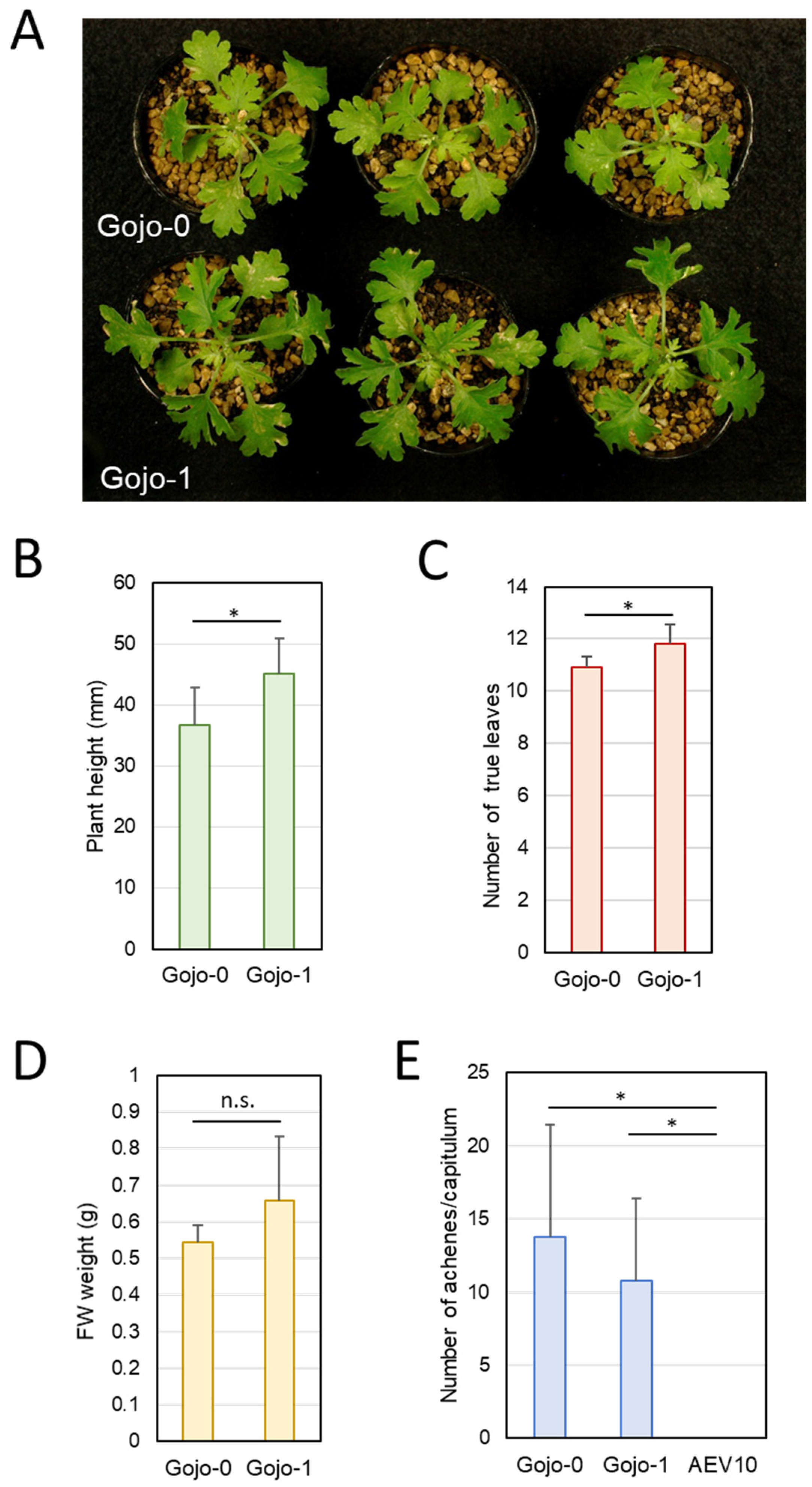
We compared the growth characteristics of the newly developed Gojo-1 line with those of Gojo-0. Gojo-1 plants tended to be taller, produce more leaves, and exhibit slightly greater biomass at 34 days after sowing than Gojo-0 plants, although the differences in biomass did not reach statistical significance at the 5% level (Figure 1A–D). The morphology of the capitulum and compound inflorescence was similar to that of Gojo-0 (Figure S3). Both Gojo-1 and Gojo-0 showed significantly higher selfed seed-set rate than the self-incompatible line AEV10 (p < 0.05) (Figure 1E), confirming that self-compatibility was retained in Gojo-1. Overall, Gojo-1 displayed characteristics similar to those of Gojo-0, but traits related to viability were slightly improved in Gojo-1.

3.2. Comparison of Tissue-Culture Characteristics

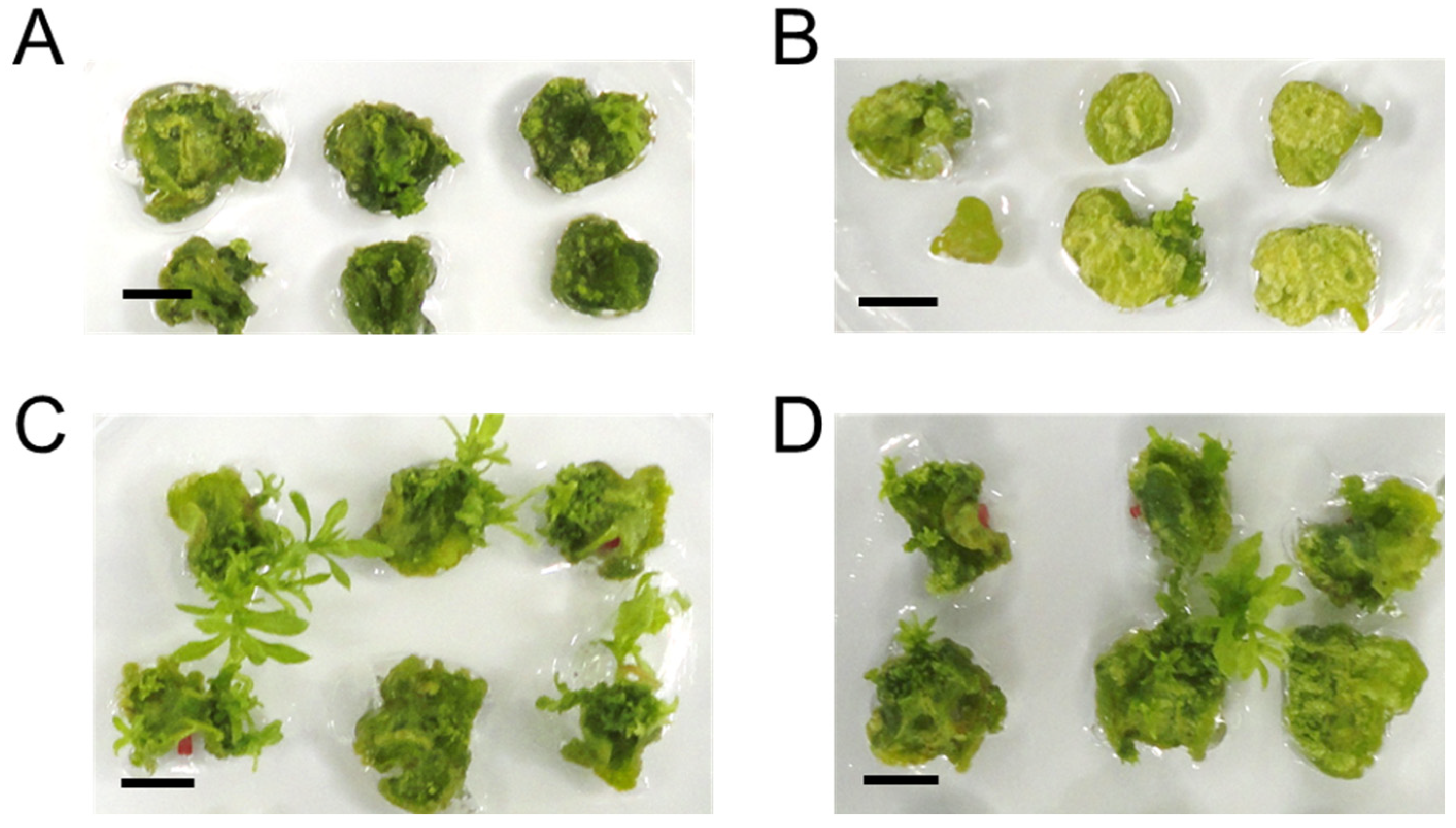
In C. seticuspe, transformants are obtained by infecting leaf discs with Agrobacterium, followed by antibiotic selection and regeneration from callus [4]. To assess whether Gojo-1 exhibits superior tissue-culture performance compared with Gojo-0, we compared the efficiencies of callus induction and shoot regeneration between the two lines. Leaf discs (6 mm in diameter), excised from aseptically grown plants using a cork borer, were placed on MS medium containing 3% sucrose, 0.3% gellan gum and adjusted to pH 5.8, supplemented with either 0.2 mg L−1 NAA and 1.0 mg L−1 BAP or 0.2 mg L−1 NAA and 2.0 mg L−1 BAP (Figure 2). After three weeks, induced calli and adventitious buds were evaluated. Under the condition of 0.2 mg L−1 NAA and 1.0 mg L−1 BAP [11], both Gojo-0 and Gojo-1 showed a 100% callus induction rate; however, the number of adventitious buds differed markedly, with 2.8 buds per leaf disc in Gojo-0 and 22.2 in Gojo-1, which represents an approximately eight-fold increase (Table 1). Similarly, under 0.2 mg L−1 NAA and 2.0 mg L−1 BAP, callus induction rates were 88.9% for Gojo-0 and 100% for Gojo-1. Adventitious bud formation again showed a large difference, with 2.2 buds per leaf disc in Gojo-0 and 15.2 in Gojo-1, representing about a seven-fold increase. These results demonstrate that Gojo-1 has a substantially higher efficiency of adventitious bud formation than Gojo-0. Therefore, Gojo-1 is considered a more suitable line for genetic transformation.

3.3. Genome Editing Using Gojo-1

Because Gojo-1 exhibits markedly higher regeneration efficiency than Gojo-0, we attempted genome editing in Chrysanthemum seticuspe using Gojo-1, as genome editing has not previously been reported in this species. As the target gene, we selected the orthologs of the C-class gene AGAMOUS (AG) in the ABC model [5]. In Asteraceae, two AG subgroups are present, and C. seticuspe also possesses two AG orthologs, CsM37 (CsGLG7.g04333.i1) and CsAGZ (CsGLG9.g43875.i1). Because these genes are orthologous to CAG1s and CAG2s in cultivated chrysanthemum, we refer to CsM37 as CsAG1 and CsAGZ as CsAG2 (Figure S4; [22]). CsAG1 and CsAG2 share 88% amino-acid identity.
A typical capitulum of Chrysanthemum consists of outer ray florets and inner disc florets. Disc florets are bisexual, whereas ray florets are female due to the degeneration of stamens. In cultivated chrysanthemum, both CAG1s and CAG2s are expressed in the pistils of ray florets and in both stamens and pistils of disc florets, and they are considered to have redundant functions [22]. In C. seticuspe, CsAG1 and CsAG2 show little expression in leaves, stems, and roots, but exhibit predominant expression in both disc and ray florets, suggesting functional redundancy similar to that in cultivated chrysanthemum, although the expression level of CsAG2 is lower than that of CsAG1 (Figure S5; [23]).
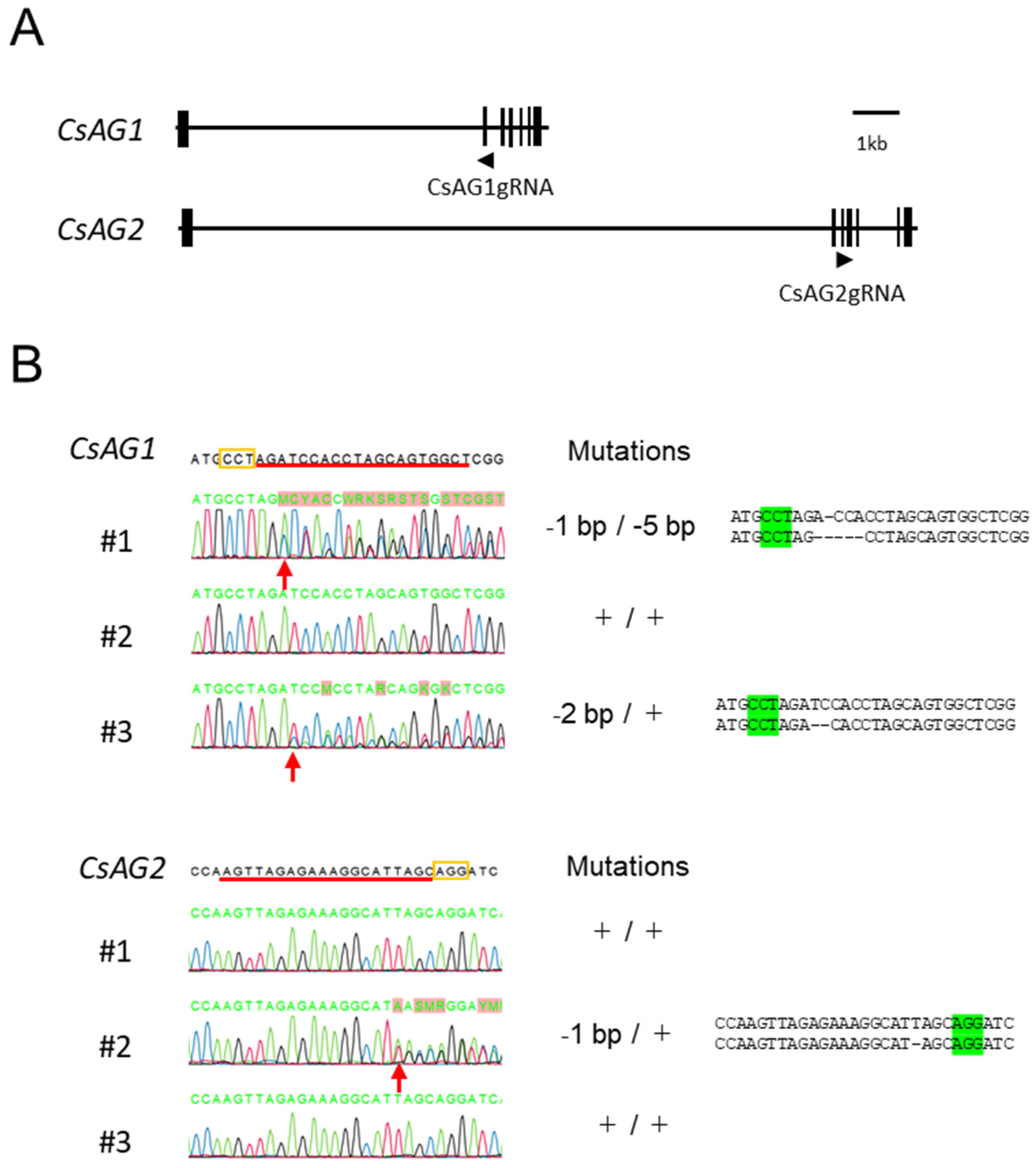
Here, gRNAs were designed to target the second exon of CsAG1 and the fourth exon of CsAG2, and genome editing was performed using the multiplex CRISPR-Cas9 vector HEMCas9-nptII (Figure 3A). Agrobacterium-mediated transformation using leaf segments yielded a total of six independent transgenic lines: five lines under regeneration conditions of 0.2 mg L−1 NAA and 0.2 mg L−1 BAP, and one line under 0.2 mg L−1 NAA and 1.0 mg L−1 BAP. Sanger sequencing of CsAG1 and CsAG2 in T1 plants revealed that transformant #2 likely carried a heterozygous 1-bp deletion in CsAG2, as inferred from chromatogram patterns (Figure 3B); however, this plant unfortunately died before flowering. Transformant #3 harbored a heterozygous 2-bp deletion in CsAG1, whereas transformant #1 carried biallelic mutations in CsAG1 consisting of 1-bp and 5-bp deletions (Figure 3B). In all cases, the mutations caused frameshifts and were therefore predicted to result in loss of gene function. Mutations were detected in three of the six transformants (individual basis: 50%), corresponding to four of twelve chromosomes (chromosomal basis: 33.3%). The frequency of obtaining biallelic mutants was 16.6%, which is comparable to that reported for targeting the PDS gene in the diploid wild species C. indicum (16.0%; [16]), although a higher frequency of biallelic mutants was achieved in that study using transformants carrying a GFP marker.
In contrast, cultivated chrysanthemum and C. indicum are self-incompatible, making it difficult to obtain selfed progeny, which represents a disadvantage for genetic functional analyses. It is well known that genome-editing efficiency varies greatly depending on the target gene. When biallelic mutants cannot be obtained due to low editing efficiency, or when technically challenging genome-editing approaches are attempted [24,25,26,27], the Gojo-1 line provides a major advantage: because it is self-compatible, homozygous mutants can be readily obtained by selfing even from heterozygous individuals. Taken together, these results indicate that an efficient genome-editing method using Gojo-1 has been established in C. seticuspe.

3.4. Functional Analysis of CsAG1 in C. seticuspe

Because members of the genus Chrysanthemum exhibit self-incompatibility, evaluating the inheritance and phenotypic manifestation of genome-edited mutations is inherently challenging. In contrast, the Gojo-1 line is self-fertile and therefore provides an appropriate genetic background for such analyses. Using line #3, which carries a heterozygous mutation in CsAG1, we sought to determine whether this mutation segregates in accordance with classical Mendelian principles. To avoid the possibility of additional somatic mutations arising in plants retaining the Cas9 transgene, we first selected, from the first selfed generation, individuals that were heterozygous for the CsAG1 mutation but lacked the CRISPR–Cas9 cassette. Among the 17 progeny obtained by selfing this line, 6 displayed the mutant phenotype (Figure 4), a segregation ratio consistent with a single recessive locus (χ2 = 0.96, p = 0.33). These results demonstrate that the CsAG1 knockout allele (csag1-1) is inherited as a typical recessive mutation under Mendelian segregation.
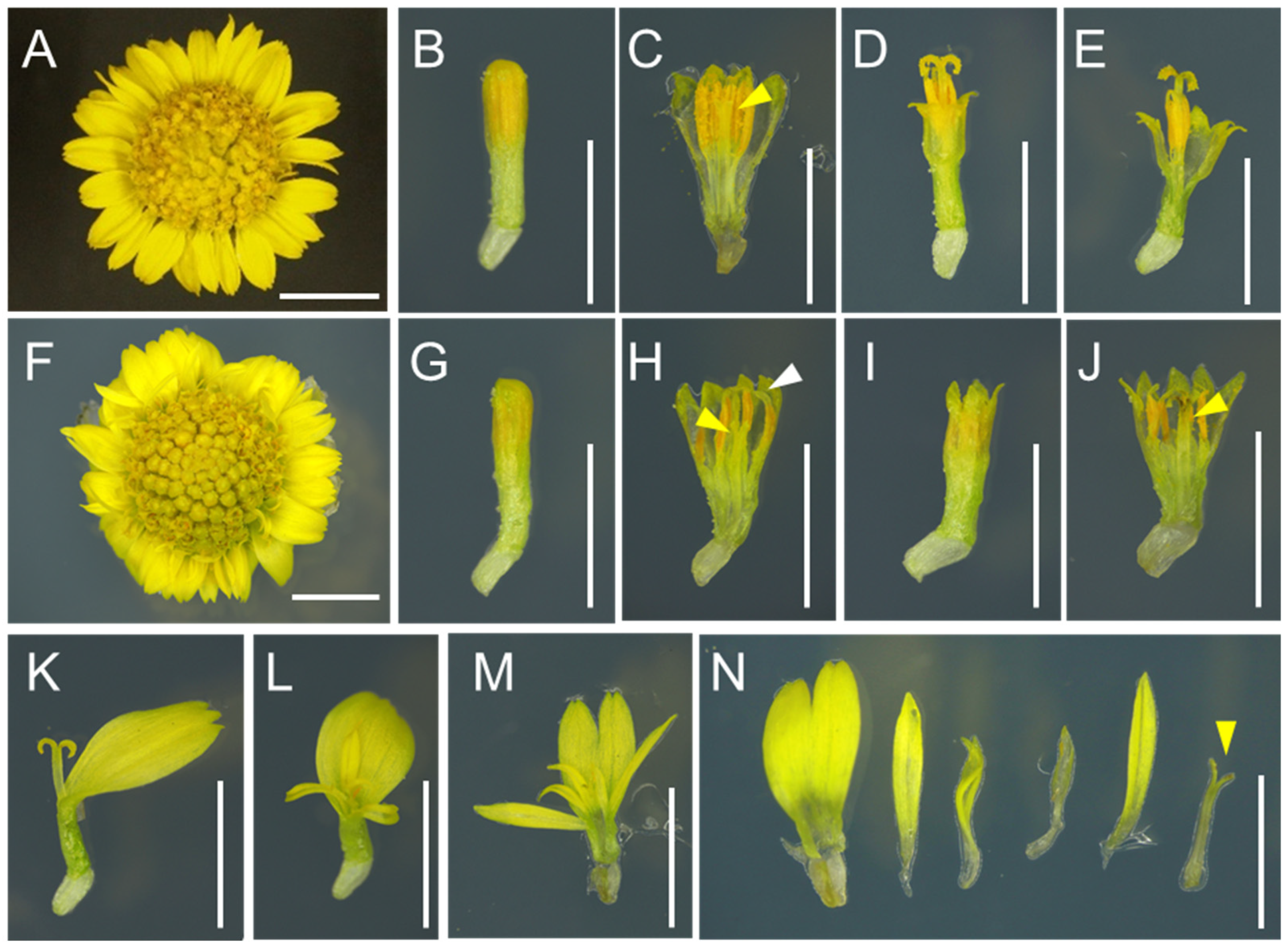
We next conducted a detailed examination of the floral phenotype. In wild-type disc florets, the corolla is tubular and divided into five lobes at the tip (Figure 4B,C). The five anthers are fused into a syngenesious column, through which the pistil elongates at anthesis; following anthesis, the stigma lobes separate and become exposed, allowing pollen deposition and germination. The calyx is vestigial and absent. By contrast, ray florets possess a tubular basal portion but develop a large, flattened ligule (Figure 4D,E). The calyx is absent, and the stamens are degenerate, rendering the ray floret functionally female. Nevertheless, the pistil is morphologically normal and fertile.
The disc florets of the csag1-1 mutants had unfused anthers that appeared shriveled, and in some florets the anther tips showed a petaloid appearance (Figure 4C,H). The style did not elongate as in the wild type (Figure 4D,E,I,J). The csag1-1 mutant was sterile, most likely due to functional defects in both the anthers and the pistils.
The ray florets of the csag1-1 mutant exhibited slight variation in phenotype among individual florets. While some ligules appeared normal, others occasionally showed bifurcation (Figure 4L,M). The internal floral structures varied considerably among florets; however, a common feature was the presence of multiple extra, slender, small petal-like organs. For example, in some florets, four to five underdeveloped petal-like structures were present in addition to the original ray petal, and an underdeveloped pistil was located at the center (Figure 4N).
In the ABC model, the class-C gene is required for the identity of stamens and carpels [28]. In the csag1-1 mutant, the poor anther development and lack of anther fusion observed in the disc florets suggest insufficient anther differentiation due to reduced class-C gene activity. Consistent with this, the apical regions of the anthers appear to have undergone petaloid transformation (Figure 4H). Similarly, the impaired pistil development observed in both disc and ray florets is likely attributable to diminished class-C gene function.
An intriguing aspect is the phenotype of the ray florets. In csag1-1, extra petal-like organs arise in addition to the original ligule (Figure 4L–N). These extra petal-like organs are most likely homeotically transformed stamens that are normally suppressed in the wild type but have undergone petaloid transformation.
In Arabidopsis, the class-C gene represses the expression of class-A genes in whorls 3 and 4 [28]. A similar regulatory mechanism may operate in C. seticuspe: reduced class-C function in whorl 3 would release the repression of class-A gene expression, allowing both class-A and class-B genes to be expressed and thereby promoting petal formation. In wild-type ray florets, no organs develop in whorl 3; however, the formation of petal-like organs in csag1-1 suggests that the suppression of organogenesis in whorl 3 is specifically associated with stamen development. This possibility is mechanistically intriguing.
In cultivated chrysanthemum, double-SRDX and double-RNAi transformants targeting both CAG1 and CAG2 have been reported [22], and their phenotypes closely resemble that of csag1-1 in C. seticuspe. However, that study did not achieve complete loss of function of the AG orthologs, nor did it provide any insight into the functional differences between CAG1 and CAG2. In addition, although the organogenesis-termination function described in Arabidopsis [28] was not observed in this study, we cannot conclude that chrysanthemum AG orthologs lack this function because only CsAG1 was knocked out in our study. Therefore, the generation of CsAG1/CsAG2 double-knockout mutant will be a critical next step to test for potential subfunctionalization or a conserved organogenesis-termination function.

3.5. Whole-Genome Sequence Comparison with Gojo-0

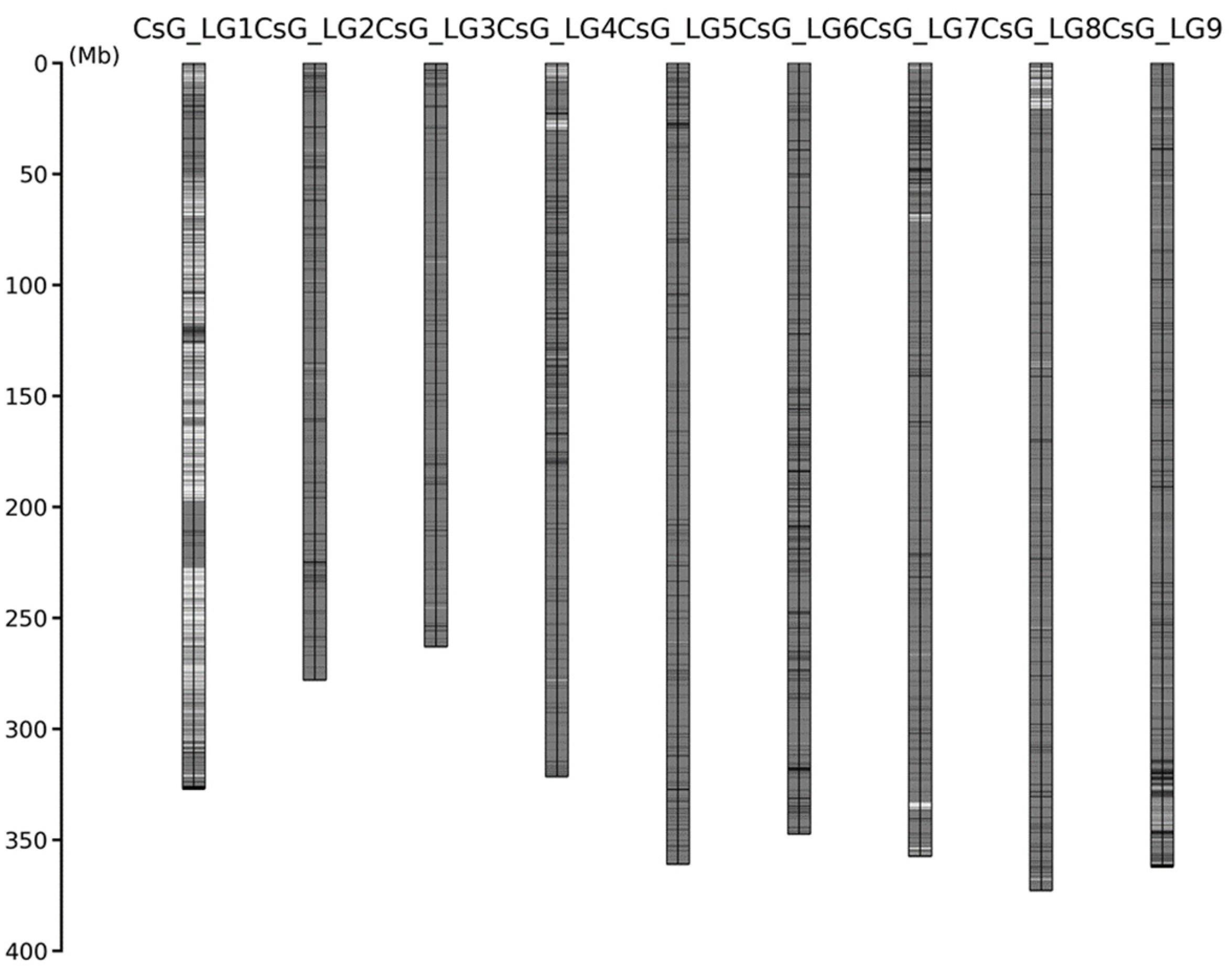
As described above, Gojo-1 is self-compatible like Gojo-0, but it shows slightly better growth and a higher regeneration efficiency than Gojo-0. Therefore, Gojo-1 is recommended for transformation experiments in C. seticuspe. Gojo-1 was generated by crossing Gojo-0, derived from AEV02, with a sibling inbred line of Gojo-0, and thus its genome sequence is expected to be highly similar to that of Gojo-0. To examine this, we obtained resequencing data of Gojo-1 using short-read sequencing and mapped the reads to the Gojo-0 genome to identify regions with high polymorphism (Figure 5 and Figure S6). After aligning the resequencing data of AEV02 and Gojo-1 to the Gojo-0 reference genome, we analyzed the sequence polymorphisms of Gojo-1 at sites that were heterozygous in AEV02. Although some highly polymorphic regions were found near the ends of several chromosomes, most polymorphic sites were located on Linkage Group 1 (LG1). Conversely, this indicates that LG2 through LG9 are highly similar to Gojo-0. Thus, the Gojo-0 genome sequence can be effectively utilized for analyses of Gojo-1 in the majority of genomic regions. On the other hand, genes responsible for the differences in culture characteristics and growth between Gojo-0 and Gojo-1, possibly genes involved in cell proliferation, plant regeneration/differentiation, or the synthesis or sensitivity of phytohormones, are likely located within the polymorphic regions between the two lines; however, these regions are extensive, making it difficult to pinpoint the causal genes at present.

4. Conclusions

Numerous omics approaches have been applied to the analysis of the cultivated chrysanthemum, C. morifolium [1]. Because C. morifolium is predominantly hexaploid and self-incompatible, it contains many homeologous genes with redundant functions and exhibits extremely high heterozygosity. These features often complicate the interpretation of data obtained by genome/omics analysis. In this study, we developed Gojo-1 as a new model line for the genus Chrysanthemum. Like Gojo-0, Gojo-1 is a diploid and highly inbred line, resulting in reduced genomic complexity, and thus Gojo-0/Gojo-1 can serve as a simplified genetic platform for functional analyses of the complex hexaploid genome of cultivated chrysanthemum, minimizing the effects of heterozygosity and redundant homeologs. The enhanced culture characteristics of Gojo-1 strengthen its utility, particularly as a gateway for functional genomics and trait engineering in chrysanthemum. For example, (i) the functional validation of predicted key genes identified through omics analysis of hexaploid cultivated chrysanthemum. Such approaches require transformation experiments; however, Gojo-0 has limitations in transformation efficiency. (ii) The use of Gojo-1 as a testbed for improving cultivated chrysanthemum. When improvement strategies are developed based on insights obtained from omics analyses of cultivated chrysanthemum, these strategies can first be tested in Gojo-1, which has a simpler genome composition. (iii) The application of advanced genome editing technologies. Because cultivated chrysanthemum is hexaploid and self-incompatible, it is inherently unsuitable for mutation induction, including genome editing. Therefore, Gojo-1 could serve as an ideal system for attempting advanced genome editing technologies that are challenging to implement in complex polyploids, such as base editing, prime editing, and promoter or enhancer replacement by genome editing (PERGE; [27]). Thus, the newly developed chrysanthemum model line Gojo-1 combines the genetic tractability and suitability for genomic and omics analyses inherited from Gojo-0 with significantly improved transformation efficiency. This line is expected to play an important role not only in basic studies of the diverse characteristic of Chrysanthemum and the Asteraceae family, but also in the development of breakthrough cultivars of chrysanthemum, one of the most economically important ornamental crops worldwide.

Supplementary Materials

The following supporting information can be downloaded at: https://www.mdpi.com/article/10.3390/horticulturae12030320/s1, Figure S1: Alignment of AGAMOUS orthologs from Asteracea species; Figure S2: Pedigree of the Gojo-1 Line; Figure S3: The Gojo-1 plant at anthesis; Figure S4: Neighbor-joining tree of AGAMOUS orthologs in Asteraceae; Figure S5: Expression of CsAG1 and CsAG2 in florets of C. seticuspe; Figure S6: Mapping of polymorphic sites between the Gojo-0 short reads and the Gojo-0 whole-genome sequence; Table S1: Primers used in this paper.

Author Contributions

Conceptualization, M.K. and M.N.; methodology, M.K. and H.S.; software, H.Y., K.T. (Koichi Toyokura) and M.N.; validation, H.Y. and M.N. and M.K.; formal analysis, M.N. and M.K.; investigation, H.Y., M.N., K.T. (Koichi Toyokura), A.M. and M.S.; resources, M.K. and K.T. (Kenji Taniguchi); data curation, M.N.; writing—original draft preparation, M.K., H.Y. and M.N.; writing—review and editing, M.K.; visualization, M.K. and M.N.; supervision, M.K.; project administration, M.K.; funding acquisition, M.K. and M.N. All authors have read and agreed to the published version of the manuscript.

Funding

This research was funded by JSPS KAKENHI, grant numbers 24H00513 and 24K08885.

Data Availability Statement

Re-sequencing data presented in the study are available in the NCBI BioProject database under accession number PRJDB40194. Further data presented in this study are available from the corresponding author upon request.

Acknowledgments

We thank Yumi Nagashima and Eriko Kaneda for technical assistance.

Conflicts of Interest

The authors declare no conflicts of interest.

Abbreviations

The following abbreviations are used in this manuscript:
BAPBenzylaminopurine
CRISPR-Cas9Clustered Regularly Interspaced Short Palindromic Repeats—CRISPR-associated protein 9
CTABCetyltrimethylammonium Bromide
DPread depth
GFPGreen Fluorescent Protein
MSMurashige and Skoog
NBRPNational BioResource Project
NAAThree letter acronym
NJNeighbor-Joining
PDSphytoene desaturase
TALENTranscription Activator-Like Effector Nuclease
TCPTEOSINTE BRANCHED1–CYCLOIDEA–PCF

References

  1. Su, J.; Jiang, J.; Zhang, F.; Liu, Y.; Ding, L.; Chen, S.; Chen, F. Current achievements and future prospects in the genetic breeding of chrysanthemum: A review. Hortic. Res. 2019, 6, 109. [Google Scholar] [CrossRef]
  2. van Geest, G.; Voorrips, R.E.; Esselink, D.; Post, A.; Visser, R.G.; Arens, P. Conclusive evidence for hexasomic inheritance in chrysanthemum based on analysis of a 183 k SNP array. BMC Genom. 2017, 18, 585. [Google Scholar] [CrossRef]
  3. Bourke, P.M.; Voorrips, R.E.; Hackett, C.A.; van Geest, G.; Willemsen, J.H.; Arens, P.; Smulders, M.J.; Visser, R.G.; Maliepaard, C. Detecting quantitative trait loci and exploring chromosomal pairing in autopolyploids using polyqtlR. Bioinformatics 2021, 37, 3822–3829. [Google Scholar] [CrossRef]
  4. Nakano, M.; Taniguchi, K.; Masuda, Y.; Kozuka, T.; Aruga, Y.; Han, J.; Motohara, K.; Nakata, M.; Sumitomo, K.; Hisamatsu, T. A pure line derived from a self-compatible Chrysanthemum seticuspe mutant as a model strain in the genus Chrysanthemum. Plant Sci. 2019, 287, 110174. [Google Scholar] [CrossRef]
  5. Nakano, M.; Hirakawa, H.; Fukai, E.; Toyoda, A.; Kajitani, R.; Minakuchi, Y.; Itoh, T.; Higuchi, Y.; Kozuka, T.; Bono, H. A chromosome-level genome sequence of Chrysanthemum seticuspe, a model species for hexaploid cultivated chrysanthemum. Commun. Biol. 2021, 4, 1167. [Google Scholar] [CrossRef]
  6. van Lieshout, N.; van Kaauwen, M.; Kodde, L.; Arens, P.; Smulders, M.J.; Visser, R.G.; Finkers, R. De novo whole-genome assembly of Chrysanthemum makinoi, a key wild chrysanthemum. G3 Genes Genomes Genet. 2022, 12, jkab358. [Google Scholar] [CrossRef]
  7. Wen, X.; Li, J.; Wang, L.; Lu, C.; Gao, Q.; Xu, P.; Pu, Y.; Zhang, Q.; Hong, Y.; Hong, L. The Chrysanthemum lavandulifolium genome and the molecular mechanism underlying diverse capitulum types. Hortic. Res. 2022, 9, uhab022. [Google Scholar] [CrossRef] [PubMed]
  8. Song, A.; Su, J.; Wang, H.; Zhang, Z.; Zhang, X.; Van de Peer, Y.; Chen, F.; Fang, W.; Guan, Z.; Zhang, F. Analyses of a chromosome-scale genome assembly reveal the origin and evolution of cultivated chrysanthemum. Nat. Commun. 2023, 14, 2021. [Google Scholar] [CrossRef] [PubMed]
  9. Hou, Z.; Yang, S.; He, W.; Lu, T.; Feng, X.; Zang, L.; Bai, W.; Chen, X.; Nie, B.; Li, C. The haplotype-resolved genome of diploid Chrysanthemum indicum unveils new acacetin synthases genes and their evolutionary history. Plant J. 2024, 119, 1336–1352. [Google Scholar] [CrossRef]
  10. Jiang, L.; Chen, S.; Wang, X.; Sen, L.; Dong, G.; Song, C.; Liu, Y. An improved genome assembly of Chrysanthemum nankingense reveals expansion and functional diversification of terpene synthase gene family. BMC Genom. 2024, 25, 593. [Google Scholar] [CrossRef] [PubMed]
  11. Zhang, J.; Zhang, J.; Li, P.; Gao, Y.; Yu, Q.; Sun, D.; Zhang, L.; Wang, S.; Tian, J.; Wang, Z. Development of a Transformation System and Locus Identification Pipeline for T-DNA in Chrysanthemum seticuspe, A Model Species for Hexaploid Cultivated Chrysanthemum. Int. J. Mol. Sci. 2022, 23, 11426. [Google Scholar] [CrossRef]
  12. Shinoyama, H.; Ichikawa, H.; Nishizawa-Yokoi, A.; Skaptsov, M.; Toki, S. Simultaneous TALEN-mediated knockout of chrysanthemum DMC1 genes confers male and female sterility. Sci. Rep. 2020, 10, 16165. [Google Scholar] [CrossRef] [PubMed]
  13. Kishi-Kaboshi, M.; Aida, R.; Sasaki, K. Generation of gene-edited Chrysanthemum morifolium using multicopy transgenes as targets and markers. Plant Cell Physiol. 2017, 58, 216–226. [Google Scholar] [CrossRef]
  14. Li, X.; Yang, Q.; Liao, X.; Tian, Y.; Zhang, F.; Zhang, L.; Liu, Q. A natural antisense RNA improves chrysanthemum cold tolerance by regulating the transcription factor DgTCP1. Plant Physiol. 2022, 190, 605–620. [Google Scholar] [CrossRef]
  15. Chen, Q.; Zhang, X.; Jin, R.; Mao, H. Establishment of a CRISPR/Cas9 gene-editing system for Chrysanthemum morifolium. Ornam. Plant Res. 2024, 4, e014, Correction in Ornam. Plant Res. 2024, 4, e040. http://doi.org/10.48130/opr-0025-0041. [Google Scholar] [CrossRef]
  16. Liu, L.; Xue, Y.; Luo, J.; Han, M.; Liu, X.; Jiang, T.; Zhao, Y.; Xu, Y.; Ma, C. Developing a UV–visible reporter-assisted CRISPR/Cas9 gene editing system to alter flowering time in Chrysanthemum indicum. Plant Biotechnol. J. 2023, 21, 1519. [Google Scholar] [CrossRef]
  17. Shirasawa Seo, N.; Nakamura, S. Genetic transformation and transgene expression of Dendranthema boreale (Makino) Ling. Bull. Miyagi Prefect. Agric. Hortic. Res. Cent. 2002, 69, 30–33. Available online: https://agris.fao.org/search/en/providers/122558/records/647242c22c1d629bc97920cb (accessed on 20 February 2026).
  18. Ito, T.; Yamatani, H.; Nobusawa, T.; Kusaba, M. Development of a CRISPR-Cas9-Based Multiplex Genome-Editing Vector and Stay-Green Lettuce. In Gene Editing in Plants: CRISPR-Cas and Its Applications, 1st ed.; Kumar, A., Arora, S., Ogita, S., Yau, Y.-Y., Mukherjee, K., Eds.; Springer: Berlin, Germany, 2024; pp. 405–414. Available online: https://link.springer.com/chapter/10.1007/978-981-99-8529-6_15 (accessed on 20 February 2026).
  19. Haqani, M.I.; Nomura, S.; Nakano, M.; Goto, T.; Nagano, A.J.; Takenouchi, A.; Nakamura, Y.; Ishikawa, A.; Tsudzuki, M. Mapping of quantitative trait loci controlling egg-quality and-production traits in Japanese quail (Coturnix japonica) using restriction-site associated DNA sequencing. Genes 2021, 12, 735. [Google Scholar] [CrossRef]
  20. Danecek, P.; Bonfield, J.K.; Liddle, J.; Marshall, J.; Ohan, V.; Pollard, M.O.; Whitwham, A.; Keane, T.; McCarthy, S.A.; Davies, R.M. Twelve years of SAMtools and BCFtools. Gigascience 2021, 10, giab008. [Google Scholar] [CrossRef]
  21. Hashimoto, S. GenoSee: A novel visualization tool for graphical genotypes. Breed. Sci. 2024, 74, 454–461. [Google Scholar] [CrossRef]
  22. Sasaki, K.; Yoshioka, S.; Aida, R.; Ohtsubo, N. Production of petaloid phenotype in the reproductive organs of compound flowerheads by the co-suppression of class-C genes in hexaploid Chrysanthemum morifolium. Planta 2021, 253, 100. [Google Scholar] [CrossRef]
  23. Sun, D.; Zhang, J.; He, J.; Geng, Z.; Li, S.; Zhang, J.; Li, P.; Zhang, L.; Wang, Z.; Wang, L. Whole-transcriptome profiles of Chrysanthemum seticuspe improve genome annotation and shed new light on mRNA–miRNA–lncRNA networks in ray florets and disc florets. BMC Plant Biol. 2022, 22, 515. [Google Scholar] [CrossRef]
  24. Gallo, D.; Meunier, A.-C.; Périn, C. A long journey towards genome editing technologies in plants: A technical and critical review of genome editing technologies. Front. Genome Ed. 2025, 7, 1663352. [Google Scholar] [CrossRef] [PubMed]
  25. Gilbertson, L.; Puchta, H.; Slotkin, R.K. The future of genome editing in plants. Nat. Plants 2025, 11, 680–685. [Google Scholar] [CrossRef] [PubMed]
  26. Lu, Y.; Wang, J.; Chen, B.; Mo, S.; Lian, L.; Luo, Y.; Ding, D.; Ding, Y.; Cao, Q.; Li, Y. A donor-DNA-free CRISPR/Cas-based approach to gene knock-up in rice. Nat. Plants 2021, 7, 1445–1452. [Google Scholar] [CrossRef]
  27. Nobusawa, T.; Yamatani, H.; Kusaba, M. Promoter/enhancer replacement by genome editing for crop improvement. Trends Plant Sci. 2026, 31, 273–281. [Google Scholar] [CrossRef] [PubMed]
  28. Bowman, J.L.; Moyroud, E. Reflections on the ABC model of flower development. Plant Cell 2024, 36, 1334–1357. [Google Scholar] [CrossRef]
Figure 1. Growth characteristics of the Gojo-1 line. (AD) Growth of Gojo-0 and Gojo-1 at 34 days after sowing, including overall plant appearance (A), plant height (B), number of true leaves (C), and shoot fresh weight (D). (E) Seed-set rate of Gojo-1. The selfed seed-set rate is presented as the number of achenes per capitulum. To prevent outcrossing, capitula were enclosed in mesh pollination bags. AEV10 is a self-incompatible line. Sample sizes were as follows: (B), Gojo-0: n = 6; Gojo-1: n = 8; (C,D), n = 10; (E), n = 4. Statistical significance was evaluated using t-test. * p < 0.05. The scale bar represents 2 cm. Error bars indicate standard deviations. n.s., not significant.
Horticulturae 12 00320 g001
Figure 2. Tissue-culture characteristics of Gojo-1. Sterile leaf discs of Gojo-0 (A,B) and Gojo-1 (C,D) were cultured on MS medium containing 3% sucrose and 0.3% gellan gum, adjusted to pH 5.8, and supplemented with either 0.2 mg L−1 NAA and 1.0 mg L−1 BAP (A,C) or 0.2 mg L−1 NAA and 2.0 mg L−1 BAP (B,D). Cultures were maintained for three weeks. Scale bars represent 1 cm.
Horticulturae 12 00320 g002
Figure 3. Genome editing of CsAG1 and CsAG2 using CRISPR-Cas9. (A) Gene structures of CsAG1 and CsAG2. gRNAs were designed in exon 2 of CsAG1 and exon 4 of CsAG2. (B) DNA mutations induced in CsAG1 and CsAG2. Mutations were detected in transformants #1–#3. A mutation in CsAG2 was identified in transformant #2, whereas mutations in CsAG1 were found in transformants #1 and #3. In the sequencing chromatograms, the gRNA target sequence is indicated by a red underline, and the PAM sequence is shown in orange boxes. Bases interpreted as mixed nucleotides during sequencing are highlighted in light red. Red arrows indicate the mutation sites. “Mutations” refers to the alterations detected in each strand of the DNA duplex. Green highlights indicate the PAM sequences.
Horticulturae 12 00320 g003
Figure 4. Phenotypes of CsAG1 knockout plants. (AE,K) Capitula and florets of Gojo-1. (FJ,LN) Capitula and florets of CsAG1 knockout plants. (A,F) Capitula. (B,C,G,H) Disc florets before anthesis. (C,H) Disc florets with the corolla and anthers dissected. (D,E,I,J) Capitula after anthesis. (E,J) Disc florets with the corolla dissected. (KN) Ray florets of Gojo-1 (K) and CsAG1 knockout lines (L,M). (N) A ray floret dissected into individual floral organs of a CsAG1 knockout line. The white arrowhead in (H) indicates the petal-like structure at the tip of the petaloid anther. The yellow arrowheads in (C,H,J,N) indicate the pistils. Scale bars represent 0.5 cm.
Horticulturae 12 00320 g004
Figure 5. Mapping of polymorphic sites between Gojo-1 short reads and the Gojo-0 whole-genome sequence. Polymorphic sites corresponding to positions that were heterozygous in AEV02 and detected between the Gojo-1 short-read sequences and the Gojo-0 whole-genome sequence were visualized on the Gojo-0 reference genome using Genosee. Genotype states are shown as horizontal lines at marker positions. Variant calls are represented as reference homozygotes (gray), heterozygotes (black), and alternative homozygotes (white).
Horticulturae 12 00320 g005
Table 1. Efficiency of adventitious bud formation.
StrainComposition of Plant Hormones (mg/L)No. of Leaf DiscsNo. of Induced CalliEfficiency of Calli Formation
(%) *
No. of Induced BudsNo. of Induced Buds/Leaf Disc
Gojo-0NAA 0.2, BAP 1.099100.0252.8
NAA 0.2, BAP 2.09888.9202.2
Gojo-1NAA 0.2, BAP 1.099100.020022.2
NAA 0.2, BAP 2.099100.013715.2
* Callus formation efficiency (%) per leaf disc.
Disclaimer/Publisher’s Note: The statements, opinions and data contained in all publications are solely those of the individual author(s) and contributor(s) and not of MDPI and/or the editor(s). MDPI and/or the editor(s) disclaim responsibility for any injury to people or property resulting from any ideas, methods, instructions or products referred to in the content.