Article

Improving Water Use Strategies in Greenhouse Tomato with Superabsorbent Polymers: Effects on Fruit Yield Under Deficit Irrigation


Department of Veterinary Sciences, University of Messina, 98168 Messina, Italy
*
Author to whom correspondence should be addressed.
Horticulturae 2026, 12(3), 321; https://doi.org/10.3390/horticulturae12030321
Submission received: 31 January 2026 / Revised: 5 March 2026 / Accepted: 6 March 2026 / Published: 8 March 2026
(This article belongs to the Special Issue Abiotic Stress Responses of Vegetable Crops—2nd Edition)

Abstract

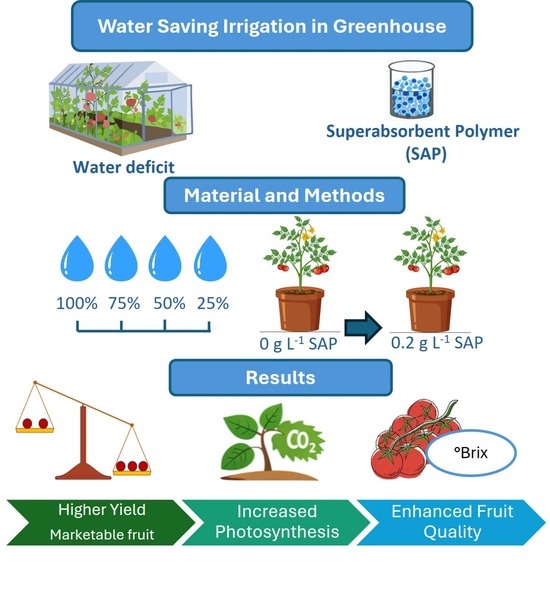
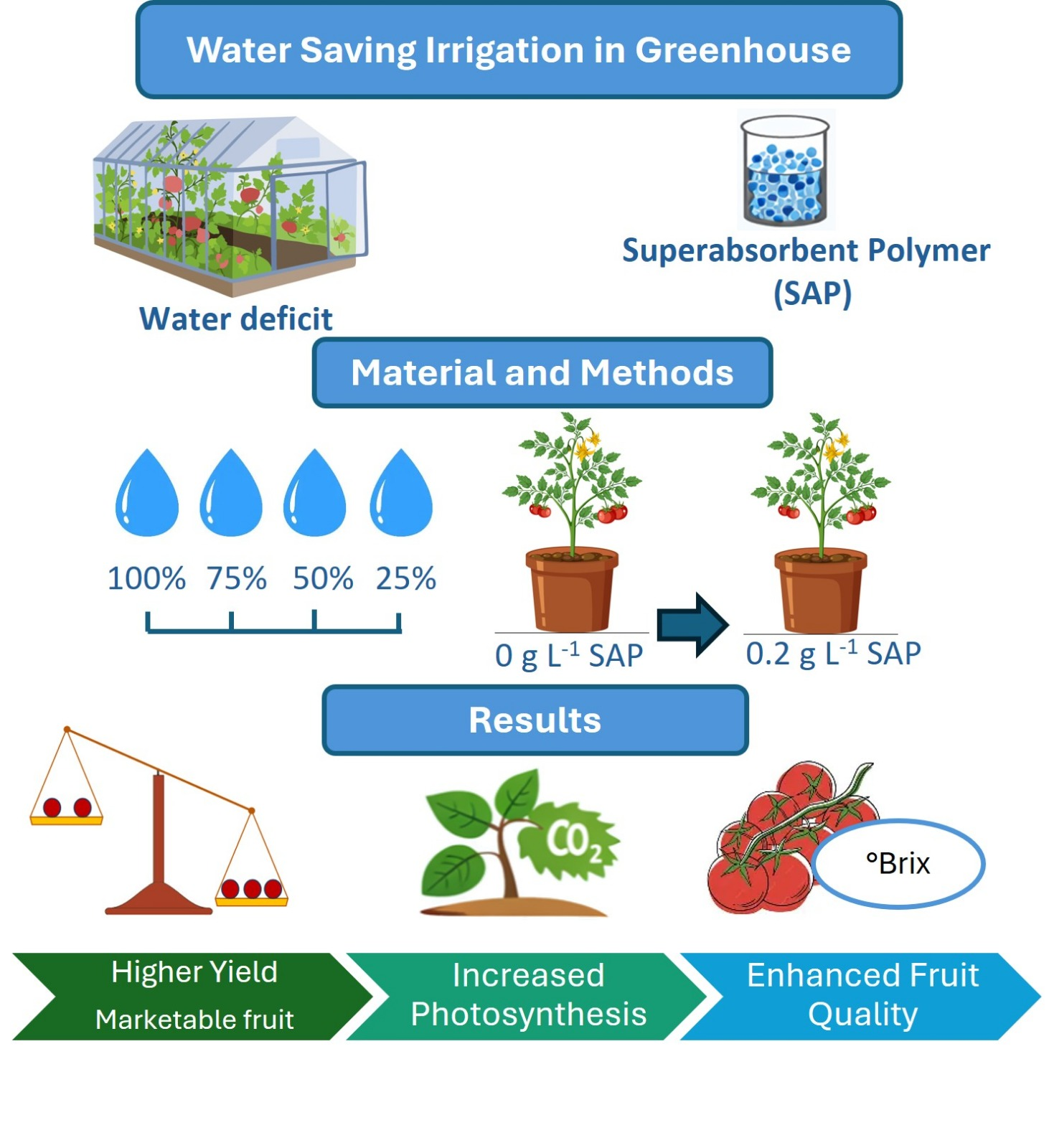
Water scarcity is increasingly challenging greenhouse tomato production, particularly in Mediterranean and semi-arid regions where irrigation water availability is becoming progressively limited. This study evaluated whether a superabsorbent polymer (SAP) can support water-saving irrigation in tomato grown in coconut fibre. Plants were cultivated in pots under four irrigation amounts (100, 75, 50, and 25% of crop water requirement—WC) combined with two SAP levels (0 and 2 g L−1). Irrigation was managed by a lysimetric control system. Reducing irrigation decreased total fruit yield (averaged across SAP treatments) from 100% WC (1212 g plant−1) to 50–25% WC (914 and 624 g plant−1, respectively), while non-marketable fruit number was unchanged (15.4 fruit plant−1, on average). SAP increased total yield, averaged across irrigation treatments (from 925 to 1022 g plant−1), and marketable fruit number (from 26.3 to 32.3 fruit plant−1), without affecting unitary fruit weight (20.4 g fruit−1, on average). SAP also increased net photosynthesis (from 16.0 to 17.4 µmol CO2 m−2 s−1), while stomatal conductance (0.14–0.15 mol H2O m−2 s−1) and WUE (4.0 µmol CO2 mmol−1 H2O) were not affected by SAP. Total soluble solids increased under severe deficit (7.8 °Brix at 25% WC) and were enhanced by SAP (from 6.9 to 7.6 °Brix), while colour parameters were mainly driven by irrigation. Overall, the irrigation amount was the primary driver of performance. Moderate deficit irrigation (75% WC) maintained a marketable fruit number and total fruit weight comparable to full irrigation (100% WC). SAP amendment acted as a complementary tool to improve marketable production and net photosynthesis across irrigation levels, providing an additive benefit to crop productivity.

Graphical Abstract

1. Introduction

Water scarcity is increasingly constraining horticultural production worldwide, and climate change is amplifying the frequency and severity of drought events, with particularly strong implications for irrigated and high-value cropping systems. In greenhouse vegetable systems, where yield stability and product uniformity are essential for economic viability, improving water efficiency while maintaining marketable yield and quality is a central agronomic objective. Tomato (Solanum lycopersicum L.) is among the most economically important vegetable crops [1] and is notably sensitive to water deficit, particularly around flowering and fruit development, when stress can reduce fruit set, limit fruit growth, and increase the proportion of non-marketable production.
Superabsorbent polymers (SAPs) and hydrogel-based soil/substrate conditioners are increasingly being investigated as a practical tool to improve water management in intensive greenhouse and soilless systems, particularly under water-limited conditions. By increasing the effective water-holding capacity of the root zone and smoothing short-term fluctuations in water availability, SAPs can support plant functioning under deficit irrigation and potentially reduce irrigation inputs while maintaining yield and marketability in high-value horticultural crops [2,3]. In this regard, SAPs grafted with acrylamide and combined with mineral fillers can reach very high swelling capacities [4].
From a functional standpoint in cropping media, SAP/hydrogels act as crosslinked hydrophilic networks capable of absorbing large volumes of irrigation solution and releasing it progressively as the surrounding substrate dries. This buffering effect can attenuate short-term water fluctuations in the root zone, particularly in systems with limited water-holding capacity. In addition to moisture regulation, SAP incorporation may modify substrate hydro-physical properties, including porosity, bulk density and hydraulic conductivity, potentially influencing drainage dynamics and nutrient retention [5,6]. The magnitude of these effects, however, depends on substrate type, irrigation management and polymer characteristics. Evidence across both soil and soilless systems confirms that SAP incorporation can substantially increase water retention of both soil and soilless substrates, with concomitant improvements in plant growth, supporting their relevance for intensive horticultural production systems [7,8,9].
Tomato studies support SAP potential under water deficit, though responses are context dependent. Under greenhouse pot conditions, alginate-based hydrogels improved tomato growth traits under contrasting deficit levels compared with non-amended controls [10].
Under field conditions in Mediterranean processing tomato, SAP application increased irrigation water use efficiency (WUE) and, under moderate deficit irrigation, helped maintain yield and quality comparable to full irrigation, largely via an increase in marketable fruit number [3]. For instance, under a furrow irrigation system in Ethiopia, the marketable and total tomato yield were significantly affected by the irrigation regime, and 75% ETc combined with mulch was identified as an agronomically and economically favorable strategy [11]. Field evidence from other vegetable crops similarly indicates that SAP addition can mitigate moderate water deficit by improving water status and sustaining yield-related traits [12].
Recent evidence also suggests that SAP effects can be associated with improved plant water status and reduced oxidative stress under deficit irrigation; in tomato, SAP increased yield and WUE and improved indicators such as relative water content and chlorophyll while lowering oxidative stress markers under stronger deficits [13]. SAPs have also been tested as seed coatings or applied in planting furrows, highlighting beneficial effects on the vegetative development of sorghum under low-water conditions [14].
These findings indicate that SAPs can alleviate water deficit, but they also highlight that outcomes may vary with irrigation scheduling; thus, understanding SAP responses across irrigation amount is essential for practical water-saving and scheduling recommendations.
Despite increasing interest, limited information is available for intensive greenhouse tomato soilless systems, particularly those based on coconut fibre substrates, where the root-zone water reservoir is small and drying cycles are rapid. Under these conditions, SAP effects may differ substantially from soil systems as moisture buffering fertigation concentration and polymer hydration–dehydration dynamics can interact more directly with plant water status. Moreover, few studies have systematically compared multiple deficit irrigation levels ranging from full to severe restriction within the same experimental framework while simultaneously evaluating yield components, fruit quality traits, and physiological responses. Evidence from pot experiments in other vegetable crops also suggests that the effect of SAP may involve dose- and management-dependent trade-offs, and that WUE and yield do not necessarily respond proportionally to increasing SAP rates [15]. Recent work on polymer gel substrates for intensive protected cultivation further supports the feasibility of gel-based root environments, with tomato showing a relatively strong growth and productivity response t under controlled conditions [16].
Accordingly, the objective of this study was to quantify the effects of superabsorbent polymer (SAP) amendment on greenhouse-grown potted tomato under four irrigation amounts (100%, 75%, 50% and 25% of crop water requirement) and two SAP rates (0 and 2 g L−1). The study specifically assessed total and marketable yield, yield components, the unmarketable fraction, and irrigation water efficiency, aiming to clarify whether SAPs can consistently support water-saving strategies across contrasting deficit levels and scheduling regimes.

2. Materials and Methods

2.1. Experimental Site and Plant Material

A greenhouse experiment was conducted at a farm in Milazzo (ME) from April 2025 to August 2025. Tomato plants (cv. Proxy F1) were transplanted at the two true-leaf stage into black plastic pots (20 cm diameter, 5 L capacity), arranged in simple rows (0.30 × 1.00 m, 3.3 plants m−2) within an open soilless system and coconut fibre as growing medium, chosen for its widespread use in greenhouse tomato production and its relatively low water holding capacity, which could amplify SAP effects. The plants were cultivated as single stems up to the 6th cluster. Bumblebees (Bombus spp.) were introduced into the greenhouse to promote fruit set. Additional agronomic practices included the manual removal of lateral shoots, defoliation, and topping. Phytosanitary treatments were carried out following standard farm practices. The experimental design included four irrigation amounts, corresponding to 100%, 75%, 50%, and 25% of the crop water requirement (WC), combined with two superabsorbent polymer (SAP) amendments. At transplanting, SAP granules were uniformly incorporated into the growing medium at two rates (0 and 2 g L−1, the recommended dose). The material consisted of a natural, biodegradable, alga-derived hydrogel developed by BeadRoots Srl (Lecce, Italy) (patent pending) with a water retention capacity of up to 100× its initial dry weight.
During the experimental period, relative air humidity remained consistently high, varying between 47% and 87%, while mean daily air temperatures ranged from 14.8 to 32.1 °C.
The experiment was arranged in a 2-way randomized complete block design (irrigation amount × SAP amendments), with 3 replications. Each replication consisted of six plants (pots).
Fruits from the first cluster were harvested at commercial ripeness, approximately 70 days after transplanting, when they reached the light-red colour stage. Subsequent harvests were performed progressively as the sixth cluster reached maturity. After each harvest, fruits were detached from the rachis and classified as marketable or unmarketable, including malformed or cracked fruits. Data collection included fruit number, individual fruit weight and size, as well as total and marketable yield.

2.2. Irrigation

The experiment was conducted using a drip irrigation system controlled by a lysimetric setup that continuously measured pot weight and automatically triggered irrigation events [17]. For each treatment, the target weight range was calculated as the difference between pot weight at field capacity (FC) and dry substrate weight (DW), scaled by the irrigation fraction. For 100% WC,
Target   weight 100 % = D W + F C D W  
For 75%, 50%, and 25% WC, the target weight was proportionally reduced. Irrigation was triggered when the pot weight fell below 85% of the target, corresponding to a substrate moisture level that limits water availability without causing severe stress. The 100% WC treatment was defined as maintaining readily available water at approximately 10% of substrate content, targeting a drainage fraction of 10–15%. Reduced irrigation treatments applied proportionally smaller volumes per event, while maintaining the 85% threshold relative to each treatment’s target weight.
This strategy allowed irrigation to be dynamically adjusted in response to climatic conditions. Fertigation was uniformly applied across all treatments using a complete nutrient solution containing macronutrients (mmol L−1), i.e., 13.59 NO3–N, 1.42 NH4+–N, 2.21 PO43−–P, 7.23 K+, 5.28 Ca2+, 2.99 Mg2+, and 4.87 SO42−–S, and micronutrients (μmol L−1), i.e., 18.44 Fe2+, 34.72 B, 0.96 Cu2+, 6.40 Zn2+, 12.01 Mn2+, and 0.72 Mo. The nutrient solution was formulated to achieve an electrical conductivity of 1.9 dS m−1, with the pH adjusted to a range of 5.5–6.2. During the experimental period, the number of irrigation events ranged from 2 to 14, the cumulative irrigation volumes amounted to 201 L pot−1 for the 100% WC treatment, 150.4 L pot−1 for the 75% WC treatment, 102.3 L pot−1 for the 50% WC treatment and 50 L pot−1 for the 25% WC treatment.

2.3. Total Soluble Solids (TSSs)

Total soluble solids (TSSs), expressed as °Brix, were measured using a portable digital refractometer (HANNA Instruments Italia Srl, Padua Italy). For each replicate, TSS measurements were performed on six marketable fruits randomly selected from the 2nd and 5th clusters. Tomato juice was prepared by blending tomato fruit using a blender for 5 min. Five mL of the juice was taken and centrifuged (Neya 10R, REMI, Mumbai, India) at 5000 rpm. The clear supernatant (1–2 mL) was taken and three drops were then carefully applied on the refractometer using a plastic dropper and the reading was obtained directly as the percentage soluble solids concentration (°Brix range 0–95% at 22 °C).

2.4. Fruit Shape Index and Color

Fruit shape and colour were assessed at commercial ripeness. For each replicate, six marketable fruits were randomly selected from the 2nd and 5th clusters and used for morphological and colour measurements. Fruit dimensions were measured by recording the longitudinal (L) and transverse (D) diameters using a digital caliper. Fruit morphology was quantified through the fruit shape index (FSI), defined as the ratio between fruit length and width (L/D), in accordance with the methodology reported by Brewer et al. [18].
Tomato colour was assessed by determining the CIELAB colour parameters: lightness (L*), red–green coordinate (a*), and yellow–blue coordinate (b*), using a CR-200 colorimeter (Konica Minolta, Inc., Tokyo, Japan).

2.5. Physiological Parameters

At 70 days after transplanting, before harvesting the first cluster, gas exchange measurements were carried out in six plants per treatment using a CO2/H2O infrared gas analyzer (LCi, ADC Bioscientific Ltd., Hoddesdon, UK) from 10:00 to 14:00. This timing corresponded to the onset of the productive phase, thus providing a physiological snapshot of plant performance at the beginning of harvest. For each replicate, the net photosynthetic rate (An), stomatal conductance (gs) and transpiration rate (E) were recorded. Instantaneous water use efficiency (WUE) was calculated as the An/E ratio, indicating the amount of CO2 fixed per unit of transpired water. At the same time, SPAD index, flavonol content (FLvM) (F660/F375), and anthocyanin content (AnthM) (F660/F525nm) were measured using an MPM-100 (Opti-Sciences Corporation, Tyngsboro, MA, USA).

2.6. Data Analysis

Analysis of variance (ANOVA), including two-way ANOVA, was performed using CoStat version 6.311 (CoHortSoftware, Monterey, CA, USA). Prior to ANOVA, normality of residuals was assessed using the Shapiro–Wilk test, and homogeneity of variances was evaluated using the Levene test. Tukey’s test (p < 0.05) was applied to determine significant differences among groups. Measurements were collected on six plants per replicate; statistical analyses were performed on replicate means, with the replicate considered as the experimental unit.

3. Results

3.1. Fruit Yield and Yield Components

The two-way ANOVA highlighted a strong main effect of irrigation amount (I) and SAP amendment (S) on most yield and yield-related traits, while no significant effects were observed for interactions I × S, indicating that the effects of the two factors were largely independent and additive (Table 1).

3.2. Effect of Irrigation Amount (I)

A clear gradient was observed across irrigation amounts. Compared with full irrigation (100% WC), the moderate deficit (75% WC) caused only a limited but significant reduction in total fruit number (48.5 vs. 50.4 fruits plant−1), without affecting marketable fruit number, total fruit weight, or unitary fruit weight. In contrast, more severe water deficits (50% and 25% WC) caused marked yield penalties. At 50% WC, total fruit number declined to 42.4 fruits plant−1, accompanied by a significant reduction in total fruit weight (914.7 g plant−1) and unitary fruit weight (20.0 g) in comparison with full irrigation (100% WC) (1212.3 g plant−1 and 23.5 g fruit−1, respectively). The most severe deficit (25% WC) led to the strongest yield depression, with total fruit number decreasing to 37.1 fruits plant−1, marketable fruit number to 22.9 fruits plant−1, and total fruit weight to 624.4 g plant−1, corresponding to an approximate 48% reduction in total yield per plant compared with full irrigation. Unitary fruit weight also declined sharply under this treatment (15.2 g fruit−1). Overall, moving from 100% WC to 25% WC corresponded to an approximate 50% reduction in total yield per plant. Non-marketable fruit number was not significantly affected by irrigation amount, suggesting that deficit irrigation primarily reduced productive yield (fruit set and/or growth) rather than increasing the proportion of defective fruit.

3.3. Effect of SAP (S)

SAP amendment significantly improved yield performance compared with the untreated control mainly through total fruit number (46.5 vs. 42.7 fruits plant−1) and marketable fruit number (32.3 vs. 26.3 fruits plant−1), resulting in higher total fruit weight (1022.2 vs. 925.0 g plant−1). In contrast, SAP had no significant effect on unitary fruit weight, indicating that the yield benefit was predominantly attributable to improved fruit set and marketability rather than to enhanced individual fruit growth. Consistently, SAP also showed a numerical reduction in non-marketable fruits (14.2 vs. 16.4 fruits plant−1), although this variable was non-significant. Overall, SAP amendment increased the proportion of marketable yield, reinforcing the interpretation that SAP primarily acts by improving the productive efficiency of the crop rather than fruit growth.

3.4. Cluster Dynamics Across the Cropping Cycle

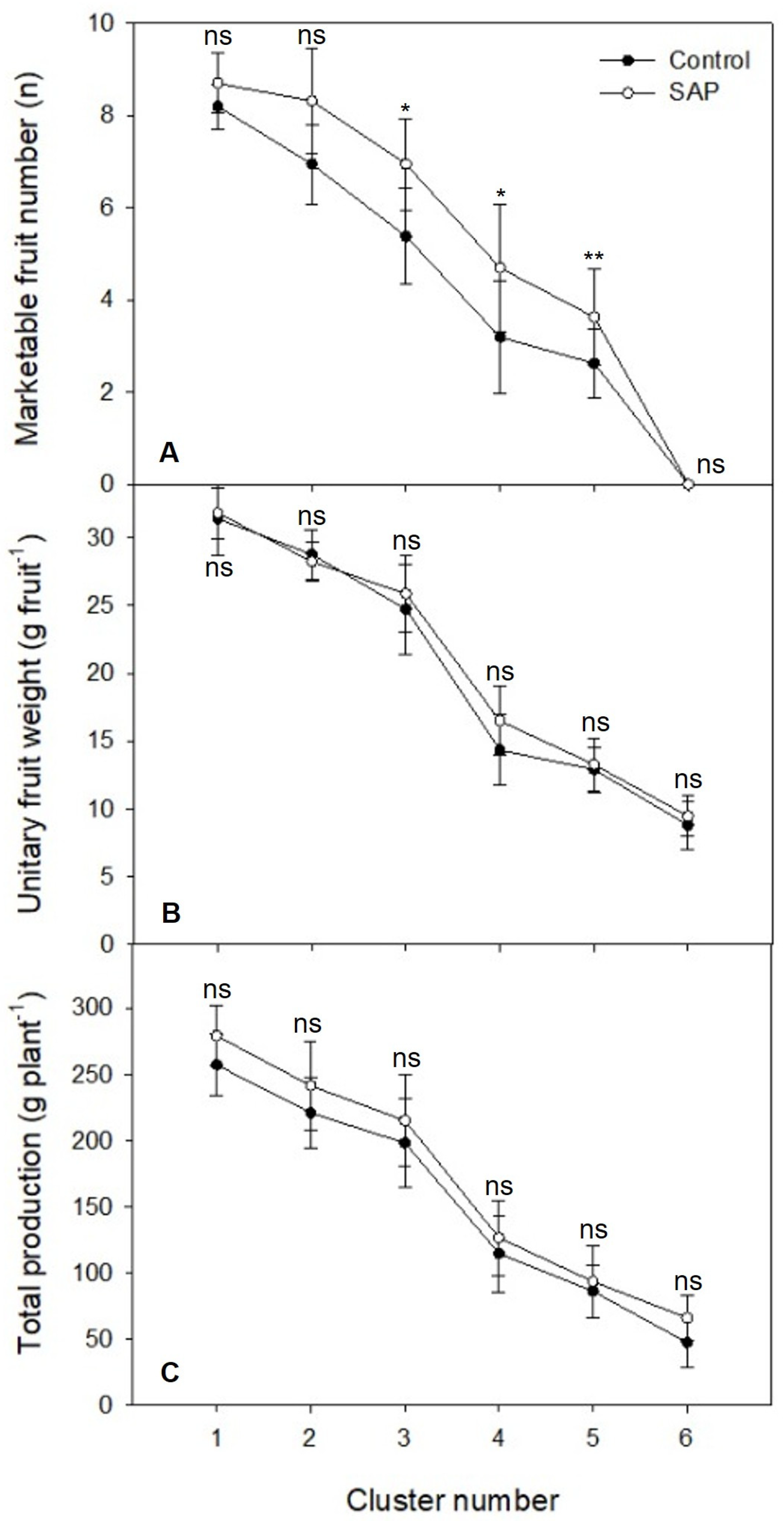
Cluster profiles revealed a strong positional/temporal gradient in reproductive output (Figure 1). Marketable fruit number per cluster decreased progressively from the first to the sixth cluster in both treatments until zero in the last cluster, indicating a gradual reduction in fruit set as the crop advanced.
In parallel, unitary fruit weight showed a marked decline across successive clusters, dropping from more than 30 g in the first cluster to less than 10 g in the final cluster. The combined reduction in fruit number and fruit size resulted in a steep decrease in yield contribution per cluster (total production), with most production concentrated in the first clusters and progressively declining toward cluster 6.
Across these within-plant patterns, SAP consistently tended to maintain higher values than the control, particularly for marketable fruit number and total production in the intermediate clusters (approximately clusters 2–4). Importantly, the SAP advantage was minimal for unitary weight, supporting the whole-plant evidence (Table 1) that SAP acted mainly by sustaining marketable fruit production rather than by increasing fruit size. Overall, the cluster analysis provides a mechanistic explanation for the higher marketable fruit number and yield observed under SAP, by showing that SAP partially attenuated the late-cluster decline in marketability and yield contribution.

3.5. Fruit Quality Traits and Colour Parameters

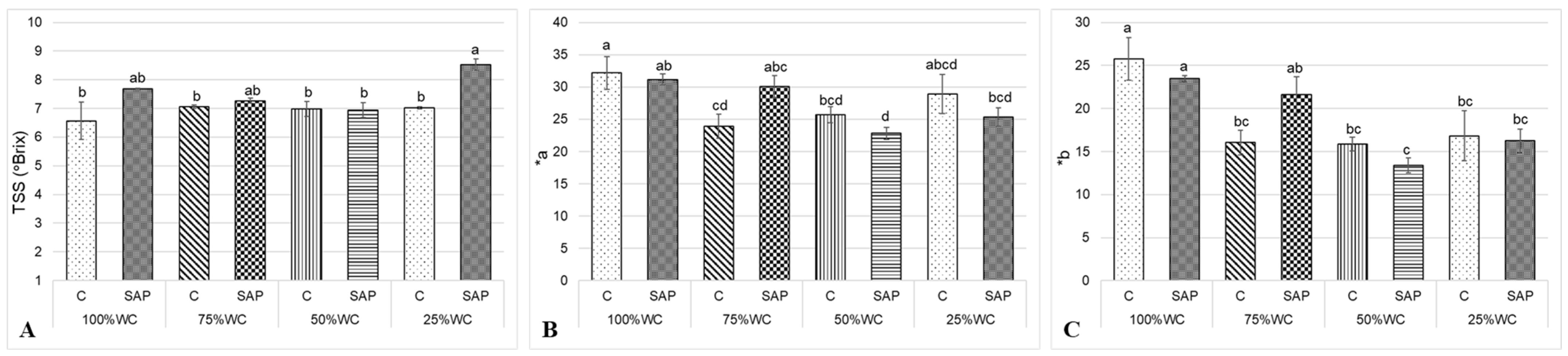
Fruit quality attributes were significantly affected by irrigation regime and, to a lesser extent, by SAP amendment (Table 2). Soluble solids content (°Brix) showed significant main effects on both factors, as well as a significant I × S interaction, indicating that the SAP effect on °Brix depended on the irrigation regime. Across irrigation amounts, the highest TSS was recorded under the most severe deficit (25% WC: 7.8 °Brix), whereas treatments with higher water content (100% WC and 75% WC) showed comparable values (7.1–7.2 °Brix), and 50% WC resulted in the lowest value (6.9 °Brix). Overall, SAP increased soluble solids (SAP: 7.6 °Brix vs. Control: 6.9 °Brix), supporting a consistent improvement in sweetness-related quality under SAP application.
Colour-related traits responded mainly to irrigation amount (Table 2). Lightness (L*) was significantly influenced by irrigation amount, with higher L* at 25% WC (41.2) compared with 100% WC and 75% WC (37.0 and 36.7, respectively). In contrast, redness (a*) and yellowness (b*) decreased under severe deficit irrigation. The highest a* value was observed under full irrigation (100% WC: 31.7), while reduced values were measured under 75% WC, 50% WC and 25% WC (27.0, 24.3 and 27.1, respectively). Similarly, b* declined markedly from 24.6 at 100% WC to 18.8 at 75% WC and reached the minimum at 50% WC (14.6), undifferentiated from the 25% WC (16.5). SAP did not significantly influence L*, a*, or b* as main effects; however, significant I × S interactions were detected for a* and b* (Figure 2B,C), suggesting that the response of colour coordinates to irrigation amount differed between SAP-treated and control plants, even though overall mean differences were small. Finally, the fruit shape index (FSI) was not affected by any factor, remaining stable across irrigation amounts and SAP treatments (0.82–0.83).

3.6. Physiological Parameters

Physiological parameters were differentially affected by irrigation amount and SAP levels (Table 3). Irrigation significantly influenced the gas exchange parameters (An, gs, and WUE). Plants irrigated at 100% WC and 75% WC showed higher An values compared to 50% WC and 25% WC plants, which showed a significant reduction in photosynthetic activity (−16% and −39%, respectively). Stomatal conductance (gs) decreased progressively with decreasing irrigation, reaching the lowest value at 25% WC (−36%). WUE showed significant differences at 25% WC, with a reduction of 39%. SPAD index, flavonoid, and anthocyanin were not significantly affected by irrigation amount (Table 3).
Except for An, ANOVA indicated that SAP levels did not significantly affect physiological parameters. An showed significant differences in plants treated with SAP compared to the control plants, with an increase of 10%.
No significant interactions between irrigation amount and SAP levels were detected.

4. Discussion

The findings of this study suggest that tomato plants are highly susceptible to water stress, which has a considerable impact on their growth and developmental processes [19,20]. Irrigation amount exerted a strong main effect on yield and leaf gas exchange, whereas SAP amendment provided an additional, largely additive benefit for yield components.
The progressive reduction in irrigation from 100% WC to 75, 50, and 25% WC resulted in a clear decline in total fruit weight, with a limited non-significant reduction under 75% WC and severe penalties under 50–25% WC.
These yield losses reflected concurrent reductions in both total fruit number (from 50.4 to 37.1 fruits plant−1) and unitary fruit weight (from 23.5 to 15.2 g fruit−1), indicating that water deficit constrained sink establishment. These effects can be attributed to the intensity and duration of water stress and to the phenological stage at which stress occurred [21]. Cantore et al. [21], in their experiment, showed that longer and more intense stress periods led to a marked reduction in fruit weight. Moreover, the decrease in fruit number was likely associated with flower abortion and early fruit drop under water-limited conditions, as previously reported by Wudiri and Henderson [22] and Marouelli and Silva [23].
Importantly, non-marketable fruit number was not significantly affected by irrigation amount, suggesting that deficit irrigation reduced productivity primarily through lower fruit production rather than by increasing the defective fraction. The overall pattern agrees with previous evidence in tomato showing that irrigation reduction is typically associated with progressive yield losses, with stronger penalties under more severe deficits, while moderate deficits may be comparatively less disruptive depending on environment and management [3,10,24]. Across irrigation treatments, SAP increased total fruit number (from 42.7 to 46.5 fruits plant−1) and, to a greater extent, marketable fruit number (26.3 to 32.3 fruits plant−1), with a corresponding increase in total fruit weight (925.0 to 1022.2 g plant−1), while unitary fruit weight was not significantly affected. These findings are consistent with those of Abd El-Badea et al. [25], who showed that the use of hydrogel as a soil amendment had a positive effect on yield-related traits, including total production. The increases in plant growth and yield under SAP treatment can be attributed to the presence of a sufficient amount of water and nutrients which can be easily taken with low pressure in the root area [26]. A similar outcome, SAP-associated increases in yield and fruit number with limited effects on mean fruit weight, has been reported in field-grown processing tomato, where SAP improved marketable yield and irrigation water use efficiency largely via an increase in marketable fruit number, while interactions with irrigation treatment were generally not significant [3]. Cerasola et al. [3] reported that in processing tomatoes under Mediterranean conditions, although the main effects of irrigation and SAP on yield and water use efficiency were significant, no significant interaction between the two factors was observed for any of the parameters analyzed. This indicates that the effect of SAP on productivity remains constant across different irrigation levels, rather than modifying the effect of water in a way that depends on the irrigation level. Evidence from greenhouse pot tomato experiments likewise supports the view that SAPs can enhance performance under limited water supply [10]. Similarly, Toscano et al. [27] observed that even foliar biostimulant applications can mitigate drought-induced yield losses and modulate fruit quality traits in greenhouse tomato.
In our experiment, the absence of a significant irrigation amount × SAP interaction for yield components indicates that SAP effects were largely independent of irrigation amount. This suggests that SAP did not mitigate severe water deficit sufficiently to offset structural yield penalties under 50–25% WC but rather provided a consistent additive benefit across water regimes, in agreement with the literature data [3,15]. SAPs modify the dynamics of water retention and release in the soil or substrate, increasing the availability of water in the volume explored by the roots, without necessarily altering the plant response to different irrigation amount. These substances act primarily through physical–chemical mechanisms, retaining more water in the soil, but they do not directly affect the plant’s ability to absorb or utilize water physiologically, processes that are mainly determined by water supply [28].
The observed SAP effects are consistent with the functional concept of superabsorbent hydrogels as crosslinked polymer networks capable of absorbing and retaining water and then releasing it as the surrounding matrix dries, thereby buffering short-term water deficit in the root zone [5,24,29,30]. These materials are also frequently discussed as soil/substrate amendments that can improve water management and, in some contexts, reduce water losses and increase water use efficiency, although the magnitude of effects depends on the environment, soil/substrate, and application rate [5,15,24].
Moreover, evidence indicates that SAP can modify hydro-physical properties such as bulk density and hydraulic conductivity in soil systems, which may contribute to improved water retention and water availability [5,6,24].
Drought stress negatively influences plants by decreasing the concentration of photosynthetic pigments, thereby limiting light capture, photosynthetic efficiency, and overall biomass production [31,32]. Leaf gas exchange data provide physiological context for the yield responses. Net photosynthesis (An) was strongly affected by irrigation amount; well-watered and moderately stressed plants (100% WC and 75% WC) maintained higher An, whereas progressively lower values under 50% WC and especially 25% WC reflected increasing physiological limitations induced by water shortage. The simultaneous reduction in stomatal conductance (gs) under deficit irrigation, together with the sharp decline in WUE observed only at 25% WC, suggests that physiological stress became particularly limiting at 25% WC.
In this context, SAP application partially mitigated the negative effects of water deficit by enhancing An, without altering gs or WUE, indicating a possible improvement in photosynthetic capacity. The absence of a significant improvement in instantaneous WUE suggests that SAP primarily enhanced carbon assimilation without proportionally reducing transpiration water loss. This indicates that SAP acted mainly as a water buffer sustaining photosynthesis rather than altering stomatal regulation or intrinsic transpiration efficiency.
Although physiological measurements were collected at a single time point, they provide a physiologically meaningful assessment of plant functioning at the onset of harvest.
Fruit quality responses reflected expected drought-related trade-offs, with the total soluble solids (TSSs) that were significantly affected by irrigation amount, with the highest values at 25% WC (7.8 °Brix).
SAP also increased TSS (from 6.9 to 7.6 °Brix), and the significant irrigation amount × SAP interaction indicates that SAP provided an additive value of sugar accumulation at 25% WC. The increase in total soluble solids (TSSs) associated with polymer application may result from enhanced metabolic activity, which promotes the production of greater amounts of acids, metabolites, and glucose. As reported by Solanki and Bisen [33], the accumulation of assimilates prior to fruit development likely played a role in determining fruit TSSs. Improved water availability in the root zone was reflected in increased TSS values, a response that agrees with the literature findings showing positive effects of SAP use and irrigation regimes on soluble solids concentration across different crop species. These synthesized compounds may contribute to the overall accumulation and composition of TSSs [34].
In tomato, deficit irrigation is often managed to enhance soluble solids, particularly when irrigation is reduced near harvest, and quality assessments commonly include TSSs and instrumental colour parameters similar to those measured here [3]. SAP studies also report variable responses of quality traits depending on stress intensity and dry matter accumulation, consistent with the interaction observed here [2,24].
Colour parameters (L*, a*, b*) were primarily influenced by irrigation amount. Specifically, L* increased under the most severe deficit (25% WC), while a* and b* were reduced under deficit conditions relative to full irrigation, indicating that water restriction altered colour development.
SAP did not exert a significant main effect on L*, a*, or b* across irrigation levels, although irrigation amount × SAP interactions for a* and b* suggest that SAP may modulate colour development depending on the irrigation context [3].
From a broader perspective, these results support the view that irrigation amount remains the dominant lever shaping yield performance in greenhouse tomato grown in coconut fibre, while SAP can provide measurable additive advantages by increasing marketable fruit number and supporting photosynthetic performance. The additive nature of SAP effects observed here is consistent with tomato field evidence showing that SAP can improve yield and WUE with generally limited interactions with irrigation treatment [3].
Comparable water-saving and productivity gains have also been demonstrated with bio-based hydrogels under field conditions in leafy vegetables, where amendment improved yield and irrigation water use efficiency and enabled reductions in watering frequency [35]. Together with greenhouse-orientated evidence on gel substrates [16] and drought mitigation responses reported in other vegetables [12], these studies support the adoption of an SAP/hydrogel as a complementary tool as a water-saving strategy, alongside deficit irrigation.
However, responses to SAP are not necessarily proportional to dose, and excessively high rates may introduce physical constraints or competitive water absorption effects; consequently, dose–response optimization is essential for practical recommendations [15,24].
In this framework, future work in greenhouse/soilless tomato should couple SAP dose optimization with direct monitoring of substrate water dynamics (moisture curves, drainage/leaching) and plant water status, to better distinguish hydraulic from physiological drivers and to define robust, cost-effective recommendations across deficit levels.

5. Conclusions

Water availability remains the principal factor influencing greenhouse tomato growth and yield, underscoring the importance of effective irrigation management. Collectively, the results indicate that irrigation amount is the dominant lever determining yield in greenhouse tomato grown in coconut fibre, whereas superabsorbent polymers (SAPs) can act as a complementary tool to support crop performance, enhancing the number of marketable fruits and sustaining photosynthetic activity under moderate water limitations.
While SAP can improve certain quality traits and contribute to yield stability, it cannot fully compensate for severe water deficits, highlighting the limits of this approach under severe water restriction. These findings suggest that integrating SAP into irrigation strategies can promote more resilient and sustainable production, but optimal doses and careful monitoring of substrate moisture and plant water status are essential.
Further work should optimize SAP dose and directly monitor substrate moisture dynamics and plant water status to refine recommendations across deficit levels.

Author Contributions

Conceptualization, F.G. and S.T.; methodology, F.G. and S.T.; software, A.M., T.L.M., F.C. and E.B.; validation, F.G. and S.T.; investigation, A.M., T.L.M., F.C. and E.B.; resources, F.G.; data curation, A.M., T.L.M., F.C. and E.B.; writing—original draft preparation, F.G. and S.T.; writing—review and editing, F.G. and S.T.; visualization, F.G. and S.T.; supervision, F.G. and S.T.; funding acquisition, F.G. All authors have read and agreed to the published version of the manuscript.

Funding

This work was supported by the project Sustainable greenhouse farming systems: from sun to fork (Sun2Fork) funded by the Italian Ministry of University and Research within the framework of the EU Horizon Europe Partnership for Research and Innovation in the Mediterranean Area (PRIMA) (CUP J43C24000250008).

Data Availability Statement

The original contributions presented in this study are included in the article. Further inquiries can be directed to the corresponding author.

Conflicts of Interest

The authors declare no conflicts of interest.

References

  1. FAOSTAT Food and Agriculture Organization of the United Nations. FAOSTAT Statistical Database; FAO: Rome, Italy, 2026; Available online: https://www.fao.org/faostat/en/#data/QCL (accessed on 27 January 2026).
  2. de Oliveira Neto, E.D.; Lima, C.J.D.S.; da Silva Júnior, G.B.; Dutra, A.F.; Júnior, C.R.B.; Barros, P.E.D.O.; da S. Assunção, D.; Briozo, M.E. Hydrogel application alters physical and chemical properties of soil, reducing fertirrigation needs in tomato crop. Sci. Hortic. 2024, 334, 113305. [Google Scholar] [CrossRef]
  3. Cerasola, V.A.; Perlotti, L.; Pennisi, G.; Orsini, F.; Gianquinto, G. Potential use of superabsorbent polymer on drought-stressed processing tomato (Solanum lycopersicum L.) in a Mediterranean climate. Horticulturae 2022, 8, 718. [Google Scholar] [CrossRef]
  4. Adair, A.; Kaesaman, A.; Klinpituksab, P. Superabsorbent materials derived from hydroxyethyl cellulose and bentonite: Preparation, characterization and swelling capacities. Polym. Test. 2017, 64, 321–329. [Google Scholar] [CrossRef]
  5. Abdelghafar, R.; Abdelfattah, A.; Mostafa, H. Effect of super absorbent hydrogel on hydro-physical properties of soil under deficit irrigation. Sci. Rep. 2024, 14, 7655. [Google Scholar] [CrossRef]
  6. Errahali, S.; Chtouki, M.; Qetrani, S.; Oukarroum, A.; Latifi, M.; Belachemi, L.; Benyoucef, H.; Kaddami, H. Effects of superabsorbent hydrogel on soil porosity, bulk density, and water productivity of tomato grown under drought stress in clay loam and sandy loam soils. J. Soil Sci. Plant Nutr. 2025, 25, 6474–6493. [Google Scholar] [CrossRef]
  7. Montesano, F.F.; Parente, A.; Santamaria, P.; Sannino, A.; Serio, F. Biodegradable superabsorbent hydrogel increases water retention properties of growing media and plant growth. Agric. Agric. Sci. Procedia 2015, 4, 451–458. [Google Scholar] [CrossRef]
  8. Tomadoni, B.; Salcedo, M.F.; Mansilla, A.Y.; Casalongué, C.A.; Alvarez, V.A. Macroporous alginate-based hydrogels to control soil substrate moisture: Effect on lettuce plants under drought stress. Eur. Polym. J. 2020, 137, 109953. [Google Scholar] [CrossRef]
  9. Kathi, S.; Simpson, C.; Umphres, A.; Schuster, G. Cornstarch-based, biodegradable superabsorbent polymer to improve water retention, reduce nitrate leaching, and result in improved tomato growth and development. HortScience 2021, 56, 1486–1493. [Google Scholar] [CrossRef]
  10. El Idrissi, A.; Dardari, O.; Metomo, F.N.N.N.; Essamlali, Y.; Akil, A.; Amadine, O.; Aboulhrouz, S.; Zahouily, M. Effect of sodium alginate-based superabsorbent hydrogel on tomato growth under different water deficit conditions. Int. J. Biol. Macromol. 2023, 253, 127229. [Google Scholar] [CrossRef]
  11. Zewdie, B.M.; Asmamaw, B.; Mohammed, A. Effect of mulching and amount of water on the yield of tomato under furrow irrigation. J. Ecol. Nat. Resour. 2023, 7, 000324. [Google Scholar] [CrossRef]
  12. Alotaibi, M.M.; Alharbi, M.M.; Alsudays, I.M.; Alsubeie, M.S.; Almuziny, M.; M. Alabdallah, N.; Alghanem, S.M.; Albalawi, B.F.; Ismail, K.A.; Alzuaibr, F.M. Influence of Super-Absorbent Polymer on growth and productivity of green bean under drought conditions. Agronomy 2024, 14, 1146. [Google Scholar] [CrossRef]
  13. Daraei, R.; Ghanbari, F.; Alizadeh, H.A. Co-application of kaolin and superabsorbent polymer mitigate water stress and improves yield and water use efficiency in tomato plant. Sci. Hortic. 2024, 338, 113691. [Google Scholar] [CrossRef]
  14. de Barros, A.F.; Pimentel, L.D.; Araujo, E.F.; de Macedo, L.R.; Martinez, H.E.; Batista, V.A.; da Paixão, M.Q. Super absorbent polymer application in seeds and planting furrow: It will be a new opportunity for rainfed agriculture. Semin. Ciências Agrárias 2017, 38, 1703–1714. [Google Scholar] [CrossRef]
  15. Taheri, H.; Mohammadi, A.S.; Ansari, N.A. Effect of superabsorbent polymer on yield, yield components and water use efficiency of lettuce. Irrig. Sci. Eng. 2020, 43, 117–129. [Google Scholar]
  16. Panova, G.G.; Krasnopeeva, E.L.; Laishevkina, S.G.; Kuleshova, T.E.; Udalova, O.R.; Khomyakov, Y.V.; Mirskaya, G.V.; Vertebny, V.E.; Zhuravleva, A.S.; Shevchenko, N.N.; et al. Polymer gel substrate: Synthesis and application in the intensive light artificial culture of agricultural plants. Gels 2023, 9, 937. [Google Scholar] [CrossRef]
  17. Maio, A.; La Malfa, T.; Condurso, C.; Miller, A.; Toscano, S.; Gresta, F. Citrus waste as a sustainable amendment for tomato soilless substrates under deficit irrigation. Agronomy 2026, 16, 288. [Google Scholar] [CrossRef]
  18. Brewer, M.T.; Lang, L.; Fujimura, K.; Dujmovic, N.; Gray, S.; van der Knaap, E. Development of a controlled vocabulary and software application to analyze fruit shape variation in tomato and other plant species. Plant Physiol. 2006, 141, 15–25. [Google Scholar] [CrossRef]
  19. Subramanian, K.S.; Santhanakrishnan, P.; Balasubramanian, P. Responses of field grown tomato plants to arbuscular mycorrhizal fungal colonization under varying intensities of drought stress. Sci. Hortic. 2006, 107, 245–253. [Google Scholar] [CrossRef]
  20. Khapte, P.S.; Kumar, P.; Burman, U.; Kumar, P. Deficit irrigation in tomato: Agronomical and physio-biochemical implications. Sci. Hortic. 2019, 248, 256–264. [Google Scholar] [CrossRef]
  21. Cantore, V.; Lechkar, O.; Karabulut, E.; Sellami, M.H.; Albrizio, R.; Boari, F.; Stellacci, A.M.; Todorovic, M. Combined effect of deficit irrigation and strobilurin application on yield, fruit quality and water use efficiency of “cherry” tomato (Solanum lycopersicum L.). Agric. Water Manag. 2016, 167, 53–61. [Google Scholar] [CrossRef]
  22. Wudiri, B.B.; Henderson, D.W. Effects of water stress on flowering and fruit set in processing-tomatoes. Sci. Hortic. 1985, 27, 189–198. [Google Scholar] [CrossRef]
  23. Marouelli, W.A.; Silva, W.L. Water tension thresholds for processing tomatoes under drip irrigation in Central Brazil. Irrig. Sci. 2007, 25, 411–418. [Google Scholar] [CrossRef]
  24. Oladosu, Y.; Rafii, M.Y.; Arolu, F.; Chukwu, S.C.; Salisu, M.A.; Fagbohun, I.K.; Muftaudeen, T.K.; Swaray, S.; Haliru, B.S. Superabsorbent polymer hydrogels for sustainable agriculture: A review. Horticulturae 2022, 8, 605. [Google Scholar] [CrossRef]
  25. Abd El-Badea, S.; El-Awady, E.A.A.; Ahmed, H.M.I. Improving nitrogen utilization efficiency by Potato (Solanum tuberosum L.). B. Effect of irrigation intervals, nitrogen rates, and Veterra hydrogel on growth, yield, quality, and nutrient uptake. Nat. Sci. 2011, 9, 34–41. [Google Scholar]
  26. Başak, H. The effects of super absorbent polymer application on the physiological and biochemical properties of tomato (Solanum lycopersicum L.) plants grown by soilless agriculture technique. Appl. Ecol. Environ. Res. 2020, 18, 5907–5921. [Google Scholar] [CrossRef]
  27. Toscano, S.; Maio, A.; La Malfa, T.; Calderone, F.; Merlino, M.; Cincotta, F.; Condurso, C.; Gresta, F. Biostimulants enhance tomato productivity and fruit quality under water deficit. Front. Sustain. Food Syst. 2026, 10, 1674846. [Google Scholar] [CrossRef]
  28. Takahashi, M.; Kosaka, I.; Ohta, S. Water retention characteristics of superabsorbent polymers (SAPs) used as soil amendments. Soil Syst. 2023, 7, 58. [Google Scholar] [CrossRef]
  29. Nnadi, F.; Brave, C. Environmentally friendly superabsorbent polymers for water conservation in agricultural lands. J. Soil Sci. Environ. Manag. 2011, 2, 206–211. Available online: http://www.academicjournals.org/JSSEM (accessed on 15 January 2026).
  30. Krasnopeeva, E.L.; Panova, G.G.; Yakimansky, A.V. Agricultural applications of superabsorbent polymer hydrogels. Int. J. Mol. Sci. 2022, 23, 15134. [Google Scholar] [CrossRef] [PubMed]
  31. Batra, N.G.; Sharma, V.; Kumari, N. Drought-induced changes in chlorophyll fluorescence, photosynthetic pigments, and thylakoid membrane proteins of Vigna radiata. J. Plant Interact. 2014, 9, 712–721. [Google Scholar] [CrossRef]
  32. Xu, C.; He, C.G.; Wang, Y.J.; Bi, Y.F.; Jiang, H. Effect of drought and heat stresses on photosynthesis, pigments, and xanthophyll cycle in alfalfa (Medicago sativa L.). Photosynthetica 2020, 58, 1226–1236. [Google Scholar] [CrossRef]
  33. Solanki, R.; Bisen, B.P. Impact of SAP and irrigation scheduling on growth and quality attributes in Acid lime. In Advances in Agricultural and Horticultural Sciences; Firenze University Press: Florence, Italy, 2022; p. 199. [Google Scholar]
  34. Sendur Kumaran, S. Effect of hydrophilic polymers on yield and quality of tomato. Int. J. Appl. Pure Sci. Agric. 2016, 2, 56–60. [Google Scholar]
  35. Zhu, J.; Suhaimi, F.; Lim, J.Y.; Gao, Z.; Swarup, S.; Loh, C.S.; Li, J.; Ong, C.N.; Tan, W.K. A field study on using soybean waste-derived superabsorbent hydrogel to enhance growth of vegetables. Sci. Total Environ. 2022, 851, 158141. [Google Scholar] [CrossRef] [PubMed]
Figure 1. Cluster analysis of yield components in tomato under superabsorbent polymer amendment (Control vs. SAP): (A) marketable fruit number (fruits cluster−1), (B) unitary fruit weight (g fruit−1), and (C) yield contribution per cluster (g plant−1). Values are reported as mean ± SE. Data are shown for SAP treatments averaged across irrigation amounts. The asterisks depict statistically significant differences between Control vs. SAP treatment at each cluster harvest. Significance values were obtained from a t-test for means of samples; ns (not significant), * p < 0.05, and ** p < 0.01.
Horticulturae 12 00321 g001
Figure 2. Interaction effects of irrigation water amount × SAP levels on total soluble solids (°Brix) (A), a* (green–red chromatic axis) (B), and b* (blue–yellow chromatic axis) (C). Each value represents the mean ± SE of three replicates. Bars with the same letters are not significantly different, as determined by Tukey test (p < 0.05).
Horticulturae 12 00321 g002
Table 1. Total, marketable and non-marketable fruit number (n plant−1), total fruit weight (g plant−1), and unitary fruit weight (g fruit−1) in tomato grown under different irrigation amounts (100% WC, 75% WC, 50% WC, and 25% WC) and two SAP levels (Control and SAP).
Treatments Total Fruit Number
(n Plant−1)
Marketable Fruit Number
(n Plant−1)
Non-Marketable Fruit Number
(n Plant−1)
Total Fruit Weight
(g Plant−1)
Unitary Fruit Weight
(g Fruit−1)
Irrigation amount (I)100% WC50.4 ± 1.4 A33.5 ± 1.9 A16.9 ± 1.41212.3 ± 44.8 A23.5 ± 0.2 A
75% WC48.5 ± 1.5 B32.4 ± 1.6 A16.3 ± 1.01143.1 ± 32.5 A23.1 ± 0.3 A
50% WC42.4 ± 1.2 C28.4 ± 2.1 AB14.2 ± 1.7914.7 ± 28.1 B20.0 ± 0.5 B
25% WC37.1 ± 0.9 D22.9 ± 1.5 C14.0 ± 1.2624.4 ± 26.1 C15.2 ± 0.5 C
SAP levels (SAP)C42.7 ± 1.5 B26.3 ± 1.4 B16.4 ± 0.9925.0 ± 61.5 B20.2 ± 1.0
SAP46.5 ± 1.5 A32.3 ± 1.5 A14.2 ± 1.01022.2 ± 63.2 A20.7 ± 0.8
SignificanceI******ns******
SAP*****ns**ns
I × SAPnsnsnsnsns
Within each factor, means followed by different letters differ significantly (Tukey test). Each value represents the mean ± SE of three replicates Two-way ANOVA significance is reported as ns (not significant), ** p < 0.01, and *** p < 0.001.
Table 2. Total soluble solids (°Brix), colour parameters (L*: brightness; a*: green–red chromatic axis) (B), and b* (blue–yellow chromatic axis), and fruit shape index in tomato grown under different irrigation amounts (100% WC, 75% WC, 50% WC, and 25% WC) and two SAP levels (Control and SAP).
Treatments TSS (°Brix)L*a*b*FSI
Irrigation amount (I)100% WC7.1 ± 0.4 AB37.0 ± 0.44 B31.7 ± 1.15 A24.6 ± 1.46 A0.83 ± 0.00
75% WC7.2 ± 0.1 AB36.7 ± 0.54 B27.0 ± 1.41 B18.8 ± 1.14 B0.83 ± 0.01
50% WC6.9 ± 0.1 B38.1 ± 0.36 AB24.3 ± 0.85 B14.6 ± 0.68 B0.82 ± 0.01
25% WC7.8 ± 0.4 A41.2 ± 1.76 A27.1 ± 1.16 B16.5 ± 0.63 BC0.83 ± 0.01
SAP levels (SAP)C6.9 ± 0.3 B39.1 ± 1.0127.7 ± 1.0818.7 ± 1.250.83 ± 0.01
SAP7.6 ± 0.2 A37.4 ± 0.4127.4 ± 1.0118.7 ± 1.140.82 ± 0.01
SignificanceI*********ns
S**nsnsnsns
I × S*ns***ns
Within each factor, means followed by different letters differ significantly (Tukey test). Each value represents the mean ± SE of three replicates. Two-way ANOVA significance is reported as ns (not significant), * p < 0.05, ** p < 0.01 and *** p < 0.001.
Table 3. Results of two-way ANOVA analysis for physiological parameters in tomato grown under different irrigation amounts (100% WC, 75% WC, 50% WC, and 25% WC) and two SAP levels (Control and SAP).
Treatments An
(µmol CO2 m−2 s−1)
gs
(mol H2O m−2 s−1)
WUE
(µmol CO2/mmol H2O)
SPAD
Index
FLvM
(F660/F375)
AnthM (F660/F525nm)
Irrigation amount (I)100% WC19.2 ± 0.68 A0.16 ± 0.01 AB4.4 ± 0.40 A57.5 ± 2.790.14 ± 0.040.12 ± 0.01
75% WC19.8 ± 0.40 A0.18 ± 0.00 A4.8 ± 0.17 A54.8 ± 2.230.13 ± 0.040.12 ± 0.01
50% WC16.3 ± 0.89 B0.13 ± 0.00 BC4.3 ± 0.23 A60.6 ± 4.220.14 ± 0.030.12 ± 0.01
25% WC11.7 ± 0.40 C0.10 ± 0.01 C2.7 ± 0.09 B59.4 ± 3.690.20 ± 0.040.12 ± 0.00
SAP levels (SAP)C16.0 ± 0.90 B0.14 ± 0.013.9 ± 0.2757.9 ± 2.030.15 ± 0.020.12 ± 0.00
SAP17.4 ± 1.14 A0.15 ± 0.014.2 ± 0.3058.2 ± 1.280.16 ± 0.020.12 ± 0.00
SignificanceI********nsnsns
S*nsnsnsnsns
I × Snsnsnsnsnsns
Within each factor, means followed by different letters differ significantly (Tukey test). Each value represents the mean ± SE of three replicates. Two-way ANOVA significance is reported as ns (not significant), * p < 0.05, ** p < 0.01 and *** p < 0.001.
Disclaimer/Publisher’s Note: The statements, opinions and data contained in all publications are solely those of the individual author(s) and contributor(s) and not of MDPI and/or the editor(s). MDPI and/or the editor(s) disclaim responsibility for any injury to people or property resulting from any ideas, methods, instructions or products referred to in the content.