Article

STARP Marker Development for Cadmium Accumulation Mutant Loci of the CaHMA1 Gene and Construction of a DNA Fingerprinting Map in Pepper (Capsicum annuum L.)


1
College of Resources and Environmental Sciences, Southwest University, Chongqing 400715, China
2
Guangdong Key Laboratory of Plant Epigenetics, College of Life Sciences and Oceanography, Shenzhen University, Shenzhen 518060, China
3
College of Agronomy and Biotechnology, Southwest University, Chongqing 400715, China
4
College of Horticulture and Landscape Architecture, Southwest University, Chongqing 400715, China
*
Author to whom correspondence should be addressed.
Horticulturae 2026, 12(3), 319; https://doi.org/10.3390/horticulturae12030319
Submission received: 31 January 2026 / Revised: 2 March 2026 / Accepted: 5 March 2026 / Published: 7 March 2026
(This article belongs to the Section Biotic and Abiotic Stress)

Abstract

Pepper (Capsicum annuum L.) is a significant vegetable crop, and its fruits tend to accumulate cadmium (Cd). The background value of soil Cd in the main pepper-producing area (southwest China) is relatively high, which results in a high risk of Cd contamination in pepper and its products in this area. Therefore, the cultivation of pepper varieties with low Cd accumulation is vital for ensuring food safety and the development of the pepper industry. A prior genome-wide association study (GWAS) identified the heavy-metal-transporting ATPase gene (CaHMA1) as a crucial gene that facilitates Cd accumulation in pepper fruits. Herein, three semi-thermal asymmetric reverse PCR (STARP) molecular markers (STARP1, STARP2, and STARP3) were designed according to three single-nucleotide polymorphism (SNP) loci (Chr02_154361710, Chr02_154362005, and Chr02_154367255) identified in the intronic region of CaHMA1. Subsequently, these STARP molecular markers were validated using 70 pepper core germplasms with known genotypes. The results indicated that the STARP markers exhibited an identity of over 95% with the corresponding SNP markers. By utilizing the aforementioned STARP markers, the pepper population was divided into two haplotypes (Hap) (Hap1 and Hap2). Under Cd stress, the average Cd content in the fruits of Hap2 pepper was 27.01% lower than that of Hap1. Collectively, these three STARP markers can rapidly and accurately identify the Cd accumulation capacity of pepper varieties with different haplotypes. Furthermore, 24 SNPs were additionally screened from 150 core SNPs according to the criteria of minor allele frequency (MAF) > 0.40, polymorphism information content (PIC) > 0.35, observed heterozygosity (OH) < 0.6, and uniform distribution across 12 chromosomes. These 24 SNPs were combined with the 3 SNPs from the STARP marker developed in the intron region of CaHMA1, and a pepper DNA fingerprinting map was successfully constructed. This DNA fingerprinting map achieved a 100% identification efficiency for 216 pepper germplasm accessions and was able to distinguish the Cd accumulation capacities among different pepper germplasm accessions. In conclusion, this study provides reliable STARP markers for the marker-assisted selection (MAS) breeding of pepper varieties with low Cd accumulation. Moreover, the constructed DNA fingerprinting map possesses dual functions, identifying varieties and evaluating Cd accumulation traits that have high practical value in pepper breeding.

1. Introduction

Soil cadmium (Cd) pollution has emerged as a global impediment to the sustainable development of agriculture [1]. As a non-essential and highly toxic heavy metal, Cd not only disrupts plant physiological metabolism, hampers plant growth, and degrades crop quality, but also accumulates via the food chain, posing severe risks to human health such as organ damage, osteoporosis, cardiovascular diseases, and cancer [2,3]. Research indicates that over 20% of agricultural soils worldwide surpass the safe thresholds for Cd [1]. Approximately 7% of China’s agricultural soil is contaminated with Cd [4]. Annual grain yield losses caused by Cd and other heavy metals exceed 10 million tons [5]. In comparison, contaminated food reaches up to 12 million tons, resulting in an economic loss of at least 20 billion yuan annually [6]. The sources of Cd in soil primarily encompass two aspects, i.e., natural and anthropogenic factors [7]. Conventional wisdom suggests that anthropogenic factors—including industrial activities, mining and metallurgy, and agricultural production—are the primary contributors to excessive Cd concentrations in soil. Nevertheless, recent research has shown that the geological background is also a crucial factor contributing to high Cd concentrations in soil [8]. Southwest China is one of the regions with the most intensive karst development globally. The weathering of carbonate rocks and the secondary enrichment that occur during the natural soil formation process lead to the high background value of soil Cd in this region [9]. Consequently, it poses a significant threat to local agricultural production and the health of the local population.
Pepper (Capsicum annuum L.) from the Solanaceae family is widely cultivated globally and used extensively in food, medicine, and industrial production due to its unique spicy taste, aroma, and bioactive substances [10,11]. However, it belongs to crops that have a tendency to accumulate Cd in the fruits. It absorbs Cd from the soil via its roots, and then the Cd is transported to and accumulates in the fruits [12,13]. The risk of Cd contamination in pepper production has become increasingly prominent in recent years [14,15]. As the primary production area of pepper, the southwest region exhibits a high Cd content in its geological background, attributed to its distinctive carbonate geological features [16,17]. Therefore, the risk of Cd exceeding the standard in peppers and their products is high in the southwestern region.
The most effective and economical method to reduce metal toxicity (e.g., Cd levels) in crops is to breed varieties with low Cd accumulation [16]. Common methods are conventional breeding and molecular marker-assisted selection (MAS). MAS uses DNA molecular markers or functional markers tightly linked to Cd accumulation traits for indirect selection, and when combined with conventional breeding methods, it facilitates the development of new varieties [18,19]. Because of its efficiency, accuracy, and reproducibility, molecular MAS has become one of the main methods for breeding low-Cd-accumulating varieties [20]. Progress has been made in the development and application of molecular markers associated with Cd accumulation in crops such as wheat and rice. Salsman et al. (2018) developed two competitive allele-specific PCR (KASP) markers, Cad-5B and Ex_c1343_2570756, associated with Cd accumulation in wheat grains, with an average prediction accuracy of 84–88% [21]. Xu et al. (2022) developed the KASP molecular marker LCd-38 based on functional single-nucleotide polymorphism (SNP) sites of Cd accumulation-associated genes, which accurately differentiates high Cd genotype (CC) and low Cd genotype (TT) rice varieties [19]. However, no reports have been published on molecular markers associated with Cd accumulation in pepper fruits.
Molecular markers are the foundation for molecular MAS and design breeding. SNP molecular markers, which are developed based on sequencing technology, possess the core advantages of high abundance, strong locus specificity, and codominant inheritance [19]. They have been extensively utilized in crucial research and application domains such as genome-wide association studies (GWAS) and MAS breeding [22]. Nevertheless, SNP detection frequently depends on technologies such as genomic sequencing, which are relatively expensive and have emerged as a key bottleneck constraining their large-scale practical application [22]. In this context, the development of straightforward, cost-effective, and efficient genotyping techniques for target SNP loci holds significant practical value for further facilitating the popularization and application of SNP markers in related fields [22]. Currently, the mainstream SNP genotyping technology systems in this field primarily encompass cleaved amplified polymorphic sequences (CAPS), KASP, and semi-thermal asymmetric reverse PCR (STARP) [22]. CAPS represent a codominant molecular marker technology founded on PCR amplification and restriction enzyme digestion [23]. Due to constraints such as the limited number of restriction sites and low throughput, this method is suitable for small-scale and low-throughput genotyping. KASP is a genotyping technique based on fluorescence detection. This technique depends on the precise matching of primer terminal bases and the specific amplification of allele-specific SNPs or insertion/deletion (InDels) using competitive PCR technology. Ultimately, it can accurately genotype two variants within a single gene locus [24]. It is dependent on the commercial KASPTM Master mix and can solely be analyzed through fluorescence detection, which incurs relatively high costs [25]. STARP represents an emerging genotyping technology, and its principle is analogous to that of KASP. Nevertheless, STARP employs two universal priming element-adjustable (PEA) primers, obviating the need for KASP™ Master Mix and thereby reducing the detection cost. Moreover, a 4 bp insertion fragment has been introduced between the two STARP genotypes, enabling genotyping either through fluorescence signal or conventional gel electrophoresis. Additionally, the introduction of two mismatched bases at the third or fourth base position of the 3′ end has significantly enhanced the specificity and accuracy of allele amplification and resolved the issue of non-specific binding of KASP primers [22,25,26]. STARP markers have been widely applied in crops such as wheat and rice due to their low cost, high throughput, and operational simplicity [22,25,27]. However, no studies have been conducted on STARP markers in pepper.
In our previous study, 215 pepper germplasms were re-sequenced, and GWAS was conducted on the Cd content in pepper fruit. We identified the heavy-metal-transporting ATPase gene (CaHMA1) as a key gene responsible for Cd accumulation in pepper fruits. CaHMA1 can promote Cd absorption in yeast and Arabidopsis. Virus-Induced Gene Silencing (VIGS) technology was employed to silence the CaHMA1 gene in pepper fruits, resulting in a 55.9% reduction in the Cd content of pepper fruits [16]. Wei et al. (2024) discovered that the GhHMA1 gene in cotton possessed the function of Cd transport [28]. CaHMA1 is a crucial gene that promotes Cd accumulation in pepper fruits. Four SNP loci were identified in the intron region of the CaHMA1 gene, which could be classified into two haplotypes (Hap) within the pepper populations. Under the treatment of 5 mg·kg−1 Cd, the average fruit Cd content of Hap1 was 1.3 times greater than that of Hap2. These four SNPs might be the key factors influencing the variation in fruit Cd content among pepper genotypes [16]. These SNPs can be utilized for the identification and screening of pepper varieties with low Cd accumulation. Consequently, in this study, the STARP molecular marker was developed for the SNP sites within the intron region of CaHMA1. Simultaneously, the core SNPs were screened based on the re-sequencing data of 215 pepper germplasms, and a DNA fingerprinting map was constructed. These findings provided technical support for the effective utilization of CaHMA1 and established a theoretical basis for MAS breeding of pepper varieties with low Cd accumulation.

2. Materials and Methods

2.1. Plant Materials

In this study, 69 pepper accessions (comprising 60 Capsicum annuum L., 7 Capsicum frutescens L., 1 Capsicum chinense L., and 1 Capsicum baccatum L. accessions, as well as 55 Hap1 and 14 Hap2) were selected from a total of 215 re-sequenced pepper germplasms (including 197 Capsicum annuum L., 16 Capsicum frutescens L., 10 Capsicum chinense L., and 6 Capsicum baccatum L. accessions, as well as 187 Hap1 and 28 Hap2) according to cultivation type, genetic relationship, and the haplotype of the CaHMA1 gene [16]. These 69 pepper accessions, in conjunction with Zunla No. 1 (Capsicum annuum L., Hap3), which is the accession corresponding to the pepper reference genome, constituted the core pepper germplasms for the validation of STARP markers. Additionally, phylogenetic analysis indicated that the 70 core pepper germplasm selections in this study encompassed all branches of the 215 resequenced pepper germplasm resources (Figure S1). These core pepper germplasm resources were capable of fully representing the genetic background of the 215-pepper germplasm. The selection method for core germplasm resources was referenced from the studies conducted by Xu et al. (2022) and Yang et al. (2024) [19,29]. The aforementioned 70 core germplasm resources of pepper encompass all haplotypes found in the 215 tested materials, with a rational distribution ratio of each haplotype. These core germplasm resources demonstrate adequate representativeness and can be utilized for the validation of STARP markers. The 216 pepper varieties were chosen as test materials for the establishment of a pepper DNA fingerprinting map. The material population consists of 215 re-sequenced pepper varieties and a reference genome corresponding to the pepper variety Zunla No. 1 to guarantee the representativeness and versatility of the DNA fingerprinting. The College of Resources and Environment at Southwest University has collected and preserved pepper germplasm resources, details of which are presented in Table S1.

2.2. Pot Experiment

A pot experiment was conducted to simulate Cd stress in peppers. Two treatment groups were established: the control group with a Cd concentration of 0 mg·kg−1 and the treatment group with a Cd concentration of 5 mg·kg−1. The Cd treatment concentration was determined based on the study by Hu et al. (2021) [12]. The soil utilized for the experiment was collected from the Vegetable Research and Development Center in Bishan District, Chongqing. The soil was naturally air-dried, manually ground, and sieved through a 2 mm screen. Subsequently, 5 kg of the sieved soil was weighed and placed into plastic pots. In accordance with the experimental design, different concentrations of Cd solution (CdCl2·2.5H2O, CAS#7790-78-5, Shanghai Jizhi Biochemical Technology Co., Ltd., Shanghai, China) were added to the soil, thoroughly mixed, and allowed to equilibrate at room temperature for 2 weeks. Pepper seedlings with healthy growth, uniform size, and a five-leaf/one-heart stage were selected for transplantation. Two seedlings were transplanted into each pot, and each treatment was replicated 3 times and randomly arranged. The plants were cultivated under the conditions of 28 °C during the light period, 22 °C during the dark period, a 14-h light cycle, a 10-h dark cycle, and a relative humidity of 60% until the pepper fruits reached maturity and were harvested [30]. The pot experiment, and the cultivation and management of pepper germplasm were conducted in accordance with the study by Xu et al. (2023) [16].

2.3. DNA Extraction

Young pepper leaves were ground in liquid nitrogen, and the genomic DNA was extracted using the cetyltrimethylammonium bromide (CTAB) method as described by Yang et al. (2024) [29].

2.4. STARP Primer Design

Herein, three STARP markers were developed based on the SNP loci (Chr02_154361710, Chr02_154362005, and Chr02_154367255) in the intron region of the CaHMA1 gene associated with Cd accumulation in pepper fruits. STARP1 was designed based on the SNP locus Chr02_154361710, where base A was mutated to G. STARP2 was designed based on the SNP locus Chr02_154362005, where the base G was mutated to A. STARP3 was designed based on the SNP locus Chr02_154367255, where the base C was mutated to G. Each STARP marker has five primers: two universal priming element-adjustable (PEA) primers with fluorescent modifications, two asymmetrically modified allele-specific (AMAS) primers, and a common primer [25]. PEA primers are defined as universal primers featuring fluorescent modifications. Specifically, PEA1 is modified with fluorescein amidite (FAM), and PEA2 is modified with hexachlorofluorescein (HEX). The AMAS primer is an allele-specific sequence primer. The first base at the 3′ end of the primer represents an allele-specific base, and the third or fourth base is an introduced mismatch base (artificial mismatch is carried out according to certain principles (A and T to C, G to A, C to T)). Moreover, the universal adaptor sequences Tail 1 and Tail 2 are added at the 5′ end. AMAS-primer 1 serves as the specific sequence primer for the reference genotype, while AMAS-primer 2 functions as the specific sequence primer for the variant genotype [25]. The sequences for PEA-1 and PEA-2 are as follows: PEA-1 sequence (5′d FAM-AGCTGGTT-Sp9-GCAACAGGAACCAGC-T(Dabsyl)-ATGAC-3′) and PEA-2 sequence (5′dHEX-ACTGCTCAAGAG-Sp9-GACGCAAGTGAGCAG-T(Dabsyl)-ATGAC-3′) [25]. AMAS primers and universal primers were designed using Geneious® Pro (v 11.1.3). The primer design was based on the research conducted by Wu et al. (2020) [25], and the primer sequences are presented in Table 1. These primers were synthesized by Sangon Biotech (Shanghai, China) Co., Ltd. The specific regions of CaHMA1 that were amplified with the three STARP marker primers are presented in Figure S2.

2.5. STARP Reaction System and Program

The PCR amplification system and reaction procedure were established in accordance with the method described by Wu et al. (2020) [25]. The 10 µL reaction system contained the following components: 0.04 µL AMAS-primer 1, 0.04 µL AMAS-primer 2, 0.2 µL common primer, 0.1 µL PEA1, 0.1 µL PEA2, 0.2 µL Takara Taq (Cat # R001WZ, TaKaRa, Beijing, China), 5 µL 2.5 mM dNTPs (Cat # 4030, TaKaRa, Beijing, China), and 1 µL 10 × buffer (Cat # B600066, Bio Basic Inc., Markham, ON, Canada). The PCR program was as follows: 94 °C for 3 min, 94 °C for 20 s, and 56 °C for 2 min, with a decrease of 1 °C per cycle, for six cycles; 94 °C for 20 s and 62 °C for 1 min for 40 cycles; and 62 °C for 2 min. A real-time quantitative fluorescence instrument (Bio-Rad CFX96, Bio-Rad Laboratories, Inc., Hercules, CA, USA) was used to read the fluorescence signal, and the genotype was determined based on the signal ratio [25].

2.6. Selection of Core SNPs

Genetic diversity parameters, such as minor allele frequency (MAF), polymorphism information content (PIC), observed heterozygosity (OH), and genetic diversity (GD), were calculated using PowerMarker (v3.25) software based on the SNPs obtained from the re-sequencing of 215 pepper varieties [31].

2.7. DNA Fingerprinting Map Construction

Core SNPs were selected based on the following conditions: MAF > 0.40, PIC > 0.35, OH < 0.6, no missing genotype data, evenly distributed across 12 chromosomes, and SNPs located near genes. To reduce the quantity of SNPs and thereby save identification costs, the optimal combination of SNPs that can comprehensively distinguish 216 pepper germplasm accessions was selected from the core SNPs set using SNPT (v 0.3) software [29].

2.8. Determination of Cadmium

Intact pepper fruits were harvested 45 days after fruit setting, at which point the fruits had reached full maturity [32]. After being rinsed three times with deionized water, the samples were incubated at 105 °C for 1 h and subsequently dried to a constant weight at 75 °C. Precisely 1 g of the dried pepper fruit sample was accurately weighed and digested by heating to boiling in a mixed acid solution of HNO3:HClO4 (volume ratio = 4:1). The concentration of Cd was determined using an atomic absorption spectrophotometer (PerkinElmer SIMMA 6000, Norwalk, CT, USA). The quality of the results was monitored using the plant reference material (GBW # 08513) provided by the National Institute of Standards and Technology. The Cd recovery of all measured plant samples should be greater than 95%, and the relative standard deviation (RSD) precision should be guaranteed to be within 10% [12]. All samples were collected, processed, and analyzed under identical laboratory conditions to guarantee the reliability and comparability of the data. The Cd content in pepper fruit (mg·kg−1) was calculated as follows: Cd content of fruit (mg·kg−1) = Cd concentration in digestion solution (µg·mL−1) × volume of digestion solution (mL)/dry weight of digested sample (g) [12].

2.9. Data Analysis

Statistical analysis was conducted using the Statistical Package for the Social Sciences (v 25.0) (IBM Corp, Armonk, NY, USA ). A total of three biological replicates were established for the experiment, and the results were presented as the mean ± SD. The differences between groups were analyzed using an unpaired t-test, and the significance level was set at p < 0.05. Graphs were generated using RStudio (v2024.04.1).

3. Results

3.1. Development of STARP Markers for the CaHMA1 Gene in Pepper

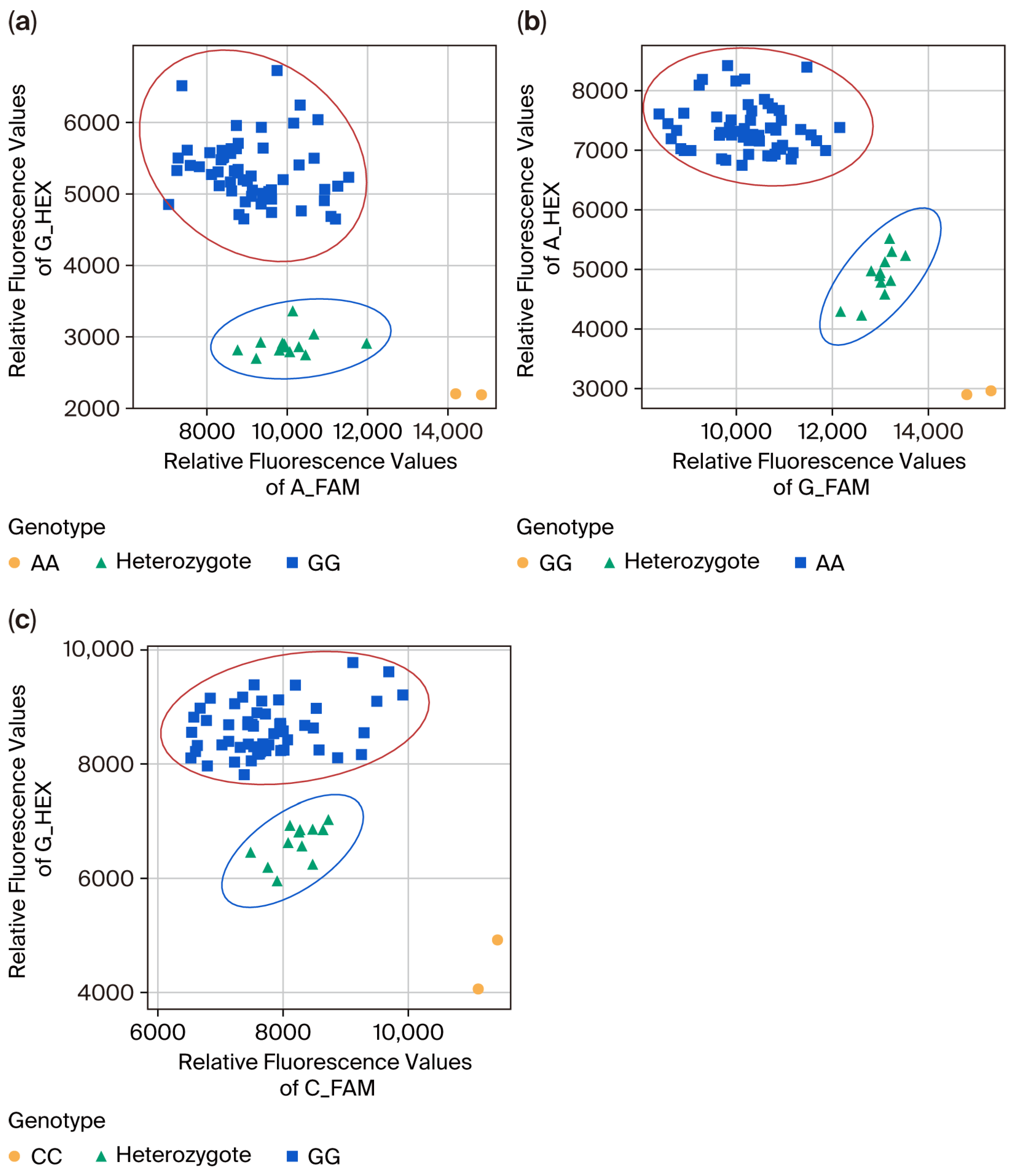
To validate the detection accuracy of the STARP markers developed in this study, we employed these three STARP markers to perform genotype identification analysis on 70 pepper core germplasm resources with known genotypes. The reference genotype was labeled using a fluorescent FAM tag, whereas the variant genotype was labeled using a fluorescent HEX tag. Orange circles, green triangles, and blue squares are used to denote homozygous reference genotypes, heterozygous genotypes, and homozygous variant genotypes, respectively. The results indicated that 70 pepper varieties could be classified into three groups by STARP1. Among these, the signal points of 55 pepper varieties were blue squares, and the HEX fluorescence signal value was high, corresponding to the homozygous variant genotype GG. The signal points of two pepper varieties were orange circles, and the FAM fluorescence signal values were relatively higher, representing the homozygous reference genotype AA. The signal points of the 13 pepper accessions were green triangles, which corresponded to the heterozygous genotype (Figure 1a). STARP2 was capable of classifying 70 pepper varieties into three groups. The signal points of 56 pepper varieties were blue squares, and the HEX fluorescence signal value was high, indicating a homozygous variant genotype AA. The signal points of two pepper varieties were orange circles, and the FAM fluorescence signal values were high, representing homozygous reference genotype GG. The signal points of the 12 pepper varieties were green triangles, corresponding to the heterozygous genotype (Figure 1b). STARP3 was also able to classify 70 pepper varieties into three groups. The signal points of 56 pepper varieties were blue squares, and the HEX fluorescence signal value was high, suggesting a homozygous variant genotype GG. The signal points of two pepper varieties were orange circles, and the FAM fluorescence signal values were higher, denoting homozygous reference genotype CC. The signal points of the 12 pepper varieties were green triangles, which were of the heterozygous genotype (Figure 1c). The three STARP markers developed in this study were capable of accurately distinguishing the homozygous reference genotype, homozygous variant genotype, and heterozygous genotype, and they demonstrated codominant characteristics.

3.2. Verification of STARP Markers for CaHMA1 in Pepper

We further compared the STARP marker genotyping results with those based on SNP markers obtained from the re-sequencing of pepper germplasms. The results showed (Table 2) that the consistency between STARP1 and SNP marker genotyping was 95.7%. For the three pepper varieties (82015-2, 82050-1, and Yujiao 15), the results of STARP1 genotyping were inconsistent with those of SNP marker genotyping. The SNP markers for 82015-2 and 82050-1 indicated heterozygous genotypes, while Yujiao 15 was identified as having a homozygous variant genotype GG. In contrast, the STARP1 markers indicated that 82015-2 was a homozygous variant genotype GG, 82050-1 was a homozygous reference genotype AA, and Yujiao 15 was a heterozygous genotype. The genotyping consistency of STARP2 and STARP3 markers with SNP markers was 97.1%. For the two pepper varieties (82015-2 and 82050-1), the genotyping results of the STARP2 and STARP3 markers were inconsistent with those of the SNP marker. SNP markers indicated that 82015-2 and 82050-1 were heterozygous genotypes, whereas STARP2 markers indicated that 82015-2 was a homozygous variant genotype AA and 82050-1 was a homozygous reference genotype GG. Meanwhile, STARP3 markers indicated that 82015-2 was a homozygous variant genotype GG and 82050-1 was a homozygous reference genotype CC. These results suggest that the STARP1, STARP2, and STARP3 markers exhibit high concordance with SNP markers obtained from re-sequencing.

3.3. Haplotype Analysis Based on STARP Markers

In this study, a haplotype analysis was conducted on 70 core pepper germplasm resources based on the three STARP markers mentioned above. The findings indicated that the Hap1 genotypes (where STARP1, STARP2, and STARP3 were homozygous variants GG, AA, and GG, respectively) accounted for 55 pepper varieties. Hap2 (in which all three STARP markers were heterozygous genotypes) comprised 12 pepper varieties. 82050-1 and Zunla No. 1 belonged to Hap3 (in which the aforementioned three STARP markers were homozygous reference genotypes AA, GG, and CC, respectively). The haplotype classification based on the three STARP markers was 95.7% consistent with that based on the SNP markers (Table 2). In addition, the haplotypes of 82015-2, 82050-1, and Yujiao 15, as determined with the three STARP markers, were inconsistent with those determined with the SNP markers (Table 2). Collectively, these results indicate that the STARP1, STARP2, and STARP3 markers can accurately identify pepper cultivars with distinct CaHMA1 haplotypes.

3.4. Cd Content in Pepper Fruits with Different Haplotypes Based on STARP Markers

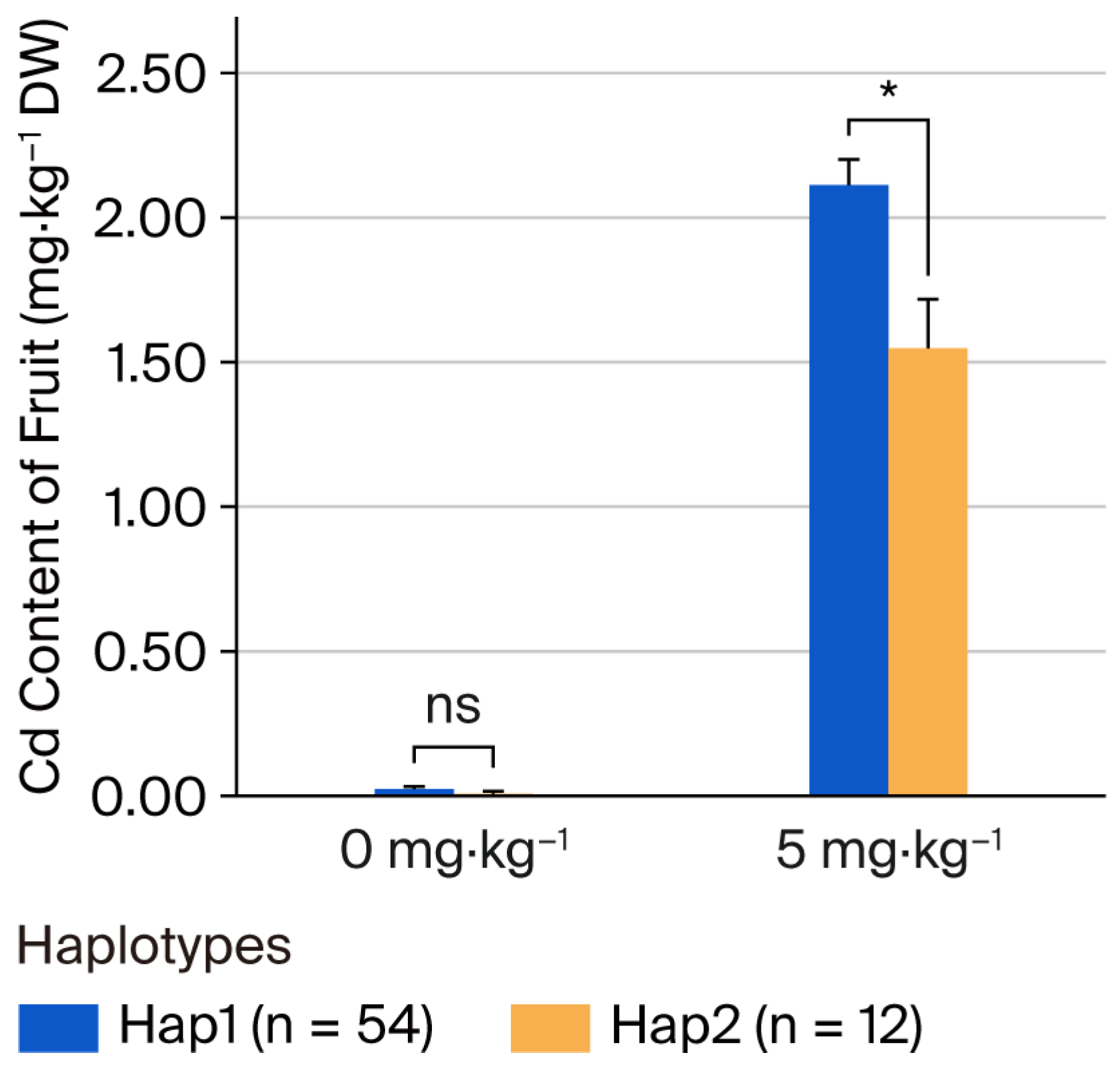
Given the strong linkage among the three SNPs (Chr02_154361710, Chr02_154362005, and Chr02_154367255) used for the development of STARP markers [16], the present study analyzed the Cd contents in pepper fruits of different haplotypes classified based on the combination of three STARP markers (STARP1, STARP2, and STARP3). After excluding the pepper germplasm with consistent genotyping results between STARP markers and SNP markers, the results indicated that under the treatment of 5 mg·kg−1 Cd, Hap1 (homozygous variant genotypes of STARP1, STARP2, and STARP3: GG, AA, and GG; n = 54) had an average Cd content of 2.11 mg·kg−1. Conversely, the mean Cd content in the fruits of Hap2 (heterozygous genotypes at all three STARPs; n = 12) was 1.54 mg·kg−1, representing a 27.01% reduction compared to that of Hap1 (Figure 2). In addition, this study demonstrated that the growth of Hap1 peppers was significantly inhibited under 5 mg·kg−1 Cd stress when compared to the control condition (0 mg·kg−1 Cd). Nevertheless, the degree of growth inhibition of Hap2 peppers was not significant (Figure S3). These results suggest that there are substantial disparities in Cd content among distinct haplotype pepper varieties classified according to three STARP markers. These markers can be employed for the rapid and precise identification of the Cd accumulation capacity of different pepper varieties. Since there was only one sample of the Hap3 type of pepper variety (STARP1, STARP2, and STARP3 molecular markers were homozygous reference genotypes AA, GG, and CC), the data volume was insufficient, and the statistical power was inadequate. Consequently, the Cd content in the fruits of the aforementioned haplotype peppers was not analyzed. Simultaneously, we will collect a larger number of the Hap3 germplasms for further analysis.

3.5. Core SNP Screening and Polymorphism Analysis

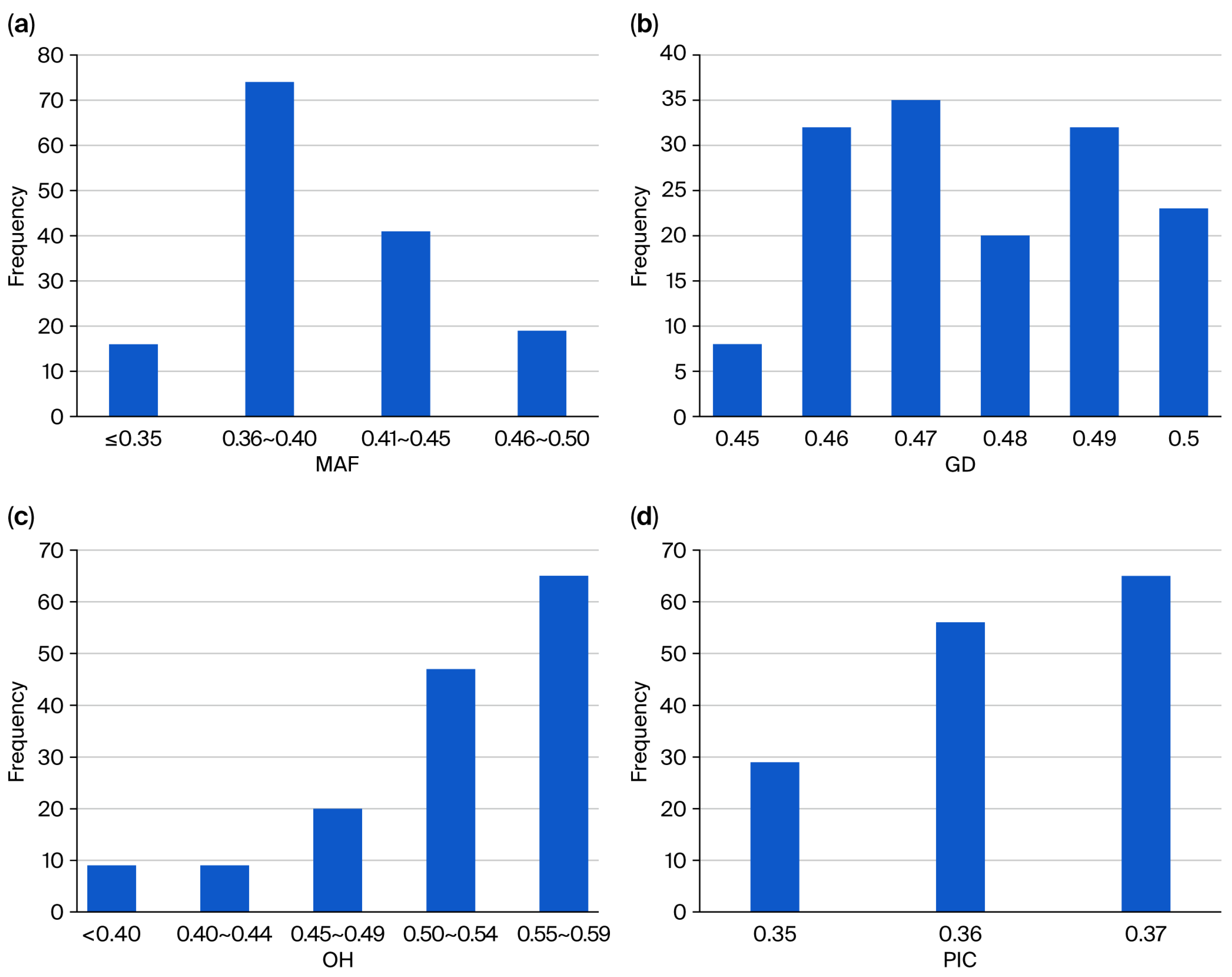
Herein, we analyzed high-quality SNPs obtained from the re-sequencing of 215 pepper varieties for MAF, PIC, OH, and GD. Based on an MAF > 0.40, PIC > 0.35, and OH < 0.6, 150 SNPs were selected. Of these, 12 were located on Chr1 and Chr3, 10 on Chr2 and Chr5, 13 on Chr4 and Chr11, and 21, 14, 7, 11, 15, and 9 on Chr6, Chr7, Chr8, Chr9, Chr10, and Chr12, respectively. Furthermore, genetic diversity parameter calculations and distribution statistics for the 150 SNP loci (Table S2, Figure 3) showed that the ranges of variation for MAF, GD, OH, and PIC were 0.35–0.50, 0.45–0.50, 0.20–0.59, and 0.35–0.37, respectively, with average values of 0.40, 0.48, 0.52, and 0.36 (Table S2). The PIC values were concentrated between 0.35 and 0.37, indicating that among the pepper varieties, the SNPs selected in this study have high polymorphism. The OH of the 150 SNPs was 0.52 (range = 0.20–0.59), with 74.67% of SNPs having OH between 0.50 and 0.59, indicating a high level of observed heterozygosity.

3.6. Construction of the Pepper DNA Fingerprinting Map

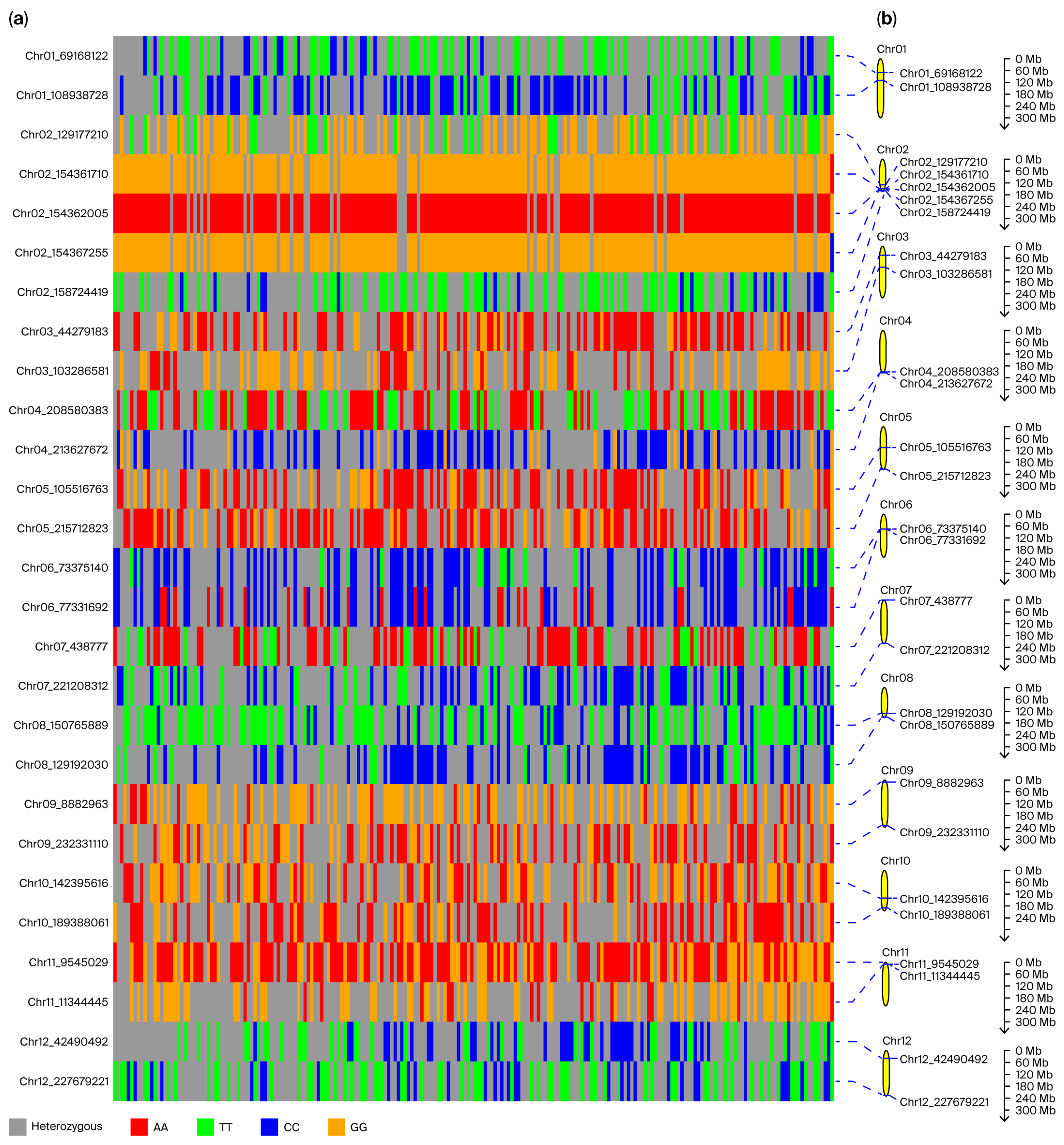
In this study, we utilized SNPT (v 0.3), to screen the minimum SNP combination from 150 core SNPs, which could fully distinguish 216 pepper germplasms (including 215 re-sequenced pepper varieties and the corresponding reference genome variety of pepper, Zunla No. 1). The combination consisted of 24 SNPs that were uniformly distributed across 12 chromosomes, and these SNPs were situated near genes. The three SNPs (Chr02_154361710, Chr02_154362005, and Chr02_154367255) that were successfully developed as STARP markers in the intron region of CaHMA1 were used in conjunction with the aforementioned 24 SNPs to construct a DNA fingerprinting map of 216 pepper germplasms. Among them, the three SNPs in the intronic region of the CaHMA1 gene were significantly associated with the Cd accumulation ability of pepper fruits. These SNPs could accurately distinguish the differences in Cd accumulation ability among different genotypes [16]. Therefore, this DNA fingerprinting map integrating the above SNP loci not only achieves 100% identification efficiency for the 216 pepper germplasms, but also accurately discriminates the fruit Cd accumulation capacity of pepper varieties with different CaHMA1 haplotypes (Figure 4). Among the 24 SNPs, Chr01_108938728, Chr02_129177210, Chr03_44279183, Chr03_103286581, and Chr10_189388061 were located in exonic regions; Chr05_215712823, Chr05_105516763, and Chr12_228037502 were located in intronic regions; Chr01_69168122, Chr04_213627672, Chr06_73375140, Chr07_438777, Chr08_150765889, Chr09_232331110, Chr09_8882963, Chr10_14239561, Chr11_11344445, and Chr12_42490492 were located in promoter regions; and Chr02_158724419, Chr06_77331692, Chr07_221208312, Chr08_129192030, and Chr11_9545029 were located 1135, 1461, 1981, 817, and 1572 bp downstream of the genes, respectively (Table S2).

4. Discussion

Cd is the predominant heavy metal pollutant globally, and pepper is a crucial vegetable crop worldwide [16]. Unfortunately, pepper fruits have a tendency to absorb and accumulate Cd2+, thereby elevating the risk of Cd contamination in pepper and its derived products [16]. Breeding low-Cd-accumulating varieties is the most economical and effective method to deliver stress-smart crop plants and ensure sustainable agriculture [33,34]. Accordingly, cultivating pepper varieties with low Cd accumulation in their fruits is very important for effectively mitigating the risk of Cd contamination in pepper fruits. In a previous study, CaHMA1 was identified as a crucial gene influencing Cd accumulation in pepper fruits through a GWAS analysis of the Cd content in pepper fruits. This gene encodes a heavy metal ATPase transporter [16]. No SNP loci were detected within the coding or promoter regions of the CaHMA1 gene. Nevertheless, four SNP sites were identified in its intron region, and these SNPs could be classified into two haplotypes within the pepper populations. Under the treatment of 5 mg·kg−1 Cd, the average fruit Cd content of Hap1 was 1.3 times greater than that of Hap2. These four SNPs might be the key factors influencing the variation in fruit Cd content among pepper genotypes [16]. In this study, three STARP markers were successfully developed based on the SNP site (Chr02_154361710, Chr02_154362005, and Chr02_154367255) in the intron region of the CaHMA1 gene, which was significantly associated with fruit Cd content. These markers can accurately identify the fruit Cd accumulation capacity of pepper materials with different haplotypes. Simultaneously, 24 SNPs were selected from 150 core SNPs and combined with the aforementioned 3 SNPs for the development of STARP markers to construct a DNA fingerprinting map. This fingerprinting map enabled 100% precise discrimination of 216 pepper germplasms, which can be used for germplasm identification, variety authenticity testing, and efficiently applied to the rapid screening of low Cd-accumulating germplasms. These results provide practical markers and technical support for MAS breeding of low Cd-accumulating pepper varieties, with clear value for breeding application.

4.1. The Three STARP Markers Developed Based on SNPs in the Intronic Region of the CaHMA1 Gene Exhibited High Reliability

MAS is a potent breeding strategy that utilizes molecular markers closely linked to target traits (e.g., Cd accumulation) for genotypic screening, in conjunction with conventional breeding methods, to develop novel varieties [19]. This technology is widely acknowledged for its high efficiency, high precision, and immunity to environmental interference [19]. In recent years, molecular markers associated with Cd accumulation have been comprehensively developed and implemented in major crops such as rice and maize [19,35]. Nevertheless, research on the development and application of molecular markers related to Cd accumulation in pepper fruits remains scarce, which has become a bottleneck in the genetic improvement of low-Cd pepper varieties. Therefore, the present study developed three STARP markers based on three SNP loci within the intron region of CaHMA1, a key gene that regulates Cd accumulation in pepper fruits. The accuracy of these three STARP markers was verified using 70 pepper core germplasms with known genotypes. The results indicated that the three STARP markers developed in this study could precisely distinguish homozygous reference genotypes, homozygous variant genotypes, and heterozygous genotypes, displaying a codominant characteristic. Moreover, the consistency between these STARP markers and the original SNP markers exceeded 95%, confirming their high reliability. The studies conducted by Wu et al. (2020) and Yang et al. (2023) also revealed that STARP markers possess the characteristic of codominance, enabling the accurate identification of different genotypes [25,26]. This phenomenon is primarily attributed to the fact that the two AMAS primers in STARP markers are designed for each of the two alleles at the same SNP site, and mismatched bases are introduced at the third and fourth positions from the 3′ ends of the AMAS primers [25]. This has significantly enhanced the specificity of STARP labeling. It also suggests that the STARP markers developed in this study can precisely identify pepper varieties with different CaHMA1 genotypes. In addition, the STARP markers are fluorescence-based molecular markers, and their primers can be independently designed. They exhibit characteristics such as high throughput, low detection cost, and high specificity [26]. These characteristics make STARP markers particularly suitable for large-scale germplasm screening and MAS breeding. For example, Wu et al. (2020) successfully developed 56 STARP markers for traits associated with wheat quality, tolerance to biotic and abiotic stresses, grain yield, and adaptability [25]. Yang et al. (2023) [26] developed the STARP marker S-TAC1 for the functional site of the Tiller Angle Control gene (TAC1). The STARP marker S-TAC1 precisely identified the genotypes of 56 sequenced conventional varieties and was employed to predict the genotypes of 164 hybrid rice varieties [26]. The advantages of STARP markers and their successful application cases in MAS breeding suggest that the three STARP markers developed in this study, which are based on the intron region of CaHMA1, possess certain advantages and can be extensively utilized in the identification and MAS breeding of pepper germplasm resources with low Cd accumulation.
During the development of molecular markers, the validation of marker effectiveness relies on a certain scale of samples with known genotypes. This is also a common technical strategy in the field of crop molecular marker development [19,29]. Xu et al. (2022) chose 10 samples from 65 rice germplasms with known genotypes to verify the Lcd38 KASP molecular marker and confirmed that the identification results of this marker were entirely consistent with the sequencing results [19]. Yang et al. (2024) screened 45 samples from 60 sweet potato varieties with known genotypes, combined them with 482 KASP primer combinations to conduct typing experiments, and ultimately succeeded in developing 274 high-quality KASP markers [29]. In this study, 70 core pepper germplasm samples (comprising 60 C apsicum annuum L., 7 C apsicum frutescens L., 1 C apsicum chinense L., and 1 C apsicum baccatum L. accessions, as well as 55 Hap1, 14 Hap2, and 1 Hap3) with known genotypes were selected to verify the accuracy of the STARP markers. The core germplasm resources comprehensively covered all cultivation types and CaHMA1 haplotypes of the 215 pepper germplasms and also included Zunla No. 1 (Capsicum annuum L.), the pepper variety corresponding to the reference genome (haplotype Hap3), which was absent in the 215 pepper germplasms. This high-quality selection strategy not only enabled the test materials to fully represent the genetic background of the 215 pepper populations but also demonstrated that the sample size was sufficient to support the systematic verification of the accuracy and specificity of the STARP markers, which would enhance the practical application value of germplasm screening and MAS breeding in low-Cd-accumulating peppers. Due to the scarcity of Hap3 pepper varieties among the 215 pepper accessions, the 70 core accessions included only one Hap3 pepper variety (Zunla No. 1). In the future, we will gather additional Hap3 pepper varieties to augment the sample size of core germplasm resources for subsequent validation analysis.

4.2. Minor Disparities Were Detected Between STARP Markers and SNP Markers

Notably, minor genotyping discrepancies were detected between STARP and SNP markers in samples 82015-2 and 82050-1. SNP markers identified both samples as heterozygous genotypes, while STARP (STARP1, STARP2, and STARP3) markers classified 82015-2 as a homozygous variant genotype and 82050-1 as a homozygous reference genotype. Similar discrepancies were reported by Wu et al. (2020), which indicated that there was a slight discrepancy between the typing results of STARP markers and those of STS or CAPS markers [25]. The disparities in identification results may be associated with contamination of DNA samples, variations in DNA sample concentration, and differences in the amplification efficiency of the STARP primer for the two alleles [25]. Furthermore, this observation can also be ascribed to genetic drift caused by pollen contamination, which might have led to genetic disparities between different samples of the same material utilized for re-sequencing and STARP marker development [36]. To verify the aforementioned speculation and clarify the true genotypes of these two varieties, in-depth verification experiments are scheduled to be conducted in the future.

4.3. The Three STARP Markers Are Capable of Accurately Identifying the Cd Accumulation Ability of Pepper Fruits with Distinct CaHMA1 Haplotypes

Our prior research has verified that CaHMA1 has the capacity to facilitate Cd uptake in yeast and Arabidopsis thaliana. The silencing of CaHMA1 in pepper fruits through the application of Virus-Induced Gene Silencing (VIGS) technology led to a 55.9% decrease in the Cd content of the fruits [16]. CaHMA1 is mainly expressed in pepper fruits, and its expression level is significantly higher in the fruits of high-Cd-accumulating pepper cultivars than in those of low-Cd-accumulating ones [16]. In this study, it was found that under Cd stress, the Cd content of the Hap1 pepper material (where the STARP1, STARP2, and STARP3 markers were homozygous variant genotypes GG, AA, and GG, respectively) was significantly higher than that of the Hap2 pepper material (in which all three STARP markers were heterozygous genotypes). These results imply that the genotypic differences in the heavy metal Cd accumulation capacity of pepper fruits might be closely associated with the variants of three SNPs (Chr02_154361710, Chr02_154362005, Chr02_154367255) in the intron region of the CaHMA1 gene. Introns can regulate gene expression through enhancers, alternative splicing, and other mechanisms, thereby affecting plant phenotypes [37,38]. Based on this, it is hypothesized that the SNP variation in the intron region of the CaHMA1 gene in this study may alter the expression level or function of the gene through the aforementioned regulatory pathways, ultimately resulting in significant differences in the Cd accumulation ability of pepper fruits with different haplotypes. We will conduct further experiments for validation and analysis. In this study, it was further discovered that the growth of Hap1 pepper plants was notably inhibited under Cd stress, whereas the growth of Hap2 pepper plants was significantly less affected. This disparity was primarily ascribed to the difference in Cd accumulation capacity between the two haplotype pepper varieties: Hap1 peppers exhibited significantly higher Cd enrichment capacity than Hap2 peppers. It is well documented that Cd2+ can induce the overproduction of reactive oxygen species (ROS) in plant cells, thereby leading to oxidative damage to cellular structures and disrupting normal physiological metabolic processes [39]. Due to the higher Cd accumulation in Hap1, this haplotype endured more severe Cd-induced toxicity, which, in turn, led to stronger growth inhibition under Cd stress. The aforementioned results also demonstrated that the three STARP markers developed in this study could precisely differentiate the Cd accumulation ability of pepper fruits with distinct CaHMA1 haplotypes and possessed high practical value. In addition, as there was only one sample of the Hap3 type of pepper variety (STARP1, STARP2, and STARP3 molecular markers were homozygous reference genotypes AA, GG, and CC), the data volume was insufficient, and the statistical power was inadequate. As a result, the Cd content in the fruits of the aforementioned haplotype peppers was not analyzed. Meanwhile, we will collect a larger quantity of peppers with the aforementioned genotypes for further analysis.

4.4. The 150 Core SNPs Exhibited Favorable Genetic Properties

Core SNPs are the foundation for constructing DNA fingerprinting maps. To construct the DNA fingerprinting map for pepper, 150 SNP markers were selected from the re-sequencing results of 215 pepper varieties based on MAF, PIC, OH, and GD. The MAF values of these 150 SNP markers ranged from 0.35 to 0.50, with a mean of 0.40. Notably, the MAF threshold exerts a significant impact on both fingerprinting accuracy and population structure inference; SNPs with low MAF values generally exhibit lower polymorphism compared to those with high MAF values [35]. Given the relatively high MAF values of the 150 selected SNPs, they are endowed with excellent polymorphic potential, which is a prerequisite for an effective DNA fingerprinting map. The PIC value serves to quantify the level of polymorphism revealed by DNA markers and aids in the estimation of genetic relationships among accessions [40]. Generally, multiallelic markers (e.g., randomly amplified polymorphic DNA (RAPD), amplified fragment length polymorphism (AFLP), and simple sequence repeats (SSR) markers) demonstrate PIC values within the range of 0.5 to 1.0, while biallelic SNP markers have a theoretical PIC range from 0 to 0.5 [40]. In the current study, the PIC values of the 150 SNP markers fluctuated between 0.35 and 0.37, with an average of 0.36. This finding suggests that the selected SNPs exhibit high polymorphism among the tested pepper accessions. Significantly, the utilization of SNPs with high PIC values for the construction of fingerprinting maps guarantees the accuracy of pepper germplasm classification [40], thereby further validating the rationality of our marker selection. Furthermore, the OH values of the 150 SNP markers ranged from 0.20 to 0.59, with an average of 0.52, indicating a relatively high level of heterozygosity. This can be attributed to the commercial varieties used in this study, which are mostly hybrid varieties. The population structure will be optimized for further analysis. Studies have shown that fingerprinting maps from hybrid varieties obtained from the market have greater practical value than research based mainly on inbred lines [31]. This suggests that the 150 SNP markers selected from the re-sequencing of 215 pepper varieties in this study have high practical value for constructing the pepper DNA fingerprinting map. The GD values of the 150 SNP markers ranged from 0.45 to 0.50, with an average of 0.48, suggesting a high level of genetic divergence. Elevated GD values signify a robust discriminatory capacity of the core markers, which is crucial for precise germplasm identification and genetic relationship analysis [31]. Collectively, these results confirm that the 150 core SNPs identified in this study exhibit favorable genetic characteristics, including high values of MAF, PIC, OH, and GD, rendering them ideal candidates for the development of pepper DNA fingerprinting map profiles.

4.5. The DNA Fingerprinting Map Based on 27 SNPs Exhibits Significant Practical Utility

Using molecular markers to construct a fingerprinting map for crop varieties allows for rapid and accurate identification of varieties or lines, providing substantial convenience for crop breeding and seed management [41]. The establishment and improvement of a pepper DNA fingerprinting map can be used for the GD analysis of pepper germplasm resources, facilitating pepper breeding [41]. Currently, most pepper DNA fingerprinting maps are constructed based on SSR markers. Feng et al. (2022) developed SSR markers for pepper using 26 main pepper varieties from Qinghai for GD analysis and constructing a molecular fingerprinting map [41]. Lei et al. (2024) constructed fingerprinting maps for 60 pepper breeding parents using six SSR markers: PM1, CAMS-855, CO911525S, PM22, HpmsE015, and Hpms1214 [42]. Duan et al. (2025) [43] employed generalized linear models and mixed linear models to identify 16 SSR markers associated with pepper fruit color traits, achieving phenotypic variance explanation rates ranging from 6.6% to 13.8%. Furthermore, nine core primer pairs were screened to construct a molecular fingerprint for 57 pepper germplasm accessions [43]. However, SSR markers have limitations, including a low number of markers and low genome throughput [44]. SNPs offer stronger specificity, more abundant variation sources, and greater potential numbers than SSR markers [29,45]. Therefore, SNP detection technology has been recommended by international organizations such as the International Seed Federation and the international union for the protection of new varieties of plants (UPOV) as an auxiliary method for variety identification [46]. Thus, developing DNA fingerprinting maps based on SNP markers will be the primary method for identifying pepper varieties in the future. Herein, relying on 150 core SNP sites, we identified the minimum SNP combination capable of fully distinguishing 216 pepper germplasm samples (including 215 re-sequenced pepper varieties and the corresponding reference genome variety of pepper, Zunla No. 1). This combination consisted of 24 SNP loci, which were uniformly distributed across the 12 chromosomes of pepper, and all SNPs were situated in the adjacent regions of genes. The aforementioned combination of SNPs was combined with the three SNPs that were successfully converted into STARP markers in the intron region of CaHMA1 to successfully create a DNA fingerprinting map of 216 accessions of pepper germplasm (including 215 re-sequenced pepper varieties and the corresponding reference genome variety of pepper, Zunla No. 1). On the premise of ensuring identification accuracy, constructing a DNA fingerprinting map with the minimum number of SNP markers can reduce the time, cost, and workload associated with breed identification, thereby enhancing identification efficiency [40]. Notably, the DNA fingerprinting map profile developed in this study includes only 27 SNPs, yet it attains a 100% discrimination efficiency for the tested pepper germplasm accessions. Additionally, this DNA fingerprinting map incorporates three SNPs in the intronic region of CaHMA1. They are significantly associated with the Cd accumulation capacity of pepper fruits and can precisely distinguish the disparities in Cd accumulation capacity among different genotypes [16]. Therefore, this DNA fingerprinting map can accurately distinguish the Cd accumulation capacity of pepper fruits from different genotypes. This discovery further confirms that the constructed DNA fingerprinting map profile possesses high practical value, offering reliable molecular support for the targeted breeding of low-Cd-accumulating pepper varieties and the precise identification of germplasm resources. Additionally, this DNA fingerprinting map serves as a supplement and improvement to the existing pepper fingerprints.
In the current study, a total of 216 pepper germplasm accessions (including 215 re-sequenced pepper varieties and the corresponding reference genome variety of pepper, Zunla No. 1) were chosen for the construction of DNA fingerprinting maps, achieving an identification efficiency of 100%. This outcome comprehensively validates the broad applicability of the established DNA fingerprinting map, which allows for the precise discrimination of pepper germplasm accessions with different genotypes. Moreover, the germplasm resources and marker data generated in this research are easily reusable, thus offering a reliable basis for researchers carrying out subsequent studies in relevant fields. In conclusion, this study offers a technical tool with dual functions of germplasm identification and target trait screening for the MAS breeding of pepper varieties with low Cd accumulation.

4.6. Implications and Limitations of the Present Study

The STARP markers developed and the DNA fingerprinting map established in this study offer reliable and applicable tools for MAS breeding of low-Cd-accumulating pepper varieties. This has significant practical implications for pepper quality breeding and food safety assurance. Nevertheless, the reliability and practical efficiency of these STARP markers and the fingerprinting map require further validation and optimization within large-scale breeding populations and practical breeding programs. In future research, additional verification will be carried out under practical breeding conditions to comprehensively assess their application potential.
Given the conserved mechanisms of Cd uptake, translocation, and accumulation across diverse plant species, CaHMA1, the key gene identified in this study that regulates Cd accumulation in pepper fruits, shows significant potential as a candidate target for genetic improvement in other Solanaceous crops, such as tomatoes. Notably, the STARP molecular markers and DNA fingerprinting map in this study are not restricted to the materials used herein but are also applicable to other pepper varieties. Furthermore, in future studies, we will collect a larger number of pepper varieties to validate the effectiveness of the aforementioned STARP molecular markers and DNA fingerprinting, which will further enhance their practical applicability in pepper genetic improvement and Cd-contaminated agricultural production.

5. Conclusions

In summary, we have successfully developed three STARP markers based on SNP loci in the intronic region of the CaHMA1 gene. These markers can accurately differentiate pepper varieties with different genotypes and exhibit a high level of concordance with SNP markers. They can also effectively identify the Cd accumulation capacity in the fruits of pepper varieties with different CaHMA1 haplotypes, thereby providing an effective tool for MAS breeding of low-Cd-accumulation pepper varieties. Moreover, 24 SNPs were selected from the 150 core SNPs, and a DNA fingerprinting map was successfully constructed by integrating these 24 SNPs with the 3 SNPs that had previously been developed into STARP markers from the intronic region of the CaHMA1 gene. The identification efficiency of this DNA fingerprinting map method was 100%, and it could precisely discriminate the Cd accumulation ability among different pepper genotypes. Simultaneously, it also established a platform for germplasm identification, variety protection, and genetic improvement of low-Cd-accumulation traits in pepper.

Supplementary Materials

The following supporting information can be downloaded at: https://www.mdpi.com/article/10.3390/horticulturae12030319/s1, Table S1: Details of pepper germplasm; Table S2: Information regarding 150 core SNPs; Figure S1: Phylogenetic analysis of pepper germplasm resources; Figure S2: Amplification of specific regions of the CaHMA1 gene using STARP marker primers; Figure S3: Growth status of peppers under different Cd treatment conditions.

Author Contributions

W.X., Y.C., Y.P., W.Z. and K.L. conceived the study. H.H., C.S. and X.L. collected the data presented in the manuscript. H.H. performed statistical analysis. W.X., H.H. and A.R. contributed to the writing. W.X., N.L. and Y.C. revised the manuscript. All authors have read and agreed to the published version of the manuscript.

Funding

This work was supported by the National Natural Science Foundation of China (32272801; 32172597), China Agriculture Research System (CARS-23-B08), National Key Research and Development Program of China (2018YFD0201200), Talent Project of Chongqing Natural Science Foundation (cstc2021ycjh-bgzxm0033), and National Key Research and Development Program of China (2023YFE0105000).

Data Availability Statement

The original contributions presented in this study are included in the article/Supplementary Materials. Further inquiries can be directed to the corresponding author.

Acknowledgments

We would like to express our gratitude to the reviewers of this manuscript; their insight was instrumental in improving this paper. We also thank the Ministry of Agriculture and Rural Affairs of the People’s Republic of China for the financial support necessary that made this work possible.

Conflicts of Interest

The authors declare no competing interests.

References

  1. Kong, D.H.; Wang, G.; Zheng, J.L.; Zhao, X.Y.; Zhang, L.J.; Davronbek, B.; Wu, H.X.; Wan, J.J.; Su, X.T. Sustainable synthesis of artificial humic substances from bamboo powder by FeCl3-catalyzed low-temperature pyrolysis for cadmium contaminated soil remediation and carbon sequestration. Environ. Res. 2026, 289, 123319. [Google Scholar] [CrossRef] [PubMed]
  2. Wang, P.; Li, M.; Ma, X.; Zhao, B.; Jin, X.; Zhang, H.; Chen, S.; Wu, X.; Zhang, X. Integrative Transcriptome and Metabolome Analysis Identifies Potential Pathways Associated with Cadmium Tolerance in Two Maize Inbred Lines. Plants 2025, 14, 1853. [Google Scholar] [CrossRef]
  3. Nehzomi, Z.S.; Shirani, K. The gut microbiota: A key player in cadmium toxicity-implications for disease, interventions, and combined toxicant exposures. J. Trace Elem. Med. Biol. 2025, 88, 127570. [Google Scholar] [CrossRef] [PubMed]
  4. Huang, X.H.; Li, X.Z.; Zheng, L.P.; Zhang, Y.; Sun, L.; Feng, Y.H.; Du, J.Y.; Lu, X.S.; Wang, G.Q. Comprehensive assessment of health and ecological risk of cadmium in agricultural soils across China: A tiered framework. J. Hazard. Mater. 2025, 465, 133111. [Google Scholar] [CrossRef]
  5. Shao, H.b.; Chu, L.Y.; Xu, G.; Yan, K.; Zhang, L.H.; Sun, J.N. Progress in Phytoremediating Heavy-Metal Contaminated Soils. In Soil Biology, 1st ed.; Sherameti, I., Varma, A., Eds.; Springer: Berlin/Heidelberg, Germany, 2011; Volume 30, pp. 73–90. [Google Scholar]
  6. Wang, L.; Liu, Q.Q.; Zhao, F.H.; Yang, J.; Fu, J.Y.; Liao, X.Y. An integrated three-crop rotation of oilseed rape−rice−rice enables the safe utilization and sustainable remediation of Cd-contaminated farmland. Environ. Technol. Innov. 2025, 38, 38104123. [Google Scholar] [CrossRef]
  7. Haider, F.U.; Cai, L.Q.; Coulter, J.A.; Cheema, S.A.; Wu, J.; Zhang, R.Z.; Ma, W.J.; Farooq, M. Cadmium toxicity in plants: Impacts and remediation strategies. Ecotoxicol. Environ. Saf. 2021, 211, 111887. [Google Scholar] [CrossRef] [PubMed]
  8. Wei, X.; Bai, X.Y.; Wen, X.F.; Liu, L.; Xiong, J.; Yang, C.L. A large and overlooked Cd source in karst areas: The migration and origin of Cd during soil formation and erosion. Sci. Total Environ. 2023, 895, 165126. [Google Scholar] [CrossRef]
  9. Lin, G.B.; Zhang, C.; Yang, Z.F.; Li, Y.; Liu, C.J.; Ma, L.Q. High geological background concentrations of As and Cd in karstic soils may not contribute to greater risks to human health via rice consumption. J. Hazard. Mater. 2024, 480, 135876. [Google Scholar] [CrossRef]
  10. Chen, W.K.; Wang, X.F.; Sun, J.; Wang, X.R.; Zhu, Z.S.; Ayhan, D.H.; Yi, S.; Yan, M.; Zhang, L.L.; Meng, T.; et al. Two telomere-to-telomere gapless genomes reveal insights into Capsicum evolution and capsaicinoid biosynthesis. Nat. Commun. 2024, 15, 4295. [Google Scholar] [CrossRef]
  11. Shan, Q.Y.; Wan, Y.; Liang, J.D.; He, W.J.; Zeng, J.; Liang, W.H.; Xiong, S.W.; Zhang, M.L.; Wang, B.; Zou, X.X.; et al. HS-SPME combined with GC-MS and GC-O for characterization of key aroma-active compounds in fruity and grassy peppers (Capsicum chinense Jacq.). Food Chem. X 2024, 24, 101944. [Google Scholar] [CrossRef]
  12. Hu, X.T.; Li, T.; Xu, W.H.; Chai, Y.R. Distribution of cadmium in subcellular fraction and expression difference of its transport genes among three cultivars of pepper. Ecotoxicol. Environ. Saf. 2021, 216, 112182. [Google Scholar] [CrossRef]
  13. Shen, C.; Huang, B.F.; Hu, L.; Yuan, H.W.; Huang, Y.Y.; Wang, Y.B.; Sun, Y.F.; Li, Y.; Zhang, J.R.; Xin, J.L. Comparative transcriptome analysis and Arabidopsis thaliana overexpression reveal key genes associated with cadmium transport and distribution in root of two Capsicum annuum cultivars. J. Hazard. Mater. 2024, 465, 133365. [Google Scholar] [CrossRef]
  14. Qiao, K.; Tian, Y.B.; Hu, Z.L.; Chai, T.Y. Wheat cell number regulator CNR10 enhances the tolerance, translocation, and accumulation of heavy metals in plants. Environ. Sci. Technol. 2018, 53, 860–867. [Google Scholar] [CrossRef] [PubMed]
  15. Tu, D.H.; Tian, X.; Liang, C.J.; Zhou, P.; Wang, Y.P.; Xing, D.; Liu, Y.Z. Physiological and biochemical responses of pepper (Capsicum annuum L.) to cadmium stress: The mitigating effects of exogenous abscisic acid. Ecotoxicol. Environ. Saf. 2025, 299, 118370. [Google Scholar] [CrossRef] [PubMed]
  16. Xu, W.H.; Huang, H.; Li, X.D.; Yang, M.; Chi, S.L.; Pan, Y.; Li, N.N.; Paterson, A.H.; Chai, Y.R.; Lu, K. CaHMA1 promotes Cd accumulation in pepper fruit. J. Hazard. Mater. 2023, 460, 132480. [Google Scholar] [CrossRef] [PubMed]
  17. Li, B.; Lin, K.; Liu, X.; Ma, X.D.; Li, X.Z.; Wu, Z.L.; Li, C.; Yu, T.; Wu, T.S.; Yang, Z.F. Mechanism of cadmium (Cd) enrichment in the soil of karst areas with high geochemical background in Southwest China. Chem. Geol. 2025, 673, 122523. [Google Scholar] [CrossRef]
  18. Li, T.; Hu, M.J.; Xu, J.; Jiang, Y.G.; Yan, H.L.; Yu, Y.J.; He, Z.Y. Researches in Screening and Breeding of Rice Varieties with Low-Cadmium Accumulation. J. Agric. Sci. Technol. 2021, 23, 36–46. (In Chinese) [Google Scholar]
  19. Xu, J.; Li, T.; Hu, M.J.; Jiang, Y.G.; Yan, H.L.; Xu, W.X.; Yu, Y.J.; He, Z.Y. Development and Utilization of KASP Marker LCd-38 for Cadmium Accumulation in Rice Grain. J. Agric. Sci. Technol. 2022, 4, 40–47. (In Chinese) [Google Scholar]
  20. Cobb, J.N.; Biswas, P.S.; Platten, J.D. Back to the future: Revisiting MAS as a tool for modern plant breeding. Theor. Appl. Genet. 2019, 132, 647–667. [Google Scholar] [CrossRef]
  21. Salsman, E.; Kumar, A.; AbuHammad, W.; Abbasabadi, A.O.; Dobrydina, M.; Chao, S.M.; Li, X.H.; Manthey, F.A.; Elias, E.M. Development and validation of molecular markers for grain cadmium in durum wheat. Mol. Breed. 2018, 38, 28. [Google Scholar] [CrossRef]
  22. Tehseen, M.M.; Zheng, Y.J.; Wyatt, N.A.; Bolton, M.D.; Yang, S.M.; Xu, S.S.; Li, X.H.; Chu, C.G. Development of STARP Marker Platform for Flexible SNP Genotyping in Sugarbeet. Agronomy 2023, 13, 1359. [Google Scholar] [CrossRef]
  23. Kulkarni, K.P.; Appiah, R.K.; Reddy, U.K.; Melmaiee, K. Cleaved Amplified Polymorphic Sequence Markers in Horticultural Crops: Current Status and Future Perspectives. Agronomy 2024, 14, 2598. [Google Scholar] [CrossRef]
  24. Dipta, B.; Sood, S.; Mangal, V.; Bhardwaj, V.; Thakur, K.A.; Kumar, V.; Singh, B. KASP: A high-throughput genotyping system and its applications in major crop plants for biotic and abiotic stress tolerance. Mol. Biol. Rep. 2024, 51, 508. [Google Scholar] [CrossRef]
  25. Wu, Y.Y.; Li, M.; He, Z.H.; Dreisigacker, S.; Wen, W.E.; Jin, H.; Zhai, S.N.; Li, F.J.; Gao, F.M.; Liu, J.D.; et al. Development and validation of high-throughput and low-cost STARP assays for genes underpinning economically important traits in wheat. Theor. Appl. Genet. 2020, 133, 2431–2450. [Google Scholar] [CrossRef] [PubMed]
  26. Yang, S.H.; Gui, Y.I.; Chen, R.; Zhou, S.F.; Chen, Z.J.; Liu, H.Q.; Wang, F. Development of STARP Markers for TAC1 Gene in Rice and Analysis of TAC1 Genotypes in 164 Hybrid Rice. Fujian Agric. Sci. Technol. 2023, 4, 7–11. (In Chinese) [Google Scholar]
  27. Chen, Z.Y.; Ke, W.S.; He, F.; Chai, L.L.; Cheng, X.J.; Xu, H.W.; Wang, X.B.; Du, D.J.; Zhao, Y.D.; Chen, X.Y.; et al. A single nucleotide deletion in the third exon of FT-D1 increases the spikelet number and delays heading date in wheat (Triticum aestivum L.). Plant Biotechnol. J. 2022, 20, 920–933. [Google Scholar] [CrossRef]
  28. Wei, X.; Geng, M.H.; Yuan, J.C.; Zhan, J.J.; Liu, L.S.; Chen, Y.L.; Wang, Y.; Qin, W.Q.; Duan, H.Y.; Zhao, H.; et al. GhRCD1 promotes cotton tolerance to cadmium by regulating the GhbHLH12-GhMYB44-GhHMA1 transcriptional cascade. Plant Biotechnol. J. 2024, 22, 1777–1796. [Google Scholar] [CrossRef] [PubMed]
  29. Yang, F.Y.; Lang, T.; Wu, J.Y.; Zhang, C.; Qu, H.J.; Pu, Z.G.; Yang, F.; Yu, M.; Feng, J.Y. SNP loci identification and KASP marker development system for genetic diversity, population structure, and fingerprinting in sweetpotato (Ipomoea batatas L.). BMC Genom. 2024, 25, 1245. [Google Scholar] [CrossRef] [PubMed]
  30. Khan, I.U.; Rono, J.K.; Liu, X.S.; Feng, S.J.; Yang, Z.M. Functional characterization of a new metallochaperone for reducing cadmium concentration in rice crop. J. Clean. Prod. 2020, 272, 123152. [Google Scholar] [CrossRef]
  31. Yang, Y.Y.; Lyu, M.J.; Liu, J.; Wu, J.J.; Wang, Q.; Xie, T.Y.; Li, H.C.; Chen, R.; Sun, D.L.; Yang, Y.X.; et al. Construction of an SNP fingerprinting database and population genetic analysis of 329 Cauliflower cultivars. BMC Plant Biol. 2022, 22, 522. [Google Scholar] [CrossRef]
  32. Zhao, S.P.; Ye, X.Z.; Zhang, Q.; Xiao, W.D.; Chen, D.; Huang, M.J.; Hu, J.; Gao, N. The capacity and critical stage of Cd absorption and accumulation of different pepper cultivars. J. Plant Nutr. Fertil. 2021, 27, 695–705. (In Chinese) [Google Scholar]
  33. Raza, A.; Khare, T.; Zhang, X.Y.; Rahman, M.M.; Hussain, M.; Gill, S.S.; Chen, Z.H.; Zhou, M.X.; Hu, Z.L.; Varshney, R.K. Novel strategies for designing climate-smart crops to ensure sustainable agriculture and future food security. J. Sustain. Agric. Environ. 2025, 4, e70048. [Google Scholar] [CrossRef]
  34. Tang, L.; Wang, J.; Ji, Z.; Li, X.; Liu, X.; Lv, Q.; Wei, P.; Hu, H.; Li, Y.; Mao, B.; et al. Pyramiding elite alleles of genetically linked OsNRAMP5 and OsHMA3 confers low-Cd grains without compromising stress tolerance in rice. Plant Commun. 2025, 101690. [Google Scholar] [CrossRef]
  35. Cheng, Y.R.; Liu, R.; Yang, T.; Yang, S.; Chen, J.; Huang, Y.W.; Long, D.; Zeng, J.; Wu, D.D.; Kang, H.Y.; et al. Genetic factors of grain cadmium concentration in Polish wheat (Triticum polonicum L.). Plant Physiol. 2024, 196, 979–995. [Google Scholar] [CrossRef]
  36. Galeano, E.; Bousquet, J.; Thomas, B.R. SNP-based analysis reveals unexpected features of genetic diversity, parental contributions and pollen contamination in a white spruce breeding program. Sci. Rep. 2021, 11, 4990. [Google Scholar] [CrossRef] [PubMed]
  37. Meng, F.L.; Zhao, H.N.; Zhu, B.; Zhang, T.; Yang, M.Y.; Li, Y.; Han, Y.P.; Jiang, J.M. Genomic editing of intronic enhancers unveils their role in fine-tuning tissue-specific gene expression in Arabidopsis thaliana. Plant Cell 2021, 33, 1997–2014. [Google Scholar] [CrossRef] [PubMed]
  38. Glick, L.; Castiglione, S.; Loewenthal, G.; Raia, P.; Pupko, T.; Mayrose, I. Phylogenetic Analysis of 590 Species Reveals Distinct Evolutionary Patterns of Intron-Exon Gene Structures Across Eukaryotic Lineages. Mol. Biol. Evol. 2024, 41, msae248. [Google Scholar] [CrossRef]
  39. Khan, I.U.; Zhang, Y.F.; Shi, X.N.; Qi, S.S.; Zhang, H.Y.; Du, D.L.; Gul, F.; Wang, J.H.; Naz, M.; Shah, S.W.A.; et al. Dose dependent effect of nitrogen on the phyto extractability of Cd in metal contaminated soil using Wedelia trilobata. Ecotoxicol. Environ. Saf. 2023, 264, 115419. [Google Scholar] [CrossRef] [PubMed]
  40. Park, J.S.; Kang, M.Y.; Shim, E.J.; Oh, J.; Seo, K.I.; Kim, K.S.; Sim, S.C.; Chung, S.M.; Park, Y.; Lee, G.P.; et al. Genome-wide core sets of SNP markers and Fluidigm assays for rapid and effective genotypic identification of Korean cultivars of lettuce (Lactuca sativa L.). Hortic. Res. 2022, 9, uhac119. [Google Scholar] [CrossRef]
  41. Feng, P.L.; Han, R.; Wang, Y.Y.; Shao, D.K.; Li, Q.H.; Zhong, Q.W. Construction of a DNA fingerprint for pepper varieties based on SSR markers. Acta Agric. Boreali-Occident. Sin. 2022, 31, 320–327. (In Chinese) [Google Scholar]
  42. Lei, G.; Chen, X.J.; Zhou, K.H.; Huang, Y.Q.; Yuan, X.J.; Li, G.G.; Fang, Y.; Fang, R. Genetic Diversity and Fingerprint Analysis in 60 Founder Parents of Pepper Based on SSR Markers. J. Plant Genet. Resour. 2024, 25, 1321–1335. (In Chinese) [Google Scholar]
  43. Duan, M.J.; Li, Y.F.; Wang, C.P.; Huang, R.Z.; Huang, Q.Z.; Zhang, S.C. Association Analysis and Fingerprint Map Construction of Fruit Color Traits in Pepper via SSR Markers. Biotechnol. Bull. 2025, 41, 81–94. (In Chinese) [Google Scholar]
  44. Zhang, T.; Chang, L.C.; Guo, C.G.; Zhang, L.G.; Wu, J.; Liang, J.L.; Gao, J.; Wang, X.W. Development of KASP Markers for Pepper High Polymorphism. China Veg. 2023, 1, 34–46. [Google Scholar]
  45. Dan, X.M.; Qumu, X.; Lai, Q.; Mao, K.S.; Gong, W.F.; Qin, X.S.; Li, T.; Liu, X.Y.; Wang, J. Phylogenomic analysis and SNP fingerprinting construction of Camellia oleifera Abel. germplasm resources using SLAF-seq technology. Ind. Crops Prod. 2025, 229, 120978. [Google Scholar] [CrossRef]
  46. Rafalski, A. Applications of single nucleotide polymorphisms in crop genetics. Curr. Opin. Plant Biol. 2002, 5, 94–100. [Google Scholar] [CrossRef]
Figure 1. STARP marker typing of 70 pepper cultivars: (a) distribution of relative fluorescence values of STARP1 markers among 70 pepper cultivars; (b) distribution of relative fluorescence values of STARP2 markers among 70 pepper cultivars; (c) distribution of relative fluorescence values of STARP3 markers among 70 pepper cultivars. Orange circles, green triangles, and blue squares represent homozygous reference genotypes, heterozygous genotypes, and homozygous variant genotypes, respectively. Homozygous genotypes AA, CC, and GG mean that the two alleles on the same locus carry adenine (A), cytosine (C), and guanine (G), respectively.
Horticulturae 12 00319 g001
Figure 2. Cd content in pepper fruits of different haplotypes. The Cd content of pepper fruits was calculated with reference to the fruit dry weight (DW). For the three molecular markers STARP1, STARP2, and STARP3, their genotypes were homozygous GG, AA, and GG, respectively, in Hap1 pepper accessions, whereas all of them were heterozygous genotypes in Hap2 pepper accessions. Homozygous genotypes AA and GG mean that the two alleles on the same locus carry adenine (A) and guanine (G). Data are presented as mean ± standard error (SE). The t-test was employed to analyze significant differences (“ns” = p > 0.05, “*” = p < 0.05).
Horticulturae 12 00319 g002
Figure 3. Frequency distribution of genetic parameters for 150 core SNPs: (a) frequency distribution of minor allele frequency (MAF); (b) frequency distribution of genetic diversity (GD); (c) frequency distribution of observed heterozygosity (OH); (d) frequency distribution of polymorphic information content (PIC).
Horticulturae 12 00319 g003
Figure 4. DNA fingerprinting map of 216 pepper germplasm resources based on SNP markers. (a) Genotyping of 27 SNP markers in 216 pepper germplasm resources. Each row corresponds to one SNP locus, and each column corresponds to one pepper cultivar. Homozygous genotypes AA, TT, CC, and GG signify that the two alleles at the SNP site are adenine (A), thymine (T), cytosine (C), and guanine (G), respectively, which correspond to red, light green, blue, and orange in the DNA fingerprinting map. Heterozygous genotypes are denoted in gray. (b) The position of the 27 SNP markers on the chromosome.
Horticulturae 12 00319 g004
Table 1. Information regarding STARP markers primer.
SNP IDReference GenotypesVariant GenotypesPositionRegionsMarker NamePrimer NameSequences (5′→3′)
Chr02_154361710AG15436170intronSTARP1SNP2-F1GCAACAGGAACCAGCTATGACAATCTTGTGTCAACTAcCA
SNP2-F2GACGCAAGTGAGCAGTATGACAATCTTGTGTCAACTcTCG
SNP2-RGGCGCTACCTCTCTTACATT
Chr02_154362005GA15436205intronSTARP2SNP3-F1GCAACAGGAACCAGCTATGACATGTAAGAGAGGTAGCGtCG
SNP3-F2GACGCAAGTGAGCAGTATGACATGTAAGAGAGGTAGCaCCA
SNP4-RGGCCACTTCATAGCTTGTAC
Chr02_154367255CG154367255intronSTARP3SNP4-R1GCAACAGGAACCAGCTATGACTAACGAAGCATTCAGAtAG
SNP4-R2GACGCAAGTGAGCAGTATGACTAACGAAGCATTCAGcCAC
SNP4-FAAAGCTGGCAACAAGAGGTC
Note: The bold black sequences represent the adaptor sequences, while the lowercase letters indicate the mismatched bases introduced. A, T, C, and G denote adenine, thymine, cytosine, and guanine, respectively.
Table 2. Genotyping results for 70 pepper cultivars based on SNP markers and STARP markers.
SNP IDChr02_154361710Chr02_154362005Chr02_154367255Haplotypes
Reference GenotypesAGC
Variant GenotypesGAG
SNP MarkersSTARP1 MarkersConsistencySNP MarkersSTARP2 MarkersConsistencySNP MarkersSTARP3 MarkersConsistencySNP MarkersSNP MarkersConsistency
Pixiandifangzhong-2GGGGYAAAAYGGGGY11Y
Pixiandifangzhong-5GGGGYAAAAYGGGGY11Y
Xiaomila2019513079HeterozygoteHeterozygoteYHeterozygoteHeterozygoteYHeterozygoteHeterozygoteY22Y
Gongxianbendilajiao2019513053GGGGYAAAAYGGGGY11Y
GongxianbendixiaohaijiaoGGGGYAAAAYGGGGY11Y
Chunfeng04-3GGGGYAAAAYGGGGY11Y
FenglahongxiuGGGGYAAAAYGGGGY11Y
82015-2HeterozygoteGGNHeterozygoteAANHeterozygoteGGN21N
82050-1HeterozygoteAANHeterozygoteGGNHeterozygoteCCN23N
82175-1GGGGYAAAAYGGGGY11Y
ShuxiuerjintiaoGGGGYAAAAYGGGGY11Y
ChangshengdabaopiGGGGYAAAAYGGGGY11Y
Ribensanyingjiao 326GGGGYAAAAYGGGGY11Y
HuangxiuchaotianjiaoGGGGYAAAAYGGGGY11Y
Layan 201GGGGYAAAAYGGGGY11Y
Xingshu No. 16HeterozygoteHeterozygoteYHeterozygoteHeterozygoteYHeterozygoteHeterozygoteY22Y
Xingshuzhoujiao No. 2HeterozygoteHeterozygoteYHeterozygoteHeterozygoteYHeterozygoteHeterozygoteY22Y
Bola No. 3GGGGYAAAAYGGGGY11Y
Bola No. 8GGGGYAAAAYGGGGY11Y
BolahongshuaiGGGGYAAAAYGGGGY11Y
Bola No. 1GGGGYAAAAYGGGGY11Y
BolafengxiangGGGGYAAAAYGGGGY11Y
Zunhu No. 1GGGGYAAAAYGGGGY11Y
Gailiangxingla 109GGGGYAAAAYGGGGY11Y
Xinglajiao 906HeterozygoteHeterozygoteYHeterozygoteHeterozygoteYHeterozygoteHeterozygoteY22Y
O46L02-1-1 (or O46L02-H)GGGGYAAAAYGGGGY11Y
C7117GGGGYAAAAYGGGGY11Y
939-1GGGGYAAAAYGGGGY11Y
Yujiao 15GGHeterozygoteNAAAAYGGGGY1-N
Sujiaodaguo 717GGGGYAAAAYGGGGY11Y
83-3GGGGYAAAAYGGGGY11Y
BolaxinhongxiuGGGGYAAAAYGGGGY11Y
Bola No. 7GGGGYAAAAYGGGGY11Y
Yanjiao 502HeterozygoteHeterozygoteYHeterozygoteHeterozygoteYHeterozygoteHeterozygoteY22Y
Kerun No. 1GGGGYAAAAYGGGGY11Y
EjiaomoliGGGGYAAAAYGGGGY11Y
Sujiao No. 5GGGGYAAAAYGGGGY11Y
Hongguan No. 1GGGGYAAAAYGGGGY11Y
Haimai H515GGGGYAAAAYGGGGY11Y
82093-1GGGGYAAAAYGGGGY11Y
82179-2GGGGYAAAAYGGGGY11Y
82314GGGGYAAAAYGGGGY11Y
82334GGGGYAAAAYGGGGY11Y
ChangjianlajiaoGGGGYAAAAYGGGGY11Y
Hamai 5000GGGGYAAAAYGGGGY11Y
Gongxianerjingtiao2019513038GGGGYAAAAYGGGGY11Y
NongxingerjintiaoGGGGYAAAAYGGGGY11Y
AnhuitianjiaoGGGGYAAAAYGGGGY11Y
HuayuniujiaojiaoGGGGYAAAAYGGGGY11Y
QiemendatianjiaoGGGGYAAAAYGGGGY11Y
Qianjiao No. 5GGGGYAAAAYGGGGY11Y
Layan 102GGGGYAAAAYGGGGY11Y
Xingshu 201GGGGYAAAAYGGGGY11Y
XingshuqingcuiGGGGYAAAAYGGGGY11Y
BolahongxingGGGGYAAAAYGGGGY11Y
862-1-1-1-1 (or 862-H-H)GGGGYAAAAYGGGGY11Y
Yanjiao 485GGGGYAAAAYGGGGY11Y
Xingshuzhoupijiao No. 4GGGGYAAAAYGGGGY11Y
Yanjiao 435GGGGYAAAAYGGGGY11Y
ChangjianGGGGYAAAAYGGGGY11Y
CuilaGGGGYAAAAYGGGGY11Y
EjiaoshuailiangGGGGYAAAAYGGGGY11Y
82016-2HeterozygoteHeterozygoteYHeterozygoteHeterozygoteYHeterozygoteHeterozygoteY22Y
XingshuzhoupijiaoHeterozygoteHeterozygoteYHeterozygoteHeterozygoteYHeterozygoteHeterozygoteY22Y
XingshulvyanHeterozygoteHeterozygoteYHeterozygoteHeterozygoteYHeterozygoteHeterozygoteY22Y
Bolajiangjiao No. 1HeterozygoteHeterozygoteYHeterozygoteHeterozygoteYHeterozygoteHeterozygoteY22Y
Yanjiao 802HeterozygoteHeterozygoteYHeterozygoteHeterozygoteYHeterozygoteHeterozygoteY22Y
Yanjiao1912HeterozygoteHeterozygoteYHeterozygoteHeterozygoteYHeterozygoteHeterozygoteY22Y
BolacuiyuHeterozygoteHeterozygoteYHeterozygoteHeterozygoteYHeterozygoteHeterozygoteY22Y
Zhunla No. 1AAAAYGGGGYCCCCY33Y
Note: The symbol “Y” indicates that the genotyping results of SNP and STARP markers are consistent, while the symbol “N” indicates that the genotyping results of SNP and STARP markers are inconsistent. Homozygous genotypes AA, CC, and GG mean that the two alleles on the same locus carry adenine (A), cytosine (C), and guanine (G), respectively. Heterozygote indicates heterozygous genotype.
Disclaimer/Publisher’s Note: The statements, opinions and data contained in all publications are solely those of the individual author(s) and contributor(s) and not of MDPI and/or the editor(s). MDPI and/or the editor(s) disclaim responsibility for any injury to people or property resulting from any ideas, methods, instructions or products referred to in the content.