Article

Potential for Cultivating Various Legume Species in Controlled Environment Agriculture

by
Aušra Brazaitytė
1,*,†,
Rūta Sutulienė
1,†,
Giedrė Samuolienė
1,
Akvilė Viršilė
1,
Audrius Pukalskas
1,
Kristina Laužikė
1,
Justinas Raginskis
1,
Pirjo Mäkelä
2,
Hirofumi Ishihara
2 and
Michael Martin
3
1
Lithuanian Research Centre for Agriculture and Forestry, Institute of Horticulture, Kauno Str. 30, LT-54333 Babtai, Lithuania
2
Department of Agricultural Sciences, University of Helsinki, 00014 Helsinki, Finland
3
IVL Swedish Environmental Research Institute, 114 28 Stockholm, Sweden
*
Author to whom correspondence should be addressed.
These authors contributed equally to this work.
Horticulturae 2026, 12(3), 308; https://doi.org/10.3390/horticulturae12030308
Submission received: 3 January 2026 / Revised: 27 February 2026 / Accepted: 3 March 2026 / Published: 5 March 2026

Abstract

Legumes are among the most important plants capable of biological nitrogen fixation. However, there is a significant knowledge gap regarding the specifics of cultivating legumes in hydroponic systems under controlled environment conditions, particularly nitrogen metabolism at different growth stages, which this study addressed. Chickpeas, faba beans, lentils, soybeans, and sugar peas were cultivated in deep-water hydroponics without rhizobia, with a nutrient solution as the nitrogen source. The legumes displayed significant variations in growth patterns and nitrogen dynamics. Among them, soybeans had the longest growth cycle, characterised by extended vegetative and early reproductive phases, while sugar peas developed the fastest. In all species, nitrate was the dominant form of nitrogen found in the roots, stems, and leaves, followed by ammonium (NH3–N) and nitrite (NO2). The levels of NH3–N varied among species, peaking early in faba beans and later in chickpeas. NO2 concentrations were low and decreased with development. The activities of nitrate reductase and nitrite reductase also varied across species, plant organs, and growth stages. The highest enzyme activity was consistently observed in the leaves. Notably, peas exhibited high enzyme activity across all organs, while the leaves of soybeans showed the highest activity in the studied legumes.

1. Introduction

Legumes are some of the most important agricultural crops, offering numerous benefits as a sustainable source of protein and bioactive compounds for both human and animal consumption. Legumes are effectively incorporated into various agricultural practices such as crop rotation, intercropping and green manure application. These issues have been extensively studied in field crop research and summarised in various scientific articles [1,2,3,4,5]. However, there is a significant knowledge gap regarding the cultivation of legumes in hydroponic systems. Soybeans are mainly grown and studied in hydroponic systems [6,7,8,9,10], but there is little data on the cultivation of other legumes such as sugar peas, lentils and others. Most of the studies have focused on the quality and productivity of these crops, examining different hydroponic systems, the effects of mineral nutrients and salinity, various Rhizobium strains, etc. [11,12,13,14,15]. Still, we have not found any data on nitrogen metabolism at different growth stages of legumes cultivated rhizobia-free in hydroponic solution with only mineral N. It is well known that legume growth in the field is a dynamic process closely linked to developmental stages and resource allocation. Initially, during germination, growth is minimal. In the vegetative stage, growth reaches its peak, characterised by rapid shoot and root development. As plants transition to reproductive development, growth slows until seed formation occurs [16,17,18,19]. Nitrogen uptake in legumes fluctuates significantly throughout their development. The process begins from seed germination to establishing symbiotic nitrogen fixation, and then to nitrogen remobilisation during reproduction. Nitrogen cycle enzyme activity peaks from the late vegetative stage to early flowering, when canopy growth and nitrogen demand are at their highest. During pod and seed development, their activity declines as nitrogen is redirected towards the reproductive systems [6,16,20,21,22,23]. However, there is limited understanding of how these processes occur when legumes are cultivated in hydroponic systems within controlled environment agriculture, where consistent environmental conditions are maintained. Therefore, our studies aimed to evaluate the growth of various legumes without rhizobia in hydroponics and to analyse ammonia, nitrite, and nitrate levels, as well as changes in nitrogen cycle enzyme activity during their growth. The results obtained can be used to screen legume species for future studies on intercropping with leafy vegetables, utilising the symbiosis between legumes and nitrogen-fixing bacteria. Such studies are currently lacking. According to the existing literature, research on hydroponic cultivation of both legumes and non-legumes has mainly focused on animal feed [24,25,26,27]. Notably, studies by D-Andrade et al. [28] on intercropping lettuce with alfalfa in a vertical hydroponic system demonstrated that combining moderate nitrate levels with nitrogen-fixing legumes improved resource use efficiency. This approach also reduced the need for synthetic fertilisers in hydroponic systems, without significantly impacting lettuce yield.

2. Materials and Methods

2.1. Plant Material and Growing Conditions

These legumes were grown: chickpea (Cicer arietinum, ‘Badil’), faba bean (Vicia faba, ‘Aquadulce’), lentil (Lens culinaris, beluga type), soybean (Glycine max, tofu-soya type, ‘Proteix’), and sugar pea (Pisum sativum, ‘Norli’—further in the text—pea). All legume seeds used in this study were purchased from Sativa Biosaatgut GmbH, Jestetten, Germany.
The pot experiment was conducted in a controlled environment within walk-in growth chambers (4 m × 6 m × 3.2 m) at the phytotron complex of the Institute of Horticulture, Research Centre for Agriculture and Forestry in Lithuania. The microclimate inside the growth chamber was autonomously controlled using the microclimate control system (2.5/3.4 kW, Panasonic Holdings Corporation, Tokyo, Japan).
Legume plant seeds were sown in rockwool cubes measuring 2.5 cm × 2.5 cm × 3.0 cm, which had been pre-soaked in deionised water adjusted to a pH of 5.0 using diluted sulfuric acid. These cubes were then placed in a plastic tray for germination. Seeds were disinfected using a 10% sodium hypochlorite solution for 10 min. They were then rinsed five times with sterile distilled water and soaked in distilled water for 2 h. However, soybean seeds were only disinfected and rinsed with sterile water, as they tend to swell quickly. Seeds were germinated in a growth chamber with an average temperature of 24 °C and a controlled relative humidity of 60 ± 5%. Artificial lighting was provided by 4-channel controllable light-emitting diode (LED) units (TUAS GTR 2V 0021096109 C1 DL ST, Tungsram, Budapest, Hungary). The photosynthetic photon flux density (PPFD) was maintained at 200 ± 10 μmol m−2 s−1 throughout the 16 h photoperiod, with a preselected spectral composition of deep red (61%), blue (20%), white (15%), and far red (4%). PPFD was measured and regulated at the plant level using a photometer-radiometer (RF-100, Sonopan, Bialystok, Poland).
After 10 days, the plants that had developed their first true leaves were transferred to 35 L deep-water culture (DWC) hydroponic systems comprising three independent tanks filled with nutrient solution. One tank represents one experimental replication. Three random plants from each replicate were measured. The mean of the three plants was used as one value per replicate for statistical analysis. The solution contained the following concentrations (mg L−1): nitrogen 120 (109.14 mg L−1 NO3–N and 10.86 mg L−1 NH4+–N in the final solution), calcium 88, phosphorus 20, potassium 128, magnesium 40, sulphur 53, boron 0.16, molybdenum 0.2, manganese 0.08, copper 0.08, iron 1.6, and zinc 0.8. The pH of the solution was maintained between 6.0 and 6.5, and the electrical conductivity (EC) was set at 1.2 mS cm−1. A portable meter (GroLine HI9814, Hanna Instruments, Woonsocket, RI, USA) was used to measure the pH and EC of the hydroponic solution daily, with adjustments made using sulfuric acid or potassium hydroxide as necessary. The hydroponic solution was saturated with oxygen using air pumps (ProSilent a400 JBL GmbH & Co. KG, Neuhofen, Germany) capacity 600 L h−1, pressure > 160 mbar). The hydroponic systems were replenished with 7 L of the nutrient solution (same as mentioned above) for chickpeas and peas, 10 L for faba beans and 5 L for lentils, every week from the R2 (see Section 2.2) growth stage until the end of the experiment. For soybeans, hydroponic systems were replenished weekly with 5 L of solution from the V4 (see Section 2.2) growth stage to R2, and with 10 L from R2 until the end of the experiment. Plants were grown at an average day/night temperature of 23/19 °C.

2.2. Growth Characteristics and Sampling

Three randomly selected plants from each replication at various growth stages (Vn—the legume plant develops new leaves, R2—full bloom, then most of the flowers on the plant are open, R3—early pod, then the first pods become visible) were selected for growth indices measurements and biochemical analysis. Further, only the development of legumes was monitored, and growth stages R4 (full pod; pods reach their full size but are still flat) and R5 (early seeds were recorded) were monitored. Growth stages were evaluated according to the relevant agricultural manuals [29,30,31]. The growth characteristics of legumes were studied by measuring various parameters, including plant height, root length, and the fresh weights (FW) and dry weights (DW) of leaves, stems, and roots. FW and DW were measured using an electronic balance (Mettler Toledo, ML104T/00; Mettler-Toledo, Columbus, OH, USA). DW was determined by drying the samples for 48 h in a drying oven (Venticell-222, Medcenter Einrichtungen, Gräfeling, Germany) at 70 °C. The following indices were calculated based on the data from DW [32,33]:
Relative growth rate (RGR)
RGR = l n ( W 2 ) l n ( W 1 ) t 2 t 1
where W1 and W2 are the plant dry weights at times t1 and t2, respectively; ln—denotes the natural logarithm; t2 − t1 is the time interval over which growth is measured. The resulting RGR is typically expressed in units such as g g−1 day−1.
Leaf weight ratio (LWR)
L W R = Dry   weight   of   leaves Total   dry   weight   of   the   plant
Root to shoot ratio (RSR)
R S R = Dry   weight   of   roots Dry   weight   of   shoots  
The dry weight of legumes was used to determine ammonia, nitrites, and nitrates, while the fresh weight was used to assess nitrite and nitrate reductase activity.

2.3. Determination of Ammonia, Nitrites, and Nitrates

Dried plant material (approximately 0.5 g) was weighed into a 50 mL disposable centrifuge tube and extracted with 50 mL of hot (95 °C) water for 60 min using a test tube rotator Labinco LD79 (Labinco BV, Breda, The Netherlands). After extraction samples were centrifuged at 3000 rpm for 30 min.
Determination of nitrogen compounds was performed using Hanna Instruments HI83306 multiparameter photometer (Hanna Instruments, Woonsocket, RI, USA). Ammonia was determined as NH3–N using an adapted Nessler method, measuring absorbance at 420 nm. 1 mL of unreacted sample is added to the cuvette using a 1 mL pipette. 9 mL of ammonia High Range Reagent B is added. The plastic stopper and the cap are replaced, and the cuvette is swirled to mix the solution. Zero reading is taken. After that, 4 drops of ammonia reagent A are added, the stopper and cap are replaced, the cuvette is swirled and reinserted to photometer, the timer is switched on, and the measurement is taken after 3.5 min. The result is displayed as mg/L NH3–N (Method Adaptation of the ASTM Manual of Water and Environmental Technology), D1426, Nessler Method [34].
Nitrites were determined using the method Adaptation of the Ferrous Sulfate Method. A light source LED with a narrow-band interference filter at 575 nm was used. The cuvette is filled with 10 mL of unreacted sample, and the plastic stopper and the cap are replaced. The cuvette is inserted into the holder, and a zero measurement is taken. One packet of Nitrite High Range Reagent is added to the solution, and the plastic stopper and the cap are replaced. The cuvette is gently shaken until the reagent is completely dissolved (about 2 min). After insertion of the cuvette into the holder, the timer is pressed (10 min), and after that, the reading is performed. The instrument displays nitrite (NO2) concentration in mg L−1.
Nitrates were determined using an adaptation of the cadmium reduction method. A light source LED with a narrow band interference filter @ 525 nm was used. The cuvette is filled with 0.2 mL of sample, and 9.8 mL of ultra-pure water is added to bring the sample volume to 10 mL. The plastic stopper and cap are replaced. The cuvette is inserted into the holder, and the blank is measured. One packet of Nitrate reagent is added to the solution, the plastic stopper and the cap are replaced, and the contents of the cuvette are vigorously shaken up and down for exactly 10 s. Then the mixing is continued by gently inverting the cuvette for 50 s, taking care not to introduce air bubbles. After that, the cuvette is reintroduced to the photometer, the timer is started, and after 4.5 min, the colour development is measured; the instrument displays the results in mg L−1 of nitrate-nitrogen (NO3).

2.4. Determination of Nitrite and Nitrate Reductase Activity

Fresh plant material samples were ground in liquid nitrogen and homogenised in extraction buffer (100 mM potassium phosphate, pH 7.5; 5 mM magnesium acetate; 10% (v/v) glycerol; 10% (w/v) PVPP; 0.1% (v/v) Triton X-100; 1 mM EDTA; 1 mM DTT; 1 mM PMSF; 1 mM benzamidine; 1 mM 6-aminocaproic acid). The homogenate was filtered and centrifuged at 14,000 rpm for 15 min, and the supernatant was used for enzyme activity analysis immediately after preparation.
Nitrate reductase (NR) activity was determined by measuring the formation of nitrite (NO2) in an NADH-dependent reaction. The reaction mixture consisted of 13 µL of enzyme extract and 67 µL of the analytical solution (50 mM potassium phosphate, pH 7.5; 5 mM EDTA; 0.25 mM NADH; 5 mM KNO3), incubated for 20 min at 25 °C. The reaction was stopped by adding 0.12 mL of a 1:1 (v/v) mixture of sulfanilamide (1% (w/v) 3 M HCl) and NED (0.1% (w/v)), then the samples were incubated for 15 min at 25 °C, and the absorbance at 540 nm was measured (BMG Labtech microplate reader, Ortenberg, Germany) [35]. A similar analytical solution without NADH was used as a blank. The amount of NO2 was calculated from the NaNO2 calibration curve, and the NR activity was expressed as nmol NO2 g−1 FW h−1.
Nitrite reductase (NiR) activity was determined by nitrite (NO2) consumption in a methyl viologen/dithionite reducing system [35]. The reaction mixture consisted of 140 µL of 100 mM potassium phosphate buffer (pH 7.5), 10 µL of 5 mM KNO2, 10 µL of enzyme extract, 10 µL of methyl viologen (2 mg mL−1) and 10 µL of deionised water; the reaction was initiated by the addition of 20 µL of sodium dithionite (25 mg mL−1) in 290 mM NaHCO3 solution and incubated for 30 min at 25 °C.
After incubation, 10 µL of the reaction mixture was diluted with 190 µL of deionised water (to oxidise dithionite), then 0.12 mL of a 1:1 (v/v) mixture of sulfanilamide (1% (w/v) 3 N HCl) and NED (0.05% (w/v)) 0.06 mL of sulfanilamide (1% (w/v) 3 M HCl) were added, incubated for 30 min at 25 °C and the absorbance at 540 nm was measured (BMG Labtech microplate reader, Ortenberg, Germany). The mixture without methyl viologen was used as a blank. The amount of consumed (bound) NO2 was estimated from the nitrite calibration curve, and the NiR activity was expressed as mmol NO2 g−1 FW h−1.

2.5. Statistical Analysis

A statistical analysis was performed using Microsoft Excel 2016 and XLSTAT 2022 (Addinsoft, Long Island, NY, USA). A one-way analysis of variance (ANOVA) followed by Tukey’s honestly significant difference test (p < 0.05) for multiple comparisons was used to evaluate differences in mean measurements (n = 3).

3. Results

3.1. The Growth and Development of Legumes in Hydroponics

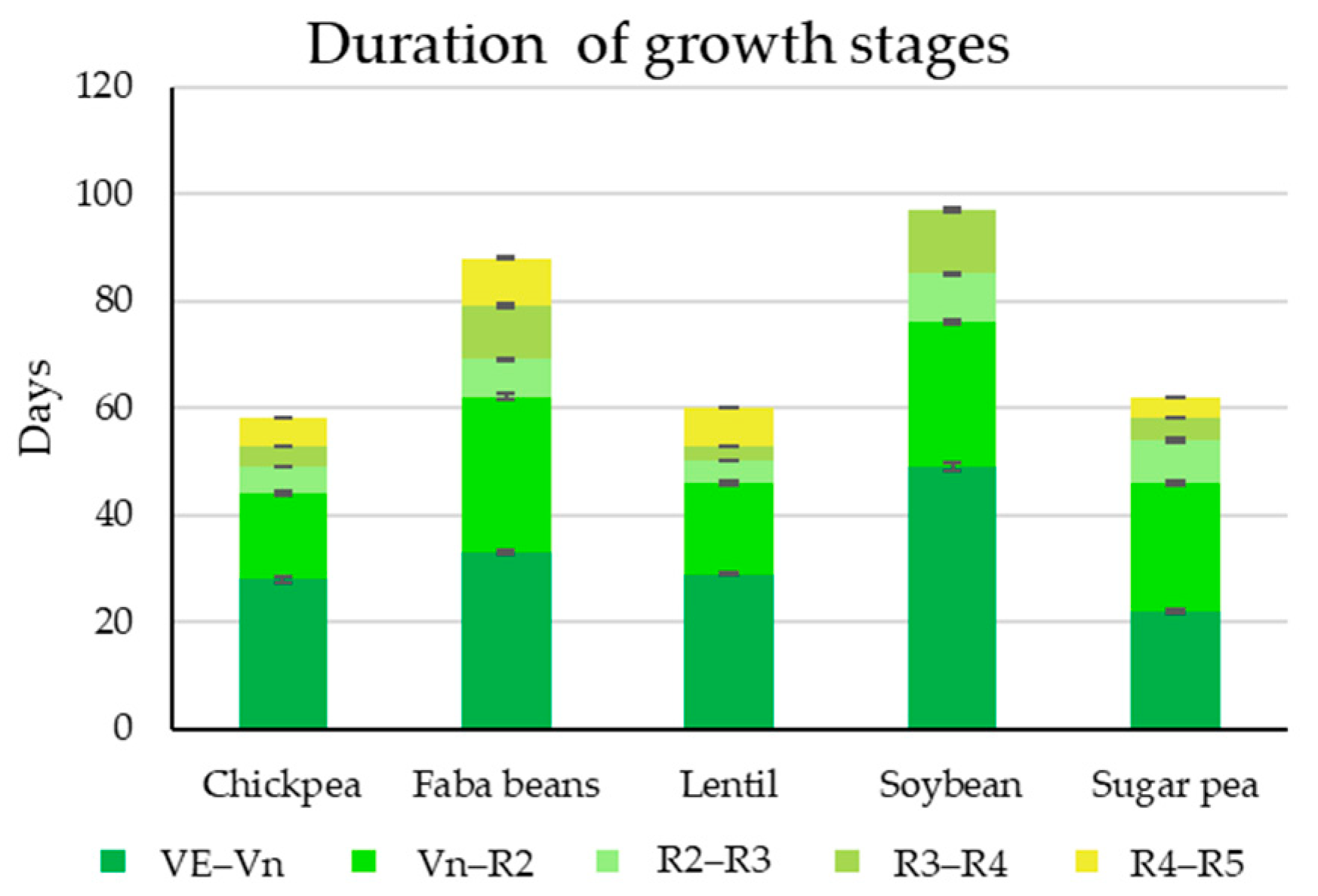
The duration of the developmental stages varies among the five legume species (Figure 1). In all crops, the early vegetative (VE–Vn) and reproductive (till full bloom (R2)) stages occupy a large portion of total development, particularly in soybean and faba bean. Before transitioning to reproductive stages, the vegetative growth stage (VE–Vn) of soybean lasted 49 days, whereas that of faba bean lasted 33 days. Soybeans took the longest to grow, reaching only the R4 growth stage within 97 days of cultivation, indicating that full pod formation had occurred. Given that this long-growing plant did not align with our subsequent goals of co-cultivating legumes with leafy vegetables, soybeans were not grown beyond the R5 growth stage. The shortest vegetative growing period was observed in sugar pea, lasting just 22 days. During reproductive development, the duration of individual stages in sugar pea was similar to that in lentil and chickpea. Overall, their growth to the R5 stage lasted an average of about 60 days.
Morphological traits and biomass accumulation were evaluated at V2, R2 and R3 growth stages and showed at Table 1. As development progressed, signs of senescence, such as stunted growth and yellowing leaves, became evident, so these measurements were not conducted at R4 and R5 growth stages. Shoot height increased steadily from V2 to R3 in all species. At the V2 stage, lentil and soybean exhibited the greatest shoot height, followed by faba bean, whereas chickpea and sugar pea were significantly shorter. These trends remained evident throughout the growth period.
Root length also varied significantly, but the extent of this variation depended on the legume species. Soybeans produced long roots consistently at all stages, with no significant differences between vegetative and reproductive stages. Similar trends have also been observed in peas. The roots of the faba bean grew consistently longer, with R3 exhibiting the greatest length, significantly surpassing those of other varieties. The root length of chickpeas and lentils was shorter during the vegetative stage than during the reproductive stage; however, no significant differences were observed among the various reproductive stages.
Biomass accumulation increased significantly from V2 to R3 in all five legume species, with substantial differences among organs and crops. At V2 and R2, soybean and faba bean exhibited the greatest leaf, stem, and root dry weights. However, at R3, only soybeans showed the highest growth across all organs, resulting in a total dry weight of 72.57 g, far exceeding that of all other species. Chickpea, sugar pea and lentil produced comparatively little biomass. The biomass changes in legume roots differed from those in the shoots. Root dry weight increased at V2 and R2, with chickpea and faba bean exhibiting the highest values. Faba bean and chickpea also increased substantially at R3, although to a lesser extent compared to soybeans, whereas lentil and sugar pea consistently produced the lowest root biomass across stages. Overall, there was significant variation in biomass partitioning and total dry matter accumulation among species, with soybean demonstrating the most vigorous growth during vegetative and reproductive development, unlike sugar pea and lentil.
Growth indices also differed significantly among species. Lentil exhibited the highest RGR during VE–V2 and decreased as the plants developed. Similar trends have been observed in both soybeans and sugar peas. Meanwhile, chickpea and faba bean showed the greatest RGR from V2–R2. LWR generally declined with growth in all species except soybean, which maintained consistently high values. Chickpeas showed a significant increase in RSR at R2, unlike other legumes, which did not exhibit substantial differences in this index during their development. The only exception was sugar peas, where the RSR was higher at V2. RSR in soybeans showed consistently low values across various growth stages due to its predominant shoot biomass accumulation. Overall, these findings reveal significant interspecific differences in growth behaviour, biomass distribution, and developmental pathways among legume species.

3.2. Nitrogen Content in Legumes

Significant differences in the concentrations of NH3–N, NO2, and NO3 were observed in the roots, stems, and leaves of various legume species at different growth stages (Table 2). At the V2 stage, faba bean exhibited markedly higher NH3–N levels compared to all other species. However, this concentration decreased significantly as the faba bean developed. In contrast, the roots of chickpea and soybean showed a progressive increase in NH3–N from the V2 to the R3 growth stages, with significant differences noted. Lentil and pea maintained relatively low concentrations of NH3–N across all growth stages, with the lowest levels recorded at the R2 stage. Lentil also exhibited the highest levels of NO2 and NO3 in its roots throughout all growth stages, with no significant changes noted during development. While chickpea showed significantly lower levels of NO2, these increased considerably from the V2 to R3 growth stages. No significant variations in NO2 concentrations were observed among the growth stages of soybean and pea.
Chickpea recorded the lowest NO3 concentration at the V2 stage, but this increased as the plant developed, particularly at the R2 growth stage. A similar trend was observed in faba beans. However, at the R3 growth stage, nitrate concentrations slightly declined in the roots of both chickpea and faba bean. Pea maintained moderate nitrate levels, with a slight increase across the stages.
The stems of chickpea and pea showed the highest accumulation of NH3–N at the R2 growth stage, compared to the V2 and R3 stages. In contrast, lentil stems exhibited an opposite trend. The highest concentration of NO2 in chickpea stems was observed at the V2 growth stage, followed by faba bean and soybean. At later growth stages, soybean maintained the highest NO2 levels among the legumes studied. Notably, at the V2 growth stage, chickpea displayed a higher concentration of NO3 in comparison with other legume species. Throughout development, the levels of NO2 and NO3 decreased in the stems of all species, with chickpea experiencing the most pronounced decline. At the R2 and R3 growth stages, pea exhibited the highest NO3 concentrations compared to the other legumes.
At the V2 growth stage, chickpea leaves exhibited the lowest NH3–N concentration, which progressively increased from V2 to R3, reaching a peak at R3. A similar trend was observed in peas. In contrast, the NH3–N concentrations in lentils and soybeans showed no significant changes throughout their growth stages. At V2, soybeans had the highest concentration of NO2 in their leaves, although growth stages did not significantly affect this measurement. During the R2 and R3 stages, the NO2 concentration was significantly highest in chickpeas and faba beans, while lentils showed the lowest levels. Additionally, leaf NO3 concentrations did not differ significantly among the legume species at any growth stage.
The results indicated that, across all species and growth stages, NO3 was the most abundant form of nitrogen found in the roots, leaves, and stems of the studied legumes. This was followed by NH3–N and NO2. The levels of NH3–N showed significant variation among species, particularly in faba bean and chickpea. In faba bean, peak concentrations of NH3–N occurred during the early growth stages, whereas in chickpea, they were observed at later stages. NO2 concentrations were generally lower and decreased as plants developed, especially in stems. These patterns suggest that species and tissue type strongly regulate the accumulation of different nitrogen forms during legume growth.

3.3. Nitrite and Nitrate Reductase Activity in Legumes

Root NR and NiR activities varied significantly across species and growth stages. Pea plants exhibited the highest activity of these enzymes in their roots during the V2 growth stage. As they progressed into reproductive development, the activity of these enzymes decreased, but it remained higher than that observed in other plants. Additionally, no significant differences were noted between the R2 and R3 growth stages. In contrast, faba beans experienced a substantial decrease in both NR and NiR activity as they developed. Lentils at the V2 growth stage showed high NR activity in roots, but NiR activity was lower than in other legumes (Table 3).
Similar trends in NR and NiR activity changes during development were observed in pea stems, mirroring those in roots. In chickpea and soybean stems, NR activity decreased, particularly at the R3 growth stage. In contrast, lentil stems exhibited relatively high NR activity, especially during the V2 and R3 growth stages. However, the NiR activity in the stems of these plants remained consistent across all growth stages. Analogous trends were also observed in both chickpea and faba bean stems.
Leaves showed significantly higher activities of both NR and NiR compared to roots and stems across all species and growth stages. In particular, NR activity was notably elevated in soybean and pea leaves across all growth stages, with a peak at the V2 stage. For chickpea and lentil leaves, NR activity remained consistent across all growth stages. Additionally, NiR activity in soybean leaves increased during the reproductive development stage compared to the vegetative stage, and it was higher than that in other leguminous plants. In contrast, NiR activity in faba bean and pea leaves did not vary with growth stage.
In summary, the activities of NR and NiR varied significantly across legume species, plant organs, and growth stages. The leaves of all legume plants displayed much higher NR and NiR activity than their roots and stems. Among the legumes studied, peas showed high enzyme activity across all plant parts. Notably, soybean leaves demonstrated the highest levels of NR and NiR activity compared to the other legumes.

4. Discussion

4.1. Characteristics of Growth and Development of Legumes in Hydroponics

The development of legumes in hydroponic systems CEA is influenced by the interaction between the genetic traits of specific species and carefully controlled environmental conditions. CEA systems enable precise regulation of temperature, light intensity, photoperiod, nutrient composition, root-zone oxygenation, and water availability across various plant cultivation systems. All these factors also significantly impact legume phenology, growth rates, and biomass [10,36,37,38]. Our results showed that variation in developmental stage duration among the five legume species highlights well-established species-specific differences in phenological progression and growth strategies under hydroponic cultivation in CEA. Similar trends to our results have been observed in other studies in which legume plants were grown in hydroponic systems under various conditions [10,39,40]. Soybeans and peas were the most notable in terms of their development duration. Soybeans exhibit longer early vegetative (VE–Vn) and early reproductive (up to full bloom, R2) stages compared to other legumes, indicating a prolonged period for canopy establishment and resource accumulation. The literature shows that soybeans are primarily known for their sensitivity to photoperiod and for regulating vegetative growth. The length of the vegetative phase significantly affects the timing of flowering and maturation, particularly under short-day conditions, and is influenced by significant maturity loci and variations in genes associated with flowering time. These genetic and physiological factors contribute to the extended vegetative phases observed in many soybean genotypes, especially in long-day environments [17,41]. Generally, field experiments on soybean cultivars indicate that the average vegetative growth stage is about 40–65 days [17,42]. In our studies, soybean vegetative growth in hydroponic CEA lasted 49 days and was comparable to that in the field. This similarity may have been influenced by the long-day (16 h) environments under which the plants were cultivated. The relatively long vegetative growth stage led to an extended reproductive development phase. It took 97 days for the soybean to reach the R4 growth stage. In comparison, most soybean cultivars achieve physiological maturity (R7–R8) in about 100 to 130 days [43]. This indicates that further studies are necessary to assess the impact of photoperiod on soybean growth in hydroponic CEA.
Our results revealed that pea exhibited the shortest overall growth duration, taking just 60 days to reach the R5 stage, with 22 days in the vegetative growth stage. Literature data showed that the beginning of seed growth occurred in field pea at 75 days after sowing [21]. Phenological models developed for field-grown peas indicate that temperature and thermal time accumulation significantly influence the rate of development across the BBCH-coded stages. Quick transitions from vegetative to reproductive stages in peas have been modelled and observed, particularly under spring sowing and higher temperatures, aligning with the rapid onset of early reproduction in short-season systems [44]. During our research, we found that the average day/night temperature for growing peas hydroponically was 23 °C during the day and 19 °C at night. This may have contributed to their faster development compared to other legumes.
For our research, we cultivated legumes until the R3 growth stage, when pod formation began and, according to the literature, nitrogen fixation began to decline. In addition, maximum nitrogen fixation typically occurs during the late vegetative to early reproductive stages [21,45,46]. In the literature, it is noted that legumes focus on developing their canopy and root systems during the vegetative phase. This early growth phase emphasizes rapid leaf and stem expansion, which enhances photosynthesis, increases biomass accumulation, and supports the formation of early nodules. Once the plants begin flowering and forming pods, they enter reproductive growth, which involves boosting overall biomass and reallocating carbon to the reproductive organs [16,17,18,19,45,47]. Our studies indicate that hydroponically grown legumes exhibit growth patterns similar to those grown in the field, with increased biomass accumulation during the early pod growth stage (R3). Only chickpeas and peas grew reliably from the R2 to R3 growth stages. The mass of other legumes increased but did not differ significantly between these stages. Among all the legumes, soybeans were the most notable. Soybeans exhibited vigorous growth, with strong shoot and root development. These plants grown in the hydroponic system exhibited uneven growth, as shown by the lack of significant statistical differences in biomass between the V2 and R2 growth stages. This suggests that vigorous growth and high plant density in the hydroponic environment may have led to intraspecific competition among soybeans. There is currently no literature on how density affects the growth of individual soybeans in hydroponics. However, studies conducted in soil and open hydroponics indicate that increased density can reduce the number of branches on soybean plants [48,49].
Plant growth analysis is a valuable set of quantitative methods used to describe and interpret the performance of all plant systems, whether they are grown in natural or controlled conditions. This approach integrates various aspects of plant form and function, utilising simple data such as plant weight, area, volume, and composition. By analysing this data, we can investigate processes across the entire plant or crop [32,33]. Generally, RGR is highest during early vegetative growth, characterised by rapid leaf development, high rates of photosynthesis, and efficient biomass accumulation [32,37]. Our research has revealed differences in relative growth rates (RGR) among various legume species. Lentil, soybean, and pea growth rates (RGR) were highest during the early stages of development (VE–V2). Chickpea and faba bean reached their maximum RGR later (V2–R2), indicating a prolonged vegetative growth phase before they began reproduction. LWR measures the proportion of total plant biomass attributed to leaves during different stages of growth. This ratio is highest early in vegetative development, as leaves optimise light capture and carbon assimilation [32]. Our results supported these trends observed in the hydroponic growth of legumes. In faba bean, lentil, and soybean, this index remained largely unchanged during the transition to reproductive development, except in pea. Similar trends were observed when evaluating RSR, an important parameter for measuring the relative distribution of biomass between root and aboveground components [32]. Chickpea distinguished itself by having the highest RSR and the lowest LWR at the R2 stage, indicating increased rooting during early reproductive growth. Similar patterns have been observed when these plants are grown in the field [50].
In summary, distinct differences were observed in growth duration, phenology, and biomass distribution among the legumes studied, which aligns with field cultivation patterns. Soybean exhibited the longest growth cycle, characterised by extended vegetative and early reproductive stages. In contrast, pea developed the fastest, likely due to favourable temperature conditions that hastened its transition to reproduction. Given these developmental characteristics, pea may be the most suitable choice for identifying plants that can be cultivated alongside leafy vegetables. However, further research is needed.

4.2. Changes in Nitrogen Metabolism in Legumes During Development

This study focuses on legume plants grown without rhizobia, enabling the examination of nitrogen metabolism dynamics that reflect the uptake, transport, and assimilation of mineral nitrogen rather than BNF. This experimental framework is especially advantageous for isolating the organisation of mineral nitrogen metabolism within the plant from symbiotic factors, such as nodulation, carbon allocation to nodules, and the export of BNF products. This indicates that nodules did not form on the roots and that nitrogenase did not function. Consequently, variations in nitrate reductase (NR) and nitrite reductase (NiR) activity, as well as the forms of mineral nitrogen, can be interpreted as direct physiological responses to inorganic nitrogen availability. It is important to note that plants received a mixed mineral nitrogen source, predominantly in the form of nitrate. The final hydroponic solution has a NO3:NH4+ ratio of 10:1. This ratio is crucial to the discussion, as the majority of nitrogen must traverse the assimilatory nitrate reduction pathway, whereas the NH4+ fraction can be assimilated directly, bypassing both NR and NiR.
Research has shown that mineral nitrogen availability can fully support the growth and biomass accumulation of legumes, especially during their early developmental stages. Additionally, while inorganic nitrogen can suppress nodulation and nitrogen fixation, it also promotes root growth and nutrient uptake. This allows legumes to maintain normal physiological function even in the absence of rhizobia.
The uptake of mineral nitrogen by plants is primarily governed by membrane transporters that absorb nitrogen from the solution into the root epidermis and cortex cells, subsequently distributing it throughout the plant’s tissues [51,52]. The primary “gateways” for nitrate (NO3) are the NRT1/NPF transporters, which typically have a low affinity but serve a broad range of functions, and the NRT2 transporters, which are high-affinity transporters [53,54,55]. Ammonium (NH4+), on the other hand, is taken up by the AMT family of transporters. Once nitrate enters the root cells, it can be: (i) reduced locally within the cells, (ii) temporarily stored (for example, in vacuoles), or (iii) loaded into the xylem for transport to the aboveground parts of the plant [56]. It is in the aboveground organs that further assimilation into usable forms occurs, a process that tends to be more intense. This model of nitrogen uptake—where it is absorbed by the roots and assimilated in the leaves—is particularly likely when the nutrient solution is rich in nitrate and when the leaves have the necessary reducing power to facilitate the further assimilation of nitrite (NO2) and ammonium (NH4+).
Legumes are often linked with symbiotic nitrogen fixation; however, they are not entirely reliant on rhizobia for their growth. In the absence of these symbiotic bacteria, legumes can take up inorganic nitrogen from the soil or a hydroponic solution, utilising nitrate and ammonium transport systems that function similarly to non-leguminous plants [57]. Higher plants utilise a two-enzyme system for the assimilation of mineral nitrogen. NR located in the cytosol catalyses the conversion of NO3 to NO2, while nitrite NiR located in plastids catalyses the reduction of NO2 to NH4+ [53,56]. The produced NH4+ or transported directly from the hydroponic solution can be rapidly integrated into organic forms via the glutamine synthetase/glutamate synthase (GS/GOGAT) cycle, yielding glutamine and glutamate [53,54,55]. These amino acids serve as major nitrogen donors for the biosynthesis of other amino acids, nucleotides, and various nitrogen-containing compounds. Effective assimilation relies on coordination between NR and NiR, as well as on the timely further assimilation of NH4+ [58].
Our results demonstrate a clear organ-specific gradient: NR and NiR activities were highest in leaves, significantly lower in stems, and lowest in roots [59,60]. The distribution of N forms across organs and growth stages was closely associated with the activity of NR and NiR enzymes, indicating coordinated regulation of N assimilation in legume plants grown without rhizobia. In roots, high nitrate concentrations at the V2 stage coincided with elevated NR activity, suggesting active nitrate uptake and initial reduction, whereas consistently low nitrite levels reflected efficient coupling between NR and NiR, preventing nitrite accumulation. As plants progressed to reproductive stages, root NR activity declined despite the presence of nitrate, implying a developmental shift toward nitrate transport to aboveground tissues rather than continued root assimilation. In stems, decreasing NO3 and NO2 concentrations from V2 to R3, together with sustained enzyme activities, indicate that this organ functions as a transient site of nitrate processing and redistribution rather than long-term storage. Leaves exhibited the highest NR and NiR activities across all species and growth stages, while nitrate concentrations remained relatively stable, demonstrating rapid nitrate turnover and efficient assimilation. The absence of excessive ammonia accumulation in leaf tissues further supports effective downstream incorporation of reduced nitrogen into organic compounds. This distribution indicates that the primary site of nitrate reduction is the photosynthetic tissues, which is logical, given that leaves have better access to the energy and reducing power required for nitrite reduction in plastids, followed by subsequent NH4+ assimilation. In contrast, roots in this model likely function primarily as nodes for nitrate uptake and transport rather than as major sites for reduction, particularly when nitrogen supply is not limiting, and nitrate can be efficiently transported to the leaves for assimilation [61,62].
The profiles of mineral nitrogen forms (NO3, NO2, and NH3–N) across different organs should be interpreted in conjunction with enzymatic capacity, distinguishing between “quantity” and “flux” [63,64]. Elevated concentrations of NO3 in tissues do not invariably indicate more intensive assimilation, as NO3 can be temporarily stored (e.g., in vacuoles) and serve osmoregulatory and reserve functions, especially when it is consistently available in solution. An increase in NO2 levels within a specific organ or growth stage may indicate a lack of coordination between NR and NiR or limitations in subsequent NH4+ assimilation via GS/GOGAT, leading to the accumulation of this intermediate.
The NH4+ component (approximately 11 mg L−1 in the final solution) adds an additional interpretive layer to the NH3–N results, as part of the NH3–N pool may originate not only from the NO3 → NO2 → NH4+ pathway but also from direct NH4+ input from the solution [65,66]. Therefore, organs or growth stages with elevated NH3–N content may reflect not just that nitrate reduction has increased but also temporary NH4+ assimilation loads, variations in transport efficiency, or limitations in carbon skeletons/energy, particularly in non-photosynthetic tissues [67]. This reasoning facilitates a clear distinction in the discussion between: (i) NO3 accumulation and reduction (linked to NR/NiR), (ii) NH4+ uptake and rapid incorporation into amino acids (GS/GOGAT), and (iii) scenarios where increases in intermediate or final inorganic nitrogen pools result from metabolic coordination rather than nitrogen deficiency or excess.
Ultimately, changes in NR and NiR activities during the V2, R2, and R3 stages, alongside the dynamics of NO3, NO2, and NH3–N, should be analysed in the context of plant development and alterations in nitrogen “sinks,” rather than merely as immediate effects of nitrogen solution concentrations [54,62]. During the vegetative stage, heightened nitrogen demand correlates with the rapid growth of leaves and other vegetative tissues [64]. Conversely, during reproductive stages (flowering and pod initiation), new nitrogen “sinks” emerge, influencing nitrogen distribution and potentially modifying enzymatic activities and inorganic nitrogen pool profiles across organs.

5. Conclusions

Based on the combined analysis of biomass allocation, nitrogen profiles, and NR/NiR activities, sugar pea emerged as the most promising candidate for future combined or intercropping systems with leafy vegetables under hydroponic conditions. This species exhibited high and stable nitrate and nitrite reductase activities in leaves, moderate mineral nitrogen accumulation, and a balanced allocation between shoot and root biomass, indicating efficient nitrogen assimilation without excessive internal nitrogen buffering. Soybean showed similarly strong leaf-based nitrate assimilation but was associated with higher biomass dominance and nitrogen demand, suggesting a potentially stronger competitive role. In contrast, faba bean displayed a more root-oriented nitrogen utilisation strategy and elevated ammonium accumulation, which may limit its suitability for systems prioritising above-ground productivity. Importantly, these interpretations are derived from monoculture hydroponic screening and should be regarded as preliminary indicators rather than direct predictions of intercropping performance.

Author Contributions

Conceptualisation, A.B., R.S., G.S. and A.V.; methodology, A.B., R.S., P.M., H.I. and M.M.; formal analysis, R.S., A.P., K.L. and J.R.; writing—original draft preparation, A.B. and R.S.; writing—review and editing, A.B., R.S., G.S., A.V., A.P., P.M., H.I. and M.M.; supervision, A.B.; project administration, R.S. All authors have read and agreed to the published version of the manuscript.

Funding

This research was funded by NordForsk, Nordic Energy Research, the Research Council of Lithuania, Formas, the Swedish Energy Agency and the Research Council of Finland through the funding to “Green nitrogen transition: The potential of legumes in control environment agriculture”, project number 181319.

Data Availability Statement

The original contributions presented in the study are included in the article further inquiries can be directed to the corresponding author.

Conflicts of Interest

The authors declare no conflicts of interest.

Abbreviations

The following abbreviations are used in this manuscript:
BNFBiological nitrogen fixation
CEAControlled Environment agriculture
LEDLight-emitting diode
DWCDeep-water culture hydroponic systems
RGRRelative growth rate
LWRLeaf weight ratio
RSRRoot to shoot ratio
NRNitrate reductase
NiRNitrite reductase

References

  1. Blair, M.W.; Wu, X.; Bhandari, D.; Zhang, X.; Hao, J. Role of Legumes for and as Horticultural Crops in Sustainable Agriculture. In Organic Farming for Sustainable Agriculture; Nandwani, D., Ed.; Springer International Publishing: Cham, Switzerland, 2016; Volume 9, pp. 185–211. [Google Scholar]
  2. Stagnari, F.; Maggio, A.; Galieni, A.; Pisante, M. Multiple Benefits of Legumes for Agriculture Sustainability: An Overview. Chem. Biol. Technol. Agric. 2017, 4, 2. [Google Scholar] [CrossRef]
  3. Kebede, E. Contribution, Utilization, and Improvement of Legumes-Driven Biological Nitrogen Fixation in Agricultural Systems. Front. Sustain. Food Syst. 2021, 5, 767998. [Google Scholar] [CrossRef]
  4. Yanni, A.E.; Iakovidi, S.; Vasilikopoulou, E.; Karathanos, V.T. Legumes: A Vehicle for Transition to Sustainability. Nutrients 2023, 16, 98. [Google Scholar] [CrossRef] [PubMed]
  5. Yeremko, L.; Czopek, K.; Staniak, M.; Marenych, M.; Hanhur, V. Role of Environmental Factors in Legume-Rhizobium Symbiosis: A Review. Biomolecules 2025, 15, 118. [Google Scholar] [CrossRef] [PubMed]
  6. Imsande, J. Enhanced Nitrogen Fixation Increases Net Photosynthetic Output and Seed Yield of Hydroponically Grown Soybean. J. Exp. Bot. 1988, 39, 1313–1321. [Google Scholar] [CrossRef]
  7. Hata, N.; Futamura, H. Production of Soybean Plants for Hydroponic Cultivation from Seedling Cuttings in a Medium Containing Rhizobium Inoculum Depending on Various Concentrations of Nutrient Solution and Different Nitrogen Sources. J. Hortic. Res. 2020, 28, 71–82. [Google Scholar] [CrossRef]
  8. Kontopoulou, C.-K.; Giagkou, S.; Stathi, E.; Savvas, D.; Iannetta, P.P.M. Responses of Hydroponically Grown Common Bean Fed with Nitrogen-Free Nutrient Solution to Root Inoculation with N2-Fixing Bacteria. HortScience 2015, 50, 597–602. [Google Scholar] [CrossRef]
  9. Kontopoulou, C.; Liasis, E.; Iannetta, P.P.; Tampakaki, A.; Savvas, D. Impact of Rhizobial Inoculation and Reduced N Supply on Biomass Production and Biological N2 Fixation in Common Bean Grown Hydroponically. J. Sci. Food Agric. 2017, 97, 4353–4361. [Google Scholar] [CrossRef]
  10. Karavidas, I.; Ntatsi, G.; Ntanasi, T.; Tampakaki, A.; Giannopoulou, A.; Pantazopoulou, D.; Sabatino, L.; Iannetta, P.P.M.; Savvas, D. Hydroponic Common-Bean Performance under Reduced N-Supply Level and Rhizobia Application. Plants 2023, 12, 646. [Google Scholar] [CrossRef]
  11. Paradiso, R.; Buonomo, R.; Dixon, M.A.; Barbieri, G.; De Pascale, S. Effect of Bacterial Root Symbiosis and Urea as Source of Nitrogen on Performance of Soybean Plants Grown Hydroponically for Bioregenerative Life Support Systems (BLSSs). Front. Plant Sci. 2015, 6, 888. [Google Scholar] [CrossRef]
  12. Savvas, D.; Ntatsi, G.; Vlachou, M.; Vrontani, C.; Rizopoulou, E.; Fotiadis, C.; Ropokis, A.; Tampakaki, A. Impact of Different Rhizobial Strains and Reduced Nitrogen Supply on Growth, Yield and Nutrient Uptake in Cowpea Grown Hydroponically. Acta Hortic. 2018, 1227, 417–424. [Google Scholar] [CrossRef]
  13. Arcas-Pilz, V.; Parada, F.; Villalba, G.; Rufí-Salis, M.; Rosell-Melé, A.; Gabarrell Durany, X. Improving the Fertigation of Soilless Urban Vertical Agriculture Through the Combination of Struvite and Rhizobia Inoculation in Phaseolus Vulgaris. Front. Plant Sci. 2021, 12, 649304. [Google Scholar] [CrossRef] [PubMed]
  14. Amoako, F.K.; Sulieman, S.; Mühling, K.H. Mineral and Carbon Metabolic Adjustments in Nodules of Symbiotically Grown Faba Bean (Vicia faba L.) Varieties in Response to Organic Phosphorus Supplementation. Plants 2023, 12, 3888. [Google Scholar] [CrossRef] [PubMed]
  15. Hu, Y.; Chen, Y.; Yang, X.; Deng, L.; Lu, X. Enhancing Soybean Yield: The Synergy of Sulfur and Rhizobia Inoculation. Plants 2023, 12, 3911. [Google Scholar] [CrossRef]
  16. Daur, I.; Sepetoğlu, H.; Sindel, B. Dynamics of Faba Bean Growth and Nutrient Uptake and Their Correlation with Grain Yield. J. Plant Nutr. 2011, 34, 1360–1371. [Google Scholar] [CrossRef]
  17. Yuan, S.L.; Li, R.; Chen, H.F.; Zhang, C.J.; Chen, L.M.; Hao, Q.N.; Chen, S.L.; Shan, Z.H.; Yang, Z.L.; Zhang, X.J.; et al. RNA-Seq Analysis of Nodule Development at Five Different Developmental Stages of Soybean (Glycine max) Inoculated with Bradyrhizobium Japonicum Strain 113-2. Sci. Rep. 2017, 7, 42248. [Google Scholar] [CrossRef]
  18. Mondal, M.M.A.; Puteh, A.B.; Mohd Abdul Malek, M.A.; Roy, S.; Yusop, M.R. Contribution of morpho-physiological traits on yield of lentil (Lens culinaris Medik). Aust. J. Crop Sci. 2013, 7, 1167–1172. [Google Scholar]
  19. Pinzón-Sandoval, E.H.; Carvalho Silva, W.; Marchiori, P.E.R. Phenology, Mass Accumulation Patterns and Growing Degree Days in Common Bean. Rev. Cienc. Agric. 2024, 41, e3239. [Google Scholar] [CrossRef]
  20. Dwivedi, S.L.; Sahrawat, K.L.; Upadhyaya, H.D.; Mengoni, A.; Galardini, M.; Bazzicalupo, M.; Biondi, E.G.; Hungria, M.; Kaschuk, G.; Blair, M.W.; et al. Advances in Host Plant and Rhizobium Genomics to Enhance Symbiotic Nitrogen Fixation in Grain Legumes. In Advances in Agronomy; Elsevier: Amsterdam, The Netherlands, 2015; Volume 129, pp. 1–116. [Google Scholar]
  21. Koutroubas, S.D.; Damalas, C.A.; Fotiadis, S.; Markopoulos, T. Species, Cultivar and Seasonal Effects on Nodulation and Nitrogen Utilization of Spring Mediterranean Grain Legumes. J. Soil Sci. Plant Nutr. 2023, 23, 4463–4473. [Google Scholar] [CrossRef]
  22. Camargos, L.S.; Aguiar, L.F.; Azevedo, R.A. Site of Nitrate Reduction in Jack Bean (Canavalia ensiformis) Changes from Leaf to Root during Development. N. Z. J. Crop Hortic. Sci. 2006, 34, 131–137. [Google Scholar] [CrossRef]
  23. Hossain, Z.; Wang, X.; Hamel, C.; Gan, Y. Nodulation and Nitrogen Accumulation in Pulses Vary with Species, Cultivars, Growth Stages, and Environments. Can. J. Plant Sci. 2018, 98, 527–542. [Google Scholar] [CrossRef]
  24. Zheng, Y.; Guo, Y.; Li, Y.; Yang, W.; Dong, Y. Intercropping of Wheat Alleviates the Adverse Effects of Phenolic Acids on Faba Bean. Front. Plant Sci. 2022, 13, 997768. [Google Scholar] [CrossRef] [PubMed]
  25. Soufan, W. The Effect of the Mixing Ratio of Barley and Mung Bean Seeds on the Quality of Sprouted Green Fodder and Silage in a Hydroponic System. Agronomy 2023, 13, 2301. [Google Scholar] [CrossRef]
  26. Liu, Y.; Liu, M.; Zhang, Q.; Jin, P.; Xu, X. Effects of pH on Interactions between Rice and Pea Grown under Hydroponic Condition. Plant Growth Regul. 2024, 104, 201–213. [Google Scholar] [CrossRef]
  27. Elghalmi, O.; El Aadmoni, Z.; Samir, K.; El Koudrim, M. Enhancing Forage Production and Nutrient Value Through Cereal/Legume Mixtures in Hydroponic Systems: A Study on Barley, Triticale, and Fodder Pea. Agric. Res. 2025, 14, 804–811. [Google Scholar] [CrossRef]
  28. D-Andrade, L.; Escalante-Garcia, N.; Olvera-Gonzalez, E.; Orsini, F.; Pennisi, G.; De Luna, F.V.; Silos-Espino, H.; Najera, C. Intercropping Lettuce with Alfalfa Under Variable Nitrate Supply: Effects on Growth Performance and Nutrient Dynamics in a Vertical Hydroponic System. Plants 2025, 14, 2060. [Google Scholar] [CrossRef]
  29. Management of Legume|Bean IPM. Available online: https://beanipm.pbgworks.org/management (accessed on 8 December 2025).
  30. Manitoba Pulse & Soybean Growers. Faba Bean Growth Staging Guide; Manitoba Pulse & Soybean Growers: Carman, MB, Canada, 2019. [Google Scholar]
  31. Manitoba Pulse & Soybean Growers. Soybean Growth Staging Guide; Manitoba Pulse & Soybean Growers: Carman, MB, Canada, 2015. [Google Scholar]
  32. Hunt, R. Growth Analysis, Individual Plants. In Encyclopedia of Applied Plant Sciences, 2nd ed.; Thomas, B., Murphy, D.J., Murray, B.G., Eds.; Elsevier: Oxford, UK, 2016. [Google Scholar]
  33. Pandey, R.; Paul, V.; Das, M.; Meena, M.; Meena, R.C. Plant Growth Analysis; Edward Arnold: London, UK, 2017. [Google Scholar] [CrossRef]
  34. ASTM D1426–08; Standard Test Methods for Ammonia Nitrogen in Water. ASTM International: West Conshohocken, PA, USA, 2008.
  35. Ali, A.; Sivakami, S.; Raghuram, N. Regulation of Activity and Transcript Levels of NR in Rice (Oryza sativa): Roles of Protein Kinase and G-Proteins. Plant Sci. 2007, 172, 406–413. [Google Scholar] [CrossRef]
  36. Rajaseger, G.; Chan, K.L.; Tan, K.Y.; Ramasamy, S.; Khin, M.C.; Amaladoss, A.; Haribhai, P.K. Hydroponics: Current Trends in Sustainable Crop Production. Bioinformation 2023, 19, 925–938. [Google Scholar] [CrossRef]
  37. Tawarkhed, S.; Ashvathama, V.H.; Navyashree, R.; Patil, M.; Mummigatti, U.V. Evaluation of Growth Parameters and Yield Variation in Field Pea Genotypes. Int. J. Adv. Biochem. Res. 2024, 8, 709–713. [Google Scholar] [CrossRef]
  38. Sinha, T.; Mondal, S.; Nath, R.; Hembram, S. Morphological Traits and Growth Studies of Some Promising Chickpea [Cicer arietinum (L.)] Genotypes. Int. J. Chem. Stud. 2020, 8, 1712–1717. [Google Scholar] [CrossRef][Green Version]
  39. Ozkan, S.S. Yield and Quality Effects of Co-Cultivating Barley and Triticale with Legumes in Hydroponic Fodder Production. Legume Res. Int. J. 2025, 48, 414–422. [Google Scholar] [CrossRef]
  40. Fernandes, C.; Ravi, L. Screening of Symbiotic Ability of Rhizobium Under Hydroponic Conditions. In Microbial Symbionts; Elsevier: Amsterdam, The Netherlands, 2023; pp. 327–341. [Google Scholar]
  41. Hou, Z.; Liu, B.; Kong, F. Regulation of Flowering and Maturation in Soybean. In Advances in Botanical Research; Elsevier: Amsterdam, The Netherlands, 2022; Volume 102, pp. 43–75. [Google Scholar]
  42. Sun, H.; Shen, S.; Yang, J.; Zou, J.; Harrison, M.T.; Wang, Z.; Hu, J.; Guo, H.; Umburanas, R.C.; Zhai, Y.; et al. Soybean Cultivar Breeding Has Increased Yields Through Extended Reproductive Growth Periods and Elevated Photosynthesis. Plants 2025, 14, 1675. [Google Scholar] [CrossRef] [PubMed]
  43. Soybean. Available online: https://www.fao.org/land-water/databases-and-software/crop-information/soybean/en/ (accessed on 8 December 2025).
  44. Schieler, M.; Riemer, N.; Kleinhenz, B.; Saucke, H.; Veith, M.; Racca, P. SIMONTO-Pea: Phenological Models to Predict Crop Growth Stages in BBCH of Grain and Green Peas (Pisum sativum) for Temporal Pest Management. Agriculture 2023, 14, 15. [Google Scholar] [CrossRef]
  45. Morin, A.; Maurousset, L.; Vriet, C.; Lemoine, R.; Doidy, J.; Pourtau, N. Carbon Fluxes and Environmental Interactions during Legume Development, with a Specific Focus on Pisum sativum. Physiol. Plant. 2022, 174, e13729. [Google Scholar] [CrossRef] [PubMed]
  46. Ciampitti, I.A.; De Borja Reis, A.F.; Córdova, S.C.; Castellano, M.J.; Archontoulis, S.V.; Correndo, A.A.; Antunes De Almeida, L.F.; Moro Rosso, L.H. Revisiting Biological Nitrogen Fixation Dynamics in Soybeans. Front. Plant Sci. 2021, 12, 727021. [Google Scholar] [CrossRef]
  47. Vogel, J.T.; Liu, W.; Olhoft, P.; Crafts-Brandner, S.J.; Pennycooke, J.C.; Christiansen, N. Soybean Yield Formation Physiology—A Foundation for Precision Breeding Based Improvement. Front. Plant Sci. 2021, 12, 719706. [Google Scholar] [CrossRef]
  48. Klimek-Kopyra, A.; Bacior, M.; Lorenc-Kozik, A.; Neugschwandtner, R.W.; Zając, T. Intraspecific Competition as a Driver for True Production Potential of Soybean. Ital. J. Agron. 2021, 16, 1709. [Google Scholar] [CrossRef]
  49. Tadevosyan, A.; Matevosyan, A.; Tovmasyan, A.; Asatryan, A.; Gasparyan, A.; Mairapetyan, S. The Impact of Planting Density on Yield and Nutritional Value of Glycine max (L.) Merr. Under Outdoor Hydroponics in Armenia. Acta Hortic. 2025, 1416, 513–522. [Google Scholar] [CrossRef]
  50. Kamboj, E.; Dhaka, A.K.; Kumar, S.; Singh, B.; Hooda, V.S. Growth and Yield Performance of Chickpea (Cicer arietinum) as Influenced by Irrigation Levels and Genotypes: A Review. Agric. Rev. 2024, 46, 663–670. [Google Scholar] [CrossRef]
  51. Muratore, C.; Espen, L.; Prinsi, B. Nitrogen Uptake in Plants: The Plasma Membrane Root Transport Systems from a Physiological and Proteomic Perspective. Plants 2021, 10, 681. [Google Scholar] [CrossRef]
  52. Duan, W.; Wang, S.; Zhang, H.; Xie, B.; Zhang, L. Plant Growth and Nitrate Absorption and Assimilation of Two Sweet Potato Cultivars with Different N Tolerances in Response to Nitrate Supply. Sci. Rep. 2024, 14, 21286. [Google Scholar] [CrossRef] [PubMed]
  53. Fan, X.; Naz, M.; Fan, X.; Xuan, W.; Miller, A.J.; Xu, G. Plant Nitrate Transporters: From Gene Function to Application. J. Exp. Bot. 2017, 68, 2463–2475. [Google Scholar] [CrossRef] [PubMed]
  54. Zayed, O.; Hewedy, O.A.; Abdelmoteleb, A.; Ali, M.; Youssef, M.S.; Roumia, A.F.; Seymour, D.; Yuan, Z.-C. Nitrogen Journey in Plants: From Uptake to Metabolism, Stress Response, and Microbe Interaction. Biomolecules 2023, 13, 1443. [Google Scholar] [CrossRef] [PubMed]
  55. Dechorgnat, J.; Nguyen, C.T.; Armengaud, P.; Jossier, M.; Diatloff, E.; Filleur, S.; Daniel-Vedele, F. From the Soil to the Seeds: The Long Journey of Nitrate in Plants. J. Exp. Bot. 2011, 62, 1349–1359. [Google Scholar] [CrossRef]
  56. Liang, G.; Zhang, Z. Reducing the Nitrate Content in Vegetables Through Joint Regulation of Short-Distance Distribution and Long-Distance Transport. Front. Plant Sci. 2020, 11, 1079. [Google Scholar] [CrossRef]
  57. Lepetit, M.; Brouquisse, R. Control of the Rhizobium–Legume Symbiosis by the Plant Nitrogen Demand Is Tightly Integrated at the Whole Plant Level and Requires Inter-Organ Systemic Signaling. Front. Plant Sci. 2023, 14, 1114840. [Google Scholar] [CrossRef]
  58. Oaks, A. Primary Nitrogen Assimilation in Higher Plants and Its Regulation. Can. J. Bot. 1994, 72, 739–750. [Google Scholar] [CrossRef]
  59. Han, Z.; Lu, Y.; Zhao, Y.; Wang, Y.; Han, Z.; Han, Y.; Zhang, J. Analysis of Relative Expression of Key Enzyme Genes and Enzyme Activity in Nitrogen Metabolic Pathway of Two Genotypes of Potato (Solanum tuberosum L.) Under Different Nitrogen Supply Levels. Horticulturae 2022, 8, 769. [Google Scholar] [CrossRef]
  60. Costa-Broseta, Á.; Castillo, M.; León, J. Nitrite Reductase 1 Is a Target of Nitric Oxide-Mediated Post-Translational Modifications and Controls Nitrogen Flux and Growth in Arabidopsis. Int. J. Mol. Sci. 2020, 21, 7270. [Google Scholar] [CrossRef]
  61. Wang, Y.-Y.; Cheng, Y.-H.; Chen, K.-E.; Tsay, Y.-F. Nitrate Transport, Signaling, and Use Efficiency. Annu. Rev. Plant Biol. 2018, 69, 85–122. [Google Scholar] [CrossRef]
  62. Wang, Q.; Li, S.; Li, J.; Huang, D. The Utilisation and Roles of Nitrogen in Plants. Forests 2024, 15, 1191. [Google Scholar] [CrossRef]
  63. Binacchi, F.; Niether, W.; Brock, C.; Knebl, L.; Brændholt, A.; Wolf, B.; Gattinger, A. Demystifying the Agronomic and Environmental N Performance of Grain Legumes across Contrasting Soil Textures of Central Germany. Agric. Ecosyst. Environ. 2023, 356, 108645. [Google Scholar] [CrossRef]
  64. Mugi-Ngenga, E.; Bastiaans, L.; Zingore, S.; Anten, N.P.R.; Giller, K.E. The Role of Nitrogen Fixation and Crop N Dynamics on Performance and Legacy Effects of Maize-Grain Legumes Intercrops on Smallholder Farms in Tanzania. Eur. J. Agron. 2022, 141, 126617. [Google Scholar] [CrossRef]
  65. De Filippis, G.; Ercoli, L.; Rossetto, R. A Spatially Distributed, Physically-Based Modeling Approach for Estimating Agricultural Nitrate Leaching to Groundwater. Hydrology 2021, 8, 8. [Google Scholar] [CrossRef]
  66. Robertson, G.P.; Groffman, P.M. Nitrogen Transformations. In Soil Microbiology, Ecology and Biochemistry; Elsevier: Amsterdam, The Netherlands, 2024; pp. 407–438. [Google Scholar]
  67. Amoah, J.N.; Keitel, C.; Kaiser, B.N. Nitrogen Deficiency Impacts Growth and Modulates Carbon Metabolism in Maize. Planta 2025, 262, 94. [Google Scholar] [CrossRef]
Figure 1. Duration of legume growth stages. VE—germination and emergence, Vn—the legume plant leaves (chickpea—V9, faba beans—V4, lentil—V8, soybean—V3, sugar pea—V4), R2—full bloom, R3—early pod, R4—full pod, R5—early seed.
Horticulturae 12 00308 g001
Table 1. Changes in growth parameters during the growth of legume plants.
IndicesGSLegumes Plants
ChickpeaFaba BeansLentilSoybeanSugar Pea
Shoot height, cmV216.50 ± 1.500 c21.00 ± 1.732 b33.67 ± 0.294 c32.73 ± 0.623 b13.67 ± 0.333 c
R239.00 ± 2.887 b58.50 ± 1.443 a50.33 ± 0.588 b83.67 ± 1.856 a25.67 ± 0.667 b
R355.67 ± 3.283 a64.00 ± 3.000 a61.00 ± 1.018 a91.00 ± 5.196 a32.67 ± 1.202 a
Root length, cmV239.33 ± 2.848 b35.50 ± 0.289 c31.67 ± 0.401 b73.00 ± 6.245 a47.67 ± 5.897 a
R258.33 ± 2.963 a58.67 ± 4.485 b 56.33 ± 0.111 a63.00 ± 3.786 a57.67 ± 2.963 a
R364.00 ± 1.732 a92.50 ± 6.640 a53.67 ± 0.801 a78.00 ± 2.309 a56.67 ± 6.360 a
Leaf DW, gV20.15 ± 0.016 b0.66 ± 0.054 b0.23 ± 0.009 b1.18 ± 0.088 b0.48 ± 0.059 c
R22.04 ± 0.383 b6.52 ± 0.547 a1.28 ± 0.020 a11.11 ± 2.226 b1.49 ± 0.081 b
R36.77 ± 1.014 a7.84 ± 1.110 a1.38 ± 0.046 a35.36 ± 8.233 a2.08 ± 0.071 a
Stem DW, gV20.04 ± 0.007 b0.30 ± 0.033 b0.14 ± 0.006 b0.44 ± 0.024 b0.19 ± 0.030 c
R20.87 ± 0.184 b4.84 ± 0.533 a1.09 ± 0.006 a7.10 ± 1.048 b1.09 ± 0.056 b
R33.92 ± 0.317 a6.32 ± 0.919 a1.49 ± 0.199 a23.26 ± 6.027 a1.89 ± 0.112 a
Root DW, gV20.05 ± 0.008 c0.31 ± 0.025 c0.11 ± 0.007 b0.36 ± 0.026 b0.16 ± 0.022 c
R22.08 ± 0.307 b2.62 ± 0.223 b0.48 ± 0.026 a1.37 ± 0.126 b0.42 ± 0.018 b
R33.07 ± 0.126 a5.49 ± 0.837 a0.58 ± 0.057 a13.95 ± 1.859 a0.66 ± 0.037 a
Total DW, gV20.24 ± 0.029 c1.26 ± 0.112 b0.48 ± 0.021 b1.98 ± 0.126 b0.84 ± 0.109 c
R24.98 ± 0.849 b13.98 ± 1.303 a2.85 ± 0.040 a19.58 ± 3.106 b2.99 ± 0.142 b
R313.76 ± 1.214 a19.64 ± 2.124 a3.45 ± 0.413 a72.57± 16.118 a4.64 ± 0.162 a
RGRVE–V20.04 ± 0.001 c0.04 ± 0.001 b0.26 ± 0.002 a0.14 ± 0.001 a0.13 ± 0.004 a
V2–R20.16 ± 0.002 a0.11 ± 0.001 a0.08 ± 0.001 b0.06 ± 0.002 b0.08 ± 0.022 ab
R2–R30.11 ± 0.010 b0.02 ± 0.001 c0.03 ± 0.014 c0.06 ± 0.005 b0.04 ± 0.002 b
LWRV20.61 ± 0.010 a0.52 ± 0.003 a0.49 ± 0.004 a0.60 ± 0.009 a0.58 ± 0.004 a
R20.41 ± 0.016 b0.47 ± 0.004 ab0.45 ± 0.006 ab0.56 ± 0.023 a0.50 ± 0.004 b
R30.49 ± 0.032 b0.40 ± 0.032 b0.40 ± 0.022 b0.48 ± 0.006 a0.45 ± 0.002 c
RSRV20.27 ± 0.027 b0.33 ± 0.004 a0.30 ± 0.007 a0.22 ± 0.016 a0.24 ± 0.015 a
R20.74 ± 0.086 a0.23 ± 0.002 a0.21 ± 0.010 a0.08 ± 0.020 a0.16 ± 0.009 b
R30.30 ± 0.048 b0.40 ± 0.078 a0.21 ± 0.047 a0.20 ± 0.021 a0.17 ± 0.015 b
Notes: GS—growth stages, VE—germination and emergence, V2—the legume plant leaves, R2—full bloom, R3—early pod; RGR—relative growth rate, LWR—leaf weight ratio, RSR—root to shoot ratio. The values are means ± SE (standard error). According to Tukey’s test, different letters in columns indicate significant differences at p < 0.05 level.
Table 2. Changes in ammonia nitrogen, nitrites, and nitrates content during the growth of legume plants.
IndicesGSLegumes Plants
ChickpeaFaba BeansLentilSoybeanSugar Pea
Roots
NH3–N, mg g−1 DWV20.23 ± 0.009 c16.85 ± 0.029 a0.80 ± 0.026 a0.45 ± 0.028 c0.57 ± 0.009 b
R21.68 ± 0.017 b11.17 ± 0.521 b0.54 ± 0.022 c0.77 ± 0.021 b0.46 ± 0.007 c
R32.02 ± 0.046 a4.93 ± 0.109 c0.71 ± 0.007 b2.96 ± 0.015 a0.67 ± 0.038 a
NO2, mg g−1 DWV20.80 ± 0.001 c0.87 ± 0.088 b2.37 ± 0.133 a1.43 ± 0.088 a1.33 ± 0.088 a
R21.10 ± 0.058 b0.27 ± 0.033 c2.03 ± 0.067 a1.10 ± 0.115 a0.97 ± 0.033 a
R31.37 ± 0.067 a1.23 ± 0.088 a1.90 ± 0.153 a1.67 ± 0.517 a0.83 ± 0.233 a
NO3, mg g−1 DWV252.67 ± 4.419 c79.17 ± 1.093 b107.50 ± 2.291 a100.17 ± 0.726 a74.50 ± 2.843 b
R2115.00 ± 4.907 a89.33 ± 2.455 a115.67 ± 3.678 a107.83 ± 4.807 a84.33 ± 2.186 ab
R391.00 ± 2.000 b80.17 ± 1.093 b103.50 ± 3.547 a104.83 ± 1.590 a86.50 ± 2.000 a
Stems
NH3–N, mg g−1 DWV20.00 ± 0.000 c11.56 ± 0.161 a1.17 ± 0.013 b0.76 ± 0.037 a2.18 ± 0.006 c
R20.33 ± 0.001 a7.81 ± 0.223 b0.76 ± 0.010 c0.74 ± 0.007 a2.86 ± 0.071 a
R30.27 ± 0.012 b4.67 ± 0.048 c1.25 ± 0.011 a0.56 ± 0.012 b2.38 ± 0.012 b
NO2, mg g−1 DWV23.95 ± 0.180 a2.66 ± 0.067 a1.16 ± 0.066 a2.23 ± 0.033 a1.38 ± 0.037 a
R20.60 ± 0.099 b1.43 ± 0.066 b0.36 ± 0.033 b1.96 ± 0.218 ab1.07 ± 0.033 b
R30.23 ± 0.033 b1.01 ± 0.065 c0.33 ± 0.033 b1.56 ± 0.033 b0.99 ± 0.057 b
NO3, mg g−1 DWV295.49 ± 1.197 a63.41 ± 1.945 a82.59 ± 1.477 a61.96 ± 1.727 a80.25 ± 1.659 a
R273.23 ± 1.906 b52.51 ± 0.879 b68.68 ± 0.760 b60.94 ± 1.257 a78.79 ± 0.333 a
R365.89 ± 1.900 b56.30 ± 0.866 b51.36 ± 1.482 c54.97 ± 2.711 a67.39 ± 1.876 b
Leaves
NH3–N, mg g−1 DWV20.16 ± 0.079 c13.88 ± 0.217 a1.13 ± 0.044 a1.16 ± 0.036 a1.00 ± 0.029 b
R20.45 ± 0.001 b8.37 ± 0.192 b1.38 ± 0.044 a1.27 ± 0.015 a1.03 ± 0.014 b
R30.81 ± 0.030 a4.33 ± 0.176 c1.27 ± 0.145 a1.26 ± 0.030 a1.53 ± 0.014 a
NO2, mg g−1 DWV22.10 ± 0.058 b3.63 ± 0.067 b2.87 ± 0.033 a4.13 ± 0.935 a2.17 ± 0.067 c
R23.73 ± 0.167 a3.93 ± 0.033 a2.13 ± 0.120 b2.63 ± 0.033 a2.63 ± 0.067 b
R33.10 ± 0.300 a3.37 ± 0.033 c2.47 ± 0.088 b3.17 ± 0.318 a2.93 ± 0.033 a
NO3, mg g−1 DWV246.67 ± 3.087 a58.17 ± 1.590 a63.83 ± 2.920 a45.33 ± 3.245 a68.67 ± 1.014 a
R254.67 ± 3.383 a55.17 ± 3.528 a63.83 ± 1.878 a55.33 ± 4.842 a63.67 ± 3.444 a
R350.67 ± 4.919 a51.33 ± 3.346 a54.83 ± 1.093 a48.33 ± 2.603 a60.17 ± 3.180 a
Notes: GS—growth stages, V2—the legume plant leaves, R2—full bloom, R3—early pod; NH3–N—ammonia nitrogen, NO2—nitrites, NO3—nitrates; DW—dry weight. The values are means ± SE (standard error). According to Tukey’s test, different letters in columns indicate significant differences at p < 0.05 level.
Table 3. Changes in nitrite and nitrate reductase activity during the growth of legume plants.
IndicesGSLegumes Plants
ChickpeaFaba BeansLentil SoybeanSugar Pea
Roots
NR, μmol g−1 FW h−1V218.93 ± 0.799 ab46.05 ± 0.782 a67.92 ± 0.015 a37.08 ± 0.612 a70.81 ± 0.356 a
R221.41 ± 0.702 a35.63 ± 2.818 b19.07 ± 0.173 c22.60 ± 0.958 b54.63 ± 1.287 b
R316.46 ± 1.299 b21.41 ± 0.702 c25.36 ± 0.941 b23.63 ± 0.836 b58.48 ± 1.236 b
NiR, μmol g−1 FW h−1V224.75 ± 0.835 a37.75 ± 1.790 a18.88 ± 0.447 a35.19 ± 0.587 a50.58 ± 1.051 a
R224.42 ± 1.962 a35.19 ± 0.587 a25.50 ± 0.964 a38.89 ± 1.504 a51.07 ± 0.977 a
R325.09 ± 0.725 a24.42 ± 1.962 b22.29 ± 3.438 a25.52 ± 2.849 b50.61 ± 1.068 a
Stems
NR, μmol g−1 FW h−1V254.55 ± 1.634 b52.66 ± 0.211 b84.36 ± 0.222 a59.96 ± 2.211 a121.59 ± 0.872 a
R267.92 ± 1.859 a69.59 ± 2.119 a65.36 ± 5.887 b65.94 ± 2.996 a72.63 ± 0.938 b
R341.18 ± 1.997 c67.92 ± 1.859 a86.07 ± 4.316 a39.86 ± 1.212 b71.77 ± 2.165 b
NiR, μmol g−1 FW h−1V254.27 ± 1.708 a53.37 ± 0.309 a52.36 ± 0.294 a47.72 ± 5.468 a60.79 ± 0.436 b
R256.02 ± 1.839 a47.72 ± 5.468 a52.78 ± 1.970 a27.18 ± 1.019 b66.78 ± 0.121 a
R352.51 ± 2.212 a56.02 ± 1.839 a52.36 ± 0.294 a34.01 ± 5.387 ab53.04 ± 1.279 c
Leaves
NR, μmol g−1 FW h−1V2290.92 ± 4.323 a329.63 ± 1.617 b307.87 ± 9.739 a587.34 ± 2.584 a507.07 ± 7.853 a
R2284.18 ± 9.674 a377.80 ± 2.607 a371.82 ± 28.936 a563.46 ± 26.142 a411.88 ± 41.266 ab
R3297.66 ± 9.601 a284.18 ± 9.674 c371.48 ± 8.324 a473.69 ± 8.625 b337.11 ± 17.39 b
NiR, μmol g−1 FW h−1V2310.93 ± 5.340 ab341.83 ± 11.621 a156.58 ± 1.943 b325.41 ± 16.887 b328.50 ± 13.888 a
R2341.83 ± 11.621 a325.41 ± 16.887 a294.21 ± 10.776 a445.28 ± 10.290 a320.66 ± 5.633 a
R3280.03 ± 2.265 b341.83 ± 11.621 a155.04 ± 1.755 b443.62 ± 15.516 a337.85 ± 8.487 a
Notes: GS—growth stages, V2—the legume plant leaves, R2—full bloom, R3—early pod. NR—nitrate reductase, NiR—nitrite reductase. The values are means ± SE (standard error). According to Tukey’s test, different letters in columns indicate significant differences at p < 0.05 level.
Disclaimer/Publisher’s Note: The statements, opinions and data contained in all publications are solely those of the individual author(s) and contributor(s) and not of MDPI and/or the editor(s). MDPI and/or the editor(s) disclaim responsibility for any injury to people or property resulting from any ideas, methods, instructions or products referred to in the content.