


Abstract
Potato is a vital crop in the United States, and increasing its production is essential. Due to their differences in rooting characteristics and nitrogen (N) needs, each potato cultivar generally receives specific research-based N recommendations. However, limited research exists on how other fertilizer nutrients, including micronutrients and plant growth-promoting rhizobacteria (PGPR), affect potato yield and quality. This study evaluated the response of Mesa Russet potatoes to various pre-plant and foliar fertilizer treatments on sandy, alkaline soil in Colorado, USA for two growing seasons. Six fertilizer treatments were tested in a randomized complete block design with four replications: (1) 4-13-17-1S (control), also known as the Farmer’s Standard, (2) 3-10-13, (3) 3-10-13 + PGPR, (4) 3-10-13-1S-1Zn, (5) 9-15-3-1S-0.25Zn + K-acetate foliar, and (6) 9-15-3-1S-0.25Zn + 0-0-15-5S foliar. The results showed that treatment PGPR maximized tuber bulking rate by 1.5 g plant−1 day−1, and 3.3 g plant−1 day−1 in 2016 and 2017, respectively, compared to the control treatment. Also, treatment 3-10-13 + PGPR had the highest total and larger tuber (>114 g, >170 g and >284 g) yields in both years. In contrast, the control (4-13-17-1S) had the lowest yield in both years. Treatment 9-15-3-1S-0.25Zn + K-Ac foliar resulted in total yields in both years that were statistically similar to the PGPR treatment; this treatment had the highest N, P, and Zn applications compared to all other treatments. Treatment 9-15-3-1S-0.25Zn + 0-0-15-5S foliar exhibited marketable yields (tubers > 114 g) comparable to the PGPR treatment in both years; this treatment had the highest S application as compared to the others. Further testing of PGPRs, S, and Zn individually and in combination is needed to evaluate their impact on other Russet potato cultivars grown in sandy soils prior to broadening these recommendations.
1. Introduction
Potato (Solanum tuberosum L.) production is vital to the world’s agricultural economy and food security, serving as a staple food for millions across the Americas, Asia, Africa, and Europe. Its widespread cultivation is due to its exceptional nutritional value, adaptability, and ability to thrive in various climates [1]. Potatoes are an essential source of minerals including potassium (K), vitamins C and B6, and carbohydrates, and make a major contribution to daily nutritional requirements. Potato is known as a high-yielding and nutrient demanding crop that requires balanced plant nutrients for optimal growth and development [2].
Optimal crop production and harvest quality necessitate a well-balanced blend of important nutrients [3]. Potatoes are nutrient-intensive crops that deplete significant amounts of soil nutrients during their growth cycle [4]. Consistent high yields and exceptional tuber quality in potato farming necessitate meticulously controlled nutrient treatments. Insufficient and unbalanced fertilization results in suboptimal growth, hindered development, and yield reduction in potato crops [5]. They require an equilibrium of vital nutrients including nitrogen (N), phosphorus (P), and K for optimal growth and quality [6]. Macronutrients control plant physiological functions and biochemical processes while directly affecting potato yields, tuber size distribution, and quality factors including dry matter content, specific gravity, and marketability [7]. Optimal potato yields depend on the proper balance of NPK fertilizer application and sometimes, other nutrients, as well [8].
Some growers have found that applying plant growth-promoting rhizobacteria (PGPR) improves the effectiveness of combined NPK fertilizer and improves potato growth and yield. Beneficial soil microorganisms inhabit the rhizosphere and some form symbiotic relationships with plants, which can boost plant growth and productivity. These bacteria display multiple functional mechanisms that include biological N fixation and P solubilization and produce phytohormones including indole-3-acetic acid (IAA), gibberellins, and cytokinins [9]. PGPR can improve plant resistance to abiotic stresses such as drought and salinity while simultaneously offering protection against plant pathogens by inducing systemic resistance resulting in greater plant growth and tuber yield [10,11,12]. PGPR application can also improve seed germination along with root and shoot development and enhanced nutrient absorption, especially P, which can result in increased crop yields [13,14].
Bacillus subtilis is a specific PGPR which has been shown to suppress many potato diseases including viral (e.g., Potyvirus yituberosi), bacterial (e.g., Streptomyces scabies), and fungal (e.g., Alternaria solani, Phytophthora infestans, Fusarium) [1,2,3,15,16]. However, research is limited on the nutritional effects of B. subtilis in potatoes. Recent groundbreaking work reported that a single pre-plant application of B. subtilis could halve fertilizer input requirements for potato while maintaining growth and yield [17]. B. subtilis has been shown to increase available P by up to 30% through solubilization; mitigate drought stress; and solubilize zinc (Zn) and K in other crops [18,19,20,21]. However, these impacts have not yet been documented in potato.
Due to limited research on B. subtilis in potato nutrition, the primary objective of this study was to evaluate the effects of a PGPR (specifically, B. subtilis) compared to different liquid fertilizer combinations on the growth, yield, and quality of Mesa Russet potatoes cultivated in the San Luis Valley, Colorado, USA. The study was specifically designed to:
- Quantify the impact of B. subtilis combined with 3-10-13 fertilizer on overall growth traits, bulking rate, tuber production, and size distribution;
- Evaluate the yield performance of pre-plant fertilizer combinations with B. subtilis under field conditions to determine whether pre-plant liquid fertilizer applications could achieve similar results to B. subtilis.
2. Materials and Methods
2.1. Experimental Design and Layout
Field experiments were conducted at Colorado State University’s San Luis Valley Research Center (latitude 37°43′ N, longitude 106°9′ W, and 2310 m altitude) during the 2016 and 2017 potato growing seasons. Average annual precipitation at the San Luis Valley Research Center ranges from 17.8–22.9 cm.
The experimental site is in a semiarid area with gravelly sandy loam soils which are well-drained, calcareous, moderately alkaline, and relatively flat (0–2%) (Norte gravelly sandy loam; loamy-skeletal, mixed, superactive, calcareous, frigid Aquic Ustorthents) (https://soilseries.sc.egov.usda.gov/OSD_Docs/N/NORTE.html) (accessed on 5 February 2026). The soils had medium to high concentrations of most nutrients (Table 1). Soil chemistry analysis indicated that soil pH was alkaline (7.7–7.9), and soil organic matter was low (1.2%). Nitrate-N concentrations were classified as very low (5–8 mg kg−1), while soil K concentration was high in both years (234–358 mg kg−1) (Table 1). Other nutrients such as P and Zn were all in optimal concentration ranges, except S which was low in both years at 5 mg kg−1.
Table 1.
Soil properties of the experimental site (0–30 cm depth) at the San Luis Valley Research Center (CO, USA).
The experimental design was a randomized complete block design (RCBD) with each treatment replicated four times. Treatments were different complete fertilizer combinations including (1) 4-13-17-1S as a control (farmer’s standard practice; commonly used by potato growers in the San Luis Valley), (2) 3-10-13, (3) 3-10-13 with PGPR, (4) 3-10-13-1S-0.1Zn, (5) 9-15-3-1S-0.25 Zn + K-acetate Foliar (18.7 L ha−1 of Bio-K), (6) 9-15-3-1S-0.25 Zn + 0-0-15-5S Foliar (Table 2). The fertilizers were pre-formulated by the company, and the trade name for the PGPR was Rhyzo-Link from Nachurs Alpine Solutions (Dublin, OH, USA). Rhyzo-Link was pre-mixed with 3-10-13 liquid fertilizer and applied in-furrow. The application rate was 112.5 billion CFU/ha of B. subtilis. All fertilizers were applied in liquid form and banded on both sides of each furrow except for foliar applications. Foliar application was applied twice during the growing season: first during tuber initiation (approximately 45–50 days after planting) and second during tuber bulking (approximately 65–70 days after planting). A TerraKing Precision Boom Deluxe Sprayer (Agri-Fab, Inc., Sullivan, IL, USA) was used to apply foliar treatments.
Table 2.
Amounts of N, P, K, S and Zn applied in each treatment. These applications were made in addition to the 90 kg N ha−1 base application made to all plots.
The plot size for each experimental unit was 6.7 m long and 3.4 m wide, made up of four rows with spacing of 86 cm between rows. Each row was designed to receive 22 potato seeds 30 cm apart within rows. Certified seed of Mesa Russet was planted on raised beds on 23 May 2016, and on 1 June 2017. Mesa Russet is a medium maturity cultivar with medium specific gravity. Seed was planted with a potato planter to a depth of 15–20 cm. Potatoes were grown under a solid set sprinkler irrigation system and were irrigated with 6.4 mm water three times per week.
All plots received base N applications of urea ammonium nitrate (UAN) applied at 90 kg of N ha−1 in addition to the fertilizer treatments shown in Table 2. UAN was applied in three split applications at weekly intervals during tuberization, starting on 7 and 10 July, 2016 and 2017, respectively. In-season N fertilizer was applied with a boom sprayer and then immediately watered in after spraying.
2.2. Measurements
Plots were sampled twice (15 and 18 weeks after planting (WAP)) during each growing season to evaluate the treatment effect on plant growth during the growing season. Two adjacent plants were sampled from each plot from one of two middle rows. One of the middle rows had been previously marked for plant sampling and the other row for harvest. A total of eight plants were sampled for each treatment with two per replicate. At least one plant was skipped as a border plant before the next adjacent plants were sampled on the next sampling date. Tubers were collected, washed, and weighed to determine tuber bulking at each sampling date. Vines were collected and weighed to determine fresh weight of aboveground vegetative growth, dry weight was measured after potato leaves were removed, and stems were oven-dried at 65 °C to a constant weight. Tuber dry weight was determined by cutting tubers into 6 to 8 thinly sliced pieces and oven-drying at 65 °C until a constant weight was obtained. Tuber dry matter is a measure of total solid content consisting of carbohydrates, proteins, amino acids, nutrients, pigments, fats, and sugars.
Potato vines were killed by mechanical flailing about two weeks before harvest. Tubers were harvested mechanically between 115 and 120 days after planting (DAP) using a potato digger. Tubers were sorted into size distribution groups based on tuber weight (<114 g, 114–170 g, 171–227 g, 228–285 g, 286–340 g, 341–397 g, 398–454 g, and >454 g). The size data were grouped into market size classes (total weight, >114 g, >170 g, and >285 g). Ten randomly selected potato tubers for each plot were used to evaluate specific gravity from the sorted weight 286–340 g. Tuber specific gravity (SG) was calculated using the formula: SG = weight of tuber in air/(tuber weight in air − weight of tuber in water) [22]. Specific gravity is a measurement of the solids or starch content relative to the amount of water contained in a potato. Low moisture translates to high solids content, a quality desired in the market.
Tubers from each plot were evaluated for external (growth cracks, knobs, misshapes) and internal defects (hollow heart). Five large (286–454 g) tubers from each plot were cut into half for the evaluation of internal defects. If any internal defects were found in a group of five, an additional five large potatoes were cut sequentially until five consecutive tubers showed no internal defects. Therefore, when defects were found, sample number was increased to improve precision.
Petioles were collected from the youngest mature potato leaves, from the fourth or fifth leaf from the top of each plant. Petioles were collected four times during each growing season to determine the concentrations of N, P, and K in the petioles as influenced by treatment. Ten leaves were collected from each plot, composited across replication, leaf blades were removed, and petioles and blades were dried in an oven at 65 °C to constant weight and sent to Servi-Tech Laboratories for NPK concentration analysis.
Statistical analysis was conducted using one-way analysis of variance (ANOVA), and all data were subjected to a test for significance using the PROC GLM procedure in SAS (Statistical Analysis System, version 9.4, Cary, NC, USA). Years were not pooled for analysis due to large differences in in-season precipitation between years (20%). Tukey’s honestly significant difference test was used for mean separation with a p-value of 0.05.
3. Results
3.1. Plant Growth
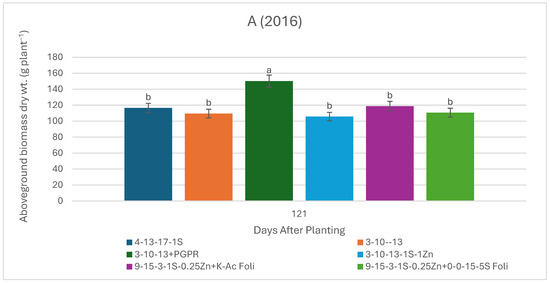
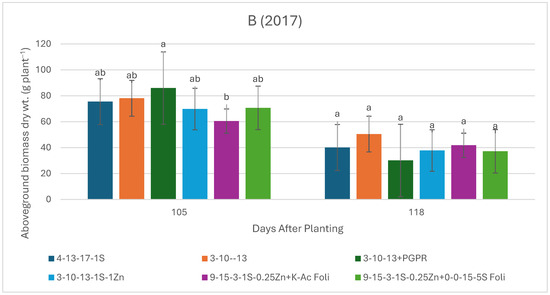
Aboveground biomass dry weight measurements were highest in the 3-10-13 + PGPR treatment in 2016 (121 DAP) and 2017 (105 DAP); this trend, however, did not continue on the later sampling date in 2017 (Figure 1 and Table 3).
Figure 1.
Effect of different fertilizer combinations on aboveground biomass dry weight of Mesa Russet potato grown in 2016 (A) and 2017 (B). Treatment means with a letter in common are not significantly different from one another by Tukey’s honestly significant difference (HSD) test (p < 0.05).
Table 3.
Effect of different fertilizer combinations on tuber and stem numbers of Mesa Russet, 2016 and 2017. Treatment means with a letter in common are not significantly different from one another by Tukey’s honestly significant difference (HSD) test (p < 0.05).
Due to compositing petiole samples for analysis across replicates, statistical analysis on the petiole nutrient concentrations is not possible (Figures S1–S3). Petiole N and P concentrations ranged between 1.7–2.2%, and 0.22–0.40%, respectively, which are considered sufficient N and P petiole concentrations. The content of K in petioles generally decreased over time, with all sampling dates and treatments exhibiting levels below 8%, which is the sufficiency threshold for potato petioles [23]. Leaf and tuber NPK analysis was also composited and could not be analyzed statistically (Figures S4–S6).
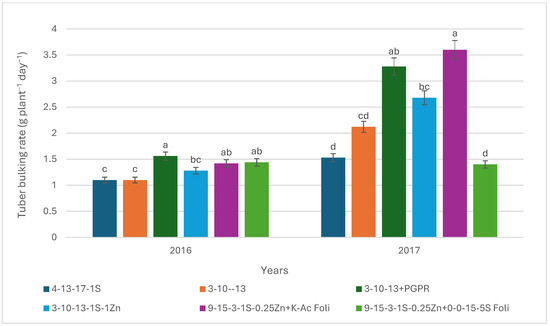
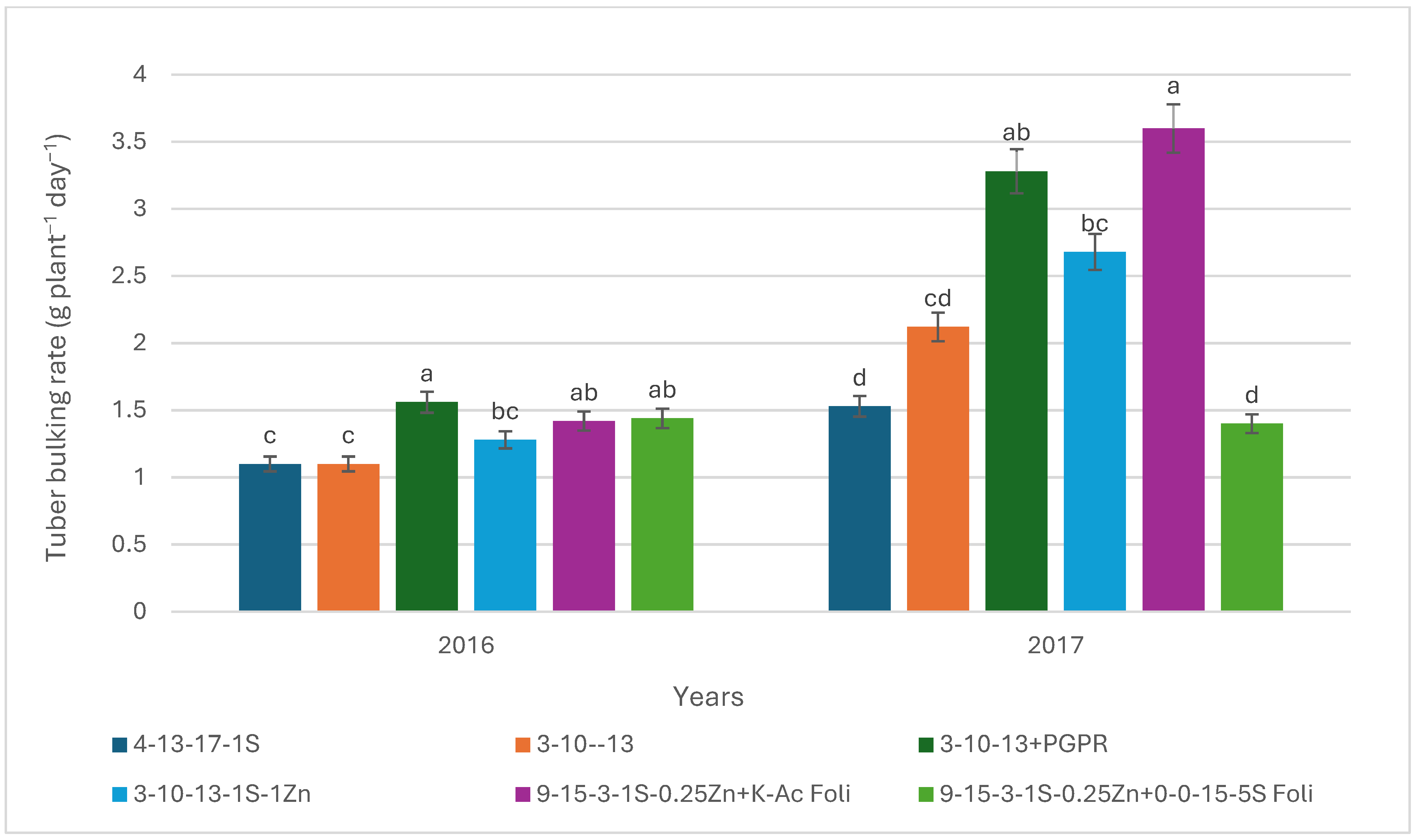
Tuber bulking rate demonstrated the most advantageous response to the PGPR treatment, especially in 2016, with a rate of 1.5 g plant−1 day−1. In 2017, the treatments PGPR and 9-15-3-1S-0.25Zn + K-Ac foliar exhibited enhanced tuber bulking rates of 3.3 and 3.6 g plant−1 day−1, respectively, compared to the Farmer’s Standard treatment (Figure 2).
Figure 2.
Effect of different fertilizer combinations on tuber bulking rate of Mesa Russet potatoes grown in 2016 and 2017. Treatment means with a letter in common are not significantly different from one another by Tukey’s honestly significant difference (HSD) test (p < 0.05).
3.2. Yield and Tuber Size Distribution
The overall impact of combined fertilizer applications on crop yields varied across treatments (Table 4). The 3-10-13 + PGPR treatment had the highest total yields in both years and consistently produced higher amounts of larger tubers (>114 g, >170 g, and >284 g). The 9-15-3-1S-0.25Zn + 0-0-15-5S foliar had marketable yields (>114 g) similar to 3-10-13 + PGPR. No consistent yield or tuber size responses were observed among the remaining treatments.
Table 4.
Effect of different fertilizer combinations on tuber yield and tuber size distribution of Mesa Russet, 2016 and 2017. Treatment means with a letter in common are not significantly different from one another by Tukey’s honestly significant difference (HSD) test (p < 0.05).
3.3. Tuber Quality
External defects, such as knobs, cracking, and misshapen tubers, were generally low across most treatments, and there were no treatment differences (Table 5). In terms of internal defects, the incidence of hollow heart was not different from the Farmer’s Standard in either year.
Table 5.
Effect of different fertilizer combinations on tuber quality of Mesa Russet potatoes grown in 2016 and 2017. Treatment means with a letter in common are not significantly different from one another by Tukey’s honestly significant difference (HSD) test (p < 0.05).
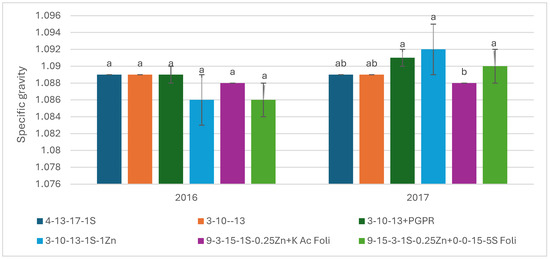
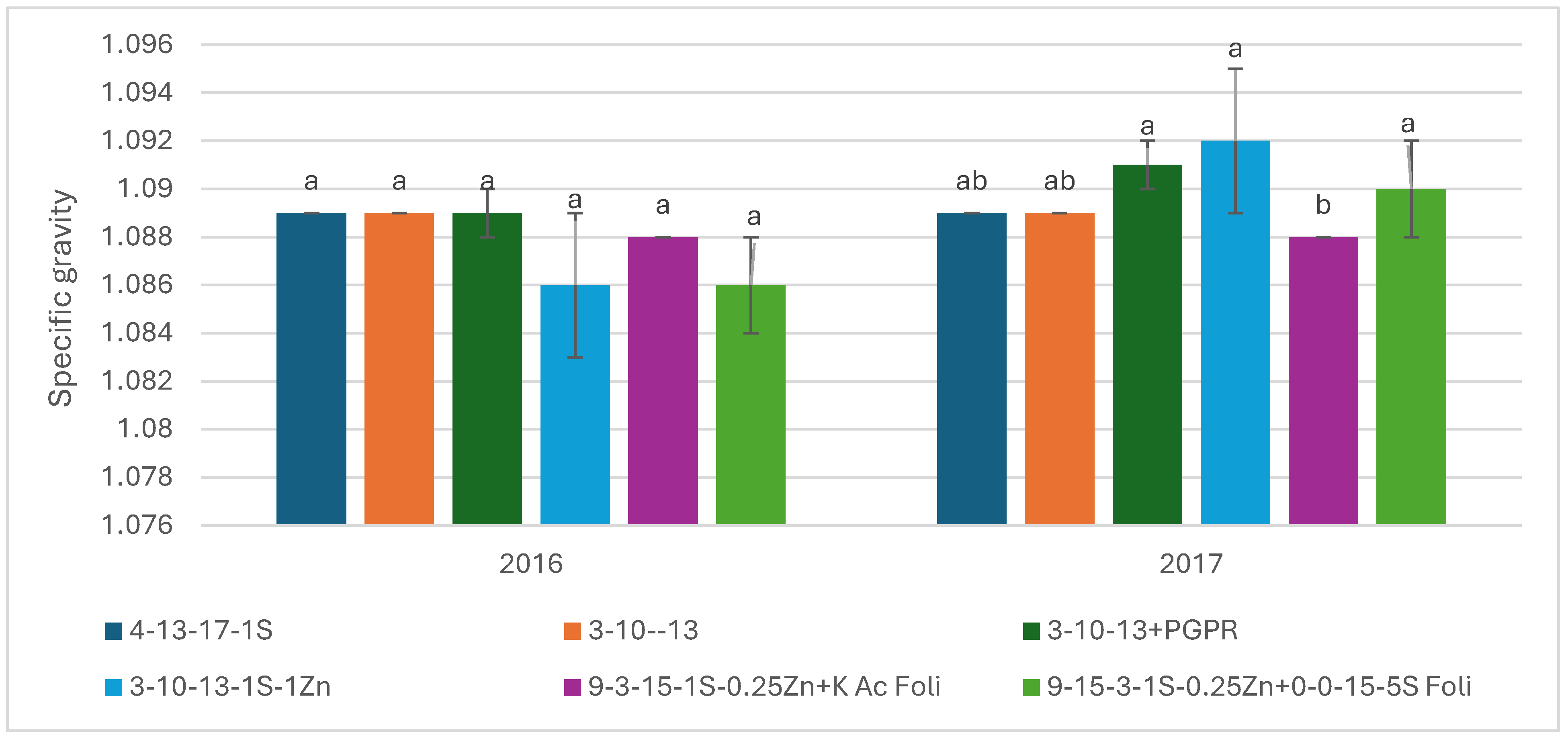
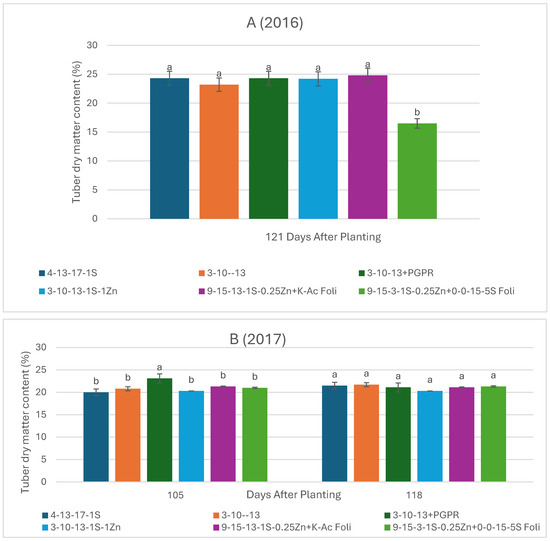
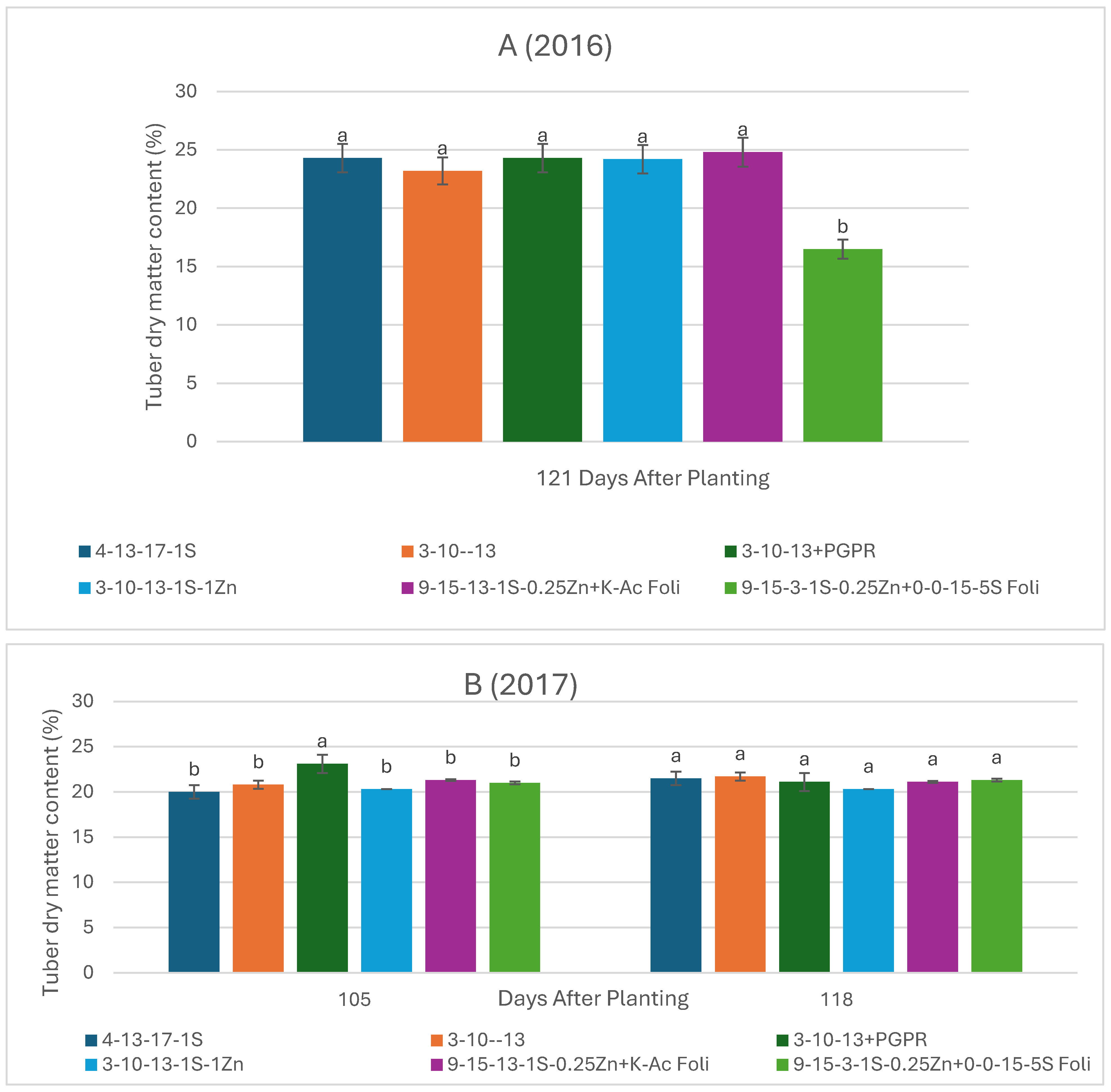
There were no treatment differences from the Farmer’s Standard in specific gravity in either year; however, in 2017 there were some differences among treatments (Figure 3). In 2016, most of the treatments recorded a tuber dry matter content (DMC) with an average of 24.0% in 2016, except for the 9-15-3-1S-0.25Zn + 0-0-15-5S foliar treatment, which recorded a significantly lower DMC of 16.2% compared to the remaining treatments (Figure 4A). In 2017, a general decline in DMC was observed across all treatments, with an average of 20.8%, except for the 3-10-13 + PGPR treatment, which maintained a relatively high DMC of 23.1% at 105 days after planting (DAP) (Figure 4B).
Figure 3.
Effect of different fertilizer combinations on specific gravity of Mesa Russet potatoes in 2016 and 2017. Treatment means with a letter in common are not significantly different from one another by Tukey’s honestly significant difference (HSD) test (p < 0.05).
Figure 4.
Effect of different fertilizer combinations on tuber dry matter content of Mesa Russet potatoes grown in 2016 (A) and 2017 (B). Treatment means with a letter in common are not significantly different from one another by Tukey’s honestly significant difference (HSD) test (p < 0.05).
4. Discussion
4.1. Plant Growth-Promoting Rhizobacteria
The application of combined fertilizers including NPK is a well-established practice to enhance crop productivity, including that of potatoes. However, the integration of PGPR with NPK fertilizers is increasingly recognized as a sustainable approach to further improve crop performance while potentially reducing the dependency on chemical inputs [24]. Our results show that potatoes treated with treatment 3-10-13 + PGPR exhibited higher aboveground dry matter and yields in both years, 2016 and 2017, compared to the Farmer’s Standard treatment (Figure 1). Furthermore, the large tuber sizes increased in this treatment, with notable increases in the weights of tubers size >114 g and >284 g compared to the Farmer’s Standard treatment in both years as well (Table 4).
PGPR treatment produced the highest tuber bulking rate, particularly in 2016, with a rate of 1.5 g/plant/day compared to the Farmer’s Standard treatment. In 2017, treatments PGPR and 9-15-3-1S-0.25Zn + K-Ac foliar had higher bulking rates (3.3 and 3.6 g/plant/day, respectively) compared to the Farmer’s Standard treatment (Figure 2). The effect of B. subtilis on potato tuber bulking rate may be due to the previously reported potential for Bacillus strains to increase secretion of indole-3-acetic acid (IAA) and cytokinin, during the initiation of potato tuber formation [25]. Auxin concentration increases significantly at the end of the stolon, the point of tuber formation. IAA concentration has been identified as the primary hormone regulating stem and tuber growth [26]. Therefore, although tuber number was not affected by treatment (Table 3), tuber bulking rate was affected by B. subtilis, probably through its effect on IAA secretion.
In addition, PGPR can enhance the root structure of plants, which improves their ability to absorb water and nutrients, which improves plant performance [24]. In a study evaluating how using B. subtilis along with regular NPK fertilizer could impact potato, notable increases in plant height and tuber weight were found compared to using fertilizer alone [13]. These findings suggest that PGPR can enhance the effectiveness of regular fertilizers by facilitating nutrient absorption. Field research has shown that using PGPR along with 75% of the recommended fertilizer amount led to a 25% increase in tuber yield compared to using the full amount of fertilizer alone [27]. This research suggests that using beneficial bacteria in potato production could allow for reductions in chemical fertilizer use without reducing productivity.
4.2. Nutrient-Specific Responses
In addition to the beneficial effects of PGPR on Russet potato growth and yield, some other combined fertilizer treatments including the foliar K-acetate treatment also demonstrated significant improvements in total yield and tuber size distribution, but these improvements were never repeated consistently across years (Table 4). These liquid fertilizer treatments were included to determine whether additional nutrients could achieve the same benefits as the PGPR; our data shows that none of these treatments performed as well as 3-10-13 + PGPR consistently. Therefore, the mode of action of the PGPR is either not due to nutritional impacts or makes higher levels of nutrients available to plants than were applied in the pre-plant treatments (Table 2).
The different combined fertilizer applications did not appear to influence petiole and leaf N, P, or K concentration of Mesa Russet at any of the sampling dates in either year; however, since samples were pooled across replicates for analysis, no statistical analysis is possible. The 3-10-13 + PGPR treatment showed lower petiole NPK concentrations at 85 DAP in 2016 and 77 DAP in 2017 compared to the Farmer’s Standard treatment (Figures S1–S3). Interestingly, this pattern contrasted with the yield results, where the control treatment had significantly reduced yields compared to the 3-10-13 + PGPR treatment. Data shows that plants with elevated nutrient concentrations in their petioles did not always achieve higher efficiency in nutrient usage or productivity results [28]. Previous research has shown that potato plants treated with combined fertilizers and microbes demonstrated improved nutrient absorption and proper distribution to growing parts, which caused decreased petiole nutrient concentrations yet increased biomass and tuber yields [28,29]. Petiole nutrient levels must be evaluated as part of an overall plant growth and nutrient distribution pattern instead of being used as stand-alone indicators of potential yield. Similarly, the concentration of NPK in leaves and tubers did not show differences among treatments in either year. Other studies have shown similar results demonstrating that the varied fertilization of NPK did not affect the concentration of NPK in tubers and leaves [30].
5. Conclusions
This study demonstrated that the 3-10-13 + PGPR treatment significantly enhanced yield and large tuber size distribution in Mesa Russet potato production compared to Farmer’s Standard fertilizer application. The mechanism through which B. subtilis influences yield seems to be through stimulation of IAA production in the stolon, leading to increased tuber bulking rate and yield. However, this needs to be verified with targeted research on IAA production as influenced by B. subtilis.
The integrated approach combining PGPR with combined fertilizers represents a promising strategy for sustainable intensification of potato production systems, offering potential for reduced chemical fertilizer dependency while maintaining or improving yield performance.
Supplementary Materials
The following supporting information can be downloaded at: https://www.mdpi.com/article/10.3390/horticulturae12030268/s1, Figure S1: Effect of different fertilizer combinations on petiole N concentration of Mesa Russet potatoes grown in 2016 (A) and 2017 (B); Figure S2: Effect of different fertilizer combinations on petiole P concentration of Mesa Russet potatoes grown in 2016 (A) and 2017 (B); Figure S3: Effect of different fertilizer combinations on petiole K concentration of Mesa Russet potatoes grown in 2016 and 2017; Figure S4: Effect of different fertilizer combinations on leaf (A) and tuber (B) N concentrations of Mesa Russet, 2016 and 2017; Figure S5: Effect of different fertilizer combinations on leaf (A) and tuber (B) P concentrations of Mesa Russet, 2016 and 2017; Figure S6: Effect of different fertilizer combinations on leaf (A) and tuber (B) K concentrations of Mesa Russet, 2016 and 2017.
Author Contributions
Conceptualization, S.A. and S.Y.C.E.; methodology, S.A. and S.Y.C.E.; formal analysis, S.A.; investigation, S.A.; resources, S.Y.C.E.; writing—original draft, S.A.; writing—review and editing, S.Y.C.E. and J.G.D.; supervision, S.Y.C.E. All authors have read and agreed to the published version of the manuscript.
Funding
This research was funded by the Colorado Agricultural Experiment Station, the Colorado Potato Administrative Committee, and the Ministry of Higher Education and Scientific Research of Libya.
Data Availability Statement
Data are contained within the article.
Acknowledgments
We gratefully acknowledge the technical support provided by Mercy Essah in the field and in the lab.
Conflicts of Interest
The authors declare no conflicts of interest. The funders had no role in the design of the study; in the collection, analyses, or interpretation of data; in the writing of the manuscript; or in the decision to publish the results.
References
- Gildemacher, P.R. Innovation in Seed Potato Systems in Eastern Africa. Ph.D. Thesis, Wageningen University, Wageningen, The Netherlands, 2012. [Google Scholar]
- Pervez, M.A.; Ayyub, C.M.; Shaheen, M.R.; Noor, M.A. Determination of physiomorphological characteristics of potato crop regulated by potassium management. Pak. J. Agric. Sci. 2013, 50, 611–615. [Google Scholar]
- Shi, X.; Zhang, X.; Kang, W.; Chen, Y.; Fan, M. Possibility of recommending potassium application rates based on a rapid detection of the potato petiole K status with a portable K ion meter. Am. J. Potato Res. 2019, 96, 48–54. [Google Scholar] [CrossRef] [Scilit]
- Soratto, R.P.; Sandaña, P.; Fernandes, A.M.; Martins, J.D.L.; Job, A.L.G. Testing critical phosphorus dilution curves for potato cropped in tropical Oxisols of southeastern Brazil. Eur. J. Agron. 2020, 115, 126020. [Google Scholar] [CrossRef] [Scilit]
- Neumann, A.; Torbert, H.A.; Denef, K. Nitrogen fertilizer effects on crop yield, grain quality, and residue decomposition in a wheat–corn rotation. Agron. J. 2012, 104, 1374–1382. [Google Scholar]
- Khan, H.; Akhtar, M.E.; Mahmood, N. Response of potato to different levels of nitrogen, phosphorus and potassium fertilizers. Pak. J. Agric. Sci. 2013, 50, 19201. [Google Scholar]
- Mokrani, K.; Hamdi, K.; Tarchoun, N. Potato (Solanum tuberosum L.) response to nitrogen, phosphorus and potassium fertilization rates. Commun. Soil Sci. Plant Anal. 2018, 49, 1314–1330. [Google Scholar] [CrossRef] [Scilit]
- Barascu, N.; Iianosi, M.; Duda, M.M.; Donescu, V. The effect of high NPK levels on potato yield size structure and tubers starch content. Sci. Pap. Ser. A Agron. 2015, 58, 136–142. [Google Scholar]
- Glick, B.R. Plant growth-promoting bacteria: Mechanisms and applications. Scientifica 2012, 1, 963401. [Google Scholar] [CrossRef] [Scilit]
- Kloepper, J.W.; Ryu, C.M.; Zhang, S. Induced systemic resistance and promotion of plant growth by Bacillus spp. Phytopathology 2004, 94, 1259–1266. [Google Scholar] [CrossRef] [Scilit]
- Lugtenberg, B.; Kamilova, F. Plant-growth-promoting rhizobacteria. Annu. Rev. Microbiol. 2009, 63, 541–556. [Google Scholar] [CrossRef] [Scilit]
- Batool, T.; Ali, S.; Seleiman, M.F.; Naveed, N.H.; Ali, A.; Ahmed, K.; Mubushar, M. Plant growth promoting rhizobacteria alleviates drought stress in potato in responmse to suppressive oxidative stress and antioxidant enzymes activities. Sci. Rep. 2020, 10, 16975. [Google Scholar] [CrossRef] [Scilit]
- Bhattacharyya, P.N.; Jha, D.K. Plant growth-promoting rhizobacteria (PGPR): Emergence in agriculture. World J. Microbiol. Biotechnol. 2012, 28, 1327–1350. [Google Scholar] [CrossRef] [Scilit] [PubMed]
- Chea, L.; Alhussein, M.; Karlovsky, P.; Pawelzik, E.; Naumann, M. Adaptation of potato cultivars to phosphorus variability and enhancement of phosphorus efficiency by Bacillus subtilis. BMC Plant Biol. 2024, 24, 1176. [Google Scholar] [CrossRef] [Scilit] [PubMed]
- Shokouhifar, M.; Sohrabi, M.; Rabbani, M.; Molana, S.M.H.; Werner, F. Sustainable phosphorus fertilizer supply chain management to improve crop yield and P use efficiency using an ensemble heuristic–metaheuristic optimization algorithm. Agronomy 2023, 13, 565. [Google Scholar] [CrossRef] [Scilit]
- Bisht, N.; Chauhan, P.S. Excessive and disproportionate use of chemicals cause soil contamination and nutritional stress. In Soil Contamination; Larramendi, M.L., Soloneski, S., Eds.; IntechOpen: London, UK, 2021; pp. 107–115. [Google Scholar]
- Barlog, P.; Grzebisz, W.; Łukowiak, R. Fertilizers and fertilization strategies mitigating soil factors constraining efficiency of nitrogen in plant production. Plants 2022, 11, 1855. [Google Scholar] [CrossRef] [Scilit]
- Rosen, C.J.; Eliason, R. Nutrient Management for Commercial Fruit and Vegetable Crops in Minnesota; University of Minnesota Extension: Minneapolis, MN, USA, 2005; Available online: https://hdl.handle.net/11299/197955 (accessed on 10 September 2025).
- Bundy, L.G.; Tunney, H.; Halvorson, A.D. Agronomic aspects of phosphorus management. In Phosphorus: Agriculture and the Environment; Sims, J.T., Sharpley, A.N., Daniel, T.C., Eds.; American Society of Agronomy: Madison, WI, USA, 2005; pp. 683–727. [Google Scholar]
- Thompson, B. Efficient Fertilizer Use-Potassium, 1st ed.; John Wiley and Sons: New York, NY, USA, 2010. [Google Scholar]
- Marschner, P. (Ed.) Marschner’s Mineral Nutrition of Higher Plants, 3rd ed.; Elsevier: Amsterdam, The Netherlands, 2012. [Google Scholar]
- Love, S.L.; Stark, J.C.; Salaiz, T. Response of four potato cultivars to rate and timing of nitrogen fertilizer. Am. J. Potato Res. 2005, 82, 21–30. [Google Scholar] [CrossRef] [Scilit]
- Rosen, C.J. Potato Fertilization on Irrigated Soils; University of Minnesota Extension: Minneapolis, MN, USA, 2024; Available online: https://extension.umn.edu/crop-specific-needs/potato-fertilization-irrigated-soils (accessed on 12 September 2025).
- Nasiri, A.; Yarnia, M.; Hassanpanah, D.; Farahvash, F.; Khalilvand, E. The response of different potato cultivars to plant growth-promoting rhizobacteria (PGPRs) and chemical fertilizers in aeroponic culture conditions. J. Plant Nutr. 2022, 45, 2975–2985. [Google Scholar] [CrossRef] [Scilit]
- Sorokan, A.; Veselova, S.; Benkovskaya, G.; Maksimov, I. Endophytic strain Bacillus subtilis 26D increases levels of phytohormones and repairs growth of potato plants after Colorado potato beetle damage. Plants 2021, 10, 923. [Google Scholar] [CrossRef] [Scilit]
- Roumeliotis, E.; Kloosterman, B.; Oortwijn, M.; Kohlen, W.; Bouwmeester, H.J.; Visser, R.G.; Bachem, C.W. The effects of auxin and strigolactones on tuber initiation and stolon architecture in potato. J. Exp. Bot. 2012, 63, 4539–4547. [Google Scholar] [CrossRef] [Scilit]
- Meena, V.S.; Maurya, B.R.; Verma, J.P.; Meena, R.S.; Jatav, G.K. Role of biofertilizers in sustainable potato (Solanum tuberosum L.) production: A review. Environ. Sustain. Indic. 2017, 2, 100011. [Google Scholar]
- Rosen, C.J.; Bierman, P.M. Potato yield and tuber set as affected by phosphorus fertilization. Am. J. Potato Res. 2008, 85, 110–120. [Google Scholar] [CrossRef] [Scilit]
- Westermann, D.T. Nutritional requirements of potatoes. Am. J. Potato Res. 2005, 82, 301–307. [Google Scholar] [CrossRef] [Scilit]
- Mankotia, B.S.; Sharma, R. Effect of drip irrigation and fertigation on nutrient content and uptake in potato (Solanum tuberosum L.). Himachal J. Agric. Res. 2020, 46, 138–143. [Google Scholar]

Disclaimer/Publisher’s Note: The statements, opinions and data contained in all publications are solely those of the individual author(s) and contributor(s) and not of MDPI and/or the editor(s). MDPI and/or the editor(s) disclaim responsibility for any injury to people or property resulting from any ideas, methods, instructions or products referred to in the content. |
© 2026 by the authors. Licensee MDPI, Basel, Switzerland. This article is an open access article distributed under the terms and conditions of the Creative Commons Attribution (CC BY) license.