


Abstract
This study examines how visual features and green space morphology jointly shape restorative perception in dog-friendly urban green spaces using a data-driven analytical framework. A self-constructed dataset integrating street-view imagery, landscape element composition, and morphological metrics was developed to quantify visual entropy, visual richness, and spatial structure. Ten dimensions of visual perception were modeled using an XGBoost framework optimized with a genetic algorithm, achieving high predictive performance (R2 = 0.827–0.989). Streetscape analysis revealed relatively stable visual entropy but pronounced heterogeneity in visual richness, reflecting variability in color, form, and spatial layering. Element-level decomposition showed the visual dominance of natural components, particularly trees, sky, and grass. Piecewise linear regression further identified threshold-dependent and dimension-specific effects of green space proportion, fragmentation, patch size, connectivity, aggregation, and shape complexity. Moderate fragmentation and aggregation enhanced perceived complexity and stimulation, whereas excessive shape complexity reduced most restorative responses.
1. Introduction
Urban green spaces are widely recognized for their enduring health-promoting effects, including psychological restoration, physiological regulation, and behavioral activation. The prolonged impacts of COVID-19 have amplified the public health relevance of these spaces, as social restrictions and disruptions in daily life impose systemic stress, with 10–20% of recovered individuals experiencing long-term post-infection symptoms such as fatigue, autonomic dysregulation, and cognitive deficits [1,2]. Non-pharmacological, accessible interventions, such as urban green spaces, have thus become essential for post-pandemic health support [3].
Among urban green spaces, dog-friendly parks constitute a distinct category, characterized by interactive human–pet and social behaviors. The mental health benefits of pets are contingent on interaction quality, social engagement, and spatial design rather than mere ownership [4,5,6,7,8]. During the pandemic, these parks mitigated loneliness and stress by facilitating safe human–pet interactions and reinforcing social support [9,10,11,12,13,14]. In the post-pandemic recovery phase, they further support physical activity, stress regulation, and community cohesion.
These unique affordances of dog-friendly parks—facilitating human–pet interactions, enabling safe observation of dogs, and promoting social engagement—contribute to increased fascination, behavioral activation, and additional restorative pathways beyond those offered by generic green spaces. Recent empirical evidence indicates that observing and interacting with dogs can enhance mood and support psychological restoration at levels comparable to exposure to natural scenes. By explicitly linking these interactive and social features to Attention Restoration Theory and Stress Reduction Theory, the framework provides a stronger conceptual rationale for examining how visual and morphological characteristics of dog-friendly parks drive perceptual, cognitive, and emotional responses. This emphasis highlights the importance of dog-friendly parks in post-pandemic urban planning and public health interventions, reinforcing their role in promoting multidimensional well-being.
Our study highlights the novelty of examining restorative perception in dog-friendly urban green spaces as the joint outcome of natural elements, moderate spatial connectivity and fragmentation, and unique pet-related affordances. Unlike prior work that treats visual, morphological, and soundscape factors independently, we quantify their threshold-dependent, context-specific interactions using multi-source visual–morphological data within a multi-stage cognitive framework and advanced modeling. This approach clarifies the mechanisms by which these spaces support psychological restoration and behavioral activation, emphasizing both conceptual and practical significance.
Previous research has largely examined visual preferences, landscape morphology, and soundscapes independently, while the joint, threshold-dependent, and context-specific effects of these factors in dog-friendly urban green spaces have been largely overlooked. Interactions related to dog presence—such as play and observation—introduce an additional pathway of fascination and behavioral activation, which can enhance restorative outcomes beyond those provided by generic green spaces. Our study addresses this gap by integrating multi-source visual–morphological data, advanced computational modeling (Mask2Former + XGBoost-GA), and theoretically grounded cognitive frameworks, including Attention Restoration Theory and Stress Reduction Theory, to quantify how these factors interact to shape restorative perception in a post-pandemic urban context.
Building on this, we have further clarified the interactions between morphological and visual features within these spaces. Specifically, connected patches, moderate fragmentation, and partially open layouts interact with high naturalness, tree and water dominance, and low proportions of hard paving to enhance perceived coherence, preference, and restorative outcomes. Threshold-dependent effects are also observed, as excessive enclosure or overly complex shapes can reduce perceived safety and restorative potential, consistent with perceived sensory dimensions such as serene, space, nature, and refuge. These refinements are integrated within the multi-stage cognitive framework, illustrating how landscape morphology modulates visual perception to support psychological restoration and emotional well-being.
In these dynamic spaces, visual perception serves as the primary channel through which users engage with the environment, shaping attraction, perceived safety, and the intensity of interactions. Visual cues thus extend beyond aesthetics, influencing emotional restoration, psychological resilience, and behavioral activation. Despite growing interest in green space visual preferences, frameworks capable of quantifying how visual features translate into restorative experiences remain limited [15,16,17,18,19]. Existing models often fail to capture the nonlinearity and multidimensional interactions inherent in visual–perceptual relationships, while heterogeneity across contexts challenges generalizability.
To address these gaps, this study proposes a multi-stage cognitive pathway framework integrating affordance theory [20], Attention Restoration Theory [21], and Stress Reduction Theory [22,23,24]. The framework delineates three stages: (1) visual perception, capturing immediate processing of environmental complexity and entropy; (2) primary cognition, involving preference formation and environmental evaluation; and (3) advanced cognition, integrating behavioral experiences, social context, and individual characteristics to generate emotional and restorative outcomes.
Empirically, the study examines ten representative pet-friendly parks in Chengdu, systematically quantifying visual features including complexity, richness, spatial configuration, and landscape elements. Using XGBoost combined with genetic algorithms for hyperparameter optimization, nonlinear relationships between objective visual attributes and subjective perception are modeled. This yields a predictive framework capable of informing design and planning decisions, elucidating how visual features drive behavioral activation and multidimensional restorative outcomes. By distinguishing main and interaction effects across perceptual dimensions, the study clarifies the context-dependent and mechanistically heterogeneous pathways through which pet-friendly parks promote health and well-being.
2. Relate Work
2.1. Visual Perception in Dog-Friendly Green Spaces
Visual perception is an active, hierarchical, and context-dependent process shaped by interactions between bottom-up sensory encoding and top-down cognitive modulation, rather than a passive or purely subjective response. From a biological vision perspective, early stages extract basic visual features, which are progressively integrated into spatial and semantic representations [25]. At higher cognitive levels, these representations interact with memory, affect, and behavioral intent to generate holistic evaluations of environmental quality and restorative potential [26,27,28,29,30,31].
This organization implies that landscape perception is inherently nonlinear and interaction-driven, emerging from coordinated visual features rather than isolated elements [32,33,34]. In behavior-intensive settings such as dog-friendly parks, spatial configuration, visual complexity, and dynamic human–animal interactions jointly shape evolving perceptual experiences, rendering static preference measures insufficient [35,36,37,38].
Accordingly, this study proposes a three-stage cognitive framework comprising (1) visual perception of structural features, (2) primary cognitive evaluation of environmental quality, and (3) advanced cognitive integration linking perception with behavior and individual background. Sociodemographic characteristics operate as moderators at the advanced stage rather than as perceptual variables. This framework provides theoretical constraints for variable grouping, model specification, and causal interpretation in quantitative landscape–perception research.
2.2. Physiological and Cognitive Processes in Visual Perception
Visual perception is a multi-level, hierarchical, and context-dependent process shaped by sensory encoding, neural computation, and cognitive mechanisms, mediating the transformation of objective spatial features into subjective experience [39,40]. Early stages encode basic visual primitives, which are organized into spatial and semantic structures, while higher levels integrate memory, affect, and behavioral intent to evaluate environmental quality and restorative potential [41,42,43]. This staged processing implies nonlinear, interaction-driven perception, particularly in dynamic contexts such as pet-friendly parks, where spatial configuration, landscape complexity, and human–animal activity co-construct evolving scenes. We propose a three-stage cognitive pathway: (1) perception—processing visual structure and complexity; (2) primary cognition—evaluating environmental quality; and (3) advanced cognitive integration—combining visual cognition with behavioral experience and individual background to shape emotional restoration. Sociodemographics function as antecedent/moderating factors at the advanced stage. This framework provides theoretical constraints for variable selection, modeling, and causal interpretation, bridging landscape features, subjective experience, and restorative outcomes.
3. Construction of a Multistage Cognitive Measurement Framework for Visual Perception in Dog-Friendly Green Spaces
3.1. Multistage Cognitive Processes of Visual Perception in Dog-Friendly Green Spaces
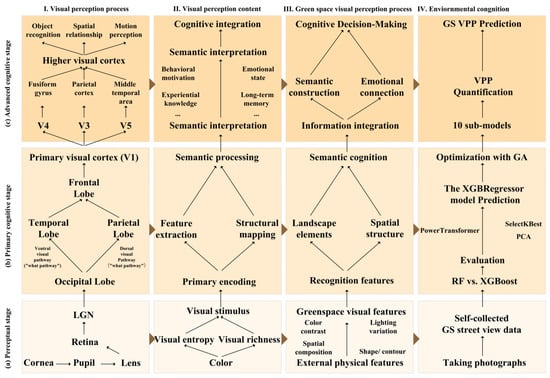
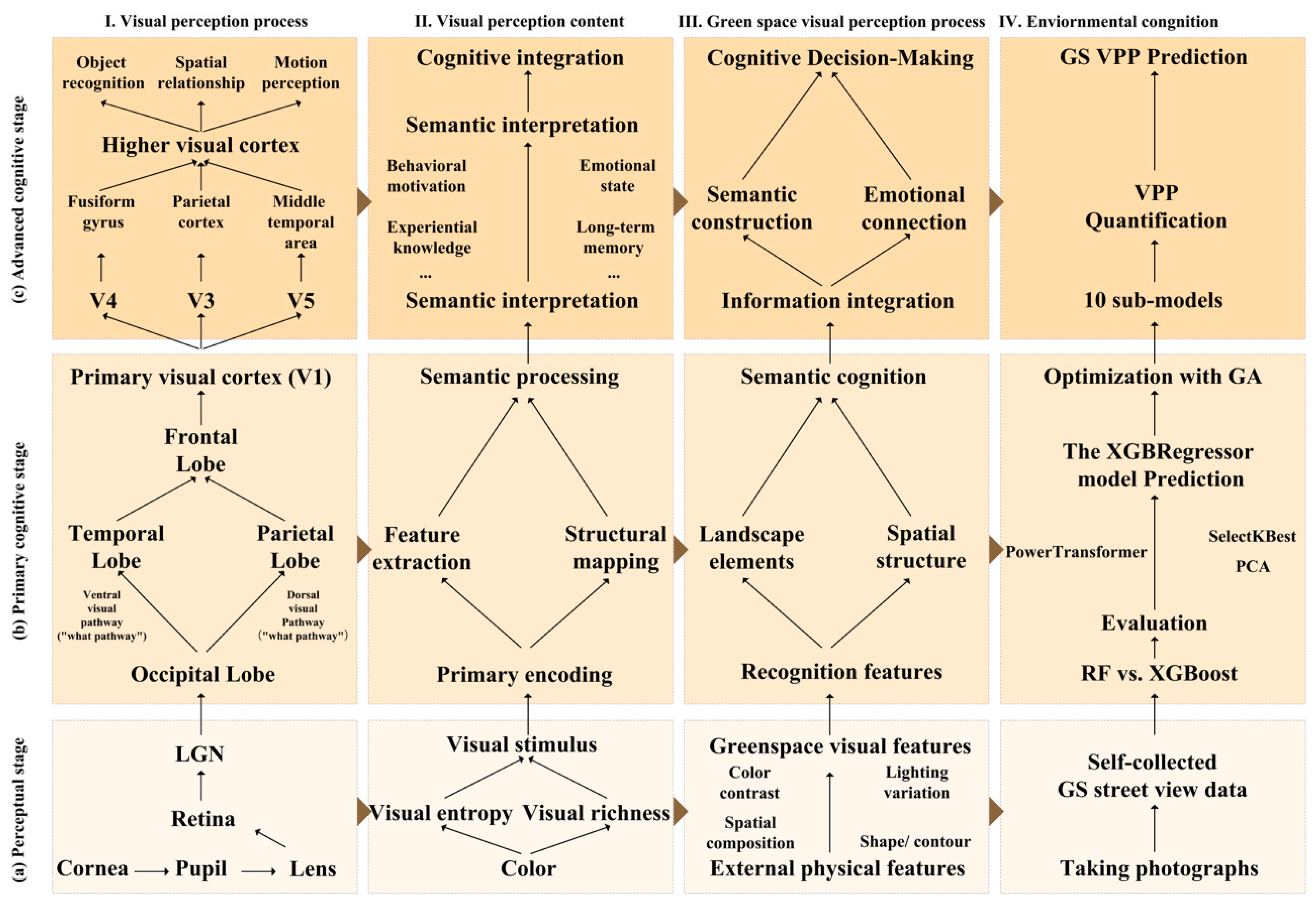
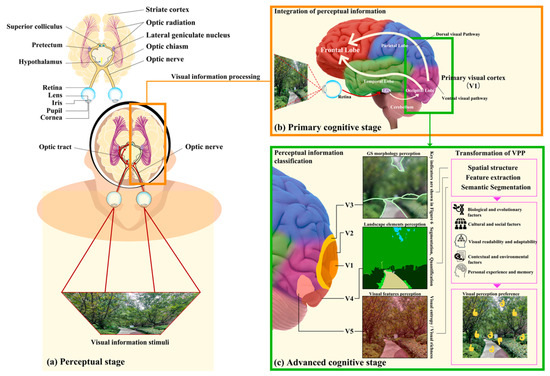
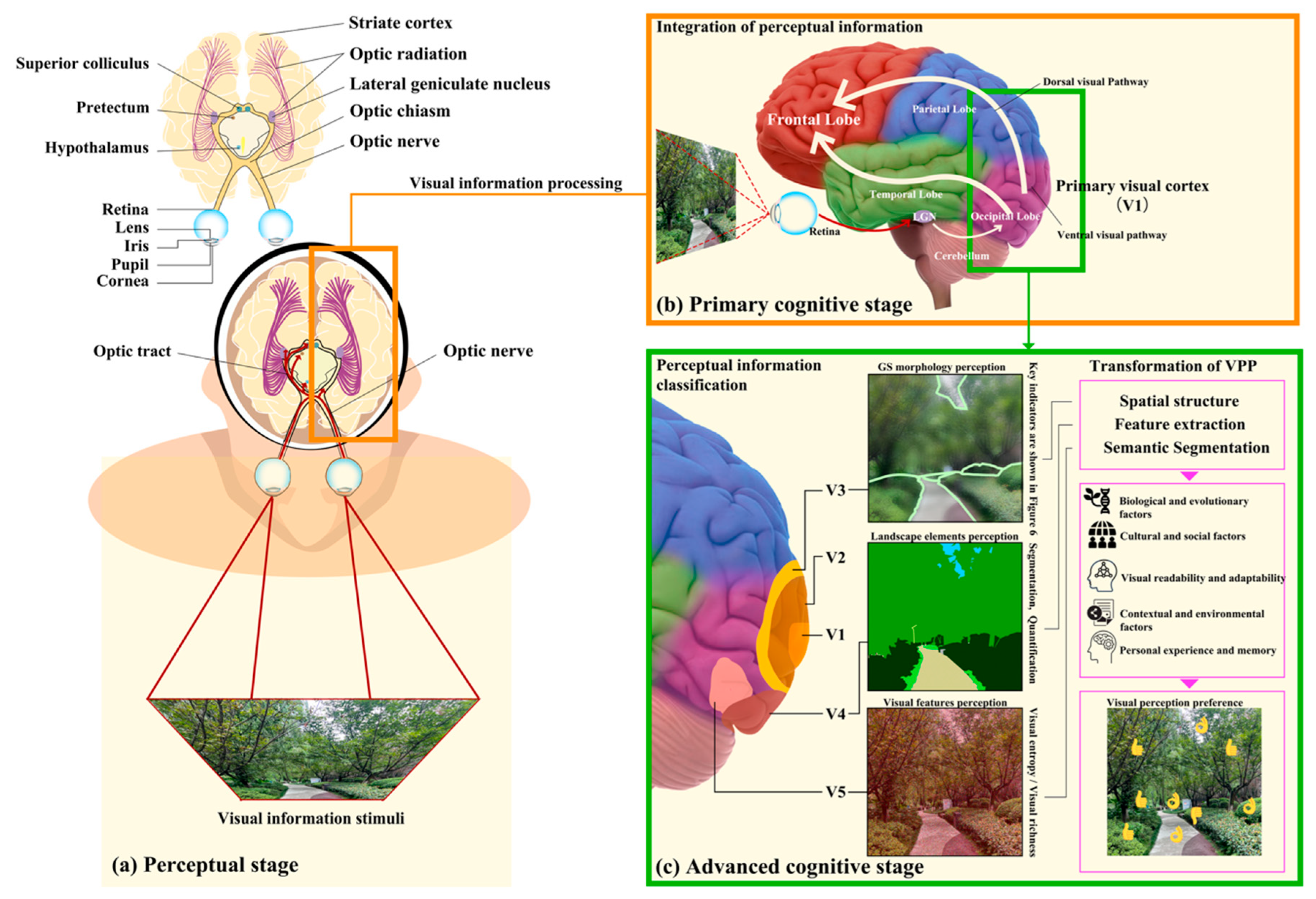
Visual perception serves as the primary informational gateway through which individuals engage with dog-friendly urban green spaces and functions as a critical mediator between objective landscape features and subjective emotional responses. Existing research, however, often treats visual preference or emotional response as a direct outcome variable, overlooking the staged translation and functional differentiation that visual information undergoes during cognitive processing [44,45,46,47]. This simplification weakens mechanistic explanations of the relationship between environment and emotion. Building on the physiological–cognitive processing mechanisms of human visual perception and accounting for the highly dynamic and multi-faceted spatial characteristics of dog parks, this study proposes a multi-stage [48,49,50,51], hierarchically structured framework for visual cognition, as shown in Figure 1. The central premise is that visual information does not exert a holistic influence on emotional experience; rather, it is progressively transformed along a defined temporal sequence and through layers of informational complexity (Figure 2). By integrating temporal progression and information content as complementary dimensions, the framework systematically decomposes the visual perception process in dog parks, providing theoretical constraints for indicator selection, variable grouping, and model development.
Figure 1.
Framework of Pet Park Perception Mechanism: Reasoning from the Visual Perception Process to the Green Space Perception Process.
Figure 2.
Framework of Pet Park Perception Mechanism: Visual Perception Process and Computer Vision Simulation Diagram.
In the initial perception stage, the visual system encodes basic environmental stimuli, color, luminance, contours, texture, and spatial composition, providing objective, low-level input without semantic interpretation. Measurement should focus on quantifiable physical features to avoid cognitive contamination. In the primary cognition stage, visual information is integrated to identify landscape elements and their spatial relationships, emphasizing organization and structural complexity rather than emotional response. Measurement priorities include element composition and spatial configuration, bridging physical stimuli and subjective evaluation. In the advanced cognition stage, visual representations interact with individual experience, emotional state, and behavioral expectations, generating emotional responses, preference judgments, and potential behaviors. Measurement at this stage targets subjective evaluations while excluding structural features. Explicitly distinguishing these stages addresses prior misclassification of preference as perception, provides theoretical constraints for variable selection and modeling, and establishes a foundation for analyzing perception–emotion–behavior coupling in dog-friendly urban green spaces.
3.2. Structured Measurement Framework for Perception in Dog-Friendly Urban Green Spaces
Building on the multi-stage visual cognition pathway, this study proposes a structured measurement framework integrating objective visual features with subjective perception in dog-friendly urban green spaces [36,52,53,54]. The framework reorganizes existing variables by their functional roles across the cognitive sequence “perceptual input, structural decoding, subjective integration” to enhance interpretability and comparability. It comprises five dimensions: (1) visual features, capturing low-level inputs via visual entropy and richness; (2) landscape elements, quantifying presence, spatial distribution, and combinations of trees, grass, buildings, and other features; (3) green space morphology, measuring spatial patterns using proportion, patch area, connectivity, aggregation, shape complexity, and fragmentation; (4) sociodemographics, controlling for population density, gender, and education; and (5) visual perception preference, representing high-level cognitive outputs across ten perceptual evaluations (comfort, pleasure, calmness, naturalness, orderliness, quietness, harmony, complexity, openness, stimulation). This framework provides a rigorous, stage-specific foundation for modeling perception, emotion, and behavior in urban leisure spaces.
4. Quantitative Analysis of Visual Perception Features in Dog-Friendly Urban Green Spaces and Predictive Model Development
4.1. Construction of a Comprehensive Landscape Perception Measurement System Based on Visual Mechanisms
Building on human visual perception and the multi-stage cognitive pathway, this study develops a comprehensive perception measurement system for dog-friendly parks, comprising five dimensions and 32 indicators to support quantitative modeling of landscape perception and subjective preference prediction. A total of 150 volunteers captured ground-level park images from a human-eye perspective while providing visual preference ratings, establishing a self-collected Green Space Street View (GSSV) dataset that maximizes ecological validity and mitigates temporal or context mismatches. Objective perception was quantified across three core dimensions, visual features, landscape elements, and green space morphology, comprising 19 indicators, combined with socio-demographics to form a 22-variable matrix. Visual entropy and visual richness captured information density and color diversity, while Mask2Former enabled pixel-level recognition of 11 landscape elements, and GIS-based metrics quantified spatial configuration, connectivity, and complexity. A multi-target regression framework integrating XGBoost with a genetic algorithm optimized feature selection and hyperparameters, effectively modeling nonlinear relationships between environmental features and ten subjective perception dimensions. This mechanism-driven, multi-source, and predictive framework enables interpretable quantification of visual perception, providing a replicable methodological foundation for evaluating and optimizing dog-friendly urban green spaces, bridging objective landscape characteristics, perceptual processing, and human–environment interactions.
4.2. Sample Selection of Dog-Friendly Green Spaces in Chengdu
This study employed purposive sampling to select structurally comparable urban dog-friendly parks in central Chengdu. Using AOI data from the Chinese Academy of Sciences and the 2025 China Land Use Remote Sensing Dataset, 2229 green space POIs were extracted in ArcGIS 10.8. NDVI was calculated from 2020 Landsat 8 imagery and corrected via visual interpretation, retaining sites with NDVI 0.3–0.6 to control vegetation coverage. Fractal dimension, computed via the Box-counting algorithm in ImageJ 1.54, filtered spaces with values 1.7–1.9 to ensure spatial structural consistency and visual legibility. Candidate parks were further screened for comparable pet facilities, openness, and accessibility. Under these criteria, 10 parks were selected, providing a structurally controlled sample for mechanistic modeling of the relationship between green space morphology and visual perception preferences, rather than statistical population inference.
4.3. Data Sources and Core Dataset Description
This study integrates multi-source data to construct a core dataset for modeling visual perception in dog-friendly parks, linking objective environmental features with subjective preferences. Data include LUCC, urban green space POIs, NDVI, ADE20K semantic segmentation, and GSSV images with subjective visual evaluations. GSSV images were systematically captured across 10 selected parks with standardized paths, angles, and coverage, providing high-resolution ground-level data for visual feature extraction and landscape element identification. Subjective evaluations were collected via structured questionnaires, generating analyzable preference signals to train regression models. Auxiliary datasets supported area delineation, function screening, vegetation standardization, and semantic classification, ensuring spatial consistency and enabling accurate mapping from objective features to perceptual responses.
4.3.1. Collection and Processing of Self-Collected Green Space Street-View Image Dataset
This study integrates multi-source data to construct a core dataset for modeling visual perception in dog-friendly parks, linking objective environmental features with subjective preferences. Data include LUCC, urban green space POIs, NDVI, ADE20K semantic segmentation, and self-collected GSSV images with subjective visual evaluations. GSSV images were systematically captured across 10 selected parks with standardized paths, angles, and coverage, providing high-resolution ground-level data for visual feature extraction and landscape element identification. Subjective evaluations were collected via structured questionnaires, generating analyzable preference signals to train regression models.
4.3.2. Subjective Perception Evaluation Dataset
The subjective perception evaluation dataset was constructed based on the self-collected GSSV image library. A total of 500 images were randomly selected and divided into 10 groups of 50 images each. The study recruited 150 volunteers (Table 1), who were randomly assigned to groups such that every 10 participants evaluated one group of images. Participants rated each image across 10 perception dimensions: comfort, pleasure, calmness, naturalness, orderliness, quietness, harmony, complexity, openness, and stimulation, using a 7-point Likert scale (Table 2). Prior to formal evaluation, participants completed background instructions and example training to ensure familiarity with the rating criteria. Inter-rater reliability was assessed using the Intraclass Correlation Coefficient (ICC) across all dimensions, with values ranging from 0.81 to 0.92, indicating excellent agreement among raters and confirming the robustness of the subjective perception data.
Table 1.
Characteristic of volunteers.
Table 2.
Results of the green space visual perception preference questionnaire.
After the evaluations, each image was independently rated by 15 participants per perceptual dimension, resulting in a total of 750 ratings per dimension across all images and participants. All scores were first standardized using Z-scores, and outliers were removed before calculating the mean for each dimension, resulting in a structured subjective perception evaluation dataset. Participants’ demographic information, including gender, age, and occupational background, was recorded simultaneously for subsequent control variable analyses. Post hoc power analysis indicated a statistical power of 0.85, ensuring the reliability and robustness of the data. The data collection and processing procedures for this study were approved by the Ethics Committee of Sichuan Provincial Forestry Center Hospital.
4.4. Analysis of Visual Features and Construction of Predictive Models for Dog-Friendly Green Spaces
4.4.1. Quantification and Analysis of Visual Features Based on Mask2Former
To gain deeper insights into the visual features associated with pet park perception, this study employed computer vision techniques to quantitatively measure VE (Equation (1)) and R (Equation (2)). The extraction of these features integrates deep learning methods based on a Transformer architecture, incorporating a mask mechanism and advanced feature extraction techniques. This approach enables efficient processing of instance segmentation, panoptic segmentation, and semantic segmentation tasks. According to Cheng et al. (2022), Mask2Former outperforms other specialized models across multiple datasets and segmentation tasks, demonstrating robust performance in image segmentation applications [55].
is a metric used to quantify the complexity of pixel intensity distribution within an image, expressed in bits. This indicator is calculated based on the number of gray levels in the image, for instance, for an 8-bit image. The computation involves first determining the proportion of pixels corresponding to each gray level by normalizing the image’s grayscale histogram. These probability values are then substituted into the entropy formula to derive the VE of the image. A higher entropy value indicates a more uniform pixel distribution, greater informational richness, and higher visual complexity. In contrast, a lower entropy suggests that the image content is more homogeneous or simple.
is an index used to assess the perceptual complexity of image colors and can be understood as color-based VE. This value is calculated based on the statistical characteristics of different color categories or regions in an image. Here, denotes the total number of color categories, and represents the proportion of the ith color category or region. The term reflects the amount of information carried by each category, with lower probabilities corresponding to higher information content.
Each category is further assigned a weighting factor , determined by its color standard deviation and color mean , which together represent the intensity of color variation and perceived brightness. The term may refer to a perceptual color space constructed from the four psychological color channels: red, green, yellow, and blue. is used to adjust the color characteristic parameters.
By computing the weighted sum of each category’s perceptual weight and its information content, the overall of the image is obtained, offering a measure more closely aligned with human perception of color distribution and variation.
Unlike traditional approaches such as the Pyramid Scene Parsing Network (PSPNet), which rely on convolutional neural networks to extract image features and are limited to local contextual information, Mask2Former leverages a self-attention mechanism to effectively capture long-range dependencies within an image. This allows the model to better handle objects that are spatially distant or morphologically complex within a scene. Such characteristics enable Mask2Former to outperform conventional methods in visually complex urban environments.
Mask2Former was trained on the ADE20K dataset, which consists of 20,210 complex everyday scene images for training, 2000 for validation, and 3000 for testing, encompassing a wide variety of objects commonly found in natural and built environments. On average, each image contains 19.5 instances and 10.5 object categories. After training, the Mask2Former model achieved a pixel-level accuracy of 84.59%, demonstrating exceptional segmentation performance that fully meets the high accuracy and performance requirements of this study.
4.4.2. Semantic Segmentation of Urban Landscape Elements Using Mask2Former
To further analyze landscape elements in pet park perception, this study applied deep learning techniques to segment, identify, and quantify 11 common urban landscape elements: wall, building, sky, floor, tree, grass, plant, canopy, bench, streetlight, and signboard. For each element, the proportion of pixels occupied in the image was calculated to represent its perceptual presence.
The Mask2Former model was employed to perform scene parsing, assigning each pixel to a corresponding category label. Based on the ADE20K scene parsing benchmark and utilizing the SceneParse150 subset, perceptible landscape elements were extracted for perceptual analysis. The quality of semantic segmentation was evaluated using the following four metrics:
Pixel Accuracy quantifies the overall proportion of correctly classified pixels within the dataset. It is computed as the ratio of the total number of accurately classified pixels to the total number of pixels, providing a general measure of model performance (Equation (3)).
denotes the number of pixels correctly classified as category ; the numerator represents the total number of correctly classified pixels, while the denominator refers to the total number of pixels in the dataset.
Mean Accuracy evaluates classification performance at the category level by calculating the proportion of correctly classified pixels within each class relative to the total number of pixels belonging to that class, followed by averaging across all classes (Equation (4)). This metric mitigates bias toward dominant classes by considering class-specific accuracy.
is the total number of categories, is the number of pixels correctly classified as category , is the total number of pixels that are actually of category .
Mean Intersection over Union (Mean IoU) measures the overlap between the predicted and ground truth regions for each category by computing the ratio of the intersection to the union, subsequently averaging the values across all classes (Equation (5)). Mean IoU captures both false positives and false negatives, offering a more stringent assessment of segmentation quality compared to pixel-level accuracy.
The denominator is the union of the predicted and ground truth region pixels for class .
Weighted Intersection over Union extends the IoU metric by accounting for class imbalance. Specifically, it weights the IoU of each category according to its actual pixel count, ensuring that categories with larger spatial representation contribute proportionally to the overall evaluation.
Where represents the total number of true pixels for class , which is used as the weight.
After completing the scene parsing, we further detect object instances within the images and generate precise object segmentation masks. Based on the predefined landscape element categories, we label and extract each type of landscape element. Finally, by quantifying the pixel size of each landscape element, we calculate its proportion in the overall landscape scene and count the number of different landscape element types present in the scene. Through this process, we have developed a comprehensive landscape element perception model. This method not only improves the accuracy of landscape element recognition but also provides precise data support for the quantitative analysis of visual perception in urban green spaces.
4.4.3. Multivariate Regression Analysis of the Impact of Green Space Morphology on Perception
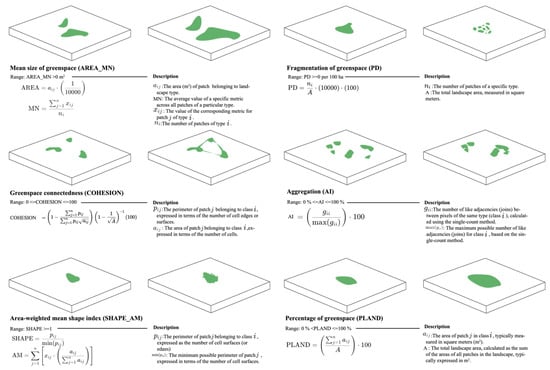
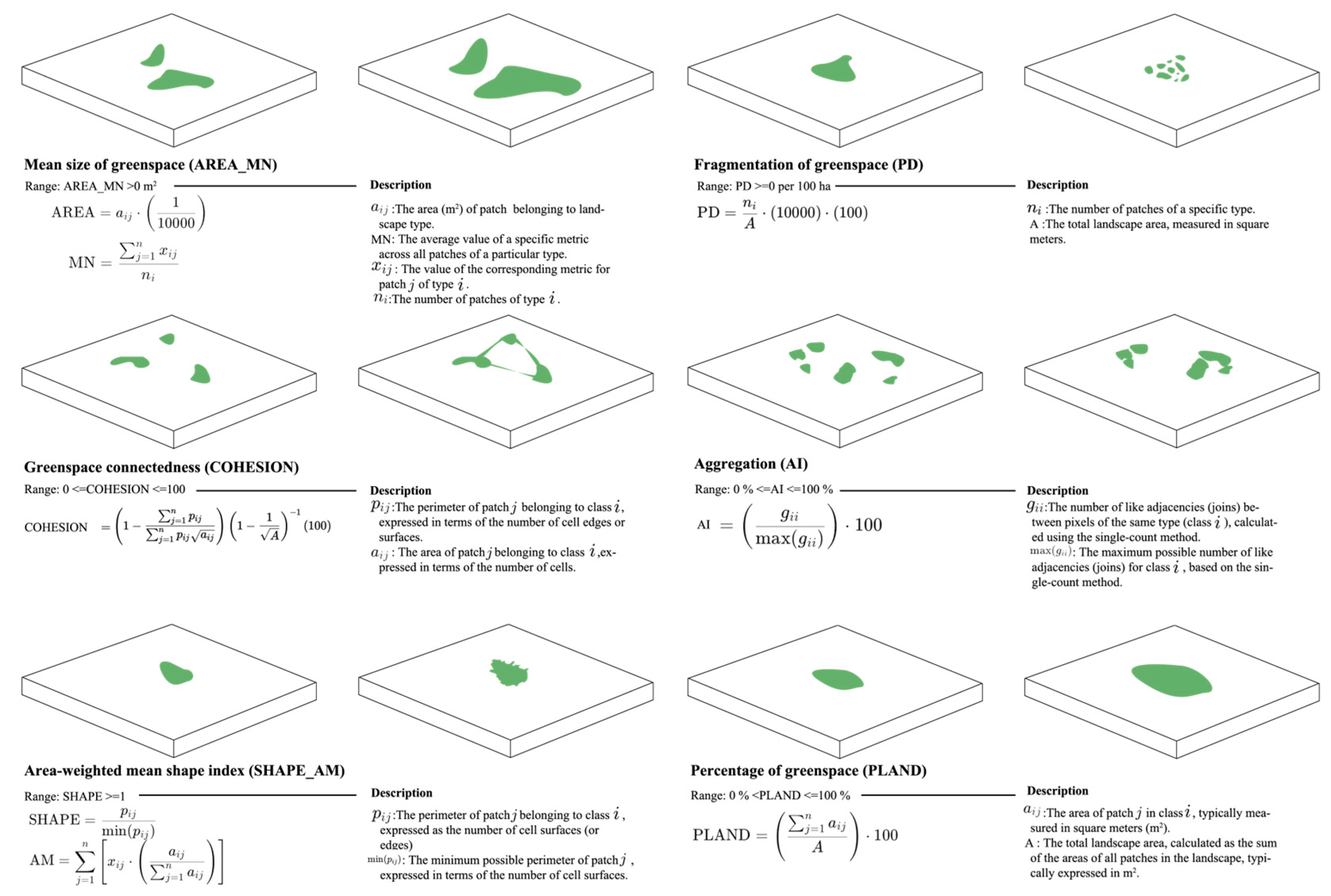
To explore the influence of green space morphology on perception, this study selects six key indicators (Figure 3): Green space percentage, Mean size, Shape complexity, Connectivity, Aggregation, and Fragmentation. XGBoost regression was applied to model and predict all ten subjective perception dimensions using the full set of visual morphology features, providing a comprehensive predictive framework. Additionally, stepwise (segmented) linear regression was conducted to examine the effects of individual morphological variables on specific perceptual dimensions, offering interpretable insights into both linear and threshold-dependent relationships.
Figure 3.
Description and Calculation of Green Space Morphology a. a Some images in this table are directly adopted from a previous paper, with additional images created and provided by the authors of the current study for the purpose of enhancing the comprehensiveness of the data presentation [52].
The multivariate regression model allows for the simultaneous analysis of multiple correlated dependent variables, such as VE, R, and landscape element preference. This approach not only reduces the number of hypothesis tests, thereby minimizing redundant errors and enhancing statistical robustness, but also captures potential nonlinear relationships and interaction effects among variables. In addition, covariance matrix analysis enables the quantification of correlations between dependent variables, providing deeper insights into the mechanisms of green space perception.
4.4.4. Analysis and Prediction of Pet Park Perception Preferences Based on AHP and XGBoost
To explore visual perception preferences in pet park experiences, this study focused on evaluating individuals’ subjective experiences during interactions within the landscape. Ten commonly used indicators of subjective perception preferences were selected, including sense of comfort, pleasure, calmness, naturalness, tidiness, quietness, harmony, complexity, openness, and stimulation.
The Analytic Hierarchy Process (AHP) was employed to assess these subjective preferences. A hierarchical model comprising the goal layer, criteria layer, and alternative layer was constructed, and a pairwise comparison matrix was developed to determine the relative weights of each indicator. The consistency index (CI) of the matrix was 0.14, as shown in Equation (6). And the consistency ratio (CR) was 0.09, as shown in Equation (7). According to the AHP methodology, the closer the CI value is to 0, the better the consistency of the matrix; a CR value less than 0.1 typically indicates acceptable consistency, suggesting that the model is reasonably coherent.
In the Analytic Hierarchy Process (AHP), represents the largest eigenvalue of the judgment matrix. In theory, if the matrix is perfectly consistent, should equal n, the order of the matrix, which corresponds to the number of compared criteria. The CI is used to measure the degree of deviation of the judgment matrix from complete consistency. The closer the CI value is to 0, the higher the level of consistency, and thus the more reliable the results.
The CI measures the degree to which the judgment matrix deviates from perfect consistency, while the CR compares this deviation against that of a randomly generated matrix. This allows an assessment of whether the inconsistency is within an acceptable range. Generally, a CR value less than 0.1 indicates that the judgment matrix has passed the consistency check, demonstrating sufficient reliability for further computation of indicator weights.
In addition, this study employed the XGBoost algorithm combined with a GA to train, test, and optimize both subjective and objective datasets, thereby constructing a robust and stable model for predicting perceptual preferences.
4.4.5. Construction of a Visual Perception Preference Prediction Model Based on XGBoost and GA
To predict visual perception preferences, this study employed an integrated XGBoost–GA modeling approach. XGBoost was chosen for its ability to capture highly nonlinear relationships and feature interactions between green space morphology and perception preferences [56,57]. GA was used for hyperparameter optimization and feature selection, preventing local optima, reducing redundant variables, and improving model generalizability [58,59,60,61,62,63]. In total, 80% of the data was used for training and 20% for testing. Inputs included green space morphology indicators, socio-demographics, and spatial factors, while outputs comprised ten subjective perception dimensions: comfort, pleasure, calmness, naturalness, orderliness, quietness, harmony, complexity, openness, and stimulation. Data preprocessing involved PowerTransformer for target normalization, SelectKBest for feature selection, and PCA retaining 95% variance, with noise added to enhance robustness. Each indicator was predicted via a separate XGBRegressor, with GA optimizing n_estimators, max_depth, learning_rate, subsample, colsample_bytree, and regularization parameters over a maximum of 300 iterations. Model performance was assessed using MSE (Equation (8)), MAE (Equation (9)), and R2 (Equation (10)), providing robust evaluation of predictive accuracy and interpretability.
MSE is the average of the squared differences between the predicted values and the actual values, used to measure the magnitude of prediction errors [36]. Specifically, represents the true value, represents the predicted value, represents the mean of the true values and is the number of samples. By calculating the squared prediction error for each sample and averaging them, MSE reflects the degree of deviation between the model’s predictions and the actual values. MAE is the average of the absolute errors between the predicted values and the actual values, measuring the average magnitude of the errors [64,65,66]. The , measures the degree to which the model fits the data. A value closer to 1 indicates a better model fit [67].
MSE and MAE measure the deviation and overall error between predicted and true values, respectively; while R2 is used to assess the model’s ability to explain the variance of the target variable, serving as a key performance indicator for regression models. Figure 3 provides a visual overview of the model evaluation process. The complete code for building and training the XGBRegressor model using PyCharm 2024.2.1 and the XGBoost library is provided to ensure the reproducibility of results and facilitate future applications.
In summary, the integrated model based on XGBoost and GAs effectively reveals the complex relationship between green space morphology and visual perception preferences. It significantly enhances the model’s predictive performance and interpretability, providing quantitative evidence and theoretical support for the optimization and design of green spaces.
5. Results
5.1. XGBoost-GA Model Performance for Visual Perception Dimensions
The self-collected GSSV dataset was captured along main park paths at 20 m intervals, 1.6 m height, using a standardized camera (26 mm, f/1.5, 3024 × 4032) between 9:00 and 11:00 in October 2024, yielding 722 images. After cropping, stitching, and removing obstructions, irrelevant edges, and repetitive or low-quality images (SSIM > 0.95), 632 high-quality images remained. Images were aligned with volunteer sightlines to approximate authentic perception. Metadata (time, location, photographer, device) was recorded for each image. Mask2Former semantic segmentation extracted VE, R, and landscape element proportions, while participant ratings provided subjective perception indicators. Unstructured landscape and perception data were encoded via LabelMe, and all images and indicators were integrated into a unified Excel dataset keyed by image ID, forming a structured, operational foundation for multidimensional analysis, visualization, and machine learning modeling.
Using the test dataset, the XGBoost–GA model explained 95.4% of comfort, 90.8% of pleasure, 94.2% of calmness, 92.9% of naturalness, 95.6% of orderliness, 96.1% of quietness, 93.2% of harmony, 93.5% of complexity, 82.7% of openness, and 98.9% of stimulation. Compared with a Random Forest–GA model, XGBoost–GA improved prediction accuracy by approximately 8% (p < 0.05). Inclusion of all morphological, visual, and socio-demographic variables further enhanced predictive accuracy and demonstrated strong generalization across test cases.
Model accuracy in predicting visual perception preferences, quantified by MSE, was 0.03 for comfort, 0.03 for pleasure, 0.03 for calmness, 0.03 for naturalness, 0.04 for orderliness, 0.03 for quietness, 0.03 for harmony, 0.02 for complexity, 0.03 for openness, and 0.04 for stimulation. Corresponding MAE values were 0.03, 0.03, 0.06, 0.05, 0.04, 0.03, 0.05, 0.04, 0.03, and 0.04, respectively. The low MSE and MAE values indicate close alignment between predicted and observed scores, confirming the model’s high predictive accuracy across all visual perception dimensions.
5.2. Visual Features and Spatial Heterogeneity of Pet-Friendly Park Streetscapes
Using the self-constructed streetscape image dataset, visual entropy (VE) and visual richness (R) were calculated for each image to quantify streetscape visual characteristics (Table 3). VE ranged from 0.71 to 2.03 (mean = 1.46, SD = 0.30), while R ranged from 18.05 to 77.01 (mean = 42.97, SD = 12.71).
Table 3.
Results of the self-collected GSSV dataset.
During data processing, each image was converted to grayscale and normalized to calculate VE, deriving information entropy from the normalized pixel distribution. R was computed by classifying image colors and applying perceptual weighting, capturing diversity in color, form, and spatial hierarchy.
Descriptive statistics, including mean, standard deviation, and range, were used to quantify spatial variability in visual complexity and richness. The low standard deviation of VE indicates relatively consistent visual complexity across the study area, whereas the higher standard deviation of R reflects substantial variation in color, form, and spatial layering, revealing the spatial heterogeneity of streetscape composition.
By jointly analyzing VE and R, this study establishes a quantitative characterization of streetscape visual features, providing a data foundation for exploring how visual attributes influence psychological, emotional, and behavioral responses, and offering evidence-based guidance for urban green space design and optimization.
5.3. Distribution Characteristics of Streetscape Landscape Elements in Pet-Friendly Parks
A statistical analysis of landscape elements was conducted using the GSSV dataset (Table 4). The number of landscape element types per image ranged from 1 to 11, with a mean of 6.49 elements, images containing six element types accounted for approximately 70% of the dataset.
Table 4.
Distribution of Landscape element frequencies.
In addition to occurrence frequency, the visual proportion of each element category was calculated at the pixel level. Trees accounted for the largest share of visual coverage (40%), followed by sky (16%), grass (14%), and vegetation (11%). Built elements contributed substantially smaller proportions, including buildings (5%), tree canopy (4%), paved surfaces, benches, and streetlights (each approximately 2%), while walls and signage each accounted for roughly 1% of the visual field.
By constructing an element-wise matrix for each image based on both element type and visual proportion, the spatial distribution of landscape components within park streetscapes was quantitatively characterized. The results indicate a clear dominance of natural elements, which exhibit both high occurrence frequency and extensive visual coverage, whereas artificial elements are comparatively sparse and visually subordinate. This composition reflects the structural visual profile of pet-friendly park green spaces and provides a quantitative basis for subsequent analyses of perceptual outcomes, landscape design optimization, and ecological function assessment.
5.4. Effects of Green Space Morphological Characteristics on Visual Preference Dimensions in Urban Pet-Friendly Parks
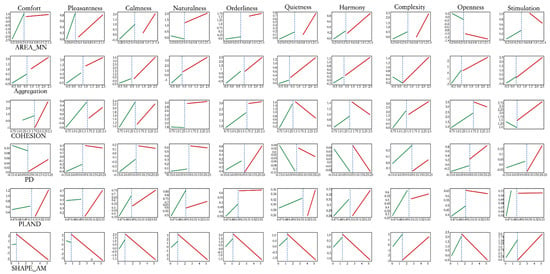
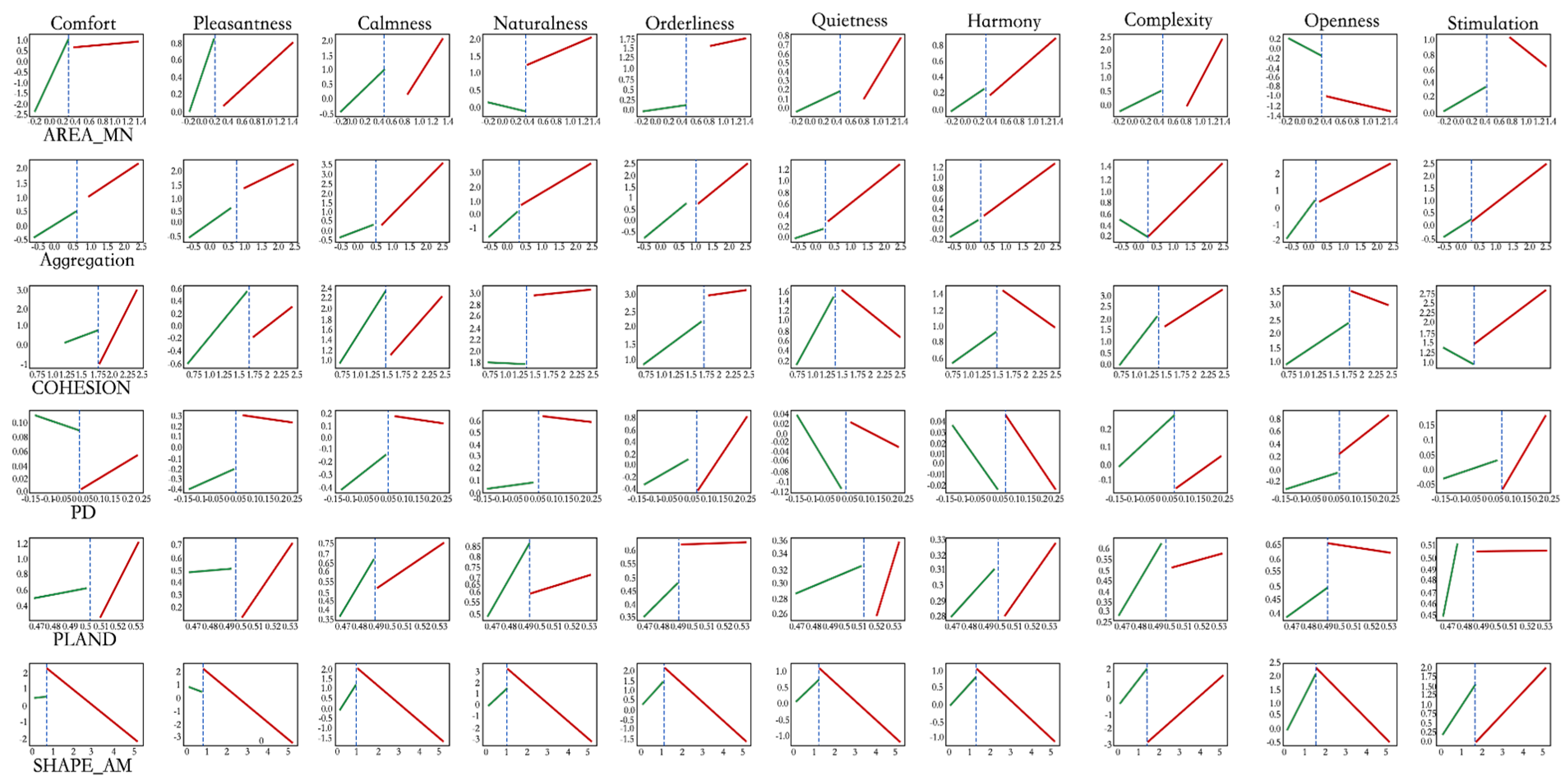
Six green space morphological indicators, green space proportion, fragmentation, mean patch area, connectivity, aggregation index, and shape complexity, were calculated for pet-friendly parks within the study area. Piecewise linear regression analyses were then conducted to examine their relationships with ten visual preference dimensions (Figure 4).
Figure 4.
Piecewise Linear Relationships Between Green Space Morphological Indicators and Visual Preference Dimensions in Pet-Friendly Parks. The slope to the left (green line) of the inflection point represents the rate of change in the visual preference dimension when the morphological indicator is below the threshold (low-level effect), whereas the slope to the right (red line) of the inflection point represents the rate of change when the indicator is above the threshold (high-level effect).
Inflection points for green space proportion (0.17–0.44) revealed nonlinear responses: comfort, pleasure, quietness, and harmony increased, while calmness, naturalness, and openness showed slope reversals. Fragmentation (0.02–0.08) enhanced complexity, openness, and stimulation. Mean patch area (0.17–0.43) yielded diminishing slopes for comfort, pleasure, and stimulation but increases for calmness, naturalness, and openness. Connectivity (1.19–1.75) selectively boosted comfort, naturalness, and stimulation. Aggregation (0.22–0.92) exhibited inverted U-shaped effects; comfort, calmness, and complexity remained positive, while pleasure, harmony, and openness declined. Shape complexity (0.70–1.71) maintained positive slopes for complexity and stimulation, with other dimensions decreasing. This systematic analysis across micro- (fragmentation), meso- (proportion, patch area, aggregation), and macro-scale (connectivity, shape) structures quantifies differential sensitivity of visual preferences, providing empirically grounded guidance for optimizing urban dog-friendly green space morphology.
6. Discussion
6.1. Effects of Green Space Morphology and Landscape Elements on Perceptual Experience in Pet-Friendly Parks
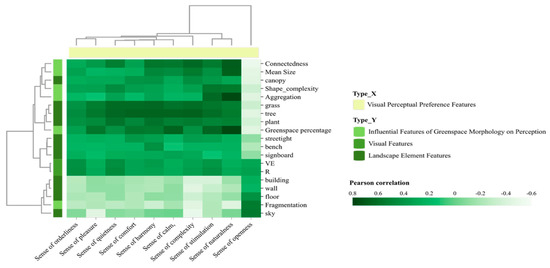
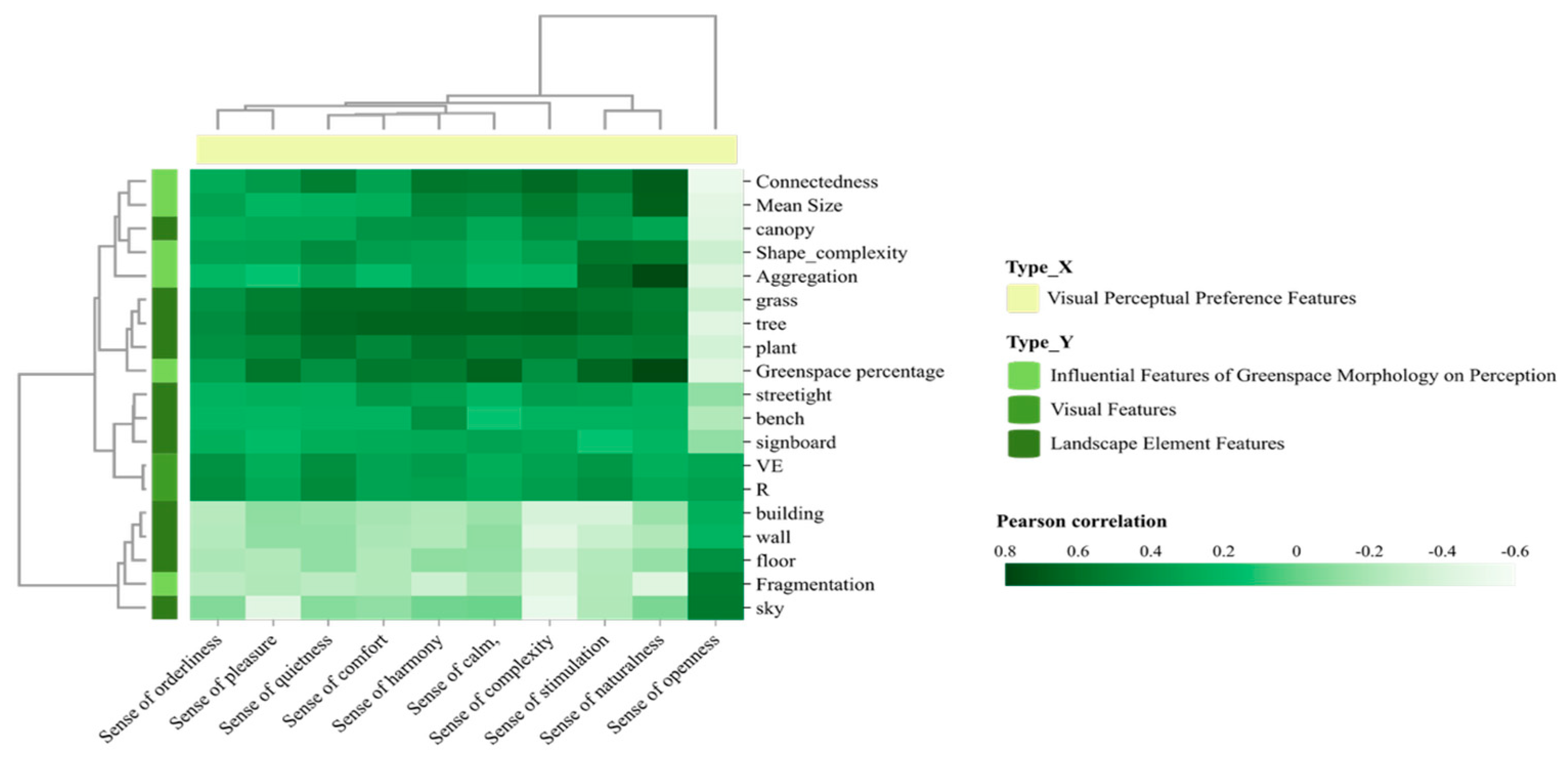
Based on a self-constructed street-view image dataset and green space attribute database, this study developed a correlation matrix linking green space morphology and landscape elements with visual perceptual outcomes, thereby quantifying the nonlinear relationships between ten perceptual dimensions and vegetation cover, green space area, connectivity, aggregation, fragmentation, and landscape element composition (Figure 5). Pearson correlation analyses reveal that positive affective dimensions, including comfort, pleasure, calmness, quietness, and harmony, are significantly and positively associated with trees (r = 0.55–0.67), grassland (r = 0.53–0.64), other vegetation (r = 0.46–0.59), green space proportion (r = 0.54–0.66), and spatial connectivity (r = 0.53–0.57). In contrast, hardscape elements such as walls, buildings, and paved surfaces exhibit negative correlations with these affective dimensions (r = −0.11 to −0.45).
Figure 5.
Nonlinear Relationships Between Objective Spatial Characteristics and Subjective Visual Perception.
Perceptual dimensions related to cognitive–structural evaluation, including naturalness, orderliness, complexity, stimulation, and openness, show strong associations with overall green space proportion (r = 0.78), aggregation (r = 0.77), connectivity (r = 0.69), fragmentation (r = 0.54), sky view ratio (r = 0.54), and paved surfaces (r = 0.43). In particular, complexity and stimulation are positively influenced by increased spatial heterogeneity, shape complexity, and visual richness (r = 0.43–0.67). Conversely, orderliness is enhanced under conditions of lower fragmentation (r = −0.26), while openness increases with higher sky visibility and fragmentation (r = 0.43–0.54) but declines with dense vegetation cover (r = −0.33 to −0.52).
These findings highlight that spatial morphology affects restorative perception through nonlinear and threshold-dependent mechanisms rather than simple linear associations. Specifically, certain configurations in spatial organization correspond to optimal levels of environmental complexity and stimulus, reflecting threshold effects that align with attention restoration and stress reduction theories. This provides a theoretical basis for understanding how varying degrees of aggregation, connectivity, and visual richness can differentially enhance cognitive–structural perceptions and affective restoration, bridging quantitative morphological metrics with established restorative environment theories.
Collectively, these findings indicate that vegetation density, spatial continuity, and biological richness play a central role in enhancing restorative and positive affective perceptions, whereas cognitive–structural perceptions are more strongly regulated by spatial organization, visual complexity, and trade-offs between enclosure and openness. By quantitatively disentangling these differentiated perceptual pathways, the results provide empirical guidance for optimizing the structural configuration and element composition of urban pet-friendly green spaces to support both emotional restoration and spatial legibility [68,69].
6.2. SHAP-Based Quantification of Visual Perceptual Feature Contributions
SHAP analysis of ten XGBoost–GA sub-models quantified landscape contributions to visual perception in dog-friendly parks. Inputs included green space proportion, tree and grass cover, fragmentation, aggregation, connectivity, mean patch size, visual entropy, visual richness, and shape complexity. Drivers varied by dimension: comfort by tree (0.10), grass (0.06), and shape complexity (0.05); pleasure by green space proportion (0.04) and tree cover (0.04); calmness by VE (0.08); naturalness by R (0.08) and shape complexity (0.06); orderliness by shape complexity (0.09) and connectivity (0.06); quietness by canopy (0.08); harmony by vegetation (0.08); perceived complexity by tree and shape complexity (0.08); openness by fragmentation (0.09); stimulation by connectivity (0.07) and VE (~0.05). High-frequency features include green space proportion, VE, shape complexity, mean patch size, and connectivity, while fragmentation and aggregation strongly affect openness and complexity [70,71].
6.3. SHAP Effect Analysis
The SHAP main-effect analysis indicates pronounced heterogeneity in the independent contributions of visual environmental features to different dimensions of university students’ subjective perceptions in pet-friendly park settings (Table 5). Overall, natural landscape elements play a dominant role in restorative experience dimensions, particularly comfort, pleasure, calmness, and perceived naturalness, whereas built landscape structures exert primarily complementary effects on dimensions related to spatial perception. In contrast, the independent contributions of sociodemographic variables are generally modest across all perceptual dimensions.
Table 5.
SHAP main effect analysis of independent contributions of visual features to subjective perceptions among university students in dog-friendly parks.
Feature contributions reveal distinct visual drivers across perceptual dimensions, showing clear functional differentiation. Natural landscape features dominate restorative and positively valenced perceptions [72,73,74]. Greenspace percentage strongly influenced comfort, pleasure, quietness, and harmony, exceeding 65% in comfort and harmony, indicating overall natural coverage as a fundamental prerequisite for positive experiences. Spatial connectedness independently supported calmness and naturalness, highlighting the role of structural continuity. In contrast, order and openness relied on sky visibility and spatial expansiveness, while complexity and stimulation were driven by built elements and fragmentation, indicating that structural discontinuity heightens arousal. These results suggest that restoration is primarily shaped by natural coverage and connectivity, whereas high-arousal perceptions are more influenced by structural complexity and fragmentation. Complementing main-effect analysis with interaction effects (Table 6) clarifies synergistic mechanisms, showing that different perceptual dimensions integrate environmental elements differently: some are sensitive to additive effects, others to structural alignment, providing a mechanistic basis for dynamic, synergy-based interpretation of visual environments.
Table 6.
SHAP interaction effect analysis of independent contributions of visual features to subjective perceptions among university students in dog-friendly parks.
Interaction-effect analysis shows that each perceptual dimension is shaped by specific combinations of visual elements, revealing directional patterns [75]. Comfort is primarily driven by Greenspace Percentage × Tree, highlighting the synergy between overall green coverage and tree structure. Pleasure is dominated by Greenspace Percentage × R (interaction strength 3.02, contribution 16.53%), showing that color diversity enhances positive emotion under high greenery. Within restorative dimensions, Tranquility is influenced by Connectedness × Tree (19.25%), while Naturalness and Quietness are driven by Greenspace Percentage × Tree, emphasizing vegetation layering in stabilizing emotional responses. Order relies on Greenspace Percentage × Grass (2.77, 12.03%), and Harmony on Greenspace Percentage × Floor (19.15%), indicating that low-lying vegetation and ground paving enhance visual coherence. In high cognitive-load dimensions, Complexity is shaped by Greenspace Percentage × Building, Openness by Greenspace Percentage × Sky, and Stimulation by Greenspace Percentage × VE, demonstrating that natural–built element combinations and visual information intensity modulate perceptions of complexity, expansiveness, and arousal.
Key morphological thresholds—Greenspace Percentage ≥35–40%, moderate connectivity, and fragmentation below critical limits—optimize restorative perception while avoiding overstimulation or reduced orderliness. These empirically derived thresholds offer actionable guidance for dog-friendly park design, linking landscape configuration to perceived sensory dimensions such as serene, space, nature, and refuge.
6.4. Limitations
When considering the generalizability of the findings, it is necessary to cautiously acknowledge potential limitations arising from the sample composition. Although the study recruited volunteers from diverse occupational and social backgrounds, including education, research, and service sectors, providing some heterogeneity in social context, the age distribution was heavily skewed toward younger adults [76]. This restricts the ability to fully capture age-related differences in visual perception, emotional regulation, and environmental responsiveness. We have strengthened the discussion on age-related perceptual variability, explicitly acknowledging that generational differences in cognitive processing, aesthetic preferences, and tolerance for visual complexity may influence perception-based assessments. Previous research has demonstrated systematic variation across age groups in perceptual preferences, cognitive processing strategies, and emotion-recovery pathways, particularly in terms of tolerance for spatial complexity, openness, and stimulus intensity [77,78,79,80].
Consequently, the present findings should be interpreted with caution when extrapolating to middle-aged or older populations and are most applicable to characterizing perceptual and emotional responses among younger adults in similar environmental contexts [81,82,83,84,85,86]. Future studies should employ stratified sampling or cross-age comparative designs to systematically examine how age moderates both the main and interactive effects of visual landscape features, thereby enhancing the external validity and population applicability of the results.
When considering generalizability, findings should be interpreted with caution due to the sample’s youth bias and Chengdu-specific context. Age-related differences in cognitive processing, aesthetic preference, and tolerance for visual complexity may influence perception, limiting extrapolation to middle-aged or older populations. Cultural norms, dog-park usage, and attitudes toward pets may also differ in other urban contexts, constraining broader applicability. Moreover, the study relies on static GSSV images, capturing only visual features and not dynamic, multi-sensory experiences such as dog movement, human–dog interactions, or ambient sounds, which may further modulate behavioral activation and restorative responses. Future research should employ stratified, cross-age, and cross-cultural designs, and incorporate video stimuli, immersive virtual reality, or in situ field studies to validate and extend the visual–morphological findings, thereby enhancing external validity and ecological relevance.
7. Conclusions
This study developed a comprehensive quantitative model of visual perception for medium-sized dog-friendly parks in Chengdu, integrating both objective and subjective indicators. The research workflow encompassed data collection, landscape element annotation and visual feature extraction, calculation of spatial morphology metrics, multi-target regression modeling, XGBoost and GA optimization, SHAP-based feature contribution analysis, and model validation with predictive visualization. The indicator system included four dimensions comprising 29 specific metrics, covering visual preference for green spaces, the influence of spatial morphology on perception, landscape element characteristics, and visual features.
The practical applicability of the model was further validated through scenario simulations. For example, adjustments in greenspace coverage, increased fragmentation, or optimized spatial structure produced quantifiable changes in comfort, pleasure, tranquility, and naturalness scores, and potential health benefits were estimated based on the service population scale.
Overall, this study establishes a structured framework for quantifying visual perception in dog-friendly parks, providing an operational tool for landscape design evaluation, supporting precise prediction and optimization of multidimensional perception indicators, and offering data-driven guidance for urban green space planning. The framework advances visual perception research toward greater scientific rigor, interpretability, and generalizability.
Author Contributions
Conceptualization, Y.P.; methodology, Y.P.; software, C.J., Y.L. and X.D.; validation, Y.P.; formal analysis, Y.P., C.J.; investigation, Y.L., X.D. and C.J.; resources, Y.L.; data curation, Y.P.; writing—original draft preparation, Y.P.; writing—review and editing, Y.P. and H.S.; visualization, X.D.; supervision, H.S. and Q.C.; project administration, H.S. and Q.C.; funding acquisition, Q.C. All authors have read and agreed to the published version of the manuscript.
Funding
This research was funded by the National Key R&D Program of China: Technologies for the Construction of Urban-Rural Recreational and Health-Promoting Bamboo Forests [Grant No. 2023YFD22012040102]. The APC was funded by Q.C.
Data Availability Statement
The original contributions presented in the study are included in the article. Further inquiries can be directed to the corresponding author.
Acknowledgments
We would like to express our sincere gratitude to all those who have contributed to the success of this research.
Conflicts of Interest
The authors declare no conflicts of interest.
References
- Zhao, W.; Li, X.; Zhu, X.; Ye, H.; Xu, H. Restorative properties of green sheltered spaces and their morphological characteristics in urban parks. Urban For. Urban Green. 2023, 86, 127986. [Google Scholar] [CrossRef] [Scilit]
- Xiong, J.; Lipsitz, O.; Nasri, F.; Lui, L.M.W.; Gill, H.; Phan, L.; Chen-Li, D.; Iacobucci, M.; Ho, R.; Majeed, A.; et al. Impact of COVID-19 Pandemic on Mental Health in the General population: A Systematic Review. J. Affect. Disord. 2020, 277, 55–64. [Google Scholar] [CrossRef] [Scilit] [PubMed]
- Stansfeld, S.; Haines, M.; Brown, B. Noise and Health in the Urban Environment. Rev. Environ. Health 2000, 15, 43–82. [Google Scholar] [CrossRef] [Scilit] [PubMed]
- Parsons, C.E.; Landberger, C.; Purves, K.L.; Young, K.S. No Beneficial Associations between Living with a Pet and Mental Health Outcomes during the COVID-19 Pandemic in a Large UK Longitudinal Sample. Ment. Health Prev. 2024, 35, 200354. [Google Scholar] [CrossRef] [Scilit]
- Northrope, K.; Shnookal, J.; Ruby, M.B.; Howell, T.J. The Relationship Between Attachment to Pets and Mental Health and Wellbeing: A Systematic Review. Animals 2025, 15, 1143. [Google Scholar] [CrossRef] [Scilit]
- Li, J.; Wong, N.M.L. The mediating role of loneliness in the relationship between pet ownership and human well-being. Sci. Rep. 2025, 15, 35899. [Google Scholar] [CrossRef] [Scilit]
- Amiot, C.E.; Quervel-Chaumette, M.; Gagné, C.; Bastian, B. An experimental study focusing on mindfulness to capture how our contacts with dogs can promote human well-being. Sci. Rep. 2025, 15, 23202. [Google Scholar] [CrossRef] [Scilit] [PubMed]
- Tan, J.S.Q.; Fung, W.; Tan, B.S.W.; Low, J.Y.; Syn, N.L.; Goh, Y.X.; Pang, J. Association between pet ownership and physical activity and mental health during the COVID-19 ‘circuit breaker’ in Singapore. One Health 2021, 13, 100343. [Google Scholar] [CrossRef] [Scilit]
- Kretzler, B.; König, H.-H.; Hajek, A. Pet ownership, loneliness, and social isolation: A systematic review. Soc. Psychiatry Psychiatr. Epidemiol. 2022, 57, 1935–1957. [Google Scholar] [CrossRef] [Scilit]
- Barr, H.K.; Guggenbickler, A.M.; Hoch, J.S.; Dewa, C.S. Examining evidence for a relationship between human-animal interactions and common mental disorders during the COVID-19 pandemic: A systematic literature review. Front. Health Serv. 2024, 4, 1321293. [Google Scholar] [CrossRef] [Scilit]
- Samet, L.E.; Vaterlaws-Whiteside, H.; Harvey, N.D.; Upjohn, M.M.; Casey, R.A. Exploring and Developing the Questions Used to Measure the Human–Dog Bond: New and Existing Themes. Animals 2022, 12, 805. [Google Scholar] [CrossRef] [Scilit]
- Edwards, J.R.; Gotschall, J.W.; Clougherty, J.E.; Schinasi, L.H. Associations of greenspace use and proximity with self-reported physical and mental health outcomes during the COVID-19 pandemic. PLoS ONE 2023, 18, e0280837. [Google Scholar] [CrossRef] [Scilit]
- Yang, C.; Shi, S.; Runeson, G.; Lu, D. Towards social sustainability in urban communities: Exploring how community parks influence residents’ social interaction during the COVID-19 pandemic. Humanit. Soc. Sci. Commun. 2024, 11, 1506. [Google Scholar] [CrossRef] [Scilit]
- Kogan, L.R.; Currin-McCulloch, J.; Bussolari, C.; Packman, W.; Erdman, P. The Psychosocial Influence of Companion Animals on Positive and Negative Affect during the COVID-19 Pandemic. Animals 2021, 11, 2084. [Google Scholar] [CrossRef] [Scilit] [PubMed]
- Dunkel, A. Visualizing the perceived environment using crowdsourced photo geodata. Landsc. Urban Plan. 2015, 142, 173–186. [Google Scholar] [CrossRef] [Scilit]
- Koblet, O.; Purves, R.S. From online texts to Landscape Character Assessment: Collecting and analysing first-person landscape perception computationally. Landsc. Urban Plan. 2020, 197, 103757. [Google Scholar] [CrossRef] [Scilit]
- Rossetti, T.; Lobel, H.; Rocco, V.; Hurtubia, R. Explaining subjective perceptions of public spaces as a function of the built environment: A massive data approach. Landsc. Urban Plan. 2019, 181, 169–178. [Google Scholar] [CrossRef] [Scilit]
- Jorba, M.; López-Silva, P. Mind in action: Expanding the concept of affordance. Philos. Psychol. 2024, 37, 1579–1589. [Google Scholar] [CrossRef] [Scilit]
- Stevenson, M.P.; Schilhab, T.; Bentsen, P. Attention Restoration Theory II: A systematic review to clarify attention processes affected by exposure to natural environments. J. Toxicol. Environ. Health Part B 2018, 21, 227–268. [Google Scholar] [CrossRef] [Scilit]
- Ohly, H.; White, M.P.; Wheeler, B.W.; Bethel, A.; Ukoumunne, O.C.; Nikolaou, V.; Garside, R. Attention Restoration Theory: A systematic review of the attention restoration potential of exposure to natural environments. J. Toxicol. Environ. Health Part B 2016, 19, 305–343. [Google Scholar] [CrossRef] [Scilit]
- Wen, H.; Lin, H.; Liu, X.; Guo, W.; Yao, J.; He, B.-J. An assessment of the psychologically restorative effects of the environmental characteristics of university common spaces. Environ. Impact Assess. Rev. 2025, 110, 107645. [Google Scholar] [CrossRef] [Scilit]
- Li, H.; Ding, Y.; Zhao, B.; Xu, Y.; Wei, W. Effects of immersion in a simulated natural environment on stress reduction and emotional arousal: A systematic review and meta-analysis. Front. Psychol. 2023, 13, 1058177. [Google Scholar] [CrossRef] [Scilit]
- Ulrich, R.S.; Simons, R.F.; Losito, B.D.; Fiorito, E.; Miles, M.A.; Zelson, M. Stress recovery during exposure to natural and urban environments. J. Environ. Psychol. 1991, 11, 201–230. [Google Scholar] [CrossRef] [Scilit]
- Marselle, M.R. Theoretical Foundations of Biodiversity and Mental Well-being Relationships. In Biodiversity and Health in the Face of Climate Change; Marselle, M., Stadler, J., Korn, H., Irvine, K., Bonn, A., Eds.; Springer: Cham, Switzerland, 2019. [Google Scholar] [CrossRef] [Scilit]
- Cao, Y.; Yang, P.; Xu, M.; Li, M.; Li, Y.; Guo, R. A novel method of urban landscape perception based on biological vision process. Landsc. Urban Plan. 2024, 254, 105246. [Google Scholar] [CrossRef] [Scilit]
- Bonnefond, M.; Jensen, O.; Clausner, T. Visual processing by hierarchical and dynamic multiplexing. eNeuro 2023, 11. [Google Scholar] [CrossRef] [Scilit]
- Peters, R.J.; Itti, L. Beyond bottom-up: Incorporating task-dependent influences into a computational model of spatial attention. In Proceedings of the 2007 IEEE Conference on Computer Vision and Pattern Recognition, Minneapolis, MN, USA, 17–22 June 2007; pp. 1–8. [Google Scholar] [CrossRef] [Scilit]
- Hartig, T.; Mang, M.; Evans, G.W. Restorative Effects of Natural Environment Experiences. Environ. Behav. 1991, 23, 3–26. [Google Scholar] [CrossRef] [Scilit]
- Li, W.; Liu, Y. The influence of visual and auditory environments in parks on visitors’ landscape preference, emotional state, and perceived restorativeness. Humanit. Soc. Sci. Commun. 2024, 11, 1491. [Google Scholar] [CrossRef] [Scilit]
- Liu, Y.; Hu, M.; Zhao, B. Audio-visual interactive evaluation of the forest landscape based on eye-tracking experiments. Urban For. Urban Green. 2019, 46, 126476. [Google Scholar] [CrossRef] [Scilit]
- Lou, X.; Ito, K.; Li, L.M.W. Rethinking environmental values in psychology from the perspective of anthropocentrism. J. Environ. Psychol. 2025, 101, 102518. [Google Scholar] [CrossRef] [Scilit]
- Celikors, E.; Wells, N.M. Are low-level visual features of scenes associated with perceived restorative qualities? J. Environ. Psychol. 2022, 81, 101800. [Google Scholar] [CrossRef] [Scilit]
- Zhang, G.; Wu, G. Interactive influence of the perceived visual richness, greenness and scenography on landscape preference of urban woodland. J. Environ. Psychol. 2025, 103, 102586. [Google Scholar] [CrossRef] [Scilit]
- Naik, N.A.; Bhat, I.A.; Afroze, D.; Rasool, R.; Mir, H.; Andrabi, S.I.; Shah, S.; Siddiqi, M.A.; Shah, Z.A. Vascular endothelial growth factor A gene (VEGFA) polymorphisms and expression of VEGFA gene in lung cancer patients of Kashmir Valley (India). Tumor Biol. 2012, 33, 833–839. [Google Scholar] [CrossRef] [Scilit]
- Chen, S.; Wu, Z.; Sleipness, O.R.; Wang, H. Benefits and Conflicts: A Systematic Review of Dog Park Design and Management Strategies. Animals 2022, 12, 2251. [Google Scholar] [CrossRef] [Scilit]
- Yang, L.; Wu, Q.; Lyu, J. Which affects park satisfaction more, environmental features or spatial pattern? Landsc. Ecol. 2025, 40, 60. [Google Scholar] [CrossRef] [Scilit]
- Jin, T.; Lu, J.; Shao, Y. Exploring the Impact of Visual and Aural Elements in Urban Parks on Human Behavior and Emotional Responses. Land 2024, 13, 1468. [Google Scholar] [CrossRef] [Scilit]
- Zhao, J.; Gong, X. Animals in Urban Green Spaces in Relation to Mental Restorative Quality. Urban For. Urban Green. 2022, 74, 127620. [Google Scholar] [CrossRef] [Scilit]
- Liu, Y.; Zhang, J.; Liu, C.; Yang, Y. A Review of Attention Restoration Theory: Implications for Designing Restorative Environments. Sustainability 2024, 16, 3639. [Google Scholar] [CrossRef] [Scilit]
- Pham, T.P.; Sanocki, T. Human Attention Restoration, Flow, and Creativity: A Conceptual Integration. J. Imaging 2024, 10, 83. [Google Scholar] [CrossRef] [Scilit] [PubMed]
- Teeuwen, R.; Milias, V.; Bozzon, A.; Psyllidis, A. How well do NDVI and OpenStreetMap data capture people’s visual perceptions of urban greenspace? Landsc. Urban Plan. 2024, 245, 105009. [Google Scholar] [CrossRef] [Scilit]
- Ratcliffe, E.; Korpela, K.M. Memory and place attachment as predictors of imagined restorative perceptions of favourite places. J. Environ. Psychol. 2016, 48, 120–130. [Google Scholar] [CrossRef] [Scilit]
- Menzel, C.; Reese, G. Implicit Associations With Nature and Urban Environments: Effects of Lower-Level Processed Image Properties. Front. Psychol. 2021, 12, 591403. [Google Scholar] [CrossRef] [Scilit] [PubMed]
- Ricciardi, E.; Spano, G.; Lopez, A.; Tinella, L.; Clemente, C.; Elia, G.; Dadvand, P.; Sanesi, G.; Bosco, A.; Caffò, A.O. Long-Term Exposure to Greenspace and Cognitive Function during the Lifespan: A Systematic Review. Int. J. Environ. Res. Public Health 2022, 19, 11700. [Google Scholar] [CrossRef] [Scilit]
- Chen, T.; Wang, L.; Huang, B.; Yu, J.; Wu, Y. Pursued Spatial Perception benefit considering Attractiveness and Cognitive Load: Appropriate Visual Complexity of Indoor Commercial Space. J. Build. Eng. 2024, 98, 111144. [Google Scholar] [CrossRef] [Scilit]
- Yang, W.; Jeon, J.Y. Effects of lighting and sound factors on environmental sensation, perception, and cognitive performance in a classroom. J. Build. Eng. 2023, 76, 107063. [Google Scholar] [CrossRef] [Scilit]
- Zhang, X.; Chen, X.; Zhang, X. The impact of exposure to air pollution on cognitive performance. Proc. Natl. Acad. Sci. USA 2018, 115, 9193–9197. [Google Scholar] [CrossRef] [Scilit]
- Dwivedi, K.; Sadiya, S.; Balode, M.P.; Roig, G.; Cichy, R.M. Visual features are processed before navigational affordances in the human brain. Sci. Rep. 2024, 14, 5573. [Google Scholar] [CrossRef] [Scilit]
- Epstein, R.A.; Baker, C.I. Scene Perception in the Human Brain. Annu. Rev. Vis. Sci. 2019, 5, 373–397. [Google Scholar] [CrossRef] [Scilit]
- Parra, L.A.; Madrigal Díaz, D.E.; Ramos, F. Computational framework of the visual sensory system based on neuroscientific evidence of the ventral pathway. Cogn. Syst. Res. 2023, 77, 62–87. [Google Scholar] [CrossRef] [Scilit]
- Kyle-Davidson, C.; Zhou, E.Y.; Walther, D.B.; Bors, A.G.; Evans, K.K. Characterising and dissecting human perception of scene complexity. Cognition 2023, 231, 105319. [Google Scholar] [CrossRef] [Scilit]
- Peng, Y.; Li, Z.; Shah, A.M.; Lv, B.; Liu, S.; Liu, Y.; Li, X.; Song, H.; Chen, Q. Decoding the Role of Urban Green Space Morphology in Shaping Visual Perception: A Park-Based Study. Land 2025, 14, 495. [Google Scholar] [CrossRef] [Scilit]
- Ekland, E.H.; Szostak, J.W.; Bartel, D.P. Structurally Complex and Highly Active RNA Ligases Derived from Random RNA Sequences. Science 1995, 269, 364–370. [Google Scholar] [CrossRef] [Scilit]
- Valtchanov, D.; Ellard, C.G. Cognitive and affective responses to natural scenes: Effects of low level visual properties on preference, cognitive load and eye-movements. J. Environ. Psychol. 2015, 43, 184–195. [Google Scholar] [CrossRef] [Scilit]
- Cheng, B.; Misra, I.; Schwing, A.G.; Kirillov, A.; Girdhar, R. Masked-attention Mask Transformer for Universal Image Segmentation. In Proceedings of the 2022 IEEE/CVF Conference on Computer Vision and Pattern Recognition (CVPR), New Orleans, LA, USA, 21–24 June 2022. [Google Scholar] [CrossRef] [Scilit]
- Swietek, A.R.; Zumwald, M. Visual Capital: Evaluating building-level visual landscape quality at scale. Landsc. Urban Plan. 2023, 240, 104880. [Google Scholar] [CrossRef] [Scilit]
- Wagtendonk, A.J.; Vermaat, J.E. Visual perception of cluttering in landscapes: Developing a low resolution GIS-evaluation method. Landsc. Urban Plan. 2014, 124, 85–92. [Google Scholar] [CrossRef] [Scilit]
- Taha, Z.Y.; Abdullah, A.A.; Rashid, T.A. Optimizing Feature Selection with Genetic Algorithms: A Review of Methods and Applications. arXiv 2024, arXiv:2409.14563. [Google Scholar] [CrossRef] [Scilit]
- Morales-Hernández, A.; Van Nieuwenhuyse, I.; Rojas Gonzalez, S. A survey on multi-objective hyperparameter optimization algorithms for machine learning. Artif. Intell. Rev. 2022, 56, 8043–8093. [Google Scholar] [CrossRef] [Scilit]
- Li, Q.; Kamaruddin, N.; Zhang, J.; Peng, C.; Sui Ki Khoo, A. A novel method of bayesian genetic optimization on automated hyperparameter tuning. Sci. Rep. 2025, 15, 43181. [Google Scholar] [CrossRef] [Scilit] [PubMed]
- Khalil, M.; AlSayed, A.; Liu, Y.; Vanrolleghem, P.A. An integrated feature selection and hyperparameter optimization algorithm for balanced machine learning models predicting N2O emissions from wastewater treatment plants. J. Water Process Eng. 2024, 63, 105512. [Google Scholar] [CrossRef] [Scilit]
- Mehdary, A.; Chehri, A.; Jakimi, A.; Saadane, R. Hyperparameter Optimization with Genetic Algorithms and XGBoost: A Step Forward in Smart Grid Fraud Detection. Sensors 2024, 24, 1230. [Google Scholar] [CrossRef] [Scilit]
- Hodson, T.O.; Over, T.M.; Foks, S.S. Mean Squared Error, Deconstructed. J. Adv. Model. Earth Syst. 2021, 13, e2021MS002681. [Google Scholar] [CrossRef] [Scilit]
- Khoshvaght, H.; Permala, R.R.; Razmjou, A.; Khiadani, M. A critical review on selecting performance evaluation metrics for supervised machine learning models in wastewater quality prediction. J. Environ. Chem. Eng. 2025, 13, 119675. [Google Scholar] [CrossRef] [Scilit]
- Qi, J.; Du, J.; Siniscalchi, S.M.; Ma, X.; Lee, C.-H. On Mean Absolute Error for Deep Neural Network Based Vector-to-Vector Regression. arXiv 2020. [Google Scholar] [CrossRef] [Scilit]
- Jierula, A.; Wang, S.; Oh, T.-M.; Wang, P. Study on Accuracy Metrics for Evaluating the Predictions of Damage Locations in Deep Piles Using Artificial Neural Networks with Acoustic Emission Data. Appl. Sci. 2021, 11, 2314. [Google Scholar] [CrossRef] [Scilit]
- Helland, I.S. On the Interpretation and Use of R 2 in Regression Analysis. Biometrics 1987, 43, 61. [Google Scholar] [CrossRef] [Scilit]
- Lo, C.-W. Effects of urban green space landscape elements on perceived sensory dimensions, landscape preference, stress restoration, and anxiety in women. Cities 2026, 170, 106595. [Google Scholar] [CrossRef] [Scilit]
- Zhang, J.; Tan, Z.; Bu, F. Impact of urban green spaces on mental restoration in older adults: A perspective based on subjective perception. Front. Public Health 2025, 13, 1687874. [Google Scholar] [CrossRef] [Scilit]
- Rahimi, E.; Barghjelveh, S.; Dong, P. Quantifying how urban landscape heterogeneity affects land surface temperature at multiple scales. J. Ecol. Environ. 2021, 45, 22. [Google Scholar] [CrossRef] [Scilit]
- Zhang, Y.; Zhou, R.; Lv, X.; Ma, Q.; Li, Y.; Li, C.; Fang, X.; Li, J.; Zhang, Z.; Fang, S. Quantifying the impacts of blue-green spaces on population exposure to heatwaves across climate zones. Landsc. Ecol. 2025, 40, 205. [Google Scholar] [CrossRef] [Scilit]
- Bai, Z.; Zhang, S.; He, H.; Xu, M. Nature perception and positive emotions in urban forest parks enhance subjective well-being. Sci. Rep. 2025, 15, 31457. [Google Scholar] [CrossRef] [Scilit] [PubMed]
- Li, Y.; Li, W.; Liu, Y. Remedies from nature: Exploring the moderating mechanisms of natural landscape features on emotions and perceived restoration in urban parks. Front. Psychol. 2025, 15, 1502240. [Google Scholar] [CrossRef] [Scilit]
- Gao, W.; Tang, B.M.; Liu, B. Effects of Landscape Characteristic Perception of Campus on College Students’ Mental Restoration. Behav. Sci. 2025, 15, 470. [Google Scholar] [CrossRef] [Scilit]
- Zhang, G.; Yang, J.; Jin, J. Assessing Relations Among Landscape Preference, Informational Variables, and Visual Attributes. J. Environ. Eng. Landsc. Manag. 2021, 29, 294–304. [Google Scholar] [CrossRef] [Scilit]
- Bornstein, M.H.; Jager, J.; Putnick, D.L. Sampling in Developmental science: Situations, shortcomings, solutions, and Standards. Dev. Rev. 2013, 33, 357–370. [Google Scholar] [CrossRef] [Scilit]
- Chen, S.-W.; Keglovits, M.; Devine, M.; Stark, S. Sociodemographic Differences in Respondent Preferences for Survey Formats: Sampling Bias and Potential Threats to External Validity. Arch. Rehabil. Res. Clin. Transl. 2022, 4, 100175. [Google Scholar] [CrossRef] [Scilit]
- Segen, V.; Avraamides, M.N.; Slattery, T.J.; Wiener, J.M. Age-related changes in visual encoding strategy preferences during a spatial memory task. Psychol. Res. 2021, 86, 404–420. [Google Scholar] [CrossRef] [Scilit]
- Nasrollahi, N.; Jowett, T.; Machado, L. Emotional information processing in young and older adults: Meta-analysis reveals faces elicit distinct biases. Eur. J. Ageing 2022, 19, 369–379. [Google Scholar] [CrossRef] [Scilit]
- Kim, S.; Geren, J.L.; Knight, B.G. Age Differences in the Complexity of Emotion Perception. Exp. Aging Res. 2015, 41, 556–571. [Google Scholar] [CrossRef] [Scilit] [PubMed]
- González-Gualda, L.M.; Vicente-Querol, M.A.; García, A.S.; Molina, J.P.; Latorre, J.M.; Fernández-Sotos, P.; Fernández-Caballero, A. An exploratory study of the effect of age and gender on face scanning during affect recognition in immersive virtual reality. Sci. Rep. 2024, 14, 5553. [Google Scholar] [CrossRef] [Scilit] [PubMed]
- Grainger, S.A.; Crawford, J.D.; Riches, J.C.; Kochan, N.A.; Chander, R.J.; Mather, K.A.; Sachdev, P.S.; Henry, J.D. Aging Is Associated With Multidirectional Changes in Social Cognition: Findings From an Adult Life-Span Sample Ranging From 18 to 101 Years. J. Gerontol. Ser. B 2022, 78, 62–72. [Google Scholar] [CrossRef] [Scilit]
- Castro, V.L.; Isaacowitz, D.M. The same with age: Evidence for age-related similarities in interpersonal accuracy. J. Exp. Psychol. Gen. 2019, 148, 1517–1537. [Google Scholar] [CrossRef] [Scilit] [PubMed]
- Pereira, N.M.; Maresh, A.M.; Modi, V.K.; Rosenblatt, S.D. Tympanostomy tubes in the age of quarantine. Int. J. Pediatr. Otorhinolaryngol. 2022, 154, 111047. [Google Scholar] [CrossRef] [Scilit] [PubMed]
- Gautrais, J. The hidden variables of leadership. Behav. Process. 2010, 84, 664–667. [Google Scholar] [CrossRef] [Scilit] [PubMed]
- Rogers, L.J.; Vallortigara, G. Complementary Specializations of the Left and Right Sides of the Honeybee Brain. Front. Psychol. 2019, 10, 280. [Google Scholar] [CrossRef] [Scilit] [PubMed]

Disclaimer/Publisher’s Note: The statements, opinions and data contained in all publications are solely those of the individual author(s) and contributor(s) and not of MDPI and/or the editor(s). MDPI and/or the editor(s) disclaim responsibility for any injury to people or property resulting from any ideas, methods, instructions or products referred to in the content. |
© 2026 by the authors. Licensee MDPI, Basel, Switzerland. This article is an open access article distributed under the terms and conditions of the Creative Commons Attribution (CC BY) license.