Article

Exogenous Na2SiO3 Mitigates the Adverse Effects of Drought Stress on Cucumber Seed Germination by Regulating the AsA-GSH Cycle

1
College of Horticulture, Gansu Agricultural University, Lanzhou 730070, China
2
State Key Laboratory of Aridland Crop Science, Lanzhou 730070, China
*
Authors to whom correspondence should be addressed.
Horticulturae 2026, 12(2), 243; https://doi.org/10.3390/horticulturae12020243
Submission received: 16 December 2025 / Revised: 30 January 2026 / Accepted: 13 February 2026 / Published: 18 February 2026

Abstract

Silicon (Si) plays a crucial role in mitigating biotic and abiotic stress in crops, yet its effects on cucumber seed germination under drought stress remain unclear. This study investigated the impact of exogenous Si on the ascorbic acid-glutathione (AsA-GSH) cycle during cucumber seed germination under PEG-6000-induced drought stress. Seeds of the cucumber cultivar ‘Xinchun No. 4’ were used in this study. Na2SiO3 served as the silicon source, and drought stress was simulated using PEG-6000. The treatments included distilled water (CK), 10% polyethylene glycol (PEG), and PEG combined with five concentrations of silicon (1, 3, 5, 7, and 9 mM Si). Results showed that 10% PEG significantly inhibited seed germination and reduced antioxidant capacity. In contrast, 5 mM Si (5.0 Si + PEG) alleviated PEG-induced stress, reducing malondialdehyde (MDA) and proline (Pro) by 36.87% and 13.71%, respectively, and decreasing reactive oxygen species (ROS) accumulation. Specifically, H2O2 and O2· contents declined by 20.00–41.76% and 14.29–27.27%, respectively. The 5.0 Si + PEG treatment also reduced soluble sugar content by 29.08% and 27.84% at 48 h and 72 h, respectively, while increasing soluble protein content by 9.97% and 10.30% at 6 h and 12 h. Additionally, it enhanced activities of dehydroascorbate reductase (DHAR), glutathione reductase (GR), and glutathione Stransferase (GST) by 15.00%, 17.48%, and 18.81%, respectively, and elevated ascorbic acid (AsA) content and the GSH/GSSG ratio. In conclusion, 5 mM Si alleviated drought stress by activating the AsA-GSH cycle and enhancing antioxidant defense, providing valuable insights for Si application in agriculture.

1. Introduction

Plants are often exposed to multiple abiotic stresses during their growth cycle due to variable environmental conditions, such as drought, temperature fluctuations, and salinity. Among these, drought stress induces a series of physiological and biochemical changes, including alterations in chlorophyll content, photosynthetic efficiency, relative water content, osmotic balance, and enzyme activity. As a result, drought stress has become a major limiting factor for plant growth and productivity in agricultural systems [1]. Cucumber (Cucumis sativus L.) is a nutrient-dense vegetable, rich in vitamins and minerals, which makes it suitable for both fresh consumption and processing. As a globally cultivated crop with substantial economic importance, cucumber holds a significant position in the vegetable industry [2]. However, cucumbers are highly sensitive to water deficiency, which adversely affects their growth, development, and overall productivity. Studies have demonstrated that drought stress can significantly reduce cucumber yield and compromise fruit quality, posing a major challenge to sustainable cucumber production [3]. Drought stress significantly inhibited the photosynthetic rate and root activity of cucumber seedlings, thereby impeding their growth. Conversely, under drought conditions, the dry matter content, tannin content, soluble sugar content, and soluble protein content in cucumber seedlings exhibited a marked increase [4]. Under drought stress, reduced water availability and impaired cellular integrity collectively lead to decreased firmness of cucumber flesh, directly affecting its texture. Simultaneously, drought stress promotes cucurbitacin biosynthesis, suppresses sugar accumulation, and alters the composition of volatile flavor compounds. Furthermore, it indirectly influences flavor through oxidative stress imbalance and related pathways [5,6]. Seed germination represents the foundational stage of the cucumber life cycle and serves as a critical determinant of crop productivity. The efficiency and uniformity of cucumber seed germination significantly influence seedling vigor, establishment, and subsequent yield and quality parameters [7]. However, in the context of escalating global climate change, water scarcity and erratic drought patterns have emerged as major abiotic stressors, significantly constraining cucumber production worldwide [8]. Drought stress, induced by soil water deficit, severely disrupts cucumber seed water uptake, enzyme activity, energy metabolism, and endogenous hormone balance. These physiological impairments result in delayed seed germination, reduced germination rates, and, in severe cases, complete germination failure [9]. Drought stress significantly reduces the germination potential, germination rate, and lateral root development in cucumber seeds. Consequently, improving drought tolerance in cucumber seeds is essential for achieving high-yielding and high-quality cucumber production [10]. Plants possess the ability to perceive and respond to their environmental conditions, ensuring germination occurs only under favorable circumstances. To cope with drought stress, plants have evolved a range of drought resistance mechanisms. Studies have demonstrated that drought tolerance is associated with numerous factors, including plant hormone signaling pathways [11], reactive oxygen species (ROS) signaling [12], antioxidant enzyme activity [13], and the expression of stress-response-related genes [14]. Drought stress frequently coincides with oxidative damage, characterized by the excessive production of ROS which subsequently inhibits plant growth and development. To counteract the excessive production of ROS induced by drought stress, plants typically activate a series of antioxidant defense mechanisms. These mechanisms include the upregulation of antioxidant enzymes, such as superoxide dismutase (SOD), catalase (CAT), and peroxidase (POD), as well as the synthesis of non-enzymatic antioxidants, including ascorbate, glutathione, and carotenoids [15]. The ascorbate-glutathione (AsA-GSH) pathway plays a critical role in scavenging ROS in plants. This pathway helps maintain cellular redox balance through the AsA-GSH cycle, thereby enhancing plant stress tolerance. In this cycle, ascorbate peroxidase (APX) catalyzes the oxidation of ascorbate (AsA) to monodehydroascorbate (MDHA), which can subsequently isomerize to dehydroascorbate (DHA). Monodehydroascorbate reductase (MDHAR) and DHAR subsequently reduce MDHA and DHA back to AsA, utilizing Nicotinamide adenine dinucleotide phosphate (NADPH) and glutathione (GSH), respectively. Simultaneously, glutathione reductase (GR) oxidizes GSH to glutathione disulfide (GSSG), which is then reduced back to GSH by GR using NADPH. These interconnected processes synergistically scavenge ROS, mitigate oxidative damage, and collectively enhance plant adaptability under stress conditions [16].
Polyethylene glycol 6000 (PEG 6000) is a non-toxic and widely used osmotic regulator. Its aqueous solution effectively reduces water potential, creating a water-deficient environment that simulates physiological drought. This reduction in water potential restricts water uptake by plant roots, thereby inducing drought-like stress conditions in experimental settings [17]. PEG-induced osmotic stress has been established as a reliable method to simulate drought stress in plants, widely adopted in experimental studies to create controlled water-deficient conditions that mimic the physiological effects of drought [18]. For instance, white clover seeds were treated with PEG 6000 to induce drought stress, while studies on cotton demonstrated that both soil drought and PEG-induced stress induce osmotic stress and dehydration, reducing water potential to comparable levels [19]. Notably, PEG 6000 is considered an ideal reagent for simulating drought stress due to its inability to penetrate plant cell walls. In recent years, the application of exogenous nutrients has gained prominence as an effective strategy to mitigate drought stress in plant seeds and seedlings, showing significant potential in enhancing resilience and improving growth performance under water-deficient conditions. For example, the exogenous application of melatonin has been shown to significantly enhance drought tolerance in soybeans [20]. Exogenous nutrient application mitigates drought stress in developing plants primarily by reinforcing physiological resilience. This approach enhances osmotic adjustment and antioxidant defenses, thereby sustaining growth under water deficit [21]. The exogenous application of melatonin has been shown to significantly enhance drought tolerance in soybeans. Research indicates that melatonin treatment promotes the accumulation of key metabolites, such as carbohydrates, proteins, amino acids, and soy isoflavones, which collectively improve stress resilience and physiological performance under drought conditions [22]. Melatonin has been shown to effectively mitigate drought-induced damage in radishes by enhancing antioxidant defense mechanisms. Additionally, it accelerates the recovery capacity of radishes following rewatering, demonstrating its dual role in both stress mitigation and post-stress restoration [23]. Agricultural practices that enhance crop yield and quality under drought conditions typically involve the adoption of drought-tolerant varieties, mulching, drip irrigation, water-retaining agents, and chemical regulators. These measures work synergistically to conserve soil moisture, enable precise water supply, improve soil quality, and ultimately strengthen crop drought resistance [24,25].
In addition to the aforementioned exogenous substances playing a pivotal role in alleviating drought stress, silicon (Si), the second most abundant element in soil, has also demonstrated significant potential in mitigating stress [26]. Si supplementation significantly reduced salt-induced ROS accumulation and lipid peroxidation levels, thereby effectively mitigating oxidative damage in seedlings under salt stress [27]. Si has been demonstrated to enhance seed germination under cinnamic acid (CA)-induced autotoxicity by improving sucrose metabolism and respiratory efficiency in cucumber plants [28]. Si has been shown to enhance lentil seed germination by reducing the levels of permeable substances and strengthening the antioxidant defense systems [29]. Another study revealed that under water stress conditions, silicon enhanced the activities of SOD and CAT, reduced MDA concentration, and consequently alleviated oxidative stress in tomato seedling buds, ultimately improving seed germination rates [30]. Under drought conditions, Si has been shown to mitigate the detrimental effects of drought stress by enhancing plant antioxidant defenses, regulating osmotic balance, and modulating respiratory metabolism [31]. Additionally, Si can promote root water uptake under drought stress conditions, further enhancing plant drought tolerance. Furthermore, Si has been shown to limit increases in leaf plasma membrane permeability and MDA content by reducing chlorophyll degradation, thereby enhancing the activity of antioxidant enzymes [32]. Silicate and silica nanoparticles have been demonstrated to act as initiators, promoting marigold seed germination and enhancing seedling growth under PEG induced drought stress conditions [33]. The studies indicate that Si treatment promotes seed germination and growth under abiotic stress. Numerous studies have explored the mechanisms by which Si enhances drought resistance in marigold, tomato, and lentil seeds. However, systematic research on the effects of Si during the vulnerable germination stage of cucumber seeds under drought stress remains unreported. Therefore, this study investigated the effects of exogenous Si on the AsA-GSH cycle, osmotic regulatory substances, and growth parameters during cucumber seed germination under PEG-induced drought stress. The aim was to elucidate the mitigating effects of exogenous Si on seed germination in cucumber under drought stress.

2. Materials and Methods

2.1. Plant Materials

Cucumber seeds (cultivar ‘Xin Chun No. 4’) were obtained from the Gansu Academy of Agricultural Sciences (Lanzhou, China). Polyethylene glycol 6000 (PEG 6000), used to simulate drought stress in cucumbers, and the Si source (sodium silicate nonahydrate, Na2SiO3·9H2O; analytical grade) were both procured from Shanghai Yuanye Biotechnology Co., Ltd. (Shanghai, China).

2.2. Experimental Design

Seeds of uniform size and plumpness were selected and soaked in warm water at 55 °C for 10 min. After the water cooled to room temperature, the seeds were gently patted dry. The distilled water-treated seeds were randomly divided into five groups. For each group, 20 seeds were placed flat on a 9 cm glass Petri dish lined with two layers of filter paper. Subsequently, 6 mL of PEG solution at different concentration gradients (0%, 5%, 10%, 15%, and 20%) was added to each dish to simulate varying degrees of drought stress. After 72 h, seed germination potential, germination rate, and related physiological indicators were uniformly measured to determine the moderate stress concentration that inhibits seed germination. Using a pre-established moderate PEG concentration (10%) to simulate drought stress conditions, we established a factorial experimental system comprising six silicon (Si) pretreatment concentrations (0, 1, 3, 5, 7, and 9 mM). The treatments included: distilled water (CK), 10% PEG (10% PEG), 1.0 mmol/L Si + PEG (1.0 Si + PEG), 3.0 mmol/L Si + PEG (3.0 Si + PEG), 5.0 mmol/L Si + PEG (5.0 Si + PEG), 7.0 mmol/L Si + PEG (7.0 Si + PEG), and 9.0 mmol/L Si + PEG (9.0 Si + PEG). During preparation of each experimental treatment, the pH of sodium metasilicate solutions was rigorously adjusted to and maintained at 6.0 ± 0.1 using a calibrated pH meter and standardized acid/base titration methods. Seeds were incubated in Petri dishes under dark conditions in an artificial climate chamber maintained at 28 °C and 60% relative humidity for 72 h. We then measured the germination index, growth index, malondialdehyde and proline contents, and antioxidant enzyme activities, with concurrent photographic documentation. Each treatment combination is maintained in three biological replicates to ensure statistical robustness.

2.3. Si-Mediated Alleviation of PEG Stress

Based on the screening test results, four treatments were designed to investigate the effects of silicon on physiological and biochemical changes during cucumber seed germination under PEG-induced stress. These included CK (seed soaking in distilled water, cultivation in distilled water), Si (seed soaking in Si solution, cultivation in distilled water), PEG (seed soaking in distilled water, cultivation in PEG solution), and Si + PEG (seed soaking in Si solution, cultivation in PEG solution). The seed-containing Petri dishes were placed in a 28 °C artificial climate chamber for dark cultivation. Samples were collected at 6 h, 12 h, 24 h, 36 h, 48 h, and 72 h post-treatment to measure the content of osmotic regulators, ROS accumulation, and the content of the key components and enzyme activity in the ASA–GSH cycle. Each treatment combination is maintained in three biological replicates to ensure statistical robustness.

2.4. Determination of Germination Index

The germination standard was set when the seed coat was broken and the radicle was visible [34]. After repeated treatments on 20 cucumber seeds, the number of germinated seeds was counted and photographed daily. Germination energy (GE), Germination percentage (GP), germination index (GI), and viability index (VI) were measured at 72 h. The calculation formulas are as follows: GE = (Peak-period Total germinated seeds/Total seeds) × 100%, GP = (72 h Total germinated seeds/Total seeds) × 100%, GI = Gt/Dt, where Gt is the total number of seeds germinated each day and Dt is the corresponding number of days for germination; and VI = S × GP, where S is plant length (cm). Each treatment combination is maintained in three biological replicates to ensure statistical robustness.

2.5. Determination of Growth Index

The hypocotyl length of each seedling was measured starting from the junction of the radicle and hypocotyl. The radicle length of each seedling was determined from the root tip to the connection point of the radicle and hypocotyl [35]. The fresh weight of sprouts was measured with an electronic balance. To determine the dry weight, the sprouts were first dried in an oven at 105 °C for 30 min. Subsequently, the temperature was reduced to 80 °C, and the drying process was continued until a constant weight was attained [36]. Each treatment combination is maintained in three biological replicates to ensure statistical robustness.

2.6. MDA and Pro Content

MDA content was determined using the Thio barbituric acid method [37]. At 72 h post-germination, 0.5 g of cucumber sprouts were weighed and homogenized with 5 mL of 10% trichloroacetic acid. The homogenate was centrifuged at 4000 rpm for 10 min at 4 °C. A 2 mL aliquot of the supernatant was mixed with 2 mL of 0.6% TBA and heated at 100 °C for 20 min. After cooling, the mixture was centrifuged, and the OD values were measured at 450 nm, 532 nm, and 600 nm, following determination of the MDA concentration via a standard curve, the MDA content was calculated and is presented as μmol per gram fresh weight (μmol·g−1 FW). Proline content was determined using the sulfosalicylic acid method. Briefly, 0.3 g of fresh cucumber sprouts were weighed and mixed with 5 mL of sulfosalicylic acid. The mixture was incubated in boiling water for 10 min, then cooled and filtered. A 2 mL aliquot of the filtrate was combined with 2 mL of glacial acetic acid and 3 mL of acidic indophenol solution, followed by boiling for 40 min. After cooling, 5 mL of toluene was added to the solution, which was then shaken thoroughly and allowed to settle until the layers separated. The OD value was measured at 520 nm, based on the proline concentration determined from a standard curve, the proline content was calculated and expressed as μg·g−1 FW. Each treatment combination is maintained in three biological replicates to ensure statistical robustness.

2.7. Determination of Antioxidant Enzyme Activity

Antioxidant enzyme activity was determined using the established method [38]. Briefly, 0.5 g of 72 h germinated samples were weighed and homogenized with 5 mL of 50 mM phosphate-buffered solution. The mixture was transferred to a centrifuge tube and incubated at 4 °C for 20 min. After centrifugation, the supernatant was carefully aspirated to obtain the antioxidant enzyme extract, which was stored at 4 °C for subsequent assays. SOD activity (U·g−1 FW) was measured by monitoring the inhibition of nitro blue tetrazolium photochemical reduction at 560 nm. POD activity (U·g−1 FW) was determined using a micro-modified assay: 20 μL of enzyme extract was added to 3 mL of POD reaction solution, and the OD value change was continuously measured at 470 nm for 3 min. CAT activity (U·g−1 FW) was assessed by adding 100 μL of enzyme solution to 3 mL of CAT reaction solution and continuously measuring the absorbance change at 240 nm for 2 min. Each treatment combination is maintained in three biological replicates to ensure statistical robustness.

2.8. Determination of Soluble Sugar and Soluble Protein Content

Soluble sugar content was determined using the Anthrone-ethyl acetate, while soluble protein content was measured using the Coomassie Brilliant Blue method [39]. Samples (0.5 g) of fresh cucumber sprouts at different germination stages (6 h, 12 h, 24 h, 36 h, 48 h, and 72 h) were homogenized with 5 mL of distilled water. The mixture was transferred to a test tube and heated in a boiling water bath for 30 min, then filtered into a 25 mL volumetric flask. The test tube was rinsed with distilled water, reheated in the boiling water bath for 30 min, and filtered again into the volumetric flask, which was then filled to volume. Transfer 0.5 mL of the solution to a new test tube, followed by the addition of 1.5 mL of distilled water, 0.5 mL of glacial acetic acid, and 5 mL of concentrated sulfuric acid. Mix thoroughly. After thorough shaking, the test tube was immediately placed in a boiling water bath for 1 min, then removed and cooled to room temperature. The soluble sugar content (μg·g−1) was determined by measuring the absorbance at 630 nm. The sample (0.5 g) was homogenized with 5 mL of distilled water and then centrifuged at 10,000 rpm for 10 min. Subsequently, 1 mL of the supernatant was transferred to a clean tube, mixed with 5 mL of Coomassie Brilliant Blue solution by vertexing, and incubated at room temperature for 2 min. The soluble protein content (μg·g−1) was determined by measuring the absorbance at 595 nm using a spectrophotometer. Each treatment combination is maintained in three biological replicates to ensure statistical robustness.

2.9. Determination of H2O2 and O2· Content

H2O2 content was determined according to the method of Velichkova et al. [40], Briefly 1 g of the sample was homogenized with 1 mL of extraction solution using pre-cooled acetone and quartz sand at 4 °C. The mixture was ground and homogenized at 3000 rpm for 10 min, then centrifuged for 10 min. Take 1 mL of the supernatant and mix it with 0.1 mL of titanium sulfate and 0.2 mL of concentrated ammonia solution. After precipitation formed, the mixture was centrifuged at 3000 rpm for 10 min, and the supernatant was discarded. The precipitate was washed repeatedly with acetone 3–5 times to remove plant pigments. The precipitate was then dissolved in 5 mL of 2 mol/L sulfuric acid, and the volume was adjusted to 10 mL. The absorbance was measured at 415 nm, and the H2O2 content (μmol·g−1 FW). was calculated. O2· content was determined according to the method of Elstner et al. [41]. Briefly, 2 g of the sample was ground with an appropriate amount of phosphate buffer, diluted to 10 mL, filtered, and centrifuged at 10,000 rpm for 10 min. The supernatant was collected for further analysis. In three test tubes, 2 mL of the supernatant was mixed with 1.5 mL phosphate buffer, 0.5 mL HCl, and hydroxylamine, then incubated at 25 °C for 20 min. In three separate tubes, 2 mL of the reaction mixture from the previous step was combined with 2 mL p-aminobenzene sulfonic acid and 2 mL α-naphthylamine, followed by incubation at 30 °C for 30 min. The absorbance was measured at 530 nm, and the O2· content (μmol·g−1 FW) was calculated. Each treatment combination was maintained with three biological replicates to ensure statistical robustness.

2.10. Determination of Key Enzyme Activities in the AsA-GSH Cycle

ASA and DHA concentrations were extracted using the sulfosalicylic acid method [36] and determined according to the instructions provided in the Shanghai Yaji Biological Co., Ltd. (Shanghai, China) kit. Briefly, 0.5 g of fresh sample was homogenized with 2.5 mL of pre-chilled 5% sulfosalicylic acid on an ice bath, then centrifuged at 12,000 rpm at 4 °C for 20 min. The supernatant was collected for subsequent analysis. For AsA and DHA determination, 100 μL of the supernatant was mixed with 24 μL of 1.84 mol·L−1 triethanolamine and 250 μL of 50 mmol·L−1 phosphate buffer (pH 7.5). For total ascorbic acid determination, 50 μL of 10 mmol·L−1 dithiothreitol was added. If measuring only AsA, equal volumes of distilled water were substituted for both DTT and ethylmaleimide. Allow the mixture to stand at room temperature for 10 min, then incubate the reaction mixture at 40 °C for 1 h. After the reaction, measure the absorbance at 525 nm. Calculate the AsA and total ascorbic acid content in the sample based on the standard curve to determine the DHA content. For GSH and GSSG content determination, take 50 μL of the supernatant and add reaction buffer to a final volume of 100 μL. For total glutathione (GSH + GSSG) measurement, add appropriate amounts of glutathione reductase solution and protein precipitant, mix thoroughly, and let stand at room temperature for 10 min. Centrifuge at 10,000 rpm for 5 min and collect the supernatant. In a new centrifuge tube, add 50 μL of the supernatant and 50 μL of GSH chromogenic substrate. Incubate at room temperature for 15 min, then measure the absorbance at 412 nm. For GSH-only measurement, omit the glutathione reductase solution and proceed directly to color development. Calculate the GSSG content based on the standard curve. The activity of ascorbate peroxidase (APX) was assayed by monitoring the decrease in absorbance at 290 nm during the enzyme-catalyzed oxidation of AsA by H2O2 [42]. Glutathione peroxidase (GPX) activity was determined by monitoring the decrease in absorbance at 340 nm during the H2O2-dependent oxidation of GSH coupled to NADPH oxidation. Glutathione S-transferase (GST) activity was assayed by measuring the rate of absorbance increase at 340 nm during the enzymatic conjugation of GSH with CDNB (1-chloro-2,4-dinitrobenzene). The activity of dehydroascorbate reductase (DHAR) was assayed by monitoring the absorbance increase at 265 nm through the reduction of DHA to AsA. Based on the reduction of DHA to AsA, DHAR activity was determined from the rate of absorbance increase at 265 nm. Glutathione reductase (GR) activity was assayed by measuring the rate of NADPH oxidation at 340 nm in the reaction that reduces GSSG to GSH. Each treatment combination was maintained with three biological replicates to ensure statistical robustness.

2.11. Statistical Analysis

Data were processed using Microsoft Excel 2010 software, and graphs were generated using GraphPad Prism 9.0.0. Univariate analysis of variance (ANOVA) was conducted using SPSS 20.0 software. Significant differences were further analyzed using Duncan’s multiple range test for multiple comparisons, with a significance threshold of p < 0.05.

3. Results

3.1. Effects of Different Concentrations of PEG on Cucumber Seed Germination

As shown in Table 1, increasing PEG concentration led to a gradual decline in the germination percentage (GP), germination efficiency (GE), and germination index (GI) of cucumber seeds compared to the CK. Furthermore, PEG treatments at concentrations of 5%, 10%, 15%, and 20% significantly reduced the viability index (VI), hypocotyl length, primary root length, and fresh weight of cucumber seeds relative to the CK. Specifically, the viability index (VI) decreased significantly by 28.91%, 39.97%, 61.40%, and 80.55% at PEG concentrations of 5%, 10%, 15%, and 20%, respectively. Similarly, hypocotyl length decreased significantly by 37.17%, 63.72%, 77.88%, and 87.61%, while primary root length decreased by 18.82%, 31.29%, 52.61%, and 73.69%, respectively. Additionally, fresh weight declined significantly by 25.00%, 50.00%, 58.33%, and 66.67% at the corresponding PEG concentrations. Compared to the CK, the 15% and 20% PEG treatments significantly reduced cucumber seed germination vigor by 8.64% and 27.07%, respectively. In summary, the 5% PEG concentration exhibited weak inhibitory effects, insufficient to simulate severe drought conditions, while the 15% and 20% concentrations were excessively strong, causing substantial seed damage. Consequently, a 10% PEG concentration was selected as the optimal drought stress simulation condition for subsequent experimental studies.

3.2. Effects of Different Silicon Concentrations on Post-Germination Growth Parameters of Cucumber Seeds Under PEG Stress

3.2.1. Effects of Different Silicon Concentrations on Cucumber Seed Germination Under PEG Stress

Table 2 illustrates that the 10% PEG treatment markedly suppressed GP, GE, GI, and VI in cucumber seeds relative to CK, with reductions of approximately 18.33%, 5.88%, 22.42%, and 47.88%. No significant variations in GP and GR were observed between the 10% PEG treatment and the 1.0 Si + PEG or 3.0 Si + PEG treatments. In contrast, GI and VI increased by 2.69% and 6.72%, in that order, and the 5.0 Si + PEG treatment significantly enhanced GP, GI, and GR by 10.19%, 14.56%, and 21.19%, in sequence, compared to the 10% PEG treatment. Moreover, GR experienced an additional rise of 2.09%. The 7.0 Si + PEG treatment resulted in reductions of 4.08% and 4.17% in GP and GR, in that order, but increased GI and VI by 9.35% and 12.45%. Conversely, the 9.0 Si + PEG treatment displayed no notable changes in GP, GE, GI, or VI relative to the 10% PEG treatment. The findings indicate that exogenous silicon supplementation can partially alleviate the negative impacts of PEG treatment on cucumber seed germination. Of the concentrations tested, 5.0 mM exogenous Si demonstrated the most pronounced ameliorative effect.

3.2.2. Effects of Different Silicon Concentrations on Cucumber Sprout Growth Under PEG Stress

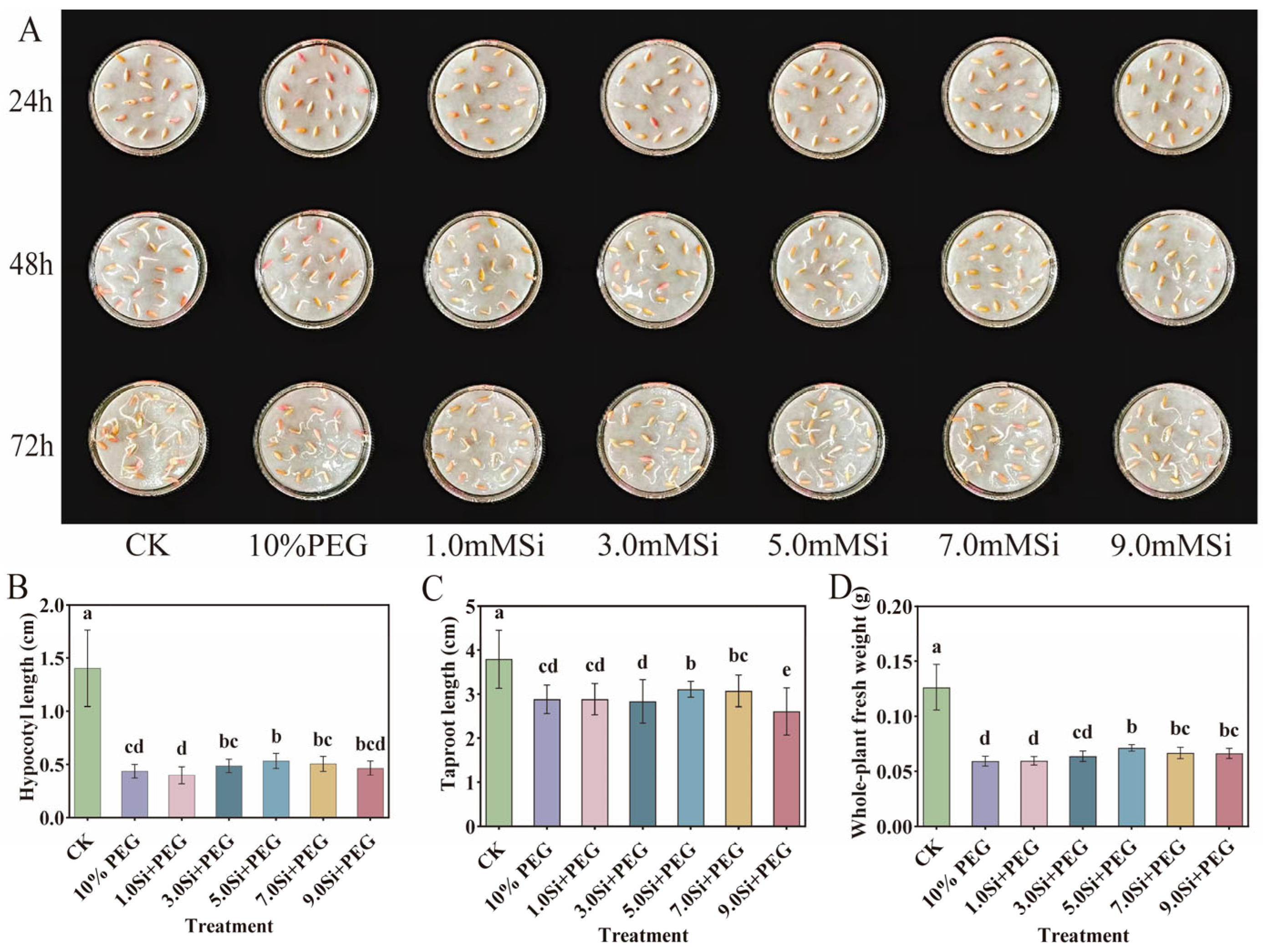
As shown in Figure 1, compared with the CK treatment, the 10% PEG treatment significantly inhibited the growth of cucumber seedlings, reducing hypocotyl length, primary root length, and whole-plant fresh weight by 68.91%, 23.96%, and 53.05%, respectively. Compared with the 10% PEG treatment, the 1.0 Si + PEG treatment showed no significant differences in hypocotyl length, primary root length, or whole-plant fresh weight. Compared with the 10% PEG treatment, the 3.0 Si + PEG treatment increased hypocotyl length by 11.47% and whole-plant fresh weight by 7.76%. Compared with the 10% PEG treatment, hypocotyl length and whole-plant fresh weight in the 5.0 Si + PEG treatment increased significantly by 22.29% and 20.57%, respectively, while primary root length increased by 7.90%. Compared with the 10% PEG treatment, the 7.0 Si + PEG treatment increased hypocotyl length by 15.94% and whole-plant fresh weight by 12.65%. Compared with the 10% PEG treatment, only whole-plant fresh weight increased (by 11.97%) under the 9.0 Si + PEG treatment. Notably, primary root length showed no significant differences across treatments, except in the 5.0 Si + PEG treatment. Overall, exogenous silicon application effectively alleviated polyethylene glycol-induced growth inhibition in cucumber seedlings, with the 5.0 Si + PEG treatment showing the most pronounced improvement in hypocotyl length, primary root length, and total fresh weight.

3.2.3. Effects of Different Silicon Concentrations on the Antioxidant System of Cucumber Seedlings Under PEG Stress

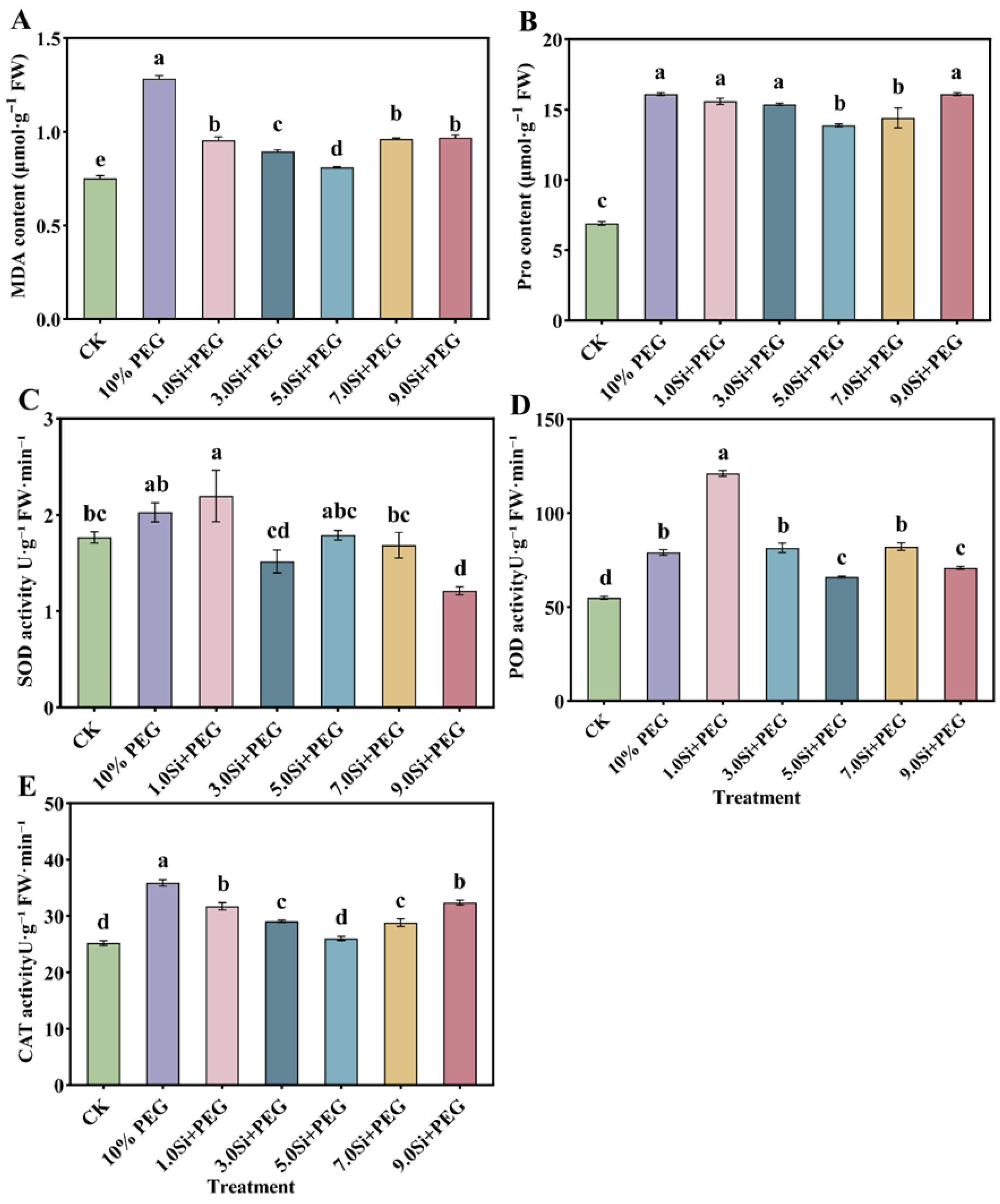
Compared to the CK, MDA and Pro levels significantly increased by 70.77% and 133.31%, respectively, under 10% PEG treatment (Figure 2). In contrast, the 3.0 Si + PEG and 5.0 Si + PEG treatments significantly reduced MDA levels by 30.23% and 36.87%, respectively, compared to the 10% PEG treatment. Similarly, the 5.0 Si + PEG and 7.0 Si + PEG treatments significantly decreased Proline (Pro) content by 13.71% and 10.78%, respectively, compared to the 10% PEG treatment. These results suggest that exogenous Si partially alleviated osmotic stress in cucumber seedlings, leading to reduced Pro accumulation. No significant differences were observed among the remaining treatments.
Compared to the CK, PEG treatments increased SOD, POD, and CAT activities by 17.64%, 43.93%, and 42.48%, respectively. In contrast, the 3.0 Si + PEG treatment significantly reduced SOD activity by 25.14% compared to PEG alone. Similarly, POD activity was significantly reduced by 16.23% and 10.46% in the 5.0 Si + PEG and 9.0 Si + PEG treatments, respectively, compared to PEG alone. All Si concentrations reduced CAT activity, with the 5.0 Si + PEG treatment showing the most pronounced mitigation effect, decreasing CAT activity by 27.51% compared to PEG alone. In summary, the exogenous addition of 5.0 mM Si significantly promoted cucumber seed germination and growth under PEG stress. Consequently, the 5.0 mM Si + PEG treatment (Si + PEG) was selected for subsequent experiments.

3.3. Effects of Silicon on the Osmoregulatory System and ASA-GSH Cycle in Cucumber Seedlings Under PEG Stress

3.3.1. Effect of Silicon on Soluble Sugar and Soluble Protein Content in Cucumber Seedlings Under PEG Stress

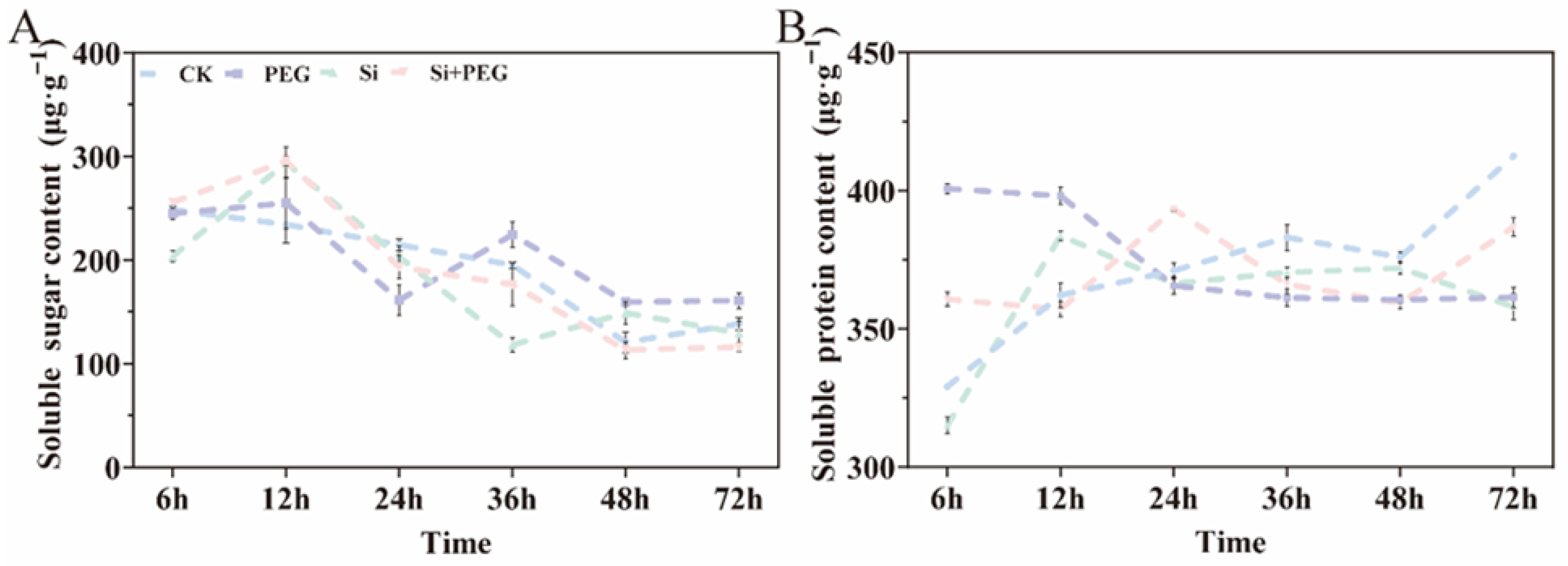
Figure 3A demonstrates that the soluble sugar content in PEG-treated samples remained consistently higher than that in the CK from 12 h to 72 h, with a significant increase of 32.35% observed at 48 h. In comparison to PEG treatment alone, the Si + PEG treatment significantly reduced the soluble sugar content by 29.08% and 27.84% at 48 h and 72 h, respectively. Figure 3B demonstrates that the soluble protein content in the PEG-treated group significantly increased by 21.74% and 9.93% compared to the CK group between 6 h and 12 h. During the same period, the soluble protein content in the Si + PEG group showed a significant increase of 9.97% and 10.30% compared to the PEG treatment.

3.3.2. Effect of Si on ROS Accumulation in Cucumber Sprouts Under PEG Stress

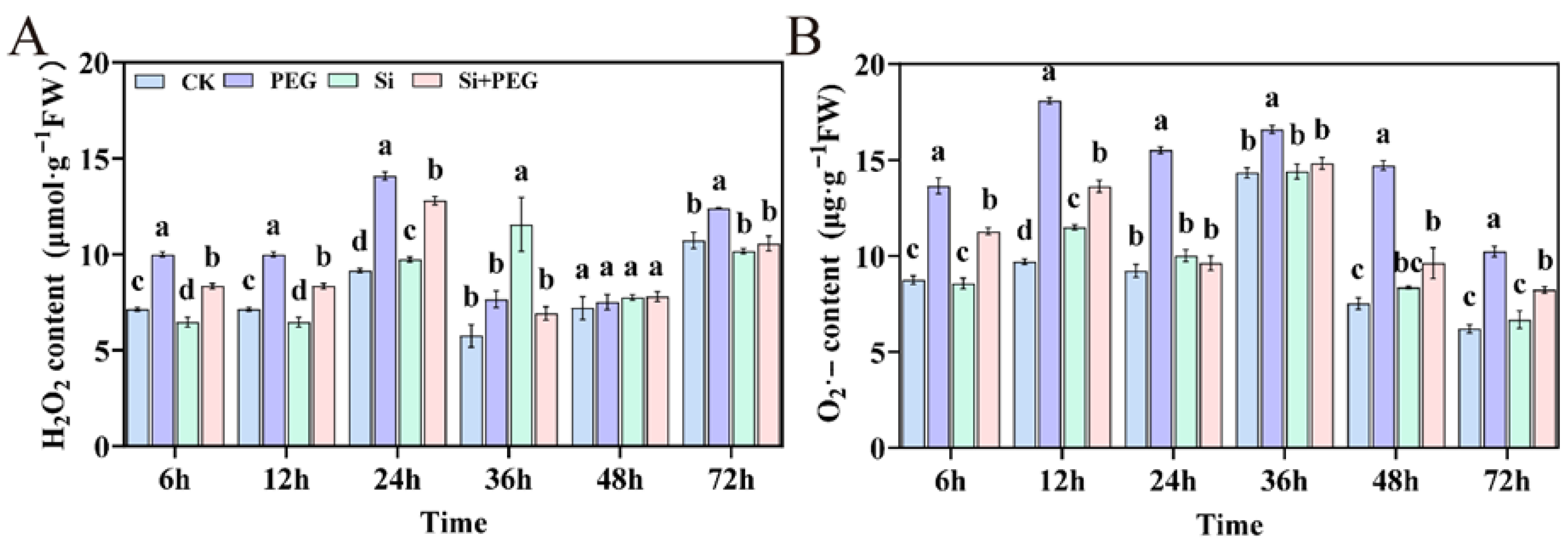
As shown in Figure 4A, during the 6–24 h period, the H2O2 content in the PEG-treated group was significantly higher than that in the CK group, with increases of 42.86%, 75.00%, and 31.25% at 6 h, 12 h, and 24 h, respectively. In contrast, the Si + PEG treatment significantly reduced H2O2 content compared to the PEG-treated group, with decreases of 20.00%, 20.00%, and 41.76% at 6 h, 12 h, and 24 h, respectively. During the 6–72 h period, PEG treatment significantly elevated O2· levels compared to the CK group, with increases of 40.00%, 63.64%, 45.45%, 60.01%, 50.03%, and 57.14% at 6 h, 12 h, 24 h, 36 h, 48 h, and 72 h, respectively. In contrast, the Si + PEG treatment significantly reduced O2· content by 14.29%, 22.22%, 18.18%, and 27.27% at 6 h, 12 h, 48 h, and 72 h, respectively, compared to the PEG-treated group (Figure 4B).

3.3.3. Effect of Si on the ASA-GSH Cycle in Cucumber Seedlings Under PEG Stress

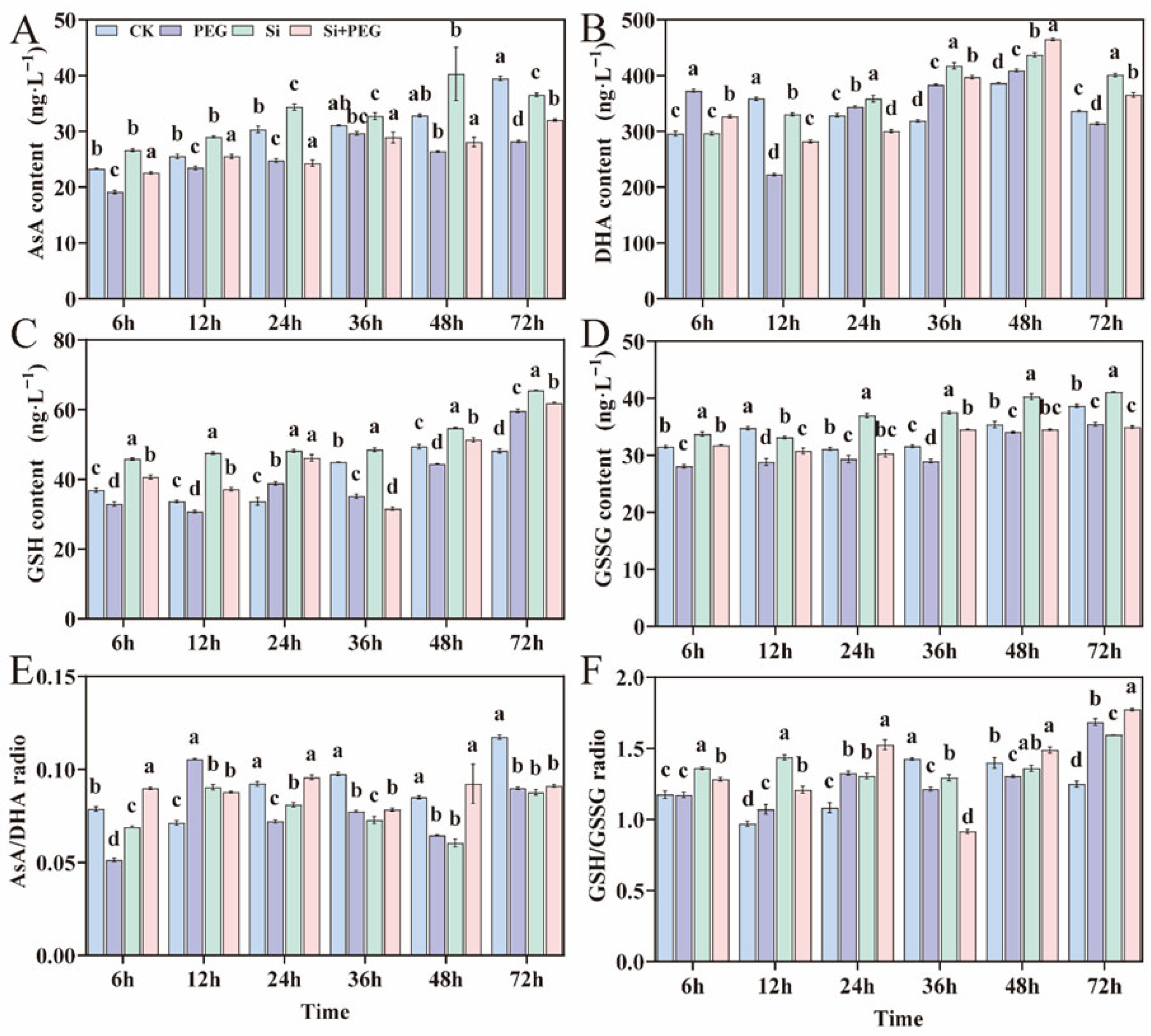
Compared to the CK group, PEG treatment significantly reduced AsA content by 16.67%, 14.29%, and 25.00% at 24 h, 36 h, and 72 h, in that order. In contrast, the Si + PEG treatment significantly increased AsA content by 18.00% at 6 h relative to the PEG-treated group (Figure 5A). At 12 h, 24 h, and 72 h, PEG treatment markedly decreased DHA content compared to the CK group, with reductions of 23.53%, 23.53%, and 22.22%. Conversely, the Si + PEG treatment significantly elevated DHA content by 15.38%, 23.08%, and 21.43% at these time points compared to the PEG-treated group (Figure 5B). PEG treatment also significantly lowered GSH content by 20.00%, 18.18%, and 23.08% at 36 h, 48 h, and 72 h, respectively, compared to the CK group. In contrast, the Si + PEG treatment significantly enhanced GSH content by 23.45%, 20.75%, 18.92%, and 15.72% at 6 h, 12 h, 24 h, and 48 h, in sequence, relative to the PEG-treated group (Figure 5C). GSSG levels in PEG-treated groups were consistently lower than those in the CK group, though not significantly. However, the Si + PEG treatment significantly increased GSSG levels by 12.91% and 19.10% at 6 h and 36 h compared to the PEG-treated group. The AsA/DHA ratio in PEG-treated plants was consistently lower than in the CK group, with a significant reduction of 34.82% at 6 h. However, the Si + PEG treatment significantly raised the AsA/DHA ratio by 34.50% and 12.36% at 6 h and 24 h compared to the PEG-treated group (Figure 5D). The GSH/GSSG ratio in PEG-treated plants decreased significantly by 18.34% and 25.90% at 24 h and 72 h, respectively, compared to the CK group. In contrast, the Si + PEG treatment significantly increased the GSH/GSSG ratio by 16.10% and 34.26% at 6 h and 12 h compared to the PEG-treated group (Figure 5E).

3.3.4. Effect of Silicon on Antioxidant Enzyme Activity in Cucumber Seedlings Under PEG Stress

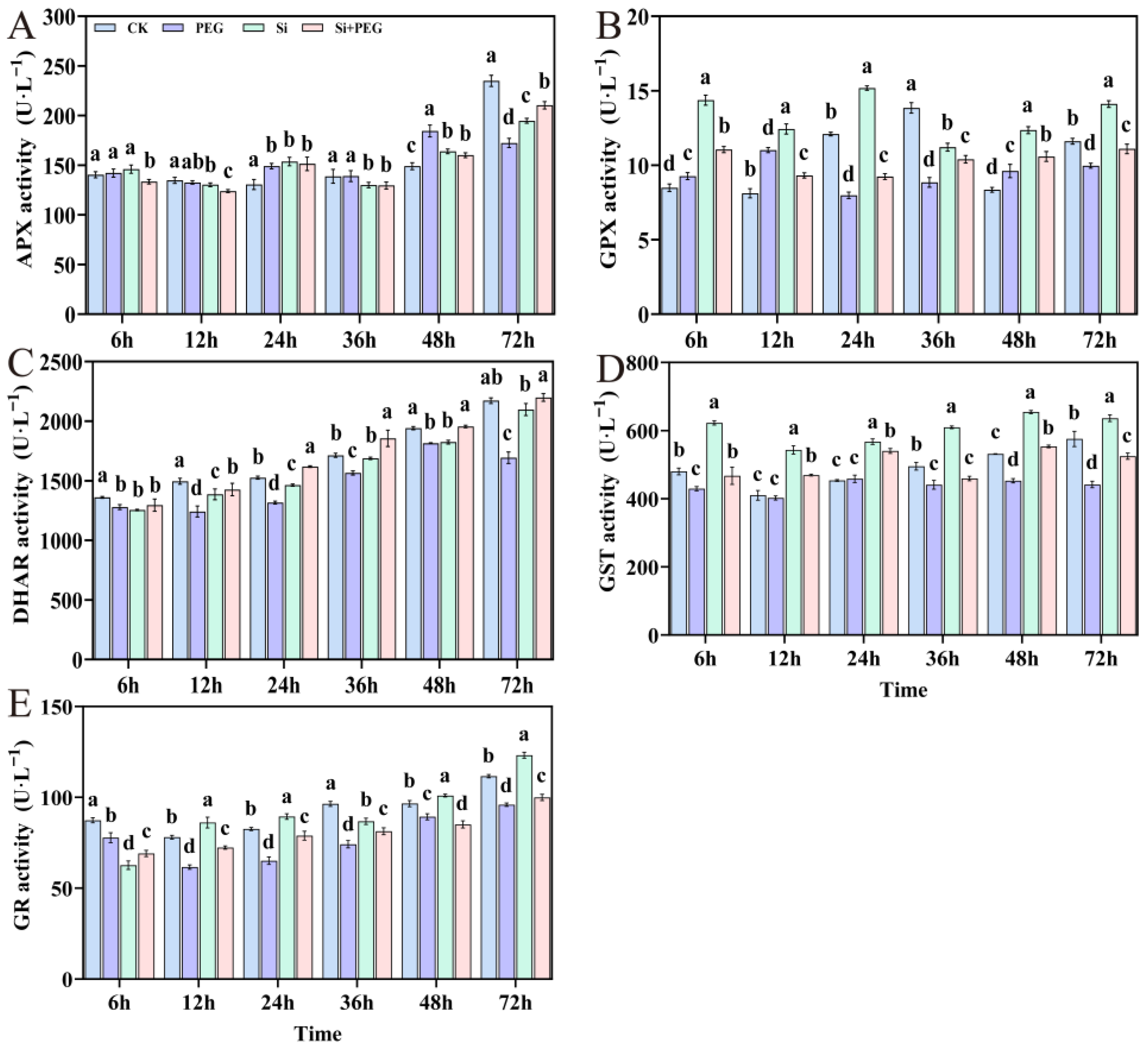
Under PEG treatment, APX activity significantly increased by 14.13% and 23.74% at 24 h and 48 h, respectively, compared to the CK group. In contrast, the Si + PEG treatment significantly reduced APX activity by 6.13%, 6.57%, and 13.21% at 6 h, 12 h, and 48 h, respectively, compared to the PEG-treated group (Figure 6A). PEG treatment significantly decreased GPX activity by 42.86% and 41.67% at 24 h and 36 h, respectively, compared to the CK group. In contrast, the Si + PEG treatment significantly increased GPX activity by 19.06%, 47.95%, and 21.52% at 36 h, 48 h, and 72 h, respectively, compared to the CK group. Furthermore, compared to the PEG-treated group, the Si + PEG treatment enhanced GPX activity by 17.54%, 10.18%, and 11.37% at 36 h, 48 h, and 72 h, respectively (Figure 6B). DHAR activity was consistently lower in the PEG-treated group compared to the CK group across all time points, with significant reductions of 13.33%, 19.35%, 15.63%, 15.15%, 11.76%, and 10.00% at 6 h, 12 h, 24 h, 36 h, 48 h, and 72 h, respectively. In contrast, the Si + PEG treatment significantly increased DHAR activity by 11.76%, 10.64%, 10.53%, and 15.03% at 24 h, 36 h, 48 h, and 72 h, respectively, compared to the PEG-treated group (Figure 6C). GR activity under PEG treatment was significantly reduced by 33.33%, 33.33%, 35.29%, 33.33%, 30%, and 24% at 6 h, 12 h, 24 h, 36 h, 48 h, and 72 h, respectively, compared to the CK group. In contrast, the Si + PEG treatment significantly increased GR activity by 17.48%, 21.06%, and 9.62% at 12 h, 24 h, and 36 h, respectively, compared to the PEG-treated group (Figure 6D). GST content under PEG treatment exhibited a decreasing trend across all time points, with a significant reduction of 23.22% at 72 h compared to the CK group. In contrast, the Si + PEG treatment significantly increased GST content by 16.71%, 17.91%, 22.20%, and 18.81% at 12 h, 24 h, 48 h, and 72 h, respectively, compared to the PEG-treated group (Figure 6E).

4. Discussion

Seed germination, a critical stage in the plant life cycle, is essential for plant growth, development, and species reproduction. However, this stage is highly vulnerable and particularly susceptible to both biotic and abiotic stresses [43]. Optimal moisture is essential for seed germination. Both drought and waterlogging can disrupt normal germination processes and may lead to seed mortality [44]. Building on previous relevant studies, our research employed polyethylene glycol (PEG) to simulate drought stress [45]. Our results demonstrated that the 6 mL 10% PEG treatment significantly inhibited cucumber seeds, GP, GR, and GI. Furthermore, it markedly reduced the vigor index, hypocotyl length, primary root length, and total fresh weight, indicating that PEG profoundly impairs cucumber seed germination and subsequent growth and development [46]. Previous studies have demonstrated that the exogenous application of silicon at specific concentrations can alleviate various abiotic stresses in plants [47]. Si treatment mitigated PEG-induced stress in cucumber seeds, enhancing key growth parameters including germination index, vigor index, hypocotyl and primary root elongation, and biomass accumulation, particularly at concentrations of 5.0 mM and 7.0 mM. Furthermore, exogenous nitroprusside significantly enhanced the germination rate and vigor index of Hedy Otis diffuse seeds under drought stress. Similarly, low-concentration abscisic acid seed soaking improved germination characteristics and alleviated cellular damage in Astragalus membranous seeds [48]. This finding is consistent with the results of the present study. Under stress conditions, membrane lipid peroxidation functions as a critical physiological mechanism that inhibits seed germination. MDA, the end product of lipid peroxidation, serves as a key indicator of plasma membrane damage severity and reflects plant tolerance to drought stress [49]. Pro acts as an effective Osmo protectant, regulating plant cell permeability, and its accumulation levels provide a reliable indicator of the extent of damage plants experience under abiotic stress [50]. Under PEG-induced stress, MDA and Pro accumulated significantly in Chinese cabbage seeds, leading to a pronounced inhibition of seed germination rates. This resulted in retarded radicle and hypocotyl growth, impaired hypocotyl elongation, and a significant decline in germination indices [51]. This finding is consistent with the results of the present study. Under PEG-induced stress, plants exhibited increased accumulation of MDA and Pro, which intensified lipid peroxidation during germination and subsequently inhibited cucumber seed germination and growth. Stress resistance in plants can also be achieved by elevating the levels of key osmotic regulatory substances, including soluble sugars and proteins [52]. During the 6–24 h period, 5.0 mM Si application significantly increased soluble sugar and protein content compared to the PEG treatment, thereby alleviating stress. This effect shifted between 36 and 72 h, when Si application instead reduced soluble sugar content. This reduction might be attributed to accelerated seed germination in later stages induced by exogenous silicon, thereby increasing sugar consumption for energy supply [36].
Beyond their role as stress-induced molecules, reactive oxygen species (ROS) also function as crucial regulators of plant development [53]. Changes in O2· levels during the plant stress response serve as a signal for the activation of the antioxidant system, thereby enabling plants to mitigate adverse conditions [54]. The combined effect of elevated ROS activity and impaired antioxidant enzyme activity leads to an accumulation of H2O2. This buildup of H2O2 subsequently reduces seed viability [55]. Compared to the CK, PEG-stressed cucumber seeds exhibited elevated levels of H2O2 and O2·, indicating that drought stress disrupts cellular redox homeostasis, resulting in ROS accumulation. To counteract oxidative stress, plants elevate the activity of key antioxidant enzymes, including CAT, POD, and SOD [27]. In this study, 10% PEG stress triggered a significant increase in both POD and CAT activities in cucumber seeds. The antioxidant enzymes act in concert through a scavenging cascade, SOD initiates the process by converting O2· to H2O2, while CAT and POD further detoxify H2O2 into H2O and O2, thereby minimizing ROS accumulation and oxidative damage. However, excessively high PEG concentrations significantly inhibited seed germination, possibly because the stress intensity surpassed the detoxification capacity of the antioxidant enzyme system. Studies have demonstrated that exogenous silicon application can reduce antioxidant enzyme activity in crops under Autotoxin stress conditions [9], consistent with our results.
The AsA-GSH cycle is a central redox pathway in plants, essential for maintaining cellular antioxidant homeostasis and detoxifying the antioxidants AsA and GSH are critical for sustaining redox homeostasis. Their oxidized counterparts, DHA and GSSG, also act as dynamic signals, where alterations in the AsA/DHA and GSH/GSSG ratios signify plant adaptation to abiotic stress [56]. The enzymes APX, DHAR, GPX, and GR constitute a critical defense system against abiotic stress by synergistically scavenging reactive oxygen species, regenerating antioxidant pools, and maintaining cellular redox homeostasis [57,58]. Within the AsA-GSH cycle, APX scavenges H2O2 using AsA, while DHAR and GR regenerate the antioxidant pool by reducing DHA to AsA and GSSG to GSH, respectively. Concurrently, GPX and GST utilize GSH to detoxify harmful compounds such as lipid peroxides. These reactions collectively enhance the antioxidant defense system [59]. Under abiotic stress, these enzyme activities show an initial upregulation to boost antioxidant capacity and ROS scavenging. However, prolonged exposure can lead to a subsequent decline in activity due to cumulative oxidative damage, thereby destabilizing the antioxidant system [60]. Studies indicate that exogenous silicon at optimal concentrations alleviates various abiotic stresses in plants [61]. Compared with plants under PEG stress, exogenous application of 5.0 mM Si significantly increased the contents of AsA and GSH in cucumber plants by enhancing the activities of DHAR and GR in the AsA-GSH cycle. This is consistent with reports that Si alleviates oxidative damage in salt-stressed Brassica napus plants through elevated GSH and AsA contents and enhanced AsA-GSH cycle enzyme activities [62]. Furthermore, exogenous application of 5.0 mM Si significantly elevated the AsA/DHA and GSH/GSSG ratios. Studies indicate that increased AsA/DHA and GSH/GSSG ratios lead to a higher proportion of reduced antioxidants, enhanced cycle efficiency, and more effective ROS scavenging, thereby mitigating oxidative damage [42]. GPX and GST employ GSH to eliminate harmful substances such as membrane lipid peroxides [63]. Exogenous application of silicon fertilizer effectively alleviates the stress induced by PEG through sustaining efficient defense mechanisms, thereby enhancing the activities of GPX and GST in wheat under PEG stress and in rice under arsenic stress [64,65]. Similarly, in this study, exogenous Si (5.0 mM) enhanced GPX and GST activity compared to the PEG treatment, thus contributing to the alleviation of PEG-induced stress and ROS accumulation. In this study, exogenous Si applied at 5.0 mM similarly enhanced the activities of GPX and GST, compared with the PEG-treated group, thereby contributing to the alleviation of PEG-induced stress and the reduction in ROS accumulation. In arid and semi-arid regions, exogenous silicon application enhances seed germination and seedling emergence in cucumber by increasing antioxidant enzyme activity, improving osmotic adjustment, and maintaining redox homeostasis. Consequently, this practice leads to improved seedling emergence rates and overall seedling quality.

5. Conclusions

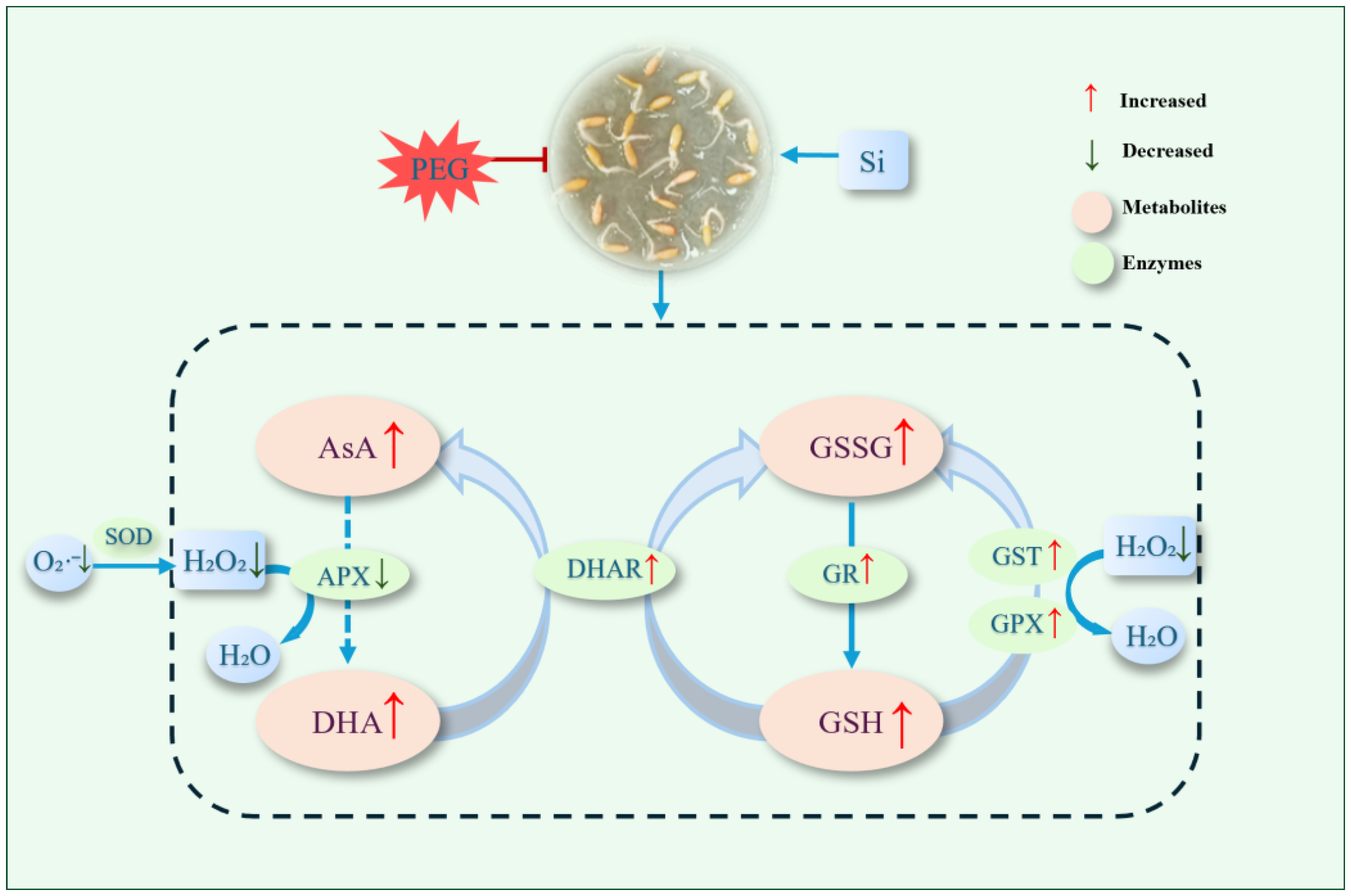
This study showed that PEG-simulated drought stress adversely affected cucumber seed germination by reducing the germination rate, vigor, index, and vitality index, thereby inhibiting seedling emergence. The alleviation of PEG stress by 5 mM Si in cucumber seeds was achieved through the upregulation of POD and CAT activities, leading to decreased ROS levels, reduced membrane peroxidation, and consequently lower MDA content. Furthermore, compared to PEG treatment, 5 mM Si application upregulated DHAR and GR activities in the AsA-GSH cycle, which boosted AsA and GSH content and consequently improved the AsA/DHA and GSH/GSSG ratios. Exogenous 5 mM Si mitigated PEG stress in cucumber seeds through multiple mechanisms: enhancing antioxidant enzymes, improving osmotic adjustment, and activating the AsA-GSH cycle to maintain redox homeostasis, thus promoting seed germination and growth. The potential regulatory mechanism by which exogenous silicon enhances cucumber seed germination under drought stress through modulating the ASA-GSH cycle is illustrated in Figure 7.

Author Contributions

Conceptualization, N.J. and J.Y.; methodology, Z.L.; validation, X.M. and S.J.; formal analysis, L.J.; investigation, S.W. and S.H.; resources, J.L. and J.Y.; data curation, K.C.; writing—original draft preparation, K.C.; writing—review and editing, K.C. and N.J.; visualization, K.C.; supervision, N.J.; project administration, J.L.; funding acquisition, J.L. and J.Y. All authors have read and agreed to the published version of the manuscript.

Funding

This work was supported by the Major Science and Technology Special Projects in Gansu Province (23ZDNA008); Longyuan Youth Talent Project in Gansu Province (LYYC-2023-02); Key Research and Development Program of Gansu (24YFNA018) and the earmarked fund for Gansu Agriculture Research System (GSARS-03-03).

Data Availability Statement

The original contributions presented in this study are included in the article. Further inquiries can be directed to the corresponding authors.

Conflicts of Interest

The authors declare no conflicts of interest.

References

  1. Aliniaeifard, S.; Rezayian, M.; Mousavi, S.H. Drought stress: Involvement of plant hormones in perception, signaling, and response. In Plant Hormones and Climate Change; Springer: Berlin/Heidelberg, Germany, 2023; pp. 227–250. [Google Scholar]
  2. Qomariah, I.R.; Mawardi, M. Aplikasi Bakteri Fotosintesis dengan beberapa Komposisi Pupuk Kimia terhadap Pertumbuhan dan Produksi Tanaman Mentimun (Cucumis sativus L.). J. Agroplant 2024, 7, 89–102. [Google Scholar] [CrossRef]
  3. Wang, M.; Jiang, B.; Peng, Q.; Liu, W.; He, X.; Liang, Z.; Lin, Y. Transcriptome analyses in different cucumber cultivars provide novel insights into drought stress responses. Int. J. Mol. Sci. 2018, 19, 2067. [Google Scholar] [CrossRef] [PubMed]
  4. Liu, C.-J.; Lyu, C.-Y.; Ai, X.-Z.; Bi, H.-G. Effects of fulvic acid on photosynthetic characteristics, yield and quality of cucumber under drought stress. J. Appl. Ecol. 2022, 33, 1300–1310. [Google Scholar]
  5. Ouzounidou, G.; Giannakoula, A.; Ilias, I.; Zamanidis, P. Alleviation of drought and salinity stresses on growth, physiology, biochemistry and quality of two cucumber (Cucumis sativus L.) cultivars by Si application. Braz. J. Bot. 2016, 39, 531–539. [Google Scholar] [CrossRef]
  6. Ali, A.B.; Elshaikh, N.A.; Hussien, G.; Abdallah, F.E.; Hassan, S. Biochar addition for enhanced cucumber fruit quality under deficit irrigation. Biosci. J. 2020, 36, 1930–1937. [Google Scholar] [CrossRef]
  7. Yang, F.; Gu, Q.; He, W.; Hong, D.; Yu, M.; Yao, J. Case Study on the Application of Innovative Cultivation Techniques in Cucumber Production. Int. J. Hortic. 2025, 15, 29. [Google Scholar] [CrossRef]
  8. Pandey, S.; Ansari, W.; Jha, A.; Bhatt, K.; Singh, B. Evaluation of melons and indigenous Cucumis spp. genotypes for drought tolerance. In Proceedings of the II International Symposium on Underutilized Plant Species: Crops for the Future-Beyond Food Security 979, Kuala Lumpur, Malaysia, 27 June–1 July 2011. [Google Scholar]
  9. Lyu, J.; Jin, N.; Meng, X.; Jin, L.; Wang, S.; Xiao, X.; Liu, Z.; Tang, Z.; Yu, J. Exogenous silicon alleviates the adverse effects of cinnamic acid-induced autotoxicity stress on cucumber seedling growth. Front. Plant Sci. 2022, 13, 968514. [Google Scholar] [CrossRef]
  10. Campobenedetto, C.; Grange, E.; Mannino, G.; Van Arkel, J.; Beekwilder, J.; Karlova, R.; Garabello, C.; Contartese, V.; Bertea, C.M. A biostimulant seed treatment improved heat stress tolerance during cucumber seed germination by acting on the antioxidant system and glyoxylate cycle. Front. Plant Sci. 2020, 11, 836. [Google Scholar] [CrossRef]
  11. Li, M.; Yang, Y.; Raza, A.; Yin, S.; Wang, H.; Zhang, Y.; Dong, J.; Wang, G.; Zhong, C.; Zhang, H. Heterologous expression of Arabidopsis thaliana rty gene in strawberry (Fragaria × ananassa Duch.) improves drought tolerance. BMC Plant Biol. 2021, 21, 57. [Google Scholar] [CrossRef]
  12. Li, X.; Liu, X.; Yao, Y.; Li, Y.; Liu, S.; He, C.; Li, J.; Lin, Y.; Li, L. Overexpression of Arachis hypogaea AREB1 gene enhances drought tolerance by modulating ROS scavenging and maintaining endogenous ABA content. Int. J. Mol. Sci. 2013, 14, 12827–12842. [Google Scholar] [CrossRef]
  13. Liu, D.; He, S.; Song, X.; Zhai, H.; Liu, N.; Zhang, D.; Ren, Z.; Liu, Q. IbSIMT1, a novel salt-induced methyltransferase gene from Ipomoea batatas, is involved in salt tolerance. Plant Cell Tissue Organ Cult. 2015, 120, 701–715. [Google Scholar] [CrossRef]
  14. Dong, D.; Qi, C.; Zhang, J.; Deng, Q.; Xia, P.; Li, P.; Jia, C.; Zhao, B.; Zhang, N.; Guo, Y.-D. CsHSFA1d promotes drought stress tolerance by increasing the content of raffinose family oligosaccharides and scavenging accumulated reactive oxygen species in cucumber. Plant Cell Physiol. 2024, 65, 809–822. [Google Scholar] [CrossRef] [PubMed]
  15. Brunetti, C.; Tattini, M.; Guidi, L.; Velikova, V.; Ferrini, F.; Fini, A. An integrated overview of physiological and biochemical responses of Celtis australis to drought stress. Urban For. Urban Green. 2019, 46, 126480. [Google Scholar] [CrossRef]
  16. Luo, Q.; Ma, Y.; Chen, Z.; Xie, H.; Wang, Y.; Zhou, L.; Ma, Y. Biochemical responses of hairgrass (Deschampsia caespitosa) to hydrological change. Front. Plant Sci. 2022, 13, 987845. [Google Scholar] [CrossRef]
  17. Akhter, M.M.; Hasan, M.; Bahadur, M.; Islam, M.; Iqbal, M.A.; Soufan, W.; Aurib, K.; Akhter, T.; Soysal, S.; Elsabagh, A. Wheat genotypes respond differently under polyethylene glycol (PEG) induced drought stress during germination and early seedling growth stages. Pak. J. Bot. 2012, 57, 1. [Google Scholar] [CrossRef]
  18. Wilmer, L.; Tränkner, M.; Pawelzik, E.; Naumann, M. Sufficient potassium supply enhances tolerance of potato plants to PEG-induced osmotic stress. Plant Stress 2022, 5, 100102. [Google Scholar] [CrossRef]
  19. Zhang, H.; Liu, Y.; Tian, H.; Xiong, J.; Lu, J.; Liao, S.; Du, Z.; Xie, Y. Multilayered omics reveals PEG6000 stimulated drought tolerance mechanisms in white clover (Trifolium repens L.). Ind. Crops Prod. 2025, 226, 120722. [Google Scholar] [CrossRef]
  20. Zhao, Q.; Zheng, X.; Wang, C.; Wang, Q.; Wei, Q.; Liu, X.; Liu, Y.; Chen, A.; Jiang, J.; Zhao, X. Exogenous Melatonin Improves Drought Tolerance by Regulating the Antioxidant Defense System and Photosynthetic Efficiency in Fodder Soybean Seedings. Plants 2025, 14, 460. [Google Scholar] [CrossRef]
  21. El-Beltagi, H.; Sattar, A.; Sher, A.; Ijaz, M.; Baig, A.; Naz, I.; Almaghasla, M.; Hamed, L.; Ramadan, K.; El-Mogy, M. Exogenous Application of Silicon and Brassinosteroids Alleviate the Adversities of Drought Stress on Maize through Up-Regulation of Photosynthetic Efficiency, Antioxidants Defense System and Osmotic Adjustment. Russ. J. Plant Physiol. 2025, 72, 84. [Google Scholar] [CrossRef]
  22. Cao, L.; Kou, F.; Zhang, M.; Jin, X.; Ren, C.; Yu, G.; Zhang, Y.; Wang, M. Effect of exogenous melatonin on the quality of soybean and natto products under drought stress. J. Chem. 2021, 2021, 8847698. [Google Scholar] [CrossRef]
  23. De Oliveira, T.D.; De Andrade, A.N.; Dantas, E.F.O.; Araujo, D.J.; Da Silva, R.R.; Lopes, A.S.; Dias, T.J.; Henschel, J.M.; Batista, D.S. Melatonin Mitigates Drought Stress on Radish and Promotes its Recovery After Rehydration. J. Plant Growth Regul. 2025, 44, 1963–1972. [Google Scholar] [CrossRef]
  24. Haghpanah, M.; Hashemipetroudi, S.; Arzani, A.; Araniti, F. Drought tolerance in plants: Physiological and molecular responses. Plants 2024, 13, 2962. [Google Scholar] [CrossRef] [PubMed]
  25. Xing, Y.; Wang, X. Precision agriculture and water conservation strategies for sustainable crop production in arid regions. Plants 2024, 13, 3184. [Google Scholar] [CrossRef] [PubMed]
  26. Zhu, Y.; Yin, J.; Liang, Y.; Liu, J.; Jia, J.; Huo, H.; Wu, Z.; Yang, R.; Gong, H. Transcriptomic dynamics provide an insight into the mechanism for silicon-mediated alleviation of salt stress in cucumber plants. Ecotoxicol. Environ. Saf. 2019, 174, 245–254. [Google Scholar] [CrossRef]
  27. Gou, T.; Chen, X.; Han, R.; Liu, J.; Zhu, Y.; Gong, H. Silicon can improve seed germination and ameliorate oxidative damage of bud seedlings in cucumber under salt stress. Acta Physiol. Plant. 2020, 42, 12. [Google Scholar] [CrossRef]
  28. Meng, X.; Jin, N.; Jin, L.; Wang, S.; Zhao, W.; Xie, Y.; Huang, S.; Zhang, Z.; Xu, Z.; Liu, Z. Silicon-seed priming promotes seed germination under CA-induced autotoxicity by improving sucrose and respiratory metabolism in cucumber (Cucumis sativus L.). BMC Plant Biol. 2024, 24, 1164. [Google Scholar] [CrossRef]
  29. Biju, S.; Fuentes, S.; Gupta, D. Silicon improves seed germination and alleviates drought stress in lentil crops by regulating osmolytes, hydrolytic enzymes and antioxidant defense system. Plant Physiol. Biochem. 2017, 119, 250–264. [Google Scholar] [CrossRef]
  30. Shi, Y.; Zhang, Y.; Yao, H.; Wu, J.; Sun, H.; Gong, H. Silicon improves seed germination and alleviates oxidative stress of bud seedlings in tomato under water deficit stress. Plant Physiol. Biochem. 2014, 78, 27–36. [Google Scholar] [CrossRef]
  31. Bhardwaj, S.; Kapoor, D. Fascinating regulatory mechanism of silicon for alleviating drought stress in plants. Plant Physiol. Biochem. 2021, 166, 1044–1053. [Google Scholar] [CrossRef]
  32. Sharf-Eldin, A.A.; Alwutayd, K.M.; El-Yazied, A.A.; El-Beltagi, H.S.; Alharbi, B.M.; Eisa, M.A.; Alqurashi, M.; Sharaf, M.; Al-Harbi, N.A.; Al-Qahtani, S.M. Response of maize seedlings to silicon dioxide nanoparticles (SiO2NPs) under drought stress. Plants 2023, 12, 2592. [Google Scholar] [CrossRef]
  33. Rahimi, S.; Hatami, M.; Ghorbanpour, M. Silicon-nanoparticle mediated changes in seed germination and vigor index of marigold (Calendula officinalis L.) compared to silicate under PEG-induced drought stress. Gesunde Pflanz. 2021, 73, 575–589. [Google Scholar] [CrossRef]
  34. Chen, Q.B.; Wang, W.J.; Zhang, Y.; Zhan, Q.D.; Liu, K.; Botella, J.R.; Bai, L.; Song, C.P. Abscisic acid-induced cytoplasmic translocation of constitutive photomorphogenic 1 enhances reactive oxygen species accumulation through the HY5-ABI5 pathway to modulate seed germination. Plant Cell Environ. 2022, 45, 1474–1489. [Google Scholar] [CrossRef] [PubMed]
  35. Zhang, Z.; Fan, J.; Wu, J.; Zhang, L.; Wang, J.; Zhang, B.; Wang-Pruski, G. Alleviating effect of silicon on melon seed germination under autotoxicity stress. Ecotoxicol. Environ. Saf. 2020, 188, 109901. [Google Scholar] [CrossRef] [PubMed]
  36. Meng, X.; Luo, S.; Dawuda, M.M.; Gao, X.; Wang, S.; Xie, J.; Tang, Z.; Liu, Z.; Wu, Y.; Jin, L. Exogenous silicon enhances the systemic defense of cucumber leaves and roots against CA-induced autotoxicity stress by regulating the ascorbate-glutathione cycle and photosystem II. Ecotoxicol. Environ. Saf. 2021, 227, 112879. [Google Scholar] [CrossRef]
  37. Marthandan, V.; Geetha, R.; Kumutha, K.; Renganathan, V.G.; Karthikeyan, A.; Ramalingam, J. Seed priming: A feasible strategy to enhance drought tolerance in crop plants. Int. J. Mol. Sci. 2020, 21, 8258. [Google Scholar] [CrossRef]
  38. Luo, S.; Tang, Z.; Yu, J.; Liao, W.; Xie, J.; Lv, J.; Feng, Z.; Dawuda, M.M. Hydrogen sulfide negatively regulates cd-induced cell death in cucumber (Cucumis sativus L.) root tip cells. BMC Plant Biol. 2020, 20, 480. [Google Scholar] [CrossRef]
  39. Zhang, S.-q.; Lv, Y.-j.; Zhang, Y.; Peng, X.; Liu, Y.; Rong, L. Repair capacity of perennial ryegrass (Lolium perenne L.) based on arbuscular mycorrhizal fungi on the in uranium contaminated soil. In IOP Conference Series: Earth and Environmental Science; IOP Publishing: Bristol, UK, 2019. [Google Scholar]
  40. Velikova, V.; Yordanov, I.; Edreva, A. Oxidative stress and some antioxidant systems in acid rain-treated bean plants: Protective role of exogenous polyamines. Plant Sci. 2000, 151, 59–66. [Google Scholar] [CrossRef]
  41. Elstner, E.F.; Heupel, A. Inhibition of nitrite formation from hydroxylammoniumchloride: A simple assay for superoxide dismutase. Anal. Biochem. 1976, 70, 616–620. [Google Scholar] [CrossRef]
  42. Xinlu, X.; Dandan, L.; Yuandan, M.; Jianyun, Z.; Jianfei, S.; Yan, G.; Rumin, Z. Responses of the antioxidant defense system of Osmanthus fragrans cv.‘Tian Xiang TaiGe’to drought, heat and the synergistic stress. Chin. Bull. Bot. 2018, 53, 72–81. [Google Scholar]
  43. Adhikari, P.; Shrestha, S.M.; Manandhar, H.K.; Marahatta, S. Effect of native trichoderma as seed treatment on germination and seedling performance of lentil under biotic and abiotic stress conditions. SAARC J. Agric. 2023, 21, 145–156. [Google Scholar] [CrossRef]
  44. Ahanger, M.A.; Siddique, K.H.; Ahmad, P. Understanding drought tolerance in plants. Physiol. Plant. 2021, 172, 286–288. [Google Scholar] [CrossRef] [PubMed]
  45. Kylyshbayeva, G.; Bishimbayeva, N.; Jatayev, S.; Eliby, S.; Shavrukov, Y. Polyethylene Glycol (PEG) Application Simulates Plant Dehydration but Does Not Accurately Mimic Drought. Plants 2024, 14, 92. [Google Scholar] [CrossRef] [PubMed]
  46. Wang, X.; Sun, H.; Lian, X.; Feng, J.; Zhao, J.; Wang, Y.; Liu, Y. Physiological and biochemical characteristics of cucumber seedlings under different levels of drought stress (PEG 6000 concentrations). Hortic. Sci. 2024, 51, 202–211. [Google Scholar] [CrossRef]
  47. Khan, M.I.R.; Ashfaque, F.; Chhillar, H.; Irfan, M.; Khan, N.A. The intricacy of silicon, plant growth regulators and other signaling molecules for abiotic stress tolerance: An entrancing crosstalk between stress alleviators. Plant Physiol. Biochem. 2021, 162, 36–47. [Google Scholar] [CrossRef] [PubMed]
  48. Ma, X.; Wang, W.; Zhou, H.; Li, W.; Li, J.; Li, Y.; Qiu, Q.; Yin, H. Effect of soaking exogenous abscisic acid on Onobrychis viciifolia seed germination and physiological mechanism under drought stress. Chin. J. Eco-Agric. 2024, 32, 1882–1890. [Google Scholar]
  49. Zhang, Y.; Luan, Q.; Jiang, J.; Li, Y. Prediction and utilization of malondialdehyde in exotic pine under drought stress using near-infrared spectroscopy. Front. Plant Sci. 2021, 12, 735275. [Google Scholar] [CrossRef]
  50. Zhu, Y.; Jiang, X.; Zhang, J.; He, Y.; Zhu, X.; Zhou, X.; Gong, H.; Yin, J.; Liu, Y. Silicon confers cucumber resistance to salinity stress through regulation of proline and cytokinins. Plant Physiol. Biochem. 2020, 156, 209–220. [Google Scholar] [CrossRef]
  51. Jiang, Y.; Zhang, Y. Effect of drought stress on seed germination and seedling growth of Chinese cabbage. Hans J. Agric. Sci. 2018, 8, 164–170. [Google Scholar]
  52. Zhuang, D.; Li, H.-B.; Wang, Y.; Zhou, D.; Zhao, L. Nanoparticle-Elicited Eustress Intensifies Cucumber Plant Adaptation to Water Deficit. Environ. Sci. Technol. 2025, 59, 3613–3623. [Google Scholar] [CrossRef]
  53. Martin, R.E.; Postiglione, A.E.; Muday, G.K. Reactive oxygen species function as signaling molecules in controlling plant development and hormonal responses. Curr. Opin. Plant Biol. 2022, 69, 102293. [Google Scholar] [CrossRef]
  54. Gogoi, K.; Gogoi, H.; Borgohain, M.; Saikia, R.; Chikkaputtaiah, C.; Hiremath, S.; Basu, U. The molecular dynamics between reactive oxygen species (ROS), reactive nitrogen species (RNS) and phytohormones in plant’s response to biotic stress. Plant Cell Rep. 2024, 43, 263. [Google Scholar] [CrossRef] [PubMed]
  55. Bailly, C.; Bogatek-Leszczynska, R.; Côme, D.; Corbineau, F. Changes in activities of antioxidant enzymes and lipoxygenase during growth of sunflower seedlings from seeds of different vigour. Seed Sci. Res. 2002, 12, 47–55. [Google Scholar] [CrossRef]
  56. Anjum, N.A.; Gill, S.S.; Gill, R.; Hasanuzzaman, M.; Duarte, A.C.; Pereira, E.; Ahmad, I.; Tuteja, R.; Tuteja, N. Metal/metalloid stress tolerance in plants: Role of ascorbate, its redox couple, and associated enzymes. Protoplasma 2014, 251, 1265–1283. [Google Scholar] [CrossRef] [PubMed]
  57. Balci, M.; Arikan-Abdulveli, B.; Yildiztugay, E.; Ozfidan-Konakci, C. Role of syringic acid in enhancing growth, photosynthesis, and antioxidant defense in lettuce exposed to arsenic stress. Physiol. Plant. 2025, 177, e70051. [Google Scholar] [CrossRef]
  58. Cheng, H.; Ma, X.; Jia, S.; Li, M.; Mao, P. Transcriptomic analysis reveals the changes of energy production and AsA-GSH cycle in oat embryos during seed ageing. Plant Physiol. Biochem. 2020, 153, 40–52. [Google Scholar] [CrossRef]
  59. Arikan, B.; Alp, F.N.; Ozfidan-Konakci, C.; Balci, M.; Elbasan, F.; Yildiztugay, E.; Cavusoglu, H. Fe2O3-modified graphene oxide mitigates nanoplastic toxicity via regulating gas exchange, photosynthesis, and antioxidant system in Triticum aestivum. Chemosphere 2022, 307, 136048. [Google Scholar] [CrossRef]
  60. Wang, C.-Q.; Xu, H.-J.; Liu, T. Effect of selenium on ascorbate–glutathione metabolism during peg-induced water deficit in Trifolium repens L. J. Plant Growth Regul. 2011, 30, 436–444. [Google Scholar] [CrossRef]
  61. Abd-Elzaher, M.A.; El-Desoky, M.A.; Khalil, F.A.; Eissa, M.A.; Amin, A.E.-E.A. Exogenously applied proline with silicon and zinc nanoparticles to mitigate salt stress in wheat plants grown on saline soil. J. Plant Nutr. 2025, 48, 1559–1576. [Google Scholar] [CrossRef]
  62. Hasanuzzaman, M.; Nahar, K.; Rohman, M.; Anee, T.I.; Huang, Y.; Fujita, M. Exogenous silicon protects Brassica napus plants from salinity-induced oxidative stress through the modulation of AsA-GSH pathway, thiol-dependent antioxidant enzymes and glyoxalase systems. Gesunde Pflanz. 2018, 70, 185–194. [Google Scholar] [CrossRef]
  63. Anee, T.I.; Rachman, R.R.; Ziqi, Z.; Suzuki, N. A combination of salt stress and waterlogging provides protection to tomato plants against the negative effects of waterlogging individually applied. Physiol. Plant. 2025, 177, e70116. [Google Scholar] [CrossRef]
  64. Tripathi, P.; Tripathi, R.D.; Singh, R.P.; Dwivedi, S.; Goutam, D.; Shri, M.; Trivedi, P.K.; Chakrabarty, D. Silicon mediates arsenic tolerance in rice (Oryza sativa L.) through lowering of arsenic uptake and improved antioxidant defence system. Ecol. Eng. 2013, 52, 96–103. [Google Scholar] [CrossRef]
  65. Ahmad, Z.; Waraich, E.A.; Barutçular, C.; Hossain, A.; Erman, M.; Çiğ, F.; Gharib, H.; Sabagh, A.E. Enhancing drought tolerance in wheat through improving morpho-physiological and antioxidants activities of plants by the supplementation of foliar silicon. Phyton 2020, 89, 529–539. [Google Scholar] [CrossRef]
Figure 1. Effect of different concentrations of Si on the germination and growth of cucumber seeds during the germination period under PEG stress. (A) Phenotype Diagram, (B) Hypocotyl length, (C) Taproot length, (D) Whole-plant fresh weigh. The error line in the figure represents the mean ± SE, and different letters represent significant differences (p < 0.05) among difference treatments. Each treatment combination is maintained in three biological replicates to ensure statistical robustness, the same as below.
Horticulturae 12 00243 g001
Figure 2. Effects of different concentrations of Si on MDA content (A), Pro content (B), SOD activity (C), POD activity (D), and CAT activity (E) in cucumber sprouts under PEG stress. Note: Malondialdehyde (MDA), Proline (Pro), Superoxide Dismutase (SOD), Peroxidase (POD), and Catalase (CAT). Data in the table represent mean ± SE. Different letters after the same column of numbers indicate significant differences (p < 0.05) among difference treatments. Each treatment combination is maintained in three biological replicates to ensure statistical robustness.
Horticulturae 12 00243 g002
Figure 3. Effect of Si on the changes in soluble sugar (A) and soluble protein (B) contents during cucumber seed germination under PEG stress. Data in the table represent mean ± SE. Each treatment combination is maintained in three biological replicates to ensure statistical robustness.
Horticulturae 12 00243 g003
Figure 4. Effects of silicon on H2O2 (A) and O2· (B) accumulation in cucumber seeds during germination under PEG stress. Data in the table represent mean ± SE. Different letters after the same column of numbers indicate significant differences (p < 0.05) among difference treatments. Each treatment combination is maintained in three biological replicates to ensure statistical robustness.
Horticulturae 12 00243 g004
Figure 5. Effect of Si on AsA (A), DHA (B), GSH (C), GSSG (D) contents, AsA/DHA (E) and GSH/GSSG (F) during cucumber seed germination under PEG stress. Note: Ascorbic Acid (AsA), Dehydroascorbic Acid (DHA), Glutathione (GSH), Glutathione Disulfide (GSSG), Ascorbic Acid/Dehydroascorbic Acid Ratio (AsA/DHA) and Glutathione Redox Ratio (GSH/GSSG). Data in the table represent mean ± SE. Different letters after the same column of numbers indicate significant differences (p < 0.05) among difference treatments. Each treatment combination is maintained in three biological replicates to ensure statistical robustness.
Horticulturae 12 00243 g005
Figure 6. Effect of Si on APX (A), GPX (B), DHAR (C), GR (D) and GST (E) enzyme activities during cucumber seed germination under PEG stress. Note: Ascorbate Peroxidase (APX), Glutathione Peroxidase (GPX), Dehydroascorbate Reductase (DHAR), Glutathione Reductase (GR) and Glutathione S-Transferase (GST). Data in the table represent mean ± SD. Different letters after the same column of numbers indicate significant differences (p < 0.05) among difference treatments. Each treatment combination is maintained in three biological replicates to ensure statistical robustness.
Horticulturae 12 00243 g006
Figure 7. Potential regulatory mechanism by which exogenous silicon enhances cucumber seed germination under drought stress via modulation of the ASA-GSH cycle.
Horticulturae 12 00243 g007
Table 1. Effect of different concentrations of PEG on cucumber seed germination indexes.
TreatmentGE (%)GP (%)GI (%)VI (%)Hypocotyl LengthTaproot LengthFresh Weight
CK85.00 ± 5.00 a91.67 ± 2.89 a15.61 ± 0.67 a506.92 ± 32.55 a1.13 ± 0.43 a4.41 ± 0.68 a0.12 ± 0.02 a
5%80.00 ± 13.23 a83.33 ± 10.41 ab13.06 ± 2.84 ab359.39 ± 69.72 b0.71 ± 0.33 b3.58 ± 0.62 b0.09 ± 0.02 b
10%81.67 ± 7.64 a88.33 ± 7.64 ab12.78 ± 0.54 ab302.63 ± 32.11 b0.41 ± 0.19 c3.03 ± 0.60 c0.06 ± 0.01 c
15%76.67 ± 7.64 a83.33 ± 5.77 ab11.44 ± 1.78 b195.61 ± 26.82 c0.25 ± 0.06 d2.09 ± 0.39 d0.05 ± 0.01 d
20%56.67 ± 11.55 b67.00 ± 8.66 b7.72 ± 1.135 c98.96 ± 32.90 d0.14 ± 0.05 d1.16 ± 0.38 e0.04 ± 0.01 e
Note: Germination Energy (GE), Germination Percentage (GP), Germination Index (GI), Vigor Index (VI). Data in the table represent mean ± SE. Different letters after the same column of numbers indicate significant differences (p < 0.05) among difference treatments. Each treatment combination is maintained in three biological replicates to ensure statistical robustness.
Table 2. Effect of Different Silica Concentrations on the Germination Index of Cucumber Seeds under PEG Stress.
TreatmentGE (%)GP (%)GI (%)VI (%)
CK85.00 ± 5.00 a100.00 ± 0.00 a15.83 ± 0.33 a519.45 ± 20.9 a
10% PEG80.00 ± 0.00 ab81.67 ± 2.89 b12.28 ± 0.25 e270.6667 ± 8.67 cd
1.0 Si + PEG76.67 ± 2.89 b86.67 ± 7.64 b12.33 ± 0.33 e284.36 ± 24.75 bcd
3.0 Si + PEG80.00 ± 5.00 ab86.67 ± 7.64 b12.61 ± 0.25 de288.79 ± 40.46 bcd
5.0 Si + PEG81.67 ± 2.89 ab90.00 ± 0.00 b14.06 ± 0.35 b328.00 ± 4.99 b
7.0 Si + PEG76.67 ± 2.89 b85.00 ± 5.00 b13.39 ± 0.54 bc304.79 ± 30.26 bc
9.0 Si + PEG76.67 ± 2.89 b83.33 ± 2.89 b13.11 ± 0.51 cd255.65 ± 26.05 d
Note: Germination Energy (GE), Germination Percentage (GP), Germination Index (GI), Vigor Index (VI). Data in the table represent mean ± SE. Different letters after the same column of numbers indicate significant differences (p < 0.05) among difference treatments. Each treatment combination is maintained in three biological replicates to ensure statistical robustness.
Disclaimer/Publisher’s Note: The statements, opinions and data contained in all publications are solely those of the individual author(s) and contributor(s) and not of MDPI and/or the editor(s). MDPI and/or the editor(s) disclaim responsibility for any injury to people or property resulting from any ideas, methods, instructions or products referred to in the content.