Article

Protocorm-Derived Fungus, Ceratobasidium sp., Significantly Enhances Seed Germination in Anoectochilus roxburghii (Wall.) Lindl. (Orchidaceae)


1
Center for Integrative Conservation, Xishuangbanna Tropical Botanical Garden, Chinese Academy of Sciences, Mengla 666303, China
2
College of Life Sciences, University of Chinese Academy of Sciences, Beijing 101408, China
3
College of Tropical Agriculture and Forestry, Hainan University, Haikou 570228, China
4
Hainan Guangshen Technology Co., Ltd., Haikou 571199, China
*
Authors to whom correspondence should be addressed.
These authors contributed equally to this work.
Horticulturae 2026, 12(2), 244; https://doi.org/10.3390/horticulturae12020244
Submission received: 17 January 2026 / Revised: 10 February 2026 / Accepted: 16 February 2026 / Published: 18 February 2026
(This article belongs to the Section Propagation and Seeds)

Abstract

Orchid seed germination is heavily dependent on orchid mycorrhizal fungi (OMF) for nutrient acquisition in the field. Employing OMF to promote the germination and reproductive success of orchids is increasingly recognized as an effective conservation strategy. However, the success of this approach depends on identifying the most compatible fungal partners and integrating them properly into conservation programs. In this study, seeds of Anoectochilus roxburghii (Wall.) Lindl., a medicinal terrestrial orchid with Chinese national Level-II protected status, were co-cultured in vitro with 12 fungal strains from diverse sources to test seed preference to fungi and identify germination-promoting fungi. One strain (P2), isolated from host protocorms and identified as Ceratobasidium sp. based on rDNA-ITS phylogeny, showed the highest germination-promoting efficacy in in vitro symbiotic seed germination (SSG) experiments, yielding 41.09 ± 3.04% protocorm formation and 13.83 ± 3.15% seedling development at 60 days after sowing. Both values were significantly higher than those of other fungal treatments and the uninoculated control. Pilot trials of ex vitro and ex situ symbiotic seed germination demonstrated that strain P2 enhanced seedling development despite a low germination percentage caused by seed loss in artificial medium. These findings highlight the strong symbiotic preference of A. roxburghii seeds for strain P2 and demonstrate its potential as a valuable microbial resource for increasing seedling density in large-scale seedling propagation programs.

1. Introduction

Orchidaceae, comprising 29,524 accepted species worldwide [1], are among the most threatened plant taxa globally due to habitat destruction, climate change, and unsustainable harvesting, especially for economic purposes such as ornamental and medicinal use [2,3,4]. Orchids represent 85.6% of all plant species listed in the CITES Appendices [5], highlighting their urgent conservation needs. A key factor contributing to their vulnerability is the obligate symbiotic relationship with orchid mycorrhizal fungi (OMF) throughout their life cycle [6]. OMF, mainly from the families Ceratobasidiaceae, Tulasnellaceae, and Serendipitaceae [7], colonize orchid roots or the basal part of protocorms and form intracellular pelotons that facilitate bidirectional nutrient exchange: the fungus supplies carbon, nitrogen, and phosphorus while receiving photosynthates [8,9,10,11]. Beyond nutrient provisioning, OMF also influence hormone signaling, enhance stress tolerance, and regulate seasonal growth rhythms [12,13,14,15,16].
The importance of OMF is particularly evident during the earliest stages of orchid life cycle, seed germination. Orchid seeds are extremely small (typically 0.3–14 μg), lack endosperm, and therefore cannot germinate independently [17,18]. Successful seed germination in the field depends entirely on the presence of compatible OMF, which provide essential nutrients for protocorm development [8,15]. The protocorm represents a unique and key developmental phase that determines whether a seed successfully transitions into a seedling [17,19]. Numerous studies have shown that natural seed germination in orchids requires highly specific fungal partners, as mismatched or incompatible fungi fail to support protocorm progression to advanced stages [20,21,22,23,24]. This high degree of specificity highlights the importance of identifying fungal partners that remain effective over time for both seedling propagation programs and species conservation.
Recent studies indicate that the source of OMF strongly influences symbiotic efficiency [25,26]. Fungi isolated from naturally germinating seeds of the host often outperform isolates from roots of mature individuals in promoting seed germination [26]. Traditionally, OMF have been predominantly isolated from roots and seedlings for symbiotic germination [21,27,28,29,30], and these strains can retain their capacity to promote seed germination and seedling development under laboratory conditions [21,24,29,31]. However, emerging evidence suggests that protocorm-derived fungi can be isolated more rapidly and effectively and often exhibit higher germination-promoting effects [26,32,33]. For example, Shao et al. found that isolates from host protocorms accelerated seed germination and seedling formation, resulting in the highest seedling yield in a shorter time [25]. While the major mycorrhizal partners of terrestrial orchids exhibit a broad spectrum of specificity [34], the seed fungal preference of A. roxburghii, particularly during early germination, remains unclear.
Anoectochilus roxburghii is valued for both its ecological significance and economic utility, serving as an ornamental and a medicinal plant. Its distinctive golden-reticulated leaves make it highly prized in horticultural markets, where they are cultivated as either standalone potted plants or combined with other ornamental orchids. In addition, bioactive compounds in A. roxburghii, such as kinsenosides, flavonoids, and polysaccharides [35], confer a range of pharmacological activities, including anti-hyperglycemic, hepatoprotective, anti-inflammatory, and immunomodulatory effects [36,37,38]. These diverse properties support its considerable potential for pharmaceutical, nutraceutical, and cosmeceutical applications [39]. Consequently, A. roxburghii had been subjected to intensive harvesting across its native range before its inclusion in the revised National Key Protected Wild Plants list (NKPWP). This unsustainable exploitation, combined with habitat loss, has caused a sharp population decline, rendering it an endangered species (China’s Biodiversity Red List: Higher Plants, https://www.iplant.cn/rep/protlist/4?page=24 (accessed on 26 October 2025)) as a China national level-II protected species in the NKPWP. Currently, seedling propagation of A. roxburghii for the commercial market relies primarily on tissue culture (Callus tissue differentiation) [40,41]. While this method enables rapid mass production, its critical drawback is that it generates genetically uniform monocultures, which reduces the species’ adaptive potential to environmental stresses and increases susceptibility to pathogens, posing a long-term threat to its survival [42].
In contrast, seedlings propagated through symbiotic germination exhibit greater genetic diversity and pathogen resistance, making them suitable for restoring natural plant populations. Previous studies have reported that Ceratobasidiaceae species can colonize A. roxburghii and establish symbiotic relationships, but their effects on seed germination-promoting remain unexplored [35]. Meanwhile, Mycena anoectochila strains isolated from the root cortex of A. roxburghii have been shown to stimulate seed germination in 12 other orchid species but fail to support their full seedling establishment [43]. Therefore, it is essential to identify germination-promoting mycorrhizal fungi in A. roxburghii to improve seedling survival rates and ecological fitness, and contribute to the species’ conservation. In this study, we assessed the germination-promoting capacity of a large number of OMF in A. roxburghii. Specifically, we addressed the following questions: (1) How do fungal origins (host species) and isolation tissues (protocorm, tuber, and mature root) influence symbiotic seed germination (SSG) efficiency? (2) Do A. roxburghii seeds show a stronger preference for isolates derived from their own host? (3) Can the most effective strain identified under laboratory conditions support ex vitro SSG for further seedling production? Addressing these questions is critical for improving seedling propagation and supporting population reintroduction of this rare and endangered medicinal orchid.

2. Materials and Methods

2.1. Study Species

Anoectochilus roxburghii (Wall.) Lindl. is a terrestrial, perennial orchid that is mainly distributed in Japan, India, Nepal, Sri Lanka and China, including the provinces of Guizhou, Fujian, Hainan, Jiangxi, Taiwan, Yunnan, and Zhejiang. It occurs in a variety of habitats, such as evergreen broad-leaved forests and humid valleys, typically at 50–1600 m.

2.2. Study Area and Seed Collection

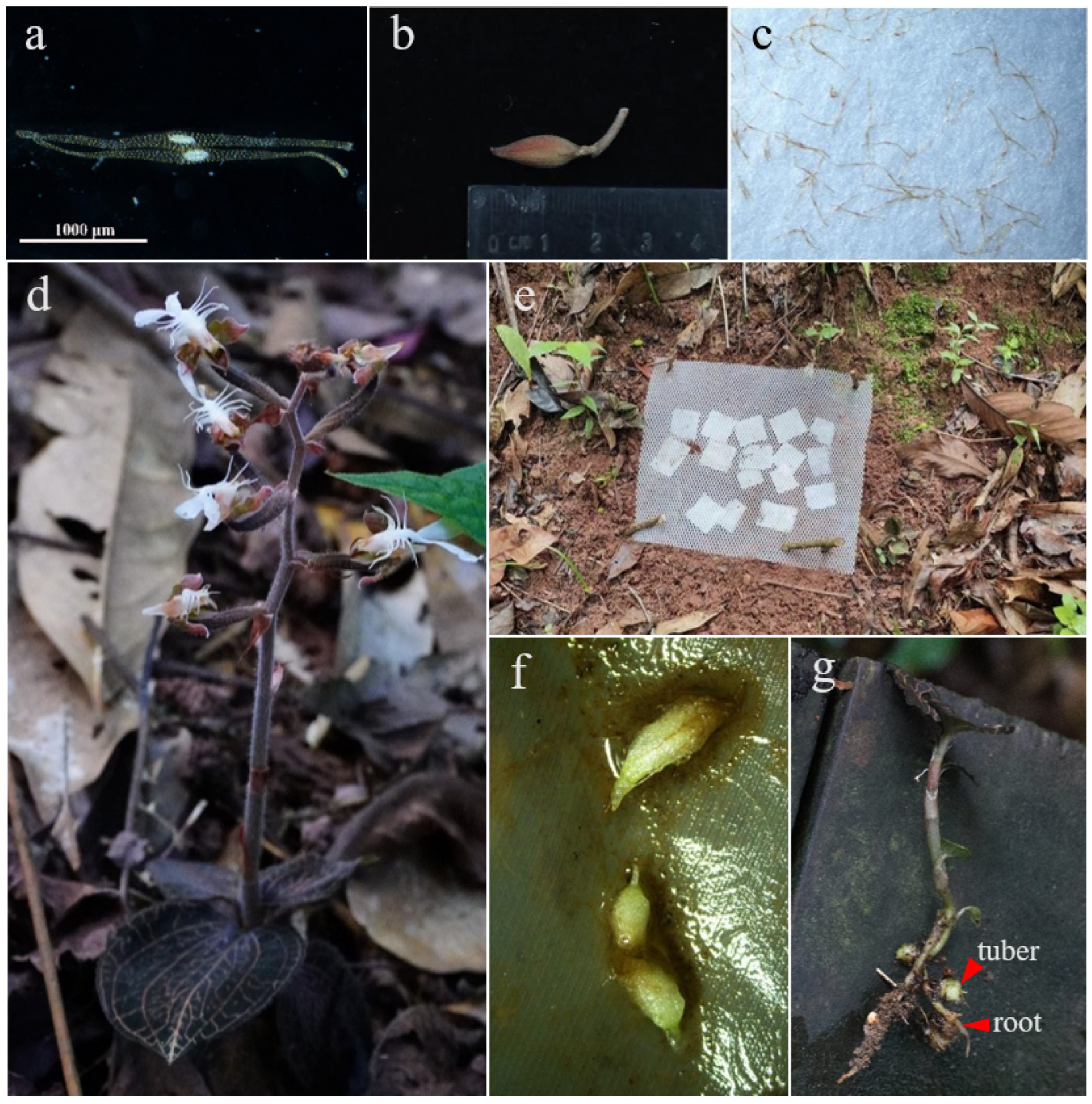
The study was conducted in Xishuangbanna Tropical Botanical Garden (XTBG; 21°45′ N, 101°02′ E; altitude, 580 m), Yunnan Province, China. The region experiences a monsoon-influenced climate, with mean annual temperatures ranging from 18 to 22 °C and annual precipitation of 1200–1700 mm. Mature but undehisced capsules (Figure 1b) from both naturally pollinated and artificially cross-pollinated wild plants (Figure 1d) were collected annually in December or January from 2021 to 2024. Seeds were carefully extracted from fruits (Figure 1a), dried and stored at −20 °C according to previous protocols [25]. Seed viability was assessed using tetrazolium chloride (TTC) staining (Figure 1c) before SSG.

2.3. Fungal Isolation

Fungal isolates were sourced from different tissues of A. roxburghii and two of its close relatives. Protocorms were obtained using an in situ seed-baiting device deployed near adult A. roxburghii plants in their natural habitat (Figure 1e,f). Roots and tubers were collected directly from wild mature individuals of A. roxburghii (Figure 1g). Additionally, tuber samples were taken from two congeneric species, A. burmannicus and A. albolineatus, both occurring in the Xishuangbanna Dai Autonomous Prefecture of Yunnan Province, China. Three species were identified during their flowering period by the authors. Fungal isolation was performed on these samples to enable cross-species comparison within the genus Anoectochilus (Table 1). The protocorms and tubers were rinsed with distilled water, surface-sterilized in 1% (w/v) NaClO for 5 min, and washed 3–5 times with sterile water. Sterilized tissues were sectioned and placed on potato dextrose agar (PDA) medium, which was incubated at 25 ± 1 °C for 3–7 days. Emerging hyphae were transferred to fresh PDA plates and subcultured 2–3 times to obtain pure isolates.
For root-associated mycorrhizal fungi, the single peloton method [44] was applied. Young roots were rinsed, sectioned into ca.1 cm segments, and surface sterilized sequentially with 75% ethanol (30 s), sterile water, 1% NaClO (2 min), and 3–5 sterile water rinses. After removing the velamen, pelotons were released by scraping into sterile water, settled for 1 h, and examined under a microscope (10×). Individual pelotons were isolated with a micropipette fitted with sterile pipette tips (10 μL), transferred to PDA plates, and incubated at 25 ± 1 °C in darkness. Fungal purification followed the same procedure as described above [45].

2.4. Molecular Identification of Fungal Isolates and Phylogenetic Analysis

Genomic DNA was extracted from fresh mycelium using the DNeasy Plant Mini Kit (Qiagen, Valencia, CA, USA) following the manufacturer’s guidelines. The internal transcribed spacer (ITS) region was amplified with primers ITS1 (5′-TCCGTAGGTGAACCTGCGG-3′) and ITS4 (5′-TCCTCCGCTTATTGATATGC-3′) [46]. PCR reactions (total 50 μL) contained 1.0 μL DNA, 5.0 μL 10× buffer, 1.0 μL Taq DNA polymerase, 1.0 μL dNTP mix (10 mM), 1.5 μL each primer (10 μM), and sterile distilled water to volume. Amplification was carried out on a 2720 Thermal Cycler (Applied Biosystems, Foster City, CA, USA) under the following cycling profile: initial denaturation at 95 °C for 5 min, 35 cycles of 95 °C for 30 s, 58 °C for 30 s, and 72 °C for 1 min, and a final extension at 72 °C for 7 min. The PCR products were purified and sequenced in both directions using an ABI 3730XL DNA Sequencer (Applied Biosystems, Foster City, CA, USA) at Personalbio Co., Ltd. (Shanghai, China). The obtained sequences were compared with GenBank using BLAST searches (BLAST+ 2.13.0), and isolates showing ≥ 95% rDNA-ITS similarity were assigned to genus level [47]. All sequences were deposited in GenBank (accession numbers PX112899–PX112935).
Twenty related representative rDNA-ITS sequences of OMF were downloaded from GenBank and analyzed together with the representative sequences obtained in this study. Auricularia subglabra (GenBank accession NR120152.1) was designated as the outgroup. Sequence alignment was performed in MEGA v12, followed by slightly manual adjustment, and the resulting alignment was used for subsequent analyses. Phylogenetic relationships were carried out using both Maximum Likelihood (ML) and Bayesian Inference (BI) methods. ML analyses were performed in Stamatakis-HPC2 v.8.2.11 [48] under the best-fitting GTR + GAMMA model, with 1000 bootstrap replicates conducted to estimate branches/nodes support expressed as Maximum Likelihood Bootstrap Support (MLBS) values. Bayesian analyses were performed with MrBayes v.3.2.7 [49]. The optimal DNA substitution model for each dataset was determined using the Bayesian Information Criterion (BIC) implemented in jModelTest 2 [50]. The Markov chain Monte Carlo (MCMC) analyses ran for 3,000,000 generations, with trees sampled every 1000 generations. Convergence between independent runs was considered achieved when the average standard deviation of split frequencies decreased below 0.01 and the potential scale-reduction factor (PSRF) approached 1.0, indicating sufficient sampling. The first 50% of the sampled trees were discarded as burn-in, and the remaining trees were summarized to construct a majority-rule consensus tree.

2.5. Symbiotic Seed Germination

A total of twelve fungal strains were selected for symbiotic seed germination. Ten representative strains isolated from Anoectochilus spp. were chosen after taking into account morphological (hyphal growth pattern (spiraling), growth rate, and colony pigmentation (front and reverse)), host origin, tissue source, and ITS-rDNA-based taxonomic classification. Additionally, two reference strains, the generalist orchid symbiont Serendipita indica (YDLXB) and Ceratobasidium sp. (M20) isolated from protocorms of Habenaria myriotricha, were included to compare their ability to promote germination across distant species (Table 1).
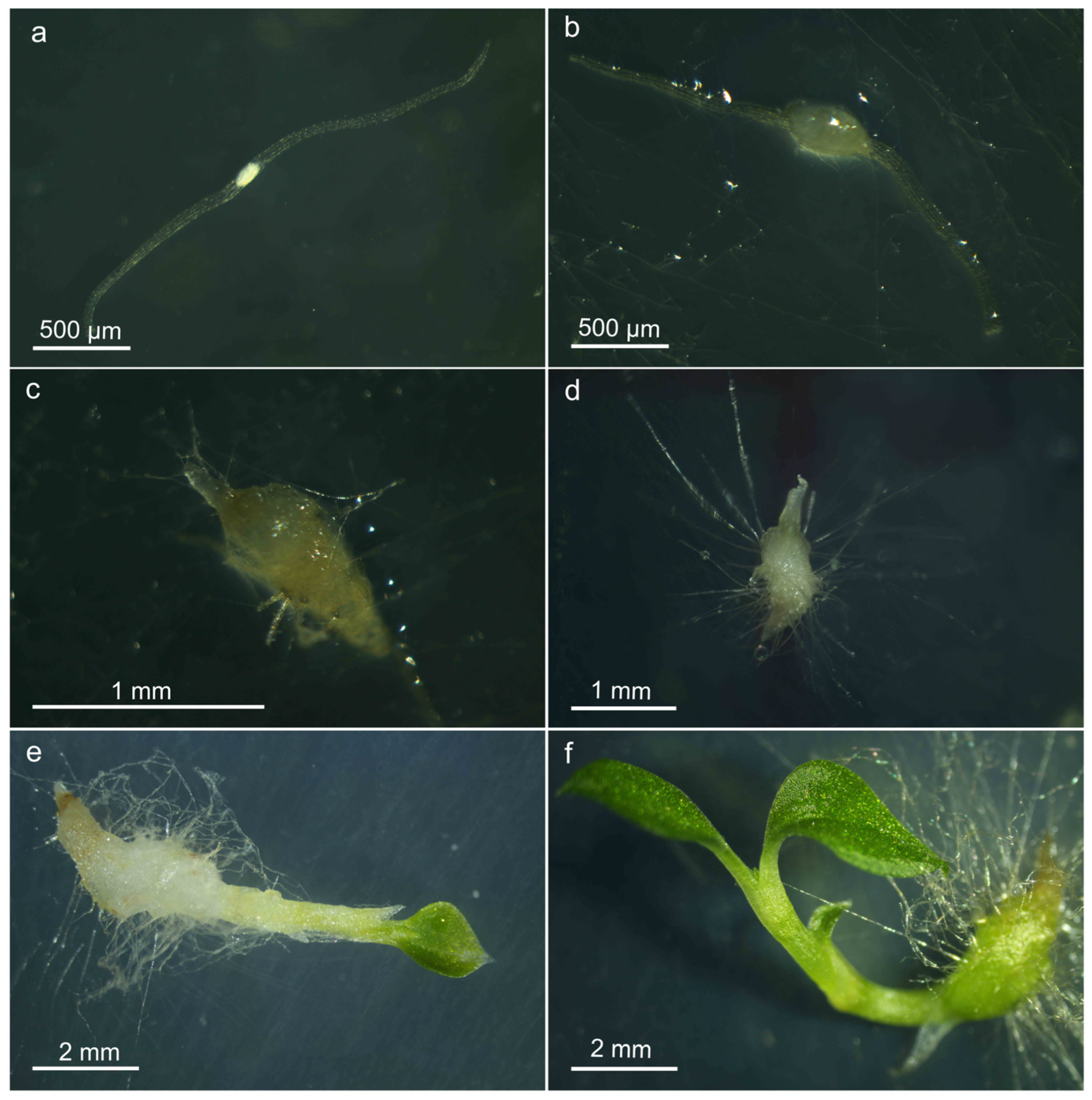
Fungal cultures were reactivated on PDA dishes at 25 ± 1 °C for 3–5 days prior to SSG. A. roxburghii seeds underwent surface sterilization in 1% NaClO (30 s) followed by 3–5 sterile water rinses, then were suspended in sterile agar solution (1 g/L). Seeds were first suspended in a 0.1% agar solution to ensure uniform distribution. The density of this suspension was rigorously determined by counting seeds in ten replicate 100 µL aliquots under a stereomicroscope. As slight variations were observed across these aliquots, the mean count was used for all calculations. If the seed concentration falls below 100 seeds per mL, additional seeds are suspended in the agar solution. If the concentration exceeds 100 seeds per mL, the agar solution is diluted with a precise volume of suspension to achieve a standardized concentration of 100 seeds per mL. Then, 1 mL of this solution containing approximately 100 seeds was used for in vitro assays using a pipette. Oatmeal agar (OMA) medium containing 0.25 g oatmeal and 8 g agar per liter of distilled water, with pH 5.7–5.8 was specially made for Ceratobasidium spp. growth. For symbiotic treatments, one actively growing fungal plug (1 × 1 × 0.5 cm) or a sterile PDA plot without fungus as a control was centrally inoculated on OMA plates, followed by even distribution of 1 mL seed suspension. All cultures were independently replicated in six Petri dishes and maintained at 25 ± 1 °C in darkness for 15 days before being cultured under a 12/12 h light/dark photoperiod. Germination progress was monitored using a stereomicroscope. Seed development was classified into five stages according to established morphological criteria [51] (Table 2, Figure 2).

2.6. Pilot Trials of Ex Vitro and Ex Situ Symbiotic Seed Germination

To assess whether the most effective strain could promote seedling establishment of A. roxburghii beyond in vitro conditions, pilot trials were conducted in tissue culture bottles and nursery trays. In the tissue culture bottle treatment, sterilized sphagnum peat moss with a moisture content of approximately 65–70% were filled to about one-third of the bottle volume and inoculated with the target OMF for the treatment groups, and or uninoculated substrates for the control, with twelve replicates per group. Afterward, approximately 300 A. roxburghii seeds were sown per bottle and maintained under the same conditions as in vitro experiments. In the nursery tray treatment, seeds were sown in a substrate pre-inoculated with the target OMF and an uninoculated substrate as a control, respectively, with three replicate trays each, and covered with a 1 cm layer of unsterilized peat. Trays were maintained under shaded-house conditions at 24–28 °C and 70–80% relative humidity, with natural light under 75% shade, and watered daily.

2.7. Data Collection and Statistical Analysis

For each treatment, at 30, 60, and 90 days after sowing, the number of seeds at each developmental stage was recorded. Protocorm formation (P) was defined as the percentage of seeds that developed beyond imbibition (stages N2–N5), and seedling development (S) was defined as the percentage of seeds that reached the seedling stage with at least one leaf (stages N4–N5). In the pilot trials, data collection was limited to protocorm and seedling development due to the impracticality of observing seeds at earlier stages. All analyses were carried out in R version 4.4.0, and results are presented as mean ± standard error (Mean ± SE), with statistical significance determined at α = 0.05. Normality and homogeneity of variances were assessed using the Shapiro–Wilk and Levene tests, respectively. After appropriate data log-transformation, the effects of fungal treatments on protocorm and seedling development were analyzed by linear mixed-effects models (LMMs) fitted using the ‘lme4’ package [52]. Post hoc tests were performed as needed using the ‘glht’ function from the ‘multcomp’ package [53] and the ‘emmeans’ and ‘emtrends’ functions from the ‘emmeans’ package [54]. Graphical visualizations were generated with ggplot2.

3. Results

3.1. Isolation and Identification of Mycorrhizal Fungi

A total of 37 fungal isolates (Table 1) were obtained, of which 31 showed morphological characteristics consistent with OMF. The molecular identification based on maximum sequence similarity of the ITS rDNA region against the NCBI database confirmed that these 31 isolates were closely related to the Ceratobasidiaceae species.

3.2. Phylogenetic Analysis of the Representative Isolates in Ceratobasidiaceae

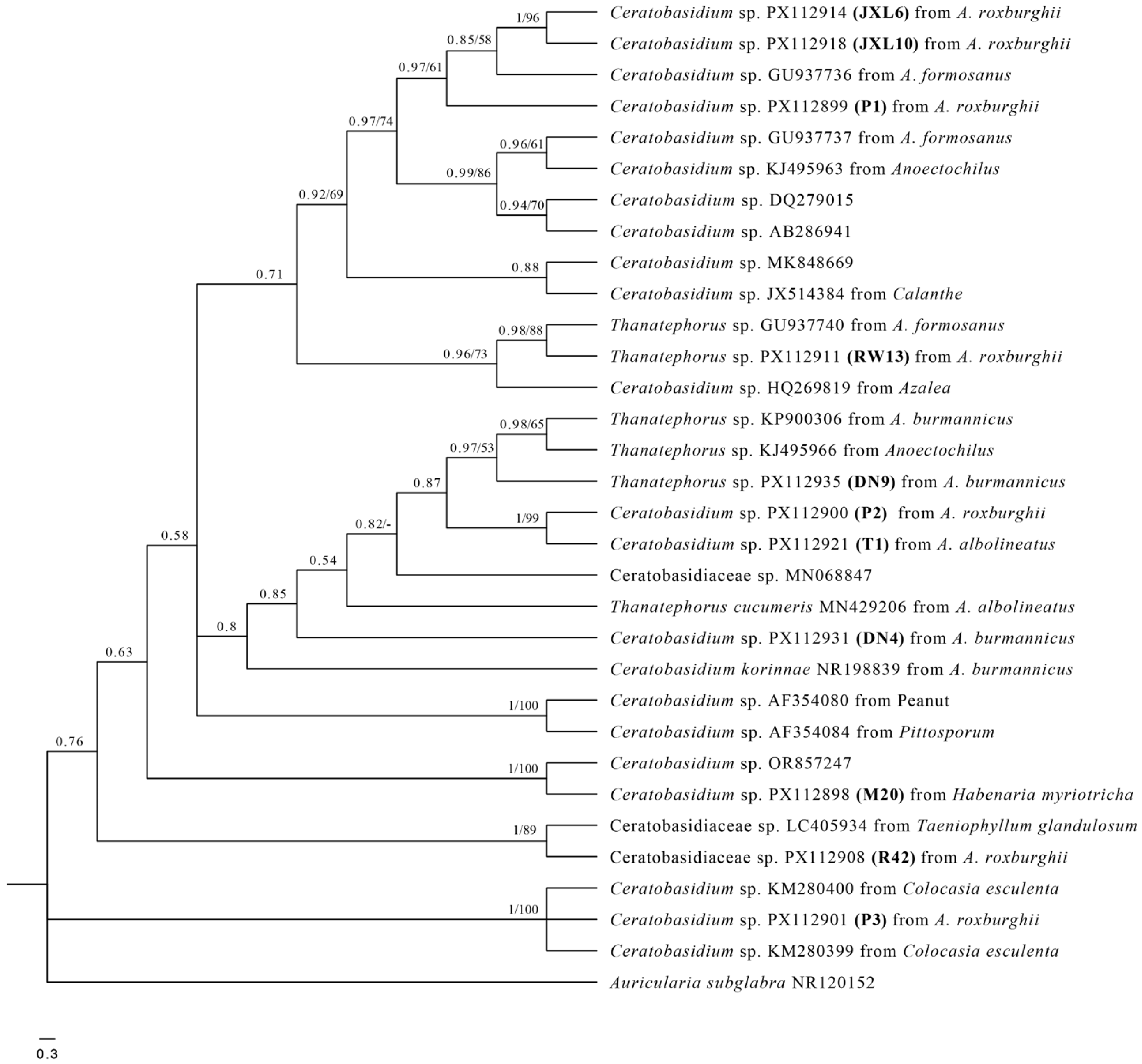
Using 20 OMF sequences from the NCBI database and 11 representative Ceratobasidiaceae sequences obtained in the current study (except for YDLXB, Serendipita indica), a phylogenetic tree of Ceratobasidiaceae was generated (Figure 3). The 31 OMFs formed several clades with both known and unidentified taxa previously reported within this family. The isolates obtained in this study were distributed across multiple phylogenetic clades, and Thanatephorus and Ceratobasidium sequences were intermingled. Furthermore, the isolates did not cluster by host plant species or by the tissue of origin within the same host.

3.3. Fungal Effects on Seed Germination and Seedling Development

Finally, 12 fungal treatments and two control treatments were used to compare the abilities of different fungi in promoting seed germination and seedling development in A. roxburghii. The results demonstrated significant fungal-mediated enhancement of seed germination and seedling formation of A. roxburghii (Figure 4, Table S1).
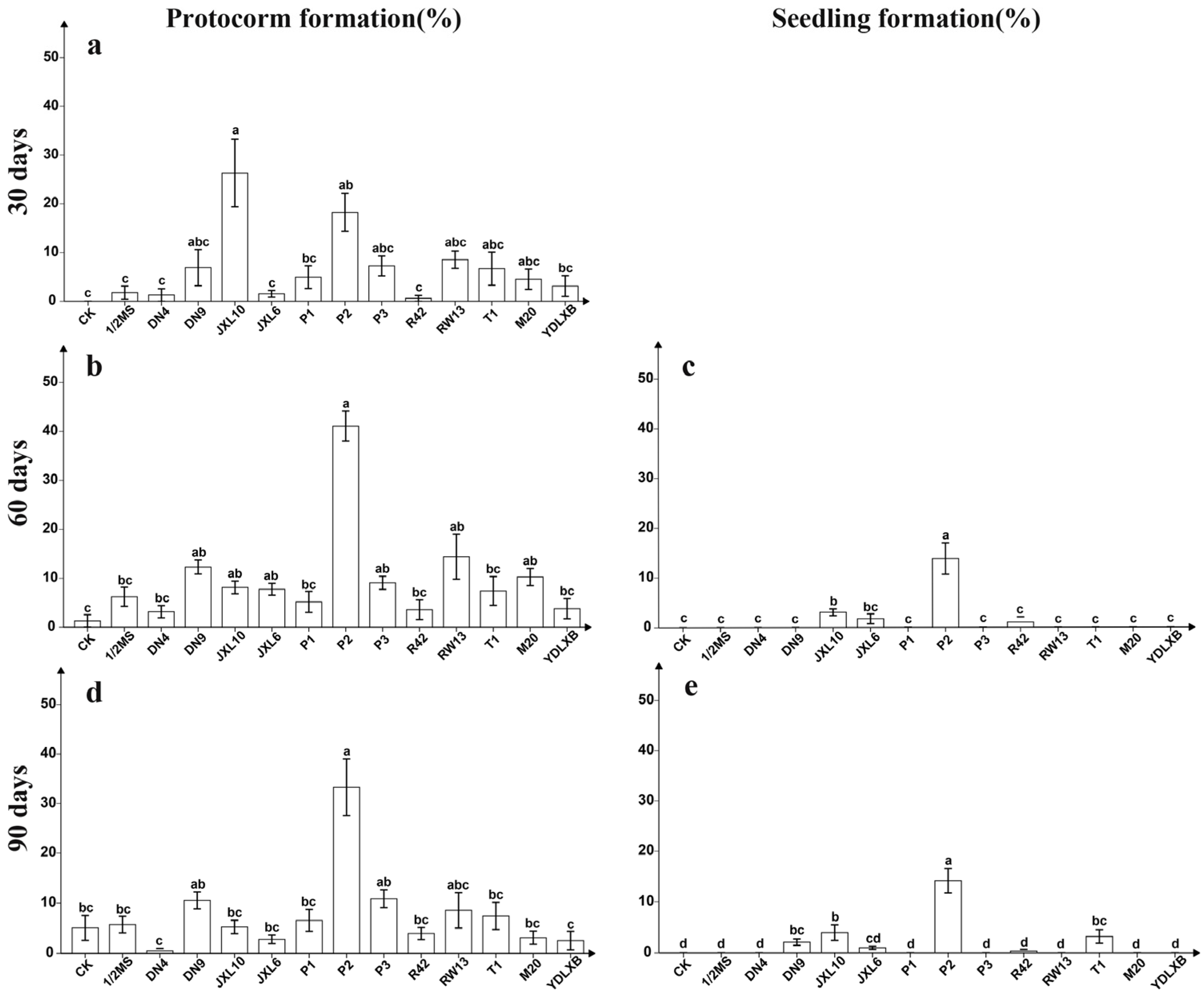
After 30 days of co-culture, all inoculated treatments significantly promoted germination (p ≤ 0.05), with particularly notable effects observed for the JXL10 and P2 strains (Figure 4a). The JXL10 treatment achieved a protocorm formation of 26.33 ± 6.95%, which was significantly higher than that of the other treatments. While the P2 treatment showed a slightly lower protocorm formation (18.24 ± 3.89%), it promoted faster developmental progression, with some seeds already reaching the cotyledon stage (Stage 3) (Table S1). No seedlings were observed in any treatment at this stage, and no germination occurred in the CK group.
By day 60, the P2 treatment showed significant improvement, reaching protocorm formation and seedling formation rates of 41.09 ± 3.04% and 13.83 ± 3.15%, respectively, both significantly higher than other treatments (p ≤ 0.05) (Figure 4b,c). Seedlings also emerged in the JXL10 (3.06 ± 0.68%), JXL6 (1.74 ± 0.98%), and R42 (1.04 ± 1.04%) treatments. Among these, the JXL10 treatment supported faster seedling development, with the highest proportion of two-leaf seedlings (2.45 ± 0.65%). However, the proportion of protocorms in the JXL10 treatment decreased compared with day 30.
At 90 days, strain P2 remained the most effective strain and exhibited the highest protocorm formation (33.28 ± 5.74%) and seedling formation (14.16 ± 2.42%) among all treatments, both significantly higher than other treatments (p ≤ 0.05) (Figure 4d,e). Most other treatments also showed reduced germination rates compared to day 60. The protocorm-derived strains P1 and P3 managed to promote germination but only up to the protocorm stage (Stage 2). Additional treatments, including DN9, JXL10, JXL6, R42 and T1, also supported limited seedling development (Table S1).

3.4. Pilot Trials

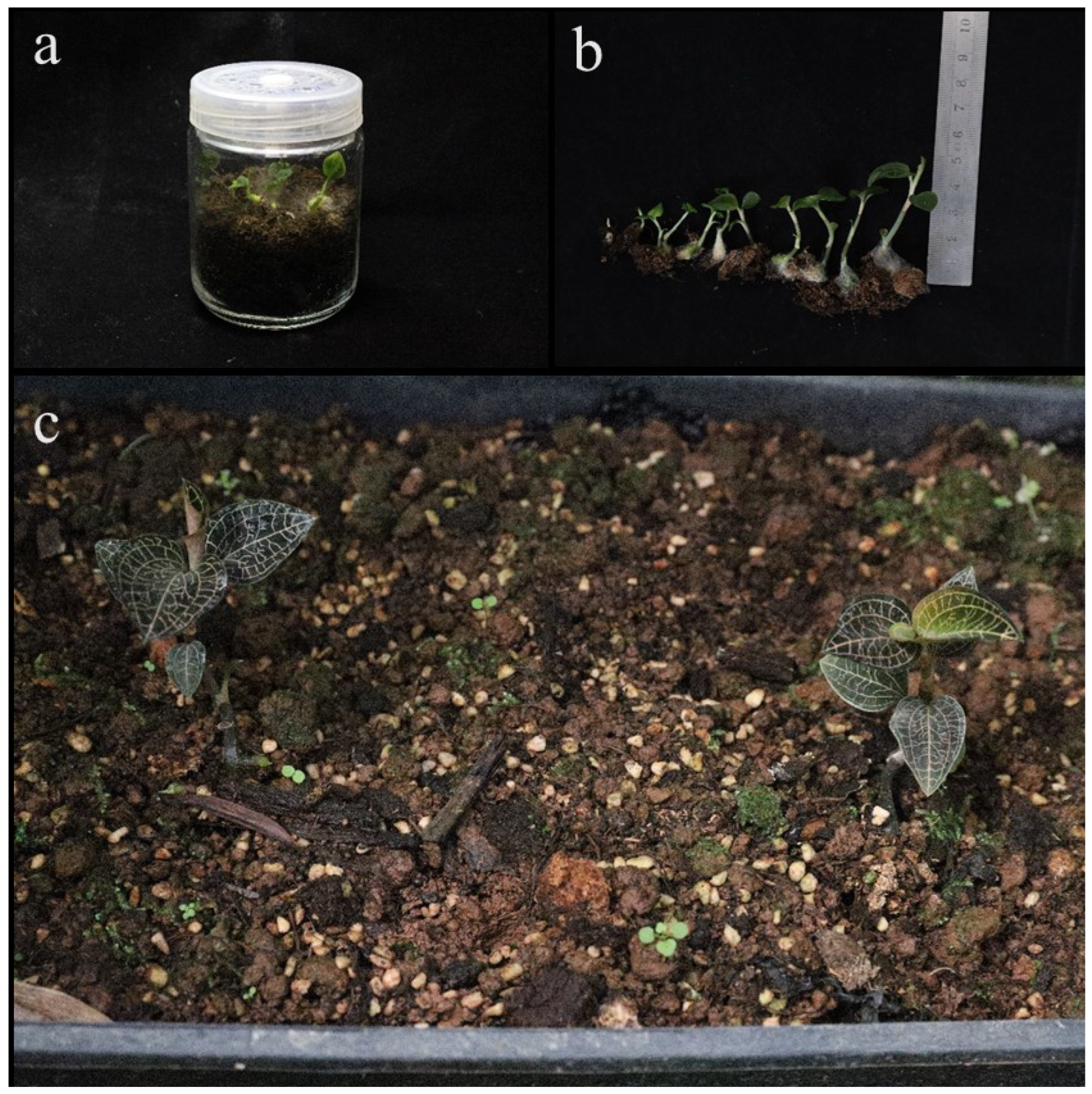
Co-cultivation of A. roxburghii seeds with the active strain P2 in tissue culture bottles resulted in rapid protocorm and seedling development. After two months, 2.28% and 0.78% of sown seeds had developed into a protocorm and seedling (Figure 5a,b, Table S2), respectively. In contrast, seeds sown in nursery trays with unsterilized substrate produced a few seedlings after five months. However, these seedlings developed four leaves and reached a maximum plant height of 6.10 cm, with a stem diameter of 4.20 mm (Figure 5c).

4. Discussion

Over-collection and habitat degradation have placed A. roxburghii in a critically endangered state, highlighting the urgent need to develop effective conservation measures. Because orchid seeds lack nutrient reserves, their germination and early seedling development depend on symbiotic relationships with suitable OMF [17]. Therefore, identifying compatible fungal partners is essential for the successful propagation of symbiotic seedlings and species reintroduction [55,56,57,58]. In this study, in vitro symbiotic seed germination was employed to assess the germination-promoting ability of 12 OMF isolates obtained from different sources. Our results showed clear functional variation between strains, with one strain that consistently promoted seed germination under in vitro conditions. Moreover, ex vitro germination trials and nursery tray sowing achieved a germination rate comparable to that of commercial Cremastra appendiculata plantations (2.18 ± 0.36%) [59]. This indicates that the fungal strain P2 is a promising candidate for large-scale seedling production and direct sowing in natural habitats, offering a practical method for conserving A. roxburghii.

4.1. OMF from Different Sources Effects on Seed Germination

The effectiveness of OMF in promoting seed germination and seedling development is closely linked to their origin, with fungi derived from different tissues showing variable performance [26,33]. However, root-associated fungal communities are highly diverse and often include many unidentified fungi with unknown ecological functions, making the isolation of germination-promoting strains challenging [7,60,61]. Increasing evidence suggests that such isolates not only achieve higher germination rates and accelerated seedling development under controlled conditions, but also, more significantly, exhibit highly consistent performance in in situ SSG [5,23,33,45,62,63,64].
In this study, we show that fungi in the Ceratobasidiaceae family also associate with the seeds of A. roxburghii. This extends their known specific associations with adult plants of Anoectochilus (e.g., A. sandvicensis and A. formosanus) [65,66]. This dominance suggests a degree of symbiotic specificity at the family level, implying that A. roxburghii species may preferentially associate with Ceratobasidiaceae fungi. However, despite their close phylogenetic relationships (Figure 3), these isolates displayed substantial functional divergence in their ability to promote seed germination (Figure 4). For instance, although isolates P2 and T1 clustered together on the phylogenetic tree with high bootstrap support, strain P2 demonstrated significantly higher seed germination and seedling development than T1. This observation supports previous observations that genetic proximity alone does not reliably predict symbiotic performance [23,67]. For example, Fuji et al. reported that five phylogenetically similar Tulasnella strains exhibited strikingly different symbiotic compatibility with seeds of Bletilla striata, Pecteilis radiata, and Spiranthes australis [67]. Similarly, Zhang et al. reported substantial variation in the ability to promote seed germination and seedling development among four closely related Tulasnella isolates when co-cultured with Dendrobium huoshanense seeds [23]. Such variation likely arises from differences in metabolic pathways or nutrient exchange efficiency between fungal strains [9,68].
Among the isolates tested, fungi derived from host protocorms were the most effective in promoting seed germination and seedling establishment. However, after 90 days, the DN9 and T1 strains isolated from the tubers of species closely related to A. roxburghii also facilitated seedling establishment, albeit with much lower efficiency than the protocorm-derived P2 strain. This pattern suggests some degree of cross-compatibility among orchid species, as also reported by Shao et al., who showed differential effects among fungal isolates obtained from protocorms of four Dendrobium species when tested with D. chrysotoxum seeds [25]. In their study, a heterospecific strain (SSCDO-5) from D. catenatum supported overall seedling development (p > 0.05), but the conspecific GC-15 strain promoted more rapid seedling formation. These results suggest that cross-compatibility is more likely among closely related species and may represent an adaptive response under nutrient-limited or stressful conditions, where seeds rely on locally available fungi [17,41,69]. Nevertheless, host-derived isolates consistently demonstrate higher efficiency in promoting seedling establishment and subsequent growth, where orchid hosts may have finely tuned their physiological responses to adapt to specific fungal sources, whereas heterospecific isolates likely serve only as suboptimal partners under ecological stress, together constituting a dual insurance strategy for seed germination.
Anoectochilus roxburghii also exhibit a germination preference for fungi derived from their host protocorms, a pattern observed under both laboratory and field conditions, likely because protocorms act as key symbiotic interfaces during early development and the associated fungi may have evolved more efficient carbon transfer or immune evasion mechanisms, thereby providing more stable nutritional support [39,70]. The decline in protocorm formation observed after 90 days across most treatments may result from several interconnected factors. Primary contributors likely include natural protocorm attrition and limited resources available to support sustained development [71,72]. Additionally, prolonged co-culture may induce fungal senescence, reducing its capacity for intracellular colonization. Nutrient uptake in protocorms depends on the dynamic formation and degradation of fungal pelotons; shifts in this turnover over time can alter the efficiency of carbon and nitrogen transfer [73]. The orchid–fungus symbiosis also requires a delicate balance: excessive fungal proliferation or loss of host regulation can shift the interaction from mutualistic to neutral or even detrimental, potentially leading to late-stage protocorm attrition, as observed in earlier symbiotic physiology studies [74]. Finally, extended in vitro culture can gradually alter the microenvironment [13]—through the accumulation of fungal metabolites, changes in medium properties (e.g., pH), and localized oxygen depletion—all of which may collectively compromise protocorm viability. Recent evidence further suggests that orchid mycorrhizal interactions can induce hypoxia-related responses in protocorm tissues, indicating that oxygen availability may become limiting as fungal biomass and respiration increase over time [75]. These results support the view that seedling development is a more informative indicator of OMF efficacy than germination alone, as many fungi can trigger germination, but only a few sustain full seedling development. In this study, strain P2 not only promoted relatively high protocorm formation but also produced the greatest proportion of seedlings, highlighting its potential utility for seedling propagation of A. roxburghii.

4.2. Ex Vitro and Ex Situ Seedling Propagation

Our results demonstrate that the P2 isolate can support a practical route for seed germination and seedling production of A. roxburghii. Seeds sown on sterilized or unsterilized substrates showed lower protocorm and seedling formation rates than those in in vitro SSG. This is likely because the small size of orchid seeds allows them to become trapped within the crevices of coarse substrates, preventing growth and resulting in low germination rates. In addition, substrate composition may further affect both seed and fungal performance. Increasing sowing density could partially offset these effects in future practices. The number of seedlings obtained in nursery trays with unsterilized substrate was lower than that in the tissue culture bottles with sterile substrate, suggesting that increased variability in biotic and abiotic conditions may have a large effect on seed germination. Even under shade-house conditions, fluctuations in light, temperature, and humidity, together with pathogen pressure, can reduce the efficiency of symbiotic seed germination [17]. These findings underscore the distinction between “potential specificity” observed under laboratory conditions and “ecological specificity” in the field [26,76]. Although limited seed availability prevented large-scale sowing, the gradual transition from in vitro to ex vitro and finally to sowing in an open environment represents a meaningful step forward in the application of P2 as a fungal resource. However, further optimization will be essential to improve seed germination and seedling vegetative development in field conditions.

5. Conclusions

A total of 37 fungal strains were isolated from protocorms, roots, and tubers of A. roxburgii and its sister species. Among these, 31 strains were successfully identified through ITS-rDNA sequencing and phylogenetic analysis as belonging to the classical orchid mycorrhizal family Ceratobasidiaceae. Twelve representative isolates were subsequently selected for symbiotic seed germination assays. The results demonstrated that one strain, Ceratobasidium sp. P2, originally isolated from host protocorms, most effectively promoted seed germination and seedling development in A. roxburghii by 60 days. The germination-promoting activity of P2 was further confirmed under both ex vitro and ex situ conditions, leading to successful seedling establishment. This study confirms a clear seed preference of A. roxburgii for Ceratobasidiaceae fungi and, for the first time, identifies a highly compatible symbiotic fungus (P2) with strong potential for application in seedling propagation.

Supplementary Materials

The following supporting information can be downloaded at https://www.mdpi.com/article/10.3390/horticulturae12020244/s1: Table S1: Germination rates and proportions of different germination stages of A. roxburghii seeds under different treatments; Table S2: Protocorms and Seedlings formation of A. roxburghii seeds under P2 strain treatment in tissue culture bottles.

Author Contributions

Conceptualization, C.Y., M.-X.W. and S.-C.S.; methodology, C.Y. and M.-X.W.; validation, C.Y., P.-Y.X. and L.T.; formal analysis, C.Y.; investigation, C.Y., M.-X.W., P.-Y.X. and L.T.; resources, C.Y. and M.-X.W.; data curation, C.Y.; writing—original draft preparation, C.Y.; writing—review and editing, S.-C.S., and X.-Q.S.; visualization, C.Y.; supervision, S.-C.S., and X.-Q.S. All authors have read and agreed to the published version of the manuscript.

Funding

This research was funded by the National Natural Science Foundation of China (Grant Nos. 32571937, 32171655) and the Special Fund for Scientific Research of Shanghai Landscaping & City Appearance Administrative Bureau (Grant No. G252413).

Data Availability Statement

The original contributions presented in this study are included in the article and Supplementary Material. Further inquiries can be directed to the corresponding authors.

Acknowledgments

We gratefully acknowledge Hans Jacquemyn (Department of Biology, Plant Conservation and Population Biology, KU Leuven, B-3001 Leuven, Belgium) for his valuable advice on data analysis methods and critical revision of the initial manuscript. We also sincerely thank Li-Sheng Zhang and Xiao-Jing Wang from the Xishuangbanna Tropical Botanical Garden for their assistance with data analysis and laboratory work, respectively.

Conflicts of Interest

Author Meng-Xue Wang was employed by the company Hainan Guangshen Technology Co., Ltd. The remaining authors declare that the research was conducted in the absence of any commercial or financial relationships that could be construed as a potential conflict of interest.

Abbreviations

The following abbreviations are used in this manuscript:
OMFOrchid mycorrhizal fungi
CITESConvention on International Trade in Endangered Species of Wild Fauna and Flora
SSGSymbiotic seed germination

References

  1. Pérez-Escobar, O.A.; Bogarín, D.; Przelomska, N.A.S.; Ackerman, J.D.; Balbuena, J.A.; Bellot, S.; Bühlmann, R.P.; Cabrera, B.; Cano, J.A.; Charitonidou, M.; et al. The origin and speciation of orchids. New Phytol. 2024, 242, 700–716. [Google Scholar] [CrossRef] [Scilit] [PubMed]
  2. Shao, S.C.; Burgess, K.S.; Cruse-Sanders, J.M.; Liu, Q.; Fan, X.L.; Huang, H.; Gao, J.Y. Using in situ symbiotic seed germination to restore over-collected medicinal orchids in southwest China. Front. Plant Sci. 2017, 8, 888. [Google Scholar] [CrossRef] [Scilit] [PubMed]
  3. Gale, S.; Fischer, G.; Cribb, P.; Fay, M. Orchid conservation: Bridging the gap between science and practice. Bot. J. Linn. Soc. 2018, 186, 425–434. [Google Scholar] [CrossRef] [Scilit]
  4. Hinsley, A.; Boer, H.J.; Fay, M.F.; Gale, S.W.; Gardiner, L.M.; Gunasekara, R.S.; Kumar, P.; Masters, S.; Metusala, D.; Roberts, D.L.; et al. A review of the trade in orchids and its implications for conservation. Bot. J. Linn. Soc. 2018, 186, 435–455. [Google Scholar] [CrossRef] [Scilit]
  5. Shao, S.C.; Luo, Y.; Jacquemyn, H. Successful reintroduction releases pressure on China’s orchid species. Trends Plant Sci. 2022, 27, 211–213. [Google Scholar] [CrossRef] [Scilit]
  6. Favre-Godal, Q.; Gourguillon, L.; Lordel-Madeleine, S.; Gindro, K.; Choisy, P. Orchids and their mycorrhizal fungi: An insufficiently explored relationship. Mycorrhiza 2020, 30, 5–22. [Google Scholar] [CrossRef] [Scilit]
  7. Dearnaley, J.; Martos, F.; Selosse, M.A. 12 Orchid mycorrhizas: Molecular ecology, physiology, evolution and conservation aspects. In Fungal Associations; Springer: Berlin/Heidelberg, Germany, 2012; Volume 9, pp. 207–230. [Google Scholar] [CrossRef] [Scilit]
  8. Zhao, D.K.; Mou, Z.M.; Ruan, Y.L. Orchids acquire fungal carbon for seed germination: Pathways and players. Trends Plant Sci. 2024, 29, 733–741. [Google Scholar] [CrossRef] [Scilit]
  9. Zhao, Z.; Yang, L.N.; Wang, Y.Y.; Qian, X.; Ding, G.; Jacquemyn, H.; Xing, X.K. Unlocking germination: The role of mycorrhizal strain and seed provenance in driving seed germination of a widespread terrestrial orchid. Mycorrhiza 2025, 35, 18. [Google Scholar] [CrossRef] [Scilit]
  10. Wang, Y.Y.; Zhao, Z.Y.; Liu, J.X.; Yang, A.Y.W.; Jacquemyn, H.; Yang, L.N.; Qian, X.; Li, T.Q.; Ding, G.; Xing, X.K. Contribution of orchids to the carbon budget of fungi in germinating seeds of Gymnadenia conopsea. Sci. China Life Sci. 2025, 69, 662–675. [Google Scholar] [CrossRef] [Scilit]
  11. Zhao, Z.Y.; Wang, Y.Y.; Yang, L.N.; Qian, X.; Yang, A.Y.W.; Liu, J.X.; Jacquemyn, H.; Li, T.Q.; Xing, X.K. Metabolic shifts and nutrient transfer patterns in orchid seeds during symbiotic germination. Plant Cell Environ. 2025, 48, 6406–6420. [Google Scholar] [CrossRef] [Scilit] [PubMed]
  12. Han, J.Y.; Xiao, H.F.; Gao, J.Y. Seasonal dynamics of mycorrhizal fungi in Paphiopedilum spicerianum (Rchb. f) Pfitzer—A critically endangered orchid from China. Glob. Ecol. Conserv. 2016, 6, 327–338. [Google Scholar] [CrossRef] [Scilit]
  13. Fochi, V.; Chitarra, W.; Kohler, A.; Voyron, S.; Singan, V.R.; Lindquist, E.A.; Barry, K.W.; Girlanda, M.; Grigoriev, I.V.; Martin, F.; et al. Fungal and plant gene expression in the Tulasnella calosporaSerapias vomeracea symbiosis provides clues about nitrogen pathways in orchid mycorrhizas. New Phytol. 2017, 213, 365–379. [Google Scholar] [CrossRef] [Scilit] [PubMed]
  14. Liu, S.; Lv, D.; Lu, C.; Xiao, Y.; Wang, S.; Zhou, W.; Niu, J.; Wang, Z. Tulasnella can contribute to breakthrough in germination of the medicinal orchid Bletilla striata via producing plant hormones. Rhizosphere 2022, 22, 2452–2498. [Google Scholar] [CrossRef] [Scilit]
  15. Miura, C.; Furui, Y.; Yamamoto, T.; Kanno, Y.; Honjo, M.; Yamaguchi, K.; Suetsugu, K.; Yagame, T.; Seo, M.; Shigenobu, S.; et al. Auto-activation of mycorrhizal symbiosis signaling through gibberellin deactivation in orchid seed germination. Plant Physiol. 2023, 194, 546–563. [Google Scholar] [CrossRef] [Scilit]
  16. Pujasatria, G.C.; Miura, C.; Yamaguchi, K.; Shigenobu, S.; Kaminaka, H. Colonization by orchid mycorrhizal fungi primes induced systemic resistance against necrotrophic pathogen. Front. Plant Sci. 2024, 15, 1447050. [Google Scholar] [CrossRef] [Scilit]
  17. Rasmussen, H.N.; Dixon, K.W.; Jersáková, J.; Těšitelová, T. Germination and seedling establishment in orchids: A complex of requirements. Ann. Bot. 2015, 116, 391–402. [Google Scholar] [CrossRef] [Scilit]
  18. Yeh, C.M.; Chung, K.; Liang, C.K.; Tsai, W.C. New insights into the symbiotic relationship between orchids and fungi. Appl. Sci. 2019, 9, 585. [Google Scholar] [CrossRef] [Scilit]
  19. Gao, X.; Wang, Y.; Deng, D.; Luo, Y.; Shao, S.; Luo, Y. Morphogenesis changes in protocorm development during symbiotic seed germination of Dendrobium chrysotoxum (Orchidaceae) with its mycobiont, Tulasnella sp. Horticulturae 2023, 9, 531. [Google Scholar] [CrossRef] [Scilit]
  20. Stewart, S.L.; Kane, M.E. Symbiotic seed germination and evidence for in vitro mycobiont specificity in Spiranthes brevilabris (Orchidaceae) and its implications for species-level conservation. Vitr. Cell. Dev. Biol.-Plant 2007, 43, 178–186. [Google Scholar] [CrossRef] [Scilit]
  21. Gao, Y.; Zhao, Z.; Li, J.; Liu, N.; Jacquemyn, H.; Guo, S.; Xing, X. Do fungal associates of co-occurring orchids promote seed germination of the widespread orchid species Gymnadenia conopsea? Mycorrhiza 2020, 30, 221–228. [Google Scholar] [CrossRef] [Scilit] [PubMed]
  22. Tang, Y.J.; Guo, S.X.; Chen, J. Advances in the specificity of orchid-mycorrhizal fungi. J. Cap. Norm. Univ. (Nat. Sci. Ed.) 2020, 42, 63–74. [Google Scholar] [CrossRef]
  23. Zhang, Y.; Wang, S.W.; Li, N.Q.; Jin, Q.; Anbazhakan, R.; Dai, Y.F.; Xiang, Z.X.; Gao, J.Y. Ecological specificity of fungi on seedling establishment in Dendrobium huoshanense: A narrow distributed medicinal orchid. Mycorrhiza 2025, 35, 41. [Google Scholar] [CrossRef] [Scilit] [PubMed]
  24. Zettler, L.W.; Dvorak, C.J. Tulasnella calospora (UAMH 9824) retains its effectiveness at facilitating orchid symbiotic germination in vitro after two decades of subculturing. Bot. Stud. 2021, 62, 14. [Google Scholar] [CrossRef] [Scilit]
  25. Shao, S.C.; Wang, Q.X.; Beng, K.C.; Zhao, D.K.; Jacquemyn, H. Fungi isolated from host protocorms accelerate symbiotic seed germination in an endangered orchid species (Dendrobium chrysotoxum) from southern China. Mycorrhiza 2020, 30, 529–539. [Google Scholar] [CrossRef] [Scilit]
  26. Zhao, D.K.; Selosse, M.A.; Wu, L.M.; Luo, Y.; Shao, S.C.; Ruan, Y.L. Orchid reintroduction based on seed germination-promoting mycorrhizal fungi derived from protocorms or seedlings. Front. Plant Sci. 2021, 12, 701152. [Google Scholar] [CrossRef] [Scilit]
  27. Khamchatra, N.; Dixon, K.W.; Tantiwiwat, S.; Piapukiew, J. Symbiotic seed germination of an endangered epiphytic slipper orchid, Paphiopedilum villosum (Lindl.) Stein. from Thailand. S. Afr. J. Bot. 2016, 104, 76–81. [Google Scholar] [CrossRef] [Scilit]
  28. Hughes, O.T.W. Orchid-Mycorrhiza Relationships: Propagation of Terrestrial and Epiphytic Orchids from Seed. Ph.D. Dissertation, Manchester Metropolitan University, Manchester, UK, 2018; pp. 1–242. [Google Scholar]
  29. Decruse, S.W.; Neethu, R.S.; Pradeep, N.S. Seed germination and seedling growth promoted by a Ceratobasidiaceae clone in Vanda thwaitesii Hook. f., an endangered orchid species endemic to South Western Ghats, India and Sri Lanka. S. Afr. J. Bot. 2018, 116, 222–229. [Google Scholar] [CrossRef] [Scilit]
  30. Yao, N.; Zheng, B.Q.; Wang, T.; Cao, X.L. Isolation of Tulasnella spp. from cultivated Paphiopedilum orchids and screening of germination-enhancing fungi. J. Fungi 2023, 9, 597. [Google Scholar] [CrossRef] [Scilit]
  31. Meng, Y.Y. Symbiotic Specificity of Mycorrhizal Fungi at Different Lifecycle Stages of Three Orchids. Ph.D. Dissertation, Xishuangbanna Tropical Botanical Garden of Chinese Academy of Sciences, Yunnan, China, 2019; pp. 1–133. [Google Scholar]
  32. Selosse, M.A.; Minasiewicz, J.; Boullard, B. An annotated translation of Noël Bernard’s 1899 article ‘On the germination of Neottia nidus-avis’. Mycorrhiza 2017, 27, 611–618. [Google Scholar] [CrossRef] [Scilit]
  33. Shao, S.C.; Luo, Y.; Jacquemyn, H. Co-cultures of mycorrhizal fungi do not increase germination and seedling development in the epiphytic orchid Dendrobium nobile. Front. Plant Sci. 2020, 11, 571426. [Google Scholar] [CrossRef] [Scilit] [PubMed]
  34. Li, T.Q.; Wu, S.M.; Yang, W.K.; Selosse, M.-A.; Gao, J.Y. How mycorrhizal associations influence orchid distribution and population dynamics. Front. Plant Sci. 2021, 12, 647114. [Google Scholar] [CrossRef] [Scilit] [PubMed]
  35. Zhang, Y.; Li, Y.Y.; Guo, S.X. Effects of the mycorrhizal fungus Ceratobasidium sp. AR2 on growth and flavonoid accumulation in Anoectochilus roxburghii. PeerJ 2020, 8, e8346. [Google Scholar] [CrossRef] [Scilit] [PubMed]
  36. Li, L.; Li, Y.M.; Liu, Z.L.; Liu, Q.; Yi, L.T. The renal protective effects of Anoectochilus roxburghii polysaccharose on diabetic mice induced by high-fat diet and streptozotocin. J. Ethnopharmacol. 2016, 178, 58–65. [Google Scholar] [CrossRef] [Scilit]
  37. Guo, Y.L.; Ye, Q.; Yang, S.L.; Wu, J.Z.; Ye, B.Z.; Wu, Y.B.; Huang, Z.H.; Zheng, C.J. Therapeutic effects of polysaccharides from Anoectochilus roxburghii on type II collagen-induced arthritis in rats. Int. J. Biol. Macromol. 2019, 122, 882–892. [Google Scholar] [CrossRef] [Scilit]
  38. Wu, Y.B.; Liu, C.; Jiang, Y.Q.; Bai, B.K.; He, X.H.; Wang, H.R.; Wu, J.Z.; Zheng, C.J. Structural characterization and hepatoprotective effects of polysaccharides from Anoectochilus zhejiangensis. Int. J. Biol. Macromol. 2022, 198, 111–118. [Google Scholar] [CrossRef] [Scilit]
  39. Zhang, W.T.; Mei, Y.; Wang, J.H. Research status and prospect of precious medicinal plant Anoectochilus roxburghii. Chin. Agric. Sci. Bull. 2024, 40, 16–26. [Google Scholar] [CrossRef]
  40. Lv, X.K.; Zhou, L.S.; Guo, S.X. Resource characteristics and propagation techniques of Anoectochilus roxburghii in China. Acta Pharm. Sin. 2022, 57, 2057–2067. [Google Scholar] [CrossRef]
  41. Zhang, L.H.; Zheng, M.X.; Zhou, G.; Qiu, M.C.; Yang, Y.S.; Zhang, J.J. In vitro propagation of tetraploid Anoectochilus roxburghii: A valuable Chinese herbal medicine. Ind. Crops Prod. 2025, 225, 120618. [Google Scholar] [CrossRef] [Scilit]
  42. Spielman, D.; Brook, B.W.; Frankham, R. Most species are not driven to extinction before genetic factors impact them. Proc. Natl. Acad. Sci. USA 2004, 101, 15261–15264. [Google Scholar] [CrossRef] [Scilit]
  43. Guo, S.X.; Fan, L.; Cao, W.Q.; Xu, J.T.; Xiao, P.G. Mycena anoectochila sp. nov. isolated from mycorrhizal roots of Anoectochilus roxburghii from Xishuangbanna, China. Mycologia 1997, 89, 952–954. [Google Scholar] [CrossRef] [Scilit]
  44. Zhu, G.S.; Gui, Y.; Liu, Z.Y. A novel technique for isolating orchid mycorrhizal fungi. Fungal Divers. 2008, 33, 123–137. [Google Scholar]
  45. Zi, X.M.; Sheng, C.L.; Goodale, U.M.; Shao, S.C.; Gao, J.Y. In situ seed baiting to isolate germination-enhancing fungi for an epiphytic orchid, Dendrobium aphyllum (Orchidaceae). Mycorrhiza 2014, 24, 487–499. [Google Scholar] [CrossRef] [Scilit] [PubMed]
  46. White, T.J.; Bruns, T.; Lee, S.; Taylor, J. Amplification and direct sequencing of fungal ribosomal RNA genes for phylogenetics. In PCR Protocols: A Guide to Methods and Applications; Innis, M.A., Gelfand, D.H., Sninsky, J.J., White, T.J., Eds.; Academic Press: New York, NY, USA, 1990; pp. 315–322. [Google Scholar]
  47. Freestone, M.W.; Swarts, N.D.; Reiter, N.; Tomlinson, S.; Sussmilch, F.C.; Wright, M.M.; Holmes, G.D.; Phillips, R.D.; Linde, C.C. Continental-scale distribution and diversity of Ceratobasidium orchid mycorrhizal fungi in Australia. Ann. Bot. 2021, 128, 329–343. [Google Scholar] [CrossRef] [Scilit] [PubMed]
  48. Stamatakis, A. RAxML version 8: A tool for phylogenetic analysis and post-analysis of large phylogenies. Bioinformatics 2014, 30, 1312–1313. [Google Scholar] [CrossRef] [Scilit] [PubMed]
  49. Ronquist, F.; Teslenko, M.; Mark, P.; Ayres, D.L.; Darling, A.; Höhna, S.; Larget, B.; Liu, L.; Suchard, M.A.; Huelsenbeck, J.P. MrBayes 3.2: Efficient bayesian phylogenetic inference and model choice across a large model space. Syst. Biol. 2012, 61, 539–542. [Google Scholar] [CrossRef] [Scilit]
  50. Darriba, D.; Taboada, G.L.; Doallo, R.; Posada, D. jModelTest 2: More models, new heuristics and parallel computing. Nat. Methods 2012, 9, 772. [Google Scholar] [CrossRef] [Scilit]
  51. Arditti, J. Factors affecting the germination of orchid seeds. Bot. Rev. 1967, 33, 1–97. [Google Scholar] [CrossRef] [Scilit]
  52. Bates, D.; Kliegl, R.; Vasishth, S.; Baayen, R.H. Parsimonious mixed models. arXiv 2015. [Google Scholar] [CrossRef] [Scilit]
  53. Hothorn, T.; Bretz, F.; Westfall, P. Simultaneous inference in general parametric models. Biom. J. 2008, 50, 346–363. [Google Scholar] [CrossRef] [Scilit]
  54. Searle, S.R.; Speed, F.M.; Milliken, G.A. Population marginal means in the linear model: An alternative to least squares means. Am. Stat. 1980, 34, 216–221. [Google Scholar] [CrossRef] [Scilit]
  55. Batty, A.L.; Brundrett, M.C.; Dixon, K.W.; Sivasithamparam, K. In situ symbiotic seed germination and propagation of terrestrial orchid seedlings for establishment at field sites. Aust. J. Bot. 2006, 54, 375–381. [Google Scholar] [CrossRef] [Scilit]
  56. Bustam, B.M.; Dixon, K.W.; Bunn, E. In vitro propagation of temperate Australian terrestrial orchids: Revisiting asymbiotic compared with symbiotic germination. Bot. J. Linn. Soc. 2014, 176, 556–566. [Google Scholar] [CrossRef] [Scilit]
  57. Phillips, R.D.; Reiter, N.; Peakall, R. Orchid conservation: From theory to practice. Ann. Bot. 2020, 126, 345–362. [Google Scholar] [CrossRef] [Scilit] [PubMed]
  58. Wang, X.J.; Wu, Y.H.; Ming, X.J.; Wang, G.; Gao, J.Y. Isolating ecological-specific fungi and creating fungus-seed bags for epiphytic orchid conservation. Glob. Ecol. Conserv. 2021, 28, e01714. [Google Scholar] [CrossRef] [Scilit]
  59. Xiao, X. The One-Step Seedling Formation Technique of Cremastra appendiculata Seeds in Symbiosis with Fungus. Master’s Dissertation, Guizhou University, Guiyang, China, 2024; pp. 1–75. [Google Scholar]
  60. Põlme, S.; Bahram, M.; Jacquemyn, H.; Kennedy, P.; Kohout, P.; Moora, M.; Oja, J.; Öpik, M.; Pecoraro, L.; Tedersoo, L. Host preference and network properties in biotrophic plant-fungal associations. New Phytol. 2018, 217, 1230–1239. [Google Scholar] [CrossRef] [Scilit] [PubMed]
  61. Liu, H.; Jacquemyn, H.; Yu, S.; Chen, W.; He, X.; Huang, Y. Mycorrhizal diversity and community composition in co-occurring Cypripedium species. Mycorrhiza 2022, 33, 107–118. [Google Scholar] [CrossRef] [Scilit] [PubMed]
  62. Rasmussen, H.N.; Whigham, D.F. Seed ecology of dust seeds in situ: A new study technique and its application in terrestrial orchids. Am. J. Bot. 1993, 80, 1374–1378. [Google Scholar] [CrossRef] [Scilit]
  63. Zhou, X.; Gao, J.Y. Highly compatible Epa-01 strain promotes seed germination and protocorm development of Papilionanthe teres (Orchidaceae). Plant Cell Tissue Organ Cult. 2016, 125, 479–493. [Google Scholar] [CrossRef] [Scilit]
  64. Huang, H.; Zi, X.M.; Lin, H.; Gao, J.Y. Host-specificity of symbiotic mycorrhizal fungi for enhancing seed germination, protocorm formation and seedling development of over-collected medicinal orchid, Dendrobium devonianum. J. Microbiol. 2018, 56, 42–48. [Google Scholar] [CrossRef] [Scilit]
  65. Jiang, J.H.; Lee, Y.I.; Cubeta, M.A.; Chen, L.C. Characterization and colonization of endomycorrhizal Rhizoctonia fungi in the medicinal herb Anoectochilus formosanus (Orchidaceae). Mycorrhiza 2015, 25, 431–445. [Google Scholar] [CrossRef] [Scilit]
  66. Swift, S.; Munroe, S.; Im, C.; Tipton, L.; Hynson, N.A. Remote tropical island colonization does not preclude symbiotic specialists: New evidence of mycorrhizal specificity across the geographic distribution of the Hawaiian endemic orchid Anoectochilus sandvicensis. Ann. Bot. 2019, 123, 657–666. [Google Scholar] [CrossRef] [Scilit]
  67. Fuji, M.; Miura, C.; Yamamoto, T.; Komiyama, S.; Suetsugu, K.; Yagame, T.; Yamato, M.; Kaminaka, H. Relative effectiveness of Tulasnella fungal strains in orchid mycorrhizal symbioses between germination and subsequent seedling growth. Symbiosis 2020, 81, 53–63. [Google Scholar] [CrossRef] [Scilit]
  68. Ghirardo, A.; Fochi, V.; Lange, B.; Witting, M.; Schnitzler, J.P.; Perotto, S.; Balestrini, R. Metabolomic adjustments in the orchid mycorrhizal fungus Tulasnella calospora during symbiosis with Serapias vomeracea. New Phytol. 2020, 228, 1939–1952. [Google Scholar] [CrossRef] [Scilit] [PubMed]
  69. Bonnardeaux, Y.; Brundrett, M.; Batty, A.; Dixon, K.; Koch, J.; Sivasithamparam, K. Diversity of mycorrhizal fungi of terrestrial orchids: Compatibility webs, brief encounters, lasting relationships and alien invasions. Mycol. Res. 2007, 111, 51–61. [Google Scholar] [CrossRef] [Scilit] [PubMed]
  70. Valadares, R.B.S.; Perotto, S.; Santos, E.C.; Lambais, M.R. Proteome changes in Oncidium sphacelatum (Orchidaceae) at different trophic stages of symbiotic germination. Mycorrhiza 2014, 24, 349–360. [Google Scholar] [CrossRef] [Scilit]
  71. Yang, J.; Li, N.Q.; Gao, J.Y. Roles of mycorrhizal fungi on seed germination of two Chinese medicinal orchids: Need or do not need a fungus? Front. Plant Sci. 2024, 15, 1415401. [Google Scholar] [CrossRef] [Scilit]
  72. Mala, B.; Kuegkong, K.; Sa-Ngiaemsri, N.; Nontachaiyapoom, S. Effect of germination media on in vitro symbiotic seed germination of three Dendrobium orchids. S. Afr. J. Bot. 2017, 112, 521–526. [Google Scholar] [CrossRef] [Scilit]
  73. Kuga, Y.; Sakamoto, N.; Yurimoto, H. Stable isotope cellular imaging reveals that both live and degenerating fungal pelotons transfer carbon and nitrogen to orchid protocorms. New Phytol. 2014, 202, 594–605. [Google Scholar] [CrossRef] [Scilit]
  74. Knudson, L. Physiological study of the symbiotic germination of orchid seeds. Bot. Gaz. 1925, 79, 345–379. [Google Scholar] [CrossRef] [Scilit]
  75. Cao, D.C. “Smother love” of mycorrhiza: Hypoxic germination of orchids. Plant Physiol. 2023, 192, 2240–2242. [Google Scholar] [CrossRef] [Scilit]
  76. Masuhara, G.; Katsuya, K. In situ and in vitro specificity between Rhizoctonia spp. and Spiranthes sinensis (Persoon) Ames. var. amoena (M. bieberstein) Hara (Orchidaceae). New Phytol. 1994, 127, 711–718. [Google Scholar] [CrossRef] [Scilit]
Figure 1. Plant, seeds, and materials of A. roxburghii used for symbiotic fungal isolation. (a) Seed morphology; (b) Mature, undehisced capsule; (c) Seed viability assessed by tetrazolium chloride (TTC) staining; viable embryos are stained red; (d) Mature flowering plant in native habitat; (e) The in situ baiting trials; (f) Protocorms; (g) Roots and tubers.
Horticulturae 12 00244 g001
Figure 2. Morphological characteristics of A. roxburghii seeds at different germination stages. (a) Mature seed; (b) Imbibed seed; (c) Protocorm formation; (d) Cotyledon stage; (e) Single-leaf seedling; (f) Two-leaf seedling.
Horticulturae 12 00244 g002
Figure 3. Bayesian and ML phylogenetic tree of mycorrhizal fungi isolated from different tissue sources using nrDNA ITS. Numbers on branches are Bayesian Inference (BI) and Maximum Likelihood (ML) support values, respectively. A dash (-) denotes that the branch is absent in the ML tree, while a blank for ML indicates bootstrap support < 50%. The names of fungal strains used for symbiotic seed germination are shown in bold.
Horticulturae 12 00244 g003
Figure 4. Protocorm and seedling formation (%) of A. roxburghii seeds under 12 fungal treatments and two controls (CK and 1/2 MS) after 30, 60, and 90 days of co-culture. The fungal treatments included isolates from tubers (JXL10, JXL6), protocorms (P1, P2, P3), roots (R42, RW13) of A. roxburghii, tubers of A. burmannicus (DN4, DN9), tubers of A. albolineatus (T1), protocorms of Habenaria myriotricha (M20), and the generalist orchid symbiont Serendipita indica (YDLXB). (a) protocorm formation at 30 days; (b) protocorm formation at 60 days; (c) Seedling percentage at 60 days; (d) protocorm formation at 90 days; (e) Seedling percentage at 90 days. Values represent Mean ± SE, and different lowercase letters indicate significant differences at p < 0.05.
Horticulturae 12 00244 g004
Figure 5. The P2 strain promoted seed germination and growth of A. roxburghii under both ex vitro (a), seedlings (b) and ex situ conditions (c).
Horticulturae 12 00244 g005
Table 1. Fungal strains isolated from different sources with accession numbers and their closest matches in GenBank.
Strain IDClosest Matching FungiAccession NumberClosest Match in GenBankPercentage Identity (%)Used in SSG and Phylogenetics
Anoectochilus burmannicus  Tubers
DN2Ceratobasidium sp.PX112929NR19883996.34
DN3Ceratobasidium sp.PX112930NR19883996.34
DN4Ceratobasidium sp.PX112931NR19883995.55
DN5Thanatephorus sp.PX112932KJ49596697.48
DN6Thanatephorus sp.PX112933KJ49596696.56
DN8Thanatephorus sp.PX112934KJ49596696.82
DN9Thanatephorus sp.PX112935KJ49596696.66
A. roxburghii  Tubers
JXL1Ceratobasidium sp.PX112912GU93773696.13
JXL5Pestalotiopsis sp.PX112913MN85621999.64
JXL6Ceratobasidium sp.PX112914GU93773698.66
JXL7Trichoderma lixiiPX112915OR34626798.72
JXL8Trichoderma harzianumPX112916MK02730598.89
JXL9Pestalotiopsis sydowianaPX112917MF77480899.46
JXL10Ceratobasidium sp.PX112918GU93773699.22
JXL15Trichoderma velutinumPX112919MK79370299.04
JXL17Ceratobasidium sp.PX112920GU93773797.63
A. roxburghii  Protocorms
P1Ceratobasidium sp.PX112899GU93773699.12
P2Ceratobasidium sp.PX112900OR47127995.97
P3Ceratobasidium sp.PX112901AF35408098.16
P4Diaporthe acutisporaPX112902OP16378498.87
P5Ceratobasidium sp.PX112903AF35408098.53
A. roxburghii  Roots
R3reCeratobasidium sp.PX112904OR47127995.10
R9Ceratobasidiaceae sp.PX112905LC70815597.95
R11Ceratobasidium sp.PX112906AF35408098.39
R41Ceratobasidiaceae sp.PX112907LC70815597.95
R42Ceratobasidiaceae sp.PX112908LC70815598.00
RW3Thanatephorus sp.PX112909GU93774099.35
RW11Thanatephorus sp.PX112910GU93774099.23
RW13Thanatephorus sp.PX112911GU93774099.34
Anoectochilus albolineatus  Tubers
T1Ceratobasidium sp.PX112921OR47127995.40
T2Ceratobasidium sp.PX112922OR47127995.40
T3Ceratobasidium sp.PX112923OR47127995.40
T4-1Ceratobasidium sp.PX112924OR47127995.40
T4-2Ceratobasidium sp.PX112925OR47127995.40
T5Ceratobasidium sp.PX112926OR47127995.40
T6Thanatephorus sp.PX112927KJ49596696.66
T7Ceratobasidium sp.PX112928OR47127995.40
Habenaria myriotricha  Protocorms
M20Ceratobasidium sp.PX112898OR857247100
Rhizosphere soil of desert shrubs
YDLXBSerendipita indicaNR16602399.83
Note: The symbol √ indicates that the fungus is used in SSG and phylogenetics.
Table 2. Morphological characterization of different germination stages in orchid seeds.
Stage CodeDevelopmental StageMorphological Description
N0UngerminatedEmbryo shows no visible changes; seed coat intact
N1ImbibitionEmbryo swollen but still enclosed by the seed coat
N2Protocorm formationSeed coat ruptured; embryo develops protuberances resembling a mulberry-like structure
N3CotyledonThe first leaf primordium (cotyledon) becomes visible
N4Early seedlingThe first true leaf fully expanded
N5SeedlingThe second true leaf and functional roots developed
Disclaimer/Publisher’s Note: The statements, opinions and data contained in all publications are solely those of the individual author(s) and contributor(s) and not of MDPI and/or the editor(s). MDPI and/or the editor(s) disclaim responsibility for any injury to people or property resulting from any ideas, methods, instructions or products referred to in the content.