Article

The Cucumber WRKY Transcription Factor WRKY50 Positively Regulates Shoot Branching

College of Bioscience and Bioengineering, Jiangxi Agricultural University, Nanchang 330045, China
*
Author to whom correspondence should be addressed.
Horticulturae 2026, 12(2), 191; https://doi.org/10.3390/horticulturae12020191
Submission received: 5 December 2025 / Revised: 27 January 2026 / Accepted: 2 February 2026 / Published: 3 February 2026
(This article belongs to the Special Issue A Decade of Research on Vegetable Crops: From Omics to Biotechnology)

Abstract

As sessile organisms, plants adapt to their environments through shoot branching, a key determinant of plant architecture. However, the regulatory mechanisms governing this trait in cucumber remain incompletely understood. Although certain WRKY transcription factors have been implicated in branching regulation in other species, whether they are involved in cucumber branching has not yet been reported. In this study, we identified a transcription factor, CsWRKY50, whose expression positively correlates with branching in cucumber. The transcript level of CsWRKY50 was markedly elevated in the multi-branching mutant nwd and in high-branching cucumber varieties. Notably, CsWRKY50 showed the highest expression in axillary meristems compared to other tissues. Heterologous overexpression of CsWRKY50 in Arabidopsis significantly increased branch number and altered the transcriptional levels of several branching-related genes. Yeast two-hybrid assays confirmed that CsWRKY50 interacts with CsRAX5 and a truncated form of CsMYB84. The additive branching phenotype observed in the CsWRKY50-overexpressing Atbrc1 mutant indicates that CsWRKY50 may function independently of BRC1. Notably, RAX genes were up-regulated under these conditions. This work provides novel genetic resources and a theoretical foundation for improving plant architecture in cucumber cultivation.

1. Introduction

Shoot branching represents a crucial strategy for plant survival and spatial occupation, governed by an intricate regulatory network [1,2]. As a key agronomic trait, shoot branching pattern directly determines the spatial structure and yield formation in horticultural crops such as cucumber [1,3]. Moreover, shoot branching serves as a significant characteristic of cucumber’s architectural structure, defining its interaction with the surrounding environment. It impacts vital physiological processes such as photosynthesis, the number of flowers and fruits, and overall yield [3,4,5,6,7].
Shoot branching is a highly plastic process, typically divided into three stages: axillary bud formation, dormancy, and outgrowth [1,8]. Whether an axillary bud enters dormancy or directly initiates outgrowth is primarily determined by the synergistic regulation of multiple hormone signaling pathways [4]. Auxin is a central hormone in the control of plant branching, primarily produced by the apical bud and transported downwards. Its role in branching is mainly reflected in the establishment and maintenance of apical dominance, the inhibition of lateral bud outgrowth, and the influence on branch angle [8]. The effect of GAs on axillary bud outgrowth varies in different species [9,10,11]. In Arabidopsis and rice, GA-deficient mutants and the overexpression of GA catabolism genes result in increased branching phenotypes [9,10]. However, in some plants, such as rose and sweet cherry, GA3, GA4, or GA4+7 have been reported to promote axillary bud outgrowth [10,11]. Cytokinin acts antagonistically to auxin in branching [12]. Cytokinin can release the auxin-mediated inhibition of lateral buds, promoting their outgrowth and growth [13]. When the apical bud is removed or auxin levels decrease, the concentration of cytokinin at the lateral buds increases, thereby promoting their sprouting [13]. The ratio of cytokinin to auxin is a critical factor in determining plant branching density and morphology [14,15]. Strigolactones (SLs) are a class of hormones recently discovered to play a significant regulatory role in plant branching [16,17]. SL reduces the growth capacity of lateral buds by promoting the degradation of auxin efflux carrier PIN proteins, thereby decreasing auxin accumulation in the lateral buds [18,19]. Disruptions in SL biosynthesis genes, for instance DWARF27, contribute to an elevated number of lateral branches or tillers [20,21]. Moreover, SL induces BRC1 expression, and the unresponsiveness of brc1 mutants to SL suggests BRC1 acts downstream in the SL pathway [22,23]. Therefore, the signaling pathways of hormones engage in complex interactions, with BRC1/TB1 playing a central role in integrating these varied signals to finely control bud outgrowthor dormancy. In Arabidopsis axillary buds, BRC1 directly binds to and activates three HD-ZIP genes (HB21, HB40, HB53), thereby promoting the expression of the ABA biosynthesis gene NCED3 and ABA accumulation, ultimately inhibiting bud growth. This BRC1/HD-ZIP regulatory module is conserved under low-light conditions and serves as a crucial mechanism for plants to control branching through the ABA signaling pathway [24].
Cucumber (Cucumis sativus L.) is an annual climbing herbaceous plant, categorized into determinate and indeterminate growth types. Research into the regulation of cucumber lateral shoot growth remains challenging to date, and a systematic, in-depth, and comprehensive study at the molecular level has yet to be conducted [25,26]. The Cucumber Lateral Suppressor (CLS) gene is pivotal in the initiation of cucumber axillary meristems, consequently affecting lateral shoot development [27]. In cucumber, CsBRC1 directly binds to the promoter of CsPIN3, inhibiting the transcription of the auxin efflux carrier PINFORMED3 (PIN3). This likely leads to reduced auxin export from axillary buds, thereby suppressing lateral shoot growth [21]. Ectopic expression of CsBRC1-like within the Arabidopsis brc1-1 mutant background led to a decrease in both rosette branches and rosette leaves. Conversely, silencing of CsBRC1-like in cucumber resulted in leaf malformation but did not alter shoot branching [20]. In addition to CsBRC1 and CsBRC1-like, the AGAMOUS-LIKE 16 (CsAGL16), a MADS-box transcription factor, facilitates axillary bud development in cucumber. Impaired CsAGL16 function resulted in diminished bud emergence, while elevated CsAGL16 expression led to an increase in branching [28]. Recent studies have demonstrated that the CsTIE1 protein can interact with CsAGL16 in cucumber [29,30]. This interaction stimulates lateral branch development through the CsAGL16-dependent ABA pathway [29,30]. Despite these findings, the regulatory network, particularly the role of transcription factor families such as WRKY in cucumber, remains poorly understood.
As one of the largest families of transcriptional regulators in plants, WRKY transcription factors are essential parts of the signaling networks that control many biological processes [31,32,33,34]. Emerging reports have progressively substantiated the critical role of WRKY transcription factors in modulating branching. WRKY-B in tomato positively regulates the branching-related genes BL and PIN4. Concurrently, it negatively regulates the AUX/IAA gene IAA15, thereby promoting lateral branch development [35]. WRKY71/EXB1 positively regulates the expression of RAX family transcription factors (RAX1, RAX2, and RAX3) and controls auxin homeostasis in Arabidopsis. This pivotal role promotes axillary meristem initiation and bud activity, thereby facilitating shoot branching [33]. WRKY28 promotes shoot branching in Brassica napus by inhibiting the expression of BRC1 genes, thereby releasing ABA-mediated bud dormancy [31]. In summary, only a limited number of reports currently confirm the role of WRKY transcription factors in plant branching. Therefore, identifying novel WRKY transcription factors involved in regulating plant branching is of great significance.
The Arabidopsis thaliana WRKY50 (AtWRKY50) gene negatively regulates the plant salicylic acid signaling pathway, thereby suppressing plant immune responses and increasing its susceptibility to specific pathogens [36]. AtWRKY50 independently induces PR1 gene expression by binding to a DNA site on the PR1 promoter that deviates from the canonical W-box. Furthermore, AtWRKY50 can interact with TGA2/TGA5 transcription factors, synergistically enhancing PR1 expression [37]. Therefore, in this study, we aimed to characterize the function of the AtWRKY50 homolog, CsWRKY50, in cucumber shoot branching. We investigated its expression pattern, performed functional analysis through heterologous expression, and explored its potential molecular mechanisms via protein interaction studies and genetic analysis.

2. Materials and Methods

2.1. Plant Materials and Growth Conditions

The glabrous mutant nwd, which was identified from an EMS-mutagenized population derived from the wild-type cucumber line HB (Southern China type), has been previously reported [38]. Cucumber inbred lines V05A0650 (with multiple branches), V05A1272 (with few branches), and V05A1276 (with no branches) were provided by Professor Li Xixiang from the Institute of Vegetables and Flowers, Chinese Academy of Agricultural Sciences, and Professor Zhang Xiaolan from China Agricultural University. The field experiment materials were sown, germinated, and transplanted into the experimental field of Jiangxi Agricultural University after normal germination and seedling cultivation. The cucumber plants were grown in a greenhouse (humidity: 70–85%, light intensity: 300–320 μmol·m−2·s−1) under long-day conditions (16 h of light/8 h of darkness, 22–25 °C), with LED lamps as the light source. The planting substrate was a 1:1 mixture of nutrient soil and vermiculite, and the plants were irrigated with nutrient solution once a week.

2.2. RNA Extraction, RT-PCR, and qRT-PCR

During the third true-leaf stage, total RNA was extracted from the youngest fully expanded leaf pooled from 3 plants using the MiniBEST Plant RNA Extraction Kit (TaKaRa, Beijing, China). Subsequently, the extracted RNA was reverse transcribed into cDNA using M-MLV (RNase H2) Reverse Transcriptase (TaKaRa). Quantitative real-time PCR (qRT-PCR) was performed on the Roche LightCycler 480 (LC480) system with Universal SYBR Green qPCR Premix (Share-bio, Shanghai, China). The reaction system had a total volume of 20 µL, consisting of 10 µL Premix, 0.4 µL each of forward and reverse primers (8 µM each), 5 µL (15 ng) cDNA, and 4.2 µL nuclease-free ddH2O. The cycling conditions were as follows: 5 min of pre-denaturation at 95 °C, followed by 40 cycles of denaturation at 95 °C for 10 s, annealing at 60 °C for 10 s, and extension at 72 °C for 30 s (data acquisition was performed at this step). Each sample was assayed with three technical replicates to ensure data reliability. The cucumber or Arabidopsis Actin was used as the reference gene in cucumber and Arabidopsis, respectively, and the relative expression levels of target genes were calculated using the 2−ΔΔCt method. All primer sequences are detailed in Supplementary Table S1.

2.3. Gene Cloning and Plasmid Construction

The coding sequence of the cucumber CsWRKY50 gene was amplified using the primer pair LX-27/LX-28. The overexpression vector pHB (including a CaMV 35S promoter, hygromycin resistance) was linearized via BamHI and XbaI double digestion. The coding sequence of CsWRKY50 was then recombined with the linearized pHB overexpression vector using a seamless cloning kit to construct the pHB-35S-CsWRKY50 overexpression vector. For yeast two-hybrid (Y2H) experiments, pGADT7 (AD) and pGBKT7 (BD) vectors (Clontech, Japan) were used as the backbone constructs. The CsWRKY50 full-length coding sequence was amplified using primers LX-45/LX-46 and cloned into the AD vector digested with NdeI and BamHI, resulting in pGADT7-CsWRKY50. Additionally, the full-length coding sequences (including stop codons) of CsREV, CsBRC1, CsAXR1, CsLAS, CsRAX5, CsMYB84, CsMKK7, and CsPIN3 were amplified using primer pairs LX-29/LX-30, LX-31/LX-32, LX-33/LX-34, LX-35/LX-36, LX-39/LX-40, LX-37/LX-38, LX-41/LX-42, and LX-43/LX-44, respectively. The truncated coding sequences of CsMYB84 (CsMYB84 ΔN1-67 and CsMYB84 ΔN1-165) were amplified using primer pairs LX50/LX38, and LX51/LX38, respectively. The amplified products were then cloned into the BD vector digested with EcoRI and BamHI, yielding pGBKT7-CsREV, pGBKT7-CsBRC1, pGBKT7-CsAXR1, pGBKT7-CsLAS, pGBKT7-CsRAX5, pGBKT7-CsMYB84, pGBKT7-CsMKK7, pGBKT7-CsPIN3, pGBKT7-CsMYB84 ΔN1-67, and pGBKT7-CsMYB84 ΔN1-165, respectively.

2.4. Generation of Transgenic Plants

The constructed pHB-35S-CsWRKY50 plasmid was transformed into the Agrobacterium strain GV3101, followed by the floral dip method to introduce 35S-CsWRKY50 into Arabidopsis thaliana [39]. Transgenic plants were selected on 1/2 MS basal medium (PhytoTech, M519, Lenexa, KS, USA) supplemented with 20 μg/mL hygromycin (Yeasen, 60225ES03, Shanghai, China). After one week of growth on the medium, positive transgenic seedlings were transferred to soil and cultivated in a greenhouse. For the expression of CsWRKY50 in wild-type plants, T2 generation plants were used, while T3 generation plants (homozygous for the CsWRKY50 transgene and the brc1-2 mutant) were used for the Atbrc1 mutant (brc1-2; Col-0 background).

2.5. Yeast Two-Hybrid Assays

Protein–protein interactions were assessed using the yeast strain AH109 with HIS3 and ADE2 reporter genes. Yeast transformation was performed using the lithium acetate (LiAc) method. Positive transformants were selected on SD/–Leu–Trp medium for 3 days at 30 °C, followed by further evaluation of protein autoactivation or interaction on SD/–Leu–Trp–His and SD/–Leu–Trp–His–Ade media. For dropout assays, the original culture (OD600 = 1.0) and diluted cultures (OD600 = 0.1, 0.01) were spotted onto SD/–Leu–Trp, SD/–Leu–Trp–His, and SD/–Leu–Trp–His–Ade solid media, respectively, and incubated for 3 days at 30 °C. Images were captured using a Canon camera (Canon Co., Ltd. (Beijing, China)) under identical settings. Each experiment was repeated at least three times, and representative images are shown.

2.6. Statistical Analysis

Data are presented as mean ± standard deviation (SD). Statistical analyses were performed using SPSS version 20.0 (SPSS Inc., Chicago, IL, USA) with three independent biological replicates. The threshold for statistical significance was set at p < 0.05.

3. Results

3.1. CsWRKY50 Expression Level Is Positively Correlated with the Number of Branches

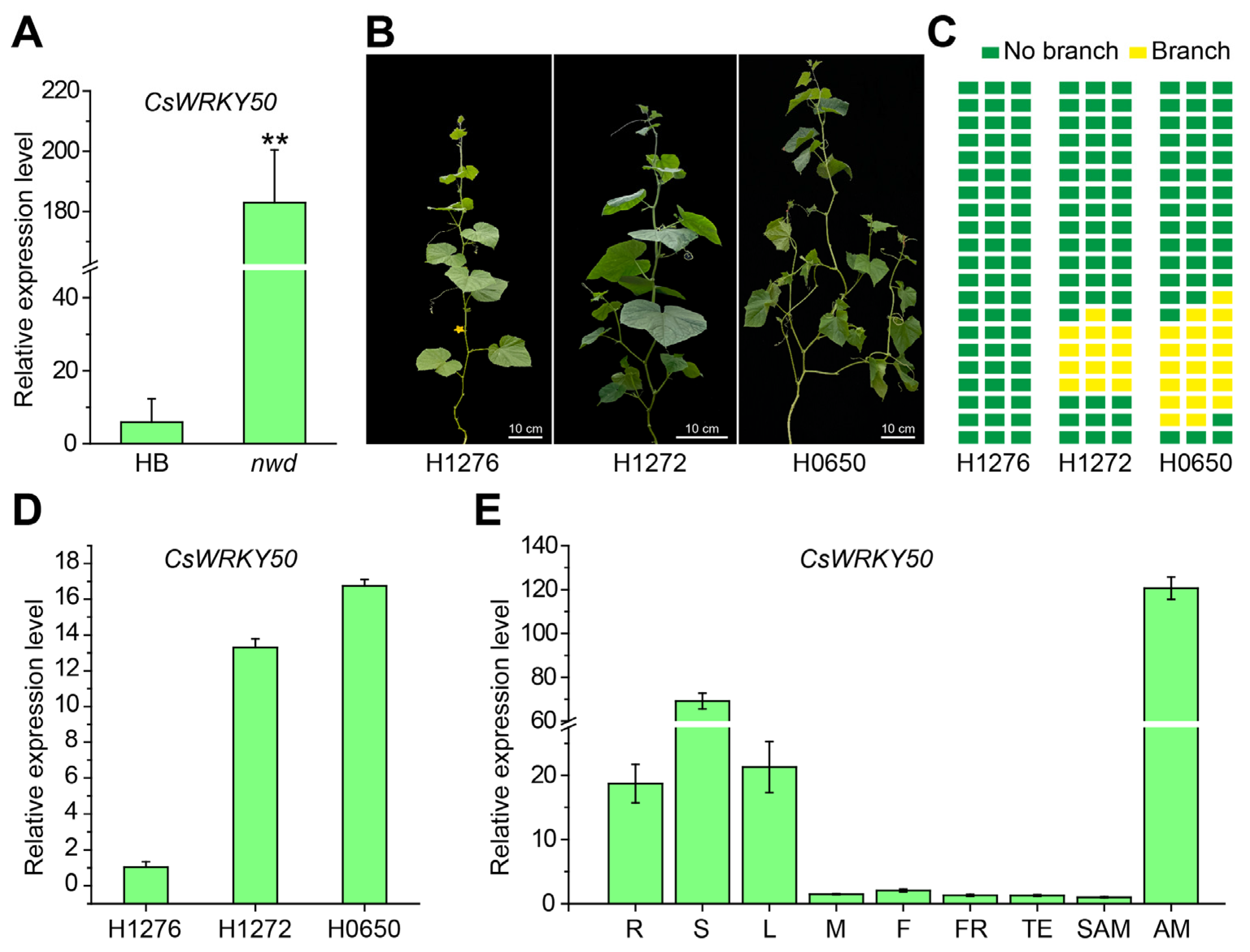
A multi-branching mutant was screened, named nwd, from a cucumber EMS mutant library [38]. Transcriptome data results indicated that the expression level of the CsaV3_6G042280 gene was significantly increased in the nwd mutant (Figure 1A), suggesting that this gene might be involved in promoting cucumber branching. Database comparison revealed that the cucumber CsaV3_6G042280 gene is homologous to the Arabidopsis thaliana WRKY50 gene, and thus it was named CsWRKY50. To further verify whether CsWRKY50 is closely related to cucumber branching, three cucumber varieties with significant differences in branching were selected (Figure 1B,C), and the expression level of CsWRKY50 was detected by real-time quantitative PCR (qRT-PCR). The results showed that in the branchless cucumber variety H1276, the expression level of CsWRKY50 was significantly lower than that in the two branching cucumber varieties (H1272 and H0650) (Figure 1D). Furthermore, the more branches a cucumber had, the higher the expression level of CsWRKY50 (Figure 1D). These results suggest that CsWRKY50 may play an important role in promoting cucumber branching.
To investigate the expression level of CsWRKY50 in different cucumber tissues, we analyzed its expression pattern in various cucumber tissues by qRT-PCR. As shown in Figure 1E, CsWRKY50 was detected in all tested cucumber tissues (roots, stems, leaves, male flowers, female flowers, fruits, tendrils, shoot apical meristems, and axillary meristems), and its expression levels varied significantly among different tissues. Notably, the expression levels were relatively high in stems and axillary meristems, with the highest expression observed in the axillary meristems. This result indicates that CsWRKY50 may have an important function in the initiation and development of cucumber axillary meristems.

3.2. Heterologous Overexpression of CsWRKY50 in Arabidopsis Thaliana Increases Branching

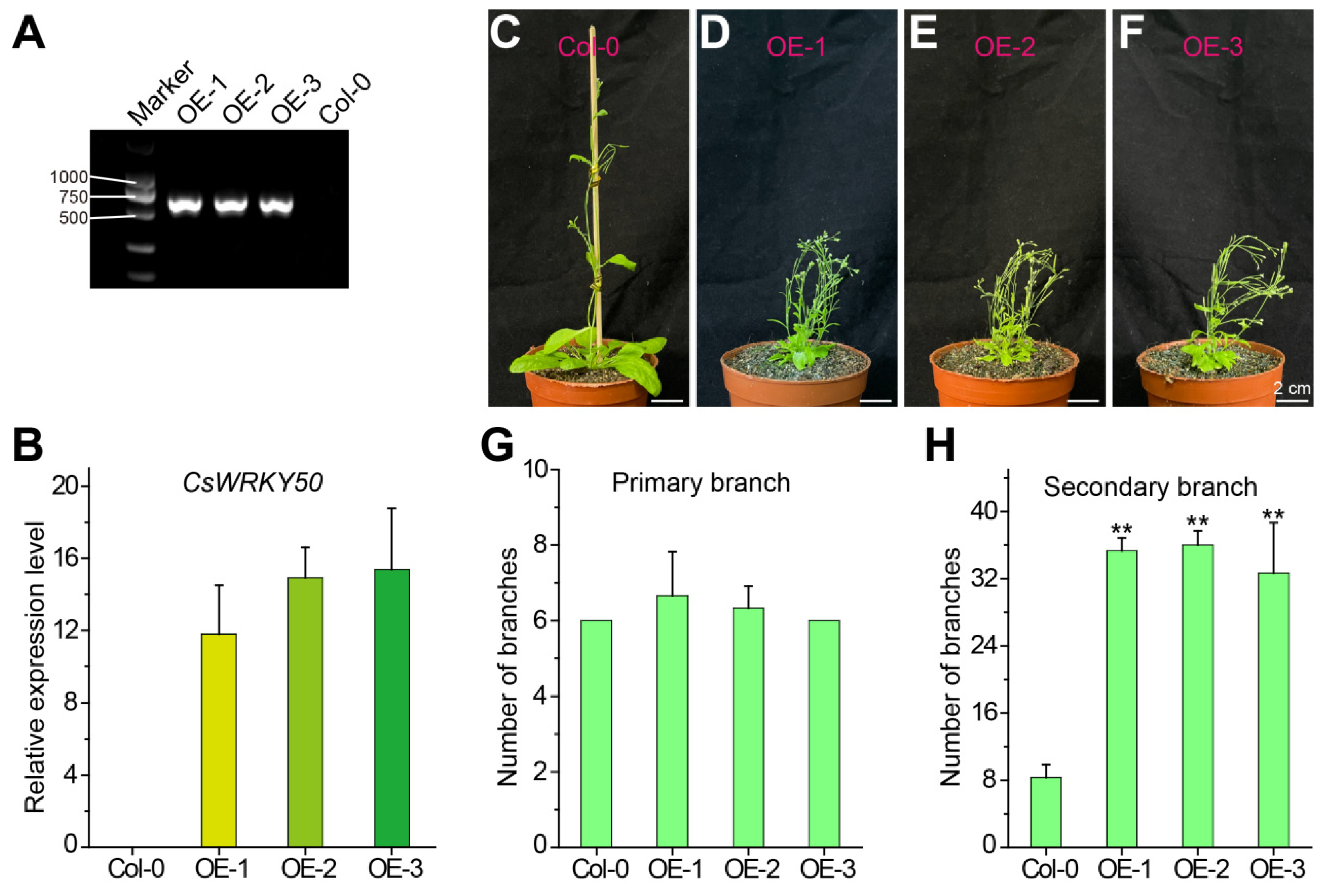
To further verify the promoting effect of CsWRKY50 on branching, we constructed a CsWRKY50 overexpression vector and overexpressed cucumber CsWRKY50 in Arabidopsis thaliana using transgenic technology. By screening T0 generation seedlings for resistance, we obtained three overexpression lines. RT-PCR and qRT-PCR were performed on T3 generation overexpression lines to detect the expression level of CsWRKY50. The results showed that CsWRKY50 was stably expressed in all three overexpression lines, and the expression levels of CsWRKY50 were similar across these lines (Figure 2A,B). We further quantified the number of primary (branches originating directly from the rosette) and secondary (branches from the primary bolt) branches and found that the overexpression plants significantly increased the number of secondary branches, but did not affect the number of primary branches (Figure 2G,H). The above results indicate that increased expression levels of cucumber CsWRKY50 can significantly increase the number of branches in Arabidopsis.

3.3. Overexpression of CsWRKY50 Leads to Imbalance in Auxin Transport, Signal Transduction, and Downstream Developmental Gene Regulatory Networks

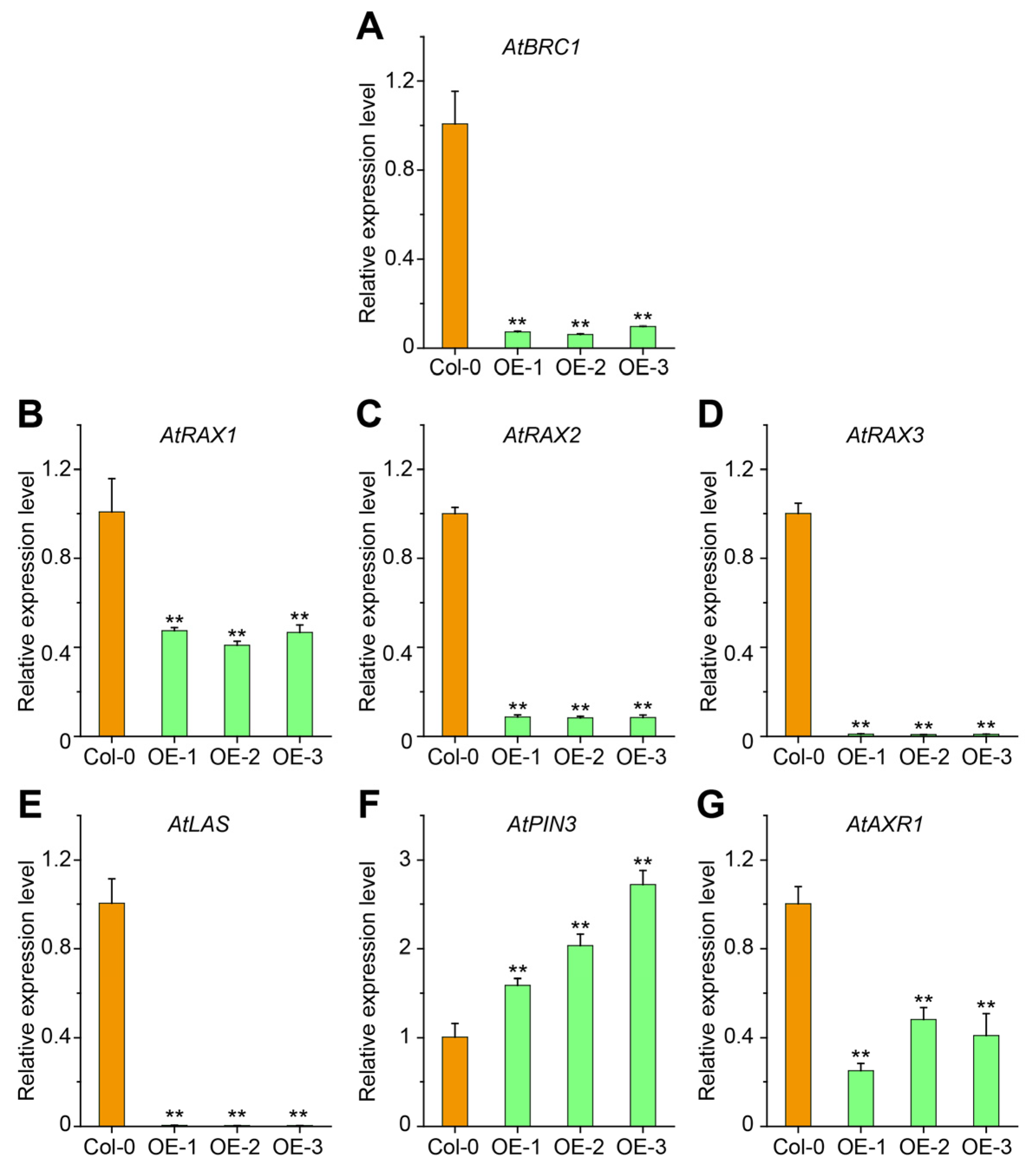
To investigate the specific mechanism by which cucumber CsWRKY50 regulates Arabidopsis branching, we analyzed the expression of multiple genes involved in the branching regulatory network in three CsWRKY50-overexpressing Arabidopsis lines. The results showed that the transcript level of AtBRC1 (a TCP family transcription factor), an inhibitor of axillary bud outgrowth, was significantly downregulated in CsWRKY50-overexpressing Arabidopsis lines (Figure 3A). Furthermore, the transcript levels of the other TCP family transcription factors (AtRAX1, AtRAX2, and AtRAX3) and the GRAS family transcription factor AtLAS, which play roles in axillary bud initiation and development, as well as the lateral meristem initiation factor REVOLUTA (AtREV), were all significantly downregulated (Figure 3B–E). These results indicate that CsWRKY50 negatively regulates genes related to bud dormancy and branch initiation. Additionally, the transcript level of the auxin efflux carrier AtPIN3 was significantly upregulated in CsWRKY50 overexpression plants (Figure 3F), while the transcript level of the auxin signal transduction-related gene AUXIN RESISTANT 1 (AtAXR1) was significantly downregulated (Figure 3G). This suggests that CsWRKY50 weakens plant sensitivity to auxin and may indirectly affect the maintenance of apical dominance by altering auxin transport and distribution, synergistically promoting branching.

3.4. CsWRKY50 Interacts with CsRAX5 and Truncated CsMYB84 in Yeast

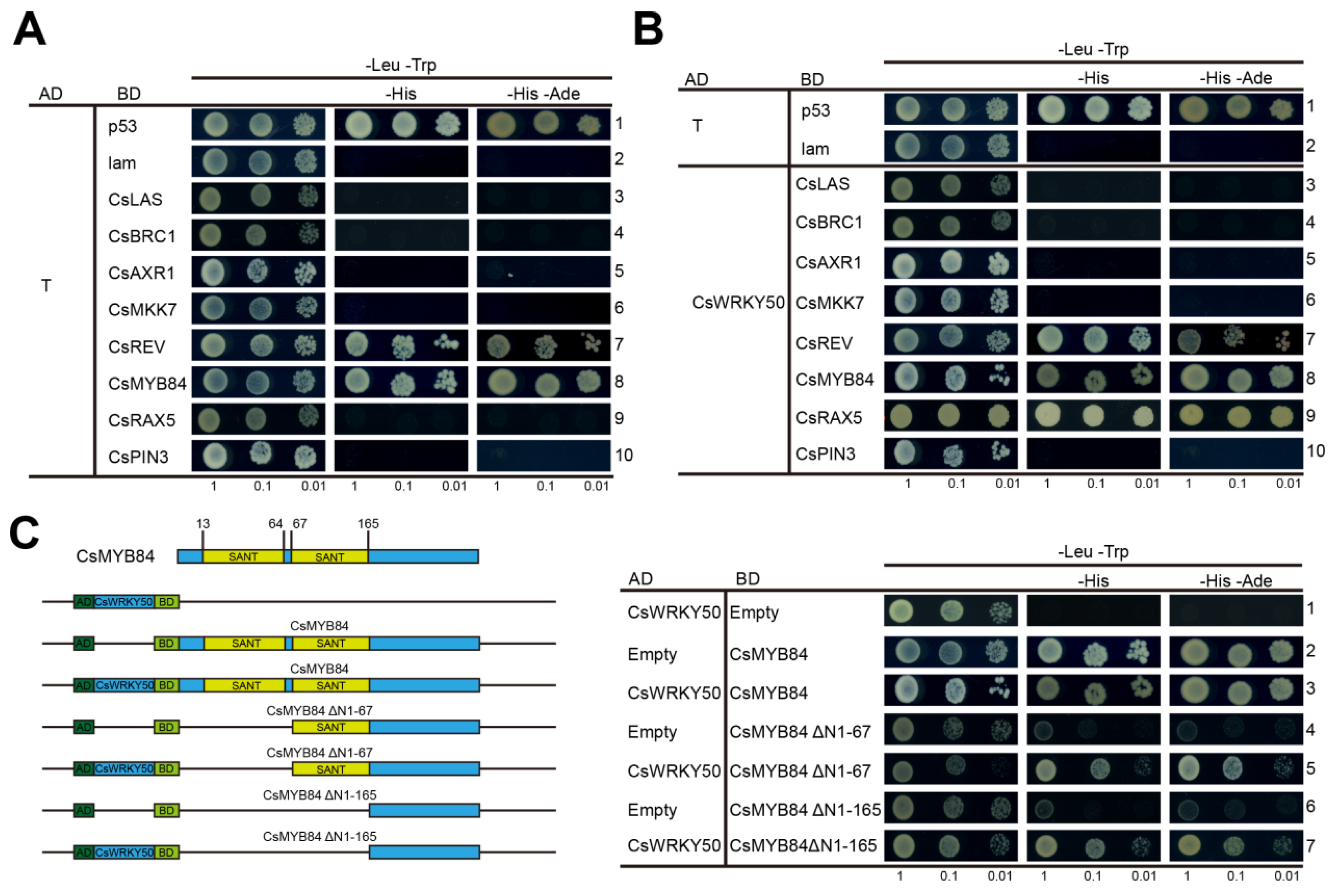
Given the significant differences in the expression levels of the Arabidopsis branching-related genes between wild-type and CsWRKY50-overexpressing Arabidopsis, to explore the possibility that these proteins might interact with CsWRKY50 protein to jointly regulate Arabidopsis lateral branch development, we retrieved the corresponding homologous genes in cucumber from the NCBI website for some of the aforementioned genes (CsaV3_6G013930, CsaV3_1G003610, CsaV3_2G034930, CsaV3_3G00359, CsaV3_UNG046320, and CsaV3_2G025790), and named them CsREV, CsBRC1, CsAXR1, CsLAS, CsRAX5, and CsMYB84, respectively. Due to severe auto-activation observed for CsREV and CsMYB84, we first performed yeast two-hybrid (Y2H) assays with the other four proteins. The results showed that CsWRKY50 only interacted with CsRAX5 (Figure 4A). Additionally, Y2H results also indicated that CsWRKY50 did not interact with CsMKK7 (CsaV3_1G007340) or CsPIN3 (CsaV3_5G028620).
To further verify whether CsMYB84 interacts with CsWRKY50 in yeast, we truncated the individual domains of CsMYB84 to analyze whether its domains interact with CsWRKY50. For this purpose, the domains of CsMYB84 were predicted in this study. CsMYB84 contains two SANT domains. Subsequently, we performed truncations according to CsMYB84 corresponding protein domains. Ultimately, truncation of CsMYB84 at the 67th amino acid (CsMYB84 ΔN1-67) abolished its auto-activation and enabled interaction with CsWRKY50 (Figure 4C). Further deletion of the N-terminal 165 amino acids of CsMYB84 revealed that the truncated protein (CsMYB84 ΔN1-165) still interacted with CsWRKY50, indicating that the interaction domain resides within the C-terminal region (Figure 4C).

3.5. CsWRKY50 May Regulate Branching Through a Pathway Independent of BRC1

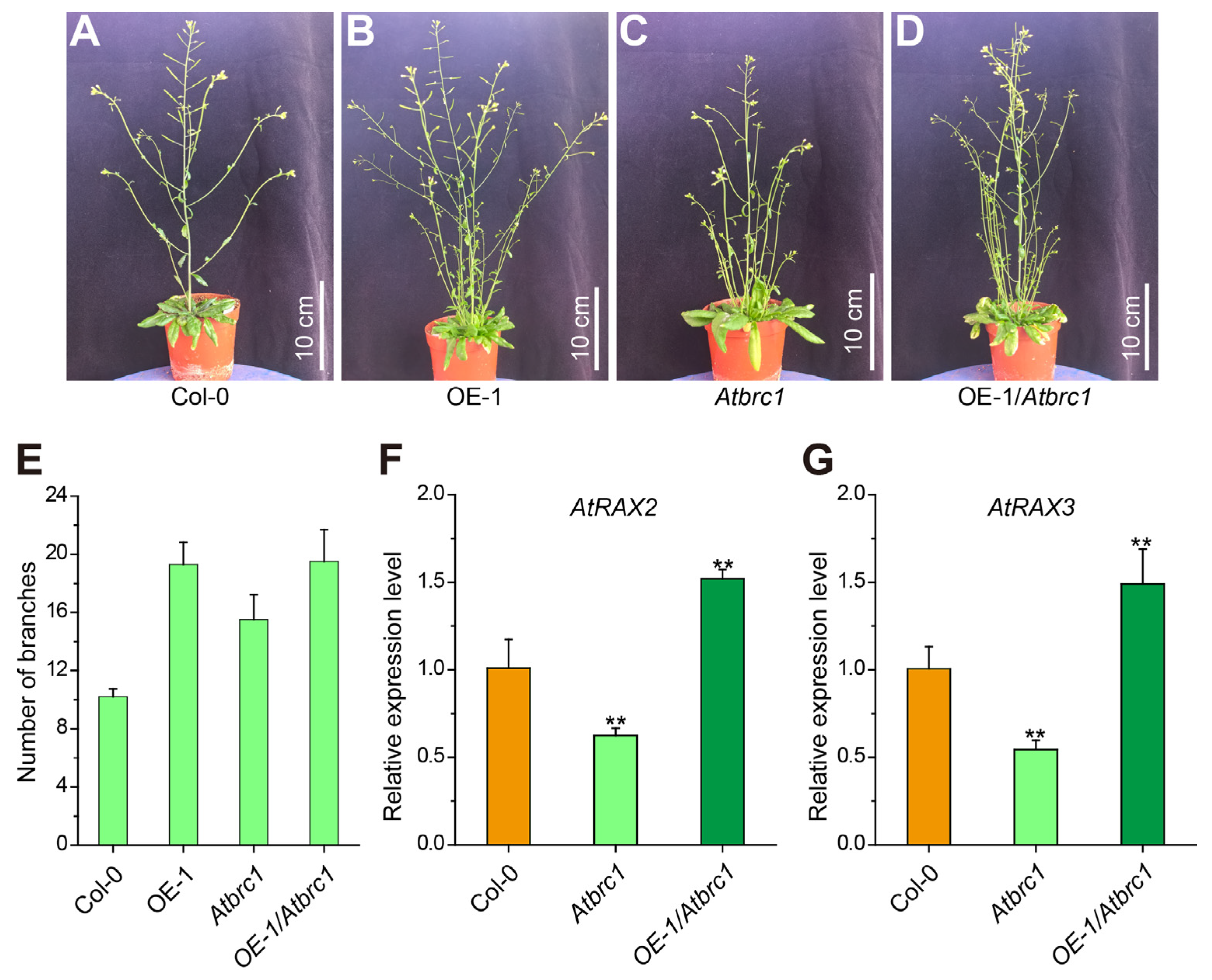
Given that the transcriptional level of the important branching regulatory gene BRC1 is significantly downregulated in CsWRKY50-overexpressing Arabidopsis, we further investigated whether there is an interaction between WRKY50 and BRC1 in regulating branching. By crossing CsWRKY50-overexpressing Arabidopsis with Arabidopsis Atbrc1 mutants, we identified homozygous Atbrc1 mutant plants that overexpress CsWRKY50 from the F2 generation (Figure 5D). Quantification of the number of branches for each genotype showed that both CsWRKY50-overexpressing Arabidopsis and Atbrc1 single mutants had significantly more total branches than the wild type. Furthermore, CsWRKY50-overexpressing Arabidopsis had more total branches than the Atbrc1 single mutant, while the homozygous Atbrc1 mutant plants overexpressing CsWRKY50 had the same number of total branches as the CsWRKY50-overexpressing plants (Figure 5A–E). These results indicate that both CsWRKY50 and BRC1 play important roles in branching, and suggest that CsWRKY50 likely promotes branching through a major pathway independent of BRC1.
We further analyzed the transcriptional levels of two important negative regulatory genes of branching, AtRAX2 and AtRAX3, in the homozygous Atbrc1 mutant plants overexpressing CsWRKY50 using qRT-PCR. The results showed that compared to the wild type, the transcriptional levels of AtRAX2 and AtRAX3 were significantly downregulated in the Atbrc1 single mutant but significantly upregulated in the homozygous Atbrc1 mutant plants overexpressing CsWRKY50 (Figure 5F,G). This result suggests that, unlike BRC1, CsWRKY50 promotes branching by not suppressing the expression of RAX genes. The reason for the increased transcriptional levels of RAX genes in CsWRKY50-overexpressing plants warrants further investigation.

4. Discussion

Shoot branching represents an essential agronomic trait governed by intricate regulatory networks that significantly influence plant architecture and yield formation [5,40,41,42]. The classical model underscores the central importance of systemic auxin signaling originating from apical regions and localized inhibitory pathways centered on BRC1/TB1 [8,40]. In recent years, members of the WRKY transcription factors have been recognized as pivotal regulatory components in branching control across diverse plant species, yet their functional mechanisms in cucumber remain poorly understood [32]. This study identifies and validates CsWRKY50 as a novel positive regulator of shoot branching in cucumber, offering fresh perspectives on the diversity and complexity of branching regulatory networks.
Transcriptomic analysis of the multi-branching mutant nwd, combined with expression profiling across cucumber accessions with varying branching capacities, revealed a significant positive correlation between CsWRKY50 expression levels and branch number (Figure 1A–D). Its predominant expression in axillary meristems suggests a functional association with key sites of branch initiation (Figure 1E). This finding aligns with reports of WRKY factors modulating branching in other systems. For instance, in tomato, WRKY-B directly regulates the expression of branching-related genes BL, PIN4, and IAA15 to influence auxin homeostasis and lateral shoot branching [35]. The present work extends the regulatory role of WRKY family members to cucumber shoot branching and positions CsWRKY50 as a potential mediator linking upstream signals with downstream developmental programs.
Heterologous expression experiments demonstrated that overexpression of CsWRKY50 in Arabidopsis significantly increased branch number (Figure 2H). Further molecular dissection indicated that this phenotypic alteration was accompanied by dysregulated expression of auxin-related genes: the AtPIN3 was up-regulated, whereas the AtAXR1 was down-regulated (Figure 3). Based on these transcript-level changes, we speculate that CsWRKY50 may influence auxin regulation through a potential mechanism: on one hand, it might enhance auxin efflux from buds by up-regulating PIN3, thereby disrupting the high auxin microenvironment required for bud dormancy maintenance; on the other hand, it might reduce cellular sensitivity to auxin by down-regulating AXR1. This hypothetical model shares conceptual parallels with known branching-promoting strategies, such as cytokinin-mediated antagonism of auxin transport via PIN protein regulation [13,43,44]. However, it must be emphasized that the data in this study are derived solely from transcript-level analysis in a heterologous expression system. Therefore, the proposed mechanistic explanation should be regarded as a working hypothesis consistent with the current data and requiring future validation.
Expression analyses showed that CsWRKY50 overexpression in Arabidopsis altered transcript levels of several genes involved in bud initiation and dormancy, including AtBRC1, AtRAX1/2/3, and AtLAS (Figure 3). Notably, when CsWRKY50 was overexpressed in the Arabidopsis Atbrc1 mutant background, its branching-promoting effect persisted, with branch numbers exceeding those of the Atbrc1 single mutant (Figure 5E). This additive phenotype strongly suggests that CsWRKY50 likely promotes branching through a major pathway parallel to and largely independent of BRC1. Interestingly, under these conditions, the expression of RAX genes was up-regulated (Figure 5F,G). This unexpected finding adds complexity to the regulatory network, and its underlying mechanism awaits further investigation.
Yeast two-hybrid assays provided direct evidence for CsWRKY50′s molecular interactions, confirming its association with CsRAX5 and a truncated form of CsMYB84 (Figure 4). The interaction with CsRAX5 is particularly noteworthy, as it may explain apparent discrepancies between gene expression and phenotypic outcomes: it is plausible that, rather than simply suppressing RAX transcription, CsWRKY50 might modulate RAX protein activity, stability, or subcellular localization through its observed protein–protein interactions. This represents a testable hypothesis for future investigation. Although recent studies have shown that cucumber RAX5 negatively regulates leaf size, fruit set, and plant height through auxin glycosylation [45,46], its involvement in branching control remains unconfirmed. Thus, the potential functional significance of the CsWRKY50-CsRAX5 module in cucumber branching merits further investigation. Additionally, WRKY50 also interacts with CsMYB84. However, it should be particularly noted that, given the auto-activating activity exhibited by the full-length CsMYB84 in the yeast system, the interaction has currently only been observed with a truncated, non-physiological fragment, making its biological relevance unclear. This result is merely a preliminary in vitro observation and requires further verification at the full-length protein level using alternative methods (such as Co-IP or BiFC) before any potential biological function can be inferred. In conclusion, this study systematically elucidates the function of CsWRKY50 as a positive regulator of shoot branching in cucumber. These findings not only provide a promising candidate gene for improving cucumber plant architecture but also contribute to the theoretical foundation for designing ideal plant types and enhancing both quality and efficiency in cucumber production.

5. Conclusions

In summary, our study demonstrates that CsWRKY50 is a positive regulator of shoot branching in cucumber. The expression level of CsWRKY50 is positively correlated with the number of branches. Moreover, heterologous expression of cucumber CsWRKY50 in Arabidopsis promotes branching. Furthermore, CsWRKY50 may function by influencing auxin-related processes, interacting with proteins such as CsRAX5, and acting through a pathway independent of BRC1. These findings provide a basis for further dissecting the molecular network of branching regulation and lay a research foundation for optimizing cucumber plant architecture in the future.

Supplementary Materials

The following supporting information can be downloaded at https://www.mdpi.com/article/10.3390/horticulturae12020191/s1, Table S1: Primers used in this study.

Author Contributions

Conceptualization, S.L. and Y.Z. (Yuelong Zhou); Methodology, S.L. and X.L. (Xiang Li); Software, X.L. (Xiang Li), M.L. and X.L. (Xiaomin Liao); Validation, X.L. (Xiang Li) and M.L.; Formal analysis, X.L. (Xiang Li), Z.J., Z.H. (Ziyi Hua) and Y.W.; Data curation, S.L., Y.Z. (Yuelong Zhou), X.L. (Xiang Li), Y.Z. (Yong Zhou) and Z.H. (Zhaoyang Hu); Writing—original draft preparation, Y.Z. (Yuelong Zhou); Writing—review and editing, Y.Z. (Yuelong Zhou) and S.L.; Supervision, Z.H. (Zhaoyang Hu); Project administration, S.L.; funding acquisition, S.L. and Y.Z. (Yuelong Zhou). All authors have read and agreed to the published version of the manuscript.

Funding

This research was funded by the Key Project of the Natural Science Foundation of Jiangxi Province, China (20232ACB205020, 20242BAB20255, 20232BAB205013, 20224BAB215024), the National Natural Science Foundation of China (32160709), and supported by the earmarked fund for JXARS-04.

Data Availability Statement

The original contributions presented in this study are included in the article and Supplementary Materials. Further inquiries can be directed to the corresponding author.

Conflicts of Interest

The authors declare that they have no conflicts of interest.

References

  1. Ward, S.P.; Leyser, O. Shoot branching. Curr. Opin. Plant Biol. 2004, 7, 73–78. [Google Scholar] [CrossRef]
  2. Mizzotti, C.; Galliani, B.M.; Dreni, L.; Sommer, H.; Bombarely, A.; Masiero, S. ERAMOSA controls lateral branching in snapdragon. Sci. Rep. 2017, 7, 41319. [Google Scholar] [CrossRef] [PubMed]
  3. Rameau, C.; Bertheloot, J.; Leduc, N.; Andrieu, B.; Foucher, F.; Sakr, S. Multiple pathways regulate shoot branching. Front. Plant Sci. 2015, 5, 741. [Google Scholar] [CrossRef]
  4. Ongaro, V.; Leyser, O. Hormonal control of shoot branching. J. Exp. Bot. 2008, 59, 67–74. [Google Scholar] [CrossRef] [PubMed]
  5. Liu, X.; Chen, J.; Zhang, X. Genetic regulation of shoot architecture in cucumber. Hortic. Res. 2021, 8, 143. [Google Scholar] [CrossRef] [PubMed]
  6. Domagalska, M.A.; Leyser, O. Signal integration in the control of shoot branching. Nat. Rev. Mol. Cell Biol. 2011, 12, 211–221. [Google Scholar] [CrossRef]
  7. Liu, Z.; Yang, J.; Li, S.; Liu, L.; Qanmber, G.; Chen, G.; Duan, Z.; Zhao, N.; Wang, G. Systematic Characterization of TCP Gene Family in Four Cotton Species Revealed That GhTCP62 Regulates Branching in Arabidopsis. Biology 2021, 10, 1104. [Google Scholar] [CrossRef]
  8. Leyser, O. Regulation of shoot branching by auxin. Trends Plant Sci. 2003, 8, 541–545. [Google Scholar] [CrossRef]
  9. Lo, S.F.; Yang, S.Y.; Chen, K.T.; Hsing, Y.I.; Zeevaart, J.A.; Chen, L.J.; Yu, S.M. A novel class of gibberellin 2-oxidases control semidwarfism, tillering, and root development in rice. Plant Cell 2008, 20, 2603–2618. [Google Scholar] [CrossRef]
  10. Silverstone, A.L.; Ciampaglio, C.N.; Sun, T. The Arabidopsis RGA gene encodes a transcriptional regulator repressing the gibberellin signal transduction pathway. Plant Cell 1998, 10, 155–169. [Google Scholar] [CrossRef]
  11. Choubane, D.; Rabot, A.; Mortreau, E.; Legourrierec, J.; Péron, T.; Foucher, F.; Ahcène, Y.; Pelleschi-Travier, S.; Leduc, N.; Hamama, L.; et al. Photocontrol of bud burst involves gibberellin biosynthesis in Rosa sp. J. Plant Physiol. 2012, 169, 1271–1280. [Google Scholar] [CrossRef] [PubMed]
  12. Hussain, S.; Chang, J.; Li, J.; Chen, L.; Ahmad, S.; Song, Z.; Zhang, B.; Chen, X. Multifunctional Role of Cytokinin in Horticultural Crops. Int. J. Mol. Sci. 2025, 26, 1037. [Google Scholar] [CrossRef] [PubMed]
  13. Waldie, T.; Leyser, O. Cytokinin Targets Auxin Transport to Promote Shoot Branching. Plant Physiol. 2018, 177, 803–818. [Google Scholar] [CrossRef] [PubMed]
  14. Miguel, L.C.; Longnecker, N.E.; Ma, Q.; Osborne, L.; Atkins, C.A. Branch development in Lupinus angustifolius L. I. Not all branches have the same potential growth rate. J. Exp. Bot. 1998, 49, 547–553. [Google Scholar] [CrossRef]
  15. Emery, R.N.; Longnecker, N.E.; Atkins, C.A. Branch development in Lupinus angustifolius L. II. Relationship with endogenous ABA, IAA and cytokinins in axillary and main stem buds. J. Exp. Bot. 1998, 49, 555–562. [Google Scholar]
  16. Crawford, S.; Shinohara, N.; Sieberer, T.; Williamson, L.; George, G.; Hepworth, J.; Müller, D.; Domagalska, M.A.; Leyser, O. Strigolactones enhance competition between shoot branches by dampening auxin transport. Development 2010, 137, 2905–2913. [Google Scholar] [CrossRef]
  17. Hayward, A.; Stirnberg, P.; Beveridge, C.; Leyser, O. Interactions between auxin and strigolactone in shoot branching control. Plant Physiol. 2009, 151, 400–412. [Google Scholar] [CrossRef]
  18. van Rongen, M.; Bennett, T.; Ticchiarelli, F.; Leyser, O. Connective auxin transport contributes to strigolactone-mediated shoot branching control independent of the transcription factor BRC1. PLoS Genet. 2019, 15, e1008023. [Google Scholar] [CrossRef]
  19. Shinohara, N.; Taylor, C.; Leyser, O. Strigolactone can promote or inhibit shoot branching by triggering rapid depletion of the auxin efflux protein PIN1 from the plasma membrane. PLoS Biol. 2013, 11, e1001474. [Google Scholar] [CrossRef]
  20. Shen, J.; Ge, D.; Song, X.; Xiao, J.; Liu, X.; Che, G.; Gu, R.; Wang, Z.; Cheng, Z.; Song, W.; et al. Roles of CsBRC1-like in leaf and lateral branch development in cucumber. Plant Sci. 2021, 302, 110681. [Google Scholar] [CrossRef]
  21. Shen, J.; Zhang, Y.; Ge, D.; Wang, Z.; Song, W.; Gu, R.; Che, G.; Cheng, Z.; Liu, R.; Zhang, X. CsBRC1 inhibits axillary bud outgrowth by directly repressing the auxin efflux carrier CsPIN3 in cucumber. Proc. Natl. Acad. Sci. USA 2019, 116, 17105–17114. [Google Scholar] [CrossRef] [PubMed]
  22. Dun, E.A.; de Saint Germain, A.; Rameau, C.; Beveridge, C.A. Antagonistic action of strigolactone and cytokinin in bud outgrowth control. Plant Physiol. 2012, 158, 487–498. [Google Scholar] [CrossRef] [PubMed]
  23. Seale, M.; Bennett, T.; Leyser, O. BRC1 expression regulates bud activation potential but is not necessary or sufficient for bud growth inhibition in Arabidopsis. Development 2017, 144, 1661–1673. [Google Scholar] [PubMed]
  24. González-Grandío, E.; Pajoro, A.; Franco-Zorrilla, J.M.; Tarancón, C.; Immink, R.G.; Cubas, P. Abscisic acid signaling is controlled by a BRANCHED1/HD-ZIP I cascade in Arabidopsis axillary buds. Proc. Natl. Acad. Sci. USA 2017, 114, E245–E254. [Google Scholar] [CrossRef]
  25. Zhao, W.; Chen, Z.; Liu, X.; Che, G.; Gu, R.; Zhao, J.; Wang, Z.; Hou, Y.; Zhang, X. CsLFY is required for shoot meristem maintenance via interaction with WUSCHEL in cucumber (Cucumis sativus). New Phytol. 2018, 218, 344–356. [Google Scholar] [CrossRef]
  26. Yang, F.; Xu, Y.; Wang, Z.; Dong, B.; Zhou, S.; Jiang, M.; Li, J. Identification of CsAFP3-like as a novel gene regulating determinate growth of lateral branch in cucumber. Theor. Appl. Genet. 2025, 138, 306. [Google Scholar] [CrossRef]
  27. Yuan, L.-H.; Pan, J.-S.; Wang, G.; Zhu, J.; Zhang, W.-W.; Li, Z.; He, H.-L.; Yang, Z.-N.; Cai, R.; Zhu, L.-H. The Cucumber Lateral Suppressor Gene (CLS) Is Functionally Associated with Axillary Meristem Initiation. Plant Mol. Biol. Rep. 2010, 28, 421–429. [Google Scholar] [CrossRef]
  28. Chen, J.; Liu, L.; Wang, G.; Chen, G.; Liu, X.; Li, M.; Han, L.; Song, W.; Wang, S.; Li, C.; et al. The AGAMOUS-LIKE 16-GENERAL REGULATORY FACTOR 1 module regulates axillary bud outgrowth via catabolism of abscisic acid in cucumber. Plant Cell 2024, 36, 2689–2708. [Google Scholar] [CrossRef]
  29. Chen, J.; Chen, G.; Guo, J.; He, Y.; Liu, L.; Wang, S.; Gu, C.; Han, L.; Li, M.; Song, W.; et al. The CsTIE1-CsAGL16 module regulates lateral branch outgrowth and drought tolerance in cucumber. Hortic. Res. 2024, 12, uhae279. [Google Scholar] [CrossRef]
  30. Yang, Y.; Nicolas, M.; Zhang, J.; Yu, H.; Guo, D.; Yuan, R.; Zhang, T.; Yang, J.; Cubas, P.; Qin, G. The TIE1 transcriptional repressor controls shoot branching by directly repressing BRANCHED1 in Arabidopsis. PLoS Genet. 2018, 14, e1007296. [Google Scholar] [CrossRef]
  31. Zhang, K.; Zhang, J.; Cui, C.; Chai, L.; Zheng, B.; Jiang, L.; Li, H. The WRKY28-BRC1 Transcription Factor Module Controls Shoot Branching in Brassica napus. Plants 2025, 14, 486. [Google Scholar] [CrossRef]
  32. Eulgem, T.; Rushton, P.J.; Robatzek, S.; Somssich, I.E. The WRKY superfamily of plant transcription factors. Trends Plant Sci. 2000, 5, 199–206. [Google Scholar] [CrossRef]
  33. Guo, D.; Zhang, J.; Wang, X.; Han, X.; Wei, B.; Wang, J.; Li, B.; Yu, H.; Huang, Q.; Gu, H.; et al. The WRKY Transcription Factor WRKY71/EXB1 Controls Shoot Branching by Transcriptionally Regulating RAX Genes in Arabidopsis. Plant Cell 2015, 27, 3112–3127. [Google Scholar] [CrossRef] [PubMed]
  34. Yang, L.; Fang, S.; Liu, L.; Zhao, L.; Chen, W.; Li, X.; Xu, Z.; Chen, S.; Wang, H.; Yu, D. WRKY transcription factors: Hubs for regulating plant growth and stress responses. J. Integr. Plant Biol. 2025, 67, 488–509. [Google Scholar] [CrossRef] [PubMed]
  35. Yang, H.; Zhou, K.; Wu, Q.; Jia, X.; Wang, H.; Yang, W.; Lin, L.; Hu, X.; Pan, B.; Li, P.; et al. The tomato WRKY-B transcription factor modulates lateral branching by targeting BLIND, PIN4, and IAA15. Hortic. Res. 2024, 11, uhae193. [Google Scholar] [CrossRef] [PubMed]
  36. Gao, Q.M.; Venugopal, S.; Navarre, D.; Kachroo, A. Low oleic acid-derived repression of jasmonic acid-inducible defense responses requires the WRKY50 and WRKY51 proteins. Plant Physiol. 2011, 155, 464–476. [Google Scholar] [CrossRef]
  37. Hussain, R.M.F.; Sheikh, A.H.; Haider, I.; Quareshy, M.; Linthorst, H.J.M. Arabidopsis WRKY50 and TGA Transcription Factors Synergistically Activate Expression of PR1. Front. Plant Sci. 2018, 9, 930. [Google Scholar] [CrossRef]
  38. Zhou, Y.; Xu, M.; Zhou, Y.; Hu, Z.; Liu, S. CsNWD Encoding VPS62 Emerges as a Candidate Gene Conferring the Glabrous Phenotype in Cucumber. Agronomy 2024, 14, 2019. [Google Scholar] [CrossRef]
  39. Clough, S.J.; Bent, A.F. Floral dip: A simplified method for Agrobacterium-mediated transformation of Arabidopsis thaliana. Plant J. 1998, 16, 735–743. [Google Scholar] [CrossRef]
  40. Yun, C.; Ma, W.; Feng, J.; Li, L. Branching angles in the modulation of plant architecture: Molecular mechanisms, dynamic regulation, and evolution. Plant Commun. 2025, 6, 101292. [Google Scholar] [CrossRef]
  41. Li, J.; Yao, X.; Lai, H.; Zhang, X.; Zhong, J. The diversification of the shoot branching system: A quantitative and comparative perspective in meristem determinacy. Curr. Opin. Plant Biol. 2024, 81, 102574. [Google Scholar] [CrossRef]
  42. Wang, M.; Le Moigne, M.-A.; Bertheloot, J.; Crespel, L.; Perez-Garcia, M.-D.; Ogé, L.; Demotes-Mainard, S.; Hamama, L.; Davière, J.-M.; Sakr, S. BRANCHED1: A Key Hub of Shoot Branching. Front. Plant Sci. 2019, 10, 76. [Google Scholar] [CrossRef]
  43. Müller, D.; Leyser, O. Auxin, cytokinin and the control of shoot branching. Ann. Bot. 2011, 107, 1203–1212. [Google Scholar] [CrossRef]
  44. Barbier, F.F.; Dun, E.A.; Kerr, S.C.; Chabikwa, T.G.; Beveridge, C.A. An Update on the Signals Controlling Shoot Branching. Trends Plant Sci. 2019, 24, 220–236. [Google Scholar] [CrossRef]
  45. Zhao, W.; Wang, J.; Yang, H.; Hou, X.; Zhang, Z.; Chen, J.; Wang, H.; Yan, C. Large-scale analysis of MYB genes in cucurbitaceae identifies a novel gene regulating plant height. Hortic. Res. 2025, 12, uhaf210. [Google Scholar] [CrossRef]
  46. Chen, J.; Liu, L.; Chen, G.; Wang, S.; Liu, Y.; Zhang, Z.; Li, H.; Wang, L.; Zhou, Z.; Zhao, J.; et al. CsRAXs negatively regulate leaf size and fruiting ability through auxin glycosylation in cucumber. J. Integr. Plant Biol. 2024, 66, 1024–1037. [Google Scholar] [CrossRef]
Figure 1. The transcriptional level of CsWRKY50 is elevated in multi-branched cucumber varieties. (A) Transcriptional level of CsWRKY50 in wild type (HB) and nwd mutants. (B) Branching patterns of three cucumber varieties: H1276, H1272, and H0650. (C) Statistical analysis of branching in the cucumber varieties shown in (B). Three plants were analyzed per variety. (D) Transcriptional level of CsWRKY50 in the three cucumber varieties: H1276, H1272, and H0650. Similar results were obtained in three independent experiments. (E) Transcriptional level of CsWRKY50 in different tissues of cucumber. Similar results were obtained in three independent experiments. R: Roots; S: Stems; L: Leaves; M: Male flowers; F: Female flowers; FR: Fruits; TE: Tendrils; SAM: Shoot apical meristem; AM: Axillary meristem. The results represent the means ± SD. ** p < 0.01 (t test compared to HB).
Horticulturae 12 00191 g001
Figure 2. Expression of CsWRKY50 increases the branching number in Arabidopsis. (A) RT-PCR results of three CsWRKY50-overexpressing Arabidopsis lines (OE-1, OE-2, OE-3). Three independent replicates produced similar results. (B) qRT-PCR results of three CsWRKY50-overexpressing Arabidopsis lines (OE-1, OE-2, OE-3). Results are the average of four biological replicates; three independent replicates produced similar results. (CF) Representative images of 40-day-old wild-type (Col-0) and CsWRKY50-overexpressing Arabidopsis (OE-1, OE-2, OE-3) plants. (G) Statistical results of primary branching number in wild-type (Col-0) and CsWRKY50-overexpressing Arabidopsis (OE-1, OE-2, OE-3). Five plants per line were analyzed, and the results are the average of five biological replicates. (H) Statistical results of secondary branching number in wild-type (Col-0) and CsWRKY50-overexpressing Arabidopsis (OE-1, OE-2, OE-3). Five plants per line were analyzed, and the results represent the means ± SD. ** p < 0.01 (t test compared to Col-0 values).
Horticulturae 12 00191 g002
Figure 3. The expression levels of branching-related genes change in CsWRKY50-overexpressing Arabidopsis. The transcription levels of AtBRC1 (A), AtRAX1 (B), AtRAX2 (C), AtRAX3 (D), AtLAS (E), AtPIN3 (F), and AtAXR1 (G) in wild-type (Col-0) and three CsWRKY50-overexpressing Arabidopsis lines (OE-1, OE-2, OE-3). Similar results were obtained from three independent replicates. The results represent the means ± SD. ** p < 0.01 (t test compared to Col-0 values).
Horticulturae 12 00191 g003
Figure 4. CsWRKY50 interacts with CsRAX5 and truncated CsMYB84 in yeast. (A) Detection of self-activation of CsLAS, CsBRC1, CsAXR1, CsMKK7, CsREV, CsMYB84, CsRAX5, and CsPIN3 in yeast. (B) Yeast two-hybrid (Y2H) assays were performed between CsLAS, CsBRC1, CsAXR1, CsMKK7, CsREV, CsMYB84, CsRAX5, and CsPIN3 with the CsWRKY50 protein. SV40 T antigen and p53 were used as positive controls, while SV40 T antigen and lam were used as negative controls. Transformed cells were cultured on SD/-Leu-Trp medium for three days and on SD/-Leu-Trp-His and SD/-Leu-Trp-His-Ade media for three days. Dilution ratios are shown at the bottom. Three independent replicates produced similar results. (C) Yeast two-hybrid (Y2H) assays were performed between truncated CsMYB84 and CsWRKY50. The truncation scheme is shown on the left, and the Y2H results of truncated CsMYB84 with CsWRKY50 are shown on the right. Three independent replicates produced the same results.
Horticulturae 12 00191 g004
Figure 5. CsWRKY50 likely promotes branching through a pathway independent of BRC1. (AD) The picture of 7-week-old Col-0 (A), OE-1 (B), Atbrc1 (C), and OE-1/Atbrc1 (D) plants. (E) Statistical analysis of total branching numbers in Col-0, OE-1, Atbrc1, and OE-1/Atbrc1 plants. (F) Transcriptional levels of AtRAX2 in Col-0, Atbrc1, and OE-1/Atbrc1 plants. (G) Transcriptional levels of AtRAX3 in Col-0, Atbrc1, and OE-1/Atbrc1 plants. The results represent the means ± SD. ** p < 0.01 (t test compared to Col-0 values).
Horticulturae 12 00191 g005
Disclaimer/Publisher’s Note: The statements, opinions and data contained in all publications are solely those of the individual author(s) and contributor(s) and not of MDPI and/or the editor(s). MDPI and/or the editor(s) disclaim responsibility for any injury to people or property resulting from any ideas, methods, instructions or products referred to in the content.