Review

Sustainable Soil Disinfestation Approaches in Crop Production: From Chemical Dependency to Ecological Resilience


by
Antonietta Mirabella
1,
Michele Ciriello
1,
Youssef Rouphael
1,
Christophe El-Nakhel
1,* and
Carlo Altucci
2
1
Department of Agricultural Sciences, University of Naples Federico II, 80055 Portici, NA, Italy
2
Department of Advanced Biomedical Sciences, University of Naples Federico II, 80131 Naples, NA, Italy
*
Author to whom correspondence should be addressed.
Horticulturae 2026, 12(2), 189; https://doi.org/10.3390/horticulturae12020189
Submission received: 9 December 2025 / Revised: 19 January 2026 / Accepted: 26 January 2026 / Published: 3 February 2026
(This article belongs to the Section Plant Pathology and Disease Management (PPDM))

Abstract

Soil management is crucial for addressing soil-borne pathogens, weeds, and pests, ensuring sustainable crop productivity. Traditional chemical fumigants, such as methyl bromide, have been effective but pose serious environmental risks, including ozone depletion and reduced soil biodiversity. Consequently, attention has shifted toward more sustainable alternatives. Techniques like soil solarization, anaerobic soil disinfestation (ASD), biofumigation, and the use of biological control agents (BCAs) offer environmentally friendly options for managing soil-borne diseases. Steam and microwave disinfestation are also promising techniques; however, further development is required to improve their practical efficiency. Integrated management approaches, which combine multiple interventions, have proven particularly effective, offering flexibility and enhancing control through complementary techniques. Additionally, emerging technologies such as artificial intelligence and hyperspectral imaging provide new opportunities for real-time monitoring and decision-support to optimize the timing and targeting of pest management interventions. This review emphasizes the potential of sustainable soil pest control methods to reduce reliance on chemical fumigants, improve crop yield and quality, and support environmentally responsible farming practices. It also examines the challenges associated with scalability, cost, and variable effectiveness, while outlining the strengths, weaknesses, and mechanisms of each method. Further research on regional adaptation, technological integration, and long-term impacts is essential to fully optimize these innovative solutions for food security and sustainable agriculture.

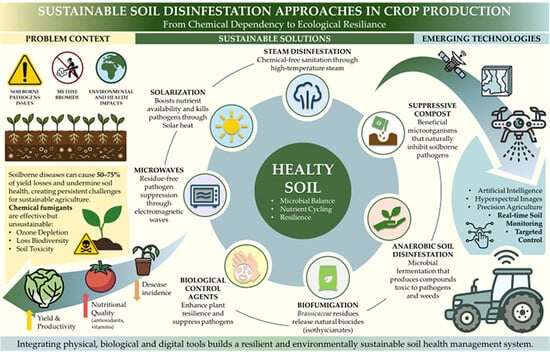
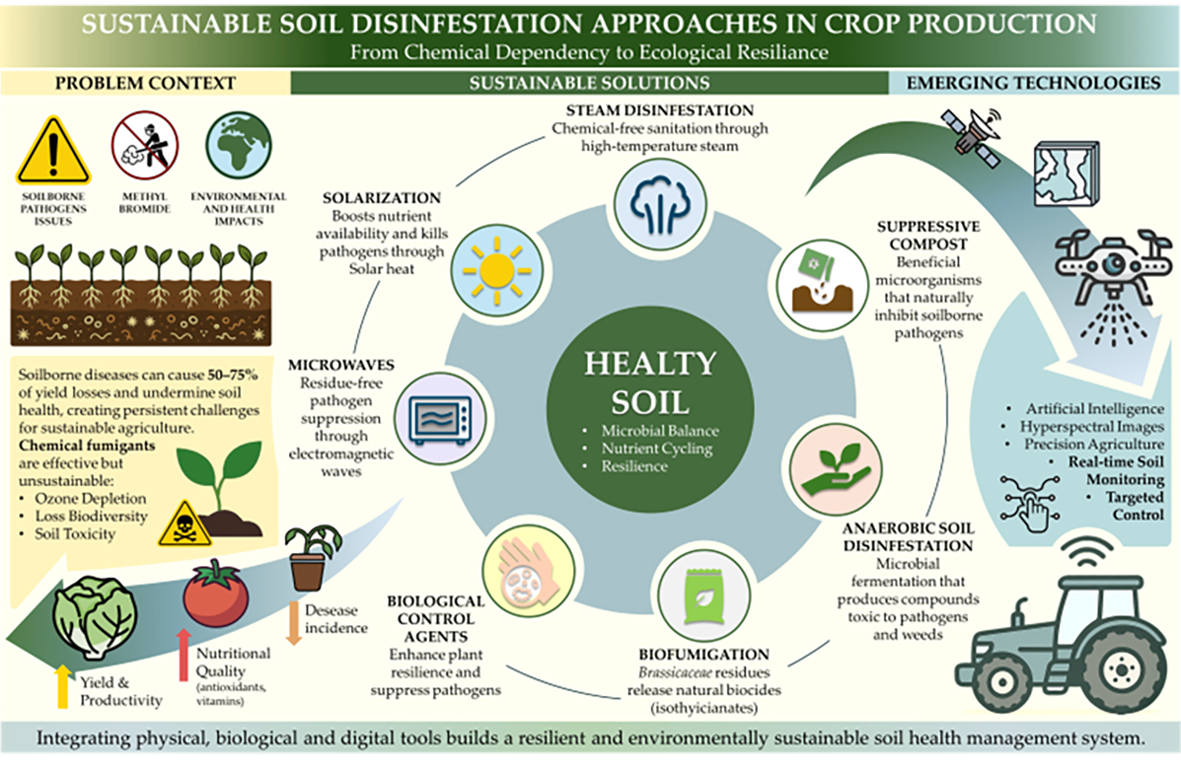
Graphical Abstract

1. Introduction

Soil management is a crucial practice in modern agriculture for controlling soil-borne pathogens that present significant risks to global food security and crop productivity. In particular, pathogens such as Fusarium spp., Pythium spp., Verticillium spp., and Rhizoctonia spp. are major contributors to significant crop losses worldwide. Soilborne diseases can be highly destructive, with several species capable of causing 50–75% yield losses in susceptible crops, representing one of the most severe constraints to agricultural productivity [1]. The Food and Agriculture Organization of the United Nations (FAO) reports that approximately USD 220 billion is spent annually worldwide on managing plant diseases [2], where soilborne plant pathogens—such as fungi, bacteria, viruses, and nematodes—pose particularly difficult management challenges. To address this problem, conventional soil treatment methods have been applied for years, primarily chemical-based approaches such as methyl bromide fumigation. Although effective in suppressing pathogens, such methods have been found to have significant negative environmental and health impacts. Methyl bromide, for example, is a potent ozone depleting substance, and its phase out under the “Montreal Protocol” highlights the urgent need for alternatives [3]. Additionally, chemical residues in soil can disrupt beneficial microbial communities, compromise soil health, and contaminate food, contributing to long-term agricultural sustainability concerns. In contrast, environmentally friendly soil disinfection approaches, which have evolved over the years as alternatives to chemical fumigants, have reported impressive results in mitigating environmental damage [4]. Sustainable soil management strategies include physical treatments such as solarization, soil heating with steam and microwave irradiation, or biological methods including biofumigation, anaerobic soil disinfestation, application of disease-suppressing compost, and use of biocontrol agents. Recent comparative research has indeed demonstrated that biological soil management—including anaerobic soil disinfestation (ASD) and organic amendments—not only reduces pathogen density such as Fusarium oxysporum but also strengthens the core microbiome and promotes a complex, resilient microbial network that confers long-lasting disease suppressiveness [5]. However, sustainable soil pest management remains an area of research that requires further exploration, especially to understand the long-term effects of these methods on soil health and microbial communities. For example, anaerobic soil disinfection is promising in pathogen suppression, but its effects on nutrient cycling and soil microbiome stability require further investigation [6]. Similarly, the effectiveness of biofumigation against emerging pathogens, such as those resistant to conventional treatments, remains uncertain [3]. Furthermore, the influence of these sustainable pest management practices on vegetable yield and quality also requires further investigation. Preliminary studies suggest that environmentally friendly methods can improve these traits by promoting healthier plant–soil interactions, but robust, large-scale evidence is still lacking [7]. Ultimately, since soil is a complex ecosystem that includes fungi, bacteria, insects, nematodes, and other microorganisms, understanding these interactions is essential to design effective soil and plant health management strategies, rather than targeting individual pathogen species [8]. Innovative approaches, including the integration of artificial intelligence (AI) with precision agriculture tools such as hyperspectral imaging, are among the emerging technologies in this field. Indeed, by providing real-time monitoring of soil health and early detection of pathogen outbreaks, they play a crucial role in optimizing the effectiveness of pest control treatments [9,10,11]. However, their practical implementation in commercial vegetable production remains a significant obstacle.
This review presents chemical, physical, and biological soil pest control methods, outlining their advantages, limitations, and recent innovations, with a focus on their effects on pathogen suppression and soil health. It also includes emerging tools, such as artificial intelligence-based diagnostics and advanced biological approaches, to identify current innovation paths in sustainable agriculture. Overall, it illustrates how these practices contribute to resilient, productive, and environmentally friendly cropping systems, improving not only yield but also the quality and sensory characteristics of vegetables.
The most relevant literature on the topic was selected using a structured narrative approach. References were identified primarily through targeted searches on platforms such as Google Scholar and Scopus, conducted iteratively within the manuscript. Search queries combined general and method-specific keywords, including “soil disinfestation,” “alternatives to soil fumigation,” “solarization,” “anaerobic soil disinfestation,” “biofumigation,” “soil steam disinfection,” “microwave soil treatment,” and “biological control agents,” often enriched with terms related to crops or pathogens. Studies were included based on their relevance to the review objectives, scientific relevance, and the utility of the proposed solutions. No a priori geographical restrictions were applied during the literature selection. Therefore, the geographic origin of the cited studies reflects the distribution of available research rather than an intentional regional focus.

2. Soil Disinfestation Methods

2.1. Chemical Methods

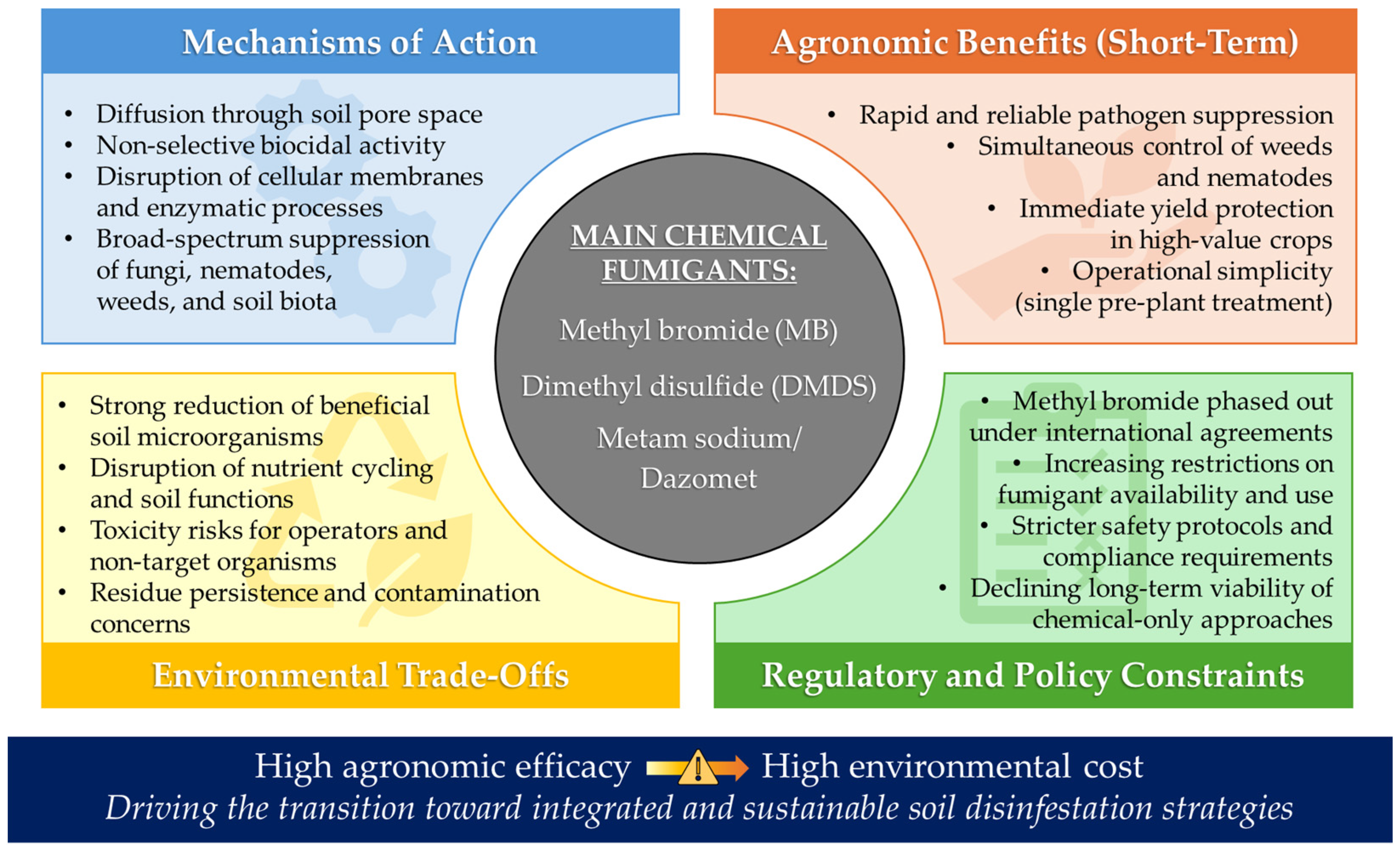
Chemical soil disinfestation (CSD) is a widely used agricultural practice in greenhouse vegetable production for its proven effectiveness against soil-borne pests, pathogens, and weeds. This control method involves the application of chemical fumigants, which, by releasing volatile compounds into the soil, disrupt the cellular and metabolic functions of pests. The main advantages of CSD are its broad-spectrum action, immediate pest suppression, and significant yield improvements. For example, fumigants such as methyl bromide (MB), dimethyl disulfide (DMDS) and metam sodium have demonstrated efficacy in controlling pathogens such as Fusarium oxysporum and nematodes such as Meloidogyne javanica, enabling high crop yields and supporting intensive agricultural production [12]. Additionally, the ability of fumigants to eliminate multiple threats in a single application simplifies pest management in resource-intensive greenhouse environments. However, despite these benefits, the environmental and economic sustainability of chemical fumigation remains a major concern. Among the most notable environmental concerns raised by the widespread use of methyl bromide is ozone depletion [13]. Similarly, modern fumigants such as DMDS and metam sodium, while less harmful to the atmosphere, still cause toxicity risks to humans and non-targeted organisms, requiring stringent application protocols [14]. Research has consistently shown that these treatments reduce microbial diversity and impede essential soil functions. Evidence from both field and microcosm studies consistently shows that fumigants negatively affect beneficial microbial communities, including nitrifiers and denitrifies, which are critical for nutrient cycling and soil ecosystem resilience [15]. Consequently, the long-term sustainability of fumigated soils may be compromised, particularly in systems that rely on continuous cropping cycles. Nevertheless, it has also been shown that the alteration of soil physicochemical properties caused by repeated fumigant use can sometimes have apparently positive implications. In some intensively managed systems, pathogen suppression through fumigation has coincided with short-term improvements in soil physicochemical properties, including reduced topsoil salinity associated with nitrate redistribution after dazomet application [16]. This benefit, however, as reported by Sennett et al. [17], is often offset by increased nitrate leaching and reductions in soil organic matter content. Indeed, fumigants often deplete soil organic matter and functional microbial groups, compromising the long-term ability of soil to recover and support healthy plant growth [18,19]. Such changes in soil carbon and nitrogen dynamics highlight the trade-offs inherent in chemical fumigation practices, where immediate benefits can come at the expense of long-term soil health. Lastly, despite its environmental impacts, chemical fumigation remains a practical option for managing soil-borne threats in greenhouse systems, where soil reuse is common. Sustainable practices, such as combining fumigation with organic amendments or adopting integrated pest management (IPM) strategies, can mitigate some of the above-mentioned drawbacks [20] (Figure 1).

2.2. Physical Methods

2.2.1. Soil Steam Disinfection

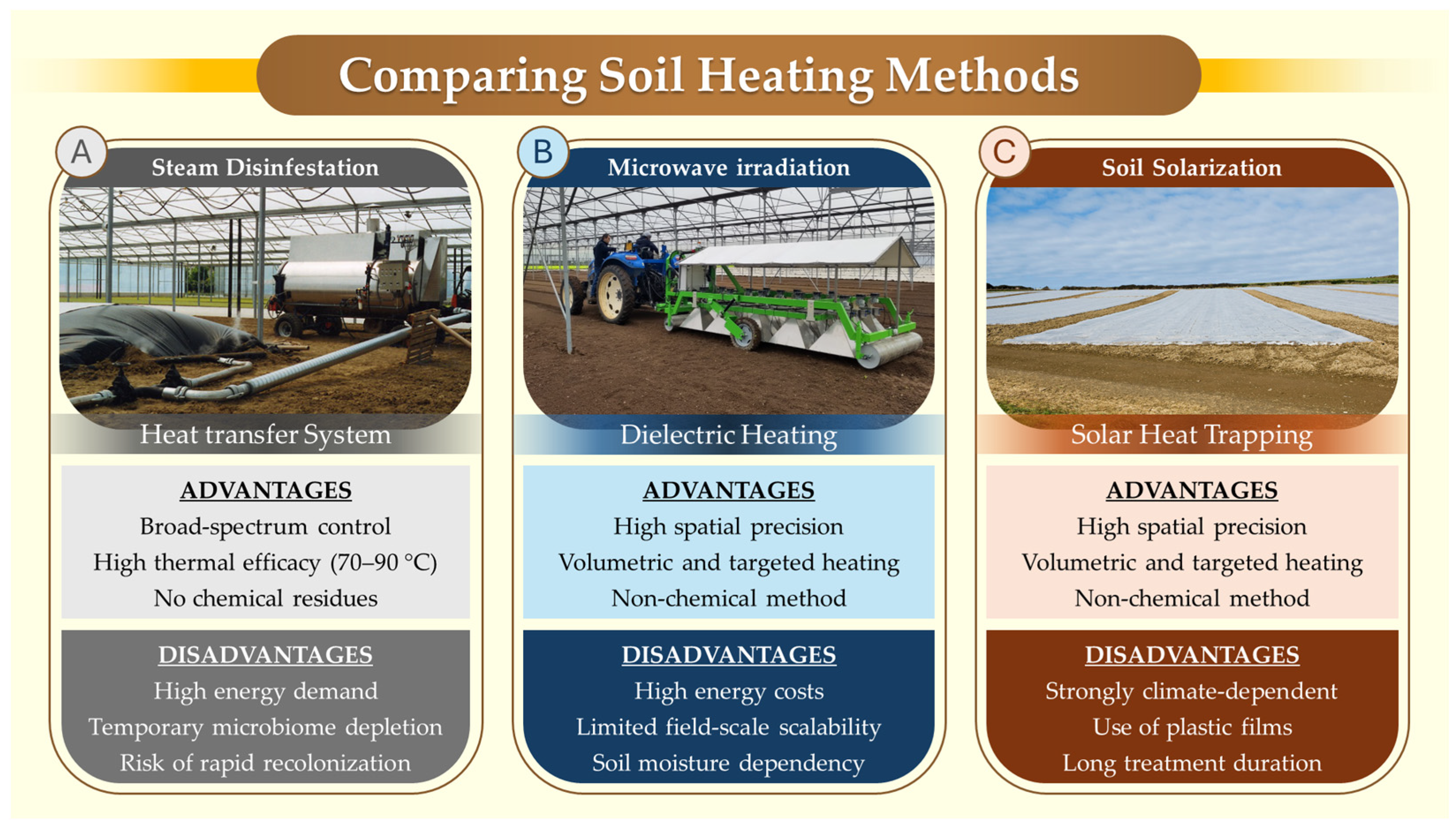
Soil steam disinfestation (SSD) is an effective and environmentally friendly method that uses water vapor to increase soil temperature, effectively eliminating pathogens such as Fusarium solani [21] and other harmful fungi [22], while also suppressing weeds and nematodes [23]. The process involves injecting hot steam into the soil through boilers and tubes, which can penetrate to varying depths. Unlike chemical fumigants, the SSD method leave no harmful residues because water is converted into steam, where it is applied to the soil at high temperatures (~70–90°C) [24,25], making it suitable for organic and sustainable farming practices. Bitarafan et al. [26] demonstrated that vacuum-assisted steaming achieved more than 90% reduction in seed germination of Avena fatua (L.), Echinochloa crus-galli (L.) P. Beauv., and Bromus sterilis (L.) at soil temperatures of 75–100 °C, regardless of soil type. These findings support soil steaming as a reliable, residue-free option for soil reuse and invasive species control; however, its performance remains strongly dependent on soil physical properties. Variations in particle size, pore structure, and moisture content critically influence heat transfer, temperature homogeneity, and overall energy efficiency, limiting the standardization of treatment protocols across contrasting soils [27,28]. In addition, the high energy demand required to achieve effective thermal inactivation constitutes a major barrier to adoption, as the combined costs of equipment and fuel can be prohibitive, particularly for small-scale farms. Economic analyses indicate that the feasibility of steam-based disinfestation is closely linked to economies of scale and supportive policy frameworks, while the integration of renewable energy sources—such as solar-assisted steam generation—offers a viable pathway to reduce operating costs and carbon emissions in regions with high solar availability [29,30]. Technologies such as band spraying, a precision application that targets specific regions of the soil, have also been developed to reduce energy consumption while maintaining pest suppression effectiveness [31]. Further innovation has focused on improving the energy efficiency of steam devices; Zhang et al. [32] optimized the design of fin-shaped heat exchangers within steam injectors to enhance thermal transfer and temperature homogeneity, achieving a 40% improvement in heating efficiency and reducing fuel consumption. Despite its successes, spraying can also have some disadvantages, such as its impact on soil properties. Although it effectively reduces pest populations, it can eliminates beneficial microorganisms, disrupting the ecological balance of the soil in the short term [21]. Soil microbiome recovery varies and may require additional interventions, such as the application of organic amendments or microbial inoculants, to restore soil health. Another concern is the risk of recontamination; once sterilized, soil becomes highly susceptible to recolonization by opportunistic pathogens or weeds, especially if post-treatment sanitation measures are not followed up carefully [22]. A study by Yang et al. [27] highlighted the importance of optimizing soil pore structure to improve heat and mass transfer during the process. Additionally, while steam treatment increased the release of soluble nutrients like K+, Mn2+, and NH4+, it did not cause bacterial eradication or significant shifts in bacterial community structure; potential risks, such as the exploitation of soil resources and the possibility of manganese toxicity, should be carefully considered, especially in repeatedly steamed soils [33]. However, careful calibration of parameters, such as steam temperature, exposure time [23], and the addition of mitigants like calcium oxide [33], can address some of these risks. In conclusion, therefore, SSD is an effective and compatible alternative to chemical fumigation for soil pest management; however, the main disadvantages are high energy consumption and risks of recontamination. Integration with crop rotation, organic amendments and microbial inoculants, together with advances in energy-saving technology, can improve its sustainability.

2.2.2. Microwaves for Soil Disinfestation

Microwave soil heating is an innovative technique that uses microwave radiation to increase soil temperatures, targeting harmful soilborne microorganisms, pathogens, and pests. By penetrating the soil and vibrating water molecules, this method generates heat that disrupts biological processes in bacteria, fungi, and other organisms, rendering them non-viable. As a result, it offers an environmentally friendly alternative to chemical pest control approaches [34]. Experimental evidence indicates that, when energy input is appropriately calibrated, microwave treatment can achieve near-complete inhibition of weed seed germination, supporting its potential for targeted, localized weed management [35]. Beyond weed and pathogen suppression, microwave exposure has also been associated with positive crop responses, including enhanced vegetative propagation and improved early plant performance, likely linked to transient reductions in competing soil microorganisms and short-term modifications of the soil biological environment [36,37]. These responses are strongly mediated by treatment parameters and soil conditions. Modeling and experimental studies consistently show that irradiation time, soil depth, and moisture content govern heat distribution and pathogen inactivation efficiency, while excessive exposure risks nutrient degradation or unnecessary energy consumption [38,39]. A comparative dose–response study indicates that microwave efficiency is strongly influenced by soil type and moisture, making process optimization essential to balance effectiveness and energy demand [40]. Ruggeri and Garau [41] have developed precise heat transfer models, including nonlinear ones, that enable targeted applications while reducing energy consumption and the risk of overheating. These innovations make microwave soil treatment a promising tool for disease management in agriculture, ensuring controlled disinfection, increased safety, and less waste, which are essential for sustainable agricultural practices. Conflicting opinions regarding the ability of this method to discriminate between harmful and beneficial microorganisms raise doubts in the scientific community. Li et al. [42] observed that 2.45 GHz microwave treatment altered the bacterial community structure in Phaeozem soils of Northeast China, causing an initial reduction in microbial diversity, followed by a gradual recovery over time. These results are consistent with those of Khan et al. [43], who showed that while pre-sowing microwave treatments altered the soil microbial community, beneficial soil microbes showed a faster recovery. However, repeated use could have cumulative effects on soil microbial dynamics, with potential long-term consequences. In fact, according to Brodie et al. [36] and Khan et al. [44], although short-term effects may be limited, prolonged exposure to heat could degrade soil, requiring long recovery periods to re-establish fertility and microbial balance. Further research will therefore be needed to optimize the process and better understand its ecological impacts, and also effectively integrate it into broader pest management strategies. While microwave soil heating offers significant benefits, it also poses environmental and resource challenges that require attention. The technique demands substantial energy inputs, raising concerns about cost and scalability, particularly in regions characterized by high energy prices [43]. Moreover, soil moisture content is a critical factor, as dry soils hinder heat penetration, while excessively wet soils require higher energy to achieve effective heating [36,37]. To maximize the potential of microwave soil heating, future research must focus on optimizing energy efficiency, refining application methods, and mitigating risks associated with excessive heating. This includes developing calibrated exposure protocols to prevent damage to soil structure and biodiversity [38,39,43]. Efforts should also aim to integrate this technology into broader pest management systems, addressing sustainability and cost-effectiveness to ensure its viability for large-scale agricultural applications. Microwave soil heating, therefore, is a promising and environmentally friendly alternative to chemical pest control, offering benefits for pathogen suppression and crop production. However, challenges such as energy demand, potential impacts on soil biodiversity, and long-term fertility concerns must be addressed. Optimizing energy efficiency, refining application protocols, and integrating the technology into broader pest management strategies are essential steps to ensure its sustainability and scalability in agricultural practices.

2.2.3. Soil Solarization

Soil solarization is a hydrothermal pest control technique that uses solar energy to raise soil temperatures sufficiently to manage soil-borne pests, pathogens, and weeds. The technique involves covering moist soil with sheets of clear polyethylene or biodegradable plastic during periods of high solar intensity, particularly in hot climates. The heat trapped under plastic increases soil temperatures to levels that are lethal to various pests and pathogens, while also suppressing weed growth. Among sustainable agricultural practices, soil solarization has gained attention as a viable alternative to chemical fumigation, especially in arid and semi-arid regions. According to Jagtap et al. [45], soil temperatures under solarization can reach 45–60 °C, sufficient to reduce soil-borne pests. Key factors that influence the effectiveness of soil solarization include mulch type, soil moisture, application duration, and climate conditions. Moist soil, for example, improves thermal conductivity, making the process more efficient [46]. Transparent plastic films maximize heat penetration, whereas colored mulches such as black or silver can contribute to additional weed suppression through combined thermal and optical effects [47]. Longer solarization periods, moist soils, and high solar intensity maximize the effectiveness of the process, making it more suitable for regions with hot, sunny climates. Under arid and semi-arid conditions, solarization has also been shown to improve soil fertility while effectively suppressing soilborne pests, supporting its application in regions with limited water availability when appropriately managed [48]. Beyond pest control, solarization induces broader ecological effects by reducing parasitic nematode populations and restructuring soil bacterial communities toward disease-suppressive configurations, thereby contributing to both agronomic performance and soil health [49]. Recent work by Rippa et al. [50] introduced an innovative solarization approach using photo-selective films that allow targeted wavelengths to penetrate while minimizing water loss. Similarly, Vatchev [51] reported that combining solarization with organic matter incorporation (biosolarization) effectively controlled the crown and root rot disease complex in greenhouse vegetables. Additionally, soil solarization increases nutrient availability, particularly nitrogen and potassium, through accelerated decomposition of organic matter [52]. This increased nutrient availability can improve crop yields and reduce the need for synthetic fertilizers. Its reduced reliance on chemical fumigants lowers environmental and human health risks, while compatibility with biodegradable plastic films further strengthens its sustainability profile [11,53]. Nevertheless, the effectiveness of solarization remains strongly climate-dependent, as adequate pathogen suppression requires prolonged periods of high solar radiation and elevated soil temperatures, thereby constraining its applicability in cooler or less irradiated regions [45]. Furthermore, the process can be time-consuming, requiring weeks of application to achieve optimal results. For smallholder farmers, the cost of purchasing plastic mulch can be a financial challenge. In some cases, the heat generated may not completely eradicate heat-resistant pathogens or deeply buried weed seeds, necessitating additional control measures. Likewise, traditional polyethylene sheets, unless recycled or replaced with biodegradable alternatives, pose significant environmental concerns [53]. Contrasting effects have been observed for soil properties. While on the one hand, soil warming increases the decomposition of organic matter, and with it the availability of nutrients for plants, especially nitrogen and potassium [52], on the other hand this prolonged exposure to high temperatures can deplete organic carbon, negatively affecting soil health [54]. The main consequence of this is the damage of beneficial microbial communities, whose subsequent recovery depends on post-solarization soil management practices, as Shea et al. [49] observed. Furthermore, solarization can cause temporary changes in soil structure, including aggregation and porosity [54]. Future perspectives of this technique focus on optimizing its application in different agroclimatic conditions through innovative practices. For example, supplementing solarization with soil amendments such as biochar, organic fertilizers, or microbial inoculants could increase its effectiveness and mitigate its limitations. Öz [55] showed that the addition of biochar improved soil quality and crop yield under solarization. In summary, soil solarization is a powerful tool for sustainable pest and pathogen management. Its ability to control soil pests, improve nutrient availability, and reduce weed growth positions it as a viable alternative to chemical fumigation. However, its limitations, including climate dependency and temporary disruptions to soil health, need to be addressed through innovative research and integration with complementary practices. With advances in technology and materials, soil solarization has the potential to play a critical role in sustainable agriculture worldwide (Figure 2).

2.3. Biological Soil Disinfestation Methods

2.3.1. Suppressive Composts for Soilborne Diseases

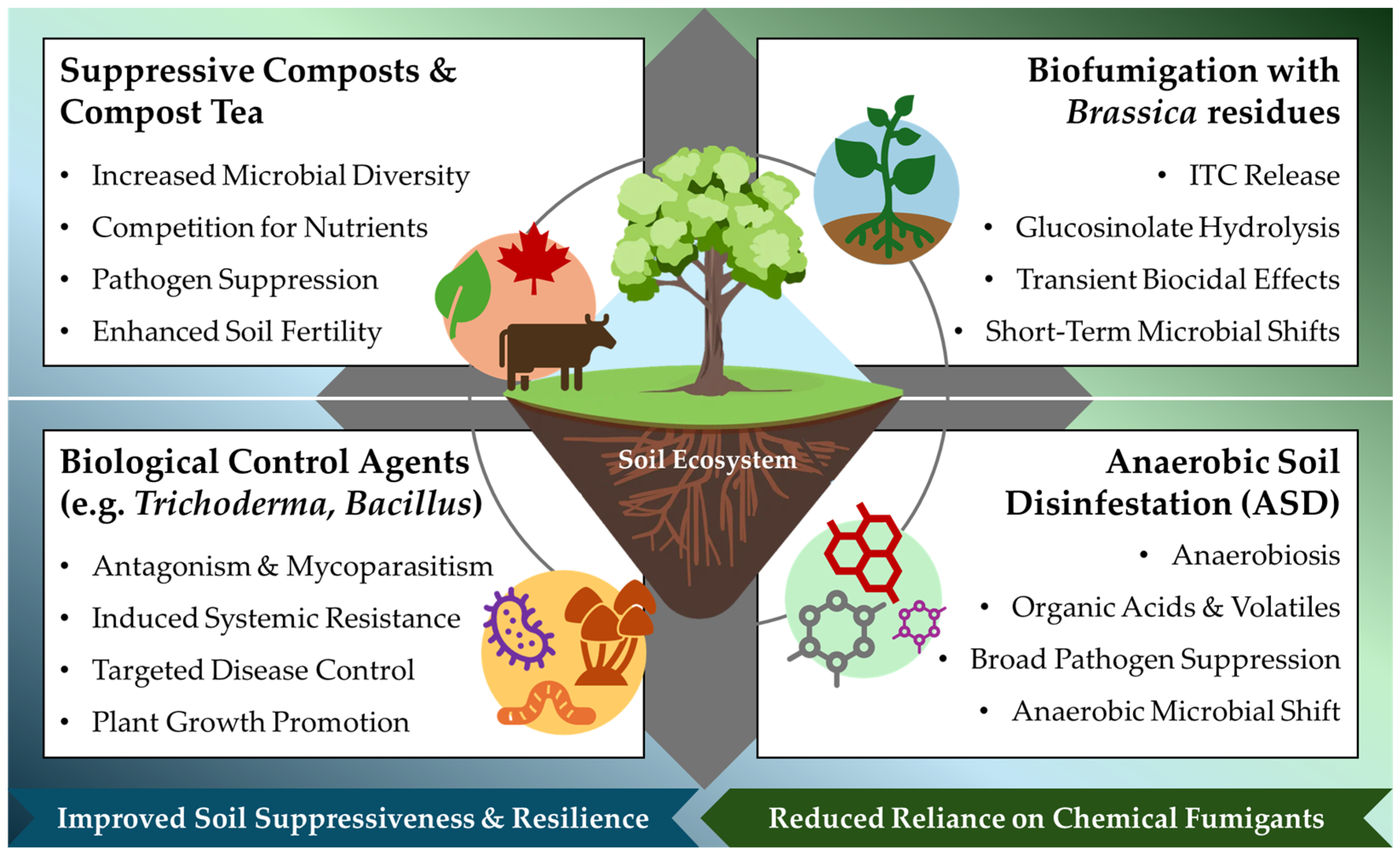
Recent research highlights the significant role of compost and compost tea (CT) in improving soil health, suppressing soil-borne pathogens, and enhancing crop productivity, marking them as vital tools in sustainable agriculture. These amendments, created by soaking organic matter in water under specific conditions, interact through the release of bioactive compounds and enhancing microbial diversity and activity. Studies highlight their efficacy against significant pathogens such as Fusarium oxysporum, Rhizoctonia solani, and root-knot nematodes, among others [56,57,58]. Biocidal effects result from secondary metabolites, organic acids, and beneficial microbial consortia, which antagonize pathogens and induce plant resistance [59,60]. Furthermore, Bonanomi et al. [61] demonstrated that CT application in Mediterranean vegetable systems significantly enhanced soil enzymatic activity, microbial biomass, and nutrient availability, resulting in higher crop yield and improved product quality. The success of these amendments depends on multiple factors, including the source and type of organic material, preparation methods, application timing, and soil environmental conditions. Evidence indicates that aeration regimes and nutrient enrichment during preparation can markedly influence pathogen suppression and microbial diversity, while vermicompost-derived formulations consistently enhance soil organic matter content, enzymatic activity, and microbial balance, resulting in improved crop performance [60,62]. Beyond individual formulations, comparative analyses across 37 compost types have identified a conserved consortium of bacterial and fungal taxa—particularly Bacillus, Pseudomonas, and Streptomyces—that is consistently associated with disease-suppressive soils, suggesting the existence of functional microbial indicators that can guide more reliable compost selection and application strategies [63]. Despite their demonstrated potential, CT remains subject to important limitations related to variability in preparation and application. Differences in brewing parameters—such as aeration regime, extraction duration, and source material composition—can substantially alter the microbial activity and consistency of the final product, leading to unpredictable disease suppression outcomes [64]. Inadequate management or excessive application may further result in nutrient imbalances or the proliferation of undesirable microorganisms, posing risks to both plant performance and soil health [57]. In addition, expensive and labor-intensive preparation methods may limit large-scale adoption in some agricultural systems. The positive effects of these amendments on soil properties are well documented, demonstrating improvements in both physical and biological parameters. Indeed, CT applications are linked to increased soil fertility, organic matter levels, and microbial community structure [65]. Under challenging conditions such as saline–sodic soils, the combined application of CT with arbuscular mycorrhizal fungi has been shown to reinforce nutrient cycling, stimulate enzymatic activity, and suppress soilborne pathogens, resulting in improved crop productivity and soil resilience [66]. More broadly, the use of organic teas in disease management supports sustainable agricultural practices by reducing dependence on synthetic chemical inputs and contributing to the preservation of soil ecosystem integrity [67]. Overall, incorporation of CT and similar organic matter amendments presents an environmentally friendly and multifaceted approach to soil pest management and soil health management. Consistently positive results in studies underscore their potential as sustainable alternatives to traditional chemical treatments, offering long-term benefits for crop productivity and soil fertility. Though, addressing variability in preparation and application methods is critical to maximizing their effectiveness and wider adoption.

2.3.2. Biological Control Agents

Biological control agents (BCAs) provide a promising and sustainable alternative for soil disinfestation by targeting soilborne pathogens through mechanisms that reduce environmental impact while promoting plant health. These agents, which include a range of bacteria, fungi, and other microbes, employ diverse strategies such as direct antagonism, resource competition, and induced systemic resistance to manage soilborne diseases. Alqahtani, [68] reviewed the main groups of microbial biocontrol agents—including Trichoderma, Bacillus, and Pseudomonas spp.—summarizing their mechanisms of pathogen inhibition and their integration within sustainable pest-management frameworks. Among bacterial BCAs, Bacillus amyloliquefaciens and Bacillus subtilis are widely studied due to their broad-spectrum efficacy. These bacteria secrete antibiotics, enzymes, and volatile organic compounds (VOCs) that directly inhibit pathogens. Sabaté and Brandán [69] demonstrated how B. amyloliquefaciens improved rhizosphere microbial diversity while significantly reducing root rot severity in degraded soils. Similarly, Zaccardelli et al. [70] reported the successful utilization of composted aromatic plant waste to produce Bacillus strains, which not only controlled pathogens but also enhanced nutrient cycling and overall soil health. The application of fungi, particularly species of the genus Trichoderma, adds a further dimension to biological control: their species are effective through mycoparasitism, the secretion of hydrolytic enzymes, and competition for nutrients and space. Saldaña-Mendoza et al. [71] emphasized the dual benefits of Trichoderma spp. in controlling soilborne pathogens and enhancing crop resilience, including improved root architecture and drought tolerance. Similarly, Tyśkiewicz et al. [72] detailed the ability of Trichoderma to mitigate fungal infections, particularly those caused by aggressive pathogens like Fusarium spp., while simultaneously promoting plant growth via phytohormone production. Mycorrhizal fungi also play an integral role in biological control, particularly through the improvement of nutrient acquisition and modulation of plant immune responses. Aljawasim et al. [73] illustrated how arbuscular mycorrhizal fungi (Glomus spp.) significantly reduced disease severity caused by Rhizoctonia solani in cucumbers. These fungi also fostered better plant vigor and yield, highlighting their holistic impact on plant health. Boutaj et al. [74] further documented the protective effects of mycorrhizal fungi in reducing vascular wilt diseases, suggesting their potential as a sustainable solution for managing complex pathogen systems. In addition to mycorrhizal symbionts, several studies have highlighted the antagonistic potential of endophytic fungi against root-infecting fungal diseases. In this regard, Taha et al. [75] investigated naturally occurring endophytes from pepper (Capsicum L.) roots (Penicillium funiculosum, Aspergillus flavus, Myrothecium verrucaria), which markedly suppressed Fusarium and Rhizoctonia root rot in greenhouse trials. Soilborne pathogens like Sclerotinia sclerotiorum present significant challenges for agriculture, but several studies have explored the potential of BCAs to combat these threats. Coniothyrium minitans and Bacillus amyloliquefaciens are particularly effective against S. sclerotiorum. Current findings suggest that Coniothyrium minitans and Bacillus amyloliquefaciens reduce disease incidence and severity through complementary mechanisms, including direct mycoparasitism, hyphal degradation, and antibiotic production [76]. Genomic and transcriptomic analyses further reveal that C. minitans possesses specialized traits enabling disruption of fungal hyphae and inhibition of pathogen reproduction, supporting its targeted efficacy against S. sclerotiorum [77]. Moreover, Han et al. [78] further demonstrated that integrating BCAs with soil organic amendments enhanced pathogen suppression, improved soil structure, and supported a diverse soil microbiome. This synergistic approach underscores the potential of combining BCAs with other sustainable practices for more robust pathogen management. Rhizobacteria, especially plant growth-promoting rhizobacteria (PGPR), offer another avenue for sustainable soil disinfestation. These bacteria form beneficial associations with plant roots, suppressing pathogens while improving plant health. Abdelaziz et al. [79] identified various PGPR strains capable of reducing disease severity while promoting plant growth through mechanisms like nutrient solubilization and secretion of growth-promoting compounds. Das et al. [80] highlighted rhizobia’s antagonistic potential against fungal pathogens, attributing their success to secondary metabolites and competition for resources. These rhizobacteria not only mitigate pathogen activity but also enhance soil fertility and microbial diversity, leading to long-term agricultural benefits. The integration of BCAs into sustainable agricultural systems relies heavily on understanding their interactions with native soil microbiomes. Liu et al. [81] provided evidence that plants can actively recruit beneficial microbes under pathogen attack, enhancing their protective efficacy. Such interactions underline the dynamic role of the soil microbiome in shaping the success of biological control strategies. Mazzola and Freilich [82] stressed the importance of utilizing native microbiomes over synthetic microbial consortia, noting that indigenous microbes offer better resilience to environmental fluctuations and soil-specific challenges. Wolfgang et al. [83] suggested that VOCs produced by bacterial BCAs could serve as an innovative mechanism for controlling nematode-based diseases, providing a non-invasive and scalable solution for soil disinfestation. However, the successful implementation of BCAs faces several challenges. Environmental factors, such as soil pH, temperature, moisture, and organic matter, significantly influence their efficacy. Additionally, variability among microbial strains, inconsistent field performance, and potential non-target effects complicate their application. Ueki et al. [84] highlighted the role of anaerobic bacteria in biological soil disinfestation, noting their effectiveness in suppressing pathogens but warning about the temporary microbial imbalances that can occur. Niu et al. [85] underscored the need to explore interspecies interactions within multi-strain formulations to enhance consistency and effectiveness. By addressing these challenges, BCAs can become a cornerstone of sustainable soil health management in modern agriculture.

2.3.3. Biofumigation

Biofumigation is an environmentally friendly agricultural technique that utilizes the natural biocidal properties of certain plants, predominantly from the Brassicaceae family, to manage soilborne pathogens, pests, and weeds while promoting soil health. This practice leverages glucosinolates (GSLs), naturally occurring compounds in Brassica spp. plants such as mustard, radish, and rapeseed, which hydrolyze into bioactive products like isothiocyanates (ITCs) upon tissue breakdown. These ITCs act as natural fumigants, disrupting the cellular metabolism of harmful organisms and reducing their populations in the soil. According to Tagele et al. [86] and Mandal et al. [87], biofumigation not only suppresses pathogens and promotes beneficial soil microbes through the action of ITCs but also serves as a cornerstone of sustainable, reduced-chemical soil health management by enhancing nutrient cycling and overall microbial activity. Biofumigation can be implemented through multiple agronomic strategies, including the incorporation of green manure crops, application of biofumigant seed meals, and rotational use of Brassica species, with effectiveness strongly influenced by management choices and environmental context. Evidence shows that Brassica-derived amendments, such as Brassica carinata (A. Braun) seed meal, can provide effective suppression of soilborne pathogens, supporting their role as viable alternatives to synthetic fumigants [88]. Treatment success is closely linked to timing and preparation, as incorporation of macerated plant biomass at peak growth enhances the release of bioactive compounds, allowing biofumigation practices to be adapted to local climatic conditions and cropping systems [89]. Moreover, efficacy varies widely among Brassica species and formulations, depending on glucosinolate profiles, tissue type, soil characteristics, and resident microbial activity, which collectively regulate the hydrolysis of glucosinolates and subsequent isothiocyanate release [90]. Environmental conditions, particularly soil temperature and moisture, play a vital role in the hydrolysis of GSLs and the release of ITCs. Moreover, Walker et al. [91] emphasized that soil pH and microbial composition can also significantly impact ITC persistence and effectiveness. One of the most significant benefits of biofumigation is its ability to manage diverse soilborne pathogens, including Fusarium graminearum [92] and Pythium aphanidermatum [93], reducing crop losses in various agricultural systems. Additionally, biofumigation contributes to soil health by enriching organic matter, enhancing nutrient cycling, and fostering beneficial microbial activity, as observed by Li et al. [94]. The technique also aligns with global sustainability goals by reducing dependence on synthetic fumigants, which are often associated with environmental degradation and regulatory restrictions. Biofumigation’s integration into crop rotation and cover cropping systems can further enhance its efficacy and environmental benefits, providing farmers with a sustainable pest management option that also improves long-term soil health. However, despite its advantages, biofumigation has limitations that can affect its widespread adoption. The success of biofumigation can be inconsistent, as it is heavily influenced by external variables, such as environmental conditions, soil properties, and the quality of the biofumigant material [95]. Producing the high biomass necessary for effective biofumigation may also be challenging for small-scale or resource-limited farmers. Furthermore, biofumigants may temporarily suppress non-target soil organisms, including beneficial invertebrates like earthworms, as reported by Fouché et al. [96]. Another challenge is the risk of phytotoxicity, where residual ITCs in the soil can negatively affect subsequent crops if their levels remain excessively high. Impacts on soil properties are multifaceted, with biofumigation often improving nutrient availability and microbial diversity while occasionally causing temporary imbalances. For instance, Walker et al. [97] observed that long-term biofumigation practices enriched soil organic matter and altered microbial community dynamics, promoting beneficial populations over time. However, improper timing or excessive application of biofumigants can lead to temporary reductions in soil microbial diversity. Research by Tagele et al. [98] showed that optimized biofumigation strategies could improve crop yields without detriment to soil microbial health, underscoring the need for careful management. Looking to the future, biofumigation holds significant potential as a cornerstone of sustainable agriculture, particularly when integrated with other practices like biological control or precision agriculture. Advances in plant breeding could lead to the development of Brassica spp. varieties with enhanced GSL content tailored for specific pathogens or pests. Additionally, the combination of biofumigation with biopesticides or soil amendments may amplify its effects while addressing limitations like variability in efficacy. Ghosh et al. [99] suggested that such combinations could yield synergistic benefits, further enhancing crop protection and productivity. Furthermore, continued research into soil microbial interactions under biofumigation conditions could refine practices, ensuring their effectiveness while preserving soil ecological balance.

2.3.4. Anaerobic Soil Disinfestation

Anaerobic Soil Disinfestation (ASD) is an innovative and sustainable soil management technique that has garnered significant attention as a reduced-chemical alternative to conventional fumigation methods. ASD is particularly effective for controlling soilborne pathogens, pests, and weeds, relying on the creation of temporary anaerobic conditions in the soil to suppress harmful microorganisms and foster a healthier soil environment [100,101]. The process involves incorporating organic amendments such as crop residues, animal manure, or industrial by-products into the soil to serve as carbon sources, followed by saturating the soil with water to create waterlogged conditions, and finally covering it with an airtight plastic film to maintain anaerobic conditions. These conditions promote the activity of anaerobic microbes, which decompose organic material to produce volatile fatty acids, alcohols, and gases toxic to many pathogens and pests [84,102]. The success of ASD depends on several factors, including soil temperature, the type and quality of organic amendments, soil moisture, and the duration of treatment. Studies have shown that higher temperatures accelerate microbial activity and enhance the production of suppressive compounds, with temperatures above 25°C being particularly effective [102,103]. The choice of organic materials is also crucial, as it determines the carbon-to-nitrogen ratio and decomposition rate, directly influencing the production of pathogen-suppressive compounds [104,105]. Adequate soil saturation is essential for maintaining anaerobic conditions, while the duration of treatment typically ranges from three to six weeks to ensure optimal pathogen suppression. While several researchers have explored these variables, there is consensus that site-specific adaptations may be necessary to maximize efficacy in diverse environments [19,106]. The benefits of ASD are manifold and have been well-documented in the literature. One of its primary advantages is its ability to suppress a wide range of soilborne pathogens and pests, including Fusarium oxysporum, and reduce the viability of root-knot nematodes [100,105]. This is attributed to the production of pathogen-suppressive compounds under anaerobic conditions. Furthermore, ASD is highly effective in managing weed populations by inhibiting seed germination, thereby reducing competition for crops [107,108]. Another key benefit lies in its contribution to soil fertility, as the decomposition of organic amendments enriches the soil with nutrients such as nitrogen and phosphorus [109]. Studies have also highlighted the method’s environmental sustainability, as it avoids the use of chemical inputs that pose risks to human health and the environment [110]. Moreover, ASD applications span diverse systems, including open fields, greenhouses, and high-tunnel organic production, making it suitable for crops such as strawberries, lettuce, and solanaceous vegetables. Evidence from contrasting agro-climatic contexts indicates that ASD can substantially reduce weed pressure and soilborne diseases while remaining flexible across temperate and tropical environments, supporting its potential as a scalable and system-independent management strategy [103,111]. Post-ASD, beneficial microbes such as Trichoderma spp. and Bacillus spp. often dominate the microbial community, contributing to improved soil health and resilience against future pathogen outbreaks [112,113]. Despite its effectiveness, ASD presents important limitations, as some pathogens, including Fusarium spp., can tolerate anaerobic conditions or recolonize soils following treatment, highlighting the need for complementary strategies to achieve durable disease control [104,105]. Another limitation is the labor and material costs associated with the method, as it requires organic amendments and plastic films, which may be prohibitive for resource-constrained farmers [100]. Additionally, anaerobic decomposition can produce greenhouse gases such as methane (CH4) and nitrous oxide (N2O), raising concerns about its environmental sustainability [110]. The results of ASD can also vary depending on soil type, climate, and the specific pest or pathogen targeted, requiring precise tailoring of the method to specific conditions [111,114]. ASD significantly impacts soil properties, leading to both immediate and long-term changes. Anaerobic conditions foster the growth of specific microbial populations, which can shift the soil microbial community towards dominance by beneficial species [84,113]. He et al. [115] reported that ASD substantially improved microbial diversity and altered the abundance of beneficial bacteria and fungi in continuously cropped soils, mitigating replant disease symptoms. Moreover, the decomposition of organic matter increases nutrient availability, though excessive mineralization may lead to nutrient leaching if not properly managed [112]. Enhanced soil structure and aggregation have also been observed, improving water retention and aeration [101,111]. Collectively, available evidence indicates that ASD contributes not only to the suppression of soilborne pests and pathogens but also to improvements in soil quality and biological functioning. To enhance adoption and long-term efficacy, future research should prioritize strategies that address current environmental and economic constraints, including the development of biodegradable films to reduce plastic waste and the evaluation of diverse organic amendments—such as industrial by-products—to lower input costs while supporting circular economy approaches [109,112]. Combining ASD with other sustainable practices, such as solarization, may offer synergistic benefits in pest suppression while mitigating greenhouse gas emissions [108]. Long-term studies on the cumulative effects of ASD on soil health, carbon sequestration, and agricultural productivity are also needed to provide a comprehensive understanding of its potential benefits and limitations [102,103]. Furthermore, Song et al. [116] revealed that in situ crop residue retention, an ASD approach, enhanced multiple ecosystem functions such as nutrient cycling efficiency, carbon sequestration, and microbial stability, underlining the multifunctionality of biological disinfestation strategies in agroecosystems. Ultimately, ASD stands out as a promising approach in integrated pest management due to its ability to suppress pathogens while improving soil properties. It provides a sustainable, eco-friendly solution, particularly for organic and sustainable farming systems, making it a valuable tool in addressing the challenges of modern agriculture.
A comparative overview of chemical, physical, and biological soil disinfestation strategies is provided in Table 1, summarizing their target organisms, agronomic benefits, limitations, and impacts on soil health and sustainability (Figure 3).

3. Integrated Pest Management for Soilborne Disease Control

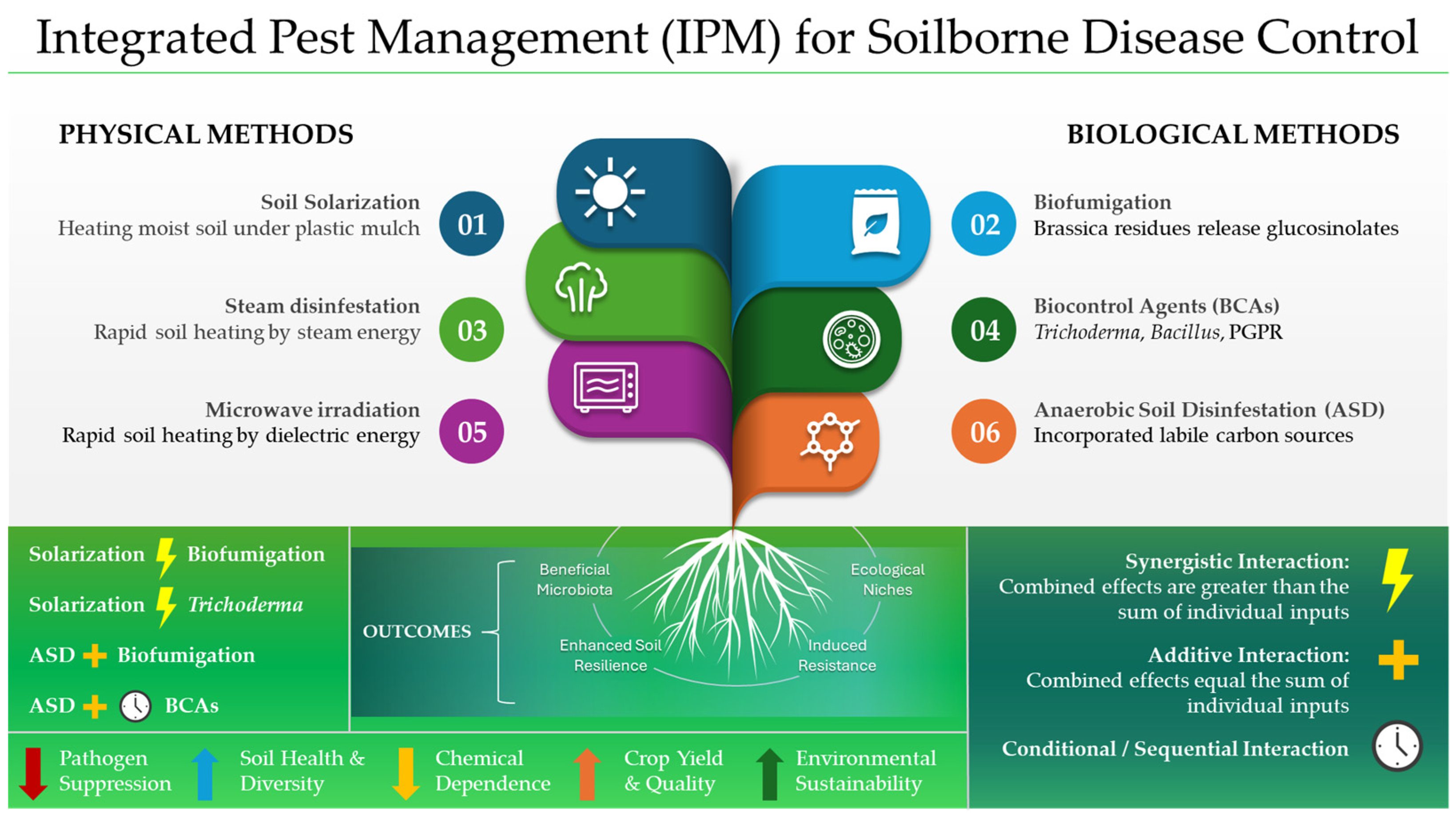
Integrated Pest Management (IPM) for soilborne diseases has gained increasing attention as a sustainable and effective approach to agricultural productivity. Recent advances, as outlined by Devi et al. [117], emphasize that the integration of biological, physical, and cultural approaches within IPM frameworks offers a sustainable and multidisciplinary alternative to conventional chemical control. Bio-solarization, a combination of solarization and biological amendments, emerges as a promising technique. Elshahawy et al. [118] demonstrated the effectiveness of incorporating Trichoderma asperellum into solarized soils for controlling black root rot in strawberries, improving both pathogen suppression and crop yield. Correspondingly, Castello et al. [119] reported that solarization-based techniques, particularly when paired with organic amendments, significantly reduced Verticillium dahliae inoculum in tomatoes cultivated in greenhouses. These studies underscore bio-solarization’s potential to enhance soilborne pathogen control while restoring soil microbial diversity. Integration of anaerobic disinfestation with BCAs further demonstrates the potential of multi-pronged IPM approaches. Khadka and Miller [120] explored the combined use of ASD with Trichoderma spp., observing significant reductions in Rhizoctonia root rot. Shrestha et al. [121] similarly highlighted the potential of combining anaerobic techniques with microbial inoculants, emphasizing their complementary effects in pathogen suppression. Moreover, Studies by Ali et al. [122] and Huang et al. [123] indicate that reductive soil disinfestation (RSD), especially when combined with biochar and antagonistic microbial inoculants such as Trichoderma spp., effectively mitigates diseases like cucumber Fusarium wilt and Rhizoctonia damping-off. This integrated approach leverages the dual action of microbial antagonism and anaerobic conditions to target pathogens while fostering beneficial microbial communities. Conversely, some other results from Ali et al. [122] caution that improper implementation may increase greenhouse gas emissions, highlighting the need for environmentally conscious adaptations of this method. In this context, Shi et al. [124] demonstrated that combining Trichoderma spp. with low doses of dimethyl disulfide (DMDS) effectively controls Fusarium wilt in solanaceous crops, showing that a balanced bio–chemical approach within IPM can enhance disease suppression while preserving soil microbiota. Probiotic bacteria application combined with biofumigation using cover crops has also been identified as a sustainable strategy. Rahman et al. [22] showcased the effectiveness of mustard cover crops for releasing biocidal compounds that suppress pathogens while enhancing soil fertility. When used with probiotic bacteria, such as Bacillus strains, this approach offers the dual benefits of disease control and crop growth promotion. However, the success of biofumigation depends on the appropriate timing of crop incorporation and management of gas emissions. In parallel, Magallanes-Tapia et al. [125] showed that combining pre-plant biofumigation with post-plant Trichoderma and Bacillus inoculation effectively suppresses nematodes and enhances soil health within IPM systems. Steam disinfestation, complemented by biological reinforcements, provides another promising IPM method. Kim et al. [126] found that steam application, followed by Trichoderma inoculation, effectively eradicates soilborne pathogens while reintroducing beneficial microorganisms to the soil. Wu et al. [127] similarly reported improved soil health and cucumber production when beneficial microbes were applied post-fumigation. Despite its efficacy, steam sterilization can be energy-intensive, posing challenges for large-scale adoption. Liu et al. [128] expanded the scope of integrated strategies by testing ASD amended with yeast residues for weed control and yield enhancement in strawberries. In the context of greenhouse crop production, Gullino et al. [3] emphasized the importance of combining physical, biological, and cultural practices. The integration of fumigation alternatives, such as biofumigation, and biological agents like Trichoderma, offers scalable solutions for managing soilborne pathogens while reducing chemical dependency. These strategies are complemented by economic analyses like Xu et al. [29], which highlight the cost-effectiveness of adopting steam as a pre-plant–soil disinfestation method for strawberry cultivation in California, particularly when coupled with biocontrol agents to restore soil health. Collectively, these studies underscore the versatility of IPM in addressing soilborne diseases through an array of complementary techniques. Bio-solarization, RSD, biofumigation, steam disinfestation, and integrated biological controls highlight the efficacy of combining methods to enhance pathogen suppression, promote soil health, and improve crop productivity. While these approaches demonstrate significant promise, challenges such as energy costs, environmental trade-offs, and implementation complexity necessitate further refinement to optimize their application in diverse agricultural systems. Accordingly, Table 2 provides a comparative overview of quantitative sustainability indicators across chemical, physical, and biological soil disinfestation strategies, highlighting trade-offs and sources of variability reported in the literature. Metrics are reported on an area basis (per hectare per treatment cycle) and include energy use (MJ ha−1), greenhouse gas emissions (kg CO2-eq ha−1), cost (USD ha−1), and plastic waste (kg ha−1). Values are expressed as literature-derived ranges reflecting differences among studies in system boundaries, experimental scales (laboratory, pilot, or field), treatment depth and duration, climate, input type and rate, and energy source. Where values were not directly reported, ranges were derived from explicitly documented operational inputs using standard conversion factors and are indicated as indicative estimates. For suppressive composts and biological control agents, quantitative data on energy use and greenhouse gas emissions are limited in the literature and are therefore reported as low-input or not quantified categories based on documented management intensity. The final column summarizes the main drivers of variability for each technique to aid interpretation of the wide numerical ranges. Overall, values should be interpreted as indicative of relative magnitude and context-specific performance rather than fixed benchmarks (Figure 4).

4. Novel Approaches in Soilborne Disease Management

The convergence of hyperspectral imaging, machine learning, thermal imaging, and biocontrol methods represents a groundbreaking approach to soilborne disease management. Recent advancements in hyperspectral imaging (HSI), machine learning (ML), and precision agriculture are transforming detection and monitoring, supporting informed decision-making within sustainable disease management frameworks. High-resolution hyperspectral imaging has emerged as a pivotal technology, allowing for the identification of stress signals in crops long before visual symptoms appear. Results reported across diverse cropping systems indicate its effectiveness in capturing spectral signatures associated with soilborne disease development, supporting its use for timely and non-destructive monitoring of plant health [137,138]. In this context, Arroyo et al. [139] integrated biofumigation practices with phyto-spectral monitoring, demonstrating how precision remote sensing can inform the spatial and temporal planning of biofumigation practices, paving the way for site-specific, sustainable disease control. Coupling HSI data with machine learning algorithms, these studies achieved precise disease prediction, underscoring the potential for timely interventions and improved risk assessment in crop protection strategies. The integration of thermal imaging with hyperspectral sensing further enhances early disease detection by providing complementary information on plant physiological status and stress responses. Combined use of active and passive infrared data with spectral analysis has been shown to improve the identification of early-stage soilborne infections through robust, non-invasive monitoring approaches [9,10,11]. More recently, the fusion of three-dimensional, multispectral, and thermal imaging with machine-learning algorithms has enabled high-accuracy diagnosis of soilborne pathogen infections under controlled and experimental conditions, illustrating the potential of AI-driven frameworks to advance precision disease monitoring [140]. Machine learning has played a crucial role in translating complex hyperspectral data into actionable insights for decision-support and early warning within disease management systems. Applications based on canopy-level hyperspectral data demonstrate that pattern-recognition algorithms can support precision monitoring and inform biologically based disease control strategies, particularly in intensive horticultural systems such as baby leaf vegetables [141,142]. These efforts align with innovations like the AI-assisted push-broom hyperspectral system described by Neri et al. [143], which enables real-time disease diagnostics in precision agriculture contexts. In parallel, coupling biological control agents with advanced sensing technologies has emerged as a promising pathway for sustainable crop protection, as hyperspectral vegetation indices can be used to monitor biocontrol activity and associated plant responses [144]. Similarly, Reis Pereira et al. [145] examined disease diagnosis methods using hyperspectral sensing and found that non-parametric approaches such as Gaussian Process Classification could significantly improve detection accuracy, further validating the synergy of advanced diagnostics with biological interventions. Precision agriculture systems that incorporate these technologies are advancing sustainable crop management by optimizing resource use and improving disease suppression strategies. Proximal sensing technologies have been shown to enhance the efficiency of crop input application while reducing environmental impacts, reinforcing their value within integrated disease management frameworks [146]. Nevertheless, the large-scale adoption of these innovations remains constrained by high investment costs, technical complexity, and operational challenges, particularly in greenhouse and open-field systems [147]. Additionally, the lack of standardized protocols for integrating hyperspectral imaging and machine-learning tools across diverse cropping systems limits reproducibility and transferability, underscoring the need for harmonized methodologies to ensure consistent and reliable performance [148]. Ultimately, the convergence of hyperspectral imaging, machine learning, thermal imaging, and biocontrol methods represents a groundbreaking approach to soilborne disease management. By facilitating early detection, precise diagnosis, and sustainable intervention, these technologies offer significant advantages in supporting treatment evaluation, optimization, and adaptive decision-making, compared with traditional methods. However, addressing scalability, cost, and integration challenges remains vital to realizing the full potential of these advancements in precision agriculture.

5. Effect of Soil Disinfestation Treatments on Crop Yields

Soil disinfestation treatments significantly affect the productivity of fresh cut vegetables and other crops. Soil solarization has shown promise in improving yields by creating favorable conditions for plant growth. Indeed, as shown in the study by Öz [55], solarization resulted in a significant improvement in mineral uptake and, consequently, increased yield of lettuce (Lactuca sativa L.). This method promotes the release of nutrients like nitrogen and phosphorus, which are essential for optimal plant growth and development. Additionally, protected cultivation systems have also benefited, as shown by Sabatino et al. [149], where solarization combined with calcium cyanamide enhanced strawberry yields and plant vigor due to improved nitrogen management and reduced nutrient loss through volatilization or leaching. Recent findings by López-Moreno et al. [150] further confirmed that both biosolarization and chemical disinfection significantly enhanced asparagus yield and spear quality, demonstrating the practical benefits of integrated disinfestation strategies in high-value vegetable crops. As for ASD, it has gained ground due to its dual effect of pathogen suppression and enhancement of beneficial microbial populations. For example, Guo et al. [151] demonstrated that ASD effectively controlled nematodes and weeds in tomato production, achieving yields comparable to chemical fumigation. Furthermore, Rahman [22] found that ASD combined with mustard biofumigation increased strawberry yield in organic systems. Indeed, biofumigation also shows promise in increasing yields while reducing chemical inputs. On the other hand, biofumigation techniques using Brassica spp. cover crops, as illustrated by Waisen et al. [152] in cucurbit systems, increase yield while simultaneously improving soil health. Therefore, when comparing sustainable pest control methods such as solarization, ASD, and biofumigation with traditional chemical fumigation, a clear trend emerges: sustainable practices maintain or improve crop productivity while preserving soil health. Indeed, chemical fumigation, although effective against pathogens, often disrupts microbial communities, as reported by Cheng et al. [153]. This study also reports that post-fumigation microbial inoculations restore yield levels but at the same time require intervention to reestablish microbial balance. In contrast, sustainable approaches such as ASD and biofumigation not only control soil-borne diseases but also improve long-term soil fertility. Meng et al. [154] found that biofumigation reduced pathogen populations while maintaining soil microbial diversity, thus being more effective than chemical treatments. In lettuce production, Zou et al. [155] found that biosolarization with organic amendments such as green tea and fish waste improved yields compared to untreated soils, illustrating the potential for integrating sustainability into crop management. Overall, sustainable methods strike a balance between pathogen control and ecological stability, unlike chemical alternatives that often require remediation to offset negative soil impacts. Case studies from different regions underscore the versatility of soil disinfestation techniques across diverse crops and climates. In Egypt, Abd-El-Kareem et al. [156] combined bio-solarization with Trichoderma asperellum to suppress black root rot in strawberries, achieving increased yields and disease control. In Ethiopia, Gebreegziher et al. [48] showed that a combination of solarization and manure significantly increased tomato yields while suppressing Orobanche infestation. Comparatively, in Hawaii, Waisen et al. [152] employed biofumigation with brassicaceous crops to improve cucumber yields while restoring soil health, illustrating the applicability of these techniques in tropical climates. In arid regions, Öz [55] showed that novel polyethylene mulch for solarization in lettuce production increased yields, emphasizing innovations in solarization methods. Similarly, in semiarid conditions, Sánchez-Navarro et al. [157] documented the efficiency of solarization in improving yields of intensive horticultural crops while maintaining soil quality. These case studies reveal the adaptability of soil disinfestation methods in managing specific regional challenges. For instance, ASD and biofumigation are effective in high-pathogen-pressure regions, while solarization proves beneficial in warmer climates. The integration of biological controls, such as T. asperellum or organic amendments, further amplifies the success of these methods across crops and geographies. Sustainable disinfestation techniques not only enhance yields but also contribute to long-term soil health, making them preferable alternatives to conventional chemical methods. By continuing to explore their combined effects, researchers can develop comprehensive strategies tailored to diverse agricultural systems.
A comparative synthesis of yield-related outcomes and disease control efficacy is provided in Table 3, while Table 4 summarizes the main environmental and soil biological effects associated with the same disinfestation strategies.

6. Effect of Soil Disinfestation Treatments on Crop Quality

The nutritional quality of fresh cut vegetables is the main determinant of their marketability, especially for high-value products; this is especially true for fresh cut products. Since soil disinfestation methods can influence soil health, nutrient availability, and plant physiological responses, they can in turn influence the nutritional profile of plants. Among the treatments described, soil solarization has been the most studied in relation to its impact on crop quality. Some studies, in fact, indicate that this treatment can increase the levels of antioxidants, vitamins, and other bioactive compounds, which are essential for consumer health. For example, Mauromicale et al. [160] observed that tomatoes grown in solarized soil had higher levels of vitamins and antioxidants, attributing these improvements to the reduction in pathogen stress and improved soil health. Similarly, Castronuovo et al. [161] reported that organic pumpkin crops grown in solarized soil showed significantly increased antioxidant activity, including elevated levels of carotenoids and phenolic compounds. Furthermore, Sabatino et al. [149] found that strawberries grown in solarized soil, especially when combined with CaCN2, showed improved postharvest quality, including firmer texture, better color retention, and increased nutritional value (ascorbic acid, anthocyanins, polyphenols). These improvements were linked to reduced pathogen pressure, resulting in healthier plant tissues and better fruit quality. Indeed, Rippa et al. [50] reported that innovative solarization systems not only suppressed soilborne pathogens but also enhanced soil biodiversity and improved the nutritional quality of produce, providing a tangible link between physical disinfestation and product quality. Likewise, Solaiman et al. [162] demonstrated that biologically based treatments can stimulate the synthesis of defense-related phytohormones in cucumber, enhancing plant resistance and indirectly contributing to improved quality attributes and stress tolerance. Therefore, while research on solarization and its direct impact on the quality and sensory attributes of vegetables has already begun, for other sustainable methods such as biofumigation and biological control there are still no studies going in this direction. This limitation represents a critical gap, as different approaches may interact differently with soil microbiota and plant physiology, potentially leading to different post-harvest outcomes. Future studies should prioritize understanding how diverse sustainable practices influence vegetable quality, including their nutritional, sensory, and storage attributes. Additionally, exploring consumer acceptance of produce grown under these methods, particularly in relation to organic labeling and certification, could inform strategies to promote sustainable agriculture. By addressing these gaps, the agricultural sector can better leverage sustainable soil disinfestation practices to meet market demands and environmental goals.

7. Conclusions and Future Perspectives

Several authoritative reviews have addressed soil disinfestation and soil-borne disease management, focusing primarily on pathogen suppression efficacy, regulatory constraints, or single methodological categories. Previous reviews cited in this manuscript have extensively examined soil disinfestation strategies and soil-borne disease management, either through comprehensive overviews or through method- and risk-focused analyses. Nevertheless, yield effects are often treated qualitatively, quality attributes receive limited attention, and emerging monitoring technologies are generally discussed outside an integrated soil management framework. In contrast, this review offers a comprehensive and integrative synthesis that explicitly links soil management methods with both yield and quality outcomes, including nutritional, functional, and postharvest attributes, across a wide range of vegetable cropping systems. Furthermore, this manuscript uniquely incorporates novel approaches for soil-borne disease detection, such as hyperspectral imaging, thermal sensing, and AI-based diagnostics, and discusses their role in assessing treatment efficacy and supporting adaptive decision-making. By jointly addressing soil management strategies, agronomic performance, product quality, and emerging precision agriculture tools within a single framework, this review goes beyond descriptive methodological comparisons and contributes to a more holistic perspective on sustainable soil health management. Despite these advances, important knowledge gaps remain. The long-term effects of sustainable soil disinfestation methods on soil microbiome stability, nutrient cycling, and functional resilience are still insufficiently understood, particularly for ASD and solarization, while evidence on their effectiveness against emerging soilborne pathogens and on consistent yield and quality responses across vegetable species and agro-climatic conditions remains fragmented. To address these limitations, future research should prioritize the following: (i) long-term assessment of soil biological and functional resilience; (ii) region-specific optimization of physical and biological techniques; (iii) integration of BCAs and organic amendments to improve consistency and durability of disease suppression; and (iv) coupling soil disinfestation with digital and precision tools, including proximal sensing and AI-based diagnostics. Based on these priorities, testable hypotheses for the next five years include the ability of repeated ASD or biosolarization cycles to establish stable disease-suppressive microbiomes, the occurrence of synergistic effects only under optimized carbon inputs and soil thermal–hydrological conditions, and the potential of microbial reinoculation and sensing-guided interventions to stabilize crop yield and quality. Addressing these directions will support the transition from input-intensive practices toward ecologically resilient, data-driven soil health management systems.

Author Contributions

Conceptualization, Y.R. and C.A.; writing—original draft preparation, A.M.; writing—review and editing, A.M., M.C., Y.R., C.E.-N., and C.A.; visualization, Y.R. and M.C.; supervision, Y.R. and C.E.-N. All authors have read and agreed to the published version of the manuscript.

Funding

This research received no external funding.

Data Availability Statement

Not applicable.

Acknowledgments

During the preparation of this manuscript, the first author (A.M.) used ChatGPT (GPT-5, OpenAI) for the purposes of drafting, refining, and formatting sections of the text.

Conflicts of Interest

The authors declare no conflicts of interest.

Abbreviations

The following abbreviations are used in this manuscript:
ASDAnaerobic Soil Disinfestation
BCAsBiological Control Agents
BSDBiological Soil Disinfestation
CSDChemical Soil Disinfestation
CTCompost Tea
DMDSDimethyl Disulfide
FAOFood and Agriculture Organization of the United Nations
GSLsGlucosinolates
HSIHyperspectral Imaging
IPMIntegrated Pest Management
ITCsIsothiocyanates
MLMachine Learning
MBMethyl Bromide
NH4+Ammonium
N2ONitrous Oxide
PGPRPlant Growth-Promoting Rhizobacteria
RSDReductive Soil Disinfestation
SSDSoil Steam Disinfection
VOCsVolatile Organic Compounds

References

  1. Panth, M.; Hassler, S.C.; Baysal-Gurel, F. Methods for Management of Soilborne Diseases in Crop Production. Agriculture 2020, 10, 16. [Google Scholar] [CrossRef]
  2. FAO. Climate Change Fans Spread of Pests and Threatens Plants and Crops; Scientific Research Publishing: Glendale, CA, USA, 2021; Available online: https://www.scirp.org/reference/referencespapers?referenceid=3176104 (accessed on 24 November 2025).
  3. Gullino, M.L.; Garibaldi, A.; Gamliel, A.; Katan, J. Soil Disinfestation: From Soil Treatment to Soil and Plant Health. Plant Dis. 2022, 106, 1541–1554. [Google Scholar] [CrossRef] [PubMed]
  4. Nwakoby, I.P.; Iheukwumere, I.H.; Iheukwumere, C.M.; Nwakoby, N.E.; Idigo, M.A.; Ike, V.E. The Impact of Pesticides on Soil Microbes and the Consequent Legal Implications. J. Pollut. Monit. Eval. Stud. Control 2025, 4, 133–138. [Google Scholar] [CrossRef]
  5. Zhou, X.; Zhang, Q.; Yan, Y.; Qu, J.; Zhou, J.; Zhao, J.; Zhang, J.; Cai, Z.; Dai, C.; Huang, X. Effects of Soil Management Strategies Based on Different Principles on Soil Microbial Communities and the Outcomes for Plant Health. Biol. Control 2025, 201, 105708. [Google Scholar] [CrossRef]
  6. Meshram, S.; Philbrick, A.N.; Adhikari, T.B. Anaerobic Soil Disinfestation: A Biologically-Based Solution for Sustainable Crop Production. Front. Hortic. 2024, 3, 1436782. [Google Scholar] [CrossRef]
  7. Rempelos, L.; Baranski, M.; Wang, J.; Adams, T.N.; Adebusuyi, K.; Beckman, J.J.; Brockbank, C.J.; Douglas, B.S.; Feng, T.; Greenway, J.D.; et al. Integrated Soil and Crop Management in Organic Agriculture: A Logical Framework to Ensure Food Quality and Human Health? Agronomy 2021, 11, 2494. [Google Scholar] [CrossRef]
  8. Tilgam, J.; Verma, S.; Choudhury, S.; Singh, D.; Das, S. Genetic Enhancement of Biocontrol Agent as Effective Management of Soilborne Disease. In Detection, Diagnosis and Management of Soil-Borne Phytopathogens; Singh, U.B., Kumar, R., Singh, H.B., Eds.; Springer Nature: Singapore, 2023; pp. 127–158. [Google Scholar]
  9. Rippa, M.; Pasqualini, A.; Manganiello, G.; Woo, S.L.; Mormile, P.; Pane, C. Infrared Imaging to Assess the Wild Rocket (Diplotaxis tenuifolia) Response to Fusarium Wilt in the Early Stages of Infection. ACS Agric. Sci. Technol. 2024, 4, 544–553. [Google Scholar] [CrossRef]
  10. Rippa, M.; Pasqualini, A.; Curcio, R.; Mormile, P.; Pane, C. Active vs. Passive Thermal Imaging for Helping the Early Detection of Soil-Borne Rot Diseases on Wild Rocket [Diplotaxis tenuifolia (L.) D.C.]. Plants 2023, 12, 1615. [Google Scholar] [CrossRef]
  11. Rippa, M.; Yan, C.; Liu, Q.; Tucci, E.; Mormile, P. Comparison between an Innovative Solarization System and Dazomet-Based Fumigation. Soil Syst. 2023, 7, 20. [Google Scholar] [CrossRef]
  12. El-Aswad, A.F.; Aly, M.I.; Alsahaty, S.A.; Basyony, A.B.A. Efficacy Evaluation of Some Fumigants against Fusarium oxysporum and Enhancement of Tomato Growth as Elicitor-Induced Defense Responses. Sci. Rep. 2023, 13, 2479. [Google Scholar] [CrossRef]
  13. Ziedan, E.-S.H.; Farrag, E.S.H. Chemical Fumigants as Alternatives Methyl Bromide for Soil Disinfestation of Plant Integrated Pest Management. J. Agric. Technol. 2016, 12, 321–328. [Google Scholar]
  14. Castellano-Hinojosa, A.; Boyd, N.S.; Strauss, S.L. Impact of Fumigants on Non-Target Soil Microorganisms: A Review. J. Hazard. Mater. 2022, 427, 128149. [Google Scholar] [CrossRef] [PubMed]
  15. Huang, X.; Zhao, J.; Zhou, X.; Zhang, J.; Cai, Z. Differential Responses of Soil Bacterial Community and Functional Diversity to Reductive Soil Disinfestation and Chemical Soil Disinfestation. Geoderma 2019, 348, 124–134. [Google Scholar] [CrossRef]
  16. Zhou, P.; Bai, X.; Xu, W.; Wang, H.; Bao, L.; Deng, X.; Scriber, K.E.; Chen, Z.; Zhou, J. Chemical Soil Disinfestation Decreases Soil Salinisation and the Presence of Potential Pathogens at the Cost of Higher Nitrate Leaching. Agric. Ecosyst. Environ. 2024, 366, 108935. [Google Scholar] [CrossRef]
  17. Sennett, L.B.; Burton, D.L.; Goyer, C.; Zebarth, B.J. Chemical Fumigation Alters Soil Carbon and Nitrogen Dynamics in Soils Amended with Substrates of Contrasting Carbon Availability. Geoderma 2022, 419, 115878. [Google Scholar] [CrossRef]
  18. Castellano-Hinojosa, A.; Noling, J.W.; Bui, H.X.; Desaeger, J.A.; Strauss, S.L. Effect of Fumigants and Non-Fumigants on Nematode and Weed Control, Crop Yield, and Soil Microbial Diversity and Predicted Functionality in a Strawberry Production System. Sci. Total Environ. 2022, 852, 158285. [Google Scholar] [CrossRef]
  19. Zhao, J.; Zhou, X.; Jiang, A.; Fan, J.; Lan, T.; Zhang, J.; Cai, Z. Distinct Impacts of Reductive Soil Disinfestation and Chemical Soil Disinfestation on Soil Fungal Communities and Memberships. Appl. Microbiol. Biotechnol. 2018, 102, 7623–7634. [Google Scholar] [CrossRef]
  20. Wang, Y.; Jin, Y.; Han, P.; Hao, J.; Pan, H.; Liu, J. Impact of Soil Disinfestation on Fungal and Bacterial Communities in Soil with Cucumber Cultivation. Front. Microbiol. 2021, 12, 685111. [Google Scholar] [CrossRef]
  21. Larson, E.R.; Crandall, S.G. Recovery of the Soil Fungal Microbiome after Steam Disinfection to Manage the Plant Pathogen Fusarium solani. Front. Plant Sci. 2023, 14, 1128518. [Google Scholar] [CrossRef]
  22. Rahman, F.U. Effectiveness of Potting Media Steaming in Constraining Growth of Soil Borne Pathogenic Fungi. Pak. J. Agric. Sci. 2023, 60, 547–554. [Google Scholar] [CrossRef]
  23. Huh, D.-A.; Chae, W.R.; Lim, H.L.; Kim, J.H.; Kim, Y.S.; Kim, Y.-W.; Moon, K.W. Optimizing Operating Parameters of High-Temperature Steam for Disinfecting Total Nematodes and Bacteria in Soil: Application of the Box−Behnken Design. Int. J. Environ. Res. Public Health 2020, 17, 5029. [Google Scholar] [CrossRef] [PubMed]
  24. Katan, J. Physical and Cultural Methods for the Management of Soil-Borne Pathogens. Crop Prot. 2000, 19, 725–731. [Google Scholar] [CrossRef]
  25. Fennimore, S.A.; Goodhue, R.E. Soil Disinfestation with Steam: A Review of Economics, Engineering, and Soil Pest Control in California Strawberry. Int. J. Fruit Sci. 2016, 16, 71–83. [Google Scholar] [CrossRef]
  26. Bitarafan, Z.; Kaczmarek-Derda, W.; Berge, T.W.; Fløistad, I.S.; Andreasen, C. Steaming Soil Is Effective in Eliminating Invasive Alien Plants (IAPs)—Part II: Effect of Soil Type. Pest Manag. Sci. 2025, 81, 5543–5550. [Google Scholar] [CrossRef]
  27. Yang, Z.; Abbas, A.; Wang, X.; Ameen, M.; Yang, H.; Ahmed Soomro, S. Influence of Soil Particle Size on the Temperature Field and Energy Consumption of Injected Steam Soil Disinfection. Processes 2020, 8, 241. [Google Scholar] [CrossRef]
  28. Yang, Z.; Wang, D.; Ameen, M.; Chen, J.; Zeng, Z.; Sun, Z.; Wang, D.; Qian, Z.; Zhang, Y. Influence of Pore Structure on Steam Disinfection Heat and Mass Transfer in Yunnan Red Loam. Therm. Sci. Eng. Prog. 2024, 47, 102312. [Google Scholar] [CrossRef]
  29. Xu, Y.; Goodhue, R.E.; Chalfant, J.A.; Miller, T.; Fennimore, S.A. Economic Viabikhanty of Steam as an Alternative to Preplant Soil Fumigation in California Strawberry Production. HortScience 2017, 52, 401–407. [Google Scholar] [CrossRef]
  30. Castañeda-Escobar, L.A.; Hernández-Orduña, M.G.; Lara-Capistrán, L.; Pulido-Herrera, V. Analysis of Disinfection in Greenhouse Soils with Medium-Temperature Steam Produced by Solar Energy. Appl. Sci. 2023, 13, 11055. [Google Scholar] [CrossRef]
  31. Guerra, N.; Fennimore, S.A.; Siemens, M.C.; Goodhue, R.E. Band Steaming for Weed and Disease Control in Leafy Greens and Carrots. HortScience 2022, 57, 1453–1459. [Google Scholar] [CrossRef]
  32. Zhang, X.; Hu, W.; Zeng, W.; Wang, W.; Zhu, S.; Li, J.; Huang, J. Optimized Design of Fins Shape of Soil Steam Disinfection Devices Based on Enhanced Heat Transfer. Energy Convers. Manag. 2025, 344, 120283. [Google Scholar] [CrossRef]
  33. Gelsomino, A.; Petrovičová, B.; Zaffina, F.; Peruzzi, A. Chemical and Microbial Properties in a Greenhouse Loamy Soil after Steam Disinfestation Alone or Combined with CaO Addition. Soil Biol. Biochem. 2010, 42, 1091–1100. [Google Scholar] [CrossRef]
  34. Spanu, M.; Fanti, A.; Bruno Lodi, M.; Casu, S.; Desogus, F.; Bisceglia, B.; Mazzarella, G. Microwaves Disinfection of Farmland. J. Electromagn. Waves Appl. 2016, 30, 2165–2173. [Google Scholar] [CrossRef]
  35. D’Ambrosio, N.; Di Sio, F.; Esposito, A.; Lodato, F.; Massa, R.; Chirico, G.; Schettino, F. Microwave-Induced Inhibition of Germination in Portulaca oleracea L. Seeds. Agronomy 2025, 15, 2418. [Google Scholar] [CrossRef]
  36. Brodie, G.I.; McFarlane, D.J.; Khan, M.J.; Phung, V.B.G.; Mattner, S.W. Microwave Soil Heating Promotes Strawberry Runner Production and Progeny Performance. Energies 2022, 15, 3508. [Google Scholar] [CrossRef]
  37. Mahdi, W.M.; Al-Badri, K.S.L.; Alqaisi, M.R.M. Effect of Microwave Radiation on Bacteria, Fungi and Some Growth Characteristics of Cowpea Vigna unguiculata L. Gesunde Pflanz. 2021, 73, 161–167. [Google Scholar] [CrossRef]
  38. Sun, X.; Zhai, C.; Yang, S.; Ma, H.; Zhao, C. Simulations and Experiments of the Soil Temperature Distribution after 2.45-GHz Short-Time Term Microwave Treatment. Agriculture 2021, 11, 933. [Google Scholar] [CrossRef]
  39. Sun, X.; Zhao, C.; Yang, S.; Ma, H.; Zhai, C. Simulations and Experiments of Soil Temperature Distribution after 2.45 GHz Long-Term Microwave Treatment. Agriculture 2022, 12, 909. [Google Scholar] [CrossRef]
  40. Fornaciari, M.; Orlandi, F.; Ruga, L.; Pezzolla, D.; Cocozza, C.; Ederli, L. Impact of Varied Microwave Exposures on Weed Species. J. Biosyst. Eng. 2025, 50, 489–501. [Google Scholar] [CrossRef]
  41. Ruggeri, A.; Garau, E. Application of a Non-Linear Heat Transfer Model to the Microwave Heating of Agricultural Soils. In Proceedings of the 2021 29th Telecommunications Forum (TELFOR), Online, 23–24 November 2021; pp. 1–4. [Google Scholar]
  42. Li, Q.; Sun, X.; Zhao, C.; Yang, S.; Gu, C.; Zhai, C. Effect of Microwave Treatment at 2.45 GHz on Soil Physicochemical Properties and Bacterial Community Characteristics in Phaeozems of Northeast China. Agronomy 2023, 13, 600. [Google Scholar] [CrossRef]
  43. Khan, M.J.; Jurburg, S.D.; He, J.; Brodie, G.; Gupta, D. Impact of Microwave Disinfestation Treatments on the Bacterial Communities of No-till Agricultural Soils. Eur. J. Soil Sci. 2020, 71, 1006–1017. [Google Scholar] [CrossRef]
  44. Khan, M.J.; Brodie, G.; Jurburg, S.D.; Chen, Q.; Hu, H.-W.; Gupta, D.; Mattner, S.W.; He, J.-Z. Assessing the Effects of Microwave Heat Disturbance on Soil Microbial Communities in Australian Agricultural Environments: A Microcosm Study. Appl. Soil Ecol. 2024, 198, 105386. [Google Scholar] [CrossRef]
  45. Jagtap, M.P.; Shinde, Y.A.; Khatri, N. An Investigation on the Effect of Soil Solarization on Soil Temperature and Soil Moisture Conservation. Arab. J. Geosci. 2022, 15, 1778. [Google Scholar] [CrossRef]
  46. Ibrahim, M.M. Influence of Soil Moisture Content on Soil Solarization Efficiency. Biol. Eng. 2012, 29, 1667–1682. [Google Scholar] [CrossRef]
  47. Shinde, Y.A.; Jagtap, M.P.; Patil, M.G.; Khatri, N. Experimental Investigation on the Effect of Soil Solarization Incorporating Black, Silver, and Transparent Polythene, and Straw as Mulch, on the Microbial Population and Weed Growth. Chemosphere 2023, 336, 139263. [Google Scholar] [CrossRef] [PubMed]
  48. Gebreegziher, W.G. Agronomic Use of Solarization Technology on Soil Fertility and Pest Management in Dryland Agriculture. Cogent Food Agric. 2024, 10, 2306692. [Google Scholar] [CrossRef]
  49. Shea, E.A.; Fernández-Bayo, J.D.; Hodson, A.K.; Parr, A.E.; Lopez, E.; Achmon, Y.; Toniato, J.; Milkereit, J.; Crowley, R.; Stapleton, J.J.; et al. Biosolarization Restructures Soil Bacterial Communities and Decreases Parasitic Nematode Populations. Appl. Soil Ecol. 2022, 172, 104343. [Google Scholar] [CrossRef]
  50. Rippa, M.; Lahoz, E.; Mormile, P.; Sorrentino, M.C.; Errico, E.; Frattolillo, M.; Petriccione, M.; Maione, F.; Ferrara, E.; Battaglia, V. Effect of an Innovative Solarization Method on Crops, Soil-Borne Pathogens, and Living Fungal Biodiversity. Agronomy 2025, 15, 1391. [Google Scholar] [CrossRef]
  51. Vatchev, T.D. Soil Solarization and Biosolarization for Controlling Crown and Root Rot Disease Complex of Greenhouse Tomato under Hysteretic Soil Conditions. Bulg. J. Agric. Sci. 2025, 31, 873–886. [Google Scholar]
  52. Ngakou, A.; Megueni, C.; Makalao, M.M.; Nwaga, D.; Taine, J.; Ndjouenkeu, R. Changes in the Physico-Chemical Properties of Soil and Harvested Soybean Seeds in Response to Soil Solarization and Bradyrhizobial Inoculation. Arch. Agron. Soil Sci. 2008, 54, 189–202. [Google Scholar] [CrossRef]
  53. Di Mola, I.; Ventorino, V.; Cozzolino, E.; Ottaiano, L.; Romano, I.; Duri, L.G.; Pepe, O.; Mori, M. Biodegradable Mulching vs Traditional Polyethylene Film for Sustainable Solarization: Chemical Properties and Microbial Community Response to Soil Management. Appl. Soil Ecol. 2021, 163, 103921. [Google Scholar] [CrossRef]
  54. Abed Gatea Al-Shammary, A.; Kouzani, A.; Gyasi-Agyei, Y.; Gates, W.; Rodrigo-Comino, J. Effects of Solarisation on Soil Thermal-Physical Properties under Different Soil Treatments: A Review. Geoderma 2020, 363, 114137. [Google Scholar] [CrossRef]
  55. Öz, H. A New Approach to Soil Solarization: Addition of Biochar to the Effect of Soil Temperature and Quality and Yield Parameters of Lettuce (Lactuca sativa L. Duna). Sci. Hortic. 2018, 228, 153–161. [Google Scholar] [CrossRef]
  56. Huang, X.Q.; Wen, T.; Zhang, J.B.; Meng, L.; Zhu, T.B.; Liu, L.L.; Cai, Z.C. Control of Soil-Borne Pathogen Fusarium oxysporum by Biological Soil Disinfestation with Incorporation of Various Organic Matters. Eur. J. Plant Pathol. 2015, 143, 223–235. [Google Scholar] [CrossRef]
  57. Misiha, P.K.; Aly, A.Z.; Tohamy, M.R.A.; Atia, M.M.M. Eco-friendly management of root-knot nematode and root rot disease infecting pepper plants by application compost and tea compost. Zagazig J. Agric. Res. 2019, 46, 1053–1065. [Google Scholar] [CrossRef]
  58. Nofal, A.M.; Abd El-Rahman, M.; Alharbi, A.A.; Abdelghany, T.M. Ecofriendly Method for Suppressing Damping-off Disease Caused by Rhizoctonia solani Using Compost Tea. BioResources 2021, 16, 6378–6391. [Google Scholar] [CrossRef]
  59. Li, X.; Wang, X.; Shi, X.; Wang, Q.; Li, X.; Zhang, S. Compost Tea-Mediated Induction of Resistance in Biocontrol of Strawberry Verticillium Wilt. J. Plant Dis. Prot. 2020, 127, 257–268. [Google Scholar] [CrossRef]
  60. Palese, A.M.; Pane, C.; Villecco, D.; Zaccardelli, M.; Altieri, G.; Celano, G. Effects of Organic Additives on Chemical, Microbiological and Plant Pathogen Suppressive Properties of Aerated Municipal Waste Compost Teas. Appl. Sci. 2021, 11, 7402. [Google Scholar] [CrossRef]
  61. Bonanomi, G.; Idbella, A.; Amoroso, G.; Iacomino, G.; Gherardelli, M.; De Sio, A.; Saccocci, F.; Abd-ElGawad, A.M.; Moreno, M.; Idbella, M. Agronomic Impacts of Chemically and Microbiologically Characterized Compost Tea in Mediterranean Volcanic Soils. Front. Plant Sci. 2025, 16, 1524884. [Google Scholar] [CrossRef]
  62. El-Shaieny, A.-H.; Farrag, H.M.; Bakr, A.; Abdelrasheed, K.G. Combined Use of Compost, Compost Tea, and Vermicompost Tea Improves Soil Properties, and Growth, Yield, and Quality of (Allium cepa L.). Not. Bot. Horti Agrobot. 2022, 50, 12565. [Google Scholar] [CrossRef]
  63. Logo, A.; Boppré, B.; Fuchs, J.; Maurhofer, M.; Oberhänsli, T.; Thürig, B.; Widmer, F.; Mayerhofer, J.; Flury, P. Analyses of 37 Composts Revealed Microbial Taxa Associated with Disease Suppressiveness. Appl. Environ. Microbiol. 2025, 91, e01100-25. [Google Scholar] [CrossRef]
  64. St. Martin, C.C.G. Potential of Compost Tea for Suppressing Plant Diseases. CABI Rev. 2015, 9, 1–38. [Google Scholar] [CrossRef]
  65. Pilla, N.; Tranchida-Lombardo, V.; Gabrielli, P.; Aguzzi, A.; Caputo, M.; Lucarini, M.; Durazzo, A.; Zaccardelli, M. Effect of Compost Tea in Horticulture. Horticulturae 2023, 9, 984. [Google Scholar] [CrossRef]
  66. El-maghraby, F.M.; Shaker, E.M.; Elbagory, M.; Omara, A.E.-D.; Khalifa, T.H. The Synergistic Impact of Arbuscular Mycorrhizal Fungi and Compost Tea to Enhance Bacterial Community and Improve Crop Productivity under Saline–Sodic Condition. Plants 2024, 13, 629. [Google Scholar] [CrossRef] [PubMed]
  67. Omara, A.E.; Hadifa, A.; Ali, D.F. The Integration Efficacy between Beneficial Bacteria and Compost Tea on Soil Biological Activities, Growth and Yield of Rice Under Drought Stress Conditions. J. Agric. Chem. Biotechnol. 2022, 13, 39–49. [Google Scholar] [CrossRef]
  68. Alqahtani, F.S. The Utilization of Microorganisms for Biological Control of Soil-Borne Plant Pathogens: A Sustainable Strategy for Managing Plant Diseases—A Comprehensive Review. J. Plant Pathol. 2025, 107, 1815–1839. [Google Scholar] [CrossRef]
  69. Sabaté, D.C.; Brandán, C.P. Bacillus amyloliquefaciens Strain Enhances Rhizospheric Microbial Growth and Reduces Root and Stem Rot in a Degraded Agricultural System. Rhizosphere 2022, 22, 100544. [Google Scholar] [CrossRef]
  70. Zaccardelli, M.; Sorrentino, R.; Caputo, M.; Scotti, R.; De Falco, E.; Pane, C. Stepwise-Selected Bacillus amyloliquefaciens and B. subtilis Strains from Composted Aromatic Plant Waste Able to Control Soil-Borne Diseases. Agriculture 2020, 10, 30. [Google Scholar] [CrossRef]
  71. Saldaña-Mendoza, S.A.; Pacios-Michelena, S.; Palacios-Ponce, A.S.; Chávez-González, M.L.; Aguilar, C.N. Trichoderma as a Biological Control Agent: Mechanisms of Action, Benefits for Crops and Development of Formulations. World J. Microbiol. Biotechnol. 2023, 39, 269. [Google Scholar] [CrossRef]
  72. Tyśkiewicz, R.; Nowak, A.; Ozimek, E.; Jaroszuk-Ściseł, J. Trichoderma: The Current Status of Its Application in Agriculture for the Biocontrol of Fungal Phytopathogens and Stimulation of Plant Growth. Int. J. Mol. Sci. 2022, 23, 2329. [Google Scholar] [CrossRef]
  73. Aljawasim, B.D.; Khaeim, H.M.; Manshood, M.A. Assessment of Arbuscular Mycorrhizal Fungi (Glomus spp.) as Potential Biocontrol Agents against Damping-off Disease Rhizoctonia Solani on Cucumber. J. Crop Prot. 2020, 9, 141–147. [Google Scholar]
  74. Boutaj, H.; Meddich, A.; Roche, J.; Mouzeyar, S.; El Modafar, C. The Effects of Mycorrhizal Fungi on Vascular Wilt Diseases. Crop Prot. 2022, 155, 105938. [Google Scholar] [CrossRef]
  75. Taha, M.M.; Hassan, M.A.E.; Abd El-Fatah, B.E.; Mahmoud, A.F.; Abo-Elnaga, H.I.G. Endophytic Fungi as Biological Control Agents Against Soil-Borne Fungal Pathogens in Pepper. Assiut J. Agric. Sci. 2025, 56, 114–130. [Google Scholar] [CrossRef]
  76. Conrad, A.M.; Telenko, D.E.P. Efficacy of Biocontrol Agents Coniothyrium minitans and Bacillus amyloliquefaciens for Managing Sclerotinia sclerotiorum in Indiana Soybean. PhytoFrontiers 2023, 3, 518–524. [Google Scholar] [CrossRef]
  77. Zhao, H.; Zhou, T.; Xie, J.; Cheng, J.; Chen, T.; Jiang, D.; Fu, Y. Mycoparasitism Illuminated by Genome and Transcriptome Sequencing of Coniothyrium minitans, an Important Biocontrol Fungus of the Plant Pathogen Sclerotinia sclerotiorum. Microb. Genom. 2020, 6, e000345. [Google Scholar] [CrossRef] [PubMed]
  78. Han, V.-C.; Michael, P.J.; Swift, B.; Bennett, S.J. Biological Control of Sclerotinia sclerotiorum: Modes of Action of Biocontrol Agents, Soil Organic Amendments, and Soil Microbiome Manipulation. Biol. Control. 2023, 186, 105346. [Google Scholar] [CrossRef]
  79. Abdelaziz, A.M.; Hashem, A.H.; El-Sayyad, G.S.; El-Wakil, D.A.; Selim, S.; Alkhalifah, D.H.M.; Attia, M.S. Biocontrol of Soil Borne Diseases by Plant Growth Promoting Rhizobacteria. Trop. Plant Pathol. 2023, 48, 105–127. [Google Scholar] [CrossRef]
  80. Das, K.; Prasanna, R.; Saxena, A.K. Rhizobia: A Potential Biocontrol Agent for Soilborne Fungal Pathogens. Folia Microbiol. 2017, 62, 425–435. [Google Scholar] [CrossRef]
  81. Liu, H.; Li, J.; Carvalhais, L.C.; Percy, C.D.; Prakash Verma, J.; Schenk, P.M.; Singh, B.K. Evidence for the Plant Recruitment of Beneficial Microbes to Suppress Soil-Borne Pathogens. New Phytol. 2021, 229, 2873–2885. [Google Scholar] [CrossRef]
  82. Mazzola, M.; Freilich, S. Prospects for Biological Soilborne Disease Control: Application of Indigenous Versus Synthetic Microbiomes. Phytopathology 2017, 107, 256–263. [Google Scholar] [CrossRef]
  83. Wolfgang, A.; Taffner, J.; Guimarães, R.A.; Coyne, D.; Berg, G. Novel Strategies for Soil-Borne Diseases: Exploiting the Microbiome and Volatile-Based Mechanisms Toward Controlling Meloidogyne-Based Disease Complexes. Front. Microbiol. 2019, 10, 1296. [Google Scholar] [CrossRef]
  84. Ueki, A.; Kaku, N.; Ueki, K. Role of Anaerobic Bacteria in Biological Soil Disinfestation for Elimination of Soil-Borne Plant Pathogens in Agriculture. Appl. Microbiol. Biotechnol. 2018, 102, 6309–6318. [Google Scholar] [CrossRef]
  85. Niu, B.; Wang, W.; Yuan, Z.; Sederoff, R.R.; Sederoff, H.; Chiang, V.L.; Borriss, R. Microbial Interactions Within Multiple-Strain Biological Control Agents Impact Soil-Borne Plant Disease. Front. Microbiol. 2020, 11, 585404. [Google Scholar] [CrossRef] [PubMed]
  86. Tagele, S.B.; Kim, R.-H.; Shin, J.-H. Interactions between Brassica Biofumigants and Soil Microbiota: Causes and Impacts. J. Agric. Food Chem. 2021, 69, 11538–11553. [Google Scholar] [CrossRef] [PubMed]
  87. Mandal, S.; Ghosh, A.; Laskar, S.H.; Roy, S.D. Beyond Chemicals: The Role of Biofumigation in Controlling Soil-Borne Pathogens, Insects, and Nematodes. Indian Front. 2025, 12, 391–401. [Google Scholar]
  88. Monaci, E.; Casucci, C.; De Bernardi, A.; Marini, E.; Landi, L.; Toscano, G.; Romanazzi, G.; Vischetti, C. Brassica carinata Seed Meal as Soil Amendment and Potential Biofumigant. Crops 2022, 2, 233–246. [Google Scholar] [CrossRef]
  89. Duff, J.D.; Firrell, M.C. Biofumigation: A Cover Crop Option 12 Months of the Year to Manage Three Soilborne Pathogens Ailing the Australian Vegetable Industry. Glob. J. Agric. Innov. Res. Dev. 2021, 8, 104–116. [Google Scholar] [CrossRef]
  90. Meng, L.; Zhang, Y.; Yu, S.; Ogundeji, A.O.; Zhang, S.; Li, S. Temporal Assessment of Biofumigation Using Mustard and Oilseed Rape Tissues on Verticillium dahliae, Soil Microbiome and Yield of Eggplant. Agronomy 2022, 12, 2963. [Google Scholar] [CrossRef]
  91. Walker, B.A.R.; Powell, S.M.; Tegg, R.S.; Doyle, R.B.; Hunt, I.G.; Wilson, C.R. Soil Microbial Community Dynamics during Ryegrass Green Manuring and Brassica Biofumigation. Appl. Soil Ecol. 2022, 179, 104600. [Google Scholar] [CrossRef]
  92. Ashiq, S.; Edwards, S.; Watson, A.; Back, M. Biofumigation for the Management of Fusarium graminearum in a Wheat-Maize Rotation. Pathogens 2022, 11, 1427. [Google Scholar] [CrossRef]
  93. Al-Daghari, D.S.S.; Al-Sadi, A.M.; Al-Mahmooli, I.H.; Janke, R.; Velazhahan, R. Biological Control Efficacy of Indigenous Antagonistic Bacteria Isolated from the Rhizosphere of Cabbage Grown in Biofumigated Soil against Pythium aphanidermatum Damping-Off of Cucumber. Agriculture 2023, 13, 626. [Google Scholar] [CrossRef]
  94. Li, H.; Man, H.; Han, J.; Jia, X.; Wang, L.; Yang, H.; Shi, G. Soil Microorganism Interactions under Biological Fumigations Compared with Chemical Fumigation. Microorganisms 2024, 12, 2044. [Google Scholar] [CrossRef] [PubMed]
  95. Dutta, T.K.; Khan, M.R.; Phani, V. Plant-Parasitic Nematode Management via Biofumigation Using Brassica and Non-Brassica Plants: Current Status and Future Prospects. Curr. Plant Biol. 2019, 17, 17–32. [Google Scholar] [CrossRef]
  96. Fouché, T.; Maboeta, M.; Claassens, S. Effect of Biofumigants on Soil Microbial Communities and Ecotoxicology of Earthworms (Eisenia andrei). Water Air Soil Pollut. 2016, 227, 256. [Google Scholar] [CrossRef]
  97. Walker, B.A.R.; Powell, S.M.; Tegg, R.S.; Doyle, R.B.; Hunt, I.G.; Wilson, C.R. Ten Years of Green Manuring and Biofumigation Alters Soil Characteristics and Microbiota. Appl. Soil Ecol. 2023, 187, 104836. [Google Scholar] [CrossRef]
  98. Tagele, S.B.; Kim, R.-H.; Jeong, M.; Jung, D.-R.; Lee, D.; Shin, J.-H. An Optimized Biofumigant Improves Pepper Yield without Exerting Detrimental Effects on Soil Microbial Diversity. Chem. Biol. Technol. Agric. 2022, 9, 99. [Google Scholar] [CrossRef]
  99. Ghosh, S.K.; Nataraj, T.; Nandini, U.; Asha, A. Biofumigation—An Effective Tool in Enhancing Yield of Capsicum by Suppressing Soil-Borne Pathogens and Augmenting Biopesticide under Protected Cultivation in India. J. Biol. Control. 2020, 34, 59–65. [Google Scholar] [CrossRef]
  100. Lopes, E.A.; Canedo, E.J.; Gomes, V.A.; Vieira, B.S.; Parreira, D.F.; Neves, W.S. Anaerobic Soil Disinfestation for the Management of Soilborne Pathogens: A Review. Appl. Soil Ecol. 2022, 174, 104408. [Google Scholar] [CrossRef]
  101. Strauss, S.L.; Kluepfel, D.A. Anaerobic Soil Disinfestation: A Chemical-Independent Approach to Pre-Plant Control of Plant Pathogens. J. Integr. Agric. 2015, 14, 2309–2318. [Google Scholar] [CrossRef]
  102. Shrestha, U.; Ownley, B.H.; Bruce, A.; Rosskopf, E.N.; Butler, D.M. Anaerobic Soil Disinfestation Efficacy Against Fusarium oxysporum Is Affected by Soil Temperature, Amendment Type, Rate, and C:N Ratio. Phytopathology 2021, 111, 1380–1392. [Google Scholar] [CrossRef]
  103. Priyashantha, A.K.H.; Attanayake, R.N. Can Anaerobic Soil Disinfestation (ASD) Be a Game Changer in Tropical Agriculture? Pathogens 2021, 10, 133. [Google Scholar] [CrossRef]
  104. Hernández-Muñiz, P.; Borrero, C.; Ordóñez-Martín, J.; Pastrana, A.M.; Avilés, M. Optimization of the Use of Industrial Wastes in Anaerobic Soil Disinfestation for the Control of Fusarium Wilt in Strawberry. Plants 2023, 12, 3185. [Google Scholar] [CrossRef] [PubMed]
  105. Henry, P.M.; Haugland, M.; Lopez, L.; Munji, M.; Watson, D.C.; Gordon, T.R. The Potential for Fusarium oxysporum f. Sp. fragariae, Cause of Fusarium Wilt of Strawberry, to Colonize Organic Matter in Soil and Persist through Anaerobic Soil Disinfestation. Plant Pathol. 2020, 69, 1218–1226. [Google Scholar] [CrossRef]
  106. Liu, D.; Samtani, J.; Johnson, C.; Zhang, X.; Butler, D.M.; Derr, J. Brewer’s Spent Grain with Yeast Amendment Shows Potential for Anaerobic Soil Disinfestation of Weeds and Pythium irregulare. Agronomy 2023, 13, 2081. [Google Scholar] [CrossRef]
  107. Khadka, R.B.; Cardina, J.; Miller, S.A. Perspectives on Anaerobic Soil Disinfestation for Weed Management. J. Integr. Pest Manag. 2021, 12, 32. [Google Scholar] [CrossRef]
  108. Khadka, R.B.; Sanabria-Velazquez, A.D.; Cardina, J.; Miller, S.A. Evaluation of Anaerobic Soil Disinfestation for Environmentally Sustainable Weed Management. Agronomy 2022, 12, 3147. [Google Scholar] [CrossRef]
  109. Wan, L.; Zhao, Y.; Xia, L.; Hu, J.; Xue, T.; Lv, H.; Yao, Z.; Meng, F.; Li, G.; Lin, S.; et al. Assessing the Environmental Sustainability of Different Soil Disinfestation Methods Used in Solar Greenhouse Vegetable Production Systems. Sci. Total Environ. 2023, 885, 163962. [Google Scholar] [CrossRef]
  110. Qasim, W.; Wan, L.; Lv, H.; Zhao, Y.; Hu, J.; Meng, F.; Lin, S.; Butterbach-Bahl, K. Impact of Anaerobic Soil Disinfestation on Seasonal N2O Emissions and N Leaching in Greenhouse Vegetable Production System Depends on Amount and Quality of Organic Matter Additions. Sci. Total Environ. 2022, 830, 154673. [Google Scholar] [CrossRef]
  111. Vincent, I.R.; Rosskopf, E.N.; Brecht, J.K.; Dufault, N.S.; Sandoya-Miranda, G.; Zhao, X. Effects of Anaerobic Soil Disinfestation for Soilborne Disease and Weed Management on Baby Leaf Lettuce Performance in a High Tunnel Organic Production System. Agronomy 2024, 14, 764. [Google Scholar] [CrossRef]
  112. Liu, L.; Huang, X.; Zhao, J.; Zhang, J.; Cai, Z. Characterizing the Key Agents in a Disease-Suppressed Soil Managed by Reductive Soil Disinfestation. Appl. Environ. Microbiol. 2019, 85, e02992-18. [Google Scholar] [CrossRef]
  113. Li, X.; Chen, J.; Zhang, Q.; Li, X.; Zhou, X.; Tao, Y. Microbial Community Responses to Multiple Soil Disinfestation Change Drivers. Appl. Microbiol. Biotechnol. 2021, 105, 6993–7007. [Google Scholar] [CrossRef]
  114. Shrestha, U.; Augé, R.M.; Butler, D.M. A Meta-Analysis of the Impact of Anaerobic Soil Disinfestation on Pest Suppression and Yield of Horticultural Crops. Front. Plant Sci. 2016, 7, 1254. [Google Scholar] [CrossRef] [PubMed]
  115. He, Y.; Gong, B.; Liang, T.; Luo, Z.; Yu, Q.; Li, C.; Peng, H.; Cai, H.; Dai, H.; Zhai, Z.; et al. Effects of Reductive Soil Disinfestation on Microbiological and Physicochemical Properties of Continuous Cropping Soils in Karst Areas of Guizhou Province. Ann. Microbiol. 2025, 75, 6. [Google Scholar] [CrossRef]
  116. Song, M.; Liu, X.; Li, J.; Xue, Z.; Zhang, Q.; Gao, L.; Tian, Y. Biological Soil Disinfestation Based on in Situ Crop Residue Retention Enhances Ecosystem Multifunctionality and Promotes Soil Health: Evidence from a 4-Year Study. Appl. Soil Ecol. 2025, 216, 106537. [Google Scholar] [CrossRef]
  117. Devi, D.L.; Sameera, G.V.H.; Devi, B.R.V.; Srm, J.J.; Singh, J.K. Integrated Pest and Disease Management in Vegetable Crops. New Era Agric. Mag. 2025, 3. [Google Scholar]
  118. Elshahawy, I.; Saied, N.; Abd-El-Kareem, F.; Abd-Elgawad, M. Enhanced Activity of Trichoderma asperellum Introduced in Solarized Soil and Its Implications on the Integrated Control of Strawberry-Black Root Rot. Heliyon 2024, 10, e36795. [Google Scholar] [CrossRef]
  119. Castello, I.; D’Emilio, A.; Danesh, Y.R.; Vitale, A. Enhancing the Effects of Solarization-Based Approaches to Suppress Verticillium dahliae Inocula Affecting Tomato in Greenhouse. J. Agric. Food Res. 2024, 18, 101355. [Google Scholar] [CrossRef]
  120. Khadka, R.B.; Miller, S.A. Synergy of Anaerobic Soil Disinfestation and Trichoderma spp. in Rhizoctonia Root Rot Suppression. Front. Sustain. Food Syst. 2021, 5, 645736. [Google Scholar] [CrossRef]
  121. Shrestha, U.; Dee, M.E.; Piya, S.; Ownley, B.H.; Butler, D.M. Soil Inoculation with Trichoderma asperellum, T. harzianum or Streptomyces griseoviridis Prior to Anaerobic Soil Disinfestation (ASD) Does Not Increase ASD Efficacy against Sclerotium rolfsii Germination. Appl. Soil Ecol. 2020, 147, 103383. [Google Scholar] [CrossRef]
  122. Ali, A.; Elrys, A.S.; Liu, L.; Xia, Q.; Wang, B.; Li, Y.; Dan, X.; Iqbal, M.; Zhao, J.; Huang, X.; et al. Deciphering the Synergies of Reductive Soil Disinfestation Combined with Biochar and Antagonistic Microbial Inoculation in Cucumber Fusarium Wilt Suppression Through Rhizosphere Microbiota Structure. Microb. Ecol. 2023, 85, 980–997. [Google Scholar] [CrossRef]
  123. Huang, X.; Cui, H.; Yang, L.; Lan, T.; Zhang, J.; Cai, Z. The Microbial Changes during the Biological Control of Cucumber Damping-off Disease Using Biocontrol Agents and Reductive Soil Disinfestation. BioControl 2017, 62, 97–109. [Google Scholar] [CrossRef]
  124. Shi, Z.; Zhang, M.; Chen, G.; Cao, A.; Wang, Q.; Yan, D.; Fang, W.; Li, Y. Evaluation of Newly Combination of Trichoderma with Dimethyl Disulfide Fumigant to Control Fusarium oxysporum, Optimize Soil Microbial Diversity and Improve Tomato Yield. Ecotoxicol. Environ. Saf. 2025, 292, 117903. [Google Scholar] [CrossRef]
  125. Magallanes-Tapia, M.A.; Cid del Prado-Vera, I.; Ferris, H.; Nava-Díaz, C.; González-Camacho, J.M.; Ochoa-Martínez, D.L. Pre-Plant Biofumigation and Integrated Post-Plant Strategies for Management of Nacobbus aberrans and Meloidogyne incognita in Greenhouse Tomato. Agronomy 2025, 15, 2284. [Google Scholar] [CrossRef]
  126. Kim, D.S.; Hoffmann, M.; Kim, S.; Scholler, B.A.; Fennimore, S.A. Integration of Steam with Allyl-Isothiocyanate for Soil Disinfestation. HortScience 2020, 55, 920–925. [Google Scholar] [CrossRef]
  127. Wu, J.; Zhu, J.; Zhang, D.; Cheng, H.; Hao, B.; Cao, A.; Yan, D.; Wang, Q.; Li, Y. Beneficial Effect on the Soil Microenvironment of Trichoderma Applied after Fumigation for Cucumber Production. PLoS ONE 2022, 17, e0266347. [Google Scholar] [CrossRef] [PubMed]
  128. Liu, D.; Samtani, J.B.; Butler, D.M. Effect of Anaerobic Soil Disinfestation with Yeast Amendment on Weed Control and Strawberry Yield. HortScience 2025, 60, 1510–1520. [Google Scholar] [CrossRef]
  129. Rubin, B.; Cohen, O.; Gamliel, A. Soil Solarization an Environmentally-Friendly Alternative. In Proceedings of the Technical Workshop on Non-Chemical Alternatives to Replace Methyl Bromide as a Soil Fumigant, Budapest, Hungary, 26–28 June 2007. [Google Scholar]
  130. Oldfield, E.E.; Bradford, M.A.; Wood, S.A. Global Meta-Analysis of the Relationship between Soil Organic Matter and Crop Yields. Soil 2019, 5, 15–32. [Google Scholar] [CrossRef]
  131. Shi, L.; Wang, J.; Gao, Z.; Zhao, X.; Di Gioia, F.; Guo, H.; Hong, J.; Ozores-Hampton, M.; Rosskopf, E. Economic Analysis of Anaerobic Soil Disinfestation for Open-Field Fresh-Market Tomato Production in Southwest and North Florida. HortTechnology 2019, 29, 777–787. [Google Scholar] [CrossRef]
  132. Yang, Z.; Wang, X.; Ameen, M. Changes in Soil Temperature and Water Content under Mobile Soil Steam Disinfection. Int. J. Agric. Biol. Eng. 2021, 14, 140–147. [Google Scholar] [CrossRef]
  133. Spanu, M.; Lodi, M.B.; Fanti, A.; Casu, S.; Desogus, F.; Mazzarella, G. A Feasibility Study for Disinfection of Farmland Using Microwaves. In Proceedings of the 2016 Loughborough Antennas & Propagation Conference (LAPC), Loughborough, UK, 14–15 November 2016; pp. 1–5. [Google Scholar]
  134. Chang, Z.; Peng, Y.; Shi, R.; Hou, J.; Yang, J.; Su, Y. Performance Investigation on Soil Disinfection with a Compound Parabolic Concentrating Solar Collector System. Energy Convers. Manag. 2023, 287, 117105. [Google Scholar] [CrossRef]
  135. Dutta, S. Biointensive Approaches: An Eco-Dynamic Strategy for Sustainable Management of Soil Borne Plant Pathogens. J. Mycopathol. Res. 2022, 60, 487–505. [Google Scholar] [CrossRef]
  136. De Corato, U. Disease-Suppressive Compost Enhances Natural Soil Suppressiveness against Soil-Borne Plant Pathogens: A Critical Review. Rhizosphere 2020, 13, 100192. [Google Scholar] [CrossRef]
  137. Galieni, A.; Nicastro, N.; Pentangelo, A.; Platani, C.; Cardi, T.; Pane, C. Surveying Soil-Borne Disease Development on Wild Rocket Salad Crop by Proximal Sensing Based on High-Resolution Hyperspectral Features. Sci. Rep. 2022, 12, 5098. [Google Scholar] [CrossRef]
  138. Manganiello, G.; Nicastro, N.; Ortenzi, L.; Pallottino, F.; Costa, C.; Pane, C. Trichoderma Biocontrol Performances against Baby-Lettuce Fusarium Wilt Surveyed by Hyperspectral Imaging-Based Machine Learning and Infrared Thermography. Agriculture 2024, 14, 307. [Google Scholar] [CrossRef]
  139. Arroyo, J.M.; Soler, J.; Linares, R.; Parra, L.; Palmero, D. Integrating Biofumigation and Phyto-Spectral Monitoring: Advancing Sustainable Agricultural Practices. Ind. Crops Prod. 2025, 235, 121814. [Google Scholar] [CrossRef]
  140. Agarwal, A.; De Jesus Colwell, F.; Bello Rodriguez, J.; Sommer, S.; Barman, M.; Correa Galvis, V.A.; Hill, T.R.; Boonham, N.; Prashar, A. Synergistic 3D, Multispectral, and Thermal Image Analysis via Supervised Machine Learning for Improved Detection of Root Rot Symptoms in Hydroponically Grown Flat-Leaf Parsley. Smart Agric. Technol. 2025, 12, 101364. [Google Scholar] [CrossRef]
  141. Pane, C.; Manganiello, G.; Nicastro, N.; Ortenzi, L.; Pallottino, F.; Cardi, T.; Costa, C. Machine Learning Applied to Canopy Hyperspectral Image Data to Support Biological Control of Soil-Borne Fungal Diseases in Baby Leaf Vegetables. Biol. Control. 2021, 164, 104784. [Google Scholar] [CrossRef]
  142. Pane, C.; Nicastro, N.; Manganiello, G.; Carotenuto, F.; Pallottino, F.; Costa, C. Hyperspectral Imaging to Oversee the Status of Baby Leaf Vegetable Crops: The Agrofiliere Project Results. In Proceedings of the 2023 IEEE International Workshop on Metrology for Agriculture and Forestry (MetroAgriFor), Pisa, Italy, 6–8 November 2023; pp. 501–505. [Google Scholar]
  143. Neri, I.; Caponi, S.; Bonacci, F.; Clementi, G.; Cottone, F.; Gammaitoni, L.; Figorilli, S.; Ortenzi, L.; Aisa, S.; Pallottino, F.; et al. Real-Time AI-Assisted Push-Broom Hyperspectral System for Precision Agriculture. Sensors 2024, 24, 344. [Google Scholar] [CrossRef]
  144. Manganiello, G.; Nicastro, N.; Caputo, M.; Zaccardelli, M.; Cardi, T.; Pane, C. Functional Hyperspectral Imaging by High-Related Vegetation Indices to Track the Wide-Spectrum Trichoderma Biocontrol Activity Against Soil-Borne Diseases of Baby-Leaf Vegetables. Front. Plant Sci. 2021, 12, 630059. [Google Scholar] [CrossRef]
  145. Reis Pereira, M.; Verrelst, J.; Tosin, R.; Rivera Caicedo, J.P.; Tavares, F.; Neves dos Santos, F.; Cunha, M. Plant Disease Diagnosis Based on Hyperspectral Sensing: Comparative Analysis of Parametric Spectral Vegetation Indices and Nonparametric Gaussian Process Classification Approaches. Agronomy 2024, 14, 493. [Google Scholar] [CrossRef]
  146. Laveglia, S.; Altieri, G.; Genovese, F.; Matera, A.; Di Renzo, G.C. Advances in Sustainable Crop Management: Integrating Precision Agriculture and Proximal Sensing. AgriEngineering 2024, 6, 3084–3120. [Google Scholar] [CrossRef]
  147. Gao, X.; Li, S.; He, Y.; Yang, Y.; Tian, Y. Spectrum Imaging for Phenotypic Detection of Greenhouse Vegetables: A Review. Comput. Electron. Agric. 2024, 225, 109346. [Google Scholar] [CrossRef]
  148. García-Vera, Y.E.; Polochè-Arango, A.; Mendivelso-Fajardo, C.A.; Gutiérrez-Bernal, F.J. Hyperspectral Image Analysis and Machine Learning Techniques for Crop Disease Detection and Identification: A Review. Sustainability 2024, 16, 6064. [Google Scholar] [CrossRef]
  149. Sabatino, L.; D’Anna, F.; Prinzivalli, C.; Iapichino, G. Soil Solarization and Calcium Cyanamide Affect Plant Vigor, Yield, Nutritional Traits, and Nutraceutical Compounds of Strawberry Grown in a Protected Cultivation System. Agronomy 2019, 9, 513. [Google Scholar] [CrossRef]
  150. López-Moreno, F.J.; Navarro-León, E.; Ruiz, J.M.; Soriano, T. Biosolarization and Chemical Disinfection as Strategies to Enhance Asparagus Yield and Quality in a Decline-Affected Plantation. Agriculture 2025, 15, 915. [Google Scholar] [CrossRef]
  151. Guo, H.; Di Gioia, F.; Zhao, X.; Ozores-Hampton, M.; Swisher, M.E.; Hong, J.; Kokalis-Burelle, N.; DeLong, A.N.; Rosskopf, E.N. Optimizing Anaerobic Soil Disinfestation for Fresh Market Tomato Production: Nematode and Weed Control, Yield, and Fruit Quality. Sci. Hortic. 2017, 218, 105–116. [Google Scholar] [CrossRef]
  152. Waisen, P.; Cheng, Z.; Sipes, B.S.; Wang, K.-H. Biofumigation Effects of Brassicaceous Cover Crops on Soil Health in Cucurbit Agroecosystems in Hawaii, USA. Pedosphere 2022, 32, 521–531. [Google Scholar] [CrossRef]
  153. Cheng, H.; Zhang, D.; Ren, L.; Song, Z.; Li, Q.; Wu, J.; Fang, W.; Huang, B.; Yan, D.; Li, Y.; et al. Bio-Activation of Soil with Beneficial Microbes after Soil Fumigation Reduces Soil-Borne Pathogens and Increases Tomato Yield. Environ. Pollut. 2021, 283, 117160. [Google Scholar] [CrossRef]
  154. Meng, T.; Ren, G.; Wang, G.; Ma, Y. Impacts on Soil Microbial Characteristics and Their Restorability with Different Soil Disinfestation Approaches in Intensively Cropped Greenhouse Soils. Appl. Microbiol. Biotechnol. 2019, 103, 6369–6383. [Google Scholar] [CrossRef]
  155. Zou, Y.; Qiu, B.; Lin, F.; Wu, W.; Guo, R.; Xing, J.; Zhao, Z.; Shpigelman, A.; Achmon, Y. Assessment of the Influence of Using Green Tea Waste and Fish Waste as Soil Amendments for Biosolarization on the Growth of Lettuce (Lactuca sativa L. var. ramosa Hort.). Front. Sustain. Food Syst. 2023, 7, 1174528. [Google Scholar] [CrossRef]
  156. Abd-El-Kareem, F.; Saied, N.M.; Elshahawy, I.E.; Abd-Elgawad, M. Soil Bio-Solarization and Trichoderma asperellum Suppress Black Root Rot Disease and Increase Strawberry Yield. Res. Sq. 2023; preprint. [Google Scholar] [CrossRef]
  157. Sánchez-Navarro, A.; Jiménez-Ballesta, R.; Girona-Ruiz, A.; Alarcón-Vera, I.; Delgado-Iniesta, M.J. Rapid Response Indicators for Predicting Changes in Soil Properties Due to Solarization or Biosolarization on an Intensive Horticultural Crop in Semiarid Regions. Land 2022, 11, 64. [Google Scholar] [CrossRef]
  158. Aljawasim, B.D.G.; Khaeim, H.M.; Manshood, M.A.; Aljawasim, B.D.G.; Khaeim, H.M.; Manshood, M.A. Assessment of Biocontrol Potential of Arbuscular Mycorrhizal (Glomus spp.) against Damping-off Disease (Rhizoctonia solani) on Cucumber. In Mycorrhizal Fungi—Utilization in Agriculture and Forestry; IntechOpen: London, UK, 2020. [Google Scholar]
  159. Conrad, A.M.; Johnson, W.G.; Cruz, C.D.; Telenko, D.E.P. Integration of Sclerotinia sclerotiorum-Targeted Biofungicides Coniothyrium minitans and Bacillus amyloliquefaciens into Season-Long Soybean Pest Management Practices in Indiana. PhytoFrontiers 2023, 3, 525–534. [Google Scholar] [CrossRef]
  160. Mauromicale, G.; Monaco, A.L.; Longo, A.M.G. Improved Efficiency of Soil Solarization for Growth and Yield of Greenhouse Tomatoes. Agron. Sustain. Dev. 2010, 30, 753–761. [Google Scholar] [CrossRef]
  161. Castronuovo, D.; De Feo, V.; De Martino, L.; Cardone, L.; Sica, R.; Caputo, L.; Amato, G.; Candido, V. Yield Response and Antioxidant Activity of Greenhouse Organic Pumpkin (Cucurbita moschata Duch.) as Affected by Soil Solarization and Biofumigation. Horticulturae 2023, 9, 427. [Google Scholar] [CrossRef]
  162. Solaiman, M.M.; Aish, A.A.; Munir, S.; Wu, Y.; He, Y.; Youssef, S.A. Induction of Multiple Defense Phytohormones Enhances Cucumber Resistance against Damping off Pathogens via Application of Fortified Composts. S. Afr. J. Bot. 2025, 187, 351–361. [Google Scholar] [CrossRef]
Figure 1. Conceptual overview of chemical soil disinfestation methods, illustrating their main inputs, mechanisms of action, and associated agronomic benefits and environmental trade-offs. Chemical fumigants provide rapid and broad-spectrum suppression of soilborne pathogens, weeds, and nematodes through non-selective biocidal activity, but this effectiveness is accompanied by disruption of beneficial soil microbiota, altered nutrient cycling, toxicity concerns, and regulatory constraints. The figure highlights the need to balance short-term efficacy with long-term soil health and sustainability considerations.
Horticulturae 12 00189 g001
Figure 2. Schematic representation of (A) steam disinfestation, based on direct heat transfer and rapid thermal inactivation of soilborne pathogens; (B) microwave soil heating, relying on dielectric heating of soil water molecules for targeted microbial suppression; and (C) soil solarization, which exploits solar radiation and soil moisture to gradually increase soil temperature under plastic mulch. For each method, the main technical and environmental constraints are highlighted to emphasize trade-offs between efficacy, energy demand, and applicability.
Horticulturae 12 00189 g002
Figure 3. Conceptual representation of the main biological soil disinfestation approaches, including suppressive composts, BCAs, biofumigation, and anaerobic soil disinfestation (ASD). The figure illustrates their primary mechanisms of action, interactions with soil microbial communities, and contributions to pathogen suppression and soil health improvement.
Horticulturae 12 00189 g003
Figure 4. Conceptual infographic illustrating the integration of physical (soil solarization, anaerobic soil disinfestation, steam or microwave treatment) and biological/biochemical approaches (biofumigation, biological control agents, suppressive amendments). The figure highlights key IPM combinations and distinguishes synergistic interactions (e.g., solarization combined with biofumigation or Trichoderma, ASD combined with biofumigation) from additive or sequential interactions (e.g., physical disinfestation followed by biological control). Arrows and symbols indicate interaction type and resulting outcomes, including pathogen suppression, soil health recovery, improved crop performance, and reduced chemical dependence.
Horticulturae 12 00189 g004
Table 1. Overview of chemical, physical, and biological soil disinfestation methods, highlighting efficacy, sustainability, and impacts on soil health.
CategoryMethodTarget
Organisms
Main AdvantagesKey LimitationsImpact on Soil HealthSustainability Level
ChemicalMethyl bromide (MB)Fungi, nematodes, weedsBroad-spectrum, rapid and reliable controlOzone depletion, toxicity, regulatory banSevere microbial depletion; slow recoveryVery low
Dimethyl disulfide (DMDS)Fungi, nematodes, weedsEffective MB alternative; high efficacyHuman toxicity risk; strict handlingTemporary microbial disruptionLow
Metam sodium/DazometFungi, nematodes, weedsCost-effective; widely usedPhytotoxicity risk; nutrient lossesReduced microbial diversity; altered N cyclingLow–moderate
PhysicalSteam disinfestationFungi, nematodes, weedsResidue-free; effective and rapidHigh energy demand; recontamination riskShort-term microbial reduction; recoverableModerate
Microwave heatingFungi, bacteria, weedsPrecise heating; chemical-freeHigh energy costs; limited scalabilityTemporary disturbance of microbial communitiesModerate
Soil solarizationFungi, nematodes, weedsLow chemical input; simple technologyClimate-dependent; plastic useEnhances nutrient availability; temporary microbial shiftsHigh (climate-dependent)
BiologicalSuppressive composts/compost teaFungi, nematodesImproves soil fertility and microbiomeVariable efficacy; preparation-dependentEnhances microbial diversity and soil structureHigh
BCAs (e.g., Trichoderma, Bacillus)Fungi, bacteriaTargeted control; plant growth promotionInconsistent field performanceStrengthens soil resilience and suppressivenessHigh
BiofumigationFungi, nematodes, weedsUses natural biocidal compoundsBiomass and timing constraintsImproves organic matter; transient imbalanceHigh
Anaerobic soil disinfestation (ASD)Fungi, nematodes, weedsBroad suppression; improves fertilityPlastic use; GHG emissionsPromotes beneficial anaerobic microbiotaHigh–moderate
Table 2. Comparative sustainability metrics of soil disinfestation and soil health management techniques across agronomic systems.
TechniqueEnergy Use (MJ ha−1)GHG Emissions (kg CO2-eq ha−1)Cost (USD ha−1)Plastic Waste (kg ha−1)Notes on Data RobustnessMain Drivers of VariabilityKey References
Chemical fumigation (e.g., MB alternatives, DMDS, metam sodium)1000–3000400–12002000–6000200–500Well-documented; includes fuel, product synthesis, and tarp use; strong baseline comparatorActive ingredient type and dose, tarp requirement and thickness, regulatory constraints, fuel use for application, regional labor and product costs[14,17,18,25]
Soil solarization100–40030–120300–1200200–500Energy low; plastic dominates environmental footprint; climate-dependentClimate and solar radiation, duration of treatment, soil moisture, plastic film type and thickness, scale of application[49,53,129]
Biosolarization (solarization + organic amendments)200–60080–250600–1800200–500Slightly higher GHG due to biomass decomposition; better pathogen controlOrganic amendment type and rate, decomposition dynamics, sealing efficiency, climate conditions, additional field operations[49,109,119,130]
Anaerobic soil disinfestation (ASD)300–900150–600800–3000200–500GHG strongly depends on amendment type and rate; good field evidenceCarbon source quality and amount, soil temperature, duration of anaerobic phase, post-treatment emissions (N2O, CH4), plastic sealing requirements[19,101,109,110,131]
Soil steam disinfestation8000–20,000600–20003000–10,0000–50Energy-intensive; GHG depends on fuel/electricity source; high costTreatment depth, soil texture and moisture, fuel or electricity source, equipment efficiency, scale of operation[25,27,28,29,132]
Microwave soil heating5000–15,000400–15002500–80000Data mostly engineering-based; few full field LCAsPower intensity and exposure time, soil moisture, treatment depth, electricity source, experimental vs. field-scale deployment[34,36,43,44,133,134]
Biofumigation (Brassicaceae residues, seed meals)200–80080–300300–15000–300Energy and GHG often estimated from biomass and tillage; variable effectivenessBiomass quantity and glucosinolate content, incorporation method, soil conditions, optional plastic sealing, variability in field operations[86,88,95,109,130,135]
Suppressive composts/compost teas50–30020–150200–12000Metrics mostly input-based; no direct LCA; low-intensity practiceCompost source and maturity, application rate, preparation method, transport distance, on-farm vs. commercial inputs[60,62,65,136]
BCAs<50<20100–5000Field-scale energy and GHG rarely quantified; generally minimal inputsStrain formulation and dose, application frequency, carrier materials, local soil–microbiome interactions, scale of production[70,72,82,115]
Where n was not explicitly reported in the compiled extraction, we retained the study as highly relevant but flagged sample size as ‘not reported’; We prioritized field/greenhouse trials, long-term studies, and meta-analyses, and selected 3–4 anchor studies per method/paragraph.
Table 3. Evidence table summarizing agronomic efficacy of sustainable soil disinfestation and biological soil management strategies.
Method ParagraphKey StudyCrop/System (geo)Disinfestation/Amendment StrategyMain Agronomic OutcomeEffect Size (vs. Control/Comparator)Sample Size/Design
Steam disinfestation[21]Controlled greenhouse soil (USA)Steam disinfestationSuppression of Fusarium solaniReduced to below detection immediately after steamingReplicated microcosms (n not reported)
[23]Soil (S. Korea)High-temperature steam (optimized)Nematode control>95% mortality at optimized conditionsBox–Behnken; 15 runs
[31]Leafy greens and carrot (USA–CA)Band steam disinfestationWeed and disease control80–99% weed control in steamed bandsField trials; replicated plots (n not reported)
Microwave disinfestation[35]Portulaca oleracea seeds (Italy)Microwave irradiationSeed germination inhibitionUp to 100% inhibition (dose-dependent)Lab bioassays; replicated (n not reported)
[36]Strawberry mother plants (Australia)Microwave soil heatingCrop performance+20–30% runners; improved progeny performanceField; replicated plots (n not reported)
[38]Soil (China)Short-duration microwave heatingLethal soil heatingSoil >60 °C within minutesLab + pilot experiments (n not reported)
Solarization[45]Field soil (India)Plastic-film solarizationSoil heating and moisture conservationSoil temperature +8–15 °CField; replicated plots (n not reported)
[49]Soil (USA–CA)Solarization/biosolarizationNematode suppression>70% reduction in parasitic nematodesField; replicated plots (n not reported)
Solarization + inputs[149]Strawberry protected system (Italy)Solarization + CaCN2Yield and quality enhancementEarly yield +105%; total yield +53%Greenhouse; replicated factorial
[55]Lettuce (Turkey)Solarization + biocharYield improvement~+38% with biochar-enhanced solarizationGreenhouse; replicated (n not reported)
Biofumigation[90]Eggplant (China)Brassica tissue biofumigationDisease (Verticillium dahliae) and yieldDisease ↓; yield ↑ (season-dependent)Field experiment (n not reported)
[92]Wheat–maize rotation (UK)Brassica green manuresPathogen (Fusarium graminearum) suppressionSignificant inoculum reductionField trials (n not reported)
[88]Soil (Italy)Brassica carinata seed mealDisease suppressionDisease pressure significantly reducedPot + field (n not reported)
BSD/compost tea[58]Seedlings (Egypt)Compost teaDamping-off (Rhizoctonia solani) control≈50–70% damping-off reductionGreenhouse trials (n not reported)
[94]Strawberry (China)Compost tea (ISR induction)Disease severity (Verticillium dahlia)Disease severity significantly reduced (ISR-type response)Greenhouse pot exp. (n not reported)
[62]Onion (Egypt)Compost + compost teaYield and qualityYield and bulb quality significantly improvedField; replicated plots (n not reported)
Microbial BCAs[158]Cucumber (Iraq)AMF (Glomus spp.)Damping-off (R. solani) suppression>50% disease reductionControlled study (n not reported)
[159]Soybean (USA–IN)Coniothyrium minitans + BacillusWhite mold (Sclerotinia) controlDisease incidence reducedField study (n not reported)
[72]Multiple crops (global)Application of Trichoderma spp. as microbial biocontrol agentsSuppression of soil-borne fungal pathogens and stimulation of plant growthConsistent disease suppression and growth promotion reported across crops and systemsNarrative review of experimental, greenhouse, and field studies
ASD[114]Horticultural crops (global)Anaerobic soil disinfestationYield responseMean yield ~+30% vs. untreatedMeta-analysis; 123 studies
[104]Strawberry (Spain)ASD (Industrial organic wastes)Weed and disease control (Fusarium wilt)Disease reduction and crop protectionGreenhouse/field trials
[111]Baby leaf lettuce (USA)ASDWeed and disease controlYield maintained or increasedHigh-tunnel field trials (n not reported)
Integrated approaches[118]Strawberry (Egypt)Solarization + TrichodermaBlack root rot controlDisease severity reduced vs. solarization aloneField + greenhouse (n not reported)
[122]Cucumber (China)RSD + biochar + BCAsFusarium wilt controlFusarium wilt suppression; yield ↑Significant disease reduction; yield increase
Upward arrows (↑) indicate an increase or positive effect relative to the untreated control or baseline condition, whereas downward arrows (↓) denote a decrease or reduction.
Table 4. Evidence table summarizing environmental and soil-biological impacts of sustainable soil disinfestation strategies.
Method ParagraphKey StudyGeographical AreaDisinfestation/Amendment StrategyEnvironmental/Soil Endpoint(s)Effect Size/MagnitudeSample Size/Design
Steam[33]ItalySteam disinfestationSoil chemistry + microbiologyTemporary ↑ NH4+ and ↑ microbial biomass C after steamingGreenhouse soil; replicated (n not reported)
[27]ChinaSteam disinfestationEnergy demandFine soils increased energy use ~20–30%Lab + modeling
[32]ChinaEngineered steam systemsEngineering efficiencyHeat-transfer efficiency +18–25%Computational + prototype
Microwave[43]AustraliaMicrowave soil heatingBacterial diversity resilienceStrong initial reduction followed by community reassemblyField soil cores; replicated (n not reported)
[42]NE ChinaMicrowave disinfestationPhysicochemical + bacteriaTemporary bacterial shifts; partial recoveryField samples; replicated (n not reported)
[134]ChinaSolar-assisted microwaveSustainability/energySolar-assisted system reduced grid energy demandPilot-scale testing
Solarization/biosolarization[53]ItalySolarization (biodegradable films)Mulch sustainabilityBiodegradable films: comparable efficacy, improved sustainabilityField experiment
[49]USA–CABiosolarizationBacterial communityDiversity shifted; recovery observedField experiment
[50]ItalyInnovative solarizationFungal biodiversityBeneficial biodiversity partially preservedField trials
Biofumigation[97]AustraliaLong-term biofumigationLong-term soil health10 years altered soil characteristics and microbiotaLong-term field study
[94]ChinaBiofumigation vs. fumigationBiofumigation vs. chemical fumigationGreater microbial diversity under biofumigationField + lab analyses
[96]South AfricaBiofumigantsEcotoxicologyNo severe earthworm ecotoxic effects at field ratesSoil ecotox assays
ASD/RSD[110]ChinaASD (OM-dependent)N2O + N leaching56–91% of seasonal N2O emitted during ASDField trials
[116]ChinaCrop-residue BSDMultifunctionalityBSD with residue retention improved multifunctionality over 4 yearsLong-term field study
[115]China (Guizhou)RSDKarst soilsImproved microbial + physicochemical indicators post-RSDField trials
Compost/compost tea[63]Switzerland/EuropeCompost diversitySuppressive taxa discovery37 composts linked to suppressiveness signaturesLarge compost survey (n = 37)
Post-fumigation “bio-activation”[153]ChinaMicrobial re-inoculationMicrobiome restorationBeneficial microbes restored suppressiveness; pathogen abundance reducedGreenhouse + field
Upward arrows (↑) indicate an increase or positive effect relative to the untreated control or baseline condition.
Disclaimer/Publisher’s Note: The statements, opinions and data contained in all publications are solely those of the individual author(s) and contributor(s) and not of MDPI and/or the editor(s). MDPI and/or the editor(s) disclaim responsibility for any injury to people or property resulting from any ideas, methods, instructions or products referred to in the content.