Article

Genome-Wide Identification and Expression Analysis of LOX-HPL-ADH Pathway Genes Contributing to C6 Volatile Diversity in Chinese Plum (Prunus salicina)

Research Institute of Non-Timber Forestry, Chinese Academy of Forestry, Zhengzhou 450003, China
*
Author to whom correspondence should be addressed.
These authors contributed equally to this work.
Horticulturae 2026, 12(1), 85; https://doi.org/10.3390/horticulturae12010085
Submission received: 21 November 2025 / Revised: 30 December 2025 / Accepted: 4 January 2026 / Published: 12 January 2026

Abstract

The characteristic green-note aroma of Chinese plum (Prunus salicina) is largely defined by C6 aldehydes and alcohols synthesized through the fatty acid pathway involving lipoxygenase (LOX), hydroperoxide lyase (HPL), and alcohol dehydrogenase (ADH). However, the LOX/HPL/ADH gene families and their potential contributions to C6 volatile formation remain poorly characterized in Chinese plum. Here, we integrated genome-wide identification with cultivar-level volatile profiling and RT–qPCR expression analyses to link candidate genes with C6 volatile accumulation. We identified 8 PsLOX, 3 PsHPL, and 13 PsADH genes and classified them into 2, 1, and 3 subfamilies, respectively. Conserved motifs/domains were shared within each family, whereas gene-structure variation suggested functional divergence; segmental duplication was the main driver of family expansion. To explore their functional relevance to aroma biosynthesis, five major C6 aldehydes and alcohols were analyzed in ten cultivars using solid-phase microextraction/gas chromatography-mass spectrometry (SPME/GC–MS), revealing substantial diversity in green-note composition. Combined with reverse transcription quantitative polymerase chain reaction (qRT–PCR) expression profiling, low PsADH2.7 expression was associated with high hexanal content, whereas elevated PsLOX5 and PsADH2.2 expression corresponded to increased 1-hexanol accumulation. High 2-ethyl-1-hexanol levels were linked to increased PsLOX4.1 and PsHPL1.3 but decreased PsADH1.2 expression. In addition, (Z)-3-hexen-1-ol abundance showed strong positive correlations with PsLOX3.1, PsHPL1.2, and PsADH2.6 expression. This integrated genomic and expression–metabolite analysis highlights candidate genes potentially involved in C6 aldehyde/alcohol biosynthesis underlying the green-note aroma of Chinese plum and provides genetic targets for aroma-oriented breeding.

1. Introduction

As a pivotal sensory quality, fruit aroma plays a decisive role in governing consumer preference and market competitiveness. Volatile organic compounds (VOCs), as the biochemical basis of fruit aroma, are capable of forming unique aromatic characteristics. The VOCs in fruits mainly include terpenes, aldehydes, alcohols, esters, and ketones, etc. [1]. These compounds originate from multiple biosynthetic pathways: fatty acid-derived volatiles from the lipoxygenase pathway, terpenes from the terpenoid pathway, volatiles derived from phenylpropanes and other amino acids from the phenyl/phenylpropane pathway and some specific pathways, as well as lactones from the β-oxidation pathway [2]. Among them, the lipoxygenase pathway, which primarily generates aldehydes, alcohols, esters, and other fatty acid-derived volatile compounds, is considered a crucial process for the production of volatile aroma substances in fruit. Lipoxygenase (LOX) oxidizes lipid substrates (C18:2 and C18:3 fatty acids) to generate hydroperoxides. Subsequently, hydroperoxide lyase (HPL) decomposes these fatty acid hydroperoxides to produce short-chain aldehydes such as hexanal and (E)-2-hexenal (C6), which are then reduced to corresponding alcohols (e.g., hexanol, (E)-2-hexenol) by alcohol dehydrogenase (ADH). The short-chain volatile aldehydes, alcohols, and esters converted in this process are collectively referred to as green leaf volatiles (GLVs), which can endow fruits with a fresh, green odor [3]. These aldehydes can also undergo reactions such as isomerization, dehydrogenation, and esterification. For instance, acyltransferase (AAT) catalyzes the reaction between acyl-CoA, alcohol receptors, and acid donors to form ester compounds [4].
Extensive research has established that the synthesis of VOCs in fruits is closely governed by the regulation of key enzymes involved in the LOX pathway. This is robustly supported by functional studies across phylogenetically diverse species, where direct manipulation of LOX pathway gene expression has been conclusively shown to alter volatile profiles. In apple and tomato, the targeted upregulation of specific LOX genes enhances the production of fatty acid-derived volatiles. Similarly, transient overexpression experiments in jujube confirm that elevating the expression of key LOX homologs promotes the accumulation of specific C6 aldehydes such as (E)-2-hexenal. Conversely, in pepper, the coordinated downregulation of CcLOX genes leads to a significant reduction in aldehydic compounds [5,6]. The complexity of this regulatory network is further illustrated in the hybrid apple, where the coordinated upregulation of LOX and ADH gene families drives C6 aldehydes and alcohols, such as hexanal and hexanol [7]. In grapes, the diversity of aroma profiles among cultivars is fundamentally attributed to the differential expression of LOX-HPL pathway genes. VvLOX and VvHPL1 expression is associated with higher levels of C6 aldehydes and alcohols, whereas high VvAAT expression correlates with increased ester accumulation. This correlation between the transcription of key genes (e.g., VvLOX, VvHPL1, VvADH2, VvAAT) and the abundance of specific volatile compounds (e.g., hexanal, (E)-2-hexenal, hexyl acetate) has been consistently observed across diverse varieties and throughout berry development [8,9,10]. Research on this pathway has also been explored within the Prunus genus. In peaches, the upregulation of PpLOX1 and PpLOX4 during fruit development promotes lactone production, while reduced expression of PpLOX2 and PpLOX3 coincides with lower C6 aldehyde levels. Downregulation of PpHPL1, PpADH1, PpADH2, and PpADH3 further contributes to decreased C6 alcohols [11]. Certain treatments enhance LOX and HPL activity and induce PpHPL1 expression, increasing (E)-2-hexenal accumulation [12]. Treatment with 1-MCP induces upregulation of PpaLOX1, PpaLOX2, PpaLOX3, PpaADH1, PpaAAT1, and PpaAAT2, accompanied by higher related enzyme activities and elevated C6 aldehyde content. HPL transcription levels rose progressively until day 20 of storage, paralleling an increase in aldehydic compounds [13]. In apricot, Methyl salicylate (MeSA) vapor treatment inhibits LOX and ADH enzyme action, decreasing the biosynthesis of C6 alcohols like (Z)-3-hexenol, hexanol, and (E)-2-hexenol, and reducing the “green” note in aroma [14].
Chinese plum (Prunus salicina) is a widely cultivated fruit tree within the Rosaceae family. Chinese plum fruit is rich in vitamin C, dietary fiber, and essential minerals. The distinctive aroma coupled with its abundant nutritional profile fulfills consumers’ dual demands for flavor and health benefits, rendering it highly popular in the market and of significant economic value. The volatile organic compounds (VOCs) of plum fruit have been extensively characterized across diverse cultivars, with esters, aldehydes, and alcohols identified as the primary contributors to its characteristic scent, and key LOX-pathway-derived compounds such as hexanal and (E)-2-hexenal being consistently reported as major contributors, identifying major volatile compounds, including hexanal, (E)-2-hexenal, 1-hexanol, L-α-terpineol, (Z)-3-hexen-1-ol acetate, and 1-butanol [15,16,17]. However, current research on plum VOCs remains largely at the phenomenological and descriptive level, primarily focused on identifying compounds that are present [18,19]. A critical transition from phenotypic metabolomics to mechanistic elucidation is yet to be achieved. This gap impedes the development of molecular strategies for the targeted enhancement of plum fruit aroma through breeding or cultivation.
Different classes of volatile compounds impart unique aroma characteristics to the fruit: esters typically confer a “fruity” note, while terpenoids contribute a “floral” flavor [20,21]. Notably, C6 aldehydes and their corresponding alcohols are particularly effective in providing a prominent green, grassy-leaf-like aroma [22,23]. Despite plum cultivars exhibiting distinct aroma profiles, this green herbaceous note is the most prevalent and is considered a key determinant of plum fruit flavor, playing a crucial role in its aroma and taste composition. Therefore, in this study, we primarily focused on C6 aldehydes and alcohols—the major contributors to the fresh/green (green-note) aroma—rather than esters. However, in P. salicina, the LOX, HPL, and ADH gene families have not been systematically characterized, and the candidate members potentially associated with cultivar-dependent variation in major C6 aldehydes and alcohols remain largely unknown.
Consequently, this study focuses on the key enzyme genes—LOX, HPL, and ADH—within the fatty acid metabolic pathway responsible for the synthesis of C6 aldehyde and alcohol volatiles. We conducted a genome-wide identification of these genes, systematically analyzing their evolutionary relationships, gene structures, duplication events, and syntenic features. Furthermore, we characterized the volatile aroma profiles of 10 representative Chinese plum cultivars using SPME/GC–MS, focusing on the accumulation of their characteristic high-abundance C6 aldehydes and alcohols. We further performed qRT-PCR expression analysis of LOX, HPL, and ADH genes across diverse cultivars, thereby establishing a link between their gene expression levels and the accumulation of C6 aldehydes and alcohols. Collectively, this integrative strategy combining genomic characterization, cultivar-level volatile profiling, and expression analysis provides a foundation for further investigation into the mechanisms by which key LOX pathway genes regulate the biosynthesis of volatile aroma compounds in Chinese plum fruit.

2. Materials and Methods

2.1. Identification of Members of Three Gene Families

To identify LOX, HPL, and ADH genes in Chinese plum (Prunus salicina), reference protein sequences were retrieved from Uniprot and used as queries for homology searches. LOX and ADH reference proteins were obtained from Arabidopsis thaliana. For HPL, tomato (Solanum lycopersicum) proteins were used because an HPL reference is not clearly present/annotated in A. thaliana, whereas tomato HPLs are well characterized in fruit volatile biosynthesis. The accession numbers and related information for all reference sequences are provided in Supplementary Table S1. Using the HMMER (v3.3.2) suite, a hidden Markov model (HMM) was built from the multiple sequence alignment of these reference sequences and used to search against the local Chinese plum protein database with an E-value cutoff of <1 × 10⁻⁵. Parallelly, BLASTP (v2.12.0+) searches were conducted using the reference sequences as queries with an expectation E-value cutoff of <1 × 10⁻⁵, and hits were retained only when they met the minimum alignment identity and coverage thresholds. The candidate sequences obtained from both HMMER and BLASTP searches were merged and de-redundified by removing exact duplicates; when multiple isoforms were annotated for the same gene locus, only the longest protein isoform was retained. Putative partial models were excluded if they lacked the core conserved domains or showed obvious truncation of the catalytic region. All non-redundant candidates were further validated by conserved structural domains using the Conserved Domain Database (CDD) and Pfam. Sequences containing conserved domains were finally shortlisted as candidate LOX, HPL, and ADH family members. We also submitted the obtained candidate sequences to ExPaSy’s Prot-Param tool (http://web.expasy.org/protparam/ (accessed on 15 June 2025)) to predict features such as molecular weight, isoelectric point, and number of amino acids [24].

2.2. Multiple-Sequence Alignment and Phylogenetic Tree Analysis

We accessed public databases to obtain the whole genome or protein sequence data of Chinese plum, Arabidopsis, apricot, and peach, and obtained the amino acid sequences through preprocessing operations such as duplicate sequence removal and sequence alignment (Table S1). To align the amino acid sequences of the obtained related proteins, we used multiple sequence alignment tools such as MAFFT (version 7.490) to produce consistent alignment results. The aligned sequences were then used to construct a maximum likelihood (ML) phylogenetic tree using IQ-TREE (version 2.2.0), with 1000 bootstrap replicates to assess branch confidence [25]. Final trees were visualized and refined using R (version 4.4.2).

2.3. Analysis of the Gene Structure, Conserved Motifs, and Conserved Domains

Collate the CDS sequences, gene sequences of LOX and other related genes, and use software, such as Geneious (2025), AUGUSTUS (version 3.5.0) or Glimmer (version 3.0.4) to map the gene structures of Chinese plum and further optimize the visualization of these gene structure maps in R. Conserved motifs were identified using MEME (https://meme-suite.org/meme/tools/meme (accessed on 15 June 2025)) for conserved structural domain comparison [26]. Conserved structural domains were analyzed using the Batch Smart function of TBtools (version 1.120), and Domains and Motifs were visualized using packages such as ggplot2 or ComplexHeatmap in R (version 4.4.2).

2.4. Prediction of Transcription Factor Binding Sites and Cis-Regulatory Element Analysis

We predicted transcription factors (TFs) related to fatty acid metabolism using the online tool PlantTFDB (version 5.0). Software was used to extract sequences 2000 bp upstream of the transcription start sites of all genes associated with the fatty acid metabolism pathway, considering them as putative promoter regions. The cis-regulatory elements within the promoter regions of the genes were predicted using PlantCARE (https://bioinformatics.psb.ugent.be/webtools/plantcare/html/ (accessed on 15 June 2025)) to identify elements that may be involved in the regulation of gene expression. After obtaining cis-regulatory element information, visualization was performed using R to visualize the distribution and types of these cis-regulatory elements.

2.5. Chromosome Location and Collinearity Analysis

Chromosomal localization of the identified genes was performed based on the Chinese plum genome annotation file using TBtools. To investigate evolutionary relationships, intra-genomic collinearity analysis was conducted using the Duplicate Gene Pair Finder utility in TBtools. This analysis identified whole-genome duplication events and segmental duplications across the Chinese plum genome. Additionally, i interspecies collinearity analysis was performed between Chinese plum (Prunus salicina) and two closely related Prunus species, peach (Prunus persica) and apricot (Prunus armeniaca), using the JCVI toolkit implemented in TBtools. The distribution patterns and collinearity relationships were visualized through Circos plots.

2.6. Determination of Aroma Components in Chinese Plum Fruits

Ten major Chinese plum (Prunus salicina) cultivars with sensory-evaluated variations in the grassy aroma note, including ‘FR’ (‘Fengweimeigui’), ‘FWHH’ (‘Fengweihuanghou’), ‘KLD’ (‘Konglongdan’), ‘WD’ (‘Weidi’), ‘WH’ (‘Weihou’), ‘WW’ (‘Weiwang’), ‘XL01’ (‘Xinlizi01’), ‘XL02’ (‘Xinlizi02’), ‘XL03’ (‘Xinlizi03’), and ‘XL04’ (‘Xinlizi04’) were used in this study. All trees were cultivated at the plantation base of the Research Institute of Non-timber Forestry, Yuanyang County, Henan Province, China (34°55′18″–34°56′27″ N, 113°46′14″–113°47′35″ E). Because ripening time varied substantially among cultivars, fruits were harvested at the commercial maturity stage. Specifically, samples were collected at 107 (FR), 138 (FWHH), 152 (KLD), 106 (WD), 164 (WH), 134 (WW), 154 (XL01), 169 (XL02), 114 (XL03), and 137 (XL04) DAFB (days after full bloom). For each cultivar, fruits were collected from three individual trees (biological replicates). From each tree, five healthy fruits with uniform size and without visible pests, diseases, or mechanical damage were harvested and pooled as one replicate, yielding three biological replicates per cultivar (n = 3) and a total of 15 fruits per cultivar.
After harvest, fruits were immediately transported to the laboratory under cooled conditions and processed in a standardized short time window to minimize post-harvest physiological changes. Samples for VOC and RNA analyses were rapidly frozen in liquid nitrogen and stored at −80 °C until further analysis. For VOC extraction, samples were homogenized and a precisely weighed aliquot of homogenate was transferred into a 20 mL headspace vial. A known amount of internal standard (3-octanol) was added to each vial at the beginning of the extraction step. The vial was immediately sealed and equilibrated at 40 °C for 30 min. Volatile compounds were extracted using a preconditioned solid-phase microextraction (SPME) fiber and subsequently desorbed in the GC–MS injection port for analysis [27].
Compound identification was performed using Thermo’s integrated workflow. Mass spectra were matched against the NIST 2023 mass spectral library in Xcalibur, using a similarity threshold of >80%. To improve identification confidence and resolve potential ambiguities (e.g., isomers), retention index (RI) validation was applied using Thermo’s Retention Index Calculation module. RIs were calculated using the Kovats method based on an n-alkane series (C6) analyzed under identical chromatographic conditions, and identifications were accepted when the experimental RI deviated by no more than ±20 units from the corresponding NIST RI values (DB-5 column conditions). The identities of five key C6 compounds (hexanal, (E)-2-hexenal, 1-hexanol, (Z)-3-hexen-1-ol, and 2-ethyl-1-hexanol) were further confirmed by comparison with authentic commercial standards. For semi-quantitative comparison across cultivars, the concentration of each volatile compound was determined relative to the added internal standard (3-octanol). The peak area of each compound was normalized to the peak area of the internal standard and the fresh weight of the sample. The chromatographic peak areas of substance A (peak area Ax) and the internal standard (peak area Ao) were determined by GC–MS. Combined with the absolute amount of internal standard added (Mo, μg) and the fresh weight of sample (M, kg), the content of substance A on a fresh-weight basis (FW; μg·kg−1 FW) was calculated as: Cx = (Ax/Ao) × (Mo/M), where Cx represents the calculated relative content (μg·kg−1 fresh weight) of the target compound. Cx represents the internal-standard–normalized (semi-quantitative) content of the target compound. Cultivars were categorized as “high-volatile” or “low-volatile” based on whether the summed content of the five key C6 aldehydes and alcohols was above or below the median value across all ten cultivars. This approach provides robust comparative data on the relative abundance of volatiles among cultivars [28].

2.7. Quantitative Expression Profiling via qRT-PCR

Fruit samples from ten Chinese plum varieties were flash-frozen in liquid nitrogen and stored at −80 °C. Total RNA was extracted using TRIzol reagent (TransGen Biotech, Beijing, China), and RNA concentration and purity (A260/A280) were assessed using a NanoDrop 2000 spectrophotometer (Thermo Fisher Scientific, Waltham, MA, USA). First-strand cDNA was synthesized from 1 μg total RNA using the PrimeScript™ RT reagent kit (TaKaRa, Dalian, China) following the manufacturer’s instructions (37 °C for 15 min; 85 °C for 5 s). RT–qPCR was performed with 2× SYBR Green qPCR Premix (Universal) (Beijing Codon Biology Co., Ltd., Beijing, China) on a Roche LightCycler® 480 II system (Roche Diagnostics, Basel, Switzerland), with no-template controls included in each run. The thermal program was 95 °C for 30 s, followed by 35 cycles of 95 °C for 10 s, annealing for 10 s at a primer-specific temperature (Supplementary Table S2), and 72 °C for 30 s. Amplification specificity was verified by melting-curve analysis (single-peak criterion) using the instrument’s default protocol. Primers for target genes and the reference gene ACT2 were designed using NCBI Primer-BLAST (https://www.ncbi.nlm.nih.gov/tools/primer-blast/, accessed on 15 June 2025); primer sequences, primer-specific annealing temperatures, and expected amplicon lengths are provided in Supplementary Table S2. Relative expression levels were calculated using the 2−ΔΔCt method with ACT2 as the internal reference [29]. Three biological replicates and four technical replicates were included for each assay.

2.8. Correlation Analysis

Correlation analyses were performed to evaluate co-expression relationships both within individual gene families and between members of different families. Pearson correlation coefficients and their corresponding p-values were calculated using the corr.test () function in the psych package, with data derived from normalized RT–qPCR expression values. To account for multiple testing effects, p-values were adjusted using the Benjamini–Hochberg method to control the false discovery rate (FDR), and the resulting FDR-adjusted p-values were used to define statistical significance. Significance thresholds were set as FDR-adjusted p < 0.05 (significant), p < 0.01 (highly significant), and p < 0.001 (extremely significant). Heatmaps visualizing significant correlations were constructed using the ComplexHeatmap package. All statistical analyses were implemented in R v4.5.0.

3. Results

3.1. Genome-Wide Identification of the LOX, HPL and ADH Genes in Chinese Plum

To identify LOX, HPL, and ADH proteins in Chinese plum, we performed homology searches using Arabidopsis LOX and ADH protein sequences and tomato HPL protein sequences as queries (Table 1). This analysis identified 24 genes: 8 LOX, 3 HPL, and 13 ADH members, named based on their Arabidopsis homologs. Protein analysis revealed that PsHPL and PsADH proteins exhibited similar sizes (329–528 aa; 37.15–59.19 kDa), while PsLOX proteins were more variable (416–942 aa; 46.39–106.90 kDa). Acidic (pI < 7) and basic (pI > 7) proteins were equally distributed. Hydrophilic (GRAVY < 0) and stable proteins (instability index < 40) predominated over hydrophobic or unstable forms.

3.2. Phylogenetic Analysis of Three Gene Families in Chinese Plum and Other Species

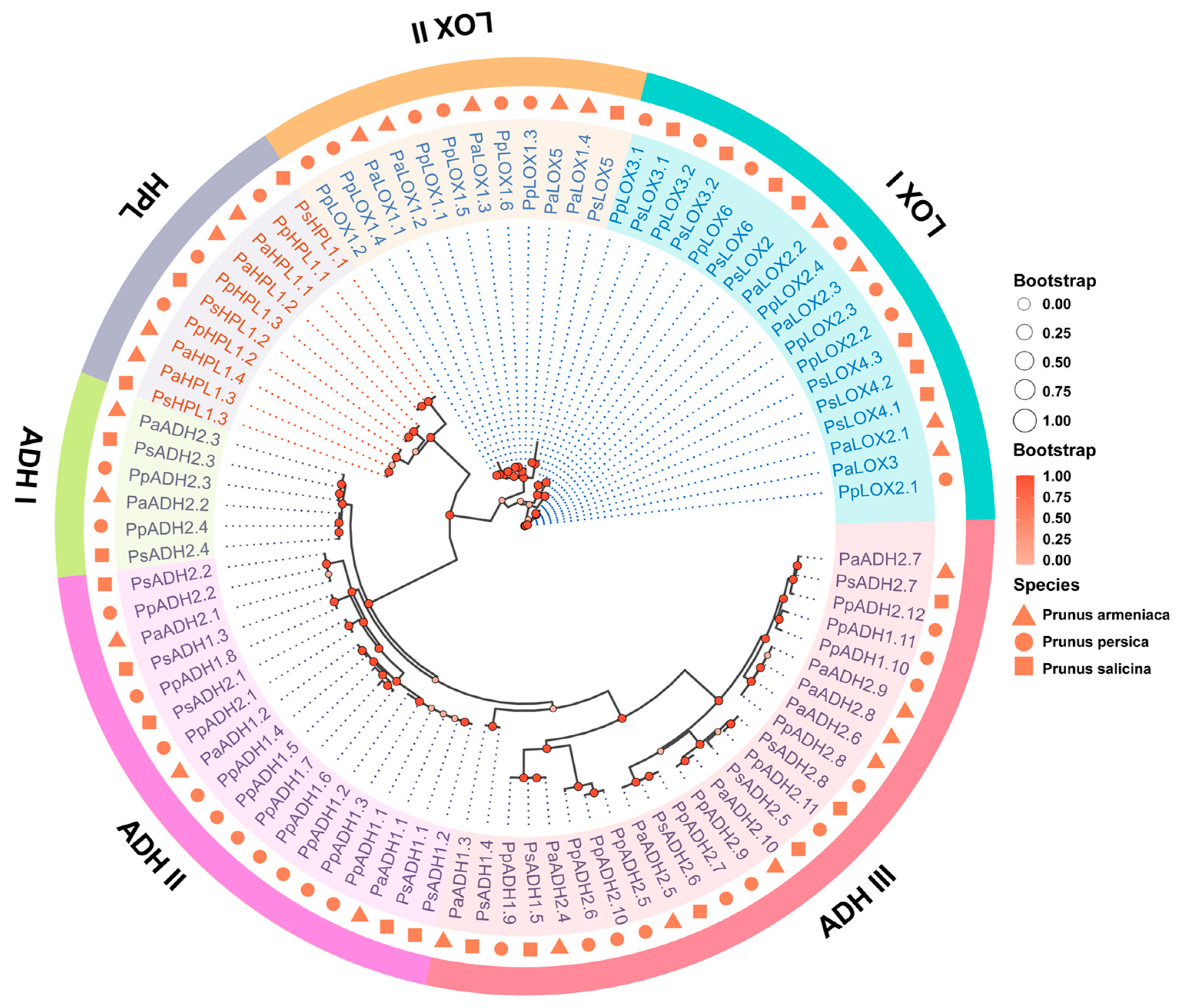
To investigate the evolutionary relationships among the LOX, HPL, and ADH gene families, a phylogenetic tree was constructed using protein sequences of 89 genes from Chinese plum (P. salicina, Ps) and two other Prunus species: apricot (P. armeniaca, Pa) and peach (P. persica, Pp) (Figure 1). The three gene families formed three distinct clades. The ADH clade contained the largest number of genes, with a total of 49 members. These ADH genes were further clustered into three subgroups: ADHI, ADHII, and ADHIII, containing 6, 18, and 25 genes, respectively. All HPL genes formed a single independent clade, representing the smallest group. The LOX clade was divided into two subclades, LOXI and LOXII, comprising 18 and 12 members, respectively. Notably, LOXI contained only one PsLOX gene, while all other PsLOX members were grouped within the LOXIIsubclade.

3.3. Conserved Domains, Motif and Gene Structure Analysis

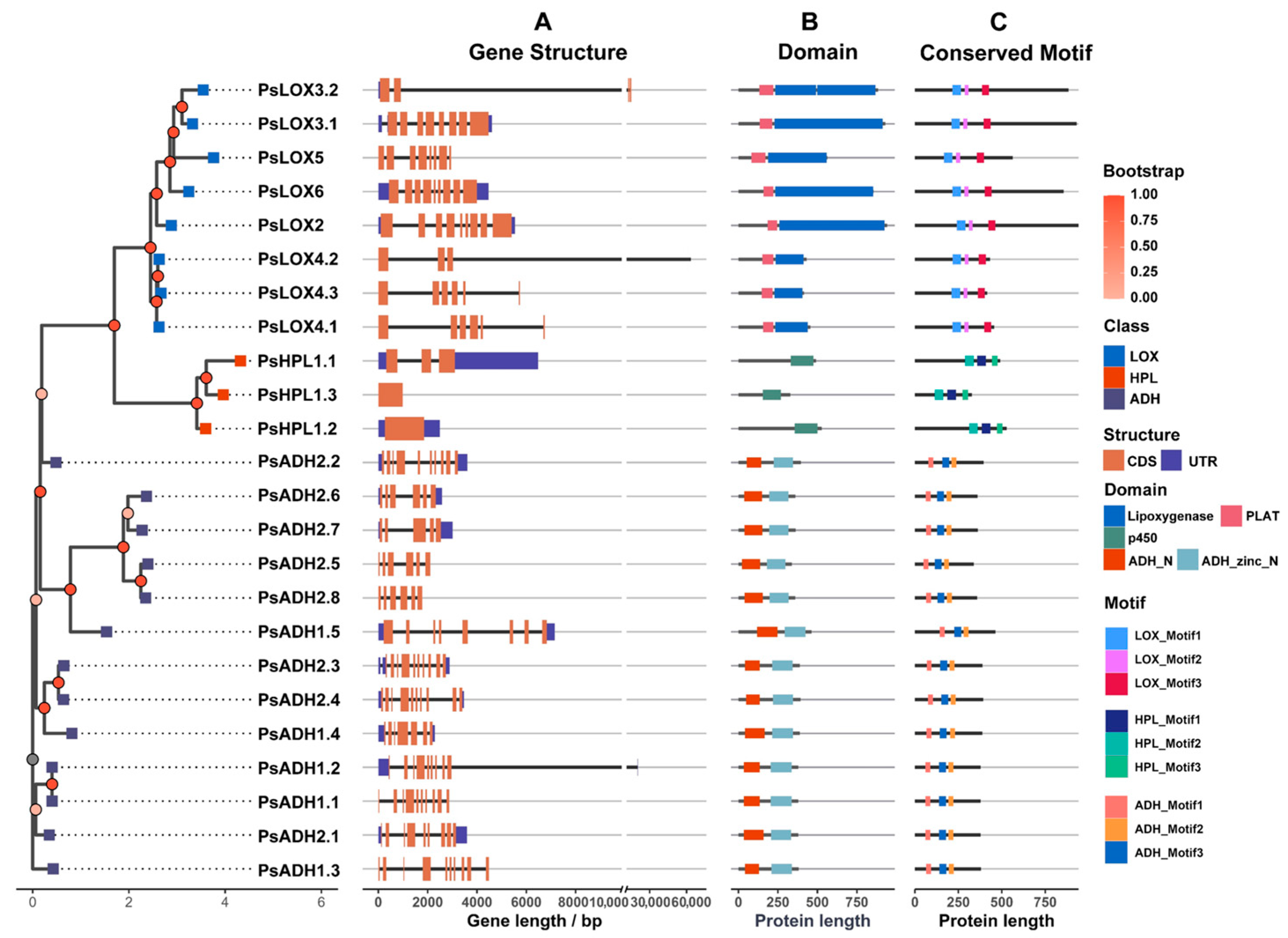
Gene structure analysis revealed distinct exon patterns among the three gene families. In the LOX family, PsLOX4.1, PsLOX4.2, and PsLOX4.3 contain six exons, while other LOX members possess 8 to 9. HPL genes exhibit the fewest exons, ranging from one to three. Substantial variation was observed within the ADH family: PsADH2.3 contains 11 exons—the highest among all 24 identified genes; PsADH1.1, PsADH1.2, PsADH1.3, PsADH2.2, and PsADH2.4 each contain ten. In contrast, PsADH2.5 to PsADH2.8 possess only five to six exons. Each gene family retains three conserved signature motifs, reflecting functional conservation across members. Family-specific domain architectures were observed: LOX proteins contained characteristic PLAT and lipoxygenase domains, HPL featured conserved P450 domains, while ADH displayed diagnostic ADH_N and ADH_zinc_N domains (Figure 2).

3.4. Cis-Regulatory Elements in the Promoter Regions of LOX-HPL-ADH Pathway Key Genes

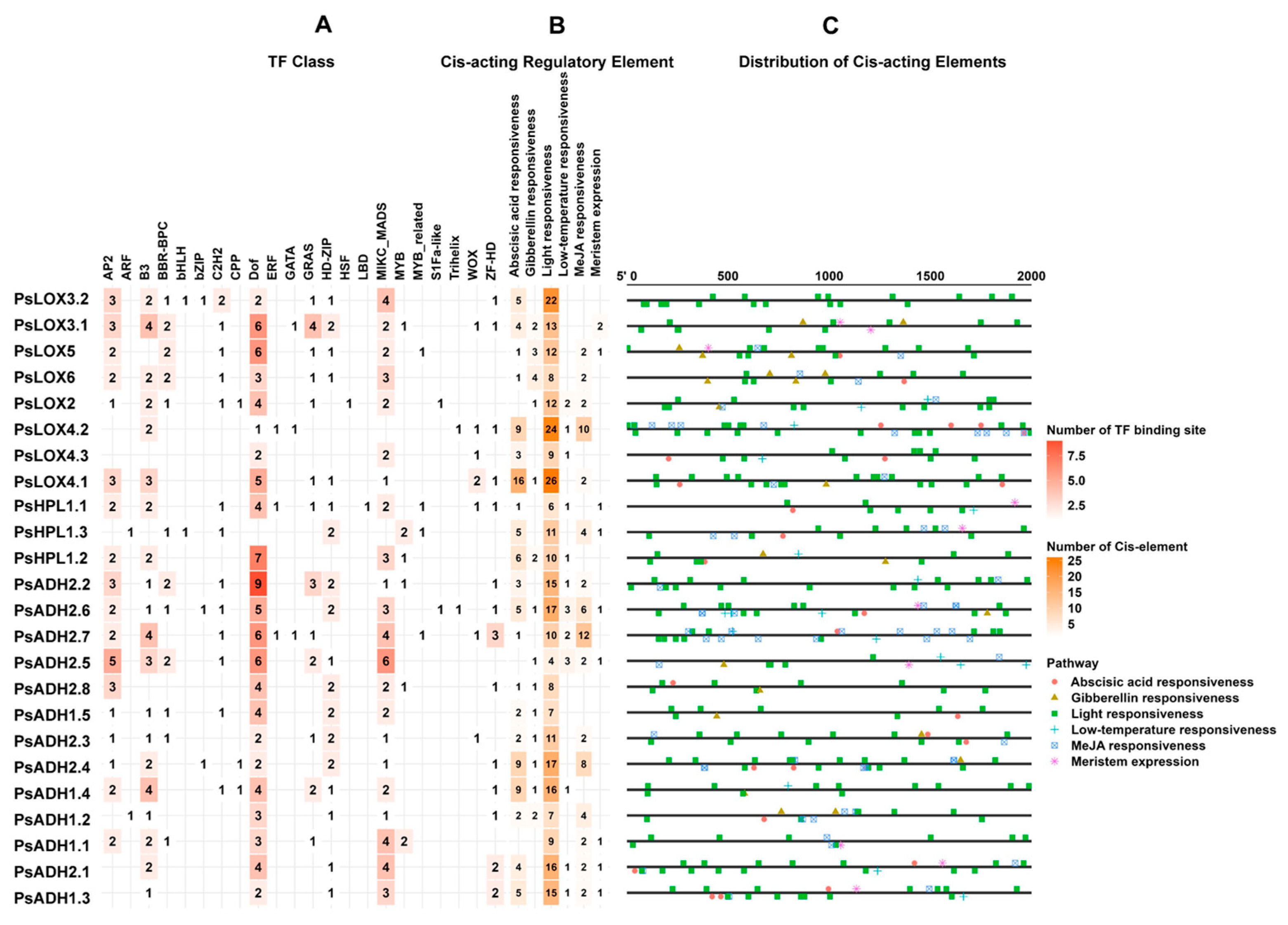
We investigated the transcription factor binding sites in the promoter regions of the PsLOX, PsHPL, and PsADH genes. To avoid inflated counts caused by overlapping predictions, all motif numbers reported here represent non-redundant predicted sites after merging highly overlapping hits of the same motif type. In the LOX gene family, 8 BBR-BPC transcription factor binding sites were detected in the promoters of five PsLOX genes. All PsLOX genes contained Dof binding sites, with the number of predicted sites ranging from 1 to 6; PsLOX5 had the highest number (6 copies). With the exception of PsLOX3.1 and PsLOX3.2, the promoters of all other family members contained varying numbers of AP2 and GRAS binding sites. In the HPL gene family, Dof binding sites showed the highest abundance: the promoters of PsHPL1.1 and PsHPL1.3 contained 7 and 4 Dof binding sites, respectively. No ERF binding sites were detected in the promoters of PsHPL1.1 and PsHPL1.2, whereas 1 ERF binding site was identified in that of PsHPL1.3. In the ADH gene family, Dof binding sites were also the most abundant: the promoters of PsADH2.5 and PsADH2.6 each contained 6 Dof binding sites, while that of PsADH2.8 contained 9 Dof binding sites. In addition, PsADH2.6 contained 1 ERF binding site, making it the only gene in this family with ERF binding sites. PsADH2.5 harbored 6 MIKC_MADS binding sites, which was also the highest number among all ADH family members. Analysis of cis-acting elements in the promoters of all genes revealed that light-responsive elements were widely distributed across the three gene families. The abundance of abscisic acid-responsive elements and methyl jasmonate (MeJA)-responsive elements was second only to that of light-responsive elements. A small number of gibberellin-responsive elements, low-temperature-responsive elements, and meristem expression-related elements were also detected (Figure 3).

3.5. Chromosomal Distribution and Synteny Analysis

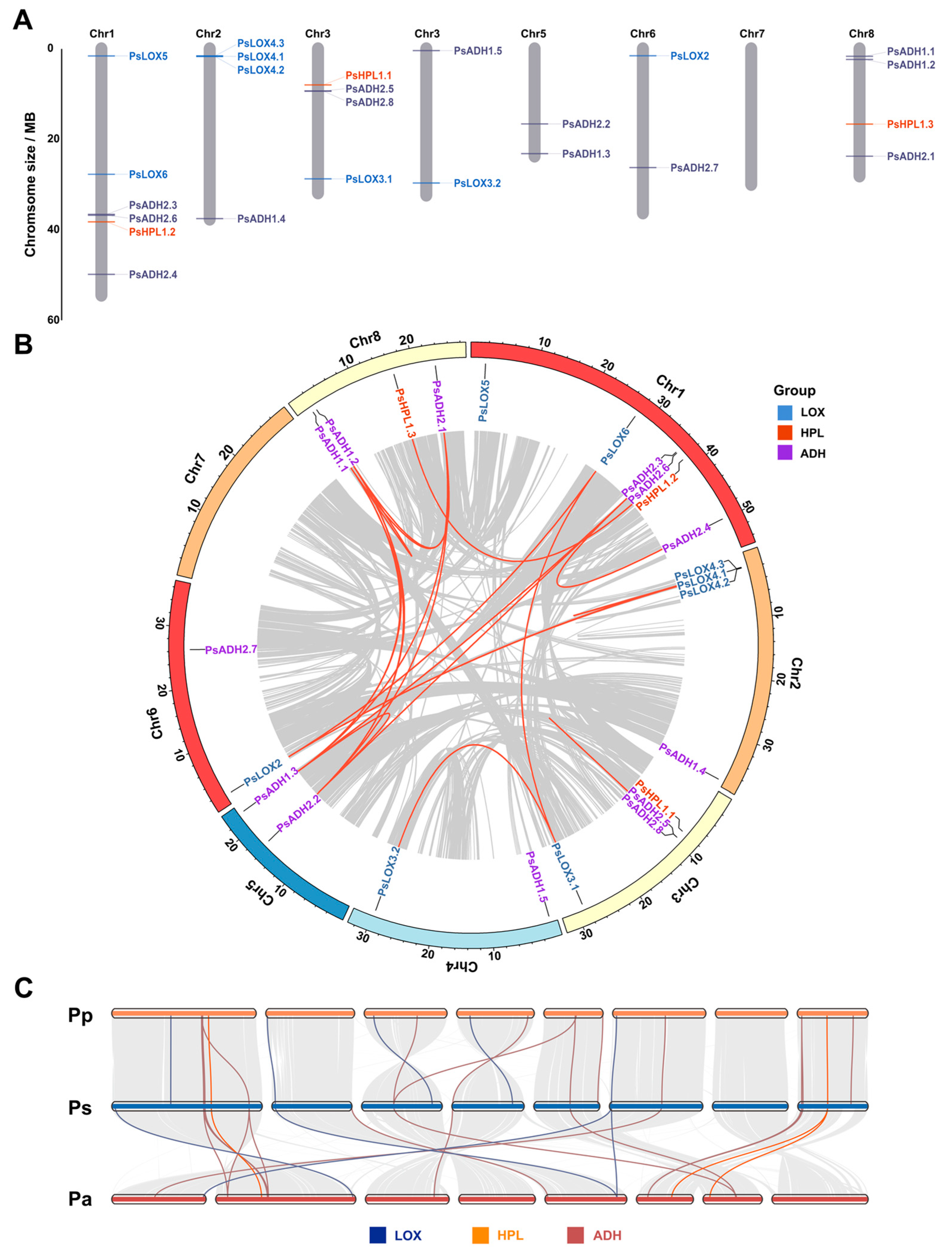
The LOX, HPL, and ADH genes were unevenly distributed across all eight chromosomes of Chinese plum (Figure 4A). Notably, no members of these three gene families were located on chromosome 7. LOX genes were primarily located on chromosomes 1, 2, 3, 4, and 6, with each chromosome harboring one to three LOX genes. Chromosome 2 contained the highest number of LOX genes, with three homologous copies. The three HPL genes were, respectively, localized to chromosomes 1, 3, and 8; the ADH genes were unevenly dispersed across all chromosomes except chromosome 7. Chromosomes 1 and 8 each carried three ADH genes, while the remaining chromosomes contained one to two ADH genes each.
We investigated the duplication events within the three gene families, identifying segmental duplication as the major expansion mechanism. The LOX, HPL, and ADH families exhibited 10, 2, and 13 segmental duplications, alongside one tandem duplication each for LOX and ADH (Figure 4B). Furthermore, cross-species synteny analysis identified 5, 2, and 12 collinear gene pairs between Chinese plum LOX, HPL, and ADH genes and their orthologs in peach, respectively. Similarly, 4, 3, and 12 collinear pairs were detected with apricot (Figure 4C). The comparable number of syntenic relationships with both peach and apricot suggests a close phylogenetic relationship.

3.6. VOCs Characterization of Ten Chinese Plum Cultivars

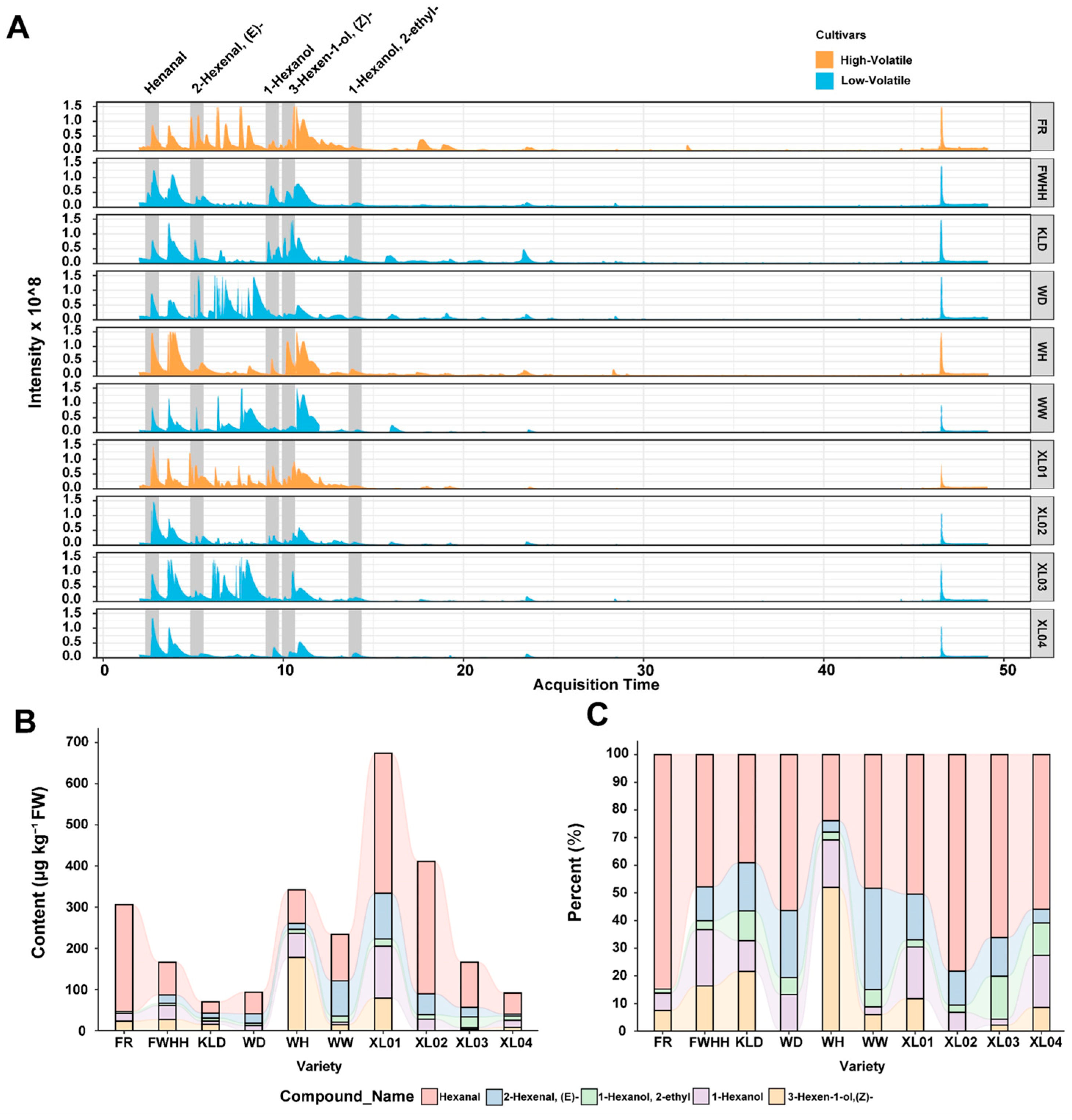
Volatile organic compounds (VOCs) were profiled in ten Chinese plum cultivars using solid-phase microextraction coupled with gas chromatography–mass spectrometry (SPME/GC–MS). In the total ion chromatograms (TICs), peak number and peak intensity reflect VOC diversity and relative abundance, respectively. Substantial cultivar-dependent differences in VOC composition and abundance were observed (Figure 5A). Notably, ‘FR’, ‘WH’, and ‘XL01’ exhibited more complex TIC patterns, with higher numbers of detectable peaks (27–35) than the other cultivars (17–26) on average.
The five most abundant C6 aldehydes and alcohols—(E)-2-hexenal, hexanal, 1-hexanol, 2-ethyl-1-hexanol, and (Z)-3-hexen-1-ol—were selected for further analysis (Figure 5B,C; Figures S1–S3). Using the median of the summed five major C6 aldehydes/alcohols as the cutoff, ‘FR’, ‘WH’, and ‘XL01’ were defined as high-volatile, and the remaining cultivars as low-volatile. The total content of these compounds varied significantly among cultivars, with ‘XL01’ showing the highest level (632.55 μg·kg−1 FW), approximately ninefold higher than ‘KLD’, which had the lowest level; ‘FR’, ‘WH’, and ‘XL02’ ranked next (Figure 5B). Hexanal was the most abundant compound in nine cultivars, except ‘WH’, reaching the highest levels in ‘XL01’ and ‘XL02’ and accounting for the largest proportion in ‘FR’ (84.79%; Figure 5C). In contrast, ‘WH’ exhibited a distinct profile in which (Z)-3-hexen-1-ol dominated, contributing 52.01% of the total; its level exceeded those of the other four compounds and was higher than the corresponding levels in the other cultivars. ‘XL01’ accumulated the highest amounts of hexanal and 1-hexanol, whereas (E)-2-hexenal was highest in ‘XL01’ and ‘WW’. ‘XL03’ contained significantly more 2-ethyl-1-hexanol than the other cultivars. In terms of relative composition, the proportion of (E)-2-hexenal was highest in ‘WW’ (36.64%) (Figure 5C). Notably, (Z)-3-hexen-1-ol was not detected in ‘XL02’, and (E)-2-hexenal was not detected in ‘FR’.

3.7. qRT-PCR Expression Analysis of LOX, HPL, and ADH Genes in Different Chinese Plum Cultivars

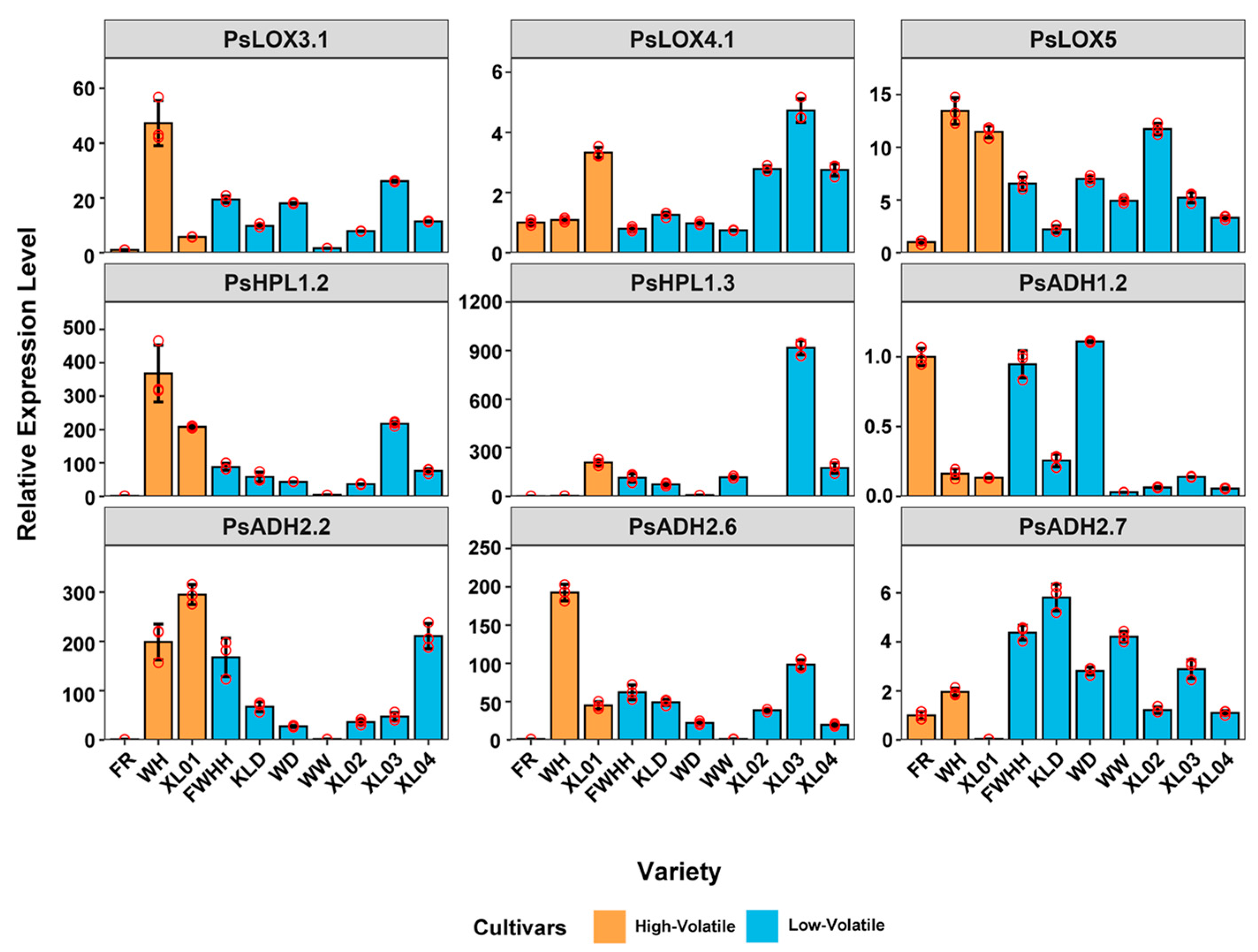
To investigate the roles of members of the LOX, HPL, and ADH gene families in the biosynthesis of high-abundance characteristic C6 aldehydes and C6 alcohols in Chinese plum, their expression levels in the mature fruit samples of 10 cultivars were analyzed by qRT-PCR (Figure 6). In cultivars with high hexanal content (‘XL02’, ‘XL01’, and ‘FR’), the expression level of PsADH2.7 was significantly lower than in the low-hexanal cultivar ‘KLD’, where its expression in ‘KLD’ was 172.31-fold higher than in ‘XL01’. In cultivars exhibiting high 1-hexanol abundance (‘XL01’ and ‘WH’), the expression of PsLOX5 was markedly higher than in low-abundance cultivars (‘WD’, ‘WW’, and ‘XL03’), while PsADH2.2 expression in ‘XL01’ and ‘WH’ ranged from 4.2- to 201.8-fold higher than in the three low-abundance cultivars. For the cultivar with elevated 2-ethyl-1-hexanol content (‘XL03’), PsLOX4.1 expression was 4.72- to 5.93-fold higher than in low-abundance cultivars (‘FR’, ‘WH’, and ‘WD’), and PsHPL1.3 expression was 4.42- to 917.55-fold higher than in all other cultivars. Conversely, PsADH1.2 expression in the low-abundance cultivars (‘FR’, ‘WH’, and ‘WD’) was 6.81- to 7.98-fold higher than in ‘XL03’. In ‘WH’, which displayed the highest (Z)-3-hexen-1-ol content, the expression levels of PsLOX3.1, PsHPL1.2, and PsADH2.6 were substantially elevated compared to the other nine cultivars, with PsLOX3.1, PsHPL1.2, and PsADH2.6 showing 2.63-, 8.47-, and 8.68-fold higher expression, respectively, than in the (Z)-3-hexen-1-ol-deficient cultivar ‘WD’.

3.8. Correlation Analysis of Gene Expression and Volatile Compound Accumulation

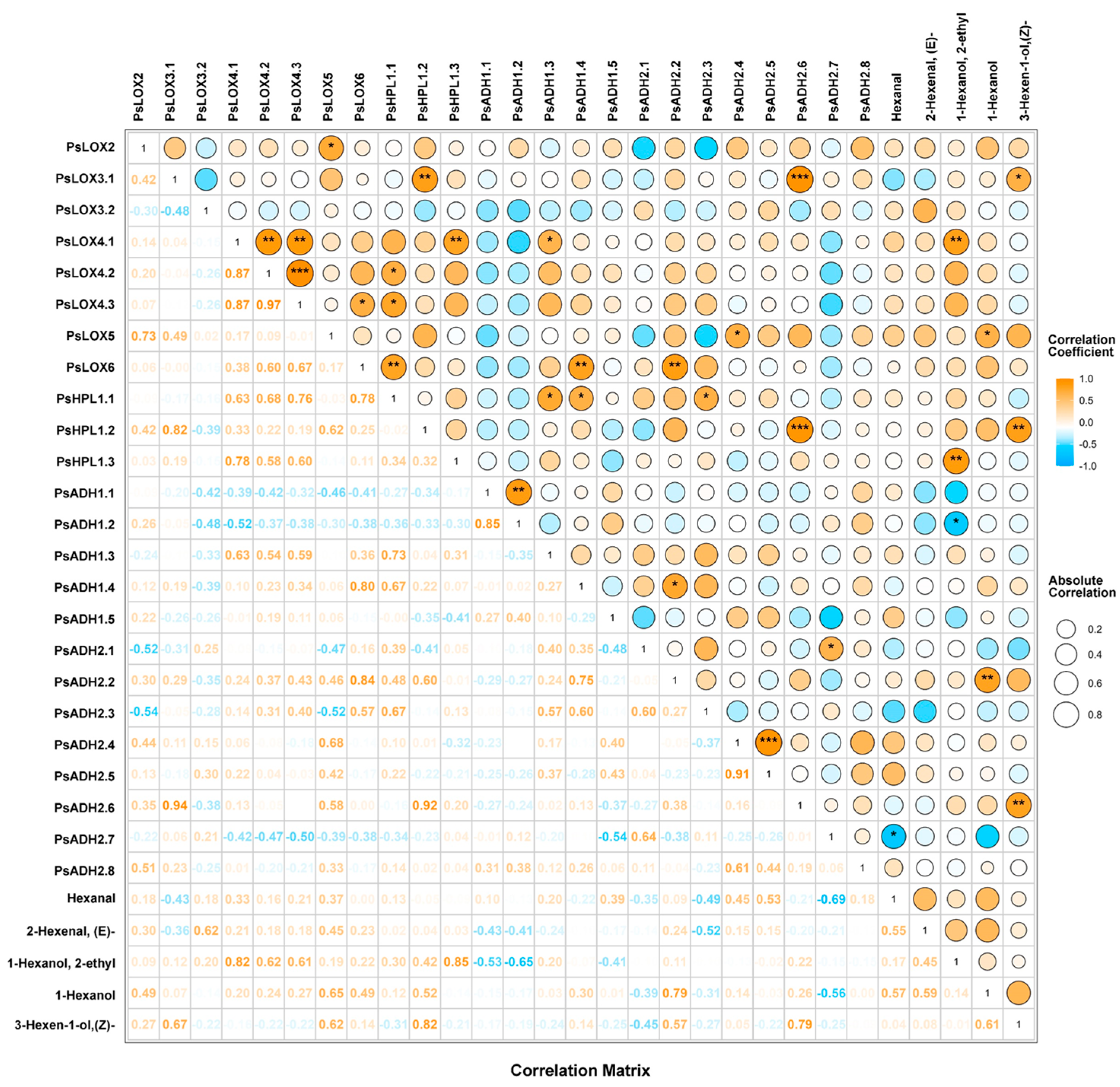
To examine the relationship between the LOX–HPL–ADH pathway gene expression and green-note C6 aldehyde/alcohol accumulation, Pearson correlation analysis was performed using qRT-PCR expression levels and the contents of five representative C6 compounds (Figure 7). The findings showed a significant inverse relationship (r = −0.69, p < 0.05) between hexanal levels and PsADH2.7 expression, indicating a negative association between this gene and hexanal abundance. In contrast, no significant correlations were observed between (E)-2-hexenal content and the expression levels of any gene family members. The accumulation of 1-hexanol showed strong positive correlations with the expression of PsLOX5 (r = 0.65) and PsADH2.2 (r = 0.79), indicating that their expression co-varied with 1-hexanol levels across cultivars. For 2-ethyl-1-hexanol, a highly significant positive correlation was detected with PsLOX4.1 and PsHPL1.3, while a significant negative correlation was observed with PsADH1.2, suggesting that multiple genes were associated with its variation. Similarly, (Z)-3-hexen-1-ol content displayed significant positive correlations with the expression of PsLOX3.1, PsHPL1.2, and PsADH2.6, indicating coordinated gene–metabolite associations. Furthermore, significant correlations were identified among upstream and downstream genes within the pathway. Specifically, PsLOX3.1 and PsHPL1.2 both exhibited strong positive correlations with PsADH2.6. Additionally, PsLOX6 exhibited significant positive correlations (p < 0.01) with three key genes—PsHPL1.1, PsHPL1.4, and PsADH2.2—indicating coordinated expression among these components. A strong positive correlation (r = 0.78, p < 0.01) was also observed between PsLOX4.1 and PsHPL1.3, further supporting their co-expression within the pathway across cultivars.

4. Discussion

4.1. Identification and Evolutionary Analysis of LOX-HPL-ADH Pathway Genes in Prunus Species

In this study, the LOX, HPL, and ADH genes of Chinese plum were identified genome-wide. Comparative analysis with other Rosaceae species revealed that the LOX gene family in Chinese plum was significantly smaller than that in Chinese white pear (23 genes) and diploid strawberry (14 FvLOX genes) [30,31]. Our results on the HPL genes in Chinese plum and peach were consistent with a previous systematic study on the HPL family in Rosaceae and model plants. The number of HPL genes in Prunus salicina (3), Prunus mume (3), and Prunus persica (3) was exactly the same, further confirming the evolutionary conservation of HPL genes in Prunus species. This also indicates that the HPL gene family has not undergone large-scale expansion within Rosaceae but has maintained core functions with low copy numbers (2–6) [32]. The number of ADH genes varied significantly among Rosaceae: pear and apple had more than 1.5 times as many ADH genes as black raspberry, sweet cherry, and strawberry. In this study, only 13 ADH genes were identified in Chinese plum. The core driving mechanism of this difference has been clarified. Unlike plum, the main driving force for ADH gene amplification in Pyrus and Malus was whole-genome duplication (WGD) and segmental duplication (SD), and the number of WGD-derived ADH genes in these two species substantially surpassed that in the other studied species [33]. Further comparison among the three representative Prunus species (Prunus salicina, Prunus armeniaca, and Prunus persica) in this study demonstrated that Chinese plum (Ps) and apricot (Pa) possessed a closer number of LOX and ADH genes, while the number of these two types of genes in peach was slightly higher. This pattern is consistent with the established phylogenetic relationship, where Prunus salicina, Prunus armeniaca, and Prunus mume are closely related sister species with relatively recent divergence times [34].

4.2. Regulatory Features of LOX-HPL-ADH Key Gene Promoters

We observed that Dof-binding sites were widely distributed in the promoters of the LOX, HPL, and ADH gene families, with particularly strong enrichment in PsLOX2, PsLOX5, PsHPL1.1, PsADH2.5, and PsADH2.6, suggesting potential relevance to their transcriptional regulation. This interpretation is consistent with the known properties of Dof transcription factors, which bind AAAG/CTTT motifs and participate in the regulation of secondary metabolism, raising the possibility that Dof factors may act as signal integrators coordinating regulatory inputs across LOX, HPL, and ADH family members [35]. Evidence from persimmon supports a regulatory role for Dof factors: DkDof3 and DkDof6 function as transcriptional repressors and mediate direct or indirect trans-repression of the DkADH1 and DkPDC2 promoters, and this mode of regulation may be conserved among cultivars [36].
The LOX, HPL, and ADH families also displayed prominent enrichment of light-responsive and ABA-responsive cis-elements in their promoters. The widespread presence of light-responsive elements is consistent with previous reports that light influences volatile biosynthesis in fruit by modulating fatty-acid substrate availability and the expression of associated genes [37]. A postharvest study in kiwifruit showed that exogenous ABA treatment during cold storage upregulates key genes in aroma-related pathways, such as AchnADH and AchnHPL, thereby promoting the accumulation of volatile compounds in fruit [38]. A genome-wide analysis of ABF transcription factors in sugar beet further supports this view: these factors are core components of ABA signaling, and their promoters contain multiple cis-elements, including ABRE and light-responsive elements; their expression was significantly induced under ABA treatment [39]. Overall, cis-element compositions across the three gene families appeared highly conserved, indicating limited promoter-level divergence during evolution and suggesting that family members may retain broadly conserved regulatory features, although these predictions require experimental validation, such as TF–promoter binding assays (EMSA) and promoter–reporter analyses under light/ABA treatments.

4.3. Association of Specific LOX, HPL and ADH Genes with the Biosynthesis of Key C6 Volatiles

‘FR’, ‘XL01’, and ‘WH’ among the cultivated cultivars exhibited the most complex and varied volatile aroma profiles, with core C6 aldehydes and alcohols particularly prominent as represented by hexanal, 1-hexanol, and (Z)-3-hexen-1-ol. By correlating these metabolic traits with the expression of genes in the LOX-HPL-ADH pathway, we identified candidate gene–metabolite associations that may contribute to the aroma diversity in Chinese plum. Specifically, the accumulation of 1-hexanol was closely associated with PsLOX5 and PsADH2.2. In ‘XL01’ and ‘WH’ varieties, which had higher 1-hexanol content, the expression levels of PsLOX5 and PsADH2.2 were significantly upregulated, showing a strong positive correlation with 1-hexanol. This pattern is consistent with the canonical LOX–HPL–ADH cascade, suggesting that PsLOX5 may catalyze the initial hydroperoxidation of fatty acids to provide precursor substrates, which could then be reduced by PsADH2.2 to form 1-hexanol; however, these RT-qPCR expression–metabolite correlations alone do not establish causality. Mechanistic literature indicates that LOX isoforms can differ in positional/regiospecificity (often discussed in plants as 9-LOX versus 13-LOX) and related product outcomes, and that plant ADHs show substrate specificity and functional diversification that can influence aldehyde–alcohol composition. Together, these studies provide a biochemical/structural context for the isoform-level associations observed here, while our present evidence remains correlative [40,41,42,43]. Importantly, the positional/regiospecificity of PsLOX isoforms (e.g., 9S vs. 13S products) was not determined in this study; therefore, whether PsLOX5 and PsLOX3.1 differ in 9/13 specificity remains to be tested by biochemical assays.
Studies on other fruits have also confirmed the importance of this pathway. In other fruits, such as pear, ethylene signaling has been reported to modulate LOX expression and volatile formation during post-harvest storage. In the present study, we focused on cultivar comparisons at commercial harvest maturity; post-harvest temporal regulation was not investigated and warrants future work [44]. In kiwifruit, the high expression of AcLOX4a suggests it may be a major contributor to aldehyde synthesis during fruit development and ripening. CRISPR-mediated multiplex frameshift knockout of AcLOX4a–c genes resulted in a maximum 86% reduction in total aldehyde content in fruits. In the CAL5-2 line, hexanal content decreased by 70% and (E)-2-hexenal by 88%; additionally, mutations in AcLOX4a–c partially reduced the emission of C5 volatiles such as (E)-2-pentenal and 1-pentanol. Further characterization of C6 aldehydes in LOX CRISPR-edited CAL5-2 kiwifruit revealed a marked decrease in the content of hexanal and (E)-2-hexenal, which are critical components of kiwifruit flavor [45]. In the present study, the high hexanal content in ‘XL01’ and ‘FR’ showed a significant negative correlation with the low expression of PsADH2.7, suggesting a potential association with hexanal accumulation via aldehyde–alcohol interconversion, while alternative explanations (e.g., substrate availability or post-transcriptional regulation) cannot be excluded. A similar mechanism has been reported in tomatoes: modulating ADH levels can alter the balance between aldehydes and alcohols, reflecting the functional diversity of the ADH gene family in the precise regulation of aldehyde and alcohol contents [46]. Of the aldehydes detected in apricot, hexanal and (E)-2-hexenal predominated. Through the ripening process, five of the six monitored volatiles—hexanal, 1-hexanol, ethyl octanoate, hexyl acetate, (E)-2-hexenal, and linalool—underwent a pronounced decline, whereas ethyl hexanoate alone exhibited a notable increase. This change was closely linked to the expression dynamics of Pa-AAT, Pa-ADH, and Pa-LOX [47]. Furthermore, the abnormally high accumulation of (Z)-3-hexen-1-ol in ‘WH’ was associated with the coordinated high expression of PsLOX3.1, PsHPL1.2, and PsADH2.6, a co-expression pattern compatible with their involvement in its synthesis but requiring biochemical validation. In contrast, the unique enrichment of 2-ethyl-1-hexanol in ‘XL03’ was positively correlated with PsLOX4.1 and PsHPL1.3, but negatively correlated with PsADH1.2, implying a cultivar-associated regulatory pattern within the LOX–HPL–ADH network rather than demonstrating a dedicated biosynthetic branch.
In summary, this study identifies several candidate genes involved in the biosynthesis of C6 aldehydes and alcohols that contribute to the characteristic green-note aroma of Chinese plum. Specifically, PsLOX5 and PsADH2.2 are linked to increased 1-hexanol accumulation, while PsLOX3.1, PsHPL1.2, and PsADH2.6 are associated with higher levels of (Z)-3-hexen-1-ol. Additionally, PsADH2.7 expression negatively correlates with hexanal content, suggesting its potential role in regulating aldehyde levels. These findings provide valuable genetic targets for marker-assisted selection or CRISPR-based breeding aimed at enhancing the green-note aroma in Chinese plum. Functional validation will be crucial to confirm the causal roles of these genes and their potential application in aroma improvement.

5. Conclusions

We identified 24 LOX–HPL–ADH pathway genes (8 LOX, 3 HPL, and 13 ADH) in Chinese plum (Prunus salicina) and characterized their evolutionary features, including phylogenetic relationships, gene structures, duplication patterns, and promoter cis-elements. These analyses suggest conserved yet potentially divergent regulatory properties among family members. By integrating genomic features with cultivar-resolved VOC profiling and qRT-PCR expression patterns, we highlighted key regulatory genes (e.g., PsLOX5, PsLOX3.1, PsHPL1.2, PsADH2.2, PsADH2.6) that are associated with the accumulation of major C6 aldehydes/alcsohols contributing to the green-note aroma of Chinese plum. This study provides an integrative genomic, multi-omics framework for aroma biosynthesis; however, the gene–metabolite associations reported here are largely correlative and require functional validation. Future studies should prioritize targeted genetic and molecular approaches to confirm the roles of key candidates and to quantify their contributions to C6 volatile biosynthesis. In addition, these candidates offer a valuable basis for marker development and aroma-oriented breeding aimed at improving fruit flavor quality and market value.

Supplementary Materials

The following supporting information can be downloaded at: https://www.mdpi.com/article/10.3390/horticulturae12010085/s1, Figure S1. Semi-quantitative Relative Contents of Five Representative C6 Aldehydes and Alcohols Across Cultivars. Data represents Mean ± SD; Figure S2. Heatmap of Representative C6 Aldehyde and Alcohol Contents Across Plum Cultivars (μg·kg−1 FW); Figure S3. Heatmap of Representative C6 Aldehyde and Alcohol proportions Across Plum Cultivars; Figure S4. qRT-PCR expression analysis of volatile biosynthesis-related genes (not included in the manuscript) in ten Chinese plum varieties; Table S1: The accession numbers and related information for all reference sequences; Table S2: Primer information for qRT-PCR analysis.

Author Contributions

Formal analysis and writing, M.W., G.D.; data curation and visualization, M.W., T.L.; experiment participation, M.W., Y.W.; resource collection and sampling, Y.W., M.W., S.L. and Y.G.; structuring, modifying, and editing of this manuscript: G.Z., F.L., M.Z., T.L., S.Y. and D.B. All authors have read and agreed to the published version of the manuscript. All authors have read and agreed to the published version of the manuscript.

Funding

This work is supported by the Key Research and Development Program of Xinjiang Uygur Autonomous Region, China (2023B02016-1).

Data Availability Statement

The original contributions presented in this study are included in the article/Supplementary Material. Further inquiries can be directed to the corresponding author.

Acknowledgments

The authors would like to thank the staff at the experimental base of the Research Institute of Non-Timber Forestry, Chinese Academy of Forestry, for their dedicated care and management of the experimental plants.

Conflicts of Interest

The authors declare no conflicts of interest.

References

  1. Wang, M.Y.; Wu, Y.Q.; Yang, H.Y.; Zhang, C.H.; Wu, W.L.; Lyu, L.F.; Cao, F.L.; Li, W.L. Formation and regulatory network of fruit aroma components of Rosaceae plants. Food Biosci. 2025, 69, 106400. [Google Scholar] [CrossRef] [Scilit]
  2. Zhang, Y.Y.; Zhang, B.B.; Zhang, Y.Y.; Song, H.F.; Shen, Z.J.; Ma, R.J.; Yu, M.L. Deciphering aroma complexity between melting flesh and stony hard peach (Prunus persica L.) fruit through integrative analysis of volatile contributions. LWT 2024, 209, 116708. [Google Scholar] [CrossRef] [Scilit]
  3. Vincenti, S.; Mariani, M.; Alberti, J.-C.; Jacopini, S.; Brunini-Bronzini de Caraffa, V.; Berti, L.; Maury, J. Biocatalytic Synthesis of Natural Green Leaf Volatiles Using the Lipoxygenase Metabolic Pathway. Catalysts 2019, 9, 873. [Google Scholar] [CrossRef] [Scilit]
  4. Zhang, J.; Wang, Y.X.; Zhang, S.S.; Zhang, S.H.; Liu, W.J.; Wang, N.; Fang, H.C.; Zhang, Z.Y.; Chen, X.S. ABIOTIC STRESS GENE 1 mediates aroma volatiles accumulation by activating MdLOX1a in apple. Hortic Res. 2024, 11, uhae215. [Google Scholar] [CrossRef] [Scilit] [PubMed]
  5. Yue, R.R.; Zhang, Z.; Shi, Q.Q.; Duan, X.S.; Wen, C.P.; Shen, B.Q.; Li, X.G. Identification of the key genes contributing to the LOX-HPL volatile aldehyde biosynthesis pathway in jujube fruit. Int. J. Biol. Macromol. 2022, 222, 285–294. [Google Scholar] [CrossRef] [Scilit]
  6. Wu, K.; Yang, M.; Chen, L.; Ou, L.; Liu, Z.; Deng, Q.; Huang, R.; Altaf, M.; Wang, Z.; Xu, L.; et al. Genome-wide identification and effect on volatile aroma compounds of lipoxygenase in fruit fatty acid metabolism pathway in Capsicum chinense. Sci. Hortic. 2025, 345, 114157. [Google Scholar] [CrossRef] [Scilit]
  7. Wang, Q.H.; Gao, F.; Chen, X.X.; Wu, W.J.; Wang, L.; Shi, J.L.; Huang, Y.; Shen, Y.Y.; Wu, G.L.; Guo, J.X. Characterization of key aroma compounds and regulation mechanism of aroma formation in local Binzi (Malus pumila × Malus asiatica) fruit. BMC Plant Biol. 2022, 22, 532. [Google Scholar] [CrossRef] [Scilit]
  8. Zhang, B.; Shen, J.Y.; Wei, W.W.; Xi, W.P.; Xu, C.J.; Ferguson, I.; Chen, K.S. Expression of genes associated with aroma formation derived from the fatty acid pathway during peach fruit ripening. J. Agric. Food Chem. 2010, 58, 6157–6165. [Google Scholar] [CrossRef] [Scilit] [PubMed]
  9. Shen, J.Y.; Wu, L.; Liu, H.R.; Zhang, B.; Yin, X.R.; Ge, Y.Q.; Chen, K.S. Bagging Treatment Influences Production of C6 Aldehydes and Biosynthesis-Related Gene Expression in Peach Fruit Skin. Molecules 2014, 19, 13461–13472. [Google Scholar] [CrossRef] [Scilit]
  10. Cai, H.F.; An, X.J.; Han, S.; Jiang, L.; Yu, M.L.; Ma, R.J.; Yu, Z.F. Effect of 1-MCP on the production of volatiles and biosynthesis-related gene expression in peach fruit during cold storage. Postharv. Biol. Technol. 2018, 141, 50–57. [Google Scholar] [CrossRef] [Scilit]
  11. Ji, X.H.; Wang, B.L.; Wang, X.D.; Wang, X.L.; Liu, F.Z.; Wang, H.B. Differences of aroma development and metabolic pathway gene expression between Kyoho and 87-1 grapes. J. Integr. Agric. 2021, 20, 1525–1539. [Google Scholar] [CrossRef] [Scilit]
  12. Qian, X.; Xu, X.Q.; Yu, K.J.; Zhu, B.Q.; Lan, Y.B.; Duan, C.Q.; Pan, Q.H. Varietal Dependence of GLVs Accumulation and LOX-HPL Pathway Gene Expression in Four Vitis vinifera Wine Grapes. Int. J. Mol. Sci. 2016, 17, 1924. [Google Scholar] [CrossRef] [Scilit]
  13. Qian, X.; Sun, L.; Xu, X.Q.; Zhu, B.Q.; Xu, H.Y. Differential Expression of VvLOXA Diversifies C6 Volatile Profiles in Some Vitis vinifera Table Grape Cultivars. Int. J. Mol. Sci. 2017, 18, 2705. [Google Scholar] [CrossRef] [Scilit] [PubMed]
  14. Sun, Y.Z.; Du, Z.L.; Sun, C.C.; Li, X.L.; Liu, M.; Zeng, X.Q.; Gong, H.S.; Fan, X.G.; Sun, S.Y. Enhancing the synthesis of lactones and C6/9 volatile compounds of apricot by methyl salicylate during cold storage. LWT-Food Sci. Technol. 2024, 212, 116962. [Google Scholar] [CrossRef] [Scilit]
  15. Sun, H.L.; Lu, X.F.; Wang, Y.; Li, J.; Liu, S. Study on Evaluation of Fruit Aroma of Plum Variety Resources Based on Headspace Solid-Phase Microextraction Combined with Gas Chromatography-Mass Spectrometry. Foods 2024, 13, 3515. [Google Scholar] [CrossRef] [Scilit]
  16. Chai, Q.Q.; Wu, B.H.; Liu, W.S.; Wang, L.J.; Yang, C.X.; Wang, Y.J.; Fang, J.B.; Liu, Y.C.; Li, S.H. Volatiles of plums evaluated by HS-SPME with GC-MS at the germplasm level. Food Chem. 2012, 130, 432–440. [Google Scholar] [CrossRef] [Scilit]
  17. Zhang, Q.; Zhu, S.L.; Lin, X.; Peng, J.S.; Luo, D.C.; Wan, X.; Zhang, Y.; Dong, X.Q.; Ma, Y.H. Analysis of Volatile Compounds in Different Varieties of Plum Fruits Based on Headspace Solid-Phase Microextraction-Gas Chromatography-Mass Spectrometry Technique. Horticulturae 2023, 9, 1069. [Google Scholar] [CrossRef] [Scilit]
  18. Pino, J.A.; Quijano, C.E. Study of the Volatile Compounds from Plum (Prunus domestica L. cv. Horvin) and Estimation of Their Contribution to the Fruit Aroma. Food Sci. Technol. 2012, 32, 76–83. [Google Scholar] [CrossRef] [Scilit]
  19. Horvat, R.J.; Chapman, G.W., Jr.; Senter, S.D.; Norton, J.D.; Okie, W.R.; Robertson, J.A. Comparison of the Volatile Compounds from Several Commercial Plum Cultivars. J. Sci. Food Agric. 1992, 60, 21–23. [Google Scholar] [CrossRef] [Scilit]
  20. Liu, H.Y.; Zhang, M.H.; Su, M.S.; Zeng, W.F.; Wang, S.C.; Du, J.H.; Zhou, H.J.; Yang, X.F.; Zhang, X.A.; Li, X.W.; et al. Multidimensional Analysis of the Flavor Characteristics of Yellow Peach at Different Ripening Stages: Chemical Composition Profiling and Sensory Evaluation. Food Chem. 2025, 471, 142772. [Google Scholar] [CrossRef] [Scilit]
  21. Chen, X.; Quek, S.Y. Free and Glycosidically Bound Aroma Compounds in Fruit: Biosynthesis, Transformation, and Practical Control. Crit. Rev. Food Sci. Nutr. 2023, 63, 9052–9073. [Google Scholar] [CrossRef] [Scilit] [PubMed]
  22. El Hadi, M.A.M.; Zhang, F.J.; Wu, F.F.; Zhou, C.H.; Tao, J. Advances in Fruit Aroma Volatile Research. Molecules 2013, 18, 8200–8229. [Google Scholar] [CrossRef] [Scilit]
  23. Taiti, C.; Pandolfi, C.; Caparrotta, S.; Dei, M.; Giordani, E.; Mancuso, S.; Nencetti, V. Fruit aroma and sensorial characteristics of traditional and innovative Japanese plum (Prunus salicina L.) cultivars grown in Italy. Eur. Food Res. Technol. 2019, 245, 2655–2668. [Google Scholar] [CrossRef] [Scilit]
  24. Sun, S.; Yi, J.J.; Gu, P.L.; Huang, Y.T.; Huang, X.; Li, H.Q.; Fan, T.T.; Zhao, J.; Wang, R.Z.; Gaballah, M.M.; et al. Comprehensive Characterization and Functional Analysis of the Lateral Organ Boundaries Domain Gene Family in Rice: Evolution, Expression, and Stress Response. Int. J. Mol. Sci. 2025, 26, 3948. [Google Scholar] [CrossRef] [Scilit]
  25. Du, H.; Yang, S.S.; Liang, Z.; Feng, B.R.; Liu, L.; Huang, Y.B.; Tang, Y.X. Genome-wide Analysis of the MYB Transcription Factor Superfamily in Soybean. BMC Plant Biol. 2012, 12, 106. [Google Scholar] [CrossRef] [Scilit]
  26. Dong, X.S.; Jiang, Y.; Yang, Y.N.; Xiao, Z.W.; Bai, X.H.; Gao, J.; Tan, S.R.; Hur, Y.K.; Hao, S.M.; He, F.F. Identification and Expression Analysis of the NAC Gene Family in Coffea canephora. Agronomy 2019, 9, 670. [Google Scholar] [CrossRef] [Scilit]
  27. Wang, Y.; He, Y.H.; Liu, Y.; Wang, D.W. Analyzing Volatile Compounds of Young and Mature Docynia delavayi Fruit by HS-SPME-GC-MS and rOAV. Foods 2023, 12, 59. [Google Scholar] [CrossRef] [Scilit] [PubMed]
  28. Deng, H.H.; He, R.M.; Long, M.C.; Li, Y.M.; Zheng, Y.Y.; Lin, L.J.; Liang, D.; Zhang, X.A.; Liao, M.A.; Lv, X.L.; et al. Comparison of the Fruit Volatile Profiles of Five Muscadine Grape Cultivars (Vitis rotundifolia Michx.) Using HS-SPME-GC/MS Combined With Multivariate Statistical Analysis. Front. Plant Sci. 2021, 12, 728891. [Google Scholar] [CrossRef] [Scilit]
  29. Zhu, G.P.; Wang, M.Y.; Li, T.S.; Hu, H.F.; Wang, M.; Li, F.D.; Yang, S.B.; Bai, D.F. Comparative Transcriptome and Metabolome Analysis Revealed Key Cold-Tolerant Metabolic Pathways Under Cold Stress in Prunus salicina × armeniaca. Sci. Hortic. 2025, 350, 114302. [Google Scholar] [CrossRef] [Scilit]
  30. Li, M.; Li, L.; Dunwell, J.M.; Qiao, X.; Liu, X.; Zhang, S.L. Characterization of the lipoxygenase (LOX) gene family in the Chinese white pear (Pyrus bretschneideri) and comparison with other members of the Rosaceae. BMC Genom. 2014, 15, 444. [Google Scholar] [CrossRef] [Scilit]
  31. Li, Z.Q.; Xie, Q.; Yan, J.H.; Chen, J.Q.; Chen, Q.X. Genome-wide identification and characterization of the abiotic-stress-responsive lipoxygenase gene family in diploid woodland strawberry (Fragaria vesca). J. Integr. Agric. 2022, 21, 1982–1996. [Google Scholar] [CrossRef] [Scilit]
  32. Xu, B.W.; Li, L.L.; Li, M. Identification and characterization of hydroperoxide lyase (HPL) gene family in seven species of Rosaceae. J. Fruit Sci. 2020, 4, 459–471. [Google Scholar]
  33. Zeng, W.W.; Qiao, X.; Li, Q.H.; Liu, C.X.; Wu, J.; Yin, H.; Zhang, S.L. Genome-wide identification and comparative analysis of the ADH gene family in Chinese white pear (Pyrus bretschneideri) and other Rosaceae species. Genomics 2020, 112, 3484–3496. [Google Scholar] [CrossRef] [Scilit]
  34. Tan, Q.P.; Li, S.; Zhang, Y.Z.; Chen, M.; Wen, B.B.; Jiang, S.; Chen, X.D.; Fu, X.L.; Li, D.M.; Wu, H.Y.; et al. Chromosome-level genome assemblies of five Prunus species and genome-wide association studies for key agronomic traits in peach. Hortic. Res. 2021, 8, 213. [Google Scholar] [CrossRef] [Scilit]
  35. Guo, Y.X.; Chen, J.; Wang, Y.F.; Sun, C.Y.; Wang, Y.; Zhang, M.P. Roles of Dof Transcription Factors in the Regulation of Plant. Biotech. Bull. 2019, 35, 146–156. [Google Scholar]
  36. Jin, R.; Wu, W.; Liu, X.F.; Chen, K.S.; Yin, X.R. Dof Transcription Factors Are Involved in High CO2 Induced Persimmon Fruit Deastringency. Horticulturae 2022, 8, 643. [Google Scholar] [CrossRef] [Scilit]
  37. Xue, W.Y.; Liu, N.; Lu, P.F.; Yang, Y.Y.; Chen, S.X. Photosynthesis and fatty acid metabolism reveals the effects of shading treatment on the fruit aroma quality of cucumber (Cucumis sativus L.). Sci. Hortic. 2024, 337, 113508. [Google Scholar] [CrossRef] [Scilit]
  38. Han, X.Y.; Wang, X.Y.; Shen, C.; Mo, Y.W.; Tian, R.G.; Mao, L.C.; Luo, Z.S.; Yang, H.Y. Exogenous ABA Promotes Aroma Biosynthesis of Postharvest Kiwifruit After Low-Temperature Storage. Planta 2022, 255, 82. [Google Scholar] [CrossRef] [Scilit] [PubMed]
  39. Meng, Y.J.; Wu, G.Q.; Wei, M. Genome-wide Identification of BvABF Gene Family and Expression Analysis under ABA Treatment in Sugar Beet (Beta vulgaris L.). Acta Pratacult. Sinica 2024, 33, 94–110. [Google Scholar]
  40. Newcomer, M.E.; Brash, A.R. The structural basis for specificity in lipoxygenase catalysis. Protein Sci. 2015, 24, 298–309. [Google Scholar] [CrossRef] [Scilit]
  41. Feussner, I.; Wasternack, C. The lipoxygenase pathway. Annu. Rev. Plant Biol. 2002, 53, 275–297. [Google Scholar] [CrossRef] [Scilit]
  42. Strommer, J. The plant ADH gene family. Plant J. 2011, 66, 128–142. [Google Scholar] [CrossRef] [Scilit]
  43. Bicsak, T.A.; Kann, L.R.; Reiter, A.; Chase, T., Jr. Tomato alcohol dehydrogenase: Purification and substrate specificity. Arch. Biochem. Biophys. 1982, 216, 605–615. [Google Scholar] [CrossRef] [Scilit]
  44. Zhao, J.L.; He, J.G.; Yue, Y.X.; Yan, Z.R.; Feng, Y.X.; Cheng, Y.D.; Guan, J.F. Effect of 1-Methylcyclopene on Quality and Volatile Organic Components and Related Gene Expression in ‘Xiangshui’ Pears. Food Sci. 2022, 43, 209–217. [Google Scholar]
  45. Huang, C.H.; Zhang, L.; Chen, X.Y.; McCourt, T.E.; Wang, T.C.; Wang, M.Y.; Winz, R.A.; McCallum, J.N.; Baldwin, S.J.; Atkinson, R.G.; et al. The aldehyde (ALD) locus controls C6-aldehyde production in kiwifruit and affects consumer perception of fruit aroma. Plant Physiol. 2025, 198, 285. [Google Scholar] [CrossRef] [Scilit] [PubMed]
  46. Speirs, J.; Lee, E.; Holt, K.; Kim, Y.-D.; Steele Scott, N.; Loveys, B.; Schuch, W. Genetic Manipulation of Alcohol Dehydrogenase Levels in Ripening Tomato Fruit Affects the Balance of Some Flavor Aldehydes and Alcohols. Plant Physiol. 1998, 117, 1047–1058. [Google Scholar] [CrossRef] [Scilit] [PubMed]
  47. González-Agüero, M.; Troncoso, S.; Gudenschwager, O.; Campos-Vargas, R.; Moya-León, M.A.; Defilippi, B.G. Differential expression levels of aroma-related genes during ripening of apricot (Prunus armeniaca L.). Plant Physiol. Biochem. 2009, 47, 435–440. [Google Scholar] [CrossRef] [Scilit] [PubMed]
Figure 1. The phylogenetic analysis of three gene families in three different species, including Prunus armeniaca (Pa), Prunus persica (Pp), and Prunus salicina (Ps), was constructed using the maximum likelihood method. Bootstrap support is indicated by node symbols, with larger circles and deeper red colors representing higher support. Species are represented by shapes next to each gene: triangles (Pa), circles (Pp), and squares (Ps). Group/subgroups are highlighted by colored outer-ring segments and labeled accordingly.
Horticulturae 12 00085 g001
Figure 2. Analysis of gene structure, conserved domains, and motifs of three gene families in Chinese plum. (A): Gene structure of individual genes. The introns, exons, and untranslated regions (UTR) are indicated by gray lines, orange rectangles, and blue rectangles, respectively. (B): Composition and arrangement of conserved functional domains within the protein sequences. Different domain types are represented by distinct colored rectangles. (C): Distribution of conserved motifs identified in the protein sequences. Bootstrap support is indicated by node symbols, with deeper red colors representing higher support.
Horticulturae 12 00085 g002
Figure 3. Analysis of cis-regulatory elements of the LOX-HPL-ADH pathway key genes. (A): Classification and quantity of predicted transcription factors (TF) binding sites. Different colors represent distinct TF families. (B): Statistics of cis-regulatory elements. The chart shows the absolute count and composition of various plant hormone and stress responsiveness-related elements. (C): Distribution profile of core elements across the promoter region (from 0 to −2000 bp upstream of the transcription start site). Bootstrap support is indicated by node symbols, with deeper red colors representing higher support.
Horticulturae 12 00085 g003
Figure 4. Chromosomal distributions. (A): Gray bars represent chromosomes (Chr1-Chr8) with numbers indicated. LOX (blue), HPL (orange), and ADH (purple) gene positions are shown. Synteny analysis in Chinese plum; (B): The duplication genes in the three gene families. The circular plot was generated using R software. The gray background lines represent genome-wide collinear/syntenic blocks across chromosomes, while the highlighted colored lines indicate the collinearity relationships involving the LOX/HPL/ADH genes; (C): Interspecies synteny of LOX/HPL/ADH genes among Prunus salicina (Ps), P. persica (Pp), and P. armeniaca (Pa). Chromosomes from different species are shown in different colors. Collinear links are colored by gene family: LOX (blue), HPL (orange), and ADH (dark red), with gray links indicating genome-wide syntenic blocks.
Horticulturae 12 00085 g004
Figure 5. (A): TIC Profiles of Volatile Compounds Across Chinese Plum Varieties (gray blocks indicate the retention time (RT) positions of individual volatile compounds); (B): Sankey Diagram of Five Aroma Compounds Distribution: Absolute Relative Content Across Groups; (C): Sankey Diagram of Five Aroma Compounds Distribution: Percentage Composition Within Variety. In panels B and C, values for each metabolite are linked across varieties with a same-color semi-transparent ribbon to improve visual continuity and highlight the across-variety trend.
Horticulturae 12 00085 g005
Figure 6. qRT-PCR expression analysis of volatile biosynthesis-related genes in ten Chinese plum varieties. Transcriptional levels were quantified by qRT-PCR and are shown relative to cultivar ‘FR’; values represent the mean ± SD of three biological replicates, with red circles on the error bars indicating individual biological replicate data points. Orange and blue bars indicate high-volatile and low-volatile cultivar groups, respectively. The remaining qRT-PCR expression results are provided in Figure S4.
Horticulturae 12 00085 g006
Figure 7. Correlation heatmap between aroma compounds and qRT-PCR expression levels. Orange color in the heatmap indicates positive correlation, blue color indicates negative correlation, and white color indicates almost no correlation. Significance levels (FDR-adjusted): * p < 0.05, ** p < 0.01, *** p < 0.001 (Benjamini–Hochberg).
Horticulturae 12 00085 g007
Table 1. Protein physicochemical property.
Gene LabelGene IDLength
(aa)
Molecular Weight (kDa)GRAVYpIInstability Index
PsLOX6evm.model.Chr1.351785696.46−0.407.3851.64
PsLOX5evm.model.Chr1.578556364.49−0.548.6543.06
PsLOX4.3evm.model.Chr2.12941646.39−0.547.7536.21
PsLOX4.2evm.model.Chr2.13543247.97−0.466.8442.08
PsLOX4.1evm.model.Chr2.13045650.62−0.397.4439.44
PsLOX3.2evm.model.Chr4.448/Chr4.450884100.24−0.416.2654.33
PsLOX3.1evm.model.Chr3.379.4931105.53−0.428.4044.20
PsLOX2evm.model.Chr6.82.1942106.90−0.356.9742.23
Subfamily Summary (Mean ± SD)685.0 ± 216.974.95 ± 25.87−0.44 ± 0.077.34 ± 0.7344.15 ± 5.86
PsHPL1.3evm.model.Chr8.129932937.15−0.116.0037.63
PsHPL1.2evm.model.Chr1.196952859.19−0.199.3250.83
PsHPL1.1evm.model.Chr3.2192/Chr3.219349154.73−0.116.9051.60
Subfamily Summary (Mean ± SD)449.3 ± 104.050.36 ± 11.46−0.14 ± 0.057.41 ± 1.6946.69 ± 7.65
PsADH2.8evm.model.Chr3.202035938.440.016.1729.97
PsADH2.7evm.model.Chr6.217036238.810.046.7825.03
PsADH2.6evm.model.Chr1.221736139.32−0.077.2027.36
PsADH2.5evm.model.Chr3.202133937.010.047.4526.01
PsADH2.4evm.model.Chr1.49139442.960.095.1933.32
PsADH2.3evm.model.Chr1.226238942.320.085.4834.57
PsADH2.2evm.model.Chr5.113439542.92−0.147.1226.27
PsADH2.1evm.model.Chr8.218437940.450.057.1526.49
PsADH1.5evm.model.Chr4.289446449.31−0.078.2448.46
PsADH1.4evm.model.Chr2.320938841.790.067.0731.53
PsADH1.3evm.model.Chr5.8038140.820.106.9734.78
PsADH1.2evm.model.Chr8.231/Chr8.23337941.12−0.126.2935.76
PsADH1.1evm.model.Chr8.16437941.12−0.126.2935.76
Subfamily Summary (Mean ± SD)383.8 ± 29.541.72 ± 3.280.01 ± 0.086.70 ± 0.7731.80 ± 6.73
Disclaimer/Publisher’s Note: The statements, opinions and data contained in all publications are solely those of the individual author(s) and contributor(s) and not of MDPI and/or the editor(s). MDPI and/or the editor(s) disclaim responsibility for any injury to people or property resulting from any ideas, methods, instructions or products referred to in the content.