Integrating UAVs and Deep Learning for Plant Disease Detection: A Review of Techniques, Datasets, and Field Challenges with Examples from Cassava

 , ,
, ,  and
and
Abstract
1. Introduction

| Citation | Scope | Strengths | Limitations | Gap Filled by This Review |
|---|---|---|---|---|
| Ahmed et al. [16] | Compares ED-Swin (UAV) vs. Inception-v3 (leaf images) for cassava. | Clear model-level comparison. | Very narrow: only two models; no dataset or pipeline coverage. | Provides a broad synthesis of DL models, datasets, and UAV workflows. |
| Zhu et al. [17] | UAV + DL for general crop diseases. | Strong UAV–sensor overview; global trends. | Not cassava-specific; no cassava datasets or phenotype issues. | Gives a cassava-focused UAV–DL analysis tied to cassava disease traits. |
| Kouadio et al. [18] | UAV disease detection across many crops. | Large quantitative survey (103 papers). | Cassava hardly represented. | Offers a full UAV–DL review dedicated to cassava. |
| Chusyairi et al. [19] | UAV monitoring of cassava fertilization/irrigation. | Good vegetation-index coverage. | Not disease-focused; no pathogen context. | Focuses specifically on cassava disease symptoms and detection. |
| Vasavi et al. [20] | ML/DL for crop leaf disease classification. | Clear ML vs. DL comparison. | Static images; no UAV considerations; not cassava-specific. | Explains how UAV imaging + dataset issues affect cassava disease detection. |
2. Overview of Cassava Diseases and Detection Needs
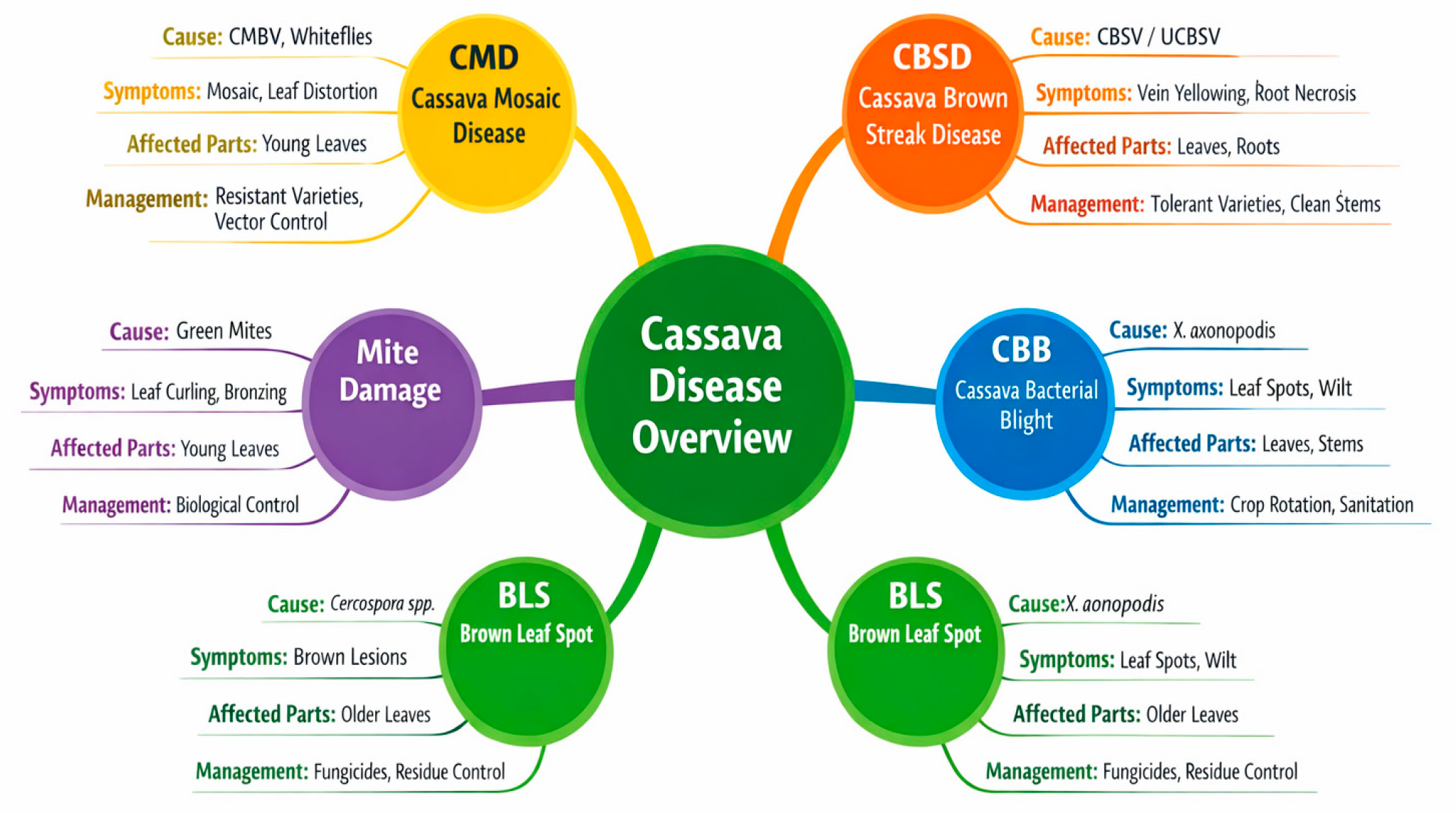
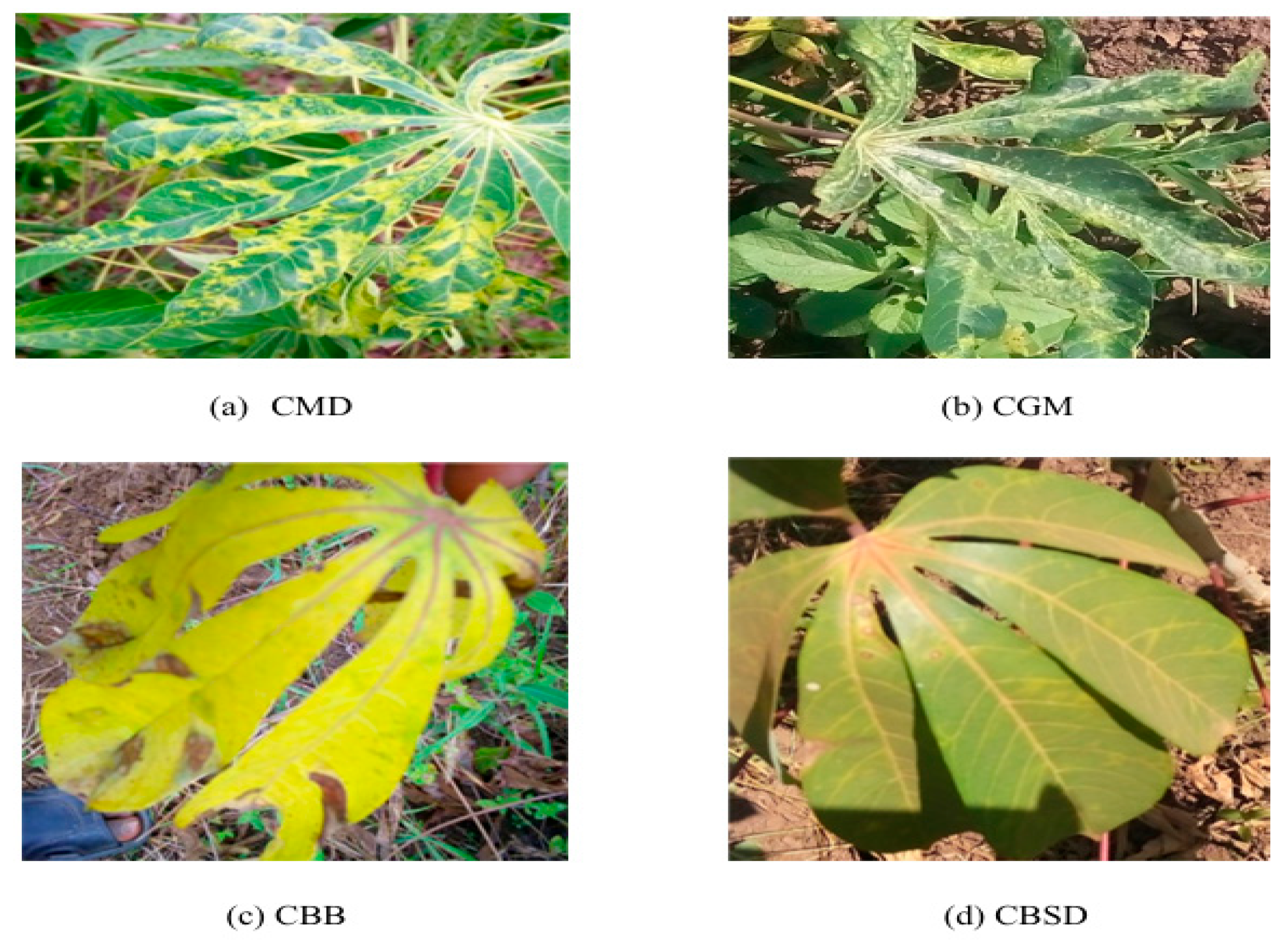
2.1. Cassava Diseases
2.1.1. Cassava Mosaic Disease (CMD)
2.1.2. Cassava Brown Streak Disease (CBSD)
2.1.3. Cassava Bacterial Blight (CBB)
2.1.4. Cassava Green Mite (CGM)
2.1.5. Other Cassava Diseases


2.2. Why We Should Use UAVs and DL for Smart Agriculture

| Disease | Causal Agent | Key Symptoms | UAV Detectability | Impact on Yield | Source |
|---|---|---|---|---|---|
| CMD 1 | Begomoviruses | Mosaic, chlorosis, twisted/stunted leaves | High—RGB and multispectral | 30–40% average loss; up to 97.3%; annual losses of USD 1.9–2.7 billion | [2,5] |
| CBSD 2 | CBSV 8, UCBSV 9 | Yellowing veins, root necrosis, patchy chlorosis | Moderate—multispectral; variable expression | Up to 70–75% loss in susceptible varieties; USD 100 million annual loss | [2,5] |
| CBB 3 | Xanthomonas axonopodis | Leaf blight, black spots, wilting | Moderate to High—RGB/HSI | Major; not precisely quantified | [2,26] |
| CGM 4 | Mononychellus tanajoa | Scratch-like white spots, leaf shrinkage | Moderate—RGB with image recognition | Up to 30% yield loss | [2,27] |
| RMD 5 | Oligonychus biharensis | Reddish-brown leaf spots, discoloration | High—strong visual cues | Serious but unquantified | |
| BLS 6 | Mycosphaerella henningsii | Brown circular spots, yellowing | High—DL achieves ~98% accuracy | Typically low yield loss | |
| CPD 7 | Phytoplasma | Color intensity variation | Moderate—GIS heat mapping | Serious; data limited | [28] |

3. UAV Technologies for Agricultural Monitoring
3.1. Sensor Technologies for UAV-Based Agricultural Monitoring
| Sensor Type | Spectral Range | Use Case | Advantages | Limitations | Suitability for Cassava Disease Detection | Sources |
|---|---|---|---|---|---|---|
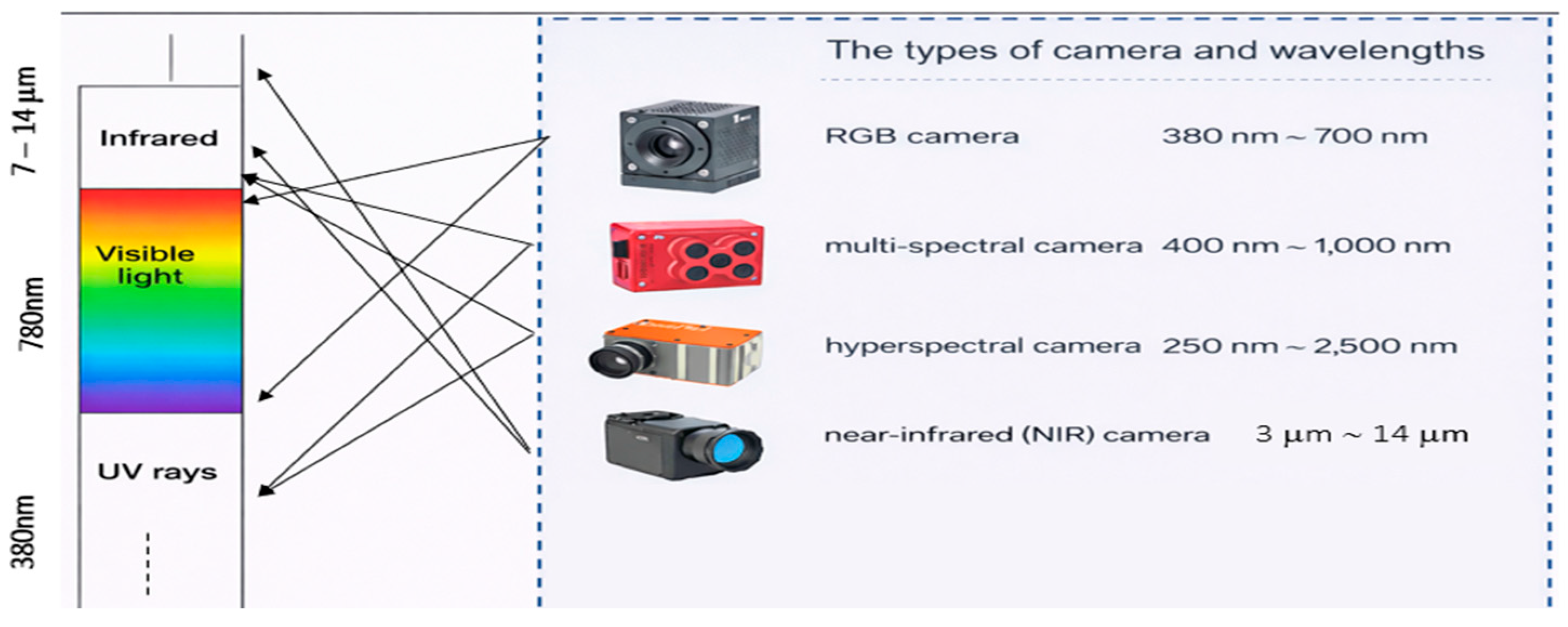
| RGB Camera | Visible (Red, Green, Blue) | General crop monitoring, cassava leaf visual symptoms | Low cost, lightweight, widely available, high-resolution imaging | Cannot capture non-visible stress indicators; limited spectral data | High—effective for CMD and CGM where visual symptoms are clear | [24,35] |
| Multispectral | Visible + Near-Infrared (e.g., Red-edge) | Vegetation health indices (NDVI 10, GNDVI 11), early stress detection | Captures subtle changes in plant physiology; ideal for disease mapping | More expensive than RGB; fewer commercial models for very low-altitude UAVs | High—suitable for early-stage detection of CBSD and BLS | [41,42,43] |
| Hyperspectral | Dozens to hundreds of narrow bands | Early detection of physiological and biochemical stress | High spectral resolution; very sensitive to stress signals | Very high cost, complex processing, heavier payload | Medium—excellent potential but limited by cost and UAV payload limits | [44,45] |
| Thermal Camera | Infrared (Surface Temperature) | Water stress, fungal infections, plant stress diagnostics | Detects stress not visible in RGB; complements visual data | Low spatial resolution; affected by environment and requires calibration | Medium—indirect support; more useful in multi-sensor configurations | [46,47] |
| LiDAR | Laser-based 3D structure detection | Canopy structure, plant height, volume estimation | Provides 3D data, unaffected by light conditions | High cost, not specific to disease unless combined with spectral imaging | Complementary 3D tool for cassava. | [43] |

3.1.1. Multispectral Cameras
3.1.2. RGB Cameras
3.1.3. Other Sensors: Hyperspectral, Thermal and LiDAR
3.2. UAV Data Acquisition Protocols for Agricultural Disease Detection
3.2.1. Flight Altitude
3.2.2. Image Overlap
3.2.3. Time-of-Day Considerations
3.2.4. Environmental Constraints
| Parameter | Recommended Range/Setting | Purpose/Justification | Sources |
|---|---|---|---|
| Flight altitude | 2–5 m | Ensures ultra-high spatial resolution needed to detect subtle foliar symptoms | [24,73] |
| Overlap (front/side) | 80%/60% | Enables high-quality orthomosaics and accurate 3D reconstructions | [35,36,74] |
| Ground sampling distance (GSD) | ~0.5–10 cm/pixel | Determines image detail; lower GSD is ideal for distinguishing symptom-level features | [34,67,75] |
| Camera resolution | ≥12 MP (e.g., 4000 × 3000 pixels) | Higher resolution improves detection of small-scale anomalies | [24,41] |
| Sensor Orientation | Nadir (direct downward) | Minimizes distortion and improves model training consistency | [41,73,76] |
| Time of day | 11:00–13:00 | Reduces shadowing and exposure variability | [34,77] |
| Environmental constraints | Clear sky, low wind (<10 km/h) | Improves image consistency; ensures stable flight | [41,67] |
3.3. Challenges of UAV in Disease Detection in Agriculture
4. Deep Learning Techniques for Plant Disease Detection
4.1. Model Architectures

4.2. Dataset Preparation
4.2.1. Data Collection
4.2.2. Annotation
4.2.3. Data Augmentation and Preprocessing
4.3. Training Strategies
4.4. Strengths and Limitations
5. UAV–DL Integration Framework for Cassava Disease Detection
| Study | Data Source | Sensor | DL Model | Deployment | Real-Time | Category |
|---|---|---|---|---|---|---|
| Unmanned aerial vehicle-based studies (n = 2) | ||||||
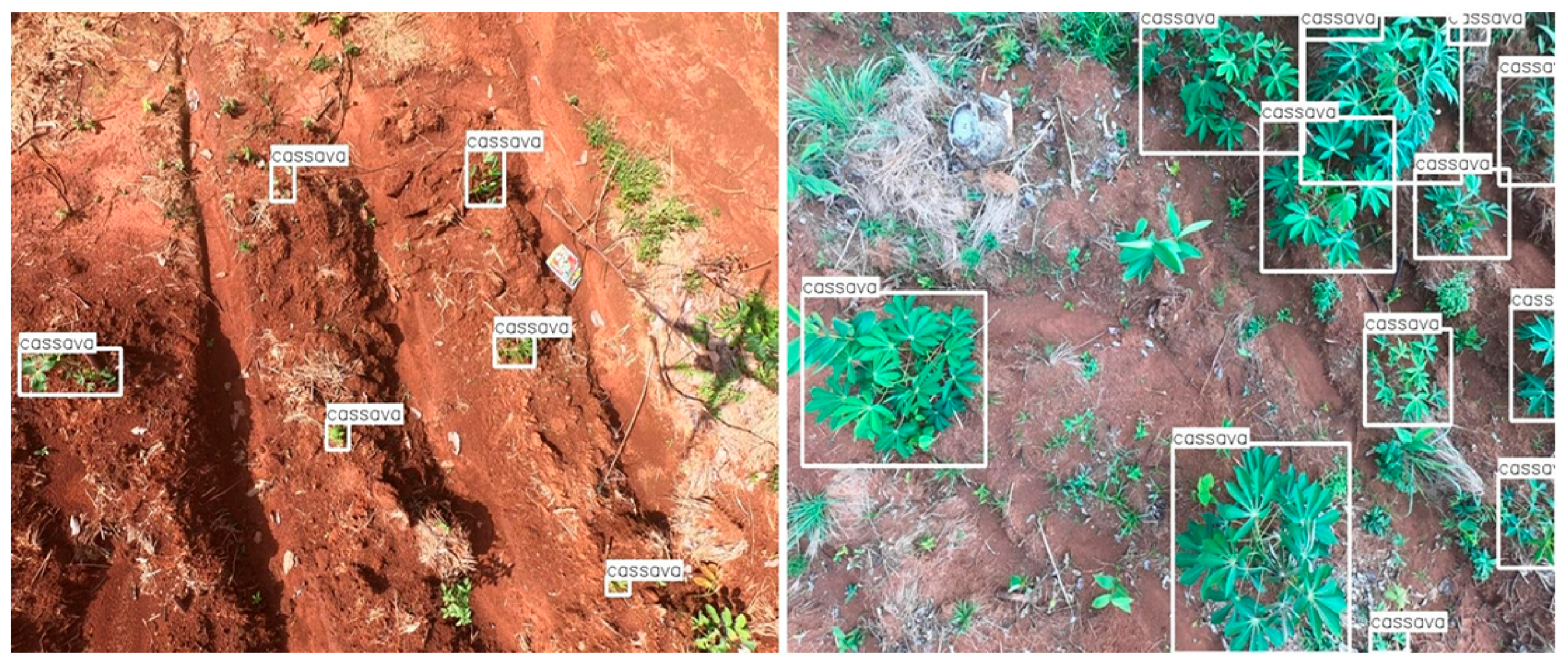
| Nnadozie et al., 2023 [24] | 550 mm Quadcopter | Red–blue–green (RGB) | YOLOv5n/s | Edge (Jetson) | Yes | UAV + real-time |
| Zhang et al., 2025 [13] | DJI Phantom 4 Pro | RGB (20 MP) | ED-Swin | desktop graphical processing unit (GPU) | Potential | UAV + Potential |
| Ground-based with real-time capability (n = 3) | ||||||
| Ramcharan et al., 2019 [15] | Handheld camera | RGB (20.2 MP) | Mobile convolutional neural network (CNN) | Smartphone | Yes | Ground + real-time |
| Mrisho et al., 2020 [14] | Smartphone | RGB | PlantVillage Nuru | Smartphone | Yes | Ground + real-time |
| Dosset et al., 2025 [4] | Lab/Ground | Not specified | CDDNet | Edge (Jetson) | Yes | Ground + real-time |
| Ground-based with potential real-time (n = 4) | ||||||
| Sambasivam & Opiyo 2021 [7] | Lab (Kaggle) | RGB | Custom convolutional neural network (CNN) | Mobile (proposed) | Potential | Ground + Potential |
| Ramcharan et al., 2017 [6] | Handheld camera | RGB (20.2 MP) | InceptionV3 | Mobile (testing) | Potential | Ground + Potential |
| Lilhore et al., 2022 [30] | Lab (Kaggle) | Not specified | Enhanced convolutional neural network (CNN) | Future target | Potential | Ground + Potential |
| Sambasivam et al., 2024 [32] | Lab (Kaggle) | Not specified | DenseNet + EfficientNet | Future (Internet of Things) | Potential | Ground + Potential |
| Ground-based without real-time (n = 7) | ||||||
| Akinpelu et al., 2025 [102] | Lab (Kaggle) | Not specified | Visual geometry group (VGG16) | Smartphone | No | Ground + no real-time |
| Elliott et al., 2022 [103] | Lab (controlled) | RGB | Support vector machine (SVM) | Desktop | No | Ground + no real-time |
| Goyal & Gill 2024 [95] | Lab (Kaggle) | Not specified | EfficientNetB3 | Not specified | No | Ground + no real-time |
| Shahriar et al., 2022 [96] | Lab (Kaggle) | RGB | Xception | Desktop | No | Ground + no real-time |
| Maryum et al., 2021 [104] | Lab (Kaggle) | RGB | EfficientNetB4 | Not specified | No | Ground + no real-time |
| Abayomi-Alli et al., 2021 [29] | Lab (Kaggle) | Not specified | MobileNetV2 | Mobile (future) | No | Ground + no real-time |
| Lokesh et al., 2024 [31] | Lab (GAN augmented) | Not specified | CNN + VGG16 + ResNet | Portable (future) | No | Ground + no real-time |
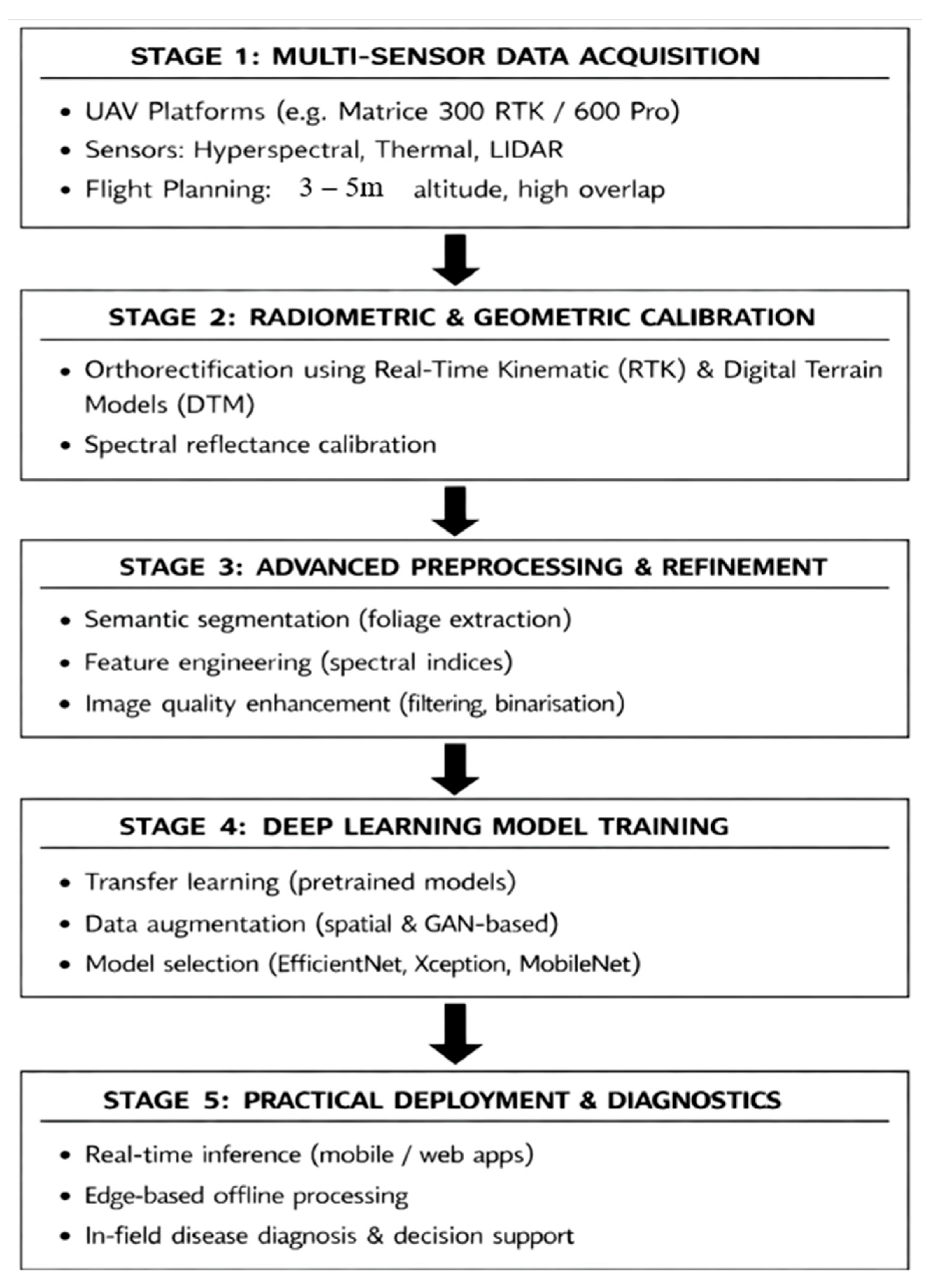
5.1. Image Acquisition
5.2. Preprocessing and Annotation
5.3. Model Training and Inference
5.4. Edge Deployment and Real-Time Decision Support
5.5. Representative Case Studies
| Reference | DL Model/Approach | Platform/Deployment | Outcome/Accuracy | Highlights |
|---|---|---|---|---|
| Ramcharan et al. (2017) [6] | Inception v3 (transfer learning) | TensorFlow on smartphones (Tanzania) | 93% accuracy on 2756 field images | First field-deployable cassava model; multi-disease detection |
| Sambasivam and Opiyo [7] | Various models + SMOTE & focal loss | Kaggle dataset of 10,000 annotated images | Top models achieved > 93% accuracy | Benchmark competition; focused on five disease classes |
| Mrisho, Mbilinyi [14] | Mobile object detection (DL integration) | PlantVillage Nuru-Smartphone mobile application (offline use) | 65–88% accuracy; outperformed farmers and extension agents | Performance improved with multi-leaf analysis |
| Nnadozie, Iloanusi [24] | YOLOv5n/YOLOv5s | NVIDIA Jetson AGX Orin (edge deployment) | YOLOv5s: higher accuracy; YOLOv5n: faster inference | Tested under variable growth stages and weed interference |
| Dosset, Dang [4] | CDDNet (MobileNetV3Small + soft attention) | Lightweight model for real-time classification | 98.95% classification accuracy | High speed and compact; optimized for mobile deployment |
| Zhang, Zhou [13] | ED-Swin Transformer | Field imagery analysis | 98.56% F1-score; 94.32% accuracy | Addressed complex backgrounds and disease morphology |
| Ozichi Emuoyibofarhe (2019) [22] | CSVM, CGSVM | Field imagery analysis. 18,000-image dataset | 83.8% and 61.6% accuracy for CSVM and CGSVM, respectively. | Targeted CMD and CBD. Manual data collection instead of UAV. Implemented ML. |
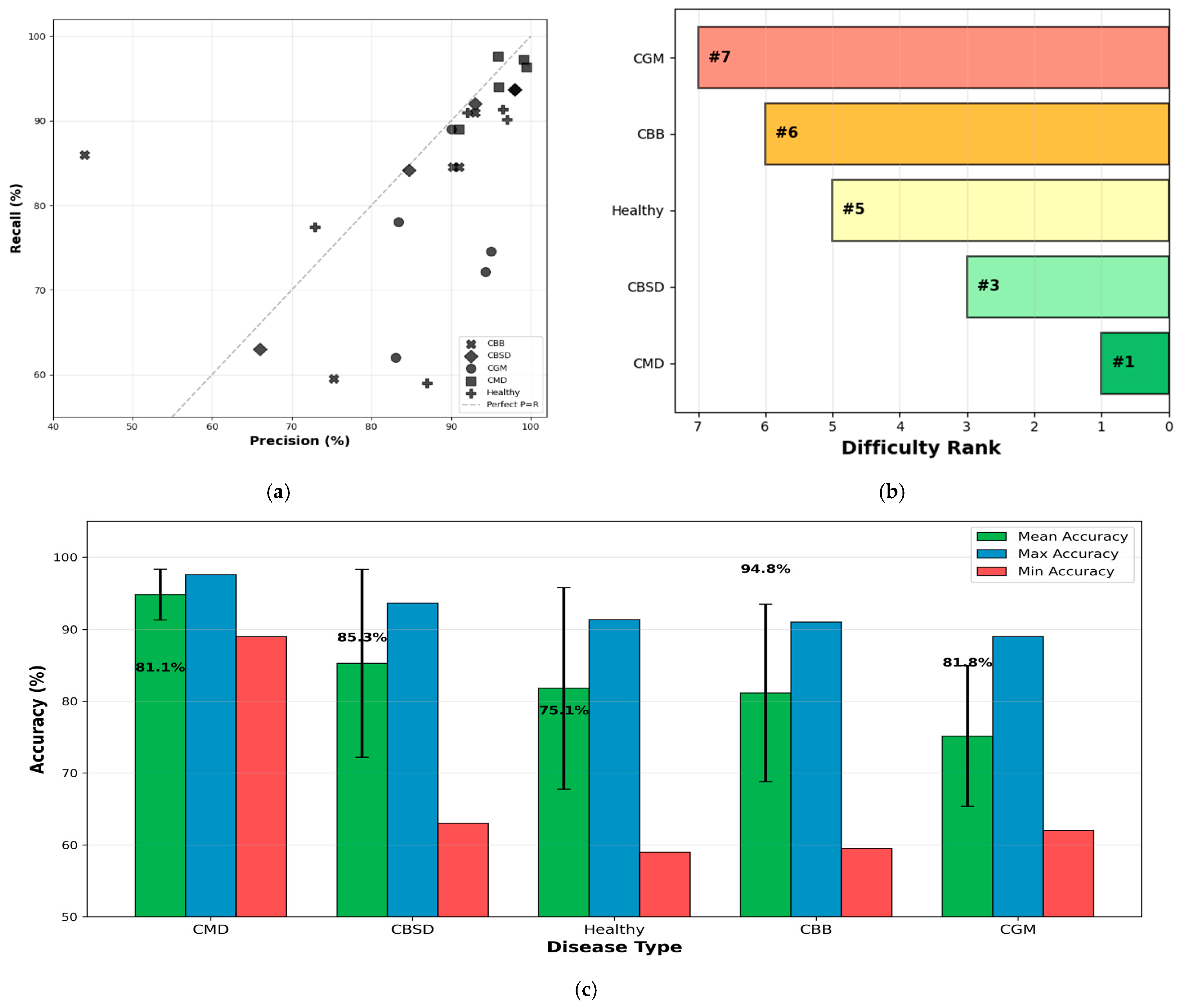
5.6. Evaluation Metrics and Real-Time Deployment Considerations
| Metric | Purpose/Description | Typical Values (Cassava Studies) | Relevance to UAV–DL Applications |
|---|---|---|---|
| Accuracy | Overall % of correct predictions (true positives + true negatives) | 85–99% [16,30] | Good for initial assessment; may be misleading in imbalanced datasets |
| Precision | % of true positive predictions among all predicted positives | 74–93% (CMD and CBSD detection) | Helps reduce false positives in multi-disease UAV scans |
| Recall (Sensitivity) | % of true positives identified out of all actual positives | 70–95% [16,32] | Critical for early-stage detection where missing diseased plants is costly |
| F1 Score | Harmonic mean of precision and recall; balances both in one metric | 88–98.56% (ED-Swin [13], EfficientNet [32,94,95,104]) | Especially useful in imbalanced datasets (e.g., CMD-dominant images) |
| IoU (intersection over union) | Degree of overlap between predicted and actual bounding boxes | >0.5 (threshold for object detection) | Key metric for evaluating object detectors like YOLOv5n/s |
| mAP (mean average precision) | Averaged precision across all classes and IoU thresholds | >90% (YOLO [24]) | Comprehensive object detection score; standard for detection tasks |
| Inference time/FPS | Time taken per image or frames per second (real-time performance) | 0.016 s/image or >30 FPS (YOLOv5n) | Vital for edge deployment and UAV real-time inference |
| Model size/parameters | Number of parameters, affecting memory use and portability | <2M (YOLOv5n), ~3M (CDDNet) | Determines compatibility with smartphones and UAV onboard processors |
6. Comparative Review of Existing Related Studies
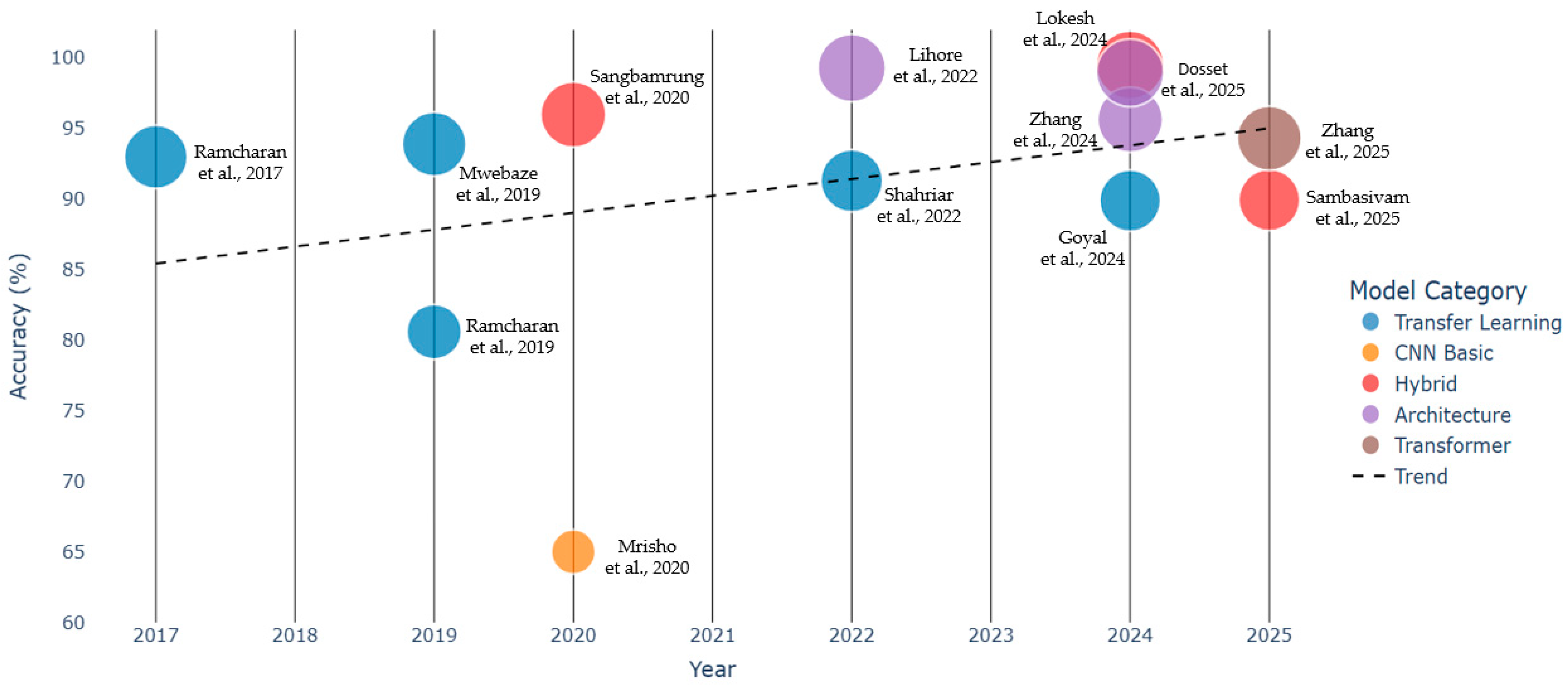
Comparative Review of Existing Studies on UAV and/or DL Applications for Cassava Disease Detection
| Author, Year | DL Method | UAV Type/Data Source | Dataset | Disease Target | Accuracy | Limitation |
|---|---|---|---|---|---|---|
| Sambasivam & Opiyo, 2021 [7] | CNNs + SMOTE, focal loss | Traditional field survey | 10,000 Uganda cassava images | CMD, CBSD, CGM, CRM, healthy | Over 93% | Small, imbalanced dataset; not UAV-acquired |
| Ramcharan et al., 2017 [6] | Inception v3 (transfer learning) | Handheld camera (Sony Cybershot) | 2756 full leaves; 15,000 leaflets | CMD, CBSD, BLS, RM, GMD | 93% (leaflets); 73–91% (full leaves) | Accuracy varies by input; limited generalization |
| Mrisho et al., 2020 [14] | Mobile CNN (PlantVillage Nuru) | Smartphone images | Ramcharan dataset | CMD, CBSD, CGM, healthy | 65–88% (based on leaf count) | Weak on subtle symptoms; low-light visibility |
| Emuoyibofarhe et al., 2019 [22] | Cubic SVM, Gaussian SVM | UAV noted as future option | Sparse info; Nigeria-based | CMD, CBB, healthy/unhealthy | 83.9% (CSVM); 61.6% (CGSVM) | Traditional ML; no UAV data; limited dataset |
| Dosset et al., 2025 [4] | CDDNet (MobileNetV3 + attention) | Designed for edge; UAV not specified | 27,053–58,807 merged images | CMD, CBSD, CGM, CRM, CBLS, CHL | 97–99% | Meteorological variation; UAV deployment untested |
| Nnadozie et al., 2023 [24] | YOLOv5n/s (object detection) | DJI Phantom 4 Pro V2.0 UAV | Custom dataset, Nigeria | Plant detection (precursor to disease mapping) | Moderate (YOLOv5s better, YOLOv5n faster) | Private data; trade-off between accuracy and speed |
| Zhang et al., 2025 [13] | ED-Swin Transformer | DJI Phantom 4 Pro V2.0 UAV | 54,353 images (China) | Blight, CBSD, CMD, mottle, healthy | 94.32% Accuracy, 98.56% Recall | Complex model; occlusion & lighting issues |
| Hasan Shahriar et al., 2022 [96] | Ensemble CNNs (Xception, etc.) | No UAV; sourced from Kaggle | 21,367 images | CMD, CBSD, CBB, CGM, healthy | 68–91% depending on model | Data from farmers; high GPU demand |
| Abayomi-Alli et al., 2021 [29] | Modified MobileNetV2 + augmentation | Makerere/NARO (field lab dataset) | 5656 labeled images | CMD, CBSD, CGM, CBB, healthy | 0.977–0.997 | No boost for extreme image degradation |
| Akinpelu et al., 2025 [102] | VGG16 (Transfer Learning) | Public Kaggle dataset | 5656 cassava images | CMD, CBSD, CGM, CBB, healthy | 88% (F1: 82%) | Needs regularization & tuning; convergence instability |
| Elliott et al., 2022 [103] | Few-shot SVM (segmentation) | Raspberry Pi box setup | 32 cassava leaves | CBB lesions (segmentation only) | No classification metric | Small dataset; no DL; lacks generalizability |
| Lokesh et al., 2024 [31] | Hybrid CNN + CycleGAN | GAN-augmented Kaggle dataset | 12,880 images | CMD, CBSD, CGM, CBB, healthy | 99.51% hybrid | High compute load; recommends real-time testing |
| Sambasivam et al., 2025 [32] | DenseNet169 + EfficientNetB0 (hybrid) | Kaggle Dataset | ~36,000 images | CMD, CBSD, CGM, CBB, healthy | 89.94% hybrid | Poor transferability; dataset imbalance; high computational cost |
| Goyal et al., 2024 [95] | EfficientNetB3, Inception, KNN; ensemble & TL used | Kaggle cassava dataset | 5656 images (5 disease + healthy classes) | CMD, CBSD, CGM, CBB, healthy | 89.9% (EffNetB3); 77% (Incep); 62% (KNN) | CBB, CGM, and CBSD often misclassified; needs improved disambiguation for similar symptom classes |
| Maryum et al., 2021 [104] | EfficientNetB4 + U-Net segmentation; transfer learning | Kaggle 2020 dataset (Uganda) | 21,397 images (segmented vs. raw) | CMD, CBSD, CGM, CBB, healthy | 89.1% (segmented); 81.4% (original) | CMD class imbalance; similar disease confusion (CGM as CMD); CBSD mislabeled as healthy |
7. Dataset Availability and Benchmarking Issues in UAV–DL for Cassava Disease Detection
| Dataset Name | Origin/Authors | Content/Categories | Size | UAV-Based | Public Access | Reference/URL |
|---|---|---|---|---|---|---|
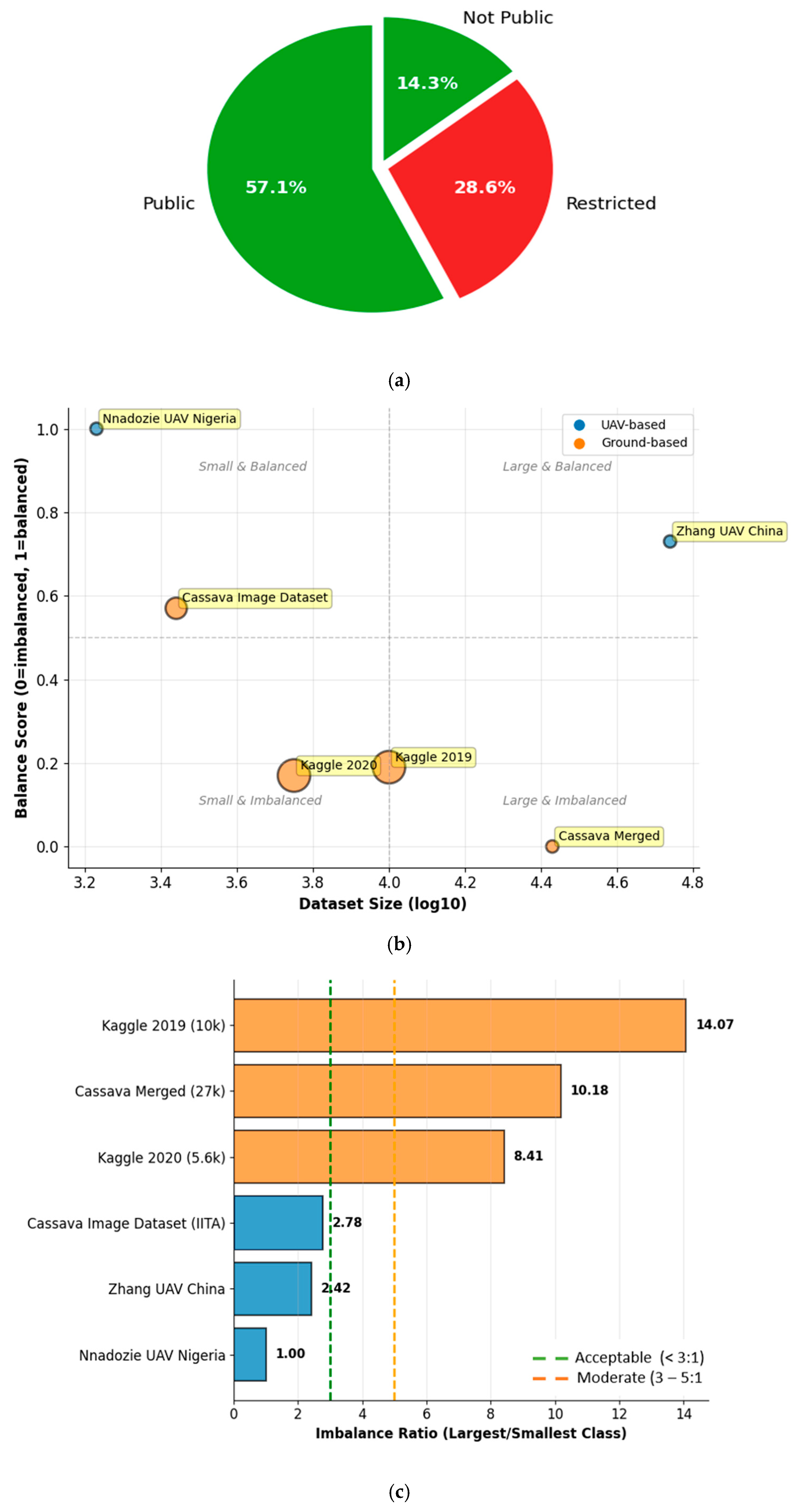
| Kaggle CVPR 2019 Dataset | AIcrowd, Makerere University, IITA | Five fine-grained cassava leaf diseases | 10,000 images | No | Public | Kaggle Dataset |
| Cassava Image Dataset | Ramcharan et al. (2017), IITA Tanzania | Whole cassava leaves (CBSD, CMD, BLS, GMD, RMD, Healthy) | 2756 images | No | Public | Ramcharan et al., 2017 [6] |
| Leaflet Cassava Dataset | Ramcharan et al. (derived) | Cropped individual leaflets (same categories as above) | 15,000 images | No | Public | Derived from Cassava Image Dataset [6] |
| Cassava Plant Disease Merged | Dosset et al. (2025) | CBSD, CMD, CGM, CRM, CBLS, Healthy | 27,053 images | No | Not Public | Dosset et al., 2025 [4] |
| Cassava Leaf Disease Combined | Dosset et al. (2025) | Cassava Image + other datasets merged (multi-source) | 58,807 images | No | Not Public | Dosset et al., 2025 [4] |
| PlantVillage Dataset | Hughes & Salathe (2015) | Multi-crop diseases incl. cassava | 26,590 (multi-crop) | No | Public | GitHub Repository [113] |
| iBean Leaf Dataset | AIR Lab Makerere University, (2020) | Bean disease (non-cassava, for model transfer evaluation) | 1296 images | No | Public | https://github.com/AI-Lab-Makerere/ibean (accessed on 12 August 2025) [25] |
| Nnadozie et al. Dataset | Nnadozie et al. (2023), Nigeria | UAV RGB imagery for cassava plant detection | Size unspecified | Yes | Not Public | In-house dataset, referenced in Nnadozie et al., 2023 [24] |
| Zhang et al. Dataset | Zhang et al. (2025), Guangxi, China | UAV + ground camera; 5 classes (bacterial blight, mosaic, mottle, CBSD, healthy) | 54,353 images | Yes | Not Public | In-house, referenced in Zhang et al., 2025 [13] |
| Makerere-NARO Dataset | Abayomi-Alli et al. (2021), Makerere & National Crops Resources Research Institute | High- and low-quality cassava disease images; used for augmentation study | 5656 labelled images | No | Not Public | Referenced in Abayomi-Alli et al., 2021 [29] |
| Elliott et al. Dataset | Elliott et al. (2022), Advanced digital SVM setup | Time-lapse images from Raspberry Pi box for CBB lesion segmentation | 32 leaves | No | Not Public | Referenced in Elliott et al., 2022 [103] |
| Kaggle Combined Cassava Dataset | Sambasivam et al. (2025) | Five categories; used to benchmark hybrid DL models | ~36,000 images | No | Public | https://www.kaggle.com/competitions/cassava-leaf-disease-classification/data (accessed on 12 August 2025) [32] |
| Lokesh CycleGAN Dataset | Lokesh et al. (2024) | Generated using GANs for 5 disease categories; used to test hybrid CNNs | 12,880 (augmented) | No | Not Public | Dataset described in Lokesh et al., 2024 [31] |
7.1. Availability and Characteristics of Cassava Datasets
7.2. Benchmarking Challenges
7.3. Implications for Model Reliability and Research Gaps
8. Conclusions and Future Directions
Funding
Data Availability Statement
Conflicts of Interest
References
- Adebayo, W.G. Cassava production in Africa: A panel analysis of the drivers and trends. Heliyon 2023, 9, e19939. [Google Scholar] [CrossRef]
- Chikoti, P.C.; Tembo, M. Expansion and impact of cassava brown streak and cassava mosaic diseases in Africa: A review. Front. Sustain. Food Syst. 2022, 6, 1076364. [Google Scholar] [CrossRef]
- Amelework, A.B.; Bairu, M.W.; Maema, O.; Venter, S.L.; Laing, M. Adoption and promotion of resilient crops for climate risk mitigation and import substitution: A case analysis of cassava for South African agriculture. Front. Sustain. Food Syst. 2021, 5, 617783. [Google Scholar] [CrossRef]
- Dosset, A.; Dang, L.M.; Alharbi, F.; Habib, S.; Alam, N.; Park, H.Y.; Moon, H. Cassava disease detection using a lightweight modified soft attention network. Pest Manag. Sci. 2025, 81, 607–617. [Google Scholar] [CrossRef]
- Mkamilo, G.; Kimata, B.; Masinde, E.A.; Masisila, F.F.; Menya, R.O.; Matondo, D.; Maruthi, M.N. Impact of viral diseases and whiteflies on the yield and quality of cassava. J. Plant Dis. Prot. 2024, 131, 959–970. [Google Scholar] [CrossRef]
- Ramcharan, A.; Baranowski, K.; McCloskey, P.; Ahmed, B.; Legg, J.; Hughes, D.P. Deep learning for image-based cassava disease detection. Front. Plant Sci. 2017, 8, 1852. [Google Scholar] [CrossRef] [PubMed]
- Sambasivam, G.; Opiyo, G.D. A predictive machine learning application in agriculture: Cassava disease detection and classification with imbalanced dataset using convolutional neural networks. Egypt. Inform. J. 2021, 22, 27–34. [Google Scholar] [CrossRef]
- Ding, W.; Abdel-Basset, M.; Alrashdi, I.; Hawash, H. Next generation of computer vision for plant disease monitoring in precision agriculture: A contemporary survey, taxonomy, experiments, and future direction. Inf. Sci. 2024, 665, 120338. [Google Scholar] [CrossRef]
- Jafar, A.; Bibi, N.; Naqvi, R.A.; Sadeghi-Niaraki, A.; Jeong, D. Revolutionizing agriculture with artificial intelligence: Plant disease detection methods, applications, and their limitations. Front. Plant Sci. 2024, 15, 1356260. [Google Scholar] [CrossRef]
- Abbas, A.; Zhang, Z.; Zheng, H.; Alami, M.M.; Alrefaei, A.F.; Abbas, Q.; Naqvi, S.A.H.; Rao, M.J.; Mosa, W.F.; Abbas, Q. Drones in plant disease assessment, efficient monitoring, and detection: A way forward to smart agriculture. Agronomy 2023, 13, 1524. [Google Scholar] [CrossRef]
- Guebsi, R.; Mami, S.; Chokmani, K. Drones in Precision Agriculture: A Comprehensive Review of Applications, Technologies, and Challenges. Drones 2024, 8, 686. [Google Scholar] [CrossRef]
- Wu, Y.; Yang, H.; Mao, Y. Detection of the pine wilt disease using a joint deep object detection model based on drone remote sensing data. Forests 2024, 15, 869. [Google Scholar] [CrossRef]
- Zhang, J.; Zhou, H.; Liu, K.; Xu, Y. ED-Swin Transformer: A Cassava Disease Classification Model Integrated with UAV Images. Sensors 2025, 25, 2432. [Google Scholar] [CrossRef]
- Mrisho, L.M.; Mbilinyi, N.A.; Ndalahwa, M.; Ramcharan, A.M.; Kehs, A.K.; McCloskey, P.C.; Murithi, H.; Hughes, D.P.; Legg, J.P. Accuracy of a smartphone-based object detection model PlantVillage Nuru in identifying the foliar symptoms of the viral diseases of cassava–CMD and CBSD. Front. Plant Sci. 2020, 11, 590889. [Google Scholar] [CrossRef]
- Ramcharan, A.; McCloskey, P.; Baranowski, K.; Mbilinyi, N.; Mrisho, L.; Ndalahwa, M.; Legg, J.; Hughes, D.P. A mobile-based deep learning model for cassava disease diagnosis. Front. Plant Sci. 2019, 10, 272. [Google Scholar] [CrossRef] [PubMed]
- Ahmed, W.A.; Yan, D.; Hamed, J.O.; Olatoyinbo, S.F. Advances in UAV-Based Deep Learning for Cassava Disease Monitoring and Detection: A Comprehensive Review of Models, Imaging Techniques, and Agricultural Applications. Smart Agric. Technol. 2025, 12, 101400. [Google Scholar] [CrossRef]
- Zhu, H.; Lin, C.; Liu, G.; Wang, D.; Qin, S.; Li, A.; Xu, J.-L.; He, Y. Intelligent agriculture: Deep learning in UAV-based remote sensing imagery for crop diseases and pests detection. Front. Plant Sci. 2024, 15, 1435016. [Google Scholar] [CrossRef] [PubMed]
- Kouadio, L.; El Jarroudi, M.; Belabess, Z.; Laasli, S.-E.; Roni, M.Z.K.; Amine, I.D.I.; Mokhtari, N.; Mokrini, F.; Junk, J.; Lahlali, R. A review on UAV-based applications for plant disease detection and monitoring. Remote Sens. 2023, 15, 4273. [Google Scholar] [CrossRef]
- Chusyairi, A.; Herdiyeni, Y.; Sukoco, H.; Santosa, E. Machine Learning Monitoring Model for Fertilization and Irrigation to Support Sustainable Cassava Production: Systematic Literature Review. J. Online Inform. 2024, 9, 190–200. [Google Scholar] [CrossRef]
- Vasavi, P.; Punitha, A.; Rao, T.V.N. Crop leaf disease detection and classification using machine learning and deep learning algorithms by visual symptoms: A review. Int. J. Electr. Comput. Eng. 2022, 12, 2079. [Google Scholar] [CrossRef]
- Chaiyana, A.; Khiripet, N.; Ninsawat, S.; Siriwan, W.; Shanmugam, M.S.; Virdis, S.G. Mapping and predicting cassava mosaic disease outbreaks using earth observation and meteorological data-driven approaches. Remote Sens. Appl. Soc. Environ. 2024, 35, 101231. [Google Scholar] [CrossRef]
- Emuoyibofarhe, O.; Emuoyibofarhe, J.O.; Adebayo, S.; Ayandiji, A.; Demeji, O.; James, O. Detection and classification of cassava diseases using machine learning. Int. J. Comput. Sci. Softw. Eng. (IJCSSE) 2019, 8, 166–176. [Google Scholar]
- Plata, I.T.; Panganiban, E.B.; Alado, D.B.; Taracatac, A.C.; Bartolome, B.B.; Labuanan, F.R.E. Drone-based geographical information system (GIS) mapping of cassava Pythoplasma disease (CPD) for precision agriculture. Int. J. Emerg. Technol. Adv. Eng 2022, 12. [Google Scholar] [CrossRef]
- Nnadozie, E.C.; Iloanusi, O.N.; Ani, O.A.; Yu, K. Detecting cassava plants under different field conditions using UAV-based RGB images and deep learning models. Remote Sens. 2023, 15, 2322. [Google Scholar] [CrossRef]
- Tiwari, V.; Joshi, R.C.; Dutta, M.K. Dense convolutional neural networks based multiclass plant disease detection and classification using leaf images. Ecol. Inform. 2021, 63, 101289. [Google Scholar] [CrossRef]
- Chin, R.; Catal, C.; Kassahun, A. Plant disease detection using drones in precision agriculture. Precis. Agric. 2023, 24, 1663–1682. [Google Scholar] [CrossRef]
- Moreno-Cadena, P.; Hoogenboom, G.; Cock, J.H.; Ramirez-Villegas, J.; Pypers, P.; Kreye, C.; Tariku, M.; Ezui, K.S.; Lopez-Lavalle, L.A.B.; Asseng, S. Modeling growth, development and yield of cassava: A review. Field Crops Res. 2021, 267, 108140. [Google Scholar] [CrossRef] [PubMed]
- Collavino, A.; Zanini, A.A.; Medina, R.; Schaller, S.; Di Feo, L. Cassava common mosaic virus infection affects growth and yield components of cassava plants (Manihot esculenta) in Argentina. Plant Pathol. 2022, 71, 980–989. [Google Scholar] [CrossRef]
- Abayomi-Alli, O.O.; Damaševičius, R.; Misra, S.; Maskeliūnas, R. Cassava disease recognition from low-quality images using enhanced data augmentation model and deep learning. Expert Syst. 2021, 38, e12746. [Google Scholar] [CrossRef]
- Lilhore, U.K.; Imoize, A.L.; Lee, C.-C.; Simaiya, S.; Pani, S.K.; Goyal, N.; Kumar, A.; Li, C.-T. Enhanced convolutional neural network model for cassava leaf disease identification and classification. Mathematics 2022, 10, 580. [Google Scholar] [CrossRef]
- Lokesh, G.H.; Chandregowda, S.B.; Vishwanath, J.; Ravi, V.; Ravi, P.; Al Mazroa, A. Intelligent Plant Leaf Disease Detection Using Generative Adversarial Networks: A Case-study of Cassava Leaves. Open Agric. J. 2024, 18, e18743315288623. [Google Scholar] [CrossRef]
- Sambasivam, G.; Prabu Kanna, G.; Chauhan, M.S.; Raja, P.; Kumar, Y. A hybrid deep learning model approach for automated detection and classification of cassava leaf diseases. Sci. Rep. 2025, 15, 7009. [Google Scholar] [CrossRef]
- Mukherjee, A.; Misra, S.; Raghuwanshi, N.S. A survey of unmanned aerial sensing solutions in precision agriculture. J. Netw. Comput. Appl. 2019, 148, 102461. [Google Scholar] [CrossRef]
- Sandoval-Pillajo, L.; García-Santillán, I.; Pusdá-Chulde, M.; Giret, A. Weed Detection Based on Deep Learning from UAV Imagery: A Review. Smart Agric. Technol. 2025, 12, 101147. [Google Scholar] [CrossRef]
- Xie, C.; Yang, C. A review on plant high-throughput phenotyping traits using UAV-based sensors. Comput. Electron. Agric. 2020, 178, 105731. [Google Scholar] [CrossRef]
- Radoglou-Grammatikis, P.; Sarigiannidis, P.; Lagkas, T.; Moscholios, I. A compilation of UAV applications for precision agriculture. Comput. Netw. 2020, 172, 107148. [Google Scholar] [CrossRef]
- Ecke, S.; Dempewolf, J.; Frey, J.; Schwaller, A.; Endres, E.; Klemmt, H.-J.; Tiede, D.; Seifert, T. UAV-Based Forest Health Monitoring: A Systematic Review. Remote Sens. 2022, 14, 3205. [Google Scholar] [CrossRef]
- Olson, D.; Anderson, J. Review on unmanned aerial vehicles, remote sensors, imagery processing, and their applications in agriculture. Agron. J. 2021, 113, 971–992. [Google Scholar] [CrossRef]
- Zhang, Z.; Zhu, L. A Review on Unmanned Aerial Vehicle Remote Sensing: Platforms, Sensors, Data Processing Methods, and Applications. Drones 2023, 7, 398. [Google Scholar] [CrossRef]
- Jurado, J.M.; López, A.; Pádua, L.; Sousa, J.J. Remote sensing image fusion on 3D scenarios: A review of applications for agriculture and forestry. Int. J. Appl. Earth Obs. Geoinf. 2022, 112, 102856. [Google Scholar] [CrossRef]
- Dash, S.K.; Sembhi, H.; Langsdale, M.; Wooster, M.; Dodd, E.; Ghent, D.; Sinha, R. Assessing the field-scale crop water condition over an intensive agricultural plain using UAV-based thermal and multispectral imagery. J. Hydrol. 2025, 655, 132966. [Google Scholar] [CrossRef]
- Nascimento, J.H.B.; Cortes, D.F.M.; Andrade, L.R.B.d.; Gallis, R.B.d.A.; Barbosa, R.L.; Oliveira, E.J.d. High-Throughput Phenotyping for Agronomic Traits in Cassava Using Aerial Imaging. Plants 2024, 14, 32. [Google Scholar] [CrossRef]
- Tuenpusa, P.; Samseemoung, G.; Soni, P.; Kuankhamnuan, T.; Sarasureeporn, W.; Poonsri, W.; Pinthong, A. Integrating Low-Altitude Remote Sensing and Variable-Rate Sprayer Systems for Enhanced Cassava Crop Management. AgriEngineering 2025, 7, 195. [Google Scholar] [CrossRef]
- Aierken, N.; Yang, B.; Li, Y.; Jiang, P.; Pan, G.; Li, S. A review of unmanned aerial vehicle based remote sensing and machine learning for cotton crop growth monitoring. Comput. Electron. Agric. 2024, 227, 109601. [Google Scholar] [CrossRef]
- Velusamy, P.; Rajendran, S.; Mahendran, R.K.; Naseer, S.; Shafiq, M.; Choi, J.-G. Unmanned Aerial Vehicles (UAV) in precision agriculture: Applications and challenges. Energies 2021, 15, 217. [Google Scholar] [CrossRef]
- Coulibaly, A. Smart Farming: Computer Simulation and Predictive Model for Cassava. Ph.D. Thesis, Université d’Ottawa/University of Ottawa, Ottawa, ON, Canada, 2024. [Google Scholar]
- Gago, J.; Douthe, C.; Coopman, R.E.; Gallego, P.P.; Ribas-Carbo, M.; Flexas, J.; Escalona, J.; Medrano, H. UAVs challenge to assess water stress for sustainable agriculture. Agric. Water Manag. 2015, 153, 9–19. [Google Scholar] [CrossRef]
- Aslahishahri, M.; Stanley, K.G.; Duddu, H.; Shirtliffe, S.; Vail, S.; Bett, K.; Pozniak, C.; Stavness, I. From RGB to NIR: Predicting of near infrared reflectance from visible spectrum aerial images of crops. In Proceedings of the IEEE/CVF International Conference on Computer Vision, Montreal, BC, Canada, 11–17 October 2021. [Google Scholar]
- Choubey, A.; Reddy, B.C. Drones in Agriculture: Multispectral Analysis, in Computational Intelligence in Robotics and Automation; CRC Press: Boca Raton, FL, USA, 2023; pp. 217–241. [Google Scholar]
- Helfer, G.A.; Barbosa, J.L.V.; Alves, D.; da Costa, A.B.; Beko, M.; Leithardt, V.R.Q. Multispectral cameras and machine learning integrated into portable devices as clay prediction technology. J. Sens. Actuator Netw. 2021, 10, 40. [Google Scholar] [CrossRef]
- Scutelnic, D.; Muradore, R.; Daffara, C. A multispectral camera in the VIS–NIR equipped with thermal imaging and environmental sensors for non invasive analysis in precision agriculture. HardwareX 2024, 20, e00596. [Google Scholar] [CrossRef] [PubMed]
- Zahiri, Z.; Laefer, D.F.; Kurz, T.; Buckley, S.; Gowen, A. A comparison of ground-based hyperspectral imaging and red-edge multispectral imaging for façade material classification. Autom. Constr. 2022, 136, 104164. [Google Scholar] [CrossRef]
- Adegoye, G.A.; Olorunwa, O.J.; Alsajri, F.A.; Walne, C.H.; Wijewandana, C.; Kethireddy, S.R.; Reddy, K.N.; Reddy, K.R. Waterlogging effects on soybean physiology and hyperspectral reflectance during the reproductive stage. Agriculture 2023, 13, 844. [Google Scholar] [CrossRef]
- Poole, L. A Multispectral and Machine Learning Approach to Early Stress Classification in Plants. Master’s Thesis, Rhodes University, Grahamstown, South Africa, 2022. [Google Scholar]
- Zhang, D.; Qi, H.; Guo, X.; Sun, H.; Min, J.; Li, S.; Hou, L.; Lv, L. Integration of UAV Multispectral Remote Sensing and Random Forest for Full-Growth Stage Monitoring of Wheat Dynamics. Agriculture 2025, 15, 353. [Google Scholar] [CrossRef]
- Zhou, J.-J.; Zhang, Y.-H.; Han, Z.-M.; Liu, X.-Y.; Jian, Y.-F.; Hu, C.-G.; Dian, Y.-Y. Evaluating the performance of hyperspectral leaf reflectance to detect water stress and estimation of photosynthetic capacities. Remote Sens. 2021, 13, 2160. [Google Scholar] [CrossRef]
- Roslim, M.H.M.; Juraimi, A.S.; Che’Ya, N.N.; Sulaiman, N.; Manaf, M.N.H.A.; Ramli, Z.; Motmainna, M. Using remote sensing and an unmanned aerial system for weed management in agricultural crops: A review. Agronomy 2021, 11, 1809. [Google Scholar] [CrossRef]
- Nnadozie, E.C.; Iloanusi, O.; Ani, O.; Yu, K. Cassava detection from UAV images using YOLOv5 object detection model: Towards weed control in a cassava farm. BioRxiv 2022, 516748. [Google Scholar] [CrossRef]
- Neupane, K.; Baysal-Gurel, F. Automatic identification and monitoring of plant diseases using unmanned aerial vehicles: A review. Remote Sens. 2021, 13, 3841. [Google Scholar] [CrossRef]
- Brenner, M.; Reyes, N.H.; Susnjak, T.; Barczak, A.L. RGB-D and thermal sensor fusion: A systematic literature review. IEEE Access 2023, 11, 82410–82442. [Google Scholar] [CrossRef]
- Nguyen, T.X.B.; Rosser, K.; Chahl, J. A review of modern thermal imaging sensor technology and applications for autonomous aerial navigation. J. Imaging 2021, 7, 217. [Google Scholar] [CrossRef] [PubMed]
- Smigaj, M.; Agarwal, A.; Bartholomeus, H.; Decuyper, M.; Elsherif, A.; de Jonge, A.; Kooistra, L. Thermal infrared remote sensing of stress responses in forest environments: A review of developments, challenges, and opportunities. Curr. For. Rep. 2024, 10, 56–76. [Google Scholar] [CrossRef]
- Wen, T.; Li, J.-H.; Wang, Q.; Gao, Y.-Y.; Hao, G.-F.; Song, B.-A. Thermal imaging: The digital eye facilitates high-throughput phenotyping traits of plant growth and stress responses. Sci. Total Environ. 2023, 899, 165626. [Google Scholar] [CrossRef]
- Kuswidiyanto, L.W.; Noh, H.-H.; Han, X. Plant disease diagnosis using deep learning based on aerial hyperspectral images: A review. Remote Sens. 2022, 14, 6031. [Google Scholar] [CrossRef]
- Zhang, T.; Cai, Y.; Zhuang, P.; Li, J. Remotely sensed crop disease monitoring by machine learning algorithms: A review. Unmanned Syst. 2024, 12, 161–171. [Google Scholar] [CrossRef]
- Shahi, T.B.; Xu, C.-Y.; Neupane, A.; Guo, W. Recent Advances in Crop Disease Detection Using UAV and Deep Learning Techniques. Remote Sens. 2023, 15, 2450. [Google Scholar] [CrossRef]
- Tsouros, D.C.; Bibi, S.; Sarigiannidis, P.G. A review on UAV-based applications for precision agriculture. Information 2019, 10, 349. [Google Scholar] [CrossRef]
- Maes, W.H. Practical Guidelines for Performing UAV Mapping Flights with Snapshot Sensors. Remote Sens. 2025, 17, 606. [Google Scholar] [CrossRef]
- Torres-Sánchez, J.; López-Granados, F.; Borra-Serrano, I.; Peña, J.M. Assessing UAV-collected image overlap influence on computation time and digital surface model accuracy in olive orchards. Precis. Agric. 2018, 19, 115–133. [Google Scholar] [CrossRef]
- Zhang, J.; Xu, S.; Zhao, Y.; Sun, J.; Xu, S.; Zhang, X. Aerial orthoimage generation for UAV remote sensing. Inf. Fusion 2023, 89, 91–120. [Google Scholar] [CrossRef]
- Amarasingam, N.; Salgadoe, A.S.A.; Powell, K.; Gonzalez, L.F.; Natarajan, S. A review of UAV platforms, sensors, and applications for monitoring of sugarcane crops. Remote Sens. Appl. Soc. Environ. 2022, 26, 100712. [Google Scholar] [CrossRef]
- Abrahams, M.; Sibanda, M.; Dube, T.; Chimonyo, V.G.; Mabhaudhi, T. A systematic review of UAV applications for mapping neglected and underutilised crop species’ spatial distribution and health. Remote Sens. 2023, 15, 4672. [Google Scholar] [CrossRef]
- Cavalaris, C.; Karamoutis, C.; Markinos, A. Efficacy of cotton harvest aids applications with unmanned aerial vehicles (UAV) and ground-based field sprayers—A case study comparison. Smart Agric. Technol. 2022, 2, 100047. [Google Scholar] [CrossRef]
- Gašparović, M.; Zrinjski, M.; Barković, Đ.; Radočaj, D. An automatic method for weed mapping in oat fields based on UAV imagery. Comput. Electron. Agric. 2020, 173, 105385. [Google Scholar] [CrossRef]
- Hnida, Y.; Mahraz, M.A.; Yahyaouy, A.; Achebour, A.; Riffi, J.; Tairi, H. Enhanced Multi-Scale Detection of Olive Tree Crowns in UAV Orthophotos Using a Deep Learning Architecture. Smart Agric. Technol. 2025, 12, 101126. [Google Scholar] [CrossRef]
- Ramírez-Cuesta, J.M.; Intrigliolo, D.S.; Lorite, I.; Moreno, M.A.; Vanella, D.; Ballesteros, R.; Hernández-López, D.; Buesa, I. Determining grapevine water use under different sustainable agronomic practices using METRIC-UAV surface energy balance model. Agric. Water Manag. 2023, 281, 108247. [Google Scholar] [CrossRef]
- Guo, A.; Ye, H.; Huang, W.; Qian, B.; Wang, J.; Lan, Y.; Wang, S. Inversion of maize leaf area index from UAV hyperspectral and multispectral imagery. Comput. Electron. Agric. 2023, 212, 108020. [Google Scholar] [CrossRef]
- Alotaibi, A.; Chatwin, C.; Birch, P. Ubiquitous Unmanned Aerial Vehicles (UAVs): A Comprehensive Review. Shanlax Int. J. Arts Sci. Humanit. 2023, 11, 62–90. [Google Scholar] [CrossRef]
- Mohsan, S.A.H.; Khan, M.A.; Noor, F.; Ullah, I.; Alsharif, M.H. Towards the unmanned aerial vehicles (UAVs): A comprehensive review. Drones 2022, 6, 147. [Google Scholar] [CrossRef]
- Sinha, J.P.; Kushwaha, H.; Kushwaha, D.; Singh, N.; Purushottam, M. Prospect of Unmanned Aerial Vehicle (UAV) Technology for Agricultural Production Management. In Proceedings of the International Conference on Emerging Technologies in Agricultural and Food Engineering, Kharagpur, India, 27–30 December 2016. [Google Scholar]
- Zhang, H.; Wang, L.; Tian, T.; Yin, J. A review of unmanned aerial vehicle low-altitude remote sensing (UAV-LARS) use in agricultural monitoring in China. Remote Sens. 2021, 13, 1221. [Google Scholar] [CrossRef]
- Negi, P.; Anand, S. Plant disease detection, diagnosis, and management: Recent advances and future perspectives. In Artificial Intelligence and Smart Agriculture: Technology and Applications; Springer: Berlin/Heidelberg, Germany, 2024; pp. 413–436. [Google Scholar]
- Nguyen, C.; Sagan, V.; Skobalski, J.; Severo, J.I. Early detection of wheat yellow rust disease and its impact on terminal yield with multi-spectral UAV-imagery. Remote Sens. 2023, 15, 3301. [Google Scholar] [CrossRef]
- Chen, P.; Yan, S.; Janicke, H.; Mahboubi, A.; Bui, H.T.; Aboutorab, H.; Bewong, M.; Islam, R. A survey on unauthorized UAV threats to smart farming. Drones 2025, 9, 251. [Google Scholar] [CrossRef]
- Mane, S. Conceptual Aspects on Unmanned Aerial Vehicles System. Int. J. All Res. Educ. Sci. Methods (IJARESM) 2024, 12, 17–26. [Google Scholar]
- Mishra, P. Disease Detection in Plants Using UAS and Deep Neural Networks. Ph.D. Thesis, Tennessee State University, Nashville, TN, USA, 2024. [Google Scholar]
- Jackulin, C.; Murugavalli, S. A comprehensive review on detection of plant disease using machine learning and deep learning approaches. Meas. Sens. 2022, 24, 100441. [Google Scholar] [CrossRef]
- Kamilaris, A.; Prenafeta-Boldú, F.X. Deep learning in agriculture: A survey. Comput. Electron. Agric. 2018, 147, 70–90. [Google Scholar] [CrossRef]
- Sharma, A.; Jain, A.; Gupta, P.; Chowdary, V. Machine learning applications for precision agriculture: A comprehensive review. IEEE Access 2020, 9, 4843–4873. [Google Scholar] [CrossRef]
- Mwebaze, E.; Gebru, T.; Frome, A.; Nsumba, S.; Tusubira, J. iCassava 2019 fine-grained visual categorization challenge. arXiv 2019, arXiv:1908.02900. [Google Scholar]
- Sangbamrung, I.; Praneetpholkrang, P.; Kanjanawattana, S. A novel automatic method for cassava disease classification using deep learning. J. Adv. Inf. Technol. 2020, 11, 241–248. [Google Scholar] [CrossRef]
- Aravind, S.; Harini, S.; Kumar, V. Cassava leaf disease classification using Deep Learning. Nveo-Nat. Volatiles Essent. Oils J. (NVEO) 2021, 8, 9375–9389. [Google Scholar]
- Chai, M.X.; Fam, Y.D.; Octaviano, Q.N.; Pee, C.-Y.; Wong, L.-K.; Tan, M.I.S.M.H.; See, J. Improved Cassava Plant Disease Classification with Leaf Detection. In Proceedings of the 2024 Asia Pacific Signal and Information Processing Association Annual Summit and Conference (APSIPA ASC), Macau, China, 3–6 December 2024. [Google Scholar]
- Srivathsan, M.S.; Jenish, S.A.; Arvindhan, K.; Karthik, R. An explainable hybrid feature aggregation network with residual inception positional encoding attention and EfficientNet for cassava leaf disease classification. Sci. Rep. 2025, 15, 11750. [Google Scholar] [CrossRef]
- Goyal, C.; Gill, K.S.; Upadhyay, D.; Devliyal, S. Assessing the Effectiveness of Deep Learning Approaches in Forecasting Cassava Leaf Diseases. In Proceedings of the 2024 International Conference on Artificial Intelligence and Emerging Technology (Global AI Summit), Greater Noida, India, 4–6 September 2024. [Google Scholar]
- Shahriar, H.; Shuvo, P.S.; Fahim, M.S.H.; Sordar, M.S.; Haque, M.E. Cassava Leaf Disease Classification Using Deep Learning and Convolutional Neural Network Ensemble. Ph.D. Thesis, Brac University, Dhaka, Bangladesh, 2022. [Google Scholar]
- Wieme, J.; Leroux, S.; Cool, S.R.; Van Beek, J.; Pieters, J.G.; Maes, W.H. Ultra-high-resolution UAV-imaging and supervised deep learning for accurate detection of Alternaria solani in potato fields. Front. Plant Sci. 2024, 15, 1206998. [Google Scholar] [CrossRef] [PubMed]
- Sorbelli, F.B.; Palazzetti, L.; Pinotti, C.M. YOLO-based detection of Halyomorpha halys in orchards using RGB cameras and drones. Comput. Electron. Agric. 2023, 213, 108228. [Google Scholar] [CrossRef]
- Mahum, R.; Munir, H.; Mughal, Z.-U.-N.; Awais, M.; Sher Khan, F.; Saqlain, M.; Mahamad, S.; Tlili, I. A novel framework for potato leaf disease detection using an efficient deep learning model. Hum. Ecol. Risk Assess. Int. J. 2023, 29, 303–326. [Google Scholar] [CrossRef]
- Duckett, T.; Pearson, S.; Blackmore, S.; Grieve, B.; Chen, W.-H.; Cielniak, G.; Cleaversmith, J.; Dai, J.; Davis, S.; Fox, C. Agricultural robotics: The future of robotic agriculture. arXiv 2018, arXiv:1806.06762. [Google Scholar] [CrossRef]
- Yao, Y.; Yue, J.; Liu, Y.; Yang, H.; Feng, H.; Shen, J.; Hu, J.; Liu, Q. Classification of maize growth stages based on phenotypic traits and UAV remote sensing. Agriculture 2024, 14, 1175. [Google Scholar] [CrossRef]
- Akinpelu, S.A.; Olasoji, O.E.; Akindolani, A.; Adeyanju, K.I.; Ajagbe, S.A.; Taiwo, G.A. Detection of cassava plant disease using deep transfer learning approach. Paradigmplus 2025, 6, 1–12. [Google Scholar] [CrossRef]
- Elliott, K.; Berry, J.C.; Kim, H.; Bart, R.S. A comparison of ImageJ and machine learning based image analysis methods to measure cassava bacterial blight disease severity. Plant Methods 2022, 18, 86. [Google Scholar] [CrossRef] [PubMed]
- Maryum, A.; Akram, M.U.; Salam, A.A. Cassava leaf disease classification using deep neural networks. In Proceedings of the 2021 IEEE 18th International Conference on Smart Communities: Improving Quality of Life Using ICT, IoT and AI (HONET), Karachi, Pakistan, 11–13 October 2021. [Google Scholar]
- Zhao, G.; Zhang, Y.; Lan, Y.; Deng, J.; Zhang, Q.; Zhang, Z.; Li, Z.; Liu, L.; Huang, X.; Ma, J. Application Progress of UAV-LARS in Identification of Crop Diseases and Pests. Agronomy 2023, 13, 2232. [Google Scholar] [CrossRef]
- Allred, B.; Martinez, L.; Fessehazion, M.K.; Rouse, G.; Koganti, T.; Freeland, R.; Eash, N.; Wishart, D.; Featheringill, R. Time of day impact on mapping agricultural subsurface drainage systems with UAV thermal infrared imagery. Agric. Water Manag. 2021, 256, 107071. [Google Scholar] [CrossRef]
- Deng, L.; Mao, Z.; Li, X.; Hu, Z.; Duan, F.; Yan, Y. UAV-based multispectral remote sensing for precision agriculture: A comparison between different cameras. ISPRS J. Photogramm. Remote Sens. 2018, 146, 124–136. [Google Scholar] [CrossRef]
- Elleouet, J.S.; Main, R.; Hartley, R.J.; Watt, M.S. Leveraging UAVspectral thermal traits for the genetic improvement of resistance to Dothistroma needle blight in Pinus radiata D. Don. Front. Plant Sci. 2025, 16, 1574720. [Google Scholar] [CrossRef]
- Chutichaimaytar, P.; Zongqi, Z.; Kaewtrakulpong, K.; Ahamed, T. An Improved Small Object Detection CTB-YOLO Model for Early Detection of Tip-Burn and Powdery Mildew Symptoms in Coriander (Coriandrum sativum) for Indoor Environment Using an Edge Device. Smart Agric. Technol. 2025, 12, 101142. [Google Scholar] [CrossRef]
- Ali, M.L.; Zhang, Z. The YOLO framework: A comprehensive review of evolution, applications, and benchmarks in object detection. Computers 2024, 13, 336. [Google Scholar] [CrossRef]
- Vijayakumar, A.; Vairavasundaram, S. Yolo-based object detection models: A review and its applications. Multimed. Tools Appl. 2024, 83, 83535–83574. [Google Scholar] [CrossRef]
- Hsiao, C. Uav Low-Altitude Agricultural Information Remote Sensing, Monitoring. J. Comput. Sci. Electr. Eng. 2024, 6, 1–8. [Google Scholar] [CrossRef]
- Hughes, D.; Salathé, M. An open access repository of images on plant health to enable the development of mobile disease diagnostics. arXiv 2015, arXiv:1511.08060. [Google Scholar]


Disclaimer/Publisher’s Note: The statements, opinions and data contained in all publications are solely those of the individual author(s) and contributor(s) and not of MDPI and/or the editor(s). MDPI and/or the editor(s) disclaim responsibility for any injury to people or property resulting from any ideas, methods, instructions or products referred to in the content. |
© 2026 by the authors. Licensee MDPI, Basel, Switzerland. This article is an open access article distributed under the terms and conditions of the Creative Commons Attribution (CC BY) license.
Share and Cite
Ahmed, W.A.; Abiola, O.A.; Yang, D.; Olatoyinbo, S.F.; Jing, G. Integrating UAVs and Deep Learning for Plant Disease Detection: A Review of Techniques, Datasets, and Field Challenges with Examples from Cassava. Horticulturae 2026, 12, 87. https://doi.org/10.3390/horticulturae12010087
Ahmed WA, Abiola OA, Yang D, Olatoyinbo SF, Jing G. Integrating UAVs and Deep Learning for Plant Disease Detection: A Review of Techniques, Datasets, and Field Challenges with Examples from Cassava. Horticulturae. 2026; 12(1):87. https://doi.org/10.3390/horticulturae12010087
Chicago/Turabian StyleAhmed, Wasiu Akande, Olayinka Ademola Abiola, Dongkai Yang, Seyi Festus Olatoyinbo, and Guifei Jing. 2026. "Integrating UAVs and Deep Learning for Plant Disease Detection: A Review of Techniques, Datasets, and Field Challenges with Examples from Cassava" Horticulturae 12, no. 1: 87. https://doi.org/10.3390/horticulturae12010087
APA StyleAhmed, W. A., Abiola, O. A., Yang, D., Olatoyinbo, S. F., & Jing, G. (2026). Integrating UAVs and Deep Learning for Plant Disease Detection: A Review of Techniques, Datasets, and Field Challenges with Examples from Cassava. Horticulturae, 12(1), 87. https://doi.org/10.3390/horticulturae12010087