Article

Polyhalite Compound Fertilizer Improves Apple Yield and Fruit Quality by Enhancing Leaf Photosynthesis and Alleviating Soil Acidification: A Three-Year Field Study


1
National Engineering Research Center for Efficient Utilization of Soil and Fertilizer Resources, College of Resources and Environment, Shandong Agricultural University, Taian 271018, China
2
Anglo American Woodsmith Ltd., Woodsmith Mine Site, Sneaton, York YO22 5BF, UK
3
Stanley Agriculture Group Co., Ltd., Linyi 276700, China
*
Author to whom correspondence should be addressed.
Horticulturae 2026, 12(1), 126; https://doi.org/10.3390/horticulturae12010126
Submission received: 4 December 2025 / Revised: 10 January 2026 / Accepted: 14 January 2026 / Published: 22 January 2026

Abstract

Apple cultivation faces soil acidification and pollution due to excessive fertilization, compounded by a scarcity of potassium (K) fertilizers. Polyhalite, a natural multi-nutrient mineral, offers a potential sustainable alternative. Therefore, a three-year field experiment was conducted, comprising a no-potassium control (CK), two conventional potassium fertilizers (sulfate of potash-based and muriate of potash-based), and six polyhalite compound fertilizer treatments (with different basal and topdressing strategies), to evaluate their effects on apple growth and soil fertility. Results showed that the single topdressing application of potassium chloride-type polyhalite compound fertilizer (T6) achieved the highest yield in the final year, which was 10.11–28.03% higher than the other potassium-applied treatments. It also achieved the highest fruit vitamin C and soluble solids content (9.53 mg 100 g−1 and 13.27%, respectively). The T6 treatment demonstrated the best performance in terms of agronomic efficiency and partial factor productivity of potassium fertilizer, reducing fertilizer waste and loss. Furthermore, the T6 treatment effectively increased soil pH, available potassium, and exchangeable calcium levels, thereby improving soil fertility. Thus, polyhalite proves effective in replacing conventional K fertilizers, with the single topdressing of MOP-type polyhalite compound fertilizer (T6) offering the most comprehensive agronomic and environmental benefits.

1. Introduction

The apple is a widely cultivated and nutritious fruit, rich in vitamins and trace elements, and holds significant economic value [1]. As the world’s largest apple producer and consumer, China accounts for more than 45% of global apple production [2], making the apple industry a key pillar of farmers’ income [3]. However, in the pursuit of higher yields and economic returns, growers often apply excessive chemical fertilizers, leading to substantial nutrient accumulation in the soil and low fertilizer efficiency, which severely constrains the sustainable use of orchard soils [4]. Existing research has clearly established a reasonable fertilization upper limit for nitrogen, phosphorus, and potassium (N-P2O5-K2O) in apple orchards at 360-340-240 kg ha−1 yr−1 [5]. However, current practical application rates far exceed this threshold, reaching 905-570-675 kg ha−1 [6].
These excessive fertilization practices lead to multiple issues in apple cultivation systems, including degraded fruit quality, soil acidification, declining productivity, and increased greenhouse gas emissions [7]. Among these, soil acidification—characterized by a decrease in pH—has become a key factor limiting global agricultural productivity, affecting crop growth, yield quality, and management efficiency [6]. Notably, soil acidification induced by unbalanced fertilization is prevalent in apple production systems in developing countries such as China, India, Egypt, and Brazil. Therefore, to achieve sustainable development of the apple industry, a precise balance must be struck among yield targets, fertilizer inputs, and environmental protection, with targeted fertilization strategies designed to mitigate soil acidification.
Potassium, second only to nitrogen in abundance among plant minerals, is essential for the growth and development of apple trees [8]. It plays an indispensable role in enhancing fruit yield, promoting sugar accumulation, improving color, and strengthening resistance to drought and disease [9]. Potassium is involved in key physiological processes, including cellular osmoregulation [10], ion charge balance [11], photosynthetic product transport, and stomatal movement [12]. Furthermore, it acts as an activator for crucial enzymes in plant metabolism, participating in protein synthesis and carbon-nitrogen metabolic pathways [13,14]. Therefore, potassium supply directly determines the economic yield and nutritional quality of apples.
In agricultural practice, potassium fertilizer application is the primary means of replenishing soil potassium. With evolving fertilization practices, the importance of potassium fertilizer is increasingly recognized. However, the conflict between the rising demand for potassium fertilizers and China’s shortage of potassium salt resources is becoming increasingly apparent. Nearly half of the domestic potassium fertilizer supply relies on imports, which constrains the healthy development of both China’s potassium fertilizer industry and its agricultural production [15]. Moreover, long-term orchard fertilization practices often overemphasize macronutrients (N, P, K) while neglecting secondary and micronutrients (e.g., Ca, Mg). This imbalance leads to issues such as soil acidification, compaction, nutrient imbalances in plants, and reduced microbial diversity [4], which directly contribute to declined fruit quality and reduced yield. Therefore, there is a pressing need to develop novel potassium fertilizers that can provide potassium in addition to secondary and micronutrients. Such integrated fertilizers are crucial for guiding the apple industry toward a sustainable and environmentally friendly future.
In the context of depleting traditional potassium resources [16], fluctuating fertilizer prices [17], and growing demands for agricultural sustainability [18], polyhalite is gaining attention as an environmentally friendly fertilizer due to its increasing advantages [19]. Polyhalite (chemical formula K2Ca2Mg(SO4)4 2H2O) is an emerging multi-nutrient mineral fertilizer [20]. The substance is abundant in four key macronutrients necessary for plant growth—potassium (K), calcium (Ca), magnesium (Mg), and sulfur (S)—as well as micronutrients such as zinc (Zn), boron (B), and iron (Fe) [20]. Furthermore, polyhalite has a salt index (69) lower than that of potassium chloride (128) and potassium sulfate (103) [21]. Owing to its low solubility and complex mineral composition, polyhalite exhibits unique slow-release properties. These properties can mitigate nutrient leaching and improve soil fertility, thereby enhancing agricultural sustainability [22].
In modern agriculture, nutrient imbalance poses a serious threat to sustainable productivity. Annually, the loss of primary nutrients, including nitrogen, phosphorus, and potassium, amounts to approximately 10 million tons, with potassium losses making up to 69% [23]. This nutrient loss exacerbates the decline in soil ecosystem services and is a major driver of low crop productivity [23]. Beyond providing comprehensive and abundant key nutrients for crops, polyhalite can effectively enhance nutrient uptake and utilization efficiency [24]. This allows for reduced chemical fertilizer application and lower pollution risks, offering significant environmental advantages. Compared with traditional fertilizers, polyhalite has a lower environmental footprint [25,26]. Moreover, its ability to release nutrients gradually provides a constant supply of calcium and magnesium to the soil, thereby improving soil structure, water retention, and nutrient-holding capacity [27]. Although numerous studies have demonstrated that polyhalite can effectively substitute for traditional potassium fertilizers in various field crops such as peanuts [26], tomatoes [28], corn [29], sugarcane [30], potatoes [31] and strawberries [32], research on its application in apple—a globally widespread crop with high nutrient demands—remains scarce, and literature concerning its optimal application methods is also relatively limited.
Based on its multi-nutrient and slow-release properties, we hypothesized that polyhalite would more effectively match the nutrient demand of apple trees, leading to superior yield and quality, alongside greater improvements in soil pH and nutrient availability compared to conventional potassium sources. To test this hypothesis, a three-year field experiment was conducted, comparing polyhalite compound fertilizers with traditional potassium fertilizers under equivalent potassium application rates. This study thereby aimed to provide a comprehensive evaluation of polyhalite as an alternative potassium source for enhancing apple productivity, fruit quality, and soil health.

2. Materials and Methods

2.1. Study Site and Experimental Materials

A three-year field experiment was conducted from 2021 to 2023 in Gu Village, Guanli Town, Qixia City, Shandong Province (37°12′ N, 120°43′ E). This area is located in the hilly region of the central Jiaodong Peninsula, with an average elevation of approximately 200 m. The region under study has a temperate monsoon climate, with an average yearly temperature of 11.6 °C and annual rainfall ranging from 680–800 mm, which primarily occurs between July and August. According to the Chinese soil taxonomy, the experimental soil is classified as Haplic Brown Soil, which corresponds to a Typic Hapludalf in the USDA soil classification system. The fundamental properties of the topsoil (0–20 cm) were as follows: nitrate nitrogen (NO3-N) 23.91 mg kg−1, ammonium nitrogen (NH4+-N) 1.73 mg kg−1, available phosphorus 86.80 mg kg−1, available potassium 128.70 mg kg−1, exchangeable calcium 1.20 cmol kg−1, exchangeable magnesium 0.34 cmol kg−1, available sulfur 14.57 mg kg−1, pH 4.52, and EC 89.71 μS cm−1. The monthly mean air temperature, precipitation, relative humidity, and total shortwave radiation at the experimental site from 2021 to 2023 are presented in Figure S1. During the three-year experimental period, the average temperatures during the apple growing season were 17.5 °C, 17.4 °C, and 18.9 °C, respectively, while the total rainfall amounts were 749.1 mm, 1023.6 mm, and 454.4 mm, respectively.
The tested apple cultivar was ‘Red Fuji’, which had been cultivated locally for seven years. Other orchard management practices such as irrigation, weeding, pruning, pest and disease control, and thinning of flowers and fruits were aligned with conventional local methods.

2.2. Experimental Design

The experiment utilized a randomized complete block design with a total of nine treatments: (1) CK: No potassium fertilizer application; (2) T1: Basal application of conventional sulfate of potash (SOP) compound fertilizer. (3) T2: Basal application of conventional muriate of potash (MOP) compound fertilizer. (4) T3: Basal application of SOP-type polyhalite compound fertilizer (POLY 23%). (5) T4: Basal application of MOP-type polyhalite compound fertilizer (POLY 28%). (6) T5: Basal application of SOP-type polyhalite compound fertilizer (POLY 23%) + a single topdressing application of SOP-type polyhalite compound fertilizer (POLY 25%). (7) T6: Basal application of MOP-type polyhalite compound fertilizer (POLY 28%) + a single topdressing application of MOP-type polyhalite compound fertilizer (POLY 36%). (8) T7: Basal application of SOP-type polyhalite compound fertilizer (POLY 23%) + split topdressing application of SOP-type polyhalite compound fertilizer (POLY 25%) in two equal doses. (9) T8: Basal application of MOP-type polyhalite compound fertilizer (POLY 28%) + split topdressing application of MOP-type polyhalite compound fertilizer (POLY 36%) in two equal doses.
The treatments were each replicated four times, culminating in 36 experimental plots in total. The detailed fertilization schedule is presented in Table 1. Each plot contained four apple trees with uniform growth vigor, representing a planting density of 750 trees per hectare.

2.3. Fertilization Treatments

Fertilizer was applied using a trenching method. For each tree, four fertilization trenches with a depth of 20 cm were dug, and fertilizers were applied individually to each tree. Basal fertilizer was applied during the deep dormancy stage (December) each year. Topdressing applications were conducted in March (sprouting stage), May (fruit development stage), and July (fruit expansion stage).
The fertilizers used in this study included: urea (N 46%), diammonium phosphate (DAP) (N 18%, P2O5 46%), potassium sulfate (SOP) (K2O 50%), potassium chloride (MOP) (K2O 60%), conventional SOP compound fertilizer (N-P2O5-K2O, 15-15-15), and conventional MOP compound fertilizer (15-15-15), all provided by Stanley Agriculture Group Co., Ltd.; SOP-type polyhalite compound fertilizer (SOP 77%, POLY 23%) (15-15-15), MOP-type polyhalite compound fertilizer (MOP 72%, POLY 28%) (15-15-15), SOP-type polyhalite compound fertilizer (SOP 75%, POLY 25%) (10-0-30), and MOP-type polyhalite compound fertilizer (MOP 64%, POLY 36%) (10-0-30). These polyhalite compound fertilizers were produced using powdered polyhalite (supplied by Anglo American Woodsmith Ltd.) as the raw material through extrusion and granulation processes at the Shandong Agricultural University experimental station. The resulting granules were sieved to a uniform diameter of 3–4 mm to ensure consistent physical properties and slow-release characteristics.
The total input of N (300 kg ha−1) and P2O5 (150 kg ha−1) was consistent across all treatments. The CK treatment received no potassium fertilizer, while all other potassium-applied treatments received an equal total amount of K2O (300 kg ha−1). Specifically, the application rates of N, P2O5, and K2O for the CK treatment across the four application stages were 120-90-0, 60-0-0, 60-30-0, and 60-0-0 kg ha−1, respectively. The application rates for treatments T1, T2, T3, and T4 were 120-90-120, 60-0-0, 60-30-120, and 60-0-60 kg ha−1 for N, P2O5, and K2O, respectively. The application rates for treatments T5 and T6 were 120-90-120, 60-0-84, 60-30-36, and 60-0-60 kg ha−1 for N, P2O5, and K2O, respectively. The application rates for treatments T7 and T8 were 120-90-120, 60-0-45, 60-30-75, and 60-0-60 kg ha−1 for N, P2O5, and K2O, respectively.

2.4. Variables Analyzed

2.4.1. Apple Sample Collection and Analysis

During the three-year field experiment (2021–2023), apple fruits were harvested at maturity (October) each year. Twenty representative fruits were selected per treatment and transported to the laboratory. Half were dried, ground, and sieved for nutrient analysis; the other half were used for quality measurements.
Yield components and dry matter: At harvest, fruit weight per plot was measured using an electronic balance to determine yield. Fruit number per tree was recorded. Single fruit weight was derived by dividing total weight by fruit count. Dry matter content was determined after deactivation at 105 °C for 30 min followed by drying at 75 °C to constant weight.
Fruit quality indices: Titratable acid content (TA) was determined by NaOH titration [33]. Vitamin C (VC) content was measured using the 2,6-dichlorophenolindophenol titration method [34]. Soluble sugar content (SS) was analyzed by the anthrone colorimetric method [35]. Soluble solids content (SSC) was measured directly with a handheld refractometer [36]. The sugar–acid (SS/TA) was calculated as soluble sugar content divided by titratable acid content.
Fruit nutrient Content: Total nitrogen was determined by the Kjeldahl method [37]. Total phosphorus was analyzed using the vanadate-molybdate yellow colorimetric method [38]. Total potassium, calcium, and magnesium were measured by inductively coupled plasma optical emission spectrometry (ICP-OES) after digestion with HNO3–HClO4 [39]. Total sulfur was quantified by the barium sulfate turbidimetric method [40].

2.4.2. Apple Leaf Sample Collection and Analysis

In 2023, during the fruit development (May), expansion (July), and maturity stages, 3–5 fully expanded, sun-exposed, and physiologically uniform leaves from the mid-canopy were selected for photosynthetic measurements. Subsequently, 40 leaves per treatment were collected, placed in labeled paper bags, and brought to the laboratory for nutrient analysis.
Photosynthetic and Chlorophyll Fluorescence Parameters: Measurements were taken with a Li-6800 portable photosynthesis system equipped with an infrared gas analyzer (IRGA) [41]. All readings were conducted on clear, cloudless mornings (9:00–11:00 AM) to minimize diurnal variation. The photosynthetic photon flux density (PPFD) in the leaf chamber was set at 1200 μmol photons m−2 s−1 (predetermined as the light-saturation point from light-response curves), CO2 concentration at 400 μmol mol−1, temperature at 25 °C, and relative humidity at 60% [42]. Chlorophyll content was estimated using a SPAD-502 m [43].
Leaf Nutrient Content: Methods for total nitrogen, phosphorus, potassium, calcium, magnesium, and sulfur were identical to those described for fruit nutrients in Section 2.4.1.

2.4.3. Soil Sample Collection and Analysis

According to the Chinese Agricultural Industry Standard NY/T 395-2012 [44], soil samples (0–20 cm depth) were collected during spring bud break (March), fruit development, expansion, and maturity stages in 2023 from consistent positions around each tree. After thorough mixing, subsamples were obtained by quartering for physicochemical analysis.
Soil Nutrient Indices: Nitrate–nitrogen (NO3-N) and ammonium–nitrogen (NH4+-N) were determined by the dual-wavelength UV colorimetric method and the indophenol blue colorimetric method, respectively [45]. Available phosphorus was extracted and quantified by molybdenum blue colorimetry [46]. Available potassium, exchangeable calcium, and exchangeable magnesium were measured by ICP-OES [47]. Available sulfur was analyzed using the barium sulfate turbidimetric method [40]. Soil pH and electrical conductivity (EC) were measured with a pH meter and a conductivity meter at a soil-to-water ratio of 5:1.

2.4.4. Potassium Absorption and Use Efficiency in Apple

Below are the formulas for computing Potassium Agronomic Efficiency (PAE), Partial Factor Productivity of Potassium (PFPP), and Potassium Fertilizer Contribution Rate (PFCR) [48,49]:
P A E k g k g = y i e l d + K y i e l d K K   f e r t i l i z e r
P F P P ( k g k g ) = y i e l d + K K   f e r t i l i z e r
P F C R ( % ) = y i e l d + K y i e l d K y i e l d + K × 100 %
where yield+K is the apple yield under potassium application (t ha−1); yield−K is the apple yield without potassium application (t ha−1); and K fertilizer represents the potassium fertilizer application rate (kg ha−1).

2.5. Data Processing

Experimental data were analyzed using Microsoft Excel 2019 and SPSS 27.0 (IBM, Chicago, IL, USA). The normality and homogeneity of variances were verified by the Shapiro–Wilk test and Levene’s test, respectively. Data were analyzed via one-way analysis of variance (ANOVA) followed by Tukey’s honestly significant difference (HSD) test, with p < 0.05 set as the criterion for significant differences. Two-way ANOVA was performed to test for the effects of year, treatment, and their interaction. Pearson correlation analysis (p ≤ 0.05) was performed to clarify the relationships between apple yield, fruit quality, soil nutrients, and leaf photosynthetic performance. Graphs were plotted using Origin software (Version 2021b, OriginLab Corporation, Northampton, MA, USA). All data are presented as the mean of four replicates, with error bars in the figures indicating standard errors.

3. Results

3.1. Effects of Different Potassium Application Treatments on Apple Growth

3.1.1. Effects of Different Potassium Application Treatments on Apple Yield and Its Components

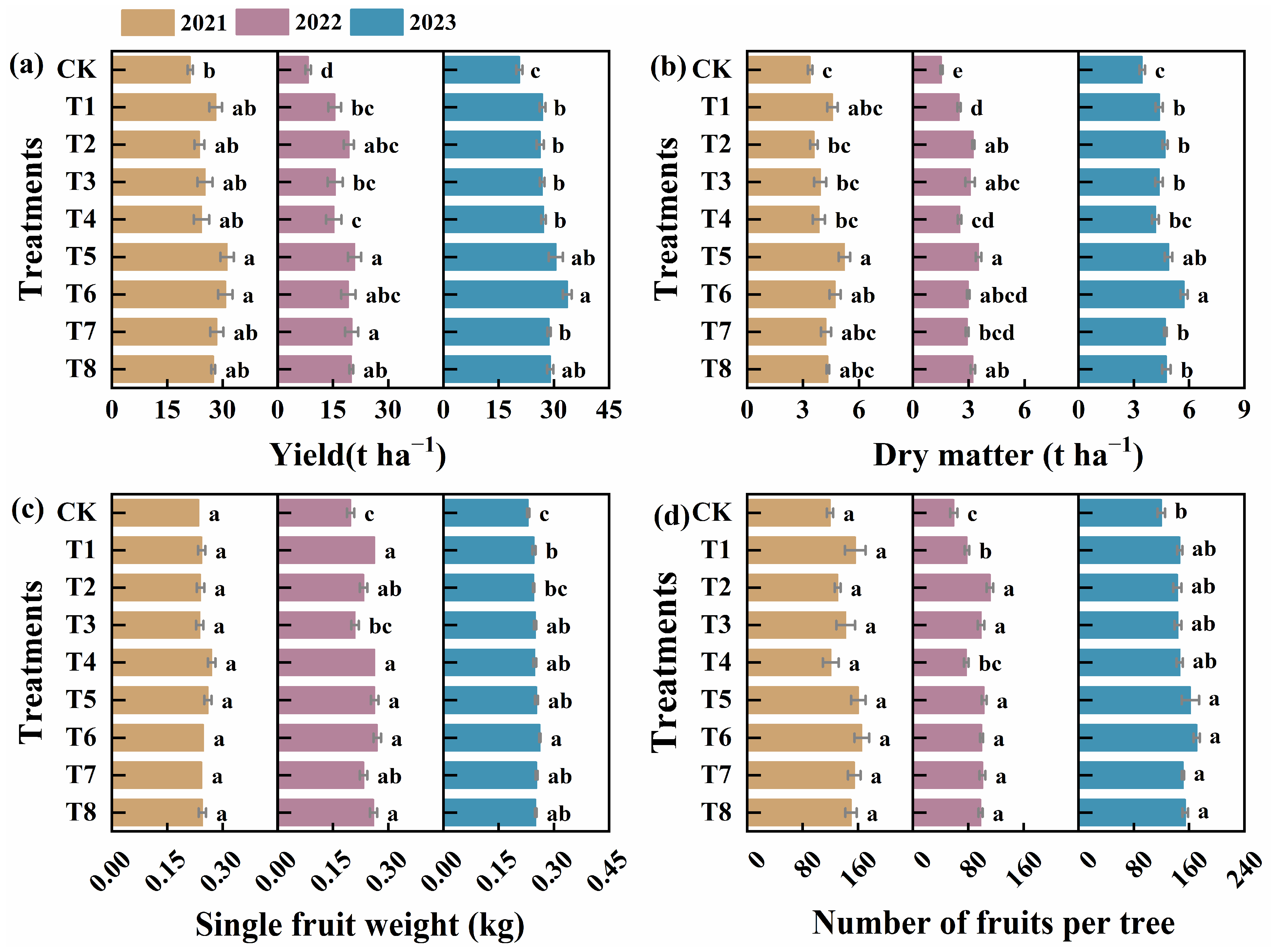
Throughout the three-year field experiment, the yield of all potassium application treatments (T1–T8) was higher than that of the potassium-free control (CK) (Figure 1a). The T5 treatment yielded the highest in the first two years, reaching 31.18 t ha−1 and 20.86 t ha−1, respectively. In the third year, the T6 treatment achieved the highest yield, which was significantly increased by 10.1128.03% compared to the other potassium-applied treatments. Overall, the treatments with a single topdressing of polyhalite compound fertilizer (T5, T6) demonstrated superior yield-increasing effects compared to the other potassium treatments. In addition, both year and treatment had highly significant effects on apple yield (p < 0.01), whereas their interaction did not show a significant main effect (p > 0.05) (Table S1). Dry matter content exhibited a similar trend (Figure 1b). In the first two years, the T5 treatment increased dry matter content by 10.59–45.81% and 8.62–42.34%, respectively, compared to the other potassium treatments. In the final year, the T6 treatment recorded the highest dry matter content at 5.72 t ha−1, which was significantly greater than all other treatments except T5. Moreover, year, treatment, and their interaction all exerted highly significant effects on dry matter. Regarding single fruit weight (Figure 1c), the T4 treatment showed the highest value in the first year, while the T6 treatment performed the best in the subsequent two years. Compared to the conventional compound potassium fertilizer treatments (T1, T2), the single fruit weight of the T4 treatment increased by 11.11–12.50% in the first year, while that of the T6 treatment increased by 2.66–15.88% in the second year and 6.50–6.94% in the third year. Year did not have a significant main effect on single fruit weight, whereas treatment and its interaction with year showed highly significant effects. In the second year, the number of fruits per plant in the potassium-applied treatments was significantly higher than that in the CK treatment, with the T2 treatment performing the best (Figure 1d). In the first and third years, the T6 treatment achieved the highest number of fruits per plant, which was increased by 6.1–26.63% and 16.92–19.58%, respectively, compared to T1 and T2. However, the differences were not statistically significant when compared with other potassium-applied treatments. The main and interactive effects of year and treatment on the number of fruits per plant followed a trend consistent with that for yield.

3.1.2. Effects of Different Potassium Application Treatments on Potassium Fertilizer Use Efficiency

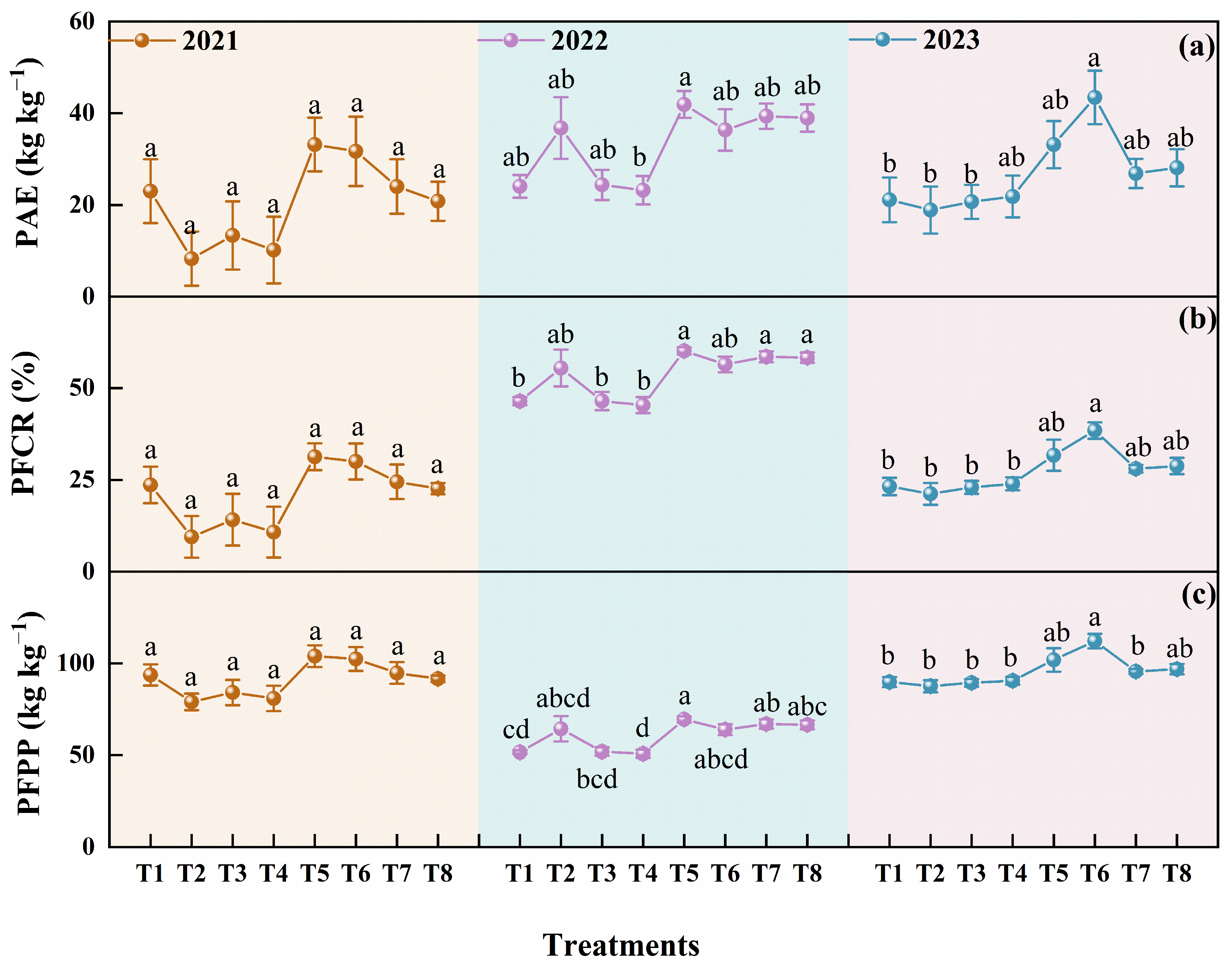
During the experimental stage, polyhalite compound fertilizer treatments generally exhibited an initial rise in PAE and PFCR, followed by a drop, while PFPP initially decreased and then increased (Figure 2). The T5 treatment performed best in the second year, with PAE, PFCR, and PFPP values of 41.92 kg kg−1, 60.23%, and 69.52 kg kg−1, respectively. The T6 treatment performed best in the first and third years. In the final year, the PAE, PFCR, and PFPP of T6 were significantly higher than those of the other potassium-applied treatments, with increases of 33.11–130.03%, 21.30–81.35%, and 10.12–28.04%, respectively. Among them, the MOP-type polyhalite compound fertilizer performed better than the SOP-type polyhalite compound fertilizer. Overall, the treatments with a single topdressing application of polyhalite compound fertilizer (T5, T6) showed the best performance, and the effectiveness gradually decreased with increasing topdressing frequency of polyhalite.

3.1.3. Effects of Different Potassium Application Treatments on Apple Fruit Quality

Fruit quality indicators varied under the different potassium application treatments (Table 2). In the first experimental year, the T3 treatment resulted in the highest Vitamin C (VC) content, reaching 14.66 mg 100 g−1. In the subsequent two years, the T6 treatment showed the highest VC content, which was 17.89–35.89% and 7.32–10.30% higher, respectively, than that of the conventional compound potassium fertilizer treatments (T1, T2). Soluble sugar content was significantly elevated in all treatments with potassium compared to the control without potassium. Among these, treatments T4, T7, and T8 consistently maintained the highest levels respectively across the three years. In the third year, the MOP-type compound fertilizer treatments (T2, T4, T6, T8) were more effective in enhancing soluble sugar content than the SOP-type treatments (T1, T3, T5, T7). In the same year, the titratable acid content in the T3 treatment was significantly higher than in the other treatments. The T6 treatment yielded the highest soluble solids content in the first and third years, at 14.47% and 13.27%, respectively. The T5 treatment showed the maximum level in the second year, which was 0.36–9.19% higher than the other potassium-applied treatments, while the CK treatment consistently showed the lowest values, as with yield. In the first two experimental years, the sugar–acid ratio under the T4 treatment was higher than that under the other potassium-applied treatments, with increases ranging from 20.60–61.27% and from 7.83–39.54%, respectively; in the third year, the T6 treatment recorded the highest sugar–acid ratio, reaching 55.37. Overall, the treatments with a single topdressing of polyhalite compound fertilizer (T5, T6) were more effective in enhancing apple soluble solids compared to the other potassium treatments. Notably, both year and treatment had highly significant effects on the four fruit quality indicators, and their interaction also exhibited a significant main effect on Vitamin C and highly significant main effects on all other indicators.

3.1.4. Effects of Different Potassium Application Treatments on Fruit Mineral Nutrients

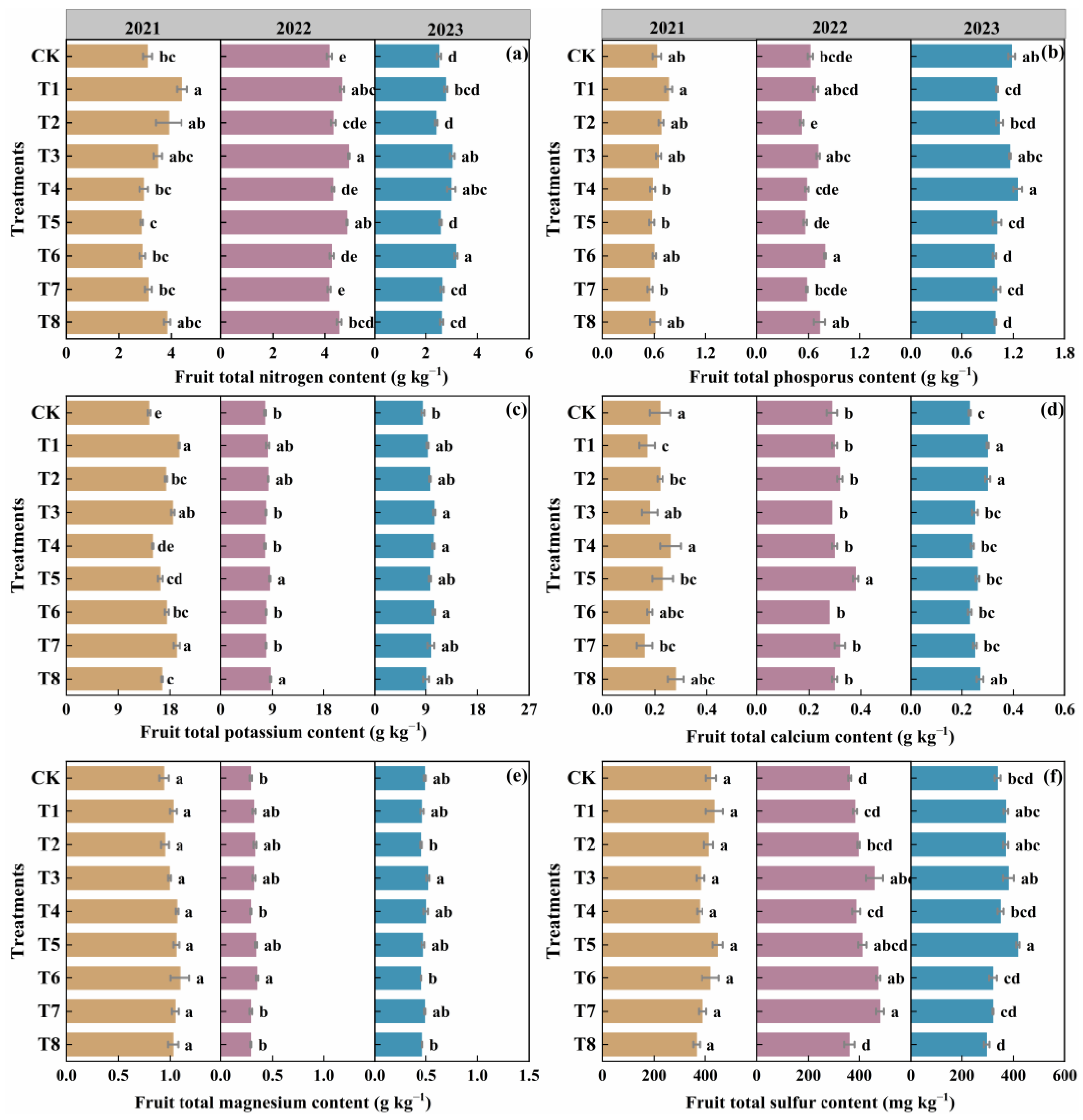
Fruit nutrient content differed significantly among the different fertilization treatments (Figure 3). In the first year, the T1 treatment resulted in the highest fruit total nitrogen content (4.42 g kg−1). In the following two years, the T3 and T6 treatments showed the highest levels, which were 17.75% and 25.90% higher than that of the CK treatment, respectively (Figure 3a). The highest fruit total phosphorus content was observed in treatments T1, T6, and T4 in the first, second, and third years, respectively (Figure 3b). For fruit total potassium content, the T1 treatment was the highest in the first year, followed by T7 (Figure 3c). In the subsequent two years, the T8 and T3 treatments exhibited the highest values, reaching 8.66 g kg−1 and 10.46 g kg−1, respectively. Regarding mineral elements, the T2 treatment had the highest total calcium content in the second year (0.38 g kg−1). In the third year, the T1 and T2 treatments showed the highest total calcium content, which was significantly greater than the other treatments (Figure 3d). Fruit total magnesium content was highest in the T6 treatment in the first two years and in the T3 treatment in the third year, representing an increase of 4.00–15.56% compared to the other potassium-applied treatments (Figure 3e). The T7 treatment resulted in the highest fruit total sulfur content in the second year, at 479.41 mg kg−1 (Figure 3f). The T5 treatment was relatively more effective in enhancing fruit total sulfur content, showing the highest levels in the first and third years. In general, the SOP-type polyhalite compound fertilizers (T3, T5, T7) were more effective in increasing fruit total sulfur than the MOP-type polyhalite compound fertilizers (T4, T6, T8), and a single topdressing application yielded better results (Figure 3f). Overall, the main effects of year, treatment, and their interaction on fruit nutrient content also varied (Table S2). Year had a highly significant main effect on all total fruit nutrients. Treatment showed a highly significant main effect on total nitrogen, total phosphorus, and total sulfur, but no significant effect on total potassium, total calcium, or total magnesium. The year × treatment interaction had a significant effect on total magnesium and highly significant effects on all other nutrient contents.

3.2. Effects of Different Potassium Application Treatments on Leaf Physiological Characteristics

3.2.1. Effects of Different Potassium Application Treatments on Leaf Physiological Performance

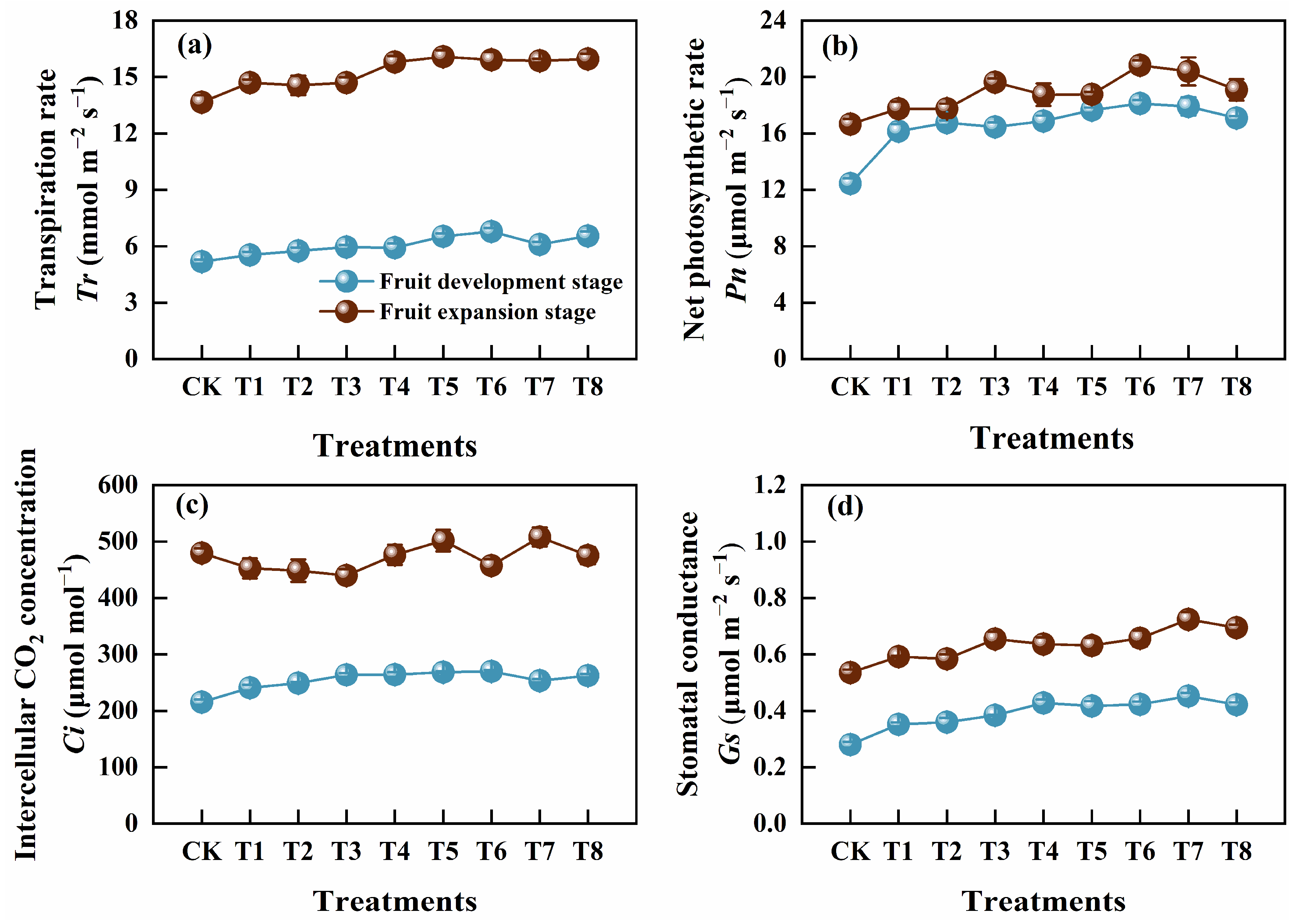
During the fruit development stage in the third year, the T6 treatment exhibited the highest transpiration rate (Tr), net photosynthetic rate (Pn), and intercellular CO2 concentration (Ci), reaching 6.78 mmol m−2 s−1, 18.13 μmol m−2 s−1, and 270.06 μmol mol−1, respectively (Figure 4). The net photosynthetic rate of all potassium-applied treatments was significantly increased compared to CK, with an increase range of 29.83–45.67% (Figure 4b). At the fruit expansion stage, the T8 treatment showed the highest transpiration rate at 15.96 mmol m−2 s−1, while T5 had the greatest intercellular CO2 concentration at 501.66 μmol mol−1 (Figure 4a,c). The T6 treatment had the highest net photosynthetic rate, exceeding the other potassium-applied treatments by 2.13–17.4%. Regarding the net photosynthetic rate, the polyhalite compound potassium fertilizer treatments (T3–T8) were all higher than the conventional compound potassium fertilizer treatments (T1–T2) (Figure 4b). Furthermore, the T7 treatment demonstrated the highest stomatal conductance (Gs) across both growth stages, showing increases of 5.85–28.51% and 4.16–23.96% compared to the other potassium treatments. Overall, the stomatal conductance of the polyhalite compound fertilizer treatments (T3–T8) was also generally higher than that of the conventional compound fertilizer treatments (T1–T2) (Figure 4d).

3.2.2. Effects of Different Potassium Application Treatments on Apple Leaf Chlorophyll Fluorescence Parameters

The chlorophyll fluorescence parameters measured in 2023 are presented in Table 3. The T4 treatment exhibited the highest PSII quantum yield (ΦPSII) during both the fruit development and expansion stages, which was 7.9–59.26% and 2.03–29.89% higher, respectively, than the other treatments. The maximum photochemical efficiency of PSII (Fv/Fm) showed no significant differences among the treatments at either the fruit development or expansion stage. At the fruit expansion stage, the T7 treatment achieved the highest Fv/Fm value. The T8 treatment showed the highest PSII potential activity (Fv/F0) at the fruit development stage, followed by T6. At the fruit expansion stage, the T7 treatment exhibited the highest Fv/F0, surpassing the CK, T1, and T2 treatments significantly. The T4 treatment demonstrated the most prominent performance in electron transport rate (ETR) during both the fruit development and expansion stages, with increases of 0.68–46.51% and 2.04–10.02%, respectively, compared to the other potassium-applied treatments. In contrast, the CK treatment consistently showed the lowest ETR. Regarding the photochemical quenching coefficient (qP), the T2 and T4 treatments had the highest values at the fruit development stage, but the differences were not statistically significant compared to the other potassium-applied treatments, except for T1. At the fruit expansion stage, the qP value of the T4 treatment remained the highest, showing an increase of 2.55–49.36% over the other potassium-applied treatments.

3.2.3. Effects of Different Potassium Application Treatments on Chlorophyll Content of Apple Leaf

The SPAD value, which directly reflects leaf chlorophyll content, overall showed an increasing trend with the progression of the growth stages (Figure S2). During the flowering stage, the T7 treatment exhibited the highest SPAD value of 46.39. Moreover, the SPAD values of the polyhalite compound potassium fertilizer treatments (T3–T8) were all higher than those of the conventional compound potassium fertilizer treatments (T1–T2). The T5 treatment showed the maximum SPAD value at the fruit development stage, which was significantly increased by 5.82% and 6.34% compared to the T1 and T2 treatments, respectively. During the fruit expansion stage, the MOP-type compound fertilizer treatments were more effective in enhancing the SPAD value than the SOP-type treatments, with the T6 treatment exhibiting the highest value of 60.65.

3.2.4. Effects of Different Potassium Application Treatments on Apple Leaf Mineral Nutrient Content

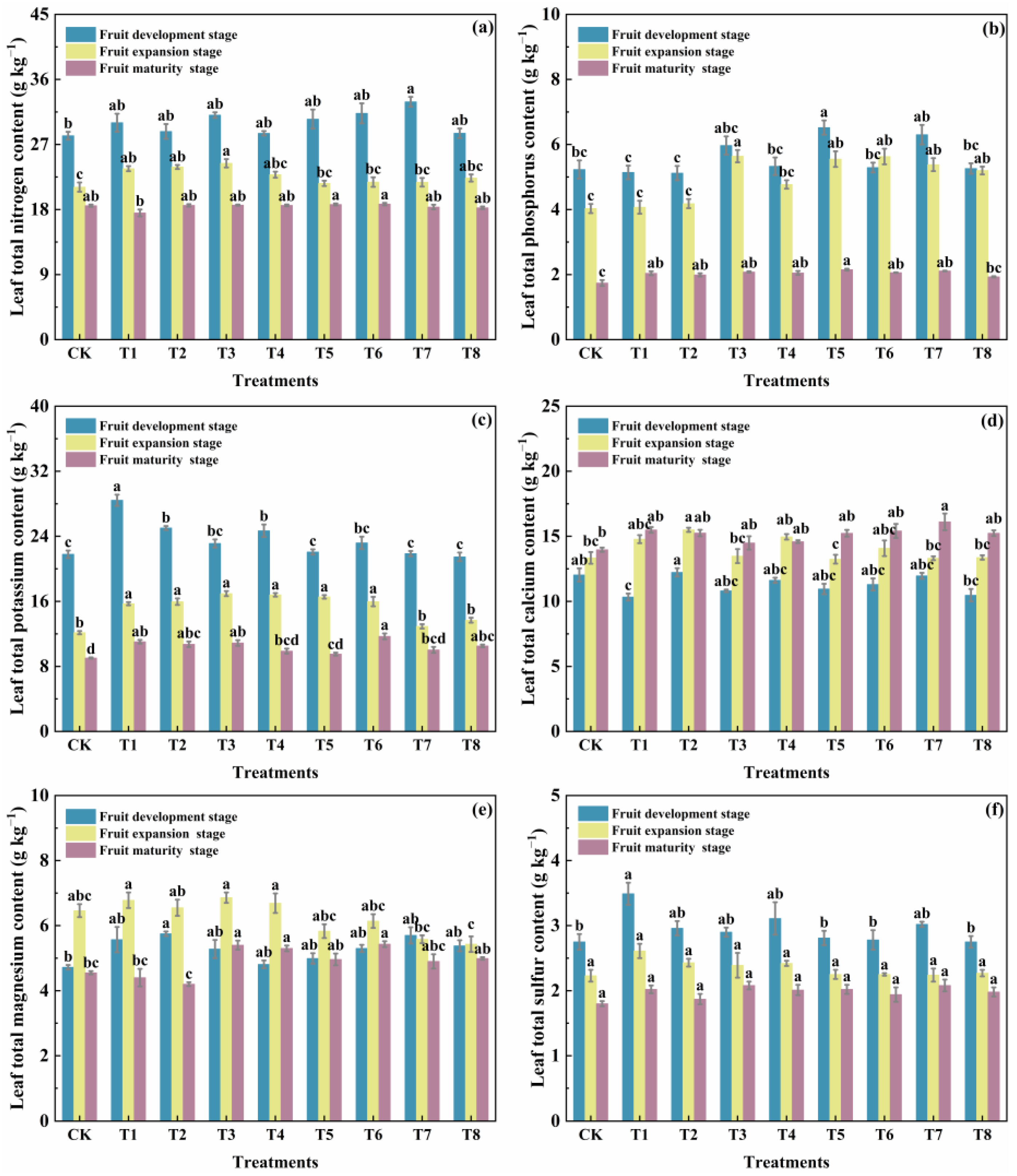
This study determined the leaf mineral nutrient contents at three key growth stages during the 2023 apple growth season. As the growth stages advanced, the levels of total nitrogen, total phosphorus, and total potassium in the leaves gradually decreased (Figure 5). At the fruit development stage, the T7 treatment resulted in the highest leaf total nitrogen content (32.9 g kg−1) (Figure 5a). In the fruit expansion stage, the T3 treatment had a total nitrogen content that was 2.18–12.86% greater than the other treatments with potassium, whereas the CK treatment had the lowest content. At the fruit maturity stage, the T6 treatment had the highest total nitrogen content (18.75 g kg−1), but the difference was not statistically significant compared to other potassium-applied treatments, except for T1.
At both the fruit development and maturity stages, the T5 treatment exhibited the highest leaf total phosphorus content, which was 3.49–27.34% and 1.9–11.4% higher, respectively, than the other potassium-applied treatments. Furthermore, the SOP-type compound potassium fertilizers were superior to the MOP-type in promoting total phosphorus accumulation (Figure 5b). At the fruit expansion stage, the T6 treatment showed the highest total phosphorus content (5.63 g kg−1), which was significantly different from the CK, T1, and T2 treatments. Overall, across the three growth stages, the polyhalite compound potassium fertilizers were more effective than the conventional potassium fertilizers in enhancing leaf total phosphorus content.
At the fruit development stage, the T1 treatment had a significantly higher total potassium content than the other treatments, reaching 28.43 g kg−1 (Figure 5c). During the fruit expansion stage, the basal-applied polyhalite compound potassium fertilizer treatments (T3, T4) increased total potassium content by 2.42–31.19% and 1.51–30.3%, respectively, compared to the other potassium-applied treatments. At the fruit maturity stage, the T6 treatment resulted in the highest total potassium content in the leaves, reaching 11.68 g kg−1.
The leaf total calcium content in apple trees generally showed an increasing trend across the three growth stages (Figure 5d). The T2 treatment resulted in the highest total calcium content at both the fruit development and expansion stages, showing increases of 2.26–18.39% and 3.61–17.07%, respectively, compared to the other potassium-applied treatments. Overall, the MOP-type compound potassium fertilizers were more effective than the SOP-type in enhancing calcium content. At the fruit maturity stage, the T6 treatment had the highest total calcium content (16.11 g kg−1). The CK treatment consistently showed the lowest leaf total potassium content across all growth stages.
Leaf total magnesium content initially increased and then decreased as the growth stages progressed (Figure 5e). At the fruit development stage, the T2 treatment had the highest total magnesium content, followed by T7. During the fruit expansion stage, the total magnesium content in the T3 treatment was 2.54–26.34% higher than in the other potassium-applied treatments. In this stage, increasing the frequency of topdressing with polyhalite compound fertilizer led to a decrease in total magnesium content. At the fruit maturity stage, the T6 treatment showed the highest leaf total magnesium content (5.43 g kg−1). Moreover, the leaf total magnesium content in the polyhalite compound potassium fertilizer treatments was increased by 11.36–23.41% and 16.67–29.29% compared to the conventional compound potassium fertilizer treatments.
At the first two growth stages, the T1 treatment exhibited the highest leaf total sulfur content, reaching 3.49 and 2.61 g kg−1, respectively (Figure 5f). At the fruit maturity stage, the T3 and T4 treatments showed the highest leaf total sulfur content, although the differences were not statistically significant compared to other treatments.

3.3. Effects of Different Potassium Application Treatments on Soil Physicochemical Properties

3.3.1. Effects of Different Potassium Application Treatments on Soil pH and Electrical Conductivity

Soil pH showed a slight increasing trend as the growth stages progressed in 2023 (Table 4). The T6 treatment resulted in the highest soil pH at the spring bud break, fruit expansion, and fruit maturity stages, which were 0.12–0.29, 0.08–0.69, and 0.03–0.69 units higher, respectively, than the other potassium-applied treatments. At the fruit development stage, the T5 treatment showed the highest pH value (6.41), but no significant difference was observed among treatments. Overall, at the fruit maturity stage, the MOP-type and SOP-type polyhalite compound fertilizers increased the soil pH by 0.14–0.23 and 0.51–0.69 units, respectively, compared to their corresponding traditional potassium fertilizers.
The electrical conductivity (EC) of the soil first rose and then fell as the growth stages advanced in the final experimental year (Table 4). The T6 treatment exhibited the highest soil EC at the spring bud break and fruit expansion stages, showing increases of 6.64–19.84% and 6.82–16.35%, respectively, compared to the other potassium-applied treatments. The T8 treatment resulted in the maximum EC (254.33 μS cm−1) at the fruit development stage, followed by the T6 treatment. At the fruit maturity stage, the EC in the T5 treatment was 6.67–24.86% higher than in the other potassium-applied treatments and was significantly different from the conventional compound potassium fertilizer treatments. Overall, the potassium-applied treatments increased the soil EC compared to the non-potassium control.

3.3.2. Effects of Different Potassium Application Treatments on Soil Available Nutrient Content

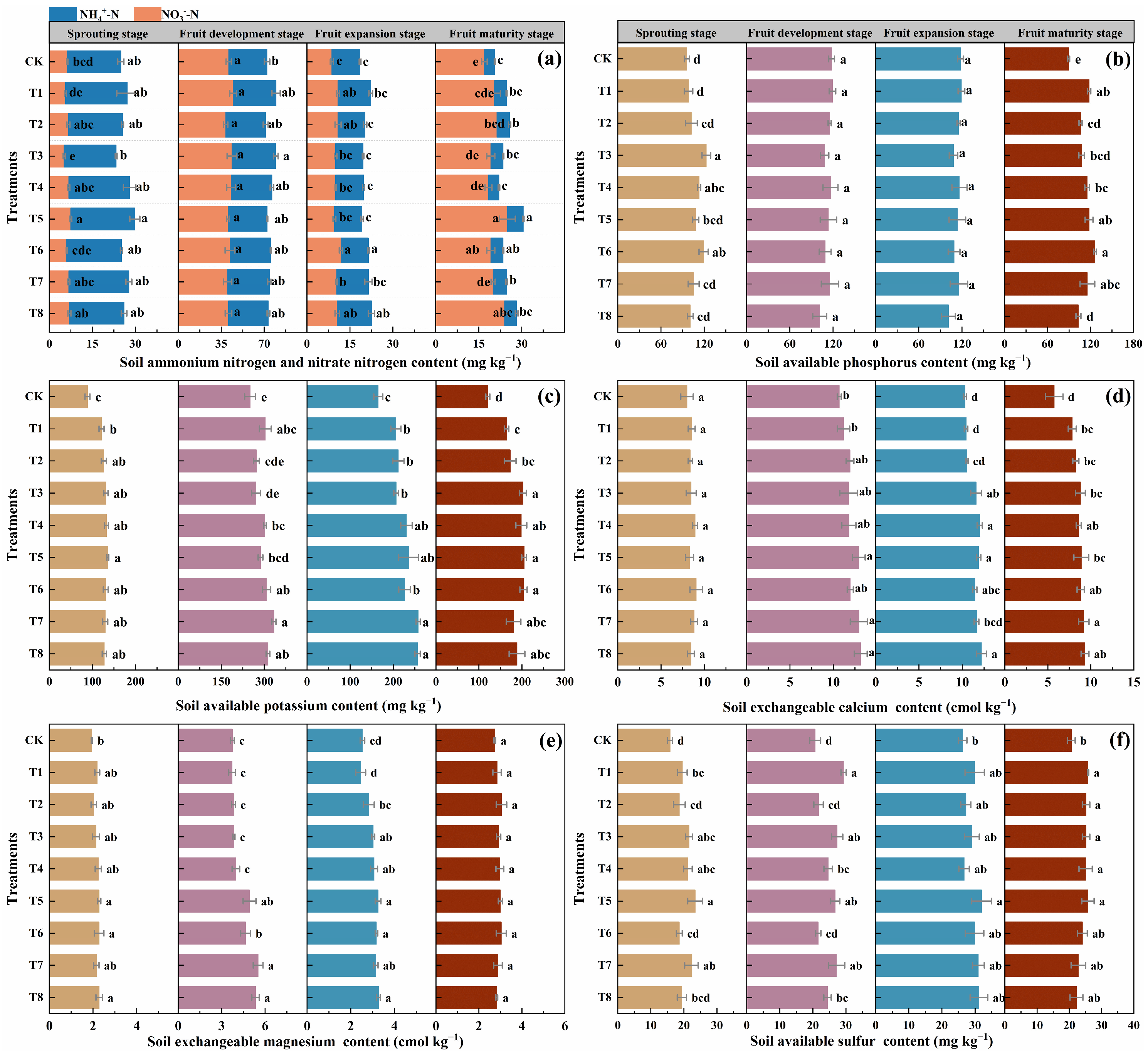
In the third experimental year, soil NO3-N content exhibited a pattern of “increase–decrease–increase” throughout the apple growth stages (Figure 6a). The T5 treatment resulted in the highest NO3-N content at both the spring bud break and fruit maturity stages. At the fruit development stage, when NO3-N content reached its peak, the T1 treatment showed a content that was 2.29–15.67% higher than the other potassium-applied treatments. During the fruit expansion stage, the T6 treatment had a higher NO3-N content (11.88 mg kg−1) than the other treatments. Furthermore, the MOP-type compound fertilizers were more effective than the SOP-type in promoting soil NO3-N accumulation during this stage. The T5 treatment also exhibited the highest NH4+-N content at the spring bud break and fruit maturity stages, which was 3.77–23.25% and 12.71–52.87% higher, respectively, than the other potassium-applied treatments. At the fruit development stage, the T3 treatment showed the highest soil NH4+-N content (35.75 mg kg−1). The T6 treatment resulted in the highest soil NH4+-N content during the fruit expansion stage, representing an increase of 13.05–41.04% compared to the other potassium-applied treatments. Regarding soil available phosphorus, the T3 treatment showed the highest content at the sprouting stage, followed by the T6 treatment (Figure 6b). At the fruit development stage, the T1 treatment resulted in the highest available phosphorus content (119.21 mg kg−1), but the difference was not statistically significant compared to the other treatments. During the fruit expansion and maturity stages, the T5 and T6 treatments showed the highest soil available phosphorus content, respectively, which was increased by 1.03–10.1% and 7.03–22.43% compared to the other potassium-applied treatments. Soil available potassium content showed an initial increase followed by a decrease throughout the growth stages (Figure 6c). The T5 treatment resulted in the highest available potassium content at the spring bud break and fruit maturity stages, which was 2.36–12.06% higher than the other treatments. At the fruit development and expansion stages, the T7 treatment exhibited the highest available potassium content (333.38 and 257.56 mg kg−1, respectively), which was significantly different from the CK, T1, and T2 treatments. Furthermore, the soil available potassium content in all potassium-applied treatments (T1–T8) was significantly higher than that in the CK treatment at all growth stages except for the fruit expansion stage. Soil exchangeable calcium content reached its peak at the fruit development stage and subsequently declined gradually (Figure 6d). The T6 treatment showed the highest exchangeable calcium content (9.06 cmol kg−1) at the sprouting stage. During the subsequent two stages (fruit development and expansion), the T8 treatment resulted in the highest exchangeable calcium content, which was 1.64–17.64% and 1.86–17.20% higher, respectively, than the other potassium-applied treatments. At the fruit maturity stage, the T7 treatment showed the highest exchangeable calcium content, which was significantly higher than that of the conventional compound fertilizer treatments.
The content of exchangeable magnesium in the soil initially increased and then de-creased as the growth stages advanced (Figure 6e). The T8 treatment resulted in the highest exchangeable magnesium content at the spring bud break and fruit expansion stages, showing increases of 0.36–12.33% and 0.5–33.25%, respectively, compared to the other potassium-applied treatments. At the fruit development stage, the T7 treatment showed the highest exchangeable magnesium content (5.52 cmol kg−1), followed by the T8 treatment. At the fruit maturity stage, the T2 treatment had the highest exchangeable magnesium content, but the differences were not statistically significant compared to other treatments. During the growth season, the available sulfur content in the soil first increased and then decreased (Figure 6f). At the spring bud break and fruit expansion stages, the T5 treatment resulted in the highest available sulfur content, which was 5.09–25.64% and 2.65–17.49% higher, respectively, than the other potassium-applied treatments. At the fruit development and maturity stages, the T1 treatment exhibited the highest soil available sulfur content, reaching 29.28 mg kg−1 and 25.81 mg kg−1, respectively. Overall, throughout the entire apple growth season, the soil available sulfur content under the SOP-type compound fertilizer treatments was higher than that under the MOP-type treatments.

3.3.3. Correlation Analysis Among Soil Properties, Apple Yield, Fruit Quality and Photosynthetic Performance Under Different Potassium Fertilization Treatments in 2023

Apple yield exhibited a highly significant positive correlation (p < 0.001) with soil NO3-N, available phosphorus, and available potassium contents, a strong, significant positive correlation (p < 0.01) with NH4+-N content and soil pH, and a significant positive correlation (p < 0.05) with soil exchangeable calcium and magnesium contents (Figure S3). Concurrently, fruit soluble solids content (SSC) and the sugar–acid ratio (SS/TA) also showed highly significant or strong, significant positive correlations with indicators such as available phosphorus, available potassium, and pH. Net photosynthetic rate (Pn) was highly significantly positively correlated with soil available phosphorus, available potassium, exchangeable calcium, and pH. Stomatal conductance (Gs) was highly significantly positively correlated with exchangeable calcium, and strongly significantly positively correlated with available phosphorus and available potassium. A strong, significant positive correlation was also observed between Pn and Gs, and both were significantly positively correlated with the fruit sugar–acid ratio, suggesting that soil nutrients may influence quality formation by regulating photosynthetic processes. Soil pH showed a highly significant positive correlation with available phosphorus and available potassium contents, and a strong significant positive correlation with exchangeable calcium, indicating a close relationship between pH conditions and the availability of multiple nutrients.

4. Discussion

4.1. Effects of Polyhalite Compound Fertilizer on Fruit Yield, Quality, Potassium Use Efficiency and Nutrient Content

The three-year trial demonstrated that polyhalite compound fertilizers, particularly treatments with a single topdressing T5 and T6, enhanced apple yield relative to conventional potassium fertilizers under equivalent K rates (Figure 1). This yield advantage stems from polyhalite’s slow-release nature, which aligns potassium supply with apple demand during critical growth phases, sustaining availability during fruit expansion [20]. A single application thus creates a stable nutrient reservoir, minimizing loss risks and preventing asynchrony between supply and demand. Additionally, Ca2+ and Mg2+ released from polyhalite compete with K+ for soil adsorption sites, reducing K fixation and improving utilization [50]—a relationship supported by the strong positive correlation between soil available K and exchangeable Ca (Figure S3). Additionally, secondary nutrients such as calcium and magnesium play key roles in maintaining cell-wall integrity and promoting the transport of photosynthetic assimilates, which can synergistically enhance yield [51]. Consistent with this, polyhalite treatments exhibited higher net photosynthetic rates and stomatal conductance than conventional fertilizers (Figure 4), reflecting better physiological performance. The advantage of multi-nutrient supply also lies in enhancing crop resistance to pests and diseases [52]. The MOP-type polyhalite outperformed SOP-type in later years, possibly due to reduced Cl–SO42− uptake competition when both ions are present [53]. T6 also promoted dry matter accumulation and fruit number (Figure 1), due to sustained K release stimulating carbohydrate synthesis and starch synthase activity [54]. This was further evidenced by T6’s highest leaf K and fruit soluble solids content in the third year, and yield’s strong positive correlation with soil available K.
Polyhalite also improved apple fruit quality, consistent with reports in carrots [55], tomatoes [28,31], and sugarcane [25]. Treatments T5 and T6 notably increased Vitamin C and soluble solids content (Table 2). This enhancement is likely due to potassium’s critical role in sugar transport from source to sink [54], a process supported by polyhalite’s sustained K release [56] and evidenced by a strong positive correlation between soluble solids and soil available K (Figure S3). Notably, sulfur supply limitation can significantly negatively impact crop yield formation and quality improvement [57]. Adequate sulfur mitigates quality limitations and boosts sulfur-containing metabolites [58], a mechanism similarly observed in onion and garlic with polyhalite-derived sulfur [59]. Moreover, the sulfur provided by polyhalite, a precursor for synthesizing sulfur-containing amino acids and Vitamin C, could be one reason for the higher VC content in the T6 treatment [60].
Compared with conventional fertilizers, polyhalite compound fertilizer enhanced fruit mineral nutrient content (Figure 3), consistent with its reported effect of improving multi-nutrient accumulation in maize grain and straw [61]. Polyhalite enhanced fruit mineral content, likely through promoting root growth and improving nutrient uptake efficiency [62]. The significant increase in total sulfur content observed in the T5 treatment further demonstrates its role as an effective sulfur source for fruit quality improvement. Calcium, an essential intracellular messenger in apples, regulates physiological processes such as stomatal movement [63], and its adequate uptake helps reduce disease risk [64]. Meanwhile, T6 achieved the highest fruit Mg content (Figure 3). Compared with single-nutrient fertilizers, polyhalite serves as a donor of potassium, calcium, and magnesium, providing more balanced nutrition to crops. The interactions among its constituent nutrients, along with their synergy with crop nutrient uptake, are widely recognized for their agronomic importance [65].
While potassium use efficiency (PAE, PFCR, PFPP) did not differ significantly among treatments in the first year—possibly due to initial soil fertility—the single topdressing polyhalite treatments (T5, T6) later achieved superior efficiency. This aligns with studies showing polyhalite enhances the uptake and utilization efficiency of nutrients like N and S [29,66]. This is primarily attributed to the ability of polyhalite, compared to highly soluble traditional potassium fertilizers, to supply these macro- and micronutrients slowly, steadily, and over an extended period according to crop demand [30]. This sustained release minimizes fixation by soil colloids and reduces leaching losses [67], aided by its complex molecular structure that resists rapid breakdown in water, ensuring a stable nutrient supply [68]. Ultimately, employing polyhalite within site-specific nutrient management frameworks can offer a cost-effective pathway to optimize fertilizer-use efficiency [29].

4.2. Regulatory Mechanisms of Polyhalite Compound Fertilizer on Leaf Photosynthetic Physiology and Mineral Nutrition

Leaf photosynthetic performance is a decisive factor for crop yield. In this study, the photosynthetic performance of the polyhalite compound fertilizer treatments (T3–T8) was generally superior to that of the conventional potassium fertilizer treatments (T1–T2). This enhancement arose from the continuous, multi-nutrient supply of polyhalite, which synergistically regulated stomatal function, enzyme activity, and assimilate synthesis. During fruit development, polyhalite treatments exhibited elevated intercellular CO2 concentration and stomatal conductance. This can be attributed to the coordinated roles of potassium and calcium: potassium serves as the primary osmolyte driving stomatal opening and improving CO2 utilization [69,70], while calcium participates in cell-wall formation and cooperatively regulates stomatal conductance [71], thereby facilitating the translocation of photosynthetic products [72]. These mechanisms align with the observed strong positive correlations between stomatal conductance and soil available K and exchangeable Ca (Figure S3). Similarly, magnesium supports crop photosynthesis and glucose allocation [68], and acts as an activator for enzymes such as Rubisco, participating in photosynthetic electron transport [73]. The high net photosynthetic rate in T6 and stomatal conductance in T7 (Figure 4) directly manifest this nutrient synergy. Additional studies have indicated that increased sulfur uptake in crops promotes an increase in leaf number and expansion of leaf area, which is more conducive to efficient photosynthesis [74]. Thus, the improvement in photosynthesis is a concerted outcome of multiple nutrients, underscoring that polyhalite—though often matched on a K-basis—effectively supplies a broader spectrum of essential elements. The findings of Milošević et al. [1] further indicate that in apple cultivation, mineral-based multi-nutrient fertilizers can significantly improve leaf nutrient balance and enhance fruit antioxidant capacity, emphasizing the need for comprehensive nutrient supply beyond primary macronutrients.
Leaf mineral nutrient analysis further confirmed polyhalite’s multi-nutrient supply advantage. Across key growth stages, leaf nutrient content in polyhalite treatments (e.g., T3, T6, T7) consistently surpassed that in conventional fertilizers (T1, T2) in Figure 5. This sustained elevation stems from polyhalite’s balanced and plant-available nutrient release, which promotes uptake and enhances synergies among elements, thereby facilitating key metabolic processes [30]. Notably, the role of sulfur is critical: adequate supply mitigates widespread deficiency concerns [75] and interacts with nitrogen to synthesize sulfur-containing amino acids, promoting protein accumulation in leaves [76]. This mechanism explains the maintained higher leaf nitrogen levels in polyhalite treatments during later growth stages. Collectively, the comprehensive nutrient profile of polyhalite fosters a robust leaf physiological status, providing a solid foundation for high yield and superior fruit quality.

4.3. Ameliorative Effects of Polyhalite Compound Fertilizer on Soil Acidity and Fertility

The slow-release, multi-nutrient nature of polyhalite enabled long-term improvement in soil fertility and alleviation of acidification. Polyhalite treatments (T3–T8) consistently increased soil pH, with T6 achieving the highest value in the third year (Table 4). This is because H+ in acidic soil can promote the dissolution of polyhalite, leading to a higher dissolution rate [29]. The released base cations (Ca2+, Mg2+, K+) subsequently displace exchangeable Al3+ and H+ from soil colloids. This process directly elevates soil pH [77] and reduces nutrient leaching losses [20]. The strong positive correlation between soil pH and exchangeable Ca supports this mechanism (Figure S3). Concurrently, the released sulfate (SO42−) displaces hydroxyl groups from soil surfaces, further elevating pH and mitigating Al toxicity [31]. Compared to traditional amendments like gypsum, polyhalite exhibits higher solubility and faster Ca mobility in soil [50], leading to superior calcium retention and reduced leaching losses [77]. Consequently, polyhalite treatments best maintained soil exchangeable Ca and Mg levels post-harvest [20,78], as confirmed in this study by higher Ca at maturity (Figure 6d). Thus, even modest polyhalite application can match the efficacy of higher gypsum rates while providing a continuous, rather than periodic, calcium supply [25].
Due to its multi-nutrient composition and slow-release properties, polyhalite helped establish a more stable and balanced soil nutrient environment [20]. This regulation of soil nitrogen dynamics was evidenced in treatments such as T5 and T6, which maintained higher levels of NO3-N and NH4+-N. The effect may be explained by an indirect optimization of nitrifying microbial activity through increased soil pH, coupled with the role of sulfur released from polyhalite. As a component of key enzymes such as nitrate reductase, sulfur synergistically promoted nitrogen assimilation and transformation [79]. Moreover, the Ca2+ released from polyhalite favors the formation of more soluble calcium phosphate salts, while SO42− can compete with PO43− for soil adsorption sites. Together, these processes alleviate phosphorus fixation in acidic soils and enhance phosphorus availability [80]. This conclusion is further supported by the strong positive correlation observed in this study between soil available phosphorus and exchangeable calcium content (Figure S3). Compared to traditional potassium fertilizers, the soil available potassium content under polyhalite treatments was generally higher, with the T5 and T7 treatments performing relatively best. This resulted from its slow-release nature combined with low Cl content [81], which minimized rapid K leaching or fixation [82]. The superior retention of exchangeable Ca (during fruit expansion and maturity) and Mg (during development and expansion) under polyhalite treatments aligns with leaching studies showing that polyhalite’s sustained release leads to lower nutrient loss in leachate and greater retention in soil or plant uptake [77]. In this study, the conventional SOP compound fertilizer T1 and the SOP-type polyhalite compound fertilizer T5 performed best in terms of soil available sulfur supply across the four apple growth stages. This is because polyhalite can release a large amount of sulfate compounds (CaSO4, MgSO4) and sulfides into the soil [83], a characteristic that also makes it an effective sulfur source for crops [28]. In addition to providing sustained nutrient supply to the soil, the Ca2+ and Mg2+ ions released from polyhalite can also promote soil particle aggregation, contributing to improved water and nutrient retention [70,84].

5. Conclusions

Based on the three-year field trial, polyhalite compound fertilizer demonstrates excellent potential as an alternative to traditional potassium fertilizers. The single topdressing application of MOP-type polyhalite compound fertilizer (T6 treatment) achieved remarkable results in key agronomic and environmental indicators, establishing it as the recommended fertilization strategy. By slowly and continuously releasing nutrients to match the growth demands of apple trees, and through multi-nutrient synergy, T6 treatment maintained the highest net photosynthetic rate in the third year, effectively promoted the accumulation of fruit soluble solids and vitamin C, and ultimately maximized yield. In terms of improving soil fertility, the high solubility and sustained supply of secondary nutrients from polyhalite balanced the soil nutrient structure and enhanced fertilizer use efficiency by the crop. Furthermore, the base cations and sulfate released from polyhalite can displace acidic ions in the soil, alleviating soil acidification. This was evidenced in the experiment by the overall higher pH in polyhalite compound fertilizer treatments compared to conventional compound fertilizer treatments. In summary, as an efficient multi-nutrient fertilizer, polyhalite can provide a green solution for the apple cultivation industry facing challenges of excessive fertilization and environmental pollution.
However, this study still has limitations. The investigation into underlying mechanisms did not delve deeply into soil microbial communities, key enzyme activities, molecular regulatory pathways of crop nutrient uptake, nor did it assess potential risks such as trace element imbalance from long-term application or potential impacts on the surrounding ecosystem. Future research should prioritize combining molecular biology and other technologies to elucidate the mechanisms and conduct long-term fixed-position experiments to assess environmental safety, thereby refining the theoretical and practical framework for polyhalite compound fertilizer.

Supplementary Materials

The following supporting information can be downloaded at: https://www.mdpi.com/article/10.3390/horticulturae12010126/s1, Figure S1: Monthly mean air temperature, precipitation, relative humidity, and shortwave radiation in the study area during 2021–2023; Figure S2: Chlorophyll content (SPAD values) of apple leaves in 2023 under different K fertilization treatments. Figure S3: Pearson’s correlation analysis diagram for soil properties, apple yield, fruit quality, and leaf photosynthetic performance in 2023. Table S1: Analysis of year and treatment on apple yield and its component factors; Table S2: Analysis of year and treatment on apple fruit nutrient content.

Author Contributions

Conceptualization, C.L.; Methodology, M.H., P.H., Y.L., Z.Q. and D.L.; Validation, Y.G.; Formal Analysis, J.Q.; Investigation, M.H., P.H., J.R., J.B. and W.W.; Resources, C.L.; Data Curation, J.Q.; Writing—Original Draft Preparation, J.Q.; Writing—Review and Editing, H.F., C.L.; Supervision, C.L.; Project Administration, C.L.; Funding Acquisition, C.L. All authors have read and agreed to the published version of the manuscript.

Funding

This research was supported by the Shandong Province Key Scientific and Technological Innovation Projects Program (Grant No. 2022SFGC0302) and Anglo American Woodsmith Ltd. (Grant No. 3000-SAU-3038-23).

Data Availability Statement

The data that support the findings of this study are available from the corresponding author upon reasonable request.

Conflicts of Interest

Authors Wentao Wu and Jing Bai were employed by the company Stanley Agriculture Group Co., Ltd. Author Jason Ren was employed by Anglo American Woodsmith Ltd. The remaining authors declare that the research was conducted in the absence of any commercial or financial relationships that could be construed as a potential conflict of interest.

Abbreviations

The following abbreviations are used in this manuscript:
POLYPolyhalite
SOPSulfate of potash
MOPMuriate of potash
PAEPotassium Agronomic Efficiency
PFPPPartial Factor Productivity of Potassium
PFCRPotassium Fertilizer Contribution Rate

References

  1. Milošević, T.; Milošević, N.; Mladenović, J. The Influence of Organic, Organo-Mineral and Mineral Fertilizers on Tree Growth, Yielding, Fruit Quality and Leaf Nutrient Composition of Apple cv. ’Golden Delicious Reinders’. Sci. Hortic. 2022, 297, 110978. [Google Scholar] [CrossRef]
  2. Zhang, B.; Su, S.; Duan, C.; Feng, H.; Chau, H.W.; He, J.; Li, Y.; Hill, R.L.; Wu, S.; Zou, Y. Effects of partial organic fertilizer replacement combined with rainwater collection system on soil water, nitrate-nitrogen and apple yield of rainfed apple orchard in the Loess Plateau of China: A 3-year field experiment. Agric. Water Manag. 2022, 260, 107295. [Google Scholar] [CrossRef]
  3. Chen, Z.; Yu, L.; Liu, W.; Zhang, J.; Wang, N.; Chen, X. Research progress of fruit color development in apple (Malus domestica Borkh.). Plant Physiol. Biochem. 2021, 162, 267–279. [Google Scholar] [CrossRef]
  4. Chen, R.; Xue, X.; Wang, G.; Wang, J. Determination and dietary intake risk assessment of 14 pesticide residues in apples of China. Food Chem. 2021, 351, 129266. [Google Scholar] [CrossRef] [PubMed]
  5. Wang, X.Y.; Tong, Y.A.; Liu, F.; Zhao, Z.P. Evaluation of the situation of fertilization in apple fields in Shaanxi province. J. Plant Nutr. Fertil. 2013, 19, 213–220. [Google Scholar]
  6. Liu, Z.J.; Zhu, H.; Zhang, Z.X.; Zhao, J.R.; Hou, L.Y.; Zhai, B.N.; Xu, X.P.; Lei, Q.L.; Zhu, Y.J. Current status of fertilization, distribution of N and P in soil profiles and techniques for reducing fertilizer application and improving efficiency in China’s apple orchards. J. Plant Nutr. Fertil. 2021, 27, 1294–1304. [Google Scholar]
  7. Hou, L.Y.; Liu, Z.J.; Zhao, J.R.; Ma, P.Y.; Xu, X.P. Comprehensive assessment of fertilization, spatial variability of soil chemical properties, and relationships among nutrients, apple yield and orchard age: A case study in Luochuan County. China Ecol. Indic. 2021, 122, 107285. [Google Scholar]
  8. Zörb, C.; Senbayram, M.; Peiter, E. Potassium in agriculture—Status and perspectives. J. Plant Physiol. 2014, 171, 656–669. [Google Scholar] [CrossRef]
  9. Srivastava, A.K.; Shankar, A.; Chandran, A.K.N.; Sharma, M.; Jung, K.H.; Suprasanna, P.; Pandey, G.K. Emerging concepts of potassium homeostasis in plants. J. Exp. Bot. 2020, 71, 608–619. [Google Scholar] [CrossRef]
  10. Kemp, S.J.; Smith, F.W.; Wagner, D.; Mounteney, I.; Bell, C.P.; Milne, C.J.; Gowing, C.J.B.; Pottas, T.L. An Improved Approach to Characterize Potash-Bearing Evaporite Deposits, Evidenced in North Yorkshire, United Kingdom. Econ. Geol. 2016, 111, 719–742. [Google Scholar] [CrossRef]
  11. Oosterhuis, D.M.; Loka, D.A.; Kawakami, E.M.; Pettigrew, W.T. The Physiology of Potassium in Crop Production. In Advances in Agronomy; Sparks, D.L., Ed.; Academic Press: Burlington, ON, Canada, 2014; Volume 126, pp. 203–233. [Google Scholar]
  12. Xu, X.; Liu, G.; Liu, J.; Lyu, M.; Wang, F.; Xing, Y.; Meng, H.; Li, M.; Jiang, Y.; Tian, G.; et al. Potassium alleviated high nitrogen-induced apple growth inhibition by regulating photosynthetic nitrogen allocation and enhancing nitrogen utilization capacity. Hortic. Plant J. 2024, 10, 1–14. [Google Scholar] [CrossRef]
  13. Hu, W.; Coomer, T.D.; Loka, D.A.; Oosterhuis, D.M.; Zhou, Z. Potassium deficiency affects the carbon-nitrogen balance in cotton leaves. Plant Physiol. Biochem. 2017, 115, 408–417. [Google Scholar] [CrossRef]
  14. Lu, Z.F.; Hu, W.S.; Ye, X.L.; Lu, J.; Gu, H.H.; Li, X.K.; Cong, R.H.; Ren, T. Potassium regulates diel leaf growth of Brassica napus by coordinating the rhythmic carbon supply and water balance. J. Exp. Bot. 2022, 73, 3686–3698. [Google Scholar] [CrossRef]
  15. Tan, H.; Cui, Y.; Liu, C.; Zeng, F.; Han, C.; Zhang, H.; Fan, X.; Mitchell, R.; Yan, D.; Zhang, D. Toward the Replacement of Conventional Fertilizer with Polyhalite in Eastern China to Improve Peanut Growth and Soil Quality. Chem. Biol. Technol. Agric. 2022, 9, 94. [Google Scholar] [CrossRef]
  16. Yahaya, S.M.; Mahmud, A.A.; Abdullahi, M.; Haruna, A. Recent advances in the chemistry of nitrogen, phosphorus and potassium as fertilizers in soil: A review. Pedosphere 2023, 33, 385–406. [Google Scholar]
  17. Ben Hassen, T.; El Bilali, H. Impacts of the Russia-Ukraine war on global food security: Towards more sustainable and resilient food systems? Foods 2022, 11, 2301. [Google Scholar] [CrossRef]
  18. Meena, V.; Dotaniya, M.L.; Meena, M.D.; Jat, R.S.; Meena, M.K.; Choudhary, R.L.; Meena, H.S.; Meena, B.L.; Meena, L.K.; Rai, P.K. Conjoint application of nutrients as customized fertilizers influences growth and yield characteristics of Brassica juncea L., augmented profitability and nutrient use efficiency indices. J. Soil Sci. Plant Nutr. 2024, 24, 7605–7620. [Google Scholar] [CrossRef]
  19. Barbier, M. Characterizing polyhalite plant nutritional properties. Agric. Res. Technol. Open Access J. 2017, 6, 65–73. [Google Scholar] [CrossRef]
  20. Yermiyahu, U.; Zipori, I.; Faingold, I.; Yusopova, L.; Fausta, N.; Bar-Tal, A. Polyhalite as a multi nutrient fertilizer—Potassium, magnesium, calcium and sulphate. Isr. J. Plant Sci. 2017, 64, 145–157. [Google Scholar]
  21. Kile, L.; Woodley, A.; Gatiboni, L.; Suchoff, D. Polyhalite as an Alternative Potassium Fertilizer for Sweetpotatoes. Agron. J. 2025, 117, 70114. [Google Scholar] [CrossRef]
  22. Li, Z.; Qiu, L.; Zhang, T.E.G.; Zhang, L.; Wang, L.; Wu, L.; Wang, Y.; Zhang, Y.; Dong, J.; Li, W.; et al. Long-term application of controlled-release potassium chloride increases maize yield by affecting soil bacterial ecology, enzymatic activity and nutrient supply. Field Crops Res. 2023, 297, 108946. [Google Scholar] [CrossRef]
  23. Sapkota, T.B.; Jat, M.L.; Rana, D.S.; Khatri-Chhetri, A.; Jat, H.S.; Bijarniya, D.; Sutaliya, J.M.; Kumar, M.; Singh, L.K.; Jat, R.K.; et al. Crop Nutrient Management Using Nutrient Expert Improves Yield, Increases Farmers’ Income and Reduces Greenhouse Gas Emissions. Sci. Rep. 2021, 11, 1564. [Google Scholar] [CrossRef] [PubMed]
  24. Lewis, T.D.; Hallett, P.D.; Paton, G.I.; Harrold, L. Retention and release of nutrients from polyhalite to soil. Soil Use Manag. 2020, 36, 117–122. [Google Scholar] [CrossRef]
  25. Pavinato, P.S.; Corá, J.E.; de Camargo Santos, A.; Herrera, W.F.B.; Pavuluri, K.; Pierce, F.J. Sugarcane response to polyhalite fertilizer in Brazilian Oxisols. Agron. J. 2020, 112, 5264–5278. [Google Scholar] [CrossRef]
  26. Gopinath, K.A.; Rajanna, G.A.; Visha Kumari, V.; Singh, V.K.; Ajay, B.C.; Awasthi, N.K.; Mishra, V.; Sukumaran, S.; Venkatesh, G.; Rajkumar, B. Exploring the use of POLY4 for the improvement of productivity, peanut quality, and soil properties in Southern India. Front. Plant Sci. 2024, 15, 1448909. [Google Scholar] [CrossRef]
  27. Ong, M.K.; Cheng, C.R.; Ong, C.A.; Maqbool, M.; Zahid, N. Effects of polyhalite and doses application after anthesis on yield, quality and postharvest storage shelf life of MD2 pineapples (Ananas comosus). J. Food Qual. 2025, 1, 1293311. [Google Scholar] [CrossRef]
  28. Da Costa Mello, S.; Pavuluri, K.; Pierce, F.J. Polyhalite as a sulfur source for fresh market tomato production in Brazil. J. Plant Nutr. 2020, 43, 92–107. [Google Scholar] [CrossRef]
  29. Singh, V.K.; Shekhawat, K.; Singh, R.K.; Babu, S.; Upadhyay, P.K.; Rai, P.K.; Kumar, A.; Awasthi, N.K.; Rathore, S.S. Optimizing polyhalite (POLY-4) use in the maize-wheat system: A comparative case study from upper and trans Indo-Gangetic plains of India. Heliyon 2023, 9, 22566. [Google Scholar] [CrossRef]
  30. Herrera, W.F.B.; Arruda, B.; de Carvalho, H.W.P.; Pavinato, P.S. Improving potassium use efficiency of sugarcane through the use of polyhalite. CABI Agric. Biosci. 2022, 3, 55. [Google Scholar] [CrossRef]
  31. Mello, S.; Tonhati, R.; Neto, D.D.; Darapuneni, M.; Pavuluri, K. Response of tomato to polyhalite as a multi nutrient fertilizer in south-east Brazil. J. Plant Nutr. 2018, 41, 2126–2140. [Google Scholar] [CrossRef]
  32. Lay-Walters, A.; Heagy, K.; Woodley, A.; Hoffmann, M. Impact of pre-plant fertilizer rates in combination with Polysulphate® on soil nitrogen distribution and yield of short-day strawberries (Fragaria ananassa cv. Camarosa). Agronomy 2024, 14, 774. [Google Scholar] [CrossRef]
  33. Guo, J.; Guo, Y.; Tong, P.; Wang, X.; Wang, J. Effects of Different Coverage Years of Hail-Proof Nets on Environment, Leaf Traits and Fruit Quality in Apple Orchards. Horticulturae 2025, 11, 198. [Google Scholar] [CrossRef]
  34. Strohecker, R.; Vaubel, R. Die Bestimmung der Ascorbinsäure (C-Vitamin) nach J. Tillmans durch Titration mit 2.6-Dichlorphenolindophenol. Angew. Chem. 1936, 49, 666–668. [Google Scholar] [CrossRef]
  35. Leyva, A.; Quintana, A.; Sánchez, M.; Rodríguez, E.N.; Cremata, J.; Sánchez, J.C. Rapid and sensitive anthrone–sulfuric acid assay in microplate format to quantify carbohydrate in biopharmaceutical products: Method development and validation. Biologicals 2008, 36, 134–141. [Google Scholar] [CrossRef]
  36. Cao, J.K.; Jiang, W.B.; Zhao, Y.M. Postharvest Physiological and Biochemical Experimental Guidance for Fruits and Vegetables; China Light Industry Press: Beijing, China, 2007; pp. 101–105. [Google Scholar]
  37. Nelson, D.W.; Sommers, L.E. Determination of total nitrogen in plant material. Agron. J. 1962, 65, 109–112. [Google Scholar] [CrossRef]
  38. Soon, Y.K.; Kalra, Y.P. A comparison of plant-tissue digestion methods for nitrogen and phosphorus analyses. Can. J. Soil Sci. 1995, 75, 243–245. [Google Scholar] [CrossRef]
  39. Selvakumar, G.; Yi, P.H.; Lee, S.E.; Shagol, C.C.; Han, S.G.; Sa, T.; Chung, B.N. Effects of long-term subcultured arbuscular mycorrhizal fungi on red pepper plant growth and soil glomalin content. Mycobiology 2018, 46, 122–128. [Google Scholar] [CrossRef] [PubMed]
  40. Zhang, C.; Li, J.; Dai, Y.; Gustave, W.; Zhai, W.; Zhong, Z.; Chen, J. Spatial and Temporal Variations of Heavy Metals’ Bioavailability in Soils Regulated by a Combined Material of Calcium Sulfate and Ferric Oxide. Toxics 2023, 11, 296. [Google Scholar] [CrossRef] [PubMed]
  41. Ladikou, E.V.; Daras, G.; Landi, M.; Chatzistathis, T.; Sotiropoulos, T.; Rigas, S.; Papadakis, I.E. Physiological and Biochemical Effects of Potassium Deficiency on Apple Tree Growth. Horticulturae 2025, 11, 42. [Google Scholar] [CrossRef]
  42. Sousa, R.O.D.; Jesus, J.F.D.; da Silva, M.N.; Paula-Marinho, S.D.O.; Alcântara Neto, F.D.; Carvalho, H.H.D.; Costa, J.H.; da Silva, R.F.; Dauala, G.A.; de Souza Silveira, M.V.; et al. Photosynthetic efficiency and water status as determinants for the performance of semiarid-adapted cotton cultivars under drought in greenhouse. Agronomy 2025, 15, 500. [Google Scholar] [CrossRef]
  43. Richardson, A.D.; Duigan, S.P.; Berlyn, G.P. An evaluation of noninvasive methods to estimate foliar chlorophyll content. New Phytol. 2002, 153, 185–194. [Google Scholar] [CrossRef]
  44. NY/T 395-2012; Procedural Regulations Regarding the Environment Quality Monitoring of Soil. Ministry of Agriculture of the People’s Republic of China: Beijing, China, 2012.
  45. Bao, S.D. Soil and Agricultural Chemistry Analysis, 3rd ed.; China Agriculture Press: Beijing, China, 2013; ISBN 978-7-109-06644-1. [Google Scholar]
  46. Chen, Q.; Li, Z.L.; Qu, Z.M.; Zhou, H.Y.; Qi, Y.J.; Liu, Z.G.; Zhang, M. Maize yield and root morphological characteristics affected by controlled-release diammonium phosphate and Paecilomyces variotii extracts. Field Crops Res. 2020, 255, 107862. [Google Scholar] [CrossRef]
  47. Meier, S.; de Souza Campos, P.M.; Palma-Millanao, R.; Rojas, N.; González, M.E.; Muñoz, S.; Ondrasek, G.; Naser, K.; Hirzel, J.; Seguel, A. Biochar-based controlled-release ammonium phosphate fertilizer: Synthesis and impact on soil nutrient dynamics, wheat growth, and yield under controlled conditions. Environ. Technol. Innov. 2025, 39, 104269. [Google Scholar] [CrossRef]
  48. Carciochi, W.D.; Salvagiotti, F.; Pagani, A.; Calvo, N.I.R.; Eyherabide, M.; Rozas, H.R.S.; Ciampitti, I.A. Nitrogen and sulfur interaction on nutrient use efficiencies and diagnostic tools in maize. Eur. J. Agron. 2020, 116, 126045. [Google Scholar] [CrossRef]
  49. Lu, W.; Hao, Z.; Ma, X.; Gao, J.; Fan, X.; Guo, J.; Li, J.; Lin, M.; Zhou, Y. Effects of Different Proportions of Organic Fertilizer Replacing Chemical Fertilizer on Soil Nutrients and Fertilizer Utilization in Gray Desert Soil. Agronomy 2024, 14, 228. [Google Scholar] [CrossRef]
  50. Bhatt, R.; Imas, P.; Perelman, A.; Verma, K.K.; Al-Shuraym, L.A.; Sayed, S.; Gaber, A.; Hossain, A. Polyhalite improves growth, yield, and quality and reduces insect pest incidence in sugarcane (Saccharum officinarum L.) in the semiarid tropics. Front. Sustain. Food Syst. 2024, 8, 1388916. [Google Scholar] [CrossRef]
  51. Hao, X.; Papadopoulos, A.P. Effects of calcium and magnesium on growth, fruit yield and quality in a fall greenhouse tomato crop grown on rockwool. Can. J. Plant Sci. 2003, 83, 903–912. [Google Scholar] [CrossRef]
  52. Huber, D.; Römheld, V.; Weinmann, M. Relationship between nutrition, plant diseases and pests. In Marschner’s Mineral Nutrition of Higher Plants, 3rd ed.; Marschner, P., Ed.; Academic Press: San Diego, CA, USA, 2012; pp. 283–298. [Google Scholar]
  53. Dordas, C. Role of nutrients in controlling plant diseases in sustainable agriculture. A review. Agron. Sustain. Dev. 2008, 28, 33–46. [Google Scholar] [CrossRef]
  54. Kanai, S.; Ohkura, K.; Adu-Gyamfi, J.J.; Mohapatra, P.K.; Nguyen, N.T.; Saneoka, H.; Fujita, K. Depression of sink activity precedes the inhibition of biomass production in tomato plants subjected to potassium deficiency stress. J. Exp. Bot. 2007, 58, 2917–2928. [Google Scholar] [CrossRef]
  55. Huang, C.; Yermiyahu, U.; Shenker, M.; Ben-Gal, A. Effect of leaching events on the fate of polyhalite nutrient minerals used for crop fertilization. J. Plant Nutr. 2020, 43, 2518–2532. [Google Scholar] [CrossRef]
  56. McCray, J.M.; Ji, S.; Crusciol, C. Influence of elemental sulfur on sugarcane yield on Histosols with near-neutral pH. Commun. Soil Sci. Plant Anal. 2018, 49, 109–123. [Google Scholar] [CrossRef]
  57. Barbarick, K.A. Polyhalite application to sorghum-sudangrass and leaching in soil columns. Soil Sci. 1991, 151, 159–166. [Google Scholar] [CrossRef]
  58. Czerniawski, P.; Bednarek, P. Glutathione S-transferases in the biosynthesis of sulfur-containing secondary metabolites in Brassicaceae plants. Front. Plant Sci. 2018, 9, 1639. [Google Scholar] [CrossRef]
  59. Arunachalam, T.; Gade, K.; Mahadule, P.A.; Khalate, A.; Awasti, N.K.; Mishra, V.; Mahajan, V.B. Polyhalite as an alternate nutrient source for improving growth, yield, and nutrient use efficiency in onion and garlic. Sci. Rep. 2025, 15, 26623. [Google Scholar] [CrossRef] [PubMed]
  60. Adak, E.; Sengupta, S. Role of polyhalite in soil-plant nutrition studies. Int. J. Agric. Nutr. 2024, 6, 32–34. [Google Scholar] [CrossRef]
  61. Li, X.; Jing, R.; Guo, J.; Li, S.; Bai, L.; Dai, J. Effects of compound fertilizer containing polyhalite on soil and maize growth under different nitrogen levels. Sustainability 2025, 17, 8827. [Google Scholar] [CrossRef]
  62. Saberi Riseh, R.; Hassanisaadi, M.; Vatankhah, M.; Varma, R.S.; Thakur, V.K. Nano/micro-structural supramolecular biopolymers: Innovative networks with the boundless potential in sustainable agriculture. Nano-Micro Lett. 2024, 16, 147. [Google Scholar] [CrossRef] [PubMed]
  63. Xu, H.; Guo, X.; Bai, J. Thermal behavior of polyhalite: A high-temperature synchrotron XRD study. Phys. Chem. Miner. 2017, 44, 125–135. [Google Scholar] [CrossRef]
  64. Taylor, M.D.; Locascio, S.J. Blossom-end rot: A calcium deficiency. J. Plant Nutr. 2004, 27, 123–139. [Google Scholar] [CrossRef]
  65. Rietra, R.P.J.J.; Heinen, M.; Dimkpa, C.O.; Bindraban, P.S. Effects of nutrient antagonism and synergism on yield and fertilizer use efficiency. Commun. Soil Sci. Plant Anal. 2017, 48, 1895–1920. [Google Scholar] [CrossRef]
  66. Lillywhite, R.D.; Wiltshire, J.J.J.; Webb, J.; Menadue, H. The response of winter barley (Hordeum vulgare) and forage maize (Zea mays) crops to polyhalite, a multi-nutrient fertilizer. J. Agric. Sci. 2020, 158, 269–278. [Google Scholar] [CrossRef]
  67. Degryse, F.; Baird, R.; Andelkovic, I.; McLaughlin, M.J. Long-term fate of fertilizer sulfate-and elemental S in co-granulated fertilizers. Nutr. Cycl. Agroecosyst. 2021, 120, 31–48. [Google Scholar] [CrossRef]
  68. Farhat, N.; Elkhouni, A.; Zorrig, W.; Smaoui, A.; Abdelly, C.; Rabhi, M. Effects of magnesium deficiency on photosynthesis and carbohydrate partitioning. Acta Physiol. Plant. 2016, 38, 145. [Google Scholar] [CrossRef]
  69. Bhatt, R.; Singh, P. Sugarcane response to irrigation and potash levels in subtropics. Agric. Res. J. 2021, 58, 709–715. [Google Scholar]
  70. Hawkesford, M.J.; Ruan, J.; Cakmak, I.; White, P.J. Functions of Macronutrients. In Marschner’s Mineral Nutrition of Plants, 4th ed.; Rengel, Z., Cakmak, I., White, P.J., Eds.; Academic Press: London, UK, 2022; pp. 241–281. [Google Scholar]
  71. Kudla, J.; Becker, D.; Grill, E.; Hedrich, R.; Hippler, M.; Kummer, U.; Parniske, M.; Romeis, T.; Schumacher, K. Advances and current challenges in calcium signaling. New Phytol. 2018, 218, 414–431. [Google Scholar] [CrossRef]
  72. Hochmal, A.K.; Schulze, S.; Trompelt, K.; Hippler, M. Calcium-dependent regulation of photosynthesis. Biochim. Biophys. Acta Bioenerg. 2015, 1847, 993–1003. [Google Scholar] [CrossRef] [PubMed]
  73. Cakmak, I.; Kirkby, E.A. Role of magnesium in carbon partitioning and alleviating photooxidative damage. Physiol. Plant. 2008, 133, 692–704. [Google Scholar] [CrossRef] [PubMed]
  74. Li, Y.Y.; Ming, B.; Fan, P.P.; Liu, Y.; Wang, K.R.; Hou, P.; Xue, J.; Li, S.K.; Xie, R.Z. Quantifying contributions of leaf area and longevity to leaf area duration under increased planting density and nitrogen input regimens during maize yield improvement. Field Crops Res. 2022, 283, 108551. [Google Scholar] [CrossRef]
  75. Škarpa, P.; Antošovský, J.; Ryant, P.; Hammerschmiedt, T.; Kintl, A.; Brtnický, M. Using waste sulfur from biogas production in combination with nitrogen fertilization of maize (Zea mays L.) by foliar application. Plants 2021, 10, 2188. [Google Scholar] [CrossRef]
  76. Hawkesford, M.; Horst, W.; Kichey, T.; Lambers, H. Functions of Macronutrients. In Marschner’s Mineral Nutrition of Higher Plants, 3rd ed.; Academic Press: London, UK, 2012; pp. 135–189. [Google Scholar]
  77. Wu, C. Polyhalite improves lettuce yield, nutrient uptake and reduces Ca leaching in acidic soils. Soil Tillage Res. 2025, 71, 1–11. [Google Scholar]
  78. Nachtigall, G.R.; Carraro, H.R.; Alleoni, L.R.F. Potassium, calcium, and magnesium distribution in an Oxisol under long-term potassium-fertilized apple orchard. Commun. Soil Sci. Plant Anal. 2007, 38, 1439–1449. [Google Scholar] [CrossRef]
  79. Zuchi, S.; Cesco, S.; Varanini, Z.; Pinton, R.; Astolfi, S. Sulphur deprivation limits Fe-deficiency responses in tomato plants. Planta 2009, 230, 85–94. [Google Scholar] [CrossRef] [PubMed]
  80. Bhatt, R.; Singh, P.; Ali, O.M.; Abdel Latef, A.A.H.; Laing, A.M.; Hossain, A. Polyhalite Positively Influences the Growth, Yield and Quality of Sugarcane (Saccharum officinarum L.) in Potassium and Calcium-Deficient Soils in the Semi-Arid Tropics. Sustainability 2021, 13, 10689. [Google Scholar] [CrossRef]
  81. Konappan, S.; Ramanujam, K.; Saitheja, V.; Subramanian, S.; Govindan, S.K.; Ettiyagounder, P.; Ponnusamy, J.; Muthaiyan, G.; Mylesamy, G.; Paul, R.A.I.; et al. Polyhalite as a next generation chloride free multi-nutrient fertilizer for sustainable agriculture–review. J. Plant Nutr. 2025, 48, 3784–3814. [Google Scholar] [CrossRef]
  82. Otto, R.; Altarugio, L.M.; Rizzo, V.X.; Mellis, E.V.; Tenelli, S.; Soares, J.R.; Moretti, S.M.L. Sulfur fertilization sources for multisite sugarcane (Saccharum spp.) fields in Brazil. Agron. J. 2025, 117, 70088. [Google Scholar] [CrossRef]
  83. Zhou, Z.; Chen, K.; Yu, H.; Chen, Q.; Wu, F.; Zeng, X.; Tu, S.; Qin, Y.; Meakin, R.; Fan, X. Changes in tea performance and soil properties after three years of polyhalite application. Agron. J. 2019, 111, 1967–1976. [Google Scholar] [CrossRef]
  84. Karthikeyan, P.K.; Ranjani, R.; Gokul, D.; Swetha, K.; Bhuvaneswari, R.; Muraleedharan, A. Evaluation of polyhalite on growth, yield attributes, and yield of blackgram (Vigna mungo L.). J. Appl. Nat. Sci. 2023, 15, 29–33. [Google Scholar] [CrossRef]
Figure 1. Apple yield and related characteristics under different K fertilization treatments during 2021–2023: (a) yield; (b) dry matter; (c) single fruit weight; (d) number of fruits per plant. Different lowercase letters marked above the bars indicate significant differences among treatments at p < 0.05, according to Tukey’s honestly significant difference (HSD) test.
Horticulturae 12 00126 g001
Figure 2. Potassium fertilizer use efficiency indices under different K fertilization treatments during 2021–2023: (a) Potassium Agronomic Efficiency (PAE); (b) Potassium Fertilizer Contribution Rate (PFCR); (c) Partial Factor Productivity of Potassium (PFPP). Different lowercase letters marked above the error bars for the same indicator in the same year indicate significant differences among treatments at p < 0.05, according to Tukey’s (HSD) test.
Horticulturae 12 00126 g002
Figure 3. Nutrient contents in apple fruits under different K fertilization treatments during 2021–2023: (a) total nitrogen; (b) total phosphorus; (c) total potassium; (d) total calcium; (e) total magnesium; (f) total sulfur. Different lowercase letters marked above the bars indicate significant differences among treatments at p < 0.05, according to Tukey’s (HSD) test.
Horticulturae 12 00126 g003
Figure 4. Photosynthetic performance of apple leaves under different K fertilization treatments in 2023: (a) transpiration rate; (b) net photosynthetic rate; (c) intercellular CO2 concentration; (d) stomatal conductance.
Horticulturae 12 00126 g004
Figure 5. Nutrient contents of apple leaves in 2023 under different K fertilization treatments: (a) total nitrogen; (b) total phosphorus; (c) total potassium; (d) total calcium; (e) total magnesium; (f) total sulfur. Different lowercase letters marked above the bars indicate significant differences among treatments at p < 0.05, according to Tukey’s (HSD) test.
Horticulturae 12 00126 g005
Figure 6. Soil nutrient contents in 2023 under different K fertilization treatments: (a) NH4+-N and NO3-N; (b) available phosphorus; (c) available potassium; (d) exchangeable calcium; (e) exchangeable magnesium; (f) available sulfur. Different lowercase letters marked above the bars indicate significant differences among treatments at p < 0.05, according to Tukey’s (HSD) test.
Horticulturae 12 00126 g006
Table 1. Fertilization scheme for each treatment.
TreatmentBasal ApplicationMarch TopdressingMay TopdressingJuly Topdressing
CKN PN PN PN
T1N K (SOP)
Conventional sulfate of potash compound fertilizer
N PN P K (SOP)N K (SOP)
T2N K (MOP)
conventional muriate of potash compound Fertilizer
N PN P K (MOP)N K (MOP)
T3N K (SOP)
SOP-type polyhalite compound fertilizer (POLY 23%)
N PN P K (SOP)N K (SOP)
T4N K (MOP)
MOP-type polyhalite compound fertilizer (POLY 28%)
N PN P K (MOP)N K (MOP)
T5N K (SOP)
SOP-type polyhalite compound fertilizer (POLY 23%)
N P
SOP-type polyhalite compound fertilizer (POLY 25%)
N P K (SOP)N K (SOP)
T6N K (MOP)
MOP-type polyhalite compound fertilizer (POLY 28%)
N P
MOP-type polyhalite compound fertilizer (POLY 36%)
N P K (MOP)N K (MOP)
T7N K (SOP)
SOP-type polyhalite compound fertilizer (POLY 23%)
N P
SOP-type polyhalite compound fertilizer (POLY 25%) (split application)
N P K (SOP)
SOP-type polyhalite compound fertilizer (POLY 25%)
N K (SOP)
T8N K (MOP)
MOP-type polyhalite compound fertilizer (POLY 28%)
N P
MOP-type polyhalite compound fertilizer (POLY 36%) (split application)
N P K (MOP)
MOP-type polyhalite compound fertilizer (POLY 36%)
N K (MOP)
Note: N, nitrogen fertilizer; P, phosphorus fertilizer; SOP, sulfuric acid potassium fertilizer; MOP, chloride acid potassium fertilizer.
Table 2. Fruit quality under different treatments during 2021–2023.
YearTreatmentVitamin C
(mg 100 g−1)
Soluble Sugar (%)Titratable Acid
(%)
Soluble Solids
(%)
Sugar–Acid Ratio
2021CK11.24 a6.64 b0.27 g9.56 g24.33 b
T112.84 a10.71 a0.36 ef13.53 f29.65 ab
T213.12 a10.88 a0.39 de13.83 d27.6 ab
T314.66 a9.65 ab0.44 abc13.57 ef22.18 b
T413.61 a12.22 a0.34 f13.97 c35.77 a
T513.69 a11.41 a0.43 bcd14.17 b26.45 ab
T612.02 a10.69 a0.41 cd14.47 a26.07 ab
T711.57 a12.20 a0.46 ab13.67 e26.57 ab
T813.33 a11.70 a0.48 a14.13 b24.32 b
2022CK8.43 e7.25 e0.14 abc12.64 b54.59 d
T19.89 d10.80 cd0.12 c13.49 ab95.38 ab
T211.40 bc11.15 bcd0.13 bc13.62 ab89.86 bc
T312.59 ab10.46 d0.14 abc13.27 ab79.06 c
T412.46 ab11.56 abc0.11 c12.73 ab105.77 a
T510.92 cd11.71 abc0.16 a13.90 a75.80 c
T613.44 a12.16 ab0.15 ab13.85 a84.81 bc
T712.68 ab12.55 a0.13 abc13.10 ab95.21 ab
T813.24 a11.90 ab0.12 bc13.49 ab98.09 ab
2023CK7.98 a7.80 d0.27 abc11.07 b29.11 e
T18.64 a8.88 cd0.24 bcd12.46 ab37.40 cd
T28.88 a9.26 bc0.27 abc12.59 a34.56 de
T38.78 a9.22 bc0.30 a12.76 a30.71 de
T48.71 a10.37 b0.24 cd13.15 a44.33 bc
T58.44 a9.87 bc0.23 d12.29 ab44.54 bc
T69.53 a11.91 a0.22 d13.27 a55.37 a
T78.57 a9.97 bc0.22 d12.63 a46.07 b
T88.83 a12.12 a0.28 ab13.14 a43.98 bc
Year (Y)121.88 **14.36 **2446.20 **35.45 **1203.99 **1441.20 **
Treatment (T)6.42 **30.41 **27.77 **35.61 **6.97 **29.10 **
Y×T2.89 **2.71 *26.14 **8.79 **5.00 **11.73 **
Note: Means followed by different lowercase letters within the same column of each item under each year are significantly different among treatments at p < 0.05, as determined by Tukey’s (HSD) test. Numbers are shown as F values. NS means the difference is not significant. *, ** indicate significant differences at the p < 0.05 and p < 0.01 levels, respectively. Y means Year; T means Treatment.
Table 3. The chlorophyll fluorescence parameters of apple leaves in 2023 under different K fertilization treatments.
Growth StageTreatmentΦPSIIFV/FmFV/F0ETRqP
Fruit development stageCK0.233 c0.757 a3.12 b116.38 d0.293 c
T10.333 ab0.774 a3.45 ab160.62 abc0.308 bc
T20.237 c0.768 a3.53 ab119.36 d0.360 a
T30.326 ab0.763 a3.62 a164.43 abc0.344 ab
T40.371 a0.764 a3.45 ab174.88 a0.360 a
T50.344 ab0.771 a3.42 ab173.70 ab0.347 ab
T60.314 b0.786 a3.71 a156.58 bc0.348 ab
T70.327 ab0.769 a3.34 ab158.58 abc0.358 ab
T80.298 b0.787 a3.75 a149.10 c0.330 abc
Fruit expansion stageCK0.286 c0.814 a4.64 b159.75 b0.3501 b
T10.302 bc0.829 a4.87 ab170.62 ab0.496 a
T20.346 ab0.825 a4.73 b178.49 a0.353 b
T30.344 ab0.821 a4.75 b177.18 ab0.475 a
T40.372 a0.837 a5.16 ab187.71 a0.527 a
T50.353 a0.818 a4.77 b173.21 ab0.514 a
T60.347 a0.833 a5.00 ab176.31 ab0.443 ab
T70.365 a0.844 a5.43 a183.96 a0.450 ab
T80.338 ab0.838 a5.21 ab175.24 ab0.432 ab
Note: ΦPSII, quantum yield of PSII; Fv/Fm, maximum quantum efficiency of PSII; Fv/F0, ratio of variable to minimum fluorescence; qP, photochemical quenching coefficient; ETR, electron transport rate (μmol m−2 s−1). Means followed by different lowercase letters within the same column of each item for each growth stage are significantly different among treatments at p < 0.05, as determined by Tukey’s (HSD) test.
Table 4. The pH and electrical conductivity of soil under different K fertilization treatments in 2023.
TreatmentpHEC (μS cm−1)
Sprouting StageFruit
Development Stage
Fruit
Expansion Stage
Fruit
Maturity Stage
Sprouting StageFruit
Development Stage
Fruit
Expansion Stage
Fruit
Maturity Stage
CK5.78 b5.71 a5.82 c5.92 c158.35 a197.85 b107.55 b97.75 c
T16.13 ab6.16 a6.34 abc6.43 abc171.18 a222.15 ab120.55 ab109.90 bc
T26.10 ab6.13 a6.05 bc6.13 bc159.35 a229.15 ab118.73 ab106.40 bc
T36.26 ab6.22 a6.66 a6.66 ab174.48 a221.23 ab117.70 ab113.83 abc
T46.18 ab6.25 a6.57 ab6.64 ab175.48 a220.13 ab119.97 ab105.83 bc
T56.09 ab6.41 a6.53 ab6.57 ab167.18 a223.78 ab117.63 ab132.13 a
T66.38 a6.22 a6.74 a6.82 a187.13 a245.20 a132.93 a123.87 ab
T76.15 ab6.38 a6.59 a6.64 ab162.95 a242.67 a114.25 b114.43 abc
T86.18 b6.21 a6.63 a6.79 a156.15 a254.33 a124.45 ab113.07 abc
Note: EC, electrical conductivity of soil. Means followed by different lowercase letters within the same column of each item for each growth stage are significantly different among treatments at p < 0.05, as determined by Tukey’s (HSD) test.
Disclaimer/Publisher’s Note: The statements, opinions and data contained in all publications are solely those of the individual author(s) and contributor(s) and not of MDPI and/or the editor(s). MDPI and/or the editor(s) disclaim responsibility for any injury to people or property resulting from any ideas, methods, instructions or products referred to in the content.