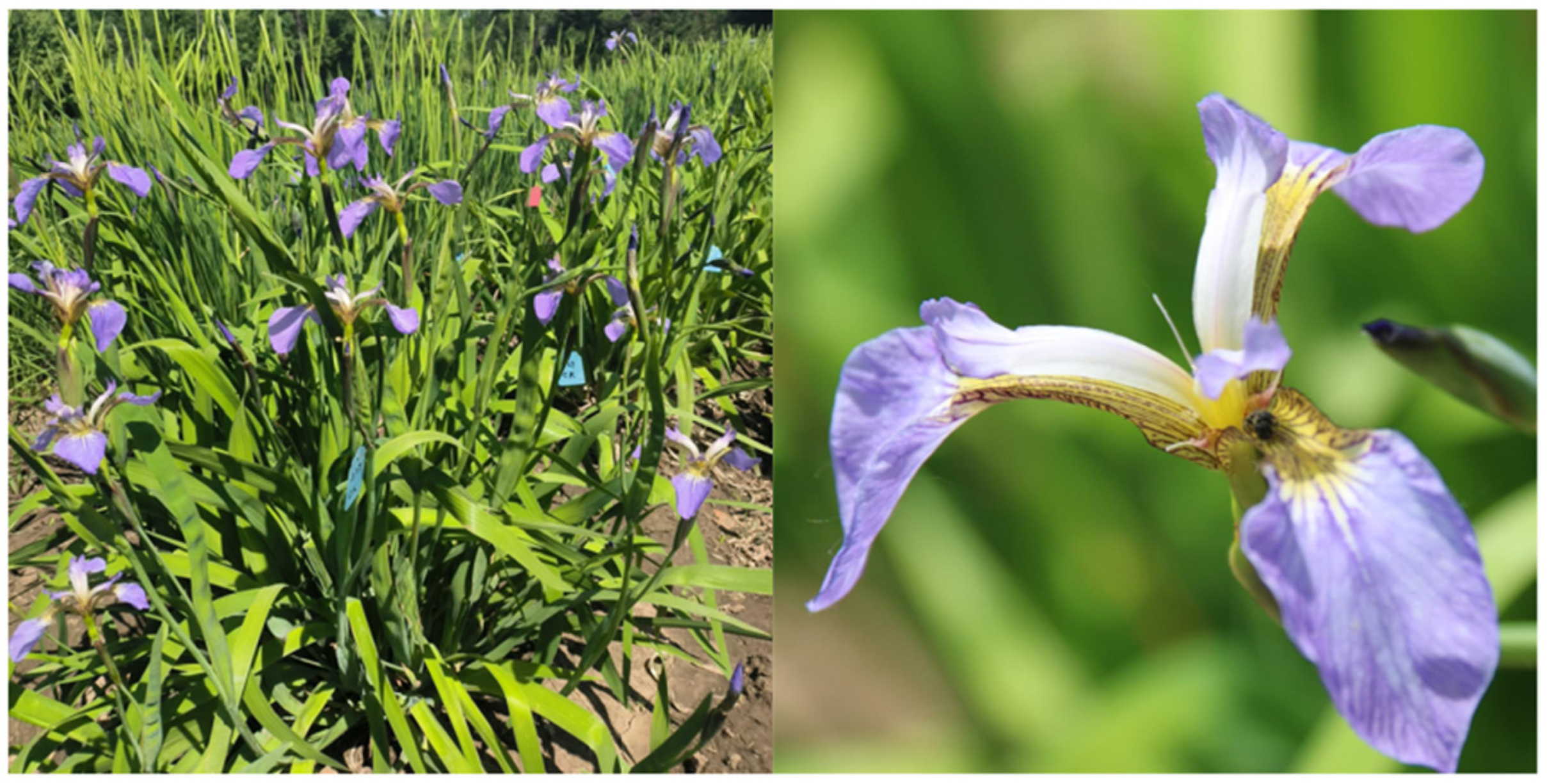
Establishment of an In Vitro Regeneration System Using Shoot Tips of Iris setosa


Abstract
1. Introduction
2. Materials and Experimental Procedures
2.1. Experimental Plant Materials and Media Constituents
2.2. Disinfection of Explant Surfaces
2.3. Induction of Multiple Shoots
2.4. Proliferation Culture
2.5. Induction of Adventitious Root
2.6. Acclimatization
2.7. Statistical Analysis
3. Results
3.1. Disinfection of Explant Surfaces
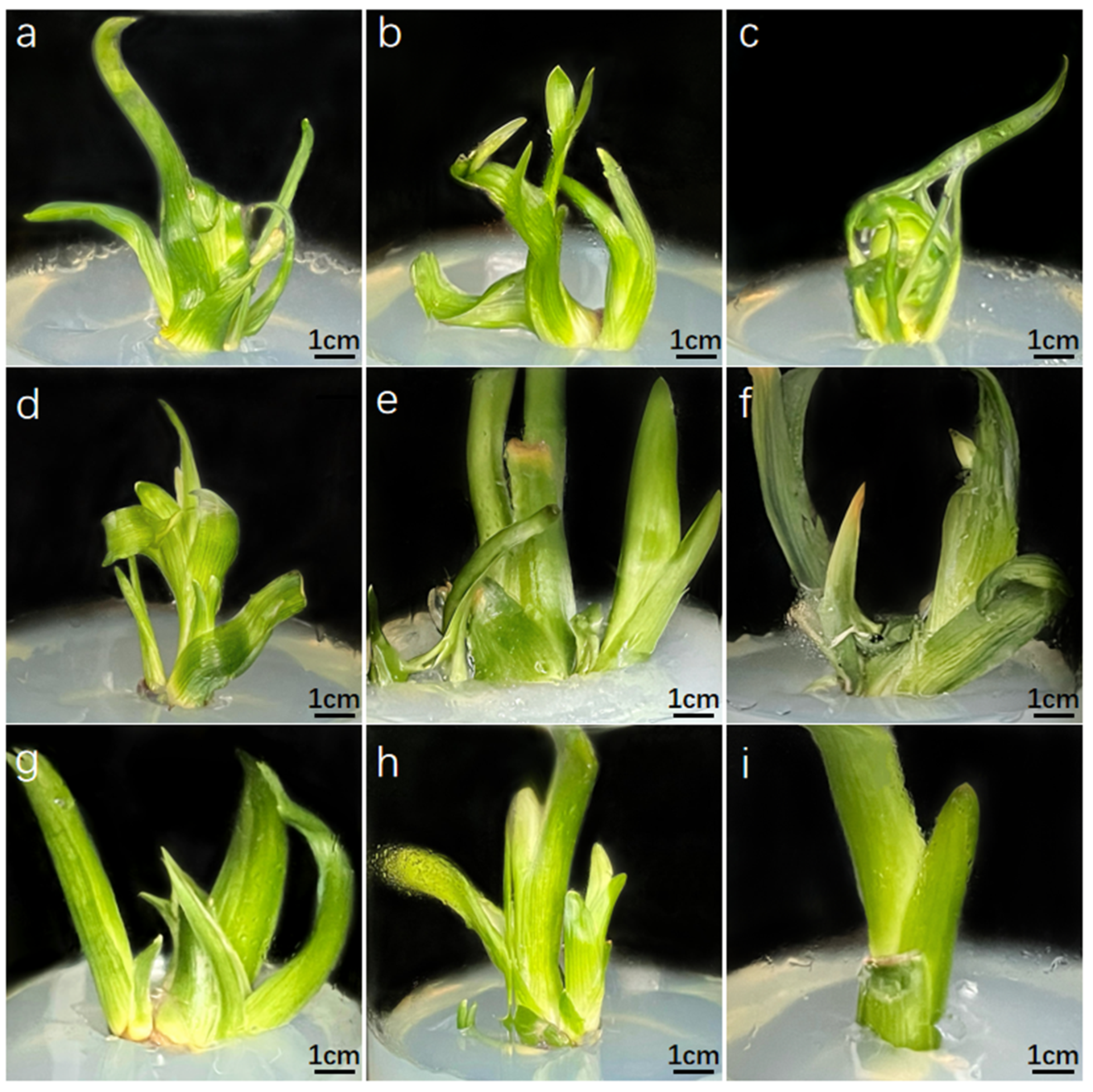
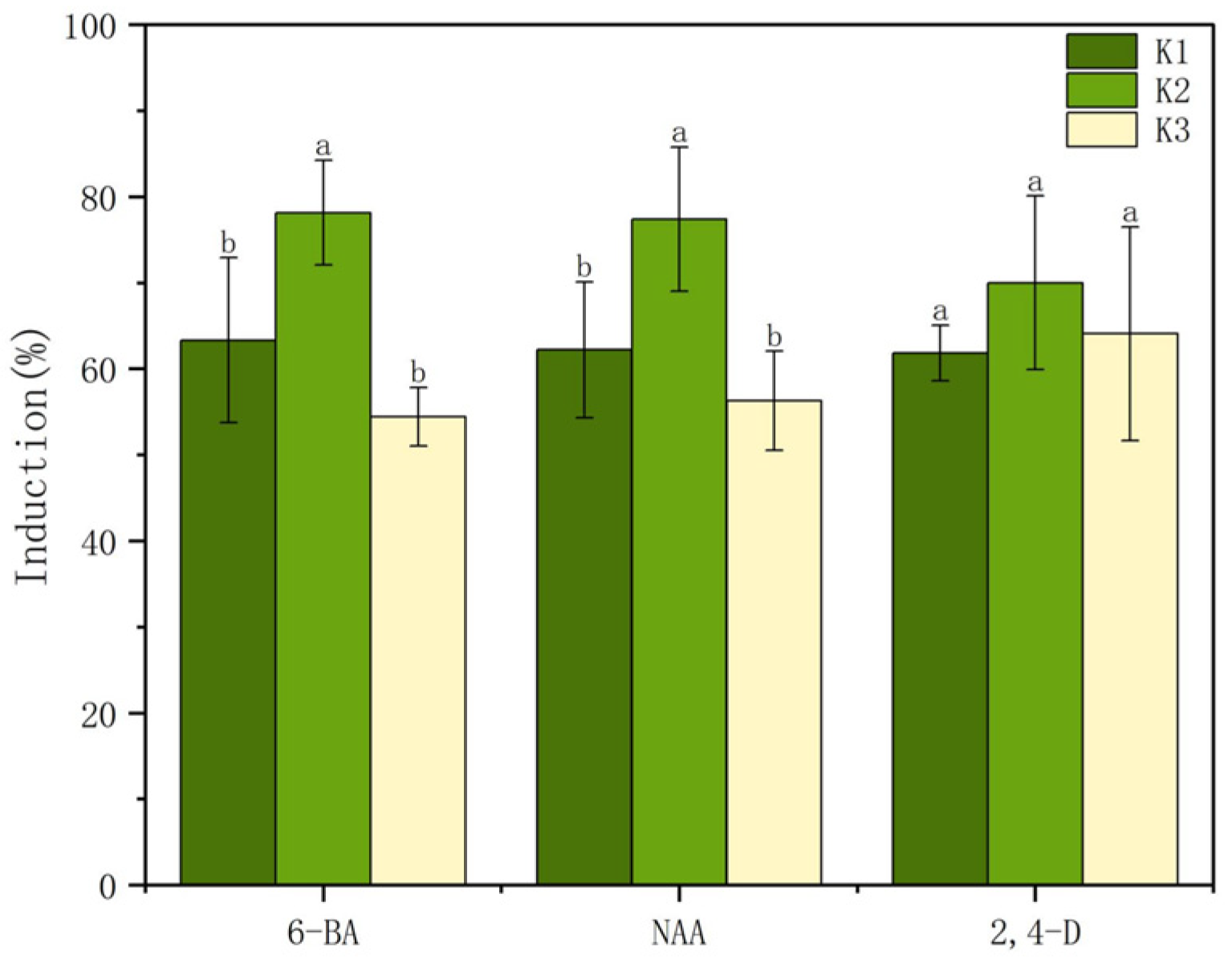
3.2. Induction of Multiple Shoots
3.3. Proliferation of Shoots
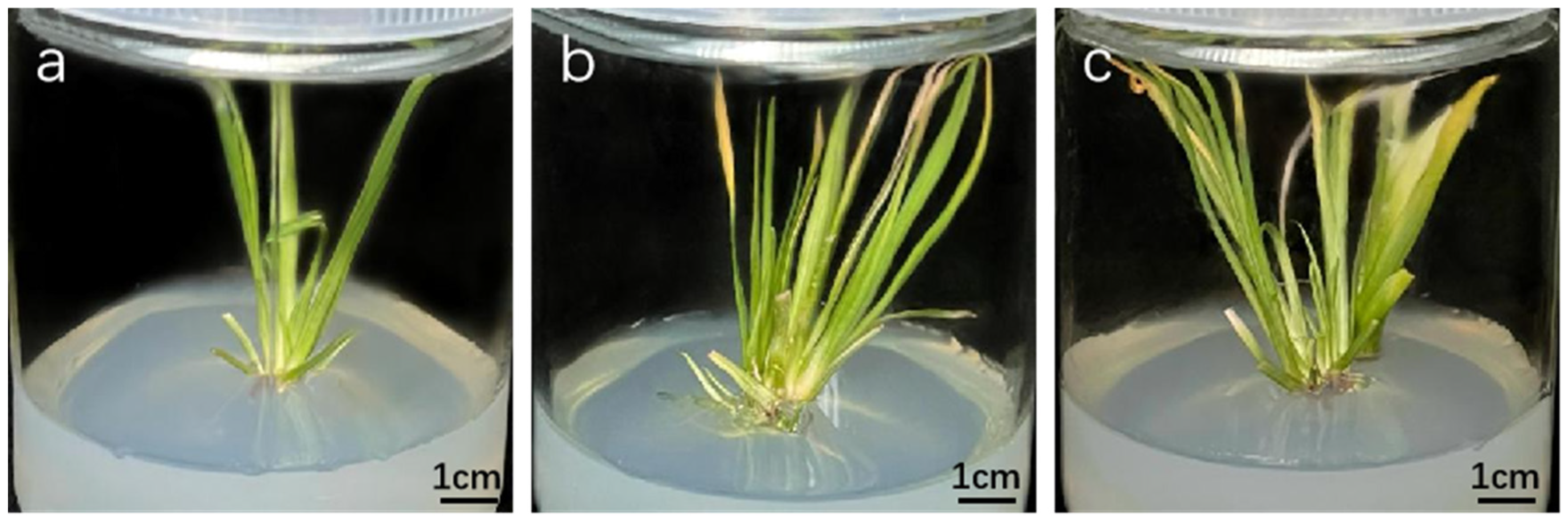
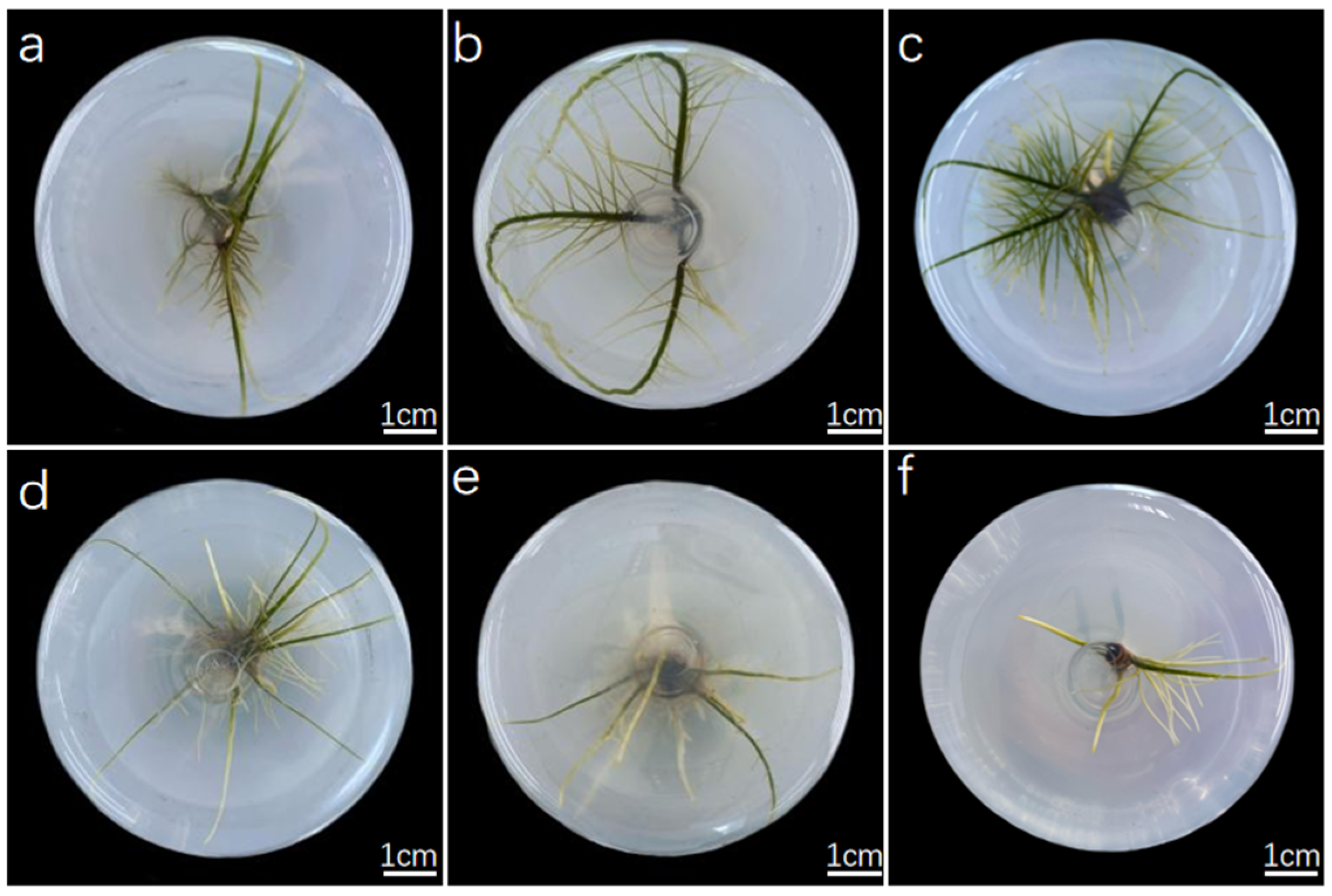
3.4. Induction of Adventitious Roots
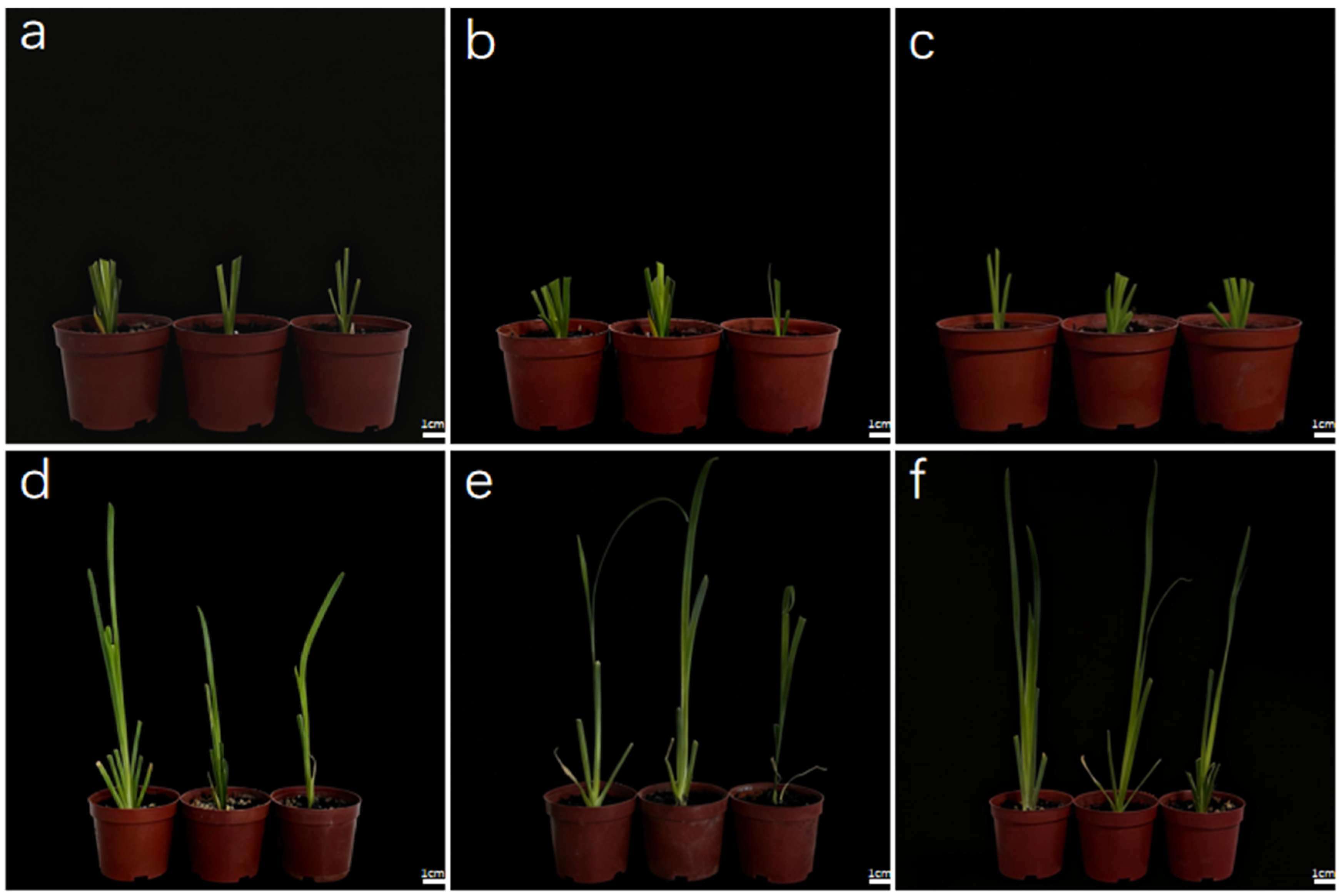
3.5. Acclimatization
4. Discussion
5. Conclusions
Supplementary Materials
Author Contributions
Funding
Data Availability Statement
Acknowledgments
Conflicts of Interest
References
- Lê, H.G.; Hwang, B.S.; Choi, J.-S.; Jeong, Y.T.; Kang, J.-M.; Võ, T.C.; Oh, Y.T.; Na, B.-K. Iris setosa Pall. ex Link Extract Reveals Amoebicidal Activity Against Acanthamoeba castellanii and Acanthamoeba polyphaga with Low Toxicity to Human Corneal Cells. Microorganisms 2024, 12, 1658. [Google Scholar] [CrossRef]
- Crișan, I. The Genus Iris Tourn. ex L.: Updates on Botany, Cultivation, Novel Niches and Impactful Applications. Plants 2025, 14, 2870. [Google Scholar] [CrossRef] [PubMed]
- Khatib, S.; Faraloni, C.; Bouissane, L. Exploring the Use of Iris Species: Antioxidant Properties, Phytochemistry, Medicinal and Industrial Applications. Antioxidants 2022, 11, 526. [Google Scholar] [CrossRef]
- Chang, C.S.; Lee, H.S.; Park, T.Y.; Kim, H. Reconsideration of Rare and Endangered Plant Species in Korea Based on the IUCN Red List Categories. Korean J. Ecol. 2005, 28, 305–320. [Google Scholar] [CrossRef][Green Version]
- Zhao, Y. Some notes on the genus Iris of China. Acta Phytotaxon. Sin. 1980, 18, 53–62. [Google Scholar]
- Kawase, K.; Mizutani, H.; Yoshioka, M.; Fukuda, S. Shoot Formation on Floral Organs of Japanese Iris in Vitro. J. Jpn. Soc. Hortic. Sci. 1995, 64, 143–148. [Google Scholar] [CrossRef]
- Bae, K.-H.; Yoo, K.-H.; Lee, H.-B.; Yoon, E.-S. Callus Induction and Plant Regeneration of Iris dichotoma Pall. in Endangered Species. J. Plant Biotechnol. 2012, 39, 182–188. [Google Scholar] [CrossRef]
- Liu, H.; Fan, L.; Song, H.; Tang, B.; Wang, L. Establishment of Regeneration System of Callus Pathway for Iris sanguinea Donn ex Horn. In Vitro Cell. Dev. Biol.—Plant 2020, 56, 694–702. [Google Scholar] [CrossRef]
- Xu, N.; Fu, H.; Liu, Y.; Kilaru, A.; Behera, J.R.; Wang, L. Establishment of Iris laevigata Tissue Culture Using Hypocotyl and Root Explants. Plants 2025, 14, 2733. [Google Scholar] [CrossRef]
- Doğan, S.; Caglar, G. In Vitro Shoot Proliferation via Immature Embryos of Iris kirkwoodiae Chaudhary. ANADOLU 2018, 28, 48–54. [Google Scholar]
- Thokchom, R.; Maitra, S.; Gantait, S.S.; Viswavidyalaya, K. Optimization of Plantlet Regeneration from Leaf Base Derived Callus of Japanese Iris (Iris ensata Thunb.): An Ornamental Medicinal Plant. Plants 2023, 12, 2801. [Google Scholar]
- Subotić, A.; Radojević, L. Plant Regeneration of Iris halophila Pall. and I. sibirica Franch. by Somatic Embryogenesis and Organogenesis. Bull. Inst. Jard. Bot. Buitenzorg 1995, 29, 149–155. [Google Scholar]
- Xu, L.; Huang, S.; Han, Y.; Yuan, H. Plant Regeneration of Iris germanica L. from Shoot Apexes via an Improved Somatic Embryogenesis Protocol. HortScience 2015, 50, 1045–1048. [Google Scholar] [CrossRef]
- Shimizu, K.; Yabuya, T.; Adachi, T. Plant Regeneration from Protoplasts of Iris germanica L. Euphytica 1996, 89, 223–227. [Google Scholar] [CrossRef]
- Wang, Y.; Jeknic, Z.; Ernst, R.C.; Chen, T.H. Improved Plant Regeneration from Suspension-Cultured Cells of Iris germanica L. ‘Skating Party’. HortScience 1999, 34, 1271–1276. [Google Scholar] [CrossRef]
- Boltenkov, E.V.; Zarembo, E.V. In Vitro Regeneration and Callogenesis in Tissue Culture of Floral Organs of the Genus Iris (Iridaceae). Biol. Bull. 2005, 32, 138–142. [Google Scholar] [CrossRef]
- Laublin, G.; Cappadocia, M. In Vitro Ovary Culture of Some Apogon Garden Irises (Iris pseudacorus L., I. setosa Pall., I. versicolor L.). Bot. Acta 1992, 105, 319–322. [Google Scholar] [CrossRef]
- Kundu, M.; Kumar, S.; Lathar, R. Effect of Mercuric Chloride on Sterilization of Different Explants of Lilium longiflorum Cultivars Elite, Brunello, Cordelia. J. Plant Dev. Sci. 2022, 14, 219–222. [Google Scholar]
- Ning, Y.; Dong, H.; Zhang, X.; Li, Y.; Cui, C.; Li, S. The Establishment of a Highly Efficient In Vitro Regeneration System for Viburnum opulus L. ‘Roseum’. Plants 2025, 14, 374. [Google Scholar] [CrossRef]
- Jevremović, S.; Jeknić, Z.; Subotić, A. Micropropagation of Iris sp. In Protocols for Micropropagation of Selected Economically-Important Horticultural Plants; Lambardi, M., Ozudogru, E.A., Jain, S.M., Eds.; Humana Press: Totowa, NJ, USA, 2012; pp. 291–303. [Google Scholar]
- Violeta, M.M.; Teodorescu, A.; Şuţan Nicoleta, A. Preliminary Results on the In Vitro Propagation by Leaf Explants and Axillary Buds of Iris aphylla L. J. Hortic. 2013, 1, 279–282. [Google Scholar]
- Tian, H.; Hou, N. Study on Tissue Culture and Rapid Propagation Technology System of Polygonatum sibiricum Red. J. Nanjing Norm. Univ. Nat. Sci. Ed. 2020, 43, 129–135. [Google Scholar]
- Wang, L.; Du, Y.; Rahman, M.M.; Li, Z.; Ahn, C.; Kim, E.; Qi, J.; Hwang, Y.; Lee, C. Establishment of an Efficient In Vitro Propagation System for Iris sanguinea. Sci. Rep. 2018, 8, 17100. [Google Scholar] [CrossRef] [PubMed]
- Osman, N.I.; Sidik, N.J.; Awal, A. Effects of Variations in Culture Media and Hormonal Treatments upon Callus Induction Potential in Endosperm Explant of Barringtonia racemosa L. Asian Pac. J. Trop. Biomed. 2016, 6, 143–147. [Google Scholar] [CrossRef]
- Pernisová, M.; Klíma, P.; Horák, J.; Válková, M.; Malbeck, J.; Souček, P.; Reichman, P.; Hoyerová, K.; Dubová, J.; Friml, J.; et al. Cytokinins Modulate Auxin-Induced Organogenesis in Plants via Regulation of the Auxin Efflux. Proc. Natl. Acad. Sci. USA 2009, 106, 3609–3614. [Google Scholar] [CrossRef]
- Thwe, A.A.; Kim, Y.B.; Kim, S.U.; Park, S.U. In Vitro Shoot Regeneration from Stem Internodes of Polygonum tinctorium. Life Sci. J. 2012, 9, 2059–2062. [Google Scholar]
- Trinh, T.H.; Nguyen, Q.T.; Nguyen, T.H.T.; Pham, H.T.; Duong, H.N.; Nguyen, T.T. Induction and Evaluation of Secondary Metabolite and Antioxidant Activity in Adventitious Root of Codonopsis javanica. Vietnam J. Sci. Technol. Eng. 2021, 63, 11–16. [Google Scholar] [CrossRef]
- Uzun, S.; İlbaş, A.İ.; Ipek, A.; Eren, Ö.; Can, E.; Çöçü, S.; Kaya, E. Efficient In Vitro Plant Regeneration from Immature Embryos of Endemic Iris sari and I. schachtii. Turk. J. Agric. For. 2014, 38, 348–353. [Google Scholar] [CrossRef]
- Glijin, A.; Roshca, I.; Sîrbu, T.; Cîrju, A. Propagation by Tissue Culture of Some Hosta Taxa from the Collection of the “Alexandru Ciubotaru” National Botanical Garden (Institute). Agricultura 2023, 1–2, 49–60. [Google Scholar]
- Yusnita, Y.; Jamaludin, J.; Agustiansyah, A.; Dwiningsih, S.; Anwar, S. A Combination of IBA and NAA Resulted in Better Rooting and Shoot Sprouting than Single Auxin on Malay Apple [Syzygium malaccense (L.) Merr. & L.M. Perry] Stem Cuttings. AGRIVITA J. Agric. Sci. 2017, 40, 80–90. [Google Scholar]
- Rahman, M.M.; Ivy, N.A.; Mian, M.A.; Islam, M.S.; Hossain, M.A. Effect of Auxin (NAA, IBA and IAA) in Root Regeneration through In Vitro Culture of Sugarcane. Int. J. Plant Biol. Res. 2018, 6, 1109. [Google Scholar]



| HgCl2 Treatment Time | Contamination Rate % | Browning Rate % | Survival Rate % |
|---|---|---|---|
| 6 min | 34.44 ± 0.05 a | 7.78 ± 0.02 c | 52.22 ± 0.02 a |
| 7 min | 25.56 ± 0.02 b | 10.00 ± 0.03 c | 55.56 ± 0.05 a |
| 8 min | 20.00 ± 0.03 bc | 18.89 ± 0.04 b | 57.78 ± 0.04 a |
| 9 min | 15.55 ± 0.04 d | 34.44 ± 0.05 a | 41.11 ± 0.04 b |
| Groups | 6-BA (mg·L−1) | NAA (mg·L−1) | 2,4-D (mg·L−1) | Induction (%) | Growth State of Multiple Shoot |
|---|---|---|---|---|---|
| 1 | 1.00 | 0.30 | 0 | 56.67 ± 1.93 de | Slender, green |
| 2 | 1.00 | 0.50 | 0.50 | 82.22 ± 2.94 ab | Thick, green, and fast growing |
| 3 | 1.00 | 1.00 | 1.00 | 51.11 ± 1.11 e | Slender, green, and partially abnormal |
| 4 | 2.00 | 0.30 | 0.50 | 77.78 ± 2.94 b | Slender, green, and fast growing |
| 5 | 2.00 | 0.50 | 1.00 | 88.89 ± 1.11 a | Thick, green, and fast growing |
| 6 | 2.00 | 1.00 | 0 | 67.78 ± 1.11 c | Thick, dark green |
| 7 | 3.00 | 0.30 | 1.00 | 52.22 ± 4.01 e | Thick, dark green, and slow growing |
| 8 | 3.00 | 0.50 | 0 | 61.11 ± 4.01 cd | Thick, green |
| 9 | 3.00 | 1.00 | 0.50 | 50.00 ± 1.92 e | Thick, partially abnormal |
| Groups | 6-BA (mg·L−1) | NAA (mg·L−1) | Proliferation Coefficient | Growth State of Shoots |
|---|---|---|---|---|
| 1 | 1.00 | 0.00 | 2.17 ± 0.08 bcd | Thick, fast growing |
| 2 | 1.00 | 0.30 | 2.37 ± 0.05 bc | Thick, green, and many differentiated shoots |
| 3 | 1.00 | 0.50 | 1.07 ± 0.03 f | Slow growing, few differentiated shoots |
| 4 | 2.00 | 0.00 | 2.53 ± 0.14 b | Thick, fast growing and many differentiated shoots |
| 5 | 2.00 | 0.30 | 3.37 ± 0.15 a | Thick, fast growing and many differentiated shoots |
| 6 | 2.00 | 0.50 | 2.20 ± 0.19 bc | Thick, fast growing and many differentiated shoots |
| 7 | 3.00 | 0.00 | 1.77 ± 0.14 de | Slow growing, few differentiated shoots |
| 8 | 3.00 | 0.30 | 1.97 ± 0.18 cd | Slow growing, few differentiated shoots |
| 9 | 3.00 | 0.50 | 1.47 ± 0.12 e | few differentiated shoots, yellow at the base |
| Groups | IBA (mg·L−1) | NAA (mg·L−1) | Rooting (%) | Adventitious Roots Number | Average Root Length (cm) | Growth Condition of Roots |
|---|---|---|---|---|---|---|
| 1 | 0.10 | 0 | 76.67 ± 0.03 bc | 4.17 ± 0.13 c | 4.27 ± 0.27 bc | Thin and weak primary root, dense lateral roots. |
| 2 | 0.30 | 0 | 91.67 ± 0.02 a | 4.41 ± 0.12 c | 5.30 ± 0.12 a | thick primary root and dense well-developed lateral roots |
| 3 | 0.50 | 0 | 98.33 ± 0.02 a | 5.23 ± 0.17 b | 5.53 ± 0.28 a | thick primary root and dense well-developed lateral roots |
| 4 | 0 | 0.10 | 88.33 ± 0.03 ab | 6.14 ± 0.16 a | 4.90 ± 0.12 ab | thick primary root, Slow growing and sparse lateral roots. |
| 5 | 0 | 0.30 | 68.33 ± 0.07 c | 5.89 ± 0.09 a | 4.47 ± 0.23 bc | Thin and weak primary root, Slow growing and sparse lateral roots. |
| 6 | 0 | 0.50 | 51.67 ± 0.04 d | 5.05 ± 0.08 b | 3.90 ± 0.17 c | Thin and weak primary root, Slow growing and sparse lateral roots. |
Disclaimer/Publisher’s Note: The statements, opinions and data contained in all publications are solely those of the individual author(s) and contributor(s) and not of MDPI and/or the editor(s). MDPI and/or the editor(s) disclaim responsibility for any injury to people or property resulting from any ideas, methods, instructions or products referred to in the content. |
© 2025 by the authors. Licensee MDPI, Basel, Switzerland. This article is an open access article distributed under the terms and conditions of the Creative Commons Attribution (CC BY) license (https://creativecommons.org/licenses/by/4.0/).
Share and Cite
Liu, R.; Lu, S.; Qian, Y.; Meng, Y.; Zhou, Y.; Yang, X.; Bai, Y. Establishment of an In Vitro Regeneration System Using Shoot Tips of Iris setosa. Horticulturae 2025, 11, 1530. https://doi.org/10.3390/horticulturae11121530
Liu R, Lu S, Qian Y, Meng Y, Zhou Y, Yang X, Bai Y. Establishment of an In Vitro Regeneration System Using Shoot Tips of Iris setosa. Horticulturae. 2025; 11(12):1530. https://doi.org/10.3390/horticulturae11121530
Chicago/Turabian StyleLiu, Ruoqi, Siyu Lu, Ying Qian, Yuan Meng, Yunwei Zhou, Xue Yang, and Yun Bai. 2025. "Establishment of an In Vitro Regeneration System Using Shoot Tips of Iris setosa" Horticulturae 11, no. 12: 1530. https://doi.org/10.3390/horticulturae11121530
APA StyleLiu, R., Lu, S., Qian, Y., Meng, Y., Zhou, Y., Yang, X., & Bai, Y. (2025). Establishment of an In Vitro Regeneration System Using Shoot Tips of Iris setosa. Horticulturae, 11(12), 1530. https://doi.org/10.3390/horticulturae11121530