Article

Study on the Mechanism of Resistance of Pepper Cultivars Against Phytophthora Blight via Transcriptome Analysis


1
Longping Agricultural College, Hunan University, Changsha 410000, China
2
Institute of Plant Protection, Hunan Academy of Agricultural Sciences, Changsha 410000, China
3
Yuelushan Laboratory, Changsha 410000, China
4
Institute of Vegetable, Hunan Academy of Agricultural Sciences, Changsha 410000, China
5
Key Laboratory of Molecular Microbiology and Technology, Ministry of Education, Department of Microbiology, College of Life Sciences, Nankai University, Tianjin 300110, China
*
Authors to whom correspondence should be addressed.
These authors contributed equally to this work.
Horticulturae 2025, 11(12), 1458; https://doi.org/10.3390/horticulturae11121458
Submission received: 20 August 2025 / Revised: 22 November 2025 / Accepted: 27 November 2025 / Published: 2 December 2025
(This article belongs to the Section Biotic and Abiotic Stress)

Abstract

Pepper blight, caused by Phytophthora capsici, significantly impacts plant health and reduces crop yields, resulting in severe economic losses. Developing resistant varieties and identifying resistance targets through transcriptomic sequencing, along with elucidating their underlying resistance mechanisms, represent pivotal strategies for disease control. In this study, 11 resistant pepper varieties were identified from 21 varieties; among these, the highly resistant line 19K23 and the susceptible line QM were selected for further analysis. Transcriptome sequencing of root samples from both varieties was conducted on day 2 and day 5 after inoculation with P. capsici. Analysis of differentially expressed genes between the resistant variety and susceptible variety revealed pathways such as photosynthesis, oxidoreductase activity, plant-pathogen interaction, and secondary metabolism. Six key biological processes were highlighted among the highly differentially expressed genes, with porphyrin and chlorophyll metabolism activated early in 19K23. The Ras family, MAPK signaling, hormone signal transduction, and GPI-anchor biosynthesis were implicated in resistance. Importantly, secondary metabolism and lipid metabolism pathways such as phenylpropanoid biosynthesis, isoquinoline alkaloid biosynthesis, and unsaturated fatty acid biosynthesis appeared to play pivotal roles. Additionally, cell wall synthesis and structure, as well as stress response processes, were important. These findings enhance understanding of pepper resistance mechanisms against P. capsici and offer valuable molecular insights for future research on genetic regulation and resistance breeding.

1. Introduction

Pepper (Capsicum annuum L.) is one of the most widely cultivated vegetables in China, with a stable annual planting area exceeding 2.1 million hectares and a total production reaching 64 million tons, accounting for 50% of global production [1,2]. However, intensive cultivation practices and continuous cropping have resulted in the buildup of soil-borne diseases. Major diseases, including Phytophthora blight, viral diseases, bacterial spot of pepper, and anthracnose, pose a serious threat to the sustainable development of the pepper industry [3,4]. Phytophthora blight is a devastating soil-borne disease caused by Phytophthora capsici, which primarily affects the leaves, fruits, and stems of pepper plants [5]. The pathogen can survive for a long period in the soil in the presence of oospores. However, after infecting crops, it has a short incubation period and spreads rapidly [6]. Once established, the disease is difficult to eradicate and can lead to large-scale crop yield reductions or even complete crop failure, resulting in massive economic losses [7,8].
Currently, the control of Phytophthora blight primarily relies on chemical methods. However, the long-term use of chemical agents may lead to fungicide resistance in P. capsici, negatively impacts soil microbial communities, and can lead to decreased soil fertility and environmental pollution [9]. Therefore, reducing or replacing chemical agents is a key goal in controlling Phytophthora blight. Among all the strategies, breeding resistant materials is one of the most effective, economical, and safe methods for managing this disease, as it can significantly increase crop yields, reduce pesticide usage, enhance agricultural sustainability, and improve crop adaptability [10,11].
Transcriptomics, a key field in modern biological research, plays an indispensable role in disease resistance breeding. RNA sequencing (RNA-Seq), which utilizes next-generation sequencing technology to analyze and quantify the complete set of RNA molecules (the transcriptome) in a biological sample, has become an essential tool in transcriptomics [12]. Since its emergence, RNA-Seq technology has enabled high-throughput quantification and characterization of the transcriptome [13]. By integrating transcriptomics with genetics and genomics, researchers have gained invaluable insights into gene expression, alternative splicing, and the identification of novel transcripts, providing a comprehensive understanding of gene regulation [14]. For instance, integrating omics technologies into vegetable breeding reveals deeper insights into the molecular mechanisms controlling important traits, enabling more targeted and effective crop improvement strategies. This integration facilitates the identification of genes, markers, and metabolic pathways associated with desired traits, thereby accelerating the development of improved vegetable varieties with enhanced agronomic traits, nutritional value, and stress resistance. Currently, RNA-Seq is widely used in various biological studies, including understanding gene regulation, investigating disease mechanisms, and exploring developmental processes across a wide range of organisms, from model species to non-model species, enabling the discovery of novel genes and alternative splicing events [15]. The development of genome editing guided by transcriptomics enables efficient, precise, and targeted mutagenesis, laying the foundation for future breeding strategies [16]. However, a systematic understanding of the transcriptomic characteristics and gene expression dynamics of disease resistance genes in pepper remains limited.
Here, we screened resistant and susceptible pepper varieties to Phytophthora blight, and performed RNA-Seq analysis on the transcriptome data of the infected samples at 2 and 5 days post inoculation (dpi) using bioinformatics techniques. Functional enrichment analysis of differentially expressed genes (DEGs) was performed, and the expression patterns were explored from different times and varieties in response to P. capsici infection. This multi-faceted investigation aimed to uncover key genes and metabolic pathways involved in disease resistance, providing a foundation for elucidating the molecular mechanisms of Phytophthora blight resistance in pepper, as well as establishing effective molecular breeding approaches to improve disease resistance.

2. Materials and Methods

2.1. Cultivation of Peppers and Infection by P. capsici

A total of 21 pepper genotypes were provided by Zheng Jingyuan from the Hunan Vegetable Research Institute. Disinfected pepper seeds were placed on sterile filter paper, moistened with sterile water in Petri dishes, and incubated in darkness at 30 °C until germination. Germinated seeds were sown in 12-well trays containing growth substrate (Changchun Strong Seedling Peat Technology Co., Ltd., Changchun, China) mixed with Stanley compound fertilizer (Stanley Agriculture Group Co., Ltd., Linyi, China) (applied at a rate of 10 g per 1 kg of substrate). The trays were then maintained in a greenhouse at 26 °C, with 70% relative humidity and a 14-h light/10-h dark photoperiod under a light intensity of 4000 Lux. Furthermore, CO2 concentration was maintained at an optimal level by the greenhouse control system to enhance pepper seedling growth. Seedlings were inoculated with P. capsici at the 6-true-leaf stage. P. capsici isolate XY3 was used for inoculation. The inoculum was produced as follows: First, ten mycelial plugs were incubated in V8 liquid medium at 28 °C for 3–5 days. Subsequently, the plugs were rinsed and transferred to sterile water for a 24-h dark incubation, followed by a 30-min cold-shock (4 °C) and a 30-min equilibration at room temperature to induce synchronous zoospore release. Finally, zoospore concentration was quantified using a hemocytometer. Inoculation was performed using a root-drench method, applying 1 mL of the spore suspension with a concentration of 1 × 10⁴ spores/mL to the roots of each plant. At the same time, control plants were mock-inoculated with sterile water. A total of three independent inoculation experiments were conducted: one preliminary experiment followed by two formal experiments. In each formal experiment, for each pepper variety, both Phytophthora-inoculated and mock-inoculated treatments were applied to six replicates of 12-cell trays. Thus, each treatment consisted of 72 experimental units.
Disease severity was assessed at 7 dpi using a 0–5 rating scale: 0: no symptoms; 1: slight blackening of the stem base and roots, leaves may wilt but can recover; 2: blackening of the stem and roots extending 1–2 cm, leaves wilt irreversibly, occasional leaf drop; 3: blackening of the stem and roots exceeding 2 cm, obvious wilting or significant leaf drop; 4: extensive blackening and constriction of the stem and roots, severe defoliation or wilting sparing only the growing point; 5: entire plant death [17].
A Disease Index (DI) was calculated using the following formula:
D I = 100 ×   sum   of   number   of   entities   assessed   as   disease   score   i   ×   disease   score   i total   number   of   observations   ×   maximum   disease   score
Resistance was classified based on the DI as follows: highly resistant (HR): disease index ≤ 10; resistant (R): 10 < disease index ≤ 30; moderately resistant (MR): 30 < disease index ≤ 50; susceptible (S): disease index > 50.

2.2. RNA Preparation and Transcriptome Sequencing

Based on the screening results, one resistant (19K23) and one susceptible (QM) pepper variety were selected for transcriptome sequencing. Root tissues of those plants were collected at 0, 2 and 5 dpi with P. capsici. Additionally, mock-inoculated controls for each cultivar at each time point were included in the qRT-PCR validation assays. This was essential to normalize for background gene expression fluctuations associated with plant growth during the 5-day experimental period. Samples were immediately frozen in liquid nitrogen for subsequent RNA extraction. Three biological replicates were prepared for each treatment, with each replicate containing the root tissues of at least two individual pepper plants. The extracted total RNA samples were subjected to quality assessment, followed by library construction. Initially, library concentration was quantified using a Qubit 3.0 fluorometer (required ≥1 ng/μL). The insert fragment size of the library was then detected using a Qsep400 (BiOptic Inc., New Taipei City, Taiwan) high-throughput analysis system. Finally, the effective library concentration was precisely quantified by qPCR to ensure it exceeded 2 nM. Libraries that passed quality control were sequenced on a high-throughput platform using a paired-end 150 bp (PE150) strategy.

2.3. Bioinformatics Analysis

Raw data (raw reads) in FASTQ format were first processed using in-house Perl scripts. The adaptor sequences and low-quality sequence reads were removed from the data sets and raw sequences were transformed into clean reads after data processing. These clean reads were then mapped to the reference genome sequence (https://www.ncbi.nlm.nih.gov/datasets/genome/GCF_000710875.1/) accessed on 11 March 2015 using HISAT2. Gene expression levels were quantified as Fragments per Kilobase of transcript per Million mapped reads (FPKM). Differential expression analysis between experimental groups was performed using DESeq2, which models the data based on a negative binomial distribution. The resulting p-values were adjusted using the Benjamini–Hochberg procedure for controlling the false discovery rate. Genes with an adjusted p-value ≤ 0.01 and |log2 FC| ≥ 1 found by DESeq2 were defined as differentially expressed. Furthermore, a stricter cutoff of |log2 FC| ≥ 5 to focus on genes exhibiting the most significant expression changes was applied. Gene Ontology (GO) enrichment analysis of the DEGs was implemented by the clusterProfiler packages based on Wallenius non-central hyper-geometric distribution [18], which can adjust for gene length bias in DEGs. KEGG is a database resource for understanding high-level functions and utilities of biological systems from molecular-level information, especially large-scale molecular datasets generated by genome sequencing and other high-throughput experimental technologies (http://www.genome.jp/kegg/) accessed on 10 May 2018 [19]. We used the KOBAS database [20] and clusterProfiler software (v 4.4.4) to test the statistical enrichment of DEGs in KEGG pathways. The R Programming Language (v 3.2.0) was utilized to generate bar plots and enrichment analysis circle diagrams for significantly enriched functional terms. Additionally, Gene Set Enrichment Analysis (GSEA) was performed using GSEA software (clusterProfiler software v 4.4.4) [21] to identify coordinated changes in predefined gene sets.

2.4. Primer Design, qRT-PCR, and Data Analysis

A total of 37 pairs of specific primers for reference genes were designed using Primer-BLAST (v 2.17.0) on the National Center for Biotechnology Information website (https://www.ncbi.nlm.nih.gov/tools/primer-blast/) accessed on 3 June 2025, and sequences of these primers are listed in Table S1. qRT-PCR reaction was performed in a 20-μL reaction mixture containing 10 μL 2× SupRealQ Purple Universal SYBR qPCR Master Mix (Takara, Shiga, Japan), 0.4 μL 10 pM of each primer, 1 μL template (cDNA from samples), and 8.2 μL sterile distilled water. Reaction mixtures were incubated for 30 s at 95 °C, followed by 40 amplification cycles for 5 s at 95 °C and 30 s at 60 °C. All reactions were carried out on 96-well reaction plates with a CFX96 machine (Bio-Rad) in triplicate. Gene relative expression levels were calculated using the comparative Ct (2−ΔΔCt) method. The experiment included three biological replicates for each combination of genotype (resistant cultivar 19K23 and susceptible cultivar QM), time point (2 and 5 dpi), and treatment (post-inoculated vs. mock-inoculated control).

3. Results

3.1. Screening of Pepper Cultivars

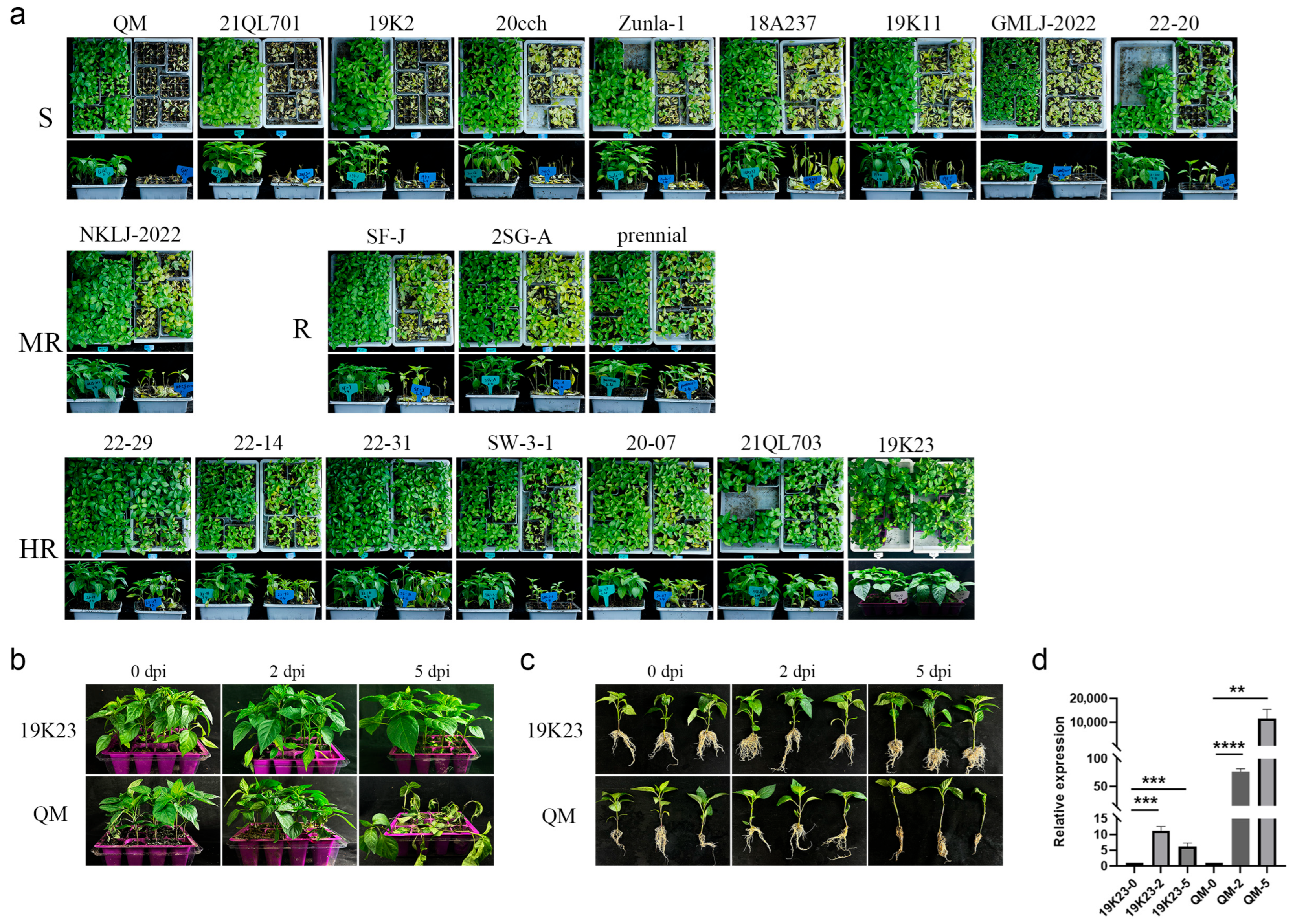
A total of 21 pepper varieties were screened for resistance to Phytophthora blight. At 7 dpi, disease symptoms were recorded, and the DI for each variety was calculated. Based on the classification criteria of Yu [17], the 21 cultivars were categorized by their resistance levels (Table 1, Figure 1a), with the detailed disease data provided in Table S2. From this screening, the variety 19K23, which exhibited high resistance, and the variety QM, which showed high susceptibility, were selected for subsequent analysis due to their stable and contrasting phenotypes.
To capture key transcriptional changes during infection, time points for RNA-Seq were selected based on disease progression. In the susceptible cultivar QM, early wilting symptoms were observable at 2 dpi, which progressed to severe wilting at the pot level by 5 dpi (Figure 1b). Detailed examination of individual plants revealed that the inoculated QM plants experienced defoliation and exhibited blackening of the root and stem tissues, aligning with the drastic phenotypic contrast to the fully asymptomatic resistant cultivar 19K23 (Figure 1c). Furthermore, quantification of Phytophthora biomass via qRT-PCR (targeting the Phytophthora actin gene, with pepper actin as a reference) revealed contrasting dynamics (Figure 1d). Resistance in 19K23 was associated with a peak (11-fold increase) at 2 dpi followed by a decline to 6-fold at 5 dpi. In contrast, susceptibility in QM was characterized by a dramatic increase from 76-fold at 2 dpi to over 10,000-fold at 5 dpi, consistent with extensive colonization. Accordingly, 2 dpi and 5 dpi were defined as the early and late stages of infection, respectively, and were selected for transcriptome analysis.

3.2. RNA-Seq Analysis

Samples were taken 0, 2, and 5 dpi, and the following samples were used for sequencing and transcriptome analysis: RK0 (19K23-0 dpi), RK2 (19K23-2 dpi), RK5 (19K23-5 dpi), SQ0 (QM-0 dpi), SQ2 (QM-2 dpi), SQ5 (QM-5 dpi). A total of 827,516,272 raw reads were obtained. After stringent filtering of reads of adapters, poly-N tails, and low-quality reads, high-quality clean data was obtained for each of the 18 libraries, with an average GC content ≥ 42.5% and Q30 score ≥ 94.53% (Table 2). Given the high genome coverage of Illumina sequencing, the RNA-Seq data were used for further analysis. Hierarchical clustering analysis was performed on all samples based on the standardized gene expression transcripts per million values, and the results showed that all biological replicates of the same treatment clustered together (Figure S1a), which indicated good sample reproducibility. Similarly, principal component analysis (PCA) showed a clear separation between samples according to both variety and infection stage (Figure S1b). These results confirm that the RNA-Seq data effectively captured the distinct transcriptional profiles associated with the progression of P. capsici infection, providing a robust dataset for further analysis.

3.3. DEG Analysis

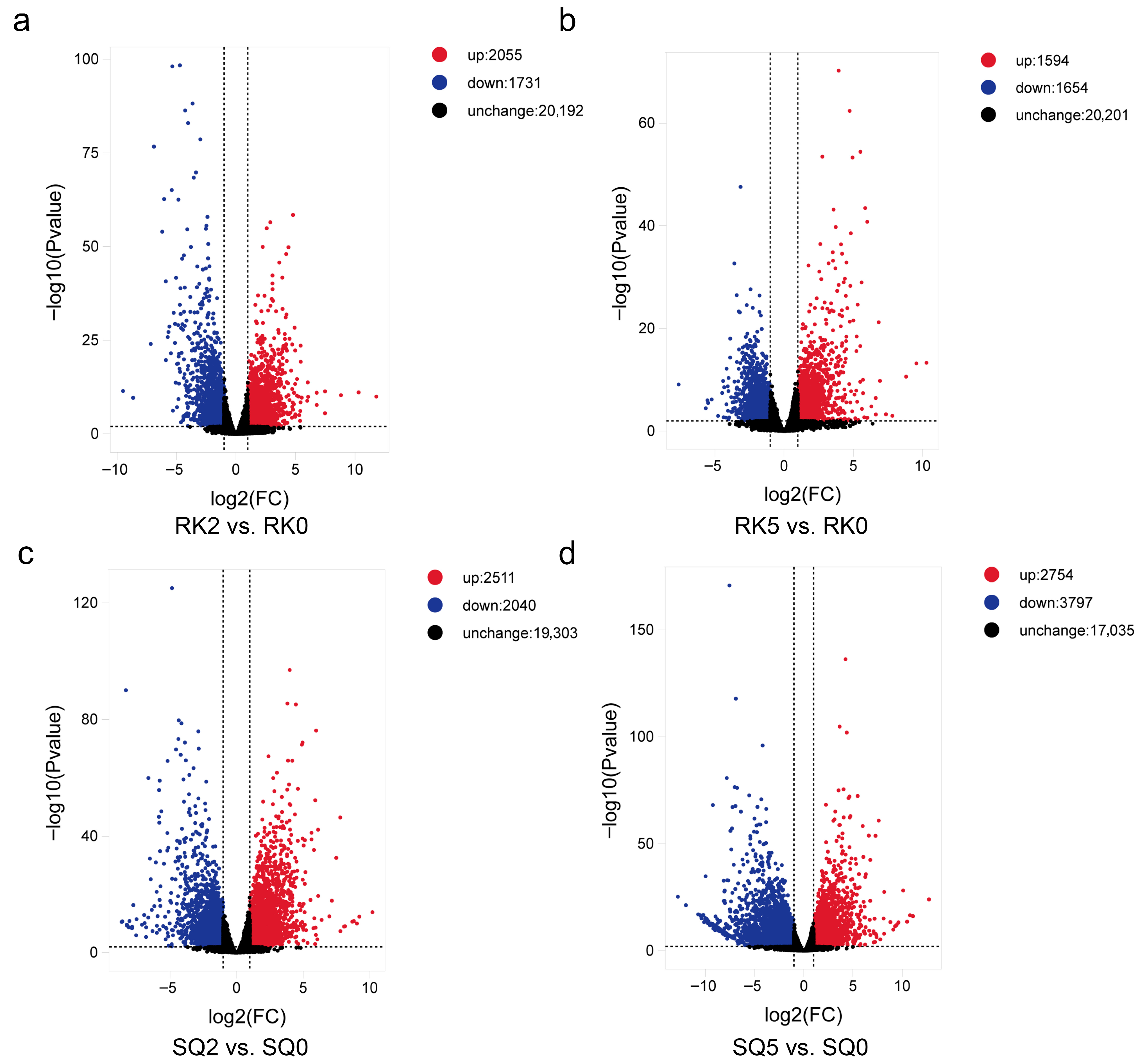
DEGs were identified using a cutoff of adjusted p-value ≤ 0.01 and |log2 FC| ≥ 1. The analysis revealed distinct transcriptional responses to P. capsici infection in both resistant and susceptible varieties over time. In the resistant variety (19K23), 2055 genes were up-regulated and 1731 were down-regulated at 2 dpi (RK2 vs. RK0) (Figure 2a). At 5 dpi (RK5 vs. RK0), 1594 genes were up-regulated and 1654 were down-regulated (Figure 2b). In the susceptible variety (QM), the response was more pronounced. At 2 dpi (SQ2 vs. SQ0), 2511 genes were up-regulated and 2040 were down-regulated (Figure 2c). By 5 dpi (SQ5 vs. SQ0), the number of DEGs increased substantially, with 2754 genes up-regulated and 3797 down-regulated (Figure 2d).

3.4. GO and KEGG Enrichment Analysis

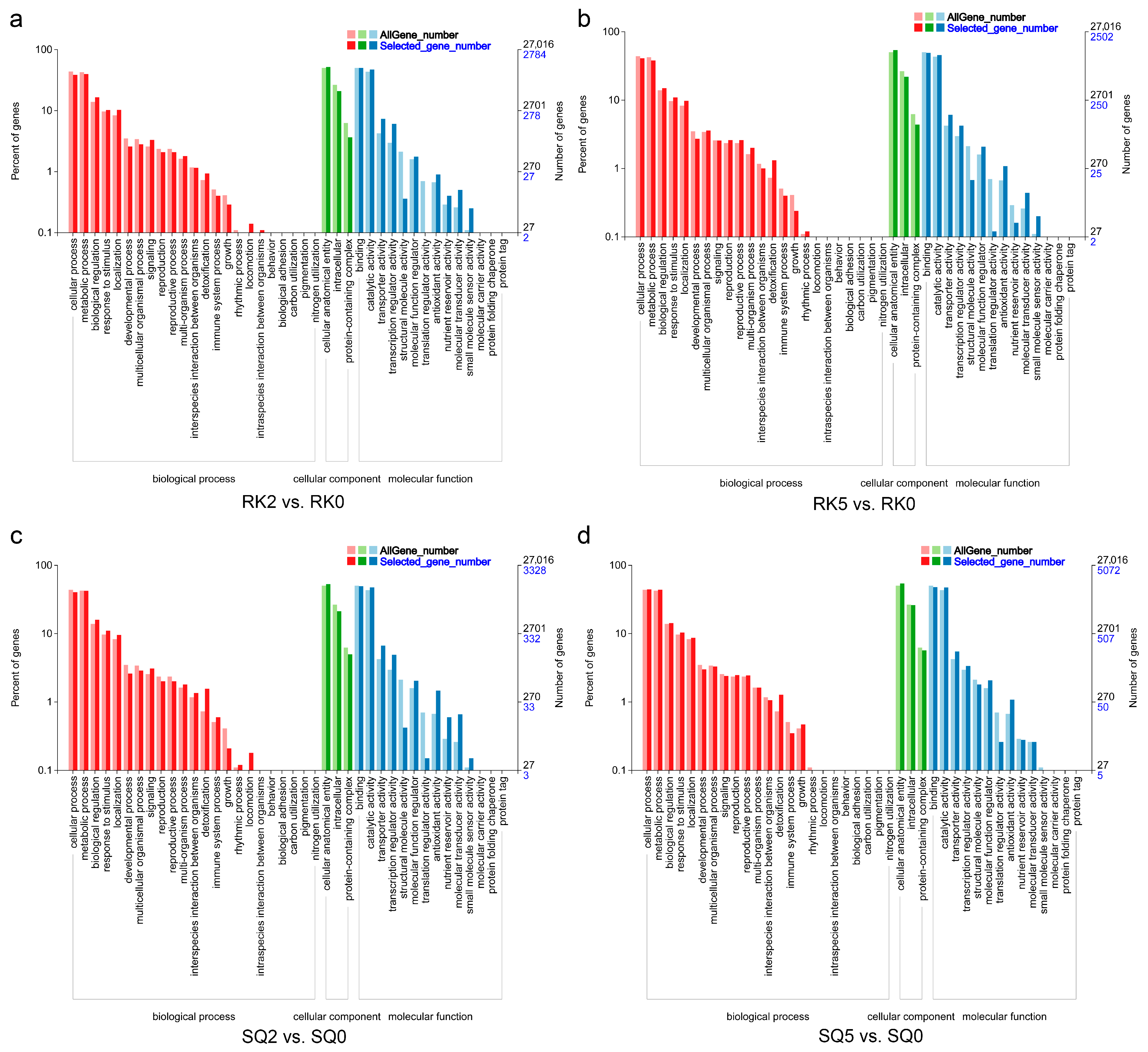
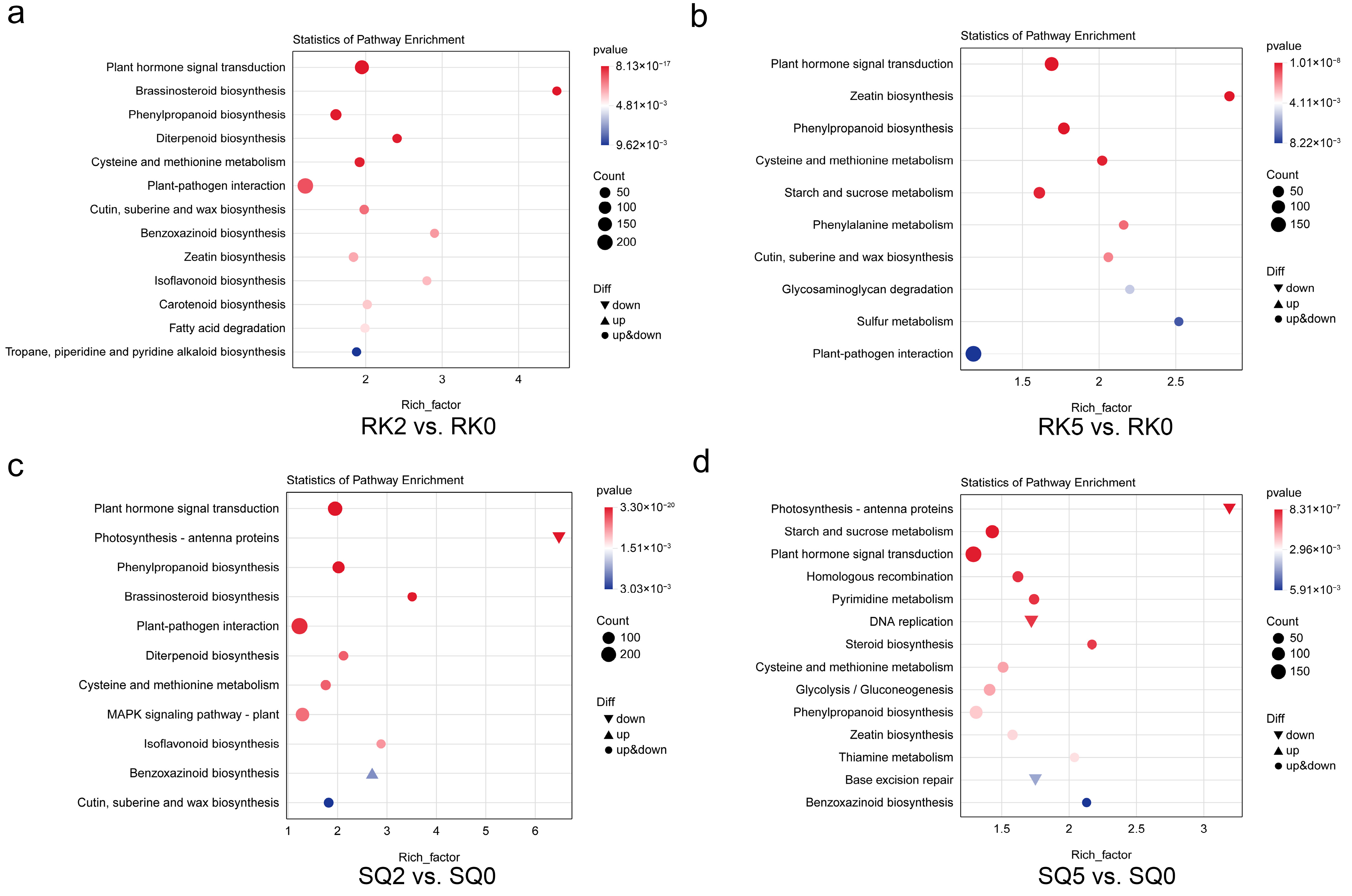
To elucidate the biological functions of the DEGs, we performed GO (Figure 3) and KEGG pathway enrichment analyses (Figure 4). At 2 dpi in RK2 vs. RK0, DEGs were significantly enriched in 41 GO terms and 13 KEGG pathways (p-value < 0.01). The most prominent GO terms included xenobiotic transmembrane transporter activity (18 DEGs), antiporter activity (18 DEGs), and regulation of transcription, DNA-templated (95 DEGs). Key enriched KEGG pathways were plant hormone signal transduction (152 DEGs), brassinosteroid biosynthesis (14 DEGs), and phenylpropanoid biosynthesis (65 DEGs). At 5 dpi in RK5 vs. RK0, DEGs were enriched in 36 GO terms and 10 KEGG pathways. Top GO terms included protein heterodimerization activity (49 DEGs), oxidoreductase activity (130 DEGs), and carbohydrate binding (76 DEGs). The most enriched KEGG pathways were plant hormone signal transduction (114 DEGs), zeatin biosynthesis, and phenylpropanoid biosynthesis (62 DEGs). At 2 dpi in SQ2 vs. SQ0, DEGs were associated with 39 GO terms and 11 KEGG pathways. The top GO terms were transmembrane transporter activity (73 DEGs), cell wall (48 DEGs) and extracellular region (64 DEGs). The most significantly enriched KEGG pathways included plant hormone signal transduction (181 DEGs), photosynthesis—antenna protein and phenylpropanoid biosynthesis (97 DEGs). At 5 dpi in SQ5 vs. SQ0, DEGs were enriched in 36 GO terms and 14 KEGG pathways. The top GO terms were protein heterodimerization activity (49 DEGs), oxidoreductase activity (130 DEGs) and carbohydrate binding (76 DEGs). The most prominent KEGG pathways were photosynthesis—antenna proteins (18 DEGs), starch and sucrose metabolism (108 DEGs) and plant hormone signal transduction (183 DEGs).
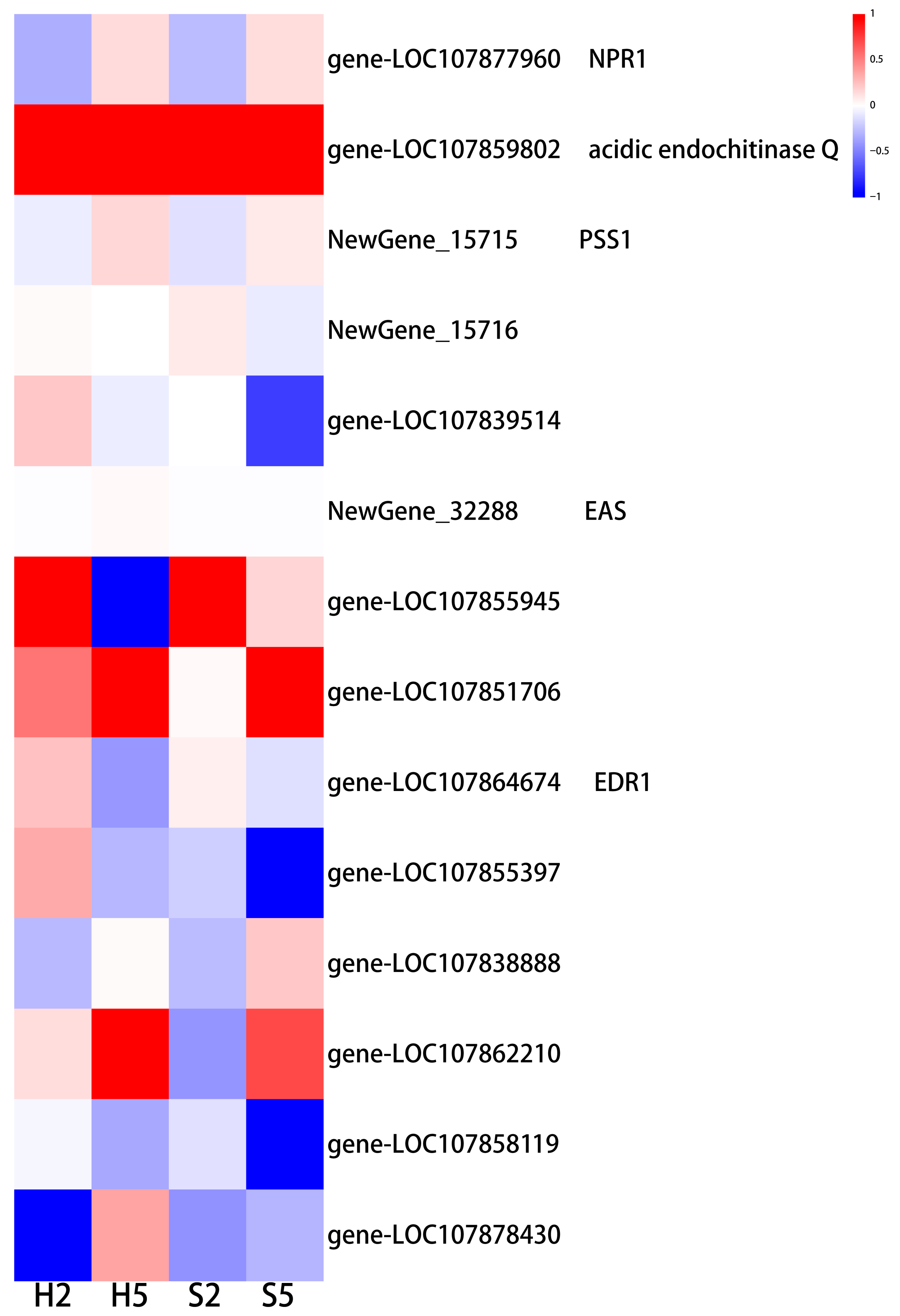
We subsequently selected genes that have been previously demonstrated to play a role in disease resistance and analyzed their expression in each treatment (Figure 5). The gene encoding acidic endochitinase Q, a pathogenesis-related (PR) protein, was up-regulated in all treatments, while the EDR1 gene (LOC107858119) was suppressed. Overall, the expression patterns of the DEGs involved in disease resistance were similar in all treatments. Thus, further analysis is needed to find clues governing different resistance-related pathways between the treatments examined.

3.5. Different DEGs Between the Two Cultivars

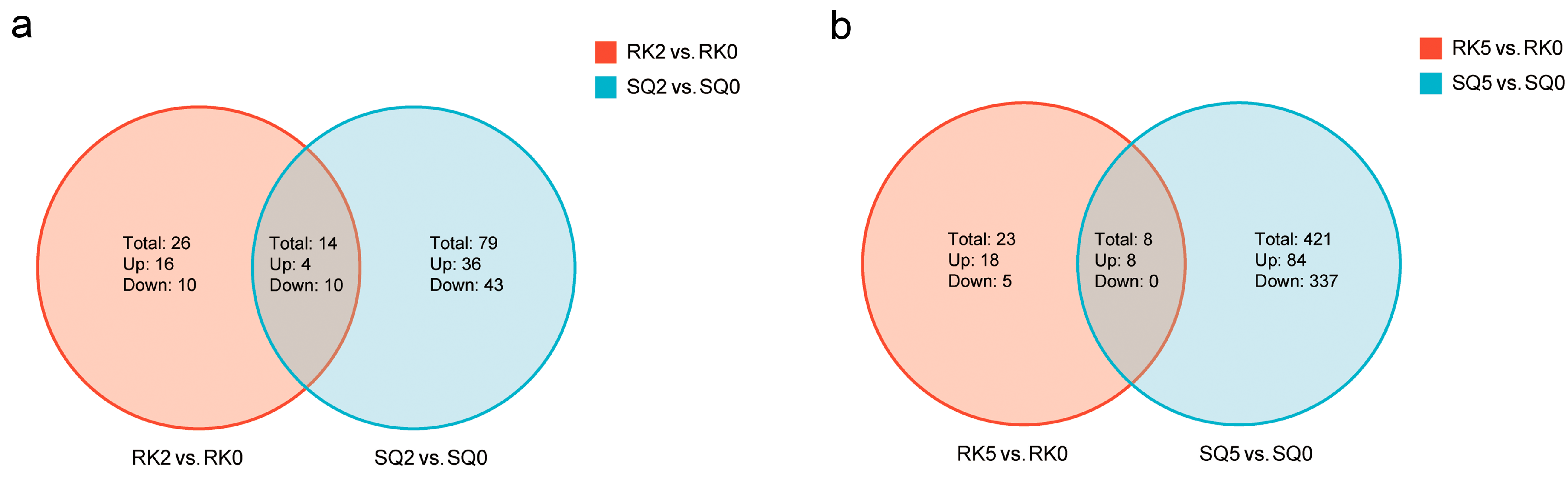
To identify a high-confidence set of genes with dramatic expression changes between the two varieties, further comparisons were made of the DEGs between 19K23 and QM. The absolute values of log2FC were set as equal to or greater than 5. Comparative analysis of DEGs at 2 dpi revealed 40 and 93 DEGs in RK2 vs. RK0 (H2) and SQ2 vs. SQ0 (S2) groups, respectively, with 14 common DEGs shared between them. The group H2 possessed 26 unique DEGs (represented by the orange circle in Figure 6a), while the group S2 had 79 unique DEGs (blue circle in Figure 6a). At 5 dpi, the numbers of DEGs in groups H5 and S5 were 31 and 429, respectively, with 23 unique to H5 (orange circle, Figure 6b) and 421 unique to S5 (blue circle, Figure 6b). Across these four comparisons, we found that the majority of DEGs in the resistant cultivar were up-regulated, whereas most DEGs in the susceptible cultivar were down-regulated. The expression patterns of key genes from these specific sets are detailed below (Figure 7a–l).

3.5.1. Photosynthesis

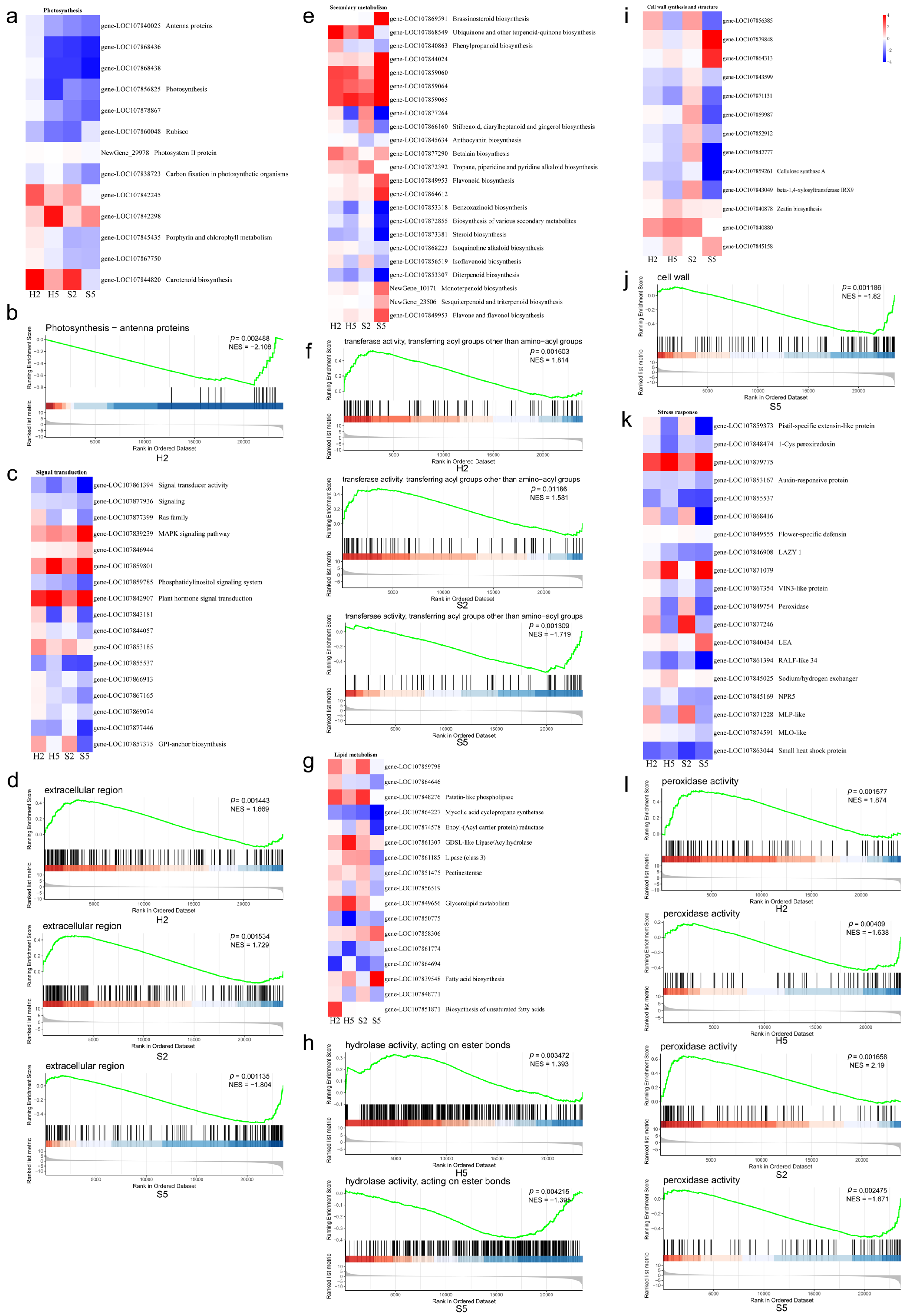
In the resistant variety 19K23, photosynthesis-related pathways were among the most significantly enriched at 2 dpi. Therefore, comparisons of expression for photosynthesis-related DEGs between the two varieties were made (Figure 7a). In 19K23, carbon fixation protein (LOC107842245, LOC107842298), porphyrin and chlorophyll metabolism proteins (LOC107845435, LOC107867750) and a carotenoid biosynthesis enzyme (LOC107844820) were up-regulated at 2 dpi, and all other genes were down-regulated. In contrast, these same porphyrin and chlorophyll metabolism genes (LOC107845435, LOC107867750) were down-regulated in both H5 and S2. However, all the other DEGs of SQ5 were down-regulated except for the carbon fixation protein (LOC107842298). This indicates that porphyrin and chlorophyll II metabolism in the resistant variety may play a role in the early stages of infection. Additionally, GSEA revealed that the photosynthesis-antenna proteins (ko00196) were specifically down-regulated at 2 dpi in 19K23 (Figure 7b).

3.5.2. Signal Transduction

For signal transduction, in 19K23, the genes responsible for the Ras family (LOC107877399), MAPK signaling pathway (LOC107839239, LOC107846944, LOC107859801), most plant hormone signal transduction (LOC107842907, LOC107843181, LOC107844057, LOC107853185) and GPI-anchor biosynthesis (LOC107857375) were up-regulated, and other genes were down-regulated at 2 dpi. Notably, while the susceptible variety (QM) mirrored most of these transcriptional changes, it failed to up-regulate the Ras family gene (LOC107877399). This specific difference suggests that the early activation of Ras signaling may be important in establishing a successful resistance response. Furthermore, the expression of DEGs was basically consistent between 19K23 and QM at 5 dpi, with the exception of the MAPK signaling pathway (LOC107839239, LOC107846944, LOC107859801) and hormone signal transduction (LOC107842907, LOC107853185), which were up-regulated, while the rest were down-regulated (Figure 7c). Beyond intracellular signaling, the defense response at the cell periphery appears crucial. GSEA revealed a specific enrichment of genes associated with the extracellular region (GO:0005576) in the disease-resistant variety (Figure 7d).

3.5.3. Secondary Metabolism

Secondary metabolism pathways were broadly activated in response to infection (Figure 7e). A core set of defense pathways, including those for flavonoid, monoterpenoid, and various alkaloid biosynthesis, were up-regulated in both 19K23 and QM. This shared response underscores the fundamental role of these antimicrobials and signaling compounds in the general defense against P. capsici. However, critical differences emerged in variety-specific gene activation. In group H2, genes for phenylpropanoid biosynthesis (LOC107840863) and isoquinoline alkaloid biosynthesis (LOC107868223) were uniquely up-regulated, suggesting an early and targeted production of key defense compounds. Conversely, S5 showed unique up-regulation of brassinosteroid and sesquiterpenoid/triterpenoid biosynthesis pathways. While brassinosteroids can be involved in defense, their differential regulation here may point to a mis-timed or ineffective response. Furthermore, GSEA revealed a specific down-regulation of the gene set for transferase activity, transferring acyl groups other than amino−acyl groups (GO:0016747) in S5 (Figure 7f).

3.5.4. Lipid Metabolism

For lipid metabolism (Figure 7g), many genes showed similar up-regulation trends in both resistant and susceptible varieties at 2 dpi, except for biosynthesis of unsaturated fatty acids (LOC107851871), which was only up-regulated in 19K23. The divergence became dramatic at 5 dpi. While the resistant variety sustained or enhanced the expression of key lipid-modifying enzymes, the susceptible variety (QM) exhibited a widespread suppression of these same pathways. This suggests that maintaining lipid biosynthesis and remodeling is important for sustained defense in the resistant host, whereas the susceptible host suffers a breakdown in these processes. Interestingly, the hydrolase activity, acting on ester bonds (GO:0016788) was specifically upregulated in RK5 and downregulated in SQ5, which is precisely the opposite (Figure 7h). This contrast highlights a potential key difference in the defense mechanisms between resistant and susceptible plants.

3.5.5. Cell Wall Synthesis and Structure

The regulation of cell wall-related genes, a primary physical barrier against pathogens, revealed starkly different strategies between the two varieties (Figure 7i). Specifically, in 19K23, LOC107856385, LOC107879848, beta-1,4-xylosyltransferase IRX9 (LOC107843049) and zeatin biosynthesis (LOC107840880) were up-regulated at 2 dpi, and only LOC107864313 and zeatin biosynthesis (LOC107840878, LOC107840880, LOC107845158) were up-regulated at 5 dpi. In contrast, the S2 group initially mounted a broad-spectrum response, up-regulating nearly all measured cell wall-related genes. However, by 5 dpi, the trend dramatically reversed, with most of these same genes becoming strongly repressed. This transcriptional collapse was confirmed by GSEA, which showed a significant down-regulation of the ‘cell wall’ gene set (GO:0005618) specifically in the susceptible variety at 5 dpi (Figure 7j). This indicates a failure to maintain the structural integrity of its primary defense barrier, likely a direct contributing factor to its susceptibility.

3.5.6. Stress Response

The expression trends of DEGs involved in the stress response were generally consistent between resistant and susceptible varieties (Figure 7k). Most of these genes, such as those encoding a pistil-specific extensin-like protein (LOC107859373), an auxin-responsive protein (LOC107868416), and peroxidase (LOC107849754, LOC107877246 etc.) were up-regulated in the early stage of disease resistance and down-regulated in the late stage. Conversely, genes encoding LEA protein (LOC107840434) and a sodium/hydrogen exchanger (LOC107845025) were down-regulated in the early stage and up-regulated in the late stage. Only two genes, LOC107879775 and LOC107871079, were up-regulated in both the early and late stages. Additionally, peroxidase activity (GO:0004601) was upregulated in both RK2 and SQ2, but down-regulated at 5 dpi (Figure 7l). This suggests that, during the early stages of disease resistance, plants respond to stress as a defense mechanism against pathogens. However, by the later stages, the plants may no longer need to maintain this stress response, potentially indicating a shift in their defense strategy or successful containment of the infection.

3.6. qRT-PCR Analysis of Gene Expression Levels

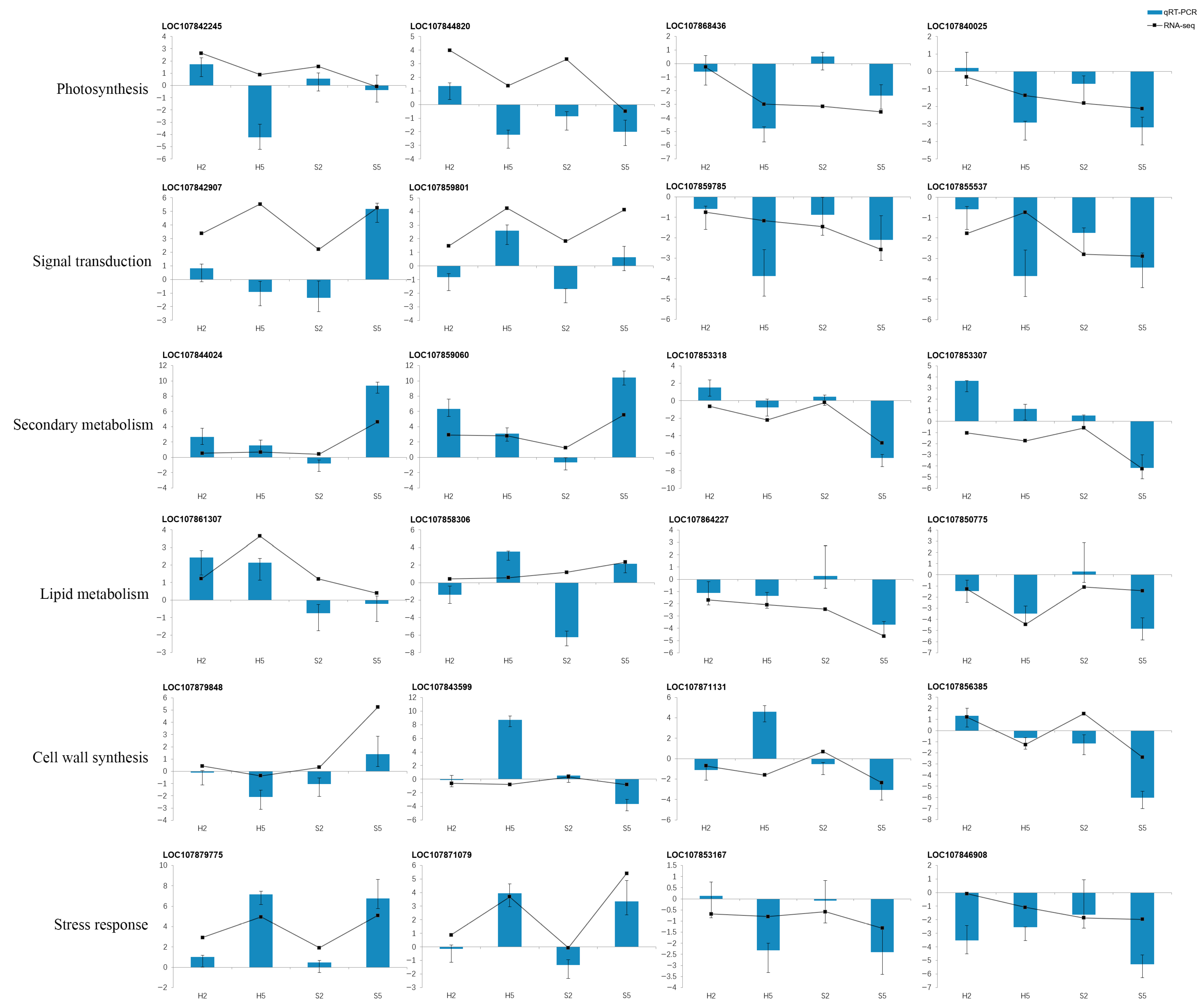
To validate our RNA-Seq data, the expression levels of 32 genes, representing the six key pathways identified previously, were confirmed by qRT-PCR in the roots of 19K23 and QM. Of the 32 genes quantified, 24 showed expression patterns highly consistent with the RNA-Seq data (Figure 8).
In the photosynthetic pathway, the genes encoding a carbon fixation protein (LOC107842245) and a key enzyme in carotenoid biosynthesis (LOC107844820) were confirmed to be up-regulated, while LOC107868436 and LOC107840025 were confirmed to be down-regulated. For signal transduction, the up-regulation of LOC107842907 and MAPK-related gene (LOC107859801) was validated, as was the down-regulation of LOC107859785 and LOC107855537. The qRT-PCR results for these targets showed strong consistency with the RNA-Seq data. In the secondary metabolic pathway, LOC107844024 and LOC1078659060 showed up-regulated expression patterns, whereas LOC107853318 and LOC107853307 displayed down-regulation trends. The quantitative results were generally consistent for all targets except for LOC107853307, which exhibited discordant expression in three groups. In the lipid metabolism pathway, GDSL-like Lipase/Acylhydrolase (LOC107861307) and LOC107858306—as previously mentioned—exhibited specific up-regulation patterns, with quantitative results corroborating this observation. Conversely, LOC107864227 and LOC107850775 demonstrated overall down-regulation trends. For cell wall biosynthesis, qRT-PCR confirmed the specific up-regulation of LOC107879848 and LOC107856385 at 2 dpi, alongside the consistent down-regulation of LOC107843599 and LOC107871131. In the stress response pathway, LOC107879775 and LOC1078671079, demonstrated consistent up-regulation patterns, with quantitative results confirming this expression profile. Meanwhile, LOC107853167 and LOC107846908 were confirmed to be predominantly down-regulated.

4. Discussion

The oomycete P. capsici is an important pathogen that infects a wide range of hosts, including pepper and other crops in the Solanaceae, Cucurbitaceae, and Fabaceae families. Studying the key genes and metabolic pathways underlying disease resistance provides a crucial foundation for developing resistant cultivars through molecular breeding. In our study, we performed RNA-Seq analysis on resistant and susceptible pepper varieties at 2 and 5 dpi, which were selected based on our observations of disease development, quantification of pathogen biomass, and further referenced from Dunn et al. [22], to explore the temporal and variety-specific transcriptional mechanisms underlying resistance to P. capsici.
In our RNA-Seq analysis, mock-inoculated plants from both the resistant (19K23) and susceptible (QM) varieties at day 0 served as the controls for samples collected at 2 dpi and 5 dpi. However, to account for gene expression changes due to normal plant development over the 0–5 day period, mock-inoculated controls for each cultivar and time point were included in the qRT-PCR analysis. This allowed us to isolate expression changes specifically induced by the pathogen, independent of ontogenetic variation. The results from this validation were consistent with those obtained from the RNA-Seq analysis using day 0 as the control. Furthermore, we will proceed to conduct in-depth studies on the metabolomics of QM and 19K23, to further validate the transcriptomic findings.
An initial enrichment analysis of the DEGs obtained by conventional analysis methods (with a fold change of 2), revealed a vast number of pathways. Acidic endochitinase Q, a member of the PR protein family [23], functions in plant disease resistance through the hydrolysis of fungal cell walls [24] and the elicitation of plant immune signaling pathways [25]. As such, it is classified as a disease resistance protein. Our study analyzed its expression patterns across cultivars and time points. However, the expression patterns of most genes were very similar across different treatments. Therefore, we conducted further in-depth research.
We selected genes with a differential expression fold change greater than or equal to 5 for analysis, in an attempt to identify common pathways. Among these, photosynthesis-related pathways emerged as a top candidate. Photosynthesis and light harvesting play important roles in plant growth and disease resistance, and may play a key role in plant-biotroph interactions, affecting the oxidative signaling response [26]. Studies have shown that pathogen attack can alter the expression of genes related to photosynthesis in plants [27]. For instance, Han et al. [28] demonstrated that the light-harvesting chlorophyll a/b-binding protein TaLhc2 in wheat simultaneously affects resistance and photosynthesis. In our results, porphyrin and chlorophyll metabolism proteins (LOC107845435, LOC107867750) were specifically upregulated in the resistant variety at 2 dpi, suggesting that these proteins may enhance disease resistance by regulating photosynthesis in the resistant variety.
The Ras superfamily of small GTPases are known to be key signaling hubs that can enhance plant immunity by modulating defense-related pathways, including the jasmonic acid signaling pathway [29]. The upregulation of Ras family genes in our resistant variety in the early stage of infection suggests a close relationship between the Ras family and plant disease resistance.
A key observation in our study is that while the susceptible variety mounted a significant transcriptional response in secondary metabolism pathways during the late stage of infection (5 dpi), this response was ultimately futile, as the plants were already severely infected. Phenylalanine metabolism is a cornerstone for plant growth. It produces various secondary metabolites such as phenolic compounds and lignin. The enzyme phenylalanine ammonia-lyase (PAL) is a critical gateway to this pathway, and its overexpression has been shown to enhance disease resistance [30,31]. Furthermore, phenylalanine metabolism is closely related to plant disease resistance signaling pathways, such as the mitogen-activated protein kinase cascade [32]. Further metabolomic analysis and in-depth research will be conducted on the metabolites mentioned above.
Sodium/hydrogen exchangers (NHEs) are crucial membrane proteins with well-established roles in plant growth and stress resistance. They can regulate the balance of sodium (Na+) and hydrogen (H+) ions inside and outside the cell, thereby maintaining critical cellular pH and ion homeostasis [33], enabling plants to survive adverse conditions such as salt stress. For example, overexpression of the tobacco NHX1 gene has been shown to enhance tolerance to stress [34], further demonstrating the versatility of NHEs in responding to heavy metal cadmium stress. Previous studies on NHEs have focused on their role in abiotic stress resistance, but in this study we found that the disease-resistant variety showed up-regulated expression of NHE genes 5 dpi, suggesting that this protein may also play an important role in biotic stress resistance, which warrants further investigation.
Based on the aforementioned RNA-Seq results, the pathways we identified—photosynthesis, stress response, plant-pathogen interaction, and secondary metabolism—provide insights for understanding pepper disease resistance mechanisms and breeding strategies. Specifically, these pathways not only reveal potential novel resistance genes, but also provide molecular targets for marker-assisted selection and gene editing approaches. This knowledge may be directly translated into crop improvement through CRISPR/Cas9 editing and overexpression strategies to develop enhanced disease-resistant cultivars. This approach is supported by growing evidence from multiple fronts. Molecular marker studies have shown that pepper lines with high PR gene expression exhibit enhanced resistance to P. capsici [35]. Pathway-targeted interventions, including the use of defense elicitors [36] and metabolic engineering approaches [37,38], have also proven effective in enhancing disease resistance. Furthermore, recent systems biology approaches have demonstrated the power of integrating multiple pathways, such as the proposed “photosynthesis-defense” coupling [39] and “redox-immunity-metabolism” networks [40]. Building on our current omics data and ongoing metabolomics profiling across different varieties and growth stages, we aim to establish a pathway synergy network to systematically analyze the potential for multi-pathway interactions.
For the pathways highlighted in this study, we plan to conduct functional genomics validation by performing CRISPR-mediated knockout or overexpression of candidate genes to observe disease resistance phenotypes and validate field performance. This includes evaluating genotype-phenotype correlations for pathway-associated genes, such as screening PR1-overexpressing lines for Phytophthora resistance. Furthermore, we will integrate multi-omics approaches, combining metabolomics (LC-MS) and proteomics (iTRAQ), to investigate post-transcriptional regulation, such as whether oxidoreductase activity correlates with protein post-translational modifications such as phosphorylation. Additionally, comparative genomics analysis across Solanaceae species (e.g., tomato, tobacco) will help distinguish between conserved defense mechanisms and pepper-specific adaptations, potentially revealing novel targets for broad-spectrum resistance breeding.

5. Conclusions

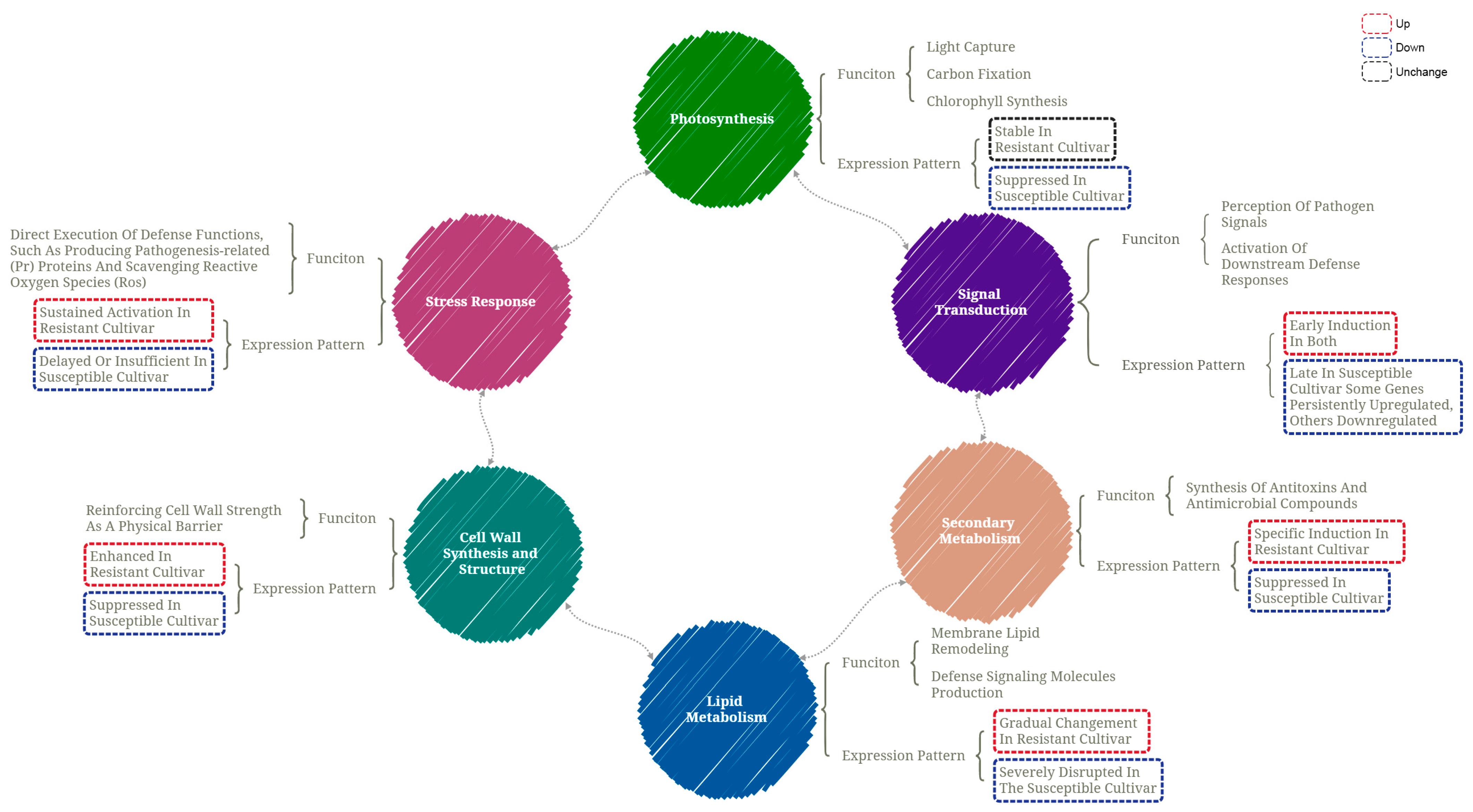
In this study, we systematically investigated the molecular mechanisms underlying pepper resistance to Phytophthora capsici. First, 21 pepper genotypes were divided into four groups with significant differences in disease resistance. Subsequently, RNA-Seq analysis was performed on resistant and susceptible varieties at 2 and 5 days post-inoculation to capture dynamic transcriptional responses. Comprehensive bioinformatics analyses revealed differentially expressed genes and their functional enrichment patterns across different time points and varieties. By integrating temporal expression patterns and cultivar-specific regulatory networks, we identified multiple critical regulatory modules associated with pathogenesis-related (PR) proteins, phenylpropanoid biosynthesis, MAPK signal transduction, and photosynthesis. We summarized the functions and expression profiles of these critical pathways in Figure 9. These findings provide both fundamental insights into pepper-Phytophthora interactions and practical gene targets for marker-assisted breeding.

Supplementary Materials

The following supporting information can be downloaded at: https://www.mdpi.com/article/10.3390/horticulturae11121458/s1, Figure S1: Gene clustering heatmap and principal component analysis (PCA); Table S1: Primer sequences of candidate reference genes for normalization, amplification length and annealing temperature of the amplified product in quantitative real-time PCR assays in this experiment; Table S2: Disease index of pepper cultivars after P. capsici inoculation in this experiment.

Author Contributions

Conceptualization, Y.C., Y.Z. and Z.Z.; methodology, Y.C., Y.Z. and J.Z. (Jingwen Zhang); software, Y.C., Y.Z. and J.Z. (Jingwen Zhang); validation, Y.Z., J.Z. (Jingyuan Zheng) and Z.Z.; formal analysis, Y.Z.; investigation, J.Z. (Jingwen Zhang), S.L.; resources, S.L.; data curation, B.Z.; writing—original draft preparation, Y.Z.; writing—review and editing, Y.C. and Y.Z.; visualization, J.Z. (Jingyuan Zheng); supervision, J.Z. (Jingyuan Zheng); project administration, and Z.Z.; funding acquisition, Z.Z. and Q.Y. All authors have read and agreed to the published version of the manuscript.

Funding

This research was funded by the Yuelushan Laboratory Breeding Program (2025-ZY01012) and National Science Foundation of China (32272517).

Institutional Review Board Statement

Not applicable.

Informed Consent Statement

Not applicable.

Data Availability Statement

The data that support the findings of this study are openly available in the SRA database at https://www.ncbi.nlm.nih.gov/sra/PRJNA1306308 accessed on 18 August 2025, reference number PRJNA1306308.

Acknowledgments

Differential Gene Expression analysis was performed using BMKCloud (www.biocloud.net).

Conflicts of Interest

The authors declare no conflicts of interest.

References

  1. Zhang, K.; Yu, H. Transposon proliferation drives genome architecture and regulatory evolution in wild and domesticated peppers. Nat. Plants 2025, 11, 359–375. [Google Scholar] [CrossRef]
  2. Zou, Z.; Zou, X. Geographical and Ecological Differences in Pepper Cultivation and Consumption in China. Front. Nutr. 2021, 8, 718517. [Google Scholar] [CrossRef]
  3. Zhou, J.; Liang, J.; Zhang, X.; Wang, F.; Qu, Z. Trichoderma brevicompactum 6311: Prevention and Control of Phytophthora capsici and Its Growth-Promoting Effect. J. Fungi 2025, 11, 105. [Google Scholar] [CrossRef] [PubMed]
  4. Sun, F.; Chen, Y.; Luo, Y.; Yang, F.; Yu, T.; Han, H.; Yang, Y.; Zhou, Y. Cryptochromes (CRYs) in pepper: Genome-wide identification, evolution and functional analysis of the negative role of CaCRY1 under Phytophthora capsici infection. Plant Sci. 2025, 355, 112460. [Google Scholar] [CrossRef]
  5. Quesada-Ocampo, L.M.; Parada-Rojas, C.H.; Hansen, Z.; Vogel, G.; Smart, C.; Hausbeck, M.K.; Carmo, R.M.; Huitema, E.; Naegele, R.P.; Kousik, C.S.; et al. Phytophthora capsici: Recent Progress on Fundamental Biology and Disease Management 100 Years After Its Description. Annu. Rev. Phytopathol. 2023, 61, 185–208. [Google Scholar] [CrossRef]
  6. Lamour, K.H.; Mudge, J.; Gobena, D.; Hurtado-Gonzales, O.P.; Schmutz, J.; Kuo, A.; Miller, N.A.; Rice, B.J.; Raffaele, S.; Cano, L.M.; et al. Genome sequencing and mapping reveal loss of heterozygosity as a mechanism for rapid adaptation in the vegetable pathogen Phytophthora capsici. Mol. Plant Microbe Interact. 2012, 25, 1350–1360. [Google Scholar] [CrossRef]
  7. Lamour, K.H.; Stam, R.; Jupe, J.; Huitema, E. The oomycete broad-host-range pathogen Phytophthora capsici. Mol. Plant Pathol. 2012, 13, 329–337. [Google Scholar] [CrossRef] [PubMed]
  8. Wang, M.; Zhang, W. The Effects of Antofine on the Morphological and Physiological Characteristics of Phytophthora capsici. Molecules 2024, 29, 1965. [Google Scholar] [CrossRef] [PubMed]
  9. Lacey, R.F.; Fairhurst, M.J.; Daley, K.J.; Ngata-Aerengamate, T.A.; Patterson, H.R.; Patrick, W.M. Assessing the effectiveness of oxathiapiprolin toward Phytophthora agathidicida, the causal agent of kauri dieback disease. FEMS Microbes 2021, 2, xtab016. [Google Scholar] [CrossRef]
  10. Lin, Y.C.; Mansfeld, B.N.; Tang, X.; Colle, M.; Chen, F.; Weng, Y.; Fei, Z.; Grumet, R. Identification of QTL associated with resistance to Phytophthora fruit rot in cucumber (Cucumis sativus L.). Front. Plant Sci. 2023, 14, 1281755. [Google Scholar] [CrossRef]
  11. Guo, Y.; Krasnow, C.S. Characterizing the Dynamics of Virulence and Fungicide Resistance of Phytophthora capsici in Michigan Vegetable Fields Reveals Loci Associated with Virulence. Plant Dis. 2024, 108, 332–341. [Google Scholar] [CrossRef]
  12. Pardo-Palacios, F.J.; Wang, D.; Reese, F.; Diekhans, M.; Carbonell-Sala, S.; Williams, B.; Loveland, J.E.; De María, M.; Adams, M.S.; Balderrama-Gutierrez, G.; et al. Systematic assessment of long-read RNA-seq methods for transcript identification and quantification. Nat. Methods 2024, 21, 1349–1363. [Google Scholar] [CrossRef]
  13. Reixachs-Solé, M.; Eyras, E. Uncovering the impacts of alternative splicing on the proteome with current omics techniques. Wiley Interdiscip. Rev. RNA 2022, 13, e1707. [Google Scholar] [CrossRef]
  14. Wang, Y.; Xie, Z.; Kutschera, E.; Adams, J.I.; Kadash-Edmondson, K.E.; Xing, Y. rMATS-turbo: An efficient and flexible computational tool for alternative splicing analysis of large-scale RNA-seq data. Nat. Protoc. 2024, 19, 1083–1104. [Google Scholar] [CrossRef]
  15. Vishwanath, P.P.; Bidaramali, V.; Lata, S.; Yadav, R.K. Transcriptomics: Illuminating the molecular landscape of vegetable crops: A review. J. Plant Biochem. Biotechnol. 2025, 34, 349–364. [Google Scholar] [CrossRef]
  16. Gao, C. Genome engineering for crop improvement and future agriculture. Cell 2021, 184, 1621–1635. [Google Scholar] [CrossRef] [PubMed]
  17. Yu, P.; Qin, K.; Crosby, K.; Ong, K.; Gentry, T.; Gu, M. Biochar reduces containerized pepper blight caused by Phytophthora capsici. Sci. Rep. 2024, 14, 30664. [Google Scholar] [CrossRef] [PubMed]
  18. Ashburner, M.; Ball, C.A.; Blake, J.A.; Botstein, D.; Butler, H.; Cherry, J.M.; Davis, A.P.; Dolinski, K.; Dwight, S.S.; Eppig, J.T.; et al. Gene ontology: Tool for the unification of biology. The Gene Ontology Consortium. Nat. Genet. 2000, 25, 25–29. [Google Scholar] [CrossRef]
  19. Kanehisa, M.; Goto, S.; Kawashima, S.; Okuno, Y.; Hattori, M. The KEGG resource for deciphering the genome. Nucleic Acids Res. 2004, 32, D277–D280. [Google Scholar] [CrossRef]
  20. Mao, X.; Cai, T.; Olyarchuk, J.G.; Wei, L. Automated genome annotation and pathway identification using the KEGG Orthology (KO) as a controlled vocabulary. Bioinformatics 2005, 21, 3787–3793. [Google Scholar] [CrossRef] [PubMed]
  21. Pertea, M.; Pertea, G.M.; Antonescu, C.M.; Chang, T.C.; Mendell, J.T.; Salzberg, S.L. StringTie enables improved reconstruction of a transcriptome from RNA-seq reads. Nat. Biotechnol. 2015, 33, 290–295. [Google Scholar] [CrossRef]
  22. Dunn, A.R.; Smart, C.D. Interactions of Phytophthora capsici with Resistant and Susceptible Pepper Roots and Stems. Phytopathology 2015, 105, 1355–1361. [Google Scholar] [CrossRef] [PubMed]
  23. Payne, G.; Ahl, P.; Moyer, M.; Harper, A.; Beck, J.; Meins, F., Jr.; Ryals, J. Isolation of complementary DNA clones encoding pathogenesis-related proteins P and Q, two acidic chitinases from tobacco. Proc. Natl. Acad. Sci. USA 1990, 87, 98–102. [Google Scholar] [CrossRef] [PubMed]
  24. Schlumbaum, A.; Mauch, F.; Vögeli, U.; Boller, T. Plant chitinases are potent inhibitors of fungal growth. Nature 1986, 324, 365–367. [Google Scholar] [CrossRef]
  25. Jia, X.; Meng, Q.; Zeng, H.; Wang, W.; Yin, H. Chitosan oligosaccharide induces resistance to Tobacco mosaic virus in Arabidopsis via the salicylic acid-mediated signalling pathway. Sci. Rep. 2016, 6, 26144. [Google Scholar] [CrossRef] [PubMed]
  26. Bechtold, U.; Karpinski, S.; Mullineaux, P.M. The influence of the light environment and photosynthesis on oxidative signalling responses in plant-biotrophic pathogen interactions. Plant Cell Environ. 2010, 28, 1046–1055. [Google Scholar] [CrossRef]
  27. Selvaraj, K.; Fofana, B. An Overview of Plant Photosynthesis Modulation by Pathogen Attacks. Adv. Photosynt Fundam. Asp. 2012, 22, 466–484. [Google Scholar]
  28. Han, X.; Han, S.; Li, Y.; Li, K.; Yang, L.; Ma, D.; Fang, Z.; Yin, J.; Zhu, Y.; Gong, S. Double roles of light-harvesting chlorophyll a/b binding protein TaLhc2 in wheat stress tolerance and photosynthesis. Int. J. Biol. Macromol. 2023, 253, 127215. [Google Scholar] [CrossRef]
  29. Zhu, D.; Hou, L.; Xiao, P.; Guo, Y.; Deyholos, M.K.; Liu, X. VvWRKY30, a grape WRKY transcription factor, plays a positive regulatory role under salinity stress. Plant Sci. 2019, 280, 132–142. [Google Scholar] [CrossRef]
  30. Way, H.M.; Kazan, K.; Mitter, N.; Goulter, K.C.; Birch, R.G.; Manners, J.M. Constitutive expression of a phenylalanine ammonia-lyase gene from Stylosanthes humilis in transgenic tobacco leads to enhanced disease resistance but impaired plant growth. Physiol. Mol. Plant Pathol. 2002, 60, 275–282. [Google Scholar] [CrossRef]
  31. Oliva, M.; Hatan, E.; Kumar, V.; Galsurker, O.; Nisim-Levi, A.; Ovadia, R.; Galili, G.; Lewinsohn, E.; Elad, Y.; Alkan, N.; et al. Increased phenylalanine levels in plant leaves reduces susceptibility to Botrytis cinerea. Plant Sci. 2020, 290, 110289. [Google Scholar] [CrossRef]
  32. Li, C.; Wang, M.; Guo, Y.; Zhang, S.; Xu, H.; Ge, Y. Activation of the calcium signaling, mitogen-activated protein kinase cascade and phenylpropane metabolism contributes to the induction of disease resistance in pear fruit upon phenylalanine treatment. Postharvest Biol. Technol. 2024, 210, 112782. [Google Scholar] [CrossRef]
  33. Khan, I.U.; Ali, A.; Yun, D.-J. Arabidopsis NHX Transporters: Sodium and Potassium Antiport Mythology and Sequestration During Ionic Stress. J. Plant Biol. 2018, 61, 292–300. [Google Scholar] [CrossRef]
  34. Wang, G.; Yang, D.; Zhang, Y.; Li, Q.; Ji, J.; Jin, C.; Wu, G.; Guan, C. Na+/H+ antiporter (NHX1) positively enhances cadmium (Cd) resistance and decreases Cd accumulation in tobacco plants cultivated in Cd-containing soil. Plant Soil 2020, 453, 389–408. [Google Scholar] [CrossRef]
  35. Silvar, C.; Merino, F.; Díaz, J. Differential activation of defense-related genes in susceptible and resistant pepper cultivars infected with Phytophthora capsici. J. Plant Physiol. 2008, 165, 1120–1124. [Google Scholar] [CrossRef]
  36. Majid, M.U.; Awan, M.F.; Fatima, K.; Tahir, M.S.; Ali, Q.; Rashid, B.; Rao, A.Q.; Nasir, I.A.; Husnain, T. Genetic resources of chili pepper (Capsicum annuum L.) against Phytophthora capsici and their induction through various biotic and abiotic factors. Cytol. Genet. 2017, 51, 296–304. [Google Scholar] [CrossRef]
  37. Naves, E.R.; de Ávila Silva, L.; Sulpice, R.; Araújo, W.L.; Nunes-Nesi, A.; Peres, L.E.P.; Zsögön, A. Capsaicinoids: Pungency beyond Capsicum. Trends Plant Sci. 2019, 24, 109–120. [Google Scholar] [CrossRef]
  38. Nauen, J.; Tripodi, P.; Wendenburg, R.; Tringovska, I.; Nakar, A.N.; Stoeva, V.; Pasev, G.; Klemmer, A.; Todorova, V.; Bulut, M.; et al. The genetic architecture of the pepper metabolome provides insights into the regulation of capsianoside biosynthesis. bioRxiv 2023. preprint. [Google Scholar] [CrossRef]
  39. De Torres Zabala, M.; Littlejohn, G.; Jayaraman, S.; Studholme, D.; Bailey, T.; Lawson, T.; Tillich, M.; Licht, D.; Bölter, B.; Delfino, L.; et al. Chloroplasts play a central role in plant defence and are targeted by pathogen effectors. Nat. Plants 2015, 1, 15074. [Google Scholar] [CrossRef]
  40. Zhang, Z.; Shi, Q.; Wang, B.; Ma, A.; Wang, Y.; Xue, Q.; Shen, B.; Hamaila, H.; Tang, T.; Qi, X.; et al. Jujube metabolome selection determined the edible properties acquired during domestication. Plant J. 2022, 109, 1116–1133. [Google Scholar] [CrossRef]
Figure 1. Disease assessment and pathogen dynamics in resistant and susceptible pepper cultivars inoculated with Phytophthora capsici. (a) Disease symptoms observed in 21 cultivars at 7 days post-inoculation (dpi); (b) Pot-level and (c) seedling-level phenotypes of resistant and susceptible cultivars at 0, 2, and 5 dpi; (d) Relative expression of the P. capsici actin gene in resistant and susceptible cultivars at 0, 2, and 5 dpi. In (a), the two pots of seedlings in each panel are the mock control (left) and the Phytophthora-inoculated treatment (right). The letters above each panel indicate the cultivar. In (bd), 19K23 represents the disease-resistant cultivar, whereas QM denotes the susceptible cultivar. ** p < 0.01; *** p < 0.001; *** p < 0.0001.
Horticulturae 11 01458 g001
Figure 2. Volcano plot of differentially expressed genes (DEGs) between Phytophthora capsici-inoculated and mock-inoculated treatments in resistant (19K23) and susceptible (QM) pepper varieties. Panels a-d represent the group comparisons RK2 vs. RK0 (a), RK5 vs. RK0 (b), SQ2 vs. SQ0 (c), and SQ5 vs. SQ0 (d), respectively. The X-axis represents the value of the difference multiple after log2 conversion, and the Y-axis indicates the significance value after log10 conversion. The three colors red, blue, and black, represent up-regulated DEGs, down-regulated DEGs, and unchanged genes, respectively.
Horticulturae 11 01458 g002
Figure 3. Gene ontology (GO) functional enrichment analysis of differentially expressed genes (DEGs) in the same pepper cultivar (resistant: 19K23; susceptible: QM) at different time points post-inoculation with Phytophthora capsici. Panels a-d represent the group comparisons RK2 vs. RK0 (a), RK5 vs. RK0 (b), SQ2 vs. SQ0 (c), and SQ5 vs. SQ0 (d), respectively. The X-axis represents GO functional classification, and the Y-axis represents the number of up-regulated and down-regulated genes in each corresponding GO term. Red, green, and blue represent the three biological processes BP (Biological Process), CC (Cellular Component), and MF (Molecular Function), respectively.
Horticulturae 11 01458 g003
Figure 4. Pathway enrichment analysis of differentially expressed genes (DEGs) in the same pepper cultivar (resistant: 19K23; susceptible: QM) at different time points post-inoculation with Phytophthora capsici. Panels a-d represent the group comparisons RK2 vs. RK0 (a), RK5 vs. RK0 (b), SQ2 vs. SQ0 (c), and SQ5 vs. SQ0 (d), respectively. The X-axis represents enrichment factor values, with higher values indicating greater pathway enrichment. The Y-axis represents pathway names, typically arranged in descending order of enrichment significance from top to bottom. The dot size represents the number of differentially expressed genes (count). The dot color corresponds to the p-value, with colors closer to red indicating more statistically significant enrichment. The dot shape denotes differential expression patterns: circles represent mixed trends (containing both up- and down-regulated genes), while triangles indicate specifically up-regulated or down-regulated genes.
Horticulturae 11 01458 g004
Figure 5. Heatmap of selected differentially expressed genes (DEGs) involved in disease resistance in the interaction between two pepper cultivars (resistant: 19K23; susceptible: QM) with Phytophthora capsici. H2, RK2 vs. RK0; H5, RK5 vs. RK0; S2, SQ2 vs. SQ0; S5, SQ5 vs. SQ0. In the heatmap, red blocks indicate upregulated genes while blue represents downregulated genes.
Horticulturae 11 01458 g005
Figure 6. Venn diagram of unique differentially expressed genes (DEGs) of the comparison group of H2, S2, H5, and S5 following inoculation with Phytophthora capsici. (a) Unique DEGs of resistant (19K23) and susceptible (QM) pepper varieties at 2 days post-inoculation (dpi). (b) Unique DEGs of resistant and susceptible varieties at 5 dpi. The absolute value of log2 FC was equal to or greater than 5. H2, RK2 vs. RK0; H5, RK5 vs. RK0; S2, SQ2 vs. SQ0; S5, SQ5 vs. SQ0.
Horticulturae 11 01458 g006
Figure 7. Heatmap and gene set enrichment analysis (GSEA) of unique differentially expressed genes (DEGs) across experimental groups in resistant (19K23) and susceptible (QM) pepper cultivars following inoculation with Phytophthora capsici. In this figure, panels (a,b): Photosynthesis. (c,d): Signal transduction. (e,f): Secondary metabolism. (g,h): Lipid metabolism. (i,j): Cell wall synthesis and structure. (k,l): Stress response. H2, RK2 vs. RK0; H5, RK5 vs. RK0; S2, SQ2 vs. SQ0; S5, SQ5 vs. SQ0. In the heatmaps, red indicates up-regulated genes while blue represents down-regulated genes. In GSEA, the annotation in the top-left corner of each GSEA plot denotes the pathway name, with each plot illustrating the overall expression trend of an entire pathway in the corresponding group. A positive or negative normalized enrichment score (NES) reflects the pathway-wide up-regulation or down-regulation, respectively.
Horticulturae 11 01458 g007
Figure 8. RNA-Seq results confirmed by qRT-PCR in resistant (19K23) and susceptible (QM) pepper cultivars following inoculation with Phytophthora capsici. Genes were sorted by pathways mentioned before and the pepper actin gene (GQ339766) was used as an internal control. The X-axis represents the four experimental groups (H2, RK2 vs. RK0; H5, RK5 vs. RK0; S2, SQ2 vs. SQ0; S5, SQ5 vs. SQ0), while the Y-axis displays the expression levels of target genes measured by qRT-PCR (bars) and RNA-Seq (lines). For each treatment, all genes were analyzed with three biological replicates, each comprising three technical replicates, with high concordance observed across all replicate sets.
Horticulturae 11 01458 g008
Figure 9. Functions and expression profiles of critical pathways in the resistance of pepper against Phytophthora blight. Each large colored circle represents a specific pathway, with two branches describing its function and expression pattern. The three colors red, blue, and black, represent up-regulated, down-regulated, and unchanged pathways, respectively.
Horticulturae 11 01458 g009
Table 1. Disease index of 21 pepper cultivars at 7 days post-inoculation with Phytophthora capsici.
CultivarDisease Incidence (%)Disease Index (%)Resistance Level
QM100.00 ± 0.0098.89 ± 1.36S
21QL701100.00 ± 0.0098.89 ± 1.36S
19K2100.00 ± 0.0089.72 ± 0.00S
20cch100.00 ± 0.0083.00 ± 8.11S
19K597.92 ± 4.1781.07 ± 8.50S
Zunla-194.44 ± 10.0973.06 ± 10.19S
18A23795.83 ± 4.5668.61 ± 5.31S
19K11100.00 ± 0.0064.44 ± 5.13S
GMLJ-202298.61 ± 3.4059.44 ± 7.35S
22-2068.89 ± 19.7755.50 ± 18.92S
NKLJ-202254.17 ± 24.0137.22 ± 23.68MR
SF-J37.50 ± 26.2226.67 ± 19.52R
2SG-A40.28 ± 26.0419.17 ± 17.91R
prennial19.44 ± 15.5214.44 ± 12.10R
22-2918.06 ± 8.199.72 ± 3.40HR
22-1412.50 ± 11.498.06 ± 6.70HR
22-3111.11 ± 8.616.94 ± 4.52HR
SW-3-14.17 ± 6.974.17 ± 6.97HR
20-075.56 ± 6.803.61 ± 4.76HR
21QL7031.39 ± 3.401.11 ± 2.72HR
19K230.00 ± 0.000.00 ± 0.00HR
In the table, “HR” denotes highly resistant; “R” resistant; “MR” moderately resistant; and “S” susceptible.
Table 2. Sequencing data statistics of two pepper cultivars (resistant: 19K23; susceptible: QM) at different time points post-inoculation with Phytophthora capsici.
Sample IDTotal ReadsClean ReadsGC (%)Q20 (%)Q30 (%)
RK0-147,764,41223,882,20642.598.2495.12
RK0-239,242,78619,621,39342.9698.1794.75
RK0-344,654,50622,327,25342.9198.0994.77
RK2-144,271,75022,135,87542.8398.5595.81
RK2-246,285,94623,142,97342.8898.495.46
RK2-343,606,23421,803,11743.9198.4895.67
RK5-143,603,65621,801,82843.0198.3295.17
RK5-241,935,13020,967,56542.9998.5495.74
RK5-341,871,81620,935,90842.7398.4695.51
SQM0-142,038,31421,019,15742.8498.495.4
SQM0-251,272,55625,636,27843.2198.1895.02
SQM0-342,490,38421,245,19243.198.294.82
SQM2-139,965,44619,982,72342.8198.5195.64
SQM2-245,366,03822,683,01942.7598.3895.29
SQM2-344,715,13822,357,56942.8198.3995.41
SQM5-154,936,37627,468,18849.7898.0494.53
SQM5-250,504,23825,252,11947.498.1994.88
SQM5-362,991,54631,495,77348.4198.1594.92
In the table, “RK” denotes cultivar 19K23; “SQ” cultivar QM. The trailing digit (0, 2, and 5) indicates days post-inoculation. The suffix (e.g., −1, −2) denotes the biological replicate number.
Disclaimer/Publisher’s Note: The statements, opinions and data contained in all publications are solely those of the individual author(s) and contributor(s) and not of MDPI and/or the editor(s). MDPI and/or the editor(s) disclaim responsibility for any injury to people or property resulting from any ideas, methods, instructions or products referred to in the content.