Article

Evaluation of Cucumber (Cucumis sativus L.) Growth in an Open Soilless System Using Different Substrates
by
Teresa Leuratti
1,
Nicola Michelon
2,
Alejandra Paredes
3,
Jaime Santamaria
4,
Giampaolo Zanin
1,
Stefano Bona
1,
Giuseppina Pennisi
5,*,
Giorgio Gianquinto
5 and
Francesco Orsini
5
1
Department of Agronomy, Food, Natural Resources, Animals and Environment (DAFNAE), University of 7 Padova, Viale dell’Università, 16, 35020 Legnaro, PD, Italy
2
Italo-Latin American International Organization (IILA), Via Giovanni Paisiello 24, 00198 Roma, RM, Italy
3
Faculty of Agronomic Sciences, University of El Salvador, Ciudad Universitaria, Final de Av. Mártires y Héroes del 30 Julio, 503 San Salvador 07 Km, San Salvador 1101, El Salvador
4
Plan Trifinio, SISTAGRO Centre, Department of Santa Ana, San Salvador 1101, El Salvador
5
Department of Agricultural and Food Sciences (DISTAL), University of Bologna, Viale Fanin 44, 40127 Bologna, BO, Italy
*
Author to whom correspondence should be addressed.
Horticulturae 2025, 11(11), 1356; https://doi.org/10.3390/horticulturae11111356
Submission received: 4 September 2025 / Revised: 17 October 2025 / Accepted: 4 November 2025 / Published: 11 November 2025

Abstract

The soil of the Trifinio region, the tri-national territory between Guatemala, Honduras, and El Salvador, is damaged by the expansion of monoculture, which decreases fertility and causes problems for local farmers. Furthermore, the region also faces issues of erosion and soil contamination. As an alternative to soil cultivation, soilless systems can be adopted, not requiring fertile soil, and significantly increasing yields and resource use efficiency. To encourage soilless technique application in the region, the aim of this study was to compare 18 different substrate mixes to identify the most suitable for the local cultivation of cucumber (Cucumis sativus L.). The substrates were obtained comparing three rates of peat and compost (0%, 20% and 40%, by volume) in factorial combination, with the remaining being either coir or pumice (filling component). Plant growth, flower setting, physiological status (relative chlorophyll content and leaf temperature), and plant production were evaluated. Highest yield was achieved with 20% peat, while compost (20% and 40%) was able to increase fruit length and improve the relative chlorophyll content, but did not affect total production. However, when focusing on environmental sustainability as an important standpoint, a peat-free substrate should be utilized even though the results favored the 20% peat treatment for production. Considering that the differences in production in favor of 20% peat treatment were of limited practical relevance. In regard to the filling components (coir and pumice) yields were unaffected and only minor parameters were changed. Based on the results obtained, a substrate consisting of 60% coir and 40% compost resulted in the best option for the soilless cultivation of cucumber in the Trifinio region, with both materials being sustainable and easily available for local farmers.
Keywords:
yield; peat; compost; coir; pumice

1. Introduction

In several world regions, an intensive monocultural farming system is the solution for the increasing demand for agricultural products caused by population growth [1]. This is primarily seen in emerging economies, where agriculture is the driving economic sector, but access to advanced and sustainable technologies is still limited. Therefore, deforestation and monoculture are commonly adopted as solutions to increase production [2]. Central America is one of the regions most affected by the expansion of both practices, especially the Trifinio region, a territory extending along the borders of Honduras, Guatemala, and El Salvador [3,4]. This trend harms soil fertility, which relies on close relationships among soil, microbiome, and plants. Plant biodiversity is crucial for enhancing soil microbiological diversity and fostering a more resilient and robust soil ecosystem microbiology [5]. Furthermore, soil quality in El Salvador is challenged by additional threats, including erosion, salinization, compaction, and contamination [6]. These issues are significant obstacles for local agriculture and do not have a single, rapid resolution but rather a set of practices that require planning and time [7]. However, maintaining and even increasing agricultural production is essential for the region, considering that in El Salvador, about 15% of the population in 2022 was registered as working in agriculture [8]. While in 2021–2023, 3 million people were described by FAO as moderately or severely food insecure [8].
Soilless farming, the technique of growing plants in nutrient-rich solution with or without an inert substrate [9], offers a solution to these problems, allowing farmers to produce while restoring the health and fertility of their soil. This system is easy to apply and offers many advantages, including lower resource inputs (mainly when managed on a closed-cycle basis) and a lower incidence of pests, diseases, and damage that are common in the soil.
In soilless cultivation, the substrate provides physical support for the roots and promotes plant growth by absorbing and retaining water and nutrients [10]. The composition of the substrate may influence the yield and the plant health [11]. Generally, the horticultural industry uses a mixture of raw materials (such as sand, gravel, rock wool, peat moss, or sawdust) and amendments, which include fertilizers, liming materials, and biocontrol agents [12]. Since their chemical and physical characteristics differ according to their composition, it is necessary to identify substrates that feature ideal characteristics for the targeted plant species, as these can influence plants’ growth and development [13]. Even if peat and rock wool are the most widespread substrates for commercial hydroponics worldwide [12], a number of locally available substrates are also commonly adopted in simplified hydroponic systems. In Latin America, rock wool is not a common substrate, while a wide variety of natural substrates are available, such as river, quarry, and quartz sands, gravel, pumice, rice hulls, coir, and light wood sawdust [14]. Among those primarily available in El Salvador, there are coir (coconut fiber), a waste of coconut cultivation, highly produced by the country (around 67,000 tons in 2025) [9], and pumice, a product of volcanic origin [15,16].
Cucumber (Cucumis sativus L.) is a key crop for the Trifinio region, with a production of around 7600 tons in El Salvador, only, in 2022 [8]. The performance and sustainability of different growing substrates for cucumber cultivation have been addressed by a number of researchers. Al-Far et al. [17] examined substrates for cucumber grown in a greenhouse and found that a mixture of 50% tuff and 50% sawdust gave the best result. Similarly, Marsic et al. [18] identified perlite as a more effective substrate as compared to clay pellets. Yang et al. [19] demonstrated that the use of organic substrates such as pine bark, coir, and wood fiber can be a sustainable alternative to perlite. Research based on location and local parameters has also investigated the best substrate among the materials available within the region, an essential feature for environmental sustainability and viability of the study. For instance, Ali et al. [20], in North Sinai, Egypt, identified a mixture of sand and date palm residues as the optimal substrate for cucumber in a soilless system, optimizing the use of local resources. The use of a suitable substrate becomes even more crucial under stressful conditions. Therefore, our analysis of the optimal substrate for cucumber cultivation was conducted in a greenhouse under tropical conditions, where both temperature and humidity reach remarkably high levels and where plant health is consequently severely compromised. Accordingly, this research aimed at identifying the optimal substrate mixture for cucumber cultivation in soilless systems in El Salvador, considering its climatic characteristics and the availability of local materials, prioritizes affordability and ease of access for Salvadoran farmers. The substrates were tested to develop practical and applicable solutions for the region’s agricultural community.

2. Materials and Methods

2.1. Location and Climatic Conditions

The experiment took place in a 350 m2 greenhouse in the Technological Innovation Center SISTAGRO, located in Metapán, at the department of Santa Ana, El Salvador (14°33′ N, −89°45′ E, 477 m a.s.l.). According to the Köppen classification, the local climate is Aw type, a tropical savannah with dry summer and a rainy season between June and October [21,22]. The greenhouse’s climatic parameters (air temperature and relative humidity) were measured daily using a digital thermometer with a resolution of 0.1 °C (Thermo Fisher Scientific, Waltham, MA, USA).

2.2. Experimental Design and Treatments

A randomized block design was used. Cultivation bags were arranged in eight blocks, each containing one bag for each of the 18 substrates evaluated. Each block consisted of two rows of nine bags each. The distance of the bags was 1.0 m between rows and 0.4 m within the row, and each bag contained one plant (2.5 plants m−2). Each bag was placed on the support of two bricks, between which a PVC pipe allowed for drainage collection. The leaching fraction of the nutrient solution was not recirculated as the crop was managed as an open cultivation system.
The cultivation unit consisted of polyethylene bags (10 L volume) perforated on the sides and bottom and filled with the substrate evaluated. The 18 substrates were obtained from the factorial combination of peat and compost, both at three rates (0, 20, and 40%, by volume), and two other raw materials (coir and pumice) at different ratios (from 0 to 100%, by volume) to complete the formulation (hereafter called “filling materials”) (Table 1). The peat used was a peat-based commercial substrate containing 85% Canadian sphagnum peat, 15% fine horticultural vermiculite, calcitic limestone, and dolomitic limestone, together with a wetting agent (LM-GPS LM-2, Lambert Peat Moss, Rivière-Ouelle, QC, Canada). The supplier declares the following characteristics: particle size of 0–10 mm, bulk density of 40–100 g L−1, 63–75% by volume of water holding capacity, 13–23% (v/v) air porosity, pH range between 5.4 and 6.3, and electrical conductivity of 1000–1500 µS cm−1. On a nutritional level, the peat contains 50–90 mg L−1 of N-NO3, 5–30 mg L−1 of P4, and 100–160 mg L−1 of K [23]. The compost used was supplied by Orgánicos San Julián (Finca Cristo Negro, San Julian, El Salvador), derived from composted vegetable waste. Analysis in a local laboratory (Laboratorio de Quimica Agricola CENTA, San Andres, El Salvador) resulted in the following nutrient values (on a dry basis): 0.97% of total N, 0.32% of P, and 0.86% of K. Pumice (1–5 mm diameter) and coir were also supplied by the local company Orgánicos San Julián (San Julián, El Salvador).

2.3. Physical and Chemical Characterization of the Substrates

The 18 substrates were evaluated for their physical and chemical traits. Bulk density (BD) was determined according to EN13040 (CEN, 2007) [24]. Total pore space (TPS), air-filled porosity (AFP), and water holding capacity (WHC) were evaluated by the NCSU porometer method [25,26]. For chemical characterization, substrates were prepared using the EN 13040 (CEN, 2007) methodology. pH and electrical conductivity (EC) were determined using EN 13037 (CEN, 2011a) [27] and EN 13038 (CEN, 2011b) [28] methods, respectively. Analyses were performed on three replicates.

2.4. Plant Material and Crop Management

The study assessed the growth and yield of cucumber plants (Cucumis sativus L. cv Centauro). Seeds were obtained by a local company (El Surco, S. A de C.V., Santa Ana, El Salvador). On 1 May 2024, the sowing was performed manually in rigid plastic trays (54 cm × 48 cm) with 128 cells (0.30 cm × 0.30 cm). The trays were placed in an outdoor nursery, covered by a poly shade net, reducing sunlight intensity by 63% while preserving air circulation from the open sides. In the five days after sowing, 3 L of water per tray was applied daily in four applications (0.75 L for each application) at 8:00 a.m., 11:00 a.m., 1:30 p.m., and 4:00 p.m. using a watering can. When 80% of the seedlings had fully expanded cotyledons, a nutrient solution, was applied at an EC of 1200 µS cm−1, prepared from a water-soluble compound fertilizer (Solu feed Inicio fertilizer, Duwest, Guatemala City, Guatemala, N:P2O5:K2O = 20:30:10 + Mg + S). The nutrient solution was applied twice a day, 0.75 L at 8:00 a.m. and 0.75 L at 4:00 p.m. The seedlings were transplanted, one per bag, on 16 May 2024, 15 days after sowing.
Plants were irrigated 5 times a day, adapting the irrigation volume to the amount of drainage (between 25 and 35%) and maintaining it at a constant among the different substrate treatments. Irrigation was applied using a drip irrigation system equipped with self-compensating emitters (2.4 L h−1 flow rate, one for each bag). From the fourth day after transplanting, fertigation was applied twice a day, using a stock nutrient solution diluted through a Venturi system. The fertilizer used varied stages, according to the development: from 0 to 15 days after transplant (DAT) Solu Feed Inicio fertilizer (Duwest, Guatemala City, Guatemala; N:P:K = 20:30:10 + Mg + S) was used with a concentration of 0.7 g L−1. From 16 to 30 DAT, the nutrient solution was prepared with 1 g L−1 of Solu Feed Desarollo fertilizer (Duwest, Guatemala City, Guatemala; N:P:K = 22:11:22 + Mg + S). Finally, from 31 DAT to the end of the cycle, the nutrient solution consisted of 0.2 g L−1 of Solu Feed Desarollo and 0.8 g L−1 of Hakaphos Base fertilizer (COMPO AGRO, Santiago del Chile, Chile; N:P:K = 7:12:40).

2.5. Data Collection

Early growth and flower settings were monitored on 3, 12, and 17 June (corresponding to 18, 27 and 32 DAT, respectively), recording plant height, leaf number, and flower number. The flower number was also measured on 7 June.
Plant physiological status was monitored when harvest started on 20 June (35 DAT). Data were collected weekly until the end of the experiment (9 August). Plant nutritional (nitrogen) status and plant physiological condition were monitored through the measurement of the relative chlorophyll content [29,30] and leaf temperature [31]. Relative chlorophyll content was determined by using a SPAD-502 (Konica Minolta Business Solutions Italia SpA, Milano, Italy). Measurements were taken on 5 leaves in the basal part of the plant, 5 in the middle part, and 5 in the aerial part, for a total of 15 measurements per plant. Leaf temperature was measured using an infrared thermometer 62 MAX+ (Fluke, Washington, DC, USA) with an optical resolution of 12:1. Measurements were taken between 12 pm and 2 pm, maintaining the instrument at 15 cm from the leaf.
Harvesting time was identified as when fruits had reached the commercial standards for the local market, given by uniform coloration and rounded extremities. A total of 12 harvests were carried out at intervals of 4–7 days. At each harvest, fruits gathered from each plant were counted, measured in length and circumference, and weighed.

2.6. Statistical Analysis

Statistical analysis was performed using the software R (version 4.3.1) [32]. A fixed-effects analysis of variance (ANOVA) model was applied, including the variables DATE, Filling_component, P_Peat, P_Compost as factors, and Block as a random effect. Interactions among factors were considered to evaluate their combined effects. The ANOVA was conducted using the car package [33], employing Type III methodology for calculating main effects and interactions. A post hoc Tukey test was used to compare treatment means using the agricolae package [34]. Comparisons were conducted regarding individual factors and two-way interactions, with a significance level of 5%. Linear models were handled using the lme4 [35] and lmerTest [36] packages, which provided estimates and significance tests for the model parameters.

3. Results

3.1. Substrate Characterization and Climate Conditions

Table 2 shows the results of the physical-chemical characterization of the substrates. The dry bulk density (BD) of the substrates ranged between 64.8 and 772.8 g L−1, experiencing an increase with the increase in compost and/or pumice content and a decrease with the rise in peat and/or coir (Table 2). In fact, in treatment with 40% compost, the dry bulk density increased by 35.38% compared to the treatment with 0% compost and increased by 186% in the maximum pumice rate compared to substrates without pumice. Opposite trends were reported for the BD according to peat rate (−15.82%) and coir rate (−89.91%). In general, along with the increase in the peat rate in the substrate, an increase in the water holding capacity (WHC) and a decrease in the air-filled porosity (AFP) and the total porosity (TP) were observed. pH and EC (varying between 6.0 and 6.6, and 40 and 440 µS cm−1, respectively) also decreased as peat increased. The same general trend was recorded with compost for EC. Increasing coir rates, as a filling component, resulted in an increase in the total porosity, the air-filled porosity, and in EC.
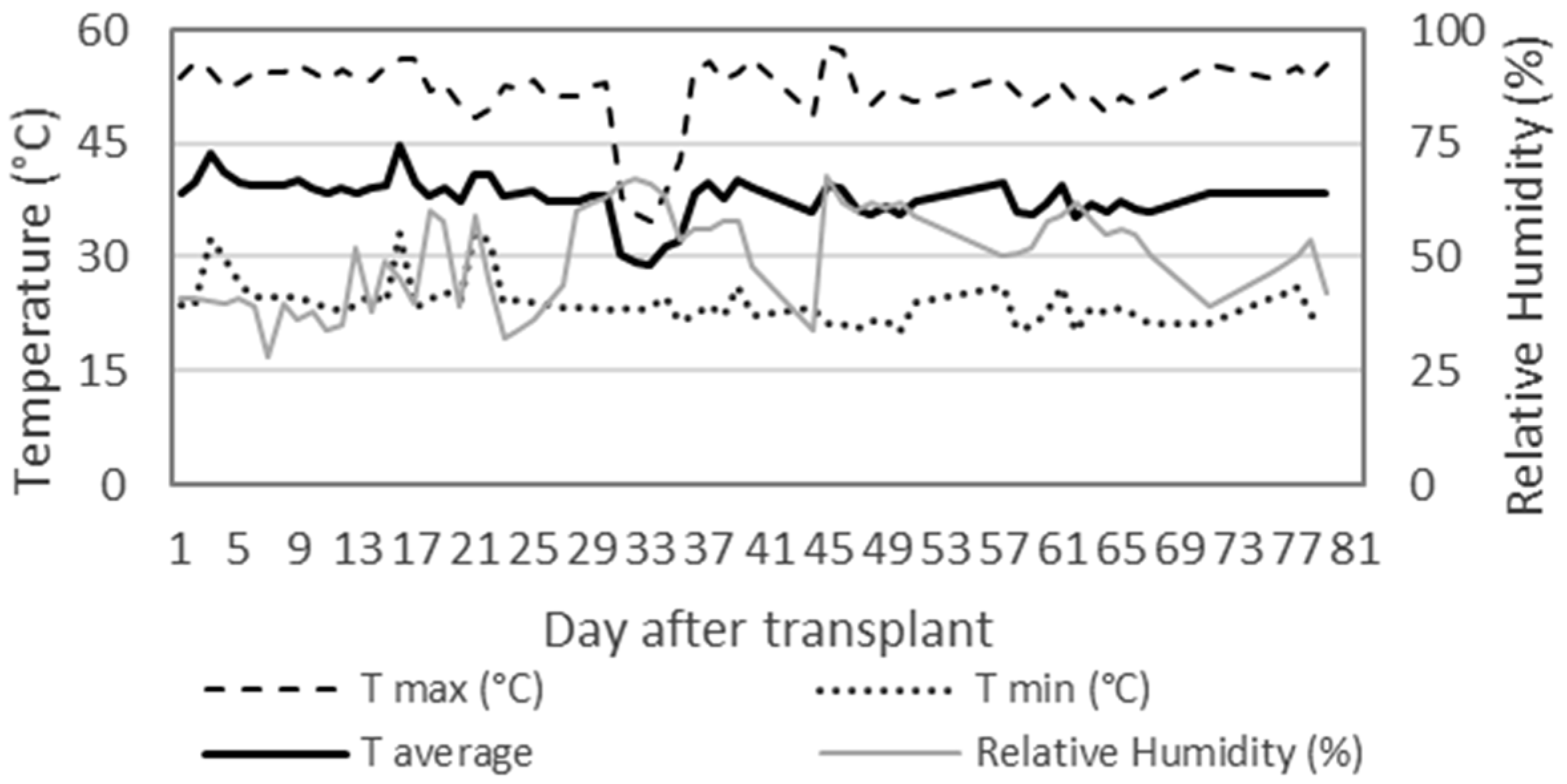
The climate within the greenhouse was generally very warm and relatively dry, with little variation throughout the experiment. The average temperature ranged from 29.1 °C to 44.8 °C (Figure 1). The relative humidity varied considerably during the experiment, influenced by the rainy events that characterized the season, except during the first 15 days of the experiment. The observed values, ranging from 30% to 70%, were slightly lower than the optimal range of 60–80% required for healthy plant growth [37].

3.2. Early Growth and Flower Setting

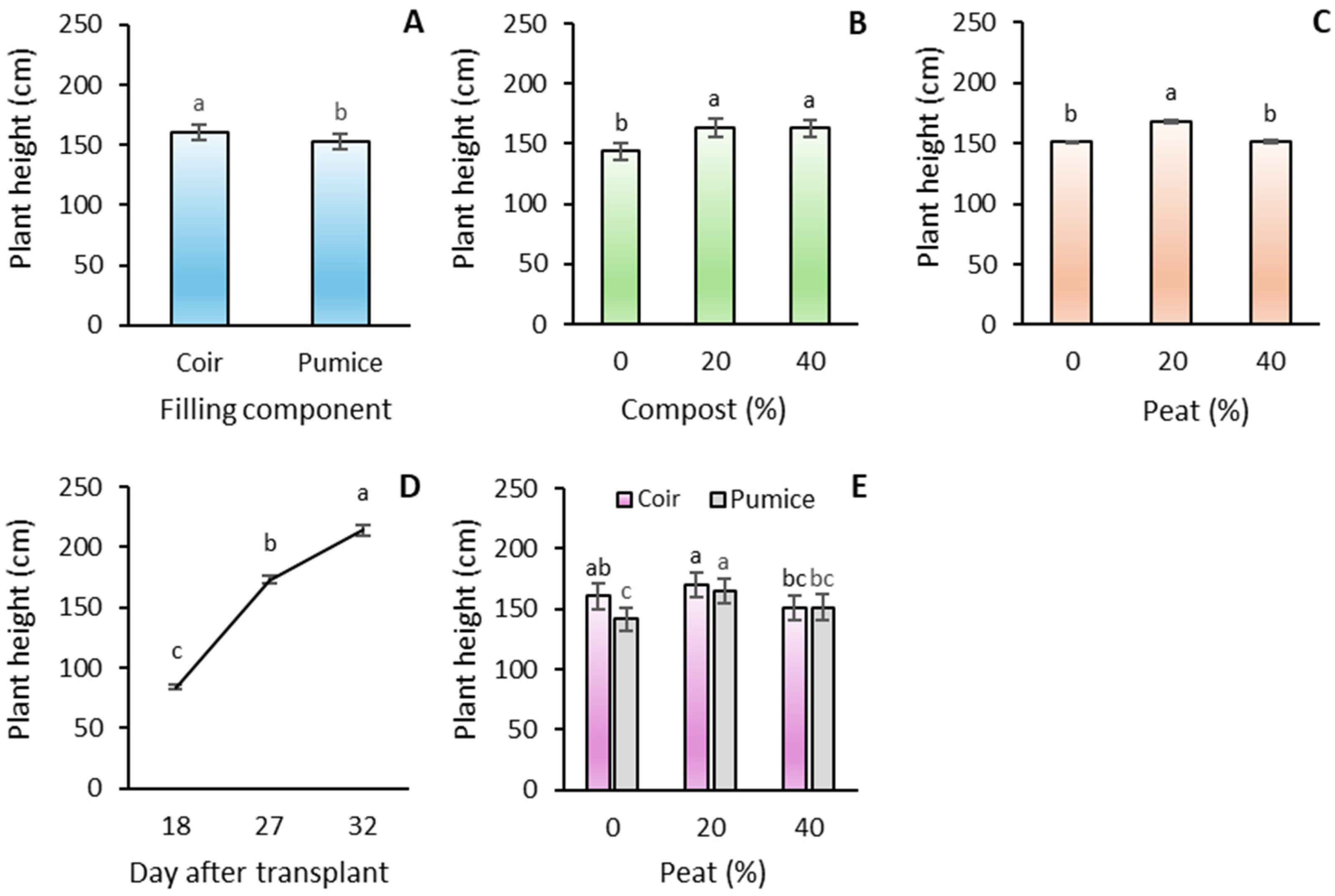
Morphological parameters were frequently significantly affected by treatments. Regarding plant height, coir outperformed pumice among the filling substrate components, increasing plant height by 5% (Figure 2A). The rate of compost influenced plant height: 20% of compost increased plant height by around 13% compared to 0% compost, no other gain was obtained by raising compost content to 40% (Figure 2B). A 20% peat resulted in 11% taller plants than those grown in peat-free substrates. However, further increases in peat content reversed this positive effect (Figure 2C). Overall, plant height rapidly increased, reaching 83.8 cm at 18 DAT and exceeding 2 m in the following two weeks (Figure 2D). A significant interaction between the peat content and the filling component was observed: with 20% or 40% of peat, plant height was unaffected by the filling component, while plants grown in the peat-free substrate were significantly taller with coir than with pumice (Figure 2E).
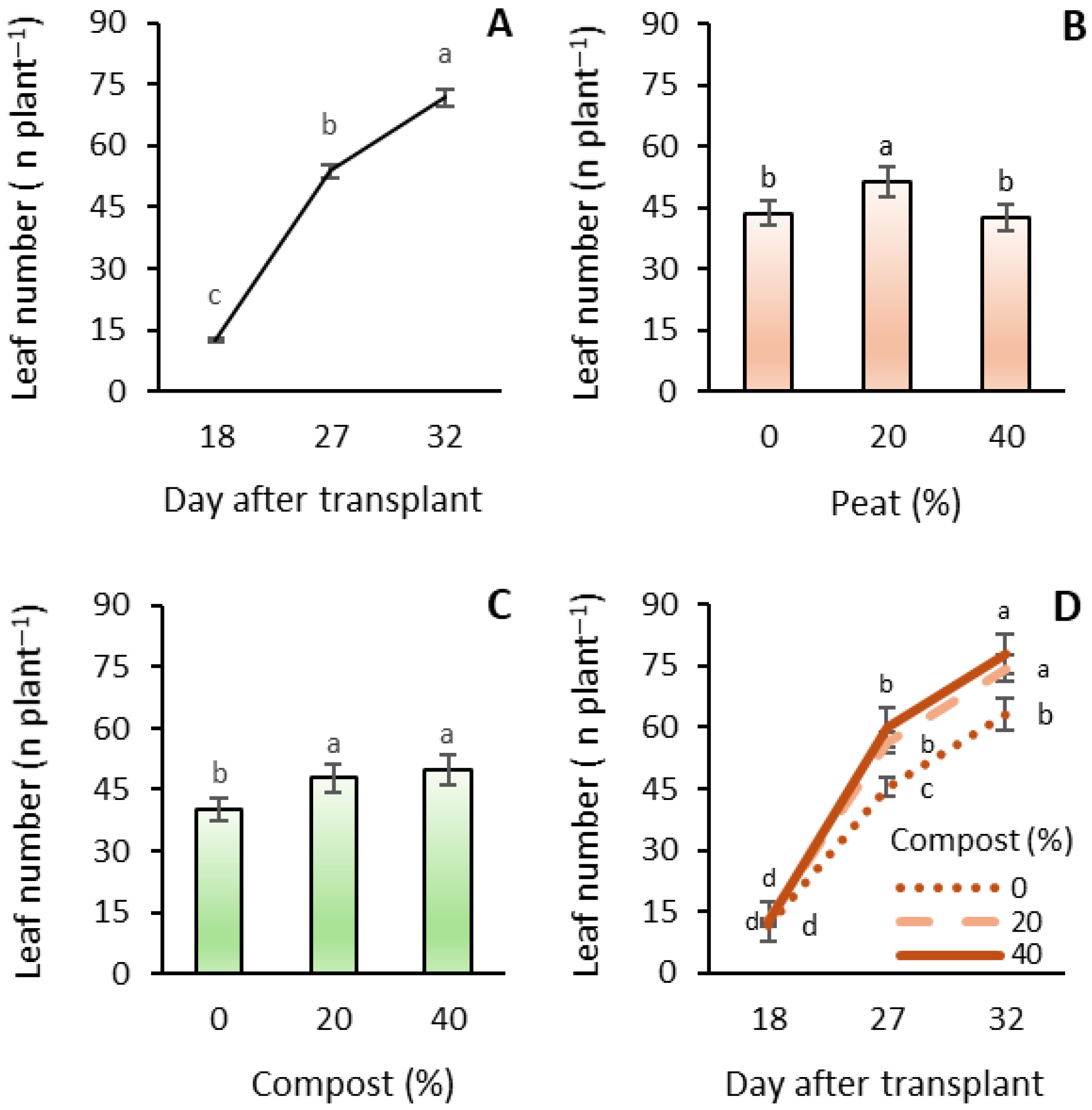
The average leaf number followed similar trends, increasing from 12.5 to 71.7 in 14 days (Figure 3A). Similarly, the highest leaf number was observed when substrates contained 20% peat (Figure 3B) and 20% or 40% compost (Figure 3C). However, the positive effect of compost was significant only from 12 June, at 27 DAT (Figure 3D).
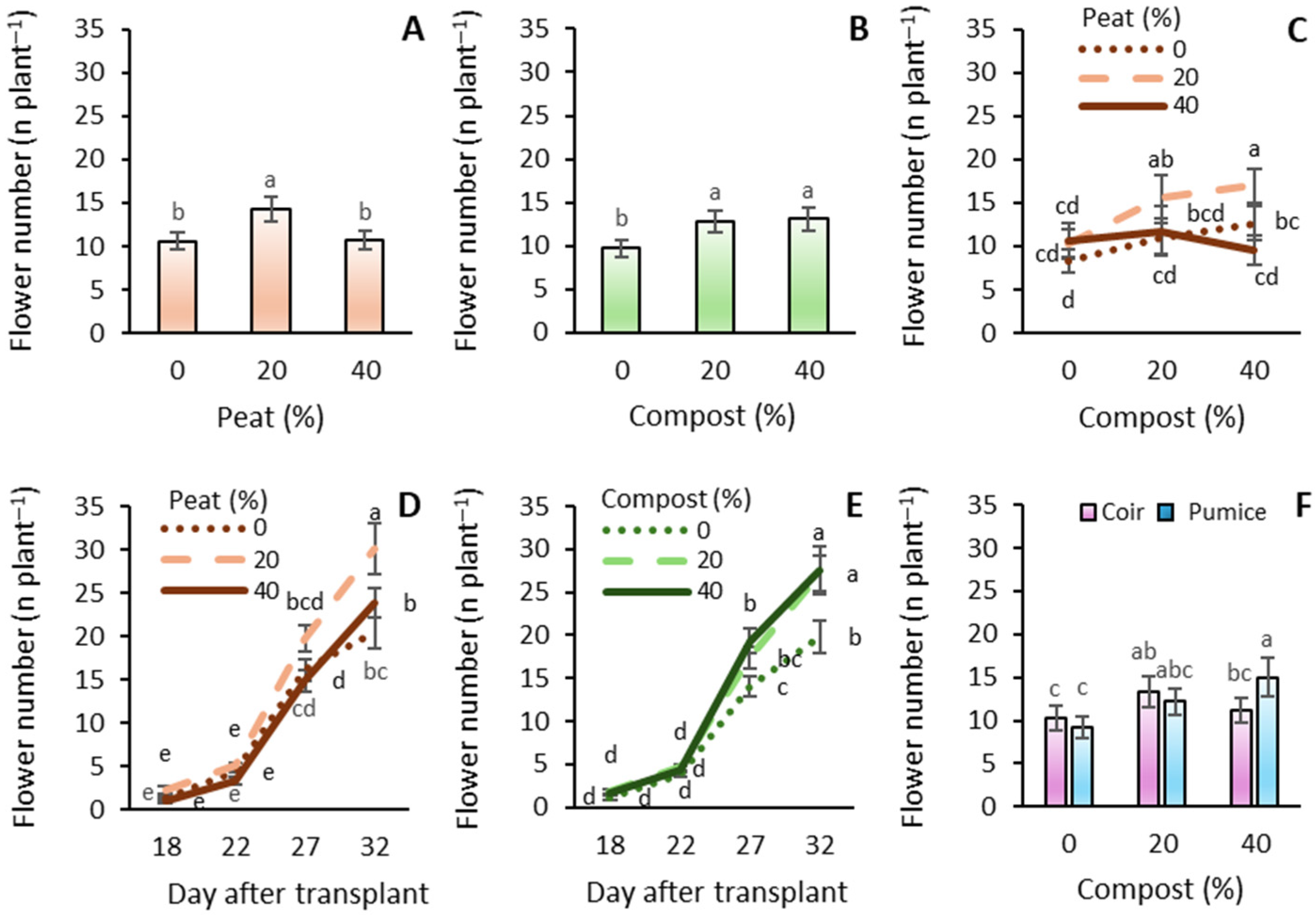
As for plant height and leaf number, incorporating 20% peat and 20% or 40% compost positively influenced the flower number, which increased by around 35% and 22%, as compared to the substrates without peat or compost (Figure 4A,B). However, a significant interaction between peat and compost components was found, indicating that the negative impact of 40% peat was particularly evident when substrates contained 40% compost (Figure 4C). For peat addition to the mix, the effect was significant only at the last sampling date (Figure 4D), while compost-related differences were already detected at 27 DAT (Figure 4E). The interaction between compost content and filling component was also significant. With 40% compost, a higher flower number was observed when pumice was used as a filling component, whereas at lower compost amounts, the difference between the two filling components was not significant (Figure 4F).

3.3. Plant Physiological Status

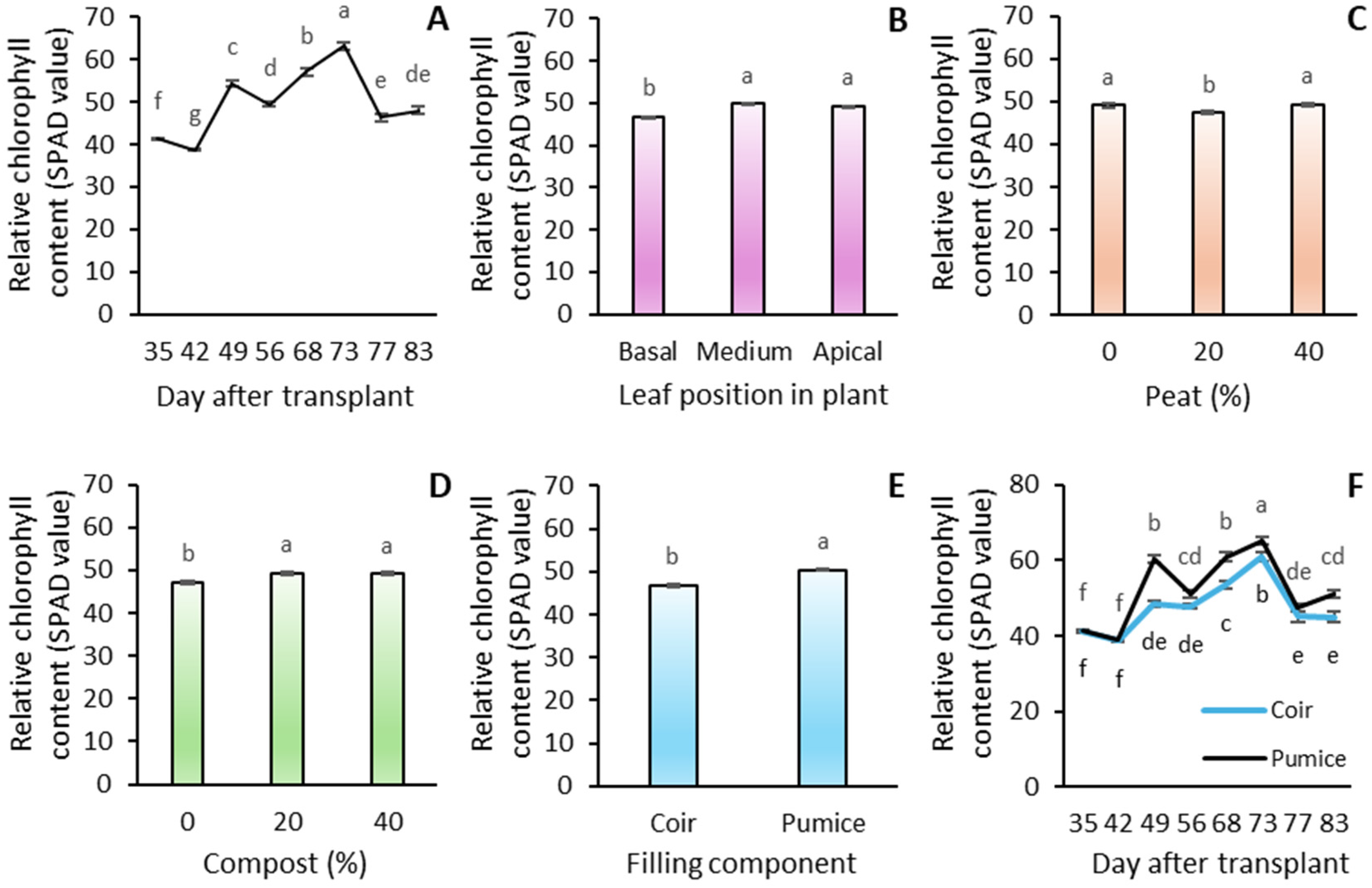
Only the sampling data had a significant effect on leaf temperature (Supplementary Figure S1), no significant differences were observed for the other factors. The relative chlorophyll content recorded in cucumber plants, on the other hand, showed several significant differences. First of all, in the sampling data, it followed a rising trend until 73 DAT, decreasing in the last week of the trial (Figure 5A). Leaf position also affected relative chlorophyll content, which was higher in the plant’s middle and apical parts (49.5 vs. 46.6 of basal leaves) (Figure 5B). Relative chlorophyll content was comparable between 0% and 40% peat substrates but decreased (by 4%) using substrates with 20% peat (Figure 5C). On the other hand, 20% and 40% compost increased relative chlorophyll content (Figure 5D) as compared to compost-free substrate. Among filling components, relative chlorophyll content was 8% higher in substrates containing pumice than in those containing coir. (Figure 5E). In particular, differences appeared to be stronger in the central four sampling times (between 49 and 73 DAT) when the average difference was around 12% (Figure 5F).

3.4. Production

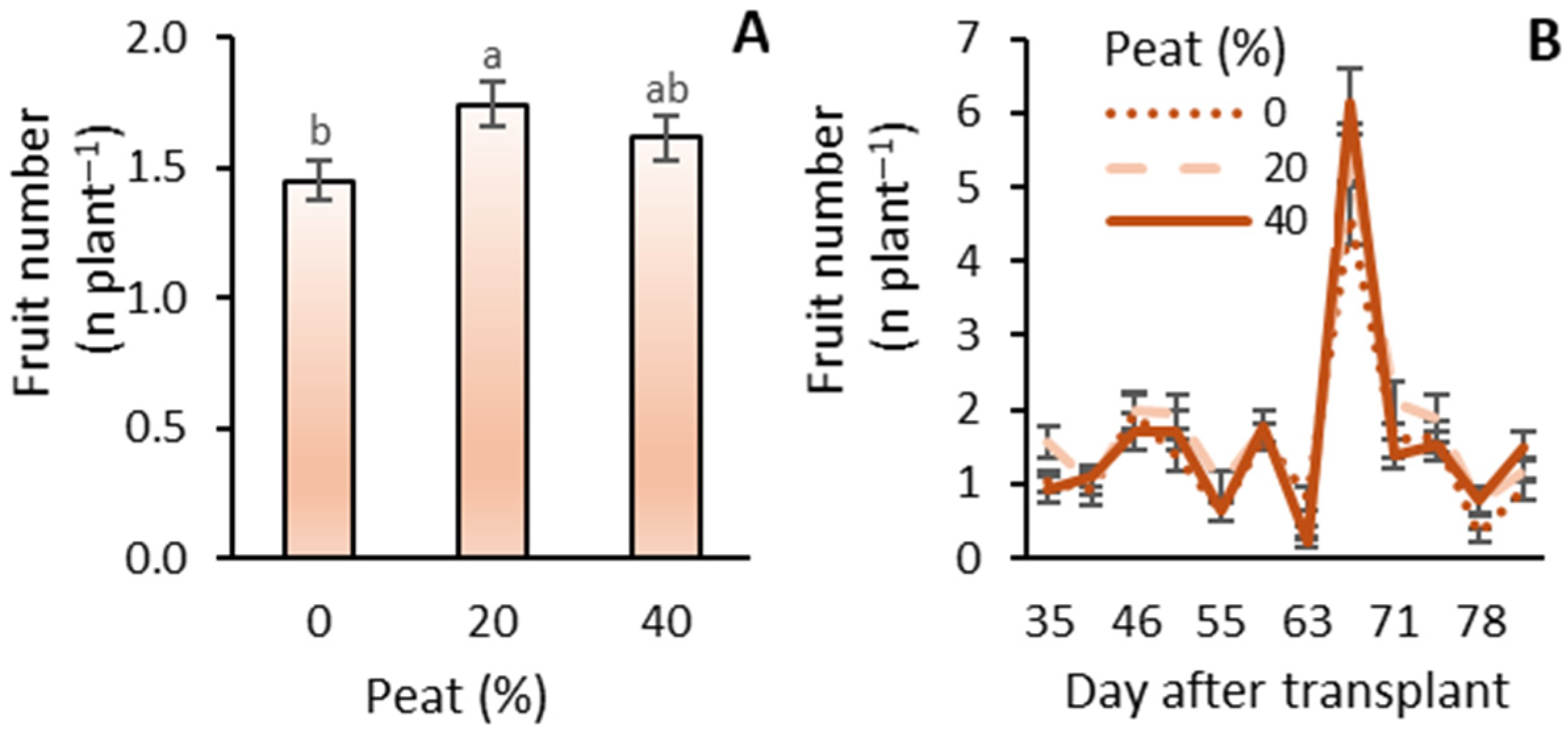
Fruit harvest occurred 12 times at 4–7-day intervals, starting from 35 DAT. Peat content affected fruit number, and substrate containing 20% peat resulted in fruit numbers being around 21% higher than the peat-free ones (Figure 6A). The interaction between the two factors (sampling date and peat content) was also significant: 20% peat resulted in a higher fruit number before 59 DAT, while afterwards 40% peat treatment enabled the production of a higher number of fruits, reaching, at the last harvest, a significantly higher fruit number compared to the 20% peat and peat-free substrates (Figure 6B).
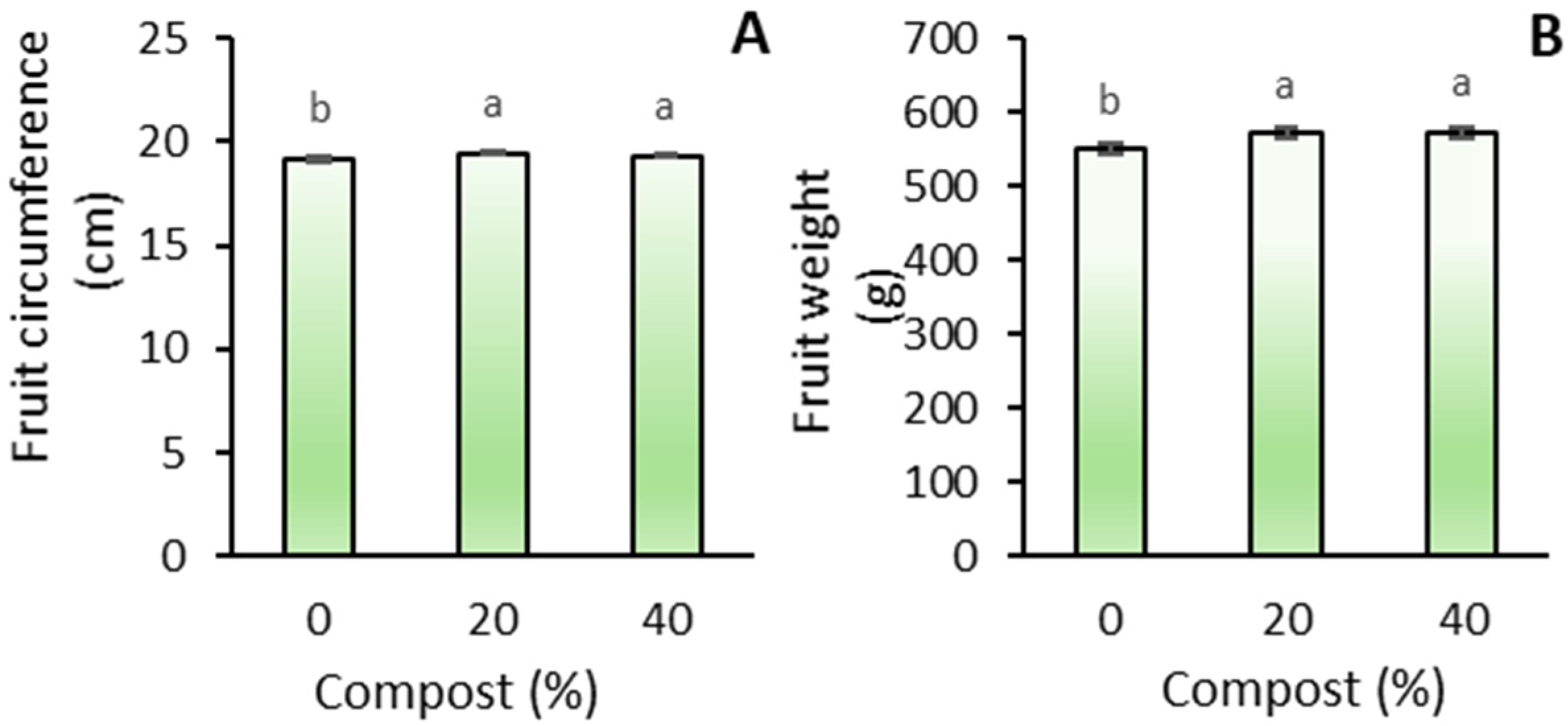
The average fruit length differed according to the sampling date, ranging from 25 to 30 cm (Supplementary Table S2). Generally, higher values were found in the central part of the sampling period, between 52 and 67 DAT. Fruit circumference and fruit weight showed a similar response to the treatments. Values ranged from 19 to 21 cm for fruit circumference and 420 to 700 g for fruit weight. The highest values were observed between 59 and 71 DAT. A small but significant increase in these fruit features was observed when plants were grown with 20% or 40% compost compared to the compost-free substrate (+1.2 and +4.1%, respectively, for fruit circumference and fruit weight) (Figure 7A,B).
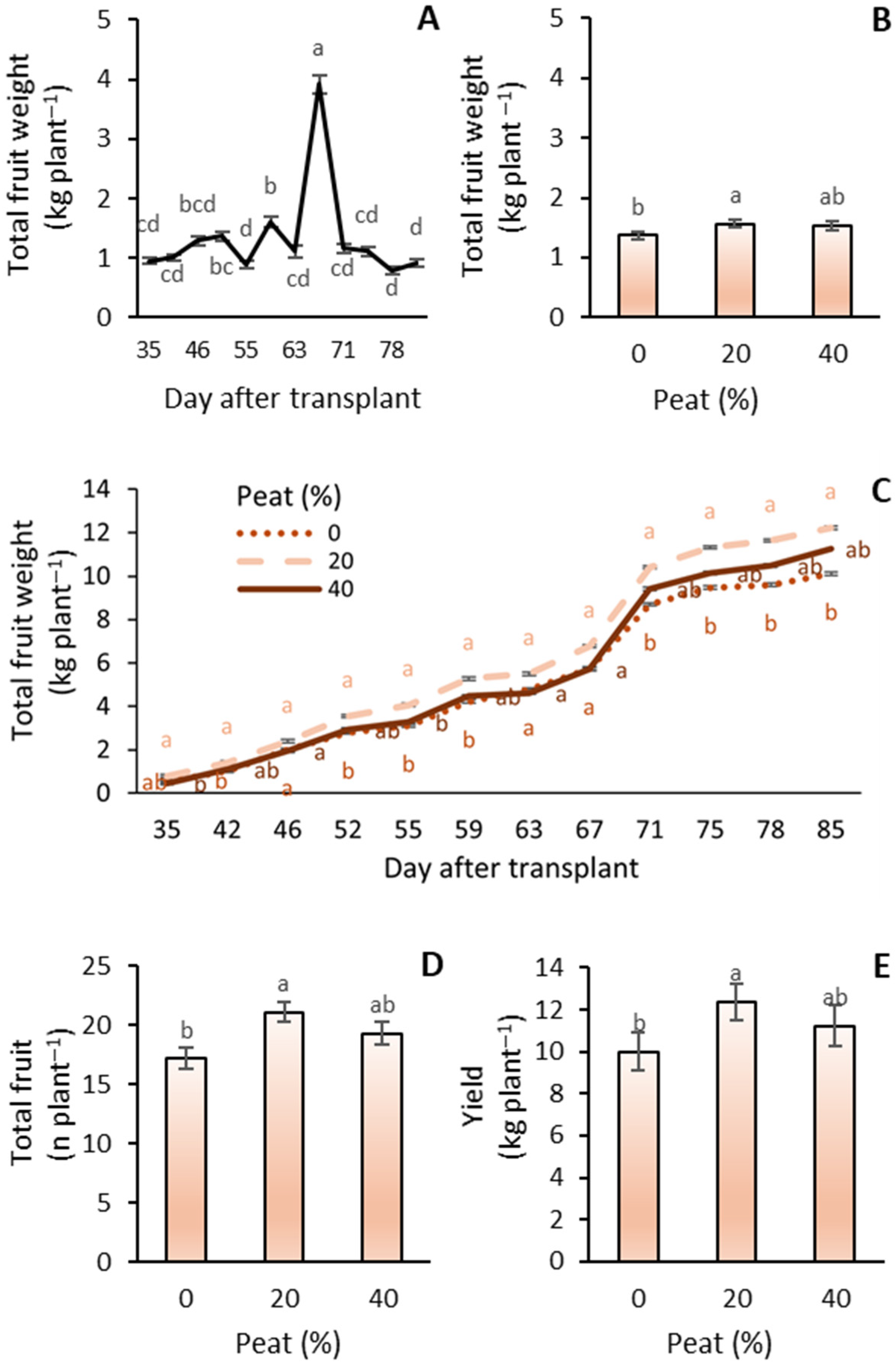
The total fruit yield in the various harvests ranged between 784 and 1599 g plant−1 (apart from the harvest at 67 DAT, which yielded 3913 g plant−1) (Figure 8A, where values represent the mean fruit yield across all treatments at each harvest date). The other statistically significant differences are the following. Plants grown with 20% peat presented a higher (around 14%) total fruit weight as compared to plants grown without peat (Figure 8B). Although 20% peat treatment had the best performance in terms of total fruit weight, this was not always consistent over time. In fact, at the last harvest, plants with 20% peat yielded 21.4% less than the 40% treatment (Figure 8C). Total fruit number and yield were only affected by peat content. In both cases, the best performances were obtained by plants grown with 20% peat, showing an increment of 22.9% in fruit number and 23.9% in yield compared to the peat-free substrates (Figure 8D,E).

4. Discussion

Many analyzed morphological parameters (e.g., plant height, leaf and flower number) showed the best performance in cucumber plants grown with 20% peat (Figure 2C, Figure 3B and Figure 4A). This was also confirmed at harvest, as fruit number (Figure 8D), total fruit weight (Figure 8B), and total yield (Figure 8E) showed the highest values in plants grown with 20% peat. Peat is one of the most widely used substrates in the world because of its stability and consistency in physical and chemical properties, which make it optimal for horticultural production, even in soilless systems [19,38,39]. Peat exhibits structural stability and wettability with optimal aeration and water-holding capacity, ensuring plant growth is in line with its requirements [40]. This is in accordance with the analytical data obtained by the substrate analysis, where water holding capacity increased with the rising peat rate. Furthermore, Majdi et al. [41], compared three different substrates for soilless cultivation of green pepper (Capsicum annum L.): vermiculite—sand (1:1), peat—perlite (1:1) and rock wool, and recorded a higher yield in the treatment that included peat, highlighting the ability of peat to promote vegetable production. The ability to retain water played an important role in plant growth and production of cucumber, especially in a tropical greenhouse subjected to extremely high heat. Physiological parameters of plants grown with 20% peat, contrasting to observations in yields, did not demonstrate superior performance compared with plants grown in absence or with 40% peat. No differences in leaf temperature were detected in response to substrate components, and the relative chlorophyll content was even lower with 20% peat, respective to 0% peat and 40% peat treatments (Figure 5C). Chlorophylls are extremely sensitive to stress, making them a reliable indicator of plants’ response to environmental conditions, as their content declines rapidly in adverse conditions [42]. However, the lower relative chlorophyll content in the 20% peat treatment does not necessarily contradict the expectations: higher SPAD readings of relative chlorophyll content values can result from pigment concentration in fewer and narrower leaves, which may indicate stress conditions [43].
The presence of compost in the substrate mix, as compared to compost-free substrate, increased plant height (Figure 2B), leaf (Figure 3C) and flower numbers (Figure 4B), fruit dimensions (Figure 7A) and weight (Figure 7B), and relative chlorophyll content (Figure 5D). Unfortunately, from a production standpoint, compost’s positive effect did not translate into an increase in yield. Compost is well known for its benefits for plant growth and production, as highlighted by several studies [44,45,46,47]. In our substrates, compost was able to increase water-holding capacity. It has also been reported that compost can improve the efficiency of capturing applied nitrogen by decreasing the nutrients leaching from the matrix substrate [48]. This is due to better water retention and ion-exchange capacity, which are undoubtedly important in a soilless cultivation system. The result obtained with the use of compost, with respect to the compost-free substrate, can be considered a great result for the Trifinio region. Despite no improvement being observed in terms of yield, we reported a positive impact on both morphological parameters and fruit features using compost. This is combined with the fact that it is a widespread ecological and low-impact material that all farmers can easily produce. Therefore, an easily available substrate can be adopted by growers, enabling soilless cucumber production with high production standards.
An interaction between the rate of compost and peat was found to affect flower number (Figure 4C), for which higher values were observed with 20% peat, regardless of the compost rate. In contrast, a decrease in flowers number was observed when 40% peat was combined with 40% compost (Figure 4C). This can be explained by an excessive water retention in both peat and compost which were found to increase water-holding capacity in our soil analysis, as is also reported in the literature [49,50]. Sphagnum peat is known for its significant water-retention capacity, but this comes at the expense of aeration [51], and compost has been shown to significantly increase water-holding capacity, particularly in coarser substrates, such as pumice and coir [52,53]. As Haghighi et al. [54] reported, increasing water retention and decreasing air porosity can lead to waterlogging in hydroponic systems, resulting in hypoxic conditions for the plant roots. These authors observed that cucumber plants under waterlogged conditions exhibit reduced transpiration and lower stomatal conductance. A decrease in potassium and phosphorus uptake due to waterlogging has also been recorded, which are key elements for fruit production and flower development [55], this could explain the lower number of flowers in the presence of 40% peat and 40% compost. An appropriate balance between air space and water-holding capacity is highly important. Yang et al. [19] compared five different substrates for cucumber cultivation in Dutch bucket system (namely: sphagnum peat, medium-grade pine bark, coarse-grade pine bark, coir, and wood fiber). This research found that the medium-grade pine bark substrate showed the best performance in terms of both fresh and dry fruit weight and earliest fruiting time. This substrate had an air space of 30% and a water holding capacity of 42.6%, which are intermediate values compared to those of the other substrates analyzed, highlighting the importance of balancing these two factors.
Even if the plants showed the best performance in terms of production using 20% peat, the environmental problems related to peatland exploitation is a well-established concern [56]. Peat extraction has a considerable environmental impact, especially on climate regulation, hydrology, and the biodiversity of natural peatlands [57]. Cleary et al. [58] conducted a life cycle assessment (LCA) to estimate the net greenhouse gas (GHG) emissions of the Canadian peat industry between 1990 and 2000. The study highlighted how peatlands, once exploited for peat production, shift from functioning as GHG sinks to becoming net sources of emissions. In addition, their study emphasized that transportation accounts for approximately 10% of the peat industry’s total GHG emissions. This factor becomes even more critical in our scenarios where peat must be transported from the main extraction areas in Northern Europe [59] to Central America, thereby adding a further environmental disadvantage.
Considering the need to identify the most sustainable solution for cucumber soilless cultivation in El Salvador, alternative substrates or mixtures of substrates were evaluated in this research. Taking into account the enhanced yield observed in peat-grown plants, the positive effects of compost application on plant physiology and morphology, and the contrasting environmental burdens associated with the production of peat and compost, the adoption of compost emerges as the more environmentally sustainable option. Compost is obtained through a process with limited ecological consequences, as reported, for example, by the LCA performed by Serafini et al. [60] on the composting process. Furthermore, compost is also able to provide nutrients for plant growth [61], which is one of the reasons why it is becoming increasingly popular as a substrate for soilless cultivation [62,63]. Eklind et al. [64] investigated the use of herbage composts as an horticultural substrate, which was concluded to be a suitable option, also providing nutrients to the seedling for the first six weeks and, thus, contributing to the reduction in fertilizer needs. Finally, Aviles et al. [65] and Bouchtaoui et al. [66] demonstrated the compost’s ability to host and suppress pathogen development.
The filling components tested in this study were coir and pumice. No markedly better performance was observed for one of them: taller plants at early stages were observed with coir (Figure 2A), while higher relative chlorophyll content was recorded in pumice treatment (Figure 5E). However, it must be considered that, as reported for 20% peat treatment, higher relative chlorophyll content can be related to a lower leaves number due to stress conditions. The best performance of plant height, by using coir as filling component, could be due to the high bulk density of pumice. Indeed, it has been observed by Zhao et al. [67] that the use of pure pumice as substrate for hydroponics may lead to more moderate vegetative growth. Studying the development of raspberry (Rubus idaeus L.) in hydroponics, they observed the lowest growth rate when the plant was grown in pure pumice. In contrast, vegetative growth increased in plants that were grown using other substrates (coir and flax) added to pumice.
We observed the interactions between compost rate and the filling component on flower number, where coir obtained a higher performance in the presence of 20% compost, while pumice did so in the presence of 40% compost (Figure 4F). Coir has been reported as beneficial for plants when mixed with a limited quantity of compost [68], while pumice, on other hand, improves soil aeration and reduces negative effects of flooding [69], helping to counterbalance the issues generated by a high percentage of compost. This is mainly due to compost’s high water-retention capacity, which, if excessive, can limit substrate aeration. A further interaction between the filling component and peat and compost was observed in plant height, where it was noted that in peat-free substrates, coir produced taller plants, while the presence of peat (20% or 40%) balanced the plants’ height between substrates (Figure 2E). The observed decline in plant height when coir was combined with a high percentage of compost or peat further supports the hypothesis that excessive water retention can negatively affect the vegetative growth of the plant.
The results regarding plant height and flower number suggest that coir is a suitable substrate and that it performs better, compared to pumice, in the absence of peat or compost.
It should be noted that no effect of the filling component was found in any of the productive traits. Thus, considering the similar results, the choice of the filling component should depend on its sustainability. Both are natural materials and available in the region; however, coir has two essential characteristics for sustainability: it is renewable and can be obtained from waste [70].
We observed that the peat-free substrate composed of 40% compost and 60% coir was able to achieve a plant yield of 11.4 kg plant−1, which falls within the average overall plant yield calculated across all treatments (ranging 8.3 to 13.3 kg plant−1). Considering the plant density adopted (2.5 plants m−2), these translate into a total yield of 28.5 kg m−2, much higher than the average Salvadoran yield of cucumber in soil (i.e., 3.04 kg m−2 in 2023, [69]) and also higher than the final yield obtained by Yang et al. [19]. Considering productivity, availability of materials, and sustainability, we can conclude that the substrate composed of 40% compost and 60% coir is the best among those tested. These results may encourage a greater adoption of soilless cultivation systems to address soil fertility limitations in the Trifinio region, with compost and coir identified as optimal substrate components that balance productivity and sustainability.

5. Conclusions

Based on the results obtained related to both early plant growth and production, organic materials such as compost and peat are beneficial for the plant’s vital parameters and fruit production. The addition of these two organic sources generally led to morphological and productive improvements. However, an excess of organic material (40% compost and 40% peat) decreased morphological indicators, e.g., flower number. Both peat and compost positively affected cucumber plant growth, certain production traits, and final yield. Compost rates of 20% and 40% yielded the best results, particularly for fruit dimension and fruit weight. As compost is readily available and cost-effective, its use at the highest rate is recommended to local farmers. Pumice and coir (coconut fiber) showed no significant production differences. Considering both performance and cost-effectiveness, coir is suggested as a filling component, as it is renewable and aligned with circular economic principles, which are crucial for sustainability and affordability.
The results achieved in this research suggest a mixture of 60% coir and 40% compost. Despite a limitation in flower numbers, this combination did not negatively impact yield (11.4 kg m−2). Both materials are sustainable, easily accessible, and economically viable, making this mix advisable for soilless cucumber production in the Trifinio region.
This study aims to guide soilless cultivation development in the Trifinio region, starting by identifying the most suitable substrate for production and ecological aspects. Future studies should explore other soilless system aspects (e.g., water and nutrition management, shading, cultivation system typology), and other crop species, considering that collaboration between researchers and policymakers is crucial to support farmers in adopting soilless cultivation. Such approach could significantly enhance the region’s agricultural sustainability and production while maintaining low costs.

Supplementary Materials

The following supporting information can be downloaded at: https://www.mdpi.com/article/10.3390/horticulturae11111356/s1, Figure S1: Leaf temperature: effect of sampling data. Line series represent the average values. Only significant results for ANOVA at p ≤ 0.01 are reported. Means with the same letters are similar according to Tukey’s test (p ≤ 0.05); Table S1: Significance letters corresponding to Figure 7B. Means with the same letters are similar according to Tukey’s test (p ≤ 0.05); Table S2: Average fruit length (cm) according to the sampling date. Means with the same letters are similar according to Tukey’s test (p ≤ 0.05).

Author Contributions

Conceptualization, N.M. and T.L.; methodology, G.G., S.B., G.Z., T.L. and N.M.; software S.B. and T.L.; validation, F.O., G.Z., G.P. and G.G.; formal analysis, T.L., S.B. and G.Z.; investigation, T.L., N.M., A.P. and J.S.; resources, N.M.; data curation, S.B., G.Z. and F.O.; writing—original draft preparation, T.L. and G.Z.; writing—review and editing, G.P., F.O., S.B. and G.Z.; visualization, T.L. and G.Z.; supervision F.O., G.P., G.Z. and G.G.; project administration, N.M.; funding acquisition, N.M. All authors contributed to the article and approved the submitted version.

Funding

This study was included within the framework of the Project: “Innovazione tecnologica e ricerca scientifica per un’orticoltura sostenibile e competitiva nella regione Trifinio, AID 12810” promoted by the Italo-Latin American International Organization (IILA) in collaboration with Plan Trifinio and funded by the Italian Agency for Development Cooperation (AICS). Support to this research was also provided by the Horizon Europe programme of the European Commission through the project INtegrated and Circular Technologies for Sustainable city region FOOD systems in Africa (InCitis-Food) grant agreement HEU 101083790.

Data Availability Statement

The original contributions presented in the study are included in the article/Supplementary Material, further inquiries can be directed to the corresponding author.

Acknowledgments

Special thanks to PLAN TRIFINIO for providing resources and to the center of technological innovation of SISTAGRO—PLAN TRIFINIO, Metapan, headquarters and support center for the experiments.

Conflicts of Interest

The authors declare that the research was conducted in the absence of any commercial or financial relationships that could be construed as a potential conflict of interest.

References

  1. FAO. The Second Report on the State of the World’s Plant Genetic Resources for Food and Agriculture. Available online: https://www.fao.org/4/i1500e/i1500e00.htm (accessed on 5 February 2025).
  2. Suarez, A.; Gwozdz, W. On the relation between monocultures and ecosystem services in the Global South: A review. Biol. Conserv. 2023, 278, 109870. [Google Scholar] [CrossRef]
  3. Guereña, A.; Burgos, S. Smallholders at Risk: Monoculture Expansion, Land, Food and Livelihoods in Latin America; Oxfam International: Nairobi, Kenya, 2014. [Google Scholar]
  4. Schlesinger, P.; Muñoz Brenes, C.L.; Jones, K.W.; Vierling, L.A. The Trifinio Region: A case study of transboundary forest change in Central America. J. Land Use Sci. 2017, 12, 36–54. [Google Scholar] [CrossRef]
  5. Belete, T.; Yadete, E. Effect of Mono Cropping on Soil Health and Fertility Management for Sustainable Agriculture Practices: A Review. J. Plant Sci. 2023, 11, 6. [Google Scholar] [CrossRef]
  6. FAO. Regional assessment of soil changes in Latin America and the Caribbean. In Status of the World’s Soil Resources (SWSR)—Main Report; FAO: Rome, Italy, 2015. [Google Scholar]
  7. Khangura, R.; Ferris, D.; Wagg, C.; Bowyer, J. Regenerative Agriculture—A Literature Review on the Practices and Mechanisms Used to Improve Soil Health. Sustainability 2023, 15, 2338. [Google Scholar] [CrossRef]
  8. FAOSTAT. Available online: https://www.fao.org/faostat/en/#data (accessed on 10 February 2025).
  9. Arumugam, T.; Sandeep, G.; Maheswari, M.U. Soilless farming of vegetable crops: An overview. Pharma Innov. J. 2021, 10, 773–785. [Google Scholar]
  10. Raviv, M.; Lieth, J.H.; Bar-Tal, A. Soilless Culture: Theory and Practice, 1st ed.; Elsevier Science: Amsterdam, The Netherlands, 2019. [Google Scholar]
  11. Alsmairat, N.G.; Al-Ajlouni, M.G.; Ayad, J.Y.; Othman, Y.A.; Hilaire, R.S. Hilaire Composition of soilless substrates affect the physiology and fruit quality of two strawberry (Fragaria × ananassa Duch.) cultivars. J. Plant Nutr. 2018, 41, 2356–2364. [Google Scholar] [CrossRef]
  12. Savvas, D.; Gruda, N. Application of soilless culture technologies in the modern greenhouse industry—A review. Eur. J. Hortic. Sci. 2018, 83, 280–293. [Google Scholar] [CrossRef]
  13. Al-Ajlouni, M.G.; Ayad, J.Y.; Othman, Y.A. Particle Size of Volcanic Tuff Improves Shoot Growth and Flower Quality of Asiatic Hybrid Lily Using Soilless Culture. HortTechnology 2017, 27, 223–227. [Google Scholar] [CrossRef]
  14. Rodriguez Delfin, A. Advances of hydroponics in Latin America. Acta Hortic. 2012, 947, 23–32. [Google Scholar] [CrossRef]
  15. Raviv, M.; Wallach, R.; Silber, A.; Bar-Tal, A. Substrates and their analysis. In Hydroponic Production of Vegetables and Ornamentals; Savvas, D., Passam, H., Eds.; Embryo Publications: Athens, Greece, 2002; pp. 25–102. [Google Scholar]
  16. Ferrés, D.; Granados, H.D.; Hernández, W.; Pullinger, C.; Chávez, H.; Taracena, C.R.C.; Cañas-Dinarte, C. Three thousand years of flank and central vent eruptions of the San Salvador volcanic complex (El Salvador) and their effects on El Cambio archeological site: A review based on tephrostratigraphy. Bull. Volcanol. 2011, 73, 833–850. [Google Scholar] [CrossRef]
  17. Al-Far, A.M.; Tadros, M.J.; Makhadmeh, I.M. Evaluation of different soilless media on growth, quality, and yield of cucumber (Cucumis sativus L.) grown under greenhouse conditions. Aust. J. Crop Sci. 2019, 13, 1388–1401. [Google Scholar] [CrossRef]
  18. Kacjan Marsic, N.; Jakse, M. Growth and yield of grafted cucumber (Cucumis sativus L.) on different soilless substrates. J. Food Agric. Environ. 2010, 8, 654–658. [Google Scholar]
  19. Yang, T.; Altland, J.E.; Samarakoon, U.C. Evaluation of substrates for cucumber production in the Dutch bucket hydroponic system. Sci. Hortic. 2023, 308, 111578. [Google Scholar] [CrossRef]
  20. Ali, A.A.-B.A. Studies on Cucumber Production Using Substrate Culture Under North Sinai Conditions. J. Ecol. Eng. 2023, 24, 40–53. [Google Scholar] [CrossRef]
  21. Kottek, M.; Grieser, J.; Beck, C.; Rudolf, B.; Rubel, F. World Map of the Köppen-Geiger Climate Classification Updated. Meteorol. Z. 2006, 15, 259–263. [Google Scholar] [CrossRef]
  22. Peel, M.C.; Finlayson, B.L.; McMahon, T.A. Updated world map of the Köppen-Geiger climate classification. Hydrol. Earth Syst. Sci. 2007, 11, 1633–1644. [Google Scholar] [CrossRef]
  23. Lamembert Lambert Peat Moss LM-18 GERMINATION 15P Data Sheet. Available online: https://www.imporalaska.com/uploads/products/2021/02/ficha_1614352546_1614352926.pdf (accessed on 3 November 2025).
  24. EN 13040; Soil Improvers and Growing Media. Sample Preparation for Chemical and Physical Tests, Determination of Dry Matter Content, Moisture Content and Laboratory Compacted Bulk Density. Technical Committee CEN/TC 223; European Committee For Standardization (CEN): Brussels, Belgium, 2007.
  25. Fonteno, W.C.; Harden, C.T. Procedures for Determining Physical Properties of Horticultural Substrates Using The NCSU Porometer; Horticultural Substrates Laboratory, North Carolina State University: Raleigh, NC, USA, 1995. [Google Scholar]
  26. Fonteno, W.; Bilderback, T. Impact of Hydrogel on Physical Properties of Coarse-structured Horticultural Substrates. J. Am. Soc. Hortic. Sci. 1993, 118, 217–222. [Google Scholar] [CrossRef]
  27. EN 13037; Soil Improvers and Growing Media. Determination of pH. Technical Committee CEN/TC 223; European Committee For Standardization (CEN): Brussels, Belgium, 2011.
  28. EN 13038; Soil Improvers and Growing Media. Determination of Electrical Conductivity. Technical Committee CEN/TC 223; European Committee For Standardization (CEN): Brussels, Belgium, 2011.
  29. Gianquinto, G.; Goffart, J.P.; Olivier, M.; Guarda, G.; Colauzzi, M.; Dalla Costa, L.; Delle Vedove, G.; Vos, J.; MacKerron, D.K.L. The use of hand-held chlorophyll meters as a tool to assess the nitrogen status and to guide nitrogen fertilization of potato crop. Potato Res. 2004, 47, 35–80. [Google Scholar] [CrossRef]
  30. Yue, X.; Hu, Y.; Zhang, H.; Schmidhalter, U. Evaluation of Both SPAD Reading and SPAD Index on Estimating the Plant Nitrogen Status of Winter Wheat. Int. J. Plant Prod. 2019, 14, 67–75. [Google Scholar] [CrossRef]
  31. Jiménez-Bello, M.A.; Ballester, C.; Castel, J.R.; Intrigliolo, D.S. Development and validation of an automatic thermal imaging process for assessing plant water status. Agric. Water Manag. 2011, 98, 1497–1504. [Google Scholar] [CrossRef]
  32. R Core Team. R: A Language and Environment for Statistical Computing; R Foundation for Statistical Computing: Vienna, Austria, 2023. [Google Scholar]
  33. Fox, J.; Weisberg, S. An R Companion to Applied Regression, 3rd ed.; SAGE Publications Inc.: Thousand Oaks, CA, USA, 2019. [Google Scholar]
  34. de Mendiburu, F. Agricolae: Statistical Procedures for Agricultural Research. 22 October 2023. Available online: https://cran.r-project.org/web/packages/agricolae/index.html (accessed on 6 February 2025).
  35. Bates, D.; Mächler, M.; Bolker, B.; Walker, S. Fitting Linear Mixed-Effects Models Using lme4. J. Stat. Softw. 2015, 67, 1–48. [Google Scholar] [CrossRef]
  36. Kuznetsova, A.; Brockhoff, P.B.; Christensen, R.H.B. lmerTest Package: Tests in Linear Mixed Effects Models. J. Stat. Softw. 2017, 82, 1–26. [Google Scholar] [CrossRef]
  37. Amani, M.; Foroushani, S.; Sultan, M.; Bahrami, M. Comprehensive review on dehumidification strategies for agricultural greenhouse applications. Appl. Therm. Eng. 2020, 181, 115979. [Google Scholar] [CrossRef]
  38. Kingston, P.H.; Scagel, C.F.; Bryla, D.R.; Strik, B. Suitability of Sphagnum Moss, Coir, and Douglas Fir Bark as Soilless Substrates for Container Production of Highbush Blueberry. HortScience 2017, 52, 1692–2699. [Google Scholar] [CrossRef]
  39. Carlile, W.; Raviv, M.; Prasad, M. Organic soilless media components. In Soilless Culture; Elsevier: Amsterdam, The Netherlands, 2019; pp. 303–378. [Google Scholar] [CrossRef]
  40. Younis, A.; Ahsan, M.; Akram, A.; Lim, K.-B.; Zulfiqar, F.; Tariq, U. Use of Organic Substrates in Sustainable Horticulture. In Biostimulants for Crop Production and Sustainable Agriculture; CABI Books: Wallingford, UK, 2022; pp. 122–138. [Google Scholar] [CrossRef]
  41. Majdi, Y.; Ahmadizadeh, M.; Ebrahimi, R. Effect of Different Substrates on Growth Indices and Yield of Green Peppers at Hydroponic Cultivate. Curr. Res. J. Biol. Sci. 2012, 4, 496–499. [Google Scholar]
  42. Talebzadeh, F.; Valeo, C. Evaluating the Effects of Environmental Stress on Leaf Chlorophyll Content as an Index for Tree Health. IOP Conf. Ser. Earth Environ. Sci. 2022, 1006, 012007. [Google Scholar] [CrossRef]
  43. Shah, S.H.; Houborg, R.; McCabe, M.F. Response of Chlorophyll, Carotenoid and SPAD-502 Measurement to Salinity and Nutrient Stress in Wheat (Triticum aestivum L.). Agronomy 2017, 7, 61. [Google Scholar] [CrossRef]
  44. Eksi, M.; Rowe, D.B.; Fernández-Cañero, R.; Cregg, B.M. Effect of substrate compost percentage on green roof vegetable production. Urban For. Urban Green. 2015, 14, 315–322. [Google Scholar] [CrossRef]
  45. Gruda, N.S. Increasing Sustainability of Growing Media Constituents and Stand-Alone Substrates in Soilless Culture Systems. Agronomy 2019, 9, 298. [Google Scholar] [CrossRef]
  46. Atzori, G.; Pane, C.; Zaccardelli, M.; Cacini, S.; Massa, D. The Role of Peat-Free Organic Substrates in the Sustainable Management of Soilless Cultivations. Agronomy 2021, 11, 1236. [Google Scholar] [CrossRef]
  47. Aydi, S.; Eksi, M.; Rowe, D.B.; Fernández-Cañero, R.; Cregg, B.M. Date-Palm Compost as Soilless Substrate Improves Plant Growth, Photosynthesis, Yield and Phytochemical Quality of Greenhouse Melon (Cucumis melo L.). Agronomy 2023, 13, 212. [Google Scholar] [CrossRef]
  48. Lim, L.Y.; Lee, C.T.; Bong, C.P.C.; Lim, J.S.; Sarmidi, M.R.; Klemes, J.J. A Review on the Impacts of Compost on Soil Nitrogen Dynamics. Chem. Eng. Trans. 2018, 63, 349–354. [Google Scholar] [CrossRef]
  49. Bondì, C.; Castellini, M.; Iovino, M. Compost Amendment Impact on Soil Physical Quality Estimated from Hysteretic Water Retention Curve. Water 2022, 14, 1002. [Google Scholar] [CrossRef]
  50. Li, H.; Parent, L.E.; Karam, A.; Tremblay, C. Potential of Sphagnum peat for improving soil organic matter, water holding capacity, bulk density and potato yield in a sandy soil. Plant Soil 2004, 265, 355–365. [Google Scholar] [CrossRef]
  51. Michel, J.-C. The Physical Properties of Peat: A Key Factor for Modern Growing Media. Mires Peat 2010, 6, 2. [Google Scholar] [CrossRef]
  52. Adugna, G. A Review on Impact of Compost on Soil Properties, Water Use and Crop Productivity. 2016. Available online: https://www.semanticscholar.org/paper/A-review-on-impact-of-compost-on-soil-properties%2C-Adugna/266b919a0d00b0aeb0b0ae3efcf01e234a9f4000 (accessed on 14 February 2025).
  53. Zemánek, P. Evaluation of compost influence on soil water retention. Acta Univ. Agric. Silvic. Mendel. Brun. 2014, 59, 227–232. [Google Scholar] [CrossRef]
  54. Haghighi, M.; Khosravi, S. Effects of Grafting on Cucumber Growth Under Flooding Stress During 15 Days in Vegetative Stage. J. Agric. Sci. Technol. 2022, 24, 873–883. [Google Scholar]
  55. Huđ, A.; Šamec, D.; Senko, H.; Petek, M.; Brkljačić, L.; Pole, L.; Lazarević, B.; Rajnović, I.; Udiković-Kolić, N.; Mešić, A.; et al. Response of White Cabbage (Brassica oleracea var. capitata) to Single and Repeated Short-Term Waterlogging. Agronomy 2023, 13, 200. [Google Scholar] [CrossRef]
  56. Bonn, A.; Reed, M.S.; Evans, C.D.; Joosten, H.; Bain, C.; Farmer, J.; Emmer, I.; Couwenberg, J.; Moxey, A.; Artz, R.; et al. Investing in nature: Developing ecosystem service markets for peatland restoration. Ecosyst. Serv. 2014, 9, 54–65. [Google Scholar] [CrossRef]
  57. Räsänen, A.; Albrecht, E.; Annala, M.; Aro, L.; Laine, A.M.; Maanavilja, L.; Mustajoki, J.; Ronkanen, A.-K.; Silvan, N.; Tarvainen, O.; et al. After-use of peat extraction sites—A systematic review of biodiversity, climate, hydrological and social impacts. Sci. Total Environ. 2023, 882, 163583. [Google Scholar] [CrossRef]
  58. Cleary, J.; Roulet, N.T.; Moore, T.R. Greenhouse gas emissions from Canadian peat extraction, 1990–2000: A life-cycle analysis. Ambio 2005, 34, 456–461. [Google Scholar] [CrossRef] [PubMed]
  59. Hirschler, O.; Osterburg, B. Peat Extraction, Trade and Use in Europe: A Material Flow Analysis. Mires Peat 2022, 28, 24. [Google Scholar] [CrossRef]
  60. Serafini, L.F.; Feliciano, M.; Rodrigues, M.A.; Gonçalves, A. Systematic Review and Meta-Analysis on the Use of LCA to Assess the Environmental Impacts of the Composting Process. Sustainability 2023, 15, 1394. [Google Scholar] [CrossRef]
  61. Farrell, M.; Jones, D. Food waste composting: Its use as a peat replacement. Waste Manag. 2010, 30, 1495–1501. [Google Scholar] [CrossRef]
  62. Raviv, M. Composts in growing media: What’s new and what’s next? Acta Hortic. 2013, 982, 39–52. [Google Scholar] [CrossRef]
  63. Del Salas Sanjuán, M.C.; Pardossi, A.; Incrocci, L.; Gianquinto, G. Managing Mineral Nutrition in Soilless Culture. In Rooftop Urban Agriculture; Springer International Publishing: Cham, Switzerland, 2017. [Google Scholar] [CrossRef]
  64. Eklind, Y.; Salomonsson, L.; Wivstad, M.; Rämert, B. Use of Herbage Compost as Horticultural Substrate and Source of Plant Nutrients. Biol. Agric. Hortic. 2014, 16, 269–290. [Google Scholar] [CrossRef]
  65. Aviles, M.; Borrero, C.; Trillas, M.I. Review on compost as an inducer of disease suppression in plants grown in soilless culture. Dyn. Soil Dyn. Plant 2011, 5, 1–11. [Google Scholar]
  66. Bouchtaoui, E.M.; Haouas, A.; Dababat, A.A.; Lahlali, R.; Benali, A.; Fahr, M.; Smouni, A.; Azim, K.; Liu, Z.; Li, J.; et al. Exploring mechanisms of compost-mediated suppression of plant pathogens: A critical review. Appl. Soil Ecol. 2024, 203, 105644. [Google Scholar] [CrossRef]
  67. Zhao, R.; Sofkova-Bobcheva, S.; Cartmill, D.L.; Hardy, D.; Zernack, A. Comparative evaluation of pumice as a soilless substrate for indoor Rubus idaeus L. cultivation. N. Z. J. Crop Hortic. Sci. 2024, 52, 280–297. [Google Scholar] [CrossRef]
  68. Martins, T.C.; Machado, R.M.A.; Alves-Pereira, I.; Ferreira, R.; Gruda, N.S. Coir-Based Growing Media with Municipal Compost and Biochar and Their Impacts on Growth and Some Quality Parameters in Lettuce Seedlings. Horticulturae 2023, 9, 105. [Google Scholar] [CrossRef]
  69. Sahin, U.; Anapali, O. Addition of Pumice Affects Physical Properties of Soil Used for Container Grown Plants. Agric. Conspec. Sci. 2006, 71, 59–64. [Google Scholar]
  70. Mariotti, B.; Martini, S.; Raddi, S.; Tani, A.; Jacobs, D.F.; Oliet, J.A.; Maltoni, A. Coconut Coir as a Sustainable Nursery Growing Media for Seedling Production of the Ecologically Diverse Quercus Species. Forests 2020, 11, 522. [Google Scholar] [CrossRef]
Figure 1. Climatic parameters recorded inside the greenhouse during the experiment. Black lines represent the daily temperatures (T), gray line indicate the relative humidity (RH).
Horticulturae 11 01356 g001
Figure 2. Plant height: effect of filling component (A), compost rate (B), peat rate (C), sampling data (D), and the interaction between peat rate and filling component (E). Histograms and line series represent the average values, and bars represent the Standard Error Mean (SEM). Only significant results for ANOVA at p ≤ 0.01 are reported. Means with the same letters are similar according to Tukey’s test (p ≤ 0.05).
Horticulturae 11 01356 g002
Figure 3. Leaf number: effect of sampling date (A), peat rate (B), compost rate (C), and the interaction between compost rate and sampling date (D). Histograms and line series represent the average values, and bars represent the Standard Error Mean (SEM). Only significant results for ANOVA at p ≤ 0.01 are reported. Means with the same letters are similar according to Tukey’s test (p ≤ 0.05).
Horticulturae 11 01356 g003
Figure 4. Number of flowers: effect of peat rate (A), compost rate (B), the interaction between compost and peat rate (C), the interaction between data sampling and peat rate (D), among data sampling and compost rate (E), and the interaction between compost rate and filling component (F). Histograms and line series represent the average values, and bars represent the Standard Error Mean (SEM). Only significant results for ANOVA at p ≤ 0.01 are reported. Means with the same letters are similar according to Tukey’s test (p ≤ 0.05).
Horticulturae 11 01356 g004
Figure 5. SPAD values: effect of sampling data (A), leaf position (B), peat rate (C), compost rate (D), filling component (E), and interaction between sampling data and filling rate (F). Histograms and line series represent the average values, and bars represent the Standard Error Mean (SEM). Only significant results for ANOVA at p ≤ 0.01 are reported. Means with the same letters are similar according to Tukey’s test (p ≤ 0.05).
Horticulturae 11 01356 g005
Figure 6. Number of fruits per plant and per harvest: effect of peat rate (A) and interaction between sampling data and peat rate (B). Histograms and line series represent the average values, and bars represent the Standard Error Mean (SEM). Only significant results for ANOVA at p ≤ 0.01 are reported. Means with the same letters are similar according to Tukey’s test (p ≤ 0.05). For panel B statistical significance letters are provided in Supplementary Table S1.
Horticulturae 11 01356 g006
Figure 7. Fruit circumference: effect of compost rate (A), fruit weight: effect of compost rate (B). Histograms represent the average values and bars represent the Standard Error Mean (SEM). Only significant results for ANOVA at p ≤ 0.01 are reported. Means with the same letters are similar according to Tukey’s test (p ≤ 0.05).
Horticulturae 11 01356 g007
Figure 8. Average of total fruit weight: effect of sampling date (A), peat rate (B), and their interaction (C) (shown as cumulative fruit yield per plant), total fruit number per plant: effect of peat rate (D), Yield: effect of peat rate (E). Histograms represent average value, and bars represent Standard Error mean (SEM). Only significant results for ANOVA at p ≤ 0.01 are reported. Means with the same letters are similar according to Tukey’s test (p ≤ 0.05).
Horticulturae 11 01356 g008
Table 1. Composition of the 18 treatments, showing the percentage of peat, compost, coir, and pumice for each treatment.
TreatmentPeat (%)Compost (%)Coir (%)Pumice (%)
1001000
2020800
3040600
4200800
52020600
62040400
7400600
84020400
94040200
10000100
11020080
12040060
13200080
142020060
152040040
16400060
174020040
184040020
Table 2. Physical-chemical characteristics of the substrates evaluated. BD: bulk density, TP: total porosity, AFP: air-filled porosity, WHC: water holding capacity, pH: substrate reaction, and EC: electrical conductivity. Standard deviations, based on three replicates, are reported in parentheses.
Peat
(%)
Compost (%)Coir (%)Pumice (%)BD
(g L−1)
TP
(%)
AFP
(%)
WHC
(%)
pHEC
(µS cm−1)
00100064.8 (8.8)68.6 (2.7)55.2 (1.8)13.4 (1.0)6.5 (0.3)370 (12.3)
000100702.8 (19.4)64.5 (2.5)44.1 (1.5)20.4 (1.0)6.2 (0.3)440 (11.7)
020800281.3 (10.1)79.5 (2.8)55 (1.7)24.5 (1.1)6.6 (0.3)290 (11.2)
020080682.6 (19.2)54.4 (2.4)31.5 (1.3)22.9 (1.0)6.4 (0.3)320 (10.4)
040600280.3 (11.3)61.9 (2.5)16.8 (1.2)45.1 (1.4)6.4 (0.3)300 (10.9)
040060772.8 (20.1)59.4 (2.4)36.1 (1.3)23.2 (1.1)6.5 (0.3)210 (9.2)
20080097.7 (9.0)71.5 (2.7)55.6 (1.7)15.9 (1.0)6.3 (0.3)350 (11.0)
200080675.2 (18.1)54.3 (2.4)27.4 (1.3)26.9 (1.1)6.3 (0.3)40 (6.8)
2020600272.8 (10.2)65.6 (2.6)37 (1.4)28.6 (1.2)6.5 (0.3)410 (11.2)
2020060693.2 (18.3)51.6 (2.3)31.9 (1.3)19.7 (1.0)6.2 (0.3)60 (6.9)
2040400501.1 (13.7)57.2 (2.4)17.3 (1.1)39.9 (1.3)6.6 (0.3)260 (9.4)
2040040623.1 (17.5)59.3 (2.4)34.1 (1.2)25.2 (1.2)6.1 (0.3)130 (7.6)
400600181.5 (9.6)72.7 (2.6)39.2 (1.4)33.5 (1.2)6.4 (0.3)100 (7.3)
400060545.6 (15.7)58.1 (2.4)27.5 (1.2)30.6 (1.1)6 (0.2)130 (6.8)
4020400213.4 (9.8)58.9 (2.4)26.3 (1.2)32.6 (1.2)6.3 (0.3)120 (7.2)
4020040508.5 (15.3)45.3 (2.2)14 (1.0)31.3 (1.2)6 (0.2)100 (6.5)
4040200318.5 (12.1)58.7 (2.4)16.1 (1.0)42.6 (1.4)6 (0.2)130 (7.0)
4040020576.4 (16.0)49.8 (2.2)17.8 (1.0)32 (1.3)6 (0.2)200 (7.4)
Disclaimer/Publisher’s Note: The statements, opinions and data contained in all publications are solely those of the individual author(s) and contributor(s) and not of MDPI and/or the editor(s). MDPI and/or the editor(s) disclaim responsibility for any injury to people or property resulting from any ideas, methods, instructions or products referred to in the content.