Article

Quantification of Light, Photoperiod, Temperature, and Water Stress Symptoms Using Image Features for Smart Vegetable Seedling Production


1
Department of Agricultural Machinery Engineering, Graduate School, Chungnam National University, Daejeon 34134, Republic of Korea
2
Department of Smart Agricultural Systems, Graduate School, Chungnam National University, Daejeon 34134, Republic of Korea
*
Author to whom correspondence should be addressed.
Horticulturae 2025, 11(11), 1340; https://doi.org/10.3390/horticulturae11111340
Submission received: 11 September 2025 / Revised: 28 October 2025 / Accepted: 5 November 2025 / Published: 7 November 2025

Abstract

Environmental factors like light, photoperiod, temperature, and water are vital for crop growth, and even slight deviations from their optimal ranges can cause seedling stress and reduce yield. Therefore, this study aimed to quantify seedling stress symptoms using image features analysis under varying light, photoperiod, temperature, and water conditions. Seedlings were grown under controlled low, normal, and high environmental conditions. Light intensity at 50 µmol m−2 s−1 (low), 250 µmol m−2 s−1 (normal), and 450 µmol m−2 s−1 (high), photoperiod cycles, 8/16 h (day/night) (low), 10/14 h (day/night) (normal), and 16/8 h (day/night) (high) day/night, temperature at 20 °C (low), 25 °C (normal), and 30 °C (high), and water availability at 1 L per day (optimal), 1 L every two days (moderate stress), and 1 L every three days (severe stress) were applied for 15 days. Commercial low-cost RGB, thermal, and depth sensors were used to collect data every day. A total of 1080 RGB images, which were pre-processed with histogram equalization and filters (Median and Gaussian), were used for noise reduction to minimize illumination effects. Morphological, color, and texture features were then analyzed using ANOVA (p < 0.05) to assess treatment effects. The result shows that the maximum canopy area for tomato was 115,226 pixels, while lettuce’s maximum plant height was 9.28 cm. However, 450 µmol m−2 s−1 light intensity caused increased surface roughness, indicating stress-induced morphological alteration. The analysis of Combined Stress Index (CSI) values indicated that the highest stress levels were 50% for pepper, 55% for tomato, 62% for cucumber, 55% for watermelon, 50% for lettuce, and 50% for pak choi. The findings showed that image-based stress detection enables precise environmental control and improves early-stage crop management.

1. Introduction

Seedling health is crucial for crop production, directly influencing growth rates, disease resistance, and overall plant development [1]. During early developmental stages, seedlings are highly sensitive to environmental conditions, and even minor fluctuations in light, temperature, water availability, or nutrient supply can substantially impair growth, vigor, and survival [2]. Healthy seedlings ensure uniform crop establishment, which supports consistent plant height, efficient nutrient uptake, and enhanced tolerance to both biotic and abiotic stresses [3]. Conversely, exposure to stress during early growth can impede development, reduce photosynthetic efficiency, and ultimately lower yield potential [4]. Maintaining optimal seedling health is therefore essential for modern high-efficiency agricultural production systems.
Environmental factors such as temperature, humidity, light intensity, and carbon dioxide (CO2) concentration strongly influence seedling development [5,6]. Deviations from optimal ranges trigger physiological and morphological stress responses, many of which are visually observable. For example, elevated temperatures can increase transpiration and induce leaf wilting, while insufficient light reduces chlorophyll content, inhibits leaf expansion, and restricts growth [7]. Key stress indicators include changes in plant height, canopy area, leaf size, leaf number, and pigmentation [8,9,10]. Understanding how environmental fluctuations affect these traits is critical for optimizing growth conditions and minimizing stress impacts [10,11]. Accurate identification and quantification of stress symptoms enable early detection and more effective health management strategies [11,12].
Traditionally, seedling stress assessment relies on manual visual inspection of traits such as leaf curling, discoloration, or reduced size [13]. While informative, these methods are subjective, labor-intensive, and unsuitable for large-scale applications. In dense, smart seedling production systems, frequent inspection is inefficient and may disturb plant growth [14]. This highlights the need for data-driven, scalable approaches that objectively quantify stress symptoms, determine severity, and monitor their progression over time. Such methods support precise, real-time stress detection and enable timely interventions.
Computer vision has emerged as a powerful tool for non-invasive, high-throughput monitoring of seedling growth and stress responses. Image-based and sensor-integrated approaches allow measurement of plant traits traditionally assessed by human observation. RGB imaging has been widely used to detect stress indicators such as reduced canopy area, chlorosis, and canopy shrinkage under varying environmental conditions [15,16,17,18]. By extracting multiple image-derived features, these methods provide precise quantification of stress severity and facilitate early detection. Integrating imaging with environmental monitoring further enables timely control strategies to improve seedling growth outcomes, and previous studies confirm their effectiveness in assessing stress under specific environmental conditions [19,20].
Researchers developed various approaches to transform image features into quantitative indicators of plant stress. Measurable features such as canopy area, texture metrics (e.g., gray-level co-occurrence matrix (GLCM) contrast), leaf surface temperature, and color indices [21,22,23]. These features are often integrated into statistical modeling frameworks to monitor stress progression and evaluate intensity. Previous studies showed that normalizing image features against baseline conditions or set thresholds improves the reliability and consistency of interpreting stress symptoms across various environmental scenarios [24,25].
Several studies demonstrate the practical use of these approaches. Ors et al. evaluated drought stress in tomato seedlings using canopy area and texture, while Zhao et al. examined temperature stress in lettuce via leaf color and morphology [26,27]. Islam et al. applied image processing and Support Vector Machines (SVMs) to classify stress in pepper seedlings [1]. Chiang et al. investigated fluctuating light effects on canopy structure, and Islam et al. combined sensor fusion with image processing to quantify stress in multiple vegetables [12,28]. Thermal imaging has been used to detect heat stress in cucumber, while Sain et al. and Khan et al. studied humidity stress through leaf curling and water retention [29,30,31]. Collectively, these studies show that image-based methods provide robust, non-invasive frameworks for early stress detection, with applications in both research and commercial systems [32].
Further research has refined these methods. Liu et al. correlated lettuce pigment degradation with thermal stress using RGB imaging [33]. Hassan-ijalilian et al. quantified chlorotic and necrotic areas in soybean to develop a stress severity index [34]. Yogeshwariet et al. and Islam et al. employed GLCM texture features with regression models to describe stress in soybeans and vegetable seedlings [12,35]. Wacker et al. proposed automated systems for canopy size and pigment loss estimation under stress [36]. Machine learning has further advanced stress detection, with studies using vegetation indices [37], convolutional neural networks [38], hyperspectral and thermal fusion [39], thermal leaf temperature mapping [40], and combined color–thermal analysis [41]. Canopy area and greenness indices have also been applied to early stress detection [1,42], while UAV-based RGB and thermal imaging demonstrated strong performance in vineyard stress monitoring compared to conventional indices [43].
Previous studies offered significant insights into the application of image-based features and statistical methodologies for the detection and analysis of plant stress symptoms. However, many of these studies primarily concentrated on isolated stress factors or a limited range of image features. In practical cultivation environments, seedlings are often subjected to multiple, interacting environmental stresses, resulting in complex and multidimensional physiological responses. Although RGB, thermal, and hyperspectral imaging have been applied separately, the integration of morphological, color, texture, and temperature features into a unified quantitative framework remains underexplored. Furthermore, the deployment of such integrated approaches within smart production facilities, where precise and continuous monitoring is essential, presents opportunities for further advancement.
In response to the growing demand for early stress detection, quantification, and improved environmental regulation, this study aimed to quantify light, photoperiod, temperature, and water stress symptoms in vegetable seedlings through image feature analysis under controlled environmental variations.

2. Materials and Methods

2.1. Seedling Production Facility and Environmental Conditions

The experiment was conducted in a controlled seedling production facility within the Department of Agricultural Machinery Engineering at Chungnam National University, Daejeon, Republic of Korea. The facility consisted of five independent growth chambers, each designed to simulate specific environmental stress conditions. Each chamber measured 1.5 m (L) × 1.1 m (W) × 2.5 m (H) and was equipped with a vertical cultivation frame comprising three tiers of growing beds. Each bed accommodated three standardized seedling trays, with 45 planting holes per tray, resulting in 135 plants per bed and a total of 405 plants per chamber. This setup allowed for both technical replication (five chambers) and vegetative replication (multiple trays and plants in each chamber). The vertical frames measured 0.98 m × 0.6 m × 2.16 m, and each individual bed was sized at 0.9 m × 0.6 m × 0.15 m, providing adequate space for consistent and uniform seedling development under controlled environmental conditions [13].
Six vegetable seedling species, pepper, tomato, lettuce, watermelon, cucumber, and pak choi, were grown in the facility. All seedlings were grown under standardized baseline conditions, allowing for consistent monitoring and evaluation of their responses to controlled environmental variations. Key environmental parameters, including temperature, relative humidity, and CO2 concentration, were precisely regulated using integrated systems comprising air conditioning, heating, humidification, dehumidification, and solenoid valves. Continuous monitoring of light intensity, temperature fluctuations, and photoperiod cycles was conducted using calibrated sensors to ensure uniformity across experimental treatments, as shown in Table 1. Airflow within the chambers was maintained by two axial fans per cultivation bed, and fluorescent lighting provided consistent illumination conducive to optimal seedling growth [1].
The experiment focused on four primary environmental variables, as shown in Table 2—namely, light intensity, temperature, water availability, and photoperiod—to evaluate their effects on seedling growth and stress responses. Light intensity was regulated at three levels: 50, 250, and 450 µmol m−2 s−1, measured in lux with a digital light sensor module and converted to PPFD using a factor of 0.0135 (PPFD to lux; https://www.apogeeinstruments.com/conversion-ppfd-to-lux/ (accessed on 27 August 2025)). Temperature conditions were maintained at 20 °C, 25 °C, and 30 °C to simulate varying thermal environments. Water was supplied at three intervals: 1 L per day (optimal), 1 L every two days (moderate stress), and 1 L every three days (severe stress). Commercial Hoagland nutrient solutions A and B (Daeyu Co., Ltd., Seoul, Republic of Korea) were added to the irrigation water to adjust and maintain the electrical conductivity (EC) at 0.8 dS m−1 and pH at 6.0. The nutrient concentration was regulated by daily monitoring of EC and pH during seedling irrigation. Photoperiod treatments were set at 8/16 h, 10/14 h, and 16/8 h (day/night) to evaluate the influence of light duration on seedling development. Table 3 presents the total image acquisition and distribution across the 15-day experiments.

2.2. Image Acquisition and Preprocessing

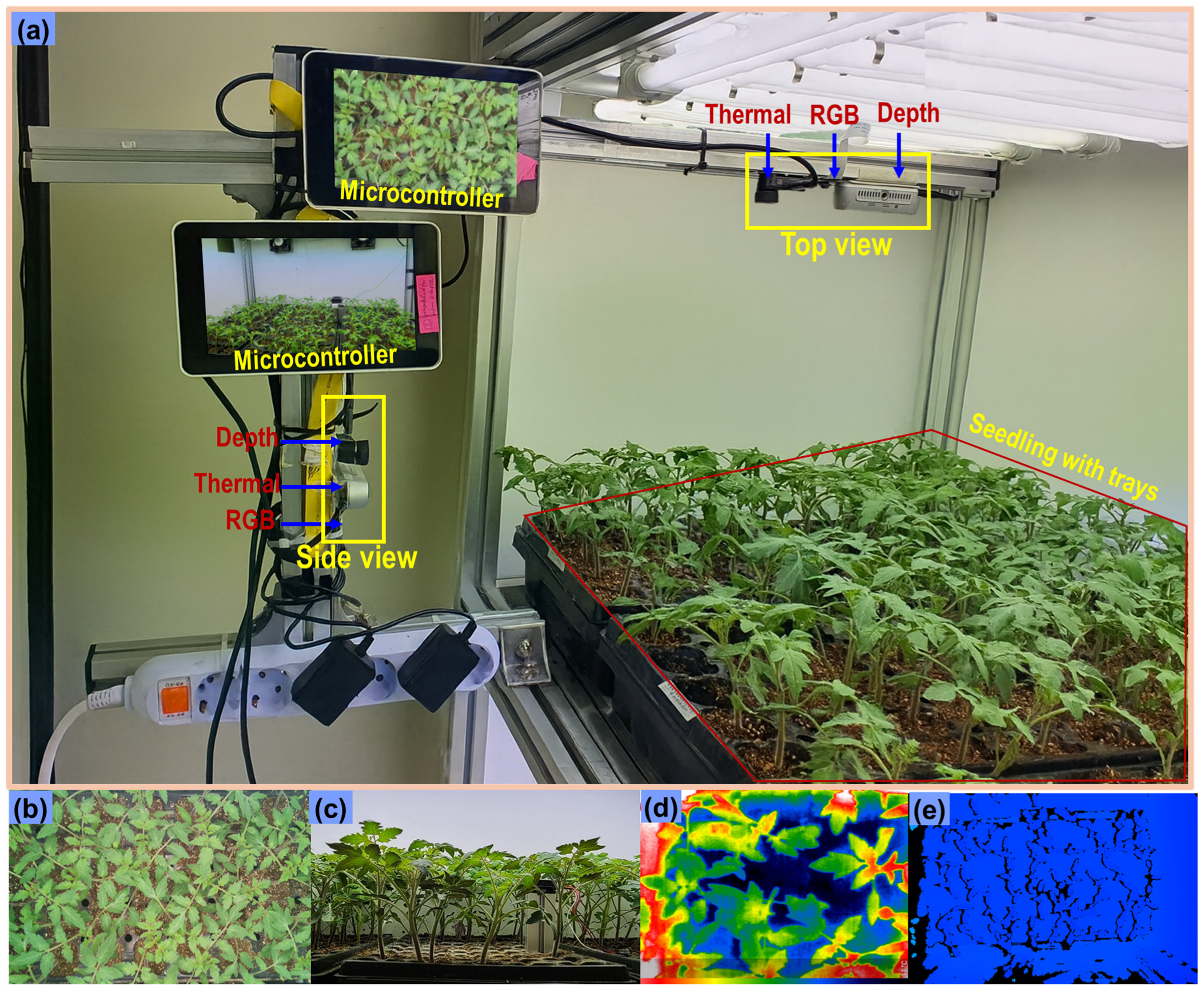
To evaluate stress symptoms of vegetable seedlings under varying environmental conditions, image data were acquired using a multi-sensor imaging platform, as shown in Figure 1. The platform consisted of a commercial RGB camera (Raspberry Pi Camera Module V2, Raspberry Pi Foundation, Cambridge, UK), a depth camera (Intel RealSense D435, Intel Corporation, Santa Clara, CA, USA), and a thermal camera (Compact Pro, Seek Thermal Inc., Santa Barbara, CA, USA). These cameras were positioned to capture top and side views of the seedling on the seedling trays, allowing for comprehensive spatial and thermal analyses from multiple perspectives [44]. To ensure optimal field of view (FOV) coverage, cameras were positioned 0.60 m above the seedling trays for top-view imaging and 0.30 m laterally for side-view acquisition. Uniform lighting conditions were maintained during image capture to minimize external variability and ensure consistent image quality. Image acquisition and storage were automated using a commercial microcontroller (Raspberry Pi 4B, Raspberry Pi Foundation, Cambridge, UK), enabling synchronized data collection with minimal manual intervention. To enhance image stability and reduce motion blur, five images were captured per tray during each session, and their average was used for subsequent analysis to ensure consistency and accuracy.
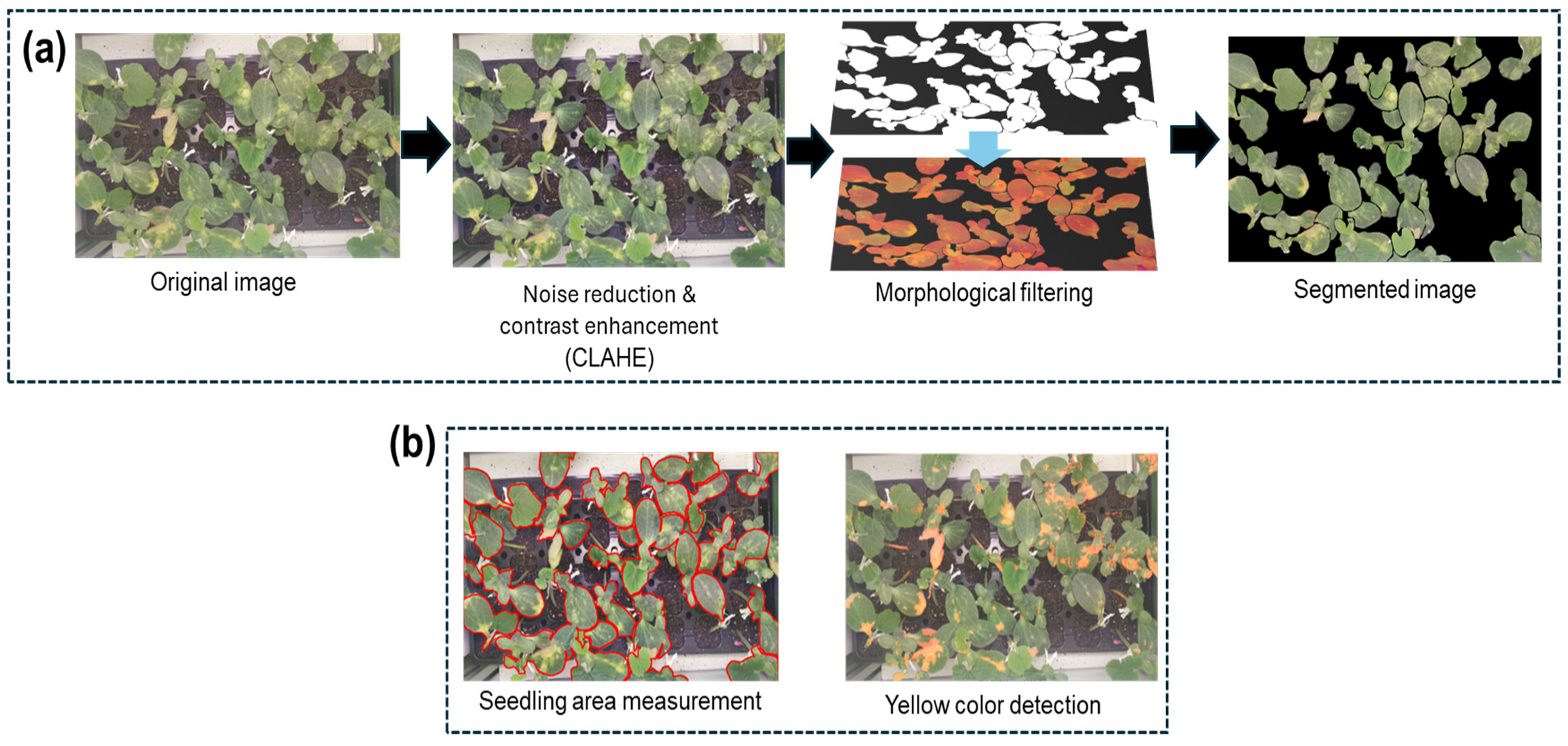
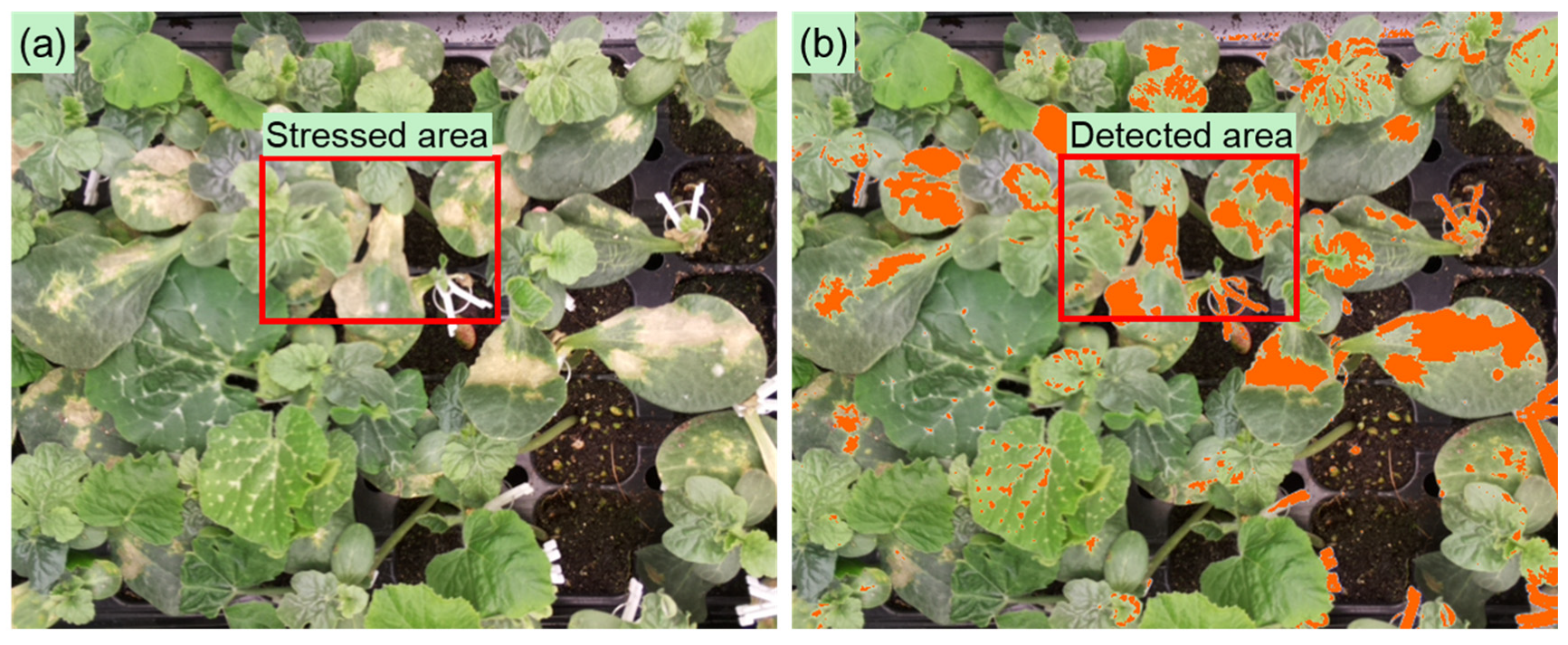
High-resolution images were acquired and used to visualize and quantify stress symptoms of six vegetable seedlings: tomato, pepper, cucumber, pak choi, lettuce, and watermelon. The quality of the image has a direct influence on the accuracy of background segmentation and canopy area detection; therefore, preprocessing was applied to enhance image quality before analysis. The preprocessing involved median filtering (3 × 3 kernel) to reduce noise, followed by histogram equalization applied to all three channels and subsequently combined to enhance image contrast. Histogram equalization minimized the variation in color distribution between images, thereby standardizing the distinction between the object and the background. This step ensured that the upper and lower limits for green color selection in the HSV space remained consistent across images. Thereafter, HSV color space transformation was applied with manually defined upper and lower limits to mask the green color, and finally, color thresholding techniques were used to remove the background, as shown in Figure 2a and Table A1 [44,45]. This approach ensured accurate canopy area segmentation. For the stress region identification, the same approach described above was used, with different HSV thresholds to segment yellow regions to identify stress spots, as shown in Figure 2b. The proportion of yellow pixels relative to the total canopy area was then calculated to quantify stress severity.
For leaf area quantification, the preprocessed images were converted to binary format, and contour detection was used to isolate leaf boundaries. The detected contours were smoothed by calculating the total arc length of each polygonal curve, which allowed complex leaf shapes to be captured more accurately, as presented in Figure 2b. From each smoothed contour, leaf area was calculated by counting the total number of pixels enclosed within the contour. Leaf area is an important indicator of seedling health and provides useful information for distinguishing between healthy and stressed plants.
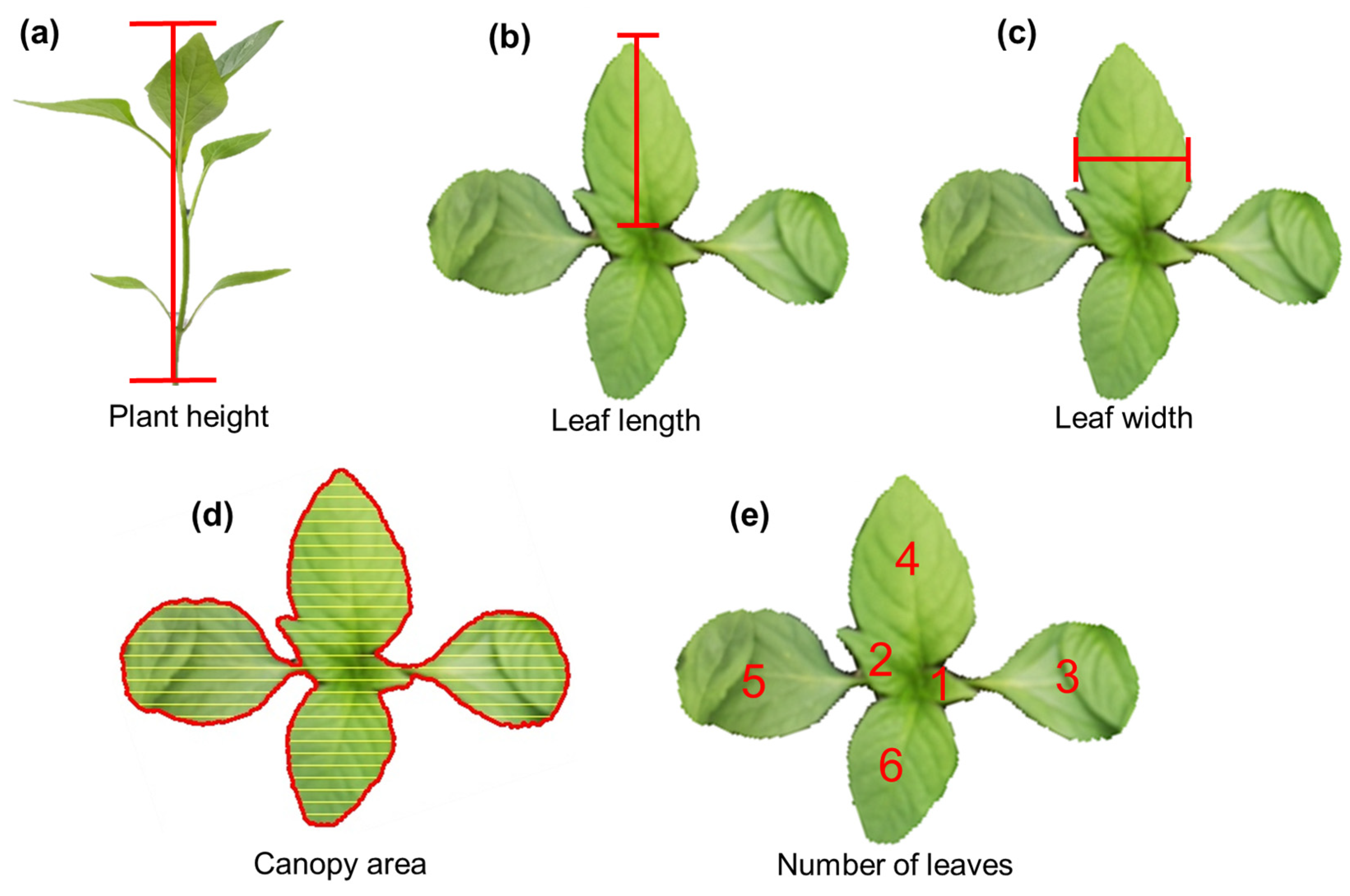
In addition, morphological features were extracted from the segmented contours. Canopy length and width were measured as the longest distance between two contour points for length and the maximum perpendicular distance to this axis for width, shown in Figure A1 as supplemented. The total number of leaves per seedling was determined by counting each canopy contour in the segmented image. These measures, together with the canopy area data, provide a comprehensive assessment of seedling growth and stress status.
The integrated imaging platform enabled the extraction of key morphological and color features, including canopy area, leaf length, leaf width, plant height, leaf number, color intensity, and surface temperature distribution. RGB images provide valuable insight into the morphological features, including canopy area and leaf length. Leaf width, leaf number, and color features. Thermal imaging facilitated early detection of heat-induced stress through localized temperature variations, while depth imaging captured structural traits such as canopy and leaf development. The combined use of RGB, thermal, and depth data provided a comprehensive and non-invasive assessment of seedling stress responses.
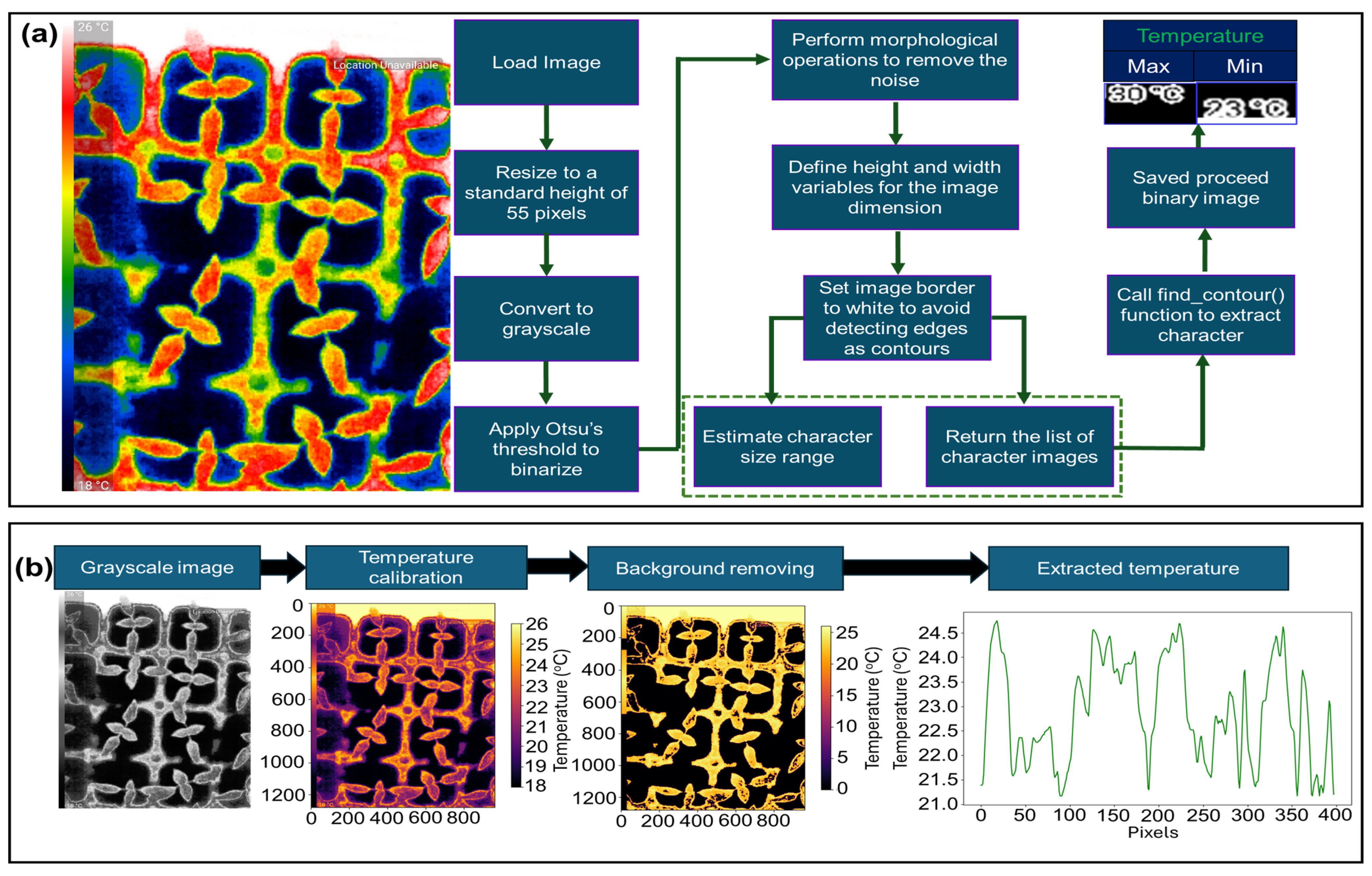
The temperature extraction process from thermal images began with converting the captured thermal image to grayscale to facilitate pixel intensity analysis. To ensure accurate extraction of the minimum and maximum temperature values, the image was resized to a standard height of 55 pixels. This value was empirically determined after testing multiple resizing levels (30–100 pixels) to provide optimal digit legibility of the reference scale shown in Figure 3a. At a lower value, the digits in the reference scale became fragmented, whereas larger values introduced background noise and inconsistent segmentation. The 55-pixel ensured that the numerical characters remained clearly legible and could be reliably separated from the background during binarization for this experimental condition. These extracted values were subsequently used to calibrate the grayscale image, enabling accurate mapping of pixel intensities to temperature values and ensuring consistency across images.
The minimum and maximum temperatures from the reference color scale were used to calibrate grayscale thermal images for absolute temperature measurements. After that, binary intensity thresholding was used to separate the seedling from the background. From this masked region, one specific row of pixels was selected to create a thermal line profile (Figure 3b) that showed canopy temperature variance. It facilitated the early identification of temperature-induced stress by identifying localized canopy areas of stress and monitoring seedling thermal responses.
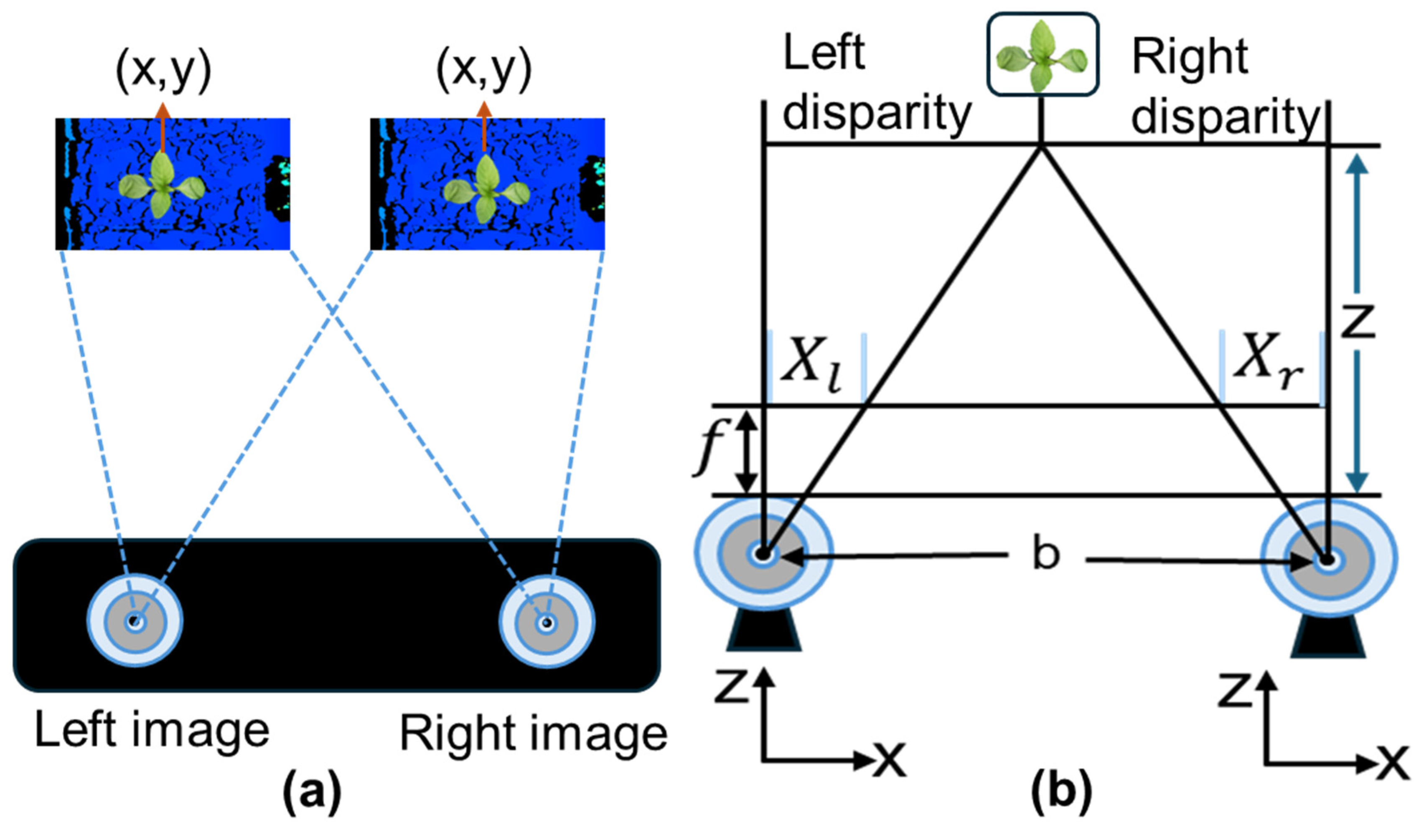
Figure 4 presents seedling height measuring procedures using a depth sensor. Upon image acquisition, three data types were simultaneously recorded: an RGB image, raw depth data, and associated metadata. The RGB image served as a visual reference, while the raw depth data provided pixel-wise depth information corresponding to real-world distances. The metadata included critical calibration parameters, focal length (f), baseline distance (B), and the intrinsic matrix, all of which are essential for accurate depth computation. To ensure reliable performance, the depth camera was calibrated using the built-in self-calibration technique provided by the RealSense Viewer. This process involved pointing the camera toward a flat surface, performing an on-chip calibration routine, and applying the refined parameters directly to the device. As a result, lens distortion coefficients and calibration parameters were updated automatically, improving measurement accuracy without the need for external equipment. The key calibration parameters of the depth camera are summarized in Table 4.
To derive height measurements, pixel-wise depth values were obtained directly from the raw depth data generated by the stereo vision sensor, as shown in Figure 4a,b. Depth computation is based on stereo matching between the left and right infrared images, where the disparity (difference in pixel location between corresponding points) is internally calculated by the camera firmware. Using the calibrated camera parameters, the depth value at each pixel D(x,y) was determined according to Equation (1). In the stereo vision coordinate system, the X-axis corresponds to the horizontal direction, the Y-axis to the vertical direction in the image plane, and the Z-axis to the depth from the camera. In certain 3D schematic representations, the Y-axis may also be shown perpendicular to the page to define a right-handed coordinate system [46,47]
D x , y = B × f d ( x , y )
where d(x, y) indicates the disparity at pixel coordinates (x, y).
Seedling height estimation was performed by segmenting the depth values into two categories: seedling and background (tray and soil). The background depth was defined as the minimum value within the region of interest, while the canopy depth corresponded to the maximum depth value detected within the seedling area. Seedling height was then calculated by subtracting the canopy depth from the background depth [48]. This method integrates depth map processing with camera calibration to enable precise and automated seedling height estimation.

2.3. Stress Symptom Quantification Using Image Features

Image-based feature extraction enables precise quantification of stress symptoms in seedlings by integrating morphological, color, and texture analysis. From the segmented images, key morphological features such as leaf length, leaf width, canopy area, and no of leaves were measured to quantify seedling stress symptoms, while changes in color and texture served as critical indicators of physiological stress [49]. As illustrated in Figure 5, tressed areas of the leaves were identified by color segmentation in the HSV color space to distinguish color differences in a seedling canopy area. Threshold ranges for the segmentation hue, saturation, and value were empirically optimized to distinguish healthy green leaf area from yellow or brown stressed regions. Texture analysis was performed using the Gray Level Co-occurrence Matrix (GLCM), which quantifies spatial relationships of pixel intensities in the leaf canopy region. GLCM, co-occurrence values evaluate and characterize uneven surfaces, rough patches, and localized damage. These textural features, derived from pixel intensity patterns, provided indicators of early stress responses to environmental factors [50]. The combination of these image-derived features provides a non-invasive and comprehensive method to evaluate these characteristics, enabling ongoing plant health assessment, early stress identification, and prompt action.
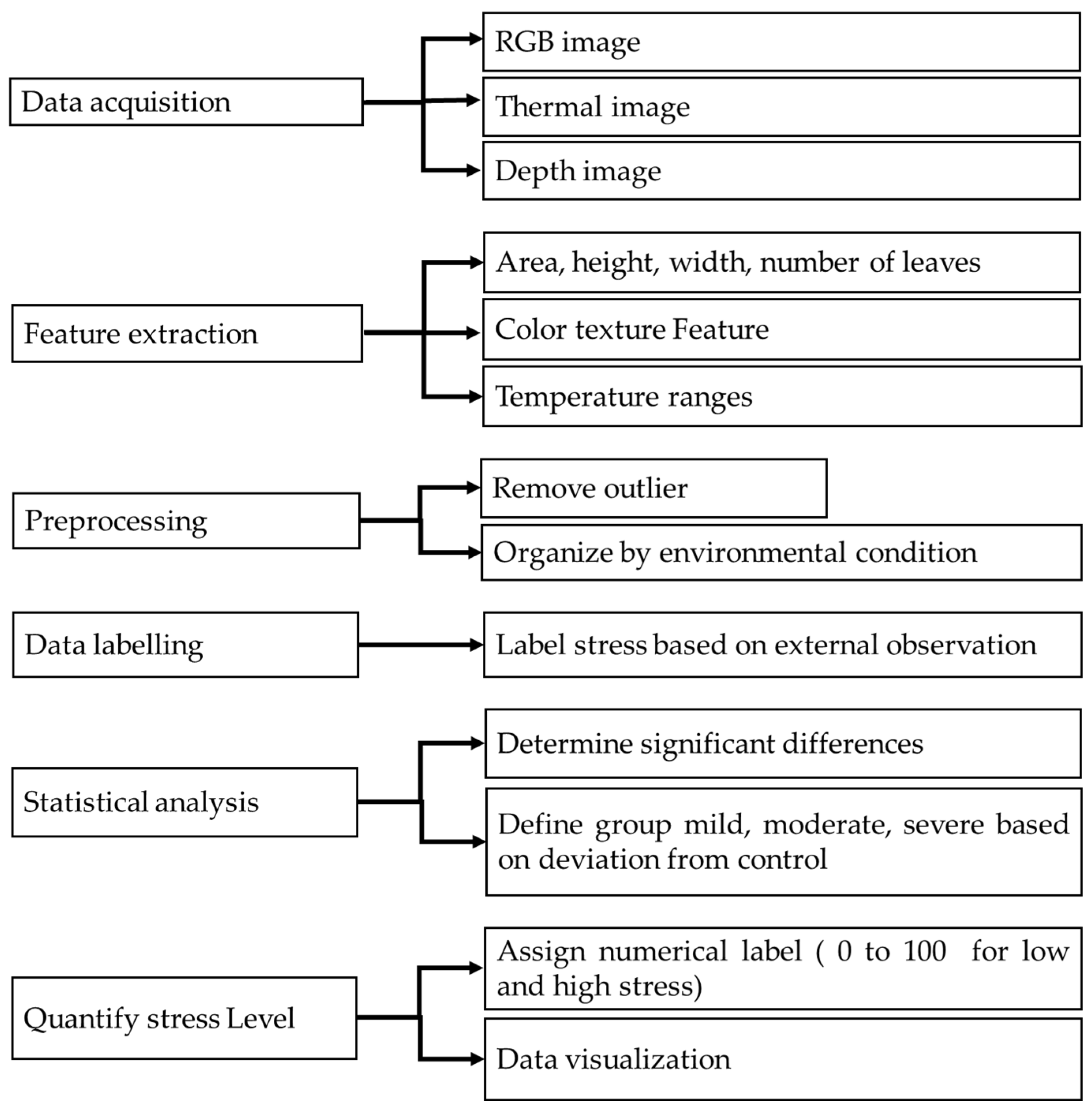
Seedling stress symptoms were quantified by a systematic procedure, as seen in Figure 6. The procedure integrates RGB, thermal, and depth imaging with advanced image processing techniques to extract relevant morphological, color, and texture features. The procedure began with image acquisition of six vegetable seedlings cultivated under different conditions, followed by pre-processing to remove noise and enhance visual quality, as described in the previous section. Morphological features, including leaf length, leaf width, canopy area, plant height, and leaf number, were extracted from the processed RGB and depth images, with plant height obtained from depth data. Thermal images were calibrated using grayscale-to-temperature conversion, and binary masks were applied to isolate the seedling region for accurate canopy temperature measurement. The resulting morphological, thermal, and texture data were systematically organized for further analysis. Stress quantification was guided by domain expertise, reference data, and horticultural knowledge, and carried out by calculating feature-based ratios and measurements from the images, with variations in these features forming the basis for determining stress severity. The quantification process involved analyzing chlorosis through color segmentation, computing the ratio of yellow pixels to total canopy area, extracting texture characteristics using the Gray-Level Co-occurrence Matrix (GLCM), and assessing canopy temperature for thermal stress evaluation. This integrated methodology enables precise, non-invasive measurement of seedling stress severity under controlled environmental conditions.

2.4. Analytical Procedure

Seedling morphological and color features, including canopy area, height, leaf length, leaf width, leaf number, texture, and temperature, were statistically analyzed using time-series data from stressed and non-stressed groups to identify significant temporal changes in response to environmental stress. A one-way ANOVA was performed to determine significant differences in extracted features, morphological (canopy area, height, leaf length, leaf width, leaf number), and color (yellow color index) between stressed and non-stressed groups over time. This was followed by post hoc multiple-comparison tests using Fisher’s Least Significant Difference (LSD) method at a significant level of 0.05 to identify which specific group means differed significantly. Grouping letters was generated to indicate statistically homogeneous subsets. The analysis enabled categorization of seedlings into stress severity levels according to differences in each parameter under stress compared to control conditions, providing insights into the temporal dynamics of stress development in response to environmental changes.
To quantify the stress intensity, extracted features were calculated. Based on the calculated values, the Crop Stress Index (CSI) was estimated individually for each measured feature using Equation (2) as follows:
C S I = X c o n t r o l X s t r e s s X c o n t r o l × 100
where Xcontrol and Xstress represent the measured values of extracted image features under control and stress conditions, respectively. The resulting CSI values were converted to percentage scores to express the relative severity of stress.
Subsequently, CSI values from each extracted feature were combined to calculate an overall combined (CSI) that comprehensively describes the severity of stress across multiple plant features. The combined CSI was calculated using the following Equation (3)
Combined   CSI = i = 1 n C S I i n
where CSIi represents the CSI of each individual feature, and n is the total number of features analyzed. The distribution of CSI values for each stress feature was visualized using violin plots (presented in Section 3) to summarize and compare stress severity across groups. These plots show key statistical indicators, including the mean (average stress level), median (middle point of the data), and standard deviation (variability or spread of the data). The width of each violin plot represents the frequency of different stress values, enabling clear identification of differences among mild, moderate, and high-stress groups based on the combined features.

3. Results

3.1. Stress Symptoms Visualization by Morphological and Yellow Color Feature

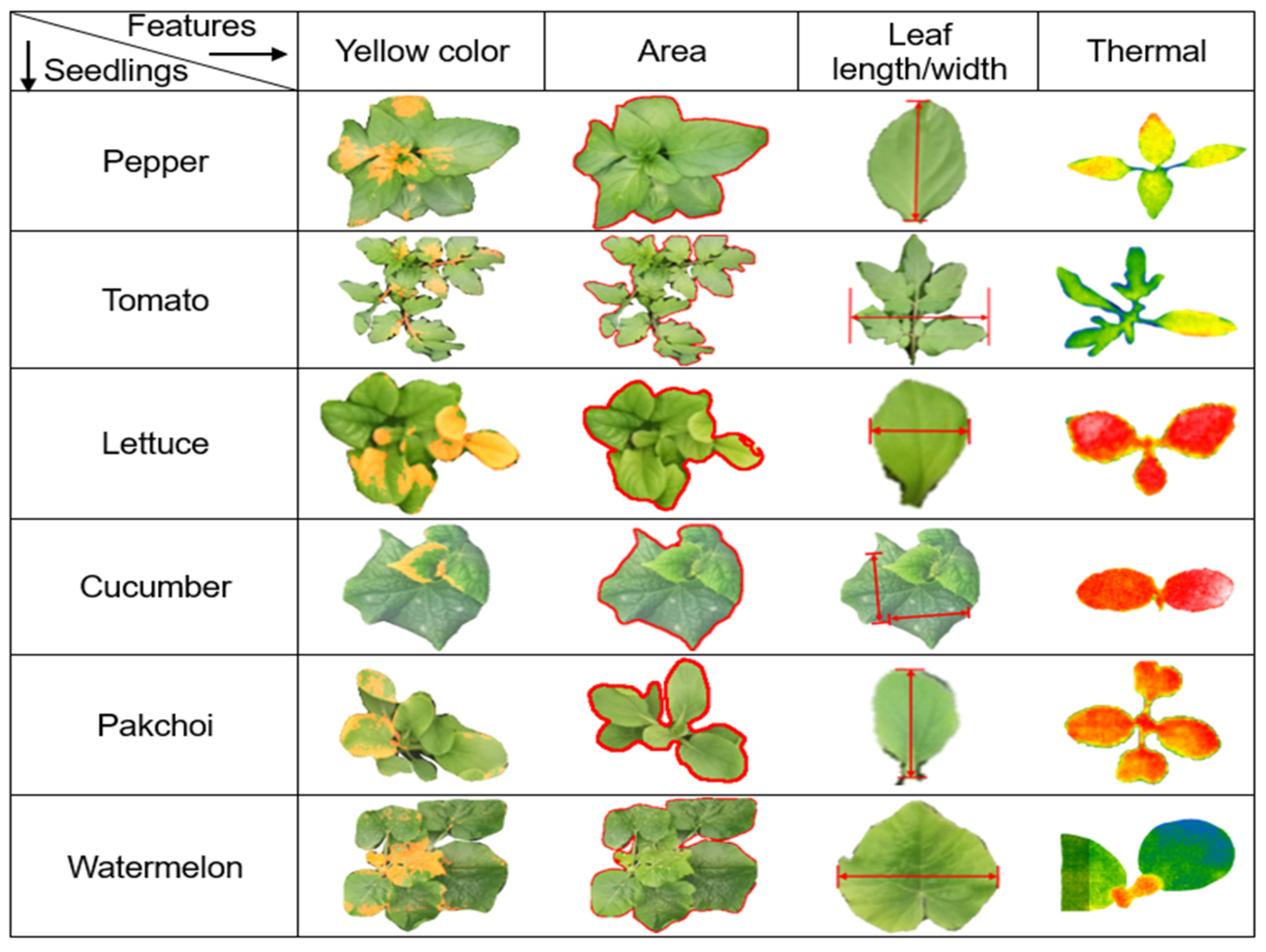
Figure 7 shows six vegetable seedlings, pepper, tomato, lettuce, cucumber, pak choi, and watermelon, each 15 days old, displaying differences in canopy area, leaf length, leaf width, color, and temperature variation. Examination of canopy area reveals significant reductions in stressed seedlings, particularly in cucumber and pak choi, which exhibit the smallest canopy coverage. Height measurements indicate irregular growth patterns, with limited vertical development observed in pepper, tomato, and lettuce under stress conditions. Leaf length and width analysis further shows minimal expansion in pepper, tomato, and watermelon seedlings, reflecting restricted growth. Color alterations serve as a critical stress indicator, with tomato, lettuce, and watermelon displaying the most pronounced yellow color, whereas pepper and cucumber seedlings retain more green coloration, suggesting comparatively higher stress tolerance. The yellow regions indicate areas affected by stress, while the green regions denote relatively healthy tissues. Thermal stress visualization demonstrates that the color gradient from green to red represents increasing surface temperature due to reduced transpiration and limited thermal dissipation. These canopy, morphological, and temperature-based observations collectively provide important insights into species-specific responses to environmental stressors.

3.2. Stress Symptoms by Growth Period and Environmental Conditions

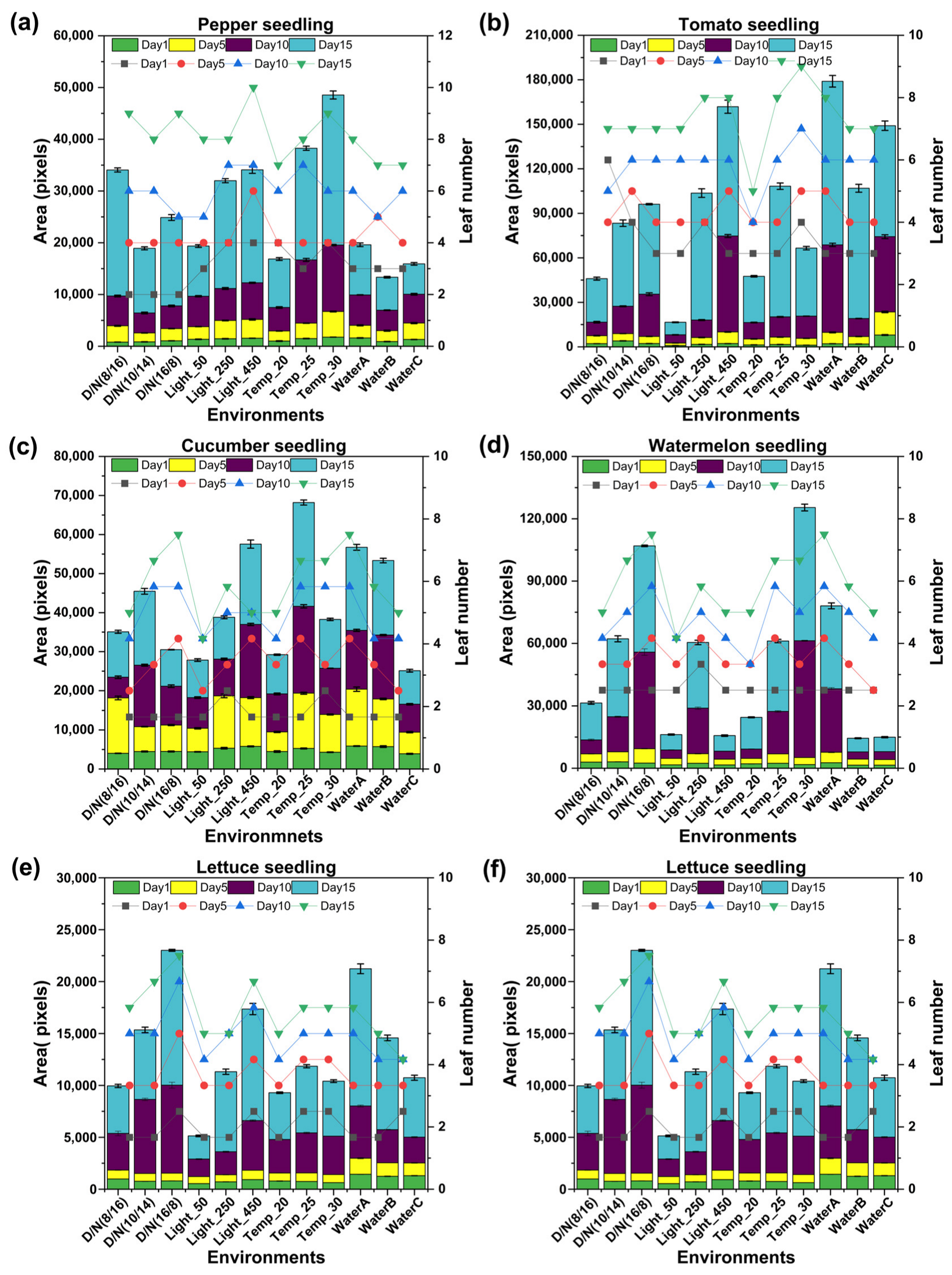
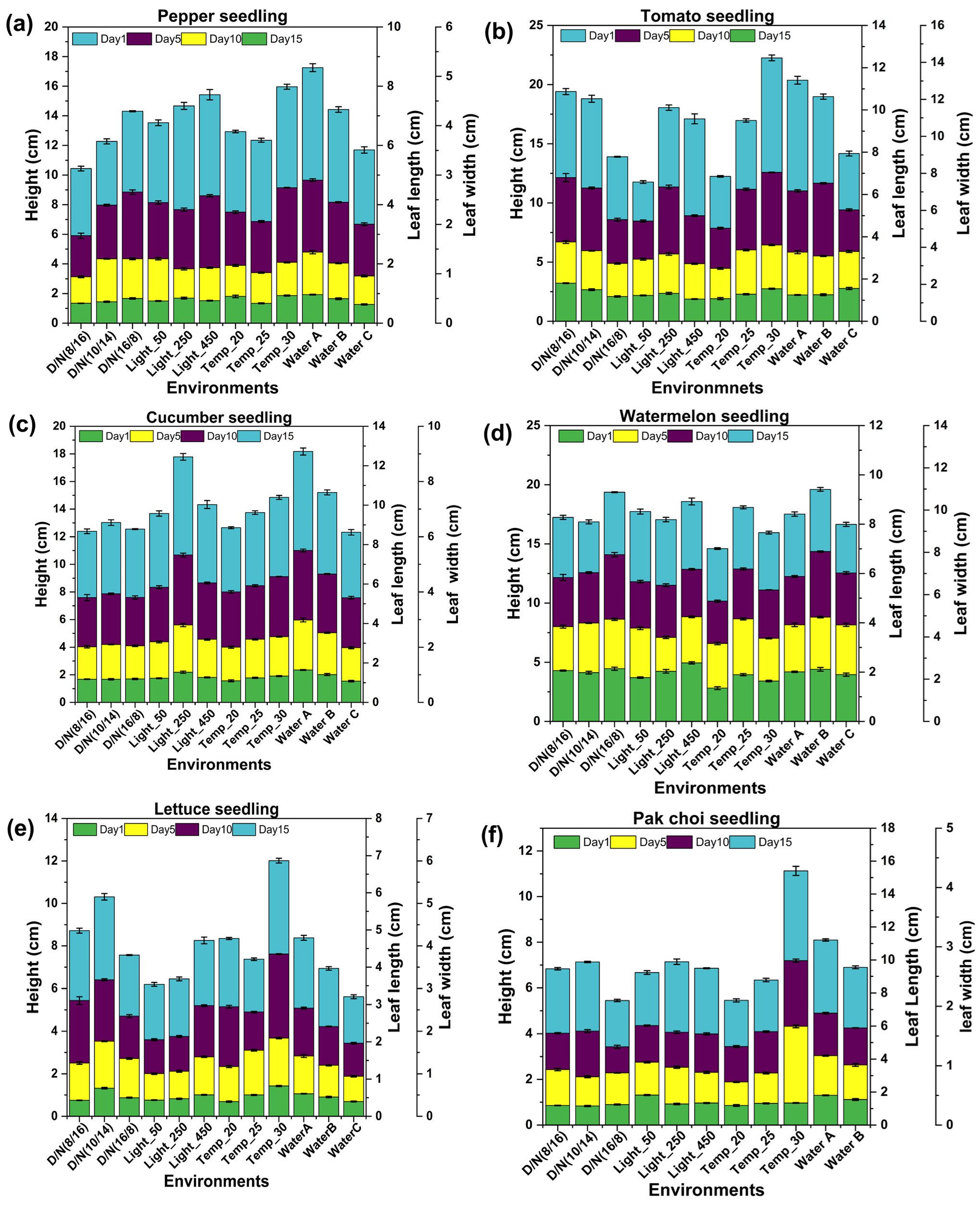
The examination of canopy area and leaf number under different environmental conditions offers measurable insights into how seedlings react to stress, as illustrated in Figure 8 [51]. The area of leaves plays a crucial role in the growth of the canopy and its ability to capture light, whereas the number of leaves indicates the emergence of new leaves and the overall progress of development [52]. Changes in these parameters under stress conditions demonstrate distinct adaptive strategies that are unique to each type of plant [52].
Pepper maintained a consistent number of leaves under various conditions, with the highest leaf number recorded under high light intensity. Canopy area, however, declined after Day 10, particularly at 20 °C and under severe water-stressed conditions, suggesting that under suboptimal conditions, pepper prioritizes leaf retention over canopy expansion. Tomato showed steady increases in leaf number until Day 10 under moderate conditions (25 °C, 250 µmol m−2 s−1, and optimal water), reaching the highest count at 30 °C. After Day 10, leaf number decreased when exposed to low temperature and severe water stress. Canopy area followed a similar pattern, with initial growth under moderate conditions and a decline under adverse conditions, indicating reduced overall growth and leaf formation. Cucumber maintained a stable leaf number across treatments, while canopy area was noticeably reduced under low temperature and severe water stress conditions. Between Day 5 and Day 10, canopy area increased without a change in leaf number, suggesting a growth strategy focused on enlarging existing leaves rather than producing new ones. Watermelon kept a constant leaf number across conditions, but canopy area increased up to Day 10 at 30 °C with a day/night cycle of 16/8 h, followed by a decline under severe water stress and high light conditions (450 µmol m−2 s−1). This pattern indicates that stress conditions limited new leaf formation but allowed growth of existing ones. Lettuce also maintained leaf number across conditions, with early gains in canopy area under optimal conditions and reductions under high temperature and low light. Pak choi increased both leaf number and canopy area until Day 10 under moderate conditions (normal temperature, light, and water), with further increases at high light conditions, after which both parameters declined under low temperatures and severe water stress conditions.
Similarly, different seedlings such as pepper, tomato, cucumber, watermelon, lettuce, and pak choi showed distinct growth responses to variations in temperature, light intensity, water availability, and photoperiod as shown in Figure 9. Pepper seedlings reached maximum height at 30 °C under optimal water availability, with significant reductions under high water stress conditions. Tomato exhibited a similar trend, achieving its tallest growth at high temperature with optimal water availability, followed by a marked slowdown after Day 10 under water stress or low light intensity. Cucumber height peaked at 250 µmol m−2 s−1 with optimal water by Day 10 but reduced under low temperature combined with water stress. Watermelon height remained comparatively stable, with modest gains under a high photoperiod at normal temperature. Lettuce achieved its greatest height at 30 °C with a normal photoperiod but decreased under low temperature and high light conditions. Pak choi displayed its tallest growth at normal temperature and light conditions, but height was most severely reduced under water stress.
The result showed that leaf length and width reached their maximum values under the same environmental conditions, indicating proportionally scaled expansion along both the longitudinal and perpendicular axes. Pepper, tomato, lettuce, and pak choi exhibited this proportional growth, with maximum dimensions measured from contour-based primary axis detection (length) and perpendicular span extraction (width) in segmented leaf images. Cucumber and watermelon differed in that maximum width exceeded maximum length under optimal conditions 250 µmol m−2 s−1 with optimal water for cucumber and normal temperature with a high photoperiod for watermelon, indicating a lateral-dominant growth pattern. This was confirmed by higher width-to-length ratios derived from the measurement dataset. Under stress conditions, both dimensions decreased simultaneously, but in cucumber and watermelon the lateral growth in leaf geometry remained evident.
Overall, temperatures of 25 °C, optimal water availability, and a moderate light intensity of 250 µmol m−2 s−1 developed ideal growth conditions. Cucumbers and watermelons exhibited an increase in canopy size, while pak choi and tomatoes experienced declines in all assessed morphological features under water stress. The results highlight the importance of specific environmental management strategies to enhance seedling growth within regulated cultivation systems.

3.3. Stress Symptoms by Color and Texture Features

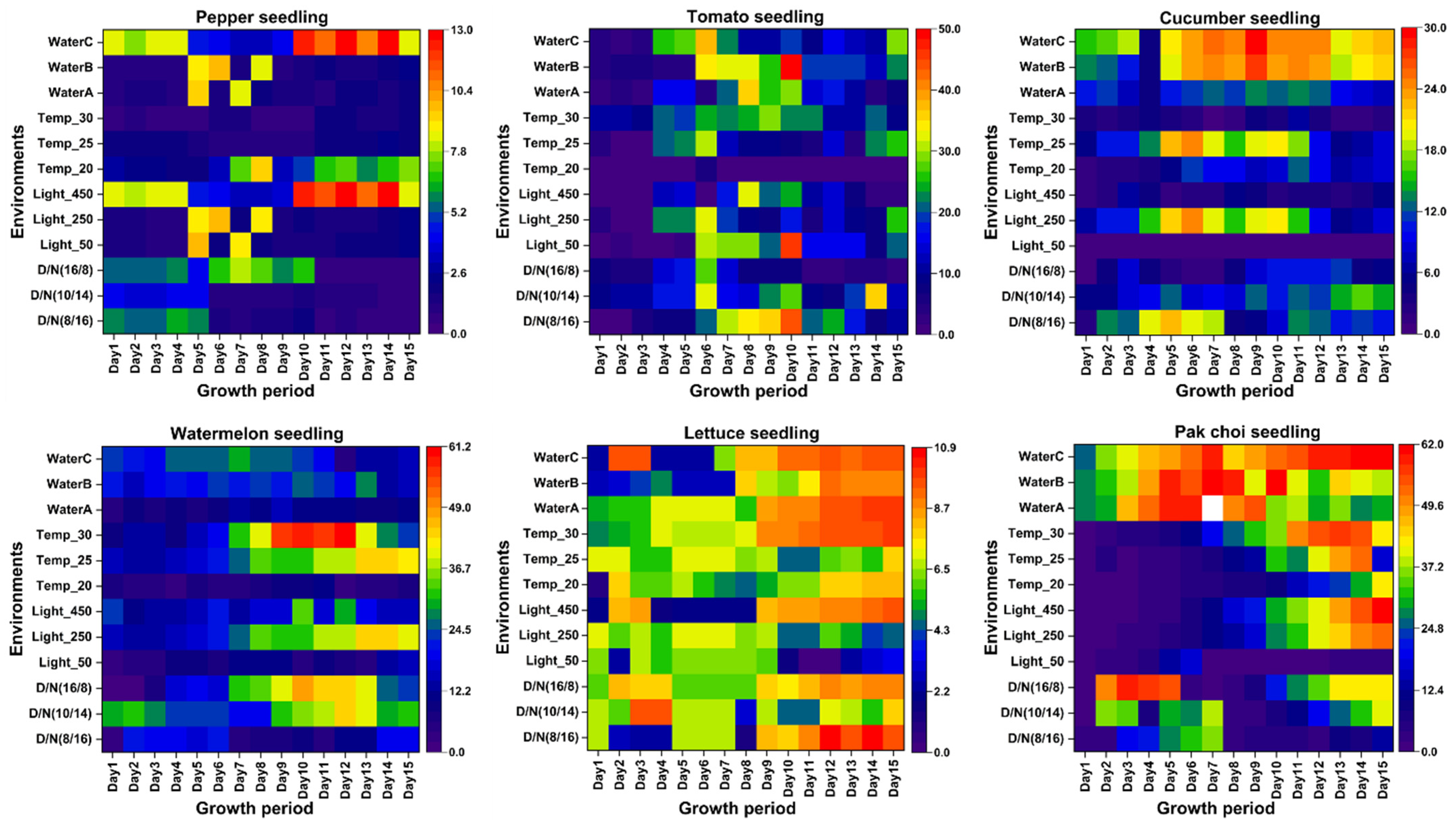
Water availability, temperature, and light intensity influenced seedling coloration over the monitored growth period (Day 1 to Day 15), as shown in Figure 10. This period corresponds to the early vegetative stage, where morphological development and color stress responses are most dynamic. Leaf discoloration, as quantified through image-based color segmentation, indicates environmental stress, whereas greenness represents healthy growth [53]. The color scale used in the analysis ranged from blue (moderate discoloration) to yellow, orange, and red (increasing stress severity).
In pepper seedlings, the highest degree of leaf discoloration was observed under severe water stress combined with high light intensity, with stress intensity increasing progressively from Day 1 to Day 15. The initial yellow values at Day 1 represent pre-existing leaf color variation captured at the first measurement, rather than stress developing during the trial. Under a moderate water supply, initial stress was minimal, followed by a moderate increase between Days 5 and 9, after which color levels stabilized. Tomato seedlings displayed a notable yellow color between Days 4 and 11 when subjected to severe water stress, low light intensity, and a low photoperiod, followed by gradual recovery.
Cucumber seedlings showed consistent yellow color throughout the period under severe water stress, while under normal temperature and normal light conditions, moderate discoloration peaked between Days 4 and 10 and then declined. Watermelon seedlings remained stable in the early phase but exhibited a sharp increase in yellow color during the final week, particularly at high temperature and a high photoperiod. Lettuce, highly sensitive to stress, displayed increasing yellow color after Day 8, peaking between Days 10 and 15 under severe water stress, high light intensity, and high temperature; slight yellow values at Day 1 are attributed to baseline leaf coloration detected by the segmentation algorithm. Pak choi exhibited a strong yellow color response after Day 10, mainly due to severe water stress, with final discoloration reaching 62%.
The heatmap analysis confirms that lettuce, pak choi, and tomato exhibited the most pronounced temporal changes in color, while cucumber and watermelon maintained greater stability. Across all seedlings, severe water stress and high temperature were the dominant contributors to increased yellow percentage.
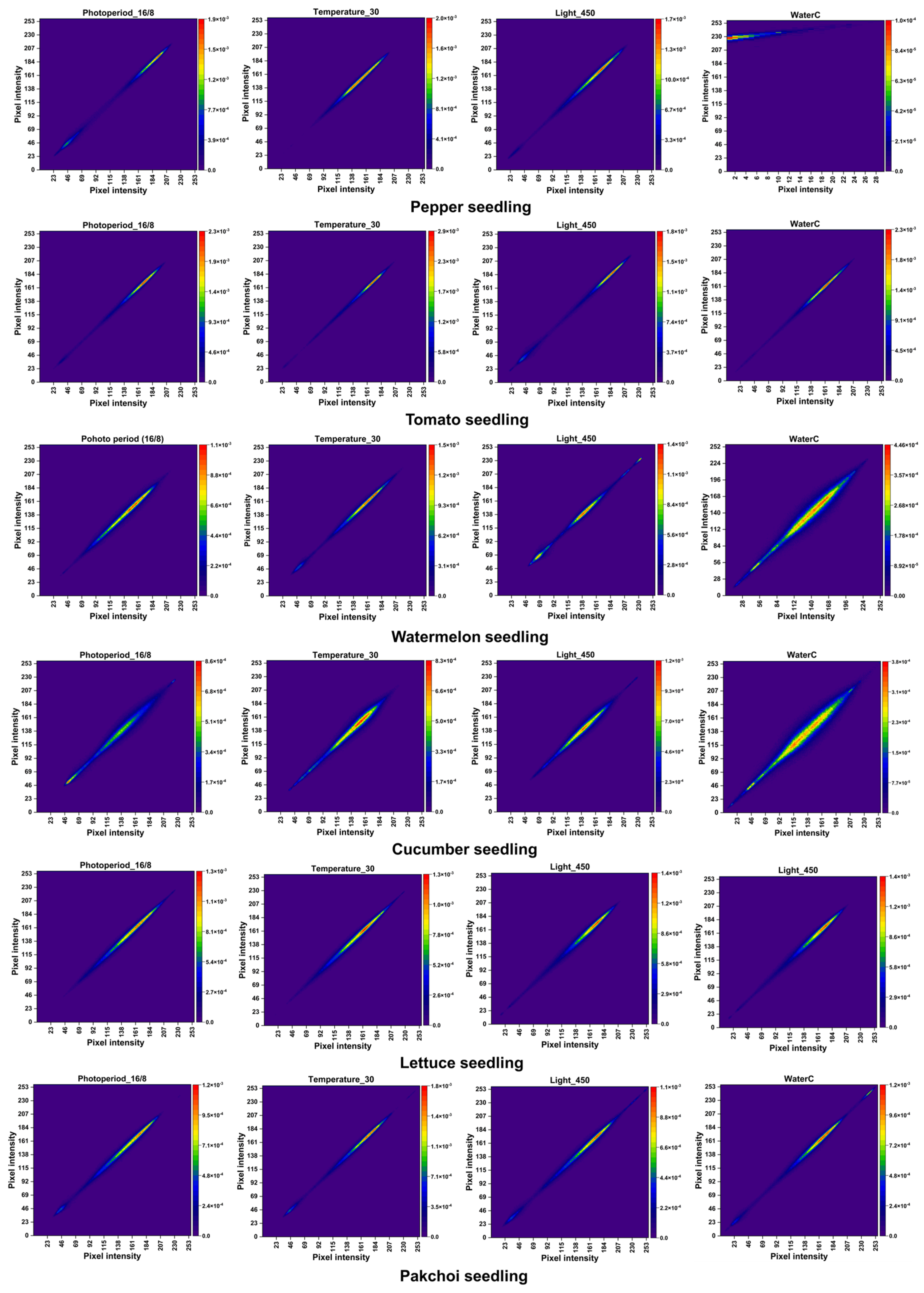
The texture of plant leaves represents pixel intensity variations that indicate surface smoothness, roughness, and structural integrity [54]. Under stress, seedlings undergo texture changes due to dehydration, leaf curling, and shrinkage [54]. The gray-level co-occurrence matrix (GLCM) quantifies these changes, revealing how environmental factors affect seedling structure.
As shown in Table A2 and Figure 11, pepper and lettuce seedlings under a high photoperiod have concentrated pixel intensity distributions, suggesting homogeneous leaf surfaces with little structural differences. They maintain homogeneity at 0.53 in pepper under low-stress light conditions compared to 0.33 under high stress. Cucumber and watermelon seedlings have more pixel intensities, suggesting surface heterogeneity. Cucumber homogeneity decreases from 0.48 under low stress to 0.33 under high stress, showing texture dispersion. Cucumber and tomato seedlings shrink and roughen under high temperature stress. As stress increases, cucumber contrast values drop from 207.1 to 132.4, suggesting substantial structural changes. Although influenced, tomato displays modest variance with consistent correlation values around 0.96, suggesting a homogeneous reaction.
Lettuce and pak choi have more stable correlation scores, suggesting a constant texture regardless of temperature. High light intensity increases pixel dispersion in cucumber and watermelon seedlings, indicating rougher surfaces and curling. Homogeneity decreases from 0.46 in low-stress cucumbers to 0.33 under high stress, showing textural abnormalities. In contrast, pak choi and lettuce seedlings had steady intensity distributions and constant energy values (e.g., 0.51 under low stress vs. 0.45 under high stress), showing greater light stress tolerance.
All seedlings change texture under severe water stress. The largest pixel intensity spread is in cucumbers and watermelons, indicating extreme dehydration, roughness, and energy loss. Cucumber homogeneity decreased from 0.55 under moderate stress to 0.48 under high stress. Pepper and tomato seedlings have different textures, showing partial adaptation. Lettuce and pak choi are smoother but seem wilted rather than curled or collapsed. Stress increases contrast values (e.g., pak choi 295.2 under low stress vs. 303.8 under high stress), showing smooth texture but leaf rigidity issues.

3.4. Statistical Analysis of Measured Features of Six Vegetable Seedlings

Table A3, Table A4, Table A5, Table A6, Table A7 and Table A8 present the statistical comparison of morphological features and yellow color for six vegetable seedlings under stressed and non-stressed conditions. Statistical analysis was conducted as described in the previous section, with grouping letters in the table indicating statistically homogeneous subsets at p < 0.05.
Statistical analysis revealed clear treatment effects on morphological and color features across the six vegetable seedlings (Table A3, Table A4, Table A5, Table A6, Table A7 and Table A8). Pepper maintained stable growth under favorable conditions, with canopy area reaching 12,072.80 pixels at 30 °C, nearly three times that at 20 °C, while leaf width increased to 1.37 cm, indicating enhanced lateral expansion. Exposure to high light intensity elevated the yellow color index to 8.06, reflecting pigment stress despite an expanded canopy. Tomato achieved its maximum canopy area under 450 µmol m−2 s−1 (38,282.80 pixels) but recorded its highest yellow index at 30 °C (17.87), indicating thermally induced pigment alteration even when structural metrics such as height and leaf length, leaf width showed limited variation.
Watermelon demonstrated a pronounced sensitivity to combined water and temperature stress, with canopy area reduced to 3487.44 pixels and yellow index elevated to 31.81 under 30 °C with water limitation. High light intensity further increased yellow color (18.30) and reduced leaf width (1.17 cm), while a high photoperiod supported broader leaf development (2.80 cm). Cucumber attained optimal growth at 25 °C with minimal pigment change, whereas water stress increased yellow index values and reduced both leaf length and width. Lettuce, although generally tolerant, displayed canopy area reduction (3003.83 pixels) and decreased height (1.70 cm) under low light conditions; water stress reduced leaf length to 0.72 cm, indicating constrained structural development preceding pigment change. Pak choi maintained high yellow values across treatments but showed pronounced reductions in leaf length (0.42 cm) and width (0.61 cm) under water stress, indicating marked morphological sensitivity.
Collectively, these observations confirm that water deficit and elevated temperature were the dominant factors driving pigment-based stress indices, while light intensity primarily influenced canopy area and, in certain cases, contributed to pigment variation. The integration of morphological and colorimetric measurements demonstrates the capacity of image-derived metrics to quantify species-specific stress responses with high precision.

3.5. Stress Symptom Quantifications by Morphological Features and Yellow Color

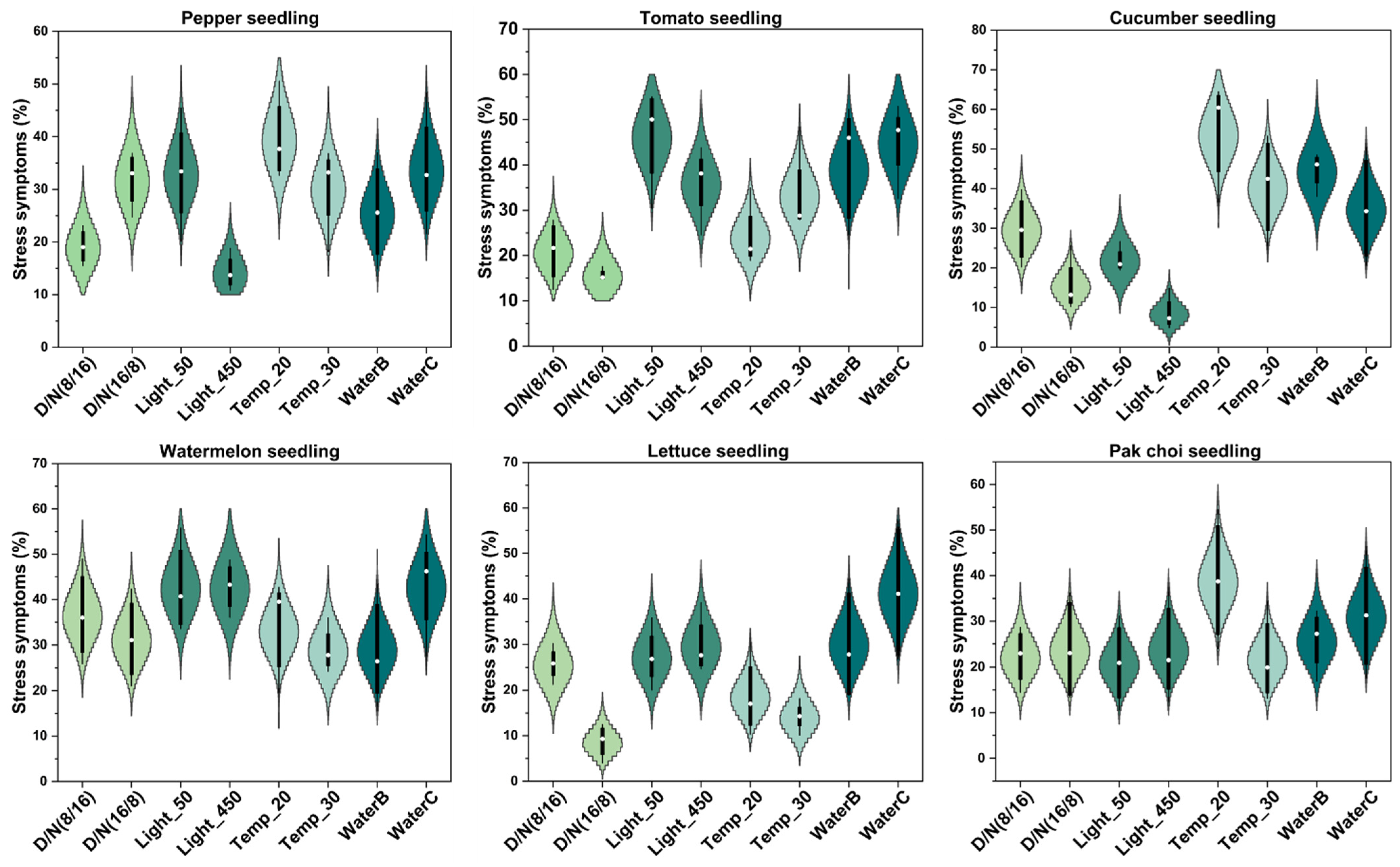
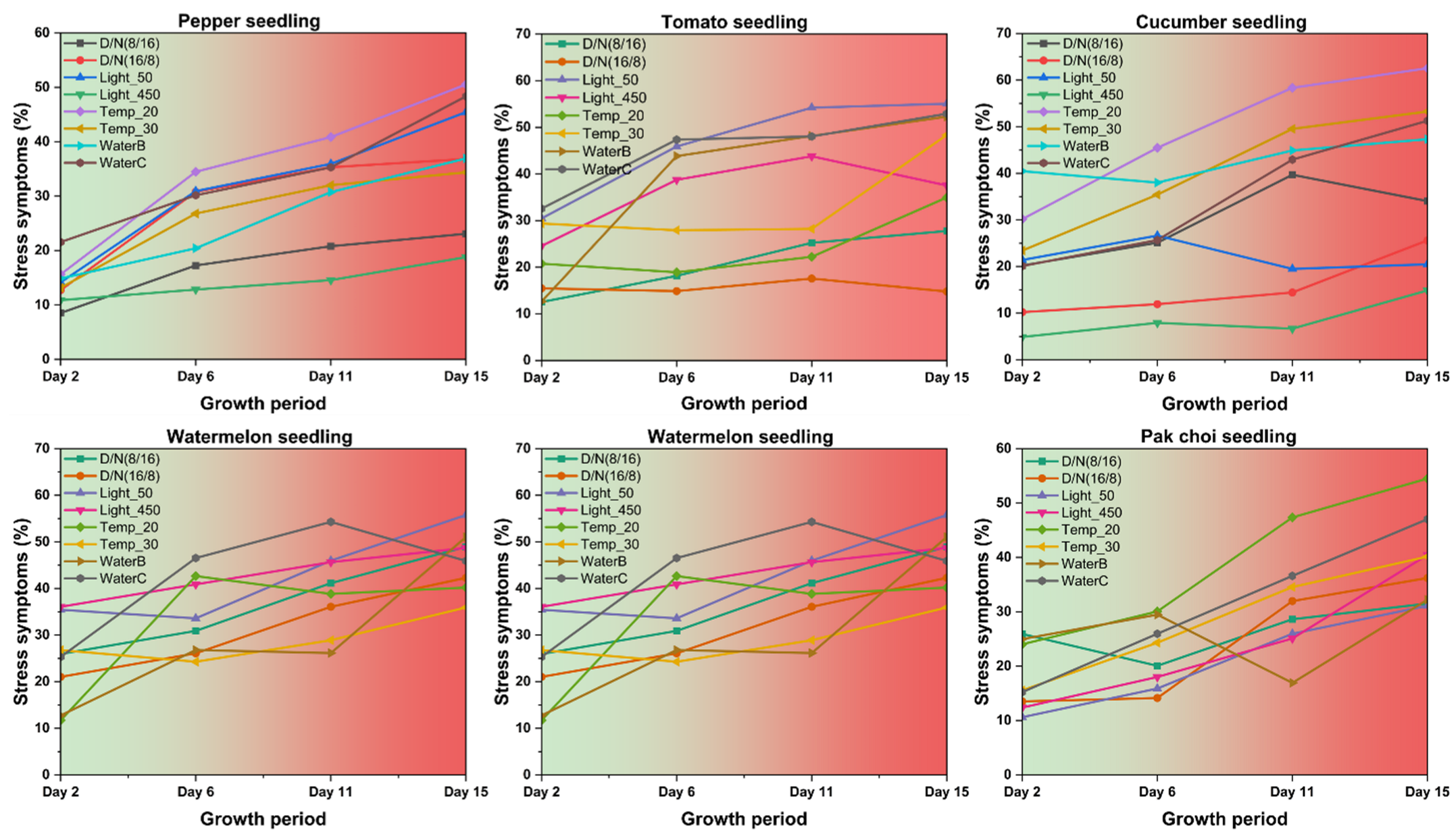
Stress symptoms were quantified based on morphological features (canopy area, plant height, leaf length, leaf width, and leaf number) and color features (yellow color index). These were used to calculate the stress percentage for each feature, with results visualized using violin plots and line graphs (Figure 12 and Figure 13) showing the combined CSI symptom distribution over the 15-day period. In the violin plots, the white dot represents the median stress percentage, the thick black bar indicates the interquartile range (IQR), and the violin width reflects the density of stress values across all measured features. Wider violins indicate greater variability in stress response among features, whereas narrower violins suggest more uniform expressions. Table 5 shows the maximum CSI over 15-day experiments, which shows daily stress trends and highlights the peak stress levels observed for each seedling.
During the 15-day period, stress levels varied widely across seedlings, as seen by violin medians (white dots) and spread (violin width). Pepper (10–55%), tomato (10–55%), and cucumber (5–70%) showed the wider distributions under low light, high temperature, and severe water stress conditions, indicating larger deviations from control in both morphological and color features. Importantly, the reduction in stress under high light was evident only in pepper and cucumber, where lower medians and narrower spreads indicated more uniform responses close to control values, whereas tomato and pak choi under 450 µmol m−2 s−1 displayed higher medians and wider spreads, and watermelon and lettuce were intermediate rather than uniformly low. Watermelon (20–65%) and lettuce (15–60%) exhibited greater variability under low light or low temperature, while pak choi (15–55%) had its widest distributions under high temperature and severe water stress conditions, reflecting disproportionate impacts on certain traits. Overall, narrow violins with low medians (e.g., pepper/cucumber at 450 µmol m−2 s−1) indicate conditions that kept features close to control values, whereas wide violins and higher medians (e.g., severe water stress, low light, and high temperature) show larger and more variable changes from baseline.

4. Discussion

This study analyzed the effects of environmental conditions on seedling health using sensor fusion and image processing to quantify morphological and color-based stress symptoms. Prior work shows that stable environmental control promotes uniform seedling development, whereas variation in temperature, light, and water induces different growth responses [55]. Multi-factor stress can also amplify morphological variation across different environments [56]. Consistent with previous literature, uniform growth changes were observed, while variations in temperature, light intensity, and water availability produced distinct responses among seedling types.
Canopy area reduction was a prominent indicator of stress. Cucumber and pak choi exhibited the largest canopy losses under the combined high temperature and severe water deficit conditions, while watermelon showed substantial reductions primarily under drought stress (Figure 8). In contrast, tomato and lettuce maintained relatively stable canopy sizes under normal conditions (25 °C, 250 µmol m−2 s−1), optimal water, consistent with a previous study that normal environments allow sustained leaf expansion and maintain leaf water status [57,58]. Under low light conditions, canopy expansion slowed across all species, likely because reduced light availability lowered energy production, which in turn slowed overall biomass development [1,59]. High light intensity promoted canopy expansion in pepper and cucumber when water was sufficient, aligning with findings that adequate water supply enhances leaf growth through increased canopy area [60]. However, when water was limiting, high light no longer enhanced growth, a pattern consistent with reports that water scarcity overrides the growth-promoting effects of light by restricting carbon absorption and cell expansion [61]. These patterns suggest that canopy reduction under stress not only reflects growth inhibition but also represents an adaptive mechanism to reduce transpiration and overheating.
Height responses followed similar trends. Tomato and pak choi showed pronounced height suppression under drought, while cucumber and watermelon were most affected when drought was combined with high temperature. These patterns align with physiological evidence that water deficit reduces cell elongation via turgor loss [62] and that high temperatures accelerate developmental rates but shorten the elongation phase [63]. Conversely, under optimal conditions (25 °C, optimal water), height growth was stable across species, reflecting the role of balanced thermal and water supply in sustaining leaf elongation. Light conditions regulated height differently: low light promoted modest stem elongation, likely as a shade-avoidance response, while high light combined with water scarcity restricted vertical growth, as seen in other leafy crops [64].
Leaf size decreased notably in tomato and pak choi under severe water stress, while cucumber and watermelon showed sharper reductions when heat and drought occurred together, indicating that combined stresses had a stronger impact on growth. The simultaneous reduction in leaf length and width suggests that stress limits growth in both directions, lowering total leaf area and photosynthetic capacity. This occurs because water loss reduces the internal pressure needed for cell expansion, and combined stresses further slow growth by disrupting internal growth regulators [65]. Under normal conditions, leaves expand normally, showing that leaf size can adjust flexibly to the environment [1].
In some species, the number of leaves changed less than their size. Pepper and cucumber kept the same number of leaves even under stress, likely to preserve enough leaf surface for photosynthesis despite smaller leaves. This matches findings that drought-tolerant plants often keep their leaves to maintain energy production [66]. In contrast, tomato and pak choi dropped leaves under severe water stress, which reduced both leaf number and canopy area (Figure 8). Leaves reduced under stress are seen as a way to save energy and reduce water loss [67].
Thermal imaging patterns in this study revealed how plant surface temperature changes under different stress conditions, particularly in tomato, pepper, and watermelon under stress, especially at leaf edges, indicating reduced cooling efficiency due to lower water release from leaves [68]. In cucumber, high temperature coincided with a reduced texture uniformity and contrast, suggesting surface roughening and shrinkage, while high light (450 µmol m−2 s−1) caused similar texture changes in cucumber and watermelon. These effects match earlier findings that heat and light stress alter leaf surface structure by changing leaf angle, outer layer thickness, and cell arrangement [69]. Overall, the results support thermal infrared imaging as a reliable, non-invasive method for early detection of heat and water stress [70].
Color and pigment responses further supported stress detection. Water deficit accelerated chlorophyll breakdown in lettuce, pak choi, and tomato, consistent with their lower tolerance to prolonged drought [71]. In contrast, cucumber and watermelon maintained greener pigmentation, reflecting greater pigment stability and drought resilience. Texture analysis showed increased surface roughness under stress in cucumber and watermelon, while pepper and tomato displayed partial stability, and lettuce and pak choi exhibited smoother but wilted surfaces. Such structural changes reflect epidermal cell collapse and altered tissue integrity [72], reinforcing that pigment and texture features provide complementary perspectives on stress adaptation.
Most prior studies have analyzed single stresses or limited feature sets (e.g., drought effects using canopy area [26], or thermal imaging under heat [29]). In contrast, this study represents the first attempt to integrate RGB, thermal, and depth imaging for simultaneous quantification of light, photoperiod, temperature, and water interactions across six vegetable species. Unlike Islam et al. [12], who focused on water stress in pepper plants, this work demonstrates a multi-dimensional feature framework that captures canopy morphology, color changes, texture variation, and temperature variation under combined stress scenarios. This integration offers a broader perspective on plant stress adaptation, enabling both trait-specific and species-specific insights within controlled environments
This integrated method shows potential, although there are still some limitations. Lighting variability, particularly under fluorescent lamps, introduced color noise and reduced consistency in color indices. Future studies should use LED panels with constant light intensity and include a white reference card in each frame for color calibration. Sometimes, heat sources close to the imaging system messed up thermal and depth data. To reduce these mistakes, cameras should be shielded and calibrated against reference surfaces. Finally, RGB, depth, and thermal imaging recorded many important aspects. However, adding more sensing modalities, including hyperspectral imaging, chlorophyll fluorescence, or 3D mapping, could make stress detection and mechanistic interpretation even better. This study demonstrates the potential of low-cost, multi-sensor image processing for non-invasive stress monitoring by integrating canopy area, height, color, texture, and thermal features with underlying physiological systems. The results demonstrate that different species have different ways of dealing with stress. For example, cucumber and watermelon had adequate texture and pigment stability, while tomato and pak choi depended more on leaf breakdown and pigment discoloration. These findings enhance the comprehension of stress physiology and contribute to the development of automated environmental control systems for seedling production, thus supporting more resilient and efficient controlled-environment agriculture.

5. Conclusions

This study thoroughly examined the effects of major environmental factors on the health and stress symptoms of six vegetable seedlings, including pepper, tomato, cucumber, watermelon, lettuce, and pak choi. Among these seedlings, cucumber showed the highest sensitivity, experiencing stress levels of approximately 62%, largely due to water deficit and high temperatures. Pepper and watermelon also demonstrated notable vulnerability, with stress indices around 50% and 55%, respectively. In contrast, lettuce and pak choi exhibited moderate but comparable stress levels, close to 50%. The yellow color emerged as a key visual indicator of stress, especially under conditions of water shortage and high temperatures, particularly in lettuce, pak choi, and tomato seedlings. Texture analysis using GLCM provided quantitative insights into surface defects, indicating significant structural changes and roughness in cucumber and watermelon under high-stress circumstances, while pepper, lettuce, and pak choi exhibited mild adaptive responses. The integration of morphological, color, temperature, and texture analyses enabled precise, real-time evaluation of seedling health and early stress detection. This multi-feature image-based approach offers a reliable method for early diagnosis of plant stress, facilitating timely interventions to reduce crop losses, optimize resource use, and enhance management efficiency in controlled-environment agriculture. The findings highlight the importance of precise control of temperature and water availability for improving seedling survival and ensuring sustainable crop production in precision agriculture systems.

Author Contributions

Conceptualization, S. and S.-O.C.; methodology, S. and S.-O.C.; software, S. and S.I.; validation, S., S.I., M.R.A., P.K.D., E.B. and M.N.R.; formal analysis, S., S.I., M.R.A. and M.N.R.; investigation, M.N.R. and S.-O.C.; resources, S.-O.C.; data curation, S., S.I., E.B. and M.N.R.; writing—original draft preparation, S.; writing—review and editing, S.I., M.N.R. and S.-O.C.; visualization, S., S.I., M.R.A. and P.K.D.; supervision, S.-O.C.; project administration, S.-O.C.; funding acquisition, S.-O.C. All authors have read and agreed to the published version of the manuscript.

Funding

This work was supported by the Korea Institute of Planning and Evaluation for Technology in Food, Agriculture and Forestry (IPET) through Smart Farm Multi-Ministry Package Innovation Technology Development Project, funded by the Ministry of Agriculture, Food and Rural Affairs (MAFRA) (Project No. RS-2024-00399854), Republic of Korea.

Data Availability Statement

The original contributions presented in this study are included in the article. Further inquiries can be directed to the corresponding author.

Conflicts of Interest

The authors declare no conflicts of interest.

Appendix A

Figure A1. Measurements of seedling morphological features, (a) plant height, (b) leaf length, (c) leaf width, (d) canopy area, and (e) the number of leaves in seedlings.
Horticulturae 11 01340 g0a1
Table A1. Crop-specific HSV values for green and yellow spot segmentation.
SeedlingTaskHSV
PepperCanopy (green)40–8530–10025–95
Yellow spots18–3225–10055–100
TomatoCanopy (green)38–8835–10020–90
Yellow spots20–3425–10055–100
CucumberCanopy (green)42–9040–10025–95
Yellow spots 18–3230–10060–100
WatermelonCanopy (green)40–8635–10018–88
Yellow spots18–3025–10055–100
LettuceCanopy (green)35–8525–9535–100
Yellow spots 16–3020–10060–100
Pak choiCanopy (green)35–8220–9030–100
Yellow spots16–3020–10058–100
Table A2. Mean comparison of different texture features (contrast, correlation, energy, and homogeneity) under different environmental conditions.
Seedling ContrastCorrelationEnergyHomogeneity
ConditionsABCABCABCABC
PepperLight301.6276.2243.90.940.950.960.350.590.430.450.530.33
photoperiod271.6264.1302.50.950.950.940.350.500.490.430.360.38
Temperature321.0276.2194.50.940.950.960.570.600.450.480.580.31
Water111.090.2194.50.910.970.990.450.390.490.410.470.54
TomatoLight284.4188.1166.20.950.960.970.330.680.460.490.550.43
photoperiod214.1173.9190.80.960.960.960.370.700.460.470.550.50
Temperature241.7186.6191.10.960.960.960.390.590.410.500.390.46
Water63.248.0961.70.980.980.980.30.460.480.450.580.44
CucumberLight113.4132.584.00.950.960.960.490.470.440.470.480.33
photoperiod184.6180.3178.20.960.960.950.410.570.460.460.450.33
Temperature207.1132.4132.40.950.960.960.450.460.470.430.560.43
Water140.3196.5264.30.870.940.930.550.630.430.430.550.48
WatermelonLight102.8146.8102.80.970.970.970.320.540.490.500.450.43
photoperiod114.9119.6141.30.970.980.960.380.460.480.460.430.46
Temperature103.8146.8125.40.970.970.970.400.520.470.50.510.33
water140.1196.5264.30.870.940.930.350.600.480.430.340.5
LettuceLight252.0190.7171.40.940.960.960.440.440.450.430.460.38
photoperiod199.8191.9155.30.950.960.960.510.570.480.430.560.46
Temperature216.9190.7196.70.950.960.950.510.640.430.430.410.44
Water160.3194.6136.00.960.960.970.530.440.430.440.490.34
Pak choiLight237.6354.8379.50.960.940.940.520.550.470.410.380.43
photoperiod327.2260.4393.90.950.970.930.500.550.350.420.450.50
Temperature237.9354.6250.20.950.940.950.440.660.390.420.570.49
Water295.2277.0303.80.950.950.950.320.510.450.220.230.41
A = Low stress, B = No stress, C = High stress
Table A3. Statistical comparison of morphological and color features of pepper seedlings.
ConditionsAreaHeightLeaf LengthLeaf WidthNo of LeavesYellow Color
Photoperiod (8/16 h)7307.16 AB2.05 BC2.80 A0.93 B5.26 AB2.64 BC
Photoperiod (10/14 h)4800.90 B2.61 B2.27 AB0.84 B4.73 B2.04 BC
Photoperiod (16/8 h)4870.43 B3.81 A2.25 ABC1.01 B5.06 AB4.18 BC
Light intensity
(50 µmol m−2 s−1)
4612. 70 B2.43 BCS2.23 ABCD1.05 AB5.13 AB2.63 BC
Light intensity
(250 µmol m−2 s−1)
7296.40 AB2.12 CDE1.98 CD1.15 AB5.73 AB3.09 BC
Light intensity
(450 µmol m−2 s−1)
7936.40 A2.10 CDE1.77 BCD0.84 B5.93 AB8.065 A
Temperature (20 °C)4198.63 B2.05 CDE1.60 BCD0.84 B7.13 A4.94 AB
Temperature (25 °C)9379.63 AB1.95 DE1.50 BCDE1.03 AB5.93 AB1.66 C
Temperature (30 °C)12,072.80 A1.87 E1.48 CE1.37 A7.13 A1.12 C
Water (optimal)6553.75 AB1.80 DE1.47 CE1.05 AB6.20 A2.62 BC
Water (moderate)4628.50 B1.92 BC1.46 DE1.12 AB7.12 A3.02 BA
Water (severe)4379.70 B2.01 BCD0.75 E1.21 B7.51 A8.03 A
Different letters indicate significant differences at p < 0.05 (Fisher’s Least Significant Difference (LSD) test).
Table A4. Statistical comparison of morphological and color features of tomato seedlings.
ConditionsAreaHeightLeaf LengthLeaf WidthNo of LeavesYellow Color
Photoperiod (8/16 h)13,841.86 B3.85 ABCD3.43 A2.12 AB5.26 AB17.95 A
Photoperiod (10/14 h)26,055.03 AB4.93 ABC2.57 AB2.50 AB5.40 AB17.54 A
Photoperiod (16/8 h)24,516.90 AB4.86 ABC3.37 A2.73 AB4.93 AB8.86 AB
Light intensity
(50 µmol m−2 s−1)
4175.30 B4.93 D2.39 AB1.91 BC4.13 B16.02 A
Light intensity
(250 µmol m−2 s−1)
23,543.16 AB4.37 ABC2.69 AB2.82 A5.13 AB12.97 AB
Light intensity
(450 µmol m−2 s−1)
38,282.80 A4.30 ABCD1.88 ABC1.19 C6.00 A10.91 AB
Temperature (20 °C)10,654.73 B3.13 CD2.80 AB1.94 BC4.93 AB0.90 B
Temperature (25 °C)25,821.00 AB4.36 BCD2.47 AB1.96 ABC5.26 AB12.63 AB
Temperature (30 °C)19,655.26 AB5.75 A2.22 ABC2.10 AB5.53 AB17.87 A
Water (optimal)36,368.04 A5.17 AB2.80 AB1.85 A5.00 AB13.99 A
Water (moderate)24,729.97 AB5.37 AB1.77 BC2.02 AB6.00 AB16.21 A
Water (severe)3757.79 B3.51 BCD0.75 C2.23 B6.00 B19.43 C
Different letters indicate significant differences at p < 0.05 (Fisher’s Least Significant Difference (LSD) test).
Table A5. Statistical comparison of morphological and color features of watermelon seedlings.
ConditionsAreaHeightLeaf LengthLeaf WidthNo of LeavesYellow Color
Photoperiod (8/16 h)6841.93 B4.40 A1.98 ABC1.70 AB4.64 AB13.30 CDE
Photoperiod (10/14 h)13,274.25 C4.12 A2.29 AB2.36 AB5.14 AB29.88 A
Photoperiod (16/8 h)22,676.08 B4.89 AB1.63 BCD2.80 A6.00 A26.12 AB
Light intensity
(50 µmol m−2 s−1)
3651.39 C4.40 A1.74 BCD2.18 AB4.00 B8.36 DE
Light intensity
(250 µmol m−2 s−1)
15,739.82 C4.31 A1.06 D1.40 B5.14 AB27.78 AB
Light intensity
(450 µmol m−2 s−1)
3670.46 B4.64 B1.17 CD1.62 AB4.64 AB18.30 BCD
Temperature (20 °C)5470.43 C3.66 B1.33 CD1.30 B4.21 B6.085 E
Temperature (25 °C)14,581.96 C4.61 B1.88 ABCD2.23 AB5.42 AB27.91 AB
Temperature (30 °C)33,934.5 A4.06 A1.91 ABCD2.55 AB5.28 AB31.81 A
Water (optimal)16,529.61 B4.40 A2.68 A2.16 A4.0 AB9.99 CDE
Water (moderate)3487.44 C4.89 AB2.39 AB2.23 AB5.0 AB20.66 ABC
Water (severe)3286.7 C4.12 A2.55 B2.45 B5.00 AB20.92 ABC
Different letters indicate significant differences at p < 0.05 (Fisher’s Least Significant Difference (LSD) test).
Table A6. Statistical comparison of morphological and color features of cucumber seedlings.
ConditionsAreaHeightLeaf LengthLeaf WidthNo of LeavesYellow Color
Photoperiod (8/16 h)10,178.77 CDE3.17 AB1.79 C1.84 CDE4.00 AB12.45 B
Photoperiod (10/14 h)9371.03 CDE3.18 AB1.85 C2.30 BCD5.25 AB10.74 BCD
Photoperiod (16/8 h)8564.37 DE3.21 B1.67 C2.26 CDE5.75 A5.97 BDE
Light intensity
(50 µmol m−2 s−1)
7064.5 E3.38 B2.43 B3.22 AB3.75 B0.06 BF
Light intensity
(250 µmol m−2 s−1)
10,356.8 BCDE4.46 AB1.89 C2.75 ABC5.00 AB13.93 B
Light intensity
(450 µmol m−2 s−1)
15,120.23 AB3.56 A1.61 C1.35 E4.75 AB3.53 BEF
Temperature (20 °C)7377.4 DE3.06 AC1.80 C1.69 DE4.25 B7.07 BCDE
Temperature (25 °C)18,903.77 A3.52 AB2.22 B3.30 A5.50 AB13.90 B
Temperature (30 °C)9646.73 CDE3.77 AB1.90 C2.22 CDE5.50 AB3.06 BEF
Water (optimal)14,366.4 ABC4.56 A2.82 A1.89 CD5.75 A11.34 BC
Water (moderate)12,218.23 BCD3.80 AC1.76 C2.12 DE4.50 AB19.83 A
Water (severe)6358.01 E3.04 AC0.76 D2.32 DE4.00 B20.66 A
Different letters indicate significant differences at p < 0.05 (Fisher’s Least Significant Difference (LSD) test).
Table A7. Statistical comparison of morphological and color features of lettuce seedlings.
ConditionsAreaHeightLeaf LengthLeaf WidthNo of LeavesYellow Color
Photoperiod (8/16 h)3362.54 B1.70 ABC1.29 BCD0.86 BC4.83 AB6.78 AB
Photoperiod (10/14 h)5076.58 AB2.09 AB1.12 CD0.87 BC5.16 AB6.56 AB
Photoperiod (16/8 h)8928.79 A1.54 ABC1.30 BCD1.28 A5.91 A7.46 A
Light intensity
(50 µmol m−2 s−1)
3003.83 B1.11 C1.37 BCD0.87 BC4.08 B4.24 B
Light intensity
(250 µmol m−2 s−1)
4080.92 B1.28 BC1.79 B0.87 BC4.58 AB5.95 AB
Light intensity
(450 µmol m−2 s−1)
5395.62 AB1.63 ABC1.15 BCD0.79 C5.66 AB5.97 AB
Temperature (20 °C)2882.83 B1.54 ABC1.25 BCD1.17 AB4.5 AB6.47 AB
Temperature (25 °C)4249.54 B1.48 BC1.57 BC1.38 A5.33 AB6.95 AB
Temperature (30 °C)4011.71 A2.35 A1.39 BC0.84 BC5.58 AB8.41 A
Water (optimal)9483.96 A1.83 ABC2.81 A0.81 B4.0 B8.43 A
Water (moderate)7142.71 AB1.52 ABC1.31 BCD0.88 BC5.0 AB6.81 AB
Water (severe)6063.46 AB1.24 C0.72 D0.92 AB5.1 AB7.11 A
Different letters indicate significant differences at p < 0.05 (Fisher’s Least Significant Difference (LSD) test).
Table A8. Statistical comparison of morphological and color features of pak choi seedlings.
ConditionsAreaHeightLeaf LengthLeaf WidthNo of LeavesYellow Color
Photoperiod (8/16 h)1305.70 B1.73 A2.80 A0.51 CD4.73 A0.78 D
Photoperiod (10/14 h)4493.46 A1.80 AB1.77 B0.72 A5.40 A0.77 D
Photoperiod (16/8 h)3116.16 AB1.33 BC1.13 C0.63 AB5.20 A0.76 D
Light intensity
(50 µmol m−2 s−1)
919.46 B1.69 AB0.98 CD0.50 CD4.00 A3.86 D
Light intensity
(250 µmol m−2 s−1)
1930.23 AB1.78 AB0.85 CDE0.59 BC4.60 A20.62 BC
Light intensity
(450 µmol m−2 s−1)
2677.73 AB1.71 AC0.83 CDE0.41 DE4.86 A22.86 B
Temperature (20 °C)538.36 B1.36 ABC0.75 CDE0.37 E4.20 A11.57 CD
Temperature (25 °C)1907.30 AB1.58 ABC0.74 CDE0.51 CD4.60 A20.93 BC
Temperature (30 °C)2427.53 AB2.74 BC0.719 CDE0.54 BC5.20 A30.55 B
Water (optimal)2542.24 AB2.07 BC0.53 DE0.48 B5.00 A53.81 A
Water (moderate)2028.13 AB1.73 A0.40 E0.52 CD5.00 A52.09 A
Water (severe)1121.84 B1.38 A0.42 E0.61 BC5.20 A44.66 A
Different letters (A–E) indicate significant differences at p < 0.05 (Fisher’s Least Significant Difference (LSD) test).

References

  1. Islam, S.; Samsuzzaman; Reza, M.N.; Lee, K.H.; Ahmed, S.; Cho, Y.J.; Noh, D.H.; Chung, S.O. Image processing and support vector machine (SVM) for classifying environmental stress symptoms of pepper seedlings grown in a plant factory. Agronomy 2024, 14, 2043. [Google Scholar] [CrossRef]
  2. Afonso, P.; Castro, I.; Carvalho, M. Salt-resilient cowpeas: Early identification through growth parameters and gene expression at germination stage. Int. J. Mol. Sci. 2025, 26, 1892. [Google Scholar] [CrossRef] [PubMed]
  3. Martín-Cardoso, H.; San Segundo, B. Impact of nutrient stress on plant disease resistance. Int. J. Mol. Sci. 2025, 26, 1780. [Google Scholar] [CrossRef] [PubMed]
  4. Zandalinas, S.I.; Peláez-Vico, M.Á.; Sinha, R.; Pascual, L.S.; Mittler, R. The impact of multifactorial stress combination on plants, crops, and ecosystems: How should we prepare for what comes next? Plant J. 2024, 117, 1800–1814. [Google Scholar] [CrossRef]
  5. Charoenrak, P.; Watcharinrat, D.; Suvanapa, K.; Saengngam, N.; Supamattra, S.; Phasinam, T.; Phasinam, K. Optimizing growth of crystal lettuce using controlled environments in a Thai plant factory. Int. J. Agric. Biosci. 2024, 13, 494–499. [Google Scholar]
  6. Wheeler, R.M. Improving vertical farming efficiency through dynamic environmental control. Front. Sci. 2024, 2, 1465403. [Google Scholar] [CrossRef]
  7. Park, E.; Hong, S.J.; Lee, A.Y.; Park, J.; Cho, B.K.; Kim, G. Phenotyping of low-temperature stressed pepper seedlings using infrared thermography. J. Biosyst. Eng. 2017, 42, 163–169. [Google Scholar]
  8. Li, J.; Shi, Y.; Veeranampalayam-Sivakumar, A.N.; Schachtman, D.P. Elucidating sorghum biomass, nitrogen and chlorophyll contents with spectral and morphological traits derived from unmanned aircraft system. Front. Plant Sci. 2018, 9, 1406. [Google Scholar] [CrossRef]
  9. Shamshiri, R.R.; Jones, J.W.; Thorp, K.R.; Ahmad, D.; Man, H.C.; Taheri, S. Review of optimum temperature, humidity, and vapour pressure deficit for microclimate evaluation and control in greenhouse cultivation of tomato: A review. Int. Agrophys. 2018, 32, 287–302. [Google Scholar] [CrossRef]
  10. Lee, J.H.; Kim, H.B.; Nam, S.Y. Evaluation of the growth and leaf color of indoor foliage plants under high temperature and continuous lighting conditions at different light intensity. J. Agric. Life Environ. Sci. 2022, 34, 26–36. [Google Scholar]
  11. Körner, T. Effects of Thermopriming on Resilience to Subsequent Stress Conditions in Tomato (Solanum lycopersicum L.). Ph.D. Thesis, Hochschule Geisenheim University, Geisenheim, Germany, 2025. [Google Scholar]
  12. Islam, S.; Reza, M.N.; Ahmed, S.; Samsuzzaman; Cho, Y.J.; Noh, D.H.; Chung, S.O. Seedling growth stress quantification based on environmental factors using sensor fusion and image processing. Horticulturae 2024, 10, 186. [Google Scholar] [CrossRef]
  13. Lee, K.H.; Samsuzzaman; Reza, M.N.; Islam, S.; Ahmed, S.; Cho, Y.J.; Noh, D.H.; Chung, S.O. Evaluation of machine learning models for stress symptom classification of cucumber seedlings grown in a controlled environment. Agronomy 2024, 15, 90. [Google Scholar] [CrossRef]
  14. Sornalakshmi, K.; Sujatha, G.; Sindhu, S.; Hemavathi, D. A technical survey on deep learning and AI solutions for plant quality and health indicators monitoring in agriculture. In Proceedings of the 2022 3rd International Conference on Smart Electronics and Communication (ICOSEC), Trichy, India, 17–19 October 2022. [Google Scholar]
  15. Lee, U.; Chang, S.; Putra, G.A.; Kim, H.; Kim, D.H. An automated, high-throughput plant phenotyping system using machine learning-based plant segmentation and image analysis. PLoS ONE 2018, 13, e0196615. [Google Scholar] [CrossRef] [PubMed]
  16. Faqeerzada, M.A.; Park, E.; Kim, T.; Kim, M.S.; Baek, I.; Joshi, R.; Kim, J.; Cho, B.K. Fluorescence hyperspectral imaging for early diagnosis of heat-stressed ginseng plants. Appl. Sci. 2023, 13, 31. [Google Scholar] [CrossRef]
  17. Li, W.; Wang, J.; Zhang, Y.; Yin, Q.; Wang, W.; Zhou, G.; Huo, Z. Combining texture, color, and vegetation index from unmanned aerial vehicle multispectral images to estimate winter wheat leaf area index during the vegetative growth stage. Remote Sens. 2023, 15, 5715. [Google Scholar] [CrossRef]
  18. Nabwire, S.; Wakholi, C.; Faqeerzada, M.A.; Arief, M.A.A.; Kim, M.S.; Baek, I.; Cho, B.K. Estimation of cold stress, plant age, and number of leaves in watermelon plants using image analysis. Front. Plant Sci. 2022, 13, 847225. [Google Scholar] [CrossRef]
  19. Zhang, H.; Tian, X.; Yu, W.; Wang, Y.; Du, Q.; Li, R. The specific HbHAK2 promoter from halophytic Hordeum brevisubulatum regulates root development under salt stress. Agric. Commun. 2024, 2, 100050. [Google Scholar] [CrossRef]
  20. Kim, C.H.; Samsuzzaman; Reza, M.N.; Ali, K.Y.L.M.R.; Chung, S.O.; Kabir, M.S.N. Deep learning based identification of pepper (Capsicum annuum L.) diseases: A review. Precis. Agric. 2023, 5, 68. [Google Scholar]
  21. Wang, H.; Qian, X.; Zhang, L.; Xu, S.; Li, H.; Xia, X.; Dai, L.; Xu, L.; Yu, J.; Liu, X. A method of high throughput monitoring crop physiology using chlorophyll fluorescence and multispectral imaging. Front. Plant Sci. 2018, 9, 407. [Google Scholar] [CrossRef]
  22. Pérez-Patricio, M.; Osuna-Coutiño, J.D.J.; Ríos-Toledo, G.; Aguilar-González, A.; Camas-Anzueto, J.L.; Morales-Navarro, N.A.; Velázquez-González, J.R.; Cundapí-López, L.Á. Plant stress detection using a three-dimensional analysis from a single RGB image. Sensors 2024, 24, 7860. [Google Scholar] [CrossRef]
  23. Pachpor, K.S.; Rojatkar, D.V. A comprehensive analysis of stress detection and classification models for crop health assessment. In Proceedings of the 2024 International Conference on Emerging Systems and Intelligent Computing (ESIC), Bhubaneswar, India, 9–11 February 2024. [Google Scholar]
  24. Hill, C.B.; Angessa, T.T.; Westcott, S.; McFawn, L.A.; Shirdelmoghanloo, H.; Han, Y.; Li, C. Evaluation of the impact of heat stress at flowering on spikelet fertility and grain quality in barley. Agric. Commun. 2024, 2, 100066. [Google Scholar] [CrossRef]
  25. Zhang, J.; Naik, H.S.; Assefa, T.; Sarkar, S.; Reddy, R.C.; Singh, A.; Singh, A.K. Computer vision and machine learning for robust phenotyping in genome-wide studies. Sci. Rep. 2017, 7, 44048. [Google Scholar] [CrossRef] [PubMed]
  26. Ors, S.; Ekinci, M.; Yildirim, E.; Sahin, U.; Turan, M.; Dursun, A. Interactive effects of salinity and drought stress on photosynthetic characteristics and physiology of tomato (Lycopersicon esculentum L.) seedlings. S. Afr. J. Bot. 2021, 137, 335–339. [Google Scholar] [CrossRef]
  27. Zhao, X.; Sui, X.; Zhao, L.; Gao, X.; Wang, J.; Wen, X.; Li, Y. Morphological and physiological response mechanism of lettuce (Lactuca sativa L.) to consecutive heat stress. Sci. Hortic. 2022, 301, 111112. [Google Scholar] [CrossRef]
  28. Chiang, C.; Bånkestad, D.; Hoch, G. Reaching natural growth: The significance of light and temperature fluctuations in plant performance in indoor growth facilities. Plants 2020, 9, 1312. [Google Scholar] [CrossRef]
  29. Zhang, F.; Huo, Z.; Yang, Z.; Zhang, L.; Wang, N.; Jiang, M.; Kong, R.; Mi, Q.; Li, M.; Wu, H. Construction of indicators of low-temperature stress levels at the jointing stage of winter wheat. Agriculture 2024, 14, 1430. [Google Scholar] [CrossRef]
  30. Sain, S.K.; Paul, D.; Kumar, P.; Kumar, A.; Mohan, M.; Monga, D.; Prakash, A.H.; Prasad, Y.G. Cotton leaf curl disease (CLCuD) prediction modeling in upland cotton under different ecological conditions using machine learning tools. Ecol. Inform. 2024, 81, 102648. [Google Scholar] [CrossRef]
  31. Khan, N.; Qi, W.; Han, Y.; Su, X.; Hefferon, K.L. Agricultural planting improvement and risk control. Front. Bioeng. Biotechnol. 2025, 13, 1577861. [Google Scholar] [CrossRef]
  32. Islam, S.; Reza, M.N.; Samsuzzaman, S.A.; Cho, Y.J.; Noh, D.H.; Chung, S.O.; Hong, S.J. Machine vision and artificial intelligence for plant growth stress detection and monitoring: A review. Precis. Agric. 2024, 6, 34. [Google Scholar] [CrossRef]
  33. Liu, Y.; Ban, S.; Wei, S.; Li, L.; Tian, M.; Hu, D.; Liu, W.; Yuan, T. Estimating the frost damage index in lettuce using UAV-based RGB and multispectral images. Front. Plant Sci. 2024, 14, 1242948. [Google Scholar] [CrossRef]
  34. Hassanijalilian, O.; Igathinathane, C.; Bajwa, S.; Nowatzki, J. Rating iron deficiency in soybean using image processing and decision-tree based models. Remote Sens. 2020, 12, 4143. [Google Scholar] [CrossRef]
  35. Yogeshwari, M.; Thailambal, G. Automatic feature extraction and detection of plant leaf disease using GLCM features and convolutional neural networks. Mater. Today Proc. 2023, 81, 530–536. [Google Scholar] [CrossRef]
  36. Wacker, K.; Kim, C.; van Iersel, M.W.; Sidore, B.; Pham, T.; Haidekker, M.; Seymour, L.; Ferrarezi, R.S. Development of an automated low-cost multispectral imaging system to quantify canopy size and pigmentation. Sensors 2024, 24, 5515. [Google Scholar] [CrossRef] [PubMed]
  37. Burns, B.W.; Green, V.S.; Hashem, A.A.; Massey, J.H.; Shew, A.M.; Adviento-Borbe, M.A.A.; Milad, M. Determining nitrogen deficiencies for maize using various remote sensing indices. Precis. Agric. 2022, 23, 791–811. [Google Scholar] [CrossRef]
  38. Kuo, C.E.; Tu, Y.K.; Fang, S.L.; Huang, Y.R.; Chen, H.W.; Yao, M.H.; Kuo, B.J. Early detection of drought stress in tomato from spectroscopic data: A novel convolutional neural network with feature selection. Chemom. Intell. Lab. Syst. 2023, 239, 104869. [Google Scholar] [CrossRef]
  39. Pineda, M.; Barón, M.; Pérez-Bueno, M.L. Thermal imaging for plant stress detection and phenotyping. Remote Sens. 2020, 13, 68. [Google Scholar] [CrossRef]
  40. Cohen, Y.; Alchanatis, V.; Saranga, Y.; Rosenberg, O.; Sela, E.; Bosak, A.J.P.A. Mapping water status based on aerial thermal imagery: Comparison of methodologies for upscaling from a single leaf to commercial fields. Precis. Agric. 2017, 18, 801–822. [Google Scholar] [CrossRef]
  41. Stutsel, B.; Johansen, K.; Malbéteau, Y.M.; McCabe, M.F. Detecting plant stress using thermal and optical imagery from an unoccupied aerial vehicle. Front. Plant Sci. 2021, 12, 734944. [Google Scholar] [CrossRef]
  42. Ballester, C.; Brinkhoff, J.; Quayle, W.C.; Hornbuckle, J. Monitoring the effects of water stress in cotton using the green red vegetation index and red edge ratio. Remote Sens. 2019, 11, 87. [Google Scholar] [CrossRef]
  43. Walsh, J.J.; Mangina, E.; Negrão, S. Advancements in imaging sensors and AI for plant stress detection: A systematic literature review. Plant Phenomics 2024, 6, 0153. [Google Scholar] [CrossRef]
  44. Samsuzzaman; Reza, M.N.; Islam, S.; Lee, K.H.; Haque, M.A.; Ali, M.R.; Cho, Y.J.; Noh, D.H.; Chung, S.O. Automated seedling contour determination and segmentation using support vector machine and image features. Agronomy 2024, 14, 2940. [Google Scholar] [CrossRef]
  45. Abbasi, R.; Martinez, P.; Ahmad, R. Automated visual identification of foliage chlorosis in lettuce grown in aquaponic systems. Agriculture 2023, 13, 615. [Google Scholar] [CrossRef]
  46. Mussabayev, R.R.; Kalimoldayev, M.N.; Amirgaliyev, Y.N.; Tairova, A.T.; Mussabayev, T.R. Calculation of 3D coordinates of a point on the basis of a stereoscopic system. Open Eng. 2018, 8, 109–117. [Google Scholar] [CrossRef]
  47. Ubina, N.A.; Cheng, S.C.; Chang, C.C.; Cai, S.Y.; Lan, H.Y.; Lu, H.Y. Intelligent underwater stereo camera design for fish metric estimation using reliable object matching. IEEE Access 2022, 10, 74605–74619. [Google Scholar] [CrossRef]
  48. Kim, W.S.; Lee, D.H.; Kim, Y.J.; Kim, T.; Lee, W.S.; Choi, C.H. Stereo-vision-based crop height estimation for agricultural robots. Comput. Electron. Agric. 2021, 181, 105937. [Google Scholar] [CrossRef]
  49. El-Hendawy, S.; Tahir, M.U.; Al-Suhaibani, N.; Elsayed, S.; Elsherbiny, O.; Elsharawy, H. Potential of thermal and RGB imaging combined with artificial neural networks for assessing salt tolerance of wheat genotypes grown in real-field conditions. Agronomy 2024, 14, 1390. [Google Scholar] [CrossRef]
  50. Kim, K.C.; Kim, J.S. Effects of light treatment on growth and yield of barley sprouts. Korean J. Agric. Sci. 2025, 52, 153–162. [Google Scholar] [CrossRef]
  51. Raj, R.; Walker, J.P.; Pingale, R.; Nandan, R.; Naik, B.; Jagarlapudi, A. Leaf area index estimation using top-of-canopy airborne RGB images. Int. J. Appl. Earth Obs. Geoinf. 2021, 96, 102282. [Google Scholar] [CrossRef]
  52. Wu, Y.; Gong, W.; Wang, Y.; Yong, T.; Yang, F.; Liu, W.; Wu, X.; Du, J.; Shu, K.; Liu, J.; et al. Leaf area and photosynthesis of newly emerged trifoliolate leaves are regulated by mature leaves in soybean. J. Plant Res. 2018, 131, 671–680. [Google Scholar] [CrossRef]
  53. Naik, H.S.; Zhang, J.; Lofquist, A.; Assefa, T.; Sarkar, S.; Ackerman, D.; Singh, A.; Singh, A.K.; Ganapathysubramanian, B. A real-time phenotyping framework using machine learning for plant stress severity rating in soybean. Plant Methods 2017, 13, 23. [Google Scholar] [CrossRef]
  54. Kour, N.; Adak, P. Assessing the relationship between the biochemical and the morphological factors (leaf surface area and leaf surface texture) of industrial and roadside plants. Environ. Monit. Assess. 2024, 196, 559. [Google Scholar] [CrossRef] [PubMed]
  55. Jia, X.; Wang, Y.; Jiang, J.; Xiong, R.; Zhang, Z.; Yang, R.; Cao, G. Effects of different light and temperature treatments on seed germination and seedling growth of vegetables. IOP Conf. Ser. Earth Environ. Sci. 2020, 598, 012108. [Google Scholar] [CrossRef]
  56. Jiang, Z.; van Zanten, M.; Sasidharan, R. Mechanisms of plant a cclimation to multiple abiotic stresses. Commun. Biol. 2025, 8, 655. [Google Scholar] [CrossRef] [PubMed]
  57. Ding, J.; Johnson, E.A.; Martin, Y.E. Optimization of leaf morphology in relation to leaf water status: A theory. Ecol. Evol. 2020, 10, 1510–1525. [Google Scholar] [CrossRef]
  58. Dou, H.; Niu, G.; Gu, M.; Masabni, J.G. Effects of light quality on growth and phytonutrient accumulation of herbs under controlled environments. Horticulturae 2017, 3, 36. [Google Scholar] [CrossRef]
  59. Schumann, T.; Paul, S.; Melzer, M.; Dörmann, P.; Jahns, P. Plant growth under natural light conditions provides highly flexible short-term acclimation properties toward high light stress. Front. Plant Sci. 2017, 8, 681. [Google Scholar] [CrossRef]
  60. Li, Q.; Liu, Y.; Tian, S.; Liang, Z.; Li, S.; Li, Y.; Wei, M.; Zhang, D. Effect of supplemental lighting on water transport, photosynthetic carbon gain and water use efficiency in greenhouse tomato. Sci. Hortic. 2019, 256, 108630. [Google Scholar] [CrossRef]
  61. Parkash, V.; Singh, S. A review on potential plant-based water stress indicators for vegetable crops. Sustainability 2020, 12, 3945. [Google Scholar] [CrossRef]
  62. Coussement, J.R.; Villers, S.L.; Nelissen, H.; Inzé, D.; Steppe, K. Turgor-time controls grass leaf elongation rate and duration under drought stress. Plant Cell Environ. 2021, 44, 1361–1378. [Google Scholar] [CrossRef]
  63. Zhu, T.; Fonseca De Lima, C.F.; De Smet, I. The heat is on: How crop growth, development, and yield respond to high temperature. J. Exp. Bot. 2021, 72, 7359–7373. [Google Scholar] [CrossRef]
  64. Carotti, L.; Pistillo, A.; Zauli, I.; Meneghello, D.; Martin, M.; Pennisi, G.; Gianquinto, G.; Orsini, F. Improving water use efficiency in vertical farming: Effects of growing systems, far-red radiation and planting density on lettuce cultivation. Agric. Water Manag. 2023, 285, 108365. [Google Scholar] [CrossRef]
  65. Zandalinas, S.I.; Sengupta, S.; Fritschi, F.B.; Azad, R.K.; Nechushtai, R.; Mittler, R. The impact of multifactorial stress combination on plant growth and survival. New Phytol. 2021, 230, 1034–1048. [Google Scholar] [CrossRef] [PubMed]
  66. Kapoor, D.; Bhardwaj, S.; Landi, M.; Sharma, A.; Ramakrishnan, M.; Sharma, A. The impact of drought in plant metabolism: How to exploit tolerance mechanisms to increase crop production. Appl. Sci. 2020, 10, 5692. [Google Scholar] [CrossRef]
  67. Seleiman, M.F.; Al-Suhaibani, N.; Ali, N.; Akmal, M.; Alotaibi, M.; Refay, Y.; Dindaroglu, T.; Abdul-Wajid, H.H.; Battaglia, M.L. Drought stress impacts on plants and different approaches to alleviate its adverse effects. Plants 2021, 10, 259. [Google Scholar] [CrossRef] [PubMed]
  68. Leigh, A.; Sevanto, S.; Close, J.D.; Nicotra, A.B. The influence of leaf size and shape on leaf thermal dynamics: Does theory hold up under natural conditions? Plant Cell Environ. 2017, 40, 237–248. [Google Scholar] [CrossRef]
  69. Yavas, I.; Jamal, M.A.; Ul Din, K.; Ali, S.; Hussain, S.; Farooq, M. Drought-induced changes in leaf morphology and anatomy: Overview, implications and perspectives. Pol. J. Environ. Stud. 2024, 33, 2. [Google Scholar] [CrossRef]
  70. Zhou, Z.; Majeed, Y.; Naranjo, G.D.; Gambacorta, E.M. Assessment for crop water stress with infrared thermal imagery in precision agriculture: A review and future prospects for deep learning applications. Comput. Electron. Agric. 2021, 182, 106019. [Google Scholar] [CrossRef]
  71. Li, X.; Zhang, W.; Niu, D.; Liu, X. Effects of abiotic stress on chlorophyll metabolism. Plant Sci. 2024, 342, 112030. [Google Scholar] [CrossRef]
  72. Zahedi, S.M.; Karimi, M.; Venditti, A.; Zahra, N.; Siddique, K.H.; Farooq, M. Plant adaptation to drought stress: The role of anatomical and morphological characteristics in maintaining the water status. J. Soil Sci. Plant Nutr. 2025, 25, 409–427. [Google Scholar] [CrossRef]
Figure 1. Image acquisition using RGB, thermal, and depth cameras of the six vegetable seedlings, (a) Image acquisition platform, (b) RGB image (top view), (c) RGB image (side view), (d) thermal image, and (e) depth image.
Horticulturae 11 01340 g001
Figure 2. Image preprocessing workflow for seedling stress symptom quantification (a) preprocessing steps for background segmentation from left to right, including noise reduction and color masking, and (b) canopy area and yellow spot detection in seedlings.
Horticulturae 11 01340 g002
Figure 3. Temperature extraction from thermal images: (a) minimum and maximum temperature detection and (b) steps for final temperature detection from thermal images.
Horticulturae 11 01340 g003
Figure 4. Seedling height measurement using a depth sensor: (a) sensor setup for depth estimation, and (b) theory of triangulation-based depth estimation using disparity values.
Horticulturae 11 01340 g004
Figure 5. Image-based color analysis to identify stressed regions in seedlings: (a) stressed area and (b) detected stressed area.
Horticulturae 11 01340 g005
Figure 6. Workflow for seedling stress symptoms quantification using morphological and color features.
Horticulturae 11 01340 g006
Figure 7. Impact of environmental stress on vegetable seedlings based on morphological and color features (yellow color, canopy area, leaf length, leaf width, and temperature variations).
Horticulturae 11 01340 g007
Figure 8. Comparison of seedling canopy area and number of leaves under different environmental conditions over time (a) pepper, (b) tomato, (c) cucumber, (d) watermelon, (e) lettuce, and (f) pak choi. In each panel, the bar graphs (left y-axis) show seedling canopy area (pixels), and the line graphs (right y-axis) show the number of leaves.
Horticulturae 11 01340 g008
Figure 9. Comparison of seedling morphological features (plant height, leaf length, and leaf width) under different environmental conditions over time: (a) pepper, (b) tomato, (c) cucumber, (d) watermelon, (e) lettuce, and (f) pak choi.
Horticulturae 11 01340 g009
Figure 10. Visualization of yellow color under various environmental conditions of pepper, tomato, cucumber, watermelon, lettuce, and pak choi seedlings for 15 days.
Horticulturae 11 01340 g010
Figure 11. Visualization of six vegetable seedlings’ texture features in different environmental conditions (15 days).
Horticulturae 11 01340 g011
Figure 12. Distribution of stress symptoms (%) in six vegetable seedlings across different environmental conditions.
Horticulturae 11 01340 g012
Figure 13. Stress symptom changes (%) in vegetable seedlings over 15 days (Days 2, 6, 11, and 15) based on combined morphological and color features (leaf length, width, number of leaves, color, and texture).
Horticulturae 11 01340 g013
Table 1. Key environmental monitoring sensors and specifications.
Sensor TypeModelCompanyDetection RangeAccuracy
Temperature
and humidity
DHT22Aosong, Guangzhou, ChinaTemp: −40~80 °C
Hum: 0–100%
Temp: ±0.5 °C Hum: ±2%
CO2sh-300dsSohatech, Seoul,
Republic of Korea
0~5000 ppm-
Light intensityGY 30Sunfounder, Shenzhen, China1~65,535 lux-
Electrical Conductivity (EC)Com-100Hm digital, Seoul,
Republic of Korea
0~9990 µS/cm±2%
pHSX-620Sanxin, Shanghai, China0~14±0.01%
Table 2. Environmental conditions for seedling stress symptoms analysis.
Environmental
Parameter
Environmental Conditions
LowNormal High
DayNightDayNightDayNight
Temperature (°C)201525203025
Light intensity
(µmol m−2 s−1)
50025004500
Photoperiod (h)8161014168
Water1 L every two days 1 L per day 1 L every three days
Humidity (%) 60 ± 5
CO2 (ppm) 600–800
EC (dS·m−1) 0.8
pH 6.0
Air flow Static
Table 3. Total image acquisition and distribution of 15-day experiments.
Seedling TypeConditionsDaily ImagesDaysSeedling VarietyTotal Images
Six seedlings (pepper, tomato, cucumber, watermelon, lettuce, and pak choi)Light5156270
Temperature5156270
Photoperiod5156270
Water5156270
Total 1080
Table 4. Calibration parameters used for seedling height measurement.
ParametersValue
Left intrinsics 0.495, 0.792, 0.494, 0.505, −0.058, 0.066, −0.001, −0.000, −0.021
Right intrinsics0.497, 0.794, 0.500, 0.497, −0.057, 0.064, −0.000, 0.000, −0.020
Left rotation (World → Left)1.000, 0.001, 0.008, −0.001, 1.000, 0.002, −0.008, −0.002, 1.000
Right rotation (World → Right)1.000, −0.001, 0.001, 0.001, 1.000, −0.002, −0.001, 0.002, 1.000
Rectified resolution1920 × 1080
Stereo baseline (mm)−50.005
Rectified resolution1920 × 1080
Focal length (fx, fy)(960.995, 960.995)
Principal point (cx, cy)(963.552, 540.003)
Calibration methodSelf-calibration (on-chip, RealSense Viewer)
Table 5. Maximum combined stress index (CSI) over 15-day experiments.
SeedlingsDay2Day6Day11Day15Max CSI
Cucumber40.4645.4758.3662.5462.54
Watermelon36.0746.5254.3055.7655.76
Pepper14.8630.9235.3050.5550.55
Pak choi25.9229.4847.3550.5050.50
Lettuce30.1629.3045.3250.2450.24
Tomato32.5647.3654.2155.0655.06
Disclaimer/Publisher’s Note: The statements, opinions and data contained in all publications are solely those of the individual author(s) and contributor(s) and not of MDPI and/or the editor(s). MDPI and/or the editor(s) disclaim responsibility for any injury to people or property resulting from any ideas, methods, instructions or products referred to in the content.