Article

Growth and Quality Responses of Ligularia stenocephala to Different LED Light Spectra in a Plant Factory

1
Interdisciplinary Program in Smart Agriculture, Kangwon National University, Chuncheon 24341, Republic of Korea
2
Department of Horticulture, Kangwon National University, Chuncheon 24341, Republic of Korea
3
Institute of National Products, Smart Farm Research Center, KIST Gangneung, 679 Saimdang-ro, Gangneung 25451, Republic of Korea
4
Agricultural and Life Science Research Institute, Kangwon National University, Chuncheon 24341, Republic of Korea
5
Cheorwon Plasma Research Institute, Cheorwon 24062, Republic of Korea
6
FutureGreen Co., Ltd., Yongin 17095, Republic of Korea
*
Author to whom correspondence should be addressed.
These authors contributed equally to this work.
Horticulturae 2026, 12(3), 353; https://doi.org/10.3390/horticulturae12030353
Submission received: 30 January 2026 / Revised: 10 March 2026 / Accepted: 11 March 2026 / Published: 13 March 2026

Abstract

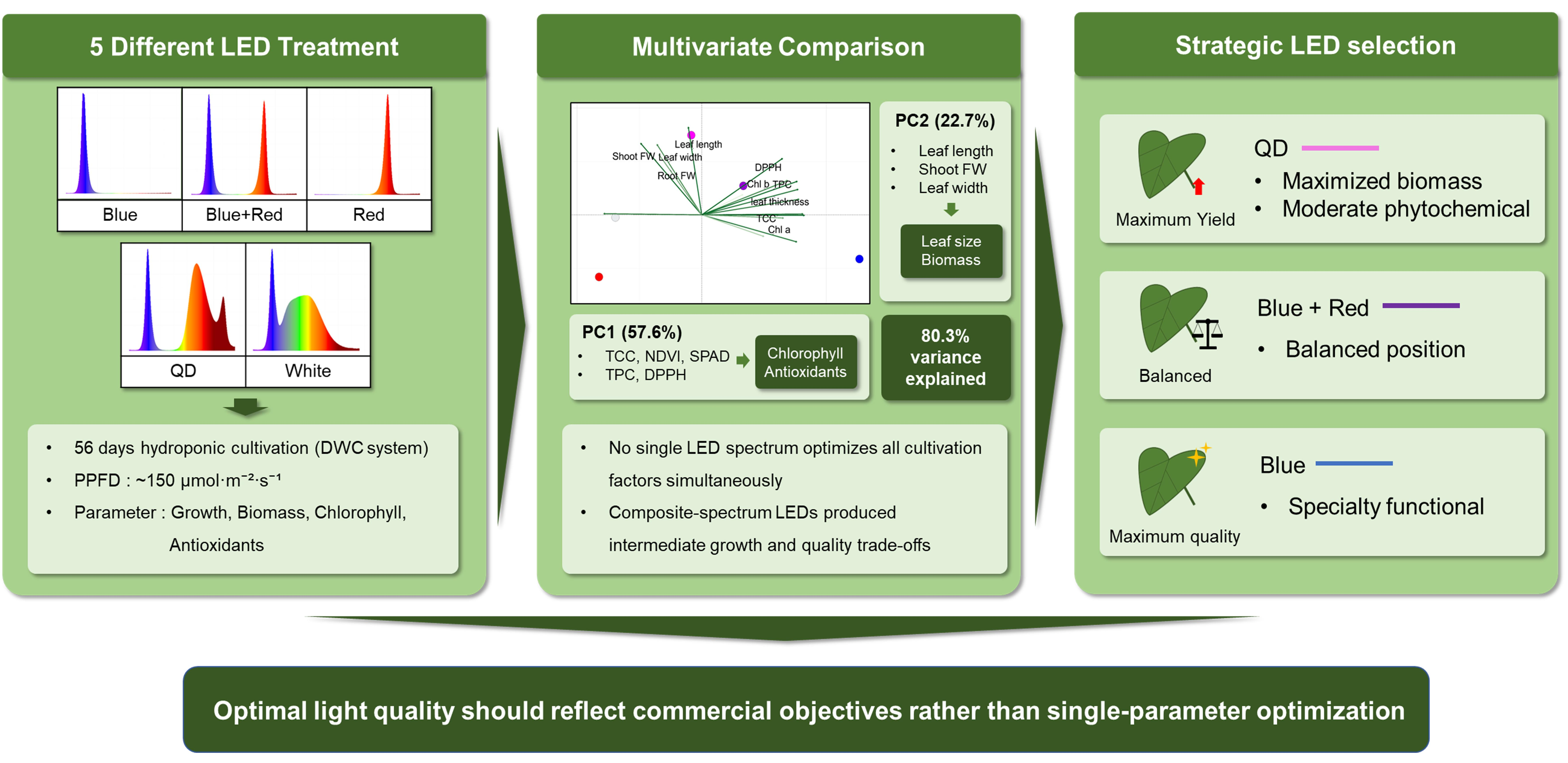
Light quality is a crucial factor influencing plant growth and physiological quality in controlled-environment agriculture (CEA). This study examined how different LED light spectra affect the growth and internal quality of Ligularia stenocephala cultivated in a plant factory. The plants were grown under five types of LED light: monochromatic red, monochromatic blue, a combination of blue and red, white LEDs, and quantum dot (QD) LEDs. We evaluated various growth parameters, biomass accumulation, chlorophyll indices, and antioxidant capacity. Monochromatic red LEDs promoted rapid early growth and stem elongation but led to lower chlorophyll accumulation and antioxidant capacity. In contrast, monochromatic blue LEDs increased chlorophyll content, leaf thickness, dry matter accumulation, and antioxidant capacity, although they limited leaf expansion and shoot biomass. Composite-spectrum LEDs displayed distinct trade-offs between growth and quality parameters. QD LEDs maximized shoot biomass accumulation while maintaining moderate internal quality, whereas Blue+Red LEDs provided a balanced combination of significant biomass and enhanced phytochemical content. Principal component analysis indicated a fundamental trade-off between quality-related (PC1: 57.6%) and growth-related (PC2: 22.7%) parameters, showing that no single LED spectrum could optimize all cultivation factors simultaneously. Therefore, LED selection should align strategically with specific cultivation goals: use QD LEDs for volume-based production, Blue+Red LEDs for balanced premium markets, and blue LEDs for specialty functional vegetables. These findings underscore the importance of context-dependent lighting optimization strategies in plant factory systems and offer a framework for selecting the most effective LED spectra to enhance crop performance in CEA.

Graphical Abstract

1. Introduction

Ligularia stenocephala M&K is a perennial plant belonging to the Asteraceae family, found in the wetlands of deep mountainous areas [1]. As a native species of Gom-chwi (Ligularia spp.), it is the most widely cultivated among those used as a wrapped vegetable [2]. Ligularia stenocephala is typically grown in natural light, both in open fields and greenhouses. However, these growing conditions can lead to outbreaks of powdery mildew in June and July, resulting in leaf scorching or wilting, which may weaken or kill the plants [3]. Additionally, high summer temperatures can cause bolting and stress, leading to decreased yields. Ligularia stenocephala has been traded at approximately 15,000 KRW (approximately 11.5 USD) kg−1 in domestic auction markets; however, its stable supply remains constrained by insufficient cultivation technology and the lack of standardized production systems [4]. Despite its commercial significance and growing demand as a functional leafy vegetable, research on the spectral responses of Ligularia stenocephala is limited, especially when compared to more commonly studied leafy vegetables like lettuce, which are highly sensitive to environmental stress.
High temperature stress is a significant challenge for the production of Ligularia stenocephala in conventional cultivation systems. Elevated temperatures can disrupt water relations, lead to osmolyte accumulation, affect photosynthetic activity, alter hormone production, and compromise the thermal stability of cell membranes [5,6]. Similar issues have been observed in other leafy vegetables in the Asteraceae family, such as lettuce, where high temperatures can induce bolting, resulting in bitter-tasting leaves and reduced marketability [7]. Moreover, when cultivated outdoors or in greenhouses, the intensity of natural light varies significantly with seasonal and weather changes. Leaves exposed to outdoor light experience fluctuations in photosynthetic photon flux density (PPFD) due to intermittent sunlight and shading from clouds [8,9]. Additionally, the light spectrum includes unnecessary wavelength bands [10], which impose further constraints on cultivation. These fluctuations in light intensity can lead to a slow photosynthetic response, limiting crop productivity [11]. Such challenges in conventional cultivation highlight the need for controlled environment solutions.
Plant factories allow for the artificial manipulation of growth conditions, including light, temperature, and humidity, facilitating year-round production of high-quality vegetables and accelerating growth compared to outdoor farming [12]. In many regions, artificial lighting is used to supplement insufficient natural sunlight during winter or periods of limited daylight, accounting for variations in light intensity and photoperiod [13,14]. Plant responses are influenced by changes in light intensity, quality, and duration, regulated by specific photoreceptors [15]. During winter, supplemental lighting is commonly utilized in greenhouses to address the lack of natural sunlight, though the daily light integral (DLI) still fluctuates based on weather conditions [16]. This strategy enhances photosynthetic performance, promoting stable year-round productivity, yield, and crop quality. Among various artificial light sources, light-emitting diodes (LEDs) have become the preferred technology for these controlled environment systems.
The effectiveness of indoor agriculture, particularly in plant factories, is significantly influenced by light quality. The use of energy-efficient light-emitting diodes (LEDs) in indoor farming systems is increasing [17]. LEDs produce less heat compared to high-pressure sodium (HPS) lamps and have a long operational lifespan [18]. They also allow for better regulation of plant growth, as different colors can be combined to create customized light spectra tailored to specific intensity requirements [13,14]. Red and blue light serve as the primary energy sources for photosynthetic CO2 assimilation in plants, having the greatest impact on plant growth [19]. However, using monochromatic light can negatively affect plants. Supplementing red LEDs with an appropriate amount of blue light can correct the imbalance between phytochrome and cryptochrome, thus promoting plant growth and development and potentially increasing crop yield [20]. Building on these traditional LED technologies, quantum dot LEDs emerge as an innovative option with distinct spectral properties.
A variety of LED light sources with unique spectral characteristics are now commercially available for plant cultivation. Quantum dots (QDs) are nanoscale semiconductor crystals with diameters less than 20 nm, and their emission and absorption spectra can be tuned across the ultraviolet to infrared spectrum [21]. In a method for integrating QDs into LEDs, blue light is used as excitation light. This technique allows some blue light to pass through while converting the remainder into green and red wavelengths, resulting in light that comprises a mixture of blue, green, and red [22]. QD LED spectral characteristics have been reported to enhance plant growth and physiological quality, including chlorophyll content and antioxidant capacity, in perilla leaves [23]. However, comprehensive data on the responses of Ligularia stenocephala to QD LEDs and other LED light qualities is still limited. Therefore, this study aims to investigate the effects of various LED light qualities—including monochromatic red and blue light, combined blue and red light, white light, and quantum dot LEDs—on the growth characteristics and internal quality of Ligularia stenocephala grown hydroponically in a plant factory. The goal is to provide foundational information on spectral responses that can inform the selection.

2. Materials and Methods

2.1. Plant Material and Growth Conditions

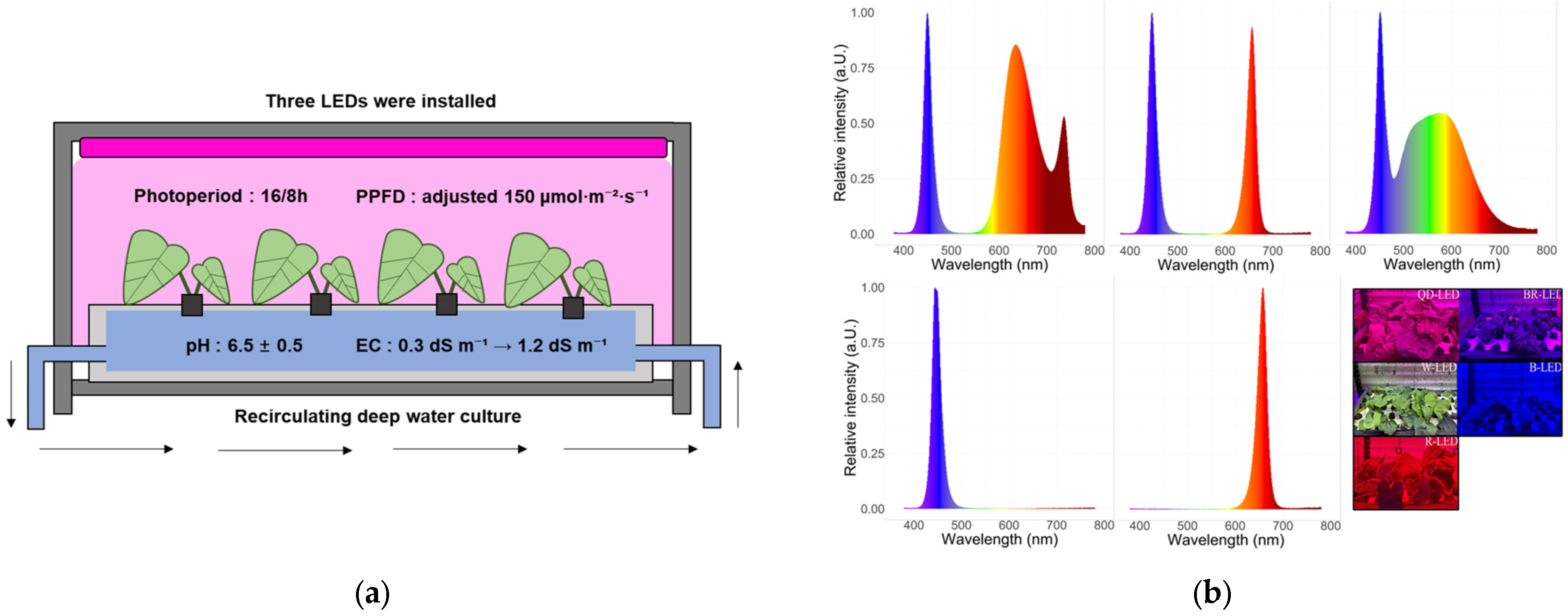
The experimental plant used in this study was Ligularia stenocephala (gondalbi), a species that is taxonomically distinct from Ligularia fischeri (gomchwi), another commonly consumed Ligularia species in Korea. The experiment took place in a closed-type plant factory chamber at Kangwon National University, which was equipped with a recirculating deep water culture (DWC) hydroponic system set up on a four-tier rack (Figure 1a). Seeds were soaked in running water for 12 h and then subjected to cold, moist storage at 5 °C for 7 days to promote uniform germination. The germinated seeds, which had visible radicles, were transplanted into urethane sponges for seedling establishment.
The seedlings were cultivated under controlled environmental conditions, with an air temperature of 22 ± 3 °C and relative humidity of 80 ± 10%. During the seedling stage, white LED lighting was provided at a photosynthetic photon flux density (PPFD) of 100 μmol m−2 s−1 under a 16/8 h (light/dark) photoperiod. White LED, the most widely used light source in horticultural production, was selected for the early seedling stage to support stable and uniform plant development prior to the application of experimental light quality treatments [24]. After 42 days of seedling growth, plants with fully expanded first true leaves were transplanted into the hydroponic system and exposed to LED light quality treatments for 56 days, by which point several treatment groups had reached a marketable leaf size suitable for commercial sale as a wrap vegetable, and growth rates across all measured parameters had markedly declined, indicating that the plants had entered a growth plateau phase and representing a biologically and commercially appropriate harvest time.
The nutrient solution formulation was based on the standard hydroponic solution for leafy vegetables developed by the Horticultural Research Institute [25]. Electrical conductivity (EC) was initially maintained at 0.3 dS m−1 and increased by 0.3 dS m−1 every two weeks through replacement with fresh nutrient solution, reaching a final EC of 1.2 dS m−1, while pH was kept at 6.5 ± 0.5 throughout the cultivation period.

2.2. LED Light Quality Treatments

The light qualities used in the experiment included QD LED (Cheorwon Plasma Research Institute, Gangwon-do, Republic of Korea), which emitted blue light, red light, and a small proportion of far-red light; white LED (HT400-5700; BISSOL LED, Seoul, Republic of Korea), which produced blue light, a broad spectrum of green light, and a minor portion of red light; blue+red LED (HT402-1; BISSOL LED, Seoul, Republic of Korea) with a blue-to-red ratio of 1:2; and monochromatic blue LED (HT400-Blue; BISSOL LED, Seoul, Republic of Korea) and red LED (HT400-Red; BISSOL LED, Seoul, Republic of Korea). The wavelengths of the LEDs were measured three times, and the average values were recorded (Figure 1b). For detailed spectral distribution and proportion parameters of each LED treatment, refer to Supplementary (Table S1). Three bar-shaped LED units were installed for each light quality treatment, and PPFD was maintained at approximately 150 ± 10 μmol·m−2·s−1 at canopy level across all treatments under a photoperiod of 16/8 h (light/dark). To provide a more comprehensive description of the experimental setup, detailed environmental conditions including air temperature, relative humidity, and CO2 concentration as well as PPFD levels measured at distances of 20 cm and 40 cm from the LED fixtures under all five light-quality treatments have been added to the Supplementary Materials (Table S2). These measurements were conducted after the completion of the experiment to verify the spatial uniformity and technical specifications of the growth environment used in this study.

2.3. Growth and Morphological Measurements

After planting, we measured the following parameters at 7-day intervals: leaf length, leaf width, leaf number, and stem length. On the final day of cultivation, we assessed leaf thickness, as well as the fresh weight of shoots and roots, and calculated the dry matter content (DMC). Measurements for leaf length and width were taken from the largest leaf; leaf length was measured from the tip to where the blade meets the petiole, and leaf width was recorded at the broadest part. The longest stem indicated the stem length, while the count of fully opened true leaves represented the leaf number. Leaf thickness was measured with a digital thickness gauge (range: 0–12.7 mm), excluding the veins. The DMC was calculated using Equation (1) after recording the fresh weight and drying the samples in a hot air oven (OF-21E; JEO TECH Co., Ltd., Daejeon, Republic of Korea) at 80 °C for 72 h to obtain the dry weight. We also examined the weekly growth rates of leaf length, leaf width, leaf number, and stem length by comparing them to the previous week, using Equation (2), where α1 and α2 represent measurements at times t1 and t2, respectively [26].
D M C   % = D r y   w e i g h t   g F r e s h   w e i g h t   g × 100
μ e x p = ln α 2 / α 1 / t 2 t 1

2.4. Internal Quality Analysis

At the conclusion of the cultivation period, we evaluated several parameters: NDVI, SPAD, total chlorophyll content (TCC), chlorophyll a (Chl a), chlorophyll b (Chl b), DPPH radical scavenging activity, and total phenolic content (TPC). The NDVI (Normalized Difference Vegetation Index), known for its sensitivity to chlorophyll content in leaf spectral reflectance characteristics [27], was measured using a portable spectrophotometer (Polypen RP 410 UVIS; Photon System Instruments, Drásov, Czech Republic) on healthy leaves. SPAD readings, which indicate chlorophyll content, were obtained from the same leaves using a chlorophyll meter (SPAD-502; Minolta Camera Co., Tokyo, Japan). Total chlorophyll content (TCC), chlorophyll a (Chl a), and chlorophyll b (Chl b) were quantified according to the AOAC (2003) method, as applied by Im et al. (2016) and Yoon et al. (2018) [28,29,30]. For each light quality treatment, we extracted 1 g of finely chopped fresh Ligularia stenocephala leaves in 10 mL of methanol at 4 °C for 48 h. We then sampled 1 mL of the extract and measured its absorbance at 642.5 nm and 660 nm using a UV-Vis spectrophotometer (BioMate 3S UV-Vis; Thermo Fisher Scientific, Boston, MA, USA). Chlorophyll contents were calculated using Equations (3)–(5).
T o t a l     c h l o r o p h y l l   ( m g · m L 1 ) = 7.12 × A 660 n m + 16.8 × A 642.5 n m
C h l o r o p h y l l   a   m g · m L 1 = 9.930 × A 660 n m 0.777 × A 642.5 n m
C h l o r o p h y l l   b   m g · m L 1 = 17.60 × A 642.5 n m 2.81 × A 660 n m
The DPPH radical scavenging activity was analyzed following the method described by Oboh (2005) [31]. For each light quality treatment, we homogenized 0.5 g of fresh Ligularia stenocephala with 20 mL of methanol. A 0.1 mL aliquot of this homogenized sample was then combined with a 0.4 mM DPPH methanol solution and incubated in the dark for 30 min. We recorded the absorbance at 516 nm using the same spectrophotometer described above and calculated the results using Equation (6).
D P P H   r a d i c a l   s c a v e n g i n g   a b i l i t y   ( % ) = 1   S a m p l e   A 516 n m   B l a n k   A 516 n m × 100
Total phenolic content (TPC) was assessed using a modified Folin–Denis method [32]. For each light quality treatment, 50 µL of the sample solution was mixed with 450 µL of distilled water. Next, 50 µL of Folin–Ciocalteu phenol reagent was added to the mixture, which was then incubated at room temperature for five minutes. Following this, 150 µL of 7% Na2CO3 and 1000 µL of distilled water were added and the mixture was thoroughly mixed, resulting in a final reaction volume of 1.7 mL. The reaction mixture was incubated at room temperature for 2 h, after which the absorbance was measured at 760 nm using the same spectrophotometer described above. TPC was calculated based on a gallic acid standard curve, with results expressed as mg gallic acid equivalents (GAE)·g−1.

2.5. Statistical Analysis

Statistical analyses were conducted using R software version 4.3.0 (R Core Team, Vienna, Austria). A one-way analysis of variance (ANOVA) was performed to identify significant differences among treatments, followed by Duncan’s multiple range test (DMRT) for mean separation at the 5% significance level (p < 0.05), utilizing the ‘agricolae’ package (version 1.3-7) [33]. Data visualization and graphical outputs were generated with the ‘tidyverse’ suite of packages (version 2.0.0) [34]. To assess multivariate relationships among growth and quality parameters, principal component analysis (PCA) was executed using the ‘FactoMineR’ package (version 2.11) [35], with results visualized through the ‘factoextra’ package (version 1.0.7) [36].

3. Results

3.1. Morphological and Growth Changes in Ligularia stenocephala

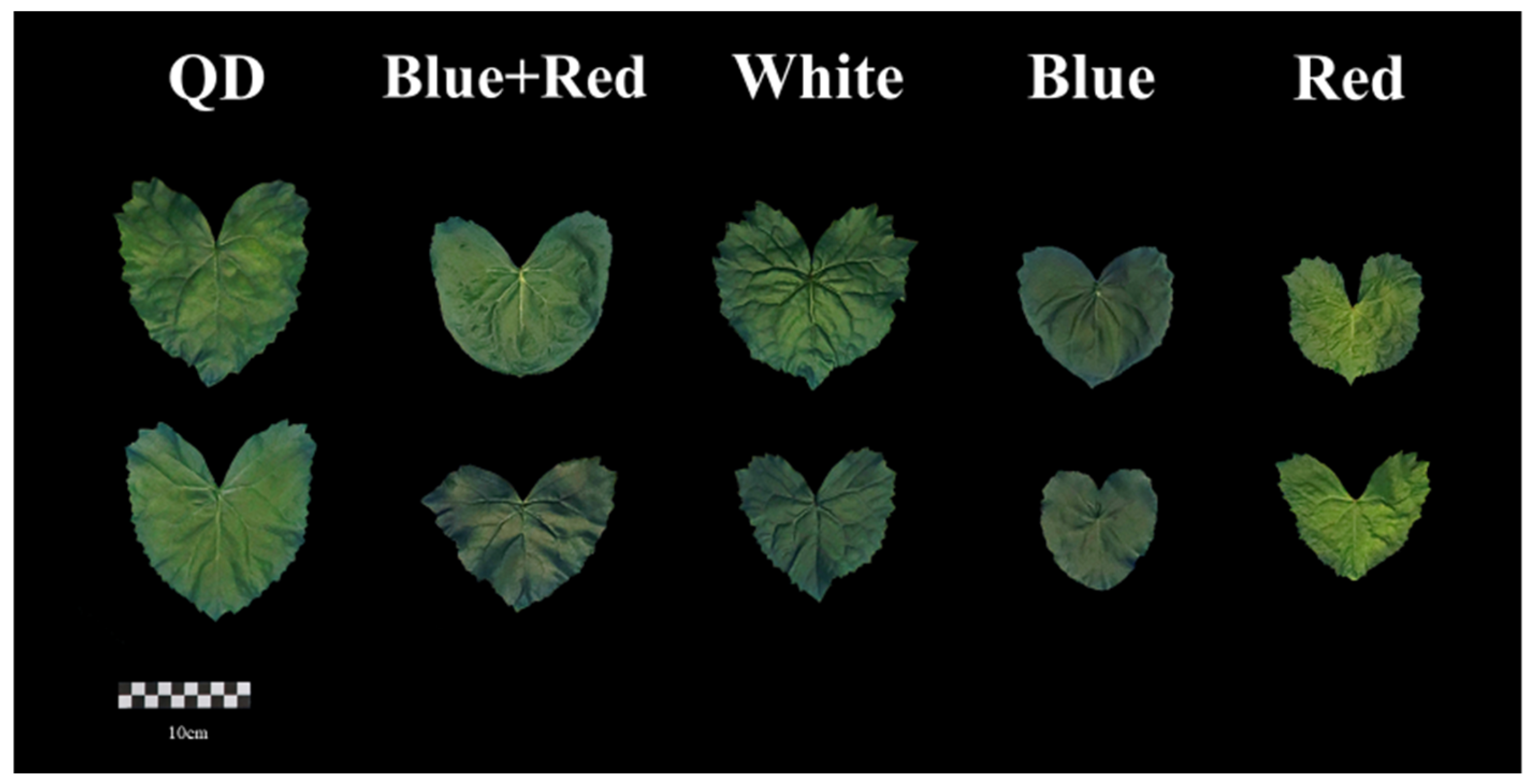
Ligularia stenocephala grown under different LED light qualities exhibited significant differences in morphological characteristics and growth patterns. In terms of leaf morphology, larger leaves were observed under composite light treatments such as QD, Blue+Red, and White, in comparison to those grown under monochromatic light (Figure 2). Leaves exposed to monochromatic light appeared considerably smaller. In terms of leaf color, those cultivated under blue light exhibited a dark green hue, while leaves grown under red light displayed a lighter green color, highlighting a noticeable visual difference. These variations in leaf color can likely be attributed to differences in chlorophyll content influenced by light quality, a conclusion which is supported by biochemical analyses.
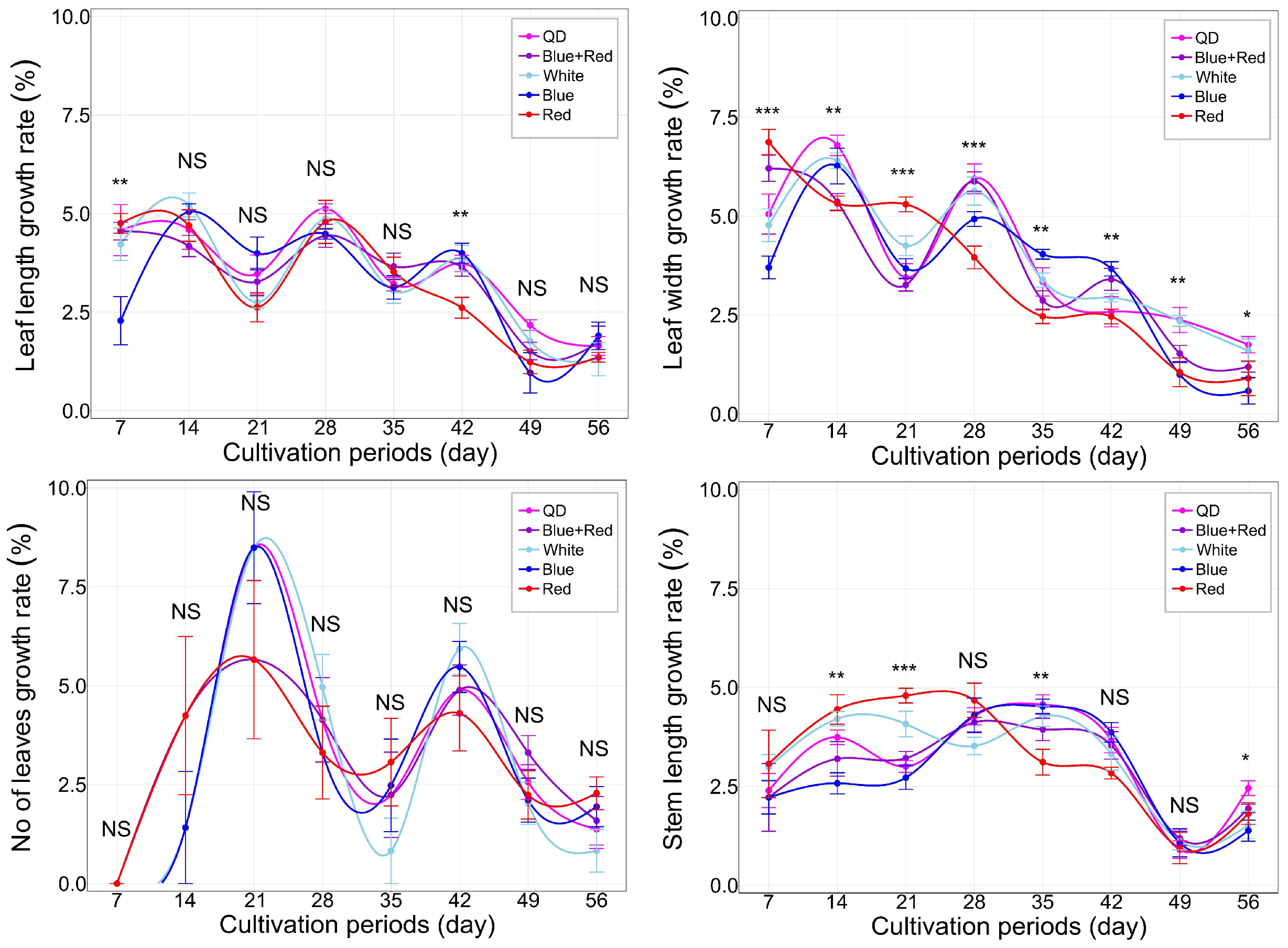
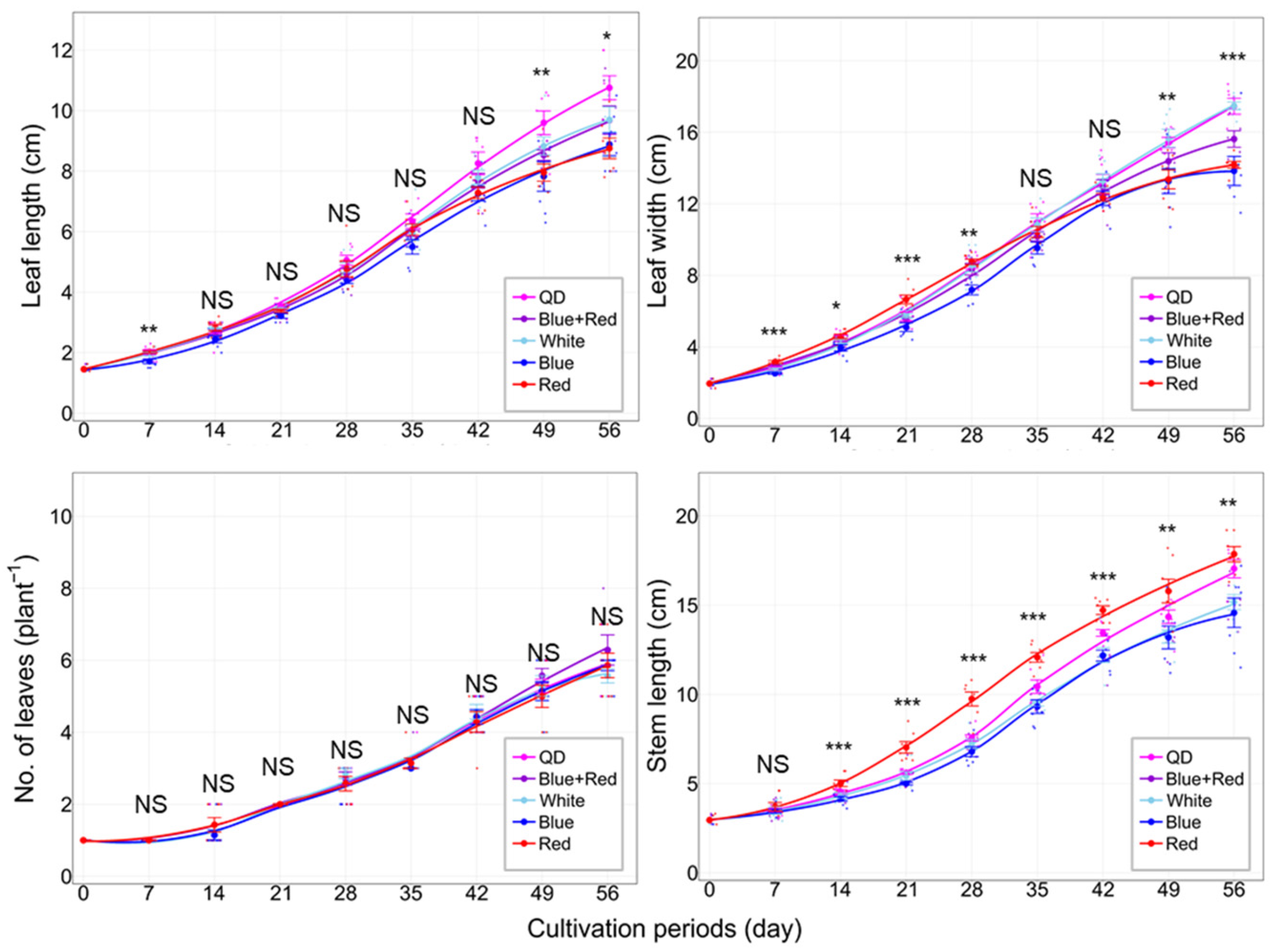
The weekly growth rate of Ligularia stenocephala peaked on day 7 under the red treatment for leaf length, leaf width, and stem length, indicating rapid early growth (Figure 3). Growth rates fluctuated, showing repeated patterns of increase and decrease until day 35. An increase in leaf number occurred earlier under the Red and Blue+Red treatments compared to other light-quality treatments; a sharp increase at day 21 was noted under all other light treatments, though differences among treatments were not statistically significant throughout the cultivation period, likely due to high variability. Stem length exhibited the highest initial growth rate under the Red treatment at days 14 and 21 (p < 0.01 and p < 0.001, respectively), but the decline in growth rate also began earliest under this treatment, with significant differences observed by day 35. A sharp decline was seen after 42 days across all light-quality treatments for all growth parameters.
Leaf length and width increased rapidly under the red treatment during the early growth stage; however, as cultivation progressed, larger values were noted under combined light treatments (Figure 4). Leaf number showed no significant differences among light-quality treatments throughout the cultivation period. Stem length consistently remained greatest under the red treatment from transplanting to harvest, although the differences compared to the QD and White treatments diminished during the later growth stage.
Leaves grown under the QD treatment measured 10.8 cm in length, the only treatment surpassing 10 cm, and were about 23% longer than those grown under the Red treatment, which had the shortest leaves (Table 1). Leaf width reached approximately 17.5 cm under both the QD and White treatments, significantly greater than the widths observed under other light-quality treatments. In contrast, leaves grown under monochromatic Blue and Red light did not exceed 9 cm in length and remained below 15 cm in width, resulting in noticeably smaller leaves compared to those grown under combined light treatments.
The highest number of leaves was found in the Blue+Red group, averaging around six leaves per plant. However, no significant differences were noted among treatments during the cultivation period, and these differences were not statistically significant at the end of the experiment. The tallest stems were observed under the Red treatment, reaching approximately 18 cm, while the QD and White treatments also surpassed 17 cm, with no statistically significant differences compared to Red. Conversely, plants grown under the Blue treatment had the shortest stems, measuring less than 15 cm. Leaf thickness was significantly greatest under the Blue treatment, averaging approximately 0.47 mm, while the thinnest leaves were found under the Red and White treatments, both measuring around 0.40 mm.
On the final day of cultivation, the QD treatment, which produced the largest leaf size, also recorded the highest shoot fresh weight at approximately 27 g—about 1.44 times greater than that of the Blue treatment (Table 2). While the Red treatment initially promoted superior leaf growth, its growth rate slowed over time, leading to a lower shoot fresh weight at harvest compared to plants grown under combined light treatments. The Blue treatment, characterized by smaller leaf size and shorter stem length, had the lowest shoot fresh weight at less than 20 g, indicating limited biomass accumulation. In terms of root fresh weight, the QD treatment was the highest at approximately 7.5 g, suggesting that it supported superior growth in both shoot and root biomass. Conversely, the Blue treatment had the lowest root fresh weight at around 5 g.
The shoot dry matter content (DMC) displayed an opposite trend to fresh weight, with the Blue treatment showing a significantly higher DMC of approximately 36%. Lower DMC values were recorded under combined light treatments, excluding QD, with the White treatment having the lowest shoot DMC at about 30%. A similar trend was observed for root DMC, where the Blue treatment exceeded 40%, while the Red treatment had the lowest value. Both shoot and root DMC values were highest in the Blue treatment, although the QD treatment had the second-highest values, indicating a more balanced growth pattern.

3.2. Internal Quality Changes in Ligularia stenocephala

SPAD values, which indicate relative chlorophyll content, were significantly higher under the Blue and Blue+Red treatments compared to other light-quality treatments. In contrast, lower SPAD values were observed under the White and Red treatments (Table 3). NDVI values, serving as an indirect indicator of chlorophyll content, displayed a similar trend to SPAD values. NDVI values exceeded 0.5 under the Blue+Red and Blue treatments, while the QD treatment reached the threshold value of 0.50 ± 0.01. In contrast, NDVI values remained below 0.5 under the White and Red treatments, with the lowest value of approximately 0.48 observed under the White treatment.
Destructive analysis of chlorophyll content confirmed the patterns observed in SPAD and NDVI measurements. Total chlorophyll content was highest under the Blue treatment, reaching approximately 35 mg·mL−1. Under this treatment, chlorophyll a measured 24.2 mg·mL−1 and chlorophyll b measured 11.4 mg·mL−1, both significantly higher than the lowest values recorded under the Red treatment. The QD treatment exhibited intermediate chlorophyll characteristics across all measurement methods, maintaining moderate-to-high values in the non-destructive indices (NDVI, SPAD) as well as in destructive chlorophyll quantification (TCC, Chl a, Chl b). This intermediate positioning, along with superior biomass production (Table 2), suggests that the broad-spectrum QD composition strikes a functional balance between promoting growth and enhancing chlorophyll accumulation.
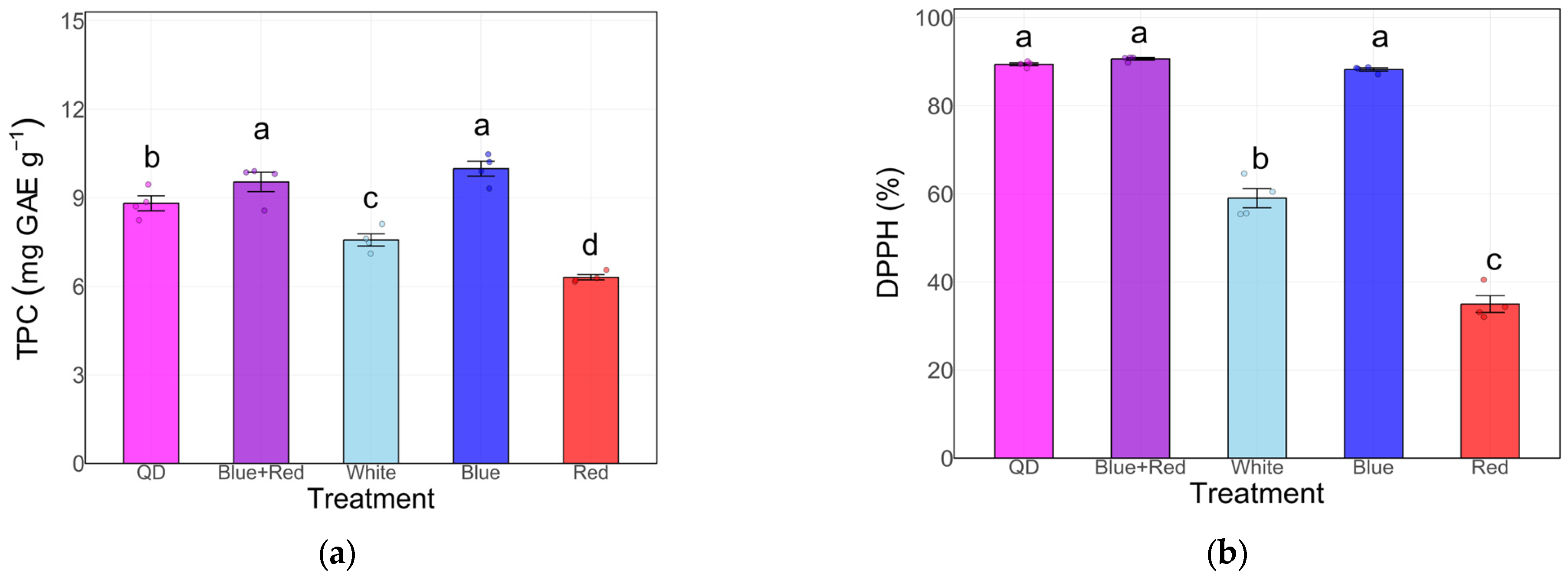
Antioxidant activity was assessed through total phenolic content and DPPH radical scavenging activity. The total phenolic content was significantly higher under the Blue and Blue+Red treatments, with the Blue treatment showing the highest level at approximately 10 mg GAE·g−1 (Figure 5a). This value was about 1.5 times greater than that of the Red treatment, which had the lowest total phenolic content. The QD treatment displayed intermediate levels, while the White treatment had the lowest content among the combined light treatments.
DPPH radical scavenging activity exhibited a similar trend (Figure 5b). Higher activity was noted under the Blue+Red and Blue treatments, whereas the Red treatment demonstrated the lowest values. The QD treatment also showed high DPPH radical scavenging activity, exceeding 85%, comparable to the levels seen under the Blue and Blue+Red treatments. The highest DPPH activity, approximately 91%, was recorded under the Blue+Red treatment, more than double that of the Red treatment, which only reached 35% activity. The White treatment had higher activity than the Red but remained significantly lower than the QD, Blue+Red, and Blue treatments.

3.3. Multivariate Relationships Among Growth and Quality Parameters

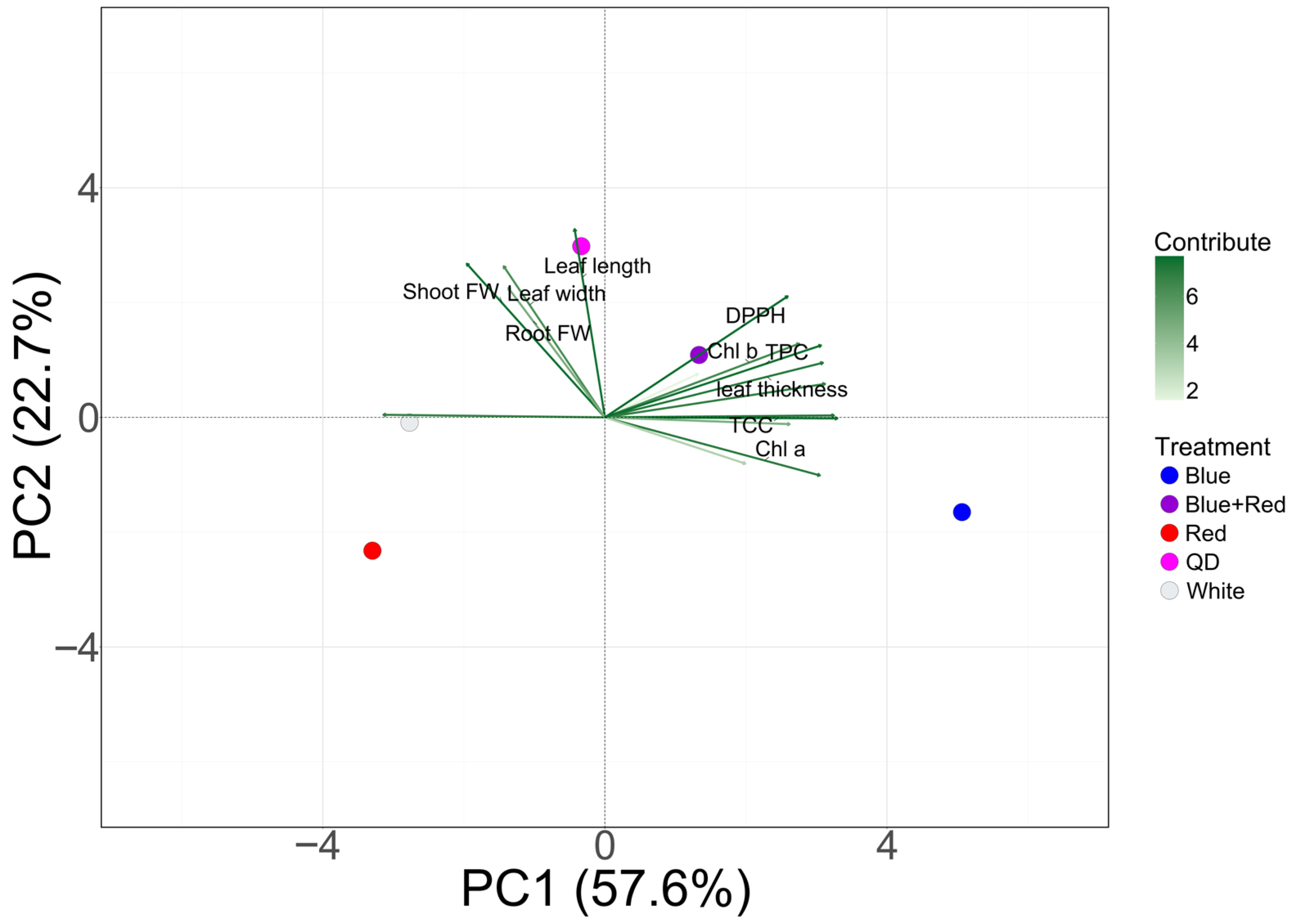
Principal component analysis (PCA) was conducted to assess the multivariate relationships among growth and quality parameters under various LED light qualities. The analysis of the scree plot indicated that the first two principal components (PC1 and PC2) accounted for 57.6% and 22.7% of the total data variance, respectively, resulting in a cumulative variance of 80.3%.
PC1 was primarily associated with chlorophyll-related variables and internal quality traits. Total chlorophyll content (TCC) had the highest contribution to PC1 (0.977), followed by NDVI (0.966), chlorophyll a (0.907), SPAD (0.929), chlorophyll b (0.820), and leaf thickness (0.920). Antioxidant indicators also contributed significantly to PC1, with total phenolic content (TPC) at 0.912 and DPPH radical scavenging activity at 0.771. Conversely, stem length had a strong negative contribution to PC1 (−0.935), indicating an inverse relationship with chlorophyll accumulation and antioxidant capacity.
PC2 was mainly linked to morphological expansion and leaf size. Leaf length had the highest contribution to PC2 (0.976), followed by shoot fresh weight (0.796), leaf width (0.783), and root fresh weight (0.671). DPPH radical scavenging activity contributed substantially to both PC1 (0.771) and PC2 (0.627), highlighting its relevance to both internal quality and plant growth. Collectively, these variables represented plant biomass accumulation and leaf expansion capacity.
The biplot distribution effectively distinguished the LED treatments based on their growth and quality characteristics (Figure 6). The Blue treatment was positioned in the right-center to lower-right region (positive PC1, near-zero to negative PC2), indicating high chlorophyll content and antioxidant activity but limited biomass accumulation. The Blue+Red treatment was located in the upper-right quadrant (positive PC1 and PC2), demonstrating balanced characteristics in both chlorophyll content and biomass accumulation. The QD treatment was found in the upper-center region (positive PC2, moderate PC1), exhibiting high biomass accumulation with intermediate chlorophyll levels. The White treatment was near the origin, showing moderate values across most parameters. In contrast, the Red treatment occupied the lower-left quadrant (negative PC1 and PC2), characterized by low chlorophyll content, reduced antioxidant activity, and smaller leaf size, which correlated with excessive stem elongation as indicated by the negative direction of the stem length vector in PC1.

4. Discussion

Ligularia stenocephala showed larger leaf sizes under combined light treatments. The leaves appeared dark green under monochromatic blue light and light green under monochromatic red light. This observation is similar to findings in lettuce cultivation, where increased red light resulted in a lighter leaf color [27]. Additionally, leaf greenness correlates with levels of chlorophyll a and b [37]. Destructive analysis of Ligularia stenocephala leaves indicated that chlorophyll a, chlorophyll b, and total chlorophyll content (TCC) were highest under blue light and lowest under red light (Table 3). Thus, the variations in leaf color of Ligularia stenocephala are likely due to differences in chlorophyll content influenced by light quality.
In this study, among the growth parameters measured, leaf length, leaf width, and shoot fresh weight were greatest under the QD treatment (Table 1 and Table 2). Stem length was longest under the Red treatment, while the shortest stem was found under the Blue treatment. The QD light used in this study combined blue light with broad red and far-red light, whereas the White light included blue light along with a small proportion of red and green light (Figure 1). The rapid early growth observed under the Red treatment, followed by a progressive decline in growth rate (Figure 3), may be attributed to ‘red light syndrome,’ a phenomenon in which prolonged exposure to monochromatic red light gradually impairs photosynthetic capacity [38]. This is consistent with the significantly lower chlorophyll indices and antioxidant capacity observed in the Red treatment at harvest (Table 3), suggesting progressive deterioration of the photosynthetic apparatus under prolonged monochromatic red irradiance [39]. Previous research has shown that adding far-red light to a combination of blue and red light increases fresh weight and leaf area compared to using only blue and red light [40], supporting the superior biomass production observed under the QD treatment in this study. Furthermore, both green light and far-red (FR) light have been reported to serve as shade signals in plants, triggering shade-avoidance responses such as leaf expansion and petiole elongation [41,42]. Composite spectrum treatments generally produced larger leaves compared to monochromatic treatments, likely due to the induction of shade-avoidance responses and broader activation of photoreceptors [43]. The far-red component represents a defining spectral characteristic of QD LED that distinguishes it from the other treatments, and its contribution to growth promotion is supported by the literature-based inference presented in this study. Although a direct comparison with an independent far-red supplementation treatment would be required to conclusively isolate its effect, this was beyond the scope of the present production-oriented study and is recommended as a direction for future research.
Leaf width, stem length, and fresh weight of shoots and roots exhibited the lowest values under the Blue treatment (Table 1 and Table 2). Research on red-leaf lettuce indicates that exposure to monochromatic blue light significantly reduces leaf width compared to red light [44]. Additionally, a higher proportion of blue light has been shown to adversely affect shoot growth in lettuce [38]. Throughout the cultivation period, there were no substantial differences in leaf number among the various light quality treatments (Figure 4). By the end of the cultivation, the highest leaf count, averaging approximately six leaves, was recorded under the Blue+Red treatment; however, no statistically significant differences were found compared to the other light treatments (Table 1). These findings imply that light quality has a minimal impact on leaf number in Ligularia stenocephala cultivation. This is consistent with reports that spectral composition does not significantly affect leaf number in certain leafy vegetables, regardless of R:B ratio combinations [45], and a meta-analysis of 59 independent studies demonstrated that far-red light supplementation, a component present in the QD spectrum, also had no significant effect on leaf number across vegetable crops [46]. Accordingly, the differences in shoot fresh weight observed among treatments were driven by individual leaf expansion and thickness rather than by differences in leaf number. Leaf thickness was greatest under the Blue treatment, while the thinnest leaves were observed under the Red and White treatments (Table 1). This trend aligns with previous studies on rubber tree leaves, where leaf thickness increased under blue light and decreased under red light [47].
The shoot and root dry matter content values were significantly highest under the Blue treatment (Table 2). An increased proportion of blue light can enhance chloroplast development, promote chlorophyll synthesis in leaves, regulate stomatal opening and closing, and influence dry matter accumulation in plants [48]. This may explain the superior dry matter content and chlorophyll levels observed in Ligularia stenocephala leaves exposed to blue light in this experiment.
Among the spectral reflectance characteristics of leaves, NDVI, which is sensitive to chlorophyll content [27], and SPAD showed the highest values under blue light and the lowest values under white light, where larger leaf sizes were observed (Table 3). Although growth inhibition was not noted under green light, chlorophyll content has been reported to decrease in such conditions [49,50]. This likely accounts for the lower NDVI and SPAD values observed under white light, characterized by a broad green-light spectrum and larger leaf size. Additionally, destructive analysis revealed that chlorophyll a, chlorophyll b, and total chlorophyll content (TCC) were highest under the blue treatment and lowest under the red treatment. Blue light is known to enhance the expression of several enzymes involved in chlorophyll biosynthesis [51]. Furthermore, previous research has shown that cultivating rapeseed under blue light leads to increased leaf thickness and higher chlorophyll content per unit weight [52]. This is consistent with the results of the present study, where Ligularia stenocephala grown under blue light exhibited the greatest leaf thickness and the highest chlorophyll-related indices.
Antioxidant capacity, measured by total phenolic content and DPPH radical scavenging activity, was significantly enhanced under Blue and Blue+Red LEDs, while Red light resulted in the lowest values. The total phenolic content was highest under Blue light (Figure 5), consistent with previous findings that indicated elevated SPAD and total phenolic content in Lactuca sativa L. ‘Sunmang’ and Lactuca sativa L. ‘Grand Rapid TBR’ grown under a higher proportion of blue light compared to conditions lacking blue light [44]. Bioactive compounds, such as phenolic acids and flavonoids, play a crucial role in scavenging free radicals and oxidants, thereby preventing cellular damage [53,54]. Short wavelengths like blue light possess high energy levels that induce oxidative stress, which in turn enhances the capacity to scavenge reactive oxygen species [50,54]. In this experiment, the increase in total phenolic content in leaves grown under blue light can be attributed to this mechanism. This blue light-mediated enhancement of antioxidant capacity is consistent with findings in other Asteraceae species. A recent study on Cichorium intybus L., a functional leafy vegetable of the same family, reported that blue LED irradiation induced the accumulation of highly antioxidant polyphenols, including quercetin derivatives and chicoric acid, whereas red LEDs induced a markedly different polyphenolic composition, underscoring the importance of species-specific light spectrum selection for optimizing nutraceutical content in Asteraceae vegetables [55]. DPPH radical scavenging activity exhibited a similar trend to that of total phenolic content, with the highest values observed under Blue+Red and Blue treatments, and the lowest under Red treatment. This finding aligns with previous studies that demonstrated a strong correlation between total phenolic content and DPPH scavenging activity [56]. Under the QD treatment, DPPH radical scavenging activity was comparable to that under Blue and Blue+Red treatments, indicating a similarly high antioxidant capacity, despite QD’s primary advantage in biomass production.
Principal component analysis (PCA) provided a quantitative framework for LED selection, with the first two components accounting for 80.3% of the total variance. This analysis revealed a fundamental trade-off between quality (PC1: chlorophyll and antioxidant capacity) and growth (PC2: biomass accumulation) parameters. The distinct spatial separation of treatments in the PCA biplot (Figure 6) illustrates that no single LED spectrum can simultaneously optimize all cultivation parameters. The Blue treatment achieved maximum internal quality but resulted in growth suppression (positive PC1, negative PC2). In contrast, the QD treatment maximized biomass production while maintaining moderate phytochemical levels (high PC2, moderate PC1). The Blue+Red treatment occupied a balanced position (positive PC1 and PC2), integrating both quality and growth attributes. Consequently, LED selection for commercial production of Ligularia stenocephala should align strategically with target market requirements: QD for volume-based production prioritizing harvest yield, Blue+Red for markets requiring substantial biomass and enhanced nutritional quality, and Blue for specialty functional vegetables where maximum phytochemical content is prioritized over biomass accumulation. These findings demonstrate that the definition of “optimal” light quality is context-dependent and must reflect specific commercial objectives rather than pursuing single-parameter optimization.

5. Conclusions

This study examined how different qualities of LED light affect the growth characteristics and internal quality of Ligularia stenocephala grown hydroponically in a plant factory. The findings showed that the spectral composition of LED light significantly influenced plant morphology, biomass accumulation, chlorophyll-related indices, and antioxidant capacity. Monochromatic red light stimulated rapid early growth and stem elongation but was not adequate to maintain biomass accumulation and internal quality throughout the cultivation period. In contrast, monochromatic blue light improved chlorophyll content, leaf thickness, dry matter accumulation, and antioxidant capacity, though it restricted leaf expansion and overall biomass production. Composite-spectrum LEDs produced intermediate results, with distinct trade-offs in growth and quality parameters depending on their spectral composition. Principal component analysis indicated that no single LED spectrum could maximize both biomass production and phytochemical quality simultaneously, highlighting an inverse relationship between growth-related and quality-related parameters. Therefore, selecting LEDs for commercial production of Ligularia stenocephala should align strategically with specific cultivation goals: quantum dot LEDs for volume-based systems focused on harvest yield, Blue+Red spectrum for markets that require a balance of substantial biomass and enhanced nutritional quality, and monochromatic blue light for specialty functional vegetables where maximizing phytochemical content is prioritized over biomass accumulation. The light-quality-dependent response patterns identified in this study provide essential baseline information that could guide the development of stage-specific lighting strategies, such as sequential applications of LED spectra, to further optimize cultivation systems for Ligularia stenocephala.

Supplementary Materials

The following supporting information can be downloaded at: https://www.mdpi.com/article/10.3390/horticulturae12030353/s1, Table S1. Spectral characteristics of five LED light sources used in the experiment, including photosynthetic photon flux (PPF) ratio by wavelength band and peak wavelengths. Table S2. Environmental conditions, air temperature, relative humidity, CO2 concentration and photosynthetic photon flux density (PPFD) measured at 40 cm and 20 cm distances from the LED fixtures across five light quality treatments.

Author Contributions

Conceptualization, M.J.K. and H.-M.K.; methodology, M.J.K.; software, Y.B.K.; validation, S.-H.K., I.-L.C. and H.S.Y.; formal analysis, M.J.K.; investigation, M.J.K., D.Y.L. and J.H.L.; resources, S.J.L. and H.-M.K.; data curation, M.J.K.; writing—original draft preparation, M.J.K.; writing—review and editing, Y.B.K.; visualization, Y.B.K.; supervision, H.-M.K.; project administration, H.-M.K.; funding acquisition, Y.K., J.K. and H.-M.K. All authors have read and agreed to the published version of the manuscript.

Funding

This work was supported by the Korea Institute of Planning and Evaluation for Technology in Food, Agriculture, and Forestry (IPET) through the Technology Commercialization Support Program, funded by the Ministry of Agriculture, Food, and Rural Affairs (MAFRA) (122056-3), and the Basic Science Research Program through the National Research Foundation of Korea (NRF), which is funded by the Ministry of Education (RS-2021-NR060130).

Data Availability Statement

The original contributions presented in this study are included in the article/Supplementary Material. Further inquiries can be directed to the corresponding author.

Acknowledgments

The authors sincerely thank the reviewers and editors for their valuable feedback and efforts. They also appreciate the support of the laboratory members, whose contributions were essential to this research.

Conflicts of Interest

Author Jidong Kim was employed by the company FutureGreen Co., Ltd. The remaining authors declare that the research was conducted in the absence of any commercial or financial relationships that could be construed as a potential conflict of interest.

References

  1. Kim, K.-H.; Kim, N.-Y.; Kim, S.-H.; Han, I.-A.; Yook, H.-S. Study on antioxidant effects of fractional extracts from Ligularia stenocephala leaves. J. Korean Soc. Food Sci. Nutr. 2012, 41, 1220–1225. [Google Scholar] [CrossRef]
  2. Suh, J.T.; Yoo, D.L.; Kim, K.D.; Lee, J.N.; Kwon, Y.S.; Kim, W.B. Breeding of ‘Gommany’cultivar of Gomchwi with disease resistant, high quality, and yield. Korean J. Plant Resour. 2016, 29, 625–629. [Google Scholar] [CrossRef]
  3. Suh, J.T.; Yoo, D.L.; Kim, K.D.; Lee, J.N.; Sohn, H.B.; Nam, J.H.; Kim, S.J.; Hong, S.Y.; Kim, Y.H. Breeding of ‘Greenbear’for New Cultivar of Gomchwi with Disease Resistant and High Yield. Korean J. Plant Resour. 2021, 34, 339–345. [Google Scholar] [CrossRef]
  4. Gangwon Agricultural Research & Extension Services. Cultivation Technology and Harvest Methods for Gondalbi. In 2023 Agricultural Science and Technology R&D Results: Practical Farming Utilization Data; Gangwon Agricultural Research & Extension Services: Chuncheon, Republic of Korea, 2023; pp. 214–215. Available online: https://ares.gangwon.kr/gwares/know_how/research/application_data?articleSeq=37725 (accessed on 10 March 2026). (In Korean)
  5. Waraich, E.; Ahmad, R.; Halim, A.; Aziz, T. Alleviation of temperature stress by nutrient management in crop plants: A review. J. Soil Sci. Plant Nutr. 2012, 12, 221–244. [Google Scholar] [CrossRef]
  6. Carotti, L.; Graamans, L.; Puksic, F.; Butturini, M.; Meinen, E.; Heuvelink, E.; Stanghellini, C. Plant factories are heating up: Hunting for the best combination of light intensity, air temperature and root-zone temperature in lettuce production. Front. Plant Sci. 2021, 11, 592171. [Google Scholar] [CrossRef]
  7. Chen, L.; Xu, M.; Liu, C.; Hao, J.; Fan, S.; Han, Y. LsMYB15 Regulates Bolting in Leaf Lettuce (Lactuca sativa L.) Under High-Temperature Stress. Front. Plant Sci. 2022, 13, 921021. [Google Scholar] [CrossRef]
  8. Knapp, A.; Smith, W. Stomatal and photosynthetic responses during sun/shade transitions in subalpine plants: Influence on water use efficiency. Oecologia 1987, 74, 62–67. [Google Scholar] [CrossRef]
  9. Bhuiyan, R.; Van Iersel, M.W. Only extreme fluctuations in light levels reduce lettuce growth under sole source lighting. Front. Plant Sci. 2021, 12, 619973. [Google Scholar] [CrossRef]
  10. Lee, S.; Park, S. LED array design for optimal combination of plant grown. J. Plant Biotechnol. 2014, 41, 123–126. [Google Scholar] [CrossRef][Green Version]
  11. Slattery, R.A.; Walker, B.J.; Weber, A.P.; Ort, D.R. The impacts of fluctuating light on crop performance. Plant Physiol. 2018, 176, 990–1003. [Google Scholar] [CrossRef]
  12. Luna-Maldonado, A.I.; Vidales-Contreras, J.A.; Rodríguez-Fuentes, H. Advances and trends in development of plant factories. Front. Plant Sci. 2016, 7, 1848. [Google Scholar] [CrossRef] [PubMed]
  13. Darko, E.; Heydarizadeh, P.; Schoefs, B.; Sabzalian, M.R. Photosynthesis under artificial light: The shift in primary and secondary metabolism. Philos. Trans. R. Soc. B Biol. Sci. 2014, 369, 20130243. [Google Scholar] [CrossRef]
  14. Paradiso, R.; Proietti, S. Light-quality manipulation to control plant growth and photomorphogenesis in greenhouse horticulture: The state of the art and the opportunities of modern LED systems. J. Plant Growth Regul. 2022, 41, 742–780. [Google Scholar] [CrossRef]
  15. Kami, C.; Lorrain, S.; Hornitschek, P.; Fankhauser, C. Light-regulated plant growth and development. Curr. Top. Dev. Biol. 2010, 91, 29–66. [Google Scholar] [CrossRef] [PubMed]
  16. Jayalath, T.C.; van Iersel, M.W.; Ferrarezi, R.S. The Energy Requirement for Supplemental Greenhouse Lighting Can Be Reduced by Considering ‘Excess’ Light from the Previous Day. Plants 2024, 13, 652. [Google Scholar] [CrossRef]
  17. Wong, C.E.; Teo, Z.W.N.; Shen, L.; Yu, H. Seeing the lights for leafy greens in indoor vertical farming. Trends Food Sci. Technol. 2020, 106, 48–63. [Google Scholar] [CrossRef]
  18. Barta, D.; Tibbitts, T.; Bula, R.; Morrow, R. Evaluation of light emitting diode characteristics for a space-based plant irradiation source. Adv. Space Res. 1992, 12, 141–149. [Google Scholar] [CrossRef]
  19. Lin, K.-H.; Huang, M.-Y.; Huang, W.-D.; Hsu, M.-H.; Yang, Z.-W.; Yang, C.-M. The effects of red, blue, and white light-emitting diodes on the growth, development, and edible quality of hydroponically grown lettuce (Lactuca sativa L. var. capitata). Sci. Hortic. 2013, 150, 86–91. [Google Scholar] [CrossRef]
  20. Gao, Q.; Liao, Q.; Li, Q.; Yang, Q.; Wang, F.; Li, J. Effects of LED red and blue light component on growth and photosynthetic characteristics of coriander in plant factory. Horticulturae 2022, 8, 1165. [Google Scholar] [CrossRef]
  21. Tian, D.; Ma, H.; Huang, G.; Gao, M.; Cai, F.; Fang, Y.; Li, C.; Jiang, X.; Wang, A.; Wang, S. A review on quantum dot light-emitting diodes: From materials to applications. Adv. Opt. Mater. 2023, 11, 2201965. [Google Scholar] [CrossRef]
  22. Jishi, T.; Ishii, T.; Shoji, K. Cultivation of cos lettuce using blue LED and quantum dot wavelength conversion sheets. Sci. Hortic. 2022, 295, 110772. [Google Scholar] [CrossRef]
  23. Chung, S.I.; Kang, M.Y.; Lee, S.C. The Growth and Enhancement of Functional Ingredients for Health Improvement of Perilla Leaves Using LED Light Source with QD Application. J. Crop Sci. Biotechnol. 2020, 23, 163–169. [Google Scholar] [CrossRef]
  24. Kusuma, P.; Pattison, P.M.; Bugbee, B. From physics to fixtures to food: Current and potential LED efficacy. Hortic. Res. 2020, 7, 56. [Google Scholar] [CrossRef] [PubMed]
  25. Seo, T.-C.; Rho, M.-Y.; Gang, N.-J.; Lee, S.-C.; Choi, Y.-H.; Yun, H.-K. Effect of Nutrient solution concentration on the growth and mineral uptake of various wrap-up vegetables and herbs grown with mixed planting in DFT hydroponics. J. Bio-Environ. Control 2007, 16, 395–406. [Google Scholar]
  26. Metsoviti, M.N.; Katsoulas, N.; Karapanagiotidis, I.T.; Papapolymerou, G. Effect of nitrogen concentration, two-stage and prolonged cultivation on growth rate, lipid and protein content of Chlorella vulgaris. J. Chem. Technol. Biotechnol. 2019, 94, 1466–1473. [Google Scholar] [CrossRef]
  27. Chen, J.-J.; Zhen, S.; Sun, Y. Estimating Leaf Chlorophyll Content of Buffaloberry Using Normalized Difference Vegetation Index Sensors. HortTechnology 2021, 31, 297–303. [Google Scholar] [CrossRef]
  28. Yoon, H.S.; Choi, I.-L.; Heo, J.-Y.; Kim, J.Y.; Han, S.J.; Kang, H.-M. Influence of hot water immersion and MAP pre-treatments on sterilization and asparagus spear qualities during cold storage. Hortic. Sci. Technol. 2018, 36, 756–765. [Google Scholar] [CrossRef]
  29. Im, J.S.; Cho, J.H.; Cho, K.S.; Chang, D.C.; Jin, Y.I.; Yu, H.S.; Kim, W.Y. Effect of salinity stress on growth, yield, and proline accumulation of cultivated potatoes (Solanum tuberosum L.). Hortic. Sci. Technol. 2016, 34, 818–829. [Google Scholar] [CrossRef]
  30. AOAC International. Official Methods of Analysis of the Association of Official Analytical Chemists; AOAC International: Rockville, MD, USA, 1991; Volume 12. [Google Scholar]
  31. Oboh, G. Effect of blanching on the antioxidant properties of some tropical green leafy vegetables. LWT-Food Sci. Technol. 2005, 38, 513–517. [Google Scholar] [CrossRef]
  32. Zhang, Q.; Zhang, J.; Shen, J.; Silva, A.; Dennis, D.A.; Barrow, C.J. A simple 96-well microplate method for estimation of total polyphenol content in seaweeds. J. Appl. Phycol. 2006, 18, 445–450. [Google Scholar] [CrossRef]
  33. de Mendiburu, F. Agricolae: Statistical Procedures for Agricultural Research. R Package Version 1.3-7. 2023. Available online: https://CRAN.R-project.org/package=agricolae (accessed on 10 March 2026).
  34. Wickham, H.; Averick, M.; Bryan, J.; Chang, W.; McGowan, L.D.A.; François, R.; Grolemund, G.; Hayes, A.; Henry, L.; Hester, J. Welcome to the Tidyverse. J. Open Source Softw. 2019, 4, 1686. [Google Scholar] [CrossRef]
  35. Lê, S.; Josse, J.; Husson, F. FactoMineR: An R package for multivariate analysis. J. Stat. Softw. 2008, 25, 1–18. [Google Scholar] [CrossRef]
  36. Kassambara, A.; Mundt, F. Factoextra: Extract and Visualize the Results of Multivariate Data Analyses. R Package Version 1.0.7. 2020. Available online: https://CRAN.R-project.org/package=factoextra (accessed on 10 March 2026).
  37. Shibghatallah, M.A.H.; Khotimah, S.N.; Suhandono, S.; Viridi, S.; Kesuma, T. Measuring leaf chlorophyll concentration from its color: A way in monitoring environment change to plantations. AIP Conf. Proc. 2013, 1554, 210–213. [Google Scholar] [CrossRef]
  38. Boros, I.F.; Székely, G.; Balázs, L.; Csambalik, L.; Sipos, L. Effects of LED lighting environments on lettuce (Lactuca sativa L.) in PFAL systems—A review. Sci. Hortic. 2023, 321, 112351. [Google Scholar] [CrossRef]
  39. Son, K.-H.; Oh, M.-M. Leaf shape, growth, and antioxidant phenolic compounds of two lettuce cultivars grown under various combinations of blue and red light-emitting diodes. HortScience 2013, 48, 988–995. [Google Scholar] [CrossRef]
  40. Jin, W.; Urbina, J.L.; Heuvelink, E.; Marcelis, L.F. Adding far-red to red-blue light-emitting diode light promotes yield of lettuce at different planting densities. Front. Plant Sci. 2021, 11, 609977. [Google Scholar] [CrossRef]
  41. Zhang, T.; Maruhnich, S.A.; Folta, K.M. Green light induces shade avoidance symptoms. Plant Physiol. 2011, 157, 1528–1536. [Google Scholar] [CrossRef]
  42. Li, L.; Tong, Y.-X.; Lu, J.-L.; Li, Y.-M.; Yang, Q.-C. Lettuce growth, nutritional quality, and energy use efficiency as affected by red–blue light combined with different monochromatic wavelengths. HortScience 2020, 55, 613–620. [Google Scholar] [CrossRef]
  43. Tarakanov, I.G.; Tovstyko, D.A.; Lomakin, M.P.; Shmakov, A.S.; Sleptsov, N.N.; Shmarev, A.N.; Litvinskiy, V.A.; Ivlev, A.A. Effects of Light Spectral Quality on Photosynthetic Activity, Biomass Production, and Carbon Isotope Fractionation in Lettuce, Lactuca sativa L. Plants. Plants 2022, 11, 441. [Google Scholar] [CrossRef]
  44. Kelly, N.; Runkle, E.S. End-of-production ultraviolet A and blue light similarly increase lettuce coloration and phytochemical concentrations. HortScience 2023, 58, 525–531. [Google Scholar] [CrossRef]
  45. Naznin, M.T.; Lefsrud, M.; Gravel, V.; Azad, M.O.K. Blue Light added with Red LEDs Enhance Growth Characteristics, Pigments Content, and Antioxidant Capacity in Lettuce, Spinach, Kale, Basil, and Sweet Pepper in a Controlled Environment. Plants 2019, 8, 93. [Google Scholar] [CrossRef]
  46. Zhang, M.; Ju, J.; Hu, Y.; He, R.; Song, J.; Liu, H. Meta-Analysis of the Impact of Far-Red Light on Vegetable Crop Growth and Quality. Plants 2024, 13, 2508. [Google Scholar] [CrossRef] [PubMed]
  47. Zheng, L.; Van Labeke, M.-C. Long-term effects of red-and blue-light emitting diodes on leaf anatomy and photosynthetic efficiency of three ornamental pot plants. Front. Plant Sci. 2017, 8, 917. [Google Scholar] [CrossRef] [PubMed]
  48. Zhang, H.; Li, X.; Han, T.; Huang, Q.; Liu, J.; Tian, A.; Liu, L.; Sun, G.; Dong, L.; Wang, H.; et al. Effects of Light Quality and Photoperiod on Growth, Dry Matter Production and Yield of Ginger. Plants 2025, 14, 953. [Google Scholar] [CrossRef] [PubMed]
  49. Johkan, M.; Shoji, K.; Goto, F.; Hahida, S.; Yoshihara, T. Effect of green light wavelength and intensity on photomorphogenesis and photosynthesis in Lactuca sativa. Environ. Exp. Bot. 2012, 75, 128–133. [Google Scholar] [CrossRef]
  50. Ahmadi, T.; Shabani, L.; Sabzalian, M.R. LED light mediates phenolic accumulation and enhances antioxidant activity in Melissa officinalis L. under drought stress condition. Protoplasma 2020, 257, 1231–1242. [Google Scholar] [CrossRef]
  51. Wang, H.; Gu, M.; Cui, J.; Shi, K.; Zhou, Y.; Yu, J. Effects of light quality on CO2 assimilation, chlorophyll-fluorescence quenching, expression of Calvin cycle genes and carbohydrate accumulation in Cucumis sativus. J. Photochem. Photobiol. B Biol. 2009, 96, 30–37. [Google Scholar] [CrossRef]
  52. Shengxin, C.; Chunxia, L.; Xuyang, Y.; Song, C.; Xuelei, J.; Xiaoying, L.; Zhigang, X.; Rongzhan, G. Morphological, Photosynthetic, and Physiological Responses of Rapeseed Leaf to Different Combinations of Red and Blue Lights at the Rosette Stage. Front. Plant Sci. 2016, 7, 1144. [Google Scholar] [CrossRef]
  53. Piluzza, G.; Bullitta, S. Correlations between phenolic content and antioxidant properties in twenty-four plant species of traditional ethnoveterinary use in the Mediterranean area. Pharm. Biol. 2011, 49, 240–247. [Google Scholar] [CrossRef]
  54. Jarerat, A.; Techavuthiporn, C.; Chanchomsuek, C.; Nimitkeatkai, H. Enhancement of Antioxidant Activity and Bioactive Compounds in Eggplants Using Postharvest LEDs Irradiation. Horticulturae 2022, 8, 134. [Google Scholar] [CrossRef]
  55. Menicucci, F.; Marino, G.; Sillo, F.; Carli, A.; dos Santos Nascimento, L.B.; Detti, C.; Centritto, M.; Brunetti, C.; Balestrini, R.M. Blue and red LEDs modulate polyphenol production in Precoce and Tardiva cultivars of Cichorium intybus L. Front. Plant Sci. 2025, 16, 1529804. [Google Scholar] [CrossRef]
  56. Zhou, S.-H.; Fang, Z.-X.; Lü, Y.; Chen, J.-C.; Liu, D.-H.; Ye, X.-Q. Phenolics and antioxidant properties of bayberry (Myrica rubra Sieb. et Zucc.) pomace. Food Chem. 2009, 112, 394–399. [Google Scholar] [CrossRef]
Figure 1. Experimental setup and LED spectral characteristics. (a) Schematic of the closed-type plant factory with four-tier DWC hydroponic system (pH 6.5 ± 0.5 EC: 0.3 dS m−1 to 1.2 dS m−1). (b) Spectral profiles of five LED treatments (QD, Blue+Red, White, Blue, Red) and representative plant images (bottom right). All LEDs maintained at ~150 μmol·m−2·s−1 PPFD at canopy level. a.u. indicates arbitrary units.
Horticulturae 12 00353 g001
Figure 2. Harvested Ligularia stenocephala leaves from plants grown hydroponically under five LED light qualities (QD, Blue+Red, White, Blue, and Red) for 56 days in a plant factory. Scale bar = 10 cm.
Horticulturae 12 00353 g002
Figure 3. Weekly growth rate changes in leaf length, leaf width, number of leaves, and stem length of Ligularia stenocephala grown hydroponically under five types of LED light for 56 days in a plant factory. Vertical bars represent ± SEM (n = 7). NS indicates not significant, * p < 0.05, ** p < 0.01, *** p < 0.001.
Horticulturae 12 00353 g003
Figure 4. Changes in leaf length, leaf width, number of leaves, and stem length of Ligularia stenocephala grown hydroponically under five LED qualities for 56 days in a plant factory. Vertical bars represent ± SEM (n = 7). NS indicates not significant, * p < 0.05, ** p < 0.01, *** p < 0.001.
Horticulturae 12 00353 g004
Figure 5. Antioxidant capacity of Ligularia stenocephala leaves grown hydroponically under five LED light qualities for 56 days in a plant factory. Vertical bars represent ± SD (n = 4) and small letters indicate the separation of the five LED light qualities between the columns by Duncan’s multiple range test at the 5% level. (a) Total phenolic content (b) DPPH radical scavenging activity.
Horticulturae 12 00353 g005
Figure 6. Principal component analysis (PCA) biplot of growth and quality parameters in Ligularia stenocephala under five LED light qualities. The first two principal components (PC1 and PC2) explained 57.6% and 22.7% of the total variance, respectively. Arrows represent variable loadings, with arrow length indicating contribution magnitude. Treatment groups are color-coded: Blue (blue), Blue+Red (purple), Red (red), QD (magenta), and White (gray). PC1 primarily represents chlorophyll content and antioxidant capacity, while PC2 represents morphological expansion and biomass accumulation.
Horticulturae 12 00353 g006
Table 1. Growth characteristics of Ligularia stenocephala grown hydroponically under five LED qualities for 56 days in a plant factory. Growth characteristics are presented as the mean ± SEM (n = 7).
TreatmentsLeafStem
Length
(cm)
Length (cm)Width (cm)Number
(Plant −1)
Thickness (mm)
QD10.8 ± 1.1 a z17.5 ± 1.2 a5.9 ± 0.9 a0.45 ± 0.01 b17.0 ± 1.4 a
Blue+Red9.7 ± 1.2 ab15.1 ± 1.3 b6.3 ± 1.1 a0.44 ± 0.01 b15.2 ± 1.1 b
White9.7 ± 1.1 ab17.5 ± 0.6 a5.6 ± 0.5 a0.40 ± 0.01 c17.0 ± 1.0 a
Blue8.9 ± 1.0 b13.8 ± 2.1 b5.9 ± 0.4 a0.47 ± 0.01 a14.6 ± 2.2 b
Red8.8 ± 0.9 b14.2 ± 0.5 b5.9 ± 0.9 a0.40 ± 0.01 c17.9 ± 1.1 a
z Means with different letters within columns indicate statistically significant differences according to Duncan’s range test at the 5% level.
Table 2. Fresh weight and dry matter content of Ligularia stenocephala shoots and roots grown hydroponically under five LED light qualities for 56 days in a plant factory. Fresh weight is presented as the mean ± SEM (n = 6) and dry matter content as the mean ± SEM (n = 3).
TreatmentsFresh Weight (g)Dry Matter Content (%)
ShootRootShootRoot
QD26.8 ± 1.2 a z7.5 ± 0.8 a33.8 ± 0.7 b37.1 ± 0.3 b
Blue+Red22.5 ± 2.0 b7.3 ± 0.8 a30.9 ± 1.3 c34.2 ± 0.9 bc
White24.2 ± 2.2 ab6.0 ± 1.2 ab30.1 ± 0.8 c36.6 ± 2.3 b
Blue18.6 ± 2.3 c5.2 ± 0.9 b35.9 ± 0.7 a42.6 ± 2.5 a
Red21.9 ± 4.3 bc6.7 ± 1.9 ab33.2 ± 0.6 b32.4 ± 0.4 c
z Means with different letters within columns indicate statistically significant differences according to Duncan’s range test at the 5% level.
Table 3. Chlorophyll characteristics of Ligularia stenocephala leaves grown hydroponically under five LED light qualities for 56 days in a plant factory. SPAD and NDVI are presented as the mean ± SEM (n = 7). Total chlorophyll content (TCC), chlorophyll a (Chl a), and chlorophyll b (Chl b) are presented as the mean ± SEM (n = 4).
TreatmentsNDVISPADChl a (mg∙mL−1)Chl b (mg∙mL−1)TCC (mg∙mL−1)
QD0.50 ± 0.01 b z51.2 ± 1.1 b22.4 ± 0.1 c11.2 ± 0.3 ab33.5 ± 1.0 bc
Blue+Red0.52 ± 0.02 a52.7 ± 1.3 a23.5 ± 0.5 ab10.6 ± 0.3 bc34.0 ± 1.6 b
White0.48 ± 0.01 c47.7 ± 0.4 d22.7 ± 0.5 bc10.4 ± 0.2 bc33.1 ± 1.3 bc
Blue0.53 ± 0.02 a53.5 ± 0.6 a24.2 ± 0.1 a11.4 ± 0.2 a35.6 ± 0.2 a
Red0.49 ± 0.02 c48.8 ± 0.8 c22.4 ± 0.1 c9.9 ± 0.0 c32.3 ± 0.3 c
z Means with different letters within columns indicate statistically significant differences according to Duncan’s range test at the 5% level.
Disclaimer/Publisher’s Note: The statements, opinions and data contained in all publications are solely those of the individual author(s) and contributor(s) and not of MDPI and/or the editor(s). MDPI and/or the editor(s) disclaim responsibility for any injury to people or property resulting from any ideas, methods, instructions or products referred to in the content.