
Article

Morphological Evaluation and Phenolic Content of Wild Prunus cerasifera Ehrh. Fruits from Slovenia

Faculty of Agriculture and Life Sciences, University of Maribor, 2312 Hoče, Slovenia
*
Author to whom correspondence should be addressed.
Horticulturae 2024, 10(10), 1057; https://doi.org/10.3390/horticulturae10101057
Submission received: 10 September 2024 / Revised: 27 September 2024 / Accepted: 30 September 2024 / Published: 3 October 2024

Abstract

Wild fruit species offer significant nutritional, environmental, and economic benefits. Among them, Prunus cerasifera Ehrh. (myrobalan) stands out for its resilience and nutrient-rich fruits, traditionally consumed fresh or dried. This study aimed to assess the morphological and biochemical diversity of 21 wild P. cerasifera accessions from Slovenia, focusing on 18 fruit and stone traits, including size, shape, color, and phenolic compounds such as total monomeric anthocyanins and total phenolic content (TPC). The objective was to identify genotypes with potential for cultivation and food production or as parental components in breeding programs. The results showed variability in fruit length (2.19–2.82 cm), width (2.18–2.99 cm), weight (67.98–150.30 g), firmness, and juiciness, with notable differences in stone characteristics. Phytochemical analysis revealed a wide range of TPC (277–1756 mg/100 g) and anthocyanin levels (0–710 mg/100 g), with higher concentrations in darker fruits. Statistical analysis compared PAM and AGNES clustering methods, finding that PAM with five clusters and AGNES with two clusters provided similar insights. The study emphasized variability in morphological and chemical traits among clusters, with specific accessions showing particularly valuable traits, such as accession RK13, which had high TPC and anthocyanins and a non-adherent stone.

1. Introduction

Wild fruit species were an essential part of our ancestors’ diet, not only providing nutritional value by offering key sources of vitamins, minerals, antioxidants, and dietary fiber but also offering medicinal, environmental, aesthetic, and economic benefits [1]. In developing countries, particularly among rural and indigenous communities, wild fruit plants continue to be crucial for nutritional security [2], especially when food crops are scarce, household budgets are limited, or market access is difficult [3]. In economically more developed countries, the use of wild fruit plants has been replaced by conventionally grown, modern-bred varieties with desired properties, thus reducing genetic diversity among plant genotypes [4,5]. In light of climate change, population growth, and significant genetic erosion leading to biodiversity loss, ensuring future food security has become a global issue [6]. To prevent further genetic erosion and address these challenges, exploring, collecting, preserving, and utilizing wild-plant genetic resources sustainably is essential, whether as breeding material or in low-impact fruit production [7].
Prunus cerasifera Ehrh., commonly known as myrobalan or cherry plum, belonging to the genus Prunus is thought to originate from southeastern Europe (Balkans, Crimea) and western and central Asia (Caucasus, Iran, Iraq) and grows in both wild and cultivated forms across neighboring regions of Europe and Asia [8,9,10,11,12,13,14]. In recent years, it has spread to temperate regions worldwide, including New Zealand, and is now classified as a weed species in Australia [15]. In Slovenia, a small country in Central Europe known for its diverse natural landscapes, including the Alps, the Adriatic coast, karst caves, and forests, wild myrobalans are found across the country but are predominantly concentrated in the southeastern Sub-Mediterranean area, particularly in the Goriška and Coastal-karst regions [16]. Natural populations of this species display remarkable variability in growth vigor, temperature tolerance, ripening time, and resistance to diseases and pests (e.g., root-knot nematodes, soil-borne pathogens, phytoplasmas, root asphyxia, and iron-induced chlorosis) [17,18]. It is hardy in various soil types, including gravelly, sandy, calcareous, and nutrient-poor soils, although it does not do well in compacted soils [19]. Due to these properties, it is often used as a rootstock for other commercially important Prunus species, such as almond, apricot, plum, and peach [20,21,22]. Additionally, it has a high capacity for carbon sequestration and heavy metal accumulation [18]. In some regions, such as the Caucasus, Central Asia, Belarus, and Ukraine, P. cerasifera is also recognized as a medicinal plant [19,23].
P. cerasifera is a deciduous, often very fertile shrub or small tree (4–8 m high). It is primarily cultivated as an attractive ornamental tree. The bark is purple-brown, and the young twigs are glabrous and glossy, with branches often bearing thorns. The leaves are elliptic to ovate, 2–7 cm long, and green or purple in color. After short winter rest, the flowering begins early in the season [21], typically in March to early April. The white, hermaphrodite flowers appear before foliage. The fruits, often referred to as plums [24], are mostly globose, ranging from 1.5 to 3 cm in size, although irregular shapes can occur. The skin color varies widely, from yellow and orange to red, blue, or purple, while the flesh, which adheres more or less to the stone, can range from greenish to yellow, orange, or red. Fruits are ripe from July to September and are usually sweet and juicy, though some genotypes produce less tasty fruit [15,25,26,27]. They are used both fresh and dried [28,29] or processed into products like jams, chutneys, and spirits [13]. However, the application of high temperatures during the production of jams, marmalades and sauces has been shown to significantly reduce anthocyanin content in the final products. Therefore, it is recommended to employ lower temperatures to preserve higher anthocyanin levels in P. cerasifera products Putkaradze et al. [30].
Studies analyzing P. cerasifera fruits from different locations have demonstrated that the fruits are rich in polyphenolics, flavonoids, anthocyanins, carotenoids, alkaloids, and essential amino acids [23]. Furthermore, they exhibit high antioxidant activity [19,31,32]. Purple fruits of myrobalan trees from the slopes of Huocheng town (Xinjiang, China) contain higher levels of anthocyanins and phenolics and have higher antioxidant activity than the red and yellow genotypes [31]. Similar conclusions were reported by Smanalieva et al. [32] who studied six red, black, and yellow wild myrobalan genotypes from the forests of Kyrgyzstan. Dunaevskaya et al. [19] studied four cherry plum cultivars from the Nikita Botanical Gardens (Crimea). Also, they concluded that dark-colored myrobalan fruits are a rich natural source of antioxidants, containing high levels of phenolic compounds as well as significant amounts of ascorbic acid and zinc. Gunduz and Saraçoğlu [33] examined 18 P. cerasifera accessions previously selected from the Mediterranean region of Turkey and found considerable variation in total phenolics and antioxidant activity, with phenolic content comparable to other plum species. In contrast, Celik et al. [34] analyzed the biochemical composition, including phenolic and antioxidant contents, of three plum species (P. domestica, P. cerasifera and P. spinosa). The latter demonstrated superior antioxidant capacity and overall biochemical content compared to the other two species. In addition, the study by Wei et al. [35] showed that the leaves and branches also have antioxidant properties and are rich in tannins, flavonoids, and phenolic acids. They are also abundant in natural red pigments, particularly anthocyanins, used in the beverage industry [23].
In recent decades, several studies have focused on the morphological evaluation of wild and cultivated cherry plums, aiming to gather essential data for the conservation and utilization of this species. In Serbia, Čolić et al. [36] evaluated the pomological traits of 49 cherry plum genotypes selected from the native population, while Horvath et al. [10] examined morphological traits between 29 P. cerasifera accessions of the Prunus Genetic Resources Collection of INRAE (French National Research Institute for Agriculture, Food and Environment). Gorina and Lukicheva [37] assessed the morphological and biological characteristics of 200 myrobalan hybrids in the steppe region of Crimea to identify promising genotypes for breeding and cultivation. Moreover, Khadivi et al. [38] and Heidari et al. [39] studied phenotypic and pomological variability among the 73 and 43 wild myrobalan accessions from Iran, respectively.
In some studies, the evaluation of morphological features was combined with the analysis of the biochemical properties of the fruit. The pomological and technological characteristics of 19 genotypes selected from spontaneous populations of P. cerasifera in Serbia were examined by Miletić et al. [40] to identify valuable material for preservation and commercial cultivation. In a related study, Nikolić et al. [41] evaluated 17 genotypes from autochthonous populations of P. cerasifera to determine their potential for cultivation and to assess phenotypic variation in important morphological and chemical traits, such as fruit and stone weight, soluble dry matter, total sugar, and acids. In China, Liu et al. [42] investigated the genetic diversity of phenotypic traits in 47 wild myrobalan plums from Xinjiang and uncovered considerable genetic variation that supports conservation and utilization efforts. In Romania, Cosmulescu et al. [28] evaluated the morphological traits, total dry matter, soluble solids, sugars, and acidity of 20 semi-cultivated myrobalan genotypes and found high genetic diversity in both phenotypic and biochemical characteristics, indicating great potential for selection and exploitation. Recently, Sottile et al. [43] analyzed a new myrobalan variety from Italy, assessing its chemical and nutraceutical properties while providing a detailed description of its key morphological and pomological traits, offering valuable reference for consumer characterization.
The objectives of the present study were (1) to evaluate wild P. cerasifera material from Slovenia using 18 morphological descriptors, (2) to determine some of the biochemical characteristics of the fruits, such as phenolic compounds and anthocyanin content, and (3) to identify genotypes with potential for cultivation and food production in sustainable agricultural practices or as parental components in breeding programs. In addition, our research aims to provide a more comprehensive understanding of this wild species.

2. Materials and Methods

2.1. Plant Material

The plant material included in the study was prospected in 2022. The fruits of 21 wild P. cerasifera accessions were collected in the Slovenian Plant Gene Bank (SPGB) of the Faculty of Agriculture and Life Sciences, Maribor. Accessions were collected in wild nature, moved (by grafting) into a gene bank in 2011, and are now a part of the permanent collection. Data on the origin of individual accessions, along with GPS coordinates, are provided in Table S1. We sampled mature trees that are growing under the same environmental conditions.
The fruits were harvested from late July (20 July) to early September (1 September), with intervals of one to two weeks to ensure the fruits were collected at full maturity (consumption ripeness). A simultaneous harvest of all the studied genotypes was impossible due to significant differences in growth and development among the individual genotypes. Although some genotypes typically mature in early July, they were not included in the study due to the impact of spring frost on fruiting that year. We recorded the harvest date and treated it as a numerical variable. Ten fruits were collected per tree to assess the morphological characteristics. Subsequently, the fruits were pitted by hand, freeze-dried, ground, and stored at −80 °C until further chemical analysis.

2.2. Morphological Evaluation

Eighteen fruit and stone morphological characteristics were recorded as botanical descriptors (Table S1). For the fruit, the evaluated traits included size, shape in lateral view, symmetry in ventral view, depth of suture towards the stalk end, depression at apex, pubescence at apex, depth of stalk cavity, ground color of the skin, color of flesh, firmness of flesh, juiciness, and degree of adherence of stone to flesh. For the stone, the general shape in lateral view, shape in ventral view, development of the keel, texture of lateral surface, width at base, and shape of apex were assessed. The descriptors were applied following the protocol for distinctness, uniformity, and stability (DUS) tests [44], which are standard for Prunus species within the International Union for the Protection of New Varieties of Plants (UPOV) framework and the European Cooperative for Crop Genetic Resources (ECPGR) network through the European Prunus Database (EPDB, www.bordeaux.inra.fr/euprunusdb, accessed on 9 September 2024) [10,45]. Eighteen morphological characteristics were presented as categorical variables. Skin color, ranging from yellow to dark violet, and flesh color, from yellowish green to red, were treated as ordinal variables due to their inherent order (Table 1).
Additionally, the length and width of ten fruits from each accession were measured using a sliding scale, and their total weight was recorded. The average values of these ten measurements for length and width were calculated and reported as the respective length and width of each accession (Table S1). The length (cm), width (cm) and weight (g) of 10 fruits were considered as numerical variables (Table 1).

2.3. Extraction and Analysis of Phenolics

Phenolic compounds were extracted as described by Imenšek et al. [46]. In brief, 4 mL of extraction solution (methanol:water:acetic acid, 80:20:0.1, v/v/v) was added to 0.20 g of sample. The suspension was sonicated for 15 min and then centrifuged at 7.500 rpm. The supernatant was transferred to a 10 mL volumetric flask, and the extraction procedure was repeated. The supernatants were combined, diluted to the mark and used for the determination of total phenolics and anthocyanin contents. Each determination was conducted in duplicate.
The total monomeric anthocyanin content of the extracts was determined using the pH differential method following the procedure described by Lee et al. [47], and the results were expressed as equivalents of cyanidin-3-glucoside. Two dilutions were prepared for each test sample, one with pH 1.0 buffer (0.025 M KCl) and the other with pH 4.5 buffer (0.4 M NaCH3COO). The sample extract was diluted in a microcentrifuge tube (1.5 mL) with buffer solutions in a ratio of 1:9 (v/v) so that the absorbance was between 0.2 and 1.0 AU. The absorbance was measured within 30 min at 520 nm and 700 nm against demineralized water (blank). The concentration of anthocyanin pigments (mg/L) was calculated using the following equation:
c = A M W D F 1000 ε l
where A = (A520nmA700nm)pH 1.0 − (A520nmA700nm)pH 4.5; DF = dilution factor; l = path length (cm), MW = cyanidin-3-glucoside molecular weight (449.2 g/mol); and ε = molar extinction coefficient (26,900 L mol−1 cm−1).
The total phenolic content (TPC) of the extracts was determined using Folin–Ciocalteu (F-C) phenol reagent, following the procedure described by Ainsworth and Gillespie [48]. To 100 µL of the sample, gallic acid standard solution, and reagent blank, 200 µL of 10% F-C reagent was added. After 5 min, 800 µL of 700 mM Na2CO3 was added. The absorbance was measured after two hours of incubation at room temperature at 765 nm. A calibration curve was produced within the concentration range from 10 µg/mL to 160 µg/mL. The TPC was expressed as mg of gallic acid per 100 g dry sample. Both measured parameters were considered as numerical variables (Table 1).

2.4. Statistical Analyses

The statistical analyses were performed in R version 4.2.2 [49].
Descriptive statistics, including mean, standard deviation, median, minimum, maximum, and quartiles, were calculated for the numerical variables (length, width, weight, anthocyanin content, and TPC) (Table 1).
The cluster analyses were performed for the following traits: harvest date, length, width, ground color of skin, color of flesh, firmness of flesh, juiciness, degree of adherence of stone to flesh, anthocyanin content, and TPC. Those traits were taken into focus because of their importance in the production and consumption of specific accessions. Since the variables were both numerical and categorical, we calculated the dissimilarity matrix with the general dissimilarity coefficient [50] using the daisy function from the cluster package (version 2.1.6) [51]. The Partitioning Around Medoids (PAM) and Agglomerative Nesting (AGNES) [52] methods were then applied to the dissimilarity matrix using the pam and agnes functions from the same package. The optimal number of clusters was determined using the silhouette method. Factor Analysis of Mixed Data (FAMD) [53] was applied to represent the clusters graphically. For this purpose, functions FAMD and fviz_mfa_ind from the FactoMineR package (version 2.11) [54] were used.
Associations between cluster membership and morphological features (categorical variables) were analyzed with chi-square tests for contingency tables using the function chisq.test from the stats package (version 4.2.2) [49]. p-values were estimated using the Monte Carlo simulation with 10,000 iterations.
Due to the small sample sizes, the ordinal scale of some variables and deviations from normality, distributional differences for continuous and ordinal variables (e.g., harvest date, length, width, weight, skin color, flesh color, anthocyanin content, and TPC) between clusters were assessed using nonparametric Kruskal–Wallis and Mann–Whitney tests. If the Kruskal–Wallis test revealed significant differences, the Dunn post-hoc test with the Benjamini–Hochberg p-adjustment method was applied for pairwise comparisons [55]. p-values for the Mann–Whitney test were estimated by Monte Carlo simulation with 10,000 iterations. For this purpose, the functions kruskal.test and wilcox.test from the stat package (version 4.2.2) [49], as well as the dunn.test from the dunn.test package (version 1.3.6) [56], were employed.
Continuous variables, such as width, length, weight, skin and flesh color, anthocyanins, and TPC correlations, were exploited with the Spearman correlation coefficient [55] using function rcorr from the Hmisc package (version 5.1.3) [57].
A p < 0.05 was considered statistically significant. For graphical presentation, R packages ggplot2 (version 3.5.1) [58], corrplot (version 0.94) [59], and ggpubr (version 0.6.0) [60] were also used.

3. Results and Discussion

3.1. Cluster Analysis and Morphological Evaluation

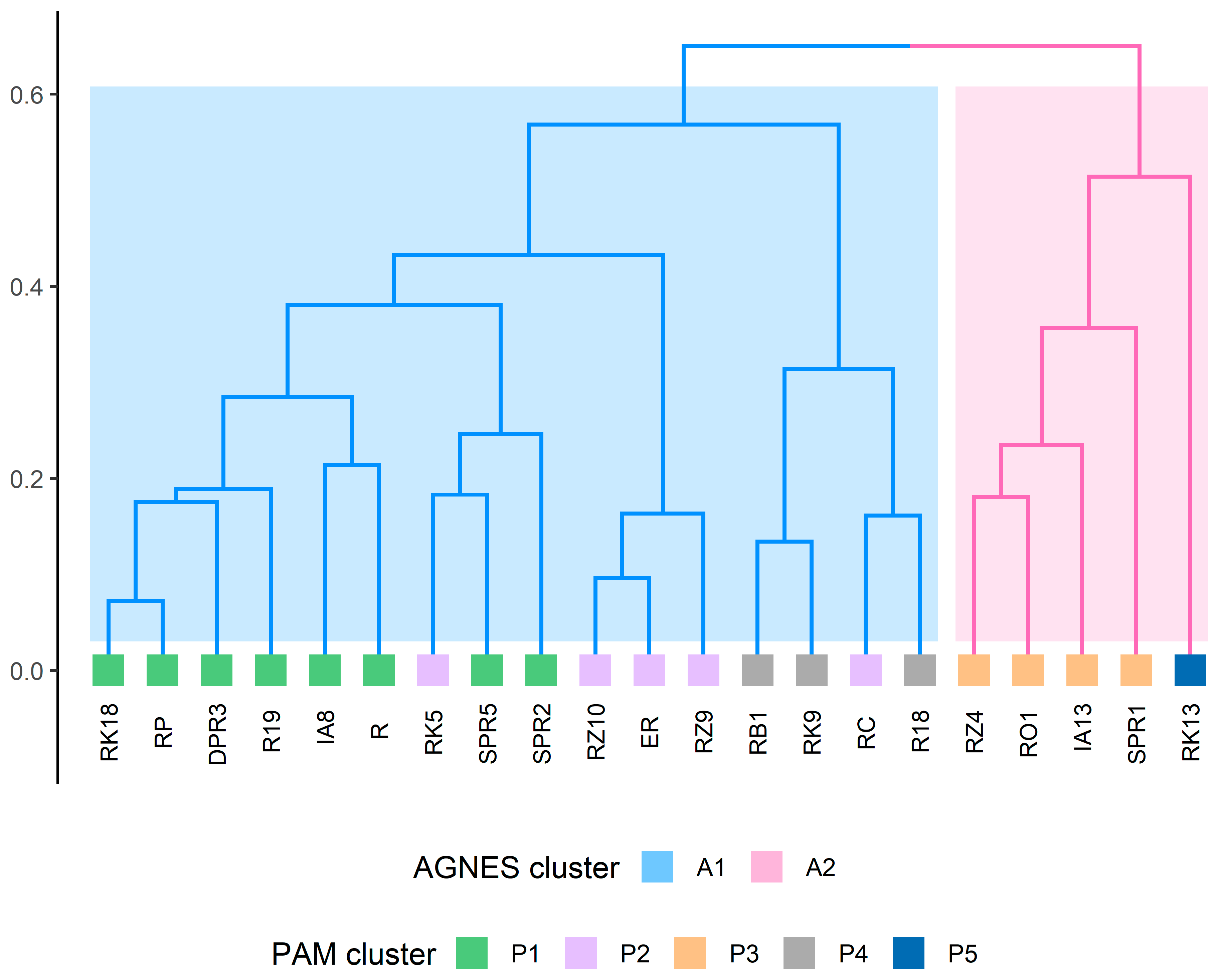
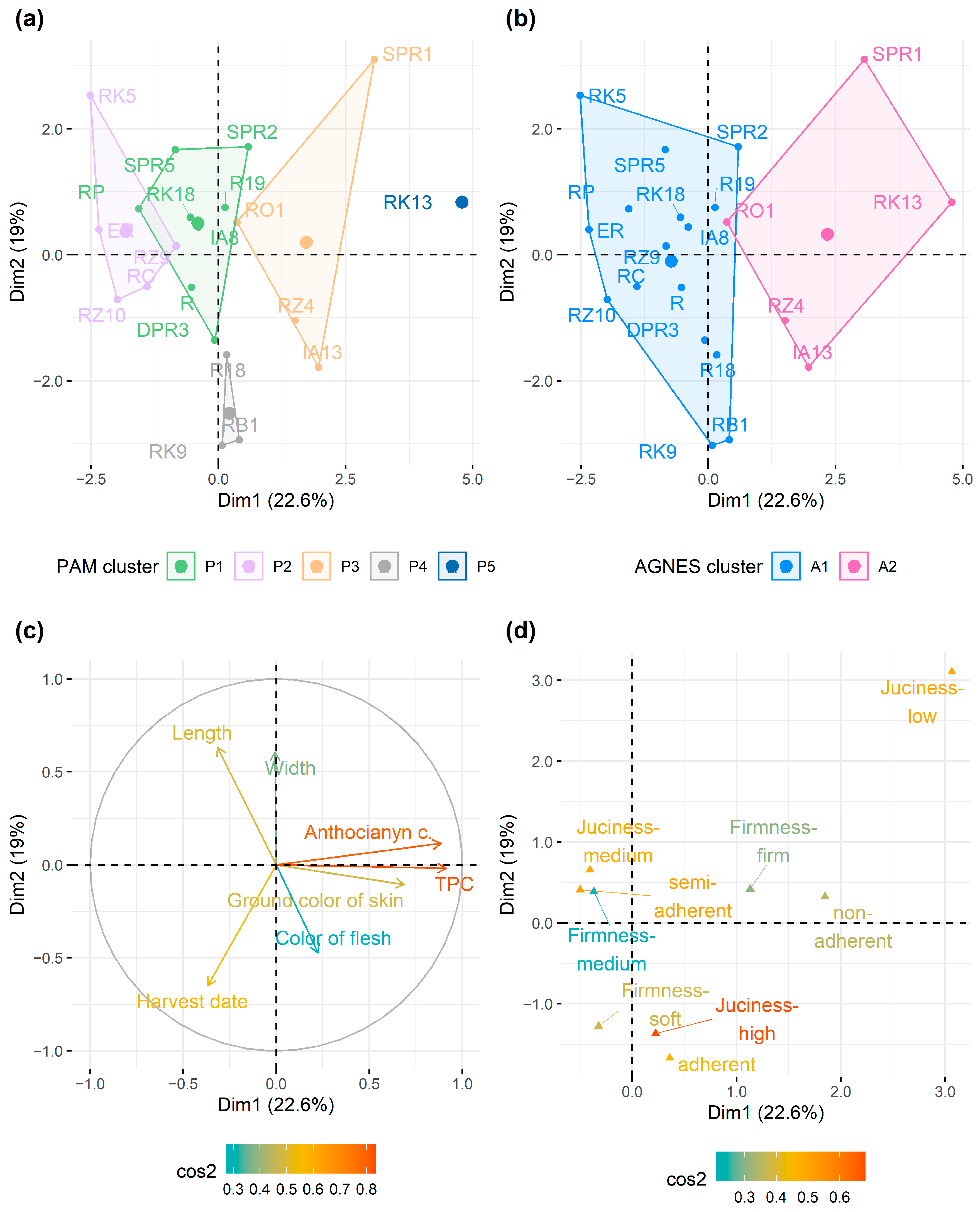
The assignment of the accessions to the clusters obtained from PAM and AGNES cluster analyses are displayed in Figure 1, Figure 2, Figure 3 and Figure S1. For AGNES clustering, the optimal average silhouette score was obtained with two clusters (A1 and A2), while PAM clustering achieved the highest average silhouette score with five clusters (P1–P5). The dendrogram (Figure 1) illustrates the results of the AGNES clustering, with individual accessions colored according to the PAM clustering. It can be observed that accessions in the first AGNES cluster (A1) belong to the first (P1), second (P2), and fourth (P4) PAM cluster, while the accessions in the second AGNES cluster (A2) are from the third (P3) and fifth (P5) PAM clusters (Figure 1 and Figure 2). Even if the dendrogram obtained using the AGNES method had been cut to create five clusters, only two units (RK5 and RC) would be assigned to different clusters compared to the PAM clustering (Figure 1). This agreement indicates that the methods provide comparable results, which underlines the reliability of the results.
PAM and AGNES methods, together with other clustering techniques, have been compared in numerous studies. However, few studies specifically address their performance on data structures like ours. Most comparisons are performed on health or microarray data, and the results regarding the superiority of either AGNES or PAM often diverge. Anand and Kumar [61] applied different clustering algorithms to several well-known datasets and found that both PAM and AGNES performed well, with AGNES showing higher cluster accuracy than PAM. They also observed that different clustering methods could yield different optimal numbers of clusters—a pattern also evident in our study, where two clusters were identified with AGNES and five with PAM.
For gene expression data, Houda et al. [62] recommended both PAM and AGNES. In contrast, Thalamuthu et al. [63] cautioned against hierarchical clustering methods such as AGNES, noting that while they offer visualization (e.g., dendrograms), they generally exhibit poorer performance and should be used with caution. Partitional clustering algorithms such as PAM are often preferred over hierarchical clustering algorithms (such as AGNES) due to their more interpretable results, lower computational requirements, and better overall performance [64,65].
The following results primarily present the characteristics of the five clusters identified using the PAM method, with the corresponding figures and tables. The details of the two clusters identified using the AGNES method can be found in the Supplementary Material. For the sake of clarity, the five clusters obtained using the PAM method are referred to as P1, P2, P3, P4, and P5 in the following text, while the clusters obtained using AGNES clustering are referred to as A1 and A2.
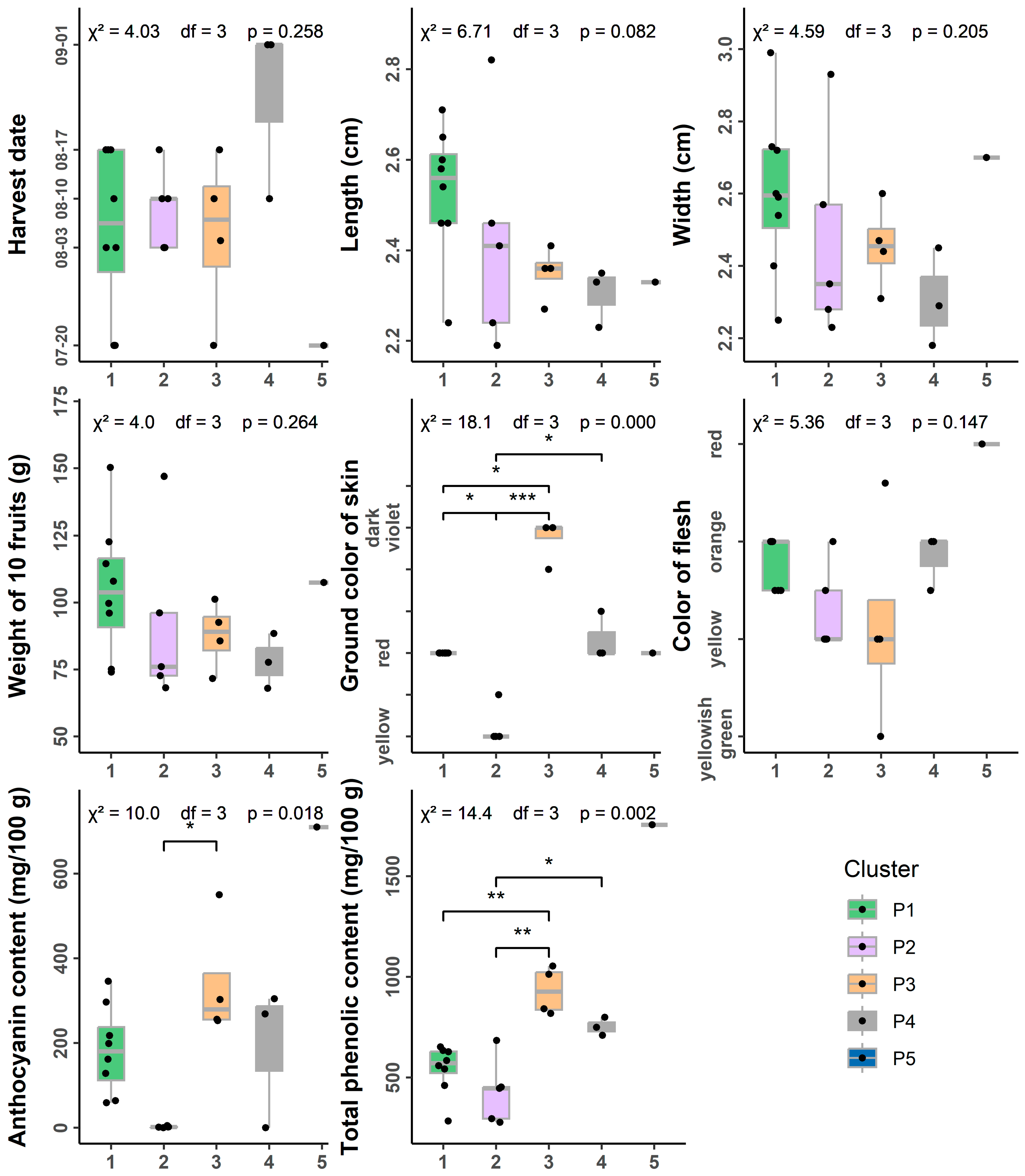
The differences between the clusters, obtained with PAM clustering, for numerical and ordinal variables (Table 1) are illustrated with boxplots alongside the results of the Kruskal–Wallis and Dunn tests (Figure 4). Cluster P5 was excluded from the Kruskal–Wallis and Dunn tests as it consisted of only one unit (RK13). However, it is shown in Figure 4 to allow a visual comparison of the values of this accession with those of the other clusters. The figure shows that this accession considerably differs from the others in terms of harvest date, flesh color, anthocyanins, and TPC. Descriptive statistics for each cluster are provided in Table 2.
Although late harvest appears to be characteristic of cluster P4 according to PAM clustering (Figure 4), the differences in harvest dates between clusters were not statistically significant, likely due to the small sample size. Across all accessions, the harvest dates were evenly distributed, except for RB1 and RK9, which matured at the latest in September (Table S1) and are both members of cluster P4.
No significant differences between clusters were found in the length, width and weight (Figure 4). Fruit length in our sample ranged from 2.19 cm (RZ10) to 2.82 cm (RK5), width ranged from 2.18 cm (RB1) to 2.99 cm (SPR5), and the weight of ten fruits ranged from 67.98 g (RB1) to 150.30 g (SPR5), with mean values of 2.43 cm, 2.51 cm and 74.01 g, respectively (Table 2). Myrobalan plum fruits are very variable in size and weight, with the average fruit weight in our study ranging from 6.8 g to 15.03 g, which is similar to the findings of Cosmulescu et al. [28] and Čolić et al. [36], who reported a range of 5.86 g to 15.39 g and 5.6 g to 15.34 g, respectively. However, Horvath et al. [10] reported slightly higher values of 6.56 g to 17.5 g. Additionally, in the study of wild myrobalan genotypes, Liu et al. [42] observed that the greatest diversity in fruit weight was among smaller genotypes, from 6.12 g to 6.8 g, while larger genotypes exceeded 20.3 g. Similarly, Miletić et al. [40] evaluated the morphology of spontaneous P. cerasifera populations in eastern Serbia, noting variations between 4.8 g and 24.3 g. In comparison Khadivi et al. [38] found smaller wild myrobalan fruits from Iran with lengths varying from 1.15 cm to 2.8 cm, widths from 1.03 cm to 2.9 cm, and weights from 1.79 g to 14.09 g. Heidari et al. [39], also studying wild myrobalan fruits from Iran, reported even smaller fruits, with lengths ranging from 1.09 cm to 1.6 cm, widths ranging between 0.9 cm and 1.67 cm, and weights ranging from 0.6 g to 3.3 g. These findings highlight the broad phenotypic diversity present within the species across different regions. This is expected as wild P. cerasifera genotypes grow from seeds produced through open pollination and both inter- and intra-specific hybridization with other compatible plum species from the genus Prunus, such as P. domestica and P. spinosa [13,24], leading to high levels of heterozygosity.
The color of myrobalan fruit in our sample is highly variable (Table S1, Figure 3 and Figure 4), which is consistent with findings from other studies [10,40,42]. Both descriptors related to the skin and flesh color divided the accessions into four distinct categories. For descriptor 50 (fruit: ground color of the skin), red fruits were prevalent (eleven accessions)—six were yellow, three were dark violet, and one (RO1) was purplish violet. Another interesting trait, often observed in plum species, is the overcolor of the skin. Although this trait was not explicitly evaluated, it was visible in several accessions, such as R19, RC, RK9, or RK13 (Figure 3 and Figure S1).
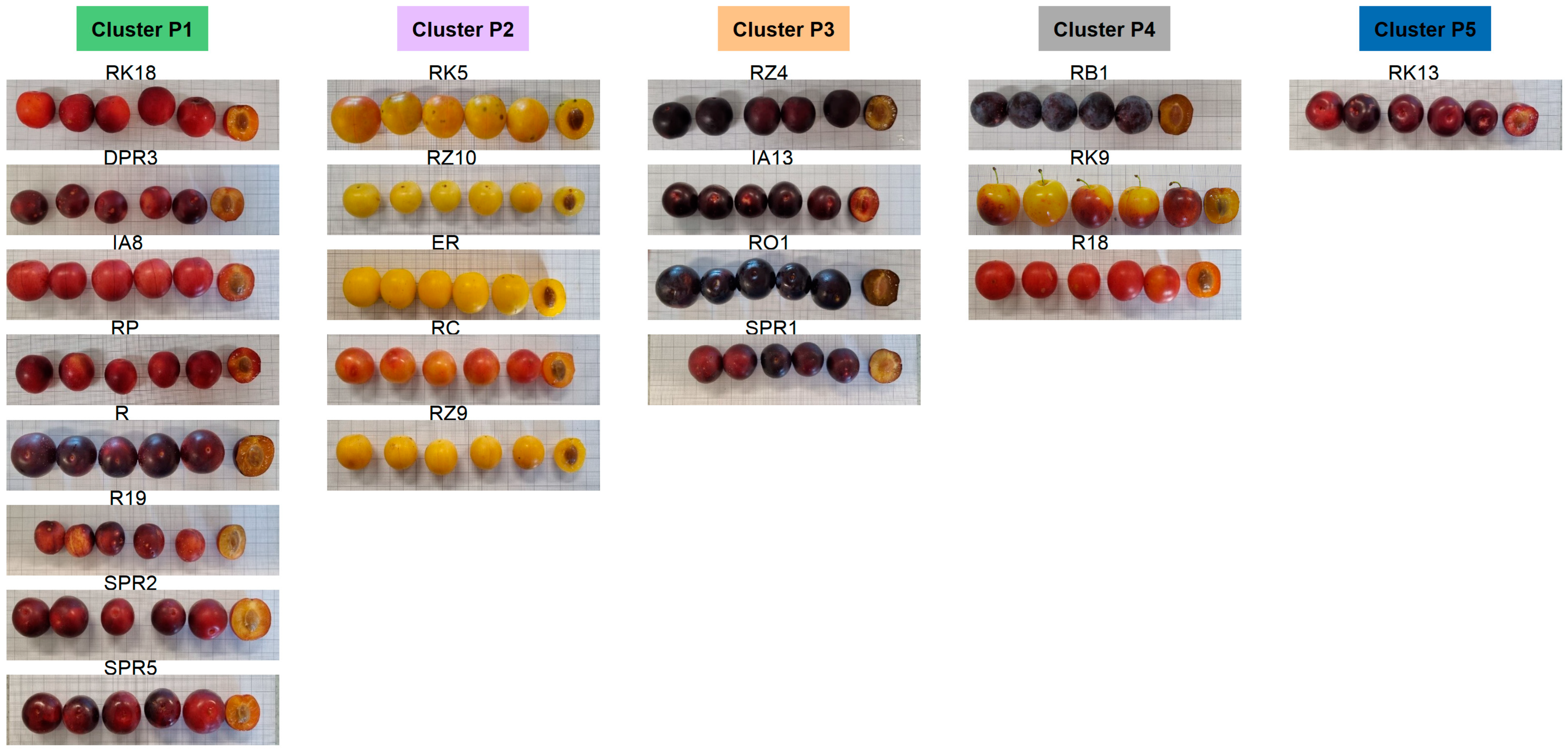
Fruits within the same cluster have a similar ground skin color (Figure 3 and Figure S1). According to the PAM clustering analysis, clusters P1 (red), P2 (yellow), and P3 (dark violet) are most distinctly differentiated by their color. In contrast, cluster P4 consists of accessions with various colors, indicating greater diversity within this group. Cluster P5 consists of a single accession that shares the red color characteristics of cluster P1. Significant differences were found in the ground skin color between PAM clusters. Specifically, there were only no significant pairwise differences between clusters P1 and P4, and between clusters P3 and P4 for ground skin color.
For descriptor 51 (fruit: color of flesh), ten accessions were characterized by orange flesh and nine by yellow flesh, while accessions SPR1 (yellowish green) from cluster P3 and RK13 (red) from cluster P5 stood out with distinct flesh colors. However, flesh color did not reveal any significant differences between clusters.
Descriptors related to color revealed discrepancies in the accession names. Three accessions originally included in the SPGP collection were labeled as having light-colored fruits. However, our evaluation showed that two of them (SPR2 and SPR5) have red fruits, while SPR1 was dark violet. These discrepancies could be associated with mistakes in naming donor materials during sampling due to human error when collecting trees in their juvenile period and/or later, during the maintenance of the material. Addressing issues with mislabeling is essential, as genetic monitoring with careful coordination and accurate record-keeping within and among collections provides vital verification of the plants held for conservation [66]. Furthermore, these issues highlight the importance of conducting both morphological and molecular evaluations of the material included in the collections.
Significant differences between clusters were found for the anthocyanin content and the TPC (Figure 4). The most pronounced differences were found between clusters P2 and P3, which also have the most distinguishable skin color (Figure 3). For anthocyanin content, the only significant difference was between clusters P2 and P3. For TPC, the difference between clusters P1 and P2 was not statistically significant, although the difference in skin color was statistically significant.
In our sample, TPC content in the samples ranged from 277 mg/100 g (ER) to 1756 mg/100 g (RK13), while anthocyanin content varied from 0 mg/100 g (ER and R18) to 710 mg/100 g (RK13). The mean values were 677.95 mg/100 g for phenolics and 196.62 mg/100 g for anthocyanins (Table 2). Gunduz and Saraçoğlu [33] investigated P. cerasifera selections from Turkey, reporting TPC (mg GAE/kg fresh weight) values between 218.3 and 583.1. Wang et al. [31] examined wild myrobalans from Xinjiang, China, and found TPC values (g/kg fresh weight) ranging from 1.34 to 2.13 for yellow fruits, from 1.76 to 2.77 for red fruits and from 3.89 to 4.65 for purple fruits. The total anthocyanins (g/kg peel fresh weight) were undetected in yellow fruits but varied from 1.93 to 3.87 in red fruits and from 11.18 to 19.86 in purple fruits. The concentration of both compounds was highest in purple fruits. Moscatello et al. [67] analyzed the TPC of the flesh (mesocarp + epicarp) of three different plum species—P. cerasifera, P. domestica and P. salicina—at different stages of development. In all species, the TPC (g/100 g dry weight) increased during development, peaking around the commercial harvest date before declining. Smanalieva et al. [32] evaluated the chemical composition and physical attributes of wild myrobalans from the forests of Kyrgyzstan. TPC values (mg GAE/100 g per dry sample) ranged from 177 in yellow fruits to 365 in black fruits, while anthocyanin content (g/kg) varied from 0 in yellow fruits to 0.82 in black fruits. The research conducted so far has revealed considerable differences in the TPC content of P. cerasifera fruits, which can mainly be attributed to the varying growth conditions and biotic factors that influence the biosynthesis of plant secondary metabolites [68]. Additionally, comparisons between studies are complicated by the fact that results are usually reported based on fresh or dry matter, with data on moisture content often not provided, as well as the use of different analytical methods [69]. It has been reported that phenolic compounds help plants respond to various environmental stressors and improve plant resilience under challenging conditions [70]. In our study, the influence of environmental stress factors on the biosynthesis of phenolic compounds and the resulting variations in their content between genotypes can largely be excluded, as all trees were cultivated at the same location under uniform agronomic conditions. Thus, the observed variation in phenolic content is likely attributable to the genetic background of the trees. Incorporating genotypes with high phenolic content, overall fruit quality and plant resilience into sustainable agricultural practices could be an important tool for addressing the environmental challenges in fruit production. In addition, genotypes with higher anthocyanin content could be suitable for use in the food industry as natural colorants. However, further studies are needed to evaluate their stability [31].
The differences between the clusters determined with AGNES clustering for numerical variables are shown with boxplots, together with the results of the Mann–Whitney test (Figure S2). Descriptive statistics for each cluster are provided in Table S2. Statistically significant differences between clusters A1 and A2 were observed for the same variables as the five clusters from the PAM clustering, namely ground skin color, anthocyanin content, and TPC.
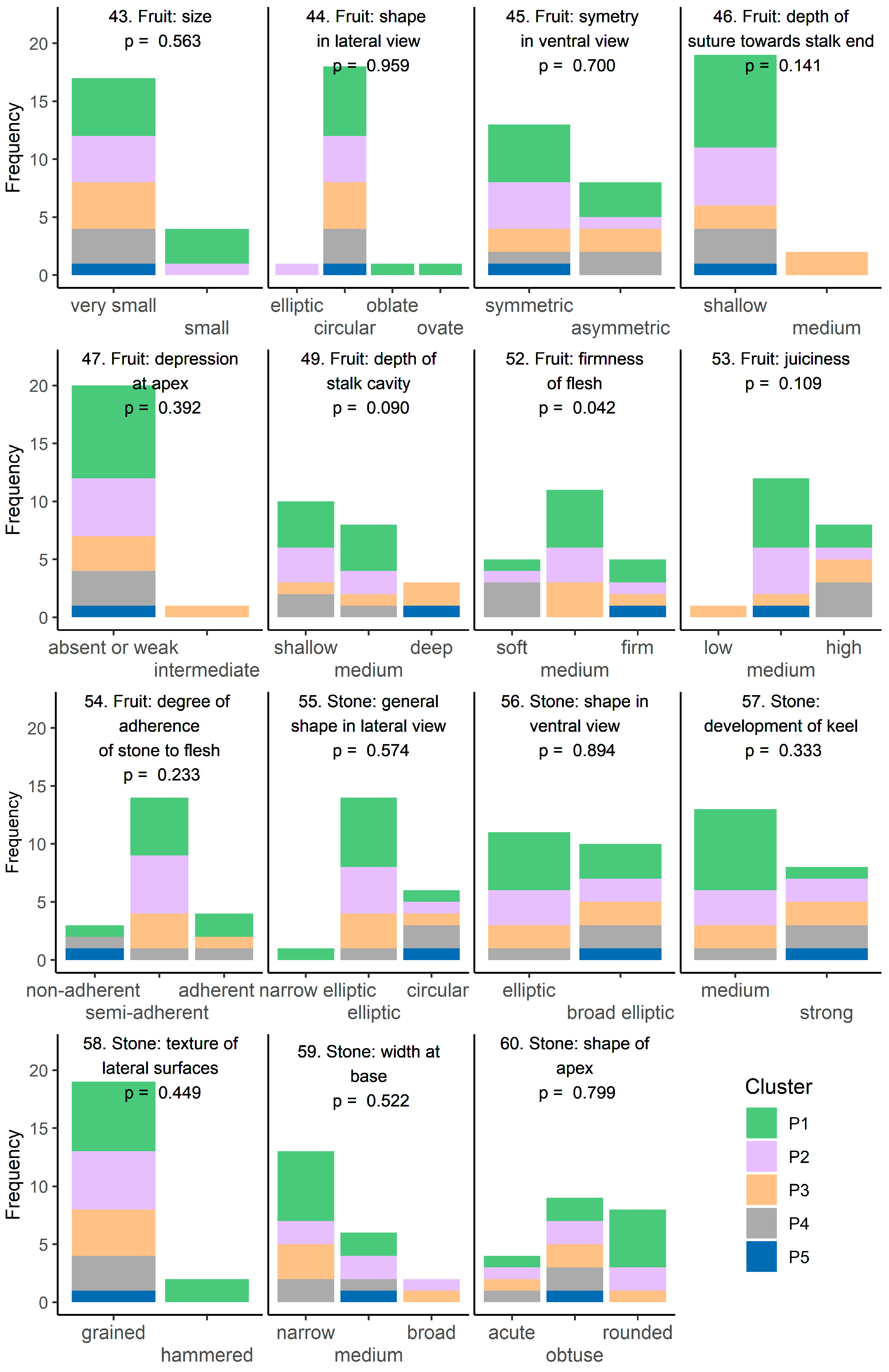
Associations between cluster membership according to PAM clustering and morphological features (categorical variables) are illustrated in Figure 5. The results of our study revealed variation for most morphological traits of myrobalan genotypes, except for descriptor 48 (fruit: pubescence at apex), where all accessions were glabrous (Table S1). This is why descriptor 48 is not shown in Figure 5.
Descriptor 43 (fruit: size) revealed that most accessions from all clusters produced very small fruits. However, fruits from accessions SPR2, SPR5, and R from cluster P1, along with accession RK5 from cluster P2, were recognized as small (Table S1, Figure 5).
Most units in all clusters had a circular shape in lateral view (descriptor 44), which is typical for fruits of myrobalan. However, accession ER from cluster P2 was described as elliptic, and accessions SPR5 and R19 from cluster P1 were described as oblate (Table S1, Figure 5).
For descriptor 45 (fruit: symmetry in ventral view), most accessions (13) were symmetric, while eight accessions were asymmetric. Both symmetric and asymmetric accessions were observed in all clusters (P1–P5), except in cluster P5, where RK13 was the only accession, and it was symmetric (Table S1, Figure 5).
Regarding descriptor 46 (depth of suture towards the stalk end), only two accessions from cluster P3 (SPR1 and IA13) had medium suture depth, while the others exhibited shallow depth (Table S1, Figure 5).
For descriptor 47 (fruit: depression at apex), accession SPR1 from cluster P3 showed intermediate depression, whereas the rest displayed either absent or weak depression (Table S1, Figure 5).
Variability was more pronounced in the depth of the stalk cavity (descriptor 49), with 10, 8, and 3 accessions having shallow, medium, and deep cavities, respectively. Units in clusters P1, P2, and P4 were categorized as shallow or medium, while units in cluster P3 ranged from shallow to deep. Accession RK13 from P5 had a deep stalk cavity (Table S1, Figure 5).
Regarding descriptor 52 (fruit: firmness of flesh), most accessions exhibited medium firmness, with the rest evenly divided between soft and firm categories. According to PAM clustering, accessions in clusters P1 and P2 showed variability ranging from soft to firm, P3 ranged from medium to firm, P4 was exclusively soft, and RK13 from P5 was firm (Table S1, Figure 5).
Juiciness (descriptor 53) was categorized as low for accession SPR1, medium for 12 accessions, and high for 8 accessions. In clusters P1 and P2, juiciness ranged from medium to high, while P3 included all juiciness levels. P4 was exclusively high, and RK13 from P5 exhibited medium juiciness (Table S1, Figure 5).
Myrobalan fruits are typically characterized by flesh that adheres to the stone, which aligns with our findings. Most accessions exhibited either adherent (four) or semi-adherent flesh (14), while three accessions (R18 from cluster P4, SPR2 from cluster P1, and RK13 from cluster P5) were classified as non-adherent, according to descriptor 54 (fruit: adherence of stone to flesh) (Table S1, Figure 5).
The morphological characteristics of stones from different Prunus species are important tools for the identification and differentiation at both the species level and among distinct cultivars [71]. We evaluated five stone-related traits.
For descriptor 55 (stone: shape in lateral view), most accessions (14) had an elliptic stone, followed by six with a circular stone, while only accession R19 from cluster P1 had a narrow elliptic stone (Table S1, Figure 5).
Regarding descriptor 56 (stone: shape in ventral view), the accessions were almost evenly split between two categories: elliptic (10 accessions) or broad elliptic (11 accessions). The distribution did not show any association with cluster membership (Table S1, Figure 5).
Descriptor 57 (stone keel development) indicated that stones exhibited either medium (13 accessions) or strong keel development (eight accessions). Most accessions from P1 had medium keel development, except for SPR2, while RK13 from P5 had strong keel development. The distribution of keel development values did not show any association with the other clusters (Table S1, Figure 5).
For descriptor 58 (stone: texture of lateral surfaces), most accessions exhibited a grained texture, with only SPR2 and SPR5 from cluster P1 displaying a hammered texture (Table S1, Figure 5).
For descriptor 59 (stone width at base), stones from thirteen accessions were narrow, six were medium, and two were broad (IA13 from cluster P3 and RK5 from cluster P2) (Table S1, Figure 5).
For descriptor 60 (stone shape of apex), nine stones from the studied accessions were obtuse, eight were rounded, and four were acute. The shape of the stone apex ranged from acute to rounded in clusters P1, P2, and P3, from acute to obtuse in P4, and was obtuse in RK13 from P5.
Although some associations were observed between cluster membership according to PAM clustering and morphological traits, only the association with firmness of flesh was statistically significant (Figure 5). A larger sample would be required to confirm the associations between cluster membership and other morphological traits.
Fruit size is an important factor in high-quality table fruit production, influencing consumer preferences and marketability [72]. Along with traits like color, shape, and absence of defects, it significantly affects the determination of fruit quality and purchasing decisions, with larger fruits generally seen as higher quality [73]. Additionally, flavor, taste, texture, and skin color are important criteria for determining fruit quality, shaping consumer preferences across various fruits [74,75,76,77,78,79]. In plums and plumcots, consumers tend to prefer round shapes without protruding tips, and dark-red skin [80]. Similarly, sweet cherry consumers often favor large, sweet, red or dark-red fruits with a medium-firm to firm mesocarp [81].
Based on these insights, the clustering of the studied accessions revealed potentially valuable material with favorable morphological and/or chemical traits that could be beneficial for marketing or breeding programs. Within cluster P1, three accessions stand out: R, SPR2, and SPR5. All are characterized by large fruit size, with SPR5 producing the largest and heaviest fruits—traits that are often preferred by consumers [81,82], though such a size may negatively impact yield, as observed in P. domestica L. [82,83]. Other observed characteristics of the accession in cluster P1 are moderate: average TPC, average anthocyanins, medium ground skin color (between yellow and dark violet), semi-adherent stone, medium juiciness, and medium firmness. For this reason, they may not be particularly interesting.
Accessions in cluster P2 did not show particularly distinguishing features, except for RK5, which had the longest fruits. However, the P2 cluster mainly consisted of yellow-colored accessions, while cluster P3 comprised dark-fruited accessions with high levels of TPC and anthocyanins. Fruit coloration is often influenced by environmental conditions and geographical location [75], but this factor is controlled in our study as all trees were grown under the same conditions, as stated in the Methods section. Carotenoids are primarily responsible for yellow, orange, and red hues [75], indicating that the coloration of accessions in cluster P2 is likely due to this pigment, although we did not measure it. In contrast, anthocyanins contribute to darker shades such as deep red, blue, and purple [75], which is characteristic of the dark fruits in cluster P3. These pigments play a crucial role in the coloring, dye, and antioxidant industries, making the accessions from clusters P2 and P3 particularly interesting for these applications. A high phenolic content in cluster P3 is beneficial for health reasons, as it helps defend against chronic diseases [78]. However, elevated phenolics in fruit skin can lead to astringency, potentially causing consumer rejection of certain varieties [78]. Consumers often prioritize sensory enjoyment, such as taste and texture, over health benefits [84].
Cluster P4 was notable for its late-ripening fruits and had the lowest average length, width, and weight (Table S3)—a trait that may be advantageous, as smaller fruits are typically sweeter and better suited for processing [80]. However, P4 was also characterized by soft fruits, which are generally unfavorable to consumers [81]. Firmness, an important quality parameter, is also associated with fruit storage potential and consumer preferences [78,80]. The advantages of late-ripening varieties can be useful for producers, as late-flowering genotypes exhibit a delayed break in winter dormancy, enabling them to avoid the damaging effects of freezing temperatures during this period [37]. However, some varieties may still produce an early harvest despite late blooming if their fruits develop quickly. In order to establish this in the studied genotypes, a more detailed evaluation of flowering traits is essential. Additionally, extending the fresh fruit season with late cultivars can improve the commercial value of fruit production by providing consumers with fresh produce for a longer period. Cluster P5, represented solely by accession RK13, stood out the most, exhibiting the highest TPC and anthocyanin levels. Additionally, its flesh was firm and did not adhere to the stone—an uncommon trait in myrobalan that is favorable for consumers.
Although organoleptic properties were not formally studied, RK13 was also noted for its good taste (personal observations). Morphological observations revealed that certain traits like stone adherence to the flesh, show similarities with the P. domestica species. This suggests that accession RK13 may be of a putative hybrid origin, which is not surprising as P. cerasifera can easily hybridize with P. domestica. To confirm this, further evaluation should involve a combination of approaches, including detailed morphological assessment, ploidy level determination, and molecular markers evaluations.
Considering numerical and ordinal variables, the clusters obtained with AGNES clustering can best be distinguished by the ground color of skin, the anthocyanin content, and the TPC (Figure S2). Cluster A1 exhibited lower values than A2 for all characteristics mentioned, which is to be expected due to the high correlations between skin color, anthocyanin content, and TPC (Figure 6). When considering morphological traits (categorical variables) statistically significant association with AGNES clusters was only observed between cluster membership and the depth of the stalk cavity (Figure S3).

3.2. Correlations

The results of the correlation analysis are shown in Figure 6. There is a moderately strong positive and statistically significant correlation between anthocyanins and TPC (r = 0.665, p = 0.001), which is expected, as anthocyanins are a subclass of phenolic compounds [78]. This finding is consistent with the findings of Viljevac et al. [85], who reported a strong statistically significant correlation (r = 0.76) between TPC and total anthocyanin content in sour cherries.
A strong positive and statistically significant correlation can be observed between the ground color of skin and the anthocyanin content (r = 0.711, p < 0.001) and between the ground color of skin and the TPC (r = 0.729, p < 0.001). This indicates that darker-colored fruits tend to have a higher anthocyanin content and generally higher phenolic content. The correlation between anthocyanin content and skin color is expected due to the role of anthocyanins in fruit pigmentation [78]. The relationship between TPC and skin color is less direct, as the fruits contain many phenolic compounds beyond anthocyanins, as shown by Celik et al. [34]. Viljevac et al. [85] also found significant correlations between the color parameters and the anthocyanin and phenolic content for sour cherry fruits. They reported statistically significant negative correlations for the L, b, and h parameters in the CIELab color system. Since these color parameters are generally higher for yellow than for dark violet, our positive correlations are consistent with their findings of negative correlations. Similarly, Smanalieva et al. [32] and Wang et al. [31] concluded that dark-colored myrobalans contained the highest levels of phenolics and anthocyanins.
Conversely, the color of the fruit flesh shows no statistically significant correlation with the content of anthocyanins and phenols. Anthocyanins accumulate in both the flesh and skin of fruits, contributing to their vivid coloring [86]; however, in fruits such as peaches, apricots, plums, and grapes, these compounds are more concentrated in the skin than in the flesh [87]. In contrast, Wang et al. (2012), found no absorbance around 500 nm in methanolic pulp extracts of red, purple, and yellow myrobalan, indicating the absence of anthocyanins in the pulp.
Length, width, and weight do not correlate significantly with the content of anthocyanins and phenols (Figure 6). However, the correlation coefficient between length and TPC is negative and moderately high (r = −0.37, p = 0.098), indicating that phenolic content decreases with increasing fruit length. This could be because most phenolic compounds are concentrated in the skin, and the ratio of skin to total fruit mass is lower in larger fruits and could result in lower phenolic content in the whole fruit. Results from other studies are somewhat contradictory. Mallik and Hamilton [88], in their study on blueberries, confirmed that berry size influences phenolics, anthocyanins, and antioxidant activity, as these compounds are concentrated in the epidermal tissues. Consequently, smaller berries, with a larger surface-area-to-volume ratio, generally contain higher levels of these beneficial compounds compared to larger berries. However, Erdal et al. [89] reported inconsistent findings when studying sweet cherries, noting an influence of fruit size on phenolic concentration but with varying results across different fruit samples.

4. Conclusions

This study confirmed significant morphological and chemical variability among myrobalan genotypes, identifying promising accessions such as SPR5 and RK13 as a promising candidate for future breeding programs targeting both fruit quality and processing characteristics due to their high phytochemical content and/or desirable morphological traits. It is important to highlight that the genotypes were grown at the same location under uniform agronomic practices, allowing us to largely exclude the influence of environmental stress factors. We therefore suggest that the observed variations in anthocyanin and total phenolic levels may be attributed to genetic differences, which require further confirmation through additional research. Moreover, the chemical composition of P. cerasifera fruits has been only briefly studied. Future investigations should focus on the nutritional value of the fruits, particularly those attributes that influence consumer preferences. Such comprehensive data, combined with information on the trees’ resilience to environmental stressors, would enable us to recommend specific genotypes for future breeding programs.

Supplementary Materials

The following supporting information can be downloaded at: https://www.mdpi.com/article/10.3390/horticulturae10101057/s1, Table S1: The full list of material used in the study, including information dealing with the name, location, harvest date, descriptors used for morphological evaluation, as well as data on total phenolic content (TPC) and total monomeric anthocyanin content; Figure S1: Photos of fruits by AGNES; Figure S2: Boxplots of numerical variables by AGNES clustering; Figure S3: Frequency distribution colored by AGNES; Table S2: Descriptive statistics of AGNES clustering; Table S3: Descriptive statistics of PAM clustering.

Author Contributions

Conceptualization, T.T., V.S., J.K. and M.Š.; methodology, T.T., V.S., J.K. and M.Š.; software, V.S.; formal analysis, J.K. and K.H.; investigation, T.T., M.Š. and K.H.; data curation, T.T., V.S., J.K., K.H. and M.Š.; writing—original draft preparation, T.T., V.S., J.K. and M.Š.; writing—review and editing, T.T., V.S., J.K. and M.Š.; visualization, V.S. All authors have read and agreed to the published version of the manuscript.

Funding

This study was financially supported by the Programme Research for Improvement of Safe Food and Health, P1-0164 (C).

Data Availability Statement

All data are provided in the Supplementary Files.

Acknowledgments

The authors would like to thank Slovenian Plant Gene Bank for providing valuable plant material used in this study. We would like to express our gratitude to Anja Ivanuš and Tamara Hribernik for technical support.

Conflicts of Interest

The authors declare no conflicts of interest.

References

  1. Ercisli, S.; Sagbas, H.I. Wild Edible Fruits: A Rich Source of Biodiversity. Anadolu J. AARI 2017, 27, 116–122. [Google Scholar]
  2. Suwardi, A.B.; Ilman Navia, Z.; Harmawan, T.; Syamsuardi, S.; Mukhtar, E. Importance and local conservation of wild edible fruit plants in the East Aceh Region, Indonesia. Int. J. Conserv. Sci. 2022, 13, 221–232. [Google Scholar]
  3. Borelli, T.A.-O.; Hunter, D.A.-O.X.; Powell, B.; Ulian, T.; Mattana, E.; Termote, C.A.-O.; Pawera, L.A.-O.; Beltrame, D.A.-O.; Penafiel, D.A.-O.; Tan, A.; et al. Born to eat wild: An integrated conservation approach to secure wild food plants for food security and nutrition. Plants 2020, 9, 1299. [Google Scholar] [CrossRef] [PubMed]
  4. Fu, Y.B. Understanding crop genetic diversity under modern plant breeding. Theor. Appl. Genet. 2015, 128, 2131–2142. [Google Scholar] [CrossRef]
  5. Zhang, H.; Mittal, N.; Leamy, L.J.; Barazani, O.; Song, B.H. Back into the wild-apply untapped genetic diversity of wild relatives for crop improvement. Evol. Appl. 2016, 10, 5–24. [Google Scholar] [CrossRef]
  6. Salgotra, R.K.; Chauhan, B.S. Genetic diversity, conservation, and utilization of plant genetic resources. Genes 2023, 14, 174. [Google Scholar] [CrossRef]
  7. Shashidhara, N.; Dhanalakshmi, T.N.; Santosh, D.T. Plant Genetic Resources in Sustainable Agriculture: Current State, Future Perspectives, and Challenges. In Recent Advances in Agricultural Sciences and Technology; Biradar, N., Shah, R.A., Ahmad, A., Eds.; Dilpreet Publishing House: New Delhi, India, 2023; pp. 93–102. [Google Scholar]
  8. Erturk, Y.; Maghradze, D.; Orhan, E.; Agar, G. An assessment of genetic variability and relationships among wild-grown blackthorn (Prunus spinosa L.) plants based on RAPD markers. Genet. Mol. Res. 2009, 8, 1238–1244. [Google Scholar] [CrossRef]
  9. Hedrick, U.P. The Plums of New York; J. B. Lyon Company, State Printers: Albany, NY, USA, 1911; p. 616. [Google Scholar]
  10. Horvath, A.; Christmann, H.; Laigret, F. Genetic diversity and relationships among Prunus cerasifera (cherry plum) clones. Botany 2008, 86, 1311–1318. [Google Scholar] [CrossRef]
  11. Kappert, H.; Roemer, T.; Rudorf, W. Züchtung von Gem üse, Obst, Reben und Forstpflanzen: Zwetschen, Pflaumen, Reineclauden, Mirabellen. In Handbuch der Pflanzenzüchtung; Paul Parey in Berlin und Hamburg: Berlin, Germany, 1962; Volume 6. [Google Scholar]
  12. Mišić, P.D. Šljiva; Nolit: Beograd, Serbia, 1979; p. 213. [Google Scholar]
  13. Topp, B.L.; Russell, D.M.; Neumüller, M.; Dalbó, M.A.; Liu, W. Plum. In Fruit Breeding; Badenes, M.L., Byrne, D.H., Eds.; Springer: New York, NY, USA, 2012; pp. 571–621. [Google Scholar]
  14. Weinberger, J.H. Plums. In Advances in Fruit Breeding, 1st ed.; Janick, J., Moore, J.N., Eds.; Purdue University Press: West Lafayette, Indiana, 1975; pp. 336–347. [Google Scholar]
  15. Popescu, I.; Caudullo, G. Prunus cerasifera in Europe: Distribution, Habitat, Usage and Threats. In European Atlas of Forest Tree Species; San-Miguel-Ayanz, J., De Rigo, D., Caudullo, G., Houston, D.T., Mauri, A., Eds.; Publication Office of the European Union: Luxembourg, 2016; p. 142. [Google Scholar]
  16. Martinčič, A.; Wraber, T.; Jogan, J.; Podobnik, A.; Ravnik, V.; Turk, B.; Vreš, B.; Frajman, B.; Strgulc-Krajšek, S.; Trčak, B.; et al. Mala Flora Slovenije: Ključ Za Določanje Praprotnic in Semenk; Tehniška založba Slovenije: Ljubljana, Slovenia, 2007; p. 967. [Google Scholar]
  17. Moreno, M.A. Breeding and selection of Prunus rootstocks at the Aula Dei Experimental Station, Zaragoza, Spain. Acta Hortic. 2004, 658, 519–528. [Google Scholar] [CrossRef]
  18. Petrov, D.; Ocokoljić, M.; Galečić, N.; Skočajić, D.; Simović, I. Adaptability of Prunus cerasifera Ehrh. to climate changes in multifunctional landscape. Atmosphere 2024, 15, 335. [Google Scholar] [CrossRef]
  19. Dunaevskaya, E.V.; Gorina, V.M.; Melkozerova, E.A.; Khetagurov, K.M.; Kozyrev, A.K. Prunus cerasifera Ehrh. fruits are a source of biologically active substances and high-quality feedstock for Food for Specific Health Use. E3S Web Conf. 2021, 282, 11. [Google Scholar] [CrossRef]
  20. Das, B. Prunus diversity-early and present development: A review. Int. J. Biodivers. Conserv. 2011, 3, 721–734. [Google Scholar] [CrossRef]
  21. Sancin, V. Sadje z Našega Vrta; Založništvo Tržaškega Tiska: Trst, Italy, 1988; p. 376. [Google Scholar]
  22. Sedaghathoor, S.; Ansari, R.; Allahyari, M.S.; Nasiri, E. Comparison of morphological characteristics of some plum and prune cultivars of Iran. Sci. Res. Essay 2009, 4, 992–996. [Google Scholar]
  23. Liu, W.; Nan, G.; Nisar, M.; Wan, C. Chemical constituents and health benefits of four Chinese plum species. J. Food Qual. 2020, 2020, 17. [Google Scholar] [CrossRef]
  24. Neumuller, M. Fundamental and applied aspects of plum (Prunus domestica) breeding. Fruit Veg. Cereal Sci. Biotechol. 2011, 5, 139–156. [Google Scholar]
  25. Hartmann, W.; Neumüller, M.; Gradziel, T. Plum Breeding. In Breeding Plantation Tree Crops: Temperate Species; Mohan Jain, S., Priyadarshan, P.M., Eds.; Springer Science Business Media: New York, NY, USA, 2009; pp. 161–231. [Google Scholar]
  26. Krüssmann, G. Manual of Cultivated Broad-Leaved Trees and Shrubs; Timber Press: Portland, OR, USA, 1984; Volume III, PRU-Z; p. 445. [Google Scholar]
  27. Pirc, H. Divje Sadne Vrste na Domačem Vrtu; Kmetijska Založba: Slovenj Gradec, Slovenia, 2008; p. 160. [Google Scholar]
  28. Cosmulescu, S.N.; Ionica, M.E.; Mutu, N. Evaluation on genetic diversity of phenotypic traits in myrobalan lum (Prunus cerasifera Ehrh.). South West. J. Hortic. Biol. Env. 2018, 9, 25–34. [Google Scholar]
  29. Hanelt, P. European Wild Relatives of Prunus Fruit Crops; Springer: Berlin, Germany, 2001; p. 3649. [Google Scholar]
  30. Putkaradze, J.; Diasamidze, M.; Vanidze, M.; Kalandia, A. Antioxidant Activity of Prunus cerasifera products. Int. J. Life Sci. 2021, 10, 52–54. [Google Scholar]
  31. Wang, Y.; Chen, X.; Zhang, Y.; Chen, X. Antioxidant activities and major anthocyanins of myrobalan plum (Prunus cerasifera Ehrh.). J. Food Sci. 2012, 77, 388–393. [Google Scholar] [CrossRef]
  32. Smanalieva, J.; Iskakova, J.; Oskonbaeva, Z.; Wichern, F.; Darr, D. Determination of physicochemical parameters, phenolic content, and antioxidant capacity of wild cherry plum (Prunus divaricata Ledeb.) from the walnut-fruit forests of Kyrgyzstan. Eur. Food. Res. Technol. 2019, 245, 2293–2301. [Google Scholar] [CrossRef]
  33. Gunduz, K.; Saraçoğlu, O. Variation in total phenolic content and antioxidant activity of Prunus cerasifera Ehrh. selections from Mediterranean region of Turkey. Sci. Hortic. 2012, 134, 88–92. [Google Scholar] [CrossRef]
  34. Celik, F.; Gundogdu, M.; Alp, S.; Muradoglu, F.; Ercişli, S.; Gecer, M.K.; Canan, I. Determination of phenolic compounds, antioxidant capacity and organic acids contents of Prunus domestica L., Prunus cerasifera Ehrh. and Prunus spinosa L. fruits by HPLC. Acta Chromatogr. 2017, 29, 507–510. [Google Scholar] [CrossRef]
  35. Wei, Q.; Ji, X.Y.; Long, X.S.; Li, Q.R.; Yin, H. Chemical constituents extracted from leaves of Prunus cerasifera Ehrh. cv. Atropurpurea Jacg. and their antioxidant activities in vitro. Chem. For. Prod. J. 2015, 35, 116–122. [Google Scholar] [CrossRef]
  36. Čolić, S.; Zec, G.; Marinković, D.; Zoran, J. Genetic and phenotypic variability of cherry plum (Prunus cerasifera Ehrh) pomological characteristics. Genetika 2003, 35, 155–160. [Google Scholar] [CrossRef]
  37. Gorina, V.M.; Lukicheva, L. Morphological and biological features of cherry plum hybrids. Acta Hortic. 2021, 1308, 73–80. [Google Scholar] [CrossRef]
  38. Khadivi, A.; Mirheidari, F.; Moradi, Y.; Paryan, S. Phenotypic and fruit characterizations of Prunus divaricata Ledeb. germplasm from the north of Iran. Sci. Hortic. 2020, 261, 109033. [Google Scholar] [CrossRef]
  39. Heidari, P.; Sahebi, M.; Azadvari, E.; Lawson, S.; Rezaei, M.; Khadivi, A. Morphological variability of indigenous cherry plum (Prunus divaricata Ledeb.) accessions. Eur. J. Hortic. Sci. 2022, 87, 8. [Google Scholar] [CrossRef]
  40. Miletić, R.; Žikić, M.; Banjac, N.; Nikolić, R. Pomological and technological characteristics of collected selections of cherry plum Prunus cerasifera Erhr. Genetika 2005, 37, 39–47. [Google Scholar] [CrossRef]
  41. Nikolić, D.; Rakonjac, V.; Milutinović, M.; Fotiric Aksic, M. Variabilityand heritability of morphologicaland chemical fruit properties in cherry plum (Prunus cerasifera Ehrh). J. Pomol. 2007, 41, 45–49. [Google Scholar]
  42. Liu, C.; Chen, X.; Wang, J.; Chen, X.; Wang, H.; Tian, C.; Wu, C. Studies on genetic diversity of phenotypic traits in wild myrobalan plum (Prunus cerasifera Ehrh.). Acta Hortic. Sinica 2008, 35, 1261–1268. [Google Scholar]
  43. Sottile, F.; Napolitano, A.; Badalamenti, N.; Bruno, M.; Tundis, R.; Loizzo, M.R.; Piacente, S. A new bloody pulp selection of myrobalan (Prunus cerasifera L.): Pomological traits, chemical composition, and nutraceutical properties. Foods 2023, 12, 1107. [Google Scholar] [CrossRef]
  44. UPOV. Protocol for Distinctness, Uniformity and Stability Tests: Prunus domestica L. (European plum); UPOV Species Code: PRUNU_DOM; UPOV: Geneva, Switzerland, 2003. [Google Scholar]
  45. Horvath, A.; Balsemin, E.; Barbot, J.-C.; Christmann, H.; Manzano, G.; Reynet, P.; Laigret, F.; Mariette, S. Phenotypic variability and genetic structure in plum (Prunus domestica L.), cherry plum (P. cerasifera Ehrh.) and sloe (P. spinosa L.). Sci. Hortic. 2011, 129, 283–293. [Google Scholar] [CrossRef]
  46. Imenšek, N.; Ivančič, A.; Kraner Šumenjak, T.; Islamčevič Razboršek, M.; Kristl, J. The effect of maturation on chemical composition and harvest of fruits of diverse elderberry interspecific hybrids. Eur. J. Hortic. Sci. 2021, 86, 223–231. [Google Scholar] [CrossRef]
  47. Lee, J.; Durst, R.W.; Wrolstad, R.E. Determination of total monomeric anthocyanin pigment content of fruit juices, beverages, natural colorants, and wines by the pH differential method: Collaborative study. J. AOAC Int. 2005, 88, 1269–1278. [Google Scholar] [CrossRef] [PubMed]
  48. Ainsworth, E.A.; Gillespie, K.M. Estimation of total phenolic content and other oxidation substrates in plant tissues using Folin–Ciocalteu reagent. Nat. Protoc. 2007, 2, 875–877. [Google Scholar] [CrossRef]
  49. R Core Team R: A Language and Environment for Statistical Computing; R Foundation for Statistical Computing: Vienna, Austria, 2022.
  50. Gower, J.C. A general coefficient of similarity and some of its properties. Biometrics 1971, 27, 857–871. [Google Scholar] [CrossRef]
  51. Maechler, M.; Rousseeuw, P.; Struyf, A.; Hubert, M.; Hornik, K.; Studer, M.; Roudier, P.; Gonzalez, J. Cluster: Cluster Analysis Basics and Extensions; Ku Leuven: Leuven, Belgium, 2023. [Google Scholar]
  52. Kaufman, L.; Rousseeuw, P.J. Finding Groups in Data: An Introduction to Cluster Analysis; John Wiley & Sons, Inc.: Hoboken, NJ, USA, 1990. [Google Scholar]
  53. Pagès, J. Analyse factorielle de données mixtes. Rev. Stat. Appl. 2004, 52, 93–111. [Google Scholar]
  54. Lê, S.; Josse, J.; Husson, F. FactoMineR: A package for multivariate analysis. J. Stat. Softw. 2008, 25, 18. [Google Scholar] [CrossRef]
  55. Hollander, M.; Wolfe, D.A.; Chicken, E. Nonparametric Statistical Methods; John Wiley & Sons, Inc.: Hoboken, NJ, USA, 2015. [Google Scholar]
  56. Dinno, A. Dunn’s Test of Multiple Comparisons Using Rank Sums, 1.3.6; CRAN: Vienna, Austria, 2024. [Google Scholar]
  57. Harrell, F.E., Jr.; Dupont, C. Hmisc: Harrell Miscellaneous, 5.1-3; CRAN: Vienna, Austria, 2024. [Google Scholar]
  58. Wickham, H. Ggplot2: Elegant Graphics for Data Analysis; Springer International Publishing: Cham, Switzerland, 2016. [Google Scholar]
  59. Wei, T.; Viliam, S. R Package “Corrplot”: Visualization of a Correlation Matrix; CRAN: Vienna, Austria, 2024. [Google Scholar]
  60. Kassambara, A. Ggpubr: ‘Ggplot2’ Based Publication Ready PlotsR 0.6.0; CRAN: Vienna, Austria, 2023. [Google Scholar]
  61. Anand, S.K.; Kumar, S. Experimental comparisons of clustering approaches for data representation. ACM Comput. Surv. 2022, 55, 45. [Google Scholar] [CrossRef]
  62. Houda, F.; Fatiha, B.; Bouamrane, K. An experimental study on microarray expression data from plants under salt stress by using clustering methods. Int. J. Interact. Multi. 2020, 6, 10. [Google Scholar] [CrossRef]
  63. Thalamuthu, A.; Mukhopadhyay, I.; Zheng, X.; Tseng, G.C. Evaluation and comparison of gene clustering methods in microarray analysis. Bioinformatics 2006, 22, 2405–2412. [Google Scholar] [CrossRef]
  64. Ozdemir, O.; Cerman, S. Performance comparison with hierarchical and partitional clustering methods. WSEAS Trans. Commun. 2021, 20, 177–184. [Google Scholar] [CrossRef]
  65. Esnault, C.; Rollot, M.; Guilmin, P.; Zucker, J.-D. Qluster: An easy-to-implement generic workflow for robust clustering of health data. Front. Artif. Intell. 2023, 5, 1–20. [Google Scholar] [CrossRef]
  66. Diaz-Martin, Z.; Fant, J.; Havens, K.; Cinea, W.; Tucker Lima, J.M.; Griffith, M.P. Current management practices do not adequately safeguard endangered plant species in conservation collections. Biol. Conserv. 2023, 280, 109955. [Google Scholar] [CrossRef]
  67. Moscatello, S.; Frioni, T.; Blasi, F.; Proietti, S.; Pollini, L.; Verducci, G.; Rosati, A.; Walker, R.P.; Battistelli, A.; Cossignani, L.; et al. Changes in absolute contents of compounds affecting the taste and nutritional properties of the flesh of three plum species throughout development. Foods 2019, 8, 486. [Google Scholar] [CrossRef] [PubMed]
  68. Deng, P.; Cui, B.; Zhu, H.; Phommakoun, B.; Zhang, D.; Li, Y.; Zhao, F.; Zhao, Z. Accumulation pattern of amygdalin and prunasin and its correlation with fruit and kernel agronomic characteristics during apricot (Prunus armeniaca L.) kernel development. Foods 2021, 10, 397. [Google Scholar] [CrossRef]
  69. Kristl, J.; Golenač, L.P.; Sem, V. Dynamics of cyanogenic glycosides in apple and plum fruits, products, and byproducts: A comprehensive review. J. Food Sci. 2024; early view. [Google Scholar] [CrossRef]
  70. Li, Z.; Ahammed, G.J. Plant stress response and adaptation via anthocyanins: A review. Plant Stress 2023, 10, 100230. [Google Scholar] [CrossRef]
  71. Ropelewska, E. Diversity of plum stones based on image texture parameters and machine learning algorithms. Agronomy 2022, 12, 762. [Google Scholar] [CrossRef]
  72. Miranda, J.C.; Gené-Mola, J.; Zude-Sasse, M.; Tsoulias, N.; Escolà, A.; Arnó, J.; Rosell-Polo, J.R.; Sanz-Cortiella, R.; Martínez-Casasnovas, J.A.; Gregorio, E. Fruit sizing using AI: A review of methods and challenges. Postharvest Biol. Technol. 2023, 206, 112587. [Google Scholar] [CrossRef]
  73. Ni, F.; Li, Z.; Huang, J. Worldwide productivity and research trend on fruit quality: A bibliometric study. Front. Plant Sci. 2024, 14, 1294989. [Google Scholar] [CrossRef]
  74. Cetin, B.E.; Saraçoğlu, O. Effects of different maturity stages and fruit parts on quality traits of plum (Prunus domestica) fruits. Erwerbs-Obstbau 2023, 65, 1069–1077. [Google Scholar] [CrossRef]
  75. Ranganath, K.G. Pigments that colour our fruits: An overview. Erwerbs-Obstbau 2022, 64, 535–547. [Google Scholar] [CrossRef]
  76. Tarancón, P.; Tárrega, A.; González, M.; Besada, C. External quality of mandarins: Influence of fruit appearance characteristics on consumer choice. Foods 2021, 10, 2188. [Google Scholar] [CrossRef]
  77. Drkenda, P.; Ćulah, A.; Spaho, N.; Akagić, A.; Hudina, M. How do consumers perceive sensory attributes of apple? Foods 2021, 10, 2667. [Google Scholar] [CrossRef] [PubMed]
  78. Crisosto, C.H. Establishing a consumer quality index for fresh plums (Prunus salicina Lindell). Horticulturae 2023, 9, 682. [Google Scholar] [CrossRef]
  79. Pons-Gómez, A.; Albert-Sidro, C.; Bartual, J.; Yuste, F.; Besada, C. Influence of pomegranate appearance attributes on consumer choice, and identification of barriers and drivers for consumption. Foods 2023, 12, 3803. [Google Scholar] [CrossRef]
  80. Shamsolshoara, Y.; Miri, S.M.; Gharesheikhbayat, R.; Pirkhezri, M.; Davoodi, D. Phenological, morphological, and pomological characterizations of three promising plum and apricot natural hybrids. Taiwania 2021, 66, 466–478. [Google Scholar]
  81. Paunović, G.; Hajder, Đ.; Korićanac, A.; Pašalić, B.; Glišić, I.; Jovanović-Cvetković, T.; Cvetković, M. Preferences in sweet cherry fruits among consumers in Serbia and Bosnia and Herzegovina. Hort. Sci. 2022, 49, 189–196. [Google Scholar] [CrossRef]
  82. Mirheidari, F.; Khadivi, A.; Moradi, Y.; Paryan, S. The selection of superior plum (Prunus domestica L.) accessions based on morphological and pomological characterizations. Euphytica 2020, 216, 87. [Google Scholar] [CrossRef]
  83. Milošević, T.; Milošević, N.; Mladenović, J. Diversity of plums belonging to P. domestica L., P. insititia L. and Prunus × rossica Erem. Tree vigour, yielding and fruit quality attributes. Sci. Hortic. 2023, 320, 112220. [Google Scholar] [CrossRef]
  84. Ballco, P.; Gracia, A. Tackling nutritional and health claims to disentangle their effects on consumer food choices and behaviour: A systematic review. Food Qual. 2022, 101, 104634. [Google Scholar] [CrossRef]
  85. Viljevac, M.; Dugalić, K.; Jurković, V.; Mihaljević, I.; Tomaš, V.M.; Puškar, B.; Lepeduš, H.; Sudar, R.; Jurković, Z. Relation between polyphenols content and skin colour in sour cherry fruits. J. Agric. Sci. 2012, 57, 57–67. [Google Scholar] [CrossRef][Green Version]
  86. Ponder, A.; Hallmann, E.; Kwolek, M.; Średnicka-Tober, D.; Kazimierczak, R. Genetic differentiation in anthocyanin content among berry fruits. Curr. Issues Mol. Biol. 2021, 43, 36–51. [Google Scholar] [CrossRef] [PubMed]
  87. García-Gómez, B.E.; Salazar, J.A.; Nicolás-Almansa, M.; Razi, M.; Rubio, M.; Ruiz, D.; Martínez-Gómez. Molecular bases of fruit quality in Prunus species: An integrated genomic, transcriptomic, and metabolic review with a breeding perspective. Int. J. Mol. Sci. 2020, 22, 333. [Google Scholar] [CrossRef] [PubMed]
  88. Mallik, A.U.; Hamilton, J. Harvest date and storage effect on fruit size, phenolic content and antioxidant capacity of wild blueberries of NW Ontario, Canada. J. Food Sci. Technol. 2017, 54, 1545–1554. [Google Scholar] [CrossRef]
  89. Erdal, A.; Saraçoğlu, O.; Burhan, O.; Karakaya, O.; Ates, U. The influence of fruit size on quality attributes and bioactive compounds of sweet cherry fruit. Erwerbs-Obstbau 2022, 65, 701–707. [Google Scholar] [CrossRef]
Figure 1. Dendrogram generated using the Agglomerative Nesting (AGNES) clustering method for 21 accessions. Different colors represent clusters identified by the AGNES (A1 and A2) or Partitioning Around Medoids (PAM) (P1–P5) clustering method. Sample annotations correspond to those listed in Table S1.
Horticulturae 10 01057 g001
Figure 2. Visual representation of clusters on the first two principal components from Factor Analysis of Mixed Data (FAMD) conducted on 21 accessions. (a) Individual factor map with points colored according to Partitioning Around Medoids (PAM) clustering (P1–P5). (b) Individual factor map with points colored according to Agglomerative Nesting (AGNES) clustering (A1 and A2). (c) Variable factor map for numerical variables. (d) Variable factor map for categorical variables. Convex hulls are drawn around each cluster to clearly delineate cluster boundaries. Variables are colored on the blue-to-red gradient based on their contribution (cos2) to the first two principal components, with higher cos2 values indicating greater contributions. Blue represents the lowest contributions, while red signifies the highest contributions. The abbreviation TPC stands for total phenolic content.
Horticulturae 10 01057 g002
Figure 3. Photos of fruits from each of the 21 accessions, organized by clusters, identified using the Partitioning Around Medoids (PAM) clustering method (P1–P5). Column caption colors correspond to the same color codes used for PAM clusters in other figures.
Horticulturae 10 01057 g003
Figure 4. Boxplots of numerical and ordinal variables, colored according to clusters (P1–P5), identified using the Partitioning Around Medoids (PAM) method for 21 accessions. The differences between clusters P1–P4 were analyzed with Kruskal–Wallis tests. Chi-square values ( χ 2 ), degrees of freedom (df) and p-values are provided. Dunn’s post hoc tests with Benjamini–Hochberg adjustment for multiple comparisons are included where appropriate. Cluster 5, containing only one unit, was excluded from the statistical analysis. Significant differences in distributions between clusters are indicated by asterisks: * for p < 0.05, ** for p < 0.01, and *** for p < 0.001.
Horticulturae 10 01057 g004
Figure 5. Frequency distribution of morphological traits across 21 accessions with frequencies color-coded according to clusters obtained using the Partitioning Around Medoids (PAM) clustering method (P1–P5). Only morphological properties showing variability in our sample are included. p-values, derived from chi-square tests with Monte Carlo simulations, are provided to assess the statistical significance of the associations between clusters and observed variables. The traits are numbered as referenced in UPOV [44].
Horticulturae 10 01057 g005
Figure 6. Graphical representation of correlations between numerical and ordinal variables using Spearman’s correlation coefficient. Statistically significant correlation coefficients are marked with asterisks: *** for p < 0.001.
Horticulturae 10 01057 g006
Table 1. List of variables, their values and types.
VariableValuesType
Fruit: sizevery small, smallcategorical
Fruit: shape in lateral viewelliptic, circular, oblate, ovatecategorical
Fruit: symmetry in ventral viewsymmetric, asymmetriccategorical
Fruit: depth of suture towards the stalk endshallow, mediumcategorical
Fruit: depression at apexabsent or weak, intermediatecategorical
Fruit: pubescence at apexabsentcategorical
Fruit: depth of stalk cavityshallow, medium, deepcategorical
Fruit: ground color of the skinyellow, orange-yellow, red, light violet, purplish violet, dark violetcategorical-ordinal
Fruit: color of fleshyellowish green, yellow, 4.5, orange, 5.6, redcategorical-ordinal
Fruit: firmness of fleshsoft, medium, firmcategorical
Fruit: juicinesslow, medium, highcategorical
Fruit: degree of adherence of stone to fleshnon-adherent, semi-adherent, adherentcategorical
Stone: general shape in lateral viewnarrow elliptic, elliptic, circularcategorical
Stone: shape in ventral viewelliptic, broad ellipticcategorical
Stone: development of the keelmedium, strongcategorical
Stone: texture of lateral surfacegrained, hammeredcategorical
Stone: width at basenarrow, medium, broadcategorical
Stone: shape of apexacute, obtuse, roundedcategorical
Weight of 10 fruits (g)67.98–150.3numerical
Average length of 10 fruits (cm)2.19–2.82numerical
Average width of 10 fruits (cm)2.18–2.99numerical
Anthocyanin content (mg/100 g)0–710numerical
Total phenolic content (mg/100 g)277–1756numerical
Harvest date—number of days after 20 July1–44numerical
Table 2. Descriptive statistics for length, width, weight, anthocyanin content, and total phenolic content (TPC). The abbreviations q1 and q3 represent the first and third quartiles, respectively.
VariablesnMeansdMedianMinMaxq1q3
Length (cm)212.430.172.412.192.822.332.54
Width (cm)212.510.222.472.182.992.312.60
Weight (g)2194.9223.8992.5767.98150.3075.13107.52
Anthocyanin content (mg/100 g)21196.62190.63199.000.00710.005.00297.00
Total phenolic content (mg/100 g)21677.95327.54634.00277.001756.00460.00799.00
Disclaimer/Publisher’s Note: The statements, opinions and data contained in all publications are solely those of the individual author(s) and contributor(s) and not of MDPI and/or the editor(s). MDPI and/or the editor(s) disclaim responsibility for any injury to people or property resulting from any ideas, methods, instructions or products referred to in the content.