Review

Biotransformation of Plant-Based Substrates by Water Kefir: Micro-Ecological Mechanisms and Sensory Quality Remodeling

1
School of Food & Pharmaceutical Science and Technology, Guangzhou College of Technology and Business, Foshan 528138, China
2
Graduate School, Inner Mongolia Agricultural University, Hohhot 010018, China
3
Business Developing Department, BYHEALTH Co., Ltd., Zhuhai 519000, China
*
Authors to whom correspondence should be addressed.
Fermentation 2026, 12(9), 396; https://doi.org/10.3390/fermentation12090396
Submission received: 24 June 2026 / Revised: 9 August 2026 / Accepted: 20 August 2026 / Published: 23 August 2026
(This article belongs to the Section Fermentation for Food and Beverages)

Abstract

The development of plant-based functional beverages is often limited by inherent matrix defects, particularly undesirable off-flavors, astringency, and colloidal instability. Water kefir (WK), a highly resilient multispecies symbiotic consortium, offers a robust biorefining platform to address these challenges. This review systematically elucidates the underlying micro-ecological logic and biochemical mechanisms of WK-mediated plant matrix remodeling. We first detail how spatial niche differentiation and cross-feeding networks among lactic acid bacteria, yeasts, and acetic acid bacteria drive ecological homeostasis. Next, we highlight core molecular events that elevate sensory quality: protein unfolding for off-flavor elimination, enzymatic depolymerization of phenolics to mitigate astringency, and exopolysaccharide synthesis for rheological and flavor diffusion control. Finally, to overcome industrial scale-up challenges, we outline a precision fermentation framework, integrating systems multi-omics, real-time biomimetic monitoring, and sensory topological modeling. Ultimately, this synthesis provides theoretical guidance for the reverse flavor engineering and targeted nutritional design of novel plant-based beverages.

1. Introduction

Against the backdrop of increasingly diversified global dietary patterns and the growing public interest in the functional development of plant-derived foods, overcoming the inherent limitations of plant-based substrates—such as weak sensory profiles, residual antinutritional factors, and flavor defects—through efficient biotransformation technologies has become a central issue in the field of functional food fermentation [1,2]. Within this context, water kefir (WK) has emerged as a highly promising cross-domain microbial symbiotic platform. Owing to its remarkable metabolic remodeling capacity and ecological stability, WK is evolving from a traditional household starter culture into an ideal biorefining tool for the precision transformation of plant-based matrices [3]. The widespread popularity of WK is attributable to its long-standing record of dietary safety, extremely low production cost, and operational simplicity. These features make it an ideal fermentation model with high public engagement in citizen science research [4].
At the core of water kefir fermentation is a self-organized microbial microecological factory composed of lactic acid bacteria, yeasts, and acetic acid bacteria embedded within a dextran-based polysaccharide matrix [5,6]. Recent multi-omics studies have shown that although this symbiotic consortium exhibits pronounced geographical heterogeneity at the initial stage, it displays remarkable functional convergence during fermentation; that is, regardless of taxonomic diversity, the system ultimately maintains a highly consistent set of core metabolic functions [7]. This functional redundancy endows WK with strong resilience and metabolic remodeling capacity when confronting variable and complex plant-based substrates. Longitudinal monitoring studies have further confirmed that, after undergoing pronounced fluctuations during the early fermentation stage, the water kefir microbial community can become locked into a specific steady state and exhibit strong survival resilience and evolutionary robustness through the long-term coexistence of core species and their substrains [8].
Water kefir offers distinctive biorefining value for overcoming industrial bottlenecks in plant-based substrates, such as weak flavor, beany off-notes, and sensory astringency. Through tight metabolic coupling, its symbiotic system establishes a robust microbial barrier. Specifically, yeasts assimilate lactic acid produced by lactic acid bacteria (LAB) to buffer pH drops, while supplying essential nutrients and consuming dissolved oxygen to support LAB growth. This highly coordinated microenvironment not only fosters beneficial symbionts but also generates broad-spectrum antimicrobials to inhibit undesirable contamination [9]. In addition, WK communities and their metabolites exhibit outstanding biotransformation and detoxification activities in complex environments, such as toxin degradation, enabling WK to transcend its role as a simple probiotic carrier and become an efficient biorefining hub [10]. By directionally regulating community dynamics and metabolic kinetics, this system can be guided to effectively adapt to different low-cost industrial substrates, thereby achieving self-optimization and steady-state maintenance of the fermentation environment.
Water kefir fermentation plays a key role in both physical and biochemical remodeling for the structural improvement of plant proteins and the degradation of antinutritional factors. On the one hand, WK-assisted fermentation can effectively reshape the secondary structure of plant proteins. For example, it induces conformational rearrangements of α-helices and random coils. This process significantly improves physicochemical properties, such as solubility and water-holding capacity, and enhances overall nutritional quality by degrading antinutritional factors like polyphenol complexes [11]. Such microstructural changes also represent an effective pathway for eliminating undesirable volatile compounds, such as beany off-flavors, from plant protein isolates [12]. On the other hand, through the fermentation process, WK can specifically degrade allergens in plant-based substrates and markedly enhance the overall bioactivity and digestibility of proteins [13].
In terms of the targeted enrichment of flavor compounds and the transformation of polyphenols, regulation of the metabolic axes in water kefir provides essential support. Water kefir co-culture fermentation systems can secrete specific hydrolytic enzymes, such as β-glucosidase and β-xylosidase, to cleave glycosidic bonds in polyphenols, thereby promoting the release and conversion of bound bioactive polyphenols and key volatile flavor precursors [14]. In addition, WK fermentation can substantially reshape the metabolic profile of the substrate and improve the overall sensory quality of the fermented liquid through complex enzymatic reactions and redirected metabolic fluxes [15]. Particularly in the targeted induction of the organic acid–ester metabolic axis, microbial metabolic pathways and their coordinated regulatory mechanisms in WK exert a decisive influence on the formation of volatile flavor compounds [6]. The synergistic effects of yeasts and lactic acid bacteria on the organic acid metabolism constitute a core mechanism driving the dynamic evolution of volatile flavor compounds and promoting the enrichment of fruity esters [16]. On this basis, the use of WK to ferment plant-based industrial by-products such as soy whey can, through metagenomics-guided directional regulation of metabolic pathways, eliminate sensory defects while imparting a distinctive flavor profile to the final product [17].
Although several excellent reviews have previously summarized the general microbial diversity and applications of non-dairy water kefir [18,19], they have mostly focused on descriptive compilations of fermentation formulas, general health benefits, or traditional sucrose-based ecology. A systematic framework that explains the molecular biotransformation of complex plant macromolecules—specifically plant protein structural remodeling, enzymatic polyphenol conversion, and the integration of multi-omics with sensory engineering—remains absent. To address this knowledge gap, this review aims to answer the following core questions: How do water kefir consortia remodel plant proteins, polyphenols, and polysaccharides at the molecular level, and how can these underlying mechanisms be harnessed to drive precision fermentation and sensory engineering? Ultimately, by linking fundamental microecological mechanisms with precision fermentation strategies, this review provides a robust scientific foundation for the reverse flavor engineering and targeted nutritional design of next-generation plant-based beverages.

2. Microbial Interactions and Environmental Adaptation: The Steady-State Logic of the Water Kefir Symbiotic System

2.1. Community Succession and Functional Convergence Driven by Environmental Filtering

The stability of the water kefir symbiotic system is closely associated with the physicochemical selection imposed by its fermentation environment. Although kefir grains from different origins exhibit substantial taxonomic heterogeneity in their initial microbial composition due to their geographical background, propagation practices, and substrate history, community succession during fermentation is continuously driven by factors such as environmental acidification, oxygen limitation, and nutrient depletion [20]. Pan-multi-omics studies have confirmed that, regardless of the initial microbial composition, the system typically reaches a pH of approximately 3.6 after 48 h of standard fermentation and ultimately develops a similar metabolite profile, thereby exhibiting a high degree of functional convergence [21,22].
The progressive low-pH environment is a central selective factor driving the convergence of water kefir communities [23]. Under standard anaerobic conditions, active fermentation by lactic acid bacteria (LAB) rapidly drives the matrix pH down to a protective threshold of below 4.0, typically stabilizing between 3.3 and 3.5 within 24 to 48 h [24]. Sustained acid stress not only induces dynamic shifts in the relative proportions of different lactic acid bacterial genera, but may also inhibit grain biomass accumulation and the activity of polysaccharide-synthesizing enzymes [25]. Within this microecological interaction, however, nitrogen-containing compounds released by yeast autolysis or metabolism can effectively buffer the biochemical stress imposed on lactic acid bacteria by the acidic environment [26]. Thus, acidification is not merely a deterioration of the habitat, but rather a directional driving force that reshapes the symbiotic network. Strains with acid tolerance, efficient utilization of sucrose and its hydrolysis products, and the capacity for cross-feeding with the symbiotic community are selectively enriched. The acidic microenvironment is both a natural product of the preceding metabolism and the starting point for subsequent niche differentiation [9], enabling the system to continuously evolve toward a steady-state consortium in which acid tolerance and acid production are highly coordinated.
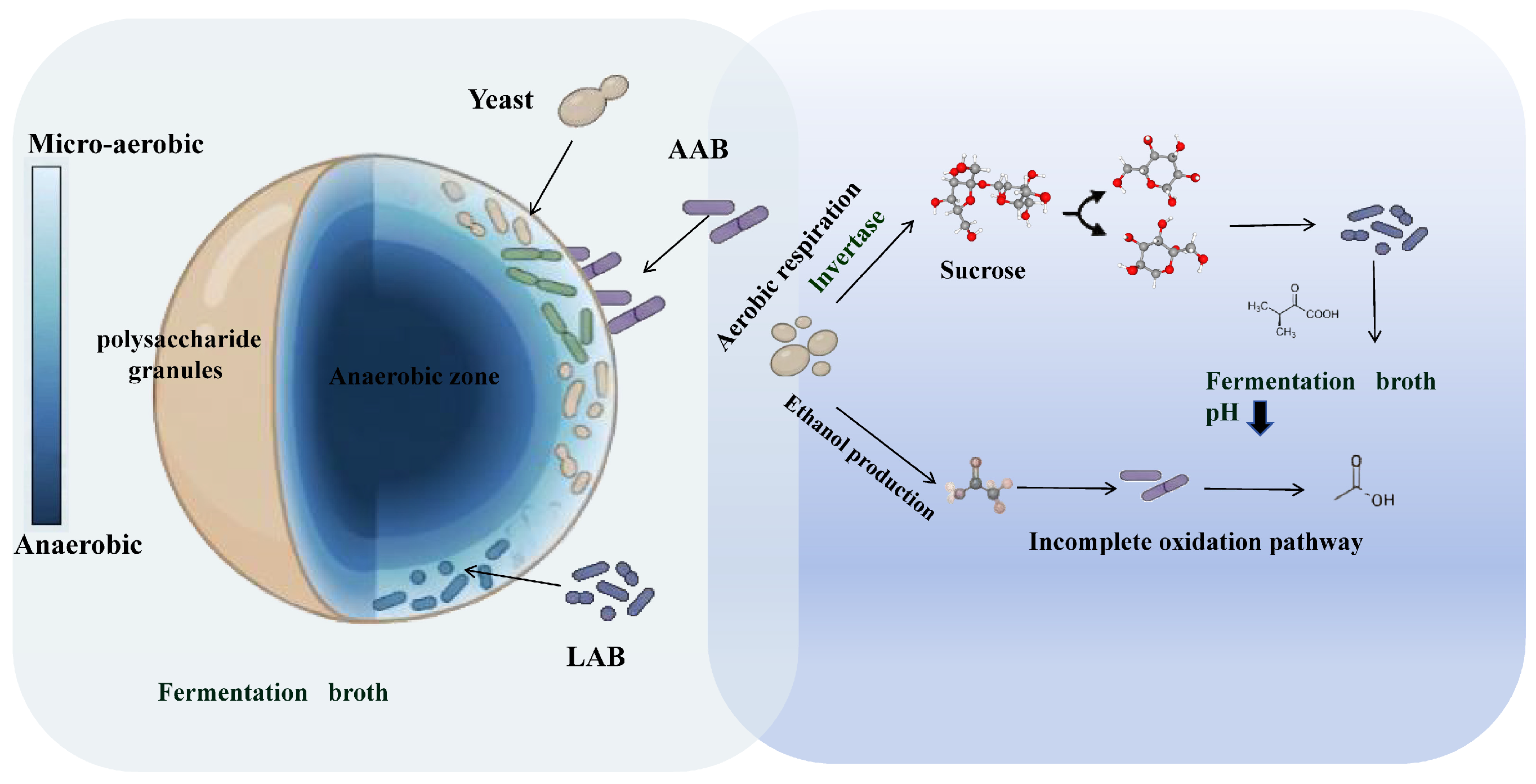
Beyond acid stress, dynamic changes in oxygen gradients also play a decisive role in shaping metabolic division of labor and product distribution within the community. Water kefir is not an absolutely anaerobic system; rather, the extent of oxygen diffusion within it is constrained by multiple physical factors, including the exposed liquid surface area, grain compactness, and fluid shear conditions [25,27]. Such local differences in dissolved oxygen strongly promote drive functional niche differentiation among microorganisms: the aerobic metabolism of yeasts can rapidly consume free oxygen in the medium, thereby creating a microaerobic or anaerobic environment suitable for the proliferation of lactic acid bacteria; lactic acid bacteria then dominate lactic acid synthesis and extracellular polysaccharide construction within this microenvironment. In oxygen-rich regions such as the air–liquid interface, acetic acid bacteria, such as members of the genus Acetobacter, proliferate extensively and convert ethanol produced by yeast metabolism into acetic acid through highly efficient ethanol oxidation pathways [27]. Quantitative analysis suggests that oxygen exposure substantially influences this ecological balance: while it facilitates the proliferation of acetic acid bacteria (AAB), it significantly reduces the abundance of anaerobic species like Bifidobacterium aquikefiri, leading to a metabolic shift where volatile acetic acid levels escalate from 1.19 g/L under anaerobic conditions to 7.88 g/L under aerobic exposure [24]. The accumulation of acetic acid not only strengthens the antimicrobial barrier of the system, but also provides the basis for the refreshing taste and characteristic volatile acidic aroma of the fermented product [28]. Therefore, dissolved oxygen gradients that arise spontaneously from oxygen consumption by the microbial community profoundly alter the distribution ratios of metabolic fluxes toward lactic acid, acetic acid, and ethanol, thereby determining the overall flavor profile and sensory stimulation intensity of plant-based beverages [29].
Substrate composition and the fermentation timeline constitute the material and spatiotemporal basis for community selection. When the fermentation matrix shifts from a traditional simple sucrose solution to a complex plant-derived system, the distinctive carbon and nitrogen sources and secondary metabolites present in plant-based substrates can induce the targeted growth of specific microorganisms and stimulate secondary metabolic interactions and energy partitioning among multiple species, thereby profoundly altering the sensory attributes of the final product [30,31]. Along the temporal dimension, microbial proliferation patterns are highly coupled with changes in the chemical space. In general, water kefir fermentation can reach an optimal balance among microbial biomass, the accumulation of core metabolites, including lactic acid, acetic acid, ethanol, and glycerol, and sensory acceptability within the first 24 h. This fermentation window can effectively prevent the loss of freshness and aroma attenuation associated with excessive acidification [5]. By approximately 72 h, most core metabolic activities tend to stagnate [26]. Furthermore, raw plant matrices and whole fruits added to supplement nitrogen and micro-nutrients inherently harbor diverse autochthonous microbiota. Depending on agricultural processing, drying methods, and preservative treatments, unpasteurized plant substrates can introduce undesirable opportunistic microorganisms—such as Enterobacteriaceae and Pseudomonas species—into the fermentation system [19,32]. These native colonizers actively compete with core water kefir strains for metabolic niches, occasionally triggering unpredicted ethanol drift, flavor instability, or safety hazards. Consequently, transitioning from raw whole fruits to pasteurized, standardized plant extracts (e.g., heat-treated fig or berry extracts) represents a vital process control strategy to suppress undesirable wild microbiota and ensure reproducible microbial profiles in industrial scale-up [19]. In summary, environmental filtering and functional convergence jointly driven by the physicochemical environment, nutritional substrates, and temporal scale provide a solid microecological theoretical foundation for the evolution of water kefir from a traditional experience-based fermentation system into a designable platform for the targeted transformation of plant-based matrices.

2.2. Genetic Elasticity and Metabolic Plasticity Supported by the Core Microbiota of Water Kefir

At the metagenomic and evolutionary levels, water kefir communities exhibit strong genetic elasticity and a decoupling between phenotypic stability and genetic variability. Although the community displays high long-term stability at both the strain level and the macroscopic phenotypic level, this stability contrasts sharply with the high rates of horizontal transfer and variability of mobile genetic elements (MGEs), such as plasmids and phages [33]. This genetic architecture enables the symbiotic community to effectively adapt to diverse substrate-related stresses by fine-tuning its local mobilome, without requiring a complete shift in the core taxonomic structure.
This distinctive genetic resilience is harbored by a highly conserved core microbiome. Certain genera or species, such as Aliiicoccus syzygi, Bifidobacterium aquikefiri, Komagataeibacter hansenii, and Lentilactobacillus hilgardii, exhibit extremely high sequence consistency and temporal robustness at the strain level [8]. Genetically, dominant core members possess a robust repertoire of carbohydrate-active enzymes, conferring the intrinsic potential to synthesize diverse exopolysaccharides during early fermentation [19]. Furthermore, specific stress-response gene clusters—such as those mediating intracellular pH homeostasis and trehalose accumulation—are deeply conserved among community members like bifidobacteria. These inherent genetic traits provide the essential molecular basis for the community’s capacity to resist physical stresses, such as high osmotic pressure, and adapt to environmental fluctuations [34].
Building upon this robust genetic foundation, water kefir displays pronounced metabolic plasticity, unlocking the potential to assimilate complex, non-standard substrates [35]. When plant-based matrices rich in proteins and ligand-like components (e.g., soy protein) are introduced, their specific nutritional constituents and secondary metabolites deeply induce the transcriptional regulation of related metabolic pathways, beyond merely altering the microbial growth rate [36,37]. For example, driven by geographical origin and substrate succession, the activation of latent genera such as Weissella can significantly enhance the metabolic fluxes in volatile organic acids, alcohols, and esters, whereas the introduction of Dekkera can increase flavor complexity through distinctive bypass metabolism under specific nutrient-limited conditions, thereby driving diversified branching of the final aroma trajectory [38].
Molecular evidence at the metaproteomic level further reveals the functional redundancy and compensatory mechanisms underlying this phenotypic stability. Although water kefir communities from different origins exhibit pronounced heterogeneity in species abundance, their protein translation levels associated with core biological pathways—such as carbohydrate and amino acid metabolism—remain highly conserved [7]. During fermentation or substrate perturbation, the contributions of different species to enzyme proteins involved in core metabolic pathways undergo dynamic and adaptive adjustment. For instance, the carbon-metabolic burden may be borne entirely by Saccharomyces cerevisiae in some communities, whereas in others, it is jointly shared with Zygosaccharomyces pomaceae. This highlights a previously underappreciated scientific fact: yeasts contribute substantially to the community’s overall metabolic activity at the protein level [7]. Ultimately, this multispecies cooperative steady state, underpinned by dynamic compensation in metaprotein expression, constitutes the physiological mechanism by which water kefir maintains its resilience in complex and variable plant-based matrices.

2.3. Functional Redundancy and Cooperative Homeostasis Under Multi-Taxon Microbial Interactions

The phenotypic stability of the water kefir symbiotic system is jointly maintained by yeasts, LAB, AAB, and accompanying microorganisms. Its core biochemical mechanism follows a global metabolic framework involving substrate breakdown, intermediate product sharing, and end-product diversion. Fermentation is typically initiated by sucrose-hydrolyzing yeasts, such as Saccharomyces species. The secreted invertases degrade complex sucrose into free glucose and fructose, establishing an open monosaccharide-sharing network [39]. This public-goods provision greatly facilitates the cooperative succession of subsequent species. Thereafter, AAB utilize yeast-derived ethanol as a primary energy source, converting it into acetic acid via incomplete oxidation pathways [40]. Crucially, species-specific carbon-utilization strategies profoundly shape the ecological network topology. In contrast to the altruistic shared metabolism of Saccharomyces cerevisiae, Zymomonas—despite its high ethanologenic potential—relies on high-affinity transport systems for rapid sugar consumption, which can quickly deplete carbon sources, limit cross-feeding, and trigger intense resource competition [7].
Beyond carbon flow transfer, cooperative interactions between yeasts and LAB exhibit a deeper nutritional and stress-protective dimension. Although the progressive accumulation of lactate, acetate, and ethanol lowers the environmental pH to form an antimicrobial barrier [19], acid-tolerant symbiotes evade this inhibition by upregulating classical acid-response pathways, including amino acid decarboxylation and proton pumps. Concurrently, yeasts release peptides, amino acids, and B vitamins through metabolism or autolysis, thereby relieving nitrogen limitations in LAB and enhancing their acid tolerance [41]. Within water kefir systems, the grain matrix integrity and fluid rheology are dynamically governed by strain-specific exopolysaccharide (EPS) networks [42]. Mechanistically, glucansucrase secretion strictly requires sucrose as both a substrate and a transcriptional/release inducer, while its activity hinges on Ca2+ cofactors and optimal pH (4.3–4.6); dropping below pH 3.5 can lead to enzyme inactivation and grain disintegration [43]. Distinct LAB strains exhibit functional division in EPS synthesis: Lentilactobacillus hilgardii produces water-insoluble α-(1→3)-branched dextran, forming a rigid physical scaffold, whereas L. hordei releases soluble α-(1→6) dextran that mediates S. cerevisiae cell co-aggregation for biofilm formation and increases liquid viscosity. Additionally, species such as Leuconostoc citreum and Gluconobacter albidus secrete fructans (levan) into the fermented liquid, collectively modulating the viscoelasticity and ecological stability of the system [44].
These multispecies interactions provide the ecological foundation for functional specialization when transitioning to plant-based substrates. Fine-scale transcriptomic differentiation among cultures drives the specialization of communities from different origins within specific secondary metabolic networks, such as flavor biotransformation [45]. In this sense, water kefir operates not as a static microbial assemblage, but as a dynamically regulated metabolic consortium. Its ecological function depends less on the mere presence of particular taxa, and more on the context-dependent allocation of metabolic tasks under specific substrate pressures.
When the fermentation matrix expands from traditional sugar water to wort or complex plant-based substrates, the microbial succession kinetics deviate significantly, driven by two matrix-specific physiological factors: nitrogen availability and buffering capacity. In nitrogen-rich legume/cereal milks, abundant free peptides accelerate early-stage acidification by fast-growing LAB (e.g., L. plantarum), which outpaces yeast growth. Conversely, in highly acidic, low-buffering fruit media, yeast and AAB dominate the active and late stages due to acid-driven environmental filtering. Based on these substrate-specific succession dynamics [44], the accompanying organic acid metabolic flux within the system exerts a dual regulatory effect on the formation of the fermented flavor profile [25]. Lactic-acid-dominated acidification and metabolite accumulation act as biochemical signals and secondary carbon sources, reciprocally stimulating specific AAB and yeast proliferation to trigger deeper multispecies metabolic cascades. Therefore, effective flavor regulation in plant-based systems requires the systematic control of initial substrate concentrations and core fermentation parameters. Such intervention dynamically modulates the organic acid spectrum and volatile compound flux, thereby preserving the acid-base buffering capacity during storage and optimizing sensory quality [46].
The fermentation homeostasis of water kefir arises from the ecological continuity maintained by metabolic cooperation and the system robustness provided by functional redundancy. In plant-based processing, the primary microecological strategy is to preserve the yeasts’ glycan-degrading capacity to supply aroma precursors, while stabilizing LAB-driven acidification and polysaccharide scaffolding [41]. On this basis, targeted expression of specific enzyme systems can be induced through precursor supplementation or microenvironmental intervention [47]. Specifically, activating cystathionine γ-lyase governs sulfur-containing amino acid metabolism to release characteristic aromas, while stimulating glutamate decarboxylase mitigates acid stress and synthesizes neuroactive metabolites. This strategy ultimately enables targeted sensory modulation, including acid–sweet balance, fruit-aroma enrichment, attenuation of beany off-flavors, and softening of plant-derived astringency. Figure 1 schematically deconstructs the spatial arrangements, oxygen-driven niches, and metabolic syntrophy underpinning this symbiotic homeostasis.

3. Biotransformation of Plant-Based Matrices by Water Kefir Symbiotic Microbiota and Mechanisms of Quality Remodeling

While the previous literature often discusses the biotransformation of proteins, phenolics, exopolysaccharides, and volatiles as separate events, these components actually interact extensively within complex plant matrices. To better understand how water kefir remodels sensory quality, it is necessary to view these processes as an interconnected biochemical network. For instance, the microbial unfolding of plant proteins (Section 3.1) directly assists in releasing matrix-bound phenolics (Section 3.2). As fermentation progresses, these relaxed proteins and liberated phenolics are gradually incorporated into newly formed EPS hydrogel networks (Section 3.3). Together, this complex protein–phenolic–EPS architecture dictates the physical diffusion and release kinetics of volatile flavor compounds (Section 3.4). By examining this integrated framework, the following subsections illustrate that sensory improvement in plant-based beverages relies on the synergy between these macromolecules, rather than on isolated metabolic pathways.

3.1. Remodeling of Protein Secondary Structure and Mechanisms of Nitrogen Reduction and Off-Flavor Attenuation

The improvement in plant protein quality by water kefir does not simply rely on acid production to mask undesirable flavors, but is instead based on the sustained biochemical regulation of protein spatial conformation and nitrogen-containing metabolic networks by the symbiotic microbiota [48]. In their native state, plant proteins form compact aggregates or complexes [49] that deeply bury hydrophobic regions, partial peptide bonds, and bound molecules. This not only limits digestibility, but also facilitates the release of undesirable beany or green off-flavors during processing. However, fermentative microbes (e.g., LAB and yeasts) drive a continuous remodeling process involving unfolding, limited hydrolysis, and reassembly [50]. Through organic acid accumulation, proteolysis, and metabolite-mediated interfacial rearrangement, these microbes transition compact proteins into looser, more readily hydrated, and enzymatically hydrolyzable conformations.
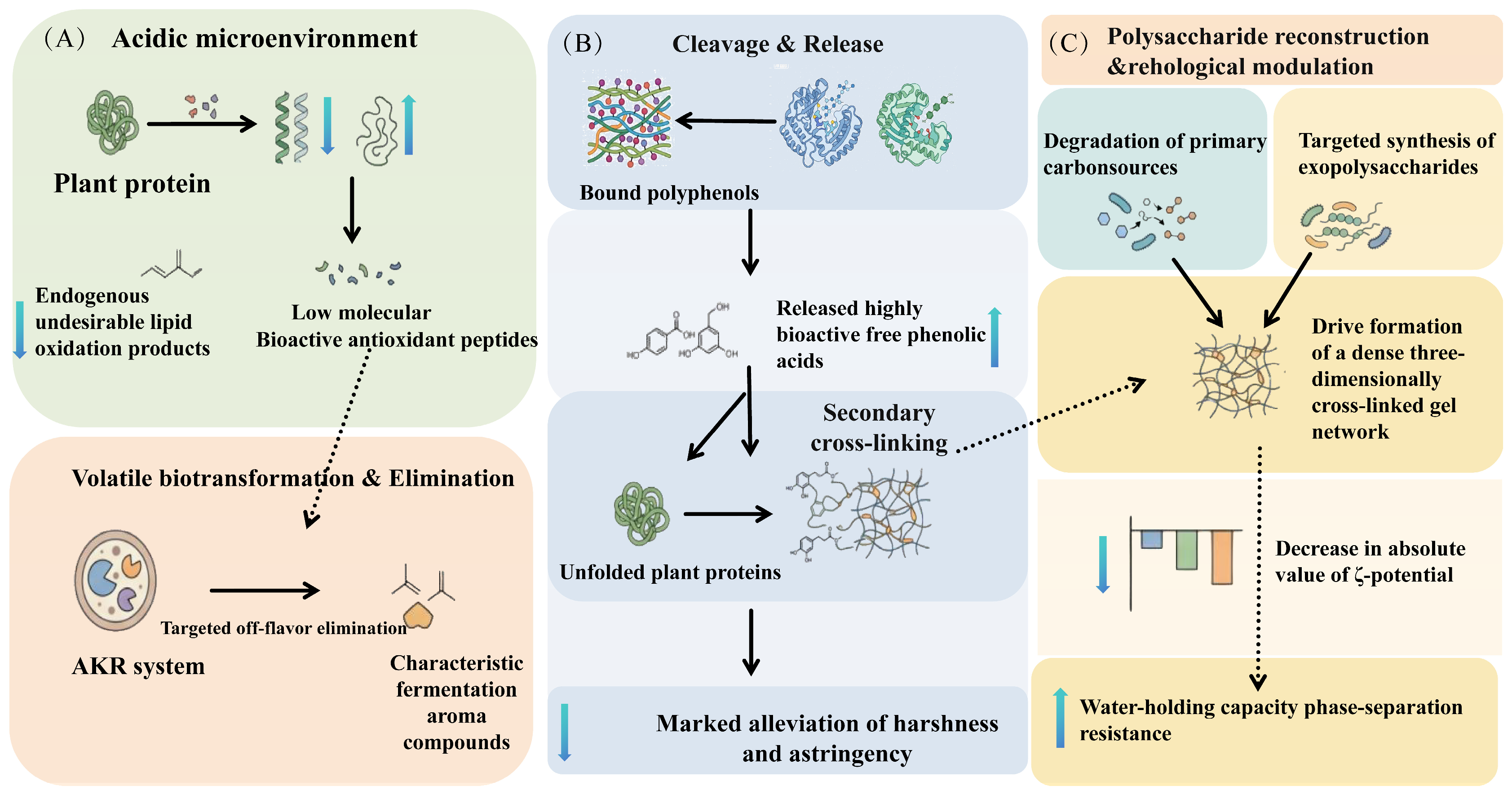
Structural characterization studies have confirmed that water kefir fermentation can specifically modulate the secondary structure of composite protein systems, such as lentil–whey protein complexes, by significantly altering the proportions of α-helices and random coils, while β-sheets and β-turns remain relatively stable [13]. This indicates that the symbiotic microecology does not indiscriminately disrupt the protein network, but preferentially acts on highly flexible and readily exposed free chain segments, inducing local unfolding and spatial conformational rearrangement of proteins. A decrease in α-helix content reflects weakened intrachain hydrogen-bond stability, whereas an increase in random-coil proportion indicates enhanced conformational freedom of protein peptide chains. These changes effectively increase the contact sites between proteases and substrates and provide a structural basis for the release of functional peptides, exposure of hydrophilic groups, and conversion of core flavor precursors. In plant-derived composite protein systems, such as lentil–quinoa protein interaction models, the introduction of water kefir-assisted fermentation can further induce reassociation among different protein components, thereby markedly improving the processing characteristics and functional performance of the overall protein system [11]. The acidic microenvironment induced by fermentation alters the charge distribution on the protein surface, weakens local electrostatic repulsion, and drives the formation of new supramolecular aggregation scales. At the same time, microbially mediated limited hydrolysis appropriately suppresses flocculation and precipitation linked to excessive aggregation. The dynamic balance between these two physicochemical mechanisms confers a softer colloidal mouthfeel to plant-based fermented systems and substantially reduces the rough, green, and astringent notes associated with plant proteins. However, these structural improvements are not universal and depend heavily on the specific plant matrix. In globular pseudo-cereal systems such as quinoa protein isolates, rapid charge neutralization near the isoelectric point (pH 4.0–5.0) often triggers severe self-aggregation and coarse precipitation rather than a uniform gel network [51]. This contradiction illustrates a critical kinetic mismatch during fermentation: if the acidification rate outpaces the time required for protein conformational rearrangement and controlled proteolysis, rapid charge collapse leads to network defects and phase separation [52]. Consequently, the outcome of protein biotransformation varies substantially between matrices, necessitating precise control over acidification kinetics tailored to the intrinsic aggregation properties of each plant protein.
From the perspective of nitrogen-containing compound metabolic flux, fermentation-mediated nitrogen reduction does not physically decrease the total protein abundance of the system. Rather, it directionally converts macromolecular protein nitrogen, which is difficult for the human body to absorb and prone to inducing undesirable flavors, into small bioactive peptides, free amino acids, and high-quality nitrogen sources that can be reutilized by microorganisms. Fermentation studies on specific legume matrices, such as jack bean, have shown that specific peptides released after water kefir transformation not only have developmental potential for microencapsulated antioxidant systems [53], but also significantly inhibit lipid peroxidation by selectively scavenging free radicals. This cascade enhancement of antioxidant capacity triggered by limited protein hydrolysis is highly likely to represent an important indirect off-flavor attenuation pathway that blocks odor formation associated with fatty acid oxidation in legume-, cereal-, or tuber-based plant matrices [54].
The transformation of protein biochemical properties is closely associated with the profound remodeling of volatile metabolic networks in the water kefir fermentation system [41]. The symbiotic microbiota can significantly reshape the volatile profile through differential utilization of substrate carbon sources and diversion of metabolic pathways. Once the secondary and tertiary structures of plant proteins are moderately opened, amino acid residues and small-molecule flavor precursors originally buried in hydrophobic cavities can more readily enter intra- and extracellular microbial metabolic fluxes [55]. During this biochemical process, the accumulation of undesirable nitrogenous odorants, such as specific volatile amines or sulfides, is restricted, whereas biosynthetic pathways for organic acids, higher alcohols, esters, and mild fermentation-derived aromas are substantially activated [56]. Dynamic metabolomic monitoring of cereal matrices, such as wort, has likewise confirmed that water kefir fermentation can induce intense metabolite turnover within the system, thereby fundamentally altering the physicochemical and sensory qualities of the matrix [15]. Thus, protein-structure remodeling and flavor modification are not isolated physical or chemical events, but instead constitute a continuous biochemical succession jointly driven by the symbiotic microecology: protein unfolding enhances substrate accessibility to enzymatic hydrolysis, limited hydrolysis releases active nitrogen sources, and the symbiotic microbiota subsequently channel them into secondary metabolic pathways such as organic-acid and ester synthesis [57]. Together, these processes ultimately achieve a systematic quality enhancement of plant-based fermented beverages in terms of nutritional accessibility, moderation of characteristic nitrogenous notes, and suppression of beany and miscellaneous off-flavors.

3.2. Biological Extraction and Targeted Structural Modification of Phenolic Compounds

Phenolic compounds in plant-based matrices do not all exist in free forms; a considerable proportion is tightly embedded within cell walls or polysaccharide–protein composite networks, or occurs in bound forms through glycosidic bonds, ester bonds, and other linkages [58,59]. The core significance of water kefir fermentation in reshaping the biochemical properties of polyphenols does not only lie in increasing the absolute abundance of total phenolics. Rather, through enzymatic dissociation by the symbiotic microbiota, acidification-induced depolymerization of the microenvironment, and secondary metabolic transformation, bound phenolics with low mobility and poor extractability are converted into free phenols and small-molecule derivatives that are more readily absorbed and possess higher biochemical reactivity [60]. The fermentation process induces pronounced dynamic succession in the levels of various phenolic compounds, while different polyphenol configurations exhibit markedly different sensitivities to biotransformation. Specific symbiotic metabolic routes may even catalyze the formation of entirely new phenolic derivative systems [45]. Based on this property, the use of symbiotic fermentation systems to recover and transform food-processing by-products rich in soluble dietary fiber, such as molasses residues, not only substantially reduces the industrial cost of biorefining, but also endows the final products with distinctive antioxidant and metabolic symbiotic attributes [61]. The ultimately released and targeted modified polyphenol profiles strongly influence several core sensory dimensions of beverages, including acidity perception, bitterness, color stability, and overall astringency, while this metabolic direction is strongly and synergistically regulated by culture composition, fermentation temperature, and specific fruit or vegetable substrate matrices [62].
The fundamental driving force for the efficient release of phenolic compounds from complex multicomponent matrices originates from the rich extracellular hydrolase repertoire of the water kefir symbiotic community. Specifically, β-glucosidase can specifically cleave glycosidic bonds on phenolic acids, flavonoids, and aromatic precursors, driving the transition of bound precursors into free active molecules [63]. Tannase targets the degradation of macromolecular condensed tannins, effectively reducing intense sensory astringency while releasing small phenolic acids with strong antioxidant potential, such as gallic acid [64]. Esterases further act on ester bonds cross-linking phenolic acids and cell-wall polysaccharides, promoting the depolymerization of typical bound macromolecules such as ferulic acid and coumaric acid and their efficient migration into the liquid phase [14]. In addition, the enzymatic release of polyphenols is often biochemically coupled with lipid degradation and fatty acid metabolic networks within the system. Fermentation-derived unsaturated free fatty acids can be converted through β-oxidation and structural transformation into specific lactone compounds, thereby imparting a full-bodied characteristic fruity aroma to fermented products [65]. In this biochemical cascade, system acidification induced by acid-producing taxa such as lactic acid bacteria, together with the catalytic effects of specific enzyme systems such as phytase on the conversion of amino acids into aldehydes and ketones, jointly amplifies the nutritional value and sensory quality of plant-based products [66]. Thus, deglycosylation and the associated enzymatic hydrolysis network are not only biochemical channels for the release of aromatic compounds, but also the underlying mechanism for the enrichment of endogenous plant phenolics and targeted aromatic derivatives.
In plant-protein composite systems, such as legume-, cereal-, or nut-based matrices, the released active phenolics can further undergo secondary interactions with proteins and free mineral elements [67], profoundly affecting the overall rheology and sensory performance of the fermentation system [64]. Studies have shown that introducing water kefir-assisted fermentation can effectively reorganize the cross-linked structures of plant-derived proteins from lentil, pea, or quinoa, thereby improving protein physiological quality while altering the distribution pattern of endogenous polyphenols. At the macroscopic physicochemical level, these polyphenol–macromolecule interactions manifest as significant increases in the apparent viscosity and colloidal particle size of plant-based beverages, which substantially improves resistance to phase separation and water-holding capacity in fluid systems [68]. Meanwhile, the synchronous release and accumulation of free fatty acids, small peptides, and amino acids jointly optimize product body and flavor complexity. Therefore, evaluation of polyphenol bioextraction efficiency must be systematically mapped to protein structural relaxation, mineral chelation status, enhancement of antioxidant capacity, and regulation of sensory astringency.
In practical industrial applications, the water kefir-mediated process more closely resembles a mild green biorefining strategy: it can efficiently solubilize antioxidant phenolic compounds while effectively modulating turbidity, astringency perception, color retention, and suspension stability through fine adjustment of dynamic polyphenol–protein complex interactions. Targeted process design enables a controllable plant-based quality-remodeling module encompassing functional extraction, aroma release, astringency reduction, and color stabilization. Examples include medium optimization for β-glucosidase-driven aroma release, and fermentation time control to limit tannase and preserve tea-like textures. Table 1 outlines these remodeling strategies across diverse plant matrices.

3.3. Enzymatic Reconstruction of Complex Polysaccharides and Regulation of Rheological Properties

During the fermentation of plant-based beverages, the water kefir symbiotic microbiota substantially reshape the rheological properties and textural perception of the system through complex carbohydrate–metabolic activities. Fermentation promotes a structural spatial transition of the polysaccharide network within the matrix, shifting it from a plant-endogenous macromolecule-supported architecture toward a microbially regulated metabolic architecture. As a result, the apparent viscosity of the system exhibits dynamic bidirectional modulation [83]. On the one hand, high-sugar-consuming microorganisms within the symbiotic community efficiently degrade and metabolize primary carbon sources such as free sucrose, glucose, and fructose in the system [37], disrupting part of the original hydrated colloidal network of the matrix and leading to a decrease in viscosity at specific fermentation stages. On the other hand, particular functional strains increase the viscoelasticity and body of the system through polymer synthesis. Studies have confirmed that Oenococcus kitaharae and Oenococcus oeni in fermentation systems can efficiently synthesize high-molecular-weight polymers such as dextran, α-glucan, and β-fructan from sucrose substrates. Additionally, bacteria of the genera Komagataeibacter and Gluconobacter are also widely involved in the extracellular assembly of macromolecules such as bacterial cellulose and fructans. The synthesis and secretion of homopolysaccharides or heteropolysaccharides by lactic acid bacteria, particularly the introduction of the rheological behavior of dextran, actively participate in and dominate the cross-linked assembly of the three-dimensional gel network [20,92,93]. Furthermore, the structural diversity of EPS dictates its specific binding interactions with matrix components: the anionic functional groups of EPS coordinate divalent ions (Ca2+, Mg2+) to form ionically bridged junction zones [94], while engaging in non-covalent binding with depolymerized phenolics and relaxed plant proteins. These EPS–polyphenol–protein interactions yield key functional benefits, such as masking the native astringency and bitterness of plant tannins and protecting bioactive phenolics against oxidation [95]. These microbial polysaccharides not only significantly increase the apparent viscosity and microscopic particle size of the fluid, but also effectively reduce electrostatic repulsion among colloidal particles, as indicated by a decrease in the absolute ζ-potential, thereby markedly enhancing the phase-separation resistance and water-holding capacity of plant-based matrices. Ultimately, this confers longer-term physical stability during storage and a fuller, richer mouthfeel upon consumption.
To achieve a rheological balance between the intensity of substrate enzymatic degradation and the retained level of microbial polysaccharide synthesis, and to avoid extreme physical phase transitions such as excessive hydration (over-thinning) or gelation (over-thickening) in fermented beverages, the systematic optimization of core fermentation parameters is particularly critical. The taxonomic attributes and absolute concentration of the inoculum, the carbon-to-nitrogen source ratio of the plant-based substrate, and dynamic changes in the dissolved oxygen gradient can all act as driving forces that profoundly influence the reaction rates of these bidirectional metabolic networks [96]. During process development, response surface methodology (RSM) is commonly used to systematically optimize core variables such as the initial probiotic load, incubation temperature, and fermentation time, thereby accurately identifying the thermodynamic operating window in which the fermentation system reaches its optimal rheological modulus and textural state [74].
More importantly, the evolution of the rheological state of water kefir is not merely a physical phenomenon, but also functions as a mass-transfer barrier that profoundly constrains and regulates the release kinetics and sensory perception of key flavor compounds in the local oral environment, introducing an inherent sensory trade-off between textural body and aroma volatility. As matrix viscosity increases and the colloidal cross-linked network becomes denser, the molecular diffusion resistance of alcohols, short-chain esters, and characteristic volatile organic acids across liquid–gas and liquid–solid interfaces increases significantly [97]. Drawing parallels from general protein–polysaccharide hydrogel systems where polymer networks physically modulate volatile release kinetics [98], such EPS-mediated encapsulation in water kefir may temporarily impede the immediate headspace release of fruity esters, while potentially protecting fragile volatile compounds against thermal degradation during storage and prolonging flavor persistence during consumption. Therefore, achieving a balance between physical viscosity and aroma release through targeted strain screening and regulation of polysaccharide metabolic diversity has become a core strategy for optimizing the sensory acceptance of plant-based fermented beverages [80]. This rheological remodeling guided by microecological metabolism is not only an effective means of suppressing undesirable flavor diffusion in plant-protein matrices, but the accompanying protein conformational relaxation and polysaccharide coupling also exert profound engineering effects on the final macroscopic physical homeostasis and persistent fixation of the flavor fingerprint in the beverage.

3.4. Evolution of Organic Acid Profiles and Construction of Ester-Based Flavor Fingerprints

The flavor remodeling of plant matrices by water kefir is fundamentally a coupled evolutionary process of organic acid metabolism and ester synthesis driven synergistically by core taxa such as lactic acid bacteria, yeasts, and acetic acid bacteria [14]. Flavor construction in the early stages of fermentation relies heavily on the primary metabolic networks of carbohydrates and amino acids. A large number of intermediate products derived from microbial metabolism, such as lactic acid, acetic acid, and trace succinic acid, significantly impart a rich, characteristic sourness to the matrix and, more importantly, these short-chain organic acids act as core carbon skeletons, strongly participating in the synthetic network of complex higher-order flavors through subsequent esterification reactions [28,41]. In plant-based water kefir systems, the sensory acidity experience of the product does not depend solely on the absolute concentration of total titratable acidity, but is governed by the integrated synergistic effects of various organic acid profiles. Therefore, the dynamic evolution of organic acid profiles in the middle and late stages of fermentation provides a robust metabolic precursor pool for secondary esterification reactions and the assembly of characteristic volatile aromas.
Regarding the targeted construction of ester-based flavor fingerprints, the structural composition and abundance ratio of volatile organic compounds strongly influence the ultimate sensory recognizability of the beverage [99]. The symbiotic fermentation of water kefir can selectively synthesize core volatile aromatic substances such as ethyl acetate, isoamyl alcohol, and isoamyl acetate, thereby imparting prominent sweet and characteristic fruity aromas to the originally bland plant base [26]. This metabolic output exhibits strong microecological specificity: co-culture combinations of yeasts and lactic acid bacteria with different configurations present significant differences in transcriptional regulation regarding the diversion and conversion of volatile precursors. Specific dominant strain combinations can significantly upregulate the expression of key enzymes such as alcohol acetyltransferases, thereby driving the rapid accumulation of high concentrations of short- and medium-chain fatty acid ethyl esters, which imparts a pronounced fruity signature to the product [100]. In product formulation design, constructing an ideal ester fingerprint requires carefully balancing the molar ratio of short- and medium-chain esters at the microecological metabolic level, while strictly controlling the sensory coupling relationship between total ester abundance and residual acidity.
For plant extracts with ubiquitous flavor defects (such as beany, astringent, and grassy notes), metabolic network modification mediated by symbiotic fermentation serves as a key technological strategy to overcome the bottleneck of consumer acceptance [80]. The specific endogenous lipoxygenase pathways and abundant free amino acids in plant bases such as legumes, cereals, or nuts profoundly rearrange the basal metabolic fluxes in the fermentation system. The intervention of water kefir enables the targeted removal of off-flavors and the synergistic enrichment of characteristic aromas. For instance, the aldo-keto reductase systems of the symbiotic consortia can effectively degrade key lipid oxidation products (such as hexanal and 2-pentylfuran) responsible for the beany flavor in soy matrices, redirecting these carbon skeletons into the synthesis pathways of esters and higher alcohols [101]. This degradation and recombination mechanism not only effectively limits the sensory transmission of the beany flavor but also achieves a profound sensory transformation toward pleasant fruity or floral notes [17].Furthermore, co-fermenting water kefir with fungal or plant endogenous enzymes broadens the availability of flavor precursors. Microbial interactions within these systems activate enzymes, notably β-glucosidase, to cleave glycosidic bonds and release latent aroma compounds, significantly multiplying the diversity and abundance of volatile organic compounds (VOCs). This enzymatic and metabolic synergy provides a theoretical basis for tailoring distinct flavor profiles in non-traditional plant matrices like fruit by-products, oats, and legumes. Figure 2 illustrates the molecular events driving this biochemical remodeling, encompassing protein unfolding, phenolic depolymerization, and rheological control.

4. Precision Design and Sensory Engineering of Water Kefir Products

4.1. Process Standardization and Sensory Quality Control of Water Kefir

For large-scale industrial production, substrate standardization represents a core barrier to achieving batch-to-batch consistency and quality stability. The biochemical stability and macroscopic sensory characteristics of water kefir are governed by nutrient configurations, substrate concentration gradients, and environmental thermodynamic parameters. In complex plant extracts or fruit-based formulations, the assembly of endogenous nutrients not only determines the oxygen consumption rate of yeasts, thereby creating a suitable microaerophilic niche for lactic acid bacteria, but also fundamentally defines the dynamic trajectory of fermentation and the final domain of sensory expression [80]. Systematic optimization of substrate compositional ratios and incubation temperature in the fermentation broth using response surface methodology or central composite rotatable design is therefore a prerequisite for standardizing the physicochemical characteristics of the product and maximizing its functional properties [92].
The core objective of water kefir process standardization is to transform traditional spontaneous and chaotic symbiotic fermentation into a predictable, verifiable, and scalable controlled biochemical process. Because natural kefir grains from different origins exhibit pronounced and unpredictable heterogeneity in volatile flavor profiles and fermentation kinetics, establishing standardized industrial strain banks and constructing simplified co-culture starters with defined compositions have become advanced strategies for reducing batch variation and improving process controllability [21]. In plant-based water kefir fermentation, biochemical events such as glycan degradation, pH shifts, ethanol accumulation, and aroma release are highly intertwined, strongly influencing the turbidity, rheological thickness, and multidimensional aroma profile of the final beverage [80]. Therefore, rather than relying solely on endpoint pH as a single release criterion, modern industrial control would benefit significantly from establishing a multivariate linkage-control model [29]. Incorporating fermentation time, temperature gradients, substrate consumption rates, and the production fluxes in core metabolites such as ethanol and organic acids into a dynamic monitoring network, thereby constructing a full-cycle early-warning mechanism for batch deviation, is essential for optimizing fluid properties and homogenizing sensory quality.
Closed-loop risk management of secondary metabolites, particularly alcohol content, represents a critical regulatory checkpoint for plant-based water kefir commercialization. For matrices with high intrinsic sugar contents (e.g., fruit juices or coconut water), process design must strictly decouple primary fermentation from post-fermentation ethanol drift during storage, where alcohol levels can fluctuate unpredictably between 15.0 g/L and 28.2 g/L (approximately 1.9–3.5% v/v) depending on substrate nitrogen availability and buffering capacity [24]. By integrating online densitometers and rapid ethanol-detection ports, the critical threshold for physical termination can be reliably identified. Specifically, utilizing standardized, nitrogen-limited plant extracts (rather than raw fruits) to restrict yeast metabolic velocity, combined with terminating the primary fermentation at a target pH of 3.6, serves as a vital process control strategy to suppress this drift [24]. Furthermore, stage-wise physical cooling and microfiltration-based microbial removal can effectively prevent latent alcohol exceedance and excessive acidification during cold-chain distribution [102].
Systematic constraint of flavor fluctuation depends heavily on the deep coupling of multidimensional chemical characterization with sensory evaluation omics. A standardized quality system would greatly benefit from establishing a three-dimensional verification framework spanning microscopic molecular profiles to macroscopic neural perception [103]. On the basis of ensuring absolute microbiological safety, modern sensory quality control can be constructed as a three-tier evaluation topology composed of instrumental biomimetic fingerprints, trained sensory panels, and dynamic consumer-behavior tracking. At the objective quantification level, electronic tongue systems that simulate human chemosensory perception enable effective digital deconstruction of characteristic attributes such as sourness–astringency, sweet aftertaste, and body fullness in beverages [104]. At the subjective evaluation level, the rate-all-that-apply (RATA) method can be introduced to assess the instantaneous intensity of specific aromas or irritant sensations [105]; temporal dominance of sensations testing can be combined to trace the spatiotemporal evolution sequence of dominant sensory perceptions during oral processing and swallowing [83]; and semi-quantitative consumer preference scaling and trained-panel evaluation can be further applied for validation [69]. The ultimate aim of this full-chain engineering approach, from biochemical profiling to sensory cognition, is not to eliminate the inherent metabolic diversity of the water kefir symbiotic microecology, but rather to constrain it within a quantifiable, reproducible flavor thermodynamic space that conforms to targeted design esthetics.

4.2. Plant-Based Matrix Adaptation and Beverage Design for Targeted Physiological Functions

Water kefir symbiotic microecology exhibits remarkable habitat flexibility, enabling deep biochemical degradation of diverse plant-derived glycans, primary fruit and vegetable metabolites, and complex protein matrices. By carefully optimizing fermentation thermodynamic parameters, substrate spatial configurations, and core strain combinations, the release of volatile flavors can be deeply coupled with specific targeted physiological health functions [70,106]. The strong adaptability of symbiotic grains to heterogeneous sugar-containing substrates endows them with substantial ecological and economic engineering potential for converting low-value by-products of the food industry, such as pomace, peels, and other fibrous matrices, into high-bioefficacy value-added carriers [71]. Specifically, fermenting industrial side-streams such as soy whey effectively degrades antinutritional oligosaccharides while generating bioactive gluconic (0.71 g/100 mL) and glucuronic acids. Similarly, sugar-rich pineapple osmotic dehydration effluents and fruit processing residues (e.g., cocoa pulp) are efficiently biotransformed into aromatic functional drinks rich in fruity esters and organic acids, exemplifying water kefir as a robust biorefining tool for agro-industrial waste upcycling [36,43].
In nutritional intervention designs aimed at low-glycemic-load (GL) restructuring and body-weight management, the fermentation kinetics of water kefir can efficiently deplete residual free sugars within the matrix and redirect substrate carbon flux toward short-chain organic acids and natural carbon dioxide, thereby imparting a refreshing texture characterized by mild acidity and abundant carbonation. This natural sugar-reduction mechanism based on microbial carbon metabolism makes water kefir a high-quality physical and sensory substitute for conventional high-sugar carbonated soft drinks [56]. In addition, systematic process optimization may not only activate the potential probiotic barrier function of the system, but also facilitate the dissociation and enrich free phenolics from plant matrices, thereby establishing a biochemical defense against cellular oxidative stress and nonspecific inflammation [107,108]. In formulation engineering, the targeted incorporation of natural fruit juices as co-fermentation substrates can fully exploit fermentation-derived organic acids and fruity esters to reduce dependence on refined exogenous sugars, while lowering metabolic burden and markedly expanding the sensory acceptance range [41].
For individuals with lactose intolerance and those adhering to strict plant-based dietary preferences, the non-dairy fermentation platform of water kefir provides a natural route for allergen avoidance [10,109]. As an ideal evolutionary alternative to traditional dairy kefir, it aligns closely with clinical nutritional demands for eliminating the allergenic risks associated with proteins. In the fields of sports nutrition and high-protein meal replacements, plant proteins such as soy and cereal proteins are often accompanied by pronounced endogenous lipid-oxidation off-flavors and a powdery, gritty mouthfeel, whereas the introduction of symbiotic fermentation can substantially modulate subunit interactions and water-holding properties in complex composite protein systems [13,72]. Through mild bioenzymatic degradation, this process not only effectively attenuates the beany harshness of globulins and the coarse powdery rheological characteristics, but also purifies undesirable flavors via aldehyde–ketone reduction pathways, thereby enabling the smooth release of characteristic aromas in high-viscosity, high-protein fluids.
For populations focused on antioxidant efficacy and chronic degenerative metabolic health, fruit and vegetable matrices rich in bioactive anthocyanins and flavonoids constitute excellent functional delivery vehicles [110]. Coupling the water kefir microecology with polyphenol-enriched matrices such as grape juice can create innovative healthy fluid alternatives with high physicochemical stability, sustained microecological activity, and extremely low alcohol residues [46,87]. Particularly in beverage formulation for older adults, fine intervention in fermentation dynamics is essential: late-stage fermentation pathways should be blocked, or specific yeast mutants with low sugar consumption and low alcohol production must be screened, to strictly limit ethanol accumulation risk [111] while attenuating the physical impact of excessively strong irritating acidity on the vulnerable gastrointestinal mucosa.
Therefore, the development of highly customized functional beverages must rely on a systematic design concept integrating targeted substrate screening–microbiota-oriented metabolic steering–closed-loop evaluation of flavor and physiological efficacy. For example, biotransformation of wort by the symbiotic microecology can remove coarse plant-fiber sensations and generate pleasant aromas, providing a commercially promising base matrix for non-alcoholic fermented beverages [11]. Additionally, the in-depth elucidation of microbial metabolic roles and their transcriptional regulatory pathways is the core prerequisite for targeted flavor shaping. Moreover, the solvent environment of the fermentation system, such as mineral water systems rich in characteristic trace elements from deep seawater, can also profoundly intervene in the biochemical enzymatic activity and organic acid metabolic flux in the symbiotic microbiota, ultimately determining the upper limit of functional factor expression [16]. This multidimensional cross-integration constructs the underlying engineering logic for the development of next-generation plant-based water kefir products.

4.3. Food Safety, Ethanol Regulations, and Challenges of Undefined Consortia

The industrial translation of water kefir from an artisanal ferment to a standardized plant-based functional beverage is severely constrained by critical food safety risks and divergent global regulatory frameworks. A primary technical barrier is the prevention of pathogenic and opportunistic contamination within an open, symbiotic system. While the rapid acidification of standard WK fermentations—typically dropping from an initial pH of >5.0 to a protective range of 3.3–3.5 within 24 to 48 h—suppresses many common vegetative pathogens, raw botanical matrices are inherently non-sterile [5,26]. Unpasteurized plant extracts and dried fruits, such as dried figs (Ficus carica L.), are rich in calcium and trace minerals that benefit grain growth, but they also introduce a diverse wild microbiota [112]. Although water kefir exhibits broad antimicrobial activity against pathogens such as Salmonella spp., Escherichia coli, and Pseudomonas aeruginosa, these contaminants can still pose risks during the initial lag phase or in cases of compromised fermentation kinetics [112]. Consequently, industrial process design should implement strict Hazard Analysis and Critical Control Point (HACCP) protocols. Substrates should undergo thermal pasteurization or high-pressure processing (HPP) prior to inoculation, although such treatments require careful optimization to avoid degrading heat-sensitive plant polyphenols or altering the buffering capacity of the matrix.
Equally challenging is the strict management of yeast-derived ethanol kinetics, commonly termed ethanol drift. Under the United States Food and Drug Administration regulations and European Union frameworks, any beverage marketed as non-alcoholic must strictly maintain an alcohol by volume (ABV) of less than 0.5% (equivalent to approximately 4.0 g/L of ethanol) [112]. In contrast, Australia’s Standard 2.6.2 [113] permits a slightly higher limit of 1.15% ABV specifically for the “brewed soft drink” category [112]. Traditional water kefir fermentations naturally and consistently violate these legal thresholds. Metabolic profiling shows that under standard conditions on a sucrose–fig medium, the dominant fermentative yeast Saccharomyces cerevisiae rapidly converts hexoses into ethanol, reaching concentrations of 20.3 g/L (approximately 2.5% ABV) after 72 h [26]. Even in shorter 48 h fermentations, fig-based substrates accumulate up to 14.5 g/L (approx. 1.8% ABV) of ethanol [5]. Because yeasts remain metabolically active after bottling, they continue to ferment residual simple sugars—such as the fructose and glucose that typically remain at concentrations of 4.0–8.0 g/L [5]—leading to unpredictable alcohol accumulation during cold-chain storage. To halt this drift without destroying the live probiotic cells, manufacturers must deploy physical intervention strategies, such as sterile membrane microfiltration (0.22 μm) to selectively remove yeast cells while retaining smaller LAB, or utilize nitrogen-limited plant substrates to physiologically starve the yeast population.
Finally, the commercialization of water kefir faces a fundamental legal bottleneck regarding the safety clearance of its “undefined” microbial consortium. Regulatory authorities, such as the US FDA (for Generally Recognized as Safe, GRAS, status) and the European Food Safety Authority (EFSA, for the Qualified Presumption of Safety, QPS, list), require precise, strain-level taxonomic identification and characterized phenotypic traits (e.g., absence of transferable antibiotic resistance genes) [112]. Traditional WK grains are highly heterogeneous, co-existing consortia of various LAB (Lentilactobacillus hilgardii, Lacticaseibacillus paracasei, Schleiferilactobacillus harbinensis), acetic acid bacteria (Acetobacter spp.), and yeasts [6]. Some core symbiotic members pose significant industrial and biosecurity risks. For example, Dekkera bruxellensis is a dominant yeast in many WK grains [6], yet it is also a notorious spoilage organism in the wine and beer industries, making its intentional cultivation highly problematic in multi-product food manufacturing plants. Additionally, novel symbiotic taxa, such as Bifidobacterium aquikefiri, lack established historical safety dossiers under EFSA QPS guidelines. Because the microbial ratios within artisanal kefir grains fluctuate significantly based on water hardness, fermentation temperature, and backslopping frequency, establishing batch-to-batch biological consistency is nearly impossible. To satisfy modern food safety dossiers, the industry should transition away from traditional, variable grains toward the formulation of defined, synthetic starter cultures. These reconstructed consortia should exclude spoilage and unapproved taxa while synthetically mimicking the core metabolic cross-feeding pathways necessary to achieve the desired sensory and rheological remodeling of plant-based matrices.

5. Frontiers and Perspectives in Water Kefir Process Analysis

Although water kefir holds immense potential as a biorefining platform, its transition from traditional empiricism to industrial-scale precision fermentation is currently hindered by several realistic limitations. The inherent compositional variability of artisanal grains severely limits the reproducibility of sensory outcomes and complicates cross-study comparisons. Furthermore, the unpredictability of ethanol drift during scale-up, complex regulatory hurdles surrounding undefined multi-species consortia, and evolving consumer perceptions of non-dairy fermented beverages all present significant bottlenecks. Crucially, much of the existing mechanistic literature still extrapolates evidence derived from well-studied dairy fermentations or generic LAB directly to water kefir systems, highlighting a critical knowledge gap that requires system-specific validation.
To overcome these challenges and drive the paradigm shift toward targeted precision regulation, future research could be condensed into three core priorities: (1) Mechanistic Dissection of Core Functional Modules and Their Causal Roles in Flavor and Safety: Future exploration would greatly benefit from placing water kefir within a systems biology framework. Currently, static, correlation-based multi-omics inferences excel at predicting potential pathways, yet they often fall short in confirming precise in situ enzymatic activities within complex solid–liquid interfaces. To move beyond these limitations, it is highly recommended to integrate modern molecular biology approaches. Such methodologies include in situ strain reconstruction, simplified co-culture models with defined compositions, stable isotope metabolic-flux tracing, and targeted gene-knockout validation. This shift from superficial microbial-phase description to rigorous causal mechanism models will elucidate how interspecies coupling of metabolic fluxes drives flavor differentiation and ensures biosafety across heterogeneous plant-based substrates. (2) Development and Validation of Real-Time, Biomimetic Sensing and AI-driven Modeling Tools: Precision regulation at the industrial level depends on the non-destructive, high-frequency tracking of physicochemical evolution. The integration of mid-infrared spectroscopy and biomimetic sensor arrays (e.g., electronic noses and tongues) with rapid volatilomic detection ports provides an efficient pathway for dynamic monitoring. Furthermore, the deployment of artificial intelligence models—including fuzzy logic algorithms, machine learning, and multivariate partial least-squares regression—holds great promise for advancing the field. These intelligent models can establish nonlinear mapping networks linking substrate molecular ratios, characteristic volatile abundance, core microbial succession, and consumers’ sensory language, thereby enabling the reverse engineering of targeted flavor designs. (3) Translation of Multi-Omics Insights into Robust, Reproducible Starter Systems and Industrial Protocols: To address batch-to-batch fluctuations and scale-up bottlenecks, the effective translation of empirical findings into standardized industrial solutions remains a critical objective. Future efforts must focus on developing defined, highly reproducible starter cultures that mimic the functional redundancy of the natural kefir grain matrix while strictly complying with commercial food safety regulations. Additionally, the establishment of dynamic risk early-warning systems must be established across the entire product lifecycle to tightly control latent ethanol accumulation, abnormal acid stress, and microbial succession during cold-chain storage.
In conclusion, overcoming the current constraints of traditional empiricism requires the deep integration of microecological mechanisms, intelligent process monitoring, and standardized industrial protocols. By bridging the gap between fundamental multi-omics research and applied sensory engineering, the water kefir consortium can be effectively harnessed as a modern biorefining tool, ultimately delivering highly reproducible and functional plant-based products to the consumer market.

Author Contributions

Conceptualization, D.M.; resources, D.M.; data curation, D.M.; writing—original draft preparation, D.M.; writing—review and editing, R.Y., Y.W. and Y.Z.; visualization, D.M. and R.Y.; project administration, D.M. and Y.W.; supervision, Y.Z. All authors have read and agreed to the published version of the manuscript.

Funding

This research received no external funding.

Institutional Review Board Statement

Not applicable.

Informed Consent Statement

Not applicable.

Data Availability Statement

No new data were created or analyzed in this study. Data sharing is not applicable to this article.

Conflicts of Interest

Author Yuanchi Wang was employed by the company BYHEALTH Co., Ltd. The remaining authors declare that the research was conducted in the absence of any commercial or financial relationships that could be construed as a potential conflict of interest.

References

  1. McClements, D.J.; Grossmann, L. The Science of Plant-Based Foods: Constructing next-Generation Meat, Fish, Milk, and Egg Analogs. Compr. Rev. Food Sci. Food Saf. 2021, 20, 4049–4100. [Google Scholar] [CrossRef] [Scilit] [PubMed]
  2. Sawant, S.S.; Park, H.-Y.; Sim, E.-Y.; Kim, H.-S.; Choi, H.-S. Microbial Fermentation in Food: Impact on Functional Properties and Nutritional Enhancement—A Review of Recent Developments. Fermentation 2025, 11, 15. [Google Scholar] [CrossRef] [Scilit]
  3. Guzel-Seydim, Z.B.; Gökırmaklı, Ç.; Greene, A.K. A Comparison of Milk Kefir and Water Kefir: Physical, Chemical, Microbiological and Functional Properties. Trends Food Sci. Technol. 2021, 113, 42–53. [Google Scholar] [CrossRef] [Scilit]
  4. Walsh, L.H.; Breselge, S.; Martin, J.G.P.; Coakley, M.; Ferguson, E.; Stapleton, A.; Crispie, F.; O’Toole, P.W.; Cotter, P.D. Kefir4All, a Citizen Science Initiative to Raise Awareness of the Roles That Microbes Play in Food Fermentation. J. Microbiol. Biol. Educ. 2024, 25, e00155-23. [Google Scholar] [CrossRef] [Scilit] [PubMed]
  5. Gökırmaklı, Ç.; Yüceer, Y.K.; Guzel-Seydim, Z.B. Chemical, Microbial, and Volatile Changes of Water Kefir during Fermentation with Economic Substrates. Eur. Food Res. Technol. 2023, 249, 1717–1728. [Google Scholar] [CrossRef] [Scilit]
  6. Wang, Y.; Wang, X.; Xu, Y.; Li, Y.; Liu, Y.; Lin, X. Volatile Flavor Characteristics and Microbial Fermentation Differences of Water Kefir Grains from Different Origins. Eur. Food Res. Technol. 2025, 251, 3019–3032. [Google Scholar] [CrossRef] [Scilit]
  7. Breselge, S.; de Paula Dias Moreira, L.; Skibinska, I.; Yin, X.; Brennan, L.; Kilcawley, K.; Porcellato, D.; Cotter, P.D. Water Kefir Multi-Omics Reveals Functional Redundancies despite Taxonomic Differences and the Underappreciated Contribution of Yeast. npj Sci. Food. 2025, 9, 265. [Google Scholar] [CrossRef] [Scilit] [PubMed]
  8. Cotter, P.; Walsh, L.; Breselge, S.; Martin, J.; Coakley, M.; Crispie, F.; Skibinska, I.; Kilcawley, K. Adaptations and Community Changes in Milk and Water Kefir Microbiomes in Response to Environmental Parameters as Revealed by the Kefir4All Project 2026. Nat. Portf. 2026; under review. [CrossRef] [Scilit] [PubMed]
  9. Köhler, S.; Schmacht, M.; Troubounis, A.H.L.; Ludszuweit, M.; Rettberg, N.; Senz, M. Tradition as a Stepping Stone for a Microbial Defined Water Kefir Fermentation Process: Insights in Cell Growth, Bioflavoring, and Sensory Perception. Front. Microbiol. 2021, 12, 732019. [Google Scholar] [CrossRef] [Scilit] [PubMed]
  10. Ouyang, W.; Liao, Z.; Yang, X.; Zhang, X.; Zhu, X.; Zhong, Q.; Wang, L.; Fang, X.; Wang, J. Microbial Composition of Water Kefir Grains and Their Application for the Detoxification of Aflatoxin B1. Toxins 2024, 16, 107. [Google Scholar] [CrossRef] [Scilit] [PubMed]
  11. Tan, T.-C.; Easa, A.; Gammoh, S.; Aludatt, M.; Tranchant, C.; Almajwal, A.; Maghaydah, S.; Dheyab, M.; Al-Qaisi, A.; Al Qudsi, F. Preparation of Lentil and Quinoa Protein Complexes through Protein-Protein Interactions and Water Kefir-Assisted Fermentation to Improve Protein Quality and Functionality. Front. Sustain. Food Syst. 2023, 7, 1174597. [Google Scholar] [CrossRef] [Scilit]
  12. Al-Qaisi, A.; Alrosan, M.; Almajwal, A.M.; Gammoh, S.; Alu’datt, M.H.; Kubow, S.; Tan, T.-C.; Mahmood, A.A.R.; Qudsi, F.R.A. Evaluation of Structure, Quality, Physicochemical Properties, and Phenolics Content of Pea Proteins: A Novel Strategy through the Incorporation of Fermentation. J. Food Sci. 2024, 89, 1517–1530. [Google Scholar] [CrossRef] [Scilit] [PubMed]
  13. Alrosan, M.; Tan, T.-C.; Easa, A.M.; Gammoh, S.; Alu’datt, M.H.; Kubow, S.; Almajwal, A.M.; Razzak Mahmood, A.A.; Al-Qaisi, A.; Bawadi, H. Enhancing the Quality of Lentil Proteins via Combination with Whey Proteins Based on a Dual Process: A Novel Strategy through the Incorporation of Complexation and Fermentation. Food Sci. Biotechnol. 2025, 34, 65–78. [Google Scholar] [CrossRef] [Scilit] [PubMed]
  14. Gao, Y.; Zhuo, R.; Luo, H.; Ho, C.-T.; Chen, Y.; Zhou, H.; Qu, Z.; Chen, H.; Yi, Y.; Wang, Y.; et al. Characterizing and Decoding the Effects of Co-Culture Fermentation on Dark Tea Infusion Flavor Development: Elucidating Microbial Succession and Metabolic Dynamics Mediated by Eurotium cristatum and Water Kefir. Food Chem. X 2025, 30, 102876. [Google Scholar] [CrossRef] [Scilit] [PubMed]
  15. Wen, S.; Dong, N.; Zhang, Y.; Yang, B.; Wang, B.; Dai, Y.; Lin, X.; Dong, L.; Zhang, S. Metabolic Profiling of Wort Fermented with Water Kefir Grains and Its Effect on Wort Quality. Food Biosci. 2024, 59, 104181. [Google Scholar] [CrossRef] [Scilit]
  16. Justel, M.A.; Outeiriño, E.B.; Guerra, N.P. Production of Kefir and Kefir-like Beverages: Fundamental Aspects, Advances, and Future Challenges. Processes 2026, 14, 73. [Google Scholar] [CrossRef] [Scilit]
  17. Tu, C.; Azi, F.; Huang, J.; Xu, X.; Xing, G.; Dong, M. Quality and Metagenomic Evaluation of a Novel Functional Beverage Produced from Soy Whey Using Water Kefir Grains. LWT 2019, 113, 108258. [Google Scholar] [CrossRef] [Scilit]
  18. Egea, M.B.; Santos, D.C.D.; de Oliveira Filho, J.G.; Ores, J.d.C.; Takeuchi, K.P.; Lemes, A.C. A Review of Nondairy Kefir Products: Their Characteristics and Potential Human Health Benefits. Crit. Rev. Food Sci. Nutr. 2022, 62, 1536–1552. [Google Scholar] [CrossRef] [Scilit] [PubMed]
  19. Lynch, K.M.; Wilkinson, S.; Daenen, L.; Arendt, E.K. An Update on Water Kefir: Microbiology, Composition and Production. Int. J. Food Microbiol. 2021, 345, 109128. [Google Scholar] [CrossRef] [Scilit] [PubMed]
  20. Khan, A.; Breselge, S.; O’Mahony, A.K.; O’Sullivan, O.; Cotter, P.D.; McCarthy, S.N.; Mahony, J.; Kenny, J.G. Water Kefir as a Paradigm for Multi-Omics and Genome-Scale Metabolic Modelling in Fermented Food. npj Biofilms Microbiomes 2026, 12, 116. [Google Scholar] [CrossRef] [Scilit] [PubMed]
  21. Breselge, S.; Skibinska, I.; Yin, X.; Brennan, L.; Kilcawley, K.; Cotter, P.D. The Core Microbiomes and Associated Metabolic Potential of Water Kefir as Revealed by Pan Multi-Omics. Commun. Biol. 2025, 8, 415. [Google Scholar] [CrossRef] [Scilit] [PubMed]
  22. Bueno, R.S.; Ressutte, J.B.; Hata, N.N.Y.; Henrique-Bana, F.C.; Guergoletto, K.B.; de Oliveira, A.G.; Spinosa, W.A. Quality and Shelf Life Assessment of a New Beverage Produced from Water Kefir Grains and Red Pitaya. LWT 2021, 140, 110770. [Google Scholar] [CrossRef] [Scilit]
  23. Sin, P.Y.; Tan, S.H.; Asras, M.F.F.; Lee, C.M.; Lee, T.C. Probiotic Growth Pattern and Physicochemical Evaluation of Water Kefir Fermentation. Malays. Appl. Biol. 2024, 53, 21–30. [Google Scholar] [CrossRef] [Scilit]
  24. Laureys, D.; Aerts, M.; Vandamme, P.; De Vuyst, L. Oxygen and Diverse Nutrients Influence the Water Kefir Fermentation Process. Food Microbiol. 2018, 73, 351–361. [Google Scholar] [CrossRef] [Scilit] [PubMed]
  25. Arrieta-Echeverri, M.C.; Fernandez, G.J.; Duarte-Riveros, A.; Correa-Álvarez, J.; Bardales, J.A.; Villanueva-Mejía, D.F.; Sierra-Zapata, L. Multi-Omics Characterization of the Microbial Populations and Chemical Space Composition of a Water Kefir Fermentation. Front. Mol. Biosci. 2023, 10, 1223863. [Google Scholar] [CrossRef] [Scilit] [PubMed]
  26. Laureys, D.; De Vuyst, L. Microbial Species Diversity, Community Dynamics, and Metabolite Kinetics of Water Kefir Fermentation. Appl. Environ. Microbiol. 2014, 80, 2564–2572. [Google Scholar] [CrossRef] [Scilit] [PubMed]
  27. De Roos, J.; De Vuyst, L. Acetic Acid Bacteria in Fermented Foods and Beverages. Curr. Opin. Biotechnol. 2018, 49, 115–119. [Google Scholar] [CrossRef] [Scilit] [PubMed]
  28. Moretti, A.F.; Moure, M.C.; Quiñoy, F.; Esposito, F.; Simonelli, N.; Medrano, M.; León-Peláez, Á. Water Kefir, a Fermented Beverage Containing Probiotic Microorganisms: From Ancient and Artisanal Manufacture to Industrialized and Regulated Commercialization. Future Foods 2022, 5, 100123. [Google Scholar] [CrossRef] [Scilit]
  29. Salek, R.N.; Pleva, P.; Sumczynski, D.; Vinter, Š.; Kopečková, J.; Rejdlová, A.; Lorencová, E. Sauerkraut Juice Fermented with Different Symbiotic Starter Cultures: Comprehensive Assessment of Physicochemical, Rheological, Antioxidant, and Microbiological Characteristics. Front. Sustain. Food Syst. 2025, 9, 1570465. [Google Scholar] [CrossRef] [Scilit]
  30. Zannini, E.; Lynch, K.M.; Nyhan, L.; Sahin, A.W.; O’ Riordan, P.; Luk, D.; Arendt, E.K. Influence of Substrate on the Fermentation Characteristics and Culture-Dependent Microbial Composition of Water Kefir. Fermentation 2023, 9, 28. [Google Scholar] [CrossRef] [Scilit]
  31. Cufaoglu, G.; Eser, E.; Erdinc, A.N. The Microbial Composition of Water Kefir and the Effects of Fermentation Conditions: A Systematic Review and Meta-Analysis. Food Biosci. 2025, 73, 107778. [Google Scholar] [CrossRef] [Scilit]
  32. Randazzo, W.; Corona, O.; Guarcello, R.; Francesca, N.; Germanà, M.A.; Erten, H.; Moschetti, G.; Settanni, L. Development of New Non-Dairy Beverages from Mediterranean Fruit Juices Fermented with Water Kefir Microorganisms. Food Microbiol. 2016, 54, 40–51. [Google Scholar] [CrossRef] [Scilit]
  33. Somerville, V.; Prasad, A.; Maurice, C.F.; Garrido-Sanz, D.; Ulrich, E.; Mazel, F.; Sarton-Lohéac, G.; Bonilla-Rosso, G.; Baud, G.; Tamarelle, J.; et al. Strain-Level and Phenotypic Stability Contrasts with Plasmid and Phage Variability in Water Kefir Communities. Biorxiv 2025. [Google Scholar] [CrossRef] [Scilit]
  34. Eckel, V.P.L.; Ziegler, L.-M.; Vogel, R.F.; Ehrmann, M. Bifidobacterium tibiigranuli Sp. Nov. Isolated from Homemade Water Kefir. Int. J. Syst. Evol. Microbiol. 2020, 70, 1562–1570. [Google Scholar] [CrossRef] [Scilit] [PubMed]
  35. Garmendia, G.; Gyenes, F.; Alvarez, A.; Arbildi, E.; Giménez, S.; Gonda, M.; Vero, S. Dynamic Microbiota in Water Kefir: Microbial Shift and Ecological Selection during Fermentation. BMC Microbiol. 2025, 26, 271. [Google Scholar] [CrossRef] [Scilit] [PubMed]
  36. Azi, F.; Tu, C.; Meng, L.; Zhiyu, L.; Cherinet, M.T.; Ahmadullah, Z.; Dong, M. Metabolite Dynamics and Phytochemistry of a Soy Whey-Based Beverage Bio-Transformed by Water Kefir Consortium. Food Chem. 2021, 342, 128225. [Google Scholar] [CrossRef] [Scilit] [PubMed]
  37. Kaya, Y.; Akgün, H.A.; Taş, T.K. Metagenomic Analysis of Microbial Dynamics in Water Kefir Grains: Influence of Soy Protein on Biomass Growth and the Development of an Alternative Beverage. Int. J. Food Sci. Tech. 2025, 60, vvae024. [Google Scholar] [CrossRef] [Scilit]
  38. Wang, Z.; Wang, S.; He, Q.; Yang, X.; Zhao, B.; Zhang, H.; Deng, Y. Ecological Design of High-Performance Synthetic Microbial Communities: From Theoretical Foundations to Functional Optimization. ISME Commun. 2025, 5, ycaf133. [Google Scholar] [CrossRef] [Scilit] [PubMed]
  39. Stadie, J.; Gulitz, A.; Ehrmann, M.A.; Vogel, R.F. Metabolic Activity and Symbiotic Interactions of Lactic Acid Bacteria and Yeasts Isolated from Water Kefir. Food Microbiol. 2013, 35, 92–98. [Google Scholar] [CrossRef] [Scilit] [PubMed]
  40. Gonda, M.; Garmendia, G.; Rufo, C.; Peláez, Á.L.; Wisniewski, M.; Droby, S.; Vero, S. Biocontrol of Aspergillus flavus in Ensiled Sorghum by Water Kefir Microorganisms. Microorganisms 2019, 7, 253. [Google Scholar] [CrossRef] [Scilit] [PubMed]
  41. Wang, Y.; Xu, Y.; Li, Y.; Yu, J.; Yang, D.; Liu, Y.; Lin, X. Flavor Formation in Water Kefir: Metabolic Roles of Microorganisms and Their Regulatory Pathways. Food Rev. Int. 2025, 41, 3552–3568. [Google Scholar] [CrossRef] [Scilit]
  42. Gökırmaklı, Ç.; Şatır, G.; Guzel-Seydim, Z.B. Microbial Viability and Nutritional Content of Water Kefir Grains under Different Storage Conditions. Food Sci. Nutr. 2024, 12, 4143–4150. [Google Scholar] [CrossRef] [Scilit] [PubMed]
  43. Pendón, M.D.; Bengoa, A.A.; Iraporda, C.; Medrano, M.; Garrote, G.L.; Abraham, A.G. Water Kefir: Factors Affecting Grain Growth and Health-Promoting Properties of the Fermented Beverage. J. Appl. Microbiol. 2022, 133, 162–180. [Google Scholar] [CrossRef] [Scilit] [PubMed]
  44. Bera, K.; Bhattacharya, D.; Mukhopadhyay, M. Microbial Polysaccharide Engineering: The Role of LAB-Derived EPS in Fermented Food Innovation and Nutritional Enhancement. Food Sci. Biotechnol. 2026. [Google Scholar] [CrossRef] [Scilit]
  45. Dikmetas, D.N.; Acar, E.G.; Ceylan, F.D.; İlkadım, F.; Özer, H.; Karbancioglu-Guler, F. Functional Fermented Fruit Juice Production and Characterization by Using Water Kefir Grains. J. Food Sci. Technol. 2026, 63, 378–391. [Google Scholar] [CrossRef] [Scilit] [PubMed]
  46. de Souza, H.F.; Monteiro, G.F.; Bogáz, L.T.; Freire, E.N.S.; Pereira, K.N.; Vieira de Carvalho, M.; Gomes da Cruz, A.; Viana Brandi, I.; Setsuko Kamimura, E. Bibliometric Analysis of Water Kefir and Milk Kefir in Probiotic Foods from 2013 to 2022: A Critical Review of Recent Applications and Prospects. Food Res. Int. 2024, 175, 113716. [Google Scholar] [CrossRef] [Scilit] [PubMed]
  47. Smit, G.; Smit, B.A.; Engels, W.J.M. Flavour Formation by Lactic Acid Bacteria and Biochemical Flavour Profiling of Cheese Products. FEMS Microbiol. Rev. 2005, 29, 591–610. [Google Scholar] [CrossRef] [Scilit] [PubMed]
  48. Outeiriño, E.B.; Justel, M.A.; Novo, C.P.; Couñago, A.A.; Guerra, N.P. Production and Characterization of Kefir Beverages by Fermentation of Whole Milk with Milk or Water Kefir Grains. Foods 2026, 15, 1616. [Google Scholar] [CrossRef] [Scilit] [PubMed]
  49. Inanlar, B.; Capanoglu, E. The Rise of Plant-Based Proteins: Consumer Perception and Challenges. Food Sci. Nutr. 2026, 14, e71713. [Google Scholar] [CrossRef] [Scilit] [PubMed]
  50. Aguiar, L.L.; Cabral, R.S.; Coelho, V.S.; Nunes, B.V.; Silva, V.D.M.; de Oliveira, G.B.; Labanca, R.A.; Melo, J.O.-F.; de Araújo, R.L.B. Emerging Techniques for the Extraction and Enzymatic Hydrolysis of Plant Proteins From Waste: An Integrative Review. J. Food Process Eng. 2026, 49, e70512. [Google Scholar] [CrossRef] [Scilit]
  51. Montellano Duran, N.; Galante, M.; Spelzini, D.; Boeris, V. The Effect of Carrageenan on the Acid-Induced Aggregation and Gelation Conditions of Quinoa Proteins. Food Res. Int. 2018, 107, 683–690. [Google Scholar] [CrossRef] [Scilit] [PubMed]
  52. Zhao, C.; Dong, B.; Yao, Y.; Zhu, Y.; Liu, M.; Zhao, G. Lactic Acid Bacteria Fermentation–Driven Protein-Based Gelation: Mechanisms, Structure–Function Relationships, and Food Applications. Adv. Colloid. Interface Sci. 2026, 356, 103971. [Google Scholar] [CrossRef] [Scilit] [PubMed]
  53. Yusuf, D.; Kholifaturrohmah, R.; Nurcholis, M.; Setiarto, R.H.B.; Anggadhania, L.; Sulistiani. Potential of White Jack Bean (Canavalia ensiformis L. DC) Kefir as a Microencapsulated Antioxidant. Prev. Nutr. Food Sci. 2023, 28, 453–462. [Google Scholar] [CrossRef] [Scilit] [PubMed]
  54. Nwachukwu, I.D.; Aluko, R.E. Structural and Functional Properties of Food Protein-Derived Antioxidant Peptides. J. Food Biochem. 2019, 43, e12761. [Google Scholar] [CrossRef] [Scilit] [PubMed]
  55. Ma, D.; Wang, B.; Xiao, S.; Wang, J. Non-Targeted Metabolomics Unveils Metabolic Spectrum Characteristics and Core Metabolite Interaction Networks in Water Kefir Fermentation. LWT 2024, 195, 115840. [Google Scholar] [CrossRef] [Scilit]
  56. Yin, L.; Pu, S.; Tong, Q.; Chen, Z.; Ye, T.; Yan, S. Formation Mechanism of Key Flavor Compounds During the Fermentation of Strawberry Juice with Water Kefir Grains. Foods 2026, 15, 1312. [Google Scholar] [CrossRef] [Scilit] [PubMed]
  57. Pihurov, M.; Păcularu-Burada, B.; Cotârleț, M.; Grigore-Gurgu, L.; Borda, D.; Stănciuc, N.; Kluz, M.; Bahrim, G.E. Kombucha and Water Kefir Grains Microbiomes’ Symbiotic Contribution to Postbiotics Enhancement. Foods 2023, 12, 2581. [Google Scholar] [CrossRef] [Scilit] [PubMed]
  58. Lu, C.; Zhang, J.; Zhao, X.; Zi, Y.; Xiao, X. Biotransformation of Phenolic Acids in Foods: Pathways, Key Enzymes, and Technological Applications. Foods 2025, 14, 2187. [Google Scholar] [CrossRef] [Scilit] [PubMed]
  59. La Torre, C.; Pino, R.; Fazio, A.; Plastina, P.; Loizzo, M.R. Synergistic Bioactive Potential of Combined Fermented Kombucha and Water Kefir. Beverages 2025, 11, 65. [Google Scholar] [CrossRef] [Scilit]
  60. Papadopoulou, D.; Chrysikopoulou, V.; Rampaouni, A.; Tsoupras, A. Antioxidant and Anti-Inflammatory Properties of Water Kefir Microbiota and Its Bioactive Metabolites for Health Promoting Bio-Functional Products and Applications. AIMS Microbiol. 2024, 10, 756–811. [Google Scholar] [CrossRef] [Scilit] [PubMed]
  61. Papadopoulou, D.; Chrysikopoulou, V.; Rampaouni, A.; Plakidis, C.; Ofrydopoulou, A.; Shiels, K.; Saha, S.K.; Tsoupras, A. Antioxidant, Antithrombotic and Anti-Inflammatory Properties of Amphiphilic Bioactives from Water Kefir Grains and Its Apple Pomace-Based Fermented Beverage. Antioxidants 2025, 14, 164. [Google Scholar] [CrossRef] [Scilit] [PubMed]
  62. Putri, D.A.; Nalurita, I.; Pereira, A.X. Changes in Chemical Profile and Bioactive Potential of Cascara Water Kefir Probiotic Beverage During Fermentation. Agro. Bali. Agric. J. 2025, 8, 242–253. [Google Scholar] [CrossRef] [Scilit]
  63. Ren, X.; Xiong, H.; Liao, X.; Abduallah, A.M.A.; Su, J.; Wang, X.; Tian, C.; Xue, J.; Song, Z.; Zhang, X. The Physiochemical Characteristics and Metabolic Components of Paeonia Ostii Petal Tea Produced through Eurotium cristatum-Mediated Liquid Fermentation. Food Chem. X 2026, 33, 103436. [Google Scholar] [CrossRef] [Scilit] [PubMed]
  64. Manzanilla-Herrera, H.E.; Navarro-Moreno, L.G.; Carvajal-Zarrabal, O.; Hernández-Sánchez, F.; Navarro-Mtz, A.K.; Capataz-Tafur, J.; Olaide-Olawunmi, A.; Nolasco-Hipólito, C. Transforming Chamomile (Matricaria chamomilla) Infusion into a Fermented Beverage Using Sucrose and Probiotic Lactic Acid Bacteria. Discov. Food 2025, 6, 36. [Google Scholar] [CrossRef] [Scilit]
  65. Kahve, A.N.; Bayrak, E. Determination of the Functional, Nutritional, and Some Quality Properties of Kefir Produced With the Addition of Germinated Chickpeas. Food Sci. Nutr. 2025, 13, e70860. [Google Scholar] [CrossRef] [Scilit] [PubMed]
  66. Limbad, M.; Gutierrez Maddox, N.; Hamid, N.; Kantono, K. Sensory and Physicochemical Characterization of Sourdough Bread Prepared with a Coconut Water Kefir Starter. Foods 2020, 9, 1165. [Google Scholar] [CrossRef] [Scilit] [PubMed]
  67. Quan, T.H.; Benjakul, S.; Sae-leaw, T.; Balange, A.K.; Maqsood, S. Protein–Polyphenol Conjugates: Antioxidant Property, Functionalities and Their Applications. Trends Food Sci. Technol. 2019, 91, 507–517. [Google Scholar] [CrossRef] [Scilit]
  68. Arsou, L.; Exarhopoulos, S.; Goulas, A.; Dimitreli, G. Effect of Low-Temperature Storage of Kefir Grains and Trehalose Addition on the Production of the Exopolysaccharide Kefiran. Macromol 2026, 6, 3. [Google Scholar] [CrossRef] [Scilit]
  69. Hampton, J.; Tang, C.; Jayasree Subhash, A.; Serventi, L. Assessment of Pear Juice and Puree as a Fermentation Matrix for Water Kefir. J. Food Process. Preserv. 2021, 45, e15223. [Google Scholar] [CrossRef] [Scilit]
  70. Esar, S.Y.; Foe, K.; Caroline; Tjahjono, Y.; Wijaya, H.; Ervina, M. Development of a Synbiotic Water Kefir, Dragon Fruit, and Inulin–Medium-Chain Triglyceride Drink as a Candidate for an Antihyperlipidemic Beverage. J. Adv. Pharm. Technol. Res. 2026, 17, 198. [Google Scholar] [CrossRef] [Scilit] [PubMed]
  71. da Silva, S.F.; Cavalcante, M.P.; Sensheng, Y.; Silva, S.d.S.; Frota Gaban, S.V. Physicochemical Properties, Antioxidant Activity, and Sensory Profiles of Kombucha and Kombucha-Like Beverages Prepared Using Passion Fruit (Passiflora edulis) and Apple (Malus pumila). ACS Agric. Sci. Technol. 2024, 4, 938–946. [Google Scholar] [CrossRef] [Scilit]
  72. Güzel-Seydim, Z.B.; Şatır, G.; Gökırmaklı, Ç. Use of Mandarin and Persimmon Fruits in Water Kefir Fermentation. Food Sci. Nutr. 2023, 11, 5890–5897. [Google Scholar] [CrossRef] [Scilit] [PubMed]
  73. Onat, B.; Niçin, R.T.; Kanıbol, N.A.; Çetin, E.; Şentürk, D.Z.; Şimşek, Ö. Influence of Jerusalem Artichoke on Microbial and Chemical Characteristics of Water Kefir Production. Int. J. Gastron. Food Sci. 2025, 39, 101104. [Google Scholar] [CrossRef] [Scilit]
  74. Koh, W.Y.; Lim, X.X.; Khor, B.H.; Rasti, B.; Tan, T.C.; Kobun, R.; Uthumporn, U. Production and Optimisation of Fermented Pumpkin-Based Mature Coconut Water Kefir Beverage Using Response Surface Methodology. Beverages 2024, 10, 34. [Google Scholar] [CrossRef] [Scilit]
  75. Wang, X.; Wang, P. Red Beetroot Juice Fermented by Water Kefir Grains: Physicochemical, Antioxidant Profile and Anticancer Activity. Eur. Food Res. Technol. 2023, 249, 939–950. [Google Scholar] [CrossRef] [Scilit]
  76. Azi, F.; Tu, C.; Abdul Rasheed, H.; Dong, M. Comparative Study of the Phenolics, Antioxidant and Metagenomic Composition of Novel Soy Whey-based Beverages Produced Using Three Different Water Kefir Microbiota. Int. J. Food Sci. Technol. 2020, 55, 1689–1697. [Google Scholar] [CrossRef] [Scilit]
  77. Zhan, Q.; Thakur, K.; Feng, J.-Y.; Zhu, Y.-Y.; Zhang, J.-G.; Wei, Z.-J. LC-MS Based Metabolomics Analysis of Okara Fermented by Bacillus subtilis DC-15: Insights into Nutritional and Functional Profile. Food Chem. 2023, 413, 135656. [Google Scholar] [CrossRef] [Scilit] [PubMed]
  78. Weis, C.M.S.C.; Diniz, L.G.T.; Andrade, G.S.; Monteiro, L.M.; Manfron, J.; Camargo, A.F.; Kubeneck, S.; Klein, G.H.; Romani, L.C.; Longo, V.D.; et al. Fermented Beverage Based on Lupines (Lupinus luteus) Using Water Kefir. Food Sci. Eng. 2024, 5, 87–98. [Google Scholar] [CrossRef] [Scilit]
  79. Scarpelin, C.; de Souza Cordes, C.L.; Kamimura, E.S.; Macedo, J.A.; de Paula Menezes Barbosa, P.; Alves Macedo, G. New Plant-Based Kefir Fermented Beverages as Potential Source of GABA. J. Food Sci. Technol. 2025, 62, 264–272. [Google Scholar] [CrossRef] [Scilit] [PubMed]
  80. Ustaoğlu-Gençgönül, M.; Gökırmaklı, Ç.; Üçgül, B.; Karagül-Yüceer, Y.; Guzel-Seydim, Z.B. Chemical, Microbial, and Volatile Compounds of Water Kefir Beverages Made from Chickpea, Almond, and Rice Extracts. Eur. Food Res. Technol. 2024, 250, 2233–2244. [Google Scholar] [CrossRef] [Scilit]
  81. Maughan, L.; Koolman, L.; Macori, G.; Killian, C.; Fanning, S.; Whyte, P.; Bolton, D. Characterization of Bacterial and Fungal Populations in Retail Kefirs in Ireland. J. Dairy Sci. 2025, 108, 8187–8204. [Google Scholar] [CrossRef] [Scilit] [PubMed]
  82. Massa, A.; Axpe, E.; Atxa, E.; Hernández, I. Sustainable, Carbonated, Non-Alcoholic Beverages Using Leftover Bread. Int. J. Gastron. Food Sci. 2022, 30, 100607. [Google Scholar] [CrossRef] [Scilit]
  83. Vimercati, W.C.; Araújo, C.d.S.; Macedo, L.L.; Fonseca, H.C.; Guimarães, J.S.; de Abreu, L.R.; Pinto, S.M. Physicochemical, Rheological, Microbiological and Sensory Properties of Newly Developed Coffee Flavored Kefir. LWT 2020, 123, 109069. [Google Scholar] [CrossRef] [Scilit]
  84. Li, X.; He, Y.; Xie, Y.; Zhang, L.; Li, J.; Liu, H. Effects of Fermentation with Kefir Grains on Nutrient Composition, Flavor Volatiles, and Product Physical Stability of a Hemp Seed (Cannabis sativa L.) Beverage. LWT 2023, 183, 114934. [Google Scholar] [CrossRef] [Scilit]
  85. Satir, G. The Effects of Fermentation with Water Kefir Grains on Two Varieties of Tigernut (Cyperus esculentus L.) Milk. LWT 2022, 171, 114164. [Google Scholar] [CrossRef] [Scilit]
  86. Chomphoosee, T.; Seesuriyachan, P.; Wattanutchariya, W.; Tipbunjong, C.; Therdtatha, P.; techapun, C.; Insomphun, C.; Panti, N.; Moukamnerd, C. A Novel Beverage of Coffee Cherry (Cascara) Water Kefir Rich in Antioxidants, Bioactive Compounds, and Exhibiting Promising Antibacterial and Sensory Qualities. LWT 2025, 219, 117539. [Google Scholar] [CrossRef] [Scilit]
  87. Abdi, A.; Gatri, E.; Guilbaud, J.; Bouallagui, H.; Fadhlaoui, K.; Garrait, G.; Ayed, L. Co-Cultivation of Potential Probiotic Strains Isolated from Water Kefir for Fermented Green Tea Beverage. Fermentation 2025, 11, 169. [Google Scholar] [CrossRef] [Scilit]
  88. Sy, M.Z.S.; Wardani, A.K. Effect of Sucrose and Starter on the Chemical and Organoleptic Properties of Fig Leaf Tea Water Kefir. agriTECH 2024, 44, 341. [Google Scholar] [CrossRef] [Scilit]
  89. Rizqiati, H.; Nurwantoro, N.; Bramadita, A.M. Physicochemical, Microbiological and Organoleptic Characteristics of Rosella Water Kefir with Sucrose Sweetener. J. Teknol. Hasil. Pertan. 2023, 16, 84. [Google Scholar] [CrossRef] [Scilit]
  90. Gülhan, A. Usability of Carbon Sources as Sucrose, Honey and Agave Syrup in Fermentation of Lemonade with Water Kefir Grains. Sugar Tech 2023, 25, 1542–1556. [Google Scholar] [CrossRef] [Scilit]
  91. Bielska, P.; Cais-Sokolińska, D.; Teichert, J.; Biegalski, J.; Kaczyński, Ł.K.; Chudy, S. Effect of Honeydew Honey Addition on the Water Activity and Water Holding Capacity of Kefir in the Context of Its Sensory Acceptability. Sci. Rep. 2021, 11, 22956. [Google Scholar] [CrossRef] [Scilit] [PubMed]
  92. De Almeida, K.V.; Sant’ Ana, C.T.; Wichello, S.P.; Louzada, G.E.; Verruck, S.; Teixeira, L.J.Q. Water Kefir: Review of Microbial Diversity, Potential Health Benefits, and Fermentation Process. Processes 2025, 13, 885. [Google Scholar] [CrossRef] [Scilit]
  93. Li, T.; Shu, G.; Dai, C.; Kang, J.; Liu, Y.; Shan, C. Comparison of Fermentation Performance and Metabolites of Water Kefir Grains. Acta Sci. Pol. Technol. Aliment. 2024, 23, 379–398. [Google Scholar] [CrossRef] [Scilit]
  94. Cao, D.-Q.; Song, Y.-X.; Wu, Y.-F.; Yihuo, G.; Jin, J.-Y. Calcium Ion Mixing Modes Govern Membrane Fouling Mitigation During Membrane-Based Recovery of Extracellular Polymeric Substances. Membranes 2025, 15, 169. [Google Scholar] [CrossRef] [Scilit] [PubMed]
  95. Sun, X.; Sarteshnizi, R.A.; Udenigwe, C.C. Recent Advances in Protein–Polyphenol Interactions Focusing on Structural Properties Related to Antioxidant Activities. Curr. Opin. Food Sci. 2022, 45, 100840. [Google Scholar] [CrossRef] [Scilit]
  96. Rozali, N.A.F.M.; Windayani, N.; Sunarharum, W.B.; Romli, S.R.; Sikin, A.M.; Kamarudin, W.S.S.W. Effect of Fermentation Time on Nutritional, Microbiological, and Sensorial Properties of Roselle Kefir Popsicle. J. Pangan Agroindustri 2025, 13, 1–12. [Google Scholar] [CrossRef] [Scilit]
  97. Zaman, W.; Ayaz, A. Hydrocolloid–Small-Molecule Interactomics in Food Systems: Linking Binding, Phase Behavior, Rheology, Flavor Release, and Bioaccessibility. Food Hydrocoll. 2026, 181, 112955. [Google Scholar] [CrossRef] [Scilit]
  98. Jiang, X.; Liang, Q.; Wei, Z.; Yin, S.; Wang, J.; Duan, Y.; Shi, W. Polysaccharide-Induced Hypophthalmichthys molitrix Surimi Gel for Controlling Fishy Smell Release: Sensory, HS-GC-IMS, HS-SPME-GC-MS Screening and Textural Characteristics. Food Hydrocoll. 2026, 178, 112672. [Google Scholar] [CrossRef] [Scilit]
  99. Anthony, E.O.; Sánchez-Castañeda, A.K.; Saulou-Bérion, C.; Moussa, M. Towards Sustainable Yeast-Based Isoamyl Acetate Production: Biotechnological Strategies, Biomass Valorisation, and Downstream Process Intensification. Bioresour. Technol. Rep. 2026, 34, 102810. [Google Scholar] [CrossRef] [Scilit]
  100. Peng, B.; Nie, P.; Xu, H. Plant-Based Fermented Foods: Classification, Biochemical Transformations, and Health Benefits. Fermentation 2025, 11, 364. [Google Scholar] [CrossRef] [Scilit]
  101. Ji, S.L.; Li, M.S.; Li, F.L.; Chen, F.Y.; Wei, D. Odor Characteristic Discrimination of Northeast Chinese Fermented Soybean Paste Based on Sensory Analysis, Electronic Nose, and GC-IMS. Shipin Yu Jixie 2025, 41, 44–53. [Google Scholar] [CrossRef]
  102. de Souza, H.F.; Teixeira, R.D.; Junior, F.V.S.; Teixeira, F.D.; Pereira, K.N.; da Cruz, A.G.; Brandi, I.V.; Kamimura, E.S. Shelf Life and Sensory Profile of Potentially Probiotic Mead Obtained by Co-Fermentation of Water Kefir and Saccharomyces boulardii. Foods 2025, 15, 99. [Google Scholar] [CrossRef] [Scilit] [PubMed]
  103. Wen, L.; Lei, J.; Yang, L.; Kan, Q.; Wang, P.; Li, J.; Chen, C.; He, L.; Fu, J.; Ho, C.-T.; et al. Metagenomics and Untargeted Metabolomics Analyses to Unravel the Formation Mechanism of Characteristic Metabolites in Cantonese Soy Sauce during Different Fermentation Stages. Food Res. Int. 2024, 181, 114116. [Google Scholar] [CrossRef] [Scilit] [PubMed]
  104. Lee, J.Y.; Kim, H.; Yang, T.; Oh, S.; Kim, G.J.; Park, S.; Lee, S.; Mok, I.-K.; Kang, D.H.; Kim, D. Enhancing the Biochemical and Functional Properties of Water Kefir: Comparative Effects of Different Water Sources with Emphasis on Deep Ocean Water. J. Funct. Foods 2025, 132, 106965. [Google Scholar] [CrossRef] [Scilit]
  105. Sawangrat, K.; Therdtatha, P.; Pundee, A.; Seesuriyachan, P.; Panti, N. Development of New Functional Beverage: Longan Kefir Supplemented with Herbs. Curr. Appl. Sci. Technol. 2024, 24, e0259608. [Google Scholar] [CrossRef] [Scilit]
  106. de Mel, R.; Al Khafaji, A.H.; Muthusamy, S.; Xu, J.; Håkansson, Å. Changes in Gut Microbiota Composition Following Water Kefir Consumption in Healthy Adults. Sci. Rep. 2026, 16, 16006. [Google Scholar] [CrossRef] [Scilit] [PubMed]
  107. Pham, H.T.; Nguyen, B.-C.T.; Nguyen, T.-P.; Nguyen, V.-M.; Duong, T.V.; Nguyen, K.T. Enhancing Edible Bird’s Nest with Water Kefir: A Novel Approach to Boost Antioxidant, Anti-Tyrosinase, and Probiotic Growth-Stimulating Properties for Functional Beverage Development. Pol. J. Food Nutr. Sci. 2025, 75, 397–409. [Google Scholar] [CrossRef] [Scilit]
  108. Wichello, S.P.; Chaves, K.F.; Vimercati, W.C.; Saraiva, S.H.; Teixeira, L.J.Q. Development, Characterization, and Stability of Flavored Water Kefir: Impact of Fermentation and Storage. Fermentation 2025, 11, 513. [Google Scholar] [CrossRef] [Scilit]
  109. Reis, F.V.S.; Bezerra, S.Q.d.S.; Silva, A.V.S.; de Sousa, T.E.A.; de Sousa, P.B.; Lima, L.H.M.d.S.; Junior, J.M.L.; Carneiro, R.M. Pineapple and Mint-Flavored Water Kefir: Functional Properties, Nutritional Potential, and Contribution to the Integral Use of Food. Open Minds Int. J. 2025, 1, 1–10. [Google Scholar] [CrossRef] [Scilit]
  110. Wen, S.; Guo, B.; Liang, Y.; Wei, X.; Chen, Y.; Ji, C.; Zhang, S. Screening of Acid-Producing Strains in Water Kefir Grains and Their Application in Alcohol-Free Fermentation of Wort. Food Ferment. Ind. 2025, 51, 60–67+76. [Google Scholar]
  111. Bellut, K.; Krogerus, K.; Arendt, E.K. Lachancea fermentati Strains Isolated From Kombucha: Fundamental Insights, and Practical Application in Low Alcohol Beer Brewing. Front. Microbiol. 2020, 11, 764. [Google Scholar] [CrossRef] [Scilit] [PubMed]
  112. Bozkir, E.; Yilmaz, B.; Sharma, H.; Esatbeyoglu, T.; Ozogul, F. Challenges in Water Kefir Production and Limitations in Human Consumption: A Comprehensive Review of Current Knowledge. Heliyon 2024, 10, e33501. [Google Scholar] [CrossRef] [Scilit] [PubMed]
  113. Food Standards Australia New Zealand. Australia New Zealand Food Standards Code—Standard 2.6.2—Non-Alcoholic Beverages and Brewed Soft Drinks; Federal Register of Legislation, Australian Government: Canberra, Australia, 2024. Available online: https://www.legislation.gov.au/F2015L00465/latest/text (accessed on 19 August 2026).
Figure 1. Spatial niche differentiation and cross-feeding metabolic network of the water kefir symbiotic system. Microbial oxygen consumption creates a distinct dissolved oxygen gradient, driving the spatial niche differentiation among yeasts, acetic acid bacteria (AAB), and lactic acid bacteria (LAB) embedded within the exopolysaccharide (EPS) matrix. Biochemically, the community maintains homeostasis through cross-feeding: yeasts supply simple sugars and essential nutrients to LAB while mitigating oxygen toxicity and buffering rapid acidification. Concurrently, AAB convert yeast-derived ethanol into acetic acid, ultimately establishing a highly coupled carbon–nitrogen metabolic flux and an antimicrobial barrier. (Note: While the EPS matrix structure and spatial microbial distribution are supported by experimental microscopy, the dynamic oxygen gradients and specific cross-feeding fluxes shown here are largely inferred from multi-omics metabolic modeling and remain partially theoretical).
Fermentation 12 00396 g001
Figure 2. Molecular mechanisms of water kefir-mediated biochemical remodeling. Quality elevation of plant-based substrates is driven by three parallel molecular events. (A) Protein Remodeling and Off-Flavor Elimination: Acidic conditions and proteases unfold plant proteins, releasing antioxidant peptides and exposing lipid oxidation products (e.g., hexanal). These are biotransformed into pleasant aromas by the microbial aldo-keto reductase (AKR) system (an enzymatic pathway that reduces volatile aldehydes into less odorous alcohols). (B) Phenolic Depolymerization and Complexation: Extracellular hydrolases cleave bound polyphenols into free bioactive phenolics, which undergo secondary cross-linking with unfolded proteins to mitigate astringency. (C) Polysaccharide Synthesis and Rheological Modulation: Specific taxa synthesize high-molecular-weight exopolysaccharides (EPS), reducing colloidal electrostatic repulsion (indicated by absolute ζ-potential, a key physical metric of suspension stability). This drives the formation of a dense gel network that enhances water-holding capacity, prevents phase separation, and reshapes the oral diffusion kinetics of flavor compounds. (Note: While the biotransformation of specific macromolecules—such as protein degradation and phenolic release—are supported by empirical evidence, the holistic, three-dimensional mechanistic network linking EPS rheology to volatile release represents an emerging conceptual framework derived from systems biology, intended to guide future experimental validation).
Fermentation 12 00396 g002
Table 1. Summary of water kefir fermentation characteristics and quality remodeling in diverse plant-based substrates.
Substrate CategoryKey Microbes and EnzymesChallengesPhysicochemical Profiles and Quality ImprovementsRef.
Fruit and veg. by-products
(apple, pitaya, grape, beetroot, carrot)
LAB, AAB, yeasts; dextransucrase,
β-glucosidase, tannase
Technological: Ethanol drift; post-acidification; matrix perishability.
Biological: Polyphenol-induced microbial inhibition.
Physicochemical: Apparent viscosity ↑ 2.7–4.2-fold, water-holding capacity ↑ 32%; ↓ pH (5.2–6.1 to 3.2–3.8); sucrose hydrolysis.
Quality: Grassy off-notes (hexanal, leaf aldehyde) ↓ >90%;
↑ Fruity esters (isoamyl acetate, ethyl hexanoate) 5.3–8.7-fold; DPPH radical scavenging ↑ to 82–94%, ABTS scavenging ↑ to 79–91%; biopreservation effect extended refrigerated shelf-life to 21–28 days
[29,45,56,66,69,70,71,72,73,74,75]
Legumes and protein matrices (soy whey, okara, soy milk, lentil, pea)Lactiplantibacillus plantarum, Lacticaseibacillus paracasei, Bifidobacterium spp.;
proteases, tannases, β-galactosidase
Nutritional: Endogenous antinutrients; low protein digestibility.
Sensory: Intense beany off-flavors.
Physical: Colloidal instability.
Physicochemical: Lysine ↑ 2.59-fold; histidine ↑ 1.68-fold; ACE-inhibition activity ↑ 80–92.3%
Quality: ↓ Hexanal (>90%) and antinutrients, phytate ↓ 63.2%, trypsin inhibitor ↓ 52.4%; ↑ in vitro digestibility from 76.4% to 87.3%, α-helix ↓ (12.1% to 7.6%) and random coil ↑ (14.8% to 19.5%)
[11,16,17,36,76,77,78,79]
Wort and cereal substrates
(malt, oat milk, rice, wheat flour)
Liquorilactobacillus spp., Acetobacter spp., Saccharomyces cerevisiae; endogenous hydrolases, exogenous amylaseSensory: Raw cereal notes; excessive bitterness/astringency.
Physical: Starch retrogradation; osmotic stress under high sugars.
Physicochemical: Starch breakdown, reducing sugars consumed ↓ 29.5%; ↑ organic acids, total acid ↑ from 4.03 to 9.52 g/L. Lactic acid ↑ 31.4-fold (441.97 to 13,871.16 mg/L)
Quality: ↓ Wort bitterness, E-tongue confirms bitterness ↓ 92.7% (5.79 to 0.42) and aftertaste-B ↓ 92.8%; ↑ malty notes, total flavonoids ↑ 63.6%; extended shelf-life > 14 days
[5,8,15,66,80,81,82]
Nut and seed emulsions
(hemp seed, tiger nut, coffee bean)
Liquorilactobacillus spp.,
Saccharomyces cerevisiae, Dekkera spp.;
lipases, transferases
Technological: Low mass transfer in high-fat media; short shelf-life.
Sensory: Lipid oxidation and rancidity.
Physicochemical: Lipid β-oxidation to lactones; ↑ continuous-phase viscosity.
Quality: ↓ Lipid rancidity, SFA ↓ 36.6%, UFA ↑ 48.5%; ↑ mild nutty/cheese flavor, free amino acids ↑ from 667.05 to 1087.22 μg/g; ↑ phase-separation resistance, particle size ↑ from 18.15 to 530.15 nm
[53,80,83,84,85,86]
Teas and sugary extracts (black/green tea, fig leaf, honey)Eurotium cristatum, Leuconostoc spp., Acetobacter spp., Saccharomyces boulardii; tannase, phenolic acid esterase, invertaseBiological: Tannin toxicity; grain disintegration (nitrogen/mineral deficiency).
Sensory: Severe astringency.
Physicochemical: Lactic acid ↑ 20.5-fold, succinic acid ↑ 3-fold; bound phenolics depolymerization, TPC ↑ 12.2%; EPS cross-linking, viscosity index ↑ 4.8-fold.
Quality: Antioxidant bioefficacy ↑ 51.27%
[14,87,88,89,90,91]
Note: ↑ indicates an increase or enhancement; ↓ indicates a decrease, reduction, or degradation.
Disclaimer/Publisher’s Note: The statements, opinions and data contained in all publications are solely those of the individual author(s) and contributor(s) and not of MDPI and/or the editor(s). MDPI and/or the editor(s) disclaim responsibility for any injury to people or property resulting from any ideas, methods, instructions or products referred to in the content.