
Article

Co-Digestion as a Strategy to Optimize Anaerobic Digestion Without Pretreatment: Implications for Methane Yield and Process Stability


Department of Environmental Engineering, Hacettepe University, 06800 Ankara, Turkey
*
Author to whom correspondence should be addressed.
Fermentation 2026, 12(8), 389; https://doi.org/10.3390/fermentation12080389
Submission received: 29 June 2026 / Revised: 5 August 2026 / Accepted: 14 August 2026 / Published: 19 August 2026

Abstract

Rapid population growth, urbanization, and industrialization are continuously increasing global energy demand while intensifying climate change associated with fossil fuel consumption. In this context, renewable energy production from organic waste has gained increasing attention as a sustainable and environmentally friendly strategy. Anaerobic digestion (AD) offers significant potential for simultaneous waste stabilization and biomethane generation. However, many previous studies investigating lignocellulosic or nutrient-rich substrates have relied on physical, chemical, or thermal pretreatment methods to enhance biodegradability, despite their additional operational costs, energy consumption, and environmental impacts. Therefore, developing low-cost and pretreatment-free co-digestion strategies remains an important research need. This study investigated the biomethane production potentials of untreated chicken manure (CM) and duckweed (Lemna minor-LM) collected from the final sedimentation tanks of wastewater treatment plants under mono-digestion and co-digestion conditions. The study hypothesized that rapidly growing and widely available LM biomass could enhance methane production without requiring pretreatment. Among all reactors, CM0.75 (75% of the total TS derived from CM and 25% from LM and inoculum) achieved the highest performance with a cumulative biogas production of 5350 mL (74.2% of CH4) and a methane yield of 327 mL CH4/g VS, while mono-digestion of CM resulted in the lowest methane yield of 104 mL CH4/g VS. The results demonstrated that LM biomass naturally proliferating in wastewater treatment plants can be directly utilized as an effective co-substrate to improve biomethane production from poultry wastes. The proposed approach provides a cost-efficient, eco-friendly, and circular-economy-oriented alternative by eliminating the need for pretreatment while simultaneously valorizing problematic biomass generated in wastewater treatment facilities.

1. Introduction

A continuous rise in global energy demand is stemming from rapid population growth, accelerated urbanization, and industrial expansion, with projections indicating that total primary energy consumption could reach 600–1000 EJ by 2050 [1,2] Urban areas now account for around two-thirds of global energy use and are responsible for a significant proportion of anthropogenic CO2 emissions. The impact on the environment of using fossil fuels, including rising global temperatures, sea levels and more extreme weather, has led to increased international climate-based initiatives to mitigate carbon emissions [3,4]. In this context, the use of renewable energy and improving energy efficiency have become key strategies to reduce climate-related risks [1]. Of all the renewable energy sources, biomass is particularly notable due to its widespread availability, storability, and its potential to support carbon-neutrality goals when sustainably managed [5].
The use of diverse organic waste streams, along with agricultural and forestry residues, can help to partially replace fossil fuels and contribute to greenhouse gas mitigation [6]. Among the available conversion pathways, AD is a well-established and efficient biochemical process for converting organic matter into biogas under anaerobic conditions. The ability to operate continuously and its dual environmental and energy benefits make biomass-based AD a strategically important technology in low-carbon renewable energy systems [7,8]. Selecting a suitable substrate is critical for the efficiency and stability of AD. Chicken manure (CM) is a promising organic residue because of its high organic matter and nutrient content [9,10]. Despite its considerable biogas potential, AD of CM is confronted with numerous operational challenges. The breakdown of nitrogen-rich substances like uric acid and proteins creates ammonium and free ammonia, which can inhibit methanogenic microorganisms at high levels [11]. These challenges indicate that improved management strategies are essential to enhance the stability and performance of AD when using CM as a substrate. In this context, anaerobic co-digestion emerges as an effective strategy, as it improves biogas production by combining substrates with complementary characteristics. It balances key parameters such as the carbon-to-nitrogen (C/N) ratio, nutrient composition, and buffering capacity to create favorable conditions for microbial activity and methane production [12]. Several studies have examined the co-digestion of CM with different organic substrates [13,14]. Duckweed (Lemna minor) is a small, floating aquatic plant that is widely found in freshwater environments. It has gained attention as a promising source of bioenergy due to its rapid growth, high biomass productivity, and rich protein and starch content [15,16]. Compared to other bioenergy pathways, research into using duckweed for biogas production is still in its early stages [16,17]. Existing studies on duckweed-based AD have increasingly explored co-digestion strategies to enhance process performance [16,18,19].
Previous studies have mostly used pretreated substrates or complex feedstock combinations or focused on optimizing mixture compositions. While pretreatment can enhance the biodegradability and methane potential of complex biomass, it introduces extra energy demands, operational complexity and expenses [20,21]. Therefore, whether co-digestion alone can provide a simple and effective strategy for biogas production from untreated biomass remains insufficiently explored.
To address this research gap, the present study experimentally evaluates CM–LM co-digestion as a pretreatment-free approach by comparing its biochemical methane potential and process stability with those of CM and LM mono-digestion. Accordingly, the following research questions are addressed: (i) Does untreated co-digestion result in a higher methane yield than mono-digestion? (ii) Does it improve anaerobic digestion stability?

2. Materials and Methods

2.1. Feedstock Characterization

This study aimed to determine the biomethane potential (BMP) of both CM with high protein content and LM formed in the final sedimentation tanks of wastewater treatment plants. LM particles obtained from ASKİ Tatlar Wastewater Plant, Sincan district of Ankara, had a diameter of 2–3 mm, were round-shaped, and hard-shelled. Biodegradation of LM is difficult due to the presence of lignin and cellulose in its structure [18]. Fresh CM was obtained from an egg-production facility housing approximately 900,000 chickens in the Çubuk district of Ankara. The collected CM had initial TS and VS contents of 22.0 ± 1.2% and 14.6 ± 0.9%, respectively. Before reactor feeding, it was diluted with water and passed through a sieve with a 2 mm aperture to remove feathers, eggshell particles, and other undesirable materials and to obtain a homogeneous slurry suitable for injection using graduated syringes. The total solid (TS) and volatile solid (VS), pH, and the COD concentration of the inoculum, CM, and LM were determined before the study. The results are provided in Table 1.

2.2. Experimental Procedure

The experimental procedure builds upon our preliminary conference study [22] and is presented here with substantial methodological, analytical, and interpretative expansions. A series of six pyrex borosilicate glass reactors with a working volume of 1.0 L was operated anaerobically in batch mode at mesophilic temperature (35 ± 1 °C). The inoculum was obtained from the anaerobic digestion unit of Tatlar Wastewater Treatment Plant (Ankara, Türkiye) operating at mesophilic temperature. One reactor containing only the inoculum was included as a blank control to account for background methane production. All reactors were continuously mixed and temperature-controlled using a hot-plate magnetic stirring system, operated at 200–250 rpm to ensure homogeneity. The temperatures of the reactors were monitored by a stick thermometer attached to the outer surface of the reactors and assumed to be 2 or 3 °C lower than inside the reactor. The temperature of the samples was also monitored every week. The experiments were conducted over a period of 30 days, which was considered sufficient to achieve substantial biodegradation of the organic substrates and stabilization of biogas production. To evaluate the BMP values of CM and LM, different substrate mixing ratios, given in Table 2, were applied across the reactors. Except for the inoculum control, all reactors were prepared by adjusting the volumetric proportions of CM, LM, and inoculum to achieve a constant TS loading of 13.6 g per reactor. For example, to get the CM0.75 reactor ready for the operation, 693 mL of inoculum, 84 mL of CM including a TS of 10.2 g, and 223 mL of LM including a TS of 3.4 g were injected into the reactor, as specified in Table 2. This approach ensured comparability of the results by maintaining a consistent organic loading basis across all experimental conditions. The designation of the reactors and their respective feeding compositions, and the approximate TS and VS concentrations are presented in Table 2. Following preparation, the reactors were gasified with nitrogen for 5 min each to get rid of the oxygen in the reactors. Further, they were sealed and linked to the biogas collection system to initiate the anaerobic digestion experiments.

2.3. Analytical Methods

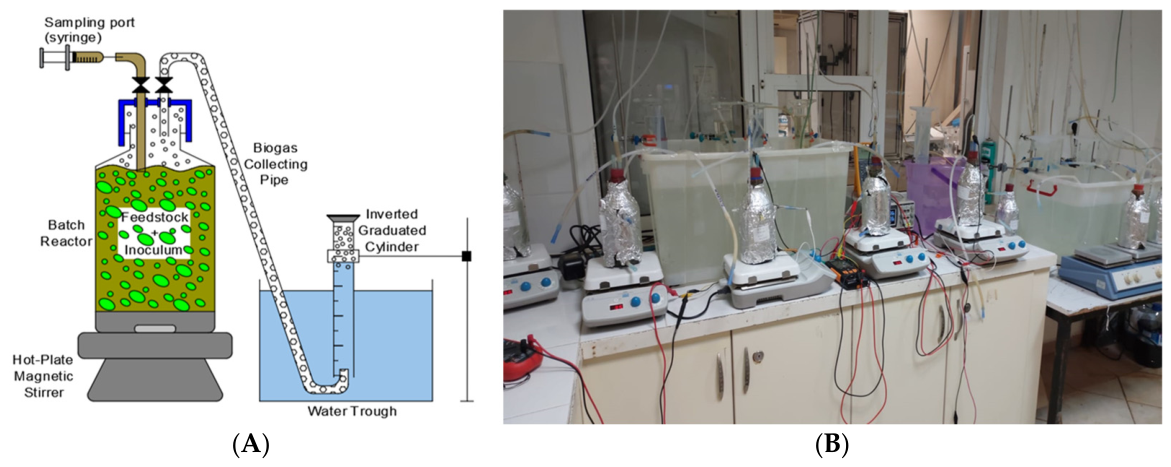
Biogas production from each reactor was quantified using a water displacement system with inverted graduated cylinders. Gas volumes were recorded either daily or at multi-day intervals, depending on the biogas production rate. A schematic representation of the experimental setup and a photograph of the laboratory-scale system are provided in Figure 1A,B. Well-mixed digestate samples (20 mL) were collected weekly through the sampling port using a wide-bore graduated syringe for physicochemical analyses. The reactor contents were thoroughly mixed before sampling to ensure a homogeneous digestate consistency, and no clogging occurred during sample collection. The volume removed during weekly sampling was taken into account when calculating the total methane production. The methane content of the produced biogas was determined using an Orsat gas analyzer at 3–4 day intervals, following the procedure described by [23]. Reactor pH and oxidation–reduction potential (ORP) were monitored weekly using a bench-top multi-parameter instrument.
The residual chemical oxygen demand (COD) in the reactors was measured on a weekly basis using a Hach Lange CADAS 200 spectrophotometer in combination with commercial test kits (LCK 014). TS and VS contents of the inoculum, CM, and LM were determined according to Standard Methods for the Examination of Water and Wastewater [24].

3. Results and Discussion

3.1. Influence of Substrate Composition on Biogas and Methane Production

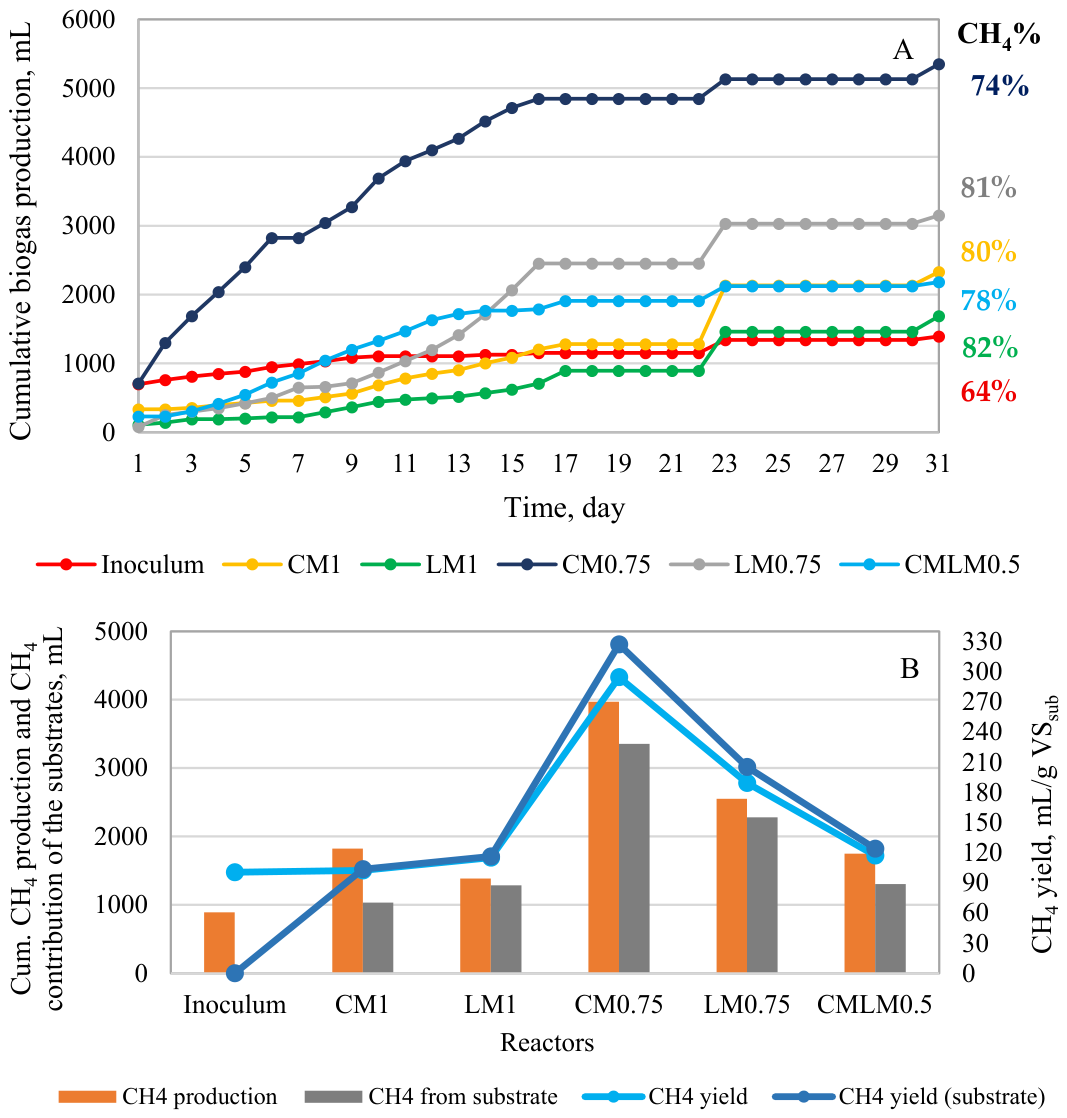
Accounting for the biogas production from substrates and inoculum together, the cumulative biogas production and methane content obtained from the reactors are presented in Figure 2A. In accordance with the experimental results, the co-digestion reactors generally showed higher observed performance than the mono-digestion ones. Among all experimental groups, the CM0.75 reactor exhibited the highest performance, producing 5350 mL of cumulative biogas (74.2% of CH4). The other mono- and co-digestion reactors produced a cumulative biogas of between 1650 and 3150 mL. Due to the fixed TS loadings of 13.6 g from substrates-only, the CM, LM, and the inoculum volumes changed in all reactors (Table 2). Therefore, the CH4 contribution of the inoculum varied from one reactor to another. To eliminate CH4 production originating from the inoculum in the reactors, the inoculum volumes fed to each reactor and the cumulative biogas production (1394 mL) and CH4 content (64%) of the inoculum reactor were used as the basis. Thus, the total CH4 production, CH4 originating from substrate, and the CH4 yields were calculated and presented in Figure 2B.
The total CH4 production attributable solely to the substrates increased in the following order: CM1 (1033 mL) < LM1 (1285 mL) < CMLM0.5 (1303 mL) < LM0.75 (2280 mL) < CM0.75 (3355 mL). Methane yields were calculated using both the VS of the feed substrates and the combined VS of the substrates and inoculum, as presented in Figure 2B. After accounting for the endogenous methane contribution of the inoculum, the substrate-based methane yields ranged from 104 mL CH4/g VS in CM1 to 327 mL CH4/g VS in CM0.75. Although the total methane production of CM1 was comparable to that of CMLM0.5, a larger proportion of the methane measured in CM1 originated from the inoculum because of the higher inoculum volume. Consequently, despite the substantial organic content of CM, CM1 showed a substrate-based methane yield similar to that of LM1. The biomethane potential of CM has been reported to range from 200 to 360 mL CH4/g VS, depending on its characteristics and the applied operational conditions [25,26]. The lower yield obtained from CM1 may reflect incomplete conversion of particulate organic matter under the applied reactor configuration and 30-day digestion period. Although ammonia inhibition has been reported for CM-based anaerobic digestion [10], it could not be evaluated because nitrogen, total ammonia nitrogen, and free ammonia concentrations were not measured in the present study. Moreover, because the pH of CM1 did not exceed 7.5, the proportion of free ammonia was expected to remain relatively low. Based on previous studies, the higher observed performance in CM0.75 and LM0.75 configurations may be associated with the complementary characteristics of the co-substrates and the combined influence of substrate composition and reactor conditions [27,28]. However, the specific mechanisms responsible for the observed differences could not be determined as well as the results did not confirm a synergistic interaction or demonstrate enhanced biodegradability of the individual substrates. Previous studies have reported that co-digestion may improve anaerobic digestion performance through complementary nutrient characteristics, dilution of inhibitory compounds, and potentially more favorable C/N conditions [26,28]. CM generally has a high organic nitrogen content due to its elevated protein content, and its anaerobic degradation may result in ammonia accumulation, potentially inhibiting methanogenic microorganisms, particularly under high organic loading conditions [11]. Co-digestion with a substrate having complementary characteristics, such as LM, may therefore contribute to a more favorable substrate mixture. Nevertheless, because the carbon and nitrogen contents, ammonia concentrations, and microbial community composition were not measured, these possible mechanisms could not be verified. The results indicate that untreated LM can be incorporated as a co-substrate in CM-based anaerobic digestion at batch scale; however, its specific contribution to process stability and methane production requires further investigation.
Importantly, these results were obtained without pretreatment of the substrate mixtures. Previous studies investigating LM-based anaerobic digestion have employed thermal, mechanical, or chemical pretreatment methods to disrupt lignocellulosic structures and improve hydrolysis efficiency [29,30]. However, because no direct comparison with pretreated substrates was performed, the present findings indicate only the batch-scale feasibility of pretreatment-free co-digestion and do not demonstrate equivalence or superiority to pretreatment-based systems. In the present study, LM harvested directly from the final sedimentation tanks of a wastewater treatment plant was evaluated as a co-substrate without pretreatment. The observed biomethane production indicates that this wastewater-derived biomass has potential for direct use in AD. Because LM may accumulate rapidly in nutrient-rich wastewater environments and create operational challenges in clarification units, its recovery and utilization could contribute to both biomass management and renewable energy production. The findings therefore suggest that naturally accumulated LM may serve as a bioenergy feedstock without additional pretreatment. However, the practical and economic feasibility of this approach should be validated through continuous reactor studies and techno-economic assessment.
The methane yield obtained in the CM0.75 reactor was also comparable to or higher than several previously reported LM co-digestion studies where pretreatment was applied. In recent years, several studies have reported improved methane production from CM through co-digestion strategies involving different organic co-substrates. Alkhrissat and co-workers [31] investigated the co-digestion of CM and perennial ryegrass and reported enhanced methane yields under optimized substrate ratios. Similarly, co-digestion systems involving poultry manure, food waste, municipal organic wastes, and agricultural residues have been shown to improve digestion stability and methane generation through nutrient balancing and dilution of inhibitory compounds. Nevertheless, many of these studies relied on pretreatment methods, conductive additives, or external process intensification strategies to enhance biomethane production. In contrast, the higher methane production observed in the selected CM–LM co-digestion configurations was obtained using untreated substrates without such additional interventions.

3.2. Comparative Evaluation of COD and Solids Degradation in Mono- and Co-Digestion Reactors

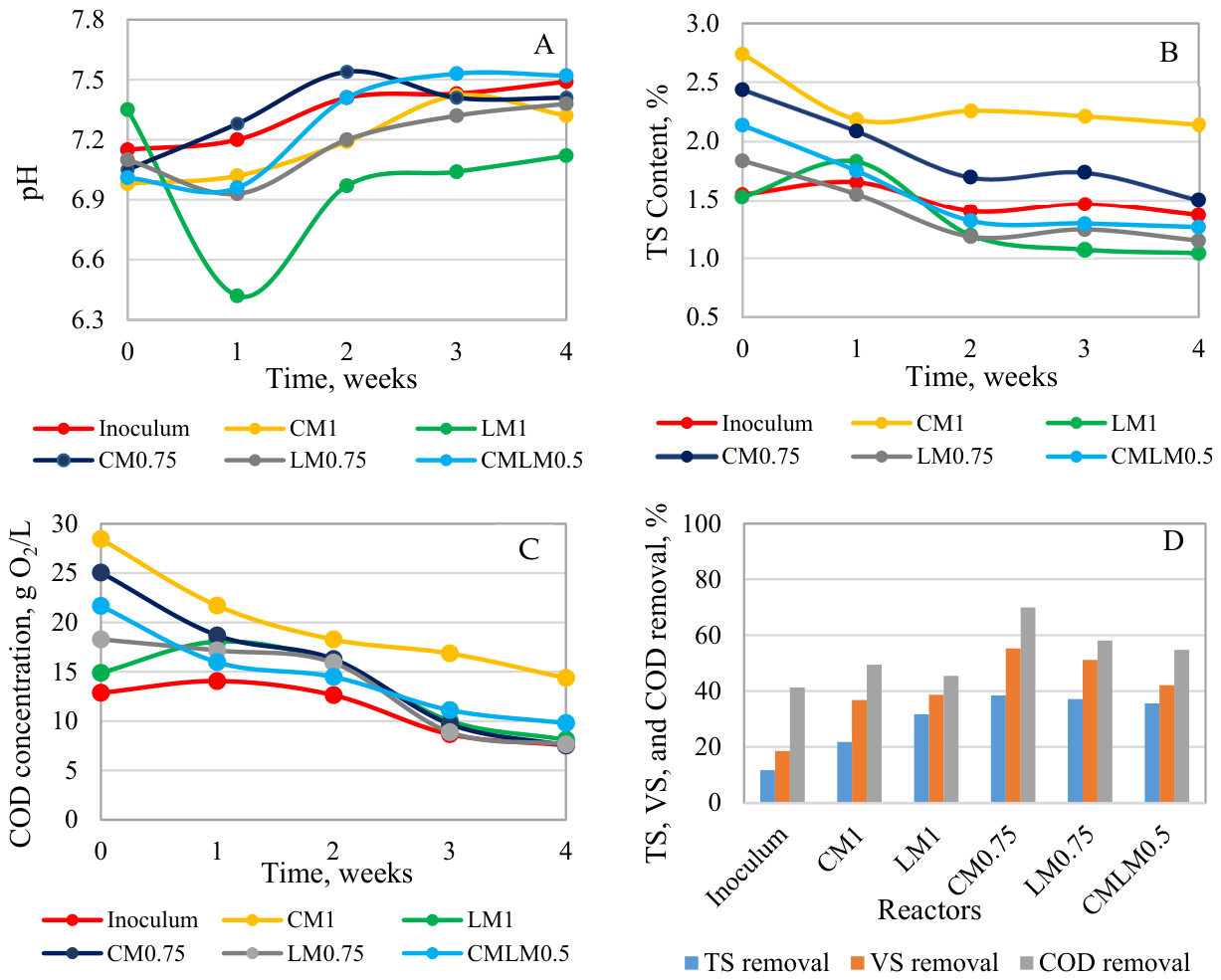
The pH values and TS, VS, and COD contents and removal rates obtained from the reactors are presented in Figure 3A–D. The pH of the reactors ranged between 6.9 and 7.6 during the study, which is in the range where anaerobic microorganisms can actively grow and populate in the process [29]. Only in the LM1 reactor, the pH declined to around 6.4 in the 1st week and then started to increase to neutral pH again after the 2nd week. This may have occurred due to the partial biodegradation of particulate matter into VFAs at the beginning of the study, which can lower the pH. As it is known, LM is a hemicellulosic substrate rich in protein and has an outer shell resistant to biodegradation [18]. A slow biogas production rate of the LM1 reactor in the first 10 days of the study supports the thesis of solubilization of organic materials and pH decline in the first 2 weeks before becoming an available compound for methane production. This is evident in Figure 2A and Figure 3A.
Due to the natural content of the feed substrates and the inoculum, the TS, VS, and COD concentrations of the reactors at the beginning of the study varied according to the feeding rates of each substrate and inoculum, as shown in Figure 3B,C. The COD concentrations of the reactors changed between 14.9 and 28.4 g COD/L at the start. At the end of the study, the COD removal efficiencies of the reactors ranged between 41 and 70%, including the inoculum reactor. As shown in Figure 3C,D, the highest COD removal efficiency was observed in the CM0.75 reactor (70%), followed by LM0.75 (58%) and CMLM0.5 (55%), which of all benefited from the co-digestion effects. On the other hand, CM1 and LM1 reactors presented a COD removal efficiency of 49 and 45%, respectively. The results are aligned with the TS and VS removal efficiencies and methane production performances of the reactors as presented in Figure 2 and Figure 3. The difference in the COD removal rates of co-digestion reactors, especially the CM0.75, compared to mono-digestion reactors, can explain the difference in methane production and yield.
At the beginning of the study, the TS contents of the LM1, inoculum, LM0.75, CMLM0.5, CM0.75, and CM1 reactors were 1.53%, 1.55%, 1.83%, 2.13%, 2.44%, and 2.74%, respectively, as shown in Figure 3B. Because of the differences in particulate matter content of the substrate mixtures and the biodegradation rates in the reactors, the TS removal rates ranged between 21.8% (CM1) and 38.5% (CM0.75) in the reactors, as shown in Figure 3D. The results are in parallel with the methane production obtained from the substrate, where the CM0.75 and CM1 reactors presented the highest and lowest methane productions, respectively. Besides, the second highest TS removal rate (37.1%) was observed at another co-digestion reactor, LM0.75.
Co-digestion of the substrates improved the TS removal rates. Compared with LM1, the higher TS removal rate obtained in CMLM0.5 indicated improved overall degradation performance when LM was co-digested with CM. Based on findings reported in previous studies, this improvement may be associated with complementary nutrient characteristics and a potentially more favorable C/N balance in the substrate mixture, as well as possible effects on the microbial community [16,19,28,31,32]. However, because the carbon and nitrogen contents were not measured in the present study, the contribution of the C/N ratio could not be directly verified. The initial VS contents of the reactors ranged from 1.00% to 1.11%. At the end of the study, the VS removal rates of the inoculum, CM1, LM1, CMLM0.5, LM0.75, and CM0.75 reactors were 18.53%, 36.80%, 38.67%, 42.11%, 51.19%, and 55.25%, respectively. Similarly, the co-digestion reactors, especially CM0.75 and LM0.75, presented higher VS removal rates compared to mono-digestion reactors. The VS removal rates obtained in the co-digestion reactors are compatible with the results reported by Bay an co-workers [33]. They reported a VS removal rate of 45–60% in co-digestion reactors treating CM and municipal organic solid waste at various mixture ratios, stating that the co-digestion enhanced the methane production and VS removal performances. In another study, Gaur and co-workers [29] reported a VS reduction of 50% at the mixture of 2.5:1 of LM and waste activated sludge without any pretreatment, which is almost the same as our finding (51% VS removal) at the LM: CM ratio of 3:1. Even though the biodegradation of the LM is more difficult compared to substrates such as manure or food waste, due to its lignocellulosic content, the LM0.75 reactor showed the second highest methane production and VS removal results in the study. This result indicates the favorable overall performance of the LM-rich mixture under the conducted batch conditions, although the mechanisms responsible for this performance could not be determined.

3.3. The Effects of Pretreatment-Free Co-Digestion

Chemical, thermal, and mechanical pretreatments are commonly employed to accelerate the rate-limiting hydrolysis of structurally complex feedstocks in AD [26]. Anaerobic co-digestion involves the mixing and simultaneous treatment of diverse waste streams to enhance methane production efficiency. A pretreatment-free configuration may reduce the number of unit operations and associated infrastructure; however, the extent of these benefits depends on feedstock properties and site-specific operating conditions [34]. From an engineering perspective, co-digestion can also improve the physical characteristics of the feed mixture by adjusting its moisture and solids contents and facilitating mixing and material handling. Combining waste with different characteristics may additionally provide a more suitable feed mixture for biological conversion. Nevertheless, substrate selection and mixing ratios should be carefully controlled because not every combination produces the same digestion performance [27,34]. The results obtained from the experimental work indicate a highly pronounced effect of CM and LM when they are co-digested, even in the absence of feedstock pretreatment. Mono-digestion of CM and LM yielded remarkably low performance, with 104 mL CH4/g VS and 116 mL CH4/g VS, respectively. These reduced performances can be attributed to the distinct metabolic bottlenecks.
Bi and co-workers [35] reported that CM mono-digestion may be susceptible to ammonia inhibition because of its high nitrogen and uric acid contents. In contrast, LM contains rigid lignocellulosic cell walls that may restrict rapid enzymatic accessibility when digested alone [30,36]. In the present study, certain CM–LM mixtures exhibited higher overall solids removal and methane production than the corresponding mono-digestion reactors. However, these results do not demonstrate that mixing inherently enhanced the enzymatic degradation of the lignocellulosic structure of LM. The observed improvement may instead be associated with external process effects, including the complementary characteristics and proportions of the substrates, dilution of potentially inhibitory compounds, and differences in inoculum amount. Because enzymatic activity was not measured and these factors were not independently controlled, their individual contributions to the observed performance could not be determined. The co-digestion represents an optimal threshold, improving the methane production performance from 1033 mL to 3355 mL and increasing the methane yield to 327 mL CH4/g VS. This dramatic spike is driven by the complementary nutrient profiles of the co-substrates. LM provides structural moisture, essential trace elements, and a carbon-rich profile that dilutes and balances the nitrogen-heavy CM [26,30,35]. As explained by Mata-Alvarez and co-workers [28], optimization of the carbon-to-nitrogen ratio stabilizes the systemic pH and prevents the ammonia-related problems, enhancing the metabolic efficiency of the methanogenic consortia without needing costly thermo-chemical or physical pretreatments. However, increasing the proportion of duckweed further, as in LM0.75 and CMLM0.5 reactors, causes a step-down in methane yields to 205 and 124 mL CH4/g VS, respectively. This phenomenon is also reported by Negassa and Fikadu [18] and Yadav and co-workers [30], which confirms that while co-digestion successfully unlocks interactive benefits, the system remains highly sensitive to substrate mixing ratios, requiring a dominant fraction of easily biodegradable volatile solids as in CM alongside a measured volume of duckweed buffer to trigger the methane boost.

4. Conclusions

This study evaluated the biomethane production and organic matter removal performance of untreated CM and LM under mono- and co-digestion conditions in mesophilic batch reactors. Among the conducted configurations, CM0.75 achieved the highest cumulative biogas production (5350 mL), methane yield (327 mL CH4/g VS), COD removal efficiency (70%), and TS removal rate (38.5%). LM0.75 showed the second-highest TS removal rate (37.1%) and a COD removal efficiency of 58%, while CMLM0.5 achieved 55% COD removal. In comparison, the COD removal efficiencies of the CM1 and LM1 mono-digestion reactors were 49% and 45%, respectively. These results show that all co-digestion configurations generally achieved higher observed methane production and organic matter removal than the mono-digestion reactors under the applied experimental conditions.
The generally stable pH conditions supported anaerobic digestion, although a temporary decrease was observed in LM1 during the initial period. The subsequent pH recovery and delayed methane production in LM1 were consistent with the slower conversion of its particulate organic matter. Overall, the findings indicate that a CM-rich mixture, represented by CM0.75, was the most favorable of the investigated substrate compositions and that untreated LM can be incorporated into CM-based anaerobic digestion without pretreatment. However, the results do not demonstrate a synergistic interaction or identify the individual mechanisms responsible for the observed differences. All substrate-fed reactors received the same substrate-derived TS loading of 13.6 g, while their substrate-derived VS concentrations were comparable, ranging between 10 and 11 g VSsub/L. Methane yields were normalized to the substrate-derived VS, and the endogenous methane contribution of the inoculum was determined using the inoculum-only reactor. Thus, the reactor configurations were compared on a consistent substrate-loading basis. Nevertheless, the different inoculum amounts resulted in variations in the substrate-to-inoculum ratio, which may have influenced degradation kinetics and the methane yields measured during the 30-day digestion period. Moreover, carbon and nitrogen contents, ammonia concentrations, enzymatic activity, and microbial community composition were not measured. Therefore, the contribution of these factors to the observed differences could not be determined, and the findings should be considered specific to the conducted batch configurations. Further studies using consistent substrate loadings and controlled substrate-to-inoculum ratios in continuous and pilot-scale reactors should include detailed nutrient characterization, total ammonia nitrogen and free ammonia monitoring, microbial analyses, and techno-economic and life cycle assessments to validate and optimize the proposed approach.

Author Contributions

A.P.A.: Conceptualization, Data curation, Formal analysis, Investigation, Methodology, Visualization, Validation, Writing—original draft, Writing—review and editing, Funding acquisition. K.D.: Conceptualization, Data curation, Formal analysis, Investigation, Methodology, Visualization, Writing—original draft, Writing—review and editing. A.U.: Writing—review and editing. All authors have read and agreed to the published version of the manuscript.

Funding

This research was supported by the Hacettepe University Scientific Research Projects Coordination Unit under Project Number 21452. The authors gratefully acknowledge this financial support.

Institutional Review Board Statement

Not applicable.

Informed Consent Statement

Not applicable.

Data Availability Statement

The data that support the findings of this study are available on request from the corresponding author.

Acknowledgments

A preliminary version of this study was presented at the 15th International Exergy, Energy and Environment Symposium (IEEES-15) held on 19–22 December 2024, in Istanbul, Türkiye. The present manuscript substantially expands the conference contribution through comprehensive experimental evaluation, extended discussion, updated literature integration, and detailed interpretation of the findings. During the revision of this manuscript, the authors used language editing tools to improve language, clarity, and readability. All suggestions were critically reviewed and edited by the authors, who take full responsibility for the content of the publication.

Conflicts of Interest

The authors declare no conflict of interest.

References

  1. Hosseini, S.E.; Abdul Wahid, M.; Jamil, M.M.; Azli, A.A.; Misbah, M.F. A review on biomass-based hydrogen production for renewable energy supply. Int. J. Energy Res. 2015, 39, 1597–1615. [Google Scholar] [CrossRef] [Scilit]
  2. Perea-Moreno, M.A.; Samerón-Manzano, E.; Perea-Moreno, A.J. Biomass as renewable energy: Worldwide research trends. Sustainability 2019, 11, 863. [Google Scholar] [CrossRef] [Scilit]
  3. Ceglia, F.; Marrasso, E.; Roselli, C.; Sasso, M.; Coletta, G.; Pellegrino, L. Biomass-based renewable energy community: Economic analysis of a real case study. Energies 2022, 15, 5655. [Google Scholar] [CrossRef] [Scilit]
  4. Ceglia, F.; Marrasso, E.; Roselli, C.; Sasso, M. Energy and environmental assessment of a biomass-based renewable energy community including photovoltaic and hydroelectric systems. Energy 2023, 282, 128348. [Google Scholar] [CrossRef] [Scilit]
  5. Malik, P.; Awasthi, M.; Sinha, S. Biomass-based gaseous fuel for hybrid renewable energy systems: An overview and future research opportunities. Int. J. Energy Res. 2021, 45, 3464–3494. [Google Scholar] [CrossRef] [Scilit]
  6. Yana, S.; Nizar, M.; Mulyati, D. Biomass waste as a renewable energy in developing bio-based economies in Indonesia: A review. Renew. Sustain. Energy Rev. 2022, 160, 112268. [Google Scholar] [CrossRef] [Scilit]
  7. Aslan, N.; Salman, O.; Konakci, R.; Akan, A.P. Circular economy approach to promote sustainable energy from waste. Sustain. Futures 2025, 10, 101238. [Google Scholar] [CrossRef] [Scilit]
  8. Yangin-Gomec, C.; Dalkılıç, K.; Perendeci, A.; Güngörmüşler, M.; Somorin, T.; Roussel, J.; Varol, M.; Ramos, A.; Van Hullebusch, E.D.; Trubetskaya, A.; et al. Thermochemical processing of organic wastes for sustainable valorisation and energy recovery: A review of recent contributions to the field. Biomass Bioenergy 2025, 201, 108122. [Google Scholar] [CrossRef] [Scilit]
  9. Zhang, T.; Yang, Y.; Liu, L.; Han, Y.; Ren, G.; Yang, G. Improved biogas production from chicken manure anaerobic digestion using cereal residues as co-substrates. Energy Fuels 2014, 28, 2490–2495. [Google Scholar] [CrossRef] [Scilit]
  10. Molaey, R.; Bayrakdar, A.; Sürmeli, R.Ö.; Çalli, B. Anaerobic digestion of chicken manure: Mitigating process inhibition at high ammonia concentrations by selenium supplementation. Biomass Bioenergy 2018, 108, 439–446. [Google Scholar] [CrossRef] [Scilit]
  11. Abouelenien, F.; Fujiwara, W.; Namba, Y.; Kosseva, M.; Nishio, N.; Nakashimada, Y. Improved methane fermentation of chicken manure via ammonia removal by biogas recycle. Bioresour. Technol. 2010, 101, 6368–6373. [Google Scholar] [CrossRef] [Scilit] [PubMed]
  12. Rahman, M.A.; Shahazi, R.; Nova, S.N.B.; Uddin, M.R.; Hossain, M.S.; Yousuf, A. Biogas production from anaerobic co-digestion using kitchen waste and poultry manure as substrate—Part 1: Substrate ratio and effect of temperature. Biomass Convers. Biorefinery 2023, 13, 6635–6645. [Google Scholar] [CrossRef] [Scilit] [PubMed]
  13. Dawi Cahyono, N.A.; Shamsuddin, M.R.; Ayoub, M.; Mansor, N.; Isa, N.H.M.; Nagoor Gunny, A.A. Anaerobic co-digestion of chicken manure with energy crop residues for biogas production. In IOP Conference Series: Earth and Environmental Science; IOP Publishing: Bristol, UK, 2021; Volume 765, p. 012044. [Google Scholar] [CrossRef] [Scilit]
  14. Emmanuel, J.K.; Gervas, J.B. Influence of municipal food waste and poultry manure mixing on substrate physicochemical properties and biogas production. Biofuels 2025, 16, 1183–1190. [Google Scholar] [CrossRef] [Scilit]
  15. Buragohain, S.; Mahanta, P.; Mohanty, K. Biogas production from anaerobic mono-and co-digestion of lignocellulosic feedstock: Process optimization and its implementation at community level. Environ. Technol. Innov. 2021, 24, 101981. [Google Scholar] [CrossRef] [Scilit]
  16. Chusov, A.; Maslikov, V.; Badenko, V.; Zhazhkov, V.; Molodtsov, D.; Pavlushkina, Y. Biogas potential assessment of the composite mixture from duckweed biomass. Sustainability 2021, 14, 351. [Google Scholar] [CrossRef] [Scilit]
  17. Zhang, Y.; Zhan, X.; Hatzikioseyian, A.; Lens, P.N.L. Anaerobic Digestion of Duckweed Used to Remediate Water Contaminated with Zinc and Ammonium. Appl. Sci. 2025, 15, 6212. [Google Scholar] [CrossRef] [Scilit]
  18. Negassa, A.; Fikadu, D. Evaluation of biogas production by anaerobic digestion of duckweed (Lemna minor) and cattle manure. J. Pet. Environ. Biotechnol. 2021, 12, 413–414. [Google Scholar] [CrossRef] [Scilit]
  19. Pena, L.; Oliveira, M.; Fragoso, R.; Duarte, E. Potential of duckweed for swine wastewater nutrient removal and biomass valorisation through anaerobic co-digestion. J. Sustain. Dev. Energy Water Environ. Syst. 2017, 5, 127–138. [Google Scholar] [CrossRef] [Scilit]
  20. Orlando, M.Q.; Borja, V.M. Pretreatment of animal manure biomass to improve biogas production: A review. Energies 2020, 13, 3573. [Google Scholar] [CrossRef] [Scilit]
  21. Yu, Q.; Sun, C.; Liu, R.; Yellezuome, D.; Zhu, X.; Bai, R.; Liu, M.; Sun, M. Anaerobic co-digestion of corn stover and chicken manure using continuous stirred tank reactor: The effect of biochar addition and urea pretreatment. Bioresour. Technol. 2021, 319, 124197. [Google Scholar] [CrossRef] [Scilit] [PubMed]
  22. Dalkılıç, K.; Akan, A.P.; Uğurlu, A. Impacts of Co-Substrate on Biogas Production. In Proceedings of the 15th International Exergy, Energy and Environment Symposium (IEEES-15), Istanbul, Türkiye, 19–21 December 2024; pp. 1–5. [Google Scholar]
  23. Dalkılıc, K.; Ugurlu, A. Biogas production from chicken manure at different organic loading rates in a mesophilic-thermopilic two stage anaerobic system. J. Biosci. Bioeng. 2015, 120, 315–322. [Google Scholar] [CrossRef] [Scilit] [PubMed]
  24. American Public Health Association; American Water Works Association; Water Environment Federation. 2540 Solids. In Standard Methods for the Examination of Water and Wastewater, 24th ed.; Lipps, W.C., Baxter, T.E., Braun-Howland, E., Eds.; APHA Press: Washington, DC, USA, 2023. [Google Scholar]
  25. Dalkılıç, K.; Aghayev, E.; Sinoplu, E. Voltage application and biomass retention increased biogas production in a combined microbial electrolysis cell and anaerobic digestion system treating chicken manure. Biochem. Eng. J. 2025, 219, 109728. [Google Scholar] [CrossRef] [Scilit]
  26. Tawfik, A.; Eraky, M.; Osman, A.I.; Ai, P.; Zhou, Z.; Meng, F.; Rooney, D.W. Bioenergy production from chicken manure: A review. Environ. Chem. Lett. 2023, 21, 2707–2727. [Google Scholar] [CrossRef] [Scilit]
  27. Kunatsa, T.; Xia, X. A review on anaerobic digestion with focus on the role of biomass co-digestion, modelling and optimisation on biogas production and enhancement. Bioresour. Technol. 2022, 344, 126311. [Google Scholar] [CrossRef] [Scilit] [PubMed]
  28. Mata-Alvarez, J.; Dosta, J.; Romero-Güiza, M.S.; Fonoll, X.; Peces, M.; Astals, S. A critical review on anaerobic co-digestion achievements between 2010 and 2013. Renew. Sustain. Energy Rev. 2014, 36, 412–427. [Google Scholar] [CrossRef] [Scilit]
  29. Gaur, R.Z.; Khan, A.A.; Suthar, S. Effect of thermal pre-treatment on co-digestion of duckweed (Lemna gibba) and waste activated sludge on biogas production. Chemosphere 2017, 174, 754–763. [Google Scholar] [CrossRef] [Scilit] [PubMed]
  30. Yadav, D.; Barbora, L.; Bora, D.; Mitra, S.; Rangan, L.; Mahanta, P. An assessment of duckweed as a potential lignocellulosic feedstock for biogas production. Int. Biodeterior. Biodegrad. 2017, 119, 253–259. [Google Scholar] [CrossRef] [Scilit]
  31. Alkhrissat, T. Anaerobic co-digestion of chicken manure and perennial ryegrass: Methane yield and kinetic study. Mater. Res. Proc. 2025, 48, 663–669. [Google Scholar] [CrossRef] [Scilit]
  32. Ahmad, A.; Almohamadi, H.; Alnasser, A.S.; Nasser, Q.; Al-Sibani, M.; Al-Rahbi, A.S.; Mubarak, M.S. Microbial synergies in co-digestion of food waste and wastewater sludge: Pathways to energy recovery and emission reduction. Renew. Sustain. Energy Rev. 2026, 226, 116333. [Google Scholar] [CrossRef] [Scilit]
  33. Bay, T.; Vural, B.B.; Gökçek, Ö.B. Highly efficient biomethane production from chicken manure and municipal organic solid waste using magnetite: Converting waste into energy. Biodegradation 2026, 37, 27. [Google Scholar] [CrossRef] [Scilit] [PubMed]
  34. Ferdeș, M.; Paraschiv, G.; Ionescu, M. Anaerobic co-digestion: A way to potentiate the synergistic effect of multiple substrates and microbial diversity. Energies 2023, 16, 2116. [Google Scholar] [CrossRef] [Scilit]
  35. Bi, S.; Qiao, W.; Xiong, L.; Mahdy, A.; Wandera, S.M.; Yin, D.; Dong, R. Improved high solid anaerobic digestion of chicken manure by moderate in situ ammonia stripping and its relation to metabolic pathway. Renew. Energy 2020, 146, 2380–2389. [Google Scholar] [CrossRef] [Scilit]
  36. Di Mario, J.; Nocella, S.; Gambelli, A.M.; Del Buono, D.; Gigliotti, G. Lemna minor as Support Biomass for Enhancing the Biomethane Yield of Brewery’s Spent Grain Pulp When Used in Co-Digestion. Agriculture 2026, 16, 545. [Google Scholar] [CrossRef] [Scilit]
Figure 1. Schematic representation of the laboratory-scale batch anaerobic digestion setup (A), a photograph of the experimental setup showing reactors, gas collection lines, and the water displacement system (B) used for biogas measurement.
Fermentation 12 00389 g001
Figure 2. Cumulative biogas production and methane contents obtained from the reactors accounting for substrates and inoculum together (A), total methane and substrate-derived methane (free of inoculum contribution) production, and methane yield (B) of the reactors.
Fermentation 12 00389 g002
Figure 3. The pH values (A), TS content (B), COD concentrations (C), and TS, VS, and COD removal rates (D) of the reactors.
Fermentation 12 00389 g003
Table 1. Characteristics of feedstocks.
Feedstock TypeTS, % (w/w)VS, % (w/w)COD, g/LpH
CM12.148.911526.30
LM1.531.2415.26.55
Inoculum1.550.9012.97.15
Table 2. Reactor designations and feeding compositions.
ReactorVInoculum (mL)Winoculum
(g TS)
VCM (mL)WCM
(g TS)
VLM (mL)WLM
(g LM)
Total TS (~g/L)Total VS (~g/L)VSsub. (~g/L)
CM189013.811013.6--27.417.810.0
LM11101.7--89013.615.312.011.1
CM0.7569310.88410.22233.414.216.410.3
LM0.753054.7283.466710.214.913.511.1
CMLM0.55007.8566.84446.814.614.910.5
Inoculum1.015.5----15.58.9-
V: volume (mL), W: weight (g), CM1: Chicken manure + inoculum, LM1: Lemna minor + inoculum, CM0.75: 75% of the total TS is from CM and 25% of the total TS is from LM + inoculum, LM0.75: 75% of the total TS is from LM and 25% of the total TS is from CM + inoculum, CMLM0.5: 50% of the total TS is from CM and 50% of the total TS is from LM + inoculum.
Disclaimer/Publisher’s Note: The statements, opinions and data contained in all publications are solely those of the individual author(s) and contributor(s) and not of MDPI and/or the editor(s). MDPI and/or the editor(s) disclaim responsibility for any injury to people or property resulting from any ideas, methods, instructions or products referred to in the content.