Article

Evaluation of Monascus ruber Inoculum Preparation Strategies and Surfactant Supplementation to Enhance Biopigment Production in a Xylose-Based Medium Derived from Ethanol Biorefinery By-Products


by
Willian de S. M. Reis
,
Gabriel L. de Arruda
,
Silvio S. da Silva
,
Arnaldo M. R. Prata
and
Júlio C. dos Santos
*
Department of Biotechnology, Lorena School of Engineering, University of São Paulo, Lorena 12602-810, Brazil
*
Author to whom correspondence should be addressed.
Fermentation 2026, 12(8), 387; https://doi.org/10.3390/fermentation12080387
Submission received: 8 July 2026 / Revised: 8 August 2026 / Accepted: 13 August 2026 / Published: 17 August 2026
(This article belongs to the Special Issue Microbial Processes for Biomass Conversion to Bioenergy)

Abstract

Bioenergy biorefineries generate lignocellulosic by-products rich in fermentable sugars that can serve as renewable feedstocks for the production of high-value bioproducts, including microbial pigments with promising bioactive properties (antioxidant, antimicrobial, and anticancer). Therefore, this study aimed to identify a suitable inoculum preparation strategy, to optimize the culture medium, and to evaluate biopigment production using xylose-based media derived from sugarcane bagasse hemicellulosic hydrolysate (SBHH). Different inoculation strategies were evaluated (cell suspension, whole mycelial discs, and fractionated mycelial discs) and supplementation with Tween 80 (TW80). The medium composition was optimized using a Box–Behnken design, with xylose, yeast extract, and TW80 as variables, and fermentations were then conducted under selected inoculum conditions in semi-defined media and SBHH. The mycelial disc inoculation strategy was selected due to its high biopigment production and lower operational complexity, yielding 8.99, 8.48, and 11.78 AU of yellow, orange, and red biopigments, respectively. The optimized culture composition consisted of 55.65 g/L of xylose, 4.18 g/L of yeast extract, and 15.38 g/L of Tween 80. The cultivation of M. ruber in SBHH resulted in 12.73, 10.75, and 14.56 AU of yellow, orange, and red biopigments, respectively. Thus, the strategy of inoculum preparation associated with non-ionic surfactant proved promising for application in bioenergy biorefineries.

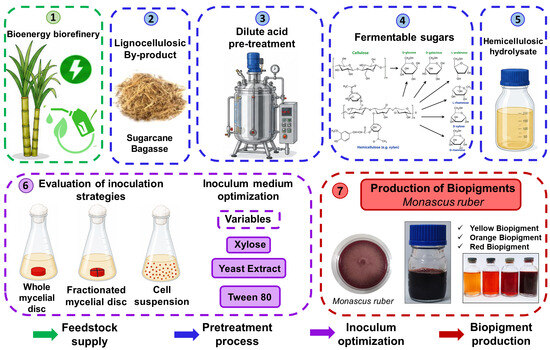
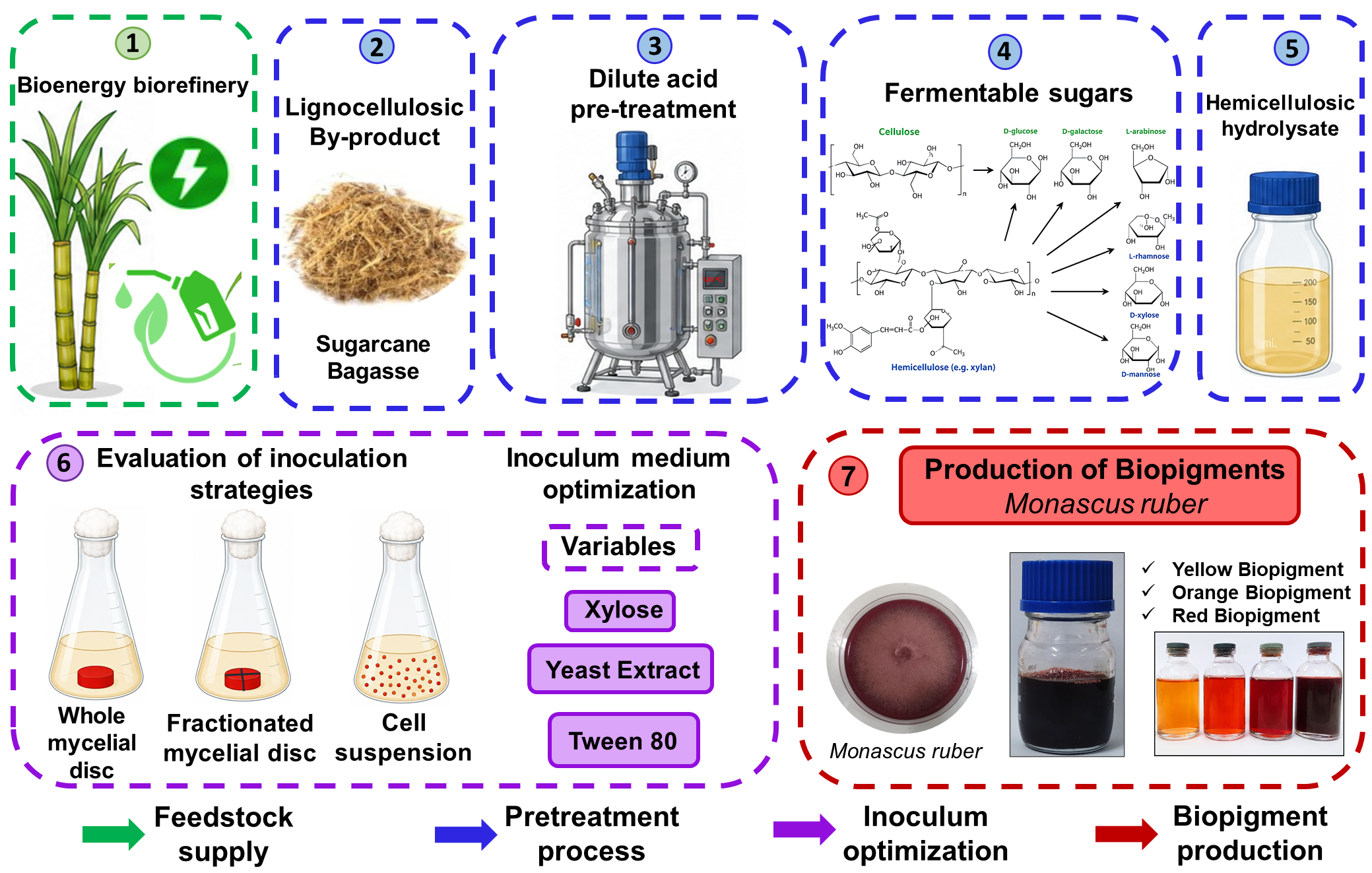
Graphical Abstract

1. Introduction

The transition from a fossil-based economy to a sustainable bioeconomy has intensified the development of integrated biorefineries capable of converting renewable biomass into fuels, chemicals, materials, and high-value bioproducts [1,2]. Among the available feedstocks, sugarcane stands out due to its high productivity and strategic importance for sugar and ethanol production, generating approximately 540 Mt of sugarcane bagasse annually during juice extraction [3]. Although this lignocellulosic residue is traditionally used for cogeneration of heat and electricity, its abundance and carbohydrate-rich composition have made sugarcane bagasse an attractive feedstock for the microbial production of value-added bioproducts [4,5], including bioethanol [6], xylitol [7], organic acids [8], microbial lipids [9], biosurfactants [10], biopolymers [11], and natural pigments [12].
Sugarcane bagasse is a lignocellulosic biomass composed primarily of cellulose (40–50%), hemicellulose (20–30%), and lignin (20–30%), together with minor amounts of extractives and ash [13]. Due to its high carbohydrate content, particularly its hemicellulosic fraction, sugarcane bagasse can be subjected to dilute-acid pretreatment to generate a hemicellulosic hydrolysate rich in fermentable sugars for microbial fermentation [3]. Following dilute-acid pretreatment, sugarcane bagasse hemicellulosic hydrolysates typically contain xylose as the predominant sugar (approximately 10–20 g/L), with smaller amounts of glucose (generally <2 g/L) and arabinose (≈1–2 g/L), although these concentrations vary according to pretreatment conditions and subsequent concentration steps [14]. Despite being the predominant sugar in hemicellulosic hydrolysates, xylose is generally assimilated less efficiently than glucose by many conventional industrial microorganisms. Consequently, the hemicellulosic fraction remains underutilized compared with glucose-rich streams derived from cellulose. Thus, the development of bioprocesses based on pentose-assimilating microorganisms is essential to improve carbon conversion efficiency and maximize the valorization of all lignocellulosic fractions [15,16,17].
Among the various bioproducts that can be obtained from renewable feedstocks, microbial pigments have attracted considerable attention owing to the increasing consumer demand for natural colorants and growing concerns regarding the environmental and toxicological impacts associated with some synthetic dyes. Natural pigments derived from microorganisms (hereafter, referred to as biopigments) offer several advantages over plant- and animal-based ones, including rapid production cycles, independence from seasonal variations, easier process control, and scalability [18,19,20].
There are different microbial producers of natural biopigments, and among them, the filamentous fungus Monascus ruber stands out due to its well-known ability to synthesize yellow, orange, and red biopigments during fermentation processes [21]. Besides their coloring properties, these biopigments have attracted increasing industrial interest due to their reported antioxidant [22,23,24], antimicrobial [23,25], anti-inflammatory [22], antitumor [22,24], and immunomodulatory activities [26]. Furthermore, the ability of M. ruber to utilize low-cost agro-industrial substrates reinforces its potential as a promising microorganism for the sustainable production of value-added bioproducts [27,28].
The production of fungal biopigments in submerged fermentation is influenced by several physicochemical and biological factors, including the nature and concentration of carbon and nitrogen sources, the carbon-to-nitrogen ratio, pH, temperature, aeration, agitation, inoculum characteristics, and medium composition. These variables affect not only fungal growth but also the biosynthesis of secondary metabolites, directly influencing biopigment yield and process performance [21,29].
A strategy that has attracted increasing attention for improving fungal fermentations is the supplementation of culture media with surfactants. Non-ionic surfactants such as Tween 80 can alter cell membrane permeability, facilitate nutrient transport, modify oxygen transfer characteristics, and influence fungal morphology. In biopigment-producing fungi, surfactant supplementation has been associated with enhanced biopigment secretion, increased metabolite yields, and improved substrate utilization, although the magnitude of these effects depends on the microorganism and cultivation conditions employed [30,31]. Wang et al. [32] demonstrated that surfactant supplementation enhanced biopigment production by facilitating the secretion of intracellular biopigments and modifying membrane properties. More recently, Chen et al. [30] investigated the mechanism underlying this response and demonstrated that non-ionic surfactants increase membrane permeability, promote the transmembrane transport of hydrophobic biopigments, and facilitate their extracellular accumulation, thereby reducing intracellular biopigment.
Furthermore, inoculum preparation is recognized as a critical step in the process, as it plays a key role in the adaptation and metabolic activation of the microorganism prior to fermentation [21,29]. In filamentous fungi, inoculum characteristics such as age, concentration, and morphology can significantly affect growth kinetics, nutrient and substrate uptake, and secondary metabolite production [33,34]. In submerged cultivation, different inoculation strategies have been employed. Spore suspensions are the most commonly used approach because they provide a standardized inoculum concentration [35]. Agar mycelial discs offer a simple and rapid inoculation procedure but may introduce variability associated with the metabolism state and growth region of the colony. Alternatively, liquid seed cultures provide metabolically active biomass with a shorter adaptation phase, although they require an additional cultivation step [36]. These approaches influence the initial metabolism state of the fungus, affecting pellet formation, hyphal development, and ultimately metabolite production [37]. Nevertheless, compared with studies focused on medium optimization and fermentation conditions, the influence of inoculum preparation strategy on Monascus biopigment production remains relatively underexplored.
Despite its recognized importance, the optimization of inoculum preparation for M. ruber remains underexplored, particularly regarding cultivation strategies using xylose as the main carbon source. Therefore, a better understanding of different inoculation methods is essential to improve biopigment production and establish more efficient fermentation processes. In this context, the present study aimed to evaluate different inoculation strategies for biopigment production by M. ruber in xylose-based media; optimize the composition of the inoculum culture medium using experimental design, including surfactant supplementation; and validate the optimized inoculum in fermentations using SBHH as a renewable substrate.

2. Materials and Methods

2.1. Microorganism

The fungus Monascus ruber Tieghem IOC 2225 was donated by the Filamentous Fungi Culture Collection (CCFF) of the Oswaldo Cruz Foundation (IOC/FIOCRUZ, Rio de Janeiro, Brazil) and is available at the Laboratory of Biopolymers, Bioreactors and Process Simulation (LBBSIM), Department of Biotechnology, School of Engineering of Lorena—University of São Paulo (EEL-USP). The microbial culture was maintained viable through periodic subculturing on sterile potato dextrose agar (PDA) Petri dishes, with incubation periods of 10 to 12 days at 30 °C, allowing the culture to reach the desired growth stage before inoculation. The cultures were then kept refrigerated at 4 °C to maintain viability.

2.2. Commercial Xylose-Based Culture Medium Composition and Fermentation Process Conditions

The culture medium consisted of 53.38 g/L of xylose (≥99%, Synth, Diadema, SP, Brazil) and 4.37 g/L of yeast extract, supplemented with 5 g/L of K2HPO4, 0.1 g/L of CaCl2·2H2O, 0.5 g/L of MgSO4·7H2O, 0.01 g/L of FeSO4·7H2O, 0.01 g/L of ZnSO4·7H2O, and 0.03 g/L of MnSO4·7H2O. The initial pH was adjusted to 6.0 by adding HCl or NaOH solutions. The cultures were carried out in a rotary shaker (Innova 4000, Incubator Shaker, New Brunswick Scientific, Enfield, CT, USA) at 150 rpm, 30 °C, in the absence of light. The cultures for inoculum production were conducted for 5 days, and the fermentation cultures were conducted for 15 days.

2.3. Evaluation of Inoculum Preparation Methods and Tween 80 Supplementation During Inoculum Development and Fermentation

Different inoculation protocols were evaluated in order to investigate their influence on fungal growth and biopigment production by Monascus ruber. Three inoculation strategies were investigated: (1) cellular suspension; (2) whole mycelial discs; (3) fragmented mycelial discs. For the cell suspension method, cells from a Petri dish were scraped with 10 mL of sterile distilled water. A volume of 1 mL of this suspension was used as inoculum. For inoculation with a whole mycelial disc, a mycelial disc approximately 8 mm in diameter was cut with a sterile pipette tip and inoculated into the culture medium. For the fractionated mycelial disc method, two additional transverse cuts were made with a scalpel in the 8 mm mycelial disc, dividing it in four fractions of the disc, and these fragments were used for inoculation.
For each inoculation method, tests were performed with and without 10 g/L of the surfactant Tween 80. The cultures were carried out in 50 mL Erlenmeyer flasks containing 20 mL of culture medium, in triplicate. Samples were evaluated for biopigment production, biomass concentration, and xylose concentration at the end of the process. The inoculum age was established based on preliminary growth kinetics performed by our research group, which identified the cultivation period required to obtain sufficient fungal biomass for standardized inoculum preparation. The use of an 8 mm mycelial disc was selected to ensure standardization and reproducibility among cultivations, allowing the same initial inoculum size to be consistently applied throughout the experiments. This inoculum size was also adopted in previous Monascus ruber fermentation studies [12], supporting its suitability for standardized inoculum preparation.
After the initial inoculum preparation evaluation, the resulting fungal biomass obtained from each inoculation strategy was used to evaluate its effect on the subsequent fermentation stage. To evaluate the effect of the different inoculum preparation methods on the fermentation stage, assays were performed in triplicate using inocula obtained from each evaluated method. After 5 days of cultivation, the cultures were centrifuged, the supernatant was discarded, and only the harvested fungal biomass was transferred to fresh fermentation medium (Section 2.2) to initiate the fermentation process. Fermentations were carried out for 15 days in 500 mL Erlenmeyer flasks containing 200 mL of culture medium. Samples were collected periodically to determine yellow, orange, and red biopigment production, whereas biomass and xylose concentration were determined only at the end of the fermentation process.

2.4. Optimization of the Culture Medium for the Inoculum Preparation Stage

After selecting the most suitable inoculum preparation method, the composition of the culture medium used during the inoculum preparation stage was optimized using a Box–Behnken experimental design. The evaluated concentrations were 20–60 g/L of xylose, 2–6 g/L of yeast extract, and 0–20 g/L of Tween 80, with five replicates at the central point. Inoculum preparation was carried out according to the method previously selected in this study (Section 2.3). The experiments were conducted in 50 mL Erlenmeyer flasks containing 20 mL of culture medium and incubated for 5 days. The following were used as response variables: the production of yellow, orange, and red biopigments; cell concentration; and xylose consumption.
The response variables were analyzed using Design-Expert 13 (StatEase, Minneapolis, MN, USA) and Statistica 13.0 (StatSoft, Hamburg, Germany) software. Empirical models were fitted and used to verify the influence of each factor and to predict the optimized production conditions. Model validation experiments were performed under the optimized conditions, with new cultures carried out in triplicate, following the medium conditions indicated by the statistical analysis and using the same parameters and cultivation time.

2.5. Application of the Selected Inoculum Preparation Protocol for Biopigment Production Using Sugarcane Bagasse Hemicellulosic Hydrolysate

Sugarcane bagasse was obtained from Usina Ipiranga (Descalvado, SP, Brazil). Upon receipt, the material was washed with running water and oven-dried at 60 °C until it reached approximately 10% moisture content. The hemicellulosic hydrolysate was obtained by acid pretreatment of sugarcane bagasse using diluted sulfuric acid in a stainless-steel reactor (Allbiom, model CR80, Cajuru, SP, Brazil) with an 80 L capacity, available at the Department of Biotechnology of the School of Engineering of Lorena, University of São Paulo (EEL-USP). For the acid pretreatment, a 1% sulfuric acid solution and a solid-to-liquid ratio of 1:10 were used, with the reactor loaded with 3 kg of dry bagasse. The reaction was carried out at 121 °C for 20 min [7]. After acid pretreatment, the liquid fraction (acid hydrolysate) was collected and stored in a cold chamber (4 °C) for further use.
The hemicellulosic hydrolysate was concentrated under vacuum at 70 °C until a xylose concentration of approximately 53 g/L was reached, which is equivalent to the xylose concentration used in the semi-defined fermentation medium. Subsequently, the hydrolysate was subjected to an overliming process, in which the pH was increased to 8 using NaOH, followed by adjustment to the fermentation pH (pH 6.0) using concentrated phosphoric acid (85%). The hydrolysate was then autoclaved at 110 °C for 15 min. Fermentation using the SBHH was carried out with yeast extract as a supplementary nitrogen source, along with the other medium components described in Section 2.2, except xylose, which was supplied by the hydrolysate. Cultivations were performed in 500 mL Erlenmeyer flasks containing 200 mL of hydrolysate-based medium. Fermentation medium was inoculated with biomass obtained using the selected inoculum preparation method, in which the inoculum was produced in the culture medium optimized by the experimental design (Section 2.5), following the inoculation procedure described in Section 2.4. The cultures were incubated in a rotary shaker at 150 rpm and 30 °C in the absence of light for 15 days. At the end of the fermentation period, biomass concentration; sugar consumption; and yellow, orange, and red biopigment production were evaluated.

2.6. Analytical Methods

2.6.1. Determination of Biomass Concentration

Biomass concentration was determined by dry weight measurement. For this purpose, the content of each collected cultivation flask was transferred to a 50 mL Falcon tube and subsequently centrifuged (Beckman, model J6-HC, Brea, CA, USA) at 2465× g for 10 min. The supernatant was collected for further evaluation of biopigment production and xylose consumption, while the biomass obtained was washed with 70% ethanol solution and dried in an oven at 60 °C until constant weight [12].

2.6.2. Analysis of Biopigment Production

Extracellular biopigment production was measured after biomass removal by centrifugation. Spectrophotometric analysis was performed using an Eppendorf spectrophotometer (Eppendorf SE, Hamburgo, Germany), measuring absorbance at 400 nm for yellow, 450 nm for orange, 490 nm for red biopigments, all corresponding to the maximum absorption wavelengths of each color. The obtained absorbance values were multiplied by the respective dilution factors, and the results were expressed as absorbance units (AU), which were used as an absorbance-based index for comparative evaluation of biopigment production [38].

2.6.3. Xylose Quantification and Phenolic Compounds

Quantification of sugars in commercial xylose-based media, as well as of the sugars present in hemicellulosic hydrolysate, was performed by high-performance liquid chromatography (HPLC). Samples were properly diluted and filtered through 0.45 µm membrane filters (MF-Millipore™, Merck, Darmstadt, Germany). Then, samples were injected into an Agilent 1200 series chromatograph (Agilent Technologies, Santa Clara, CA, USA) equipped with a RID-6A refractive index detector and an HPX-87H column (300 mm × 7.8 mm) (Bio-Rad, Hercules, CA, USA), under the following conditions: column temperature of 45 °C, mobile phase of 0.01 N H2SO4, flow rate of 0.6 mL/min, and injection volume of 20 µL [39].
For the analysis of furans (furfural and 5-HMF) and phenolics compounds (gallic acid, syringaldehyde, and syringic acid), a Zorbax C18 column (Agilent Technologies, Santa Clara, CA, USA) was employed at 30 °C, utilizing a gradient of 1% acetic acid in water (A), acetonitrile (B), and methanol (C) at a flow rate of 1.3 mL/min [40]. The gradient began with 90% of A and 10% of C, transitioning to 80% of A, 4% of B, and 16% of C over 10 min, maintained until 14 min. Subsequently, 100% B was utilized for column cleaning, and at 18 min, the initial conditions were reinstated for column equilibration. The detection of the analyzed compounds was performed using a UV detector at a wavelength of 280 nm [41].

2.7. Statistical Analysis

Data were analyzed using Statistica 13.0 (StatSoft, Hamburg, Germany) and are presented as mean ± standard deviation (SD). Statistical significance was assessed using one-way analysis of variance (ANOVA), followed by Tukey’s post hoc test, with a significance level set at p < 0.05. The experimental design analysis and statistical evaluation of the results were performed using Design-Expert 13 (Stat-Ease, Minneapolis, MN, USA), whereas response surface plots were generated using Statistica 13.0.

3. Results and Discussion

3.1. Effect of Inoculation Strategy and Tween 80 Supplementation on Inoculum Preparation Step

The results obtained using the different inoculation strategies and Tween 80 supplementation on biopigment production, biomass concentration, and xylose consumption after 5 days of cultivation in the inoculum preparation step are presented in Table 1.
The highest values for all biopigment fractions among the evaluated methods were obtained with fragmented mycelium discs supplemented with Tween 80. Under these conditions, 11.79, 10.96, and 13.33 AU of yellow, orange, and red biopigments were produced, respectively. This condition also presented the highest biomass concentration (16.69 g/L) and the highest xylose consumption (24.69%).
A clear effect of the inoculation strategy was observed. Cultures initiated with cellular suspensions showed the lowest performance, particularly in the absence of Tween 80, reaching only 2.15, 2.36, and 3.27 AU for yellow, orange, and red biopigments, respectively, together with a biomass concentration of 3.91 g/L and 12.74% xylose consumption. In contrast, inoculation with mycelial discs substantially improved all response variables. In the presence of Tween 80, the absorbance values increased to 9.31, 7.88, and 9.19 AU for yellow, orange, and red biopigments, respectively, accompanied by higher biomass concentration and xylose consumption.
The superior performance of mycelial disc inoculation strategies may be associated with the direct transfer of metabolically active fungal biomass into the fermentation medium, reducing the adaptation phase and promoting faster establishment of vegetative growth. In contrast, cultures initiated from cellular suspensions likely required additional energy expenditure for hyphal development before entering the active growth phase. Similar effects have been reported for filamentous fungi, in which inoculum characteristics directly influence pellet formation, hyphal extension, nutrient assimilation, and secondary metabolite biosynthesis [42,43].
Among the inoculation strategies evaluated, fragmented mycelial discs consistently outperformed whole mycelial discs. This behavior may be attributed to the greater number of active hyphal growth points generated during fragmentation, increasing the available surface area for nutrient uptake. Morphological control is recognized as a key factor affecting biopigment biosynthesis in M. ruber and M. purpureus fermentations, since highly aggregated pellets can limit diffusion processes, whereas dispersed and moderately branched mycelia generally favor metabolite production [44,45].
Previous studies have demonstrated strong correlations between fungal morphology and biopigment production, indicating that increased branching and reduced pellet compactness can enhance biopigment biosynthesis [31,43]. The study by Lv et al. [46] demonstrated that mycelial morphology in Monascus purpureus is not fixed but is strongly influenced by cultivation conditions, particularly pH and agitation speed. Under optimized conditions (pH 5.0 and 180 rpm), the fungus developed small, well-dispersed pellets composed of shorter, thicker, and highly branched hyphae. This specific morphological configuration was associated with enhanced biopigment production, indicating that controlled cultivation parameters can directly modulate fungal morphology and, consequently, metabolic output.
Tween 80 supplementation positively influenced biopigment production regardless of the inoculation strategy employed. For example, red biopigment production increased from 6.72 to 13.33 AU in fragmented mycelial disc cultures and from 4.96 to 9.19 AU in whole mycelial disc cultures. Non-ionic surfactants, such as Tween 80, have been widely reported to enhance microbial biopigment production through multiple complementary mechanisms. These include increasing membrane permeability and facilitating biopigment secretion, modifying membrane lipid composition and fluidity, improving nutrient uptake, influencing fungal morphology by promoting more favorable pellet structures and preserving hyphal integrity, and modulating metabolic pathways involved in biopigment biosynthesis. Depending on the fermentation strategy, surfactants may also promote the in situ solubilization of hydrophobic pigments, reducing product inhibition and contributing to higher biopigment production [47,48,49].
The simultaneous increases observed in biopigment production, biomass concentration, and xylose consumption suggest that Tween 80 not only facilitated biopigment secretion but also promoted favorable conditions for fungal growth and metabolism. Consequently, the superior performance obtained with fragmented mycelial discs supplemented with Tween 80 likely resulted from the combined effects of improved fungal morphology, enhanced metabolic efficiency, leading to higher biomass accumulation and biopigment biosynthesis.

3.2. Comparison of Different Inoculum Preparation Methods in the Fermentation Stage for Biopigment Production

After evaluating the inoculation methods, the biomass obtained by each method was inoculated into a new medium and its performance as inoculum was assessed in a 15-day fermentation process. The results obtained are shown in Figure 1.
Consistent with the results observed during the inoculum evaluation stage, the inoculation strategy based on fragmented mycelial discs supplemented with Tween 80 resulted in the highest production of yellow (9.53 ± 0.62 AU), orange (9.09 ± 0.45 AU), and red (12.71 ± 1.07 AU) biopigments. This strategy also promoted the highest biomass concentration (11.56 ± 0.66 g/L) and xylose consumption (80.19 ± 2.64%). In contrast, inoculation with a cellular suspension in the absence of surfactant resulted in the lowest production of yellow (2.82 ± 0.17 AU), orange (2.67 ± 0.34 AU), and red (3.66 ± 0.39 AU) biopigments, as well as the lowest biomass concentration (6.76 ± 0.31 g/L) and xylose consumption (40.36 ± 1.96%).
The kinetic profiles (Figure 1) revealed clear differences among the inoculation strategies. Cultures inoculated with whole or fragmented mycelial discs entered the productive phase earlier and exhibited faster biopigment accumulation than cultures initiated with cellular suspensions (Figure 1A–C). Furthermore, Tween 80 positively influenced the production of all biopigment fractions regardless of the inoculation method employed.
The higher biopigment production observed in cultures inoculated with mycelial discs was accompanied by greater xylose consumption and biomass formation, suggesting that improved carbon assimilation contributed to enhanced metabolites biosynthesis. Since M. ruber biopigments are synthesized from carbon-derived precursors, a faster utilization of the available substrate is expected to support higher biopigment levels throughout fermentation.
The superior performance of mycelial-disc inoculation strategies may be associated with differences established during inoculum preparation, which could influence the subsequent growth pattern and biopigment production during fermentation. However, the mechanisms underlying the observed differences in fermentation performance were not investigated in the present study. The direct transfer of metabolically active fungal biomass likely reduced the adaptation phase and promoted faster establishment of vegetative growth. In contrast, cultures initiated with cellular suspensions required an additional adaptation period before active hyphal growth became established. Consequently, biopigment biosynthesis began earlier, resulting in greater metabolite accumulation throughout cultivation [33,50].
In Monascus, it has been demonstrated that the initial inoculum concentration significantly affects biopigment production, with maximum values obtained under intermediate conditions, while excessively low or high inocula compromise productivity due to an imbalance between cell growth and substrate consumption [37]. Silbir and Goksungur [51] reported that an inoculation ratio of 2% (v/v) maximized red biopigment production, whereas both lower and higher inoculum levels reduced production, highlighting the importance of inoculum standardization for efficient fermentation. Furthermore, the type of inoculum also influences fungal morphology, directly affecting pellet formation and mycelial growth pattern, parameters strongly correlated with biopigment biosynthesis [29,34,35]. These results indicate that the inoculum acts not only as a source of initial biomass but also as an important factor influencing fermentation performance and biopigment production, being crucial for process efficiency [51,52]. Similar relationships between mycelial morphology and pigment production have been reported by Kim et al. [42] and by Yang et al. [43], who demonstrated that controlled mycelial morphology was associated with increased biopigment yields.
Supplementation with Tween 80 exerted a positive influence on biopigment production throughout fermentation. Studies suggest that non-ionic surfactants may influence the expression of genes involved in biopigment biosynthesis and enhance pigment secretion, contributing to increased biopigment production [53,54]. Similar observations have been reported in extractive fermentation systems employing other non-ionic surfactants. Shi et al. [55] showed that integrating cells immobilized in calcium alginate with extractive fermentation in a medium containing Triton X-100 (50 g/L v/v) micelles allowed the production of Monascus biopigments in repeated batches. The system maintained active cell growth over multiple cycles, reaching approximately 21.2 g/L of biomass after seven batches, resulting in an average productivity of up to 22.31 AU/d during the first four cycles and 19.7 AU/d by the end of seven batches.
Whole mycelial discs showed fermentation performance comparable to that obtained with fragmented discs, with no statistically significant differences in biopigment production. Results comparable to those obtained with fragmented mycelial discs were observed using the biomass derived from the whole mycelial disc inoculum, with yields of 8.99, 8.48, and 11.78 AU of yellow, orange, and red biopigments, respectively, and with a biomass concentration of 9.22 g/L and a xylose consumption of 70.44%. Thus, the inoculum preparation method can influence subsequent fermentation performance and should be considered a critical operational variable in biopigment production processes using M. ruber [29,36].
Since no statistically significant differences were observed during the production stage, the intact mycelial disc was selected because it provides equivalent process performance while requiring fewer handling steps. This simplifies inoculum preparation, improves operational standardization, and facilitates future scale-up, while also reducing opportunities for accidental contamination during inoculum manipulation.

3.3. Optimization of the Culture Medium Composition for Inoculum Performance

A Box–Behnken experimental design was employed to evaluate the effects of xylose concentration, yeast extract concentration, and Tween 80 supplementation on biopigment production, biomass formation, and xylose consumption by M. ruber. The experimental results (Table 2) revealed substantial variations among the tested conditions, indicating that the composition of the inoculum culture medium strongly influenced biomass formation and subsequent biopigment biosynthesis.
The highest absorbance values for all three biopigments were obtained in runs 12 and 5. Run 12 yielded 8.40, 8.98, and 9.99 AU for yellow, orange, and red biopigments, respectively, while run 5 produced 8.14, 8.94, and 9.20 AU. Both conditions were characterized by the highest Tween 80 concentration (20 g/L) combined with low to intermediate yeast extract concentrations, suggesting a positive effect of the surfactant on biopigment production. The influence of Tween 80 was particularly evident at 40 g/L xylose and 2 g/L yeast extract, where the addition of 20 g/L Tween 80 increased the absorbance values from 1.05 to 8.14 AU for yellow biopigments, from 1.05 to 8.94 AU for orange biopigments, and from 1.66 to 9.20 AU for red biopigments (runs 7 and 5, respectively), corresponding to increases of approximately 7.8-fold, 8.5-fold, and 5.5-fold for yellow, orange, and red biopigments, respectively.
Xylose concentration also played an important role in the process, particularly in relation to biomass formation. These observations are consistent with previous studies indicating that carbon availability influences fungal growth and biopigment production in Monascus [56]. According to Li et al. [52], carbon availability affects the supply of acetyl-CoA and malonyl-CoA, the main precursors of the polyketide pathway responsible for pigment biosynthesis. Therefore, an adequate carbon supply is important to sustain cell growth while providing sufficient precursors for pigment formation. In the present study, intermediate-to-high xylose concentrations combined with moderate yeast extract levels promoted the highest pigment production, suggesting that this condition provided a balanced carbon supply for both primary metabolism and biopigment biosynthesis.
Higher biomass concentrations were generally observed at high xylose levels, especially in experiments 9, 11, and 12, in which biomass values exceeded 29 g/L. However, the relationship between xylose concentration and biopigment production was not strictly linear. Although increased carbon availability promoted biomass accumulation, this did not necessarily result in proportional increases in biopigment synthesis. For example, runs 2 and 10 showed xylose consumption rates exceeding 50% but yielded absorbance values for yellow, orange, and red biopigments of less than 4 AU. Conversely, run 5 generated one of the highest biopigment values (8.14–9.20 AU) despite presenting the lowest xylose consumption value (5.45%). Similarly, runs 3 and 4 resulted in relatively high biomass concentrations but lower biopigment levels than runs 5 and 12. This result suggests that the presence of Tween 80 may have contributed to enhanced biopigment production without requiring higher xylose consumption.
Although Tween 80 was not evaluated as a carbon source in the present study, a possible explanation for its positive effect may involve its interaction with fungal lipid metabolism. Esterase enzymes have been identified and characterized in Monascus ruber, supporting the possibility that Tween 80 may be hydrolyzed to release oleic acid [57,58]. The released oleic acid may potentially influence lipid metabolism and contribute to the availability of precursors associated with biopigment biosynthesis [59]. However, this hypothesis remains speculative and requires further investigation.
In addition, the presence of residual Tween 80 in the fermentation broth may influence downstream processing. Non-ionic surfactants are capable of forming micellar structures and improving the solubilization of hydrophobic compounds, which may affect biopigment recovery and purification procedures [60]. Furthermore, Tween 80 is widely used in food, pharmaceutical, cosmetic, and biotechnology-related applications as an emulsifier, stabilizer, and solubilizing agent, which highlights the importance of understanding its residual presence when considering the downstream processing and potential applications of Monascus biopigments, indicating future studies should be performed to consider this point [61,62,63,64].
Regarding the nitrogen source, increasing the yeast extract concentration did not result in higher biopigment yield. Nevertheless, the increase in yeast extract concentration from condition 1 to condition 3, and from condition 7 to condition 8, led to higher biomass production and greater xylose consumption.
With the results presented in Table 2, models (Table 3 and Equations (1)–(5)) representing the production of yellow, orange, and red biopigments, as well as the final concentration of cellular biomass, were obtained based on the variables under study, with R2 values of 0.86, 0.94, 0.90, 0.89, 0.95, and 0.90 for each of these responses, respectively.
The detailed analysis of variance for all fitted models is presented in the Supplementary Materials (Tables S1 and S2). Tables S1 and S2 present the analysis of variance for the quadratic models describing yellow, orange, and red biopigment production, as well as final cellular biomass, as functions of xylose concentration, yeast extract concentration, and Tween 80 concentration. All models were significant at the 95% confidence level (p < 0.05). Lack of fit was not significant at the 95% confidence level for the evaluated models. The models were reduced by excluding terms with low contribution, while retaining those required to preserve model hierarchy. Individual model terms were evaluated considering a 90% confidence level (p < 0.10), with terms significant at 95% also indicated in the ANOVA tables. Some interaction and quadratic terms with p-values above 0.10 were retained in the models because their removal either compromised model hierarchy or negatively affected the adequacy and predictive structure of the equations, as indicated by the reduction in the coefficient of determination and by the subsequent experimental confirmation of the predicted optimum condition. For yellow biopigment production, the lack of fit was significant at the 90% confidence level, although not at 95%. Nevertheless, its use for optimization was supported by the subsequent experimental confirmation of the predicted optimum condition, as shown below, indicating satisfactory predictive capacity for this response. Thus, considering the analysis of the ANOVA tables, the quadratic models adequately described the experimental data.
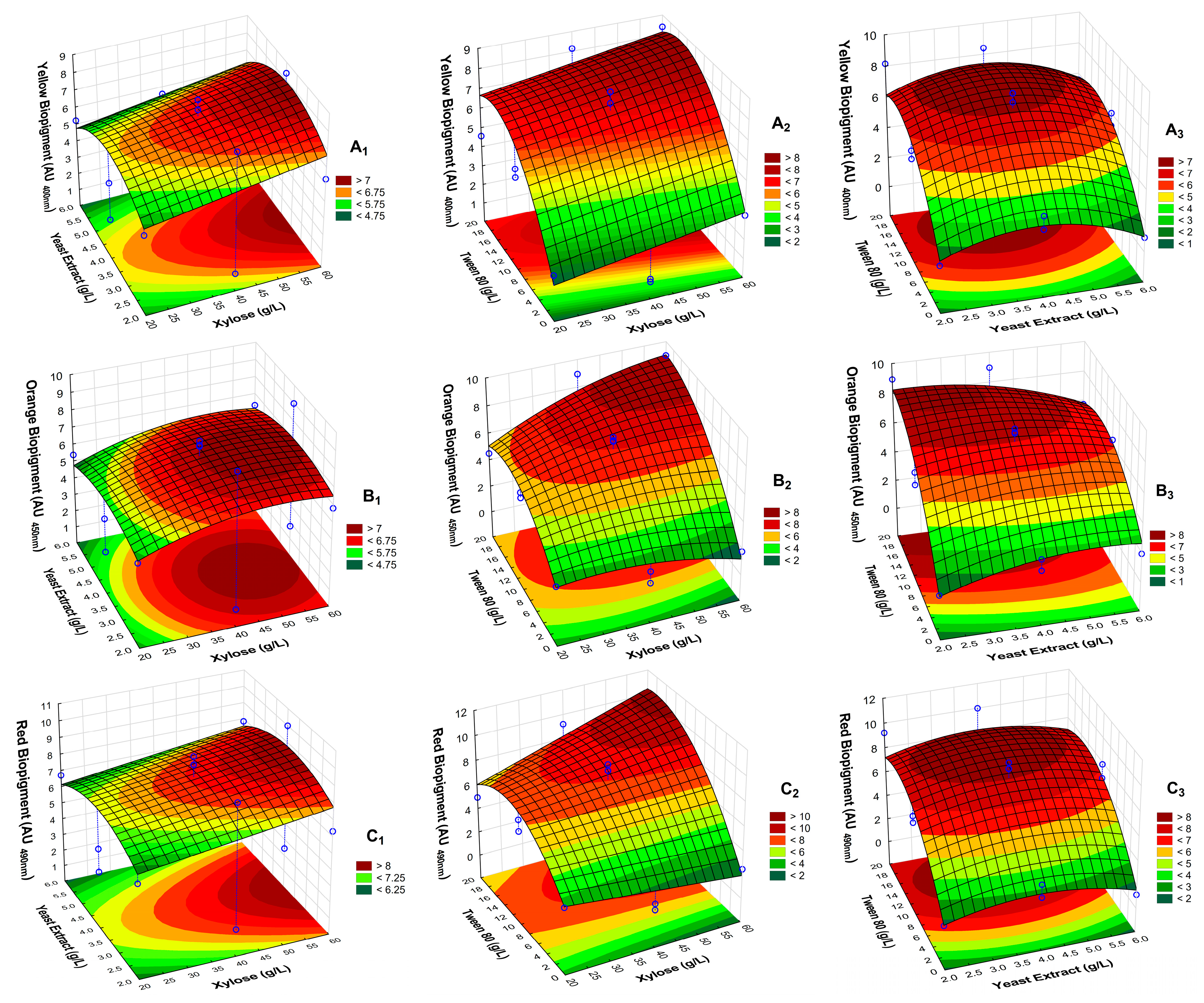
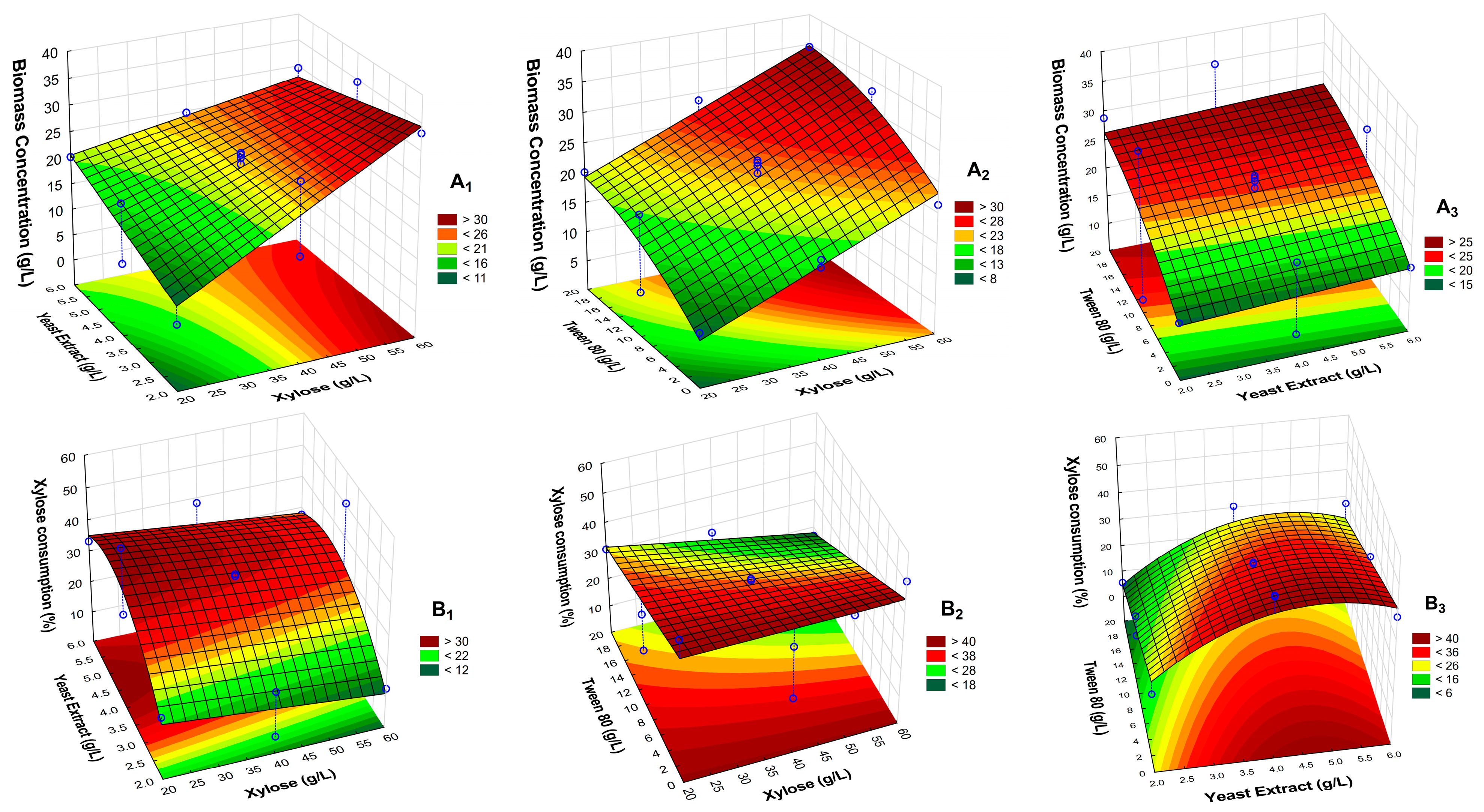
Response surfaces were generated from fitted regression models and are presented to facilitate the interpretation of the individual and interactive effects of the studied variables. Based on the fitted regression models, response surface plots were generated for yellow, orange, and red biopigment production (Figure 2), as well as biomass concentration and xylose consumption (Figure 3), using Statistica 13.0 software. In each graph, two factors were varied within the experimental range, while the remaining factor was fixed at its central point.
A positive effect of Tween 80 was evident for all biopigment fractions, with production increasing as the surfactant concentration rose from 0 to approximately 15–20 g/L. As shown in Table 4, this behavior is supported by a significant positive linear term and a significant negative quadratic term, indicating the existence of an optimal concentration range. Significant interactions between xylose concentration and Tween 80 were also observed for orange and red biopigment production, demonstrating that the effect of the surfactant depended on carbon availability. Overall, the highest biopigment levels were obtained under conditions combining high xylose concentrations (>50 g/L), intermediate yeast extract concentrations (4–4.5 g/L), and high Tween 80 (15–20 g/L) supplementation.
The results indicate that Tween 80 promoted higher biopigment biosynthesis during inoculum preparation, which may contribute to improved fermentation performance in the subsequent production stage. Such effects may be associated with alterations in membrane permeability and nutrient uptake promoted by non-ionic surfactants. Similar behavior has been reported in Monascus fermentations, with non-ionic surfactants improving biopigment production. Lv et al. [49] demonstrated that the combination of soybean oil as an in situ extractant and Span 80 as a surfactant increased yellow biopigment production by Monascus purpureus by 27.8-fold compared with the control culture. Despite the positive influence on biopigment production, detrimental effects were reported at higher concentrations, resulting in reduced production [65,66]. Wang et al. [32] reported that Triton X-100 exerted a concentration-dependent effect on both growth and biopigment production by Monascus purpureus. In that work, biopigment levels increased progressively with surfactant addition, reaching a maximum of 273.2 U/mL at 15 g/L. However, further increases in Triton X-100 led to a decline in both biomass and biopigment synthesis, which was attributed to membrane damage and reduced cell viability.
Xylose concentration also positively influenced biopigment production. The response surfaces (Figure 2B2) revealed progressive increases in biopigment formation as xylose concentration increased from 20 to approximately 60 g/L, particularly under conditions containing moderate to high Tween 80 concentrations. As the primary carbon source, xylose supplies the carbon skeletons required for fungal growth and the synthesis of polyketide-derived biopigments. The metabolism of xylose generates key intermediates such as acetyl-CoA and malonyl-CoA, which are directly involved in M. ruber biopigment biosynthesis [27,59]. Consequently, increasing carbon availability likely enhanced precursor supply for secondary metabolite formation. Furthermore, elevated sugar concentrations may generate moderate osmotic stress, a condition previously associated with enhanced secondary metabolite production in Monascus species [54,67].
The interaction between xylose and Tween 80 was particularly evident for all three biopigments produced (Figure 2A2–C2). Under low xylose concentrations, the positive effect of Tween 80 was relatively limited, whereas at elevated xylose concentrations, the surfactant promoted substantial increases in biopigment production. These results indicate that the effectiveness of Tween 80 depends on adequate carbon availability and that its effect may be enhanced under conditions of combined osmotic and surfactant-induced stress.
The effect of yeast extract was less pronounced than that of xylose and Tween 80 but revealed an important role in regulating fungal metabolism. Maximum biopigment production was generally achieved at intermediate yeast extract concentrations (approximately 4–5 g/L), whereas higher concentrations tended to stabilize or even reduce biopigment formation. This behavior suggests that biopigment biosynthesis was governed not only by nitrogen availability itself but also by the carbon-to-nitrogen (C/N) balance established in the culture medium. At low yeast extract concentrations, nitrogen limitation may restrict protein synthesis, enzyme production, and biomass development. Conversely, excessive nitrogen availability promotes primary metabolism and biomass accumulation, diverting carbon away from secondary metabolism and reducing the metabolic flux available for azaphilone biopigment biosynthesis. Therefore, the intermediate yeast extract concentration identified in the present study likely provided a more favorable C/N ratio, supplying sufficient nitrogen to sustain fungal growth while avoiding excessive nitrogen availability, which has been associated with reduced biopigment production in Monascus spp. Similar responses have been reported for Monascus spp. and other biopigment-producing filamentous fungi, in which optimized C/N ratios coordinate biomass formation and secondary metabolism, whereas nitrogen excess generally favors growth over biopigment biosynthesis [68,69].
Biomass formation was primarily influenced by xylose concentration and Tween 80 supplementation, which exhibited highly significant positive effects (p < 0.0001) (Supplementary Material, Table S2). The response surfaces showed a clear increase in biomass concentration as xylose concentration increased from 20 to 60 g/L, particularly when Tween 80 concentrations were maintained at intermediate or high levels (Figure 3A1,A2). The highest biomass values (>30 g/L) were observed under conditions combining elevated xylose concentrations (≈60 g/L) and Tween 80 supplementation, indicating that carbon availability was the main factor governing fungal growth.
The positive effect of xylose was expected, as this sugar serves as the primary carbon and energy source for cellular metabolism, supporting essential biosynthetic pathways such as ATP generation and biomass formation. In Monascus fermentations, growth and metabolite production are strongly dependent on fermentable sugars, particularly in xylose-rich lignocellulosic hydrolysates [39,70].
Similarly, Tween 80 exerted a stimulatory effect on biomass formation [30,71]. In addition to modifying membrane properties, non-ionic surfactants may influence fungal morphology by promoting the development of more favorable pellet structures and preserving hyphal integrity during submerged cultivation. Moreover, Tween 80 can be hydrolyzed, releasing oleic acid that may be incorporated into membrane lipids, thereby altering membrane composition and fluidity [72].
The optimum conditions for biomass formation did not fully coincide with those required for maximum biopigment production. Although both responses were positively influenced by xylose and Tween 80, biomass accumulation was mainly associated with higher xylose availability and favorable growth conditions, whereas biopigment production was more strongly influenced by Tween 80 and its interaction with the carbon source. This decoupling is evident from the fact that at intermediate xylose levels (40 g/L), high Tween 80 concentrations (20 g/L) still resulted in elevated biopigment biosynthesis (26.28 AU), highlighting the dissociation between growth and secondary metabolism in Monascus ruber. Similar trends have been reported in Monascus fermentations, where biopigment production does not necessarily correlate with maximum biomass formation [73].
Xylose consumption was influenced by all three variables, with yeast extract and Tween 80 showing a more pronounced effect in the fitted model (p = 0.002 and p < 0.0001, respectively, as shown in the Supplementary Materials, Table S2). Substrate utilization increased substantially with increasing yeast extract supplementation, reaching values above 45–50% at intermediate Tween 80 concentrations. Although biomass formation increased with higher initial xylose concentration, a lower percentage of substrate consumption was observed at high sugar loading, resulting in residual xylose in the medium. This behavior may be associated with metabolic regulation and transport limitations under high substrate concentrations during fermentation.
Therefore, based on the developed models and desirability analysis, and the concomitant optimization of biopigment production, biomass concentration, and xylose consumption, the optimal culture medium composition for inoculum preparation was optimized and corresponded to 55.65 g/L xylose, 4.18 g/L yeast extract, and 15.38 g/L Tween 80. These conditions correspond to a region where carbon availability, nitrogen supply, and Tween 80 supplementation are simultaneously balanced, leading to high predicted biopigment production while maintaining high biomass formation and efficient substrate utilization. The experimental results obtained under these conditions showed good agreement with the values predicted by the models for all evaluated responses (Table 4).
The validation assays showed that all experimental responses fell within the confidence intervals predicted by the statistical models, confirming the reliability of the optimization procedure. These results demonstrate that optimizing the culture medium used for inoculum preparation provides a robust strategy for obtaining a reproducible inoculum capable of supporting efficient biopigment production. Therefore, the inoculum prepared under the selected culture conditions was used for subsequent validation in SBHH to assess the applicability of the proposed strategy in a lignocellulosic biorefinery context.

3.4. Evaluation of the Selected Inoculum Preparation Protocol for Biopigment Production Using Sugarcane Bagasse Hemicellulosic Hydrolysate

After establishing the selected inoculum preparation strategy and the optimized inoculum culture medium, the process was validated using SBHH as a renewable substrate. The composition of the prepared concentrated hydrolysate was 2.38 g/L cellobiose, 6.48 g/L glucose, 9.4 g/L arabinose, and 60.5 g/L xylose. The medium composition was adjusted to ensure that the xylose concentration was comparable to that used in the semi-defined fermentation medium assays (approximately 53 g/L), and regarding the remaining components, except xylose (which was supplied by the hydrolysate), they were supplemented as described in Section 2.2., enabling a consistent basis for comparison between systems. The results are shown in Table 5.
Inoculum application in fermentations using SBHH demonstrated that the selected inoculation strategy and the optimization of the culture medium for inoculum preparation were effective in producing biomass with metabolically active cells, capable of sustaining high biopigment production on a lignocellulosic substrate. Although the semi-defined medium resulted in higher absorbance values for all three biopigments, cultivation in the hydrolysate-based medium also achieved substantial production, reaching 12.73, 10.75, and 14.56 AU for yellow, orange, and red biopigments, respectively. Likewise, biomass concentration decreased from 14.85 to 12.93 g/L, while xylose consumption decreased from 62.94 to 54.93. These results demonstrate that sugarcane bagasse hemicellulosic hydrolysate is a suitable renewable substrate for M. ruber cultivation and biopigment production.
The decrease in biopigment production was accompanied by a reduction in xylose consumption, and since Monascus ruber biopigments are azaphilone polyketides synthesized from acetyl-CoA and malonyl-CoA precursors, efficient carbon uptake is essential to sustain the metabolic flux required for secondary metabolite biosynthesis [27]. Therefore, it is expected that any limitation affecting xylose transport into the cell will directly impact biopigment formation.
The residual xylose concentration after 15 days of cultivation was approximately 20.01 g/L in the semi-defined medium and 24.34 g/L in the SBHH-based medium. As xylose was the major fermentable sugar in the SBHH, its higher residual concentration in the hydrolysate-based medium indicates lower xylose utilization compared with the semi-defined medium, which was accompanied by lower biomass formation and biopigment production. Since a considerable amount of xylose remained available in the SBHH-based medium at the end of cultivation, carbon availability was unlikely to be the limiting factor. Instead, the lower xylose consumption and the consequently lower biomass and biopigment production are more likely attributable to the presence of pretreatment-derived inhibitory compounds, which may have impaired fungal metabolism and xylose assimilation.
The hydrolysate contained furans and phenolic compounds, including 5-hydroxymethylfurfural (5-HMF) (0.1 g/L), furfural (0.03 g/L), gallic acid (0.08 g/L), syringic acid (0.06 g/L), and syringaldehyde (0.3 g/L). The lower biopigment production observed in the SBHH may be associated with the presence of the inhibitory compounds generated during acid pretreatment and the combined presence of furanic and phenolic compounds may have contributed to the observed reductions in SBHH [74,75]. These molecules are known to impair microbial metabolism by damaging membrane integrity, inhibiting enzymatic activities, and inducing oxidative stress, consequently affecting the biosynthesis of secondary metabolites [74,76]. Since M. ruber biopigments are dependent on cellular metabolism status and intracellular redox balance, the presence of such inhibitors may partially explain the reductions observed in biomass formation, xylose consumption, and biopigment production in the present study [28,77]. Nevertheless, despite the presence of these inhibitors, cultivation in SBHH maintained approximately 91.8%, 85.1%, and 86.7% of the yellow, orange, and red biopigment absorbance values, respectively, compared with the semi-defined medium, demonstrating the suitability of this renewable substrate for M. ruber cultivation despite the presence of residual pretreatment-derived inhibitors. Liu et al. [78] observed that furfural and 5-HMF reduced biopigment production, although their mutant strain developed enhanced tolerance to these inhibitors during cultivation.
Although inoculum-related parameters have long been recognized as important factors influencing Monascus biopigment production, most studies have focused on optimizing inoculum size, inoculation ratio, or spore concentration rather than evaluating different inoculum preparation strategies [79,80]. For example, Velmurugan et al. [81] optimized biopigment production from corn cobs by adjusting cultivation parameters such as substrate moisture, incubation temperature, fermentation time, and inoculum dosage while maintaining a standardized inoculum preparation protocol.
This study demonstrates that the choice of culture and the optimization of the inoculum preparation medium represent an additional means of improving the biopigment production process by enhancing the cell growth efficiency of the fungal biomass prior to transfer to the production medium. Thus, achieving approximately 88% of the biopigment production achieved in the semi-defined medium indicates that the prepared inoculum generated metabolically active cells capable of adapting to the stress conditions imposed by the hydrolysate, highlighting the importance of the inoculum metabolism state for robust lignocellulosic bioprocesses.
Nevertheless, the results of the present work can be compared to other works which used low inhibitor content hydrolysates. Hilares et al. [39], working with the same strain, reported 18.71 AU of red biopigment using enzymatic sugarcane bagasse hydrolysate, while Ramos et al. [73] obtained 14.65 AU using enzymatic sugarcane straw hydrolysate. The red biopigment production obtained in the present study (14.56 AU) was comparable to these values, despite the use of a hemicellulosic hydrolysate rich in xylose and containing compounds derived from acid pretreatment. Since enzymatic hydrolysates are typically richer in glucose and contain fewer fermentation inhibitors, these results highlight the robustness of the proposed process and its potential for the valorization of hemicellulosic streams within biorefineries.
Because lignocellulosic hydrolysates contain phenolic compounds, furans, and other degradation products generated during biomass pretreatment, detoxification processes are commonly applied before their use in microbial fermentations. Among the most widely employed strategies are overliming with calcium hydroxide, activated charcoal adsorption, and ion-exchange resins, which reduce inhibitor concentrations while largely preserving fermentable sugars [82,83].
The importance of hydrolysate detoxification was demonstrated by Arruda et al. [28], who evaluated biopigment production by Monascus ruber immobilized in polyurethane foam using SBHH. The authors observed that activated charcoal detoxification (1%, w/v) improved biopigment production, increasing red biopigment production from 5.68 AU in the non-detoxified hydrolysate to 11.32 AU in the detoxified hydrolysate. In the present study, the SBHH was subjected only to an overliming treatment prior to fermentation, without the use of additional detoxification strategies such as activated charcoal adsorption or ion exchange resin. Even under these conditions, red biopigment production reached 14.56 AU, suggesting that the combination of the selected inoculum preparation strategy and Tween 80 supplementation improved the fermentation performance in the hydrolysate. These results indicate that this combined approach may have partially mitigated the adverse effects of residual inhibitors, allowing efficient biomass formation and biopigment production without additional detoxification steps beyond overliming.
Most studies evaluating non-ionic surfactants for Monascus cultivation have been conducted using synthetic or semi-defined media, whereas studies employing lignocellulosic hydrolysates generally do not include surfactant supplementation [84]. Among the few studies combining non-ionic surfactants with lignocellulosic hydrolysates, Sánchez-Muñoz et al. [85] demonstrated that a surfactant formulation composed of Triton X-100 and Tween 80 significantly enhanced red biopigment production from sugarcane bagasse and straw hemicellulosic hydrolysates, reaching 18.81 and 20.65 AU510 nm/mL, respectively. These findings, together with the results obtained in the present study, reinforce the potential of combining non-ionic surfactants with lignocellulosic hydrolysates as an effective strategy to improve Monascus biopigment production in biorefinery-based processes.
These findings demonstrate that inoculum physiological conditioning, combined with Tween 80 supplementation, represents a complementary strategy to conventional hydrolysate detoxification, improving fungal robustness and enabling efficient biopigment production from sugarcane bagasse hemicellulosic hydrolysate. This approach highlights the potential of integrating Monascus ruber bioprocesses into lignocellulosic biorefineries while reducing the negative impacts of residual fermentation inhibitors.

4. Conclusions

This study demonstrated the potential of Monascus ruber in the production of high-value biopigments from xylose-based media and sugarcane bagasse-derived substrates, reinforcing the applicability of fungal biopigments within lignocellulosic biorefinery concepts. The results showed that inoculum preparation and culture medium composition are critical factors influencing fungal growth, substrate utilization, and biopigment biosynthesis. The use of mycelial disc-based inoculation associated with surfactant supplementation improved process performance, while medium optimization enabled the development of a robust and highly productive inoculum. Furthermore, the successful application of this inoculum in SBHH demonstrated the feasibility of converting lignocellulosic by-products into value-added natural colorants. The use of sugarcane-derived hydrolysates as renewable feedstocks further contributes to waste valorization and the development of a more circular and bio-based economy.

Supplementary Materials

The following supporting information can be downloaded at: https://www.mdpi.com/article/10.3390/fermentation12080387/s1, Table S1: Analysis of variance (ANOVA) and coefficient of determination (R2) for the fitted models for biopigments production (yellow, orange and red) as a function of the studied variables and Table S2: Analysis of variance (ANOVA) and coefficient of determination (R2) for the fitted model for cell concentration and xylose consumption as a function of the studied variables.

Author Contributions

Conceptualization, W.d.S.M.R., A.M.R.P., and J.C.d.S.; methodology, W.d.S.M.R., G.L.d.A., A.M.R.P., and J.C.d.S.; validation, W.d.S.M.R., G.L.d.A., A.M.R.P., and J.C.d.S.; formal analysis, W.d.S.M.R.; investigation, W.d.S.M.R. and G.L.d.A.; resources, S.S.d.S., A.M.R.P., and J.C.d.S.; data curation, W.d.S.M.R.; writing—original draft preparation, W.d.S.M.R.; writing—review and editing, W.d.S.M.R., G.L.d.A., S.S.d.S., A.M.R.P., and J.C.d.S.; visualization, W.d.S.M.R.; supervision, A.M.R.P. and J.C.d.S.; project administration, A.M.R.P. and J.C.d.S.; funding acquisition, S.S.d.S., A.M.R.P., and J.C.d.S. All authors have read and agreed to the published version of the manuscript.

Funding

This study was financed in part by the Coordenação de Aperfeiçoamento de Pessoal de Nível Superior—Brasil (CAPES)—Finance Code 001, and by CNPq, Brasilia, Brazil, grant #304320/2025-0.

Institutional Review Board Statement

Not applicable.

Informed Consent Statement

Not applicable.

Data Availability Statement

All data generated or analyzed during this study are available in the manuscript and Supplementary Materials.

Acknowledgments

The authors thank the Filamentous Fungi Culture Collection of the Oswaldo Cruz Foundation (Brazil) for donating the strain of Monascus ruber Tieghem IOC 2225. During the preparation of this work, the authors used the free version of CHATGPT GPT-5.6 Luna, OpenAI (provided by OpenAI. San Francisco. California. U.S.; available at https://openai.com/blog/chatgpt) (accessed on 5 June 2026) to partially aid with language editing, and some schematic figures were created with the assistance of ChatGPT image generation and subsequently edited by the authors for scientific accuracy. The authors reviewed and edited the content as needed and take full responsibility for the content of the publication.

Conflicts of Interest

The authors declare no conflicts of interest.

References

  1. Conteratto, C.; Artuzo, F.D.; Santos, O.I.B.; Talamini, E. Biorefinery: A Comprehensive Concept for the Sociotechnical Transition toward Bioeconomy. Renew. Sustain. Energy Rev. 2021, 151, 111527. [Google Scholar] [CrossRef] [Scilit]
  2. Pater, B.; Piecuch, J.; Pink, M.; Redlichová, R.; Tamáš, V. Evolution of the Economic System: From a Fossil-Based Economy to the Circular Bioeconomy. In The Circular Bioeconomy; Routledge: London, UK, 2025; pp. 3–34. [Google Scholar]
  3. Ntunka, M.G.; Makhathini, T.P.; Khumalo, S.M.; Bwapwa, J.K.; Tshibangu, M.M. Recent Developments in the Valorization of Sugarcane Bagasse Biomass via Integrated Pretreatment and Fermentation Strategies. Fermentation 2025, 11, 632. [Google Scholar] [CrossRef] [Scilit]
  4. Lee, H.; Sohn, Y.J.; Jeon, S.; Yang, H.; Son, J.; Kim, Y.J.; Park, S.J. Sugarcane Wastes as Microbial Feedstocks: A Review of the Biorefinery Framework from Resource Recovery to Production of Value-Added Products. Bioresour. Technol. 2023, 376, 128879. [Google Scholar] [CrossRef] [Scilit] [PubMed]
  5. Wang, D.; Sarsaiya, S.; Zheng, J.; Wong, J.W.; Zhou, J.; Zhang, J. A Critical Review on the Development Stages of Biorefinery Systems for Sugarcane Processing Wastes. Renew. Sustain. Energy Rev. 2026, 226, 116316. [Google Scholar] [CrossRef] [Scilit]
  6. Antunes, F.A.F.; Santos, J.C.; Chandel, A.K.; Carrier, D.J.; Peres, G.F.D.; Milessi, T.S.S.; da Silva, S.S. Repeated Batches as a Feasible Industrial Process for Hemicellulosic Ethanol Production from Sugarcane Bagasse by Using Immobilized Yeast Cells. Cellulose 2019, 26, 3787–3800. [Google Scholar] [CrossRef] [Scilit]
  7. Jofre, F.M.; Hernández-Pérez, A.F.; dos Santos, J.C.; de Almeida Felipe, M.d.G. Use of Dry Yeast Biomass as a New Approach for Detoxification of Hemicellulosic Hydrolysates Aiming to Xylitol Production. Ind. Crops Prod. 2021, 170, 113812. [Google Scholar] [CrossRef] [Scilit]
  8. Saknaveeporn, K.; Yingkamhaeng, N.; Torgbo, S.; Kamonsutthipaijit, N.; Thumanu, K.; Nimchua, T.; Watthanasakphuban, N.; Sukyai, P. Bioconversion of Sugarcane Bagasse into Cellulose and Organic Acid Using Lactiplantibacillus plantarum/Laccase-Mediated Pretreatment. Food Bioprocess Technol. 2025, 18, 11015–11030. [Google Scholar] [CrossRef] [Scilit]
  9. Carvalho, A.K.F.; Bento, H.B.; Reis, C.E.; De Castro, H.F. Sustainable Enzymatic Approaches in a Fungal Lipid Biorefinery Based in Sugarcane Bagasse Hydrolysate as Carbon Source. Bioresour. Technol. 2019, 276, 269–275. [Google Scholar] [CrossRef] [Scilit] [PubMed]
  10. Barbosa, F.G.; Marcelino, P.R.F.; Lacerda, T.M.; Philippini, R.R.; Giancaterino, E.T.; Mancebo, M.C.; dos Santos, J.C.; da Silva, S.S. Production, Physicochemical and Structural Characterization of a Bioemulsifier Produced in a Culture Medium Composed of Sugarcane Bagasse Hemicellulosic Hydrolysate and Soybean Oil in the Context of Biorefineries. Fermentation 2022, 8, 618. [Google Scholar] [CrossRef] [Scilit]
  11. Tagne, R.F.T.; Cruz-Santos, M.M.; Antunes, F.A.F.; Shibukawa, V.P.; Miano, S.B.; Kenfack, J.A.A.; da Silva, S.S.; Ngomade, S.B.L.; Santos, J.C. Pullulan Production from Sugarcane Bagasse Hemicellulosic Hydrolysate by Aureobasidium Pullulans ATCC 42023 inBubble Column Reactor. Fermentation 2024, 10, 322. [Google Scholar] [CrossRef] [Scilit]
  12. de Arruda, G.L.; Raymundo, M.T.F.R.; De Carvalho, L.T.; Da Silva, S.S.; Santos, J.C. Biopigments Production from Sugarcane Bagasse Hemicellulosic Hydrolysate Using Cells of Monascus ruber Immobilized in Polyurethane Foam. World J. Microbiol. Biotechnol. 2025, 41, 289. [Google Scholar] [CrossRef] [Scilit] [PubMed]
  13. Chougala, V.; Gowda, A.C.; Nagaraja, S.; Ammarullah, M.I. Effect of Chemical Treatments on Mechanical Properties of Sugarcane Bagasse (Gramineae Saccharum officinarum L.) Fiber Based Biocomposites: A Review. J. Nat. Fibers 2025, 22, 2445571. [Google Scholar] [CrossRef] [Scilit]
  14. Martiniano, S.E.; Chandel, A.K.; Soares, L.C.S.R.; Pagnocca, F.C.; Da Silva, S.S. Evaluation of Novel Xylose-Fermenting Yeast Strains from Brazilian Forests for Hemicellulosic Ethanol Production from Sugarcane Bagasse. 3 Biotech 2013, 3, 345–352. [Google Scholar] [CrossRef] [Scilit] [PubMed]
  15. Das, S.; Chandukishore, T.; Ulaganathan, N.; Dhodduraj, K.; Gorantla, S.S.; Chandna, T.; Gupta, L.K.; Sahoo, A.; Atheena, P.V.; Raval, R. Sustainable Biorefinery Approach by Utilizing Xylose Fraction of Lignocellulosic Biomass. Int. J. Biol. Macromol. 2024, 266, 131290. [Google Scholar] [CrossRef] [Scilit] [PubMed]
  16. Saxena, A.; Hussain, A.; Parveen, F.; Ashfaque, M. Current Status of Metabolic Engineering of Microorganisms for Bioethanol Production by Effective Utilization of Pentose Sugars of Lignocellulosic Biomass. Microbiol. Res. 2023, 276, 127478. [Google Scholar] [CrossRef] [Scilit] [PubMed]
  17. Narisetty, V.; Cox, R.; Bommareddy, R.; Agrawal, D.; Ahmad, E.; Pant, K.K.; Chandel, A.K.; Bhatia, S.K.; Kumar, D.; Binod, P. Valorisation of Xylose to Renewable Fuels and Chemicals, an Essential Step in Augmenting the Commercial Viability of Lignocellulosic Biorefineries. Sustain. Energy Fuels 2022, 6, 29–65. [Google Scholar] [CrossRef] [Scilit] [PubMed]
  18. Dufossé, L. Microbial Pigments from Bacteria, Yeasts, Fungi, and Microalgae for the Food and Feed Industries. In Natural and Artificial Flavoring Agents and Food Dyes; Elsevier: Amsterdam, The Netherlands, 2018; pp. 113–132. [Google Scholar]
  19. Sen, T.; Barrow, C.J.; Deshmukh, S.K. Microbial Pigments in the Food Industry—Challenges and the Way Forward. Front. Nutr. 2019, 6, 7. [Google Scholar] [CrossRef] [Scilit] [PubMed]
  20. Barreto, J.V.d.O.; Casanova, L.M.; Junior, A.N.; Reis-Mansur, M.C.P.P.; Vermelho, A.B. Microbial Pigments: Major Groups and Industrial Applications. Microorganisms 2023, 11, 2920. [Google Scholar] [CrossRef] [Scilit] [PubMed]
  21. Agboyibor, C.; Kong, W.-B.; Chen, D.; Zhang, A.-M.; Niu, S.-Q. Monascus Pigments Production, Composition, Bioactivity and Its Application: A Review. Biocatal. Agric. Biotechnol. 2018, 16, 433–447. [Google Scholar] [CrossRef] [Scilit]
  22. Chaudhary, V.; Katyal, P.; Panwar, H.; Kaur, J.; Aluko, R.E.; Puniya, A.K.; Poonia, A.K. Antioxidative, Anti-inflammatory, and Anticancer Properties of the Red Biopigment Extract from Monascus purpureus (MTCC 369). J. Food Biochem. 2022, 46, e14249. [Google Scholar] [CrossRef] [Scilit] [PubMed]
  23. Kaur, M.; Goel, M.; Mishra, R.C.; Lahane, V.; Yadav, A.K.; Barrow, C.J. Characterization of the Red Biochromes Produced by the Endophytic Fungus Monascus purpureus CPEF02 with Antimicrobial and Antioxidant Activities. Fermentation 2023, 9, 328. [Google Scholar] [CrossRef] [Scilit]
  24. Tan, H.; Xing, Z.; Chen, G.; Tian, X.; Wu, Z. Evaluating Antitumor and Antioxidant Activities of Yellow Monascus Pigments from Monascus ruber Fermentation. Molecules 2018, 23, 3242. [Google Scholar] [CrossRef] [Scilit] [PubMed]
  25. Teiba, I.I.; Mamdouh, I.; Yousef, M.I.; Hussein, A.; El-Bilawy, E.H. Antimicrobial Activity of Monascus purpureus-Derived Red Pigments against Salmonella typhimurium, Escherichia coli, and Enterococcus faecalis. AMB Expr. 2025, 15, 6. [Google Scholar] [CrossRef] [Scilit] [PubMed]
  26. Lin, C.-H.; Lin, T.-H.; Pan, T.-M. Alleviation of Metabolic Syndrome by Monascin and Ankaflavin: The Perspective of Monascus Functional Foods. Food Funct. 2017, 8, 2102–2109. [Google Scholar] [CrossRef] [Scilit] [PubMed]
  27. Arruda, G.L.; Reis, W.S.; Raymundo, M.T.F.; Shibukawa, V.P.; Cruz-Santos, M.M.; Silos, N.O.; Prado, C.A.; Marcelino, P.R.; da Silva, S.S.; Santos, J.C. Biotechnological Potential of Monascus: Biological Aspects, Metabolites of Interest, and Opportunities for New Products. Microbiol. Res. 2025, 297, 128177. [Google Scholar] [CrossRef] [Scilit] [PubMed]
  28. Arruda, G.L.; Raymundo, M.T.F.R.; Cruz-Santos, M.M.; Shibukawa, V.P.; Jofre, F.M.; Prado, C.A.; Da Silva, S.S.; Mussatto, S.I.; Santos, J.C. Lignocellulosic Materials Valorization in Second Generation Biorefineries: An Opportunity to Produce Fungal Biopigments. Crit. Rev. Biotechnol. 2025, 45, 393–412. [Google Scholar] [CrossRef] [Scilit] [PubMed]
  29. Morales-Oyervides, L.; Oliveira, J.C.; Sousa-Gallagher, M.J.; Méndez-Zavala, A.; Montañez, J.C. Selection of Best Conditions of Inoculum Preparation for Optimum Performance of the Pigment Production Process by Talaromyces Spp. Using the Taguchi Method. Biotechnol. Prog. 2017, 33, 621–632. [Google Scholar] [CrossRef] [Scilit] [PubMed]
  30. Chen, G.; Wang, M.; Tian, X.; Wu, Z. Analyses of Monascus Pigment Secretion and Cellular Morphology in Non-ionic Surfactant Micelle Aqueous Solution. Microb. Biotechnol. 2018, 11, 409–419. [Google Scholar] [CrossRef] [Scilit] [PubMed]
  31. Yang, X.; Dong, Y.; Liu, G.; Zhang, C.; Cao, Y.; Wang, C. Effects of Nonionic Surfactants on Pigment Excretion and Cell Morphology in Extractive Fermentation of Monascus sp. NJ1. J. Sci. Food Agric. 2020, 100, 1832. [Google Scholar] [CrossRef] [Scilit] [PubMed]
  32. Wang, Y.; Zhang, B.; Lu, L.; Huang, Y.; Xu, G. Enhanced Production of Pigments by Addition of Surfactants in Submerged Fermentation of Monascus purpureus H1102. J. Sci. Food Agric. 2013, 93, 3339–3344. [Google Scholar] [CrossRef] [Scilit] [PubMed]
  33. Papagianni, M. Fungal Morphology and Metabolite Production in Submerged Mycelial Processes. Biotechnol. Adv. 2004, 22, 189–259. [Google Scholar] [CrossRef] [Scilit] [PubMed]
  34. Veiter, L.; Rajamanickam, V.; Herwig, C. The Filamentous Fungal Pellet—Relationship between Morphology and Productivity. Appl. Microbiol. Biotechnol. 2018, 102, 2997–3006. [Google Scholar] [CrossRef] [Scilit] [PubMed]
  35. Sood, S.; Singhal, R.; Bhat, S.; Kumar, A. 2.13—Inoculum Preparation. In Comprehensive Biotechnology, 2nd ed; Moo-Young, M., Ed.; Pergamon: Oxford, UK, 2011; pp. 151–164. [Google Scholar]
  36. Zamani-Noor, N.; Jedryczka, M. Inoculum and Inoculation Techniques: Key Steps in Studying Pathogenicity and Resistance to Sclerotinia Stem Rot in Oilseed Rape. Front. Plant Sci. 2025, 16, 1610049. [Google Scholar] [CrossRef] [Scilit] [PubMed]
  37. Zhang, X.; Liu, H.; Zhang, M.; Chen, W.; Wang, C. Enhancing Monascus Pellet Formation for Improved Secondary Metabolite Production. J. Fungi 2023, 9, 1120. [Google Scholar] [CrossRef] [Scilit] [PubMed]
  38. Vendruscolo, F.; Bühler, R.M.M.; de Carvalho, J.C.; de Oliveira, D.; Moritz, D.E.; Schmidell, W.; Ninow, J.L. Monascus: A Reality on the Production and Application of Microbial Pigments. Appl. Biochem. Biotechnol. 2016, 178, 211–223. [Google Scholar] [CrossRef] [Scilit] [PubMed]
  39. Hilares, R.T.; de Souza, R.A.; Marcelino, P.F.; da Silva, S.S.; Dragone, G.; Mussatto, S.I.; Santos, J.C. Sugarcane Bagasse Hydrolysate as a Potential Feedstock for Red Pigment Production by Monascus ruber. Food Chem. 2018, 245, 786–791. [Google Scholar] [CrossRef] [Scilit] [PubMed]
  40. Skendi, A.; Irakli, M.; Chatzopoulou, P. Analysis of Phenolic Compounds in Greek Plants of Lamiaceae Family by HPLC. J. Appl. Res. Med. Aromat. Plants 2017, 6, 62–69. [Google Scholar] [CrossRef] [Scilit]
  41. Muñoz, S.S.; Balbino, T.R.; Terán-Hilares, R.; Mier-Alba, E.; Barbosa, F.G.; Balagurusamy, N.; Santos, J.C.; da Silva, S.S. Non-Ionic Surfactant Formulation Sequentially Enhances the Enzymatic Hydrolysis of Cellulignin from Sugarcane Bagasse and the Production of Monascus ruber Biopigments. Bioresour. Technol. 2022, 362, 127781. [Google Scholar] [CrossRef] [Scilit] [PubMed]
  42. Kim, H.J.; Kim, J.H.; Oh, H.J.; Shin, C.S. Morphology Control of Monascus Cells and Scale-up of Pigment Fermentation. Process Biochem. 2002, 38, 649–655. [Google Scholar] [CrossRef] [Scilit]
  43. Chen, G.; Huang, T.; Bei, Q.; Tian, X.; Wu, Z. Correlation of Pigment Production with mycelium morphology in Extractive Fermentation of Monascus anka GIM 3.592. Process Biochem. 2017, 58, 42–50. [Google Scholar] [CrossRef] [Scilit]
  44. Jia, L.; Huang, Y.; Yu, J.-H.; Stadler, M.; Shao, Y.; Chen, W.; Chen, F. Characterization of Key Upstream Asexual Developmental Regulators in Monascus ruber M7. Food Biosci. 2022, 50, 102153. [Google Scholar] [CrossRef] [Scilit]
  45. Shi, R.; Luo, Q.; Liu, Y.; Chen, W.; Wang, C. Effect of γ-Heptalactone on the Morphology and Production of Monascus Pigments and Monacolin K in Monascus purpureus. J. Fungi 2022, 8, 179. [Google Scholar] [CrossRef] [Scilit] [PubMed]
  46. Lv, J.; Zhang, B.-B.; Liu, X.-D.; Zhang, C.; Chen, L.; Xu, G.-R.; Cheung, P.C.K. Enhanced Production of Natural Yellow Pigments from Monascus purpureus by Liquid Culture: The Relationship between Fermentation Conditions and Mycelial Morphology. J. Biosci. Bioeng. 2017, 124, 452–458. [Google Scholar] [CrossRef] [Scilit] [PubMed]
  47. Kang, B.; Zhang, X.; Wu, Z.; Qi, H.; Wang, Z. Effect of pH and Nonionic Surfactant on Profile of Intracellular and Extracellular Monascus Pigments. Process Biochem. 2013, 48, 759–767. [Google Scholar] [CrossRef] [Scilit]
  48. Chen, G.; Bei, Q.; Huang, T.; Wu, Z. Tracking of Pigment Accumulation and Secretion in Extractive Fermentation of Monascus anka GIM 3.592. Microb. Cell Factories 2017, 16, 172. [Google Scholar] [CrossRef] [Scilit] [PubMed]
  49. Lv, J.; Qian, G.-F.; Chen, L.; Liu, H.; Xu, H.-X.; Xu, G.-R.; Zhang, B.-B.; Zhang, C. Efficient Biosynthesis of Natural Yellow Pigments by Monascus Purpureus in a Novel Integrated Fermentation System. J. Agric. Food Chem. 2018, 66, 918–925. [Google Scholar] [CrossRef] [Scilit] [PubMed]
  50. Geris, R.; Teles De Jesus, V.E.; Ferreira Da Silva, A.; Malta, M. Exploring Culture Media Diversity to Produce Fungal Secondary Metabolites and Cyborg Cells. Chem. Biodivers. 2024, 21, e202302066. [Google Scholar] [CrossRef] [Scilit] [PubMed]
  51. Silbir, S.; Goksungur, Y. Natural Red Pigment Production by Monascus Purpureus in Submerged Fermentation Systems Using a Food Industry Waste: Brewer’s Spent Grain. Foods 2019, 8, 161. [Google Scholar] [CrossRef] [Scilit] [PubMed]
  52. Li, P.; Zhou, Y.; Wu, Y.; Jiang, X.; Wang, X.; Shi, X.; Wang, W. The Effects of Environmental Factors on the Synthesis of Water-Soluble Monascus Red Pigments via Submerged Fermentation: A Review. J. Sci. Food Agric. 2024, 104, 7754–7764. [Google Scholar] [CrossRef] [Scilit] [PubMed]
  53. Chen, G.; Bei, Q.; Huang, T.; Wu, Z. Variations in Monascus Pigment Characteristics and Biosynthetic Gene Expression Using Resting Cell Culture Systems Combined with Extractive Fermentation. Appl. Microbiol. Biotechnol. 2018, 102, 117–126. [Google Scholar] [CrossRef] [Scilit] [PubMed]
  54. Chen, G.; Zhao, W.; Zhao, L.; Song, D.; Chen, B.; Zhao, X.; Hu, T. Regulation of the Pigment Production by Changing Cell Morphology and Gene Expression of Monascus ruber in High-Sugar Synergistic High-Salt Stress Fermentation. J. Appl. Microbiol. 2023, 134, lxad207. [Google Scholar] [CrossRef] [Scilit] [PubMed]
  55. Shi, K.; Zhao, Y.; Song, D.; Chen, G.; Wang, C.; Wu, Z.; Gu, H. Monascus Yellow Pigment Production by Coupled Immobilized-Cell Fermentation and Extractive Fermentation in Nonionic Surfactant Micelle Aqueous Solution. Fermentation 2023, 9, 168. [Google Scholar] [CrossRef] [Scilit]
  56. Huawei, Z.; Chengtao, W.; Jie, Q.; Bingjing, Z.; Bing, Z.; Chuangyun, D. Determining a Suitable Carbon Source for the Production of Intracellular Pigments from Monascus purpureus HBSD 08. Pigment Resin Technol. 2019, 48, 547–554. [Google Scholar] [CrossRef] [Scilit]
  57. Kang, L.-J.; Meng, Z.-T.; Hu, C.; Zhang, Y.; Guo, H.-L.; Li, Q.; Li, M. Screening, Purification, and Characterization of a Novel Organic Solvent-Tolerant Esterase, Lip2, from Monascus purpureus Strain M7. Extremophiles 2017, 21, 345–355. [Google Scholar] [CrossRef] [Scilit] [PubMed]
  58. Zhu, J.; Xia, Q.; Gan, J.; Yu, D.; Ding, B.; Chen, M.; Zhang, Y. Screening, Identification and Enzyme Production Conditions Optimization of High-Yield Esterase Monascus. China Brew. 2024, 43, 103. [Google Scholar] [CrossRef]
  59. Hajjaj, H.; Klaébé, A.; Goma, G.; Blanc, P.J.; Barbier, E.; François, J. Medium-Chain Fatty Acids Affect Citrinin Production in the Filamentous Fungus Monascus ruber. Appl. Environ. Microbiol. 2000, 66, 1120–1125. [Google Scholar] [CrossRef] [Scilit] [PubMed]
  60. Kang, B.; Zhang, X.; Wu, Z.; Qi, H.; Wang, Z. Solubilization Capacity of Nonionic Surfactant Micelles Exhibiting Strong Influence on Export of Intracellular Pigments in Monascus fermentation. Microb. Biotechnol. 2013, 6, 540–550. [Google Scholar] [CrossRef] [Scilit] [PubMed]
  61. Mehmood, T.; Ahmed, A. Tween 80 and Soya-Lecithin-Based Food-Grade Nanoemulsions for the Effective Delivery of Vitamin D. Langmuir 2020, 36, 2886–2892. [Google Scholar] [CrossRef] [Scilit] [PubMed]
  62. Halmos, E.P.; Mack, A.; Gibson, P.R. Review Article: Emulsifiers in the Food Supply and Implications for Gastrointestinal Disease. Aliment. Pharmacol. Ther. 2019, 49, 41–50. [Google Scholar] [CrossRef] [Scilit] [PubMed]
  63. Fratter, A.; Semenzato, A. New Association of Surfactants for the Production of Food and Cosmetic Nanoemulsions: Preliminary Development and Characterization: Preliminary Development and Characterization. Int. J. Cosmet. Sci. 2011, 33, 443–449. [Google Scholar] [CrossRef] [Scilit] [PubMed]
  64. Prieto, C.; Calvo, L. Performance of the Biocompatible Surfactant Tween 80, for the Formation of Microemulsions Suitable for New Pharmaceutical Processing. J. Appl. Chem. 2013, 2013, 930356. [Google Scholar] [CrossRef] [Scilit]
  65. Hu, Z.; Zhang, X.; Wu, Z.; Qi, H.; Wang, Z. Perstraction of Intracellular Pigments by Submerged Cultivation of Monascus in Nonionic Surfactant Micelle Aqueous Solution. Appl. Microbiol. Biotechnol. 2012, 94, 81–89. [Google Scholar] [CrossRef] [Scilit] [PubMed]
  66. Chen, G.; Bei, Q.; Shi, K.; Tian, X.; Wu, Z. Saturation Effect and Transmembrane Conversion of Monascus Pigment in Nonionic Surfactant Aqueous Solution. AMB Expr. 2017, 7, 24. [Google Scholar] [CrossRef] [Scilit] [PubMed]
  67. Huang, T.; Wang, M.; Shi, K.; Chen, G.; Tian, X.; Wu, Z. Metabolism and Secretion of Yellow Pigment under High Glucose Stress with Monascus ruber. AMB Expr. 2017, 7, 79. [Google Scholar] [CrossRef] [Scilit] [PubMed]
  68. Said, F.M.; Brooks, J.; Chisti, Y. Optimal C: N Ratio for the Production of Red Pigments by Monascus ruber. World J. Microbiol. Biotechnol. 2014, 30, 2471–2479. [Google Scholar] [CrossRef] [Scilit] [PubMed]
  69. Tong, A.; Lu, J.; Huang, Z.; Huang, Q.; Zhang, Y.; Farag, M.A.; Liu, B.; Zhao, C. Comparative Transcriptomics Discloses the Regulatory Impact of Carbon/Nitrogen Fermentation on the Biosynthesis of Monascus kaoliang Pigments. Food Chem. X 2022, 13, 100250. [Google Scholar] [CrossRef] [Scilit] [PubMed]
  70. Srianta, I.; Kusdiyantini, E.; Zubaidah, E.; Ristiarini, S.; Nugerahani, I.; Alvin, A.; Iswanto, N.; Zhang, B.-B. Utilization of Agro-Industrial by-Products in Monascus fermentation: A Review. Bioresour. Bioprocess. 2021, 8, 129. [Google Scholar] [CrossRef] [Scilit] [PubMed]
  71. Huang, Z.; Hu, T.; Liu, H.; Xie, H.; Tian, X.; Wu, Z. Biosynthesis and Polyketide Oxidation of Monascus Red Pigments in an Integrated Fermentation System with Microparticles and Surfactants. Food Chem. 2022, 394, 133545. [Google Scholar] [CrossRef] [Scilit] [PubMed]
  72. Zhang, B.-B.; Cheung, P.C. A Mechanistic Study of the Enhancing Effect of Tween 80 on the Mycelial Growth and Exopolysaccharide Production by Pleurotus tuber-regium. Bioresour. Technol. 2011, 102, 8323–8326. [Google Scholar] [CrossRef] [Scilit] [PubMed]
  73. Ramos, L.; Gamboa, M.L.; Arruda, G.L.; Santos, J.C.; Pereira, F.M.; Chandel, A.K. Upgrading Sugarcane Straw into Biopigments via Enzymatic Hydrolysis and Fermentation by Monascus ruber: Integrating Statistical Analysis and Kinetic Modeling. React. Chem. Eng. 2026, 11, 1262–1273. [Google Scholar] [CrossRef] [Scilit]
  74. Jilani, S.B.; Olson, D.G. Mechanism of Furfural Toxicity and Metabolic Strategies to Engineer Tolerance in Microbial Strains. Microb. Cell Factories 2023, 22, 221. [Google Scholar] [CrossRef] [Scilit] [PubMed]
  75. Vanmarcke, G.; Demeke, M.M.; Foulquié-Moreno, M.R.; Thevelein, J.M. Identification of the Major Fermentation Inhibitors of Recombinant 2G Yeasts in Diverse Lignocellulose Hydrolysates. Biotechnol. Biofuels 2021, 14, 92. [Google Scholar] [CrossRef] [Scilit] [PubMed]
  76. Xiong, J.; Chen, M.; Zhang, L.; Zhou, Q.; Huang, Z.; Lin, X.; Fang, X.; Ye, X.; Zhu, W.; Liu, W. Research Progress in the Mechanisms of Microbial Furfural Tolerance and Future Research Prospects for Its Biotechnological Exploitation. Fermentation 2026, 12, 232. [Google Scholar] [CrossRef] [Scilit]
  77. Huang, T.; Tan, H.; Lu, F.; Chen, G.; Wu, Z. Changing Oxidoreduction Potential to Improve Water-Soluble Yellow Pigment Production with Monascus ruber CGMCC 10910. Microb. Cell Factories 2017, 16, 208. [Google Scholar] [CrossRef] [Scilit] [PubMed]
  78. Liu, J.; Luo, Y.; Guo, T.; Tang, C.; Chai, X.; Zhao, W.; Bai, J.; Lin, Q. Cost-Effective Pigment Production by Monascus purpureus Using Rice Straw Hydrolysate as Substrate in Submerged Fermentation. J. Biosci. Bioeng. 2020, 129, 229–236. [Google Scholar] [CrossRef] [Scilit] [PubMed]
  79. Quan, W.; Chen, S.; Li, H.; Tang, Z.; Alam, M.N.; Liu, X. Isolation of Monascus purpureus HC-5 and Optimization of Solid-State Fermentation for High-Yield Pigment Production. Microorganisms 2025, 13, 2874. [Google Scholar] [CrossRef] [Scilit] [PubMed]
  80. Chen, X.; Chen, M.; Wu, X.; Li, X. Cost-effective Process for the Production of Monascus Pigments Using Potato Pomace as Carbon Source by Fed-batch Submerged Fermentation. Food Sci. Nutr. 2021, 9, 5415–5427. [Google Scholar] [CrossRef] [Scilit] [PubMed]
  81. Velmurugan, P.; Hur, H.; Balachandar, V.; Kamala-Kannan, S.; Lee, K.-J.; Lee, S.-M.; Chae, J.-C.; Shea, P.J.; Oh, B.-T. Monascus Pigment Production by Solid-State Fermentation with Corn Cob Substrate. J. Biosci. Bioeng. 2011, 112, 590–594. [Google Scholar] [CrossRef] [Scilit] [PubMed]
  82. Murillo-Franco, S.L.; Dos Santos De Vechi, C.V.; Biancheti, L.M.; Milessi, T.S.; Arruda, P.V.; Santos, E.D.; Da Silva, D.D.V.; Dussán, K.J. Detoxification Strategies to Remove Inhibitors from Lignocellulose Hydrolysates: Challenges and New Prospects. In Biorefineries in Circular Bioeconomy; Green Energy and Technology; Chandel, A.K., Sundaramurthy, S., Eds.; Springer Nature: Singapore, 2025; pp. 229–269. [Google Scholar]
  83. Vinod Kumar, V.K.; Yadav, S.K.; Jitendra Kumar, J.K.; Vivek Ahluwalia, V.A. A Critical Review on Current Strategies and Trends Employed for Removal of Inhibitors and Toxic Materials Generated during Biomass Pretreatment. Bioresour. Technol. 2020, 299, 122633. [Google Scholar] [CrossRef] [Scilit] [PubMed]
  84. Prado, C.A.; Loureiro, B.M.S.; Arruda, G.L.; Santos, J.C.; Chandel, A.K. Hydrodynamic Cavitation Assisted Pretreatment of Sugarcane Bagasse in the Presence of Yeast Cell Mass for the Production of Sugars and Their Use for Biopigments Production by Monascus ruber. Biomass Bioenergy 2024, 190, 107434. [Google Scholar] [CrossRef] [Scilit]
  85. Muñoz, S.S.; Rocha, T.B.; Gutierrez, S.G.B.; Alba, E.M.; Teran-Hilares, R.; dos Santos, J.C.; da Silva, S.S. Monascus Pigments Production for Sustainable Utilization of Sugarcane Hemicellulosic Hydrolysates By-Products. Bioresour. Technol. Rep. 2025, 32, 102356. [Google Scholar] [CrossRef] [Scilit]
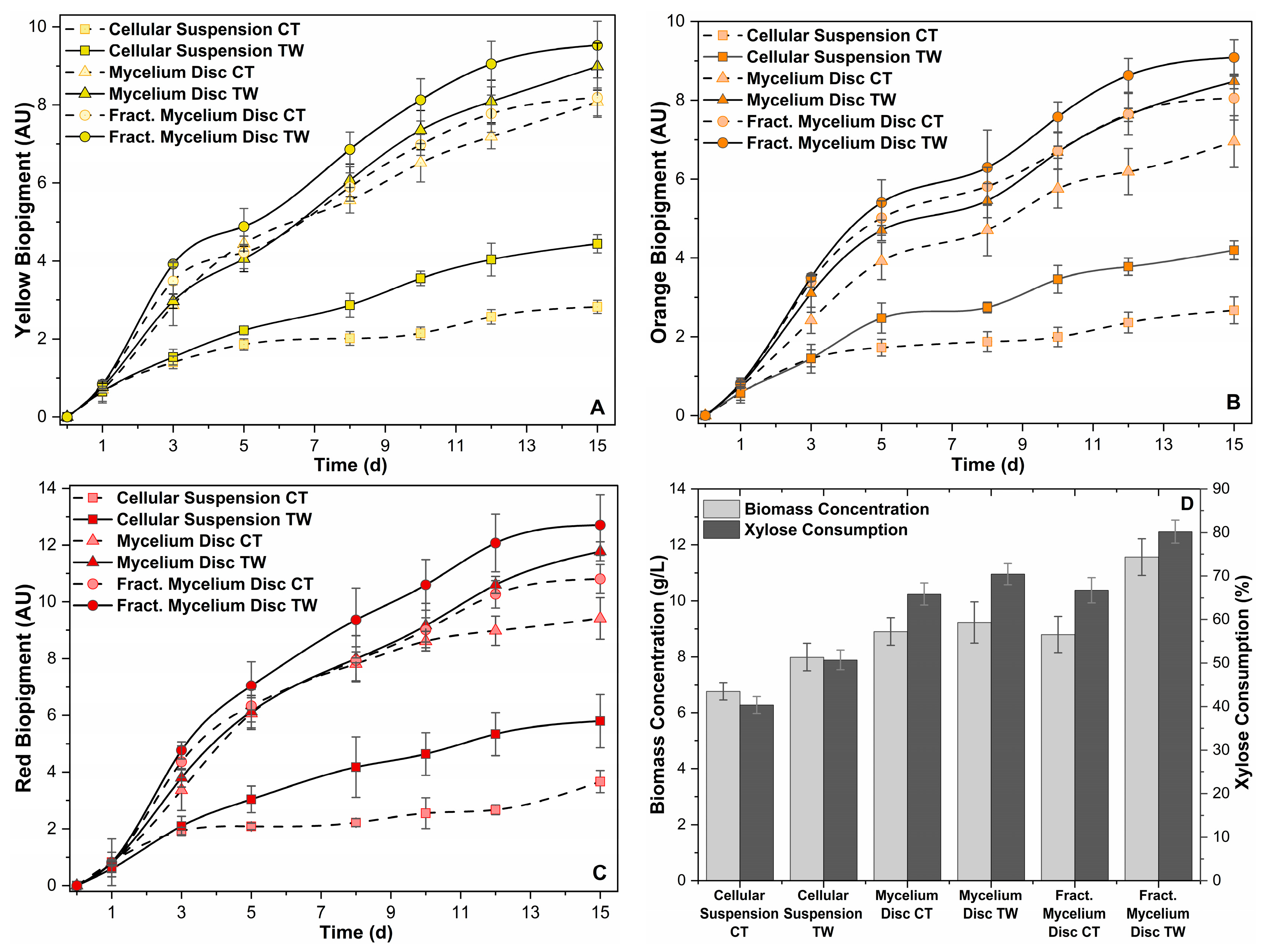
Figure 1. Production of biopigments (yellow (A), orange (B), and red (C)), biomass concentration, and xylose consumption (D) during the evaluation of the inoculation method in the fermentation of M. ruber with (TW) and without (CT) surfactant addition for 15 days. Fract: fractionated.
Fermentation 12 00387 g001
Figure 2. Response surfaces for (A1A3) yellow biopigment production (AU400nm), (B1B3) orange biopigment production (AU450nm), and (C1C3) red biopigment production (AU490nm), showing the interaction effects between the experimental factors. In each surface, the third experimental factor was kept at its central point. The color scale represents the predicted response values, from lower values (green) to intermediate values (yellow) and higher values (red).
Fermentation 12 00387 g002
Figure 3. Response surfaces for (A1A3) biomass concentration (g/L) and (B1B3) xylose consumption (%), showing the interaction effects between the experimental factors. In each surface, the third experimental factor was kept at its central point. The color scale represents the predicted response values, from lower values (green) to intermediate values (yellow) and higher values (red).
Fermentation 12 00387 g003
Table 1. Evaluation of different inoculum preparation methods based on biopigment production, biomass concentration, and xylose consumption at the inoculum preparation stage. CT (without surfactant); TW (with Tween 80).
Inoculation
Protocol
Biopigment Production (AU)Biomass (g/L)Xylose
Consumption (%)
YellowOrangeRed
Cellular
Suspension CT
2.15 e ± 0.562.36 e ± 0.293.27 d ± 0.343.91 e ± 0.8912.74 d ± 1.59
Cellular
Suspension TW
3.62 d ± 0.183.78 c,d ± 0.304.53 c,d ± 0.325.29 d,e ± 0.4517.81 c ± 1.24
Mycelium
Disc CT
4.07 c,d ± 0.333.71 d ± 0.274.96 c,d ± 0.386.60 c,d ± 0.9719.26 b,c ± 1.56
Mycelium
Disc TW
9.31 b ± 0.577.88 b ± 0.479.19 b ± 1.678.64 c ± 1.3422.70 a,b ± 1.29
Fractionated Mycelium
Disc CT
4.86 c ± 0.264.64 c ± 0.356.72 b,c ± 0.6213.66 b ± 0.4215.08 c,d ± 1.91
Fractionated Mycelium
Disc TW
11.79 a ± 0.5910.96 a ± 0.2413.33 a ± 2.0416.69 a ± 0.9424.69 a ± 2.14
Values are expressed as mean ± standard deviation. Different letters in the same column indicate statistically significant differences between treatments, according to Tukey’s test (p < 0.05).
Table 2. Box–Behnken experimental design matrix, with quintuplicates at the central point, independent variables (xylose concentration, yeast extract, and Tween 80), and response variables for each run after 5 days of cultivation.
RunCulture Medium Components (g/L)
(Codified Values in Parenthesis)
Response Variables
Biopigment ProductionBiomass
(g/L)
Xylose
(%)
Xylose
(A)
Yeast
Extract (B)
Tween 80
(C)
Yellow
(AU400nm)
Orange
(AU450nm)
Red
(AU490nm)
120 (−1)2 (−1)10 (0)4.774.965.757.3420.2
220 (−1)4 (0)0 (−1)2.372.53.58.7951.00
320 (−1)6 (+1)10 (0)5.25.356.6920.133.05
420 (−1)4 (0)20 (+1)4.554.464.9120.0730.46
540 (0)2 (−1)20 (+1)8.148.949.2028.75.45
640 (0)6 (+1)20 (+1)5.565.716.5124.6527.15
740 (0)2 (−1)0 (−1)1.051.051.6615.0620.03
840 (0)6 (+1)0 (−1)0.911.931.1516.338.31
960 (+1)2 (−1)10 (0)5.295.786.333.1312.77
1060 (+1)4 (0)0 (−1)3.231.752.4321.2850.5
1160 (+1)6 (+1)10 (0)6.016.297.8329.5627.6
1260 (+1)4 (0)20 (+1)8.48.989.9934.5516.75
1340 (0)4 (0)10 (0)8.077.618.7822.3035.00
1440 (0)4 (0)10 (0)6.826.057.3224.8731.93
1540 (0)4 (0)10 (0)6.846.037.2424.3335.6
1640 (0)4 (0)10 (0)8.087.859.2723.1327.7
1740 (0)4 (0)10 (0)7.517.548.7625.2331.73
Table 3. Predictive models for yellow, orange, and red biopigment production; biomass concentration; and xylose consumption.
ResponseModel
Yellow Biopigment (AU)−4.379 + 0.038A + 2.845B + 0.669C − 0.368B2 − 0.021C2(1)
Orange Biopigment (AU)−3.61 + 0.11A + 1.86B + 0.58C + 0.007AC − 0.05BC −0.002A2 − 0.18B2 − 0.02C2(2)
Red Biopigment
(AU)
0.054 − 0.04A + 2.22B + 0.48C + 0.008AC − 0.28B2 − 0.026C2(3)
Biomass Concentration (g/L)−18.12 + 0.79A + 4.48B + 1.01C − 0.10AB − 0.022B2(4)
Xylose Consumption (%)−18.017 − 0.004A + 27.12B − 0.34C − 0.016AC − 2.86C2(5)
Table 4. Predicted and experimental responses under the optimized conditions obtained for the validation of the models in relation to the production of yellow, orange, and red biopigments; biomass concentration; and xylose consumption.
Response VariablePredicted Means *Experimental Values
Optimized Condition **
Yellow Biopigment (AU)8.58 ± 0.999.10 ± 0.74
Orange Biopigment (AU)8.13 ± 0.949.34 ± 0.86
Red Biopigment (AU)9.97 ± 1.12 10.24 ± 0.88
Biomass Concentration (g/L)31.71 ± 2.0430.85 ± 2.31
Xylose Consumption (%)25.75 ± 4.4428.89 ± 2.27
* Average ± 95% confidence interval. ** Average ± standard deviation.
Table 5. Comparative fermentation performance of Monascus ruber in semi-defined medium and sugarcane bagasse hydrolysate-based medium after 15 days of fermentation.
Response VariablesSemi-Defined
Medium
Sugarcane Bagasse
Hydrolysate-Based Medium
Yellow Biopigment (AU)13.86 ± 1.4112.73 ± 0.97
Orange Biopigment (AU)12.63 ± 0.4610.75 ± 0.61
Red Biopigment (AU)16.80 ± 0.2314.56 ± 0.42
Biomass Concentration (g/L)14.85 ± 1.6512.93 ± 0.84
Xylose Consumption (%)62.94 ± 2.5254.93 ± 1.64
Disclaimer/Publisher’s Note: The statements, opinions and data contained in all publications are solely those of the individual author(s) and contributor(s) and not of MDPI and/or the editor(s). MDPI and/or the editor(s) disclaim responsibility for any injury to people or property resulting from any ideas, methods, instructions or products referred to in the content.