
Review

Advances in the Biosynthetic Production of Daunomycin: Genetic, Metabolic, and Process Engineering Strategies


by
Alexandra Cristina Blaga
1,2,
Irina Cârlescu
1,2,
Ioan Mămăligă
1,2 and
Elena Niculina Drăgoi
1,*
1
Cristofor Simionescu Faculty of Chemical Engineering and Environmental Protection, Gheorghe Asachi Technical University of Iasi, 73 D. Mangeron Blvd., 700050 Iasi, Romania
2
S.C. M.I.B. T.H. S.R.L., Str. Aurel Vlaicu 78, 700071 Iasi, Romania
*
Author to whom correspondence should be addressed.
Fermentation 2026, 12(7), 304; https://doi.org/10.3390/fermentation12070304
Submission received: 26 May 2026 / Revised: 24 June 2026 / Accepted: 25 June 2026 / Published: 26 June 2026
(This article belongs to the Special Issue Fermentation Processes and Product Development)

Abstract

Daunomycin (daunorubicin) is one of the most clinically significant anthracyclines used in chemotherapy, and its efficient production remains a major objective for biotechnological researchers. Industrial manufacturing relies on the fermentation of Streptomyces peucetius and Streptomyces coeruleorubidus, which produce daunomycin as a secondary metabolite under controlled conditions. This review will focus on the methods to enhance the total efficiency of biotechnological production, from upstream biosynthesis to downstream processing. Given the complexity of the daunomycin biosynthetic pathway in Streptomyces spp., substantial progress has been made in strain improvement to increase yield, metabolic robustness, and process stability. Advances in classical mutagenesis, pathway engineering, regulatory network modulation, and precursor supply optimization, along with rational medium design and advanced process control, have led to substantial increases in product titers and productivity. At the same time, innovations in downstream processes, such as extraction, purification and process integration, have increased recovery efficiency, product quality, and economic feasibility. With improvements in the production process, novel drug delivery modalities have been developed (e.g., drug carriers based on erythrocytes, drug nanocarriers based on hyaluronic acid) with increased efficiency and lower systemic toxicity. These developments indicate an evolution from pathway-level engineering to industrial-scale manufacturing and clinical application, underlining the evolution of daunomycin research and biotechnological production.

1. Introduction

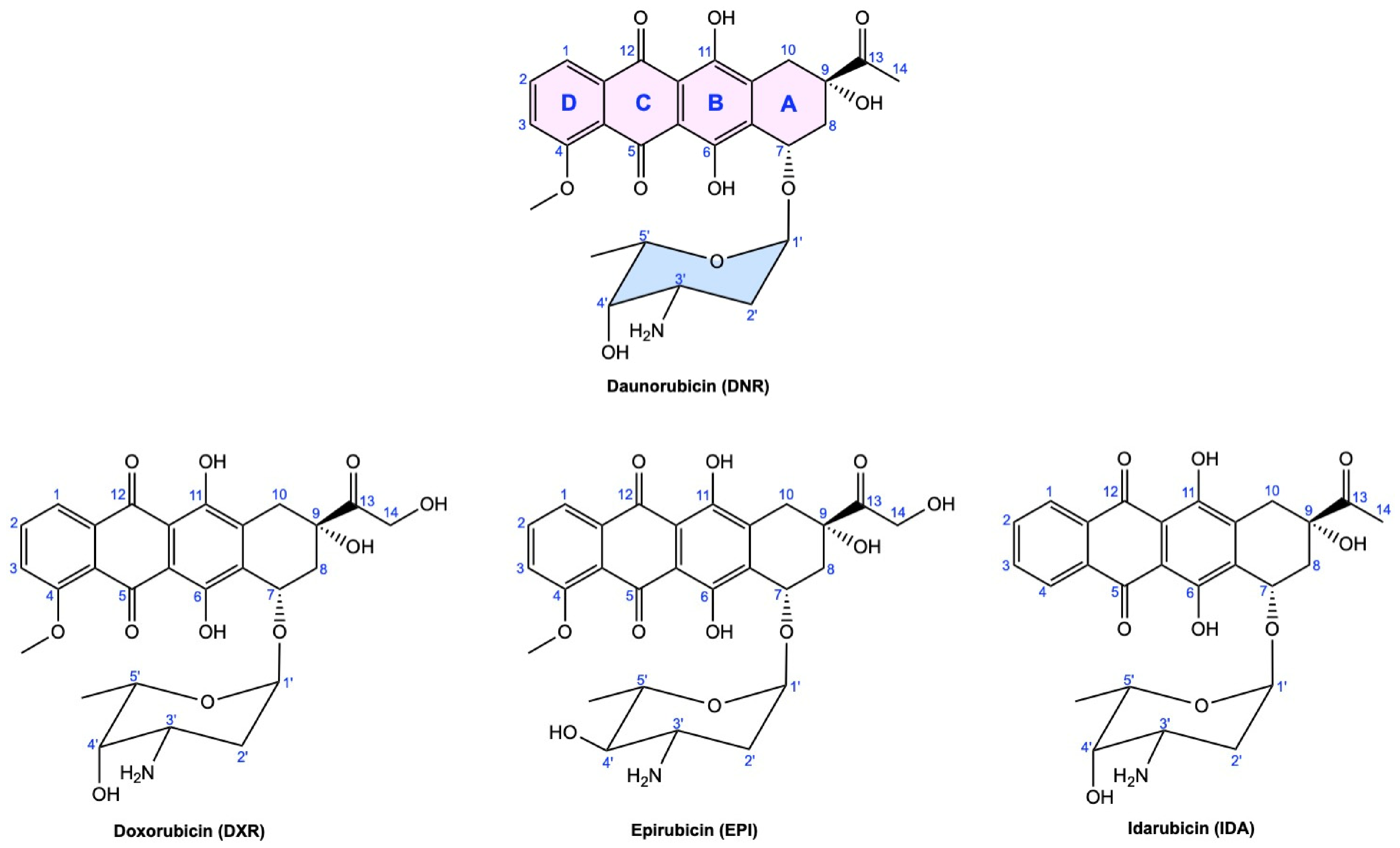
Daunomycin (daunorubicin) is a clinically established anthracycline antibiotic that has played a central role in anticancer chemotherapy for several decades—Figure 1. It was first isolated in the 1960s by Di Marco et al. at Farmitalia Research Laboratories from Streptomyces peucetius, with a yield of 5–15 mg L−1 [1]. The compound was renamed daunorubicin, combining the original name with “rubidomycin”, an identical molecule independently isolated from S. coeruleorubidus [2]. It is used in the treatment of acute myeloid leukemia (AML) and acute lymphoblastic leukemia (ALL) and has shown efficacy in some lymphomas, breast cancer, and certain sarcomas such as Ewing sarcoma [3,4,5,6]. Daunorubicin’s clinical importance is underlined by the fact that it is listed on the World Health Organization’s List of Essential Medicines and has been approved by regulatory agencies, including the U.S. Food and Drug Administration [7].
The main producers of daunomycin and similar cytostatic drugs are spread across various regions worldwide. China and India together account for about 50% of the global market, positioning them as industry leaders. The United States of America contributes about 25% of total production, while Europe accounts for approximately 15% and Japan for around 10% [8]. The global Daunomycin hydrochloride injection market was valued at USD 450 million in 2024 and is expected to grow to USD 750 million by 2033. This rise reflects growing demand for this important chemotherapeutic drug. Several leading pharmaceutical companies, such as Teva Pharmaceutical Industries, Pfizer Inc., Sandoz International GmbH, Bristol-Myers Squibb Company, and Sun Pharmaceutical Industries Ltd., dominate the market. They collectively hold a large market share and are key drivers of innovation and supply within this therapeutic segment [9].
Its antitumor activity is explained by multiple mechanisms of action, combining DNA intercalation, topoisomerase II inhibition, chromatin spatial organization disruption, and induction of oxidative DNA damage, with potent cytotoxic effects in cancer cells [2,10,11,12,13,14]. Clinical use of daunomycin is constrained by several limitations: dose-dependent cardiotoxicity, myelosuppression, and multidrug resistance mediated by efflux transporters and metabolic inactivation [2,7,15,16,17]. These challenges have driven sustained efforts to improve both the balance between therapeutic efficacy and toxicity and the production efficiency of daunorubicin. The complexity of its molecular architecture makes total chemical synthesis impractical for commercial-scale production due to low overall yields, high costs, stereochemical challenges, and the generation of hazardous by-products [18,19,20]. Additionally, extensive use of organic solvents and reactive reagents has an environmental impact and raises biosafety concerns [8].
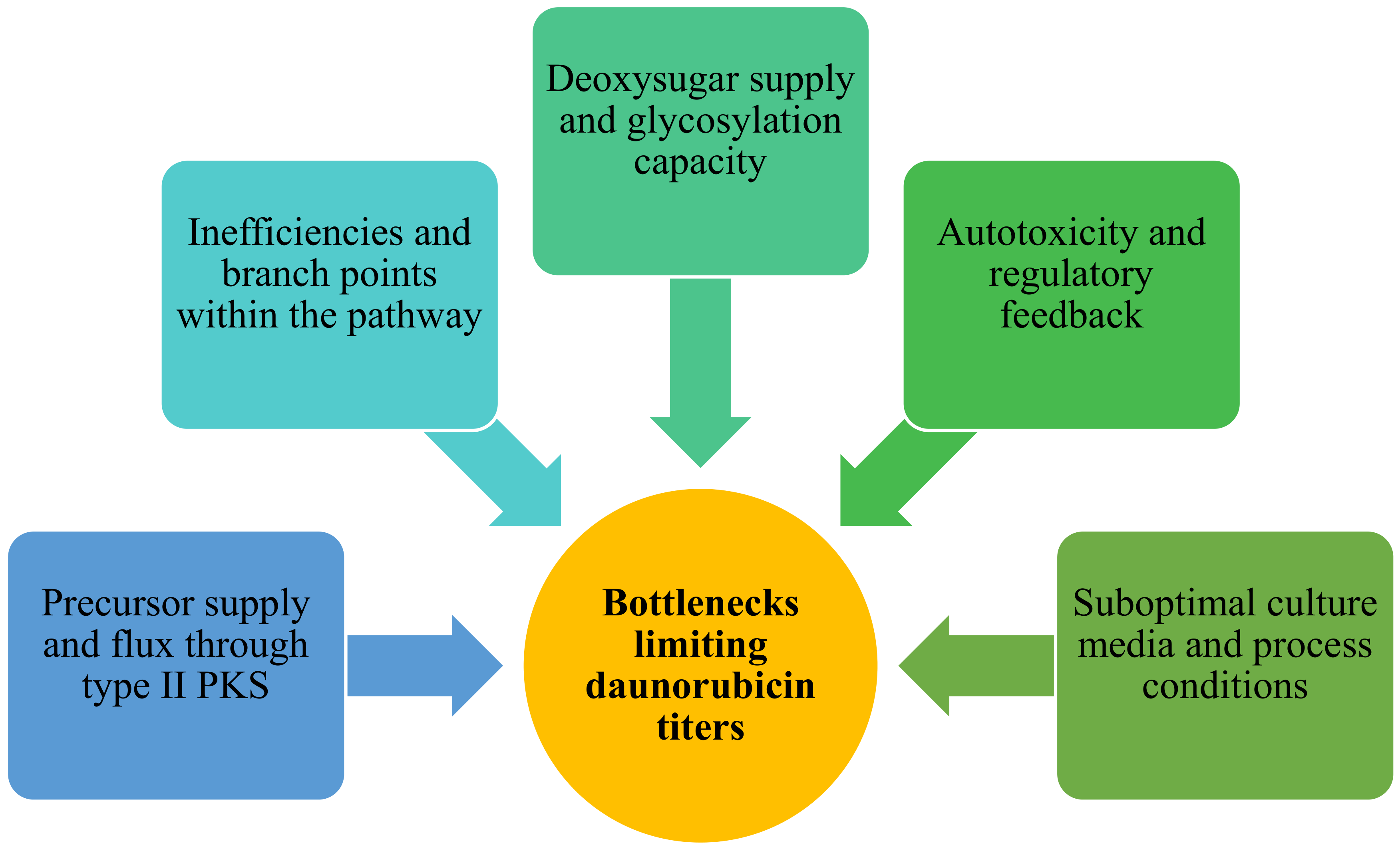
Microbial biosynthesis has become the main method for biotechnological production, with Streptomyces peucetius and similar actinobacteria acting as natural sources [21,22]. The bioproduction of daunomycin faces several interconnected challenges that affect its efficiency and sustainability in industrial manufacturing (Figure 2).
The primary constraint is related to the producing microorganisms (such as Streptomyces spp.). They synthesize daunomycin as a secondary metabolite during the idiophase (when nutrient availability becomes limited and cell growth ceases), a process that requires precise metabolic regulation [23,24,25,26]. Natural strains show low productivity, whereas improved mutants suffer from genetic instability and variability between batches [27,28]. Metabolic limitations further reduce efficiency, as the complex polyketide biosynthetic pathway demands a balanced supply of precursors (malonyl-CoA, propionyl-CoA, activated sugar donors). At the same time, competing primary pathways and regulatory networks limit carbon flux toward daunomycin production, while intracellular product accumulation inhibits cell growth [29]. Traditional improvement strategies, which depend on empirical mutagenesis and screening, are labor-intensive and often unpredictable [30]. This highlights the necessity for rational engineering methods based on a mechanistic understanding of daunomycin biosynthesis [31,32].
Upstream process development represents a complex challenge, constrained by diverse requirements. First, biomass growth requires complex media rich in organic substrates, whereas daunomycin biosynthesis requires defined media with controlled carbon sources. Additionally, the filamentous morphology of actinomycetes leads to hyphal aggregation, increased broth viscosity, and limits oxygen transfer, complicating scale-up and reproducibility [33,34]. Downstream processing is difficult because of low product concentrations and the complex structure of daunomycin, a glycosylated anthracycline. Structurally similar analogs produced in fermentation also demand multistep purification. Additionally, environmental and regulatory issues arise from anthracycline residues in wastewater, detected at ng L−1 to μg L−1 levels, necessitating effective effluent treatment. Production must also maintain strain stability, process robustness, and GMP compliance [8].
Progress in molecular genetics, metabolic engineering, and systems biology has turned Streptomyces-based biosynthesis into a robust platform for enhancing metabolite production [35]. A detailed elucidation of the biosynthetic gene cluster and its regulatory structure has facilitated targeted pathway engineering, optimization of precursor supply, improved host tolerance, and the investigation of heterologous expression systems [36,37,38,39]. Modern bioprocess optimization and synthetic biology techniques have enhanced yield, consistency, and scalability [40,41]. At the same time, they facilitate the production of structurally diverse anthracycline derivatives, which may have improved pharmacological profiles [42,43].
This review covers, in the following order, (i) the biosynthetic pathway and its bottlenecks, (ii) genetic and metabolic-engineering interventions, (iii) bioprocess optimization, (iv) downstream recovery, and (v) post-biosynthetic formulation. We additionally provide a 25-year bibliometric analysis (Section 2) and a techno-economic perspective (Section 4.3) that have not appeared in previous daunomycin reviews.

2. Bibliometric Analysis

Despite its long clinical history, the research history of daunomycin has been only briefly analyzed in the literature [23,44,45]. To complement these qualitative reviews, we conducted a systematic bibliometric analysis of publications on daunomycin from January 2000 to May 2026.
Four main subfields commonly considered in daunomycin production research were defined: yield improvement, novel derivatives, cytotoxicity mitigation, and industrial scale-up. In addition, two subfields underrepresented in the previous reviews were considered: CRISPR-based synthetic biology and downstream purification. Each subfield was defined as a Boolean query using the two canonical drug names combined with an OR connector (“daunorubicin OR daunomycin”) and subfield-specific descriptors as provided in Supplementary Table S1. Publications can contribute to more than one subfield, as the subfields were defined a priori based on the literature and are not mutually exclusive. The resulting overlap is reported as a topic-by-topic Jaccard-similarity matrix in Supplementary Table S2.
To ensure that the article counts were not sensitive to the indexing policy of any single database, queries were conducted through complementary scholarly indices: (i) Scopus, which was used as the primary source for full record data such as publication year, DOI, institutional affiliation, citation count, open-access status, and venue; (ii) OpenAlex, the world’s largest open scholarly database (~250 million records); (iii) Europe PMC, which has strong biomedical full-text coverage; and (iv) PubMed via the NCBI E-utilities API, which is the standard biomedical reference index. For each subfield, a quantitative measure of agreement was calculated as the maximum pairwise ratio among the four database hit counts. Subfield queries with a maximum divergence of >1.25 (i.e., >±25% between any two databases) were re-examined and refined before final data extraction. For cases where Scopus returned more matching records than the 5000-limit imposed on standard API keys, the total number reported, the number retrieved, and the resulting truncation rate were recorded in Supplementary Table S3, as the relevance-ordered truncation applied by Scopus is not a random sample of the underlying population.
The records retrieved from Scopus were first deduplicated by DOI and then by normalized title, eliminating intra-source duplicates and the small overlap across databases observed during validation. From this deduplicated dataset, the following per-subfield indicators were computed (Table 1): total number of publications (N) and the share of publications for which a publication year could be retrieved; median publication year; three most common country affiliations, each publication counted once per unique country represented in its author affiliations according to Nature Index attribution rules and the whole-counting convention described in [46]; open-access percentage as reported by Scopus; total and arithmetic-mean citation counts at the time of data retrieval; and a time-normalized impact indicator, defined as citations per paper divided by years elapsed since publication, reported alongside the raw mean. Cumulative citation counts are systematically biased toward older publications [46], so a time-normalized indicator is added to enable fair comparisons across subfields whose median publication years differ by more than a decade.
The geographic distribution of the daunomycin literature reflects two distinct research streams. Italy’s position as the second-most active country in the Cytotoxicity-mitigation subfield (Table 1) is explained by the foundational role of Farmitalia Research Laboratories in Milan, which discovered daunomycin [47]. Germany emerges as the third-most-affiliated country in both the Novel-derivatives and the Downstream/purification subfield. The German contribution is consistent with the country’s longstanding medicinal-chemistry and bioprocess infrastructure, supported by industrial laboratories, and is concentrated in synthesis- and purification-oriented subfields.
The small number of indexed publications identified for the Yield-improvement subfield (N = 24) is striking, given that daunorubicin has been continuously manufactured by submerged fermentation of Streptomyces peucetius and related strains since the late 1960s [47] and that target production levels for the drug and its 14-hydroxy derivative doxorubicin remain “comparatively low” by industrial standards. The value is best read as evidence of structural underrepresentation in the peer-reviewed literature rather than as evidence of inactivity in the area. Three mechanisms are most likely responsible for this aspect. First, fermentation strain and process improvements for an off-patent commodity drug are routinely protected as trade secrets or via patent rather than journal publication. Secondly, the highest academically reported titers are modest, limiting the pace at which new, publishable yield improvements can develop. Third, the pre-defined subfield categories employed here are not mutually exclusive.
For this analysis, three limitations should be kept in mind. First, the time-normalized citation rate corrects for one source of bias but not all. Dividing each paper’s citation count by the years since its publication removes the unfair advantage that older papers have simply because they have had more time to accumulate citations. It does not, however, account for the fact that different scientific fields cite at different baseline rates: a medicinal-chemistry paper typically attracts more citations per year than an equivalently high-quality bioprocess-engineering paper, because the medicinal-chemistry community is larger and publishes more. A fully field-weighted indicator (FWCI/CNCI) would require a per-paper subject-category mapping [46], which was not applied here. Second, country credit based on institutional affiliation spreads recognition across all participating countries instead of being confined to a single leading nation. Fractional counting would slightly alter the rankings, favoring smaller-output countries, but it does not displace the top three in any subfield within the current sample. Third, the six subfields were defined a priori rather than derived from an unsupervised topic model, so the results are conditional on the particular descriptor lists in Supplementary Table S1, which were selected to maximize cross-database hit-count agreement rather than internal cluster purity.

3. Daunomycin: Chemical and Biological Background

3.1. Chemical Structure and Classification

Daunomycin belongs to the anthracycline family of natural products, a structurally related group of polyketide antibiotics produced by various actinomycetes, predominantly Streptomyces peucetius and Streptomyces coeruleorubidus [48]. Anthracyclines are characterized by their tetracyclic anthraquinone core structure linked to one or more amino sugars through glycosidic bonds. Daunomycin was among the earliest anthracyclines to have its structure determined and to enter clinical development, forming the basis for later anthracycline derivatives [49,50]. Closely related derivatives include doxorubicin (C27H29NO11), which differs from daunomycin solely by the presence of a hydroxymethyl group in place of a methyl group at the C-14 position; epirubicin, a C-4′ epimer of doxorubicin and idarubicin, which lacks the C-4 methoxy substituent present in daunorubicin (Figure 3) [2,51,52].
Daunomycin is characterized by a complex molecular architecture comprising two principal structural components: the daunorubicinone aglycone and the daunosamine amino sugar moiety (Figure 3). The aglycone consists of a tetracyclic anthracyclinone (anthraquinone-based) ring system (designated as rings A, B, C, and D) that incorporates adjacent quinone and hydroquinone functionalities within rings B and C. This chromophore is further substituted with a methoxy group at the C-4 position of ring D. It bears a short side chain at C-9 in ring A, terminating in a carbonyl group at C-13 and a methyl substituent. Additional hydroxyl groups are positioned at C-6, C-9, and C-11, influencing the molecule’s capacity for hydrogen bonding and redox activity [8,53]. The molecular formula of daunomycin is C27H29NO10, with a molecular weight of 527.52 Da [54].
The daunosamine sugar is covalently attached to the aglycone via a β-glycosidic linkage at the C-7 position of ring A. This amino sugar component is crucial for biological activity because it improves water solubility, adjusts pharmacokinetic behavior, and promotes electrostatic interactions with the negatively charged DNA phosphate backbone via its positively charged amino group at physiological pH. Additionally, the glycosidic moiety affects cellular uptake and membrane permeability. Structural modifications to the daunosamine residue have been shown to substantially change DNA-binding affinity, cellular distribution, and resistance profiles, notably in the context of P-glycoprotein-mediated multidrug resistance.
The structure–activity relationships of anthracyclines have been extensively studied. The daunosamine part is essential for cytotoxic activity, as derivatives without the sugar core show a 70- to 100-fold decrease in potency compared to the full glycoside [50]. The planar anthraquinone chromophore enables intercalation between adjacent DNA base pairs, with preferential binding to triplet sequences containing two adjacent GC base pairs delimited by an AT base pair on the 5′ side (e.g., 5′-ATGC or 5′-ATCG), inducing local DNA unwinding of approximately 8° and disrupting helical topology [55,56,57]. The quinone–hydroquinone system undergoes facile one-electron redox cycling, generating reactive oxygen species, including superoxide anion and hydroxyl radicals, that contribute to oxidative DNA damage and lipid peroxidation. The structural distinction at the C-14 position between daunomycin and doxorubicin, methyl versus hydroxymethyl, profoundly influences their clinical utility and toxicity profiles. Daunomycin demonstrates preferential efficacy in hematological malignancies, particularly acute myeloid leukemia and acute lymphoblastic leukemia. In contrast, doxorubicin exhibits a broader spectrum of activity extending to both hematological cancers and solid tumors, including breast carcinoma, sarcomas, and lymphomas [58,59,60]. This differential tissue selectivity likely reflects variations in cellular uptake, metabolic transformation, and subcellular distribution patterns influenced by the additional hydroxyl functionality in doxorubicin [54].

3.2. Natural Producers and Biosynthetic Gene Cluster

Daunomycin is mainly produced by soil-dwelling actinomycetes of the genus Streptomyces [54,61]. Streptomycetes are sporulating mycelial bacteria (with a developmental cycle resembling that of filamentous fungi), whose complex lifecycle is intimately coupled to secondary metabolite production. A single uninucleoid spore germinates and expands through hyphal tip extension and branching into a multinucleoid mycelial network. Upon nutrient limitation, a regulatory cascade triggers aerial hypha formation through autolytic degradation of the old vegetative mycelium. These aerial hyphae ultimately differentiate into chains of uninucleoid spores for dispersal. Crucially, this morphological differentiation is temporally coupled to secondary metabolism, coinciding with the activation of antibiotic biosynthetic pathways [62].
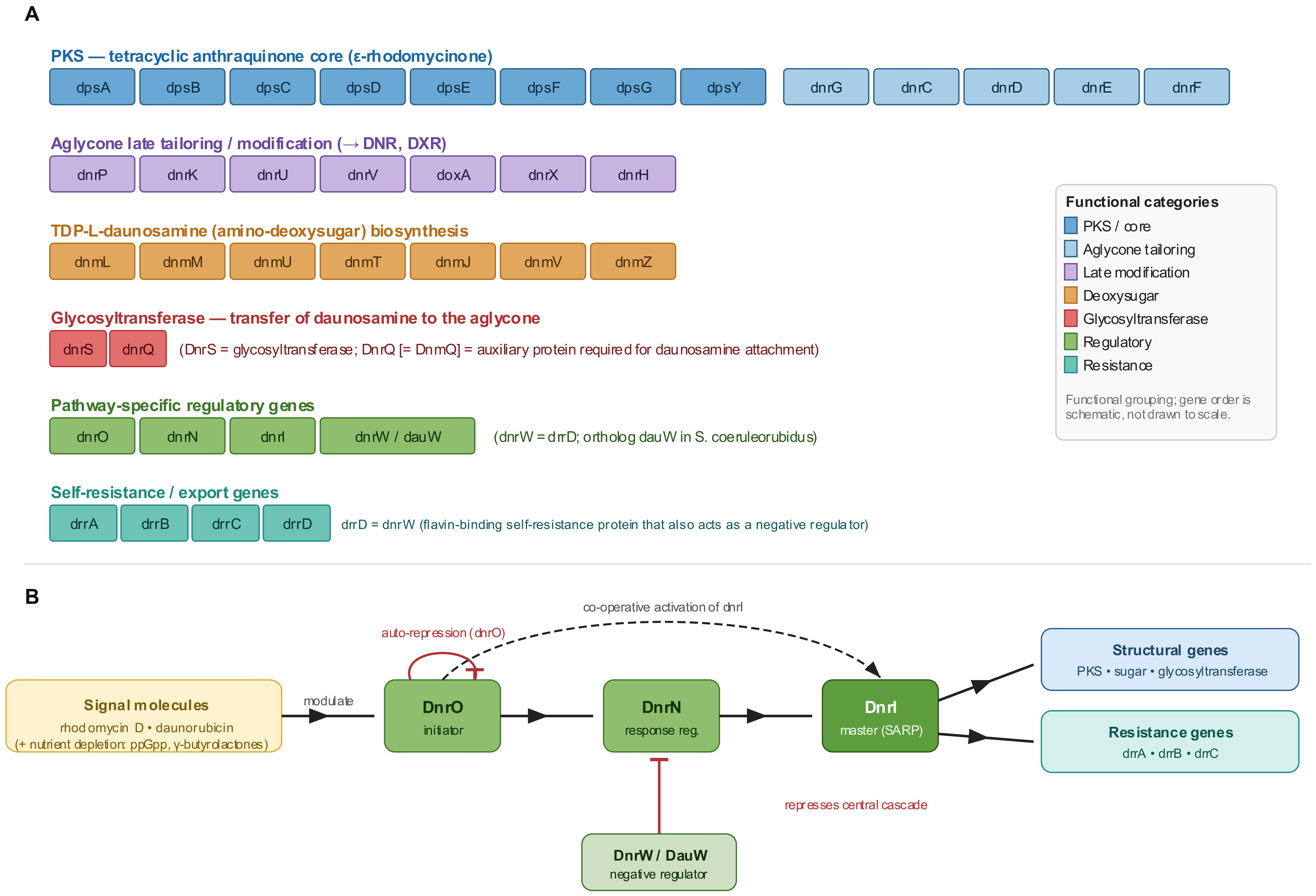
The principal and best-characterized natural producer is Streptomyces peucetius, which was first isolated and described in the early 1960s [16,51]. The wild-type strain S. peucetius ATCC 29050 primarily synthesizes daunomycin as its major anthracycline product and contains the daunorubicin biosynthetic gene cluster responsible for the assembly of the anthracycline aglycone—ε-rhodomycinone, formation of thymidine diphosphate daunosamine, glycosylation with daunosamine, and subsequent tailoring reactions (Figure 4, which details the biosynthetic gene cluster) [23,63].
This strain produces from 6.1 mg L−1 daunorubicin in a non-acidified medium to 45.3 mg L−1 in a medium acidified with oxalic acid [63]. The intracellular concentration of anthracyclines in the producing strain is tightly regulated and maintained below lethal levels by a complex network of regulatory systems, including transcription factors, sigma factors, and small regulatory RNAs (sRNAs), whose activity is modulated by the availability or depletion of signaling molecules, including pathway intermediates such as rhodomycin D and daunorubicin itself, which directly modulate the DNA-binding activity of DnrO and genus-wide nutrient-responsive signals such as the alarmone (p)ppGpp and γ-butyrolactone autoregulators that trigger secondary metabolism upon nutrient limitation [37,64,65,66]. In addition to resistance determinants and regulatory proteins, the biosynthetic gene cluster represents the principal genetic unit responsible for secondary metabolite production [67]. Consequently, the biosynthesis of these compounds can be precisely modulated by reconfiguring the underlying genetic network of biosynthetic and regulatory genes [37].
A mutagenized derivative of S. peucetius designated S. peucetius subsp. caesius ATCC 27952 was developed by treatment with N-nitroso-N-methyl urethane. Its complete genome consists of 8,023,114 bp with a linear chromosome, 7187 protein-coding genes, 18 rRNA operons, and 66 tRNAs [68]. This mutant strain differs from its parent not only in the morphological aspects of its vegetative and aerial mycelia but more importantly in its biochemical profile, manifesting enhanced capacity for C-14 hydroxylation of daunomycin to yield doxorubicin as the predominant anthracycline product. Other techniques, such as overexpressing bldA (a global regulatory gene in Streptomyces that encodes the only tRNA capable of translating the rare leucine codon TTA (UUA) with a central role in controlling secondary metabolism, bldA-25), dnrO (major transcriptional regulator required for the expression of the transcriptional activator dnrN, dnrO-25), and a combination of bldA and dnrO (bldnrO-25) in bldA-deficient Streptomyces peucetius ATCC 27952, have also been used to increase daunomycin biosynthesis [37]. Consequently, S. peucetius subsp. caesius has become a critical reference strain for metabolic engineering studies aimed at improving anthracycline biosynthesis [45,68].
In addition to S. peucetius, Streptomyces coeruleorubidus has been identified as an independent natural producer of daunomycin [51]. This organism was discovered concurrently in the 1960s by Dubost and colleagues at Rhône-Poulenc, who initially designated the isolated compound as rubidomycin before it was recognized to be structurally identical to daunomycin [69]. S. coeruleorubidus possesses a biosynthetic pathway highly homologous to that of S. peucetius. However, certain strains, such as S. coeruleorubidus ISP 5145, have been reported to produce only minimal quantities of daunomycin while generating a similar spectrum of related metabolites [70,71]. Other strains, such as S. coeruleorubidus ME130-A4, ME 130-A4 (FERM P-3540), have been developed for daunomycin production [72].
Beyond these two main strains, daunomycin production appears to be phylogenetically restricted within the Streptomyces genus [51]. While several other Streptomyces species synthesize structurally related anthracyclines through analogous type II polyketide synthase (PKS-II) pathways (including nogalamycin, aclacinomycin, and various rhodomycin derivatives), the specific combination of biosynthetic genes required for authentic daunorubicin assembly is not widely distributed [73]. The limited distribution of natural daunomycin producers, coupled with the extensive genetic and biochemical characterization of the S. peucetius system, has established this organism as the definitive model for studies on anthracycline biosynthesis, regulatory mechanisms, metabolic engineering, and industrial strain improvement strategies.
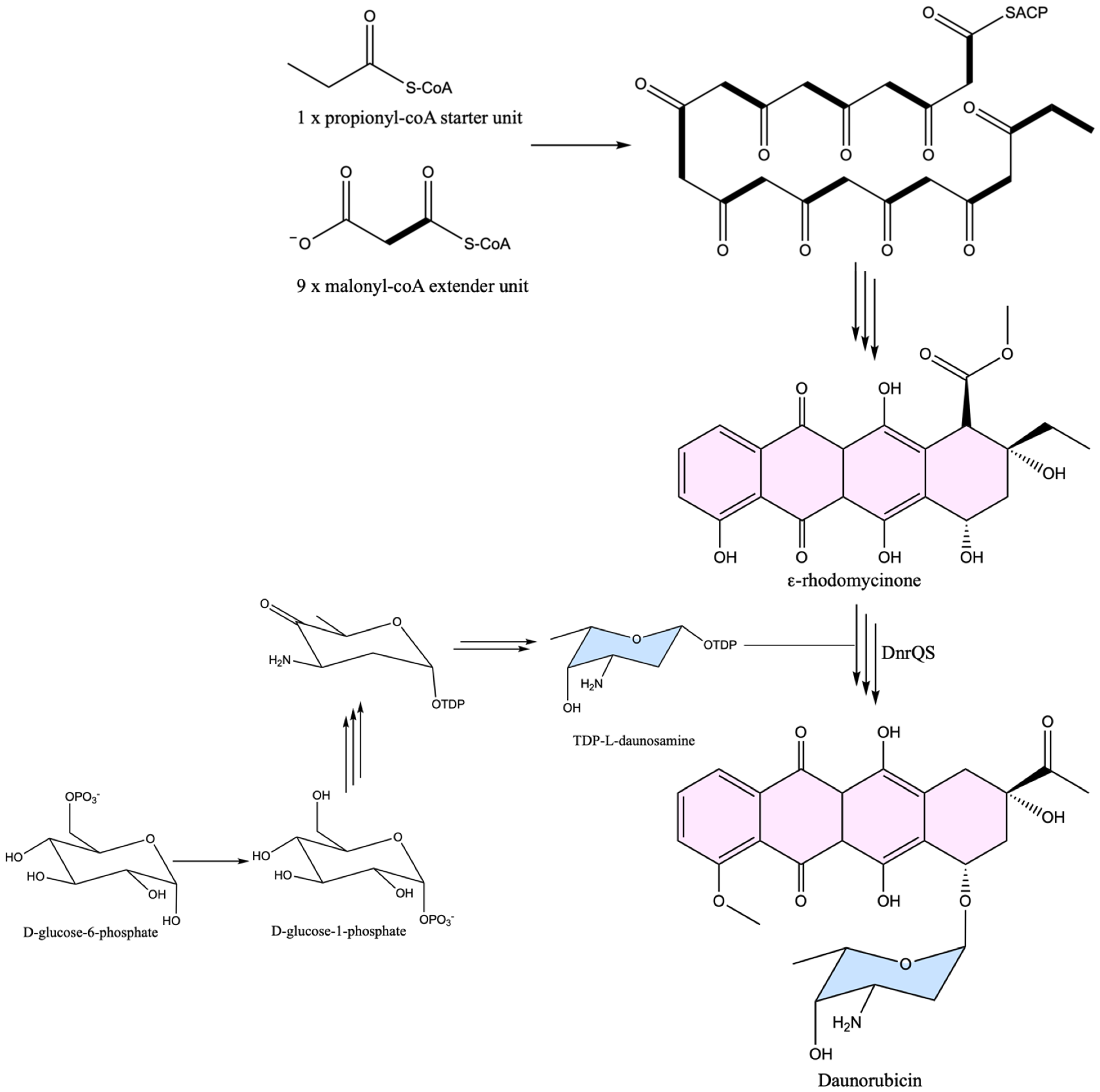
Daunomycin biosynthesis in Streptomyces peucetius and Streptomyces coeruleorubidus shares a highly conserved anthracycline biosynthetic framework. In both microorganisms, the pathway is encoded within a dedicated gene cluster that integrates structural genes for metabolite formation with pathway-specific regulators and self-resistance determinants [44]. The biosynthetic process follows the classical anthracycline pathway logic, beginning with the assembly of the polyketide backbone by a type II polyketide synthase (PKS), which condenses one propionyl-CoA starter unit with multiple malonyl-CoA extender units (Figure 5). Subsequent cyclization, aromatization, and oxidation reactions generate the key aglycone intermediate ε-rhodomycinone, which serves as a precursor for subsequent enzymatic modification steps [23,74].
In parallel with aglycone formation, both species synthesize the amino deoxysugar daunosamine via a dedicated pathway involving epimerases, reductases, and nucleotide-dependent modifying enzymes. The final assembly of the antibiotic requires glycosylation of the aglycone, catalyzed by specific glycosyltransferases such as DnrS and DnrQ or their functional homologs.
This step is critical for biological activity and represents a major control point for metabolic flux toward daunomycin [22,75]. In both S. peucetius and S. coeruleorubidus, the expression of structural genes is coordinated by pathway-specific transcriptional regulators, with DnrI acting as the central positive regulator that activates multiple biosynthetic operons [76]. In addition, both organisms possess Drr-type ATP-Binding Cassette (ABC) transport systems that actively export daunomycin, providing self-resistance and contributing to improved production capacity [76,77,78].
Despite this high level of biochemical conservation, important differences exist at the regulatory and physiological levels. In S. peucetius, pathway control is primarily mediated by multiple transcriptional regulators, including DnrI (positive regulator) and DnrO (dual regulator that activates the daunorubicin biosynthetic cascade through sequential induction of DnrN and DnrI, while concurrently functioning as a pathway-specific negative regulator through self-repression of its own transcription), and DnrN, and strain improvement strategies have focused mainly on enhancing precursor supply, increasing gene dosage, or overexpressing key tailoring enzymes. In contrast, S. coeruleorubidus contains an additional regulatory element, the DauW gene (orthologous gene with DnrW and DrrD), located within the anthracycline cluster. Functional studies have demonstrated that dauW negatively regulates daunomycin biosynthesis [36]. Disruption or deletion of DauW results in a significant increase in antibiotic production, accompanied by elevated transcription of DnrI and enhanced self-resistance capacity, indicating that DauW modulates pathway output by repressing the central regulatory cascade. Another strategy considered the enhancement of dTDP-L-daunosamine availability. In vitro reconstitution of the dTDP-L-daunosamine biosynthetic pathway identified the aminotransferase step as the major rate-limiting bottleneck, suggesting that overexpression or engineering of this enzyme for higher catalytic efficiency represents a direct approach to increase pathway flux. Additionally, competing side reactions that divert dTDP-sugar intermediates away from dTDP-L-daunosamine biosynthesis highlight the importance of attenuating or deleting competing enzymatic activities to maximize net precursor availability. Furthermore, strengthening the upstream supply of dTDP-4-keto-6-deoxy-glucose, the key precursor for daunosamine biosynthesis, constitutes an additional engineering target [22].
Another distinguishing feature is the broader secondary metabolite profile of S. coeruleorubidus, which produces not only daunomycin but also related anthracyclines such as rubomycins, suggesting differences in pathway flux distribution and tailoring enzyme specificity [79]. In contrast, S. peucetius is more specialized toward daunomycin production and serves as the principal industrial source and precursor platform for doxorubicin manufacturing [45].
Overall, daunomycin biosynthesis in S. peucetius and S. coeruleorubidus relies on a conserved enzymatic core consisting of type II PKS-mediated backbone formation, deoxysugar biosynthesis, glycosylation, transcriptional activation by DnrI, and active efflux-based self-protection. The major divergence between the two species lies in regulatory architecture, particularly the presence of the negative regulator DauW in S. coeruleorubidus, which introduces an additional layer of control over pathway expression. These differences are of practical importance to metabolic engineering and strain improvement, as they define distinct intervention points for enhancing industrial daunomycin production.

3.3. Bottlenecks in Native Daunomycin Biosynthesis

Although Streptomyces species can efficiently produce daunomycin, industrial titers remain constrained by multiple regulatory and physiological aspects. Among the key constraints are
-
Inadequate biosynthesis and availability of the activated sugar precursor thymidine diphosphate-L-daunosamine (TDP-daunosamine) needed for the glycosylation of aglycone;
-
Low catalytic efficiency of the glycosyltransferase DnrS responsible for daunosamine attachment at the C-7 position, leading to accumulation of non-glycosylated intermediates;
-
Intrinsic cytotoxicity of daunomycin and its biosynthetic intermediates;
-
Stringent transcriptional regulation mediated by pathway-specific regulators (DnrI, DnrN, DnrO) and global regulatory networks that temporally restrict and often suppress biosynthetic gene expression under standard fermentation conditions [45,80].
At the transcriptional level, expression of the daunomycin biosynthetic gene cluster (Dau/Dnr) is tightly controlled by pathway-specific regulators, such as DnrI and DnrN, as well as by global regulatory networks associated with morphological differentiation, nutrient sensing, and secondary metabolism. These regulatory layers result in suboptimal expression of key biosynthetic enzymes under industrial fermentation conditions [77].
Another major constraint concerns product-associated toxicity and feedback effects. Daunomycin exhibits cytotoxicity, affecting cellular viability, reducing growth rates, and altering membrane integrity at elevated intracellular concentrations. To mitigate self-toxicity, Streptomyces peucetius relies on multiple complementary resistance mechanisms. However, the capacity of these systems is limited and may become inefficient during overproduction [45]. The primary defense is active efflux mediated by the DrrA–DrrB ABC transporter system, which maintains daunorubicin at subinhibitory intracellular concentrations by continuously exporting excess drug; deletion of these genes leads to toxic intracellular accumulation and a 10-fold decrease in production [81]. At the extracellular level, a secreted serine protease forms a specific daunorubicin–protease complex that neutralizes the drug outside the cell, preventing its re-uptake and maintaining a steady-state subinhibitory drug concentration in the cellular environment [82]. Accumulation of the final product can also cause feedback inhibition, leading to decreased biosynthetic activity and limiting achievable titers [83]. Additionally, the formation of biogenic iron–daunorubicin nanoparticles, based on daunomycine’s iron chelating ability and hydrophobicity, has been described as an autonomous defense mechanism that incorporates free daunorubicin, thereby reducing its bioavailability and cytotoxicity [84]. Complementing these strategies, DrrC, a UvrA-like DNA-binding protein, provides an additional layer of protection by inhibiting or destabilizing the binding of daunorubicin to the producer’s genomic DNA, thereby preventing interference with gene expression and avoiding free radical damage associated with DNA-bound drug reduction [85].
Precursor supply represents an additional metabolic bottleneck, as daunomycin biosynthesis requires malonyl-CoA and propionyl-CoA for polyketide assembly, as well as activated sugar precursors for daunosamine formation. These metabolites compete with essential primary metabolic pathways, including fatty acid biosynthesis, energy metabolism, and synthesis of structural components. Insufficient availability of acetyl-CoA–derived intermediates can restrict polyketide synthase activity. Furthermore, imbalanced metabolic flux may lead to the accumulation of early intermediates, inefficient carbon utilization, and increased by-product formation, collectively reducing overall pathway efficiency [86,87].

4. Optimization Strategies to Improve Daunomycin Yield

Research efforts to increase daunomycin production in S. coeruleorubidus reflect a clear evolution from early fermentation-based approaches to the application of advanced molecular and metabolic engineering methodologies. During the foundational era (1977–1982), defining contributions by Blumauerová et al. (1977) established optimal culture medium compositions, while subsequent studies systematically characterized biotransformation pathways and identified feudomycin derivatives, revealing that S. coeruleorubidus produces a complex mixture of at least nine antibiotically active glycosides rather than pure daunomycin [71,88]. The molecular characterization period (1990–1999) marked the first cloning of daunomycin biosynthesis genes [78] and the identification of DpsC as a critical determinant of starter unit specificity, demonstrating that propionyl-CoA, rather than acetyl-CoA, serves as the polyketide starter unit [76]—a key insight into polyketide synthase selectivity. In the advanced engineering era (2008–2025), sophisticated metabolic and genetic interventions have further enhanced production: Shang et al. (2008) engineered strains to produce 4′-epidaunorubicin, Yuan et al. (2011) achieved an eightfold yield increase through targeted dauW deletion, Dong et al. (2024) characterized three distinct ABC transporters (drrAB1, drrAB2, drrAB3) as essential for daunomycin efflux, and Beneš et al. (2025) reported record titers of 5.5–6.0 g L−1 via oil-based fermentation inducing biogenic nanoparticle formation [36,64,79,84]. Collectively, these studies illustrate a progressive integration of fermentation optimization, molecular understanding, and metabolic engineering.
However, there is a biosynthetic and industrial coupling between daunomycin and doxorubicin, and thus, the optimization strategies are closely correlated. In Streptomyces peucetius subsp. caesius ATCC 27952, daunomycin serves as the direct precursor to doxorubicin. The final C-14 hydroxylation, which transforms daunomycin into doxorubicin, is catalyzed by a single cytochrome P450 monooxygenase, DoxA [83]. This enzyme also facilitates two earlier oxidation steps in the biosynthesis of 13-deoxydaunorubicin and 13-dihydrodaunorubicin [89]. Kinetic analysis of recombinant DoxA shows that the final C-14 hydroxylation is slower than the earlier C-13 oxidations [89,90]. This is the primary reason DoxA is widely regarded as the rate-limiting enzyme in doxorubicin biosynthesis [91]. Recent work on structural and redox-partner engineering has identified the native ferredoxin Fdx4 and ferredoxin reductase FdR3, along with the vicinal-oxygen-chelate protein DnrV, which diminishes product inhibition by sequestering doxorubicin. These modifications led to up to a 180% increase in titer in engineered strains [92]. Additionally, rational mutagenesis of DoxA, specifically the P88Y variant, resulted in a 56% improvement in bioconversion efficiency [91].
Since DoxA catalysis is inherently inefficient, nearly all commercial doxorubicin is produced by microbial fermentation followed by semi-synthetic conversion from daunomycin [93]. This industrial process has three implications for daunomycin production. Many strain-engineering studies in the daunomycin literature measure the DXR/daunomycin ratio rather than daunomycin alone, so comparing titers across studies requires careful attention to the analytical endpoint. Additionally, daunomycin serves as an industrial starting material for semi-synthesizing second-generation anthracyclines such as epirubicin (through C-4′ epimerization of daunosamine) and idarubicin (via C-4 demethoxylation of the aglycone) [53]. Any strategy that raises the daunomycin titer will benefit the entire second-generation anthracycline pipeline, not just daunomycin itself. Additionally, inhibiting the conversion of daunomycin to doxorubicin by inactivating DoxA or DnrV provides a viable approach for producing pure daunomycin. This simplifies downstream purification but eliminates the natural co-production of doxorubicin [93].
In the natural producer, the flux partitioning between daunomycin and doxorubicin serves as a controllable industrial variable: blocking C-14 hydroxylation optimizes daunomycin accumulation for subsequent chemical modification, while increasing DoxA activity shifts flux toward doxorubicin. The choice of strategy depends entirely on the desired compound, and both methods are active areas of research in metabolic engineering [91].

4.1. Genetic and Metabolic Engineering Approaches

Enhancing daunomycin production in Streptomyces species has been a central objective of metabolic and genetic engineering, aiming to overcome the inherent constraints of native biosynthetic pathways (Table 2). Strategies include
-
Targeted manipulation of regulatory genes and structural genes,
-
Optimization of sugar biosynthesis pathways,
-
Overexpression of positive transcriptional regulators, and
-
Modulation of self-resistance genes, often combined with inactivation of specific post-modification enzymes to redirect metabolic flux toward increased daunomycin yield.
An important approach is THE modulation of pathway-specific regulatory elements. Targeted disruption of the DauW gene in S. coeruleorubidus resulted in an approximately eightfold increase in daunomycin production, suggesting that DauW is an important negative regulator of the pathway [36]. Deletion of the wblAspe gene in S. peucetius OIM resulted in an increase in the total production of doxorubicin by approximately 70% and daunomycin by 150% compared to the parental strain under the same fermentation conditions [39]. Malla et al. (2009) examined the effect of over-expression of the self-resistance gene on the production of daunomycin by Streptomyces peucetius [80]. Using S. peucetius ATCC 27952 as the parental strain, recombinant strains overexpressing DrrAB, DrrC and the combined DrrABC genes were constructed. The engineered strains (S. peucetius DrrAB, DrrC, and DrrABC) showed a substantial increase in antibiotic production, with the strain carrying the plasmid pDrrAB25 showing a nearly 3-fold improvement in daunomycin yield compared to the wild type. The data reveal that overexpression of the Drr efflux system, which increases the capacity for cellular export and resistance, successfully alleviates the intracellular product toxicity and can be a feasible approach to enhance daunomycin productivity [80].

4.2. Bioprocess Optimization

Through systematic optimization of fermentation media and process parameters, significant advances in daunomycin production have also been made. Important strategies include the use of oils instead of traditional carbon sources, the use of statistical optimization methods, and the use of immobilized cell systems (Table 3). Reported production levels vary on an extremely broad range: from very low concentrations characteristic of wild-type strains cultivated under conventional conditions (strains such as S. peucetius ATCC 29050 or wild-type S. coeruleorubidus produce titers in the μg L−1 range or below 15 mg L−1), to moderate titers achieved through classical selection or process optimization (55–75 mg L−1 for Streptomyces insignis ATCC 31913 in aerated fermenters). A notable advancement is the optimization of culture medium composition and nutritional strategies, leading to substantial increases in productivity, based on oils (soy, corn, rapeseed, olive pomace) as superior carbon sources for high daunomycin titers, especially when combined with molasses or other complex feeds [97]. In the patented processes, time-programmed feeding strategies provide carbon and nitrogen sequentially to support growth and precursor supply, amino acids to enhance acetyl/propionyl CoA and S-adenosylmethionine availability, and fatty acids or oils to maintain PKS II activity in late fermentation. This staged approach is a key process-level factor consistently associated with daunomycin titers at or above 3 g L−1. The most remarkable recent example is the S. coeruleorubidus RTA 2210 strain, which produces 5.5–6.0 g L−1 daunomycin in optimized oil-based media (olive pomace oil), almost three times higher than in conventional glucose-based media, and 1000 times higher than in wild-type strains. The improved performance was enabled by an autonomous resistance mechanism based on the formation of biogenic daunomycin-iron nanoparticles [84].
Overall, the data highlight the importance of strain selection, medium optimization and process intensification for improving biosynthesis of daunomycin, providing a relevant comparative framework to benchmark fermentation performance and set realistic targets for process development and industrial scale-up. The literature suggests that titers of 0.5–1.0 g L−1 or greater are required for industrial economic viability, a threshold that is significantly exceeded by the new lipid-based media approaches.
The comparison of strains considering volumetric productivity indicates different results between glucose-based and lipid-based processes. The best oil-fed systems achieve ~0.02 g L−1 h−1. On the other hand, glucose-fed wild-type cultures remain below 10−3 g L−1 h−1. This difference may partly reflect the sustained precursor supply offered by lipid catabolism during the idiophase, as required polyketide biosynthesis precursors are provided by primary metabolism, a source that becomes limiting as cultures enter the stationary phase [86]. Oil-based media can also develop an independent daunomycin-resistance mechanism through biogenic nanoparticle formation, further differentiating these systems from typical glucose-fed systems.
Optimal fermentation of daunomycin typically proceeds over 168–192 h (7–8 days) under tightly controlled environmental and nutritional conditions. Temperature and pH are maintained to support both growth and production, with optimal microbial growth occurring at 26–30 °C (typically 28 °C) and an initial pH of 7.5–8.0, controlled to 6.8–7.5 throughout fermentation.
The control of dissolved oxygen is usually phase-dependent: above 45% for the early growth phase (0–36 h) to enable rapid biomass accumulation, adjusted to 10–45% for the production phase (37–120 h), and above 30% for the late phase (>121 h) to enable secondary metabolism. In a staged strategy, nutrient supplementation is used to improve precursor availability and enzymatic activity. In the early phase (0–48 h), 0.1–2.0% sodium bicarbonate increases production by ~28%; in the mid-phase (48–96 h), 0.01–0.10% S adenosylmethionine increases yield by ~32%; and in the late phase (72–144 h), 0.1–3.0% rapeseed oil or fatty acids increases production by ~45%. Used in combination, these additive and environmental strategies can lead to cumulative improvements in yield of 65–72% over baseline fermentation [98]. The progression from 1.0 g L−1 baseline production to 5.5–6.0 g L−1 in recent studies represents a 5–6-fold improvement, making industrial-scale daunomycin production more efficient. Key drivers include
-
Deletion of negative regulators (8-fold improvement);
-
Fed-batch fermentation optimization (15–25% improvement);
-
Additive supplementation strategies (65–72% cumulative improvement);
-
Oil-based fermentation with autonomous resistance (3-fold improvement)

4.3. Techno-Economic Considerations

The economics of daunomycin manufacturing are dominated by downstream processing. In fermentation-based production of secondary metabolites, downstream recovery and purification typically account for 50–80% of total manufacturing cost, a share that rises further for low-titer products such as anthracyclines, where purification volumes are large, and solvent consumption is extensive [100]. Cost of goods sold (COGS) is highly sensitive to fermentation titer: doubling the titer from 1 to 2 g L−1 typically reduces COGS by 40–60% by concurrently reducing fermenter size, utility consumption, and downstream unit operations [101]. This sensitivity largely explains the industrial attractiveness of the oil-based high-titer media developed in recent patents and academic reports [84]. It justifies the commonly cited minimum titer of 0.5–1.0 g L−1 for the economic viability of anthracycline fermentations at the industrial scale [23,45].
Anthracycline production has a low performance from the green chemistry perspective. Conventional solvent-based recovery (extraction with chloroform followed by chromatography on silica gel) yields process mass intensity (PMI) values in the hundreds to low thousands of kg waste per kg active pharmaceutical ingredient (API), in line with typical values for complex-molecule API synthesis [102]. Resin-based adsorption (LX-20 or LX-68M macroporous resins) replaces liquid-liquid extraction, reducing the solvent intensity and hence E-factor, while energy use and effluent load are also reduced in parallel.

5. Daunomycin Downstream from the Fermentation Broth

Purification and recovery of biotechnologically produced metabolites are critical and yet challenging stages of the overall process, due to the complex composition of fermentation broths and the typically low product concentrations. Although significant progress has been made in developing downstream processes for daunomycin recovery, several technological and knowledge gaps remain, limiting overall process efficiency, scalability, and economic viability.
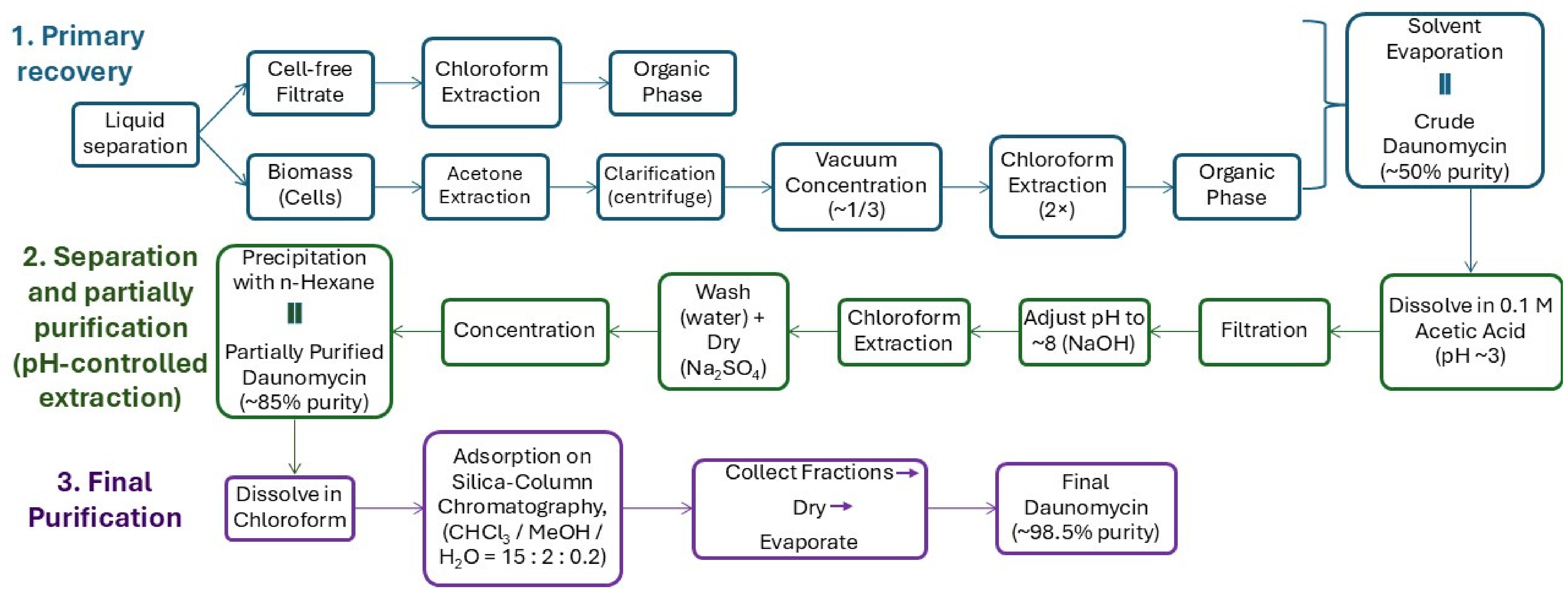
Downstream recovery of daunomycin is generally based on solvent extraction strategies that recover both the extracellular fraction present in the culture supernatant and the intracellular or cell-associated fraction (Figure 6). After completion of fermentation, the broth is subjected to primary solid–liquid separation (centrifugation or filtration) to remove microbial biomass. Daunomycin present in the clarified supernatant can be recovered by liquid–liquid extraction with organic solvents such as chloroform. In parallel, the biomass fraction may be treated with a polar solvent (e.g., acetone) to release intracellular product, followed by clarification, concentration under reduced pressure, and secondary extraction into an immiscible organic phase. The combined organic extracts are subsequently concentrated to obtain a crude daunomycin product of moderate purity. Further purification relies on pH-controlled re-extraction and solvent fractionation steps that exploit the amphoteric nature of daunomycin. The crude extract is dissolved in a dilute acidic solution to remove insoluble impurities, then adjusted to alkaline pH and back-extracted into an organic solvent to enhance selectivity and recovery. After washing and drying of the organic phase, solvent removal and antisolvent precipitation (e.g., with n-hexane) yield a partially purified product, while final purification is commonly achieved by adsorption or silica gel chromatography to obtain high-purity daunomycin [72].
An alternative, industrially oriented approach, described in the patent literature, bypasses the need for extensive liquid-liquid solvent extraction by combining resin-based adsorption and chelation steps. In this workflow, the fermentation broth is filtered first to remove cells. The clarified liquid is passed through a macroporous adsorptive resin (LX-20 or LX-68M type), which selectively retains daunomycin but allows the hydrophilic impurities to pass. The resin-based product is then treated with ethylenediaminetetraacetic acid (EDTA) salts to complex metal ions and remove metal-associated contaminants. Controlled pH and column operation minimize impurities. The product is recovered by crystallization and concentration. This method provides a solvent-efficient and scalable alternative suitable for industrial production with emphasis on environmental and operational benefits while ensuring high product purity [100].
Classical recovery techniques such as solvent extraction and adsorption-based purification provide reliable separation but usually consist of multiple unit operations, high solvent usage and problems related to product losses and environmental impact [84]. Instead of the conventional recovery of the soluble product, some processes rely on the controlled precipitation of daunomycin in an inactive form directly from the cultivation medium, such as a biogenic nanoparticle. Precipitation occurs through the autonomous-defense mechanism: in an oil-based medium, daunomycin’s iron-chelating ability and hydrophobicity drive the formation of biogenic iron–daunomycin nanoparticles/complexes that partition into the solid sediment as an inactive form. The solid phase is easily separated and re-extracted with a strong acid, which simplifies the subsequent operations. In addition to better process control, precipitation-based recovery results in lower consumption of chlorinated hydrocarbons compared to conventional solvent extraction, which reduces operational costs and environmental impact [84].

6. Post-Biosynthetic Formulation and Delivery Strategies to Improve Daunomycin Treatment Results

Anthracycline antibiotics such as daunomycin are highly potent chemotherapeutic agents, exerting their effects by mechanisms including DNA intercalation, free radical generation, and topoisomerase II inhibition. However, their therapeutic potential is often limited due to poor solubility, fast systemic clearance and off-target toxicity [103]. To overcome these shortcomings, different post-biosynthetic formulation and delivery strategies were developed in order to increase bioavailability, higher accumulation at target tissues and lower systemic side effects [104,105,106,107,108].
The therapeutic performance of daunomycin can be substantially enhanced through a combination of targeted and controlled delivery, rational structural modification, and synergistic combination strategies, which can improve malign cell selectivity and reduce systemic toxicity and drug resistance [109,110,111].

6.1. Nano- and Biohybrid Delivery Systems

Specific drug delivery systems (polymeric nanoparticles, PEGylated drug systems, liposomes, and micelles) can improve drug bioavailability and efficacy. Nanocarrier platforms have been extensively explored to improve daunomycin accumulation and controlled release [112,113,114,115,116]. For example, dense DNA-coated gold nanoparticles (AuNPs) can load over 1000 daunomycin molecules per particle, provide sustained release for 48 h, and enhance cytotoxicity compared to the free drug, while maintaining the optimal size range (16–100 nm) for accumulation in the tumor [112]. Ternary gold-based systems combining AuNPs, gemini surfactants, and DNA–daunomycin complexes, Au@16-Ph-16/DNA–Dauno, have demonstrated potent activity against pediatric B-cell acute lymphoblastic leukemia (B-ALL) cell lines at minimal drug concentrations, suggesting potential for cost-effective yet highly efficacious therapy [109]. Magnetic nanocarriers functionalized with avidin and carrying iminobiotinylated daunomycin achieve high loading efficiency (~94%) and reduced IC50 values (concentration of a compound required to inhibit a given biological response by 50%) compared with free drug, with pH- and biotin-triggered release, and offer prospects for magnetically guided tumor targeting [117,118]. Studies have shown that DaunoXome (nanoliposomal daunomycin) improves drug delivery to hematological malignancies and offers several advantages over free daunomycin: enhanced efficacy against multidrug-resistant cell lines, a more favorable toxicity profile, and the ability to cross the blood–brain barrier [119,120]. Liu et al. (2023) investigated folic acid-modified PEGylated liposomes for the co-delivery of hydrophobic homoharringtonine and hydrophilic daunomycin [121]. This system achieved high encapsulation efficiency, optimal synergistic drug ratios, and enhanced antitumor efficacy compared to free drug combinations, while reducing systemic toxicity. Through both active and passive targeting mechanisms, the drugs preferentially accumulated at tumor sites, thereby minimizing toxicity to major organs [121].

6.2. Antibody and Peptide Conjugates (Targeted Delivery)

Targeting daunomycin to specific tumor cells via antibodies or cell-penetrating peptides improves selectivity and reduces off-target effects: conjugates with oligoarginine peptides (e.g., Arg6) preserve the drug’s DNA-binding and topoisomerase-inhibitory functions, efficiently deliver daunomycin into cells, and maintain potent in vitro cytotoxicity [122]. Szász et al. (2024) investigated peptide–drug conjugates for pancreatic cancer targeting by identifying three octapeptides (EPSQSWSM, ETPPSWGG, and GSSEQLYL) and conjugating them to daunomycin through a dual-linker system comprising an oxime bond and a cleavable tetrapeptide sequence, enabling tumor-specific drug delivery and controlled release [123]. Enyedi et al. (2017) investigated cyclic NGR peptide–daunomycin conjugates exploiting dual tumor-targeting mechanisms: NGR peptides (peptides containing the asparagine–glycine–arginine domain) bind CD13 receptors on tumor vasculature, while their isoAsp degradation products target RGD-binding integrins involved in metastasis. Four conjugates with varying stability were synthesized and tested on CD13-positive and -negative cell lines, revealing that C-terminal drug conjugation via enzyme-labile spacers provided superior antitumor activity compared to branched designs [124,125].

6.3. Structural Optimization and Combination Therapy

Rational chemical modification and co-delivery strategies further enhance the efficacy of daunomycin. Polymethoxybenzyl substitutions on the sugar amino group yield daunomycin derivatives with higher DNA affinity, stronger disruption of the cell cycle and glycolysis, and improved cytotoxicity compared with the parent drug, alongside predicted enhancements in pharmacokinetic and toxicity profiles [110,111]. Charak et al. (2025) investigated idarubicin, a daunomycin analog with enhanced activity due to a methoxy-to-hydrogen substitution, demonstrating strong, spontaneous binding to tRNA at guanine, uracil, and adenine sites, creating stable complexes while preserving tRNA’s A-form structure [126]. These findings elucidate the dynamics of anthracycline binding and guide the development of improved analogs with enhanced efficacy and reduced toxicity for tRNA-targeted cancer therapies [126].

7. Future Research Directions

The performed analysis shows that several major gaps remain, limiting industrial productivity (Table 4). The real-time adaptive control of fermentation parameters, including dissolved oxygen, nutrient feeding, and additive supplementation, remains largely unexplored. Advanced artificial intelligence (AI) and machine learning (ML) approaches could allow dynamic optimization of these variables to maximize yield and reproducibility. Complementary to process control, comprehensive transcriptomic and proteomic profiling is needed for various fermentation phases to identify rate-limiting enzymes and control bottlenecks, providing molecular targets for metabolic intervention.
From a practical implementation perspective, scale-up challenges continue to hinder industrial application, as metabolic regulation and product distribution may shift unpredictably at both pilot and industrial scales. Heterologous expression of the daunomycin biosynthetic pathway in safer, well-characterized hosts such as Streptomyces coelicolor represents a promising strategy to address biosafety concerns and enable flexible strain engineering. Integration of modern synthetic biology tools, including CRISPR-based genome editing and modular regulatory circuits, could accelerate the development of high-performing strains and allow systematic optimization of pathway flux [127]. Addressing these gaps through a combination of systems biology, structural insights, and advanced bioprocessing is required to unlock the full biosynthetic potential of daunomycin and related anthracyclines.
Table 4. Major knowledge gaps and proposed research priorities.
Focus AreaPriority DirectionsKey References
Systems biology of daunomycin Multi-omics (transcriptomics, proteomics, metabolomics) under high-production conditions; regulatory network reconstruction; genome-scale flux modeling of PKS and sugar pathways[128]
Mechanisms of self-resistanceCharacterization of efflux, target modifications, and nanoparticle-based sequestration; identification of regulatory circuits controlling these systems[84]
Rational medium and process designRedox-controlled fermentations, iron speciation studies, lipid type/systematic screening; linking physiochemical parameters to transcriptional and metabolic responses[127,129]
New hosts and strain discoveryGenome mining for alternative anthracycline producers; development of heterologous hosts (engineered Streptomyces, Actinomycetes, or yeasts) for daunomycin pathways[128]
Advanced metabolic/synthetic biology toolsCRISPR editing, dynamic control circuits, modularization of type II PKS and sugar pathways, AI-assisted design of enzymes and regulatory parts[128]
Sustainable downstream processingContinuous chromatography, in situ product removal, aqueous two-phase systems, membrane-assisted extraction, integrated continuous manufacturing[130,131]
One major research gap in the industrial production of daunomycin concerns the advancement of more selective and sustainable separation technologies. Advanced adsorption materials, membrane-based separations, and aqueous two-phase systems for anthracycline recovery remain unexplored, although they have the potential to reduce solvent usage and improve selectivity. In addition, there is a limited understanding of interactions between daunomycin and biomass components during cell disruption and clarification, which affects recovery yields and process robustness.
Process integration and real-time control also represent important future directions. Most existing downstream schemes operate in a sequential batch-based manner with limited process monitoring. The implementation of process analytical technologies and AI/ML-assisted control strategies could permit dynamic adjustment of pH, extraction conditions and phase separation parameters, thus improving consistency and reducing product degradation.
Subsequent research should also focus on downstream–upstream integration, aligning fermentation conditions with recovery requirements to reduce impurity content in the fermentation broth and simplify purification. The application of process intensification concepts, such as continuous extraction, in situ product removal and hybrid separation systems, offers promising opportunities to increase overall productivity. Dealing with these gaps will be essential to developing economically sustainable, industrially robust processes for daunomycin recovery.

8. Conclusions

Recent advances in daunomycin biosynthesis have significantly enhanced production efficiency and therapeutic potential through multiple strategic approaches. Complete elucidation of the daunomycin biosynthetic gene cluster in Streptomyces species has enabled targeted genetic engineering to optimize yield, including overexpression of rate-limiting enzymes.
Looking forward, emerging trends could be used to transform daunomycin production platforms: systems biology and machine learning approaches are enabling predictive modeling of biosynthetic pathways for rational strain design; cell-free biosynthesis systems offer simplified production environments with enhanced control; and semi-synthetic approaches combining fermentation with chemical modification provide access to structurally complex analogs. Furthermore, integrating continuous fermentation technologies, real-time process monitoring, and sustainable downstream methods promises to reduce costs and environmental impact while maintaining product quality, positioning these platforms for scalable, economically viable production of both daunomycin and next-generation anthracycline therapeutics.

Supplementary Materials

The following supporting information can be downloaded at https://www.mdpi.com/article/10.3390/fermentation12070304/s1, Table S1: Query for each sub-field; Table S2: Topic overlap; Table S3: Data validation.

Author Contributions

Conceptualization, A.C.B. and I.C.; methodology, A.C.B.; software, E.N.D.; validation, A.C.B. and E.N.D.; formal analysis, A.C.B. and I.M.; investigation, E.N.D.; resources, A.C.B., I.C. and I.M.; data curation, A.C.B. and E.N.D.; writing—original draft preparation, A.C.B. and E.N.D.; writing—review and editing, A.C.B., I.C., I.M. and E.N.D.; visualization, A.C.B.; project administration, A.C.B., I.C. and I.M.; funding acquisition, A.C.B., I.C. and I.M. All authors have read and agreed to the published version of the manuscript.

Funding

This research was funded by the project entitled “BIOTECH NEXT GEN—Establishment of an Advanced Center for Research and Innovation in Next-Generation Biotechnologies”, SMIS code 338517, co-financed by the European Union through the North—East Regional Program 2021–2027 (Romania), part of European Regional Development Fund (ERDF). The implementation of this project is carried out by the private company M.I.B. T.H. S.R.L.—Lead Partner, in partnership with Iasi University of Life Sciences (IULS), contributing to the enhancement of innovation, competitiveness, and sustainable development in line with the Regional Smart Specialisation Strategy—RIS3 North-East 2021-2027.

Institutional Review Board Statement

Not applicable.

Data Availability Statement

The data will be available upon request.

Acknowledgments

This research is part of the project entitled “BIOTECH NEXT GEN—Establishment of an Advanced Center for Research and Innovation in Next-Generation Biotechnologies”, SMIS code 338517, co-financed by the European Union through the North–East Regional Program 2021–2027 (Romania), part of European Regional Development Fund (ERDF). The implementation of this project is carried out by the private company M.I.B. T.H. S.R.L.—Lead Partner, in partnership with Iasi University of Life Sciences (IULS), contributing to the enhancement of innovation, competitiveness, and sustainable development in line with the Regional Smart Specialisation Strategy—RIS3 North-East 2021-2027.

Conflicts of Interest

Authors Alexandra Cristina Blaga, Irina Cârlescu and Ioan Mămăligă were employed by the company S.C. M.I.B. T.H. S.R.L. The authors declare no conflicts of interest. The funders had no role in the design of the study; in the collection, analyses, or interpretation of data; in the writing of the manuscript; or in the decision to publish the results.

Abbreviations

The following abbreviations are used in this manuscript:
AIArtificial Intelligence
AMLAcute myeloid leukemia
ALLAcute lymphoblastic leukemia
AuNPsGold nanoparticles
IDAIdarubicin
MLMachine Learning
PKSPolyketide synthase

References

  1. Von Hoff, D.D.; Rozencweig, M.; Slavik, M. Daunomycin: An Anthracycline Antibiotic Effective in Acute Leukemia. In Advances in Pharmacology; Garattini, S., Goldin, A., Hawking, F., Kopin, I.J., Schnitzer, I.J., Eds.; Academic Press: Cambridge, MA, USA, 1978; Volume 15, pp. 1–50. [Google Scholar]
  2. Mattioli, R.; Ilari, A.; Colotti, B.; Mosca, L.; Fazi, F.; Colotti, G. Doxorubicin and other anthracyclines in cancers: Activity, chemoresistance and its overcoming. Mol. Asp. Med. 2023, 93, 101205. [Google Scholar] [CrossRef] [PubMed]
  3. Anand, U.; Dey, A.; Chandel, A.K.S.; Sanyal, R.; Mishra, A.; Pandey, D.K.; De Falco, V.; Upadhyay, A.; Kandimalla, R.; Chaudhary, A.; et al. Cancer chemotherapy and beyond: Current status, drug candidates, associated risks and progress in targeted therapeutics. Genes Dis. 2023, 10, 1367–1401. [Google Scholar] [CrossRef] [PubMed]
  4. Zhuang, J.; Li, Y.; Zhang, Y.; Huang, Y.; Han, Y.; Lin, N.; Li, Y. Mechanisms, treatment strategies and predictive biomarkers of drug resistance in acute myeloid leukemia. Mutat. Res.-Rev. Mutat. Res. 2026, 797, 108578. [Google Scholar] [CrossRef] [PubMed]
  5. Xu, J.; Song, C.; He, Y.; Huang, R.; Tu, S. The clinical observation of none-promyelocytic AML patients inducted with idarubicin or daunorubicin included standard regimens: A tertiary care center experience. BMC Pharmacol. Toxicol. 2025, 26, 10. [Google Scholar] [CrossRef] [PubMed]
  6. Torma, L.; Gaál, A.; Ranđelović, I.; Tóvári, J.; Varga, Z.; Szakács, G.; Szoboszlai, N. Development of daunorubicin-loaded bovine serum albumin nanoparticles–preparation, characterisation, optimization of production process, investigation of in vitro and in vivo toxicity and activity. Colloids Surf. B Biointerfaces 2026, 264, 115623. [Google Scholar] [CrossRef] [PubMed]
  7. Koirala, N.; Butnariu, M.; Panthi, M.; Gurung, R.; Adhikari, S.; Subba, R.K.; Acharya, Z.; Popović-Djordjević, J. Chapter 12-Antibiotics in the management of tuberculosis and cancer. In Antibiotics-Therapeutic Spectrum and Limitations; Dhara, A.K., Nayak, A.K., Chattopadhyay, D., Eds.; Academic Press: Cambridge, MA, USA, 2023; pp. 251–294. [Google Scholar]
  8. Korniłłowicz-Kowalska, T.; Rybczyńska-Tkaczyk, K. Growth conditions, physiological properties, and selection of optimal parameters of biodegradation of anticancer drug daunomycin in industrial effluents by Bjerkandera adusta CCBAS930. Int. Microbiol. 2020, 23, 287–301. [Google Scholar] [CrossRef] [PubMed]
  9. Market Research Intellect. Daunorubicin Hydrochloride Injection Market (2026–2035). Available online: https://www.marketresearchintellect.com/product/daunorubicin-hydrochloride-injection-market/ (accessed on 26 May 2026).
  10. Kim, B.R.; Kim, D.Y.; Tran, N.L.; Kim, B.G.; Lee, S.I.; Kang, S.H.; Min, B.Y.; Hur, W.; Oh, S.C. Daunorubicin induces GLI1-dependent apoptosis in colorectal cancer cell lines. Int. J. Oncol. 2024, 64, 66. [Google Scholar] [CrossRef] [PubMed]
  11. Adeyemi, S.A.; Ngema, L.M.; Choonara, Y.E. Advances in targeted therapies and emerging strategies for blood cancer treatment. RSC Pharm. 2025, 2, 950–961. [Google Scholar] [CrossRef]
  12. Keresteš, V.; Kubeš, J.; Applová, L.; Kollárová, P.; Lenčová-Popelová, O.; Melnikova, I.; Karabanovich, G.; Khazeem, M.M.; Bavlovič-Piskáčková, H.; Štěrbová-Kovaříková, P.; et al. Exploring the effects of topoisomerase II inhibitor XK469 on anthracycline cardiotoxicity and DNA damage. Toxicol. Sci. 2024, 198, 288–302. [Google Scholar] [CrossRef] [PubMed]
  13. Paukovcekova, S.; Krchniakova, M.; Chlapek, P.; Neradil, J.; Skoda, J.; Veselska, R. Thiosemicarbazones Can Act Synergistically with Anthracyclines to Downregulate CHEK1 Expression and Induce DNA Damage in Cell Lines Derived from Pediatric Solid Tumors. Int. J. Mol. Sci. 2022, 23, 8549. [Google Scholar] [CrossRef] [PubMed]
  14. Oyeyode, M.; Tempel, M.; Lakowski, T.M.; Davie, J.R. DNA intercalating drugs: Mechanisms of action in cancer treatment. Adv. Biol. Regul. 2025, 98, 101115. [Google Scholar] [CrossRef] [PubMed]
  15. Liang, Y.; Zhang, G.; Chen, X.; Gao, F.; Zeng, X.; Jv, Y.; Ye, S.; Zhou, Y. Folliculin-interacting protein 1: From molecular structure to disease and therapeutic targets. Biochem. Pharmacol. 2026, 244, 117571. [Google Scholar] [CrossRef] [PubMed]
  16. Danta, C.C.; Sahu, A.N. Chapter 16-Naturally occurring anticancer drugs. In Medicinal Chemistry of Chemotherapeutic Agents; Acharya, P.C., Kurosu, M., Eds.; Academic Press: Cambridge, MA, USA, 2023; pp. 539–588. [Google Scholar]
  17. Dendorfer, S.M.; Schmidt-Brücken, K.; Kramer, M.; Steffen, B.; Schliemann, C.; Mikesch, J.-H.; Alakel, N.; Herbst, R.; Hänel, M.; Hanoun, M.; et al. Randomized Comparison of Cardiotoxicity With 60 Versus 90 mg Daunorubicin in AML Induction Therapy. Am. J. Hematol. 2026, 101, 512–520. [Google Scholar] [CrossRef] [PubMed]
  18. Woodruff, H.B.; Burg, R.W. Chapter 9B-The antibiotic explosion. In Hemodynamics and Immune Defense, 2nd ed.; Parnham, M., Page, C., Bruinvels, J., Eds.; Academic Press: Cambridge, MA, USA, 2024; pp. 307–352. [Google Scholar]
  19. Li, Y.-P.; Bu, Q.-T.; Li, J.-F.; Xie, H.; Su, Y.-T.; Du, Y.-L.; Li, Y.-Q. Genome-based rational engineering of Actinoplanes deccanensis for improving fidaxomicin production and genetic stability. Bioresour. Technol. 2021, 330, 124982. [Google Scholar] [CrossRef] [PubMed]
  20. Xu, Z.; Tian, P. Rethinking Biosynthesis of Aclacinomycin A. Molecules 2023, 28, 2761. [Google Scholar] [CrossRef] [PubMed]
  21. Lee, N.; Hwang, S.; Kim, W.; Lee, Y.; Kim, J.H.; Cho, S.; Kim, H.U.; Yoon, Y.J.; Oh, M.-K.; Palsson, B.O.; et al. Systems and synthetic biology to elucidate secondary metabolite biosynthetic gene clusters encoded in Streptomyces genomes. Nat. Prod. Rep. 2021, 38, 1330–1361. [Google Scholar] [CrossRef] [PubMed]
  22. Mohideen, F.I.; Nguyen, L.H.; Richard, J.D.; Ouadhi, S.; Kwan, D.H. In Vitro Reconstitution of the dTDP-l-Daunosamine Biosynthetic Pathway Provides Insights into Anthracycline Glycosylation. ACS Chem. Biol. 2022, 17, 3331–3340. [Google Scholar] [CrossRef] [PubMed]
  23. Pudhuvai, B.; Beneš, K.; Čurn, V.; Bohata, A.; Lencova, J.; Vrzalova, R.; Barta, J.; Matha, V. The Daunomycin: Biosynthesis, Actions, and the Search for New Solutions to Enhance Production. Microorganisms 2024, 12, 2639. [Google Scholar] [CrossRef] [PubMed]
  24. Cao, Z.; Yu, J.; Wang, W.; Lu, H.; Xia, X.; Xu, H.; Yang, X.; Bao, L.; Zhang, Q.; Wang, H.; et al. Multi-scale data-driven engineering for biosynthetic titer improvement. Curr. Opin. Biotechnol. 2020, 65, 205–212. [Google Scholar] [CrossRef] [PubMed]
  25. Lee, Y.; Lee, N.; Hwang, S.; Kim, W.; Jeong, Y.; Cho, S.; Palsson, B.O.; Cho, B.-K. Genome-scale determination of 5´ and 3´ boundaries of RNA transcripts in Streptomyces genomes. Sci. Data 2020, 7, 436. [Google Scholar] [CrossRef] [PubMed]
  26. Sun, C.-F.; Xu, W.-F.; Zhao, Q.-W.; Luo, S.; Chen, X.-A.; Li, Y.-Q.; Mao, X.-M. Crotonylation of key metabolic enzymes regulates carbon catabolite repression in Streptomyces roseosporus. Commun. Biol. 2020, 3, 192. [Google Scholar] [CrossRef] [PubMed]
  27. Li, H.; Hu, Y.; Zhang, Y.; Ma, Z.; Bechthold, A.; Yu, X. Identification of RimR2 as a positive pathway-specific regulator of rimocidin biosynthesis in Streptomyces rimosus M527. Microb. Cell Factories 2023, 22, 32. [Google Scholar] [CrossRef] [PubMed]
  28. Krysenko, S. Current Approaches for Genetic Manipulation of Streptomyces spp.—Key Bacteria for Biotechnology and Environment. BioTech 2025, 14, 3. [Google Scholar] [CrossRef] [PubMed]
  29. Yang, S.; Gui, J.; Zhang, Z.; Tang, J.; Chen, S. Enhancement of doxorubicin production in Streptomyces peucetius by genetic engineering and process optimization. AMB Express 2024, 14, 41. [Google Scholar] [CrossRef] [PubMed]
  30. Trovão, M.; Schüler, L.M.; Machado, A.; Bombo, G.; Navalho, S.; Barros, A.; Pereira, H.; Silva, J.; Freitas, F.; Varela, J. Random Mutagenesis as a Promising Tool for Microalgal Strain Improvement towards Industrial Production. Mar. Drugs 2022, 20, 440. [Google Scholar] [CrossRef] [PubMed]
  31. Jeyachandran, S.; Vibhute, P.; Kumar, D.; Ragavendran, C. Random mutagenesis as a tool for industrial strain improvement for enhanced production of antibiotics: A review. Mol. Biol. Rep. 2023, 51, 19. [Google Scholar] [CrossRef] [PubMed]
  32. Rajendhran, J. Chapter 6-Molecular tools for strain improvement for bioprocesses. In Current Developments in Biotechnology and Bioengineering; Sirohi, R., Pandey, A., Taherzadeh, M.J., Larroche, C., Eds.; Elsevier: Amsterdam, The Netherlands, 2022; pp. 165–185. [Google Scholar]
  33. Wu, Y.; Kang, Q.; Zhang, L.-L.; Bai, L. Subtilisin-Involved Morphology Engineering for Improved Antibiotic Production in Actinomycetes. Biomolecules 2020, 10, 851. [Google Scholar] [CrossRef] [PubMed]
  34. Kumar, P.; Khushboo; Rajput, D.; Dubey, K.K. Insights into the mechanism of mycelium transformation of Streptomyces toxytricini into pellet. FEMS Microbes 2023, 4, xtad017. [Google Scholar] [CrossRef] [PubMed]
  35. Del Carratore, F.; Hanko, E.K.R.; Breitling, R.; Takano, E. Biotechnological application of Streptomyces for the production of clinical drugs and other bioactive molecules. Curr. Opin. Biotechnol. 2022, 77, 102762. [Google Scholar] [CrossRef] [PubMed]
  36. Yuan, T.; Yin, C.; Zhu, C.; Zhu, B.; Hu, Y. Improvement of antibiotic productivity by knock-out of dauW in Streptomyces coeruleobidus. Microbiol. Res. 2011, 166, 539–547. [Google Scholar] [CrossRef] [PubMed]
  37. Pokhrel, A.R.; Chaudhary, A.K.; Nguyen, H.T.; Dhakal, D.; Le, T.T.; Shrestha, A.; Liou, K.; Sohng, J.K. Overexpression of a pathway specific negative regulator enhances production of daunorubicin in bldA deficient Streptomyces peucetius ATCC 27952. Microbiol. Res. 2016, 192, 96–102. [Google Scholar] [CrossRef] [PubMed]
  38. Raskar, H.D.; Avhad, D.N.; Rathod, V.K. Ultrasound assisted production of daunorubicin: Process intensification approach. Chem. Eng. Process. Process Intensif. 2014, 77, 7–12. [Google Scholar] [CrossRef]
  39. Noh, J.-H.; Kim, S.-H.; Lee, H.-N.; Lee, S.Y.; Kim, E.-S. Isolation and genetic manipulation of the antibiotic down-regulatory gene, wblA ortholog for doxorubicin-producing Streptomyces strain improvement. Appl. Microbiol. Biotechnol. 2010, 86, 1145–1153. [Google Scholar] [CrossRef] [PubMed]
  40. Jha, D.K.; Archana, S.; Elyasi, Z. Bioprocess Optimization Strategies: Enhancing Efficiency and Yield in Bio-Manufacturing. In Industrial Applications for Bioprocessing and Biomanufacturing; Madan, A., Tariq, M., Satapathy, M.K., Rasmi, Y., Eds.; IGI Global Scientific Publishing: Hershey, PA, USA, 2026; pp. 173–220. [Google Scholar]
  41. Peterson, L.; Gosea, I.V.; Benner, P.; Sundmacher, K. Digital twins in process engineering: An overview on computational and numerical methods. Comput. Chem. Eng. 2025, 193, 108917. [Google Scholar] [CrossRef]
  42. Wang, R.; Nguyen, J.; Hecht, J.; Schwartz, N.; Brown, K.V.; Ponomareva, L.V.; Niemczura, M.; van Dissel, D.; van Wezel, G.P.; Thorson, J.S.; et al. A BioBricks Metabolic Engineering Platform for the Biosynthesis of Anthracyclinones in Streptomyces coelicolor. ACS Synth. Biol. 2022, 11, 4193–4209. [Google Scholar] [CrossRef] [PubMed]
  43. Wang, R.; Nji Wandi, B.; Schwartz, N.; Hecht, J.; Ponomareva, L.; Paige, K.; West, A.; Desanti, K.; Nguyen, J.; Niemi, J.; et al. Diverse Combinatorial Biosynthesis Strategies for C–H Functionalization of Anthracyclinones. ACS Synth. Biol. 2024, 13, 1523–1536. [Google Scholar] [CrossRef] [PubMed]
  44. Hutchinson, C.R. Biosynthetic Studies of Daunorubicin and Tetracenomycin C. Chem. Rev. 1997, 97, 2525–2536. [Google Scholar] [CrossRef] [PubMed]
  45. Shrestha, B.; Pokhrel, A.R.; Darsandhari, S.; Parajuli, P.; Sohng, J.K.; Pandey, R.P. Engineering Streptomyces peucetius for Doxorubicin and Daunorubicin Biosynthesis. In Pharmaceuticals from Microbes: The Bioengineering Perspective; Arora, D., Sharma, C., Jaglan, S., Lichtfouse, E., Eds.; Springer International Publishing: Cham, Switzerland, 2019; pp. 191–209. [Google Scholar]
  46. Waltman, L. A review of the literature on citation impact indicators. J. Informetr. 2016, 10, 365–391. [Google Scholar] [CrossRef]
  47. Cassinelli, G. The roots of modern oncology: From discovery of new antitumor anthracyclines to their clinical use. Tumori J. 2016, 102, 226–235. [Google Scholar] [CrossRef] [PubMed]
  48. Bayles, C.E.; Hale, D.E.; Konieczny, A.; Anderson, V.D.; Richardson, C.R.; Brown, K.V.; Nguyen, J.T.; Hecht, J.; Schwartz, N.; Kharel, M.K.; et al. Upcycling the anthracyclines: New mechanisms of action, toxicology, and pharmacology. Toxicol. Appl. Pharmacol. 2023, 459, 116362. [Google Scholar] [CrossRef] [PubMed]
  49. Nishio, T.; Shimada, Y.; Yoshikawa, Y.; Kenmotsu, T.; Schiessel, H.; Yoshikawa, K. The Anticancer Drug Daunomycin Directly Affects Gene Expression and DNA Structure. Int. J. Mol. Sci. 2023, 24, 6631. [Google Scholar] [CrossRef] [PubMed]
  50. Martins-Teixeira, M.B.; Carvalho, I. Antitumour Anthracyclines: Progress and Perspectives. ChemMedChem 2020, 15, 933–948. [Google Scholar] [CrossRef] [PubMed]
  51. D’Yakonov, V.A.; Dzhemileva, L.U.; Dzhemilev, U.M. Chapter 2-Advances in the Chemistry of Natural and Semisynthetic Topoisomerase I/II Inhibitors. In Studies in Natural Products Chemistry; Atta-ur, R., Ed.; Elsevier: Amsterdam, The Netherlands, 2017; Volume 54, pp. 21–86. [Google Scholar]
  52. Singh, R.; Zubair, R.K.; Suresh, S.; Lonari, S.B.; Phatake, R.S. Chapter 3-Naturally occurring and structural analogues of quinones offering new research directions for the discovery of anticancer drugs. In Quinone-Based Compounds in Drug Discovery; Dar, U.A., Shahnawaz, M., Rehman Hakeem, K., Eds.; Academic Press: Cambridge, MA, USA, 2025; pp. 29–53. [Google Scholar]
  53. Vardanyan, R.S.; Hruby, V.J. 30-Antineoplastics. In Synthesis of Essential Drugs; Vardanyan, R.S., Hruby, V.J., Eds.; Elsevier: Amsterdam, The Netherlands, 2006; pp. 389–418. [Google Scholar]
  54. Alavi, M.; Varma, R.S. Overview of novel strategies for the delivery of anthracyclines to cancer cells by liposomal and polymeric nanoformulations. Int. J. Biol. Macromol. 2020, 164, 2197–2203. [Google Scholar] [CrossRef] [PubMed]
  55. Quigley, G.J.; Wang, A.H.; Ughetto, G.; van der Marel, G.; van Boom, J.H.; Rich, A. Molecular structure of an anticancer drug-DNA complex: Daunomycin plus d(CpGpTpApCpG). Proc. Natl. Acad. Sci. USA 1980, 77, 7204–7208. [Google Scholar] [CrossRef] [PubMed]
  56. Wang, R.; He, B.; Zhao, W.; Jin, H.; Wei, M.; Wu, L. A review on advances in DNA-intercalators for sensor technologies: Mechanisms, applications, and innovations. Talanta 2026, 298, 128926. [Google Scholar] [CrossRef] [PubMed]
  57. Kaczorowska, A.; Lamperska, W.; Frączkowska, K.; Masajada, J.; Drobczyński, S.; Sobas, M.; Wróbel, T.; Chybicka, K.; Tarkowski, R.; Kraszewski, S.; et al. Profound Nanoscale Structural and Biomechanical Changes in DNA Helix upon Treatment with Anthracycline Drugs. Int. J. Mol. Sci. 2020, 21, 4142. [Google Scholar] [CrossRef] [PubMed]
  58. Cavalcanti-Neto, M.P.; Brauer, V.S.; Rella, A.; Shamseddine, A.; Dasilva, D.; Matos, G.S.; de Sa, N.P.; Shroyer, K.; Hannun, Y.; Del Poeta, M. Steryl glucosides as a novel chemosensitizer: Enhancing doxorubicin response in estrogen receptor-positive breast cancer. Biomed. Pharmacother. 2026, 201, 119653. [Google Scholar] [CrossRef] [PubMed]
  59. D’Souza, M.S.; Hussain, A.; Krmic, M.; Niha, A.; Ray, S.D. Chapter 38-Development of resistance to anticancer medications: Challenges and clinical implications. In Side Effects of Drugs Annual; Ray, S.D., Ed.; Elsevier: Amsterdam, The Netherlands, 2024; Volume 46, pp. 517–530. [Google Scholar]
  60. Abdel-Fattah, M.M.; Abozaid, Y.M.; Messiha, B.A.S.; Khalaf, M.M. Saxagliptin mitigates doxorubicin-induced cardiotoxicity by modulating NLRP3/caspase-1/IL-1β and TLR-4/NF-κB pathways. Toxicol. Appl. Pharmacol. 2026, 507, 117697. [Google Scholar] [CrossRef] [PubMed]
  61. Patel, D.; Naik, A.; Sohaliya, N. Streptomyces. In Compendium of Phytopathogenic Microbes in Agro-Ecology: Vol. 3, Bacteria, Protozoa, Algae and Nematodes; Amaresan, N., Kumar, K., Eds.; Springer Nature: Cham, Switzerland, 2025; pp. 213–229. [Google Scholar]
  62. Hulst, M.B.; Grocholski, T.; Neefjes, J.J.C.; van Wezel, G.P.; Metsä-Ketelä, M. Anthracyclines: Biosynthesis, engineering and clinical applications. Nat. Prod. Rep. 2022, 39, 814–841. [Google Scholar] [CrossRef] [PubMed]
  63. Lomovskaya, N.; Doi-Katayama, Y.; Filippini, S.; Nastro, C.; Fonstein, L.; Gallo, M.; Colombo Anna, L.; Hutchinson, C.R. The Streptomyces peucetius dpsY anddnrX Genes Govern Early and Late Steps of Daunorubicin and Doxorubicin Biosynthesis. J. Bacteriol. 1998, 180, 2379–2386. [Google Scholar] [CrossRef] [PubMed]
  64. Dong, J.; Ning, J.; Tian, Y.; Li, H.; Chen, H.; Guan, W. The involvement of multiple ABC transporters in daunorubicin efflux in Streptomyces coeruleorubidus. Microb. Biotechnol. 2024, 17, e70023. [Google Scholar] [CrossRef] [PubMed]
  65. Jiang, H.; Hutchinson, C.R. Feedback regulation of doxorubicin biosynthesis in Streptomyces peucetius. Res. Microbiol. 2006, 157, 666–674. [Google Scholar] [CrossRef] [PubMed]
  66. Song, Y.; Zhang, X.; Zhang, Z.; Shentu, X.; Yu, X. Physiology and Transcriptional Analysis of ppGpp-Related Regulatory Effects in Streptomyces diastatochromogenes 1628. Microbiol. Spectr. 2022, 11, e01200–e01222. [Google Scholar] [CrossRef] [PubMed]
  67. Matyszewska, D.; Dziubak, D.; Zaborowska-Mazurkiewicz, M.; Su, Z.; Leitch, J.J.; Lipkowski, J.; Bilewicz, R. Investigating the Alteration of Membrane Properties Caused by Doxorubicin: Application of Phospholipid Mono- and Bilayer Biomembrane Models. J. Phys. Chem. C 2025, 129, 16756–16766. [Google Scholar] [CrossRef]
  68. Dhakal, D.; Lim, S.-K.; Kim, D.H.; Kim, B.-G.; Yamaguchi, T.; Sohng, J.K. Complete genome sequence of Streptomyces peucetius ATCC 27952, the producer of anticancer anthracyclines and diverse secondary metabolites. J. Biotechnol. 2018, 267, 50–54. [Google Scholar] [CrossRef] [PubMed]
  69. Wiernik, P.H. Inching toward cure of acute myeloid leukemia: A summary of the progress made in the last 50 years. Med. Oncol. 2014, 31, 136. [Google Scholar] [CrossRef] [PubMed]
  70. Law, J.W.-F.; Chan, K.-G.; He, Y.-W.; Khan, T.M.; Ab Mutalib, N.-S.; Goh, B.-H.; Lee, L.-H. Diversity of Streptomyces spp. from mangrove forest of Sarawak (Malaysia) and screening of their antioxidant and cytotoxic activities. Sci. Rep. 2019, 9, 15262. [Google Scholar] [CrossRef] [PubMed]
  71. Blumauerová, M.; Matějů, J.; Stajner, K.; Vaněk, Z. Studies on the production of daunomycinonederived glycosides and related metabolites in Streptomyces coeruleorubidus and Streptomyces peucetius. Folia Microbiol. 1977, 22, 275–285. [Google Scholar] [CrossRef] [PubMed]
  72. Akihiro Yoshimoto, Y.T.; Tobe, H.; Kouno, K.; Ishikura, T.; Takeuchi, T.; Umezawa, H. Process for Producing Daunomycin. European Patent EP0100075A2, 1 October 1986. [Google Scholar]
  73. Belknap, K.C.; Park, C.J.; Barth, B.M.; Andam, C.P. Genome mining of biosynthetic and chemotherapeutic gene clusters in Streptomyces bacteria. Sci. Rep. 2020, 10, 2003. [Google Scholar] [CrossRef] [PubMed]
  74. Hwang, K.-S.; Kim, H.U.; Charusanti, P.; Palsson, B.Ø.; Lee, S.Y. Systems biology and biotechnology of Streptomyces species for the production of secondary metabolites. Biotechnol. Adv. 2014, 32, 255–268. [Google Scholar] [CrossRef] [PubMed]
  75. Wang, J.; Zhang, R.; Chen, X.; Sun, X.; Yan, Y.; Shen, X.; Yuan, Q. Biosynthesis of aromatic polyketides in microorganisms using type II polyketide synthases. Microb. Cell Factories 2020, 19, 110. [Google Scholar] [CrossRef] [PubMed]
  76. Bao, W.; Sheldon Paul, J.; Wendt-Pienkowski, E.; Hutchinson, C.R. The Streptomyces peucetius dpsC Gene Determines the Choice of Starter Unit in Biosynthesis of the Daunorubicin Polyketide. J. Bacteriol. 1999, 181, 4690–4695. [Google Scholar] [CrossRef] [PubMed]
  77. Vasanthakumar, A.; Kattusamy, K.; Prasad, R. Regulation of daunorubicin biosynthesis in Streptomyces peucetius–feed forward and feedback transcriptional control. J. Basic Microbiol. 2013, 53, 636–644. [Google Scholar] [CrossRef] [PubMed]
  78. Otten, S.L.; Stutzman-Engwall, K.J.; Hutchinson, C.R. Cloning and expression of daunorubicin biosynthesis genes from Streptomyces peucetius and S. peucetius subsp. caesius. J. Bacteriol. 1990, 172, 3427–3434. [Google Scholar] [CrossRef] [PubMed]
  79. Shang, K.; Hu, Y.; Zhu, C.; Zhu, B. Production of 4′-epidaunorubicin by metabolic engineering of Streptomyces coeruleorubidus strain SIPI-1482. World J. Microbiol. Biotechnol. 2008, 24, 1107–1113. [Google Scholar] [CrossRef]
  80. Malla, S.; Niraula, N.P.; Liou, K.; Sohng, J.K. Self-resistance mechanism in Streptomyces peucetius: Overexpression of drrA, drrB and drrC for doxorubicin enhancement. Microbiol. Res. 2010, 165, 259–267. [Google Scholar] [CrossRef] [PubMed]
  81. Srinivasan, P.; Palani, S.N.; Prasad, R. Daunorubicin efflux in Streptomyces peucetius modulates biosynthesis by feedback regulation. FEMS Microbiol. Lett. 2010, 305, 18–27. [Google Scholar] [CrossRef] [PubMed][Green Version]
  82. Dubey, R.; Kattusamy, K.; Dharmalingam, K.; Prasad, R. Daunorubicin forms a specific complex with a secreted serine protease of Streptomyces peucetius. World J. Microbiol. Biotechnol. 2014, 30, 253–261. [Google Scholar] [CrossRef] [PubMed]
  83. Hulst, M.B.; Zhang, L.; van der Heul, H.U.; Du, C.; Elsayed, S.S.; Koroleva, A.; Grocholski, T.; Wander, D.P.A.; Metsä-Ketelä, M.; Neefjes, J.J.C.; et al. Metabolic engineering of Streptomyces peucetius for biosynthesis of N,N-dimethylated anthracyclines. Front. Bioeng. Biotechnol. 2024, 12, 1363803. [Google Scholar] [CrossRef] [PubMed]
  84. Beneš, K.; Čurn, V.; Pudhuvai, B.; Motis, J.; Michalcová, Z.; Bohatá, A.; Lencová, J.; Bárta, J.; Rost, M.; Vilcinskas, A.; et al. Autonomous Defense Based on Biogenic Nanoparticle Formation in Daunomycin-Producing Streptomyces. Microorganisms 2025, 13, 107. [Google Scholar] [CrossRef] [PubMed]
  85. Lomovskaya, N.; Hong, S.K.; Kim, S.U.; Fonstein, L.; Furuya, K.; Hutchinson, R.C. The Streptomyces peucetius drrC gene encodes a UvrA-like protein involved in daunorubicin resistance and production. J. Bacteriol. 1996, 178, 3238–3245. [Google Scholar] [CrossRef] [PubMed]
  86. Li, S.; Li, Z.; Pang, S.; Xiang, W.; Wang, W. Coordinating precursor supply for pharmaceutical polyketide production in Streptomyces. Curr. Opin. Biotechnol. 2021, 69, 26–34. [Google Scholar] [CrossRef] [PubMed]
  87. Zabala, D.; Braña, A.F.; Salas, J.A.; Méndez, C. Increasing antibiotic production yields by favoring the biosynthesis of precursor metabolites glucose-1-phosphate and/or malonyl-CoA in Streptomyces producer strains. J. Antibiot. 2016, 69, 179–182. [Google Scholar] [CrossRef] [PubMed]
  88. Oki, T.; Matsuzawa, Y.; Kiyoshima, K.; Yoshimoto, A.; Naganawa, H.; Takeuchi, T.; Umezawa, H. New anthracyclines, feudomycins, produced by the mutant from Streptomyces coeruleorubidus ME130-A4. J. Antibiot. 1981, 34, 783–790. [Google Scholar]
  89. Walczak, R.J.; Dickens, M.L.; Priestley, N.D.; Strohl, W.R. Purification, properties, and characterization of recombinant Streptomyces sp. strain C5 DoxA, a cytochrome P-450 catalyzing multiple steps in doxorubicin biosynthesis. J. Bacteriol. 1999, 181, 298–304. [Google Scholar] [CrossRef] [PubMed]
  90. Rimal, H.; Lee, S.W.; Lee, J.H.; Oh, T.J. Understanding of real alternative redox partner of Streptomyces peucetius DoxA: Prediction and validation using in silico and in vitro analyses. Arch. Biochem. Biophys. 2015, 585, 64–74. [Google Scholar] [CrossRef] [PubMed]
  91. Zhang, J.; Gao, L.X.; Chen, W.; Zhong, J.J.; Qian, C.; Zhou, W.W. Rational Design of Daunorubicin C-14 Hydroxylase Based on the Understanding of Its Substrate-Binding Mechanism. Int. J. Mol. Sci. 2023, 24, 8337. [Google Scholar] [CrossRef] [PubMed]
  92. Koroleva, A.; Artukka, E.; Yamada, K.; Newmister, S.A.; Harte, R.J.; Boesger, H.; Londen, M.; Sanders, J.N.; Tirkkonen, H.; Kannisto, M.; et al. Metabolic engineering of doxorubicin biosynthesis through P450-redox partner optimization and structural analysis of DoxA. Nat. Commun. 2026, 17, 2358. [Google Scholar] [CrossRef] [PubMed]
  93. Lomovskaya, N.; Otten, S.L.; Doi-Katayama, Y.; Fonstein, L.; Liu, X.C.; Takatsu, T.; Inventi-Solari, A.; Filippini, S.; Torti, F.; Colombo, A.L.; et al. Doxorubicin overproduction in Streptomyces peucetius: Cloning and characterization of the dnrU ketoreductase and dnrV genes and the doxA cytochrome P-450 hydroxylase gene. J. Bacteriol. 1999, 181, 305–318. [Google Scholar] [CrossRef] [PubMed]
  94. Scotti, C.; Hutchinson, C.R. Enhanced antibiotic production by manipulation of the Streptomyces peucetius dnrH and dnmT genes involved in doxorubicin (adriamycin) biosynthesis. J. Bacteriol. 1996, 178, 7316–7321. [Google Scholar] [CrossRef] [PubMed][Green Version]
  95. Stutzman-Engwall, K.J.; Otten, S.L.; Hutchinson, C.R. Regulation of secondary metabolism in Streptomyces spp. and overproduction of daunorubicin in Streptomyces peucetius. J. Bacteriol. 1992, 174, 144–154. [Google Scholar] [CrossRef] [PubMed][Green Version]
  96. Malla, S.; Niraula, N.P.; Liou, K.; Sohng, J.K. Improvement in doxorubicin productivity by overexpression of regulatory genes in Streptomyces peucetius. Res. Microbiol. 2010, 161, 109–117. [Google Scholar] [CrossRef] [PubMed]
  97. Ningxia Taisheng Biotechnology Ltd. Medium for Producing Daunorubicin by Fermenting Streptomyces peucetius or Streptomyces coeruleorubidus and Fermentation Method. Chinese Patent CN103642881B, 18 November 2013. [Google Scholar]
  98. Cai, C.; Pan, X.; He, F.; Zhang, W.; Yu, X. High-Yield Fermentation Production Method for Daunorubicin. Chinese Patent CN105838760A, 25 May 2016. [Google Scholar]
  99. Tunac, J.B.; Graham, B.D.; Dobson, W.E.; Lenzini, M.D. Fermentation by a new daunomycin-producing organism, Streptomyces insignis ATCC 31913. Appl. Environ. Microbiol. 1985, 49, 265–268. [Google Scholar] [CrossRef] [PubMed]
  100. Pan, S.; Zhao, Z. Improvement Method of Extraction and Purification Technology of Daunorubicin Fermentation Liquor. Chinese Patent CN101798328B, 23 May 2012. [Google Scholar]
  101. Crater, J.S.; Lievense, J.C. Scale-up of industrial microbial processes. FEMS Microbiol. Lett. 2018, 365, fny138. [Google Scholar] [CrossRef] [PubMed]
  102. Jimenez-Gonzalez, C.; Ponder, C.S.; Broxterman, Q.B.; Manley, J.B. Using the Right Green Yardstick: Why Process Mass intensity Is Used in the Pharmaceutical Industry to Drive More Sustainable Processes. Org. Process Res. Dev. 2011, 15, 912–917. [Google Scholar] [CrossRef]
  103. Kumar, N.; Thapliyal, P.C. Chapter 47-Toxicology of daunomycin: A logical approach to risk assessment and management. In Hazardous Chemicals; Chawla, M., Singh, J., Kaushik, R.D., Eds.; Academic Press: Cambridge, MA, USA, 2025; pp. 655–662. [Google Scholar]
  104. Liu, J.; Wang, X.; Wu, Y.; Yuan, L.; Zhang, X.; Wu, X.; Liu, M. Fabrication of hairpin DNA-functionalized polydopamine-coated gold nanoparticles as a theranostic nanoplatform for effective delivery of daunorubicin: Binding affinity, drug release and cytotoxicity study. J. Drug Deliv. Sci. Technol. 2026, 116, 107982. [Google Scholar] [CrossRef]
  105. Sperotto, A.; Ciotti, G.; Basso, M.; Gottardi, M. CPX-351: From preclinical studies to future directions. Curr. Opin. Pharmacol. 2026, 87, 102605. [Google Scholar] [CrossRef] [PubMed]
  106. Wang, J.; Liu, M.; Zhang, Y.; Li, D.; Zheng, H. A hyaluronic acid-based nanoplatform combined chemotherapies for enhancing anti-breast cancer efficiency via responding to acidic tumor microenvironment. Int. J. Biol. Macromol. 2026, 338, 149820. [Google Scholar] [CrossRef] [PubMed]
  107. Pourmadadi, M.; Ghaemi, A.; Shamsabadipour, A.; Rajabzadeh-Khosroshahi, M.; Shaghaghi, M.; Rahdar, A.; Pandey, S. Nanoparticles loaded with Daunorubicin as an advanced tool for cancer therapy. Eur. J. Med. Chem. 2023, 258, 115547. [Google Scholar] [CrossRef] [PubMed]
  108. Bakrim, S.; Khalid, A.; Abdalla, A.N.; Ibrahim, S.E.; Hamza, S.M.A.; El Omari, N.; Wen, G.K.; Lee, L.-H.; Bouyahya, A. Encapsulation-based enhancements in modern drug delivery systems. Int. J. Pharm. 2026, 689, 126470. [Google Scholar] [CrossRef] [PubMed]
  109. Giráldez-Pérez, R.; Grueso, E.; Montero-Hidalgo, A.; Muriana-Fernández, C.; Kuliszewska, E.; Luque, R.; Prado-Gotor, R. Daunomycin Nanocarriers with High Therapeutic Payload for the Treatment of Childhood Leukemia. Pharmaceutics 2025, 17, 1236. [Google Scholar] [CrossRef] [PubMed]
  110. Kalashnikova, A.; Toibazarova, A.; Artyushin, O.; Anikina, L.; Globa, A.; Klemenkova, Z.; Andreev, M.; Radchenko, E.; Palyulin, V.; Aleksandrova, Y.; et al. Design of New Daunorubicin Derivatives with High Cytotoxic Potential. Int. J. Mol. Sci. 2025, 26, 1270. [Google Scholar] [CrossRef] [PubMed]
  111. Füredi, A.; Tóth, S.; Hegedüs, K.; Szabó, P.T.; Gaál, A.; Barta, G.; Naszályi, L.N.; Kiss, K.; Bölcskei, K.; Szeltner, Z.; et al. Safe delivery of a highly toxic anthracycline derivative through liposomal nanoformulation achieves complete cancer regression. Mol. Cancer 2025, 24, 269. [Google Scholar] [CrossRef] [PubMed]
  112. Whitener, R.; Mosley, R.J.; Wower, J.; Byrne, M.E. Nucleic acid biohybrid nanocarriers with high-therapeutic payload and controllable extended release of daunomycin for cancer therapy. J. Biomed. Mater. Res. Part A 2021, 109, 1256–1265. [Google Scholar] [CrossRef] [PubMed]
  113. Wang, Y.; Huang, R.; Feng, S.; Mo, R. Advances in nanocarriers for targeted drug delivery and controlled drug release. Chin. J. Nat. Med. 2025, 23, 513–528. [Google Scholar] [CrossRef] [PubMed]
  114. Hocaoğlu, R.; Zıkşahna, K.; Ihlamur, M. Selecting nanocarrier platforms for drug delivery: A criteria-based, translational review integrating CQA/CMC and immune interactions. Health Nanotechnol. 2026, 2, 5. [Google Scholar] [CrossRef]
  115. Kumar, R.; Dkhar, D.S.; Kumari, R.; Divya; Mahapatra, S.; Dubey, V.K.; Chandra, P. Lipid based nanocarriers: Production techniques, concepts, and commercialization aspect. J. Drug Deliv. Sci. Technol. 2022, 74, 103526. [Google Scholar] [CrossRef]
  116. Joseph, X.; Akhil, V.; Arathi, A.; Mohanan, P.V. Nanobiomaterials in support of drug delivery related issues. Mater. Sci. Eng. B 2022, 279, 115680. [Google Scholar] [CrossRef]
  117. Sun, S.; Li, B.; Yang, T.; Lin, Q.; Zhao, J.; Luo, F. Preparation and Evaluation of Smart Nanocarrier Systems for Drug Delivery Using Magnetic Nanoparticle and Avidin-Iminobiotin System. J. Nanomater. 2018, 2018, 1627879. [Google Scholar] [CrossRef]
  118. Kadkhoda, J.; Akrami-Hasan-Kohal, M.; Tohidkia, M.R.; Khaledi, S.; Davaran, S.; Aghanejad, A. Advances in antibody nanoconjugates for diagnosis and therapy: A review of recent studies and trends. Int. J. Biol. Macromol. 2021, 185, 664–678. [Google Scholar] [CrossRef] [PubMed]
  119. Jha, S.; Hegde, M.; Banerjee, R.; Alqahtani, M.S.; Abbas, M.; Fardoun, H.M.; Unnikrishnan, J.; Sethi, G.; Kunnumakkara, A.B. Nanoformulations: Reforming treatment for non-small cell lung cancer metastasis. Biochem. Pharmacol. 2025, 238, 116928. [Google Scholar] [CrossRef] [PubMed]
  120. Rodríguez, F.; Caruana, P.; De la Fuente, N.; Español, P.; Gámez, M.; Balart, J.; Llurba, E.; Rovira, R.; Ruiz, R.; Martín-Lorente, C.; et al. Nano-Based Approved Pharmaceuticals for Cancer Treatment: Present and Future Challenges. Biomolecules 2022, 12, 784. [Google Scholar] [CrossRef] [PubMed]
  121. Liu, Q.; Luo, L.; Gao, X.; Zhang, D.; Feng, X.; Yang, P.; Li, H.; Mao, S. Co-Delivery of Daunorubicin and Homoharringtonine in Folic Acid Modified-Liposomes for Enhancing Therapeutic Effect on Acute Myeloid Leukemia. J. Pharm. Sci. 2023, 112, 123–131. [Google Scholar] [CrossRef] [PubMed]
  122. Visone, V.; Szabó, I.; Perugino, G.; Hudecz, F.; Bánóczi, Z.; Valenti, A. Topoisomerases inhibition and DNA binding mode of daunomycin–oligoarginine conjugate. J. Enzym. Inhib. Med. Chem. 2020, 35, 1363–1371. [Google Scholar] [CrossRef] [PubMed]
  123. Szász, Z.; Enyedi, K.N.; Takács, A.; Fekete, N.; Mező, G.; Kőhidai, L.; Lajkó, E. Characterisation of the cell and molecular biological effect of peptide-based daunorubicin conjugates developed for targeting pancreatic adenocarcinoma (PANC-1) cell line. Biomed. Pharmacother. 2024, 173, 116293. [Google Scholar] [CrossRef] [PubMed]
  124. Enyedi, K.N.; Tóth, S.; Szakács, G.; Mező, G. NGR-peptide−drug conjugates with dual targeting properties. PLoS ONE 2017, 12, e0178632. [Google Scholar] [CrossRef] [PubMed]
  125. Cai, Y.; Zhu, B.; Shan, X.; Zhou, L.; Sun, X.; Xia, A.; Wu, B.; Yu, Y.; Zhu, H.H.; Zhang, P.; et al. Inhibiting Endothelial Cell-Mediated T Lymphocyte Apoptosis with Integrin-Targeting Peptide-Drug Conjugate Filaments for Chemoimmunotherapy of Triple-Negative Breast Cancer. Adv. Mater. 2024, 36, 2306676. [Google Scholar] [CrossRef] [PubMed]
  126. Charak, S.; Srivastava, C.M.; Kumar, D.; Mittal, L.; Asthana, S.; Mehrotra, R.; Shandilya, M. Beyond DNA interactions: Insights into idarubicin’s binding dsynamics with tRNA using spectroscopic and computational approaches. J. Photochem. Photobiol. B Biol. 2025, 266, 113147. [Google Scholar] [CrossRef] [PubMed]
  127. Deritei, D.; Aird, W.C.; Ercsey-Ravasz, M.; Regan, E.R. Principles of dynamical modularity in biological regulatory networks. Sci. Rep. 2016, 6, 21957. [Google Scholar] [CrossRef] [PubMed]
  128. Yook, G.; Nam, J.; Jo, Y.; Yoon, H.; Yang, D. Metabolic engineering approaches for the biosynthesis of antibiotics. Microb. Cell Factories 2025, 24, 35. [Google Scholar] [CrossRef] [PubMed]
  129. Madden, M.; Pulliam, C.; Holandez-Lopez, K.; Campbell, A.; Li, J. Emerging strategies to enhance microbial natural product–based drug discovery. Curr. Opin. Biotechnol. 2025, 96, 103369. [Google Scholar] [CrossRef] [PubMed]
  130. Rathore, A.S.; Mishra, S.; Nikita, S.; Priyanka, P. Bioprocess Control: Current Progress and Future Perspectives. Life 2021, 11, 557. [Google Scholar] [CrossRef] [PubMed]
  131. Zhao, L.; Ma, G. Chromatography media and purification processes for complex and super-large biomolecules: A review. J. Chromatogr. A 2025, 1744, 465721. [Google Scholar] [CrossRef] [PubMed]
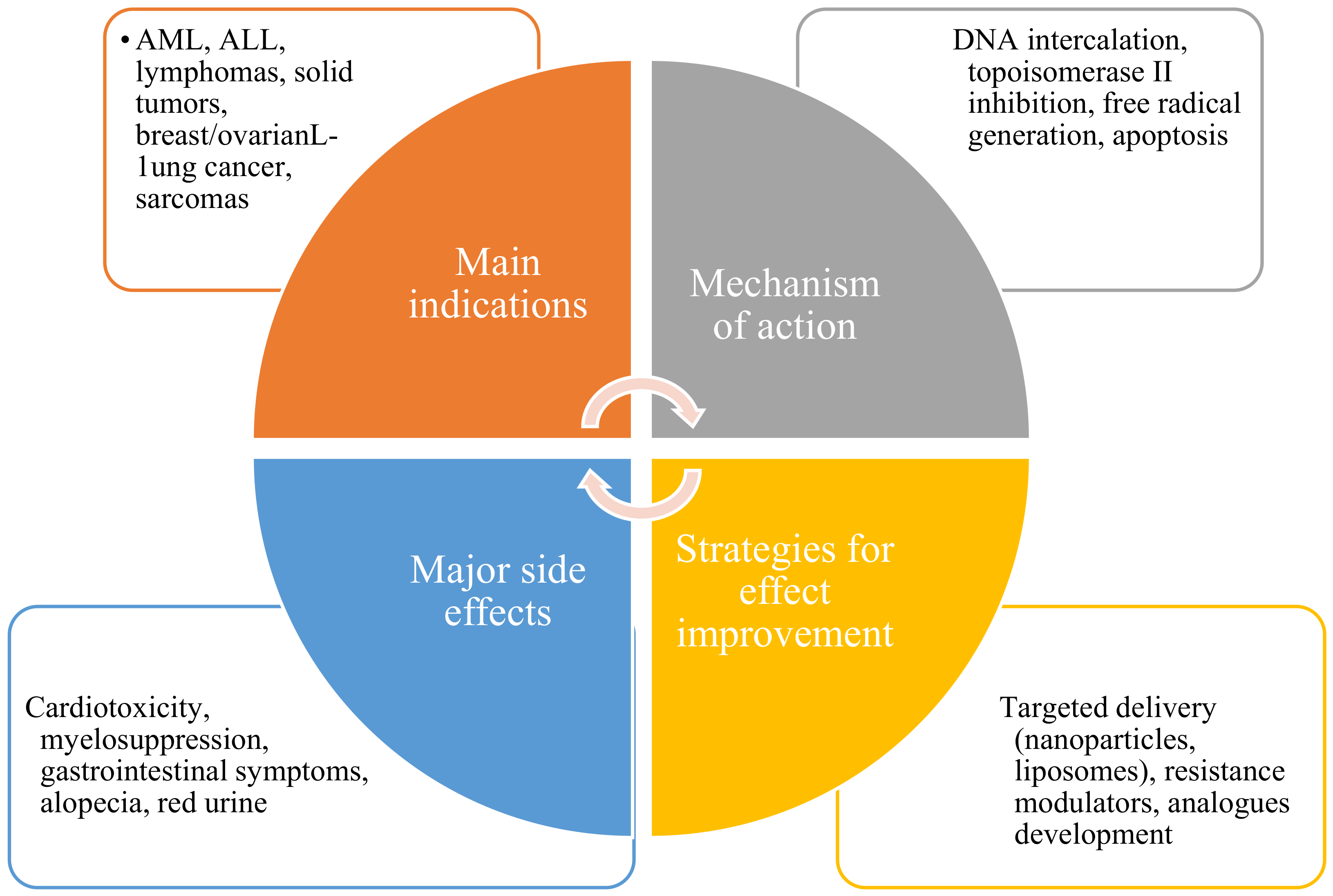
Figure 1. Key aspects of daunorubicin utilization.
Fermentation 12 00304 g001
Figure 2. Synthesis of major bottlenecks limiting daunomycin titers.
Fermentation 12 00304 g002
Figure 3. First (DNR and DXR) and second (EPI and IDA) generation of anthracyclines.
Fermentation 12 00304 g003
Figure 4. Organization of the daunorubicin (dnr/dps/dnm/drr) biosynthetic gene cluster of Streptomyces peucetius. (A) Functional organization of cluster genes. (B) Pathway-specific regulatory circuit (the arrow indicates activation and the bar-headed line indicates repression). PKS—tetracyclic anthraquinone core (forms ε-rhodomycinone): DpsA—ketosynthase α (KSα; 3-oxoacyl-ACP synthase); condenses one propionyl-CoA starter with nine malonyl-CoA extenders to build the decaketide. DpsB—ketosynthase β/chain-length factor (KSβ/CLF); partners with DpsA and sets polyketide chain length. DpsC—starter-unit selection protein (ketosynthase III–like); determines the propionyl-CoA starter choice. DpsD—acyltransferase; acts with DpsC in starter-unit loading/selection. DpsE—C-9 ketoreductase; reduces the nascent decaketide before cyclization. DpsF—aromatase/first-ring cyclase. DpsG—acyl carrier protein (ACP); tethers the growing chain. DpsY—cyclase; completes ring cyclization to 12-deoxyaklanonic acid. DnrG—monooxygenase (oxygenase); oxidation to aklanonic acid. DnrC—aklanonic acid methyl ester transferase (SAM-dependent methyltransferase). DnrD—aklanonic acid methyl ester cyclase; forms the fourth ring leading to aklaviketone. DnrE—aklaviketone reductase; reduces the C-7 keto leading to aklavinone. DnrF—aklavinone-11-hydroxylase (FAD-dependent); leads to ε-rhodomycinone. TDP-L-daunosamine (amino-deoxysugar) biosynthesis: DnmL—glucose-1-phosphate thymidylyltransferase; first committed step leading to TDP-D-glucose. DnmM—TDP-D-glucose 4,6-dehydratase leading to TDP-4-keto-6-deoxy-D-glucose (naturally frameshifted/nonfunctional in wild-type ATCC 29050, complemented by a locus outside the cluster). DnmU—TDP-4-keto-6-deoxyglucose 3,5-epimerase; sets the L-configuration. DnmT—2,3-dehydratase/hydratase acting in the C-3 deoxygenation step. DnmJ—aminotransferase; introduces the C-3 amino group. DnmV—TDP-4-ketohexulose reductase; reduces C-4 keto → TDP-L-daunosamine (final sugar). DnmZ—protein of unknown function, required for daunosamine biosynthesis. Glycosyltransferase—daunosamine transfer: DnrS—glycosyltransferase; attaches TDP-L-daunosamine to ε-rhodomycinone (C-7), leading to rhodomycin D. DnrQ (=DnmQ)—auxiliary/activator protein required for DnrS-catalysed glycosyl transfer. Aglycone late modification (forms DNR, DXR): DnrP—esterase (methylesterase); rhodomycin D leading to 13-deoxycarminomycin. DnrK—carminomycin-4-O-methyltransferase; O-methylates C-4 leading to 13-deoxydaunorubicin. DnrU—ketoreductase; C-13 reduction (forms 13-dihydro shunt metabolites). DnrV—accessory protein required for DoxA activity (P450 redox/folding partner). DoxA—cytochrome P450; performs C-13 oxidations (leading to daunorubicin) and the final, rate-limiting C-14 hydroxylation (leading to doxorubicin). DnrX—late-tailoring enzyme; its inactivation diverts flux toward doxorubicin. DnrH—glycosyltransferase converting DNR/DXR to baumycin-like higher glycosides; its inactivation raises daunorubicin titer. Pathway-specific regulatory genes: DnrO—pathway-specific regulator (TetR-family, helix-turn-helix); initiates the cascade by activating dnrN while repressing its own gene; senses intracellular daunorubicin and rhodomycin D (feedback). DnrN—pseudo-response regulator that activates dnrI. DnrI—master pathway-specific activator (SARP family); activates the structural and resistance operons. DnrW (=DrrD; ortholog of dauW in S. coeruleorubidus)—negative regulator that represses the central cascade. Self-resistance/export genes: DrrA—nucleotide-binding (ATP-binding) component of the DrrAB ABC efflux pump. DrrB—membrane-integral component of the DrrAB pump; together they export daunorubicin (antiporter). DrrC—UvrA-like, ATP/DNR-dependent DNA-binding protein; binds the drug–DNA complex to protect the producer’s genome (intracellular target protection). DrrD (=DnrW)—flavin-binding self-resistance protein (its mutant shows partial loss of resistance); also functions as a negative regulator.
Fermentation 12 00304 g004
Figure 5. Scheme for polyketide biosynthesis of daunomycin. The “n x” notation gives the number of equivalents of each acyl-CoA precursor that the type II PKS incorporates into one polyketide chain.
Fermentation 12 00304 g005
Figure 6. Daunomycin downstream process.
Fermentation 12 00304 g006
Table 1. Bibliometric data for the six topics identified.
TopicNo PapersMedian YearTop-3 Countries (by Institutional Affiliation)OA FractionTotal CitationsMean Citations/PaperMean Citations/Paper/YearMedian Citations/Paper/YearTotal Reported by Scopus
Yield improvement242013United States, China, South Korea54%126152.55.682.6424
Novel derivatives49982017United States, China, Germany45%236,19947.35.31.887737
Cytotoxicity mitigation16532011United States, Italy, Germany31%110,98167.15.31.891653
Industrial scale-up1122014China, United States, India34%860176.88.62.72113
CRISPR/synthetic biology982021United States, China, Japan71%410241.97.542.7198
Downstream/purification9952017United States, China, Germany40%40,47440.73.471.55995
Table 2. Genetic engineering strategies for improving daunomycin production and diversification.
Strategy CategoryTarget Gene(s)/ApproachMechanism/ObjectiveOutcomeKey References
Pathway-specific regulatory engineeringIntroduction of DnmT
on a high-copy-number plasmid into the DnrH mutant
Reduction of undesired by-products—ε-rhodomycinone; enhanced efflux and cellular protection8.5-fold increase in daunomycin production and improved strain productivity[80,94]
Manipulation of DnrR1, DnrR2, DnrN, DnrO Activation of the daunomycin biosynthetic cluster; relief of transcriptional repression and pathway bottlenecksGlobal upregulation of biosynthesis and 2-fold increased production[37,78,95]
Deletion of DauW (DrrD and DnrW ortholog in S. coeruleobidus)Enhanced self-resistance to daunorubicin Increased daunomycin biosynthesis by 8-fold[36]
Modulation of transcriptional regulators (DnrI/J/N/O)Optimization of feed-forward and feedback control; prevention of premature pathway shutdown due to product accumulationImproved pathway stability and sustained production during fermentation[77]
Efflux-based self-resistanceOverexpression of DrrA–DrrB in S. peucetiusExpression of resistance genes for higher tolerance against cytotoxic daunomycin effectIncreased daunomycin production to 12 mg L−1 compared to 4.5 mgL−1 in the wild strain[80]
Disruption of DrrA and DrrB operons Active export of daunomycin to prevent intracellular accumulation and cytotoxicityEnhanced cellular tolerance and 10-fold decrease in daunomycin production[81,96]
Extracellular sequestration mechanismsBiogenic iron/oil nanoparticle formationBinding and sequestration of daunomycin outside the cell to reduce autotoxicityReduced bioavailability of free daunomycin and its associated toxicity.[84]
Combinatorial biosynthesisHeterologous gene combinations; tailoring enzyme modificationDiversification of biosynthetic pathways through enzyme swapping or modificationProduction of novel daunomycin derivatives with improved or altered properties[83]
Table 3. Strain-specific media optimization studies.
Producing StrainMedium Composition and Process ConditionsReported TiterVolumetric ProductivityKey References
Streptomyces coeruleorubidus RTA 221010 g L−1 baker’s yeast, 20 g L−1 soy flour, 100 g L−1 pomace olive oil, 5 g L−1 yeast extract, 5 g L−1 glycerol, 2 g L−1 K2HPO4, 1 g L−1 MgSO4·7H2O, 3 g L−1 CaCO3, and 3.6 g L−1 FeSO4·7H2O. The pH was adjusted to 5.9–6.1 using 2 M NaOH or 2 M HCl, Batch duration 264 h5.5–6.0 g L−1 (5500–6000 mg L−1)~0.022 g L−1 h−1[84]
glucose as a carbon source~2.0 g L−1~0.0076 g L−1 h−1
Streptomyces peucetiussoybean oil 20 g L−1, molasses 30 g L−1, glycerine 12 g L−1, earthworm powder 20 g L−1, peptone (10 g L−1), K2HPO4, 0.6 g L−1, CaCO3 6 g L−1, NH4SO4 5 g L−1, NaCl 4 g L−1, Repone K 6 g L−1, MgSO4 6 g L−1, FeCl3 0.2 g L−1, polyethylene diamine 0.01 gL−1; Batch duration 168 h3.24–3.46 g L−1~0.020 g L−1 h−1[97]
Streptomyces coeruleorubidusglucose 10 g L−1, cornstarch 50 g L−1, corn steep liquor 20 g L−1, Seitan powder 10 g L−1, ammonium sulfate 10 g L−1, dipotassium hydrogen phosphate 5 g L−1, ferrous sulfate 1 g L−1, sodium chloride 0.5g L−1, calcium carbonate 3 g L−1, defoamer 0.3 g L−1, pH 7.0~7.5.; Batch duration 168 h2.5–3 g L−1
(2500–3000 mg L−1)
~0.016 g L−1 h−1[98]
Streptomyces peucetius MTCC 4332glucose, 4 g L−1; malt extract, 10 g L−1; yeast extract, 4 g L−1; pH, 7.3, 7 days46.96 mg L−1 ~0.00028 g L−1 h−1[38]
ultrasound-assisted fermentation (25 kHz, 160 W, 40% duty cycle, 5 min applied on day 4), 7 days fermentation76.42 mg L−1 ~0.00045 g L−1 h−1
Streptomyces coeruleorubidus (39–146)3.5% soluble starch, 3% soybean meal, 0.3% NaCl, 0.3% CaCO3; daunomycin mainly as glycosides; Batch duration 168 h (estimated)1263 mg L−1 (antibiotic activity)~0.0075 g L−1 h−1[71]
Streptomyces insignis J566-9 ATCC 319135% cerelose, 1.25% defatted soy flour, 1.2% herring meal, 0.33% NaCl, 0.75% autolyzed yeast, and 1.0% CaCO3. The fermentation was carried out for 120 h at 30 °C, 200 rpm, and 0.5 volume of air per volume of medium per min.58–75 mg L−1~0.00056 g L−1 h−1[99]
Streptomyces peucetius ATCC 29050APM production medium, 120 h, 30 °C. The cultures were acidified with oxalic acid, heated at 60 °C for 45 min, adjusted to pH 8.5, and extracted with chloroform.45.3 mg L−1~0.00038 g L−1 h−1[63]
Disclaimer/Publisher’s Note: The statements, opinions and data contained in all publications are solely those of the individual author(s) and contributor(s) and not of MDPI and/or the editor(s). MDPI and/or the editor(s) disclaim responsibility for any injury to people or property resulting from any ideas, methods, instructions or products referred to in the content.