This is an early access version, the complete PDF, HTML, and XML versions will be available soon.
Open AccessArticle
Valorization of Maize Lime-Cooking Wastewater Through Lipid and Carotenoid Production by Rhodotorula glutinis Yeast: An Approach Using Pulse Fed-Batch Culture and Techno-Economic Assessment
by
Carolina Ramírez-Martínez
 Carolina Ramírez-Martínez
Gael Jesús Molina-Benítez
Gael Jesús Molina-Benítez
Mariana Franco-Morgado
Mariana Franco-Morgado  and
and
Alberto Ordaz
Alberto Ordaz
1
Tecnologico de Monterrey, Escuela de Ingeniería y Ciencias, Campus Estado de México, Av. Eugenio Garza Sada 2501, Monterrey 64849, Nuevo León, Mexico
2
Tecnologico de Monterrey, Escuela de Ingeniería y Ciencias, Campus Puebla, Av. Eugenio Garza Sada 2501, Monterrey 64849, Nuevo León., Mexico
*
Author to whom correspondence should be addressed.
Fermentation 2026, 12(6), 285; https://doi.org/10.3390/fermentation12060285 (registering DOI)
Submission received: 25 April 2026
/
Revised: 23 May 2026
/
Accepted: 25 May 2026
/
Published: 15 June 2026
Abstract
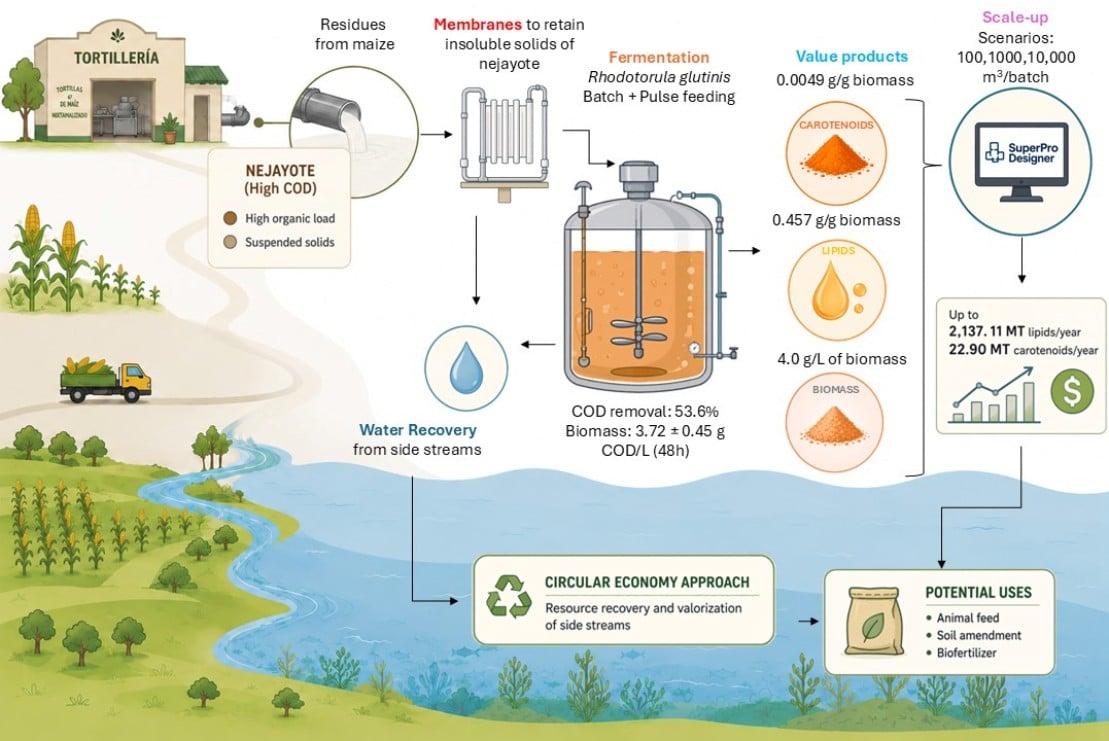
The increasing generation of agro-industrial residues like nejayote (maize lime-cooking wastewater from the maize nixtamalization process) poses significant environmental challenges in Mexico due to its elevated chemical oxygen demand (COD) and organic load. This study evaluates the physical separation of nejayote via membranes and its use as a low-cost substrate for producing lipids and carotenoids using Rhodotorula glutinis. A batch culture followed by pulse-feeding achieved a COD removal efficiency of 53.6% (0.22 g COD/(L h)) and a biomass concentration of 3.72 ± 0.45 g COD/L within 48 h. The yeast demonstrated a high specific metabolic efficiency, yielding 0.457 g of lipids and 0.0049 g of carotenoids per gram of biomass, with an oleaginous fraction of 46.21% in dry weight. Experimental data calibrated a process model in SuperPro Designer, simulating full-scale processes treating 100, 1000, and 10,000 m3 of nejayote per batch, producing up to 2137.11 MT of lipids and 22.90 MT of carotenoids annually. A techno-economic analysis estimated the investment, operating costs, and financial indicators for all scenarios. Strategies like evaporation and reverse osmosis to concentrate nejayote significantly improved profitability by reducing equipment size. Additionally, a circular economy approach was modeled, recovering process water and nutrient-rich side streams. These findings confirm that integrated physical and biological treatment, coupled with resource recovery, transforms this particularly agro-industrial residue into a technically robust and economically viable biorefinery feedstock, aligning industrial production with sustainable waste management.
Share and Cite
MDPI and ACS Style
Ramírez-Martínez, C.; Molina-Benítez, G.J.; Franco-Morgado, M.; Ordaz, A.
Valorization of Maize Lime-Cooking Wastewater Through Lipid and Carotenoid Production by Rhodotorula glutinis Yeast: An Approach Using Pulse Fed-Batch Culture and Techno-Economic Assessment. Fermentation 2026, 12, 285.
https://doi.org/10.3390/fermentation12060285
AMA Style
Ramírez-Martínez C, Molina-Benítez GJ, Franco-Morgado M, Ordaz A.
Valorization of Maize Lime-Cooking Wastewater Through Lipid and Carotenoid Production by Rhodotorula glutinis Yeast: An Approach Using Pulse Fed-Batch Culture and Techno-Economic Assessment. Fermentation. 2026; 12(6):285.
https://doi.org/10.3390/fermentation12060285
Chicago/Turabian Style
Ramírez-Martínez, Carolina, Gael Jesús Molina-Benítez, Mariana Franco-Morgado, and Alberto Ordaz.
2026. "Valorization of Maize Lime-Cooking Wastewater Through Lipid and Carotenoid Production by Rhodotorula glutinis Yeast: An Approach Using Pulse Fed-Batch Culture and Techno-Economic Assessment" Fermentation 12, no. 6: 285.
https://doi.org/10.3390/fermentation12060285
APA Style
Ramírez-Martínez, C., Molina-Benítez, G. J., Franco-Morgado, M., & Ordaz, A.
(2026). Valorization of Maize Lime-Cooking Wastewater Through Lipid and Carotenoid Production by Rhodotorula glutinis Yeast: An Approach Using Pulse Fed-Batch Culture and Techno-Economic Assessment. Fermentation, 12(6), 285.
https://doi.org/10.3390/fermentation12060285
Note that from the first issue of 2016, this journal uses article numbers instead of page numbers. See further details
here.
Article Metrics
Article metric data becomes available approximately 24 hours after publication online.