Article

Screening of a Gossypol-Degrading Fungus and Its Application in Detoxification and Quality Improvement of Cottonseed Hulls


1
School of Biotechnology and Key Laboratory of Industrial Biotechnology of Ministry of Education, Jiangnan University, Wuxi 214122, China
2
Jiaxing Central Blood Station, Jiaxing 314000, China
*
Authors to whom correspondence should be addressed.
Fermentation 2026, 12(6), 283; https://doi.org/10.3390/fermentation12060283
Submission received: 13 May 2026 / Revised: 11 June 2026 / Accepted: 12 June 2026 / Published: 13 June 2026
(This article belongs to the Section Industrial Fermentation)

Abstract

Cottonseed hull is an abundant and low-cost cotton processing byproduct, but its feed application is severely limited by free gossypol. This study screened a gossypol-degrading fungal strain from naturally fermented cottonseed hulls and soy sauce koji, and evaluated its detoxification and feed improvement effects via solid-state fermentation. Strain TM-2 was identified as Aspergillus oryzae. It degraded over 60% of gossypol in liquid fermentation and 69.54% in cottonseed hull solid-state fermentation. Genome annotation revealed 409 CAZyme genes and key pathways for naphthalene and aromatic compound degradation. After fermentation, crude protein and acid-soluble protein were significantly increased, while cellulose, hemicellulose, lignin, neutral detergent fiber, and acid detergent fiber were notably reduced. Antioxidant activity was also greatly enhanced. Secretomic analysis identified 92 extracellular proteins, including hemicellulases, cellulases, proteases, and peptidases that jointly promoted detoxification and quality improvement. A. oryzae TM-2 efficiently degrades gossypol and improves feed quality, showing high value in fermented feed development and agricultural byproduct utilization.

1. Introduction

In 2025, the global cotton production reached approximately 26 million tons. Cottonseed hulls are the most abundant and concentrated by-product in the cotton processing industry, accounting for 25% to 38% of the entire raw cotton seeds [1]. They offer several advantages, including widespread availability, low cost, and moderate levels of crude fiber and crude protein, which render them a promising unconventional feed resource for ruminants [2]. However, the efficient utilization of cottonseed hulls as feed is hindered by a significant bottleneck—the presence of free gossypol, a naturally occurring toxic compound [3,4]. Prolonged or excessive exposure of dairy cows to cottonseed hulls rich in free gossypol leads to gossypol accumulation in the body [5]. Feeding growing dairy cows diets containing 200 mg/kg of free gossypol from cottonseed meal for 120 days is deemed safe, while a concentration of 400 mg/kg of free gossypol is considered toxic [6,7]. This accumulation results in adverse effects such as binding to hemoglobin and myoglobin, disrupting red blood cell structure and function, causing chronic intoxication, anemia, growth inhibition, and decreased milk production [8,9]. Additionally, when dairy cows ingest 36.8 mg of free gossypol per kilogram of body weight daily, various adverse effects on their reproductive performance become evident [10]. Gossypol negatively affects the reproductive system of animals by damaging germ cell integrity, suppressing sex hormone release, and interfering with fertilized egg attachment and embryonic growth [11,12]. Consequently, this leads to reduced conception rates, increased incidences of abortion, and stillbirths, and higher rates of weak calves, ultimately affecting the economic viability and sustainability of dairy farming [13]. Moreover, chronic gossypol exposure also impairs the liver, kidneys, and other metabolic organs, compromising immunity and disease resistance [14]. These toxic effects prevent the widespread use of cottonseed hulls in dairy cow diets, despite their nutritional value, thereby impeding their efficient utilization and industrial adoption as a feed source.
The industry commonly utilizes physical and chemical methods to detoxify cottonseed byproducts and mitigate the toxic risk of free gossypol for safe feed production [15]. But the traditional detoxification methods do not strike a balance between detoxification effectiveness and nutrient preservation, failing to meet the requirements of modern animal husbandry for environmentally friendly, effective, and nutrient-conserving detoxification technologies [16]. Solid-state fermentation (SSF) has emerged as a promising bioconversion method for effectively utilizing agricultural byproducts due to its gentle conditions, high efficiency, and eco-friendliness [17,18]. Despite its inherent limitations in practical implementation, such as challenges in the online monitoring of fermentation parameters and low volumetric productivity, SSF has been extensively investigated within various biological detoxification and feed bioconversion techniques. With its mild reaction conditions, favorable conversion efficiency, minimal byproduct generation, and limited degradation of nutritional constituents, solid-state fungal fermentation is recognized as a leading approach for producing high-quality fermented feed [19,20]. Fungi secrete a variety of hydrolytic and redox enzymes, such as cellulase, hemicellulase, protease, amylase, and laccase, during their growth and metabolism [21]. These enzymes efficiently break down crude fiber, anti-nutritional factors, and toxins like free gossypol in cottonseed hulls, while also breaking down complex molecules into easily absorbable nutrients like small peptides, amino acids, and soluble sugars [22,23,24]. This process significantly enhances feed digestibility and palatability. Additionally, fungal fermentation plays a crucial role in balancing intestinal microflora, improving nutrient utilization and immunity, thereby enhancing production efficiency, milk quality, and overall health of dairy cows [25,26]. For instance, the culture of Aspergillus oryzae-fermented soybean residue exhibits high nutritional value as feed, enhancing lipid metabolism and stabilizing intestinal flora in mice [27,28]. Similarly, A. oryzae-fermented rapeseed meal boosts immune responses in fish [29], and A. oryzae-fermented alfalfa hay stimulates rumen fermentation in ruminants, leading to increased feed intake and dry matter digestibility in dairy cows [30]. In the realm of industrial fermentation, A. oryzae has been successfully utilized for industrial GABA production, exemplified by strain NSK, demonstrating its scalability [31]. However, despite its prevalent application, research on its ability to degrade free gossypol remains limited, with existing studies primarily concentrating on process optimization or performance evaluation. For instance, Lim et al. confirmed gossypol degradation in cottonseed meal but did not provide specific degradation rates or elucidate the underlying enzymatic mechanisms [32]. Importantly, the closely related Aspergillus flavus, which shares similarities in morphology and genome [33,34], produces aflatoxins that can disrupt gut microbiota, provoke immune responses, induce oxidative damage, and ultimately hinder animal growth [35]. In contrast, A. oryzae generally lacks functional key regulatory genes, such as aflJ and aflR, and does not produce aflatoxins [36].
This study aimed to enhance the value and safety of cottonseed hulls by screening fungal strains with high gossypol degradation capability and favorable feeding fermentation traits. This research focused on evaluating the essential characteristics of the selected strain, including efficiency in removing free gossypol, enhancing nutritional components, and metabolic activity of the enzyme system. The goal was to develop a functional fungus suitable for converting agricultural byproducts and to offer dependable strain reservoirs and technical assistance for creating low-toxic, high-nutrient, environmentally friendly, and secure fermented feed from cottonseed hulls.

2. Materials and Methods

2.1. Experimental Samples

Cottonseed hulls were provided by Xinjiang Tecon Co., Ltd., Wujiaqu, China. The raw materials were crushed by a grinder, mixed with cotton lint, sieved through a 20-mesh sieve, and stored for later use. Naturally fermented cottonseed hulls and soy sauce koji were provided by Jiaxing Haorui Biotechnology Co., Ltd., Jiaxing, China.

2.2. Main Culture Media

Potato Dextrose Agar (PDA) medium [37]: 200 g peeled potatoes were cut into pieces, boiled in 800–1000 mL water for 30 min, and filtered with 8 layers of gauze. Glucose (20 g) and agar (20 g) were added to the filtrate, and the volume was adjusted to 1000 mL. Sterilization was performed at 115 °C for 20 min.
Sporulation medium: KH2PO4 1 g, KNO3 1 g, MgSO4 0.5 g, KCl 0.5 g, soluble starch 0.2 g, glucose 0.2 g, agar 20 g, dissolved in 1 L distilled water with natural pH, then sterilized at 115 °C for 20 min and cooled for use. All reagents used were purchased from Sinopharm Chemical Reagent Co., Ltd., Shanghai, China.

2.3. Primary Screening of Gossypol-Degrading Microorganisms

Five grams of crushed cottonseed hulls and soy sauce koji mixture were blended with 50 mL of sterile water, shaken at 220 r/min for 1 h (HYL-C Combined Shaker, Taicang Qiangwen Laboratory Equipment Co., Ltd., Taicang, China), and serially diluted to 10−1, 10−2, 10−3, and 10−4. A 100 μL aliquot of each dilution was spread on PDA plates and incubated at 30 °C for 2 days. Independent fungal colonies were selected and purified by three-point inoculation on PDA plates at 30 °C for 2 days. The purified strains were inoculated on sporulation medium and cultured at 30 °C for 3–4 days until visible spores were produced. Spores were eluted with sterile 0.75% normal saline to prepare a spore suspension, which was counted under a microscope (OPTIKA-B350 Microscope, OPTIKA S.R.L, Ponteranica, Italy) and stored.

2.4. Secondary Screening and Liquid Culture of Gossypol-Degrading Strains

In 43 mL of liquid medium, 2 mL of 10 mg/mL gossypol acetate was added to reach a final gossypol concentration of approximately 400 mg/L. Then 5 mL of quantitative spore suspension was inoculated and cultured at 30 °C, 220 r/min for 5 days. A control group without a fungal spore suspension was set. After cultivation, mycelial morphology and medium color were observed, and gossypol content in the culture broth was determined. All liquid culture experiments were performed with three independent biological replicates and three technical replicates within each batch, and the experimental results were expressed as mean ± standard deviation.

2.5. Solid-State Fermentation of Gossypol-Degrading Strains

Twenty grams of crushed cottonseed hulls were placed in a 500 mL Erlenmeyer flask, mixed with 20 mL water, sealed with 6 layers of gauze, sterilized, and cooled to room temperature (optimized via preliminary experiments, the solid-to-liquid ratio of 1:1 was identified as the optimal moisture condition). Sterilization efficacy verification: Sterilized samples were spread onto PDA plates and incubated at 30 °C for 48 h to confirm no colony formation. The spore suspension (1.2 × 10⁶ spores/mL) of the primarily screened fungi was inoculated at a 10% inoculation rate. After mixing, the flask was placed in a constant temperature and humidity incubator (Bxs-250S Constant Temperature and Humidity Incubator, Panasonic, Tokyo, Japan) at 30 °C, 96% humidity for 4 days, with turning every 6–8 h. A control group without a fungal spore suspension was set. After fermentation, the mixture was dried at 45 °C for further analysis. All solid-state fermentation experiments were performed with three independent biological replicates and three parallel flasks per batch, and all results were expressed as mean ± standard deviation. All inoculation and material turning procedures during fermentation were performed in a laminar flow cabinet. The bench surface was disinfected via 30 min of ultraviolet irradiation and wiped with 75% ethanol before operation. Erlenmeyer flasks were sealed with six layers of gauze to balance air permeability and contamination resistance, which effectively minimized the risk of microbial contamination.

2.6. Determination of Free Gossypol

Standard gossypol solution (1.0 mg/mL) was prepared by dissolving gossypol in acetonitrile—0.2% phosphoric acid water (85:15) and serially diluted into six gradients to establish a standard curve based on peak area. For solid samples, the sample was mixed with mobile phase at 1:10, ultrasonicated, centrifuged, and the supernatant was filtered through a 0.22 μm organic membrane. HPLC conditions [38]: Agilent 1260 (Agilent, Santa Clara, CA, USA), Xbridge-C18 column, mobile phase acetonitrile-0.2% phosphoric acid aqueous solution (85:15), flow rate 1.0 mL/min, UV detection wavelength 235 nm, column temperature 25 °C, injection volume 20 μL, liner compensation 0.2 mm.

2.7. Identification, Morphological Observation and Toxin Assay of Aspergillus oryzae

Hyphae and spore suspension were picked for wet mount preparation and observed under an optical microscope (10 × 40). Fungal genomic DNA was extracted using the Omega Fungal DNA Kit (D3195 HP, Omega Bio-tek, Norcross, GA, USA). The universal fungal primers ITS1 (5′-TCCGTAGGTGAACCTGCGG-3′) and ITS4 (5′-TCCTCCGCTTATTGATATGC-3′) were used for 18S rRNA amplification. PCR system: DNA template 1 μL, forward primer 1 μL, reverse primer 1 μL, Taq polymerase 12.5 μL, ddH2O 9.5 μL. PCR products were verified by agarose gel electrophoresis and sequenced by Sangon Biotech, Shanghai, China. Sequences were blasted in the NCBI database for homology comparison, and a phylogenetic tree was constructed. Aflatoxin contents were determined following the method described by Köse [39].

2.8. Genome Sequencing and Functional Analysis of Aspergillus oryzae

High-quality genomic DNA was extracted using the NucleoBond® HMW DNA Kit (Macherey-Nagel, Düren, Germany). DNA concentration and purity were determined using Qubit 4.0, and integrity was checked by 0.75% agarose gel electrophoresis. Library construction and sequencing were performed on the Illumina NovaSeq 6000 platform. Raw reads were filtered by Trimmomatic (v0.36) to remove adapters and low-quality bases. Genome assembly was conducted using SPAdes (v3.15), and gaps were filled by Gapfiller (v1.11). Gene prediction and annotation were performed using GeneMark (v1.10). Functional annotations were carried out based on KOG, KEGG, and CAZy databases to analyze carbohydrate-active enzymes and metabolic pathways.

2.9. Determination of Conventional Physicochemical Indexes

Crude protein was determined by the Kjeldahl method. Neutral detergent fiber (NDF) and acid detergent fiber (ADF) were measured according to Fan [40].
Lignin, cellulose, and hemicellulose were analyzed following Lu [41]. A solid sample weighing 0.3 g (dry weight) was dried and subsequently extracted with 3.0 mL of 72% H2SO4 for 1 h at 30 °C. Deionized water was then added to dilute the H2SO4 to 4%. The resulting mixture was maintained at 121 °C for 1 h and subsequently filtered. The filter residue was dried to a constant weight at 105 °C to calculate the content of acid-insoluble lignin. The sample was further diluted with 4% sulfuric acid, and the absorbance of the filtrate was measured at 320 nm. The filtrate was neutralized with Na2CO3 and centrifuged; the supernatant was collected to determine the glucose and xylose content using HPLC (1260, Agilent Technologies, Santa Clara, CA, USA). The contents of cellulose and hemicellulose were then calculated.
The radical scavenging activity of 1,1-Diphenyl-2-picrylhydrazyl (DPPH) was assessed using a modified method from Alzagameem [42]. A precisely measured 2 mL of the diluted sample solution was combined with 2 mL of a 0.1 mmol·L−1 DPPH solution. Following thorough mixing, the resulting mixture was allowed to react for 30 min, after which absorbance was recorded at 517 nm. Anhydrous ethanol served as the blank for zero adjustment, while vitamin E was utilized as the reference standard to construct the standard curve. The results are presented as the free radical scavenging capacity per gram of cottonseed hulls.
The cation radical scavenging activity of 2,2′-Azinobis-(3-ethylbenzothiazoline-6-sulfonic acid) (ABTS) was assessed following the methodology outlined by Alzagameem [42]. The ABTS working solution was prepared by combining 2 mL of a 7 mmol·L−1 ABTS solution with 2 mL of a 2.45 mmol·L−1 potassium persulfate solution. This mixture was incubated in the dark at room temperature for 12 h and subsequently diluted to achieve an absorbance of 0.70 ± 0.02 at 734 nm. Prior to application, the prepared ABTS solution was preheated at 37 °C for 10 min. Following serial dilution, 0.1 mL of the sample solution was introduced into the ABTS working solution. Deionized water served as the blank control for zero calibration, while vitamin E was utilized as the reference standard for establishing the standard curve. The results were reported as free radical scavenging capacity per gram of cottonseed hulls.

2.10. Effect of Aspergillus oryzae Fermentation on Hydrolase System of Cottonseed Hulls

A. oryzae TM-2 was inoculated into cottonseed hulls for solid-state fermentation at 30 °C for 4 days. One gram of the crushed sample was extracted with 20 mL PBS buffer. The extract was centrifuged and separated by 12% SDS-PAGE at 120 V, followed by in-gel trypsin digestion. Extracellular proteins were identified by LC-MS/MS (Q Exactive plus Ultimate 3000 RSLC nano, Thermo Fisher Scientific, Waltham, MA, USA). Raw data were processed by Mascot Distiller 2.5 and matched against the UniProt database. Theoretical pI and molecular weight were analyzed using ExPASy (accessed 1 February 2026; https://www.expasy.org/).

2.11. Statistical Analysis

All experiments were conducted with at least three biological replicates (independent batches), and each biological replicate contained three technical replicates. The experimental data are presented as mean ± standard deviation. Statistical analyses were performed using SPSS 26.0 software. The significance of the data was calculated by analysis of variance (ANOVA) followed by Duncan’s test. The threshold for statistical significance was set at p < 0.05.

3. Results and Discussion

3.1. Screening of Gossypol-Degrading Fungi

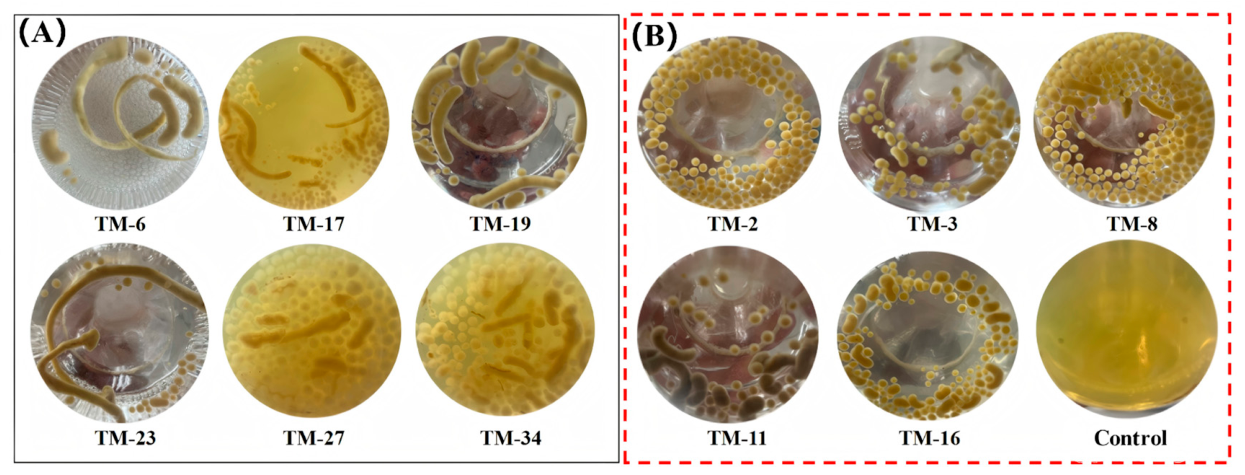
Forty-six strains of fungi growing on PDA plates containing 0.03% gossypol acetate were isolated from cottonseed hulls and koji. They were isolated and purified multiple times and named TM-1 to TM-46 successively. The spore suspensions (1.2 × 10⁶ spores/mL) were respectively added to the primary screening liquid culture medium to observe the mycelial growth morphology and the color of the culture medium. The results are shown in Figure 1. In Figure 1A, the mycelial pellets of TM-6, TM-17, TM-19, TM-23, TM-27, and TM-34 could not grow normally in the primary screening medium. They all converged to a certain extent to form a thick mycelial long line, presenting an irregular shape, and the number of mycelial pellets was also relatively small. This might be related to their intolerance to gossypol, which led to growth restrictions. In addition, compared with the other three fungal strains, the color of the liquid culture medium of TM-17, TM-27, and TM-34 strains was light yellow, similar to that of the control group, indicating that the degradation rate of gossypol might be lower. However, the color of the liquid fermentation culture medium corresponding to TM-6, TM-19, and TM-23 was colorless. The mycelial spheres of TM-2, TM-3, TM-8, TM-11, and TM-16 shown in Figure 1B grow well in the primary screening medium, basically presenting regular spherical shapes. The number of mycelial spheres is relatively large, and the color of the medium is light. Combined with the mycelial growth status and the fading color of the medium, these strains were preliminarily inferred to have the potential for gossypol degradation [43].
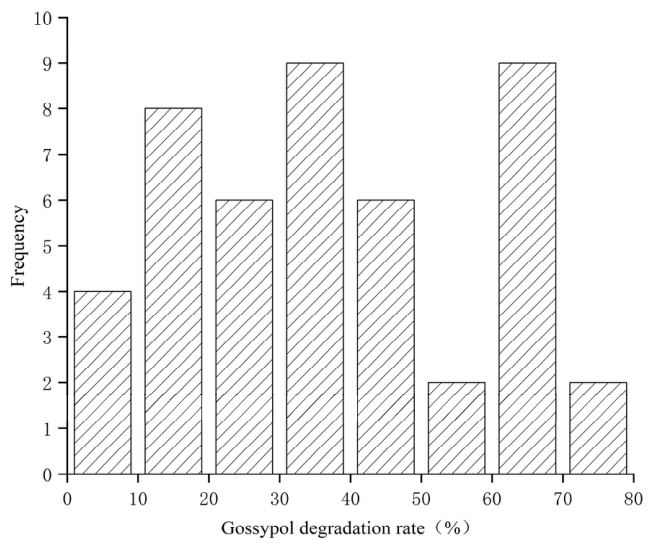
The content of free gossypol in the liquid culture medium was sampled and determined. The frequency distribution of gossypol degradation rates among 46 fungal strains is shown in Figure 2. Among the 46 fungi, the degradation rate of liquid gossypol by 11 fungi, namely TM-2, TM-3, TM-5, TM-8, TM-10, TM-11, TM-12, TM-16, TM-29, TM-32, and TM-36, was relatively high, all exceeding 50%. Based on the fact that these 11 strains of fungi grew well in the liquid culture medium containing gossypol, it is preliminarily judged that their degradation ability to gossypol is relatively strong.
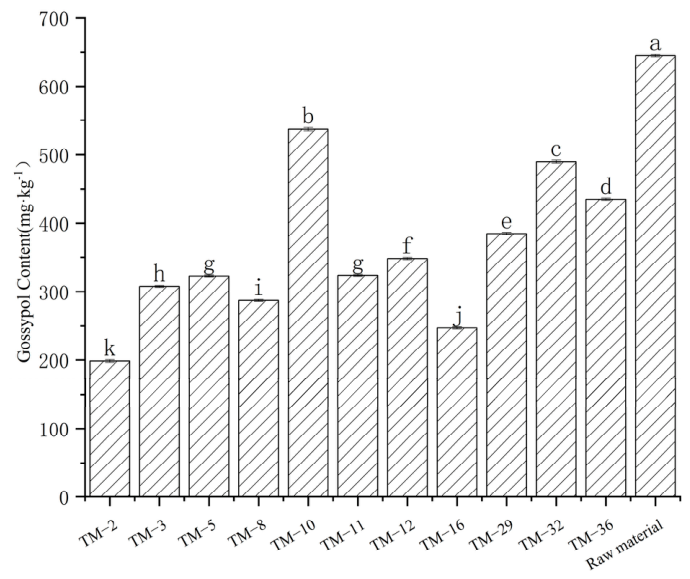
After the initial verification through liquid fermentation, in order to eliminate the specific differences in the strains in different environments, solid-state fermentation experiments were continued on the above 11 strains of fungi for re-verification. The results are shown in Figure 3. With cottonseed hulls as the substrate, the content of free gossypol was 645.28 mg/kg. After solid-state fermentation, a series of enzyme systems produced by the strain had a certain degree of degradation effect on gossypol. Among them, after the cottonseed hulls were solid-state fermented by TM-2, the gossypol content was 196.53 ± 8.47 mg/kg, and the degradation rate reached 69.54 ± 1.23%. Determination of aflatoxins revealed that the concentrations of four types of aflatoxins in fermented products were below the limit of detection (0.03 μg·kg−1), which was markedly lower than the national permissible limit of 5 μg·kg−1, demonstrating the safety of the fermented feed. After fermentation, the fermented cottonseed hull exhibited normal physical appearance without obvious off-odors, indicating that the fermentation process possesses favorable technological adaptability and promising research and application prospects [44,45].

3.2. Identification of High-Efficiency Gossypol-Degrading Strain TM-2

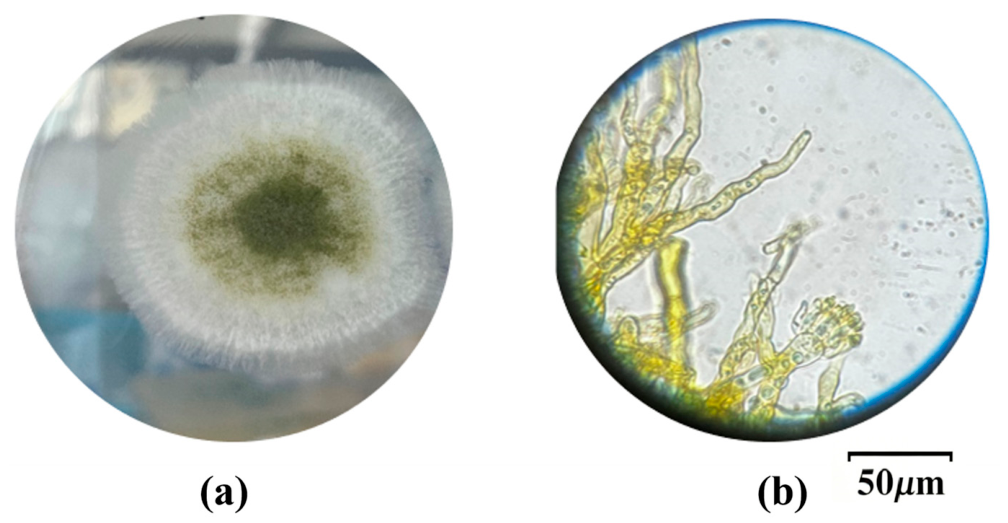
As shown in Figure 4a, strain TM-2 was cultivated on PDA plates at 30 °C. By the third day, white mycelium emerged from the center of inoculation, spreading outward. The marginal mycelium appeared sparse, slender, and either appressed or slightly aerial, while the central mycelium was densely packed and slightly elevated. Within 5–7 days, green conidia developed, originating from the center and gradually progressing towards the edges over a limited distance. The central region exhibited a profusion of conidia, forming dark green powdery clusters, whereas the periphery displayed only sporadic conidia. By day 8–10, the colony reached stability, with coexisting mycelium and conidia; although the marginal mycelium continued to extend slightly, the colony’s diameter ceased to increase significantly. The color gradient shifted naturally from dark green at the center to light green at the edges. Upon examination under light microscopy (Figure 4b), the hyphae appeared yellowish-green, slender, septate, and intricately branched. The conidiophores enlarged at the tip to create subglobose vesicles, with phialides growing on the vesicle surface, generating chains of globose conidia. This configuration exhibited a characteristic broom-like (Aspergillum) pattern, intricately extending outward. These cultural and micromorphological characteristics closely matched previously reported morphological traits of Aspergillus oryzae. The colonial color gradient and floccose texture corresponded to the morphological depiction outlined by Niu et al. [46] and Sakai et al. [47]. The morphological attributes of conidiophores, vesicles, and distinctive penicillate-like fruiting structure aligned with the description provided by Suleiman [33].
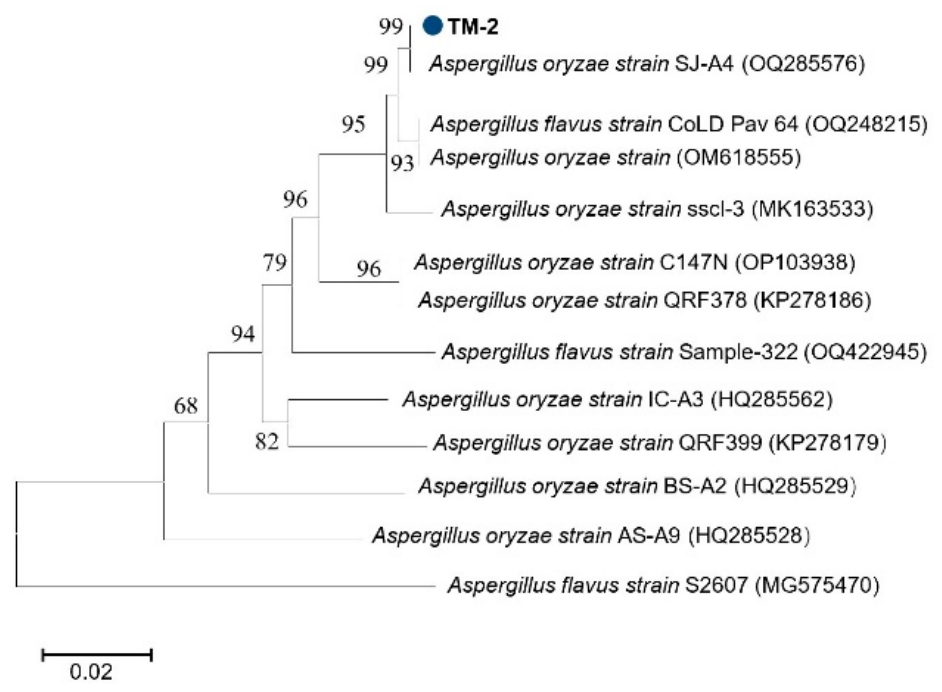
The ITS1-ITS4 sequence of strain TM-2 was determined. Through Blast comparison, species sequences of the same genus but different species were selected to construct an evolutionary tree as shown in Figure 5. From the phylogenetic tree, it can be known that strain TM-2 has the closest genetic relationship with A. oryzae. By comparing the sequence with the NCBI database, it was found that the similarity between strain TM-2 and A. oryzae SJ-A4 was 99.79%. It was identified and named A. oryzae TM-2.

3.3. Genomic Analysis of Aspergillus oryzae TM-2

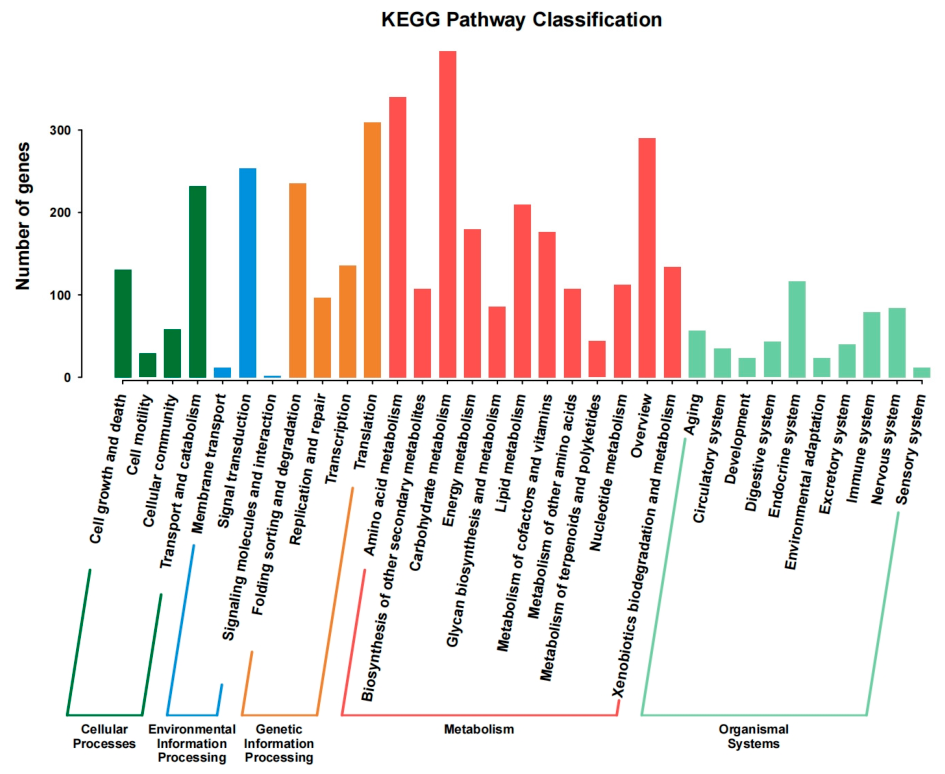
The raw data obtained from sequencing were statistically analyzed and evaluated for quality through Fastp, and quality splicing was performed simultaneously. After the pure genes were spliced and optimized, the genome length was 36,637,758 bp, and the model evaluation fit degree reached 98.99%, indicating that the sequencing results were stable and reliable. The amino acid sequence of the strain was compared with the KEGG database, and the comparison results of different classifications of KEGG were statistically analyzed, as shown in Figure 6. It was found that a total of 4180 genes in the strain genome were annotated. Metabolism, Genetic Information Processing, and Organismal Systems are several metabolic pathways mainly involved in the strain genome. There were 2178, 775, and 511 gene annotation results, respectively. Further analysis through the KEGG PATHWAY database revealed that pathways such as amino acid biosynthesis (93), carbon metabolism (123), starch and sucrose metabolism (81), oxidative phosphorylation (79), and tyrosine metabolism (66) had a relatively high correlation with the strain genome. In addition, through the summary of the comparison results, 35 genes related to the naphthalene degradation pathway (ko00626) and 44 genes related to the degradation pathway of aromatic compounds (ko01220) were found. Especially gossypol, as an aromatic compound with a naphthalene structure, this may be related to the degradation of gossypol [48].
The genome of A. oryzae TM-2 was annotated to a total of 409 CAZyme genes. The gene numbers of polysaccharide lyase (PL), glycosyltransferase (GT), glycoside hydrolase (GH), carbohydrate esterase (CE), and coactive enzyme (AA) were 9, 25, 170, 66, and 139, respectively. Among them, the largest number of genes annotated by a single enzyme are AA3 (glucose oxidase family) and AA7 (polycopper oxidase family), with 54 and 45, respectively. Both belong to enzymes with auxiliary activity, and the main enzyme activities are concentrated in cellobiose dehydrogenase, aryl alcohol oxidase, glucose oxidase, oligosaccharide oxidase, and chitosan oligosaccharide oxidase. It also contains carbohydrate esterase CE10, with its activity concentrated in carboxyl esterase, aryl esterase, etc. In addition, the types of glycosidase hydrolases are the most abundant. Gene annotations are basically concentrated on xylanase, β-glucanase, galactosidase, arabifuran glycosidase, xylosidase, and various functional hydrolytic glycosidases.
The degradation of gossypol by A. oryzae TM-2 is related to multiple metabolic pathways involved in the strain’s own genes. Especially as gossypol is an aromatic compound with a naphthalene structure, the degradation of naphthalene (ko00626) and the degradation pathway of aromatic compounds (ko01220) may be involved in the degradation of harmful gossypol [49]. In addition, the abundant enzyme-annotated genes have also laid a foundation for the subsequent enzyme system research and metabolic function exploration of this strain.

3.4. Effect of Aspergillus oryzae TM-2 Fermentation on the Feeding Quality of Cottonseed Hulls

After cottonseed hulls were fermented by A. oryzae TM-2, the feed quality was significantly improved (Table 1). Compared with the control, the pH value of the A. oryzae TM-2 fermented cottonseed hulls decreased by 1.75, and the acidity increased by 0.59%. The pH value basically met the requirement of 3.6 to 4.5 for fermented feed. Under this acidic condition, it could, to a certain extent, inhibit harmful bacteria [50], and was also conducive to the normal growth and metabolism of A. oryzae, maintaining a high level of fermentation activity. Ensure a good enzyme production and metabolic capacity. Meanwhile, studies have shown that a lower pH value and a higher content of organic acids have positive significance for improving the intestinal health and production performance of animals and poultry [51]. The crude protein content increased by 29.02 mg/g. The possible reason for this is that during the metabolic process, it is necessary to synthesize the bacterial protein required by itself, thereby secreting a certain number of small peptides and enzyme proteins and consuming carbohydrate substances. The proportion of carbohydrate components decreased, and the crude protein content relatively increased. The current results align with prior studies on enhancing crude protein content in cotton by-products through solid-state fermentation (SSF). Lin et al. achieved a significant increase in crude protein levels in defatted cottonseed meal by employing compound probiotics in SSF [52]. Likewise, Dong et al. raised the crude protein content of cottonseed hull using Candida utilis CU-3 in SSF [53]. In addition, since the large-molecule proteins in cottonseed hulls are difficult to be absorbed by ruminants, especially various antigen proteins, and A. oryzae TM-2 fermentation can degrade large-molecule proteins into functional polypeptide or small peptide substances through a rich enzyme system, the acid-soluble protein after A. oryzae TM-2 fermentation has also increased from the initial 6.02 mg/g to 15.63 mg/g. In ruminant feed, the composition and relative content of nutrients directly affect the quality of the feed. In cottonseed hulls, many other main components of crops are crude fibers (cellulose, hemicellulose, and lignin), which have a significant negative impact on the daily digestibility of ruminants [54]. Cellulase and hemicellulase generated by microbial fermentation can accelerate the degradation of cellulose and hemicellulose. The degraded products not only provide nutrients for microbial metabolism but also supply energy for the growth of ruminants [55]. As shown in Table 1, the contents of cellulose and hemicellulose in the A. oryzae TM-2 fermented cottonseed hulls decreased by 20.6% and 59.3%, respectively, due to the rich enzymatic hydrolysis (cellulase and xylanase). However, lignin, as a component that cannot be fully utilized by microorganisms, surrounds cellulose and hemicellulose to form a barrier, hindering the hydrolysis and digestion of structural carbohydrates by rumen microorganisms and enzymes. Therefore, Neutral detergent fiber (NDF) and acid detergent fiber (ADF) are commonly used to more intuitively evaluate the properties of feed fibers [56]. Among them, NDF, compared with ADF, contains hemicellulose, which can directly reflect the conditions of cellulose and lignin. In the A. oryzae TM-2 fermented cottonseed hulls, the lignin content decreased by 31.1%, while NDF and ADF decreased by 14.1% and 22.6%, respectively. Meanwhile, the overall antioxidant capacity of the cottonseed hulls after fermentation was also enhanced. The clearance rates of DPPH· and ABTS+· increased from the initial 23.41% and 12.91% to 84.91% and 53.95%, respectively.

3.5. Effect of Aspergillus oryzae Fermentation on Hydrolase Profile of Cottonseed Hulls

The composition of the hydrolase enzyme system of cottonseed hulls fermented by A. oryzae TM-2 is particularly important for explaining the improvement of the overall digestion level. The extracellular proteins secreted by A. oryzae TM-2 after fermenting cottonseed hulls were identified by liquid chromatography-tandem mass spectrometry (LC-MS/MS) technology. A total of 92 proteins were identified, among which 22 (23.90%) were hemicellulose-degrading enzymes, and 13 (14.10%) were cellulose-degrading enzymes. There were 23 proteases and peptidases (25.00%), 9 pectin-degrading enzymes (9.80%), and 25 remaining proteins.
Hemicellulases were the most abundant, including 6 xylanases (4 GH10, 2 GH11), 6 arabinofuranosidases (GH54, GH43, GH51, GH62), and 5 glycoside hydrolases (mainly GH3). GH10 xylanase and GH3 xylan 1,4-β-xylosidase (protein intensity 2.81 × 10⁹) played key roles in hemicellulose degradation. Cellulases included 4 glucanases (3 GH7, 1 GH6), 2 endoglucanases (GH12), and 2 β-glucosidases (GH3). GH7 glucanase (2.43 × 10⁹) exhibited high activity on crystalline cellulose. Proteases/peptidases included aspartic protease (A1), carboxypeptidase (S10), neutral protease (M35), alkaline protease (S8), and actin. Aspartic protease and carboxypeptidase showed antibacterial and mycotoxin detoxification activities, improving feed safety and nutrition [57,58,59]. The complex enzyme system synergistically degraded lignocellulose, decomposed macromolecular nutrients, detoxified gossypol, and enhanced antioxidant activity, confirming the excellent performance of A. oryzae TM-2 in cottonseed hulls bioconversion.

4. Conclusions

In this study, a high-efficiency gossypol-degrading strain was screened from cottonseed hulls and soy sauce koji and identified as A. oryzae TM-2. During solid-state fermentation of cottonseed hulls, A. oryzae TM-2 secretes multiple functional enzymes, including hemicellulases, cellulases, proteases, and peptidases, which synergistically achieve anti-nutrient decomposition, macromolecule transformation, toxin detoxification, and antioxidant improvement. Fermented cottonseed hulls exhibit low free gossypol content, high protein levels, and significant antioxidant activity, thereby positioning them as a high-quality unconventional protein feed for ruminants. To investigate the detoxification mechanisms of gossypol-degrading enzymes, candidate enzymes identified through genomic and secretomic analyses can be validated for their functions using gene knockout or heterologous expression in future studies, which will elucidate their catalytic mechanisms. Additionally, to establish the feeding safety threshold and optimal dietary inclusion level of fermented cottonseed hulls, subsequent animal feeding trials should be conducted for a comprehensive assessment and further validation of their practical feeding performance. To summarize, this study provides elite strains, key technologies, and theoretical support for green bioconversion, feed resource development, and antibiotic-free breeding of cottonseed hulls and other agricultural byproducts, showing promising industrial application prospects.

Author Contributions

Conceptualization, T.C., G.C., and Y.Z.; methodology, J.Y. and T.C.; validation, J.Y. and T.C.; formal analysis, Y.Z.; investigation, T.C.; data curation, T.C.; writing—original draft preparation, J.Y. and T.C.; writing—review and editing, Y.Z.; supervision, G.C. and Y.Z.; project administration, Y.Z.; funding acquisition, T.C. and Y.Z. All authors have read and agreed to the published version of the manuscript.

Funding

This research received no external funding.

Institutional Review Board Statement

Not applicable.

Informed Consent Statement

Not applicable.

Data Availability Statement

The original contributions presented in this study are included in the article. Further inquiries can be directed to the corresponding authors.

Acknowledgments

We would like to express our gratitude to Jiaxing Haorui Biotechnology Co., Ltd. for the support provided in terms of raw material supply, fermentation process optimization, and industrial application.

Conflicts of Interest

The authors declare no conflicts of interest.

References

  1. Klasson, T.; Pancio, B.; Torbert, A. Recycling Waste Cottonseed Hulls to Biomaterials for Ammonia Adsorption. Recycling 2025, 10, 158. [Google Scholar] [CrossRef]
  2. Kumar, M.; Singh, J.; Sharma, K.; D’Souza, C.; Dukare, A.; Nehete, L.; Saxena, S. Production of Furfural from Cottonseed Hulls: A Sustainable Approach for Cotton By-Product Utilization. J. Cotton Sci. 2025, 29, 64–76. [Google Scholar]
  3. Mageshwaran, V. An overview of gossypol and methods of its detoxification in cottonseed meal for non-ruminant feed applications. Indian J. Nat. Prod. Resour. 2021, 12, 348–358. [Google Scholar] [CrossRef]
  4. Kumar, M.; Tomar, M.; Punia, S.; Grasso, S.; Arrutia, F.; Choudhary, J.; Singh, S.; Verma, P.; Mahapatra, A.; Patil, S.; et al. Cottonseed: A sustainable contributor to global protein requirements. Trends Food Sci. Technol. 2021, 111, 100–113. [Google Scholar] [CrossRef]
  5. Ninkuu, V.; Liu, Z.; Zhou, Y.; Sun, X. The nutritional and industrial significance of cottonseeds and genetic techniques in gossypol detoxification. Plants People Planet 2024, 6, 271–286. [Google Scholar] [CrossRef]
  6. Kalogianni, A.; Moschovas, M.; Chrysanthakopoulou, F.; Lazou, T.; Theodorou, G.; Politis, I.; Bossis, I.; Gelasakis, A. The Effects of Replacing Soybean Meal with Rapeseed Meal, Cottonseed Cake, and Fava Beans on the Milk Yield and Quality Traits in Milking Ewes. Animals 2022, 12, 274. [Google Scholar] [CrossRef]
  7. Wang, W.; Yang, H.; Wang, Y.; Yang, K.; Jiang, L.; Li, S. Gossypol detoxification in the rumen and Helicoverpa armigera larvae: A review. Anim. Nutr. 2021, 7, 967–972. [Google Scholar] [CrossRef] [PubMed]
  8. Duraiswamy, A.; Sneha, A.; Jebakani, K.; Selvaraj, S.; Pramitha, J.; Selvaraj, R.; Petchiammal, K.; Sheriff, S.; Thinakaran, J.; Rathinamoorthy, S.; et al. Genetic manipulation of anti-nutritional factors in major crops for a sustainable diet in future. Front. Plant Sci. 2023, 13, 26. [Google Scholar] [CrossRef]
  9. Khajali, F.; Rafiei, F. A review of plant anti-nutritional factors in animal health and production: The classification, biological properties, and the passivation strategy. J. Agric. Food Res. 2024, 18, 13. [Google Scholar] [CrossRef]
  10. Villaseñor, M.; Coscioni, A.; Galvao, K.; Chebel, R.; Santos, J. Gossypol disrupts embryo development in heifers. J. Dairy Sci. 2008, 91, 3015–3024. [Google Scholar] [CrossRef]
  11. Su, X.; He, Y.; Li, H.; Yu, T.; Sun, Q.; Chen, M.; Zhang, B.; Wang, W.; Ju, S.; Li, Q. Melatonin protects porcine oocytes from gossypol-induced meiosis defects via regulation of SIRT1-mediated mitophagy. Food Chem. Toxicol. 2025, 195, 12. [Google Scholar] [CrossRef]
  12. Subramani, T.; Ganapathyswamy, H.; Sampathrajan, V.; Raj, C. Effect of cottonseed milk on growth performance, hematological and semen characteristics in male Wistar albino rats. Food Prod. Process. Nutr. 2023, 5, 10. [Google Scholar] [CrossRef]
  13. Parales-Girón, J.; Neto, J.; Lock, A. Whole cottonseed and palmitic and oleic acid supplementation improve production responses during the immediate postpartum in multiparous dairy cows. J. Dairy Sci. 2026, 109, 1259–1274. [Google Scholar] [CrossRef] [PubMed]
  14. Zhang, H.; Dai, J.; Cai, M.; Cheng, K.; Hu, Y.; Luo, Z. Effects of dietary replacement of fishmeal by cottonseed meal on the growth performance, immune and antioxidant responses, and muscle quality of juvenile crayfish Procambarus clarkii. Aquacult. Rep. 2023, 31, 9. [Google Scholar] [CrossRef]
  15. Yan, Z.; Li, T.; Zou, G.; Zhang, X.; Qu, L.; Wei, Y. Probiotic Fermentation of Defatted Cottonseed Meal for Sustainable Foods and Non-Food Applications. Microorganisms 2025, 13, 1020. [Google Scholar] [CrossRef]
  16. Lv, L.; Xiong, F.; Pei, S.; He, S.; Li, B.; Wu, L.; Cao, Z.; Li, S.; Yang, H. Synergistic fermentation of cottonseed meal using Lactobacillus mucosae LLK-XR1 and acid protease: Sustainable production of cottonseed peptides and depletion of free gossypol. Food Chem. 2025, 493, 145848. [Google Scholar] [CrossRef]
  17. Chilakamarry, C.; Sakinah, A.; Zularisam, A.; Sirohi, R.; Khilji, I.; Ahmad, N.; Pandey, A. Advances in solid-state fermentation for bioconversion of agricultural wastes to value-added products: Opportunities and challenges. Bioresour. Technol. 2022, 343, 126065. [Google Scholar] [CrossRef]
  18. Sadh, P.; Duhan, S.; Duhan, J. Agro-industrial wastes and their utilization using solid state fermentation: A review. Bioresour. Bioprocess. 2018, 5, 1. [Google Scholar] [CrossRef]
  19. Borkertas, S.; Viskelis, J.; Viskelis, P.; Streimikyte, P.; Gasiunaite, U.; Urbonaviciene, D. Fungal Biomass Fermentation: Valorizing the Food Industry’s Waste. Fermentation 2025, 11, 351. [Google Scholar] [CrossRef]
  20. Lambo, M.; Ma, H.; Zhang, H.; Song, P.; Mao, H.; Cui, G.; Dai, B.; Li, Y.; Zhang, Y. Mechanism of action, benefits, and research gap in fermented soybean meal utilization as a high-quality protein source for livestock and poultry. Anim. Nutr. 2024, 16, 130–146. [Google Scholar] [CrossRef]
  21. El-Gendi, H.; Saleh, A.; Badierah, R.; Redwan, E.; El-Maradny, Y.; El-Fakharany, E. A Comprehensive Insight into Fungal Enzymes: Structure, Classification, and Their Role in Mankind’s Challenges. J. Fungi 2022, 8, 23. [Google Scholar] [CrossRef]
  22. Datta, R. Enzymatic degradation of cellulose in soil: A review. Heliyon 2024, 10, e24022. [Google Scholar] [CrossRef] [PubMed]
  23. Jia, Y.; Liu, S.; Li, T.; Guo, W.; Liu, Z.; Wu, Z.; Liu, Z.; Zhao, L.; Li, B.; Xin, F. Fermentation of wheat bran by edible fungal mycelium: A pathway to high-quality protein for sustainable ruminant feed. Anim. Feed Sci. Technol. 2026, 335, 12. [Google Scholar] [CrossRef]
  24. Wang, W.-K.; Li, W.-J.; Wu, Q.-C.; Wang, Y.-L.; Li, S.-L.; Yang, H.-J. Isolation and Identification of a Rumen Lactobacillus Bacteria and Its Degradation Potential of Gossypol in Cottonseed Meal during Solid-State Fermentation. Microorganisms 2021, 9, 2200. [Google Scholar] [CrossRef] [PubMed]
  25. Pittaluga, A.; Miccoli, F.; Guerrero, L.; Relling, A. Effect of multispecies fungal extract supplementation on growth performance, nutrient digestibility, ruminal fermentation, and the rumen microbiome composition of beef cattle fed forage-based diets. J. Anim. Sci. 2025, 103, 11. [Google Scholar] [CrossRef]
  26. Sucu, E.; Moore, C.; VanBaale, M.; Jensen, H.; Sanz-Fernandez, M.; Baumgard, L. Effects of feeding Aspergillus oryzae fermentation product to transition Holstein cows on performance and health. Can. J. Anim. Sci. 2019, 99, 237–243. [Google Scholar] [CrossRef]
  27. Ichikawa, N.; Ng, L.; Makino, S.; Goh, L.; Lim, Y.; Ferdinandus; Sasaki, H.; Shibata, S.; Lee, C. Solid-State Fermented Okara with Aspergillus spp. Improves Lipid Metabolism and High-Fat Diet Induced Obesity. Metabolites 2022, 12, 198. [Google Scholar] [CrossRef]
  28. Hong, C.; Chen, S.; Hsu, Y.; Yen, G. Protective effect of fermented okara on the regulation of inflammation, the gut microbiota, and SCFAs production in rats with TNBS-induced colitis. Food Res. Int. 2022, 157, 111390. [Google Scholar] [CrossRef]
  29. Qu, Y.; Han, F.; Qiao, Y.; Shi, X.; Chen, H.; Li, E. Effects of replacing soybean meal with fermented rapeseed meal in low-fish-meal feed on the growth, immunity, and gut microbiota of juvenile white shrimp, Litopenaeus vannamei. Aquaculture 2025, 595, 741693. [Google Scholar] [CrossRef]
  30. Hymes-Fecht, U.; Casper, D. Adaptation and withdrawal of feeding dried Aspergillus oryzae fermentation product to dairy cattle and goats on in vitro NDF digestibility of selected forage sources. Transl. Anim. Sci. 2021, 5, txab051. [Google Scholar] [CrossRef]
  31. Wan-Mohtar, W.; Ab Kadir, S.; Halim-Lim, S.; Ilham, Z.; Hajar-Azhari, S.; Saari, N. Vital parameters for high gamma-aminobutyric acid (GABA) production by an industrial soy sauce koji Aspergillus oryzae NSK in submerged-liquid fermentation. Food Sci. Biotechnol. 2019, 28, 1747–1757. [Google Scholar] [CrossRef]
  32. Lim, S.; Lee, K. A Microbial Fermentation of Soybean and Cottonseed Meal Increases Antioxidant Activity and Gossypol Detoxification in Diets for Nile tilapia, Oreochromis niloticus. J. World Aquacult. Soc. 2011, 42, 494–503. [Google Scholar] [CrossRef]
  33. Suleiman, W. A multi-aspect analysis of two analogous aspergillus spp. belonging to section Flavi: Aspergillus flavus and aspergillus oryzae. BMC Microbiol. 2023, 23, 71. [Google Scholar] [CrossRef] [PubMed]
  34. Nargesi, S.; Abastabar, M.; Valadan, R.; Mayahi, S.; Youn, J.; Hedayati, M.; Seyedmousavi, S. Differentiation of Aspergillus flavus from Aspergillus oryzae Targeting the cyp51A Gene. Pathogens 2021, 10, 1279. [Google Scholar] [CrossRef] [PubMed]
  35. Choi, H.; Garavito-Duarte, Y.; Gormley, A.; Kim, S. Aflatoxin B1: Challenges and Strategies for the Intestinal Microbiota and Intestinal Health of Monogastric Animals. Toxins 2025, 17, 43. [Google Scholar] [CrossRef] [PubMed]
  36. Kiyota, T.; Hamada, R.; Sakamoto, K.; Iwashita, K.; Yamada, O.; Mikami, S. Aflatoxin non-productivity of Aspergillus oryzae caused by loss of function in the aflJ gene product. J. Biosci. Bioeng. 2011, 111, 512–517. [Google Scholar] [CrossRef]
  37. Suryelita, S.; Riga, R.; Etika, S.; Ikhsan, M.; Febria, F.; Yolanda, M.; Ulfah, M.; Artasasta, M. Phytochemical Screening and Biological Activities of Fungal Phyllosticta capitalensis Derived from Andrographis paniculata. Moroc. J. Chem. 2023, 11, 553–565. [Google Scholar] [CrossRef]
  38. Wang, W.-K.; Wang, Y.-L.; Li, W.-J.; Wu, Q.-C.; Li, S.-L.; Yang, H.-J. Gossypol Exhibited Higher Detrimental Effect on Ruminal Fermentation Characteristics of Low-Forage in Comparison with High-Forage Mixed Feeds. Toxics 2021, 9, 51. [Google Scholar] [CrossRef]
  39. Köse, S.; Biyik, H. Biodegradation of aflatoxin in dried figs. World J. Microbiol. Biotechnol. 2025, 41, 13. [Google Scholar] [CrossRef]
  40. Fan, Z.; Chen, T.; Cai, G.; Huang, X.; Zhong, S.; Li, X.; Zhang, E. Effect of Aspergillus niger Fermentation on the Metabolites in Corn Stalks. Fermentation 2023, 9, 50. [Google Scholar] [CrossRef]
  41. Lu, X.; Li, F.; Zhou, X.; Hu, J.; Liu, P. Biomass, lignocellulolytic enzyme production and lignocellulose degradation patterns by Auricularia auricula during solid state fermentation of corn stalk residues under different pretreatments. Food Chem. 2022, 384, 132622. [Google Scholar] [CrossRef]
  42. Alzagameem, A.; Khaldi-Hansen, B.E.; Büchner, D.; Larkins, M.; Kamm, B.; Witzleben, S.; Schulze, M. Lignocellulosic Biomass as Source for Lignin-Based Environmentally Benign Antioxidants. Molecules 2018, 23, 2664. [Google Scholar] [CrossRef] [PubMed]
  43. Zafra, G.; Absalón, A.; Cortés-Espinosa, D. Morphological changes and growth of filamentous fungi in the presence of high concentrations of PAHs. Braz. J. Microbiol. 2015, 46, 937–941. [Google Scholar] [CrossRef] [PubMed]
  44. Rehemujiang, H.; Yusuf, H.; Ma, T.; Diao, Q.; Kong, L.; Kang, L.; Tu, Y. Fermented cottonseed and rapeseed meals outperform soybean meal in improving performance, rumen fermentation, and bacterial composition in Hu sheep. Front. Microbiol. 2023, 14, 1119887. [Google Scholar] [CrossRef] [PubMed]
  45. Liu, N.; Wang, Y.; An, X.; Qi, J.; Jia, Y. Effects of microbial fermentation on nutrients and flavor substances of cottonseed kernel and functional properties of derived peptides. Chem. Biol. Technol. Agric. 2025, 12, 28. [Google Scholar] [CrossRef]
  46. Niu, C.; Xing, X.; Zheng, F.; Liu, C.; Wang, J.; Li, Q. Isolation, identification and application of Aspergillus oryzae BL18 with high protease activity as starter culture in doubanjiang (broad bean paste) fermentation. Food Biosci. 2023, 51, 102225. [Google Scholar] [CrossRef]
  47. Sakai, K.; Sato, K.; Kaneoke, M.; Kusumoto, K. Isolation and characterization of koji mold (Aspergillus oryzae) from nature in Niigata. J. Biosci. Bioeng. 2024, 138, 415–422. [Google Scholar] [CrossRef]
  48. Pei, X.; Wu, B.; Zhang, C.; Liu, M.; Zheng, X.; Zhang, C.; Zhang, X.; Wang, W.; Yang, X.; Wei, T.; et al. Biological Detoxification of Gossypol: Enzymatic Mechanisms, System Engineering, and Prospects for Green Valorization. J. Agric. Food Chem. 2026, 74, 12659–12678. [Google Scholar] [CrossRef]
  49. Wang, S.; Liang, Q.; Zhan, Y.; Mukhtar, H.; Fu, X.; Zhang, F.; Wang, Y.; Mou, H. A novel gossypol-degradation approach by Meyerozyma guilliermondii WST-M1 and its application in the development of cottonseed meal as feed resource. Ind. Crop. Prod. 2024, 220, 119299. [Google Scholar] [CrossRef]
  50. Cui, J.; Xia, P.; Zhang, L.; Hu, Y.; Xie, Q.; Xiang, H. A novel fermented soybean, inoculated with selected Bacillus, Lactobacillus and Hansenula strains, showed strong antioxidant and anti-fatigue potential activity. Food Chem. 2020, 333, 127527. [Google Scholar] [CrossRef]
  51. Gerzilov, V.; Hristakieva, P. Organic acids supplementation in poultry nutrition: A review. Open Vet. J. 2025, 15, 3448–3458. [Google Scholar] [CrossRef]
  52. Lin, J.; Zhang, J.; Zou, G.; Zhang, X.; Shang, H.; Ji, B.; Bai, Y.; Qu, L.; Wei, Y. Enhancing the Nutritional Quality of Defatted Cottonseed Meal by Solid-State Fermentation with Probiotic Microbes. Fermentation 2024, 10, 429. [Google Scholar] [CrossRef]
  53. Dong, D.; Yan, Y.; Yang, F.; Yao, H.; Li, Y.; Huang, X.; Aihemaiti, M.; Zhan, F.; Hou, M.; Cui, W. Integrated Microbiota and Metabolomics Analysis of Candida utilis CU-3 Solid-State Fermentation Effects on Cottonseed Hull-Based Feed. Microorganisms 2025, 13, 1380. [Google Scholar] [CrossRef] [PubMed]
  54. Wang, H.; Shi, M.; Ma, Z.; Zhang, X.; Shan, H.; Xu, X.; Quan, S.; Zhang, J.; Tian, Y. Metabolomics Study Revealed the Effects of CaO-Treated Maize Straw on the Rumen Metabolites. Animals 2025, 15, 674. [Google Scholar] [CrossRef] [PubMed]
  55. Cann, I.; Cheng, Y.; Alhawsawi, M.; Moran, M.; Li, Y.; Gong, T.; Zhu, W.; Mackie, R. Rumen-Targeted Mining of Enzymes for Bioenergy Production. Annu. Rev. Anim. Biosci. 2025, 13, 343–369. [Google Scholar] [CrossRef]
  56. Li, K.; Yang, X.; Liu, X.; Hu, X.; Wu, Y.; Wang, Q.; Ma, F.; Li, S.; Wang, H.; Liu, Z.; et al. QTL analysis of the developmental changes in cell wall components and forage digestibility in maize (Zea mays L.). J. Integr. Agric. 2022, 21, 3501–3513. [Google Scholar] [CrossRef]
  57. Díaz, M.; Rocha, G.; Kise, F.; Rosso, A.; Guevara, M.; Parisi, M. Antimicrobial activity of an aspartic protease from Salpichroa origanifolia fruits. Lett. Appl. Microbiol. 2018, 67, 168–174. [Google Scholar] [CrossRef] [PubMed]
  58. Monika, S.; Małgorzata, B.; Zbigniew, O. Contribution of Aspartic Proteases in Candida Virulence. Protease Inhibitors against Candida Infections. Curr. Protein Pept. Sci. 2017, 18, 1050–1062. [Google Scholar] [CrossRef]
  59. Xu, X.; Pang, M.; Liu, J.; Wang, Y.; Wu, X.; Huang, K.; Liang, Z. Genome mining reveals the genes of carboxypeptidase for OTA-detoxification in Bacillus subtilis CW14. Int. J. Biol. Macromol. 2021, 186, 800–810. [Google Scholar] [CrossRef]
Figure 1. The growth of fungi under PDA liquid medium containing gossypol (A) for irregular growth and (B) for regular growth.
Fermentation 12 00283 g001
Figure 2. Frequency distribution of gossypol degrading fungi.
Fermentation 12 00283 g002
Figure 3. The influence of selected fungal strains on the content of gossypol during solid-state fermentation of cottonseed hulls (n = 3). Different lowercase letters above columns indicate significant differences at p < 0.05.
Fermentation 12 00283 g003
Figure 4. Macroscopic (a) and microscopic (b) morphology of strain TM-2.
Fermentation 12 00283 g004
Figure 5. Phylogenetic tree of strain TM-2.
Fermentation 12 00283 g005
Figure 6. KEGG pathway classification of A. oryzae TM-2.
Fermentation 12 00283 g006
Table 1. Effects of A. oryzae fermentation on physicochemical indexes of cottonseed hulls.
IndexControl GroupFermented Cottonseed Hulls
AppearanceBrownishLight brown
pH6.42 ± 0.05 a4.67 ± 0.07 b
Total acid content (%)0.40 ± 0.08 a0.99 ± 0.12 b
Crude protein (mg/g)125.63 ± 2.09 a154.65 ± 4.21 b
Acid-soluble protein (mg/g)6.02 ± 0.21 a15.63 ± 0.36 b
Lignin (%)37.59 ± 0.58 a25.89 ± 0.31 b
Cellulose (%)45.09 ± 0.37 a35.79 ± 0.14 b
Hemicellulose (%)20.41 ± 0.21 a8.31 ± 0.03 b
NDF (%)88.12 ± 0.66 a75.72 ± 0.32 b
ADF (%)67.78 ± 0.25 a52.48 ± 0.12 b
The clearance rates of DPPH· (%)23.41 ± 0.32 a84.91 ± 0.45 b
The clearance rates of ABTS+· (%)12.91 ± 0.32 a53.95 ± 0.14 b
Different lowercase letters indicate significant differences among groups (p < 0.05).
Disclaimer/Publisher’s Note: The statements, opinions and data contained in all publications are solely those of the individual author(s) and contributor(s) and not of MDPI and/or the editor(s). MDPI and/or the editor(s) disclaim responsibility for any injury to people or property resulting from any ideas, methods, instructions or products referred to in the content.