Article

Application of Cheese-Derived Exopolysaccharide-Producing Lactobacilli in Type II Sourdough to Delay Bread Staling


by
Hümeyra Çetin Babaoğlu
,
Talha Demirci
*,
Nihat Akın
and
Sultan Arslan Tontul
Department of Food Engineering, Selcuk University, Konya 42130, Türkiye
*
Author to whom correspondence should be addressed.
Fermentation 2026, 12(6), 278; https://doi.org/10.3390/fermentation12060278
Submission received: 7 April 2026 / Revised: 18 May 2026 / Accepted: 25 May 2026 / Published: 10 June 2026
(This article belongs to the Special Issue The Roles of Lactic Acid Bacteria in Food Fermentation)

Abstract

This study aimed to evaluate the technological, functional and nutritional effects of exopolysaccharide-producing lactic acid bacteria (LAB) strains, isolated from artisanal Tulum cheese as type II sourdough starters. The objective of this study was to improve bread quality, delay staling, and enhance bioactive properties, such as antioxidant capacity and estimated glycaemic index (eGI). Six LAB strains (Loigolactobacillus coryniformis, Lactiplantibacillus plantarum, Levilactobacillus brevis, Lacticaseibacillus paracasei, Lactobacillus helveticus, and Lacticaseibacillus rhamnosus) were individually used for sourdough fermentation. Bread samples were analyzed for pH, titratable acidity (TA), LAB counts, specific volume, colour, total phenolic content (TPC), antioxidant activity (DPPH and ABTS), starch digestibility, eGI, staling kinetics (Avrami model) and amylopectin retrogradation (DSC). Strain-dependent improvements in bread functionality were observed. L. brevis and L. coryniformis strains increased sourdough acidity to a greater extent, and resulting in lower pH values. Accordingly, bread produced with sourdough fermented by these strains exhibited higher specific volume than the control. Although higher ABTS radical scavenging activity and TPC were detected in sourdough bread compared to the control bread, no significant differences were observed among the breads in terms of total antioxidant activity measured by DPPH. L. rhamnosus significantly improved antioxidant activity and reduced the eGI. L. coryniformis, L. plantarum and L. brevis were the most effective at retarding staling, reducing the increase in hardness and limiting amylopectin retrogradation. This study is the first to demonstrate the functional potential of LAB strains from artisanal Tulum cheese as sourdough starters. These findings reveal the potential for developing clean-label bakery products with an extended shelf life and improved health-related functionality.

1. Introduction

For centuries, bread has been a staple food in many cultures because of its affordability, accessibility, and satiating properties. Freshness is an important quality parameter for bread and is one of the factors that determine its shelf life. Consumer perception is negatively affected by the loss of bread quality due to staling. Staling is defined as the physical and chemical changes that result in the loss of freshness, flavour, and aroma of bread [1]. This leads to significant bread wastage and economic losses. Factors such as the crystallization of starch granules, starch–gluten interactions and moisture migration within bread are effective for staling [2]. Bread staling starts with starch retrogradation and then becomes irreversible because of increased interaction with gluten. Staling also affects crust and crumb in different ways: the crumb develops a firm structure, while the crust softens. This is because the bread crust is hygroscopic, and water in the crumb migrates toward and diffuses into the crust during staling. Moisture migration between components occurs during staling. The addition of substances such as enzymes, carbohydrates, or lipids to bread formulations enables starch to form complexes with these additives, thus reducing or preventing the formation of intramolecular or intermolecular crosslinks in starch molecules [3].
Sourdough is a complex ecosystem in which LAB and yeast coexist and may contain different ingredients depending on the process. In spontaneous fermentation, flour microflora, which are well adapted to the ecosystem and develop further during fermentation, are effective. Sourdough fermentation has direct and indirect positive effects on human health. Organic acids formed during sourdough fermentation reduce the glycaemic index. This is related to the delay in gastric emptying caused by acetic acid [4]. The conversion of amino acids or peptides during fermentation contributes to the formation of sour flavour [5]. In addition, sourdough fermentation increases the solubility of some bioactive components [6].
The use of hydrocolloid mixtures in bakery products has positive effects, such as increasing the water-holding capacity of flour and bread, improving texture and mouthfeel, and delaying staling by reducing starch retrogradation [1]. Studies have shown that exopolysaccharide (EPS), which are produced from lactic acid bacteria (LAB) and have a GRAS status, are a very good alternative to expensive hydrocolloids. LAB-derived EPS can be utilized, especially in cereal-based products where sourdough fermentation can be applied [1]. EPS has cholesterol-lowering, antitumor, antiulcer, and antimutagenic effects and contributes to the technological properties of products [7]. It also has a prebiotic effect because it cannot be digested in the lower digestive tract. EPS quality and yield are affected by carbon and nitrogen sources, other molecules, minerals, trace elements, ambient temperature, pH, and oxygen concentration in the environment in which the microorganism grows. The type of LAB used for EPS production also affects its chemical composition, electrical charge, three-dimensional structure, and ability to interact with proteins [8].
Based on this information, LAB strains isolated from traditional Tulum cheeses, included in our culture collection and previously identified as high EPS producers, were evaluated for their potential use as starter cultures in sourdough bread production, and their effects on the staling characteristics of the bread were investigated.

2. Materials and Methods

2.1. Material

In this study, LAB strains previously isolated from Tulum cheeses and identified as high EPS producers were used individually as starter cultures [9]. The LAB strains used in sourdough, along with their EPS production yields, are presented in Table 1.
LAB cultures were separately incubated in sterile de Man, Rogosa, and Sharpe (MRS) broth at 37 °C for 24 h. Following incubation, the broth culture was centrifuged, and the cell pellet was washed with sterile Ringer’s solution to remove the medium used for growth. Sterile 20% glycerol solution was added to the cell pellet, and the suspension was stored at −18 °C until use.
Flour, salt, sugar, and Baker’s yeast used in bread production were obtained from local markets in Konya, Türkiye. Consumables used in the microbiological and chemical analyses were purchased from Sigma-Merck (Taufkirchen, Germany).

2.2. Sourdough Fermentation and Bread Production

For sourdough fermentation, flour and sterile water were mixed at a 1:1 ratio, and LAB cultures were inoculated to achieve a final concentration of at least 106 CFU/g. Following aseptic homogenization, the sourdough samples were fermented at 30 °C for 24 h. For bread production, wheat flour (moisture 11.30%, protein 13.90%, ash 0.51%, carbohydrate 74.20%) (1 kg), salt (1.5%), sugar (1%), baker’s yeast (3%), sourdough (30%), and water (62.5%—determined by farinograph) were mixed for 15 min. The flour and water contributed by the sourdough were considered and subtracted from the total formulation to achieve the target water absorption. The controls were prepared without sourdough. The dough underwent bulk fermentation at 30 °C with 80% humidity for 40 min, then was weighed (100 g), shaped, and proofed under the same conditions for 20 min. The samples were baked at 210 °C for 25 min. After baking, the breads were cooled to room temperature, packaged individually in polyethylene zip-lock bags, and stored in a dark cabinet at ambient temperature (25 °C) for 5 days. During storage, the moisture content and crumb firmness were measured daily, and the obtained data were used to evaluate the staling kinetics. The bread samples are presented in Figure 1.

2.3. Determination of pH and Total Titratable Acidity (TA) and Enumeration of LAB

The pH and titratable acidity (TA) of the sourdough samples were determined using established methods [10]. To enumerate LAB, 10 g of sourdough was homogenized in 90 mL of sterile 2% sodium citrate and serially diluted in 0.1% (w/v) sterile peptone solution. Dilutions (100 μL) were plated on MRS agar supplemented with cycloheximide (10 mg/L) to suppress yeast growth and adjusted to pH 6.4 ± 0.2. Plates were incubated anaerobically at 30 °C for 72 h (Anaerocult A, Merck Millipore, Burlington, MA, USA). The results are expressed as log CFU per gram of the sample.

2.4. Specific Volume and Colour Measurement of Bread

The specific volume of bread (mL/g) was determined using the rapeseed displacement method on baked and cooled samples [11]. The crust and crumb colours were measured at three points using a Chroma Meter (CR-400, Konica Minolta, Tokyo, Japan) to obtain L*, a*, and b* values. The browning index (BI) was calculated using the following equation (Equation (1)). The BI is a unitless parameter.
BI = (100/0.17)·(((a* + 1.75L*)/(5.647L* + a* − 3.012b*)) − 0.31)

2.5. Determination of Total Phenolic Content and Antioxidant Activity

Polyphenols were extracted from the bread samples according to established methods [12]. For free phenolics, 0.5 g of the sample was mixed with 5 mL of acetone–water (1:1, v/v) and shaken for 1 h, followed by centrifugation (2500 rpm, 10 min). The supernatant was evaporated to dryness, re-dissolved in 2 mL DMSO, and used for the determination of free phenolic content and antioxidant activity. The residue was hydrolyzed with 20 mL of 2 N NaOH for 4 h, acidified to pH 2, and successively extracted with hexane and diethyl ether–ethyl acetate (1:1, v/v). The combined organic extracts were evaporated, dissolved in 2 mL DMSO, and analyzed for their bound phenolic content and antioxidant activity.
The total, free, and bound phenolic contents of the bread were determined using the Folin–Ciocalteu method [13], and the results are expressed as mg gallic acid equivalents (GAE) per kg of bread. The antioxidant activity of the extracts was also determined using the DPPH (2,2-diphenyl-1-picrylhydrazyl) and ABTS (2,2-Azino-bis-3-ethylbenzothiazoline-6-sulfonic acid) radical scavenging methods [14]. The results were expressed as µmol Trolox equivalents (TE) per 100 g of sample.

2.6. In Vitro Starch Digestibility and Glycaemic Index

In vitro starch digestibility was determined using a simulated enzymatic digestion procedure. A 50 mg sample was homogenized with 10 mL of HCl–KCl buffer (pH 1.5) containing 0.2 mL pepsin solution and incubated in a shaking water bath (Daihan Scientific, Seoul, Republic of Korea) at 50 °C for 1 h. The volume was adjusted to 25 mL using Tris–maleate buffer (pH 6.9), and the pH was maintained at 6.9 using 1 M NaOH. Subsequently, 5 mL of α-amylase solution was added, and the mixture was incubated at 37 °C for 3 h. Aliquots were boiled to inactivate the enzyme and cooled to room temperature at predetermined intervals. For further hydrolysis, each aliquot was mixed with sodium acetate buffer (0.4 M, pH 4.5) and amyloglucosidase and incubated at 60 °C for 45 min. The glucose content was determined using the GOPOD assay, and the absorbance was measured spectrophotometrically at 510 nm.
The amount of hydrolyzed starch was calculated by multiplying the glucose content by 0.9 g glucose/g starch. Hydrolysis curves were fitted using nonlinear regression in Sigma Plot Systat 12 (Erkrath, Germany), and the area under the curve was used to derive the hydrolysis index (HI). The estimated glycaemic index (eGI) was calculated according to the established methods [15].

2.7. Thermal Characteristics of Sourdough Bread

After 5 days of storage, slices taken from the centre of the bread samples were analyzed using Differential Scanning Calorimetry (DSC) (Mettler Toledo, Greifensee, Switzerland) to assess amylopectin retrogradation [16]. A 10 mg sample was placed in a DSC pan and was hermetically sealed. The temperature was increased from 5 to 140 °C at a rate of 10 °C/min. An isothermal hold was applied at 5 °C for 5 min to ensure thermal stability. The melting enthalpy of retrograded amylopectin (ΔH) was obtained from each of the thermograms.

2.8. Determination of Bread Staling Kinetics Using the Avrami Model

The dry matter content of the bread samples was determined by drying the ground samples in an oven at 105 °C to a constant weight. The texture profiles of the bread samples were analyzed using a texture analyzer (TA-HD Plus texture analyser, Stable Micro Systems, Godalming, UK). Slices with a thickness of 2 cm and diameter of 3 cm were compressed to 40% of their original height using a 30 mm-diameter cylindrical probe. The maximum force recorded during compression was considered as the hardness value (F) [11]. The moisture content (M) and hardness (H) of the bread samples were plotted against storage time, and the resulting curves were fitted to the Avrami model (Equation (2)) [16].
P P t P P 0 = e x p ( k t n )
where P denotes the parameter being evaluated (M or H). The subscripts represent the corresponding parameter values at a given time. The rate constant is expressed as k. The Avrami exponent n, which characterizes the starch retrogradation behaviour, was also determined. OriginLab software (v9.9) (OriginLab Corporation, Northampton, MA, USA) was used for data fitting and parameter estimation.

2.9. Statistical Analysis

Two independent breadmaking trials were conducted (n = 2), and the analyses were performed in triplicate for each replicate. Statistical evaluation of the data obtained was performed using one-way analysis of variance (ANOVA) using Minitab 16 software (Minitab Inc., State College, PA, USA), and the Tukey multiple comparison test was applied to samples where the difference between means was statistically significant.

3. Results and Discussion

3.1. pH, TA, and LAB Count of Sourdough Samples

The pH, and TA values, and LAB counts of the sourdough samples are presented in Table 2. There was no significant difference in the LAB counts of the sourdough samples after fermentation (p > 0.05). The total LAB count in the samples varied between 8.29 and 9.14 log CFU/g.
In our study, the total counts of all LAB starter strains reaching approximately 8–9 log CFU/g (8.29–9.14 log CFU/g) after sourdough fermentation are in full agreement with the values reported in the literature for mature sourdough. Previous studies indicate that sourdough starters typically reach microbial populations of around 8–9 log CFU/g upon fermentation [17,18]. Although the starter cultures used belong to different LAB species (e.g., L. plantarum, L. brevis, and L. paracasei), once they successfully adapt to the sourdough environment, they tend to reach a similar maximum cell density regardless of the species. In contrast the change in the starter cultures significantly affected the pH and TA values of sourdough samples (p < 0.05). Sourdough fermented by L. brevis (S665) had the highest TA (0.93%), and the lowest pH (3.55). The basic mechanism of sourdough fermentation involves an increase in total acidity (TA) due to an increase in the levels of acids such as acetic and lactic acids. This occurred alongside an increase in LAB and a decrease in pH. Although there was no significant difference between the LAB counts of the sourdough samples at the end of fermentation, the difference between the TA and pH values may be related to the differences in the acid-producing ability of the starter cultures used. These findings are similar to those previously reported [19]. Moreover, the high TA and low pH values observed in sourdough fermented by L. brevis are not surprising. As an obligate heterofermentative species, L. brevis metabolizes hexoses to produce lactic acid, acetic acid, and CO2. The formation of acetic acid, in addition to lactic acid, significantly contributes to the increase in TA. Furthermore, previous studies have reported that L. brevis can promote more rapid acidification in sourdough than other LAB species [20]. Similarly, L. coryniformis is a species commonly found in sourdough ecosystems, that has developed tolerance to acid stress and possesses the ability to rapidly acidify the environment.

3.2. Specific Volume and Colour Values of Breads

The specific volume of the bread samples varied between 2.46 and 3.46 mL/g (Table 3). The use of sourdough significantly increased the specific volume of bread (p < 0.05), whereas the lowest value was measured in the control. The highest specific volume was observed in the sourdough bread produced with L. coryniformis. Differences in the specific volumes of the samples may be attributed to variations in sourdough acidity, the homo- or heterofermentative nature of the starter cultures, or differences in their proteolytic activities [21].
It has been reported that the increase in acidity and decrease in pH resulting from sourdough fermentation may further improve the dough’s gas-holding capacity [22]. Accordingly, the fact that the bread produced with sourdoughs exhibiting the highest TA and the lowest pH values (B1270 and B665) also showed the highest specific volume confirms this observation. However, while a partial weakening of the gluten network may be desirable in strong flour due to its potential to improve gas retention, it can lead to a decrease in loaf volume in doughs that cannot develop sufficiently strong gluten structure. High acidity may enhance the activity of proteolytic enzymes, resulting in depolymerization of the gluten network and consequently reducing the gas-holding capacity of the dough [23]. In contrast, a well-developed gluten network improves the dough viscoelastic properties. The combined effect of this three-dimensional structure on gas retention, together with the gas-producing capacity of yeast, contributes to increased crumb porosity and, consequently, a higher specific volume in the final product [24]. It has also been suggested that protein-related parameters may have a less pronounced effect on bread volume in sourdough systems. Furthermore, the increase in water-extractable arabinoxylans and formation of exopolysaccharides during fermentation can enhance the gas-holding capacity of the dough [23]. The fermentative type of the starter culture also affects the final product volume, as heterofermentative cultures contribute to gas formation [22]. Therefore, bread produced with sourdough is expected to exhibit higher specific volume values than the control.
The crumb and crust colours of the sourdough bread were also determined (Table 3). The differences in b* values among the samples were not statistically significant for either the crust or the crumb (p > 0.05). The L* value of the crust decreased with the addition of sourdough, except for B1270 and B665. The Maillard reaction, the primary process responsible for crust colour formation in bread, is highly pH-sensitive, and its rate decreases as acidity increases. This reduction in the reaction rate leads to less browning during baking, resulting in a lighter and brighter crust colour (higher L* value). Therefore, the highest L* values observed in bread produced with highly acidic sourdoughs can be explained by this mechanism. The pH values of the sourdoughs used to produce B1270 and B665 were 3.63 and 3.55, respectively. In contrast, the pH values of the other sourdough samples were above 4.0, ranging from 4.14 to 4.19. Similarly, the total acidity (TA) values of the sourdoughs used for B1270 and B665 were determined to be 0.85% and 0.93%, respectively, whereas the TA values of the other sourdough samples ranged from 0.46% to 0.49%. Therefore, S1270 and S665 sourdoughs exhibited the highest acidity among all the samples. Accordingly, it is expected that the dough produced from these sourdoughs would also have higher acidity than the other bread doughs. It is considered that, due to the increased acidity in B1270 and B665 breads, the Maillard reaction proceeded at a slower rate. Consequently, the crust L* values of these breads were higher, while their a* values were lower than those of the other sourdough breads. At the same time, high acidity levels below pH 4.0 can inhibit the endogenous amylase enzymes present in flour, thereby limiting the hydrolysis of starch into reducing sugars (such as maltose and glucose), which are essential substrates for the Maillard reaction. Consequently, a lower availability of reducing sugars results in weaker Maillard reactions and a lighter crust colour [21]. Additionally, the a* value of the crust in B16 was higher than that of the control and B665 samples (p < 0.05), whereas differences among the other samples were not statistically significant (p > 0.05). The L* and a* values of the crumb were similar to those of the control bread (p > 0.05). During sourdough fermentation, the conversion of starch polymers to sugars increases the substrate availability for the Maillard reaction. Consequently, melanoidin formation increases, leading to an increase in a* values in sourdough bread [25]. The observation that sourdough bread exhibited higher crust a* values than control bread produced using only baker’s yeast is also strongly supported by the literature [21,23].
When the crust browning index values of the bread samples are examined, the BI values of B16 and B449 were found to be higher than those of the control sample. The formation of free sugars during fermentation provides additional substrates for the Maillard reaction, thereby enhancing colour darkening. However, the increased acidity in sourdough systems may also slow down the Maillard reaction, resulting in a lighter and brighter crust colour. Accordingly, the lower L* values observed in the B449 and B16 samples may explain the higher BI values determined in these samples compared to the others. Overall, a decrease in L* values was associated with an increase in BI values, indicating a general darkening of colour among the samples [23].

3.3. Phenolic Content and Antioxidant Activity of Breads

The free, bound, and total phenolic contents and antioxidant activities of the sourdough samples are presented in Table 4.
In general, the free antioxidant activity of the samples increased with the addition of sourdough (p < 0.05). When both DPPH and ABTS radical scavenging activities were examined in detail, L. rhamnosus (B288) was found to be the most effective strain in enhancing the extraction of antioxidative compounds from the sourdough medium. The free, bound, and total phenolic contents of the samples increased with the addition of sourdough (p < 0.05), although no significant differences were observed among the sourdoughs (p > 0.05). Sourdough fermentation modifies bioactive components, which can be released and transformed into one another, or new bioactive compounds can be synthesized as a result of cell wall degradation [26]. The extent of these modifications is influenced by the pH of the environment; at low pH, enzymes responsible for cell wall degradation are activated. From this perspective, the increase in the total phenolic content of bread due to sourdough fermentation is an expected outcome.
The antioxidant activity of phenolic compounds can vary; therefore, high levels of phenolic compounds alone are insufficient to enhance antioxidant activity. The interaction between antioxidant substances and their molecular structures determines their overall antioxidant potential. Consequently, an increase in phenolic compounds does not always correlate with a higher antioxidant activity. Although higher antioxidant activity (in terms of ABTS radical scavenging activity) and total phenolic content were detected in sourdough bread compared to the control bread, the absence of significant differences among samples in terms of total antioxidant activity measured by DPPH may be attributed to the variability of antioxidant capacity results depending on the analytical method used. For instance, the DPPH method is generally more sensitive to compounds soluble in organic solvents, whereas the ABTS assay can measure both hydrophilic and lipophilic antioxidants. If the specific antioxidants released during fermentation are not chemically suitable for reacting with the DPPH radical, no difference in total DPPH activity compared to the control may be observed. Similarly, sourdough fermentation has been reported to positively affect antioxidant activity and phenolic content, although the extent of these effects depends on the type of microorganism used.

3.4. The eGI of Sourdough Bread

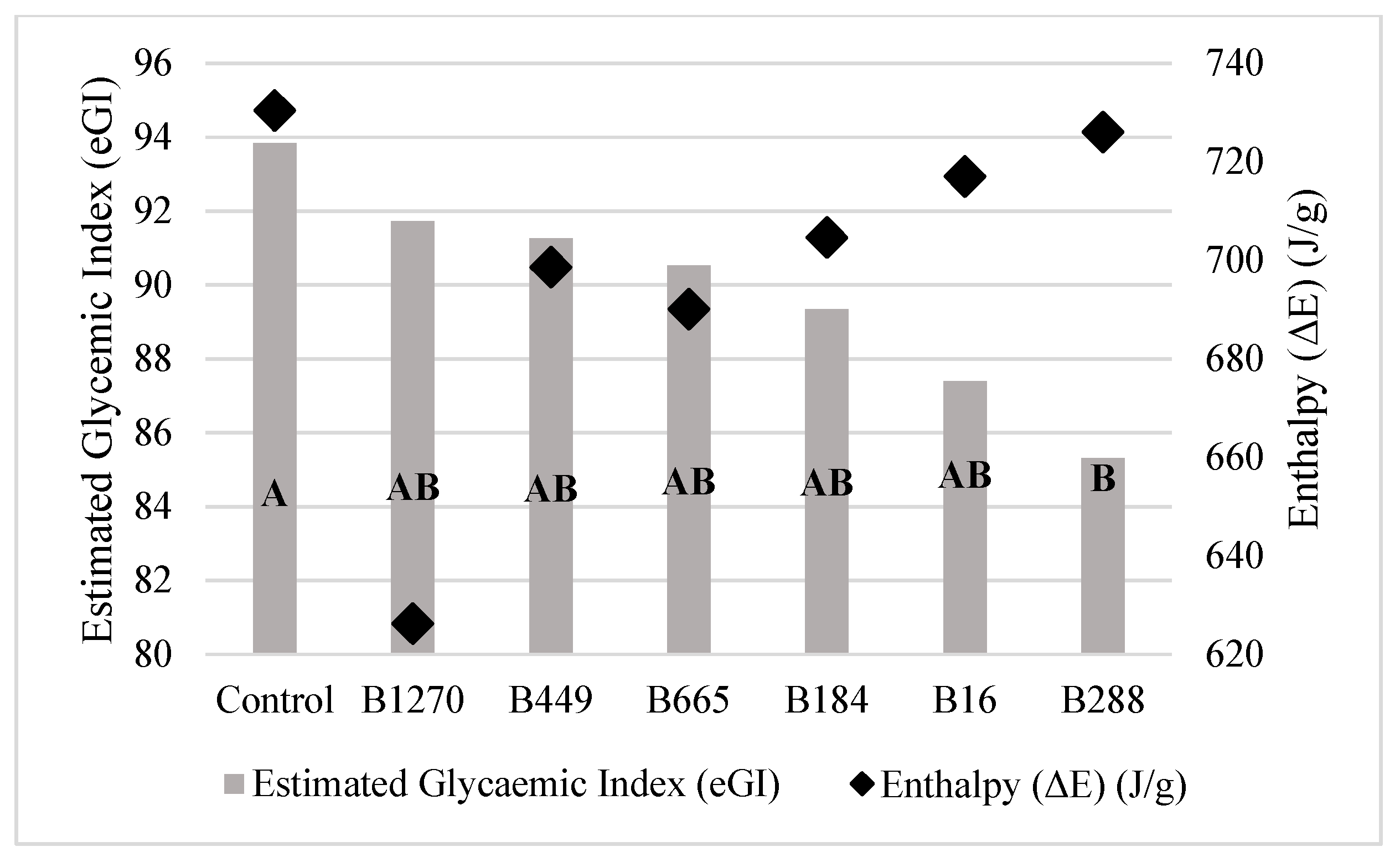
The eGI value of B288 was significantly lower than that of the control sample (p < 0.05) (Figure 2). In contrast, the estimated GI values of the other samples were similar to that of the control (p > 0.05).
It has been reported that organic acids formed during fermentation may limit starch hydrolysis by promoting starch–protein interactions during gelatinization and by affecting starch structure, thereby potentially enhancing resistant starch formation. In addition, interactions between starch and other molecules that restrict gelatinization and facilitate resistant starch formation are known to protect starch granules from enzymatic hydrolysis. Furthermore, phenolic compounds and other bioactive components may act as amylose inhibitors by forming inclusion complexes with starch, thereby limiting its digestion. This, in turn, may contribute to a reduction in postprandial glucose response and glycaemic index.
According to the eGI results obtained in this study, the B288 sample, which exhibited the highest antioxidant activity and phenolic content, also exhibited the lowest eGI value. In light of the literature, this may be attributed to the potential inhibitory effect of phenolic compounds on starch digestion. In addition, a possible increase in resistant starch content may have contributed to the lower glycaemic index. However, because the resistant starch content was not directly measured, it would not be appropriate to attribute the lower eGI value solely to this factor. Moreover, as shown in Table 2, some sourdough samples exhibited higher organic acid content than B288. This suggests that multiple factors, including strain-specific differences, may have contributed to the observed postprandial glucose response.

3.5. Amylopectin Retrogradation in Bread Samples Determined by DSC

The results of the DSC analysis conducted to determine amylopectin retrogradation in the bread samples after 5 d of storage are presented in Figure 2. The differences between the DSC results of the bread samples were statistically insignificant (p > 0.05). Retrogradation is associated with the rearrangement of amylose chains during short-term staling, which occurs within a few hours after baking, and the rearrangement of amylopectin chains during long-term staling throughout the storage. The energy required to melt amylopectin crystals increases with staling. Therefore, it is expected that the area under the endothermic peak—and consequently the enthalpy value—will increase with increasing amylopectin retrogradation in DSC analysis [27].
Starch retrogradation is a complex phenomenon that involves a series of molecular and physicochemical transformations. Various analytical techniques, particularly differential scanning calorimetry (DSC), are widely used to monitor changes in starch properties. Upon heating, heat absorption occurs due to phase transitions such as melting. DSC enables the detection of amylopectin realignment into more ordered structures and water release from the starch matrix. In retrograded starch, the endothermic peak observed by DSC provides quantitative information on the enthalpy change and transition temperatures associated with the melting of recrystallized amylopectin. However, DSC alone may not be sufficient to fully describe the staling process of bread. The increase in crumb firmness, which negatively affects consumer acceptance during storage, cannot be solely attributed to starch retrogradation. Additional mechanisms contribute to staling and the development of crumb hardness. Changes in crumb moisture, water migration between the crumb and crust, and starch–gluten interactions play significant roles in this process. In particular, moisture redistribution during storage is a key factor contributing to the increase in bread firmness [28]. In the present study, the observed increase in crumb firmness during storage, despite the absence of significant changes in the DSC parameters, may be explained by the contribution of these additional mechanisms.

3.6. Staling Kinetics of Bread Samples

The kinetic parameters obtained from the Avrami model are presented in Table 5. In all bread samples, the hardness increased during storage, and this increase was most pronounced in the control sample (p < 0.05). This trend was mitigated by the sourdough application (p < 0.05). The smallest increase in hardness was observed in sourdough breads produced with L. coryniformis (B1270), L. brevis (B665), L. paracasei (B184), and L. helveticus (B16).
When the equilibrium hardness value was considered, a result similar to that obtained at the end of storage was observed (p < 0.05). The samples with the longest half-life were B1270, B449, and B665 (p < 0.05). A long half-life indicates that staling is delayed [16]. The difference between the k-values of the samples determined by the Avrami model was not statistically significant (p > 0.05). The k-value is the reaction rate constant, and a high k-value indicates rapid staling. Amylopectin crystallization was slower in samples with low k values. Generally, as a result of the kinetic calculations, samples with low k values tend to have high n-values [29]. Therefore, the results obtained in this study are in agreement with the literature. The k values of the samples with low equilibrium hardness values were low, while their n-values were high.
Although the differences between the equilibrium moisture values of the bread samples were insignificant, the significant difference in equilibrium hardness values is thought to be due to partial trapping of water that could not be retained by starch and proteins in the structure. The water absorption capacity of the amorphous amylose fraction of starch is higher than that of the crystalline fraction, which imparts elasticity and softness to the bread. However, the water-holding capacity of the reorganized molecules decreases, and the released water is retained by the gluten network during the storage. This causes the bread to develop a hard, inelastic structure [30].
The hardness values were consistent with the specific volume values. As the internal structure of the bread becomes denser and firmer, the hardness value increases while the specific volume decreases. Retrogradation, pore structure, and moisture toward the crust also significantly affect the hardness of bread [31]. In this study, the hardness decreased as the specific volume of the samples increased.

4. Conclusions

In this study, sourdough bread was produced using LAB strains with a high EPS production ability, and their functional and technological contributions were evaluated. The findings revealed that the influence of LAB on bread quality and functionality was strongly dependent on the strain employed. Some strains primarily enhance nutritional and bioactive properties, while others provide technological advantages by improving shelf life and product stability. The highest specific volume was determined for the sourdough bread produced by L. coryniformis. Among the strains tested, L. rhamnosus was particularly effective in enhancing the release of bound phenolic compounds within the sourdough matrix, thereby improving the antioxidant potential of the bread. In addition, this strain significantly contributed to lowering starch digestibility and reducing eGI, suggesting a promising role in the development of bread with improved health-related attributes. In contrast, L. coryniformis, L. plantarum, and L. brevis strains demonstrated strong anti-staling effects. The staling kinetic data indicated that these strains slowed the retrogradation of starch and limited physical deterioration during storage. Thus, they are promising candidates for prolonging the freshness of bread and maintaining its textural quality.
Overall, the results of this study emphasize the versatile potential of LAB in sourdough. By tailoring strain selection, cereal-based foods with targeted functional, nutritional, and technological benefits can be designed. This approach not only contributes to the development of healthier bread formulations with enhanced bioactivity and reduced glycaemic response but also supports industrial efforts to improve product quality and consumer acceptance through natural fermentation. In future studies, the synergistic effects of mixed LAB cultures should be investigated, and fermentation parameters should be optimized. Additionally, EPS levels in different cereal-based food systems can be quantified on a product-specific basis, and both their health-related effects and technological contributions can be further explored.

Author Contributions

H.Ç.B.: Data curation, Formal analysis, Investigation, Methodology, Visualization, Writing—original draft, and review and editing. T.D.: Conceptualization, Methodology, Validation, Writing—original draft, Writing—review and editing. N.A.: Funding acquisition, resources, and editing. S.A.T.: Methodology, Visualization, Writing—review and editing. All authors have read and agreed to the published version of the manuscript.

Funding

The authors are incredibly grateful to the Scientific Research Projects Coordination Unit of Selcuk University for supporting this study (Project number: 22408010).

Institutional Review Board Statement

Not applicable.

Informed Consent Statement

Not applicable.

Data Availability Statement

The original contributions presented in this study are included in the article. Further inquiries can be directed to the corresponding author.

Conflicts of Interest

The authors declare no conflicts of interest.

References

  1. Tinzl-Malang, S.K.; Grattepanche, F.; Rast, P.; Fischer, P.; Sych, J.; Lacroix, C. Purified Exopolysaccharides from Weissella confusa 11GU-1 and Propionibacterium freudenreichii JS15 Act Synergistically on Bread Structure to Prevent Staling. LWT 2020, 127, 109375. [Google Scholar] [CrossRef]
  2. Fadda, C.; Sanguinetti, A.M.; Del Caro, A.; Collar, C.; Piga, A. Bread Staling: Updating the View. Compr. Rev. Food Sci. Food Saf. 2014, 13, 473–492. [Google Scholar] [CrossRef] [PubMed]
  3. Fu, Z.; Chen, J.; Luo, S.J.; Liu, C.M.; Liu, W. Effect of Food Additives on Starch Retrogradation: A Review. Starch—Stärke 2015, 67, 69–78. [Google Scholar] [CrossRef]
  4. Alkay, Z.; Falah, F.; Cankurt, H.; Dertli, E. Exploring the Nutritional Impact of Sourdough Fermentation: Its Mechanisms and Functional Potential. Foods 2024, 13, 1732. [Google Scholar] [CrossRef]
  5. Zhao, C.J.; Schieber, A.; Gänzle, M.G. Formation of Taste-Active Amino Acids, Amino Acid Derivatives and Peptides in Food Fermentations—A Review. Food Res. Int. 2016, 89, 39–47. [Google Scholar] [CrossRef]
  6. Pejcz, E.; Czaja, A.; Wojciechowicz-Budzisz, A.; Gil, Z.; Spychaj, R. The Potential of Naked Barley Sourdough to Improve the Quality and Dietary Fibre Content of Barley Enriched Wheat Bread. J. Cereal Sci. 2017, 77, 97–101. [Google Scholar] [CrossRef]
  7. Ouarabi, L.; Ouarabi, L.; Hamma-Faradji, S.; Mohedano, M.L.; López, P.; Drider, D. Exopolysaccharides from Lactic Acid Bacteria: Structure, Biosynthesis, and Health Benefits. Microbes Infect. 2025, 27, 105581. [Google Scholar] [CrossRef]
  8. Zhang, K.; Liu, S.; Liang, S.; Xiang, F.; Wang, X.; Lian, H.; Li, B.; Liu, F. Exopolysaccharides of Lactic Acid Bacteria: Structure, Biological Activity, Structure-Activity Relationship, and Application in the Food Industry: A Review. Int. J. Biol. Macromol. 2024, 257, 128733. [Google Scholar] [CrossRef]
  9. Özkan, E.R.; Demirci, T.; Öztürk, H.İ.; Akın, N. Screening Lactobacillus Strains from Artisanal Turkish Goatskin Casing Tulum Cheeses Produced by Nomads via Molecular and in Vitro Probiotic Characteristics. J. Sci. Food Agric. 2021, 101, 2799–2808. [Google Scholar] [CrossRef]
  10. Nouska, C.; Hatzikamari, M.; Matsakidou, A.; Biliaderis, C.G.; Lazaridou, A. Enhancement of Textural and Sensory Characteristics of Wheat Bread Using a Chickpea Sourdough Fermented with a Selected Autochthonous Microorganism. Foods 2023, 12, 3112. [Google Scholar] [CrossRef]
  11. AACC. AACC Approved Methods of Analysis of the American Association of Cereal Chemists; AACC: St. Paul, MN, USA, 2012; Volume 1, pp. 70–86. [Google Scholar]
  12. Durmus, Y.; Whitney, K.; Anil, M.; Simsek, S. Enrichment of Sourdough Bread with Hazelnut Skin, Cross-Linked Starch, or Oxidized Starch for Improvement of Nutritional Quality. J. Food Process Eng. 2023, 46, e14361. [Google Scholar] [CrossRef]
  13. Mushtaq, B.S.; Nikoloudaki, O.; Ben, M.; Arora, K.; Tlais, A.Z.A.; Polo, A.; Cagno, R.D.; Gobbetti, M. Development of Nutritionally Enhanced Sourdough Bread Through Tritordeum Bran Incorporation and Assessment in an in Vitro Gut Simulation. Future Foods 2026, 13, 100874. [Google Scholar] [CrossRef]
  14. Gumul, D.; Oracz, J.; Litwinek, D.; Żyżelewicz, D.; Zięba, T.; Sabat, R.; Wywrocka-Gurgul, A.; Ziobro, R. Quality- and Health-Promoting Compounds of Whole Wheat Bread with the Addition of Stale Bread, Cornmeal, and Apple Pomace. Foods 2024, 13, 1767. [Google Scholar] [CrossRef] [PubMed]
  15. Demirkesen-Bicak, H.; Arici, M.; Yaman, M.; Karasu, S.; Sagdic, O. Effect of Different Fermentation Condition on Estimated Glycemic Index, in Vitro Starch Digestibility, and Textural and Sensory Properties of Sourdough Bread. Foods 2021, 10, 514. [Google Scholar] [CrossRef] [PubMed]
  16. Arp, C.G.; Correa, M.J.; Ferrero, C. Kinetic Study of Staling in Breads with High-Amylose Resistant Starch. Food Hydrocoll. 2020, 106, 105879. [Google Scholar] [CrossRef]
  17. Lattanzi, A.; Minervini, F.; Di Cagno, R.; Diviccaro, A.; Antonielli, L.; Cardinali, G.; Cappelle, S.; De Angelis, M.; Gobbetti, M. The Lactic Acid Bacteria and Yeast Microbiota of Eighteen Sourdoughs Used for the Manufacture of Traditional Italian Sweet Leavened Baked Goods. Int. J. Food Microbiol. 2013, 163, 71–79. [Google Scholar] [CrossRef]
  18. Yu, Y.; Wang, J.; Sadiq, F.A.; Cheng, H.; Liu, A.; Liu, Y.; Tian, S.; Liang, J.; Zhu, L.; Zhang, G. Enhancing Sourdough Fermentation with AI and Multi-Omics: From Natural Diversity to Synthetic Microbial Community. Trends Food Sci. Technol. 2025, 165, 105233. [Google Scholar] [CrossRef]
  19. Menezes, L.A.A.; De Marco, I.; Neves Oliveira dos Santos, N.; Costa Nunes, C.; Leite Cartabiano, C.E.; Molognoni, L.; Pereira, G.V.d.M.; Daguer, H.; De Dea Lindner, J. Reducing FODMAPs and Improving Bread Quality Using Type II Sourdough with Selected Starter Cultures. Int. J. Food Sci. Nutr. 2021, 72, 912–922. [Google Scholar] [CrossRef]
  20. Lau, S.W.; Chong, A.Q.; Chin, N.L.; Talib, R.A.; Basha, R.K. Sourdough Microbiome Comparison and Benefits. Microorganisms 2021, 9, 1355. [Google Scholar] [CrossRef]
  21. Perri, G.; Coda, R.; Rizzello, C.G.; Celano, G.; Ampollini, M.; Gobbetti, M.; De Angelis, M.; Calasso, M. Sourdough Fermentation of Whole and Sprouted Lentil Flours: In Situ Formation of Dextran and Effects on the Nutritional, Texture and Sensory Characteristics of White Bread. Food Chem. 2021, 355, 129638. [Google Scholar] [CrossRef]
  22. Komlenić, D.K.; Ugarčić-Hardi, Ž.; Jukić, M.; Planinić, M.; Bucić-Kojić, A.; Strelec, I. Wheat Dough Rheology and Bread Quality Effected by Lactobacillus brevis Preferment, Dry Sourdough and Lactic Acid Addition. Int. J. Food Sci. Technol. 2010, 45, 1417–1425. [Google Scholar] [CrossRef]
  23. Pontonio, E.; Perri, G.; Calasso, M.; Celano, G.; Verni, M.; Rizzello, C.G. Unveiling the Impact of Traditional Sourdough Propagation Methods on the Microbiological, Biochemical, Sensory, and Technological Properties of Sourdough and Bread: A Comprehensive First Study. Appl. Food Res. 2025, 5, 101037. [Google Scholar] [CrossRef]
  24. Islam, M.A.; Islam, S. Sourdough Bread Quality: Facts and Factors. Foods 2024, 13, 2132. [Google Scholar] [CrossRef]
  25. Çetin Babaoğlu, H.; Arslan Tontul, S.; Karaduman, L.; Üzgü, Y. The Usage of Sourdough Powder as the Natural Preservative and Glycemic Index Lowering Agent in Salty Muffins. Br. Food J. 2023, 125, 3573–3584. [Google Scholar] [CrossRef]
  26. Gabriele, M.; Cavallero, A.; Tomassi, E.; Arouna, N.; Árvay, J.; Longo, V.; Pucci, L. Assessment of Sourdough Fermentation Impact on the Antioxidant and Anti-Inflammatory Potential of Pearl Millet from Burkina Faso. Foods 2024, 13, 704. [Google Scholar] [CrossRef]
  27. Primo-Martín, C.; van Nieuwenhuijzen, N.H.; Hamer, R.J.; van Vliet, T. Crystallinity Changes in Wheat Starch During the Bread-Making Process: Starch Crystallinity in the Bread Crust. J. Cereal Sci. 2007, 45, 219–226. [Google Scholar] [CrossRef]
  28. Besbes, E.; Le Bail, A.; Seetharaman, K. Impact of Local Hydrothermal Treatment During Bread Baking on Soluble Amylose, Firmness, Amylopectin Retrogradation and Water Mobility During Bread Staling. J. Food Sci. Technol. 2015, 53, 304–314. [Google Scholar] [CrossRef]
  29. Armero, E.; Collar, C. Crumb Firming Kinetics of Wheat Breads with Anti-Staling Additives. J. Cereal Sci. 1998, 28, 165–174. [Google Scholar] [CrossRef]
  30. Tontul, S.A.; Babaoğlu, H.Ç. Effect of Flour Particle Size on Physical Properties and Shelf Life of Bread. J. Food 2019, 44, 898–906. [Google Scholar] [CrossRef]
  31. Özkaya, B.; Baumgartner, B.; Özkaya, H. Effects of Concentrated and Dephytinized Wheat Bran and Rice Bran Addition on Bread Properties. J. Texture Stud. 2018, 49, 84–93. [Google Scholar] [CrossRef]
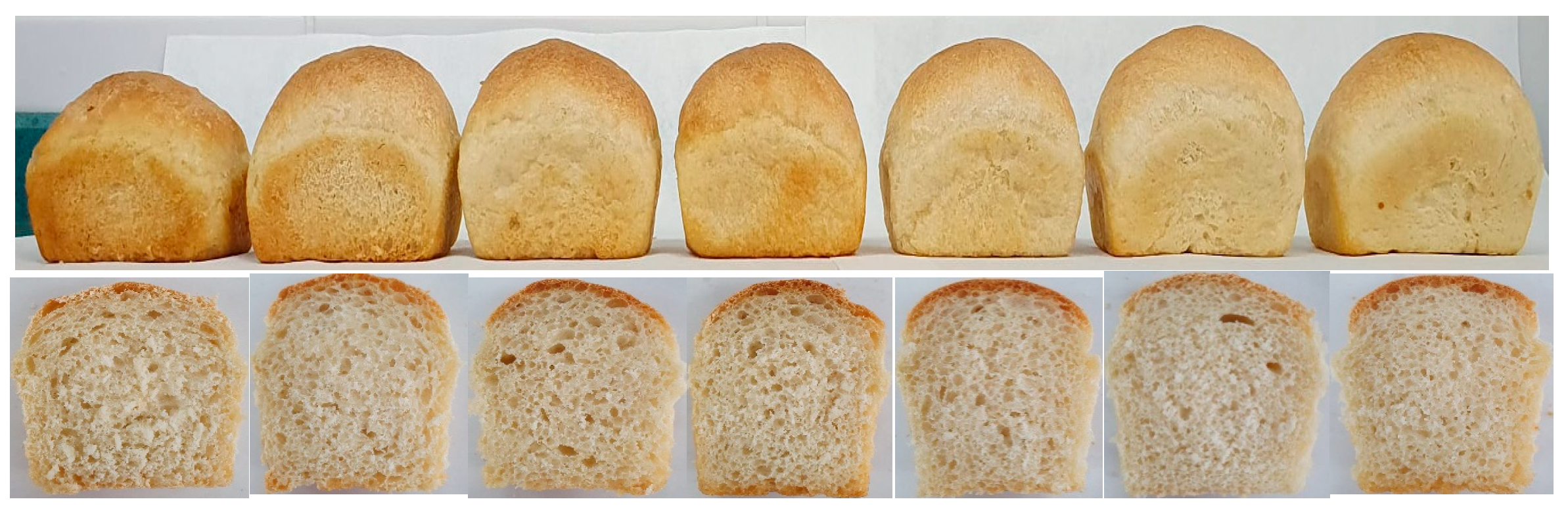
Figure 1. Sourdough breads prepared with different starter cultures (from left to right: control, B16, B184, B288, B449, B665, and B1270 samples). Control: Bread sample produced without the addition of sourdough; B1270: Bread sample produced with sourdough using Loigolactobacillus coryniformis as the starter culture; B449: Bread sample produced with sourdough using Lactiplantibacillus plantarum as the starter culture; B665: Bread sample produced with sourdough using Levilactobacillus brevis as the starter culture; B184: Bread sample produced with sourdough using Lacticaseibacillus paracasei as the starter culture; B16: Bread sample produced with sourdough using Lactobacillus helveticus as the starter culture; B288: Bread sample produced with sourdough using Lacticaseibacillus rhamnosus as the starter culture.
Fermentation 12 00278 g001
Figure 2. Estimated glycaemic index values at the beginning of storage and DSC-measured enthalpy values at the end of storage in bread samples. Letters ‘A–B’ indicate that the differences between the samples were statistically significant (p < 0.05). As the differences among the enthalpy values are statistically insignificant, no letter notation was applied (p > 0.05).
Fermentation 12 00278 g002
Table 1. Lactobacillus isolates identified via 16S rRNA gene sequencing and their GenBank accession numbers, adapted from NCBI-BLAST (+v2.5.0).
IsolateStrainIdentification (%)GenBank
Accession No.
The Yield of EPS (µg/mL)
1270Loigolactobacillus coryniformis (B518)99MF540549.1198.48
449Lactiplantibacillus plantarum (CSCWL 6–9)99KR055058.1276.58
665Levilactobacillus brevis (a88)99KX057568.1355.81
184Lacticaseibacillus paracasei (RCM2)98KT626389.1391.86
16Lactobacillus helveticus (L47)99KP317715.1424.90
288Lacticaseibacillus rhamnosus (LRB)99CP016823.1517.65
Table 2. pH, TA values and LAB count of sourdough samples after fermentation.
SamplepHTA (%)LAB (log CFU/g)
S12703.63 ± 0.01 C0.85 ± 0.01 B8.29 ± 0.49 A
S4494.19 ± 0.00 A0.46 ± 0.01 C9.14 ± 0.39 A
S6653.55 ± 0.00 D0.93 ± 0.00 A8.38 ± 0.23 A
S1844.15 ± 0.00 AB0.46 ± 0.01 C8.60 ± 0.01 A
S164.18 ± 0.02 AB0.47 ± 0.01 C8.40 ± 0.11 A
S2884.14 ± 0.00 B0.49 ± 0.01 C8.62 ± 0.05 A
n = 2, (mean ± standard error). Letters ‘A–D’ given in the same column indicate that the differences between sourdough samples are statistically significant (p < 0.05).
Table 3. Specific volume and colour values of bread samples, bread crust, and crumb.
SampleSpecific Volume (mL/g)L*-Crusta*-Crustb*-CrustL*-Crumba*-Crumbb*-CrumbBI-CrustBI-Crumb
Control2.46 ± 0.02 D70.38 ± 1.98 A6.77 ± 0.12 B33.28 ± 1.17 A69.20 ± 0.66 A−1.78 ± 0.04 AB19.92 ± 0.07 A70.81 ± 6.78 D17.62 ± 0.76 A
B12703.46 ± 0.03 A65.32 ± 1.56 A8.33 ± 0.68 AB33.90 ± 0.28 A70.71 ± 1.46 A−1.75 ± 0.00 AB18.47 ± 0.29 A80.04 ± 3.38 BCD15.75 ± 0.70 A
B4493.23 ± 0.07 ABC59.04 ± 0.99 CD9.72 ± 0.62 AB32.33 ± 0.24 A67.66 ± 1.33 A−1.61 ± 0.06 A18.72 ± 0.24 A88.43 ± 5.65 AB17.26 ± 0.77 A
B6653.35 ± 0.02 AB67.22 ± 0.23 AB7.27 ± 0.35 B32.91 ± 0.54 A72.52 ± 0.31 A−1.87 ± 0.01 B19.26 ± 0.02 A73.06 ± 3.65 CD15.74 ± 0.58 A
B1843.08 ± 0.01 C62.59 ± 1.15 BCD9.66 ± 0.57 AB33.17 ± 0.48 A68.21 ± 0.13 A−1.67 ± 0.02 A18.24 ± 0.27 A84.09 ± 2.10 ABC17.17 ± 0.47 A
B163.06 ± 0.03 BC57.73 ± 0.76 D10.76 ± 0.17 A32.31 ± 0.27 A67.40 ± 1.49 A−1.71 ± 0.03 AB18.61 ± 0.88 A92.30 ± 2.24 A17.96 ± 1.47 A
B2883.00 ± 0.02 C62.74 ± 0.61 BCD9.09 ± 0.86 AB32.48 ± 1.18 A68.70 ± 0.24 A−1.67 ± 0.00 A18.93 ± 0.37 A80.52 ± 5.74 ABCD17.03 ± 0.83 A
n = 2, (mean ± standard error). Different superscript letters (‘A–D’) in the same column indicate statistically significant differences between the bread samples (p < 0.05).
Table 4. Functional analysis of bread samples.
ControlB1270B449B665B184B16B288
DPPH (µmol TE/100 g)Free89.92 ± 2.55 E100.77 ± 10.20 DE109.23 ± 1.34 CD112.75 ± 2.39 BCD122.35 ± 2.45 ABC124.52 ± 4.99 AB135.70 ± 0.89 A
Bound219.07 ± 12.83 A223.01 ± 16.29 A226.17 ± 18.24 A229.22 ± 2.32 A236.92 ± 0.44 A239.43 ± 1.43 A239.82 ± 3.11 A
Total314.42 ± 15.73 A318.34 ± 24.27 A335.40 ± 19.58 A341.97 ± 0.07 A359.27 ± 2.89 A363.94 ± 3.55 A375.52 ± 2.22 A
ABTS (µmol TE/100 g)Free155.33 ± 2.40 A156.44 ± 7.00 A159.17 ± 3.45 A166.78 ± 6.82 A167.21 ± 10.62 A175.18 ± 5.65 A181.16 ± 4.05 A
Bound184.47 ± 6.57 B200.60 ± 4.81 AB208.29 ± 3.35 AB210.38 ± 14.94 AB218.69 ± 1.46 AB224.61 ± 1.05 AB226.38 ± 7.95 A
Total339.80 ± 8.97 C357.04 ± 11.81 BC367.46 ± 0.10 ABC377.17 ± 8.12 ABC385.89 ± 9.15 ABC399.79 ± 6.71 AB407.55 ± 12.00 A
TPC (mg GAE/kg)Free200.71 ± 5.10 B332.72 ± 4.98 A347.90 ± 14.97 A373.39 ± 14.95 A400.40 ± 9.48 A398.99 ± 16.57 A408.62 ± 16.68 A
Bound493.03 ± 23.20 B626.67 ± 2.99 A641.15 ± 4.81 A650.77 ± 5.25 A651.29 ± 26.63 A656.41 ± 9.94 A707.02 ± 6.67 A
Total693.75 ± 28.30 B959.39 ± 7.97 A992.17 ± 13.35 A1018.48 ± 23.89 A1051.69 ± 17.16 A1055.40 ± 26.51 A1115.63 ± 10.01 A
n = 2, (mean ± standard error). Different superscript letters (‘A–E’) in the same column indicate statistically significant differences between the bread samples (p < 0.05).
Table 5. Kinetic parameters obtained from Avrami modelling the change in the moisture and the hardness of bread samples during storage.
Sample P0 (% w/w)Pt (% w/w)P (% w/w)knR2t1/2 (Day)
ControlMOISTURE35.50 ± 0.24 A33.33 ± 0.00 A33.24 ± 0.04 A0.50 ± 0.35 A1.37 ± 0.06 A0.98 ± 0.011.63 ± 0.06 A
B127035.07 ± 0.87 A32.44 ± 0.16 A32.42 ± 0.17 A0.37 ± 0.04 A1.59 ± 0.01 A0.99 ± 0.001.17 ± 0.12 A
B44934.92 ± 0.14 A32.35 ± 0.19 A32.26 ± 0.26 A0.11 ± 0.00 A2.18 ± 0.17 A0.96 ± 0.032.81 ± 0.01 A
B66534.58 ± 0.59 A32.57 ± 0.10 A32.50 ± 0.11 A0.40 ± 0.11 A1.34 ± 0.12 A0.99 ± 0.001.31 ± 0.02 A
B18434.73 ± 0.00 A32.86 ± 0.38 A32.69 ± 0.35 A0.26 ± 0.13 A1.70 ± 0.02 A0.94 ± 0.021.64 ± 0.05 A
B1633.85 ± 0.08 A32.84 ± 0.37 A32.77 ± 0.33 A0.21 ± 0.01 A1.72 ± 0.10 A0.95 ± 0.021.72 ± 0.11 A
B28834.43 ± 0.04 A32.26 ± 0.05 A32.11 ± 0.08 A0.28 ± 0.16 A1.64 ± 0.07 A0.92 ± 0.021.97 ± 0.06 A
ControlHARDNESS1824.04 ± 25.52 A6027.17 ± 196.08 A7164.47 ± 130.01 A0.35 ± 0.09 A1.12 ± 0.08 B0.93 ± 0.011.38 ± 0.08 B
B1270726.95 ± 9.38 D3489.85 ± 375.51 C3994.93 ± 193.54 C0.15 ± 0.01 A1.78 ± 0.04 A0.98 ± 0.002.04 ± 0.14 A
B449763.47 ± 12.57 D3912.72 ± 74.53 BC4186.58 ± 7.80 BC0.30 ± 0.04 A1.42 ± 0.02 AB0.96 ± 0.011.67 ± 0.09 AB
B665732.17 ± 33.12 D3749.54 ± 91.69 BC4105.54 ± 78.41 BC0.22 ± 0.01 A1.52 ± 0.04 AB0.98 ± 0.001.89 ± 0.04 AB
B184884.92 ± 7.27 CD4025.82 ± 7.39 BC4259.31 ± 86.31 BC0.38 ± 0.03 A1.32 ± 0.13 AB0.99 ± 0.001.47 ± 0.08 B
B16945.42 ± 16.27 C4340.23 ± 35.99 BC4739.19 ± 145.48 BC0.38 ± 0.04 A1.24 ± 0.04 B0.97 ± 0.021.46 ± 0.07 B
B2881164.80 ± 64.35 B4616.24 ± 64.49 B4831.01 ±105.34 B0.38 ± 0.02 A1.36 ± 0.00 AB0.99 ± 0.001.47 ± 0.04 B
n = 2, (mean ± standard error). Different superscript letters (‘A–D’) in the same column indicate statistically significant differences between the bread samples (p < 0.05). P0: Moisture or hardness of bread at t = 0, Pt: Moisture or hardness of bread at t = 5, P: Moisture or hardness of bread at t = ∞, k: Rate constant, n: Avrami exponent, R2: Model fit ratio, t1/2: Half-life.
Disclaimer/Publisher’s Note: The statements, opinions and data contained in all publications are solely those of the individual author(s) and contributor(s) and not of MDPI and/or the editor(s). MDPI and/or the editor(s) disclaim responsibility for any injury to people or property resulting from any ideas, methods, instructions or products referred to in the content.