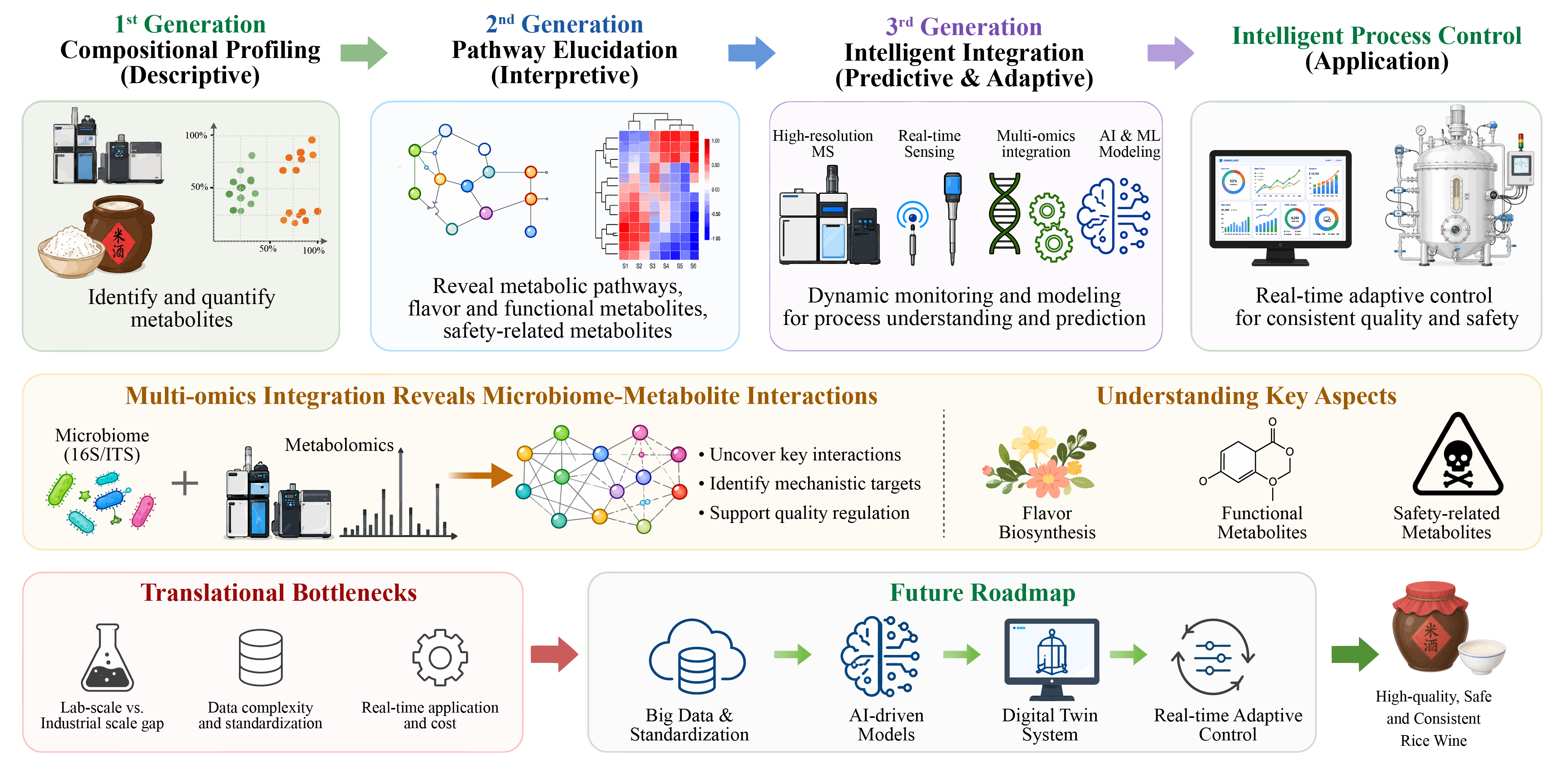

Metabolomics-Driven Insights into Rice Wine Fermentation: From Descriptive Profiling to Intelligent Process Control
 , , and
Abstract
1. Introduction
2. Metabolomics Development in Rice Wine Fermentation
2.1. First-Generation Metabolomics (2000–2010): Baseline Profiling of Dominant Metabolites
2.1.1. Technical Basis and Analytical Limitations
2.1.2. Application in Rice Wine: Profiling Major Metabolic Trends
2.2. Second-Generation Metabolomics (2010–2020): Comprehensive Flavor and Safety Analysis
2.2.1. Advances in High-Resolution Mass Spectrometry
2.2.2. Multi-Technique Integration and Expanded Metabolite Coverage
2.2.3. Enabling Metabolic Pathway Elucidation
2.3. Third-Generation Metabolomics (2020-Present): AI-Driven and Multi-Omics-Enabled Precision Analysis
2.3.1. AI-Assisted Data Analysis and Predictive Modeling
2.3.2. Multi-Omics Integration Linking Microbes to Metabolites
2.3.3. Emerging In Situ and Real-Time Analytical Strategies
3. Metabolite Profiling and Safety Monitoring in Rice Wine Production
3.1. Elucidation of Flavor Metabolite Biosynthesis

| Rice Wine Category | Key Raw Materials | Dominant Microflora (Starter/Qu) | Major Metabolite Classes | Unique Biomarkers (Discriminants) | Sensory Descriptors | Reference |
|---|---|---|---|---|---|---|
| Shaoxing Huangjiu (Yellow Rice Wine) | Glutinous rice, Wheat Qu (Saccharification starter), Water | Aspergillus oryzae, Saccharomyces cerevisiae, Lactobacillus spp. | Amino acids, Organic acids, Short-chain peptides, Esters | γ-Aminobutyric acid (GABA), Pyroglutamic acid, Aspartic acid, Diethyl succinate, Benzaldehyde | Umami, Full-bodied, Mellow, Rich bouquet | [71] |
| Red Qu Rice Wine (Hong Qu) | Glutinous rice, Red Yeast Rice (Monascus starter) | Monascus purpureus, Monascus ruber, Saccharomyces cerevisiae | Polyketides, Pigments, Statins, Volatile esters | Monacolin K, Monascin, Ankaflavin, Ethyl hexanoate, β-Phellandrene | Functional, Fruity, Slightly bitter, Distinctive red color | [72] |
| Sweet Rice Wine (Jiuniang/Tianjiu) | Polished glutinous rice, Xiaoqu (Rice Qu) | Rhizopus spp. (e.g., R. oryzae), Mucor spp., Rhizopus chinensis | Reducing sugars, Alcohols, Organic acids | Glucose, Maltose, Ethyl lactate, 2-Phenylethanol, Isoamyl alcohol | Sweet, Floral, Honey-like, Low alcohol, Light body | [73] |
| Black Glutinous Rice Wine | Black glutinous rice (Whole grain), Wheat Qu or Xiaoqu | Saccharomyces cerevisiae, Rhizopus spp., Aspergillus spp. | Anthocyanins, Phenolic acids, Flavanols, Citric acid | Cyanidin-3-glucoside, Peonidin-3-glucoside, Protocatechuic acid, Vanillic acid | Astringent, Antioxidant-rich, Complex berry notes | [74] |
3.2. Functional Metabolites
3.3. Safety Risk Metabolites
3.4. Adaptive Safety Monitoring Systems
4. Application of Metabolomics in Microbiome-Metabolite Interaction Control
4.1. Evolution of Analytical Frameworks Linking Microbial Community Structure and Metabolites
4.2. Metabolic Contributions of Core Functional Taxa and Strategies for Regulation
4.3. Suppression of Harmful Taxa and Purification of the Fermentation Ecosystem
5. Metabolomics Technology Application Bottlenecks and Future Prospects
5.1. Key Bottlenecks Limiting Translation of Metabolomics into Practice
5.2. Future Directions Toward Intelligent and Adaptive Metabolomics Applications
6. Conclusions and Prospects
Author Contributions
Funding
Institutional Review Board Statement
Informed Consent Statement
Data Availability Statement
Acknowledgments
Conflicts of Interest
References
- Peng, B.; Huang, H.; Xu, J.; Xin, Y.; Hu, L.; Wen, L.; Li, L.; Chen, J.; Han, Y.; Li, C. Rice Wine Fermentation: Unveiling Key Factors Shaping Quality, Flavor, and Technological Evolution. Foods 2025, 14, 2544. [Google Scholar] [CrossRef]
- Tian, S.; Zeng, W.; Zhou, J.; Du, G. Correlation between the microbial community and ethyl carbamate generated during Huzhou rice wine fermentation. Food Res. Int. 2022, 154, 111001. [Google Scholar] [CrossRef] [PubMed]
- Xia, Y.; Luo, H.; Wu, Z.; Zhang, W. Microbial diversity in jiuqu and its fermentation features: Saccharification, alcohol fermentation and flavors generation. Appl. Microbiol. Biotechnol. 2023, 107, 25–41. [Google Scholar] [CrossRef]
- Zhao, S.; Xu, Q.; Li, M.; Chen, J.; Francis, F.; Dai, X.; Tan, J.; Kong, Z. Exploring the Impact of Dinotefuran Residue on Microbial Community and Flavor Generation in Huangjiu Fermentation. J. Agric. Food Chem. 2025, 73, 17219–17232. [Google Scholar] [CrossRef]
- Liu, Z.; Zhang, M.; Chen, P.; Harnly, J.M.; Sun, J. Mass spectrometry-based nontargeted and targeted analytical approaches in fingerprinting and metabolomics of food and agricultural research. J. Agric. Food Chem. 2022, 70, 11138–11153. [Google Scholar] [CrossRef] [PubMed]
- Windarsih, A.; Rohman, A.; Riswanto, F.D.O.; Dachriyanus; Yuliana, N.D.; Bakar, N.K.A. The metabolomics approaches based on LC-MS/MS for analysis of non-halal meats in food products: A review. Agriculture 2022, 12, 984. [Google Scholar] [CrossRef]
- Ruan, W.; Liu, J.; Guo, H.; Yang, S.; Niu, M.; Yu, H.; Meng, X. From aroma to off-flavor: Metabolomics unveils the metabolic double-sided nature of traditional Chinese fermented foods. Food Chem. 2026, 502, 147635. [Google Scholar] [CrossRef]
- Wang, F.; Zhao, P.; Du, G.; Zhai, J.; Guo, Y.; Wang, X. Advancements and challenges for brewing aroma-enhancement fruit wines: Microbial metabolizing and brewing techniques. Food Chem. 2024, 456, 139981. [Google Scholar] [CrossRef]
- Taheri, S.; Andrade, J.C.d.; Conte-Junior, C.A. Emerging perspectives on analytical techniques and machine learning for food metabolomics in the era of industry 4.0: A systematic review. Crit. Rev. Food Sci. Nutr. 2025, 65, 6003–6029. [Google Scholar] [CrossRef] [PubMed]
- Kim, A.J.; Choi, J.N.; Kim, J.; Park, S.B.; Yeo, S.H.; Choi, J.H.; Lee, C.H. GC-MS based metabolite profiling of rice koji fermentation by various fungi. Biosci. Biotechnol. Biochem. 2010, 74, 2267–2272. [Google Scholar] [CrossRef]
- Cui, Y.; Li, Q.; Zhang, M.; Liu, Z.; Yin, W.; Liu, W.; Chen, X.; Bi, K. LC−MS determination and pharmacokinetics of p-coumaric acid in rat plasma after oral administration of p-coumaric acid and freeze-dried red wine. J. Agric. Food Chem. 2010, 58, 12083–12088. [Google Scholar] [CrossRef] [PubMed]
- Koda, M.; Furihata, K.; Wei, F.; Miyakawa, T.; Tanokura, M. NMR-based metabolic profiling of rice wines by F 2-selective total correlation spectra. J. Agric. Food Chem. 2012, 60, 4818–4825. [Google Scholar] [CrossRef]
- Diez-Simon, C.; Mumm, R.; Hall, R.D. Mass spectrometry-based metabolomics of volatiles as a new tool for understanding aroma and flavour chemistry in processed food products. Metabolomics 2019, 15, 41. [Google Scholar] [CrossRef]
- Zeng, X.; Fu, X.; Li, G.; Yu, S. 1H NMR analysis of rice wine treated by electric field. Guang Pu Xue Yu Guang Pu Fen Xi Guang Pu 2004, 24, 748–751. [Google Scholar]
- Peng, Q.; Meng, K.; Zheng, H.; Yu, H.; Zhang, Y.; Yang, X.; Lin, Z.; Xie, G. Metabolites comparison in post-fermentation stage of manual (mechanized) Chinese Huangjiu (yellow rice wine) based on GC–MS metabolomics. Food Chem. X 2022, 14, 100324. [Google Scholar] [CrossRef]
- Dai, C.-E.; Li, H.-L.; He, X.-P.; Zheng, F.-F.; Zhu, H.-L.; Liu, L.-F.; Du, W. Research advance in metabolism of effective ingredients from traditional Chinese medicines by probiotics. China J. Chin. Mater. Medica 2018, 43, 31–38. [Google Scholar] [CrossRef]
- Wang, J.; Wang, D.; Huang, M.; Sun, B.; Ren, F.; Wu, J.; Meng, N.; Zhang, J. Identification of nonvolatile chemical constituents in Chinese Huangjiu using widely targeted metabolomics. Food Res. Int. 2023, 172, 113226. [Google Scholar] [CrossRef]
- Pinu, F.R.; Goldansaz, S.A.; Jaine, J. Translational metabolomics: Current challenges and future opportunities. Metabolites 2019, 9, 108. [Google Scholar] [CrossRef] [PubMed]
- Zhang, R.; Jia, W.; Shi, L. A comprehensive review on the development of foodomics-based approaches to evaluate the quality degradation of different food products. Food Rev. Int. 2023, 39, 5563–5582. [Google Scholar] [CrossRef]
- Shu, N.; Chen, X.; Sun, X.; Cao, X.; Liu, Y.; Xu, Y.-J. Metabolomics identify landscape of food sensory properties. Crit. Rev. Food Sci. Nutr. 2023, 63, 8478–8488. [Google Scholar] [CrossRef]
- Beale, D.J.; Pinu, F.R.; Kouremenos, K.A.; Poojary, M.M.; Narayana, V.K.; Boughton, B.A.; Kanojia, K.; Dayalan, S.; Jones, O.A.; Dias, D.A. Review of recent developments in GC–MS approaches to metabolomics-based research. Metabolomics 2018, 14, 152. [Google Scholar] [CrossRef]
- Feng, X.; Wang, H.; Yu, Y.; Zhu, Y.; Ma, J.; Liu, Z.; Ni, L.; Lin, C.-C.; Wang, K.; Liu, Y. Exploration of the flavor diversity of oolong teas: A comprehensive analysis using metabolomics, quantification techniques, and sensory evaluation. Food Res. Int. 2024, 195, 114868. [Google Scholar] [CrossRef]
- Mo, X.; Fan, W.; Xu, Y. Changes in volatile compounds of Chinese rice wine wheat Qu during fermentation and storage. J. Inst. Brew. 2009, 115, 300–307. [Google Scholar] [CrossRef]
- Bravo, L.; Goya, L.; Lecumberri, E. LC/MS characterization of phenolic constituents of mate (Ilex paraguariensis, St. Hil.) and its antioxidant activity compared to commonly consumed beverages. Food Res. Int. 2007, 40, 393–405. [Google Scholar] [CrossRef]
- Chen, S.; Xu, Y. The influence of yeast strains on the volatile flavour compounds of Chinese rice wine. J. Inst. Brew. 2010, 116, 190–196. [Google Scholar] [CrossRef]
- Kuang, H.; Li, Z.; Peng, C.; Liu, L.; Xu, L.; Zhu, Y.; Wang, L.; Xu, C. Metabonomics approaches and the potential application in foodsafety evaluation. Crit. Rev. Food Sci. Nutr. 2012, 52, 761–774. [Google Scholar] [CrossRef]
- Rubert, J.; Zachariasova, M.; Hajslova, J. Advances in high-resolution mass spectrometry based on metabolomics studies for food–a review. Food Addit. Contam. Part A 2015, 32, 1685–1708. [Google Scholar] [CrossRef]
- Wang, N.; Chen, S.; Zhou, Z. Age-dependent characterization of volatile organic compounds and age discrimination in Chinese rice wine using an untargeted GC/MS-based metabolomic approach. Food Chem. 2020, 325, 126900. [Google Scholar] [CrossRef]
- Daliri, E.B.-M.; Ofosu, F.K.; Chelliah, R.; Kim, J.-H.; Kim, J.-R.; Yoo, D.; Oh, D.-H. Untargeted metabolomics of fermented rice using UHPLC Q-TOF MS/MS reveals an abundance of potential antihypertensive compounds. Foods 2020, 9, 1007. [Google Scholar] [CrossRef]
- Lee, G.-H.; Bang, D.-Y.; Lim, J.-H.; Yoon, S.-M.; Yea, M.-J.; Chi, Y.-M. Simultaneous determination of ethyl carbamate and urea in Korean rice wine by ultra-performance liquid chromatography coupled with mass spectrometric detection. J. Chromatogr. B 2017, 1065, 44–49. [Google Scholar] [CrossRef] [PubMed]
- Bai, W.; Sun, S.; Zhao, W.; Qian, M.; Liu, X.; Chen, W. Determination of ethyl carbamate (EC) by GC-MS and characterization of aroma compounds by HS-SPME-GC-MS during wine frying status in Hakka yellow rice wine. Food Anal. Methods 2017, 10, 2068–2077. [Google Scholar] [CrossRef]
- Alves Filho, E.G.; Silva, L.M.A.; Ribeiro, P.R.; de Brito, E.S.; Zocolo, G.J.; Souza-Leão, P.C.; Marques, A.T.; Quintela, A.L.; Larsen, F.H.; Canuto, K.M. 1H NMR and LC-MS-based metabolomic approach for evaluation of the seasonality and viticultural practices in wines from São Francisco River Valley, a Brazilian semi-arid region. Food Chem. 2019, 289, 558–567. [Google Scholar] [CrossRef]
- Jiang, X.; Xie, Y.; Wan, D.; Zheng, F.; Wang, J. Simultaneously detecting ethyl carbamate and its precursors in rice wine based on a pH-responsive electrochemical impedance sensor. Anal. Chim. Acta 2020, 1126, 124–132. [Google Scholar] [CrossRef] [PubMed]
- Yin, X.L.; Peng, Z.X.; Pan, Y.; Lv, Y.; Long, W.; Gu, H.W.; Fu, H.; She, Y. UHPLC-QTOF-MS-based untargeted metabolomic authentication of Chinese red wines according to their grape varieties. Food Res. Int. 2024, 178, 113923. [Google Scholar] [CrossRef]
- Ruangchaisirawet, Y.; Lorjaroenphon, Y.; Jom, K.N. Combined metabolomics and flavoromics to follow the fermentation process in sweet fermented rice (Khao-Mak). Eur. Food Res. Technol. 2024, 250, 495–509. [Google Scholar] [CrossRef]
- Zhang, S.; Chen, J.; Gao, F.; Su, W.; Li, T.; Wang, Y. Foodomics as a tool for evaluating food authenticity and safety from field to table: A review. Foods 2024, 14, 15. [Google Scholar] [CrossRef] [PubMed]
- Gao, Y.; Hou, L.; Gao, J.; Li, D.; Tian, Z.; Fan, B.; Wang, F.; Li, S. Metabolomics approaches for the comprehensive evaluation of fermented foods: A review. Foods 2021, 10, 2294. [Google Scholar] [CrossRef] [PubMed]
- Wang, H.; Shang, R.; Gao, S.; Huang, A.; Huang, H.; Li, W.; Guo, H. Characterization of key aroma compounds in a novel Chinese rice wine Xijiao Huojiu during its biological-ageing-like process by untargeted metabolomics. Heliyon 2024, 10, e34396. [Google Scholar] [CrossRef]
- Liang, Z.C.; Lin, X.Z.; He, Z.G.; Su, H.; Li, W.X.; Guo, Q.Q. Comparison of microbial communities and amino acid metabolites in different traditional fermentation starters used during the fermentation of Hong Qu glutinous rice wine. Food Res. Int. 2020, 136, 109329. [Google Scholar] [CrossRef]
- Shen, C.; Yu, Y.; Zhang, X.; Zhang, H.; Chu, M.; Yuan, B.; Guo, Y.; Li, Y.; Zhou, J.; Mao, J.; et al. The dynamic of physicochemical properties, volatile compounds and microbial community during the fermentation of Chinese rice wine with diverse cereals. Food Res. Int. 2024, 198, 115319. [Google Scholar] [CrossRef]
- Zhao, X.; Zou, H.; Du, G.; Chen, J.; Zhou, J. Effects of nitrogen catabolite repression-related amino acids on the flavour of rice wine. J. Inst. Brew. 2015, 121, 581–588. [Google Scholar] [CrossRef]
- Yuan, H.; Wu, Z.; Liu, H.; He, X.; Liao, Z.; Luo, W.; Li, L.; Yin, L.; Wu, F.; Zhang, L.; et al. Screening, identification, and characterization of molds for brewing rice wine: Scale-up production in a bioreactor. PLoS ONE 2024, 19, e0300213. [Google Scholar] [CrossRef]
- Xu, Q.; Zhao, S.; Chen, J.; Wang, R.; Wang, K.; Dai, X.; Kong, Z. Safety Risks and Quality Control in Huangjiu: From Raw Materials to Fermentation Process. Agric. Commun. 2025, 3, 100085. [Google Scholar] [CrossRef]
- Dai, Y.; Chen, Y.; Lin, X.; Zhang, S. Recent Applications and Prospects of Enzymes in Quality and Safety Control of Fermented Foods. Foods 2024, 13, 3804. [Google Scholar] [CrossRef]
- Zheng, X.; Huang, M.; Liu, J.; Yang, B.; Yu, J.; Liu, W.; Li, W.; Jing, G.; Liu, W. Quantitative determination of ethyl carbamate in alcoholic beverages using gas chromatography coupled to ion mobility spectrometer. Food Chem. 2025, 496, 146710. [Google Scholar] [CrossRef]
- Shi, H.; An, F.; Lin, H.; Li, M.; Wu, J.; Wu, R. Advances in fermented foods revealed by multi-omics: A new direction toward precisely clarifying the roles of microorganisms. Front. Microbiol. 2022, 13, 1044820. [Google Scholar] [CrossRef]
- Huang, Y. Volatile organic compounds in rice wine: Formation mechanisms and analytical approaches: Y. Huang. Food Sci. Biotechnol. 2026, 1–19. [Google Scholar] [CrossRef]
- Ge, X.; Zhou, Y.; Li, Q.; Tan, Y.; Luo, Y.; Hong, H. Machine learning for food flavor prediction and regulation: Models, data integration, and future perspectives. J. Adv. Res. 2025; in press. [CrossRef]
- Putri, S.P.; Ikram, M.M.M.; Sato, A.; Dahlan, H.A.; Rahmawati, D.; Ohto, Y.; Fukusaki, E. Application of gas chromatography-mass spectrometry-based metabolomics in food science and technology. J. Biosci. Bioeng. 2022, 133, 425–435. [Google Scholar] [CrossRef]
- Kharbach, M.; Alaoui Mansouri, M.; Taabouz, M.; Yu, H. Current application of advancing spectroscopy techniques in food analysis: Data handling with chemometric approaches. Foods 2023, 12, 2753. [Google Scholar] [CrossRef]
- Fraga-Corral, M.; Carpena, M.; Garcia-Oliveira, P.; Pereira, A.; Prieto, M.; Simal-Gandara, J. Analytical metabolomics and applications in health, environmental and food science. Crit. Rev. Anal. Chem. 2022, 52, 712–734. [Google Scholar] [CrossRef]
- Li, S.; Han, Y.; Yan, M.; Qiu, S.; Lu, J. Machine learning and multi-omics integration to reveal biomarkers and microbial community assembly differences in abnormal stacking fermentation of sauce-flavor baijiu. Foods 2025, 14, 245. [Google Scholar] [CrossRef]
- Sharma, P.; Vishwakarma, R.; Varjani, S.; Gautam, K.; Gaur, V.K.; Farooqui, A.; Sindhu, R.; Binod, P.; Awasthi, M.K.; Chaturvedi, P.; et al. Multi-omics approaches for remediation of bisphenol A: Toxicity, risk analysis, road blocks and research perspectives. Environ. Res. 2022, 215, 114198. [Google Scholar] [CrossRef]
- Kang, J.M.; Xue, Y.S.; Chen, X.X.; Han, B.Z. Integrated multi-omics approaches to understand microbiome assembly in Jiuqu, a mixed-culture starter. Compr. Rev. Food Sci. Food Saf. 2022, 21, 4076–4107. [Google Scholar] [CrossRef]
- Feng, L.; Wang, S.; Chen, H. Research progress on volatile compounds and microbial metabolism of traditional fermented soybean products in China. Food Biosci. 2024, 61, 104558. [Google Scholar] [CrossRef]
- He, Y.; Wang, X.; Li, P.; Lv, Y.; Nan, H.; Wen, L.; Wang, Z. Research progress of wine aroma components: A critical review. Food Chem. 2023, 402, 134491. [Google Scholar] [CrossRef]
- Anagho-Mattanovich, M.; Paige, H.A.; Medina, R.H.; Moritz, T. Stable-isotope labeling using mass spectrometry for metabolism research. TrAC Trends Anal. Chem. 2026, 196, 118691. [Google Scholar] [CrossRef]
- Zhang, S.J.; Lin, Y.; Wu, T.X.; Yuan, D.D.; Jiang, S.F.; Fu, P. Analysis of Microorganisms, Volatile and Non-Volatile Metabolites During the Fermentation Process of Gastrodia Elata Sweet Rice Wine Based on Multi-Omics Technology. J. Food Sci. 2025, 90, e70774. [Google Scholar] [CrossRef]
- Yamazaki, Y.; Sasaki, T.; Ochiai, N.; Sasamoto, K.; Michihata, T.; Yoshida, K.; Koyanagi, T. Mechanisms of aroma compound formation in traditional Japanese sake brewing by natural lactic acid fermentation: Insights from solvent-assisted stir bar sorptive extraction with GC-MS and bacterial flora analysis. Food Chem. 2026, 502, 147596. [Google Scholar] [CrossRef]
- Wang, Y.; Liang, H.; Hu, Z.; Chen, L.; Zhu, L.; Zhuang, K.; Ding, W.; Shen, Q. Evaluation of flavor properties in rice bran by solid-state fermentation with yeast. Food Chem. X 2025, 28, 102516. [Google Scholar] [CrossRef]
- Lei, C.; Chen, J.; Chen, Z.; Ma, C.; Chen, X.; Sun, X.; Tang, X.; Deng, J.; Wang, S.; Jiang, J.; et al. Spatial metabolomics in mental disorders and traditional Chinese medicine: A review. Front. Pharmacol. 2025, 16, 1449639. [Google Scholar] [CrossRef]
- Du, Z.; Sun, L.; Lin, Y.; Yang, F.; Cai, Y. Using PacBio SMRT Sequencing Technology and Metabolomics to Explore the Microbiota-Metabolome Interaction Related to Silage Fermentation of Woody Plant. Front. Microbiol. 2022, 13, 857431. [Google Scholar] [CrossRef]
- Zhang, J.; Li, T.; Zou, G.; Wei, Y.; Qu, L. Advancements and future directions in yellow rice wine production research. Fermentation 2024, 10, 40. [Google Scholar] [CrossRef]
- Tan, J.; Zhang, L.; Cen, L.; Dai, Y.; Qiu, S.; Zeng, X.; Wang, X.; Wei, C. Metabolomics-based analysis of the regulatory effects of Dendrobium nobile Lindl. on key bioactive metabolites during rice wine fermentation. J. Sci. Food Agric. 2026, 106, 1772–1784. [Google Scholar] [CrossRef]
- Du, Y.-H.; Ye, Y.-Q.; Hao, Z.-P.; Tan, X.-Y.; Ye, M.-Q. Research on wine flavor: A bibliometric and visual analysis (2003–2022). Food Chem. Adv. 2024, 4, 100717. [Google Scholar] [CrossRef]
- Mao, X.; Yue, S.-J.; Xu, D.-Q.; Fu, R.-J.; Han, J.-Z.; Zhou, H.-M.; Tang, Y.-P. Research progress on flavor and quality of Chinese rice wine in the brewing process. ACS Omega 2023, 8, 32311–32330. [Google Scholar] [CrossRef]
- Xiaohui, G.; Zhang, D.; Ling, X.; Chen, C. Research Progress on the Relationship between Microbial Community and Flavor Quality Formation in Rice Wine. Food Sci. 2024, 45, 358–366. [Google Scholar]
- Moon, H.Y.; Kim, H.J.; Kim, K.S.; Yoo, S.J.; Lee, D.W.; Shin, H.J.; Seo, J.-A.; Kang, H.A. Molecular characterization of the Saccharomycopsis fibuligera ATF genes, encoding alcohol acetyltransferase for volatile acetate ester formation. J. Microbiol. 2021, 59, 598–608. [Google Scholar] [CrossRef]
- Mandlaa; Ren, Y.; Qiao, M.; Yang, Y.; Ren, G.; Chen, Z.; Sun, Z. Profiling the potential producers of higher alcohol in different Daqu (a starter of Baijiu) by amplifying the key enzyme gene. Cogent Food Agric. 2024, 10, 2306014. [Google Scholar] [CrossRef]
- Zeng, J.; Gong, L.; Qin, S.; Fang, P.; Shu, F.; Zhang, W.; Zhou, Y.; Li, X.; He, Q.; Sun, P.; et al. Multi-omics reveals glutinous rice varieties shape Baijiu flavor via microbial and metabolic modulation. Front. Microbiol. 2025, 16, 1721127. [Google Scholar] [CrossRef]
- Liu, S.P.; Mao, J.; Liu, Y.Y.; Meng, X.Y.; Ji, Z.W.; Zhou, Z.L.; Ai-lati, A. Bacterial succession and the dynamics of volatile compounds during the fermentation of Chinese rice wine from Shaoxing region. World J. Microbiol. Biotechnol. 2015, 31, 1907–1921. [Google Scholar] [CrossRef]
- Wang, M.; Liu, Y.; Guo, X.; Ding, Y.; Liu, D. Optimizing the Brewing Process, Metabolomics Analysis, and Antioxidant Activity Analysis of Complexed Hongqu Rice Wine with Kiwiberry. Fermentation 2024, 10, 494. [Google Scholar] [CrossRef]
- Gong, Y.; Hu, J.; Xie, T.; Mou, H.; Xiao, S.; Yao, Z.; Yang, T. Investigation on the multi-scale structure and digestibility of starch in sweet rice wine and its vinasse: Insights from indica and glutinous rice varieties. Food Chem. X 2025, 28, 102521. [Google Scholar] [CrossRef]
- Jiang, L.; Su, W.; Mu, Y.; Mu, Y. Major Metabolites and Microbial Community of Fermented Black Glutinous Rice Wine With Different Starters. Front. Microbiol. 2020, 11, 593. [Google Scholar] [CrossRef]
- Ren, N.; Gong, W.; Zhao, Y.; Zhao, D.G.; Xu, Y. Innovation in sweet rice wine with high antioxidant activity: Eucommia ulmoides leaf sweet rice wine. Front. Nutr. 2022, 9, 1108843. [Google Scholar] [CrossRef]
- Yang, J.; Song, J.; Zhou, J.; Lin, H.; Wu, Z.; Liu, N.; Xie, W.; Guo, H.; Chi, J. Functional components of Chinese rice wine can ameliorate diabetic cardiomyopathy through the modulation of autophagy, apoptosis, gut microbiota, and metabolites. Front. Cardiovasc. Med. 2022, 9, 940663. [Google Scholar] [CrossRef]
- Kim, T.J.; Kim, Y.J.; Seo, W.D.; Park, S.U.; Kim, J.K. Improved quantification of catechin and epicatechin in red rice (Oryza sativa L.) using stable isotope dilution liquid chromatography-mass spectrometry. Appl. Biol. Chem. 2022, 65, 85. [Google Scholar] [CrossRef]
- Ahn, J.; Bae, S.; Lee, G.; Kim, G.D.; Son, H.S. Influence of alcohol level and temperature on rice wine metabolite changes during 200-day storage. LWT 2025, 238, 118808. [Google Scholar] [CrossRef]
- Huang, Y.; Lu, W.-W.; Chen, B.; Wu, M.; Li, S.-G. Determination of 13 phenolic compounds in rice wine by high-performance liquid chromatography. Food Anal. Methods 2015, 8, 825–832. [Google Scholar] [CrossRef]
- Liu, M.; Zhao, B.; Wang, P.; Wang, B.; Li, J.; Meng, N.; Li, H.; Sun, J.; Sun, B. The regulatory mechanism of mannan from millet Huangjiu on flavor release. Carbohydr. Polym. 2025, 348, 122808. [Google Scholar] [CrossRef]
- Tang, A.; Peng, B. Metatranscriptomics reveals microbial community function succession and characteristic flavor formation mechanisms during black rice wine fermentation. Food Chem. 2024, 457, 140428. [Google Scholar] [CrossRef]
- Meng, L.; Liu, L.; Zhou, C.; Pan, S.; Zhai, X.; Jiang, C.; Guo, Y.; Ji, Z.; Chi, J.; Peng, F.; et al. Polyphenols and Polypeptides in Chinese Rice Wine Inhibit Homocysteine-induced Proliferation and Migration of Vascular Smooth Muscle Cells. J. Cardiovasc. Pharmacol. 2016, 67, 482–490. [Google Scholar] [CrossRef]
- Peng, L.; Ai-Lati, A.; Ji, Z.; Chen, S.; Mao, J. Polyphenols extracted from huangjiu have anti-inflammatory activity in lipopolysaccharide stimulated RAW264.7 cells. RSC Adv. 2019, 9, 5295–5301. [Google Scholar] [CrossRef]
- Chen, M.Y.; Zhang, S.T.; Ren, Y.X.; Le, Z.; Li, L.X.; Sun, B.S. Effects of Different Brewing Technologies on Polyphenols and Aroma Components of Black Chokeberry Wine. Foods 2023, 12, 868. [Google Scholar] [CrossRef]
- Cao, C.; Liu, Y.; Xie, H.; Wan, L.; Dong, L.; Wang, J.; Han, X. The Impact of Different Concentrations of Raspberry Extract on the Ethyl Carbamate Content in Chinese Rice Wine. J. Food Sci. 2025, 90, e70461. [Google Scholar] [CrossRef]
- Zhu, Y.; Wang, B.; Liu, M.; Li, H.; Zhao, D.; Sun, B.; Sun, J. From fermentation to storage: Innovative development of nanosensing technology and biological regulation strategies for the full lifecycle control of ethyl carbamate. Food Control 2026, 183, 111959. [Google Scholar] [CrossRef]
- Yawadio, R.; Tanimori, S.; Morita, N. Identification of phenolic compounds isolated from pigmented rices and their aldose reductase inhibitory activities. Food Chem. 2007, 101, 1616–1625. [Google Scholar] [CrossRef]
- Gide, S.; Abdulkarim, S.; Danjuma, L. Effects of fermentation process on levels of Aflatoxin B1 in Cereals. Dutse J. Pure Appl. Sci. 2025, 11, 8–16. [Google Scholar] [CrossRef]
- Lee, J.G.; Park, S.K.; Yoon, H.J.; Kang, D.H.; Kim, M. Exposure assessment and risk characterisation of ethyl carbamate from Korean traditional fermented rice wine, Takju and Yakju. Food Addit. Contam. Part A 2016, 33, 207–214. [Google Scholar] [CrossRef]
- Fu, M.-L.; Liu, J.; Chen, Q.-H.; Liu, X.-J.; He, G.-Q.; Chen, J.-C. Determination of ethyl carbamate in Chinese yellow rice wine using high-performance liquid chromatography with fluorescence detection. Int. J. Food Sci. Technol. 2010, 45, 1297–1302. [Google Scholar] [CrossRef]
- Luo, Q.; Shi, R.; Gong, P.; Liu, Y.; Chen, W.; Wang, C. Biogenic amines in Huangjiu (Chinese rice wine): Formation, hazard, detection, and reduction. LWT 2022, 168, 113952. [Google Scholar] [CrossRef]
- Nguyen, M.T.; Tozlovanu, M.; Tran, T.L.; Pfohl-Leszkowicz, A. Occurrence of aflatoxin B1, citrinin and ochratoxin A in rice in five provinces of the central region of Vietnam. Food Chem. 2007, 105, 42–47. [Google Scholar] [CrossRef]
- Kan, X.; Yao, Y.; Chen, Z.; Rong, Q.; Du, F.; Liu, J.; Li, X.; Liu, X.; Yao, D. Multi-omics and quantitative technique reveal the effects of post-fermentation on the metabolites and flavor quality of sea buckthorn leaves tea. J. Future Foods, 2026; in press. [CrossRef]
- Zhao, Y.; Liu, J.; Wang, H.; Gou, F.; He, Y.; Yang, L. Advancements in Fermented Beverage Safety: Isolation and Application of Clavispora lusitaniae Cl-p for Ethyl Carbamate Degradation and Enhanced Flavor Profile. Microorganisms 2024, 12, 882. [Google Scholar] [CrossRef]
- Chen, G.-M.; Huang, Z.-R.; Wu, L.; Wu, Q.; Guo, W.-L.; Zhao, W.-H.; Liu, B.; Zhang, W.; Rao, P.-F.; Lv, X.-C.; et al. Microbial diversity and flavor of Chinese rice wine (Huangjiu): An overview of current research and future prospects. Curr. Opin. Food Sci. 2021, 42, 37–50. [Google Scholar] [CrossRef]
- Li, S.; Tian, Y.; Jiang, P.; Lin, Y.; Liu, X.; Yang, H. Recent advances in the application of metabolomics for food safety control and food quality analyses. Crit. Rev. Food Sci. Nutr. 2021, 61, 1448–1469. [Google Scholar] [CrossRef]
- Chen, G.; Li, W.; Yang, Z.; Liang, Z.; Chen, S.; Qiu, Y.; Lv, X.; Ai, L.; Ni, L. Insights into microbial communities and metabolic profiles in the traditional production of the two representative Hongqu rice wines fermented with Gutian Qu and Wuyi Qu based on single-molecule real-time sequencing. Food Res. Int. 2023, 173, 113488. [Google Scholar] [CrossRef]
- Wang, Z.M.; Wang, C.T.; Shen, C.H.; Wang, S.T.; Mao, J.Q.; Li, Z.; Gänzle, M.; Mao, J. Microbiota stratification and succession of amylase-producing Bacillus in traditional Chinese Jiuqu (fermentation starters). J. Sci. Food Agric. 2020, 100, 3544–3553. [Google Scholar] [CrossRef] [PubMed]
- Yi, X.; Xia, H.; Huang, P.; Ma, S.; Wu, C. Exploring Community Succession, Assembly Patterns, and Metabolic Functions of Ester-Producing-Related Microbiota during the Production of Nongxiangxing baijiu. Foods 2024, 13, 3169. [Google Scholar] [CrossRef]
- Peng, Q.; Huang, J.; Li, S.; Chen, Z.; Zhu, Q.; Yuan, H.; Li, J.; Massou, B.B.; Xie, G. Dynamics of microbial communities and metabolites during the fermentation of Ningxia goji berry wine: An integrated metagenomics and metabolomics approach. Food Res. Int. 2025, 201, 115609. [Google Scholar] [CrossRef]
- Luo, Y.; Zhang, C.; Liao, H.; Luo, Y.; Huang, X.; Wang, Z.; Xiaole, X. Integrative metagenomics, volatilomics and chemometrics for deciphering the microbial structure and core metabolic network during Chinese rice wine (Huangjiu) fermentation in different regions. Food Microbiol. 2024, 122, 104569. [Google Scholar] [CrossRef]
- Xiong, Q.; Wu, H.; Lai, D.; Peng, Y.; Zhao, X.; Yang, Z.; Zhou, D. A novel preparation method for black rice wine (beer, Huangjiu and sweet wine) and its association with a core nutrient-metabolite network. Food Chem. 2025, 492, 145585. [Google Scholar] [CrossRef] [PubMed]
- Wang, C.; Yuan, G.; He, Y.; Tang, J.; Zhou, H.; Qiu, S. The formation of higher alcohols in rice wine fermentation using different rice cultivars. Front. Microbiol. 2022, 13, 978323. [Google Scholar] [CrossRef]
- Wang, X.D.; Ban, S.D.; Qiu, S.Y. Analysis of the mould microbiome and exogenous enzyme production in Moutai-flavor Daqu. J. Inst. Brew. 2018, 124, 91–99. [Google Scholar] [CrossRef]
- Son, E.Y.; Lee, S.M.; Kim, M.; Seo, J.A.; Kim, Y.S. Comparison of volatile and non-volatile metabolites in rice wine fermented by Koji inoculated with Saccharomycopsis fibuligera and Aspergillus oryzae. Food Res. Int. 2018, 109, 596–605. [Google Scholar] [CrossRef] [PubMed]
- Cha, J.; Park, S.E.; Kim, E.J.; Seo, S.H.; Cho, K.M.; Kwon, S.J.; Lee, M.H.; Son, H.S. Effects of saccharification agents on the microbial and metabolic profiles of Korean rice wine (makgeolli). Food Res. Int. 2023, 172, 113367. [Google Scholar] [CrossRef]
- Deng, Y.; Zheng, H.; Zhao, M.; Cao, C.; Kan, H.; Wu, B.; Liu, Y. Flavor characteristics and metabolomics of sweet rice wine fermented with different non-Saccharomyces yeasts. Food Res. Int. 2025, 211, 116473. [Google Scholar] [CrossRef] [PubMed]
- Zhao, C.; Su, W.; Mu, Y.; Luo, L.; Zhao, M.; Qiu, S.; Su, G.; Jiang, L. Effects of Jiuqu inoculating Rhizopus oryzae Q303 and Saccharomyces cerevisiae on chemical components and microbiota during black glutinous rice wine fermentation. Int. J. Food Microbiol. 2023, 385, 110012. [Google Scholar] [CrossRef]
- Wan, B.; Tian, T.; Xiong, Y.; Wang, S.; Luo, X.; Liao, W.; Liu, P.; Miao, L.; Gao, R. Isolation and Evaluation of Rhizopus arrhizus Strains from Traditional Rice Wine Starters (Jiuqu): Enzyme Activities, Antioxidant Capacity, and Flavour Compounds. Foods 2025, 14, 312. [Google Scholar] [CrossRef]
- Qian, M.; Ruan, F.X.; Zhao, W.H.; Dong, H.; Bai, W.D.; Li, X.L.; Huang, X.Y.; Li, Y.X. The dynamics of physicochemical properties, microbial community, and flavor metabolites during the fermentation of semi-dry Hakka rice wine and traditional sweet rice wine. Food Chem. 2023, 416, 135844. [Google Scholar] [CrossRef]
- Xu, J.; Wu, H.; Wang, Z.; Zheng, F.; Lu, X.; Li, Z.; Ren, Q. Microbial dynamics and metabolite changes in Chinese Rice Wine fermentation from sorghum with different tannin content. Sci. Rep. 2018, 8, 4639. [Google Scholar] [CrossRef] [PubMed]
- Yang, Y.; Li, S.; Xia, Y.; Wang, G.; Ni, L.; Zhang, H.; Ai, L. Effects of different lactic acid bacteria on the characteristic flavor profiles of Chinese rice wine. J. Sci. Food Agric. 2024, 104, 421–430. [Google Scholar] [CrossRef] [PubMed]
- Capozzi, V.; Russo, P.; Ladero, V.; Fernández, M.; Fiocco, D.; Alvarez, M.A.; Grieco, F.; Spano, G. Biogenic amines degradation by Lactobacillus plantarum: Toward a potential application in wine. Front. Microbiol. 2012, 3, 122. [Google Scholar] [CrossRef] [PubMed]
- Xue, G.; Qu, Y.; Wu, D.; Huang, S.; Che, Y.; Yu, J.; Song, P. Biodegradation of aflatoxin B1 in the Baijiu brewing process by Bacillus cereus. Toxins 2023, 15, 65. [Google Scholar] [CrossRef]
- Sang, X.; Li, K.; Zhu, Y.; Ma, X.; Hao, H.; Bi, J.; Zhang, G.; Hou, H. The impact of microbial diversity on biogenic amines formation in grasshopper sub shrimp paste during the fermentation. Front. Microbiol. 2020, 11, 782. [Google Scholar] [CrossRef]
- Li, X.; Yao, J.; Lei, D.; Xiong, J.; Wang, H.; Cai, T.; Xiang, W.; Tang, J. The dynamic of biogenic amines and higher alcohols of Chinese rice wine during fermentation. Food Sci. Biotechnol. 2025, 34, 1423–1432. [Google Scholar] [CrossRef]
- Xia, X.; Zhang, Q.; Zhang, B.; Zhang, W.; Wang, W. Insights into the Biogenic Amine Metabolic Landscape during Industrial Semidry Chinese Rice Wine Fermentation. J. Agric. Food Chem. 2016, 64, 7385–7393. [Google Scholar] [CrossRef]
- Park, M.K.; Kim, Y.S. Mass spectrometry based metabolomics approach on the elucidation of volatile metabolites formation in fermented foods: A mini review. Food Sci. Biotechnol. 2021, 30, 881–890. [Google Scholar] [CrossRef]
- Zong, E.; Yang, J.; Zhang, J.; Wang, X.; Zhang, S.; Peng, Y.; Lai, J.; Sun, X.; Zeng, S.; Ao, L.; et al. Environmental factor driven microbial interactions regulate flavor metabolisms in polymicrobial fermented alcoholic beverages: A dynamic coupling framework. Food Res. Int. 2025, 225, 118097. [Google Scholar] [CrossRef] [PubMed]
- Ben Ayed, R.; Hanana, M. Artificial intelligence to improve the food and agriculture sector. J. Food Qual. 2021, 2021, 5584754. [Google Scholar] [CrossRef]
- Kakani, V.; Nguyen, V.H.; Kumar, B.P.; Kim, H.; Pasupuleti, V.R. A critical review on computer vision and artificial intelligence in food industry. J. Agric. Food Res. 2020, 2, 100033. [Google Scholar] [CrossRef]
- Ding, H.; Tian, J.; Yu, W.; Wilson, D.I.; Young, B.R.; Cui, X.; Xin, X.; Wang, Z.; Li, W. The application of artificial intelligence and big data in the food industry. Foods 2023, 12, 4511. [Google Scholar] [CrossRef]
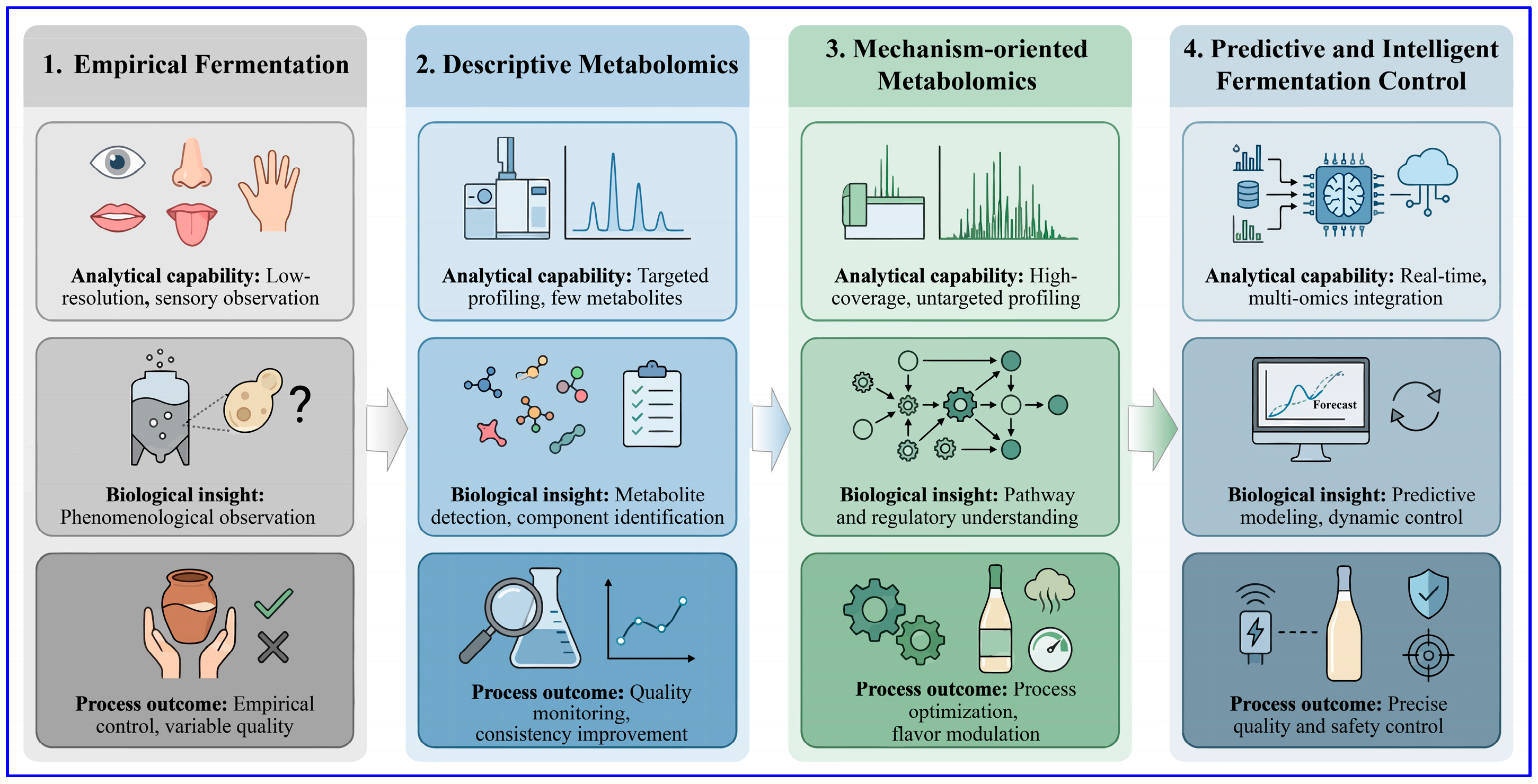

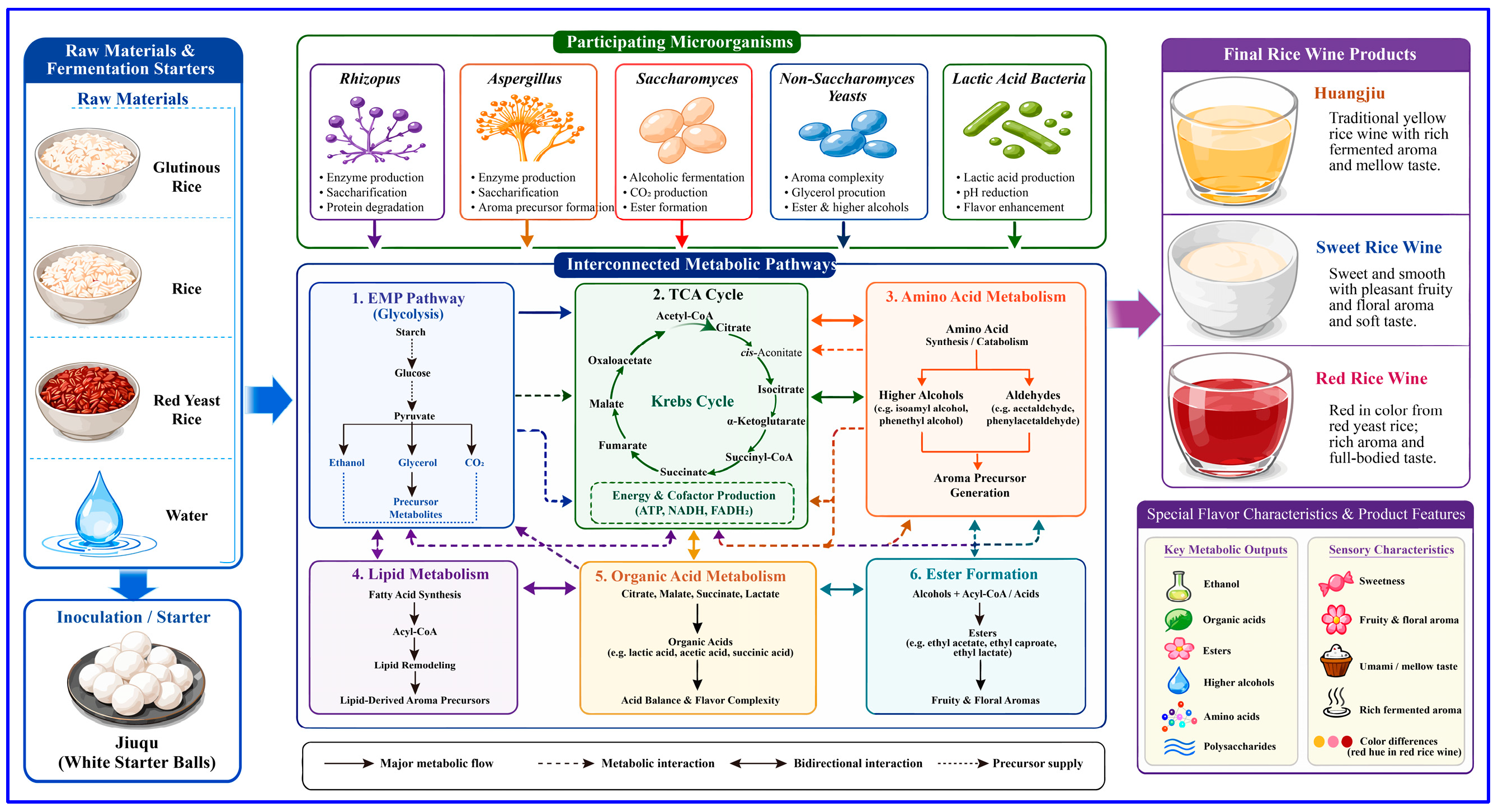

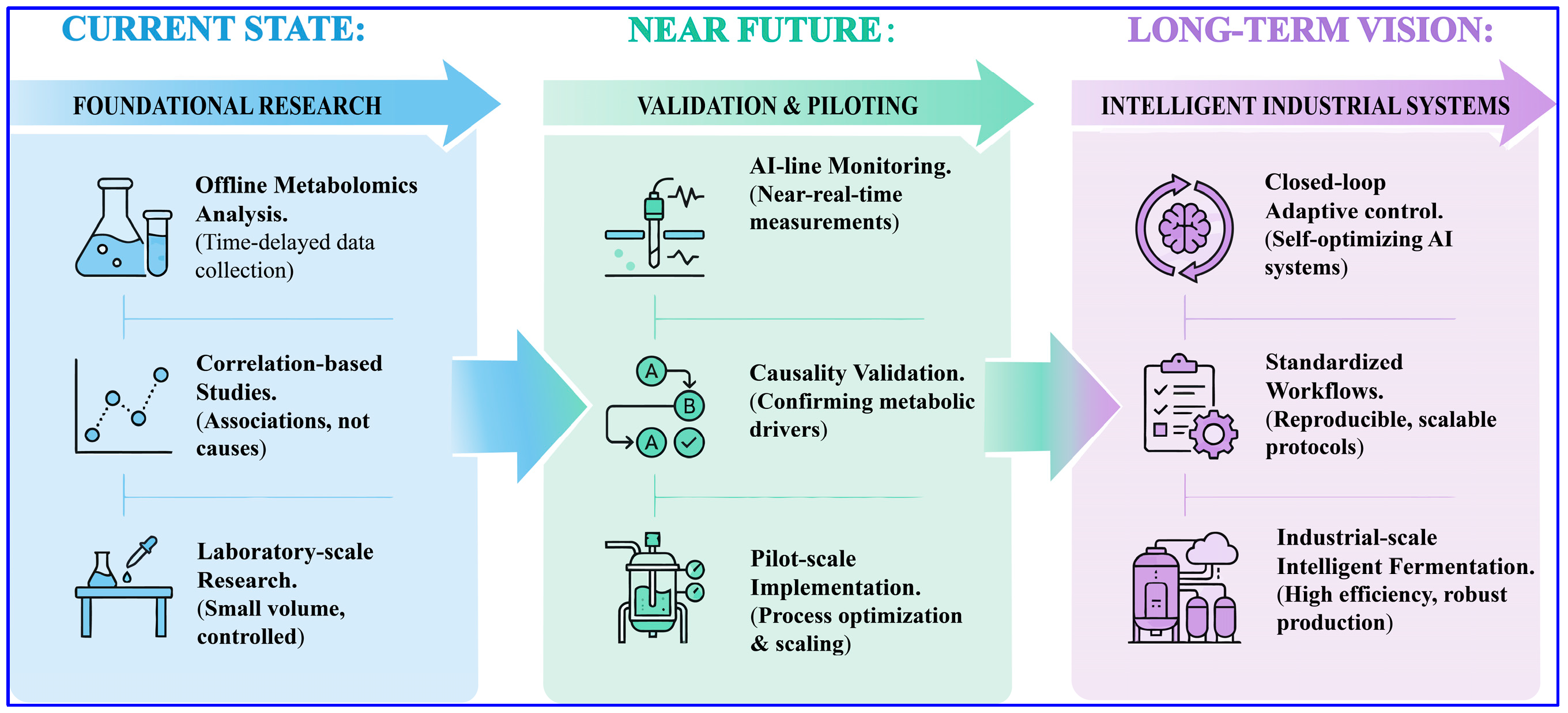
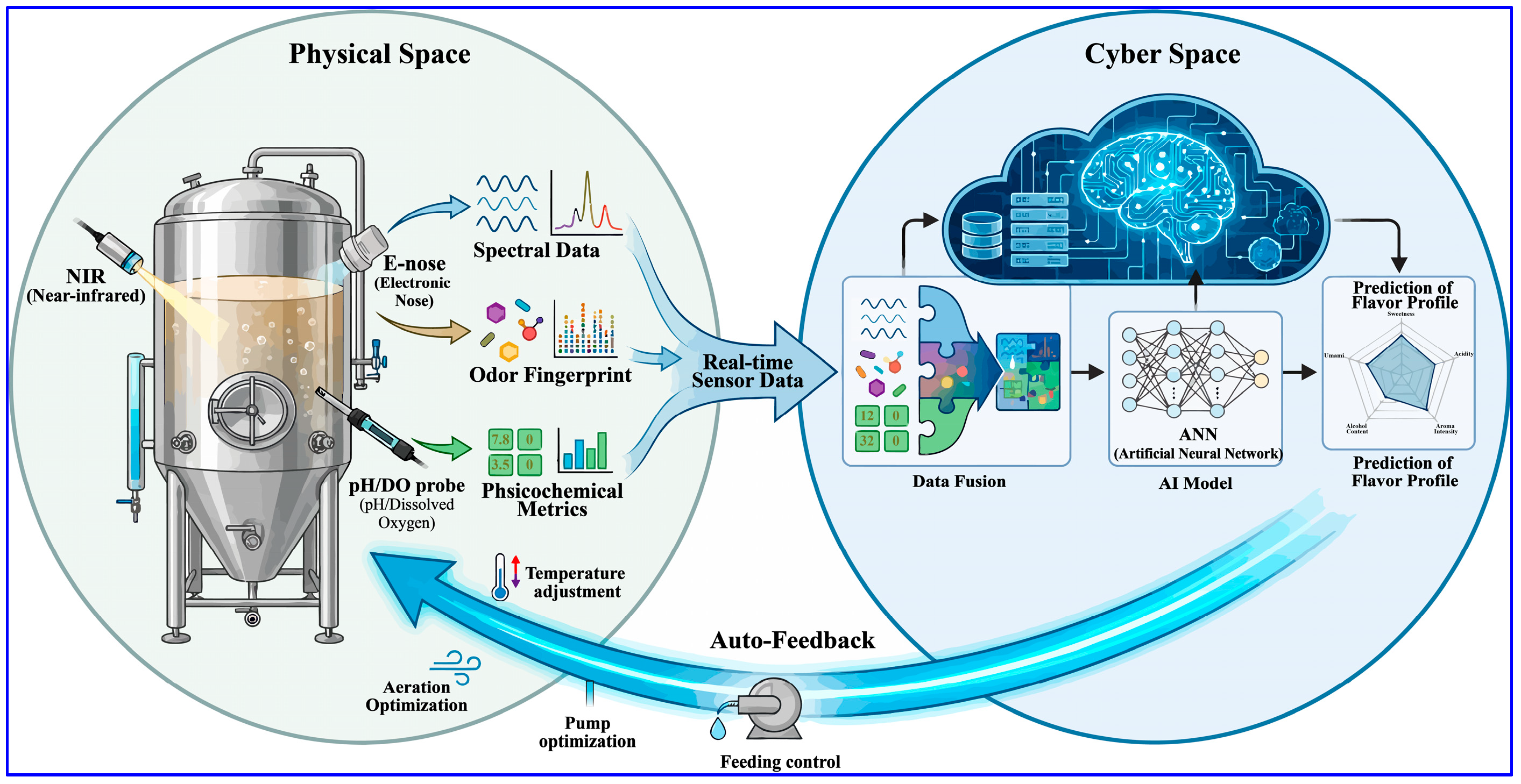
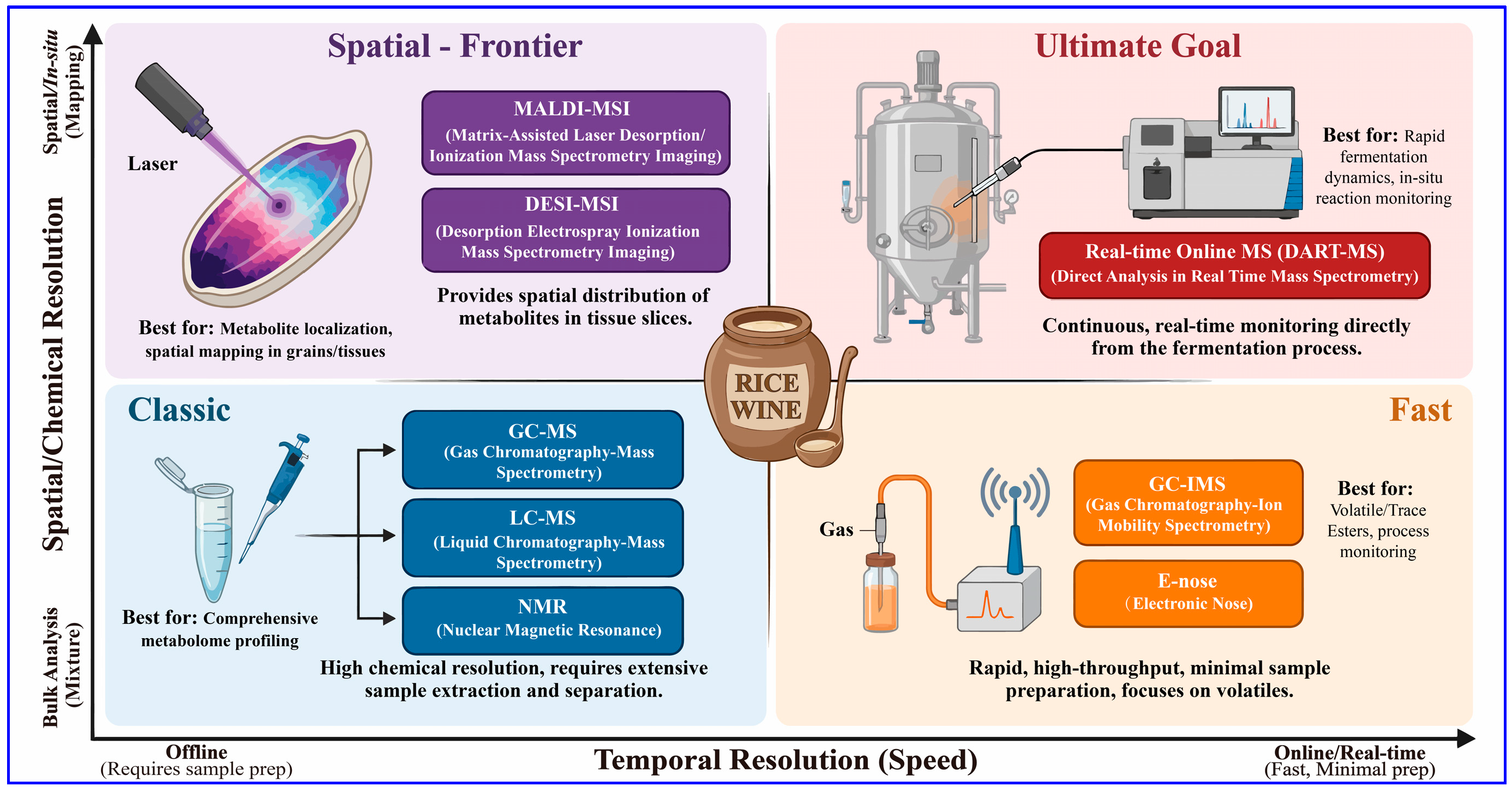
| Analytical Platform | Target Analytes | Sample Pretreatment | Sensitivity/LOD | Throughput (Speed) | Current Limitation | Application in Rice Wine | Reference |
|---|---|---|---|---|---|---|---|
| GC-MS (Gas Chromatography-MS) | Volatile compounds (Esters, Alcohols, Aldehydes) | LLE, SPME, or SAFE (Required) | High (ppm to ppb level) | Low (30–60 min/sample) | Limited to thermally stable volatiles; lengthy prep risks artifact formation. | Standard profiling of aroma compounds; quantification of fusel oils. | [59] |
| LC-MS/LC-MS/MS (Liquid Chromatography-MS) | Non-volatile compounds (Amino acids, Peptides, Phenols) | Extraction, Filtration, Derivatization (Optional) | Very High (ppb to ppt level) | Medium (15–30 min/sample) | Matrix effect (ion suppression); complex data processing for untargeted runs. | Profiling of taste-active peptides (umami) and functional polyphenols. | [6] |
| NMR (1H Nuclear Magnetic Resonance) | All abundant organic compounds (holistic overview) | Minimal (Buffer addition) | Low (ppm level,) μM range | High (1–10 min/sample) | Low sensitivity for trace flavor compounds; signal overlap in complex mixtures. | Quality control consistency; absolute quantification of ethanol/sugars without standards. | [32] |
| GC-IMS (Ion Mobility Spectrometry) | Trace Volatiles & Isomers (Fingerprinting) | None (Headspace injection) | Ultra-High (ppb to ppt level) | High (5–15 min/sample) | Lack of standardized spectral libraries compared to NIST (MS); non-linear dynamic range. | Rapid discrimination of vintage/age; identifying off-flavors at sub-threshold levels. | [60] |
| MALDI-MSI/DESI-MSI (Mass Spectrometry Imaging) | Spatial distribution of metabolites | Matrix application/Cryo-sectioning | High (dependent on matrix) | Variable (Hours per image) | Difficult absolute quantification; surface roughness affects signal stability. | In situ visualization of metabolite diffusion in Qu (starters) or rice kernels. | [61] |
| Real-time MS (DART-MS/PTR-MS) | Volatile evolution in real-time | None (Direct ambient ionization) | High (ppb level) | Ultra-High (Seconds/sample) | inability to separate isomers (no chromatography); mainly qualitative monitoring. | Online monitoring of fermentation kinetics; rapid screening of raw materials. | [62] |
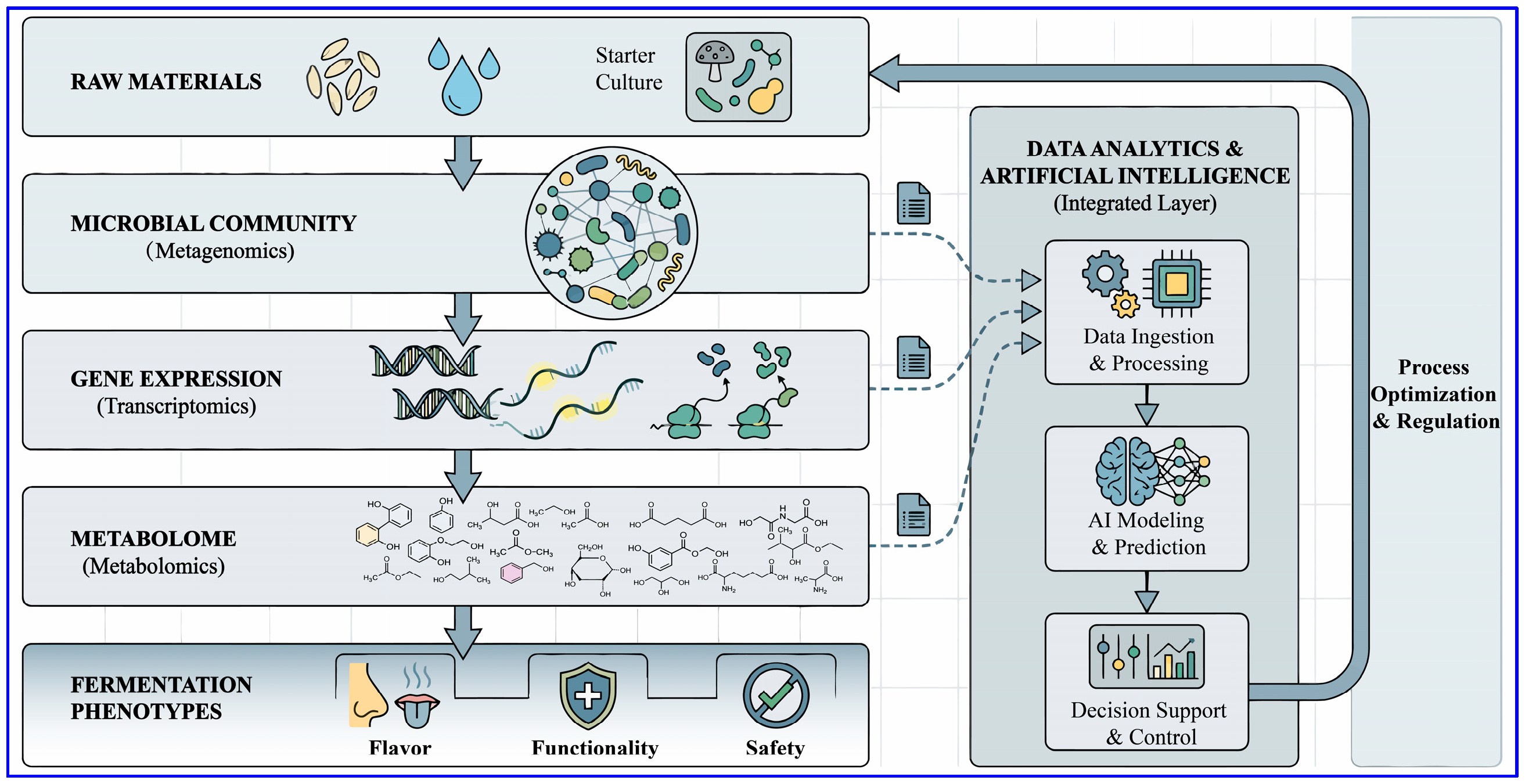
| Application Focus | Metabolomics Approach | Key Insights | Practical Relevance | Reference |
|---|---|---|---|---|
| Flavor Formation | Volatile compound profiling; Pathway mapping | Links microbial succession to sensory compound dynamics | Guides strain selection and fermentation tuning for sensory quality enhancement | [7] |
| Functional Metabolites | Bioactivity-correlated metabolite screening | Identifies health-modulating compounds driven by enzymatic transformations | Supports development of value-added products with validated bioactive properties | [76] |
| Safety Risk Control | Toxin-targeted monitoring; Stability tracking | Maps contamination pathways and degradation kinetics | Enables hazard prediction systems and critical control point interventions | [43] |
| Process Monitoring & Optimization | Real-time metabolic flux analysis | Reveals rate-limiting reactions and metabolic bottlenecks | Facilitates adaptive process control for yield improvement and resource efficiency | [97] |
Disclaimer/Publisher’s Note: The statements, opinions and data contained in all publications are solely those of the individual author(s) and contributor(s) and not of MDPI and/or the editor(s). MDPI and/or the editor(s) disclaim responsibility for any injury to people or property resulting from any ideas, methods, instructions or products referred to in the content. |
© 2026 by the authors. Licensee MDPI, Basel, Switzerland. This article is an open access article distributed under the terms and conditions of the Creative Commons Attribution (CC BY) license.
Share and Cite
Peng, B.; Chen, B.; Dai, Z.; Chen, J.; Hu, L.; Wen, L.; Li, C. Metabolomics-Driven Insights into Rice Wine Fermentation: From Descriptive Profiling to Intelligent Process Control. Fermentation 2026, 12, 264. https://doi.org/10.3390/fermentation12060264
Peng B, Chen B, Dai Z, Chen J, Hu L, Wen L, Li C. Metabolomics-Driven Insights into Rice Wine Fermentation: From Descriptive Profiling to Intelligent Process Control. Fermentation. 2026; 12(6):264. https://doi.org/10.3390/fermentation12060264
Chicago/Turabian StylePeng, Baoyu, Bifeng Chen, Zhaozhao Dai, Jinwen Chen, Lang Hu, Lelei Wen, and Changchun Li. 2026. "Metabolomics-Driven Insights into Rice Wine Fermentation: From Descriptive Profiling to Intelligent Process Control" Fermentation 12, no. 6: 264. https://doi.org/10.3390/fermentation12060264
APA StylePeng, B., Chen, B., Dai, Z., Chen, J., Hu, L., Wen, L., & Li, C. (2026). Metabolomics-Driven Insights into Rice Wine Fermentation: From Descriptive Profiling to Intelligent Process Control. Fermentation, 12(6), 264. https://doi.org/10.3390/fermentation12060264