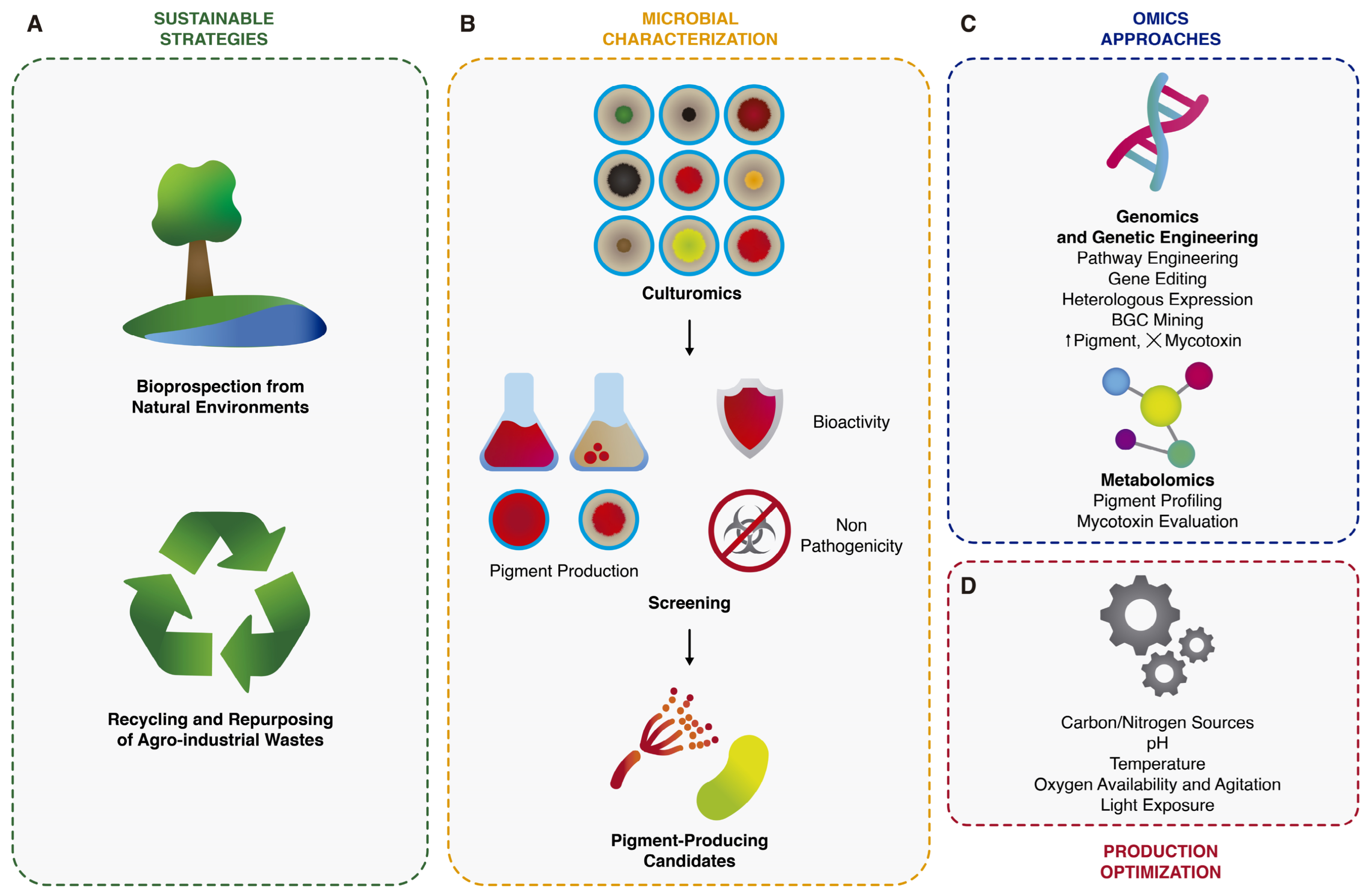

The Microbial Palette: From Bioprospecting to Genetic Engineering of Microbial Pigments

 , , , and
Abstract
1. A World of Color: From Natural to Synthetic to Microbial Pigments
2. The Benefits of Microbial Pigments
3. The Barriers Encountered When Using Microbial Pigments
4. Brazilian Biodiversity: Bioprospecting New Pigment-Producing Microorganisms
5. Omics Approaches for Pigment Discovery
6. Genetic Engineering Applications in Microbial Pigment Production
7. CRISPR-Mediated Gene Editing
7.1. CRISPR-Cas9
7.2. CRISPRi Gene Repression
7.3. CRISPRi-Cas9/Cpf1/Cas12a
7.4. Challenges and Future Perspectives of CRISPR-Based Pigment Engineering
8. Future Perspectives
Author Contributions
Funding
Institutional Review Board Statement
Informed Consent Statement
Data Availability Statement
Conflicts of Interest
References
- Abel, A. 24—The History of Dyes and Pigments: From Natural Dyes to High Performance Pigments. In Colour Design, 2nd ed.; Best, J., Ed.; Woodhead Publishing Series in Textiles; Woodhead Publishing: Cambridge, UK, 2012; pp. 557–587. [Google Scholar]
- de Oliveira Barreto, J.V.; Casanova, L.M.; Junior, A.N.; Reis-Mansur, M.C.P.P.; Vermelho, A.B. Microbial Pigments: Major Groups and Industrial Applications. Microorganisms 2023, 11, 2920. [Google Scholar] [CrossRef] [PubMed]
- Lincke, G. Molecular Stacks as a Common Characteristic in the Crystal Lattice of Organic Pigment Dyes A Contribution to the “Soluble–Insoluble” Dichotomy of Dyes and Pigments from the Technological Point of View. Dye. Pigment. 2003, 59, 1–24. [Google Scholar] [CrossRef]
- De Carvalho, J.C.; Cardoso, L.C.; Ghiggi, V.; Woiciechowski, A.L.; de Souza Vandenberghe, L.P.; Soccol, C.R. Microbial Pigments. In Biotransformation of Waste Biomass into High Value Biochemicals; Brar, S.K., Dhillon, G.S., Soccol, C.R., Eds.; Springer: New York, NY, USA, 2014; pp. 73–97. [Google Scholar]
- Phipps, E. Cochineal Red: The Art History of a Color; Metropolitan Museum of Art: New York, NY, USA, 2010. [Google Scholar]
- Lévi-Strauss, C. The Use of Wild Plants in Tropical South America. Econ. Bot. 1952, 6, 252–270. [Google Scholar] [CrossRef]
- Puglieri, T.S.; Maccarelli, L. Paint and Coloring Materials from the Brazilian Amazon Forest: Beyond Urucum and Jenipapo. Heritage 2023, 6, 5883–5898. [Google Scholar] [CrossRef]
- Mapari, S.A.S.; Thrane, U.; Meyer, A.S. Fungal Polyketide Azaphilone Pigments as Future Natural Food Colorants? Trends Biotechnol. 2010, 28, 300–307. [Google Scholar] [CrossRef]
- Gürses, A.; Açıkyıldız, M.; Güneş, K.; Gürses, M.S. (Eds.) Historical Development of Colorants. In Dyes and Pigments; Springer International Publishing: Cham, Switzerland, 2016; pp. 1–12. [Google Scholar]
- Nagendrappa, G. Sir William Henry Perkin: The Man and His ‘Mauve’. Resonance 2010, 15, 779–793. [Google Scholar] [CrossRef]
- Sen, T.; Barrow, C.J.; Deshmukh, S.K. Microbial Pigments in the Food Industry—Challenges and the Way Forward. Front. Nutr. 2019, 6, 7. [Google Scholar] [CrossRef] [PubMed]
- Malabadi, R.B.; Kolkar, K.P.; Chalannavar, R. Plant Natural Pigment Colorants-Health Benefits: Toxicity of Synthetic or Artificial Food Colorants. Int. J. Innov. Sci. Res. Rev. 2022, 4, 3418–3429. [Google Scholar]
- Kumar, M.; Singh, V.P.; Bhat, S.B.; Kumar, R. Environmental Risks of Textile Dyes and Photocatalytic Materials for Sustainable Treatment: Current Status and Future Directions. Discov. Environ. 2025, 3, 132. [Google Scholar] [CrossRef]
- Hoque, M.B.; Oyshi, T.H.; Hannan, A.; Haque, P.; Rahman, M.; Shahid, A.; Sheikh, S. Unraveling the Ecological Footprint of Textile Dyes: A Growing Environmental Concern. Pollut. Study 2024, 5, 3014. [Google Scholar] [CrossRef]
- Namakka, M.; Rahman, M.R.; Mohamad Bin Said, K.A.; Kuok, K.K.; Md Yusof, F.A.; Al-Saleem, M.S.M.; Al-Humaidi, J.Y.; Rahman, M.M. Unveiling the Synergistic Effect of an nZVI–SiO2–TiO2 Nanocomposite for the Remediation of Dye Contaminated Wastewater. Mater. Adv. 2024, 5, 9292–9313. [Google Scholar] [CrossRef]
- Agarwal, H.; Bajpai, S.; Mishra, A.; Kohli, I.; Varma, A.; Fouillaud, M.; Dufossé, L.; Joshi, N.C. Bacterial Pigments and Their Multifaceted Roles in Contemporary Biotechnology and Pharmacological Applications. Microorganisms 2023, 11, 614. [Google Scholar] [CrossRef] [PubMed]
- Yuan, X.; Gao, S.; Tan, Y.; Cao, J.; Yang, S.; Zheng, B. Production of Red Yeast Rice Rich in Monacolin K by Variable Temperature Solid Fermentation of Monascus Purpureus. RSC Adv. 2023, 13, 27303–27308. [Google Scholar] [CrossRef] [PubMed]
- Averianova, L.A.; Balabanova, L.A.; Son, O.M.; Podvolotskaya, A.B.; Tekutyeva, L.A. Production of Vitamin B2 (Riboflavin) by Microorganisms: An Overview. Front. Bioeng. Biotechnol. 2020, 8, 570828. [Google Scholar] [CrossRef]
- Ramesh, C.; Vinithkumar, N.V.; Kirubagaran, R.; Venil, C.K.; Dufossé, L. Multifaceted Applications of Microbial Pigments: Current Knowledge, Challenges and Future Directions for Public Health Implications. Microorganisms 2019, 7, 186. [Google Scholar] [CrossRef]
- Rather, L.J.; Mir, S.S.; Ganie, S.A.; Shahid-ul-Islam; Li, Q. Research Progress, Challenges, and Perspectives in Microbial Pigment Production for Industrial Applications—A Review. Dye. Pigment. 2023, 210, 110989. [Google Scholar] [CrossRef]
- Lopes, F.C.; Ligabue-Braun, R. Agro-Industrial Residues: Eco-Friendly and Inexpensive Substrates for Microbial Pigments Production. Front. Sustain. Food Syst. 2021, 5, 589414. [Google Scholar] [CrossRef]
- Nacional, I. RESOLUÇÃO—RDC No 778, DE 1° DE MARÇO DE 2023—RESOLUÇÃO—RDC No 778, DE 1° DE MARÇO DE 2023—DOU—Imprensa Nacional. Available online: https://www.in.gov.br/web/dou/-/resolucao-rdc-n-778-de-1-de-marco-de-2023-468499613 (accessed on 12 May 2026).
- Agência Nacional de Vigilância Sanitária (Brasil). Farmacopeia Brasileira 7a edição: Volume I—Versão RDC no 940/2024—VIGENTE. 2024. Available online: https://bibliotecadigital.anvisa.gov.br/jspui/handle/anvisa/11937 (accessed on 12 May 2026).
- Nacional, I. RESOLUÇÃO—RDC No 628, DE 10 DE MARÇO DE 2022—RESOLUÇÃO—RDC No 628, DE 10 DE MARÇO DE 2022—DOU—Imprensa Nacional. Available online: https://www.in.gov.br/web/dou/-/resolucao-rdc-n-628-de-10-de-marco-de-2022-386108199 (accessed on 13 May 2026).
- Mota, I.G.C.; Neves, R.A.M.D.; Nascimento, S.S.D.C.; Maciel, B.L.L.; Morais, A.H.D.A.; Passos, T.S. Artificial Dyes: Health Risks and the Need for Revision of International Regulations. Food Rev. Int. 2023, 39, 1578–1593. [Google Scholar] [CrossRef]
- How Safe Are Color Additives?|FDA. Available online: https://www.fda.gov/consumers/consumer-updates/how-safe-are-color-additives (accessed on 2 April 2026).
- HHS, FDA to Phase Out Petroleum-Based Synthetic Dyes in Nation’s Food Supply|FDA. Available online: https://www.fda.gov/news-events/press-announcements/hhs-fda-phase-out-petroleum-based-synthetic-dyes-nations-food-supply (accessed on 13 May 2026).
- FDA Approves Three Food Colors from Natural Sources|FDA. Available online: https://www.fda.gov/news-events/press-announcements/fda-approves-three-food-colors-natural-sources (accessed on 13 May 2026).
- Adebo, O.A.; Molelekoa, T.; Makhuvele, R.; Adebiyi, J.A.; Oyedeji, A.B.; Gbashi, S.; Adefisoye, M.A.; Ogundele, O.M.; Njobeh, P.B. A Review on Novel Non-thermal Food Processing Techniques for Mycotoxin Reduction. Int. J. Food Sci. Technol. 2021, 56, 13–27. [Google Scholar] [CrossRef]
- Hamad, G.M.; Mehany, T.; Simal-Gandara, J.; Abou-Alella, S.; Esua, O.J.; Abdel-Wahhab, M.A.; Hafez, E.E. A Review of Recent Innovative Strategies for Controlling Mycotoxins in Foods. Food Control 2023, 144, 109350. [Google Scholar] [CrossRef]
- Feng, Y.; Shao, Y.; Chen, F. Monascus Pigments. Appl. Microbiol. Biotechnol. 2012, 96, 1421–1440. [Google Scholar] [CrossRef]
- Lyu, X.; Lyu, Y.; Yu, H.; Chen, W.; Ye, L.; Yang, R. Biotechnological Advances for Improving Natural Pigment Production: A State-of-the-Art Review. Bioresour. Bioprocess. 2022, 9, 8. [Google Scholar] [CrossRef] [PubMed]
- Mirjalili, M.; Nazarpoor, K.; Karimi, L. Eco-Friendly Dyeing of Wool Using Natural Dye from Weld as Co-Partner with Synthetic Dye. J. Clean. Prod. 2011, 19, 1045–1051. [Google Scholar] [CrossRef]
- Abel, G.; Amobonye, A.; Bhagwat, P.; Pillai, S. Diversity, Stability and Applications of Mycopigments. Process Biochem. 2023, 133, 270–284. [Google Scholar] [CrossRef]
- Aftab, A.; Muhammad, S.T.F.; Akbar, N.; Khaliq, S.; Sajjad, A.; Kakar, M.A. Pigment Production in Penicillium: Different Methods of Optimization in Submerged Fermentation. Pak-Euro J. Med. Life Sci. 2021, 4, 77–95. [Google Scholar]
- Akilandeswari, P.; Pradeep, B.V. Exploration of Industrially Important Pigments from Soil Fungi. Appl. Microbiol. Biotechnol. 2016, 100, 1631–1643. [Google Scholar] [CrossRef]
- Ramesh, C.; Prasastha, V.R.; Venkatachalam, M.; Dufossé, L. Natural Substrates and Culture Conditions to Produce Pigments from Potential Microbes in Submerged Fermentation. Fermentation 2022, 8, 460. [Google Scholar] [CrossRef]
- Chavan, A.; Pawar, J.; Kakde, U.; Venkatachalam, M.; Fouillaud, M.; Dufossé, L.; Deshmukh, S.K. Pigments from Microorganisms: A Sustainable Alternative for Synthetic Food Coloring. Fermentation 2025, 11, 395. [Google Scholar] [CrossRef]
- Pailliè-Jiménez, M.E.; Stincone, P.; Brandelli, A. Natural Pigments of Microbial Origin. Front. Sustain. Food Syst. 2020, 4, 590439. [Google Scholar] [CrossRef]
- Sicheritz-Ponten, T. A Phylogenomic Approach to Microbial Evolution. Nucleic Acids Res. 2001, 29, 545–552. [Google Scholar] [CrossRef]
- Tiwari, P.; Bae, H. Horizontal Gene Transfer and Endophytes: An Implication for the Acquisition of Novel Traits. Plants 2020, 9, 305. [Google Scholar] [CrossRef] [PubMed]
- Armijos Jaramillo, V.D.; Vargas, W.A.; Sukno, S.A.; Thon, M.R. Horizontal Transfer of a Subtilisin Gene from Plants into an Ancestor of the Plant Pathogenic Fungal Genus Colletotrichum. PLoS ONE 2013, 8, e59078. [Google Scholar] [CrossRef]
- Ochman, H.; Lawrence, J.G.; Groisman, E.A. Lateral Gene Transfer and the Nature of Bacterial Innovation. Nature 2000, 405, 299–304. [Google Scholar] [CrossRef]
- Brockhurst, M.A.; Colegrave, N.; Rozen, D.E. Next-generation Sequencing as a Tool to Study Microbial Evolution. Mol. Ecol. 2011, 20, 972–980. [Google Scholar] [CrossRef]
- Saati-Santamaría, Z.; Pérez-Mendoza, D.; Khashi u Rahman, M.; de Sousa, B.F.S.; Montero-Calasanz, M.D.C.; Rey, L.; Roy, S.; Sanjuán, J.; García-Fraile, P. Evolutionary Mechanisms Underlying Bacterial Adaptation to the Plant Environment. FEMS Microbiol. Rev. 2026, 50, fuag005. [Google Scholar] [CrossRef] [PubMed]
- Geers, A.U.; Strube, M.L.; Bentzon-Tilia, M. Small Spatial Scale Drivers of Secondary Metabolite Biosynthetic Diversity in Environmental Microbiomes. mSystems 2023, 8, e0072422. [Google Scholar] [CrossRef] [PubMed]
- Nobre, C.A.; Obregón, G.O.; Marengo, J.A.; Fu, R.; Poveda, G. Characteristics of Amazonian Climate: Main Features. Amazon. Glob. Change 2009, 186, 149–162. [Google Scholar] [CrossRef]
- Coleção de Fungos Da Amazônia|SiBBr. Available online: https://collectory.sibbr.gov.br/collectory/public/show/co40 (accessed on 28 November 2025).
- Afroz Toma, M.; Rahman, M.H.; Rahman, M.S.; Arif, M.; Nazir, K.N.H.; Dufossé, L. Fungal Pigments: Carotenoids, Riboflavin, and Polyketides with Diverse Applications. J. Fungi 2023, 9, 454. [Google Scholar] [CrossRef]
- De Melo Pereira, D.Í.; Gurgel, R.S.; De Souza, A.T.F.; Matias, R.R.; De Souza Falcão, L.; Chaves, F.C.M.; Da Silva, G.F.; Martínez, J.G.; De Lima Procópio, R.E.; Fantin, C.; et al. Isolation and Identification of Pigment-Producing Endophytic Fungi from the Amazonian Species Fridericia Chica. J. Fungi 2024, 10, 77. [Google Scholar] [CrossRef]
- dos Reis Celestino, J.; de Carvalho, L.E.; da Paz Lima, M.; Lima, A.M.; Ogusku, M.M.; Souza, J.V.B. de Bioprospecting of Amazon Soil Fungi with the Potential for Pigment Production. Process Biochem. 2014, 49, 569–575. [Google Scholar] [CrossRef]
- Fonseca, R.S.K.; Lotas, K.M.; Cortez, A.C.A.; da Silva Fernandes, F.; de Souza, É.S.; Dufossé, L.; de Souza, J.V.B. Exploration of Carotenoid-Producing Rhodotorula Yeasts from Amazonian Substrates for Sustainable Biotechnology Applications. Curr. Res. Microb. Sci. 2025, 8, 100373. [Google Scholar] [CrossRef] [PubMed]
- Relatórios e Balanços|SOS Mata Atlântica. Available online: https://www.sosma.org.br/sobre/relatorios-e-balancos (accessed on 28 November 2025).
- Marques, M.C.M.; Grelle, C.E.V. (Eds.) The Atlantic Forest: History, Biodiversity, Threats and Opportunities of the Mega-Diverse Forest; Springer International Publishing: Cham, Switzerland, 2021. [Google Scholar]
- Myers, N.; Mittermeier, R.A.; Mittermeier, C.G.; Da Fonseca, G.A.B.; Kent, J. Biodiversity Hotspots for Conservation Priorities. Nature 2000, 403, 853–858. [Google Scholar] [CrossRef] [PubMed]
- Barbosa, R.D.N.; Santos, J.E.F.D.; Bezerra, J.D.P.; Istel, Ł.; Houbraken, J.; Oliveira, N.T.; Souza-Motta, C.M.D. Brazilian Atlantic Forest and Pampa Biomes in the Spotlight: An Overview of Aspergillus, Penicillium, and Talaromyces (Eurotiales) Species and the Description of Penicillium Nordestinense Sp. Nov. Acta Bot. Bras. 2022, 36, e2021abb0390. [Google Scholar] [CrossRef]
- Büdel, B.; Weber, H.-M.; Porembski, S.; Barthlott, W. Cyanobacteria of Inselbergs in the Atlantic Rainforest Zone of Eastern Brazil. Phycologia 2002, 41, 498–506. [Google Scholar] [CrossRef]
- Machado, W.R.C.; Silva, L.G.D.; Vanzela, E.S.L.; Del Bianchi, V.L. Evaluation of the Process Conditions for the Production of Microbial Carotenoids by the Recently Isolated Rhodotorula Mucilaginosa URM 7409. Braz. J. Food Technol. 2019, 22, e2018267. [Google Scholar] [CrossRef]
- Lucas, D.C.R.; Chisté, R.C. Brazilian Biomes as Promising Resources of Rhodotorula Yeasts for the Biotechnological Production of Carotenoids. Chem. Biodivers. 2025, 22, e00469. [Google Scholar] [CrossRef]
- Klink, C.A.; Machado, R.B. Conservation of the Brazilian Cerrado. Conserv. Biol. 2005, 19, 707–713. [Google Scholar] [CrossRef]
- Behling, H.; Hooghiemstra, H. Neotropical Savanna Environments in Space and Time. In Interhemispheric Climate Linkages; Elsevier: Amsterdam, The Netherlands, 2001; pp. 307–323. [Google Scholar]
- Ledru, M.-P.; Ceccantini, G.; Gouveia, S.E.M.; López-Sáez, J.A.; Pessenda, L.C.R.; Ribeiro, A.S. Millenial-Scale Climatic and Vegetation Changes in a Northern Cerrado (Northeast, Brazil) since the Last Glacial Maximum. Quat. Sci. Rev. 2006, 25, 1110–1126. [Google Scholar] [CrossRef]
- Machado, W.R.C.; Bianchi, V.L.D. Production of microbial carotenoids by Rhodotorula lactosa isolated in the Brazilian tropical savanna/Produção de carotenoides microbianos por Rhodotorula lactosa isolada na savana tropical brasileira. Braz. J. Dev. 2021, 7, 89302–89322. [Google Scholar] [CrossRef]
- Pinto, O.H.B.; Costa, F.S.; Rodrigues, G.R.; da Costa, R.A.; da Rocha Fernandes, G.; Júnior, O.R.P.; Barreto, C.C. Soil Acidobacteria Strain AB23 Resistance to Oxidative Stress Through Production of Carotenoids. Microb. Ecol. 2021, 81, 169–179. [Google Scholar] [CrossRef]
- Lins, A.B.; Bione, A.P.; Lins, U.M.B.L.; de Souza Mendonça, R.; Campos-Takaki, G.M. Biotechnological Potential of Talaromyces Sp. Isolated from Soil of Caatinga Biome in the Production of Pigments with Antimicrobial Activity. Res. Soc. Dev. 2022, 11, e240111133045. [Google Scholar] [CrossRef]
- de Cássia Dias Mendes-Silva, T.; Vidal, E.E.; de Souza, R.D.F.R.; Schmidt, K.D.C.; Mendes, P.V.D.; da Silva Andrade, R.F.; da Silva Oliveira, F.G.; de Lucena, B.T.L.; de Oliveira, M.B.M.; dos Santos Correia, M.T.; et al. Production of Carotenoid Sarcinaxanthin by Kocuria Palustris Isolated from Northeastern Brazil Caatinga Soil and Their Antioxidant and Photoprotective Activities. Electron. J. Biotechnol. 2021, 53, 44–53. [Google Scholar] [CrossRef]
- da Silva, P.H.; Morant, K.V.; Nascimento, R.F.d.; Campos-Takaki, G.M.d. An Innovate Approach of Fungal Pigments as Inducing the Oxidase Activity Applied to Bioelectrode Systems. Res. Soc. Dev. 2022, 11, e16711628799. [Google Scholar] [CrossRef]
- Roesch, L.F.W.; Vieira, F.C.B.; Pereira, V.A.; Schünemann, A.L.; Teixeira, I.F.; Senna, A.J.T.; Stefenon, V.M. The Brazilian Pampa: A Fragile Biome. Diversity 2009, 1, 182–198. [Google Scholar] [CrossRef]
- Otero, D.M.; Bulsing, B.A.; Huerta, K.D.M.; Rosa, C.A.; Zambiazi, R.C.; Burkert, C.A.V.; Burkert, J.F.D.M. Carotenoid-Producing Yeasts in the Brazilian Biodiversity: Isolation, Identification and Cultivation in Agroindustrial Waste. Braz. J. Chem. Eng. 2019, 36, 117–129. [Google Scholar] [CrossRef]
- Cipolatti, E.P.; Remedi, R.D.; Sá, C.D.S.; Rodrigues, A.B.; Gonçalves Ramos, J.M.; Veiga Burkert, C.A.; Furlong, E.B.; Fernandes De Medeiros Burkert, J. Use of Agroindustrial Byproducts as Substrate for Production of Carotenoids with Antioxidant Potential by Wild Yeasts. Biocatal. Agric. Biotechnol. 2019, 20, 101208. [Google Scholar] [CrossRef]
- Godoy, F.M.R.; Paggi, G.M.; Lorenz, A.P.; Ramos, J.V.; Franco, D.G.; Calarge, F.M.L.; Garcia, N.F.L.; Urquiza, M.V.S.; Schiavo, J.A.; Almeida, N.F.; et al. Bacteriome Diversity of Soil Islands Associated With Bromeliads From Ironstone Outcrops in the Brazilian Pantanal. Int. J. Microbiol. 2025, 2025, 6374781. [Google Scholar] [CrossRef]
- de Siqueira, K.A.; Brissow, E.R.; dos Santos, J.L.; White, J.F.; Santos, F.R.; de Almeida, E.G.; Soares, M.A. Endophytism and Bioactivity of Endophytic Fungi Isolated from Combretum Lanceolatum Pohl Ex Eichler. Symbiosis 2017, 71, 211–222. [Google Scholar] [CrossRef]
- Zona Costeira e Marinha. Available online: https://www.gov.br/mma/pt-br/assuntos/biodiversidade-e-biomas/biomas-e-ecossistemas/ecossistemas-costeiros-e-marinhos/zona-costeira-e-marinha (accessed on 2 April 2026).
- Pommer, V.; Barbosa, R.D.N.; Geremia, F.; Alves, I.D.; Camargo, M.D.S.; Rocha, E.M.; Sbaraini, N.; Staats, C.; De Souza-Motta, C.M.; Schrank, A.; et al. Fungi from Brazilian Oceanic Islands: Identification and Genome Characterization of Periconia Belmontensis Sp. Nov. Isolated from São Pedro and São Paulo Archipelago. Fungal Genet. Biol. 2026, 182, 104055. [Google Scholar] [CrossRef]
- Arthaud, I.D.B.; Rodrigues, F.A.R.; Jimenez, P.C.; Montenegro, R.C.; Angelim, A.L.; Maciel, V.M.M.; Silveira, E.R.; Freitas, H.P.S.; Sousa, T.S.; Pessoa, O.D.L.; et al. Studies on the Secondary Metabolites of a Pseudoalteromonas Sp. Isolated from Sediments Collected at the Northeastern Coast of Brazil. Chem. Biodivers. 2012, 9, 418–427. [Google Scholar] [CrossRef]
- Conrado, R.; Gomes, T.C.; Roque, G.S.C.; De Souza, A.O. Overview of Bioactive Fungal Secondary Metabolites: Cytotoxic and Antimicrobial Compounds. Antibiotics 2022, 11, 1604. [Google Scholar] [CrossRef]
- Zeilinger, S.; Martín, J.-F.; García-Estrada, C. (Eds.) Fungal Secondary Metabolites in the “OMICS” Era. In Biosynthesis and Molecular Genetics of Fungal Secondary Metabolites; Fungal Biology; Springer: New York, NY, USA, 2015; Volume 2, pp. 1–12. [Google Scholar]
- Dai, X.; Shen, L. Advances and Trends in Omics Technology Development. Front. Med. 2022, 9, 911861. [Google Scholar] [CrossRef]
- Stannius, R.O.; Dunlap, C.A.; Morvan, E.; Berbon, M.; Lecomte, S.; Loquet, A.; Kovács, Á.T. Identification of Widely Conserved Biosynthetic Gene Cluster Involved in Pigment Production of Bacillus Subtilis. mSystems 2025, 10, e00759-25. [Google Scholar] [CrossRef]
- Huang, D.; Wang, Y.; Zhang, J.; Xu, H.; Bai, J.; Zhang, H.; Jiang, X.; Yuan, J.; Lu, G.; Jiang, L.; et al. Integrative Metabolomic and Transcriptomic Analyses Uncover Metabolic Alterations and Pigment Diversity in Monascus in Response to Different Nitrogen Sources. mSystems 2021, 6, e0080721. [Google Scholar] [CrossRef]
- Ma, X.; Lu, L.; Yao, F.; Fang, M.; Wang, P.; Meng, J.; Shao, K.; Sun, X.; Zhang, Y. High-Quality Genome Assembly and Multi-Omics Analysis of Pigment Synthesis Pathway in Auricularia Cornea. Front. Microbiol. 2023, 14, 1211795. [Google Scholar] [CrossRef]
- Xu, S.; Gao, S.; An, Y. Research Progress of Engineering Microbial Cell Factories for Pigment Production. Biotechnol. Adv. 2023, 65, 108150. [Google Scholar] [CrossRef]
- Zhang, S.; Guo, F.; Yan, W.; Dai, Z.; Dong, W.; Zhou, J.; Zhang, W.; Xin, F.; Jiang, M. Recent Advances of CRISPR/Cas9-Based Genetic Engineering and Transcriptional Regulation in Industrial Biology. Front. Bioeng. Biotechnol. 2020, 7, 459. [Google Scholar] [CrossRef] [PubMed]
- Li, X.-H.; Lu, H.-Z.; Yao, J.-B.; Zhang, C.; Shi, T.-Q.; Huang, H. Recent Advances in the Application of CRISPR/Cas-Based Gene Editing Technology in Filamentous Fungi. Biotechnol. Adv. 2025, 81, 108561. [Google Scholar] [CrossRef] [PubMed]
- Song, I.; Kim, J.; Baek, K.; Choi, Y.; Shin, B.; Jin, E. The Generation of Metabolic Changes for the Production of High-Purity Zeaxanthin Mediated by CRISPR-Cas9 in Chlamydomonas reinhardtii. Microb. Cell Factories 2020, 19, 220. [Google Scholar] [CrossRef]
- Lai, L.; Xin, R.; Cui, T. Gene Editing Technology Combined with Response Surface Optimization to Improve the Synthesis Ability of Lycopene in Pantoea Dispersa MSC14. J. Appl. Microbiol. 2024, 135, lxae272. [Google Scholar] [CrossRef] [PubMed]
- Jeong, S.H.; Kim, H.J.; Lee, S.J. New Target Gene Screening Using Shortened and Random sgRNA Libraries in Microbial CRISPR Interference. ACS Synth. Biol. 2023, 12, 800–808. [Google Scholar] [CrossRef]
- López, J.; Bustos, D.; Camilo, C.; Arenas, N.; Saa, P.A.; Agosin, E. Engineering Saccharomyces Cerevisiae for the Overproduction of β-Ionone and Its Precursor β-Carotene. Front. Bioeng. Biotechnol. 2020, 8, 578793. [Google Scholar] [CrossRef]
- Liu, T.; Dong, C.; Qi, M.; Zhang, B.; Huang, L.; Xu, Z.; Lian, J. Construction of a Stable and Temperature-Responsive Yeast Cell Factory for Crocetin Biosynthesis Using CRISPR-Cas9. Front. Bioeng. Biotechnol. 2020, 8, 653. [Google Scholar] [CrossRef] [PubMed]
- Chen, Q.H.; Qian, Y.D.; Niu, Y.J.; Hu, C.Y.; Meng, Y.H. Characterization of an Efficient CRISPR-iCas9 System in Yarrowia Lipolytica for the Biosynthesis of Carotenoids. Appl. Microbiol. Biotechnol. 2023, 107, 6299–6313. [Google Scholar] [CrossRef]
- Zhang, X.; Chen, S.; Lin, Y.; Li, W.; Wang, D.; Ruan, S.; Yang, Y.; Liang, S. Metabolic Engineering of Pichia Pastoris for High-Level Production of Lycopene. ACS Synth. Biol. 2023, 12, 2961–2972. [Google Scholar] [CrossRef]
- Zhang, X.; Chen, W.; Wang, C. Regulation of Citrinin Biosynthesis in Monascus Purpureus: Impacts on Growth, Morphology, and Pigments Production. Food Microbiol. 2025, 127, 104698. [Google Scholar] [CrossRef]
- Liu, W.; An, C.; Shu, X.; Meng, X.; Yao, Y.; Zhang, J.; Chen, F.; Xiang, H.; Yang, S.; Gao, X.; et al. A Dual-Plasmid CRISPR/Cas System for Mycotoxin Elimination in Polykaryotic Industrial Fungi. ACS Synth. Biol. 2020, 9, 2087–2095. [Google Scholar] [CrossRef] [PubMed]
- Ree Yoon, H.; Han, S.; Chul Shin, S.; Cheong Yeom, S.; Jin Kim, H. Improved Natural Food Colorant Production in the Filamentous Fungus Monascus Ruber Using CRISPR-Based Engineering. Food Res. Int. 2023, 167, 112651. [Google Scholar] [CrossRef] [PubMed]
- Futyma, M.E.; Guo, Y.; Hoeck, C.; Hoof, J.B.; Gotfredsen, C.H.; Mortensen, U.H.; Larsen, T.O. Genetic Origin of Homopyrones, a Rare Type of Hybrid Phenylpropanoid- and Polyketide-Derived Yellow Pigments from Aspergillus Homomorphus. Appl. Microbiol. Biotechnol. 2021, 105, 5113–5121. [Google Scholar] [CrossRef]
- Nussenzweig, P.M.; Marraffini, L.A. Molecular Mechanisms of CRISPR-Cas Immunity in Bacteria. Annu. Rev. Genet. 2020, 54, 93–120. [Google Scholar] [CrossRef]
- Zhao, D.; Zhu, X.; Zhou, H.; Sun, N.; Wang, T.; Bi, C.; Zhang, X. CRISPR-Based Metabolic Pathway Engineering. Metab. Eng. 2021, 63, 148–159. [Google Scholar] [CrossRef]
- Wang, C.; Zhao, S.; Shao, X.; Park, J.-B.; Jeong, S.-H.; Park, H.-J.; Kwak, W.-J.; Wei, G.; Kim, S.-W. Challenges and Tackles in Metabolic Engineering for Microbial Production of Carotenoids. Microb. Cell Factories 2019, 18, 55. [Google Scholar] [CrossRef] [PubMed]
- Mo, X.-H.; Zhang, H.; Wang, T.-M.; Zhang, C.; Zhang, C.; Xing, X.-H.; Yang, S. Establishment of CRISPR Interference in Methylorubrum Extorquens and Application of Rapidly Mining a New Phytoene Desaturase Involved in Carotenoid Biosynthesis. Appl. Microbiol. Biotechnol. 2020, 104, 4515–4532. [Google Scholar] [CrossRef]
- Depardieu, F.; Bikard, D. Gene Silencing with CRISPRi in Bacteria and Optimization of dCas9 Expression Levels. Methods 2020, 172, 61–75. [Google Scholar] [CrossRef]
- Du, P.; Lou, C.; Zhao, X.; Wang, Q.; Ji, X.; Wei, W. CRISPR-Based Genetic Switches and Other Complex Circuits: Research and Application. Life 2021, 11, 1255. [Google Scholar] [CrossRef] [PubMed]
- Liu, Y.; Han, J.; Chen, Z.; Wu, H.; Dong, H.; Nie, G. Engineering Cell Signaling Using Tunable CRISPR–Cpf1-Based Transcription Factors. Nat. Commun. 2017, 8, 2095. [Google Scholar] [CrossRef] [PubMed]
- Meliawati, M.; Schilling, C.; Schmid, J. Recent Advances of Cas12a Applications in Bacteria. Appl. Microbiol. Biotechnol. 2021, 105, 2981–2990. [Google Scholar] [CrossRef]
- Shen, J.-Y.; Zhao, Q.; He, Q.-L. Application of CRISPR in Filamentous Fungi and Macrofungi: From Component Function to Development Potentiality. ACS Synth. Biol. 2023, 12, 1908–1923. [Google Scholar] [CrossRef]
- Woodcraft, C.; Chooi, Y.-H.; Roux, I. The Expanding CRISPR Toolbox for Natural Product Discovery and Engineering in Filamentous Fungi. Nat. Prod. Rep. 2023, 40, 158–173. [Google Scholar] [CrossRef]
- Qin, X.; Xie, B.; Zong, X.; Yu, X.; Feng, Y. Selective Production, Relationship and Controversy between Monascus Pigments and Citrinin. Food Biosci. 2023, 56, 103233. [Google Scholar] [CrossRef]
- Han, T.; Nazarbekov, A.; Zou, X.; Lee, S.Y. Recent Advances in Systems Metabolic Engineering. Curr. Opin. Biotechnol. 2023, 84, 103004. [Google Scholar] [CrossRef] [PubMed]
- Prabowo, C.P.S.; Eun, H.; Yang, D.; Huccetogullari, D.; Jegadeesh, R.; Kim, S.-J.; Lee, S.Y. Production of Natural Colorants by Metabolically Engineered Microorganisms. Trends Chem. 2022, 4, 608–626. [Google Scholar] [CrossRef]
- Luzzatto-Knaan, T.; Melnik, A.V.; Dorrestein, P.C. Mass Spectrometry Tools and Workflows for Revealing Microbial Chemistry. Analyst 2015, 140, 4949–4966. [Google Scholar] [CrossRef] [PubMed]
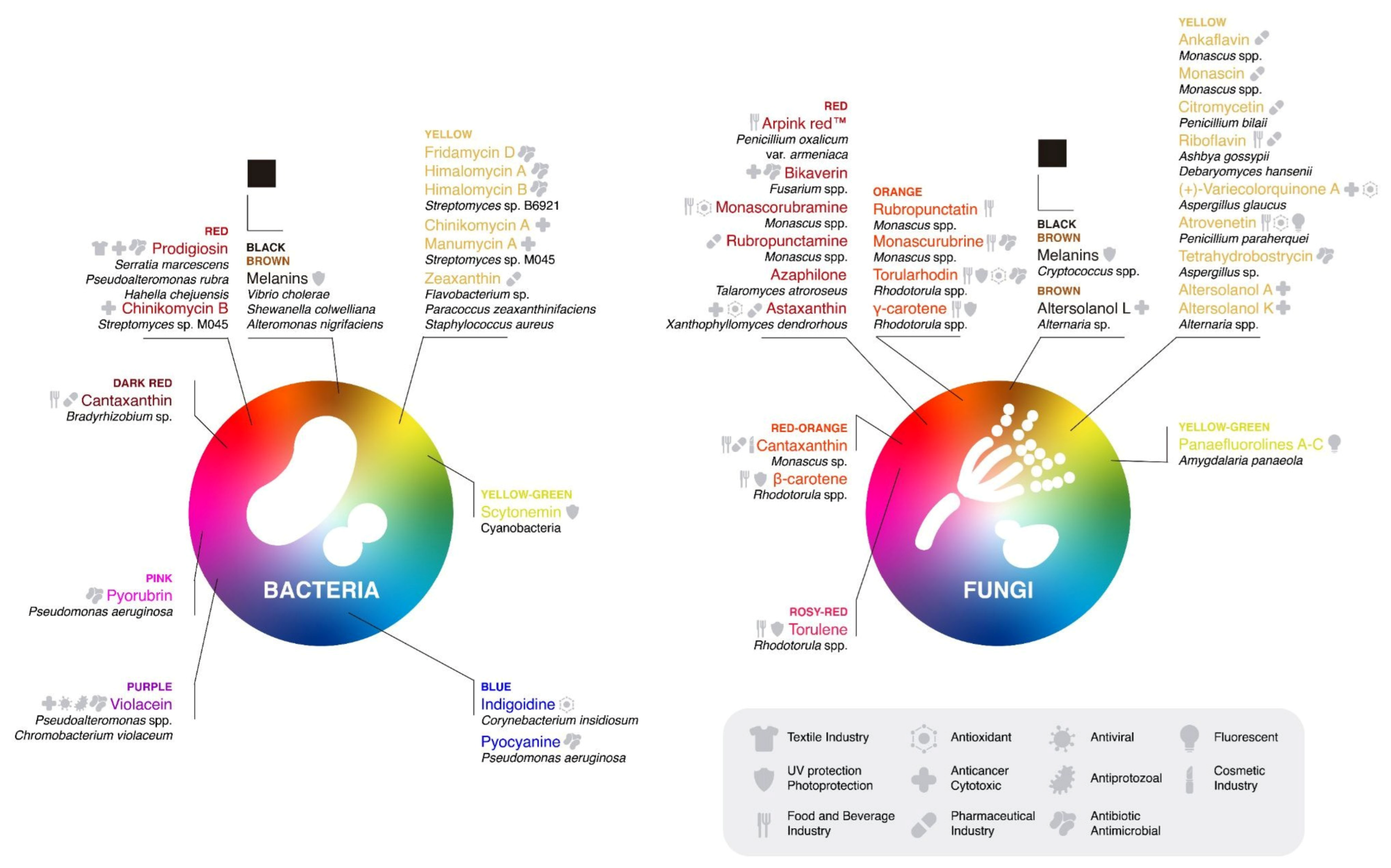

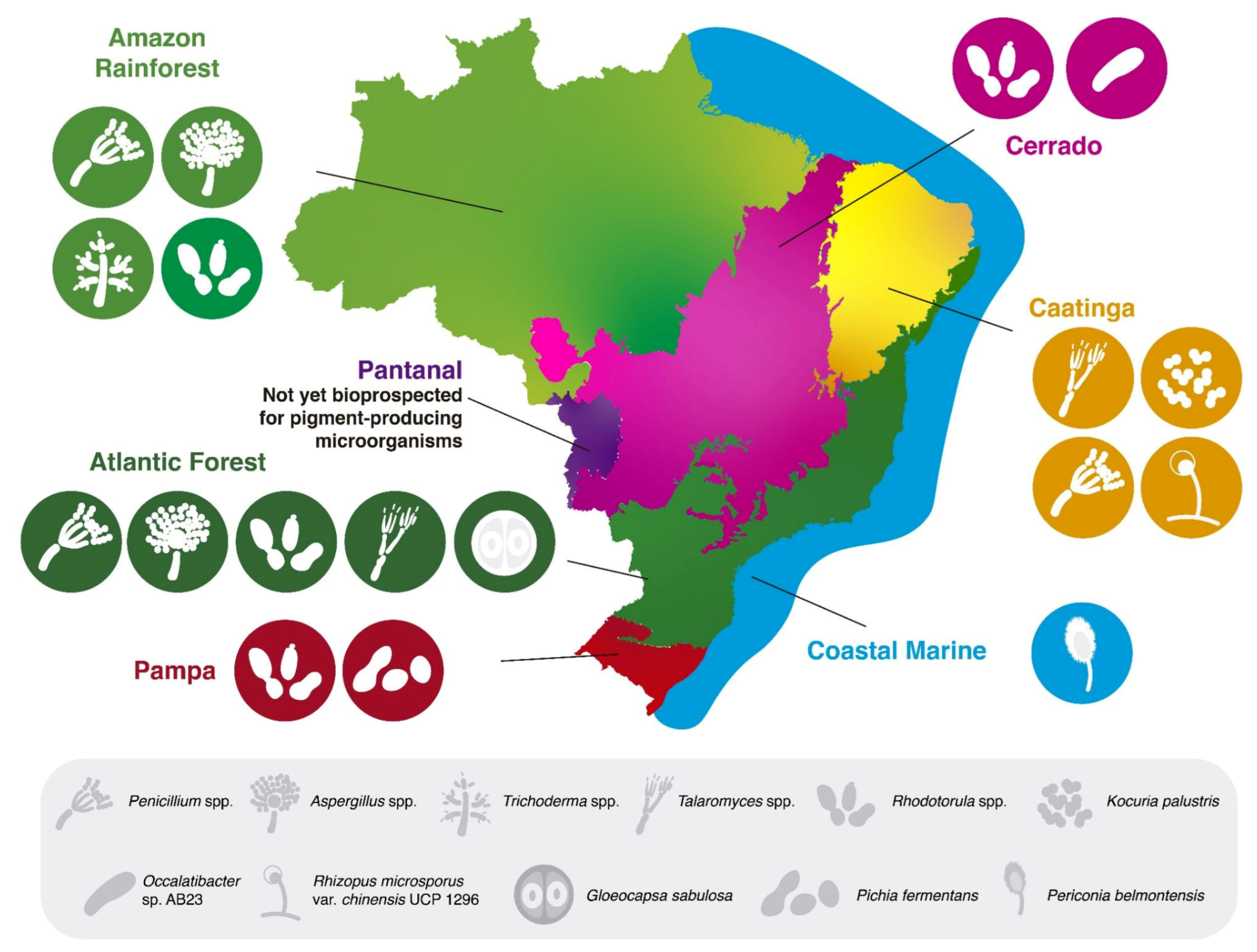

| INS | Dye | Brasil (ANVISA) | USA (FDA) | EU (EFSA) |
|---|---|---|---|---|
| 129 | Allura Red AC | ✔ | ✔ | ✔ |
| 123 | Amaranth/Bordeaux S | ✔ | ✔ | |
| 122 | Azorubine | ✔ | ✔ | |
| 131 | Blue Patent V | ✔ | ✔ | |
| 151 | Brilliant Black BN | ✔ | ✔ | |
| 133 | Brilliant Blue FCF | ✔ | ✔ | ✔ |
| 155 | Brown HT | ✔ | ✔ | |
| 121 | Citrus Red n°2 | ✔ | ||
| 127 | Erythrosine | ✔ | ✔ | |
| 143 | Fast Green FCF | ✔ | ✔ | |
| 142 | Green S | ✔ |
| Organism | Family | Pigment or Compound | Color | Host Organism | Metabolic Engineering Strategies Used | Modified Genes | Outcomes | References |
|---|---|---|---|---|---|---|---|---|
| Algae | Carotenoids | Zeaxanthin | Yellow | Chlamydomonas reinhardtii | CRISPR-Cas9 ribonucleoprotein-mediated knock-in | Double knockout of LCYE and ZEP | The double knockout mutant had a 60% higher zeaxanthin yield and content after 3 days of cultivation | Song et al., 2020 [85] |
| Bacteria | Lycopene | Lycopene | Bright red | Pantoea dispersa MSC14 | CRISPR-Cas9 | Knockout of crtY, overexpression of ctrI | crtY knockout and crtI overexpression enabled lycopene production in P. dispersa MSC14 | (Lai et al. 2024) [86] |
| Indol pigments | Violacein | Purple | Escherichia coli | CRISPRi uses a single-molecular guide RNA (sgRNA) | Repression of tyrR, pykF, cra, ptsG, pykA, sdaA, and tnaA | A 5′-shortened sgRNA CRISPRi library enabled low-cost phenotype-associated gene screening and improved violacein production in E. coli | (Jeong et al. 2023) [87] | |
| Yeasts | Carotenoids | β-carotene | Orange | Saccharomyces cerevisiae CEN.PK2-1c | CRISPR-Cas9 | Integration of crtE, crtYB and crtI | Metabolic engineering increased β-carotene and β-ionone production in S. cerevisiae | (López et al. 2020) [88] |
| Apocarotenoid dicarboxylic acid | Crocetin | Red | Saccharomyces cerevisiae BY4741 | CRISPR-Cas9 based multiplex genome integration | Integration of CCD2 and ALDH genes | CRISPR-Cas9-mediated multi-copy integration and temperature-regulated expression of CCD2 and ALDH optimized crocetin biosynthesis in S. cerevisiae | (Liu et al. 2020) [89] | |
| β-carotene and Zeaxanthin | Orange and Yellow | Yarrowia lipolytica Po1f | CRISPR-iCas9 | Integration of carRA/carB/GGS1/tHMG | CRISPR-iCas9 enabled efficient multi-gene editing and carotenoid pathway engineering in Y. lipolytica, accelerating carotenoid pathway engineering through one-step integration of several genes | (Chen et al. 2023) [90] | ||
| Lycopene | Lycopene | Red | Pichia pastoris GS115 | CRISPR-Cpf1a | Deletion of DPP1 and LPP1. downregulation of Erg9 | CRISPR/Cpf1-mediated metabolic and lipid engineering enabled record-high lycopene production by optimizing terpene pathway flux and lipid synthesis in P. pastoris | (Zhang et al. 2023) [91] | |
| Filamentous Fungi | Mycotoxin | Citrinin | – | Monascus purpureus RP2 | CRISPR-Cas9 | Knockout of ctnA and overexpression of ctnA | ctnA gene interference altered morphology and secondary metabolism in M. purpureus, reducing citrinin production while enhancing pigment biosynthesis for potential industrial optimization | (Zhang et al. 2025) [92] |
| – | Monascus purpureus KL-001 | CRISPR-Cas9 mediated marker-based deletion (CMBD) and CRISPR-Cas9 mediated marker-free deletion (CMFD) | Deletion of citrinin BGC | A dual-plasmid CRISPR/Cas system enabled efficient large-gene-fragment deletions and stable elimination of citrinin biosynthesis while improving Monascus Red production in Monascus | (Liu et al. 2020) [93] | |||
| Monascus pigments | – | Red, orange and yellow pigments | Monascus ruber KACC46666 | CRISPR-Cas9 | Inactivation of MpigI and MpigI’ (mutation insertion) | CRISPR/Cas9 engineering of the negative regulators MpigI and MpigI′ enhanced Monascus pigment biosynthesis without inducing citrinin production in Monascus | (Ree Yoon et al. 2023) [94] | |
| Phenylpropanoid-class of polyketides | α-pyrones homopyrones A and B | Yellow | Aspergillus homomorphus IBT21893 | CRISPR-Cas9 | Deletion of ahpA and truncated mutant of ahpB | CRISPR/Cas9-mediated deletion of ahpA and ahpB identified the biosynthetic gene cluster responsible for phenylpropanoid-type yellow pigment production in A. homomorphus | (Futyma et al. 2021) [95] |
Disclaimer/Publisher’s Note: The statements, opinions and data contained in all publications are solely those of the individual author(s) and contributor(s) and not of MDPI and/or the editor(s). MDPI and/or the editor(s) disclaim responsibility for any injury to people or property resulting from any ideas, methods, instructions or products referred to in the content. |
© 2026 by the authors. Licensee MDPI, Basel, Switzerland. This article is an open access article distributed under the terms and conditions of the Creative Commons Attribution (CC BY) license.
Share and Cite
Tusset, B.L.; Mocelin, I.; Villa, L.C.; dos Santos, A.E.T.; de Matos, R.; Kmetzsch, L.; Lopes, F.C. The Microbial Palette: From Bioprospecting to Genetic Engineering of Microbial Pigments. Fermentation 2026, 12, 263. https://doi.org/10.3390/fermentation12060263
Tusset BL, Mocelin I, Villa LC, dos Santos AET, de Matos R, Kmetzsch L, Lopes FC. The Microbial Palette: From Bioprospecting to Genetic Engineering of Microbial Pigments. Fermentation. 2026; 12(6):263. https://doi.org/10.3390/fermentation12060263
Chicago/Turabian StyleTusset, Bruna Lise, Iago Mocelin, Lorenza Corti Villa, Alice Elvira Teixeira dos Santos, Rafael de Matos, Lívia Kmetzsch, and Fernanda Cortez Lopes. 2026. "The Microbial Palette: From Bioprospecting to Genetic Engineering of Microbial Pigments" Fermentation 12, no. 6: 263. https://doi.org/10.3390/fermentation12060263
APA StyleTusset, B. L., Mocelin, I., Villa, L. C., dos Santos, A. E. T., de Matos, R., Kmetzsch, L., & Lopes, F. C. (2026). The Microbial Palette: From Bioprospecting to Genetic Engineering of Microbial Pigments. Fermentation, 12(6), 263. https://doi.org/10.3390/fermentation12060263