
Fermented Navy Bean (Phaseolus vulgaris) Products with Improved Nutritional, Antioxidant, and Antihypertensive Potential



Abstract
1. Introduction
2. Materials and Methods
2.1. Reagents
2.2. Raw Materials
2.3. Fermented Product Obtention and Characterization
2.3.1. Microbiological Analysis
2.3.2. Amino Acid Profile
2.3.3. Peptide Analysis by FPLC and HPLC
2.3.4. Free Amino Groups
2.3.5. Analysis of Organic Acids
2.3.6. Phenolic Compound Analysis
2.3.7. Analysis of Antinutrients: Phytic Acid and Trypsin Inhibitor Content
2.4. Bioaccessibility of Biotive Compound Analysis
2.4.1. Antioxidant Properties
2.4.2. Antihypertensive Properties
2.5. Statistical Analysis
3. Results and Discussions
3.1. Chemical Characterization and Microbiological Quality of Samples
3.2. Changes in the Phenolic Compound Content of Products
3.3. Changes in the Amino Acid Content and Peptides of the Products
3.4. Changes in the Antinutrients of the Products
3.5. Bioaccessibility of Bioactive Compounds
3.6. Product Peptide Dialyzability After Gastrointestinal Digestion
3.7. Bioactive Properties of Products After Gastrointestinal Digestion
4. Conclusions
Supplementary Materials
Author Contributions
Funding
Institutional Review Board Statement
Informed Consent Statement
Data Availability Statement
Acknowledgments
Conflicts of Interest
Abbreviations
| ACE -I | Angiotensin-Converting Enzyme-I |
| FPLC | Fast Protein Liquid Chromatography |
| FMNB | Fermented Mashed Navy Beans |
| FMNB-D | Dialysate of Fermented Mashed Navy Beans |
| FMNB-Di | Digested Fermented Mashed Navy Beans |
| HHL | Hippuryl-Histidyl-Leucine |
| IC50 | Half-maximal Inhibitory Concentration |
| LAB | Lactic Acid Bacteria |
| MNB | Mashed Navy Beans |
| MNB-D | Dialysate of Mashed Navy Beans |
| MNB-Di | Digested Mashed Navy Beans |
| MW | Molecular weight |
References
- Granito, M.; Frias, J.; Doblado, R.; Guerra, M.; Champ, M.; Vidal-Valverde, C. Nutritional Improvement of Beans (Phaseolus vulgaris) by Natural Fermentation. Eur. Food Res. Technol. 2002, 214, 226–231. [Google Scholar] [CrossRef]
- Zhang, X.; Zhang, Z.; Shen, A.; Zhang, T.; Jiang, L.; El-Seedi, H.; Zhang, G.; Sui, X. Legumes as an Alternative Protein Source in Plant-Based Foods: Applications, Challenges, and Strategies. Curr. Res. Food Sci. 2024, 9, 100876. [Google Scholar] [CrossRef]
- Nirmala Prasadi, V.P.; Joye, I.J. Dietary Fibre from Whole Grains and Their Benefits on Metabolic Health. Nutrients 2020, 12, 3045. [Google Scholar] [CrossRef]
- Messina, V.; Skylas, D.J.; Roberts, T.H.; Valtchev, P.; Whiteway, C.; Li, Z.; Hopf, A.; Dehghani, F.; Quail, K.J.; Kaiser, B.N. Pulse Proteins: Processing, Nutrition, and Functionality in Foods. Foods 2025, 14, 1151. [Google Scholar] [CrossRef]
- Han, S.S.; Hur, S.J.; Lee, S.K. A Comparison of Antioxidative and Anti-Inflammatory Activities of Sword Beans and Soybeans Fermented with Bacillus subtilis. Food Funct. 2015, 6, 2736–2748. [Google Scholar] [CrossRef]
- Nicolás-García, M.; Jiménez-Martínez, C.; Perucini-Avendaño, M.; Hildeliza Camacho-Díaz, B.; Ruperto Jiménez-Aparicio, A.; Dávila-Ortiz, G. Phenolic Compounds in Legumes: Composition, Processing and Gut Health. In Legumes Research—Volume 2; IntechOpen: London, UK, 2022. [Google Scholar]
- Colucci Cante, R.; Gallo, M.; Nigro, F.; Passannanti, F.; Salameh, D.; Budelli, A.; Nigro, R. Lactic Fermentation of Cooked Navy Beans by Lactobacillus paracasei CBA L74 Aimed at a Potential Production of Functional Legume-Based Foods. Can. J. Chem. Eng. 2020, 98, 1955–1961. [Google Scholar] [CrossRef]
- Duarte, C.M.; Nunes, M.C.; Gojard, P.; Dias, C.; Ferreira, J.; Prista, C.; Noronha, P.; Sousa, I. Use of European Pulses to Produce Functional Beverages—From Chickpea and Lupin as Dairy Alternatives. J. Funct. Foods 2022, 98, 105287. [Google Scholar] [CrossRef]
- Baboldashti, M.K.; Xie, X.; Xu, C. Probiotic Plant-Based Yogurts from Common Beans (Phaseolus vulgaris): Physicochemical Properties, Bioactive Peptides, and Health-Promoting Activities before and after In Vitro Digestion. Agric. Prod. Process. Storage 2025. [Google Scholar] [CrossRef]
- Cheng, S.; Langrish, T.A.G. A Review of the Treatments to Reduce Anti-Nutritional Factors and Fluidized Bed Drying of Pulses. Foods 2025, 14, 681. [Google Scholar] [CrossRef]
- Sinkovič, L.; Pipan, B.; Šibul, F.; Nemeš, I.; Tepić Horecki, A.; Meglič, V. Nutrients, Phytic Acid and Bioactive Compounds in Marketable Pulses. Plants 2023, 12, 170. [Google Scholar] [CrossRef]
- Vijaya, P.S.; Singh, R. Pulses: Nutritional or Anti-Nutritional? A Review on Bioactive Components and Digestibility. J. Food Sci. Technol. 2023, 20, 28–51. [Google Scholar] [CrossRef]
- Van de Velde, F.; Cian, R.E.; Garzón, A.G.; Albarracín, M.; Drago, S.R. Fermented Pulses for the Future: Microbial Strategies Enhancing Nutritional Quality, Functionality, and Health Potential. Fermentation 2025, 12, 18. [Google Scholar] [CrossRef]
- Acquah, C.; Ohemeng-Boahen, G.; Power, K.A.; Tosh, S.M. The Effect of Processing on Bioactive Compounds and Nutritional Qualities of Pulses in Meeting the Sustainable Development Goal 2. Front. Sustain. Food Syst. 2021, 5, 681662. [Google Scholar] [CrossRef]
- Adebo, O.A.; Njobeh, P.B.; Adebiyi, J.A.; Gbashi, S.; Phoku, J.Z.; Kayitesi, E. Fermented Pulse-Based Food Products in Developing Nations as Functional Foods and Ingredients. In Functional Food—Improve Health Through Adequate Food; IntechOpen: London, UK, 2017. [Google Scholar]
- Rahmi, A.; Arcot, J. In Vitro Assessment Methods for Antidiabetic Peptides from Legumes: A Review. Foods 2023, 12, 631. [Google Scholar] [CrossRef] [PubMed]
- Cissé, M.; Doué, G.G.; Yao, W.; Zoué, T.L. Impact of Lactic Acid Fermentation on the Nutritional Potential and Anti-Nutritional Factors of Two Widely Consumed Pulses (Vigna unguiculata and Vigna subterranea) Flours in Côte d’Ivoire. Int. J. Biochem. Res. Rev. 2022, 31, 13–22. [Google Scholar] [CrossRef]
- Martoccia, M.; Disca, V.; Jaouhari, Y.; Bordiga, M.; Coïsson, J.D. Recent Approaches for Bioactive Peptides Production from Pulses and Pseudocereals. Molecules 2025, 30, 4304. [Google Scholar] [CrossRef]
- Drago, S.; Garzon, A. Formulaciones Alimenticias a Base de Sorgo Fermentado y Su Proceso de Elaboración; Universidad Nacional del Litoral: Santa Fe, Argentina, 2023. [Google Scholar]
- ISO 7889/IDF 117A; Milk and Milk Products—Enumeration of Lactic Acid Bacteria—Colony-Count Technique at 30 °C. International Organization for Standardization/International Dairy Federation: Brussels, Belgium, 1988.
- FIL/IDF 94B; Milk and Milk Products—Enumeration of Coliforms—Colony-Count Technique at 30 °C. International Organization for Standardization/International Dairy Federation: Brussels, Belgium, 1990.
- FIL/IDF 73A; Milk and Milk Products—Enumeration of Microorganisms—Colony-Count Technique at 30 °C. International Dairy Federation: Brussels, Belgium, 1985.
- Alaiz, M.; Navarro, J.L.; Girón, J.; Vioque, E. Amino Acid Analysis by High-Performance Liquid Chromatography after Derivatization with Diethyl Ethoxymethylenemalonate. J. Chromatogr. A 1992, 591, 181–186. [Google Scholar] [CrossRef]
- Lowry, O.H.; Rosebrough, N.J.; Farr, A.L.; Randall, R.J. Protein Measurement with the Folin Phenol Reagent. J. Biol. Chem. 1951, 193, 265–275. [Google Scholar] [CrossRef]
- Aquino, M.E.; Drago, S.R.; Schierloh, L.P.; Cian, R.E. Identification of Bioaccessible Glycosylated Neuroprotective Peptides from Brewer’s Spent Yeast Mannoproteins by in vitro and in silico Studies. Food Res. Int. 2025, 209, 116188. [Google Scholar] [CrossRef]
- Nielsen, P.M.; Petersen, D.; Dambmann, C. Improved Method for Determining Food Protein Degree of Hydrolysis. J. Food Sci. 2001, 66, 642–646. [Google Scholar] [CrossRef]
- Albarracín, M.; Van de Velde, F.; Cian, R.E.; Drago, S.R. Neuroprotective Properties of Fermented Malted Rice Obtained Under Different Processing Conditions. Fermentation 2025, 11, 459. [Google Scholar] [CrossRef]
- Ale, E.C.; Irazoqui, J.M.; Ale, A.; Peralta, G.H.; Puntillo, M.; Burns, P.; Correa Olivar, G.; Cazenave, J.; Bergamini, C.V.; Amadio, A.F.; et al. Protective Role of Limosilactobacillus fermentum Lf2 and Its Exopolysaccharides (EPS) in a TNBS-Induced Chronic Colitis Mouse Model. Fermentation 2024, 10, 77. [Google Scholar] [CrossRef]
- Garzón, A.G.; Van de Velde, F.; Drago, S.R. Gastrointestinal and Colonic In Vitro Bioaccessibility of γ-Aminobutiric Acid (GABA) and Phenolic Compounds from Novel Fermented Sorghum Food. LWT 2020, 130, 109664. [Google Scholar] [CrossRef]
- AOAC Official Method 986.11; Phytate in Foods. Anion-Exchange Method. AOAC: Gaithersburg, MD, USA, 2000.
- AACC (American Association of Cereal Chemists). Approved Methods Committee Approved Methods of the American Association of Cereal Chemists; Approved Methods Committee; American Association of Cereal Chemists (AACC): St Paul, MN, USA, 2000. [Google Scholar]
- Cian, R.E.; Martínez-Augustin, O.; Drago, S.R. Bioactive Properties of Peptides Obtained by Enzymatic Hydrolysis from Protein Byproducts of Porphyra columbina. Food Res. Int. 2012, 49, 364–372. [Google Scholar] [CrossRef]
- Benzie, I.F.F.; Strain, J.J. The Ferric Reducing Ability of Plasma (FRAP) as a Measure of “Antioxidant Power”: The FRAP Assay. Anal. Biochem. 1996, 239, 70–76. [Google Scholar] [CrossRef]
- Hayakari, M.; Kondo, Y.; Izumi, H. A Rapid and Simple Spectrophotometric Assay of Angiotensin-Converting Enzyme. Anal. Biochem. 1978, 84, 361–369. [Google Scholar] [CrossRef]
- Boyle, J. Lehninger Principles of Biochemistry, 4th ed.; Nelson, D., Cox, M., Eds.; Biochemistry and Molecular Biology Education; Freeman and Company: New York, NY, USA, 2005; Volume 33, pp. 74–75. [Google Scholar] [CrossRef]
- Ayivi, R.D.; Gyawali, R.; Krastanov, A.; Aljaloud, S.O.; Worku, M.; Tahergorabi, R.; da Silva, R.C.; Ibrahim, S.A. Lactic Acid Bacteria: Food Safety and Human Health Applications. Dairy 2020, 1, 202–232. [Google Scholar] [CrossRef]
- Kang, S.S.; Kim, M.K.; Kim, Y.J. Comprehensive Evaluation of Microbiological and Physicochemical Properties of Commercial Drinking Yogurts in Korea. Food Sci. Anim. Resour. 2019, 39, 820–830. [Google Scholar] [CrossRef] [PubMed]
- Bulca, S.; Büyükgümüş, E. Production of Yogurt Analogs from Peanut Milk (Extract) Using Microbial Transglutaminase and Two Different Starter Cultures. LWT 2024, 205, 116546. [Google Scholar] [CrossRef]
- Hutkins, R. Starter Cultures. In Microbiology and Technology of Fermented Foods; Hutkins, R.W., Ed.; Wiley-Blackwell: Hoboken, NJ, USA, 2006; pp. 67–106. [Google Scholar]
- Demarinis, C.; Verni, M.; Pinto, L.; Rizzello, C.G.; Baruzzi, F. Use of Selected Lactic Acid Bacteria for the Fermentation of Legume-Based Water Extracts. Foods 2022, 11, 3346. [Google Scholar] [CrossRef]
- Ayed, L.; M’hir, S.; Nuzzolese, D.; Di Cagno, R.; Filannino, P. Harnessing the Health and Techno-Functional Potential of Lactic Acid Bacteria: A Comprehensive Review. Foods 2024, 13, 1538. [Google Scholar] [CrossRef]
- Nicolás-García, M.; Perucini-Avendaño, M.; Jiménez-Martínez, C.; de Perea-Flores, M.J.; Gómez-Patiño, M.B.; Arrieta-Báez, D.; Dávila-Ortiz, G. Bean Phenolic Compound Changes during Processing: Chemical Interactions and Identification. J. Food Sci. 2021, 86, 643–655. [Google Scholar] [CrossRef]
- Giusti, F.; Capuano, E.; Sagratini, G.; Pellegrini, N. A Comprehensive Investigation of the Behaviour of Phenolic Compounds in Legumes during Domestic Cooking and In Vitro Digestion. Food Chem. 2019, 285, 458–467. [Google Scholar] [CrossRef]
- Plamada, D.; Vodnar, D.C. Polyphenols—Gut Microbiota Interrelationship: A Transition to a New Generation of Prebiotics. Nutrients 2022, 14, 137. [Google Scholar] [CrossRef]
- Tong, S.C.; Siow, L.F.; Tang, T.K.; Lee, Y.Y. Plant-Based Milk: Unravel the Changes of the Antioxidant Index during Processing and Storage—A Review. Crit. Rev. Food Sci. Nutr. 2024, 64, 4603–4621. [Google Scholar] [CrossRef]
- Akanni, G.B.; Adebo, O.A. Metabolite Perturbations in Fermented Legumes as Elucidated Using Metabolomics: A Review. Int. J. Food Sci. Technol. 2024, 59, 4234–4250. [Google Scholar] [CrossRef]
- Lisciani, S.; Marconi, S.; Le Donne, C.; Camilli, E.; Aguzzi, A.; Gabrielli, P.; Gambelli, L.; Kunert, K.; Marais, D.; Vorster, B.J.; et al. Legumes and Common Beans in Sustainable Diets: Nutritional Quality, Environmental Benefits, Spread and Use in Food Preparations. Front. Nutr. 2024, 11, 1385232. [Google Scholar] [CrossRef] [PubMed]
- Ter, Z.Y.; Chang, L.S.; Babji, A.S.; Zaini, N.A.M.; Fazry, S.; Sarbini, S.R.; Peterbauer, C.K.; Lim, S.J. A Review on Proteolytic Fermentation of Dietary Protein Using Lactic Acid Bacteria for the Development of Novel Proteolytically Fermented Foods. Int. J. Food Sci. Technol. 2024, 59, 1213–1236. [Google Scholar] [CrossRef]
- Ren, Y.; Li, L. The Influence of Protease Hydrolysis of Lactic Acid Bacteria on the Fermentation Induced Soybean Protein Gel: Protein Molecule, Peptides and Amino Acids. Food Res. Int. 2022, 156, 111284. [Google Scholar] [CrossRef]
- Carbonaro, M.; Maselli, P.; Nucara, A. Structural Aspects of Legume Proteins and Nutraceutical Properties. Food Res. Int. 2015, 76, 19–30. [Google Scholar] [CrossRef]
- Peres Fabbri, L.; Cavallero, A.; Vidotto, F.; Gabriele, M. Bioactive Peptides from Fermented Foods: Production Approaches, Sources, and Potential Health Benefits. Foods 2024, 13, 3369. [Google Scholar] [CrossRef]
- Indrati, R. Bioactive Peptides from Legumes and Their Bioavailability. In Legumes Research—Volume 2; IntechOpen: London, UK, 2022. [Google Scholar]
- Sharma, N.; Angural, S.; Rana, M.; Puri, N.; Kondepudi, K.K.; Gupta, N. Phytase Producing Lactic Acid Bacteria: Cell Factories for Enhancing Micronutrient Bioavailability of Phytate Rich Foods. Trends Food Sci. Technol. 2020, 96, 1–12. [Google Scholar] [CrossRef]
- Shi, L.; Arntfield, S.D.; Nickerson, M. Changes in Levels of Phytic Acid, Lectins and Oxalates during Soaking and Cooking of Canadian Pulses. Food Res. Int. 2018, 107, 660–668. [Google Scholar] [CrossRef] [PubMed]
- Anaemene, D.; Fadupin, G. Anti-Nutrient Reduction and Nutrient Retention Capacity of Fermentation, Germination and Combined Germination-Fermentation in Legume Processing. Appl. Food Res. 2022, 2, 100059. [Google Scholar] [CrossRef]
- Byanju, B.; Hojilla-Evangelista, M.P.; Lamsal, B.P. Fermentation Performance and Nutritional Assessment of Physically Processed Lentil and Green Pea Flour. J. Sci. Food Agric. 2021, 101, 5792–5806. [Google Scholar] [CrossRef]
- de Assis, B.B.T.; Pimentel, T.C.; Dantas, A.M.; dos Santos Lima, M.; da Silva Campelo Borges, G.; Magnani, M. Biotransformation of the Brazilian Caatinga Fruit-Derived Phenolics by Lactobacillus acidophilus La-5 and Lacticaseibacillus casei 01 Impacts Bioaccessibility and Antioxidant Activity. Food Res. Int. 2021, 146, 110435. [Google Scholar] [CrossRef] [PubMed]
- Huang, D.; Boxin, O.U.; Prior, R.L. The Chemistry behind Antioxidant Capacity Assays. J. Agric. Food Chem. 2005, 53, 1841–1856. [Google Scholar] [CrossRef] [PubMed]
- Zhang, Z.; Wang, J.L.; Hao, Y.P.; Meng, Y.; Meng, J.; Chen, J.H.; Ding, C.H.; Xi, J. Effects of Lactobacillus Fermentation on the Composition, Existing Forms, Digestive Characteristics, and Antioxidant Activity of Polyphenols in Three Kinds of Bean Milk. Food Biosci. 2025, 68, 106482. [Google Scholar] [CrossRef]
- Ahmad, H.; Khan, H.; Haque, S.; Ahmad, S.; Srivastava, N.; Khan, A. Angiotensin-Converting Enzyme and Hypertension: A Systemic Analysis of Various ACE Inhibitors, Their Side Effects, and Bioactive Peptides as a Putative Therapy for Hypertension. JRAAS—J. Renin-Angiotensin-Aldosterone Syst. 2023, 2023, 7890188. [Google Scholar] [CrossRef]
- Rui, X.; Wen, D.; Li, W.; Chen, X.; Jiang, M.; Dong, M. Enrichment of ACE Inhibitory Peptides in Navy Bean (Phaseolus vulgaris) Using Lactic Acid Bacteria. Food Funct. 2015, 6, 622–629. [Google Scholar] [CrossRef]
- Li, T.; Du, W.; Huang, H.; Wan, L.; Shang, C.; Mao, X.; Kong, X. Research Progress on the Mechanism of Action of Food-Derived ACE-Inhibitory Peptides. Life 2025, 15, 1219. [Google Scholar] [CrossRef]
- Sreerama, Y.N.; Sashikala, V.B.; Pratape, V.M. Phenolic Compounds in Cowpea and Horse Gram Flours in Comparison to Chickpea Flour: Evaluation of Their Antioxidant and Enzyme Inhibitory Properties Associated with Hyperglycemia and Hypertension. Food Chem. 2012, 133, 156–162. [Google Scholar] [CrossRef]
- Cian, R.E.; Drago, S.R. Microbial Bioactive Peptides from Bacteria, Yeasts, and Molds. In Handbook of Food Bioactive Ingredients: Properties and Applications; Jafari, S.M., Rashidinejad, A., Simal-Gandara, J., Eds.; Springer International Publishing: Cham, Switzerland, 2022; pp. 1–24. ISBN 978-3-030-81404-5. [Google Scholar]
- Khurana, V.; Goswami, B. Angiotensin Converting Enzyme (ACE). Clin. Chim. Acta 2022, 524, 113–122. [Google Scholar] [CrossRef] [PubMed]
- Agunloye, O.M.; Oboh, G.; Ademiluyi, A.O.; Ademosun, A.O.; Akindahunsi, A.A.; Oyagbemi, A.A.; Omobowale, T.O.; Ajibade, T.O.; Adedapo, A.A. Cardio-Protective and Antioxidant Properties of Caffeic Acid and Chlorogenic Acid: Mechanistic Role of Angiotensin Converting Enzyme, Cholinesterase and Arginase Activities in Cyclosporine Induced Hypertensive Rats. Biomed. Pharmacother. 2019, 109, 450–458. [Google Scholar] [CrossRef]
- Rui, X.; Boye, J.I.; Simpson, B.K.; Prasher, S.O. Purification and Characterization of Angiotensin I-Converting Enzyme Inhibitory Peptides of Small Red Bean (Phaseolus vulgaris) Hydrolysates. J. Funct. Foods 2013, 5, 1116–1124. [Google Scholar] [CrossRef]
- Ramlal, A.; Nautiyal, A.; Baweja, P.; Kumar, V.; Mehta, S.; Mahto, R.K.; Tripathi, S.; Shanmugam, A.; Pujari Mallikarjuna, B.; Raman, P.; et al. Angiotensin-Converting Enzyme Inhibitory Peptides and Isoflavonoids from Soybean [Glycine max (L.) Merr.]. Front. Nutr. 2022, 9, 1068388. [Google Scholar] [CrossRef] [PubMed]
- World Health Organization. WHO Technical Report Series; WHO: Geneva, Switzerland, 2007. [Google Scholar]


| Attribute | Product | Value |
|---|---|---|
| pH | MNB | 6.28 ± 0.05 b |
| FMNB | 4.80 ± 0.20 a | |
| Lactic acid content (g 100 g−1 dw) | MNB | - |
| FMNB | 0.93 ± 0.12 |
| Microorganisms (Log CFU/mL) | Storage (d) | ||||
|---|---|---|---|---|---|
| Product | Inoculum | 0 | 14 | 28 | |
| S. thermophilus | MNB | - | - | - | - |
| FMNB | 7.5 ± 0.1 a | 9.4 ± 0.1 c | 9.0 ± 0.1 b | 9.0 ± 0.1 b | |
| L. delbrueckii subsp. bulgaricus | MNB | - | - | - | - |
| FMNB | 2.0 ± 0.1 b | 1.8 ± 0.3 b | 1.3 ± 0.1 a | <1 a | |
| TMA | MNB | - | 1.6 ± 0.2 a | 3.3 ± 0.3 c | 2.1 ± 0.1 b |
| FMNB | - | 1.5 ± 0.1 | <1 * | <1 * | |
| TPA | MNB | - | <1 * | <1 * | <1 * |
| FMNB | - | <1 * | <1 * | <1 * | |
| Total Coliforms | MNB | - | <1 * | <1 * | <1 * |
| FMNB | - | <1 * | <1 * | <1 * | |
| Molds and yeasts | MNB | - | <1 * | <1 * | <1 * |
| FMNB | - | <1 * | <1 * | <1 * | |
| Phenolic Compound (mg 100 g−1 dw) | MNB 0 d | FMNB 0 d | MNB 15 d | FMNB 15 d | MNB 28 d | FMNB 28 d | |
|---|---|---|---|---|---|---|---|
| Chlorogenic acid | F | 1.96 ± 0.13 a | 2.21 ± 0.01 ab | 3.14 ± 0.36 c | 2.63 ± 0.52 abc | 2.87 ± 0.12 bc | 2.78 ± 0.12 bc |
| B | - | - | - | - | - | - | |
| Caffeic acid | F | 0.12 ± 0.02 a | 0.14 ± 0.00 a | 0.15 ± 0.01 a | 0.12 ± 0.02 a | 0.13 ± 0.01 a | 0.13 ± 0.00 a |
| B | 0.05 ± 0.01 b | 0.03 ± 0.00 a | - | - | - | - | |
| p-coumaric acid | F | 0.04 ± 0.00 a | 0.03 ± 0.00 a | 0.03 ± 0.00 a | 0.04 ± 0.01 a | 0.03 ± 0.00 a | 0.03 ± 0.00 a |
| B | 0.41 ± 0.03 b | 0.51 ± 0.02 c | 0.01 ± 0.00 a | 0.01 ± 0.00 a | 0.004 ± 0.000 a | 0.01 ± 0.00 a | |
| Ferulic acid | F | 0.38 ± 0.06 b | 0.18 ± 0.01 a | 0.40 ± 0.02 b | 0.34 ± 0.01 b | 0.33 ± 0.05 b | 0.31 ± 0.00 b |
| B | 2.65 ± 0.11 b | 3.27 ± 0.16 c | 0.04 ± 0.00 a | 0.05 ± 0.00 a | 0.02 ± 0.00 a | 0.05 ± 0.00 a | |
| p-sinapic acid | F | 0.05 ± 0.01 a | 0.04 ± 0.02 a | 0.04 ± 0.01 a | 0.05 ± 0.01 a | 0.04 ± 0.01 a | 0.04 ± 0.01 a |
| B | 0.22 ± 0.02 b | 0.27 ± 0.01 c | 0.004± 0.000 a | 0.005 ± 0.000 a | 0.003 ± 0.000 a | 0.005 ± 0.000 a | |
| Total (T) | F | 2.55 ± 0.10 a | 2.60 ± 0.03 a | 3.76 ± 0.40 b | 3.18 ± 0.60 b | 3.40 ± 0.19 b | 3.30 ± 0.01 b |
| B | 3.28 ± 0.15 b | 4.05 ± 0.19 c | 0.05 ± 0.00 a | 0.07 ± 0.00 a | 0.03 ± 0.00 a | 0.06 ± 0.00 a | |
| T | 5.83 ± 0.24 b | 6.65 ± 0.16 c | 3.81 ± 0.40 a | 3.25 ± 0.60 a | 3.43 ± 0.19 a | 3.36 ± 0.02 a |
| Antinutrient | Product | Value |
|---|---|---|
| Phytic acid (g 100 g−1) | MNB | 1.17 ± 0.16 a |
| FMNB | 1.21 ± 0.04 a | |
| Trypsin inhibitor (TIU mg−1) | MNB | 1.79 ± 0.16 b |
| FMNB | 1.32 ± 0.06 a |
| Dialyzability (%) | MNB | FMNB |
|---|---|---|
| Phenolic compounds | ||
| Chlorogenic acid | 18.2 ± 1.0 a | 46.3 ± 0.5 b |
| p-coumaric acid | 0.27 ± 0.03 a | 1.37 ± 0.09 b |
| Ferulic acid | 10.2 ± 0.8 b | 4.6 ± 0.9 a |
| p-sinapic acid | 12.6 ± 0.28 b | 6.9 ± 1.0 a |
| Total | 11.9 ± 0.8 a | 18.2 ± 0.3 b |
| Peptides | 10.0 ± 0.3 a | 9.9 ± 0.2 a |
| IC50 Value (mg Solids mL−1) | ||||
|---|---|---|---|---|
| MNB | FMNB | MNB-D | FMNB-D | |
| ACE-I | 0.635 ± 0.043 d | 0.413 ± 0.002 c | 0.160 ± 0.005 b | 0.117 ± 0.003 a |
| Enzyme Kinetic Parameters | ||||
| Sample Concentration (mg solid mL−1) | Kmapp (mmol L−1) | Vmaxapp (µmol min−1 mL−1) | ||
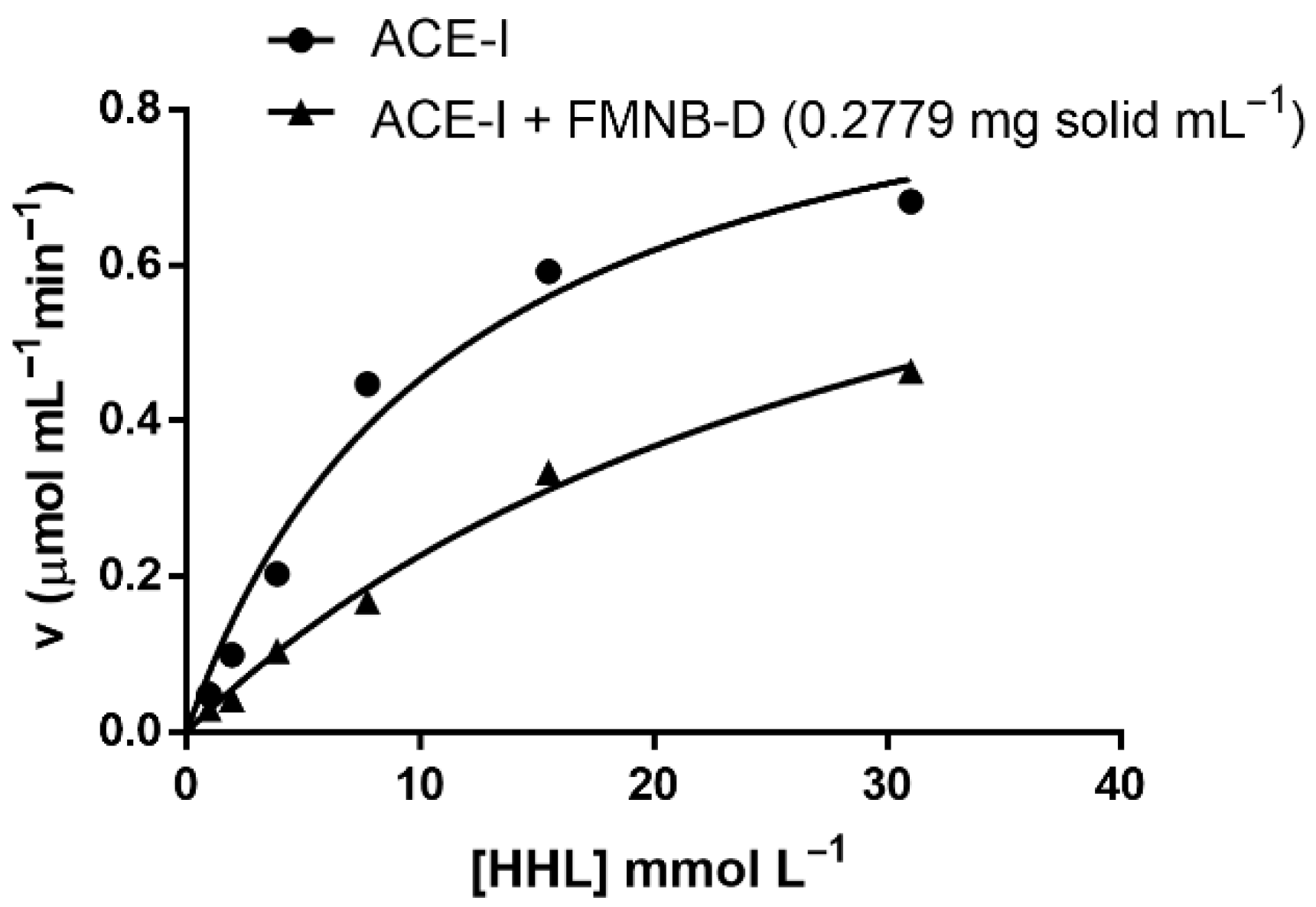
| ACE-I | - | 11.5 ± 0.8 a | 0.975 ± 0.078 a | |
| ACE-I + FMNB-D | 0.2779 | 32.6 ± 1.5 b | 0.965 ± 0.086 a | |
Disclaimer/Publisher’s Note: The statements, opinions and data contained in all publications are solely those of the individual author(s) and contributor(s) and not of MDPI and/or the editor(s). MDPI and/or the editor(s) disclaim responsibility for any injury to people or property resulting from any ideas, methods, instructions or products referred to in the content. |
© 2026 by the authors. Licensee MDPI, Basel, Switzerland. This article is an open access article distributed under the terms and conditions of the Creative Commons Attribution (CC BY) license.
Share and Cite
Van de Velde, F.; Albarracín, M.; Cian, R.E.; Drago, S.R. Fermented Navy Bean (Phaseolus vulgaris) Products with Improved Nutritional, Antioxidant, and Antihypertensive Potential. Fermentation 2026, 12, 238. https://doi.org/10.3390/fermentation12050238
Van de Velde F, Albarracín M, Cian RE, Drago SR. Fermented Navy Bean (Phaseolus vulgaris) Products with Improved Nutritional, Antioxidant, and Antihypertensive Potential. Fermentation. 2026; 12(5):238. https://doi.org/10.3390/fermentation12050238
Chicago/Turabian StyleVan de Velde, Franco, Micaela Albarracín, Raúl E. Cian, and Silvina R. Drago. 2026. "Fermented Navy Bean (Phaseolus vulgaris) Products with Improved Nutritional, Antioxidant, and Antihypertensive Potential" Fermentation 12, no. 5: 238. https://doi.org/10.3390/fermentation12050238
APA StyleVan de Velde, F., Albarracín, M., Cian, R. E., & Drago, S. R. (2026). Fermented Navy Bean (Phaseolus vulgaris) Products with Improved Nutritional, Antioxidant, and Antihypertensive Potential. Fermentation, 12(5), 238. https://doi.org/10.3390/fermentation12050238