
Article

Comparative Evaluation of Artificial Neural Networks and Response Surface Methodology for Nitrogen Source Optimization in Xylitol Production

by
Jonas P. Souza
1,
Miquéias G. dos Santos
1,
Henrique M. Fogarin
1,
Sâmilla G. C. Almeida
1,
Gisele C. A. Santos
2,
Débora D. V. Silva
3,
Érica R. Filletti
2 and
Kelly J. Dussán
1,4,*
1
Department of Chemical Engineering, Institute of Chemistry, São Paulo State University (Unesp), Av. Prof. Francisco Degni, 55 – Jardim Quitandinha, Araraquara 14800-900, Brazil
2
Department of Physics and Mathematics, Institute of Chemistry, São Paulo State University (Unesp), Av. Prof. Francisco Degni, 55 – Jardim Quitandinha, Araraquara 14800-900, Brazil
3
Department of Biochemistry and Organic Chemistry, Institute of Chemistry, São Paulo State University (Unesp), Av. Prof. Francisco Degni, 55 – Jardim Quitandinha, Araraquara 14800-900, Brazil
4
Bioenergy Research Institute (IPBEN), São Paulo State University (Unesp), Av. Prof. Francisco Degni, 55 – Jardim Quitandinha, Araraquara 14800-900, Brazil
*
Author to whom correspondence should be addressed.
Fermentation 2026, 12(5), 236; https://doi.org/10.3390/fermentation12050236
Submission received: 13 April 2026 / Revised: 5 May 2026 / Accepted: 11 May 2026 / Published: 13 May 2026

Abstract

Xylitol is a five-carbon sugar alcohol of industrial interest due to its applications as a food sweetener and sugar substitute. In this study, artificial neural networks combined with a genetic algorithm were evaluated as a data-driven approach for modeling and exploring xylitol production by Spathaspora boniae and Spathaspora brasiliensis during fermentation of sugarcane bagasse hemicellulosic hydrolysate. The dataset comprised 20 experimental points obtained from a face-centered central composite design, using urea, yeast extract, peptone, and ammonium sulfate as input variables. The neural network models showed high goodness-of-fit, with R2 values of 0.9952 for S. boniae and 0.9930 for S. brasiliensis. Experimental validation of the optimized conditions resulted in xylitol production of 11.54 ± 0.52 g L−1 for S. boniae and 9.29 ± 0.24 g L−1 for S. brasiliensis. Comparison with response surface methodology showed that both approaches provided strong predictive performance, although the statistical model predicted the optimum conditions more accurately. For S. boniae, however, the ANN-GA approach identified an alternative condition associated with lower nitrogen supplementation and higher experimental xylitol production. Given the limited dataset, this study should be regarded as a proof-of-concept for the application of data-driven optimization tools to xylitol fermentation. The results indicate that ANN-GA can complement classical statistical methods by helping to identify alternative operating conditions in bioprocess optimization.

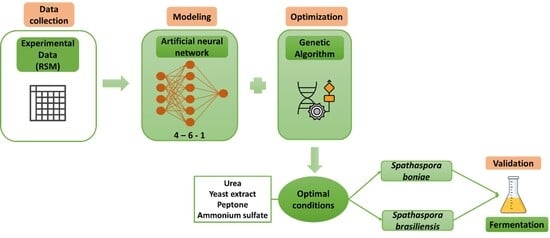
Graphical Abstract

1. Introduction

Xylitol, a natural poly-alcohol classified as a five-carbon sugar alcohol, has a sweetness similar to sucrose but only one-third the calories, which has made it an attractive substitute for sucrose, fructose, and other sugars in the food and pharmaceutical industries [1,2,3]. Although xylitol can be used as an energy source, its consumption is not regulated by insulin and does not cause high blood sugar levels [4]. Furthermore, xylitol is not readily metabolized by oral and ear microorganisms, which limits their growth and contributes to its antimicrobial properties. This characteristic helps prevent dental caries and reduces the risk of otitis media [3]. Industrially, xylitol is produced by catalytic hydrogenation of pure D-xylose solution under high temperature and pressure, and with the necessity of high-purity input and severe reaction conditions, this method is quite expensive and consumes a lot of energy [5]. For decades, scientists have been researching alternative cost-effective biotechnological production strategies, with a focus on low-cost xylose materials and their biocatalytic conversion to xylitol under ambient conditions [2].
In this context, lignocellulosic biomass, which includes energy crops and agricultural residues, is considered an ideal renewable source that meets the necessary requirements, with glucose and xylose being the most common monosaccharides in lignocellulosic biomass, which represent 60–70% and 30–40% of its hydrolysis, respectively [6]. Yeasts are the main microorganisms capable of converting xylose into xylitol, making them ideal candidates for the biotechnological process, with species of the genus Spathaspora showing particular potential due to their ability to efficiently metabolize pentose sugars [2,7,8,9]. This ability is linked to its metabolic pathway, where xylose reductase (XR) converts D-xylose to xylitol, which is then secreted or further oxidized into xylulose by xylitol dehydrogenase (XDH). D-xylulose is then phosphorylated and metabolized via the pentose phosphate pathway [10]. Among these species, Spathaspora boniae and Spathaspora brasiliensis have demonstrated promising fermentative performance using lignocellulosic hydrolysates [9,11], although their biotechnological potential remains underexplored.
The optimization of fermentation conditions, particularly nitrogen supplementation, plays a crucial role in improving xylitol yields and process efficiency. Traditionally, Response Surface Methodology (RSM) has been widely applied as a robust statistical tool to model and optimize fermentation processes based on structured experimental designs [12]. However, fermentative systems often involve complex and non-linear interactions that may not be fully captured by quadratic models [12,13]. In this context, Artificial Neural Networks (ANN) have emerged as powerful data-driven tools capable of modeling non-linear relationships without requiring predefined equations [13,14,15]. In parallel, Genetic Algorithms (GA), inspired by evolutionary principles, have been successfully applied to identify optimal operating conditions in complex systems [16,17].
The selection of ANN and GA in this study was based on their complementary roles in modeling and optimization [18,19,20]. ANN was employed as a data-driven modeling tool to capture non-linear relationships between variables, while GA was used to explore the search space and identify optimal conditions. These approaches were selected to enable a direct comparison with Response Surface Methodology, which provides both a statistical model and an optimization framework within the same experimental design.
Therefore, this study presents a proof-of-concept application of an Artificial Neural Network combined with a Genetic Algorithm as an alternative data-driven approach for exploring nitrogen source optimization in xylitol production by Spathaspora boniae and Spathaspora brasiliensis using sugarcane bagasse hemicellulosic hydrolysate. This approach builds upon previous work in which nitrogen source optimization was performed using Response Surface Methodology [21], enabling a direct comparison between classical statistical modeling and data-driven strategies within the same experimental domain. The objective is not to replace classical statistical approaches, but to evaluate whether a combined ANN–GA strategy can be used as an exploratory tool to identify feasible operating conditions and assess potential improvements in process efficiency, particularly in terms of nutrient utilization, thereby providing new insights into nitrogen source optimization for xylitol production.

2. Materials and Methods

2.1. Preparation and Treatment of Hemicellulosic Hydrolysate from Sugarcane Biomass

Sugarcane bagasse and straw were generously supplied by the Santa Cruz Sugar and Alcohol Mill, part of the São Martinho Group, located in Américo Brasiliense, São Paulo. The structural composition of both raw and pretreated sugarcane biomass (cellulose and lignin content) was analyzed following the methodology described by Sluiter et al. [22]. Pretreatment of the sugarcane biomass mixture (50:50 straw-to-bagasse ratio by weight) was conducted in a 250 L reactor at the National Center for Research in Energy and Materials (CNPEM), specifically at the National Laboratory of Science and Technology of Bioethanol (CTBE). The pretreatment conditions included a solid-to-liquid ratio of 1:10, a temperature of 140 °C, 0.5% sulfuric acid (w/v), and a reaction time of 15 min [23]. After pretreatment, the hemicellulosic hydrolysate (Table 1) was filtered to isolate the solid fraction (pretreated biomass). For detoxification, the hemicellulosic hydrolysate was treated as outlined by Marton et al. [24]. The pH was initially adjusted to 7.0 using calcium oxide (CaO), followed by a reduction to pH 2.5 with phosphoric acid (H3PO4). Activated carbon was then added at a concentration of 1.0% (w/v), and the mixture was incubated in a shaking incubator at 60 °C and 100 rpm for 30 min. The precipitates formed during this process were removed via vacuum filtration. Finally, the pH of the hydrolysate was adjusted to 5.5, and the solution was sterilized at 110 °C (0.5 atm) for 15 min to prepare it for use as a fermentation medium.

2.2. Microorganism

The yeast strains Spathaspora boniae (UFMG-CM-Y306) and Spathaspora brasiliensis (UFMG-HMD19.3) were kindly provided by the Microorganisms Collection of the Federal University of Minas Gerais. Prior to the experiments, the yeasts were pre-cultured in test tubes containing nutrient agar (1.0 g L−1 meat extract, 2.0 g L−1 yeast extract, 5.0 g L−1 peptone, 1.0 g L−1 sodium chloride, 15 g L−1 agar) at 30 °C for 24 h. Subsequently, the cells were propagated in 400 mL of YPX liquid medium (10 g L−1 yeast extract, 20 g L−1 peptone, and 30 g L−1 D-xylose) in 1000 mL Erlenmeyer flasks at 30 °C with continuous shaking (200 rpm) for 24 h. After this period, the cells were harvested by centrifugation at 2057× g for 5 min, washed, and resuspended in sterile distilled water. This cell suspension was used as the inoculum for fermentation experiments, starting with an initial concentration of 1.0 g L−1.

2.3. Fermentation Condition

Fermentations were carried out in 250 mL Erlenmeyer flasks containing 100 mL of hemicellulosic hydrolysate (40% working volume), following standard fermentation protocols for yeasts under microaerobic conditions [25]. They were used for 72 h at 30 °C, with agitation at 200 rpm and an initial pH of 5.5. Nitrogen sources at different concentrations (urea, yeast extract, peptone, and ammonium sulfate) were incorporated into the hydrolysate according to 24-1 face-centered central composite design (Supplementary Material—Table S1). This approach allowed the study to focus exclusively on the impact of nitrogen source composition on xylitol production. Samples were collected every 24 h during the fermentations for the evaluation of cell growth, as well as the quantification of sugars and metabolites. The concentration of xylose was not considered an optimization variable because it derives directly from the composition of the hemicellulosic hydrolysate.

2.4. Artificial Neural Network Model (Designing and Training of Neural Network)

Artificial neural network methodology employed in this study was a multilayer perceptron model (MLP) with a single hidden layer architecture (4–6-1) having 4 input, 6 hidden and 1 output neurons, Figure 1. It was performed using the Neural Network Getting Started tool in the MATLAB R2023b software (MathWorks Inc., Natick, MA, USA). The concentrations of urea, yeast extract, peptone, and ammonium sulfate were utilized as variables for creating the ANN topology, which was used to determine the non-linear relationship between input variables and output response. The network was trained using the Levenberg–Marquardt back-propagation algorithm. The mean squared error (MSE) was utilized to measure the adequacy of the developed model.
It is recognized that the dataset used for training the ANN, composed of 20 experimental points, is at the lower limit of what is recommended for machine learning models, which could potentially increase the risk of overfitting. To mitigate this limitation and evaluate the model’s generalization capacity, the following strategies were adopted: (i) random division of the data into training (70%), validation (15%), and test (15%) sets, ensuring that the model’s performance was evaluated on data not used in training; (ii) careful selection of the number of neurons in the hidden layer (6 neurons), seeking a balance between learning capacity and generalization, as recommended by Hussain et al. [26]; and (iii) independent experimental validation of the optimal conditions predicted by the ANN-GA model, comparing the predictions with real experimental data not used in any stage of the model’s training or validation. This combined approach allows for the evaluation of whether the model has indeed learned the system’s behavior or merely memorized the training data.

2.5. Optimization by Genetic Algorithm (GA)

GA is a traditional evolutionary computing algorithm used for heuristic global optimization. Its heuristic is based on Charles Darwin’s evolution theory, with a deterministic component representing natural selection, in which more adapted individuals have a higher chance of survival and reproduction, and a stochastic component representing random individual genetic mutation and parental genetic crossover in reproduction [18].
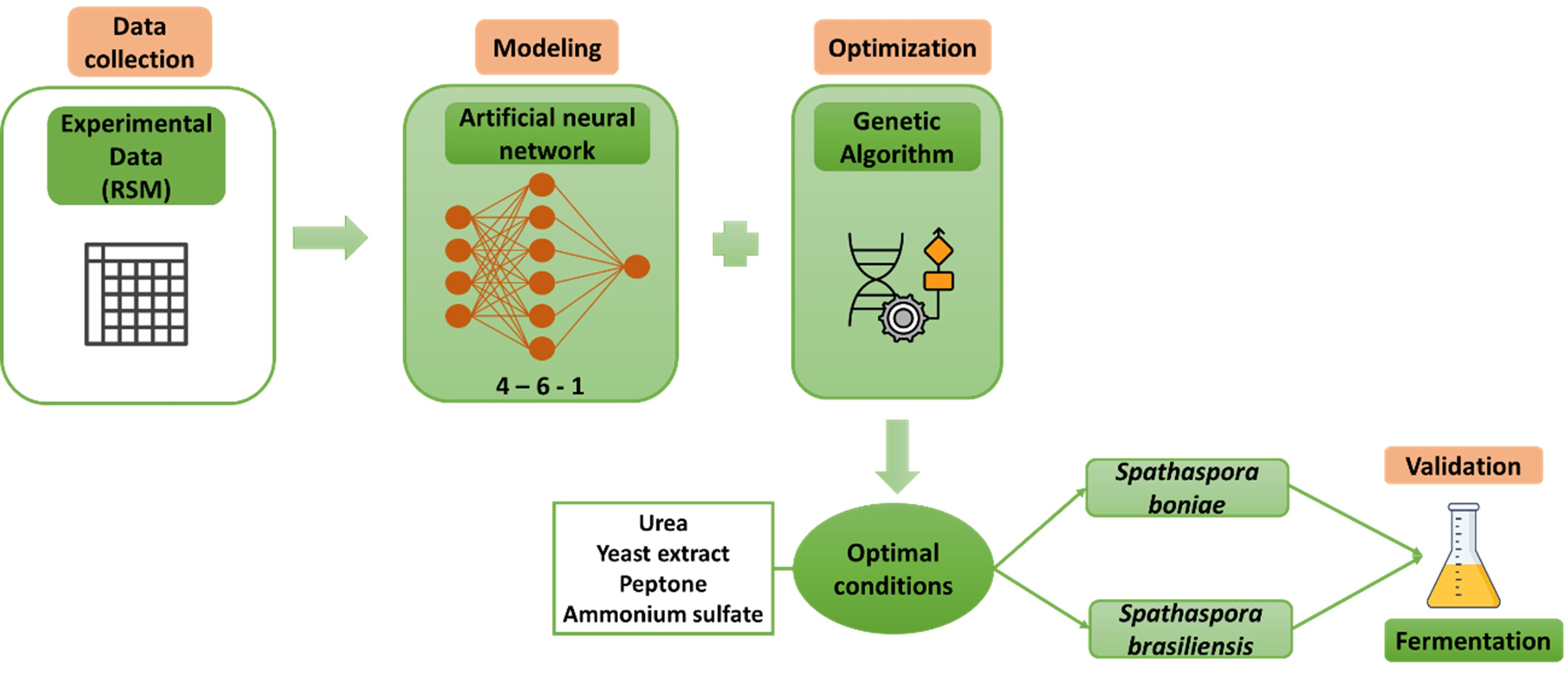
The Genetic Algorithm (GA) was used for optimizing xylitol production by adjusting process variables such as urea, yeast extract, peptone, and ammonium sulfate. GA was chosen as an optimization method because it can efficiently explore the search space by combining natural selection, crossover, and genetic mutation. The initial GA population was generated considering the experimental limits of the process variables. Each individual in the population represented a unique combination of these variables. The fitness function used to evaluate the performance of each individual was xylitol production, estimated by the Artificial Neural Network (ANN) model previously developed based on experimental data. The ANN was trained to predict xylitol production based on selected process variables. The flowchart of the hybridization of the artificial neural network and genetic algorithm can be seen in Figure 2. During GA iterations, natural selection was applied, favoring individuals with higher xylitol production. Genetic crossing and mutation were employed to generate new combinations of process variables, introducing diversity into the population. The evolutionary process was repeated for 100 generations, aiming at convergence towards the optimal combination of variables that maximized xylitol production. The GA was implemented using Global Optimization Toolbox with MATLAB software.

2.6. Analytical Procedures

The analytical procedures were carried out according to the methodology used by Souza et al. [21]. To measure cell growth, a calibration curve was created that correlated OD600 with cell dry weight (CD) in grams per liter. The concentrations of arabinose, glucose, xylose, xylitol, ethanol, acetic acid, and formic acid were measured using high-performance liquid chromatography (HPLC). The samples were filtered via a Sep Pak C18 filter (Waters Associates, Milford, MA, USA) and injected (20 μL) into a Shimadzu liquid chromatography system with an RID refractive index detector (Columbia, MA, USA), a BIO-RAD AMINEX HPX-87H (São Francisco, CA, USA) (300 × 7.8 mm) analytical column was used at a temperature of 60 °C, with the mobile phase H2SO4 0.01 N at a flow rate of 0.6 mL min−1.

3. Results and Discussion

3.1. Artificial Neural Network Model

Based on experimental data from the literature published by Souza et al. [21] (Supplementary Material—Tables S2 and S3), numerical matrices were created for the development of Artificial Neural Networks (ANNs). The input for the ANNs contained 20 data points with four parameters, urea, yeast extract, peptone and ammonium sulfate, derived from the data matrix utilized by the author in the face-centered central composite design to optimize xylitol production. A desired output matrix for the ANNs was created using the values of the xylitol concentrations that correspond to each of these samples. Separate input and output matrices were generated for each yeast, with dimensions of 4 × 20 and 1 × 20, respectively. In the current investigation, the yeasts Spathaspora boniae and Spathaspora brasiliensis, respectively, have separate training, validation, and test samples shown in Table 2 and Table 3. The 20 samples of each yeast were divided into three sets at random: 70% for training, 15% for validation, and the remaining 15% for testing the ANN’s performance.
The ANNs were implemented using the Levenberg–Marquardt Method (trainlm) and the Matlab software with the nnstart—fitting app application. In ANN modeling, the choice of network size, hidden layer and number of neurons are all essential components in predicting experimental results. The chosen topology included four neurons in the input layer that corresponded to the concentrations of urea, yeast extract, peptone, and ammonium sulfate. The output layer was made up of one neuron for each xylitol concentration. The hidden layer is composed of 6 neurons; this number was selected by analyzing an increasing and decreasing number of neurons beginning with 10 and selecting the number that best allows the ANN to learn and generalize the experiment, that is, the one with the lowest MSE and highest R2 value.
The development of an effective ANN model requires careful consideration of network architecture parameters. Hidden layers are used in networks to perform complicated and nonlinear functions [27]. The number of neurons at hidden levels is extremely important. A higher number of neurons in a given hidden layer can result in model overfitting, which occurs when the network memorizes the pattern and instead of generalizing it from the training dataset. If the number of neurons is reduced, the model fit decreases, requiring additional training time to determine the optimal number of neurons [26]. Our selection of 6 neurons in the hidden layer was based on this optimization principle, achieving the best balance between learning capacity and generalization.
The yeast Spathaspora boniae performed best during epoch 6, out of a total of 6 epochs performed by the ANN. In contrast, the yeast Spathaspora brasiliensis performed best in epoch 3, with the ANN executing three epochs total.
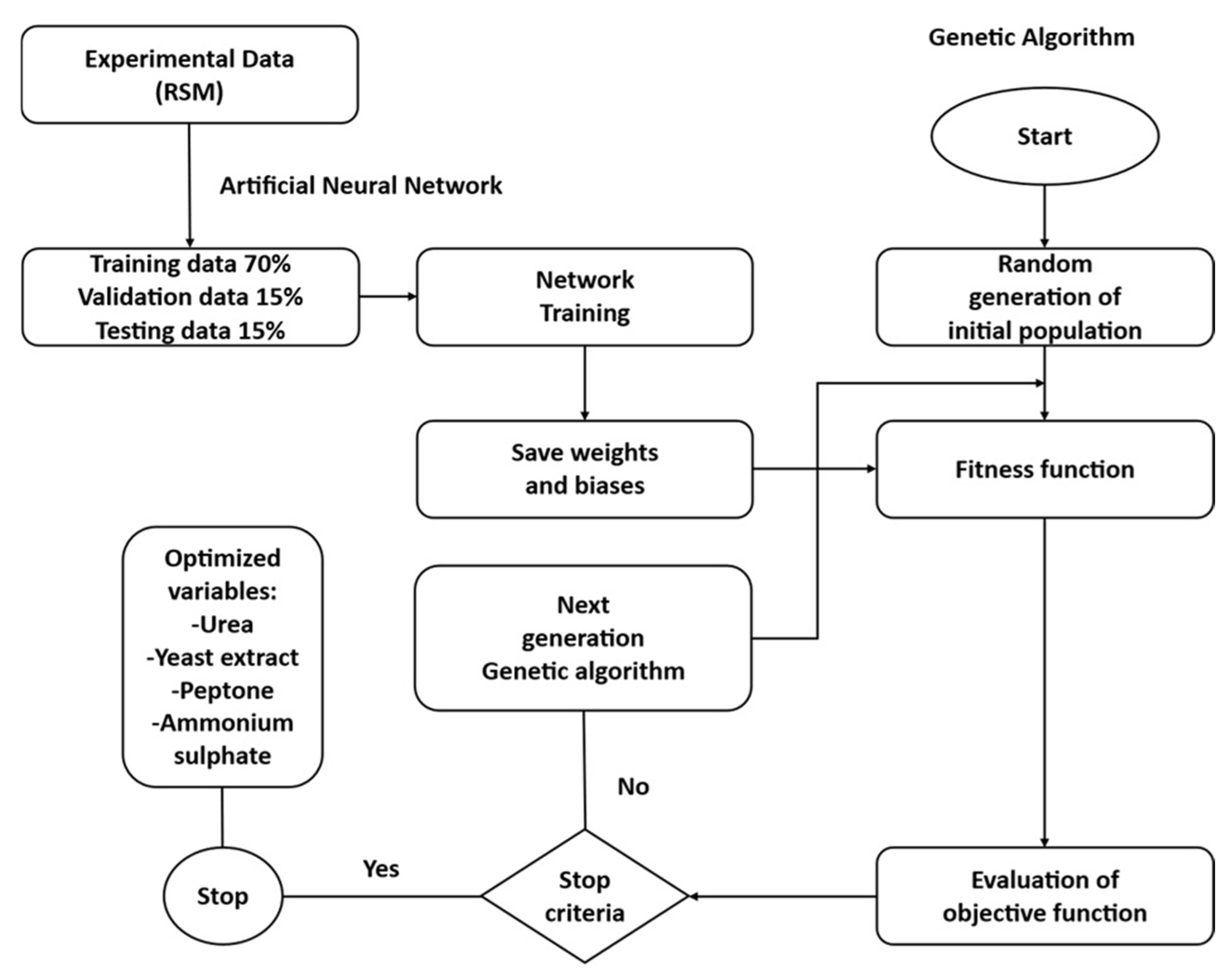
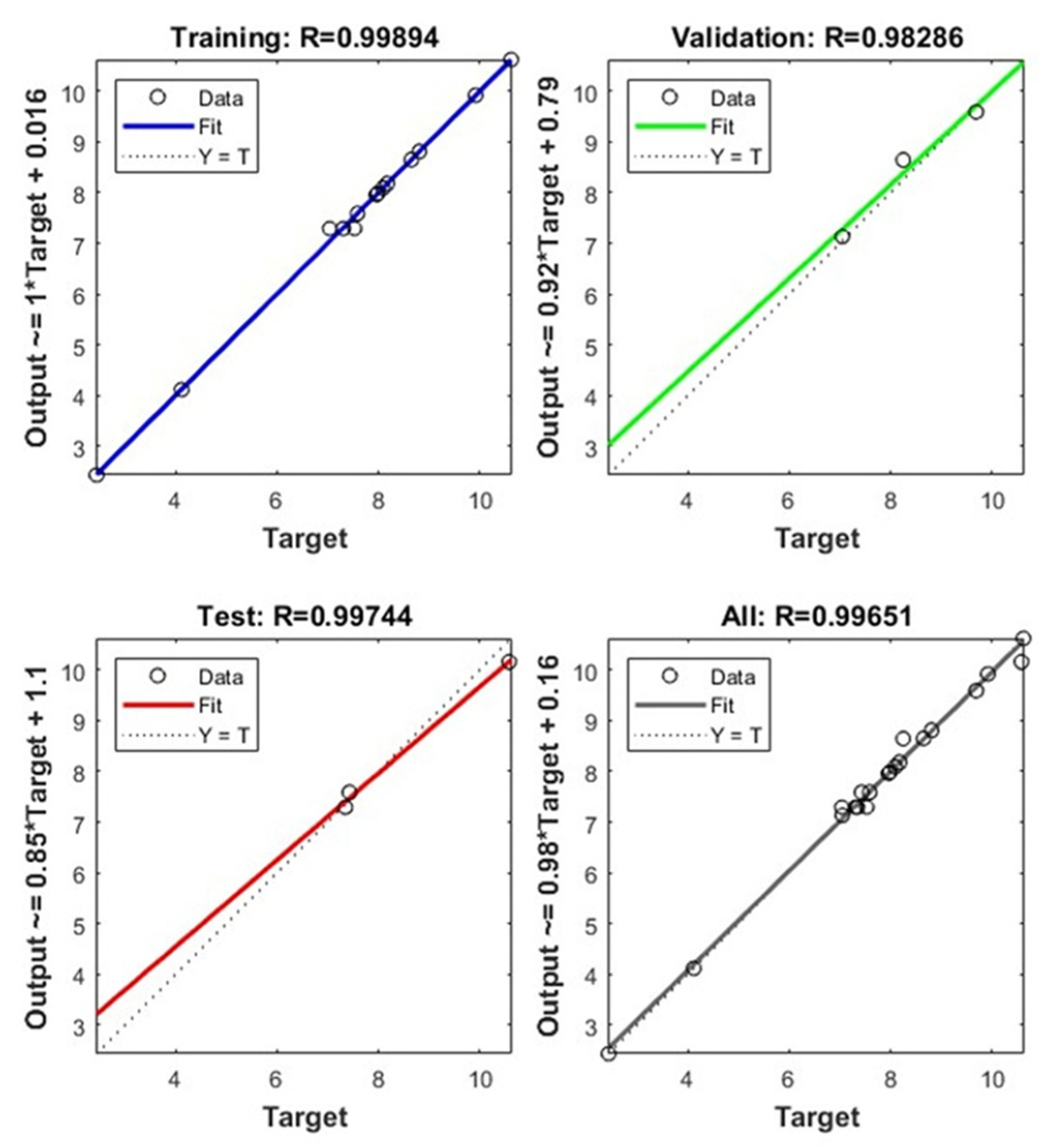
Figure 3 shows the correlation coefficients of the training, validation, and test sets for the yeast Spathaspora boniae, which were 0.99953, 0.99965, and 0.99891, respectively, as well as the proximity of the points to the central trend line. Similarly, in Figure 4, for the yeast Spathaspora brasiliensis, the correlation coefficients of the training, validation, and test sets, as well as the proximity of the points to the central trend line, are shown as 0.99894, 0.98286, and 0.99744, respectively.
The training, validation, and testing correlation coefficients in Figure 3 and Figure 4 demonstrate that the data used was adequately representative and accurately represented for the problem. Additionally, as indicated in Table 4, the determination coefficient (R2), the Root Mean Square Error (RMSE), Mean Absolute Percentage Error (MAPE) and Mean Absolute Error (MAE) of the training, validation, testing, and total data were used to statistically evaluate the performance of the ANN. The low values show that the suggested ANN provides a good approximation when modeling data for the production of xylitol.

3.2. Comparison of the ANN and RSM Models

A thorough comparison between Response Surface Methodology (RSM) and Artificial Neural Network (ANN) models was performed to evaluate their prediction accuracy. The evaluation used a variety of performance parameters, including the determination coefficient (R2), Root Mean Square Error (RMSE), Mean Absolute Percentage Error (MAPE), and Mean Absolute Error (MAE), as shown in Table 5.
Thus, for the yeast Spathaspora boniae, the ANN model presented higher R2 (0.9952) and lower RMSE (0.2374), MAPE (0.0000%), and MAE (0.1404) values compared to the RSM model (R2 = 0.9748, RMSE = 0.5462, MAPE = 0.0000%, and MAE = 0.4233), indicating an excellent fit and a strong relationship between predicted and experimental xylitol production.
For Spathaspora brasiliensis, both models also showed high predictive performance. The ANN model presented R2 = 0.9930, RMSE = 0.1583, MAPE = 1.0440%, and MAE = 0.0862, while the RSM model showed R2 = 0.9978, RMSE = 0.0872, MAPE = 0.7050%, and MAE = 0.0525, indicating that the RSM model provided slightly better predictive accuracy for this yeast.
These results are consistent with Vardhan et al. [15], who reported that ANN models are capable of capturing complex non-linear relationships in xylitol production systems, resulting in highly accurate predictions. Similarly, Desai et al. [12] demonstrated improved predictive accuracy of ANN compared to RSM in fermentation medium optimization. However, the present results indicate that this superiority is not universal, as both models showed comparable performance for S. brasiliensis, with RSM presenting lower error values.
Overall, the comparison between the ANN and RSM models revealed complementary rather than strictly hierarchical performance profiles. ANN showed a better fit for S. boniae, whereas for S. brasiliensis, both models exhibited similar predictive performance, with RSM presenting slightly lower error metrics.

3.3. ANN-GA Optimization and Validation

The Genetic Algorithm (GA) was used to optimize the input variables of the Artificial Neural Network (ANN) model, using the neural network model created for each yeast as a fitness function.
The maximum predicted xylitol production for the yeast Spathaspora boniae was 10.14 g L−1, obtained with concentrations of 0.52 g L−1 urea, 4.05 g L−1 yeast extract, 1.39 g L−1 peptone, and 1.33 g L−1 ammonium sulphate. The experimental advantage of the ANN-GA predicted optimum value is evident as maximum xylitol production is obtained using only 4.05 g L−1 of yeast extract and 1.39 g L−1 of peptone, resulting in a reduction in the amount of nitrogen sources required, which is consistent with previous studies highlighting the influence of nitrogen supplementation on xylitol production [28,29,30]. These findings are in agreement with Pappu and Gummadi [19], who demonstrated that ANN-GA optimization can significantly improve xylitol production by efficiently exploring the search space of fermentation variables.
On the other hand, the maximum xylitol production predicted by the GA for the yeast Spathaspora brasiliensis was 10.64 g L−1, with concentrations of 0.05 g L−1 urea, 6.10 g L−1 yeast extract, 0.73 g L−1 peptone, and 2.90 g L−1 ammonium sulfate. In this case, optimization by ANN-GA increased the amount of yeast extract and reduced the amount of peptone required.
The integration of genetic algorithms with artificial neural networks has proven to be a powerful approach for bioprocess optimization. Li et al. [20] established a strategy to optimize lysine fermentation using ANN-GA, demonstrating improved fermentation efficiency and predictive performance.
The accuracy of Artificial Neural Network–Genetic Algorithm (ANN-GA) predictions for optimal input variables was assessed through experimental validation for each yeast species. To validate the reliability of the model, experiments were performed in triplicate under the optimal conditions predicted by the ANN-GA model. It is important to note that the optimization models provide point estimates, as they identify specific optimal conditions within the experimental domain rather than ranges of values.
When the optimal conditions predicted by each methodology were experimentally validated (Table 6), it was observed that the RSM model presented lower mean absolute errors (MAE) (0.02 g L−1 for S. boniae and 0.52 g L−1 for S. brasiliensis) compared to the ANN-GA model (1.40 g L−1 and 1.35 g L−1, respectively).
The results indicate that the RSM model was more accurate, presenting smaller mean absolute errors (MAE), while ANN-GA showed larger errors. However, ANN-GA also made predictions reasonably close to the experimental values, despite its larger margin of error.
Experimental validation showed that the RSM-derived optima were predicted with greater accuracy than the ANN-GA-derived optima for both yeasts. Nevertheless, ANN-GA identified an alternative condition for S. boniae that required lower concentrations of yeast extract and peptone and resulted in a higher experimental xylitol concentration than the condition previously obtained by RSM (Table 6).
This finding suggests that, even with a limited dataset, ANN-GA may help explore non-intuitive combinations of nutrients and propose practically relevant solutions, especially when medium cost and input efficiency are considered alongside predictive accuracy [24]. For S. brasiliensis, this advantage was not observed, indicating that the benefits of ANN-GA are strain-dependent and should not be generalized.
Overall, the results indicate that ANN-GA should not be interpreted as universally superior to RSM for this system. Instead, the two approaches provide complementary insights: RSM showed better precision in predicting the optimum conditions in the experimental validation step, whereas ANN-GA enabled the identification of an alternative condition for S. boniae associated with reduced organic nitrogen supplementation and higher experimental xylitol production.
This aspect makes the ANN-GA approach particularly attractive for industrial-scale applications, where small reductions in input costs can result in significant cost reductions.
Despite the promising results obtained in this study, several challenges remain regarding the application of data-driven approaches for bioprocess optimization. One of the main limitations is the availability of sufficiently large and high-quality experimental datasets, which are essential for improving the robustness and generalization capacity of machine learning models such as artificial neural networks. In fermentation processes, experimental data generation is often time-consuming and costly, which restricts the application of more complex modeling approaches.
From a methodological perspective, future studies should explore the use of larger datasets and alternative modeling strategies, including hybrid approaches that combine statistical and data-driven models. The incorporation of additional process variables, such as pH, temperature, and oxygen availability, may also improve model performance and provide a more comprehensive understanding of the system. Furthermore, validation under scaled-up conditions and different substrates will be essential to assess the industrial applicability of these approaches.

4. Conclusions

This study evaluated the application of an artificial neural network integrated with a genetic algorithm (ANN–GA) as a data-driven approach for optimizing xylitol production by Spathaspora boniae and Spathaspora brasiliensis in sugarcane bagasse hemicellulosic hydrolysate. Although the ANN models showed high goodness-of-fit metrics, the limited dataset used for training restricts the broader generalization of the results. Comparison with Response Surface Methodology (RSM) demonstrated that both approaches were effective, with RSM providing more accurate prediction of the optimum conditions during experimental validation. However, for S. boniae, the ANN–GA approach identified an alternative cultivation condition with reduced yeast extract and peptone concentrations and higher experimental xylitol production than the RSM-derived condition, highlighting its relevance when nutrient efficiency is considered alongside product formation. Overall, the results indicate that ANN–GA can be used as an exploratory tool to identify feasible operating conditions within the experimental domain. However, it should not be interpreted as a replacement for classical statistical approaches, particularly when only small datasets are available. These findings reinforce the importance of combining different modeling strategies to better understand and optimize complex bioprocesses.

Supplementary Materials

The following supporting information can be downloaded at: https://www.mdpi.com/article/10.3390/fermentation12050236/s1, Table S1: Coded levels and real levels (g L−1) of face-centered central composite design for evaluating the effect of urea, yeast extract, peptone, and ammonium sulfate on hemicellulosic hydrolysate of sugarcane biomass on the production of xylitol, Table S2: Responses to the face-centered central composite design for evaluating the effect of urea, yeast extract, peptone, and ammonium sulfate on the production of xylitol by Spathaspora boniae UFMG-CM-Y306 and Table S3: Responses to the face-centered central composite design for evaluating the effect of urea, yeast extract, peptone, and ammonium sulfate on the production of xylitol by Spathaspora brasiliensis UFMG-HMD19.3.

Author Contributions

Conceptualization: J.P.S., D.D.V.S., É.R.F. and K.J.D.; Methodology: J.P.S., H.M.F. and S.G.C.A.; Investigation: J.P.S., H.M.F. and S.G.C.A.; Supervision: D.D.V.S. and K.J.D.; Writing—original draft: J.P.S., H.M.F. and M.G.d.S.; Writing—review and editing: J.P.S., M.G.d.S., G.C.A.S., D.D.V.S., É.R.F. and K.J.D. All authors have read and agreed to the published version of the manuscript.

Funding

This study was financed in part by the Coordenação de Aperfeiçoamento de Pessoal de Nível Superior—Brasil (CAPES, Doctoral Scholarship, code 001) and the National Council for Scientific and Technological Development (CNPq #316230/2023-5).

Institutional Review Board Statement

Not applicable.

Informed Consent Statement

Not applicable.

Data Availability Statement

The original contributions presented in this study are included in the article/Supplementary Material. Further inquiries can be directed to the corresponding author.

Acknowledgments

The authors are grateful to Coordenação de Aperfeiçoamento de Pessoal de Nível Superior (CAPES) for financially supporting the current study. We gratefully acknowledge Carlos A. Rosa from the Universidade Federal de Minas Gerais (UFMG), Brazil for providing us with the yeast strains.

Conflicts of Interest

The authors declare no conflict of interest.

Abbreviations

The following abbreviations are used in this manuscript:
ANNArtificial Neural Networks
GAGenetic Algorithms
MAEMean Absolute Error
MAPEMean Absolute Percentage Error
MLPMultilayer Perceptron Model
MSEMean Squared Error
RMSERoot Mean Square Error
RSMResponse Surface Methodology

References

  1. Deng, Y.; Luo, X.; Wang, H.; Li, S.; Liang, J.; Pang, Z. Xylitol fermentation characteristics with a newly isolated yeast Wickerhamomyces anomalus WA. Fungal Biol. 2024, 128, 1657–1663. [Google Scholar] [CrossRef]
  2. Dasgupta, D.; Bandhu, S.; Adhikari, D.K.; Ghosh, D. Challenges and prospects of xylitol production with whole cell bio-catalysis: A review. Microbiol. Res. 2017, 197, 9–21. [Google Scholar] [CrossRef]
  3. Chen, X.; Jiang, Z.H.; Chen, S.; Qin, W. Microbial and bioconversion production of D-xylitol and its detection and application. Int. J. Biol. Sci. 2010, 6, 834–844. [Google Scholar] [CrossRef] [PubMed]
  4. Delgado Arcaño, Y.; Valmaña García, O.D.; Mandelli, D.; Carvalho, W.A.; Pontes, L.A.M. Xylitol: A review on the progress and challenges of its production by chemical route. Catal. Today 2020, 344, 2–14. [Google Scholar] [CrossRef]
  5. Queiroz, S.S.; Jofre, F.M.; Mussatto, S.I.; Felipe Mdas, G.A. Scaling up xylitol bioproduction: Challenges to achieve a profitable bioprocess. Renew. Sustain. Energy Rev. 2022, 154, 111789. [Google Scholar] [CrossRef]
  6. Kim, S.R.; Ha, S.-J.; Wei, N.; Oh, E.J.; Jin, Y.-S. Simultaneous co-fermentation of mixed sugars: A promising strategy for producing cellulosic ethanol. Trends Biotechnol. 2012, 30, 274–282. [Google Scholar] [CrossRef]
  7. Cadete, R.M.; Rosa, C.A. The yeasts of the genus Spathaspora: Potential candidates for second-generation biofuel production. Yeast 2018, 35, 191–199. [Google Scholar] [CrossRef]
  8. Nguyen, N.H.; Suh, S.-O.; Marshall, C.J.; Blackwell, M. Morphological and ecological similarities: Wood-boring beetles associated with novel xylose-fermenting yeasts, Spathaspora passalidarum gen. sp. nov. and Candida jeffriesii sp. nov. Mycol. Res. 2006, 110, 1232–1241. [Google Scholar] [CrossRef]
  9. Morais, C.G.; Batista, T.M.; Kominek, J.; Borelli, B.M.; Furtado, C.; Moreira, R.G.; Franco, G.R.; Rosa, L.H.; Fonseca, C.; Hittinger, C.T.; et al. Spathaspora boniae sp. nov., a D-xylose-fermenting species in the Candida albicans/lodderomyces clade. Int. J. Syst. Evol. Microbiol. 2017, 67, 3798–3805. [Google Scholar] [CrossRef]
  10. Granström, T.B.; Izumori, K.; Leisola, M. A rare sugar xylitol. Part I: The biochemistry and biosynthesis of xylitol. Appl. Microbiol. Biotechnol. 2007, 74, 277–281. [Google Scholar] [CrossRef]
  11. Cadete, R.M.; Melo, M.A.; Zilli, J.E.; Vital, M.J.S.; Mouro, A.; Prompt, A.H.; Gomes, F.C.O.; Stambuk, B.U.; Lachance, M.-A.; Rosa, C.A. Spathaspora brasiliensis sp. nov., Spathaspora suhii sp. nov., Spathaspora roraimanensis sp. nov. and Spathaspora xylofermentans sp. nov., four novel d-xylose-fermenting yeast species from Brazilian Amazonian forest. Antonie Leeuwenhoek Int. J. Gen. Mol. Microbiol. 2013, 103, 421–431. [Google Scholar] [CrossRef] [PubMed]
  12. Desai, K.M.; Survase, S.A.; Saudagar, P.S.; Lele, S.; Singhal, R.S. Comparison of artificial neural network (ANN) and response surface methodology (RSM) in fermentation media optimization: Case study of fermentative production of scleroglucan. Biochem. Eng. J. 2008, 41, 266–273. [Google Scholar] [CrossRef]
  13. Naveed, M.H.; Khan, M.N.A.; Mukarram, M.; Naqvi, S.R.; Abdullah, A.; Haq, Z.U.; Ullah, H.; Al Mohamadi, H. Cellulosic biomass fermentation for biofuel production: Review of artificial intelligence approaches. Renew. Sustain. Energy Rev. 2024, 189, 113906. [Google Scholar] [CrossRef]
  14. Agatonovic-Kustrin, S.; Beresford, R. Basic concepts of artificial neural network (ANN) modeling and its application in pharmaceutical research. J. Pharm. Biomed. Anal. 2000, 22, 717–727. [Google Scholar] [CrossRef]
  15. Vardhan, H.; Sasamal, S.; Mohanty, K. Fermentation process optimisation based on ANN and RSM for xylitol production from areca nut husk followed by xylitol crystal characterisation. Process Biochem. 2022, 122, 146–159. [Google Scholar] [CrossRef]
  16. Leung, Y.-W.; Wang, Y. Multiobjective programming using uniform design and genetic algorithm. IEEE Trans. Syst. Man Cybern. Part C (Appl. Rev.) 2000, 30, 293–304. [Google Scholar] [CrossRef]
  17. Nagata, Y.; Chu, K.H. Optimization of a fermentation medium using neural networks and genetic algorithms. Biotechnol. Lett. 2003, 25, 1837–1842. [Google Scholar] [CrossRef]
  18. Cai, G.; Zheng, W.; Yang, X.; Zhang, B.; Zheng, T. Combination of uniform design with artificial neural network coupling genetic algorithm: An effective way to obtain high yield of biomass and algicidal compound of a novel HABs control actinomycete. Microb. Cell Fact. 2014, 13, 75. [Google Scholar] [CrossRef]
  19. Pappu, S.M.J.; Gummadi, S.N. Artificial neural network and regression coupled genetic algorithm to optimize parameters for enhanced xylitol production by Debaryomyces nepalensis in bioreactor. Biochem. Eng. J. 2017, 120, 136–145. [Google Scholar] [CrossRef]
  20. Li, H.; Chen, J.; Li, X.; Gan, J.; Liu, H.; Jian, Z.; Xu, S.; Zhang, A.; Li, G.; Chen, K. Artificial neural network and genetic algorithm coupled fermentation kinetics to regulate L-lysine fermentation. Bioresour. Technol. 2024, 393, 130151. [Google Scholar] [CrossRef] [PubMed]
  21. Souza, J.P.; Fogarin, H.M.; Almeida, S.G.C.; Santos, B.C.S.; Silva, D.D.V.; Dussán, K.J. Fermentation of Sugarcane Biomass Hemicellulosic Hydrolysate by Yeast-Producer of Xylitol and Ethanol Isolated from the Atlantic Forest and the Brazilian Amazon Forest. Waste Biomass Valorization 2024, 16, 105–118. [Google Scholar] [CrossRef]
  22. Sluiter, A.; Hames, B.; Ruiz, R.; Scarlata, C.; Sluiter, J.; Templeton, D.; Crocker, D. Determination of Structural Carbohydrates and Lignin in Biomass—NREL/TP-510-42618. Laboratory Analytical Procedure (LAP). 2012, 17. Available online: https://docs.nrel.gov/docs/gen/fy13/42618.pdf (accessed on 10 May 2026).
  23. de Almeida, S.G.C.; Tarelho, L.A.C.; Hauschild, T.; Costa, M.A.M.; Dussán, K.J. Biochar production from sugarcane biomass using slow pyrolysis: Characterization of the solid fraction. Chem. Eng. Process.-Process Intensif. 2022, 179, 109054. [Google Scholar] [CrossRef]
  24. Marton, J.M.; Felipe, M.G.A.; Almeida e Silva, J.B.; Pessoa, A. Evaluation of the activated charcoals and adsorption conditions used in the treatment of sugarcane bagasse hydrolysate for xylitol production. Braz. J. Chem. Eng. 2006, 23, 9–21. [Google Scholar] [CrossRef]
  25. Stambuk, B.U.; Franden, M.A.; Singh, A.; Zhang, M. d-xylose transport by Candida succiphila and Kluyveromyces marxianus. Appl. Biochem. Biotechnol. 2003, 106, 255–263. [Google Scholar] [CrossRef]
  26. Hussain, M.; Bedi, J.S.; Singh, H. Determining number of neurons in hidden layers for binary error correcting codes. In Proceedings of the Applications of Artificial Neural Networks III, Orlando, FL, USA, 20 April 1992; pp. 1015–1022. [Google Scholar]
  27. Jorjani, E.; Chehreh Chelgani, S.; Mesroghli, S. Application of artificial neural networks to predict chemical desulfurization of Tabas coal. Fuel 2008, 87, 2727–2734. [Google Scholar] [CrossRef]
  28. Carvalheiro, F.; Duarte, L.C.; Medeiros, R.; Gírio, F.M. Xylitol production by Debaryomyces hansenii in brewery spent grain dilute-acid hydrolysate: Effect of supplementation. Biotechnol. Lett. 2007, 29, 1887–1891. [Google Scholar] [CrossRef]
  29. Saha, B.C.; Kennedy, G.J. Optimization of xylitol production from xylose by a novel arabitol limited co-producing Barnettozyma populi NRRL Y-12728. Prep. Biochem. Biotechnol. 2021, 51, 761–768. [Google Scholar] [CrossRef]
  30. Gobert, A.; Tourdot-Maréchal, R.; Sparrow, C.; Morge, C.; Alexandre, H. Influence of nitrogen status in wine alcoholic fermentation. Food Microbiol. 2019, 83, 71–85. [Google Scholar] [CrossRef]
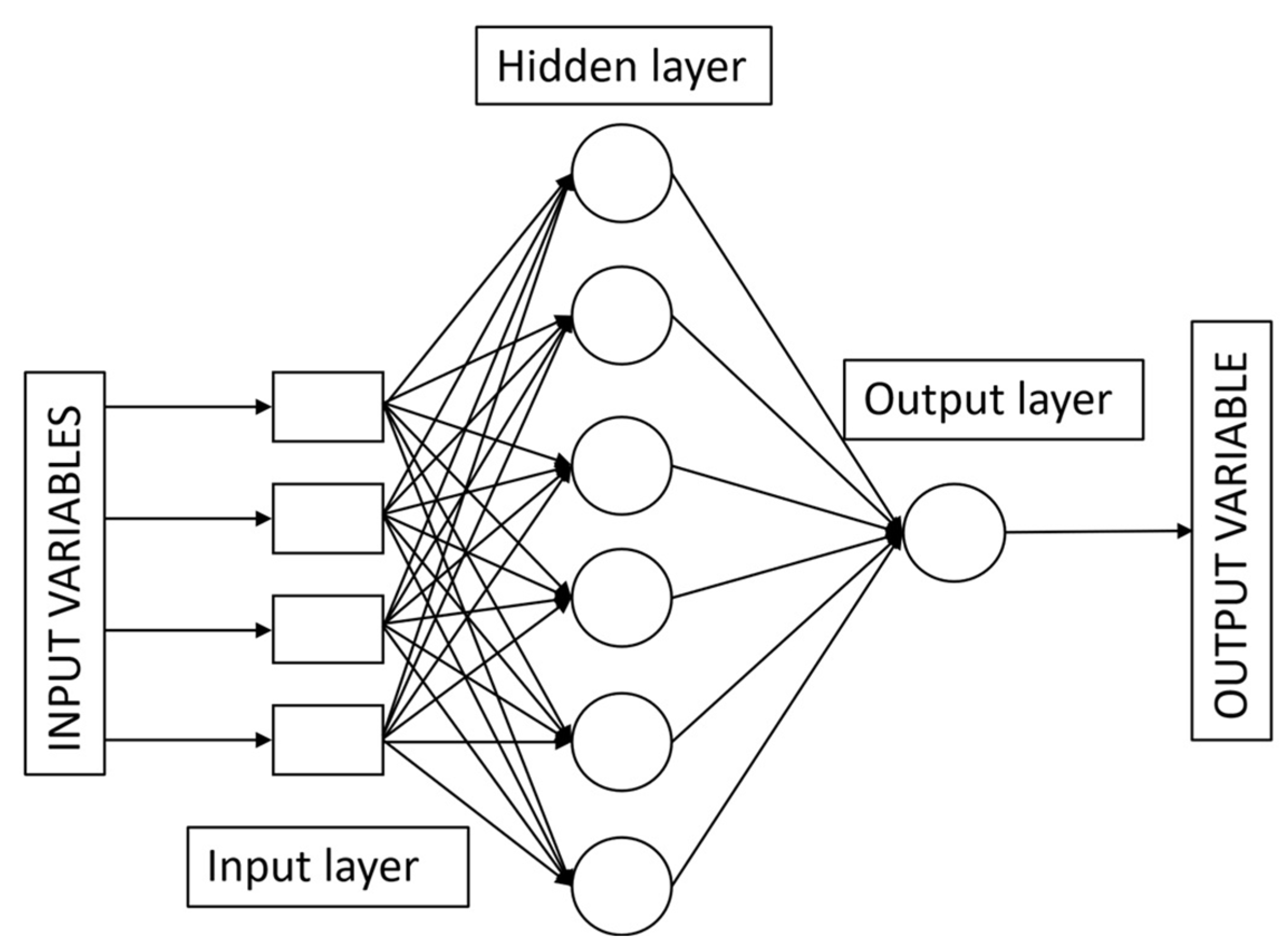
Figure 1. Architecture of ANN.
Fermentation 12 00236 g001
Figure 2. Flowchart used in modeling and optimizing the fermentation process by the yeasts Spathaspora boniae and Spathaspora brasiliensis in hemicellulosic hydrolysate of sugarcane biomass.
Fermentation 12 00236 g002
Figure 3. Observed versus predicted results of Spathaspora boniae yeasts for training, validation, testing, and total, followed by their respective R values.
Fermentation 12 00236 g003
Figure 4. Observed versus predicted results of Spathaspora brasiliensis yeasts for training, validation, testing, and total, followed by their respective R values.
Fermentation 12 00236 g004
Table 1. The hemicellulosic hydrolysate composition after pretreatment.
CompoundConcentration (g L−1)
Xylose26.29
Glucose3.79
Arabinose3.58
Acetic Acid3.77
Total Phenolics1.67
Table 2. Division of data into three groups (training, validation and testing) for the yeast Spathaspora boniae. Comparison of experimental results of xylitol production versus those predicted by the artificial neural network.
SamplesUrea
(g L−1)
Yeast Extract
(g L−1)
Peptone
(g L−1)
Ammonium Sulfate
(g L−1)
Xylitol
(g L−1)
Predicted by ANN
(g L−1)
Training      
10.050.230.190.110−3.95 × 10⁻¹¹
30.056.10.192.97.637.63
50.050.234.82.90.330.33
70.056.14.80.118.378.37
81.36.14.82.95.475.47
90.73.12.51.56.597.93
131.33.12.51.59.49.40
140.70.232.51.51.051.05
150.76.12.51.510.7410.74
160.73.10.191.56.236.23
170.73.14.81.58.718.71
180.73.12.50.117.967.96
190.73.12.52.97.817.81
200.73.12.51.57.667.93
Validation      
21.30.230.192.900.50
100.73.12.51.56.477.93
120.053.12.51.57.26.74
Testing      
41.36.10.190.117.447.55
61.30.234.80.110.320.02
110.73.12.51.56.457.93
Table 3. Division of data into three groups (training, validation and testing) for the yeast Spathaspora brasiliensis. Comparison of experimental results of xylitol production versus those predicted by the artificial neural network.
SamplesUrea
(g L−1)
Yeast Extract
(g L−1)
Peptone
(g L−1)
Ammonium Sulfate
(g L−1)
Xylitol
(g L−1)
Predicted by ANN
(g L−1)
Training      
10.050.230.190.112.442.44
30.056.10.192.910.6210.62
41.36.10.190.118.818.81
50.050.234.82.98.658.65
61.30.234.80.118.098.09
81.36.14.82.99.929.92
90.73.12.51.57.317.29
100.73.12.51.57.537.29
110.73.12.51.57.047.29
131.33.12.51.58.188.18
140.70.232.51.54.124.12
150.76.12.51.57.967.96
180.73.12.50.117.597.59
190.73.12.52.97.997.99
Validation      
21.30.230.192.98.258.64
160.73.10.191.57.057.13
170.73.14.81.59.699.59
Testing      
70.056.14.80.1110.5810.16
120.053.12.51.57.437.59
200.73.12.51.57.357.29
Table 4. Statistical comparison of training, validation and testing for ANN.
YeastParameterTrainingValidationTest
Spathaspora boniaeR20.99910.99930.9978
RMSE0.10210.45140.3511
MAPE0.0000%0.0000%33.7362%
MAE0.03860.44840.3077
Spathaspora brasiliensisR20.99790.96600.9949
RMSE0.09280.24040.2628
MAPE0.4978%2.3417%2.2952%
MAE0.03620.19350.2124
Table 5. Statistical comparison of response surface methodology and artificial neural network models.
ParameterANNRSM
Spathaspora boniae
R20.99520.9748
RMSE0.23740.5462
MAPE0.0000%0.0000%
MAE0.14040.4233
Spathaspora brasiliensis
R20.99300.9978
RMSE0.15830.0872
MAPE1.0440%0.7050%
MAE0.08620.0525
Table 6. Optimized parameters of nitrogen sources for enhanced xylitol production by Spathaspora boniae UFMG-CM-Y306 and Spathaspora brasiliensis UFMG—HMD19.3 in fermentation using hybrid ANN-GA and RSM.
ApproachVariablesXylitol Concentration (g L−1)Parameter
Urea
(g L−1)
Yeast Extract
(g L−1)
Peptone
(g L−1)
Ammonium Sulphate
(g L−1)
PredictedExperimentalMAE
Spathaspora boniae
ANN-GA0.524.051.391.3310.1411.54 ± 0.5201.40
RSM0.585.262.821.309.729.74 ± 0.8290.02
Spathaspora brasiliensis
ANN-GA0.056.100.732.9010.649.29 ± 0.2441.35
RSM0.054.424.82.9010.6310.11 ± 0.9090.52
Disclaimer/Publisher’s Note: The statements, opinions and data contained in all publications are solely those of the individual author(s) and contributor(s) and not of MDPI and/or the editor(s). MDPI and/or the editor(s) disclaim responsibility for any injury to people or property resulting from any ideas, methods, instructions or products referred to in the content.