Article

Metagenomic and Metabolomic Insights into Microbial Community Dynamics and Flavor Metabolite Formation in Novel Versus Traditional Strong-Flavor Daqu


1
State Key Laboratory of Green Papermaking and Resource Recycling, Qilu University of Technology, Jinan 250353, China
2
Institute of Biology, Shandong Academy of Sciences, Jinan 250103, China
3
Jinan Ruifeng Bioengineering Co., Ltd., Jinan 250308, China
*
Author to whom correspondence should be addressed.
Fermentation 2026, 12(5), 235; https://doi.org/10.3390/fermentation12050235
Submission received: 20 March 2026 / Revised: 6 May 2026 / Accepted: 8 May 2026 / Published: 11 May 2026
(This article belongs to the Special Issue Perspectives on Microbiota of Fermented Foods, 2nd Edition)

Abstract

Daqu is the core saccharifying and fermenting agent in Baijiu production and a pivotal factor in flavor formation. Challenges that often hinder traditional strong-flavor Daqu brewing include low enzymatic activity and insufficient aroma. Therefore, we have developed a novel Daqu brewing system. Furthermore, we investigated the differences in flavor profiles between traditional and novel Daqu by performing headspace solid-phase microextraction gas chromatography-mass spectrometry (HS-SPME-GC-MS). We comparatively analyzed the microbial communities, metabolic functions, and flavor compositions in the two Daqu types via absolute quantitative metagenomics. Functional microorganisms were significantly enriched in the novel Daqu, which exhibited enhanced carbohydrate metabolism and a highly robust acidic environment owing to the fostering of core functional genera such as Aspergillus, Saccharomyces, and Pediococcus. This significantly increased the aldehyde and organic acid levels, which resulted in pronounced aldehydic and acidic sensory characteristics. Carbohydrate-Active EnZyme (CAZy) profiling confirmed the significantly elevated abundance of glycoside hydrolases (GHs) and glycosyltransferases (GTs) in novel Daqu, which improved starch bioconversion and synthesis of flavor precursors. Thus, this study shows that novel Daqu promotes ethanol accumulation and the synthesis of flavor compounds like acetals by strengthening the core microbiota and metabolic networks. These findings provide a theoretical foundation for enriching the aromatic complexity of Baijiu.

1. Introduction

Baijiu is one of the six most renowned distilled spirits worldwide. It is a significant cultural vehicle for traditional Chinese food and beverage heritage. Baijiu is produced from cereal grains such as sorghum, rice, and wheat through traditional solid-state fermentation, distillation, aging, and blending [1]. The core saccharifying and fermenting agent used in Baijiu brewing is Daqu, which is critical in determining the aromatic profile and taste complexity of the final spirit. Daqu is generally produced from raw materials such as wheat, barley, and sorghum. Its manufacturing process involves grain moistening, crushing, mixing, and shaping (Caiqu, a traditional process of compacting the starter materials into brick-shaped blocks by pressing), followed by spontaneous solid-state fermentation, incubation in a controlled environment, and maturation (storage) for several months [2]. Additionally, Daqu is enriched with a diverse array of enzymes that drive the saccharification and fermentation of brewing substrates. Additionally, it functions as a precursor source. Thus, the enzymatic degradation of raw materials along with the microbial metabolic byproducts collectively impart a unique and complex flavor profile that is characteristic of Chinese Baijiu [3].
The typical moisture content of traditional Daqu is approximately 10%. Although low-moisture conditions are conducive to long-term preservation, they impact the critical parameters of brewing efficiency by significantly inhibiting microbial metabolism and enzymatic activities within the Daqu matrix. This results in suboptimal saccharification and fermentation [4], which directly contribute to a high Daqu dosage requirement and insufficient aroma profile. Several challenges are inherent to Daqu open production systems such as inconsistent quality between batches, low production efficiency, and potential safety risks through contamination by spoilage microorganisms (adventitious bacteria) [5]. Furthermore, seasonal variations cause drastic shifts in the Daqu microbial community structure, which result in significant fluctuations in product quality. Additionally, these environmental fluctuations hinder the standardization of traditional solid-state fermentation, which is a major challenge for consistent industrial-scale production [6]. The traditional Daqu manufacturing process is characterized by prolonged production cycles and uncontrolled dispersal of fungal spores within incubation rooms. These drawbacks impede production efficiency and pose potential health risks to operators. Thus, these issues highlight the urgent need for modernized fermentation technologies [7].
The synergistic interactions within the Daqu microbial community constitute the foundation of the Baijiu aromatic profile. Fundamentally, Daqu manufacturing involves a directed enrichment of specific functional microorganisms; subsequently, environmental selection pressures shape the final microbial consortium and its metabolic output [8]. During Baijiu fermentation, the biological activities of the functional microorganisms in Daqu including filamentous fungi, yeasts, and bacteria facilitate the bioconversion of cereal-derived precursors into a diverse array of volatile metabolites [9]. Esters are the most pivotal aroma components in Baijiu and are primarily synthesized through microbial enzymatic esterification of alcohol and organic acid substrates [10]. Higher alcohols are critical components that constitute the sensory “skeleton” of Baijiu flavor. They are primarily synthesized by yeasts through amino acid catabolism (the Ehrlich pathway) or de novo synthesis from sugars [11]. Furthermore, lactic acid bacteria and acetic acid bacteria synthesize organic acids through their metabolic pathways. These organic acids play a dual role in flavor modulation by acting directly as intrinsic aroma components that shape the sensory profile of the spirit; additionally, they function as essential precursors for enzymatic esterification to yield diverse esters. Consequently, they play a vital role in regulating the overall Baijiu flavor characteristics [12,13]. Thus, the microbial communities in the complex fermentation system of Daqu Baijiu drive the biochemical transformation processes that constitute the core stage of constructing its unique aromatic profile [14,15].
The microbial community structure and metabolic activities inherent to Daqu are pivotal saccharifying and fermenting agents in Baijiu brewing, and these directly determine the foundation of the flavor precursors for the final spirit [16]. During fermentation, complex interactions between the metabolic succession of Daqu microbiota and environmental factors drive the biosynthesis and transformation of key volatile organic compounds such as esters and alcohols. The variety and abundance of these flavor metabolites ultimately shape the unique sensory and stylistic characteristics of Baijiu. HS-SPME-GC-MS exhibits high extraction efficiency and precise qualitative and quantitative analytical capabilities and has become a core method for deciphering the volatile flavor profiles and metabolic phenotypes of Daqu [17]. Absolute quantitative metagenomics effectively overcomes the limitations of traditional culture-dependent methods by enabling a comprehensive elucidation of fine-scale species composition, diversity structure, and dynamic succession patterns of the microbial community during Daqu fermentation [18]. Moreover, modern microbiology has yielded deeper insights into the mechanisms underlying the interaction of Daqu communities, and substantial progress has been achieved in viability-preserving technologies such as cryopreservation and vacuum packaging. These advancements urgently warrant industry-level innovation in traditional manufacturing processes to achieve the precise regulation of Daqu activity.
This study proposes a novel Daqu manufacturing strategy based on activation cultivation and in situ viability preservation to successfully produce fresh wet Daqu enriched with highly active functional microorganisms and hydrolytic enzyme systems. This novel wet Daqu shows significant competitive advantages over traditional dried strong-flavor Daqu in terms of active microbial loading, enzyme kinetic performance, accumulation of aroma components, and fermentation enhancement factors. In this study, novel Daqu and traditional strong-flavor Daqu were comparatively applied to Baijiu fermentation. HS-SPME-GC-MS was used to analyze the aroma components of both Daqu types and their resulting spirits. The species composition and absolute abundance of microorganisms in Daqu were determined using quantitative metagenomics. Physicochemical indicators of both Daqu types and fermented grains (Jiupei) were detected, and both Baijiu types were subjected to sensory evaluation. Correlations were established between the sensory scores, spirit flavor compounds, Daqu aroma components, and microbial communities. Thus, we aimed to identify the composition and mechanisms underlying the formation of the aroma compounds produced during Baijiu brewing. Overall, this study provides methodologies and insights for enhancing the concentration of aroma components such as acetals.

2. Materials and Methods

2.1. Materials and Reagents

High-temperature Daqu was provided by the Guizhou Jiuzhoudao Liquor Industry Co., Ltd. (Zunyi, China). Hongyingzi sorghum was obtained from Maotai town, China. Wheat, rice, and millet were purchased from Jinan. Analytical grade maltose, calcium chloride, yeast extract, lactic acid, trehalose, glycerol, sodium hydroxide, sulfuric acid, anhydrous sodium acetate, glacial acetic acid, iodine solution, soluble starch, cobalt chloride, potassium dichromate, Erochrome Black T, Fehling’s solution, glucose, and amyl acetate were purchased from Beijing Box Biotechnology Co., Ltd. (Beijing, China).

2.2. Instrumentation and Equipment

The following items of equipment were used in this study: a 50 L liquid stirred-tank fermenter (Huisen Biological Equipment Zhenjiang Co., Ltd., Zhenjiang, China), a crusher (CSJ-250, Jiangyin Dinghao Machinery Equipment Co., Ltd., Jiangyin, China), a thermometer, a 15 mL centrifuge (Sartorius AG, Goettingen, Germany), a vortex mixer (IKA, Staufen, Germany), and a 2 mL centrifuge (Eppendorf, Hamburg, Germany). Volatile compounds were analyzed using a GCMS-QP2020 gas chromatography-mass spectrometry system (Shimadzu Corporation, Kyoto, Japan). Extraction was performed using SPME fibers (50/30 μm DVB/CAR/PDMS, Supelco, Bellefonte, PA, USA), and separation was achieved on an Agilent HP-5 capillary column (30 m × 250 μm × 0.25 μm, Agilent Technologies, Santa Clara, CA, USA).

2.3. Methods

2.3.1. Preparation and Quality Index Analysis of Novel Daqu

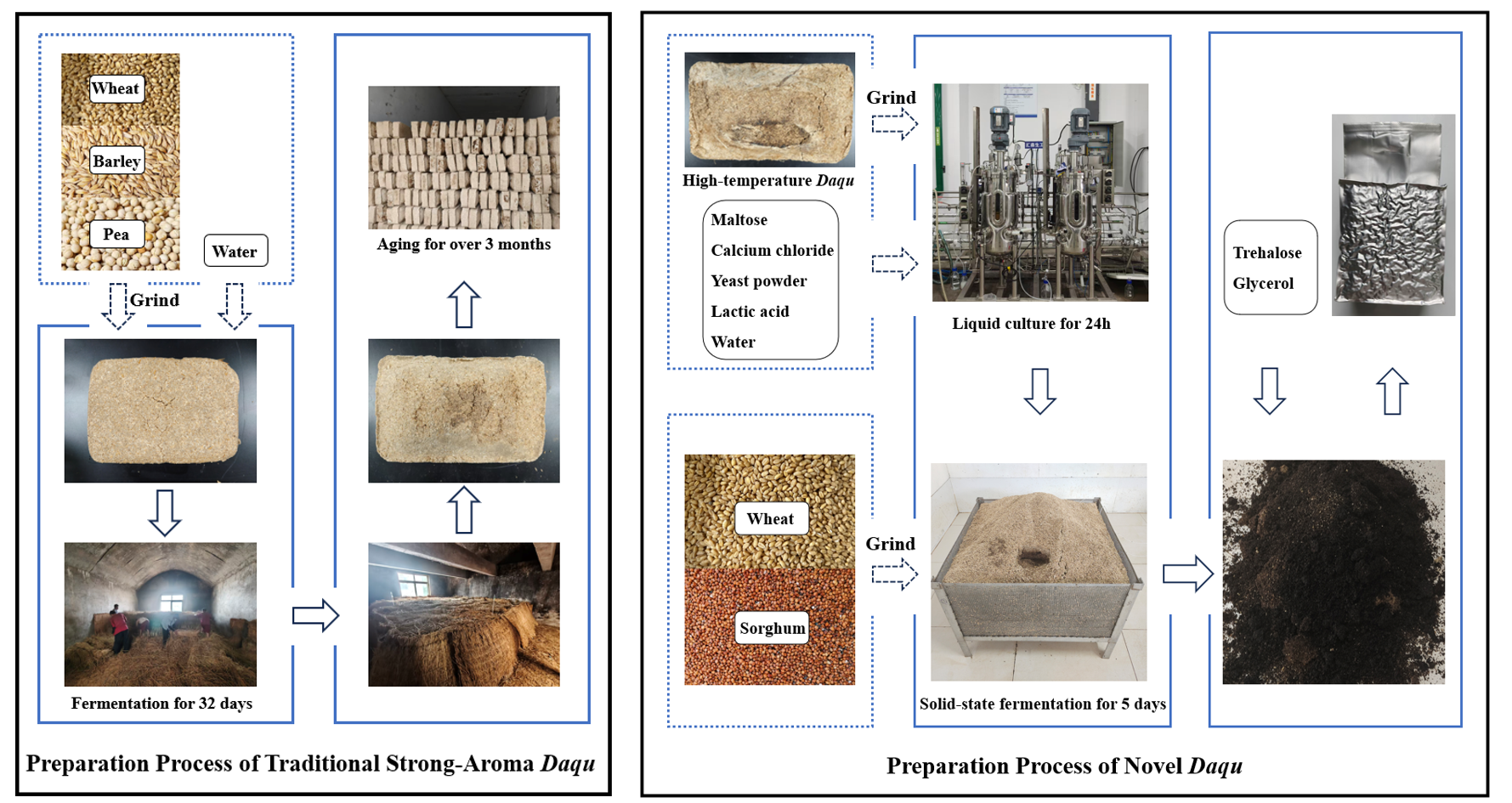
Two types of Daqu were used in this study: traditional strong-flavored Baijiu Daqu (B-Daqu) and novel strong-flavored Baijiu Daqu (R-Daqu). B-Daqu was collected from a distillery in Shandong Province. It comprised finished dried Daqu, which was pulverized before fermentation. R-Daqu was prepared as follows: pulverized high-quality Daqu was inoculated into a liquid medium containing maltose, calcium chloride, and lactic acid and cultured for 24 h. The resulting liquid culture was mixed with pretreated sorghum and wheat flour and subjected to a 5-day temperature-programmed solid-state fermentation in an incubator. Next, the R-Daqu bricks were naturally air-dried and pulverized, and the preparation of R-Daqu was completed by adding trehalose and glycerol as viability-preserving agents. The prepared R-Daqu was vacuum-packaged and stored in a low-temperature environment when not in use (Figure 1). Both B-Daqu and R-Daqu were sampled immediately after preparation and used for Baijiu fermentation, with the samples stored at −20 °C for subsequent experimental analysis.
The raw materials for brewing include sorghum, rice, millet, and wheat. They were pulverized and subjected to steaming and cooling treatments before being thoroughly mixed with Daqu. Two experimental groups were created: B-Daqu and R-Daqu. The Daqu dosage was maintained at 30% grain weight in both groups. The homogenized mixtures were designated as “B-mixture” and “R-mixture,” and samples were collected and retained prior to pit entry. Subsequently, the mixtures from both groups were loaded into six adjacent traditional fermentation pits (three replicates per group) and sealed for a 60-day solid-state fermentation. Next, “B-Jiupei” and “R-Jiupei” samples were collected from the respective pits. Finally, Jiupei from the three pits within the same group were pooled, mixed with 20% rice husk, and distilled to obtain the spirit.
After sample retrieval, moisture, reducing sugar, and free amino acid contents; saccharifying, liquefying, and fermenting powers; and B-Daqu and R-Daqu acidity were determined according to the Chinese Light Industry Standard General Methods of Analysis for Daqu [19] and Chinese National Standard Determination of Reducing Sugar in Foods [20]. Additionally, the moisture and starch contents of the mixtures prior to pit entry and alcohol content, moisture, acidity, starch, and reducing sugar content of the discharged Jiupei were measured according to the Chinese Group Standard General Methods of Analysis for Solid-State Fermented Grains [21].

2.3.2. Sample Preparation and Absolute Quantitative Metagenomic Sequencing

The Daqu sample (3.5 g) was weighed and mixed with sterile glass beads and PBS buffer. Multiple rounds of vortexing and differential centrifugation were performed at 1500 rpm to remove large particles and 6000 rpm to collect microorganisms. Then, the obtained enriched microbial pellets were stored at −80 °C.
Total genomic DNA was extracted from the samples using the FastDNA SPIN Kit for Soil (MP Biomedicals, Irvine, CA, USA). DNA integrity and concentration were validated via agarose gel electrophoresis, UV-Vis spectrometry using NanoDrop 2000 (Thermo Fisher Scientific, Wilmington, DE, USA), and quantification using Qubit 3.0 fluorometer (Thermo Fisher Scientific, Wilmington, DE, USA). The library was constructed by shearing the DNA into approximately 300 bp fragments, followed by ligation with adapters and sequencing on the Illumina NovaSeq 6000 platform (Genesky Biotechnologies Inc., Shanghai, China). Raw data were preprocessed using Seq-Prep and Sickle to remove adapters and low-quality reads (length < 50 bp or Q < 20), after which 359,266,494 high-quality clean reads were obtained. These reads were assembled into contigs (≥500 bp) for ORF prediction via MetaGeneMarker version 3.26, followed by the construction of a non-redundant gene catalog using CD-HIT (95% identity, 90% coverage). For obtaining taxonomic annotation and composition of bacterial communities, representative sequences from a non-redundant gene catalog were aligned to GTDB Version 202.0 Protein Sequence database by using Kraken2 Version 2.0.9. Furthermore, cluster of orthologous groups of proteins (COG) annotation and functional genes identification were processed with the BLASTP version 2.13.0 by using non-supervised orthologous groups (eggNOG) Version 4.5 and Kyoto Encyclopedia of Genes and Genomes (KEGG) databases (http://www.genome.jp/kegg/, accessed on 25 July 2025) with e-value threshold of 1 × 10⁻⁵. Relative abundances of taxonomic groups, key enzymes and functional genes were determined as the proportion of matching reads assigned to a category in total effective reads.

2.3.3. Sensory Evaluation of Baijiu

A panel of nine national-level Baijiu judges performed a blind sensory evaluation of the B- and R-spirits according to the Chinese National Standard Terminology of Sensory Evaluation of Baijiu [22]. The samples were characterized and scored based on multiple dimensions including color, aroma, mouthfeel, and overall style.

2.3.4. Detection of Volatile Flavor Compounds in Daqu and Baijiu Spirits

Extraction of volatile flavor compounds from Daqu: Volatile flavor compounds in Daqu were extracted using HS-SPME. A 0.5 g sample of Daqu powder was placed in a 20 mL headspace vial and heated for extraction. After equilibration at 60 °C for 10 min, the extraction was performed using an SPME fiber (50/30 μm DVB/CAR/PDMS) for 20 min. Then, the fiber was desorbed from the GC-MS inlet for 5 min prior to injection.
Extraction of volatile flavor compounds from Baijiu spirits: HS-SPME was used to extract volatile flavor compounds from the spirits. A 5 mL sample (4997.5 μL of spirit and 2.5 μL of amyl acetate) was added to a 20 mL headspace vial and heated. Following equilibration at 60 °C for 10 min, extraction was performed with the SPME fiber (50/30 μm DVB/CAR/PDMS) for 20 min, followed by desorption in the GC-MS inlet for 5 min before injection.
Gas chromatography: An Agilent HP-5 capillary column (30 m × 250 μm × 0.25 μm) was used. High-purity Helium (99.999%) was used as the carrier gas at a flow rate of 1 mL/min in the splitless mode. The inlet temperature was maintained at 250 °C. The oven temperature program started at 40 °C (held for 3 min), increased to 130 °C at a rate of 2.5 °C/min (held for 0 min), and finally reached 240 °C at 7 °C/min (held for 7 min).
Mass spectrometry: Electron ionization (EI) was performed at 70 eV. The ion source and quadrupole temperatures were set to 230 °C and 150 °C, respectively. The mass scanning range was 25–450 amu, and the auxiliary temperature was 280 °C. The “stune.u” tuning file was used in Scan mode.
Each sample was analyzed in triplicate. Data analysis was performed using Shimadzu GC-MS solution software (version 4.30). Volatile components were identified by comparing the mass spectra with the NIST17 database, and the average values from three replicates were reported.

2.3.5. Statistical Analysis

The results are expressed as mean ± SD. ANOVA was performed using SPSS 26.0. Multivariate statistical analysis was performed using SIMCA 14.1, and charts were generated using the Origin 2024. A redundancy analysis (RDA) was performed using CANOCO 4.5. Principal Coordinate Analysis (PCoA) and Statistical Analysis of Metagenomic Profiles (STAMP) were performed online using OmicStudio tools (https://www.omicstudio.cn/tool, accessed on 3 October 2025) and OECloud platform (https://cloud.oebiotech.com, accessed on 3 October 202). Each sample was analyzed in triplicate. Genera were screened according to the absolute differences in metagenomic absolute quantitative gene copy numbers between the two samples. Specifically, the top 8 bacterial and fungal genera with the largest net differences in gene copy numbers in R-Daqu were selected. Spearman’s correlation analysis was performed between these genera and the major flavor compounds of Baijiu, and a correlation network was constructed based on significant correlations. All analyses were carried out on the OmicStudio cloud platform.

3. Results and Discussion

3.1. Physicochemical Properties of Daqu and Jiupei Before and After Pit Entry

Moisture content is a fundamental indicator of Daqu quality. An appropriate moisture level is essential for ensuring normal microbial metabolism in the Daqu matrix, efficient synthesis of enzyme systems, and balanced accumulation of flavor compounds [23]. Excessively low moisture content inhibits microbial growth and enzyme synthesis, which leads to deficient Daqu saccharification and fermentation capacity. In contrast, excessively high moisture content renders the Daqu susceptible to mold and spoilage during storage [24]. The moisture content of R-Daqu was 22.92 ± 0.87%, which was 2.46 times higher than that of B-Daqu. We postulate that this higher moisture level protected microbial viability and enzyme activity in R-Daqu. Furthermore, R-Daqu was vacuum-packaged and stored in a low-temperature environment when not in use, which could effectively inhibit spoilage issues typically associated with high moisture content.
Saccharifying, liquefying, and fermenting powers are parameters that primarily characterize the comprehensive efficiency of Daqu to convert starchy raw materials into fermentable sugars and further metabolize them into ethanol. R-Daqu exhibited saccharifying (968 ± 45 U/g), liquefying (10.7 ± 1.1 U/g), and fermenting (10.2 ± 0.9 U/g) powers that were 2.2, 9.7, and 12.8 times higher than those of B-Daqu, respectively. These enhanced saccharification, liquefaction, and fermentation capacities indicate that R-Daqu decomposed starch and other substances in the raw materials with high efficiency, which yielded an increased quantity of converted fermentable sugars, which additionally provide a substantial foundation for ethanol production and the generation of flavor compounds during subsequent Jiupei fermentation.
Daqu acidity reflects the cumulative organic acid level and metabolic activity of acid-producing microorganisms. B-Daqu showed an acidity of 1.5 ± 0.1 mmol/10 g, whereas the acidity of R-Daqu was 3.4 ± 0.3 mmol/10 g. This indicates that the acid-producing microbiota in R-Daqu were metabolically vigorous and provided superior pH regulation capacity for the Baijiu fermentation system, which effectively inhibited the proliferation of spoilage bacteria [25]. An acidic environment ensures the efficient and orderly progression of enzymatic reactions, including saccharification and fermentation, while simultaneously providing a substantial quantity of organic acids for the final spirit.
Reducing sugar content in Daqu directly reflects the starch saccharification efficiency and microbial metabolic coordination. This is a vital indicator for evaluating saccharification capacity, measuring substrate quantity for fermentation, and assessing overall brewing performance. The reducing sugar content was 2.42 ± 0.18% for R-Daqu, and it was significantly higher than that of B-Daqu, which indicates that the functional microbiota exhibited a relatively thorough saccharification metabolism and higher conversion efficiency from starch to fermentable sugars during Daqu preparation in the R-Daqu group. This result is consistent with the superior saccharifying and liquefying powers exhibited by R-Daqu, which resulted in abundant availability of carbon substrates for subsequent fermentation stages, leading to increased alcohol yield in Baijiu production.
Free amino acid content did not differ significantly between B-Daqu and R-Daqu. Both possessed ample free amino acid reserves, which provided rich nitrogen sources and flavor precursors for Baijiu brewing.
Overall, these indicators show that R-Daqu was characterized by a suitable moisture content and was aided by optimized preservation technology. Additionally, it possessed superior saccharifying, liquefying, and fermenting powers than those of B-Daqu, along with higher acidity and reducing sugar content. These parameters, combined with its sufficient free amino acid reserves, indicate that R-Daqu is a superior Daqu for Baijiu brewing (Table 1).
Pit entry of fermented grains (Jiupei) is a critical step in Baijiu brewing. It involves the layered filling of a well-mixed substrate into pits, followed by sealing to create an anaerobic environment. This process promotes anaerobic respiration among the microorganisms in the mixture to facilitate the metabolic transformation of the substrate into Jiupei, which is enriched with ethanol and diverse flavor compounds.
No significant differences were observed in starch content, moisture content, or pit entry temperature between the two groups prior to fermentation, which ensured consistency in the initial fermentation conditions (Table S1). The alcohol content in Jiupei is a core indicator of the efficiency of ethanol generation and accumulation during the fermentation stage, and it directly affects the brewing capacity and progression of fermentation. We found that all R-Jiupei pits showed an average alcohol content (4.93% vol) that was higher than that observed for B-Jiupei (4.63% vol), which indicates the superior overall fermentation efficiency of R-Daqu. R-Jiupei acidity was 3.63 mmol/10 g, which was significantly higher than that of B-Jiupei. This suggests higher accumulation of organic acids in R-Jiupei and the presence of a pronounced acidic environment within the fermentation system. This finding indicates that the acid-producing microorganisms of R-Daqu elicited strong metabolic activity during fermentation, which provides a suitable acidic environment for the subsequent generation of flavor compounds such as esters and aldehydes. Adequate moisture acts as the foundation for microbial metabolism and enzymatic reactions in Jiupei. The higher moisture content observed in R-Jiupei (59.78%) than in B-Jiupei provides a superior aqueous environment for brewing reactions such as saccharification and fermentation, which facilitate the growth and reproduction of functional microorganisms and optimal performance of enzyme systems. Additionally, it provides the critical environmental support required for superior ethanol production efficiency.
Starch is the primary carbon source utilized by microorganisms in Baijiu brewing. Furthermore, starch acts as the foundation for the production of ethanol and flavor compounds because its utilization rate directly determines the alcohol yield [26,27]. Reducing sugars are key intermediates in starch saccharification, and they act as direct substrates for microbial fermentation. Reducing sugar generation and utilization efficiency reflects the effectiveness of starch-to-sugar conversion. Additionally, this factor influences the efficiency of the synthesis of ethanol and various flavor metabolites. R-Jiupei showed a significantly low (9.37%) starch content, and the reducing sugar content (0.58%) remained lower and more stable. This indicates that R-Daqu achieved efficient starch decomposition and utilization. That is, polysaccharides in the raw materials were thoroughly degraded into fermentable sugars by the Daqu enzyme system, and the generated reducing sugars were rapidly utilized by yeast for ethanol fermentation without significant accumulation. This result indicates an efficient metabolic cycle, corresponding to the higher alcohol content observed in R-Jiupei. These indicators suggest that R-Daqu possesses robust saccharification and fermentation powers, which are conducive to achieving thorough starch conversion and high ethanol production efficiency (Table 2).

3.2. Metagenomic Characterization of Microbial Communities in Daqu

3.2.1. Microbial Community Diversity and Compositional Discrepancy Analysis

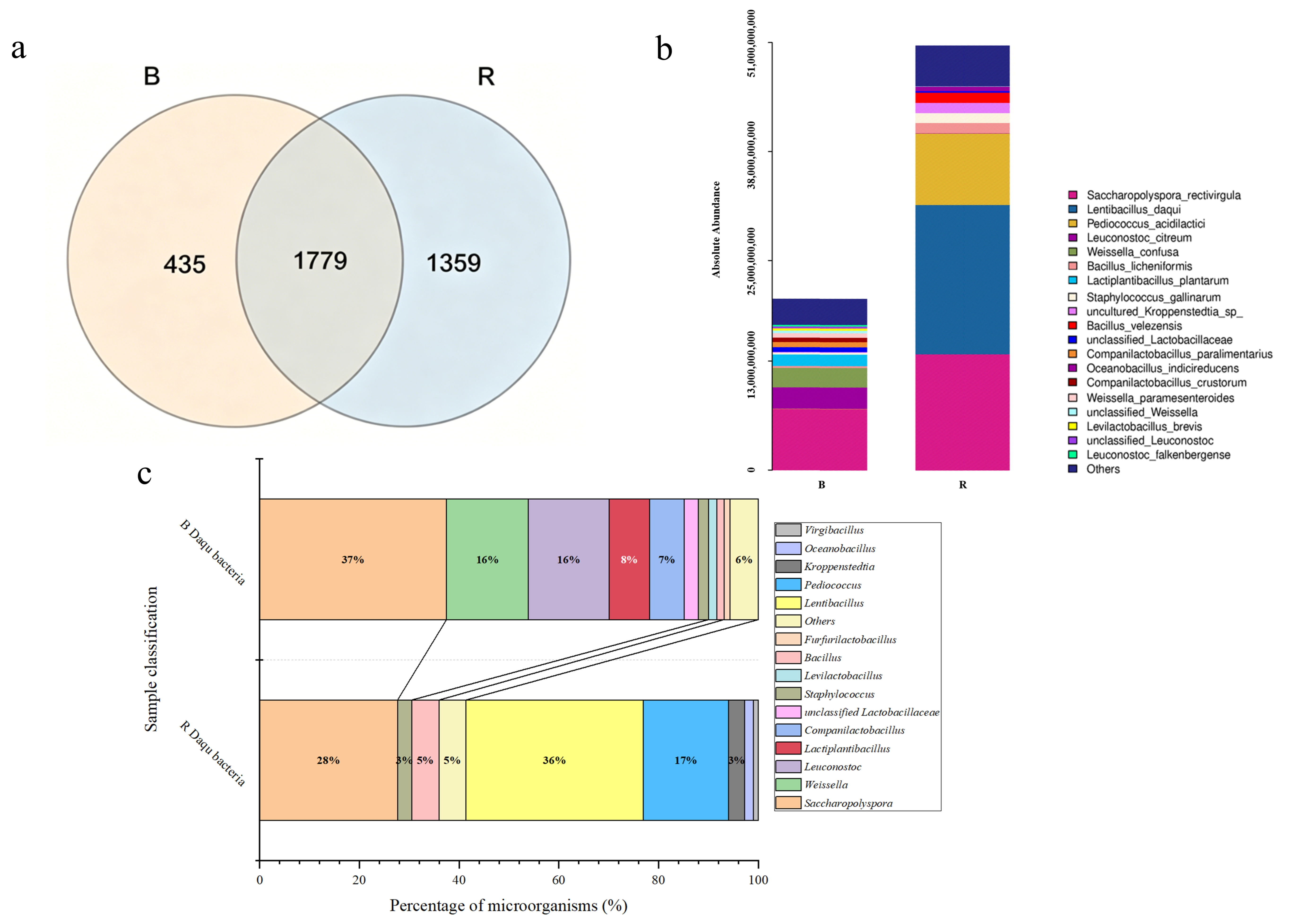
In total, 2214 bacterial species were detected in B-Daqu, whereas 3138 species were identified in R-Daqu. The absolute quantitative microbial diversity analysis showed that bacterial abundance was more than twice as high in R-Daqu as that in B-Daqu. The bacterial composition varied significantly between the two Daqu types, with R-Daqu exhibiting a higher diversity of bacterial species (Figure 2a). At the genus level, the dominant bacterial genera in B-Daqu were Saccharopolyspora, Weissella, Leuconostoc, Lactiplantibacillus, and Companilactobacillus with relative abundances of 36.82%, 16.14%, 15.93%, 7.92%, and 6.88%, respectively. In contrast, the dominant genera in R-Daqu were Lentibacillus, Saccharopolyspora, Pediococcus, and Bacillus with relative abundances of 35.56%, 27.61%, 7.08%, and 5.45%, respectively (Figure 2c). At the species level, the dominant bacterial species in B-Daqu were Saccharopolyspora rectivirgula, Leuconostoc citreum, Weissella confusa, and Lactiplantibacillus plantarum. In contrast, the dominant species in R-Daqu were Lentibacillus daqui, Saccharopolyspora rectivirgula, and Pediococcus acidilactici (Figure 2b). Lentibacillus daqui is widely detected in Daqu and functions as the dominant bacterial species in high-temperature Daqu. It exhibits a robust capacity for producing pyrazines and guaiacols at the temperature range of 45–60 °C. Lentibacillus daqui showed significant positive correlation with isobutyric acid, phenylacetic acid, and nonanoic acid levels [28]. Saccharopolyspora rectivirgula is frequently detected in Baijiu Daqu and exhibits a significant positive correlation with key aromatic components such as 2,3,5-trimethylpyrazine and 2,3,5,6-tetramethylpyrazine [29]. Pediococcus acidilactici is a representative lactic acid bacterium found in Daqu and Jiupei fermentation systems. Its abundance and metabolic activity directly influence acidity balance and spirit quality. P. acidilactici is a key target microorganism for modulating fermentation, and it plays a pivotal role in high-temperature fermentation [30].
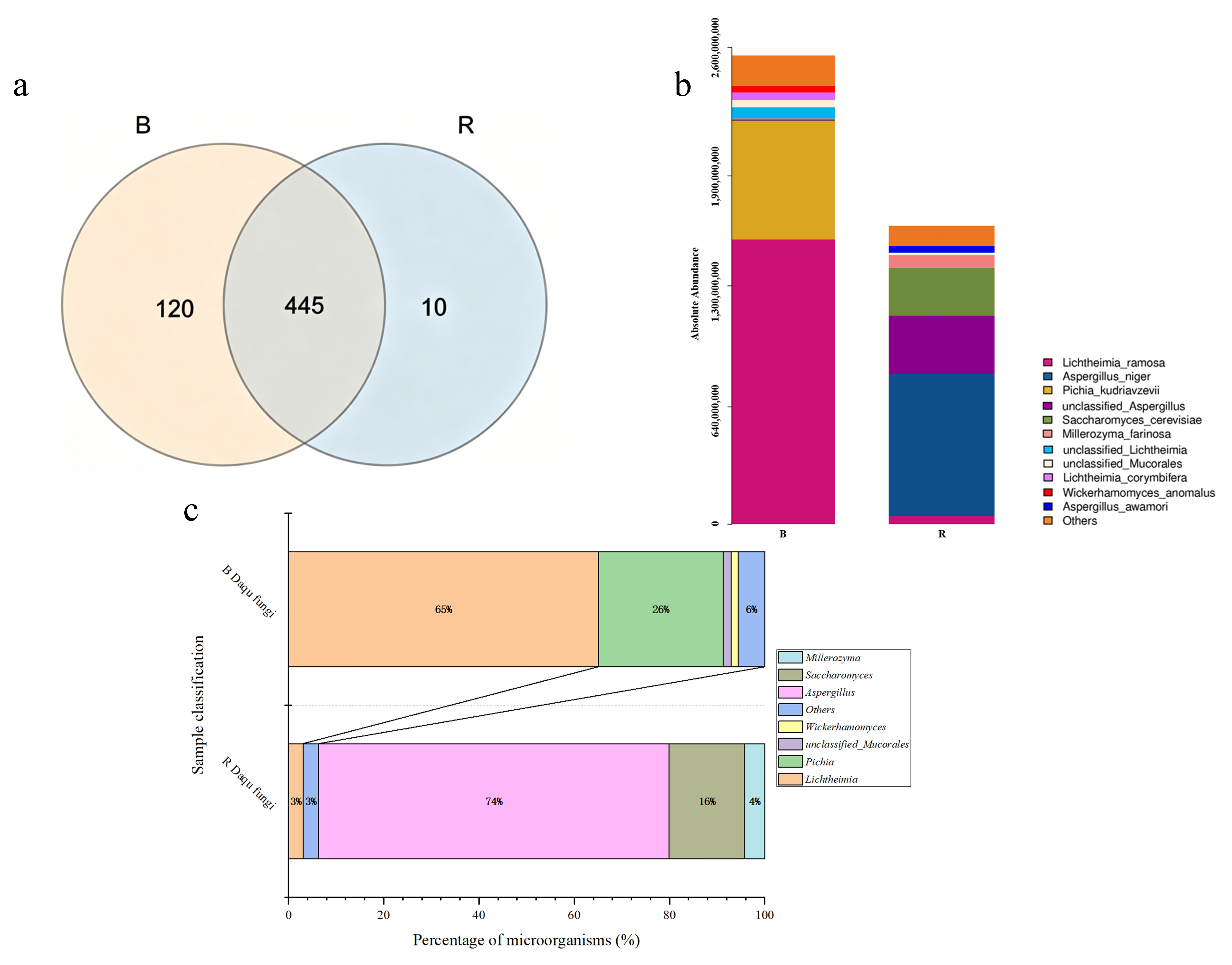
In total, 565 fungal species were detected in B-Daqu, whereas 455 species were identified in R-Daqu. Thus, fungal richness was significantly higher in B-Daqu than in R-Daqu (Figure 3a). This discrepancy may be attributed to the fact that all R-Daqu preparation processes were performed in the production workshop rather than over a prolonged fermentation duration in a traditional aging room. Consequently, R-Daqu lacked natural inoculation from the indigenous fungal microbiota inherent to the aging room, which has resulted in lower fungal richness. At the genus level, the dominant fungal taxa in B-Daqu were Lichtheimia and Pichia, which accounted for 64.94% and 26.20% of the fungal population, respectively. In contrast, the dominant taxa in R-Daqu were Aspergillus and Saccharomyces, which accounted for 73.49% and 15.93% of the population, respectively (Figure 3c). At the species level, the dominant fungi in B-Daqu were Lichtheimia ramosa and Pichia kudriavzevii, and Lichtheimia ramosa acts as a key functional fungus that efficiently secretes amylolytic and proteolytic enzymes, which promote the decomposition of starch and proteins in raw materials, thereby providing sufficient carbon and nitrogen sources for subsequent microbial metabolism and saccharification reactions [31,32]. Meanwhile, Pichia kudriavzevii exhibits strong ethanol fermentation capacity and stress tolerance, and participates in the synthesis of flavor precursors such as higher alcohols and esters, which contribute to the formation of the typical strong-aroma profile. By contrast, the dominant species in R-Daqu were Aspergillus niger, unclassified Aspergillus, and Saccharomyces cerevisiae (Figure 3b). Aspergillus niger is the dominant fungus in Baijiu Daqu and is widely distributed across the high-temperature Daqu, medium-temperature Daqu, and Jiupei fermentation systems. It acts as a key functional microorganism for saccharification, proteolysis, and the generation of flavor precursors. Its metabolic activity directly dictates the saccharifying and liquefying powers of Daqu and determines the ethanol yield and aroma quality of the final spirit in addition to functioning as a primary contributor to esterification [33]. Unclassified Aspergillus refers to strains within the Aspergillus genus that cannot be precisely annotated at the species level owing to limitations in sequencing annotation resolution, specific strain domestication characteristics, or database matching coverage. Saccharomyces cerevisiae is the primary functional microorganism involved in ethanol fermentation in Daqu. It utilizes fermentable sugars that are produced through the hydrolysis of starch by microbes such as Aspergillus niger for anaerobic fermentation; thus, it governs ethanol biosynthesis and establishes the foundational alcohol content of Baijiu. Simultaneously, Saccharomyces cerevisiae generates characteristic flavor compounds such as higher alcohols and esters through secondary metabolism. These compounds enrich the aroma profile and gustatory layers of the spirit [34].
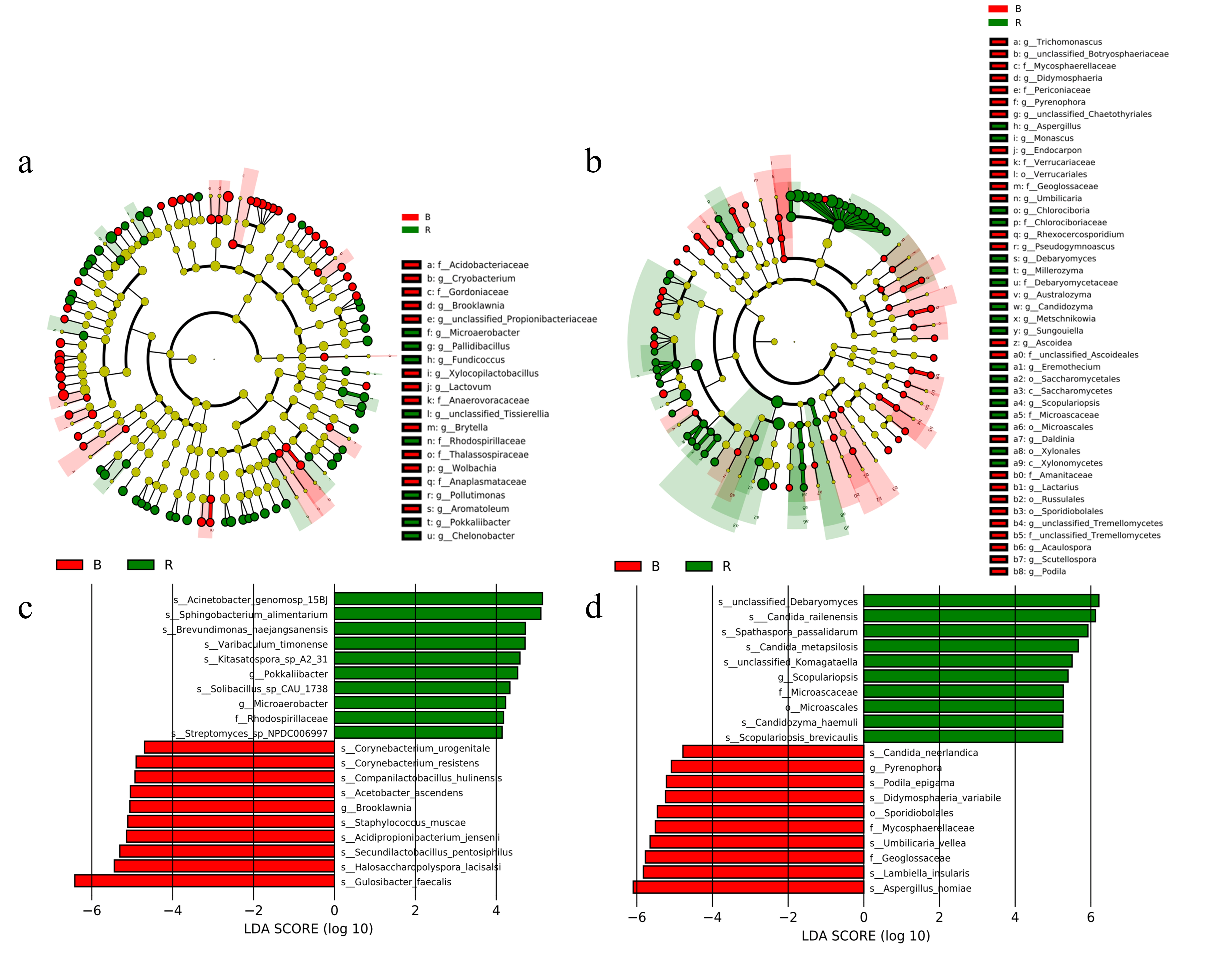
Linear discriminant analysis effect size (LEfSe) (LDA score > 4.0) showed significant niche differentiation in both bacterial (Figure 4a,c) and fungal (Figure 4b,d) compositions between the two Daqu types. Among the bacterial community, the taxa Corynebacterium, Acetobacter, and Staphylococcus showed significant enrichment in B-Daqu, and Gulosibacter faecalis exhibited the highest LDA score. Hence, it was considered the primary discriminatory biomarker for B-Daqu. In contrast, Acinetobacter, Sphingobacterium, and Brevundimonas were significantly enriched in R-Daqu. The discrepancy in composition was more pronounced in the fungal community. Aspergillus homiae, Geoglossaceae, and Umbilicaria were enriched in B-Daqu, whereas aromatic non-Saccharomyces yeast groups such as Debaryomyces, Candida, and Spathaspora were predominantly enriched in R-Daqu. Geoglossaceae and Umbilicaria in B-Daqu are not typical functional microorganisms for Daqu fermentation. Their detection may originate from the production environment of traditional Daqu rooms. These two taxa contribute little to Daqu fermentation and are not core functional groups during the fermentation process. Their presence also reflects, to a certain extent, the inherent drawbacks of the traditional open-type Daqu manufacturing process. In summary, B-Daqu tended to enrich bacteria associated with organic acid metabolism and traditional fermentative molds, whereas R-Daqu exhibited strong enrichment of non-Saccharomyces yeasts. These key differential microbial groups likely dictate the distinct fermentation flavors and metabolite profiles that are characteristic of each Daqu type.

3.2.2. Functional Metabolic Prediction of Microbial Communities Based on KEGG Database

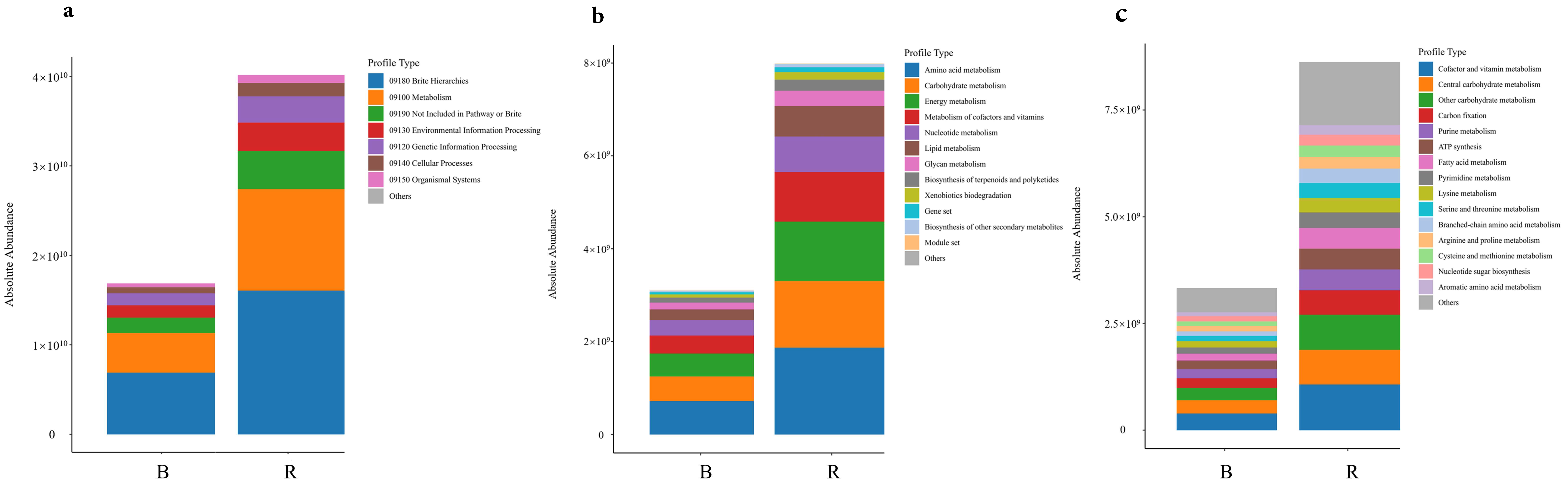
B-Daqu and R-Daqu exhibited distinct microbial metabolic activities. We elucidated these metabolic discrepancies by performing functional annotations using CAZy and KEGG databases. The stacked bar chart of absolute abundance under the KEGG Level 1 categories (Figure 5a) indicates the distribution of major functional classes, including Metabolism, Genetic Information Processing, Cellular Processes, and Environmental Information Processing. The total functional abundance in R-Daqu was significantly higher than that in B-Daqu, which indicates a higher enriched functional gene reservoir in the R-Daqu microbial community and higher potential activity for metabolism and information processing than that in the B-Daqu microbial community. The functional composition indicated that the proportion of “Metabolism” was high in both types; however, its absolute abundance was notably higher in R-Daqu than in B-Daqu. This highlights the superior potential of R-Daqu for substrate transformation. The functional abundance map under KEGG M_Level 2 (Module Level 2) classification (Figure 5b) showed that the dominant metabolic functions were consistent between the two groups with core modules centered on “Carbohydrate metabolism” and “Amino acid metabolism”. These modules correspond to the essential saccharification process, such as the decomposition of raw materials such as starch and glucose, and are linked to the generation of flavor compounds such as esters and aldehydes, which are critical for the sensory profile of the spirit. “Energy metabolism” supports the energy requirements for microbial proliferation and metabolic processes. Although the structural composition of metabolic functions was highly similar between the two types, the abundance of each function was higher in R-Daqu, which indicates the higher efficiency of R-Daqu for decomposing the brewing raw materials and its substantially higher capacity for generating diverse flavor metabolites compared with those of B-Daqu. KEGG M_Level 3 (Module Level 3) metabolic module analysis (Figure 5c) showed that both Daqu types exhibited identical functional preferences in core dominant sub-modules. These were primarily concentrated in “Central carbohydrate metabolism” and “Other carbohydrate metabolism,” which corresponded with the core “saccharification” role necessary for ethanol production. Additionally, “Cofactor and vitamin metabolism” modules ensure enzymatic catalytic activity and support efficient metabolic progression, whereas various “Amino acid metabolism” modules are associated with the synthesis of esters and aromatic flavor compounds. The higher abundance of each sub-metabolic module in R-Daqu signifies a stronger raw material (starch and proteins) decomposition efficiency than that of B-Daqu and a more abundant output of flavor substances (amino acids and fatty acids). In summary, although B-Daqu and R-Daqu share a consistent metabolic functional structure, R-Daqu elicits superior metabolic activity and higher potential for brewing applications.
At the genetic level, in terms of saccharometabolism of Daqu, the absolute abundances of key genes encoding starch degradation-related enzymes, namely glucoamylase [EC:3.2.1.3], alpha-amylase [EC:3.2.1.1], and pullulanase [EC:3.2.1.41], as well as genes encoding endo-1,4-beta-xylanase [EC:3.2.1.8] and pectin lyase [EC:4.2.2.10] involved in carbohydrate degradation, in R-Daqu were 8.21 times, 2.80 times, 43.98 times, 21.02 times, and 12.42 times those in B-Daqu, respectively. In terms of protein metabolism of Daqu, the absolute abundances of genes encoding bacillolysin [EC:3.4.24.28], aminopeptidase N [EC:3.4.11.2], and dipeptidase E [EC:3.4.13.21] in R-Daqu were 301.24 times, 1.13 times, and 1.21 times those in B-Daqu, respectively, among which the difference in the absolute abundance of the bacillolysin-encoding gene was particularly significant. For key genes related to ester synthesis, the absolute abundances of genes encoding acetyl-CoA synthetase [EC:6.2.1.1] and long-chain-fatty-acid—CoA ligase [EC:6.2.1.3] in R-Daqu were 5.74 times and 4.75 times those in B-Daqu, respectively, and the high absolute abundance of these genes is conducive to enhancing the potential of R-Daqu to synthesize ester aroma substances. For key genes related to aldehyde synthesis, the absolute abundances of genes encoding aldehyde dehydrogenase (NAD+) [EC:1.2.1.3], acetaldehyde dehydrogenase (acetylating) [EC:1.2.1.10], and alcohol dehydrogenase (propanol-preferring) [EC:1.1.1.1] in R-Daqu were 4.92 times, 2.02 times, and 1.20 times those in B-Daqu, respectively. The increase in their absolute abundances can enhance the potential of Daqu to synthesize aldehyde aroma substances. In summary, the absolute abundances of key genes related to saccharometabolism, protein metabolism, ester synthesis, and aldehyde synthesis in R-Daqu are all significantly higher than those in B-Daqu, which indicates that R-Daqu has a stronger potential to decompose raw materials and synthesize flavor substances, further confirming its excellent brewing performance.

3.2.3. Carbohydrate-Active Enzymes Profiling Based on CAZy Database

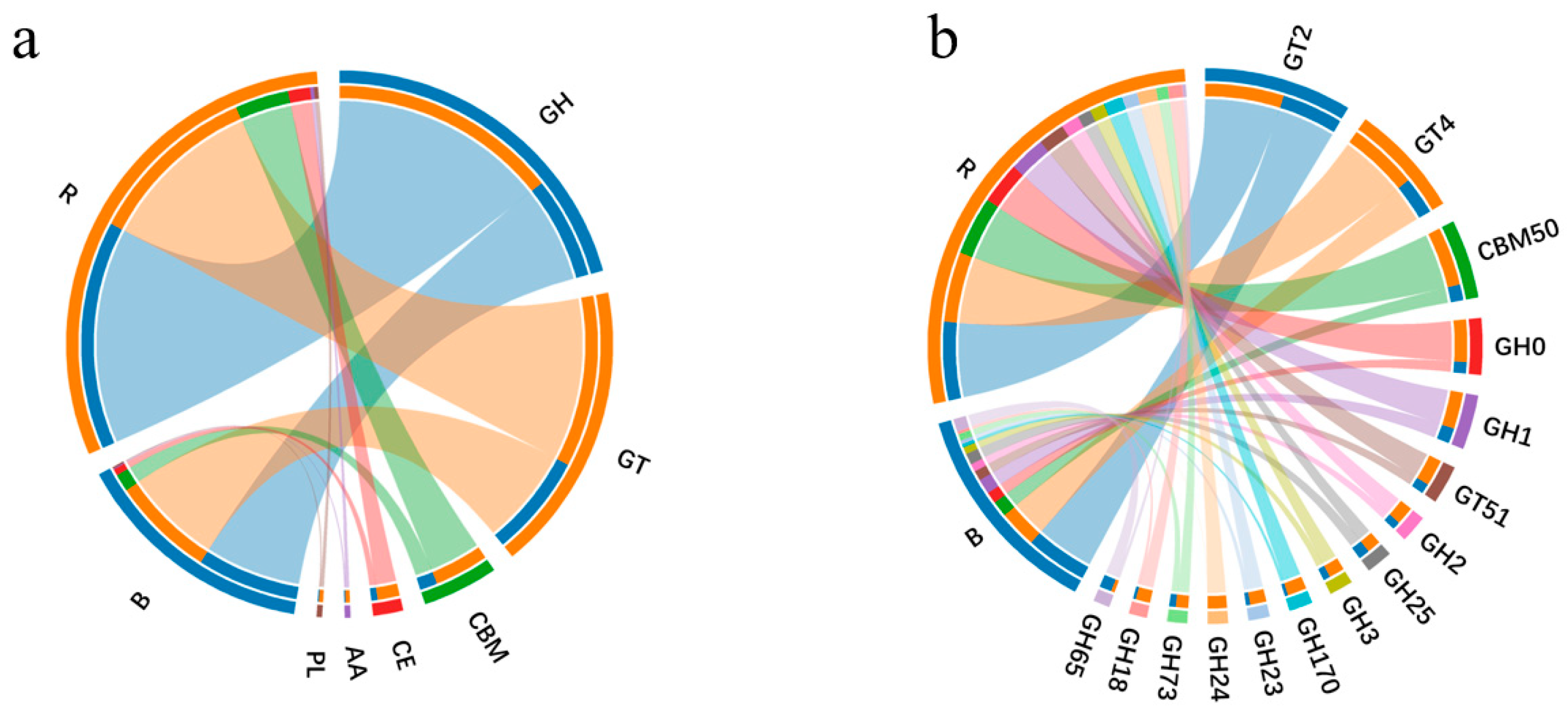
The functional annotation results of the carbohydrate-active enzymes based on the CAZy database are shown in Figure 6a. All genes were categorized into six primary classes at CAZy Level 1. Among these Glycoside Hydrolases (GHs), GlycosylTransferases (GTs), Polysaccharide Lyases (PLs), Auxiliary Activities (AAs), Carbohydrate Esterases (CEs), and Carbohydrate-Binding Modules (CBMs) exhibited prominent annotation counts. The absolute abundance of CAZy enzymes in R-Daqu was significantly higher than that in B-Daqu, which indicates a more enriched pool of microbially encoded enzymes and a more robust enzymatic foundation for carbohydrate metabolism and saccharification. The dominant CAZy classes were consistent between the two Daqu types, with GHs accounting for the highest proportion of enzymes. GHs are responsible for decomposing polysaccharides such as starch and cellulose and function as the key executioners of the “saccharification” function. GTs comprised the second dominant class. These function as core enzymes for synthesis reactions in sugar metabolism and participate in glycan chain construction. CBMs assist enzymes in binding to carbohydrate substrates to enhance the catalytic efficiency. CAZy enzymes act as core functional carriers for the “raw material decomposition → substance transformation → flavor generation” process. The higher abundance of core enzymes such as GHs and GTs in R-Daqu than in B-Daqu signifies its superior saccharification efficiency (via GHs) and glycan synthesis capacity (via GTs), which enables better efficiency of conversion of raw materials into fermentable substrates. Functional abundance clustering at CAZy Level 2 showed that the dominant enzyme family composition was identical in both Daqu types (Figure 6b). The core is concentrated in GT2 and GT4, which are key enzymes pertaining to glycan chain synthesis in sugar metabolism, and they participate in the construction of small-molecule carbohydrates. The GH families act as the primary drivers of saccharification, and they are responsible for breaking down polysaccharides into fermentable sugars, whereas CBM50 enhances catalytic efficiency by facilitating enzyme–substrate binding. The higher abundance of core families (GTs and GHs) in R-Daqu than in B-Daqu indicates its superior polysaccharide decomposition and sugar synthesis capabilities. Although the structural framework of the enzyme families was consistent across both groups, R-Daqu showed a higher abundance of enzymatic reservoir and more pronounced microbial-driven metabolic activity than those of B-Daqu, which makes R-Daqu more conducive for subsequent ethanol production and flavor compound generation. In summary, the specific CAZy enzyme family abundance in R-Daqu was higher than that in B-Daqu, which indicates the significantly higher functional potential of R-Daqu for carbohydrate metabolism.

3.3. Comparative Analysis of Volatile Aroma Compounds in Daqu

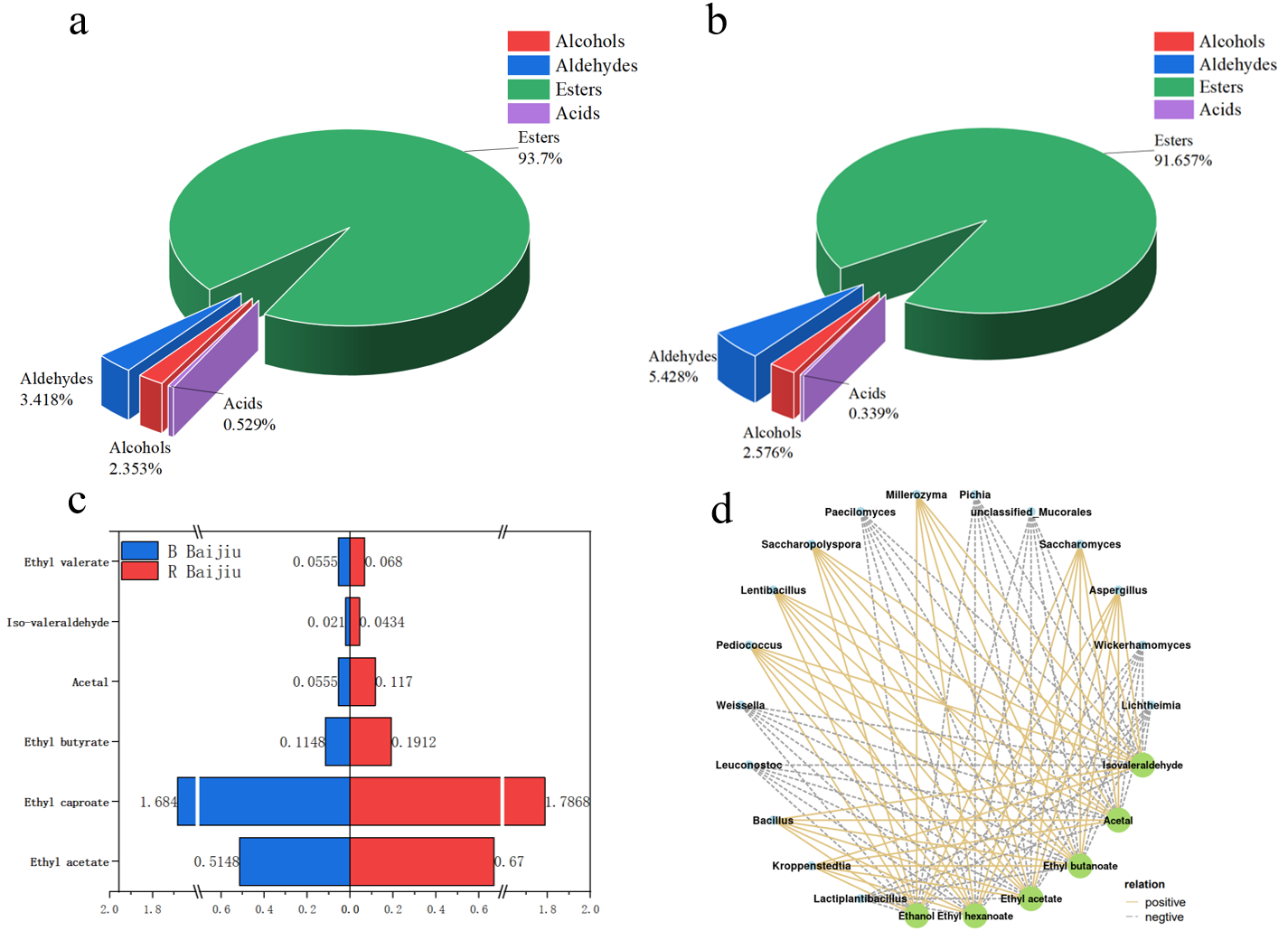
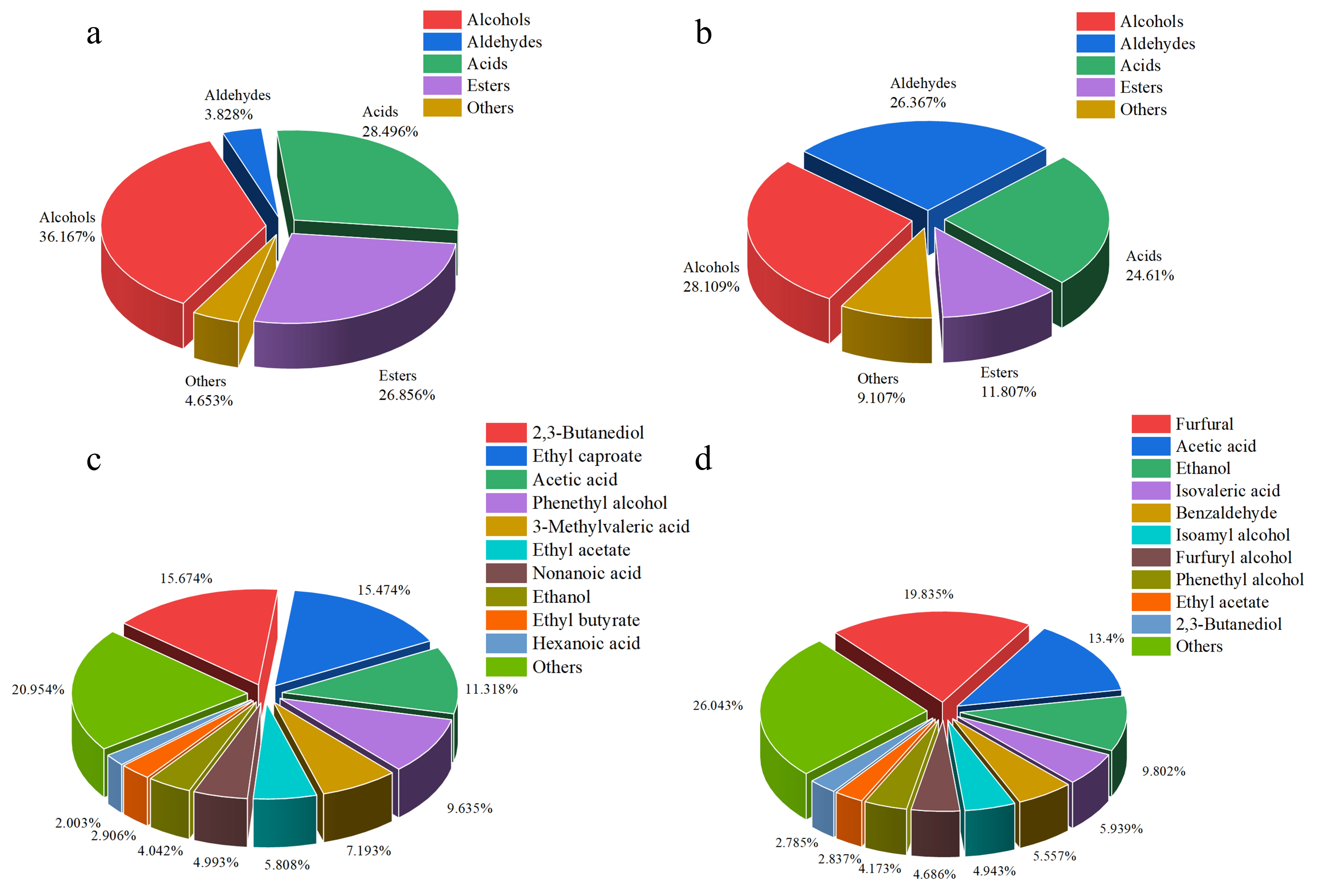
Volatile flavor compounds constitute the core foundation of Daqu aroma. The detection of these compounds effectively compensates for the limitations of traditional evaluation methods and provides a critical basis for the quantitative quality assessment of Daqu and elucidation of flavor transmission mechanisms from Daqu to the final spirit [35]. In this study, HS-SPME-GC-MS was used to identify the primary volatile flavor compounds in B-Daqu and R-Daqu. In total, 46 and 62 aroma components were detected in B-Daqu and R-Daqu, respectively (Tables S3 and S4). R-Daqu exhibited a higher proportion of aldehydes than that observed in B-Daqu but lower proportions of esters and alcohols (Figure 7a,b). B-Daqu showed distinct characteristics of strong-aroma Daqu. It contained ethyl hexanoate, 2,3-butanediol, acetic acid, and phenylethyl alcohol as the predominant components (Figure 7c), which imparted intense ester, fruity, and alcoholic notes to B-Daqu. In contrast, R-Daqu inclined toward the profile of sesame-aroma Daqu, and it primarily comprised furfural, acetic acid, ethanol, and isovaleric acid (Figure 7d). These compounds contributed to its characteristic toasted and sweet aroma. Notably, R-Daqu exhibited prominent roasted and scorched notes owing to its enrichment with various pyrazines such as 2,3,5-trimethylpyrazine and 2,6-dimethylpyrazine, which collectively impart a strong nutty, caramel-like, and toasted aroma. The furfural level was substantially high and accounted for 19.83% of the total volatile compounds. This high furfural concentration suggests that R-Daqu may have undergone extensive Maillard reactions or carbohydrate degradation during fermentation [36].
The significant discrepancies in volatile flavor composition between the two Daqu types may be primarily attributed to the synergistic regulation of microbial community structures, fermentation process conditions, and raw material conversion efficiencies [37]. The core dominant microbiota in R-Daqu was characterized by significant enrichment of Lentibacillus and Aspergillus niger, which, in comparison with that observed for B-Daqu, exhibited substantially higher absolute abundances and key metabolic functional genes pertaining to the KEGG carbohydrate metabolism pathways and CAZy GH families. These characteristics provided a more robust enzymatic foundation for the synthesis of flavor precursors. We postulate that during the Daqu preparation stage, the high moisture content (22.92%) and acidic environment of R-Daqu effectively modulated the metabolic activities of functional brewing microorganisms, which facilitated the efficient utilization of reducing sugars by key strains such as Saccharomyces cerevisiae, subsequently resulting in increased ethanol accumulation. Furthermore, the high-temperature environment during R-Daqu fermentation intensified the Maillard reaction and carbohydrate degradation efficiency, which induced large-scale generation of scorched-flavor compounds such as furfural and pyrazines. In contrast, microbial metabolism in B-Daqu was primarily driven by Lichtheimia, Saccharopolyspora, and Pichia. As the overwhelmingly dominant fungus, Lichtheimia contributed strongly to saccharification, protease secretion, and organic acid production, while its metabolic pathways together with Saccharopolyspora and Pichia favored the accumulation of traditional ester and alcohol flavor compounds such as ethyl hexanoate and phenylethyl alcohol [38].

3.4. Study and Analysis of Mechanism Underlying the Formation of Key Flavor Compounds in Chinese Baijiu

The alcohol yields were 33.8% for B-Daqu and 35.3% for R-Daqu. We performed a detailed analysis of the quality profiles of the two Baijiu samples by integrating statistical sensory scoring with detailed organoleptic descriptions (Table S6). Visually, both spirits appeared clean, transparent, and free of precipitates. Thus, they both maintained the typical appearance of premium Baijiu. The scoring results indicated that R-Baijiu was significantly superior to B-Baijiu in terms of both aroma and taste (p < 0.05). Furthermore, R-Baijiu exhibited a characteristic intense pit aroma, prominent aldehydic notes, and sophisticated aromatic layering. The body was full and smooth, with flavor profiles characteristic of sesame-aroma and initial fermentation rounds of sauce-aroma Baijiu. In contrast, B-Baijiu exhibited a typical strong aroma style dominated by mellow sweetness, pit aroma, and ethyl hexanoate notes; however, its aromatic complexity was inferior to that of R-Baijiu. Furthermore, the newly distilled B-Baijiu possessed a pronounced pungency that was accompanied by noticeable mouth numbing and astringent sensations with relatively shorter aftertaste. Although neither the style scores nor total scores differed significantly between the two samples (p > 0.05), nuanced sensory discrepancies indicated enhanced accumulation of complex flavor-associated compounds and gustatory balance in R-Baijiu. This suggests that the metabolic activity of the functional microbiota in R-Daqu exerts a strong promoting effect on the production of flavor precursors, aldehydes, and nitrogen-containing heterocyclic compounds.
Both B-Baijiu and R-Baijiu are qualified strong aroma spirits characterized by abundant ethyl hexanoate content. Their typical flavor skeleton is dominated by ethyl hexanoate, which, in synergy with ethyl acetate and ethyl butyrate, presents characteristic tropical fruit notes such as pineapple, apple, and banana. These form the foundation of its mellow sweetness and full-bodied richness [39,40]. However, significant discrepancies were observed between the two in terms of flavor structure and organoleptic performance. Compared with B-Baijiu, R-Baijiu exhibited a higher concentration of aldehydes (Figure 8a,b), with a particularly prominent proportion of acetals (Figure 8c). Acetals impart distinctive aldehydic aroma characteristics to the spirit and effectively enhance the body fullness and smoothness that provide a rounded mouthfeel. In contrast, the lower acetal content of B-Baijiu led to a relatively short aftertaste and pronounced pungency that is typical of newly distilled spirits (Table S4). In terms of aromatic layering, R-Baijiu exhibited a sophisticated ester composition, with higher concentrations and proportions of medium-chain fatty acid esters such as ethyl valerate, ethyl heptanoate, and ethyl octanoate. These compounds contributed to the delicate mango and pear aromas and fatty nuances that collectively constituted a diverse, harmonious, and multidimensional fruit aroma profile, which contributed to an overall flavor performance that was complex and voluptuous.
We performed a correlation analysis between the top eight bacterial and fungal genera with the most significant differences in absolute abundance between R-Daqu and the primary flavor compounds in Baijiu. Subsequently, a correlation network was used to elucidate the relationships between the dominant microbial genera in Daqu and major volatile components in Baijiu. This network confirmed that these microorganisms substantially contributed to the accumulation of flavor components. The significantly different components of R-Baijiu, including ethanol, ethyl hexanoate, ethyl acetate, ethyl butanoate, acetal, and isovaleraldehyde, showed positive correlation with Kroppenstedtia, Bacillus, Pediococcus, Lentibacillus, Saccharopolyspora, Millerozyma, Saccharomyces, and Aspergillus in Daqu (Figure 8d).
The alcohol yield achieved during brewing is one of the most fundamental indicators for grading Daqu. R-Daqu exhibited superior saccharifying, liquefying, and fermenting powers with an alcohol yield that was 1.5% higher than that of B-Daqu, which indicated enhanced brewing performance. An integrated analysis of the correlation results and existing literature on microbial functions showed that ethanol production is directly associated with Saccharomyces and Millerozyma, both of which convert fermentable sugars into ethanol via the alcoholic fermentation pathway [41,42]. Although Aspergillus does not directly participate in ethanol synthesis, the functional enzymes it secretes, such as amylases and glucoamylases, efficiently degrade starch substrates in raw materials into available small-molecule sugars for yeast. This indirectly promotes ethanol accumulation [43]. This finding is consistent with the genomic evidence that the abundance of glucoamylase and alpha-amylase genes in R-Daqu was 8.21 and 2.81 times higher than those in B-Daqu, respectively. Consistent with the findings of Liu Y, Aspergillus in Daqu can secrete glucoamylase and α-amylase, thereby improving ethanol production by providing sufficient fermentable sugars for yeast [44].
Acetal is a key flavor compound in Baijiu and acts as a characteristic marker of aged spirits. It is primarily generated through the slow condensation of ethanol and acetaldehyde under acidic conditions during storage and aging, although it is also formed in minor quantities via microbial action during fermentation [45]. This compound enriches the aromatic complexity of the spirit by imparting pleasant fruity and grassy notes; additionally, it imparts a mellow sense of maturity. Furthermore, acetal formation consumes free acetaldehyde, which reduces the pungency of the spirit. This action results in a harmonious and well-coordinated flavor profile [46,47]. The acetal concentration in R-Baijiu was approximately 2.11 times higher than that in B-Baijiu. Furthermore, this elevated acetal content was closely linked to the higher production of its precursor acetaldehyde. Notably, the acetaldehyde content in R-Daqu was four times higher than that in B-Daqu. Integrated correlation analysis and a literature review of microbial functions showed that acetal generation is directly associated with Saccharomyces and Millerozyma. Both genera produce substantial quantities of the acetaldehyde precursor during metabolic processes. Acetaldehyde is a key intermediate of the Embden–Meyerhof–Parnas (EMP) pathway in alcoholic fermentation, and it accumulates significantly during ethanol synthesis at the peak fermentation stages. This phenomenon is highly consistent with previous findings where the synergistic action of Pichia kudriavzevii, Saccharomyces cerevisiae, and Schizosaccharomyces pombe led to the rapid accumulation of acetaldehyde during the piling fermentation stage [48]. Consequently, we inferred that the interspecies synergistic metabolism of the yeast community is the core driver of efficient acetaldehyde synthesis in the fermentation system. Although Pediococcus does not directly generate acetaldehyde, it provides an acidic environment through lactic acid fermentation, which promotes the transformation of acetaldehyde and ethanol into acetal. This outcome indirectly shifts the chemical equilibrium [49]. At the species level, these three microorganisms were significantly enriched in R-Daqu, with relative abundances of 15.89% for Saccharomyces cerevisiae, 4.16% for Millerozyma farinosa, and 16.83% for Pediococcus acidilactici. While in B-Daqu, the corresponding relative abundances were merely 0.41%, 0.002%, and 0.03%, respectively. According to absolute quantitative metagenomic results, the abundances of Saccharomyces cerevisiae, Millerozyma farinosa and Pediococcus acidilactici in R-Daqu were significantly higher than those in B-Daqu, at 24.67-fold, 1151.59-fold and 1648.48-fold, respectively. Thus, the significantly higher acetal content in R-Baijiu than in B-Baijiu may be primarily attributed to a combination of substantial production of the acetaldehyde precursor by Saccharomyces and Millerozyma via the alcoholic fermentation pathway and stable acidic environment created by Pediococcus through lactic acid fermentation. These conditions facilitate the conversion of acetaldehyde and ethanol into acetal.
Furfural is a vital flavor component in Baijiu, and its presence at appropriate concentrations enhances the aromatic layering and stylistic typicality of the spirit [50]. Furfural content varied significantly between R-Daqu and B-Daqu, with furfural accounting for 19.83% of the total volatile compounds in R-Daqu compared with only 0.32% in B-Daqu. Furfural formation in Daqu is a multi-step biochemical process. Initially, hemicellulose in the raw materials is hydrolyzed into pentoses such as xylose by hemicellulases secreted by molds such as Aspergillus and Rhizopus. Subsequently, the synergistic conditions of high acidity and elevated fermentation temperatures mediate its direct conversion into furfural via dehydration [51]. The coordination of microbial metabolism, acidity, and temperature is crucial for furfural synthesis, and neither sufficient substrates alone nor favorable environmental conditions can independently drive efficient furfural production. The highest observed relative abundance of Aspergillus niger in R-Daqu was 47.65%. This species secretes substantial quantities of hemicellulases to effectively decompose hemicellulose into xylose to provide ample substrate for furfural synthesis. Additionally, the acidity of R-Daqu was significantly higher than that of B-Daqu. This may be primarily attributed to the high enrichment of Pediococcus acidilactici, which is a typical lactic acid bacterium [52]. This strain converts sugars such as glucose into lactic acid via homofermentation, which rapidly lowers the environmental pH and provides the necessary acidic conditions for furfural formation. Furthermore, the peak fermentation temperature during R-Daqu preparation reached 60 °C, which surpasses the 45–50 °C temperature range observed for B-Daqu. Furthermore, these higher temperatures promoted furfural generation. In this study, the maximum temperature during the pit fermentation stage of brewing was controlled at approximately 38 °C, which could have effectively inhibited excessive production and accumulation of furfural and maintained its concentration at an appropriate level in the final spirit. Consequently, the furfural content in R-Baijiu was 8.03 mg/L, and its scorched aroma harmonized with the primary Baijiu bouquet, which enhanced the full-bodied and aged sensation of the spirit and prevented the emergence of scorched bitterness.
Moreover, the levels of pyrazine aromatic components varied significantly between R-Daqu and B-Daqu. The experimental results showed that pyrazines accounted for 5.16% of the total volatile compounds in R-Daqu, which was 1.61 times higher than that in B-Daqu. Furthermore, the guaiacol proportion detected in R-Daqu was 0.25%, whereas it was absent in B-Daqu. Furthermore, metagenomic analysis showed that the relative abundance of Lentibacillus daqui in R-Daqu was as high as 35.19% with an absolute abundance that was 1567.20 times higher than that in B-Daqu. L. daqui is a dominant bacterium in high-temperature Daqu, and it exhibits robust metabolic activity at temperatures ranging from 45 to 60 °C, which enables the synthesis of various pyrazines and guaiacol-like compounds that act as crucial precursors of the Baijiu flavor profile [28]. This finding is consistent with the study by Zhang, Z., which identified Lentibacillus daqui as a potential key contributor to pyrazine biosynthesis in high-temperature Daqu [28]. As reported by Wu, S., high temperature plays a crucial role in the formation of pyrazines [53]. In this study, spirit fermentation followed the strong aroma process, which lacks the high-temperature piling stage characteristics of sauce-aroma Baijiu. Under these conditions, the fermentation temperature remained relatively low (approximately 38 °C), which led to limited generation of pyrazines that are difficult to detect in the final spirit. However, despite being below the detection limit of conventional methods owing to their low concentrations, these pyrazines exert a significant influence on the overall flavor landscape even at extremely low odor thresholds [54]. This accounts for the emergence of sensory characteristics in R-Baijiu that are similar to those of sesame-aroma and the initial fermentation rounds of sauce-aroma spirits.

4. Conclusions

This study has clarified the mechanisms underlying the core advantages of using novel Daqu, as opposed to the traditional strong-aroma Baijiu Daqu, by analyzing the microbial community composition, carbohydrate-active enzyme profiles, and flavor metabolic characteristics. Novel Daqu specifically enriches functional microorganisms such as Aspergillus, Saccharomyces, and Lentibacillus by constructing a robust hydrolytic enzyme system and diverse flavor precursor synthesis pathways. These features closely correlate with the discrepancies in microbial metabolism and flavor compound accumulation between the two Daqu types. Aspergillus is a core saccharifying functional genus that significantly enhances the abundance of carbohydrate-active enzymes such as glycoside hydrolases, which efficiently degrade polysaccharides such as starch and hemicellulose in raw materials to provide ample substrates for flavor precursor synthesis. Saccharomyces functions as the pivotal alcoholic fermentation strain that not only dominates ethanol synthesis but additionally generates substantial quantities of acetaldehyde, which acts as a critical precursor for acetal formation. Lentibacillus modulates the acidic environment of the fermentation system through its metabolism and is additionally involved in the synthesis of pyrazines and other flavor compounds, which further enrich the flavor dimensions. Application of novel Daqu synergistically regulated the microbial metabolic networks and significantly increased the acetal content in the spirit. This enhancement may be primarily attributed to the collaborative production of acetaldehyde by Saccharomyces and Millerozyma and the promotional effect of the acidic environment created by Pediococcus via lactic acid fermentation during the condensation reaction between acetaldehyde and ethanol. This study has elucidated the composition and network underlying the formation of aroma and flavor compounds during Baijiu brewing and has determined the mechanism of association between core functional microorganisms, carbohydrate-active enzymes, and flavor compounds such as acetals. These findings provide methodologies and insights for increasing the concentration of characteristic flavor compounds and optimizing Baijiu flavor quality during fermentation. Future research will focus on the isolation, identification, and functional verification of core functional strains from novel Daqu, and construct synthetic microbial communities to achieve the directional regulation of acetal and flavor compound synthesis. In addition, the application of novel Daqu in other flavor-type Baijiu such as Jiang-flavor Baijiu will be explored, which is expected to further enhance the production of complex aroma compounds including pyrazines by utilizing its highly active microbial community.

Supplementary Materials

The following supporting information can be downloaded at https://www.mdpi.com/article/10.3390/fermentation12050235/s1: Table S1. Comparison of physicochemical indices of R-Daqu and B-Daqu mixtures before fermentation; Table S2. Composition and sensory characteristics of volatile flavor compounds in B-Daqu; Table S3. Composition and sensory characteristics of volatile flavor compounds in R-Daqu; Table S4. Composition and sensory characteristics of volatile flavor compounds in B-Baijiu; Table S5. Composition and sensory characteristics of volatile flavor compounds in R-Baijiu; Table S6. Sensory evaluation results of B-Baijiu and R-Baijiu.

Author Contributions

Conceptualization, G.J. and H.T.; methodology, J.W.; software, N.L.; validation, G.J., K.L. and Q.W.; formal analysis, H.T.; investigation, G.J.; resources, P.D.; data curation, H.T.; writing—original draft preparation, G.J.; writing—review and editing, P.L.; visualization, H.T.; supervision, F.L.; project administration, R.W.; funding acquisition, P.D. All authors have read and agreed to the published version of the manuscript.

Funding

This work was supported by Jinan Innovation Team Project (No. 202534018) and Horizontal Science and Technology Project Entrusted by Dongxiao Bioengineering (Shandong) Co., Ltd. (No. 2024KYJSHT0239).

Institutional Review Board Statement

The study was conducted in accordance with the Declaration of Helsinki and approved by the Ethics Review Committee of Qilu University of Technology (QLU-ERC-2025-018 and 7 June 2025).

Informed Consent Statement

Informed consent was obtained from all subjects involved in the study.

Data Availability Statement

The original contributions presented in this study are included in the article/Supplementary Material. Further inquiries can be directed to the corresponding author.

Acknowledgments

We would like to thank the State Key Laboratory of Green Papermaking and Resource Recycling at Qilu University of Technology for its help and support.

Conflicts of Interest

Authors Fengyong Lu and Qi Wang are employed by the company “Jinan Ruifeng Bioengineering Co., Ltd.” However, for the purposes of this investigation, there was no financing relationship with the company; therefore, there are no conflicts of interest. The authors declare that this study received funding from Dongxiao Bioengineering (Shandong) Co., Ltd. The funder was not involved in the study design, collection, analysis, interpretation of data, the writing of this article or the decision to submit it for publication. The remaining authors declare that the research was conducted in the absence of any commercial or financial relationships that could be construed as a potential conflict of interest.

Abbreviations

The following abbreviations are used in this manuscript:
HS-SPME-GC-MSheadspace solid-phase microextraction gas chromatography-mass spectrometry
CAZyCarbohydrate-Active EnZyme
GHsglycoside hydrolases
GTsglycosyltransferases
GTDBGenome Taxonomy Database
EIElectron ionization
RDAredundancy analysis
PCoAPrincipal Coordinate Analysis
STAMPStatistical Analysis of Metagenomic Profiles
LEfSeLinear discriminant analysis effect size
PLsPolysaccharide Lyases
AAsAuxiliary Activities
CEsCarbohydrate Esterases
CBMsCarbohydrate-Binding Modules
EMPEmbden–Meyerhof–Parnas

References

  1. Wang, R.; Lal, A.; Xin, C. Baijiu Blending Technology, 3rd ed.; Chemical Industry Press: Beijing, China, 2023. (In Chinese) [Google Scholar]
  2. Tang, J.; Wei, J.; Yang, Y.; Ge, X.; Zuo, Q.; Zhao, C.; Huang, Y. Spatio-Temporal Scales of the Chinese Daqu Microbiome: Heterogeneity, Niche Differentiation, and Assembly Mechanisms. Trends Food Sci. Technol. 2025, 156, 104832. [Google Scholar] [CrossRef]
  3. Ali, A.; Li, W.; Chen, X.; Patil, P.J.; Li, H.; Zhang, Y.; Li, X. Interdisciplinary Omics of Daqu and Baijiu: A Bibliometric Analysis (2011–2025). Food Biosci. 2025, 71, 107372. [Google Scholar] [CrossRef]
  4. Zhu, C.; Cheng, Y.; Zuo, Q.; Huang, Y.; Wang, L. Exploring the Impacts of Traditional Crafts on Microbial Community Succession in Jiang-Flavored Daqu. Food Res. Int. 2022, 158, 111568. [Google Scholar] [CrossRef]
  5. He, G.; Huang, J.; Wu, C.; Jin, Y.; Zhou, R. Bioturbation Effect of Fortified Daqu on Microbial Community and Flavor Metabolite in Chinese Strong-Flavor Liquor Brewing Microecosystem. Food Res. Int. 2020, 129, 108851. [Google Scholar] [CrossRef] [PubMed]
  6. Wang, H.; Chen, Z.; Qing, H.; Huang, M.; Xue, G.; Lu, X.; Che, Y.; Dong, Y.; Zhang, S.; Yu, J.; et al. Seasonal Influence on the Microbial Diversity and Flavor Substances in the Strong Flavor Daqu Fermentation. Food Chem. Mol. Sci. 2025, 11, 100332. [Google Scholar] [CrossRef]
  7. Wen, Z.; Wei, Y.-H.; Han, D.-Y.; Song, L.; Zhu, H.-Y.; Guo, L.-C.; Chen, S.-X.; Lin, B.; He, C.-J.; Guo, Z.-X.; et al. Deciphering the Role of Traditional Flipping Crafts in Medium-Temperature Daqu Fermentation: Microbial Succession and Metabolic Phenotypes. Curr. Res. Food Sci. 2025, 10, 101063. [Google Scholar] [CrossRef] [PubMed]
  8. Han, P.-J.; Luo, L.-J.; Han, Y.; Song, L.; Zhen, P.; Han, D.-Y.; Wei, Y.-H.; Zhou, X.; Wen, Z.; Qiu, J.-Z.; et al. Microbial Community Affects Daqu Quality and the Production of Ethanol and Flavor Compounds in Baijiu Fermentation. Foods 2023, 12, 2936. [Google Scholar] [CrossRef]
  9. Zheng, X.-W.; Han, B.-Z. Baijiu (白酒), Chinese Liquor: History, Classification and Manufacture. J. Ethn. Foods 2016, 3, 19–25. [Google Scholar] [CrossRef]
  10. Xu, Y.; Zhao, J.; Liu, X.; Zhang, C.; Zhao, Z.; Li, X.; Sun, B. Flavor Mystery of Chinese Traditional Fermented Baijiu: The Great Contribution of Ester Compounds. Food Chem. 2022, 369, 130920. [Google Scholar] [CrossRef]
  11. Wei, J.; Du, H.; Xu, Y. Revealing the Key Microorganisms Producing Higher Alcohols and their Assembly Processes during Jiang-Flavor Baijiu Fermentation. Food Biosci. 2024, 61, 104569. [Google Scholar] [CrossRef]
  12. Liu, W.-H.; Chai, L.-J.; Wang, H.-M.; Lu, Z.-M.; Zhang, X.-J.; Xiao, C.; Wang, S.-T.; Shen, C.-H.; Shi, J.-S.; Xu, Z.-H. Bacteria and Filamentous Fungi Running a Relay Race in Daqu Fermentation Enable Macromolecular Degradation and Flavor Substance Formation. Int. J. Food Microbiol. 2023, 390, 110118. [Google Scholar] [CrossRef]
  13. Yuan, L.; Li, Y.; Zheng, L.; Qin, Y.; Zhang, X.; Ma, L.; Zhang, H.; Du, L. Impact of Organic Acids on Aroma Release in Light-Flavor Baijiu: A Focus on Key Aroma-Active Compounds. Food Biosci. 2025, 65, 106071. [Google Scholar] [CrossRef]
  14. Yang, L.; Fan, W.; Xu, Y. Qu-Omics Elucidates the Formation and Spatio-Temporal Differentiation Mechanism Underlying the Microecology of High Temperature Daqu. Food Chem. 2024, 438, 137988. [Google Scholar] [CrossRef] [PubMed]
  15. Tang, P.; Li, Q.; Li, C.; Xiao, D.; Wang, X.; Guo, X. Analysis and Formation Mechanism of Key Aroma Compounds with Ammonia-Like off-Flavors in Jiang-Flavored High-Temperature Daqu: Substances Composition and Main Microorganisms. Food Biosci. 2025, 73, 107656. [Google Scholar] [CrossRef]
  16. Ying, H.; Yang, J.; Yu, L.; Wei, J.; Sheng, Q.; Yuan, Y.; Yue, T. Metagenomics and GC-IMSanalyses- Reveal Microbial Community Differences and Flavor Characteristics among three Types of Feng Flavor Daqu. Food Res. Int. 2025, 221, 117551. [Google Scholar] [CrossRef]
  17. Li, Q.; Zhang, L.; Li, R.; Tang, J.; Lin, B.; Qin, C.; Jiang, W.; An, L.; Zhang, F.; Shi, X.; et al. Metagenomics-Based Analysis of Microbial Community Dynamics and Flavor Compound Correlations during Rice-Flavor Baijiu Brewing. Front. Bioeng. Biotechnol. 2025, 13, 1638716. [Google Scholar] [CrossRef]
  18. Yang, L.; Huang, X.; Hu, J.; Deng, H.; He, J.; Zhang, C. The Spatiotemporal Heterogeneity of Microbial Community Assembly during Pit Fermentation of Soy Sauce Flavor Baijiu. Food Biosci. 2024, 61, 104438. [Google Scholar] [CrossRef]
  19. QB/T 4257-2011; General Methods of Analysis for Daqu. China Standards Press: Beijing, China, 2011.
  20. GB 5009.7-2016; Determination of Reducing Sugar in Foods. China Standards Press: Beijing, China, 2016.
  21. T/CBJ 004-2018; General Methods of Analysis for Solid-State Fermented Grains. China Alcoholic Drinks Association: Beijing, China, 2018.
  22. GB/T 33405-2016; Terminology of Sensory Evaluation of Baijiu. China Standards Press: Beijing, China, 2016.
  23. Xie, L.; Zhang, H.; Tian, J.; Yu, S.; Zhang, X.; Yang, H.; Hu, X.; Chen, M.; Wang, R.; Cai, A.; et al. Study on the Real-Time Online Determination of the Moisture Content of Baijiu Daqu during Fermentation: New Application of Spectral Reconstruction Technology. J. Food Compos. Anal. 2025, 146, 107904. [Google Scholar] [CrossRef]
  24. Ma, S.; Luo, H.; Zhao, D.; Qiao, Z.; Zheng, J.; An, M.; Huang, D. Environmental Factors and Interactions among Microorganisms Drive Microbial Community Succession during Fermentation of Nongxiangxing Daqu. Bioresour. Technol. 2022, 345, 126549. [Google Scholar] [CrossRef] [PubMed]
  25. Wu, L.; Yan, M.; Huang, X.; Liao, H.; Bao, D.; Ge, Y.; Wang, S.; Xia, X. Temperature-Mediated Shift from Competitive to Facilitative Interactions Between Lactic Acid Bacteria and Bacillus Species in Daqu Fermentation: Insights from Metagenomics, Dual RNA-seq, and Coculture Analysis. Int. J. Food Microbiol. 2025, 442, 111352. [Google Scholar] [CrossRef]
  26. Wang, B.; Wu, Q.; Xu, Y.; Sun, B. Synergistic Effect of Multiple Saccharifying Enzymes on Alcoholic Fermentation for Chinese Baijiu Production. Appl. Environ. Microbiol. 2020, 86, e00013-20. [Google Scholar] [CrossRef]
  27. Chen, L.; Peng, Q.; Chen, Y.; Che, F.; Chen, Z.; Feng, S. Analysis of Dominant Microorganisms and Core Enzymes in Qingke Baijiu Daqu by High-Throughput Sequencing and Proteomics. Food Res. Int. 2025, 204, 115941. [Google Scholar] [CrossRef]
  28. Zhang, Z.; Ran, X.; Guo, Z.; Hou, Q.; Qu, D.; Wang, C.; Xu, Y.; Wang, Y. Microbial Diversity, Functional Properties, and Flavor Characteristics of High-Temperature Daqu With Different Colors. Food Res. Int. 2025, 212, 116406. [Google Scholar] [CrossRef] [PubMed]
  29. Yao, X.; Chen, X.; Niu, J.; Li, J.; Li, W.; Zhu, H.; Li, X.; Sun, B. Storage Time Drives Divergent Microbial Functions and Flavor Metabolism in High-Temperature Daqu. Food Res. Int. 2026, 228, 118363. [Google Scholar] [CrossRef]
  30. Tu, H.; Zhou, G.; Lu, J.; Tan, F.; Han, Y.; Yang, F.; Du, H.; Liu, Y.; Li, J.; Wang, L.; et al. Cooperative Interaction Between Pediococcus and Bacillus Communities as a Key Factor in the High-Temperature Thermal Differentiation of Daqu. Food Biosci. 2024, 62, 105457. [Google Scholar] [CrossRef]
  31. Zhu, Q.; Chen, L.; Peng, Z.; Zhang, Q.; Huang, W.; Yang, F.; Du, G.; Zhang, J.; Wang, L. The Differences in Carbohydrate Utilization Ability between Six Rounds of Sauce-Flavor Daqu. Food Res. Int. 2023, 163, 112184. [Google Scholar] [CrossRef]
  32. Wei, Y.; Han, D.; Song, L.; Guo, L.; Bai, M.; Han, P.; Zhu, H.; Wen, Z. Integrative Analysis of Fungal Communities in Three Types of Baijiu Daqu Using Third-Generation Sequencing and Culturomics. Front. Microbiol. 2026, 16, 1748163. [Google Scholar] [CrossRef] [PubMed]
  33. Tie, Y.; Wang, L.; Ding, B.; Deng, Z.; Yang, Q.; Zhu, M.; Wu, Z.; Tang, L.; Suyama, T.; Zhang, W. Investigating the Main Contributors to Esterification Activity and Identifying the Aqueous-Phase Ester Synthases in Daqu. Food Biosci. 2025, 66, 106227. [Google Scholar] [CrossRef]
  34. Wang, Y.; Yun, J.; Zhou, M.; Wang, Z.; Li, D.; Jia, X.; Gao, Q.; Chen, X.; Xie, G.; Wu, H.; et al. Exploration and Application of Saccharomyces cerevisiae NJ002 to Improve the Fermentative Capacity of Medium-High Temperature Daqu. Bioresour. Technol. Rep. 2023, 23, 101571. [Google Scholar] [CrossRef]
  35. Niu, M.; Ma, L.; Yang, Y.; Jia, J.; Xiang, L.; Tu, T.; Zhao, X.; Shen, C.; Wang, S. Uncovering the Key Volatile Compounds Affecting the Roasted Aroma in Sauce-Flavor Baijiu and their Perceptual Interactions. LWT 2025, 237, 118705. [Google Scholar] [CrossRef]
  36. Chen, H.; Zhu, Y.; Xie, Y.; Long, W.; Lan, W.; She, Y.; Fu, H. Rapid Identification of High-Temperature Daqu Baijiu with the Same Aroma Type Through the Excitation Emission Matrix Fluorescence of Maillard Reaction Products. Food Control 2023, 153, 109938. [Google Scholar] [CrossRef]
  37. Ali, A.; Wu, Y.; Li, W.; Duan, Z.; Zhang, R.; Liu, J.; Patil, P.J.; Shah, H.; Li, X. Insight into Microorganisms and Flavor Substances in Traditional Chinese Fermented Food Starter: Daqu. Process Biochem. 2024, 146, 433–450. [Google Scholar] [CrossRef]
  38. Zhang, Q.; Huo, N.; Wang, Y.; Zhang, Y.; Wang, R.; Hou, H. Aroma-Enhancing Role of Pichia manshurica Isolated from Daqu in the Brewing of Shanxi Aged Vinegar. Int. J. Food Prop. 2017, 20, 2169–2179. [Google Scholar] [CrossRef]
  39. Gao, Y.; Wang, H.; Xiong, A.; Liu, L.; Tong, R.; Pei, W.; Yang, L.; Wu, X.; Wang, Z. Baijiu: Chemical Composition, Biological Functions, and Endogenous Metabolic Profiles. Food Res. Int. 2025, 219, 116895. [Google Scholar] [CrossRef] [PubMed]
  40. Chen, J.; Zhang, J.; Zeng, R.; Lin, Y.; Duan, Y.; Song, C.; Zhang, S.; Zuo, Y. Distribution Characteristic, Synthesis Mechanism and Regulation Measures of Ethyl Acetate in Strong Flavor Baijiu: A Review. Food Biosci. 2025, 73, 107681. [Google Scholar] [CrossRef]
  41. Qiu, F.; Du, B.; Zhang, C.; Zhu, L.; Yan, Y.; Li, W.; Leng, W.; Pang, Z.; Li, X.; Sun, B. Effects of Saccharomyces cerevisiae on Microbial Community and Flavor Metabolites in Solid-State Fermentation of Strong-Flavor Baijiu. Food Biosci. 2024, 59, 103925. [Google Scholar] [CrossRef]
  42. Zhao, H.; Xu, J.; Wang, R.; Liu, X.; Peng, X.; Guo, S. Succession and Diversity of Microbial Flora during the Fermentation of Douchi and their Effects on the Formation of Characteristic Aroma. Foods 2023, 12, 329. [Google Scholar] [CrossRef]
  43. Norouzian, D.; Akbarzadeh, A.; Scharer, J.M.; Moo Young, M. Fungal Glucoamylases. Biotechnol. Adv. 2006, 24, 80–85. [Google Scholar] [CrossRef]
  44. Liu, Y.; Li, H.; Liu, W.; Ren, K.; Li, X.; Zhang, Z.; Huang, R.; Han, S.; Hou, J.; Pan, C. Bioturbation Analysis of Microbial Communities and Flavor Metabolism in a High-Yielding Cellulase Bacillus subtilis Biofortified Daqu. Food Chem. X 2024, 22, 101382. [Google Scholar] [CrossRef]
  45. Huang, Q.; Liu, Y.; Tian, L.; Xiong, F.; He, Z.; Zhao, Y.; Xiang, S.; Qiu, X.; Yu, J.; Guan, T. Effects of Storage Time on Flavor Characteristics of Bran-Free Fermented Baijiu by Using Electronic Sensory, Descriptive Sensory Analysis, GC× GC–MS, and ICP-MS. Food Chem. X 2024, 23, 101667. [Google Scholar] [CrossRef]
  46. Dai, W.; Tan, W.; Chen, X.; Wang, J.; Yu, Y.; Zheng, Q. Why Aging Matters: Acetaldehyde-Acetal Interconversion in Baijiu. J. Food Compos. Anal. 2025, 148, 108222. [Google Scholar] [CrossRef]
  47. Wei, Y.; Zou, W.; Shen, C.; Yang, J. Basic Flavor Types and Component Characteristics of Chinese Traditional Liquors: A Review. J. Food Sci. 2020, 85, 4096–4107. [Google Scholar] [CrossRef]
  48. Li, C.; Yang, F.; Han, Y.; Yang, C.; Qin, X.; Zheng, H.; Chen, L.; Lu, J.; Zhang, C.; Lu, F.; et al. Aldehyde Metabolism in Maotai-Flavor Baijiu: Insights from Integrated Metagenomic and Metaproteomic Analyses. Food Res. Int. 2025, 221, 117518. [Google Scholar] [CrossRef]
  49. Xiao, Z.; Shen, Y.; Tu, Z.; Yang, X.; Zhang, Y.; Luo, Y. Enhanced Phenyllactic Acid Production From Grass Carp Viscera Hydrolysate Using Engineered Pediococcus acidilactici. Bioresour. Technol. 2026, 440, 133460. [Google Scholar] [CrossRef] [PubMed]
  50. Luo, X.; Fan, W.; Xu, Y.; Cheng, P.; Sun, Y.; Zhu, X.; Hu, J. Characterization of Volatile Bitter off-Taste Compounds in Maotai-Flavor Baijiu (Chinese Liquor). LWT 2025, 217, 117363. [Google Scholar] [CrossRef]
  51. Wang, Y.; Li, M.; Wang, Z.; Liu, S.; O’Young, L. Furfural Production: A Review on Reaction Mechanism and Conventional Production Process. Ind. Crops Prod. 2025, 230, 121103. [Google Scholar] [CrossRef]
  52. Tu, H.; Zhou, G.; Tan, F.; Yang, F.; Han, Y.; Li, J.; Liu, Y.; Wu, Y.; Chen, J.; Wang, L. Temperature-Driven Deterministic-Dominated Microbial Assembly Underpins Seasonal Divergence in Baijiu High-Temperature Daqu. Food Biosci. 2025, 74, 107985. [Google Scholar] [CrossRef]
  53. Wu, S.; Du, H.; Xu, Y. Daqu Microbiota Adaptability to Altered Temperature Determines the Formation of Characteristic Compounds. Int. J. Food Microbiol. 2023, 385, 109995. [Google Scholar] [CrossRef]
  54. Du, J.; Zhang, Y.; Ning, Z.; Jiang, S.; Liu, J.; Ni, X.; Li, Q.; Yang, Q. Comparative Analysis of Pyrazine Compounds in Soy Sauce Aroma Baijiu from Different Regions and their Impact on Flavor Profiles. J. Food Compos. Anal. 2025, 148, 108447. [Google Scholar] [CrossRef]
Figure 1. Schematic comparison of traditional strong-aroma Daqu (B-Daqu) and novel Daqu (R-Daqu) preparation processes.
Fermentation 12 00235 g001
Figure 2. Diversity and abundance of microbial communities in B-Daqu and R-Daqu at the species level. Venn diagram of bacteria (a); Stacked bar chart of absolute abundance of bacterial communities (b). Relative abundance of bacterial communities in B-Daqu and R-Daqu at the genus level (c).
Fermentation 12 00235 g002
Figure 3. Diversity and abundance of microbial communities in B-Daqu and R-Daqu at the species level. Venn diagram of fungi (a); Stacked bar chart of absolute abundance of fungi communities (b). Relative abundance of fungi communities in B-Daqu and R-Daqu at the genus level (c).
Fermentation 12 00235 g003
Figure 4. Linear discriminant analysis effect size (LEfSe) of microbial communities in B-Daqu and R-Daqu. Taxonomic cladograms of bacteria (a) and fungi (b) in B-Daqu and R-Daqu. LDA score distribution histograms of bacteria (c) and fungi (d) in B-Daqu and R-Daqu.
Fermentation 12 00235 g004
Figure 5. Predicted functional profiles of microbial communities in B-Daqu and R-Daqu based on the KEGG database. Functional absolute abundance at KEGG Level 1 (a), metabolic module absolute abundance at KEGG M_Level 2 (b), and metabolic module absolute abundance at KEGG M_Level 3 (c).
Fermentation 12 00235 g005
Figure 6. Distribution of carbohydrate-active enzymes (CAZymes) in B-Daqu and R-Daqu. Distribution of enzymes at CAZy Level 1 (a) and distribution of core enzyme families at CAZy Level 2 (b).
Fermentation 12 00235 g006
Figure 7. Comparison of volatile flavor compounds between B-Daqu and R-Daqu. Proportion of volatile compound categories in B-Daqu (a) and R-Daqu (b). Relative levels of individual dominant compounds in B-Daqu (c) and R-Daqu (d).
Fermentation 12 00235 g007
Figure 8. Composition and comparison of volatile flavor compounds in B-Baijiu and R-Baijiu. (a,b) Pie charts showing percentage composition of major flavor components (excluding ethanol) in B-Baijiu (a) and R-Baijiu (b); (c) comparison of concentrations of key volatile flavor compounds between B-Baijiu and R-Baijiu. Correlation network analysis between key differential microbial genera in Daqu and major flavor compounds in Baijiu (d).
Fermentation 12 00235 g008
Table 1. Comparison of physicochemical properties between B-Daqu and R-Daqu.
B-DaquR-Daqu
Moisture Content (%)9.32 ± 0.35 b22.92 ± 0.87 a
Saccharifying Power (U/g)431 ± 28 b968 ± 45 a
Liquefying Power (U/g)1.1 ± 0.3 b10.7 ± 1.1 a
Fermenting Power (U/g)0.8 ± 0.3 b10.2 ± 0.9 a
Acidity (mmol/10 g)1.5 ± 0.1 b3.4 ± 0.3 a
Reducing Sugar Content (glucose %)2.07 ± 0.15 b2.42 ± 0.18 a
Free Amino Acid Content (%)0.14 ± 0.02 a0.16 ± 0.03 a
Note: Different letters in the same row indicate significant differences at p < 0.05.
Table 2. Comparison of physicochemical indices and fermentation products of R- and B-fermented grains after fermentation.
B-JiupeiR-Jiupei
Pit aPit bPit cPit dPit ePit f
Alcohol content (% vol)5 ± 0.65.1 ± 0.73.8 ± 0.54.7 ± 0.64.4 ± 0.75.7 ± 0.5
Total acidity (mmol/10 g)2.8 ± 0.32.6 ± 0.23 ± 0.43.3 ± 0.43.9 ± 0.53.7 ± 0.4
Moisture content (%)57.23 ± 1.6557.49 ± 1.8858.30 ± 2.0559.23 ± 1.8559.71 ± 2.1260.41 ± 1.94
Starch content (%)10.9 ± 1.211.7 ± 1.311.9 ± 1.110.8 ± 1.18.8 ± 0.98.5 ± 0.8
Reducing sugar content (%)0.93 ± 0.390.55 ± 0.221.01 ± 0.410.51 ± 0.220.73 ± 0.380.49 ± 0.22
Note: Pits a, b, and c represent the fermentation pits for B-Jiupei, and Pits d, e, and f represent the fermentation pits for R-Jiupei.
Disclaimer/Publisher’s Note: The statements, opinions and data contained in all publications are solely those of the individual author(s) and contributor(s) and not of MDPI and/or the editor(s). MDPI and/or the editor(s) disclaim responsibility for any injury to people or property resulting from any ideas, methods, instructions or products referred to in the content.