


Abstract
Baijiu, a traditional Chinese distilled spirit with profound cultural and economic significance, faces long-standing challenges in standardization, quality consistency, and skill inheritance due to its empirical production model. The rapid advancement of artificial intelligence (AI) and multi-omics technologies is driving a paradigm shift in Baijiu research from experience-driven to data-driven approaches. This review systematically summarizes the current state of AI applications across the entire Baijiu industry chain. Common AI methods including traditional machine learning, deep learning, multimodal data fusion, and emerging paradigms such as explainable AI (XAI), genome-scale metabolic models (GEMs), and few-shot learning are critically examined. Key bottlenecks—data silos, small sample sizes, model interpretability, and the tension between technology and tradition—are discussed in depth. Future directions are proposed, including multimodal fusion, digital twins, hybrid mechanistic–data modeling, closed-loop control, human–machine collaboration, standardization, and ethical governance. This review provides a comprehensive framework for integrating AI into Baijiu research and offers references for intelligent transformation in other fermented food systems.
1. Introduction
1.1. Baijiu Industry and the Complexity of Baijiu Flavor
As China’s national liquor, Baijiu carries profound cultural heritage [1] and stands as one of the world’s six major distilled spirits alongside brandy, whiskey, vodka, gin, and rum [2]. According to the latest research report from the China Alcoholic Drinks Association, from January to October 2024, the total output of large-scale brewing enterprises in China exceeded 36 million kiloliters, achieving a net profit of nearly 190 billion RMB, accounting for 45% of the food industry’s profits, highlighting its significant position in the national economy [3]. The unique charm of Baijiu lies in the interaction of its complex trace components that form its characteristic taste and aroma [3]. Ethanol and water constitute 98% of Baijiu’s composition, while the remaining 1–2% includes various trace components such as alcohols, acids, esters, aldehydes, and ketones, which collectively shape its distinctive flavor profile [4]. Currently, Baijiu has developed 12 distinct aroma types, including sauce-aroma, strong-aroma, and light-aroma types, each with unique aromatic characteristics. Strong-aroma Baijiu, as the dominant market category, accounts for 60–70% of total Baijiu sales due to its rich aroma and unique flavor.
1.2. Limitations of Traditional Brewing Models and Transition Pressures
For thousands of years, the inheritance and development of Baijiu brewing technology have evolved the production process into a series of complex steps, covering material selection, Qu-making [5], fermentation, distillation [6], aging, blending, and bottling. However, traditional brewing techniques have long relied on the experiential inheritance model of “observing with eyes, smelling with nose, touching with hands, and tasting with mouth,” presenting challenges in standardization and the risk of skill discontinuity. Abnormal phenomena during the pile fermentation of sauce-flavor Baijiu—such as the “waist line” characterized by white colonies and clumps in the middle section, and “sub-temperature fermentation” with overall slow temperature rise—are currently only identifiable through subjective sensory experiences, lacking scientific and objective evaluation standards. Daqu production, as the critical initial stage of Baijiu, also depends on traditional empirical knowledge and manual skills, leading to inconsistent product quality.
Meanwhile, consumption upgrades and market competition demand higher standards for quality consistency and authenticity traceability. Traditional statistical methods struggle to handle the extreme complexity and diversity of flavor compounds in Baijiu [7]—3443 trace components have been identified in strong-flavor Baijiu, to date. Fermentation occurs in open environments where microorganisms from pit mud and air enter the process, making it difficult to identify and predict the core microbial communities involved in flavor compound synthesis [8,9].
1.3. Intersection of Artificial Intelligence and Food Science
The application of artificial intelligence in the food sector continues to expand, demonstrating significant advantages from flavor analysis to safety monitoring. It enables real-time monitoring of food contamination, spoilage, and risks through image recognition [10], sensor data analysis, and predictive models, thereby enhancing process supervision efficiency [11,12]. Compared to traditional statistical methods reliant on linear assumptions, machine learning, as a computer algorithm equipped with feature extraction, data mining, and modeling capabilities, offers distinct advantages: the ability to handle complex nonlinear relationships, more efficient processing of large-scale data [13], provision of comprehensive evaluation metrics [14], and greater flexibility and precision in model performance tuning [11].
In recent years, the rapid development of multi-omics technologies—including metagenomics, transcriptomics, proteomics, and metabolomics—has greatly expanded our understanding of the structure and function of microbial communities in fermented foods [15]. However, the massive volume and analytical complexity of such data often make efficient interpretation challenging when relying solely on omics approaches. The rise of artificial intelligence provides new avenues to address this bottleneck [16,17,18]. Machine learning demonstrates immense potential in data processing and analysis, enabling the extraction and revelation of functionally significant relationships and biological mechanisms from complex multidimensional omics data through algorithm optimization and iterative model training [19,20]. Specifically, artificial intelligence enables high-resolution microbial annotation [21] and accurate prediction of gene functions and novel metabolic pathways [22], allowing researchers to establish complex microbial interaction models that drive fermentation processes [23].
1.4. Review Purpose and Scope
Although research on the application of artificial intelligence in the Baijiu field is increasing, existing studies are scattered across different dimensions such as production control, quality identification, and flavor analysis, lacking systematic organization and integration. Cheng et al. point out that the combined analysis of metabolomics, flavoromics, and artificial intelligence provides a powerful tool for elucidating the molecular mechanisms of Baijiu flavor formation and implementing flavor regulation [24]. The integration of metabolic network modeling with deep learning offers transformative methods for intelligent Baijiu brewing. Shi et al. systematically summarized the core value of artificial intelligence in exploring microbial resources for fermented foods [25]. They emphasize that this will accelerate the development of next-generation fermentation agents and optimize fermentation processes [25].
Based on the above context, this paper aims to systematically review the current research status of artificial intelligence in the Baijiu field [24], summarize technical pathways and application scenarios, identify limitations of existing studies, and outline future directions. This review’s scope covers the production end (brewing control, intelligent Qu-making), product end (quality identification, traceability, and authenticity verification [26]), and value end (flavor analysis, consumer insights [22]), with a focus on the progress and challenges of applying artificial intelligence methods such as machine learning and deep learning across the entire Baijiu industry chain.
2. Common Artificial Intelligence Methods in the Baijiu Field
In recent years, the rapid development of artificial intelligence technology has provided powerful tool support for the digital transformation of the liquor industry [27]. Unlike traditional statistical methods that rely on linear assumptions, machine learning, as a computer algorithm with capabilities in feature extraction, data mining, and modeling, demonstrates significant advantages in handling complex nonlinear relationships in liquor brewing and quality analysis. This section systematically reviews commonly used artificial intelligence methods in the liquor field, discussing them from three dimensions: traditional machine learning algorithms, deep learning methods, and data fusion strategies while also introducing emerging technologies (Figure 1).
Figure 1.
Application pedigree of artificial intelligence technology in the field of Baijiu.
2.1. Traditional Machine Learning Algorithms
Traditional machine learning algorithms have been widely applied in tasks such as liquor flavor analysis, quality prediction [28], and origin traceability [29,30]. Based on the nature of the learning tasks [31], these algorithms can be categorized into supervised learning, unsupervised learning, and ensemble learning methods.
2.1.1. Feature Dimensionality Reduction and Selection Methods
Liquor testing data (such as chromatographic, spectral, and mass spectrometry data) typically exhibit high dimensionality and high collinearity. Direct modeling can easily lead to overfitting and high computational complexity issues. Therefore, feature dimensionality reduction and selection have become critical preprocessing steps in artificial intelligence applications for liquor.
Principal component analysis, as a classical unsupervised dimensionality reduction technique, converts original variables into a small number of uncorrelated composite variables through an orthogonal transformation. It has been widely applied in the analysis of flavor substance data of Baijiu [32]. However, the principal components extracted by standard PCA are often difficult to interpret directly. Researchers have, therefore, developed improved methods, such as kernel principal component analysis and sparse principal component analysis, that introduce kernel techniques to handle nonlinear relationships or impose sparsity constraints to enhance model interpretability [33].
In addition to dimensionality reduction, feature selection methods based on filter, wrapper, and embedded approaches are also widely adopted [34,35]. Spearman correlation analysis is commonly used for preliminary screening of features significantly correlated with target variables [36]. In a study on stacking fermentation of sauce-flavor Baijiu, researchers employed competitive adaptive reweighted sampling, genetic algorithms, and random forest feature selection methods, combined with support vector machines and XGBoost to construct classification and regression models. Among these, the GA + XGBoost model achieved a classification accuracy of 99.26% for fermentation rounds [37].
2.1.2. Classification and Regression Models
Support vector machine is one of the most commonly used supervised learning algorithms in the classification task of Baijiu. Its core idea is to map the original data to a high-dimensional feature space through kernel functions, and construct an optimal hyperplane that maximizes the class margin in the high-dimensional space [38,39]. SVM has unique advantages in handling small-sample and nonlinear data, making it particularly suitable for tasks such as Baijiu origin traceability and aroma type classification [40]. However, SVM is sensitive to the selection of kernel function and parameter optimization and usually requires combining optimization methods such as genetic algorithms and particle swarm optimization for parameter tuning.
The extreme learning machine is a training algorithm for single-hidden-layer feedforward neural networks. Its characteristic is the random initialization of input weights and biases, with only the output weights calculated analytically, resulting in extremely fast training speed. XGBoost, as an ensemble learning algorithm based on gradient-boosted decision trees, builds powerful ensemble models by iteratively adding weak learners and optimizing the objective function [41,42]. This algorithm performs excellently in tasks such as identifying the year of Baijiu base liquor and predicting sensory grade [43], and its built-in feature importance evaluation mechanism also helps identify key flavor compounds. XGBoost performs excellently in these tasks largely because its objective function incorporates a regularization term that penalizes model complexity, effectively reducing overfitting when dealing with high-dimensional and relatively small-sample data typical of flavor studies. Moreover, its built-in sparsity-aware algorithm handles missing sensory or instrumental data gracefully, and the gain-based feature importance scores provide direct chemical interpretability by highlighting the most discriminant flavor compounds.
Ensemble learning strategies have also been widely applied in Baijiu analysis. The GA-Bagging-SVM ensemble model, developed by researchers, optimizes the combination of base classifiers through genetic algorithms, effectively reducing the uncertainty and bias of single models.
2.1.3. Algorithm Selection Considerations
The selection of machine learning algorithms in the food processing field should be based on the specific characteristics of the task [44]. Supervised learning is suitable for classification and regression tasks with labeled data; unsupervised learning plays a role in exploratory data analysis, sample clustering, and anomaly detection [45]; deep learning, as a subset of machine learning, leverages multilayer neural network structures and holds unique advantages in processing high-dimensional raw data.
2.2. Deep Learning Methods
With the improvement in computational power and the expansion of data scale, the application of deep learning methods in the liquor industry has increasingly grown, particularly demonstrating advantages in image recognition [46] and complex pattern mining that traditional machine learning methods struggle to match.
2.2.1. Convolutional Neural Networks and Their Application in Image Recognition
Traditional koji grading relies on manual observation of the cross-sectional color and mycelium morphology of koji blocks, which is highly subjective and inefficient. To address this issue, researchers have developed a deep learning-based koji block grading framework that adopts a two-stage strategy: first, using Faster R-CNN for automatic detection and localization of regions of interest in the cross-sections of koji blocks, and then employing a ResNet classification network to perform grading discrimination on the extracted cross-sectional images. Faster R-CNN, as a classical object detection model [47], generates candidate regions through a Region Proposal Network (RPN) and combines CNN for object classification and bounding box regression, demonstrating excellent performance in the task of koji block recognition with complex backgrounds, allowing for the creation of deeper and more expressive classification networks through residual connections [48,49].
The application of deep learning models in visual scenarios of the liquor industry faces multiple challenges, including data collection, annotation quality, and model generalization. Researchers typically need to construct standardized datasets for specific tasks, including uniform lighting conditions, establishing standardized annotation criteria, and employing data augmentation techniques to expand training samples [50].
2.2.2. Comparison and Selection of Object Detection Models
In addition to Faster R-CNN, object detection models such as RetinaNet and the YOLO series have also been applied for visual inspection within the food industry. These models present a trade-off between detection accuracy and inference speed: RetinaNet addresses class imbalance issues through a focal loss function, offering advantages in small object detection [51]; the YOLO series achieves real-time detection capabilities with its end-to-end single-stage detection architecture. In the context of liquor production, model selection requires comprehensive consideration of detection accuracy requirements, computational resource constraints, and real-time needs.
2.3. Data Fusion Strategies
Liquor quality is a comprehensive reflection of multidimensional information, as single-modal data often struggles to fully characterize its intrinsic properties. Multimodal fusion technology enhances detection performance and model stability for complex samples by collaboratively analyzing heterogeneous data from multiple sensors, enabling a more comprehensive and precise characterization of food characteristics [52].
2.3.1. Fusion Levels and Strategies
Based on the stage at which data fusion occurs, multimodal fusion methods are typically categorized into three types: low-level fusion, mid-level fusion, and high-level fusion [53].
Low-level fusion directly concatenates data at the raw data level, merging raw measurement data from multiple sensors into a single feature vector before inputting it into the model. This strategy is straightforward to implement and preserves raw information to the greatest extent, but it faces challenges such as the curse of dimensionality and noise accumulation.
Mid-level fusion first extracts representative features from each modality’s data, then fuses the extracted features [54]. This strategy achieves dimensionality reduction and denoising through the feature extraction step, effectively reducing redundant information and enhancing model performance [55]. In the study of Baijiu flavor prediction, researchers extracted peak area features of flavor compounds from GC-MS data and dynamic features from electronic nose (E-Nose) response curves, then fused the two types of features as input to the prediction model, achieving higher sensory score prediction accuracy compared to single-modality approaches.
High-level fusion involves modeling each modality’s data separately [56], then combining the decision results of each sub-model to derive the final conclusion. The advantage of this strategy is that each modality can independently select and optimize the most suitable model algorithm, offering high flexibility; the drawback is the neglect of intermodal interaction information [57,58].
2.3.2. Typical Fusion Scenarios
In the analysis of flavor-active compounds in Baijiu, techniques such as gas chromatography–mass spectrometry (GC-MS) and gas chromatography–ion mobility spectrometry (GC-IMS) are widely used for qualitative and quantitative analysis [59]. However, there exists a complex nonlinear relationship between compound composition and sensory perception, making it difficult to accurately predict sensory quality by relying solely on compound concentrations. By using chromatographic/mass spectrometric data and sensory scores from professional evaluators as multimodal inputs, machine learning association models can be established to reveal the mapping relationships between compound composition and sensory attributes.
During the fermentation process of Baijiu, multi-source sensor data such as temperature, pH value, and physicochemical indicators of yellow water reflect the fermentation state from different aspects. By integrating and modeling this heterogeneous data, real-time prediction of key indicators such as starch content, moisture content, and acidity in fermented grains can be achieved. Research shows that prediction models incorporating multi-source parameters exhibit higher accuracy and robustness compared to single-parameter models [60,61].
2.4. Emerging Methods and Technological Paradigms
2.4.1. Integration of Genome-Scale Metabolic Models and Machine Learning
Genome-scale metabolic models (GEMs) are mathematical models of microbial metabolic networks reconstructed based on genome annotation information [62], capable of simulating intracellular metabolic flux distributions [63]. Researchers have proposed a new paradigm that combines machine learning with GEMs, utilizing machine learning to predict gene functions and metabolic pathways from metagenomic, transcriptomic, and other data [64]. This provides inputs for GEM construction. In studies on brewer’s yeast, researchers developed the iSP_1513 genome-scale metabolic model, containing 4062 reactions and 2747 metabolites, which can predict metabolite production under different temperature conditions. This approach also holds broad application prospects in the study of Baijiu brewing microorganisms.
2.4.2. Introduction of Explainable Artificial Intelligence
Traditional machine learning models are often regarded as “black boxes,” with their decision-making processes lacking transparency, which limits trust in critical scenarios such as liquor quality control [65]. The introduction of explainable artificial intelligence (XAI) technologies offers new approaches to address this issue [66]. SHAP (SHapley Additive exPlanations) values, as an explanation method based on cooperative game theory, can quantify the contribution of each feature to the model’s prediction results. In the study of abnormal fermentation in sauce-flavor Baijiu, researchers applied SHAP analysis to identify 13 abnormal fermentation microbial biomarkers and 9 flavor biomarkers, providing a basis for understanding the mechanisms of fermentation anomalies. Researchers have begun to apply SHAP to machine learning modeling of Baijiu spectral data, interpreting the model’s decision-making rationale to verify its alignment with brewing science knowledge, thereby enhancing the model’s reliability and acceptability.
2.4.3. Few-Shot Learning and Transfer Learning
Data collection in the Baijiu industry often faces challenges such as high costs, long cycles, and low standardization, making it difficult to obtain large-scale labeled datasets [67]. To address this bottleneck, researchers have explored few-shot learning and transfer learning strategies [29]. Transfer learning involves transferring pre-trained model weights from large general datasets to Baijiu-specific tasks, adapting them to the target domain through fine-tuning. This significantly reduces the need for labeled data for the target task. Few-shot learning algorithms focus on learning effective patterns from limited samples, using methods such as meta-learning [68] and metric learning. These technologies provide feasible pathways for AI applications in Baijiu research under data-scarce scenarios.
In the field of Baijiu, artificial intelligence methods form a technological spectrum ranging from traditional machine learning to deep learning [69], from unimodal analysis to multimodal fusion, and from black-box models to interpretable modeling. Traditional machine learning algorithms, leveraging their advantages in handling small-sample and nonlinear data, have been widely applied in tasks such as flavor prediction [70] and quality classification; deep learning methods provide automated solutions for visual recognition scenarios like koji-making and liquor selection; multimodal fusion strategies significantly enhance the comprehensive representational capabilities of models by integrating heterogeneous data sources. Emerging technologies such as genome-scale metabolic model–machine learning integrated frameworks, explainable artificial intelligence, and few-shot learning are driving a paradigm shift in Baijiu research from “experience-driven” to “data-knowledge dual-driven” [71].
3. Application of Artificial Intelligence in the Intelligentization of Baijiu Production
Baijiu brewing is a complex solid-state fermentation process encompassing multiple stages such as koji-making, stacking, pit entry, fermentation [55], and distillation. Traditional production methods heavily rely on manual experience [72], presenting challenges like crude process control, significant quality fluctuations [73], and difficulties in skill inheritance. In recent years, the introduction of artificial intelligence technologies has provided new solutions for transparency, standardization, and intelligentization of production processes.
3.1. Fermentation Process Modeling and Prediction
Fermentation is the core process in the formation of Baijiu quality, involving a multi-microbial community’s synergistic metabolism [71] and complex physicochemical changes. Key indicators such as temperature, acidity, starch content, and moisture content of the fermented grains during the fermentation process directly affect microbial metabolic activities and the generation of flavor substances. Traditional detection methods rely on post-sampling laboratory analysis, which is time-consuming and destructive, and real-time monitoring is difficult to achieve [74]. The combination of machine learning and rapid detection technologies such as near-infrared spectroscopy has opened new avenues for dynamic monitoring of the fermentation process.
3.1.1. Key Indicator Prediction
In the study on stacking fermentation of sauce-flavor Baijiu, researchers collected a total of 671 fermented grain samples from seven fermentation rounds [37]. They employed methods such as competitive adaptive reweighted sampling, genetic algorithms, and random forest feature selection, combined with support vector machines and XGBoost to construct classification and regression models [75]. The results showed that the GA + XGBoost model achieved a classification accuracy of 99.26% for fermentation rounds, while the RFS + SVR model achieved prediction R2 values of 0.9674 and 0.9610 for acidity and starch content, respectively. The significant contribution of this research lies in incorporating fermentation round information as a classification covariate into the model, significantly enhancing the model’s generalization ability and interpretability, and providing methodological support for understanding the stage-dependent changes in solid-state fermentation systems [37].
In the fermentation process of strong-flavor Baijiu, researchers developed a hybrid deep learning model based on an attention mechanism, combining CNN and LSTM, to predict the total acid, total ester, and total alcohol content in fermented grains. This model integrates environmental variables such as temperature, humidity, carbon dioxide concentration, and pH value. It selects features that are significantly correlated with the target parameters through the Spearman correlation coefficient. Compared to a single LSTM model, the prediction coefficient of determination for total acid, total ester, and total alcohol increased by 17.40%, 3.80%, and 5.70%, respectively, while the mean absolute error and root mean square error remained below 0.019 and 2.890. This study demonstrates that there are complex nonlinear relationships between environmental parameters and fermentation products, and deep learning models can effectively capture these relationships, providing real-time decision support for precise control of the fermentation process [76].
3.1.2. Fermentation State Determination
Accurate determination of the fermentation state is the foundation of process control. Traditionally, brewers judge fermentation progress by observing the odor of fermented grains, temperature changes [77], and tactile sensations, but this method is highly subjective and difficult to quantify [78]. Near-infrared spectroscopy combined with machine learning offers the possibility of objectively identifying fermentation stages. Research shows that fermented grains from different fermentation batches exhibit unique near-infrared spectral characteristics [79], which reflect stage-specific changes in microbial community structure and metabolic activity. By establishing classification models, fermentation stages can be automatically identified, enabling timely warnings for abnormal fermentation states.
The complexity of the solid-state fermentation process presents unique challenges for modeling. The heterogeneity of the solid-state matrix, the dynamic succession of microbial communities, and the spatial distribution of temperature gradients all render traditional homogeneous reaction models inadequate. Artificial intelligence methods, particularly machine learning algorithms capable of handling nonlinear, high-dimensional data, offer new tools to address these challenges. Integrating domain knowledge with data-driven models can significantly enhance the robustness and predictive capabilities of the models, which is a crucial direction for intelligent control of solid-state fermentation in the future [80].
3.2. Intelligent Qu-Making and Visual Recognition
Daqu, a saccharification and fermentation agent in Baijiu brewing, directly impacts liquor yield and flavor profile [81]. Traditional Daqu grading relies on manual observation of the cross-sectional color, hyphal morphology, and fracture structure of the Qu blocks, which is not only subjective and labor-intensive but also makes it challenging to ensure consistent evaluation standards [82]. The integration of computer vision and machine learning provides a technological pathway to address this issue.
3.2.1. Qu Block Grading Model
For light-flavor Daqu, researchers proposed a two-layer hierarchical structure model based on computer vision and machine learning [82]. The study first compared three image segmentation methods: threshold segmentation, morphological fusion, and K-means clustering [83]. The results showed that the morphological fusion method performed optimally in terms of accuracy, precision, recall, and F1-score, achieving 96.67%, 95.00%, 95.00%, and 0.95, respectively. In the feature selection phase, the researchers employed methods such as mean accuracy decrease based on random forests [82], recursive feature elimination, LASSO regression, and ridge regression. For the classification models, support vector machines, logistic regression, random forests, K-nearest neighbors, and stacking ensemble models were used to construct the grading system.
The results indicated that for the three-class classification task involving raw Daqu, crushed Daqu, and aged Daqu, the random forest model performed best, achieving an accuracy of 96.67%, with precision, recall, and F1-score reaching 97.50%, 97.50%, and 0.97, respectively [82]. In the binary classification task distinguishing raw Daqu from crushed Daqu, the combination of the RF-MDA feature selection method and the stacking model demonstrated optimal performance, achieving an accuracy of 90.00%, with precision and recall at 94.44% and 85.00%, respectively [82]. This research provides theoretical foundations and technical support for enhancing the efficiency and objectivity of Daqu grading, while also demonstrating the potential to transform traditional empirical knowledge into quantifiable models.
3.2.2. Microbial Omics and Grading Association
The grading of Daqu is not only related to appearance characteristics but also closely associated with the microbial community structure and function. Focusing on Hongxin Qu in the production of light-flavor Baijiu, researchers conducted a comparative study on three grades (superior, first, and second) using metagenomics and physicochemical analysis. The results showed that a total of 1556 genera and 5367 species were detected across all samples, with bacteria and fungi being the predominant microorganisms in Hongxin Qu, maintaining a relative abundance ratio of over 4.5:1. Kroppenstedtia (11.43%), Leuconostoc (10.52%), and Fructilactobacillus (9.00%) were the top three genera in terms of abundance in Hongxin Qu.
Although the microbial community composition of the three grades of Hongxin Qu was highly similar, each grade exhibited specific microbial community structures and metagenomic functional characteristics. The dominant microorganisms in superior and first-grade Qu were primarily positively correlated with energy metabolism and lipid metabolism, while those in second-grade Qu were mainly positively correlated with carbohydrate metabolism and amino acid metabolism. This study reveals the microbiological basis behind the grade differences in Daqu, providing new perspectives for scientific grading and quality control [84].
3.3. Intelligent Liquor Selection and Experience Capitalization
“Selecting wine by observing the flower” is a traditional technique in the distillation process of Baijiu. Brewers determine the alcohol content and quality by observing the size, delicacy, and dissipation speed of the “wine flowers” formed by the flowing liquor. They then decide to remove the heads and tails and grade the collected liquor. This technique embodies the experiential wisdom of generations of brewers [85,86] but also presents challenges such as difficulties in inheritance and ambiguous standards.
Translating this tacit knowledge into quantifiable and replicable algorithmic models is a typical application of artificial intelligence in Baijiu production. By using high-speed imaging equipment to capture images of wine flowers and combining them with brewers’ synchronous grading judgments to establish annotated datasets, deep learning models can learn the mapping relationship between wine flower morphology and liquor quality. Such applications not only automate the liquor selection process but, more importantly, preserve intangible cultural heritage techniques in a parameterized form [87], offering new pathways for skill inheritance.
3.4. Process Monitoring and Anomaly Diagnosis
Abnormal phenomena during fermentation are often difficult to detect and diagnose promptly through traditional methods. Taking the secondary temperature rise phenomenon in the fermentation of strong-aroma Baijiu as an example, studies have found that when a secondary temperature rise occurs, the diversity of flavor compounds increases while their overall content decreases [88], and microbial community succession accelerates, particularly with the rapid accumulation of lactic acid bacteria inhibiting the growth of other genera. Traditional monitoring of such anomalies relies on manual experience [89], lacking scientific and objective evaluation criteria.
Artificial intelligence methods provide new tools for early warning and diagnosis of fermentation anomalies. In the study on abnormal fermentation in sauce-flavor Baijiu stacking fermentation, researchers combined machine learning with multi-omics integration analysis to identify 13 abnormal fermentation microbial biomarkers and 9 flavor biomarkers [90]. Through SHAP analysis, the contribution of key biomarkers to model decision-making was revealed. This type of research not only helps in understanding the mechanisms of abnormal fermentation but also provides a foundation for establishing intelligent early warning systems.
The application of artificial intelligence in the intelligentization of Baijiu production has expanded from single processes to full-process coverage. In fermentation process modeling, near-infrared spectroscopy combined with machine learning has achieved rapid prediction of key indicators and accurate identification of fermentation stages [91]. The strategy of incorporating round information as covariates into models has significantly improved the generalization capabilities of models. In intelligent Daqu making, computer vision and deep learning have provided an objective and efficient alternative to traditional manual grading. The combination of morphological fusion image segmentation and random forest classification models achieved 96.67% accuracy in three-class classification tasks. Metagenomic analysis further revealed the microbiological basis of Daqu grade differences. In process monitoring and anomaly diagnosis, machine learning combined with multi-omics analysis provides new tools for understanding fermentation anomaly mechanisms. These advancements collectively drive the paradigm shift in Baijiu production from “experience-driven” to “data-driven”.
4. Application of Artificial Intelligence in Baijiu Quality Identification and Traceability
The identification of liquor quality and traceability of origin is crucial in ensuring product authenticity, safeguarding consumer rights, and regulating market order [92]. Traditional quality evaluation heavily relies on the subjective sensory assessments of professional liquor tasters, a method that is not only influenced by the physiological state of the tasters and environmental factors, but also difficult to standardize and scale up [93]. Meanwhile, the significant price disparities in the liquor market have made high-end products frequent targets of counterfeiting, intensifying the demand for traceability and authenticity verification [93]. In recent years, the deep integration of modern analytical techniques such as chromatography, spectroscopy, mass spectrometry, and machine learning has provided new technological pathways for objective evaluation of liquor quality and authenticity verification [94].
4.1. Base Liquor Quality Assessment and Grade Classification
Base liquor, the original liquor before blending, directly determines the quality of the final product through its grade [95]. Traditional base liquor classification primarily depends on empirical judgment, lacking objective and quantifiable evaluation standards. The combination of flavoromics and machine learning methods has opened new avenues for achieving precise grading of base liquor quality.
4.1.1. Quality Grading of Strong-Aroma Base Liquor
In the study on the classification of base liquor for strong-flavor Baijiu, researchers employed two techniques: headspace solid-phase microextraction–gas chromatography–time-of-flight mass spectrometry (HS-SPME-GC-TOFMS) and headspace-gas chromatography–ion mobility spectrometry (HS-GC-IMS) to systematically analyze five grades of base liquor from five different brands of strong-flavor Baijiu [96]. The two methods identified 313 and 188 volatile compounds, respectively [96]. Through correlation analysis, 12 key compounds significantly associated with quality grades were screened out, including ethyl 2-methylbutyrate, ethyl isovalerate, ethyl propionate, etc.
The study further integrated detection data obtained from the two techniques and combined them with eight supervised machine learning algorithms to construct classification models. The results showed that the random forest and logistic regression models performed most excellently, with accuracy rates reaching 0.913 and 0.8696, and F1-scores of 0.9167 and 0.8681, respectively. Validation results from receiver operating characteristic curves and confusion matrices further confirmed the robustness of the models. The significant contribution of this study lies not only in verifying the feasibility of combining flavoromics data with machine learning in base liquor classification but also in significantly enhancing the discriminative ability of the models through a multi-technique data fusion strategy.
4.1.2. Quality Grading of Sauce-Flavor Base Liquor
The production process of sauce-flavor Baijiu is more complex, involving eight rounds of fermentation and seven rounds of liquor extraction, with significant differences in the style of base liquor from different rounds. To address the quality grading issue of sauce-flavor base liquor, researchers collected 133 samples of first-round base liquor, covering three quality grades: first, second, and third. The study employed gas chromatography–flame ionization detection to quantitatively analyze 52 major flavor components. Combining quantitative descriptive analysis and odor activity values, 27 key flavor compounds were identified, including acetic acid, propionic acid, ethyl oleate, and isoamyl alcohol, which significantly contribute to differences in quality grade.
Notably, researchers also conducted correlation analyses between base liquor quality and the microbial community structure and physicochemical indicators of the corresponding fermented grains. Through metagenomic sequencing, 16 bacterial biomarkers (including Komagataeibacter and Acetobacter) and 7 fungal biomarkers (including Aspergillus and Monascus) were identified. The abundance changes in these microorganisms are closely related to the quality grades of the base liquor. Additionally, the reducing sugar content in the fermented grains was confirmed to have a significant impact on the quality of the base liquor.
In terms of model construction, researchers evaluated the performance of eleven machine learning classification models and nine regression models [97], ultimately selecting the optimal model for the accurate classification and prediction of base liquor quality grades. This study not only provides a new method for evaluating the quality of sauce-flavor base liquor [98,99], but also reveals the microbiological basis behind quality differences [100], offering a scientific foundation for controlling base liquor quality from the source.
4.1.3. Sensory Quality Prediction and Key Flavor Substance Identification
Sensory quality is the core basis for the classification of liquor grades [101], but there is a complex nonlinear relationship between sensory scores and compound composition. Machine learning-enhanced flavoromics approaches provide new insights to address this issue [102]. In the study of different batches of sauce-flavor liquor, researchers systematically analyzed the sensory characteristics and flavor compound composition of seven batches. The research found that the sensory characteristics exhibit distinct stage-wise changes: the early batches (BJ1-BJ2) are dominated by sourness, the mid-term batches (BJ3-BJ5) by sauce aroma, and the later batches (BJ6-BJ7) by roasted aroma.
Through aroma extract dilution analysis and odor activity value analysis, researchers identified 18 key odor-active compounds, including ethyl butyrate, ethyl isovalerate, phenethyl acetate, and others. Further combining machine learning with clustering algorithms helped to construct quality grade prediction models: the model combining a multilayer perceptron and hierarchical clustering analysis achieved an accuracy of 85%. The XGBoost and K-means combination reached 97% accuracy, and the random forest with a Gaussian mixture model combination attained 84% accuracy.
The introduction of the SHAP model provided a tool for interpreting model decisions [103,104]. Through SHAP analysis, researchers identified 20 key aroma compounds, including diethyl succinate, tetramethylpyrazine, acetaldehyde, and others, and determined the quality concentration thresholds for these compounds. This study offers a reliable method for flavor regulation and quality evaluation of Baijiu [105] while also demonstrating the application value of explainable artificial intelligence in food sensory science.
4.2. Brand and Origin Classification
Chinese Baijiu exhibits diverse aroma types and distinct regional characteristics [106]. Strong-aroma Baijiu can be further categorized into Sichuan-style, Jianghuai-style, and Northern-style based on production regions, with these stylistic differences arising from the combined effects of factors such as raw materials [107], pit mud microorganisms, and climatic conditions. Establishing effective brand and origin classification methods holds significant importance for protecting geographical indication products and regulating the market.
4.2.1. Brand Identification Based on Chromatography–Mass Spectrometry and Near-Infrared Spectroscopy
Researchers employed multi-solvent liquid–liquid extraction combined with gas chromatography–mass spectrometry to detect and analyze trace components in different styles of strong-aroma Baijiu, identifying 28 substances that may constitute the individuality and commonality of the three styles. Simultaneously, the study integrated near-infrared spectroscopy with three machine learning algorithms (extreme learning machine, partial least squares discriminant analysis, support vector machine) to classify and identify the three styles of strong-aroma Baijiu. The prediction accuracy of all three models exceeded 80%, indicating that near-infrared spectroscopy data combined with chemometric methods holds significant application value in the rapid identification of different Baijiu brands.
4.2.2. Rapid Identification of Aroma Type and Origin
On a broader sample set, researchers compared the applicability of two techniques—solid-phase microextraction–mass spectrometry and fast gas chromatography electronic nose—in discriminating the aroma types and origins of Baijiu [108]. The study involved 65 Baijiu samples representing six different aroma types, while also selecting strong-aroma Baijiu from three origins for geographical discrimination research.
The data was subjected to multi-class modeling using orthogonal partial least squares discriminant analysis and binary classification modeling using partial least squares discriminant analysis. The results showed that the SPME-MS-based method outperformed GC-E-Nose in terms of both goodness of fit and predictive ability. For aroma type classification, the overall correct classification rate of SPME-MS was 94.44%. For origin classification, the accuracy was 100% [109]. In contrast, the corresponding values for GC-E-Nose were 91.53% and 93.94%, respectively. This study demonstrates that SPME-MS combined with appropriate multivariate statistical methods can effectively achieve rapid and accurate identification of liquor aroma types and origins.
4.3. Authenticity Identification and Traceability
Due to the significant price disparities, liquor has become a hotspot for food fraud. The counterfeit industry chain for high-end liquor persists despite repeated prohibitions, causing substantial losses to manufacturers and consumers [110]. The development of authenticity identification technology holds significant practical importance for combating counterfeiting [26] and maintaining market order.
4.3.1. Multi-Technology Integrated Identification Methods
Researchers systematically evaluated the applicability of three techniques—solid-phase microextraction–gas chromatography–mass spectrometry (SPME-GCMS), Fourier transform infrared spectroscopy (FTIR), and quantitative nuclear magnetic resonance hydrogen spectroscopy (qNMR)—in liquor authenticity identification. The study collected 30 liquor samples from seven different distilleries. Principal component analysis was applied to SPME-GCMS and FTIR data to identify clustering patterns reflecting chemical differences among products from different distilleries [111].
The results indicate that SPME-GCMS has the potential to be developed into a fully portable method for liquor identification. FTIR is less effective in authenticity identification but can be used to determine the alcohol content range of samples. The 1H qNMR technique is capable of quantifying ethanol concentration and calculating observable congener chemical compositions, including esters, ethanol, methanol, fusel oils, and organic acids.
Among 30 samples, researchers found abnormal ethanol content in three samples and a lack of major congeners in two samples, which may indicate the presence of counterfeit products. NMR provides detailed and quantitative chemical information on congeners [112], offering potential fingerprint analysis methods for authenticity identification and quality control of liquor style, producer, and vintage [113].
4.3.2. Technical Approach for Origin Traceability
Machine learning is playing an increasingly important role in liquor origin traceability research [30]. The general technical approach involves conducting chromatographic, spectroscopic [114], mass spectrometric, and other detection analyses on liquor samples from different origins to obtain multidimensional data, followed by establishing machine learning models to analyze the data for classification and prediction of samples from different origins [30].
In this process, machine learning can not only compensate for the shortcomings of traditional data analysis methods [115] but also fully leverage the advantages of related detection technologies, expanding the depth and breadth of detection technology applications [116]. The combination of detection technologies such as chromatography with machine learning has become the mainstream paradigm for traceability research of liquor origins. In the future, with advancements in detection technologies and optimization of algorithmic models, the accuracy and efficiency of origin traceability are expected to further improve.
The application of artificial intelligence in liquor quality identification and traceability has formed a relatively complete technical system [117,118]. In terms of base liquor quality assessment, the integration of flavoromics data with machine learning models has achieved classification accuracies exceeding 91% for strong-flavor base liquor and 97% for sauce-flavor base liquor. For sensory quality prediction, machine learning-enhanced flavoromics methods can not only accurately predict sensory scores but also identify key flavor substances and their concentration thresholds through SHAP analysis. Regarding brand and origin classification, the combination of SPME-MS with multivariate statistical analysis has achieved classification accuracies of 94.44% and 100% for aroma type and origin, respectively. In authenticity identification, multi-technology fusion methods such as SPME-GCMS and NMR can effectively detect counterfeit products [119]. These advancements collectively drive the paradigm shift in liquor quality evaluation from subjective experience to objective data, providing robust support for the improvement in industry quality control systems [78].
5. Application of Artificial Intelligence in Baijiu Flavor Analysis and Product Development
The formation of Baijiu flavor is a complex biochemical process involving the synergistic effects of hundreds of volatile compounds and non-volatile components. Traditional flavor research primarily relies on quantitative analysis of single compounds and sensory evaluation, making it difficult to capture the interaction effects between compounds and their comprehensive contribution to the overall flavor [74]. In recent years, the deep integration of flavoromics and machine learning has provided a new research paradigm for deciphering the formation mechanisms of Baijiu flavor, predicting sensory quality, and developing new products.
5.1. Flavor Perception Prediction and Key Compound Identification
5.1.1. Sensory Characteristic Prediction of Sauce-Flavor Baijiu
The production of sauce-flavored Baijiu involves seven rounds of liquor extraction, with each round’s base liquor possessing unique flavor characteristics [120]. Researchers systematically analyzed the sensory features and flavor compound composition of sauce-flavored Baijiu from seven rounds [120], revealing distinct phased changes in sensory characteristics: early rounds (BJ1–BJ2) are dominated by sourness, middle rounds (BJ3–BJ5) by sauce aroma, and later rounds (BJ6–BJ7) by roasted aroma. Through aroma extraction dilution analysis and odor activity value analysis, researchers identified 18 key odor-active compounds, including ethyl butyrate, ethyl isovalerate, phenethyl acetate, and others [105].
The study further integrated machine learning models with clustering algorithms to construct a quality grade prediction model. The combination of a multilayer perceptron and hierarchical clustering analysis achieved an accuracy rate of 85% [105], while the XGBoost and K-means combination reached 97%, and the random forest with Gaussian mixture model combination attained 84%. This research indicates that different algorithm combinations are suitable for various types of classification tasks [121], and selecting the appropriate models is crucial for prediction accuracy.
The introduction of the SHAP model provided a tool for interpreting model decisions. Through SHAP analysis, researchers identified 20 key aroma compounds, including diethyl succinate, tetramethylpyrazine, acetaldehyde, etc. [105], and determined the quality concentration thresholds for these compounds. This study not only offers a reliable method for flavor regulation and quality evaluation of Baijiu, but also demonstrates the application value of explainable artificial intelligence in food sensory science [122,123].
5.1.2. Prediction of Overall Aroma Profile of Sauce-Flavor Baijiu
In another study focusing on sauce-flavor Baijiu, researchers collected 27 representative samples from major production regions in China, integrated flavoromics with sensory profile analysis, and employed five machine learning algorithms to establish a new strategy for predicting overall aroma characteristics [70]. The results showed that neural network models outperformed other algorithms, effectively capturing the complex interactions among flavor compounds [70].
Through model analysis, researchers identified 18 chemical parameters that may influence the overall aroma profile. The significance of these factors was further validated through addition and omission experiments [124], significantly enhancing the sensory experience of commercial Baijiu [90]. This study demonstrates the potential of machine learning in flavor research of sauce-aroma Baijiu and provides new perspectives for understanding its flavor formation mechanisms.
5.1.3. Flavor Evolution and Age Discrimination of Aged Sauce Baijiu
During the aging process, Baijiu undergoes complex physicochemical changes [125], with its flavor characteristics dynamically evolving over storage time. Researchers employed four analytical techniques—gas chromatography–mass spectrometry (GC-MS), gas chromatography–ion mobility spectrometry (GC-IMS), electronic nose, and electronic tongue—to systematically analyze sauce-aroma Baijiu samples aged from 1 to 30 years [126], constructing a multilayered flavor profile of the liquor.
By adopting a data fusion strategy that combines synthetic minority oversampling techniques with neural networks, the study significantly improved the accuracy of age discrimination for aged Baijiu, achieving an accuracy rate of 0.96 and a precision rate of 0.97. The research identified 28 important features, including furfural, 2-hexanol (GC-MS), Area 65 (GC-IMS), and bitterness (electronic tongue). Further analysis revealed potential correlations between different data sources: the astringency detected by the electronic tongue (E-Tongue) showed positive correlations with ethyl lactate detected by GC-MS and Area 40 detected by GC-IMS.
This study provides a multi-technology integrated methodological framework for authenticity identification and quality evaluation of aged Baijiu. It also demonstrates the advantages of machine learning in processing multimodal data.
5.2. Microbial Resource Mining and Metabolic Network Analysis
5.2.1. AI-Driven Research Paradigm for Fermentation Microorganisms
The microorganisms in fermented foods constitute a diverse microscopic ecosystem [127], holding significant application potential in food production, flavor formation, and promoting human health [128,129]. However, the complex structure of these microbial communities [130], the evident limitations of traditional cultivation methods, and the difficulty in functional analysis [131] pose numerous challenges for related research. The recent rapid development of multi-omics technologies—including metagenomics, transcriptomics, proteomics, and metabolomics—has greatly expanded the understanding of microbial community structures and functions [132]. Yet, the massive data volume and analytical complexity often make it difficult to efficiently interpret data relying solely on omics approaches [133].
The rise of artificial intelligence offers new solutions to this bottleneck. By leveraging machine learning and deep learning algorithms, researchers can extract microbial pattern features from multi-source large-scale data, achieving high-resolution species annotation, gene function prediction, and reconstruction of metabolic pathways involved. This provides powerful support for uncovering fermentation mechanisms. AI not only models interactions between microorganisms, but also predicts the formation trajectories of key flavors and nutritional components during fermentation, offering decision-making foundations for fermentation process optimization.
5.2.2. Four Core Applications in Microbial Resource Mining
The study systematically summarizes four core applications of AI in microbial resource mining: rapid and precise annotation of microbial strains [134]; functional gene identification and enzyme activity prediction [135]; metabolic pathway construction and target compound synthesis prediction [136]; and microbial interaction network construction and fermentation process regulation [137]. These applications overcome key scientific challenges that traditional technologies struggle to resolve, such as “who is doing what,” “how they cooperate/compete,” and “how to modify processes to enhance product quality,” providing new tools to unravel the mechanisms of flavor formation, nutritional enhancement, and food safety [138].
In strain annotation, machine learning enables high-resolution microbial classification from metagenomic data [139], identifying low-abundance species that are difficult to detect with conventional methods [140]. In functional gene identification, deep learning models can predict gene functions and their involvement in metabolic pathways [141], accelerating the discovery of key flavor synthesis enzymes. In metabolic pathway prediction, machine learning frameworks can be applied to single-step and multi-step retrosynthetic predictions, enabling the design of microbial metabolic pathways [142].
5.2.3. Study on Microbial Enzyme Diversity in Fermented Foods
In broader research on fermented food microorganisms, researchers employed artificial intelligence methods to analyze over 10,000 metagenome-assembled genomes from global fermented foods, identifying more than 5 million enzyme sequences, which were clustered into nearly 100,000 homologous clusters covering over 3000 unique EC number types. Functional analysis revealed that 84.4% of enzyme clusters lack annotations in existing databases, particularly showing high novelty in terpene and polyketide metabolic enzymes. The study also systematically resolved the distribution of microbial enzymes across different food types, with 31.3% of enzyme clusters exhibiting food-type specificity.
The study constructed a machine learning model based on the enzyme composition in samples, enabling accurate classification of fermented food sources and identification of key enzymes that differentiate various habitats. This research highlights the immense potential of fermented foods in mining microbial enzyme resources [25] and provides methodological references for functional analysis of microorganisms involved in Baijiu brewing.
5.3. Multidimensional Analytical Framework for Flavor Complexity
The complexity of Baijiu flavor originates from the synergistic interactions between volatile aromatic compounds and key non-volatile compounds, with the latter having a decisive influence on texture perception [143]. To analyze this multidimensional system, researchers proposed a tripartite methodological framework integrating dynamic sensory analysis, high-resolution metabolomics, and advanced mass spectrometry techniques.
Dynamic sensory analysis employs the Temporal Dominance of Sensations method and the Temporal Check-All-That-Apply protocol to capture the evolution of sensory perceptions during consumption [143]. High-resolution metabolomics comprehensively characterizes flavor-active compounds through targeted and untargeted high-resolution mass spectrometry. Advanced mass spectrometry techniques utilize proton transfer reaction mass spectrometry and gas chromatography–ion mobility spectrometry to achieve real-time monitoring of flavor dynamics. This tripartite composite method identifies key sensory drivers—including aroma determinants, taste modulators, and texture-active substances—while overcoming the limitations of traditional techniques [143].
The study further proposes a computational framework that integrates multi-omics data to elucidate contribution mechanisms and achieve predictive quality control. This framework combines sensory validation with molecular analysis to unravel the flavor complexity of Baijiu across the entire production-to-consumption chain.
5.4. From Flavor Analysis to Product Development
The ultimate goal of flavor analysis is to guide product development and quality optimization. The application of machine learning in flavor research is driving a paradigm shift from passive analysis to active design.
5.4.1. Determination of Concentration Thresholds for Key Flavor Compounds
Through interpretable AI methods such as SHAP analysis, researchers can identify the key aroma compounds that contribute the most to quality grades and determine their quality concentration thresholds [105]. This information provides a quantitative basis for flavor regulation during blending, enabling blenders to precisely adjust the concentrations of key compounds according to achieve target flavor profiles [144].
5.4.2. Directed Optimization of Sensory Experience
In the study of sauce-flavor Baijiu, 18 chemical parameters identified through machine learning models were successfully used to enhance the sensory experience of commercial Baijiu after validation through addition and omission experiments. This data-driven product optimization approach enables the targeted development of new products that align with consumer preference data [145].
5.4.3. AI-Driven Starter Culture Development
AI-driven microbial resource mining will play a more central industrial role in the future [25,146], promising to accelerate the development of next-generation fermentation strains, improve production efficiency and stability, and advance the research and development of personalized and functional foods. By using machine learning to predict microbial interaction relationships and metabolic functions, researchers can design synthetic microbial communities to produce target flavor compounds in a directional manner.
The application of artificial intelligence in the analysis of Baijiu flavor profiles and product development is reshaping traditional research paradigms. In flavor perception prediction, machine learning combined with flavoromics has achieved accurate prediction of sensory quality. The combination model of XGBoost and K-means achieved a 97% accuracy rate in predicting the quality grades of sauce-flavor Baijiu [105], while neural network models effectively captured the complex interactive relationships between flavor compounds [70]. In the age discrimination of aged sauce-flavor Baijiu, a multi-technology integration strategy combining SMOTE oversampling and neural networks resulted in a discrimination accuracy of 0.96. For microbial resource exploration, an AI-driven analytical framework enabled high-resolution species annotation, functional gene prediction, and metabolic pathway reconstruction, with 84.4% of microbial enzyme clusters in fermented foods confirmed to possess high novelty. In flavor complexity analysis, the integration framework of dynamic sensory analysis, high-resolution metabolomics, and advanced mass spectrometry technologies provides systematic methods for understanding the formation mechanisms of Baijiu flavor. These advancements collectively propel research on Baijiu flavor from empirical description to mechanistic interpretation and from passive analysis to active design, marking a paradigm shift.
6. Challenges and Prospects
Research on the application of artificial intelligence in the liquor industry has made significant progress [93], but there are still many challenges in moving from the laboratory to production lines and from single-point breakthroughs to systemic integration. These challenges stem from the inherent complexity of the liquor brewing system [147] and reflect common issues in the deep integration of data-driven methods with traditional industries [148]. Systematically addressing these bottlenecks and envisioning future development directions are of great importance for promoting the healthy and sustainable development of this field (Figure 2).
Figure 2.
Challenges, countermeasures, and development roadmap.
6.1. Main Bottlenecks in Current Research
6.1.1. Challenges at the Data Level
Data Silos and Lack of Standardization: The digital transformation of the liquor industry is still in its early stages [149,150]. Information systems between different enterprises are not interconnected, and data from different production stages within the same enterprise are often stored separately in varying formats. This data silo phenomenon severely restricts the generalization capabilities of models [151] and the formation of industry-wide universal solutions. Small- and medium-sized liquor enterprises have weak digital infrastructure, lacking the foundational facilities for data collection and storage, making it difficult to accumulate high-quality training data. At the same time, low data standardization complicates cross-enterprise and cross-regional data integration. Differences in testing methods, instrument parameters, and data formats adopted by different laboratories result in research outcomes that are challenging to validate, replicate, or transfer across contexts.
The Complexity of Multi-Omics Data Integration: With the widespread application of multi-omics technologies in Baijiu research, the data faced by researchers has expanded from single-type physicochemical indicators to multiple layers such as metagenomics [152,153], transcriptomics, proteomics, and metabolomics. These data are characterized by high dimensionality, heterogeneity, batch effects, and multi-scale features, posing significant challenges for data integration and analysis [154]. High-dimensional data often contains substantial redundant information and noise, while the relatively limited sample size can easily lead to overfitting issues [155]. Complex nonlinear relationships exist between different omics datasets, which traditional statistical methods struggle to effectively capture. Additionally, batch effects introduced by multi-batch experiments [156] and methodological specificity variations across different technical platforms further increase the difficulty of data integration [157].
The Small-Sample Dilemma: The long production cycle and high costs of Baijiu make it challenging to obtain large-scale annotated datasets. Fermentation process studies often only collect samples from limited batches, and the quality grading of base liquors relies on sensory evaluations by professional tasters, which are costly to annotate and highly subjective. Under small-sample conditions, complex deep learning models are prone to overfitting, while simple machine learning models struggle to capture deep patterns in the data. Building robust and reliable models in data-scarce scenarios is one of the core challenges in this field.
6.1.2. Challenges at the Model Level
Insufficient Interpretability and the Trust Gap: The artificial intelligence models widely used in the Baijiu (Chinese liquor) industry, particularly deep learning models, are often regarded as “black boxes,” with their decision-making processes lacking transparency [158,159]. In critical scenarios such as Baijiu quality control, model users find it difficult to understand why a model provides a particular judgment, leading to challenges in trusting and adopting the model’s recommendations [160]. This issue of insufficient interpretability has created a cognitive divide between traditional master brewers and algorithm engineers. Master brewers, relying on decades of accumulated experience, can identify the factors that influence quality. However, when a model’s conclusions contradict their experience, the lack of explanatory mechanisms often leads them to question the model’s credibility. Research indicates that the introduction of explainable artificial intelligence (XAI) technologies can significantly enhance model reliability and acceptability by quantifying the contribution of each feature to the model’s predictions [161], thereby helping to verify whether the model’s decisions align with brewing science knowledge.
Limited Model Generalization Capability: Many studies report excellent model performance on specific datasets [162,163], but when models are applied to new production batches, base liquors from different years, or samples from different regions, their performance often declines significantly. This lack of generalization stems from training data failing to cover all sources of variation in real-world scenarios, including differences in raw material batches, changes in climatic conditions, and the succession of microecosystems in fermentation pits. Studies show that the predictive capabilities of machine learning models outside their training data distribution are often weaker than those of mechanism-based models [164]. The heterogeneity of solid-state fermentation processes, which introduces data noise, further exacerbates this issue.
The Disconnection Between Mechanistic Models and Data Models [165]: The long-accumulated mechanistic knowledge in liquor brewing research—including microbial metabolic pathways, enzyme catalytic kinetics, and laws of mass and heat transfer—is disconnected from current mainstream data-driven models. Traditional mechanistic models offer good interpretability and extrapolation capabilities but are limited by simplified assumptions of complex systems. Data-driven models can fit complex nonlinear relationships but lack biological interpretability [166,167]. Keeping the two separate not only wastes valuable prior knowledge but also limits the potential of data models.
6.1.3. Organizational and Ethical Challenges
The Tension Between Technology and Tradition: Liquor brewing techniques, honed over centuries, embody profound cultural significance and artisanal wisdom [168]. The introduction of artificial intelligence technology, while enhancing efficiency, has sparked deep reflections on the methods of skill transmission [169]. Does converting tacit knowledge into explicit parameters risk losing the subtleties inherent in tradition? Could algorithmic decision-making replace human judgment and lead to the alienation of skill inheritance? These questions touch on the value orientation of technological application and require collective industry deliberation.
Data Privacy and Algorithmic Bias: With the widespread adoption of smart sensors and IoT devices in production processes, vast amounts of production data are being collected and stored [170]. This data may involve a company’s core technological secrets, making data privacy and security issues increasingly prominent [171]. In broader food systems, the extensive application of artificial intelligence also faces challenges such as data privacy concerns [172], workforce adaptability adjustments, and regulatory obstacles [173,174]. Additionally, the issue of algorithmic bias warrants attention [175]. If the training data itself contains biases—for example, quality grading overly relies on specific styles of sensory evaluation standards—the model may amplify these biases, leading to homogenization and loss of diversity in quality assessments. Research indicates that even in medical and health fields, algorithmic bias could result in unequal nutritional interventions, necessitating the incorporation of fairness considerations in algorithm design [176].
6.2. Future Development Directions
6.2.1. Multimodal Data Fusion and Digital Twins
Single-modal data struggles to comprehensively characterize the complex processes of liquor brewing and quality formation. Future research should focus on integrating multi-source heterogeneous data—including process sensor data (temperature, pH, pressure), spectral data (near-infrared, mid-infrared, Raman), image data (qu block cross-sections, wine flower morphology), omics data (metagenomics, metabolomics), and sensory evaluation data—to construct a multimodal fusion analysis framework. The introduction of deep generative models, particularly techniques like variational autoencoders, provides new tools for multimodal data integration [154], effectively addressing data heterogeneity and missing values while enabling data augmentation and batch effect correction [177].
Building on data fusion, digital twin technology offers a new paradigm for intelligent control of fermentation processes [178]. By integrating real-time sensor data with multi-scale models [179]—including cellular metabolic kinetic models and reactor hydrodynamic models—digital twin systems can achieve real-time monitoring, state prediction, and closed-loop optimization of fermentation processes. This technical approach has been validated in systems like wine fermentation, reducing simulation time by 30-fold while maintaining high prediction accuracy.
6.2.2. Deep Integration of Mechanistic Knowledge and Data-Driven Approaches
The integration of traditional mechanism models with machine learning, known as hybrid modeling, is becoming an important direction for optimization of fermentation processes [180]. Research has shown that combining knowledge-driven mechanism predictions with residual neural networks can significantly improve the predictive accuracy [181] and generalization capabilities of models. In hybrid modeling studies of Saccharomyces cerevisiae fermentation, the hybrid model reduced average prediction error by approximately two-fold [182] while maintaining good biological interpretability.
In the context of Baijiu fermentation systems, this paradigm can be concretized into the following pathways: first, constructing a preliminary mechanism model based on existing microbial metabolic knowledge to describe the basic kinetics of substrate consumption, microbial growth, and product synthesis; utilizing machine learning models to fit residual terms not captured by the mechanism model, including microbial interaction effects and environmental disturbance impacts [183]; and finally, employing optimization methods such as genetic algorithms for global optimization of key process parameters [184]. This “knowledge-guided, data-enhanced” modeling strategy leverages both the extrapolation capabilities of mechanism models and the flexibility of data-driven models, promising to form the theoretical foundation for intelligent Baijiu brewing.
6.2.3. Dynamic Modeling and Closed-Loop Control
Current research predominantly focuses on offline prediction and post hoc analysis, where collected sample data is used to build models for evaluating completed fermentation outcomes or classifying static samples [185,186]. Future research should prioritize dynamic modeling and online control to achieve real-time intervention and optimization of fermentation processes.
The key issues to be addressed in dynamic modeling include: how to extract dynamic features reflecting fermentation status from time-series sensor data, how to predict future trends of key indicators [187], and how to adjust control parameters promptly when fermentation deviates from the expected trajectory. Recurrent neural network models such as Long Short-Term Memory (LSTM) and Gated Recurrent Units (GRUs), which excel in processing sequential data, have been preliminarily applied to dynamically predict critical parameters in Baijiu fermentation.
Closed-loop control systems integrate dynamic models with automated control, updating model states using real-time sensor data and automatically adjusting process parameters such as temperature, pH, and aeration based on model predictions to keep the fermentation process near its optimal trajectory [188]. While this technology has seen successful applications in industrial biomanufacturing, challenges specific to Baijiu solid-state fermentation—such as sensor durability and process heterogeneity—remain [189].
6.2.4. Explainable Artificial Intelligence and Knowledge Discovery
With increasing demands for model transparency, explainable AI techniques are becoming increasingly vital in Baijiu research [190]. Interpretation methods like SHAP values and LIME can quantify the contribution of each input feature to model outputs [103], helping researchers identify key flavor compounds, microbial biomarkers, or process parameters critical to Baijiu quality [191]. In studies on abnormal fermentation of sauce-flavor Baijiu, SHAP analysis successfully identified 13 microbial biomarkers and 9 flavor biomarkers associated with fermentation anomalies, providing insights into the mechanisms underlying abnormal fermentation.
More importantly, explainable artificial intelligence is not merely a tool to meet trust requirements [192], but also a new pathway for scientific discovery [193]. When models identify key features inconsistent with traditional cognition, these features may point to scientific mechanisms that have not yet been fully understood [194], guiding researchers to conduct in-depth mechanistic studies. This human–machine collaborative knowledge discovery model is expected to accelerate fundamental research in Baijiu flavor chemistry and brewing microbiology.
6.2.5. Human–Machine Collaboration and Knowledge Inheritance
The application of artificial intelligence in the Baijiu industry should not be simplistically understood as replacing humans with machines [195], but rather as constructing a new working model of human–machine collaboration. In this model, AI is responsible for repetitive, high-intensity tasks such as basic parameter monitoring, anomaly detection, and standardized evaluation, while human experts focus on tasks requiring creative thinking and comprehensive judgment, such as flavor innovation, process optimization, and anomaly diagnosis.
In terms of knowledge inheritance, AI provides technical means for the explicit expression of tacit knowledge [196,197]. By correlating the sensory judgments of master brewers with instrument detection data and transforming traditional experience into quantifiable parameter systems, it becomes possible to achieve parametric preservation and digital inheritance of intangible cultural heritage techniques [198]. Simultaneously, augmented reality-based training systems can visually transmit expert knowledge to the younger generation of brewers, shortening the skill acquisition cycle.
6.2.6. Standardization and Open-Source Ecosystem Development
The application of artificial intelligence in Baijiu production must achieve a leap from academic research to industrial application, which cannot be separated from the construction of standardization and the cultivation of an open-source ecosystem. Standardization efforts should cover multiple levels, including data collection specifications (sample processing, testing methods, data formats), model evaluation metrics (accuracy requirements, validation methods), and application interface protocols, providing a foundation for comparing and integrating different research results.
The development of an open-source ecosystem is of great significance for lowering the technical application barriers in the industry. By establishing shared annotated datasets [199], open-source algorithm model libraries [200], and reproducible research cases [201], more researchers and enterprises can participate in technological innovation [202], accelerating technological iteration and optimization. Simultaneously, the open-source ecosystem helps form industry consensus and promotes the dissemination of best practices [203].
6.2.7. Ethical Framework and Governance Mechanisms
As artificial intelligence becomes more deeply integrated into the Baijiu industry, corresponding ethical frameworks and governance mechanisms need to be established in parallel [204,205]. This includes data privacy protection mechanisms (ensuring data rights for enterprises and consumers), algorithm fairness evaluations (avoiding oversimplified quality assessment criteria), and the delineation of human–machine responsibilities (clarifying the boundaries of accountability between algorithmic and human decision-making) [206]. The research emphasizes the need for ethical frameworks and interdisciplinary collaboration to guide responsible AI deployment. Within the broader food system, researchers advocate for analyzing regulatory frameworks and proposing fairness-centered design principles to achieve a balanced advancement in AI deployment.
The application of artificial intelligence in the Baijiu industry is at a critical stage of evolving from isolated breakthroughs to systemic integration. The main bottlenecks in current development include data-level challenges such as data silos, high-dimensional complexity, and small-sample dilemmas; model-level issues like insufficient interpretability and limited generalization capabilities; and organizational-level concerns regarding technological trust and ethical problems [207,208]. Future research should focus on directions such as multimodal data fusion and digital twins, hybrid modeling combining mechanistic knowledge with data-driven approaches, dynamic modeling and closed-loop control, explainable AI and knowledge discovery, human–machine collaboration and knowledge inheritance, standardization and open-source ecosystem development [209], and ethical frameworks and governance mechanisms. The coordinated advancement of these directions is expected to propel the Baijiu industry from an experience-driven paradigm to a dual data-knowledge-driven paradigm, achieving genuine intelligent transformation while respecting traditional brewing principles.
7. Conclusions
The application of artificial intelligence in the Baijiu (Chinese liquor) field is undergoing a profound transformation from isolated breakthroughs to systemic integration, and from auxiliary analysis to core-driven processes. Through a systematic review of existing research, it can be observed that this interdisciplinary domain has developed a relatively complete technological spectrum as well as application scenarios: traditional machine learning algorithms continue to play robust roles in tasks such as flavor prediction and quality classification; deep learning methods provide automated solutions for visual recognition scenarios like koji-making and liquor selection; multimodal fusion strategies significantly enhance the comprehensive representation capabilities of models by integrating heterogeneous data sources; the introduction of explainable AI technologies offers new tools for understanding model decision-making rationales and verifying their alignment with brewing scientific knowledge. These advancements collectively propel Baijiu research from empirical description to mechanistic interpretation, and from passive analysis to active design, marking a paradigm shift.
Looking ahead, the application of artificial intelligence in the Baijiu industry will continue to deepen along the path of data-knowledge dual-driven development. This requires collaborative efforts from brewers, data scientists, food microbiologists, and policymakers to jointly explore a Chinese approach that respects traditional brewing principles while embracing modern intelligent technologies. In this process, AI is not merely a tool for enhancing efficiency but also a vital force for unraveling the mysteries of flavor formation, revitalizing traditional craftsmanship, and creating new consumer value. Only by adhering to the integration of mechanisms and data, balancing technology with humanistic values, and prioritizing both innovation and heritage can the intelligent transformation and sustainable development of the Baijiu industry be truly realized.
Author Contributions
Literature retrieval and information collection: H.H., J.Z., Y.D. and J.L. Analyzed the data: H.H., J.Z., J.L., L.X. and H.L. Wrote and reviewed the paper: H.H., J.Z., J.L., L.X., Y.D. and H.L. Project management: H.H., J.Z. and J.L. All authors have read and agreed to the published version of the manuscript.
Funding
This work was financially supported by University-Enterprise Joint Innovation Base for Applied Brewing Engineering Technology of Sichuan Provincial Education Department (25NJGC-B06).
Institutional Review Board Statement
Not applicable.
Informed Consent Statement
Not applicable.
Data Availability Statement
The original contributions presented in this study are included in the article. Further inquiries can be directed to the corresponding author.
Conflicts of Interest
The authors declare no conflicts of interest.
References
- Gao, Y.; Wang, H.; Xiong, A.; Liu, L.; Tong, R.; Pei, W.; Yang, L.; Wu, X.; Wang, Z. Baijiu: Chemical compositions, biological functions, and endogenous metabolic profiles. Food Res. Int. 2025, 219, 116895. [Google Scholar] [CrossRef] [Scilit]
- Aliya, A.; Liu, S.; Zhang, D.; Cao, Y.; Sun, J.; Jiang, S.; Liu, Y. Research on the Evaluation of Baijiu Flavor Quality Based on Intelligent Sensory Technology Combined with Machine Learning. Chemosensors 2024, 12, 125. [Google Scholar] [CrossRef] [Scilit]
- Sun, J.; Zhu, Y.; Wang, P.; Sun, B. Research progress in the flavor chemistry and health effects of Baijiu. Agric. Prod. Process. Storage 2025, 1, 2. [Google Scholar] [CrossRef] [Scilit]
- Hong, J.; Zhao, D.; Sun, B. Research Progress on the Profile of Trace Components in Baijiu. Food Rev. Int. 2021, 39, 1666–1693. [Google Scholar] [CrossRef] [Scilit]
- Xia, Y.; Luo, H.; Wu, Z.; Zhang, W. Microbial diversity in jiuqu and its fermentation features: Saccharification, alcohol fermentation and flavors generation. Appl. Microbiol. Biotechnol. 2023, 107, 25–41. [Google Scholar] [CrossRef] [Scilit]
- Xu, Y.; Sun, B.; Fan, G.; Teng, C.; Xiong, K.; Zhu, Y.; Li, J.; Li, X. The brewing process and microbial diversity of strong flavour Chinese spirits: A review. J. Inst. Brew. 2017, 123, 5–12. [Google Scholar] [CrossRef] [Scilit]
- Mu, Y.; Huang, J.; Zhou, R.; Zhang, S.; Qin, H.; Tang, H.; Pan, Q.; Tang, H. Characterization of the differences in aroma-active compounds in strong-flavor Baijiu induced by bioaugmented Daqu using metabolomics and sensomics approaches. Food Chem. 2023, 424, 136429. [Google Scholar] [CrossRef] [Scilit] [PubMed]
- Chai, L.J.; Lu, Z.M.; Zhang, X.J.; Ma, J.; Xu, P.X.; Qian, W.; Xiao, C.; Wang, S.T.; Shen, C.H.; Shi, J.S.; et al. Zooming in on Butyrate-Producing Clostridial Consortia in the Fermented Grains of Baijiu via Gene Sequence-Guided Microbial Isolation. Front. Microbiol. 2019, 10, 1397. [Google Scholar] [CrossRef] [Scilit] [PubMed]
- Tong, Y.; Jiang, M.; Kumar, A.; Deng, B.; Zhang, S.; Wang, S.; Liu, M.; Yu, J.; Song, P. Age-dependent microbial succession and functional differentiation in pit mud and Zaopei of strong-flavor Baijiu. LWT 2025, 237, 118748. [Google Scholar] [CrossRef] [Scilit]
- Shehzad, K.; Ali, U.; Akhtar, M. Computer Vision for Food Quality Assessment: Advances and Challenges. 2025. Available online: https://ssrn.com/abstract=5196776 (accessed on 10 January 2026).
- Huang, J.; Zhang, M.; Mujumdar, A.S.; Li, C. AI-based processing of future prepared foods: Progress and prospects. Food Res. Int. 2025, 201, 115675. [Google Scholar] [CrossRef] [Scilit]
- Javaid, M.; Haleem, A.; Khan, I.; Suman, R. Understanding the potential applications of Artificial Intelligence in Agriculture Sector. Adv. Agrochem 2022, 2, 15–30. [Google Scholar] [CrossRef] [Scilit]
- Gamage, A.; Gangahagedara, R.; Subasinghe, S.; Gamage, J.; Guruge, C.; Senaratne, S.; Randika, T.; Rathnayake, C.; Hameed, Z.; Madhujith, T.; et al. Advancing sustainability: The impact of emerging technologies in agriculture. Curr. Plant Biol. 2024, 40, 100420. [Google Scholar] [CrossRef] [Scilit]
- Hamid, M.; Shah, S.; Husnain, G.; Ghadi, Y.; Maaytah, S.; Qahmash, A. Enhancing Agricultural Disease Detection: A Multi-Model Deep Learning Novel Approach. Eng. Rep. 2025, 7, e13113. [Google Scholar] [CrossRef] [Scilit]
- Wen, L.; Yang, L.; Chen, C.; Li, J.; Fu, J.; Liu, G.; Kan, Q.; Ho, C.T.; Huang, Q.; Lan, Y.; et al. Applications of multi-omics techniques to unravel the fermentation process and the flavor formation mechanism in fermented foods. Crit. Rev. Food Sci. Nutr. 2024, 64, 8367–8383. [Google Scholar] [CrossRef] [Scilit] [PubMed]
- Ahmed, Z.; Wan, S.; Zhang, F.; Zhong, W. Artificial intelligence for omics data analysis. BMC Methods 2024, 1, 4. [Google Scholar] [CrossRef] [Scilit]
- Mann, M.; Kumar, C.; Zeng, W.F.; Strauss, M.T. Artificial intelligence for proteomics and biomarker discovery. Cell Syst. 2021, 12, 759–770. [Google Scholar] [CrossRef] [Scilit]
- Biswas, N.; Chakrabarti, S. Artificial Intelligence (AI)-Based Systems Biology Approaches in Multi-Omics Data Analysis of Cancer. Front. Oncol. 2020, 10, 588221. [Google Scholar] [CrossRef] [Scilit]
- Chen, C.; Hou, J.; Tanner, J.J.; Cheng, J. Bioinformatics Methods for Mass Spectrometry-Based Proteomics Data Analysis. Int. J. Mol. Sci. 2020, 21, 2873. [Google Scholar] [CrossRef] [Scilit] [PubMed]
- Kumar, R.; Ruhel, R.; van Wijnen, A.J. Unlocking biological complexity: The role of machine learning in integrative multi-omics. Acad. Biol. 2024, 2. [Google Scholar] [CrossRef] [Scilit] [PubMed]
- Qayyum, H.; Ishaq, Z.; Ali, A.; Kayani, M.U.R.; Huang, L. Genome-resolved metagenomics from short-read sequencing data in the era of artificial intelligence. Funct. Integr. Genom. 2025, 25, 124. [Google Scholar] [CrossRef] [Scilit]
- Zheng, Y.; Young, N.D.; Wang, T.; Chang, B.C.H.; Song, J.; Gasser, R.B. Systems biology of Haemonchus contortus—Advancing biotechnology for parasitic nematode control. Biotechnol. Adv. 2025, 81, 108567. [Google Scholar] [CrossRef] [Scilit]
- Yuan, J.; Ma, D.; Yang, Y.; Zhao, Y.; Ren, H.; Liu, X.; Tan, M.; Li, K. A review and prospects: Multi-omics and artificial intelligence-based approaches to understanding the effects of lactic acid bacteria and yeast interactions on fermented foods. Innov. Food Sci. Emerg. Technol. 2024, 99, 103874. [Google Scholar] [CrossRef] [Scilit]
- Cheng, W.; Li, N.; Pan, T.; Zhu, Q.; Lan, W.; Liu, G.; Guo, Y.; Chen, X. Analysis and regulation of baijiu aroma-active compounds: Integrating metabolomics, sensory genomics, and artificial intelligence. Food Res. Int. 2026, 228, 118375. [Google Scholar] [CrossRef] [Scilit]
- Shi, P.Q.; Liu, S.P.; Mao, J.Q.; Liu, X.G.; Tu, R.K.; Qin, H.; Sun, A.B.; Zhang, D.C.; Mao, J. AI-driven exploration of microbial resources in fermented foods. Trends Food Sci. Technol. 2026, 167, 105450. [Google Scholar] [CrossRef] [Scilit]
- Zhou, F.; Wu, Y.; Zeng, X.; Zhang, Z.; Wang, S.; Huang, P.; Kang, Z. Authenticity Verification of Alcoholic Beverages in IoT Environment through Fluorescence Hyperspectral Technology and Machine Learning. J. Circuits Syst. Comput. 2024, 33, 2450314. [Google Scholar] [CrossRef] [Scilit]
- Gavhane, K. Digital Transformation in SME Retail Operations: An Empirical Study of AI-Driven Inventory Management Systems in Regulated Markets. 2025. Available online: https://ssrn.com/abstract=5401566 (accessed on 10 January 2026).
- Rashvand, M.; Ren, Y.; Sun, D.; Senge, J.; Krupitzer, C.; Fadiji, T.; Miró, M.; Shenfield, A.; Watson, N.; Zhang, H. Artificial intelligence for prediction of shelf-life of various food products: Recent advances and ongoing challenges. Trends Food Sci. Technol. 2025, 159, 104989. [Google Scholar] [CrossRef] [Scilit]
- Li, Y.; Logan, N.; Quinn, B.; Hong, Y.; Birse, N.; Zhu, H.; Haughey, S.; Elliott, C.T.; Wu, D. Fingerprinting black tea: When spectroscopy meets machine learning a novel workflow for geographical origin identification. Food Chem. 2024, 438, 138029. [Google Scholar] [CrossRef] [Scilit] [PubMed]
- Feng, L.; Wu, B.; Zhu, S.; He, Y.; Zhang, C. Application of Visible/Infrared Spectroscopy and Hyperspectral Imaging With Machine Learning Techniques for Identifying Food Varieties and Geographical Origins. Front. Nutr. 2021, 8, 680357. [Google Scholar] [CrossRef] [Scilit]
- Burkart, N.; Huber, M. A Survey on the Explainability of Supervised Machine Learning. J. Artif. Intell. Res. 2021, 70, 245–317. [Google Scholar] [CrossRef] [Scilit]
- Li, J.; Qiao, C.; Liu, H.; Zhao, D.; Zhang, J.; Lai-chun, L.; Huo, D.; Hou, C. Fluorescence Nanoparticle Sensor Array Combined with Multidimensional Data Processing for the Determination of Small Organics and the Identification of Baijiu. Anal. Lett. 2023, 56, 2749–2763. [Google Scholar] [CrossRef] [Scilit]
- Lee, G.; Wang, T.; Kim, D.; Jeong, M. Sparse group principal component analysis using elastic-net regularisation and its application to virtual metrology in semiconductor manufacturing. Int. J. Prod. Res. 2024, 63, 865–881. [Google Scholar] [CrossRef] [Scilit]
- Azeem, S.; Javed, S.; Naseer, I.; Farouk, O.; Ghazal, T. A New Hybrid PSO-HHO Wrapper Based Optimization for Feature Selection. IEEE Access 2025, 13, 87090–87099. [Google Scholar] [CrossRef] [Scilit]
- Hao, P.; Gao, W.; Hu, L. Embedded feature fusion for multi-view multi-label feature selection. Pattern Recognit. 2024, 157, 110888. [Google Scholar] [CrossRef] [Scilit]
- Taheri, N.; Tucci, M. Enhancing Regional Wind Power Forecasting through Advanced Machine-Learning and Feature-Selection Techniques. Energies 2024, 17, 5431. [Google Scholar] [CrossRef] [Scilit]
- Zhang, N.; Li, Z.; Huang, X.; Shi, J.; Zou, X.; Zhang, S.; Shen, C.; Wang, S.; Hu, Y.; Wang, Q. NIR-based chemometric modeling for fermentation round classification and physicochemical indicator prediction during stacking fermentation of sauce-flavor Baijiu. Food Biosci. 2025, 73, 107680. [Google Scholar] [CrossRef] [Scilit]
- Kalu, S.; Ugorji, C. Implementation of Support Vector Machine Learning Algorithm Using Stochastic Sub-Gradient Descent. Int. J. Comput. Math. Data Sci. 2025, 2, 1–10. [Google Scholar] [CrossRef]
- Shinde, R. Plant Stem Disease Detection using Deep Learning. Int. Sci. J. Eng. Manag. 2025, 4, 1–7. [Google Scholar] [CrossRef] [Scilit]
- Li, B.; Liu, M.; Lin, F.; Tai, C.; Xiong, Y.; Ao, L.; Liu, Y.; Lin, Z.; Tao, F.; Xu, P. Marker-Independent Food Identification Enabled by Combing Machine Learning Algorithms with Comprehensive GC × GC/TOF-MS. Molecules 2022, 27, 6237. [Google Scholar] [CrossRef] [Scilit] [PubMed]
- Guo, R.; Fu, D.; Sollazzo, G. An ensemble learning model for asphalt pavement performance prediction based on gradient boosting decision tree. Int. J. Pavement Eng. 2021, 23, 3633–3646. [Google Scholar] [CrossRef] [Scilit]
- Hancock, J.T.; Khoshgoftaar, T.M. CatBoost for big data: An interdisciplinary review. J. Big Data 2020, 7, 94. [Google Scholar] [CrossRef] [Scilit]
- Ye, Q.; Zhang, X.; Yao, Y.; Wang, Y.; Chen, L.; Lin, B.; Huang, H.; Xu, J.; Peng, X.; Guo, L. Smart evaluation of tea quality: Machine learning-assisted SERS for white tea vintage authentication and grade classification. Food Chem. 2026, 505, 148106. [Google Scholar] [CrossRef] [Scilit]
- Pandey, V.; Srivastava, S.; Dash, K.; Singh, R.; Shaikh, A.; Kovács, B.; Harsányi, E. Machine Learning Algorithms and Fundamentals as Emerging Safety Tools in Preservation of Fruits and Vegetables: A Review. Processes 2023, 11, 1720. [Google Scholar] [CrossRef] [Scilit]
- Liu, W. Discriminatory Pricing Detection Based on the Dual Pricing Model Clustering Framework. In Artificial Intelligence and the Rule of Law; Springer: Singapore, 2026; pp. 91–115. [Google Scholar] [CrossRef] [Scilit]
- Lai, Y. A Comparison of Traditional Machine Learning and Deep Learning in Image Recognition. J. Phys. Conf. Ser. 2019, 1314, 012148. [Google Scholar] [CrossRef] [Scilit]
- Zou, X.; Wu, C.; Liu, H.; Yu, Z.; Kuang, X. An accurate object detection of wood defects using an improved Faster R-CNN model. Wood Mater. Sci. Eng. 2024, 20, 413–419. [Google Scholar] [CrossRef] [Scilit]
- Borawar, L.; Kaur, R. ResNet: Solving Vanishing Gradient in Deep Networks. In Proceedings of International Conference on Recent Trends in Computing; Lecture notes in networks and systems; Springer: Singapore, 2023; pp. 235–247. [Google Scholar] [CrossRef] [Scilit]
- Ceni, A. Random Orthogonal Additive Filters: A Solution to the Vanishing/Exploding Gradient of Deep Neural Networks. IEEE Trans. Neural Netw. Learn. Syst. 2025, 36, 10794–10807. [Google Scholar] [CrossRef] [Scilit] [PubMed]
- Nikolenko, A.; Mikhalev, K. Methods for addressing labeled data scarcity in applied computer vision systems. Appl. Asp. Inf. Technol. 2025, 8, 263–273. [Google Scholar] [CrossRef] [Scilit]
- Tang, Z.; Tang, J.; Shang, Y. A Data-Driven RetinaNet Model for Small Object Detection in Aerial Images. arXiv 2025, arXiv:2509.02928. [Google Scholar] [CrossRef] [Scilit]
- Huang, W.; Yin, M.; Xia, J.; Zhang, X. A review of cross-scale and cross-modal intelligent sensing and detection technology for food quality: Mechanism analysis, decoupling strategy and integrated applications. Trends Food Sci. Technol. 2024, 151, 104646. [Google Scholar] [CrossRef] [Scilit]
- Peng, D.; Zhou, W.; Pan, J.; Wang, D. MSEDNet: Multi-scale fusion and edge-supervised network for RGB-T salient object detection. Neural Netw. 2024, 171, 410–422. [Google Scholar] [CrossRef] [Scilit]
- Lee, H.T.; Shim, M.; Liu, X.; Cheon, H.R.; Kim, S.G.; Han, C.H.; Hwang, H.J. A review of hybrid EEG-based multimodal human-computer interfaces using deep learning: Applications, advances, and challenges. Biomed. Eng. Lett. 2025, 15, 587–618. [Google Scholar] [CrossRef] [Scilit] [PubMed]
- Ye, M.; Yan, X.; Hua, X.; Jiang, D.; Xiang, L.; Chen, N. MRCFN: A multi-sensor residual convolutional fusion network for intelligent fault diagnosis of bearings in noisy and small sample scenarios. Expert Syst. Appl. 2024, 259, 125214. [Google Scholar] [CrossRef] [Scilit]
- Mou, L.; Zhou, C.; Zhao, P.; Nakisa, B.; Rastgoo, M.; Jain, R.; Gao, W. Driver stress detection via multimodal fusion using attention-based CNN-LSTM. Expert Syst. Appl. 2021, 173, 114693. [Google Scholar] [CrossRef] [Scilit]
- Luo, X.; Jia, N.; Ouyang, E.; Fang, Z. Introducing machine-learning-based data fusion methods for analyzing multimodal data: An application of measuring trustworthiness of microenterprises. Strateg. Manag. J. 2024, 45, 1597–1629. [Google Scholar] [CrossRef] [Scilit]
- Zhang, M.; Yao, S.; Hu, B.; Piao, Y.; Ji, W. C2DFNet: Criss-Cross Dynamic Filter Network for RGB-D Salient Object Detection. IEEE Trans. Multimed. 2022, 25, 5142–5154. [Google Scholar] [CrossRef] [Scilit]
- Rao, W.; Li, X.; Ouyang, L.; Zhu, S.; Hu, S.; Zhou, J. Characterization of key aroma compounds in Rice flavor baijiu from different rice raw materials by gas chromatography-ion mobility spectrometry and gas chromatography-olfactometry-quadrupole time of flight mass spectrometry. Food Biosci. 2023, 56, 103370. [Google Scholar] [CrossRef] [Scilit]
- Jiang, H.; Deng, J.; Chen, Q. Monitoring of simultaneous saccharification and fermentation of ethanol by multi-source data deep fusion strategy based on near-infrared spectra and electronic nose signals. Eng. Appl. Artif. Intell. 2023, 127, 107299. [Google Scholar] [CrossRef] [Scilit]
- Xu, W. Research on probiotic activity monitoring and predictive maintenance algorithm based on industrial big data. In IET Conference Proceedings; The Institution of Engineering and Technology: Stevenage, UK, 2026; Volume 2025, pp. 831–837. [Google Scholar] [CrossRef] [Scilit]
- Hsieh, Y. Computational Integration of Multi-Omics and Phenotype Data into Genome-Scale Metabolic Models. Ph.D. Thesis, Universität Potsdam, Potsdam, Germany, 2026. [Google Scholar] [CrossRef]
- Morrissey, J.; Barberi, G.; Strain, B.; Facco, P.; Kontoravdi, C. NEXT-FBA: A hybrid stoichiometric/data-driven approach to improve intracellular flux predictions. Metab. Eng. 2025, 91, 130–144. [Google Scholar] [CrossRef] [Scilit]
- Ai, L.; Muggleton, S.H.; Liang, S.S.; Baldwin, G.S. Boolean matrix logic programming for active learning of gene functions in genome-scale metabolic network models. Mach. Learn. 2025, 114, 254. [Google Scholar] [CrossRef] [Scilit]
- Chen, T.; Zhang, L.; Guo, W.; Zhang, Z.; Datcu, M. Analyzing the Adversarial Robustness and Interpretability of Deep SAR Classification Models: A Comprehensive Examination of Their Reliability. Remote Sens. 2025, 17, 1943. [Google Scholar] [CrossRef] [Scilit]
- Inukonda, J.; Tetala, V.R.R.; Hallur, J. Explainable Artificial Intelligence (XAI) in Healthcare: Enhancing Transparency and Trust. Int. J. Multidiscip. Res. 2024, 6, 30010. [Google Scholar] [CrossRef]
- Zhou, R.; Chen, X.; Xu, D.; Zhang, S.; Huang, M.; Chen, H.; Gao, P.; Zeng, Y.; Zhang, L.; Dai, X. Hybrid wavelength selection strategy combined with ATR-FTIR spectroscopy for preliminary exploration of vintage labeling traceability of sauce-flavor baijiu. Spectrochim. Acta Part A Mol. Biomol. Spectrosc. 2024, 321, 124691. [Google Scholar] [CrossRef] [Scilit] [PubMed]
- Gharoun, H.; Momenifar, F.; Chen, F.; Gandomi, A. Meta-learning Approaches for Few-Shot Learning: A Survey of Recent Advances. ACM Comput. Surv. 2024, 56, 1–41. [Google Scholar] [CrossRef] [Scilit]
- Zhang, S.; Wang, R.; Wang, Y.; Ma, X.; Wu, C.; Zhang, H.; Li, Z.; Yu, D. ChineseMPD: A Semantic Segmentation Dataset of Chinese Martial Arts Classic Movie Props. Sci. Data 2024, 11, 882. [Google Scholar] [CrossRef] [Scilit]
- Zhu, M.; Wang, M.; Gu, J.; Deng, Z.; Zhang, W.; Pan, Z.; Luo, G.; Wu, R.; Qin, J.; Gomi, K. Machine learning-assisted aroma profile prediction in Jiang-flavor baijiu. Food Chem. 2025, 478, 143661. [Google Scholar] [CrossRef] [Scilit]
- Li, S.; Yang, L.; Du, H.; Qiu, S.; Xu, Y. Rare microbial taxa as potential drivers of yield variation in sauce-flavor baijiu fermentation: Insights from microecology and machine learning. Int. J. Food Microbiol. 2026, 451, 111685. [Google Scholar] [CrossRef] [Scilit]
- Yu, J.; Qi, L.; Ren, J.; Wang, C.; Sun, Y. Intelligent Baijiu Steamer-Filling Distillation System Based on Multimodal Image Fusion. IEEE Sens. J. 2024, 24, 23349–23360. [Google Scholar] [CrossRef] [Scilit]
- Li, L.; Fan, M.; Xu, Y.; Zhang, L.; Qian, Y.; Tang, Y.; Li, J.; Zhao, J.; Yuan, S.; Liu, J. Comparative Analysis of Volatile Flavor Compounds in Strongly Flavored Baijiu under Two Different Pit Cap Sealing Processes. Foods 2023, 12, 2579. [Google Scholar] [CrossRef] [Scilit]
- Du, L.; Zhou, J.; Tang, Y.; Liu, X.; Zhong, J.; Yang, B.; He, Y.; Tuo, X.; Du, H. Intelligent recognition of the fermentation stage of baijiu based on multi-dimensional data fusion and interpretable machine learning. Food Res. Int. 2026, 229, 118451. [Google Scholar] [CrossRef] [Scilit]
- Li, M.; Zhang, L.; Yuan, D.; Sun, X.; Tong, Q. A Hyperspectral Analysis-Based Approach for Estimation of Wear Metal Content in Lubricating Oil. Lubricants 2025, 13, 393. [Google Scholar] [CrossRef] [Scilit]
- Ray, A.; Sinha, C.; Sharma, A.; Khamrui, K.; Hussain, S.; Dabas, J.; Mohanty, T. AI-driven real-time monitoring and predictive control system for yoghurt fermentation. Food Control 2025, 182, 111857. [Google Scholar] [CrossRef] [Scilit]
- Horváth, T.; Kun, S.; Sipos, L.; Pham, D.T. Automated monitoring of alcoholic fermentation: Trends and challenges. J. Food Sci. Technol. 2026, 63, 224–237. [Google Scholar] [CrossRef] [Scilit] [PubMed]
- Ramkumar, V.; I.P, B.; Gopiraman, M.; Kim, I.; Kim, S. A Systematic Review of the Applications of Electronic Nose and Electronic Tongue in Food Quality Assessment and Safety. Chemosensors 2025, 13, 161. [Google Scholar] [CrossRef] [Scilit]
- Xie, B.; He, Y.; Wang, Q.; Deng, C.; Tuo, X.; Zhang, G. Research on Near-Infrared Spectral Data Analysis of Liquor Fermented Grains Based on a Multilayer Perceptron Model. 2026. Available online: https://ssrn.com/abstract=6103768 (accessed on 10 January 2026).
- Jin, G.; Zhao, Y.; Xin, S.; Li, T.; Xu, Y. Solid-State Fermentation Engineering of Traditional Chinese Fermented Food. Foods 2024, 13, 3003. [Google Scholar] [CrossRef] [Scilit]
- Zhao, J.; Yang, Y.; Teng, M.; Zheng, J.; Wang, B.; Mallawaarachchi, V.; Lin, Y.; Fang, Z.; Shen, C.; Yu, S.; et al. Metaproteomics profiling of the microbial communities in fermentation starters (Daqu) during multi-round production of Chinese liquor. Front. Nutr. 2023, 10, 1139836. [Google Scholar] [CrossRef] [Scilit]
- Zhao, M.; Han, C.; Xue, T.; Ren, C.; Nie, X.; Jing, X.; Hao, H.; Liu, Q.; Jia, L. Establishment of a Daqu Grade Classification Model Based on Computer Vision and Machine Learning. Foods 2025, 14, 668. [Google Scholar] [CrossRef] [Scilit]
- Clero, K.; Ed-Diny, S.; Achalhi, M.; Cherkaoui, M.; Harraki, I.; Fkihi, S.; Benzakour, I.; Soror, T.; Rziki, S.; Abdelali, H.; et al. Loosening rocks detection at Draa Sfar deep underground mine in Morocco using infrared thermal imaging and image segmentation models. Artif. Intell. Geosci. 2025, 6, 100106. [Google Scholar] [CrossRef] [Scilit]
- Han, P.J.; Luo, L.J.; Han, Y.; Song, L.; Zhen, P.; Han, D.Y.; Wei, Y.H.; Zhou, X.; Wen, Z.; Qiu, J.Z.; et al. Microbial Community Affects Daqu Quality and the Production of Ethanol and Flavor Compounds in Baijiu Fermentation. Foods 2023, 12, 2936. [Google Scholar] [CrossRef] [Scilit] [PubMed]
- Sakandar, H.A.; Hussain, R.; Farid Khan, Q.; Zhang, H. Functional microbiota in Chinese traditional Baijiu and Mijiu Qu (starters): A review. Food Res. Int. 2020, 138, 109830. [Google Scholar] [CrossRef] [Scilit]
- Xu, Y.; Zhao, J.; Liu, X.; Zhang, C.; Zhao, Z.; Li, X.; Sun, B. Flavor mystery of Chinese traditional fermented baijiu: The great contribution of ester compounds. Food Chem. 2022, 369, 130920. [Google Scholar] [CrossRef] [Scilit]
- Ma, X.; Tu, L.; Xu, Y. Development status of the digitization of intangible cultural heritages. Sci. Sin. Inf. 2018, 49, 121–142. [Google Scholar] [CrossRef] [Scilit]
- Chen, X.; Li, H.; Qiu, F.; Niu, J.; Ali, A.; Zhu, L.; Ma, H.; Li, W.; Li, X.; Sun, B. Impact of secondary temperature rise on microbial succession and flavor compounds in strong-flavor baijiu fermentation. Food Res. Int. 2025, 213, 116594. [Google Scholar] [CrossRef] [Scilit] [PubMed]
- Yu, W. Design of real-time temperature monitoring system in liquor brewing process. Adv. Eng. Innov. 2025, 16, 44–48. [Google Scholar] [CrossRef] [Scilit]
- Li, S.; Han, Y.; Yan, M.; Qiu, S.; Lu, J. Machine Learning and Multi-Omics Integration to Reveal Biomarkers and Microbial Community Assembly Differences in Abnormal Stacking Fermentation of Sauce-Flavor Baijiu. Foods 2025, 14, 245. [Google Scholar] [CrossRef] [Scilit] [PubMed]
- Huang, H.; Hu, X.; Tian, J.; Chen, P.; Huang, D. Multigranularity cascade forest algorithm based on hyperspectral imaging to detect moisture content in Daqu. J. Food Process Eng. 2020, 44, e13633. [Google Scholar] [CrossRef] [Scilit]
- Ding, S.; Wang, L.; He, Z.; Sui, Z.; Wang, G.; Takarada, T.; Maeda, M.; Liang, X. Identifying Exogenous DNA in Liquid Foods by Gold Nanoparticles: Potential Applications in Traceability. ACS Food Sci. Technol. 2021, 1, 605–613. [Google Scholar] [CrossRef] [Scilit]
- Bi, Y.; Zhu, Y.; Liu, J.; Yu, D.; Fan, Q.; Hu, X.; Zhang, W. Molecular-Level Identification of Liquor Vintage via an Intelligent Electronic Tongue Integrated with a One-Dimensional Convolutional Neural Network. Sensors 2025, 25, 7350. [Google Scholar] [CrossRef] [Scilit]
- Bodenbender, L.; Rohn, S.; Parastar, H.; Sinderhauf-Gacioch, K.; Weller, P. Towards “greener” strategies in quality control: Rapid volatilomics of cocoa based on HS-GC-IMS and machine learning. Anal. Bioanal. Chem. 2026. [Google Scholar] [CrossRef] [Scilit]
- Yang, X.; Chen, R.; Wu, J.; Yu, F.; Liao, F.; Li, X.; Wang, Y.; Zhao, C.; Zhang, H.; Wu, X. Identification of key differential compounds in different quality grades of base liquor during the production of Jiang-flavored baijiu. Food Chem. X 2025, 26, 102331. [Google Scholar] [CrossRef] [Scilit]
- Zhou, C.; Yu, Y.; Zhu, Y.; Chai, J.; Liu, R.; Cui, Z.; Li, D.; Feng, X.; Liu, Y. Machine learning discrimination of quality grades of base liquor integrating GC-TOF/MS and GC-IMS data analysis: Case study of strong-flavor Chinese baijiu. Food Chem. 2025, 492, 145281. [Google Scholar] [CrossRef] [Scilit]
- Chen, L.; Wang, J.; Zhu, M.; He, R.; Mu, H.; Ren, H.; Wu, B. Quality evaluation parameter and classification model for effluents of wastewater treatment plant based on machine learning. Water Res. 2025, 268, 122696. [Google Scholar] [CrossRef] [Scilit] [PubMed]
- Li, W.; Jiang, X.; Lyu, J.; Li, X.; Li, X.; Huang, X.; Wu, Y.; Xu, K. Research on the extraction of fluffing characteristic parameters and cluster analysis of heat-treated bamboo bundles based on grayscale image threshold segmentation. Ind. Crops Prod. 2025, 230, 121084. [Google Scholar] [CrossRef] [Scilit]
- Wu, J.; Chen, R.; Li, X.; Fu, Z.; Xian, C.; Zhao, W.; Zhao, C.; Wu, X. Comprehensive identification of key compounds in different quality grades of soy sauce-aroma type baijiu by HS-SPME-GC-MS coupled with electronic nose. Front. Nutr. 2023, 10, 1132527. [Google Scholar] [CrossRef] [Scilit]
- Hu, X.; Du, H.; Ren, C.; Xu, Y. Illuminating Anaerobic Microbial Community and Cooccurrence Patterns across a Quality Gradient in Chinese Liquor Fermentation Pit Muds. Appl. Environ. Microbiol. 2016, 82, 2506–2515. [Google Scholar] [CrossRef] [Scilit] [PubMed]
- Ding, L.; Sun, Y.; Wang, X.; Cheng, X.; Quan, Z.; Feng, S.; Yang, H. Establishment of original liquor discrimination using fluorescence spectroscopy combined with chemometric analysis and its application in Chinese mild-flavor liquors. J. Food Compos. Anal. 2023, 123, 105507. [Google Scholar] [CrossRef] [Scilit]
- Shang, S.; Yang, Q.; Zhang, D. Multi-omics Technology-Based Flavor Formation Mechanisms and Intelligent Quality Control Research in Strong-Flavor Baijiu. Int. J. Biol. Life Sci. 2025, 11, 25–30. [Google Scholar] [CrossRef] [Scilit]
- Salih, A.; Raisi-Estabragh, Z.; Galazzo, I.; Radeva, P.; Petersen, S.; Lekadir, K.; Menegaz, G. A Perspective on Explainable Artificial Intelligence Methods: SHAP and LIME. Adv. Intell. Syst. 2024, 7, 2400304. [Google Scholar] [CrossRef] [Scilit]
- Ponce-Bobadilla, A.V.; Schmitt, V.; Maier, C.S.; Mensing, S.; Stodtmann, S. Practical guide to SHAP analysis: Explaining supervised machine learning model predictions in drug development. Clin. Transl. Sci. 2024, 17, e70056. [Google Scholar] [CrossRef] [Scilit]
- Li, S.; Han, Y.; Wang, L.; Zhang, Y.; Wang, F.; Ou, Y.; Li, H.; Yang, L.; Qiu, S.; Lu, J. Machine learning-enhanced flavoromics: Identifying key aroma compounds and predicting sensory quality in sauce-flavor baijiu. Food Chem. 2025, 475, 143328. [Google Scholar] [CrossRef] [Scilit] [PubMed]
- Shi, X.; Fan, C.; Hui, M.; Tian, Q.; Zhang, F.; Pan, C. Integrated metagenomic and metabolomic analysis reveals regional style differences in Maotai-flavour Baijiu. Curr. Res. Microb. Sci. 2026, 10, 100558. [Google Scholar] [CrossRef] [Scilit]
- Ma, Y.; Wei, Z.; Xiao, X.; Yu, K.; Huang, H.; Tan, J.; Wang, Y.; Du, Y.; Li, Y. Investigating the impact of various sorghum types on the key aroma compounds of Sichuan Xiaoqu Baijiu through application of the sensomics approach. Food Chem. X 2024, 22, 101367. [Google Scholar] [CrossRef] [Scilit] [PubMed]
- He, Y.; Shi, W.; Huang, T.; Mei, J.; Lu, Z.; Zhang, X.; Yang, B.; Chen, X.; Wang, S.; Cai-hong, S.; et al. Overproduction of organic acids affects the microbial community succession and flavor metabolism during Baijiu fermentation. LWT 2024, 213, 117093. [Google Scholar] [CrossRef] [Scilit]
- Hu, Y.; Wei, C.; Wang, X.; Wang, W.; Jiao, Y. Using three-dimensional fluorescence spectroscopy and machine learning for rapid detection of adulteration in camellia oil. Spectrochim. Acta Part A Mol. Biomol. Spectrosc. 2025, 329, 125524. [Google Scholar] [CrossRef] [Scilit]
- Soenartho, G.; Sitabuana, T. Perlindungan Hukum Konsumen Bagi Korban Atas Peredaran Minuman Keras Oplosan. J. Indones. Sos. Teknol. 2022, 3, 598–608. [Google Scholar] [CrossRef] [Scilit]
- Daras, I.; Singh, S.; Vieira, T.; Pereira, J.; Guerreiro, P.; Sousa, C.; Poças, M. Chemical Characterization of Postindustrial Recycled Polyethylene Terephthalate Obtained From Multilayer PET/PE Sheets: A Baseline Study on Safety Aspects. Packag. Technol. Sci. 2025, 39, 257–270. [Google Scholar] [CrossRef] [Scilit]
- Kew, W.; Bell, N.; Goodall, I.; Uhrín, D. Advanced Solvent Signal Suppression for the Acquisition of 1D and 2D NMR Spectra of Scotch Whisky. Magn. Reson. Chem. 2017, 55, 784. [Google Scholar] [CrossRef] [Scilit]
- Vicente, J.; Kist, V.; Mega, C.; Rossato, O.; Veloso, G.; Carvalho, M. Spectroscopy-driven authentication of agro-industrial products: A comprehensive review of NMR, FT-IR, NIR and Chemometric workflows. Food Chem. 2026, 513, 148982. [Google Scholar] [CrossRef] [Scilit]
- Qiang, H.Q.; Gu, H.W.; Yin, X.L.; Meng, Z.; Long, W.; Fu, H.; She, Y. A comprehensive review on wine authentication and traceability: Current issues, solutions and future perspectives. Food Chem. 2026, 508, 148456. [Google Scholar] [CrossRef] [Scilit] [PubMed]
- Wu, Y.; Sicard, B.; Gadsden, S. Physics-informed machine learning: A comprehensive review on applications in anomaly detection and condition monitoring. Expert Syst. Appl. 2024, 255, 124678. [Google Scholar] [CrossRef] [Scilit]
- Lin, Y.; Ma, J.; Wang, Q.; Sun, D.W. Applications of machine learning techniques for enhancing nondestructive food quality and safety detection. Crit. Rev. Food Sci. Nutr. 2023, 63, 1649–1669. [Google Scholar] [CrossRef] [Scilit] [PubMed]
- Aghababaei, A.; Aghababaei, F.; Pignitter, M.; Hadidi, M. Artificial Intelligence in Agro-Food Systems: From Farm to Fork. Foods 2025, 14, 411. [Google Scholar] [CrossRef] [Scilit] [PubMed]
- Mounika, A.; Patra, P.; Kandra, P. Recent advances and applications of artificial intelligence and related technologies in the food industry. Appl. Food Res. 2022, 2, 100126. [Google Scholar] [CrossRef] [Scilit]
- Meoni, G.; Sousa, I.; Tenori, L.; Niero, G.; Pozza, M.; De Marchi, M.; Manuelian, C.L. A metabolic profiling approach to characterize and discriminate plant-based beverages and milk. J. Dairy Sci. 2025, 108, 5675–5695. [Google Scholar] [CrossRef] [Scilit]
- Niu, J.; Liu, R.; Li, W.; Lang, Y.; Li, X.; Sun, W.; Sun, B. Characterize and explore the dynamic changes in the volatility profiles of sauce-flavor baijiu during different rounds by GC-IMS, GC-MS and GC×GC-MS combined with machine learning. Food Res. Int. 2025, 213, 116568. [Google Scholar] [CrossRef] [Scilit] [PubMed]
- Hollmann, N.; Müller, S.; Purucker, L.; Krishnakumar, A.; Körfer, M.; Hoo, S.B.; Schirrmeister, R.T.; Hutter, F. Accurate predictions on small data with a tabular foundation model. Nature 2025, 637, 319–326. [Google Scholar] [CrossRef] [Scilit]
- En-nhaili, A.; Hachmoud, A.; Meddaoui, A.; Jrifi, A. Enhancing product predictive quality control using Machine Learning and Explainable AI. Data Metadata 2024, 4, 500. [Google Scholar] [CrossRef] [Scilit]
- Jo, D.; Han, S.; Ko, S.; Kim, K.; Yang, D.; Kim, J.; Oh, G.; Choi, G.; Lee, D.; Tabassum, N.; et al. Application of artificial intelligence in the advancement of sensory evaluation of food products. Trends Food Sci. Technol. 2025, 165, 105283. [Google Scholar] [CrossRef] [Scilit]
- Fan, H.; Fan, W.; Xu, Y. Characterization of key odorants in Chinese chixiang aroma-type liquor by gas chromatography-olfactometry, quantitative measurements, aroma recombination, and omission studies. J. Agric. Food Chem. 2015, 63, 3660–3668. [Google Scholar] [CrossRef] [Scilit]
- Fan, G.; Fu, Z.; Sun, B.; Zhang, Y.; Wang, X.; Xia, Y.; Huang, M.; Li, X. Roles of aging in the production of light-flavored Daqu. J. Biosci. Bioeng. 2019, 127, 309–317. [Google Scholar] [CrossRef] [Scilit] [PubMed]
- Wang, D.; Chen, Y.; Ma, X.; Zhang, X.; Zhang, J.; Guo, S.; Li, J.; Xiang, L. A fusion strategy of multivariate flavor analysis techniques for the discrimination of aged sauce-flavor Baijiu. Food Chem. X 2025, 31, 102986. [Google Scholar] [CrossRef] [Scilit] [PubMed]
- Auchtung, J.M.; Hallen-Adams, H.E.; Hutkins, R. Microbial interactions and ecology in fermented food ecosystems. Nat. Rev. Microbiol. 2025, 23, 622–634. [Google Scholar] [CrossRef] [Scilit]
- Dimidi, E.; Cox, S.R.; Rossi, M.; Whelan, K. Fermented Foods: Definitions and Characteristics, Impact on the Gut Microbiota and Effects on Gastrointestinal Health and Disease. Nutrients 2019, 11, 1806. [Google Scholar] [CrossRef] [Scilit] [PubMed]
- Leeuwendaal, N.K.; Stanton, C.; O’Toole, P.W.; Beresford, T.P. Fermented Foods, Health and the Gut Microbiome. Nutrients 2022, 14, 1527. [Google Scholar] [CrossRef] [Scilit]
- Jin, R.; Song, J.; Liu, C.; Lin, R.; Liang, D.; Aweya, J.J.; Weng, W.; Zhu, L.; Shang, J.; Yang, S. Synthetic microbial communities: Novel strategies to enhance the quality of traditional fermented foods. Compr. Rev. Food Sci. Food Saf. 2024, 23, e13388. [Google Scholar] [CrossRef] [Scilit]
- Fentie, E.G.; Lim, K.; Jeong, M.; Shin, J.H. A comprehensive review of the characterization, host interactions, and stabilization advancements on probiotics: Addressing the challenges in functional food diversification. Compr. Rev. Food Sci. Food Saf. 2024, 23, e13424. [Google Scholar] [CrossRef] [Scilit] [PubMed]
- Zhang, E.; Claesson, M.J.; Cotter, P.D. Adopting omics-based approaches to facilitate the establishment of microbial consortia to generate reproducible fermented foods with desirable properties. npj Sci. Food 2026, 10, 90. [Google Scholar] [CrossRef] [Scilit]
- Subramanian, I.; Verma, S.; Kumar, S.; Jere, A.; Anamika, K. Multi-omics Data Integration, Interpretation, and Its Application. Bioinform. Biol. Insights 2020, 14, 1177932219899051. [Google Scholar] [CrossRef] [Scilit]
- Sagar, K.; Priti, K.; Chandra, H. Artificial intelligence in metagenome-assembled genome reconstruction: Tools, pipelines, and future directions. J. Microbiol. Methods 2026, 241, 107390. [Google Scholar] [CrossRef] [Scilit]
- Zhang, H.; Hu, Y.; Li, X.; Du, K.; Zeng, T.; Li, C. Application of support vector machines and genetic algorithms to fluid identification in Offshore Granitic subduction hill reservoirs. Geoenergy Sci. Eng. 2024, 240, 213013. [Google Scholar] [CrossRef] [Scilit]
- Sun, J.; Sun, W.; Zhang, G.; Lv, B.; Li, C. High efficient production of plant flavonoids by microbial cell factories: Challenges and opportunities. Metab. Eng. 2022, 70, 143–154. [Google Scholar] [CrossRef] [Scilit]
- Periyasamy, A. A review of bioremediation of textile dye containing wastewater. Clean. Water 2025, 4, 100092. [Google Scholar] [CrossRef] [Scilit]
- Yu, Y.; Wang, J.; Sadiq, F.; Cheng, H.; Liu, A.; Liu, Y.; Tian, S.; Liang, J.; Zhu, L.; Zhang, G. Enhancing sourdough fermentation with AI and multi-omics: From natural diversity to synthetic microbial community. Trends Food Sci. Technol. 2025, 165, 105233. [Google Scholar] [CrossRef] [Scilit]
- Kumar, A.; Xu, C.; Dakal, T.C. Microbiome based precision medicine through integrated multiomics and machine learning. Microbiol. Res. 2026, 303, 128384. [Google Scholar] [CrossRef] [Scilit] [PubMed]
- Zhu, Y.; Wang, S.; Xi, X.; Zhang, M.; Liu, X.; Tang, W.; Cai, P.; Xing, S.; Bao, P.; Jin, Y.; et al. Integrative analysis of long extracellular RNAs reveals a detection panel of noncoding RNAs for liver cancer. Theranostics 2021, 11, 181–193. [Google Scholar] [CrossRef] [Scilit]
- Chettri, D.; Verma, A.K.; Chirania, M.; Verma, A.K. Metagenomic approaches in bioremediation of environmental pollutants. Environ. Pollut. 2024, 363, 125297. [Google Scholar] [CrossRef] [Scilit]
- Goshisht, M.K. Machine Learning and Deep Learning in Synthetic Biology: Key Architectures, Applications, and Challenges. ACS Omega 2024, 9, 9921–9945. [Google Scholar] [CrossRef] [Scilit]
- Zhang, B.; Yang, Y.; Song, F.; Xiang, P.; Yang, F.; Tu, H. Decoding Baijiu flavor complexity: Integrating dynamic sensory analysis, high-resolution metabolomics, and advanced mass spectrometry. Food Res. Int. 2025, 221, 117371. [Google Scholar] [CrossRef] [Scilit]
- Lyu, X.; Jiang, Q.; Linghu, K.; Zhou, Y.; Yu, M.; Wei, C.; Lin, L.; Zhou, Q.; Zhou, Z.; Zhang, C. Digital transformation of Jiangxiangxing Baijiu production: Integrating flavor compound analysis, machine learning recognition, and genetic algorithm blending of multi-rounds. Food Res. Int. 2026, 230, 118635. [Google Scholar] [CrossRef] [Scilit]
- Babu, S.; Garza, J.; Kumar, R.; Talavera, M. Sensory optimization of Peruvian lucuma fruit ice cream using I-optimal mixture design. Appl. Food Res. 2025, 5, 100807. [Google Scholar] [CrossRef] [Scilit]
- Thiyagarajulu, N.; Yuvaraj, D.; Gopinathan, P.; Deepak, P.; Rajkumar, M.; Subramani, T.; Rangappa, E.; Sivagamasundari, U.; Huang, Z. Assessment on Sustainable Biomining: Integrating Environmental Responsibility and Economic Viability. Land Degrad. Dev. 2025, 37, 3–27. [Google Scholar] [CrossRef] [Scilit]
- Shen, D.; Shen, H.; Yang, Q.; Chen, S.; Dun, Y.; Liang, Y.; Zheng, J.; Zhao, S. Deciphering Succession and Assembly Patterns of Microbial Communities in a Two-Stage Solid-State Fermentation System. Microbiol. Spectr. 2021, 9, e0071821. [Google Scholar] [CrossRef] [Scilit] [PubMed]
- Gallastegui, L.; Forradellas, R. FASECO: A Framework for Advanced Support of E-Commerce and digital transformation in SMEs with natural language processing-enhanced analysis. J. Open Innov. Technol. Mark. Complex. 2024, 10, 100412. [Google Scholar] [CrossRef] [Scilit]
- Qin, P.; Li, Y. Study on the Influence of Digital Transformation on The Financial Performance of Wuliangye. Front. Bus. Econ. Manag. 2024, 14, 69–76. [Google Scholar] [CrossRef] [Scilit]
- Ye, Y.; Guo, X. The A Study on the Changes in Financial Performance of Shanxi Xinghuacun Fen Wine After Digital Transformation. Acad. J. Manag. Soc. Sci. 2024, 9, 60–67. [Google Scholar] [CrossRef] [Scilit]
- Han, F.; Huang, X.; Wang, X.; Chen, Y.F.; Lu, C.; Li, S.; Lu, L.; Zhang, D.W. Artificial Intelligence in Orthopedic Surgery: Current Applications, Challenges, and Future Directions. MedComm 2025, 6, e70260. [Google Scholar] [CrossRef] [Scilit]
- Dong, W.; Peng, Y.; Ma, J.; Hu, Y.; Chen, S.; Zhao, S. Yeasts in traditional Baijiu fermentation: Diversity, functions, microbial interactions and applications. Front. Microbiol. 2025, 16, 1652173. [Google Scholar] [CrossRef] [Scilit]
- Shang, R.; Zhong, J.; Zhang, W.; Xu, S.; Li, Y. Multilabel Feature Selection via Shared Latent Sublabel Structure and Simultaneous Orthogonal Basis Clustering. IEEE Trans. Neural Netw. Learn. Syst. 2025, 36, 5288–5303. [Google Scholar] [CrossRef] [Scilit]
- Baião, A.R.; Cai, Z.; Poulos, R.C.; Robinson, P.J.; Reddel, R.R.; Zhong, Q.; Vinga, S.; Gonçalves, E. A technical review of multi-omics data integration methods: From classical statistical to deep generative approaches. Brief. Bioinform. 2025, 26, bbaf355. [Google Scholar] [CrossRef] [Scilit]
- Guo, X.; Han, J.; Song, Y.; Yin, Z.; Liu, S.; Shang, X. Using expression quantitative trait loci data and graph-embedded neural networks to uncover genotype-phenotype interactions. Front. Genet. 2022, 13, 921775. [Google Scholar] [CrossRef] [Scilit]
- Sanders, L.; Chok, H.; Samson, F.; Acuna, A.; Polo, S.; Boyko, V.; Chen, Y.; Dinh, M.; Gebre, S.; Galazka, J.; et al. Batch effect correction methods for NASA GeneLab transcriptomic datasets. Front. Astron. Space Sci. 2023, 10, 1200132. [Google Scholar] [CrossRef] [Scilit]
- Lu, J.; Zhang, W.; He, Y.; Jiang, M.; Liu, Z.; Zhang, J.; Zheng, L.; Zhou, B.; Luo, J.; He, C.; et al. Multi-omics decodes host-specific and environmental microbiome interactions in sepsis. Front. Microbiol. 2025, 16, 1618177. [Google Scholar] [CrossRef] [Scilit]
- Alsakran, A.; Elmessery, W.; Szűcs, P.; Eid, M.; Shams, M.; Hassan, E.; El-Hafeez, T.; Mahmoud, S.; Saleh, D.; AlQthanin, R.; et al. Enhancing interpretability and explainability for fish farmers: Decision tree approximation of DDPG for RAS control. Aquac. Int. 2025, 33, 623. [Google Scholar] [CrossRef] [Scilit]
- Buyuktepe, O.; Catal, C.; Kar, G.; Bouzembrak, Y.; Marvin, H.; Gavai, A. Food fraud detection using explainable artificial intelligence. Expert Syst. 2023, 42, e13387. [Google Scholar] [CrossRef] [Scilit]
- Das, A.; Rad, P. Opportunities and Challenges in Explainable Artificial Intelligence (XAI): A Survey. arXiv 2020, arXiv:2006.11371. [Google Scholar] [CrossRef] [Scilit]
- Nazir, S.; Dickson, D.M.; Akram, M.U. Survey of explainable artificial intelligence techniques for biomedical imaging with deep neural networks. Comput. Biol. Med. 2023, 156, 106668. [Google Scholar] [CrossRef] [Scilit]
- Rathore, A.S.; Choudhury, S.; Arora, A.; Tijare, P.; Raghava, G.P.S. ToxinPred 3.0: An improved method for predicting the toxicity of peptides. Comput. Biol. Med. 2024, 179, 108926. [Google Scholar] [CrossRef] [Scilit]
- Guido, R.; Ferrisi, S.; Lofaro, D.; Conforti, D. An Overview on the Advancements of Support Vector Machine Models in Healthcare Applications: A Review. Information 2024, 15, 235. [Google Scholar] [CrossRef] [Scilit]
- Cao, X.; Duan, C.; Luo, X.; Zheng, S.; Hao, X.; Shang, D.; Zhang, Z. Physics-informed machine learning approach for molten pool morphology prediction and process evaluation in directed energy deposition of 12CrNi2 alloy steel. J. Manuf. Process. 2024, 119, 806–826. [Google Scholar] [CrossRef] [Scilit]
- Lorenzo, G.; Ahmed, S.R.; Ii, D.A.H.; Vaughn, B.; Kalpathy-Cramer, J.; Solorio, L.; Yankeelov, T.E.; Gomez, H. Patient-specific, mechanistic models of tumor growth incorporating artificial intelligence and big data. Annu. Rev. Biomed. Eng. 2024, 26, 529–560. [Google Scholar] [CrossRef] [Scilit]
- Pan, X.; Chen, D.; Pan, B.; Huang, X.; Yang, K.; Piao, S.; Zhou, T.; Dai, Y.; Chen, F.; Li, X. Evolution and prospects of Earth system models: Challenges and opportunities. Earth-Sci. Rev. 2024, 260, 104986. [Google Scholar] [CrossRef] [Scilit]
- Hussein, A.; Prasad, M.; Braytee, A. Explainable AI Methods for Multi-Omics Analysis: A Survey. arXiv 2024, arXiv:2410.11910. [Google Scholar] [CrossRef] [Scilit]
- Chou, J. Tradition and Modernity: Evolution of China Liquor-making Technology. Mol. Microbiol. Res. 2023, 13, 1–12. [Google Scholar] [CrossRef] [Scilit]
- Сoменкo, Д.; Трифoнoва, О.; Sadovyі, M. The use of artificial intelligence and neural networks in the educational process in professional disciplines by students majoring in professional education (digital technologies). Sci. Issues Ternopil Volodymyr Hnatiuk Natl. Pedagog. Univ. Ser. Pedagog. 2023, 1, 45–55. [Google Scholar] [CrossRef] [Scilit]
- Rai, R.; Tiwari, M.; Ivanov, D.; Dolgui, A. Machine learning in manufacturing and industry 4.0 applications. Int. J. Prod. Res. 2021, 59, 4773–4778. [Google Scholar] [CrossRef] [Scilit]
- Rojek, I.; Prokopowicz, P.; Piechowiak, M.; Kotlarz, P.; Náprstková, N.; Mikołajewski, D. The Impact of Data Analytics Based on Internet of Things, Edge Computing, and Artificial Intelligence on Energy Efficiency in Smart Environment. Appl. Sci. 2025, 16, 225. [Google Scholar] [CrossRef] [Scilit]
- Singh, D. Harnessing Artificial Intelligence to Safeguard Food Quality and Safety. J. Food Prot. 2025, 88, 100621. [Google Scholar] [CrossRef] [Scilit]
- Dakhia, Z.; Russo, M.; Merenda, M. AI-Enabled IoT for Food Computing: Challenges, Opportunities, and Future Directions. Sensors 2025, 25, 2147. [Google Scholar] [CrossRef] [Scilit] [PubMed]
- Guebsi, R.; Mami, S.; Chokmani, K. Drones in Precision Agriculture: A Comprehensive Review of Applications, Technologies, and Challenges. Drones 2024, 8, 686. [Google Scholar] [CrossRef] [Scilit]
- Gianfrancesco, M.; Tamang, S.; Yazdany, J.; Schmajuk, G. Potential Biases in Machine Learning Algorithms Using Electronic Health Record Data. JAMA Intern. Med. 2018, 178, 1544. [Google Scholar] [CrossRef] [Scilit]
- Goktas, P.; Grzybowski, A. Shaping the Future of Healthcare: Ethical Clinical Challenges and Pathways to Trustworthy AI. J. Clin. Med. 2025, 14, 1605. [Google Scholar] [CrossRef] [Scilit]
- Palma, A.; Richter, T.; Zhang, H.; Lubetzki, M.; Tong, A.; Dittadi, A.; Theis, F. Multi-Modal and Multi-Attribute Generation of Single Cells with CFGen. arXiv 2024, arXiv:2407.11734. [Google Scholar] [CrossRef] [Scilit]
- Zhao, S.; Jiao, T.; Adade, S.; Wang, Z.; Ouyang, Q.; Chen, Q. Digital twin for predicting and controlling food fermentation: A case study of kombucha fermentation. J. Food Eng. 2025, 393, 112467. [Google Scholar] [CrossRef] [Scilit]
- Xia, J.; Long, D.; Chen, M.; Chen, A. Optimization of fermentation processes in intelligent biomanufacturing: On online monitoring, artificial intelligence, and digital twin technologies. Chin. J. Biotechnol. 2025, 41, 1179–1196. [Google Scholar] [CrossRef] [Scilit]
- Zhao, Y.; Cai, Y.; Jiang, H. Recurrent Neural Network-Based Hybrid Modeling Method for Digital Twin of Boiler System in Coal-Fired Power Plant. Appl. Sci. 2023, 13, 4905. [Google Scholar] [CrossRef] [Scilit]
- Pan, Y.; Guo, J.; Chen, Y.; Cheng, Q.; Li, W.; Liu, Y. A fundamental diagram based hybrid framework for traffic flow estimation and prediction by combining a Markovian model with deep learning. Expert Syst. Appl. 2023, 238, 122219. [Google Scholar] [CrossRef] [Scilit]
- Valencia-Velásquez, J.; Yaker-Moreno, H.A.; Martínez-Guerrero, A.; Ibáñez-Espinel, F.; Pérez-Correa, J.R.; Caicedo-Ortega, N.H. Advancing hybrid modeling of Saccharomyces cerevisiae fermentation with mixed carbon sources and urea in a mini-stirred tank reactor. Bioprocess Biosyst. Eng. 2025, 48, 1919–1937. [Google Scholar] [CrossRef] [Scilit] [PubMed]
- Jiang, J.; Lin, Q.; Guan, X.; Zhou, S.; Zhong, S.; Xiang, X.; Wang, Z.; Chen, G.; Guo, G. Using Machine Learning and GPT Models To Enhance Electrochemical Pretreatment of Anaerobic Cofermentation: Prediction, Early Warning, and Biomarker Identification. ACS EST Eng. 2025, 5, 1149–1159. [Google Scholar] [CrossRef] [Scilit]
- Raut, S.; Sharma, A.; Keshariya, A.; Agarwal, V.; Kumar, R.; Mishra, A. Artificial intelligence-driven optimization of biohydrogen production: ANN-GA, RSM, and python synergy for novel Alcaligenes ammonioxydans utilizing sugarcane bagasse. Fuel 2025, 399, 135647. [Google Scholar] [CrossRef] [Scilit]
- Gilioli, A.; Sacco, A.; Giovannozzi, A.; Giacosa, S.; Bosso, A.; Panero, L.; Barera, S.; Messina, S.; Lagori, M.; Motta, S.; et al. Raman spectroscopy as a rapid tool for monitoring lactic acid concentration during wine malolactic fermentation directly in the winery. Talanta Open 2025, 12, 100494. [Google Scholar] [CrossRef] [Scilit]
- Lange, C.; Seidel, S.; Altmann, M.; Stors, D.; Kemmer, A.; Cai, L.; Born, S.; Neubauer, P.; Bournazou, M.N.C. A Setup for Automatic Raman Measurements in High-Throughput Experimentation. Biotechnol. Bioeng. 2025, 122, 2751–2769. [Google Scholar] [CrossRef] [Scilit]
- Yang, C.; Zhao, Y.; An, T.; Liu, Z.; Jiang, Y.; Li, Y.; Dong, C. Quantitative prediction and visualization of key physical and chemical components in black tea fermentation using hyperspectral imaging. LWT 2021, 141, 110975. [Google Scholar] [CrossRef] [Scilit]
- Adeleke, I.; Adebo, O.; Nwulu, N. Leveraging IoT and machine learning for smart fermentation of amasi: A predictive framework for acidity control. J. Agric. Food Res. 2025, 24, 102409. [Google Scholar] [CrossRef] [Scilit]
- Chen, L.; Qin, X.; Wang, G.; Teng, M.; Zheng, Y.; Yang, F.; Du, H.; Wang, L.; Xu, Y. Oxygen influences spatial heterogeneity and microbial succession dynamics during Baijiu stacking process. Bioresour. Technol. 2024, 403, 130854. [Google Scholar] [CrossRef] [Scilit] [PubMed]
- Ouyang, J.; Zhao, J.; Huang, M.; Liu, H.; Sun, B.; Wu, J.; Li, H.; Zhao, D. Interpretable machine learning for the grade prediction of strong flavor yuanjiu (crude Baijiu) based on HS-GC-IMS. Food Chem. X 2026, 35, 103780. [Google Scholar] [CrossRef] [Scilit]
- Li, B.; Tang, J.; Zhu, C.; Gong, J.; Wu, Q.; Yang, Y.; Ge, X.; Wei, J.; Huang, Y. Analyzing the metabolic mechanisms and regulation of flavor compounds in Baijiu from a microbial sociology perspective. Food Biosci. 2026, 78, 108546. [Google Scholar] [CrossRef] [Scilit]
- Mathew, D.; Ebem, D.; Ikegwu, A.; Ukeoma, P.; Dibiaezue, N. Recent Emerging Techniques in Explainable Artificial Intelligence to Enhance the Interpretable and Understanding of AI Models for Human. Neural Process. Lett. 2025, 57, 16. [Google Scholar] [CrossRef] [Scilit]
- Delavari, P.; Ozturan, G.; Yuan, L.; Yilmaz, Ö.; Oruc, I. Artificial intelligence, explainability, and the scientific method: A proof-of-concept study on novel retinal biomarker discovery. PNAS Nexus 2023, 2, pgad290. [Google Scholar] [CrossRef] [Scilit] [PubMed]
- Espinoza, J.L.; Dupont, C.L.; O’Rourke, A.; Beyhan, S.; Morales, P.; Spoering, A.; Meyer, K.J.; Chan, A.P.; Choi, Y.; Nierman, W.C.; et al. Predicting antimicrobial mechanism-of-action from transcriptomes: A generalizable explainable artificial intelligence approach. PLoS Comput. Biol. 2021, 17, e1008857. [Google Scholar] [CrossRef] [Scilit]
- Dhanda, M.; Rogers, B.; Hall, S.; Dekoninck, E.; Dhokia, V. Reviewing human-robot collaboration in manufacturing: Opportunities and challenges in the context of industry 5.0. Robot. Comput.-Integr. Manuf. 2024, 93, 102937. [Google Scholar] [CrossRef] [Scilit]
- Alavi, M.; Leidner, D.; Mousavi, R. Knowledge Management Perspective of Generative Artificial Intelligence. J. Assoc. Inf. Syst. 2024, 25, 1–12. [Google Scholar] [CrossRef] [Scilit]
- Falckenthal, B.; Au-Yong-Oliveira, M.; Figueiredo, C. Intergenerational Tacit Knowledge Transfer: Leveraging AI. Societies 2025, 15, 213. [Google Scholar] [CrossRef] [Scilit]
- Wang, K.; Cui, R.; Liu, X.; Li, K.; Yang, Y. Research on Revitalization Strategies for Fujian Traditional Boats’ Intangible Cultural Heritage Driven by Cultural Genes: A Dynamic Synergistic Path Based on the FAHP-DEMATEL Hybrid Model. Lect. Notes Educ. Arts Manag. Soc. Sci. 2025, 3, 289–294. [Google Scholar] [CrossRef] [Scilit]
- Hind, S.; Vlist, F.; Kanderske, M. Challenges as catalysts: How Waymo’s Open Dataset Challenges shape AI development. AI Soc. 2024, 40, 1667–1683. [Google Scholar] [CrossRef] [Scilit]
- Sarrut, D.; Arbor, N.; Baudier, T.; Bert, J.; Chatzipapas, K.; Favaretto, M.; Fuchs, H.; Grevillot, L.; Harb, H.; Van Hoey, G.; et al. GATE 10 Monte Carlo particle transport simulation: I. Development and new features. Phys. Med. Biol. 2026, 71, 015042. [Google Scholar] [CrossRef] [Scilit] [PubMed]
- Kim, H.; Hillson, N.J.; Cho, B.K.; Sung, B.H.; Lee, D.H.; Kim, D.M.; Oh, M.K.; Chang, M.W.; Jin, Y.S.; Rosser, S.J.; et al. Abstraction hierarchy to define biofoundry workflows and operations for interoperable synthetic biology research and applications. Nat. Commun. 2025, 16, 6056. [Google Scholar] [CrossRef] [Scilit]
- Marchesani, F.; Ceci, F. A quadruple helix view on smart city: Exploring the effect of internal and external open innovation on public services digitalization. Technovation 2024, 139, 103141. [Google Scholar] [CrossRef] [Scilit]
- Andres, B.; Angela, M.; Francesco, V.; Fabian, F.; Fabian, S. The ETH Domain’s Data Management Campus: Co-Creating Open Research Data Skills Across Switzerland. In Proceedings of the Open Science Fair 2025 (OSFair 2025), CERN, Geneva, Switzerland, 15–17 September 2025. [Google Scholar] [CrossRef]
- Harikrishnan, S.; Kaushik, D.; Rasane, P.; Kumar, A.; Kaur, N.; Reddy, C.; Proestos, C.; Oz, F.; Kumar, M. Artificial intelligence in sustainable food design: Technological, ethical consideration, and future. Trends Food Sci. Technol. 2025, 163, 105152. [Google Scholar] [CrossRef] [Scilit]
- Manning, L.; Brewer, S.; Craigon, P.; Frey, J.; Gutiérrez, A.; Jacobs, N.; Kanza, S.; Munday, S.; Sacks, J.; Pearson, S. Artificial intelligence and ethics within the food sector: Developing a common language for technology adoption across the supply chain. Trends Food Sci. Technol. 2022, 125, 33–42. [Google Scholar] [CrossRef] [Scilit]
- Ashtiani, S.; Martynenko, A. Toward intelligent food drying: Integrating artificial intelligence into drying systems. Dry. Technol. 2024, 42, 1240–1269. [Google Scholar] [CrossRef] [Scilit]
- Matthews, J.R.; Nairn, A. The actotron: Envisioning the future of virtual actors and digital storytelling. M/C J. 2024, 27. [Google Scholar] [CrossRef] [Scilit]
- Aithal, S.; Srinivasan, R. From Dharma to Digital: Applying Ancient Indian Ethical Frameworks to Modern Corporate Governance and Tech Entrepreneurship. In Relevance of Ancient Indian Knowledge to Management of the 21st Century; Poornaprajna Publication: Karnataka, India, 2025. [Google Scholar] [CrossRef]
- Pei, G.; Huang, H. Open science falling behind in the era of artificial intelligence. Front. Res. Metr. Anal. 2025, 10, 1595824. [Google Scholar] [CrossRef] [Scilit] [PubMed]
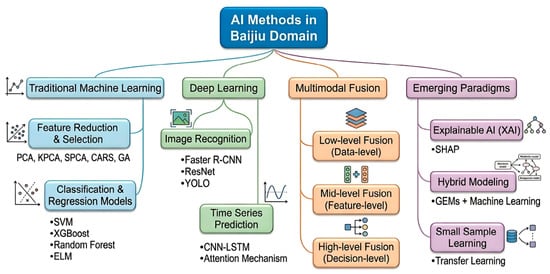
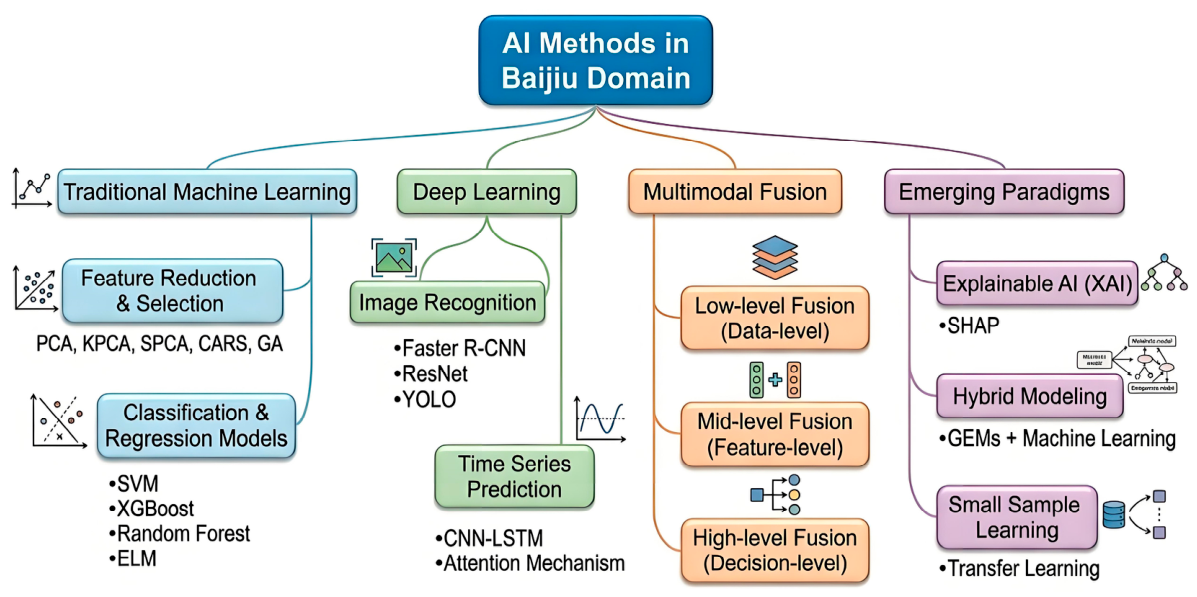
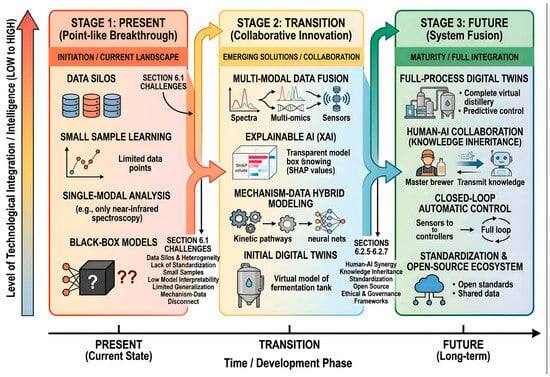
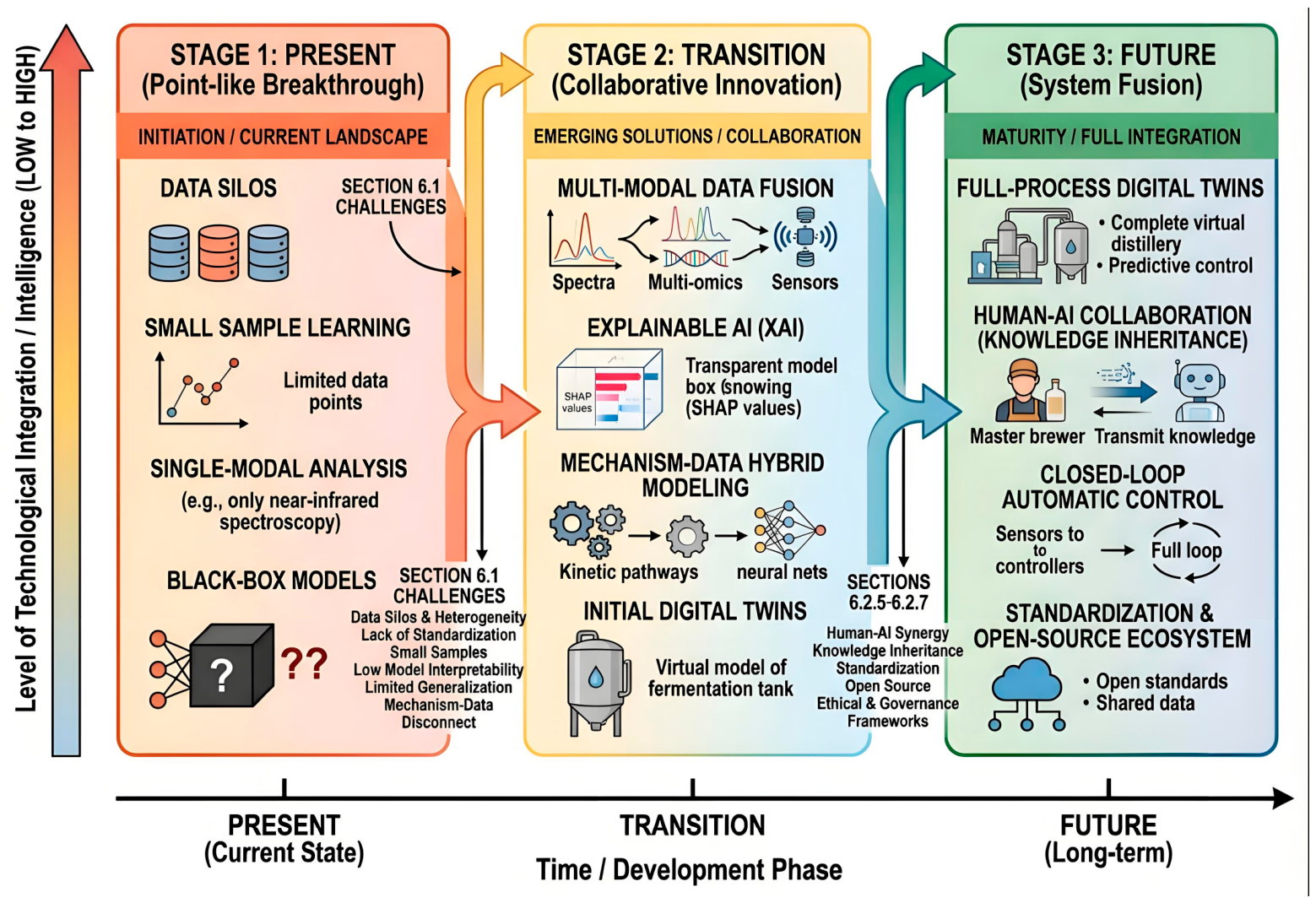
Disclaimer/Publisher’s Note: The statements, opinions and data contained in all publications are solely those of the individual author(s) and contributor(s) and not of MDPI and/or the editor(s). MDPI and/or the editor(s) disclaim responsibility for any injury to people or property resulting from any ideas, methods, instructions or products referred to in the content. |
© 2026 by the authors. Licensee MDPI, Basel, Switzerland. This article is an open access article distributed under the terms and conditions of the Creative Commons Attribution (CC BY) license.