Communication

Exogenous Carbohydrate Effects on Thermoadaptation and Thermostress in Ogataea parapolymorpha Under Different Carbon Sources


1
Department of Chemistry, Lomonosov Moscow State University, Moscow 119991, Russia
2
Institute of Medicine, RUDN University, Moscow 117198, Russia
*
Author to whom correspondence should be addressed.
Fermentation 2026, 12(4), 199; https://doi.org/10.3390/fermentation12040199
Submission received: 2 November 2025 / Revised: 30 March 2026 / Accepted: 13 April 2026 / Published: 16 April 2026
(This article belongs to the Section Yeast)

Abstract

Thermotolerant methylotrophic yeast Ogataea parapolymorpha is a promising host for high-temperature bioprocesses, yet the effects of carbon source and exogenous carbohydrates on their heat response remain poorly understood. We investigated how growth on glucose, glycerol, or methanol, short-term thermoadaptation (45 °C, 2 h), and supplementation with trehalose, sucrose, maltose, or xylose affect thermotolerance (55 °C, 30 min) and intracellular trehalose content. Thermoadaptation increased survival on all carbon sources and was accompanied by substantial trehalose accumulation in glucose- and glycerol-grown cells, but only minor trehalose accumulation in methanol-grown cells. Carbohydrate supplementation improved survival only in methanol-grown cultures. Under these conditions, trehalose, sucrose, and maltose increased intracellular trehalose levels, whereas xylose enhanced survival without a comparable increase in trehalose. These results show that the heat-stress response of O. parapolymorpha is strongly carbon source-dependent and that the protective effects of carbohydrate supplementation in methanol-grown cells cannot be explained by trehalose accumulation alone.

1. Introduction

Thermotolerant methylotrophic yeast Ogataea parapolymorpha is an attractive host in biotechnology for recombinant protein production and biofuel synthesis due to its ability to grow at temperatures up to 50 °C, its moderate glycosylation, and its utilization of diverse carbon sources, including methanol [1]. These traits make O. parapolymorpha promising hosts for high-temperature fermentation, which can reduce cooling costs, improve thermal efficiency, and suppress bacterial contamination [2].
In yeast, exposure to elevated temperatures induces a complex stress response, including the synthesis of heat shock proteins, remodeling of the cell wall, and accumulation of low-molecular-weight protective metabolites [3]. Among these metabolites, trehalose plays a central role as an osmoprotectant, chemical chaperone, radical scavenger, and readily mobilizable carbon reserve [4].
Numerous studies have demonstrated the relationship between trehalose content and yeast survival under various stresses. In Saccharomyces cerevisiae, deletion of trehalase increases resistance to freezing, saline, and ethanol stress [5,6,7]. In Hansenula polymorpha (Ogataea polymorpha), deletion of acid trehalase results in higher trehalose accumulation, increased thermotolerance, and enhanced ethanol production from xylose [8]. High extracellular trehalose concentrations (20%) enable Zygosaccharomyces rouxii to grow at elevated temperatures despite low intracellular trehalose, with concomitant accumulation of xylitol and glycerol [9]. In Kluyveromyces marxianus, trehalose levels are higher than in S. cerevisiae under identical conditions, which may contribute to its greater thermotolerance [10]. Comparative studies of methylotrophic and non-methylotrophic yeasts have revealed pronounced differences in trehalose accumulation depending on the carbon source [11].
Non-lethal heat exposure (heat-induced acquisition of thermotolerance, here referred to as “thermoadaptation”) is a well-known method to increase yeast survival under subsequent lethal temperatures (“thermostress”). In S. cerevisiae, thermoadaptation at 37 °C improves survival at 50 °C [12] and markedly alters the metabolite profile, with trehalose showing the largest change—its concentration increases several dozen-fold compared to growth at 28 °C [13]. In Candida albicans, incubation at 42 °C enhances survival at 52.5 °C and increases intracellular trehalose [14]. In H. polymorpha, deletion of TPS1 (encoding trehalose-6-phosphate synthase) abolishes thermoadaptation, confirming the importance of trehalose biosynthesis [15].
Despite extensive research on trehalose and heat adaptation in yeasts, several questions remain unresolved for O. parapolymorpha. In particular, it is still unclear how different carbon sources shape thermotolerance under acute heat stress and thermoadaptation, how strongly these responses are associated with intracellular trehalose accumulation, and whether exogenous carbohydrates can differentially modulate survival under these conditions. Previous studies have addressed related aspects of thermotolerance, carbon-source effects, and trehalose metabolism in different yeasts, but a direct comparison of these factors in O. parapolymorpha under a single experimental framework has not been performed.
Therefore, the aim of this study was to investigate how different carbon sources (glucose, glycerol, methanol), short-term thermoadaptation, and supplementation with trehalose, sucrose, maltose, or xylose affect thermotolerance and intracellular trehalose content in O. parapolymorpha. Therefore, the aim of this study was to compare how growth on glucose, glycerol, or methanol, short-term thermoadaptation, and supplementation with trehalose, sucrose, maltose, or xylose influence thermotolerance and intracellular trehalose content in O. parapolymorpha.

2. Materials and Methods

2.1. Materials

Yeast extract (BD Difco, Franklin Lakes, NJ, USA), peptone from casein C/HSH (SERVA, Heidelberg, Germany), glucose (pure; Ruskhim, Moscow, Russia), agar for microbiology (Helicon, Moscow, Russia), ammonium sulfate ((NH4)2SO4; chemically pure; Diaem, Moscow, Russia), potassium dihydrogen phosphate (KH2PO4; >99.0%; Fluka, Morris Plains, NJ, USA), magnesium sulfate heptahydrate (MgSO4·7H2O; chemically pure; Chimmed, Moscow, Russia), calcium chloride dihydrate (CaCl2·2H2O; >99.0%; Fluka, Morris Plains, NJ, USA), sodium chloride (NaCl; chemically pure; Ruskhim, Moscow, Russia), boric acid (H3BO3; approx. 99%; Sigma-Aldrich, St. Louis, MO, USA), manganese sulfate pentahydrate (MnSO4·5H2O; pure; Ruskhim, Moscow, Russia), zinc sulfate (ZnSO4; analytical grade; Ruskhim, Moscow, Russia), iron sulfate (FeSO4; analytical grade; Ruskhim, Moscow, Russia), ammonium heptamolybdate ((NH4)6Mo7O24; analytical grade; Ruskhim, Moscow, Russia), potassium iodide (KI; analytical grade; Ruskhim, Moscow, Russia), copper sulfate (CuSO4; analytical grade; Ruskhim, Moscow, Russia), biotin (>99%; Fluka, Morris Plains, NJ, USA), L-leucine (for cell culture; PanEco, Moscow Region, Russia), glycerol (USP grade; PanReac, Barcelona, Spain), methanol (chemically pure; Chimmed, Moscow, Russia), trehalose (98%; Energy Chemical, Shanghai, China), sucrose (PanReac, Barcelona, Spain), maltose monohydrate (>99%; Energy Chemical, Shanghai, China), xylose (98%; Energy Chemical, Shanghai, China), trichloroacetic acid (99%; Ruskhim, Moscow, Russia), and ethyl acetate (chemically pure; Chimmed, Moscow, Russia).

2.2. Cell Growth and Media

The yeast strain Ogataea parapolymorpha DL-1 (taxid 871575) was used in this study. Cells from a fresh YPD (10 g/L yeast extract, 20 g/L peptone, 20 g/L glucose) agar plate were inoculated into liquid YPD and grown for 10–12 h at 37 °C. Cultures were then transferred to YNB medium containing 1% (w/v) glucose, 1% (v/v) glycerol, or 1% (v/v) methanol as the sole carbon source, and incubated at 37 °C until an optical density at 600 nm (OD600), measured using a UV-1800 spectrophotometer (Shimadzu, Kyoto, Japan) or a NanoDrop OneC spectrophotometer (Thermo Fisher Scientific, Waltham, MA, USA), of 0.3–0.5 was reached, after which thermoadaptation and thermostress experiments were performed. YNB medium contained (per liter): 5 g (NH4)2SO4, 1 g KH2PO4, 1 g MgSO4, 0.1 g CaCl2, 0.1 g NaCl, 10 mg H3BO3, 8 mg MnSO4, 8 mg ZnSO4, 4 mg FeSO4, 4 mg (NH4)6Mo7O24, 2 mg KI, 0.8 mg CuSO4, 0.04 mg biotin, and 0.12 mg L-Leu.

2.3. Thermoadaptation and Thermostress

Thermoadaptation (TA) was performed by incubating cultures at 45 °C in a water bath for 2 h, while thermostress (TS) was applied by incubation at 55 °C for 30 min. Control samples were kept at 37 °C. In all cases, temperature treatment was stopped by rapid cooling on ice. To test the effect of carbohydrates on survival, trehalose, sucrose, and maltose (each at 1.4%, 40 mM), or xylose (1.4%, 90 mM), were added to the cultures 30 min before the start of thermostress. These concentrations were selected as moderate supplementation levels for testing short-term physiological effects without introducing a major osmotic component, and corresponded to approximately equal mass concentrations of the supplemented carbohydrates. Cell survival was assessed by preparing serial dilutions (OD600 = 0.5, 0.05, 0.005, 0.0005) and spotting 5 μL onto YPD agar plates.
For intracellular carbohydrate analysis, experiments were conducted under four temperature regimens: control incubation at 37 °C (K), thermoadaptation alone (TA2), thermoadaptation followed by thermostress (TA2/TS), and thermostress alone (TS). In control cultures, carbohydrates were added 30 min before sampling. In TA2, cells were incubated at 45 °C for 2 h with carbohydrate addition 30 min before the end of the treatment, and sampling was performed immediately after thermoadaptation. In TA2/TS, cells underwent the same thermoadaptation regimen followed by 30 min at 55 °C; carbohydrates were added 30 min before the end of thermoadaptation, and sampling was performed after thermostress. In TS alone, cells were shifted directly from 37 °C to 55 °C for 30 min; carbohydrates were added 30 min before the start of the heat exposure, and sampling was performed immediately afterward. The experimental workflow is illustrated in Figure S1.

2.4. Analysis of Carbohydrates

For carbohydrate analysis, 8 mL of culture was centrifuged at 8000 rpm for 1 min, washed with cold water, and centrifuged again under the same conditions. The pellet was resuspended in 400 μL of 10% trichloroacetic acid (TCA) and incubated on ice for 30 min, followed by centrifugation at 14,000 rpm for 5 min. The supernatant was extracted five times with 1 mL of fresh water-saturated ethyl acetate to remove TCA and hydrophobic cell debris. The aqueous phase was used for HPLC analysis.
HPLC was performed on a system consisting of a Knauer P 4.1 S pump and Knauer CT 2.1 column thermostat (KNAUER Wissenschaftliche Geräte GmbH, Berlin, Germany), aMidas 830 autosampler (Spark Holland B.V., Emmen, The Netherlands), an ERC RefractoMax 520 refractive index detector (ERC Inc./IDEX Health & Science, Kawaguchi, Saitama, Japan), and Clarity 8.8 software (DataApex Ltd., Prague, Czech Republic). Carbohydrate separation was carried out on a Waters Sugar-Pak I column (6.5 mm × 300 mm; Waters Corporation, Milford, MA, USA) at 80 °C using deionized water as the mobile phase at a flow rate of 0.4 mL/min. The refractometer cell was thermostated at 40 °C, and samples were kept in the autosampler at 10 °C for no longer than 12 h before injection. At least three independent biological replicates, prepared on different days, were analyzed for each condition.
Chromatographic peaks were processed in Clarity 8.8 (DataApex Ltd., Prague, Czech Republic). For overlapping peaks (trehalose/sucrose and trehalose/maltose), deconvolution was performed in OriginPro 9.1 (OriginLab Corporation, Northampton, MA, USA) using Gaussian fitting with constraints: full width at half maximum (FWHM) ≤ 0.5 and area > 0. Details of sample preparation optimization, retention times, calibration curves, and peak deconvolution examples are provided in the Supporting Information.

2.5. Statistical Analysis

Carbohydrate contents are presented as mean ± standard error of the mean (SEM). Descriptive statistics included the number of biological replicates (n), mean, standard deviation (SD), and SEM. Statistical significance of differences among groups was assessed by one-way analysis of variance (ANOVA) followed by Fisher’s multiple-comparison test. Pairwise differences were considered statistically significant at p < 0.05. Significance levels are indicated as follows: * p < 0.05, ** p < 0.01, and *** p < 0.001; p ≥ 0.05 was considered not significant. Statistical analysis and graphing were performed in OriginPro 9.1. Detailed descriptive statistics and one-way ANOVA results are provided in the Supporting Information.

3. Results and Discussion

3.1. Effect of Thermoadaptation on Cell Survival with Different Carbon Sources

The ability of prior exposure to sublethal temperatures (thermoadaptation) to enhance survival under subsequent lethal heat stress is well known and has been described for various yeast species [12,14,15]. We examined how the carbon source (1% glucose, 1% glycerol, or 1% methanol) influences the thermotolerance of O. parapolymorpha during direct thermostress and after thermoadaptation.
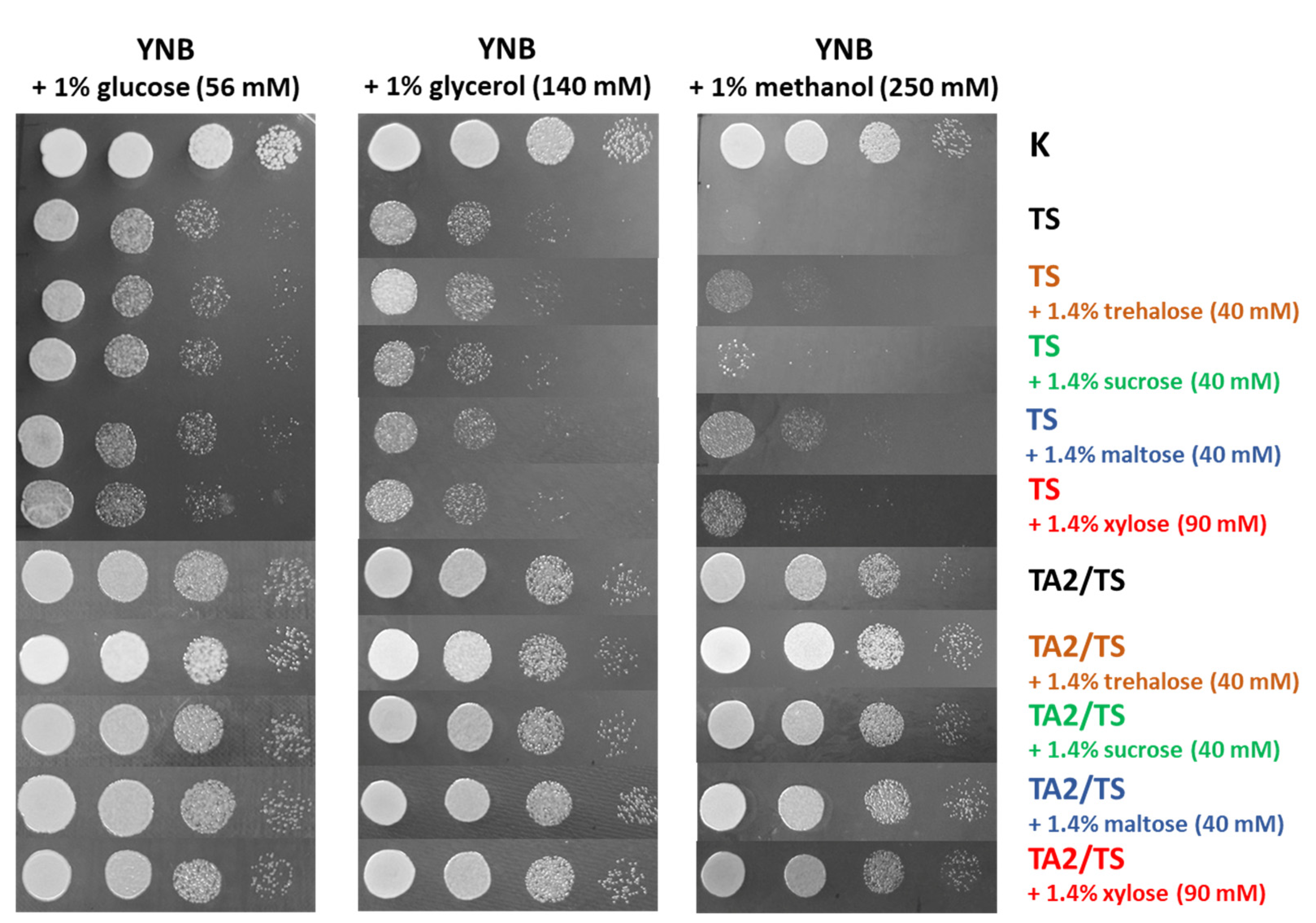
Incubation at 55 °C for 30 min (TS) was lethal for most cells. In contrast, prior incubation at 45 °C for 2 h (TA2) markedly increased survival regardless of the carbon source used (Figure 1 and Figure S4). The duration of thermoadaptation (1 h, 2 h, or two 1 h cycles separated by 1 h at 37 °C) had no significant effect on survival in glucose-grown cultures (Figure S4), and therefore the TA2 regimen was used in subsequent experiments.
Despite the protective effect of thermoadaptation, methanol-grown cells displayed lower absolute survival after heat treatment than glucose- or glycerol-grown cells. Supplementation with 40 mM trehalose, sucrose, or maltose, or 90 mM xylose, 30 min prior to thermostress did not affect survival on glucose or glycerol, but significantly improved it in methanol-grown cultures, both during direct thermostress and following thermoadaptation.

3.2. Effect of Thermoadaptation and Thermostress on Intracellular Trehalose Content

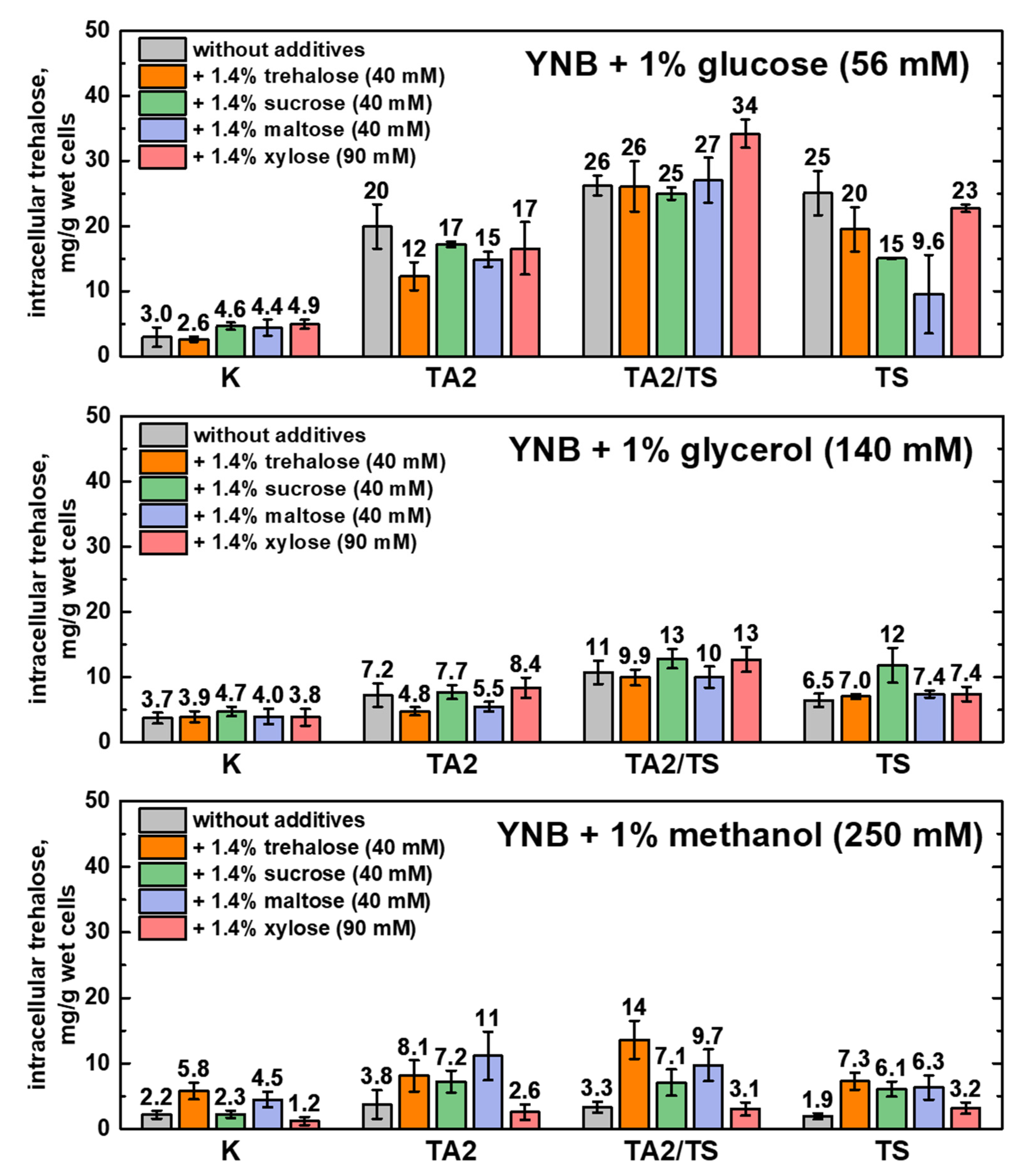
Trehalose is one of the key metabolites involved in protecting yeast cells from heat-induced damage [13,16]. We therefore measured its intracellular concentration in cells grown on different carbon sources and subjected to thermoadaptation or thermostress (Figure 2, Tables S2–S7).
In control cultures without additives, the basal intracellular trehalose level was approximately 3 mg/g of wet cells in glucose-grown cells, about 4 mg/g in glycerol-grown cells, and about 2 mg/g in methanol-grown cells. In glucose-grown cultures, both thermoadaptation and thermostress increased trehalose content to more than 20 mg/g of wet cells. In glycerol-grown cells, the level rose to approximately 10 mg/g. In methanol-grown cells, elevated temperatures caused only a minor increase, indicating limited heat-induced trehalose accumulation during growth on methanol. Thus, the extent of heat-induced trehalose accumulation depended strongly on the carbon source and was highest in glucose-grown cells, intermediate in glycerol-grown cells, and lowest in methanol-grown cells.
Comparable trehalose levels (>20 mg/g) have been reported for other yeasts, including S. cerevisiae [10,11]. However, despite similar intracellular concentrations, S. cerevisiae displays considerably lower stability at elevated temperatures compared to O. parapolymorpha. Thus, the difference in thermal stability between S. cerevisiae and O. parapolymorpha is unlikely to be explained by intracellular trehalose levels alone.
Trehalose accumulation strongly depends on growth phase, carbon source, and stress conditions, and may vary widely among yeast species. In [10,11], the closely related methylotrophic yeast Pichia angusta was shown to accumulate up to 12 mg/g of trehalose when grown on methanol, a level not observed in our experiments even under heat stress. This difference may be related to growth phase, since the published study used stationary-phase cells, whereas our experiments were performed with logarithmically growing cultures. However, the reason for this discrepancy cannot be determined from the available data and would require direct parallel experiments with different yeast species under identical conditions.
Interestingly, in our study, glucose- and glycerol-grown cultures exhibited high trehalose levels after thermostress alone, while cell survival remained low. This may reflect a “viable but nonculturable” state, in which cells retain metabolic activity but lose the ability to divide [17,18].

3.3. Effect of Carbohydrate Supplementation on Trehalose Content

Supplementation with trehalose, sucrose, maltose, or xylose 30 min before heat treatment did not alter trehalose content in glucose- or glycerol-grown cells under any temperature condition (Figure 2, Tables S2–S7). This corresponds to the absence of an effect of such supplementation on survival in these cultures.
In methanol-grown cells, the addition of trehalose, sucrose, or maltose increased trehalose levels during both thermoadaptation and thermostress. In contrast, xylose supplementation had no significant effect on intracellular trehalose levels, although it increased thermotolerance under these conditions. Thus, under methanol growth, the protective effect of xylose does not appear to be directly associated with increased trehalose accumulation.
An additional factor that may contribute to the lower thermotolerance of methanol-grown cells is the higher metabolic burden associated with methanol assimilation. In contrast to glucose or glycerol, methanol is utilized through a specific methylotrophic metabolic network tightly linked to formaldehyde detoxification and pentose phosphate pathway-dependent carbon rearrangements. Under acute heat stress, this may limit the efficient formation of trehalose precursors and increase the overall physiological cost of carbon assimilation. In this context, supplementation with exogenous carbohydrates may partially relieve this burden by providing carbon sources that are more readily incorporated into central metabolism and/or support stress adaptation.
At the same time, the stimulatory effects of sucrose and maltose on trehalose accumulation suggest that these carbohydrates are more readily connected to the formation of central carbon intermediates required for trehalose biosynthesis. By contrast, xylose may influence stress resistance through metabolic routes that are less directly coupled to trehalose formation. This interpretation is consistent with the close relationship between methanol metabolism and pentose phosphate/xylulose-5-phosphate-dependent pathways in methylotrophic yeasts [19].
Trehalose is thought to stabilize proteins and membranes during dehydration and heat damage, as well as to serve as a rapidly mobilizable carbon source [4,20]. However, its exact role during heat stress remains unclear. In O. parapolymorpha, deletion of the TPS1 gene encoding trehalose-6-phosphate synthase abolishes thermoadaptation [15]. In S. cerevisiae, growth defects at elevated temperatures caused by deletion of TPS1 or TPS2 (trehalose-6-phosphate phosphatase gene) cannot be rescued by trehalose accumulation [21]. Deletion of TPS2 increases survival upon trehalose addition both with and without thermoadaptation, whereas deletion of TPS1 eliminates this effect. These observations suggest that trehalose contributes to heat-stress resistance, but that its relationship to cell survival is more complex than a simple correlation with intracellular trehalose levels.

3.4. Intracellular Content of Supplemented Carbohydrates

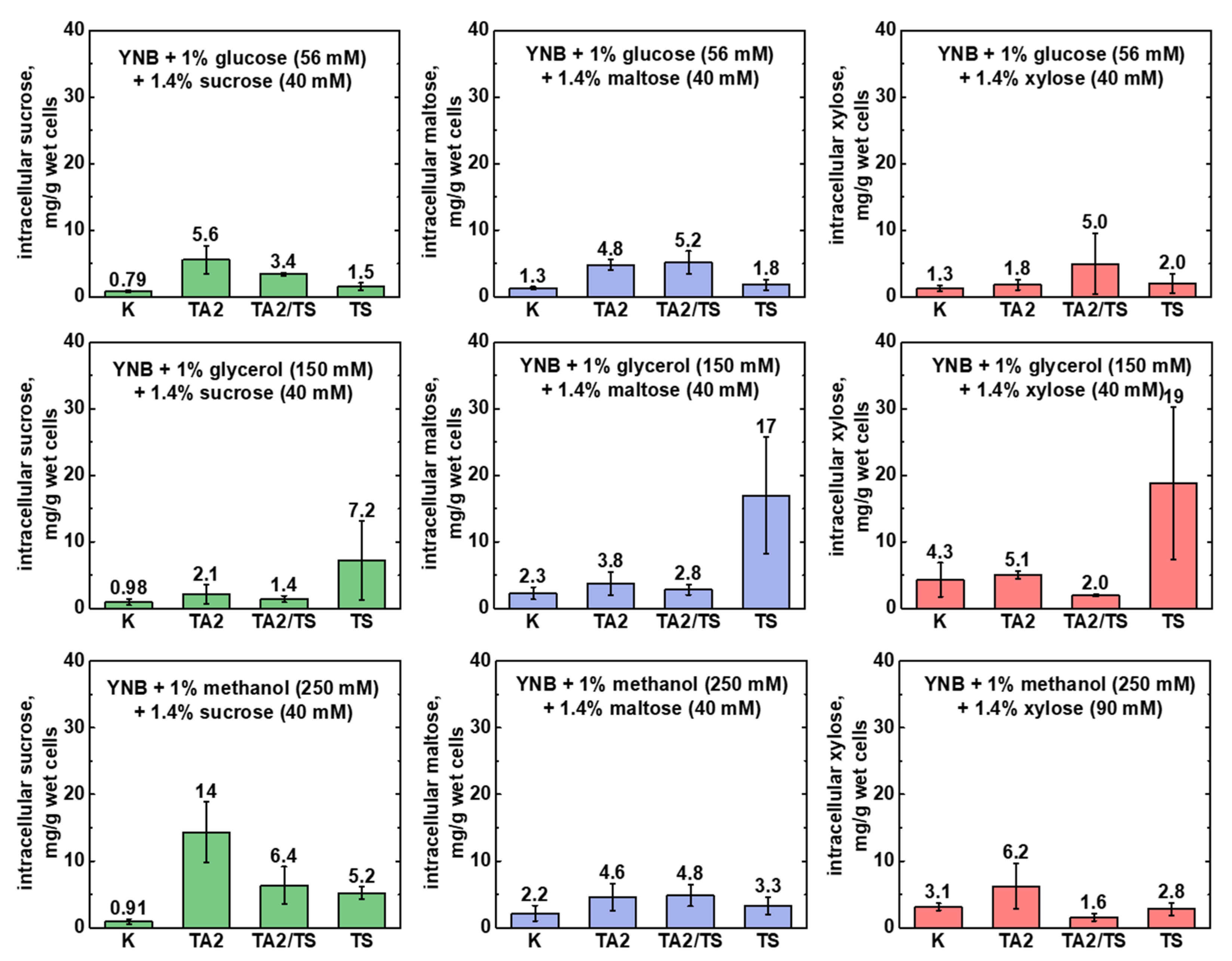
We analyzed the intracellular accumulation of exogenous carbohydrates after their addition to the cultures (Figure 3). Because these measurements showed substantial variability, only general trends can be discussed. No consistent pattern was observed in glucose-grown cells. In glycerol-grown cells, several carbohydrates showed higher mean values during thermostress, although the scatter between replicates was substantial. In methanol-grown cultures, sucrose displayed the highest recovered levels after heat treatment, whereas maltose and xylose remained comparatively low. Thus, the accumulation pattern of supplemented carbohydrates appears to depend on the carbon source and heat-treatment regime, but these data should be interpreted with caution.
In O. parapolymorpha, transport and hydrolysis of sucrose and maltose are mediated by maltose permeases and maltase, which are induced in the presence of these sugars [22,23,24,25]. Maltose permeases also transport trehalose and are noncompetitively inhibited by glucose [23]. In contrast to glucose, glycerol does not repress expression of the maltose utilization system [25] and is associated with increased intracellular maltase activity [22]. Switching to methanol strongly induces transcription of maltase and maltose permease genes as well as xylitol dehydrogenase and NADPH-dependent D-xylose reductase [19,26]. Taken together, these data suggest that methanol growth is accompanied by a broader remodeling of carbohydrate uptake and metabolism, which may contribute to the distinct effects of supplemented sugars observed in methanol-grown cultures.

4. Conclusions

This study shows that short-term thermoadaptation (45 °C for 2 h) markedly increases the survival of O. parapolymorpha during subsequent thermostress (55 °C for 30 min), regardless of the carbon source used for growth. At the same time, the magnitude of heat resistance depended strongly on the carbon source: glucose- and glycerol-grown cells survived heat treatment better than methanol-grown cells.
Heat-induced trehalose accumulation also depended on the carbon source and was highest in glucose-grown cells, intermediate in glycerol-grown cells, and lowest in methanol-grown cells. This pattern is consistent with the lower thermotolerance observed under methanol growth. However, the relationship between trehalose content and survival was not absolute, indicating that intracellular trehalose levels alone do not fully explain heat resistance in O. parapolymorpha.
Carbohydrate supplementation improved survival specifically in methanol-grown cultures. Trehalose, sucrose, and maltose increased intracellular trehalose levels under these conditions, whereas xylose enhanced thermotolerance without causing a comparable increase in trehalose. These findings suggest that the protective effects of supplemented carbohydrates in methanol-grown cells are not mediated solely by trehalose accumulation and may involve additional metabolic mechanisms.
Overall, the data reveal pronounced carbon source-dependent differences in the heat-stress response of O. parapolymorpha and indicate that carbohydrate supplementation may be a useful approach for improving the short-term heat resistance of methanol-grown cultures. Further work is required to clarify the metabolic basis of these effects and their potential relevance for methanol-based bioprocesses.

Supplementary Materials

The following supporting information can be downloaded at: https://www.mdpi.com/article/10.3390/fermentation12040199/s1, Figure S1: Experimental workflow for assessing the impact of carbohydrate supplementation on intracellular carbohydrate content; Figure S2: Calibration curves for trehalose, maltose, sucrose, and xylose (3.91–1000 μg injected): peak area vs. injected amount; Figure S3: Example of Gaussian deconvolution of overlapping trehalose and maltose peaks; Figure S4: Effect of thermoadaptation and thermostress on cell viability during growth on 1% glucose as the carbon source; Table S1: Parameters of calibration curves for trehalose, maltose, sucrose, and xylose (3.91–1000 μg injected), including LOD and LOQ values; Table S2: Descriptive statistics for intracellular trehalose content under different heat-treatment and carbohydrate-supplementation conditions in YNB + 1% glucose with or without supplementation of 40 mM trehalose, 40 mM sucrose, 40 mM maltose, or 90 mM xylose; Table S3: Pairwise significance matrix for comparisons among groups (strains K, TA2, TA2/TS, and TS grown in YNB + 1% glucose without additives and with supplementation of 40 mM trehalose (Tre), 40 mM sucrose (Suc), 40 mM maltose (Mal), or 90 mM xylose (Xyl); Table S4: Descriptive statistics for intracellular trehalose content under different heat-treatment and carbohydrate-supplementation conditions in YNB + 1% glycerol with or without supplementation of 40 mM trehalose, 40 mM sucrose, 40 mM maltose, or 90 mM xylose; Table S5: Pairwise significance matrix for comparisons among groups (strains K, TA2, TA2/TS, and TS grown in YNB + 1% glycerol without additives and with supplementation of 40 mM trehalose (Tre), 40 mM sucrose (Suc), 40 mM maltose (Mal), or 90 mM xylose (Xyl); Table S6: Descriptive statistics for intracellular trehalose content under different heat-treatment and carbohydrate-supplementation conditions in YNB + 1% methanol with or without supplementation of 40 mM trehalose, 40 mM sucrose, 40 mM maltose, or 90 mM xylose; Table S7: Pairwise significance matrix for comparisons among groups (strains K, TA2, TA2/TS, and TS grown in YNB + 1% methanol without additives and with supplementation of 40 mM trehalose (Tre), 40 mM sucrose (Suc), 40 mM maltose (Mal), or 90 mM xylose (Xyl); Figure S5: Uncropped images of glucose-grown O. parapolymorpha cells under thermoadaptation and thermostress with carbohydrate supplementation; Figure S6: Uncropped images of glycerol-grown O. parapolymorpha cells under thermoadaptation and thermostress with carbohydrate supplementation; Figure S7: Uncropped images of methanol-grown O. parapolymorpha cells under thermoadaptation and thermostress with carbohydrate supplementation.

Author Contributions

Conceptualization, D.G., A.R., V.T. and D.A.; methodology, D.G., A.R. and D.A.; investigation, D.G., A.R., A.Y., D.M. and D.A.; resources, D.A. and V.T.; writing—original draft preparation, D.A.; writing—review and editing, D.G. and D.A.; visualization, D.A.; project administration, D.A. All authors have read and agreed to the published version of the manuscript.

Funding

This research was funded by RUDN University, project № 030540-0-000.

Institutional Review Board Statement

Not applicable.

Informed Consent Statement

Not applicable.

Data Availability Statement

The raw data supporting the conclusions of this article will be made available by the authors on request.

Acknowledgments

The authors acknowledge the Lomonosov Moscow State University Development Program and RUDN University Development Program.

Conflicts of Interest

The authors declare no conflicts of interest.

Abbreviations

The following abbreviations are used in this manuscript:
TAThermoadaptation
TSThermostress
YPDYeast extract peptone dextrose medium
YNBYeast nitrogen base
HPLCHigh-performance liquid chromatography
FWHMFull width at half maximum
TCATrichloroacetic acid

References

  1. Manfrao-Netto, J.H.C.; Gomes, A.M.V.; Parachin, N.S. Advances in Using Hansenula polymorpha as Chassis for Recombinant Protein Production. Front. Bioeng. Biotechnol. 2019, 7, 94. [Google Scholar] [CrossRef]
  2. Pattanakittivorakul, S.; Kumakiri, I.; Nutaratat, P.; Hara, M.; Yokota, M.; Murata, M.; Kosaka, T.; Thanonkeo, P.; Limtong, S.; Yamada, M. High-Temperature Fermentation and Its Downstream Processes for Compact-Scale Bioethanol Production. Fuels 2024, 5, 857–867. [Google Scholar] [CrossRef]
  3. Ribeiro, R.A.; Bourbon-Melo, N.; Sa-Correia, I. The cell wall and the response and tolerance to stresses of biotechnological relevance in yeasts. Front. Microbiol. 2022, 13, 953479. [Google Scholar] [CrossRef] [PubMed]
  4. Kuczynska-Wisnik, D.; Stojowska-Swedrzynska, K.; Laskowska, E. Intracellular Protective Functions and Therapeutical Potential of Trehalose. Molecules 2024, 29, 2088. [Google Scholar] [CrossRef] [PubMed]
  5. Kim, J.; Alizadeh, P.; Harding, T.; Hefner-Gravink, A.; Klionsky, D.J. Disruption of the yeast ATH1 gene confers better survival after dehydration, freezing, and ethanol shock: Potential commercial applications. Appl. Environ. Microbiol. 1996, 62, 1563–1569. [Google Scholar] [CrossRef] [PubMed]
  6. Bandara, A.; Fraser, S.; Chambers, P.J.; Stanley, G.A. Trehalose promotes the survival of Saccharomyces cerevisiae during lethal ethanol stress, but does not influence growth under sublethal ethanol stress. FEMS Yeast Res. 2009, 9, 1208–1216. [Google Scholar] [CrossRef]
  7. Garre, E.; Perez-Torrado, R.; Gimeno-Alcaniz, J.V.; Matallana, E. Acid trehalase is involved in intracellular trehalose mobilization during postdiauxic growth and severe saline stress in Saccharomyces cerevisiae. FEMS Yeast Res. 2009, 9, 52–62. [Google Scholar] [CrossRef]
  8. Ishchuk, O.P.; Voronovsky, A.Y.; Abbas, C.A.; Sibirny, A.A. Construction of Hansenula polymorpha strains with improved thermotolerance. Biotechnol. Bioeng. 2009, 104, 911–919. [Google Scholar] [CrossRef]
  9. Xiao, X.; Liu, Q.; Zhang, Q.; Yan, Z.; Cai, D.; Li, X. Exogenous Trehalose Assists Zygosaccharomyces rouxii in Resisting High-Temperature Stress Mainly by Activating Genes Rather than Entering Metabolism. J. Fungi 2024, 10, 842. [Google Scholar] [CrossRef]
  10. Matsumoto, I.; Arai, T.; Nishimoto, Y.; Leelavatcharamas, V.; Furuta, M.; Kishida, M. Thermotolerant Yeast Kluyveromyces marxianus Reveals More Tolerance to Heat Shock than the Brewery Yeast Saccharomyces cerevisiae. Biocontrol Sci. 2018, 23, 133–138. [Google Scholar] [CrossRef]
  11. Turkel, S. Comparative analysis of glycogen and trehalose accumulation in methylotrophic and nonmethylotrophic yeasts. Mikrobiologiia 2006, 75, 737–741. [Google Scholar] [CrossRef]
  12. Sanchez, Y.; Lindquist, S.L. HSP104 required for induced thermotolerance. Science 1990, 248, 1112–1115. [Google Scholar] [CrossRef]
  13. Strassburg, K.; Walther, D.; Takahashi, H.; Kanaya, S.; Kopka, J. Dynamic transcriptional and metabolic responses in yeast adapting to temperature stress. OMICS J. Integr. Biol. 2010, 14, 249–259. [Google Scholar] [CrossRef]
  14. Arguelles, J.C. Thermotolerance and trehalose accumulation induced by heat shock in yeast cells of Candida albicans. FEMS Microbiol. Lett. 1997, 146, 65–71. [Google Scholar] [CrossRef]
  15. Reinders, A.; Romano, I.; Wiemken, A.; De Virgilio, C. The thermophilic yeast Hansenula polymorpha does not require trehalose synthesis for growth at high temperatures but does for normal acquisition of thermotolerance. J. Bacteriol. 1999, 181, 4665–4668. [Google Scholar] [CrossRef]
  16. Postaru, M.; Tucaliuc, A.; Cascaval, D.; Galaction, A.I. Cellular Stress Impact on Yeast Activity in Biotechnological Processes—A Short Overview. Microorganisms 2023, 11, 2522. [Google Scholar] [CrossRef] [PubMed]
  17. Millet, V.; Lonvaud-Funel, A. The viable but non-culturable state of wine micro-organisms during storage. Lett. Appl. Microbiol. 2000, 30, 136–141. [Google Scholar] [CrossRef] [PubMed]
  18. Xiao, Y.; Wang, J.; Sun, P.; Ding, T.; Li, J.; Deng, Y. Formation and resuscitation of viable but non-culturable (VBNC) yeast in the food industry: A review. Int. J. Food Microbiol. 2025, 426, 110901. [Google Scholar] [CrossRef]
  19. van Zutphen, T.; Baerends, R.J.; Susanna, K.A.; de Jong, A.; Kuipers, O.P.; Veenhuis, M.; van der Klei, I.J. Adaptation of Hansenula polymorpha to methanol: A transcriptome analysis. BMC Genom. 2010, 11, 1. [Google Scholar] [CrossRef] [PubMed]
  20. Jonsson, O.; Lundell, A.; Rosell, J.; You, S.; Ahlgren, K.; Swenson, J. Comparison of Sucrose and Trehalose for Protein Stabilization Using Differential Scanning Calorimetry. J. Phys. Chem. B 2024, 128, 4922–4930. [Google Scholar] [CrossRef]
  21. Gibney, P.A.; Schieler, A.; Chen, J.C.; Rabinowitz, J.D.; Botstein, D. Characterizing the in vivo role of trehalose in Saccharomyces cerevisiae using the AGT1 transporter. Proc. Natl. Acad. Sci. USA 2015, 112, 6116–6121. [Google Scholar] [CrossRef]
  22. Viigand, K.; Tammus, K.; Alamae, T. Clustering of MAL genes in Hansenula polymorpha: Cloning of the maltose permease gene and expression from the divergent intergenic region between the maltose permease and maltase genes. FEMS Yeast Res. 2005, 5, 1019–1028. [Google Scholar] [CrossRef] [PubMed]
  23. Viigand, K.; Visnapuu, T.; Mardo, K.; Aasamets, A.; Alamae, T. Maltase protein of Ogataea (Hansenula) polymorpha is a counterpart to the resurrected ancestor protein ancMALS of yeast maltases and isomaltases. Yeast 2016, 33, 415–432. [Google Scholar] [CrossRef] [PubMed]
  24. Agaphonov, M.; Romanova, N.; Choi, E.S.; Ter-Avanesyan, M. A novel kanamycin/G418 resistance marker for direct selection of transformants in Escherichia coli and different yeast species. Yeast 2010, 27, 189–195. [Google Scholar] [CrossRef]
  25. Viigand, K.; Alamae, T. Further study of the Hansenula polymorpha MAL locus: Characterization of the alpha-glucoside permease encoded by the HpMAL2 gene. FEMS Yeast Res. 2007, 7, 1134–1144. [Google Scholar] [CrossRef] [PubMed]
  26. Ravin, N.V.; Eldarov, M.A.; Kadnikov, V.V.; Beletsky, A.V.; Schneider, J.; Mardanova, E.S.; Smekalova, E.M.; Zvereva, M.I.; Dontsova, O.A.; Mardanov, A.V.; et al. Genome sequence and analysis of methylotrophic yeast Hansenula polymorpha DL1. BMC Genom. 2013, 14, 837. [Google Scholar] [CrossRef]
Figure 1. Effect of carbohydrate supplementation on the survival of O. parapolymorpha cells under thermoadaptation and thermostress. K—cells incubated at 37 °C; carbohydrates were added 30 min before analysis. TA2/TS—cells after thermoadaptation at 45 °C for 2 h followed by thermostress at 55 °C for 30 min; carbohydrates were added 30 min before the end of thermoadaptation. TS—cells exposed to thermostress at 55 °C for 30 min; carbohydrates were added 30 min before heat exposure. Uncropped images are provided in Figures S5–S7.
Fermentation 12 00199 g001
Figure 2. Effect of carbohydrate supplementation, thermoadaptation, and thermostress on intracellular trehalose content in O. parapolymorpha. K—cells incubated at 37 °C; carbohydrates were added 30 min before analysis. TA2—cells after thermoadaptation at 45 °C for 2 h; carbohydrates were added 30 min before the end of thermoadaptation. TA2/TS—cells after thermoadaptation at 45 °C for 2 h followed by thermostress at 55 °C for 30 min; carbohydrates were added 30 min before the end of thermoadaptation. TS—cells exposed to thermostress at 55 °C for 30 min; carbohydrates were added 30 min before heat exposure. Measurements were performed immediately after each treatment. Error bars indicate standard error of the mean. Experimental scheme shown in Figure S1.
Fermentation 12 00199 g002
Figure 3. Intracellular content of supplemented carbohydrates in O. parapolymorpha cells under thermoadaptation and thermostress. K—cells incubated at 37 °C; carbohydrates were added 30 min before analysis. TA2—cells after thermoadaptation at 45 °C for 2 h; carbohydrates were added 30 min before the end of thermoadaptation. TA2/TS—cells after thermoadaptation at 45 °C for 2 h followed by thermostress at 55 °C for 30 min; carbohydrates were added 30 min before the end of thermoadaptation. TS—cells exposed to thermostress at 55 °C for 30 min; carbohydrates were added 30 min before heat exposure. Error bars indicate standard error of the mean. Experimental scheme shown in Figure S1.
Fermentation 12 00199 g003
Disclaimer/Publisher’s Note: The statements, opinions and data contained in all publications are solely those of the individual author(s) and contributor(s) and not of MDPI and/or the editor(s). MDPI and/or the editor(s) disclaim responsibility for any injury to people or property resulting from any ideas, methods, instructions or products referred to in the content.