Article

Valorization of Brewer’s Spent Grains via Aspergillus oryzae Solid-State Fermentation: Production of Lignocellulolytic Enzymes for Biorefinery Applications


by
Anahid Esparza-Vasquez
,
Sara Saldarriaga-Hernandez
,
Rosa Leonor González-Díaz
,
Tomás García-Cayuela
and
Danay Carrillo-Nieves
*
Tecnologico de Monterrey, Escuela de Ingeniería y Ciencias, Av. General Ramón Corona 2514, Nuevo México, Zapopan 45138, Jalisco, Mexico
*
Author to whom correspondence should be addressed.
Fermentation 2026, 12(4), 197; https://doi.org/10.3390/fermentation12040197

Submission received: 14 March 2026 / Revised: 8 April 2026 / Accepted: 9 April 2026 / Published: 14 April 2026
(This article belongs to the Special Issue Valorization of Food Waste Using Solid-State Fermentation Technology)

Abstract

Brewer’s spent grain (BSG) is an abundant lignocellulosic by-product whose valorization can support circular bioeconomy strategies. This study evaluated BSG bioconversion by Aspergillus oryzae ATCC 10124 under solid-state fermentation (SSF) to produce lignocellulolytic enzymes and release second-generation (2G) sugars relevant to biorefinery applications. SSF was monitored over 0–10 days, and FPase, endo-cellulase, β-glucosidase, xylanase, mannanase, amylase, and ligninolytic enzyme activities were quantified. Enzymatic crude extracts were further assessed in SDS-PAGE analysis. Glucose, cellobiose, xylose and arabinose release and consumption were tracked throughout fermentation, and substrate transformation was supported by FTIR. The secretome exhibited a predominantly hydrolytic profile, with maximal hemicellulolytic and cellulolytic activity around days 2–4, as well as sustained amylase activity. Ligninolytic activity was not detected. Sugar profiles indicated rapid early hydrolysis of glucose, followed by progressive pentose release. The stabilization and decline were consistent with fungal uptake. Changes in the carbohydrate fingerprint and SDS–PAGE banding supported structural polysaccharide remodeling and hydrolytic protein secretion. Thus, this SSF platform confirmed certain potential for low-cost cellulolytic and hemicellulolytic enzyme generation. However, because sugar accumulation was temporary and followed by consumption, this system is best interpreted as a biological pretreatment and enzyme-generation step that supports subsequent downstream valorization.

1. Introduction

Brewer’s spent grains (BSGs) represent a significant and abundant agro-industrial residue, highlighting the need for sustainable valorization strategies to convert this waste into value-added products [1]. As the brewing industry continues to grow, the volume of BSG generated increases, presenting both environmental challenges and economic opportunities. If not properly managed, the accumulation of BSG poses potential environmental risks, including greenhouse gas emissions from decomposition and land-use issues related to disposal [2]. The abundance of this residue also presents a unique opportunity for resource recovery and circular economy principles [2].
BSG is primarily composed of cellulose, hemicellulose, lignin, proteins, and lipids, in addition to vitamins, minerals, polyphenols and amino acids [1,3]. This complex composition makes BSG a potentially valuable resource for various applications but also presents challenges in terms of efficient processing and utilization. Traditional uses of BSG have been limited to low-value applications, such as animal feed, but there is a growing interest in exploring more innovative and higher-value uses for this abundant waste stream [4,5].
Filamentous fungi have emerged as promising microorganisms for enzyme production and biomass transformation [6,7]. Aspergillus sp. can produce a wide range of lignocellulolytic enzymes, making it particularly suitable for the bioconversion of complex substrates such as BSG [8,9]. These enzymes play a crucial role in breaking down the lignocellulosic components of BSG, potentially unlocking its value for various applications [5]. Aspergillus oryzae is widely recognized for its robust growth on diverse substrates and its ability to secrete high levels of extracellular enzymes, characteristics that make it a suitable organism for large-scale industrial bioprocessing [10,11]. Furthermore, fermentation of BSG with A. oryzae has been reported to increase its protein content, a result attributed to the accumulation of fungal biomass during the process [12]. This bioconversion not only enhances the nutritional quality and overall value of BSG, thereby improving its potential as a feed ingredient for both animal and human consumption, but also yields hydrolytic enzymes that can be subsequently employed in saccharification processes [3,6,13,14].
The reported lignocellulolytic enzyme system produced by Aspergillus sp. includes cellulases, hemicellulases, and lignin-modifying enzymes [15]. Cellulases break down cellulose into glucose monomers, while hemicellulases act on the structurally diverse hemicelluloses, which are primarily composed of C5 sugar polymers such as xylans, mannans, and arabinogalactans. Lignin-modifying enzymes, such as laccases and oxidative peroxidases, loosen lignin structure and facilitate access to cellulose and hemicellulose. Nevertheless, these enzymes are less prevalent in A. oryzae compared to, for instance, white-rot fungi [15,16]. Overall, the synergistic action of these enzymes enables efficient deconstruction of the complex BSG matrix. Enzymes from A. oryzae have significant potential for biorefinery applications [7,17]. They can be used in saccharification processes to break down complex carbohydrates into simpler sugars for biofuel production, addressing the demand for renewable energy [18]. These enzymes also contribute to biomaterial development and offer alternatives to petroleum-based products, with applications in food processing, textile manufacturing, and paper production [1,18,19]. In BSG valorization, enzymatic treatment produces fermentable sugars convertible into high-value products through microbial fermentation, including organic acids, bioplastics, and biochemicals [20]. The residual solid fraction can be used in biocomposites or as soil amendment, ensuring comprehensive BSG utilization [4].
Although enzyme production by Aspergillus spp. under solid-state fermentation has been widely reported, comparatively fewer studies have systematically coupled time-resolved profiles of key lignocellulolytic activities on BSG with functional saccharification outcomes, particularly focusing on the release dynamics of second-generation sugars that validate the practical deconstruction and application potential of this system, particularly under low-input conditions without nutrient supplementation.
Therefore, the specific objective of this work was to evaluate BSG valorization via A. oryzae SSF by quantifying soluble protein, alongside with cellulolytic and hemicellulolytic enzyme activity dynamics as indicators of extractable hydrolytic fractions, to further link these activity trends to BSG saccharification performance through the release profile of mono- and disaccharides relevant to biorefinery applications. The findings have the potential to benefit the brewing industry, the biorefinery sector, and efforts toward a circular bioeconomy. Successfully valorizing BSG could lower waste disposal costs, generate new revenue streams, and reduce the environmental impact of brewing. Moreover, demonstrating efficient fungal deconstruction of this matrix supports its future use as an upgraded substrate for additional bioproducts, including microbial biomass ingredients such as mycoprotein, and provides a transferable framework for valorizing other lignocellulosic waste streams within sustainable biomanufacturing.

2. Materials and Methods

2.1. Raw Material Preparation

The BSG was obtained from Cervecería Cielito Lindo (Guadalajara, Mexico). Fresh BSG was collected immediately after lautering, spread in a thin layer on aluminum trays, and dried in a forced-air convection oven (Huitai, Shanghai, China, DHG-9075A) at 45 °C for 24 h to constant mass. The dried material was milled in a commercial grinder (NutriBullet®, Los Angeles, CA, USA) and sieved to 1.0 mm particle size.

2.2. Biomass Characterization

Biomass characterization was determined in accordance with National Renewable Energy Laboratory (NREL) protocols for lignocellulosic biomass handling and analysis [21]. Briefly, total solids (NREL/TP-510-42621), ash (NREL/TP-510-42622), solvent-extractives (NREL/TP-510-42619) and structural carbohydrates and lignin (NREL/TP-510-42618) were measured. Protein was determined by the Kjeldahl method (AOAC Official Method 979.09). All values are reported on a dry-matter basis and represent triplicate determinations. This BSG lot was characterized and employed in a previous study [7], and was determined to be constituted in a dry basis by cellulose (37.47 ± 1.38%), hemicellulose (8.74  ±  0.34%), lignin (17.48 ± 0.49%), protein (19.66 ± 0.80%), water-soluble extractives (24.24 ± 0.17%) and ethanol-soluble extractives (1.26  ±  2.14%), ash (2.80  ±  0.19%) and moisture (4.47  ±  0.28%).

2.3. Microorganism and Cultivation Conditions

Aspergillus oryzae (ATCC 10124) was routinely cultivated on potato dextrose agar (PDA) plates at 30 °C for 7 d until sporulation. Spores were harvested by flooding and scraping the plates with sterile 0.01% (v/v) Tween 80. The spore concentration in the resulting solution was determined using a Neubauer cytometer.

2.4. Lignocellulolytic Enzyme Production via Solid-State Fermentation (SSF)

Solid-state fermentation (SSF) systems were established as proposed by Escaramboni et al. (2022) [22]. A total of 10 g of BSG was weighed in individual jars with perforated lids to allow gas exchange (Supplementary Material, Figure S1). Initial moisture and pH were adjusted to 65% and 5.3, respectively, by adding 50 mM sodium citrate buffer prior to autoclave sterilization at 121 °C for 20 min. Systems were thoroughly mixed to avoid clumps before inoculation with 1 × 10⁶ spores/g substrate of A. oryzae. In parallel, uninoculated jars were kept under identical conditions as abiotic substrate controls. Triplicate systems were kept in incubation for 10 days at 30 °C with five recovery points over days 0, 2, 4, 6, 8 and 10, through the crude extraction protocol described in the following section (2.5. Enzymatic crude extraction).

2.5. Enzymatic Crude Extraction

Crude enzyme extracts were obtained for downstream enzymatic assays and Sodium dodecyl sulfate–polyacrylamide gel electrophoresis (SDS-PAGE) by modifying the procedure described by [23]). For each sample, sodium citrate buffer (pH 4.8) was added at a 3:1 liquid-to-solid ratio, along with protease inhibitor (Cat# A32965, Thermo Fisher Scientific, Waltham, MA, USA). The mixture was shaken at 25 °C and 200 rpm for 30 min using an oscillatory shaker (SHKE4000, Thermo Fisher Scientific), then transferred to 50 mL conical tubes and centrifuged at 900× g for 30 min. The resulting supernatant contained the extracted enzymes and was used for further analysis.

2.6. Enzymatic Activity Kinetics

2.6.1. Total Protein Quantification and SDS-PAGE Profiling

Protein concentration was determined by the Bradford assay [24] with bovine serum albumin (BSA) as a standard. For electrophoretic profiling, the protein in extracts was partially purified by cold acetone precipitation in a 1:6 sample-to-solvent ratio. Residual acetone was removed under vacuum using a SpeedVac™ DNA130 system (Thermo Fisher Scientific). The dried protein pellet was then processed in Laemmli buffer and resolved by SDS-PAGE following [25]. Gels were run in a Mini-PROTEAN® Tetra Cell (Bio-Rad, Waltham, MA, USA) with 1× Tris-Glycine-SDS running buffer at 120 V for 60 min. A BLUeye Prestained Protein Ladder (5–250 kDa; Sigma-Aldrich, St. Louis, MO, USA, Cat. #94964) served as the reference. Equal amounts of 30 µg per lane of total protein were loaded for each sample, as determined by the Bradford assay. After electrophoresis, gels were stained with QC Colloidal Coomassie (Bio-Rad), rinsed with distilled water, and imaged on a Universal Hood II Gel Documentation System (Bio-Rad).

2.6.2. Enzymatic Assays

Enzyme production during SSF was first evaluated through qualitative screening to rapidly identify enzymatic activities expressed by the cultures. These assays were performed as described by Gutiérrez-Soto et al. (2015) [26], Carrillo-Nieves et al. (2022) [18], and Saldarriaga-Hernandez et al. (2025) [7]. Substrate concentrations were selected to ensure adequate media solubility and clear halo visualization rather than to compare activities quantitatively across enzymes. Briefly, plates were prepared with a basal medium containing 0.1% (w/v) peptone, 0.01% (w/v) yeast extract, and 1.6% (w/v) agar, and were individually supplemented with diverse target substrates. Carboxymethylcellulose (CMC) was included at 2% (w/v) to screen for cellulolytic activity, birchwood xylan at 1% (w/v) for xylanase, citrus peel pectin at 0.5% (w/v) for pectinase, and soluble starch at 1% (w/v) for amylase. Oxidative activity was assessed on plates containing 0.2 mM ABTS and with CuSO4 (15 mM) as a laccase-indicator system.
Subsequently, enzyme production was quantitatively assessed in liquid extracts obtained from the SSF cultures to determine the level of enzymatic activity, following Ghose (1987) [27]. For cross-timepoint comparison, volumetric activities (FPU/mL or U/mL) were additionally normalized to the soluble protein concentration of each crude extract to obtain specific activities (U/mg protein). This normalization was applied uniformly to all enzyme classes and is the basis for the specific-activity values. Complete assay conditions and calculation formulas are provided in Saldarriaga-Hernandez et al. (2025) [7].
Cellulose-Degrading Enzymes
FPase (exoglucanase, EC 3.2.1.74) activity was evaluated following the NREL filter-paper assay (NREL/TP-510-42628 [27]), with reducing sugars measured by DNS at 540 nm [28]. Activities were initially calculated as FPU/mL, considering the enzyme concentration that releases 2 mg of glucose under the test conditions as per [27]. Endoglucanase (EC 3.2.1.4) was assessed with the CELLG5 kit (K-CELLG5, Megazyme, Wicklow, Ireland) [29], modified with the inclusion of blanks by adding the stop solution added before the sample. Activity was expressed as U/mL, where one unit corresponds to the enzyme amount releasing 1 µmol of 4-nitrophenolate per minute at 40 °C. β-Glucosidase (EC 3.2.1.21) was measured through the β-Glucosidase Activity Assay Kit (MAK129, Sigma-Aldrich/Merck, St. Louis, MO, USA) [30] and activity was expressed as U/mL, where one unit is defined as the amount of enzyme hydrolyzing 1 μmol substrate per minute at pH 7.0.
Hemicellulose-Degrading Enzymes
Xylanase (endo 1,4 -beta -xylanase EC 3.2.1.8) activity was measured using the EnzChek® Ultra Xylanase Assay Kit (Cat# E33650, Invitrogen, Waltham, MA, USA) as described by Ghosh et al. (2019) [31]. Samples were read against a standard curve from Trichoderma viride xylanase (X3876, Sigma-Aldrich); one unit equaled 1 μmol of substrate hydrolyzed per minute. Mannanase (β-1,4-mannanase EC 3.2.1.78) activity was assessed by measuring reducing sugars released from locust bean gum through the DNS method [27,28].
Lignin-Degrading Enzymes
Peroxidase (EC 1.11.1.7) activity was quantified with the Sigma MAK092 kit, along with minor modifications after Johnson & Choi (2021) [32]. Horseradish peroxidase (HRP; MAK092D) was employed as a positive control. Activities were initially estimated as U/mL, where 1 U reduces 1 µmol H2O2/min at 37 °C. As described by Agrawal and Verma (2019) [33], laccase (EC 1.10.3.2) activity was assayed with an 2,2′-Azino-bis(3-ethylbenzthiazoline-6-sulfonic acid (ABTS) solution (Roche Diagnostics, Mannheim, Germany). Absorbance at 420 nm was recorded every 10 s for 3 min, and the maximal slope was considered to calculate enzymatic activity.
α-Amylase Activity
α-Amylase activity was determined using the Ceralpha method with the α-Amylase Assay Kit (K-CERA, Megazyme, Bray, Ireland). Absorbance at 400 nm was recorded and activities were calculated from ΔA400 with blank and dilution corrections and calculated initially as U/mL. One unit is defined as the enzyme amount that releases 1 µmol of p-nitrophenol per minute from blocked p-nitrophenyl malto-oligosaccharide substrate under the assay conditions.

2.7. Kinetics of Reducing Sugar Release

Sugar concentrations were determined using high-performance liquid chromatography (HPLC; Waters® 1220 e2695, Milford, MA, USA) equipped with a refractive index detector (RID). Chromatographic separation was performed on a Bio-Rad Aminex HPX-87H column (300 × 7.8 mm, 9 μm particle size) maintained at 50 °C. The mobile phase consisted of 5 mM sulfuric acid (H2SO4), delivered at a constant flow rate of 0.5 mL/min, with a total analysis time of 30 min per sample [34].
Calibration curves were constructed using five concentration levels ranging from 1 to 20 g/L of analytical standards, including glucose, cellobiose, xylose and arabinose (Sigma-Aldrich/Merck, St. Louis, MO, USA). Quantification was performed based on peak area integration using the corresponding calibration curves.

2.8. Composition Analysis and FTIR of Biomass After Saccharification

Structural and compositional analyses of BSG were conducted to evaluate the changes induced after fungal growth and saccharification. All measurements were carried out in triplicate following the same NREL acid hydrolysis protocol described in Section 2.2 for structural carbohydrates and lignin determination (NREL/TP-510-42618) [34].
Fourier transform infrared (FTIR) spectroscopy was used to identify structural modifications and changes in functional groups in enzymatically treated BSG compared to raw biomass. Spectra were recorded over the range of 4000–400 cm−1 at a resolution of 4 cm−1, with 32 scans averaged per sample. Analyses were performed using a Bruker VERTEX 70/80 FTIR spectrometer (Billerica, MA, USA) equipped with an attenuated total reflectance (ATR) accessory.

2.9. Data Analysis

All experiments were performed in biological triplicate unless otherwise stated. Statistical analyses and figure preparation were carried out in RStudio v4.4.0, GraphPad Prism v10.0, and Minitab v17.1.0. For response variables such as soluble sugar and protein contents, as well as enzymatic titers, differences among groups were first assessed by analysis of variance (ANOVA) at a significance level of α = 0.05. Post hoc multiple-comparison tests were performed using Tukey’s honestly significant difference (Tukey HSD) to identify pairwise differences between levels. Normality and homoscedasticity assumptions of ANOVA were evaluated by inspection of residual diagnostics.

3. Results and Discussion

3.1. Brewers’ Spent Grains as a Substrate for Enzyme Production

Enzyme production in SSF is strongly influenced by both the physicochemical conditions of the process and the composition of the substrate. Compared with submerged cultures, physical conditions of SSF have been reported to enhance extracellular enzyme secretion [19,35,36,37]). Nonetheless, the substrate ultimately determines which enzymes are produced [38,39], particularly considering the molecular mechanisms under which enzyme secretion is induced in A. oryzae [40].
In this instance, BSG can be considered a balanced matrix to support microbial growth and bioproduct synthesis [41]. Although the physicochemical composition of the matrix varies with grain genotype, cultivation conditions, and brewing parameters [42], the analyzed lot showed the typical composition of this residue, characterized by a cellulose-dominant yet lignin-rich structure [43]. The hemicellulosic fraction of BSG is reported to be dominated by arabinoxylans, which, together with lignin, intertwine with cellulose to form complexes that may initially hinder enzyme access [44]. As fungal enzymatic hydrolysis proceeds, partial depolymerization releases lignin fragments and loosens this network, progressively improving access to carbohydrates and supporting enzyme induction [14]. Furthermore, the BSG lot exhibited a protein content of 19.66 ± 0.80%, in line with previous reports for this matrix [45]. This intrinsic nitrogen supports rapid fungal growth and enzymatic synthesis in SSF and reduces the need for external nitrogen supplementation [46]. Accordingly, biomass growth and enzymatic synthesis was achieved in this study with no external nitrogen supplementation.
Solvent extractives constituted an important part of the overall composition. This fraction may include phenolic compounds, fatty acids, organic acids and fermentable sugars that could be present within or on the surface of BSG particles [45]. Available sugars in BSG, among which maltose is particularly abundant [47,48], can elicit carbon catabolite repression (CCR) in fungal fermentation systems, where transcription of hydrolytic enzyme genes is repressed even when polymeric inducers are available [49,50]. As simple sugars are consumed and carbon becomes limiting, fungi typically upregulate carbohydrate-active enzymes involved in polysaccharide deconstruction [51]. Notably, although an initial supply of easily assimilable sugars in BSG could lead to CCR, it can prove to be advantageous for applications involving rapid fungal colonization and dense biomass growth (Supplementary Material, Figure S1), such as mycoprotein production [52].

3.2. Lignocellulolytic Enzyme Production and Activity

To obtain an initial, substrate-level view of the enzymatic potential induced by A. oryzae on BSG, extracellular activities were first screened using qualitative plate assays on polysaccharide-supplemented media (Table 1). Clear hydrolysis halos were observed for CMC, xylan, and pectin, indicating secretion of hydrolytic activities targeting cellulose- and hemicellulose-associated substrates. In the case of amylases, it should be considered that iodine is still able to form complexes with partially hydrolyzed products of starch, such as dextrins, which may relate to the clearance zones appearing weak [53,54]. In this sense, while this qualitative screening supported the presence of a broad hydrolytic repertoire relevant to BSG deconstruction, proper quantification was carried out in liquid extracts across SSF timepoints to identify hydrolytic activities.
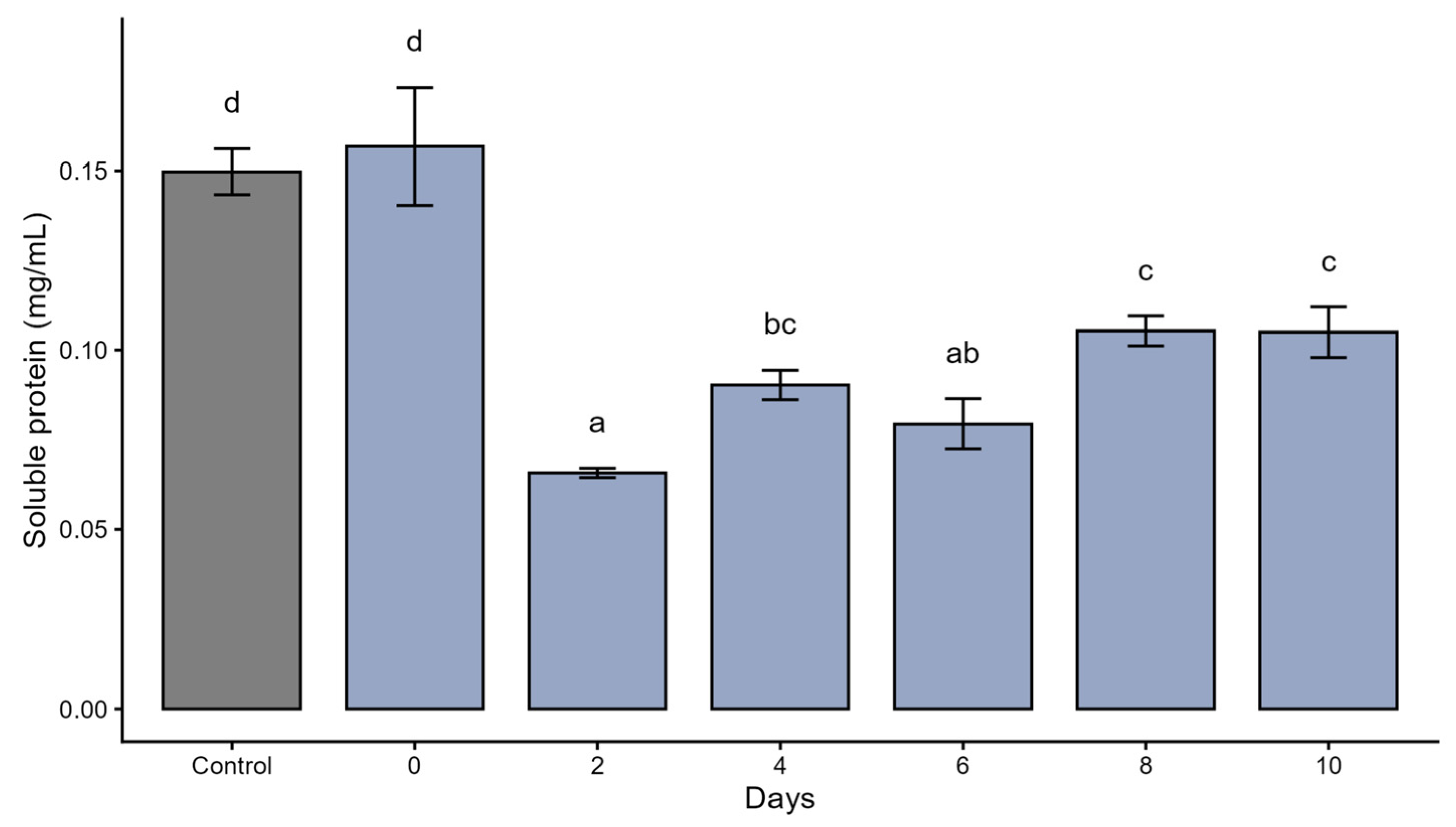
Further on, soluble protein content changed significantly across SSF timepoints (Figure 1). A sharp decrease was observed after inoculation, dropping from the initial substrate level (0.1495 ± 0.0072 mg/mL in control systems and 0.1567 ± 0.0093 mg/mL at day 0) to a minimum at day 2 (0.0658 ± 0.0013 mg/mL). Thereafter, soluble protein levels partially increased, but remained below the initial levels, with significant differences emerging among later timepoints, in a profile that points towards an early depletion of extractable substrate proteins followed by a gradual balance between fungal assimilation and the accumulation of soluble extracellular proteins during SSF.
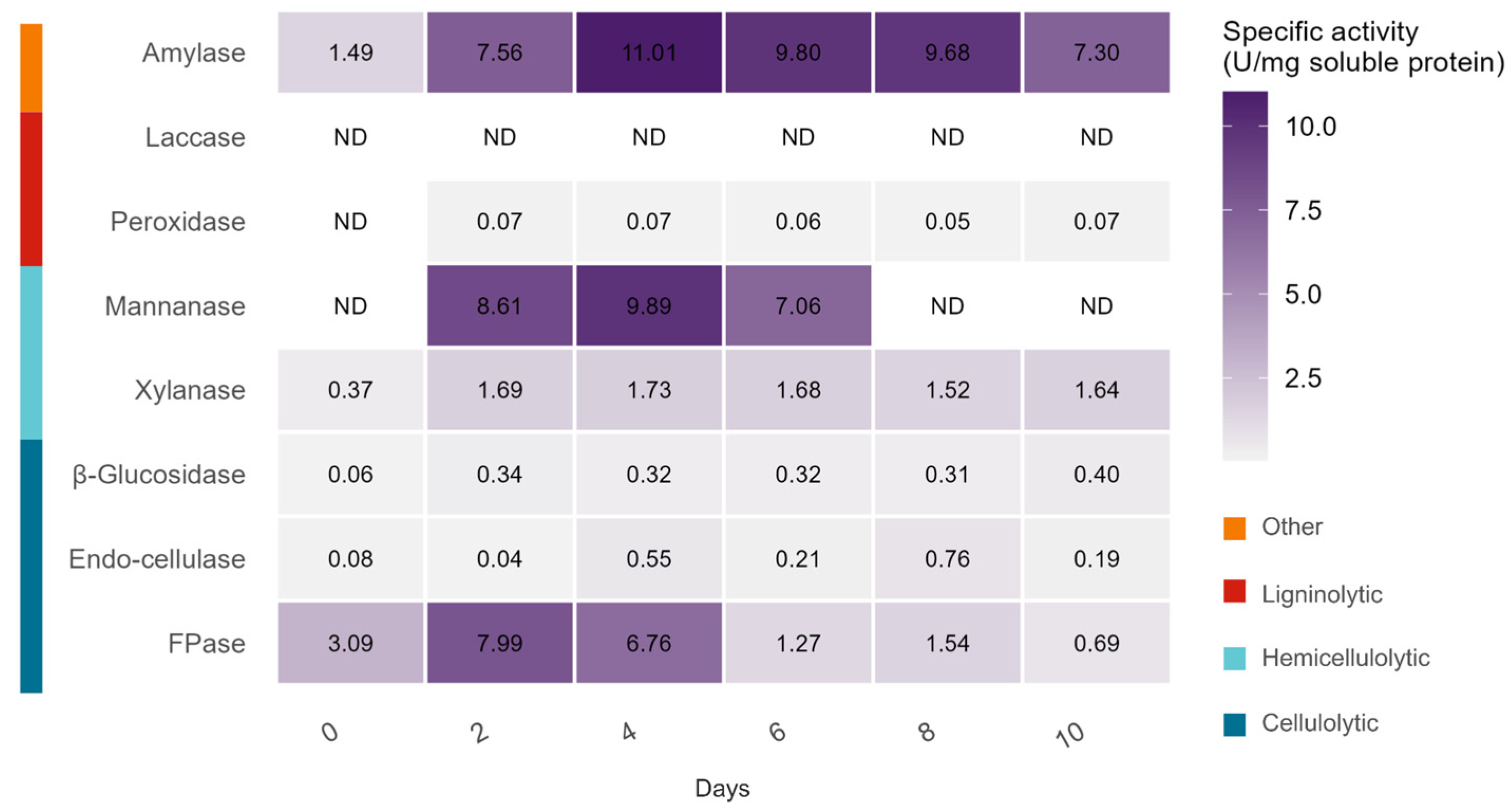
Bradford assay quantifies total soluble protein in the extract, which at early timepoints could likely represent a fraction of readily extractable peptides derived from BSG. During early SSF, these substrate-derived soluble proteins can decrease due to fungal assimilation, and, at the same time, metabolism can shift toward secretion of hydrolytic enzymes, increasing the relative contribution of enzymatic proteins within the remaining soluble fraction. In this sense, the sharp decline observed after two days of growth also corresponds with an increase in several enzyme-specific activities (Figure 2). These trends could suggest a transition phase in which readily extractable BSG proteins were depleted and fungal metabolism increasingly supported secretion of an extracellular enzymatic pool [46]. However, given that each enzyme activity in this study was quantified using detection chemistries, absolute comparisons across enzyme classes are not strictly equivalent [55]. In this sense, data is here interpreted through enzymatic time-course trends, with a focus on the identification of activities that show production and application potential under the evaluated SSF conditions. Further quantitative and qualitative enzyme data are provided in Figure S2, Tables S2–S7 (Supplementary Material).
Under this framework, the hydrolytic profile shows a clear early secretion burst dominated by amylase and hemicellulolytic and cellulolytic activities. Early amylase and β-mannanase pulses are observed, with their activities reaching maximums of 41 U/mg and 11 U/mg at days 2 and 4, respectively. Also, the cellulolytic module showed a strong early FPase peak that reached around 38 U/mg at day 2, which diminished thereafter. Endoglucanase remained consistently low, as well as β-glucosidase. In parallel, xylanase activity was moderate, alongside minimal ligninolytic signals.
This profile aligns with the well-known enzymatic capacity of A. oryzae, whose strong amylolytic activity justifies its long-standing use in traditional and industrial fermentations [40,49]. Although BSG is not a starch-rich substrate [41,45], α-amylase is regarded as a high-output enzyme and is often deployed early in fungal fermentations as part of a broader carbon-scavenging program [56]. In this species, an AmyR-regulated amylolytic system can be induced by soluble oligosaccharides derived from α-glucan, such as maltose, which activate the AmyR-dependent transcription of amylase and glucoamylase genes [49]. Because maltose and related dextrins can persist in BSG as residues derived from wort [47], early SSF conditions likely provided sufficient inducers to trigger α-amylase production despite the low bulk starch fraction. In this sense, previous SSF work on BSG suggests that A. oryzae can generate amylase activity on this substrate without readily available carbon source supplementation, which may actually lead to repression [57].
From an applied perspective, the α-amylase activity observed here is best interpreted as a supporting functional signal rather than the primary valorization target. In a BSG biorefinery context, amylase may contribute by supporting early fungal growth, to then lead to a broader secretion of polysaccharide-deconstruction enzymes. Studies aimed at industrial α-amylase production typically rely on starch-rich substrate and optimized conditions to achieve higher titers [58,59,60]. Given the established amylolytic capacity of A. oryzae and the nature of BSG, α-amylase activity was evaluated as a complementary output of this SSF system. While its presence provides context for the early hydrolytic profile of the crude extract, the main opportunity for enzyme production on a BSG system still points towards the co-production of hemicellulolytic and cellulolytic activities and their associated sugar-release performance.
Regarding cellulose conversion, the release of glucose from cellulose involves initial depolymerization by endo- and exoglucanases to cellobiose and soluble oligosaccharides, followed by β-glucosidase-mediated hydrolysis to glucose [61]. In comparative reports of Trichoderma breve grown on cassava peels, increases in β-glucosidase have been associated with rising reducing sugars, which can be interpreted as biomass saccharification through cellobiose clearance [62]. In the present study, β-glucosidase activity in the extractable fraction remained modest after day 2, whereas FPase exhibited a pronounced early maximum followed by a decline after day 6. This pattern might be indicative of early production, that could also be considered a potential extraction period in which cellulolytic enzymes are most strongly produced or most easily recovered under the SSF conditions here evaluated.
Considering BSG as an arabinoxylan-rich matrix, xylanase activity is expected to remain functionally relevant during SSF by removing hemicellulosic barriers that limit cellulose accessibility [44]. Although xylan is the dominant hemicellulosic fraction, β-mannanase can still be expressed during growth on complex lignocellulosic substrates because hemicellulase induction is often coordinated and not strictly proportional to the abundance of a single polymer. In this manner, the pronounced early β-mannanase pulse observed here coincided with other hydrolytic activities, such as xylanase and Fpase. This suggests a coordinated secretion program, rather than an isolated response for each enzyme. This pattern that aligns with reports of cross-induction of mannanase during cellulose utilization in filamentous fungi [63] and with the A. oryzae ManR regulatory system, in which mannanase is co-regulated with other polysaccharide-deconstruction enzymes, including glucanases [64]. Taken together, these trends support the coordinated expression of hemicellulases and cellulases during the depletion of readily available sugars, in line with broader carbon regulation networks, such as CCR in filamentous fungi [49,50,65].
On a broader note, lignified matrices such as BSG can reduce substrate accessibility and limit enzyme induction under standard SSF conditions. Enhanced ligninolytic secretion often requires specific inducers or supplements [38]. For instance, Vasudhevan et al. (2024) [66] induced laccase synthesis by A. oryzae on corn cobs through sucrose, copper, and yeast extract supplementation Therefore, under the baseline conditions evaluated here, this SSF system finds its primary potential in cellulolytic and hemicellulolytic enzymatic activity rather than oxidative delignification. Further enhancement of cellulolytic enzyme production from lignocellulosic substrates can nevertheless be achieved through complementary strategies such as mild alkaline pretreatment. Alkali disrupts the lignin barrier, improves carbohydrate accessibility, and in turn promotes higher cellulase synthesis and recovery during downstream bioprocessing [67,68].

3.3. SDS–PAGE Profiling of SSF Protein Extracts

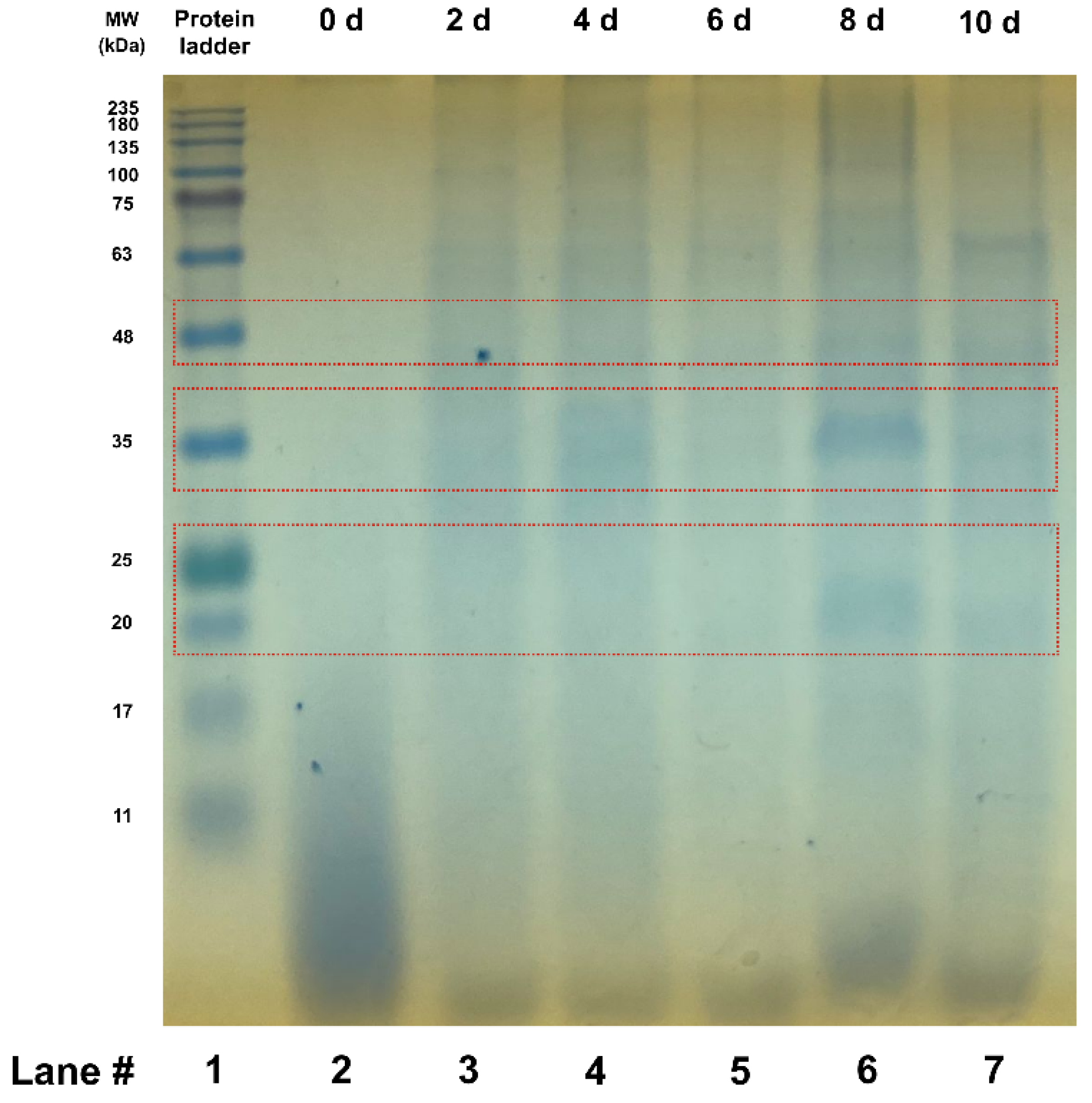
SDS–PAGE was used to visualize changes in the extracellular protein profile produced during A. oryzae SSF on BSG (Figure 3). Protein loading per lane was standardized to enable qualitative comparison of band patterns across fermentation timepoints, such that differences in band intensity primarily reflect shifts in the composition and relative abundance of secreted proteins rather than loading effects. In this sense, results show a dynamic pattern of bands, with relatively faint staining at early stages and a more defined profile at later timepoints. Notably, the day 8 sample exhibits the most pronounced banding, with stronger signals in the mid–low molecular weight region compared with earlier days.
It is worth mentioning that a crude fungal SSF secretome can exhibit multiple enzymes involved in lignocellulose deconstruction. However, SDS–PAGE alone only supports comparison of proteins in compatible MW ranges. For instance, some bands may reflect BSG barley proteins, such as hordeins [7]. For such reasons, given that enzyme identity cannot be confirmed by MW alone, further studies may seek to look into proteic profile examination through zymography or mass spectrometry for identification purposes [25,69].
For instance, in a range from 15 kDa to 250 kDa, Marđetko et al. (2021) [25] identified cellulase, endo-1,3(4)-β-glucanase, β-glycosidase, α-galactosidase, glucan 1,4-α-glucosidase, endo-1,4-β-xylanase and xyloglucanase, among others, through LC-ESI-MS analysis of SmF and SSF fungal cultures.
Another purification study of A. oryzae xylanase reported bands around 35 kDa, including fractions showing strong enrichment of this band, which could be interpreted as low-MW xylanases [70]. Furthermore, Aspergillus sp. tends to show bands related to cellulases across 20–50 kDa, with some strains exhibiting additional higher MW cellulase-active bands [69]. Furthermore, in an SSF-focused comparison of A. oryzae strains, a distinct band around 50 kDa observed broadly across strains was interpreted as α-amylase [19], where it was also reported that strains related to mixed grains fermentation tend to secrete a broader set of proteins than strains used over starch substrates, since mixed grains require cellulases and hemicellulases for saccharification.
It should be noted that industrial enzymatic cocktails are highly optimized in terms of strain selection, induction strategy, purification, and dosing, often using different substrates and production conditions, which indeed diminishes the large-scale applicability of enzymatic degradation [71,72]. Nevertheless, the present results demonstrate that A. oryzae can effectively use BSG to generate a lignocellulolytic secretome and support fungal biomass formation under SSF. Moreover, biomass growth appeared to be vigorous and may prove to be advantageous for further applications.

3.4. Effect of SSF on Biomass Saccharification

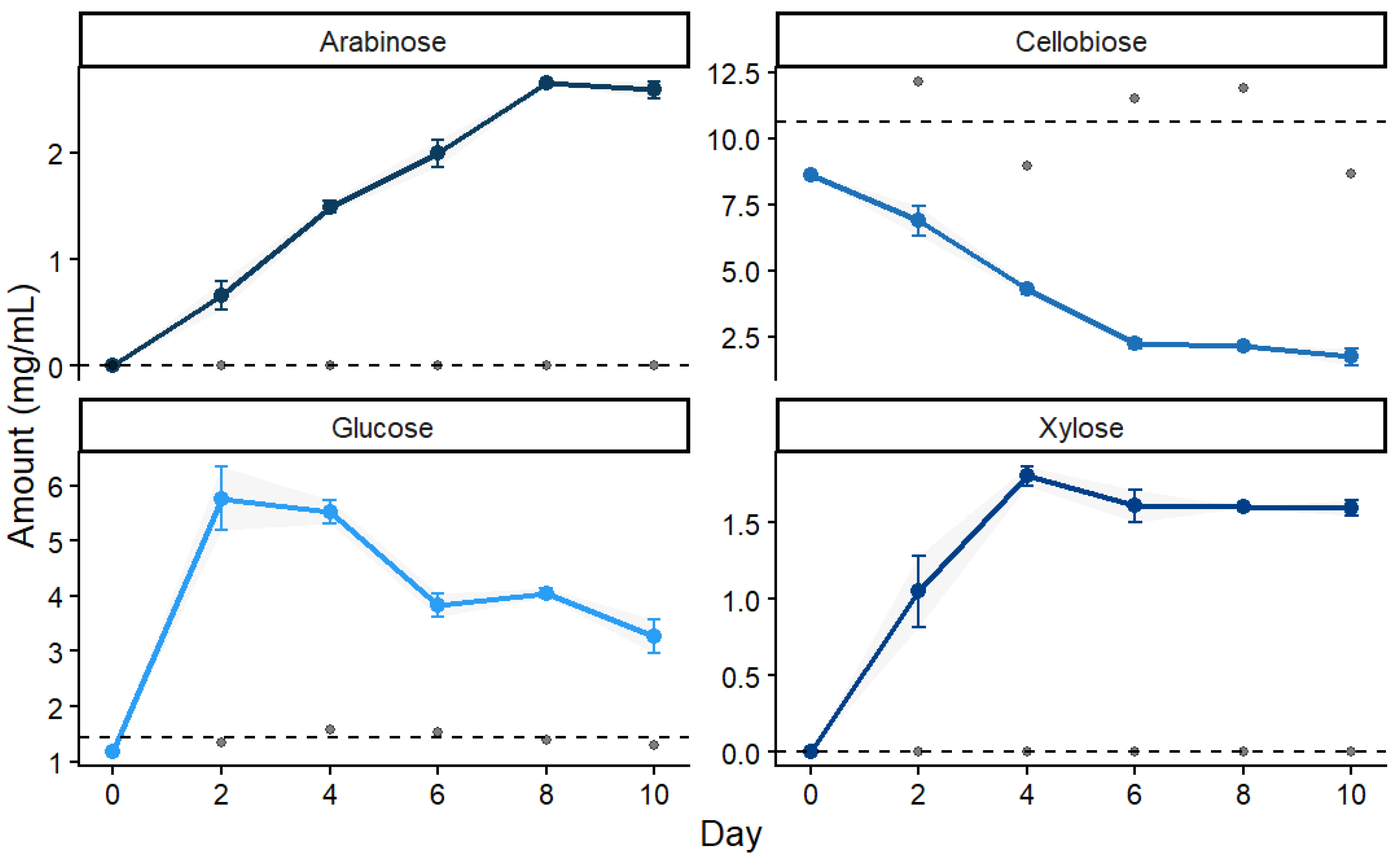
To evaluate the effect of A. oryzae fermentation of BSG into biomass saccharification and second-generation sugar release, soluble carbohydrates were quantified throughout SSF (Figure 4).
Compared with the uninoculated control baseline, the inoculated treatment showed time-dependent changes in all monitored carbohydrates, as a sign of fermentation promoting measurable release of sugars. The sharp rise in glucose, in conjunction with the accumulation of xylose and arabinose, marks an early hydrolytic phase in which readily accessible fractions of BSG are degraded. These domains most likely refer to water-soluble carbohydrates and the first accessible polysaccharides at the particle surface, such as α-glucans, amorphous cellulose regions [73], and exposed hemicellulose, possibly mannans [45,48]. A later phase in SSF (4–10 d) is then characterized by the depletion and consumption of preferred substrates. These trends are also supported by the enzymatic activity pulses previously discussed.
Mechanistically, in agreement with the detected cellulolytic activities, cellulose was likely degraded early into the process, and oligosaccharides, including cellobiose were generated in consequence. Glucose was rapidly released and consumed, as a preferred carbon source. In SSF, sugar kinetics typically simultaneously represent substrate hydrolysis and consumption. The progressive decline in cellobiose also suggests that soluble oligosaccharides were converted to glucose or assimilated [74]. The contrasting pentose kinetics are representative of arabinoxylan deconstruction. Arabinose increased throughout SSF, which could indicate continued cleavage of arabinose side chains from substituted xylans. On the contrary, xylose rose rapidly and then stabilized.
The accumulation of xylose suggests that arabinoxylan from hemicellulosic fractions of BSG were effectively solubilized during SSF. Considering carbon preference effects, the presence of metabolizable glucose, as observed here, can suppress or delay the metabolism of xylose or additional carbon sources [75,76]; even more since xylose catabolism requires additional conversion steps before entering central metabolism, as seen in fungi such as R. oryzae [77]. In this regard, xylose accumulation indicates that pentose sugars can transiently persist in the system while glucose is preferentially consumed. Xylose concentrations as observed here reflect release and simultaneous microbial uptake. Therefore, the present measurements cannot resolve whether A. oryzae actively catabolized xylose. Under this consideration, in the biorefinery concept explored here, the recovery of a pentose-enriched stream could be further studied, including the application of a mild alkaline pretreatment to disrupt lignin and enhance arabinoxylan solubilization [78]. Such an approach could improve overall second-generation sugar availability and broaden downstream valorization routes for xylose, including integration into xylitol or furfural production systems [79,80,81] or co-fermentation with organisms capable of fermenting xylose for potential biofuel obtention [78,82].
The SSF system demonstrates hydrolytic capability to liberate second-generation sugars from BSG from lignocellulosic deconstruction. However, because A. oryzae simultaneously consumes released sugars during SSF, concentrations are transient and do not represent maximum attainable yields. Thus, an alternative application of this system could be focused as a low-cost biological pretreatment and enzyme-generation step to enable downstream saccharification, rather than as a single-step process for sugar accumulation.
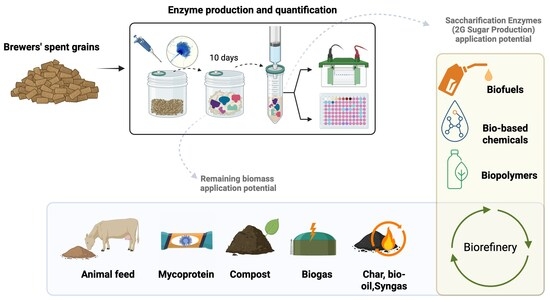
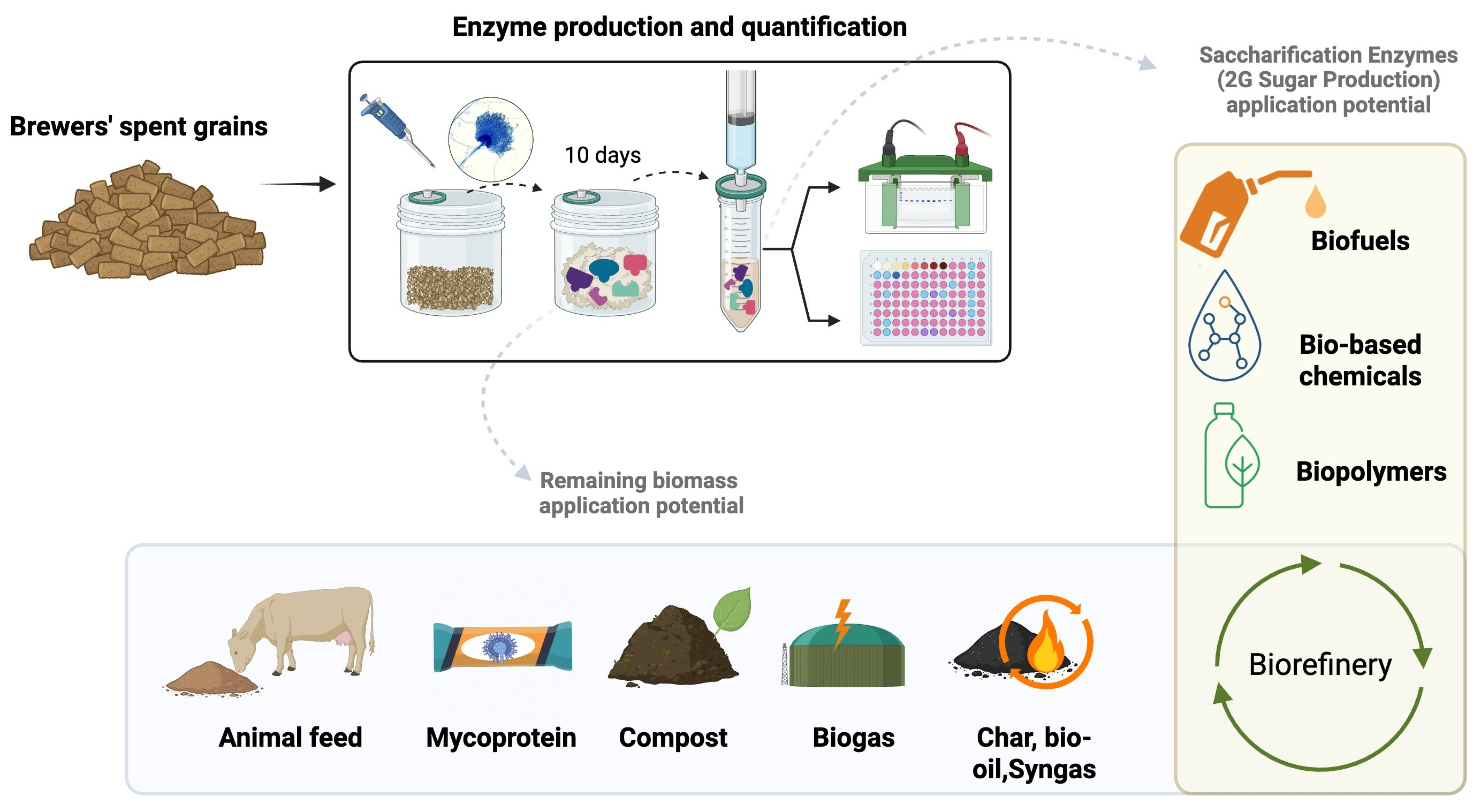
Potentially, this system can be viewed as a first-stage upgrading step in which BSG is converted into multiple recoverable streams. Following the recovery of an enzymatic extract, the fermented solids can serve as a mycelium-enriched by-product suitable for further evaluation as a mycoprotein ingredient for food or feed [83], particularly considering A. oryzae as a generally recognized as safe (GRAS) organism [84] widely recognized for its high yields of potentially edible protein on agro-waste [85]. Alternatively, as has been reported and could yet be further explored, the remaining biomass fractions may contain additional products such as organic acids that could be recovered or directly evaluated for their application as biofertilizers [86,87].

3.5. Structural and Compositional Changes in Biomass

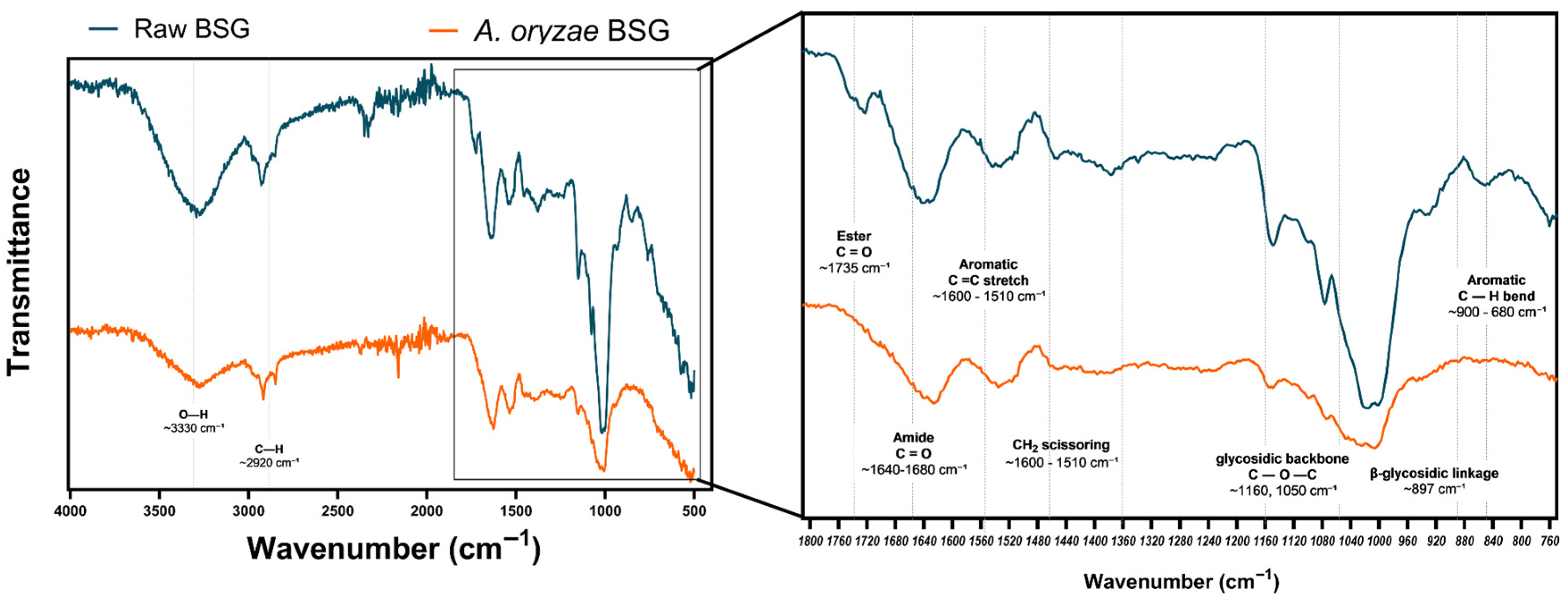
FTIR spectra were collected for control BSG and 10-day fermented BSG, as the timepoint expected to reflect the greatest extent of biomass deconstruction and chemical modification (Figure 5). In this regard, FTIR can support the identification of major lignocellulosic constituents and has been proven as sensitive to chemical changes in substrates of this kind [88].
Fingerprint features for lignocellulosic biomass are typically concentrated between 1000 and 2000 cm−1, while the 2000–2750 cm−1 region often shows smoother, less distinctive trends [89]. In this context, clear spectral differences were observed between raw and fermented BSG, as indicative of A. oryzae altering the lignocellulosic matrix and introducing signals associated with fungal biomass generation, in respect to the control.
A broad O–H stretch near 3330 cm−1 and C–H stretching around 2920 cm−1 are regarded as expected trends for lignocellulosic biomass [87,90]. In particular, the band near 1730–1740 cm−1 is consistent with C=O stretching of ester groups associated with hemicellulose, while vibrations of aromatic rings in lignin are typically observed around 1600 and 1510 cm−1 [87,88,91]. The marked region around 1200–900 cm−1, which features glycosidic backbone C–O–C vibrations (1160 and 1050 cm−1) and a β-glycosidic linkage band (893–898 cm−1), is expected in untreated BSG as a polysaccharide-rich matrix [91,92,93]. In this sense, fermented BSG exhibited notable changes in bands associated with polysaccharides. The observed reshaping of the glycosidic backbone bands, along with the enzymatic activity results, provide structural context for sugar release increase after fermentation and on the remodeling of cellulosic and hemicellulosic fractions, possibly due to changes in their relative contribution as the fungus consumes accessible fractions and accumulates its own biomass.
For instance, modifications near 1735 cm−1 are likewise indicators of hemicellulose degradation due to partial deacetylation and ester cleavage, as noted in previous studies for treated lignocellulosic matrixes [94,95]. Additionally, differences around the cellulose crystallinity band in the 1420–1430 cm−1 region, alongside changes near the amorphous band (893–898 cm−1) suggest that fermentation may have altered the relative order and accessibility of carbohydrate domains [60,93]. Finally, the 1700–1500 cm−1 region features contributions from lignin aromatics [96]. Thus, any fermentation-associated reshaping in this region could point towards slight lignin changes and the incorporation of fungal biomass signals. Nevertheless, it should be considered that FTIR analysis of lignocellulosic materials can show band shifts, limited reproducibility, and variable absolute intensities, and is therefore most reliable for assessing relative structural trends such as cellulose crystallinity [88]. Accordingly, the present comparison is interpreted as a qualitative assessment of structural changes.
The compositional analysis supports the structural trends suggested by FTIR and provides quantitative evidence of substrate remodeling during fermentation. In particular, a decrease in glucan content from 37.47 ± 1.38% in raw BSG to 28.06 ± 0.55% after fermentation indicates substantial consumption or transformation of cellulose-derived carbohydrates by A. oryzae. This observation aligns with the reshaping of bands associated with glycosidic linkages in the 1200–900 cm−1 region, which reflects modifications in polysaccharide backbones and the enzymatic breakdown of cellulose and hemicellulose structures. The modest increase in xylan content (8.74 ± 0.34% to 9.88 ± 0.16%) likely reflects a relative enrichment of hemicellulosic fractions as more readily accessible glucans are metabolized, rather than a true accumulation of xylan, which is consistent with the partial modification of the hemicellulose-associated carbonyl band around 1730–1740 cm−1.
Furthermore, the increase in both acid-soluble lignin (4.58 ± 0.02% to 5.77 ± 0.12%) and acid-insoluble lignin (12.90 ± 0.48% to 19.86 ± 0.01%) suggests a relative enrichment of lignin following carbohydrate consumption. This trend is commonly observed in biological pretreatment systems, where preferential utilization of polysaccharides increases the apparent proportion of recalcitrant aromatic components. Such enrichment may explain the subtle reshaping observed in the aromatic vibration region between 1700 and 1500 cm−1 in the FTIR spectra. Additionally, the increase in ash content (2.80 ± 0.19% to 6.74 ± 0.45%) and the reduction in protein (19.66 ± 0.80% to 15.29 ± 1.08%) likely reflect metabolic activity and fungal biomass turnover. The higher ash content may also result from a relative concentration of inorganic mineral components as fermentable carbohydrate fractions are consumed during fermentation.
Taken together, the compositional data reinforce the qualitative FTIR observations, indicating that solid-state fermentation with A. oryzae promotes partial depolymerization of carbohydrate fractions and relative enrichment of lignin-associated structures, while also introducing fungal-derived components. These results are consistent with the enzymatic profile observed during fermentation and support the role of A. oryzae in restructuring the lignocellulosic matrix toward enhanced accessibility of polysaccharides for downstream biorefinery applications.

4. Conclusions

This study demonstrates that A. oryzae can grow consistently on BSG under SSF and secrete a spectrum of lignocellulolytic enzymes. However, while enzyme production was detectable and reproducible, BSG alone under the evaluated conditions may not constitute a sufficiently strong inducer to achieve high titers of ligninolytic enzymes comparable to optimized industrial systems. The intrinsic recalcitrance of BSG, particularly its lignin fraction, likely limits enzyme induction and substrate accessibility in the absence of specific inducers or pretreatment strategies. Associated hydrolytic activities were detectable and aligned with progressive substrate modification and sugar release. While the present study confirms the feasibility of BSG valorization via A. oryzae SSF, several strategies are required to enhance industrial competitiveness. Increasing enzyme titers may involve mild alkaline or physicochemical pretreatment to improve substrate accessibility without generating inhibitory compounds. Additionally, metabolic engineering and synthetic biology tools could enable strain development tailored toward enhanced cellulolytic or ligninolytic secretion profiles. Reactor design and optimized fermentation parameters, including aeration, heat dissipation, and moisture control in solid-state systems could significantly increase growth and productivity. Process modeling and kinetic simulations may further aid in parameter optimization.
Nevertheless, from a biorefinery perspective, moderate enzyme production could be compensated if enzyme extraction is integrated with biomass upgrading rather than treated as an independent objective, since fungal colonization also promoted the structural modification of BSG.
Following enzyme extraction, the residual matrix remains enriched in fungal mycelium, dietary fiber, and partially hydrolyzed lignocellulosic fractions. This mycelium-enriched biomass can be considered a form of mycoprotein for human food applications or animal feed. In further food applications, composting of the residual solids could represent an alternative to reintegrate organic matter into agricultural systems. Furthermore, the spent fermentation matrix may be redirected toward bioenergy production, including bioethanol or biogas generation. Moreover, fungal-treated biomass presents potential as a feedstock for biopolymer development or biodegradable materials, considering fungal structural components such as chitin and glucans. In this sense, even if BSG-based SSF with A. oryzae does not independently yield concentrations of lignocellulolytic enzymes high enough for industrial application, its consistent fungal growth, biomass enrichment, and multi-pathway valorization potential justify its relevance within integrated revalorization schemes. Thus, the system should be interpreted as a modular platform adaptable to food, feed, bioenergy, and biomaterial production.

Supplementary Materials

The following supporting information can be downloaded at: https://www.mdpi.com/article/10.3390/fermentation12040197/s1. Figure S1. (A) SSF system inoculated with A. oryzae. (B) Colonized system after 10 d of growth. Figure S2. Plate qualitative enzyme screening on supplemented agar. Table S1. α-Amylase assay results. Table S2. Endoglucanase (CELLG5) assay results. Table S3. β-Glucosidase enzymatic activity assay results. Table S4. Xylanase assay results. Table S5. Mannanase assay results. Table S6. FPase assay results. Table S7. Total soluble protein.

Author Contributions

Conceptualization, S.S.-H. and D.C.-N.; methodology, A.E.-V., S.S.-H., R.L.G.-D. and D.C.-N.; formal analysis, A.E.-V. and S.S.-H.; investigation, S.S.-H.; resources, D.C.-N.; data curation, A.E.-V. and S.S.-H.; writing—original draft preparation, A.E.-V. and S.S.-H.; writing—review and editing, R.L.G.-D., T.G.-C. and D.C.-N.; supervision, T.G.-C. and D.C.-N.; project administration, D.C.-N.; funding acquisition, D.C.-N. All authors have read and agreed to the published version of the manuscript.

Funding

This study was supported by Secretaría de Innovación, Ciencia y Tecnología de Jalisco, Consejo Estatal de Ciencia y Tecnología de Jalisco (COECYTJAL), and Tecnológico de Monterrey through the Fondo de Desarrollo Científico de Jalisco para Atender Retos Sociales (FODECIJAL; Project 11028-2024) and the Ekhaga Foundation, Sweden (Grant 2024-60).

Institutional Review Board Statement

Not applicable.

Informed Consent Statement

Not applicable.

Data Availability Statement

The original contributions presented in this study are included in the article/Supplementary Material. Further inquiries can be directed to the corresponding author.

Acknowledgments

We acknowledge Tecnológico de Monterrey for providing the facilities, resources, and academic environment that supported this work. We also thank José María García-Rodríguez and Diego Villalvazo-García for their assistance in the methodological development of the experiments. We also thank the financial support provided to Anahid Esparza-Vasquez (CVU No. 1317916) and Sara Cristina Saldarriaga-Hernández (CVU No. 968429) from the National Scholarship Program (SECIHTI). During the preparation of this work, the authors used Biorender to make the graphical abstract, Paperpal 4.15.5 (Editage) and ChatGPT 5.4 (OpenAI) as tools to review the English grammar and readability of the manuscript. The authors carefully reviewed and edited the content as necessary and take full responsibility for the final version of the manuscript and its scientific accuracy. These tools were not employed to generate or alter scientific content or data in any way.

Conflicts of Interest

The authors declare no conflicts of interest.

Abbreviations

The following abbreviations are used in this manuscript:
BSGBrewer’s spent grain
SSFSolid-state fermentation
A. oryzaeAspergillus oryzae
FPaseFilter paper activity (total cellulase activity)
DNS3,5-dinitrosalicylic acid (assay)
FPUFilter paper units
ECEnzyme Commission number
FTIRFourier transform infrared spectroscopy
ATRAttenuated total reflectance
SDS–PAGESodium dodecyl sulfate–polyacrylamide gel electrophoresis
ABTS2,2′-azino-bis(3-ethylbenzothiazoline-6-sulfonic acid)
PDAPotato dextrose agar
HPLCHigh-performance liquid chromatography
CMCCarboxymethyl cellulose
GRASgenerally recognized as safe
MWMolecular weight
ANOVAAnalysis of variance

References

  1. Outeiriño, D.; Costa-Trigo, I.; Ochogavias, A.; Pinheiro de Souza Oliveira, R.; Pérez Guerra, N.; Salgado, J.M.; Domínguez, J.M. Biorefinery of brewery spent grain to obtain bioproducts with high value-added in the market. New Biotechnol. 2024, 79, 111–119. [Google Scholar] [CrossRef]
  2. Pasquet, P.-L.; Villain-Gambier, M.; Trébouet, D. By-Product Valorization as a Means for the Brewing Industry to Move toward a Circular Bioeconomy. Sustainability 2024, 16, 3472. [Google Scholar] [CrossRef]
  3. Mitri, S.; Salameh, S.-J.; Khelfa, A.; Leonard, E.; Maroun, R.G.; Louka, N.; Koubaa, M. Valorization of brewers’ spent grains: Pretreatments and fermentation, a review. Fermentation 2022, 8, 50. [Google Scholar] [CrossRef]
  4. Allegretti, C.; Bellinetto, E.; D’Arrigo, P.; Griffini, G.; Marzorati, S.; Rossato, L.A.M.; Ruffini, E.; Schiavi, L.; Serra, S.; Strini, A.; et al. Towards a Complete Exploitation of Brewers’ Spent Grain from a Circular Economy Perspective. Fermentation 2022, 8, 151. [Google Scholar] [CrossRef]
  5. Parchami, M.; Ferreira, J.A.; Taherzadeh, M.J. Brewing process development by integration of edible filamentous fungi to upgrade the quality of brewer’s spent grain (BSG). Bioresources 2021, 16, 1686–1701. [Google Scholar] [CrossRef]
  6. Marcus, A.; Fox, G. Fungal biovalorization of a brewing industry byproduct, brewer’s spent grain: A review. Foods 2021, 10, 2159. [Google Scholar] [CrossRef]
  7. Saldarriaga-Hernandez, S.; Esparza-Vasquez, A.; Villalvazo-García, D.; García-Rodríguez, J.M.; Zavala-Campos, M.; González-Díaz, R.L.; Amaya-Delgado, L.; Tamayo, E.; Benz, J.P.; Carrillo-Nieves, D. Fungal lignocellulolytic enzyme profiling: Evaluating the potential for enhancing brewer’s spent grains saccharification. Environ. Technol. Innov. 2025, 39, 104224. [Google Scholar] [CrossRef]
  8. Abdeshahian, P.; Kadier, A.; Rai, P.K.; da Silva, S.S. Lignocellulose as a renewable carbon source for microbial synthesis of different enzymes. In Lignocellulosic Biorefining Technologies; Ingle, A.P., Chandel, A.K., Silva, S.S., Eds.; Wiley: New York, NY, USA, 2020; pp. 185–202. ISBN 9781119568827. [Google Scholar]
  9. Llimós, J.; Martínez-Avila, O.; Marti, E.; Corchado-Lopo, C.; Llenas, L.; Gea, T.; Ponsá, S. Brewer’s spent grain biotransformation to produce lignocellulolytic enzymes and polyhydroxyalkanoates in a two-stage valorization scheme. Biomass Convers. Biorefinery 2022, 12, 3921–3932. [Google Scholar] [CrossRef]
  10. Devanthi, P.V.P.; Pratama, F.; Pramanda, I.T.; Bani, M.D.; Kadar, A.D.; Kho, K. Exploring the Potential of Aspergillus oryzae for Sustainable Mycoprotein Production Using Okara and Soy Whey as Cost-Effective Substrates. J. Fungi 2024, 10, 555. [Google Scholar] [CrossRef] [PubMed]
  11. Pratama, F.; Rahardja, R.T.; Rachmadi, A.R.; Salam, W.Q.; Kho, K.; Adelie, A.; Devanthi, P.V.P. Optimizing Mycoprotein Production by Aspergillus oryzae Using Soy Whey as a Substrate. J. Fungi 2025, 11, 349. [Google Scholar] [CrossRef] [PubMed]
  12. Gmoser, R.; Fristedt, R.; Larsson, K.; Undeland, I.; Taherzadeh, M.J.; Lennartsson, P.R. From stale bread and brewers spent grain to a new food source using edible filamentous fungi. Bioengineered 2020, 11, 582–598. [Google Scholar] [CrossRef]
  13. Huang, J.; Wang, J.; Liu, S. Advances in the production of fungi-derived lignocellulolytic enzymes using agricultural wastes. Mycology 2024, 15, 523–537. [Google Scholar] [CrossRef]
  14. Zeng, J.; Huang, W.; Tian, X.; Hu, X.; Wu, Z. Brewer’s spent grain fermentation improves its soluble sugar and protein as well as enzymatic activities using Bacillus velezensis. Process Biochem. 2021, 111, 12–20. [Google Scholar] [CrossRef]
  15. Ren, F.; Wu, F.; Wu, X.; Bao, T.; Jie, Y.; Gao, L. Fungal systems for lignocellulose deconstruction: From enzymatic mechanisms to hydrolysis optimization. Glob. Change Biol. Bioenergy 2024, 16, e13130. [Google Scholar] [CrossRef]
  16. Mattam, A.J.; Chaudhari, Y.B.; Velankar, H.R. Factors regulating cellulolytic gene expression in filamentous fungi: An overview. Microb. Cell Fact. 2022, 21, 44. [Google Scholar] [CrossRef] [PubMed]
  17. Saldarriaga-Hernández, S.; Velasco-Ayala, C.; Leal-Isla Flores, P.; de Jesús Rostro-Alanis, M.; Parra-Saldivar, R.; Iqbal, H.M.N.; Carrillo-Nieves, D. Biotransformation of lignocellulosic biomass into industrially relevant products with the aid of fungi-derived lignocellulolytic enzymes. Int. J. Biol. Macromol. 2020, 161, 1099–1116. [Google Scholar] [CrossRef]
  18. Carrillo-Nieves, D.; Saldarriaga-Hernandez, S.; Gutiérrez-Soto, G.; Rostro-Alanis, M.; Hernández-Luna, C.; Alvarez, A.J.; Iqbal, H.M.N.; Parra-Saldívar, R. Biotransformation of agro-industrial waste to produce lignocellulolytic enzymes and bioethanol with a zero waste. Biomass Convers. Biorefinery 2022, 12, 253–264. [Google Scholar] [CrossRef]
  19. Shinkawa, S.; Mitsuzawa, S. Feasibility study of on-site solid-state enzyme production by Aspergillus oryzae. Biotechnol. Biofuels 2020, 13, 31. [Google Scholar] [CrossRef]
  20. Jahangeer, M.; Rehman, M.U.; Nelofer, R.; Nadeem, M.; Munir, B.; Smułek, W.; Jesionowski, T.; Qamar, S.A. Biotransformation of Lignocellulosic Biomass to Value-Added Bioproducts: Insights into Bio-Saccharification Strategies and Potential Concerns. Top. Catal. 2024, 68, 929–950. [Google Scholar] [CrossRef]
  21. Sluiter, J.B.; Ruiz, R.O.; Scarlata, C.J.; Sluiter, A.D.; Templeton, D.W. Compositional analysis of lignocellulosic feedstocks. 1. Review and description of methods. J. Agric. Food Chem. 2010, 58, 9043–9053. [Google Scholar] [CrossRef]
  22. Escaramboni, B.; Garnica, B.C.; Abe, M.M.; Palmieri, D.A.; Fernández Núñez, E.G.; de Oliva Neto, P. Food waste as a feedstock for fungal biosynthesis of amylases and proteases. Waste Biomass Valorization 2022, 13, 213–226. [Google Scholar] [CrossRef]
  23. Arif, S.; M’Barek, H.N.; Bekaert, B.; Aziz, M.B.; Diouri, M.; Haesaert, G.; Hajjaj, H. Lignocellulolytic enzymes production by four wild filamentous fungi for olive stones valorization: Comparing three fermentation regimens. J. Microbiol. Biotechnol. 2024, 34, 1017–1028. [Google Scholar] [CrossRef]
  24. Bradford, M.M. A rapid and sensitive method for the quantitation of microgram quantities of protein utilizing the principle of protein-dye binding. Anal. Biochem. 1976, 72, 248–254. [Google Scholar] [CrossRef] [PubMed]
  25. Marđetko, N.; Trontel, A.; Novak, M.; Pavlečić, M.; Ljubas, B.D.; Grubišić, M.; Tominac, V.P.; Ludwig, R.; Šantek, B. Screening of Lignocellulolytic Enzyme Activities in Fungal Species and Sequential Solid-State and Submerged Cultivation for the Production of Enzyme Cocktails. Polymers 2021, 13, 3736. [Google Scholar] [CrossRef]
  26. Gutiérrez-Soto, G.; Medina-Gonzalez, G.E.; Treviño-Ramírez, J.E.; Hernández-Luna, C.E. Native Macrofungi that Produce Lignin-Modifying Enzymes, Cellulases, and Xylanases with Potential Biotechnological Applications. BioResources 2015, 10, 6676–6689. [Google Scholar] [CrossRef]
  27. Ghose, T.K. Measurement of cellulase activities. Pure Appl. Chem. 1987, 59, 257–268. [Google Scholar] [CrossRef]
  28. Miller, G.L. Use of dinitrosalicylic acid reagent for determination of reducing sugar. Anal. Chem. 1959, 31, 426–428. [Google Scholar] [CrossRef]
  29. Ramires, F.A.; Bavaro, A.R.; D’Antuono, I.; Linsalata, V.; D’Amico, L.; Baruzzi, F.; Pinto, L.; Tarantini, A.; Garbetta, A.; Cardinali, A.; et al. Liquid submerged fermentation by selected microbial strains for onion skins valorization and its effects on polyphenols. World J. Microbiol. Biotechnol. 2023, 39, 258. [Google Scholar] [CrossRef]
  30. Che, S.; Xu, Y.; Qin, X.; Tian, S.; Wang, J.; Zhou, X.; Cao, Z.; Wang, D.; Wu, M.; Wu, Z.; et al. Building microbial consortia to enhance straw degradation, phosphorus solubilization, and soil fertility for rice growth. Microb. Cell Factories 2024, 23, 232. [Google Scholar] [CrossRef]
  31. Ghosh, A.; Sutradhar, S.; Baishya, D. Delineating thermophilic xylanase from Bacillus licheniformis DM5 towards its potential application in xylooligosaccharides production. World J. Microbiol. Biotechnol. 2019, 35, 34. [Google Scholar] [CrossRef]
  32. Johnson, J.; Choi, K.-Y. Enzymatic utilization of oil and lignocellulosic biomass using halophilic marine bacteria Micrococcus luteus and Pseudoalteromonas peptidolytica. 3 Biotech 2021, 11, 360. [Google Scholar] [CrossRef]
  33. Agrawal, K.; Verma, P. Laccase: Addressing the ambivalence associated with the calculation of enzyme activity. 3 Biotech 2019, 9, 365. [Google Scholar] [CrossRef]
  34. Sluiter, A.; Hames, B.; Ruiz, R.; Scarlata, C.; Sluiter, J.; Templeton, D.; Crocker, D. Determination of Structural Carbohydrates and Lignin in Biomass; Laboratory Analytical Procedure (LAP): Washington, DC, USA, 2008. [Google Scholar]
  35. Gomes, E.; da Silva, R.; de Cassia Pereira, J.; Ladino-Orjuela, G. Fungal growth on solid substrates. In Current Developments in Biotechnology and Bioengineering; Elsevier: Amsterdam, The Netherlands, 2018; pp. 31–56. ISBN 9780444639905. [Google Scholar]
  36. Sugai-Guérios, M.H.; Balmant, W.; Furigo, A.; Krieger, N.; Mitchell, D.A. Modeling the Growth of Filamentous Fungi at the Particle Scale in Solid-State Fermentation Systems. Adv. Biochem. Eng. Biotechnol. 2015, 149, 171–221. [Google Scholar] [CrossRef] [PubMed]
  37. Viniegra-González, G.; Favela-Torres, E.; Aguilar, C.N.; Rómero-Gomez, S.d.J.; Díaz-Godínez, G.; Augur, C. Advantages of fungal enzyme production in solid state over liquid fermentation systems. Biochem. Eng. J. 2003, 13, 157–167. [Google Scholar] [CrossRef]
  38. Steudler, S.; Werner, A.; Walther, T. It Is the Mix that Matters: Substrate-Specific Enzyme Production from Filamentous Fungi and Bacteria Through Solid-State Fermentation. Adv. Biochem. Eng. Biotechnol. 2019, 169, 51–81. [Google Scholar] [CrossRef]
  39. Fernandes, H.; Moyano, F.; Castro, C.; Salgado, J.; Martínez, F.; Aznar, M.; Fernandes, N.; Ferreira, P.; Gonçalves, M.; Belo, I.; et al. Solid-state fermented brewer’s spent grain enzymatic extract increases in vitro and in vivo feed digestibility in European seabass. Sci. Rep. 2021, 11, 22946. [Google Scholar] [CrossRef]
  40. Sun, Z.; Wu, Y.; Long, S.; Feng, S.; Jia, X.; Hu, Y.; Ma, M.; Liu, J.; Zeng, B. Aspergillus oryzae as a Cell Factory: Research and Applications in Industrial Production. J. Fungi 2024, 10, 248. [Google Scholar] [CrossRef] [PubMed]
  41. Xiros, C.; Christakopoulos, P. Biotechnological potential of brewers spent grain and its recent applications. Waste Biomass Valorization 2012, 3, 213–232. [Google Scholar] [CrossRef]
  42. Almeida, A.D.R.; Geraldo, M.R.F.; Ribeiro, L.F.; Silva, M.V.; Maciel, M.V.d.O.B.; Haminiuk, C.W.I. Bioactive compounds from brewer’s spent grain: Phenolic compounds, fatty acids and in vitro antioxidant capacity. Acta Sci. Technol. 2017, 39, 269–277. [Google Scholar] [CrossRef]
  43. Meneses, N.G.T.; Martins, S.; Teixeira, J.A.; Mussatto, S.I. Influence of extraction solvents on the recovery of antioxidant phenolic compounds from brewer’s spent grains. Sep. Purif. Technol. 2013, 108, 152–158. [Google Scholar] [CrossRef]
  44. Cervantes-Ramirez, J.G.; Vasquez-Lara, F.; Sanchez-Estrada, A.; Troncoso-Rojas, R.; Heredia-Olea, E.; Islas-Rubio, A.R. Arabinoxylans Release from Brewers’ Spent Grain Using Extrusion and Solid-State Fermentation with Fusarium oxysporum and the Antioxidant Capacity of the Extracts. Foods 2022, 11, 1415. [Google Scholar] [CrossRef] [PubMed]
  45. Lynch, K.M.; Steffen, E.J.; Arendt, E.K. Brewers’ spent grain: A review with an emphasis on food and health. J. Inst. Brew. 2016, 122, 553–568. [Google Scholar] [CrossRef]
  46. Sangeetha, P.T.; Ramesh, M.N.; Prapulla, S.G. Production of fructosyl transferase by Aspergillus oryzae CFR 202 in solid-state fermentation using agricultural by-products. Appl. Microbiol. Biotechnol. 2004, 65, 530–537. [Google Scholar] [CrossRef]
  47. Yorke, J. Sensory and Analytical Impacts of Unmalted Cereal Adjunct Usage in Lager Brewing. Doctoral Dissertation, University of Nottingham, Nottingham, UK, 2022. [Google Scholar]
  48. Jin, Z.; Lan, Y.; Ohm, J.-B.; Gillespie, J.; Schwarz, P.; Chen, B. Physicochemical composition, fermentable sugars, free amino acids, phenolics, and minerals in brewers’ spent grains obtained from craft brewing operations. J. Cereal Sci. 2022, 104, 103413. [Google Scholar] [CrossRef]
  49. Tanaka, M.; Gomi, K. Induction and Repression of Hydrolase Genes in Aspergillus oryzae. Front. Microbiol. 2021, 12, 677603. [Google Scholar] [CrossRef]
  50. Adnan, M.; Zheng, W.; Islam, W.; Arif, M.; Abubakar, Y.S.; Wang, Z.; Lu, G. Carbon catabolite repression in filamentous fungi. Int. J. Mol. Sci. 2017, 19, 48. [Google Scholar] [CrossRef]
  51. van Munster, J.M.; Daly, P.; Delmas, S.; Pullan, S.T.; Blythe, M.J.; Malla, S.; Kokolski, M.; Noltorp, E.C.M.; Wennberg, K.; Fetherston, R.; et al. The role of carbon starvation in the induction of enzymes that degrade plant-derived carbohydrates in Aspergillus niger. Fungal Genet. Biol. 2014, 72, 34–47. [Google Scholar] [CrossRef]
  52. Bakratsas, G.; Polydera, A.; Nilson, O.; Chatzikonstantinou, A.V.; Xiros, C.; Katapodis, P.; Stamatis, H. Mycoprotein Production by Submerged Fermentation of the Edible Mushroom Pleurotus ostreatus in a Batch Stirred Tank Bioreactor Using Agro-Industrial Hydrolysate. Foods 2023, 12, 2295. [Google Scholar] [CrossRef]
  53. Mahfudz, M.K.; Jaikhan, S.; Phirom-on, K.; Apiraksakorn, J. Cost-Effective Strategy and Feasibility for Amylase Production from Okara by Bacillus subtilis J12. Fermentation 2024, 10, 561. [Google Scholar] [CrossRef]
  54. Pesek, S.; Silaghi-Dumitrescu, R. The iodine/iodide/starch supramolecular complex. Molecules 2024, 29, 641. [Google Scholar] [CrossRef] [PubMed]
  55. Bisswanger, H. Enzyme assays. Perspect. Sci. 2014, 1, 41–55. [Google Scholar] [CrossRef]
  56. Carlsen, M.; Nielsen, J. Influence of carbon source on alpha-amylase production by Aspergillus oryzae. Appl. Microbiol. Biotechnol. 2001, 57, 346–349. [Google Scholar] [CrossRef] [PubMed]
  57. Francis, F.; Sabu, A.; Nampoothiri, K.M.; Szakacs, G.; Pandey, A. Synthesis of α-amylase by Aspergillus oryzae in solid-state fermentation. J. Basic Microbiol. 2002, 42, 320–326. [Google Scholar] [CrossRef]
  58. Kalia, S.; Bhattacharya, A.; Prajapati, S.K.; Malik, A. Utilization of starch effluent from a textile industry as a fungal growth supplement for enhanced α-amylase production for industrial application. Chemosphere 2021, 279, 130554. [Google Scholar] [CrossRef]
  59. Mukherjee, R.; Paul, T.; Soren, J.P.; Halder, S.K.; Mondal, K.C.; Pati, B.R.; Das Mohapatra, P.K. Acidophilic α-Amylase Production from Aspergillus niger RBP7 Using Potato Peel as Substrate: A Waste to Value Added Approach. Waste Biomass Valor. 2019, 10, 851–863. [Google Scholar] [CrossRef]
  60. Reyes, I.; Cruz-Sosa, F.; Hernandez-Jaimes, C.; Vernon-Carter, E.J.; Alvarez-Ramirez, J. Effects of solid-state fermentation (Aspergillus oryzae var. oryzae) on the physicochemical properties of corn starch. Starch/Stärke 2017, 69, 1600369. [Google Scholar] [CrossRef]
  61. Siqueira, J.G.W.; Rodrigues, C.; Vandenberghe, L.P.d.S.; Woiciechowski, A.L.; Soccol, C.R. Current advances in on-site cellulase production and application on lignocellulosic biomass conversion to biofuels: A review. Biomass Bioenergy 2020, 132, 105419. [Google Scholar] [CrossRef]
  62. Zhang, C.; Lin, R.; Hou, J.; Khan, R.A.A.; Li, X.; Wei, H.; Chen, J.; Wang, R.; Zhang, J.; Liu, T. The unique sugar conversion and complex CAZyme system of Trichoderma brev T069 during solid-state fermentation of cassava peel. Ind. Crops Prod. 2023, 193, 116263. [Google Scholar] [CrossRef]
  63. van Zyl, W.H.; Rose, S.H.; Trollope, K.; Görgens, J.F. Fungal β-mannanases: Mannan hydrolysis, heterologous production and biotechnological applications. Process Biochem. 2010, 45, 1203–1213. [Google Scholar] [CrossRef]
  64. Ogawa, M.; Kobayashi, T.; Koyama, Y. ManR, a novel Zn(II)2Cys6 transcriptional activator, controls the β-mannan utilization system in Aspergillus oryzae. Fungal Genet. Biol. 2012, 49, 987–995. [Google Scholar] [CrossRef]
  65. Wang, Z.-D.; Wang, B.-T.; Jin, L.; Ruan, H.-H.; Jin, F.-J. Implications of carbon catabolite repression for Aspergillus-based cell factories: A review. Biotechnol. J. 2024, 19, e2300551. [Google Scholar] [CrossRef]
  66. Vasudhevan, P.; Kalaimurugan, D.; Ganesan, S.; Akbar, N.; Dixit, S.; Pu, S. Enhanced biocatalytic laccase production using agricultural waste in solid-state fermentation by Aspergillus oryzae for p-chlorophenol degradation. Int. J. Biol. Macromol. 2024, 281, 136460. [Google Scholar] [CrossRef]
  67. Brijwani, K.; Vadlani, P.V. Cellulolytic Enzymes Production via Solid-State Fermentation: Effect of Pretreatment Methods on Physicochemical Characteristics of Substrate. Enzyme Res. 2011, 2011, 860134. [Google Scholar] [CrossRef]
  68. Salihu, A.; Abbas, O.; Sallau, A.B.; Alam, M.Z. Agricultural residues for cellulolytic enzyme production by Aspergillus niger: Effects of pretreatment. 3 Biotech 2015, 5, 1101–1106. [Google Scholar] [CrossRef]
  69. Pimentel, P.S.S.-R.; de Oliveira, J.B.; Astolfi-Filho, S.; Pereira, N. Enzymatic Hydrolysis of Lignocellulosic Biomass Using an Optimized Enzymatic Cocktail Prepared from Secretomes of Filamentous Fungi Isolated from Amazonian Biodiversity. Appl. Biochem. Biotechnol. 2021, 193, 3915–3935. [Google Scholar] [CrossRef]
  70. Bhardwaj, N.; Kumar, B.; Agarwal, K.; Chaturvedi, V.; Verma, P. Purification and characterization of a thermo-acid/alkali stable xylanases from Aspergillus oryzae LC1 and its application in Xylo-oligosaccharides production from lignocellulosic agricultural wastes. Int. J. Biol. Macromol. 2019, 122, 1191–1202. [Google Scholar] [CrossRef]
  71. Moya, E.B.; Syhler, B.; Dragone, G.; Mussatto, S.I. Tailoring a cellulolytic enzyme cocktail for efficient hydrolysis of mildly pretreated lignocellulosic biomass. Enzym. Microb. Technol. 2024, 175, 110403. [Google Scholar] [CrossRef]
  72. Raulo, R.; Heuson, E.; Froidevaux, R.; Phalip, V. Combining analytical approaches for better lignocellulosic biomass degradation: A way of improving fungal enzymatic cocktails? Biotechnol. Lett. 2021, 43, 2283–2298. [Google Scholar] [CrossRef] [PubMed]
  73. Verduzco-Oliva, R.; Gutierrez-Uribe, J.A. Beyond enzyme production: Solid state fermentation (SSF) as an alternative approach to produce antioxidant polysaccharides. Sustainability 2020, 12, 495. [Google Scholar] [CrossRef]
  74. Sørensen, A.; Lübeck, M.; Lübeck, P.S.; Ahring, B.K. Fungal Beta-glucosidases: A bottleneck in industrial use of lignocellulosic materials. Biomolecules 2013, 3, 612–631. [Google Scholar] [CrossRef] [PubMed]
  75. Daly, P.; Peng, M.; Di Falco, M.; Lipzen, A.; Wang, M.; Ng, V.; Grigoriev, I.V.; Tsang, A.; Mäkelä, M.R.; de Vries, R.P. Glucose-Mediated Repression of Plant Biomass Utilization in the White-Rot Fungus Dichomitus squalens. Appl. Environ. Microbiol. 2019, 85, e01828-19. [Google Scholar] [CrossRef]
  76. Ronne, H. Glucose repression in fungi. Trends Genet. 1995, 11, 12–17. [Google Scholar] [CrossRef]
  77. Maas, R.H.W.; Springer, J.; Eggink, G.; Weusthuis, R.A. Xylose metabolism in the fungus Rhizopus oryzae: Effect of growth and respiration on L+-lactic acid production. J. Ind. Microbiol. Biotechnol. 2008, 35, 569–578. [Google Scholar] [CrossRef]
  78. Ranganathan, A.; Smith, O.P.; Youssef, N.H.; Struchtemeyer, C.G.; Atiyeh, H.K.; Elshahed, M.S. Utilizing Anaerobic Fungi for Two-stage Sugar Extraction and Biofuel Production from Lignocellulosic Biomass. Front. Microbiol. 2017, 8, 635. [Google Scholar] [CrossRef]
  79. Pandey, N.; Ahmad, D.; Hasan, M.; Choudhary, D.K.; Kumar, A.; Tripathi, M.K.; Siddiqui, S.A.; Shah, M.A. Current trends in the production of xylitol and paving the way for metabolic engineering in microbes. Biotechnol. Biofuels Bioprod. 2025, 18, 106. [Google Scholar] [CrossRef]
  80. Binder, J.B.; Blank, J.J.; Cefali, A.V.; Raines, R.T. Synthesis of furfural from xylose and xylan. ChemSusChem 2010, 3, 1268–1272. [Google Scholar] [CrossRef]
  81. Umai, D.; Kayalvizhi, R.; Kumar, V.; Jacob, S. Xylitol: Bioproduction and Applications—A Review. Front. Sustain. 2022, 3, 826190. [Google Scholar] [CrossRef]
  82. Buaban, B.; Inoue, H.; Yano, S.; Tanapongpipat, S.; Ruanglek, V.; Champreda, V.; Pichyangkura, R.; Rengpipat, S.; Eurwilaichitr, L. Bioethanol production from ball milled bagasse using an on-site produced fungal enzyme cocktail and xylose-fermenting Pichia stipitis. J. Biosci. Bioeng. 2010, 110, 18–25. [Google Scholar] [CrossRef] [PubMed]
  83. van Kuijk, S.J.A.; Sonnenberg, A.S.M.; Baars, J.J.P.; Hendriks, W.H.; Cone, J.W. Fungal treated lignocellulosic biomass as ruminant feed ingredient: A review. Biotechnol. Adv. 2015, 33, 191–202. [Google Scholar] [CrossRef] [PubMed]
  84. U.S. Food and Drug Administration. GRN No. 829. Powdered Aspergillus Oryzae Grown with One or More Added Minerals; U.S. Department of Health and Human Services: Atlanta, GA, USA, 2019. [Google Scholar]
  85. Ahmad, M.I.; Farooq, S.; Alhamoud, Y.; Li, C.; Zhang, H. A review on mycoprotein: History, nutritional composition, production methods, and health benefits. Trends Food Sci. Technol. 2022, 121, 14–29. [Google Scholar] [CrossRef]
  86. Alias, C.; Bulgari, D.; Gobbi, E. It Works! Organic-Waste-Assisted Trichoderma spp. Solid-State Fermentation on Agricultural Digestate. Microorganisms 2022, 10, 164. [Google Scholar] [CrossRef]
  87. Saldarriaga-Hernandez, S.; García-Béjar, J.; Esparza-Vasquez, A.; González-Díaz, R.L.; López-Torres, E.J.; López-Velázquez, J.C.; Amaya-Delgado, L.; García-Cayuela, T.; Choudhary, H.; Simmons, B.A.; et al. Integrated Biorefinery of Brewer’s Spent Grain for Second-Generation Ethanol, Mycoprotein, and Bioactive Vinasse Production. Fermentation 2025, 11, 627. [Google Scholar] [CrossRef]
  88. Karimi, K.; Taherzadeh, M.J. A critical review of analytical methods in pretreatment of lignocelluloses: Composition, imaging, and crystallinity. Bioresour. Technol. 2016, 200, 1008–1018. [Google Scholar] [CrossRef]
  89. He, L.; Hu, W.; Wei, Y. Lignocellulose Determination and Categorization Analysis for Biofuel Pellets Based on FT-IR Spectra. Spectroscopy 2022, 37, 14–22. [Google Scholar] [CrossRef]
  90. Ramírez-Estrada, A.; Mena-Cervantes, V.Y.; Mederos-Nieto, F.S.; Pineda-Flores, G.; Hernández-Altamirano, R. Assessment and classification of lignocellulosic biomass recalcitrance by principal components analysis based on thermogravimetry and infrared spectroscopy. Int. J. Environ. Sci. Technol. 2022, 19, 2529–2544. [Google Scholar] [CrossRef]
  91. Hejna, A.; Aniśko-Michalak, J.; Skórczewska, K.; Barczewski, M.; Sulima, P.; Przyborowski, J.A.; Cieśliński, H.; Marć, M. Brewers’ Spent Grain from Different Types of Malt: A Comprehensive Evaluation of Appearance, Structure, Chemical Composition, Antimicrobial Activity, and Volatile Emissions. Molecules 2025, 30, 2809. [Google Scholar] [CrossRef]
  92. Sharma, S.; Sharma, V.; Kuila, A. Cellulase production using natural medium and its application on enzymatic hydrolysis of thermo chemically pretreated biomass. 3 Biotech 2016, 6, 139. [Google Scholar] [CrossRef] [PubMed]
  93. Nelson, M.L.; O’Connor, R.T. Relation of certain infrared bands to cellulose crystallinity and crystal latticed type. Part I. Spectra of lattice types I, II, III and of amorphous cellulose. J. Appl. Polym. Sci. 1964, 8, 1311–1324. [Google Scholar] [CrossRef]
  94. Asghar, U.; Irfan, M.; Iram, M.; Huma, Z.; Nelofer, R.; Nadeem, M.; Syed, Q. Effect of alkaline pretreatment on delignification of wheat straw. Nat. Prod. Res. 2015, 29, 125–131. [Google Scholar] [CrossRef]
  95. Sun, R.; Fang, J.M.; Tomkinson, J. Characterization and esterification of hemicelluloses from rye straw. J. Agric. Food Chem. 2000, 48, 1247–1252. [Google Scholar] [CrossRef] [PubMed]
  96. Shankar, A.; Saini, S.; Sharma, K.K. Fungal-integrated second-generation lignocellulosic biorefinery: Utilization of agricultural biomass for co-production of lignocellulolytic enzymes, mushroom, fungal polysaccharides, and bioethanol. Biomass Convers. Biorefinery 2024, 14, 1117–1131. [Google Scholar] [CrossRef]
Figure 1. Soluble protein content of SSF extracts over 10 days. Bars represent mean ± SD (n = 3 per timepoint; control n = 5). Different letters indicate significant differences by one-way ANOVA followed by Tukey’s HSD (p < 0.05).
Fermentation 12 00197 g001
Figure 2. Heat map of A. oryzae lignocellulolytic enzyme specific activities on BSG. Color intensity represents mean specific activity (U/mg soluble protein) for each enzyme at each timepoint (0–10 d). ND indicates not detected.
Fermentation 12 00197 g002
Figure 3. SDS–PAGE analysis of protein samples obtained from A. oryzae during fermentation. An equal amount of total protein (30 µg) was loaded per sample lane. Lane 1 contains the molecular weight marker (kDa). Lane 2 corresponds to the initial time point (T0), while lanes 3–7 show protein profiles collected on fermentation days 2, 4, 6, 8, and 10, respectively. Dashed boxes highlight prominent bands within MW regions frequently reported for secreted fungal hydrolases.
Fermentation 12 00197 g003
Figure 4. Sugar concentrations (mg/mL) during SSF. Points and solid lines represent the mean concentration of the inoculated treatment at each sampling day. Error bars and shaded ribbons indicate ± SD calculated from biological replicates. The dashed horizontal line marks the mean value of the corresponding uninoculated control.
Fermentation 12 00197 g004
Figure 5. FTIR transmittance spectra of raw BSG (control) and 10-day A. oryzae–fermented BSG.
Fermentation 12 00197 g005
Table 1. Semi-quantitative hydrolysis indices from plate-based enzyme screening assays.
SubstrateReaction Diameter (mm)Mycelium Growth Diameter (mm)Hydrolysis Ratio Qualitative Score
CMC62.0747.811.30++
Pectin61.9852.651.22++
Starch59.0254.621.08+
Xylan61.2352.651.16++
ABTS54.7254.721.00ND
Qualitative score was assigned based on the hydrolysis ratio (reaction diameter/mycelium growth diameter): + ≤ 1.0; ++ 1.1–1.9.
Disclaimer/Publisher’s Note: The statements, opinions and data contained in all publications are solely those of the individual author(s) and contributor(s) and not of MDPI and/or the editor(s). MDPI and/or the editor(s) disclaim responsibility for any injury to people or property resulting from any ideas, methods, instructions or products referred to in the content.