Article

A Reproducible Plasmid Platform for Sporomusa sphaeroides to Support Bioelectrochemical Studies

National Institute of Technology, Kure College (KOSEN, Kure), 2-2-11, Agaminami, Kure 737-8506, Hiroshima, Japan
*
Author to whom correspondence should be addressed.
Fermentation 2026, 12(4), 196; https://doi.org/10.3390/fermentation12040196
Submission received: 31 January 2026 / Revised: 21 March 2026 / Accepted: 4 April 2026 / Published: 13 April 2026

Abstract

Robust genetic tools are a prerequisite for causal, perturbation-based tests of redox physiology in acetogens. Here we establish practical genetic entry points for Sporomusa sphaeroides DSM 2875 under strictly anaerobic handling. We first attempted genome editing via double-crossover allelic exchange targeting pyrF using a non-replicative pUC19-based knockout construct and 5-fluoroorotic acid counterselection. Diagnostic PCR identified ΔpyrF candidates with the expected size shifts, demonstrating that homologous recombination is technically feasible in DSM 2875; however, the ΔpyrF genotype exhibited severe growth defects and could not be stably maintained over repeated passages, indicating a key limitation of a pyrF-based workflow under our current conditions. We then evaluated multiple E. coli–anaerobe shuttle plasmids for introduction and maintenance. Among the tested vectors, pJIR751 reproducibly yielded erythromycin-resistant transformants after prolonged incubation and supported serial passaging on selective media. Plasmid retention was confirmed by diagnostic PCR from liquid cultures in all tested isolates. Importantly, this maintainable plasmid platform enables genetically grounded perturbation-and-rescue experiments under electrode- or Fe0-assisted conditions, allowing mechanistic hypotheses in bioelectrochemical acetogenesis to be tested causally rather than inferred from phenotypes alone. Together, these results define current practical boundaries for S. sphaeroides genetics and establish pJIR751 as a practical foundation for downstream genetic manipulation in bioelectrochemical studies.

1. Introduction

Electro-fermentation and microbial electrosynthesis provide powerful experimental and technological frameworks to interrogate and manipulate microbial redox metabolism, enabling delivery of reducing equivalents from electrodes or solid-phase reductants to drive carbon fixation and product formation [1,2,3,4]. In anaerobic systems, these approaches have attracted particular attention because they offer routes to couple renewable electricity to microbial pathways that conserve energy efficiently under low-redox-potential conditions [2,3,4]. Beyond applied goals, bioelectrochemical setups also serve as controlled platforms for testing fundamental hypotheses about how anaerobes acquire and distribute reducing power, how redox balances constrain product spectra, and which molecular modules gate electron entry into central metabolism [2,3].
At the same time, mechanistic interpretation remains challenging [5]. Apparent cathodic growth or increased product titers can arise from multiple routes, including indirect electron transfer via soluble intermediates (e.g., H2 or formate), abiotic catalysis at electrode or mineral surfaces, and mixed biotic–abiotic reaction networks that are difficult to disentangle using physiological readouts alone [5,6]. In many practical systems, small amounts of H2 or formate can sustain substantial carbon flux, and the relevant intermediates may be produced transiently or localized near surfaces, making them difficult to detect or exclude by routine measurements [7]. Consequently, the field increasingly requires causal, genetically grounded tests to distinguish direct extracellular electron utilization from indirect processes and to identify the molecular bottlenecks that control electron entry, intracellular distribution, and coupling to energy conservation [5].
Acetogenic bacteria are central to this agenda. The Wood–Ljungdahl pathway (WLP) constitutes one of the most energy-efficient routes for anaerobic CO2 fixation and supports diverse reductive bioconversions of industrial interest [8,9]. Because acetogens operate near thermodynamic limits and rely on low-potential reductant pools to drive key steps in carbon fixation, they provide stringent test cases for understanding how external reducing power can be converted into intracellular redox currency [10]. From an engineering perspective, acetogens are also attractive chassis for electricity-to-chemicals concepts, provided that electron supply routes can be characterized and—ultimately—controlled [2,9].
Among acetogens, the genus Sporomusa has emerged as a recurrent focus in bioelectrochemical research [11]. Sporomusa ovata has been widely adopted as a model organism, and its use has helped establish experimental paradigms for cathodic acetogenesis [12]. However, the generality of electron-uptake interpretations across acetogens remains an open question, in part because different Sporomusa species may engage external reducing power through distinct physiological routes under different electrochemical and mineralogical contexts [11,13]. Even within a single genus, differences in energy-conserving complexes, surface-associated physiology, and responses to solid-phase donors can reshape how electrons are acquired and how product formation is coupled to growth [13,14]. For this reason, expanding the set of genetically tractable Sporomusa models is valuable both for mechanistic clarification and for building robust design principles for electro-fermentation [11].
Here we focus on Sporomusa sphaeroides as a strategically informative target organism. In our work, S. sphaeroides displays metabolic activity consistent with oxidation of zero-valent iron (Fe0), which motivates the hypothesis that this organism may effectively utilize extracellular reducing power under conditions where solid-phase electron donors are present. Solid-phase reductants such as Fe0 are of interest in their own right as experimentally accessible electron sources that can participate in coupled abiotic–biotic redox networks [15,16,17,18]. If the physiology of S. sphaeroides indeed supports productive coupling between extracellular reducing power and acetogenic metabolism, this organism would constitute a valuable platform for testing experimentally tractable hypotheses related to electrode- or mineral-assisted operation of the WLP [17,18], including frameworks in which external electrons ultimately support the generation of low-potential reductant pools required for acetogenic metabolism. Importantly, establishing such a platform would enable not only phenomenological observations (growth, acetate formation) but also perturbation-based experiments that can resolve mechanism and quantify constraints on electron entry.
Realizing this potential, however, requires robust genetic access [19,20,21]. Without reproducible plasmid maintenance, selection, and verification workflows, it is difficult to implement perturbation experiments that can discriminate between direct and indirect routes of electron utilization, or to develop engineering strategies aligned with electro-fermentation objectives. Genetic tools are particularly important in acetogens because multiple electron transfer routes can yield superficially similar phenotypes [19,20]. For example, both direct electron uptake and H2-mediated growth can support acetogenesis under cathodic conditions, yet they imply fundamentally different constraints on reactor design, energy efficiency, and scalability [7,12,17]. Thus, practical genetic accessibility is not merely a convenience but a prerequisite for causal inference in bioelectrochemical acetogenesis.
Despite its relevance, S. sphaeroides remains genetically underdeveloped relative to common anaerobic models. While plasmid replication has been reported in related Sporomusa species (notably S. ovata) [22], explicit documentation of replicative maintenance in S. sphaeroides is limited [23]. This gap constrains both mechanistic studies and the practical development of tool-enabled workflows for electro-fermentation research. In addition, even when candidate counter-selection or allelic exchange approaches are conceptually straightforward, their successful implementation in slow-growing anaerobes often hinges on subtle operational parameters (selection strength, recovery timing, colony handling, and quality-control workflows) that must be established empirically and reported with sufficient clarity to be reproducible [24,25].
In this study, we establish a practical genetic entry point for S. sphaeroides by validating replicative maintenance of plasmid pJIR751 [26] and defining operational conditions for selection and verification across multiple isolates. We also summarize our experience with counter-selection attempts using 5-fluoroorotic acid (5-FOA) targeting pyrF [27,28], emphasizing quality-control considerations and current limitations. Together, these results provide a reproducible toolbox that lowers the barrier to genetic manipulation of S. sphaeroides and supports future causal tests of extracellular electron utilization in acetogenic bioelectrochemical systems.

2. Materials and Methods

2.1. Strains and Cultivation Conditions

S. sphaeroides DSM 2875 was used throughout this study. Unless otherwise stated, cells were cultivated anaerobically in DSMZ medium 311 adjusted to pH 7.0 [29] and incubated statically at 35 °C under an N2/CO2 (80:20, v/v) atmosphere. Cultures were grown in 50 mL serum bottles containing 20 mL medium (30 mL headspace) sealed with butyl rubber stoppers. L-cysteine was used as the primary reductant, and titanium(III) citrate was added when needed to further decrease the redox potential. Resazurin was included as a redox indicator. Routine anaerobic manipulations were performed in an anaerobic chamber.
For routine cultivation, a pre-culture was initiated by inoculating 100 µL of a glycerol stock into 5 mL of liquid medium and incubating until visible growth was observed. Subsequently, 1 mL of the pre-culture was transferred into 100 mL of liquid medium and grown to OD600 = 0.3–0.7. Cultures within this OD range were used for downstream procedures, including preparation of electrocompetent cells. For isolation and maintenance of transformant colonies, anaerobic plating and colony handling were performed in a Coy Laboratory Products anaerobic chamber (Coy Laboratory Products, Grass Lake, MI, USA).

2.2. Allelic Exchange Targeting pyrF

2.2.1. Design of the ΔpyrF Allelic Exchange Strategy

To establish a genome-level genetic entry point in DSM 2875, we first pursued targeted chromosomal modification via allelic exchange rather than plasmid-based manipulation. The pyrF locus was selected as an initial target because disruption of pyrF confers resistance to 5-fluoroorotic acid (5-FOA), enabling counterselection-based isolation of recombinants [27,30].
The overall design of the allelic exchange strategy is shown in Figure 1. A deletion allele (ΔpyrF) was constructed by fusing the upstream (pyrF 5′) and downstream (pyrF 3′) homologous regions flanking the pyrF coding sequence, thereby removing the gene while preserving the surrounding genomic context. Introduction of this allele allows replacement of the wild-type pyrF locus through a double-crossover homologous recombination event [31].
Successful allelic exchange is expected to yield a precise genomic deletion, which can be distinguished from the wild-type locus by PCR using primers positioned outside the homology arms, resulting in a characteristic size shift of the amplified fragment (Figure 1). This strategy was designed to provide a markerless chromosomal modification framework suitable for subsequent genetic analyses in DSM 2875.

2.2.2. Construction of the ΔpyrF Knockout Plasmid

A ΔpyrF knockout construct was built on a pUC19 backbone [32] by assembling the upstream and downstream homology arms flanking the pyrF locus (5′ arm: 1043 bp; 3′ arm: 1020 bp), such that allelic exchange would delete the region from the pyrF start codon to +192 bp (Figure 1). The two homology arms were amplified by PCR and fused to generate the ΔpyrF allele, which was then cloned into pUC19 using the In-Fusion cloning system. The resulting plasmid was propagated in E. coli DH5α and purified using the NucleoSpin Plasmid EasyPure (Takara Bio Inc., Kusatsu, Shiga, Japan). Correct assembly of the knockout construct was confirmed by diagnostic PCR and/or Sanger sequencing across the junctions.

2.2.3. Preparation of Electrocompetent Cells and Electroporation

Electrocompetent DSM 2875 cells were prepared from mid-exponential-phase cultures (OD600 = 0.3–0.7) grown anaerobically in DSMZ 311 medium. Cells from a 100 mL culture were harvested under anoxic conditions, washed twice with ice-cold 272 mM sucrose, and resuspended in the same solution to a final OD600 = 1.0. A total of 400 µL of concentrated cell suspension was used for electroporation.
For electroporation, 1000 ng of the ΔpyrF knockout plasmid was mixed with competent cells in a 0.2 cm-gap cuvette and pulsed at 1500 V, 500 Ω, and 50 µF. Immediately after pulsing, cells were recovered anaerobically in pre-reduced DSMZ 311 medium at 35 °C for 24 h prior to downstream selection (Section 2.2.4).

2.2.4. 5-FOA Counterselection and Colony Isolation

Following anaerobic recovery after electroporation (Section 2.2.3), cultures were plated onto pre-reduced DSMZ 311 agar supplemented with 5-fluoroorotic acid (5-FOA; final concentration 20 µg/mL). Plates were incubated under strict anoxic conditions at 35 °C for 7–10 days until colonies appeared. In early trials, roll-tube plating was also used to support colony isolation under anaerobic conditions. Individual colonies arising on 5-FOA plates were picked for downstream genotyping by diagnostic PCR. 5-FOA was used at 20 µg mL−1, which was selected empirically to balance suppression of background colonies and recovery of candidate recombinants under our conditions.

2.2.5. PCR Verification of ΔpyrF Allelic Exchange

Putative ΔpyrF recombinants obtained after 5-FOA counterselection were screened by diagnostic PCR using primers designed to distinguish the wild-type locus from the ΔpyrF allele by amplicon size (Figure 1). Primer sequences were as follows: QCdpyrF-F, GTGCCTGTCTTTCCTGTACC; QCdpyrF-R, GAACGCTAATATTGAACTGGTAG. PCR amplification was performed using KOD One DNA polymerase according to the manufacturer’s instructions, with an annealing temperature of 55 °C for 30 cycles. PCR products were analyzed by agarose gel electrophoresis on 1.0% agarose gels. Using this primer set, the expected amplicon sizes were 1263 bp for the wild-type allele and 1071 bp for the ΔpyrF allele. Colonies showing the deletion-type amplicon size were classified as ΔpyrF candidates.

2.3. Plasmid-Based Genetic Manipulation

2.3.1. Rationale for Adopting a Plasmid-Based Approach

In this study, chromosomal genetic manipulation was initially prioritized through allelic exchange targeting the pyrF locus. This strategy was selected to establish a defined auxotrophic background and to assess the feasibility of targeted genome modification in DSM 2875. While candidate ΔpyrF mutants could be obtained, subsequent handling revealed practical limitations associated with strain stabilization, routine propagation, and repeated genetic manipulation under anaerobic conditions.
To enable more flexible and iterative genetic analyses, we therefore pursued a complementary plasmid-based approach. In contrast to chromosomal modifications, plasmid-mediated systems offer reversible genetic access and are more readily adapted for sequential perturbation experiments, an important consideration for mechanistic studies in electro-fermentation and related bioelectrochemical frameworks. Establishing a plasmid system compatible with DSM 2875 was thus considered essential for future hypothesis-driven interrogation of acetogenic metabolism [19].
Based on these considerations, clostridial shuttle plasmids were evaluated as candidate vectors for genetic manipulation in DSM 2875, providing a practical alternative to chromosomal allelic exchange and forming the basis for subsequent experimental workflows described below.

2.3.2. Evaluation of Clostridial–E. coli Shuttle Plasmids and Workflow

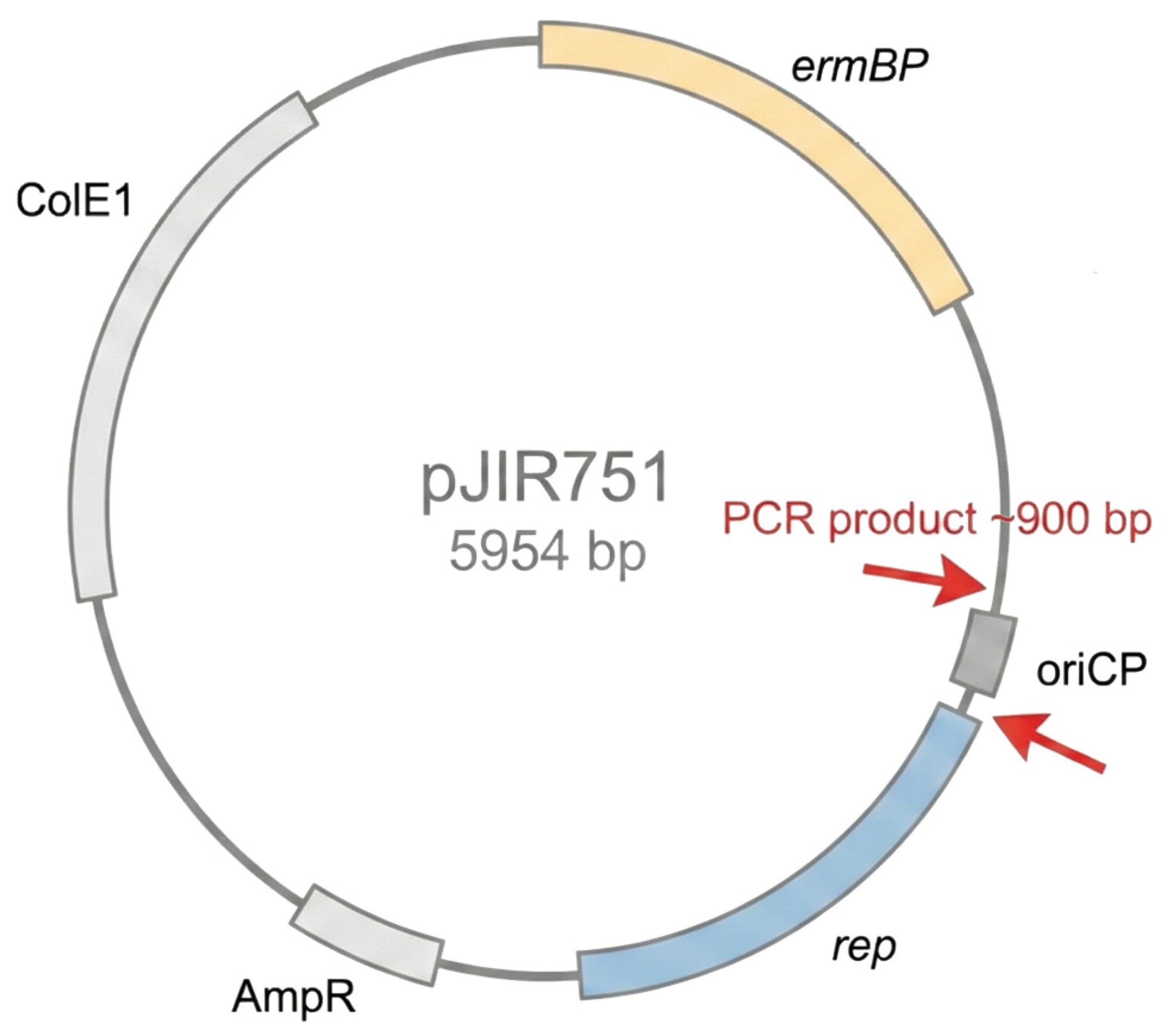
To establish a plasmid-based genetic platform in DSM 2875, several clostridial–E. coli shuttle plasmids were evaluated for introduction and maintenance in this organism. Plasmids were selected based on previously reported compatibility with anaerobic Firmicutes and acetogens, as well as differences in antibiotic resistance markers and replicon composition [19]. All plasmids were propagated in E. coli DH5α and purified using the NucleoSpin Plasmid EasyPure (Takara, Kusatsu, Shiga, Japan) prior to electroporation. For clarity of vector architecture, the map of pJIR751 is shown as a representative example (Figure 2).
Electrocompetent DSM 2875 cells were prepared and electroporated using the same workflow and pulse conditions described in Section 2.2.3. Importantly, all steps from cell harvesting and washing through electroporation, recovery, and subsequent handling were performed under strictly anoxic conditions inside a COY anaerobic chamber. Following electroporation, cells were recovered under non-selective anaerobic conditions and then subjected to antibiotic selection corresponding to each plasmid (erythromycin and/or chloramphenicol). Transformants were first recovered as colonies on selective agar and then assessed for maintainability by restreaking on fresh selective plates (see Section 3.2 and Table 1). For pJIR751, colonies were restreaked twice under erythromycin selection prior to liquid cultivation and PCR-based verification (see Section 3.2 for the PCR-based confirmation; Table 1).
Plasmid presence was initially assessed by antibiotic selection and further evaluated by diagnostic PCR targeting plasmid-specific regions. For pJIR751, primers targeting the clostridial replicon (oriCP region; expected amplicon ~900 bp) were used as a routine quality-control assay for plasmid maintenance in DSM 2875 (see Section 2.3.3). No quantitative comparison of transformation efficiencies was intended at this stage; rather, the objective was to establish a practical workflow to introduce and maintain candidate shuttle plasmids under the applied anaerobic conditions.
Previous reports describing stable maintenance of pJIR751-derived plasmids in S. ovata provided an additional rationale for including this backbone as a candidate for development in DSM 2875 [22]. Accordingly, the present workflow was designed to enable routine screening and verification of oriCPrep-based shuttle vectors as entry points for subsequent mechanistic and engineering studies.

2.3.3. PCR-Based Verification of Plasmid Maintenance

Plasmid introduction and maintenance were verified by PCR-based quality control assays. For detection of the clostridial replicon, primers targeting the oriCP region were used, yielding an expected amplicon of approximately 900 bp. The primer sequences were as follows: oriCP-F: TATTACTTTACGCCCTAGTATAGTG; oriCP-R: GATTTAAAAGGACACAGAGAGC.
PCR amplification was performed using KOD One DNA polymerase according to the manufacturer’s instructions. Reactions were carried out with an annealing temperature of 55 °C for 30 cycles. PCR products were analyzed by agarose gel electrophoresis using 1.0% (w/v) agarose gels. DNA size estimation was performed using the same molecular weight marker as described previously.
For quality control, wild-type genomic DNA was used as a negative control, and purified plasmid DNA was used as a positive control. Only samples yielding the expected amplicon size in comparison with the positive control were considered PCR-positive for plasmid-derived sequences. Because templates derived from liquid cultures can yield weak amplification, results were interpreted by comparison with the positive and negative controls.

3. Results

3.1. Construction and Validation of a ΔpyrF Mutant by Allelic Exchange

Allelic exchange targeting the pyrF locus in DSM 2875 was attempted using the ΔpyrF allele described in Section 2.2 (Figure 1). Following electroporation, cells were recovered for 24 h in non-selective DSMZ 311 medium and subsequently subjected to counter-selection on DSMZ 311 agar supplemented with 5-fluoroorotic acid (5-FOA; 20 µg mL−1). After 7–10 days of anaerobic incubation, several hundred colonies were obtained.
Screening by diagnostic PCR identified ΔpyrF genotypes in a small subset of colonies. As shown in Figure 3, PCR amplification yielded banding patterns consistent with allelic replacement. The wild-type strain produced a fragment of the expected size (1263 bp), whereas candidate ΔpyrF clones showed a shorter fragment (1071 bp), consistent with deletion of the targeted region within pyrF. Among the screened colonies, three exhibited PCR profiles consistent with the ΔpyrF genotype, and at least one clone showed unambiguous absence of the wild-type–size amplicon (Figure 3).
Despite isolation of ΔpyrF candidates, stable propagation of the deletion genotype proved difficult. The ΔpyrF strain exhibited severely impaired growth under both liquid and solid cultivation conditions. After repeated alternation between liquid culture and plating, maintenance of the ΔpyrF genotype became unreliable by the second passage cycle. In liquid medium, growth was barely detectable, and colonies on solid medium were markedly smaller than those of the wild-type strain. Direct PCR from liquid cultures yielded weak amplification, consistent with extremely low biomass and/or reduced genomic DNA abundance. Although no wild-type–size bands were detected at this stage, long-term propagation of the ΔpyrF strain could not be achieved under the tested conditions.
Together, these results indicate that allelic exchange at the pyrF locus in DSM 2875 is technically feasible, but that ΔpyrF candidates exhibit severe growth defects and limited stability in routine handling. These practical limitations motivated a subsequent shift toward plasmid-based genetic systems (Section 3.2).

3.2. Introduction and Maintenance of Clostridial–E. coli Shuttle Plasmids in S. sphaeroides

Several clostridial–E. coli shuttle plasmids were evaluated for their ability to be introduced into and maintained in S. sphaeroides DSM 2875. Following electroporation under strictly anaerobic conditions, transformants were initially assessed by growth on selective solid medium containing the appropriate antibiotics.
After plating, colonies appeared only after prolonged incubation, typically requiring approximately three weeks for visible colony formation. Plasmids pJIR751, pJIR750, and pJIR750ai yielded antibiotic-resistant colonies on selective plates, whereas pJIR418 did not produce detectable transformants under the same conditions. For pJIR751, independently obtained colonies were restreaked twice onto fresh erythromycin-containing plates while maintaining antibiotic resistance, consistent with maintainable selection on solid medium (Table 1). In contrast, although colonies were initially recovered with pJIR750 and pJIR750ai, maintenance upon subculturing was inconsistent, and these plasmids were not pursued further (Table 1).
To verify plasmid retention during liquid cultivation, five independently isolated pJIR751 colonies (C-1–C-5) were inoculated into 5 mL of liquid DSMZ 311 medium supplemented with erythromycin and cultivated anaerobically. Total DNA was extracted from each culture and subjected to diagnostic PCR targeting the oriCP region of pJIR751. All five isolates yielded the expected ~900 bp amplicon alongside the positive control (and not in the wild-type negative control), which is consistent with pJIR751 retention during liquid cultivation (Figure 4; Table 1).
Together, these results indicate that, among the shuttle plasmids tested, pJIR751 can be reproducibly introduced into DSM 2875 and maintained under erythromycin selection through two consecutive restreaks and subsequent liquid cultivation with PCR-based QC, whereas other plasmids exhibited limited or inconsistent performance under the conditions examined.

4. Discussion

4.1. Allelic Exchange in Sporomusa sphaeroides: Feasibility and Practical Limitations

Establishing a chromosomal counterselection handle is often an effective starting point for genetic tool development in non-model anaerobes. We therefore targeted the pyrF locus in S. sphaeroides to test whether double-crossover allelic exchange could be achieved within our strictly anaerobic workflow. Following electroporation and a 24 h recovery period in DSMZ 311 medium, cells were subjected to 5-fluoroorotic acid (5-FOA) counterselection (20 µg mL−1) on DSMZ 311 plates and incubated anaerobically for 7–10 days. This procedure yielded several hundred colonies, which were subsequently screened by diagnostic PCR.
PCR screening identified a small subset of candidates with banding patterns consistent with allelic replacement at the pyrF locus (Figure 3). A diagnostic primer pair designed to distinguish the wild-type locus from the ΔpyrF allele by amplicon size produced the expected product size for WT controls (1263 bp) and the corresponding shorter product for ΔpyrF candidates (1071 bp). Among the screened colonies, three showed ΔpyrF-size bands, and at least one clone displayed an unambiguous profile consistent with loss of the wild-type–size amplicon (Figure 3). Although the recovery frequency was low, these results indicate that homologous recombination and double-crossover allelic exchange are technically feasible in S. sphaeroides under the conditions tested.
In contrast, stable propagation of the ΔpyrF genotype proved difficult. Following isolation, ΔpyrF candidates exhibited markedly impaired growth in both liquid and solid media, and routine handling became challenging during subsequent passaging. In our hands, maintainability deteriorated by the second passage cycle when alternating between liquid culture and plating: growth in liquid medium was barely detectable by turbidity, and colonies on plates remained extremely small compared with the wild type. These features substantially limited the practical utility of ΔpyrF candidates as a stable genetic platform for iterative strain construction.
Importantly, this instability does not necessarily imply that ΔpyrF mutants are intrinsically non-viable in S. sphaeroides. DSMZ 311 medium used in these experiments contained uracil, indicating that the phenotype cannot be attributed simply to lack of an exogenous pyrimidine source. Rather, the severe growth defect and limited maintainability likely reflect a combination of factors, including narrow permissive windows following strong counterselection, bottlenecks imposed by slow growth and low biomass during recovery, and/or additional changes acquired during selection. Because the ΔpyrF isolate was not sequence-verified and late-stage screening relied on direct PCR from extremely low-biomass cultures, we cannot exclude contributions from secondary variants and/or mixed populations.
Taken together, these results define a practical boundary condition for early-stage genetics in S. sphaeroides: while targeted chromosomal allelic exchange is achievable, routine use of pyrF-based counterselection will likely require further optimization (e.g., recovery timing, selection intensity, media composition, and/or complementation) to yield stable, tractable mutants. This constraint motivated our subsequent shift toward plasmid-based approaches as an alternative genetic entry point providing maintainable selection and verification workflows without requiring immediate stabilization of chromosomal knockouts (Section 4.2).

4.2. Establishing a Plasmid-Based Genetic Entry Point in Sporomusa sphaeroides

Given the practical instability of ΔpyrF candidates under routine propagation, we shifted to a plasmid-based strategy to obtain a maintainable genetic entry point in S. sphaeroides. Among the clostridial–E. coli shuttle plasmids evaluated, pJIR751 provided the most reproducible platform for recovery under erythromycin selection and PCR-based verification across independent isolates (Figure 4; Table 1).
This outcome is consistent with prior work in S. ovata, where pJIR751-derived vectors can be stably maintained, suggesting that oriCP/rep-based backbones represent a useful starting point within the genus [22]. Together, these findings indicate that genetic accessibility within Sporomusa is beginning to emerge, but remains uneven across species and experimental workflows. In the present study, we did not perform parallel transformations in additional Sporomusa strains; therefore, portability of the workflow across the genus remains to be tested. While the present study does not address the mechanistic determinants of plasmid compatibility in S. sphaeroides, the empirical identification of a maintainable shuttle vector is an enabling step for tool development. In practical terms, pJIR751 supported selectable outgrowth, two consecutive restreaks on erythromycin plates, and straightforward diagnostic PCR from liquid cultures (Figure 4; Table 1), thereby lowering the barrier to implementing reporters, complementation constructs, and targeted perturbation modules in subsequent work.
A key limitation, however, is that transformation remained inefficient under the conditions tested. Even for plasmids that yielded colonies, recovery required prolonged incubation and only a small number of colonies were typically obtained (Table 1). This low apparent transformation efficiency constrains throughput (e.g., screening multiple constructs or conditions) and highlights the need for continued optimization of electroporation, recovery, and selection workflows in DSM 2875. Nevertheless, once obtained, pJIR751 transformants could be propagated under selection and verified reproducibly, consistent with achievable plasmid maintenance and providing a practical foundation for downstream genetic experiments.

4.3. Implications for Electro-Fermentation: Enabling Genetically Grounded Tests

A recurring challenge in electro-fermentation and microbial electrosynthesis is mechanistic ambiguity: apparent cathodic growth or increased product formation can reflect direct electron utilization, but can also arise indirectly via soluble intermediates (e.g., H2 or formate) or abiotic catalysis at electrode or mineral surfaces. Consequently, electrochemical correlates alone rarely establish mechanism [2,4,17]. Genetic access is therefore essential, not as a technical add-on, but as the enabling layer for perturbation-and-rescue experiments that can make electron utilization claims falsifiable.
This point is particularly relevant in Sporomusa-based cathodic acetogenesis. S. ovata is widely used as a model, yet its interpretation can be confounded by extracellular chemistry: S. ovata spent medium can modify cathodic hydrogen evolution behavior, effectively increasing reducing power delivery without requiring direct cellular electron uptake [22]. This does not exclude genuine electron uptake by S. ovata, but it underscores that direct-uptake claims require genetically grounded controls and rigorous accounting of mediator and H2 effects.
In our work, S. sphaeroides provides a strategically informative alternative angle because it displays metabolic activity consistent with oxidation of zero-valent iron (Fe0), i.e., utilization of extracellular reducing equivalents in a solid-phase context [15]. Our broader motivation is to test whether acetogens can, under some conditions, access reducing power directly from solid-phase electron donors (electrodes or Fe0) in a manner that is not reducible to hydrogen- or formate-mediated growth. At present, Fe0-associated phenotypes do not by themselves specify the route by which reducing power enters cellular metabolism. Fe0-associated phenotypes can, in principle, arise without direct electron uptake—for example, when Fe0 promotes abiotic formation of H2 (or other diffusible reductants) that cells subsequently consume [5,17]. Accordingly, causal genetic tests are required to distinguish direct electron uptake from indirect, intermediate-mediated growth.
The toolbox established here lowers the barrier to that validation. Stable maintenance of pJIR751 across independent isolates enables practical implementation of core genetic controls in S. sphaeroides—including plasmid-borne complementation, reporter deployment, and targeted perturbations—under electrode- or Fe0-assisted conditions. In this way, the present work converts a mechanistically ambiguous phenotype space into one that is experimentally addressable with causal genetic tests of acetogenic redox metabolism.

4.4. Several Limitations Define the Next Priorities for Genetic Tool Development in Sporomusa sphaeroides

First, transformation remained inefficient under the conditions tested: recovery on selective plates required prolonged incubation and typically yielded only a small number of colonies (Table 1). Improving throughput will require systematic optimization of the electroporation and recovery workflow, including cell preparation, wash chemistry, pulse parameters, recovery timing, and selection stringency.
Second, while diagnostic PCR supports the technical feasibility of allelic exchange at pyrF (Figure 3), ΔpyrF candidates could not be propagated stably in our current workflow and exhibited severe growth impairment. Stabilizing chromosomal engineering will therefore require improved recovery and growth conditions for mutants and, where appropriate, complementation strategies coupled with sequence-level validation.
Finally, our shuttle-vector evaluation was pragmatic rather than quantitative; we did not compare transformation efficiencies across plasmids or dissect compatibility mechanisms. With a reproducibly maintainable pJIR751 backbone now identified (Table 1; Figure 4), these questions can be addressed in focused follow-up work to improve delivery efficiency and to establish standardized QC assays suitable for mechanistic experiments under electro- and Fe0-assisted acetogenic conditions. As an immediate next step, we will (i) validate heterologous gene expression using pJIR751-derived constructs (a β-glucuronidase, GUS, assay workflow has already been established) and (ii) evaluate stability and performance of pJIR751 transformants under bioelectrochemical operation (electrode- or Fe0-assisted conditions) to enable causal perturbation-and-rescue tests of acetogenic redox physiology. An additional priority is to test portability of this workflow across other Sporomusa strains/species to establish genus-level design principles for genetic access in bioelectrochemical contexts.

5. Conclusions

Taken together, the results presented in this study demonstrate that DSM 2875 can be genetically accessed through two complementary routes: genome-based allelic exchange and plasmid-based maintenance.
First, a ΔpyrF mutant was successfully obtained via double-crossover allelic exchange using a non-replicative knockout construct. PCR-based validation confirmed precise replacement of the native pyrF locus, establishing that homologous recombination can be exploited in DSM 2875 under strictly anaerobic conditions. Although the resulting mutant exhibited severe growth defects and could not be stably maintained over repeated passages, this result provides direct evidence that targeted genome modification is technically feasible in this organism.
Second, several clostridial–E. coli shuttle plasmids were evaluated for their ability to enter and persist in DSM 2875. Among the tested vectors, pJIR751 consistently yielded transformants that could be propagated on selective solid media, maintained through serial passaging, and detected by diagnostic PCR from liquid cultures. In contrast, other plasmid backbones showed limited or no recoverable maintenance under the same conditions.
Importantly, these results define a practical boundary between what is currently achievable and what remains technically challenging in S. sphaeroides genetics. While stable mutants are difficult to sustain, plasmid-based systems—particularly those derived from pJIR751—provide a reproducible and maintainable platform for downstream genetic manipulation. Together, these findings establish a foundational genetic toolkit for S. sphaeroides, upon which further methodological refinements and functional studies can be built.

Author Contributions

Conceptualization, Z.-i.K.; methodology, Y.I. and Y.M.; software, Y.M.; validation, Y.I. and Y.M.; formal analysis, Y.I. and Y.M.; investigation, Y.I. and Y.M.; resources, Z.-i.K.; data curation, Y.I. and Y.M.; writing—original draft preparation, Y.M.; writing—review and editing, Y.I. and Z.-i.K.; visualization, Y.I. and Y.M.; supervision, Z.-i.K.; project administration, Z.-i.K.; funding acquisition, Z.-i.K. All authors have read and agreed to the published version of the manuscript.

Funding

This research was funded by Japan Society for the Promotion of Science (JSPS) KAKENHI, Fund for the Promotion of Joint International Research (Fostering Joint International Research (A)), Grant Number 20KK0343; by the New Energy and Industrial Technology Development Organization (NEDO), Intensive Support Program for Young Promising Researchers (Matching Support Phase), Grant Number 21W2M156; by Hiroshima Prefecture, Carbon Recycling-Related Technology Research and Development Support Subsidy (no grant number); by the Steel Foundation for Environmental Protection Technology (Environmental Research Grant, FY2019–FY2020; no grant number); and by The Iron and Steel Institute of Japan (ISIJ), ISIJ Research Promotion Grant (FY2020; no grant number).

Institutional Review Board Statement

Not applicable.

Informed Consent Statement

Not applicable.

Data Availability Statement

The data supporting the findings of this study are available on Figshare at DOI: 10.6084/m9.figshare.31228564.

Acknowledgments

The authors thank Tetsuya Kimura (Mie University) for providing the shuttle plasmids (including pJIR751 and related vectors) used in this study. During the preparation of this manuscript, the authors used ChatGPT (OpenAI; GPT-5.2 Thinking) for English proofreading. The authors reviewed and edited the output and take full responsibility for the content of this publication.

Conflicts of Interest

The authors declare no conflicts of interest. The funders had no role in the design of the study; in the collection, analyses, or interpretation of data; in the writing of the manuscript; or in the decision to publish the results.

Abbreviations

The following abbreviations are used in this manuscript:
CFUColony-forming unit
CmChloramphenicol
EmErythromycin
DSMZDeutsche Sammlung von Mikroorganismen und Zellkulturen
MESMicrobial electrosynthesis
OD600Optical density at 600 nm
PCRPolymerase chain reaction
5-FOA5-fluoroorotic acid
WLPWood–Ljungdahl pathway

References

  1. Virdis, B.; Hoelzle, R.D.; Marchetti, A.; Boto, S.T.; Rosenbaum, M.A.; Blasco-Gómez, R.; Puig, S.; Freguia, S.; Villano, M. Electro-fermentation: Sustainable bioproductions steered by electricity. Biotechnol. Adv. 2022, 59, 107950. [Google Scholar] [CrossRef]
  2. Rabaey, K.; Rozendal, R.A. Microbial electrosynthesis—Revisiting the electrical route for microbial production. Nat. Rev. Microbiol. 2010, 8, 706–716. [Google Scholar] [CrossRef]
  3. Chen, H.; Simoska, O.; Lim, K.; Grattieri, M.; Yuan, M.; Dong, F.; Lee, Y.S.; Beaver, K.; Weliwatte, S.; Gaffney, E.M.; et al. Fundamentals, Applications, and Future Directions of Bioelectrocatalysis. Chem. Rev. 2020, 120, 12903–12993. [Google Scholar] [CrossRef]
  4. Nevin, K.P.; Woodard, T.L.; Franks, A.E.; Summers, Z.M.; Lovley, D.R. Microbial Electrosynthesis: Feeding Microbes Electricity To Convert Carbon Dioxide and Water to Multicarbon Extracellular Organic Compounds. mBio 2010, 1, e00103-10. [Google Scholar] [CrossRef]
  5. Rosenbaum, M.; Aulenta, F.; Villano, M.; Angenent, L.T. Cathodes as electron donors for microbial metabolism: Which extracellular electron transfer mechanisms are involved? Bioresour. Technol. 2011, 102, 324–333. [Google Scholar] [CrossRef]
  6. Deutzmann, J.S.; Sahin, M.; Spormann, A.M. Extracellular Enzymes Facilitate Electron Uptake in Biocorrosion and Bioelectrosynthesis. mBio 2015, 6, e00496-15. [Google Scholar] [CrossRef]
  7. Tremblay, P.-L.; Faraghiparapari, N.; Zhang, T. Accelerated H2 evolution during microbial electrosynthesis with Sporomusa ovata. Catalysts 2019, 9, 166. [Google Scholar] [CrossRef]
  8. Ragsdale, S.W.; Pierce, E. Acetogenesis and the Wood–Ljungdahl pathway of CO2 fixation. Biochim. Biophys. Acta (BBA)—Proteins Proteom. 2008, 1784, 1873–1898. [Google Scholar] [CrossRef] [PubMed]
  9. Müller, V. New Horizons in Acetogenic Conversion of One-Carbon Substrates and Biological Hydrogen Storage. Trends Biotechnol. 2019, 37, 1344–1354. [Google Scholar] [CrossRef] [PubMed]
  10. Schuchmann, K.; Müller, V. Autotrophy at the thermodynamic limit of life: A model for energy conservation in acetogenic bacteria. Nat. Rev. Microbiol. 2014, 12, 809–821. [Google Scholar] [CrossRef] [PubMed]
  11. Madjarov, J.; Soares, R.; Paquete, C.M.; Louro, R.O. Sporomusa ovata as Catalyst for Bioelectrochemical Carbon Dioxide Reduction: A Review Across Disciplines From Microbiology to Process Engineering. Front. Microbiol. 2022, 13, 913311. [Google Scholar] [CrossRef]
  12. Jourdin, L.; Lu, Y.; Flexer, V.; Keller, J.; Freguia, S. Biologically Induced Hydrogen Production Drives High Rate/High Efficiency Microbial Electrosynthesis of Acetate from Carbon Dioxide. ChemElectroChem 2016, 3, 581–591. [Google Scholar] [CrossRef]
  13. Aryal, N.; Tremblay, P.-L.; Lizak, D.M.; Zhang, T. Performance of different Sporomusa species for the microbial electrosynthesis of acetate from carbon dioxide. Bioresour. Technol. 2017, 233, 184–190. [Google Scholar] [CrossRef] [PubMed]
  14. Kremp, F.; Roth, J.; Müller, V. A Third Way of Energy Conservation in Acetogenic Bacteria. Microbiol. Spectr. 2022, 10, e01385-22. [Google Scholar] [CrossRef] [PubMed]
  15. Kato, S.; Yumoto, I.; Kamagata, Y. Isolation of Acetogenic Bacteria That Induce Biocorrosion by Utilizing Metallic Iron as the Sole Electron Donor. Appl. Environ. Microbiol. 2015, 81, 67–73. [Google Scholar] [CrossRef] [PubMed]
  16. Dinh, H.T.; Kuever, J.; Mußmann, M.; Hassel, A.W.; Stratmann, M.; Widdel, F. Iron corrosion by novel anaerobic microorganisms. Nature 2004, 427, 829–832. [Google Scholar] [CrossRef]
  17. Philips, J. Extracellular Electron Uptake by Acetogenic Bacteria: Does H2 Consumption Favor the H2 Evolution Reaction on a Cathode or Metallic Iron? Front. Microbiol. 2020, 10, 2997. [Google Scholar] [CrossRef] [PubMed]
  18. Mand, J.; Park, H.S.; Jack, T.R.; Voordouw, G. The role of acetogens in microbially influenced corrosion of steel. Front. Microbiol. 2014, 5, 268. [Google Scholar] [CrossRef] [PubMed]
  19. Bourgade, B.; Minton, N.P.; Islam, M.A. Genetic and metabolic engineering challenges of C1-gas fermenting acetogenic chassis organisms. FEMS Microbiol. Rev. 2021, 45, fuab008. [Google Scholar] [CrossRef]
  20. Jin, S.; Bae, J.; Song, Y.; Pearcy, N.; Shin, J.; Kang, S.; Minton, N.P.; Soucaille, P.; Cho, B.-K. Synthetic Biology on Acetogenic Bacteria for Highly Efficient Conversion of C1 Gases to Biochemicals. Int. J. Mol. Sci. 2020, 21, 7639. [Google Scholar] [CrossRef]
  21. Leang, C.; Ueki, T.; Nevin Kelly, P.; Lovley Derek, R. A Genetic System for Clostridium ljungdahlii: A Chassis for Autotrophic Production of Biocommodities and a Model Homoacetogen. Appl. Environ. Microbiol. 2013, 79, 1102–1109. [Google Scholar] [CrossRef] [PubMed]
  22. Tremblay, P.-L.; Zhang, T. Genetic tools for the electrotroph Sporomusa ovata and autotrophic biosynthesis. Appl. Environ. Microbiol. 2023, 90, e01757-23. [Google Scholar] [CrossRef]
  23. Poehlein, A.; Zeldes, B.; Flaiz, M.; Böer, T.; Lüschen, A.; Höfele, F.; Baur, K.S.; Molitor, B.; Kröly, C.; Wang, M.; et al. Advanced aspects of acetogens. Bioresour. Technol. 2025, 427, 131913. [Google Scholar] [CrossRef]
  24. Minton, N.P.; Ehsaan, M.; Humphreys, C.M.; Little, G.T.; Baker, J.; Henstra, A.M.; Liew, F.; Kelly, M.L.; Sheng, L.; Schwarz, K.; et al. A roadmap for gene system development in Clostridium. Anaerobe 2016, 41, 104–112. [Google Scholar] [CrossRef]
  25. Heap, J.T.; Ehsaan, M.; Cooksley, C.M.; Ng, Y.-K.; Cartman, S.T.; Winzer, K.; Minton, N.P. Integration of DNA into bacterial chromosomes from plasmids without a counter-selection marker. Nucleic Acids Res. 2012, 40, e59. [Google Scholar] [CrossRef] [PubMed]
  26. Bannam, T.L.; Rood, J.I. Clostridium perfringens-Escherichia coli Shuttle Vectors That Carry Single Antibiotic Resistance Determinants. Plasmid 1993, 29, 233–235. [Google Scholar] [CrossRef] [PubMed]
  27. Tripathi, S.A.; Olson, D.G.; Argyros, D.A.; Miller, B.B.; Barrett, T.F.; Murphy, D.M.; McCool, J.D.; Warner, A.K.; Rajgarhia, V.B.; Lynd, L.R.; et al. Development of pyrF-Based Genetic System for Targeted Gene Deletion in Clostridium thermocellum and Creation of a pta Mutant. Appl. Environ. Microbiol. 2010, 76, 6591–6599. [Google Scholar] [CrossRef] [PubMed]
  28. Heap, J.T.; Pennington, O.J.; Cartman, S.T.; Carter, G.P.; Minton, N.P. The ClosTron: A universal gene knock-out system for the genus Clostridium. J. Microbiol. Methods 2007, 70, 452–464. [Google Scholar] [CrossRef]
  29. Philips, J.; Monballyu, E.; Georg, S.; De Paepe, K.; Prévoteau, A.; Rabaey, K.; Arends, J.B.A. An Acetobacterium strain isolated with metallic iron as electron donor enhances iron corrosion by a similar mechanism as Sporomusa sphaeroides. FEMS Microbiol. Ecol. 2019, 95, fiy222. [Google Scholar] [CrossRef]
  30. Redder, P.; Linder, P. New Range of Vectors with a Stringent 5-Fluoroorotic Acid-Based Counterselection System for Generating Mutants by Allelic Replacement in Staphylococcus aureus. Appl. Environ. Microbiol. 2012, 78, 3846–3854. [Google Scholar] [CrossRef]
  31. Al-Hinai Mohab, A.; Fast Alan, G.; Papoutsakis Eleftherios, T. Novel System for Efficient Isolation of Clostridium Double-Crossover Allelic Exchange Mutants Enabling Markerless Chromosomal Gene Deletions and DNA Integration. Appl. Environ. Microbiol. 2012, 78, 8112–8121. [Google Scholar] [CrossRef] [PubMed]
  32. Yanisch-Perron, C.; Vieira, J.; Messing, J. Improved M13 phage cloning vectors and host strains: Nucleotide sequences of the M13mpl8 and pUC19 vectors. Gene 1985, 33, 103–119. [Google Scholar] [CrossRef] [PubMed]
Figure 1. Strategy for construction of a ΔpyrF strain by allelic exchange. A knockout plasmid carrying the pyrF 5′ and 3′ flanking regions was introduced into wild-type DSM 2875, followed by double-crossover recombination to generate the ΔpyrF genome. Blue arrows indicate the 5′–3′ orientation of the homology arms and target locus. The “×” symbol denotes deletion of the targeted pyrF region.
Fermentation 12 00196 g001
Figure 2. Representative map of the E. coli–clostridial shuttle plasmid pJIR751 used for establishing a plasmid-based genetic platform in DSM 2875. pJIR751 (5954 bp) carries the ColE1 origin for propagation in E. coli and the clostridial replicon (oriCP/rep) for replication in anaerobic hosts, together with antibiotic resistance markers (AmpR for E. coli selection and ermBP for erythromycin selection in anaerobes) [26]. Red arrows indicate the primer positions used for diagnostic PCR to verify plasmid maintenance in DSM 2875, amplifying an approximately 900 bp fragment within the oriCP region.
Fermentation 12 00196 g002
Figure 3. PCR validation of the ΔpyrF allele in S. sphaeroides. Diagnostic PCR was performed on genomic DNA from the wild-type strain (WT) and a representative ΔpyrF candidate clone (ΔpyrF), and amplicons were resolved on a 1.0% agarose gel. Lane M, DNA size marker (kbp). The expected band sizes were WT: 1263 bp and ΔpyrF: 1071 bp, consistent with replacement of the native pyrF locus by the ΔpyrF allele via allelic exchange.
Fermentation 12 00196 g003
Figure 4. Confirmation of pJIR751 maintenance in DSM 2875 transformants. After electroporation with pJIR751, cells were recovered anaerobically and subjected to erythromycin selection. Representative liquid recovery cultures and an erythromycin-containing agar plate showing colony formation are shown (top). Five independently isolated colonies (C-1–C-5) were restreaked twice on erythromycin plates, inoculated into 5 mL liquid medium under erythromycin selection, and total DNA was extracted for diagnostic PCR (bottom). PCR was performed with primers targeting the oriCP region of pJIR751 to generate an amplicon of ~900 bp. Lane M, DNA size marker; PC, purified plasmid DNA (positive control); NC, wild-type genomic DNA (negative control); C-1–C-5, colony isolates. All five isolates yielded the expected ~900 bp product, consistent with retention of pJIR751 under the tested conditions. Note: PCR from liquid-culture templates may yield weak amplification due to low biomass and/or residual medium components; therefore, presence/absence of the expected ~900 bp amplicon was evaluated relative to the positive control.
Fermentation 12 00196 g004
Table 1. Introduction and maintenance of shuttle plasmids in DSM 2875.
PlasmidAntibiotic ResistanceColony Formation on PlatesRestreaking Under SelectionPCR QC (oriCP, Liquid Culture)
pJIR751Erythromycin (Em+)Yes (colonies after ~3 weeks)Yes (2× restreaks)Positive (5/5 isolates)
pJIR750Chloramphenicol (Cm+)Yes (colonies after ~3 weeks)Inconsistent (not pursued)Not tested
pJIR750aiChloramphenicol (Cm+)Yes (colonies after ~3 weeks)Inconsistent (not pursued)Not tested
pJIR418Erythromycin, Chloramphenicol (Em+, Cm+)NoNot applicableNot applicable
Disclaimer/Publisher’s Note: The statements, opinions and data contained in all publications are solely those of the individual author(s) and contributor(s) and not of MDPI and/or the editor(s). MDPI and/or the editor(s) disclaim responsibility for any injury to people or property resulting from any ideas, methods, instructions or products referred to in the content.