Article

Impact of Pea Fiber (Pisum sativum L.) on the Viability of Limosilactobacillus reuteri ACC27 and Quality Attributes of Fermented Milk


by
Nisa Nur Hacıbayramoğlu
and
Haktan Aktaş
*
Department of Food Engineering, Faculty of Agriculture, Ataturk University, Erzurum 25240, Turkey
*
Author to whom correspondence should be addressed.
Fermentation 2026, 12(4), 189; https://doi.org/10.3390/fermentation12040189
Submission received: 3 March 2026 / Revised: 24 March 2026 / Accepted: 2 April 2026 / Published: 9 April 2026
(This article belongs to the Section Probiotic Strains and Fermentation)

Abstract

As probiotic microorganisms must remain viable at a certain level throughout the shelf life of fermented foods, various plant-based prebiotics are added to fermented dairy products. Pea (Pisum sativum L.) is a remarkable food source due to its prebiotic properties, high phenolic content and antioxidant capacity. In this study, fermented milks containing different proportions of pea fiber powder (0%, 0.5%, 1%, 1.5% and 2%) were produced using Limosilactobacillus reuteri ACC27, which has probiotic potential, and Streptococcus thermophilus 212S. The addition of pea fiber powder promoted the growth of Limosilactobacillus reuteri ACC27, increasing viable cell counts by approximately 1 log CFU/g compared to the control during storage. In addition, the fermentation time was shortened by approximately 30 min in samples containing pea fiber. Malic (84.07–175.58 mg/kg), lactic (11,670.45–13,791.66 mg/kg), acetic (145.12–240.53 mg/kg) and benzoic acids (17.07–20.34 mg/kg) were detected in all samples. Furthermore, pea fiber supplementation improved physicochemical properties by reducing syneresis and modifying water release behavior, while also increasing viscosity. The addition of pea fiber also enhanced total phenolic content and antioxidant capacity of the samples. The results of the principal component analysis revealed that the addition of pea fiber powder was associated with potentially improved functional attributes and enhanced probiotic viability under the studied conditions.

1. Introduction

Fermentation has been one of the most widely practiced methods of preserving raw foods since ancient times. Microorganisms such as yeasts, molds, and especially lactic acid bacteria use the sugars found in food as substrates for their activity. The organic acids (OA) produced by these microorganisms significantly increase the shelf life of the products by lowering the pH. In addition to OA, microbial secondary metabolites such as hydrogen peroxide and bacteriocins are vital in preventing and delaying food spoilage [1]. In addition to improving the aroma and increasing the shelf life as a result of microbial activity, fermented foods have many positive health effects, such as strengthening the immune system, regulating blood pressure and cholesterol level and inhibiting growth of pathogens, thanks to the production of bioactive metabolites [2]. Moreover, fermented products, particularly dairy-based ones, are highly suitable carriers for probiotic microorganisms [3]. Probiotics are live microorganisms with positive effects on human health when consumed in sufficient quantities and probiotic microorganisms are typically classified as belonging to the Lactobacillus or Bifidobacterium genera [4]. Prebiotics, on the other hand, are substances that promote the growth of beneficial microorganisms. When prebiotics and probiotics are intentionally combined, they may confer synbiotic properties to the food product [5]. Recent studies have shown that prebiotics such as inulin [6,7], galactooligosaccharides [7], lactulose [7], and arabinogalactan [8], as well as certain plant-based foods rich in prebiotic components (e.g., honey [6], yellow sweet potato [9], black mulberry [10], red grape [10], cornelian cherry [10], and some vegetable flours [11]), may promote the growth of probiotics in fermented foods. Peas are rich in protein, carbohydrates, vitamins, minerals and dietary fibers, including oligosaccharides, which make up 5–15% of their content. The high oligosaccharide content of peas makes them an important food in terms of nutrient content and means they can also be effective in promoting human intestinal health [12].
The importance of functional foods has increased considerably in recent years, as consumers expect food to help them maintain or improve their health [2]. Therefore, the presence of probiotics and prebiotics in fermented foods, and the resulting synbiotic properties, are important for meeting consumer demand [5]. In this study, fermented milks were produced using Limosilactobacillus reuteri (L. reuteri) ACC27 with probiotic potential and Streptococcus thermophilus (S. thermophilus) 212S as starter cultures and prebiotic pea fiber powder (Pisum sativum L.) was added at different ratios. The aim of this study was to evaluate the effect of pea fiber powder on the microbial viability of a probiotic strain in fermented milk, as well as its impact on the fermentation process and selected physicochemical and sensory properties.

2. Materials and Methods

2.1. Starter Culture and Raw Milk

The starter cultures used to obtain fermented milk with pea fiber powder were L. reuteri ACC27, a strain with probiotic potential that has not yet been fully validated according to current probiotic criteria, and S. thermophilus 212S [13]. MRS agar or broth (Merck, Darmstadt, Germany) was used to culture the L. reuteri ACC27, which was then incubated at 37 °C for 48–72 h. On the other hand, S. thermophilus 212S was incubated on M17 agar and broth (Merck) at 37 °C for 24 h [14]. The identities of L. reuteri ACC27 and S. thermophilus 212S had been previously confirmed by phenotypic and molecular characterization, as reported in earlier studies, and the same strains were used throughout the present work. Atatürk University Food and Livestock Application and Research Centre has procured raw cow’s milk with the following characteristics; pH: 6.67, fat: 3.69%, fat-free dry matter: 9.11%, protein: 3.10% and ash: 0.71%. The raw milk was stored at +4 °C until the production phase.
Pea fiber powder was obtained from Barentz (İstanbul, Turkey) and derived from Pisum sativum L. seeds. Detailed processing information was not provided by the manufacturer; however, it was supplied as a food-grade dietary fiber product. According to the manufacturer’s specifications and literature data, the pea fiber is primarily composed of insoluble dietary fiber fractions, including cellulose and hemicellulose, with minor amounts of soluble fiber and residual carbohydrates. No chemical modification was applied prior to its use in this study.

2.2. Experimental Design

The present study was structured into three main experimental stages to evaluate the effect of pea fiber powder on the growth and functional properties of L. reuteri ACC27 in fermented milk systems. Experiment A focused on the in vitro assessment of the effect of different concentrations of pea fiber powder on the growth and acidification behavior of L. reuteri ACC27 in MRS broth. Experiment B involved the production of fermented milk using a co-culture of L. reuteri ACC27 and S. thermophilus 212S, with varying concentrations of pea fiber powder, and the monitoring of the fermentation process. Experiment C examined the microbiological, physicochemical, rheological, biochemical and sensory properties of the fermented milk samples during storage. Detailed methodologies for each experimental stage are provided in the corresponding sections below.

2.3. Effect of Pea Fiber Powder on In Vitro Growth of L. reuteri ACC27

This experiment was conducted in MRS broth as a controlled model system to evaluate the direct effect of pea fiber powder on the growth of L. reuteri ACC27 without the interference of the complex milk matrix. The effects under actual food conditions were further investigated in fermented milk (in situ) experiments described in the following sections. First, L. reuteri ACC27 was inoculated into MRS broth. After incubation at 37 °C for 18–24 h, the fresh strain was centrifuged at 8000× g at 4 °C for 10 min. The pellet was reconstituted with PBS (phosphate-buffered saline, pH 7.2, Merck) to 108 CFU/mL concentration. The cell concentration (108 CFU/mL) was adjusted using a McFarland densitometer based on turbidity measurements. This suspension was inoculated at a concentration of 2% into sterile MRS broth containing 0.5%, 1%, 1.5% and 2% pea fiber powder. On the other hand, MRS broth without pea fiber powder was used as the control. The strain was incubated for 24 h at 37 °C. The microbial growth curve in different media was revealed by pH (using Hanna pH-211, Hanna Instruments, Woonsocket, RI, USA) and microbial counting every hour [15].

2.4. Fermented Milk Production and Monitoring of Fermentation Processes

To produce fermented milk, L. reuteri ACC27 and S. thermophilus 212S were first cultivated in MRS and M17 broth, respectively, at 37 °C for 18–24 h. Then, the fresh cultures were centrifuged at 8000× g at 4 °C for 10 min, after which the cells were reconstituted in PBS to a concentration of 108 CFU/mL using a McFarland densitometer (Biosan, Riga, Latvia) based on turbidity measurements. These bacterial suspensions were inoculated separately into sterile reconstituted skim milk at a concentration of 2%, and the strains were pre-activated in this medium at 37 °C for 15 h [16]. On the other hand, raw cow’s milk was divided into five portions, to which pea fiber powder was added at 0.5% (FM05), 1% (FM10), 1.5% (FM15) and 2% (FM20) respectively. Milk without pea fiber powder was used as a control (FM00). The control sample was produced using the same co-culture of L. reuteri ACC27 and S. thermophilus 212S and differed from the other samples only by the absence of pea fiber powder. Raw cow’s milk was subjected to pasteurization at 85 °C for 25 min to ensure microbiological safety and to promote whey protein denaturation, followed by rapid cooling to 37 °C prior to inoculation. Pea fiber powder was added directly to the raw milk prior to pasteurization to ensure homogeneous dispersion within the milk matrix. The milk–fiber mixture was then pasteurized at 85 °C for 25 min. Therefore, the fiber was subjected to the same heat treatment as the milk, ensuring its microbiological safety. The pre-activated L. reuteri ACC27 and S. thermophilus 212S in reconstituted skim milk were inoculated into the pasteurized milk at an equal concentration, totaling 2%. The milk was aseptically distributed into sterile 210 mL glass jars with gentle mixing to ensure uniform dispersion of the added fiber, and fermentation was carried out directly in these containers. The milk was fermented at 37 °C until the pH reached 4.6 ± 0.1. Following fermentation, the samples were stored at 4 °C throughout the storage period. In addition, the pH of the milk was measured at thirty-minute intervals until the end of fermentation, in order to monitor the fermentation process [17]. Due to the insoluble nature of the fiber, slight sedimentation may have occurred during storage; therefore, samples were gently mixed prior to analysis.

2.5. Microbiological Analyses

To determine the microbiological properties of fermented milk produced in the study, counts of L. reuteri ACC27, S. thermophilus 212S, yeasts, molds and coliforms were carried out on days 1, 7, 14 and 21 of storage. Firstly, a 10 g sample was mixed with 90 mL-Ringer’s solution (Merck), and it was serially diluted [18]. The viable counts of L. reuteri ACC27, S. thermophilus 212S, yeast-mold and coliform were determined on MRS agar, M17 agar [14], DRBC agar (dichloran rose bengal chloramphenicol agar, Merck) [19] and VRB agar (violet red bile, Merck) [20], respectively. The plates were incubated at 37 °C for 48–72 h, at 37 °C for 24 h, at 25 °C for 5–7 days and at 37 °C for 24 h, respectively. Microbial enumeration was performed using selective media (MRS agar for L. reuteri ACC27 and M17 agar for S. thermophilus 212S) under incubation conditions favoring lactic acid bacteria. Colony morphology consistent with the respective starter cultures was observed, and no atypical colonies were detected during the enumeration period. The use of selective media and specific incubation conditions was intended to ensure the selective enumeration of the target microorganisms. Although no molecular confirmation was performed in this study, this approach is widely accepted for the differentiation of lactic acid bacteria in similar studies.

2.6. Physicochemical Analyses

The physicochemical analyses of the fermented milks were carried out on days 1, 7, 14 and 21 by performing pH, acidity, total dry matter, syneresis and water holding capacity (WHC) analyses. The pH was measured using a Hanna pH-meter (Hanna pH-211, Hanna Instruments). The pH-meter was calibrated using 4 and 7 pH buffers before use [21]. The titration method was used for the determination of acidity, which was expressed as % lactic acid [22]. The dry matter content was determined using the AOAC method by drying the samples in an oven at 105 °C until constant weight was achieved [23]. For syneresis, 25 g of samples were weighed onto filter paper and kept at 4 °C for 4 h. The amount of serum was then determined and the syneresis rate was calculated as a percentage [24]. For the WHC, the sample was centrifuged at 3000× g, 4 °C, for 30 min. The released serum was weighed, and the WHC was expressed as a percentage based on the amount of serum released after centrifugation [25].

2.7. Apparent Viscosity and Colorimetric Properties

The apparent viscosity properties of fermented milks containing prebiotics were analyzed on days 1, 7, 14 and 21 using a Brookfield Viscometer (Model DV-II, Middleboro, MA, USA). For this purpose, samples stored at 4 °C were measured at 20 and 50 rpm for 30 s using a spindle number of 6, and the average value was calculated to determine the apparent viscosity, expressed as centipoise (cP) [26]. The color properties of the fermented milks were determined using a colorimeter (Minolta CR-400, Osaka, Japan) according to the method by the CIE (International Commission on Illumination) standards. Measurements were performed by placing the probe directly on the sample surface, which was homogenized prior to analysis.

2.8. Organic Acid Content

The OA contents in the fermented milk were detected using HPLC (Agilent Technologies, Santa Clara, CA, USA), combined with a 1260 Quantitative Pump, a 1260 Infinity Auto-sampler, and a 1260 UV detector. First, 25 mL of 0.01 N HPLC-grade sulphuric acid (H2SO4, Merck) was added to 5 g of the samples and homogenized. After centrifugation at 7000× g at 4 °C for 10 min, the liquid supernatant was passed through a filter (0.45 µm, Supelco Iso-DiscTM Filters, Merck, Bellefonte, PA, USA) and transferred to HPLC vials. A 10 mM perchloric acid (HClO4, Merck) was used as mobile phase, a Spherisorb ODS2 column (4.6 × 250 mm, 5 µm) was used for the chromatographic separation. In addition, HPLC conditions were as follows: flow rate 0.5 mL/min, column temperature 35 °C, injection volume 20 μL and wavelength 210 nm [27].

2.9. Antioxidant Capacity and Total Phenolic Content

To obtain the extracts, 10 mL of an aqueous methanol solution (80%, v/v) was mixed with the fermented milk sample (5 g). Then, it was homogenized using an orbital shaker (Orbital Shaker SSL1, Stone, Staffordshire, UK) at 25 °C for six hours. After centrifugation at 1420× g for 10 min, the liquid supernatant was filtered by Whatman No. 1 filter paper [28]. The Folin–Ciocalteu reagent (500 µL) diluted by half was mixed with the extract (2 mL) for determining the total phenolic content (TPC). After leaving it to stand at 25 °C for 3 min, 2 mL of a sodium carbonate (Na2CO3) solution (2%, w/v) was added and then left to stand for 2 h at 25 °C. The absorbance was detected at 760 nm by a spectrophotometer (Epoch, BioTek, Winooski, VT, USA), and the results were calculated as mg GAE/L according to the gallic acid standard curve. To determine the antioxidant capacity, 100 µL, 150 µL and 200 µL of fermented milk extract were each made up to 3 mL with 0.1 mM DPPH solution (2,2-diphenyl-1-picrylhydrazyl). After leaving the mixtures for 30 min at 25 °C, their absorbance was detected at 517 nm using a spectrophotometer (Epoch, BioTek), and DPPH scavenging capability (%) was calculated. The antioxidant capacities of the samples were expressed as IC50 (mg/mL) [29].

2.10. Sensory Analyses

Eight semi-trained panelists, who were familiar with fermented dairy products and had prior experience in sensory evaluation, participated in the study. Before the analysis, the panelists received a brief training session to standardize their understanding of the evaluation criteria. Although the number of panelists was limited, this panel size is considered acceptable for preliminary sensory evaluation using a hedonic scale. To determine the sensory characteristics of the fermented milk samples, the panelists were asked to evaluate the color and appearance, structure and texture, syneresis, odor, acidity, taste and general acceptability of the samples. In this analysis, a nine-point hedonic scale (8–9: highly desirable, 6–7: desirable, 4–5: medium, 1–2–3: undesirable) was used and panelists were offered water and bread to prevent the transfer of sensory attributes between products [30]. The samples were served to the panelists without disturbing the gel structure (set form). The same panelists participated in all sensory evaluation sessions conducted during the storage period. Although the number of panelists was limited, this panel size is considered acceptable for preliminary sensory evaluation using a hedonic scale. For the sensory analysis in the study, ethical approval dated 2025/1 was obtained from Atatürk University Ethics Committee on 23 May 2025.

2.11. Statistical Analyses

In this study, two batches of fermented milk were produced independently, with each batch analyzed in two replicates. Thus, the study included two independent biological replicates, each analyzed in duplicate as technical replicates. The data were statistically analyzed using the SPSS22.0 statistical program (SPSS Inc., Chicago, IL, USA), and all results are given as the mean ± standard deviation. The statistical differences between sample types or storage periods were determined using a one-way ANOVA test. These statistical differences were analyzed using Duncan’s multiple comparison test (p < 0.05). Duncan’s multiple comparison test was preferred due to its sensitivity in detecting differences among treatment groups, particularly in studies with a limited number of biological replicates, and it has been widely used in similar food science studies. The Pearson correlation using ChiPlot (https://www.chiplot.online/, accessed on 11 August 2025) revealed the relationship between the data obtained throughout the storage period, while principal component analysis (PCA) revealed the relationship between the sample groups. All experimental procedures were conducted under controlled conditions to minimize variability, including standardized raw materials, processing parameters, and incubation conditions. Samples were handled and analyzed in a consistent manner to reduce potential experimental bias.

3. Results and Discussion

3.1. Effect of Pea Fiber Powder on In Vitro Growth of L. reuteri ACC27

Prebiotics are known to have a positive effect on the growth of probiotics, particularly those belonging to the Lactobacillus and Bifidobacterium genera [31]. Therefore, it is important to examine the addition of prebiotic substances to fermented foods in both in vitro and in situ conditions. This study investigated the microbial growth of L. reuteri ACC27 in MRS broth containing different ratios of pea fiber powder, and the results are presented in Figure 1 and Tables S1 and S2. Across all media, the pH of the MRS medium decreased from 6.08 to 4.31 after 24 h of incubation, while the viable cell count of L. reuteri ACC27 increased from 5.23 log CFU/mL to 9.73 log CFU/mL. It was observed that adding pea fiber powder promoted microbial growth and caused statistically significant differences throughout the incubation period (p < 0.05), except during the final six hours (p > 0.05) (Figure 1A). Furthermore, in the presence of pea fiber powder, L. reuteri ACC27 showed a tendency toward enhanced early growth compared to the control, although the duration of the lag phase appeared similar among the tested conditions. Similarly, Kumari et al. [32] also reported that dietary fiber from pea promotes the growth of probiotics such as Latilactobacillus sakei ATCC 15521, Lacticaseibacillus rhamnosus ATCC 7469 and Lactiplantibacillus plantarum ATCC 8014, and shortens the lag phase. In the presented study, pea fiber powder was found to increase the viable cell count of L. reuteri ACC27 at 8, 9, 10 and 16 h of storage (Figure 1B) (p < 0.05). Moreover, another study on this subject found that pea fiber promoted the growth of Lactiplantibacillus plantarum, Lacticaseibacillus paracasei, Bifidobacterium bifidum and Akkermansia muciniphila. The results obtained from the present study were consistent with these findings, which were anticipated given the high oligosaccharide content of peas [12]. These results indicate that pea fiber powder can promote the growth of L. reuteri ACC27 under in vitro conditions, suggesting a supportive role for probiotic viability in fermented products. The positive effect of pea fiber powder on the growth of L. reuteri ACC27 may be related to its composition, particularly its content of non-digestible carbohydrates such as oligosaccharides and complex polysaccharides. These components can act as fermentable substrates for probiotic bacteria, supporting their metabolic activity and growth. In addition, pea fiber may contribute to the stabilization of the microenvironment, which can further support bacterial viability.

3.2. Monitoring of Fermentation Processes

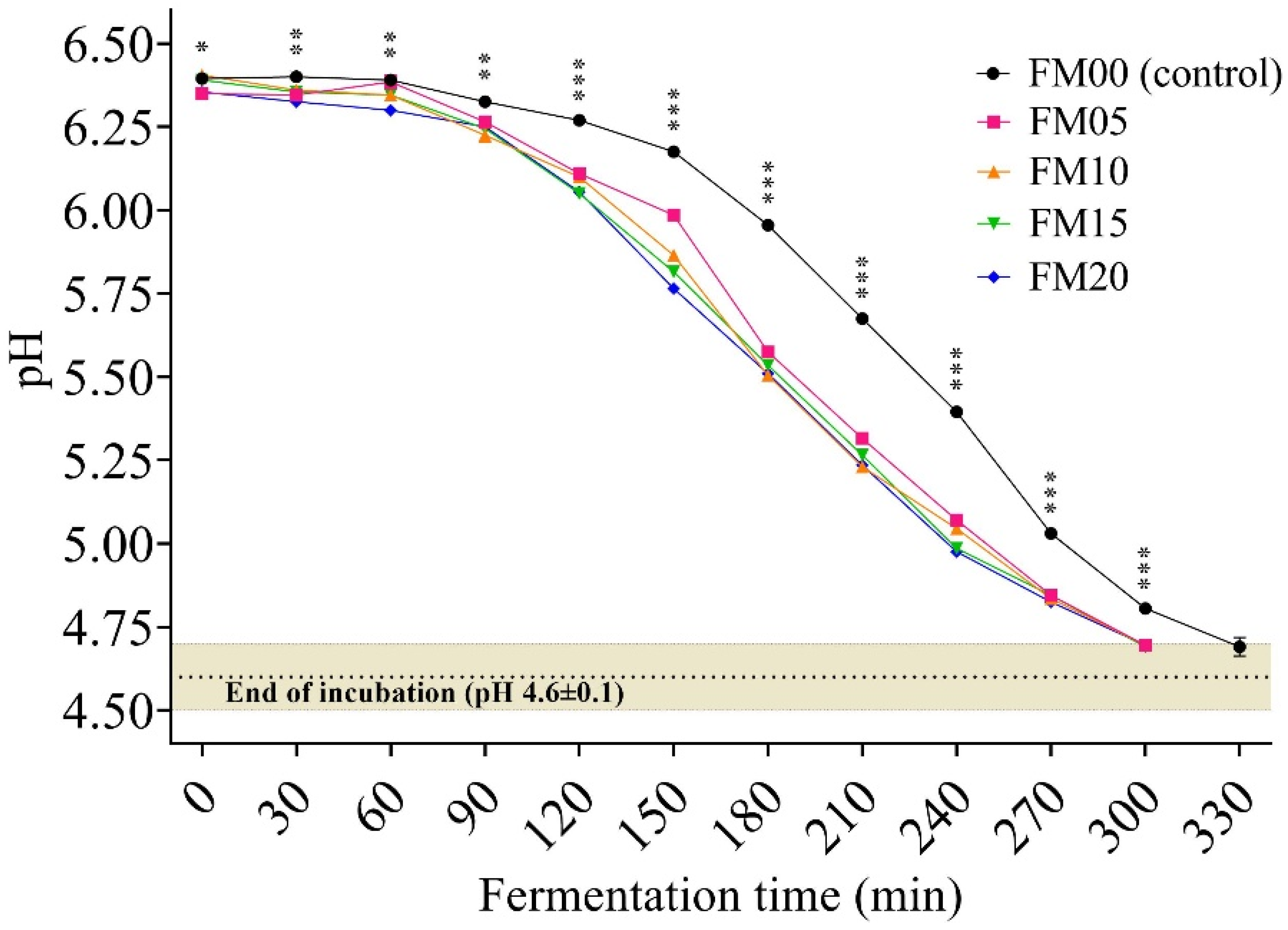
The results of monitoring the fermentation period of fermented milks containing different ratios of pea fiber powder are given in Figure 2 and Table S3. The results indicated a shorter fermentation time in samples containing pea fiber powder compared to the control. On the other hand, samples containing pea fiber powder reached the target pH (4.6 ± 0.1) earlier than the control sample, indicating a shorter fermentation time under the studied conditions. In fact, the fermentation period for samples containing pea fiber powder ended at 300 min, whereas the control sample ended at 330 min. Since it is known that dietary fibers with prebiotic properties increase the energy content of products [33], many studies have indicated that dietary fibers accelerate fermentation rates and microbial growth of probiotics compared to control groups, as demonstrated in the present study [34,35,36,37]. The faster decrease in pH observed in the milk system compared to the MRS medium can be attributed to several factors. In fermented milk, the presence of a co-culture (L. reuteri ACC27 and S. thermophilus 212S) may result in synergistic interactions that enhance acid production. In addition, lactose present in milk serves as a readily fermentable carbohydrate source, supporting rapid microbial metabolism. The complex structure of the milk matrix, including proteins and minerals, may also influence microbial activity and acidification kinetics. In contrast, the MRS medium represents a simplified system with a single strain and different nutrient composition, which may limit the rate of acid production.

3.3. Microbiological Analyses

The results obtained from the microbiological analyses of the fermented milk samples are given in Table 1. Yeast, mold, and coliform bacteria were not detected in any of the samples throughout the storage period, indicating good hygienic quality and the absence of post-processing contamination [16]. Conversely, the count of L. reuteri ACC27 ranged from 5.57 to 5.89 log CFU/g in the control sample and from 6.00 to 6.84 in the samples containing pea fiber powder. Pea fiber increased the viable cell count of L. reuteri ACC27 on day 7 (p < 0.01), whereas no statistically significant differences were observed on the other storage days (p > 0.05). It should be noted that only statistically significant differences were interpreted as true changes in this study, and statistical significance does not necessarily imply biological or technological relevance. Therefore, both statistical significance and practical or technological relevance should be considered together when interpreting the results. The relatively low initial counts of L. reuteri ACC27 observed on the first day of storage may be attributed to several factors. In the co-culture system, S. thermophilus 212S may dominate the early stages of fermentation due to its rapid growth and acid production, potentially limiting the proliferation of L. reuteri. In addition, the rapid decrease in pH during fermentation may have created less favorable conditions for L. reuteri, which is generally more sensitive to acidic environments. Furthermore, the adaptation of L. reuteri to the milk matrix may require a certain period, as it differs from its optimal growth conditions in laboratory media such as MRS broth. Several studies have reported that dietary fibers and prebiotic ingredients may promote the growth or survival of probiotic microorganisms [38,39,40,41]. Similarly, Sendra et al. [42], Oliveira et al. [43], de Souza Oliveira et al. [44] and Celestin et al. [45] observed enhanced probiotic viability in fermented milk formulations containing fiber-based ingredients. Consistent with previous studies, the present results showed that the addition of pea fiber powder promoted the viability of L. reuteri ACC27 in fermented milk, indicating a potential prebiotic support under the studied conditions. The viable cell count of S. thermophilus 212S varied during storage, ranging from 8.92 to 9.15 log CFU/g in the control sample and from 8.98 to 9.24 log CFU/g in samples containing pea fiber. Although the growth of spore-forming bacteria such as Bacillus spp. can theoretically occur in milk [46,47], the applied pasteurization conditions, selective culture media, incubation parameters, and absence of atypical colony morphologies strongly suggest that the enumerated colonies corresponded to the inoculated lactic acid bacteria. No statistical difference was observed in the count of S. thermophilus 212S during storage or between samples (p > 0.05). According to the Codex Alimentarius, the total viable cell count of the starter culture used to produce fermented milk products must be at least 107 CFU/g. In the present study, S. thermophilus 212S was used as the primary starter culture, while L. reuteri ACC27 was included as an adjunct (functional) strain. The results showed that the fermented milks complied with the Codex requirements in terms of starter culture viability.

3.4. Physicochemical Analyses

The physicochemical analysis results of the fermented milk samples are presented in Table 2. During storage, the pH values of the FM00 sample (control) varied between 4.52 and 4.68, those of the FM05 between 4.49 and 4.66, those of the FM10 between 4.42 and 4.62, those of the FM15 between 4.54 and 4.57, and those of the FM20 between 4.53 and 4.58. With the exception of day 7, the pH of samples containing pea fiber powder were lower than that of the control sample on all days of storage, although not in a linear fashion (day 1: p < 0.001; day 14: p < 0.001; day 21: p < 0.01). Conversely, the pH of FM00 (control) (p < 0.01), FM05 (p < 0.001) and FM10 (p < 0.01) decreased statistically over time. It is well known that the pH of fermented milk products decrease during storage due to microbial activity [48,49,50]. Additionally, yogurts produced by Aktaş and Çetin [16] were reported to have a pH of 4.10 after 28 days of storage. Numerical fluctuations in acidity were observed during storage; however, statistically significant changes were limited to specific sample groups and storage days. Considering the entire storage period, it can be seen that the acidity values of all the samples varied between 0.89 and 1.02%. The Codex Alimentarius emphasizes that the minimum acidity of fermented milks must be 0.6% lactic acid. The results of this study confirm that the fermented milks produced comply with the Codex. Kalyas and Ürkek [51] reported that the acidity levels of the yogurt produced using commercial culture reached 1.28% lactic acid during storage. Compared with values reported in the literature for commercial yogurt, the fermented milk produced in this study exhibited relatively higher pH and lower acidity. In the present study, post-acidification remained relatively limited during storage. This may be attributed to the absence of Lactobacillus delbrueckii subsp. bulgaricus, which is known for its strong post-acidification activity in yogurt, and to the combined metabolic behavior of S. thermophilus and L. reuteri under the applied conditions. Since L. reuteri is heterofermentative and not typically associated with strong post-acidification in milk, the observed acidification profile is more likely dominated by S. thermophilus.
Throughout storage, the total dry matter content of the control sample ranged between 12.30 and 14.20%, while that of the samples containing pea fiber powder ranged between 14.30 and 15.75%. Samples containing pea fiber powder exhibited higher total dry matter values than the control, with statistically significant differences observed only on day 21 (p < 0.01). As consumers prefer yogurts with a thicker consistency, it is common practice to add 1% to 6% milk powder to increase the dry matter content of the milk used in the industrial production of yogurt or fermented milk [52]. This study has shown that pea fiber powder could increase the dry matter content of milk. Further investigation is therefore required in terms of production costs and the feasibility of integrating it into production. Although samples containing pea fiber generally exhibited higher dry matter values, slight variations were observed at certain storage times. These fluctuations may be attributed to the heterogeneous distribution of insoluble fiber particles, possible serum redistribution within the gel matrix, and minor variations associated with the analytical method. In addition, the relatively limited number of biological replicates may have contributed to these variations.
During storage, the syneresis and WHC values of the control sample were in the range of 12.79–17.82% and 52.45–53.45%, respectively. Meanwhile, those of the samples containing pea fiber powder were in the range of 6.62–14.68% and 41.61–50.62, respectively. Although lower syneresis values were numerically observed in samples containing pea fiber, statistically significant differences were detected only on day 14 (p < 0.05). However, this decrease was only statistically significant on the fourteenth day of storage (p < 0.05). The variation in syneresis values during storage may be attributed to structural rearrangements within the protein network of the fermented milk. During storage, the gel matrix may undergo reorganization, leading to improved water retention capacity over time. The pronounced reduction observed on day 14 may indicate a stabilization point in the gel structure, where protein–protein and protein–fiber interactions become more established, resulting in enhanced water entrapment. In addition, slight post-acidification during storage may contribute to gel strengthening, further reducing syneresis. After this stage, minor fluctuations may occur due to ongoing physicochemical changes within the matrix. By contrast, the WHC value decreased statistically throughout the storage period for all samples except the control sample (p < 0.01). Furthermore, the WHC values of all samples containing pea fiber powder were lower than those of the control sample on all days of storage (day 1: p < 0.01; day 7, 14 and 21: p < 0.001). The FM15 and FM20 samples had the lowest WHC values on days 1, 7 and 14 of storage. It should be noted that the WHC in this study was calculated based on serum separation after centrifugation. Therefore, it reflects water release rather than absolute water retention capacity. Accordingly, the observed decrease in WHC is consistent with the reduction in syneresis, and both parameters indicate similar trends in water expulsion from the gel matrix. This difference arises from the calculation approach rather than a true contradiction in water retention properties. In addition, the pea fiber used in this study is predominantly composed of insoluble dietary fiber fractions such as cellulose and hemicellulose, which generally exhibit limited water-binding capacity compared to soluble fibers. The incorporation of these particles into the milk system may also disrupt the casein gel network, leading to a more heterogeneous structure that is less resistant to water expulsion under centrifugal force. Furthermore, interactions between pea-derived components and milk proteins may alter the gel matrix and water distribution, thereby influencing the measured WHC values. As other researchers have pointed out [9,53], adding prebiotics to milk has been found to increase the dry matter content and reduce syneresis and influence WHC behavior, thereby providing advantages in terms of consumer preference.

3.5. Apparent Viscosity and Colorimetric Properties

Table 2 shows the viscosity and colorimetric properties of the fermented milk samples produced in this study. During storage, the viscosity in 20 rpm and 50 rpm of the control sample were in the range of 10,817.5–18,475.0 cP and 4917.0–8263.0 cP, respectively, while the viscosity in 20 rpm and 50 rpm of the samples containing pea fiber powder were in the range of 16,015.0–26,505.0 cP and 6801.0–11,354.0 cP, respectively. Although the viscosity values of all samples were not linear during storage at 20 and 50 rpm, they did change statistically (p < 0.001). Samples containing pea fiber powder exhibited significantly higher viscosity values than the control at both 20 and 50 rpm across storage (p < 0.001). Similarly, Debon et al. [53], Zare et al. [54], and Damian and Olteanu [55] stated that adding prebiotics increased the viscosity of fermented milk. The results show that pea fiber powder can improve consumer acceptance of products by increasing the viscosity of fermented milk. The increase in viscosity observed in samples containing pea fiber powder cannot be attributed solely to the increase in total dry matter. The presence of pea fiber particles may contribute to the reinforcement of the gel network by acting as physical fillers within the casein matrix, thereby increasing resistance to flow. In addition, interactions between pea-derived components and milk proteins may promote the formation of a more structured and interconnected gel network. The incorporation of dietary fiber may also lead to partial immobilization of water within the matrix, reducing its mobility and contributing to increased viscosity. Furthermore, the heterogeneous structure created by fiber inclusion may enhance the apparent viscosity by altering the microstructure of the fermented milk system.
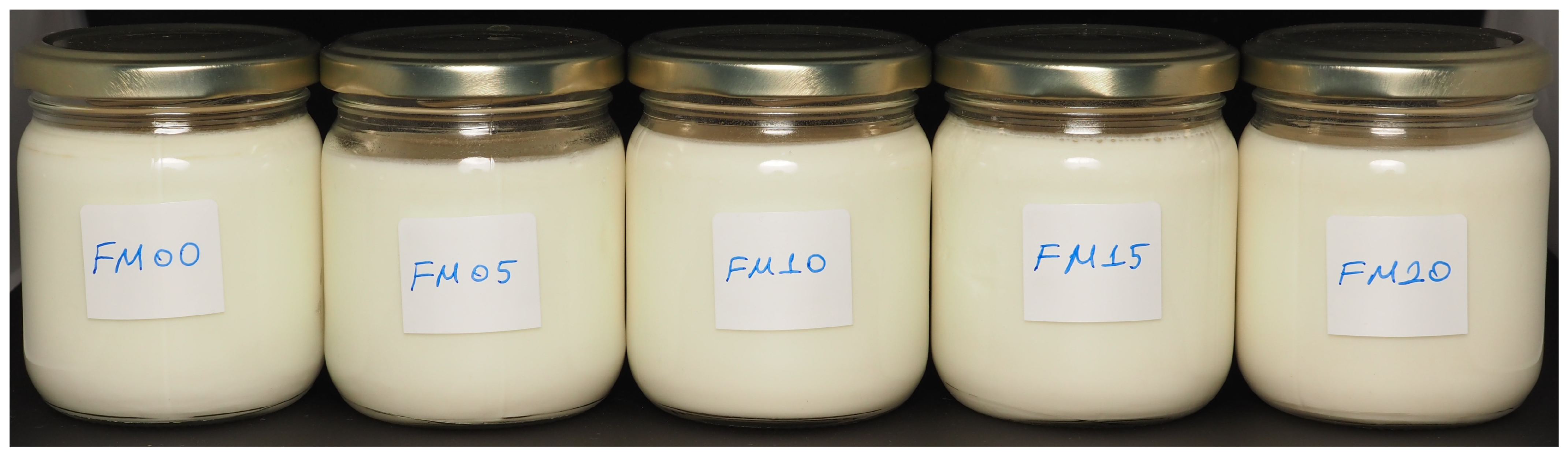
Throughout storage, the L* value of the control sample ranged between 87.14 and 88.59, whereas that of the samples containing pea fiber powder ranged between 86.35 and 88.82. Furthermore, it was determined that the L* value decreased statistically towards the end of the storage period for all samples (FM00, FM05, FM10 and FM20: p < 0.001; FM15: p < 0.01). On the other hand, statistical analysis revealed that samples containing pea fiber had lower L* values than the control sample on each day of storage, except for the 21st day (day 1: p < 0.05; day 7: p < 0.001; day 14: p < 0.01). Another color parameter, the a* value, ranged from −3.09 to −3.34 in the control sample and from −2.74 to −3.39 in samples containing pea fiber powder. Additionally, the b* value was found to range from 7.07 to 7.50 in the control sample and from 7.62 to 8.23 in the others. The a* value of all the samples increased statistically towards the end of the storage period (FM00, FM15: p < 0.05; FM05: p < 0.001; FM10, FM20: p < 0.01), whereas the b* value remained unchanged (p > 0.05). On the other hand, statistical analysis revealed that the a* and b* values of the samples containing pea fiber were higher than those of the control sample (Table 2). Although these differences are not clearly distinguishable to the naked eye (Figure 3), the results showed that adding pea fiber powder affected the colorimetric parameters L*, a* and b* of fermented milk. Similarly, some researchers have reported that adding different dietary fibers to fermented milk affects the color parameters of the samples [10,56,57]. This suggests that pea fiber powder does not affect the usual color characteristics of the product, but can improve them in new formulations.

3.6. Organic Acid Content

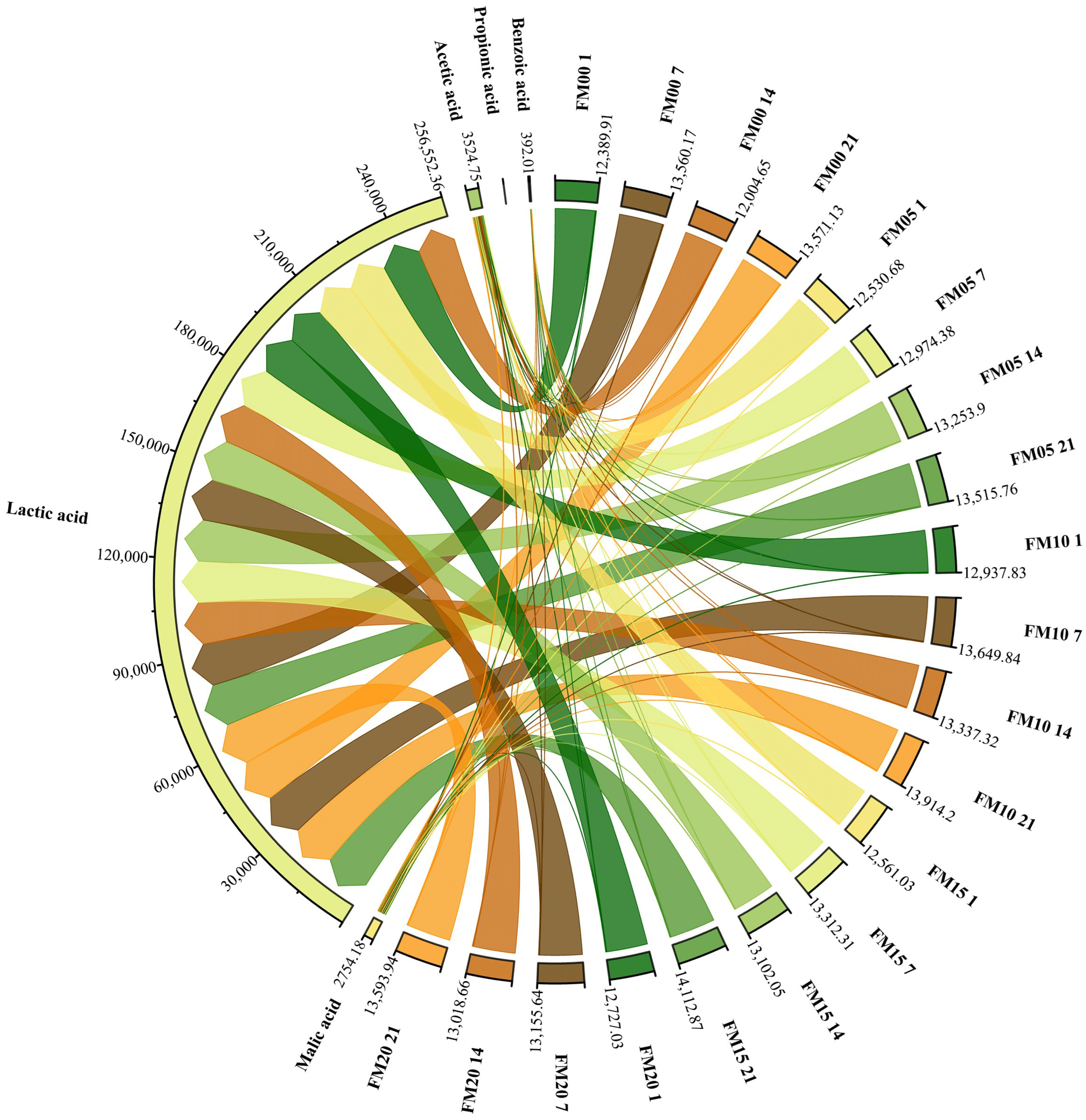
The OA produced during the fermentation process by microorganisms significantly affects product quality parameters, such as sensory characteristics and shelf life [58]. This study examined the OA content of fermented milks over time, and the results are presented in Table 3 and Figure 4. It was observed that, when all samples were considered, the malic acid content ranged from 84.07 mg/kg to 175.58 mg/kg. The results showed that adding pea fiber powder did not affect the malic acid content of the samples (p > 0.05). Conversely, the malic acid content of samples FM00 (p < 0.01), FM05 (p < 0.01), FM10 (p < 0.001) and FM15 (p < 0.05) decreased statistically over time. Although certain lactic acid bacteria are capable of performing malolactic fermentation, the strains used in the present study (L. reuteri ACC27 and S. thermophilus 212S) are not known to actively carry out this biotransformation. Therefore, the observed decrease in malic acid is more likely associated with general fermentation dynamics or storage-related changes rather than malolactic fermentation. The lactic acid content of the fermented milk samples varied between 11,670.45 and 13,791.66 mg/kg. It was found that neither the storage period nor the addition of pea fiber had a statistically significant effect on the lactic acid content of the samples (p > 0.05). Lactic acid fermentation is the most important method used to produce many fermented foods, and lactic acid is essential for giving them their distinctive properties [58]. As with Aktaş and Çetin [16], who reported producing yogurt with a lactic acid content of around 10,000 ppm, these results revealed that the main OA in the fermented milks produced in this study is lactic acid.
None of the samples contained propionic acid. The acetic and benzoic acid contents of the samples were found to be within the range of 145.12–240.53 and 17.07–20.34 mg/kg, respectively. Although the acetic acid content of all the samples increased over storage, the increase was only statistically significant in the FM20 sample (p < 0.05). Conversely, the addition of pea fiber had no statistically significant effect on the acetic acid content (p > 0.05). Although L. reuteri is a heterofermentative lactic acid bacterium capable of producing acetic acid, the acetic acid levels observed in this study likely reflect the combined metabolic activities of both L. reuteri and S. thermophilus. Under the applied conditions, the addition of pea fiber did not appear to significantly alter this metabolic balance. The benzoic acid content decreased over the storage period, but this change was only statistically significant in FM00 (p < 0.05) and FM20 (p < 0.001). The presence of benzoic acid in fermented dairy products has been reported previously and may be associated with general microbial activity and/or intrinsic milk components [16,59,60,61]. In the present study, no specific metabolic pathway was investigated; therefore, the detected benzoic acid cannot be conclusively attributed to the employed strains.

3.7. Antioxidant Capacity and Total Phenolic Content

The TPC and antioxidant capacity (IC50) of the fermented milk samples are given in Table 4. The TPC of the control sample was between 73.74 and 92.51 mg GAE/L, whereas that of the samples containing pea fiber was between 79.18 and 98.05 mg GAE/L. These results indicate that the addition of pea fiber was associated with higher TPC values. Furthermore, this increase was statistically significant on days 1 (p < 0.01), 7 (p < 0.05) and 21 (p < 0.01) of storage. By contrast, the IC50 value for the control sample ranged from 84.46 to 101.95 mg/mL throughout storage, whereas for the fiber-containing samples it ranged from 56.69 to 115.01 mg/mL. Lower IC50 values were observed in several fiber-containing samples, with statistically significant differences detected on days 1 (p < 0.05) and 21 (p < 0.01). However, this trend was not consistent across all storage days, and certain formulations (e.g., FM10) exhibited higher IC50 values compared to the control at specific time points. Since IC50 values are inversely related to antioxidant capacity, these variations may be attributed to fermentation-related transformations of phenolic compounds and matrix interactions during storage. Therefore, the antioxidant effect of pea fiber appears to depend on formulation and storage time rather than resulting in a uniform decrease in IC50 values. It is well known that plants can contain high levels of phenolic compounds, giving them antioxidant properties [62]. Similarly, Nilsson et al. [63] and Zhao et al. [64] emphasized that peas contain high levels of phenolic compounds, giving them a high antioxidant capacity. Therefore, it was expected that the TPC of the fermented milk samples with pea fiber powder would increase, while the IC50 values would decrease.
The lack of a linear relationship between pea fiber concentration and TPC or IC50 values may be attributed to the complex interactions within the food matrix. Phenolic compounds may exist in both free and bound forms, and their extractability can be influenced by interactions with proteins and other macromolecules. In particular, binding of phenolic compounds to milk proteins may reduce their measurable concentration, resulting in non-linear trends. In addition, structural changes occurring during storage may affect the release and stability of phenolic compounds. The similar TPC values observed for the control and FM20 samples on day 14 may be related to matrix-related interactions or variations in extraction efficiency. It is also possible that phenolic compounds in high-fiber samples became less extractable due to stronger binding within the matrix at this stage. Furthermore, the limited number of biological replicates may have contributed to these variations.

3.8. Sensory Analyses

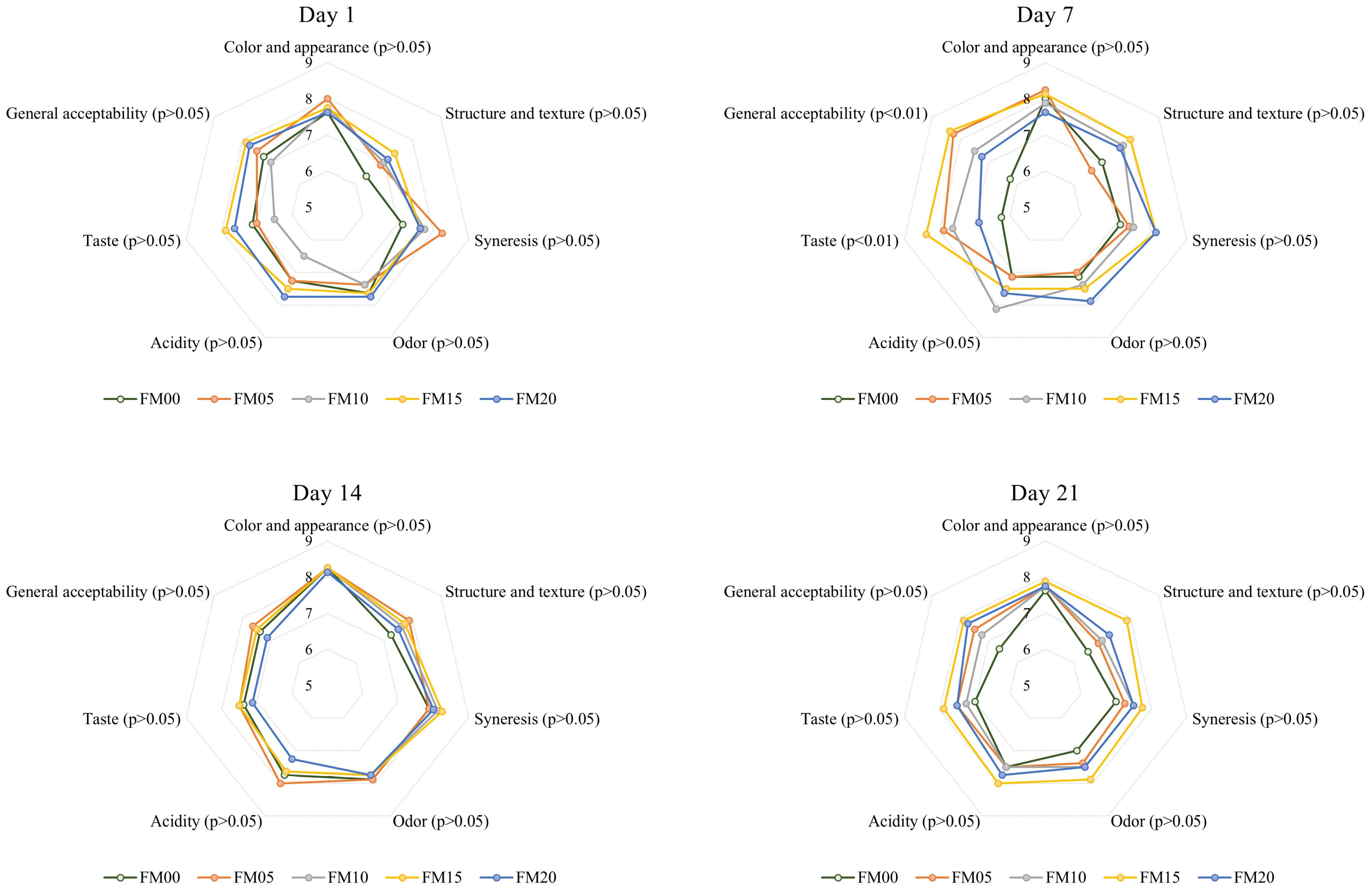
This study involved a sensory analysis to determine the impact of adding pea fiber powder to fermented milk on the characteristics of the products and the results are presented in Figure 5 and Table S4. The results showed that color and appearance, structure and texture, syneresis, odor and acidity of the samples did not change over storage, and that the addition of pea fiber had no effect on these parameters (p > 0.05). In terms of taste and general acceptability, the only statistical difference in the average scores given by the panelists was observed on the 7th day of storage (p < 0.01). Additionally, on the seventh day of storage, the panelists cited FM15 as the sample with the best taste, giving it an average score of 8.38. By contrast, on the seventh day of storage, the samples that were most highly rated by the panelists in terms of general acceptability were FM05 (8.25), FM10 (7.50) and FM15 (8.38). Similarly, Vasilev et al. [65] reported that sausages containing added pea fiber were more appealing than the control sample in terms of their appearance, texture, smell and taste. On this day, the control sample received taste and general acceptability scores of 6.25. Sensory analysis is a highly important methodological tool today, as it enables the responses of consumers to new products to be indirectly measured during the product development process [66]. The results of this study revealed that pea fiber did not have a negative effect on the sensory properties of fermented milks. In fact, on some days during the storage period, the taste and general acceptability of the samples containing pea fiber were preferred by the panelists. These findings suggest that pea fiber does not negatively affect sensory properties and may contribute positively to taste perception on certain storage days.

3.9. Correlation and Principal Component Analysis

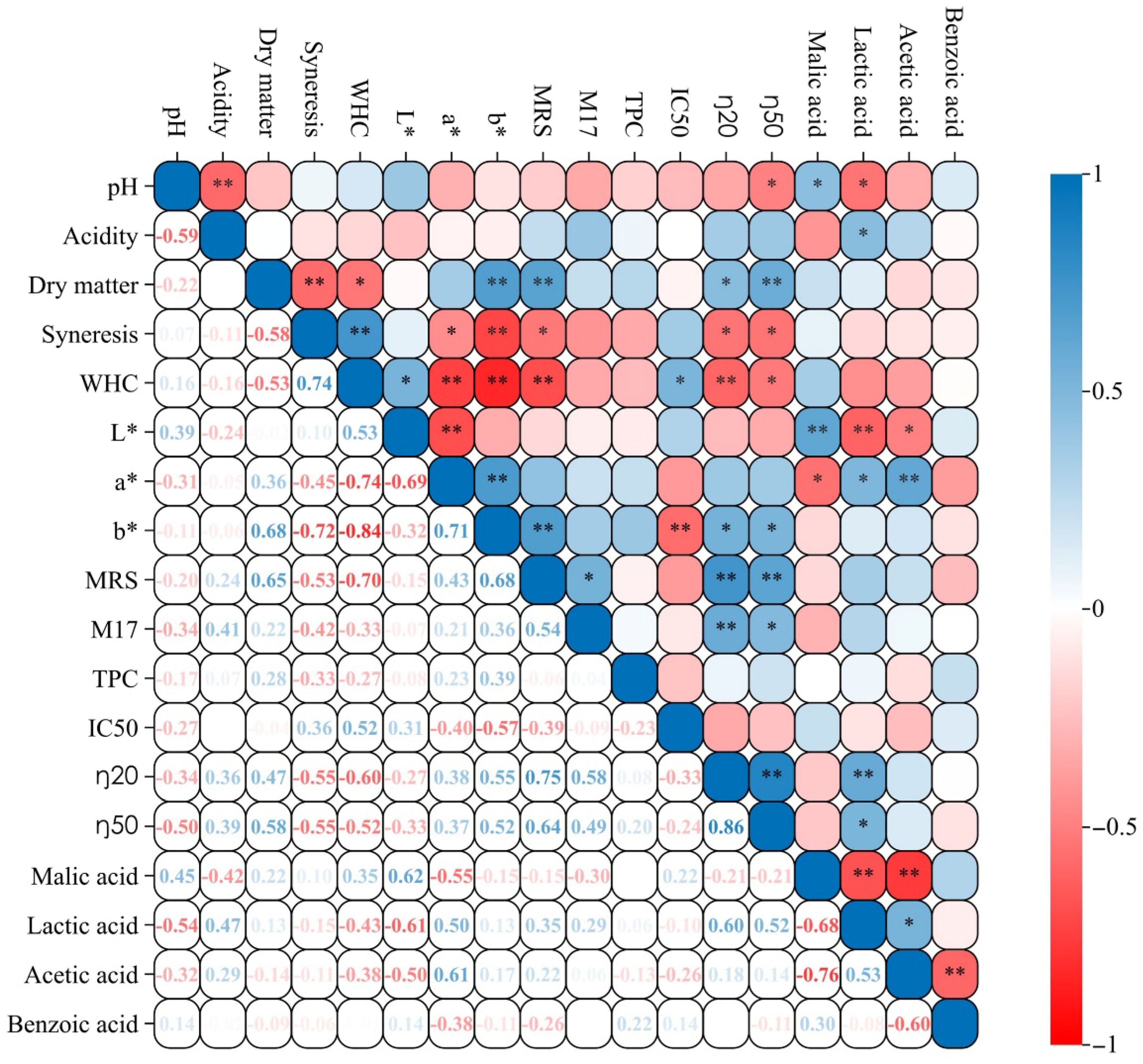
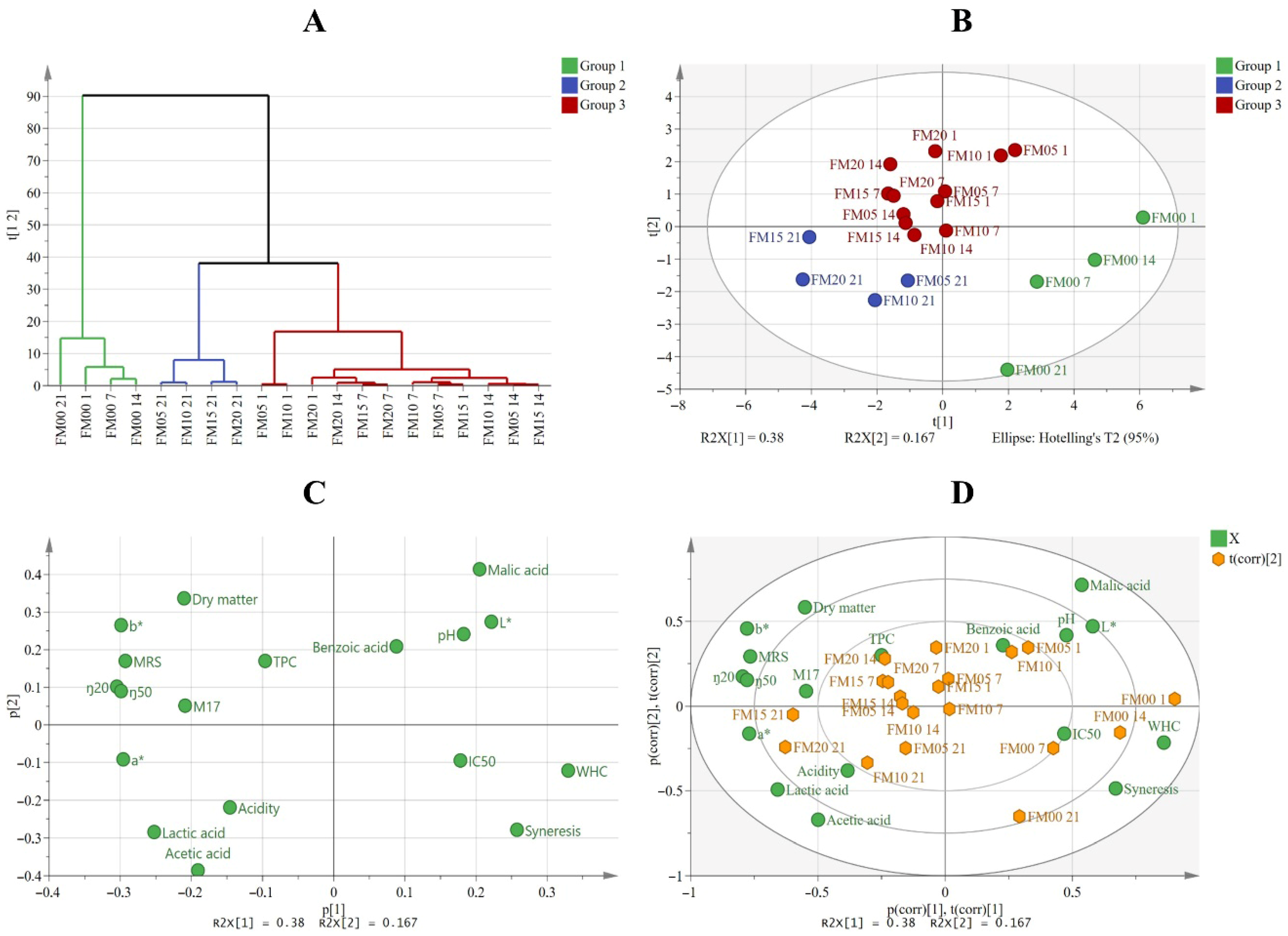
This study applied correlation analysis and PCA to determine the relationship between the data obtained from analyses of fermented milk samples and the characteristic properties of the sample groups. The results obtained from correlation analysis are presented in Figure 6 and Figure 7C. The dry matter content of the samples was found to be positively correlated with the L. reuteri ACC27 count (p < 0.01), b* value (p < 0.01) and viscosity (ŋ20: p < 0.05; ŋ50: p < 0.01), and negatively correlated with the syneresis (p < 0.01) and WHC values (p < 0.05). The observed positive association between pea fiber addition and L. reuteri ACC27 viability provides indicative evidence of a supportive interaction under in situ conditions [5]. On the other hand, similarly, Schneider and Gerber [67] also stated that an increase in dry matter content increases the viscosity. Additionally, the positive correlation between the counts of L. reuteri ACC27 and S. thermophilus 212S revealed the symbiotic relationship between the bacteria used as starter cultures in the samples (p < 0.05) [68]. A study by Celik and Bakirci [69] noted that the pH of yogurts decreased and their viscosity increased during storage. Similarly, the present study determined that the viscosity of the samples was positively correlated with lactic acid content and negatively correlated with pH. It is thought that this situation may be due to the relationship between casein, pH and the isoelectric point [70].
The PCA results for all storage days revealed that the fermented milk samples could be categorized into three distinct groups (Figure 7A,B). Group 1 comprised the FM00 day 1, FM00 day 7, FM00 day 14 and FM00 day 21 samples, while group 2 comprised the FM05 day 21, FM10 day 21, FM15 day 21 and FM20 day 21 samples. The other examples were categorized as group 3. Although the samples containing pea fiber could not be clearly distinguished from each other, it was notable that all the control samples were clearly grouped together. All control samples are grouped separately due to their high levels of syneresis, water WHC and IC50 (Figure 7D). In other words, the distinguishing parameters of groups 2 and 3 were high a* and b* values, high viscosity at 20 and 50 rpm, a high L. reuteri ACC27 count, and high TPC. These results, obtained from PCA, have once again confirmed the effects of adding pea fiber to fermented milk, a point that has been emphasized throughout this study.

4. Conclusions

This study examined the usability of pea fiber in fermented milk products. The pea fiber promoted the growth of L. reuteri ACC27 in both in vitro and in situ conditions, and shortened the fermentation time of fermented milk. Based on the observed enhancement of probiotic viability, pea fiber powder may provide supportive conditions for probiotic microorganisms in fermented milk; however, direct prebiotic or synbiotic functionality as defined by ISAPP requires further targeted investigation. In addition, pea fiber has been found to enhance the physicochemical properties of fermented milk, such as syneresis and WHC, as well as viscosity, color parameters, TPC and antioxidant capability. Taking all these results into account, pea fiber powder can be considered a promising ingredient for fermented milk formulations aimed at enhancing probiotic viability and improving physicochemical and functional quality attributes. Also, it should be noted that the present study was conducted using two independent production batches analyzed in duplicate, which represents a limitation in terms of biological replication. In addition, the absence of in vivo validation is another limitation of the present study. Therefore, future studies including a higher number of independent batches and in vivo investigations are warranted to further strengthen the robustness and applicability of the findings.

Supplementary Materials

The following supporting information can be downloaded at: https://www.mdpi.com/article/10.3390/fermentation12040189/s1, Table S1: pH change potential of L. reuteri ACC27 in MRS broth containing different proportions of pea fiber; Table S2: Viable cell count change in L. reuteri ACC27 in MRS broth containing different proportions of pea fiber; Table S3: pH change in the fermented milk samples containing different proportions of pea fiber during fermentation period; Table S4: Sensory analysis results of fermented milk samples during storage.

Author Contributions

Conceptualization, H.A.; Methodology, N.N.H. and H.A.; Software, H.A.; Validation, H.A.; Formal Analysis, H.A.; Investigation, N.N.H. and H.A.; Resources, H.A.; Data Curation, N.N.H. and H.A.; Writing—Original Draft Preparation, N.N.H. and H.A.; Writing—Review and Editing, N.N.H. and H.A.; Visualization, H.A.; Supervision, H.A.; Project Administration, H.A.; Funding Acquisition, H.A. All authors have read and agreed to the published version of the manuscript.

Funding

This research was funded by the Atatürk University Research Centre, grant number FBA-2024-14734.

Institutional Review Board Statement

The study was approved by the Atatürk University Ethics Committee (approval number: 2025/1, 23 May 2025).

Informed Consent Statement

All panelists were informed about the study and written informed consent was obtained prior to sensory analysis.

Data Availability Statement

The original contributions presented in this study are included in the article. Further inquiries can be directed to the corresponding author.

Conflicts of Interest

The authors declare no conflict of interest.

References

  1. Hashemi, S.M.B.; Raeisi, S.; Zanardi, E.; Paciulli, M.; Chiavaro, E. Antimicrobial and antioxidant activities of fermented meat patty with Lactobacillus strains. Ital. J. Food Sci. 2018, 30, 268–279. [Google Scholar]
  2. Şanlier, N.; Gökcen, B.B.; Sezgin, A.C. Health benefits of fermented foods. Crit. Rev. Food Sci. Nutr. 2017, 59, 506–527. [Google Scholar] [CrossRef]
  3. Kariyawasam, K.M.G.M.M.; Lee, N.K.; Paik, H.D. Fermented dairy products as delivery vehicles of novel probiotic strains isolated from traditional fermented Asian foods. J. Food Sci. Technol. 2021, 58, 2467–2478. [Google Scholar] [CrossRef]
  4. Çetin, B.; Aktaş, H. Monitoring probiotic properties and safety evaluation of antilisterial Enterococcus faecium strains with cholesterol-lowering potential from raw cow’s milk. Food Biosci. 2024, 61, 104532. [Google Scholar] [CrossRef]
  5. Şanlıbaba, P. Fermented nondairy functional foods based on probiotics. Ital. J. Food Sci. 2023, 35, 91–105. [Google Scholar] [CrossRef]
  6. Rayes, A.A. Enhancement of probiotic bioactivity by some prebiotics to produce bio-fermented milk. Life Sci. J. 2012, 9, 2246–2253. [Google Scholar]
  7. Figueroa-Gonzalez, I.; Rodriguez-Serrano, G.; Gomez-Ruiz, L.; Garcia-Garibay, M.; Cruz-Guerrero, A. Prebiotic effect of commercial saccharides on probiotic bacteria isolated from commercial products. Food Sci. Technol. 2019, 39, 747–753. [Google Scholar] [CrossRef]
  8. Reshetnik, E.I.; Utochkina, E.A. Healthy food products with probiotic and prebiotic properties. Foods Raw Mater. 2013, 1, 88–94. [Google Scholar] [CrossRef]
  9. El-Aidie, S.; Elsayed, N.; Hashem, M.; Elkashef, H. Development of fermented skimmed milk fortified with yellow sweet potato (Ipomoea batatas L.) with prebiotic and antioxidant activity. J. Food Nutr. Res. 2021, 60, 66–75. [Google Scholar]
  10. Barat, A.; Ozcan, T. Growth of probiotic bacteria and characteristics of fermented milk containing fruit matrices. Int. J. Dairy Technol. 2018, 71, 120–129. [Google Scholar] [CrossRef]
  11. Santos, R.O.; Silva, M.V.F.; Nascimento, K.O.; Batista, A.L.; Moraes, J.; Andrade, M.M.; Andrade, L.G.Z.S.; Khosravi-Darani, K.; Freitas, M.Q.; Raices, R.S.L.; et al. Prebiotic flours in dairy food processing: Technological and sensory implications. Int. J. Dairy Technol. 2018, 71, 1–10. [Google Scholar]
  12. Zhao, R.; Qiao, M.; Ma, Y.; Li, Q.; Li, N.; Huang, X.; Cheng, Y.; Song, L. Optimization of microwave-ultrasound assisted extraction of oligosaccharides from pea seeds and its probiotic proliferative activity. J. Food Sci. Technol. 2025; in press.
  13. Aktaş, H.; Çetin, B. Multidimensional evaluation of techno-functional properties of yoghurt bacteria. Int. Dairy J. 2024, 148, 105795. [Google Scholar] [CrossRef]
  14. Ashraf, R.; Shah, N.P. Selective and differential enumerations of Lactobacillus delbrueckii subsp. bulgaricus, Streptococcus thermophilus, Lactobacillus acidophilus, Lactobacillus casei and Bifidobacterium spp. in yoghurt—A review. Int. J. Food Microbiol. 2011, 149, 194–208. [Google Scholar]
  15. Aktaş, H. Characterisation of enterocins produced by antilisterial Enterococcus faecium BH04, BH12, BH84, and BH99 and in vitro/in situ inhibition of Listeria monocytogenes. Food Sci. Nutr. 2025, 13, e70142. [Google Scholar] [CrossRef]
  16. Aktaş, H.; Çetin, B. Effects of novel autochthonous starter cultures on quality characteristics of yoghurt. Int. J. Food Eng. 2024, 20, 799–808. [Google Scholar] [CrossRef]
  17. Robinson, R.K.; Lucey, J.A.; Tamime, A.Y. Manufacture of Yoghurt; Blackwell Publishing: London, UK, 2006. [Google Scholar]
  18. Harrigan, W.F. Laboratory Methods in Food Microbiology; Academic Press: San Diego, CA, USA, 1998. [Google Scholar]
  19. ISO 21527-1:2008; Microbiology of Food and Animal Feeding Stuffs-Horizontal Method for the Enumeration of Yeasts and Moulds-Part 1: Colony Count Technique in Products with Water Activity Greater than 0.95. The International Organization for Standardization: Geneva, Switzerland, 2008.
  20. ISO 4832:2006; Microbiology of Food and Animal Feeding Stuffs-Horizontal Method for the Enumeration of Coliforms-Colony-Count Technique. The International Organization for Standardization: Geneva, Switzerland, 2006.
  21. Savello, P.A.; Ernstrom, C.A.; Kalab, M. Microstructure and meltability of model process cheese made with rennet and acid casein. J. Dairy Sci. 1989, 72, 1–11. [Google Scholar] [CrossRef]
  22. Cemeroglu, B. General Methods in Food Analysis: Food Analysis; Food Technology Association Publications: Ankara, Türkiye, 2010. [Google Scholar]
  23. AOAC. Official Methods of Analysis of the AOAC, 18th ed.; AOAC: Gaithersburg, MD, USA, 2005. [Google Scholar]
  24. Taşdemir, Y.; Gölge, E. Rheology and sensory properties of microencapsulated propolis-enriched stirred-type yoghurt. Ital. J. Food Sci. 2023, 35, 155–163. [Google Scholar]
  25. Bensmira, M.; Jiang, B. Effect of some operating variables on the microstructure and physical properties of a novel kefir formulation. J. Food Eng. 2012, 108, 579–584. [Google Scholar] [CrossRef]
  26. Özer, E. Characteristics of apricot yogurt fermented with different culture strains and stevia. Ital. J. Food Sci. 2024, 36, 151–163. [Google Scholar]
  27. Atalar, I. Functional kefir production from high pressure homogenized hazelnut milk. LWT 2019, 107, 256–263. [Google Scholar] [CrossRef]
  28. Ozcan, T.; Sahin, S.; Akpinar-Bayizit, A.; Yilmaz-Ersan, L. Assessment of antioxidant capacity by method comparison and amino acid characterisation in buffalo milk kefir. Int. J. Dairy Technol. 2019, 72, 65–73. [Google Scholar] [CrossRef]
  29. Şengül, M.; Karakütük, İ.A.; Ay, E. Effects of sweetener type and storage conditions on physicochemical properties, phenolic compounds, and antioxidant properties of cherry laurel (Prunus laurocerasus) pulp and marmalade. J. Food Meas. Charact. 2024, 18, 8622–8637. [Google Scholar] [CrossRef]
  30. Bodyfelt, F.W.; Tobias, J.; Trout, G.M. The Sensory Evaluation of Dairy Products; Van Nostrand Reinhold: New York, NY, USA, 1988. [Google Scholar]
  31. Zafar, J.; Ul Haq, I.; Nayik, G.A.; Ramniwas, S.; Mugabi, R.; Ali Alharbi, S.; Ansari, M.J. Studies on the growth of Lactobacillus reuteri, Bifidobacterium and Escherichia coli as affected by prebiotic extracted from citrus peel. Int. J. Food Prop. 2024, 27, 783–798. [Google Scholar] [CrossRef]
  32. Kumari, T.; Das, A.J.; Das, A.B.; Reddy, C.K.; Deka, S.C. Prebiotic activity of enzymatically modified pea peel dietary fiber: An in vitro study. Bioact. Carbohydr. Diet. Fibre 2024, 32, 100452. [Google Scholar] [CrossRef]
  33. de Souza Oliveira, R.P.; Perego, P.; de Oliveira, M.N.; Converti, A. Effect of inulin on the growth and metabolism of a probiotic strain of Lactobacillus rhamnosus in co-culture with Streptococcus thermophilus. LWT 2012, 47, 358–363. [Google Scholar] [CrossRef]
  34. Carlson, J.; Hospattankar, A.; Deng, P.; Swanson, K.; Slavin, J. Prebiotic effects and fermentation kinetics of wheat dextrin and partially hydrolyzed guar gum in an in vitro batch fermentation system. Foods 2015, 4, 349–358. [Google Scholar] [CrossRef] [PubMed]
  35. Grimaldi, R.; Swann, J.R.; Vulevic, J.; Gibson, G.R.; Costabile, A. Fermentation properties and potential prebiotic activity of Bimuno® galacto-oligosaccharide (65% galacto-oligosaccharide content) on in vitro gut microbiota parameters. Br. J. Nutr. 2016, 116, 480–486. [Google Scholar] [CrossRef]
  36. Van den Abbeele, P.; Ghyselinck, J.; Marzorati, M.; Villar, A.; Zangara, A.; Smidt, C.R.; Risco, E. In vitro evaluation of prebiotic properties of a commercial artichoke inflorescence extract revealed bifidogenic effects. Nutrients 2020, 12, 1552. [Google Scholar] [CrossRef]
  37. Aly, E.; Ros-Berruezo, G.; López-Nicolás, R.; Darwish, A.A.; Sánchez-Moya, T.; Planes-Muñoz, D.; Frontela-Saseta, C. In vitro prebiotic activity of rhLf and galactooligosaccharides on infant intestinal microbiota. Nutr. Hosp. 2023, 40, 701–710. [Google Scholar]
  38. Roller, M.; Clune, Y.; Collins, K.; Rechkemmer, G.; Watzl, B. Consumption of prebiotic inulin enriched with oligofructose in combination with the probiotics Lactobacillus rhamnosus and Bifidobacterium lactis has minor effects on selected immune parameters in polypectomised and colon cancer patients. Br. J. Nutr. 2007, 97, 676–684. [Google Scholar] [CrossRef]
  39. Kadlec, R.; Jakubec, M. The effect of prebiotics on adherence of probiotics. J. Dairy Sci. 2014, 97, 1983–1990. [Google Scholar] [CrossRef]
  40. Yahfoufi, N.; Mallet, J.F.; Graham, E.; Matar, C. Role of probiotics and prebiotics in immunomodulation. Curr. Opin. Food Sci. 2018, 20, 82–91. [Google Scholar] [CrossRef]
  41. You, S.; Ma, Y.; Yan, B.; Pei, W.; Wu, Q.; Ding, C.; Huang, C. The promotion mechanism of prebiotics for probiotics: A review. Front. Nutr. 2022, 9, 1000517. [Google Scholar] [CrossRef]
  42. Sendra, E.; Fayos, P.; Lario, Y.; Fernández-López, J.; Sayas-Barberá, E.; Pérez-Alvarez, J.A. Incorporation of citrus fibers in fermented milk containing probiotic bacteria. Food Microbiol. 2008, 25, 13–21. [Google Scholar] [CrossRef] [PubMed]
  43. Oliveira, R.P.; Florence, A.C.; Silva, R.C.; Perego, P.; Converti, A.; Gioielli, L.A.; Oliveira, M.N. Effect of different prebiotics on the fermentation kinetics, probiotic survival and fatty acids profiles in nonfat symbiotic fermented milk. Int. J. Food Microbiol. 2009, 128, 467–472. [Google Scholar] [CrossRef]
  44. de Souza Oliveira, R.P.; Perego, P.; de Oliveira, M.N.; Converti, A. Effect of inulin as prebiotic and synbiotic interactions between probiotics to improve fermented milk firmness. J. Food Eng. 2011, 107, 36–40. [Google Scholar] [CrossRef]
  45. Celestin, S.; Thorat, S.S.; Desale, R.J.; Chavan, U.D. Effect of milk supplementation with fructooligosaccharides and inulin on viable counts of probiotic bacteria in goat and cow milk yoghurts. IOSR J. Environ. Sci. Toxicol. Food Technol. 2015, 9, 6–12. [Google Scholar]
  46. Gopal, N.; Hill, C.; Ross, P.R.; Beresford, T.P.; Fenelon, M.A.; Cotter, P.D. The prevalence and control of Bacillus and related spore-forming bacteria in the dairy industry. Front. Microbiol. 2015, 6, 1418. [Google Scholar] [CrossRef] [PubMed]
  47. Mehta, D.S.; Metzger, L.E.; Hassan, A.N.; Nelson, B.K.; Patel, H.A. The ability of spore formers to degrade milk proteins, fat, phospholipids, common stabilizers, and exopolysaccharides. J. Dairy Sci. 2019, 102, 10799–10813. [Google Scholar] [CrossRef]
  48. Casarotti, S.N.; Monteiro, D.A.; Moretti, M.M.; Penna, A.L.B. Influence of the combination of probiotic cultures during fermentation and storage of fermented milk. Food Res. Int. 2014, 59, 67–75. [Google Scholar] [CrossRef]
  49. Surono, I.S.; Hosono, A. Fermented milks. In Encyclopedia of Dairy Sciences; Roginski, H., Fuquay, J.W., Fox, P.F., Eds.; Academic Press: London, UK, 2003; pp. 1018–1023. [Google Scholar]
  50. Xu, Z.; Li, S.; Gong, G.; Liu, Z.; Wu, Z.; Ma, C. Influence of different acidifying strains of Lactobacillus delbrueckii subsp. bulgaricus on the quality of yoghurt. Food Sci. Technol. Res. 2015, 21, 263–269. [Google Scholar] [CrossRef]
  51. Kalyas, A.; Ürkek, B. Effect of flaxseed powder on physicochemical, rheological, microbiological and sensory properties of yoghurt. Braz. Arch. Biol. Technol. 2022, 65, e22210012. [Google Scholar] [CrossRef]
  52. Tamime, A.Y.; Robinson, R.K. Tamime and Robinson’s Yoghurt: Science and Technology; Elsevier: Amsterdam, The Netherlands, 2007. [Google Scholar]
  53. Debon, J.; Prudêncio, E.S.; Petrus, J.C.C.; Fritzen-Freire, C.B.; Müller, C.M.; Amboni, R.D.D.M.C.; Vieira, C.R.W. Storage stability of prebiotic fermented milk obtained from permeate resulting of the microfiltration process. LWT 2012, 47, 96–102. [Google Scholar] [CrossRef]
  54. Zare, F.; Boye, J.I.; Champagne, C.P.; Orsat, V.; Simpson, B.K. Probiotic milk supplementation with pea flour: Microbial and physical properties. Food Bioprocess Technol. 2013, 6, 1321–1331. [Google Scholar]
  55. Damian, C.; Olteanu, A. Influence of dietary fiber from pea on some quality characteristics of yoghurts. J. Agroaliment. Process. Technol. 2014, 20, 156–160. [Google Scholar]
  56. Ibrahim, A.H.; Khalifa, S.A. Improve sensory quality and textural properties of fermented camel’s milk by fortified with dietary fiber. J. Am. Sci. 2015, 11, 42–54. [Google Scholar]
  57. Kurbanova, I.; Lauciene, L.; Kondrotiene, K.; Zakariene, G.; Radenkovs, V.; Kiselioviene, S.; Salaseviciene, A.; Vasiliauskaite, A.; Malakauskas, M.; Musulmanova, M.; et al. Physicochemical, sensory, and microbiological analysis of fermented drinks made from white kidney bean extract and cow’s milk blends during refrigerated storage. Microorganisms 2024, 12, 1832. [Google Scholar] [CrossRef]
  58. Li, W.; Ghamry, M.; Xu, X.; Zhang, L.; Li, J. Organic acids: Key products of fermented foods and sources of anti-inflammatory potential. Food Rev. Int. 2025; in press.
  59. Özcelik, S.; Kuley, E.; Özogul, F. Formation of lactic, acetic, succinic, propionic, formic and butyric acid by lactic acid bacteria. LWT 2016, 73, 536–542. [Google Scholar] [CrossRef]
  60. Aktaş, H.; Meral Aktaş, H.; Ürkek, B.; Şengül, M.; Çetin, B. Evaluation of spreadable kefir produced from different milks in terms of some quality criteria. Probiotics Antimicrob. Proteins 2024, 16, 1734–1743. [Google Scholar] [CrossRef]
  61. Meral-Aktaş, H.; Bazu-Çırpıcı, B.; Aktaş, H.; Kadiroğlu, H.; Çetin, B. Comparative quality assessment of plant-based kefir as a vegan alternative to traditional kefir. Food Biosci. 2025, 70, 107062. [Google Scholar] [CrossRef]
  62. Nazir, N.; Nisar, M.; Ahmad, S.; Wadood, S.F.; Jan, T.; Zahoor, M.; Ahmad, M.; Ullah, A. Characterization of phenolic compounds in two novel lines of Pisum sativum L. along with their in vitro antioxidant potential. Environ. Sci. Pollut. Res. 2020, 27, 7639–7646. [Google Scholar]
  63. Nilsson, J.; Stegmark, R.; Åkesson, B. Total antioxidant capacity in different pea (Pisum sativum) varieties after blanching and freezing. Food Chem. 2004, 86, 501–507. [Google Scholar] [CrossRef]
  64. Zhao, T.; Su, W.; Qin, Y.; Wang, L.; Kang, Y. Phenotypic diversity of pea (Pisum sativum L.) varieties and the polyphenols, flavonoids, and antioxidant activity of their seeds. Cienc. Rural 2020, 50, e20190196. [Google Scholar]
  65. Vasilev, D.; Saicić, S.; Vasiljević, N. Quality and nutritive value of fermented sausages produced with inulin and pea fibre as fat replacers. Fleischwirtschaft 2013, 93, 123–127. [Google Scholar]
  66. Ruiz-Capillas, C.; Herrero, A.M. Sensory analysis and consumer research in new product development. Foods 2021, 10, 582. [Google Scholar] [CrossRef]
  67. Schneider, N.; Gerber, M. Correlation between viscosity, temperature and total solid content of algal biomass. Bioresour. Technol. 2014, 170, 293–302. [Google Scholar] [CrossRef] [PubMed]
  68. Yang, S.; Bai, M.; Kwok, L.Y.; Zhong, Z.; Sun, Z. The intricate symbiotic relationship between lactic acid bacterial starters in the milk fermentation ecosystem. Crit. Rev. Food Sci. Nutr. 2025, 65, 728–745. [Google Scholar] [CrossRef]
  69. Celik, S.; Bakirci, I. Some properties of yoghurt produced by adding mulberry pekmez (concentrated juice). Int. J. Dairy Technol. 2003, 56, 26–29. [Google Scholar] [CrossRef]
  70. Francis, M.J.; Glover, Z.J.; Yu, Q.; Povey, M.J.; Holmes, M.J. Acoustic characterisation of pH dependant reversible micellar casein aggregation. Colloids Surf. A Physicochem. Eng. Asp. 2019, 568, 259–265. [Google Scholar] [CrossRef]
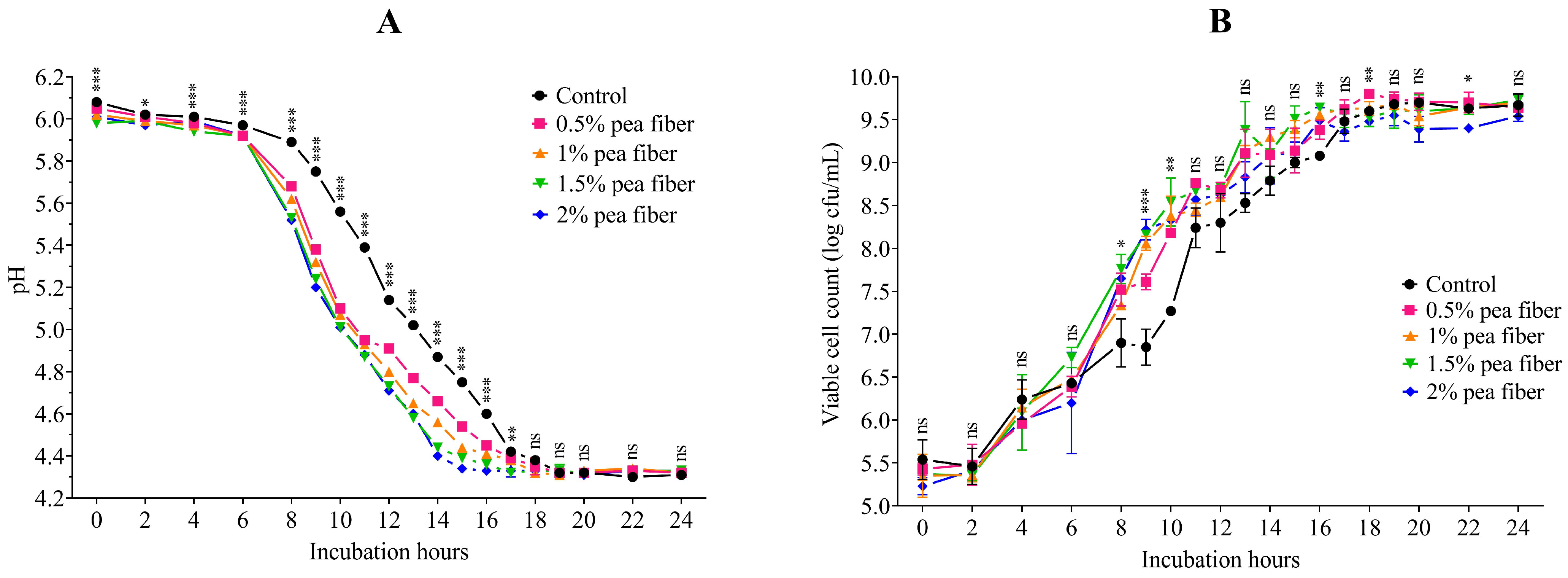
Figure 1. Changes in pH (A) and viable cell counts (B) induced by L. reuteri ACC27 in MRS broth supplemented with pea fiber powder. The one-way ANOVA test revealed statistical differences between the control and the broths with pea fiber. All results were expressed as mean ± standard deviation, ***: p < 0.001; **: p < 0.01; *: p < 0.05; ns: not statistically significant.
Fermentation 12 00189 g001
Figure 2. Changes in the pH of the fermented milk samples during the fermentation time. The one-way ANOVA test revealed statistical differences between the control and the fermented milks with pea fiber. All results were expressed as mean ± standard deviation, ***: p < 0.001; **: p < 0.01; *: p < 0.05; FM00: control sample (without pea fiber powder); FM05: sample containing 0.5% pea fiber powder; FM10: sample containing 1% pea fiber powder; FM15: sample containing 1.5% pea fiber powder; FM20: sample containing 2% pea fiber powder.
Fermentation 12 00189 g002
Figure 3. The fermented milk samples produced in this study.
Fermentation 12 00189 g003
Figure 4. Chord diagram illustrating the distribution of organic acids in fermented milk samples during storage. The segments on the left represent individual organic acids, while those on the right correspond to different sample groups and storage times. The connecting chords indicate the contribution of each organic acid to the respective samples, with chord thickness reflecting the magnitude of the concentration. Colors correspond to specific organic acids, allowing visualization of their relative abundance and distribution across samples during the storage period.
Fermentation 12 00189 g004
Figure 5. Sensory analysis results of fermented milk samples during storage period. FM00: Control, FM05: Fermented milk with 0.5% pea fiber powder, FM10: Fermented milk with 1% pea fiber powder, FM15: Fermented milk with 1.5% pea fiber powder, FM20: Fermented milk with 2% pea fiber powder.
Fermentation 12 00189 g005
Figure 6. Correlations between results from all the fermented milks. The color (from blue to red) indicates from positive to negative correlation effects. **: p < 0.01, *: p < 0.05, WHC: Water holding capacity, MRS: Limosilactobacillus reuteri ACC27 count, M17: Streptococcus thermophilus 212S count, TPC: Total phenolic content, IC50: Antioxidant capacity, ŋ20: Viscosity at 20 rpm, ŋ50: Viscosity at 50 rpm.
Fermentation 12 00189 g006
Figure 7. Principal component analysis illustrated through (A) hierarchical cluster analysis, (B) score plot, (C) loading plot, and (D) combined biplot. The R2X[1] and R2X[2] values represent the proportions of variance attributed to PC1 and PC2, respectively, which together account for 54.7% of the total data variation.
Fermentation 12 00189 g007
Table 1. Microbiological analysis results of fermented milk samples during storage 1.
ParametersSampleStorage Period (Days)Sig.
171421
Limosilactobacillus reuteri ACC27 (log CFU/g)FM005.57 ± 0.125.70 ± 0.00 D5.26 ± 0.315.89 ± 0.58ns
FM056.44 ± 0.066.65 ± 0.24 AB6.44 ± 0.436.19 ± 0.16ns
FM106.21 ± 0.136.00 ± 0.00 CD6.29 ± 0.166.38 ± 0.51ns
FM156.39 ± 0.556.76 ± 0.03 A6.20 ± 0.286.35 ± 0.49ns
FM206.37 ± 0.526.24 ± 0.34 BC6.15 ± 0.216.84 ± 0.09ns
Sig.ns**nsns 
Streptococcus thermophilus 212S (log CFU/g)FM008.93 ± 0.128.93 ± 0.128.92 ± 0.029.15 ± 0.21ns
FM059.07 ± 0.049.12 ± 0.209.24 ± 0.349.16 ± 0.02ns
FM109.11 ± 0.078.98 ± 0.039.14 ± 0.019.11 ± 0.10ns
FM159.13 ± 0.029.07 ± 0.049.10 ± 0.059.11 ± 0.10ns
FM209.07 ± 0.179.01 ± 0.019.22 ± 0.129.05 ± 0.14ns
Sig.nsnsnsns 
1 All results are presented in log CFU/g and as the mean ± standard deviation. FM00: Control, FM05: Fermented milk with 0.5% pea fiber powder, FM10: Fermented milk with 1% pea fiber powder, FM15: Fermented milk with 1.5% pea fiber powder, FM20: Fermented milk with 2% pea fiber powder, Sig.: Level of statistical significance, **: p < 0.01; ns: not statistically significant. Uppercase (A–D) letters show statistical differences in the same column.
Table 2. Physicochemical, viscosity and color analysis results of fermented milk samples during storage 1.
ParametersSampleStorage Period (Days)Sig.
171421
pHFM004.68 ± 0.02 aA4.52 ± 0.01 c4.58 ± 0.02 bA4.55 ± 0.01 bcAB**
FM054.66 ± 0.01 aAB4.58 ± 0.01 b4.49 ± 0.01 dB4.52 ± 0.01 cB***
FM104.62 ± 0.03 aB4.53 ± 0.01 b4.42 ± 0.01 cC4.43 ± 0.02 cC**
FM154.54 ± 0.01 C4.57 ± 0.024.55 ± 0.01 A4.57 ± 0.02 Ans
FM204.53 ± 0.00 C4.57 ± 0.024.58 ± 0.02 A4.55 ± 0.01 ABns
Sig.***ns***** 
Acidity (lactic acid, %)FM000.90 ± 0.01 b0.92 ± 0.00 b0.91 ± 0.01 bC0.96 ± 0.00 aBC**
FM050.93 ± 0.01 c0.96 ± 0.03 bc1.00 ± 0.00 abA1.01 ± 0.00 aA*
FM100.89 ± 0.050.98 ± 0.010.98 ± 0.01 B0.98 ± 0.01 ABns
FM150.95 ± 0.010.93 ± 0.041.02 ± 0.00 A0.96 ± 0.02 Bns
FM200.92 ± 0.010.91 ± 0.010.89 ± 0.01 C0.93 ± 0.01 Cns
Sig.nsns***** 
Total dry matter (%)FM0013.84 ± 0.0614.20 ± 1.1613.11 ± 1.0112.30 ± 0.35 Cns
FM0514.91 ± 0.3415.52 ± 1.6214.30 ± 0.5814.38 ± 0.55 Bns
FM1015.20 ± 0.8915.35 ± 0.6715.75 ± 0.6415.23 ± 0.40 ABns
FM1515.12 ± 0.1214.76 ± 0.2814.86 ± 0.9714.61 ± 0.04 Bns
FM2015.71 ± 0.1614.92 ± 0.3815.54 ± 0.3615.66 ± 0.14 Ans
Sig.nsnsns** 
Syneresis (%)FM0012.79 ± 0.6316.73 ± 3.4214.69 ± 2.20 A17.82 ± 2.37ns
FM0511.82 ± 3.0314.68 ± 0.679.82 ± 1.30 B11.65 ± 3.48ns
FM1011.55 ± 0.3812.55 ± 1.799.77 ± 1.12 B12.08 ± 3.38ns
FM1510.52 ± 0.148.77 ± 1.738.31 ± 1.71 B6.62 ± 1.55ns
FM2010.48 ± 1.2111.35 ± 5.287.53 ± 0.10 B9.53 ± 3.40ns
Sig. nsns*ns 
WHC (%)FM0053.42 ± 1.05 A53.45 ± 0.36 A53.40 ± 0.01 A52.45 ± 1.55 Ans
FM0550.62 ± 0.17 aB48.10 ± 0.05 bB49.78 ± 0.99 aB46.98 ± 0.46 bB**
FM1049.21 ± 0.02 aBC48.65 ± 0.32 aB48.93 ± 0.43 aB45.82 ± 0.38 bBC**
FM1547.89 ± 0.82 aC41.61 ± 0.61 cC44.27 ± 0.43 bC43.19 ± 0.85 bcD**
FM2048.21 ± 0.19 aC42.56 ± 0.48 cC44.98 ± 1.01 bC43.84 ± 0.55 bcCD**
Sig.*********** 
ŋ20 (cP)FM0010,817.5 ± 528.5 dD18,475.0 ± 884.0 aC11,497.5 ± 802.9 cC17,157.5 ± 654.8 bD***
FM0519,865.0 ± 1162.9 cA21,612.5 ± 1227.4 bA25,350.0 ± 908.2 aA16,015.0 ± 594.5 dE***
FM1018,865.0 ± 1136.8 cBC19,585.0 ± 994.9 bB20,080.0 ± 629.0 bB20,672.5 ± 492.2 aC***
FM1519,457.5 ± 852.6 dAB21,805.0 ± 1799.3 bA20,587.5 ± 1832.8 cB26,505.0 ± 1086.3 aA***
FM2018,590.0 ± 1015.1 cC19,262.5 ± 1587.9 cBC20,482.5 ± 916.8 bB21,260.0 ± 961.2 aB***
Sig.************ 
ŋ50 (cP)FM004917.0 ± 257.1 dD8263.0 ± 507.2 aCD6090.0 ± 478.3 bE5670.0 ± 236.7 cE***
FM058583.0 ± 560.2 cA9600.0 ± 742.9 bA10,994.0 ± 596.3 aA8232.0 ± 401.1 cD***
FM106801.0 ± 677.0 dC8792.0 ± 510.6 cB10,051.0 ± 493.6 aB9348.0 ± 273.0 bC***
FM158879.0 ± 378.6 bA8158.0 ± 505.8 cD7708.0 ± 375.5 dD11,354.0 ± 277.6 aA***
FM207911.0 ± 500.8 dB8602.0 ± 473.1 cBC9230.0 ± 287.7 bC9559.0 ± 227.4 aB***
Sig.************ 
L*FM0088.59 ± 0.13 aAB87.48 ± 0.09 cAB87.72 ± 0.04 bA87.14 ± 0.05 dC***
FM0588.82 ± 0.11 aA87.58 ± 0.11 bA87.72 ± 0.08 bA87.17 ± 0.01 cBC***
FM1088.76 ± 0.06 aA87.03 ± 0.09 cC87.52 ± 0.06 bAB87.34 ± 0.02 bA***
FM1588.36 ± 0.10 aB87.35 ± 0.01 bB87.39 ± 0.16 bB87.27 ± 0.10 bAB**
FM2088.43 ± 0.13 aB86.35 ± 0.00 cD86.95 ± 0.04 bC86.49 ± 0.01 cD***
Sig.********* 
a*FM00−3.34 ± 0.07 cC−3.23 ± 0.01 bC−3.24 ± 0.01 bcC-3.09 ± 0.01 aD*
FM05−3.39 ± 0.04 cC−3.23 ± 0.00 bC−3.24 ± 0.01 bC-3.11 ± 0.00 aD***
FM10−3.13 ± 0.01 bB−3.10 ± 0.02 bB−3.12 ± 0.03 bB-2.99 ± 0.01 aC**
FM15−3.03 ± 0.01 abA−3.06 ± 0.03 bB−3.13 ± 0.06 bB-2.93 ± 0.01 aB*
FM20−3.07 ± 0.04 cAB−2.86 ± 0.01 bA−2.93 ± 0.01 bA-2.74 ± 0.04 aA**
Sig.*********** 
b*FM007.07 ± 0.22 C7.17 ± 0.01 E7.50 ± 0.02 D7.26 ± 0.01 Dns
FM057.66 ± 0.12 B7.84 ± 0.01 C7.62 ± 0.06 CD7.65 ± 0.02 Cns
FM107.75 ± 0.19 B7.63 ± 0.02 D7.71 ± 0.02 C7.74 ± 0.03 Cns
FM157.88 ± 0.19 AB8.03 ± 0.04 B7.93 ± 0.15 B8.05 ± 0.07 Bns
FM208.23 ± 0.09 A8.18 ± 0.08 A8.19 ± 0.04 A8.22 ± 0.04 Ans
Sig.********** 
1 All results are presented as the mean ± standard deviation. FM00: Control, FM05: Fermented milk with 0.5% pea fiber powder, FM10: Fermented milk with 1% pea fiber powder, FM15: Fermented milk with 1.5% pea fiber powder, FM20: Fermented milk with 2% pea fiber powder, Sig.: Level of statistical significance, ***: p < 0.001; **: p < 0.01; *: p < 0.05; ns: not statistically significant, ŋ20: Viscosity at 20 rpm, ŋ50: Viscosity at 50 rpm, WHC: water holding capacity. Lowercase (a–d) and uppercase (A–E) letters represent statistical differences in the same row and column, respectively.
Table 3. Organic acid content of fermented milk samples during storage 1.
Organic AcidsSampleStorage Period (Days)Sig.
171421
Malic acidFM00170.04 ± 4.48 a162.00 ± 3.75 a140.26 ± 24.35 a85.90 ± 4.80 b**
FM05172.95 ± 13.04 a160.15 ± 7.30 ab143.38 ± 7.59 b97.16 ± 4.59 c**
FM10175.58 ± 12.49 a158.78 ± 6.67 a135.89 ± 3.22 b84.07 ± 2.79 c***
FM15172.06 ± 27.67 a145.30 ± 9.99 a133.16 ± 9.93 ab90.92 ± 3.56 b*
FM20151.18 ± 60.23140.41 ± 7.00140.15 ± 20.6994.84 ± 16.21ns
Sig.nsnsnsns 
Lactic acidFM0012,054.45 ± 386.4613,199.57 ± 439.3911,670.45 ± 69.2213,259.34 ± 772.00ns
FM0512,190.02 ± 745.7112,649.62 ± 457.1112,940.65 ± 682.8113,201.88 ± 258.74ns
FM1012,594.31 ± 660.9213,308.98 ± 325.0613,023.30 ± 572.6413,599.24 ± 538.50ns
FM1512,172.29 ± 673.9612,957.11 ± 327.7112,758.84 ± 697.4913,791.66 ± 1032.37ns
FM2012,403.72 ± 834.3612,834.99 ± 693.1712,700.44 ± 873.3213,241.50 ± 621.44ns
Sig.nsnsnsns 
Acetic acidFM00145.52 ± 10.07178.84 ± 13.54 AB174.57 ± 36.91206.50 ± 62.91ns
FM05147.72 ± 8.44145.12 ± 11.82 C150.16 ± 3.23197.26 ± 47.44ns
FM10148.31 ± 18.07162.24 ± 6.81 ABC158.50 ± 0.17211.32 ± 59.54ns
FM15198.03 ± 52.69189.65 ± 11.17 A189.85 ± 60.37210.54 ± 52.73ns
FM20152.40 ± 9.98 b159.90 ± 7.18 bBC157.79 ± 18.49 b240.53 ± 19.09 a*
Sig.ns*nsns 
Propionic acidFM00<LOD<LOD<LOD<LOD-
FM05<LOD<LOD<LOD<LOD-
FM10<LOD<LOD<LOD<LOD-
FM15<LOD<LOD<LOD<LOD-
FM20<LOD<LOD<LOD<LOD-
Sig.---- 
Benzoic acidFM0019.90 ± 0.06 aA19.76 ± 0.16 a19.37 ± 0.09 b19.39 ± 0.03 bC*
FM0519.99 ± 0.00 A19.49 ± 0.2619.71 ± 0.1219.46 ± 0.04 BCns
FM1019.63 ± 0.06 B19.84 ± 0.2019.63 ± 0.0819.57 ± 0.06 Bns
FM1518.65 ± 0.04 C20.25 ± 0.1420.20 ± 0.8519.75 ± 0.05 Ans
FM2019.73 ± 0.02 aB20.34 ± 0.47 a20.28 ± 0.13 a17.07 ± 0.09 bD***
Sig.***nsns*** 
1 All results are presented in mg/kg and as the mean ± standard deviation. FM00: Control, FM05: Fermented milk with 0.5% pea fiber powder, FM10: Fermented milk with 1% pea fiber powder, FM15: Fermented milk with 1.5% pea fiber powder, FM20: Fermented milk with 2% pea fiber powder, LOD: Limit of detection, Sig.: Degree of statistical significance, ns: Not statistically significant, *: p < 0.05, **: p < 0.01, ***: p < 0.001. Lowercase and uppercase letters represent statistical differences in the same row and column, respectively.
Table 4. Antioxidant capacity and total phenolic content of fermented milk samples during storage 1.
ParametersSampleStorage Period (Days)Sig.
171421
TPC (mg GAE/L)FM0076.35 ± 0.89 cC81.49 ± 0.67 bB92.51 ± 0.21 aA73.74 ± 0.21 dC***
FM0580.92 ± 0.21 bBC79.18 ± 3.13 bB89.04 ± 0.67 abAB97.45 ± 7.31 aA*
FM1093.51 ± 3.55 aA98.05 ± 6.25 aA81.24 ± 0.45 bC88.13 ± 1.96 abAB*
FM1585.06 ± 1.11 bB83.25 ± 1.56 bB86.11 ± 1.52 bB91.55 ± 1.79 aA*
FM2097.50 ± 4.41 A92.28 ± 8.33 AB90.21 ± 2.89 A80.07 ± 3.59 BCns
Sig.******* 
Antioxidant capacity (IC50, mg/mL)FM00101.95 ± 4.46 A93.68 ± 21.0588.93 ± 42.4584.46 ± 5.87 Bns
FM0574.14 ± 7.34 BC84.46 ± 33.4077.55 ± 27.6267.92 ± 9.04 BCns
FM1096.25 ± 14.29 A92.27 ± 13.71111.41 ± 18.60115.01 ± 6.19 Ans
FM1587.31 ± 4.98 AB72.30 ± 16.7573.83 ± 11.3756.69 ± 4.61 Cns
FM2063.99 ± 6.04 bD58.00 ± 6.94 b85.96 ± 2.26 a57.26 ± 5.69 bC*
Sig.*nsns** 
1 All results are presented as the mean ± standard deviation. FM00: Control, FM05: Fermented milk with 0.5% pea fiber powder, FM10: Fermented milk with 1% pea fiber powder, FM15: Fermented milk with 1.5% pea fiber powder, FM20: Fermented milk with 2% pea fiber powder, TPC: Total phenolic content, Sig.: Level of statistical significance, ***: p < 0.001; **: p < 0.01; *: p < 0.05; ns: Not statistically significant. Lowercase (a–d) and uppercase (A–D) letters represent statistical differences in the same row and column, respectively.
Disclaimer/Publisher’s Note: The statements, opinions and data contained in all publications are solely those of the individual author(s) and contributor(s) and not of MDPI and/or the editor(s). MDPI and/or the editor(s) disclaim responsibility for any injury to people or property resulting from any ideas, methods, instructions or products referred to in the content.