

Modelling of Cordycepin Production by an Engineered Aspergillus oryzae Under Different Substrates
 ,
,  and
and 
Abstract
1. Introduction
2. Materials and Methods
2.1. Fungal Strain and Cultivation
2.2. Cassava Starch Hydrolysate Preparation
2.3. Growth and Cordycepin Production of the Cordycepin-Producing Strain Under Different Nitrogen Sources
2.4. Batch Fermentation of A. oryzae Engineered Strain in Lab-Scale Bioreactor
2.5. Analytical Procedures
2.5.1. Determination of Fungal Biomass and Residual Glucose Concentration
2.5.2. Determination of Purine Nucleosides by HPLC-UV
2.5.3. Statistical Analysis
2.5.4. Calculation of the Fermentation Kinetic Parameters
2.6. Kinetic Modeling of Mycelial Growth and Cordycepin Production
3. Results and Discussion
3.1. Growth and Cordycepin Production by Engineered A. oryzae Strain Under Different Nitrogen Sources
3.2. Growth and Cordycepin Production by Engineered A. oryzae Strain from Glucose and CSH in Lab-Scale Bioreactor
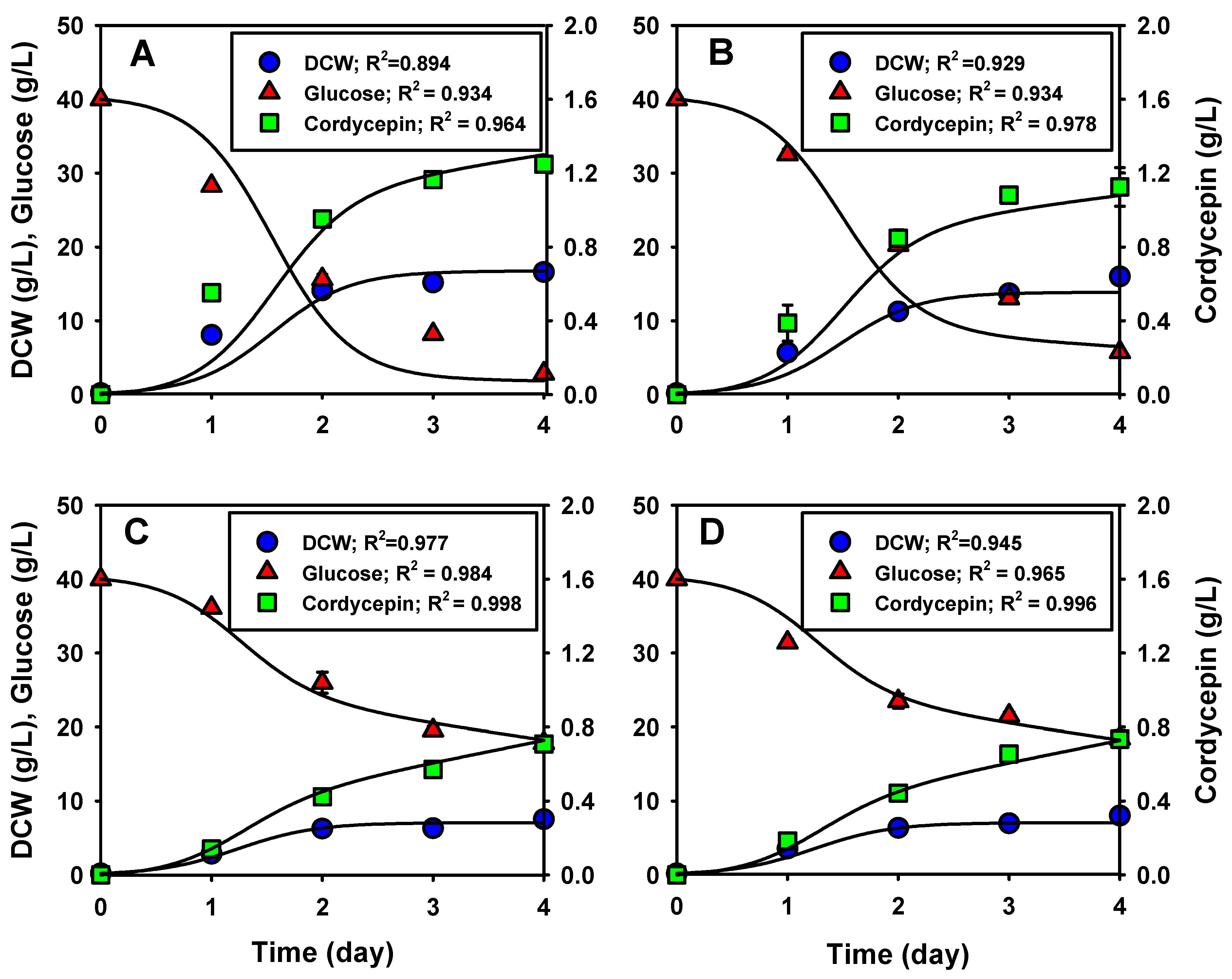
3.3. Kinetic Modeling of Fungal Growth and Cordycepin Production in Shake Flask
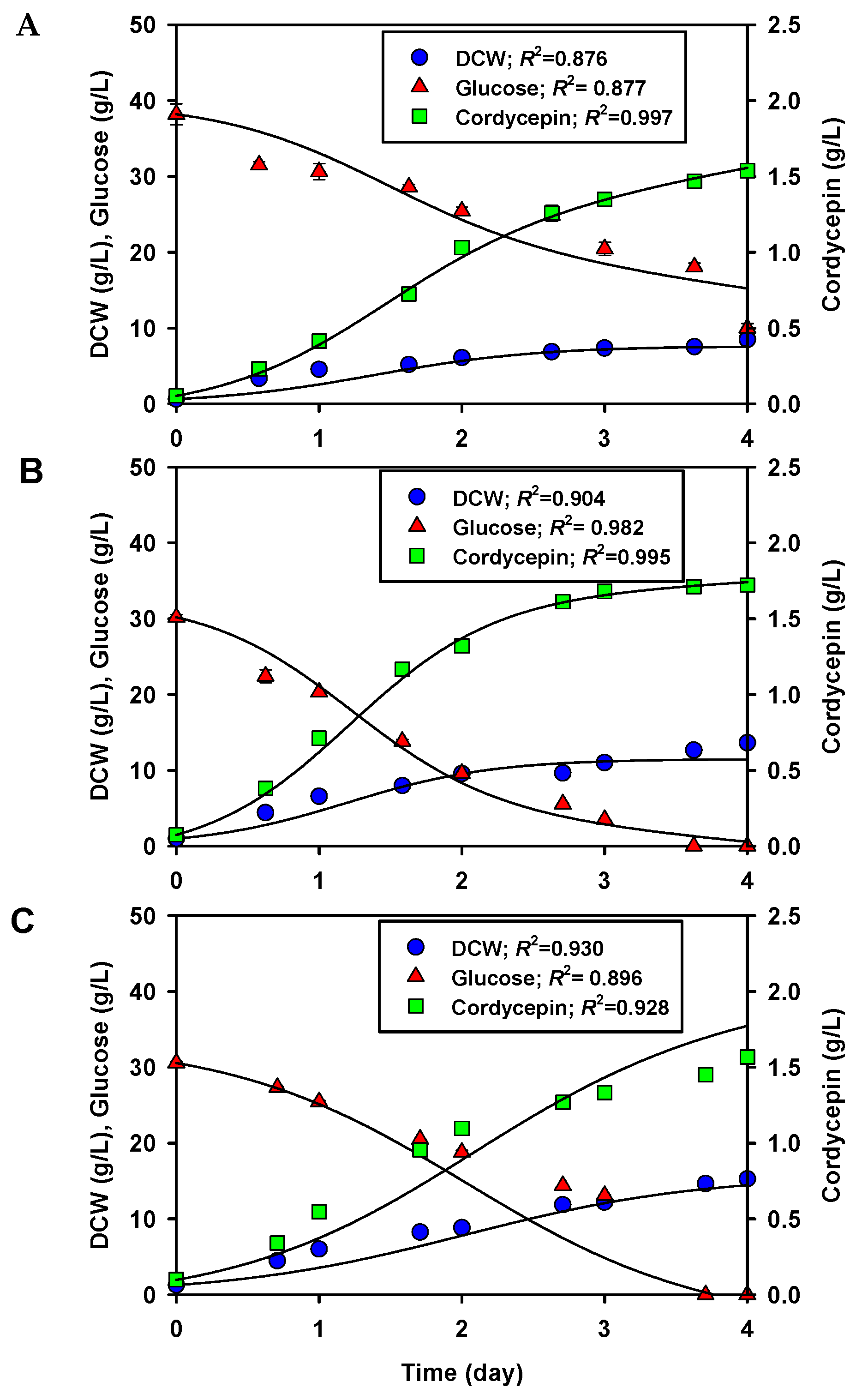
3.4. Kinetic Modeling of Fungal Growth and Cordycepin Production in Fermenter
4. Conclusions
Supplementary Materials
Author Contributions
Funding
Institutional Review Board Statement
Informed Consent Statement
Data Availability Statement
Conflicts of Interest
Abbreviations
| CSH | Cassava starch hydrolysate |
| NCDs | Non-communicable diseases |
| SmF | Submerged fermentation |
| AoCordy-T1 | Cordycepin-producing strain of A. oryzae |
| Qx | Biomass production |
| Qs | Substrate consumption |
| Qp | Cordycepin production |
| Yx/s | Biomass yield |
| Yp/s | Cordycepin yield |
| µmax | Maximum specific growth rate |
References
- Chiu, C.P.; Liu, S.C.; Tang, C.H.; Chan, Y.; El-Shazly, M.; Lee, C.L.; Du, Y.C.; Wu, T.Y.; Chang, F.R.; Wu, Y.C. Anti-Inflammatory Cerebrosides from Cultivated Cordyceps militaris. J. Agric. Food Chem. 2016, 64, 1540–1548. [Google Scholar] [CrossRef] [PubMed]
- Ramesh, T.; Yoo, S.-K.; Kim, S.-W.; Hwang, S.-Y.; Sohn, S.-H.; Kim, I.-W.; Kim, S.-K. Cordycepin (3′-Deoxyadenosine) Attenuates Age-Related Oxidative Stress and Ameliorates Antioxidant Capacity in Rats. Exp. Gerontol. 2012, 47, 979–987. [Google Scholar] [CrossRef]
- Rabie, A.M. Potent Inhibitory Activities of the Adenosine Analogue Cordycepin on SARS-CoV-2 Replication. ACS Omega 2022, 7, 2960–2969. [Google Scholar] [CrossRef]
- Bi, Y.; Zhou, Y.; Wang, M.; Li, L.; Lee, R.J.; Xie, J.; Teng, L. Targeted Delivery of Cordycepin to Liver Cancer Cells Using Transferrin-Conjugated Liposomes. Anticancer Res. 2017, 37, 5207–5214. [Google Scholar] [CrossRef] [PubMed]
- Jaiswal, J.; Srivastav, A.K.; Rajput, P.K.; Yadav, U.C.S.; Kumar, U. Integrating Synthesis, Physicochemical Characterization, and In Silico Studies of Cordycepin-Loaded Bovine Serum Albumin Nanoparticles. J. Agric. Food Chem. 2023, 71, 12225–12236. [Google Scholar] [CrossRef]
- Wu, S.; Wu, Q.; Wang, J.; Li, Y.; Chen, B.; Zhu, Z.; Huang, R.; Chen, M.; Huang, A.; Xie, Y.; et al. Novel Selenium Peptides Obtained from Selenium-Enriched Cordyceps militaris Alleviate Neuroinflammation and Gut Microbiota Dysbacteriosis in LPS-Injured Mice. J. Agric. Food Chem. 2022, 70, 3194–3206. [Google Scholar] [CrossRef] [PubMed]
- Shin, S.; Lee, S.; Kwon, J.; Moon, S.; Lee, S.; Lee, C.-K.; Cho, K.; Ha, N.-J.; Kim, K. Cordycepin Suppresses Expression of Diabetes Regulating Genes by Inhibition of Lipopolysaccharide-Induced Inflammation in Macrophages. Immune Netw. 2009, 9, 98. [Google Scholar] [CrossRef] [PubMed]
- Ashraf, S.A.; Elkhalifa, A.E.O.; Siddiqui, A.J.; Patel, M.; Awadelkareem, A.M.; Snoussi, M.; Ashraf, M.S.; Adnan, M.; Hadi, S. Cordycepin for Health and Wellbeing: A Potent Bioactive Metabolite of an Entomopathogenic Medicinal Fungus Cordyceps with Its Nutraceutical and Therapeutic Potential. Molecules 2020, 25, 2735. [Google Scholar] [CrossRef]
- Masuda, M.; Das, S.K.; Fujihara, S.; Hatashita, M.; Sakurai, A. Production of Cordycepin by a Repeated Batch Culture of a Cordyceps militaris Mutant Obtained by Proton Beam Irradiation. J. Biosci. Bioeng. 2011, 111, 55–60. [Google Scholar] [CrossRef]
- Masuda, M.; Urabe, E.; Honda, H.; Sakurai, A.; Sakakibara, M. Enhanced Production of Cordycepin by Surface Culture Using the Medicinal Mushroom Cordyceps militaris. Enzym. Microb. Technol. 2007, 40, 1199–1205. [Google Scholar] [CrossRef]
- Mao, X.-B.; Eksriwong, T.; Chauvatcharin, S.; Zhong, J.-J. Optimization of Carbon Source and Carbon/Nitrogen Ratio for Cordycepin Production by Submerged Cultivation of Medicinal Mushroom Cordyceps militaris. Process Biochem. 2005, 40, 1667–1672. [Google Scholar] [CrossRef]
- Cohen, N.; Cohen, J.; Asatiani, M.D.; Varshney, V.K.; Yu, H.T.; Yang, Y.C.; Li, Y.H.; Mau, J.L.; Wasser, S.P. Chemical Composition and Nutritional and Medicinal Value of Fruit Bodies and Submerged Cultured Mycelia of Culinary-Medicinal Higher Basidiomycetes Mushrooms. Int. J. Med. Mushrooms 2014, 16, 273–291. [Google Scholar] [CrossRef]
- Chan, J.S.L.; Barseghyan, G.S.; Asatiani, M.D.; Wasser, S.P. Chemical Composition and Medicinal Value of Fruiting Bodies and Submerged Cultured Mycelia of Caterpillar Medicinal Fungus Cordyceps militaris CBS-132098 (Ascomycetes). Int. J. Med. Mushrooms 2015, 17, 649–659. [Google Scholar] [CrossRef]
- Masuda, M.; Das, S.K.; Hatashita, M.; Fujihara, S.; Sakurai, A. Efficient Production of Cordycepin by the Cordyceps militaris Mutant G81-3 for Practical Use. Process Biochem. 2014, 49, 181–187. [Google Scholar] [CrossRef]
- Jeennor, S.; Anantayanon, J.; Panchanawaporn, S.; Chutrakul, C.; Vongsangnak, W.; Laoteng, K. Efficient de Novo Production of Bioactive Cordycepin by Aspergillus oryzae Using a Food-Grade Expression Platform. Microb. Cell Factories 2023, 22, 253. [Google Scholar] [CrossRef]
- Anantayanon, J.; Chamkhuy, W.; Rattanaphan, N.; Panchanawaporn, S.; Laoteng, K.; Jeennor, S. Enhancing Bioactive Cordycepin Production via Precision Fermentation with an Engineered Aspergillus oryzae. Fermentation 2025, 11, 32. [Google Scholar] [CrossRef]
- Wannawilai, S.; Jeennor, S.; Khongto, B.; Laoteng, K. Exploring Differential Traits of Lipid-Producing Stages of the Wild Type and Morphologically Engineered Strain of Aspergillus oryzae by Comparative Kinetic Modeling. World J. Microbiol. Biotechnol. 2020, 36, 183. [Google Scholar] [CrossRef] [PubMed]
- Wannawilai, S.; Palasak, T.; Chamkhuy, W.; Khongto, B.; Jeennor, S.; Laoteng, K. Lipid Production by Robust Aspergillus oryzae BCC7051 and a Mathematical Model Describing Its Growth and Lipid Phenotypic Traits. J. Appl. Microbiol. 2024, 135, lxae229. [Google Scholar] [CrossRef]
- Shih, I.L.; Tsai, K.L.; Hsieh, C. Effects of Culture Conditions on the Mycelial Growth and Bioactive Metabolite Production in Submerged Culture of Cordyceps militaris. Biochem. Eng. J. 2007, 33, 193–201. [Google Scholar] [CrossRef]
- Su, Q.; Zhang, Z.; Liu, X.; Wang, F. The Transcriptome Analysis on Urea Response Mechanism in the Process of Ergosterol Synthesis by Cordyceps cicadae. Sci. Rep. 2021, 11, 10927. [Google Scholar] [CrossRef]
- Chang, Y.; Liu, X.; Jiao, Y.; Zheng, X. Improved Cordycepin Production by Cordyceps militaris Using Corn Steep Liquor Hydrolysate as an Alternative Protein Nitrogen Source. Foods 2024, 13, 813. [Google Scholar] [CrossRef] [PubMed]
- Das, S.K.; Masuda, M.; Hatashita, M.; Sakurai, A.; Sakakibara, M. Optimization of Culture Medium for Cordycepin Production Using Cordyceps militaris Mutant Obtained by Ion Beam Irradiation. Process Biochem. 2010, 45, 129–132. [Google Scholar] [CrossRef]
- Kang, C.; Wen, T.C.; Kang, J.C.; Meng, Z.B.; Li, G.R.; Hyde, K.D. Optimization of Large-Scale Culture Conditions for the Production of Cordycepin with Cordyceps militaris by Liquid Static Culture. Sci. World J. 2014, 2014, 510627. [Google Scholar] [CrossRef]
- Mata-Alvarez, J.; Mitchell, D.A. Mathematical Modeling in Biotechnology. In Biotechnology-Fundamentals in Biotechnology; Doelle, H.W., Rokem, J.S., Berovic, M., Eds.; EOLSS Publishers: Paris, France, 2009; Volume 2, pp. 102–139. [Google Scholar]
- Tochampa, W.; Sirisansaneeyakul, S.; Vanichsriratana, W.; Srinophakun, P.; Bakker, H.H.C.; Chisti, Y. A Model of Xylitol Production by the Yeast Candida mogii. Bioprocess Biosyst. Eng. 2005, 28, 175–183. [Google Scholar] [CrossRef]
- Salakkam, A.; Phukoetphim, N.; Laopaiboon, P.; Laopaiboon, L. Mathematical Modeling of Bioethanol Production from Sweet Sorghum Juice under High Gravity Fermentation: Applicability of Monod-Based, Logistic, Modified Gompertz and Weibull Models. Electron. J. Biotechnol. 2023, 64, 18–26. [Google Scholar] [CrossRef]
- Nguyen, V.P.; Nguyen, N.A.; Nguyen, H.N. Developing and Solving the Mathematical Model of Transient Heat and Mass Transfer in the Freeze-Drying of Cordyceps militaris. In Proceedings of the IOP Conference Series: Earth and Environmental Science; IOP Publishing: Bristol, UK, 2023; p. 1278. [Google Scholar] [CrossRef]
- Laoteng, K.; Jitsue, S.; Dandusitapunth, Y.; Cheevadhanarak, S. Ethanol-Induced Changes in Expression Profiles of Cell Growth, Fatty Acid and Desaturase Genes of Mucor rouxii. Fungal Genet. Biol. 2008, 45, 61–67. [Google Scholar] [CrossRef]
- Wei, A.; Zhang, X.; Wei, D.; Chen, G.; Wu, Q.; Yang, S.T. Effects of Cassava Starch Hydrolysate on Cell Growth and Lipid Accumulation of the Heterotrophic Microalgae Chlorella protothecoides. J. Ind. Microbiol. Biotechnol. 2009, 36, 1383. [Google Scholar] [CrossRef] [PubMed]
- Lang, W.; Dejma, C.; Sirisansaneeyakul, S.; Sakairi, N. Biosorption of Nonylphenol on Dead Biomass of Rhizopus arrhizus Encapsulated in Chitosan beads. Bioresour. Technol. 2009, 100, 5616–5623. [Google Scholar] [CrossRef] [PubMed]
- Žnidaršič-Plazl, P.; Pavko, A. The Morphology of Filamentous Fungi in Submerged as a Bioprocess Parameter. Food Technol. Biotechnol. 2001, 39, 237–252. [Google Scholar]
- Papagianni, M. Fungal Morphology and Metabolite Production in Submerged Mycelial Processes. Biotechnol. Adv. 2004, 22, 189–259. [Google Scholar] [CrossRef]
- Bizukojc, M.; Ledakowicz, S. A Macrokinetic Modelling of the Biosynthesis of Lovastatin by Aspergillus terreus. J. Biotechnol. 2007, 130, 422–435. [Google Scholar] [CrossRef] [PubMed]
- Ammar, E.M.; Arora, N.; Philippidis, G.P. The Prospects of Agricultural and Food Residue Hydrolysates for Sustainable Production of Algal Products. Energies 2020, 13, 6427. [Google Scholar] [CrossRef]
- Lu, Y.; Zhai, Y.; Liu, M.; Wu, Q. Biodiesel Production from Algal Oil Using Cassava (Manihot Esculenta Crantz) as Feedstock. J. Appl. Phycol. 2010, 22, 573–578. [Google Scholar] [CrossRef]
- Paul, G.C.; Syddall, M.T.; Kent, C.A.; Thomas, C.R. A Structured Model for Penicillin Production on Mixed Substrates. Biochem. Eng. J. 1998, 2, 11–21. [Google Scholar] [CrossRef]



| Kinetic Parameters | Nitrogen Sources | |||||
|---|---|---|---|---|---|---|
| Yeast Extract | Peptone | (NH4)2SO4 | NH4Cl | NaNO3 | KNO3 | |
| Concentration (g/L) | ||||||
| CX | 16.593 ± 0.140 A | 15.988 ± 0.334 A | 7.521 ± 0.030 C | 8.011 ± 0.157 C | 10.645 ± 0.898 B | 10.095 ± 1.153 B |
| CP | 1.248 ± 0.007 A | 1.125 ± 0.104 A | 0.709 ± 0.009 B | 0.734 ± 0.010 B | 0.021 ± 0.003 C | 0.020 ± 0.005 C |
| Volumetric rates (g/L d) | ||||||
| QX | 4.098 ± 0.035 A | 3.947 ± 0.083 A | 1.830 ± 0.007 C | 1.953 ± 0.039 C | 2.611 ± 0.225 B | 2.474 ± 0.288 B |
| QS | 9.120 ± 0.078 B | 8.471 ± 0.072 B | 5.537 ± 0.227 C | 5.390 ± 0.265 C | 10.000 ± 0.000 A | 10.000 ± 0.000 A |
| QP | 0.312 ± 0.002 A | 0.281 ± 0.026 A | 0.177 ± 0.002 B | 0.184 ± 0.002 B | 0.005 ± 0.001 C | 0.005 ± 0.001 C |
| Specific rates (g/g d) | ||||||
| μ (/d) | 0.488 ± 0.000 A | 0.488 ± 0.000 A | 0.474 ± 0.000 C | 0.476 ± 0.000 C | 0.481 ± 0.002 B | 0.480 ± 0.002 B |
| qS | 1.086 ± 0.000 C | 1.047 ± 0.013 C | 1.434 ± 0.053 B | 1.314 ± 0.090 B | 1.851 ± 0.153 A | 1.955 ± 0.219 A |
| qP | 0.037 ± 0.000 B | 0.035 ± 0.004 B | 0.046 ± 0.000 A | 0.045 ± 0.000 A | 0.001 ± 0.000 C | 0.001 ± 0.000 C |
| Yield (g/g) | ||||||
| YX/S | 0.449 ± 0.000 A | 0.466 ± 0.006 A | 0.331 ± 0.012 B | 0.363 ± 0.025 B | 0.261 ± 0.022 C | 0.247 ± 0.029 C |
| YP/S | 0.034 ± 0.000 A | 0.033 ± 0.003 A | 0.032 ± 0.001 A | 0.034 ± 0.002 A | 0.001 ± 0.000 D | 0.000 ± 0.000 D |
| Kinetic Parameters | Carbon Sources | ||
|---|---|---|---|
| Glucose-40 * | Glucose-30 ** | CSH ** | |
| Concentration (g/L) | |||
| CX | 8.467 ± 0.523 C | 13.632 ± 0.271 B | 15.277 ± 0.000 A |
| CP | 1.538 ± 0.002 B | 1.721 ± 0.018 A | 1.567 ± 0.008 B |
| Volumetric rates (g/L/d) | |||
| QX | 1.962 ± 0.131 C | 3.164 ± 0.068 B | 3.504 ± 0.000 A |
| QS | 7.053 ± 0.194 B | 7.545 ± 0.000 A | 7.641 ± 0.052 A |
| QP | 0.371 ± 0.001 B | 0.412 ± 0.004 A | 0.367 ± 0.002 B |
| Specific rates (g/g d) | |||
| μ (/d) | 0.432 ± 0.004 A | 0.433 ± 0.001 A | 0.424 ± 0.000 B |
| qS | 1.554 ± 0.047 A | 1.033 ± 0.019 B | 0.924 ± 0.006 C |
| qP | 0.082 ± 0.005 A | 0.056 ± 0.002 B | 0.044 ± 0.000 C |
| Yield (g/g) | |||
| YX/S | 0.278 ± 0.011 C | 0.419 ± 0.009 B | 0.459 ± 0.003 A |
| YP/S | 0.053 ± 0.002 A | 0.055 ± 0.001 A | 0.048 ± 0.001 B |
| Kinetic Models | Parameters | Nitrogen Sources | |||
|---|---|---|---|---|---|
| Yeast Extract | Peptone | Inorganic Ammonium Salts | |||
| Cell growth | µmax (d−1) | 2.85 | 2.85 | 2.85 | |
| CXm (g/L) | 16.742 | 13.857 | 7.057 | ||
| R2 | 0.894 | 0.929 | 0.945–0.977 | ||
| Glucose consumption | mS (g/g d) | 0.00054 | 0.058 | 0.296 | |
| YX/S (g/g) | 0.452 | 0.452 | 0.452 | ||
| YP/S (g/g) | 0.835 | 0.835 | 0.835 | ||
| R2 | 0.934 | 0.934 | 0.965–0.984 | ||
| Cordycepin production | α (g/g) | 0.065 | 0.065 | 0.058 | |
| β (g/g d) | 0.0055 | 0.0055 | 0.017 | ||
| R2 | 0.964 | 0.978 | 0.996–0.998 | ||
| Kinetic Models | Parameters | Glucose * | Glucose ** | CSH ** | |
|---|---|---|---|---|---|
| Cell growth | µmax (d−1) | 1.743 | 1.980 | 1.210 | |
| CXm (g/L) | 7.616 | 11.470 | 15.750 | ||
| R2 | 0.876 | 0.904 | 0.930 | ||
| Glucose consumption | mS (g/g d) | 0.300 | 0.142 | 0.011 | |
| YX/S (g/g) | 0.452 | 0.452 | 0.452 | ||
| YP/S (g/g) | 0.835 | 0.835 | 0.835 | ||
| R2 | 0.877 | 0.982 | 0.896 | ||
| Cordycepin production | α (g/g) | 0.158 | 0.147 | 0.115 | |
| β (g/g d) | 0.021 | 0.0041 | 0.0051 | ||
| R2 | 0.997 | 0.995 | 0.928 | ||
Disclaimer/Publisher’s Note: The statements, opinions and data contained in all publications are solely those of the individual author(s) and contributor(s) and not of MDPI and/or the editor(s). MDPI and/or the editor(s) disclaim responsibility for any injury to people or property resulting from any ideas, methods, instructions or products referred to in the content. |
© 2026 by the authors. Licensee MDPI, Basel, Switzerland. This article is an open access article distributed under the terms and conditions of the Creative Commons Attribution (CC BY) license.
Share and Cite
Wannawilai, S.; Anantayanon, J.; Dechpreechakul, T.; Laoteng, K.; Jeennor, S. Modelling of Cordycepin Production by an Engineered Aspergillus oryzae Under Different Substrates. Fermentation 2026, 12, 174. https://doi.org/10.3390/fermentation12040174
Wannawilai S, Anantayanon J, Dechpreechakul T, Laoteng K, Jeennor S. Modelling of Cordycepin Production by an Engineered Aspergillus oryzae Under Different Substrates. Fermentation. 2026; 12(4):174. https://doi.org/10.3390/fermentation12040174
Chicago/Turabian StyleWannawilai, Siwaporn, Jutamas Anantayanon, Thanaporn Dechpreechakul, Kobkul Laoteng, and Sukanya Jeennor. 2026. "Modelling of Cordycepin Production by an Engineered Aspergillus oryzae Under Different Substrates" Fermentation 12, no. 4: 174. https://doi.org/10.3390/fermentation12040174
APA StyleWannawilai, S., Anantayanon, J., Dechpreechakul, T., Laoteng, K., & Jeennor, S. (2026). Modelling of Cordycepin Production by an Engineered Aspergillus oryzae Under Different Substrates. Fermentation, 12(4), 174. https://doi.org/10.3390/fermentation12040174