Article

Effects of Different Inocula Fermentation on Physicochemical, Nutritional and Antioxidant Activities of Non-Alcoholic Finger Millet (Eleusine coracana L.) Beverages


by
Mmaphuti Abashone Ratau
1,*,
Oluwaseun Peter Bamidele
1,
Victoria Adaora Jideani
2,
Victor Ntuli
1 and
Shonisani Eugenia Ramashia
1,*
1
Department of Food Science and Technology, University of Venda, Thohoyandou 0950, South Africa
2
Department of Food Science and Technology, Cape Peninsula University of Technology, Bellville 7535, South Africa
*
Authors to whom correspondence should be addressed.
Fermentation 2026, 12(3), 141; https://doi.org/10.3390/fermentation12030141
Submission received: 6 January 2026 / Revised: 25 February 2026 / Accepted: 26 February 2026 / Published: 6 March 2026
(This article belongs to the Section Fermentation for Food and Beverages)

Abstract

The rising demand for plant-based, lactose-free functional beverages amid gut health concerns positions finger millet (FM, Eleusine coracana) as a promising substrate. This study assessed sprouting and fermentation inoculum effect: dairy starters (Streptococcus thermophilus and Lactobacillus bulgaricus) or backslopping with commercial Mageu on microbial growth, fermentation dynamics, nutrition, antioxidants, color, and texture of FM beverages. Microbial growth increased modestly over 48 h OD600 = 0.169–0.201, peaking in non-sprouted FM with dairy starters (ND) at OD600 = 0.201). ND showed the fastest pH decline (ΔpH = 2.19), while sprouted FM with dairy starters (SD) or backslopping (SB) had controlled acidification. Total titratable acidity increased from 0.14 to 0.66%, with the highest total soluble solids in sprouted substrates (SD = 11.26 °Brix; SB = 10.97 °Brix). Proximate analysis revealed SB had high crude fiber (2.86%) and SD highest protein (4.02%). Sprouted beverages excelled in minerals (SB Ca = 27.00 mg/100 g; SD Ca = 25.75 mg/100 g), while ND or non-sprouted FM fermented spontaneously (NS) had high Fe (4.31%, 2.65%) and K (48.08%, 38.32%). ND showed peak antioxidants: phenolics 10.54 µg/mL, DPPH 87.80%, FRAP 21.24 µM Fe2+/g, ABTS 79.09%. Sprouted beverages displayed distinct color (L* = 37.67–39.65, C* = 25.94–27.03) versus commercial Mageu (L* = 57.89, C* = 14.50) and favorable texture (firmness 12.78–13.40 g, secondary peak force ~−7.2 g). Controlled fermentation of sprouted FM yields nutrient-dense, antioxidant-rich, vegetarian beverages with superior attributes, affirming its functional potential.

1. Introduction

There is increasing global interest in non-alcoholic, plant-based beverages that offer health benefits and serve as alternatives to dairy [1]. This trend is driven by rising health consciousness, the prevalence of lactose intolerance and cow’s milk allergies, ethical and environmental concerns, and the adoption of plant-forward dietary patterns [1,2,3]. Within this context, fermented cereal-based beverages are gaining attention as culturally relevant, nutrient-dense products that align with the growing demand for clean-label, dairy-free functional foods [4,5].
Concurrently, dysbiosis, an imbalance in gut microbiota, has emerged as a major public health concern [6]. Diets low in fiber and high in fat are associated with reduced populations of beneficial bacteria, such as Lactobacillus and Bifidobacterium, and increased abundance of opportunistic pathogens, including Staphylococcus aureus, Clostridium perfringens, and Clostridioides difficile. These microbial shifts are linked to obesity, inflammatory bowel disease, and other metabolic disorders [6,7]. Fermented cereal beverages derived from whole grains represent a promising dietary strategy to restore microbial balance by providing fermentable substrates, bioactive compounds, and beneficial microorganisms [8].
Reflecting these trends, the global functional beverage market was projected to reach USD 208.13 billion by 2024, with a compound annual growth rate of 7.5% between 2022 and 2027 [9]. Non-alcoholic cereal-based beverages are particularly prominent in sub-Saharan Africa, where they are valued for their nutritional quality, probiotic potential, affordability, and cultural relevance [10]. Traditionally, these beverages are consumed across age groups as weaning food, and to manage diarrhoea, gastrointestinal disturbances, and enteric infections [11].
Across sub-Saharan Africa, cereal beverages are most produced through spontaneous, household-level fermentation, a practice passed down through generations. These processes rely on indigenous microflora naturally associated with the grains, water, and utensils and typically lack formal production standards [12,13,14,15]. While spontaneous fermentation can generate desirable flavors and bioactive compounds, it often results in inconsistent microbial composition (unwanted or even pathogenic), fermentation dynamics, nutritional quality, and product appearance [5]. Common issues include high turbidity, opaque color, variable viscosity, alcohol off-flavors, and short shelf-life, which can limit acceptance beyond traditional markets [10].
Staple cereals such as maize, sorghum, and millet are widely fermented due to their high fiber content and richness in flavonoids, antioxidants, B-vitamins, vitamin E, and essential minerals [16,17,18,19,20]. Among these, finger millet, FM, (Eleusine coracana) is particularly noteworthy. It is resilient in semi-arid regions and has superior nutritional composition, including high carbohydrate content (72.6–88.0%) and exceptionally high calcium levels (364.0–398.0 mg/100 g), exceeding those of sorghum (27.6–28.0 mg/100 g) and maize (2.8–9.0 mg/100 g) [21,22,23,24]. These attributes make FM an underutilized yet highly promising substrate for plant-based, functional fermented beverages.
Traditional processing of FM often incorporates sprouting, typically in small proportions blended with non-sprouted flour. Sprouting modifies starch functionality, reduces viscosity, and produces low-viscosity beverages suitable for infants and young children as weaning foods [25]. Beyond viscosity reduction, sprouting enhances antioxidant activity, nutritional quality, and flavor development in fermented cereal products [26,27,28]. However, the effects of using sprouted FM as the dominant or sole substrate remain poorly understood, particularly under controlled fermentation conditions. Evaluating sprouting intensity as a deliberate fermentation strategy, therefore, represents a novel approach to improve functional properties, sensory quality, and nutritional value.
Given the inconsistencies of spontaneous fermentation and the absence of standardized FM starter cultures, controlled strategies are needed. Backslopping with commercially established Mageu (a Southern African maize/sorghum beverage) offers improved fermentation consistency and preserves sensory attributes, yet the effects of its microbial consortia on FM remain unexplored, highlighting a clear opportunity for investigation. Similarly, dairy-adapted starter cultures, such as Lactobacillus bulgaricus and Streptococcus thermophilus, have been evaluated in maize-based systems [29] but remain untested in dairy-free FM substrates. Integrating sprouting with Mageu backslopping and dairy-adapted starter cultures provides a unique opportunity to systematically evaluate controlled fermentation in FM while addressing variability in spontaneous processes, maintaining key sensory qualities, and enhancing functional, nutritional, and commercial potential.
Despite the potential of these approaches, their combined effects on FM fermentation remain largely unexplored. This study, therefore, aimed to evaluate the effects of backslopping using commercial Mageu and selected dairy starter cultures on (i) physicochemical properties and (ii) antioxidant capacity and nutritional profile of non-alcoholic FM beverages produced from sprouted and non-sprouted grains. By identifying optimal fermentation strategies, this work aims to establish a technical and biochemical baseline for developing standardized, nutritionally enhanced beverages that bolster food security and promote FM as a culturally relevant functional food.

2. Materials and Methods

2.1. Source of Raw Material Used in the Production of Non-Alcoholic Finger Millet Beverages

Brown FM grains were purchased from the Thohoyandou vendor market in Limpopo province, South Africa. Dairy cultures (Streptococcus thermophilus and Lactobacillus delbrueckii subsp. Bulgaricus) were purchased from Beer-Lab, Cape Town, South Africa. Fresh commercial Mageu, purchased from a supermarket in Thohoyandou, South Africa, was used for backslopping and served as the control. The commercial product typically contains maize and sorghum, live thermophilic Lactobacillus species, sugar, lactic acid, and sweeteners. A traditionally prepared Mageu was additionally produced and analyzed for contextual comparison. All reagents were obtained from Merck (Modderfontein, South Africa).

2.2. Production of Sprouted and Non-Sprouted Finger Millet Flour

FM grains were manually cleaned and washed with water to eliminate any foreign substances. To produce the sprouted flour, the cleaned FM grains were soaked in water (at a 1:2 ratio of grains to water, 12 h at 4 °C) to soften their outer coating, then incubated (EcoTherm Labotec, Model 278, Midrand, South Africa) at 25 °C for 72 h, with rinsing every 12 h. The sprouted grains were then dried at 40 °C for 48 h. In contrast, non-sprouted grains were soaked for only 12 h at 25 °C before being dried for 72 h at 40 °C. The grains were ground using a hammer mill (Perten Laboratory Mill, Model 3100, Helsinki, Finland) equipped with a 0.8 mm sieve and stored in polyethene zipper bags at 4 °C until further analyses [10].

2.3. Production of the Non-Alcoholic Finger Millet Beverages Using Dairy Cultures and Commercial Mageu (Backslopping)

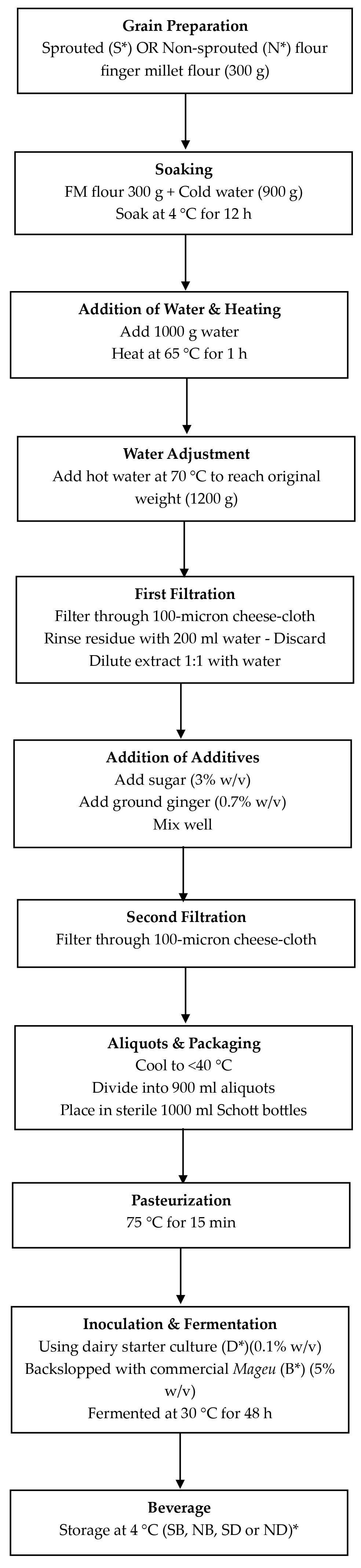
Sprouted and non-sprouted grains were used for this experiment. The procedure for producing the beverages using a dairy starter culture and backslopping with commercial Mageu is shown in Figure 1. The process included mashing, filtration, pasteurization, inoculation, and fermentation. Briefly, the FM flour (300 g) was soaked in cold water (900 g) at 4 °C for 12 h. Thereafter, water (1000 g) was added to the mixture and heated in a water bath at 65 °C for 1 h while stirring every 15 min. After heating, some of the water evaporated during the heating process; therefore, hot water (50–70 °C) was added to adjust the mixture to its original weight (1200 g).
The mixture was filtered through a 100-micron cheesecloth. The leftover grains (residue) were rinsed with 200 mL of water before being discarded. The final extract was then diluted with water (1:1). Sugar (3% w/v) and ground ginger (0.7% w/v) were also added and mixed well. The resultant mixture was filtered again through a 100-micron cheesecloth and divided into aliquots of 900 mL, placed into sterile 1000 mL Schott bottles.
After filtration, the mixture was pasteurized in a water bath at 75 °C for 15 min and then rapidly cooled in ice to approximately 40 °C before inoculation. A similar procedure was repeated with sprouted FM. Dairy starter cultures and commercial Mageu were aseptically inoculated at 0.1% (w/v) [31] and 5% (w/v) [32], respectively, and fermented at 30 °C for 48 h. Samples were analyzed for optical density (OD), pH, total titratable acidity (TTA), and total soluble solids (TSS) at the start of fermentation (0 h) and every 6 h intervals. Each time, two (2) samples were taken for analysis, and the experiment was replicated. At the end of 48 h, samples were stored at 4 °C and analyzed for proximate composition, antioxidant properties, and color profiles.

2.4. Spontaneous Fermentation of Non-Alcoholic Finger Millet Beverage

This beverage was produced and used for contextual comparison. The traditional process for producing non-alcoholic FM beverages was adapted based on the method described by [10]. FM flour (200 g) was soaked in 250 mL cold tap water for 12 h at 4 °C (1 part flour to 1.5 parts water). The resulting extract was divided into smaller (112.5 g) and larger (337.5 g) portions. Thereafter, 1000 mL of boiling (95–100 °C) water was added to the larger portions and continuously mixed until the temperature cooled to below 40 °C. The smaller portion of the extract (not heat-treated) was mixed with a small portion of FM sprouted flour (30 g), ground ginger (10 g), and 100 mL of tap water before adding to the larger portion for fermentation. Before fermentation proceeded, the extract was divided into smaller volumes (250 mL) in sterile 500 mL Schott bottles. Fermentation was conducted in an incubator (EcoTherm Labotec, Model 278, Midrand, South Africa) at 37 °C for 48 h. Samples were analyzed for OD, pH, TTA, and TSS at the start of fermentation (0 h) and every 6 h intervals. Each time, two (2) samples were taken for analysis, and the experiment was replicated. At the end of 48 h, samples were stored at 4 °C and analyzed for proximate composition, antioxidant properties, and color profiles. The beverage was regarded as non-sprouted due to the predominance of non-sprouted flour relative to the minor proportion of sprouted flour incorporated.

2.5. Microbial Growth Monitoring by Optical Density

Microbial growth during fermentation was monitored by measuring optical density (OD) at 600 nm as an indirect indicator of biomass accumulation. OD600 measurements were performed using a SpectroStar Nano microplate reader (BMG Labtech, Ortenberg, Germany), with sterile distilled water used as the blank. At each fermentation time point, 200 µL aliquots were dispensed into a 96-well microplate, shaken for 30 s at 30 rpm to ensure uniform cell suspension, and measured in triplicate.
Microbial growth was evaluated using two complementary metrics: (i) the change in optical density (ΔOD), calculated as the difference between OD at 48 h and OD at 0 h to represent net biomass increase; and (ii) the area under the OD-time curve (AUC), calculated over the 0 to 48 h fermentation period to reflect cumulative microbial growth activity [33].

2.6. Determination of pH, Total Titratable Acidity and Total Soluble Solids

The pH was measured in triplicates using a pH meter (Crison, Model Basic 20, Barcelona, Spain). The total titratable acidity (TTA) was determined by titrating 10 mL of the sample with 0.1 N of NaOH to a pink endpoint using three drops of phenolphthalein solution as an indicator. The TTA was expressed as a percentage of lactic acid [10]. The TSS content expressed as °Brix was measured using a digital hand refractometer (Atago, Model Smart-1, Tokyo, Japan) [34].
Based on these measurements, fermentation-related changes in pH, TTA, and TSS were evaluated over the 48 h fermentation period. For each parameter (pH, TTA, and TSS), the net change between 0 and 48 h (Δ0–48) was calculated from initial and final values. The minimum pH attained during fermentation was identified as the lowest recorded value, and cumulative changes over time were quantified by calculating the area under the respective parameter–time curves (AUC0–48) using the trapezoidal method.

2.7. Determination of the Proximate Composition and Mineral Content

Freeze-dried beverage powder was used to determine the proximate (nutritional) composition. The moisture and ash contents were assessed using methods from the Association of Official Analytical Chemists (AOAC). Moisture content was measured using the oven method (AOAC method 945.32 [35]) at 105 °C for 3 h, while ash content was analyzed with a muffle furnace following AOAC method 923.03 [36,37]. The crude fiber was evaluated using the Weende method [38]. Fat content was determined through petroleum ether extraction using an automated fat extractor (ANKOM, Model XT15, Macedon, NY, USA) as per AOCS guidelines [39]. Protein content was analyzed using the Dumas method for nitrogen (Leco-TruSpec-N, St. Joseph, MI, USA) in a furnace set to 950 °C, with protein percentage calculated by multiplying nitrogen content by a factor of 6.25. Carbohydrate content was derived by subtracting the total percentages of protein, fat, moisture, fiber, and ash from 100%. Energy content was calculated based on the assumption that 1 g of carbohydrates and proteins provides 4 kcal, fat provides 9 kcal, and fiber provides 2 kcal [40]. Minerals were quantified by ICP-AES (PerkinElmer Optima 8000, Waltham, MA, USA) post-ashing (550 °C) using the method described by [26].

2.8. Determination of Polyphenols and Antioxidant Activity

2.8.1. Extraction of Bioactive Compounds

Freeze-dried beverage powder was used for proximate (nutritional) composition. The method used by [29] was adapted to extract bioactive compounds from non-alcoholic FM drinks. Approximately 2 g of the beverage was mixed with 20 mL of 1% methanolic acid and sonicated for 15 min in an ultrasonic bath. The mixture was centrifuged (Hettich, Model Rotina 380 R, Tuttlingen, Germany) at 3000 rpm for 10 min, filtered using 150 mm Whatman Grade 4 filter paper, and the resulting supernatant was transferred into separate centrifuge tubes, which were then stored at 4 °C until further analysis.

2.8.2. Total Phenolic Content

The total phenolic content was measured using the method outlined by [26]. In a test tube, 1.5 mL of a 1:2 v/v Folin–Ciocalteu solution was combined with 0.5 mL of a non-alcoholic FM beverage extract and allowed to stand for 5 min at room temperature (approximately 25 °C). Then, 2 mL of a 7.5% w/v sodium carbonate solution was added to the mixture. The mixture was kept in a dark place for 45 min, with periodic shaking. The absorbance of the mixture was determined with a spectrophotometer (Shimadzu, Model UV-1600, Kyoto, Japan) at 725 nm. Total phenolic content was reported in milligrams of gallic acid equivalent per gram of non-alcoholic beverage prepared from FM.

2.8.3. Total Flavonoid Content

The total flavonoid content was determined according to the method described by [26]. About 3.4 mL of 30% methanol, 0.15 mL of 0.5 M sodium nitrite, 0.15 mL of 0.3 M aluminum chloride hexahydrate, and the extract were combined in a test tube and left to stand for 5 min. Then, 1 mL of 1 M NaOH was added and vortexed for 30 s (Gilson Vortexer, Model 36110740, Taipei, Taiwan). Thereafter, the absorbance of the reaction mixture was recorded at 506 nm by a spectrophotometer (Shimadzu, Model UV-1600, Kyoto, Japan). Catechin was used as a standard to establish the standard curve (R2 = 0.9992), and the results were expressed as milligrams of catechin equivalent per gram of the non-alcoholic FM beverage.

2.8.4. Free Radical Scavenging Activity

The approach outlined by [26] was utilized to assess the levels of 2,2-diphenyl-1-picrylhydrazyl (DPPH). A sample of 2 mL of the extract was combined with equal volumes of a DPPH solution, prepared by dissolving 2.9 mg in 100 mL of methanol. Following thorough mixing, the resulting mixture was allowed to rest in the dark at approximately 25 °C for 30 min. The absorbance of the mixture was then measured at 517 nm using a spectrophotometer. To calculate the DPPH percentage, the absorbance of the beverage extract was subtracted from the absorbance of the blank, then divided by the absorbance of the blank, and the result was expressed as a percentage.

2.8.5. Ferric-Reducing Antioxidant Power and 2,2-Azino-bis-3-ethylbenzothiazoline-6-sulphonic Acid Assay

Approximately 2 mL of ferric-reducing antioxidant power (FRAP) reagent was mixed with about 40 µL of the extract, and the combination was allowed to incubate for 15 min in the dark. Following this, the absorbance of the mixture was measured at 593 nm using a UV-1600 spectrophotometer.
For the 2,2-azino-bis-3-ethylbenzothiazoline-6-sulphonic acid (ABTS) assay, around 0.5 mL of the beverage extract was combined with 2.5 mL of ABTS reagent and allowed to sit for 7 min. The absorbance of the samples was then measured at 734 nm, and the results of the ABTS test for the beverages were expressed as a percentage.

2.9. Color and Textural Attributes of Non-Alcoholic FM Beverages

The color of non-alcoholic FM beverages was evaluated with a Hunter Lab Colorimeter (MiniScan XE Plus, Model CM-3500d, Reston, VA, USA). The reflectance was measured in terms of L* (lightness), a* (red/greenishness), and b* (yellowish/blue). The chroma (C), hue angle (Ho), and total color difference (ΔE) of the beverages were read from the instrument [41].
Texture profile attributes—firmness (maximum force), consistency (positive area under the force–time curve), and secondary peak force, were determined using a TA-XT Plus texture analyzer (Stable Micro Systems, Surrey, UK) equipped with a back-extrusion rig operating in compression mode. Measurements were conducted according to the method described by [42], with minor modifications. A cylindrical back-extrusion probe (A/BE; 35 mm diameter) attached to a 5 kg load cell was used. Test conditions comprised pre-test and test speeds of 1.0 mm/s, a post-test speed of 10.0 mm/s, a compression distance of 30 mm, an automatic trigger force of 10 g, and a data acquisition rate of 400 points per second. Texture parameters were automatically generated by the instrument software from the recorded force–time curves obtained during single-cycle back-extrusion testing.

2.10. Statistical Analysis

All experiments were also performed on commercial Mageu beverages, which served as the control. A traditionally prepared Mageu was produced and analyzed for contextual comparison. All analyses performed after fermentation were conducted within 48 h.
The one-way analysis of variance (ANOVA) was used to assess the statistical treatment effect, and the Tukey honestly significant difference (HSD) test for post hoc comparison was used to calculate the treatment means and to compare the different beverages across all measurements. The significant differences in mean values were determined at 5% (p ≤ 0.05). Principal component analysis (PCA) was used to summarize multivariate variation among treatments using fermentation dynamics (ΔpH0–48, pH_min, AUC_TTA0–48), nutritional parameters (protein, energy, P, Ca, Fe), antioxidant indices (TPC, DPPH, ABTS), and color attributes (L* and ΔE). Prior to PCA, all variables were mean-centered and scaled to unit variance (z-standardized). Because the CM treatment had missing fermentation-dynamic values, these were mean-imputed using the column means to allow all treatments to be included in a single PCA model. PCA was computed in R using prcomp (singular value decomposition on the standardized data matrix) within Julius.ai (Julius AI Inc., San Francisco, CA, USA), an R-enabled Jupyter notebook environment. Data are indicated as mean ± standard deviation (n = 3).

3. Results

3.1. Variations in pH, Total Titratable Acidity and Total Soluble Solids

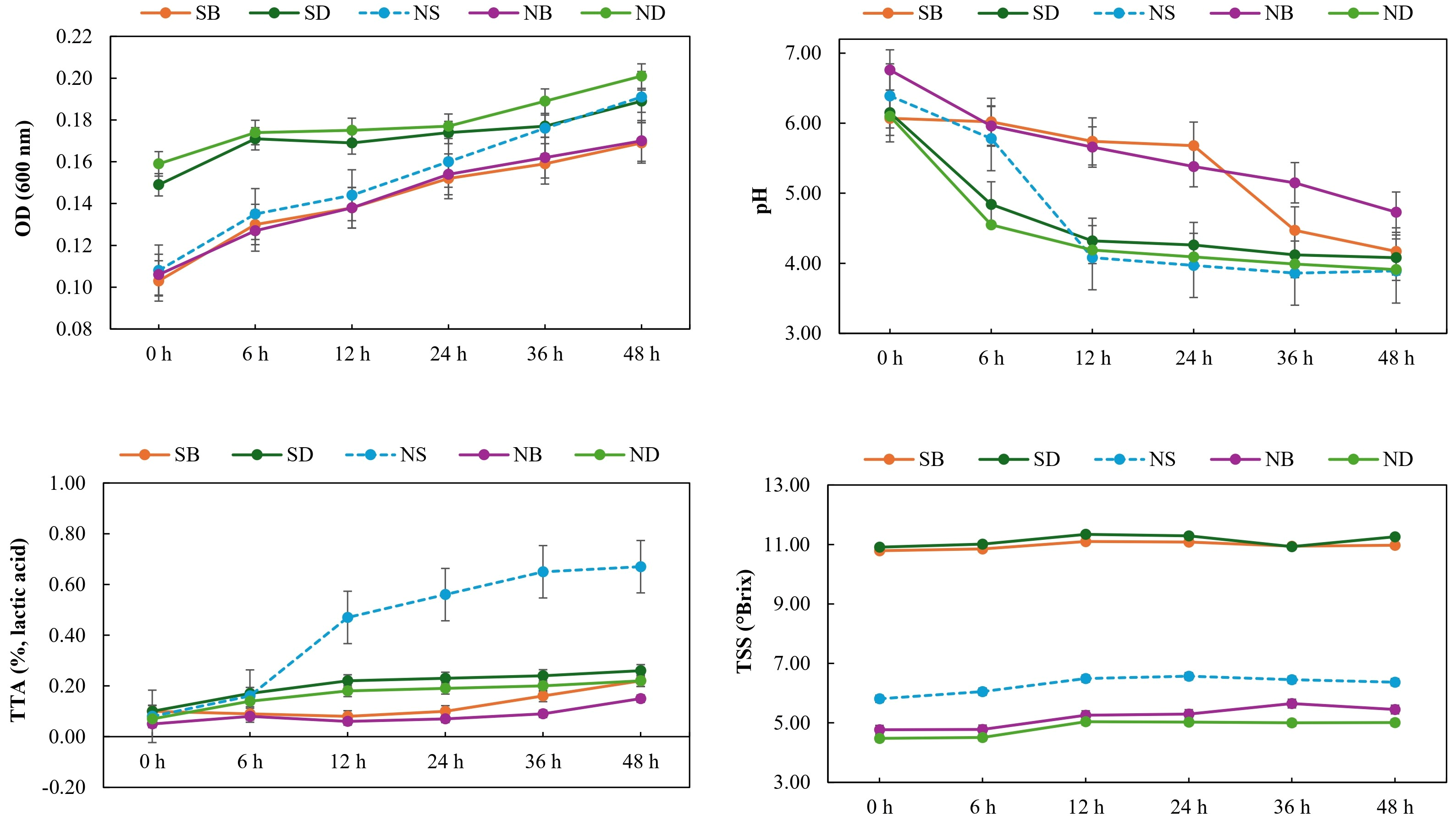
The fermentation of FM extracts showed significant differences (p < 0.05) in microbial growth, acidification, and substrate utilization depending on sprouting and inoculum type (Figure 2). Treatments included NB—non-sprouted, backslopped fermentation; ND—non-sprouted, dairy starter fermentation; SB—sprouted, backslopped fermentation; SD—sprouted, dairy starter fermentation; and NS—non-sprouted, spontaneous fermentation, included here for contextual comparison.
Initial pH ranged from 6.07 (SB) to 6.76 (NB), decreasing over 48 h to 4.08 (SD) and 4.73 (NB). SD showed rapid acidification (ΔpH = 2.08) and the lowest pH_min (4.08), supported by a relatively low AUC_pH (211.20 pH × h), indicating a fast and efficient acidification trajectory. SB had a smaller ΔpH (1.90) and higher AUC_pH (252.78 pH × h), reflecting gradual acidification during backslopping. Among non-sprouted extracts, ND acidified faster than NB (pH_min 3.91 vs. 4.73; ΔpH 2.19 vs. 2.02), with AUC_pH values (203.69 vs. 261.72 pH × h) confirming the faster acidification under dairy starter inoculation (Table 1). NS reached a ΔpH of 2.50 but is presented only for contextual comparison. The commercial Mageu had a pH of 3.94.
Lactic acid accumulation paralleled acidification. SD achieved the highest final TTA (0.25%) with moderate AUC_TTA (10.43% lactic acid × h), indicating controlled but efficient acid production. SB and ND reached 0.22%, with lower AUC_TTA (5.94 and 8.73% lactic acid × h), while NB was slower (0.14%; AUC_TTA 3.71% lactic acid × h), consistent with the pH trends. The commercial Mageu had a TTA of 0.27%.
Substrate utilization, measured by TSS, was enhanced in sprouted extracts. SD and SB started with higher TSS (10.96 and 10.79 °Brix) and maintained high values at 48 h (11.26 and 10.97 °Brix), supported by high AUC_TSS (535.17 and 527.43 °Brix × h), while ND and NB had lower TSS (4.48–5.45 °Brix) and AUC_TSS (236.31–254.43 °Brix × h). Maximum biomass accumulation (OD600) was also highest in SD and ND, showing that rapid microbial growth was tightly coupled with efficient acidification and substrate utilization.
Overall, these integrated behaviors demonstrate that SD combined the fastest growth, rapid pH decline, highest lactic acid accumulation, and maximal substrate utilization, whereas backslopping produced slower, more gradual fermentation.

3.2. Proximate Composition of Finger Millet Beverages

The proximate composition of non-alcoholic finger millet (FM) beverages varied among treatments (Table 2). Ash content ranged from 1.32% (ND) to 2.12% (NS), with beverages from sprouted grains slightly higher (1.44–1.55%) than non-sprouted beverages (1.32–1.44%). Crude fat content ranged from 4.95% (SB) to 5.77% (NB) in treatments, with NS showing 7.35%. Protein content ranged from 3.44 to 4.02% in sprouted beverages (SB, SD) and 2.88–3.25% in non-sprouted beverages (NB, ND), while NS and CM were higher at 3.66% and 5.50%, respectively. Crude fiber ranged from 0.91% (NB) to 2.86% (SB). Carbohydrate content ranged from 81.59 to 85.46% in fermented beverages, but was lower in NS (76.12%), with corresponding energy values ranging from 388 to 409 kcal/100 g, highest in non-sprouted beverages (NB, ND).
Mineral composition varied across treatments (Table 3). Silicon was absent in sprouted beverages (0.00%) and present at 0.22–4.70% in non-sprouted beverages. Phosphorus ranged from 10.89% (ND) to 25.27% (NS), calcium from 5.06% (CM) to 27.00% (SB), and potassium was 36.64–49.32% across all treatments. Iron was 0.91–1.81% in dairy and backslopping beverages and 1.49–2.19% in spontaneous fermentations and CM. Manganese ranged from 1.02 to 4.31% in experimental treatments and was not detected in CM. Chlorine was highest in CM (21.50%) and absent in spontaneous and experimental fermentations.

3.3. Polyphenol Content and Antioxidant Capacity of Non-Alcoholic Finger Millet Beverages

Non-alcoholic FM beverages showed clear differences in phenolic content and antioxidant capacity (Table 4). Total phenolic content (TPC) ranged from 7.79 µg/mL in SB to 10.54 µg/mL in ND, while total flavonoid content (TFC) varied from 4.05 µg/mL in SB to 7.74 µg/mL in NS. Among sprouted treatments, dairy starter fermentation (SD) had higher TPC (8.79 µg/mL) and TFC (5.69 µg/mL) than backslopped SB, which showed moderate TPC (7.79 µg/mL) and lowest TFC (4.05 µg/mL). Non-sprouted treatments (ND, NB) displayed comparable or higher phenolic content than sprouted beverages, with ND recording the highest TPC.
Antioxidant activity also varied among treatments. DPPH radical scavenging was highest in ND (87.80%) and NS (87.32%), while SB had the lowest activity (40.02%). ABTS activity was consistently high across fermented treatments (> 59%) but lowest in CM (30.35%), which also showed the lowest values in all phenolic assays. Overall, all experimental fermentations exhibited substantially higher phenolic and antioxidant values than the commercial maize–sorghum reference (CM), with NS comparable to ND in most metrics.

3.4. Color Properties and Texture Profile Analysis of Non-Alcoholic Finger Millet Beverages

The color properties of non-alcoholic FM beverages are shown in Table 5 and varied significantly (p < 0.05) across all measured parameters (L*, a*, b*, chroma, hue angle, and total color difference, ΔE). Figure S2 (supplementary section) shows photographs of the beverages. Lightness (L*) ranged from 37.67 (SD) to 48.54 (NS), with CM exhibiting the highest L* value of 57.89. Redness (+a*) ranged from 9.36 (NB) to 12.71 (NS), with all beverages displaying positive a* values, indicating a reddish hue. All treatments were yellow, as evidenced by positive b* values. Chroma (C*) varied between 18.61 (NB) and 28.82 (NS), while hue angles (h°) ranged from 59.82 (NB) to 66.34 (SB), with SB showing the highest hue angle. Total color differences (ΔE) relative to CM ranged from 14.33 (NB) to 23.28 (SD), indicating perceptible but acceptable differences.
Texture profile analysis confirmed that the main experimental finger millet beverages (SB, SD, NB, ND) maintained similar firmness, consistency, and secondary peak force, with firmness ranging from 12.90 to 13.40 g, consistency from 242.19 to 247.94 g·s, and secondary peak force from −7.19 to −7.61 g (Table 6). There were no statistically significant differences among these treatments (p > 0.05), indicating that neither sprouting nor starter type affected textural properties. The non-sprouted, NS showed comparable values (firmness 12.78 g, consistency 243.30 g·s, secondary peak force −7.28 g) and is included for contextual comparison. In contrast, the CM exhibited significantly higher firmness (29.83 g), consistency (521.89 g·s), and secondary peak force (−17.39 g; p < 0.05), demonstrating a firmer, more cohesive, and more consistent texture than the experimental beverages.

3.5. Inherent Structural Grouping Using Principal Component Analyses

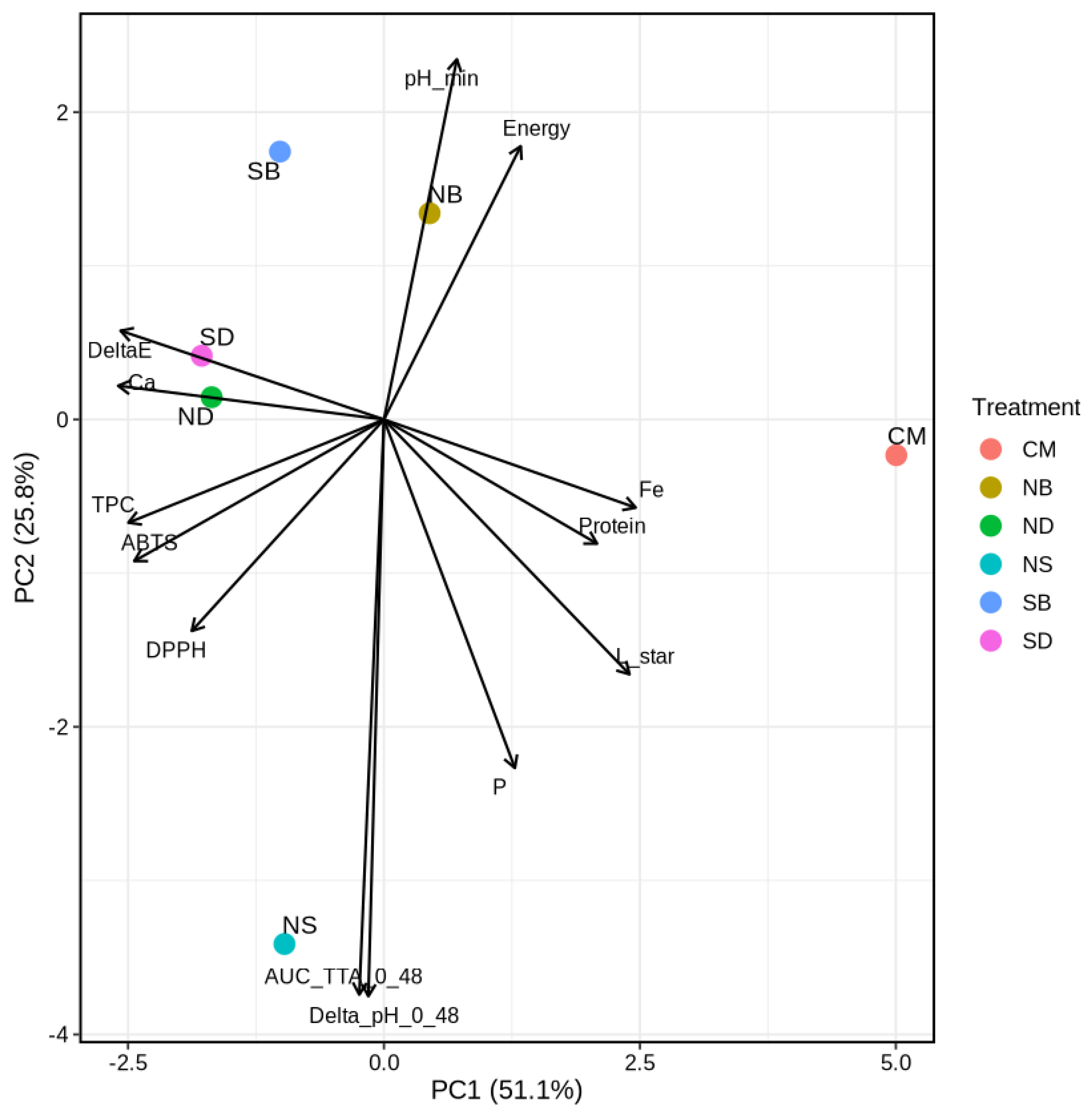
Principal component analysis (PCA) was performed to evaluate multivariate relationships among treatments, and the resulting biplot is presented in Figure 3. The principal components explained 76.86% of the total variance (PC1 = 51.11%; PC2 = 25.75%), indicating that the PCA captured most multivariate differences among FM beverages. PC1 represented the primary axis of separation and was associated with color and compositional attributes. Negative PC1 loadings were dominated by Ca, ΔE, TPC, and ABTS, whereas Fe and L* loaded positively, reflecting an inverse association between mineral-bioactive attributes and iron-lightness characteristics. CM was strongly separated on the positive side of PC1, aligning with higher Fe and L*, while all fermented treatments clustered on the negative side, with SD and ND showing the closest association with the mineral-bioactive cluster.
PC2 captured variation related to fermentation behavior. Acidification kinetics (ΔpH0–48 and AUC_TTA0–48) loaded negatively, while pH_min and energy loaded positively. Backslopping treatments (SB and NB) scored highest on PC2, whereas NS was strongly associated with the negative, acidification-related direction, SD, ND, and CM occupied intermediate positions. Overall, global separation among treatments was driven primarily by compositional attributes along PC1, while starter type structured fermentation behavior along PC2.
Figure 3. Principal component analyses biplot of fermented finger millet beverages (performed with Julius AI Inc.). Variables included fermentation dynamics (ΔpH0–48, pH_min, AUC_TTA0–48), nutrition (protein, energy, P, Ca, Fe), antioxidants (TPC, DPPH, ABTS), and color (L*, ΔE). PC1 (51.11%)-separated treatments by compositional and color-bioactive attributes, while PC2 (25.75%) captured fermentation behavior, with acidification and energy differences reflecting starter type influence. Total variance explained: 76.86%. Samples are coded by fermentation strategy and grain processing, as indicated in the biplot key. Treatments coded as follows: CM—commercial Mageu (control); NS—non-sprouted, spontaneous fermentation; NB—non-sprouted, backslopped fermentation; ND—non-sprouted, dairy starter fermentation; SB—sprouted, backslopped fermentation; and SD—sprouted, dairy starter fermentation.
Fermentation 12 00141 g003

4. Discussion

The fermentation of FM beverages revealed that substrate sprouting and starter culture selection profoundly shaped microbial growth, acidification dynamics, substrate utilization, and final beverage quality. Sprouting boosted fermentability via endogenous amylases, proteases, and phytases, promoting sugar release, partial protein hydrolysis, fiber solubilization, and enhanced mineral bioavailability [28,43]. Notably, modest biomass increases across treatments highlighted that fermentation hinged more on metabolic efficiency (faster ATP yield per enzyme or carbon substrate) than proliferation [44].
These patterns reflect the interplay between germination and microbial metabolism where endogenous enzymes from sprouting (α-amylase, protease, phytase) release simple sugars, amino acids, and partially hydrolyzed fibers, which serve as readily metabolizable substrates for LAB [45]. LAB metabolic traits, homofermentative glucose conversion, fast ATP turnover, and selective enzyme activity drive rapid acidification [46]. They also modulate substrate utilization, and stabilize or transform phenolic compounds toward antioxidant-active forms [47]. Together, germination and microbial enzymatic activity enhance protein availability, fiber solubilization, mineral bioaccessibility, and functional antioxidant expression, while controlling acidification kinetics and limiting proliferation-dependent variability.
Sprouted systems, particularly SD, supported rapid acidification (pH 4.21, 12 h, AUC pH0–48 = 211.20), reaching pH < 4.5 within the first 24 h, accompanied by elevated total titratable acidity (TTA), which likely contributed to inhibition of spoilage microorganisms such as Escherichia coli and Listeria monocytogenes [48]. SD exhibited the fastest acidification and highest substrate utilization, reflecting a tight coupling between microbial metabolism and carbohydrate conversion rather than extensive cell proliferation [44]. Rapid acidification was likely driven by homofermentative Streptococcus thermophilus and Lactobacillus delbrueckii subsp. bulgaricus efficiently converting glucose to lactic acid [49]. In contrast, SB showed a more gradual acidification trajectory, consistent with the establishment of mixed microbial communities through backslopping, sustaining metabolic activity alongside moderate microbial growth [50]. Among non-sprouted extracts, ND (pH 4.19, 12 h, AUC pH0–48 = 203.69) acidified faster than NB (pH 4.73, 48 h, AUC pH0–48 = 261.72), indicating more efficient metabolic activity despite comparable growth trends, while NS showed moderate acidification and was included primarily for contextual comparison [51]. Collectively, these results confirm that sprouting enhances substrate fermentability, while starter type modulates fermentation dynamics and trajectory.
Substrate utilization, as reflected by TSS, mirrored fermentation dynamics. Sprouted beverages (SB and SD) maintained higher TSS (~11 °Brix) throughout fermentation, suggesting enhanced starch solubilization and efficient microbial metabolism, even in the absence of pronounced biomass accumulation [44,52]. Non-sprouted beverages exhibited lower TSS (~5 °Brix), likely reflecting limited enzymatic breakdown and slower substrate consumption [52]. These patterns indicate that sprouting and starter selection optimize carbohydrate availability and microbial performance, while backslopping provides controlled, gradual acidification that may preserve sensory and functional qualities.
Proximate composition of FM beverages was strongly influenced by substrate and fermentation strategy, with protein retention emerging as a key feature. Sprouted treatments generally contained higher protein (SD = 4.02%; SB = 3.44%) than non-sprouted (ND = 3.35%) and NB = 2.88%), suggesting that germination enhances protein availability, likely through enzyme-mediated mobilization of amino acids and reduction in anti-nutritional factors [53,54]. Ref. [55] found a significant increase in protein content (17.30%) of fermented yam bean flour, with significant rises in leucine (0.16%) and isoleucine (0.31%) levels.
Crude fiber was also enriched in sprouted treatments (SB = 2.86%; SD = 2.04%), reflecting the apparent increase due to solubilization of polysaccharides during germination and fermentation [56]. This can also be likely due to part of the roots and shoots developed during sprouting that remained during deculming [57]. Fat and carbohydrate contents were broadly similar across treatments, although spontaneous fermentation (NS) showed slightly elevated fat (7.35%) and lower carbohydrates (76.12%), likely due to variable microbial metabolism [55,58,59,60]. Energy values were generally comparable, with non-sprouted beverages slightly higher than sprouted ones, largely reflecting carbohydrate content rather than protein. These findings highlight the trade-offs in nutritional composition: sprouting enhances both protein and fiber, while non-sprouted substrates maintain slightly higher energy. Controlled fermentation with defined starters helps preserve protein consistently, whereas spontaneous fermentation may introduce variability in fat and carbohydrate levels, as observed in NS.
Mineral composition was also shaped by substrate and fermentation strategy. Sprouted SB and SD contained higher calcium and potassium levels but lacked detectable silicon, consistent with phytate hydrolysis during germination [61]. Silicon is an indicator of soil that was not completely removed during the washing of grains. Iron and manganese were moderate across treatments, while chlorine was elevated in CM due to the use of industrially treated water. These findings indicate that sprouted beverages offer mineral advantages, particularly in calcium and potassium, whereas non-sprouted beverages preserve protein content.
Phenolic content and antioxidant capacity were clearly shaped by substrate type and fermentation strategy. Unlike typical sprouting-induced TPC increases [56], non-sprouted FM beverages retained higher phenolics and flavonoids and DPPH activity than sprouted counterparts. LAB likely preserved bound phenolics in intact grains, while sprouting’s hydrolysis increased oxidation losses [62,63]. Sprouted treatments exhibited slightly lower phenolic levels but maintained moderate antioxidant activity, indicating that sprouting and fermentation can selectively modulate antioxidant pathways rather than simply enhancing total phenolic content [64]. Among the sprouted beverages, backslopped fermentation (SB) did not maximize radical scavenging, whereas SD supported higher ABTS activity, suggesting that microbial metabolism under controlled fermentation can influence specific antioxidant mechanisms [65,66]. Overall, these patterns demonstrate a trade-off between phenolic retention and functional antioxidant expression, with non-sprouted substrates favoring higher radical scavenging and sprouting combined with fermentation type modulating functional activity in a more targeted manner. The commercial reference consistently showed the lowest phenolic and antioxidant activity, highlighting the advantages of experimental FM beverages.
Color and texture were influenced by substrate and fermentation. SB and SD were darker than NB and ND, likely due to enzymatic browning and phenolic interactions during germination and fermentation [67]. Activation of enzymes (such as polyphenol oxidase) promotes quinones compounds, which then polymerize into brown pigments [68]. Moreover, an increase in free amino acids and reducing sugar via alpha-amylase and protease action can enhance Maillard reactions [69]. The thermal heating that follows can further contribute dark coloration [70]. LAB during fermentation acidified the beverages, intensifying coloration since phenolic complexes from deactivation of PPO that induce enzymatic browning [71]. Microbial hydrolysis of bound pigments could have also increased extractable pigments, resulting in higher chroma in SB and NS. All experimental beverages exhibited reddish-yellow hues, whereas CM was lighter and more uniform. Texture parameters, including firmness, consistency and secondary peak force, were comparable among SB, SD, NB, ND, and NS. Alpha amylase and protease enzymes hydrolysis fragments in starch (breaking α-1,4 glycosidic bonds) and protein into soluble dextrins and peptides [45]. LAB generated modest epoxysacharrides that modulate viscosity, softening perceived firmness and secondary peak force. CM displayed higher values due to industrial processing that involves homogenization and stabilizers enhancing texture. These results indicate that sprouting and starter type exert limited influence on sensory texture and color, while commercial products provide an industrial benchmark. These factors can be perceived as positive attributes, since consumers are daily exposed to clear beverages such as soft drinks, which are typically smooth, light-bodied, and easy to swallow; the clarified finger millet beverages similarly offer a softer texture and reduced particulate mouthfeel, enhancing overall palatability.
PCA indicated that fermentation-related compositional changes were the primary source of multivariate variation among FM beverages, accounting for the dominant separation along PC1 and clearly distinguishing fermented treatments (SB, SD, NB, ND) from the commercial reference (CM). Fermented samples aligned with mineral- and antioxidant-related variables, whereas CM was associated with higher Fe and L* values. Differences between sprouted (SB, SD) and non-sprouted (NB, ND) substrates were comparatively small, with substantial overlap along PC1, indicating that fermentation effects outweighed substrate pretreatment in shaping overall compositional profiles.
Variation along PC2 reflected differences in fermentation behavior. Acidification kinetics variables opposed pH_min and energy, indicating a gradient from rapid acidification to more moderated fermentation responses. Backslopped treatments (SB and NB) were positioned furthest along this axis, consistent with greater metabolic flexibility, whereas dairy starter treatments (SD and ND) clustered closer to the origin, reflecting more controlled fermentation behavior. Spontaneous fermentation (NS) showed the strongest association with acidification kinetics, highlighting the variability associated with uncontrolled microbial activity.
Taken together, the PCA suggests that fermentation governs compositional and functional differentiation (PC1), while starter selection modulates fermentation dynamics (PC2). Within this framework, sprouted backslopped fermentation (SB) exhibited a comparatively balanced multivariate profile, combining favorable compositional attributes with moderated fermentation behavior, whereas dairy starter treatments (SD, ND) provided greater process stability but less differentiation. CM remained distinct from all fermented products, reflecting a fundamentally different quality profile.

5. Conclusions

Sprouting and starter selection interactively shaped finger millet (FM) beverage nutrition, functionality, and fermentation performance, establishing a robust foundation for safe, nutrient-dense products. PCA identified fermentation-driven compositional change as the dominant source of variation, clearly separating defined-starter FM beverages (SB, SD, NB, ND) from commercial Mageu (CM). Dairy starter fermentation (SD) ensured rapid, predictable acidification with efficient substrate utilization, while back-slopped fermentation (SB) provided more balanced fermentation dynamics alongside enhanced functional attributes. Sprouting improved fiber and mineral availability, whereas non-sprouted formulations (NB, ND) retained slightly higher energy, highlighting nutritional-functional trade-offs. By systematically profiling compositional, functional, and fermentation characteristics across these treatments, this work establishes a technical and biochemical baseline that can guide subsequent evaluations and product development. Overall, FM beverages outperformed commercial sorghum- and maize-based Mageu across key nutritional and functional metrics, validating finger millet as a robust platform for African functional food development. Future studies can build on this foundation to refine formulations, optimize microbial strains, and assess broader quality attributes for market-ready applications.

Supplementary Materials

The following supporting information can be downloaded at: https://www.mdpi.com/article/10.3390/fermentation12030141/s1, Figure S1: Comparative antioxidant activity of non-alcoholic finger millet beverages fermented spontaneously, backslopping and dairy cultures (performed with Julius AI Inc.). CM—Commercial Mageu, NS—non-sprouted, spontaneous fermentation, NB—non-sprouted, backslopped fermentation, NDC (ND)—non-sprouted, dairy starter fermentation, SB—sprouted, backslopped fermentation, SDC (SD)—sprouted, dairy starter fermentation; Figure S2: Non-alcoholic finger millet beverages. CM—Commercial Mageu, NS—non-sprouted, spontaneous fermentation, NB—non-sprouted, backslopped fermentation, NDC—non-sprouted, dairy starter fermentation, NB—non-sprouted, backslopped fermentation, SDC (SD)—sprouted, dairy starter fermentation.

Author Contributions

M.A.R.: Conceptualization, methodology, formal analysis, investigation, visualization and validation, writing—original draft preparation, writing—review and editing. O.P.B.: Conceptualization, methodology, visualization and validation, resources, supervision, writing—review and editing. V.A.J.: Conceptualization, methodology, visualization and validation, resources, supervision, writing—review and editing. V.N.: Conceptualization, methodology, visualization and validation, resources, supervision, writing—review and editing. S.E.R.: Conceptualization, methodology, visualization and validation, resources, supervision, writing—review and editing. All authors have read and agreed to the published version of the manuscript.

Funding

Gratitude is extended to the Department of Higher Education and Training in South Africa for providing financial support through the New Generation of Academic (nGAP) Phase 7 program.

Institutional Review Board Statement

No human or animal subjects were involved in this study, and there were no environmental impacts; therefore, ethical approval was not required.

Informed Consent Statement

Not applicable.

Data Availability Statement

The original contributions presented in this study are included in the article/Supplementary Materials. Further inquiries can be directed to the corresponding authors.

Acknowledgments

I sincerely thank my parents, Koena Gredia Ratau and Francina Makoena Ratau, for their continuous encouragement and unwavering support throughout my academic journey. Their confidence in me has been a vital source of strength and inspiration. The authors acknowledge the use of Julius.ai (Julius AI Inc., San Francisco, CA, USA; https://julius.ai (accessed on 28 January 2026)) to support data cleaning, principal component analysis (PCA), extraction of PCA loadings, and preparation of PCA figures. The authors take full responsibility for the integrity of the analyses, interpretation of results, and conclusions. AI tools were used only to support data analysis and figure generation; no AI tool was used to generate or fabricate experimental data.

Conflicts of Interest

The authors declare no conflicts of interest.

References

  1. Asif, N.; Anwar, O.; Arif, S.; Anwar, Z.; Iahtisham-Ul-Haq; Ercisli, S.; Mugabi, R.; Nayik, G.A. The Rise of Plant-Based Milk Alternatives: Exploring Nutritional, Health, and Sustainability Impacts. Food Chem. X 2026, 34, 103528. [Google Scholar] [CrossRef]
  2. Tireki, S. A Review on Packed Non-Alcoholic Beverages: Ingredients, Production, Trends and Future Opportunities for Functional Product Development. Trends Food Sci. Technol. 2021, 112, 442–454. [Google Scholar] [CrossRef]
  3. Moiseenko, K.V.; Glazunova, O.A.; Fedorova, T.V. Fermentation of Rice, Oat, and Wheat Flour by Pure Cultures of Common Starter Lactic Acid Bacteria: Growth Dynamics, Sensory Evaluation, and Functional Properties. Foods 2024, 13, 2414. [Google Scholar] [CrossRef] [PubMed]
  4. Adesulu-Dahunsi, A.T.; Adesulu, A.O.; Fagbemi, A.S.; Ezeamagu, C.O. African Cereal Based Fermented Beverages as Functional Drinks with Potential Impact on Human Gut Microbiota and Health Implications. Discov. Food 2025, 5, 106. [Google Scholar] [CrossRef]
  5. Kumar Meena, K.; Kumra Taneja, N.; Jain, D.; Ojha, A.; Saravanan, C.; Shankar Bunkar, D. Spontaneously Fermented Cereal Based Products: An Ancient Health Promoting Formulae for Consumption of Probiotic Lactic Acid Bacteria. Biointerface Res. Appl. Chem. 2023, 13, 465. [Google Scholar] [CrossRef]
  6. Martínez, S.; Carballo, J. Physicochemical, Sensory and Nutritional Properties of Foods Affected by Processing and Storage. Foods 2021, 10, 2970. [Google Scholar] [CrossRef]
  7. Petrariu, O.A.; Barbu, I.C.; Niculescu, A.G.; Constantin, M.; Grigore, G.A.; Cristian, R.E.; Mihaescu, G.; Vrancianu, C.O. Role of Probiotics in Managing Various Human Diseases, from Oral Pathology to Cancer and Gastrointestinal Diseases. Front. Microbiol. 2024, 14, 1296447. [Google Scholar] [CrossRef]
  8. Tomar, T.; Sachdeva, A.; Dutta, J.; Al Tawaha, A.R.M.; Karnwal, A.; Malik, T.; Selvaraj, M. Fermentation Dynamics of Millet Beverages: Microbial Interactions, Nutritional Enhancements, and Health Implications. Food Chem. X 2025, 25, 102199. [Google Scholar] [CrossRef]
  9. Gupta, A.; Sanwal, N.; Bareen, M.A.; Barua, S.; Sharma, N.; Olatunji, O.J.; Nirmal, N.P.; Sahu, J.K. Trends in Functional Beverages: Functional Ingredients, Processing Technologies, Stability, Health Benefits, and Consumer Perspective. Food Res. Int. 2023, 170, 113046. [Google Scholar] [CrossRef]
  10. Jideani, V.A.; Ratau, M.A.; Okudoh, V.I. Leuconostoc mesenteroides and Pediococcus pentosaceus Non-Alcoholic Pearl Millet Beverage Enriched with Moringa Oleifera Leaf Powder: Nutritional and Sensory Characteristics. Processes 2021, 9, 2125. [Google Scholar] [CrossRef]
  11. Olayanju, A.; Mellor, D.; Khatri, Y.; Pickles, N. The Efficacy of Fermented Foods in the Treatment and Management of Diarrhoeal Diseases: A Systematic Review and Meta-Analysis. Nutr. Health 2022, 29, 71. [Google Scholar] [CrossRef] [PubMed]
  12. Abbaspour, N. Fermentation’s Pivotal Role in Shaping the Future of Plant-Based Foods: An Integrative Review of Fermentation Processes and Their Impact on Sensory and Health Benefits. Appl. Food Res. 2024, 4, 100468. [Google Scholar] [CrossRef]
  13. Cuamatzin-garcía, L.; Rodríguez-rugarcía, P.; El-kassis, E.G.; Galicia, G.; Meza-jiménez, M.L.; Baños-lara, M.D.R.; Zaragoza-maldonado, D.S.; Pérez-armendáriz, B. Traditional Fermented Foods and Beverages from around the World and Their Health Benefits. Microorganisms 2022, 10, 1151. [Google Scholar] [CrossRef] [PubMed]
  14. García, C.L.; German Bermúdez, F.A.; Vanden Berghe, W.; Gabriela Zurita-Benavides, M.; Orellana-Manzano, A. Fermented Beverages among Indigenous Latin American Societies. Front. Sustain. Food Syst. 2024, 8, 1390162. [Google Scholar] [CrossRef]
  15. Tamang, J.P.; Cotter, P.D.; Endo, A.; Han, N.S.; Kort, R.; Liu, S.Q.; Mayo, B.; Westerik, N.; Hutkins, R. Fermented Foods in a Global Age: East Meets West. Compr. Rev. Food Sci. Food Saf. 2020, 19, 184–217. [Google Scholar] [CrossRef]
  16. Ignat, M.V.; Salanță, L.C.; Pop, O.L.; Pop, C.R.; Tofană, M.; Mudura, E.; Coldea, T.E.; Borșa, A.; Pasqualone, A. Current Functionality and Potential Improvements of Non-Alcoholic Fermented Cereal Beverages. Foods 2020, 9, 1031. [Google Scholar] [CrossRef]
  17. Wickramaarachchi, L.A.; Jayasinghe, M.A.; Herath, M.T. Cereal Based Beverages for Nutrition Security: An Integrative Review. J. Univ. Ruhuna 2022, 10, 35–45. [Google Scholar] [CrossRef]
  18. Hassan, Z.M.; Sebola, N.A.; Mabelebele, M. The Nutritional Use of Millet Grain for Food and Feed: A Review. Agric. Food Secur. 2021, 10, 16. [Google Scholar] [CrossRef]
  19. Tanwar, R.; Panghal, A.; Chaudhary, G.; Kumari, A.; Chhikara, N. Nutritional, Phytochemical and Functional Potential of Sorghum: A Review. Food Chem. Adv. 2023, 3, 100501. [Google Scholar] [CrossRef]
  20. Ramashia, S.E.; Mashau, M.E.; Onipe, O.O.; Ramashia, S.E.; Mashau, M.E.; Onipe, O.O. Millets Cereal Grains: Nutritional Composition and Utilisation in Sub-Saharan Africa. In Cereal Grains-Volume 1; IntechOpen: London, UK, 2021. [Google Scholar] [CrossRef]
  21. Gaikwad, V.; Kaur, J.; Rasane, P.; Kaur, S.; Singh, J.; Kumar, A.; Kumar, A.; Sharma, N.; Mehta, C.; Singh, A. Nutritional Significance of Finger Millet and Its Potential for Using in Functional Products. Foods Raw Mater. 2024, 12, 110–123. [Google Scholar] [CrossRef]
  22. Muhammad, Y.K.; Aparajita, B.; Baby, D.M.; Maanas, S. Review on Finger Millet (Eleusine coracana L.): Nutritional Composition, Modification, Its Effect on Physicochemical, Structural, Functional Properties, and Its Applications. J. Food Compos. Anal. 2024, 135, 106623. [Google Scholar] [CrossRef]
  23. Kaur, S.; Kumari, A.; Seem, K.; Kaur, G.; Kumar, D.; Verma, S.; Singh, N.; Kumar, A.; Kumar, M.; Jaiswal, S.; et al. Finger Millet (Eleusine coracana L.): From Staple to Superfood—A Comprehensive Review on Nutritional, Bioactive, Industrial, and Climate Resilience Potential. Planta 2024, 260, 75. [Google Scholar] [CrossRef]
  24. Hassan, S.M. Nutritional, Functional and Bioactive Properties of Sorghum (Sorghum bicolor I. Moench) with Its Future Outlooks: A Review Review Article. Open J. Nutr. Food Sci. 2023, 5, 15–20. [Google Scholar]
  25. Yenasew, A.; Urga, K. Effect of the Germination Period on Functional Properties of Finger Millet Flour and Sensorial Quality of Porridge. Food Sci. Nutr. 2023, 11, 2336–2343. [Google Scholar] [CrossRef]
  26. Chauhan, E.S. Sarita Effects of Processing (Germination and Popping) on the Nutritional and Anti-Nutritional Properties of Finger Millet (Eleusine coracana). Curr. Res. Nutr. Food Sci. 2018, 6, 566–572. [Google Scholar] [CrossRef]
  27. Bhuvaneshwari, G.; Nirmalakumari, A.; Kalaiselvi, S. Impact of Soaking, Sprouting on Antioxidant and Anti-Nutritional Factors in Milletgrains. J. Phytol. 2020, 12, 62–66. [Google Scholar] [CrossRef]
  28. Ikram, A.; Saeed, F.; Afzaal, M.; Imran, A.; Niaz, B.; Tufail, T.; Hussain, M.; Anjum, F.M. Nutritional and End-use Perspectives of Sprouted Grains: A Comprehensive Review. Food Sci. Nutr. 2021, 9, 4617. [Google Scholar] [CrossRef]
  29. Masehlele, D.P.; Adebo, J.A.; Kewuyemi, Y.O.; Adebo, O.A. Development of a Maize Meal Based-Drink Fermented Using Kefir Grains or Yoghurt Starter Cultures (Lactobacillus bulgaricus and Streptococcus thermophilus). Agric. Eng. Int. CIGR J. 2023, 25, 212–221. [Google Scholar]
  30. Shendage, S.; Patharkar, S.; Annapurwe, B. Study of the Physicochemical and Proximate Composition of Cereal Based Probiotic Beverage. Pharma Innov. J. 2020, 9, 427–432. [Google Scholar]
  31. Jideani, V.A.; Ratau, M.A.; Okudoh, V.I. Non-Alcoholic Pearl Millet Beverage Innovation with Own Bioburden: Leuconostoc mesenteroides, Pediococcus pentosaceus and Enterococcus gallinarum. Foods 2021, 10, 1447. [Google Scholar] [CrossRef] [PubMed]
  32. Daji, G.A.; Green, E.; Adebo, O.A. Nutritional and Phytochemical Composition of Mahewu (a Southern African Fermented Food Product) Derived from White and Yellow Maize (Zea mays) with Different Inocula. Fermentation 2023, 9, 58. [Google Scholar] [CrossRef]
  33. Rogers, A.T.; Bullard, K.R.; Dod, A.C.; Wang, Y. Bacterial Growth Curve Measurements with a Multimode Microplate Reader. Bio-Protocol 2022, 12, e4410. [Google Scholar] [CrossRef]
  34. Solange, A.; Marcellin, T.B.; Amenan Clémentine, K.-K.; Marina, K.-C. Evaluation of Potential Lactic Acid Bacteria Single Starter Cultures for Production of Traditional Ivoirian Cereal Beverages. GSC Biol. Pharm. Sci. 2020, 11, 182–195. [Google Scholar] [CrossRef]
  35. AOAC 945.32; Official Methods of Analysis of AOAC International: Moisture in Cereal Products (Oven Method). AOAC International: Gaithersburg, MD, USA, 2005.
  36. AOAC 923.03; Official Methods of Analysis of AOAC International: Ash of Flour (Total Ash). AOAC International: Gaithersburg, MD, USA, 2005.
  37. AOAC. Official Methods of Analysis of the Association of Official Analytical Chemists, 18th ed.; Association of Official Analytical Chemists: Gaithersburg, MD, USA, 2010; ISBN 0-93558. [Google Scholar]
  38. Zerfu, T.A.; Mekuria, A. Pregnant Women Have Inadequate Fiber Intake While Consuming Fiber-Rich Diets in Low-Income Rural Setting: Evidences from Analysis of Common “Ready-to-Eat” Stable Foods. Food Sci. Nutr. 2019, 7, 3286–3292. [Google Scholar] [CrossRef]
  39. AOCS. Approved Procedure Am 5-04: Rapid Determination of Oil/Fat Utilizing High Temperature Solvent Extraction; American Oil Chemists’ Society: Champaign, IL, USA, 2004. [Google Scholar]
  40. Mudau, M.; Mashau, M.E.; Ramashia, S.E. Nutritional Quality, Antioxidant, Microstructural and Sensory Properties of Spontaneously Fermented Gluten-Free Finger Millet Biscuits. Foods 2022, 11, 1265. [Google Scholar] [CrossRef]
  41. Mashau, M.E.; Ramatsetse, K.E.; Ramashia, S.E. Effects of Adding Moringa Oleifera Leaves Powder on the Nutritional Properties, Lipid Oxidation and Microbial Growth in Ground Beef during Cold Storage. Appl. Sci. 2021, 11, 2944. [Google Scholar] [CrossRef]
  42. Gao, F.; Li, D.; Li, H.; Chen, H.; Mao, X.; Wang, P. Influence of Post-Heating Treatment on the Sensory and Textural Properties of Stirred Fermented Milk. Foods 2023, 12, 3042. [Google Scholar] [CrossRef]
  43. Elliott, H.; Woods, P.; Green, B.D.; Nugent, A.P. Can Sprouting Reduce Phytate and Improve the Nutritional Composition and Nutrient Bioaccessibility in Cereals and Legumes? Nutr. Bull. 2022, 47, 138–156. [Google Scholar] [CrossRef]
  44. Xiao, X.; Shen, N.; Tu, Z.; Bai, J.; Zhao, Y.; Zhu, L.; Zhang, Z.; Fan, S. Nutritional and Functional Enhancement of Cereal-Based Foods through Lactic Acid Bacteria Fermentation: Focusing on Postbiotics. Food Biosci. 2025, 74, 107871. [Google Scholar] [CrossRef]
  45. Devi, M.; Sarma, A.D.; Kalita, P.; Parasar, D.P.; Hiremath, V.; Choudhary, N.; Kumar, D.; Babu Kondaveeti, S. Advances in Microbial Enzyme Technology for Food Processing Strategies and Applications. Discov. Food 2025, 6, 56. [Google Scholar] [CrossRef]
  46. Rymuszka, A.; Gorczynska, W. Classical Food Fermentations as Modern Biotechnological Platforms: Alcoholic, Acetic, Butyric, Lactic and Propionic Pathways and Applications. Molecules 2026, 31, 333. [Google Scholar] [CrossRef]
  47. De Montijo-Prieto, S.; Razola-Díaz, M.C.; Barbieri, F.; Tabanelli, G.; Gardini, F.; Jiménez-Valera, M.; Ruiz-Bravo, A.; Verardo, V.; Gómez-Caravaca, A.M. Impact of Lactic Acid Bacteria Fermentation on Phenolic Compounds and Antioxidant Activity of Avocado Leaf Extracts. Antioxidants 2023, 12, 298. [Google Scholar] [CrossRef]
  48. Anumudu, C.K.; Miri, T.; Onyeaka, H. Multifunctional Applications of Lactic Acid Bacteria: Enhancing Safety, Quality, and Nutritional Value in Foods and Fermented Beverages. Foods 2024, 13, 3714. [Google Scholar] [CrossRef]
  49. Petrova, P.; Petrov, K. Lactic Acid Fermentation of Cereals and Pseudocereals: Ancient Nutritional Biotechnologies with Modern Applications. Nutrients 2020, 12, 1118. [Google Scholar] [CrossRef]
  50. Madilo, F.K.; Parry-Hanson Kunadu, A.; Tano-Debrah, K.; Saalia, F.K.; Kolanisi, U. Diversity of Production Techniques and Microbiology of African Cereal-Based Traditional Fermented Beverages. J. Food Qual. 2024, 2024, 1–32. [Google Scholar] [CrossRef]
  51. Melia, S.; Juliyarsi, I.; Kurnia, Y.F.; Pratama, Y.E.; Azahra, H. Examination of Titratable Acidity, PH, Total Lactic Acid Bacteria and Sensory Properties in Whey Fermented with Probiotic Pediococcus Acidilactic BK01. Adv. Anim. Vet. Sci. 2021, 10, 114–119. [Google Scholar] [CrossRef]
  52. Vidal, J.D.; Beres, C.; Brito, F.O.; Zago, L.; Miyahira, R.F. Unlocking the Functional Potential of Sprouts: A Scientific Exploration on Simulated Gastrointestinal Digestion and Colonic Fermentation. J. Funct. Foods 2024, 117, 106235. [Google Scholar] [CrossRef]
  53. Samtiya, M.; Aluko, R.E.; Dhewa, T. Plant Food Anti-Nutritional Factors and Their Reduction Strategies: An Overview. Food Prod. Process. Nutr. 2020, 2, 6. [Google Scholar] [CrossRef]
  54. N’zi, K.P.; Adingra, K.M.-D.; N’guessan, K.F.; Attchelouwa, C.K.; Tano, K. Effect of Spontaneous Fermentation Time on Physicochemical, Nutrient, Anti-Nutrient and Microbiological Composition of Lima Bean (Phaseolus lunatus) Flour. J. Appl. Biosci. 2021, 162, 16707–16725. [Google Scholar] [CrossRef]
  55. Knez, E.; Kadac-Czapska, K.; Grembecka, M. Effect of Fermentation on the Nutritional Quality of the Selected Vegetables and Legumes and Their Health Effects. Life 2023, 13, 655. [Google Scholar] [CrossRef]
  56. Kumari, K.; Kashyap, P.; Chakrabarti, P. Germination and Probiotic Fermentation: A Way to Enhance Nutritional and Biochemical Properties of Cereals and Millets. Food Sci. Biotechnol. 2023, 33, 505. [Google Scholar] [CrossRef]
  57. Kumar, S.; Anand, R. Effect of Germination and Temperature on Phytic Acid Content of Cereals. IJRAS 2021, 8, 24–35. [Google Scholar] [CrossRef]
  58. Nkhata, S.G.; Ayua, E.; Kamau, E.H.; Shingiro, J.-B. Fermentation and Germination Improve Nutritional Value of Cereals and Legumes through Activation of Endogenous Enzymes. Food Sci. Nutr. 2018, 6, 2446–2458. [Google Scholar] [CrossRef]
  59. Tu, Y.; Huang, S.; Chi, C.; Lu, P.; Chen, L.; Li, L.; Li, X. Digestibility and Structure Changes of Rice Starch Following Co-Fermentation of Yeast and Lactobacillus Strains. Int. J. Biol. Macromol. 2021, 184, 530–537. [Google Scholar] [CrossRef] [PubMed]
  60. Djorgbenoo, R.; Hu, J.; Hu, C.; Sang, S. Fermented Oats as a Novel Functional Food. Nutrients 2023, 15, 3521. [Google Scholar] [CrossRef] [PubMed]
  61. Joudaki, H.; Aria, N.; Moravej, R.; Rezaei Yazdi, M.; Emami-Karvani, Z.; Hamblin, M.R. Microbial Phytases: Properties and Applications in the Food Industry. Curr. Microbiol. 2023, 80, 374. [Google Scholar] [CrossRef]
  62. Borgonovi, S.M.; Chiarello, E.; Pasini, F.; Picone, G.; Marzocchi, S.; Capozzi, F.; Bordoni, A.; Barbiroli, A.; Marti, A.; Iametti, S.; et al. Effect of Sprouting on Biomolecular and Antioxidant Features of Common Buckwheat (Fagopyrum esculentum). Foods 2023, 12, 2047. [Google Scholar] [CrossRef]
  63. Maqbool, Z.; Khalid, W.; Mahum; Khan, A.; Azmat, M.; Sehrish, A.; Zia, S.; Koraqi, H.; AL-Farga, A.; Aqlan, F.; et al. Cereal Sprout-based Food Products: Industrial Application, Novel Extraction, Consumer Acceptance, Antioxidant Potential, Sensory Evaluation, and Health Perspective. Food Sci. Nutr. 2023, 12, 707. [Google Scholar] [CrossRef]
  64. Zhao, Y.S.; Eweys, A.S.; Zhang, J.Y.; Zhu, Y.; Bai, J.; Darwesh, O.M.; Zhang, H.B.; Xiao, X. Fermentation Affects the Antioxidant Activity of Plant-Based Food Material through the Release and Production of Bioactive Components. Antioxidants 2021, 10, 2004. [Google Scholar] [CrossRef]
  65. Adebo, J.A.; Njobeh, P.B.; Gbashi, S.; Oyedeji, A.B.; Ogundele, O.M.; Oyeyinka, S.A.; Adebo, O.A. Fermentation of Cereals and Legumes: Impact on Nutritional Constituents and Nutrient Bioavailability. Fermentation 2022, 8, 63. [Google Scholar] [CrossRef]
  66. De Villa, R.; Roasa, J.; Mine, Y.; Tsao, R. Impact of Solid-State Fermentation on Factors and Mechanisms Influencing the Bioactive Compounds of Grains and Processing by-Products. Crit. Rev. Food Sci. Nutr. 2023, 63, 5388–5413. [Google Scholar] [CrossRef]
  67. Castro, L.F.; Affonso, A.D.; Lehman, R.M. Impact of Specialty Malts on Wort and Beer Characteristics. Fermentation 2021, 7, 137. [Google Scholar] [CrossRef]
  68. Shomodder, A.; Thammawong, M.; Nakano, K. Postharvest Technologies for Quality Maintenance of Sprouts. Rev. Agric. Sci. 2022, 10, 239–256. [Google Scholar] [CrossRef]
  69. Peng, S.; Caihua, X.; Feng, X.; Wudong, C.; Jifu, B.; Changsheng, H.; Tong, T.; Chenghai, L. Quality Formation Of Germination Brown Rice Under Microwave Drying: From GABA Content To Color Value. Emir. J. Food Agric. 2021, 33, 621–628. [Google Scholar] [CrossRef]
  70. Schutte, M.; Hayward, S.; Manley, M. Nonenzymatic Browning and Antioxidant Properties of Thermally Treated Cereal Grains and End Products. J. Food Biochem. 2024, 2024, 3865849. [Google Scholar] [CrossRef]
  71. Koh, W.Y.; Lim, X.X.; Uthumporn, U.; Tan, T.C.; Kobun, R.; Rasti, B. Characterisation of Physicochemical Properties, Anti-Hyperglycaemic Effects, and Probiotic Potentials in Fermented Pumpkin Drink Utilising Lactobacillus Mali Isolated from Water Kefir. Int. Food Res. J. 2024, 31, 398–416. [Google Scholar] [CrossRef]
Figure 1. Flow diagram to produce non-alcoholic finger millet beverage from sprouted or non-sprouted grains using dairy cultures and backslopping using commercial Mageu. Modified from [30]. * NB—non-sprouted, backslopped fermentation; ND—non-sprouted, dairy starter fermentation; SB—sprouted, backslopped fermentation; and SD—sprouted, dairy starter fermentation.
Fermentation 12 00141 g001
Figure 2. Changes in the optical density (OD), pH, total titratable acidity (TTA) and total soluble solids (TSS) during fermentation of finger millet. Note: Means ± SD (n = 3) (Tukey’s HSD, p < 0.05). Treatments were coded as follows: CM—commercial Mageu (control); NS—non-sprouted, spontaneous fermentation; NB—non-sprouted, backslopped fermentation; ND—non-sprouted, dairy starter fermentation; SB—sprouted, backslopped fermentation; and SD—sprouted, dairy starter fermentation.
Fermentation 12 00141 g002
Table 1. Integrated growth, acidification, and soluble solids characteristics of finger millet fermentations.
TreatmentΔpH 0–48pH_minAUC pH0–48 (pH × h)AUC TTA0–48 (°Brix × h)AUC TSS0–48 (% LA × h)
NS2.50 ± 0.05 a3.86 ± 0.02 a207.77 ± 0.28 d23.98 ± 1.29 a306.67 ± 0.63 c
SB1.90 ± 0.02 e4.17 ± 0.01 d252.78 ± 0.66 b5.94 ± 0.09 d527.43 ± 2.01 b
SD2.08 ± 0.02 c4.08 ± 0.02 c211.20 ± 0.97 c10.43 ± 0.15 b535.17 ± 4.22 a
NB2.02 ± 0.06 d4.73 ± 0.02 e261.72 ± 0.18 a3.71 ± 0.26 e254.43 ± 2.52 d
ND2.19 ± 0.02 b3.91 ± 0.01 b203.69 ± 0.78 e8.73 ± 0.17 c236.31 ± 0.44 e
Note: Values are mean ± SD (n = 3). Means within a column followed by different superscript letters are significantly different (Tukey’s HSD, p < 0.05). Letters are assigned in descending order of the mean (a highest) while allowing shared letters when not significantly different. ΔpH 0–48 = change in pH from 0 to 48 h; pH_min = minimum pH reached; AUC pH0–48 (pH × h), AUC TTA0–48 (°Brix × h), and AUC TSS0–48 (% LA × h) represent the area under the curve from 0 to 48 h; higher AUC values indicate faster changes over time. Treatments coded as follows: NS—non-sprouted, spontaneous fermentation; NB—non-sprouted, backslopped fermentation; ND—non-sprouted, dairy starter fermentation; SB—sprouted, backslopped fermentation; and SD—sprouted, dairy starter fermentation. LA—lactic acid.
Table 2. Proximate composition (%, dry matter basis) and energy value of non-alcoholic finger millet beverages fermented spontaneously, backslopping and dairy cultures.
TreatmentMoisture (%)Ash (%)Crude Fat (%)Protein (%)Crude Fiber (%)CHO (%)Energy (kcal/100 g)
SB4.69 ± 0.01 c1.44 ± 0.10 b4.95 ± 0.30 c3.44 ± 0.15 c2.86 ± 3.04 a83.57 ± 2.54 b394.16 ± 5.30 c
SD5.98 ± 0.05 b1.55 ± 0.14 b5.49 ± 0.03 b4.02 ± 0.06 b2.04 ± 2.52 a81.59 ± 2.29 b391.47 ± 5.23 d
NB4.36 ± 0.24 d1.44 ± 0.37 b5.77 ± 0.50 b2.88 ± 0.11 d0.91 ± 0.06 a85.43 ± 1.10 a408.58 ± 1.93 a
ND4.15 ± 0.12 d1.32 ± 0.37 b5.16 ± 0.39 c3.35 ± 0.15 c1.66 ± 1.58 a85.46 ± 2.19 a406.54 ± 3.93 a
CM3.22 ± 0.02 e1.17 ± 0.02 b5.05 ± 0.30 c5.50 ± 0.28 a1.14 ± 0.19 a84.30 ± 1.20 a406.20 ± 0.50 a
NS9.35 ± 0.08 a2.12 ± 0.07 a7.35 ± 0.26 a3.66 ± 0.06 b2.08 ± 1.62 a76.12 ± 1.95 c388.10 ± 2.22 b
Note: Values are mean ± SD (n = 3). Means within a column followed by different superscript letters are significantly different (Tukey’s HSD, p < 0.05). Letters are assigned in descending order of the mean (a highest) while allowing shared letters when not significantly different. Proximate composition was analyzed in freeze-dried samples and expressed on a dry matter basis. Treatments coded as follows: CM—commercial Mageu (control); NS—non-sprouted, spontaneous fermentation; NB—non-sprouted, backslopped fermentation; ND—non-sprouted, dairy starter fermentation; SB—sprouted, backslopped fermentation; and SD—sprouted, dairy starter fermentation. CHO—carbohydrates.
Table 3. Mineral composition (%, dry matter basis) of non-alcoholic finger millet beverages fermented spontaneously, backslopping and dairy cultures.
TreatmentSi (%)P (%)S (%)Cl (%)K (%)Ca (%)Fe (%)Mn (%)
CM3.86 ± 0.08 b20.99 ± 0.42 c9.18 ± 0.18 a21.50 ± 0.43 a36.64 ± 0.73 c5.06 ± 0.10 f2.19 ± 0.04 a0.00 ± 0.01 f
NB4.70 ± 0.09 a22.31 ± 0.45 b3.85 ± 0.08 e1.09 ± 0.02 d49.32 ± 0.99 a14.83 ± 0.30 e1.81 ± 0.04 b2.08 ± 0.04 e
ND0.22 ± 0.00 c10.89 ± 0.22 e4.12 ± 0.08 e4.28 ± 0.09 b48.08 ± 0.96 a24.00 ± 0.48 c1.02 ± 0.02 e4.31 ± 0.09 a
NS4.67 ± 0.09 a25.27 ± 0.51 a5.13 ± 0.10 d0.00 ± 0.01 e38.32 ± 0.77 c22.14 ± 0.44 d1.49 ± 0.03 c2.65 ± 0.05 b
SB0.00 ± 0.01 d11.61 ± 0.23 d6.96 ± 0.14 b4.28 ± 0.09 b43.34 ± 0.87 b27.00 ± 0.54 a1.12 ± 0.02 d2.44 ± 0.05 c
SD0.00 ± 0.01 d12.36 ± 0.25 d6.31 ± 0.13 c3.59 ± 0.07 c44.51 ± 0.89 b25.75 ± 0.52 b0.91 ± 0.02 f2.25 ± 0.04 d
Note: Values are mean ± SD (n = 3). Means within a column followed by different superscript letters are significantly different (Tukey’s HSD, p < 0.05). Letters are assigned in descending order of the mean (a highest) while allowing shared letters when not significantly different. Mineral composition was analyzed in freeze-dried samples and expressed on a dry matter basis. Treatments coded as follows: CM—commercial Mageu (control); NS—non-sprouted, spontaneous fermentation; NB—non-sprouted, backslopped fermentation; ND—non-sprouted, dairy starter fermentation; SB—sprouted, backslopped fermentation; and SD—sprouted, dairy starter fermentation.
Table 4. Phenolic and antioxidant capacity (dry matter basis) of non-alcoholic finger millet beverages.
TreatmentTPC (µg/mL)TFC (µg/mL)DPPH (%)FRAP (µM)ABTS (%)
CM2.49 ± 0.95 c0.68 ± 0.06 d27.07 ± 0.15 e11.24 ± 0.58 c30.35 ± 0.11 d
NB8.96 ± 0.39 b5.49 ± 0.04 b79.83 ± 0.07 b18.94 ± 0.91 b68.48 ± 0.21 b
ND10.54 ± 0.11 a7.62 ± 0.34 a87.80 ± 0.33 a21.24 ± 0.16 a79.09 ± 0.21 a
NS10.23 ± 0.47 a7.74 ± 0.00 a87.32 ± 0.78 a21.15 ± 0.28 a78.41 ± 0.32 a
SB7.79 ± 0.51 b4.05 ± 0.31 c40.02 ± 0.30 d17.80 ± 0.24 b59.31 ± 0.11 c
SD8.79 ± 0.34 b5.69 ± 0.35 b71.74 ± 0.52 c18.74 ± 0.44 b68.09 ± 0.42 b
Note: Values are mean ± SD (n = 3). Means within a column followed by different superscript letters are significantly different (Tukey’s HSD, p < 0.05). Letters are assigned in descending order of the mean (a highest) while allowing shared letters when not significantly different. Phenolic and antioxidants capacity was analyzed in freeze-dried samples and expressed on a dry matter basis. Treatments coded as follows: CM—commercial Mageu (control); NS—non-sprouted, spontaneous fermentation; NB—non-sprouted, backslopped fermentation; ND—non-sprouted, dairy starter fermentation; SB—sprouted, backslopped fermentation; and SD—sprouted, dairy starter fermentation. TPC—Total Phenolic Content, TFC—Total Flavonoid Content, DPPH—2,2-diphenyl-1-picrylhydrazyl radical scavenging activity, FRAP—Ferric Reducing Antioxidant Power, ABTS—2,2′-azino-bis(3-ethylbenzothiazoline-6-sulfonic acid) radical scavenging activity.
Table 5. Color attributes (L*, a*, b*, (C*), hue angle (h°), and total color difference (ΔE) relative to the commercial reference) of sprouted and non-sprouted finger millet beverages fermented using different starter strategies.
TreatmentL*a*b*Chroma (C*)Hue (h°)ΔE vs. CM
CM57.89 ± 0.12 a7.33 ± 0.05 d12.51 ± 0.06 e14.50 ± 0.07 e59.63 ± 0.14 c0.11 ± 0.05 d
NB44.16 ± 0.06 c9.36 ± 0.05 c16.09 ± 0.07 d18.61 ± 0.06 d59.82 ± 0.18 c14.33 ± 0.06 c
ND42.75 ± 0.11 d10.52 ± 0.10 b18.51 ± 0.22 c21.29 ± 0.14 c60.38 ± 0.53 c16.59 ± 0.04 b
NS48.54 ± 0.97 b12.71 ± 0.74 a25.86 ± 1.46 a28.82 ± 1.64 a63.84 ± 0.17 b17.16 ± 1.89 b
SB39.65 ± 0.48 e10.85 ± 0.26 b24.76 ± 0.74 a27.03 ± 0.78 a66.34 ± 0.25 a22.26 ± 0.84 a
SD37.67 ± 0.47 f11.36 ± 0.40 b23.32 ± 0.85 b25.94 ± 0.93 b64.02 ± 0.23 b23.28 ± 0.86 a
Note: Values are mean ± SD (n = 3). Means within a column followed by different superscript letters are significantly different (Tukey’s HSD, p < 0.05). Letters are assigned in descending order of the mean (a highest) while allowing shared letters when not significantly different. SB—sprouted, backslopped fermentation; SD—sprouted, dairy starter fermentation; NB—non-sprouted, backslopped fermentation; ND—non-sprouted, dairy starter fermentation; NS—non-sprouted, spontaneous fermentation; CM—commercial Mageu (control). L* indicates lightness, a* red–green coordinate, b* yellow-blue coordinate, C* chroma, h° hue angle, and ΔE represents total color difference relative to the commercial reference.
Table 6. Texture profile analysis of finger millet beverages across different treatments.
TreatmentFirmness (g)Consistency (g·s)Secondary Peak Force (g)
CM29.83 ± 2.15 a521.89 ± 33.08 a−17.39 ± 3.00 b
NB12.98 ± 0.68 b247.94 ± 36.53 b−7.20 ± 0.72 a
ND12.90 ± 0.82 b246.00 ± 36.52 b−7.19 ± 0.81 a
NS12.78 ± 1.27 b243.30 ± 31.53 b−7.28 ± 0.95 a
SB13.21 ± 0.47 b247.28 ± 33.90 b−7.61 ± 0.89 a
SD13.40 ± 1.53 b242.19 ± 33.68 b−7.20 ± 0.69 a
Note: Values are mean ± SD (n = 3). Means within a column followed by different superscript letters are significantly different (Tukey’s HSD, p < 0.05). Letters are assigned in descending order of the mean (a highest) while allowing shared letters when not significantly different. Treatments coded as follows: CM—commercial Mageu (control); NS—non-sprouted, spontaneous fermentation; NB—non-sprouted, backslopped fermentation; ND—non-sprouted, dairy starter fermentation; SB—sprouted, backslopped fermentation; and SD—sprouted, dairy starter fermentation.
Disclaimer/Publisher’s Note: The statements, opinions and data contained in all publications are solely those of the individual author(s) and contributor(s) and not of MDPI and/or the editor(s). MDPI and/or the editor(s) disclaim responsibility for any injury to people or property resulting from any ideas, methods, instructions or products referred to in the content.