


Abstract
Hanseniaspora uvarum, formerly known as Kloeckera apiculata, is the predominant yeast species in grape musts for most wine fermentations worldwide. Despite its important impact on wine quality, its genetics has only been studied in some detail within the past decade, and methods for targeted manipulations first emerged in 2021. Since then, they have been improved and extended not only with respect to the wide applications of H. uvarum in beverage industries and as an environmental control agent, but also as tools in basic genetic research. In this review, the latest developments and future perspectives are summarized.
1. Introduction
Alcoholic beverages like wine and beer have been produced by mankind for more than 6000 years. The conversion of sugars from the raw materials, i.e., grapes or degraded starch, necessitates the biological activity of yeasts, which was only recognized in the late 19th century, largely owing to Louis Pasteur [1]. Since then, research concentrated primarily on the wine, beer, and baker’s yeast Saccharomyces cerevisiae, which was unconsciously selected by humans for its excellent fermentative capacities [2]. Intriguingly, it was later discovered that this yeast does not show a classical Pasteur effect, but rather is a Crabtree-positive yeast, i.e., it favours alcoholic fermentation over respiration at high sugar concentrations even in the presence of oxygen [3]. Besides its importance in the beverage industry, recent decades saw the establishment of S. cerevisiae as the eukaryotic model organism for both genetics and basic cell biology [4].
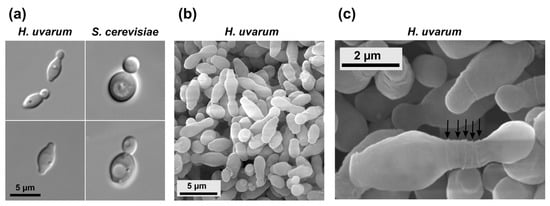
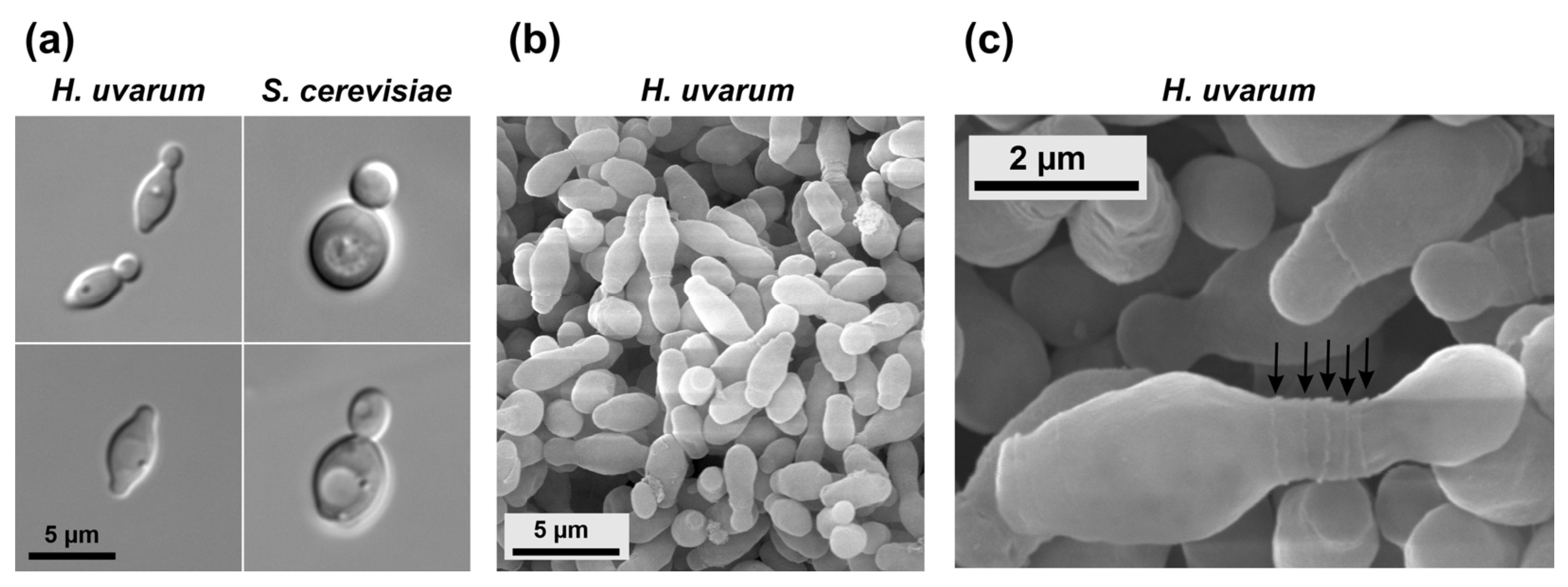
Nevertheless, it becomes increasingly evident that other yeast species have an important influence on the final product quality, especially in the wine industry [5,6,7]. Amongst these “non-Saccharomyces yeasts”, Hanseniaspora uvarum (the sexual form of Kloeckera apiculata) has drawn significant attention due to its initial predominance within the yeast population in many wine must fermentations, worldwide (for references, see [8,9]). Thus, even with the common use of S. cerevisiae starter cultures in large-scale wine production, it significantly contributes to the final aroma composition [10,11]. Its former name, K. apiculata (identifying it as a member of the “Apiculatus yeasts”), derives from its lemon-like cell shape, which is produced by its bipolar budding pattern, leaving consecutive rings of bud scars (Figure 1). Apart from its importance in wine production, H. uvarum and other Hanseniaspora species have a strong impact on other alcoholic beverages like cider, on cacao and coffee production, as efficient trapping agents for the pest fly Drosophila suzukii, or even as biological control agents against plant pathogenic fungi (excellently reviewed in [12]).
Figure 1.
Morphology of Hanseniaspora uvarum cells. Images were obtained by light (a) and scanning electron microscopy (b,c). They reveal the smaller size and lemon shape of H. uvarum cells as compared to the rounded budding pattern of S. cerevisiae (a). Black arrows in (c) designate the bud scars remaining from previous budding events. Images are reproduced from [13]. Note that in liquid cultures, an OD600 of 1 approximates 108 cells/mL for H. uvarum, as opposed to 107 cells/mL for S. cerevisiae [14].
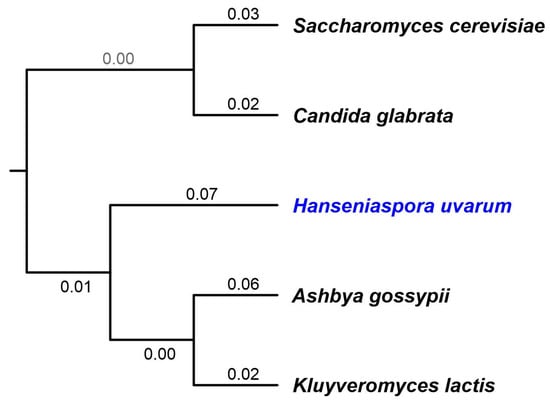
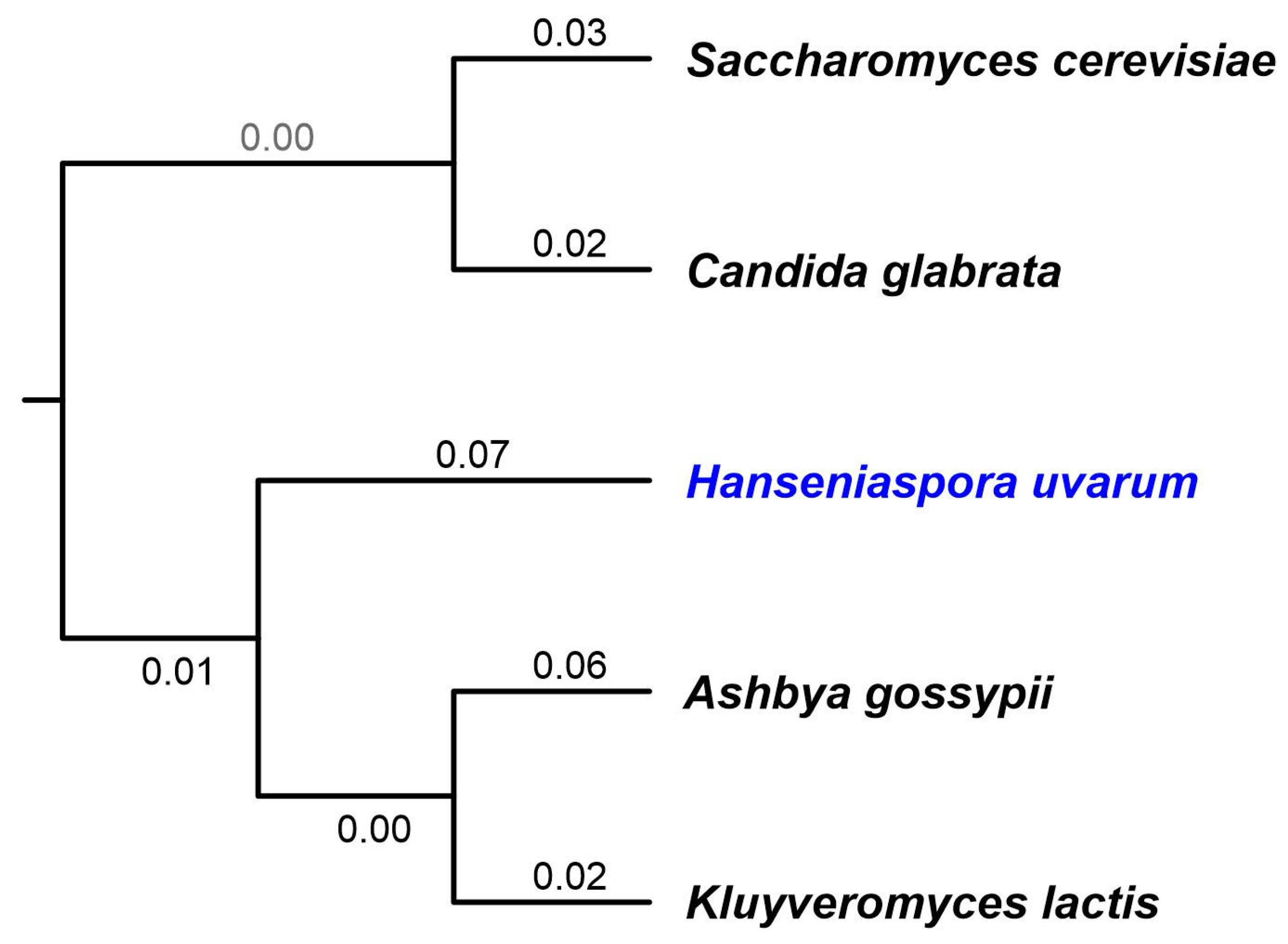
Although these applied aspects have been largely recognized before the turn of the millennium, H. uvarum was basically neglected by genetic research until the appearance of the first thoroughly curated genome sequences [14,15]. This approach was fully exploited by the recent description of 151 genome sequences of different Hanseniaspora species [16]. In contrast to S. cerevisiae, H. uvarum has not experienced a whole genome duplication and is thus evolutionarily more closely related to the milk yeast Kluyveromyces lactis or the “filamentous yeast” Ashbya gossypii (Figure 2; [14]).
Figure 2.
A simplified phylogenetic tree depicting the evolution of H. uvarum. The phylogenetic tree was computed using REALPHY [17] with the following complete genome sequences from Genbank: GCA_000091025_4_ASM9102v4 (Ashbya gossypii, [18]), GCA_010111755_1_ASM1011175v1 (Candida glabrata, [19]), GCA_050947715_1_ASM5094771v1 (Hanseniaspora uvarum, [16]), GCA_000002515_1_ASM251v1_genomic_tree (Kluyveromyces lactis, [20]), GCA_000146045_2_R64 (Saccharomyces cerevisiae, [21]). The tree was visualized using the MEGA program version 12.1.2 [22]. The numbers represent branch length. The separation of the branch with H. uvarum and its relatives, A. gossypii and K. lactis, from the branch comprising species that experienced a whole genome duplication (S. cerevisiae and C. glabrata) is estimated to have taken place approximately 100 million years ago [23].
2. Establishment of a Molecular Genetics for Hanseniaspora uvarum: Strains, Vectors and Transformation Procedures
The species H. uvarum comprises a huge number of natural isolates, mainly but not exclusively related to wine grapes (see [9] and the references therein). In fact, in more than a decade of running practical courses on the yeast population on white and red grapes of different origins, like Germany, Austria, Spain, and Italy, we invariably isolated H. uvarum, most frequently as the predominant species. Thus, a considerable genetic heterogeneity was to be expected for the different isolates, as was, in fact, observed in the genome sequences of other natural isolates [16]. When confronted with the task of studying the genetic composition of H. uvarum and developing molecular tools for this yeast, a type strain available from both German and American stock cultures (DSM2768 = CBS2584) thus seemed the best choice. As outlined in [14], the strong tendency of this strain to flocculate was first eliminated by adaptive laboratory evolution, selecting for growth as single cells. The selected strain turned out to have a diploid set of seven chromosome pairs, ranging from 0.67 to 1.77 MBp in length. Due to the smaller cell size compared to S. cerevisiae, an optical density at 600 nm for a H. uvarum culture corresponds to approximately 108 cells per mL, as opposed to 107 cells per mL for baker’s yeast.
Establishing a molecular genetics for this strain was significantly delayed by the lack of a transformation procedure and a suitable selective marker. The break-through was achieved in 2021 by Badura et al. [24], when the HuATF1 gene, encoding an alcohol acetyltransferase important in aroma production, was deleted by substitution with a hygromycin-resistance cassette after electroporation of the adapted laboratory strain. A homozygous deletion of the two alleles in the diploid strain was then obtained by increasing the concentration of the antibiotic in the selection medium. While being successful in that case, one can assume that it may be quite laborious to follow this strategy in routine functional genetic analyses. In order to develop a more suitable system for directed manipulations, we therefore adopted the electroporation method in conjunction with the hygromycin resistance marker, basically as outlined in that work [24]. To facilitate the introduction of exogenous DNA, autonomously replicating plasmids were constructed, using partial genomic libraries with genomic DNA of H. uvarum (the adapted type strain now designated as HHO1, for “Hanseniaspora Heinisch Osnabrück”). For this purpose, a non-replicative E. coli vector carrying the hygromycin resistance cassette was employed, looking for high-frequency transformation, presumably carrying plasmids with replication origins from the H. uvarum chromosomes [13]. Isolation of the plasmids from different transformants, sequence analyses and truncation of one of the isolated chromosomal fragments resulted in the construction of an H. uvarum/E. coli shuttle vector conferring hygromycin resistance and carrying a minimal ARS (Autonomously Replicating Sequence), from which further vectors with different selection markers and heterologous genes listed in Table 1 were derived.
Table 1.
Plasmids facilitating molecular genetic manipulation of Hanseniaspora uvarum.
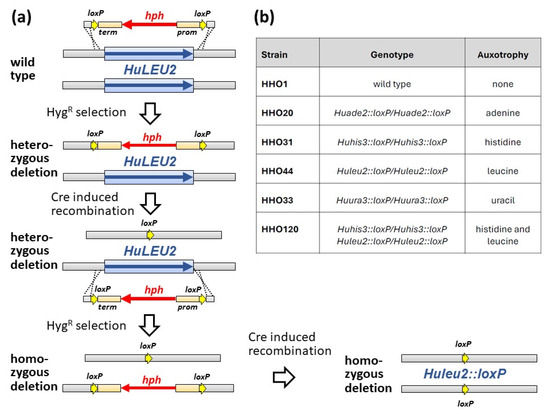
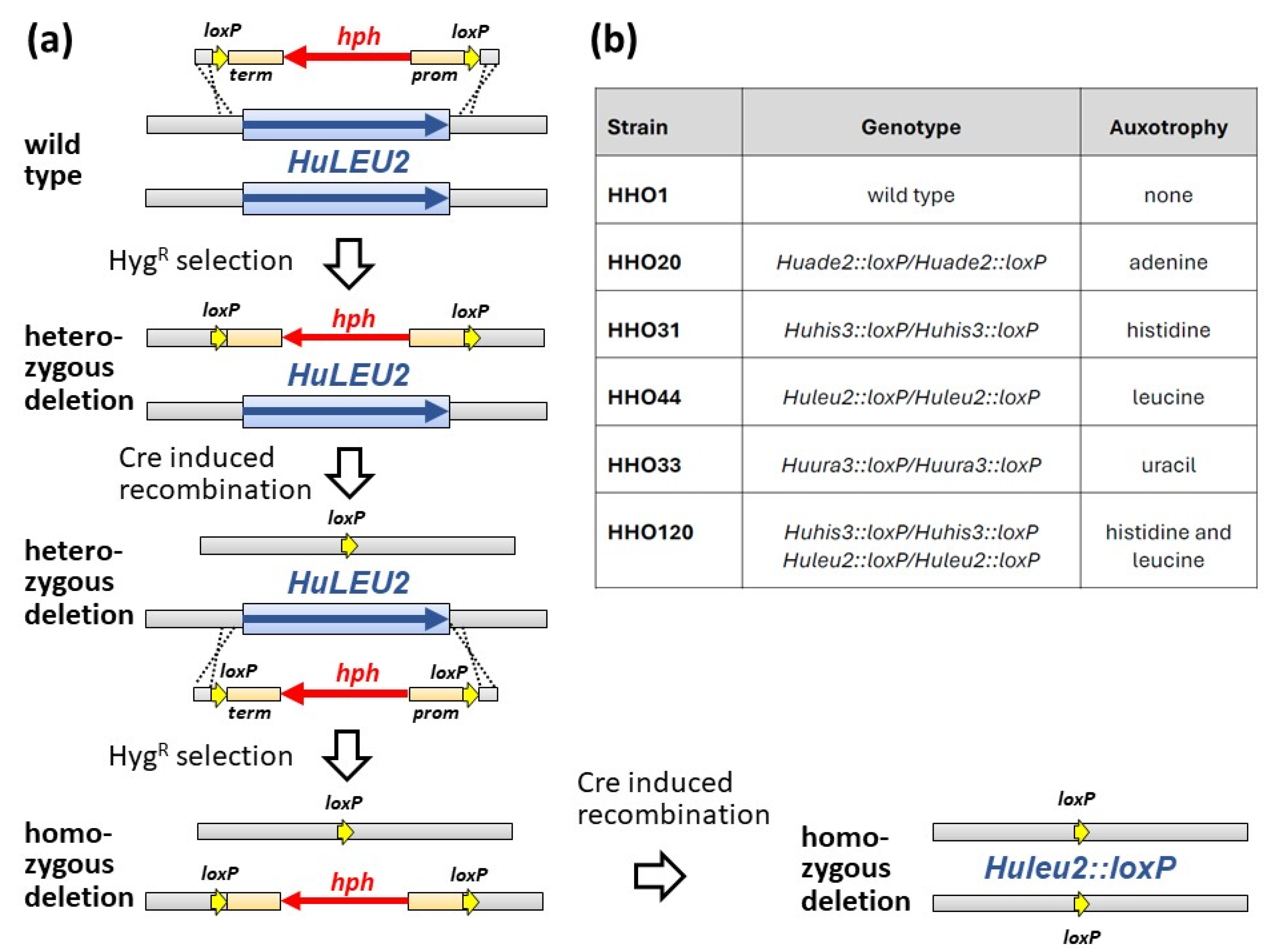
In the course of the latter work, the transformation procedure was improved in two respects, allowing for the long-term storage of H. uvarum competent cells at −70 °C, which can be either employed for electroporation or a PEG (Poly-Ethylene-Glycol)-mediated method [13]. These tools were first employed to establish the standard kanMX deletion cassette commonly used in S. cerevisiae [26] as a second dominant marker for selection on geneticin (G418). LoxP-flanked versions of the hygromycin and geneticin resistance cassettes then allowed for the PCR-targeted deletion of the HuLEU2, HuHIS3, HuADE2 and HuURA3 homologues of auxotrophic markers commonly used in S. cerevisiae (Figure 3; [13]). A set of vectors carrying the Cre-recombinase gene under the control of the constitutive HuTEF1 promoter, also listed in Table 1, enabled the removal of the resistance markers in a “delete and repeat” strategy as exemplified in Figure 3a, and routinely used for the deletion of redundant genes in S. cerevisiae [27]. With H. uvarum, this is especially important to consecutively remove both alleles of a gene in question from its diploid genome.
Figure 3.
Strategy for consecutive gene deletions in H. uvarum (a) and a collection of isogenic auxotrophic strains (b): (a) A hygromycin resistance cassette with the bacterial hph gene placed between the AgTEF2 promoter of Ashbya gossypii (prom; see legend of Figure 1 for details on the designation of this promoter) and the Candida albicans URA3 terminator (term) and flanked by direct repeats of the bacteriophage loxP sequence is depicted as an example. Plasmids carrying deletion cassettes with other selectable markers have been described in [13] and are listed in Table 1, as are the vectors for expression of the Cre recombinase, by which the deletion marker can be regenerated. Following similar strategies, strains with homozygous deletions in the biosynthetic genes listed in (b) have been obtained. Except for HHO120, the strains listed have been published [13].
As a note of caution, it should be mentioned that although the possibility of PCR-targeted deletions with short homologous flanking regions exists for H. uvarum, as established in two parallel works [13,28], longer homologies may be frequently required for a successful deletion, which can be added by in vivo-recombination in S. cerevisiae. Together, these approaches culminated in a convenient set of auxotrophic recipient strains, which is now available for genetic manipulations (Figure 3b).
3. Initial Studies on the Molecular Genetics of Hanseniaspora uvarum
Both the availability of a well-annotated genome sequence for H. uvarum and of the molecular tools described above triggered a number of investigations, which serve to indicate future lines of research. On one hand, they are based on the desire to improve its performance in wine fermentations, while on the other hand, this yeast has the potential to evolve into an interesting model organism for basic biological research in cell biology and evolution.
3.1. Applied Aspects
Applied research in the baking and beverage industries was focused for half a century on the properties of specific strains of S. cerevisiae, as the yeast driving fermentation into the production of alcohol and carbon dioxide. Nevertheless, it was always recognized that it never appears as the sole microorganism when employed for food processing, but is invariably associated with other yeasts and several lactic acid bacteria. With the advancements in large-scale RNA sequencing technologies and global mass-spectrometry analyses, it is now feasible to study the complex biological interactions in these microbial communities, which are expected to significantly impact the final product quality. Clearly, such transcriptome and proteome data rely on the availability of thoroughly annotated genomes.
In this context, transcriptome analyses have been performed on H. uvarum in membrane-separated co-fermentations of synthetic grape musts with S. cerevisiae [29]. Several genes related to glucose metabolism and oxidative stress response appeared to be oppositely expressed, being increased in S. cerevisiae and decreased in H. uvarum. In addition, amino acid transport and sulfate assimilation were stimulated in the latter. A similar study on mixed fermentations with H. uvarum primarily concentrated on the transcriptomic changes in S. cerevisiae, with evidence of the carbon flow being partially re-directed from glycolysis into the pentose phosphate pathway, accompanied by an increased production of some volatile aroma compounds [30].
H. uvarum has also been proposed to be a potent biocontrol agent in the combat against various plant-pathogenic fungi [31,32,33,34,35,36]. In this context, a transcriptome study was performed on the interaction of Penicillium digitatum, which causes spoilage of citrus fruits, with a special isolate of H. uvarum (Kloeckera apiculata 34-9). To this end, the genome of the latter was sequenced and assigned to 15 large contigs [15]. However, the fact that approximately half of the H. uvarum genes (2364 out of 4014) were differentially regulated in co-culture with P. digitatum complicates the assignment of the biological processes to the species-specific interactions. Rather, it underlines the need to carefully control experimental conditions and a rigorous mode of data analysis to differentiate species-specific effects from a general background in co-cultivations.
Another benefit of the available genome sequences from H. uvarum isolates is the possibility of gene mining for industrial purposes. Thus, a thermostable ethanol acetyltransferase has been studied in detail and modified by targeted mutagenesis for adaptation to industrial productions of ethyl acetate and related longer-chain compounds [37].
Although generally dominating the yeast population in wine fermentations, a key feature of H. uvarum is its low capacity for alcoholic fermentation. This has been addressed by comparing the specific activities of the enzymes involved to their counterparts in S. cerevisiae. In fact, the more than 15-fold reduced pyruvate kinase activity in H. uvarum as compared to that of S. cerevisiae emerged as a promising candidate for limiting the glycolytic flux in the former [14]. The genome sequence described in that work also provided the basis for cloning and heterologous complementation of the encoding HuPYK1 gene in the respective S. cerevisiae mutant, which confirmed its functional equivalence. Similar results were obtained for the two genes encoding the subunits of the heterooctameric phosphofructokinase, HuPFK1 and HuPFK2. NMR studies performed later on indicated that the rapid amination of pyruvate to alanine may be another factor diminishing the flux towards ethanol in H. uvarum, which is accompanied by a rapid exhaustion of free cytosolic NAD+ [38].
Compared to this immediate impact of the genome sequences, the newly available techniques for gene expression and targeted gene deletion in H. uvarum are only beginning to be exploited. First, the HuATF1 gene, encoding another alcohol acetyltransferase, was deleted from the genome of the evolved type strain as mentioned above [24]. As expected, a homozygous null mutant produced much lower amounts of ethyl acetate, which, despite its importance in other biotechnological processes, is considered a spoilage compound in wine [12].
Moreover, yeasts in wine fermentations are confronted with a variety of stresses (e.g., high and low osmolarity, sugar depletion, increasing ethanol concentrations, oxidative stress, sulfite, etc.) that require proper cellular responses (reviewed in [39]). Where reactive oxygen species are involved, NADPH has to be produced in sufficient amounts for their detoxification, for which the glucose-6-phosphate dehydrogenase reaction provides a major source throughout the eukaryotic kingdom [40,41]. Therefore, both alleles of the glucose-6-phosphate dehydrogenase gene (HuZWF1) were deleted from the diploid recipient strain HHO44, employing a Cre/loxP strategy similar to the one used to create the leucine auxotrophy (Figure 3a; [25]). Besides the expected requirement for methionine supplementation, the homozygous Huzwf1 deletion grew more slowly than the wild-type or the heterozygous deletion still carrying one wild-type allele, demonstrating the importance of the oxidative part of the pentose phosphate pathway in H. uvarum. The null mutant displayed an increased sensitivity towards hydrogen peroxide, confirming the role of the enzyme in oxidative stress response. An adaptation to environments causing oxidative stress has also been suggested by genome analyses, revealing an over-representation of genes involved in the tricarboxylic acid cycle and lysine biosynthesis, as well as in the sulfur assimilation pathway in H. uvarum, still pending experimental support [42].
As mentioned above, co-fermentations with starter cultures of both S. cerevisiae and H. uvarum are being increasingly investigated to broaden the aroma profiles in wine production [7,43]. However, the common practice of sulfurization to control microbial spoilage may interfere with this approach, as H. uvarum is significantly more sensitive than the S. cerevisiae strains used as starter cultures [25,44]. Intents to use adaptive laboratory evolution to improve the sulfite resistance of the H. uvarum type strain failed in our hands, probably because its genome lacks a homologue of the S. cerevisiae SSU1 gene [25]. The latter encodes a sulfite secretion pump which is overexpressed in wine strains due to chromosomal translocations and has been suggested to constitute the major reason for their high sulfite tolerance, despite the identification of other contributing factors [44]. This view was supported by the heterologous expression of ScSSU1 in H. uvarum, demonstrating a higher resistance of the respective strains in halo-assays [25]. However, while serving as a proof-of-principle, such strains may currently not be employed in large-scale co-fermentations for wine production, at least in Europe, due to the laws regulating the use of genetically modified organisms.
3.2. Basic Research
If the applied aspects of molecular genetics in H. uvarum have been poorly addressed, so far, investigations of the fundamental aspects of its genome function and evolution are even more scarce. Thus, in a non-invasive approach, the sequencing of more than 150 Hanseniaspora genomes and their in silico analysis resulted in their assignment to two previously described phylogenetic lineages, i.e., a slow-evolving (SEL) and a fast-evolving (FEL) branch, which separated approximately 95 million years ago [45]. H. uvarum belongs to the FEL group, while species like H. vineae and H. osmophila belong to the slow-evolving members [16]. Most of the sequenced isolates of H. uvarum proved to be diploid, as previously reported for the type strain [14]. In fact, the genome constitution seems to be more stable in H. uvarum than in diploid S. cerevisiae strains, resulting in a lower tendency to generate aneuploidies [16]. Interestingly, the heterozygosity at the mating type locus observed in the latter study for the H. uvarum isolates would suggest the existence of a sexual life cycle, although so far, we have not been able to induce sporulation in the type strain [14]. More elaborate screens of growth conditions or alternative approaches, as suggested in Section 4.1 below, may be required to solve this problem.
Another in silico analysis revealed a specific loss of histone encoding genes in H. uvarum, which is compensated by cis-regulatory mechanisms [46]. This has been related to the observed faster completion of the cell cycle as compared to S. cerevisiae, and an uncoupling of the regulation of histone and DNA synthesis. The latter was concluded from strains carrying a genomic fusion of the gene encoding histone 2A in H. uvarum with that of a green fluorescent marker, employing the techniques described above in Section 2.
Finally, a recent study investigated the structural basis of centromere functions in the chromosomes of different yeast species [47]. As in S. cerevisiae, the centromeres of H. uvarum, which have been analyzed for the seven chromosomes, appear to have a pointed assembly, placing these two yeasts into a closer phylogenetic relationship as opposed to species like Komagataella phaffii (former Pichia pastoris), Scheffersomyces stipitis (former Pichia stipitis), Candida albicans, Wickerhamomyces anomalus, and Barnettozyma californica. Table 2 relates the assignment of the seven centromeres numbered provisionally in the latter work to the recently published chromosome numbering from extensive genome sequencing [16].
Table 2.
Assignment of centromeres to chromosome sequences.
4. Important Lines of Future Research: Quo Vadis Hanseniaspora?
While the previous chapters demonstrated that basic molecular tools for the genetic manipulation of H. uvarum are now available and are beginning to be exploited, several immediate questions need to be addressed in the near future. These comprise improvements in methodology as well as central features of the physiology and genetics of this yeast, whose potential is only beginning to be realized.
4.1. Methodology
Compared with the toolset available for genetic manipulations in S. cerevisiae, a major drawback for the work with the H. uvarum type strain is its failure to sporulate and produce haploid progeny. This impedes the establishment of classical genetics by crossing and tetrad analysis, which in turn would greatly facilitate the generation of homozygous deletion mutants and the combination of various mutant alleles. It would also provide a comparatively easy way to establish an isogenic series of strains, avoiding the mutagenic effect of yeast transformations [27]. The heterozygosity at the mating type locus in diploid H. uvarum isolates, comprising both mating type a and alpha information, including the type strain, and the identification of some natural strains with a haploid genome, indicate the basic capability of sexual reproduction [16]. Thus, one of two alternative approaches may be followed to establish classical genetics: (i) The genome sequence of the diploid type strain should be mined to identify crucial mutations in genes impeding sporulation by their comparison with S. cerevisiae. If one or a small number of such genes can be identified as being non-functional, targeted mutagenesis or heterologous (over)expression of the S. cerevisiae homologues may be employed to restore entry into meiosis and sporulation. For example, increasing the expression of IME1, which encodes a master transcriptional regulator of sporulation in S. cerevisiae, restored the ability to undergo meiosis in a strain with a hyperactive allele of RAS2 [48]. Expression of ScIME1 under a strong promoter in H. uvarum is currently under investigation in our laboratory for a possible effect on sporulation. (ii) As an alternative, the formation of hat-shaped spores has been reported for a strain of H. uvarum in yeast taxonomy [49]. Natural isolates may thus be screened to identify strains that readily sporulate and establish the auxotrophic markers and plasmid-based tools now available for such a strain. The latter approach should be considered as a last resort, given the choice of the type strain for reasons of availability and reproducible studies mentioned in the Section 1.
In vivo recombination in S. cerevisiae has been frequently used for the construction of gene expression cassettes, using triple-shuttle vectors, for example, in genetic manipulation of mammalian neurons or in Drosophila genetics [50,51]. In our hands, plasmid-based recombination is not very efficient in H. uvarum, indicating that a triple H. uvarum/S. cerevisiae/E. coli shuttle system may be beneficial to facilitate similar manipulations. Alternatively, we have constructed a strain carrying a homozygous deletion in the HuKU80 gene (strain HHO46), which in other yeasts has been employed to inhibit non-homologous end joining and thus favor homologous recombination. Yet, the effect of this deletion on the frequency of homologous recombination still needs to be tested. These approaches could be accompanied by the establishment of new dominant selection markers, such as expression of an invertase gene from S. cerevisiae, which would confer the ability to grow on sucrose as a cheap carbon source to H. uvarum
In addition, some of the genes of interest in H. uvarum may prove to be essential, impeding the construction of homozygous deletion mutants in the diploid type strain. A system for conditional gene expression would thus be required, preferably one that can be controlled independently of the carbon source, as opposed to the GAL1/10 promoter commonly used in S. cerevisiae [52]. The tetOFF system, which governs gene expression on standard media and can be turned off by the addition of doxycyclin, has been previously employed in non-Saccharomyces yeasts like Kluyveromyces marxianus and Kluyveromyces lactis [53,54], besides a wide variety of other eukaryotic cells [55], indicating that its adaptation to H. uvarum should not pose a major problem.
Most importantly, the CRISPR/Cas system has enabled the fast manipulation of genomes in general, including several yeasts and other fungal species like S. cerevisiae, K. lactis, Ashbya gossypii, and Aspergillus nidulans, to name just a few [56,57,58,59]. Especially with the need to delete the two alleles of any given gene in the generation of homozygous deletion mutants for phenotypic analyses, the establishment of CRISPR/Cas in the H. uvarum type strain and its derivatives will be crucial for speeding up research.
4.2. Basic and Applied Research
Given the small number of investigations carried out so far and mentioned above in Section 3, most questions regarding the genetics and physiology of H. uvarum still need to be answered and obviously cannot be entirely addressed in this review. Rather, we would like to draw attention to a few examples chosen from a personal point of view.
From its ubiquitous presence on grapes and in wine fermentation, carbohydrate metabolism, specifically the control of the flux of glucose and fructose from grape musts, is of central importance for H. uvarum and has been barely addressed at the molecular level. With regard to glycolysis as the central pathway, preliminary studies indicated the presence of all enzyme-encoding genes, confirmed by functional analyses in the respective S. cerevisiae mutants for pyruvate kinase (HuPYK1) and phosphofructokinase (HuPFK1/HuPFK2; [14]). Functional studies in H. uvarum, i.e., construction and characterization of deletion mutants in any of the glycolytic genes, are not yet available. Given the closer phylogenetic relationship to K. lactis than to S. cerevisiae, it will be interesting to see if H. uvarum mainly relies on glycolysis, like the latter, or evenly distributes the carbon flow into the pentose phosphate pathway, like its closer relative K. lactis (reviewed in [60]). In the first case, homozygous deletion mutants in genes encoding the enzymes of the upper part of glycolysis may not be viable at all, since alternative carbon sources like glycerol and ethanol, commonly employed in conjunction with ethanol in the study of glycolytic mutants in S. cerevisiae [61], can apparently not be utilized by H. uvarum [62]. On the contrary, if sugars can be substantially channeled into the pentose phosphate pathway, such glycolytic mutants should be perfectly viable. It will be interesting to see which hypothesis is true.
Also, overproduction of the native pyruvate kinase could be achieved by expressing the HuPYK1 gene under the control of a strong promoter in H. uvarum to verify whether the enzyme activity is indeed the only rate-limiting step for alcoholic fermentation in the type strain [14].
Another important issue in the application of H. uvarum in cofermentations with S. cerevisiae is its tendency to produce unpleasant amounts of acetate and ethyl acetate. While the latter was efficiently reduced by the homozygous deletion of the HuATF1 gene [24], a more general approach to reduce the route to acetate formation, e.g., by manipulation of the genes encoding aldehyde dehydrogenases, still needs to be investigated. In this context, it should be noted that a closer analysis of the data published by Onetto et al. [16], taking into account the syntenic relationships, revealed that only four homologues of the five S. cerevisiae aldehyde dehydrogenase genes are present in H. uvarum (Table 3). Vice versa, it may also be interesting to construct a platform strain of H. uvarum that accumulates cytosolic acetyl-CoA as a precursor for biobutanol production, following the strategy employed in S. cerevisiae [63].
Table 3.
Homologues of the S. cerevisiae acetaldehyde dehydrogenase genes in H. uvarum.
As a final example, the metabolism of aroma compounds, especially those derived from aromatic amino acids, has been extensively studied in Hanseniaspora specied [64]. The more we understand these pathways and their regulation, the more feasible it will become to employ metabolic design strategies to the H. uvarum type strain in order to ensure the production of desired and the inhibition of undesired aroma compounds in mixed wine fermentations with starter cultures of S. cerevisiae.
5. Conclusions
While H. uvarum has been known for decades to be an important yeast in wine fermentations, it has only recently become known to be important in the processing of other fruits and biotechnological production chains from cider to cacao and coffee beans, let alone its potential as a biological control agent. These findings are now complemented by the powerful tools of genetic manipulations that have been developed within the past five years and are reviewed herein. It is also evident that these tools are merely in their infancy and should be extended within the near future to allow for more targeted approaches in the metabolic design of this important yeast species. This will not only benefit the basic research in understanding the physiology and genetics of a yeast species not as specialized and domesticated in alcoholic fermentation, such as S. cerevisiae, but also have a huge impact on its biotechnological applications.
Author Contributions
J.J.H. and H.-P.S. contributed equally in gathering and curating the data from the literature, as well as in writing the manuscript. All authors have read and agreed to the published version of the manuscript.
Funding
This research received no external funding.
Institutional Review Board Statement
Not applicable.
Informed Consent Statement
Not applicable.
Data Availability Statement
No new data were created or analyzed in this study. Data sharing is not applicable to this article.
Acknowledgments
We would like to thank the University of Osnabrück for the constant support over the last two decades, as well as the Forschungsring des Deutschen Weinbaus for financing the research on H. uvarum in our laboratory, as published and cited in this work.
Conflicts of Interest
The authors declare no conflicts of interest.
References
- Barnett, J.A. A history of research on yeasts 5: The fermentation pathway. Yeast 2003, 20, 509–543. [Google Scholar] [CrossRef] [Scilit]
- Belda, I.; Ruiz, J.; Santos, A.; Van Wyk, N.; Pretorius, I.S. Saccharomyces cerevisiae. Trends Genet. 2019, 35, 956–957. [Google Scholar] [CrossRef] [Scilit]
- Lagunas, R.; Dominguez, C.; Busturia, A.; Saez, M.J. Mechanisms of appearance of the Pasteur effect in Saccharomyces cerevisiae: Inactivation of sugar transport systems. J. Bacteriol. 1982, 152, 19–25. [Google Scholar] [CrossRef] [Scilit]
- Nielsen, J. The Power of Yeast. Yeast 2025, 42, 303–310. [Google Scholar] [CrossRef] [Scilit]
- Chambers, P.J.; Pretorius, I.S. Fermenting knowledge: The history of winemaking, science and yeast research. EMBO Rep. 2010, 11, 914–920. [Google Scholar] [CrossRef] [Scilit] [PubMed]
- Ciani, M.; Morales, P.; Comitini, F.; Tronchoni, J.; Canonico, L.; Curiel, J.A.; Oro, L.; Rodrigues, A.J.; Gonzalez, R. Non-conventional yeast species for lowering ethanol content of wines. Front. Microbiol. 2016, 7, 642. [Google Scholar] [CrossRef] [Scilit] [PubMed]
- Jolly, N.P.; Varela, C.; Pretorius, I.S. Not your ordinary yeast: Non-Saccharomyces yeasts in wine production uncovered. FEMS Yeast Res. 2014, 14, 215–237. [Google Scholar] [CrossRef] [Scilit] [PubMed]
- Benito-Castellanos, A.; Larreina, B.; Banda, M.T.C.; Santamaria, P.; Gonzalez-Arenzana, L.; Gutierrez, A.R. Biodiversity of Yeast Species Isolated During Spontaneous Fermentation: Influence of Grape Origin, Vinification Conditions, and Year of Study. Microorganisms 2025, 13, 1707. [Google Scholar] [CrossRef] [Scilit]
- Onetto, C.A.; Ward, C.M.; Van Den Heuvel, S.; Hale, L.; Cuijvers, K.; Borneman, A.R. Temporal and spatial dynamics within the fungal microbiome of grape fermentation. Environ. Microbiol. 2024, 26, e16660. [Google Scholar] [CrossRef] [Scilit]
- Borren, E.; Tian, B. The Important Contribution of Non-Saccharomyces Yeasts to the Aroma Complexity of Wine: A Review. Foods 2020, 10, 13. [Google Scholar] [CrossRef] [Scilit]
- Zott, K.; Miot-Sertier, C.; Claisse, O.; Lonvaud-Funel, A.; Masneuf-Pomarede, I. Dynamics and diversity of non-Saccharomyces yeasts during the early stages in winemaking. Int. J. Food Microbiol. 2008, 125, 197–203. [Google Scholar] [CrossRef] [Scilit]
- van Wyk, N.; Badura, J.; von Wallbrunn, C.; Pretorius, I.S. Exploring future applications of the apiculate yeast Hanseniaspora. Crit. Rev. Biotechnol. 2023, 44, 100–119. [Google Scholar] [CrossRef] [Scilit]
- Heinisch, J.J.; Murra, A.; Jürgens, K.; Schmitz, H.P. A versatile toolset for genetic manipulation of the wine yeast Hanseniaspora uvarum. Int. J. Mol. Sci. 2023, 24, 1859. [Google Scholar] [CrossRef] [Scilit]
- Langenberg, A.K.; Bink, F.J.; Wolff, L.; Walter, S.; von Wallbrunn, C.; Grossmann, M.; Heinisch, J.J.; Schmitz, H.P. Glycolytic functions are conserved in the genome of the wine yeast Hanseniaspora uvarum, and pyruvate kinase limits its capacity for alcoholic fermentation. Appl. Environ. Microbiol. 2017, 83, e01580-17. [Google Scholar] [CrossRef] [Scilit]
- Tian, Z.; Du, Y.; Yang, F.; Zhao, J.; Liu, S.; Zhang, D.; Long, C.A. Chromosome Genome Sequencing and Comparative Transcriptome-Based Analyses of Kloeckera apiculata 34-9 Unveil the Potential Biocontrol Mechanisms Against Citrus Green Mold. Front. Microbiol. 2021, 12, 752529. [Google Scholar] [CrossRef] [Scilit] [PubMed]
- Onetto, C.A.; Ward, C.M.; Varela, C.; Hale, L.; Schmidt, S.A.; Borneman, A.R. Genetic and phenotypic diversity of wine-associated Hanseniaspora species. FEMS Yeast Res. 2025, 25, foaf031. [Google Scholar] [CrossRef] [Scilit]
- Bertels, F.; Silander, O.K.; Pachkov, M.; Rainey, P.B.; van Nimwegen, E. Automated reconstruction of whole-genome phylogenies from short-sequence reads. Mol. Biol. Evol. 2014, 31, 1077–1088. [Google Scholar] [CrossRef] [Scilit] [PubMed]
- Dietrich, F.S.; Voegeli, S.; Brachat, S.; Lerch, A.; Gates, K.; Steiner, S.; Mohr, C.; Pohlmann, R.; Luedi, P.; Choi, S.; et al. The Ashbya gossypii genome as a tool for mapping the ancient Saccharomyces cerevisiae genome. Science 2004, 304, 304–307. [Google Scholar] [CrossRef] [Scilit] [PubMed]
- Xu, Z.; Green, B.; Benoit, N.; Schatz, M.; Wheelan, S.; Cormack, B. De novo genome assembly of Candida glabrata reveals cell wall protein complement and structure of dispersed tandem repeat arrays. Mol. Microbiol. 2020, 113, 1209–1224. [Google Scholar] [CrossRef] [Scilit]
- Dujon, B.; Sherman, D.; Fischer, G.; Durrens, P.; Casaregola, S.; Lafontaine, I.; De Montigny, J.; Marck, C.; Neuveglise, C.; Talla, E.; et al. Genome evolution in yeasts. Nature 2004, 430, 35–44. [Google Scholar] [CrossRef] [Scilit]
- Goffeau, A.; Barrell, B.G.; Bussey, H.; Davis, R.W.; Dujon, B.; Feldmann, H.; Galibert, F.; Hoheisel, J.D.; Jacq, C.; Johnston, M.; et al. Life with 6000 genes. Science 1996, 274, 546–567. [Google Scholar] [CrossRef] [Scilit]
- Stecher, G.; Suleski, M.; Tao, Q.; Tamura, K.; Kumar, S. MEGA 12.1: Cross-Platform Release for macOS and Linux Operating Systems. J. Mol. Evol. 2025, 94, 14–18. [Google Scholar] [CrossRef] [Scilit]
- Shen, X.X.; Zhou, X.; Kominek, J.; Kurtzman, C.P.; Hittinger, C.T.; Rokas, A. Reconstructing the backbone of the Saccharomycotina yeast phylogeny using genome-scale data. G3 2016, 6, 3927–3939. [Google Scholar] [CrossRef] [Scilit] [PubMed]
- Badura, J.; van Wyk, N.; Brezina, S.; Pretorius, I.S.; Rauhut, D.; Wendland, J.; von Wallbrunn, C. Development of genetic modification tools for Hanseniaspora uvarum. Int. J. Mol. Sci. 2021, 22, 1943. [Google Scholar] [CrossRef] [Scilit] [PubMed]
- Heinisch, J.J.; Murra, A.; Fernandez Murillo, L.; Schmitz, H.P. The role of glucose-6-phosphate dehydrogenase in the wine yeast Hanseniaspora uvarum. Int. J. Mol. Sci. 2024, 25, 2395. [Google Scholar] [CrossRef] [Scilit]
- Gueldener, U.; Heinisch, J.; Koehler, G.J.; Voss, D.; Hegemann, J.H. A second set of loxP marker cassettes for Cre-mediated multiple gene knockouts in budding yeast. Nucleic Acids Res. 2002, 30, e23. [Google Scholar] [CrossRef] [Scilit]
- Hegemann, J.H.; Heick, S.B. Delete and repeat: A comprehensive toolkit for sequential gene knockout in the budding yeast Saccharomyces cerevisiae. Methods Mol. Biol. 2011, 765, 189–206. [Google Scholar] [CrossRef] [Scilit] [PubMed]
- Badura, J.; van Wyk, N.; Zimmer, K.; Pretorius, I.S.; von Wallbrunn, C.; Wendland, J. PCR-based gene targeting in Hanseniaspora uvarum. FEMS Yeast Res. 2023, 23, foad034. [Google Scholar] [CrossRef] [Scilit]
- Yu, Y.; Zhu, W.; Nzoyisaba, D.; Zhang, X. Transcriptomic responses of Saccharomyces cerevisiae and Hanseniaspora uvarum during separated co-fermentation. World J. Microbiol. Biotechnol. 2025, 41, 335. [Google Scholar] [CrossRef] [Scilit]
- Sun, Q.; An, P.; Li, P.; Wang, H.; Tao, S.; Liu, Y. Unraveling Time-Resolved Transcriptional and Metabolic Shifts in the Mixed Fermentation of Saccharomyces cerevisiae and Hanseniaspora uvarum. J. Agric. Food Chem. 2025, 73, 12418–12432. [Google Scholar] [CrossRef] [Scilit]
- Eagan, J.L.; Digman, E.R.; den Boon, M.; Regalado, R.; Rawa, M.S.A.; Horianopoulos, L.C.; Hittinger, C.T.; Hull, C.M.; Keller, N.P. Patulin Inhibition of Specific Apple Microbiome Members Uncovers Hanseniaspora uvarum as a Potential Biocontrol Agent. Phytopathology 2025, 115, 117–127. [Google Scholar] [CrossRef] [Scilit]
- Esteves, M.; Lage, P.; Sousa, J.; Centeno, F.; de Fatima Teixeira, M.; Tenreiro, R.; Mendes-Ferreira, A. Biocontrol potential of wine yeasts against four grape phytopathogenic fungi disclosed by time-course monitoring of inhibitory activities. Front. Microbiol. 2023, 14, 1146065. [Google Scholar] [CrossRef] [Scilit] [PubMed]
- Gomez-Albarran, C.; Melguizo, C.; Patino, B.; Vazquez, C.; Gil-Serna, J. Diversity of Mycobiota in Spanish Grape Berries and Selection of Hanseniaspora uvarum U1 to Prevent Mycotoxin Contamination. Toxins 2021, 13, 649. [Google Scholar] [CrossRef] [Scilit] [PubMed]
- Li, J.; Yang, T.; Yuan, F.; Lv, X.; Zhou, Y. Inhibitory Effect and Potential Antagonistic Mechanism of Isolated Epiphytic Yeasts against Botrytis cinerea and Alternaria alternata in Postharvest Blueberry Fruits. Foods 2024, 13, 1334. [Google Scholar] [CrossRef] [Scilit]
- Liu, Z.; Tian, J.; Yan, H.; Li, D.; Wang, X.; Liang, W.; Wang, G. Ethyl acetate produced by Hanseniaspora uvarum is a potential biocontrol agent against tomato fruit rot caused by Phytophthora nicotianae. Front. Microbiol. 2022, 13, 978920. [Google Scholar] [CrossRef] [Scilit]
- Tejero, P.; Martin, A.; Rodriguez, A.; Galvan, A.I.; Ruiz-Moyano, S.; Hernandez, A. In Vitro Biological Control of Aspergillus flavus by Hanseniaspora opuntiae L479 and Hanseniaspora uvarum L793, Producers of Antifungal Volatile Organic Compounds. Toxins 2021, 13, 663. [Google Scholar] [CrossRef] [Scilit]
- Ni, B.; Fu, Z.; Zhao, J.; Yao, X.; Li, W.; Li, X.; Sun, B. Characterization and Mechanism Study of a Novel Ethanol Acetyltransferase from Hanseniaspora uvarum (EatH) with Good Thermostability, pH Stability, and Broad Alcohol Substrate Specificity. J. Agric. Food Chem. 2025, 73, 6828–6841. [Google Scholar] [CrossRef] [Scilit] [PubMed]
- Meier, S.; Wang, K.C.; Sannelli, F.; Hoof, J.B.; Wendland, J.; Jensen, P.R. Visualizing Metabolism in Biotechnologically Important Yeasts with dDNP NMR Reveals Evolutionary Strategies and Glycolytic Logic. Anal. Chem. 2024, 96, 10901–10910. [Google Scholar] [CrossRef] [Scilit]
- Heinisch, J.J.; Rodicio, R. Stress response in wine yeast. In Biology of Microorganisms on Grapes, in Must and Wine, 2nd ed.; König, H., Unden, G., Fröhlich, J., Eds.; Chapter 16; Springer: Berlin/Heidelberg, Germany, 2017; pp. 377–395. [Google Scholar]
- Ralser, M.; Wamelink, M.M.; Kowald, A.; Gerisch, B.; Heeren, G.; Struys, E.A.; Klipp, E.; Jakobs, C.; Breitenbach, M.; Lehrach, H.; et al. Dynamic rerouting of the carbohydrate flux is key to counteracting oxidative stress. J. Biol. 2007, 6, 10. [Google Scholar] [CrossRef] [Scilit]
- Stincone, A.; Prigione, A.; Cramer, T.; Wamelink, M.M.; Campbell, K.; Cheung, E.; Olin-Sandoval, V.; Gruning, N.M.; Kruger, A.; Tauqeer Alam, M.; et al. The return of metabolism: Biochemistry and physiology of the pentose phosphate pathway. Biol. Rev. Camb. Philos. Soc. 2015, 90, 927–963. [Google Scholar] [CrossRef] [Scilit]
- Onetto, C.A.; McCarthy, J.; Schmidt, S.A. A Rapid Growth Rate Underpins the Dominance of Hanseniaspora uvarum in Spontaneous Grape Juice Fermentations. Yeast 2025, 42, 116–125. [Google Scholar] [CrossRef] [Scilit]
- Ciani, M.; Comitini, F.; Mannazzu, I.; Domizio, P. Controlled mixed culture fermentation: A new perspective on the use of non-Saccharomyces yeasts in winemaking. FEMS Yeast Res. 2010, 10, 123–133. [Google Scholar] [CrossRef] [Scilit] [PubMed]
- Garcia-Rios, E.; Guillamon, J.M. Sulfur dioxide resistance in Saccharomyces cerevisiae: Beyond SSU1. Microb. Cell 2019, 6, 527–530. [Google Scholar] [CrossRef] [Scilit]
- Steenwyk, J.L.; Opulente, D.A.; Kominek, J.; Shen, X.X.; Zhou, X.; Labella, A.L.; Bradley, N.P.; Eichman, B.F.; Cadez, N.; Libkind, D.; et al. Extensive loss of cell-cycle and DNA repair genes in an ancient lineage of bipolar budding yeasts. PLoS Biol. 2019, 17, e3000255. [Google Scholar] [CrossRef] [Scilit]
- Haase, M.A.B.; Steenwyk, J.L.; Boeke, J.D. Gene loss and cis-regulatory novelty shaped core histone gene evolution in the apiculate yeast Hanseniaspora uvarum. Genetics 2024, 226, iyae008. [Google Scholar] [CrossRef] [Scilit]
- Hession, C.; Byrne, K.P.; Wolfe, K.H.; Butler, G. Centromeres in budding yeasts are conserved in chromosomal location but not in structure. PLoS Genet. 2025, 21, e1011814. [Google Scholar] [CrossRef] [Scilit]
- Schweitzer, F.; Bischof, L.; Walter, S.; Morris, S.; Schmitz, H.P.; Heinisch, J.J. The small GTPase Rho5-Yet another player in yeast glucose signaling. PLoS Genet. 2025, 21, e1011858. [Google Scholar] [CrossRef] [Scilit]
- Barnett, J.A.; Payne, R.W.; Yarrow, D. Yeasts: Chracteristics and Identification, 3rd ed.; Cambridge University Press: Cambridge, UK, 2000. [Google Scholar]
- Bakota, L.; Brandt, R.; Heinisch, J.J. Triple mammalian/yeast/bacterial shuttle vectors for single and combined Lentivirus- and Sindbis virus-mediated infections of neurons. Mol. Genet. Genom. 2012, 287, 313–324. [Google Scholar] [CrossRef] [Scilit] [PubMed]
- Paululat, A.; Heinisch, J.J. New yeast/E. coli/Drosophila triple shuttle vectors for efficient generation of Drosophila P element transformation constructs. Gene 2012, 511, 300–305. [Google Scholar] [CrossRef] [Scilit]
- Johnston, M.; Davis, R.W. Sequences that regulate the divergent GAL1-GAL10 promoter in Saccharomyces cerevisiae. Mol. Cell. Biol. 1984, 4, 1440–1448. [Google Scholar] [CrossRef] [Scilit] [PubMed]
- Bertels, L.K.; Walter, S.; Heinisch, J.J. Genetic and Physiological Characterization of the Pentose Phosphate Pathway in the Yeast Kluyveromyces lactis. Int. J. Mol. Sci. 2025, 26, 938. [Google Scholar] [CrossRef] [Scilit]
- Pecota, D.C.; Da Silva, N.A. Evaluation of the tetracycline promoter system for regulated gene expression in Kluyveromyces marxianus. Biotechnol. Bioeng. 2005, 92, 117–123. [Google Scholar] [CrossRef] [Scilit]
- Sprengel, R.; Hasan, M.T. Tetracycline-controlled genetic switches. Handb. Exp. Pharmacol. 2007, 178, 49–72. [Google Scholar] [CrossRef] [Scilit]
- Generoso, W.C.; Gottardi, M.; Oreb, M.; Boles, E. Simplified CRISPR-Cas genome editing for Saccharomyces cerevisiae. J. Microbiol. Methods 2016, 127, 203–205. [Google Scholar] [CrossRef] [Scilit]
- Munoz-Fernandez, G.; Jimenez, A.; Revuelta, J.L. Genomic Edition of Ashbya gossypii Using One-vector CRISPR/Cas9. Bio Protoc. 2020, 10, e3660. [Google Scholar] [CrossRef] [Scilit]
- Raschmanova, H.; Weninger, A.; Glieder, A.; Kovar, K.; Vogl, T. Implementing CRISPR-Cas technologies in conventional and non-conventional yeasts: Current state and future prospects. Biotechnol. Adv. 2018, 36, 641–665. [Google Scholar] [CrossRef] [Scilit] [PubMed]
- Yuan, G.; Deng, S.; Czajka, J.J.; Dai, Z.; Hofstad, B.A.; Kim, J.; Pomraning, K.R. CRISPR-Cas9/Cas12a systems for efficient genome editing and large genomic fragment deletions in Aspergillus niger. Front. Bioeng. Biotechnol. 2024, 12, 1452496. [Google Scholar] [CrossRef] [Scilit] [PubMed]
- Bertels, L.K.; Fernandez Murillo, L.; Heinisch, J.J. The pentose phosphate pathway in yeasts-more than a poor cousin of glycolysis. Biomolecules 2021, 11, 725. [Google Scholar] [CrossRef] [Scilit]
- Ciriacy, M.; Breitenbach, I. Physiological effects of seven different blocks in glycolysis in Saccharomyces cerevisiae. J. Bacteriol. 1979, 139, 152–160. [Google Scholar] [CrossRef] [Scilit]
- Lee, S.B.; Park, H.D. Isolation and Investigation of Potential Non-Saccharomyces Yeasts to Improve the Volatile Terpene Compounds in Korean Muscat Bailey A Wine. Microorganisms 2020, 8, 1552. [Google Scholar] [CrossRef] [Scilit]
- Azambuja, S.P.H.; Goldbeck, R. Butanol production by Saccharomyces cerevisiae: Perspectives, strategies and challenges. World J. Microbiol. Biotechnol. 2020, 36, 48. [Google Scholar] [CrossRef] [Scilit] [PubMed]
- Valera, M.J.; Boido, E.; Farina, L.; Dellacassa, E.; Carrau, F. Functional metabolism of aromatic precursors in Hanseniaspora: A source of natural bioactive compounds. FEMS Yeast Res. 2025, 25, foaf049. [Google Scholar] [CrossRef] [Scilit] [PubMed]

Disclaimer/Publisher’s Note: The statements, opinions and data contained in all publications are solely those of the individual author(s) and contributor(s) and not of MDPI and/or the editor(s). MDPI and/or the editor(s) disclaim responsibility for any injury to people or property resulting from any ideas, methods, instructions or products referred to in the content. |
© 2026 by the authors. Licensee MDPI, Basel, Switzerland. This article is an open access article distributed under the terms and conditions of the Creative Commons Attribution (CC BY) license.