
Article

Effects of Kuding Tea on the Succession and Assembly of the Fungal Community During Fermentation of Daqu

1
School of Brewing Engineering, Moutai Institute, Renhuai 564507, China
2
Guizhou Key Laboratory of Microbial Resources Exploration in Fermentation Industry, Kweichow Moutai Group, Zunyi 564501, China
3
School of Food Science and Engineering, Moutai Institute, Renhuai 564507, China
*
Author to whom correspondence should be addressed.
Fermentation 2026, 12(3), 136; https://doi.org/10.3390/fermentation12030136
Submission received: 5 February 2026 / Revised: 26 February 2026 / Accepted: 3 March 2026 / Published: 5 March 2026
(This article belongs to the Special Issue Development and Application of Starter Cultures, 2nd Edition)

Abstract

Incorporating plant-based additives was a promising approach for modulating the microbial ecosystems of fermentation starters. This study investigated how adding Kuding tea (20% wt/wt) influenced the assembly and succession of fungal communities during Jiang-flavored Daqu production, compared to traditional wheat-based Daqu. Using amplicon sequencing of the ITS1 region and integrated measurements of endogenous factors, we analyzed community dynamics across a 40-day fermentation period. Results showed that tea addition significantly increased fungal diversity and altered succession trajectories. Community assembly shifted from stochastic towards deterministic processes, with homogeneous selection increasing from 0.47 in wheat-based Daqu to 0.62 in tea-added Daqu. Temporal species accumulation was stronger (STR exponent z: 0.565 vs. 0.436), while compositional turnover slowed (TDR slope w: −0.539 vs. −0.626). Random forest models revealed tea-specific fungal drivers and stronger correlations with endogenous factors (e.g., reducing sugar and moisture). We concluded that Kuding tea appears to function predominantly as an environmental filter that enhanced deterministic selection, stabilized community succession, and restructured the key microbial–physicochemical relationships, providing a potential strategy for steering Daqu fermentation.

1. Introduction

As a saccharifying and fermenting agent, Daqu serves as a fundamental starter culture in the production of Chinese Baijiu, providing a diverse consortium of microorganisms and essential enzymes that drive simultaneous saccharification and fermentation [1,2]. The quality and functional characteristics of Daqu are intrinsically linked to its microbial composition, which is shaped during a spontaneous solid-state fermentation process in an open environment where raw materials and environmental tools serve as major microbial sources [3]. Among the various factors influencing the final Daqu ecosystem, the raw material composition is paramount. Variations in raw materials not only introduce distinct initial microbial inocula but also alter the physicochemical matrix, thereby steering microbial succession patterns and ultimately determining the enzymatic and flavor profiles of the mature starter [4,5]. This is evidenced by studies showing that different grains impart characteristic flavor profiles to fermented products through species-specific combinations of starch composition and protein content [4]. Consequently, the strategic selection and combination of raw materials are critical levers for controlling and improving Daqu quality.
Recognizing the profound impact of raw materials, the practice of using multi-ingredient recipes, including the incorporation of various botanicals, has gained traction as a method to engineer the Daqu microbiome. A particularly promising botanical adjunct is Kuding tea, a traditional beverage derived from the leaves of Ilex kudingcha C.J.Tseng. Kuding tea is chemically distinct from common teas like green tea, as it is particularly rich in unique bitter compounds including triterpenoids (e.g., α- and β-kudinlactones, ulmoidol and kudinchalactone A), polyphenols (e.g., chlorogenic acid, neochlorogenic acid, cryptochlorogenic acid and isochlorogenic acids A, B and C), and flavonoids (e.g., kaempferol, quercetin, rutin, and hyperoside) [6]. These bioactive constituents have been documented to possess potent antimicrobial activities [7,8]. The differential sensitivity of fungal taxa to these compounds—for instance, the known susceptibility of certain spoilage fungi like Alternaria and Penicillium to triterpenoids compounds [9]—suggests that Kuding tea supplementation could impose a selective pressure favoring tea-tolerant taxa while suppressing sensitive ones. These properties suggest that Kuding tea could act as a powerful selective agent during Daqu fermentation. While the direct use of Kuding tea in Daqu is novel, research on other tea additives provides a compelling precedent. For instance, the addition of green tea to Daqu was shown to significantly alter microbial dynamics [5,10,11], delaying bacterial shifts while accelerating fungal community reconstruction and shifting community assembly mechanisms [5]. Similarly, tea flower supplementation in light-aroma Daqu production yielded novel aroma compounds like phenethyl ketone and α-phenylethanol [12]. This demonstrates the potential of tea phytochemicals to function as environmental filters, reshaping the fermentation ecosystem.
Building directly on ecological insights from green tea-supplemented Daqu, the current study investigated the unexplored effects of Kuding tea. Previous research established that microbial community assembly in Daqu is governed by a balance of stochastic and deterministic processes that are quantifiable using null and neutral models [5]. Given its distinct phytochemical profile, we posited that Kuding tea would impose a unique and stronger selective pressure compared to green tea, leading to more pronounced alterations in fungal community succession and assembly. We specifically hypothesized that Kuding tea supplementation would significantly alter the temporal dynamics of the fungal community and increase the relative contribution of deterministic processes. To test this hypothesis, the present study focuses specifically on the fungal community—a deliberate choice given that while Daqu represents a complex bacterial–fungal ecosystem and previous studies, including our own work on green tea-supplemented Daqu [5,10,11], have extensively characterized bacterial community dynamics, the central role of fungi in Daqu functionality [2] warrants parallel investigation. Moreover, given our recent documentation of bacterial responses to tea amendments [5,10,11], a parallel investigation of fungal succession provides a complementary and ecologically complete understanding of how Kuding tea reshapes the entire Daqu microbiome.
To analyze such temporal dynamics, key ecological indicators were considered. The temporal turnover, which is described by the time–decay relationship (TDR), reflects decreasing community similarity over time and is a vital metric for succession dynamics [13]. This concept, which is applied to both animal and plant communities [14,15], is also exhibited by microbial communities in diverse environments [16]. Additionally, community changes can be estimated through the species–time relationship (STR), the temporal analog of the species–area relationship, which focuses on changes in alpha diversity and richness over time [17,18]. Significant STRs have been reported for various microbial systems [5,19,20], suggesting their broad applicability.
To test our hypothesis, we employed ITS amplicon sequencing to track fungal community dynamics, applying these temporal relationship frameworks, and linked the data to key physicochemical parameters. The objectives were: (1) to compare fungal succession patterns between Kuding tea-added and traditional Daqu; (2) to quantify the relative importance of deterministic versus stochastic processes; and (3) to identify key endogenous drivers of fungal community changes. This work elucidated how Kuding tea modulates the Daqu fermentation ecosystem, providing a scientific basis for designing novel, high-quality Daqu starters.

2. Materials and Methods

2.1. Daqu Block Preparation and Sample Collection

Daqu blocks were produced following the traditional Jiang-flavored Daqu production process, using hard wheat and Kuding tea as raw materials. The procedure included key steps such as moistening, crushing, mixing, shaping, and fermentation in storage [21]. Two types of Daqu were produced (Figure S1): the original Daqu (OD: pure wheat without Kuding tea) and the tea-added Daqu (TD), which contained 20% Kuding tea based on the total weight of raw materials. Due to the high fiber content of Kuding tea, this level was determined to be the maximum proportion at which the Qu blocks could maintain structural integrity when prepared with the 40% moisture content. For each type, three blocks were prepared, each with 1200 g of raw materials and 120 g of starter culture (10% of the raw material weight). To achieve a moisture content of 40% in the final Daqu block, 880 g of water was added.
Samples were collected from the two types of Daqu blocks on days 1, 7, 15, and 40 of the fermentation periods, corresponding to three key fermentation phases: the initial phase (Day 1), the thermal phase (Day 7 and Day 15), and the maturation phase (Day 40). For each block, samples were taken from three distinct locations: 1 cm below the top surface (the bulging inward side), 1 cm below the bottom surface (the flat inward side), and from the center. Material from the same location across three technical replicates was pooled to form one sample replicate per time point. This procedure yielded three such sample replicates for each combination of Daqu type and time point, resulting in a total of 24 samples (2 types × 4 time points × 3 replicates).

2.2. Analysis of Endogenous Factors

The internal temperature of the Daqu blocks was monitored directly using a thermometer. The pH was measured using a pH meter (PHS-3C, Leici, Shanghai, China). Other parameters, including acidity and the contents of reducing sugar, starch, and moisture, were determined in accordance with the Chinese standard QB/T 4257-2011 [22] and GB 5009.7-2016 [23]. The endogenous factors of the two types of Daqu across different time points are provided in Table S1. Due to differences in raw material composition between the two Daqu types, endogenous factors such as starch content may exhibit inherent disparities. To enable a comparable analysis of the dynamic changes in endogenous factors between the two Daqu types, the change rate approach was adopted according to [24]. The change rates was calculated using Equation (1):
C h a n g e   r a t e s = v l v e d l d e ¯
where v l represents the value of a given endogenous factor at a later time point, v e represents its value at an earlier time point, and d l d e ¯ denotes the average time interval between the two consecutive time points. Thus, the change rate reflects the average daily rate of change in an endogenous factor between two successive sampling points. For the initial time point, the change rate was defined as zero.

2.3. Total DNA Extraction, PCR Amplification, and Sequencing

Total genomic DNA was extracted from Daqu samples according to the method described by Dai et al. [25]. Cell pellets were subjected to DNA extraction using the MP FastDNA® SPIN Kit for Soil (MP Biomedicals, Santa Ana, CA, USA) following the manufacturer’s instructions.
The fungal internal transcribed spacer 1 (ITS1) region was amplified with the primers ITS1F (5′-CTTGGTCATTTAGAGGAAGTAA-3′) and ITS2 (5′-GCTGCGTTCTTCATCGATGC-3′) [26]. Polymerase chain reaction (PCR) was performed under the following conditions: initial denaturation at 95 °C for 5 min; 25 cycles of denaturation at 95 °C for 30 s, annealing at 50 °C for 30 s, and extension at 72 °C for 45 s, followed by a final extension at 72 °C for 7 min.
Amplification products were confirmed by electrophoresis on a 2% agarose gel stained with the GenGreen nucleic acidity dye (Genview, Shenzhen, China), which was run at 90 V for 30 min. PCR amplicons displaying clear bands of the expected size were pooled in equimolar ratios and purified using the Monarch® DNA Gel Extraction Kit (New England Biolabs, Ipswich, MA, USA). Subsequently, the purified amplicon library was sequenced on the Illumina NovaSeq 6000 platform by Beijing Biomarker Technologies Co., Ltd. (Beijing, China).

2.4. Sequence Data Processing

All raw paired-end sequencing data were processed using the dada2 package [27] in R (version 4.5.1) to infer amplicon sequence variants (ASVs). The quality profiles of the forward and reverse reads were visually inspected to determine appropriate trimming positions prior to filtering. Sequences containing ambiguous bases (N) were removed, and a maximum expected error (maxEE) threshold of 2 was applied to both read directions. Error rates for the forward and reverse reads were learned independently from the data using a parametric error model. Unique sequences were dereplicated before applying the core sample inference algorithm of DADA2, which models and corrects Illumina sequencing errors to reconstruct the true biological sequences. Paired-end reads were merged, requiring a minimum overlap of 20 nucleotides and allowing up to one mismatch within the overlap region to accommodate natural sequence variation in the ITS1 region. Chimeric sequences were identified and removed using the consensus method. Final ASVs were taxonomically classified against the ITS rRNA UNITE reference database (version 10.0) [28].

2.5. Statistical Analysis

To elucidate the ecological mechanisms underlying fungal community dynamics in Daqu, species–time relationships (STRs) and time–decay relationships (TDRs) were employed to quantify temporal trends in microbial diversity and community compositional turnover, respectively. For each Daqu treatment, STRs were constructed using a moving window approach [29]. Briefly, the time-series data were partitioned into all possible window subsets based on the number of observations. The Arrhenius model [30] was fitted to each window to describe the power-law relationship between time intervals and ASV richness, and it is formulated as R i c h n e s s = k × T z , where Richness denotes ASV richness (analog to species richness), T is the time interval; parameter z is the steepness of the species-time curve, and k is the expected number of species in a unit T. TDRs were estimated by log-linear model fitting between the changes in the community structure (as assessed by pairwise Bray–Curtis dissimilarity) and days elapsed. Community dissimilarities were converted to similarities by subtracting them from 1. Arrhenius (log–log) plots were used for modeling TDRs using the equation l n ( S s ) = i n t e r c e p t w l n ( T ) , where Ss is the pairwise similarity in community composition, T is the time interval, and the slope (w) is a measure of the rate of community turnover across time [13]. To account for the non-independence inherent in our dataset due to pairwise comparisons, we employed a bootstrapping procedure with 1000 iterations to assess the statistical significance of the parameters z and w (i.e., testing whether they significantly differed from zero). Specifically, we compared the originally estimated z and w values against the distribution of bootstrapped estimates—generated by randomly permuting the original data 1000 times—using a one-sample t-test, following the methodology of [31]. Furthermore, to compare the z and w values across different experimental estimations, an additional bootstrapping procedure (1000 iterations) was performed, and the significance of differences was evaluated using pairwise t-tests.
To quantify the relative influences of deterministic and stochastic processes on fungal assembly, null model analyses were conducted using the beta nearest taxon index (βNTI) and the Raup–Crick metric based on Bray–Curtis dissimilarity (RCbray). These analyses were performed within a phylogenetic bin-based null model framework [32], which was adapted from the methodology of [33].
The association between changes in dominant fungal genera (identified with relative abundance > 1% in any Daqu type), community succession (measured via GUniFrac for phylogenetic turnover and Bray–Curtis for compositional turnover), and community assembly (βNTI) was evaluated using a random forest regression model (RFM). For each metric, shifts in genus abundance—converted to Bray–Curtis distances between sample pairs—served as predictors. Model significance was evaluated using the A3 package in R, based on 10-fold cross-validation with 1000 permutations. Variable importance was quantified by the percentage increase in mean squared error (%IncMSE), with higher values indicating stronger predictive contributions [34]. To evaluate the statistical significance of individual predictors, the rfPermute package [35] was employed, conducting 1000 permutations to compute empirical p-values for each predictor, with predictors considered significant at p < 0.05. Permutation-derived model-wide R2 values were reported to indicate overall explanatory power. The random forest regression models were implemented with the following parameters: 1000 decision trees (ntree = 1000), mtry (number of variables randomly sampled at each split) set to one-third of the total predictors (default for regression tasks), and the node size (nodesize) fixed at 5 to optimize model performance [36].
Dominant genera that significantly contributed to at least one metric in the RFM were further analyzed using redundancy analysis (RDA) to explore their associations with endogenous factors. According to the principle of [37,38,39], the relative importance of genera in the RDA ordination was generated by integrating three complementary methodological approaches that evaluated distinct aspects of ordination relationships. First, axis correlation-based importance was determined by calculating the Euclidean norm of each genus’s score vector across the first two constrained axes, reflecting its overall position and correlation strength within the ordination space. Second, variance-weighted importance was obtained by weighting each axis-specific genus score according to the proportion of variance explained by that axis, thereby accounting for differences in explanatory power among ordination dimensions. Third, environmental correlation-based importance was evaluated using cosine similarity metrics, which quantify the alignment between each genus’s distribution pattern and the composite environmental gradient vector. The final composite importance score for each genus was derived as the arithmetic mean of these three normalized component scores as referred to [40], providing a robust and holistic assessment that mitigates methodological biases inherent in any single approach.
All statistical computations and visualizations were performed in R software (v4.5.1).

3. Results

3.1. Community Composition and Its Diversity

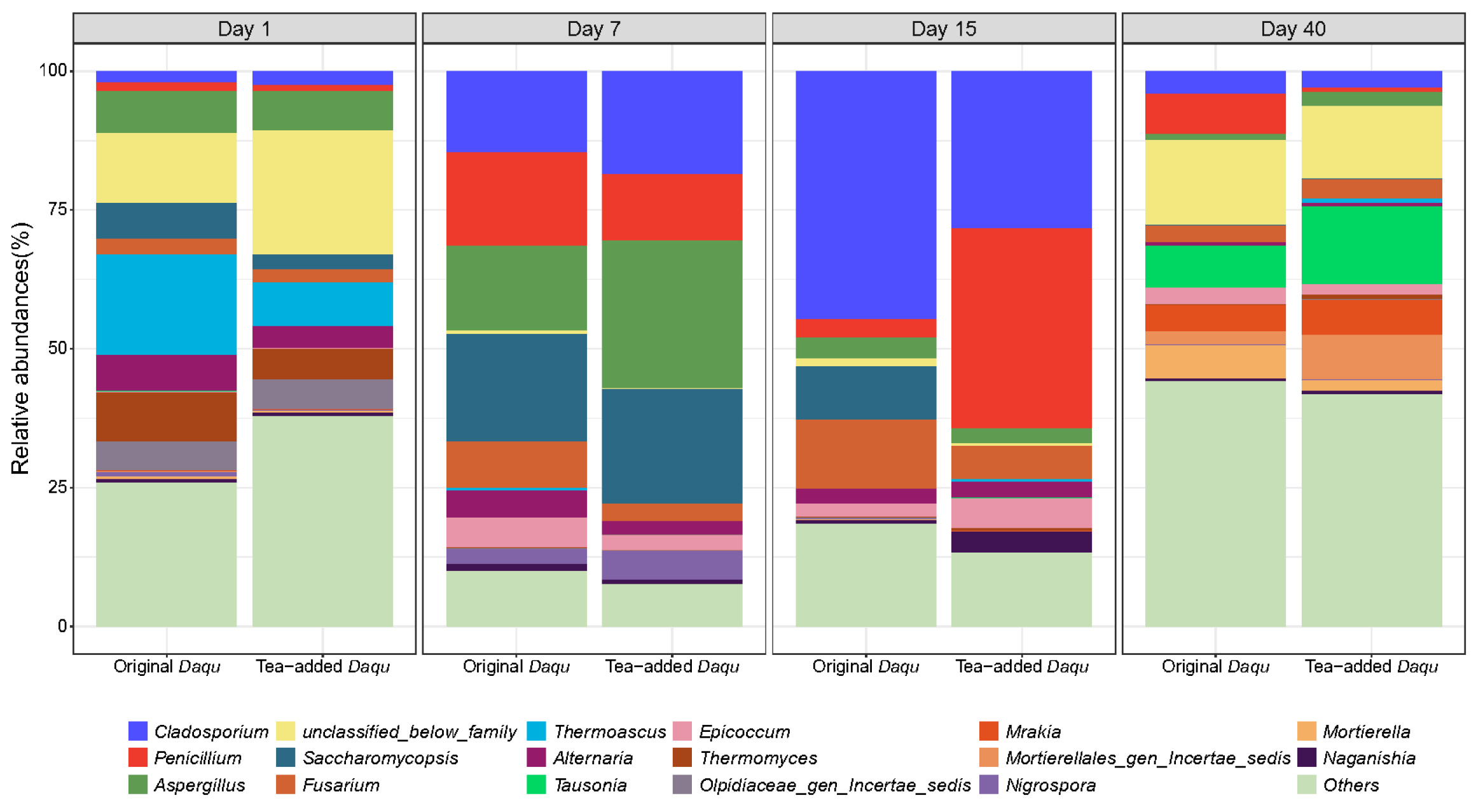
The fungal community exhibited marked successional dynamics, with pronounced compositional divergence between the OD and the TD over time (Figure 1, as well as Table S2). For instance, at Day 1, Thermoascus was substantially lower in the TD (7.92%) than in the OD (18.05%). By Day 7, Aspergillus became notably more abundant in the TD (26.57% vs. 15.15%). A striking shift occurred at Day 15, where Penicillium increased sharply in the TD (36.05%) compared to OD (3.29%), while Saccharomycopsis nearly disappeared in the TD (0.04% vs. 9.75%). In the final phase (Day 40), several taxa, including Tausonia (14.03% vs. 7.60%), Olpidiaceae_gen_Incertae_sedis (6.22% vs. 4.66%), and Mrakia (8.01% vs. 2.43%), showed markedly higher relative abundances in the TD compared to the OD. Throughout the fermentation process, the TD consistently demonstrated distinct and more pronounced fluctuations in these key fungal genera.
Rarefaction curves (Figure S2) based on the Shannon and Chao1 indices reached stable plateaus for both Daqu types, indicating that the sequencing depth was sufficient to capture the majority of diversity present. Furthermore, at an equivalent sequencing effort, the TD consistently exhibited a higher asymptotic diversity value compared to the OD (Wilcoxon test: p < 0.05), demonstrating an increased overall fungal diversity in the tea-supplemented treatment.

3.2. Assembly Mechanisms and Temporal Dynamics

The analysis of community assembly mechanisms revealed a clear shift in the dominant processes between the two treatments (Table S3). In the TD, deterministic processes, specifically homogeneous selection, accounted for a substantially greater proportion (0.62) of the assembly compared to the OD (0.47). Conversely, the combined influence of stochastic processes (dispersal limitation, homogenizing dispersal, and drift) was lower in the TD (0.38) compared to the OD (0.53). This reduction was primarily driven by a marked decrease in dispersal limitation (0.17 vs. 0.33 in OD). The contributions of drift were comparable between treatments (0.20 vs. 0.21), while heterogeneous selection and homogenizing dispersal were negligible in both.
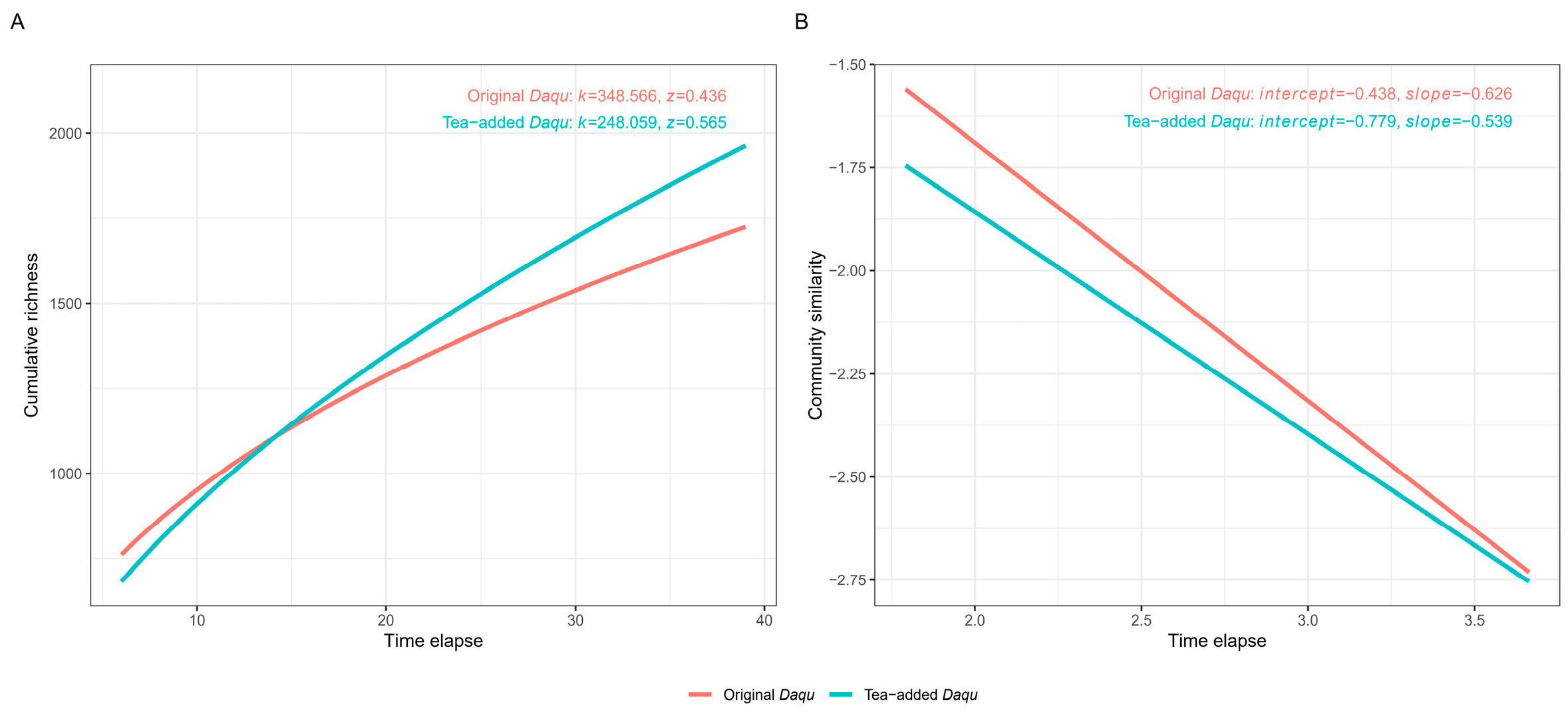
The temporal dynamics of the fungal community were analyzed using the STR and TDR models respectively (Figure 2). The STR model (Figure 2A) showed that the parameters for the OD were k = 348.566 and z = 0.436, while those for the TD were k = 248.059 and z = 0.565. The Bootstrap t-test indicated that all parameters were statistically significant (p < 0.001). Furthermore, a Bootstrap t-test was performed to examine whether there was a significant difference in the STR models between the two types of Daqu. The results revealed a significant difference (p < 0.001), indicating that the two Daqu types exhibited distinct species accumulation patterns. Additionally, the z value of the TD was higher than that of the OD, resulting in a steeper species accumulation curve. On the other hand, the TDR model (Figure 2B) results indicated that the intercept and w parameters for the OD were −0.438 and −0.626, respectively (Bootstrap t-test: p < 0.001), while those for the TD were −0.779 and −0.539 (p < 0.001). The Bootstrap t-test showed no significant difference between the TDR models of the two Daqu types (p > 0.05), suggesting that their compositional turnover patterns were similar. However, the lower absolute value of w in the TD indicated that the addition of Kuding tea could moderately slow down the rate of community succession.
Figure 2. Temporal dynamics of fungal communities in OD and TD. (A) STR showing the power-law accumulation of ASV richness over time intervals. (B) TDR depicting the decline in community similarity with increasing time intervals; the y-axis and x-axis are log-transformed. Model-fitted parameters for each Daqu type are given in the panels.
Fermentation 12 00136 g002

3.3. Influential Fungal Drivers of Community Dissimilarity and Assembly

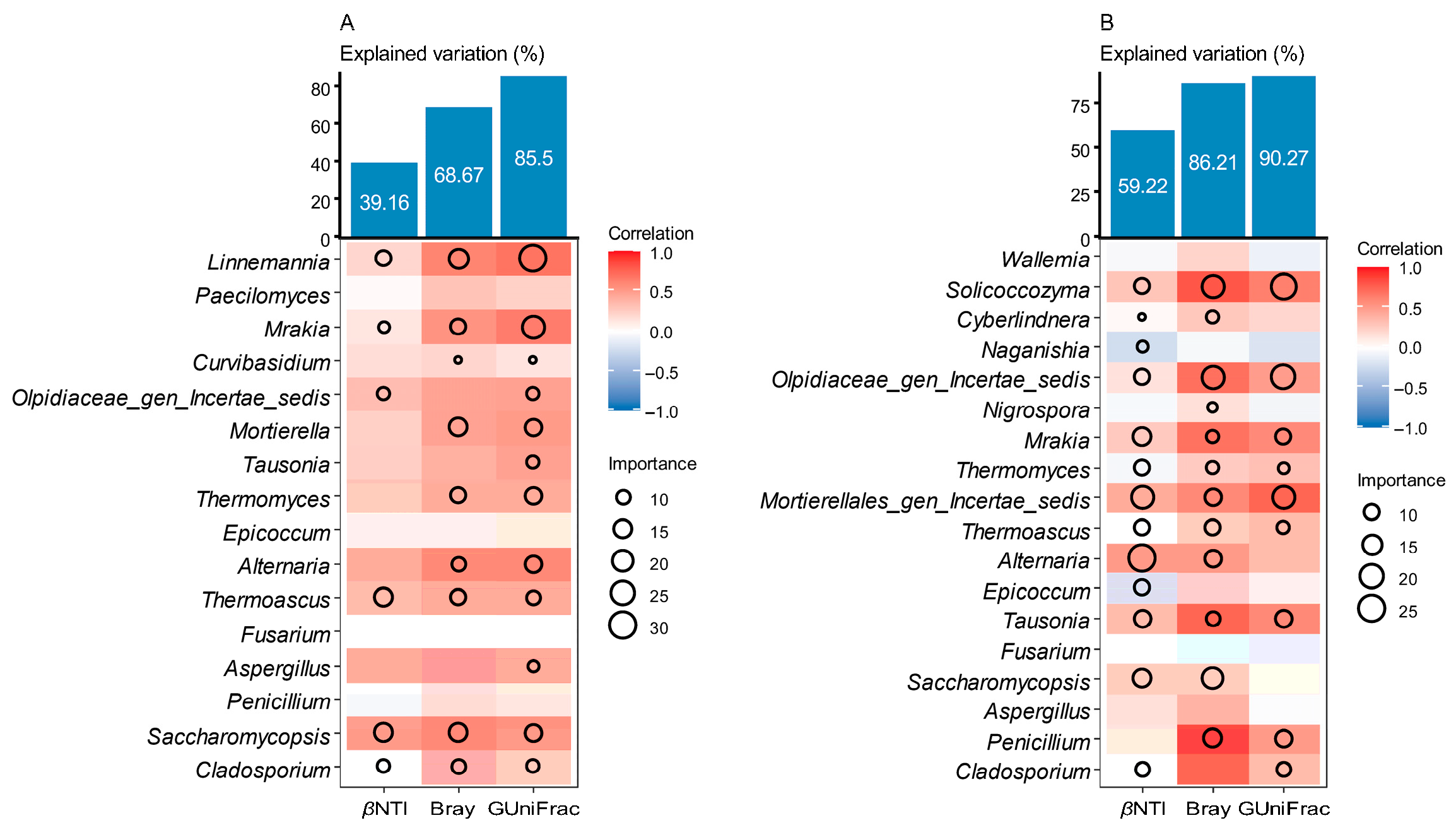
The RFM revealed distinct patterns in the relative importance of dominant genera in shaping community succession (GUniFrac and Bray–Curtis metrics) and assembly (βNTI) between the OD and the TD (Figure 3). In the OD (Figure 3A), the total explanatory power (R2) of the predictors was highest for GUniFrac (85.5%), followed by Bray–Curtis (68.67%) and the βNTI (39.16%), whereas in the TD (Figure 3B), the models exhibited substantially improved overall fits, with R2 values increasing to 90.27% for GUniFrac, 86.21% for Bray–Curtis, and notably to 59.22% for the βNTI. Key fungal predictors also shifted between treatments: for instance, in the OD, Linnemannia showed the highest %IncMSE for GUniFrac (30.37) and was a notable predictor for the βNTI, whereas in the TD, genera such as Solicoccozyma (GUniFrac, %IncMSE = 23.00) and Alternaria (βNTI, %IncMSE = 25.71) and several taxa including Cyberlindnera, Naganishia, and Epicoccum emerged as important predictors specifically in the tea-added treatment. Furthermore, while genera like Cladosporium, Thermoascus, and Mrakia were influential across both treatments, their relative importance often varied in magnitude or shifted among the three response metrics, indicating that tea addition not only enhanced the models’ explanatory capacity but also altered the specific fungal drivers underlying community dissimilarity and deterministic assembly processes.
Figure 3. Contributions of dominant genera to the βNTI, GUniFrac and Bray–Curtis metrics, respectively, in the OD (A) and TD (B), as determined by a random forest regression model. The circle size indicates variable importance (%IncMSE), while the heatmap represent the coefficients of Spearman’s correlations. The bars display the total variation in each metric explained by the dominant genera across distinct Daqus.
Fermentation 12 00136 g003

3.4. Changes in Endogenous Factors and Their Associations with Community Succession
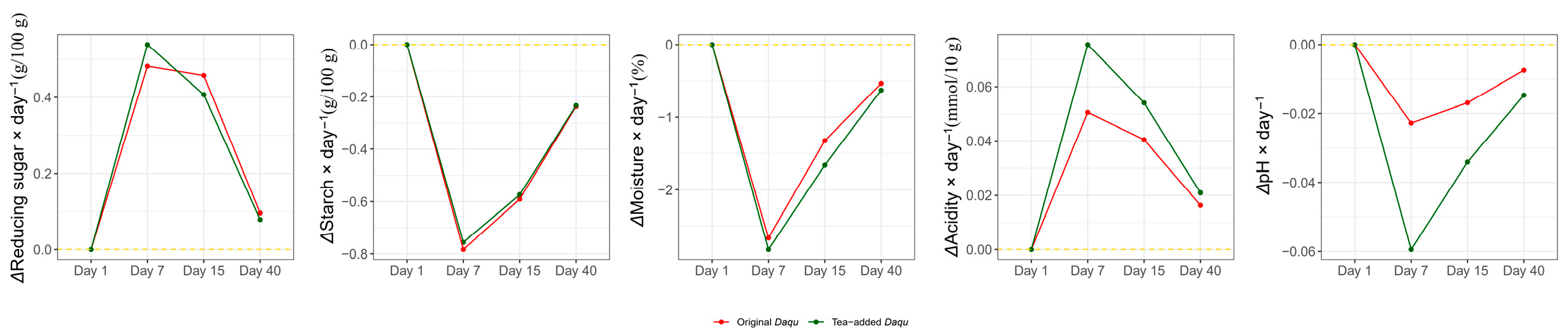
The change rates of endogenous factors during fermentation revealed distinct temporal dynamics and treatment-specific effects (Figure 4). Overall, both the OD and the TD exhibited similar directional trends: reducing sugar and acidity content showed positive daily change rates, indicating accumulation, while starch, moisture, and pH displayed negative rates, reflecting consumption or a decline over time. However, notable differences were observed between the two treatments. TD generally demonstrated a more pronounced increase in acidity accumulation, particularly at Day 7 (0.076 vs. 0.051 mmol/10 g/day for OD) and Day 15 (0.040 vs. 0.054 mmol/10 g/day for OD), accompanied by a stronger daily decrease in pH throughout the fermentation period. Moisture loss was also more marked in TD (e.g., Day 7: −2.820 vs. −2.660%/day; Day 15: −1.660 vs. −1.324%/day). In contrast, the daily consumption rate of starch was slightly lower in TD at most time points compared to the OD. By Day 40, the change rates for all indicators in both treatments approached near-zero values, indicating that the biochemical activities had largely stabilized toward the end of the fermentation process.
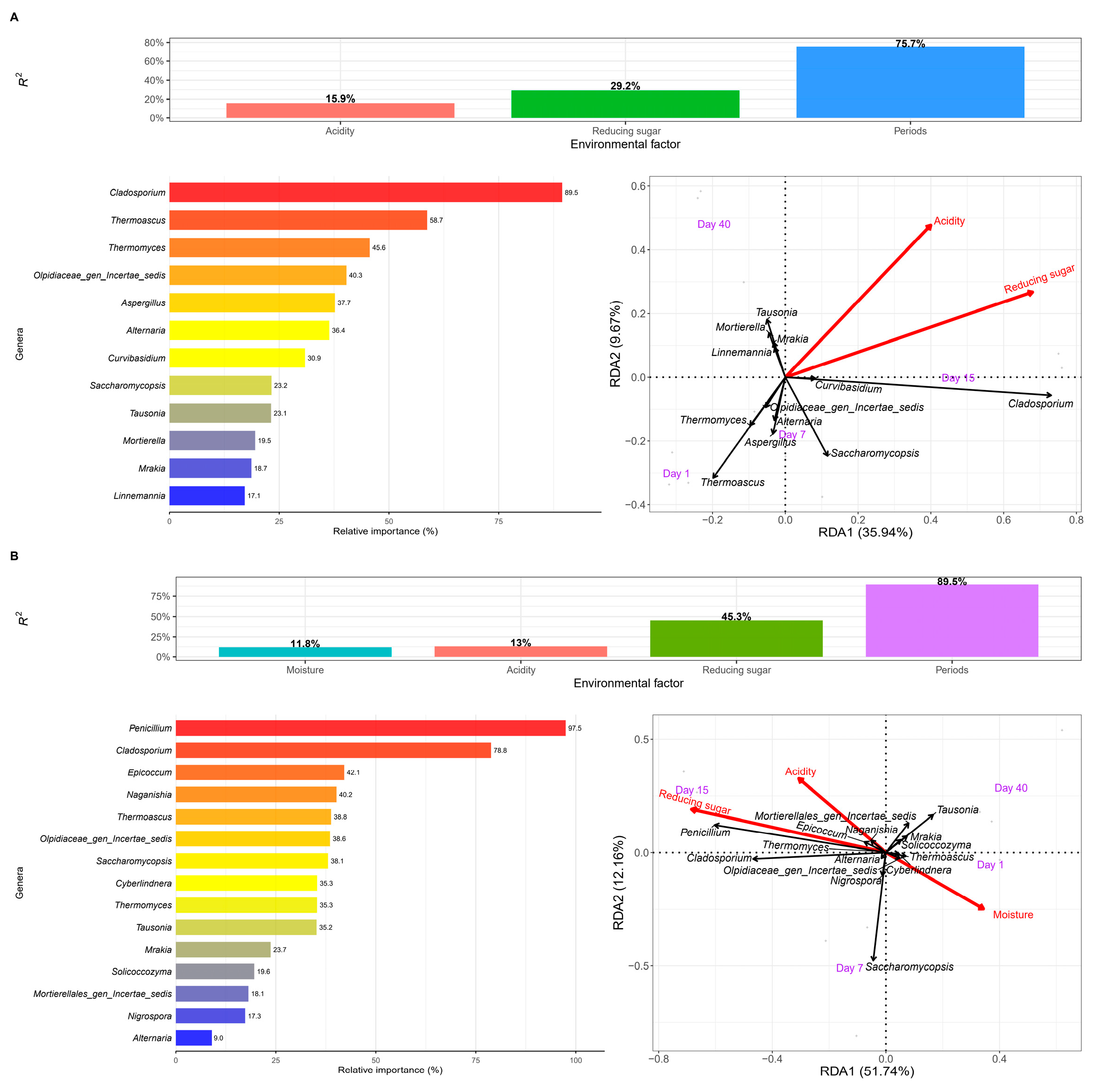
RDA revealed distinct patterns in the relationships between influential fungal genera (significant predictors from random forest models) and endogenous factors in the OD and TD (Figure 5). In the OD (Figure 5A), temporal fungal succession from Day 1 to Day 40 accounted for the largest proportion of variance (R2 = 75.7%), with reducing sugar (R2 = 29.2%) and acidity (R2 = 15.9%) serving as environmental drivers. Specifically, Cladosporium showed a strong positive correlation with reducing sugar, whereas genera such as Tausonia and Mortierella were more closely associated with acidity. In contrast (Figure 5B), TD exhibited an even stronger period effect (R2 = 89.5%), with reducing sugar remaining a major driver (R2 = 45.3%) and displaying positive correlations with genera including Penicillium and Cladosporium along RDA1. Acidity (R2 = 13.0%) and moisture (R2 = 11.8%) also contributed notably in TD; acidity correlated positively with fermentation progression from Day 1 to Day 15 but negatively from Day 15 to Day 40. Overall, the addition of tea altered fungal response patterns, modifying both the strength and direction of correlations between dominant fungal genera and key endogenous factors compared to the OD.
Figure 4. Change rates of endogenous factors during fermentation.
Fermentation 12 00136 g004
Figure 5. RDA of the associations between dominant fungal genera and endogenous factors in the OD (A) and TD (B). The top panel displays the contribution of each environmental variable to the model; the left panel shows the relative importance of genera as a bar plot; and the right panel presents the RDA biplot illustrating genera–environment relationships. Centroids for fermentation periods were labeled in the biplot.
Fermentation 12 00136 g005

4. Discussion

The rarefaction curves indicated that the addition of bitter tea significantly enhanced community diversity, which is consistent with previous studies on the addition of green tea to Daqu [10,11]. Zhao et al. [41] reported that incorporating other starchy raw materials, such as highland barley and purple wheat, into wheat-based substrates could also increase the diversity level of microbial communities in Daqu. Similarly, Zeng et al. [42] found that using different raw materials under the same processing conditions to produce Fu brick tea resulted in significant differences in bacterial communities and active components. These findings collectively suggest that both starchy and fibrous raw materials that like tea, which may carry specific microorganisms or possess distinct physicochemical properties, can alter the fermentation mechanism of Daqu when used in multi-ingredient starter preparation. Meanwhile, the exogenous microorganisms introduced by these additional materials are likely to increase the complexity of the community structure and elevate its diversity.
Over the 40-day Daqu fermentation period, 16 dominant fungal genera exhibited clear succession patterns (Figure 1), many of which (e.g., Cladosporium, Penicillium, Aspergillus, Saccharomycopsis, Fusarium, Thermoascus, Alternaria, Tausonia, Epicoccum, and Thermomyces) are commonly observed in other liquor fermentation systems [2,43,44,45,46]. The addition of Kuding tea considerably reshaped this fungal community trajectory compared to the OD. Tea supplementation initially suppressed early thermophilic genera (Thermoascus, Saccharomycopsis, Alternaria, and Thermomyces), promoted the dominance of Aspergillus and Cladosporium during the high-temperature phase (Day 7), and induced a distinctive Penicillium-dominated stage (Day 15), during which Saccharomycopsis was nearly eliminated and Fusarium persistence was markedly reduced.
At maturity (Day 40), both Daqu types showed a notable decline in dominant fungal genera relative to the initial stage. However, the TD was distinctly enriched in several taxa compared with the OD, including Tausonia (14.03% vs. 7.60%), Nigrospora (8.01% vs. 0.12%), Mrakia (6.22% vs. 4.66%), Naganishia (0.60% vs. 0.33%), Thermoascus (0.79% vs. 0.10%), Thermomyces (0.66% vs. 0.12%), and Aspergillus (2.58% vs. 1.06%). This pattern suggested that the continuous decrease in moisture content may have led to the rapid reduction in certain yeast and mold populations, while the addition of Kuding tea appeared to support the proliferation of genera such as Thermoascus, Thermomyces, and Aspergillus—fungi considered important for Daqu and subsequent liquor fermentation. Moreover, the collective abundance of other low-abundance taxa progressively increased over time, reaching the highest proportion (≈40%) by Day 40. This shift indicates that changes in the endogenous environment favored the turnover and increased dominance of previously rare or low-abundance fungal groups.
Notably, the pronounced proliferation of certain genera such as Penicillium in TD at Day 15 (36.05% vs. 3.29% in OD) appears counterintuitive, given the documented antifungal activity of Kuding tea triterpenoids against Penicillium [7,8]. However, its subsequent decline to 0.84% by Day 40—substantially lower than 7.20% in the OD—reveals a time-dependent dual role of tea amendment: indirect promotion during mid-fermentation followed by direct inhibition at maturity. The mid-fermentation bloom (Day 15) reflects indirect facilitation through competitor suppression and environmental restructuring. Tea addition suppressed early-colonizing thermophiles (Thermoascus at Day 1: 7.92% vs. 18.05% in OD; Saccharomycopsis cleared by Day 15: 0.04% vs. 9.75%), vacating the ecological space. Critically, RDA revealed that moisture emerged as a significant environmental driver exclusively in TD, with Penicillium exhibiting a strong negative correlation with moisture content (Figure 5B). This indicates that accelerated moisture loss—a key feature of TD fermentation (Figure 4)—favored this desiccation-tolerant genus that is renowned for its adaptation to low-water environments [47,48]. Simultaneously, its strong positive correlation with reducing sugar (Figure 5B) suggests efficient utilization of the available carbon resources. Thus, Penicillium was indirectly favored not by tea compounds alone but by the interplay between competitor suppression and physiological adaptation to the tea-modified environment. The sharp decline by Day 40 likely manifests the direct antimicrobial effects of tea compounds, which became operative only in later stages. During early fermentation, these compounds may have been adsorbed by the solid matrix or metabolized by active microbes. As fermentation progressed, moisture loss (Figure 4) concentrated residual bioactive compounds, while diminished microbial activity reduced their transformation, allowing antifungal properties to emerge. The very desiccation that favored Penicillium at mid-fermentation may have ultimately contributed to its suppression by concentrating inhibitory compounds to effective levels. Consequently, the transient Penicillium bloom gave way to late-successional taxa (Tausonia and Mrakia) enriched in mature TD (14.03% and 6.22%, respectively, vs. 7.60% and 4.66% in OD). This temporal dynamic illustrates that environmental filters do not uniformly suppress or promote taxa but restructure competitive hierarchies and resource landscapes [49]—and that filtering effects can shift as abiotic and biotic conditions co-evolve [50].
The specific mechanism through which tea addition reprograms microbial succession in the open Daqu ecosystem is elucidated by the distinct temporal dynamics captured by the STR and TDR models (Figure 2). A stronger, trend-like accumulation of detectable taxa over time was reflected by the significantly higher STR exponent in TD (0.565 vs. 0.436)—a pattern that, in an open system, could theoretically originate from either stochastic immigration or internal population shifts. However, the structured and significant nature of the STR signal suggested that this trend was not primarily driven by random external influx. Instead, it was aligned with the established ecological principle from microcosm studies, whereby elevated STR exponents were often interpreted as indicating increased detection of initially rare, resident taxa whose relative abundance is amplified by environmental change, rather than resulting from stochastic colonization or extinction events [16,51,52,53]. The increased dominance of the “Others” microbial group observed in the community structure analysis was also partly explained by this mechanism. This interpretation was strongly supported by the quantification of community assembly processes, which revealed a substantial increase in the contribution of deterministic homogeneous selection—from 0.47 in the OD to 0.62 in the TD. It was therefore proposed that the tea appears to function predominantly as an environmental filter, and our data are consistent with the hypothesis that tea amendment enhances deterministic selection, potentially by stimulating pre-existing taxa.
Concurrently, this interpretation was further supported by the less negative TDR slope (i.e., slower community turnover) in TD (−0.539 vs. −0.626). A more chaotic and accelerated turnover would be expected if external stochastic immigration were the dominant force. This reasoning was aligned with the assembly process analysis, which revealed a marked decrease in the role of dispersal limitation (from 0.33 to 0.17), indicating that stochastic influx from the external metacommunity or temporal changes became less influential. The observed attenuation in turnover rate instead suggested that the internal competitive landscape was modulated by tea, stabilizing community structure and dampening the rapid replacement of species typically seen under harsh or heterogeneous selective pressures [53].
Based on an integration of these findings, it was hypothesized that deterministic assembly was enhanced by tea addition through the imposition of a novel selective pressure that favors specific tea-adapted, often previously rare, taxa (as evidenced by the strong STR trend and the increased role of homogeneous selection), while niche availability is simultaneously modified to reduce the intensity of species replacement. This stabilization, reflected in the slower TDR decay, created conditions that allowed the relative influence of stochastic ecological drift to become slightly increased (increasing from 0.20 to 0.21) as the counteracting force of dispersal limitation diminished. Thus, the broader community’s temporal trajectory is shaped by tea addition through the strengthening of a specific deterministic filter, while stochastic assembly processes are permitted to have a discernible effect on the stabilized community.
The analysis of endogenous chemical change rates provided a dynamic perspective on how the metabolic trajectory of Daqu fermentation was redirected by tea amendment, with inherent substrate differences between treatments having been normalized. Notably, the most pronounced divergence between treatments was observed during the early to mid-fermentation phase (Day 7–15), particularly in acidification dynamics. A substantially higher rate of acidity accumulation was exhibited in TD (ΔAcids·day−1: 0.076 at Day 7) compared to OD (0.051), and this difference persisted through Day 15. This accelerated acidogenesis was directly reflected in a markedly steeper decline in pH (ΔpH·day−1: −0.059 vs. −0.023 at Day 7). These synchronized shifts suggested that tea addition did not merely alter the initial substrate composition; it also actively stimulated microbial acidity production early in succession. This was likely linked to the previously observed enhancement of deterministic selection and the promotion of specific acidogenic taxa. In contrast, changes in glucose consumption and starch degradation rates showed relatively modest differences between treatments, indicating that central carbon metabolism pathways were less fundamentally redirected than the acidification profile. Meanwhile, moisture loss rates were slightly more rapid in TD, possibly due to altered physicochemical properties or microbial activity affecting water retention. Collectively, these differential rates underscored that the role of tea extended beyond that of a passive substrate modifier—it proactively shaped a metabolic environment characterized by accelerated and sustained acidification, which in turn may have reinforced the selective microbial assembly previously described.
Building upon the results from the null model, which indicated a shift towards more deterministic assembly in fungi with tea addition, the RFM analyses provided a taxa-resolved perspective on how specific fungal genera contributed to this restructuring of β-diversity dynamics (Figure 3). A marked increase in the model explanatory power (R2) was observed for TD across the community succession metrics—GUniFrac (90.27% vs. 85.5%), Bray–Curtis (86.21% vs. 68.67%), and the assembly metric βNTI (59.22% vs. 39.16%). This enhanced predictability signifies that the temporal trajectories of fungal community assembly, composition, and phylogeny became more structured and less stochastic following tea amendment, aligning with the principle that strong environmental filters increase the determinism and predictability of ecological succession [33].
Concurrently, the identity of the key predictive fungal genera was substantially reconfigured. In the OD (Figure 3A), community compositional turnover (Bray–Curtis) was primarily linked to genera such as Linnemannia, Saccharomycopsis, and Mortierella, whereas phylogenetic turnover (GUniFrac) was strongly driven by Linnemannia, Mrakia, and Alternaria. In contrast (Figure 3B), tea addition promoted a distinct set of taxa to the forefront of community dynamics. Genera including Solicoccozyma, Olpidiaceae_gen_Incertae_sedis, and Saccharomycopsis emerged as top predictors for compositional and phylogenetic turnover. Most significantly, the assembly process (βNTI) in TD was overwhelmingly governed by Alternaria (%IncMSE = 25.71), followed by Mortierellales_gen_Incertae_sedis and Saccharomycopsis. The elevated role of Alternaria, a genus known for its metabolic versatility and stress tolerance [54,55,56], suggested that it may act as a keystone taxon whose response to tea-derived polyphenols and other bioactive compounds directly mediates the novel deterministic selection pressure within the fermentation ecosystem.
This shift in predictive taxa, coupled with the increased model fit, strongly supports the hypothesis that Kuding tea acts as a potent environmental filter. It selectively amplifies the influence of specific tea-tolerant fungal genera, thereby creating a more predictable ecological landscape where the succession of these responsive taxa dictates broader community patterns. This process effectively reduces the relative influence of stochastic processes like ecological drift. The findings resonate with the broader ecological concept that significant alterations in substrate chemistry can reshape microbial networks by promoting deterministic links between key microbial players and community assembly pathways, a phenomenon observed in other plant–microbe systems where root exudates or phytochemicals dictate microbiome assembly [57,58]. Thus, the addition of bitter tea does not merely alter taxonomic membership; it also fundamentally rewires the functional and ecological relationships within the Daqu fungal community, steering its temporal succession towards a more deterministic and predictable trajectory.
RDA was employed to elucidate the relationships between the genera—previously identified as significant drivers of the community succession and assembly in the RFM—and the endogenous factors, including the contents of reducing sugar and starch, acidity, moisture, and pH, in the OD and TD (Figure 5). The ordination revealed a fundamental restructuring of the microbial–physicochemical interaction network, demonstrating that the addition of Kuding tea not only alters taxonomic composition but also acts as a profound ecological engineer, reprogramming the core environmental axes that govern community succession.
In the OD (Figure 5A), microbial dynamics were significantly correlated with gradients of reducing sugar and acidity, with Cladosporium showing the highest responsiveness to environmental gradients (relative importance = 89.5%), followed by Thermoascus (58.7%) and Thermomyces (45.6%). RDA confirmed that Cladosporium exhibited the strongest positive association with reducing sugar and a moderate positive association with acidity, a pattern consistent with that found by Tang et al. [46]. The temporal trajectory, which explained 75.7% of the variance, outlined a progressive succession from the starting community (Day 1) toward a state increasingly associated with acidity accumulation by Day 15; notably, the Day 15 centroid was positioned opposite to other time points along RDA1, underscoring the pivotal role of Cladosporium as a primary regulator of early- to mid-fermentation carbohydrate metabolism. Conversely, several genera—Thermoascus, Thermomyces, Aspergillus and Alternaria—were positioned opposite to the reducing sugar and acidity vectors, indicating niche specialization for initial-stage, acidity-sensitive, low-reducing-sugar conditions or preference for complex polysaccharides such as starch [59,60,61,62]. Saccharomycopsis displayed moderate negative correlations with both reducing sugar and acidity, suggesting a more passive role in community structure determination under traditional fermentation conditions.
The addition of Kuding tea fundamentally reconfigured the ecosystem’s correlation structure, as evident not merely in microbial composition but also in a rotational shift in the environmental vectors themselves (Figure 5B). This intervention enhanced the explanatory power of all measured variables, with fermentation period (89.5%), reducing sugar (45.3%), acidity (13.0%), and the newly significant factor of moisture content (11.8%) collectively imposing stronger deterministic filters on community assembly, indicating that tea created a more structured and predictable fermentation matrix [5,11]. Penicillium (97.5%) replaced Cladosporium (78.8%) as the genus most strongly correlated with environmental gradients, exhibiting the highest positive correlation with reducing sugar, a strong negative correlation with moisture and a moderate positive correlation with acidity. This three-way interaction implies that tea supplementation generated microenvironments characterized by progressive desiccation, favoring Penicillium species adapted to low-water conditions [47,48].
Although Cladosporium persisted, its correlation strength with glucose declined, implying that tea-derived antimicrobial compounds or altered substrate chemistry reshaped competitive hierarchies. Concurrently, the tea-added treatment recruited additional taxa—Epicoccum, Cyberlindnera, Solicoccozyma and several others—indicating an expanded niche space and higher functional diversity. Intriguingly, the tea-added treatment also displayed a Day 15 centroid positioned opposite to other time points along RDA1, indicating that both treatments experienced a transient ecological bottleneck at this temporal milestone, albeit driven by different metabolic drivers.
The shared Day-15 inversion across treatments suggests that mid-fermentation represents a universal transition window regardless of tea presence, yet the underlying mechanisms diverged. In the OD, the inversion coincided with peak acidification and Cladosporium-mediated carbohydrate turnover, whereas in the TD, it aligned with moisture depletion and Penicillium-centered desiccation tolerance. The enhanced explanatory power of glucose and the emergence of moisture as a driver collectively indicate that tea supplementation shifted resource availability and water relations, thereby favoring Penicillium-dominated, desiccation-tolerant communities over the Cladosporium-led, acidity-tolerant consortia of traditional Daqu. These rotational changes in ordination space, rather than mere abundance shifts, reveal that tea addition re-oriented the entire ecological framework of the fermentation process, offering a pathway toward more controllable and standardized solid-state fermentation while preserving the functional attributes required for high-quality liquor production.
In summary, this study demonstrated that the addition of Kuding tea functioned as a potent environmental filter during Daqu fermentation, profoundly restructuring the fungal community’s assembly and succession. However, several limitations warrant consideration. First, this study relied on correlation-based inferences, leaving the precise mechanistic role of tea-derived compounds (e.g., polyphenols, saponins, and triterpenoids) in selecting for specific taxa to be experimentally verified. Second, the present study only employed a single addition level (20% w/w); varying the tea dosage might yield different community responses and filtering outcomes, which merit systematic investigation in future work. Third, our investigation was limited to the holistic effect of whole-tea supplementation, without dissecting the contributions of specific bioactive fractions (e.g., aqueous extracts, purified polyphenols, saponins, or triterpenoids). Consequently, whether the observed effects are attributable to particular compound classes—or to their synergistic interactions—remains to be elucidated. Fourth, the observed dynamics might vary under different production scales or environmental conditions. Finally, the functional implications of the reshaped community, though inferred from endogenous factor changes, require direct metagenomic or enzymatic validation. Future research should differentiate the relative contributions of inoculum versus filter effects through source-tracking analyses that quantitatively partition fungi introduced directly from tea versus those selected from the wheat microbiota by tea-derived compounds. Such approaches, combined with isolation and characterization of tea-responsive keystone taxa, would elucidate their specific metabolic roles. Parallel efforts should focus on fractionating tea extracts to identify the active components driving community restructuring and optimizing tea dosage to achieve desired fermentation outcomes. Collectively, these targeted strategies will enable the rational design of fermentation processes that leverage tea amendments to steer microbial consortia for improved control and product quality.

5. Conclusions

Tea addition enhanced deterministic selection, with homogeneous selection increasing from 0.47 in the OD to 0.62 in the TD, while stabilizing community dynamics through stronger species accumulation (STR exponent: 0.565 vs. 0.436) and slower compositional turnover (TDR slope: −0.539 vs. −0.626). Consequently, the community’s turnover became more predictable, with the RFM explaining a substantially higher proportion of variance in assembly (βNTI R2: 59.22% vs. 39.16%) and compositional turnover (Bray–Curtis R2: 86.21% vs. 68.67%). The reconfiguration of key environmental axes—highlighted by the emergence of moisture as a significant driver and the strengthened correlation of genera like Penicillium with reducing sugar and acidity—further indicated that tea amendment is associated with a reconfiguration of environmental axes and community structure. These findings provide a mechanistic framework for leveraging botanical additives to steer microbial ecosystems in solid-state fermentation.

Supplementary Materials

The following supporting information can be downloaded at https://www.mdpi.com/article/10.3390/fermentation12030136/s1, Figure S1: Comparative view of the Daqu blocks. The upper and lower rows show the Original Daqu and the tea-added Daqu, respectively; Figure S2: Rarefaction curves of the original and tea-added Daqu communities, derived from the Shannon and Chao1 diversity indices; Table S1: Measured values of endogenous factors in two types of Daqu; Table S2: Temporal dynamics in the relative abundance of dominant genera among Daqu types; Table S3: Relative importance of the five assembly processes in communities of different Daqus generated from the null model.

Author Contributions

Conceptualization, L.Z. (Liang Zhao) and X.W.; methodology, L.Z. (Liang Zhao) and X.W.; resources, J.L. and L.Z. (Liang Zhang); validation, Z.L. and Q.T.; investigation, J.Z. and Q.T.; writing—original draft preparation, L.Z. (Liang Zhao); writing—review and editing, X.W.; supervision, Q.J. and X.W. All authors have read and agreed to the published version of the manuscript.

Funding

This research was funded by the Guizhou Provincial Basic Research Program (General Program), 2026 (No. QianKeHe Jichu-MS(2026)759); the Modern Baijiu Brewing Technology Engineering Research Center of Guizhou Universities (Qianjiaoji [2023] No. 028); the Guizhou Key Laboratory of Microbial Resources Exploration in the Fermentation industry (Qiankehe Platform Talent—ZDSYS [2023] 007); and the Research Foundation for Scientific Scholars of Moutai Institute (Nos. mygccrc[2022]006, mygccrc[2022]058, and mygccrc[2022]097).

Institutional Review Board Statement

Not applicable.

Informed Consent Statement

Not applicable.

Data Availability Statement

The data presented in this study are openly available in [NCBI] at [https://www.ncbi.nlm.nih.gov/], reference number [PRJNA1390468].

Conflicts of Interest

Authors Liang Zhao, Zhenbiao Luo, Xinye Wang were employed by the company Kweichow Moutai Group. The remaining authors declare that the research was conducted in the absence of any commercial or financial relationships that could be construed as a potential conflict of interest.

References

  1. Li, W.; Fan, G.; Fu, Z.; Wang, W.; Xu, Y.; Teng, C.; Zhang, C.; Yang, R.; Sun, B.; Li, X. Effects of fortification of Daqu with various yeasts on microbial community structure and flavor metabolism. Food Res. Int. 2020, 129, 108837. [Google Scholar] [CrossRef]
  2. Sakandar, H.A.; Hussain, R.; Khan, Q.F.; Zhang, H. Functional microbiota in Chinese traditional Baijiu and Mijiu Qu (starters): A review. Food Res. Int. 2020, 138, 109830. [Google Scholar] [CrossRef]
  3. Du, H.; Wang, X.S.; Zhang, Y.H.; Xu, Y. Exploring the impacts of raw materials and environments on the microbiota in Chinese Daqu starter. Int. J. Food Microbiol. 2019, 297, 32–40. [Google Scholar] [CrossRef]
  4. Wei, J.; Jie, W.; Baosheng, L.; Jianhui, D.; Xiaojun, W.; Zhihua, S.; Xinglin, H.; Jie, H.; Chunguang, L.; Jianqin, H.; et al. Analysis of characteristic flavor compounds in single-grain chinese baijiu brewed from different raw. Food Sci. 2020, 41, 234–238. (In Chinese) [Google Scholar] [CrossRef]
  5. Zhao, L.; Li, F.F.; Xiao, H.; Zhao, T.F.; Zhong, Y.X.; Hu, Z.H.; Jiang, L.; Wang, X.Y.; Wang, X.Y. Green Tea Modulates Temporal Dynamics and Environmental Adaptation of Microbial Communities in Daqu Fermentation. Fermentation 2025, 11, 511. [Google Scholar] [CrossRef]
  6. Wüpper, S.; Lüersen, K.; Rimbach, G. Chemical Composition, Bioactivity and Safety Aspects of Kuding Tea—From Beverage to Herbal Extract. Nutrients 2020, 12, 2796. [Google Scholar] [CrossRef] [PubMed]
  7. Liu, J.; Zu, M.; Chen, K.; Gao, L.; Min, H.; Zhuo, W.; Chen, W.; Liu, A. Screening of neuraminidase inhibitory activities of some medicinal plants traditionally used in Lingnan Chinese medicines. BMC Complement. Altern. Med. 2018, 18, 102. [Google Scholar] [CrossRef]
  8. Alaoui, A.; Sahri, N.; Mahdi, I.; Fahsi, N.; El Herradi, E.H.; Sobeh, M. Argan: Phytochemical profiling and evaluation of the antioxidant, hypoglycemic, and antibacterial properties of its fruit pulp extracts. Heliyon 2024, 10, e23612. [Google Scholar] [CrossRef]
  9. Ahmed, M.; Sajid, A.R.; Javeed, A.; Aslam, M.; Ahsan, T.; Hussain, D.; Mateen, A.; Li, X.; Qin, P.; Ji, M. Antioxidant, antifungal, and aphicidal activity of the triterpenoids spinasterol and 22,23-dihydrospinasterol from leaves of Citrullus colocynthis L. Sci. Rep. 2022, 12, 4910. [Google Scholar] [CrossRef]
  10. Zhao, L.; Wang, X.; Luo, Z.; Jiang, L.; Wu, F.; Zhong, Y.; Wang, X. Effect of adding green tea on physicochemical characteristics and bacterial diversity of daqu during fermentation. Food Sci. 2024, 45, 59–68. (In Chinese) [Google Scholar] [CrossRef]
  11. Zhao, L.; Wang, X.; Luo, Z.; Gan, G.; Wu, F.; Zhong, Y.; Wang, X. Optimization of the fermentation process of Moutai-flavored Daqu with the addition of green tea: Impacts on bacterial succession and endogenous factors. J. Food Sci. Technol. 2025, 62, 1957–1967. [Google Scholar] [CrossRef]
  12. Bai, X. A Technical Study on the Tea-Flower Daqu Preparation. PhD Thesis, Anhui Agricultural University, Hefei, China, 2016. [Google Scholar]
  13. Nekola, J.C.; White, P.S. The distance decay of similarity in biogeography and ecology. J. Biogeogr. 1999, 26, 867–878. [Google Scholar] [CrossRef]
  14. Hatosy, S.M.; Martiny, J.B.H.; Sachdeva, R.; Steele, J.; Fuhrman, J.A.; Martiny, A.C. Beta diversity of marine bacteria depends on temporal scale. Ecology 2013, 94, 1898–1904. [Google Scholar] [CrossRef] [PubMed]
  15. MacArthur, R.; Wilson, E. Theory of Island Biogeography (MPB-1); Princeton University Press: Princeton, NJ, USA, 2015. [Google Scholar]
  16. Jiao, S.; Zhang, Z.; Yang, F.; Lin, Y.; Chen, W.; Wei, G. Temporal dynamics of microbial communities in microcosms in response to pollutants. Mol. Ecol. 2017, 26, 923–936. [Google Scholar] [CrossRef]
  17. Preston, F.W. Time and Space and the Variation of Species. Ecology 1960, 41, 611–627. [Google Scholar] [CrossRef]
  18. Vermeij, G.J. Species-Diversity in-Space and Time; Rosenzweig, M.L., Ed.; Cambridge University Press: New York, NY, USA, 1995; Volume 270, pp. 503–504. [Google Scholar]
  19. Ahluwalia, S.; Holmes, I.; von May, R.; Rabosky, D.L.; Rabosky, A.R.D. Assembling microbial communities: A genomic analysis of a natural experiment in neotropical bamboo internodes. PeerJ 2022, 10, e13958. [Google Scholar] [CrossRef] [PubMed]
  20. Wang, Y.; Yang, Q.; Chen, Q.; Hou, S.; Jiao, N.; Zheng, Q. Deciphering community assembly processes of the microbial community in subtropical coastal-estuarine seawater over a 6-year exploration. ISME Commun. 2025, 5, ycaf091. [Google Scholar] [CrossRef]
  21. Zuo, Q.C.; Huang, Y.G.; Guo, M. Evaluation of bacterial diversity during fermentation process: A comparison between handmade and machine-made high-temperature Daqu of Maotai-flavor liquor. Ann. Microbiol. 2020, 70, 57. [Google Scholar] [CrossRef]
  22. QB/T 4257-2011; General Methods of Analysis for Daqu. China Light Industry Press: Beijing, China, 2012.
  23. GB 5009.7-2016; Determination of Reducing Sugar in Foods. China Standard Press: Beijing, China, 2016.
  24. Huang, T.; Wei, J.; Zhou, S.; Hao, W.; Liu, X.; Yu, Z.; Zhuang, W.; Zeng, Z. Fungal community structure and succession of light-flavor Baijiu during fermentation process. LWT-Food Sci. Technol. 2025, 224, 117825. [Google Scholar] [CrossRef]
  25. Dai, Y.; Li, Z.; Tian, Z. Analysis of bacterial diversity in daqu and fermented grains for maotai-flavor liquor. Food Sci. 2019, 40, 152–159. (In Chinese) [Google Scholar] [CrossRef]
  26. Větrovský, T.; Morais, D.; Kohout, P.; Lepinay, C.; Algora, C.; Awokunle Hollá, S.; Bahnmann, B.D.; Bílohnědá, K.; Brabcová, V.; D’Alò, F.; et al. GlobalFungi, a global database of fungal occurrences from high-throughput-sequencing metabarcoding studies. Sci. Data 2020, 7, 228. [Google Scholar] [CrossRef] [PubMed]
  27. Callahan, B.J.; McMurdie, P.J.; Rosen, M.J.; Han, A.W.; Johnson, A.J.A.; Holmes, S.P. DADA2: High-resolution sample inference from Illumina amplicon data. Nat. Methods 2016, 13, 581–583. [Google Scholar] [CrossRef]
  28. Kessy, A.; Allan, Z.; Timo, P.; Raivo, P.; Filipp, I.; Henrik, N.R.; Urmas, K. UNITE General FASTA Release for Fungi. Version 19.02.2025. Available online: https://doi.org/10.15156/BIO/3301229 (accessed on 19 February 2025).
  29. White, E.P.; Adler, P.B.; Lauenroth, W.K.; Gill, R.A.; Greenberg, D.; Kaufman, D.M.; Rassweiler, A.; Rusak, J.A.; Smith, M.D.; Steinbeck, J.R.; et al. A comparison of the species-time relationship across ecosystems and taxonomic groups. Oikos 2006, 112, 185–195. [Google Scholar] [CrossRef]
  30. Dengler, J. Which function describes the species-area relationship best? A review and empirical evaluation. J. Biogeogr. 2009, 36, 728–744. [Google Scholar] [CrossRef]
  31. Hu, A.; Nie, Y.X.; Yu, G.R.; Han, C.H.; He, J.H.; He, N.P.; Liu, S.R.; Deng, J.; Shen, W.H.; Zhang, G.X. Diurnal Temperature Variation and Plants Drive Latitudinal Patterns in Seasonal Dynamics of Soil Microbial Community. Front. Microbiol. 2019, 10, 674. [Google Scholar] [CrossRef] [PubMed]
  32. Ning, D.L.; Yuan, M.T.; Wu, L.W.; Zhang, Y.; Guo, X.; Zhou, X.S.; Yang, Y.F.; Arkin, A.P.; Firestone, M.K.; Zhou, J.Z. A quantitative framework reveals ecological drivers of grassland microbial community assembly in response to warming. Nat. Commun. 2020, 11, 4717. [Google Scholar] [CrossRef]
  33. Stegen, J.C.; Lin, X.J.; Fredrickson, J.K.; Konopka, A.E. Estimating and mapping ecological processes influencing microbial community assembly. Front. Microbiol. 2015, 6, 370. [Google Scholar] [CrossRef] [PubMed]
  34. Breiman, L. Random forests. Mach. Learn. 2001, 45, 5–32. [Google Scholar] [CrossRef]
  35. Archer, E. rfPermute: Estimate Permutation P-Values for Random Forest Importance Metrics. Available online: https://CRAN.R-project.org/package=rfPermute (accessed on 10 June 2013).
  36. Zhao, L.; Yuan, H.; Zheng, K.; Zhuo, M.; Wu, F.; Zhang, Y.; Jiang, L.; Guangdong, G.; Wang, X. Functional predictions of bacterial communities associated with sorghum cultivars across different rhizocompartments. Emir. J. Food Agric. 2025, 37, 1–12. [Google Scholar] [CrossRef]
  37. Legendre, P.; Legendre, L. Numerical Ecology, 3rd ed.; Elsevier: Amsterdam, The Netherlands, 2012; Volume 24. [Google Scholar]
  38. Oksanen, J.; Simpson, G.; Blanchet, F.; Kindt, R.; Legendre, P.; Minchin, P.; O’Hara, R.; Solymos, P.; Stevens, M.; Szoecs, E.; et al. Vegan: Community Ecology Package (R Package Version 2.7-3). Available online: https://CRAN.R-project.org/package=vegan (accessed on 4 March 2025).
  39. Braak, C.J.F.T. Canonical correspondence analysis: A new eigenvector technique for multivariate direct gradient analysis. Ecology 1986, 67, 1167–1179. [Google Scholar] [CrossRef]
  40. Yun, Y.H.; Deng, B.C.; Cao, D.S.; Wang, W.T.; Liang, Y.Z. Variable importance analysis based on rank aggregation with applications in metabolomics for biomarker discovery. Anal. Chim. Acta 2016, 911, 27–34. [Google Scholar] [CrossRef]
  41. Zhao, C.; Su, W.; Mu, C.; Zheng, P.; Wang, H. Effects of different raw materials on microbial community structure and diversity in Jiang-flavor Daqu. Food Sci. 2022, 43, 133–141. (In Chinese) [Google Scholar] [CrossRef]
  42. Zeng, Q.; Lv, S.; Li, X.; Hu, X.; Liang, Y.; Fan, C.; Duan, J.; Deng, T. Bioactive ingredients and microbial diversity of fuzhuan tea produced from different raw materials. Food Sci. 2020, 41, 69–77. (In Chinese) [Google Scholar] [CrossRef]
  43. Ren, H.; Cai, Z.; Du, C.; Li, Z.; Guo, X.; Wang, Y.; Ma, D.; Zhang, B.; Zheng, Y. Interrelated spatiotemporal variations between bacterial community and physicochemical factors in pit mud of Chinese strong-flavor Baijiu. LWT-Food Sci. Technol. 2024, 192, 115630. [Google Scholar] [CrossRef]
  44. Shi, G.; Fang, C.; Xing, S.; Guo, Y.; Li, X.; Han, X.; Lin, L.; Zhang, C. Heterogenetic mechanism in high-temperature Daqu fermentation by traditional craft and mechanical craft: From microbial assembly patterns to metabolism phenotypes. Food Res. Int. 2024, 187, 114327. [Google Scholar] [CrossRef] [PubMed]
  45. Gong, L.; Qin, S.; Zheng, X.; Zhao, J.; Liu, M.; Zhao, M. Traceability between microbial community and environmental microbial Community in Maotai-flavor Daqu. Food Chem. X 2025, 27, 102321. [Google Scholar] [CrossRef]
  46. Tang, J.; Wang, L.; Zhao, Y.; Wu, C.; Qiao, L.; Xiao, X.; Guo, M.; Yang, L. Multi-omics analysis of the spatial heterogeneity of Moutai-flavored Daqu. Food Sci. 2025, 46, 126–134. (In Chinese) [Google Scholar] [CrossRef]
  47. Ropars, J.; Rodríguez de la Vega, R.C.; López-Villavicencio, M.; Gouzy, J.; Dupont, J.; Swennen, D.; Dumas, E.; Giraud, T.; Branca, A. Diversity and Mechanisms of Genomic Adaptation in Penicillium. In Aspergillus and Penicillium in the Post-Genomic Era; de Vries, R.P., Benoit Gelber, I., Andersen, M.R., Eds.; Caister Academic Press: Norfolk, UK, 2016; pp. 27–42. [Google Scholar]
  48. Zareb, A.; Banachewicz, P.; Havrysh, P.; Blaszczyk, L.; Hammad, T.; Meftah, C.; Salamon, S. Endophytic fungal communities of Calicotome spinosa-an important medicinal plant of Tizi-Ouzou (Algeria). J. Appl. Genet. 2025, 66, 763–769. [Google Scholar] [CrossRef]
  49. Germain, R.M.; Mayfield, M.M.; Gilbert, B. The ‘filtering’ metaphor revisited: Competition and environment jointly structure invasibility and coexistence. Biol. Lett. 2018, 14, 20180460. [Google Scholar] [CrossRef] [PubMed]
  50. De Wit, R. Does the Environment “Filter” or “Select” Species? Bridging the Ecologies of Microbes and Macro-Organisms for a Common Niche Assembly Theory. Environments 2025, 10, 350. [Google Scholar] [CrossRef]
  51. Caporaso, J.G.; Paszkiewicz, K.; Field, D.; Knight, R.; Gilbert, J.A. The Western English Channel contains a persistent microbial seed bank. ISME J. 2012, 6, 1089–1093. [Google Scholar] [CrossRef]
  52. Ashley, S.; Gregory, C.J.; Jo, H.; Rob, K.; Noah, F. A meta-analysis of changes in bacterial and archaeal communities with time. ISME J. 2013, 7, 1493–1506. [Google Scholar] [CrossRef] [PubMed]
  53. Jiao, S.; Chen, W.; Wang, E.; Wang, J.; Liu, Z.; Li, Y.; Wei, G. Microbial succession in response to pollutants in batch-enrichment culture. Sci. Rep. 2016, 6, 21791. [Google Scholar] [CrossRef] [PubMed]
  54. Waill, A.E.; Abdu, G.A.K.; Azza, E.; Ghoson, M.D. Allergen, pathogen, or biotechnological tool? The dematiaceous fungi Alternaria what’s for it and what’s on it? J. Pharm. Pharmacol. Res. 2021, 4, 1–6. [Google Scholar] [CrossRef]
  55. Zhao, S.; Li, J.; Liu, J.; Xiao, S.; Yang, S.; Mei, J.; Ren, M.; Wu, S.; Zhang, H.; Yang, X. Secondary metabolites of Alternaria: A comprehensive review of chemical diversity and pharmacological properties. Front. Microbiol. 2023, 13, 1085666. [Google Scholar] [CrossRef] [PubMed]
  56. Zhou, L.; Peng, Y.; Fu, L.; Lou, J. Metabolites from Alternaria Fungi and Their Bioactivities. Molecules 2013, 18, 5891–5935. [Google Scholar] [CrossRef]
  57. Zhao, L.; Lu, J.J.; Jiang, L.; Wang, X.Y.; Wu, F.Y.; Luo, Z.B.; Yang, L.; Wang, X.Y. Assembly, diversity and coexistence of bacteria communities in various rhizocompartment niches in Sorghum Cultivars. Rhizosphere 2023, 27, 100779. [Google Scholar] [CrossRef]
  58. Zhang, X.; Li, H.; Li, B.; Song, K.; Sha, Y.; Liu, Y.; Dong, S.; Wang, D.; Yang, L. Microbial Community Shifts in Tea Plant Rhizosphere under Seawater Stress: Enrichment of Beneficial Taxa. Microorganisms 2024, 12, 1287. [Google Scholar] [CrossRef]
  59. Wang, B.-T.; Hu, S.; Yu, X.-Y.; Jin, L.; Zhu, Y.-J.; Jin, F.-J. Studies of Cellulose and Starch Utilization and the Regulatory Mechanisms of Related Enzymes in Fungi. Polymers 2020, 12, 530. [Google Scholar] [CrossRef]
  60. Dong, W.; Yu, X.; Wang, L.; Zou, M.; Ma, J.; Liu, J.; Feng, Y.; Zhao, S.; Yang, Q.; Hu, Y.; et al. Unveiling the microbiota of sauce-flavor Daqu and its relationships with flavors and color during maturation. Front. Microbiol. 2024, 15, 1345772. [Google Scholar] [CrossRef]
  61. Yang, J.; Xue, F.; Li, D.; Chen, J.; Shi, G.; Song, G.; Li, Y. Oxygen regulation of microbial communities and chemical compounds in cigar tobacco curing. Front. Microbiol. 2024, 15, 1425553. [Google Scholar] [CrossRef] [PubMed]
  62. Hu, S.; Wang, B.T.; Li, T.; Bu, S.; Jin, C.Z.; Jin, L.; Ruan, H.H.; Shin, K.S.; Jin, F.J. Successional patterns of microbial communities across various stages of leaf litter decomposition in poplar plantations. Front. Microbiol. 2025, 16, 1628355. [Google Scholar] [CrossRef] [PubMed]
Figure 1. VariationCommunity structures in OD and TD during the fermentation process.
Fermentation 12 00136 g001
Disclaimer/Publisher’s Note: The statements, opinions and data contained in all publications are solely those of the individual author(s) and contributor(s) and not of MDPI and/or the editor(s). MDPI and/or the editor(s) disclaim responsibility for any injury to people or property resulting from any ideas, methods, instructions or products referred to in the content.