Article

Sustainable Co-Production of Carotenoids and Lipids by Rhodotorula toruloides Metabolizing Acetate Derived from Carbon Dioxide Fermentation

by
Cecilia Naveira-Pazos
,
María C. Veiga
and
Christian Kennes
*
Chemical Engineering Laboratory, Faculty of Sciences and Interdisciplinary Centre of Chemistry and Biology—Centro Interdisciplinar de Química y Biología (CICA), BIOENGIN Group, University of La Coruña, E-15008 La Coruña, Spain
*
Author to whom correspondence should be addressed.
Fermentation 2026, 12(3), 138; https://doi.org/10.3390/fermentation12030138
Submission received: 30 November 2025 / Revised: 16 February 2026 / Accepted: 24 February 2026 / Published: 5 March 2026
(This article belongs to the Special Issue YBC2025: Yeast in Bioeconomy)

Abstract

The ability of Rhodotorula toruloides DSM 4444 to metabolize low-cost carbon sources such as fatty acids was comprehensively studied. This organism is shown, for the first time, to simultaneously accumulate microbial oils (biofuel precursors) and carotenoids from acetic acid obtained from CO2 fermentation. This fatty acid is typically the single end product of acetogenic bioconversion of one-carbon gas pollutants (e.g., CO2 and CO). In the first set of experiments, different aerobic fermentations were carried out in automated bioreactors, with acetic acid in one case and with glucose, a more conventional carbon source, as a control, in another bioreactor. R. toruloides consumed around 80 g/L substrate under both conditions. Maximum lipid content (27.2% g/g dry weight) was reached from 38 g/L glucose, while carotenoid content was higher with acetic acid (1.4 mg/g cell after 54.1 g/L acetic acid consumed), representing a 40% increase compared to glucose (1.0 mg/g cell after 64.2 g/L glucose consumed). Additionally, in the second set of assays, a fermented broth produced by Acetobacterium woodii from CO2 fermentation, containing residual nutrients and metabolites, was tested. Despite its complex composition, R. toruloides grew and produced carotenoids (up to 0.141 mg/g), showing potential adaptability. To the best of our knowledge, this is the first report on a greenhouse gas-based biotechnological process as a promising sustainable alternative for the valorization of pollutants, e.g., gas emissions, their bioconversion to VFAs, such as acetic acid, and subsequent fermentation of the carboxylic acid into microbial oils, as a source of renewable energy, as well as carotenoids as a high-value nutraceutical product.

1. Introduction

The growing energy demand has traditionally relied on fossil fuels such as oil, coal, and natural gas [1], which pose major challenges, including resource depletion, greenhouse gas emissions, and other associated environmental and economic concerns. The oil crisis of the 1970s and subsequent issues of energy security, price volatility, and climate change have sparked renewed interest in renewable energy sources and biofuels [2]. Today, biofuels are increasingly used as sustainable alternatives to fossil fuels, particularly in the transport sector, where conventional fuels still dominate. Among these, biodiesel produced through the valorization of environmental pollutants represents a promising strategy to address these challenges and to improve the economic and environmental viability of biofuel production [3].
Biodiesel, a renewable biofuel, is typically produced by transesterification of natural triglycerides, typically derived from animal fats or vegetable oils, with an alcohol (e.g., methanol) to fatty acid methyl esters (FAMEs) [4]. This biofuel offers similar energy content to conventional diesel with higher lubricity and cetane value [2]. In addition, among the different alternative processes to obtain biodiesel, those relying on the catalytic activity of microorganisms using non-edible oil feedstocks are very attractive due to the elimination of the dependence on non-renewable sources, while avoiding competition with food crops and ensuring more efficient use of land, among others [5].
Among microorganisms suitable for biodiesel production, oleaginous yeasts can store more than 20% of lipids in their biomass, as they have advantages over other microorganisms, such as the ability to synthesize lipids from a wide variety of carbon sources, the fact that they are not as limited by physico-chemical factors such as temperature and light intensity compared to microalgae, or the rather simple lipid extraction compared to other microorganisms such as bacteria, in which lipids are generally firmly attached to the bacterial membrane [6]. However, cost-effectiveness remains a major challenge, as traditional substrates like glucose are expensive and account for a large proportion of production costs [6,7,8,9,10,11,12]. Alternative carbon sources, such as volatile fatty acids (VFAs) derived from industrial wastes, wastewater, or even greenhouse gases, among others, are more sustainable and affordable, significantly reducing raw material costs [7,13].
VFAs obtained from waste bioconversion are usually a mixture of carboxylic acids. However, in some cases, pure acetic acid can be obtained from one-carbon (C1) gases, such as CO2, CO, or syngas, using acetogenic bacteria [4]. For instance, VFAs from food waste can cost as little as $30 per tonne [14], reducing raw material costs by roughly 16-fold. Using low-cost carbon sources greatly improves process economics, although it still falls short of competing with conventional diesel at a commercial scale. Microbial oil production and extraction remain expensive, and producing a single biomolecule is often not economically viable compared to conventional refinery processes. One strategy to overcome this is to exploit microbial biomass for multi-product processes rather than focusing on a single metabolite [15]. In this study, the yeast Rhodotorula toruloides DSM 4444 was chosen for its ability to produce not only lipids but also carotenoids—a trait observed with substrates like glucose [16] but not previously reported when grown on low-cost carboxylic acids such as acetic acid, typically obtained as a main or single metabolite from acetogenic C1 gas fermentation.
Carotenoids are a group of compounds of great importance in nature. They play a vital role in the process of photosynthesis, protecting the photosynthetic apparatus against photooxidative damage by neutralizing free radicals; they act as antioxidants and prevent oxidative damage to cells. Furthermore, although these metabolites have numerous health-promoting properties, they are mostly known to be responsible for the pigmentation and colors of plants and microbial biomass [17]. As a result, interest in carotenoids has increased significantly in many different sectors such as agriculture, the food industry, or pharmaceuticals [18].
Currently, the most demanded carotenoids by the global market include β-carotene, astaxanthin, lutein, zeaxanthin, and lycopene, due to their multifunctional properties and wide range of applications. Their demand is mainly driven by their applications in the food and feed industries, nutraceuticals, and, increasingly, cosmetics, due to their antioxidant, provitamin A, and photoprotective properties. In March 2023, it was reported that the global carotenoids market size had reached US$ 1.88 Mn (million dollars) in 2022 and is expected to reach US$ 3.402 Mn by 2032 at a compound annual growth rate (CAGR) of 6.3% [19].
Among microbial producers, oleaginous yeasts of the genus Rodothorula are known to synthesize several commercially relevant carotenoids, including β-carotene, torulene, and torularhoding, in different amounts. In this context, this research thoroughly evaluated the ability of R. toruloides DSM 4444 to efficiently assimilate acetic acid and simultaneously co-produce lipids and carotenoids using a carbon source derived from gas fermentation, with β-carotene being of particular importance as a precursor of vitamin A and carotenoids contributing to protection against reactive oxygen species (ROS) [20]. These metabolites are generally obtained from the common substrate glucose, but the possibility of producing them from acetic acid is an attractive alternative, though there is hardly any literature available on the ability of yeast strains to assimilate fatty acids from C1-gas fermentation [4]. In addition, to the best of our knowledge, published data available for R. toruloides grown on such carbon sources derived from C1-gases and studies on R. toruloides using VFAs from other sources in order to produce lipids and carotenoids are not available. In this way, this research presents a novel approach and innovative data on the production of lipids and carotenoids, simultaneously, from a more cost-effective substrate such as acetic acid. The results here are also compared with glucose as a conventional reference carbon source to clearly assess the effects of the two carbon sources on lipid and carotenoid synthesis. The data obtained in these studies serve as a basis to confirm the viability of the use of VFAs derived from pollutants such as C1 gases by R. toruloides for the joint production of different valuable metabolites of industrial interest.

2. Materials and Methods

2.1. Strain, Culture Conditions, and Inoculum Preparation

The strain Rhodotorula toruloides (DSM 4444) was used for lipids and carotenoids production. It was obtained from “Deutsche Sammlung von Mikroorganismen and Zellkulturen GmbH” (Braunschweig, Germany) and was grown and maintained on potato dextrose agar (PDA) medium. To start the experiments, the strain was reactivated by inoculating it in this solid medium and growing it at 33 °C in a thermostated room for 2–3 days. Then, to obtain the pre-culture for use in the experiments, individual colonies from these plates were inoculated into a liquid medium (potato dextrose broth, PDB) and left to grow at 33 °C with constant agitation (150 rpm) for 24–36 h. The pre-culture was then harvested by centrifugation, and the supernatant was decanted and washed twice with NaCl 0.9%, harvesting by centrifugation each time. Finally, in order to estimate the amount of pre-culture biomass to be inoculated in the reactor studies, a small amount of distilled water was added to the decanted biomass, and the optical density (OD600nm) was measured. The experiments were always performed under sterile conditions, and the culture media and materials were autoclaved at 121 °C for 20 min prior to use.

2.2. Bioreactor Studies

The bioreactor experiments were carried out in 2L BIOFLO 120 fermentors (Eppendorf, Juelich, Germany), with a working volume of 1L of a growth medium with the following composition (per liter distilled water): yeast extract (YE), 1.9 g; (NH4)2SO4, 0.5 g; KH2PO4, 12.5 g; Na2HPO4, 1 g; MgSO4 × 7 H2O, 2.5 g; and CaCl2 × 2 H2O, 0.25 g. Two bioreactor studies were carried out under the same conditions, but with different substrates (i.e., carbon source); in one of the studies, glucose was used as a carbon source, and in the other one, acetic acid was used, working with an initial concentration of 10 g/L in both cases. Once the medium was prepared and before inoculating the reactor, the pH was adjusted to 6 using 2 M hydrochloric acid (HCl) or 2 M potassium hydroxide (KOH) and autoclaved at 121 °C for 20 min. In the case of glucose fermentation, the substrate was added after autoclaving the fermentation medium, using a 0.22 µm filter in order to avoid any possible contamination. The bioreactors were equipped with a pH sensor, a temperature controller, an aeration system with a sparger, and two propellers forming the mechanical agitation system. During the fermentations, aeration was kept constant at a flow rate of 2 vvm, agitation at 150 rpm, temperature at 30 °C, and pH at 6.0 by automatic addition of 1 M HCl or 1 M KOH for pH adjustment throughout the experiments. In both experiments, sequential additions of either glucose or acetic acid were performed in semi-continuous mode in order to evaluate the effect on lipids and carotenoids accumulation by the yeast. In the case of glucose, a concentrated solution of 100 g/L was used to perform the stepwise additions, while in the case of acetic acid, a commercial solution of 96% acetic acid was used.

2.3. Bottle-Scale Validation

In order to validate the applicability of the process in a real matrix, an additional test was performed in 250 mL bottles using a medium fermented by Acetobacterium woodii, rich in acetic acid. The fermentation of A. woodii in a bioreactor was carried out following the protocol described by Robles-Iglesias et al. [4], with CO2 as a single-carbon source present in the continuous gas feed. During fermentation, the pH of the medium was kept constant at 7.8, and the temperature was set at 30 °C. The gaseous substrate was a mixture of CO2/H2/N2 (25/35/40), supplied at a constant flow rate of 10 mL/min. The medium was stirred at 250 rpm, and the working volume was 1.5 L. For inoculation, 10% (v/v) of an active inoculum was used and grown under the same conditions.
Besides the absence of any other carbon source than CO2, another difference with respect to the protocol described by Robles-Iglesias et al. [4] was the supplementation of the medium with 3 mL of a vitamin solution previously filtered and added at the time of inoculation. The vitamin solution had the following composition (per liter distilled water): D-biotin, 20 mg; folic acid, 20 mg; pyridoxine-HCl, 100 mg; thiamine-HCl, 50 mg; riboflavin, 50 mg; nicotinic acid, 50 mg; D-Ca-pantothenate, 50 mg; Vitamin B12, 1 mg; p-Aminobenzoic acid, 50 mg; and lipoic acid, 50 mg. The rest of the experimental conditions (reactor set-up and model, material, reagents, and procedures) were analogous to those reported by Robles-Iglesias et al. [4].
After such anaerobic fermentation, the resulting acetic acid-rich medium was diluted with synthetic medium of the bacteria (except Na-resazurin (0.1% w/v), HCl-cysteine, and Na2S × 9 H2O), without adding vitamins, and supplemented with additional yeast extract to adjust the C/N ratio to 40, as no significant nitrogen remained in the medium, so that the initial acetic acid concentration was 10 g/L. The resulting medium was autoclaved at 121 °C for 20 min before inoculation with R. toruloides DSM 4444. Cultures, performed in 250 mL bottles with a working volume of 50 mL, were carried out in duplicate and under temperature and agitation conditions identical to those described for the bioreactor experiments.

2.4. Analytical Methods

2.4.1. Biomass Determination

Yeast growth was determined spectrophotometrically (Hitachi, Model U-200, Pacisa & Giralt, Madrid, Spain) in all experiments, measuring the optical density of a 1 mL sample at a wavelength of 600 nm (OD600nm). The optical density values allowed for plotting the growth curves.

2.4.2. Substrate Consumption

In order to measure the consumption of the substrates used in the experiments (i.e., glucose or acetic acid) vs. time in the fermentation, a high-performance liquid chromatograph (HPLC) (Agilent, Madrid, Spain) was utilized. It was equipped with two detectors, i.e., a diode array detector and a refractive index detector, maintained at 50 °C. To carry out the analysis, 1 mL samples were removed from the bioreactors, and they were centrifuged for 3 min at 7000 rpm in an Eppendorf tube. The supernatant was filtered through a 0.22 μm polytetrafluoroethylene (PTFE) filter before HPLC analyses. Sulphuric acid 0.005 M was used as mobile phase, with a flow rate of 0.80 mL/min. Also, 20 µL samples were injected into the Agilent Hi-Plex H Column (300 × 7.7 mm, Agilent, Madrid, Spain) at 45 °C.
Liquid samples of 1 mL were withdrawn from the bioreactors at different time intervals during cultivation. During the initial growth phase, sampling was performed more frequently, whereas at later stages, sampling frequency was reduced to one or two samples per day or less, depending on culture progression. The total volume removed during each experiment represented only a small fraction of the working volume (1 L) and therefore did not significantly affect the culture conditions or the calculated process parameters.
Substrate consumption rates (g/L·h) were estimated from experimental data by selecting three points within each linear phase of substrate depletion and performing a linear regression in Excel. The slope of the resulting line was taken as the consumption rate for that phase.

2.4.3. Lipid Determination

For lipid analyses, samples were taken from the medium and centrifuged for 10 min at 4000 rpm, the supernatant was discarded, and 1 mL of distilled water was added. Then, these samples were vortexed, frozen, and lyophilized for 24–48 h.
From 10–30 mg of freeze-dried biomass, the total lipids accumulated are extracted with a solution of methanol and sulphuric acid (40:1, v/v). A gas chromatograph (GC) (Thermo Fisher, Madrid, Spain) was used to quantify the fatty acid methyl esters (FAMEs). It was equipped with a flame ionization detector (FID) and an Agilent vf-23 ms column (60 m × 0.25 mm × 0.25 µm, Agilent, Madrid, Spain). The carrier gas was helium. The initial oven temperature was 120 °C, which was held constant for 1 min and then increased by 25 °C/min up to 200 °C, and then increased again by 4 °C/min up to 230 °C, which was finally maintained constant for another additional minute. FAMEs identification was possible by comparison with standard solutions prepared in the laboratory. In addition, an internal standard method was used to quantify the lipids by adding 25 mg of commercial C12:0 converted into FAME.

2.4.4. Determination of Total Carotenoids (β-Carotene Equivalent)

Carotenoids are synthesized and accumulated intracellularly, so an extraction process is necessary prior to their determination. First, 250 microliters of culture medium was introduced in a 2 mL Eppendorf tube, and 1 mm diameter glass beads were added to cover the volume. Then, 1.2 mL of a solution of hexane and ethyl acetate (50:50, v/v) with 0.01% butyl hydroxyl toluene (BHT) was added. Subsequently, the Eppendorf tubes were placed in a cell-breaking machine (MP Biomedicals™ FastPrep-24™ classic granule beating lysis and crusher system, Fisher Scientific, Madrid, Spain) and incubated on ice for 2 min. The samples were then centrifuged for 5 min at 13,000 rpm and 4 °C, and the orange-pink supernatant was collected. These steps were repeated until the supernatant was colorless. Finally, the absorbance was measured at a wavelength of 448 nm, and the total carotenoids (β-carotene equivalent) content was determined by comparing with a calibration curve.

2.5. Statistical Considerations

Due to the operational complexity and scale of the bioreactor experiments, biological replicates were not performed. Consequently, no statistical analysis was conducted. The results are presented as descriptive observations of system performance under the conditions evaluated, and comparisons between substrates should be interpreted accordingly.

3. Results and Discussion

3.1. Cell Growth and Substrate Consumption During the Aerobic Fermentation

The two fermentations, one using glucose and the other using acetic acid as the sole carbon source, were carried out at the same time and under exactly the same operating conditions, except for the nature of the substrate used, in order to ensure as reliable and accurate a comparison as possible of the results obtained with each substrate. An important parameter to be taken into account in this type of fermentation is the C/N ratio. Although C/N ratios between 40 and 80 are often considered most adequate, and C/N ratios below 20 may sometimes limit, to some extent, the production of lipids by oleaginous yeasts [21], these fermentations were carried out with an initial C/N ratio of 13 and a starting substrate concentration of 10 g/L. Although it would be possible to start the experiment with a higher initial amount of glucose and thus increase the initial C/N ratio, closer to optimal values, in the case of the reactor with acetic acid, this would lead to inhibition effects, known and previously reported for other yeasts grown on carboxylic acids. When working with VFAs concentrations above a certain threshold value, toxicity from VFAs could negatively affect lipid production [22] or even inhibit the growth of microorganisms. Furthermore, a positive point for the production of carotenoids, in contrast to lipids, is that a lower C/N ratio may be preferred. It has even been reported that C/N ratios above 50 might sometimes inhibit pigment synthesis to some extent [23]. Therefore, it was decided to carry out both fermentations with 10 g/L starting substrate concentrations, based on other published studies with other yeast strains, such as the one of Naveira-Pazos et al. [24] and Robles-Iglesias et al. [4]. On the other hand, a given amount of biomass was inoculated to obtain an initial optical density (OD600nm) close to 2 in both fermentations.
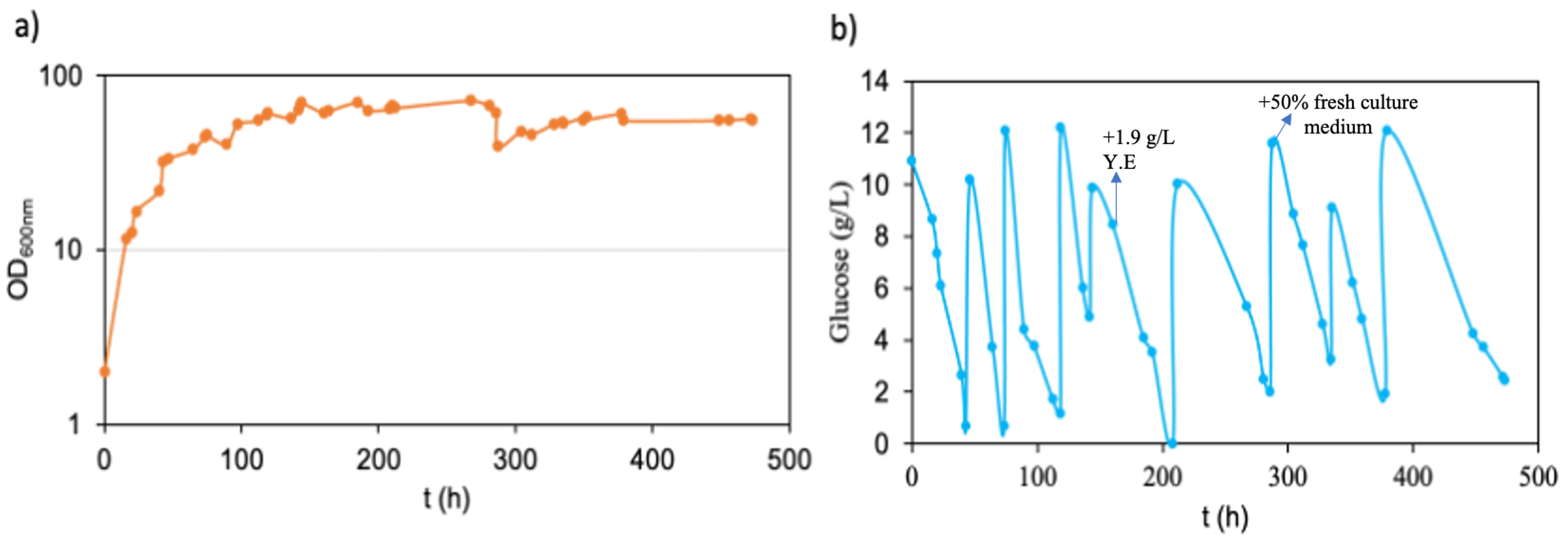
Figure 1 shows the optical density measured at 600 nm and glucose consumption over time. R. toruloides managed to grow fast under these culture conditions, with a very short lag phase (<16 h) that was not detectable at the sampling intervals used. The rapid initial increase in optical density is consistent with the relatively high inoculum concentration, which allowed the culture to enter exponential growth almost immediately. An optical density of 11.55 was already observed hardly 16 h after inoculation. The experiment lasted a total of 473 h, during which samples were taken and analyzed periodically to determine cell growth and substrate consumption. A total of nine successive glucose additions were applied whenever the substrate was basically fully depleted from the culture medium, as it was previously found that increasing amounts of substrate can benefit the accumulation of more lipids up to a certain level [24]. In addition, the C/N ratio in the bioreactor was increasing due to the progressive assimilation of the nitrogen source present in the fermentation broth. The biomass concentration reached its maximum value 267 h after inoculation, observing the highest optical density, OD600nm = 71.9, after having consumed 52.56 g/L glucose. Overall, a total of 81.1 g/L glucose had been consumed at the end of the last substrate addition, when stopping the experiment.
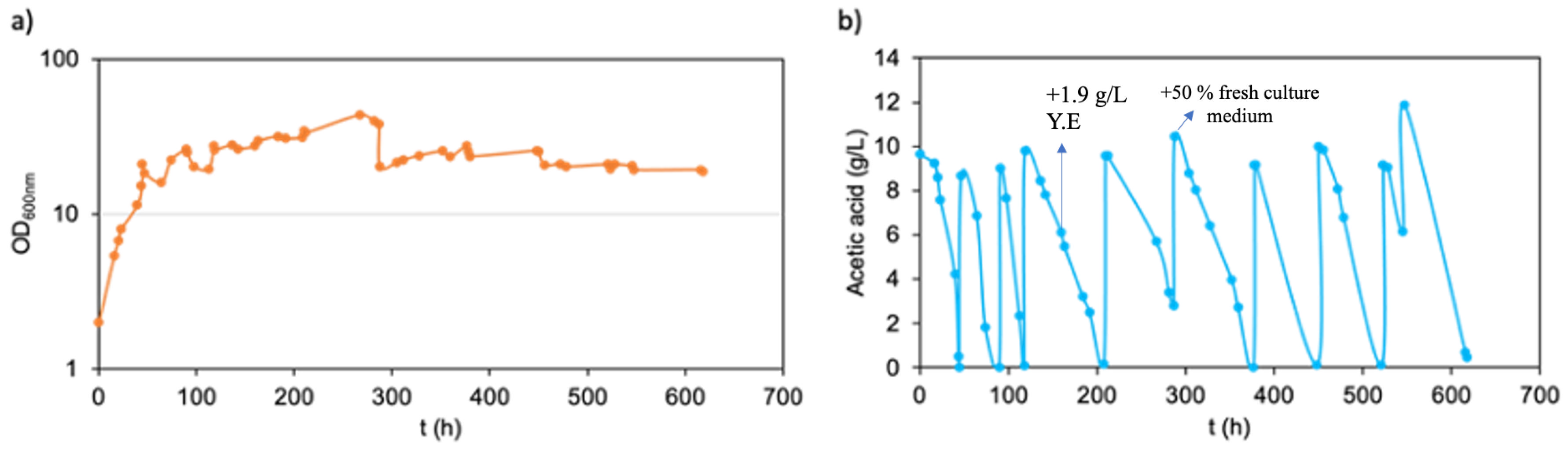
Knowing that glucose is one of the most commonly used substrates for the synthesis of metabolites of industrial interest, such as lipids and carotenoids, but also bearing in mind the high cost of this sugar, the use of other, more cost-effective carbon sources was considered. Therefore, a second fermentation was carried out using acetic acid as the only carbon source. Acetic acid was used as a single substrate in these assays, as this is generally the only carboxylic acid produced from acetogenic C1 gas fermentation, contrary to complex acid mixtures commonly obtained from acidogenic waste or wastewater fermentation, as explained above. Figure 2 shows the optical density measured at 600 nm as well as acetic acid consumption over time. R. toruloides managed to grow fast and rather well, again without any clear or significant lag phase (<16 h), but here, growth was somewhat slower compared to glucose. Indeed, in this case, an optical density of 5.34 was observed 16 h after inoculation, which is lower than that with the sugar. Therefore, this fermentation lasted longer, and a total of 618 h were needed in order to achieve a total amount of substrate consumed similar to that in the fermentation with glucose, i.e., around 80 g/L. Overall, ten successive acetic acid additions were applied, which allowed for the supply of a relatively high overall substrate concentration without having to fear significant microbial inhibition, though some possible specific level of toxic effect cannot be excluded. The biomass concentration also reached its maximum value 267 h after inoculation, observing the highest optical density, OD600nm = 43.5, after having consumed 40.7 g/L acetic acid. A total of 87.4 g/L acetic acid had been consumed at the end of the last substrate addition.
Comparing Figure 1 and Figure 2, it can be concluded that R. toruloides grows better in the presence of glucose; in such fermentation, the maximum biomass reached is 1.65 times higher than that found in the culture with acetic acid. This may be partly justified by the possible inhibitory effects, even if limited, on cell growth caused by the presence of a VFA, despite its stepwise supply [25]. In addition to possible inhibitory effects of acetate, which will generally reduce growth rates and may limit product concentrations, this substrate has a low energy content compared to glucose, and it is also necessary to take into account that energy and redox balance are very important in cell growth [26]. On the other hand, as both cultures progressed, a decrease in the substrate consumption rates could be observed. Therefore, after 160 h of fermentation, it was decided to add more yeast extract to both media (to reach the same concentration as at the beginning, i.e., 1.9 g/L), knowing that in other studies, this resulted in the possibility to maintain rather constant consumption rates from the beginning [27]. However, adding more yeast extract did not significantly increase the consumption rate under the conditions used in this study and with this specific oleaginous yeast strain. Also, after 287 h of fermentation, it was decided to add 50% fresh culture medium, with the same objective as before, i.e., to try to increase the glucose and acetic acid consumption rates again in each fermentation. However, no clear increase in consumption rates was observed in this case either. Thus, the limitation of any key nutrient did not seem to be the reason for the observed decreased rates. The highest consumption rates achieved in the glucose and acetic fermentations were 0.3536 and 0.5314 g/L·h, respectively, corresponding in both cases to the second substrate addition. Although R. toruloides managed to initiate growth faster in the sugar fermentation and also managed to grow more vigorously in this case, the highest consumption rate measured was for the acid fermentation, which should be seen as a very promising result. This could be justified by the fact that acetate can be directly cleaved to acetyl-CoA in a single step. This conversion is catalyzed by acetyl-CoA synthetase, which activates acetate using ATP to form acetyl-CoA. This allows direct entry of acetate into central metabolism.
These consumption values are summarized in detail in Table 1. These results are comparable or even superior to those obtained in other reported studies. For example, Naveira-Pazos et al. [24], working with Yarrowia lipolytica W29, reached a maximum acetic acid consumption rate in batch experiments with an acid mixture of 0.664 g/L·h for an initial acid concentration of 16 g/L. However, in the bioreactor studies, also choosing as initial conditions an optical density of 2 and 10 g/L of initial mixed acids (acetic, butyric, and hexanoic acids), the maximum acid consumption rate, encompassing the mixture of the three acids, was 0.299 g/L·h for the first addition, and was also observed to decrease progressively with additional substrate supplies. Robles-Iglesias et al. [4] achieved an acetic acid consumption rate of 0.335 g/L·h in batch experiments for an initial acetic acid concentration of 15.4 g/L, but with R. toruloides DSM 10134.
Interestingly, R. toruloides DSM 4444 shows the ability to assimilate not only common substrates, such as glucose, but also substrates typically obtained from the anaerobic fermentation of wastes, greenhouse gas emissions, or other pollutants, such as VFAs.
The observed patterns of growth and substrate consumption provide the basis for lipid and carotenoid accumulation, as once cell growth slows down and substrate is still available, carbon can be redirected towards storage metabolites such as lipids and carotenoids. Since measurements of these metabolites required larger sample volumes and longer processing times, fewer samples were taken than for monitoring cell growth and substrate consumption. Therefore, the data are presented as a function of substrate consumed rather than absolute time. The following section describes the lipid and carotenoid production profiles in fermentations with glucose and acetic acid as substrates.

3.2. Lipid Production

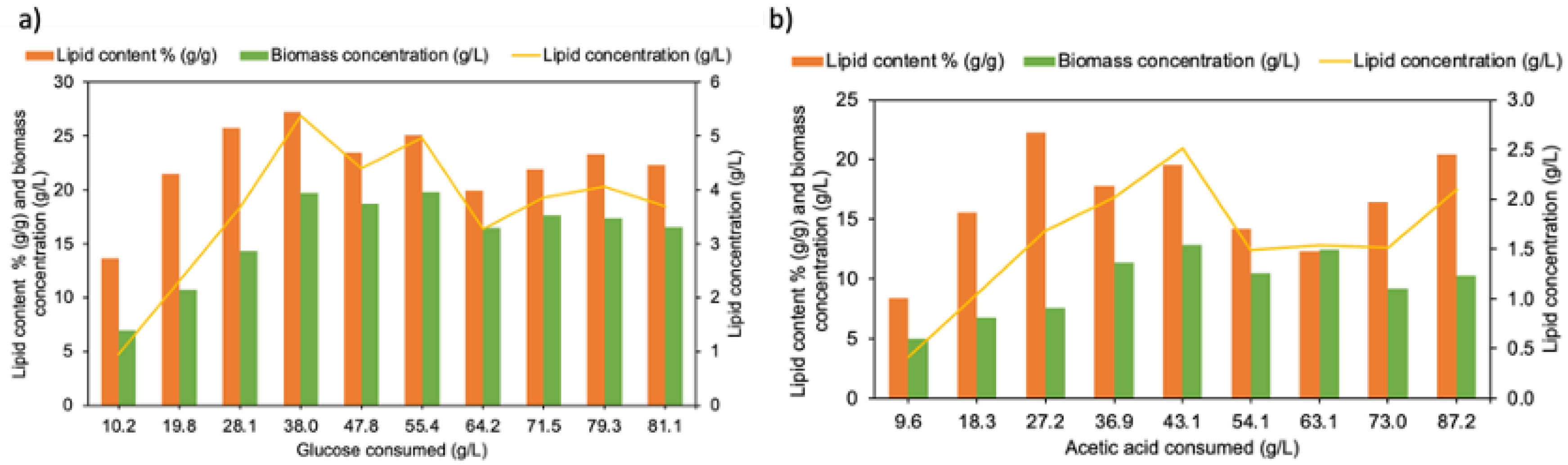
During the two fermentations carried out in this study (Section 3.1), samples were collected to assess and compare the ability of R. toruloides to produce lipids and carotenoids as a function of the amount of substrate consumed and the carbon source used. Figure 3 shows the amount of lipids (% g/g) and the concentration of lipids (g/L) obtained as a function of the concentration of substrate consumed, for each of the fermentations carried out.
The results obtained in both fermentations indicate that as the yeast consumes more substrate, either glucose or acetic acid, lipid production is favored. A maximum lipid content of 27.2% was reached for 38.0 g/L glucose consumed and 22.3% for 27.2 g/L acetic acid consumed. From these optimum points, the lipid content decreased slightly later on, confirming the reproducibility of these results independently of the substrate used. In addition, biomass and lipid concentrations seemed to follow the same trend, thus first increasing as the substrate is consumed and then decreasing slightly. Biomass and lipid concentrations were higher when glucose was the carbon source. Specifically, maximum amounts of biomass and lipids of 19.7 g/L and 5.38 g/L, respectively, were reached with glucose, and 12.85 g/L and 2.51 g/L, respectively, were achieved with acetic acid. Other research studies have also estimated the lipid content as a function of substrate consumption. Robles-Iglesias et al. [4] conducted batch experiments to check the inhibitory effect of acetic acid on R. toruloides DSM 10134 and observed that lipid production increased with increasing substrate concentrations consumed, up to a certain threshold concentration. The highest values achieved in terms of lipid content and concentration were 17.8% per gram dry weight and 0.73 g/L, respectively. Krikigianni et al. [28] worked with Rhodotorula toruloides NCYC 1576 and also showed that in their assays carried out with glucose, the biomass and lipid concentrations were higher than with acetic acid. However, in contrast to the results obtained in the present research, the highest lipid content was obtained using acetic acid. Furthermore, in order to increase lipid accumulation, in the above-cited study, R. toruloides was grown at a C/N ratio of 100, and the initial amount of substrate was increased to 30 g/L acetic acid or glucose. The biomass and lipid concentrations obtained were then, respectively, 12.2 g/L and 5.6 g/L for glucose and 7.5 g/L and 4.2 g/L for acetic acid. Regarding the lipid content under these same conditions, the values obtained were 45.8% and 56.4% for glucose and acetic acid, respectively. In that recent study, the high yields obtained could be due, among other factors, to the use of a favorable initial C/N ratio, contrary to the one used in the present study. In line with this, Huang et al. [29] also increased the C/N ratio and managed to increase the lipid content using R. toruloides AS 2.1389. Indeed, with an acetic acid concentration of 20 g/L and a C/N ratio of 200 in a batch culture, they achieved a lipid content of 48.2%, compared to 38.6% using 4 g/L acetic acid and a C/N ratio of 100 in a sequencing batch culture (SBC). On the other hand, it is important to mentionother studies, such as those reported by Naveira-Pazos et al. [24] as well as Robles-Iglesias et al. [30], observing similar results, also indicating an increase in lipid content as the amount of substrate consumed increased, though working with another oleaginous yeast, i.e., Yarrowia lipolytica.
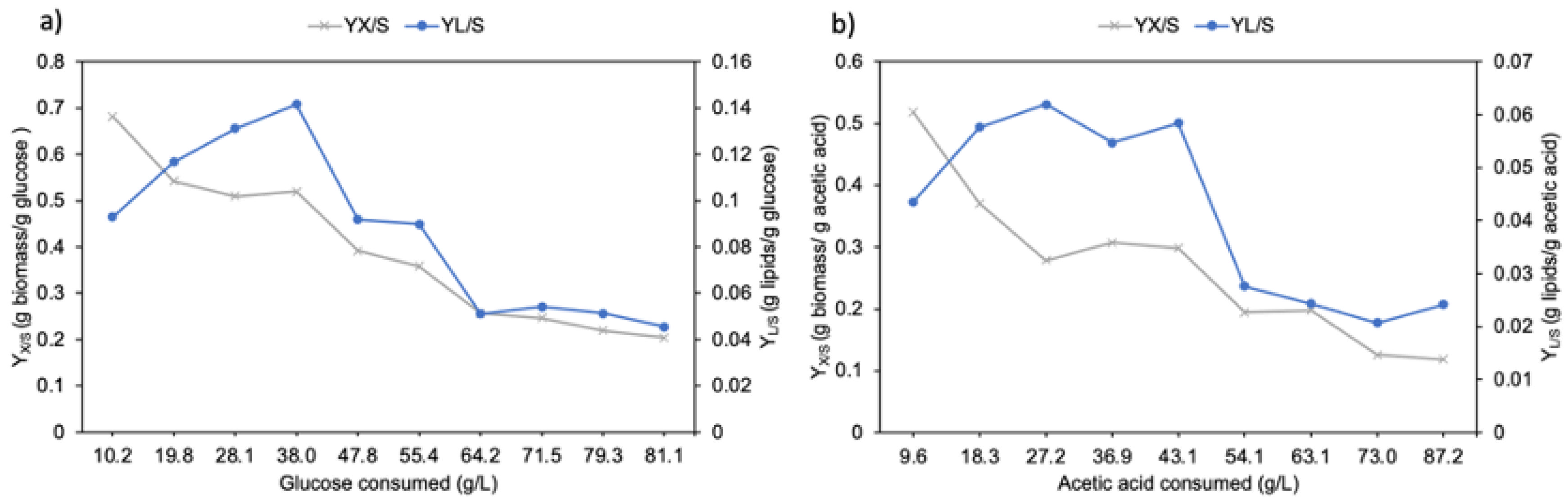
Figure 4 shows the lipid and biomass yields (YL/S and YX/S, respectively) for each concentration of glucose (Figure 4a) and acetic acid (Figure 4b). While the biomass yield decreases with increasing amounts of substrate consumed, substrate consumption has a favorable effect on the lipid yield up to a certain point; maximum lipid yields of 0.14 g/g glucose and 0.06 g/g acetic acid were reached for 38 g/L and 27.2 g/L substrate consumed in each case. Generally, the highest yields for both biomass and lipids are achieved with glucose. These results sound promising, as they indicate that after the yeast’s initial growth, substrate consumption is directed more towards lipid production rather than cell growth. Regarding the lipid yields obtained with acetic acid, the maximum YL/S reached in this experiment was higher than reported in some other recent studies. Robles-Iglesias et al. [4] observed a maximum YL/S of 0.047 g/gC for an initial acetic acid concentration of 15.4 g/L, working with another strain, R. toruloides DSM 10134, in batch mode, and with no detection of carotenoids. Comparing now with the yeast Yarrowia lipolytica NCYC 2904, Pereira et al. [31] achieved higher lipid yields than those in the present study (YL/S = 0.145) in batch cultures carried out in STR with pure VFAs.
These results demonstrate the great value of VFAs, which can be derived from a wide variety of wastes or even polluting gases, as low-cost substrates for both biomass and lipid production. Therefore, this is a promising technology based on microorganisms that allows obtaining value-added products while contributing to environmental welfare through the use of pollutants. The high lipid yields achieved in this study highlight the potential of this approach for sustainable biofuel production, offering a cost-effective and environmentally friendly alternative to traditional feedstocks. This research contributes to ongoing efforts to develop efficient processes for the conversion of waste and other pollutants, including solid waste, liquid effluents, and greenhouse gases, into high-value energy products. This approach simultaneously addresses challenges of waste management, pollution reduction, and renewable energy production.

3.3. Fatty Acid Composition

Numerous individual FAME species make up the biodiesel produced from triglyceride transesterification. However, the most common fatty acids in biodiesel are palmitic acid (C16:0), stearic acid (C18:0), oleic acid (C18:1), linoleic acid (C18:2), and linolenic acid (C18:3) [32]. According to the literature, this composition agrees with that obtained in other investigations with R. toruloides [4,29,33]. The lipid composition obtained in this work can be found in Table 2 for the fermentation using glucose as substrate and in Table 3 for the fermentation using acetic acid as the only carbon source.
Table 2 and Table 3 show that the profiles obtained from different substrates are very similar, with no significant differences in terms of percentages for any of the compounds determined. Oleic acid (C18:1), very suitable for biodiesel production, represents the dominant acid in both fermentations, both at low and high concentrations of substrate consumed, accounting for about 50%. In general, despite slight deviations, the lipid composition is fairly constant regardless of the type and the amount of substrate consumed. The trend of the lipid composition, in terms of abundance, was as follows: C18:1 > C16:0 > C18:0 > C18:2 ≈ Others.
Huang et al. [29], in their study with R. toruloides AS 2.1389 and with 20 g/L acetic acid as substrate, obtained a lipid profile very similar to that of the present research, with small differences for C16:0 and C18:0, which reached slightly lower and higher values, respectively. In the culture with 20 g/L glucose, the lipid profile obtained shows a ratio of abundances practically the same as that in the present research. Gao et al. [34] focused on evaluating crude glycerol impurities for lipid production by Rhodotorula toruloides 32489, and they obtained different results in terms of lipid profile. In their research, linoleic acid (C18:2) reached 43% of the total amount of FAMEs, while oleic acid (C18:1) accounted for about 20% of the 60 g/L glycerol consumed. With these findings and those of other studies, it can be reaffirmed that the lipid profile obtained using oleaginous yeasts can vary considerably even when using the same microorganism.
In conclusion, R. toruloides DSM 4444 has the ability to synthesize lipids at levels exceeding 20%, even using acetic acid as the only carbon source, which had not been reported previously with such a substrate. Furthermore, the accumulated fatty acids indicate that the lipid profile obtained is very similar to that of vegetable and soybean oils, which is another reason to believe that the oil produced by this strain, even using acetic acid as a substrate, could be used to obtain biofuels such as biodiesel. In this sense, the production of lipids through the use of low-value raw materials using this oleaginous yeast strain can be considered a promising strategy, thus encouraging further studies on its capacity to obtain value-added products through the assimilation of VFAs obtained from the valorization of pollutants, favoring the use of renewable sources, and promoting environmental protection and the circular economy in general.

3.4. Carotenoids Production

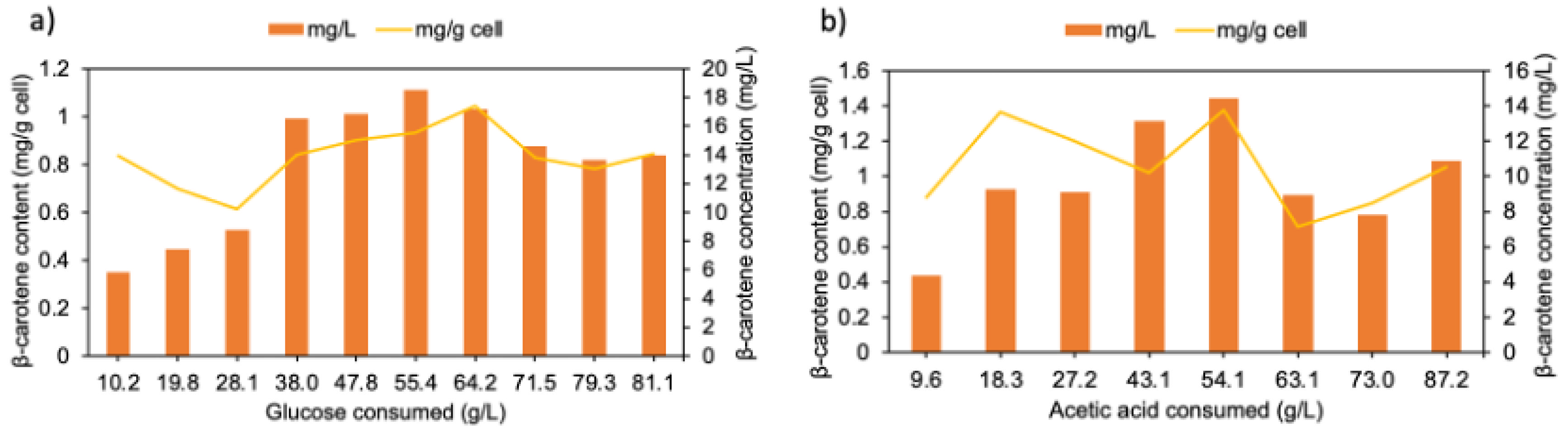
During the experiments, at the same time, samples were taken for lipid determination and to assess carotenoid production. In this case, the determination of total carotenoids was carried out and quantified in terms of β-carotene equivalent. In addition to lipid production, we found that R. toruloides DSM 4444 was also able to simultaneously produce carotenoids from either glucose or acetic acid, which is a very encouraging result. Figure 5 shows the production of β-carotene equivalent throughout the experiment, at different concentrations of substrate consumed.
The best result obtained, in terms of concentration of β-carotene equivalent, was 18.5 mg/L in the glucose fermentation and 14.4 mg/L in the acetic acid fermentation, with these two best results corresponding to a consumption of approximately 55 g/L substrate. As in the case of the lipid concentration, the amount of β-carotene equivalent accumulated also first follows an upward trend as the substrate is consumed, until it reaches the maximum point, and then remains constant or even slightly decreases. With regard to the β-carotene equivalent content (mg/g cell), it follows a slightly different trend. In the case of the fermentation with glucose, the β-carotene equivalent content starts to decrease from the beginning up to a total glucose consumption of 28.1 g/L, while from this point onwards, the trend starts to increase, reaching a maximum of 1 mg/g cell for 64.2 g/L substrate consumed. From this point on, the carotenoid content decreases slightly and remains approximately constant as the yeast continues to consume glucose. However, the results obtained in the acetic acid fermentation show that the content starts increasing from the beginning up to 54.1 g/L acetic acid consumed, and then it decreases slightly. Furthermore, it is worth noting that better results were obtained in this experiment, with the acid as carbon source, compared with glucose, reaching a β-carotene equivalent content of 1.4 mg/g cell also for approximately 55 g/L acetic acid consumed. In this case, the maximum β-carotene equivalent concentration and content coincide for the same amount of acetic acid consumed.
Bertacchi et al. [16] also conducted studies with R. toruloides DSM 4444, but used hydrolysate of Camelina sativa meal as biomass for carotenoid production. The best result obtained in shake flasks was 16 ± 1.9 mg/L carotenoids (β-carotene) under simultaneous saccharification and fermentation conditions. Bertacchi et al. [35], in subsequent research, focused on optimizing carotenoid production using the same biomass and the same yeast strain as in their previous study. In this case, the process was carried out in stirred tank bioreactors, and a concentration of 3.6 mg/L carotenoids (β-carotene) was achieved. Nagaraj et al. [36] studied the production of carotenoids (and lipids) by Rhodotorula toruloides CBS 14 grown on wheat straw hydrolysate. They were able to identify β-carotene, γ-carotene, torularhodin, and torulene, where the first was the major one, reaching a value of 1.48 mg β-carotene/100 g dry weight.
These findings and other results reported in the literature indicate that the data obtained in the present research are highly promising and highlight the ability of this native yeast strain to assimilate low-cost substrates such as VFAs and produce metabolites of great industrial interest. In particular, the experimental results demonstrate that acetic acid supports comparable substrate consumption to glucose while enhancing carotenoid accumulation, enabling the simultaneous production of microbial lipids and carotenoids. This co-production strategy establishes an efficient biotechnological approach for converting waste-derived substrates into both biofuel precursors and high-value carotenoids, thereby contributing to reduced production costs and lower environmental impact.

3.5. Key Findings on CO2 Valorization for Carotenoids and Lipids Production

As described in Section 2.3 of Materials and Methods, experiments were carried out in bottles to evaluate the production of carotenoids (and lipids) using an acetogenic fermented medium. The fermented medium was obtained by culturing, under anaerobic conditions, A. woodii in the presence of CO2 + H2, which allows the conversion of a contaminated gas into acetic acid through the Wood–Ljungdahl pathway [37]. Acetic acid present in the resulting medium served as a substrate for the culture of R. toruloides. Thus, these assays were intended to determine the ability of the yeast to grow and produce metabolites from a substrate derived from a sustainable biotechnological process, in contrast to the synthetic medium used in the above bioreactor experiments. This new approach seeks to explore the potential of valorizing industrial wastes and greenhouse gases (CO2) by obtaining value-added compounds.
After gas fermentation with A. woodii, a final acetic acid concentration of 26 g/L was reached after 47 days of culture. Then, the acetic acid-rich medium was centrifuged to remove residual biomass and to obtain a clean supernatant for subsequent use in bottle trials with R. toruloides DSM 4444. In addition, as mentioned above, the medium was diluted to reach an acetic acid concentration of 10 g/L, suitable for the yeast.
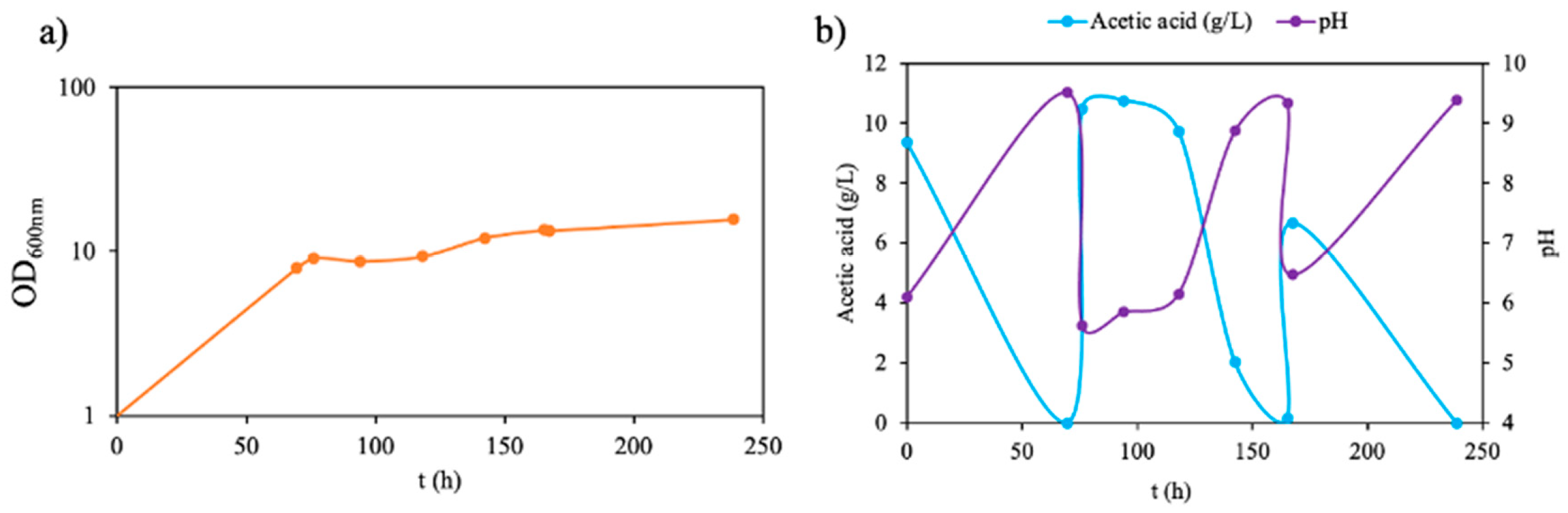
Figure 6 shows the growth, acetic acid consumption, and pH of the culture medium during the bottle tests with R. toruloides DSM 4444, carried out in duplicate. A progressive increase in biomass is observed, reaching OD600nm values above 10 after approximately 140 h, and growth is also associated with the progressive consumption of acetic acid. In this case, and contrary to the bioreactor experiments, pH could not be strictly controlled during fermentation. It can be seen in the figure that this parameter tends to increase as acetic acid is consumed due to the reduction in the acidity of the medium. During cultivation, two further additions of acetic acid were carried out, but taking care not to exceed 10 g/L to avoid inhibitory effects and also making sure that the pH did not drop below about 6 after each addition, thus maintaining favorable conditions for the microorganism. These adjustments are reflected in the peaks observed in the acetic acid concentration as well as in the pH evolution. At the end of the fermentation, the yeast had consumed 26 g/L acetic acid. The most remarkable aspect of these results is that the growth of R. toruloides was obtained in a real fermented medium, rather than a synthetic one, derived from CO2-gas fermentation.
This approach is promising, especially from an industrial perspective, as it demonstrates the robustness of the yeast to adapt and grow in complex matrices, with possible impurities and variations, which are characteristics of full-scale biotechnological processes. R. toruloides shows efficient growth capacity under these conditions, reinforcing its potential in integrated gas conversion processes, widening the range of viable fermented media for the synthesis of high-value-added products.
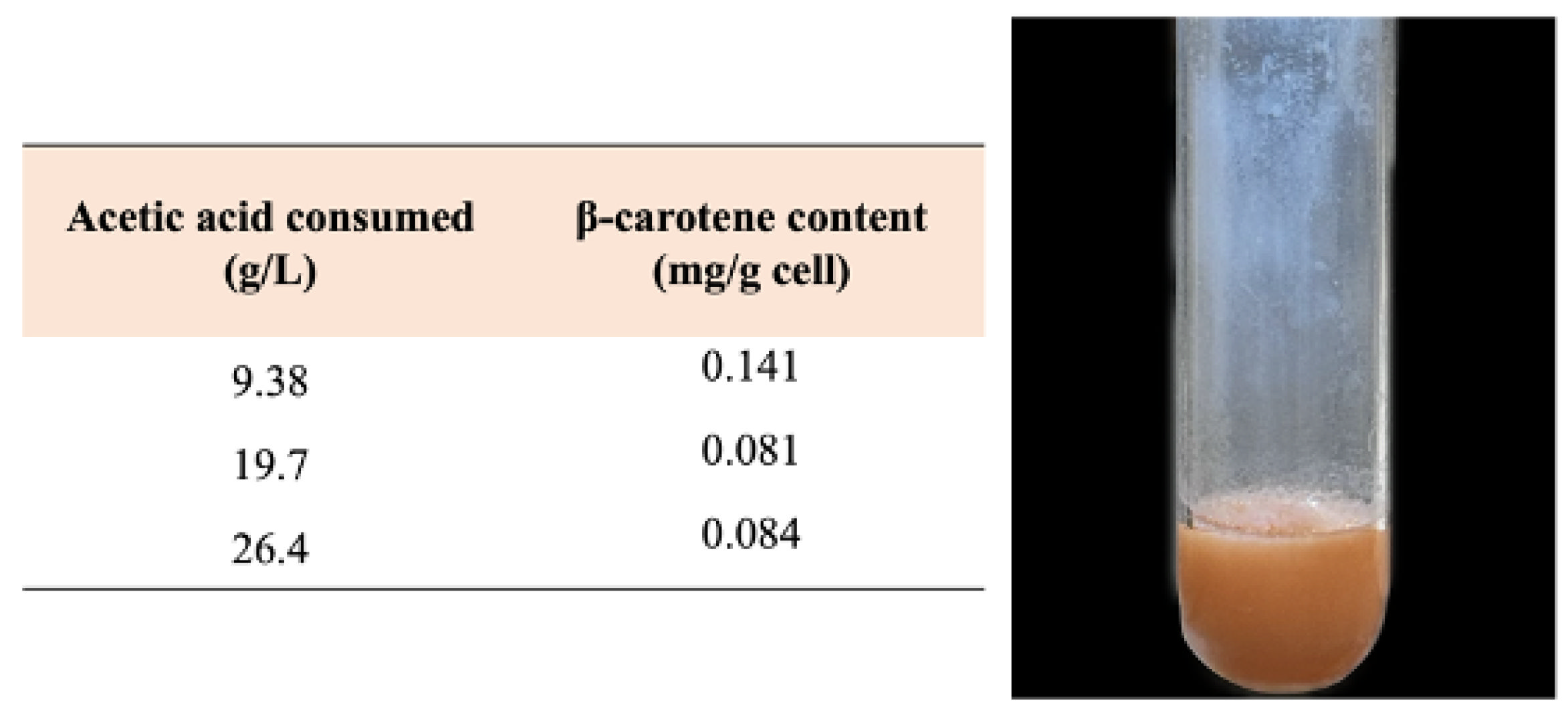
The possible production of carotenoids from this fermented medium was also evaluated. Figure 7 shows, on the left, the total carotenoid content (mg β-carotene/g cell) obtained as a function of the amount of acetic acid consumed and, on the right, the biomass obtained after cultivation, where the characteristic pigmentation of carotenoid accumulation is clearly observed.
The highest carotenoid accumulation (0.141 mg/g) was achieved after an acetic acid consumption of 9.38 g/L. However, as the total amount of acid consumed increased, the content of β-carotene equivalent decreased. These values are lower than those obtained in the bioreactor experiments with either glucose or acetic acid (see Figure 5). This shows the influence of the type of medium and culture conditions on the ability of R. toruloides to accumulate these types of metabolites. However, the use of a real medium, derived from fermentation with CO2 gas, must be taken into account, which entails greater complexity and is less favorable than the more optimized synthetic medium. On the other hand, it is also interesting to note that, both in the fermented medium and in the bioreactor tests with synthetic medium, the content of β-carotene equivalent does not follow a linear trend with respect to substrate consumption. Generally, a maximum value is reached, which then decreases as substrate consumption increases. However, in the bioreactor trials, a slight recovery of the β-carotene equivalent content is then observed, unlike in the bottle cultures, as no more acetic acid is added, limiting the possibility of detecting additional phases of carotenoid accumulation. In addition to carotenoids, the production of lipids was also analyzed. Although the values obtained were relatively modest, a lipid content of 9.54% (g lipid/g dry cell weight) was measured in the biomass at the end of the fermentation. This result, although preliminary, highlights the potential of R. toruloides for the co-production of carotenoids and lipids from CO2-derived acetic acid.
The carotenoid concentration obtained in this study in bottles has the potential to be further improved, and it is important to compare these results with other data reported in the literature for R. toruloides. For example, Gao et al. [38] achieved a carotenoid content of 1.29 mg/g with R. toruloides Z11 under optimized growth and light conditions, whereas, for example, the review of Ochoa-Viñals et al. [39] shows how, depending on the substrate, culture conditions, and the specific yeast strain used, the pigment concentration can vary widely. Generally, values are lower in real or non-optimized media, such as agro-industrial waste (e.g., 0.42 mg/g total carotenoids for strain R. toruloides NCYC 921 grown on carob pulp syrup) [40], but, even so, higher values have also been reported in some cases [39].
In that sense, further optimization of culture conditions, such as pH, C/N ratio, and substrate feeding strategy, would be required to improve process performance. However, it should be emphasized that the primary objective of this study was not process optimization but the demonstration of the technical feasibility of an integrated gas-to-yeast bioprocess, which should therefore be considered a proof-of-concept. Accordingly, the discussion focuses primarily on yields and product formation relative to substrate availability rather than productivity parameters, which can be addressed in future optimization studies.
Even so, to the best of our knowledge, there are no previous studies reporting the production of carotenoids from carboxylic acids using the strain R. toruloides DSM 4444, with even none addressing the simultaneous co-production of lipids and carotenoids from CO2-derived acetic acid by this yeast strain. Despite the relatively long cultivation times compared to industrial standards, these results demonstrate the feasibility of this novel integrated approach and highlight the need for further optimization, including reduction of cultivation time, improvement of productivity, and medium simplification, before industrial implementation can be considered.
Overall, these preliminary validation studies constitute an important basis for future optimization and scale-up and open new horizons for the valorization of waste gases to produce high-added-value bioproducts.


4. Conclusions

This work is the first to demonstrate that R. toruloides species, and more specifically strain DSM 4444, not only metabolizes common substrates such as glucose but also carboxylic acids derived from C1-gas (CO2) fermentation for the simultaneous production of lipids and carotenoids. The lipid content was very similar with either glucose or acetic acid, and the lipid profiles were similar to those of vegetable oils. The amount of carotenoids accumulated with acetic acid, in terms of β-carotene equivalent content, was even higher than with glucose. These results demonstrate the potential of this strain as a promising microbial platform to simultaneously produce biofuel precursors and high-value compounds using acetic acid as a carbon source. This study aligns with our research objective of valorizing gaseous pollutants, supporting sustainable biofuel production, and applying principles of the circular economy.

Author Contributions

C.N.-P.: writing—review and editing, methodology, investigation, and data curation. M.C.V.: writing—review and editing, supervision, resources, and funding acquisition. C.K.: writing—review and editing, supervision, resources, project administration, funding acquisition, data curation, and conceptualization. All authors have read and agreed to the published version of the manuscript.

Funding

This research is part of a project funded by the Spanish Ministry of Science and Innovation and European FEDER funds (PID2023-151067OB-I00).

Institutional Review Board Statement

Not applicable.

Informed Consent Statement

Not applicable.

Data Availability Statement

The original contributions presented in this study are included in the article. Further inquiries can be directed to the corresponding author.

Acknowledgments

The authors, belonging to the BIOENGIN group, thank Xunta de Galicia for the financial support to Competitive Reference Research Groups (ED431C 2025/36).

Conflicts of Interest

The authors declare no conflict of interest.

References

  1. Schneider, T.; Graeff-Hönninger, S.; French, W.T.; Hernandez, R.; Merkt, N.; Claupein, W.; Hetrick, M.; Pham, P. Lipid and Carotenoid Production by Oleaginous Red Yeast Rhodotorula glutinis Cultivated on Brewery Effluents. Energy 2013, 61, 34–43. [Google Scholar] [CrossRef]
  2. Timilsina, G.R.; Shrestha, A. How Much Hope Should We Have for Biofuels? Energy 2011, 36, 2055–2069. [Google Scholar] [CrossRef]
  3. Robles-Iglesias, R.; Naveira-Pazos, C.; Fernández-Blanco, C.; Veiga, M.C.; Kennes, C. Factors Affecting the Optimisation and Scale-up of Lipid Accumulation in Oleaginous Yeasts for Sustainable Biofuels Production. Renew. Sustain. Energy Rev. 2023, 171, 113043. [Google Scholar] [CrossRef]
  4. Robles-Iglesias, R.; Veiga, M.C.; Kennes, C. Carbon Dioxide Bioconversion into Single Cell Oils (Lipids) in Two Reactors Inoculated with Acetobacterium woodii and Rhodosporidium toruloides. J. CO2 Util. 2021, 52, 101668. [Google Scholar] [CrossRef]
  5. Leong, W.H.; Lim, J.W.; Lam, M.K.; Uemura, Y.; Ho, Y.C. Third Generation Biofuels: A Nutritional Perspective in Enhancing Microbial Lipid Production. Renew. Sustain. Energy Rev. 2018, 91, 950–961. [Google Scholar] [CrossRef]
  6. Bao, W.; Li, Z.; Wang, X.; Gao, R.; Zhou, X.; Cheng, S.; Men, Y.; Zheng, L. Approaches to Improve the Lipid Synthesis of Oleaginous Yeast Yarrowia lipolytica: A Review. Renew. Sustain. Energy Rev. 2021, 149, 111386. [Google Scholar] [CrossRef]
  7. Bonatsos, N.; Marazioti, C.; Moutousidi, E.; Anagnostou, A.; Koutinas, A.; Kookos, I.K. Techno-Economic Analysis and Life Cycle Assessment of Heterotrophic Yeast-Derived Single Cell Oil Production Process. Fuel 2020, 264, 116839. [Google Scholar] [CrossRef]
  8. Fei, Q.; Chang, H.N.; Shang, L.; dal rae Choi, J.; Kim, N.J.; Kang, J.W. The Effect of Volatile Fatty Acids as a Sole Carbon Source on Lipid Accumulation by Cryptococcus albidus for Biodiesel Production. Bioresour. Technol. 2011, 102, 2695–2701. [Google Scholar] [CrossRef]
  9. Igreja, W.S.; Maia, F.d.A.; Lopes, A.S.; Chisté, R.C. Biotechnological Production of Carotenoids Using Low Cost-Substrates is Influenced by Cultivation Parameters: A Review. Int. J. Mol. Sci. 2021, 22, 8819. [Google Scholar] [CrossRef]
  10. Naveira-Pazos, C.; Robles-Iglesias, R.; Fernández-Blanco, C.; Veiga, M.C.; Kennes, C. State-of-the-Art in the Accumulation of Lipids and Other Bioproducts from Sustainable Sources by Yarrowia lipolytica. Rev. Environ. Sci. Biotechnol. 2023, 22, 1131–1158. [Google Scholar] [CrossRef]
  11. Ochsenreither, K.; Glück, C.; Stressler, T.; Fischer, L.; Syldatk, C. Production Strategies and Applications of Microbial Single Cell Oils. Front. Microbiol. 2016, 7, 1539. [Google Scholar] [CrossRef]
  12. Souza, K.S.T.; Ramos, C.L.; Schwan, R.F.; Dias, D.R. Lipid Production by Yeasts Grown on Crude Glycerol from Biodiesel Industry. Prep. Biochem. Biotechnol. 2017, 47, 357–363. [Google Scholar] [CrossRef]
  13. Tomás-Pejó, E.; González-Fernández, C.; Greses, S.; Kennes, C.; Otero-Logilde, N.; Veiga, M.C.; Bolzonella, D.; Müller, B.; Passoth, V. Production of Short-Chain Fatty Acids (SCFAs) as Chemicals or Substrates for Microbes to Obtain Biochemicals. Biotechnol. Biofuels Bioprod. 2023, 16, 96. [Google Scholar] [CrossRef] [PubMed]
  14. Fei, Q.; Chang, H.N.; Shang, L.; Choi, J.D.R. Exploring Low-Cost Carbon Sources for Microbial Lipids Production by Fed-Batch Cultivation of Cryptococcus albidus. Biotechnol. Bioprocess Eng. 2011, 16, 482–487. [Google Scholar] [CrossRef]
  15. Mussagy, C.U.; Remonatto, D.; Picheli, F.P.; Paula, A.V.; Herculano, R.D.; Santos-Ebinuma, V.C.; Farias, R.L.; S. D. Onishi, B.; J. L. Ribeiro, S.; F. B. Pereira, J.; et al. A Look into Phaffia rhodozyma Biorefinery: From the Recovery and Fractionation of Carotenoids, Lipids and Proteins to the Sustainable Manufacturing of Biologically Active Bioplastics. Bioresour. Technol. 2022, 362, 127785. [Google Scholar] [CrossRef] [PubMed]
  16. Bertacchi, S.; Bettiga, M.; Porro, D.; Branduardi, P. Camelina sativa Meal Hydrolysate as Sustainable Biomass for the Production of Carotenoids by Rhodosporidium toruloides. Biotechnol. Biofuels 2020, 13, 47. [Google Scholar] [CrossRef]
  17. Mussagy, C.U.; Winterburn, J.; Santos-Ebinuma, V.C.; Pereira, J.F.B. Production and Extraction of Carotenoids Produced by Microorganisms. Appl. Microbiol. Biotechnol. 2019, 103, 1095–1114. [Google Scholar] [CrossRef]
  18. Mata-Gómez, L.C.; Montañez, J.C.; Méndez-Zavala, A.; Aguilar, C.N. Biotechnological Production of Carotenoids by Yeasts: An Overview. Microb. Cell Factories 2014, 13, 12. [Google Scholar] [CrossRef]
  19. Carotenoids Market Growth, Analysis, Trends, Forecast 2032. Available online: https://market.us/report/carotenoids-market/ (accessed on 22 June 2023).
  20. Elvira-Torales, L.I.; García-Alonso, J.; Periago-Castón, M.J. Nutritional Importance of Carotenoids and Their Effect on Liver Health: A Review. Antioxidants 2019, 8, 229. [Google Scholar] [CrossRef]
  21. Gao, R.; Li, Z.; Zhou, X.; Bao, W.; Cheng, S.; Zheng, L. Enhanced Lipid Production by Yarrowia lipolytica Cultured with Synthetic and Waste-Derived High-Content Volatile Fatty Acids under Alkaline Conditions. Biotechnol. Biofuels 2020, 13, 3. [Google Scholar] [CrossRef]
  22. Park, Y.K.; González-Fernández, C.; Robles-Iglesias, R.; Vidal, L.; Fontanille, P.; Kennes, C.; Tomás Pejó, E.; Nicaud, J.M.; Fickers, P. Bioproducts Generation from Carboxylate Platforms by the Non-Conventional Yeast Yarrowia lipolytica. FEMS Yeast Res. 2021, 21, foab047. [Google Scholar] [CrossRef]
  23. Paul, D.; Kumari, P.K.; Siddiqui, N. Yeast Carotenoids: Cost-Effective Fermentation Strategies for Health Care Applications. Fermentation 2023, 9, 147. [Google Scholar] [CrossRef]
  24. Naveira-Pazos, C.; Veiga, M.C.; Kennes, C. Accumulation of Lipids by the Oleaginous Yeast Yarrowia lipolytica Grown on Carboxylic Acids Simulating Syngas and Carbon Dioxide Fermentation. Bioresour. Technol. 2022, 360, 127649. [Google Scholar] [CrossRef]
  25. Gao, R.; Li, Z.; Zhou, X.; Cheng, S.; Zheng, L. Oleaginous Yeast Yarrowia lipolytica Culture with Synthetic and Food Waste-Derived Volatile Fatty Acids for Lipid Production. Biotechnol. Biofuels 2017, 10, 247. [Google Scholar] [CrossRef]
  26. Kutscha, R.; Pflügl, S. Microbial Upgrading of Acetate into Value-Added Products—Examining Microbial Diversity, Bioenergetic Constraints and Metabolic Engineering Approaches. Int. J. Mol. Sci. 2020, 21, 8777. [Google Scholar] [CrossRef]
  27. Robles-Iglesias, R.; Fernández-Blanco, C.; Nicaud, J.-M.; Veiga, M.C.; Kennes, C. Unlocking the Potential of One-Carbon Gases (CO2, CO) for Concomitant Bioproduction of β-Carotene and Lipids. Ecotoxicol. Environ. Saf. 2024, 271, 115950. [Google Scholar] [CrossRef]
  28. Krikigianni, E.; Matsakas, L.; Rova, U.; Christakopoulos, P.; Patel, A. Investigating the Bioconversion Potential of Volatile Fatty Acids: Use of Oleaginous Yeasts Rhodosporidium toruloides and Cryptococcus curvatus towards the Sustainable Production of Biodiesel and Odd-Chain Fatty Acids. Appl. Sci. 2022, 12, 6541. [Google Scholar] [CrossRef]
  29. Huang, X.F.; Liu, J.N.; Lu, L.J.; Peng, K.M.; Yang, G.X.; Liu, J. Culture Strategies for Lipid Production Using Acetic Acid as Sole Carbon Source by Rhodosporidium toruloides. Bioresour. Technol. 2016, 206, 141–149. [Google Scholar] [CrossRef] [PubMed]
  30. Robles-Iglesias, R.; Naveira-Pazos, C.; Nicaud, J.-M.; Veiga, M.C.; Kennes, C. Two-Stage Syngas Fermentation into Microbial Oils and β-Carotene with Clostridium carboxidivorans and Engineered Yarrowia lipolytica. J. CO2 Util. 2023, 76, 102593. [Google Scholar] [CrossRef]
  31. Pereira, A.S.; Lopes, M.; Duarte, M.S.; Alves, M.M.; Belo, I. Integrated Bioprocess of Microbial Lipids Production in Yarrowia lipolytica Using Food-Waste Derived Volatile Fatty Acids. Renew. Energy 2023, 202, 1470–1478. [Google Scholar] [CrossRef]
  32. Hoekman, S.K.; Broch, A.; Robbins, C.; Ceniceros, E.; Natarajan, M. Review of Biodiesel Composition, Properties, and Specifications. Renew. Sustain. Energy Rev. 2012, 16, 143–169. [Google Scholar] [CrossRef]
  33. Llamas, M.; Dourou, M.; González-Fernández, C.; Aggelis, G.; Tomás-Pejó, E. Screening of Oleaginous Yeasts for Lipid Production Using Volatile Fatty Acids as Substrate. Biomass Bioenergy 2020, 138, 105553. [Google Scholar] [CrossRef]
  34. Gao, Z.; Ma, Y.; Wang, Q.; Zhang, M.; Wang, J.; Liu, Y. Effect of Crude Glycerol Impurities on Lipid Preparation by Rhodosporidium toruloides Yeast 32489. Bioresour. Technol. 2016, 218, 373–379. [Google Scholar] [CrossRef]
  35. Bertacchi, S.; Cantù, C.; Porro, D.; Branduardi, P. Optimization of Carotenoids Production from Camelina sativa Meal Hydrolysate by Rhodosporidium toruloides. Fermentation 2021, 7, 208. [Google Scholar] [CrossRef]
  36. Nagaraj, Y.N.; Burkina, V.; Okmane, L.; Blomqvist, J.; Rapoport, A.; Sandgren, M.; Pickova, J.; Sampels, S.; Passoth, V. Identification, Quantification and Kinetic Study of Carotenoids and Lipids in Rhodotorula toruloides CBS 14 Cultivated on Wheat Straw Hydrolysate. Fermentation 2022, 8, 300. [Google Scholar] [CrossRef]
  37. Fernández-Naveira, Á.; Veiga, M.C.; Kennes, C. H-B-E (Hexanol-Butanol-Ethanol) Fermentation for the Production of Higher Alcohols from Syngas/Waste Gas. J. Chem. Technol. Biotechnol. 2017, 92, 712–731. [Google Scholar] [CrossRef]
  38. Gao, H.; Tang, Y.; Lv, R.; Jiang, W.; Jiang, Y.; Zhang, W.; Xin, F.; Jiang, M. Transcriptomic Analysis Reveals the Potential Mechanisms for Improving Carotenoid Production in Rhodosporidium toruloides Z11 under Light Stress. J. Agric. Food Chem. 2024, 72, 3793–3799. [Google Scholar] [CrossRef] [PubMed]
  39. Ochoa-Viñals, N.; Alonso-Estrada, D.; Pacios-Michelena, S.; García-Cruz, A.; Ramos-González, R.; Faife-Pérez, E.; Michelena-Álvarez, L.G.; Martínez-Hernández, J.L.; Iliná, A. Current Advances in Carotenoid Production by Rhodotorula sp. Fermentation 2024, 10, 190. [Google Scholar] [CrossRef]
  40. Martins, V.; Dias, C.; Caldeira, J.; Duarte, L.C.; Reis, A.; Lopes da Silva, T. Carob Pulp Syrup: A Potential Mediterranean Carbon Source for Carotenoids Production by Rhodosporidium toruloides NCYC 921. Bioresour. Technol. Rep. 2018, 3, 177–184. [Google Scholar] [CrossRef]
Figure 1. (a) Growth of R. toruloides represented on a logarithmic scale obtained during cultivation in the bioreactor with 10 g/L initial glucose concentration and initial OD600nm = 2; (b) glucose consumption by R. toruloides during cultivation in the bioreactor with 10 g/L initial glucose concentration, initial OD600nm = 2, and with successive additional supplies of carbon source.
Fermentation 12 00138 g001
Figure 2. (a) Growth of R. toruloides represented on a logarithmic scale obtained during cultivation in the bioreactor with 10 g/L initial acetic acid concentration and initial OD600nm = 2; (b) acetic acid consumption by R. toruloides during cultivation in the bioreactor with 10 g/L initial acetic acid concentration, initial OD600nm = 2, and with successive additional supplies of carbon source.
Fermentation 12 00138 g002
Figure 3. Lipid content % (g/g) and biomass and lipid concentrations (g/L) as a function of the concentration of glucose (a) and acetic acid (b) consumed by R. toruloides DSM 4444.
Fermentation 12 00138 g003
Figure 4. Biomass (YX/S) and lipid (YL/S) yields as a function of the concentration of glucose (a) and acetic acid (b) consumed by R. toruloides.
Fermentation 12 00138 g004
Figure 5. β-carotene equivalent content and concentration as a function of the concentrations of glucose (a) or acetic acid (b) consumed by R. toruloides.
Fermentation 12 00138 g005
Figure 6. (a) Growth monitoring and (b) acetic acid consumption and pH changes in duplicate bottle experiments with R. toruloides DSM 4444.
Fermentation 12 00138 g006
Figure 7. Carotenoid content in biomass of R. toruloides grown in medium derived from the gas fermentation (left). On the right, biomass obtained after this cultivation, showing the characteristic orange pigmentation due to carotenoid accumulation.
Fermentation 12 00138 g007
Table 1. Glucose and acetic acid consumption rates (g/L·h) obtained for each fermentation and for each substrate addition performed.
SubstrateAddition NumberFermentation Time (h)Consumption Rate (g/L·h)
Glucose 10–430.3531
246–730.3536
375–1180.2584
4119–1420.3268
5144–2080.1607
6212–2860.1824
7287–3340.1872
8335–3770.1711
9379–4730.1105
Acetic acid10–450.3424
247–900.5315
391–1180.3708
4119–2080.1095
5210–2870.1494
6288–3760.1019
7378–4480.1322
8450–5210.2087
9523–5450.1660
10547–6180.1627
Table 2. Fatty acid composition of R. toruloides corresponding to different concentrations of glucose consumed.
Concentration of Glucose Consumed (g/L)Lipid Profile % (g/g)
C16:0C16:1C18:0C18:1C18:2Others
10.223.40.98112.548.37.287.51
19.825.90.77818.044.74.366.32
28.125.90.73018.147.23.094.96
38.024.70.73515.650.03.934.96
47.825.20.76514.249.24.036.66
55.424.30.83113.751.44.345.48
64.224.30.82313.250.94.736.07
71.523.90.77613.051.04.916.46
79.323.40.79712.751.64.896.62
81.123.60.80712.551.24.967.01
Table 3. Fatty acid composition of R. toruloides corresponding to different concentrations of acetic acid consumed.
Concentration of Acetic Acid Consumed (g/L)Lipid Profile % (g/g)
C16:0C16:1C18:0C18:1C18:2Others
9.620.30.85010.344.110.414.1
18.322.10.69018.039.35.6114.2
27.224.20.65718.940.25.8810.2
36.924.10.68117.843.35.538.57
43.123.10.68117.643.65.159.86
54.121.50.68815.548.45.048.77
63.122.30.59017.544.13.8311.7
73.023.10.67317.846.84.497.18
87.223.20.81115.649.44.846.14
Disclaimer/Publisher’s Note: The statements, opinions and data contained in all publications are solely those of the individual author(s) and contributor(s) and not of MDPI and/or the editor(s). MDPI and/or the editor(s) disclaim responsibility for any injury to people or property resulting from any ideas, methods, instructions or products referred to in the content.