

Current Trends of Cellulosic Ethanol Technology from the Perspective of Industrial Development
 ,
,  , , , , , , , , and
Abstract
1. Introduction
2. Bioethanol Production
3. Lignocellulose, Pretreatment, Hydrolysis, and Fermentation
3.1. Chemical Composition of Lignocellulosic Biomass

| Composition of Lignocellulosic Biomasses (% in Dry Basis) | ||||
|---|---|---|---|---|
| Biomass | Cellulose | Hemicellulose | Lignin | Reference |
| Sugarcane bagasse | 45.00 | 32.00 | 17.00 | [56] |
| Sugarcane straw | 36.90 | 19.70 | 13.70 | [57] |
| Corn husk | 54.69 ± 0.15 | 27.13 ± 1.80 | 8.780 ± 1.10 | [58] |
| Rice husk | 49.63 ± 0.98 | 10.44 ± 0.28 | 21.76 ± 0.91 | [58] |
| Corn stalk | 36.89 | 20.42 | 17.38 | [59] |
| Corn stover | 37.50 | 22.40 | 17.6 | [60] |
| Rice straw | 33.42 ± 0.03 | 28.52 ± 0.81 | 4.54 ± 0.20 | [61] |
| Coconut bran | 20.95 ± 2.14 | 7.19 ± 0.99 | 41.29 ± 4.1 | [61] |
| Rape straw | 35.00 ± 0.02 | 28.62 ± 0.12 | 3.44 ± 0.56 | [61] |
| Pine bark | 25.20 ± 0.86 | 6.50 ± 0.12 | 36.91 ± 1.50 | [61] |
| Sawdust | 54.40 ± 0.13 | 13.43 ± 0.51 | 18.00 ± 0.44 | [61] |
| Banana leaves | 43.34 | 34.34 | 15.00 | [62] |
| Coconut husk | 38.86 | 30.00 | 34.96 | [63] |
| Pineapple leaf | 70.42 | 23.13 | 4.330 | [64] |
| Cocoa shell | 21.20 | 20.12 | 51.93 | [64] |
| Olive tree residue | 32.30 | 28.50 | 32.31 | [65] |
| Miscanthus ginantus | 41.08 | 24.52 | 27.00 | [66] |
| Miscanthus sinensis | 44.12 | 29.79 | 19.52 | [67] |
| Miscanthus sacchariflorus | 44.57 | 29.11 | 20.34 | [67] |
| Elephant grass | 22.00 | 24.00 | 24.00 | [68] |
| Belulang grass (Eleusine indica) | 34.16 | 31.15 | 10.92 | [69] |
3.2. Stages of Cellulosic Ethanol Production
3.2.1. Biomass Pretreatment
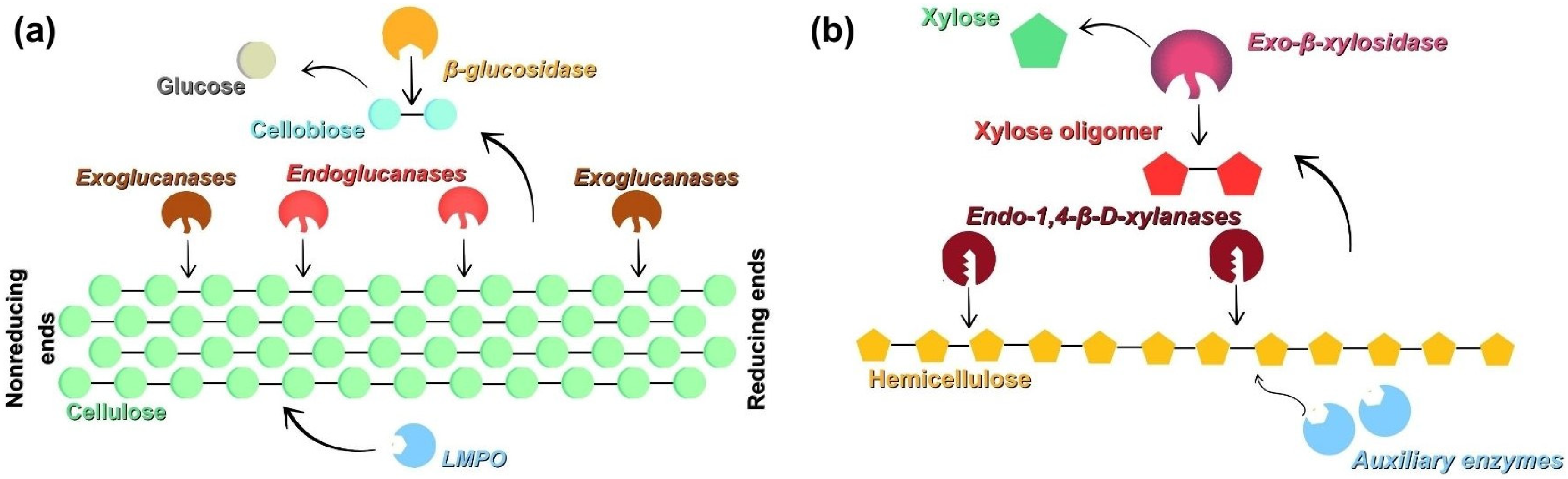
3.2.2. Hydrolysis of Pretreated Biomass
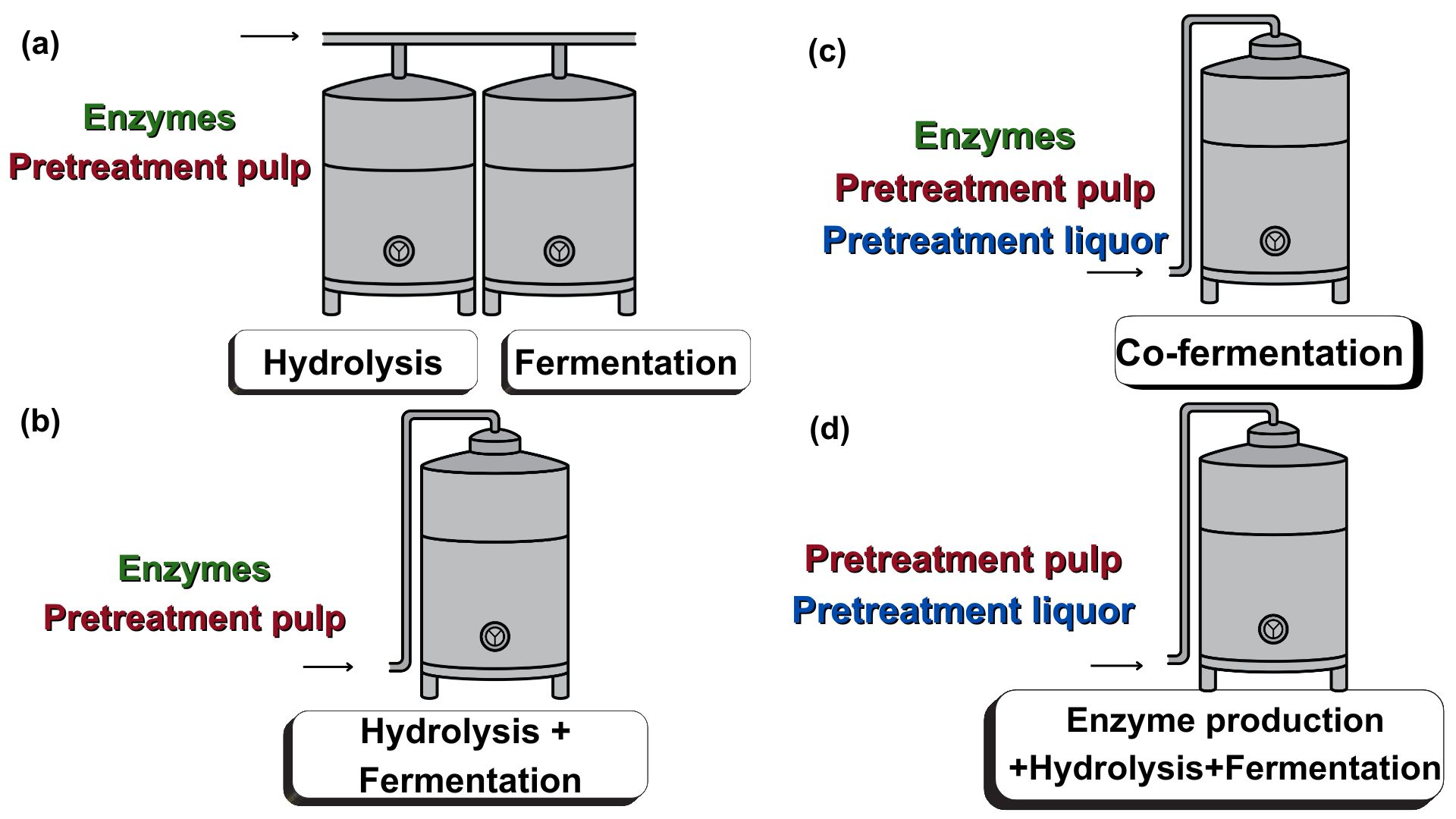
3.2.3. Fermentation of the Hydrolyzed Liquor
| Biomass Composition and Pretreatment | Hydrolysis Condition and Efficiency | Fermentation Condition and Efficiency | Reference |
|---|---|---|---|
| Old fibers—palm trees Cellulose: 62.31 ± 0.98%, Hemicellulose: 5.80 ± 0.44%, and Lignin: 21.12 ± 1.13%. Mechanical and thermochemical pretreatment: — Temperature: 55 °C and Time: 12 h; Chemical pretreatment — Temperature: 220 °C, and Concentration: H2SO4 0.025M. Treated biomass: Lignin: 28.45%, and Holocellulose (Cellulose + Hemicellulose): 49.61%. | Enzymes Celluclast 1.5 L and Novozyme® 188 (36.6 FPU of cellulases and 356.4 IU of β-glucosidase by pretreated biomass). Temperature: 50 °C, Rotating speed: 450 rpm, Time: 72 h, and TRS: 34.60 g/L, with 0.46–0.49 g TRS per g pretreated biomass (0.31–0.35 g glucose/g pretreated biomass). | SHF—Phoenix dactylifera L. Temperature: 30 °C, pH: 4.5, and Rotating speed: 450 rpm. Hydrolyzed fibers: glucose: 33.61 g/L, arabinose: 0.41 g/L, xylose: 0.61 g/L, andgalactose: 0.13 g/L. Hydrolysis liquor with 34.60 TRS g/L. Results: 10.88 g ethanol/100 g pretreated biomass and 0.38 g ethanol/g TRS. | [101] |
| Rice straw Cellulose: 31.90 ± 0.20%, Hemicellulose: 28.10 ± 0.27%, and Lignin: 3.80 ± 0.40%. Biological pretreatment. | Pecoramyces sp. F1. 8.33 g/L rice straw. | CBP—Zymomonas mobilis ATCC 31821. Time of treatment: 4 days. Results: 0.32 g ethanol/g glucose, 0.98 g/L, and ethanol fermentation efficiency of 92%. | [102] |
| Palm wood Cellulose: 19.80%, Hemicellulose: 10.90%, and Lignin: 11.00%. Chemical pretreatment (3% sulfuric, nitric, and phosphoric acids), and biomass concentration 10% (w/v). Treated biomass: Lignin: 8.00–10.20%, Hemicellulose: 7.30–9.10%, and Cellulose: 23.30–20.50%. | Cellulase produced by T reesei MTCC 4876 during growth in pretreated biomass. pH: 4.5, and Agitation: 150 rpm. Reducing sugar: 33.15–52.65 g/L, Time: 96 h, and Total Sugars: 70 g/L. | SHF—K. marxianus MTCC 1389. Temperature: 45 °C, Agitation rate: 156 rpm, pH: 5, Substrate concentration: 8.0% (v/v), Inoculum size: 3.2% (v/v), and Ethanol yield of 22.90 g/L. | [103] |
| Sugarcane bagasse Chemical pretreatment applying Temperature: 145 °C, Pressure: 1 atm, Time: 12 min, and Concentration acid: 0.5% H2SO4 v/v) and 10% w/v of bagasse. Lignin: 34.73 ± 3.58, Cellulose: 44.80 ± 0.04, and Hemicellulose: 2.02 ± 0.79. | Cellulolytic Cocktail Cellic® CTec2 (12.5 FPU/g pretreated bagasse). Biomass concentration: 16.5% of pretreated bagasse. | SSF—S. cerevisiae AGY001 (CRISPR/Cas9 modified). Treatment duration: 48 h. First stage: Aerobic regime, Temperature: 30 °C; Rotating speed: 200 rpm agitation overnight. Second stage: semi-anaerobiosis, Temperature: 40 °C. OD600: 1.0. Results: Ethanol yield of 6.88 ± 0.84 g/L and 89% fermentation efficiency. | [104] |
| Sugarcane bagasse Cellulose: 44%, Hemicellulose: 24%, and Lignin: 19%. Hydrothermal pretreatment applying Temperature: 195 °C, Time: 10 min, Agitation: 300 rpm, and Ratio: 1:10 w/v. Pretreated solid fraction: Cellulose: 59%, Hemicellulose: 12%, and Lignin: 26%. | Enzymes secreted by S. cerevisiae AC14 (Cellobiohydrolase I, Cellobiohydrolase II, Endoglucanase, β-Glucosidase, Xylanase, β-Xylosidase, Acetylxylan esterase). Cell concentration: 80 g/L. | CBP—S. cerevisiae. 10 g/L of pretreated bagasse. OD600: 100, pH: 5.5, Temperature: 35 °C, Time: 7 h, and Hydrothermal liquor (g/L): xylose: 4.22, glucose: 0.38, cellobiose: 1.15, and Total xylooligomers: 14.68. Results: 1.86 g/L/h, 13 g/L, and 89% of ethanol productivity, concentration, and fermentation efficiency, respectively. | [105] |
| Corncob residue Chemical pretreatment with 0.1 M citric acid and trisodium citrate, and pH 6.2. Treated biomass: Lignin: 35.0%, Hemicellulose: 5.4%, and Cellulose: 62.7%. | Cellic® CTec3 8.8 FPU/g of solids. Time of enzymatic hydrolysis: 72 h. 25% dry matter. Temperature: 35 °C, pH: 5.0, Agitation: 150 rpm, and Inoculation ratio: 1% w/w. Cellulose conversion: 85%. | SHF—S. cerevisiae, Zymomonas mobilis, and genetically related engineered strains. Glucose initial: 140 g/L. Temperature: 35 °C, pH: 5.0, Agitation: 200 rpm, and Time: 144 h. Results: 62.41 g/L of ethanol and 6.89 g ethanol/100 g biomass. | [106] |
| Corn stover 12.60 ± 0.6% Lignin. Chemical pretreatment applying Steam explosion; Temperature: 210 °C, Residence time: 5 min, and Initial moisture content: 30%. Treated biomass: Lignin: 23.10 ± 1.5%. | Novozyme® 188 (60 FPU/g glucan). Solid loading: 20% (12% glucan loading). | SSF—S. cerevisiae 80000012 a. Temperature: 39 °C, pH: 4.8, 50% nutrients added; 12% glucan loading. OD600: 4. Initial sugar concentration: glucan: 31.10 ± 1.1% and xylan: 17.10 ± 0.7%. Results: 59.8 g/L, 77.2%, and 78.6% of ethanol yield, sugars, and glucan fermentation efficiency. | [107] |
| Rice straw Chemical pretreatment with Dilute NaOH 10% w/v, Temperature: 121 °C, Pressure: 15 psi, and Time: 45 min. | 15 FPU of cellulase blend (Sigma-Aldrich®, St. Louis, MO, USA). 5% of pretreated biomass. pH 4.8 with 50 mM citrate buffer. | SSF—K. marxianus MSS6.3, 5% w/v dried rice straw, Time of treatment: 48 h, Temperature: 45 °C, Rotating speed: 150 rpm, and OD600: 1. Initial sugars in g/L: glucose: 24.20, xylose: 7.400, and arabinose: 1.30 g/L. Results: 10.9 g/L of ethanol, 85% fermentation efficiency, productivity of 0.22 g L−1 h−1, and overall efficiency of 46%. | [108] |
| Corn stover Lignin: 11.00%, Glucan: 34.10%, and Xylan: 20.40%. Chemical pretreatment, AFEX treatment of ammonia to biomass loading 1.0 g/g dry biomass, Water loading 0.6 g/g dry biomass, Temperature: 140 °C, and Residence time: 15 min. | Enzymes produced during cultivation of Clostridium phytofermentans ATCC 700394. | CBP—Clostridium phytofermentans ATCC 700394. 0.5% (w/w) glucan loading AFEX-Corn Stover. Agitation rate: 200 rpm, Temperature: 30 °C, Inoculation: 5% v/v, pH: 7, and Time: 10 days. Results: 76% glucan conversion, 88% xylan conversion, 2.8 g/L of ethanol yield, and ethanol/acetate ratio: 1.08. | [109] |
| Corncob Prepared based on 70% (w/w) concentrated xylose crystallization mother. Liquid supplemented with 364.0 g/L glucose and volume ratio of 1:1. | Pre-cultured cells of Escherichia B0013-2021HPA (Phosphoenolpyruvate:glucose phosphotransferase (PTase), pyruvate decarboxylase (PDC), and alcohol dehydrogenase II (ADH II). | SHF—E. coli B0013-2021HPA3 l. Volume containing 300 mL of hydrolysate for growth + 300 mL of hydrolysate for ethanol production. pH: 7. Initial sugar concentration (g/L): glucose: 266.0, xylose: 200.0, galactose: 27.00, and arabinose: 114.5. Results: 127.7 total g ethanol produced and 2.85 g/L/h of productivity. | [110] |
| Rice husk — Cellulose: 37.74%, Hemicellulose: 33.85%, and Lignin: 9.67 + Corn cob — Cellulose: 36.84%, Hemicellulose: 24.61%, and Lignin 13.73%. | Cellulase and xylanase. Cellulolytic activities: 219.9 ± 18.64 FPU/mL. Xylanolytic activities: 333.4 ± 22.74 U/mL. | SSF-co—S. cerevisiae and K. marxianus. Ratio: 50:50 v/v; Time of treatment: 72 h; and 124.6 g of TRS/L of hydrolysate. Results: 55.56 ± 0.19 g/L of ethanol, 88.32% fermentation efficiency, and overall efficiency of 46.70%. | [111] |
| Brewing spent grain, barley straw, and oak shavings Biological pretreatment with Time: 7–18 days at Temperature: 25 °C. | Trichoderma viride cellulolytic enzymes. Temperature: 25 °C, Time: 21 days, and 3.4 L solution final. | SHF—S. cerevisiae. pH: 5, Time: 14 days, and Temperature: 30 °C. Ethanol fermentation efficiency of 65%. | [112] |
| Sugarcane bagasse Lignin: 25.21%, xylan: 21.04%, and glucan: 39.60%. Chemical pretreatment applying Concentration: 20% NH4OH, Liquid ratio: 1:10, Temperature: 50 °C, and Time: 48 h. Treated biomass: Lignin: 19.49%, xylan: 5.20%, and glucan: 45.96%. | Cellic® CTec2 (10 FPU/gdry biomass). 40% solid loading, Temperature: 50 °C, Agitation rate: 150 rpm, Laccase mediator (200 U/g dry biomass), and Time: 96 h. | SHF—Candida tropicalis Y-27290. Inoculum concentration of 10.00%, Temperature: 28 °C, Agitation rate: 200 rpm. Initial sugars: glucose: 157.6 g/L and xylose: 57.12 g/L. Results: 72.40 ± 1.9 g/L ethanol produced, 0.46 ± 0.03 g/g glucose ethanol productivity, 1.21 ± 0.02 g/L/h volumetric ethanol productivity, and 89% ethanol yield. | [113] |
| Wheat straw Lignin: 22%, xylan: 22%, and glucan: 36.7%. Dry matter: 94.40%. Chemical pretreatment applying Wheat straw loading of 7.5% w/w, Temperature: 140 °C, Time: 20.5 min, and H2SO4 concentration: 1% w/w. Treated biomass: xylose: 22 g/L and glucan: 29 g/L. | Enzymes: Spezyme CP cellulase and Novozyme® 188. Enzyme loading: 15 FPU gglucan−1 and 30 CBU gglucan−1. | CBP—T. reesei Rut C30, S. cerevisiae, and Scheffersomyces stipites. Agitation rate: 150 rpm, and Temperature: 28 °C. Initial sugars: glucose: 29 g/L and xylose: 22 g/L. Result: 67% ethanol fermentation efficiency. | [114] |
| Sugarcane bagasse Cellulose: 39.72 ± 0.33%, Hemicelluloses: 26.96 ± 2.11%, and Lignin: 40.98 ± 0.01%. Chemical pretreatment with Solution of sodium hydroxide 15 g/L, and hydrogen peroxide: 2%, 50 g of bagasse, and pH 7. Treated biomass: Cellulose: 72.1%, Hemicellulose: 24.4%, and Lignin and ash: 3.5%. | Enzymes obtained during microorganisms’ growth. Cellulase concentration: 100 FPU/mL. | SSF-co—Zymomonas mobilis (PVA immobilized cells) and Pichia stipitis (suspended cells). 20 g/L pretreated bagasse. Cell loading: 40% w/v and OD600: 20. Initial sugars: glucose 28.2 g/L, xylose 6.9 g/L, cellobiose 7.5 g/L, and Cellulose 20 g/L. Results: 0.414 g ethanol/g cellulose, 81.20% of theoretical yield, and 0.705 g/L/h ethanol productivity. | [115] |
4. Characteristics of 2G Ethanol Plants Worldwide
5. Enzymatic Cocktails Applied for 2G Ethanol Production
6. Fermentative Microorganisms and Strategies for Process Optimizing
7. Government Incentives Worldwide for Cellulosic Ethanol
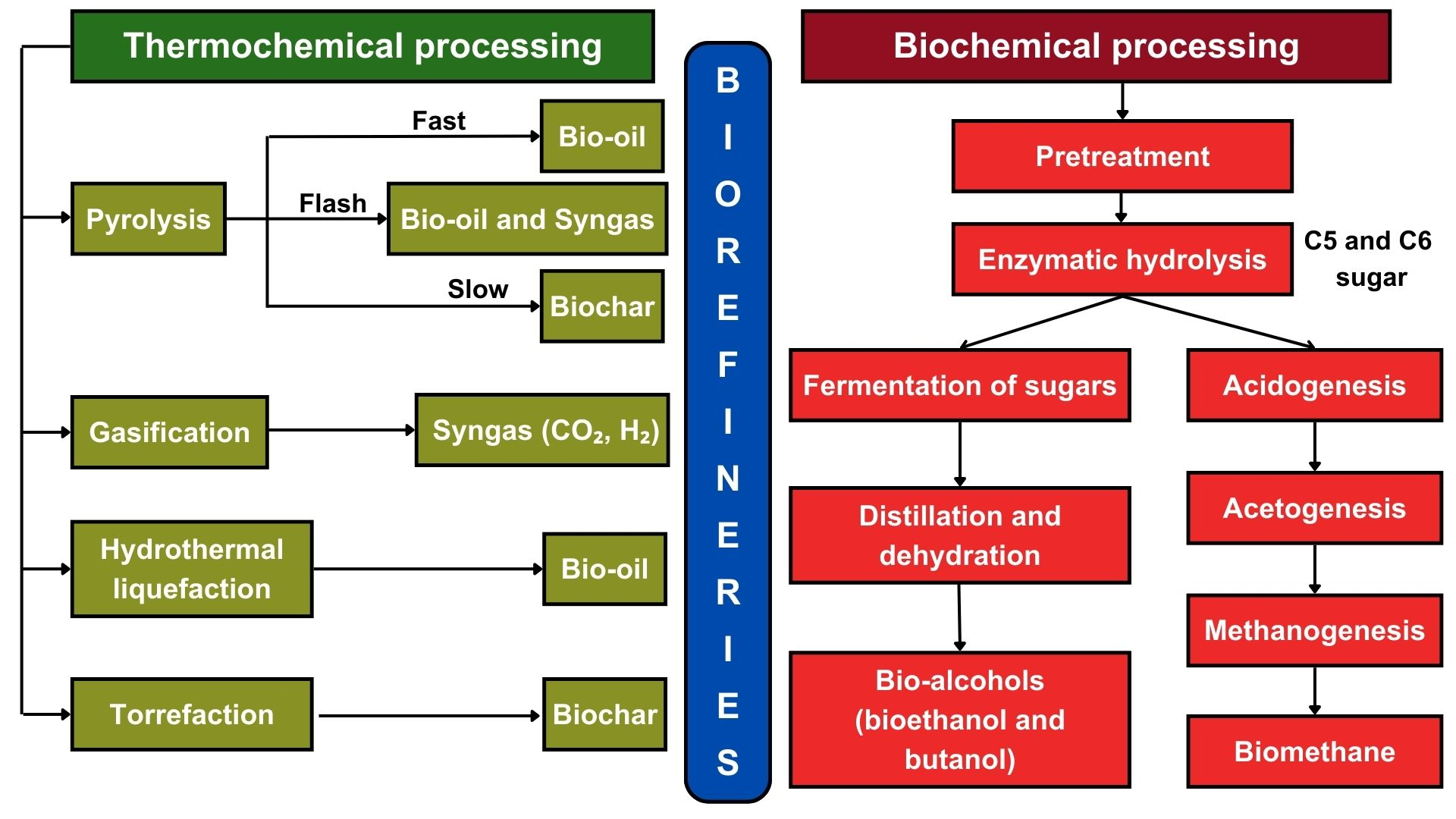
8. Lignocellulosic Biomass Biorefinery
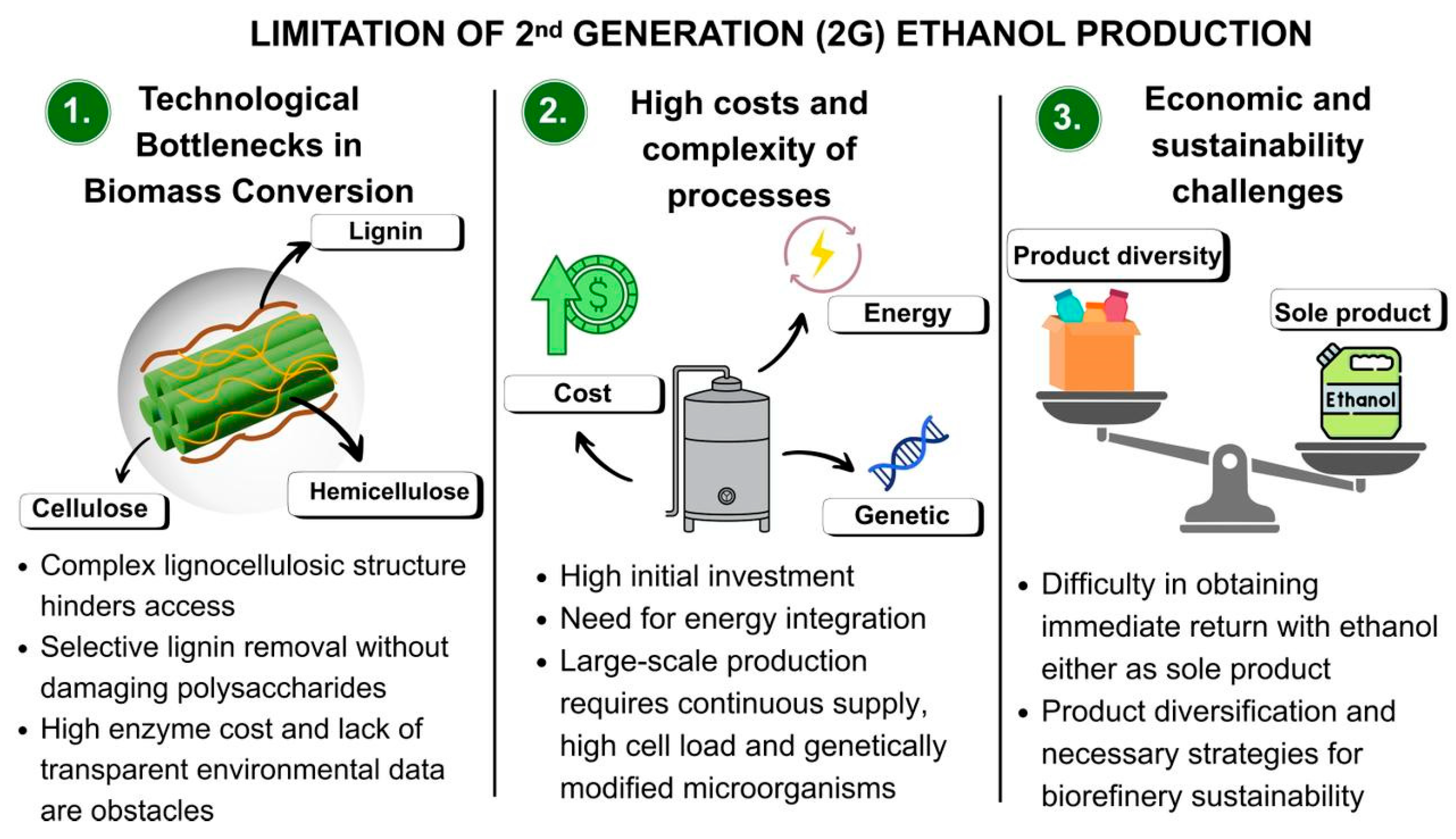
9. Bottlenecks for the Consolidation of Technology and Increased Production
10. Conclusions and Future Perspectives
Funding
Institutional Review Board Statement
Informed Consent Statement
Data Availability Statement
Acknowledgments
Conflicts of Interest
References
- COP-30 no Brasil: O que Esperar do Maior Encontro Global Sobre Mudanças Climáticas em 2025. Available online: https://www.neoenergia.com/w/cop-30-no-brasil-o-que-esperar-do-maior-encontro-global-sobre-mudancas-climaticas-em-2025 (accessed on 2 November 2025).
- Woźniak, A.; Kuligowski, K.; Świerczek, L.; Cenian, A. Review of Lignocellulosic Biomass Pretreatment Using Physical, Thermal and Chemical Methods for Higher Yields in Bioethanol Production. Sustainability 2025, 17, 287. [Google Scholar] [CrossRef]
- Raj, T.; Chandrasekhar, K.; Naresh Kumar, A.; Rajesh Banu, J.; Yoon, J.-J.; Kant Bhatia, S.; Yang, Y.-H.; Varjani, S.; Kim, S.-H. Recent Advances in Commercial Biorefineries for Lignocellulosic Ethanol Production: Current Status, Challenges and Future Perspectives. Bioresour. Technol. 2022, 344, 126292. [Google Scholar] [CrossRef]
- Areeya, S.; Panakkal, E.J.; Kunmanee, P.; Tawai, A.; Amornraksa, S.; Sriariyanun, M.; Kaoloun, A.; Hartini, N.; Cheng, Y.-S.; Kchaou, M.; et al. A Review of Sugarcane Biorefinery: From Waste to Value-Added Products. Appl. Sci. Eng. Prog. 2024, 17, 7402. [Google Scholar] [CrossRef]
- Shelar, M.N.; Matsagar, V.K.; Patil, V.S.; Barahate, S.D. Net Energy Analysis of Sugarcane Based Ethanol Production. Clean. Energy Syst. 2023, 4, 100059. [Google Scholar] [CrossRef]
- Aghaei, S.; Karimi Alavijeh, M.; Shafiei, M.; Karimi, K. A Comprehensive Review on Bioethanol Production from Corn Stover: Worldwide Potential, Environmental Importance, and Perspectives. Biomass Bioenergy 2022, 161, 106447. [Google Scholar] [CrossRef]
- Das, N.; Jena, P.K.; Padhi, D.; Kumar Mohanty, M.; Sahoo, G. A Comprehensive Review of Characterization, Pretreatment and Its Applications on Different Lignocellulosic Biomass for Bioethanol Production. Biomass Conv. Bioref. 2023, 13, 1503–1527. [Google Scholar] [CrossRef]
- Prasad, B.R.; Padhi, R.K.; Ghosh, G. A Review on Key Pretreatment Approaches for Lignocellulosic Biomass to Produce Biofuel and Value-Added Products. Int. J. Environ. Sci. Technol. 2023, 20, 6929–6944. [Google Scholar] [CrossRef]
- Shukla, A.; Kumar, D.; Girdhar, M.; Kumar, A.; Goyal, A.; Malik, T.; Mohan, A. Strategies of Pretreatment of Feedstocks for Optimized Bioethanol Production: Distinct and Integrated Approaches. Biotechnol. Biofuels 2023, 16, 44. [Google Scholar] [CrossRef] [PubMed]
- Kumar, R.; Kumar, N.; Saini, S.; Singh, C.; Barnwal, P.; Panghal, A. Ethanol from Lignocellulosic Biomass: Pretreatment Challenges and Opportunities in Sustainable Waste Management and Energy Production. Biofuels Bioprod. Bioref. 2025, 19, 2712–2738. [Google Scholar] [CrossRef]
- Basera, P.; Chakraborty, S.; Sharma, N. Lignocellulosic Biomass: Insights into Enzymatic Hydrolysis, Influential Factors, and Economic Viability. Discov. Sustain. 2024, 5, 311. [Google Scholar] [CrossRef]
- Kumar, V.; Yadav, S.K.; Kumar, J.; Ahluwalia, V. A Critical Review on Current Strategies and Trends Employed for Removal of Inhibitors and Toxic Materials Generated during Biomass Pretreatment. Bioresour. Technol. 2020, 299, 122633. [Google Scholar] [CrossRef]
- Tse, T.J.; Wiens, D.J.; Reaney, M.J.T. Production of Bioethanol—A Review of Factors Affecting Ethanol Yield. Fermentation 2021, 7, 268. [Google Scholar] [CrossRef]
- Arshad, N.; Panakkal, E.J.; Kalivarathan, P.B.; Tawai, A.; Chuetor, S.; Wanmolee, W.; Kirdponpattara, S.; Chantarasiri, A.; Rakesh, S.; Septevani, A.A.; et al. Emerging Technologies in Pretreatment and Hydrolysis for High-Solid-Loading Bioethanol Production from Lignocellulosic Biomass. Fermentation 2025, 11, 613. [Google Scholar] [CrossRef]
- Beluhan, S.; Mihajlovski, K.; Šantek, B.; Ivančić Šantek, M. The Production of Bioethanol from Lignocellulosic Biomass: Pretreatment Methods, Fermentation, and Downstream Processing. Energies 2023, 16, 7003. [Google Scholar] [CrossRef]
- Lamichhane, G.; Acharya, A.; Poudel, D.K.; Aryal, B.; Gyawali, N.; Niraula, P.; Phuyal, S.R.; Budhathoki, P.; Bk, G.; Parajuli, N. Recent Advances in Bioethanol Production from Lignocellulosic Biomass. Int. J. Green Energy 2021, 18, 731–744. [Google Scholar] [CrossRef]
- Afedzi, A.E.K.; Afrakomah, G.S.; Gyan, K.; Khan, J.; Seidu, R.; Baidoo, T.; Sultan, I.N.; Tareen, A.K.; Parakulsuksatid, P. Enhancing Economic and Environmental Sustainability in Lignocellulosic Bioethanol Production: Key Factors, Innovative Technologies, Policy Frameworks, and Social Considerations. Sustainability 2025, 17, 499. [Google Scholar] [CrossRef]
- Yaverino-Gutiérrez, M.A.; Wong, A.Y.C.-H.; Ibarra-Muñoz, L.A.; Chávez, A.C.F.; Sosa-Martínez, J.D.; Tagle-Pedroza, A.S.; Hernández-Beltran, J.U.; Sánchez-Muñoz, S.; Santos, J.C.D.; Da Silva, S.S.; et al. Perspectives and Progress in Bioethanol Processing and Social Economic Impacts. Sustainability 2024, 16, 608. [Google Scholar] [CrossRef]
- Chen, H.; Fu, X. Industrial Technologies for Bioethanol Production from Lignocellulosic Biomass. Renew. Sustain. Energy Rev. 2016, 57, 468–478. [Google Scholar] [CrossRef]
- Kumar, V.; Sinha, A.R. Sustainable Ethanol Production: CO2 Emission Analysis and Feedstock Strategies through Life Cycle Assessment. Energy Sustain. Dev. 2025, 88, 101775. [Google Scholar] [CrossRef]
- Renewable Fuels Association (RFA). Annual Ethanol Production and Market Statistics. Available online: https://ethanolrfa.org/markets-and-statistics/annual-ethanol-production (accessed on 2 November 2025).
- Alternative Fuels Data Center (AFDC). Global Ethanol Production by Country or Region (2007–2022); U.S. Department of Energy: Washington, DC, USA. Available online: https://afdc.energy.gov/data/widgets/10331 (accessed on 2 November 2025).
- Mujtaba, M.; Fernandes Fraceto, L.; Fazeli, M.; Mukherjee, S.; Savassa, S.M.; Araujo De Medeiros, G.; Do Espírito Santo Pereira, A.; Mancini, S.D.; Lipponen, J.; Vilaplana, F. Lignocellulosic Biomass from Agricultural Waste to the Circular Economy: A Review with Focus on Biofuels, Biocomposites and Bioplastics. J. Clean. Prod 2023, 402, 136815. [Google Scholar] [CrossRef]
- Ndayisenga, F.; Yu, Z.; Zheng, J.; Wang, B.; Liang, H.; Phulpoto, I.A.; Habiyakare, T.; Zhou, D. Microbial Electrohydrogenesis Cell and Dark Fermentation Integrated System Enhances Biohydrogen Production from Lignocellulosic Agricultural Wastes: Substrate Pretreatment towards Optimization. Renew. Sustain. Energy Rev. 2021, 145, 111078. [Google Scholar] [CrossRef]
- Empresa de Pesquisa Energética (EPE). Ethanol Supply Scenarios and Otto Cycle Demand from 2025 to 2034. Available online: https://www.epe.gov.br/sites-pt/publicacoes-dados-abertos/publicacoes/PublicacoesArquivos/publicacao-255/topico-735/NT-EPE-DPG-SDB-2024-09_Cenarios_de_oferta_de_etanol_2034.pdf (accessed on 24 July 2025).
- International Council on Clean Transportation (ICCT). Techno-Economic Analysis of Cellulosic Ethanol in Indonesia Using Palm Residues. Available online: https://theicct.org/publication/techno-economic-analysis-of-cellulosic-ethanol-in-indonesia-using-palm-residues/ (accessed on 2 November 2025).
- Renewable Fuels Association (RFA). 2025 Ethanol Industry Outlook: Global Fuel Ethanol Production by Country (2024); Renewable Fuels Association: Washington, DC, USA, 2025. Available online: https://ethanolrfa.org/file/2912/2025%20Outlook.pdf (accessed on 2 November 2025).
- Lin, T.-S.; Kheshgi, H.S.; Song, Y.; Vörösmarty, C.J.; Jain, A.K. Which Crop Has the Highest Bioethanol Yield in the United States? Front. Energy Res. 2023, 11, 1070186. [Google Scholar] [CrossRef]
- Clifford, C.B. 10.2 Ethanol Production and Economics. In EGEE 439: Alternative Fuels from Biomass Sources; College of Earth and Mineral Sciences, The Pennsylvania State University: Pennsylvania, PA, USA. Available online: https://courses.ems.psu.edu/egee439/node/720 (accessed on 28 September 2025).
- U.S. Energy Information Administration (EIA). U.S. Ethanol Production and Consumption Continue to Grow in 2014. Today in Energy. Available online: https://www.eia.gov/todayinenergy/detail.php?id=21212 (accessed on 28 September 2025).
- Aui, A.; Wang, Y. Cellulosic Ethanol Production: Assessment of the Impacts of Learning and Plant Capacity. Technol. Forecast. Soc. Change 2023, 197, 122923. [Google Scholar] [CrossRef]
- EMBRAPA. Tecnologias Emergentes: Etanol. 2022. Available online: https://www.embrapa.br/agencia-de-informacao-tecnologica/cultivos/cana-de-acucar/pos-producao/alcool/tecnologias-emergentes (accessed on 27 July 2025).
- RPA News. Custos de Produção de Cana-de-Açúcar Podem ter Alta de até 8% na Safra 2025/26. RPA News. 2025. Available online: https://revistarpanews.com.br/custos-de-producao-de-cana-de-acucar-podem-ter-alta-de-ate-8-na-safra-2025-26/ (accessed on 25 July 2025).
- União da Indústria de Cana-de-Açúcar (UNICA). Website Institucional. 2025. Available online: https://unica.com.br/ (accessed on 27 July 2025).
- Brasil. Ministério de Minas e Energia. Plano Nacional de Energia 2030; Ministério de Minas e Energia: Brasília, Brazil, 2007; Volume 12. Available online: https://www.gov.br/mme/pt-br/arquivos/plano-nacional-de-energia-2030-pdf.pdf (accessed on 27 July 2025).
- Raízen. Raízen Inaugura Maior Planta de Etanol de Segunda Geração do Mundo. 2025. Available online: https://www.raizen.com.br/sala-de-imprensa/raizen-inaugura-maior-planta-de-etanol-de-segunda-geracao-do-mundo (accessed on 28 July 2025).
- Ceaser, R.; Montané, D.; Constantí, M.; Medina, F. Current Progress on Lignocellulosic Bioethanol Including a Technological and Economical Perspective. Environ. Dev. Sustain. 2024, 27, 25993–26038. [Google Scholar] [CrossRef]
- Salazar-Ordóñez, M.; Pérez-Hernández, P.P.; Martín-Lozano, J.M. Sugar Beet for Bioethanol Production: An Approach Based on Environmental Agricultural Outputs. Energy Policy 2013, 55, 662–668. [Google Scholar] [CrossRef]
- Les Biocarburants. Available online: https://www.cultures-sucre.com/developpement-durable/les-biocarburants/ (accessed on 2 November 2025).
- Le Betteravier Français. Une Année Décevante Rendements et Prix. Available online: https://www.lebetteravier.fr/2024/12/05/annee-decevante-rendements-et-prix/ (accessed on 2 November 2025).
- Global Growth Insights. Cellulosic Ethanol Market Size, Share, Growth, and Industry Analysis, By Types (Energy Crops, Agriculture Residues, Municipal Solid Waste, Forest Residues, Others), By Applications Covered (Non-fuel Applications, Fuel Applications), Regional Insights and Forecast to 2033. Available online: https://www.globalgrowthinsights.com/market-reports/cellulosic-ethanol-market-105801/ (accessed on 2 November 2025).
- Hoang, T.-D.; Nghiem, N. Recent Developments and Current Status of Commercial Production of Fuel Ethanol. Fermentation 2021, 7, 314. [Google Scholar] [CrossRef]
- Findlater, K.M. Biofuels and Land Use: Global Requirements and Local Impacts. Ph.D. Dissertation, University of British Columbia, Vancouver, Canada, 2009. [Google Scholar] [CrossRef]
- FAO. The State of Food and Agriculture. 2008. Available online: http://www.fao.org/3/i0100e/i0100e.pdf (accessed on 27 July 2025).
- Rizzolo, J.A.; Woiciechowski, A.L.; Júnior, A.I.M.; Torres, L.A.Z.; Soccol, C.R. The Potential of Sweet Potato Biorefinery and Development of Alternative Uses. SN Appl. Sci. 2021, 3, 347. [Google Scholar] [CrossRef]
- Duraisam, R.; Salelgn, K.; Berekete, A.K. Production of Beet Sugar and Bio-Ethanol from Sugar Beet and It Bagasse: A Review. IJETT 2017, 43, 222–233. [Google Scholar] [CrossRef]
- Alsanad, M.A.; Emara, E.I.R. Optimizing Bioethanol (C2H5OH) Yield of Sweet Sorghum Varieties in a Semi-Arid Environment: The Impact of Deheading and Deficit Irrigation. Water 2024, 16, 1456. [Google Scholar] [CrossRef]
- Chaiben Neto, M.; Robaina, A.D.; Peiter, M.X.; Rodrigues, S.A.; Flores, Y.R.; Bruning, J.; Silva, J.G.D.; Ferreira, L.D. Economic Indicators for Ethanol Production from Starch Crops under Different Irrigation Managements. Eng. Agricola E Ambient. 2022, 26, 640–648. [Google Scholar] [CrossRef]
- Corbin, K.R.; Byrt, C.S.; Bauer, S.; DeBolt, S.; Chambers, D.; Holtum, J.A.M.; Karem, G.; Henderson, M.; Lahnstein, J.; Beahan, C.T.; et al. Prospecting for Energy-Rich Renewable Raw Materials: Agave Leaf Case Study. PLoS ONE 2015, 10, e0135382. [Google Scholar] [CrossRef]
- Matías, J.; Cruz, V.; García, A.; González, D. Evaluation of Rice Straw Yield, Fibre Composition and Collection Under Mediterranean Conditions. Acta Technol. Agric. 2019, 22, 43–47. [Google Scholar] [CrossRef]
- Wilson, C.A.; Cloy, J.M.; Graham, M.C.; Hamlet, L.E. A Microanalytical Study of Iron, Aluminium and Organic Matter Relationships in Soils with Contrasting Hydrological Regimes. Geoderma 2013, 202–203, 71–81. [Google Scholar] [CrossRef]
- Karlen, D.L.; Birrell, S.J.; Johnson, J.M.F.; Osborne, S.L.; Schumacher, T.E.; Varvel, G.E.; Ferguson, R.B.; Novak, J.M.; Fredrick, J.R.; Baker, J.M.; et al. Multilocation Corn Stover Harvest Effects on Crop Yields and Nutrient Removal. Bioenergy Res. 2014, 7, 528–539. [Google Scholar] [CrossRef]
- Biovalue. Palha e Bagaço. Available online: https://lnbr.cnpem.br/biovalue/biomassas/palha-bagaco/ (accessed on 2 November 2025).
- Naveed, M.H.; Khan, M.N.A.; Mukarram, M.; Naqvi, S.R.; Abdullah, A.; Haq, Z.U.; Ullah, H.; Mohamadi, H.A. Cellulosic Biomass Fermentation for Biofuel Production: Review of Artificial Intelligence Approaches. Renew. Sustain. Energy Rev. 2024, 189, 113906. [Google Scholar] [CrossRef]
- Kululo, W.W.; Habtu, N.G.; Abera, M.K.; Sendekie, Z.B.; Fanta, S.W.; Yemata, T.A. Advances in Various Pretreatment Strategies of Lignocellulosic Substrates for the Production of Bioethanol: A Comprehensive Review. Discov. Appl. Sci. 2025, 7, 476. [Google Scholar] [CrossRef]
- Yadav, P.; Anu; Kumar Tiwari, S.; Kumar, V.; Singh, D.; Kumar, S.; Manisha; Malik, V.; Singh, B. Sugarcane Bagasse: An Important Lignocellulosic Substrate for Production of Enzymes and Biofuels. Biomass Conv. Bioref. 2024, 14, 6111–6142. [Google Scholar] [CrossRef]
- Chandel, H.; Kumar, P.; Chandel, A.K.; Verma, M.L. Biotechnological Advances in Biomass Pretreatment for Bio-Renewable Production through Nanotechnological Intervention. Biomass Convers. Biorefinery 2024, 14, 2959–2981. [Google Scholar] [CrossRef]
- Ponce, J.; Andrade, J.G.D.S.; Dos Santos, L.N.; Bulla, M.K.; Barros, B.C.B.; Favaro, S.L.; Hioka, N.; Caetano, W.; Batistela, V.R. Alkali Pretreated Sugarcane Bagasse, Rice Husk and Corn Husk Wastes as Lignocellulosic Biosorbents for Dyes. Carbohydr. Polym. Technol. Appl. 2021, 2, 100061. [Google Scholar] [CrossRef]
- Zhang, Y.; Wang, H.; Sun, X.; Wang, Y.; Liu, Z. Separation and Characterization of Biomass Components (Cellulose, Hemicellulose, and Lignin) from Corn Stalk. BioRes 2021, 16, 7205–7219. [Google Scholar] [CrossRef]
- Mosier, N. Features of Promising Technologies for Pretreatment of Lignocellulosic Biomass. Bioresour. Technol. 2005, 96, 673–686. [Google Scholar] [CrossRef]
- Xu, C.; Zhang, X.; Hussein, Z.; Wang, P.; Chen, R.; Yuan, Q.; Gao, Y.; Song, N.; Gouda, S.G. Influence of the Structure and Properties of Lignocellulose on the Physicochemical Characteristics of Lignocellulose-Based Residues Used as an Environmentally Friendly Substrate. Sc. Total Environ. 2021, 790, 148089. [Google Scholar] [CrossRef]
- Singh, N.; Singhania, R.R.; Nigam, P.S.; Dong, C.-D.; Patel, A.K.; Puri, M. Global Status of Lignocellulosic Biorefinery: Challenges and Perspectives. Bioresour. Technol. 2022, 344, 126415. [Google Scholar] [CrossRef]
- Fatmawati, A.; Nurtono, T.; Widjaja, A. Thermogravimetric Kinetic-Based Computation of Raw and Pretreated Coconut Husk Powder Lignocellulosic Composition. Bioresour. Technol. Rep. 2023, 22, 101500. [Google Scholar] [CrossRef]
- Astuti, W.; Sulistyaningsih, T.; Prastiyanto, D.; Rusiyanto; Lanjar; Riayanti, F.I.; Astuti, A.W.; Wibowo, W.T.; Handayani, A.D.; Wulandari, D.A. Influence of Lignocellulosic Composition in Biomass Waste on the Microstructure and Dye Adsorption Characteristics of Microwave-Assisted ZnCl2 Activated Carbon. Biomass Convers. Biorefinery 2024, 14, 16681–16697. [Google Scholar] [CrossRef]
- García, A.; Alriols, M.G.; Llano-Ponte, R.; Labidi, J. Ultrasound-Assisted Fractionation of the Lignocellulosic Material. Bioresour. Technol. 2011, 102, 6326–6330. [Google Scholar] [CrossRef] [PubMed]
- Hassan, E.-S.R.E.; Mutelet, F. Evaluation of Miscanthus Pretreatment Effect by Choline Chloride Based Deep Eutectic Solvents on Bioethanol Production. Bioresour. Technol. 2022, 345, 126460. [Google Scholar] [CrossRef] [PubMed]
- Doczekalska, B.; Bartkowiak, M.; Waliszewska, B.; Orszulak, G.; Cerazy-Waliszewska, J.; Pniewski, T. Characterization of Chemically Activated Carbons Prepared from Miscanthus and Switchgrass Biomass. Materials 2020, 13, 1654. [Google Scholar] [CrossRef]
- Haankuku, C.; Epplin, F.M.; Kakani, V.G. Industrial Sugar Beets to Biofuel: Field to Fuel Production System and Cost Estimates. Biomass Bioenergy 2015, 80, 267–277. [Google Scholar] [CrossRef]
- Pratama, A.W.; Mahardika, M.; Widiastuti, N.; Piluharto, B.; Ilyas, R.A.; Sapuan, S.M.; Amelia, D.; Firmanda, A. Isolation and Characterization of Highly Thermal Stable Microcrystalline Cellulose Derived from Belulang Grass (Eleusine Indica). Case Stud. Chem. Environ. Eng. 2024, 9, 100743. [Google Scholar] [CrossRef]
- HowStuffWorks. Cellulosic Ethanol. Available online: https://science.howstuffworks.com/environmental/green-tech/energy-production/cellulosic-ethanol2.htm (accessed on 2 November 2025).
- Huang, C.; Liu, J.; Geng, W.; Tang, W.; Yong, Q. A Review of Lignocellulosic Biomass Pretreatment Technologies. Paper Biomat. 2021, 6, 61–79. [Google Scholar]
- Baksi, S.; Saha, D.; Saha, S.; Sarkar, U.; Basu, D.; Kuniyal, J.C. Pre-Treatment of Lignocellulosic Biomass: Review of Various Physico-Chemical and Biological Methods Influencing the Extent of Biomass Depolymerization. Int. J. Environ. Sci. Technol. 2023, 20, 13895–13922. [Google Scholar] [CrossRef]
- Ramadoss, G.; Muthukumar, K. Ultrasound Assisted Ammonia Pretreatment of Sugarcane Bagasse for Fermentable Sugar Production. Biochem. Eng. J. 2014, 83, 33–41. [Google Scholar] [CrossRef]
- El Khayat Driaa, Y.; Maarir, H.; Mennani, M.; Grimi, N.; Moubarik, A.; Boussetta, N. Ultrasound, Pulsed Electric Fields, and High-Voltage Electrical Discharges Assisted Extraction of Cellulose and Lignin from Walnut Shells. Int. Biol. Macromol. 2025, 292, 139319. [Google Scholar] [CrossRef]
- Buaban, B.; Inoue, H.; Yano, S.; Tanapongpipat, S.; Ruanglek, V.; Champreda, V.; Pichyangkura, R.; Rengpipat, S.; Eurwilaichitr, L. Bioethanol Production from Ball Milled Bagasse Using an On-Site Produced Fungal Enzyme Cocktail and Xylose-Fermenting Pichia stipitis. J. Biosci. Bioeng. 2010, 110, 18–25. [Google Scholar] [CrossRef] [PubMed]
- Nath, P.; Maibam, P.D.; Singh, S.; Rajulapati, V.; Goyal, A. Sequential Pretreatment of Sugarcane Bagasse by Alkali and Organosolv for Improved Delignification and Cellulose Saccharification by Chimera and Cellobiohydrolase for Bioethanol Production. 3 Biotech 2021, 11, 59. [Google Scholar] [CrossRef] [PubMed]
- Ziaei-Rad, Z.; Fooladi, J.; Pazouki, M.; Gummadi, S.N. Lignocellulosic Biomass Pre-Treatment Using Low-Cost Ionic Liquid for Bioethanol Production: An Economically Viable Method for Wheat Straw Fractionation. Biomass Bioenergy 2021, 151, 106140. [Google Scholar] [CrossRef]
- Du, W.; Yu, H.; Song, L.; Zhang, J.; Weng, C.; Ma, F.; Zhang, X. The Promoting Effect of Byproducts from Irpex Lacteus on Subsequent Enzymatic Hydrolysis of Bio-Pretreated Cornstalks. Biotechnol. Biofuels 2011, 4, 37. [Google Scholar] [CrossRef] [PubMed]
- Suhara, H.; Kodama, S.; Kamei, I.; Maekawa, N.; Meguro, S. Screening of Selective Lignin-Degrading Basidiomycetes and Biological Pretreatment for Enzymatic Hydrolysis of Bamboo Culms. Int. Biodeterior. Biodegrad. 2012, 75, 176–180. [Google Scholar] [CrossRef]
- Xie, Y.; Zhao, J.; Wang, P.; Ling, Z.; Yong, Q. Natural Arginine-Based Deep Eutectic Solvents for Rapid Microwave-Assisted Pretreatment on Crystalline Bamboo Cellulose with Boosting Enzymatic Conversion Performance. Bioresour. Technol. 2023, 385, 129438. [Google Scholar] [CrossRef]
- Wang, N.; Xu, A.; Liu, K.; Zhao, Z.; Li, H.; Gao, X. Performance of Green Solvents in Microwave-Assisted Pretreatment of Lignocellulose. Chem. Eng. J. 2024, 482, 148786. [Google Scholar] [CrossRef]
- Liknaw, T.; Ramesh, R.; Reddy Prasad, D.M.; Murali, A. Sustainable Biofuels from Corncobs: Optimization of Microwave Pretreatment for Enhanced Fermentable Sugar Yield. Chem. Eng. Commun. 2025, 212, 200–218. [Google Scholar] [CrossRef]
- Ishfaq Bhat, M.; Shahi, N.C.; Lohani, U.C.; Singh, S.; Sidique, Q.; Sirohi, R. Microwave Irradiation Assisted Intensive and Quick Delignification of Lignocellulosic Biomass, and Confirmation by Spectral, Morphological and Crystallinity Characterization. Bioresour. Technol. 2022, 351, 127029. [Google Scholar] [CrossRef]
- Zhang, W.; Diao, C.; Wang, L. Degradation of Lignin in Different Lignocellulosic Biomass by Steam Explosion Combined with Microbial Consortium Treatment. Biotechnol. Biofuels 2023, 16, 55. [Google Scholar] [CrossRef]
- Zhang, L.; Shao, G.; Jin, Y.; Yang, N.; Xu, X. Efficient Hemicellulose Removal from Lignocellulose by Induced Electric Field-Aided Dilute Acid Pretreatment. Int. J. Biol. Macromol. 2024, 261, 129839. [Google Scholar] [CrossRef]
- Matsakas, L.; Raghavendran, V.; Yakimenko, O.; Persson, G.; Olsson, E.; Rova, U.; Olsson, L.; Christakopoulos, P. Lignin-First Biomass Fractionation Using a Hybrid Organosolv—Steam Explosion Pretreatment Technology Improves the Saccharification and Fermentability of Spruce Biomass. Bioresour. Technol. 2019, 273, 521–528. [Google Scholar] [CrossRef] [PubMed]
- Vanmarcke, G.; Demeke, M.M.; Foulquié-Moreno, M.R.; Thevelein, J.M. Identification of the Major Fermentation Inhibitors of Recombinant 2G Yeasts in Diverse Lignocellulose Hydrolysates. Biotechnol. Biofuels 2021, 14, 92. [Google Scholar] [CrossRef]
- Yuan, M.; Li, W. Carbon Capture and Storage for Small-to-Medium Biorefineries: Promising Carbon Removal Solution with Economic Challenges. Environ. Sci. Technol. Lett. 2025, 12, 945–950. [Google Scholar] [CrossRef]
- Wongsurakul, P.; Kiatkittipong, W. Potential for Contamination in Fuel Ethanol Production with Proposed Specific Guideline Criteria and Experimental on Acidity Removal. Ph.D. Dissertation, Silpakorn University, Bangkok, Thailand, 2022. Available online: http://ithesis-ir.su.ac.th/dspace/handle/123456789/3996 (accessed on 27 July 2025).
- Devi, A.; Bajar, S.; Kour, H.; Kothari, R.; Pant, D.; Singh, A. Lignocellulosic Biomass Valorization for Bioethanol Production: A Circular Bioeconomy Approach. Bioenergy Res. 2022, 15, 1820–1841. [Google Scholar] [CrossRef]
- Guo, H.; He, T.; Lee, D.-J. Contemporary Proteomic Research on Lignocellulosic Enzymes and Enzymolysis: A Review. Bioresour. Technol. 2022, 344, 126263. [Google Scholar] [CrossRef] [PubMed]
- Guo, H.; Zhao, Y.; Chang, J.-S.; Lee, D.-J. Inhibitor Formation and Detoxification during Lignocellulose Biorefinery: A Review. Bioresour. Technol. 2022, 361, 127666. [Google Scholar] [CrossRef]
- Guo, H.; Zhao, Y.; Chang, J.-S.; Lee, D.-J. Enzymes and Enzymatic Mechanisms in Enzymatic Degradation of Lignocellulosic Biomass: A Mini-Review. Bioresour. Technol. 2023, 367, 128252. [Google Scholar] [CrossRef]
- Rodríguez-Sanz, A.; Fuciños, C.; Torrado, A.M.; Rúa, M.L. Extraction of the Wheat Straw Hemicellulose Fraction Assisted by Commercial Endo-Xylanases. Role of the Accessory Enzyme Activities. Ind. Crops Prod. 2022, 179, 114655. [Google Scholar] [CrossRef]
- Lee, U.; R Hawkins, T.; Yoo, E.; Wang, M.; Huang, Z.; Tao, L. Using Waste CO2 from Corn Ethanol Biorefineries for Additional Ethanol Production: Life-cycle Analysis. Biofuels Bioprod. Biorefin 2021, 15, 468–480. [Google Scholar] [CrossRef]
- Schaubeder, J.B.; Ravn, J.L.; Orzan, E.J.Q.; Manfrão-Netto, J.H.C.; Geijer, C.; Nypelö, T.; Spirk, S. Xylan-Cellulose Thin Film Platform for Assessing Xylanase Activity. Carbohydr. Polym. 2022, 294, 119737. [Google Scholar] [CrossRef] [PubMed]
- Da Silva Fernandes, F.; De Souza, É.S.; Carneiro, L.M.; Alves Silva, J.P.; De Souza, J.V.B.; Da Silva Batista, J. Current Ethanol Production Requirements for the Yeast Saccharomyces cerevisiae. Int. J. Microbiol. 2022, 2022, 878830. [Google Scholar] [CrossRef] [PubMed]
- Ochoa-Chacón, A.; Martinez, A.; Poggi-Varaldo, H.M.; Villa-Tanaca, L.; Ramos-Valdivia, A.C.; Ponce-Noyola, T. Xylose Metabolism in Bioethanol Production: Saccharomyces cerevisiae vs Non-Saccharomyces Yeasts. Bioenergy Res. 2022, 15, 905–923. [Google Scholar] [CrossRef]
- Jawad, M.; Wang, H.; Wu, Y.; Rehman, O.; Song, Y.; Xu, R.; Zhang, Q.; Gao, H.; Xue, C. Lignocellulosic Ethanol and Butanol Production by Saccharomyces cerevisiae and Clostridium Beijerinckii Co-Culture Using Non-Detoxified Corn Stover Hydrolysate. J. Biotechnol. 2024, 379, 1–5. [Google Scholar] [CrossRef]
- Li, M.; Xu, F.; Zhao, Y.; Sun, D.; Liu, J.; Yin, X.; Li, Z.; Zhao, J.; Li, H.; Bao, X. High-Efficient Production of Cellulosic Ethanol from Corn Fiber Based on the Suitable C5/C6 Co-Fermentation Saccharomyces cerevisiae Strain. Fermentation 2023, 9, 743. [Google Scholar] [CrossRef]
- Antit, Y.; Olivares, I.; Hamdi, M.; Sánchez, S. Biochemical Conversion of Lignocellulosic Biomass from Date Palm of Phoenix dactylifera L. into Ethanol Production. Energies 2021, 14, 1887. [Google Scholar] [CrossRef]
- Li, Y.; Xu, Y.; Xue, Y.; Yang, S.; Cheng, Y.; Zhu, W. Ethanol Production from Lignocellulosic Biomass by Co-Fermentation with Pecoramyces sp. F1 and Zymomonas mobilis ATCC 31821 in an Integrated Process. Biomass Bioenergy 2022, 161, 106454. [Google Scholar] [CrossRef]
- Raja Sathendra, E.; Baskar, G.; Praveenkumar, R.; Gnansounou, E. Bioethanol Production from Palm Wood Using Trichoderma reesei and Kluveromyces marxianus. Bioresour. Technol. 2019, 271, 345–352. [Google Scholar] [CrossRef] [PubMed]
- De Mélo, A.H.F.; Nunes, A.L.; Carvalho, P.H.; Da Silva, M.F.; Teixeira, G.S.; Goldbeck, R. Evaluation of Saccharomyces cerevisiae Modified via CRISPR/Cas9 as a Cellulosic Platform Microorganism in Simultaneously Saccharification and Fermentation Processes. Bioprocess Biosyst. Eng. 2023, 46, 1111–1119. [Google Scholar] [CrossRef] [PubMed]
- Perez, C.L.; Milessi, T.S.; Sandri, J.P.; Ramos, M.D.N.; Carvalho, B.T.; Claes, A.; Demeke, M.M.; Thevelein, J.M.; Zangirolami, T.C. Evaluation of Consolidated Bioprocessing of Sugarcane Biomass by a Multiple Hydrolytic Enzyme Producer Saccharomyces Yeast. Bioenergy Res. 2023, 16, 1973–1989. [Google Scholar] [CrossRef]
- Hu, C.-H.; Cai, X.; Xu, W.-D.; Luo, J.-X.; Lin, C.; Xiong, W.-H.; Zhang, X.-J.; Li, M.; Liu, Z.-Q.; Zheng, Y.-G. Cellulosic Ethanol Production from High-Solids Corncob Residues by Simultaneous Saccharification and Fermentation on a Pilot Scale. ACS Sustain. Resour. Manag. 2024, 1, 1845–1854. [Google Scholar] [CrossRef]
- Liu, Z.-H.; Qin, L.; Zhu, J.-Q.; Li, B.-Z.; Yuan, Y.-J. Simultaneous Saccharification and Fermentation of Steam-Exploded Corn Stover at High Glucan Loading and High Temperature. Biotechnol. Biofuels 2014, 7, 167. [Google Scholar] [CrossRef]
- Avchar, R.; Lanjekar, V.; Baghela, A. Bioprospecting Thermotolerant Yeasts from Distillery Effluent and Molasses for High-temperature Ethanol Production. J. Appl. Microbiol. 2022, 132, 1134–1151. [Google Scholar] [CrossRef]
- Jin, M.; Balan, V.; Gunawan, C.; Dale, B.E. Consolidated Bioprocessing (CBP) Performance of Clostridium phytofermentans on AFEX-treated Corn Stover for Ethanol Production. Biotech. Bioeng. 2011, 108, 1290–1297. [Google Scholar] [CrossRef]
- Sun, J.; Tian, K.; Wang, J.; Dong, Z.; Liu, X.; Permaul, K.; Singh, S.; Prior, B.A.; Wang, Z. Improved Ethanol Productivity from Lignocellulosic Hydrolysates by Escherichia coli with Regulated Glucose Utilization. Microb Cell Fact 2018, 17, 66. [Google Scholar] [CrossRef]
- Echa, C.; Ekpenyong, M.; Edeghor, U.; Ubi, D.; Edet, P.; Itam, D.; Antigha, R.; Asitok, A.; Antai, S. Saccharification and Co-Fermentation of Lignocellulosic Biomass by a Cockroach-Gut Bacterial Symbiont and Yeast Cocktail for Bioethanol Production. BMC Biotechnol. 2024, 24, 102. [Google Scholar] [CrossRef]
- Hawrot-Paw, M.; Stańczuk, A. From Waste Biomass to Cellulosic Ethanol by Separate Hydrolysis and Fermentation (SHF) with Trichoderma viride. Sustainability 2022, 15, 168. [Google Scholar] [CrossRef]
- Raj, K.; Krishnan, C. Improved High Solid Loading Enzymatic Hydrolysis of Low-Temperature Aqueous Ammonia Soaked Sugarcane Bagasse Using Laccase-Mediator System and High Concentration Ethanol Production. Ind. Crops Prod. 2019, 131, 32–40. [Google Scholar] [CrossRef]
- Brethauer, S.; Studer, M.H. Consolidated Bioprocessing of Lignocellulose by a Microbial Consortium. Energy Environ. Sci. 2014, 7, 1446. [Google Scholar] [CrossRef]
- Wirawan, F.; Cheng, C.-L.; Lo, Y.-C.; Chen, C.-Y.; Chang, J.-S.; Leu, S.-Y.; Lee, D.-J. Continuous Cellulosic Bioethanol Co-Fermentation by Immobilized Zymomonas mobilis and Suspended Pichia Stipitis in a Two-Stage Process. Appl. Energy 2020, 266, 114871. [Google Scholar] [CrossRef]
- Kordala, N.; Walter, M.; Brzozowski, B.; Lewandowska, M. 2G-Biofuel Ethanol: An Overview of Crucial Operations, Advances and Limitations. Biomass Convers. Biorefinery 2024, 14, 2983–3006. [Google Scholar] [CrossRef]
- Correia, B.; Matos, H.A.; Lopes, T.F.; Marques, S.; Gírio, F. Sustainability Assessment of 2G Bioethanol Production from Residual Lignocellulosic Biomass. Processes 2024, 12, 987. [Google Scholar] [CrossRef]
- U.S. Department of Energy. POET-DSM Project Liberty. Available online: https://www.energy.gov/eere/bioenergy/poet-dsm-project-liberty (accessed on 14 July 2025).
- BioFlex I. GranBio—Etanol 2G Net Zero Solutions. Available online: https://www.granbio.com/solucoes-net-zero/etanol-2g/bioflex/ (accessed on 13 July 2025).
- Malik, V.S. The Bioethanol Production for Blending into Petrol. J. Plant Biochem. Biotechnol. 2023, 32, 1–7. [Google Scholar] [CrossRef]
- Raheja, Y.; Singh, V.; Gaur, V.K.; Sharma, G.; Tsang, A.; Chadha, B.S. From Bench to Biorefinery: Custom Cellulolytic Cocktail Development for 2G Ethanol. Syst. Microbiol. Biomanuf 2025, 5, 1211–1219. [Google Scholar] [CrossRef]
- Borregaard. Home. Available online: https://www.borregaard.com/ (accessed on 16 July 2025).
- Renewables. Clariant Constructs Sunliquid® Bioethanol Plant in Romania. Available online: https://www.fuelsandlubes.com/clariant-constructs-sunliquid-bioethanol-plant-romania/ (accessed on 13 July 2025).
- Solarte-Toro, J.C.; Laghezza, M.; Fiore, S.; Berruti, F.; Moustakas, K.; Cardona Alzate, C.A. Review of the Impact of Socio-Economic Conditions on the Development and Implementation of Biorefineries. Fuel 2022, 328, 125169. [Google Scholar] [CrossRef]
- Praj. 2025. Available online: https://www.praj.net/ (accessed on 22 July 2025).
- Gírio, F.; Marques, S.; Pinto, F.; Oliveira, A.C.; Costa, P.; Reis, A.; Moura, P. Biorefineries in the World. In Biorefineries; Rabaçal, M., Ferreira, A.F., Silva, C.A.M., Costa, M., Eds.; Springer International Publishing: Cham, Switzerland, 2017; Volume 57, pp. 227–281. ISBN 9783319482866. [Google Scholar] [CrossRef]
- Pinheiro, L.P.; Longati, A.A.; Elias, A.M.; Perez, C.L.; Pereira, L.P.R.d.C.; Zangirolami, T.C.; Furlan, F.F.; Giordano, R.d.C.; Milessi, T.S. Improving the Feasibility of 2G Ethanol Production from Lignocellulosic Hydrolysate Using Immobilized Recombinant Yeast: A Technical–Economic Analysis and Life Cycle Assessment. Fermentation 2025, 11, 116. [Google Scholar] [CrossRef]
- Santos, J.H.L. Desenvolvimento de Catalisadores Heterogêneos Para a Geração de Isossorbida a Partir da Celulose. Master’s Thesis, University Federal of Pernambuco, Recife, Brazil, 2017. [Google Scholar]
- IEA Bioenergy. Global Biorefinery Status Report 2022. 2022. Available online: https://www.ieabioenergy.com/wp-content/uploads/2022/09/IEA-Bioenergy-Task-42-Global-biorefinery-status-report-2022-220712.pdf (accessed on 19 July 2025).
- ST1. The Dismantling of St1’s Bioethanol Production Plant Has Begun—Lessons Applied to New Projects. 2025. Available online: https://st1.com/article/the-dismantling-of-st1s-bioethanol-production-plant-begins-lessons-applied (accessed on 23 July 2025).
- BIOFIT Case Study Report. AustroCel Hallein Austria. 2020. Available online: https://www.biofit-h2020.eu/austrocel-hallein-austria-pulp-and-paper/CS3_AustroCel%20Hallein_PUBLIC_case_study_report.pdf?utm_source=chatgpt.com (accessed on 24 July 2025).
- Biochemtex. 2025. Available online: http://biochemtex.st.e-one.it/en (accessed on 30 July 2025).
- BioRefineries Blog. 2025. Available online: https://biorrefineria.blogspot.com/2015/08/cellulosic-ethanol-biorefineries.html (accessed on 25 July 2025).
- Abengoa. Second-Generation Biofuels: Ready for Take-Off. 2011. Available online: https://www.abengoa.com/export/sites/abengoa_corp/resources/pdf/en/gobierno_corporativo/acciones/agenda_del_inversor/07_2G_biofuels_ready_to_take_off.pdf?utm_source=chatgpt.com (accessed on 25 July 2025).
- Liu, Y.; Tang, Y.; Gao, H.; Zhang, W.; Jiang, Y.; Xin, F.; Jiang, M. Challenges and Future Perspectives of Promising Biotechnologies for Lignocellulosic Biorefinery. Molecules 2021, 26, 5411. [Google Scholar] [CrossRef]
- Handler, R.M.; Shonnard, D.R.; Griffing, E.M.; Lai, A.; Palou-Rivera, I. Life cycle assessments of ethanol production via gas fermentation: Anticipated greenhouse gas emissions for cellulosic and waste gas feedstocks. Ind. Eng. Chem. Res. 2016, 55, 3253–3261. [Google Scholar] [CrossRef]
- European Commission. Building Up the Future: Technology Status and Reliability of the Value Chains. 2017. Available online: https://www.researchgate.net/profile/Stamatis-Kalligeros/publication/325607085_Building_Up_the_Future_-_Technology_status_and_reliability_of_the_value_chains/links/5b182b3faca272021cea16d0/Building-Up-the-Future-Technology-status-and-reliability-of-the-value-chains.pdf (accessed on 22 July 2025).
- Aishwarya, A.; Goyal, A. Development of a Novel Tailor-Made Cocktail from Recombinant Crude Enzymes for Efficient Saccharification of Pretreated Elephant Grass. Int. J. Biol. Macromol. 2025, 317, 144645. [Google Scholar] [CrossRef]
- DuPont. About DuPont. Available online: https://www.dupont.com/about.html (accessed on 2 November 2025).
- Ilić, N.; Milić, M.; Beluhan, S.; Dimitrijević-Branković, S. Cellulases: From Lignocellulosic Biomass to Improved Production. Energies 2023, 16, 3598. [Google Scholar] [CrossRef]
- Novozymes. Cellic® CTec3 HS—Biomass Conversion for Ethanol. Available online: https://www.novozymes.com/en/products/ethanol/biomass-conversion/cellic-ctec3-hs (accessed on 20 July 2025).
- Lee, I.; Yu, J.-H. The Production of Fermentable Sugar and Bioethanol from Acacia Wood by Optimizing Dilute Sulfuric Acid Pretreatment and Post Treatment. Fuel 2020, 275, 117943. [Google Scholar] [CrossRef]
- Adsul, M.G. Cellulolytic Enzymes Recycling Strategies for the Economic Conversion of Lignocellulosic Biomass to Fuels. Process Biochem. 2024, 147, 62–74. [Google Scholar] [CrossRef]
- Metgen. 2025. Available online: https://www.metgen.com/biorefinery-solutions/ (accessed on 19 July 2025).
- DSM-Firmenich. Home. Available online: https://www.dsm-firmenich.com/pt-br/home.html (accessed on 20 July 2025).
- Dyadic. Home. Available online: https://dyadic.com/ (accessed on 20 July 2025).
- Maibam, P.D.; Goyal, A. Bioethanol Production from Delignified Rice Straw by Using a Novel Crude Recombinant Enzyme Cocktail in Pre-Saccharification Simultaneous Saccharification and Fermentation Process. Process Biochem. 2025, 153, 26–33. [Google Scholar] [CrossRef]
- Prajapati, B.P.; Jana, U.K.; Suryawanshi, R.K.; Kango, N. Sugarcane Bagasse Saccharification Using Aspergillus Tubingensis Enzymatic Cocktail for 2G Bio-Ethanol Production. Renew. Energy 2020, 152, 653–663. [Google Scholar] [CrossRef]
- González-Gloria, K.D.; Tomás-Pejó, E.; Amaya-Delgado, L.; Rodríguez-Jasso, R.M.; Loredo-Treviño, A.; Singh, A.; Hans, M.; Martín, C.; Kumar, S.; Ruiz, H.A. Biochemical and Biorefinery Platform for Second-Generation Bioethanol: Fermentative Strategies and Microorganisms. Fermentation 2024, 10, 361. [Google Scholar] [CrossRef]
- Zhao, J.; Zhao, Y.; Wu, L.; Yan, N.; Yang, S.; Xu, L.; He, D.; Li, H.; Bao, X. Development of a Robust Saccharomyces cerevisiae Strain for Efficient Co-Fermentation of Mixed Sugars and Enhanced Inhibitor Tolerance Through Protoplast Fusion. Microorganisms 2024, 12, 1526. [Google Scholar] [CrossRef]
- Yan, K.; Li, M.; Ma, X.; Chen, S.; Ding, B.; Huo, J.; Zhai, R.; Sha, Y.; Xu, Z.; Jin, M. Harnessing Native Nitrogen in Lignocellulosic Biomass for Cellulosic Ethanol Production by Ancestral Xylose Isomerase-Engineered Saccharomyces cerevisiae. Bioresour. Technol. 2025, 432, 132662. [Google Scholar] [CrossRef]
- Klanrit, P.; Thanonkeo, S.; Pilap, W.; Apiraksakorn, J.; Fiala, K.; Leesing, R.; Yamada, M.; Thanonkeo, P. Optimization of Fermentation Parameters for Enhanced Bioethanol Production by Multistress-Tolerant Saccharomycodes Ludwigii APRE2 Using Undetoxified Sugarcane Bagasse Hydrolysate. Energies 2025, 18, 3428. [Google Scholar] [CrossRef]
- Procópio, D.P.; Lee, J.W.; Shin, J.; Tramontina, R.; Ávila, P.F.; Brenelli, L.B.; Squina, F.M.; Damasio, A.; Rabelo, S.C.; Goldbeck, R.; et al. Metabolic Engineering of Saccharomyces cerevisiae for Second-Generation Ethanol Production from Xylo-Oligosaccharides and Acetate. Sci. Rep. 2023, 13, 19182. [Google Scholar] [CrossRef] [PubMed]
- Dandasena, T.K.; Shahi, S. A Renewable Biofuel-Bioethanol: A Review. J. Adv. Zool 2023, 44, 1698–1706. [Google Scholar] [CrossRef]
- Stewart, D.W.; Cortés-Peña, Y.R.; Li, Y.; Stillwell, A.S.; Khanna, M.; Guest, J.S. Implications of Biorefinery Policy Incentives and Location-Specific Economic Parameters for the Financial Viability of Biofuels. Environ. Sci. Technol. 2023, 57, 2262–2271. [Google Scholar] [CrossRef] [PubMed]
- Mizik, T.; Gyarmati, G. Three Pillars of Advanced Biofuels’ Sustainability. Fuels 2022, 3, 607–626. [Google Scholar] [CrossRef]
- U.S. Environmental Protection Agency (EPA). Final Renewable Fuels Standards Rule for 2023, 2024, and 2025. Available online: https://www.epa.gov/renewable-fuel-standard/final-renewable-fuels-standards-rule-2023-2024-and-2025 (accessed on 27 July 2025).
- World LPG Association (WLPGA). Renewable Fuels Incentive Policies. Available online: https://www.worldliquidgas.org/wp-content/uploads/2022/06/Renewable-Fuels-Incentive-Policies_2022.pdf (accessed on 26 July 2025).
- Bioeconomy. Minnesota Bioeconomy Incentive Profile: Highwater Ethanol Adds Cellulosic Ethanol Production. Available online: https://mnbioeconomy.org/minnesota-bioeconomy-incentive-profile-highwater-ethanol-adds-cellulosic-ethanol-production/ (accessed on 26 July 2025).
- DOE. Funding Notice: U.S. Department of Energy Announces $12 Million to Advance Biorefinery Technologies for Biofuels and Biochemicals. 2025. Available online: https://www.energy.gov/eere/bioenergy/funding-notice-us-department-energy-announces-12-million-advance-biorefinery (accessed on 26 July 2025).
- Aui, A.; Wang, Y. Post-RFS Supports for Cellulosic Ethanol: Evaluation of Economic and Environmental Impacts of Alternative Policies. Energy Policy 2022, 170, 113221. [Google Scholar] [CrossRef]
- ASN. 100 Anos de Etanol, Meio Século de Proálcool: Conquistas e Perspectivas Para o Combustível que Mudou o Brasil. 2024. Available online: https://agenciasn.com.br/arquivos/20563 (accessed on 24 July 2025).
- Teixeira, L.L.L.; Murari, T.B.; Brito, F.C.; Marques, S.C.D.A.; Cardoso, H.S.P.; Nascimento Filho, A.S. Scenarios and Opportunities in the Sugar and Ethanol Industry—Challenges and Opportunities towards a Low Carbon Economy in Brazil. Rev. Gestao Secr. 2024, 15, 276–290. [Google Scholar] [CrossRef]
- Rodrigues, L.; Gilio, L. Brazilian Biofuel Governance: The Case of Brazilian Ethanol and RenovaBio. In Sustainability Challenges of Brazilian Agriculture: Governance, Inclusion, and Innovation; Søndergaard, N., de Sá, C.D., Barros-Platiau, A.F., Eds.; Springer International Publishing: Cham, Switzerland, 2023; pp. 315–337. ISBN 9783031298530. [Google Scholar] [CrossRef]
- Godinho, R.; Lacerda De Oliveira, M.I.; Rodrigues, L.; Moreira, M.; Seabra, J.E.A. Carbon Credits and the Bioethanol Industry: Governmental Programs and Incentives. In Liquid Biofuels: Bioethanol; Soccol, C.R., Amarante Guimarães Pereira, G., Dussap, C.-G., Porto De Souza Vandenberghe, L., Eds.; Springer International Publishing: Cham, Switzerland, 2022; Volume 12, pp. 363–384. ISBN 9783031012402. [Google Scholar] [CrossRef]
- Valor Internacional. Energy Minister Backs Higher Ethanol Blend in Gasoline. 2025. Available online: https://valorinternational.globo.com/economy/news/2025/03/18/energy-minister-backs-higher-ethanol-blend-in-gasoline.ghtml (accessed on 24 July 2025).
- Ethanol Producer Magazine. Brazil to Boost Biofuel Mandates to E30, B15. 2025. Available online: https://ethanolproducer.com/articles/brazil-to-boost-biofuel-mandates-to-e30-b15 (accessed on 2 July 2025).
- Reuters. Brazil Corn Ethanol Boom Covers Demand as Country Hikes Biofuel Mandate. 2025. Available online: https://www.reuters.com/sustainability/climate-energy/brazil-corn-ethanol-boom-covers-demand-country-hikes-biofuel-mandate-2025-06-27/ (accessed on 2 July 2025).
- Forbes. BNDES Aprova R$ 1 Bi para Projeto de Etanol 2ª Geração da Raízen. 2025. Available online: https://forbes.com.br/forbesagro/2025/01/bndes-aprova-r1-bi-para-projeto-de-etanol-2a-geracao-da-raizen/ (accessed on 26 July 2025).
- De, C.L.; E Penalva Santos, D.; Correa, C.; Amaral Alves, Y.; Gomes Souza, C.; A. Mancebo Boloy, R. Brazil and the World Market in the Development of Technologies for the Production of Second-Generation Ethanol. Alex. Eng. J. 2023, 67, 153–170. [Google Scholar] [CrossRef]
- ERIA. Fiscal Policy to Support the Green and Just Energy Transition. 2024. Available online: https://www.researchgate.net/profile/Smc-Fairuz/publication/389068747_Fiscal_Policy_to_support_the_Green_and_Just_Energy_Transition/links/67b3ecbe8311ce680c672023/Fiscal-Policy-to-support-the-Green-and-Just-Energy-Transition.pdf#page=206 (accessed on 20 July 2025).
- Biofuel Express The Renewable Energy Directive (RED II and RED III): Paving the Way for a Greener Future. 2025. Available online: https://biofuel-express.com/the-renewable-energy-directive-red-ii-and-red-iii-paving-the-way-for-a-greener-future/ (accessed on 26 July 2025).
- Kemper, M.; Styles, A.; Mundt, J.; Werner, R. Harmonizing the Application of Carbon Accounting for Emissions from Purchased Electricity in the Context of Green Claims. Carbon Manag. 2025, 16, 2490562. [Google Scholar] [CrossRef]
- Mohammadi, H.; Saddler, J. Biofuel Policies Used by IEA Bioenergy Task 39 Countries: The Transition to Using the Carbon Intensity (CI) of Biofuels to Set Targets. Biofuels Bioprod. Bioref. 2025, 19, 929–941. [Google Scholar] [CrossRef]
- Ilves, R.; Küüt, A.; Allmägi, R.; Olt, J. The Impact of RED III Directive on the Use of Renewable Fuels in Transport on the Example of Estonia. Environ. Clim. Technol. 2024, 28, 165–180. [Google Scholar] [CrossRef]
- Paulson, C. Implementing a Carbon-Neutral and Emission-Free Finnish Energy System by 2035 and 2040 via Accelerated Climate Efforts Scenarios. Master’s Thesis, LUT University, Lappeenranta, Finland, 2024. [Google Scholar]
- Nummert, B. Bioeconomy in Bavaria. In The Bioeconomy System; Thrän, D., Moesenfechtel, U., Eds.; Springer: Berlin/Heidelberg, Germany, 2022; pp. 229–242. ISBN 9783662644140. [Google Scholar] [CrossRef]
- Conrad, M.-J. Design of a Continuous Autohydrolysis Pretreatment Process of Annual Lignocellulose for Industrial Application. Master’s Thesis, Technische Universität Hamburg, Hamburg, Germany, 2023. [Google Scholar] [CrossRef]
- New Energy Blue. NewEnergyBlue Acquires Inbicon Biomass Conversion Technology and International Patent Portfolio. 2024. Available online: https://newenergyblue.com/neb-acquires-inbicon/ (accessed on 27 July 2025).
- IEA Bioenergy. Implementation of Bioenergy in the European Union—2024 Update. 2024. Available online: https://www.ieabioenergy.com/wp-content/uploads/2025/01/CountryReport2024_EU27_final_v2.pdf (accessed on 20 July 2025).
- ECA. Apoio da UE aos Biocombustíveis Sustentáveis nos Transportes. 2023. Available online: https://www.eca.europa.eu/ECAPublications/SR-2023-29/SR-2023-29_PT.pdf (accessed on 27 July 2025).
- JRC Publications Repository. Advanced Biofuels in the European Union. 2023. Available online: https://publications.jrc.ec.europa.eu (accessed on 27 July 2025).
- Fatima, N.; Khanam, N.; Kumari, R.; Joshi, V.C.; Bhattacharya, S. Biofuels in India: Policies, Reviews, and Strategic Analysis. Bioenergy Res. 2025, 18, 40. [Google Scholar] [CrossRef]
- Clean India Journal. India’s Biofuel Revolution: A Study. 2025. Available online: https://cleanindiajournal.com/indias-biofuel-revolution-a-study/ (accessed on 27 July 2025).
- Chini Mandi. Assistance to 29 ethanol projects in Odisha Approved Under Ethanol Interest Subvention Scheme: Minister. 2025. Available online: https://www.chinimandi.com/assistance-to-29-ethanol-projects-in-odisha-approved-under-ethanol-interest-subvention-scheme-minister/ (accessed on 27 July 2025).
- Mukherjee, S. Bioethanol for “Bharat” (India): A Focused Journey Toward Sustainability. In Value Addition and Utilization of Lignocellulosic Biomass; Mukherjee, G., Dhiman, S., Eds.; Springer Nature: Singapore, 2025; pp. 335–342. ISBN 9789819627851. [Google Scholar] [CrossRef]
- AGFEP. 2025 China and Global Food Policy Report: Low-Carbon Transformation of Chinese Agrifood Systems. 2025. Available online: https://www.researchgate.net/profile/Shenggen-Fan/publication/393775232_2025_China_and_Global_Food_Policy_Report_Low-Carbon_Transformation_of_Chinese_Agrifood_Systems/links/6878bfaeb3294610e9b831d3/2025-China-and-Global-Food-Policy-Report-Low-Carbon-Transformation-of-Chinese-Agrifood-Systems.pdf#page=99 (accessed on 27 July 2025).
- SEI. Bioeconomy in Thailand: A case study—Stockholm Environment Institute. 2018. Available online: https://www.sei.org/wp-content/uploads/2018/04/sei-wp-2018-bioeconomy-thailand.pdf (accessed on 27 July 2025).
- Jusakulvijit, P.; Bezama, A.; Thrän, D. Criteria Prioritization for the Sustainable Development of Second-Generation Bioethanol in Thailand Using the Delphi-AHP Technique. Energy Sustain. Soc. 2021, 11, 37. [Google Scholar] [CrossRef]
- EPPO. 2020. Available online: http://www.eppo.go.th/index.php/en/policy-and-plan/en-tieb/tieb-aedp (accessed on 27 July 2025).
- SOVOS. Conformidade com o IVA na Colômbia: Uma visão geral Para as Empresas. 2025. Available online: https://sovos.com/pt-br/tributos/regras-fiscais/conformidade-com-o-iva-na-colombia/ (accessed on 27 July 2025).
- LAJ. Gobierno Estableció Plan para Apoyar a Productores y Comunidades Rurales. 2025. Available online: https://www.ambitojuridico.com/noticias/mercantil/ambiental-y-agropecuario/gobierno-establecio-plan-para-apoyar-productores-y (accessed on 27 July 2025).
- Garrigues Mexico: Government Drives Energy Transition with New Biofuels Law Based on Circular Economy and Clean Energy. 2025. Available online: https://www.garrigues.com/en_GB/new/mexico-government-drives-energy-transition-new-biofuels-law-based-circular-economy-and-clean (accessed on 27 July 2025).
- Núñez, H.M. Building a Bioethanol Market in Mexico. Econoquantum 2022, 19, 21–56. [Google Scholar] [CrossRef]
- Machin Ferrero, L.M.; Mele, F.D. Optimal Design of Sugar-Cane-Based Biorefinery Networks in Argentina. ACS Sustain. Chem. Eng. 2022, 10, 7916–7928. [Google Scholar] [CrossRef]
- The Agribiz. Na Raízen, Plantas de E2G Ainda Vão Custar R$ 1,6 Bilhão. 2025. Available online: https://www.theagribiz.com/empresas/na-raizen-plantas-de-e2g-ainda-vao-custar-r-16-bilhao/ (accessed on 27 July 2025).
- Chandukishore, T.; Das, S.; Das, P.; Veeranki, V.D.; Prabhu, A.A. Re-Routing the Hemicellulosic Fraction of Lignocellulosic Biomass toward Value Added Products: A Pragmatic Bio Refinery Approach. J. Environ. Chem. Eng. 2024, 12, 111971. [Google Scholar] [CrossRef]
- Solarte-Toro, J.C.; Cardona Alzate, C.A. Sustainability of Biorefineries: Challenges and Perspectives. Energies 2023, 16, 3786. [Google Scholar] [CrossRef]
- Chen, Z.; Chen, L.; Khoo, K.S.; Gupta, V.K.; Sharma, M.; Show, P.L.; Yap, P.-S. Exploitation of Lignocellulosic-Based Biomass Biorefinery: A Critical Review of Renewable Bioresource, Sustainability and Economic Views. Biotechnol. Adv. 2023, 69, 108265. [Google Scholar] [CrossRef] [PubMed]
- Qian, Q.; Luo, Z.; Sun, H.; Wei, Q.; Shi, J.; Li, L.; Wang, K.; Zhou, J. Process Evaluation of Simulated Novel Cellulosic Ethanol Biorefineries Coupled with Lignin Thermochemical Conversion. Renew. Energy 2024, 231, 120965. [Google Scholar] [CrossRef]
- Rajesh Banu, J.; Preethi; Kavitha, S.; Tyagi, V.K.; Gunasekaran, M.; Karthikeyan, O.P.; Kumar, G. Lignocellulosic Biomass Based Biorefinery: A Successful Platform towards Circular Bioeconomy. Fuel 2021, 302, 121086. [Google Scholar] [CrossRef]
- Duque, A.; Álvarez, C.; Doménech, P.; Manzanares, P.; Moreno, A.D. Advanced Bioethanol Production: From Novel Raw Materials to Integrated Biorefineries. Processes 2021, 9, 206. [Google Scholar] [CrossRef]
- Seo, M.W.; Lee, S.H.; Nam, H.; Lee, D.; Tokmurzin, D.; Wang, S.; Park, Y.-K. Recent Advances of Thermochemical Conversion Processes for Biorefinery. Bioresour. Technol. 2022, 343, 126109. [Google Scholar] [CrossRef]
- Rodionova, M.V.; Bozieva, A.M.; Zharmukhamedov, S.K.; Leong, Y.K.; Chi-Wei Lan, J.; Veziroglu, A.; Veziroglu, T.N.; Tomo, T.; Chang, J.-S.; Allakhverdiev, S.I. A Comprehensive Review on Lignocellulosic Biomass Biorefinery for Sustainable Biofuel Production. Int. J. Hydrogen Energy 2022, 47, 1481–1498. [Google Scholar] [CrossRef]
- Ledakowicz, S. Biochemical Processes of Lignocellulosic Biomass Conversion. Energies 2025, 18, 3353. [Google Scholar] [CrossRef]
- Pérez-Almada, D.; Galán-Martín, Á.; Contreras, M.D.M.; Castro, E. Integrated Techno-Economic and Environmental Assessment of Biorefineries: Review and Future Research Directions. Sustain. Energy Fuels 2023, 7, 4031–4050. [Google Scholar] [CrossRef]
- Rakshit, S.K.; Chakraborty, A. Techno-Economic Analysis and Life Cycle Assessment of Biofuels Production in a Cellulosic Biorefinery. In Handbook of Biorefinery Research and Technology: Production of Biofuels and Biochemicals; Bisaria, V., Ed.; Springer Nature: Singapore, 2024; pp. 195–228. ISBN 9789819775859. [Google Scholar] [CrossRef]
- Muñoz Muñoz, D.; López Galán, J.E. Butanol Production from Lignocellulosic Residues, Biorefinery Approach. Bibliometrical Analysis. Biotecnol. Sect. Agropecu. Agroind. 2022, 22, 87–104. [Google Scholar] [CrossRef]
- Foust, T.D.; Aden, A.; Dutta, A.; Phillips, S. An Economic and Environmental Comparison of a Biochemical and a Thermochemical Lignocellulosic Ethanol Conversion Processes. Cellulose 2009, 16, 547–565. [Google Scholar] [CrossRef]
- Kaistha, S.D.; Khare, E.; Kumar, S. Circular Economy Approach to Lignocellulosic Integrated Biorefineries. In Lignocellulosic Biomass and Enzymes; Kapoor, R.K., Rajan, K., Eds.; Springer Nature: Singapore, 2025; pp. 389–423. ISBN 9789819630363. [Google Scholar] [CrossRef]
- Volpato Maroldi, W.; De Andrade Arruda Fernandes, I.; Demczuk Junior, B.; Cristina Pedro, A.; Maria Maciel, G.; Windson Isidoro Haminiuk, C. Waste from the Food Industry: Innovations in Biorefineries for Sustainable Use of Resources and Generation of Value. Bioresour. Technol. 2024, 413, 131447. [Google Scholar] [CrossRef] [PubMed]
- Dahmen, N.; Lewandowski, I.; Zibek, S.; Weidtmann, A. Integrated Lignocellulosic Value Chains in a Growing Bioeconomy: Status Quo and Perspectives. GCB Bioenergy 2019, 11, 107–117. [Google Scholar] [CrossRef]
- Freitas, G.P.; Lima, B.V.M.; Volpi, M.P.C.; Rodriguez, R.P.; Moraes, B.S. Anaerobic Co-Digestion of Vinasse and Pentose Liquor and the Role of Micronutrients in Methane Production Within Sugarcane Biorefineries. Methane 2023, 2, 426–439. [Google Scholar] [CrossRef]
- Karp, S.G.; Schmitt, C.C.; Moreira, R.; De Oliveira Penha, R.; De Mello, A.F.M.; Herrmann, L.W.; Soccol, C.R. Sugarcane Biorefineries: Status and Perspectives in Bioeconomy. Bioenergy Res. 2022, 15, 1842–1853. [Google Scholar] [CrossRef]
- Liu, Z.-H.; Liu, H.; Xu, T.; Zhao, Z.-M.; Ragauskas, A.J.; Li, B.-Z.; Yuan, J.S.; Yuan, Y.-J. Lignin Valorization Reshapes Sustainable Biomass Refining. Renew. Sustain. Energy Rev. 2025, 211, 115296. [Google Scholar] [CrossRef]
- Ebrahimpourboura, Z.; Mosalpuri, M.; Yang, C.; Ponukumati, A.; Stephenson, C.; Foston, M.; Wright, M.M. Comparative Techno-Economic and Life Cycle Assessment of Electrocatalytic Processes for Lignin Valorization. Green Chem. 2024, 26, 11303–11315. [Google Scholar] [CrossRef]
- De Carvalho Filho, R.; Simões, A.L.G.; Scandelai, A.P.J.; Mioto, L.S.; De Freitas, P.S.L.; Araújo, M.A.; Gimenes, M.L.; Vareschini, D.T. Anaerobic Digestion of Vinasse Improves Its Use as a Liquid Fertilizer. OLEL 2024, 22, 474–509. [Google Scholar] [CrossRef]
- Díaz-Barajas, S.; Moreno-Andrade, I.; Garzón-Zúñiga, M.A. Mezcal vinasses treatment: A review of assessed processes. Tecnol ciencagua, Tecnol. Cienc. Agua 2024, 15, 164–206. [Google Scholar] [CrossRef]
- Tareen, A.K.; Punsuvon, V.; Parakulsuksatid, P. Conversion of Steam Exploded Hydrolyzate of Oil Palm Trunk to Furfural by Using Sulfuric Acid, Solid Acid, and Base Catalysts in One Pot. Energy Sources A Recovery Util. Environ. Eff. 2024, 46, 6126–6137. [Google Scholar] [CrossRef]
- De Moraes Dutenkefer, R.; Machado, P.G.; De Oliveira Ribeiro, C. Lignin Chemical Derivatives in Brazilian Sugarcane Sector: An Alternative to Make 2G Ethanol Viable? J. Clean. Prod. 2022, 369, 133286. [Google Scholar] [CrossRef]
- AGRANA. 2025. Available online: https://www.agrana.com/en/ (accessed on 27 July 2025).
- Granbio. 2025. Available online: https://www.granbio.com/ (accessed on 28 July 2025).
- Chandel, A.K.; Garlapati, V.K.; Singh, A.K.; Antunes, F.A.F.; da Silva, S.S. The path forward for lignocellulose biorefineries: Bottlenecks, solutions, and perspective on commercialization. Bioresour. Technol. 2018, 264, 370–381. [Google Scholar] [CrossRef] [PubMed]
- Raízen. 2025. Available online: https://www.raizen.com.br/ (accessed on 29 July 2025).
- Jubilant Life Science. 2025. Available online: https://www.jubl.com/ (accessed on 26 July 2025).
- DSEC. 2025. Available online: https://www.dsengineers.com/en/industrial-integrator/ (accessed on 29 July 2025).
- Plastics Today. 2015. Available online: https://www.plasticstoday.com/plastics-processing/bioamber-s-new-facility-now-ramping-up-to-commercial-scale?utm_source=chatgpt.com (accessed on 12 December 2025).
- AVA Biochem. 2025. Available online: https://ava-biochem.com/service/5-hydroxymethylfurfural/ (accessed on 12 December 2025).
- Wi, S.G.; Cho, E.J.; Lee, D.-S.; Lee, S.J.; Lee, Y.J.; Bae, H.-J. Lignocellulose Conversion for Biofuel: A New Pretreatment Greatly Improves Downstream Biocatalytic Hydrolysis of Various Lignocellulosic Materials. Biotechnol. Biofuels 2015, 8, 228. [Google Scholar] [CrossRef] [PubMed]
- Wu, D.; Wei, Z.; Mohamed, T.A.; Zheng, G.; Qu, F.; Wang, F.; Zhao, Y.; Song, C. Lignocellulose Biomass Bioconversion during Composting: Mechanism of Action of Lignocellulase, Pretreatment Methods and Future Perspectives. Chemosphere 2022, 286, 131635. [Google Scholar] [CrossRef] [PubMed]
- Nogueira, G.P.; Capaz, R.S.; Franco, T.T.; Dias, M.O.S.; Cavaliero, C.K.N. Enzymes as an Environmental Bottleneck in Cellulosic Ethanol Production: Does on-Site Production Solve It? J. Clean Prod. 2022, 369, 133314. [Google Scholar] [CrossRef]
- Bezerra, P.X.O.; De Farias Silva, C.E.; Soletti, J.I.; De Carvalho, S.H.V. Cellulosic Ethanol from Sugarcane Straw: A Discussion Based on Industrial Experience in the Northeast of Brazil. Bioenergy Res. 2021, 14, 761–773. [Google Scholar] [CrossRef]
- Market Reports World. Fuel Ethanol Market Overview. Available online: https://www.marketreportsworld.com/market-reports/fuel-ethanol-market-14717572 (accessed on 12 December 2025).
- MarketUs. Celullose Ethanol Market. Available online: https://market.us/report/global-cellulosic-ethanol-market/#:~:text=While%20the%20feedstocks%20are%20abundant,feasible%20alternative%20to%20traditional%20fuels (accessed on 12 December 2025).
- Mussagy, C.U.; De Souza Mesquita, L.M.; Rostagno, M.A.; Haddad, F.F.; Dos Santos, J.L.; Scarim, C.B.; Herculano, R.D.; Valette, J.; Sangaré, D. Eco-Sustainable Biorefinery to the Management of Winery Waste by Integrating Sequential Ready-to-Use Pigments and Bioenergy through Advanced Multi-Step Kinetic Slow Pyrolysis. Ind. Crops Prod. 2024, 221, 119380. [Google Scholar] [CrossRef]
- Shibukawa, V.P.; Ramos, L.; Cruz-Santos, M.M.; Prado, C.A.; Jofre, F.M.; De Arruda, G.L.; Da Silva, S.S.; Mussatto, S.I.; Dos Santos, J.C. Impact of Product Diversification on the Economic Sustainability of Second-Generation Ethanol Biorefineries: A Critical Review. Energies 2023, 16, 6384. [Google Scholar] [CrossRef]
- Prado, C.A.; Cunha, M.L.S.; Terán-Hilares, R.; Arruda, G.L.; Antunes, F.A.F.; Pereira, B.; Da Silva, S.S.; Santos, J.C. Hydrodynamic Cavitation–Assisted Oxidative Pretreatment and Sequential Production of Ethanol and Xylitol as Innovative Approaches for Sugarcane Bagasse Biorefineries. Bioenergy Res. 2023, 16, 2229–2241. [Google Scholar] [CrossRef]
- Franco Marcelino, P.R.; Ramos, C.A.; Ramos, M.T.; Pereira, R.M.; Philippini, R.R.; Matsumura, E.E.; Da Silva, S.S. Biosurfactant Production in the Context of Biorefineries. In Biosurfactants and Sustainability; Franco Marcelino, P.R., Da Silva, S.S., Lopez, A.O., Eds.; Wiley: Hoboken, NJ, USA, 2023; pp. 77–93. ISBN 9781119854364. [Google Scholar] [CrossRef]
- MarketWatch. Biorefinery Market Growth 2021—Global Size, Share, Industry Demand, Ongoing Trends, Recent Developments, Future Strategic Planning, Business Overview, COVID-19 Impact and Forecast 2027. Available online: https://www.marketwatch.com/press-release/biorefinery-market-growth-2021—Global-size-share-industry-demand-ongoing-trends-recent-developments-future-strategic-planning-business-overview-covid-19-impact-and-forecast-2027-2021-11-23 (accessed on 2 November 2025).


| Biomass | Ethanol (L/ton of Biomass) | Ethanol (L/ha) | Reference |
|---|---|---|---|
| 1st-generation biomasses—saccharine and starch-based | |||
| Sugarcane | 483 | 5930 | [42,43] |
| Cassava | 137–180 | 2210 | [44] |
| Sweet potato | 171 | 1470 | [43,45] |
| Sugar beet | 110 | 6650 | [43,46] |
| Sorgo | 390 | 2500 | [47,48] |
| Corn | 390 | 5685 | [48] |
| 2nd-generation biomasses—cellulose-based | |||
| Rice straw | 517 | 5014.9 * | [42] |
| Barley straw | 490 | 1107.4 * | [42] |
| Wheat straw | 460 | 1163.8 * | [42] |
| Corn stover | 362–456 | 2606.4–3283.2 * | [13] |
| Sugarcane bagasse | 318–500 | 2544–4000 * or 6360–10,000 * | [13] |
| Pretreatment Method | Advantages | Disadvantages |
|---|---|---|
| Physical | ||
| Mechanical crushing | Decreasing cellulose crystallinity, and altering the fiber morphology of the treated material | High energy consumption, leading to increased processing costs |
| Ultrasonic | Rapid operation, particle size reduction, enhanced cellulose accessibility, and no requirement for additional reagents | Costly equipment, high energy consumption with poor efficiency, expensive for large-scale production |
| Microwave | Simple and fast operation, short processing time, energy efficiency, rapid heating, degradation of cellulose structure, and no additional reagents required | Expensive, low delignification, production of inhibitors, required combination with other pretreatment technologies, scaling-up issues |
| Chemical | ||
| Alkaline | Reduces cellulose absorption due to efficient lignin removal and low cost; when combined with acid, produces pure cellulose with minimal by-product formation | Salt formation necessitates neutralization, chemical recovery processes, extended residence time |
| Acid | Low costs, favorable results when combined with alkaline treatment, effectively hydrolyzes hemicellulose | Hazardous, toxic, and corrosive chemicals, requiring neutralization, detoxification, chemical recovery processes, and use of anti-corrosive materials, yield losses due to sugar degradation |
| Ionic liquid | Breaks down oxygen-containing structures, operates without chemical reagents, easy to use, low energy consumption | The solvent is volatile and costly, with recovery relying on ion exchange chromatography (an expensive method) |
| Organosolv | High solid loading, obtaining high-purity lignin for further applications | High cost, requirement for separation, recovery, and reuse of solvent |
| Physicochemical | ||
| Liquid hot water | Does not require washing, chemical recovery, or detoxification steps | Longer residence time, use of large volumes of water, costly equipment, high energy consumption for heating and water evaporation |
| Steam explosion | Uses of chemicals not required, low water consumption, low environmental impact, efficiently combined with other pretreatment methods | Yield losses due to sugar degradation, high energy input required for steam heating |
| Ammonia | Low amounts of co-products, reduces enzyme requirement in the hydrolysis stage | Separation, recovery, and recycling of ammonia incur high costs |
| Oxidative | Reduced treatment severity through combined addition of oxygen and alkali to the wet oxidation process, hence reduced formation of inhibitors | Due to high costs, solvents must be separated, recovered, and reused |
| Biological | ||
| Bacteria and fungi or enzymes | Selective, chemical-free, and energy-efficient | Yield losses due to bioconversion, long incubation times, low productivity, high sensitivity to inhibition |
| Pretreatment: Type, Technique, Biomass and Reference | Biomass Composition (%) and Process Conditions | Pretreatment Results (%) |
|---|---|---|
| Physical Ultrasound—Sugarcane bagasse [73] | Untreated biomass — Lignin: 27.0 ± 0.1, Hemicellulose: 32.0 ± 0.2, and Cellulose: 38.0 ± 0.4. Pretreated biomass — Lignin: 20.7 ± 0.5, Hemicellulose: 29.3 ± 0.8, and Cellulose: 46.9 ± 0.6. | 95.60 (Cellulose recovery) 26.70 (Hemicellulose removal) 58.14 (Lignin removal) |
| Physical Ultrasound, pulsed electric fields, and high voltage—Walnut shells [74] | Untreated biomass — Lignin: 34.92 ± 0.66. Temperature of water: 70 °C, Solid–liquid ratio: 1:10 w/v, Potential ultrasound: 400 W, Ultrasound frequency: 12 kHz, and Maximum voltage of PEF: 40 kV PEF. | 33.40 (Cellulose recovery) 17.03 (Lignin removal) |
| Physical Milling— Sugarcane bagasse 5% w/v [75] | Untreated biomass — Lignin: 22.48 ± 0.05, Hemicellulose: 27.73 ± 0.09, and Cellulose: 44.13 ± 0.12. 90 stainless steel balls with diameter 2 cm, Agitation rate: 250 rpm, Time: 4 h and pauses between 10 min. | Significant particle size reduction (not specified) |
| Chemical Alkaline—Sugarcane bagasse 10% w/v [76] | Untreated biomass — Lignin: 22.10 ± 0.8, Hemicellulose: 25.80 ± 0.6, and Cellulose: 42.50 ± 0.6. Pretreated biomass — Lignin: 12.3 ± 0.5, Hemicellulose: 22.8 ± 0.9, and Cellulose: 47.4 ± 0.7. NaOH concentration: 1% (w/v), Temperature: 50 °C, and Time: 2 h. | 21.40 (Cellulose recovery) 38.10 (Hemicellulose removal) 38.10 (Lignin removal) |
| Chemical Alkaline + organosolv—Sugarcane bagasse 10% w/v [76] | Untreated biomass — Lignin: 22.1 ± 0.8, Hemicellulose: 25.8 ± 0.6, and Cellulose: 42.5 ± 0.6. Pretreated biomass — Lignin: 8.1 ± 0.3, Hemicellulose: 8.0 ± 0.4, and Cellulose: 66.1 ± 0.7. Phase 1: NaOH: 1% (w/v), T: 50 °C, and Time: 2 h. Phase 2: H3PO4: 85% v/v with chilled acetone, T: 50 °C, and Time: 1 h. | 28.40 (Cellulose recovery) 85.80 (Hemicellulose removal) 83.20 (Lignin removal) |
| Chemical Organosolv— Sugarcane bagasse 10% w/v [76] | Untreated biomass — Lignin: 22.10 ± 0.8, Hemicellulose: 25.80 ± 0.6, and Cellulose: 42.50 ± 0.6. Pretreated biomass — Lignin: 15.0 ± 0.6, Hemicellulose: 15.0 ± 0.8 and Cellulose: 54.5 ± 0.4. Phosphoric acid concentration 85%, v/v with chilled acetone, Temperature: 50 °C, and Time: 1 h. | 19.30 (Cellulose recovery) 63.40 (Hemicellulose removal) 56.00 (Lignin removal) |
| Chemical Ammonia— Sugarcane bagasse [73] | Untreated biomass — Lignin: 27.0± 0.1, Hemicellulose: 32.0 ± 0.2, and Cellulose: 38.0 ± 0.4. Pretreated biomass — Lignin: 50.4 ± 0.1, Hemicellulose: 26.8 ± 0.0 and Cellulose: 50.4 ± 0.1. | 95.40 (Cellulose recovery) 39.70 (Hemicellulose removal) 47.20 (Lignin removal) |
| Chemical Ionic liquid (IL)— Wheat straw [77] | Untreated biomass — Lignin: 18.80 ± 0.58, Cellulose: 35.69 ± 0.33, and Hemicellulose: 26.14 ± 0.28 xylan and 3.54 ± 0.11 arabinan. Pretreated biomass — Lignin: 3.73 ± 0.24, Cellulose: 53.52 ± 0.48, and Hemicellulose: 10.55 ± 0.14 of xylan and 0 arabinan. Triethyl ammonium hydrogen sulfate, Water: 20% wt, Solid solvent ratio: 1:5 g/g, Time: 3 h, and T: 130 °C. | 64.00 (Hemicellulose removal) 80.16 (Lignin removal) |
| Biological Biologic degradation—Cornstalk [78] | Microorganism: Irpex lacteus, and Time: 42 days. | 62.50 (Glucan preservation) 40.30 (Xylan preservation) 37.60 (Lignin removal) |
| Biological Biologic degradation— Bamboo culms [79] | Untreated biomass — 49.6 ± 1.5% of total sugars. Pretreated biomass — 42.9 ± 10.9% glucose, 0.4 ± 0.1% galactose, 1.0 ± 0.3% arabinose and 16.0 ± 4.8% xylose. Microorganism: Punctualaria sp. TUFC20056, and Time: 3 months. | 53.30 ± 4.4 (Lignin removal) |
| Physicochemical Microwave—arginine based deep eutectic solvents— Bamboo 5% w/v [80] | Pretreated biomass — glucan: 50, xylan: 20, and Lignin: 30. Arginine:lactic acid ratio: 1:7, and Temperature: 120 °C. | ~80.00 (Glucan recovery) 76.90 (Xylan removal) 84.80 (Lignin removal) |
| Physicochemical Microwave assisted green solvents — Corn stover [81] | Untreated biomass — Lignin: 22.21 ± 0.11, Hemicellulose: 22.13 ± 0.39, and Cellulose: 36.59 ± 0.45. Pretreated biomass — Lignin: 5.55 ± 0.29, Hemicellulose: 0 and Cellulose: 79.00 ± 5.84. Microwave irradiation: 800 W, T: 160 °C, Time: 30 min, DES: 20 g, and ChCl:LA ratio: 1:2. | 88.64 retention of cellulose 100.0 (Hemicellulose removal) 89.75 (Lignin removal) |
| Physicochemical Microwave—alkali —Corncob [82] | Untreated biomass — Lignin: 20.68, Hemicellulose: 32.65, and Cellulose: 45.35. Pretreated biomass — Lignin: 5.51, Hemicellulose: 22.14 and Cellulose: 71.69. Microwave power: 691.73 W, NaOH: 3.4%, and Irradiation time: 15.5. | 32.19 (Hemicellulose removal) 73.36 (Lignin removal) |
| Physicochemical Microwave assisted sodium chlorite method— Rice straw [83] | Untreated biomass — Lignin: 14.69 ± 1.4, Hemicellulose: 31.70 ± 0.76, and Cellulose: 34.19 ± 0.32. Microwave power: 671 W, Irradiation time: 8.66 min, Bleaching solution: 2.670%, and Bleaching time: 1 h. | Mass yield of 75.90% (Holocellulose + lignin (13.6%)) 93.51 (Lignin removal) |
| Physicochemical Steam explosion and biologic degradation— Corn straw 1.6 g/L [84] | Untreated biomass — Lignin: 16.37 ± 3.69, Hemicellulose: 24.91 ± 4.80, and Cellulose: 39.54 ± 5.43. Immersed in water for 10 min, 1.6 Mpa, and Time steam explosion: 180 s. Microbial consortium Saccharomycetales (98.92%) and the bacteria of J-6 were mainly Shinella sp. (47.38%), Cupriavidus sp. (29.84%), and Bosea sp. (7.96%). Time for biotreatment: 7 days. | 44.24 (Lignin removal) |
| Physicochemical Induced eletric field-aided dilute acid—Wheat straw 25 g/L [85] | Pretreated biomass — glucan: 33.33 ± 0.19, xylan: 22.74 ± 0.56 and arabinan: 4.31 ± 0.08. Acid concentration: 1%, Time: 5 h, and Temperature: 90 °C. | 73.6 (Hemicellulose removal) |
| Physicochemical Organic solvent and steam explosion— Spruce biomass 6.2% w/w [86] | Untreated biomass — Lignin: 32.60, Hemicellulose: 17.60, and Cellulose: 37.60. Pretreated biomass — Lignin: 15.4, Hemicellulose: 4.0, and Cellulose: 72.0. T: 200 °C, Time: 30 min, and Sulfuric acid concentration: 1% (w/w). | 16.30 (Cellulose recovery) 90.20 (Hemicellulose removal) 79.40 (Lignin removal) |
| Physicochemical Ultrasound assisted ammonia Sugarcane bagasse [73] | Untreated biomass — Lignin: 27.0 ± 0.1, Hemicellulose: 32.0 ± 0.2, and Cellulose: 38.0 ± 0.4. Particle size: 0.2740 mm, Sonication time: 45 min, Ammonia concentration: 10%, LSR 10 mL/g, and Temperature: 80 °C. | 95.78 (Cellulose recovery) 58.14 (Lignin removal) |
| Company Name/ Facility, City/Country, and Feedstock | Process Characteristics | Capacity | References |
|---|---|---|---|
| Praj Industries (Pune, India) Sugarcane bagasse, rice straw, agricultural wastes | ENFINITY® pretreatment technology, pretreated only by steam; customized cellulolytic enzyme, optimized yeasts, enzymatic hydrolysis (efficiently cleave C5 and C6 sugars), and Separated Hydrolysis and Fermentation (SHF). | 4400 (ton/year)/TRL | [14,125] |
| Clariant (Straubing, Germany) Wheat straw, corn stover, miscanthus, sugarcane bagasse | SUNLIQUID® pretreatment technology,; mechanical and thermal pretreatment, integrated process including optimized enzyme production and simultaneous conversion of C5 and C6 into ethanol, and Separated Hydrolysis and Fermentation + Simultaneous Saccharification and Co-Fermentation (SHF + SSF-co). | 4500/TRL, to be repurposed for 1G ethanol production | [14,126] |
| INBICON (Fredericia, Denmark) Straw, corn | Three-stage continuous process: mechanical conditioning of the biomass, hydrothermal pretreatment conducted at 180–200 °C, and enzymatic hydrolysis performed at high solid loading. The hydrothermal pretreatment based on autohydrolysis (compressed hot water without the addition of chemical catalysts), and Separated Hydrolysis and Fermentation (SHF). | 4300 ton/year | [126] |
| ABENGOA (Sevilha, Spain) Corn | The process employs steam explosion technology for biomass pretreatment, sulfuric acid-catalyzed steam explosion followed by enzymatic hydrolysis using proprietary, in-house-produced enzymes. ST1 Gothenburg. | 75,000 ton/year | [126] |
| Borregaard AS (Sarpsborg, Norway) Sugarcane bagasse, straw, wood, energy crops, and others | BALI™ sulfite pretreatment for biomass conversion into sugars or fermentation, cellulase enzymes, and Separated Hydrolysis and Fermentation (SHF). | 365/TRL | [14,122] |
| GranBio (São Miguel dos Campos, Brazil) Lignocellulosic biomass | PROESA® pretreatment technology, uncatalyzed steam explosion pretreatment followed by simultaneous saccharification and fermentation, Novozymes enzymes, DSM yeasts, and Simultaneous Saccharification and Co-Fermentation (SSF-co). | 30,000 m3/year, to be repurposed as integrated biorefinery | [127,128] |
| AGRANA Biorefinery (Pischelsdorf, Austria) Wheat, maize | - | 250,000 m3/year | [129] |
| Zeitz Commercial (Zeitz, Germany) Sugar beet, grain | - | - | [129] |
| ST1 Gothenburg, Ethanol (Etanolix) Plant (NEOT) Commercial (Gothenburg, Sweden) Residues: biowaste and process residue from local bakeries and bread from shops | Etanolix® plan, alcohol fuels from cellulosic sugars, process units: feedstock reception and pretreatment, enzymatic hydrolysis, fermentation, and ethanol distillation, and Separated Hydrolysis and Fermentation (SHF). | 5000 m3 of advanced bioethanol | [129,130] |
| AustroCel Biorefinery—Hallein. Commercial (Hallein, Austria) Cellulose waste | No pretreatment, Spent Sulfite Liquor (SSL), different yeast strains, hydrolysis not separately reported, sugars are already dissolved in brown liquor, and Separated Hydrolysis and Fermentation (SHF). | 160,000 ton/year | [129,131] |
| Biochemtex-Crescentino (Crescentino, Italy) Lignocellulosic biomass | PROESA® pretreatment technology (hydrolysis is proprietary), enzymatic hydrolysis, and Simultaneous Saccharification and Co-Fermentation (SSF-co). | - | [129,132] |
| Domsjö Fabriker Commercial (Örnsköldsvik, Sweden) Forestry raw material:wood | No pretreatment, sulfite pulping process acts as a pretreatment, Spent Sulfite Liquor (SSL), hydrolysis not separately reported, sugars are already dissolved in liquor, and Separated Hydrolysis and Fermentation (SHF). | 20,000 tons | [129,133] |
| Abengoa Bioenergy (St. Louis, MO, USA) Wheat straw, corn stover, and various perennial grasses | Dilute acid and steam explosion pretreatment, cellulase enzymes, proprietary in-house enzyme production for the enzymatic hydrolysis stage, and Separated Hydrolysis and Fermentation (SHF). | 25,000 ton/year | [134,135] |
| LanzaTech (Skokie, IL, USA) Woody biomass | No pretreatment, gaseous fermentation; syngas/CO/H2, and acetogenic microbes use CO and H2 to produce ethanol. | 15,000 ton/year | [136,137] |
| Company, City/Country and Feedstock | Process | Co-Products | References |
|---|---|---|---|
| Lenzing AG—wood-based fibers. Commercial (Lenzing, Austria) Lignocellulose form agricultural or forest residues | Lignocellulosic biorefinery, employs pulping, Modal, and Lyocell processes; platform distribution comprises 40% pulp production, 50% bioenergy generation, and 10% bio-based materials. | Pulp, Bioenergy, Acetic acid, Furfural, Magnesium Lignosulfonate, Soda ash, Sodium sulfate, Xylose | [129] |
| Versalis Biorefinery (Crescentino, Italy) Hardwood (poplar), Agricultural residuals | A three-platform biorefinery (C5/C6 sugars, lignin, and power/heat) designed for the production of bioethanol from lignocellulosic feedstocks (operated at 13 MWe) utilizes saturated steam. | Lignin, Green electricity, Disinfectants | [129] |
| AGRANA Biorefinery (Pischelsdorf, Austria) Wheat, maize | Two-platform system (starch and C5/C6 sugars) that integrates wheat starch processing with an existing bioethanol plant. Agricultural feedstocks are first processed to produce wheat starch and gluten, while residual streams and additional grains are directed to the bioethanol unit. The process yields high-quality bioethanol, recovered CO2 for the food and beverage industry, and non-GMO animal feed. | Protein-rich animal feed, Gluten, Biogenic CO2 | [129,221] |
| GranBio (São Miguel dos Campos, Brazil) Sugarcane bagasse | Steam explosion, with or without acid catalysis. High recovery of C5 sugars in the liquid fraction, while retaining C6 sugars in the solid fiber, although inhibitory compounds are generated, mainly acetic acid, formic acid, and phenolics derived from lignin. The process includes continuous biomass feeding, precise control of steam pressure and residence time in the pretreatment reactor, and minimization of steam losses. | Acetic acid, Furfural, Lignin | [222,223] |
| Raízen (Guariba, Brazil) Lignocellulosic biomass | Lignin, Vinasse, Filter cake | [223,224] | |
| Godavari Biorefineries Limited (Sakharwadi, India) Sugarcane molasses | Utilizes sugarcane juice and syrup in ethanol production. Alternates between sugar and ethanol production. Features vertical integration in ethanol production from molasses, supplies inputs to the ethyl acetate chain, planned to expand cellulose and cellulose derivative production from bagasse, and is a world leader in the manufacture of high-purity crude palm oil (MPO), reinforcing its profile as an integrated biorefinery. | Acetic acid, Butanol, Ethyl acetate | [225] |
| CropEnergies Bioethanol GmbH (Zeitz, Germany) Lignocellulosic biomass | C5 and C6 sugars can be converted, through fermentation or catalysis, into various products, with bioethanol being the main industrial application. Cellulose can be used for the production of microcrystalline or nanocrystalline cellulose (MCC and NCC), while lignin can be used to obtain aromatic products and other chemicals. The process requires thermochemical pretreatment of the biomass, followed by cellulose hydrolysis and sugar fermentation. | Neutral alcohol, Protein animal feed, Liquefied CO2 | [226] |
| Bioamber (Sarnia, ON, Canada) Grain-based | Conversion of glucose into succinic acid by metabolically enhanced/proprietary microorganisms. Steps for separating succinic acid and fermentation using membranes. | Succinic acid | [227] |
| AVA Biochem Ltd. (Muttenz, Switzerland) Lignocellulosic biomass | COBRIS™ (Conversion of Biomass to Renewable Industrial Substances) is a patented aqueous hydrothermal technology that promotes the conversion of renewable sugars from biomass into high-value-added chemicals. It is a sustainable, non-toxic, and scalable process developed for industrial applications. | 5-Hydroxymethyl- furfural (HMF) | [228] |
Disclaimer/Publisher’s Note: The statements, opinions and data contained in all publications are solely those of the individual author(s) and contributor(s) and not of MDPI and/or the editor(s). MDPI and/or the editor(s) disclaim responsibility for any injury to people or property resulting from any ideas, methods, instructions or products referred to in the content. |
© 2026 by the authors. Licensee MDPI, Basel, Switzerland. This article is an open access article distributed under the terms and conditions of the Creative Commons Attribution (CC BY) license.
Share and Cite
Santos, G.K.S.; de Farias Silva, C.E.; da Gama, B.M.V.; Medeiros, J.A.; Brulé, M.; Silva, A.E.d.; Almeida, R.M.R.G.; Vich, D.V.; Isemin, R.; Guo, X.; et al. Current Trends of Cellulosic Ethanol Technology from the Perspective of Industrial Development. Fermentation 2026, 12, 48. https://doi.org/10.3390/fermentation12010048
Santos GKS, de Farias Silva CE, da Gama BMV, Medeiros JA, Brulé M, Silva AEd, Almeida RMRG, Vich DV, Isemin R, Guo X, et al. Current Trends of Cellulosic Ethanol Technology from the Perspective of Industrial Development. Fermentation. 2026; 12(1):48. https://doi.org/10.3390/fermentation12010048
Chicago/Turabian StyleSantos, Gabrielly Karla Silva, Carlos Eduardo de Farias Silva, Brígida Maria Villar da Gama, Josimayra Almeida Medeiros, Mathieu Brulé, Albanise Enide da Silva, Renata Maria Rosas Garcia Almeida, Daniele Vital Vich, Rafail Isemin, Xianhua Guo, and et al. 2026. "Current Trends of Cellulosic Ethanol Technology from the Perspective of Industrial Development" Fermentation 12, no. 1: 48. https://doi.org/10.3390/fermentation12010048
APA StyleSantos, G. K. S., de Farias Silva, C. E., da Gama, B. M. V., Medeiros, J. A., Brulé, M., Silva, A. E. d., Almeida, R. M. R. G., Vich, D. V., Isemin, R., Guo, X., & Abud, A. K. d. S. (2026). Current Trends of Cellulosic Ethanol Technology from the Perspective of Industrial Development. Fermentation, 12(1), 48. https://doi.org/10.3390/fermentation12010048