


Abstract
Silage is a core roughage resource for ruminant production, but aerobic deterioration caused by microorganisms severely reduces its nutritional value and increases microbial risk. This study aimed to isolate and identify specific spoilage organisms (SSOs) from Napier grass silages during aerobic deterioration and evaluate their spoilage capability. Based on morphological observation, physiological and biochemical tests, and ITS rDNA sequence analysis, four SSOs were obtained as Trichosporon asahii (TA32), Nakaseomyces glabratus (NG38), Candida tropicalis (CT39), and Pichia kudriavzevii (PK41) with high lactate-assimilating and spoilage capacity. All four strains were facultative anaerobic yeast and exhibited robust growth within the range of 25–40 °C and pH 3.5–6.5. To verify their spoilage capability, these purified strains were inoculated into Napier grass silage and exposed to air. Fermentation and chemical parameters were monitored at 0, 2, 5, and 9 days. Results showed that silages inoculated with PK41 or TA32 exhibited the lowest aerobic stability with most rapid increase in pH (p < 0.05), while the control (CON) remained the highest aerobic stability (p < 0.05). These results provide a theoretical basis for developing targeted preservation technologies to extend the shelf-life of silage.
1. Introduction
Silage represents a cornerstone of the global livestock industry, serving as a primary roughage source for ruminants to ensure a year-round supply of high-quality feed [1]. The preservation of moist forage crops relies fundamentally on the establishment of anaerobic conditions and the rapid proliferation of lactic acid bacteria (LAB). These bacteria convert water-soluble carbohydrates (WSC) into organic acids—primarily lactic acid—thereby reducing the pH and inhibiting the growth of undesirable microorganisms [2]. However, a critical challenge in silage management arises during the storage and feed-out phase when the silo face is inevitably exposed to air [3]. This re-introduction of oxygen reactivates dormant aerobic microorganisms, triggering a cascade of deleterious events known as aerobic deterioration. This process is characterized by the oxidation of preserving acids, a rapid rise in pH, and significant heat generation due to microbial respiration [4]. The consequences of aerobic instability are severe, often resulting in dry matter losses ranging from 10% to 40% (with a maximum of 80%), a reduction in nutritive value, and a decrease in voluntary feed intake by livestock [5]. Furthermore, the proliferation of spoilage microorganisms can lead to the accumulation of mycotoxins and potential pathogens [6], posing a “dual threat” of economic loss and safety risks to both animal and human health within the “One Health” framework.
Aerobic microorganisms, especially yeasts, are generally considered the primary initiators of this aerobic deterioration process [7]. The situation with corn silage differs, as it has been observed that bacteria such as acetic acid bacteria can facilitate aerobic deterioration of this material [8]. Upon exposure to air, lactate-assimilating yeasts metabolize the lactic acid present in the silage as a carbon source. This consumption destroys the acidic barrier that preserves the forage, leading to a rise in pH that subsequently facilitates the proliferation of opportunistic microorganisms [3]. Consequently, monitoring yeast populations has become a standard metric for predicting silage stability. It is generally accepted that silage is prone to aerobic deterioration when the yeast population exceeds a critical threshold of 105 colony-forming units (CFU)/g. However, this quantitative threshold is not absolute. Woolford [9] argued that total yeast counts might be misleading, suggesting that silage tends to deteriorate only when the population of specific lactate-assimilating yeasts exceeds 105 CFU/g. This view introduces the importance of species specificity over mere population density. Recent studies have provided conflicting evidence regarding the correlation between yeast counts and aerobic stability, further complicating this issue. For instance, Liu et al. [10] reported that oat silage underwent aerobic deterioration even when yeast counts were below the threshold of 105 CFU/g. Conversely, Zhao et al. [11] observed that a fermented total mixed ration (TMR) remained aerobically stable despite containing yeast populations exceeding 105 CFU/g. These discrepancies indicate that the yeast population count is not the sole determinant of aerobic stability. The potential for deterioration is likely intrinsically linked to the specific community structure and the metabolic capabilities of the dominant yeast species present. Therefore, it is necessary to move beyond simple enumeration and employ molecular biology techniques to deeply investigate the species information of yeasts during the aerobic exposure of silage.
While the microbial ecology of silage during fermentation and exposure has been extensively studied [12,13], information regarding the specific spoilage organisms (SSOs) that cause aerobic deterioration of silage remains limited. Furthermore, recent microbiological surveys have detected the presence of non-conventional yeasts such as Pichia, Candida, and Trichosporon in feed systems [14,15]. However, most existing studies have relied primarily on culture-independent sequencing or general enumeration, which provide compositional snapshots but lack definitive functional verification of specific spoilage behaviors at the species level. There remains a knowledge gap regarding the comparative spoilage capacity of these distinct yeast species. Moreover, Napier grass, a critical high-yielding forage resource in tropical and subtropical regions, possesses unique physicochemical characteristics that may select for distinct spoilage consortia compared to corn or alfalfa, necessitating a targeted investigation. Therefore, this study aimed to isolate and identify SSOs from aerobically deteriorated silages of Napier grass through systematic physiological and biochemical tests as well as ITS rDNA molecular sequencing analysis. Subsequently, these purified strains were inoculated into aerobically exposed silage to verify their roles as SSOs. This study seeks to clarify the specific contributions of these species to lactic acid assimilation, pH elevation and substrate consumption, providing a theoretical basis for developing targeted biological control strategies to extend the shelf-life of diverse forage silages.
2. Materials and Methods
2.1. Material Collection
The deteriorated silage samples originated from previously 60-day natural fermented silages of Napier grass that had undergone aerobic stability testing. Samples displaying obvious signs of deterioration (heating, mold spots, off-odors) were collected from these silos for the subsequent isolation of microorganisms. This work was conducted in the autumn of 2025 at the Institute of Ensiling and Processing of Grass Laboratory, Nanjing Agricultural University (Nanjing, China).
2.2. Isolation and Identification of SSOs
2.2.1. Isolation of SSOs
The isolation of SSOs was based on lactate utilization characteristics, as lactic acid consumption is a hallmark of aerobic deterioration in silage. Deteriorated silage samples (10 g) were homogenized with 90 mL of sterile saline solution (0.85% NaCl). Serial dilutions were spread onto modified nutrient agar (adjusted to pH 4.0 with lactic acid, supplemented with 1.4 mL/L 1% bromocresol green ethanol solution) and modified Yeast Extract Peptone Dextrose (YPD) agar (glucose-free, containing 10.0 g/L peptone, 5.0 g/L yeast extract, 20.0 g/L agar, and lactic acid as the sole carbon source, adjusted to pH 4.0 with lactic acid, supplemented with 0.2 mg/mL chloramphenicol and 1.4 mL/L 1% bromocresol green ethanol solution). Cultures were incubated in a rotary shaker at 150 rpm for 2 days at 37 °C (for bacteria) and 30 °C (for fungi). Lactate utilization capability was determined by observing the color change in the medium (indicated by the size of the blue halo around the colony due to pH rise). Single colonies that could cause the surrounding culture medium to change color were picked and purified by repeated streaking until pure cultures were obtained. Isolation test revealed that only yeast strains possessed significant lactate assimilation capabilities. Through this preliminary screening, 55 potential SSOs strains were obtained.
The physiological and biochemical characteristics of the selected yeast strains were determined according to standard microbiological protocols [16]. Measured indices included optimum temperature and pH. Spoilage capability was assessed using carbohydrate metabolism tests (API 20 C AUX kit, including sugar/alcohol fermentation, (bio-Merieux, Marcy I’Etoile, Lyons, France)) and protein and amino acid metabolism tests (gelatin liquefaction, urea hydrolysis, casein plate test) [16,17]. Based on these tests, seven SSOs strains with high spoilage capability were obtained.
2.2.2. Identification of SSOs
Molecular identification was performed by extracting genomic DNA using the Cetyltrimethylammonium Bromide (CTAB) method [18]. The internal transcribed spacer (ITS) region of the ribosomal DNA was amplified using universal primers ITS1 and ITS4. The target PCR fragments were recovered via agarose gel electrophoresis and sequenced. The resulting sequences were compared with those in the National Center for Biotechnology Information (NCBI) database using BLAST+ 2.17.0 to identify the yeast species. The phylogenetic tree of the strain was constructed using MEGA 11.0. Finally, four SSO strains, identified as Trichosporon asahii 32 (TA32), Nakaseomyces glabratus 38 (NG38), Candida tropicalis 39 (CT39), and Pichia kudriavzevii 41 (PK41), were selected for further research.
2.3. Silage Preparation
Napier grass was cultivated at the Liuhe base of the Jiangsu Academy of Agricultural Sciences (Nanjing, China) and harvested at the late vegetative stage (120 days after regrowth, average height of 2.5 m). The fresh forage was chopped to 2–3 cm lengths. Approximately 3.5 kg of raw material was packed into 5 L laboratory silos (polyethylene bottles with a height of 26.5 cm and diameter of 17.3 cm; Lantian Biological Experimental Instrument Co., Ltd., Taizhou, China). Totally 100 silos were sealed and stored at ambient temperature (25 ± 4 °C) for 60 days to ensure complete fermentation.
2.4. Preparation of the SSOs Suspension
Four purified SSOs strains were retrieved from −80 °C storage and activated by incubation at 30 °C for 48 h. The colonies were transferred to Eppendorf tubes and harvested by centrifugation. The pellets were resuspended in phosphate-buffered saline (PBS, FL10210, Bioland Biotechnology Co., Ltd., Hangzhou, China) to obtain cell suspensions. Based on absorbance (at 660 nm) and gradient dilution counting results, the concentration of each SSO suspension was adjusted to 105 CFU/mL for subsequent use.
2.5. Experimental Design and Silage Deterioration Test
After 60 days of fermentation, silos were opened and Napier grass silage were taken out from each silo. After mixing thoroughly, Napier grass silage was randomly divided into five groups: (1) CON (Control, applied with sterilize water); (2) TA (inoculated with T. asahii); (3) NG (inoculated with N. glabratus); (4) CT (inoculated with C. tropicalis); and (5) PK (inoculated with P. kudriavzevii). The study utilized a completely randomized design with a 5 (groups) × 3 (aerobic exposure times: 2, 5, and 9 days) factorial arrangement. Each SSO was inoculated individually into its respective group to assess its specific spoilage potential. To prevent cross-contamination, all handling procedures (e.g., weighing, mixing, loading) were performed separately for each group using sterilized equipment. The inoculation rate for the SSOs groups was 105 CFU/g of fresh matter (FM). The inoculation level of 105 CFU/g of fresh matter was selected based on the established threshold for aerobic spoilage initiation in silage, as populations of specific lactate-assimilating yeasts exceeding this level are known to trigger deterioration [9]. The apply volume of sterilize water or SSOs is 50 mL/kg FM. A total of 15 silos (5 replicates × 3 aerobic exposure days) per group were prepared for a 9-day aerobic stability test. Briefly, the silage samples mixed with the respective inoculants, and loosely loaded into larger, sterile, open-top polyethylene bottles (10 L capacity, Lantian Biological Experimental Instrument Co., Ltd., Taizhou, China). These bottles were covered with two layers of gauze to prevent dust pollution and water loss while allowing air penetration. A wireless temperature sensor (DS1922L, Shanghai Wodisen Electronic Technology Co., Ltd., Shanghai, China) was placed in the geometric center of the silage mass to record the temperature at 15 min intervals. Ambient temperature was recorded simultaneously as a blank. Aerobic stability was defined as the time (h) elapsed until the silage temperature remained 2 °C above the ambient temperature [19]. Additionally, the peak temperature attained and the time to reach peak temperature were recorded to characterize the intensity of aerobic deterioration. Samples were collected after 0, 2, 5, and 9 days of aerobic exposure. The changes in pH, lactic acids, and ammonia nitrogen (NH3-N) were analyzed as indicators of aerobic deterioration.
2.6. Fermentation and Chemical Parameter Analyses
For fermentation and chemical parameter analyses, a destructive sampling method was employed. At each aerobic exposure days, 3 containers (replicates) per group were randomly selected. Samples were analyzed individually and not composited. Specifically, 20 g samples were blended with 60 mL distilled water and macerated at 4 °C for 24 h. After filtering through two layers of gauze and filter paper, the extract was used for determinations of pH, NH3-N, and organic acids content. In brief, the pH value was measured after calibration using a pH meter with a glass electrode. The NH3-N was determined via colorimetry after reaction with hypochlorite and phenol reagent [20]. The organic acid analysis was conducted in 1260 HPLC system (Agilent Technologies, Inc., Waldbronn, Germany) equipped with a Carbomix® H-NP5 column (Sepax Technologies, Inc., Newark, DE, USA) and refractive index detector. The eluent is 2.5 mM H2SO4, the flow rate is 0.5 mL/min and the running temperature is 55 °C [21]. The L-lactic acid standard was purchased from Solarbio (SL8750, Shanghai Solarbio Biotechnology Co., Ltd., Beijing, China), while the other organic acid standards were obtained from Sigma-Aldrich (Sigma-Aldrich (Shanghai) Trading Co., Ltd., Shanghai, China). The remaining samples were oven-dried for DM determination and ground to pass a 1 mm screen for analyses of WSC and total nitrogen (TN). The WSC content was determined via colorimetry after reaction with anthrone reagent [22]. The TN content was measured by a Kjeldahl nitrogen analyzer (Kjeltec 8200; Foss Analytics, Höganäs, Sweden) and multiplied by 6.25 to convert to crude protein (CP). For microbial counting, 10 g samples were homogenized with 90 mL sterilized saline solution (0.85% NaCl) and serially diluted 6-fold. The LAB, aerobic bacteria, yeasts, molds and enterobacteria were enumerated on Man Rogosa Sharpe agar medium (37 °C incubation), nutrient agar medium (37 °C incubation), potato dextrose agar medium (30 °C incubation) and violet red bile glucose agar medium (37 °C incubation) for 2–3 days, respectively. Microbial data were transformed to log10 and presented on a FM basis.
2.7. Statistical Analysis
Analysis of variance (ANOVA) was performed using the GLM procedure of SAS (Version 9.2; SAS Institute Inc., Cary, NC, USA). The specific models applied to each dataset were as follows: For the data about the fermentation and chemical parameters during aerobic exposure, a two-way ANOVA model was used with group, aerobic exposure day, and their interaction as fixed effects. For the data about aerobic stability, a one-way ANOVA model was used with group as the sole fixed effect. For both models, Tukey test was employed for post hoc multiple comparisons of means. Statistical significance was defined at the level of p < 0.05.
3. Results and Discussion
3.1. Characterization and Identification of SSOs
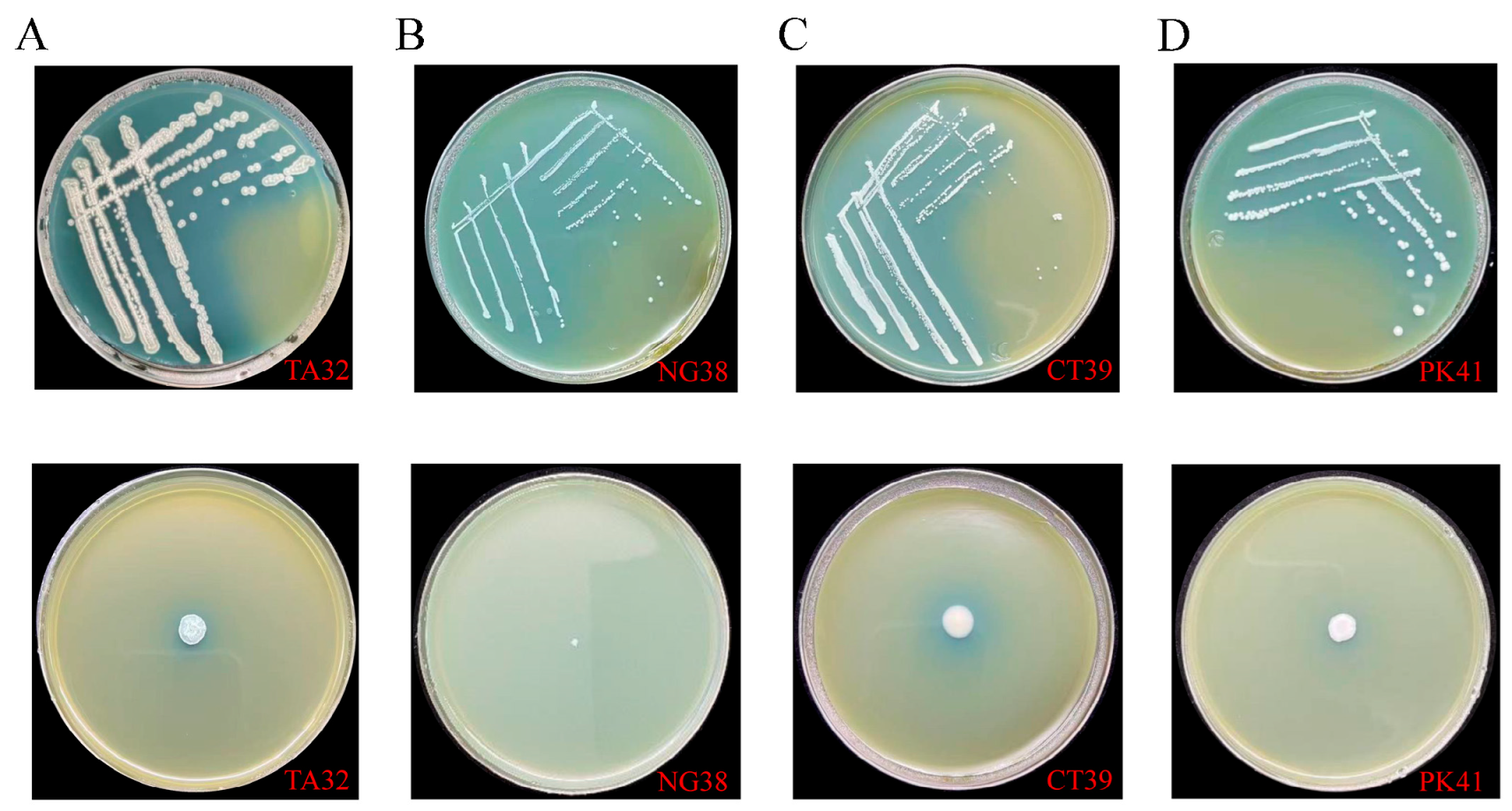
The isolation and identification of SSOs are crucial for understanding the mechanisms of aerobic deterioration in silage. Since lactic acid consumption is the primary driver of silage aerobic instability, a qualitative screening using bromocresol green indicator was employed to assess the spoilage potential of the isolates. Bromocresol green is a pH indicator that shifts from yellow/green (acidic, pH < 3.8–5.4) to blue (alkaline, pH > 5.4). As shown in Figure 1, distinct blue halos appeared around the yeast colonies on the modified medium containing lactic acid as the sole carbon source. This color change indicates that the yeasts metabolized the lactic acid, thereby depleting the acidity and raising the pH of the surrounding medium. The blue halos surrounding colonies of CT39, PK41, and TA32 were noticeably larger and more intense in color compared to those of NG38. This visual evidence suggests that CT39, PK41, and TA32 possess a more vigorous capability to assimilate lactic acid and elevate environmental pH, predicting a higher potential to cause rapid deterioration in actual silage conditions. Thus, in this study, four yeast strains (TA32, NG38, CT39, PK41) were isolated from aerobically deteriorated Napier grass silage and identified as SSOs. All SSOs of Napier grass silage are yeast rather than bacteria and mold strains, suggesting that the aerobic deterioration of silage made from Napier grass is mainly initiated by yeast.
Figure 1.
Colonies of four SSOs isolated from aerobically deteriorated Napier grass silage. (A), TA32, Trichosporon asahii TA32; (B), NG38, Nakaseomyces glabratus NG38; (C), CT39, Candida tropicalis CT39; (D), PK41, Pichia kudriavzevii PK41.
Morphologically, the colonies of TA32, NG38, CT39, and PK41 on PDA medium appeared distinct. Based on Figure 1, TA32 colonies were white to cream-colored, dry, and wrinkled, with an oval to filamentous cell shape, typical of Trichosporon species [23], while NG38, CT39, and PK41 formed smooth, cream-colored colonies with oval cells. Physiological tests revealed distinct stress tolerance profiles of four SSOs and their results are presented in Table 1. While all strains grew well at pH 3.5–6.5 and temperatures of 25–35 °C, PK41 exhibited superior tolerance to extreme conditions. It showed well growth at pH 3.0 and at 45 °C. The ability of PK41 to thrive at low pH and high temperatures suggests it is highly competitive in the acidic and potentially heating environment of silage during early aerobic exposure. This aligns with previous findings that P. kudriavzevii is a robust, multi-stress tolerant yeast often found in fermented feeds and fermented vegetables [24,25].
Table 1.
Physiological characteristics of SSOs.
Metabolic profiling (Table 2) showed that all SSOs strains could ferment D-glucose and assimilate N-acetyl-glucosamine. However, TA32 and PK41 notably possessed strong proteolytic activity, testing positive for gelatinase, urease, and casease. This proteolytic capability is concerning as it may contribute to protein degradation (proteolysis) during aerobic deterioration.
Table 2.
Carbohydrate metabolism profiles and proteolysis capacity of SSOs.
Molecular identification based on ITS rRNA gene sequencing (Table 3) confirmed the taxonomic identities of the isolates with 99–100% similarity: TA32 as T. asahii, NG38 as N. glabratus, CT39 as C. tropicalis, and PK41 as P. kudriavzevii. The accession numbers of the isolated SSOs strains are as follows: PX760671 for TA32, PX760670 for NG38, PX760668 for CT39, and PX760669 for PK41. These results corroborate previous studies identifying these genera as common spoilage yeasts [26]. Notably, T. asahii and P. kudriavzevii are also emerging opportunistic pathogens [23,24], highlighting a potential microbial risk associated with feeding spoiled silage. Although pathogenicity and mycotoxin production were not directly assessed in this study, the dominance of these species in aerobically deteriorated silages warrants caution, as yeast does not have obvious mold spots like molds do, and it is more likely to be overlooked. However, verifying the actual hazard to livestock consuming such spoiled silage requires further toxicological investigation.
Table 3.
ITS rRNA gene sequence results of SSOs.
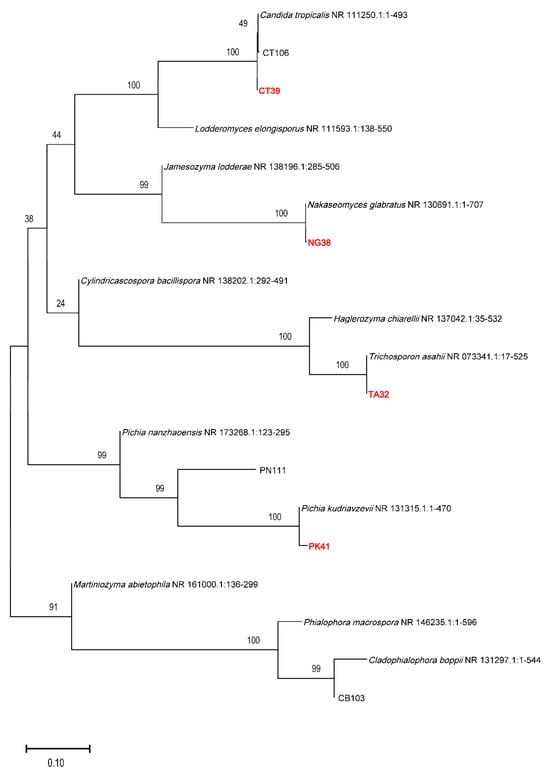
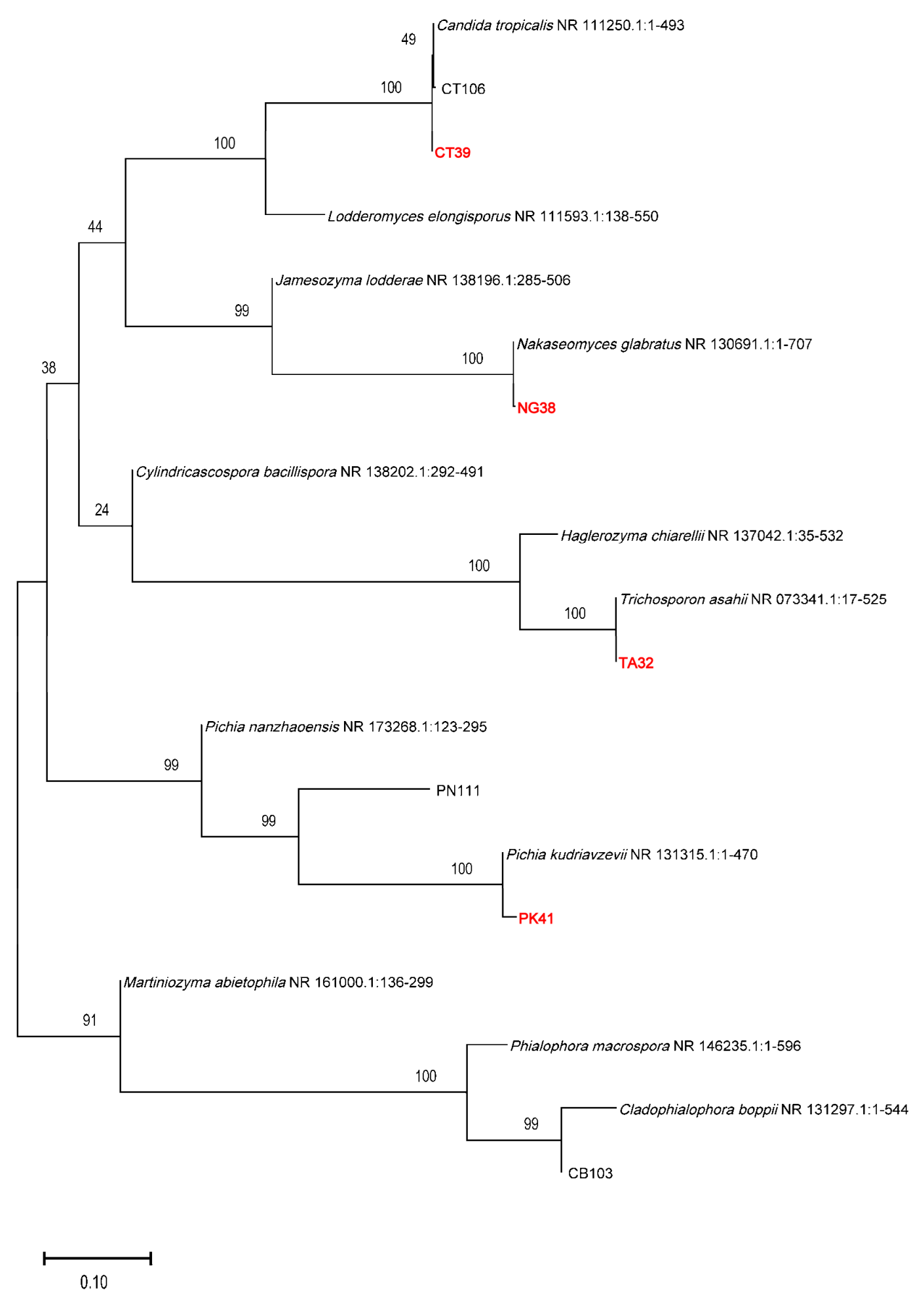
Molecular homological analysis was conducted and a phylogenetic tree (Figure 2) was constructed based on the ITS rDNA sequences for observing divergences. Strain TA32 was most closely related to T. asahii, showing 100% similarity in its ITS rDNA gene sequence. Similarly, strains NG38 and PK41 exhibited 100% similarity to N. glabratus and P. kudriavzevii, respectively, while CT39 showed 100% similarity to C. tropicalis, supporting the high confidence values from bootstrap analysis of the phylogenetic tree.
Figure 2.
Phylogenetic tree analysis of SSOs. A phylogenetic tree was reconstructed using the neighbor-joining method based on ITS1 region sequences to depict the phylogenetic relationships among the yeast species. Evolutionary distances were estimated using the maximum composite likelihood method. Bootstrap support values from 1000 replicates are indicated at the nodes. The scale bar represents an evolutionary distance of 0.1 nucleotide substitutions per site. The red marks are the four SSOs used in this work.
3.2. Composition of Napier Grass Before Ensiling
The characteristics of the fresh Napier grass prior to ensiling are shown in Table 4. The DM content was 26.3%, which is within the recommended range for ensiling. The WSC content was 8.86% DM, providing sufficient substrate for LAB [2]. The epiphytic microbial population was dominated by aerobic bacteria (7.74 log10 CFU/g FM), followed by yeasts (6.39 log10 CFU/g FM), LAB (6.35 log10 CFU/g FM), enterobacteria (6.25 log10 CFU/g FM) and molds (5.24 log10 CFU/g FM). The high initial load of yeasts (>105 CFU/g FM) might pose a significant risk for aerobic stability, as these organisms can survive anaerobic fermentation and rapidly proliferate upon air exposure [4].
Table 4.
The pre-ensiled parameters of Napier grass (means ± SD).
3.3. The Dynamics of the Fermentation Parameters During 9 Days of Aerobic Exposure of Napier Grass Silage
The dynamic changes in fermentation parameters are presented in Table 5. In CON, the pH increased from 4.09 to 4.66 during the first 5 days. During the whole aerobic exposure (9 days), the SSO-inoculated groups exhibited a much more aggressive pH elevation (p < 0.05). Specifically, the PK41 and TA32 inoculation showed the fastest increases. By day 5, the pH in the PK41 and TA32 had already surged to 5.25 and 5.43, respectively, significantly higher (p < 0.05) than CON. By day 9, these two groups reached pH values > 6.9. The pH trajectory is the most critical indicator of aerobic deterioration. The rise of >0.5 pH units in CON indicates that the aerobic deterioration process had already initiated [27], while the rapid surge in inoculated groups indicates complete deterioration driven by SSOs.
Correspondingly, the lactic acid content in PK41 or TA32 decreased precipitously from 54.4 g/kg DM at day 0 to 10.8 g/kg DM or 10.2 g/kg DM at day 9 (p < 0.05). This pH rise was strongly correlated with the consumption of lactic acid. The rapid consumption by PK41 and TA32 confirms the results of the bromocresol green plate assay (Figure 1), demonstrating their potent in lactate-assimilating capacity [9]. As lactic acid is reduced, the pH rises, “unlocking” the environment for less acid-tolerant spoilage microorganisms [2,6,8].
With the aerobic exposure proceeded, acetic acid content decreased significantly (p < 0.001). Interestingly, the SSO-inoculated groups always maintained numerically (p > 0.05) lower acetic acid levels compared to the CON group. While utilization by spoilage microorganisms is a primary cause, the physical loss of acetic acid through volatilization into the atmosphere also contributes to this decline [1], as acetic acid is a volatile fatty acid with high vapor pressure [2,28]. The lower levels in inoculated groups further suggest that these SSOs could be capable of metabolizing acetic acid.
During the entire period of aerobic exposure, the levels of propionic acid and butyric acid in each group were not detected or were so low as to be negligible. This indicates that propionic acid and butyric acid were not the indicators that the researchers needed to focus on during aerobic exposure of silages. The higher butyric acid content in NG38 and CT39 at day 5 might be attributed to measurement errors.
Table 5.
The fermentation parameters of Napier grass silage during aerobic exposure (n = 3).
3.4. The Dynamics of the Chemical Parameters During 9 Days of Aerobic Exposure of Napier Grass Silage
The nutritional quality of the Napier silage deteriorated significantly during aerobic exposure (Table 6). DM content decreased in all groups over time, reflecting the loss of nutrients due to the respiration and reproduction of aerobic microbes. The PK41 inoculation showed the most substantial DM loss, indicating intense metabolic activity. WSC was rapidly depleted, dropping to near exhaustion by day 9 in the inoculated groups except for NG38. This represents a significant energy loss for the animal [29].
Regarding nitrogen fractions, the NH3-N concentration of the Napier grass silage at the start of aerobic exposure (day 0) was consistently low. However, as exposure continued, NH3-N levels increased drastically in all groups. The PK41 and TA32 inoculation exhibited the highest NH3-N levels, rising to 113 g/kg TN and 117 g/kg TN at day 9, respectively. The low initial NH3-N concentration (below the 100 g/kg TN threshold) indicates that no severe proteolysis occurred during the anaerobic fermentation process [30]. The subsequent surge serves as an indicator of proteolysis, reflecting the breakdown of proteins into amino acids and then into ammonia [2]. This aligns with the physiological characterization (Table 2), where PK41 and TA32 showed strong positive reactions for casease and urease. It is important to note that the measured NH3-N values likely underestimate the total extent of protein degradation due to ammonia volatilization. Ammonia is highly volatile, especially as the silage pH rises above 7.0 and temperatures increase [2]. In PK41 and TA32, where pH reached nearly 7.0, a significant portion of the generated ammonia likely volatilized into the air. This intense proteolytic activity of T. asahii and P. kudriavzevii not only reduces nutritional value but also contributes to the rapid alkalinization of the silage via ammonia production.
Table 6.
The chemical parameters of Napier grass silage during aerobic exposure (n = 3).
3.5. Aerobic Stability of Napier Grass Silage
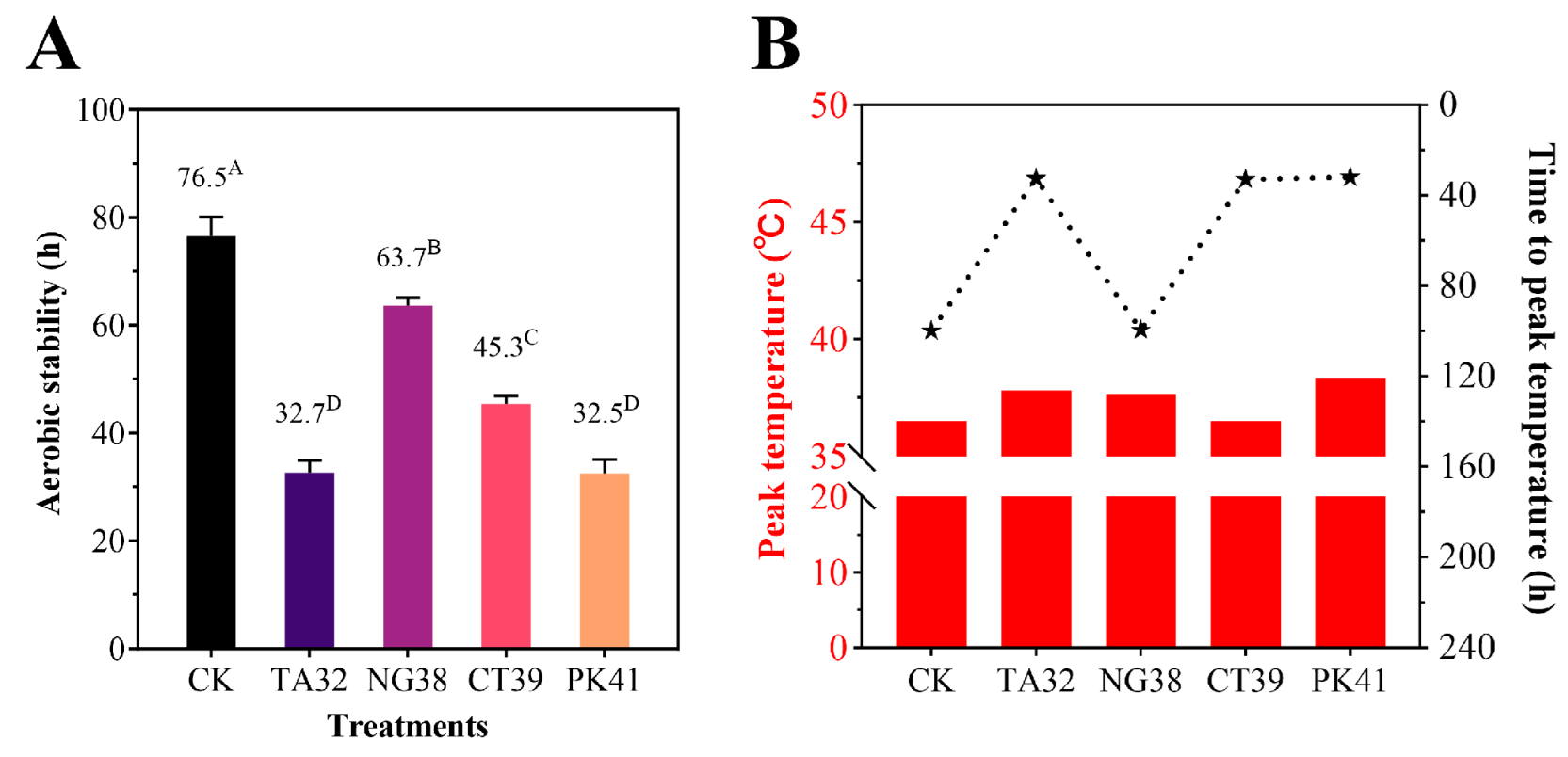
Aerobic stability, defined as the time until the silage temperature rises 2 °C above ambient temperature, is the definitive measure of resistance to aerobic deterioration [19]. As shown in Figure 3A, the inoculation of four SSOs significantly (p < 0.05) reduced the aerobic stability of Napier grass silage. CON exhibited the highest aerobic stability (76.5 h). In stark contrast, the PK41 inoculation had the lowest stability, heating up in only 32.5 h, followed closely by TA32 (32.7 h). The CT39 and NG38 inoculation showed intermediate stabilities. To provide a comprehensive understanding of deterioration dynamics, the peak temperature and time to peak temperature were further analyzed (Figure 3B). The PK41 group exhibited the most aggressive spoilage, reaching the highest peak temperature (38.3 °C) within the shortest time (32.0 h). Similarly, TA32 reached a high peak temperature (37.8 °C) rapidly at 32.5 h. In contrast, the CON group exhibited a lower peak temperature (36.5 °C) which was delayed until 100 h. Interestingly, while CT39 reached its peak temperature early (33.0 h), the intensity was lower (36.5 °C), whereas NG38 showed a delayed peak (37.7 °C) at 99.5 h) similar to the control timeline but with higher intensity. This hierarchy (CK > NG38 > CT39 > TA32 ≈ PK41) mirrors the trends observed in the plate assay (halo size) and chemical analysis (pH rise/LA depletion). As abovementioned, P. kudriavzevii and T. asahii has great ability to rapidly metabolize lactic acid and generate NH3-N. The consumption of carbohydrate and protein, combined with the loss of antifungal acids (due to metabolism and volatilization), creates a runaway spoilage effect. The drastically shortened shelf-life (<2 days) induced by these species highlights them as the primary targets for silage preservation strategies.
To sum up, this study has confirmed that PK41 and TA32 have extremely aggressive spoilage capabilities. Unlike previous observational studies that inferred spoilage potential solely based on relative abundance, our inoculation trials provided direct functional validation of the specific spoilage roles of these isolates. By comparing the degradation kinetics across groups, we established a distinct hierarchy of spoilage capacity: P. kudriavzevii and T. asahii > C. tropicalis > N. glabratus.
Figure 3.
Aerobic stability (A), peak temperature and time to peak temperature (B) of Napier grass silage inoculated with various SSOs. The error bars in the figure represent SD. Values with different capital letters among groups differed (p < 0.05). The five-point star symbol represents the time to peak temperature.
4. Conclusions
This study isolated and identified four SSOs from aerobically deteriorated Napier grass silage. Based on the size of bromocresol green discoloration zones, physiological tests, and inoculation challenge trials, PK41 (P. kudriavzevii) and TA32 (T. asahii) were identified as the most aggressive SSOs. They exhibited the strongest spoilage capacity to degrade carbohydrate and protein, and generate extensive heat. Significant increases in pH and NH3-N concentrations were prominently observed in the SSO-inoculated silages. These findings confirm that specific yeast species, rather than just total counts, determine aerobic stability. Future strategies must focus on inhibiting these specific SSOs to reduce feed loss and minimize potential microbial risks.
5. Biosafety Statement
This research involved handling cultures of four opportunistic pathogens, Trichosporon asahii TA32, Nakaseomyces glabratus NG38, Candida tropicalis CT39, and Pichia kudriavzevii PK41. All laboratory work was conducted in accordance with established biosafety protocols under Biosafety Level 2 (BSL-2) conditions. Standard microbiological safety practices were observed throughout the study to ensure personnel and environmental safety.
Author Contributions
Software, formal analysis, writing—original draft preparation, X.-Y.L.; resources, supervision, data curation, writing—review and editing, T.S.; visualization and methodology, H.-P.L. and J.-F.L.; validation and project administration, Z.-H.D.; conceptualization, investigation, Funding acquisition, methodology, data curation, validation, investigation, writing—review and editing, J.Z. All authors have read and agreed to the published version of the manuscript.
Funding
This work was financially supported by the Youth Project of NSFC (32201464), the China Postdoctoral Science Foundation (2024T170419 and 2022M721653), the General Project of NSFC (32171690), and the Fundamental Research Funds for the Central Universities (KYQN2023001).
Institutional Review Board Statement
Not applicable.
Informed Consent Statement
Not applicable.
Data Availability Statement
The original contributions presented in this study are included in the article. Further inquiries can be directed to the corresponding author.
Conflicts of Interest
The authors declare no conflict of interest.
References
- Wilkinson, J.M.; Davies, D.R. The aerobic stability of silage: Key findings and recent developments. Grass Forage Sci. 2013, 68, 1–19. [Google Scholar] [CrossRef] [Scilit]
- McDonald, P.; Henderson, A.R.; Heron, S.J.E. The Biochemistry of Silage, 2nd ed.; Chalcombe Publications: Marlow, UK, 1991. [Google Scholar]
- da Silva, E.B.; Savage, R.M.; Biddle, A.S.; Polukis, S.A.; Smith, M.L.; Kung, L. Effects of a chemical additive on the fermentation, microbial communities, and aerobic stability of corn silage with or without air stress during storage. J. Anim. Sci. 2020, 98, skaa246. [Google Scholar] [CrossRef] [Scilit]
- Muck, R.E.; Nadeau, E.M.G.; McAllister, T.A.; Contreras-Govea, F.E.; Santos, M.C.; Kung, L. Silage review: Recent advances and future technologies for silage additives. J. Dairy Sci. 2018, 101, 3980–4000. [Google Scholar] [CrossRef] [Scilit]
- Borreani, G.; Tabacco, E.; Schmidt, R.J.; Holmes, B.J.; Muck, R.E. Silage review: Factors affecting dry matter and quality losses in silages. J. Dairy Sci. 2018, 101, 3952–3979. [Google Scholar] [CrossRef] [Scilit]
- Drouin, P.; Tremblay, J.; Renaud, J.; Apper, E. Microbiota succession during aerobic stability of maize silage inoculated with Lentilactobacillus buchneri Ncimb 40788 and Lentilactobacillus hilgardii Cncm-I-4785. Microbiologyopen 2011, 10, e1153. [Google Scholar] [CrossRef] [Scilit]
- Pahlow, G.; Muck, R.E.; Driehuis, F.; Oude Elferink, S.J.W.H.; Spoelstra, S.F. Microbiology of ensiling. Silage Sci. Technol. 2003, 42, 31–93. [Google Scholar]
- Dolci, P.; Tabacco, E.; Cocolin, L.; Borreani, G. Microbial dynamics during aerobic exposure of corn silage stored under oxygen barrier or polyethylene films. Appl. Environ. Microbiol. 2011, 77, 7499–7507. [Google Scholar] [CrossRef] [Scilit] [PubMed]
- Woolford, M.K. The detrimental effects of air on silage. J. Appl. Bacteriol. 1990, 68, 101–116. [Google Scholar] [CrossRef] [Scilit]
- Liu, Q.; Lindow, S.E.; Zhang, J. Lactobacillus parafarraginis ZH1 producing anti-yeast substances to improve the aerobic stability of silage. Anim. Sci. J. 2018, 89, 1302–1309. [Google Scholar] [CrossRef] [Scilit]
- Zhao, J.; Wang, S.; Dong, Z.; Chen, L.; Shao, T. Partial substitution of whole-crop corn with bamboo shoot shell improves aerobic stability of total mixed ration silage without affecting in vitro digestibility. J. Anim. Physiol. Anim. Nutr. 2021, 105, 431–441. [Google Scholar] [CrossRef] [Scilit]
- Okoye, C.O.; Wu, Y.; Wang, Y.; Gao, L.; Li, X.; Jiang, J. Fermentation profile, aerobic stability, and microbial community dynamics of corn straw ensiled with Lactobacillus buchneri Pc-C1 and Lactobacillus plantarum Pc1-1. Microbiol. Res. 2023, 270, 127329. [Google Scholar] [CrossRef] [Scilit]
- Liu, W.; Wang, Z.; Sun, L.; Du, S.; Ge, G.; Jia, Y. Effects of two bacterial exopolysaccharides on microbial community, fermentation characteristics and aerobic stability in oat silage. Microb. Biotechnol. 2025, 18, e70118. [Google Scholar] [CrossRef] [Scilit]
- Wang, T.; Teng, K.; Cao, Y.; Shi, W.; Xuan, Z.; Zhou, J.; Zhang, J.; Zhong, J. Effects of Lactobacillus hilgardii 60TS-2, with or without homofermentative Lactobacillus plantarum B90, on the aerobic stability, fermentation quality and microbial community dynamics in sugarcane top silage. Bioresour. Technol. 2020, 312, 123600. [Google Scholar] [CrossRef] [Scilit] [PubMed]
- Li, M.; Zhou, S.; Tang, X.; Liao, C.; Li, P.; Xie, Y.; Cheng, Q.; Chen, C. Effect of co-inoculation of Lactobacillus plantarum and Lentilactobacillus buchneri on aerobic stability and microbial community composition of perennial sorghum silage. Biomass Bioenerg. 2023, 173, 106801. [Google Scholar] [CrossRef] [Scilit]
- Kurtzman, C.P.; Fell, J.W.; Boekhout, T. The Yeasts: A Taxonomic Study, 5th ed.; Elsevier: London, UK, 2011. [Google Scholar]
- Strauss, M.L.A.; Jolly, N.P.; Lambrechts, M.G.; van Rensburg, P. Screening for the production of extracellular hydrolytic enzymes by non-Saccharomyces wine yeasts. J. Appl. Microbiol. 2001, 91, 182–190. [Google Scholar] [CrossRef] [Scilit] [PubMed]
- Möller, E.M.; Bahnweg, G.; Sandermann, H.; Geiger, H.H. A simple and efficient protocol for isolation of high molecular weight DNA from filamentous fungi, fruit bodies, and infected plant tissues. Nucleic Acids Res. 1992, 20, 6115. [Google Scholar] [CrossRef] [Scilit]
- Guo, X.S.; Undersander, D.J.; Combs, D.K. Effect of Lactobacillus inoculants and forage dry matter on the fermentation and aerobic stability of ensiled mixed-crop tall fescue and meadow fescue. J. Dairy Sci. 2013, 96, 1735–1744. [Google Scholar] [CrossRef] [Scilit]
- Broderick, G.A.; Kang, J.H. Automated simultaneous determination of ammonia and total amino acids in ruminal fluid and in vitro media. J. Dairy Sci. 1980, 63, 64–75. [Google Scholar] [CrossRef] [Scilit] [PubMed]
- Zhao, J.; Dong, Z.; Li, J.; Chen, L.; Bai, Y.; Jia, Y.; Shao, T. Ensiling as pretreatment of rice straw: The effect of hemicellulase and Lactobacillus plantarum on hemicellulose degradation and cellulose conversion. Bioresour. Technol. 2018, 266, 158–165. [Google Scholar] [CrossRef] [Scilit]
- Thomas, T.A. An automated procedure for the determination of soluble carbohydrates in herbage. J. Sci. Food Agric. 1977, 28, 639–642. [Google Scholar] [CrossRef] [Scilit]
- Colombo, A.L.; Padovan, A.C.B.; Chaves, G.M. Current knowledge of Trichosporon spp. and Trichosporonosis. Clin. Microbiol. Rev. 2011, 24, 682–700. [Google Scholar] [CrossRef] [Scilit]
- Jiang, D.; Tang, X.; Zheng, M.; Niu, D.; Zuo, S.; Guan, E.; Xu, C. Mechanistic insights into fungal succession mediated by Pichia kudriavzevii during aerobic deterioration of ensiled total mixed ration. BMC Microbiol. 2025, 25, 714. [Google Scholar] [CrossRef] [Scilit]
- Moon, S.H.; Chang, M.; Kim, H.Y.; Chang, H.C. Pichia kudriavzevii is the major yeast involved in film-formation, off-odor production, and texture-softening in over-ripened Kimchi. Food Sci. Biotechnol. 2014, 23, 489–497. [Google Scholar] [CrossRef] [Scilit]
- Wang, H.; Hao, W.; Ning, T.; Zheng, M.; Xu, C. Characterization of culturable yeast species associating with whole crop corn and total mixed ration silage. Asian-Australas. J. Anim. Sci. 2018, 31, 198–207. [Google Scholar] [CrossRef] [Scilit] [PubMed]
- Mu, L.; Wang, Q.; Cao, X.; Zhang, Z. Effects of fatty acid salts on fermentation characteristics, bacterial diversity and aerobic stability of mixed silage prepared with alfalfa, rice straw and wheat bran. J. Sci. Food Agric. 2021, 102, 1475–1487. [Google Scholar] [CrossRef] [Scilit]
- Porter, M.G.; Murray, R.S. The volatility of components of grass silage on oven drying and the inter-relationship between dry matter content estimated by different analytical methods. Grass Forage Sci. 2001, 56, 405–411. [Google Scholar] [CrossRef] [Scilit]
- Muck, R.E. Silage microbiology and its control through additives. Rev. Bras. Zootec. 2010, 39, 183–191. [Google Scholar] [CrossRef] [Scilit]
- Kamphayae, S.; Kumagai, H.; Angthong, W.; Narmseelee, R.; Bureenok, S. Effects of different ratios and storage periods of liquid brewer’s yeast mixed with cassava pulp on chemical composition, fermentation quality and in vitro ruminal fermentation. Asian Australas. J. Anim. Sci. 2017, 30, 470–478. [Google Scholar] [CrossRef] [Scilit] [PubMed]

Disclaimer/Publisher’s Note: The statements, opinions and data contained in all publications are solely those of the individual author(s) and contributor(s) and not of MDPI and/or the editor(s). MDPI and/or the editor(s) disclaim responsibility for any injury to people or property resulting from any ideas, methods, instructions or products referred to in the content. |
© 2026 by the authors. Licensee MDPI, Basel, Switzerland. This article is an open access article distributed under the terms and conditions of the Creative Commons Attribution (CC BY) license.