


Abstract
Recent studies have shown that the use of non-Saccharomyces yeasts, either alone or in co-fermentation with Saccharomyces cerevisiae, can enhance the development of specialty beers with distinctive compositional characteristics. This study aimed to evaluate the main compositional and sensory differences between American Pale Ale (APA) beers produced using the commercial strain S. cerevisiae US-05 as a single starter (Test 1), and those produced through sequential inoculation with Metschnikowia pulcherrima 62 followed by S. cerevisiae US-05 (Test 2). Analyses focused on key chemical parameters and volatile compounds at the end of primary fermentation (F1) and after 20 days of refermentation at 20 °C (F2). After F1, Test 2 samples showed higher concentrations of glycerol and higher alcohols (isoamyl alcohol, benzeneethanol) and lower concentrations of esters (isoamyl acetate, ethyl hexanoate, ethyl octanoate) compared to Test 1. After F2, the differences in higher alcohol content became less significant, whereas ester concentrations, particularly ethyl acetate and ethyl octanoate, were significantly higher in Test 2. Sensory evaluation revealed that beers from Test 2 exhibited more pronounced floral and fruity notes and achieved higher overall scores in the panel assessment. These findings indicate that sequential inoculation with M. pulcherrima 62 followed by S. cerevisiae enhances both the chemical complexity and sensory appeal of APA beers, highlighting the strain’s potential as a valuable tool for developing specialty beers with unique aromatic profiles.
1. Introduction
The recent expansion of the beer industry, driven by the growing interest in craft and specialty beers, has led to the use of innovative ingredients, emerging technologies, and varying production parameters [1,2,3,4,5,6,7]. Saccharomyces cerevisiae is the most commonly used top-fermenting brewer’s yeast, typically employed in Ale beer production, fermenting at temperatures between 15–24 °C and usually floating on the surface during fermentation [5]. In contrast, the bottom-fermenting yeast Saccharomyces pastorianus, a hybrid of S. cerevisiae and S. eubayanus is used in lagers and ferments at cooler temperatures, generally between 7–13 °C [8]. Although ingredients such as spices, herbs, and fruits are increasingly incorporated in specialty beer production, yeast selection remains a critical factor in determining the organoleptic characteristics of the final product [9,10,11,12]. In this context, yeasts isolated from vineyards and various food matrices, including sourdough and wine, have been proposed as potential brewing starters [13,14,15,16,17,18,19]. Among biotechnological resources, non-Saccharomyces yeasts are gaining attention for their potential to influence the compositional and sensory properties of wine and beer [15,17,20,21,22,23,24]. Within this group, Metschnikowia pulcherrima has emerged as a promising candidate for brewing due to its enzymatic activities, including β-glucosidase, β-lyase, and protease, which can enhance or modify the composition of the final product [17,25,26]. These enzymes facilitate the release of conjugated hop-derived compounds such as terpenes and thiols [15], while the yeast’s limited ethanol production makes it especially suitable for low-alcohol beer formulations [27]. Additionally, M. pulcherrima is known for its antimicrobial activity, which inhibits the growth of yeasts, molds, and bacteria. This effect is primarily associated with the production of pulcherriminic acid, an iron-chelating compound that reduces the availability of iron for competing microorganisms [15,28,29]. Notably, a recent study by Testa et al. [17] reported that certain M. pulcherrima strains exhibit inhibitory activity against Lactiplantibacillus plantarum, Levilactobacillus brevis, and Pediococcus acidilactici, lactic acid bacteria commonly implicated in craft beer spoilage, which can cause off-flavors and other quality defects [30,31].
In this study, we investigated the impact of sequential inoculation of M. pulcherrima 62, isolated from autochthonous Albanian red grapes [15], followed by commercial S. cerevisiae US-05, on the compositional profile of an American Pale Ale (APA)-style beer. Analytical evaluations focused on the volatile components at the end of primary fermentation and in the final product after priming and refermentation.
2. Materials and Methods
2.1. Yeast Strains and Growth Conditions
For this study, Metschnikowia pulcherrima 62, from the culture collection of the Agri-Food Research Centre, Faculty of Biotechnology and Food, Agricultural University of Tirana, and the commercial Saccharomyces cerevisiae US-05 (SafeAle, Fermentis, Belgium) were used. Yeasts were cultured aerobically at 28 °C in YEPD (Yeast Extract Peptone Dextrose) broth (Merck Millipore, Darmstadt, Germany) in 500 mL Erlenmeyer flasks, maintained under stirring on a digital orbital shaker (Heathrow Scientific, Vernon Hills, IL, USA) set at 150 rpm. After 48 h, the cultures were centrifuged at 8000 rpm for 10 min at 4 °C. The resulting cell pellets were washed twice with saline solution (0.9% NaCl) and used as inoculum. Cell density of the inoculum was determined using a Thoma Counting Chamber (Thermo-Fisher Scientific, Waltham, MA, USA).
2.2. Craft Beer Production
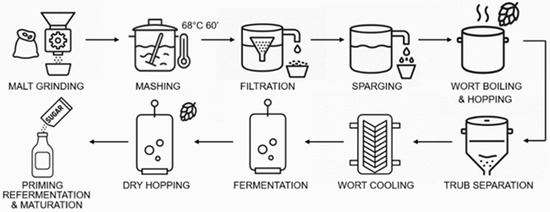
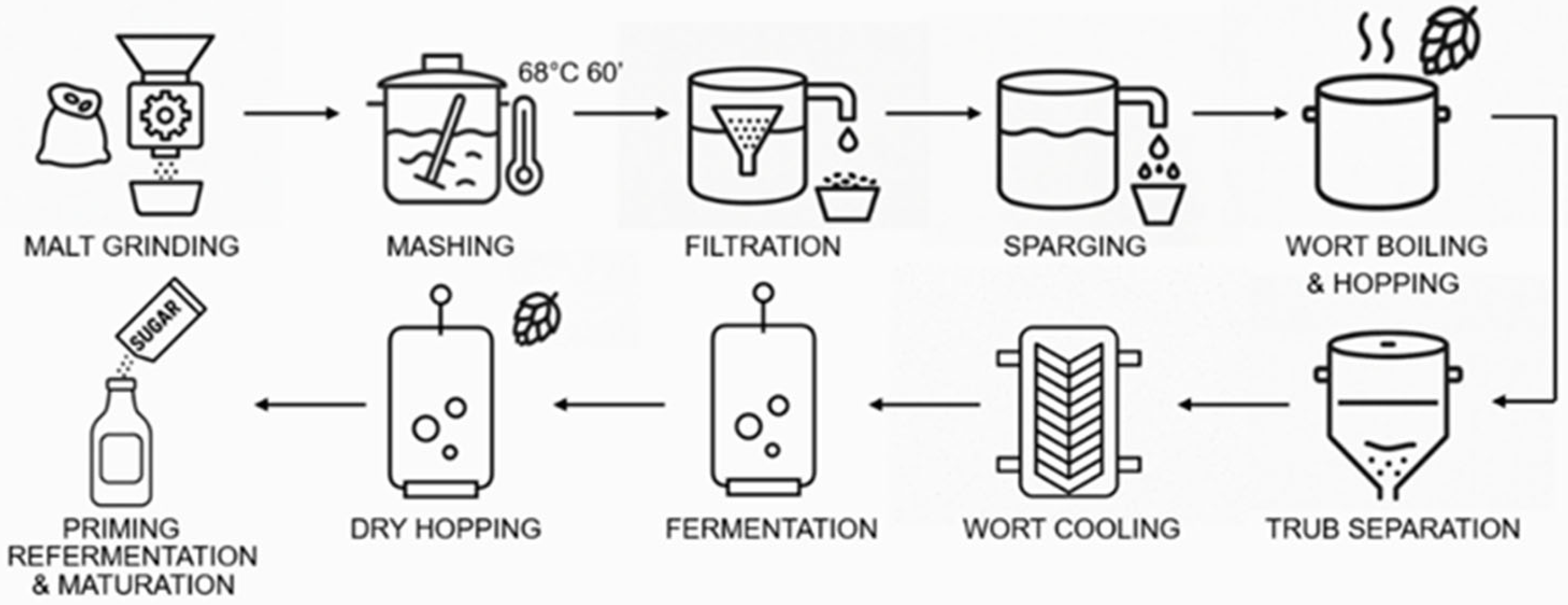
An American Pale Ale (APA) style beer wort was prepared for the experiments using a BrewZilla Gen 4.1 brewing system (KegLand PTY Ltd., Victoria, Australia). Pale Ale and Crystal malts (Château Pale Ale, Castle Malting, Lambermont, Belgium) were used for wort production, while Cascade and Citra hops (Barth-Hass, Nürnberg, Germany) were added during the boiling and dry hopping phases. Figure 1 shows a flow chart of the beer production process. The wort had the following key physico-chemical parameters, in accordance with BJCP (Beer Judge Certification Program) guidelines [32]: pH 5.60, °Plato 12.2, density 1.048 g/cm3, color 17 according by European Brewery Convention (EBC) bitterness 40 IBU (International Bitterness Unit), and free amino nitrogen (FAN) content of 255.3 mg/L.
Figure 1.
Flowchart of the Brewing Process.
In Test 1, fermentation was carried out using S. cerevisiae US-05 alone. In Test 2, M. pulcherrima strain 62 was inoculated first, followed by the addition of S. cerevisiae US-05 after 96 h. Both starter cultures were inoculated at the same initial concentration of approximately 107 cells/mL. Fermentation was conducted in triplicate at 20 °C in stainless steel containers (30 L capacity), each filled with 20 L of wort.
To achieve carbonation, 5 g/L of sucrose was added at the end of primary fermentation as a priming sugar, and the beer was then bottled in 330 mL dark brown glass bottles. Chemical analyses were performed at the end of primary fermentation. After priming and 20 days of refermentation at 20 °C, the beers were analyzed both chemically and organoleptically.
2.3. Monitoring of Primary Fermentation
During primary fermentation, pH and density were monitored. Yeast viable cell counts were determined using WL (Wallerstein Laboratory) nutrient agar medium (Merck KGaA, Darmstadt, Germany). After incubation at 28 °C for 72 h under aerobic conditions, colonies were differentiated based on color and morphology to distinguish S. cerevisiae from M. pulcherrima [17].
2.4. Main Chemical Parameters of Beers
Density (g/cm3), alcohol content (% v/v), FAN, color, and IBU were measured following European Brewery Convention (EBC) methods [33]. pH was measured using a pH meter (EDGE, Hanna Instruments, Woonsocket, RI, USA). Titratable acidity (g/L) and volatile acidity (g/L) were determined according to Baiano et al. [34]. Glycerol (mg/L), acetaldehyde (mg/L), L-malic acid (g/L), and L-lactic acid (g/L) concentrations were quantified using enzymatic kits (Steroglass, Perugia, Italy) following the manufacturer’s instructions. All analyses were performed in triplicate.
2.5. Analysis of Volatile Organic Compounds
Volatile organic compounds (VOCs) in beer samples were extracted using headspace solid-phase microextraction (HS-SPME) and analyzed by gas chromatography–mass spectrometry (GC/MS). Prior to analysis, all beer samples were stored at 4 °C. After opening, samples were degassed in an ultrasonic bath for approximately 10 min in an iced water bath to allow CO2 to escape while minimizing volatile losses [35]. Subsequently, 5 mL of each degassed sample was placed into a 20 mL autosampler headspace vial, and 2 g of sodium chloride was added. The vial was sealed and homogenized using a vortex shaker to ensure sample uniformity. VOCs extraction followed the method reported by Coppola et al. [36]. Briefly, extraction and injection were performed automatically using an autosampler device (MPS 2, Gerstel, Mülheim, Germany). The fiber (DVB/CAR/PDMS; 50/30 mm, 2 cm) was exposed to the headspace at 40 °C for 30 min, then automatically transferred to the GC injector, where VOCs desorption was performed for 10 min at 240 °C. VOCs were separated using an Agilent 7890A gas chromatograph (Agilent Technologies, Santa Clara, CA, USA) coupled with a 5975A mass spectrometer (Agilent Technologies, Santa Clara, CA, USA) and equipped with a capillary HP-Innowax column (30 m × 0.25 mm × 0.5 µm). The oven temperature was initially held at 40 °C for 1 min, then increased sequentially: to 60 °C at 2 °C/min, to 150 °C at 3 °C/min, to 200 °C at 10 °C/min, and finally to 240 °C at 25 °C/min, maintained for 7 min. Helium was used as the carrier gas at a flow rate of 1.5 mL/min. Ion source and quadrupole temperatures were set at 230 °C and 150 °C, respectively. Mass spectra were acquired in electron impact (EI) mode at 70 eV using splitless injection over an m/z range of 30–300. VOCs were identified or tentatively identified by matching mass spectra with library data (Nist05/Wiley07), linear retention indices (LRI), and retention times of available commercial standards analyzed under the same conditions. Semi-quantitative data for individual volatile compounds were expressed as relative peak area (RPA%) and calculated relative to the total VOCs peak areas from the total ion chromatogram (TIC). Beer samples were analyzed in triplicate according to a randomized sequence, with blanks included.
2.6. Sensory Analysis
The sensory characteristics of the beers were evaluated by a panel of six professional tasters (aged 30–50 years, both male and female) affiliated with the National Organization of Wine Tasters (ONAV, Italy) and certified for both wine and beer evaluation [37]. For the sensory evaluation process, the experts were specially chosen and received personalized guidelines to accurately evaluate the quality and characteristics of the beer. Samples, identified by three-digit codes, were presented in random order at 10 °C in 100 mL odorless and colorless glass cups, covered with a watch glass to minimize volatile compound losses.
Sensory attributes were assessed using a scale from 0 (no perception) to 9 (maximum intensity). The evaluated attributes and descriptors were: visual (color intensity); olfactory (ester/fruity, malty); taste (acidity, bitterness, malty); mouthfeel (body, astringency); and overall impression. Each beer was evaluated in two independent replicates.
2.7. Statistical Analysis
Results are expressed as mean ± standard deviation (SD). Statistical analyses were performed using t-tests and one-way analysis of variance (ANOVA) with Tukey post hoc tests in IBM SPSS Statistics 21, at a significance level of p < 0.05.
VOCs data were analyzed via principal component analysis (PCA) using the web-based tool MetaboAnalyst 5.0 (Xia Lab, McGill University, Montreal, QC, Canada). Data were median-centered and autoscaled prior to analysis. PCA was applied to assess significant differences in VOCs content among sample groups and to identify the volatiles that most effectively discriminate between the different beer samples.
3. Results and Discussion
3.1. Fermentation Process Monitoring
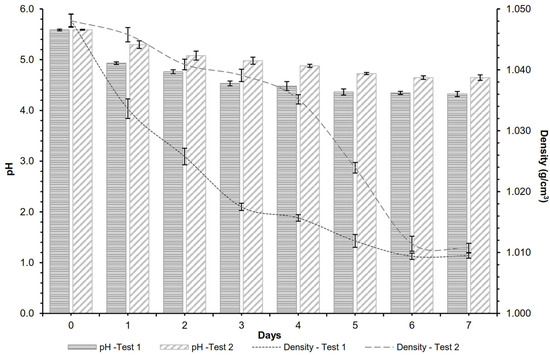
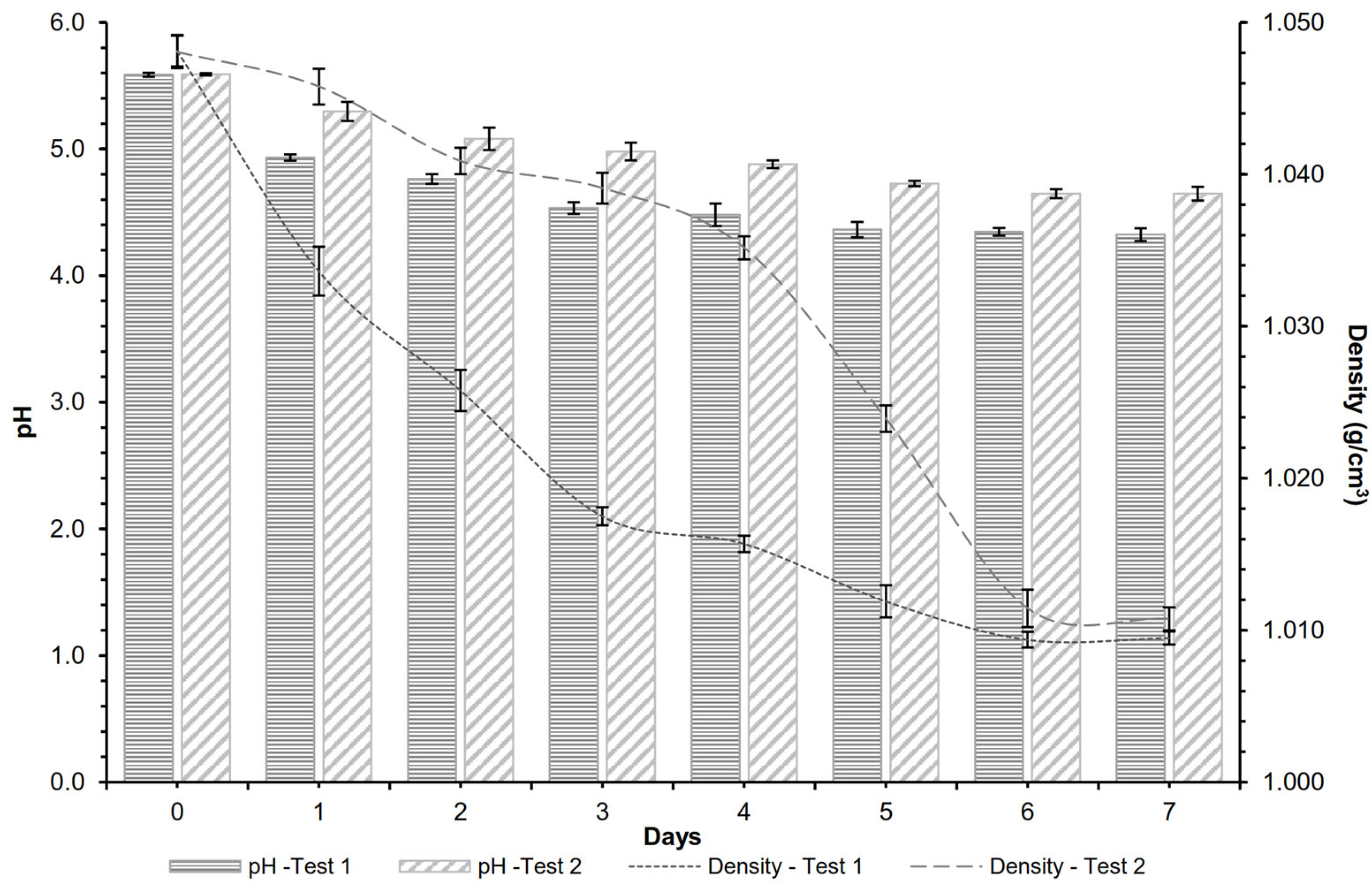
The evolution of pH and density during primary fermentation is shown in Figure 2.
Figure 2.
pH and density (g/cm3) trends during fermentation for Test 1, inoculated with S. cerevisiae US-05 alone, and Test 2, inoculated sequentially with M. pulcherrima 62 followed by S. cerevisiae US-05 after 96 h.
In Test 1, where only S. cerevisiae US-05 was used, the pH decreased rapidly from 5.60 (± 0.02) to 4.53 (± 0.05) within the first three days, reaching a final value of 4.31 (± 0.03). In contrast, in Test 2, which started with M. pulcherrima 62, the pH declined slowly during the first three days, reaching 4.98 (± 0.07). From the fourth day, following the inoculation of S. cerevisiae US-05, the pH continued to decrease, reaching a final value of 4.64 (± 0.04). The pH trends observed in both tests reflect yeast metabolism, particularly the depletion of buffering compounds such as amino acids and the production of organic acids [15]. The slightly higher final pH in Test 2 (4.64 ± 0.04) compared to Test 1 (4.31 ± 0.03) may be attributed to the limited acidification capacity of M. pulcherrima during the early fermentation phase [38]. This difference may also result, in part, from the proteolytic activity of M. pulcherrima, which increases the release of free amino acids [15]. These amino acids contribute to the medium’s buffering capacity [39], moderating the pH decrease. Density changes followed a similar pattern. In Test 1, density decreased sharply from 1.048 g/cm3 to 1.012 g/cm3 within five days, reaching 1.009 g/cm3 at the end of fermentation. Test 2 exhibited a more gradual decline, with density falling to 1.035 g/cm3 by day four. After the inoculation of S. cerevisiae US-05, density further decreased, reaching a final value of 1.010 g/cm3. In accordance with previous studies [40], we chose to carry out the sequential inoculation with S. cerevisiae US-05 after 96 h in order to allow M. pulcherrima 62 to carry out its metabolic activity without nutritional competitions.
The slower initial reduction in density in Test 2 is consistent with the low fermentative activity of M. pulcherrima during early fermentation, a phase characterized mainly by oxygen consumption and bioprotective activity rather than ethanol production [38,41]. These observations are consistent with previous studies on sequential fermentation, which indicate that early stages dominated by non-Saccharomyces yeasts are associated with delayed acidification and slower sugar consumption [42,43]. In Test 2, M. pulcherrima maintained a stable population of 6.55 log CFU/mL up to day 4 of fermentation and became undetectable from day 6 onward. In both tests, the viable cell density of S. cerevisiae increased after inoculation, exceeding 7.00 log CFU/mL from day 4 until the end of alcoholic fermentation (Table 1).
Table 1.
Viable cell counts (log CFU/mL) of S. cerevisiae and M. pulcherrima during primary fermentation (F1): Test 1 (S. cerevisiae US-05 alone) and Test 2 (M. pulcherrima 62 and S. cerevisiae US-05 sequentially inoculated after 96 h).
The fermentation kinetics confirm, in agreement with previous studies, that M. pulcherrima, does not adversely affect the viability or metabolic performance of S. cerevisiae [15,25].
3.2. Main Chemical Parameters of Beers
The results of the main chemical parameters of the analyzed beers are presented in Table 2. Clear differences in pH were observed between the samples. In particular, the beer from Test 2 (sequential inoculation of M. pulcherrima 62 followed by S. cerevisiae US-05) exhibited significantly higher pH values compared to Test 1 (S. cerevisiae US-05 alone). Specifically, pH values in Test 2 reached 4.64 (± 0.04) during primary fermentation (F1) and 4.21 (± 0.03) after the priming phase for refermentation (F2), whereas Test 1 showed lower values of 4.31 (± 0.03) and 4.16 (± 0.02), respectively.
Table 2.
Main chemical parameters of beers obtained from Test 1 (S. cerevisiae US-05 alone) and Test 2 (M. pulcherrima 62 and S. cerevisiae US-05 sequentially inoculated after 96 h) after primary fermentation (F1) and refermentation (F2).
The increase in pH observed in Test 1 is consistent with previous research associating M. pulcherrima with reduced organic acid production and limited acidification potential during alcoholic fermentation [44,45]. Unlike S. cerevisiae, which exhibits a highly efficient fermentative metabolism with rapid sugar consumption and consistent organic acid production, M. pulcherrima demonstrates slower fermentative activity and a predominantly oxidative metabolism in the early stages of fermentation. This behavior influences pH dynamics and the buffering capacity of the medium [46,47,48]. When used in sequential inoculation strategies, non-Saccharomyces yeasts like M. pulcherrima can significantly affect the acid–base balance of the final product, with implications for microbial stability, sensory perception, and fermentation control [44]. Titratable acidity ranged from 1.59 to 1.75 g/L and did not differ significantly between tests. As a critical parameter for beer quality, titratable acidity influences flavor balance, microbial stability, and shelf-life. Its variability is primarily driven by raw material composition, such as malt type or fruit adjuncts, rather than yeast strain, especially when non-acidifying yeasts are employed [49]. This supports the idea that the acid–base profile of beer is largely determined by the fermentable matrix rather than yeast metabolism alone [50].
Alcohol content was consistently lower in Test 2 than in Test 1 across both fermentation phases. At the end of F1, ethanol was 4.53% v/v in Test 2 versus 4.69% v/v in Test 1. This reduction was associated with a lower apparent attenuation in Test 2 (78%) relative to Test 1 (83%). This confirms that M. pulcherrima affects fermentation kinetics due to its limited fermentative capacity and preference for aerobic metabolism during the early stages, in which sugars are metabolized via respiration rather than fermentation, resulting in slower ethanol production [38,51,52]. Sequential inoculation with M. pulcherrima shifts the metabolic profile of the final product, consistent with the oxygen-dependent metabolism of non-Saccharomyces yeasts [38,40]. These findings align with studies showing that M. pulcherrima diverts part of fermentable sugars toward glycerol and organic acid production rather than ethanol [40,53]. Accordingly, glycerol concentrations were significantly higher in Test 2 (1144.8 mg/L in F1 and 1343.6 mg/L in F2) than in Test 1 (933.0 and 1119.6 mg/L, respectively). This increase is attributed to M. pulcherrima’s role in redox balancing and osmoregulation [46]. Morales et al. [52] reported that mixed cultures of M. pulcherrima and S. cerevisiae under controlled oxygenation produce higher glycerol amounts compared to pure cultures, supporting the hypothesis of carbon flux diversion away from ethanol synthesis. Volatile acidity showed minor variation (0.34–0.50 g/L), with a statistically significant difference only during F1 between Test 1 (0.34 g/L) and Test 2 (0.43 g/L). These values fall within typical beer ranges [49,52], indicating that M. pulcherrima does not adversely affect volatile acid levels or overall beer quality. Free amino nitrogen (FAN) levels were higher in Test 2 across both fermentation phases, likely due to reduced nitrogen uptake by M. pulcherrima or enhanced proteolytic activity during early aerobic stages [15]. Higher FAN may support yeast vitality and enhance aroma and flavor development [50]. Acetaldehyde concentrations were similar in both tests, a positive outcome since this compound can produce off-flavors such as green apple or pungent notes [54]. L-lactic acid levels were lower in Test 2, consistent with the limited lactic acid production of M. pulcherrima, which favors oxidative metabolism over lactic acid synthesis [38]. Similarly, a modest decrease in L-malic acid was observed in Test 2, in line with reports of limited malic enzyme activity in M. pulcherrima strains [55].
IBU and EBC values did not differ significantly between the tests, suggesting that M. pulcherrima does not affect hop-derived compound extraction or color stability. This aligns with previous findings showing that non-Saccharomyces yeasts, even when combined with grape must, do not significantly alter key physicochemical beer parameters such as EBC and IBU [56]. These results highlight the potential of non-Saccharomyces yeasts in brewing, enabling innovative approaches without compromising essential sensory or stability attributes.
Diacetyl is a secondary metabolite produced during yeast fermentation. Although it is typically more prevalent in ale beers, its concentration is routinely employed as a key indicator of fermentation performance and maturation efficiency in wort and beer [57]. At concentrations above the sensory threshold (0.10–0.15 mg/L), diacetyl is considered an undesirable volatile compound, as it can impart stale milk or buttery aromas and flavors [58]. In the present study, diacetyl concentrations in beers from Test 1 and Test 2 were 0.05 and 0.06 mg/L, respectively, both well below the sensory threshold.
3.3. Volatile Organic Compounds Profiling
Supplementary Tables S1 and S2 list all VOCs detected by HS-SPME/GC-MS, along with their semi-quantitative relative peak area (RPA %) data. Specifically, after primary fermentation (F1) and after refermentation (F2), 79 and 70 VOCs were detected, respectively.
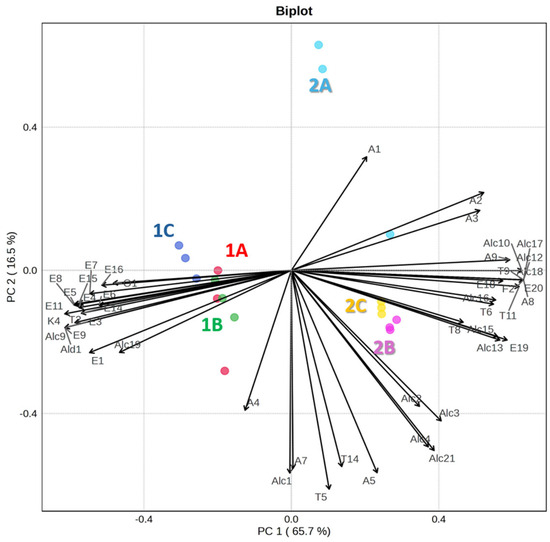
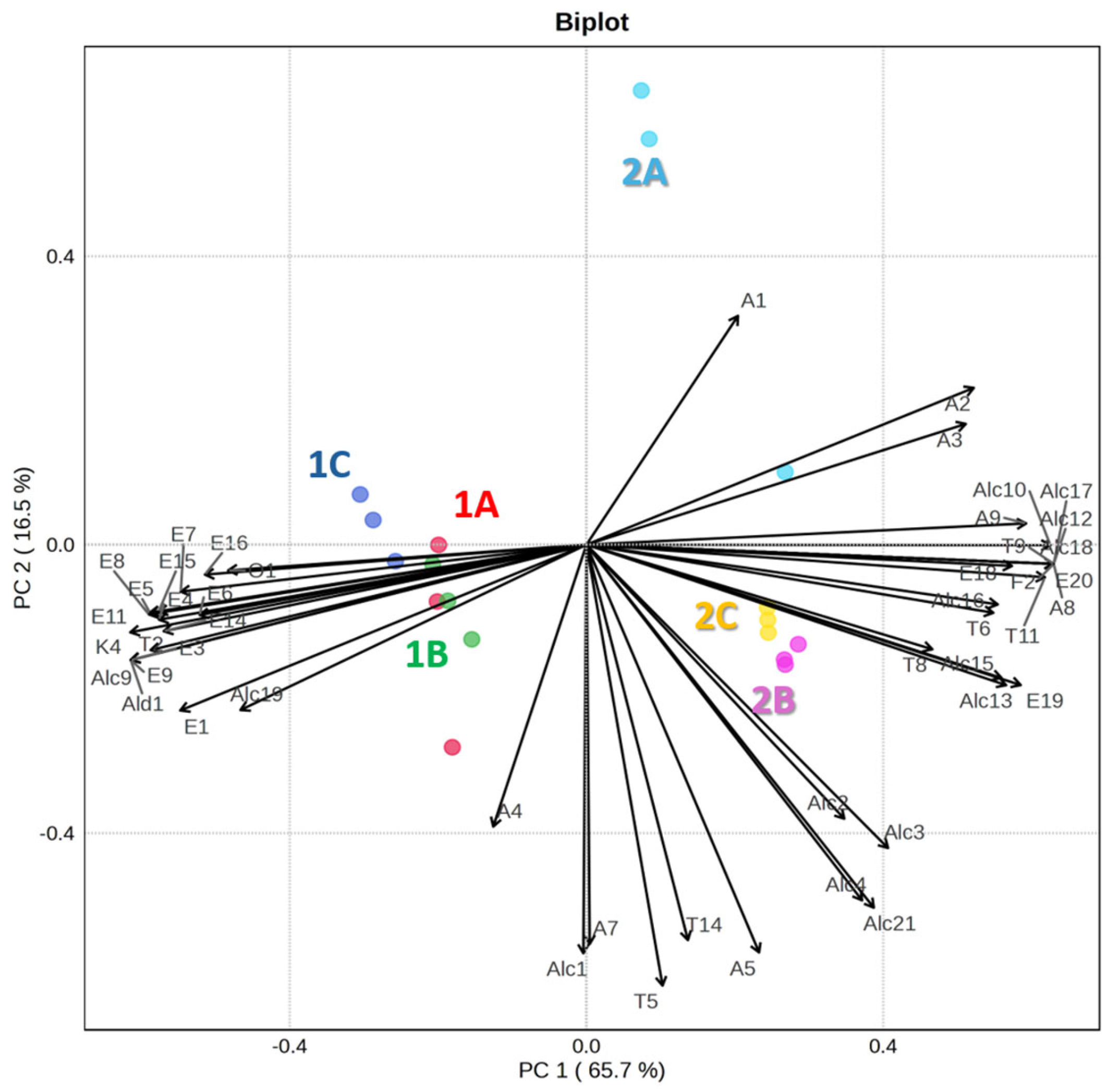
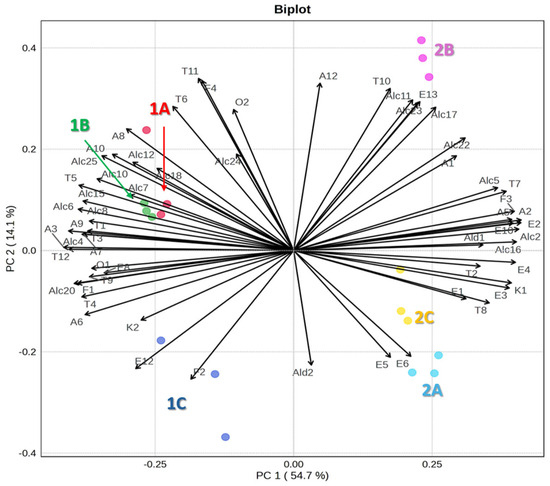
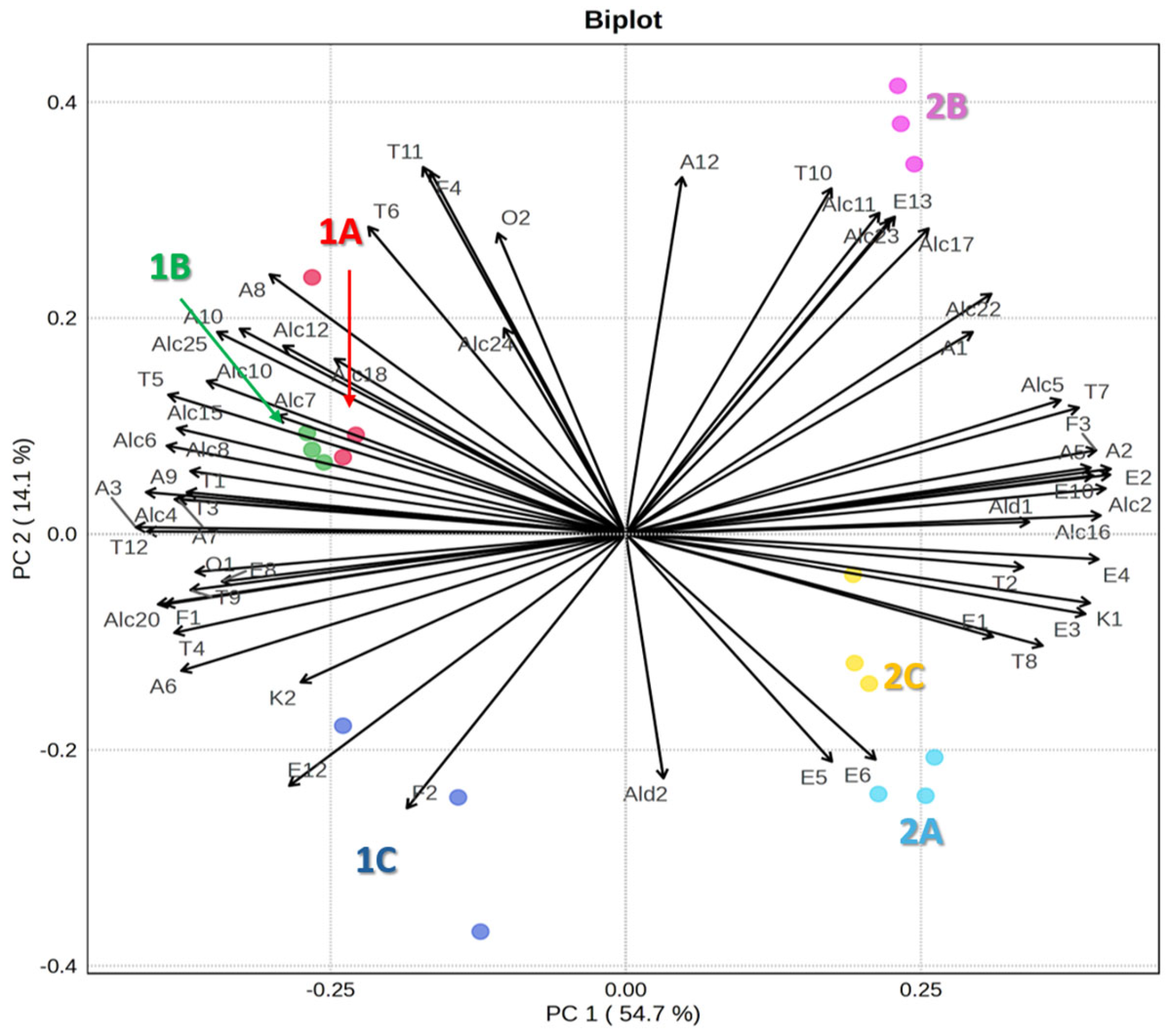
Principal component analysis (PCA) was performed to investigate the relationships between beer samples and their volatile composition. The results showed that beers could be clearly discriminated based on their VOC profiles. Figure 3 shows the distribution of beers and VOCs on the first two principal components. For beers analyzed after primary fermentation (F1), the biplot (Figure 3) represents 82.2% of the total variance (PC1: 65.7%; PC2: 16.5%). For beers analyzed after priming and refermentation (F2), the biplot (Figure 4) accounts for 68.8% of the total variance (PC1: 54.7%; PC2: 14.1%).
Figure 3.
PCA biplot showing the projection of volatile compounds (VOCs) and beers obtained after primary fermentation (F1) along the first two principal components (PC1 and PC2). Test 1 (1A, 1B, 1C) corresponds to S. cerevisiae US-05 alone, while Test 2 (2A, 2B, 2C) represents sequential inoculation of M. pulcherrima 62 followed by S. cerevisiae US-05.
Figure 4.
PCA biplot showing the projection of volatile compounds (VOCs) and beers obtained after priming and 20 days of refermentation (F2) along the first two principal components (PC1 and PC2). Test 1 (1A, 1B, 1C) corresponds to S. cerevisiae US-05 alone, while Test 2 (2A, 2B, 2C) represents sequential inoculation of M. pulcherrima 62 followed by S. cerevisiae US-05.
After F1 (Figure 3), PC1 clearly separates the beers, highlighting the effect of sequential inoculation with M. pulcherrima and S. cerevisiae (Test 2) in differentiating VOC profiles from beers obtained with a monoculture of S. cerevisiae (Test 1). PC2 appears to reflect greater homogeneity among the beers from Test 1, all located in the lower-left quadrant.
After priming and refermentation (F2), Figure 4, PC1 continues to separate the beers of Test 1 and Test 2, while PC2 suggests increased heterogeneity within both tests. This indicates that VOCs produced during primary fermentation interact during refermentation, shaping or modifying the final flavor and aroma profiles of the beers.
The predominant compounds, as determined by peak area (>1%), detected in the beer samples at the end of F1 and F2 are reported in Table 3 and Table 4, respectively.
Table 3.
Main volatile organic compounds (VOCs) detected in beers from Test 1 (S. cerevisiae US-05 alone) and Test 2 (sequential inoculation of M. pulcherrima 62 and S. cerevisiae US-05 at 96 h) after primary fermentation (F1).
Table 4.
Main volatile organic compounds (VOCs) detected in beers from Test 1 (S. cerevisiae US-05 alone) and Test 2 (sequential inoculation of M. pulcherrima 62 followed by S. cerevisiae US-05 at 96 h) after 20 days of refermentation (F2).
The VOC profiles of beers from Test 1 and Test 2 reveal notable shifts in aroma-active compounds at the end of primary fermentation (F1), highlighting the modulatory role of M. pulcherrima in sequential inoculation protocols. Esters, formed during fermentation via enzymatic condensation of alcohols and organic acids, represent the largest group of flavor-active compounds and contribute fruity notes to beer. Compared to Test 1, Test 2 showed a substantial reduction in the relative peak areas of key esters, including isoamyl acetate, ethyl hexanoate, and ethyl octanoate, with ethyl octanoate notably decreasing from 10.60% to 0.67%. This reduction suggests that M. pulcherrima either competes with S. cerevisiae for precursor metabolites (e.g., acyl-CoA, fatty acids, and acetyl-CoA) or modulates enzymatic esterification pathways during the early stages of fermentation [36,59]. Similar patterns have been observed in wine fermentations, where sequential inoculation with non-Saccharomyces yeasts results in lower levels of medium-chain ethyl and acetate esters compared to pure S. cerevisiae fermentations [60]. Specifically, M. pulcherrima has been shown to reduce ester concentrations while influencing overall aromatic profiles in mixed fermentations [25,60]. In brewing, M. pulcherrima enhances aroma complexity but generally produces lower total ester content relative to S. cerevisiae monocultures [25,61]. The relative abundance of primary higher alcohols was higher in Test 2 compared to Test 1, with isoamyl alcohol and benzeneethanol showing the largest increases, from 11.25% to 15.02% and from 9.83% to 13.04%, respectively. This effect may result from M. pulcherrima providing precursor amino acids or modifying nitrogen metabolism, thereby enhancing S. cerevisiae’s metabolic flux through the Ehrlich pathway [15,25,61]. These observations are consistent with recent findings in craft beer fermentations, where co-inoculation with M. pulcherrima significantly increased higher alcohols, such as isoamyl alcohol and isobutanol, compared to fermentations with S. cerevisiae alone [15]. Higher alcohols are produced by yeast during fermentation via both the catabolic Ehrlich pathway and anabolic amino acid metabolism, and they act as precursors for ester formation, which strongly influences beer aroma [62]. These compounds contribute alcoholic or solvent-like notes as well as a warming sensation on the palate [63]. However, excessive levels (≥ 300 mg/L) can lead to undesirable pungent odors and off-flavors. For bottom-fermented beers with a gravity of 12.0 °P, maintaining higher alcohol concentrations between 70 and 120 mg/L is considered optimal to balance sensory appeal and avoid negative flavor impacts [64]. Terpenes contribute diverse flavor notes, including citrus and floral aromas, with higher concentrations generally enhancing overall hop aroma intensity. In Test 2, β-myrcene content showed a marked reduction (0.18%) compared to Test 1 (1.24%), whereas linalool levels exhibited a slight increase, from 3.23% to 3.49%. This selective modulation likely results from biotransformation processes mediated by β-glucosidase and β-lyase enzymatic activities [15,36], consistent with previous studies demonstrating that non-Saccharomyces yeasts can preserve key monoterpene alcohols, such as linalool, while enzymatically modifying other volatile compounds [16,25,65]. An increase in the relative abundance of acids, such as 2 methyl propanoic acid (isobutyric acid), was observed, rising from 0.17% in Test 1 to 1.08% in Test 2. This branched-chain fatty acid, derived from amino acid catabolism, participates in metabolic pathways that can also produce vicinal diketones like diacetyl and acetoin, compounds known for their buttery aroma and impact on flavor quality [66,67]. Importantly, acetoin concentrations were below the detection threshold, and diacetyl was absent in all samples, indicating that M. pulcherrima does not promote vicinal diketone formation [61]. The influence of different fermentation strategies on the aromatic profile of the beers was assessed by comparing the main VOCs identified in samples from Test 1 and Test 2 after priming and 20 days of refermentation (F2), as reported in Table 4.
After F2, notable differences in VOC profiles were observed between Test 1 and Test 2. Among the esters, ethyl octanoate and β-phenyl ethyl acetate exhibited slightly higher relative peak areas in Test 2 (2.12% and 1.09%, respectively) compared to Test 1 (1.77% and 0.89%), suggesting enhanced ester formation potentially linked to the metabolic activity of M. pulcherrima [36,68]. These esters are associated with fruity and floral aromas and contribute positively to the sensory profile of the beer [54,69]. In the alcohol fraction, 2-butanol was detected only in Test 2 (1.30%), suggesting that its formation may be induced or favored by M. pulcherrima. In contrast, isoamyl alcohol and isobutyl alcohol, higher alcohols typically produced via the Ehrlich pathway through amino acid catabolism, were slightly reduced in Test 2. This decrease may result from competition for nitrogen sources or from modulation of amino acid metabolism by M. pulcherrima. Previous studies have shown that non-Saccharomyces yeasts, such as M. pulcherrima, can significantly affect higher alcohol production during fermentation. For example, Sadoudi et al. [46] reported that mixed fermentations with M. pulcherrima and S. cerevisiae led to altered volatile profiles, including reduced levels of higher alcohols. Similarly, Karaulli et al. [15] found that beers fermented with M. pulcherrima exhibited lower concentrations of these alcohols compared to single-strain S. cerevisiae fermentations, indicating a strain-dependent metabolic interaction. This effect likely stems from competition for amino acids serving as fusel alcohol precursors or from reduced efficiency of the Ehrlich pathway in the presence of M. pulcherrima [70]. Benzeneethanol (phenylethyl alcohol), known for its rose-like aroma and often positively associated with sensory quality [71], increased from 13.05% in Test 1 to 15.36% in Test 2. Supporting this, Drosou et al. [25] demonstrated that M. pulcherrima in pure culture enhances the production of this compound. Consistently, M. pulcherrima is also reported to boost phenylethyl alcohol levels, particularly when used in sequential fermentations with S. cerevisiae [72]. In addition to the above discussed volatile compounds, the phenolic off flavor (POF) effect is well known in the brewing industry [73]. Our results showed that M. pulcherrima, in sequential fermentation with S. cerevisiae, is not a producer of ethylphenols as already highlighted in a previous study [25].
Linalool showed a slight increase from 2.77% in Test 1 to 2.84% in Test 2 during F2. Although minimal, even small changes in linalool can significantly influence aroma perception due to its low sensory threshold [74]. Its presence contributes to aromatic freshness and floral complexity in fermented beverages. Han et al. [75] highlighted that linalool plays a key role in enhancing the aromatic profile during beer fermentation, particularly in processes involving non-Saccharomyces yeasts that can release or preserve such terpenes during maturation. It is interesting to note that after the F2 phase there was a decrease in terpenes under our specific experimental conditions. In general, lower temperatures (3–4 °C) provide greater stability of the volatile compounds derived from hops in beers during maturation [65].
The parameters we used in the refermentation (F2) are part of a technological phase that precedes the maturation phase. These parameters (20 °C for 20 days) are normally used in the production of Ale-style beers to allow the yeasts sufficient fermentation activity to carbonate the beer [16].
Among the acids, acetic acid increased notably in Test 2 (from 0.45% to 1.03%), whereas octanoic acid, a medium-chain fatty acid associated with waxy or cheesy aromas at high concentrations, decreased from 7.37% to 5.14%. The rise in acetic acid may reflect the oxidative metabolism of M. pulcherrima, which is known to produce moderate levels of volatile acids during fermentation [46]. The reduction in octanoic acid likely indicates altered lipid metabolism or reduced fatty acid synthesis, which can positively impact beer flavor by minimizing the risk of harsh, soapy off-flavors at elevated levels [40].
Overall, sequential fermentation with M. pulcherrima modulates the VOCs profile by enhancing aromatic ester and alcohol production while preventing excessive accumulation of potentially undesirable compounds, supporting its potential use in craft beer production.
3.4. Sensory Profiles of Beers
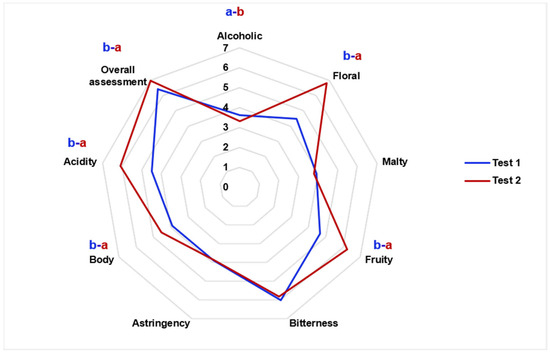
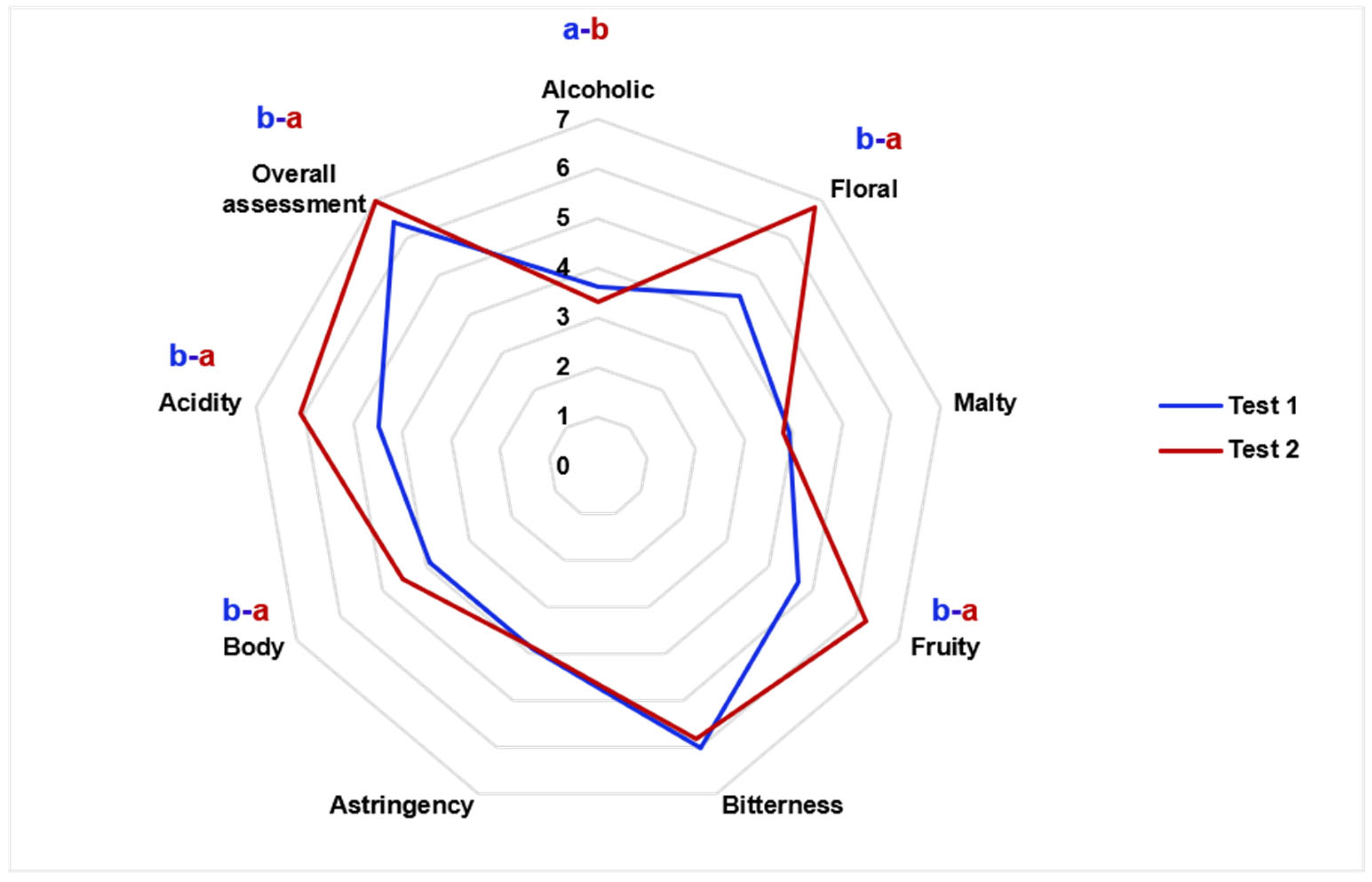
The sensory evaluation revealed that beers produced with the sequential inoculation of M. pulcherrima and S. cerevisiae (Test 2) displayed significantly different sensory characteristics compared to those fermented with S. cerevisiae alone (Test 1), as shown in Figure 5. Specifically, Test 2 beers exhibited more pronounced floral and fruity notes, likely due to increased formation of esters such as phenylethyl acetate and ethyl acetate, compounds typically associated with M. pulcherrima metabolism [36,45]. Alcohol perception was notably lower in Test 2, consistent with the slight reductions in ethanol content observed in both single and mixed fermentations involving M. pulcherrima [27,38]. Enhanced mouthfeel, linked to higher glycerol production, contributed to a fuller body and greater roundness in Test 2. Acidity perception was also increased, reflecting the acid-modulating effects of M. pulcherrima [48]. Bitterness, astringency, and malty taste showed no statistically significant differences between the two tests.
Figure 5.
Sensory profile of beers from Test 1 (inoculated with S. cerevisiae US-05 alone) and Test 2 (sequentially inoculated with M. pulcherrima 62 followed by S. cerevisiae US-05 after 96 h). Different letters (a–b) within a row (considering F1 and F2 separately) indicate statistically significant differences (p < 0.05).
Importantly, the overall sensory score was higher for Test 2 (7.0) than for Test 1 (6.4), indicating that sequential inoculation improves aromatic complexity, mouthfeel, and overall consumer acceptance [15,25]. These results support previous findings highlighting the biotechnological potential of M. pulcherrima to enhance beer sensory profiles through metabolic interactions, glycerol production, and enzymatic activity [9,25,61].
4. Conclusions
Using M. pulcherrima in staged fermentations opens promising avenues for innovative brewing techniques. By harnessing the unique metabolic capabilities of these non-Saccharomyces yeasts, brewers can craft beers with enhanced aroma complexity and richer textures, meeting the rising consumer demand for distinctive flavor experiences. Optimizing fermentation control and selecting appropriate strains will be crucial to fully realizing the potential of these yeasts in both craft and industrial brewing. In this context, M. pulcherrima 62, used as a starter, represents a valuable biotechnological tool for producing APA beers with unique compositional and sensory profiles.
Supplementary Materials
The following supporting information can be downloaded at: https://www.mdpi.com/article/10.3390/fermentation12010049/s1,; Table S1: Volatile organic compounds detected by HS-SPME/GC-MS in beer samples from Test 1 (S. cerevisiae US-05 alone) and Test 2 (sequential inoculation of M. pulcherrima 62 and S. cerevisiae US-05 at 96 h) after primary fermentation (F1); Table S2 Volatile organic compounds detected by HS-SPME/GC-MS in beer samples from Test 1 (S. cerevisiae US-05 alone) and Test 2 (sequential inoculation of M. pulcherrima 62 and S. cerevisiae US-05 at 96 h) after refermentation for 20 days (F2).
Author Contributions
Conceptualization, M.I., B.T. and J.K.; methodology, B.T. and J.K.; software, N.X., A.d.N. and B.T.; validation, M.I., K.S., F.C., I.L., F.L., K.S. and R.K.; formal analysis, B.T. and J.K.; data curation, M.I., B.T., J.K. and R.C.; writing—original draft preparation, J.K.; B.T., M.I. and N.X.; writing—review and editing, M.I., B.T., N.X. and J.K.; visualization, O.K., N.X., M.R., M.S., C.M. and F.C.; supervision, M.I., R.K., I.L., M.S., F.C., F.L. and K.S. All authors have read and agreed to the published version of the manuscript.
Funding
This research received no external funding.
Institutional Review Board Statement
This manuscript reports on a sensory analysis carried out with the participation of winemakers and professionals, as trained panelists affiliated with the National Organization of Wine Tasters (ONAV, Italy). Considering the current regulations for ethics in food science research, we collected informed consent while assuring data protection and privacy maintenance. These data do not involve any novel food or health claims and no human experimentation was developed. For these reasons, as stated in the Ethics Review and Food-Related Research released by the European Commission (Alfonso Alfonsi et al. Guidande Note: Ethics and Food-Related Research; European Commission Ethics Review Sector: Brussels, Belgium, 2012), and also in line with the Code of Ethics of the World Medical Association (Declaration of Helsinki) for experiments involving humans, we did not send our scientific project to an ethical committee for evaluation. The assessors gave their consent after receiving full information concerning the sensory test. This study did not reveal any personal information, and/or images of participants.
Informed Consent Statement
Informed consent was obtained from all subjects involved in the study.
Data Availability Statement
The original contributions presented in the study are included in the article and Supplementary Materials; further inquiries can be directed to the corresponding authors.
Conflicts of Interest
The authors declare no conflicts of interest.
References
- Aquilani, B.; Laureti, T.; Poponi, S.; Secondi, L. Beer choice and consumption determinants when craft beers are tasted: An exploratory study of consumer preferences. Food Qual. Preference 2015, 41, 214–224. [Google Scholar] [CrossRef] [Scilit]
- Basso, R.F.; Alcarde, A.R.; Portugal, C.B. Could non-Saccharomyces yeasts contribute on innovative brewing fermentations? Food Res. Int. 2016, 86, 112–120. [Google Scholar] [CrossRef] [Scilit]
- Baiano, A. Craft Beer: An Overview. Compr. Rev. Food Sci. Food Saf. 2021, 20, 1829–1856. [Google Scholar] [CrossRef] [Scilit] [PubMed]
- Medina, K.; Giannone, N.; Dellacassa, E.; Schinca, C.; Carrau, F.; Boido, E. Commercial craft beers produced in Uruguay: Volatile profile and physicochemical composition. Food Res. Int. 2023, 164, 112349. [Google Scholar] [CrossRef] [Scilit] [PubMed]
- Capece, A.; Romaniello, R.; Siesto, G.; Romano, P. Conventional and Non-Conventional Yeasts in Beer Production. Fermentation 2018, 4, 38. [Google Scholar] [CrossRef] [Scilit]
- Elzinga, K.G.; Tremblay, C.H.; Tremblay, V.J. Craft Beer in the United States: History, Numbers, and Geography. J. Wine Econ. 2015, 10, 242–274. [Google Scholar] [CrossRef] [Scilit]
- Marongiu, A.; Zara, G.; Legras, J.-L.; Del Caro, A.; Mascia, I.; Fadda, C.; Budroni, M. Novel starters for old processes: Use of Saccharomyces cerevisiae strains isolated from artisanal sourdough for craft beer production at a brewery scale. J. Ind. Microbiol. Biotechnol. 2015, 42, 85–92. [Google Scholar] [CrossRef] [Scilit]
- Meier-Dörnberg, T.; Hutzler, M.; Michel, M.; Methner, F.-J.; Jacob, F. The Importance of a Comparative Characterization of Saccharomyces cerevisiae and Saccharomyces pastorianus Strains for Brewing. Fermentation 2017, 3, 41. [Google Scholar] [CrossRef] [Scilit]
- Iorizzo, M.; Coppola, F.; Letizia, F.; Testa, B.; Sorrentino, E. Role of Yeasts in the Brewing Process: Tradition and Innovation. Processes 2021, 9, 839. [Google Scholar] [CrossRef] [Scilit]
- Peris, D.; Langdon, Q.K.; Moriarty, R.V.; Sylvester, K.; Bontrager, M.; Charron, G.; Leducq, J.-B.; Landry, C.R.; Libkind, D.; Hittinger, C.T. Complex Ancestries of Lager-Brewing Hybrids Were Shaped by Standing Variation in the Wild Yeast Saccharomyces eubayanus. PLOS Genet. 2016, 12, e1006155. [Google Scholar] [CrossRef] [Scilit]
- Mertens, S.; Steensels, J.; Saels, V.; De Rouck, G.; Aerts, G.; Verstrepen, K.J. A Large Set of Newly Created Interspecific Saccharomyces Hybrids Increases Aromatic Diversity in Lager Beers. Appl. Environ. Microbiol. 2015, 81, 8202–8214. [Google Scholar] [CrossRef] [Scilit] [PubMed]
- Iattici, F.; Catallo, M.; Solieri, L. Designing New Yeasts for Craft Brewing: When Natural Biodiversity Meets Biotechnology. Beverages 2020, 6, 3. [Google Scholar] [CrossRef] [Scilit]
- Villacreces, S.; Blanco, C.A.; Caballero, I. Developments and characteristics of craft beer production processes. Food Biosci. 2022, 45, 101495. [Google Scholar] [CrossRef] [Scilit]
- Molinet, J.; Cubillos, F.A. Wild Yeast for the Future: Exploring the Use of Wild Strains for Wine and Beer Fermentation. Front. Genet. 2020, 11, 589350. [Google Scholar] [CrossRef] [Scilit]
- Karaulli, J.; Xhaferaj, N.; Coppola, F.; Testa, B.; Letizia, F.; Kyçyk, O.; Kongoli, R.; Ruci, M.; Lamçe, F.; Sulaj, K.; et al. Bioprospecting of Metschnikowia pulcherrima Strains, Isolated from a Vineyard Ecosystem, as Novel Starter Cultures for Craft Beer Production. Fermentation 2024, 10, 513. [Google Scholar] [CrossRef] [Scilit]
- Testa, B.; Coppola, F.; Letizia, F.; Albanese, G.; Karaulli, J.; Ruci, M.; Pistillo, M.; Germinara, G.S.; Messia, M.C.; Succi, M.; et al. Versatility of Saccharomyces cerevisiae 41CM in the Brewery Sector: Use as a Starter for “Ale” and “Lager” Craft Beer Production. Processes 2022, 10, 2495. [Google Scholar] [CrossRef] [Scilit]
- Testa, B.; Coppola, F.; Iorizzo, M.; Di Renzo, M.; Coppola, R.; Succi, M. Preliminary Characterisation of Metschnikowia pulcherrima to Be Used as a Starter Culture in Red Winemaking. Beverages 2024, 10, 88. [Google Scholar] [CrossRef] [Scilit]
- Iturritxa, E.; Hill, A.E.; Torija, M.-J. Profiling potential brewing yeast from forest and vineyard ecosystems. Int. J. Food Microbiol. 2023, 394, 110187. [Google Scholar] [CrossRef] [Scilit]
- Sánchez-Adriá, I.E.; Sanmartín, G.; Prieto, J.A.; Estruch, F.; Randez-Gil, F. Sourdough Yeast Strains Exhibit Thermal Tolerance, High Fermentative Performance, and a Distinctive Aromatic Profile in Beer Wort. Foods 2024, 13, 1059. [Google Scholar] [CrossRef] [Scilit]
- Gibson, B.; Geertman, J.-M.A.; Hittinger, C.T.; Krogerus, K.; Libkind, D.; Louis, E.J.; Magalhães, F.; Sampaio, J.P. New yeasts—New brews: Modern approaches to brewing yeast design and development. FEMS Yeast Res. 2017, 17, fox038. [Google Scholar] [CrossRef] [Scilit]
- Varela, J.; Varela, C. Microbiological strategies to produce beer and wine with reduced ethanol concentration. Curr. Opin. Biotechnol. 2019, 56, 88–96. [Google Scholar] [CrossRef] [Scilit] [PubMed]
- Lombardi, S.J.; Pannella, G.; Iorizzo, M.; Moreno-Arribas, M.V.; Tremonte, P.; Succi, M.; Sorrentino, E.; Macciola, V.; Di Renzo, M.; Coppola, R. Sequential inoculum of Hanseniaspora guilliermondii and Saccharomyces cerevisiae for winemaking Campanino on an industrial scale. World J. Microbiol. Biotechnol. 2018, 34, 161. [Google Scholar] [CrossRef] [Scilit] [PubMed]
- Testa, B.; Lombardi, S.J.; Iorizzo, M.; Letizia, F.; Di Martino, C.; Di Renzo, M.; Strollo, D.; Tremonte, P.; Pannella, G.; Ianiro, M.; et al. Use of strain Hanseniaspora guilliermondii BF1 for winemaking process of white grapes Vitis vinifera cv Fiano. Eur. Food Res. Technol. 2020, 246, 549–561. [Google Scholar] [CrossRef] [Scilit]
- Testa, B.; Coppola, F.; Lombardi, S.J.; Iorizzo, M.; Letizia, F.; Di Renzo, M.; Succi, M.; Tremonte, P. Influence of Hanseniasporauvarum AS27 on Chemical and Sensorial Characteristics of Aglianico Wine. Processes 2021, 9, 326. [Google Scholar] [CrossRef] [Scilit]
- Drosou, F.; Mamma, D.; Tataridis, P.; Dourtoglou, V.; Oreopoulou, V. Metschnikowia Pulcherrima in Mono or Co-Fermentations in Brewing. BrSc 2022, 75, 69–78. [Google Scholar] [CrossRef]
- González-Pombo, P.; Pérez, G.; Carrau, F.; Guisán, J.M.; Batista-Viera, F.; Brena, B.M. One-step purification and characterization of an intracellular β-glucosidase from Metschnikowia pulcherrima. Biotechnol. Lett. 2008, 30, 1469–1475. [Google Scholar] [CrossRef] [Scilit]
- Klimczak, K.; Cioch-Skoneczny, M.; Poreda, A. Evaluation of Non-Saccharomyces Yeast for Low-Alcohol Beer Production. Appl. Sci. 2024, 14, 6755. [Google Scholar] [CrossRef] [Scilit]
- Pawlikowska, E.; Kolesińska, B.; Nowacka, M.; Kregiel, D. A New Approach to Producing High Yields of Pulcherrimin from Metschnikowia Yeasts. Fermentation 2020, 6, 114. [Google Scholar] [CrossRef] [Scilit]
- Oro, L.; Ciani, M.; Comitini, F. Antimicrobial activity of Metschnikowia pulcherrimaon wine yeasts. J. Appl. Microbiol. 2014, 116, 1209–1217. [Google Scholar] [CrossRef] [Scilit]
- Bucka-Kolendo, J.; Kiousi, D.E.; Wojtczak, A.; Doulgeraki, A.I.; Galanis, A.; Sokołowska, B. Depiction of the In Vitro and Genomic Basis of Resistance to Hop and High Hydrostatic Pressure of Lactiplantibacillus plantarum Isolated from Spoiled Beer. Genes 2023, 14, 1710. [Google Scholar] [CrossRef] [Scilit]
- Suzuki, K.; Iijima, K.; Sakamoto, K.; Sami, M.; Yamashita, H. A Review of Hop Resistance in Beer Spoilage Lactic Acid Bacteria. J. Inst. Brew. 2006, 112, 173–191. [Google Scholar] [CrossRef] [Scilit]
- Viana, A.C.; Pimentel, T.C.; Borges do Vale, R.; Clementino, L.S.; Januario Ferreira, E.T.; Magnani, M.; dos Santos Lima, M. American Pale Ale Craft Beer: Influence of Brewer’s Yeast Strains on the Chemical Composition and Antioxidant Capacity. LWT 2021, 152, 112317. [Google Scholar] [CrossRef] [Scilit]
- Benard, M. Determination of Repeatability and Reproducibility of EBC Accepted Methods: V—Beer. J. Inst. Brew. 2000, 106, 135–138. [Google Scholar] [CrossRef] [Scilit]
- Baiano, A.; Fiore, A.; la Gatta, B.; Tufariello, M.; Gerardi, C.; Savino, M.; Grieco, F. Single and Interactive Effects of Unmalted Cereals, Hops, and Yeasts on Quality of White-Inspired Craft Beers. Beverages 2023, 9, 9. [Google Scholar] [CrossRef] [Scilit]
- Giannetti, V.; Mariani, M.B.; Torrelli, P.; Marini, F. Flavour component analysis by HS-SPME/GC–MS and chemometric modeling to characterize Pilsner-style Lager craft beers. Microchem. J. 2019, 149, 103991. [Google Scholar] [CrossRef] [Scilit]
- Coppola, F.; Testa, B.; Cozzolino, R.; Karaulli, J.; Pannella, G.; Di Renzo, M.; Matarazzo, C.; Succi, M.; Iorizzo, M. Effects of inoculation timing and mixed fermentation with Metschnikowia pulcherrima and Saccharomyces cerevisiae on the aroma and sensory properties of Falanghina wine. Eur. Food Res. Technol. 2025, 251, 1699–1717. [Google Scholar] [CrossRef] [Scilit]
- Di Renzo, M.; Letizia, F.; Di Martino, C.; Karaulli, J.; Kongoli, R.; Testa, B.; Avino, P.; Guerriero, E.; Albanese, G.; Monaco, M.; et al. Natural Fiano Wines Fermented in Stainless Steel Tanks, Oak Barrels, and Earthenware Amphora. Processes 2023, 11, 1273. [Google Scholar] [CrossRef] [Scilit]
- Canonico, L.; Comitini, F.; Ciani, M. Metschnikowia pulcherrima Selected Strain for Ethanol Reduction in Wine: Influence of Cell Immobilization and Aeration Condition. Foods 2019, 8, 378. [Google Scholar] [CrossRef] [Scilit]
- Li, H.; Liu, F.; Kang, L.; Zheng, M. Study on the buffering capacity of wort. J. Inst. Brew. 2016, 122, 138–142. [Google Scholar] [CrossRef] [Scilit]
- Postigo, V.; Sanz, P.; García, M.; Arroyo, T. Impact of Non-Saccharomyces Wine Yeast Strains on Improving Healthy Characteristics and the Sensory Profile of Beer in Sequential Fermentation. Foods 2022, 11, 2029. [Google Scholar] [CrossRef] [Scilit]
- Testa, B.; Coppola, F.; Succi, M.; Iorizzo, M. Biotechnological Strategies for Ethanol Reduction in Wine. Fermentation 2025, 11, 159. [Google Scholar] [CrossRef] [Scilit]
- Budroni, M.; Zara, G.; Ciani, M.; Comitini, F. Saccharomyces and Non-Saccharomyces Starter Yeasts. In Brewing Technology; Kanauchi, M., Ed.; IntechOpen: London, UK, 2017; pp. 81–100. [Google Scholar] [CrossRef] [Scilit]
- Mestre Furlani, M.V.; Vargas Perucca, M.F.; Petrignani, D.B.; Vergara, S.C.; Leiva-Alaniz, M.J.; Maturano, Y.P.; Vazquez, F.; Dellacassa, E. Enhancing Flavor Complexity in Craft Beer: Sequential Inoculation with Indigenous Non-Saccharomyces and Commercial Saccharomyces Yeasts. Fermentation 2024, 10, 657. [Google Scholar] [CrossRef] [Scilit]
- Perpetuini, G.; Rossetti, A.P.; Quadrani, L.; Arfelli, G.; Piva, A.; Suzzi, G.; Tofalo, R. Sequential Inoculation of Metschnikowia pulcherrima and Saccharomyces cerevisiae as a Biotechnological Tool to Increase the Terpenes Content of Pecorino White Wines. Fermentation 2023, 9, 785. [Google Scholar] [CrossRef] [Scilit]
- Sadoudi, M.; Rousseaux, S.; David, V.; Alexandre, H.; Tourdot-Maréchal, R. Metschnikowia pulcherrima Influences the Expression of Genes Involved in PDH Bypass and Glyceropyruvic Fermentation in Saccharomyces cerevisiae. Front. Microbiol. 2017, 8, 1137. [Google Scholar] [CrossRef] [Scilit]
- Sadoudi, M.; Tourdot-Maréchal, R.; Rousseaux, S.; Steyer, D.; Gallardo-Chacón, J.-J.; Ballester, J.; Vichi, S.; Guérin-Schneider, R.; Caixach, J.; Alexandre, H. Yeast–yeast interactions revealed by aromatic profile analysis of Sauvignon Blanc wine fermented by single or co-culture of non-Saccharomyces and Saccharomyces yeasts. Food Microbiol. 2012, 32, 243–253. [Google Scholar] [CrossRef] [Scilit]
- Ciani, M.; Capece, A.; Comitini, F.; Canonico, L.; Siesto, G.; Romano, P. Yeast Interactions in Inoculated Wine Fermentation. Front. Microbiol. 2016, 7, 555. [Google Scholar] [CrossRef] [Scilit]
- Morata, A.; Loira, I.; Escott, C.; del Fresno, J.M.; Bañuelos, M.A.; Suárez-Lepe, J.A. Applications of Metschnikowia pulcherrima in Wine Biotechnology. Fermentation 2019, 5, 63. [Google Scholar] [CrossRef] [Scilit]
- Grieco, F.; Fiore, A.; Gerardi, C.; Tufariello, M.; Romano, G.; Baiano, A. Optimisation of quality features of new wheat beers fermented through sequential inoculation of non-Saccharomyces and Saccharomyces yeasts. Heliyon 2024, 10, e37598. [Google Scholar] [CrossRef] [Scilit]
- Klimczak, K.; Cioch-Skoneczny, M.; Poreda, A.; Ciosek, A. Evaluation of commercial yeast strains to produce reduced-alcohol beer. Eur. Food Res. Technol. 2025, 251, 3965–3979. [Google Scholar] [CrossRef] [Scilit]
- Comitini, F.; Gobbi, M.; Domizio, P.; Romani, C.; Lencioni, L.; Mannazzu, I.; Ciani, M. Selected non-Saccharomyces wine yeasts in controlled multistarter fermentations with Saccharomyces cerevisiae. Food Microbiol. 2011, 28, 873–882. [Google Scholar] [CrossRef] [Scilit]
- Morales, P.; Rojas, V.; Quirós, M.; Gonzalez, R. The impact of oxygen on the final alcohol content of wine fermented by a mixed starter culture. Appl. Microbiol. Biotechnol. 2015, 99, 3993–4003. [Google Scholar] [CrossRef] [Scilit]
- Contreras, A.; Hidalgo, C.; Henschke, P.A.; Chambers, P.J.; Curtin, C.; Varela, C. Evaluation of Non-Saccharomyces Yeasts for the Reduction of Alcohol Content in Wine. Appl. Environ. Microbiol. 2014, 80, 1670–1678. [Google Scholar] [CrossRef] [Scilit] [PubMed]
- Pires, E.J.; Teixeira, J.A.; Brányik, T.; Vicente, A.A. Yeast: The soul of beer’s aroma—A review of flavour-active esters and higher alcohols produced by the brewing yeast. Appl. Microbiol. Biotechnol. 2014, 98, 1937–1949. [Google Scholar] [CrossRef] [Scilit] [PubMed]
- Vicente, J.; Ruiz, J.; Belda, I.; Benito-Vázquez, I.; Marquina, D.; Calderón, F.; Santos, A.; Benito, S. The Genus Metschnikowia in Enology. Microorganisms 2020, 8, 1038. [Google Scholar] [CrossRef] [Scilit] [PubMed]
- Cioch-Skoneczny, M.; Cichoń, N.; Satora, P.; Skoneczny, S. Physicochemical characteristics of beer with grape must addition produced using non-Saccharomyces yeasts. Eur. Food Res. Technol. 2023, 249, 903–912. [Google Scholar] [CrossRef] [Scilit]
- Alvarez, R.; Haya, E.F.; Delgado, M.A.; Ferrete, F.J. Vicinal diketones in beer. Part I: A modified EBC method for the determination of diacetyl and other vicinal diketones in beer. J. Inst. Brew. 1989, 95, 21–23. [Google Scholar] [CrossRef] [Scilit]
- Gibson, B.; Vidgren, V.; Peddinti, G.; Krogerus, K. Diacetyl control during brewery fermentation via adaptive laboratory engineering of the lager yeast Saccharomyces pastorianus. J. Ind. Microbiol. Biotechnol. 2018, 45, 1103–1112. [Google Scholar] [CrossRef] [Scilit]
- Holt, S.; Miks, M.H.; de Carvalho, B.T.; Foulquié-Moreno, M.R.; Thevelein, J.M. The molecular biology of fruity and floral aromas in beer and other alcoholic beverages. FEMS Microbiol. Rev. 2019, 43, 193–222. [Google Scholar] [CrossRef] [Scilit]
- Muñoz-Redondo, J.M.; Puertas, B.; Cantos-Villar, E.; Jiménez-Hierro, M.J.; Carbú, M.; Garrido, C.; Ruiz-Moreno, M.J.; Moreno-Rojas, J.M. Impact of Sequential Inoculation with the Non-Saccharomyces T. delbrueckii and M. pulcherrima Combined with Saccharomyces cerevisiae Strains on Chemicals and Sensory Profile of Rosé Wines. J. Agric. Food Chem. 2021, 69, 1598–1609. [Google Scholar] [CrossRef] [Scilit]
- Einfalt, D. Barley-sorghum craft beer production with Saccharomyces cerevisiae, Torulaspora delbrueckii and Metschnikowia pulcherrima yeast strains. Eur. Food Res. Technol. 2021, 247, 385–393. [Google Scholar] [CrossRef] [Scilit]
- Zapryanova, P.; Gaytanska, Y.; Shopska, V.; Denkova-Kostova, R.; Kostov, G. Non-Conventional Yeasts for Beer Production—Primary Screening of Strains. Beverages 2025, 11, 114. [Google Scholar] [CrossRef] [Scilit]
- Ferreira, I.M.; Guido, L.F. Impact of Wort Amino Acids on Beer Flavour: A Review. Fermentation 2018, 4, 23. [Google Scholar] [CrossRef] [Scilit]
- Nasuti, C.; Solieri, L. Yeast Bioflavoring in Beer: Complexity Decoded and Built up Again. Fermentation 2024, 10, 183. [Google Scholar] [CrossRef] [Scilit]
- Klimczak, K.; Cioch-Skoneczny, M.; Duda-Chodak, A. Effects of Dry-Hopping on Beer Chemistry and Sensory Properties—A Review. Molecules 2023, 28, 6648. [Google Scholar] [CrossRef] [Scilit] [PubMed]
- Stewart, G.G.; Russell, I.; Anstruther, A. Handbook of Brewing, 3rd ed.; CRC Press: Boca Raton, FL, USA, 2017. [Google Scholar] [CrossRef] [Scilit]
- Hazelwood, L.A.; Daran, J.-M.; van Maris, A.J.; Pronk, J.T.; Dickinson, J.R. The Ehrlich Pathway for Fusel Alcohol Production: A Century of Research on Saccharomyces cerevisiae Metabolism. Appl. Environ. Microbiol. 2008, 74, 2259–2266, Correction in Appl. Environ. Microbiol. 2008, 74. https://doi.org/10.1128/AEM.00934-08. [Google Scholar] [CrossRef] [Scilit]
- Varela, C.; Sengler, F.; Solomon, M.; Curtin, C. Volatile flavour profile of reduced alcohol wines fermented with the non-conventional yeast species Metschnikowia pulcherrima and Saccharomyces uvarum. Food Chem. 2016, 209, 57–64. [Google Scholar] [CrossRef] [Scilit]
- Saerens, S.M.G.; Delvaux, F.R.; Verstrepen, K.J.; Thevelein, J.M. Production and biological function of volatile esters in Saccharomyces cerevisiae. Microb. Biotechnol. 2010, 3, 165–177. [Google Scholar] [CrossRef] [Scilit]
- Jolly, N.P.; Varela, C.; Pretorius, I.S. Not your ordinary yeast: Non-Saccharomyces yeasts in wine production uncovered. FEMS Yeast Res. 2014, 14, 215–237. [Google Scholar] [CrossRef] [Scilit]
- Sakai, M.; Hirata, H.; Sayama, H.; Sekiguchi, K.; Itano, H.; Asai, T.; Dohra, H.; Hara, M.; Watanabe, N. Production of 2-Phenylethanol in Roses as the Dominant Floral Scent Compound fromL-Phenylalanine by Two Key Enzymes, a PLP-Dependent Decarboxylase and a Phenylacetaldehyde Reductase. Biosci. Biotechnol. Biochem. 2007, 71, 2408–2419. [Google Scholar] [CrossRef] [Scilit]
- Bruner, J.; Fox, G. Novel Non-Cerevisiae Saccharomyces Yeast Species Used in Beer and Alcoholic Beverage Fermentations. Fermentation 2020, 6, 116. [Google Scholar] [CrossRef] [Scilit]
- Carvalho, D.O.; Guido, L.F. A review on the fate of phenolic compounds during malting and brewing: Technological strategies and beer styles. Food Chem. 2022, 372, 131093. [Google Scholar] [CrossRef] [Scilit]
- Reglitz, K.; Stein, J.; Ackermann, J.; Heigl, V.; Brass, L.; Ampenberger, F.; Zarnkow, M.; Steinhaus, M. Enantiospecific Determination of the Odour Threshold Concentrations of (R)- and (S)-Linalool in Water and Beer. BrSc 2023, 76, 92–96. [Google Scholar] [CrossRef]
- Han, X.; Qin, Q.; Li, C.; Zhao, X.; Song, F.; An, M.; Chen, Y.; Wang, X.; Huang, W.; Zhan, J.; et al. Application of non-Saccharomyces yeasts with high β-glucosidase activity to enhance terpene-related floral flavor in craft beer. Food Chem. 2023, 404, 134726. [Google Scholar] [CrossRef] [Scilit]

Disclaimer/Publisher’s Note: The statements, opinions and data contained in all publications are solely those of the individual author(s) and contributor(s) and not of MDPI and/or the editor(s). MDPI and/or the editor(s) disclaim responsibility for any injury to people or property resulting from any ideas, methods, instructions or products referred to in the content. |
© 2026 by the authors. Licensee MDPI, Basel, Switzerland. This article is an open access article distributed under the terms and conditions of the Creative Commons Attribution (CC BY) license.