


Abstract
The objectives of this study were to evaluate the effects of a heterofermentative lactic acid bacterial (LAB) inoculant containing Lentilactobacillus hilgardii and Lentilactobacillus buchneri with or without chitinases on ensiling, aerobic stability (AS), and in vitro ruminal fermentation of whole-crop corn silages. Uninoculated corn silage (Control, C), corn silage treated with chitinase alone (E), with a mixture of L. hilgardii and L. buchneri (I), or with a combination of E and I (EI) were ensiled in minisilos for 90 d, and the terminal silages were assessed for AS and in vitro ruminal fermentation. The experiment used a completely randomized design, with the treatment structure allowing analysis of the effects of E, I, and the E × I interaction. I and EI had higher (p < 0.01) concentrations of acetate and total volatile fatty acids, higher (p < 0.01) total bacterial and LAB counts, but lower yeast population (p < 0.01) than C and E terminal silages. Aerobic stability was greater (p < 0.001) for I and EI (>336 h) than for E (156 h) and C (152 h) silages. LAB reduced (p < 0.001) while chitinase increased (p < 0.05) total in vitro gas production. Disappearance of neutral detergent fiber was lower (p < 0.05) after 6 and 12 h but higher (p < 0.001) after 24 (74.7 and 76.7% vs. 72.7 and 72.3%) and 48 h (84.9 and 86.2% vs. 82.9 and 80.2%) of incubation for I and EI than for C and E, respectively. Inoculation of a mixture of L. hilgardii and L. buchneri alone (I) and in combination with chitinase (EI), but not chitinase (E) alone, enhanced AS and improved the in vitro NDF digestibility of corn silages.
1. Introduction
Corn silage is a major forage source for dairy cattle and an important component of intensive beef cattle operations in North America [1,2]. However, corn silage is prone to aerobic deterioration during feedout due to the activity of bacteria such as Acetobacter as well as yeast and mold, leading to loss of dry matter (DM) and forage nutritive value [2]. Treatment with lactic acid bacterial (LAB) inoculants is an established strategy to promote ensiling, improve silage quality, and reduce dry matter (DM) losses during storage and feedout [3,4,5]. Heterofermentative LAB such as Lentilactobacillus buchneri have been shown to be particularly effective in improving the aerobic stability of silages during feedout [4,6], owing to their ability to produce acetic acid (AC) and 1,2-propanediol, which inhibit yeasts and molds [6,7,8,9,10,11]. However, L. buchneri produces AC after ~60 d of ensiling [4,12,13]. In contrast, Lentilactobacillus hilgardii, which is also a heterofermentative LAB [4,14,15,16,17], produces AC as soon as 14 d after ensiling [6,18]. Therefore, a combination of L. buchneri and L. hilgardii could shorten the ensiling period required for enhanced aerobic stability (AS) and enable faster post-ensiling feedout for beef and dairy producers [6,17,19].
Microbial chitinases are promising candidates for biological control of phytopathogenic fungi as they degrade the chitin layer within fungal cell walls [20,21,22], making them a potential eco-friendly strategy to control these spoilage microorganisms [23,24,25]. Forages can harbor considerable populations of phytopathogenic fungi. However, studies evaluating the effects of chitinases in inhibiting fungi in conserved forages have been limited. Our previous studies have shown that application of a combination of Pediococcus pentosaceus or Pichia anomala along with chitinase during baling of high-moisture alfalfa hay reduced the internal temperature of round bales during storage and improved neutral detergent fiber (NDF) digestion in vitro [26,27,28]. However, the impact of a combination of heterofermentative LAB consisting of L. buchneri NCIMB-40788 and L. hilgardii CNCM I-4785 with chitinase from Streptococcus griseus on the ensiling, aerobic stability, nutrient digestibility, and feed value of corn silage has not been evaluated. It was hypothesized that chitinase, with or without LAB inoculants, would not negatively impact microbial fermentation during ensiling or aerobic exposure but would improve in vitro NDF degradability. The objectives of this study were to evaluate the effects of a heterofermentative LAB inoculant consisting of L. hilgardii and L. buchneri with or without chitinases on the ensiling, AS, and in vitro ruminal fermentation of whole-crop corn silages.
2. Materials and Methods
2.1. Forage, Treatments, and Ensiling
Corn (Zea mays) was planted under irrigation at the Lethbridge Research and Development Center, AB, Canada, in May 2018. The seeds were planted at a depth of 5–6 cm with a seeding density of 89,500 seeds ha−1. Whole-crop corn was harvested in October 2018 at two-thirds milk line (33.9 ± 0.87% DM), as described by Nair et al. [6]. The harvested forage was chopped to ca. 9.5 mm theoretical length with a Claas Jaguar 940 forage harvester (Claas KGaA mbH, Harsewinkel, Germany) equipped with a kernel processor, with rollers adjusted to 1.0 mm clearance.
Treatments were arranged in a completely randomized design, allowing for the evaluation of the effects of E, I, and the E × I interaction. Treatments included uninoculated control corn silage (C), and corn silages treated with 0.5 mg/kg fresh forage chitinase (E) from Streptococcus griseus (≥200 chitinase units/g, Sigma-Aldrich, St. Louis, MO, USA) alone (E), LAB inoculant (Lallemand Specialties Inc., Milwaukee, WI, USA) containing 1.5 × 10⁸ [29] colony forming units (cfus)/kg fresh forage L. hilgardii CNCM I-4785 and 1.5 × 10⁸ cfu/kg fresh forage L. buchneri NCIMB-40788 (I), or a combination of E and I (EI). One unit of chitinase was defined as the amount of enzyme that liberated 1.0 mg of N-acetyl-D-glucosamine from chitin per h at a pH of 6.0 at 25 °C in a 2 h assay [30].
2.2. Preparation of Whole-Crop Corn Silage in Minisilos
Minisilos were prepared as described by Nair et al. [31]. Briefly, harvested corn forage was divided into twenty 25 kg lots, with five lots per treatment, and placed on separate clean plastic sheets. Corn forage was then treated with chitinase, LAB inoculant, or a combination by spraying the respective inoculants diluted in distilled water at 25 mL/lot to provide the required application rates, as specified above. The C silage was sprayed with 25 mL of double-distilled water. Each lot was thoroughly hand-mixed to ensure uniform distribution of additives. In order to prevent cross-contamination, separate containers and sprayers were used, and gloves were changed between treatments. Mixing and application were repeated for each of the replicate lots, resulting in a total of five mixes per treatment.
After mixing, exactly 2.0 kg of forage from each replicated lot was weighed and packed into each of three minisilos (PVC pipes having 10.4 cm in width × 35.6 cm in length and rubber end caps), with one for each ensiling duration (7, 21, and 90 d), using a hydraulic press equipped with a pressure gauge to achieve the recommended packing density of ~240 kg DM/m3 for proper ensiling. After packing, minisilos were sealed with the rubber end caps having the air venting tubes closed with binder clips and secured with 4-inch metal hose clamps. A total of 60 minisilos were prepared, with 5 replicate minisilos per treatment for each ensiling duration. Each labeled minisilo was weighed immediately after filling and sealing, with the weights recorded along with the weight of empty minisilos, and was packed in Rubbermaid containers and stored indoors at ambient temperature (20 °C) throughout the ensiling period. The minisilos were vented every day initially, followed by periodic venting until there was no significant gas production (~2 weeks of storage). Five replicate samples of fresh forage were collected per treatment prior to packing of minisilos on the day of ensiling (d 0) for chemical and microbial analysis. On each sampling day, prior to opening, the minisilos were weighed, and the weights recorded were used to calculate DM losses. After opening the minisilos, the content of each minisilo was thoroughly mixed and subsampled for chemical and microbial analyses.
2.3. Aerobic Stability
Silage samples from minisilos opened at the end of 90 d of ensiling were used to assess AS. About 1.2 kg each of the terminal silage subsamples from the five replicate minisilos per treatment were mixed thoroughly and packed into 4 L insulated containers (n = 3; 13.5 cm in diameter × 30.9 cm in height). The containers were covered with two layers of cheesecloth and stored at ambient temperature (20 °C) for 14 d. Two Dallas Thermochron iButton sensors (Embedded Data Systems, Lawrenceburg, KY, USA) were placed in the silage within each container at ~9.0 cm and ~18.0 cm from the base of the container to measure temperature every 15 min throughout the 14 d of storage. Two sensors were also used to measure the ambient room temperature. After 3, 7, and 14 d of aerobic exposure (AE), the contents of each container were sub-sampled to evaluate the pH, chemical, and microbial composition. Aerobic stability was determined as the duration (hours) before the temperature of silage subjected to aerobic exposure exceeded the ambient temperature by 2 °C [32].
2.4. In Vitro Experiment
Three ruminally cannulated Angus heifers (550 ± 50 kg body weight) were used as rumen fluid donors for this experiment. The heifers were fed a total mixed ration consisting of 65.0% corn silage, 20.0% barley grain, 10.0% canola meal, and 5.0% of a vitamin-mineral supplement (% DM basis). The diet was formulated to meet or exceed the National Academies of Sciences, Engineering, and Medicine (NASEM) [33] nutrient requirements for beef heifers. All heifers were fed at 08:00 h and provided ad libitum access to feed and water and cared for in accordance with the standards of the Canadian Council on Animal Care (LRC protocol ACC1830) [34]. Rumen fluid was collected 2 h after the morning feeding from five locations within the rumen, strained through four layers of cheesecloth, combined in equal volumes among three cattle, and immediately transported in an anaerobic and pre-warmed container to the laboratory. Rumen fluid was then combined (1:2, v/v) with pre-warmed (39 °C) mineral buffer [35] to generate the inoculum.
2.5. In Vitro Incubations and Measurements
Terminal silage samples (d 90 of ensiling) from all four treatments were dried in a forced-air oven at 55 °C for 48 h and ground through a 1 mm screen using a Wiley Mill (Model 4, Arthur H. Thomas Co., Philadelphia, PA, USA). Ground samples (0.5 g each) were weighed in triplicate in acetone-rinsed Ankom F57 filter bags (25 µm porosity; Ankom Technology Crop., Macedon, NY, USA), heat-sealed, and placed in 125 mL capacity serum vials. Pre-warmed inoculum was dispensed under a stream of O2-free CO2 into pre-warmed serum vials (60 mL/vial), which were immediately sealed and placed on a rotary shaker platform (140 rev/min) in an incubator at 39 °C. Vials containing only rumen inoculum were incubated as blanks. The 0 h samples were immediately placed into an ice-water bath after preparation. The experiment was repeated twice, one week apart. Gas production (GP) from each vial was measured after 3, 6, 12, 24, and 48 h of incubation, by inserting a 26-gauge (0.4 mm) needle attached to a three-way stopcock and a pressure transducer (model PX4200-015GI, Omega Engineering Inc., Laval, QC, Canada) connected to a visual display device (Data Track, Christchurch, UK). After 48 h, fermentation was inhibited by removing the serum vials from the incubator and immersing them in ice-water. The vials were opened to remove the filter bags, the pH of the fermentation liquid was then measured with a Symphony pH meter (SB70P, VWR, Mississauga, ON, Canada), and two 1 mL samples were preserved with 200 µL of 25% (w/v) metaphosphoric acid or 200 µL of 1% (v/v) aqueous 18.4 M sulfuric acid and stored at −20 °C for analysis of volatile fatty acids (VFAs) and ammonia nitrogen (NH3-N), respectively. After removal from the vials, filter bags were rinsed with cold water until the water was clear and dried in a forced-air oven at 55 °C for 48 h. Bags were weighed to estimate DM disappearance (DMD) based on the amount of DM lost from the bags after incubation. Residues remaining in the filter bags were further analyzed individually for neutral detergent fiber (NDF), as described below, which was used to determine in vitro NDF disappearance (NDFD).
2.6. Microbial Analyses of Corn Silage
Microbial analyses of silage were conducted as described previously by Nair et al. [6] and Addah et al. [36]. Briefly, fresh corn forage samples collected on the day of ensiling, silage samples from minisilos at each opening day, and aerobically exposed silage samples collected during each sampling day during the 14 d of aerobic exposure (10 g each) were blended and homogenized with 90 mL of sterile 70 mM potassium phosphate buffer (pH = 7.0) for 30 s at 260 rpm in a StomacherTM Model 400 Circulator Lab Blender (Seward Medical Limited, London, UK). The suspension was serially diluted (10−1 to 10−7) using the same buffer and 100 µL aliquots of three selected dilutions expected to result in enumerable microbial colonies were spread in triplicate onto de Man, Rogosa, and Sharpe agar (MRS; Dalynn Biologicals, Calgary, AB, Canada) for LAB, onto nutrient agar (NA; Dalynn Biologicals, Calgary, AB, Canada) for total bacteria (TB) and onto Sabouraud’s dextrose agar (SDA; Dalynn Biologicals, Calgary, AB, Canada) for yeast and molds. Both MRS and NA plates were pre-prepared with 200 µg/mL of cycloheximide (Dalynn Biologicals, Calgary, AB, Canada), while SDA plates contained 100 µg/mL each of tetracycline and chloramphenicol. Both MRS and NA plates were incubated in a FisherbrandTM IsotempTM Microbiological Incubator (Thermo Fisher Scientific, Pittsburgh, PA, USA) at 37 °C for 24–48 h, while SDA plates were incubated at ambient temperature for 72 h. Plates containing a minimum of 30 and a maximum of 300 colonies were enumerated for microbial evaluation.
2.7. Chemical Analysis
Chemical analyses of fermentation products were conducted as described previously by Nair et al. [6] and Addah et al. [36]. Briefly, samples (15 g each) collected as described previously for microbial analysis were mixed with 135 mL of deionized water and blended for 30 s at full speed in a commercial blender (Waring Commercial, Torrington, CT, USA). The suspension was filtered through two layers of cheesecloth, and the pH of the collected fluid was measured in duplicate using a pH meter as described in the in vitro assessment. One portion (7.5 mL) of the filtrate was boiled immediately for 10 min to stop fermentation and stored at −20 °C for the analysis of water-soluble carbohydrates (WSCs) following the Nelson–Somogyi method [37] using a Dynatech MRX micro-plate reader (Dynatech Laboratories Inc., Chantilli, VA, USA). The second portion was stored on ice for the analysis of fermentation products. Samples were centrifuged at 10,000× g for 15 min at 4 °C in a Sorvall Legend Mach 1.6R centrifuge (Thermo electron Corporation, Gormley, ON, USA). The collected supernatant was analyzed, as described by Addah et al. [36], for analysis of VFA using a Hewlett Packard model 5890A Series Plus II gas–liquid chromatograph (Hewlett Packard Co., Palo Alto, CA, USA), lactate (LA), and ammonia nitrogen (NH3-N) following the procedures of Kudo et al. [38] and Broderick and Kang [39], respectively.
Proximate analysis of silage samples was conducted following the Association of Official Analytical Chemists (AOAC) [40] procedures. Briefly, samples were dried in a forced air oven at 55 °C for 48 h, followed by grinding to pass through a 1 mm screen of a Wiley Mill (Model 4, Arthur H. Thomas Co., Philadelphia, PA, USA). Samples were analyzed for DM (Method 930.15), CP (Method 990.03), NDF, as per Van Soest et al. [41], with the addition of sodium sulfite and heat-stable α-amylase, ADF (Method 973.18), ash (Method 942.05), starch, following Herrera-Saldana et al. [42], using Megazyme® (Megazyme Int. Ltd., Wicklow, Ireland)—as described by Addah et al. [43]—and WSC, as per Snell and Snell [44], as described by Hristov et al. [45].
2.8. Calculation and Statistical Analysis
Microbial populations were log-transformed before statistical analysis and estimated as cfu/g silage DM. The DM loss from minisilos during ensiling was calculated as:
where WO = weight of forage at opening, DMO = DM content at opening, WC = weight of forage at closure, and DMC = DM content at closure [46]. Silage temperature parameters evaluated included the maximum temperature (Tmax), duration (h) when the silage temperature was above the ambient temperature +2 °C during AE (threshold for spoilage), and the area above ambient temperature +2 °C. Tmax was the highest temperature recorded during 14 d of AE. The duration (h) was measured by adding the length of time (h) the silage temperature was above ambient temperature +2 °C during AE. The area above ambient temperature +2 °C was calculated for d 1–3, 1–7, 8–14, and 1–14 by multiplying the duration (h) above the ambient temperature +2 °C by the temperature above the ambient temperature +2 °C during AE.
DM loss (%) = 100 − [(WO × DMO)/(WC × DMC)] × 100
Gas production data from in vitro incubation were fitted to a nonlinear model proposed by Lopez et al. [47]:
where G (mL) is the cumulative gas production, A (mL/g DM) represents the asymptotic gas production, c (/h) is the fractional fermentation rate, Lag (h) is the initial delay in the onset of gas production, and t (h) is the time of measurement. The parameters A, c, and Lag were estimated by an iterative least squares procedure using NLIN of SAS (2012).
G = A × [1 − e−c(t−Lag)]
All data were analyzed by the analysis of variance using the mixed model procedure of SAS (version 9.3.1; SAS Inst. Inc.) [48] using the following model:
where Yij is the observation of the dependent variable, μ is the overall mean, Ti is the fixed effect of treatment, and εij is the random error associated with the observation. The duration of ensiling, AE, and the hours of in vitro incubation were the random effects. The effects of E, I, and E × I interaction were included in the model. Minisilos (n = 5), insulated containers (n = 3), and serum vials (n = 3) served as the experimental units for ensiling, AE, and in vitro incubations, respectively. For the minisilo experiment, the effects of treatment on nutrient composition, fermentation parameters, and microbial data during ensiling or AE were assessed using a repeated measure analysis with the effects of treatment (T), days of ensiling or AE (D), and T × D included in the model. Means were separated using Tukey’s test. Significant differences and trends were declared at p < 0.05 and 0.10 > p > 0.05, respectively.
Yij = μ + Ti + εij
3. Results
3.1. Fermentation Characteristics During Ensiling and Aerobic Exposure
Chemical composition, fermentation products, and microbial population of fresh corn forage and terminal (90 d of ensiling) silages ensiled in minisilos are presented in Table 1. There was no I × E interaction for any of the nutrient composition parameters evaluated. Terminal silage DM, OM, CP, NDF, ADF, and starch did not vary (p > 0.05) among treatments. Compared to C and E, the application of inoculant (for I and EI) decreased (p < 0.01) the WSC concentration of terminal silages.
Table 1.
Chemical composition, fermentation products, and microbial populations of fresh corn forage, corn silage treated with distilled water (C), treated with chitinase (E), inoculant (I) containing L. buchneri and L. hilgardii, or with E and I combination (EI), ensiled for 90 d in minisilos.
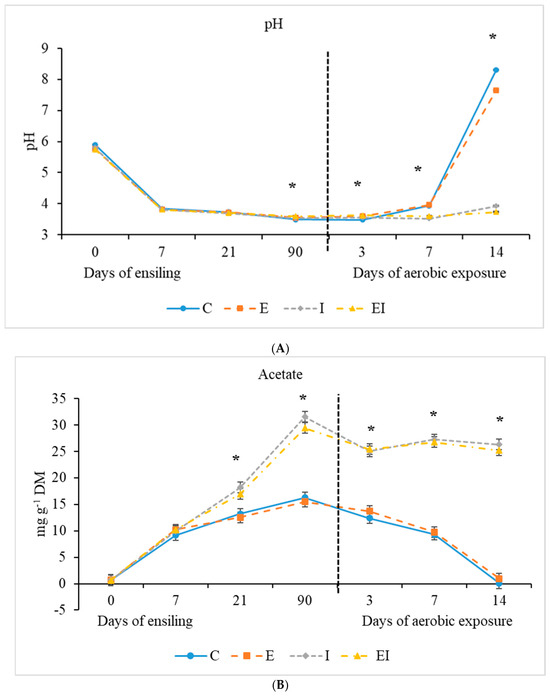
Regarding the kinetics of fermentation, there was a T × D interaction for silage pH (Figure 1A), with the pH of C being lower (3.49 vs. 3.60; p < 0.05) than that of EI after 90 d of ensiling, whereas the pH of C was lower (p < 0.05) than that of I, E, and IE on d 3 (3.48 vs. 3.56, 3.60 and 3.62, respectively), greater (p < 0,05) than that of I and EI on d 7 (3.93 vs. 3.52 and 3.60, respectively), and greater (p < 0.05) than that of I, E, and EI on d 14 (8.31 vs. 3.92, 7.66 and 3.73, respectively) of AE.
Figure 1.
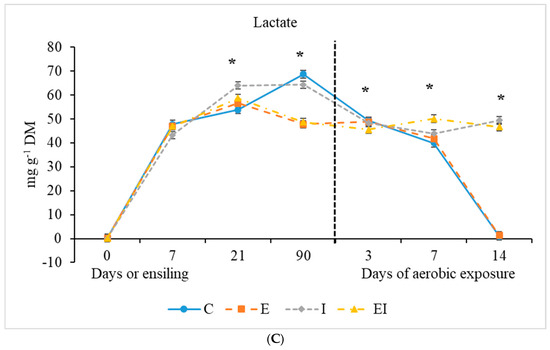
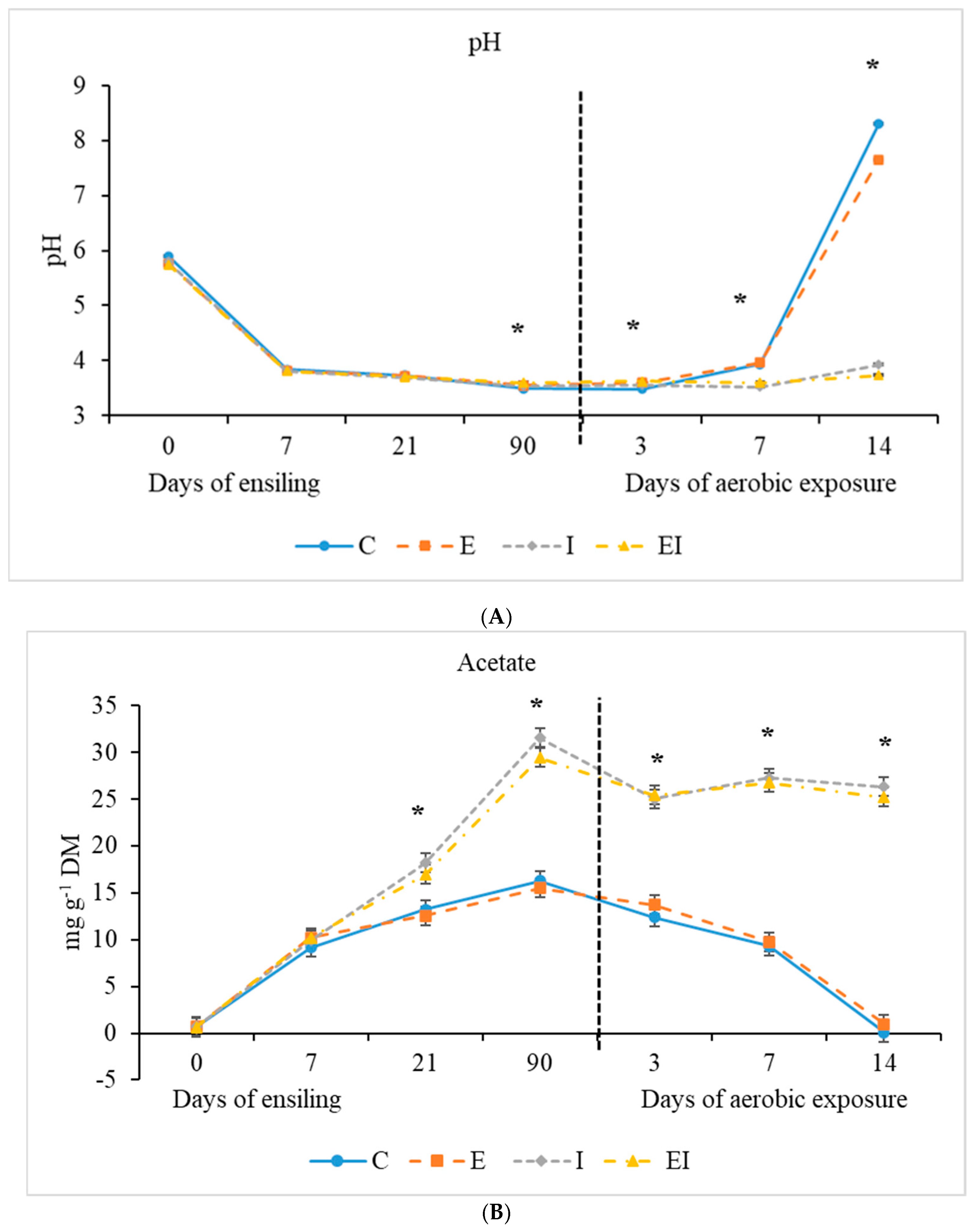
(A) Impact of addition of distilled water (C), 0.5 mg/kg fresh forage chitinase (E), lactic acid bacterial (LAB) inoculant (I) of 1.5 × 10⁸ Lactobacillus buchneri and 1.5 × 10⁸ L. hilgardii for a total of 3.0 × 10⁸ (cfu/g fresh forage) LAB, or combination of E and I (EI) to whole-crop corn silage on pH during 90 d ensiling and 14 d aerobic exposure (AE). Area a to the left of the dotted vertical line indicates ensiling, and to the right indicates the period of AE. * Treatment difference (p < 0.05) during ensiling and AE. Statistical analysis was conducted independently for each of these two phases. (B) Impact of addition of distilled water (C), 0.5 mg/kg fresh forage chitinase (E), lactic acid bacterial (LAB) inoculant (I) of 1.5 × 10⁸ Lactobacillus buchneri and 1.5 × 10⁸ L. hilgardii for a total of 3.0 × 10⁸ (cfu/g fresh forage) LAB, or combination of E and I (EI) to whole-crop corn silage on acetate concentrations during 90 d ensiling and 14 d aerobic exposure (AE). Area a to the left of the dotted vertical line indicates ensiling, and to the right indicates the period of AE. * Treatment difference (p < 0.05) during ensiling and AE. Statistical analysis was conducted independently for each of these two phases. (C) Impact of addition of distilled water (C), 0.5 mg/kg fresh forage chitinase (E), lactic acid bacterial (LAB) inoculant (I) of 1.5 × 10⁸ Lactobacillus buchneri and 1.5 × 10⁸ L. hilgardii for a total of 3.0 × 10⁸ (cfu/g fresh forage) LAB, or combination of E and I (EI) to whole-crop corn silage on lactate concentrations during 90 d ensiling and 14 d aerobic exposure (AE). Area a to the left of the dotted vertical line indicates ensiling, and to the right indicates the period of AE. * Treatment difference (p < 0.05) during ensiling and AE. Statistical analysis was conducted independently for each of these two phases.
Concentrations of acetic acid (AC; Figure 1B) were greater for (p < 0.01) I and EI but not for E over 90 d of ensiling, leading to higher (p < 0.01) concentration of AC for I and EI than for C and E on d 21 and 90 of ensiling and throughout AE. As AC accounted for ~95% of total VFA, the effects of treatment on total VFA followed the same trend as both ensiling and AE. Concentrations of propionate and butyrate were not affected by treatments. However, LA concentrations were greater (p < 0.05) for I than for C on d 21 (p < 0.01, Figure 1C) and for C and I than for E and EI on d 90 of ensiling. Concentrations of lactic acid (LA) during 14 d of AE remained similar for I and EI but decreased for C and E. LA concentrations of EI were lower than C on d 3 (p < 0.05), but greater than C on d 7 and 14 of AE (p < 0.01). The LA:AC ratio (p < 0.01) and ethanol concentrations (p < 0.05) of C and E were greater than those of I and EI during ensiling and AE. Succinate concentrations were lower (p < 0.01) for E and EI than for I.
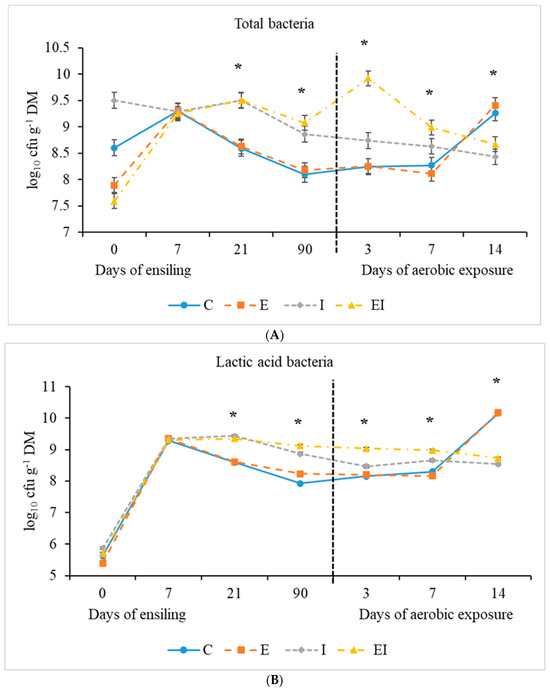
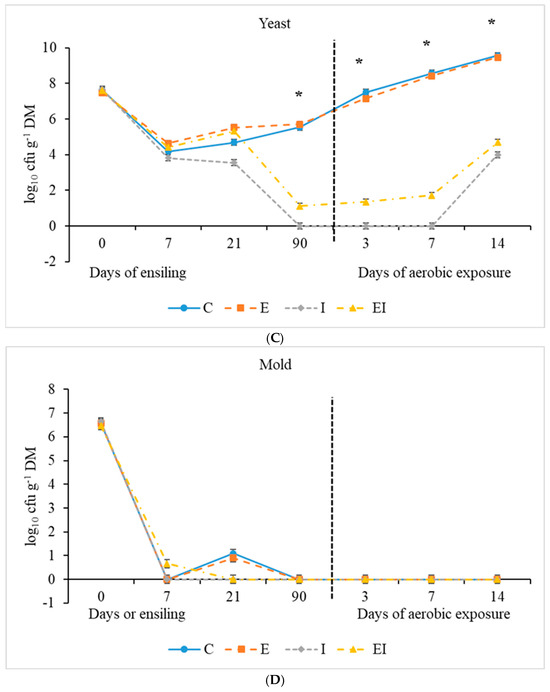
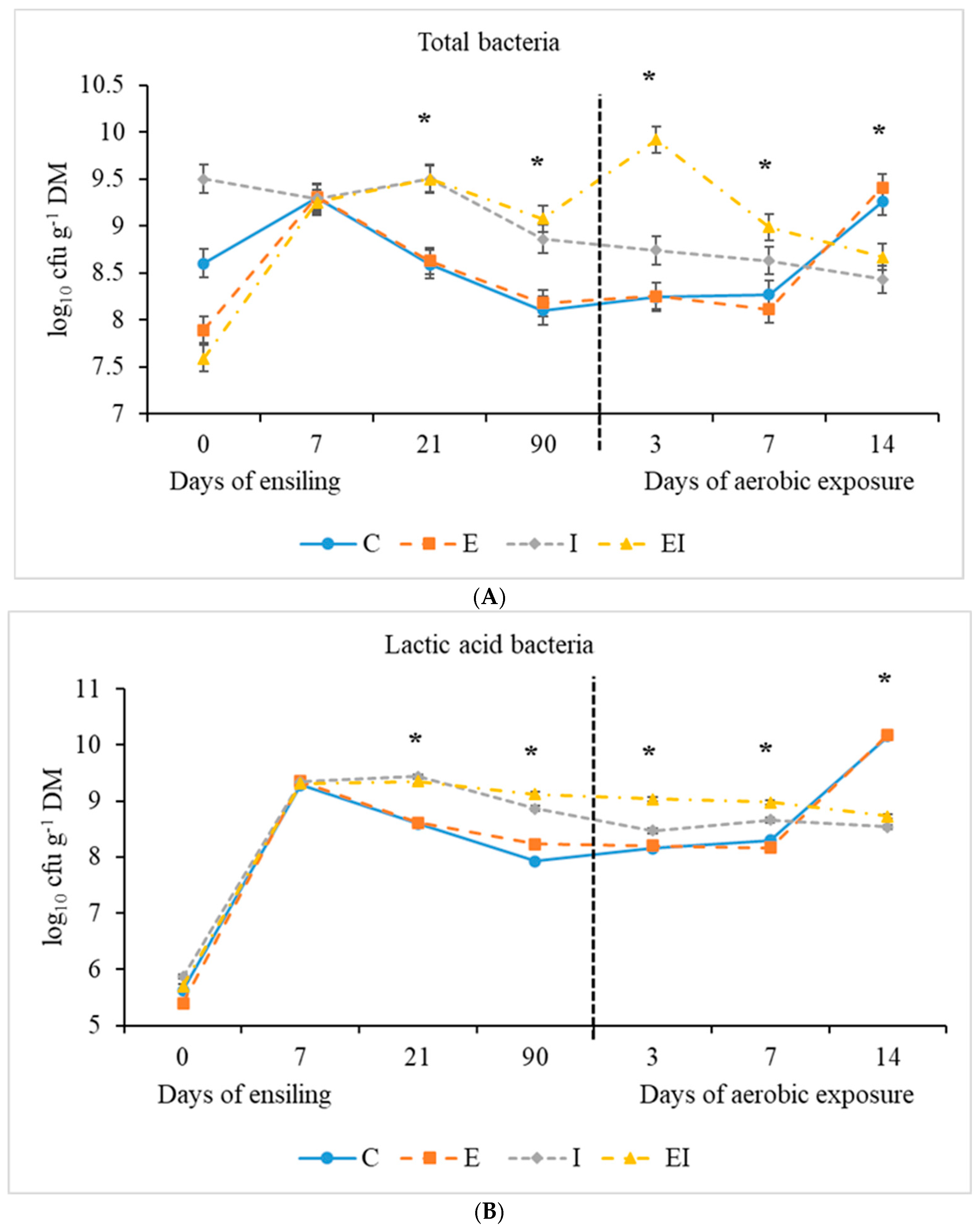
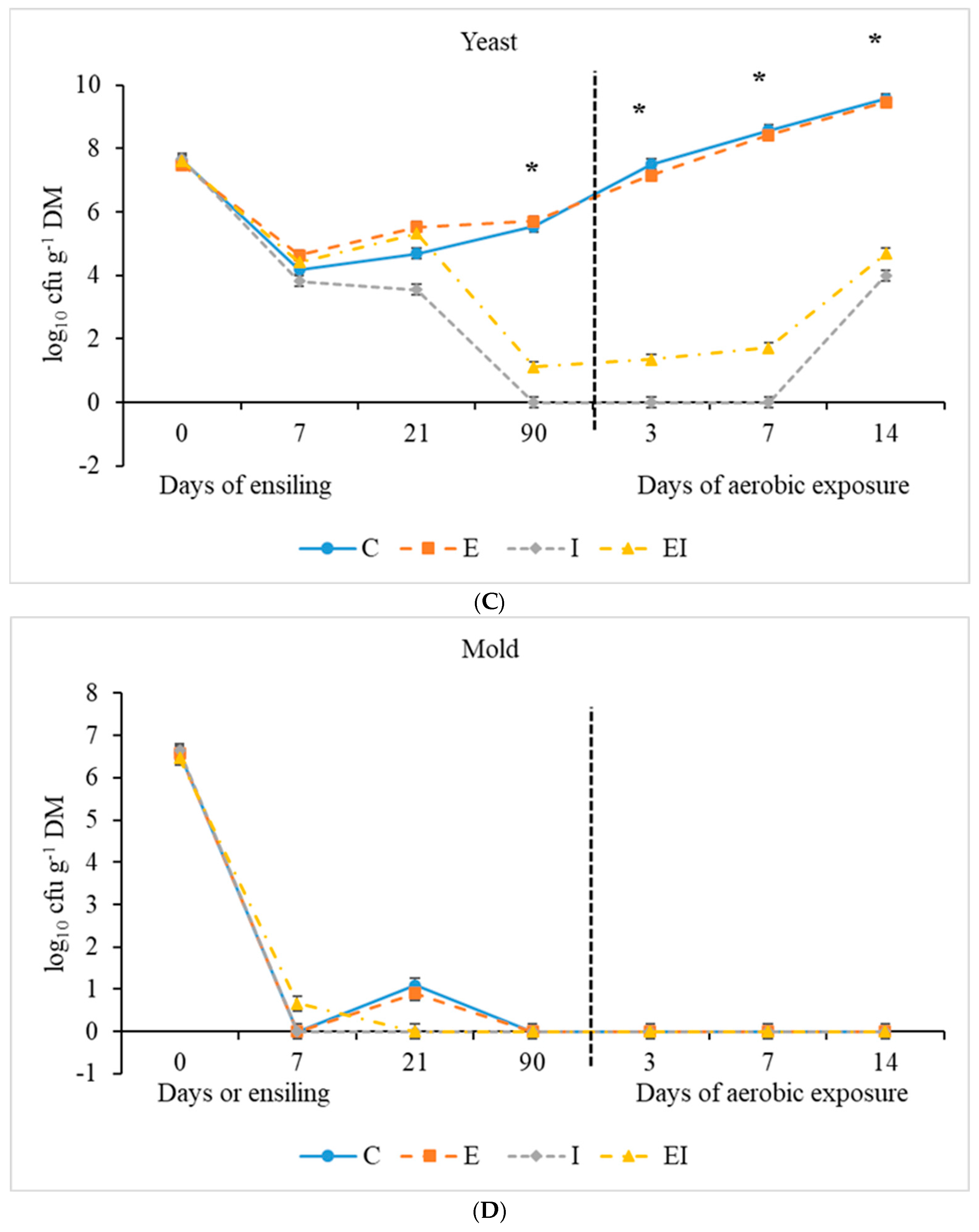
Total bacterial counts (log10 cfu/g DM) in I (9.5) and EI (9.5) were greater (p < 0.05) than those in C (8.59) and E (8.63) after 21 d of ensiling. Similarly, TB counts in I (8.74) and EI (9.08) were greater (p < 0.05) than those in C (8.10) and E (8.18) after 90 d of ensiling (Figure 2A). The TB counts of EI remained greater (p < 0.05) than those of C and E on d 3 (9.92 vs. 8.24 and 8.25, respectively) and 7 (8.99 vs. 8.27 and 8.11, respectively) of AE, while the numbers of TB were lower (p < 0.01) for I (8.43) and EI (8.67) than for C (9.26) and E (9.41) on d 14 of AE. Similarly, LAB counts (log10 cfu/g DM) in I (9.44) and EI (9.35) were higher (p < 0.05) than those in C (8.60) and E (8.62) after 21 d of ensiling. Similarly, LAB counts in I (8.87) and EI (9.12) were higher (p < 0.05) than those in C (7.93) and E (8.32) after 90 d of ensiling (Figure 2B). Moreover, the LAB counts of EI remained higher (p < 0.05) than those of E on d 3 (9.04 vs. 8.21) and 7 (8.98 vs. 8.17) of AE, while the LAB counts of C (10.16) and E (10.19) were higher than those of I (8.54) on d 14 of AE. Addition of I and EI decreased (p < 0.01) yeast population, as compared to C and E silage after 90 d of ensiling (0.0 and 1.11 vs. 5.54 and 5.71, respectively) and throughout AE (Figure 2C). Mold was not detected in terminal silages and during AE across treatments (Figure 2D). Chitinase alone did not affect (p > 0.05) any of these microbes during ensiling and AE.
Figure 2.
(A) Impact of addition of distilled water (C), 0.5 mg/kg fresh forage chitinase (E), lactic acid bacterial (LAB) inoculant (I) of 1.5 × 10⁸ Lactobacillus buchneri and 1.5 × 10⁸ L. hilgardii for a total of 3.0 × 10⁸ (cfu/g fresh forage) LAB, or combination of E and I (EI) to whole-crop corn silage on total bacterial counts during 90 d ensiling and 14 d aerobic exposure (AE). Area a to the left of the dotted vertical line indicates ensiling, and to the right indicates the period of AE. * Treatment difference (p < 0.05) during ensiling and AE. Statistical analysis was conducted independently for each of these two phases. (B) Impact of addition of distilled water (C), 0.5 mg/kg fresh forage chitinase (E), lactic acid bacterial (LAB) inoculant (I) of 1.5 × 10⁸ Lactobacillus buchneri and 1.5 × 10⁸ L. hilgardii for a total of 3.0 × 10⁸ (cfu/g fresh forage) LAB, or combination of E and I (EI) to whole-crop corn silage on lactic acid bacterial counts during 90 d ensiling and 14 d aerobic exposure (AE). Area a to the left of the dotted vertical line indicates ensiling, and to the right indicates the period of AE. * Treatment difference (p < 0.05) during ensiling and AE. Statistical analysis was conducted independently for each of these two phases. (C) Impact of addition of distilled water (C), 0.5 mg/kg fresh forage chitinase (E), lactic acid bacterial (LAB) inoculant (I) of 1.5 × 10⁸ Lactobacillus buchneri and 1.5 × 10⁸ L. hilgardii for a total of 3.0 × 10⁸ (cfu/g fresh forage) LAB, or combination of E and I (EI) to whole-crop corn silage on yeast counts during 90 d ensiling and 14 d aerobic exposure (AE). Area a to the left of the dotted vertical line indicates ensiling, and to the right indicates the period of AE. * Treatment difference (p < 0.05) during ensiling and AE. Statistical analysis was conducted independently for each of these two phases. (D) Impact of addition of distilled water (C), 0.5 mg/kg fresh forage chitinase (E), lactic acid bacterial (LAB) inoculant (I) of 1.5 × 10⁸ Lactobacillus buchneri and 1.5 × 10⁸ L. hilgardii for a total of 3.0 × 10⁸ (cfu/g fresh forage) LAB or combination of E, and I (EI) to whole-crop corn silage on mold counts during 90 d ensiling and 14 d aerobic exposure (AE). Area a to the left of the dotted vertical line indicates ensiling, and to the right indicates the period of AE. * Treatment difference (p < 0.05) during ensiling and AE. Statistical analysis was conducted independently for each of these two phases.
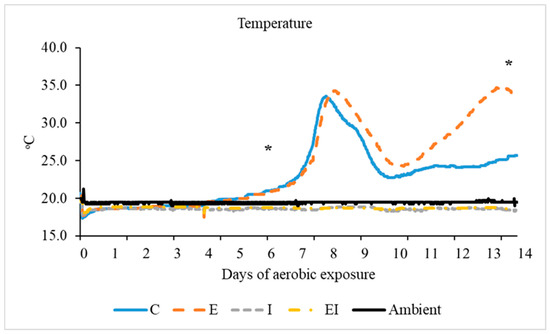
Aerobic stability of the terminal silages was increased (p < 0.001) by I, but not by E alone (Table 2). Aerobic stability of I and EI was greater (p < 0.001) than that of C and E during 14 d AE. The temperature of I and EI was close to ambient from d 0 to 14 of AE, while that of C and E increased after 5 d of AE (Figure 3).
Table 2.
Temperature data of corn silage treated with distilled water (C), with chitinase (E), inoculant (I) containing L. buchneri and L. hilgardii, or with E and I combination (EI), ensiled in minisilos during 14 days of aerobic exposure (AE).
Figure 3.
Impact of addition of distilled water (C), 0.5 mg/kg fresh forage chitinase (E), lactic acid bacterial (LAB) inoculant (I) of 1.5 × 10⁸ Lactobacillus buchneri and 1.5 × 10⁸ L. hilgardii for a total of 3.0 × 10⁸ (cfu/g fresh forage) LAB, or combination of E and I (EI) to whole-crop corn silage on silage temperature during 14 d aerobic exposure. * Treatment difference (p < 0,05) during 14 d aerobic exposure.
Maximum temperature (Tmax, °C) was higher (p < 0.001), and the time taken to reach Tmax (h) was greater (p < 0.001) for C and E than for I and EI during AE (Table 2). The duration (h) that silage temperatures were above the +2 °C threshold of ambient temperature was lower (p < 0.001) for I and EI than for C and E when measured for d 1–3, 1–7, 8–14, and 1–14 of AE. It should be noted that the Tmax of I and EI were close to ambient temperature. Moreover, the area [duration (h) × temperature] under the curve when the silage temperatures were above (+2 °C) ambient was greater (p < 0.01) for C and E than for I and EI on days 1–3, 1–7, 8–14, and 1–14 of AE. There was a significant E × I interaction (p < 0.001) with the area under the curve during d 1–14 and 8–14 of AE, with a greater area with the application of E alone (p < 0.001) but no impact with EI.
3.2. In Vitro Ruminal Fermentation
The kinetic parameters of GP, NDFD, as well as VFA production during 48 h in vitro ruminal fermentation of terminal silage are presented in Table 3. No I × E interaction was observed on GP kinetic parameters. Inoculant reduced (p < 0.001) while E increased (p < 0.05) total gas production (A) during 48 h of incubation. Inoculated silages also had a lower (p < 0.001) rate of GP (c) and shorter (p < 0.01) Lag time compared to C silage. In contrast, E had no effect on c but increased (p < 0.05) Lag time.
Table 3.
Gas production, neutral detergent fiber disappearance (NDFD), and volatile fatty acid (VFA) profile of corn silage incubated for 48 h with mixed rumen microbes.
Disappearance of NDF was calculated at each sampling time point due to a treatment × time interaction (p < 0.001). No E × I interaction was observed except after 48 h, where the combination of E and I increased (p < 0.001) NDFD, as compared to C and E. Inoculant decreased (p < 0.05) NDFD at 6 and 12 h, but increased (p < 0.001) it at 24 and 48 h of the incubation. Treatments did not affect the total VFA production or molar proportions of individual VFA, except that I decreased (p < 0.01) total VFA production, but increased (p < 0.001) molar proportion of iso-valerate at 6 and 12 h of incubation.
4. Discussion
4.1. Effects of Bacterial Inoculant and Chitinase on Ensiling Characteristics
Chitinases are glycosyl hydrolases present in a wide range of organisms from bacteria to humans that exhibit anti-fungal and anti-yeast activity by degrading the chitin layer within fungal cell walls [49,50,51]. These enzymes are gaining importance for their biotechnological applications, especially in pathogen control in human health and crop production [51]. Jin et al. [27] and Nair et al. [28] reported that application of P. pentosaceus with a chitinase to high-moisture alfalfa hay decreased internal temperature of baled forage. To our knowledge, this is the first study to explore the use of chitinase in corn silages.
The pH of the silages decreased rapidly in the initial phase of the ensiling, which was below 4.0 after 7 d ensiling, indicating that all silages were adequately ensiled regardless of treatment. It is generally regarded that spoilage microbial activity is inhibited when silage pH declines below 4.0, thereby preserving forage nutrients [4,52]. Although EI slightly increased the pH of terminal silages, the effect of this increase on silage quality would be minimal as the pH of these silages still remained below 4.0. This is supported by the similar OM, CP, starch, and NDF contents and similar DM loss for all silages. The decrease in silage pH is caused by the accumulation of LA and VFA from the metabolic activity of epiphytic microorganisms and the inoculated LAB utilizing the WSC as a substrate during ensiling. This is consistent with the lower residual WSC concentration in terminal silages as compared with that in freshly harvested corn forage and the accumulation of VFA and LA during the ensiling process. It should be noted that the residual WSC concentration was lower for I and EI than for C and E, indicating increased utilization of WSC as a result of inoculation with LAB. A significant reduction in residual WSC concentrations for terminal silages inoculated with heterofermentative LAB inoculants has been reported previously [6,11,18,31]. It is logical to assume that the LAB (L. hilgardii and L. buchneri) in the inoculated silages (I and EI) resulted in increased microbial activity and metabolism during the ensiling period, resulting in the utilization of WSC, as evidenced by the production of AC and VFA concentrations for I and EI than C and E (Table 1). Furthermore, both strains of the inoculant could produce LA and convert LA to AC [53,54,55]. This partially explained that C and I had similar levels of LA, but I had higher concentrations of AC, leading to a lower LA: AC ratio.
The increased acetate concentration after 21 d ensiling for I and EI indicated that the LAB inoculant increased acetate production at an early stage of ensiling. The inoculant used in this study contained both L. buchneri and L. hilgardii strains, which are heterofermentative and are capable of producing AC. Previous studies have shown that L. buchneri requires a longer fermentation time to produce AC [13], whereas L. hilgardii is capable of increasing AC within 14–21 d of ensiling to levels that improve the AS of silages [18,56]. Acetate is a potent anti-yeast and mold agent as reflected by a decrease in yeast and mold counts after d 21 of ensiling. It has been suggested that an LA:AC ratio of >3 is indicative of a dominant homolactic fermentation [19]. The LA:AC ratio in this study ranged from 1.6 to 3.9, with C and E silages having higher than 3 and I and IE silages being lower than 3. Other studies also observed that heterofermentative inoculants reduced the LA:AC ratio [6,12,16]. In contrast, the relatively lower LA:AC ratio of E compared to C silages was due to the lower LA concentration.
It appears that the combination of chitinase with L. buchneri and L. hilgardii did not negatively impact the activity of the LAB inoculant, as the AC concentration of silages treated with EI was similar to that of I. In contrast, in an evaluation of the effects of bacterial inoculants producing chitinase on corn silage, Joo et al. [57] reported no effect of a combination of L. paracasei L9-3 and L. buchneri L11-1 at 2.1 × 10⁵ cfu/g forage DM on AC or LA concentrations after 90 d or ensiling. In the present study, the reason why the LA concentration was decreased for E, despite having a similar LAB population as C, is unclear. Studies evaluating the effects of combining chitinase and LAB inoculants for forage preservation are scarce. Some recent studies evaluated the impact of chitosan alone or in combination with LAB inoculants on the ensiling of sugarcane, whole-crop soybean, and rehydrated corn kernels [58,59,60,61,62,63]. Chitosan is a biopolymer derived from chitin deacetylation and has been utilized as a silage inoculant due to its antimicrobial properties. Gandra et al. [62] added chitosan (5 g/kg fresh forage) in combination with 4 × 10¹⁰ cfu/g L. plantarum and 2.6 × 10¹⁰ cfu/g Propionibacterium acidipropioni to ensile whole plant soybean and recorded higher counts of TB, intermediate concentrations of AC, and lower concentrations of propionate, butyrate, iso-butyrate, and valerate, as compared to control forage. Results of the impact of application of chitosan alone have been mixed, with reports of increased TB counts [60,61], greater AC [59,61] and LA [61], decreased AC [60] and LA [58], or similar AC and LA concentrations [63] in sugar cane, rehydrated corn kernel or whole-crop soybean silages relative to untreated control silages. The variability in the experimental methodology, including the nature and concentrations of chitosan and the type of forage used between studies, could impact the end products of ensiling.
4.2. Effects of Bacterial Inoculant and Chitinase on Aerobic Stability of Whole-Crop Corn Silages
A significant result of this study was that LAB inoculant and the combination of LAB inoculant and chitinase, but not chitinase alone, markedly increased the AS of the silage from 152 h to >336 h. Silages are prone to spoilage upon exposure to air due to the activity of spoilage microorganisms that metabolize substrates, producing spores and toxins [19,64,65]. It has been observed that AS of silages is directly related to the presence of yeasts, with a population higher than 105 cfu/g DM being indicative of aerobic deterioration [12,66,67]. The yeast population in I and EI silages was lower than 105 cfu/g DM, while that in the E and C silages exceeded it, reflecting the improved AS in I and EI terminal silages as a result of increased AC concentrations. The decrease in AC concentrations and increase in yeast populations during 14 d of aerobic exposure for C and E silages occurred concomitantly, while the high AC concentration and low yeast population in I and EI silages remained relatively stable. Similar observations were also made by others evaluating combinations of heterofermentative LAB, including L. buchneri and L. hilgardii, in inoculated corn silages [6,12,16,29,55,56]. In contrast, Joo et al. [57] reported a decrease in aerobic stability of corn silages with bacterial inoculants producing chitinase, where the inoculants did not increase the concentrations of AC or decrease the numbers of yeast and mold. Studies evaluating the impact of the application of chitosan on aerobic stability have also been mixed. Del Valle et al. [58] reported that chitosan alone, but not in combination with a LAB, increased the aerobic stability of sugarcane silages, whereas Gandra et al. [62] reported that whole plant soybean silage treated with chitinase and LAB maintained a pH below 5 until 72 h after silo opening. The strains of LAB used, the nature of the studies, and the ensiling conditions could potentially affect the fermentation and microbiological outcomes of these studies.
The results showed that the application of chitinase did not adversely affect the fermentation or AS of whole-crop corn silage. The relatively greater TB and LAB counts, as well as higher concentrations of AC and LA for EI than for E, likely indicate that the addition of chitinase did not alter the microbial population and metabolism, and thereby the ensiling fermentation of corn silages. Another contributing factor could be the low concentration of mold in the silages, which was undetectable after 7 d of ensiling. Similar observations have been reported previously, where mold populations were low or undetectable in silages during ensiling [6,16,31]. It should also be noted that the present study was carried out using minisilos under experimental conditions. Fermentation and microbial dynamics in commercial large-scale silos may differ from those in laboratory-scale minisilos, as ensiling and feedout conditions are complex and challenging. However, previous studies from our lab indicated similar trends between fermentation parameters and microbial populations during ensiling and aerobic exposure in both laboratory-scale minisilos and commercial-scale silobag studies [17]. Further study is needed to explore the potential use of chitinase as a biological control method in forage conservation.
4.3. Effects of Bacterial Inoculant and Chitinase on In Vitro Ruminal Fermentation of Silage
The present study showed that GP from 6 h to the end of the 48 h incubation was lower for I and EI than for C and E. This is likely due to the fact that the WSC concentrations were lower for I and EI. Water-soluble carbohydrates are simple sugars that are a readily available substrate for fermentation microbes. Therefore, the lower WSC concentrations for I and EI likely reduced the initial fermentation activity and corresponding GP. This was corroborated by the observation that fermentation of I and EI silages had lower total VFA than C and E silages during the first 12 h incubation. An interesting finding of this study was that LAB alone increased silage NDFD, which was further increased by inoculant and chitinase at 24 and 48 h of the in vitro incubation. Information about the effects of the combination of L. hilgardii and L. buchneri on ruminal digestion of corn silage is scarce. Tabacco et al. [67] reported that corn silage inoculated with L. buchneri in laboratory-scale plastic jars had higher 24 and 48 h in vitro NDFD than uninoculated corn silages. Arriola et al. [13] also showed that L. hilgardii and L. buchneri, either alone or in combination, increased in vitro NDFD of corn silages. Our previous study found, however, that beef cattle fed a diet containing 65% corn silage with and without a mixture of L. hilgardii and L. buchneri in large-scale silo bags had similar total tract nutrient digestibility [6]. The discrepancy among studies in the effect of heterolactic LAB on nutrient digestibility may reflect the difference in the strains of LAB used, the nature of studies (in vitro vs. in vivo), and ensiling conditions (mini-silo vs. silo-bag). For example, Nair et al. [6,17] reported no difference in the growth performance of beef cattle fed corn silages inoculated with or without a mixture of L. hilgardii and L. buchneri and ensiled in silo-bags. These authors concluded that feeding inoculated silages with enhanced AS did not result in improved animal growth performance compared to uninoculated silages, as the uninoculated silages were aerobically stable when fed (~3–4 d of AE). These authors also reported that the impact of inoculation could be more prominent in large, commercial-scale feeding operations where silages at the silo face may be exposed to air for longer periods of time, compromising the AS and nutritive value.
There was a LAB and chitinase interaction for NDFD, where the NDFD tended (p = 0.099) to be greater for I than for E after 24 h of incubation, while the NDFD was greater (p < 0.001) for I than for E after 48 h, even though the application of chitinase alone did not affect NDFD. Our previous studies also found that the combination of P. pentosaceus with chitinase increased the ruminal NDF degradability of high-moisture alfalfa hay [27,28]. Therefore, further research is needed to elucidate the mode of action of this interaction to further explore the potential of chitinase in forage conservation.
5. Conclusions
Application of L. hilgardii and L. buchneri reduced the number of yeasts, increased AC and total VFA concentrations in terminal silages, enhanced the aerobic stability, and improved NDF ruminal digestion of corn silages. Application of chitinase alone had no adverse effect on ensiling fermentation, aerobic stability, or in vitro fermentation of whole-crop corn silages. Furthermore, combining the LAB inoculant and chitinase likely resulted in a synergistic effect, as indicated by greater TB and LAB counts, and suggested by a numerical improvement in 24 and 48 h NDFD. Further metagenomic evaluation during the ensiling and AE periods is necessary to define the microbial and fermentation characteristics of corn silages inoculated with chitinase for the potential application as a biological control in forage preservation.
Author Contributions
Conceptualization, T.A.M., E.C. and Y.W.; methodology, T.A.M., E.C. and Y.W.; software, H.N., J.N. and Y.W.; validation, T.A.M. and Y.W.; formal analysis, H.N., H.-E.Y., J.N. and Y.W.; investigation, H.N., H.-E.Y. and J.N.; resources, T.A.M., E.C. and Y.W.; data curation, H.N., H.-E.Y., J.N. and Y.W.; writing—original draft preparation, H.N., J.N., H.-E.Y., T.A.M. and Y.W.; writing—review and editing, H.N., J.N., H.-E.Y., T.A.M., E.C. and Y.W.; visualization, H.N., J.N., H.-E.Y., T.A.M. and Y.W.; supervision, T.A.M. and Y.W.; project administration, T.A.M. and Y.W.; funding acquisition, T.A.M., E.C. and Y.W. All authors have read and agreed to the published version of the manuscript.
Funding
This research was supported by Lallemand Specialties Inc. (grant number J-002039), the Program for Young Talents of Science and Technology of the Universities of Inner Mongolia Autonomous Region [grant number NJYT22054], and the Inner Mongolia Science and Technology Project [grant numbers 2025YFDZ0123, 2023YFDZ0079, 2025ZY0111].
Institutional Review Board Statement
The animal study protocol was approved by the Institutional Review Board (or Ethics Committee) of Lethbridge Research and Development Center (protocol code 1830, dated 11 January 2019) for studies involving animals.
Informed Consent Statement
Not applicable.
Data Availability Statement
The original contributions presented in this study are included in the article. Further inquiries can be directed to the corresponding author.
Conflicts of Interest
The author Eric Chevaux was employed by the company Lallemand SAS, an affiliate of Lallemand Inc. The remaining authors declare that the research was conducted in the absence of any commercial or financial relationships that could be construed as potential conflicts of interest. The authors declare that this study received funding from Lallemand Specialties Inc. (grant number J-002039), the Program for Young Talents of Science and Technology of the Universities of Inner Mongolia Autonomous Region [grant number NJYT22054], and the Inner Mongolia Science and Technology Project [grant numbers 2025YFDZ0123, 2023YFDZ0079, 2025ZY0111]. The funder had the following involvement with the study: conceptualization, resources, funding acquisition, and writing—review and editing.
References
- Erdman, R.A.; Piperova, L.S.; Kohn, R.A. Corn silage versus corn silage:alfalfa hay mixtures for dairy cows: Effects of dietary potassium, calcium, and cation-anion difference. J. Dairy Sci. 2011, 94, 5105–5110. [Google Scholar] [CrossRef] [Scilit] [PubMed]
- Donna, M.A.; Roy, N.; Lee, C.; Lehmkuhler, J. Practical Corn Silage Harvest and Storage Guide for Cattle Producers. University of Kentucky Cooperative Extension Service. 2023. Available online: https://publications.mgcafe.uky.edu/sites/publications.ca.uky.edu/files/ID275.pdf (accessed on 17 December 2025).
- Addah, W.; Baah, J.; Okine, E.K.; Owens, F.N.; McAllister, T.A. Effects of chop-length and ferulic acid esterase producing inoculant on fermentation and aerobic stability of barley silage, and growth performance of finishing feedlot steers. Anim. Feed Sci. Technol. 2014, 197, 34–46. [Google Scholar] [CrossRef] [Scilit]
- Muck, R.E.; Nadeau, E.M.G.; McAllister, T.A.; Contreras-Govea, F.E.; Santos, M.C.; Kung, L., Jr. Silage review: Recent advances and future uses of silage additives. J. Dairy Sci. 2018, 101, 3980–4000. [Google Scholar] [CrossRef] [Scilit] [PubMed]
- Puntillo, M.; Peralta, G.H.; Bürgi, M.D.M.; Huber, P.; Gaggiotti, M.; Binetti, A.G.; Vinderola, G. Meta-profiling of the bacterial community in sorghum silages inoculated with lactic acid bacteria. J. Appl. Microbiol. 2022, 133, 2375–2389. [Google Scholar] [CrossRef] [Scilit]
- Nair, J.; Niu, H.; Andrada, E.; Yang, H.-E.; Chevaux, E.; Drouin, P.; McAllister, T.A.; Wang, Y. Effects of inoculation of corn silage with Lactobacillus hilgardii and Lactobacillus buchneri on silage quality, aerobic stability, nutrient digestibility, and growth performance of growing beef cattle. J. Anim. Sci. 2020, 98, Skaa267. [Google Scholar] [CrossRef] [Scilit]
- Driehuis, F.; Elferink, S.J.; Spoelstra, S.F. Anaerobic lactic acid degradation during ensilage of whole crop maize inoculated with Lactobacillus buchneri inhibits yeast growth and improves aerobic stability. J. Appl. Microbiol. 1999, 87, 583–594. [Google Scholar] [CrossRef] [Scilit]
- Drouin, P.; Tremblay, J.; Chaucheyras-Durand, F. Dynamic succession of microbiota during ensiling of whole plant corn following inoculation with Lactobacillus buchneri and Lactobacillus hilgardii alone or in combination. Microorganisms 2019, 7, 595. [Google Scholar] [CrossRef] [Scilit]
- Holzer, M.; Mayrhuber, E.; Danner, H.; Braun, R. The role of Lactobacillus buchneri in forage preservation. Trends Biotechnol. 2003, 21, 282–287. [Google Scholar] [CrossRef] [Scilit]
- Killerby, M.A.; Almeida, S.T.R.; Hollandsworth, R.; Guimaraes, B.C.; Leon-Tinoco, A.; Perkins, L.B.; Henry, D.; Schwartz, T.J.; Romero, J.J. Effect of chemical and biological preservatives and ensiling stage on the dry matter loss, nutritional value, microbial counts, and ruminal in vitro gas production kinetics of wet brewer’s grain silage. J. Anim. Sci. 2022, 100, skac095. [Google Scholar] [CrossRef] [Scilit]
- Filya, I.; Sucu, E.; Karabulut, A. The effect of Lactobacillus buchneri on the fermentation, aerobic stability and ruminal degradability of maize silage. J. Appl. Microbiol. 2006, 101, 1216–1223. [Google Scholar] [CrossRef] [Scilit]
- Kleinschmit, D.H.; Kung, L., Jr. A meta-analysis of the effects of Lactobacillus buchneri on the fermentation and aerobic stability of corn and grass and small-grain silages. J. Dairy Sci. 2006, 89, 4005–4013. [Google Scholar] [CrossRef] [Scilit] [PubMed]
- Arriola, K.G.; Oliveira, A.S.; Jiang, Y.; Kim, D.; Silva, H.M.; Kim, S.C.; Amaro, F.X.; Ogunade, I.M.; Sultana, H.; Pech Cervantes, A.A.; et al. Meta-analysis of effects of inoculation with Lactobacillus buchneri, with or without other bacteria, on silage fermentation, aerobic stability, and performance of dairy cows. J. Dairy Sci. 2021, 104, 7653–7670. [Google Scholar] [CrossRef] [Scilit] [PubMed]
- Wang, T.; Teng, K.; Cao, Y.; Shi, W.; Xuan, Z.; Zhou, J.; Zhang, J.; Zhong, J. Effects of Lactobacillus hilgardii 60TS-2, with or without homofermentative Lactobacillus plantarum B90, on the aerobic stability, fermentation quality and microbial community dynamics in sugarcane top silage. Bioresour. Technol. 2020, 312, 123600. [Google Scholar] [CrossRef] [Scilit] [PubMed]
- da Silva, É.B.; Costa, D.M.; Santos, E.M.; Moyer, K.; Hellings, E.; Kung, L., Jr. The effects of Lactobacillus hilgardii 4785 and Lactobacillus buchneri 40788 on the microbiome, fermentation, and aerobic stability of corn silage ensiled for various times. J. Dairy Sci. 2021, 104, 10678–10698. [Google Scholar] [CrossRef] [Scilit]
- da Silva, É.B.; Smith, M.L.; Savage, R.M.; Polukis, S.A.; Drouin, P.; Kung, L., Jr. Effects of Lactobacillus hilgardii 4785 and Lactobacillus buchneri 40788 on the bacterial community, fermentation and aerobic stability of high-moisture corn silage. J. Appl. Microbiol. 2021, 130, 1481–1493. [Google Scholar] [CrossRef] [Scilit]
- Nair, J.; Yang, H.-E.; Redman, A.-A.; Chevaux, E.; Drouin, P.; McAllister, T.A.; Wang, Y. Effects of a mixture of Lentilactobacillus hilgardii, Lentilactobacillus buchneri, Pediococcus pentosaceus and fibrolytic enzymes on silage fermentation, aerobic stability and performance of growing beef cattle. Tans. Anim. Sci. 2022, 6, txac144. [Google Scholar] [CrossRef] [Scilit]
- Carvalho, B.F.; Ávila, C.L.S.; Pinto, J.C.; Neri, J.; Schwan, R.F. Microbiological and chemical profile of sugar cane silage fermentation inoculated with wild strains of lactic acid bacteria. Anim. Feed Sci. Technol. 2014, 195, 1–13. [Google Scholar] [CrossRef] [Scilit]
- Ferrero, F.; Piano, S.; Tabacco, E.; Borreani, G. Effects of conservation period and Lactobacillus hilgardii inoculum on the fermentation profile and aerobic stability of whole corn and sorghum silages. J. Sci. Food Agric. 2019, 99, 2530–2540. [Google Scholar] [CrossRef] [Scilit]
- Hoster, F.; Schmitz, J.E.; Daniel, R. Enrichment of chitinolytic microorganisms: Isolation and characterization of a chitinase exhibiting antifungal activity against phytopathogenic fungi from a novel Streptomyces strain. Appl. Microbiol. Biotechnol. 2005, 66, 434–442. [Google Scholar] [CrossRef] [Scilit]
- Oyeleye, A.; Normi, Y.M. Chitinase: Diversity, limitations, and trends in engineering for suitable applications. Biosci. Rep. 2018, 38, BSR2018032300. [Google Scholar] [CrossRef] [Scilit]
- Pasin, T.M.; de Oliveira, T.B.; Scarcella, A.S.A.; Polizeli, M.L.T.M.; Guazzaroni, M.E. Perspectives on expanding the repertoire of novel microbial chitinases for biological control. J. Agric. Food Chem. 2021, 69, 3284–3288. [Google Scholar] [CrossRef] [Scilit]
- Nagpure, A.; Choudhary, B.; Gupta, R.K. Chitinases: In agriculture and human healthcare. Crit. Rev. Biotechnol. 2014, 34, 215–232. [Google Scholar] [CrossRef] [Scilit] [PubMed]
- Le, B.; Yang, S.H. Microbial chitinases: Properties, current state and biotechnological applications. World J. Microbiol. Biotechnol. 2019, 35, 144. [Google Scholar] [CrossRef] [Scilit] [PubMed]
- Kozome, D.; Uechi, K.; Taira, T.; Fukada, H.; Kubota, T.; Ishikawa, K. Structural analysis and construction of a thermostable antifungal chitinase. Appl. Environ. Microbiol. 2022, 88, e0065222. [Google Scholar] [CrossRef] [Scilit] [PubMed]
- Jin, L.; Duniere, L.; Lynch, J.P.; Chevaux, E.; McAllister, T.A.; Baah, J.; Wang, Y. Application of Pediococcus pentosaceus, Pichia anomala, and chitinase to high moisture alfalfa hay at baling: Effects on ruminal digestibility. In Proceedings of the ASAS Joint Annual Meeting 2015, Orlando, FL, USA, 9–12 July 2015. [Google Scholar]
- Jin, L.; Chevaux, E.; McAllister, T.; Baah, J.; Drouin, P.; Wang, Y. Impact of Pediococcus pentosaceus and Pichia anomala in combination with chitinase on the preservation of high-moisture alfalfa hay. Grass Forage Sci. 2018, 73, 610–621. [Google Scholar] [CrossRef] [Scilit]
- Nair, J.; Jin, L.; Chevaux, E.; McAllister, T.A.; Wang, Y. Impact of inoculation with Pediococcus pentosaceus in combination with chitinase on bale core temperature, nutrient composition, microbial ecology, and ruminal digestion of high-moisture alfalfa hay. Fermentation 2024, 10, 530. [Google Scholar] [CrossRef] [Scilit]
- EFSA Panel on Additives and Products or Substances used in Animal Feed (FEEDAP); Bampidis, V.; Azimonti, G.; Bastos, M.L.; Christensen, H.; Dusemund, B.; Fašmon Durjava, M.; Kouba, M.; López-Alonso, M.; López Puente, S.; et al. Safety and efficacy of a feed additive consisting of Propionibacterium freudenreichii DSM 33189 and Lentilactobacillus buchneri (formerly Lactobacillus buchneri) DSM 12856 for all animal species (Lactosan GmbH & Co.KG.). EFSA J. 2022, 20, e07151. [Google Scholar] [CrossRef] [Scilit]
- Sigma-Aldrich, 2025. Available online: https://www.sigmaaldrich.com/US/en/product/sigma/c6137 (accessed on 20 November 2025).
- Nair, J.; Xu, S.; Smiley, B.; Yang, H.-E.; McAllister, T.A.; Wang, Y. Effects of inoculation of corn silage with Lactobacillus spp. or Saccharomyces cerevisiae alone or in combination on silage fermentation characteristics, nutrient digestibility, and growth performance of growing beef cattle. J. Anim. Sci. 2019, 97, 4974–4986. [Google Scholar] [CrossRef] [Scilit]
- Teller, R.S.; Schmidt, R.J.; Whitlow, L.W.; Kung, L., Jr. Effect of physical damage to ears of corn before harvest and treatment with various additives on the concentration of mycotoxins, silage fermentation and aerobic stability of corn silage. J. Dairy Sci. 2012, 95, 1428–1436. [Google Scholar] [CrossRef] [Scilit]
- National Academies of Sciences, Engineering, and Medicine (NASEM). Nutrient Requirements of Beef Cattle, 8th revised ed.; National Academies Press: Washington, DC, USA, 2016.
- Canadian Council on Animal Care (CCAC). CCAC Guidelines on: The Care and Use of Farm Animals in Research, Teaching, and Testing; CCAC: Ottawa, ON, Canada, 2009.
- Menke, K.H.; Raab, L.; Salewski, A.; Steingass, H.; Fritz, D.; Schneider, W. The estimation of the digestibility and metabolizable energy content of ruminant feeding stuffs from the gas production when they are incubated with rumen liquor in vitro. J. Agric. Sci. 1979, 93, 217–222. [Google Scholar] [CrossRef] [Scilit]
- Addah, W.; Baah, J.; Groenewegen, P.; Okine, E.K.; McAllister, T.A. Comparison of the fermentation characteristics, aerobic stability and nutritive value of barley and corn silages ensiled with or without a mixed bacterial inoculant. Can. J. Anim. Sci. 2011, 91, 133–146. [Google Scholar] [CrossRef] [Scilit]
- Nelson, N. A photometric adaptation of the Somogyi method for the determination of glucose. J. Biol. Chem. 1944, 153, 375–380. [Google Scholar] [CrossRef] [Scilit]
- Kudo, H.; Cheng, K.-J.; Costerton, J.W. Interactions between Treponema bryantii and cellulolytic bacteria in the in vitro degradation of straw cellulose. Can. J. Microbiol. 1987, 33, 244–248. [Google Scholar] [CrossRef] [Scilit] [PubMed]
- Broderick, G.A.; Kang, J.H. Automated simultaneous determination of ammonia and total amino acids in ruminal fluid and in vitro media. J. Dairy Sci. 1980, 63, 64–75. [Google Scholar] [CrossRef] [Scilit]
- Association of Official Analytical Chemists. Official Methods of Analysis, 17th ed.; AOAC International: Gaithersburg, MD, USA, 2000.
- Van Soest, P.J.; Robertson, J.B.; Lewis, B.A. Methods for dietary fiber, neutral detergent fiber, and nonstarch polysac-charides in relation to animal nutrition. J. Dairy Sci. 1991, 74, 3583–3597. [Google Scholar] [CrossRef] [Scilit]
- Herrera-Saldana, G.E.; Huber, J.T.; Poore, M.H. Dry matter, crude protein, and starch degradability of five cereal grains. J. Dairy Sci. 1990, 73, 2386–2393. [Google Scholar] [CrossRef] [Scilit]
- Addah, W.; Baah, J.; McAllister, T.A. Effects of an exogenous enzyme-containing inoculant on fermentation characteristics of barley silage and on growth performance of feedlot steers. Can. J. Anim. Sci. 2016, 96, 1–10. [Google Scholar] [CrossRef] [Scilit]
- Snell, F.D.; Snell, C.T. Colorimetric Methods of Analysis; D. van Nostrand Company Inc.: Toronto, ON, Canada, 1953; p. 204. [Google Scholar]
- Hristov, A.N.; McAllister, T.A.; Cheng, K.-J. Stability of exogenous polysaccharide-degrading enzyme in the rumen. Proc. West. Sect. ASAS 1997, 48, 145–148. [Google Scholar] [CrossRef] [Scilit]
- Assis, F.G.V.; Ávila, C.L.S.; Pinto, J.C.; Schwan, R.F. New inoculants on maize silage fermentation. R. Bras. Zootec. 2014, 43, 395–403. [Google Scholar] [CrossRef] [Scilit]
- Lopez, S.; France, J.; Dhanoa, M.S.; Mould, F.; Dijkstra, J. Comparison of mathematical models to describe disappearance curves obtained using the polyester bag technique for incubating feeds in the rumen. J. Anim. Sci. 1999, 77, 1875–1888. [Google Scholar] [CrossRef] [Scilit]
- SAS Inst. Inc. SAS OnlineDoc 9.3.1; SAS Institute Inc.: Cary, NC, USA, 2012.
- De Boer, W.; Klein Gunnewiek, P.J.; Lafeber, P.; Janse, J.D.; Spit, B.E.; Woldendorp, J.W. Anti-fungal properties of chitinolytic dune soil bacteria. Soil Biol. Biochem. 1998, 30, 193–203. [Google Scholar] [CrossRef] [Scilit]
- Chang, W.; Chen, C.; Wang, S. An antifungal chitinase produced by bacillus cereus with shrimp and crab shell powder as a carbon source. Curr. Microbiol. 2003, 47, 102–108. [Google Scholar] [CrossRef] [Scilit] [PubMed]
- Singh, R.; Updhyay, S.K.; Singh, M.; Sharma, I.; Sharma, P.; Kamboj, P.; Saini, A.; Voraha, R.; Sharma, A.K.; Upadhyay, T.K.; et al. Chitin, chitinases and chitin derivatives in biopharmaceutical, agricultural, and environmental perspective. Biointerface Res. Appl. Chem. 2021, 11, 9985–10005. [Google Scholar] [CrossRef] [Scilit]
- Rooke, J.A.; Hatfield, R.D. Biochemistry of ensiling. In Silage Science and Technology (Agronomy Series No. 42); Buxton, D.R., Muck, R.E., Harrison, H.J., Eds.; American Society of Agronomy: Madison, WI, USA, 2003; pp. 95–139. [Google Scholar]
- Oude Elferink, S.J.; Krooneman, J.; Gottschal, J.C.; Spoelstra, S.F.; Faber, F.; Driehuis, F. Anaerobic Conversion of Lactic Acid to Acetic Acid and 1,2-Propanediol by Lactobacillus buchneri. Appl. Environ. Microbiol. 2001, 67, 125–132. [Google Scholar] [CrossRef] [Scilit] [PubMed]
- Ferrero, F.; Tabacco, E.; Piano, S.; Casale, M. Temperature during conservation in laboratory silos affects fermentation profile and aerobic stability of corn silage treated with Lactobacillus buchneri, Lactobacillus hilgardii, and their combination. J. Dairy Sci. 2021, 104, 1696–1713. [Google Scholar] [CrossRef] [Scilit]
- Reich, L.J.; Kung, L., Jr. Effects of combining Lactobacillus buchneri 40788 with various lactic acid bacteria on the fermentation and aerobic stability of corn silage. Anim. Feed Sci. Technol. 2010, 159, 105–109. [Google Scholar] [CrossRef] [Scilit]
- Reis, C.B.; Santos, A.d.O.d.; Carvalho, B.F.; Schwan, R.F.; Ávila, C.L.d.S. Wild Lactobacillus hilgardii (CCMA 0170) strain modifies the fermentation profile and aerobic stability of corn silage. J. Appl. Anim. Res. 2018, 46, 632–638. [Google Scholar] [CrossRef] [Scilit]
- Joo, Y.H.; Jeong, S.M.; Kim, J.; Seo, M.J.; Baeg, C.H.; Lee, S.S.; Kang, B.S.; Lee, Y.; Kim, J.W.; Kim, S.-C. Application effects of bacterial inoculants producing chitinase on corn silage. J. Korean Soc. Grassl. Forage Sci. 2023, 43, 148–155. [Google Scholar] [CrossRef] [Scilit]
- Del Valle, T.A.; Zenatti, T.F.; Antonio, G.; Campana, M.; Gandra, J.R.; Zilio, E.M.C.; de Mattos, L.F.A.; de Morais, J.G.P. Effect of chitosan on the preservation quality of sugarcane silage. Grass Forage Sci. 2018, 73, 630–638. [Google Scholar] [CrossRef] [Scilit]
- Del Valle, T.A.; Antonio, G.; Zilio, E.M.C.; Dias, M.S.S.; Gandra, J.R.; Castro, F.A.B.; Campana, M.; Morais, J.P.G. Chitosan level effects on fermentation profile and chemical composition of sugarcane silage. Braz. J. Vet. Res. Anim. Sci. 2020, 57, e162942. [Google Scholar] [CrossRef] [Scilit]
- Del Valle, T.A.; Morais, J.P.G.; Facco, F.B.; Gandra, J.R.; Campana, M.; Capucho, E.; Garcia, T.M. Chitosan decreases fermentation losses and improves aerobic stability of rehydrated corn silage. Ciência Rural 2025, 55, e20230164. [Google Scholar] [CrossRef] [Scilit]
- Gandra, J.R.; Oliveira, E.R.; Takiya, C.S.; Goes, R.H.T.B.; Paiva, P.G.; Oliveira, K.M.P.; Gandra, E.R.S.; Orbach, N.D.; Haraki, H.M.C. Chitosan improves the chemical composition, microbial quality, and aerobic stability of sugarcane silage. Anim. Feed Sci. Technol. 2016, 214, 44–52. [Google Scholar] [CrossRef] [Scilit]
- Gandra, J.R.; Takiya, C.S.; Del Valle, T.A.; Oliveira, E.R.; de Goes, R.H.T.B.; Gandra, E.R.S.; Batista, J.D.O.; Araki, H.M.C. Soybean whole-plant ensiled with chitosan and lactic acid bacteria: Microorganism counts, fermentative profile, and total losses. J. Dairy Sci. 2018, 101, 7871–7880. [Google Scholar] [CrossRef] [Scilit]
- Morais, J.P.G.; Cantoria Junior, R.; Garcia, T.M.; Capucho, E.; Campana, M.; Gandra, J.R.; Ghizzi, L.G.; Del Valle, T.A. Chitosan and microbial inoculants in whole-plant soybean silage. J. Agric. Sci. 2021, 159, 227–235. [Google Scholar] [CrossRef] [Scilit]
- Hu, Z.; Niu, H.; Tong, Q.; Chang, J.; Yu, J.; Li, S.; Zhang, S.; Ma, D. The microbiota dynamics of alfalfa silage during ensiling and after air exposure, and the metabolomics after air exposure are affected by Lactobacillus casei and cellulase addition. Front. Microbiol. 2020, 11, 519121. [Google Scholar] [CrossRef] [Scilit]
- da Silva, B.É.; Liu, X.; Mellinger, C.; Gressley, T.F.; Stypinski, J.D.; Moyer, N.A.; Kung, L., Jr. Effect of dry matter content on the microbial community and on the effectiveness of a microbial inoculant to improve the aerobic stability of corn silage. J. Dairy Sci. 2022, 105, 5024–5043. [Google Scholar] [CrossRef] [Scilit]
- Kung, L., Jr. Aerobic stability of silage. In Proceedings of the California Alfalfa & Forage Symposium and Corn/Cereal Silage Conference, 1–2 December 2010; University of California Cooperative Extension: Visalia, CA, USA; Davis, CA, USA, 2010; Available online: https://alfalfasymposium.ucdavis.edu/+symposium/proceedings/2010/10-89.pdf (accessed on 27 October 2025).
- Tabacco, E.; Righi, F.; Quarantelli, A.; Borreani, G. Dry matter and nutritional losses during aerobic deterioration of corn and sorghum silages as influenced by different lactic acid bacteria inocula. J. Dairy Sci. 2011, 94, 1409–1419. [Google Scholar] [CrossRef] [Scilit]

Disclaimer/Publisher’s Note: The statements, opinions and data contained in all publications are solely those of the individual author(s) and contributor(s) and not of MDPI and/or the editor(s). MDPI and/or the editor(s) disclaim responsibility for any injury to people or property resulting from any ideas, methods, instructions or products referred to in the content. |
© 2026 by the authors. Licensee MDPI, Basel, Switzerland. This article is an open access article distributed under the terms and conditions of the Creative Commons Attribution (CC BY) license.