Article

Effects of Solid-State Fermentation with Compound Bacterial Inoculant on the Nutritional Quality, Microbial Community Structure, and Metabolic Profile of Ziziphus mauritiana Straw


1
Institute of Subtropical Agriculture, Fujian Academy of Agricultural Sciences, Zhangzhou 363005, China
2
Fujian Zhangzhou Hualong Feed Co., Ltd., Zhangzhou 363002, China
3
Institute of Animal Husbandry and Veterinary Medicine, Fujian Academy of Agricultural Sciences, Fuzhou 350013, China
*
Author to whom correspondence should be addressed.
These authors contributed equally to this work.
Fermentation 2026, 12(1), 22; https://doi.org/10.3390/fermentation12010022
Submission received: 8 December 2025 / Revised: 26 December 2025 / Accepted: 30 December 2025 / Published: 31 December 2025
(This article belongs to the Section Microbial Metabolism, Physiology & Genetics)

Abstract

This study investigated the effects of solid-state fermentation with a compound microbial inoculant on the nutritional composition, microbial community structure, and metabolic products of green jujube (Ziziphus mauritiana Lam.) straw. The results demonstrated that solid-state fermentation significantly enhanced the nutritional value of the straw, as evidenced by a marked increase in crude protein content and significant reductions in neutral detergent fiber (NDF), acid detergent fiber (ADF), and cellulose content. Metagenomic analysis revealed that fermentation substantially altered the microbial community structure of the straw, with a pronounced increase in the relative abundance of bacteria from the phylum Pseudomonadota (particularly genera such as Klebsiella and Enterobacter), and an upward trend in the abundance of fungi from the phylum Basidiomycota (Astraeus). Functional annotation indicated that fermentation enhanced the potential of the straw microbiota in genetic information processing, ABC transporters, and starch and sucrose metabolism, while attenuating the oxidative phosphorylation pathway. Metabolomic analysis identified 1176 differential metabolites, with significant increases in bioactive compounds such as peptides, amino acids, polyunsaturated fatty acids, and flavonoids following fermentation. Correlation analysis further revealed significant associations between specific microorganisms (Klebsiella, Enterobacter, and Aureobasidium) and key metabolites (amino acids, peptides, and flavonoids) in the fermented green jujube straw. This study confirms that solid-state fermentation can effectively improve the nutritional value and functional properties of the agricultural by-product green jujube straw by reshaping its microbial ecosystem and metabolic network.

1. Introduction

Green jujube (Ziziphus mauritiana Lam.), also known as ber or Indian jujube, is widely cultivated in southern China for its fruits, which hold significant economic value [1,2]. However, after fruit harvesting, the branches are often pruned back to the trunk to encourage new shoot growth for the following year’s yield, as retaining old branches can negatively affect both the quantity and quality of the fruit. This practice generates a large amount of discarded branches and leaves. Local farmers commonly dispose of this biomass through open burning [2], which not only causes serious air pollution but also represents a waste of valuable resources. Therefore, there is an urgent need to develop an efficient and convenient technology for processing green jujube straw to make full use of this agricultural waste.
Compared with straw from staple crops such as corn and rice, green jujube straw is primarily composed of lignocellulose, which has a complex structure and low nutrient availability. These characteristics severely limit its direct use as animal feed in livestock production. While existing research has focused more on the medicinal bioactive compounds in its leaves and bark, revealing notable antioxidant and anti-inflammatory potential [3,4,5], studies on the feeding value of its straw remain lacking.
A key approach to utilizing these lignocellulosic resources is microbial fermentation technology. Microbial fermentation is widely regarded as an effective and environmentally friendly strategy for converting straw into feed. Through microbial activity, complex carbohydrates such as lignin, cellulose, and hemicellulose in straw can be degraded, thereby improving the digestibility and bioavailability of nutrients. Additionally, fermentation can reduce antinutritional factors and generate various beneficial metabolites, including probiotics, enzymes, organic acids, vitamins, and small peptides, which positively influence animal growth performance, gut health, and immune function [6,7]. Commonly used fermentation strains, such as Lactobacillus, Bacillus, and yeast, play multiple roles in acid production, enzyme secretion for fiber degradation, and nutritional enhancement during fermentation [8,9,10,11]. An increasing number of studies favor the use of compound microbial inoculants, which leverage synergistic interactions among strains to achieve more comprehensive and efficient substrate degradation and functional improvement [12]. Research has confirmed that solid-state fermentation or ensiling with compound inoculants in corn straw can effectively increase the crude protein content and reduce the fiber components [13,14,15]. Fermentation of rice straw optimizes the microbial status and energy metabolism in the gastrointestinal tract of livestock, thereby improving growth performance and meat quality [16,17,18]. After fermentation, cottonseed meal exhibited an 85.63% reduction in free gossypol and an increase in small peptide content to 46.25% [19]. Studies on by-products such as wheat, sorghum, and soybean also indicate that appropriate strain combinations and fermentation processes can significantly enhance the feeding value of these agricultural wastes [20,21,22,23,24]. Similarly, extensive research on fruit by-products, such as banana [25], citrus [26], apple [27], mulberry [28], and grape [29], has demonstrated that microbial fermentation can generate a range of compounds, including prebiotics, organic acids, and polyphenols, significantly improving the feed value of fermented products [30]. Research on jujube (Ziziphus jujuba Mill.) has also confirmed that fermentation can markedly enhance the feed value of jujube by-products [31].
However, studies on the utilization of stems, branches, and leaves from fruit tree pruning as raw materials for fermentation to improve their feed value remain relatively limited. Furthermore, although existing research has accumulated substantial data on improving the nutritional phenotypes of fermented feed, there is still a lack of comprehensive and in-depth understanding of the underlying mechanisms driving these changes, particularly the dynamic evolution of microbial communities, functional gene transfer, and systemic metabolic reprogramming during fermentation. This gap in mechanistic knowledge hinders the further optimization of fermentation processes and the development of highly efficient targeted microbial inoculants.
Therefore, this study focused on the underutilized straw of green jujube and employed integrated metagenomic and metabolomic analyzes to systematically investigate the effects of solid-state microbial fermentation on its nutritional quality. This study also aimed to elucidate the microbial and metabolic changes that occur during fermentation, providing a solid theoretical foundation for the effective utilization of green jujube straw.

2. Materials and Methods

2.1. Reagents and Materials

The green jujube straw was obtained from the National Fujian-Taiwan Characteristic Crop Germplasm Resources Repository of China (Zhangzhou, China). The stems and branches of green jujube were pruned after fruit harvest. de Man, Rogosa Sharpe (MRS) broth and Luria–Bertani (LB) broth for strain cultivation were purchased from Hope Bio-Technology (Qingdao, China). Sodium chloride (NaCl, ≥99.5%, analytical grade) for preparing sterile saline and fermentation brine was acquired from Sigma-Aldrich (Shanghai, China). Genomic DNA extraction for metagenomic sequencing was performed using the E.Z.N.A.® DNA Kit (Omega Bio-tek, Norcross, GA, USA). Metagenomic library construction was performed using the TruSeqTM DNA Sample Prep Kit (Illumina, San Diego, CA, USA). Agarose (molecular biology grade) for gel electrophoresis was purchased from BioFroxx (Hangzhou, China). For metabolite extraction and LC-MS analysis, methanol (MS grade) and formic acid (MS grade) were purchased from Thermo Fisher Scientific (Shanghai, China). Ammonium acetate (MS grade) was obtained from Sigma-Aldrich (Shanghai, China). All other chemicals and solvents used were of analytical grade.

2.2. Preparation of Fermented Green Jujube Straw

The strains Lactobacillus plantarum PC-1, Bacillus subtilis PC-2 (isolated from pickled vegetables in Tibet), Bacillus amyloliquefaciens TR-1, Bacillus velezensis TR-2 (isolated from soil in Xinjiang), and Bacillus licheniformis ZLP-1 (isolated from palm meal in Indonesia) were obtained through isolation, identification, and screening based on acid production and cellulase activity in our laboratory. All strains were cultured in their respective specific media (MRS liquid medium for Lactobacillus plantarum PC-1, or LB liquid medium for Bacillus strains PC-2, TR-1, TR-2, and ZLP-1) at 37 °C for 24 h, followed by subculturing into fresh medium and incubation at 30 °C for 12 h. The seed cultures were centrifuged at 8000 rpm and 4 °C for 2 min, washed twice with 0.85% (w/v) sterile saline solution, and adjusted to a concentration of 107 CFU/mL for later use. Subsequently, the bacterial suspensions of the five strains were mixed in a 1:1 volume ratio to prepare a compound microbial inoculant.
After fruit harvesting, the green jujube straw was collected, dried, ground into powder using a pulverizer, and sieved through an 80-mesh screen. The straw powder was then evenly distributed into fermentation bags, inoculated with the above compound microbial inoculant at a rate of 15% (w/v, 1 kg straw powder inoculated with 150 mL mixed bacterial suspensions). Finally, the moisture content of the straw powder was about 20% measured by a portable moisture meter, and the pH ranged from 5.40 to 4.00, measured by a portable pH meter. The fermentation bags were sealed and placed in a constant-temperature incubator at 37 °C for 4 d to obtain fermented green jujube straw (T). The control group (CK) was maintained under the same conditions but without the strains. On the 4th day of fermentation, samples were collected by taking 5 g of material (n = 3) for subsequent metagenomic sequencing and untargeted metabolomic analysis.

2.3. Determination of Crude Protein and Fiber Fractions

Crude protein content was determined using the Kjeldahl method [32]. Fiber fractions, including neutral detergent fiber (NDF), acid detergent fiber (ADF), and acid detergent lignin (ADL), were analyzed using an ANKOM 220 fiber analyzer (ANKOM Technology, Macedon, NY, USA) following the standard procedures of the Van Soest method [33].

2.4. Microbial DNA Extraction and Metagenomic Sequencing

Microbial genomic DNA was extracted from green jujube straw samples using the E.Z.N.A.® DNA Kit (Omega Bio-tek, Norcross, GA, USA) according to the manufacturer’s protocols. The concentration and purity of the extracted DNA were assessed using a NanoDrop 2000 spectrophotometer (Thermo Scientific, Wilmington, DE, USA). DNA integrity was further verified by 1% (w/v) agarose gel electrophoresis. Qualified DNA samples were stored at −80 °C prior to library construction. Sequencing libraries were prepared using the TruSeqTM DNA Sample Prep Kit (Illumina, San Diego, CA, USA) and paired-end sequencing (150 bp) was performed on an Illumina HiSeq platform.

2.5. Sequence Data Processing, Assembly, and Gene Prediction

Raw sequencing reads were initially processed using Trimmomatic (v0.39) to remove adapter sequences and low-quality bases. The resulting high-quality clean reads were then aligned against the host genome using BWA (v0.7.17) to identify and remove host-derived sequences. De novo assembly of the host-depleted metagenomic reads was performed using MEGAHIT (v1.2.9) under default parameters to generate contigs. Gene prediction from the assembled contigs was carried out using META Prodigal (v2.6.3). A non-redundant gene catalog was constructed by clustering all predicted protein sequences with CD-HIT, applying thresholds of 95% sequence identity and 90% coverage.

2.6. Taxonomic and Functional Annotation

Taxonomic profiling was achieved by aligning the non-redundant gene set against the NCBI NR database using BLASTP (v2.10.0), and subsequent taxonomic assignment was performed based on the lowest common ancestor algorithm. For functional characterization, protein sequences were annotated against multiple databases: the Clusters of Orthologous Groups (COG) database via eggNOG, the Kyoto Encyclopedia of Genes and Genomes (KEGG) using KofamScan (v1.3.0), the Carbohydrate-Active enZymes (CAZy) database using HMMER (v3.3.2), the structured Antibiotic Resistance Gene (SARG) database, and the Virulence Factor Database (VFDB). DIAMOND (v2.1.8) was used for sequence comparisons with an e-value cutoff of 1 × 10⁻⁵. Abundance profiles for taxonomic groups and functional genes were generated by mapping the quality-controlled reads back to the non-redundant gene catalog using Salmon (v1.10.2).
Microbial community diversity within samples (alpha diversity) was assessed by calculating the Chao1 and Shannon indices. Differences in microbial community structure between sample groups (beta diversity) were evaluated based on Bray–Curtis dissimilarity matrices and visualized using Principal Component Analysis (PCA). All statistical analyses and visualizations were conducted using R software (v4.5.2) with appropriate packages.

2.7. Sample Preparation and Metabolite Extraction

A total of six samples from control (CK, n = 3) and microbial fermented (T, n = 3) green jujube straw were analyzed. Metabolites were extracted using 80% aqueous methanol solution. Briefly, 100 mg of the sample was homogenized in liquid nitrogen, mixed with 500 μL of extraction solvent, and incubated on ice for 5 min. After centrifugation at 15,000× g and 4 °C for 20 min, the supernatant was collected and diluted with MS-grade water to a final methanol concentration of 53%. The extract was recentrifuged under the same conditions, and the resulting supernatant was used for Liquid Chromatography-Mass Spectrometry (LC-MS) analysis.

2.8. Liquid Chromatography-Tandem Mass Spectrometry (LC-MS/MS) Analysis

Metabolite profiling was performed using an ultra-high-performance liquid chromatography system (Vanquish UHPLC, Thermo Fisher) coupled with a high-resolution mass spectrometer (Q ExactiveTM HF-X, Thermo Fisher). Chromatographic separation was achieved on a Hypersil Gold C18 column (100 mm × 2.1 mm, 1.9 μm) maintained at 40 °C. The mobile phase consisted of (A) 0.1% formic acid in water and (B) methanol for positive ion mode, and (A) 5 mM ammonium acetate (pH 9.0) and (B) methanol for negative ion mode. The gradient elution program was as follows: 0–1.5 min, 2% B; 1.5–3.0 min, 2–85% B; 3.0–10.0 min, 85–100% B; 10.0–10.1 min, 2–100% B; and 10.1–12.0 min, 2% B. The flow rate was 0.2 mL/min. Mass spectrometry was performed with a spray voltage of 3.5 kV, sheath gas flow rate of 35 psi, auxiliary gas flow rate of 10 L/min, capillary temperature of 320 °C, and auxiliary gas heater temperature of 350 °C. Full MS scans were acquired from m/z 100 to 1500, and data-dependent MS/MS scans were performed for metabolite identification.
Raw data were processed using CD 3.1 software for peak picking, alignment, and annotation against HMDB, KEGG, and LIPID MAPS databases. In the absence of authentic standards, these identifications are considered putative (corresponding to Metabolomics Standards Initiative confidence level 2). Quality control (QC) samples were interspersed throughout the run to ensure data stability, and metabolites with a coefficient of variation (CV) > 30% in QCs were filtered out. Multivariate statistical analyzes, including Principal Component Analysis (PCA) and Partial Least Squares-Discriminant Analysis (PLS-DA), were applied to model group separation and identify differential metabolites. Metabolites with a fold change (FC) > 2, variable importance in projection (VIP) > 1, and p-value < 0.05 (t-test) were considered significantly altered. Functional interpretation was carried out via KEGG pathway enrichment analysis.

2.9. Statistical Analysis

Data were presented as mean ± standard deviation (SD) of three biological replicates. Statistical significance of differences between the CK and T groups was determined using Student’s t-test and Benjamini and Hochberg FDR adjustments in SPSS 26.0 (SPSS Inc., Chicago, IL, USA), with a significance level set at Padj < 0.05. All graphical presentations for this data were generated using GraphPad Prism 9.0 (GraphPad Software, San Diego, CA, USA).

3. Results

3.1. Chemical Composition and Nutritional Quality During Solid-State Fermentation of Green Jujube Straw

As shown in Table 1, the microbial fermentation of green jujube straw significantly improved its nutritional value by increasing crude protein content and reducing specific fiber fractions. A significant increase (Padj < 0.05) in crude protein content was observed in the T group, compared to the CK group. Concurrently, the T group exhibited significant reductions (Padj < 0.05) in neutral detergent fiber (NDF), acid detergent fiber (ADF), and cellulose contents. However, no significant differences (p > 0.05) were found between the two groups regarding acid detergent lignin (ADL) and hemicellulose contents.

3.2. Overview of Metagenomic Data

The metagenomic sequencing and assembly statistics for the CK and T groups were summarized in Table 2. A total of over 423 million raw reads were generated across all six samples. Following stringent quality control, more than 403 million clean reads were obtained for subsequent assembly. The clean reads of the three CK replicates were assembled into an average of 54,752 contigs with an average length of 49.8 million bp, while the three T replicates yielded an average of 46,717 contigs with a significantly greater average length of 53.9 million bp. A total of 371,219 ORFs were predicted, with the T group exhibiting a markedly longer average ORF length (458 bp) compared to the CK group (379 bp). This comprehensive dataset established a reliable foundation for subsequent functional gene analysis pertaining to the microbial fermentation process.

3.3. Taxonomic Annotation

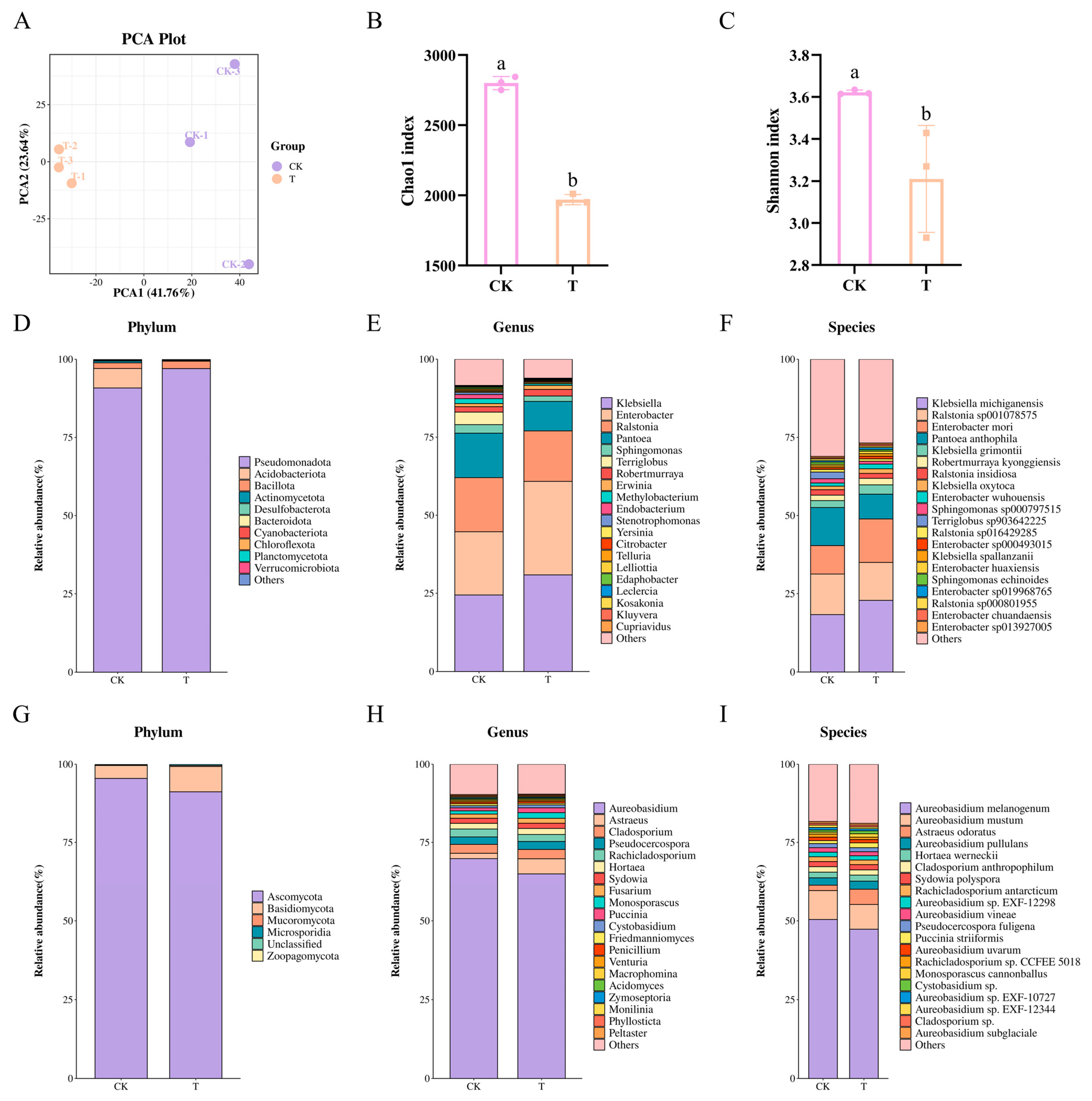
The composition of the microbial community in the CK and T groups was shown in Figure 1. The Principal Component Analysis (PCA) revealed a clear separation between the CK and T groups along the first principal component (PC1), which accounted for 41.76% of the total variance, indicating that the microbial fermentation process significantly altered the microbial community structure (Figure 1A). Evaluation using the Chao1 (richness) and Shannon (diversity) indices showed a significant decrease in both metrics in the T relative to the CK (Padj < 0.05) (Figure 1B,C).
The microbial fermentation process induced substantial and consistent shifts in both the bacterial and fungal community structures of green jujube straw. As shown in Figure 1D, the bacterial community exhibited a clear consolidation at the phylum level, with Pseudomonadota increasing from 90.82% in the CK to 97.01% in the T. This shift was accompanied by a corresponding decrease in Acidobacteriota (from CK to T, from 6.23% to 0.02%), while Bacillota showed an increase in relative abundance (from 1.82% to 2.35%). This restructuring was maintained at the genus level (Figure 1E), with Klebsiella (24.44% to 30.88%), Enterobacter (20.26% to 29.97%), and Robertmurraya (1.75% to 2.09%) showing increased relative abundance. Conversely, the abundances of Pantoea (14.25% to 9.44%), Sphingomonas (2.73% to 1.74%), and Terriglobus (4.01% to 0.01%) decreased. The species-level data confirmed this trend (Figure 1F), with Klebsiella michiganensis (18.37% to 22.94%) and Enterobacter mori (9.11% to 13.92%) increasing, while Pantoea anthophila (12.18% to 7.93%) and Terriglobus sp903642225 (2.14% to 0.004%) decreased markedly.
In contrast, the fungal community showed a different but equally consistent response. At the phylum level, Ascomycota decreased from 95.47% to 91.19%, while Basidiomycota increased from 4.14% to 8.10%. Minor phyla including Mucoromycota (from CK to T, from 0.21% to 0.33%) and Zoopagomycota (0.003% to 0.015%) also showed increased abundance after fermentation (Figure 1G). This shift was evident at the genus level, where the dominant genus Aureobasidium decreased from 69.80% to 64.92%, while Astraeus increased from 1.71% to 4.84%. Other genera, including Fusarium (1.35% to 1.57%), Monosporascus (1.04% to 1.80%), and Puccinia (0.96% to 1.55%), also showed increased abundance (Figure 1H). The species-level analysis reflected these changes, with Aureobasidium melanogenum decreasing from 50.43% to 47.34%, while Astraeus odoratus increased from 1.71% to 4.84% and Puccinia striiformis from 0.96% to 1.55% (Figure 1I).
These coordinated changes across taxonomic levels demonstrated that microbial fermentation consistently reshaped the microbial ecosystem, producing distinct and complementary structural changes in both the bacterial and fungal communities.

3.4. Functional Annotation

The functional potential of the microbial community in green jujube straw was profiled to assess the impact of microbial fermentation.

3.4.1. Carbohydrate-Active Enzymes (CAZy)

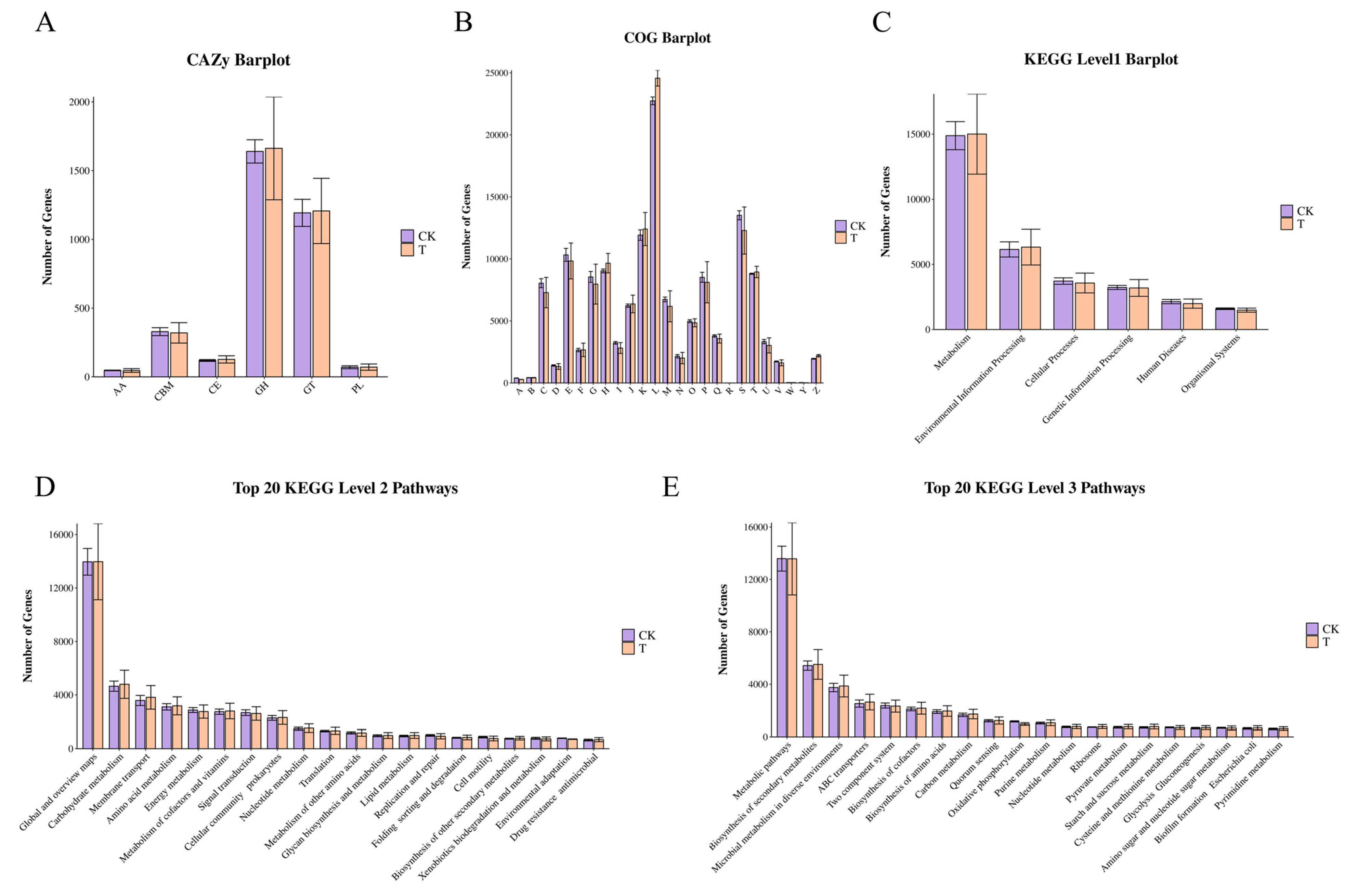
The profile of CAZy was generally consistent between the CK and T groups (Figure 2A). No significant differences were observed in the relative abundances of major families, including glycoside hydrolases (GH: CK 1639.74 ± 146.82 vs. T 1662.37 ± 648.21), glycosyl transferases (GT: CK 1192.89 ± 170.66 vs. T 1206.82 ± 410.86), and carbohydrate esterases (CE: CK 119.16 ± 11.36 vs. T 126.92 ± 45.56). This indicated that the overall functional capacity for plant polysaccharide deconstruction was preserved after fermentation.

3.4.2. Clusters of Orthologous Groups (COG)

The functional annotation based on the COG database was shown in Figure 2B. The fermentation process prompted distinct shifts in genetic information processing and metabolism. An increase was observed in functions related to transcription (category K: T 12,410.35 ± 2310.47 vs. CK 11,922.91 ± 733.07) and replication, recombination and repair (category L: T 24,572.31 ± 1106.76 vs. CK 22,744.13 ± 541.67). Conversely, a significant decrease was noted in RNA processing and modification (Category A: T 282.73 ± 12.16 vs. CK 395.85 ± 18.89) and in Nuclear structure (category Y: T 13.28 ± 4.60 vs. CK 30.52 ± 5.28) (Padj < 0.05). In central metabolism, an increase in coenzyme transport and metabolism (Category H: T 9658.68 ± 1361.88 vs. CK 9035.20 ± 265.26) was observed, while a reduction was seen in carbohydrate transport and metabolism (Category G: T 7969.37 ± 2787.10 vs. CK 8550.67 ± 763.41) and amino acid transport and metabolism (Category E: T 9837.00 ± 2506.90 vs. CK 10,325.99 ± 902.95).

3.4.3. KEGG Pathway Analysis

At the broadest functional level (Level 1, Figure 2C), the overall distribution of genes into major categories was largely stable. The most abundant category, metabolism, showed comparable abundance between T (15,005.75 ± 5332.48) and CK (14,883.06 ± 1866.30). Similarly, environmental information processing (T 6324.80 ± 2377.58 vs. CK 6148.96 ± 1009.34) and genetic information processing (T 3189.52 ± 1115.28 vs. CK 3230.57 ± 268.69) remained consistent. At Level 2 (Figure 2D), pathways for membrane transport (T 3819.16 ± 1527.18 vs. CK 3584.67 ± 649.99) and carbohydrate metabolism (T 4794.50 ± 1823.27 vs. CK 4651.79 ± 657.69) were slightly enriched after fermentation. In contrast, energy metabolism (T 2754.47 ± 855.70 vs. CK 2867.95 ± 315.87) and cell motility (T 764.09 ± 308.16 vs. CK 868.38 ± 107.85) showed a decreasing trend. A detailed view at Level 3 confirmed the enrichment of specific transport and metabolic pathways in the T group, including ABC transporters (T 2641.04 ± 1034.33 vs. CK 2524.00 ± 472.84), carbon metabolism (T 1727.06 ± 631.97 vs. CK 1664.12 ± 225.99), and starch and sucrose metabolism (T 774.22 ± 314.85 vs. CK 706.19 ± 97.45). Notably, the oxidative phosphorylation pathway was lower in the T group (965.22 ± 176.24) than in CK (1164.94 ± 78.25) (Figure 2E).
In summary, the functional profile indicated that microbial fermentation reshapes the microbial community’s metabolic strategy, enhancing capabilities in specific transport systems and carbohydrate utilization pathways while reducing investment in energy-intensive processes like oxidative phosphorylation, reflecting an adaptation to the fermented environment.

3.4.4. Antibiotic Resistance Genes (ARGs)

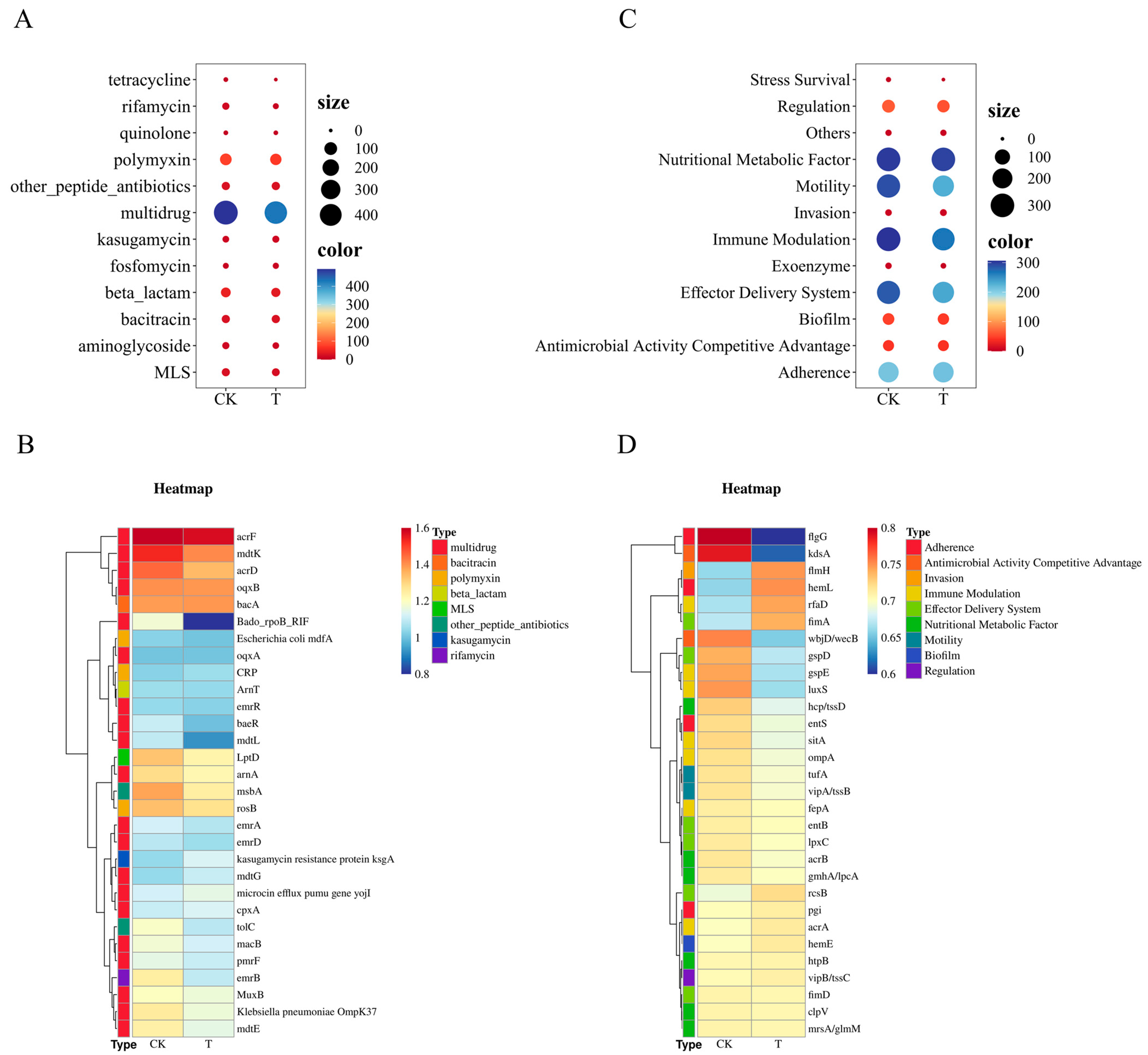
Analysis of antibiotic resistance genes (ARGs) indicated a potential trend toward reduced abundance in the T group compared to the CK group. As summarized in Figure 3A, the total ARG abundance showed a trend of being lower in the T group. The abundance of genes conferring resistance to multidrug, which is the most dominant category, was lower in T (429.91 ± 210.74) than in CK (493.19 ± 86.34). A similar trend of lower abundance was noted for several other major classes, including polymyxin (CK: 77.40 ± 17.40 vs. T: 71.28 ± 33.65), MLS (CK: 23.51 ± 6.90 vs. T: 20.82 ± 15.89), and beta-lactam (CK: 44.98 ± 7.54 vs. T: 36.00 ± 20.59). Notably, a more distinct reduction was observed for rifamycin resistance genes (CK: 14.97 ± 1.84 vs. T: 6.27 ± 3.31), while genes for tetracycline resistance were undetectable in the T group.
Examination at the subtype level provided further insight into this trend (Figure 3B). Several key genes associated with multidrug resistance showed lower abundance in the T group, such as mdtK (CK: 33.81 ± 4.69 vs. T: 25.80 ± 13.86), acrD (CK: 28.19 ± 4.83 vs. T: 22.23 ± 10.82), and msbA (CK: 23.82 ± 4.24 vs. T: 17.67 ± 9.91). The rifamycin resistance gene Bado,_rpoB,_RIF also demonstrated a clear decrease.

3.4.5. Virulence Factors (VFs)

The virulence factor (VF) profile showed moderate shifts, with a general tendency toward lower genetic potential for pathogenicity in the T group compared to CK. As shown in Figure 3C, the abundance for most major functional categories was slightly lower in T. Categories such as Effector Delivery System (CK: 283.71 ± 64.85 vs. T: 234.09 ± 140.59) and Motility (CK: 290.14 ± 49.97 vs. T: 229.52 ± 93.23) exhibited decreases. Genes related to Immune Modulation (CK: 306.06 ± 52.11 vs. T: 266.88 ± 131.50) and Nutritional/Metabolic Factors (CK: 301.44 ± 75.65 vs. T: 297.15 ± 165.42) also trended lower. Importantly, genes associated with Stress Survival were not detected in the T group. At the gene level, the trend was supported by the reduction in several specific virulence determinants (Figure 3D). The motility-related gene flgG showed a substantial decrease in the T group (CK: 17.47 ± 0.76 vs. T: 8.06 ± 3.77). Similarly, the immune modulation-associated gene kdsA was present at a lower abundance in T (CK: 16.42 ± 1.96 vs. T: 8.84 ± 5.79). Other genes, including wbjD/wecB (adherence/immune modulation) and luxS (biofilm formation), also followed this trend.

3.5. Changes in Metabolites During Microbial Fermentation of Green Jujube Straw

3.5.1. Overall Metabolic Composition and Profiling

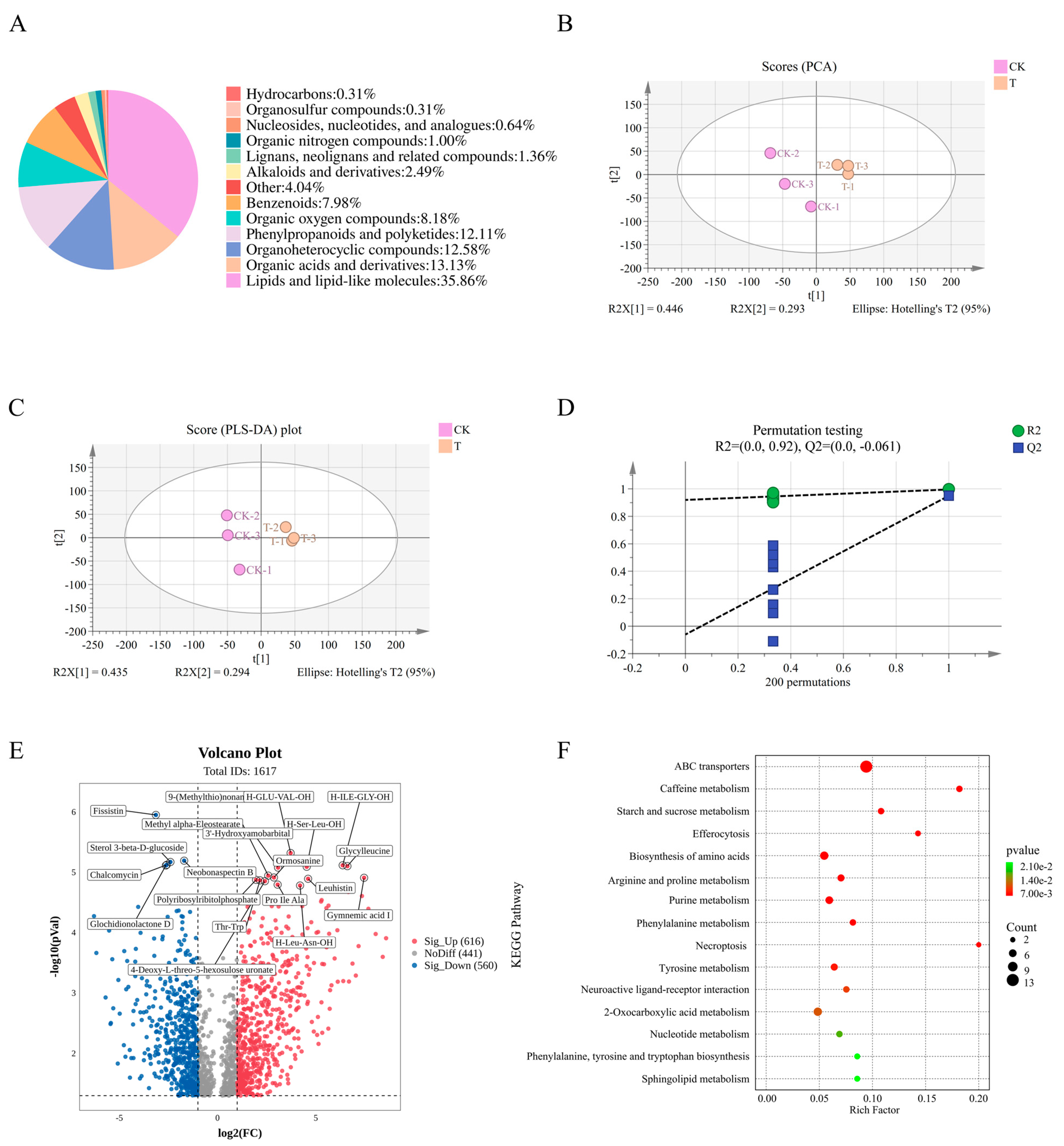
To profile the comprehensive metabolic changes in green jujube straw induced by microbial fermentation, we analyzed the samples using a non-targeted metabolomics approach. A total of approximately 5499 metabolites were detected across both the CK and T groups (Table S1, Figure S1), and these metabolites were originated from the combined reaction of green jujube straw and microbial biotransformation. The chemical composition was quantitatively dominated by lipids and lipid-like molecules, which constituted the most abundant class at 35.86%. This was followed by organic acids and derivatives (13.13%), organoheterocyclic compounds (12.58%), and phenylpropanoids and polyketides (12.11%). Together, these four major classes accounted for over 70% of the detected metabolome. Additional significant categories included organic oxygen compounds (8.18%) and benzenoids (7.98%). The remaining fraction was composed of alkaloids and derivatives (2.49%), lignans and related compounds (1.36%), organic nitrogen compounds (1.00%), nucleosides and analogs (0.64%), with hydrocarbons and organosulfur compounds each representing 0.31%; a portion of metabolites (4.04%) were classified as ‘Other’ (Figure 4A).

3.5.2. Multivariate Statistical Analysis and Differential Metabolite Identification

The principal component analysis (PCA) score scatter plot demonstrated a clear separation between the CK and T groups along the first principal component, which explains 44.6% of the total variance (Figure 4B). The Partial Least Squares Discriminant Analysis (PLS-DA) model effectively distinguished the CK and T groups, demonstrating a clear separation along the first component (t[1]), which explained 43.5% of the total variance (R2X[1] = 0.435) (Figure 4C). The model validation through permutation testing (n = 200) confirmed its robustness and reliability, as the original model’s Q2 value was significantly higher than all permuted Q2 values, with the regression line of the permuted Q2 values intersecting the vertical axis below zero at −0.061, indicating no overfitting and validating the model’s high predictive ability (Figure 4D). Based on the screening criteria of FC > 2, VIP > 1, and Padj < 0.05, a total of 1176 differential metabolites were identified between the CK and T groups. Their distribution, as visualized in the volcano plot, included 616 up-regulated and 560 down-regulated metabolites (Figure 4E).

3.5.3. KEGG Pathway Enrichment Analysis

KEGG pathway enrichment analysis of the differential metabolites revealed significant alterations in the metabolic network following fermentation (Figure 4F). The most significantly enriched pathway was ABC transporters (RichFactor = 0.094, p = 1.35 × 10⁻⁶). Key metabolic pathways including biosynthesis of amino acids, starch and sucrose metabolism, and arginine and proline metabolism were also significantly affected. Furthermore, enrichment was observed in pathways involved in secondary metabolite synthesis (caffeine metabolism), nucleotide metabolism (purine metabolism), and cellular processes such as necroptosis and efferocytosis. These results indicated that microbial fermentation profoundly influenced various biological processes, particularly in membrane transport, nutrient metabolism, and cellular regulation.

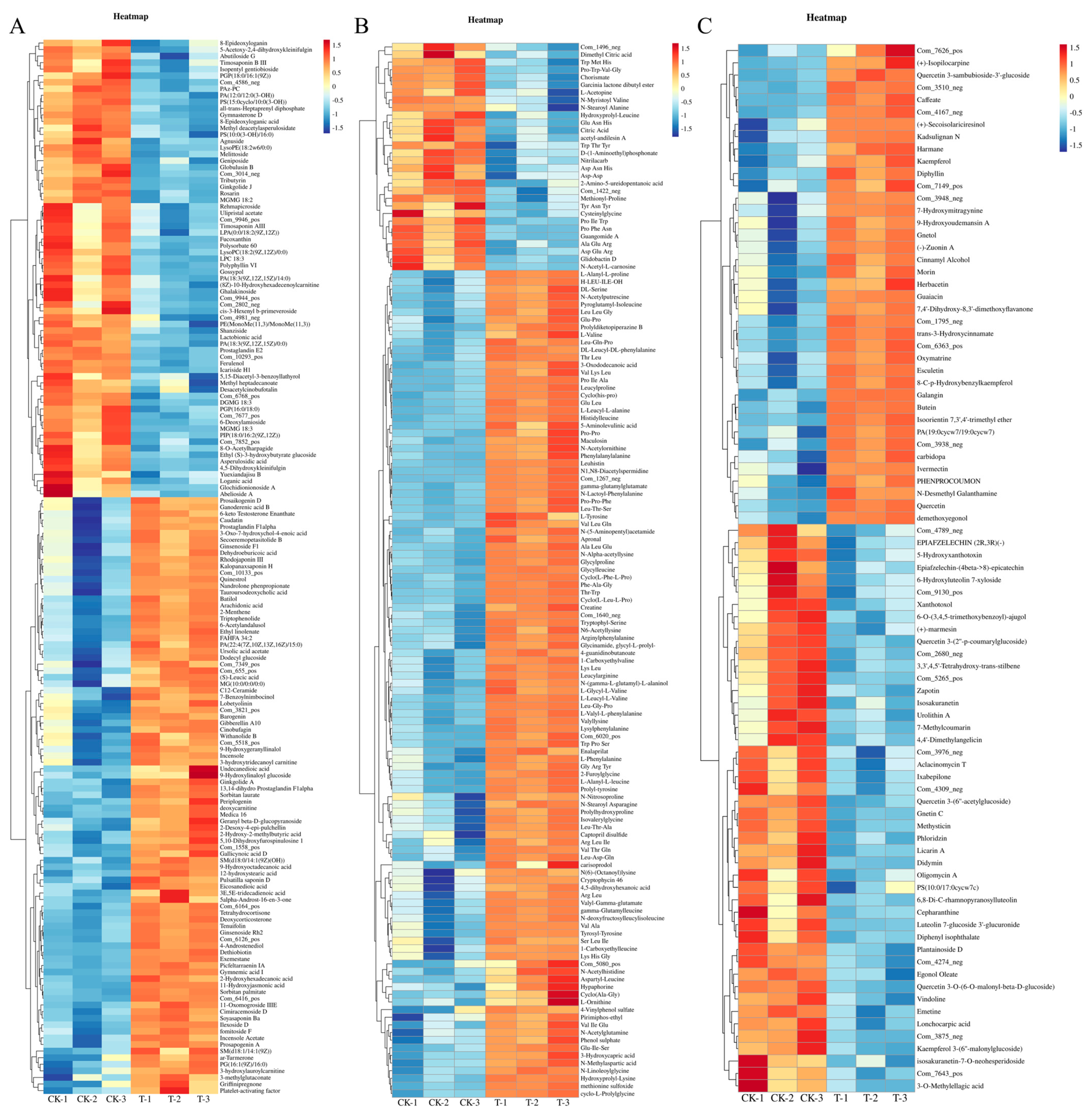
3.5.4. Alterations in Lipid and Lipid-like Molecules

The accumulation analysis of lipids and lipid-like molecules revealed a clear separation between the CK and T groups (Figure 5A), demonstrating substantial alterations in the lipidomic profile following microbial fermentation. Specifically, 60 metabolites exhibited higher abundance in the CK group, including several glycerophospholipids such as LysoPE (18:2w6/0:0) and LysoPC (18:2 (9Z,12Z)/0:0), along with various iridoid glycosides like geniposide, shanziside, and loganic acid. Additionally, phospholipids PGP (18:0/16:1 (9Z)) and PGP (16:0/18:0) showed higher levels in the CK group. In contrast, the T group displayed higher abundance of 76 metabolites, featuring important polyunsaturated fatty acids including arachidonic acid and Com_1558_pos (a feature putatively annotated as DHA). Several bioactive steroids and terpenoids were also enriched in the T group, such as ginsenoside Rh2, ginsenoside F1, withanolide B, and ursolic acid acetate. Notably, key inflammatory mediators including prostaglandin F1alpha and hydroxylated fatty acids like 9-hydroxyoctadecanoic acid and 12-hydroxystearic acid showed increased levels after fermentation. These findings indicated that microbial fermentation significantly modified the lipid composition of green jujube straw, particularly enhancing the content of polyunsaturated fatty acids, bioactive steroids, and inflammatory mediators while reducing specific glycerophospholipids and iridoid glycosides. The observed changes suggested potential modifications in both the nutritional value and functional properties of the fermented product.

3.5.5. Changes in Organic Acids and Derivatives

The abundance analysis of organic acids and derivatives revealed distinct clustering patterns between the CK and T groups (Figure 5B), indicating substantial modifications in the organic acid profile following microbial fermentation. Specifically, 30 metabolites showed higher abundance in the CK group, including key intermediates of central carbon metabolism such as citric acid and chorismate, along with several tripeptides like Trp-Met-His and Pro-Trp-Val-Gly. Other notable compounds enriched in the CKgroup included dimethyl citric acid and n-myristoyl valine. In contrast, the T group exhibited higher abundance of 85 metabolites, predominantly comprising various dipeptides and tripeptides. Significant increases were observed in L-valine, L-tyrosine, L-phenylalanine, and 5-aminolevulinic acid. Multiple peptide compounds showed marked accumulation, including leucylproline, cyclo (his-pro), glycylleucine, and N-acetylated amino acids such as N-acetylornithine and N6-acetyllysine. Additionally, several gamma-glutamyl peptides including gamma-glutamylglutamate and gamma-glutamylleucine were more abundant in the T group. These results demonstrated that microbial fermentation significantly altered the organic acid composition of green jujube straw, particularly enhancing the accumulation of various amino acids, peptides, and their derivatives while reducing specific organic acids involved in central metabolic pathways. The substantial increase in peptide abundance suggested enhanced proteolytic activity during the fermentation process, which might contribute to the modified nutritional characteristics of the fermented product.

3.5.6. Modifications in Phenylpropanoids, Polyketides, Alkaloids, and Lignans

The expression analysis of phenylpropanoids, polyketides, alkaloids, lignans and related compounds revealed a distinct separation between the CK and T groups (Figure 5C), showing differential accumulation patterns of these specialized metabolites following microbial fermentation. Specifically, 38 metabolites exhibited higher abundance in the T group, including several important flavonoids such as quercetin and its derivatives (quercetin 3-sambubioside-3′-glucoside, isoorientin 7,3′,4′-trimethyl ether), along with other bioactive compounds like kaempferol, galangin, butein, and esculetin. Notable alkaloids including harmane, 7-hydroxymitragynine, oxymatrine, and N-desmethyl galanthamine were also more abundant in the T group. Additionally, lignans such as (+)-secoisolariciresinol and kadsulignan N showed increased levels after fermentation. Conversely, 33 metabolites displayed higher abundance in the CK group, featuring various flavanones and their derivatives, including phloridzin, didymin, and isosakuranetin. Several complex flavonoids were also more abundant in the CK group, such as quercetin 3-O-(6-O-malonyl-beta-D-glucoside), kaempferol 3-(6″-malonylglucoside), and gnetin C. Other notable compounds preserved in the CK group included vindoline, emetine, and methysticin. These results demonstrated that microbial fermentation significantly altered the profile of phenylpropanoids, polyketides, alkaloids and lignans in green jujube straw, leading to the enrichment of specific flavonoid glycosides and alkaloids while reducing the abundance of various glycosylated flavonoids and certain specialized metabolites. The observed changes suggest substantial modifications in the bioactivity profile of the fermented material, potentially enhancing its antioxidant properties through the accumulation of flavonoids.

3.6. Correlation Network Between Microbial Communities and Metabolites

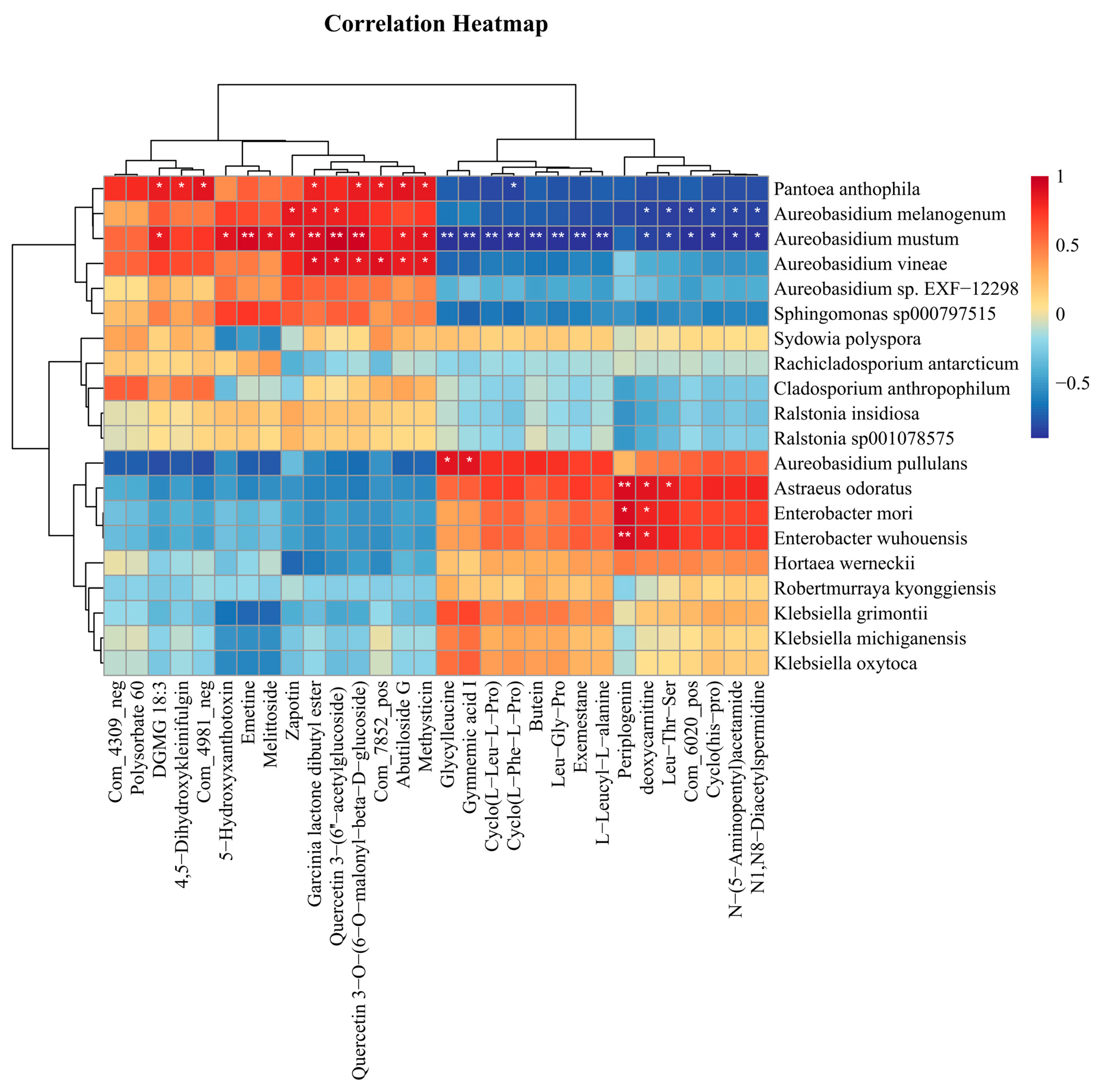
The Pearson correlation analysis revealed significant microbial-metabolite interactions between the top 10 fungal/bacterial strains and the top 20 differentially abundant metabolites (Figure 6). Aureobasidium mustum showed strong positive correlations with quercetin 3-(6″-acetylglucoside) (rho = 0.963) and quercetin 3-O-(6-O-malonyl-beta-D-glucoside) (rho = 0.955), while displaying strong negative correlations with several dipeptides such as Cyclo(L-Phe-L-Pro) and Leu-Gly-Pro. Notably, bacterial genera that increased in abundance after fermentation, such as Klebsiella and Enterobacter, were positively correlated with key amino acids and peptides, including L-valine, L-tyrosine, and glycylleucine, reinforcing their role in proteolysis and nitrogen metabolism. Conversely, these genera were negatively associated with several glycerophospholipids and glycosylated flavonoids, which were more abundant in the CK group, indicating their potential involvement in the degradation or transformation of these compounds. The fungal genus Astraeus, which increased significantly after fermentation, was positively correlated with periplogenin and deoxycarnitine, suggesting a potential role in steroid and lipid metabolism. In contrast, Pantoea anthophila, which decreased in abundance, showed negative correlations with multiple peptides and positive correlations with several flavonoids, indicating a divergent functional niche.
Overall, the correlation network reveals that the microbial community restructuring during fermentation is closely linked to the observed metabolic shifts. The enrichment of certain taxa, such as Klebsiella, Enterobacter, and Astraeus, is associated with the accumulation of nutritionally valuable metabolites, including peptides, amino acids, and polyunsaturated fatty acids, while the decline of others correlates with the reduction in fiber-associated compounds and glycosylated flavonoids. These interactions underscored the ecological and functional synergy within the microbial community, driving the nutritional and metabolic transformation of green jujube straw during solid-state fermentation.

4. Discussion

This study comprehensively investigated the changes in nutritional composition, microbial community, and metabolites of green jujube straw before and after solid-state fermentation. Our results revealed that solid-state fermentation using a compound microbial inoculant significantly increased the crude protein content of the green jujube straw while significantly reducing the contents of NDF, ADF, and cellulose. This indicates that fermentation can degrade hemicellulose and cellulose in the straw [34,35]. Therefore, microbial fermentation may be an efficient bioprocessing strategy that not only significantly enhances the nutritional value of the substrate but also modulates its microbial ecosystem and metabolic profile.
Microbial α- and β-diversity represent the richness and evenness of the microbiome in samples [36]. This study found that the α-diversity of the microbial community in the treatment group (T) decreased after fermentation, which may be attributed to the lower pH resulting from lactic acid production by lactobacilli inhibiting the growth of other strains, thereby suppressing certain microbial populations in the later stages of fermentation [37,38].
In the bacterial community, the most notable change was the further increase in the relative abundance of Pseudomonadota, rising from 90.82% to 97.01%, making it the absolutely dominant phylum. Within this phylum, the abundances of Klebsiella and Enterobacter increased significantly, while Bacillota also showed an increase. These genera are commonly associated with cellulose degradation and organic acid metabolism, and their proliferation may signify an overall enhancement of the community’s metabolic activity, particularly demonstrating stronger potential in utilizing complex plant polysaccharides. Among cellulose-degrading microorganisms, Klebsiella has been confirmed as an efficient biocatalyst capable of secreting a multifunctional cellulase system, including endoglucanase, exoglucanase, and β-glucosidase, which can hydrolyze crystalline cellulose and degrade lignocellulosic biomass [39]. Furthermore, members of both Klebsiella and Enterobacter have been reported to produce cellulase and xylanase, actively participating in fiber degradation processes [40,41,42,43]. Klebsiella also possesses nitrogen-fixing capabilities and soil-improving properties, making it well-suited for the dual objectives of waste remediation and agronomic value recovery in co-degradation systems [44]. At the species level, Klebsiella michiganensis exhibited the highest abundance, which further increased after fermentation. This species has been noted in studies on nitrogen-fixing endosymbiotic bacteria for its potential to influence the cellulase activity of host fungi [45], further reinforcing its potential role in cellulose degradation and metabolic regulation.
In the fungal community, the most apparent change was the decline in the relative abundance of Ascomycota and the rise in the relative abundance of Basidiomycota. At the genus level, although the relative abundance of the absolutely dominant genus Aureobasidium decreased, it remained predominant. Concurrently, the abundance of Astraeus increased significantly, becoming the most enriched fungal taxon during fermentation. Aureobasidium can secrete enzymes such as laccase and esterase, exhibiting certain lignin degradation capabilities and flavonoid modification abilities [46]. Additionally, some members of both Aureobasidium and Astraeus have been reported to encode and secrete various carbohydrate-active enzymes. Fungi belonging to the genus Aureobasidium, due to their strong environmental adaptability and ability to synthesize multiple bioactive compounds, such as the exopolysaccharide (like pullulan) and pigments (like melanin), show considerable potential in the biotransformation and resource utilization of agricultural wastes [47]. At the species level, the abundance of Astraeus odoratus increased substantially after fermentation. This species has been noted in related research for its ability to produce bioactive steroids and small-molecule compounds, further underscoring its potential role in shaping the unique metabolic profile of the fermented product [48,49].
This study observed that following the addition of a compound microbial inoculant comprising Bacillus amyloliquefaciens, Bacillus velezensis, Bacillus licheniformis, Lactobacillus plantarum, and Bacillus subtilis, these exogenously added strains were not detected in the metagenomic sequencing results of the fermented green jujube straw. This outcome is closely related to the sampling quantity and timing. The intense microbial community succession during fermentation likely led to the displacement of the exogenous strains [50]. Additionally, certain metabolites released post-fermentation might have influenced the activity of the exogenous strains. The initially added Bacillus and Lactobacillus strains may have played a facilitative role in the early stages of fermentations, modifying the substrate to facilitate subsequent community succession, secreting hydrolases to degrade complex polysaccharides in the straw, thereby producing readily utilizable simple sugars. This process could have created favorable conditions for the subsequent explosive growth of opportunistic genera such as Klebsiella and Enterobacter. As fermentation progressed, the exogenous strains, having fulfilled their “guiding” function, may have been outcompeted for nutrients by the later-dominant populations, resulting in their relative abundance falling below the detection limit of metagenomic sequencing. Similarly, studies have shown that Lactobacillus plantarum can undergo population dynamics and adaptive genomic mutations under environmental stress during long-term subculturing, affecting its proportion within the community [51,52]. Furthermore, the inherent sensitivity limitations of sequencing technology for low-biomass microbial populations may also lead to the under-detection of non-dominant species [53].
Although the exogenous strains were not directly detected, their functional impact remained evident: CAZy analysis indicated that key enzyme families such as glycoside hydrolases (GHs) and carbohydrate esterases (CEs) remained stable after fermentation, and KEGG pathway analysis revealed an enrichment trend in “starch and sucrose metabolism”. This suggests that the metabolic direction initiated by the added strains in the early fermentation stages was maintained and reinforced by the subsequent community. Therefore, the failure to detect exogenous strains does not imply their inactivity but rather likely reflects their replacement by more competitive indigenous microbiota after triggering directional community succession. Future studies incorporating time-series sampling, qPCR quantification, and metatranscriptomic analysis could dynamically track the colonization trajectory of exogenous strains and provide a more comprehensive understanding of their ecological functions within the fermentation system.
In addition to reshaping the microbial community and metabolic profile, solid-state fermentation also appeared to modulate the genetic potential for antibiotic resistance and virulence in the green jujube straw microbiota. Our metagenomic analysis revealed a trend toward decreased abundance of ARGs in the T group, particularly in categories such as multidrug, polymyxin, MLS, beta-lactam, and rifamycin resistance, with tetracycline resistance genes becoming undetectable after fermentation. This reduction may be attributed to the competitive exclusion of ARG-harboring taxa by the fermentative microbes, as well as the acidic environment generated during fermentation, which can inhibit the survival of certain resistant bacteria. Similarly, VF genes related to motility, immune modulation, and stress survival showed lower abundance in the T group. Such declines in pathogenic potential have been observed in other fermented feed systems, where microbial succession and metabolite accumulation can suppress opportunistic pathogens [54,55]. These findings suggest that solid-state fermentation not only improves nutritional quality but may also contribute to the microbial safety of green jujube straw as a feed ingredient by attenuating the genetic reservoirs of antibiotic resistance and virulence. It should be noted that this study assessed only the genetic potential, and the actual biosafety of the fermented product needs to be validated through animal feeding trials. We are currently conducting such an experiment to evaluate the performance and health of geese fed with this fermented straw.
Metabolomics can be employed to elucidate the impact of microbial fermentation on compounds during feed fermentation. Some bacteria have been demonstrated to possess proteolytic capacity, hydrolyzing proteins into small peptides, thereby enhancing digestibility and feeding efficacy [56]. For instance, Gao et al., utilizing Bacillus subtilis to ferment soymilk, discovered that fermentation generated substantial amounts of small peptides, amino acids, and amino acid analogs [57]. Our study found that after solid-state fermentation of green jujube straw with a compound microbial inoculant, numerous dipeptides, tripeptides, free amino acids (such as L-valine and L-tyrosine), and their derivatives (e.g., N-acetylornithine) accumulated significantly. This clearly indicates that solid-state fermentation with the compound inoculant promotes the efficient hydrolysis of inherent proteins in the straw by microbial protease systems, converting them into smaller nitrogen sources more readily digestible and absorbable by animals, thereby substantially enhancing the protein quality and bioavailability of the straw as feed. As confirmed by Wang et al. [58], fermentation can increase the amino acid levels in compounds, such as lysine, phenylalanine, isoleucine, and valine. Metabolic pathways, encompassing complex metabolic reactions and their regulation, play a key role in the dynamic changes in metabolic activities [59]. However, considering the complexity of metabolites sources, the future validation using the targeted metabolome must be conducted.
This study revealed that ABC transporters, amino acid biosynthesis, and starch and sucrose metabolism were the top three most significant metabolic pathways during fermentation. These metabolic changes are closely associated with the synergistic degradation by microorganisms and the accumulation of their secondary metabolites. Among these, ABC transporters constitute a large family of transmembrane proteins whose core function is to facilitate the transmembrane transport of various compounds using energy derived from ATP hydrolysis. During fermentation, they act like the cell’s “logistics management department” actively transporting extracellular nutrients (such as sugars and amino acids) into the cell; conversely, they may also expel intracellular metabolites (including potential inhibitors) to ensure normal microbial life activities [60]. Microorganisms synthesize all the amino acids they require through intricate metabolic networks, which is fundamental for their growth and reproduction. Utilizing fermentation technology for amino acid production has become a mature industrial process, with Corynebacterium glutamicum and Escherichia coli being commonly used production strains [61,62]. In the fermentation of green jujube straw, the enrichment of this pathway signifies that microorganisms are actively engaged in “self-reliance” converting carbon skeletons and nitrogen sources derived from straw decomposition into protein. This directly increases the crude protein content of the final fermented product, which is particularly important for developing high-quality feed.
Starch and sucrose metabolism serves as the primary energy source during the initial stages of fermentation. Microorganisms secrete enzymes to break down the relatively readily utilizable starch and sucrose in the straw into monosaccharides such as glucose and fructose [63]. These monosaccharides not only provide energy (ATP) for microorganisms via pathways like glycolysis but also their intermediate metabolites serve as precursors for synthesizing numerous other metabolites, including amino acids and organic acids.
The microorganisms and metabolites in fermented feed are closely interrelated, which directly impacts the fermentation outcome of the substrate. By conducting correlation analysis between metabolites and microbial abundance, the influence of microbial changes on metabolites can be assessed. In this study, Pearson correlation analysis was performed between the top 20 microbial species with high compositional abundance at the species level from the metagenomic data and the annotated differential metabolites from the metabolomic data, to explore the linkages between species and differential metabolites during the fermentation of green jujube straw. Notable findings included a strong positive correlation between Aureobasidium mustum and flavonoid glycosides (e.g., Quercetin 3-(6″-acetylglucoside)), as well as significant associations of Klebsiella and Enterobacter with various dipeptides (e.g., Leu-Gly-Pro) and amino acids. These correlations not only support their respective roles in protein hydrolysis and flavonoid transformation but also suggest that the microbial community achieves functional collaboration through “metabolic modularity”. Similar phenomena have been reported in the fermentation of skimmed yak milk, where lactic acid bacteria and yeasts coordinately regulate the formation of organic acids and esters via co-occurrence networks [64]. It should be noted that correlation does not imply causation; these associations may be influenced by confounding factors such as environmental conditions, microbial interactions, or metabolic channeling. For instance, during cigar tobacco leaf fermentation, although Sphingomonas and Aspergillus persist throughout the process, their correlations with metabolites change dynamically over time [65]. The results of this correlation analysis provide targets for screening key functional strains and constructing synthetic microbial consortia. Therefore, by intervening in microorganisms closely associated with target metabolites, it is possible to achieve directed regulation of the composition of fermented products. However, the scale of sample analysis in this study was notably limited by budget constraints. Future research could integrate metagenomics, transcriptomics, and in vitro enzymology experiments to further validate the specific metabolic pathways and genetic foundations underlying these correlations.

5. Conclusions

In summary, solid-state fermentation with a compound microbial inoculant significantly increased the crude protein content and reduced the fiber components of the substrate. It is also associated with substantial succession in the microbial community, highly correlated with an enhanced ecosystem dominated by bacteria of the phylum Pseudomonadota and fungi of the phylum Basidiomycota, both of which possess potential for cellulose degradation and nitrogen metabolism. This process also improved the capacity for nutrient transport and utilization and led to the accumulation of numerous beneficial metabolites, including small peptides, amino acids, polyunsaturated fatty acids, and flavonoids. Correlation analysis confirmed that these metabolic changes were closely associated with key microorganisms. Therefore, solid-state fermentation with a compound microbial inoculant likely enhanced the nutritional value and functional properties of the agricultural by-product green jujube straw by reshaping the microbial community and metabolic network.

Supplementary Materials

The following supporting information can be downloaded at https://www.mdpi.com/article/10.3390/fermentation12010022/s1. Figure S1. MS/MSI spectra of several selected metabolites; Table S1. Detailed information of metabolites identified in this study.

Author Contributions

Conceptualization, F.J., X.Z. (Xudong Zhu) and Z.L.; methodology, H.W. and X.Z. (Xingyou Zeng); software, P.C.; validation, F.J., H.W. and X.Z. (Xudong Zhu); formal analysis, P.C.; investigation, H.W. and X.Z. (Xingyou Zeng); resources, F.J.; data curation, F.J., H.W. and X.Z. (Xudong Zhu); writing—original draft preparation, F.J., H.W. and X.Z. (Xudong Zhu); writing—review and editing, Z.L.; visualization, F.J., H.W. and X.Z. (Xudong Zhu); supervision, Z.L.; project administration, F.J. and P.C.; funding acquisition, F.J. and Z.L. All authors have read and agreed to the published version of the manuscript.

Funding

This research was funded by Basic Scientific Research Project of Fujian Public Welfare Scientific Research Institute (2025R1028002), National Tropical Plants Germplasm Resource Center (NTPGRC2025-032) and Fujian Spark Program (2025S0041).

Institutional Review Board Statement

Not applicable.

Informed Consent Statement

Not applicable.

Data Availability Statement

The original contributions presented in this study are included in the article and Supplementary Materials. Further inquiries can be directed to the corresponding author.

Acknowledgments

The authors sincerely appreciate the invaluable support and contributions provided by the Institute of Subtropical Agriculture, Institute of Animal Husbandry and Veterinary Medicine.

Conflicts of Interest

Author Xingyou Zeng was employed by the company Fujian Zhangzhou Hualong Feed Co., Ltd. The remaining authors declare that the research was conducted in the absence of any commercial or financial relationships that could be construed as a potential conflict of interest.

References

  1. Guo, M.; Bi, G.; Wang, H.; Ren, H.; Chen, J.; Lian, Q.; Wang, X.; Fang, W.; Zhang, J.; Dong, Z.; et al. Genomes of Autotetraploid Wild and Cultivated Ziziphus mauritiana Reveal Polyploid Evolution and Crop Domestication. Plant Physiol. 2024, 196, 2701–2720. [Google Scholar] [CrossRef] [PubMed]
  2. O’Brien, C.J.; Campbell, S.; Young, A.; Vogler, W.; Galea, V.J. Chinee Apple (Ziziphus mauritiana): A Comprehensive Review of Its Weediness, Ecological Impacts and Management Approaches. Plants 2023, 12, 3213. [Google Scholar] [CrossRef] [PubMed]
  3. Noor, N.A.M.; Islam, M.; Hamid, N.; Raseetha, S. Phytochemical Composition of Jackfruit (Artocarpus heterophyllus) and Indian Jujube (Ziziphus mauritiana) Leaves Extracted Using Different Ethanol Concentrations. J. Sustain. Sci. Manag. 2024, 19, 146–162. [Google Scholar] [CrossRef]
  4. Nilofar; Sinan, K.I.; Dall’Acqua, S.; Sut, S.; Uba, A.I.; Etienne, O.K.; Ferrante, C.; Ahmad, J.; Zengin, G. Ziziphus mauritiana Lam. Bark and Leaves: Extraction, Phytochemical Composition, In Vitro Bioassays and In Silico Studies. Plants 2024, 13, 2195. [Google Scholar] [CrossRef]
  5. Ramar, M.K.; Henry, L.J.K.; Ramachandran, S.; Chidambaram, K.; Kandasamy, R. Ziziphus mauritiana Lam Attenuates Inflammation via Downregulating NFκB Pathway in LPS-Stimulated RAW 264.7 Macrophages & OVA-Induced Airway Inflammation in Mice Models. J. Ethnopharmacol. 2022, 295, 115445. [Google Scholar] [CrossRef] [PubMed]
  6. Yasmeen, R.; Ahmad, F. Microbial Fermented Agricultural Waste-Based Broiler Feed: A Sustainable Alternative to Conventional Feed. World’s Poult. Sci. J. 2024, 81, 271–287. [Google Scholar] [CrossRef]
  7. Chang, Y.; Omer, S.H.S.; Li, G.; Lian, H.; Liu, Y. Research Advance on Application of Microbial Fermented Fodder in Broilers Production: A Short Review. Open J. Anim. Sci. 2022, 12, 200–209. [Google Scholar] [CrossRef]
  8. Ye, M.; Sun, L.; Yang, R.; Wang, Z.; Qi, K. The Optimization of Fermentation Conditions for Producing Cellulase of Bacillus amyloliquefaciens and Its Application to Goose Feed. R. Soc. Open Sci. 2017, 4, 171012. [Google Scholar] [CrossRef]
  9. Yu, D.Y.; Oh, S.H.; Kim, I.S.; Kim, G.I.; Kim, J.A.; Moon, Y.S.; Jang, J.C.; Lee, S.S.; Jung, J.H.; Park, J.; et al. Intestinal Microbial Composition Changes Induced by Lactobacillus plantarum GBL 16, 17 Fermented Feed and Intestinal Immune Homeostasis Regulation in Pigs. J. Anim. Sci. Technol. 2022, 64, 1184–1198. [Google Scholar] [CrossRef]
  10. Getachew, M.; Amare, T.; Yimer, E. Determination of Brewery Yeast-Treated Crop Residues as Animal Feed Resource. Online J. Anim. Feed Res. 2025, 15, 159–167. [Google Scholar] [CrossRef]
  11. da Silva, É.B.; Costa, D.M.; Santos, E.M.; Moyer, K.; Hellings, E.; Kung, L., Jr. The Effects of Lactobacillus hilgardii 4785 and Lactobacillus buchneri 40788 on the Microbiome, Fermentation, and Aerobic Stability of Corn Silage Ensiled for Various Times. J. Dairy Sci. 2021, 104, 10678–10698. [Google Scholar] [CrossRef] [PubMed]
  12. Wei, P.; Guan, M.; Liang, X.; Yuan, K.; Chen, N.; Yang, Y.; Gong, P. Growth Performance and Rumen Microbiota of Sheep Respond to Cotton Straw Fermented with Compound Probiotics. Fermentation 2025, 11, 244. [Google Scholar] [CrossRef]
  13. Olagunju, L.K.; Isikhuemhen, O.S.; Dele, P.A.; Anike, F.N.; Ike, K.A.; Shaw, Y.; Brice, R.M.; Orimaye, O.E.; Wuaku, M.; Essick, B.G.; et al. Effects of the Incubation Period of Pleurotus ostreatuson the Chemical Composition and Nutrient Availability of Solid-State-Fermented Corn Stover. Animals 2023, 13, 2587. [Google Scholar] [CrossRef] [PubMed]
  14. Zhao, X.; Wang, F.; Fang, Y.; Zhou, D.; Wang, S.; Wu, D.; Wang, L.; Zhong, R. High-Potency White-Rot Fungal Strains and Duration of Fermentation to Optimize Corn Straw as Ruminant Feed. Bioresour. Technol. 2020, 312, 123512. [Google Scholar] [CrossRef]
  15. Arriola, K.G.; Kim, S.C.; Adesogan, A.T. Effect of Applying Inoculants with Heterolactic or Homolactic and Heterolactic Bacteria on the Fermentation and Quality of Corn Silage. J. Dairy Sci. 2011, 94, 1511–1516. [Google Scholar] [CrossRef]
  16. Kyawt, Y.Y.; Aung, M.; Xu, Y.; Sun, Z.; Zhou, Y.; Zhu, W.; Padmakumar, V.; Tan, Z.; Cheng, Y. Dynamic Changes of Rumen Microbiota and Serum Metabolome Revealed Increases in Meat Quality and Growth Performances of Sheep Fed Bio-Fermented Rice Straw. J. Anim. Sci. Biotechnol. 2024, 15, 34. [Google Scholar] [CrossRef]
  17. Hu, Y.; He, Y.; Gao, S.; Liao, Z.; Lai, T.; Zhou, H.; Chen, Q.; Li, L.; Gao, H.; Lu, W. The Effect of a Diet Based on Rice Straw Co-Fermented with Probiotics and Enzymes versus a Fresh Corn Stover-Based Diet on the Rumen Bacterial Community and Metabolites of Beef Cattle. Sci. Rep. 2020, 10, 10721. [Google Scholar] [CrossRef]
  18. Zhao, C.; Kang, Y.; Cao, F.; Chen, J.; Zheng, H.; Wang, W.; Huang, M. Multi-Omics Insights into Variety-Driven Differences in Rice Straw Feed Utilization: An In Vitro Fermentation Study. Fermentation 2024, 10, 567. [Google Scholar] [CrossRef]
  19. Lv, L.; Xiong, F.; Pei, S.; He, S.; Li, B.; Wu, L.; Cao, Z.; Li, S.; Yang, H. Synergistic Fermentation of Cottonseed Meal Using Lactobacillus mucosae LLK-XR1 and Acid Protease: Sustainable Production of Cottonseed Peptides and Depletion of Free Gossypol. Food Chem. 2025, 493, 145848. [Google Scholar] [CrossRef]
  20. Pu, J.; Huhe, T.; Ding, X.; Yuan, R.; Zhang, S.; Ren, J.; Niu, D. Co-Production of Polysaccharides and Platform Sugars from Wheat Straw Fermented with Irpex lacteus. Sustainability 2025, 17, 4581. [Google Scholar] [CrossRef]
  21. Sun, Y.; Liu, M.; Bai, B.; Liu, Y.; Sheng, P.; An, J.; Bao, R.; Liu, T.; Shi, K. Effect of Enzyme Preparation and Extrusion Puffing Treatment on Sorghum Straw Silage Fermentation. Sci. Rep. 2024, 14, 25237. [Google Scholar] [CrossRef] [PubMed]
  22. He, Y.; Wang, S.; Mi, Y.; Liu, M.; Ren, H.; Guo, Z.; Chen, Z.; Cai, Y.; Xu, J.; Liu, D.; et al. Adaptive Laboratory Evolution of a Microbial Consortium Enhancing Non-Protein Nitrogen Assimilation for Feed Protein Production. Microorganisms 2025, 13, 1416. [Google Scholar] [CrossRef] [PubMed]
  23. Abdel-Raheem, S.M.; Mohammed, E.S.Y.; Mahmoud, R.E.; El Gamal, M.F.; Nada, H.S.; El-Ghareeb, W.R.; Marzok, M.; Meligy, A.M.A.; Abdulmohsen, M.; Ismail, H.; et al. Double-Fermented Soybean Meal Totally Replaces Soybean Meal in Broiler Rations with Favorable Impact on Performance, Digestibility, Amino Acids Transporters and Meat Nutritional Value. Animals 2023, 13, 1030. [Google Scholar] [CrossRef] [PubMed]
  24. Li, C.; Li, S.; Zhu, Y.; Chen, S.; Wang, X.; Deng, X.; Liu, G.; Beckers, Y.; Cai, H. Improving the Nutritional Value of Plant Protein Sources as Poultry Feed through Solid-State Fermentation with a Special Focus on Peanut Meal—Advances and Perspectives. Fermentation 2023, 9, 364. [Google Scholar] [CrossRef]
  25. Li, Z.; He, X.; Tang, Y.; Yi, P.; Yang, Y.; Li, J.; Ling, D.; Chen, B.; Khoo, H.E.; Sun, J. Fermented By-Products of Banana Wine Production Improve Slaughter Performance, Meat Quality, and Flavor Fingerprint of Domestic Chicken. Foods 2024, 13, 3441. [Google Scholar] [CrossRef]
  26. Lio, E.; Esposito, C.; Paini, J.; Gandolfi, S.; Secundo, F.; Ottolina, G. Valorizing Agro-Industrial By-Products for Sustainable Cultivation of Chlorella sorokiniana: Enhancing Biomass, Lipid Accumulation, Metabolites, and Antimicrobial Potential. Metabolites 2025, 15, 212. [Google Scholar] [CrossRef]
  27. Pistol, G.C.; Pertea, A.M.; Taranu, I. The Use of Fruit and Vegetable By-Products as Enhancers of Health Status of Piglets after Weaning: The Role of Bioactive Compounds from Apple and Carrot Industrial Wastes. Vet. Sci. 2023, 11, 15. [Google Scholar] [CrossRef]
  28. Paredes-López, D.M.; Robles-Huaynate, R.A.; Soto-Vásquez, M.R.; Perales-Camacho, R.A.; Morales-Cauti, S.M.; Beteta-Blas, X.; Aldava-Pardave, U. Modulation of Gut Microbiota, and Morphometry, Blood Profiles and Performance of Broiler Chickens Supplemented with Piper aduncum, Morinda citrifolia, and Artocarpus altilis Leaves Ethanolic Extracts. Front. Vet. Sci. 2024, 11, 1286152. [Google Scholar] [CrossRef]
  29. Costa, M.M.; Alfaia, C.M.; Lopes, P.A.; Pestana, J.M.; Prates, J.A.M. Grape By-Products as Feedstuff for Pig and Poultry Production. Animals 2022, 12, 2239. [Google Scholar] [CrossRef]
  30. Ibarruri, J.; Cebrián, M.; Hernández, I. Valorisation of Fruit and Vegetable Discards by Fungal Submerged and Solid-State Fermentation for Alternative Feed Ingredients Production. J. Environ. Manag. 2021, 281, 111901. [Google Scholar] [CrossRef]
  31. Xu, T.; Zhou, X.; Degen, A.; Yin, J.; Zhang, S.; Chen, N. The Inclusion of Jujube By-Products in Animal Feed: A Review. Sustainability 2022, 14, 7882. [Google Scholar] [CrossRef]
  32. Rizvi, N.B.; Aleem, S.; Khan, M.R.; Ashraf, S.; Busquets, R. Quantitative Estimation of Protein in Sprouts of Vigna radiata (Mung Beans), Lens culinaris (Lentils), and Cicer arietinum (Chickpeas) by Kjeldahl and Lowry Methods. Molecules 2022, 27, 814. [Google Scholar] [CrossRef] [PubMed]
  33. Koh, Y.; Son, J.; Kim, B.G. Comparison of Neutral Detergent Fiber Analysis Methods for Feed Ingredients, Diets, and Feces of Pigs. J. AOAC Int. 2025, 108, 648–651. [Google Scholar] [CrossRef] [PubMed]
  34. Li, J.; Ma, D.; Tian, J.; Sun, T.; Meng, Q.; Li, J.; Shan, A. The Responses of Organic Acid Production and Microbial Community to Different Carbon Source Additions during the Anaerobic Fermentation of Chinese Cabbage Waste. Bioresour. Technol. 2023, 371, 128624. [Google Scholar] [CrossRef] [PubMed]
  35. Xie, Y.; Liu, D.; Liu, Y.; Tang, J.; Zhao, H.; Chen, X.; Tian, G.; Liu, G.; Cai, J.; Jia, G. The Microbiota and Metabolome Dynamics and Their Interactions Modulate Solid-State Fermentation Process and Enhance Clean Recycling of Brewers’ Spent Grain. Front. Microbiol. 2024, 15, 1438878. [Google Scholar] [CrossRef]
  36. Shang, Z.; Ye, Z.; Li, M.; Ren, H.; Cai, S.; Hu, X.; Yi, J. Dynamics of Microbial Communities, Flavor, and Physicochemical Properties of Pickled Chayote during an Industrial-Scale Natural Fermentation: Correlation between Microorganisms and Metabolites. Food Chem. 2022, 377, 132004. [Google Scholar] [CrossRef]
  37. Wang, Y.; Zhang, C.; Liu, F.; Jin, Z.; Xia, X. Ecological Succession and Functional Characteristics of Lactic Acid Bacteria in Traditional Fermented Foods. Crit. Rev. Food Sci. Nutr. 2023, 63, 5841–5855. [Google Scholar] [CrossRef]
  38. Li, Z.; Zhou, H.; Liu, W.; Wu, H.; Li, C.; Lin, F.; Yan, L.; Huang, C. Beneficial Effects of Duck-Derived Lactic Acid Bacteria on Growth Performance and Meat Quality through Modulation of Gut Histomorphology and Intestinal Microflora in Muscovy Ducks. Poult. Sci. 2024, 103, 104195. [Google Scholar] [CrossRef]
  39. Waghmare, P.; Kshirsagar, S.; Saratale, R.; Govindwar, S.; Saratale, G. Production and Characterization of Cellulolytic Enzymes by Isolated Klebsiella sp. PRW-1 Using Agricultural Waste Biomass. Emir. J. Food Agric. 2014, 26, 44–59. [Google Scholar] [CrossRef]
  40. Jing, T.Z.; Qi, F.H.; Wang, Z.Y. Most Dominant Roles of Insect Gut Bacteria: Digestion, Detoxification, or Essential Nutrient Provision? Microbiome 2020, 8, 38. [Google Scholar] [CrossRef]
  41. Hernández-Rosas, F.; Figueroa-Rodríguez, K.A.; García-Pacheco, L.A.; Velasco-Velasco, J.; Sangerman-Jarquín, D.M. Microorganisms and Biological Pest Control: An Analysis Based on a Bibliometric Review. Agronomy 2020, 10, 1808. [Google Scholar] [CrossRef]
  42. Sahu, T.; Choudhary, R.; Kulkarni, P. Optimization of Cellulase Production by Enterobacter quasihormaechei Using Pressmud Waste as Substrate. Ecol. Environ. Conserv. 2025, 31, S423–S429. [Google Scholar] [CrossRef]
  43. Chen, G.; Tian, Z.; Yue, Y.; Gao, X.; Chen, H.; Yang, J.; Ma, W.; Zheng, D.; Tan, H.; Zhou, Z. Symbiotic Bacteria Participate in Pectinolytic Metabolism to Enhance Larval Growth in Zeugodacus cucurbitae. Pest Manag. Sci. 2025, 81, 6820–6831. [Google Scholar] [CrossRef] [PubMed]
  44. Harindintwali, J.D.; Zhou, J.; Habimana, I.; Dong, X.; Sun, C.; Nwamba, M.C.; Yang, W.; Yu, X. Biotechnological Potential of Cellulolytic Nitrogen-Fixing Klebsiella sp. C-3 Isolated from Paddy Soil. Bioresour. Technol. Rep. 2021, 13, 100624. [Google Scholar] [CrossRef]
  45. Liang, P.; Jiang, J.; Sun, Z.; Li, Y.; Yang, C.; Zhou, Y. Klebsiella michiganensis: A Nitrogen-Fixing Endohyphal Bacterium from Ustilago maydis. AMB Express 2023, 13, 146. [Google Scholar] [CrossRef]
  46. Xiao, D.; Driller, M.; Dielentheis-Frenken, M.; Haala, F.; Kohl, P.; Stein, K.; Blank, L.M.; Tiso, T. Advances in Aureobasidium Research: Paving the Path to Industrial Utilization. Microb. Biotechnol. 2024, 17, e14535. [Google Scholar] [CrossRef]
  47. Chen, S.; Zheng, H.; Gao, J.; Song, H.; Bai, W. High-Level Production of Pullulan and Its Biosynthesis Regulation in Aureobasidium pullulans BL06. Front. Bioeng. Biotechnol. 2023, 11, 1131875. [Google Scholar] [CrossRef]
  48. Anh, D.H.; Dumri, K.; Yen, L.T.H.; Punyodom, W. The Earth-Star Basidiomycetous Mushroom Astraeus odoratus Produces Polyhydroxyalkanoates during Cultivation on Malt Extract. Arch. Microbiol. 2023, 205, 34. [Google Scholar] [CrossRef]
  49. Isaka, M.; Palasarn, S.; Srikitikulchai, P.; Vichai, V.; Komwijit, S. Astraeusins A–L, Lanostane Triterpenoids from the Edible Mushroom Astraeus odoratus. Tetrahedron 2016, 72, 3288–3295. [Google Scholar] [CrossRef]
  50. Zhang, T.; Yu, J.; Zhao, Z.; Yang, C.; Chen, X.; Yao, L. Fermentation Quality Improvement of Cigar Wrapper Inoculated with Exogenous Strain Staphylococcus capitis S1. Sci. Rep. 2025, 15, 29396. [Google Scholar] [CrossRef]
  51. Feng, C.; Zhang, F.; Wang, B.; Zhang, L.; Dong, Y.; Shao, Y. Genome-Wide Analysis of Fermentation and Probiotic Trait Stability in Lactobacillus plantarum during Continuous Culture. J. Dairy Sci. 2020, 103, 117–127. [Google Scholar] [CrossRef] [PubMed]
  52. Wu, Y.; Li, X.; You, Y.; Chen, J.; Zheng, J. Impact of Microbial Communities, Metabolic Profiles, and Metabolites in Sour Bamboo Shoot Fermentation with Different Lactic Acid Bacteria: Insights from Metagenomics and Untargeted Metabolomics. J. Future Foods, 2025; in press. [Google Scholar] [CrossRef]
  53. Ding, J.; Wei, D.; An, Z.; Zhang, C.; Jin, L.; Wang, L.; Li, Y.; Li, Q. Succession of the Bacterial Community Structure and Functional Prediction in Two Composting Systems Viewed through Metatranscriptomics. Bioresour. Technol. 2020, 313, 123688. [Google Scholar] [CrossRef] [PubMed]
  54. Zhao, Y.; Chen, W.; Zhang, P.; Cai, J.; Lou, Y.; Hu, B. Microbial cooperation promotes humification to reduce antibiotic resistance genes abundance in food waste composting. Bioresour. Technol. 2022, 362, 127824. [Google Scholar] [CrossRef]
  55. Jin, E.; Gao, D.; Zhou, Y.; Wan, P.; Chen, J.; Gong, P.; Li, P. Co-inoculation with Streptomyces thermovulgaris and commercial microbial agents enhances the reduction of antibiotic resistance genes in cattle manure composting: Driving mechanisms involving microbial communities and mobile genetic elements. Front. Microbiol. 2025, 16, 1688304. [Google Scholar] [CrossRef]
  56. Betchem, G.; Dabbour, M.; Tuly, J.A.; Billong, L.F.; Ma, H. Optimization of Fermentation Conditions to Improve the Functional and Structural Characteristics of Rapeseed Meal with a Mutant Bacillus subtilis Species. Ind. Crops Prod. 2023, 205, 117424. [Google Scholar] [CrossRef]
  57. Gao, Y.; Li, D.; Tian, Z.; Hou, L.; Gao, J.; Fan, B.; Wang, F.; Li, S. Metabolomics Analysis of Soymilk Fermented by Bacillus subtilis BSNK-5 Based on UHPLC-Triple-TOF-MS/MS. LWT 2022, 160, 113311. [Google Scholar] [CrossRef]
  58. Wang, C.; Wei, S.; Jin, M.; Liu, B.; Yue, M.; Wang, Y. Integrated Microbiomic and Metabolomic Dynamics of Fermented Corn and Soybean By-Product Mixed Substrate. Front. Nutr. 2022, 9, 831243. [Google Scholar] [CrossRef]
  59. Li, J.; Liao, Q.; Zhou, H.; Hu, R.; Li, Y.; Hu, Z.; Yu, B.; Liu, P.; Zheng, Q.; Pu, W.; et al. Multi-Omics Analyses Reveal Regulatory Networks Underpinning Metabolite Biosynthesis in Nicotiana tabacum. Nat. Commun. 2025, 16, 10339. [Google Scholar] [CrossRef]
  60. Akhtar, A.A.; Turner, D.P.J. The Role of Bacterial ATP-Binding Cassette (ABC) Transporters in Pathogenesis and Virulence: Therapeutic and Vaccine Potential. Microb. Pathog. 2022, 171, 105734. [Google Scholar] [CrossRef]
  61. D’Este, M.; Alvarado-Morales, M.; Angelidaki, I. Amino Acids Production Focusing on Fermentation Technologies—A Review. Biotechnol. Adv. 2018, 36, 14–25. [Google Scholar] [CrossRef]
  62. Hirasawa, T.; Satoh, Y.; Koma, D. Production of Aromatic Amino Acids and Their Derivatives by Escherichia coli and Corynebacterium glutamicum. World J. Microbiol. Biotechnol. 2025, 41, 65. [Google Scholar] [CrossRef]
  63. Wu, M.; Zhao, X.; Shen, Y.; Shi, Z.; Li, G.; Ma, T. Efficient Simultaneous Utilization of Glucose and Xylose from Corn Straw by Sphingomonas sanxanigenens NX02 to Produce Microbial Exopolysaccharide. Bioresour. Technol. 2021, 319, 124126. [Google Scholar] [CrossRef]
  64. Liang, X.; Zhang, Z.; Ding, B.; Bai, J.; Yang, J.; Song, L.; Liu, H. Microbial Dynamics and Metabolic Changes during Qula Fermentation from Skimmed Yak Milk. Food Biosci. 2025, 71, 107141. [Google Scholar] [CrossRef]
  65. Yang, T.; Lin, X.; Chen, R.; Wang, R.; Li, T.; Shen, F.; Zhang, X.; Lai, L.; Lu, B.; Wei, J.; et al. Integrated Metagenomics and Metabolomics Analysis Reveals Dynamic Changes of Microbiota and Metabolic Profile during Fermentation of Cigar Tobacco (Nicotiana tabacum L.) Leaves. Front. Genet. 2025, 16, 1662815. [Google Scholar] [CrossRef]
Figure 1. Microbial community structure and composition between control and fermented green jujube straw. (A) Principal component analysis (PCA) of microbial community structure; (B,C) Alpha diversity indices assessed by Chao1 and Shannon indexes, respectively; (DF) Relative abundance of bacterial communities at the phylum, genus, and species levels; (GI) Relative abundance of fungal communities at the phylum, genus, and species levels. Different lowercase letters above the bars indicate significant differences between groups (Padj < 0.05).
Fermentation 12 00022 g001
Figure 2. Functional profiling of the microbial metagenome between control and fermented green jujube straw. (A) Bar plot of CAZy (Carbohydrate-Active enZymes) functional annotation; (B) Bar plot of COG (Clusters of Orthologous Groups) functional annotation; (C) Bar plot of KEGG functional classification at Level 1; (D,E) Bar plots of the top 20 enriched pathways at KEGG Level 2 and Level 3, respectively.
Fermentation 12 00022 g002
Figure 3. Profiles of antibiotic resistance genes (ARGs) and virulence factor genes (VFGs) between control and fermented Ziziphus mauritiana straw. (A) Composition of ARGs across sample groups. (B) Heatmap visualizing the distribution of the 30 most dominant ARG subtypes. (C) Composition of major VFGs across sample groups. (D) Heatmap illustrating the distribution of the 30 most prevalent VFG subtypes.
Fermentation 12 00022 g003
Figure 4. Metabolomic profiling and differential analysis between control and fermented green jujube straw. (A) Pie chart of metabolite categories. (B) Principal component analysis (PCA) score plot. (C) Partial least squares-discriminant analysis (PLS-DA) score plot. (D) Permutation test plot for validating the PLS-DA model. (E) Volcano plot. (F) KEGG pathway enrichment bubble chart.
Fermentation 12 00022 g004
Figure 5. Heatmaps of differential metabolite abundance. (AC) Heatmaps displaying the relative abundance of lipids and lipid-like molecules (A), organic acids and derivatives (B), and phenylpropanoids, polyketides, alkaloids, and lignans (C). The color gradient represents the relative level of abundance for each metabolite.
Fermentation 12 00022 g005
Figure 6. Pearson correlation analysis between dominant microbiota and differential metabolites. (* Padj < 0.05, ** Padj < 0.01). Data: mean ± SD (n = 3).
Fermentation 12 00022 g006
Table 1. Chemical composition of fermented green jujube straw.
ItemsCKT
Crude protein (%)6.06 ± 0.40 b6.99 ± 0.26 a
Neutral detergent fiber (%)69.89 ± 1.38 a66.04 ± 0.46 b
Acid detergent fiber (%)56.06 ± 1.11 a52.77 ± 0.40 b
Acid detergent lignin (%)16.61 ± 0.5116.98 ± 0.44
Cellulose (%)37.50 ± 1.35 a34.10 ± 0.07 b
Hemicellulose (%)13.83 ± 0.3313.27 ± 0.57
The different letters represent significant differences between groups (Padj < 0.05) (n = 3). CK: unfermented control group; T: fermented green jujube straw group.
Table 2. Statistical information of the assembled contigs obtained from the tested tea samples.
SampleRaw ReadsClean ReadsNumber of ContigsNumber of ORFsTotal Length of Contigs (bp)Average Length of ORFs (bp)N50 Length of Contigs (bp)N90 Length of Contigs (bp)Max Length of Contigs (bp)
CK-177,903,71674,017,56055,11963,05052,593,432393.5996855721,257
CK-267,218,80063,902,06254,84459,54447,502,787363.4886454627,985
CK-368,963,34665,489,25454,29260,60549,412,578379.1190454917,707
T-173,973,65070,493,25246,90158,38150,708,981423.611044559435,440
T-266,975,61263,780,89245,90363,76955,497,903476.721241572435,440
T-368,739,93265,505,74847,34665,87055,410,118473.81208569435,440
CK: unfermented control group; T: fermented green jujube straw group.
Disclaimer/Publisher’s Note: The statements, opinions and data contained in all publications are solely those of the individual author(s) and contributor(s) and not of MDPI and/or the editor(s). MDPI and/or the editor(s) disclaim responsibility for any injury to people or property resulting from any ideas, methods, instructions or products referred to in the content.