
Article

Bioyogurt Enriched with Provitamin A Carotenoids and Fiber: Bioactive Properties and Stability

by
Camila Bernal-Castro
1,
Ángel David Camargo-Herrera
2,
Carolina Gutiérrez-Cortés
3 and
Consuelo Díaz-Moreno
4,*
1
Instituto de Biotecnología (IBUN), Universidad Nacional de Colombia, Bogotá 111321, Colombia
2
Facultad de Ciencias Agrarias, Universidad Nacional de Colombia, Bogotá 111321, Colombia
3
Escuela de Ciencias Agrícolas, Pecuarias y del Medio Ambiente (ECAPMA), Universidad Nacional Abierta y a Distancia (UNAD), Bogotá 111511, Colombia
4
Instituto de Ciencia y Tecnología de Alimentos (ICTA), Universidad Nacional de Colombia, Bogotá 111321, Colombia
*
Author to whom correspondence should be addressed.
Fermentation 2025, 11(12), 698; https://doi.org/10.3390/fermentation11120698
Submission received: 1 November 2025 / Revised: 11 December 2025 / Accepted: 15 December 2025 / Published: 16 December 2025

Abstract

Recent research has focused on yogurts supplemented with plant-derived and apiculture ingredients to enhance functional properties. This study evaluates the symbiotic potential of provitamin A carotenoids, dietary fiber, and oligosaccharides from carrots, mangoes, and honeydew honey in probiotic-enriched bioyogurt. Formulations were assessed during fermentation (45 °C ± 1 °C for 5 h) and refrigerated storage (4 °C ± 1 °C for 21 days). Probiotic and starter culture viability was determined using pour-plate counts on MRS agar. Physicochemical parameters including pH, titratable acidity, total soluble solids, water-holding capacity, and antioxidant metrics (total phenolics and carotenoids) were analyzed. After 21 days of storage, the probiotic culture (VEGE 092) reached 10.26 log CFU/mL and the starter culture (YOFLEX) achieved 8.66 log CFU/mL, maintaining therapeutic thresholds. Total carotenoid content increased significantly (p < 0.05) from 2.15 to 3.96 µg β-carotene/g, indicating synergistic interactions between lactic acid bacteria and plant-derived bioactive compounds. These findings demonstrate that combining plant-derived carotenoids, prebiotic fibers, and honeydew oligosaccharides effectively maintains probiotic viability and enhances antioxidant stability throughout fermentation and refrigerated storage, supporting the development of functional dairy products with improved nutritional profiles.

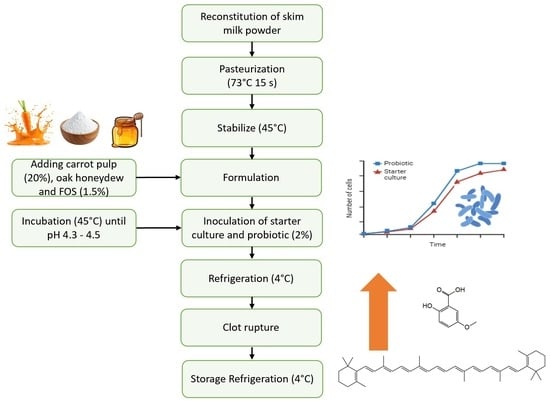
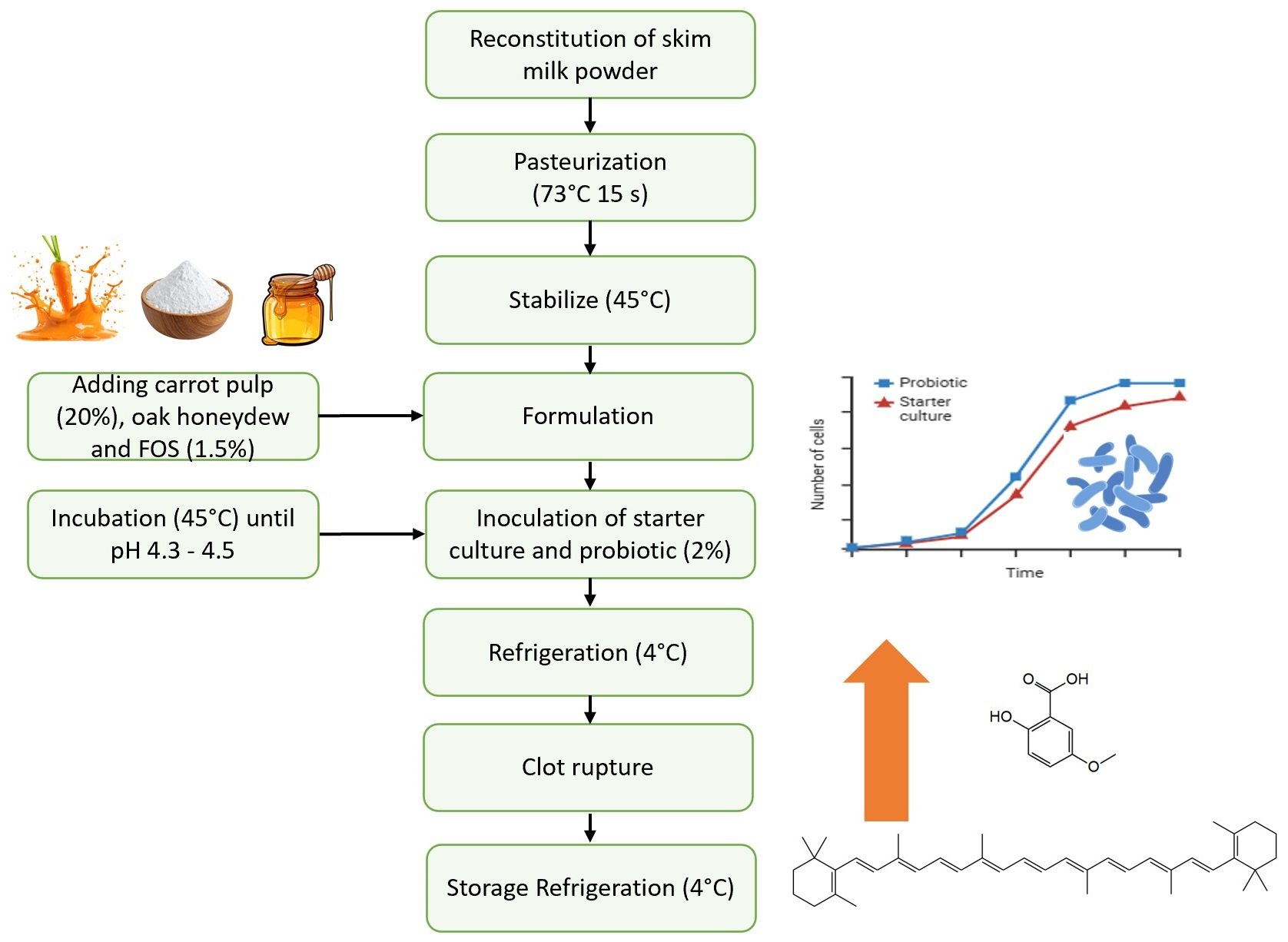
Graphical Abstract

1. Introduction

In recent decades, global trends in functional food development have focused on creating nutritious products that serve as adequate sources of bioactive ingredients, thereby positively impacting consumer health and well-being [1,2]. A promising strategy to enhance the functionality of dairy products involves developing fermented dairy beverages with functional characteristics (bioyogurts) through synergistic interactions between bioactive compounds such as dietary fiber and antioxidants and the metabolic activity of lactic acid bacteria with probiotic potential [3,4]. Current trends emphasize increasing yogurt’s health benefits by incorporating probiotics, bioactive compounds, and prebiotic fibers [5,6]. According to the consensus established by the International Scientific Association for the Study of Probiotics and Prebiotics (ISAPP), a bioyogurt is defined as “a dairy drink with functional potential due to the inclusion of probiotics and/or different physiologically active compounds with beneficial properties for the health of the host” [4]. However, the development developing novel fermented dairy products that incorporate probiotics while maintaining an appropriate viable cell count at the time of consumption presents a significant biotechnological challenge due to various factors encountered during processing and storage [7].
Food fortification is one of the most critical processes for enhancing both nutritional quality and quantity of food products. Given the high consumption rate of dairy products such as yogurt, fortification of these products can efficiently decrease or prevent diseases related to nutritional deficiencies [3] numerous studies have investigated yogurt fortification with various herbs, vegetables, juices, fruit peels, and pulps, among other natural ingredients [8]. Bioyogurts stored for extended periods may experience losses in their vitamin A and D content; therefore, supplementation with other bioactive components is necessary to compensate for or augment these lost vitamins [2].
An emerging field within dairy biotechnology that is attracting considerable attention from both consumers and the food industry involves developing alternatives based on incorporating plant-derived matrices into fermented dairy beverages. These strategies utilize the nutritional and sensory qualities of dairy products as a reference framework [9]. Among the ingredients that have demonstrated positive effects on the functional, physicochemical, bioactive, and sensory characteristics of bioyogurts are vegetables such as carrot (Daucus carota), which serves as a source of provitamin A β-carotene, vitamins C, B2, B3, and K, as well as minerals including phosphorus, potassium, calcium, and sodium [10,11,12,13,14]. Previous research has reported that incorporating carrot substrates rich in soluble fiber as stabilizers in yogurt formulations resulted in increased gel viscoelasticity, additionally suggesting that dietary fiber could enhance interactions between casein particles [11].
Mango (Mangifera indica L.) constitute an important source of antioxidants, including ascorbic acid, carotenoids, and phenolic compounds, with β-carotene being the most abundant carotenoid across different varieties of this fruit, in addition to providing significant dietary fiber content [15,16]. Honeydew honey from Apis mellifera is rich in oligosaccharides and antioxidants and has shown potential prebiotic effects. In Colombia, this honey is mainly produced in the eastern Andes from the sugary excretions of Stigmacoccus asper, an insect associated with Quercus humboldtii oak forests, ecosystems of ecological and economic importance across the Andean ranges. These insects consume large amounts of phloem sap, and up to 90% of the ingested sugars are expelled as honeydew, which serves as the raw material for honey production [17,18,19].
This research aimed to evaluate the synergistic interactions among vegetable substrates (carrot and mango), probiotics, commercial prebiotic fibers, and honeydew honey on the biotechnological, physicochemical, and antioxidant properties of bioyogurt during both the fermentation phase and refrigerated storage.

2. Materials and Methods

2.1. Materials

Carrot (Daucus carota) and mango (Mangifera indica) varieties Tommy Atkins was obtained through local markets, ensuring quality, and then processed to obtain their pulps. In the production of bioyogurt, skim milk powder was used, and as a natural prebiotic ingredient, oak honeydew honey from Apis mellifera, collected in Málaga, Santander, Colombia (6°41′ N, 72°43′ W), was incorporated. The selected honeydew originated from this geographical area and had been previously evaluated through preliminary analyses of its prebiotic potential, which yielded excellent results. Orafti® GR (BENEO, Mannheim, Germany), a food ingredient primarily composed of inulin derived from chicory, is recognized for its prebiotic effect, as per the European Union Regulation on health and nutrition claims, with an average degree of polymerization of ≥10 [20]. The culture medium for lactic acid bacteria (probiotic and starter cultures) was MRS (from Man–Rogosa–Sharpe, MRS; Oxoid, Basingstoke, UK). Reagents for antioxidant activity, carotenoids, and total phenol content were of analytical grade from Sigma-Aldrich (St. Louis, MO, USA).

2.2. Bacterial Strains

The starter culture used in the fermentation was YOFLEX (Streptococcus thermophilus and Lactobacillus delbrueckii subs. bulgaricus) from the Chr-Hannsen® brand (Hørsholm, Denmark). The strain with probiotic potential included in the bioyogurt was from the DANISCO-HOWARU® (Copenhagen, Denmark) commercial line: the VEGE 092 conglomerate (Pediococcus pentosaceus, Lactobacillus acidophilus, and Lacticaseibacillus casei). IFF Colombia supplied these strains. Reconstitution was carried out in MRS broth (Oxoid, UK). The cultures were then incubated under anaerobic conditions at 37 °C for 48 h. Subsequently, an aliquot containing the strain was inoculated into a sterile 15 mL Falcon tube with MRS broth and incubated under the previously described conditions. Growth, morphology, and culture purity were verified using Gram staining [21]. A stock of each strain (50 vials) was prepared from the activated cultures, ensuring the same cell line is used for subsequent activities.

2.3. Adequacy and Evaluation of Physicochemical Parameters of Carrot (Daucus carota) and Mango (Mangifera indica) Pulps

The vegetable material was washed with water and sanitized in a chlorine solution at 200 ppm for 10 min. Blanching was performed to inactivate endogenous enzymes and preserve the color and quality of the vegetable matrix. They were then peeled by hand and cut into slices, after removing the seed, in the case of the mango. They were cut into slices with a fruit cutter, and the slices of each fruit and vegetable were homogenized independently until a uniform pulp was obtained using a Robot Coupe blixer at 2.5 rpm. The pulp obtained was blanching (80 °C for 15 s), packed in sealed bags, and stored frozen (−4 °C).
The pH of each pulp was measured using a digital pH meter with the potentiometric method, as outlined in the official AOAC method 937.05 [22]. Total soluble solids were determined using an Atago PAL-2 refractometer and expressed as °Brix at 20 °C, in accordance with the official AOAC method 93.12 [22].
Fiber determination was performed using the gravimetric-enzymatic method, according to AOAC 2011.25 [23] and AOAC 991.43 [24] using the Megazyme commercial kit (K-TDFR-200A/Megazyme International Ireland Ltd., Bray, Ireland). Finally, the total carotenoid content was determined according to the methodology described by [25,26], with some modifications. The absorbance was measured at 450 nm using a spectrophotometer at room temperature.

2.4. Production of Bioyogurt

Initially, skim milk powder was hydrated (approximately 130 g of milk per liter of sterile water). Then, standardization of fat (3.25%) and non-fat solids (20%), homogenization (at 60–65 °C), and pasteurization of the milk (at 73 °C for 15 s) were carried out. The treatments evaluated were bioyogurt, which included VEGE 092, and the control, yogurt, with the starter culture (without the probiotic). Later, when the milk reached a temperature of 45 °C, carrot pulp (as a vegetable substrate) and mango pulp (for its sensory profile), previously pasteurized, honeydew honey, and inulin (Orafti®GR) were added. The inoculum of probiotics and starter culture was 2% (approximately 1 × 10⁸ CFU/mL) in 1000 mL. The inoculation level for both the starter culture (YOFLEX) and the probiotic consortium (VEGE 092) was standardized across all treatments. A fixed inoculum of 2% (≈1 × 10⁸ CFU/mL) was added based on the total fermentation volume (1000 mL). In the bioyogurt treatment (T1), both the starter culture and the probiotic were incorporated at the same 2% level, whereas the control yogurt (T2) received only the starter culture at 2%. No additional probiotics beyond this standardized concentration were added, ensuring consistency in culture proportion and allowing valid comparisons between treatments. The fermentation lasted approximately 6.5 h at 43 °C ± 1 °C. Finally, the coagulum was broken, the mixture was homogenized, and it was bottled in glass in a working volume of 200 mL. The mixture was then stored under refrigerated conditions (4 °C ± 1 °C) for 21 days.

2.5. Growth Kinetics of the Starter and Probiotic Cultures Under Fermentation Conditions

Before evaluating the kinetics, standard curves were developed for each of the evaluated strains. Biomass production was determined over 3 h by measuring absorbance at 600 nm and performing plate counts using the pour plate method. The results were plotted, and the linear equation was obtained (Supplementary Material).
During the fermentation process, growth kinetics were assessed using the pour plate method on MRS agar, following the methodology described by [25]. Measurements were taken every hour during the fermentation process until the pH reached 4.5. Serial dilutions were performed to enable accurate plate counting on MRS agar. Samples were incubated at 37 °C for 48 h under anaerobic conditions. Finally, the results will be expressed as Log CFU/mL [26].

2.6. Viability of Probiotic and Starter Cultures During Refrigerated Storage

The viable cells of the strains in the evaluated treatments were enumerated by plate count on MRS agar on day zero, as well as on days 1, 7, 14, and 21 of refrigerated storage. At each storage period, serial dilutions (10−1 to 10−8) were performed in sterile saline solution. Plates were incubated at 37 °C for 48 h under anaerobic conditions, and the results were expressed as log CFU/mL [27].

2.7. Evaluation of the Physicochemical Stability of Bioyogurt During Refrigerated Storage

Samples from each treatment were collected in triplicate and homogenized before analysis on days 1, 7, 14, and 21. The total soluble solids in the bioyogurts were determined using a refractometer (Atago PAL-2) according to AOAC guidelines (AOAC, 2012). Post-acidification of the yogurt was assessed by measuring pH after the first day of storage using a pH meter (model Q-400M).

2.8. Determination of Total Phenolic and Carotenoid Content in Bioyogurt During Refrigerated Storage

Before analysis, a hydro-soluble extract of bioyogurt (HYE) was prepared according to the method described by [28], with modifications. Samples were centrifuged at 8000× g for 10 min at 4 °C. Then, 10 mL of the supernatant was mixed with 15 mL of acidified methanol (containing 0.05 mL of concentrated hydrochloric acid) and stored at −8 °C for 3 h. The mixture was centrifuged at 5000× g for 10 min at 4 °C, and the resulting supernatant was collected for the determination of antioxidant activity.
Content of total phenolics: Total phenolic content was determined using the Folin–Ciocalteu spectrophotometric assay as described by [8], with modifications. A mixture was prepared containing 200 µL of yogurt extract, 800 µL of deionized water, and 100 µL of Folin–Ciocalteu reagent, which was incubated for 3 min at room temperature. Then, 300 µL of 20% sodium carbonate was added, and the mixture was incubated in the dark at room temperature for 2 h. Absorbance was measured at 765 nm using a UV-Vis spectrophotometer (Jasco V-530, Hachioji, Japan). A blank sample was prepared using distilled water instead of the extract. A gallic acid standard curve (0–100 mg/L) was prepared, and total phenolic content was expressed as mg of gallic acid equivalents per 100 g of the evaluated extract. Each sample was analyzed in triplicate, and the results are presented as mean ± standard deviation (SD).
Content total carotenoids: the total carotenoid content was determined according to the methodology suggested by [29,30]. Each bioyogurt treatment (5 g) was saponified by mixing with 37.5 mL of methanol and 12.5 mL of 50% potassium hydroxide in a flask to release esterified carotenoids and remove chlorophylls and lipids. Unsaponifiable carotenoids were extracted with 20 mL of diethyl ether, washed twice with 40 mL of distilled water, and treated with anhydrous sodium sulfate. The solvent evaporated in a water bath, and the dry residue was dissolved in 20 mL of petroleum ether. The organic phase, containing carotenoids, was separated using a glass pipette. Total carotenoids were measured spectrophotometrically at 450 nm using 0.1% hexane as a blank, and concentrations were quantified using a β-carotene calibration curve. Results were expressed as milligrams of β-carotene equivalents per gram of bioyogurt. Each analysis was performed in duplicate under dark conditions.

2.9. Antioxidant Activity of Bioyogurt During Storage

Antioxidant activity was determined using the Ferric-Reducing Ability of Plasma (FRAP) assay. The assay was performed following the methodology of [31], with modifications. In a 10 mL flask, 330 µL of extract was mixed with a solution of sodium acetate, ferric chloride, and TPTZ (2,4,6-tripyridyl-s-triazine) in a 10:1:1 ratio. The volume was then adjusted to 10 mL with distilled water. The mixture was shaken and allowed to react in the dark for 1 h. A blank was prepared with 330 µL of water, and the spectrophotometer (UV-Vis Jasco V-530, Japan) was calibrated to 593 nm. The mean value was interpolated using a Trolox standard curve (0.02–1.6 mM). Results were expressed as mmol Trolox/g of sample.

2.10. Statistical Analysis

All samples were prepared in duplicate for each treatment, and all experiments were conducted at least three times. Data were expressed as mean ± standard deviation (SD). Data processing and analysis were performed using R statistical software, version 4.3.1 (R Core Team, 2023). A 95% confidence interval was used for statistical analysis. Data were analyzed using analysis of variance (ANOVA), and significant differences were determined using Tukey’s multiple comparison test.

3. Results

3.1. Characterization of Carrot (Daucus carota) and Mango (Mangifera indica) Pulps

Table 1 presents the physicochemical characteristics and total carotenoid content of each pulp. The selection and subsequent characterization of mango and carrot pulps were conducted to determine their fiber and antioxidant contributions, as well as their potential synergistic effect with lactic acid bacteria (LAB) [15].

3.2. Growth Kinetics of the Starter and Probiotic Cultures Under Bioyogurt Fermentation Conditions

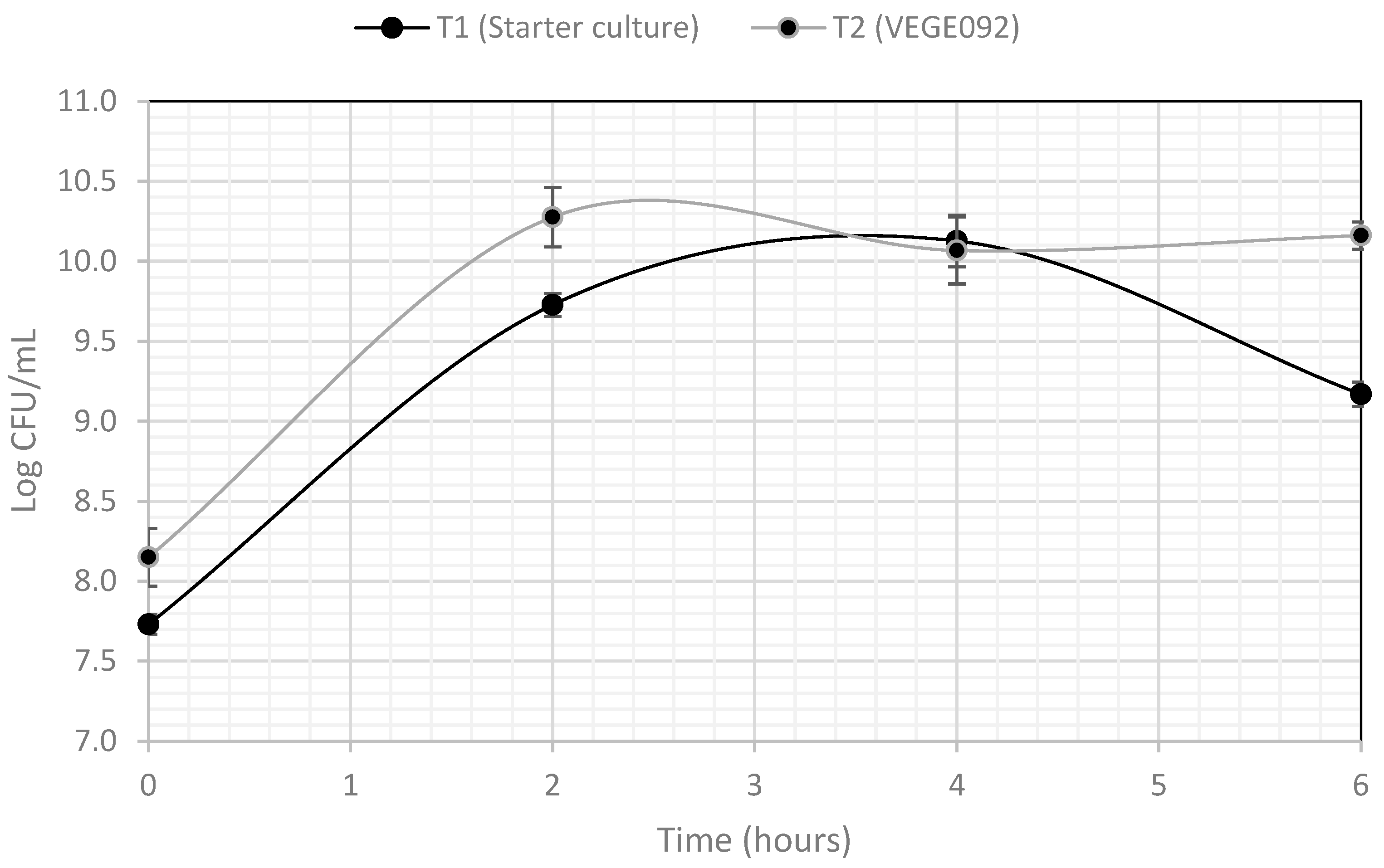
The growth kinetics of the probiotic strain VEGE092 and the starter culture are shown in Figure 1. The inclusion of carrot and mango delayed the fermentation process for both strains, which lasted approximately 6 h to reach a pH between 4.3 and 4.5. Numerical fermentation rate data were estimated from the growth curves. For T1, viable cell counts increased from approximately 8.1 to 10.3 log CFU/mL during the first 2 h, corresponding to a growth rate of ~1.1 log CFU/mL·h−1. After this point, values stabilized between 10.1 and 10.2 Log CFU/mL up to hour 6. In T2, cell counts rose from 7.8 to 9.8 log CFU/mL in the first 2 h (≈1.0 log CFU/mL·h−1), reaching a peak of ~10.2 log CFU/mL at hour 4 before decreasing to ~9.1 log CFU/mL at hour 6. These data provide a quantitative comparison of fermentation performance between treatments. This result is consistent with the findings reported by [31], who formulated a bioyogurt with different inclusion levels of carrot pulp (10%, 15%, and 20%), observing that as the percentage of carrot pulp increased, the time required to reach acidification was prolonged (5 h). During fermentation, all formulations showed a progressive decrease in pH and a corresponding increase in titratable acidity, reflecting the typical metabolic activity of lactic acid bacteria. Treatments containing carrot, mango, or honeydew honey exhibited faster acidification during the initial hours, likely due to their higher availability of fermentable sugars and bioactive compounds. As fermentation progressed, the rate of pH decline stabilized, indicating a transition from rapid exponential growth to a slower metabolic phase. This behavior was consistent across treatments, but samples enriched with prebiotic fibers demonstrated a more controlled acidification pattern, suggesting that fiber components modulated substrate availability and helped maintain a more stable fermentation process.

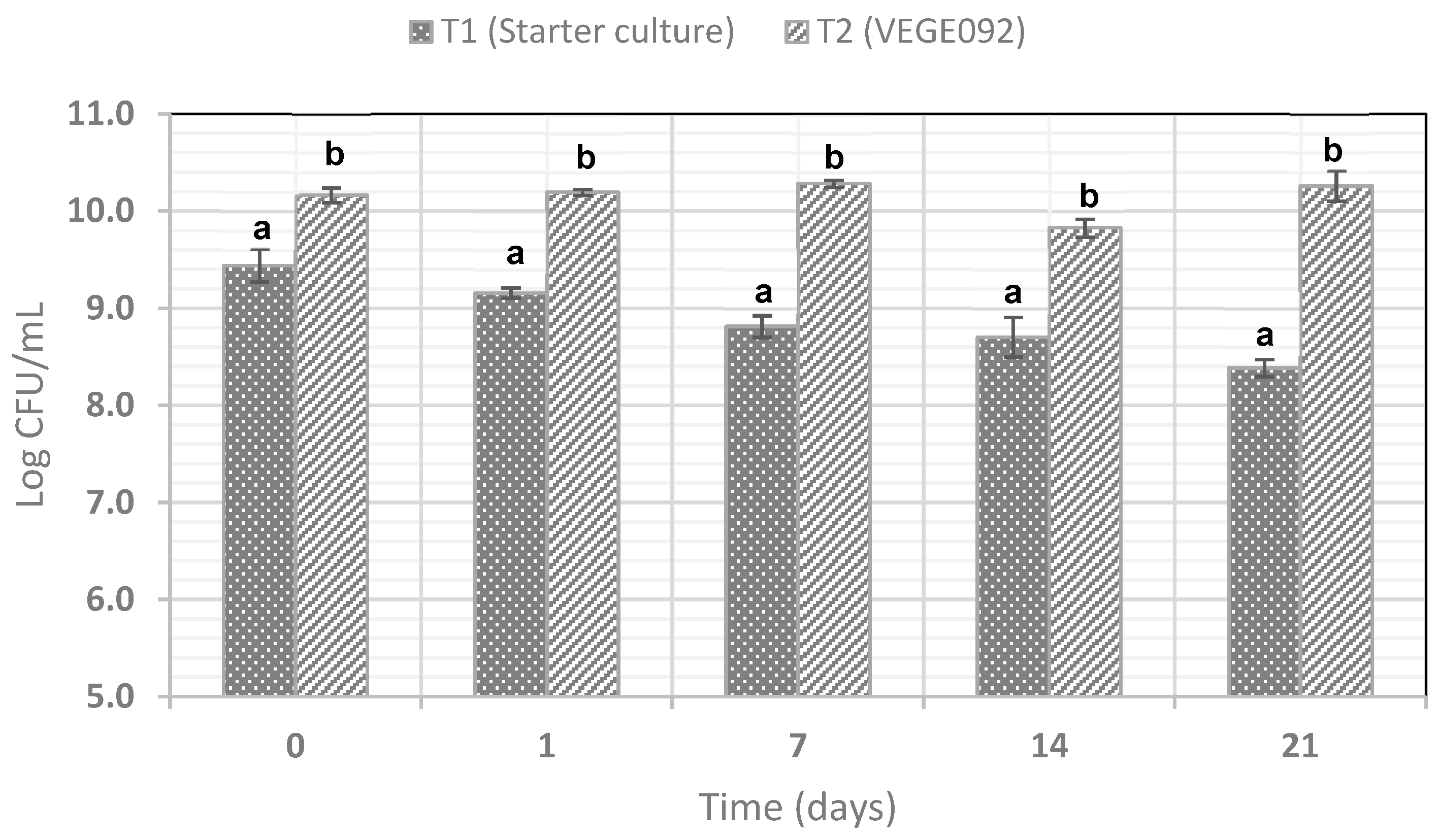
3.3. Viability of the Probiotic and Starter Cultures During Refrigerated Storage of Bioyogurt

Figure 2 shows the viability of the strains in the bioyogurt during the storage period. Bioyogurts formulated with plant-based matrices face challenges in mimicking and improving the nutritional, sensory, functional, and technological properties (such as texture and shelf life) of conventional yogurts. The main limitations of plant-based raw materials include their low protein content; coagulation properties that differ from those of caseins; the need for additives to provide desirable texture (with the current market showing a clear trend toward reducing additive use for clean labeling); the requirement to maintain stability throughout shelf life; and the potential presence of anti-nutritional factors [9].

3.4. Evaluation of the Physicochemical Characteristics of Bioyogurt During Refrigerated Storage

The physicochemical characteristics of the bioyogurt during refrigerated storage are presented in Table 2.
The addition of probiotic cultures generally does not alter the chemical composition (including moisture, protein, lipid, ash, fiber, and carbohydrate content) of fermented dairy beverages [32].

3.5. Determination of Total Phenolic Content, Carotenoids, and Antioxidant Activity of Bioyogurt During Refrigerated Storage

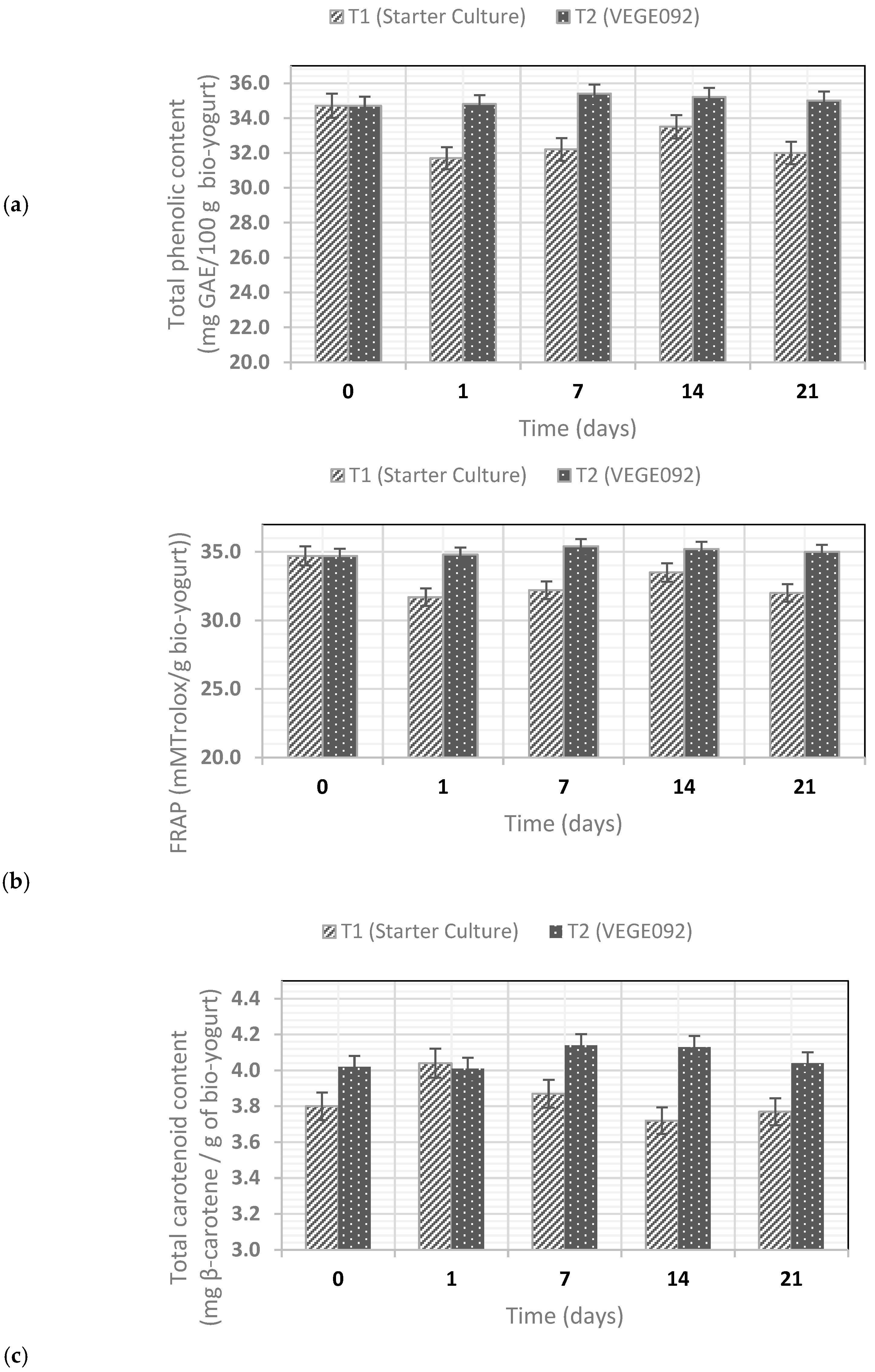
The addition of probiotic cells may lead to an increase in bioactive compounds (total phenolic compounds) and antioxidant activity in the products [33], which can be associated with the fermentation process. For a long time, it was believed that the presence of phenolic compounds from plant matrices inhibited the growth of probiotics; however, studies have demonstrated a prebiotic effect of phenolic acids and flavonoids, stimulating the growth of probiotic bacteria. The total carotenoid and phenolic contents, as well as the antioxidant activity of the bioyogurt, are shown in Figure 3. Carotenoid degradation during refrigerated storage showed contrasting behaviors between treatments. In T1, β-carotene concentrations remained stable throughout storage (4.00 mg/g on day 0 and 4.00 mg/g at day 21), indicating negligible loss. In contrast, T2 exhibited a slight reduction from 3.80 to 3.70 mg/g over the same period, corresponding to a 2.6% loss of β-carotene. These data suggest that the matrix composition of T1 provided greater protection against carotenoid degradation during cold storage.

4. Discussion

4.1. Characterization of Carrot (Daucus carota) and Mango (Mangifera indica) Pulps

The synergistic effect between probiotics and plant substrates is fundamental in the development of bioyogurt. The efficacy of a probiotic/plant substrate combination depends on several factors, including the composition of the food matrix, which must be considered to maintain and protect probiotic cells during product processing and storage [34]. The functional characteristics of plant-based matrices depend on their bioactive components, particularly dietary fibers with prebiotic potential, which play an essential role in modulating the gut microbiota and enhancing the survival of probiotic strains in various formulations. Soluble fiber, in particular, is fermented by probiotic strains to produce short-chain fatty acids (SCFAs), acting both as a promoter and protector of microbial growth [35].
Carrot (Daucus carota) is considered a valuable substrate for the food processing industry due to its high nutritional content, including dietary fiber, minerals, vitamins, antioxidants, and carotenoids [36]. It is an excellent source of β-carotene and vitamins A, C, B2, B3, and K, as well as minerals such as phosphorus, potassium, calcium, and sodium. Other carotenoids present in carrots, such as α-carotene and lutein, also contribute to the bioactive profile of the substrate. Additionally, its dietary fiber—particularly pectin—has been shown to benefit gut health by serving as a carbon source for commensal bacteria [37].
Previous studies have reported the use of carrots in the production of fermented beverages such as kanji, from which two distinct genotypes of Lactiplantibacillus paraplantarum and one genotype of Lactiplantibacillus pentosus were isolated. Carrot has also been utilized as a substrate for second-generation ethanol production [38]. Carrot, pumpkin, and spinach rank among the top antioxidant vegetables commonly consumed due to their high β-carotene content. The β-carotene in carrots (6.9–15.8 mg of total carotenoids/100 g) provides antioxidant protection to cells against oxidative damage. Moreover, carrot pulp, juice, and extracts are considered prebiotic vegetables that stimulate the growth or activity of beneficial gut bacteria, contributing to overall human health [11].
Mango (Mangifera indica), in its fresh, pulp, or extract forms, is one of the most consumed tropical fruits and contains a wide range of nutritional compounds such as carbohydrates, lipids, fatty acids, organic acids, vitamins, minerals, and bioactive compounds. The latter include phenolic compounds (phenolic acids and flavonoids) and carotenoids (α- and β-carotene), which are known for their biological properties [39]. These compounds are distributed in varying concentrations across different parts of the fruit, including the seed, peel, and pulp. Specifically, mango peel contains a significant amount of dietary fiber, which exhibits strong antioxidant potential due to phenolic compounds bound to the fiber matrix. Therefore, both the dietary fiber and phenolic compounds present in mango by-products can be considered prebiotic components, as they contribute to modulating the gut microbiome [40].
Additionally, the physicochemical characteristics of plant substrates are key factors in the development of bioprocesses. Various factors, including strain type, culture preparation method, physiological state of the cells, storage temperature, oxygen level, and substrate composition can influence the viability of probiotics in plant-based substrates. Other technological factors that affect the viability of probiotic microorganisms include pH, acidity, water activity, presence of salts and sugars, and processing conditions such as heat treatments, packaging, and storage [41].

4.2. Growth Kinetics of Starter and Probiotic Cultures Under Bioyogurt Fermentation Conditions

It has been reported that the addition of plant-based substrates to the formulation of bioyogurt leads to changes in the fermentation process due to differences in protein and carbohydrate concentrations, micronutrient availability, and the potential presence of inhibitory compounds (e.g., antimicrobial agents) [42]. Yogurt fermentation typically involves two exponential growth phases separated by a transitional phase with reduced growth [43]. In this study, the fermentation process of the starter culture lasted approximately 6 h, beginning with a cell density of 8.2 Log CFU/mL and reaching 9.49 Log CFU/mL at the end. Bioyogurt fermentation is carried out by Streptococcus thermophilus and Lactobacillus delbrueckii subsp. bulgaricus, representing a well-known example of microbial mutualism: S. thermophilus creates anaerobic conditions and provides growth-promoting factors, while L. bulgaricus releases peptides and free amino acids that serve as nitrogen sources. At the beginning of the fermentation process, S. thermophilus synthesizes urease to produce formic acid and CO2, stimulating the growth of L. bulgaricus. This interaction promotes the production of lactic and other organic acids, acidifying the medium until a pH of approximately 4.65 is reached [44].
However, when developing a bioyogurt with the inclusion of probiotic strains, the question arises as to whether to employ axenic or mixed cultures to achieve potential symbiotic interactions—similar to the relationship between S. thermophilus and L. bulgaricus—for the biosynthesis of amino acids such as valine, leucine, and isoleucine [45]. In the case of the probiotic strain VEGE092, fermentation lasted approximately 5.5 h, starting with an inoculum of about 8.5 Log CFU/mL. A cell increase of roughly 2 Log CFU/mL was observed during the first two hours, reaching a final density of 10.16 Log CFU/mL. Despite significant differences in growth compared with the starter culture, both exhibited similar acidification kinetics, achieving a pH of 4.51 after approximately 6 h of fermentation.
During fermentation, microorganisms produce a range of enzymes that enable them to break down and assimilate matrix components. Pediococcus pentosaceus has been reported to possess proteolytic enzymes, including protease, dipeptidase, dipeptidyl aminopeptidase, and aminopeptidase, as well as leucine and valine peptidase activities [46]. Additionally, the strain exhibits β-galactosidase and isomerase activities, allowing it to utilize sugars such as lactose, galactose, maltose, melezitose, and possibly cellobiose [47]. Melezitose exhibits prebiotic potential because it is minimally susceptible to hydrolysis by α-glucosidase and resistant to acid hydrolysis, fulfilling the prebiotic criterion of human indigestibility. Furthermore, prebiotics such as oligosaccharides, including melezitose, are selectively fermented by beneficial intestinal microbiota, including Bifidobacterium, Lactobacillus, certain Enterococcus species, Saccharomyces boulardii, and Bacillus coagulans, but not by undesirable microorganisms [48]. However, caution should be exercised with excessive consumption of melezitose, as it has been observed to exert a laxative effect at high doses in bees.
The metabolic pathway of this strain is homolactic, with 90% or more of the product being lactic acid [46]. Members of the genus Pediococcus possess NAD-dependent D- and L-lactate dehydrogenases that mainly produce D- and L- (+)-lactic acid. Certain P. pentosaceus strains produce approximately 0.4% lactic acid from glucose (0.5% w/v), of which 84% and 16% correspond to L- and D-lactic acid, respectively. Lactate is also the main fermentation product when utilizing fructose, ribose, or arabinose as substrates [46].

4.3. Viability of the Probiotic and Starter Cultures During Refrigerated Storage of Bioyogurt

Storage conditions (temperature and duration) can affect probiotic survival and, consequently, the product’s shelf life. Refrigerated storage (4 °C) is crucial for maintaining the stability of probiotic cultures over extended periods, while preserving their functional properties [32]. The viability of the strains during storage is shown in Figure 2. Both VEGE 092 and the starter culture maintained viable cell densities above the limits established by international standards [49].
Significant differences (p < 0.05) were observed between the two treatments during storage. VEGE 092 exhibited greater adaptability to the inclusion levels of the vegetable matrices, oak honeydew honey, and the commercial prebiotic fiber (ORAFTI), reaching a final cell density of 10.26 Log CFU/mL. In comparison, the starter culture reached 8.38 Log CFU/mL. This difference reflects a higher capacity of VEGE 092 to assimilate nutrients present in the medium, thereby maintaining cell viability. This is likely due to the presence of highly fermentable sugars and dietary fibers, which promote probiotic survival during storage. These findings suggest a synergistic effect between the starter and probiotic cultures [44]. The survival rate of the probiotic and starter cultures is directly linked to the nutritional, sensory, and functional characteristics of the bioyogurt. Higher bacterial viability enhances the production of organic acids, exopolysaccharides, and bioactive metabolites, which influence product acidity, texture, antioxidant activity, and overall stability. These microbial-derived compounds improve viscosity, water-holding capacity, and flavor development, while supporting the retention of phenolics and carotenoids during storage (Figure 3). Therefore, maintaining high viable cell counts is essential not only for ensuring probiotic functionality but also for preserving the technological and nutritional quality of the final product [34].
Similar results were reported by [11], who observed cell densities of 8.31 Log CFU/mL and 7.25 Log CFU/mL for the probiotic and starter cultures, respectively, after 28 days of storage, when yogurt was inoculated with L. acidophilus and supplemented with 33% carrot juice. Likewise, Ref. [50] reported that a fermented milk beverage containing 10% carrot pulp inoculated with Lb. paracasei reached a cell density of 8.35 Log CFU/mL after 21 days of storage.
The addition of honeydew honey may also have contributed to enhanced cell viability. Honeydew is a sugary excretion produced by phloem-feeding insects of the order Hemiptera, suborder Sternorrhyncha. These insects ingest large volumes of plant sap to meet their nutritional needs, and up to 90% of the ingested sugars pass through specialized filtration chambers and are excreted through the anus as honeydew [51,52].
Melezitose exhibits prebiotic potential, as it is minimally susceptible to hydrolysis by α-glucosidase and resistant to acid hydrolysis, thereby fulfilling the prebiotic criterion of human indigestibility. Furthermore, prebiotics, including oligosaccharides such as melezitose, are selectively fermented by beneficial intestinal microbiota such as Bifidobacteria, Lactobacilli, certain Enterococci, Saccharomyces boulardii, and Bacillus coagulans, but not by undesirable microorganisms [48,53]. However, excessive intake of melezitose should be approached with caution, as it has been reported to exert a laxative effect in high doses in bees [53].
In a study analyzing the influence of stingless bee honey (Melipona scutellaris Latrelle–uruçu) on the technological, physicochemical, and sensory characteristics of goat milk yogurt inoculated with L. acidophilus La-05 during 28 days of refrigerated storage, the incorporation of honey positively affected Lb. Acidophilus viability, increasing counts by approximately 1 Log CFU/g, demonstrating the prebiotic potential of honey sugars [54]. Moreover, melezitose extracted from honeydew honey produced in New Zealand was shown to resist hydrolysis under simulated gastric and small intestinal conditions, thus meeting the prebiotic criterion of gastrointestinal resistance [48].

4.4. Evaluation of the Physicochemical Characteristics of Bioyogurt During Refrigerated Storage

The potential synergistic relationship between the starter culture and VEGE 092 as a probiotic strain must be considered. Interactions between these microorganisms—reflected in cell density and metabolic behavior—can lead to changes in microbial composition and consequently alter the contribution of individual species to the overall bioyogurt properties. For example, a decrease in Lb. Bulgaricus counts have been associated with less creamy yogurt, since this species typically thrives at lower pH values and exhibits greater acid tolerance than its co-culture counterpart. Additionally, S. thermophilus is the primary producer of exopolysaccharides and aromatic compounds, particularly acetoin and diacetyl, which, along with acetaldehyde, contribute to the characteristic flavor of yogurt. Therefore, changes in the interactions between the starter and probiotic cultures may influence both viscosity and flavor [43].
Throughout storage, VEGE 092 exhibited a reduction in total soluble solids (TSS), suggesting an active bacterial metabolism capable of utilizing the available soluble solids in the substrate. In contrast, the starter culture did not alter these levels, likely due to its limited nutrient demand resulting from lower cell growth. Between days 14 and 21, a significant decrease (p < 0.05) in TSS content was observed, accompanied by an increase in cell density. The reduction in TSS following probiotic inoculation has been commonly attributed to the consumption of sugar by probiotic strains and the subsequent production of organic acids. This phenomenon has been consistently observed in fermented fruit and vegetable pulps and juices; however, the magnitude of the effect depends on both the probiotic strain and the composition of the food matrix [32,55].

4.5. Determination of Total Phenolic Content, Carotenoids, and Antioxidant Activity of Bioyogurt During Refrigerated Storage

The treatment containing only the starter culture maintained a relatively stable concentration of these compounds, except between weeks 14 and 21, when a more pronounced loss was observed. This finding aligns with [55], who reported that refrigerated storage (4 °C) resulted in a 40% reduction in β-carotene content in carrots, whereas frozen storage (−16 °C) led to a 25% decrease after 20 days. Regarding the treatment containing the VEGE 092 probiotic strain, a greater reduction in carotenoid concentration was observed between days 14 and 21. These results are consistent with [31], who found that carotenoid content varied depending on the percentage of carrot inclusion, ranging from 3.06 to 8.71 mg/kg (for 15–25% inclusion levels). Co-fermentation of milk with carrot may alter the chemical structure of carotenoids. However, a comprehensive understanding of the specific metabolic pathways of lactic acid bacteria (LAB) and their impact on carotenoid bioactivity and bioavailability remains to be elucidated [47].
During fermentation, the interaction between organic acids produced by lactic acid bacteria and plant-derived phenolic compounds may contribute to the modulation of antioxidant capacity. Organic acids can facilitate the release of bound phenolics through pH-driven cell wall disruption and may also participate in esterification or hydrolysis reactions that enhance phenolic solubility and reactivity. At the same time, certain phenolics can stabilize organic acid intermediates or participate in redox cycling, generating synergistic antioxidant effects. These mechanisms are consistent with previously reported metabolic conversions of phenolic substrates during lactic fermentation [28] and with evidence showing that organic acids and phenolics can interact to enhance antioxidant responses in functional plant-based matrices [37].
Recent studies have shown that the intestinal microbiota can interact with carotenoids, influencing their concentrations and the levels of vitamin A derived from them [56]. It was reported that several intestinal bacteria, including members of the genera Bacteroides, Clostridia, and Prevotella, as well as Actinobacteria, encode the enzyme phytoene dehydrogenase, which participates in the metabolism of lycopene and β-carotene. Moreover, Ref. [57] demonstrated that carrot powder is a rich source of nutrients and bioactive compounds, including β-carotene, phenolics, and flavonoids. When incorporated into probiotic cheese formulations, it enhanced both the antimicrobial and antioxidant potential of the final product and promoted the growth of probiotic bacteria. Consequently, the authors recommended carrot as a potential prebiotic ingredient to improve probiotic viability in various dairy-based applications like white cheese.
Additionally, the International Scientific Association for Probiotics and Prebiotics (ISAPP) recently acknowledged that phenolic compounds may fulfill the criteria for prebiotics. According to ISAPP, a prebiotic is defined as “a substrate that is selectively utilized by host microorganisms, conferring a health benefit” [58]. There is growing evidence that consuming mango and its derivatives may help prevent gastrointestinal diseases. In this context, phytochemicals have been suggested to play a crucial role in modulating the gut microbiota due to their dual antimicrobial and prebiotic properties.
Prebiotic fibers can modulate probiotic performance by enhancing nutrient availability, improving cell protection during fermentation, and promoting selective metabolic pathways. In this study, the incorporation of commercial fibers likely supported probiotic activity by providing fermentable substrates that stimulate early growth and contribute to sustained viability during refrigerated storage. Additionally, fibers may reduce environmental stress by improving matrix viscosity, which helps maintain cell integrity and enhances tolerance to acidification. These interactions may explain the higher stability observed in treatments where fibers were combined with carotenoid-rich substrates and honeydew honey, suggesting a synergistic effect on microbial adaptation and metabolic output [36,58].
Nevertheless, processing operations associated with value-added bioproducts may promote the degradation or chemical modification of natural phytochemicals, resulting in a reduction in their antioxidant capacity [59]. Overall, the observed survival and stability patterns suggest that the synergistic or antagonistic interactions among phenolic compounds, carotenoids, and organic acids (such as citric and malic acids) may contribute to the protection and metabolic performance of probiotic microorganisms.

5. Conclusions

This study demonstrates that the synergistic incorporation of carrot pulp, mango pulp, and holm oak honeydew into fermented dairy matrices results in quantifiable improvements in functional profile and probiotic viability. Notably, the increase in total carotenoids from 2.15 to 3.96 µg β-carotene/g evidence the biofortifying potential of the selected vegetable by-products. Concurrently, the survival of Lactiplantibacillus plantarum VEGE 092 reached 10.26 log CFU/mL and the starter culture 8.66 log CFU/mL, both meeting international criteria for probiotic functionality. Furthermore, the presence of oligosaccharides from honeydew, particularly melezitose, together with fruit-derived phenolic compounds, configures a prebiotic ecosystem that favors microbial metabolic activity and modulates the resulting bioactive matrix. Significantly, the innovation lies in simultaneously valorizing three underutilized streams through controlled lactic biotransformation, thereby opening biotechnological routes to second-generation functional ingredients. Looking forward, future research should address the specific bioavailability of carotenoids, the digestibility of oligosaccharides, and comprehensive sensory characterization. Ultimately, this technological platform biofortified fermented dairy products as competitive alternatives with industrial-scale-up potential, strategically responding to emerging market trends and strengthening productive innovation through sustainable commercial viability.

Supplementary Materials

The following supporting information can be downloaded at: https://www.mdpi.com/article/10.3390/fermentation11120698/s1, The Supplementary Material includes the growth kinetics of the evaluated probiotic strains, obtained during controlled fermentation assays. Kinetic curves describing cell growth over time are provided, along with the main growth parameters, including maximum specific growth rate (μ_max), lag phase duration (λ), and maximum cell concentration (N_max). These data support the interpretation of strain performance and their technological suitability for application in fermented dairy matrices.

Author Contributions

Conceptualization, C.B.-C., Á.D.C.-H. and C.D.-M.; methodology, C.B.-C., Á.D.C.-H. and C.G.-C.; formal analysis, C.B.-C. and Á.D.C.-H.; writing—original draft preparation, C.B.-C.; writing—review and editing, C.B.-C., C.G.-C. and C.D.-M.; supervision, C.D.-M.; funding acquisition, C.D.-M. All authors have read and agreed to the published version of the manuscript.

Funding

This research was funded by the Convocatoria Nacional para el Fomento de Alianzas interdisciplinarias que articulen investigación, creación, extensión y formación en la Universidad Nacional de Colombia 2019–2021, the funding number is 47263.

Institutional Review Board Statement

Not applicable.

Informed Consent Statement

Not applicable.

Data Availability Statement

The data presented in this study are openly available in Universidad Nacional de Colombia Repository at https://bffrepositorio.unal.edu.co/server/api/core/bitstreams/518f99d7-53ec-49f7-8098-aeff0ac755cf/content (accessed on 29 May 2022).

Acknowledgments

We would like to express our gratitude to the Instituto de Ciencia y Tecnología de Alimentos—Universidad Nacional de Colombia for the support provided throughout the development of this study. Its scientific infrastructure, technical assistance, and laboratory facilities were essential for conducting experiments and analyzing the results. We also acknowledge the institution’s commitment to research in food science and technology, which significantly strengthened and improved the overall quality of this work.

Conflicts of Interest

The authors declare that they have no conflicts of interest.

Abbreviations

The following abbreviations are used in this manuscript:
LABLactic Acid Bacteria 
FRAPFerric-Reducing Ability of Plasma 
CFUColony Forming Units
MRSMan, Rogosa and Sharpe

References

  1. Patel, P.; Jethani, H.; Radha, C.; Vijayendra, S.; Mudliar, S.N.; Sarada, R.; Chauhan, V.S. Development of a carotenoid enriched probiotic yogurt from fresh biomass of Spirulina and its characterization. J. Food Sci. Technol. 2019, 56, 3721–3731. [Google Scholar] [CrossRef]
  2. Soliman, T.N.; Nasser, S.A. Characterization of carotenoids double-encapsulated and incorporate in functional stirred yogurt. Front. Sustain. Food Syst. 2022, 6, 979252. [Google Scholar] [CrossRef]
  3. Ali, M.A.; Kamal, M.M.; Rahman, M.H.; Siddiqui, M.N.; Haque, M.A.; Saha, K.K.; Rahman, M.A. Functional dairy products as a source of bioactive peptides and probiotics: Current trends and future prospectives. J. Food Sci. Technol. 2022, 59, 1263–1279. [Google Scholar] [CrossRef]
  4. Camargo-Herrera, Á.D.; Bernal-Castro, C.; Gutiérrez-Cortes, C.; Castro, C.N.; Díaz-Moreno, C. Bio-yogurt with the inclusion of phytochemicals from carrots (Daucus carota): A strategy in the design of functional dairy beverage with probiotics. J. Food Sci. Technol. 2023, 60, 2297–2308. [Google Scholar] [CrossRef]
  5. Hussein, H.; Awad, S.; El-Sayed, I.; Ibrahim, A. Impact of chickpea as prebiotic, antioxidant and thickener agent of stirred bio-yoghurt. Ann. Agric. Sci. 2020, 65, 49–58. [Google Scholar] [CrossRef]
  6. Tesfaye, W.; Suarez-Lepe, J.; Loira, I.; Palomero, F.; Morata, A. Dairy and nondairy-based beverages as a vehicle for probiotics, prebiotics, and symbiotics: Alternatives to health versus disease binomial approach through food. In Milk-Based Beverages; Elsevier: Amsterdam, The Netherlands, 2019; pp. 473–520. [Google Scholar]
  7. Chen, K.; Gao, C.; Han, X.; Li, D.; Wang, H.; Lu, F. Co-fermentation of lentils using lactic acid bacteria and Bacillus subtilis natto increases functional and antioxidant components. J. Food Sci. 2021, 86, 475–483. [Google Scholar] [CrossRef]
  8. Pourghorban, S.; Yadegarian, L.; Jalili, M.; Rashidi, L. Comparative physicochemical, microbiological, antioxidant, and sensory properties of pre-and post-fermented yoghurt enriched with olive leaf and its extract. Food Sci. Nutr. 2022, 10, 751–762. [Google Scholar] [CrossRef]
  9. Saldo, J.; Sendra, E. Recent Advances and Trends in the Dairy Field. Foods 2022, 11, 1956. [Google Scholar] [CrossRef] [PubMed]
  10. Dong, R.; Liao, W.; Xie, J.; Chen, Y.; Peng, G.; Xie, J.; Sun, N.; Liu, S.; Yu, C.; Yu, Q. Enrichment of yogurt with carrot soluble dietary fiber prepared by three physical modified treatments: Microstructure, rheology and storage stability. Innov. Food Sci. Emerg. Technol. 2022, 75, 102901. [Google Scholar] [CrossRef]
  11. Fan, L.; Cliff, M. Carrot juice yogurts: Composition, microbiology, and sensory acceptance. In Yogurt in Health and Disease Prevention; Elsevier: Amsterdam, The Netherlands, 2017; pp. 221–235. [Google Scholar]
  12. Guiné, R.P.; De Lemos, E.T. Development of new dairy products with functional ingredients. J. Culin. Sci. Technol. 2020, 18, 159–176. [Google Scholar] [CrossRef]
  13. Kun, S.; Rezessy-Szabó, J.M.; Nguyen, Q.D.; Hoschke, Á. Changes of microbial population and some components in carrot juice during fermentation with selected Bifidobacterium strains. Process Biochem. 2008, 43, 816–821. [Google Scholar] [CrossRef]
  14. Vénica, C.I.; Spotti, M.J.; Pavón, Y.L.; Molli, J.S.; Perotti, M.C. Influence of carrot fibre powder addition on rheological, microstructure and sensory characteristics of stirred-type yogurt. Int. J. Food Sci. Technol. 2020, 55, 1916–1923. [Google Scholar] [CrossRef]
  15. Acevedo-Martínez, E.; Gutiérrez-Cortés, C.; García-Mahecha, M.; Díaz-Moreno, C. Evaluation of viability of probiotic bacteria in mango (Mangifera indica L. Cv.“Tommy Atkins”) beverage. Dyna 2018, 85, 84–92. [Google Scholar] [CrossRef]
  16. Afiyah, D.; Sarbini, R.; Suryati, T. β-carotene content and quality properties of probiotic yoghurt supplemented with podang urang mango extract. IOP Conf. Ser. Earth Environ. Sci. 2022, 1020, 012022. [Google Scholar] [CrossRef]
  17. Chamorro, F.J.; Nates-Parra, G.; Kondo, T. Mielato de Stigmacoccus asper (Hemiptera: Stigmacoccidae): Recurso melífero de bosques de roble en Colombia. Rev. Colomb. Entomol. 2013, 39, 61–70. [Google Scholar]
  18. Seraglio, S.K.T.; Silva, B.; Bergamo, G.; Brugnerotto, P.; Gonzaga, L.V.; Fett, R.; Costa, A.C.O. An overview of physicochemical characteristics and health-promoting properties of honeydew honey. Food Res. Int. 2019, 119, 44–66. [Google Scholar] [CrossRef]
  19. Durazzo, A.; Lucarini, M.; Plutino, M.; Lucini, L.; Aromolo, R.; Martinelli, E.; Souto, E.B.; Santini, A.; Pignatti, G. Bee products: A representation of biodiversity, sustainability, and health. Life 2021, 11, 970. [Google Scholar] [CrossRef]
  20. Theis, S. Authorised EU health claim for chicory inulin. In Foods, Nutrients and Food Ingredients with Authorised EU Health Claims; Elsevier: Amsterdam, The Netherlands, 2018; pp. 147–158. [Google Scholar]
  21. Tang, X.; Zhao, J. Commercial strains of lactic acid bacteria with health benefits. In Lactic Acid Bacteria: Omics and Functional Evaluation; Springer: Singapore, 2019; pp. 297–369. [Google Scholar]
  22. AOAC International. AOAC, Official Methods of Analysis of AOAC International, 20th ed.; AOAC International: Rockville, MD, USA, 2016. [Google Scholar]
  23. McCleary, B.V. Modification to AOAC official methods 2009.01 and 2011.25 to allow for minor overestimation of low molecular weight soluble dietary fiber in samples containing starch. J. AOAC Int. 2014, 97, 896–901. [Google Scholar] [CrossRef]
  24. Lee, S.C.; Prosky, L.; Vries, J.W.D. Determination of total, soluble, and insoluble dietary fiber in foods—Enzymatic-gravimetric method, MES-TRIS buffer: Collaborative study. J. AOAC Int. 1992, 75, 395–416. [Google Scholar] [CrossRef]
  25. Bernal-Castro, C.A.; Díaz-Moreno, C.; Gutiérrez-Cortés, C. Inclusion of prebiotics on the viability of a commercial Lactobacillus casei subsp. rhamnosus culture in a tropical fruit beverage. J. Food Sci. Technol. 2019, 56, 987–994. [Google Scholar] [CrossRef] [PubMed]
  26. Filannino, P.; Cardinali, G.; Rizzello, C.G.; Buchin, S.; De Angelis, M.; Gobbetti, M.; Di Cagno, R. Metabolic responses of Lactobacillus plantarum strains during fermentation and storage of vegetable and fruit juices. Appl. Environ. Microbiol. 2014, 80, 2206–2215. [Google Scholar] [CrossRef]
  27. Ge, Y.; Yu, X.; Zhao, X.; Liu, C.; Li, T.; Mu, S.; Zhang, L.; Chen, Z.; Zhang, Z.; Song, Z. Fermentation characteristics and postacidification of yogurt by Streptococcus thermophilus CICC 6038 and Lactobacillus delbrueckii ssp. bulgaricus CICC 6047 at optimal inoculum ratio. J. Dairy Sci. 2024, 107, 123–140. [Google Scholar] [CrossRef]
  28. Pan, L.-H.; Liu, F.; Luo, S.-Z.; Luo, J.-p. Pomegranate juice powder as sugar replacer enhanced quality and function of set yogurts: Structure, rheological property, antioxidant activity and in vitro bioaccessibility. LWT 2019, 115, 108479. [Google Scholar] [CrossRef]
  29. Kiros, E.; Seifu, E.; Bultosa, G.; Solomon, W. Effect of carrot juice and stabilizer on the physicochemical and microbiological properties of yoghurt. LWT-Food Sci. Technol. 2016, 69, 191–196. [Google Scholar] [CrossRef]
  30. Liu, X.; Liu, J.; Bi, J.; Cao, F.; Ding, Y.; Peng, J. Effects of high pressure homogenization on physical stability and carotenoid degradation kinetics of carrot beverage during storage. J. Food Eng. 2019, 263, 63–69. [Google Scholar] [CrossRef]
  31. Gad, A.; Ghita, E.I.; El-Din, H.M.; Badran, S.M.; El-Messery, T. Evaluation yogurt fortified with vegetable and fruit juice as a natural sources of antioxidant. Int. J. Food Nutr. Sci. 2015, 4, 21–28. [Google Scholar]
  32. Pimentel, T.C.; de Oliveira, L.I.G.; Macedo, E.d.L.C.; Costa, G.N.; Dias, D.R.; Schwan, R.F.; Magnani, M. Understanding the potential of fruits, flowers, and ethnic beverages as valuable sources of techno-functional and probiotics strains: Current scenario and main challenges. Trends Food Sci. Technol. 2021, 114, 25–59. [Google Scholar] [CrossRef]
  33. El-Dardiry, A.I. Improving the properties of the functional frozen bio-yoghurt by using carrot pomace powder (daucus carota L.). Egypt. J. Dairy Sci. 2022, 48, 1–10. [Google Scholar] [CrossRef]
  34. De Bellis, P.; Sisto, A.; Lavermicocca, P. Probiotic bacteria and plant-based matrices: An association with improved health-promoting features. J. Funct. Foods 2021, 87, 104821. [Google Scholar] [CrossRef]
  35. Siol, M.; Sadowska, A. Chemical composition, physicochemical and bioactive properties of avocado (Persea americana) seed and its potential use in functional food design. Agriculture 2023, 13, 316. [Google Scholar] [CrossRef]
  36. Purewal, S.S.; Verma, P.; Kaur, P.; Sandhu, K.S.; Singh, R.S.; Kaur, A.; Salar, R.K. A comparative study on proximate composition, mineral profile, bioactive compounds and antioxidant properties in diverse carrot (Daucus carota L.) flour. Biocatal. Agric. Biotechnol. 2023, 48, 102640. [Google Scholar] [CrossRef]
  37. Van den Abbeele, P.; Duysburgh, C.; Cleenwerck, I.; Albers, R.; Marzorati, M.; Mercenier, A. Consistent prebiotic effects of carrot RG-I on the gut microbiota of four human adult donors in the SHIME® model despite baseline individual variability. Microorganisms 2021, 9, 2142. [Google Scholar] [CrossRef]
  38. Mishra, V.; Shah, C.; Mokashe, N.; Chavan, R.; Yadav, H.; Prajapati, J. Probiotics as potential antioxidants: A systematic review. J. Agric. Food Chem. 2015, 63, 3615–3626. [Google Scholar] [CrossRef]
  39. García-Mahecha, M.; Soto-Valdez, H.; Carvajal-Millan, E.; Madera-Santana, T.J.; Lomelí-Ramírez, M.G.; Colín-Chávez, C. Bioactive compounds in extracts from the agro-industrial waste of mango. Molecules 2023, 28, 458. [Google Scholar] [CrossRef]
  40. Nicolás García, M.; Borrás Enríquez, A.J.; González Escobar, J.L.; Calva Cruz, O.d.J.; Pérez Pérez, V.; Sánchez Becerril, M. Phenolic Compounds in Agro-Industrial Waste of Mango Fruit: Impact on Health and Prebiotic Effect—A Review. Pol. J. Food Nutr. Sci. 2023, 73, 5–23. [Google Scholar] [CrossRef]
  41. Rodríguez-Pérez, C.; Pimentel-Moral, S.; Ochando-Pulido, J. New trends and perspectives in functional dairy-based beverages. Milk-Based Beverages 2019, 9, 95–138. [Google Scholar]
  42. Montemurro, M.; Pontonio, E.; Coda, R.; Rizzello, C.G. Plant-based alternatives to yogurt: State-of-the-art and perspectives of new biotechnological challenges. Foods 2021, 10, 316. [Google Scholar] [CrossRef] [PubMed]
  43. Li, B.; Ye, L.; Zhao, Y.; Liu, Y.; Chen, Y.; Zhang, H. A comprehensive review of probiotic yogurt: Nutritional modulation, flavor improvement, health benefits, and advances in processing techniques. Agric. Prod. Process. Storage 2025, 1, 17. [Google Scholar] [CrossRef]
  44. Tangyu, M.; Muller, J.; Bolten, C.J.; Wittmann, C. Fermentation of plant-based milk alternatives for improved flavour and nutritional value. Appl. Microbiol. Biotechnol. 2019, 103, 9263–9275. [Google Scholar] [CrossRef]
  45. Olson, D.W.; Aryana, K.J. Probiotic incorporation into yogurt and various novel yogurt-based products. Appl. Sci. 2022, 12, 12607. [Google Scholar] [CrossRef]
  46. Han, D.; Yan, Q.; Liu, J.; Jiang, Z.; Yang, S. Transcriptomic analysis of Pediococcus pentosaceus reveals carbohydrate metabolic dynamics under lactic acid stress. Front. Microbiol. 2021, 12, 736411. [Google Scholar] [CrossRef]
  47. Fan, X.; Shi, Z.; Xu, J.; Li, C.; Li, X.; Jiang, X.; Du, L.; Tu, M.; Zeng, X.; Wu, Z. Characterization of the effects of binary probiotics and wolfberry dietary fiber on the quality of yogurt. Food Chem. 2023, 406, 135020. [Google Scholar] [CrossRef]
  48. Swears, R.M.; Manley-Harris, M. Composition and potential as a prebiotic functional food of a Giant Willow Aphid (Tuberolachnus salignus) honeydew honey produced in New Zealand. Food Chem. 2021, 345, 128662. [Google Scholar] [CrossRef]
  49. Hill, C.; Guarner, F.; Reid, G.; Gibson, G.R.; Merenstein, D.J.; Pot, B.; Morelli, L.; Canani, R.B.; Flint, H.J.; Salminen, S. Activity of cecropin P1 and FA-LL-37 against urogenital microflora. Nat. Rev. Gastroenterol. Hepatol. 2014, 11, 506. [Google Scholar] [CrossRef]
  50. Januário, J.; Da Silva, I.; De Oliveira, A.; De Oliveira, J.; Dionísio, J.; Klososki, S.; Pimentel, T. Probiotic yoghurt flavored with organic beet with carrot, cassava, sweet potato or corn juice: Physicochemical and texture evaluation, probiotic viability and acceptance. Int. Food Res. J. 2017, 24, 359–366. [Google Scholar]
  51. Kunkel, H. 1.2. 3.1 scale insect honeydew as forage for honey production. World Crop Pests 1997, 7, 291–302. [Google Scholar]
  52. Recklies, K.; Peukert, C.; Kölling-Speer, I.; Speer, K. Differentiation of honeydew honeys from blossom honeys and according to their botanical origin by electrical conductivity and phenolic and sugar spectra. J. Agric. Food Chem. 2021, 69, 1329–1347. [Google Scholar] [CrossRef]
  53. Sanz, M.L.; Polemis, N.; Morales, V.; Corzo, N.; Drakoularakou, A.; Gibson, G.R.; Rastall, R.A. In vitro investigation into the potential prebiotic activity of honey oligosaccharides. J. Agric. Food Chem. 2005, 53, 2914–2921. [Google Scholar] [CrossRef]
  54. Machado, T.A.D.G.; de Oliveira, M.E.G.; Campos, M.I.F.; de Assis, P.O.A.; de Souza, E.L.; Madruga, M.S.; Pacheco, M.T.B.; Pintado, M.M.E.; do Egypto, R.d.C.R. Impact of honey on quality characteristics of goat yogurt containing probiotic Lactobacillus acidophilus. LWT 2017, 80, 221–229. [Google Scholar] [CrossRef]
  55. Caldeira, L.A.; Alves, É.E.; Ribeiro, A.d.M.F.; Júnior, V.R.R.; Antunes, A.B.; dos Reis, A.F.; da Cruz Gomes, J.; de Carvalho, M.H.R.; Martinez, R.I.E. Viabilidade de bactérias probióticas em bioiogurte adicionado de mel de abelhas Jataí e africanizadas. Pesqui. Agropecuária Bras. 2018, 53, 206–211. [Google Scholar] [CrossRef]
  56. Borgonovi, T.F.; Virgolin, L.B.; Janzantti, N.S.; Casarotti, S.N.; Penna, A.L.B. Fruit bioactive compounds: Effect on lactic acid bacteria and on intestinal microbiota. Food Res. Int. 2022, 161, 111809. [Google Scholar] [CrossRef]
  57. Kamel, D.G.; Hammam, A.R.; El-Diin, M.A.N.; Awasti, N.; Abdel-Rahman, A.M. Nutritional, antioxidant, and antimicrobial assessment of carrot powder and its application as a functional ingredient in probiotic soft cheese. J. Dairy Sci. 2023, 106, 1672–1686. [Google Scholar] [CrossRef]
  58. Swanson, K.S.; Gibson, G.R.; Hutkins, R.; Reimer, R.A.; Reid, G.; Verbeke, K.; Scott, K.P.; Holscher, H.D.; Azad, M.B.; Delzenne, N.M. The International Scientific Association for Probiotics and Prebiotics (ISAPP) consensus statement on the definition and scope of synbiotics. Nat. Rev. Gastroenterol. Hepatol. 2020, 17, 687–701. [Google Scholar] [CrossRef]
  59. Araújo-Rodrigues, H.; Santos, D.; Campos, D.A.; Guerreiro, S.; Ratinho, M.; Rodrigues, I.M.; Pintado, M.E. Impact of processing approach and storage time on bioactive and biological properties of rocket, spinach and watercress byproducts. Foods 2021, 10, 2301. [Google Scholar] [CrossRef]
Figure 1. Fermentation kinetics of bioyogurt formulations. Treatment 1 (T1) = bioyogurt containing the probiotic strain VEGE092; Treatment 2 (T2) = yogurt containing only the starter culture. The inclusion of carrot and mango pulps delayed the fermentation process for both strains. Different letters denote significant differences (p ≤ 0.05) according to the generalized linear model.
Fermentation 11 00698 g001
Figure 2. Viability of probiotic and starter strains during refrigerated storage. Treatment 1 (T1) = bioyogurt containing the probiotic strain VEGE092; Treatment 2 (T2) = yogurt containing only the starter culture. Different letters denote significant differences (p ≤ 0.05) according to the generalized linear model.
Fermentation 11 00698 g002
Figure 3. Total phenolic content, antioxidant activity, and total carotenoids of bioyogurt during refrigerated storage. Treatment 1 (T1) = Bioyogurt containing the probiotic strain VEGE092; Treatment 2 (T2) = yogurt containing only the starter culture. According to the generalized linear model, significant differences between treatments (T1 vs. T2) were detected at days 1, 7, 14, and 21 for all evaluated parameters (p ≤ 0.05), whereas no significant differences were observed at day 0. Data are presented as mean ± standard deviation. (a) Gallic acid content expressed as mg gallic acid equivalents (GAE) per 100 g of bioyogurt; (b) antioxidant activity determined by the FRAP method, expressed as mMol Trolox equivalents/g of bioyogurt; (c) total carotenoids expressed as mg β-carotene equivalents/g of bioyogurt.
Fermentation 11 00698 g003
Table 1. Physicochemical characteristics of carrot and mango pulps.
PulppHTotal Soluble Solids (°Brix)Total Soluble Fiber (Dry Matter, g/100 g)Total Carotenoids (µg β-Carotene/g)
Carrot5.5 ± 0.211.0 ± 0.38.7 ± 0.096.5 ± 0.26
Mango5.0 ± 0.110.5 ± 0.29.6 ± 0.146.1 ± 0.19
Means ± standard deviation (n = 3). Descript analysis of the pulps.
Table 2. pH and total soluble solids of treatments during refrigerated storage.
pH
 Time (days)
Treatment0171421
T14.3 ± 0.01 a4.3 ± 0.02 a4.1 ± 0.04 a4.2 ± 0.02 a4.0 ± 0.02 a
T24.3 ± 0.0 a4.3 ± 0.03 a4.3 ± 0.01 a4.2 ± 0.01 a4.1 ± 0.05 a
Total soluble solids
 Time (days)
Treatment0171421
T116.1 ± 0.01 a15.6 ± 0.01 a13.1 ± 0.03 b11.3 ± 0.02 b10.0 ± 0.02 b
T216.3 ± 0.01 a15.5 ± 0.01 b16.1 ± 0.01 a16.3 ± 0.02 a16.3 ± 0.01 a
Means ± standard deviation (n = 3). T1 = bioyogurt with probiotic strain VEGE092; T2 = yogurt with only the starter culture. Different lowercase letters indicate significant differences (p ≤ 0.05) among storage days for each parameter, as determined by the generalized linear model.
Disclaimer/Publisher’s Note: The statements, opinions and data contained in all publications are solely those of the individual author(s) and contributor(s) and not of MDPI and/or the editor(s). MDPI and/or the editor(s) disclaim responsibility for any injury to people or property resulting from any ideas, methods, instructions or products referred to in the content.