
Article

Enhanced In Vitro System for Predicting Methane Emissions from Ruminant Feed

Department of Animal Biosystem Sciences, Chungnam National University, Daejeon 34134, Republic of Korea
*
Author to whom correspondence should be addressed.
Fermentation 2025, 11(12), 681; https://doi.org/10.3390/fermentation11120681
Submission received: 31 October 2025 / Revised: 30 November 2025 / Accepted: 4 December 2025 / Published: 7 December 2025
(This article belongs to the Special Issue Ruminal Fermentation: 2nd Edition)

Abstract

Mitigating enteric methane emissions through diet formulation remains a significant challenge in cattle nutrition. This study developed a system to evaluate the methane production potential of feeds, expressed as the effective ruminal methane production rate (eRMR, mL/g dry matter [DM]), using a discontinuous in vitro ruminal fermentation system using rumen fluid. Sixteen concentrate feeds and two forages were tested, with a reference diet (ryegrass straw:corn:corn gluten feed = 1:1:1) included in each batch to standardize conditions and account for associative effects among feeds. Test feeds were incubated with the reference diet in closed bottles under strictly anaerobic conditions. Methane and total gas production were measured at 2, 4, 6, and 24 h, and true dry matter digestibility was calculated after 6 and 24 h. For each batch, sample feed values were corrected and standardized using those of the reference diet. The eRMR value was calculated by integrating a differential equation with parameters incorporating ruminal digestion and passage dynamics. The test feed eRMR values ranged from 1.2 mL/g DM (soybean meal) to 56.7 mL/g DM (soybean hull), with the reference diet at 14.8 mL/g DM. Evaluation of feed eRMR using data from two in vivo studies demonstrated strong correlations between predicted diet-specific eRMR values and measured methane emissions from Hanwoo steers (r = 0.93 and 0.85). This system, incorporating rumen dynamics with a reduced sampling schedule, provides a precise and practical tool for predicting in vivo enteric methane production and optimizing diet formulations to mitigate methane emissions from cattle.

1. Introduction

Mitigating methane (CH4) emissions from ruminal fermentation has become one of the most critical issues in ruminant farming. The CH4, produced as a by-product of normal fermentation of carbohydrates by rumen microorganisms leads to an energy loss of 2 to 12% of the feed’s gross energy [1] and contributes to greenhouse gas (GHG) emissions, thereby potentially influencing global warming and climate change. Notably, cattle farming, including beef and dairy production, accounts for 9.4% of total global anthropogenic GHG emissions globally, and CH4 from enteric fermentation contributed 45% [2].
While several methods have been developed to measure methane production from enteric fermentation in ruminant diets [3], the respiratory chamber remains the gold standard due to its accuracy [4]. However, its drawbacks, including high costs, intensive labor, and limited applicability, highlight the need for alternative methods. Moreover, in vivo measurements like the respiratory chamber method can rarely be used to quantify individual feeds’ methane production potential [3]. In this regard, applying in vitro ruminal fermentation (IVRF) techniques using rumen fluid has been of great interest as a potential solution [5]. However, a discontinuous IVRF system presents challenges, as fermentation patterns in test tubes differ from those in the actual rumen due to the lack of nutrient and saliva supply, as well as accumulation of fermentation end-products. This discrepancy can lead to altered methanogenic pathways, potentially causing deviations in methane production in the IVRF compared with in vivo [6,7,8].
Some researchers have tried the full- or semi-continuous culture system to address these discrepancies [9,10,11], but this can be challenging due to its technical and equipment constraints. Notably, Ramin and Huhtanen [12] developed a system for predicting ruminal methane production incorporating rumen kinetics (digestion and passage rates). Using their system, a high correlation (R2 = 0.94, root mean square of prediction error [RMSPE] = 51.6 L/d) was observed between the estimated methane production and the measured methane emission using the GreenFeed system [13]. Although promising, this method is limited to mixed feed, and the complexity of its modeling approach, along with its intricate data analysis requirements, poses challenges to its widespread adoption. Moreover, significant variations exist across IVRF batches, emphasizing the need for methodologies to normalize these differences [14]. Also, since cattle seldom consume a single feed type, accounting for the associative effect of mixed feeds is paramount [15].
In light of these challenges, our study aimed to refine a discontinuous IVRF system to quantify ruminal methane production of individual feeds. We incorporate a reference diet in each batch. This refinement adjusts for IVRF batch differences, accounting for the associative effect between feeds. We also employ a modeling approach for calculating the effective ruminal methane production rate (eRMR) by integrating rumen dynamics through a reduced sampling schedule.

2. Materials and Methods

2.1. Animal Care

Animal use and the protocols for this experiment were reviewed and approved on 1 April 2023 by the Chungnam National University Animal Research Ethics Committee (202304A-CNU-005).

2.2. In Vitro Incubation

Within each batch, a reference diet consisting of annual ryegrass, corn grain, and corn gluten feed with a ratio of 1:1:1 was included to adjust for batch variation. Each feed represents forage, grain, and fibrous and proteinaceous by-product, respectively, and they are the major ingredients used for the diet in Hanwoo beef cattle. To measure the eRMR of an individual feed, the feed sample was mixed with the reference diet with an equal amount to account for the associative effects among feed ingredients in the diet. A total of 16 concentrate feeds were evaluated to estimate their eRMR in this study (Table 1).
The tested feeds were corn grain, flaked corn grain, wheat grain, tapioca, lupin, soybean meal, canola meal, copra meal, palm kernel meal, dried distiller’s grain with solubles (DDGS), corn gluten feed, soybean hulls, cottonseed hulls, rice bran, wheat bran, and beet pulp. In addition, timothy hay and annual ryegrass straw was also included. The feed samples were dried at 60 °C for 96 h and ground through a cyclone mill (Foss, Hillerød, Denmark) fitted with a 1 mm screen prior to in vitro incubation. In each batch, three to four feeds were randomly selected and subjected to IVRF analysis, with incubations performed in triplicate for each feed.
The procedure and incubation conditions of the IVRF were similar to those described by Jeon et al. [16], with a few modifications. Briefly, before morning feeding, rumen fluid was collected from two cannulated non-lactating Holstein cows fed twice daily with a ration consisting of 600 g/kg timothy hay and 400 g/kg of a commercial concentrate mix (123 ± 8.8 g/kg crude protein [CP], 35 ± 6.4 g/kg ether extract, 265 ± 6.9 g/kg neutral detergent fiber [NDF], and 109 ± 1.2 g/kg ash) at the Center for Animal Science Research, Chungnam National University, Republic of Korea. The rumen contents (approximately 600 mL from each), collected from two cannulated cows, were combined in a 1:1 ratio, sealed in a thermos bottle, and immediately transported to the laboratory. The rumen content was strained through eight layers of cheesecloth and mixed with 4× volumes of the in vitro buffer solution [17] under strictly anaerobic conditions. A 30 mL of this final rumen fluid/buffer mixture was transferred into 125 mL serum bottles containing 0.3 g of experimental diets under continuous flushing with O2-free CO2 gas. The bottles were sealed with butyl rubber stoppers and aluminum caps and then incubated for 2, 4, 6, and 24 h in an incubator at 39 °C.

2.3. Chemical Analysis and Measurements

Chemical analyses were performed as described by Jeon et al. [16]. The feed samples were dried at 60 °C for 96 h and ground through a cyclone mill (Foss, Hillerød, Denmark) fitted with a 1 mm screen. The nutrient composition of the feed samples was analyzed at Cumberland Valley Analytical Services Inc. (Hagerstown, MD, USA). The contents of DM (Association of Official Analytical Chemists [AOAC] #934.15), CP (AOAC #990.03), ether extract (AOAC #920.39), acid detergent fiber (AOAC #973.18), and ash (AOAC #942.05) were determined. Crude protein was calculated as 6.25 times the nitrogen content, and the total nitrogen was measured using the Dumas method using a Leco FP-528 Nitrogen Combustion Analyzer (Leco Inc., Saint Joseph, MI, USA). The acid detergent lignin content was analyzed, and the neutral detergent fiber content was analyzed using a heat stable amylase and expressed inclusive of residual ash [18]. The soluble protein, neutral detergent insoluble crude protein and acid detergent insoluble crude protein contents were also determined [19]. The contents of ethanol soluble carbohydrate [20] and starch [21] were determined. Dietary energy concentrations were estimated according to NRC [22].
Total gas production from each bottle was measured after each incubation time point using a pressure transducer (Sun Bee Instruments, Inc., Seoul, Republic of Korea). Thereafter, 5 mL of headspace gas in the bottle was collected using a gas-tight syringe (Hamilton, Reno, NV, USA) for analysis of CH4 using a gas chromatograph (Daesung Science IGC-7200, Seoul, Republic of Korea) equipped with a thermal conductivity detector and HayeSep Q 80/100 column (Restek, Bellefonte, PA, USA). After collecting the headspace gas, the gas in the bottle was flushed to maintain the pressure inside the bottle close to ambient pressure.
After each incubation time point, the corresponding bottles were opened, and the pH of the cultured fluid was measured with a general-purpose pH meter (Mettler Delta 340, Mettler Toledo, Essex, UK). True dry matter digestibility (TDDM) was also analyzed according to Goering and Van Soest [17], with some modifications according to a modified version of the micro-NDF method proposed by Pell and Schofield [23] for measuring NDF degradability.

2.4. Standardization

Based on the values from the reference diet, correction factors for the values in each batch were determined as described by Kang [14]. Briefly, the mean values of the reference diet and sample feeds among batches were assumed to follow a normal distribution. The mean, standard deviation, and coefficient of variance (CV) of the reference diet were calculated using the average values from all batches for the reference diet, and the z-scores for values of the reference diet for each batch were computed. Although the mean and standard deviation for a sample across batches remain unknown, we presumed their CV matches that of the reference diet. Using the overall CV of the reference diet, the z-score values of the reference diet of each batch, and the average values of sample of each batch, we calculated the estimated overall mean values of sample as the equation follows:
μ s a m p l e = x ¯ s a m p l e ·   1 1 +   z r e f   · C V r e f 100
Here, μ s a m p l e is the expected mean of the sample feed, x ¯ s a m p l e is the mean of the sample feed for the batch, z r e f   is the z-score for the reference diet of the batch, and C V r e f is the coefficient of variation of the reference diet.
Since the sample values were obtained from co-incubation with the reference diet, the mean parameter estimates, including total gas and methane production and TDDM at each incubation time, for the sample feed were adjusted prior to normalization. Adjustments were made based on the reference diet results, taking into account the mixing ratio and dry matter content of both the reference diet and the test feed.

2.5. Effective Ruminal Methane Production Rate

The eRMR (mL/g DM) for each sample was estimated by incorporating ruminal fermentation dynamics. The methane production process was divided into two steps: (1) feed degradation and (2) methane production from the degraded feed. Feed degradation in the rumen is determined by the dynamics of microbial digestion and passage rates of the digested content, and methane production is assumed to be proportional to the digestion rate. This relationship is mathematically described using the following differential equation (Equation (2)):
d G d t = μ · k d · S 0 · e ( k d + k p ) · t
where G represents methane production (mL), t is time (h), μ is the methane production rate per digested dry matter of sample (mL/g), k d is the fractional rate of digestion (h−1), k p is the fractional rate of passage out of the rumen (h−1), and S 0 is digestible dry matter of the sample.
We hypothesized that methane production rate per unit of digested feed (mL/g) increases with incubation time, consistent with the model of Ramin and Huhtanen [12]. Accordingly, μ was modeled as a linear function:
μ =   a + b · t
where a and b are parameters estimated based on the methane production rate per unit of digested feed at 6 and 24 h of incubation. The eRMR is then computed via numerical integration of the updated equation over time:
d G d t = ( a + b · t ) · k d · S 0 · e ( k d + k p ) · t
Digestible DM of the sample ( S 0 ) was determined as the 24 h TDDM, emphasizing fermentation during early incubation. Therefore, the digestible DM excludes slowly digestible fraction and is similar to the fast pool proposed by Raffrenato et al. [24]. In vitro fermentation up to 24 h have also been used to assess dietary NDF digestibility [25] and metabolizable energy [26]. The fractional rate of digestion ( k d ) of each feed was estimated by fitting an single-pool exponential equation with a lag to total gas production data [27]. The fractional rate of passage out of the rumen ( k p ) of sample was calculated by multiplying k p of the reference diet by the correction factor. For the reference diet, a k p of 0.045 h−1 was assumed, derived from the equations of Seo et al. [28] for a typical Hanwoo steer weighing 476 kg, consuming 2.1 kg DM of ryegrass straw and 7.5 kg DM of concentrate mix, with a dietary NDF content of 41% DM (as per Cho et al. [29]).
The correction factor is determined based on the differences in forage content as a percentage of dietary dry matter (% DM) and total NDF content (% DM) between the reference diet and the sample using the following equation:
C k p = N D F r e f N D F s a m p l e θ + F p D M s a m p l e F p D M r e f
where C k p is the correction factor, θ is a constant optimized during the study, NDFsample and NDFref are the NDF contents of the sample and the reference diet (% DM), respectively, and FpDMsample and FpDMref are the forage contents of the sample and the reference diet, respectively, as a percentage of dietary dry matter.
As shown in Equation (5), the kp of a sample decreases as its NDF content increases, and the extent of this increase is magnified by the exponent, a constant θ plus the ratio of the forage content of the sample to that of the reference diet. Accordingly, if a sample contains more forage, the reduction in kp becomes more pronounced as the NDF content increases. A maximum value of 1 h−1 was applied. The constant θ was optimized by minimizing the sum of squared differences between predicted and measured eRMR values of a set of mixed diets. Various ratios of the reference feeds (annual ryegrass, corn, and corn gluten feed) were used to generate the mixed diets (i.e., 4:1:1, 1:1:4, 1:4:1, 1:1:1, 0:1:1, 1:1:0, and 1:0:1). The predicted eRMR for each mixed diet was calculated based on the individual eRMR values and respective ratios of the reference feeds, while the measured eRMR values were estimated via in vitro incubation. The eRMR for each mixed diet was calculated after performing four to six batch measurements. The optimized θ value was found to be 4.08, which was not significantly different from 4; thus, θ was set to 4 for subsequent calculations.

2.6. Data Analysis

After each batch, the total gas production (mL/100 mg DM) at 2, 4, 6, and 24 h, methane gas production (mL/100 mg DM), methane gas production at 6 and 24 h (mL/digested DM), and true dry matter digestibility (TDMD) values at 6 and 24 h of the reference diet were collected and stored in a database. If the value of the reference diet in a particular batch fell outside the range of the mean ± 1.5 × standard deviation, the results from that batch were excluded from the analysis. The overall mean and standard deviation for each parameter were recalculated after incorporating new values.
All the numerical calculations were carried out in R software (version 4.2.2, R Core Team, 2024) [30]. Curve-fitting to estimate gas production parameters of the exponential model with asymptotic maximum gas production, fractional rate of gas production, and lag was performed using the nls function in R.
V = V m a x · 1 e x p k · t λ   i f   t > λ ; 0   o t h e r w i s e  
where V is the accumulated gas production at time t, Vmax is the asymptotic maximum gas production, k is the fractional rate of gas production, and λ is the lag.
The integration was performed using the deSolve package version 1.4 [31] with a time step of 0.0625 h, extending up to 200 h of total incubation time.

2.7. Evaluation of Effective Ruminal Methane Production Rate

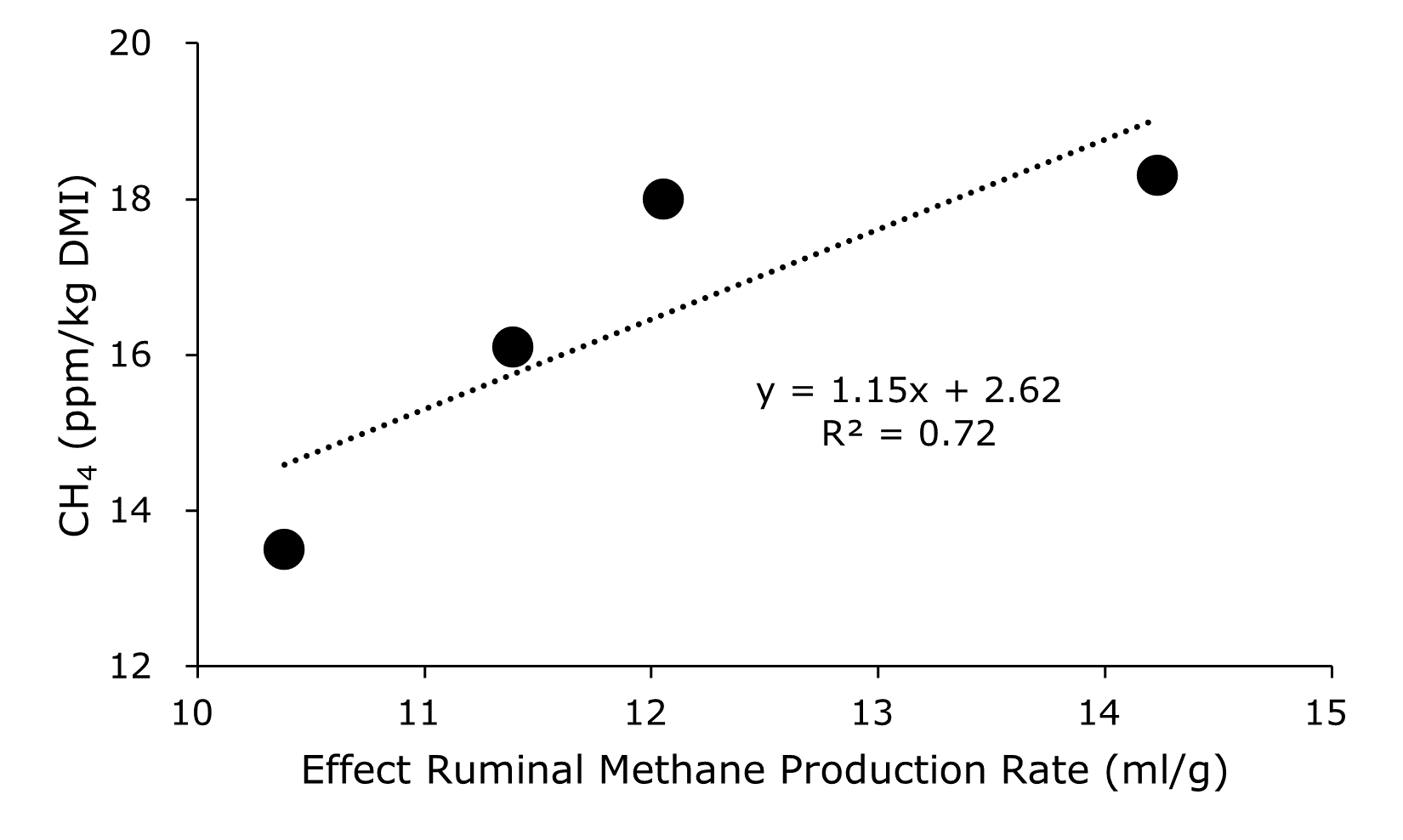
After determining the eRMR values for the test feeds, their application was evaluated using in vivo experimental data. Specifically, the reported treatment mean data from the studies by Kang et al. (2022) [32] and Oh et al. (2024) [33] were used, both of which measured methane emissions via the Laser Methane Detector (LMD) method. Kang et al. (2022) [32] investigated growing Hanwoo steers fed three dietary treatments: (1) 35% roughage with a low-energy concentrate, (2) 35% roughage with a high-energy concentrate, and (3) 25% roughage with a high-energy concentrate. Oh et al. (2024) [33] tested the effects of feeding four different CP levels—15%, 18%, 19%, and 21% (DM basis)—in the concentrate mix in early fattening Hanwoo steers.
Based on the feed composition data, eRMR values (mL/g DM) were calculated for each treatment group. The Pearson correlation between the predicted eRMR values and the measured methane concentration (ppm) in eructed gas per unit of dry matter intake (kg) was subsequently analyzed.

3. Results and Discussion

3.1. Standardization of In Vitro Fermentation Parameters of Feeds Using a Reference Diet

The reference diet, after 24 h of incubation, produced a total gas volume of 21.44 mL per 100 mg of DM, with methane production at 3.94 mL (Table 2). The 24 h TDDM was 757 g/kg DM, and methane production per gram of digested DM was 52.20 mL (Table 2). The values were summary of the data obtained from a total of 48 batch runs, including those batches with mixed diets for optimizing θ value.
The variability between batch runs tended to decrease as incubation time increased. At 24 h of incubation, the CV across the 48 batches was 5.1% for total gas production and 5.3% for TDDM, indicating relatively low variability. In contrast, methane production exhibited greater variability, with a CV of 14.6% per 100 mg of DM and 14.1% per gram of digested DM.
The results of IVRF can vary significantly depending on various experimental conditions, such as the conditions of rumen fluid, incubation environment, and sample handling [5]. While efforts have been made to standardize IVRF conditions, these efforts have primarily focused on standardizing inoculum properties by utilizing frozen rumen fluid, isolated mixed-rumen microbes, alternative enzymes, or pre-incubation treatment [34,35,36,37]. These standardization techniques may be suitable for studies aimed at assessing nutrient digestibility. However, due to the high sensitivity of rumen protozoa and methanogen to oxygen and temperature fluctuations [38,39], preserved inoculum sources are less appropriate for evaluating methane production rates [40]. To accurately simulate the rumen environment and methane production, it is crucial to use fresh rumen fluid under strictly anaerobic conditions.
To ensure consistency across IVRF, we included a reference diet in every batch of fermentations. Rather than attempting to standardize the inoculum itself, we used fresh rumen fluid to maintain the microbial populations as close to their natural state as possible. This approach allows for the standardization and correction of results based on the reference diet’s performance, thereby enhancing the reliability and comparability of the experimental outcomes. By consistently monitoring the fermentation characteristics of this reference diet across all batches, we were able to adjust for variations in fermentability, dry matter digestibility, and total gas and methane production between batches.
This correction method is particularly useful when assessing values characterizing feeds, which can be affected by inherent variability in the fermentation system. The inclusion of reference data allows for the normalization of key parameters, such as gas production, digestibility, and methane output, ensuring more accurate comparisons of eRMR across different feeds and feed varieties. Moreover, the reference diet serves as a control for identifying potential outliers or anomalies in specific batches due to unexpected experimental inconsistencies. Batches where the reference diet’s results fell outside the overall mean ± 1.5 × overall standard deviation were classified as abnormal and excluded from the analysis. The use of a reference diet thus provides a robust and reliable baseline, helping to detect systematic errors and improving the precision of the results.
Moreover, the reference die is also used to correct associative effects among feed ingredients. Associative effects, defined as interactions between feed ingredients within a ration [41], can influence the nutritional value of each feed component [15]. Since cattle rarely consume a single feed, the associative effects of mixed feeds should be considered when evaluating ruminal fermentation parameters of specific feeds. These effects are particularly significant between forage and concentrates [15,41,42]. To account for these interactions, we co-incubated the sample feed with a reference diet consisting of annual ryegrass, corn grain, and corn gluten feed in each batch. The parameter values for each feed sample were estimated by subtracting the corresponding values of the reference diet from the same batch. This approach enables the accurate estimation of the fermentation parameters of each sample feed, adjusting for the associative effects among the mixed feed ingredients in the typical diet of Hanwoo beef cattle.

3.2. Ruminal Fermentation Paramters of the Tested Feeds

Table 3 presents the total gas production kinetic parameters obtained by fitting a simple exponential equation to the total gas production profile. Multiple batches (replicates) were performed for each feed. With the feeds showing a high variation between batches, more IVRF were carried out, resulting in a range of replicates from two (rice bran) to six (canola meal and corn gluten feed).
The asymptotic maximum gas production (Vmax) across feeds averaged 25.7 mL/100 mg DM. The wide range in Vmax values, from 13.0 mL/100 mg DM in rice bran to 64.7 mL/100 mg DM in soybean hulls, reflects the diversity in chemical composition and microbial accessibility of the feeds tested. As expected, the fractional rate of digestion (kd) for the forages (i.e., timothy and ryegrass) were the lowest, at 0.071 h−1 and 0.060 h−1, respectively, indicating slower fermentation rates for these fiber-rich feeds. Concentrates had an average kd of 0.132 h−1, with soybean hulls (0.064 h−1) and ground corn (0.086 h−1) showing the lowest values, while rice bran (0.225 h−1) and copra meal (0.192 h−1) displayed the highest values. Since Vmax is closely related to kd during optimizing the parameters, a lower kd tends to be associated with higher estimated Vmax values, offsetting the overestimation of Vmax.
The observed variation in Vmax and kd across feed types aligns with previously reported findings in similar in vitro ruminal fermentation studies. A high Vmax associated with a low kd in the present study was in line with the observations by Hall et al. [43] and Seo et al. [44]. As consistent with previous studies, highly digestible carbohydrate-rich feedstuffs such as beet pulp, wheat bran, and grains yielded higher gas production due to their fermentability and nutrient availability to rumen microbes [45]. On the other hand, the lower Vmax observed for rice bran could be attributed to its higher oil content and the presence of phenolic compounds that can inhibit microbial fermentation [46]. Additionally, the significant variation in replicates observed for some feeds, such as soybean hulls and cottonseed hulls, highlights their inherent variability in fermentation potential, probably due to their heterogeneity of physical and chemical properties.
The 24-h TDDM was lower in the forages, with timothy and ryegrass having digestibility of 565 and 441 g/kg, respectively. Concentrates, on average, showed higher digestibility at 816 g/kg. Cottonseed hulls, however, exhibited a notably low digestibility of 450 g/kg, similar to the levels seen in forages, followed by palm kernel meal at 590 g/kg. In contrast, grounded wheat and corn grains were nearly completely digestible with values of 999 and 974 g/kg, respectively. Lupin and soybean meal also displayed high digestibility at 937 g/kg.
Lower TDDM in forages are expected, as these forages contain high levels of lignocellulose, which are slowly digested by rumen microbes [47]. For concentrates, the higher TDDM is consistent with their composition of more easily fermentable starches and sugars, which is rapidly degraded by amylolytic bacteria in the rumen [48]. A lower TDDM of cottonseed hull is likely due to its high fiber content and low protein digestibility, which makes it less accessible to rumen microbes, a result that aligns with previous studies indicating their limited use in diets requiring highly digestible feeds [49]. Palm kernel meal also reflects moderate digestibility likely due to its high fiber and fat content, which can reduce microbial degradation [50].
The methane production per gram of digested DM varied significantly among the tested feeds, reflecting differences in their chemical composition and fermentability (Table 4). When grouping the top five and bottom five feeds based on methane production per gram of digested DM at 6 h, the top group included copra meal, wheat bran, tapioca, beet pulp, and flaked corn grain. In contrast, excluding the forages (timothy and ryegrass), the bottom group consisted of rice bran, cottonseed hulls, corn gluten feed, DDGS, and soybean meal. A similar ranking was observed when grouping feeds based on methane production per gram of digested DM at 24 h. The top five feeds included wheat bran, copra meal, flaked corn grain, beet pulp, and palm kernel meal. The bottom group comprised rice bran, DDGS, canola meal, corn gluten feed, and cottonseed hulls, with the forages (timothy and ryegrass) positioned just above this bottom group. The top-ranked, highly fermentable feeds likely promote rapid microbial fermentation, increasing the production of hydrogen and, consequently, methane through methanogenesis, while the bottom-ranked feeds typically have higher fat or slowly digestible fiber and lower fermentation rates, resulting in lower microbial fermentation and reduced methane generation [51].
These findings are consistent with previous research by Chen et al. [6], who evaluated methane production per gram of digested DM after 48 h of in vitro incubation in various feedstuffs. Their study demonstrated higher methane outputs for fibrous concentrates and forages compared to grains and proteinous by-products: 54.9 mL for fibrous concentrates (beet pulp, soybean hulls, wheat bran), 53.7 mL for forages (alfalfa hay, Bermuda hay, corn silage), 44.9 mL for grains (barley, corn, wheat), and 36.8 mL for proteinous by-products (DDGS, soybean meal, rapeseed meal). The relatively high methane production from forages in their study is likely due to the lower NDF content and higher digestibility of the specific forages used in their study, as well as the extended fermentation period of up to 48 h. Methane typically represents only 9–10% of the total gas produced during the initial 3.5 h of in vitro fermentation, but this proportion increases sharply to 28–30% after 24 h of incubation (Braidot et al., 2023 [52]). Consequently, prolonged incubation leads to increased methane production.

3.3. Determination and Application of Effective RUMINAL Methane Production Rate

Table 4 presents the eRMR, which was estimated considering the NDF content, forage ratio, and rumen fermentation dynamics of the test feeds. It is important to note that the unit of eRMR in this study is expressed as methane production (mL) per gram of DM, which differs from the units used by Chen et al. (2016) [6], but is consistent with the units used by Lee et al. (2003) [8] and Kim et al. (2013) [7], who measured the methane gas emission potential of different feeds.
The eRMR for the reference diet, which was composed of a mixture of forage, grain, and protein- and fiber-rich by-product, was 14.8 mL/g DM. Based on the average dry matter intake of 9.6 kg/day for an early fattening stage Hanwoo steer weighing 476 kg, as reported by Cho et al. [29], a Hanwoo steer consuming the reference diet is estimated to emit 142.3 L of methane per day. This corresponds to an annual methane emission of approximately 37.2 kg/year, based on a methane density of 0.7157 g/L, which is comparable to the methane emission estimate of 36.2 kg/year per steer calculated using the Intergovernmental Panel on Climate Change (IPCC) Tier 2 method [53].
Among the feeds tested, soybean hulls had the highest eRMR, at 56.7 mL/g DM, followed by copra meal, beet pulp, wheat bran, and palm kernel meal. The forages, ryegrass and timothy, were ranked just below these top five feeds. In contrast, soybean meal had the lowest eRMR, at 1.2 mL/g DM, with corn grain, flaked corn grain, rice bran, and wheat grain also ranking in the bottom five, all with eRMR values below 4 mL/g DM (Table 4). The relatively high content of fiber (i.e., aNDF) of a feed ingredient is a key determinant of higher eRMR. However, the feed’s k p is also a significant factor, as a lower k p leads to longer retention time in the rumen, consequently resulting in increased ruminal methane production.
The relative ranking of eRMR among the tested feed is far different from the previous studies that have typically suggested higher methane emissions from grains compared to fibrous feeds. For instance, Lee et al. [8] calculated the methane emission index using wheat flour as a reference (index 100) and ranked feed ingredients as follows: wheat flour (100), wheat (98), soybean hulls (96), corn (89), and tapioca (88). Lower indices were reported for palm meal (34), soybean hulls (29), rice straw (21), and fish meal (14). Similarly, Kim et al. [7] and Braidot et al. [52] concluded that grains tend to have higher methane emission potential.
It is not surprising that highly fermentable feeds produce more total gas and methane during discontinuous in vitro fermentation. The present study also showed that grains produced a high level of methane after 24 h incubation. However, this does not happen in vivo. Enteric methane production is positively related to the level of forage and NDF in the diet while negatively correlated with the level of concentrate and dietary fat [32,54]. The higher methane production potential of grains in the previous studies is an artifact of determining the potential without considering the dynamics of digestion, especially particle flow, in the rumen.
Since enteric methane production is an outcome of fermentation, the extent of enteric methane production should follow the digestion dynamics in the rumen. Ruminal digestion is commonly described as a competition between digestion and passage. Therefore, the rate of digestion by microbial enzymes and that of passage out of the rumen determine the extent of fermentation of feed nutrients in the rumen [47]. Danielsson et al. [13] recognized the importance of rumen dynamics to predict enteric methane production of a mixed diet using IVRF system. They estimated the rate of methane production of a diet based on IVRF according to the method by Ramin and Huhtanen [12], and the retention time of a diet in the rumen was calculated using the fractional rate of passage estimated based on NDF and forage content in the diet. With this approach, they successfully predicted methane in vivo production using IVRF measurement (R2 = 0.94, RMSPE = 51.6 L/d).
A similar concept, but different approach, was used in our study. Our system emphasized on the initial fermentation phase—up to 24 h of incubation. In the actual rumen, a consistent supply of nutrients and buffers is provided, while fermentation end-products are continuously removed, creating a significant difference from in vitro conditions. Particularly, after about 10 h from the start of incubation, the rate of gas production decreases, microbial autolysis occurs, and shifts in the metabolic pathways of microbial fermentation are observed [55]. To address these dynamics, we estimated kinetic parameters using values from early incubation times (2, 4, 6, and 24 h) and calculated the methane production rate per unit of digested feed at 6 and 24 h of incubation. The methane production rate at 6 h of incubation significantly influences the eRMR during numerical integration using a linear equation of methane production rate (Equation (3)).
The eRMR values of tested feed ingredients obtained from our system precisely predicts in vivo enteric methane emissions in Hanwoo beef cattle. When the eRMR values of the experimental diets were calculated based on the eRMR values of individual feed ingredient (Table 4) and their composition in the diets, the predicted eRMR explained 87% and 72% of the variations in enteric methane emissions in Hanwoo steers, reported by Kang et al. [32] and Oh et al. [33], respectively (Figure 1 and Figure 2). This finding is particularly noteworthy, as our eRMR system resolves a previously unexplained issue in Oh et al. [33]. The authors admitted that “it is unclear how the ruminal methane concentration was negatively affected by the CP content in the present study”. The strong correlation between eRMR and measured enteric methane emissions (r = 0.85) indicates that the reduction in methane emissions associated with increased CP content was not due to the protein itself but rather to the replacement of high-eRMR feed with relatively low-eRMR feed. In other words, the reduction in methane emissions resulted from changes in the composition of feed ingredients.
Our system is both unique and practical for optimizing diet formulation to control methane emissions from cattle. While die formulation as a tool for mitigating enteric methane emissions has been of great interest, its practical application has remained unachieved [57]. It is widely recognized that certain feeds have lower methane production potential than others, and incorporating such feeds into the diet can reduce methane emissions [58]. However, this has been particularly challenging because measuring the methane production potentials of individual feedstuffs in vivo is difficult, and values obtained from traditional in vitro systems often fail to align with in vivo observations [57]. Moreover, as noted by Hristov [57], typical in vitro systems test feeds individually and cannot account for interactions—associative effects—among feeds and nutrients within a complete diet. Our system addresses these challenges by introducing a reference diet and modeling rumen dynamics to determine the eRMR values of individual feed ingredients. While the in vitro system developed by Danielsson et al. [13] has also demonstrated precise predictions of in vivo methane emissions from cattle, as seen in a recent publication [59], it is limited to mixed feeds and unsuitable for estimating the methane production potential of individual feed ingredient. In contrast, our system provides a more comprehensive approach, enabling precise assessments at both the ingredient and diet levels.
Our study still has several limitations. While the eRMR values successfully ranked the relative methane production potential of diets, they have not been evaluated against the absolute values of in vivo enteric methane emissions. Further studies are warranted to evaluate the calculated eRMR values using methane emissions measured with respiratory chambers or the GreenFeed system (C-Lock Inc., Rapid City, SD, USA). Moreover, the reference diet may influence the eRMR values obtained from our system. As the reference diet used in this study was specific to Hanwoo steers, testing various reference diets or developing customized reference diets is necessary to expand the applicability of our eRMR system, particularly for dairy cattle.

4. Conclusions

The enhanced in vitro fermentation system evaluates the methane production potential of feeds, expressed as eRMR. By integrating rumen dynamics with a reduced sampling schedule, the system provides precise predictions of in vivo enteric methane production from feeds. This system serves as a valuable tool for optimizing diet formulations to reduce methane emissions from cattle.

Author Contributions

Conceptualization, S.S.; methodology, S.S.; data curation, S.S.; formal analysis, S.S.; investigation, M.L.; funding acquisition, S.S.; supervision, M.L. and S.S.; writing—original draft, S.S.; writing—reviewing & editing, S.S. All authors have read and agreed to the published version of the manuscript.

Funding

This research was funded by Korea Institute of Planning and Evaluation for Technology in Food, Agriculture and Forestry (IPET) through Livestock Industrialization Technology Development Program, funded by Ministry of Agriculture, Food and Rural Affairs (321083-5).

Institutional Review Board Statement

The animal study protocol was approved on 1 April 2023 by the Chungnam National University Animal Research Ethics Committee (202304A-CNU-005).

Informed Consent Statement

Not applicable.

Data Availability Statement

The original contributions presented in the study are included in the article, further inquiries can be directed to the corresponding author.

Acknowledgments

The authors thank Migun Choi for her help in this experiment. During the preparation of this manuscript, the authors used ChatGPT (GPT-4o) for the purposes of English editing. The authors have reviewed and edited the output and take full responsibility for the content of this publication.

Conflicts of Interest

The authors declare no conflicts of interest.

Abbreviations

The following abbreviations are used in this manuscript:
AOACAssociation of Official Analytical Chemists
BWBody weight
CH4Methane
CPCrude protein
DDGSDistiller’s grain with solubles
DMDry matter
eRMReffective ruminal methane production rate
GHGGreenhouse gas
IVRFIn vitro ruminal fermentation
kdRuminal fractional rate of digestion
kpRuminal fractional rate of passage
NDFNeutral detergent fiber
TDDMTrue dry matter digestibility
VmaxAsymptotic maximum gas production

References

  1. Johnson, K.A.; Johnson, D.E. Methane emissions from cattle. J. Anim. Sci. 1995, 73, 2483–2492. [Google Scholar] [CrossRef]
  2. van Lingen, H.J.; Niu, M.; Kebreab, E.; Valadares Filho, S.C.; Rooke, J.A.; Duthie, C.-A.; Schwarm, A.; Kreuzer, M.; Hynd, P.I.; Caetano, M.; et al. Prediction of enteric methane production, yield and intensity of beef cattle using an intercontinental database. Agric. Ecosyst. Environ. 2019, 283, 106575. [Google Scholar] [CrossRef]
  3. Tedeschi, L.O.; Abdalla, A.L.; Álvarez, C.; Anuga, S.W.; Arango, J.; Beauchemin, K.A.; Becquet, P.; Berndt, A.; Burns, R.; De Camillis, C.; et al. Quantification of methane emitted by ruminants: A review of methods. J. Anim. Sci. 2022, 100, skac197. [Google Scholar] [CrossRef]
  4. Hill, J.; McSweeney, C.; Wright, A.-D.G.; Bishop-Hurley, G.; Kalantar-zadeh, K. Measuring methane production from ruminants. Trends Biotechnol. 2016, 34, 26–35. [Google Scholar] [CrossRef]
  5. Yáñez-Ruiz, D.R.; Bannink, A.; Dijkstra, J.; Kebreab, E.; Morgavi, D.P.; O’Kiely, P.; Reynolds, C.K.; Schwarm, A.; Shingfield, K.J.; Yu, Z.; et al. Design, implementation and interpretation of in vitro batch culture experiments to assess enteric methane mitigation in ruminants—A review. Anim. Feed. Sci. Technol. 2016, 216, 1–18. [Google Scholar] [CrossRef]
  6. Chen, C.-N.; Lee, T.-T.; Yu, B. Improving the prediction of methane production determined by in vitro gas production technique for ruminants. Ann. Anim. Sci. 2016, 16, 565–584. [Google Scholar] [CrossRef]
  7. Kim, S.-H.; Mamuad, L.L.; Jeong, C.-D.; Choi, Y.-J.; Lee, S.S.; Ko, J.-Y.; Lee, S.-S. In vitro evaluation of different feeds for their potential to generate methane and change methanogen diversity. Asian-Australas. J. Anim. Sci. 2013, 26, 1698–1707. [Google Scholar] [CrossRef]
  8. Lee, H.J.; Lee, S.C.; Kim, J.D.; Oh, Y.G.; Kim, B.K.; Kim, C.W.; Kim, K.J. Methane production potential of feed ingredients as measured by in vitro gas test. Asian-Australas. J. Anim. Sci. 2003, 16, 1143–1150. [Google Scholar] [CrossRef]
  9. Dillard, S.L.; Roca-Fernández, A.I.; Rubano, M.D.; Soder, K.J. Evaluation of a single-flow continuous culture fermenter system for determination of ruminal fermentation and enteric methane production. J. Anim. Physiol. Anim. Nutr. 2019, 103, 1313–1324. [Google Scholar] [CrossRef]
  10. Eun, J.S.; Fellner, V.; Gumpertz, M.L. Methane production by mixed ruminal cultures incubated in dual-flow fermentors. J. Dairy Sci. 2004, 87, 112–121. [Google Scholar] [CrossRef]
  11. García-González, R.; González, J.S.; López, S. Decrease of ruminal methane production in Rusitec fermenters through the addition of plant material from rhubarb (Rheum spp.) and alder buckthorn (Frangula alnus). J. Dairy Sci. 2010, 93, 3755–3763. [Google Scholar] [CrossRef]
  12. Ramin, M.; Huhtanen, P. Development of an in vitro method for determination of methane production kinetics using a fully automated in vitro gas system—A modelling approach. Anim. Feed Sci. Technol. 2012, 174, 190–200. [Google Scholar] [CrossRef]
  13. Danielsson, R.; Ramin, M.; Bertilsson, J.; Lund, P.; Huhtanen, P. Evaluation of a gas in vitro system for predicting methane production in vivo. J. Dairy Sci. 2017, 100, 8881–8894. [Google Scholar] [CrossRef]
  14. Kang, H. Revision of In Vitro Rumen Fermentation Technique Using Rumen Fluid to Estimate Ruminal Fermentability of Carbohydrate-Based Feeds. Master's thesis, Chungnam National University, Daejeon, Republic of Korea, 2023. [Google Scholar]
  15. Sun, L.; Lee, M.; Jeon, S.; Seo, S. Evaluation of the associative effects of rice straw with timothy hay and corn grain using an in vitro ruminal gas production technique. Animals 2020, 10, 325. [Google Scholar] [CrossRef]
  16. Jeon, S.; Sohn, K.-N.; Seo, S. Evaluation of feed value of a by-product of pickled radish for ruminants: Analyses of nutrient composition, storage stability, and in vitro ruminal fermentation. J. Anim. Sci. Technol. 2016, 58, 34. [Google Scholar] [CrossRef]
  17. Goering, H.K.; Van Soest, P.J. Forage Fiber Analyses (Apparatus, Reagents, Procedures, and Some Applications); U.S. Agricultural Research Service: Washington, DC, USA, 1970.
  18. Van Soest, P.J.; Robertson, J.B.; Lewis, B.A. Methods for dietary fiber, neutral detergent fiber, and nonstarch polysaccharides in relation to animal nutrition. J. Dairy Sci. 1991, 74, 3583–3597. [Google Scholar] [CrossRef]
  19. Licitra, G.; Hernandez, T.M.; Van Soest, P.J. Standardization of procedures for nitrogen fractionation of ruminant feeds. Anim. Feed Sci. Technol. 1996, 57, 347–358. [Google Scholar] [CrossRef]
  20. Hall, M.B.; Hoover, W.H.; Jennings, J.P.; Webster, T.K.M. A method for partitioning neutral detergent-soluble carbohydrates. J. Sci. Food Agric. 1999, 79, 2079–2086. [Google Scholar] [CrossRef]
  21. Hall, M.B. Determination of starch, including maltooligosaccharides, in animal feeds: Comparison of methods and a method recommended for AOAC collaborative study. J. AOAC Int. 2009, 92, 42–49. [Google Scholar] [CrossRef]
  22. NRC. Nutrient Requirements of Dairy Cattle, 7th ed.; National Academy Press: Washington, DC, USA, 2001. [Google Scholar]
  23. Pell, A.N.; Schofield, P. Computerized monitoring of gas production to measure forage digestion in vitro. J. Dairy Sci. 1993, 76, 1063–1073. [Google Scholar] [CrossRef]
  24. Raffrenato, E.; Nicholson, C.F.; Van Amburgh, M.E. Development of a mathematical model to predict pool sizes and rates of digestion of 2 pools of digestible neutral detergent fiber and an undigested neutral detergent fiber fraction within various forages. J. Dairy Sci. 2019, 102, 351–364. [Google Scholar] [CrossRef] [PubMed]
  25. Goeser, J.P.; Combs, D.K. An alternative method to assess 24-h ruminal in vitro neutral detergent fiber digestibility. J. Dairy Sci. 2009, 92, 3833–3841. [Google Scholar] [CrossRef] [PubMed]
  26. Robinson, P.H.; Givens, D.I.; Getachew, G. Evaluation of NRC, UC Davis and ADAS approaches to estimate the metabolizable energy values of feeds at maintenance energy intake from equations utilizing chemical assays and in vitro determinations. Anim. Feed Sci. Technol. 2004, 114, 75–90. [Google Scholar] [CrossRef]
  27. Schofield, P.; Pitt, R.E.; Pell, A.N. Kinetics of fiber digestion from in vitro gas production. J. Anim. Sci. 1994, 72, 2980–2991. [Google Scholar] [CrossRef]
  28. Seo, S.; Tedeschi, L.O.; Lanzas, C.; Schwab, C.G.; Fox, D.G. Development and evaluation of empirical equations to predict feed passage rate in cattle. Anim. Feed Sci. Technol. 2006, 128, 67–83. [Google Scholar] [CrossRef]
  29. Cho, H.; Kang, K.; Kang, H.; Jeon, S.; Lee, M.; Park, E.; Hong, S.; Seo, S. Repeatability of feed efficiency and its relationship with carcass traits in Hanwoo steers during their entire growing and fattening period. Anim. Biosci. 2024, 37, 1568–1580. [Google Scholar] [CrossRef]
  30. R Core Team R: A Language and Environment for Statistical Computing; R Foundation for Statistical Computing: Vienna, Austria, 2024.
  31. Soetaert, K.; Petzoldt, T.; Setzer, R.W. Solving differential equations in R: Package deSolve. J. Stat. Softw. 2010, 33, 1–25. [Google Scholar] [CrossRef]
  32. Kang, K.; Cho, H.; Jeong, S.; Jeon, S.; Lee, M.; Lee, S.; Baek, Y.; Oh, J.; Seo, S. Application of a hand-held laser methane detector for measuring enteric methane emissions from cattle in intensive farming. J. Anim. Sci. 2022, 100, skac211. [Google Scholar] [CrossRef] [PubMed]
  33. Oh, J.; Cho, H.; Jeong, S.; Kang, K.; Lee, M.; Jeon, S.; Kang, H.; Seo, S. Effects of dietary crude protein level of concentrate mix on growth performance, rumen characteristics, blood metabolites, and methane emissions in fattening Hanwoo steers. Animals 2024, 14, 469. [Google Scholar] [CrossRef]
  34. Luchini, N.D.; Broderick, G.A.; Combs, D.K. In vitro determination of ruminal protein degradation using freeze-stored ruminal microorganisms. J. Anim. Sci. 1996, 74, 2488–2499. [Google Scholar] [CrossRef][Green Version]
  35. Iowerth, D.; Jones, H.; Hayward, M.V. The effect of pepsin pretreatment of herbage on the prediction of dry matter digestibility from solubility in fungal cellulase solutions. J. Sci. Food Agric. 1975, 26, 711–718. [Google Scholar] [CrossRef]
  36. Goeser, J.P.; Hoffman, P.C.; Combs, D.K. Modification of a rumen fluid priming technique for measuring in vitro neutral detergent fiber digestibility. J. Dairy Sci. 2009, 92, 3842–3848. [Google Scholar] [CrossRef]
  37. Fabro, C.; Sarnataro, C.; Spanghero, M. Impacts of rumen fluid, refrigerated or reconstituted from a refrigerated pellet, on gas production measured at 24h of fermentation. Anim. Feed Sci. Technol. 2020, 268, 114585. [Google Scholar] [CrossRef]
  38. Tunkala, B.Z.; DiGiacomo, K.; Alvarez Hess, P.S.; Dunshea, F.R.; Leury, B.J. Rumen fluid preservation for in vitro gas production systems. Anim. Feed Sci. Technol. 2022, 292, 115405. [Google Scholar] [CrossRef]
  39. Park, T.; Yu, Z. Aerobic cultivation of anaerobic rumen protozoa, Entodinium caudatum and Epidinium caudatum. J. Microbiol. Methods 2018, 152, 186–193. [Google Scholar] [CrossRef]
  40. Tunkala, B.Z.; DiGiacomo, K.; Alvarez Hess, P.S.; Dunshea, F.R.; Leury, B.J. Impact of rumen fluid storage on in vitro feed fermentation characteristics. Fermentation 2023, 9, 392. [Google Scholar] [CrossRef]
  41. Mould, F.L.; Ørskov, E.R.; Mann, S.O. Associative effects of mixed feeds. I. effects of type and level of supplementation and the influence of the rumen fluid pH on cellulolysis in vivo and dry matter digestion of various roughages. Anim. Feed Sci. Technol. 1983, 10, 15–30. [Google Scholar] [CrossRef]
  42. Sun, P.F.; Wu, Y.M.; Liu, J.X. In vitro gas production technique to evaluate associative effects among lucerne hay, rice straw and maize silage. J. Anim. Feed Sci. 2007, 16, 272–277. [Google Scholar] [CrossRef]
  43. Hall, M.B.; Pell, A.N.; Chase, L.E. Characteristics of neutral detergent-soluble fiber fermentation by mixed ruminal microbes. Anim. Feed Sci. Technol. 1998, 70, 23–39. [Google Scholar] [CrossRef]
  44. Seo, S.; Lee, S.C.; Lee, S.Y.; Seo, J.G.; Ha, J.K. Degradation kinetics of carbohydrate fractions of ruminant feeds using automated gas production technique. Asian-Australas. J. Anim. Sci. 2009, 22, 356–364. [Google Scholar] [CrossRef]
  45. Getachew, G.; Robinson, P.H.; DePeters, E.J.; Taylor, S.J. Relationships between chemical composition, dry matter degradation and in vitro gas production of several ruminant feeds. Anim. Feed Sci. Technol. 2004, 111, 57–71. [Google Scholar] [CrossRef]
  46. Getachew, G.; DePeters, E.J.; Robinson, P.H.; Fadel, J.G. Use of an in vitro rumen gas production technique to evaluate microbial fermentation of ruminant feeds and its impact on fermentation products. Anim. Feed Sci. Technol. 2005, 123–124, 547–559. [Google Scholar] [CrossRef]
  47. Van Soest, P.J. Nutritional Ecology of the Ruminant; Cornell University Press: Ithaca, NY, USA, 1994. [Google Scholar]
  48. Huntington, G.B. Starch utilization by ruminants: From basics to the bunk. J. Anim. Sci. 1997, 75, 852–867. [Google Scholar] [CrossRef]
  49. Hale, W.H.; Lambeth, C.; Theurer, B.; Ray, D.E. Digestibility and utilization of cottonseed hulls by cattle. J. Anim. Sci. 1969, 29, 773–776. [Google Scholar] [CrossRef]
  50. O’Mara, F.P.; Mulligan, F.J.; Cronin, E.J.; Rath, M.; Caffrey, P.J. The nutritive value of palm kernel meal measured in vivo and using rumen fluid and enzymatic techniques. Livest. Prod. Sci. 1999, 60, 305–316. [Google Scholar] [CrossRef]
  51. Morgavi, D.P.; Forano, E.; Martin, C.; Newbold, C.J. Microbial ecosystem and methanogenesis in ruminants. Animal 2010, 4, 1024–1036. [Google Scholar] [CrossRef]
  52. Braidot, M.; Sarnataro, C.; Romanzin, A.; Spanghero, M. A new equipment for continuous measurement of methane production in a batch in vitro rumen system. J. Anim. Physiol. Anim. Nutr. 2023, 107, 747–753. [Google Scholar] [CrossRef] [PubMed]
  53. Jo, N.; Kim, J.; Seo, S. Comparison of models for estimating methane emission factor for enteric fermentation of growing-finishing Hanwoo steers. SpringerPlus 2016, 5, 1212. [Google Scholar] [CrossRef]
  54. Niu, M.; Kebreab, E.; Hristov, A.N.; Oh, J.; Arndt, C.; Bannink, A.; Bayat, A.R.; Brito, A.F.; Boland, T.; Casper, D.; et al. Prediction of enteric methane production, yield, and intensity in dairy cattle using an intercontinental database. Glob. Change Biol. 2018, 24, 3368–3389. [Google Scholar] [CrossRef]
  55. Cone, J.W.; van Gelder, A.H.; Visscher, G.J.W.; Oudshoorn, L. Influence of rumen fluid and substrate concentration on fermentation kinetics measured with a fully automated time related gas production apparatus. Anim. Feed Sci. Technol. 1996, 61, 113–128. [Google Scholar] [CrossRef]
  56. Oh, J.; Cho, H.; Kang, N.; Lee, M.; Hoque, M.R.; Kim, Y.Y.; Seo, S. Effects of dietary crude protein levels on growth performance, rumen characteristics, blood metabolites, and methane emissions in finishing Hanwoo steers. Asian-Australas. J. Anim. Sci. 2025, 38, 1934–1942. [Google Scholar] [CrossRef] [PubMed]
  57. Hristov, A.N. Invited review: Advances in nutrition and feed additives to mitigate enteric methane emissions. J. Dairy Sci. 2024, 107, 4129–4146. [Google Scholar] [CrossRef]
  58. Hristov, A.N.; Oh, J.; Firkins, J.L.; Dijkstra, J.; Kebreab, E.; Waghorn, G.; Makkar, H.P.; Adesogan, A.T.; Yang, W.; Lee, C.; et al. Special topics--Mitigation of methane and nitrous oxide emissions from animal operations: I. A review of enteric methane mitigation options. J. Anim. Sci. 2013, 91, 5045–5069. [Google Scholar] [CrossRef] [PubMed]
  59. Fant, P.; Ramin, M. Relationship between predicted in vivo and observed in vivo methane production from dairy cows fed a grass-silage based diet with barley, oats, or dehulled oats as a concentrate supplement. Anim. Feed Sci. Technol. 2024, 311, 115955. [Google Scholar] [CrossRef]
Figure 1. Plot of the treatment means of CH4 concentration in the exhaled gas from eructation per dry matter (ppm/kg) against the effective ruminal methane production rate (mL/g) estimated based on the formular presented in Kang et al. [32]. The line represents the best-fit regression.
Fermentation 11 00681 g001
Figure 2. Plot of the treatment means of CH4 concentration in the exhaled gas from eructation per dry matter (ppm/kg) against the effective ruminal methane production rate (mL/g) estimated based on the formular presented in Oh et al. [56]. The line represents the best-fit regression.
Fermentation 11 00681 g002
Table 1. Analyzed chemical composition (g/kg DM or as stated) of feedstuffs.
Item 1Corn GrainFlaked CornWheat GrainTapiocaLupinSoybean MealCanola MealCopra MealPalm Kernel Meal
DM, g/kg as fed849858891894905900904905916
OM984980977918963928904923951
CP908612934308531415245184
SOLP308322260891563045
NDICP41091881317135123
ADICP2941244101846
Crude fiber15252420116860115165220
aNDF85120123290281100267603701
ADF27553119019855177301483
ADL1528147123117373134
Starch719713653398129121
Ether extract434512185521131967
Ash162023823772967749
TDN, % DM88.385.182.765.081.081.064.358.655.1
ME, MJ/kg12.211.811.89.312.613.811.49.98.8
NEm, MJ/kg9.08.68.55.99.09.87.45.95.1
NEg, MJ/kg6.15.85.73.46.16.94.83.52.8
NEl, MJ/kg7.87.57.55.78.08.97.26.25.4
Carbohydrate850849836866600376476660700
NFC770741722594327290226192123
Item 1DDGSCorn Gluten FeedSoybean HullCotton Seed HullRice BranWheat BranBeet PulpTimothy HayAnnual Ryegrass Straw
DM, g/kg as fed908929894913910906920920898
OM934912948947897937961911957
CP294230110741491839810047
SOLP601682818574065014
NDICP331645302067401012
ADICP2741124891861
Crude fiber849738443610492228413440
aNDF388405739702254435493679785
ADF188124507557135123270440503
ADL1816221665639335184
Starch3098211210243415
Ether extract9030181915231111811
Ash6688525310363398943
TDN, % DM80.270.863.142.383.269.567.554.450.0
ME, MJ/kg12.411.09.56.011.910.69.98.37.2
NEm, MJ/kg8.87.45.92.98.67.16.44.73.9
NEg, MJ/kg6.04.83.50.75.84.53.92.41.6
NEl, MJ/kg7.97.05.93.47.66.76.25.04.3
Carbohydrate551653820854596723852793899
NFC196264126182363355400124126
1 DM: dry matter; OM: organic matter; CP: crude protein; SOLP: soluble CP; NDICP: neutral detergent insoluble CP; ADICP: acid detergent insoluble CP; aNDF: neutral detergent fiber analyzed using a heat stable amylase and expressed inclusive of residual ash; ADF: acid detergent fiber; ADL: acid detergent lignin; TDN: total digestible nutrients; ME: metabolizable energy; NEm: net energy for maintenance; NEg: net energy for growth; NFC: non-fiber carbohydrate.
Table 2. In vitro ruminal fermentation parameters of the reference diet (n = 48).
ItemIncubation TimeMeanSDCV
Total gas production
(mL/100 mg DM)
23.130.520.166
46.130.840.138
69.701.020.105
2421.441.100.051
Methane production
(mL/100 mg DM)
20.400.110.268
40.920.240.260
61.500.330.220
243.940.570.146
Methane production
(mL/g true digested DM)
627.395.860.214
2452.207.350.141
True dry matter digestibility (%)656.124.580.082
2475.714.040.053
Mixture of annual ryegrass, corn grain, and corn gluten feed with a ratio of 1:1:1.
Table 3. Gas production profile and 24 h true dry matter (DM) digestibility of the tested feeds.
FeedBatchesTotal Gas Production24 h True DM Digestibility, g/kg
Vmax, mL/100 mg DMkd, h−1Lag, h
Reference diet 29 24.3 ± 0.000.092 ± 0.00010.59 ± 0.002756 ± 0.6
Corn grain535.8 ± 2.150.086 ± 0.00621.11 ± 0.267974 ± 50.7
Flaked corn grain535.1 ± 3.450.097 ± 0.01381.05 ± 0.246921 ± 117.0
Wheat grain331.4 ± 1.100.167 ± 0.01751.10 ± 0.140999 ± 58.6
Tapioca526.8 ± 1.450.184 ± 0.01020.94 ± 0.306823 ± 128.4
Lupin325.2 ± 1.980.147 ± 0.05660.65 ± 0.534937 ± 11.4
Soybean meal221.5 ± 0.150.153 ± 0.01520.32 ± 0.354937 ± 66.5
Canola meal616.7 ± 1.000.147 ± 0.02820.26 ± 0.187843 ± 47.7
Copra meal523.6 ± 1.570.192 ± 0.03660.63 ± 0.213859 ± 149.9
Palm kernel meal 419.8 ± 0.820.102 ± 0.03540.28 ± 0.289590 ± 28.3
DDGS318.2 ± 1.420.121 ± 0.00900.05 ± 0.087810 ± 85.0
Corn gluten feed625.0 ± 2.570.087 ± 0.02300.14 ± 0.185882 ± 89.5
Soybean hull564.7 ± 35.770.064 ± 0.07990.26 ± 0.581828 ± 116.7
Cotton seed hull417.0 ± 6.680.091 ± 0.06410.19 ± 0.370450 ± 16.7
Rice bran213.0 ± 4.450.225 ± 0.00240.96 ± 0.205651 ± 99.0
Wheat bran423.9 ± 0.950.144 ± 0.01640.72 ± 0.030767 ± 41.0
Beet pulp330.6 ± 1.380.139 ± 0.00251.01 ± 0.233838 ± 60.4
Timothy hay121.20.0710.00565
Annual ryegrass415.0 ± 5.550.060 ± 0.03330.00 ± 0.000441 ± 88.7
Mixture of annual ryegrass, corn grain, and corn gluten feed with a ratio of 1:1:1. Only the reference diet from the batches in this study was included.
Table 4. Methane production rate (mL/g of true digested dry matter) of the tested feeds.
FeedMethane Production
(mL/g of True Digested Dry Matter)
Effective Ruminal Methane Production Rate
(mL/g Dry Matter)
6 h24 h
Reference diet 27.46 ± 0.10839.82 ± 0.08814.82 ± 0.068
Corn grain28.36 ± 3.43338.11 ± 5.1331.74 ± 0.537
Flaked corn grain33.51 ± 6.59346.63 ± 9.7002.06 ± 0.493
Wheat grain29.37 ± 2.49741.81 ± 6.1303.23 ± 0.473
Tapioca35.46 ± 10.24444.26 ± 5.77112.42 ± 6.018
Lupin30.13 ± 2.07340.74 ± 4.36815.80 ± 1.947
Soybean meal18.78 ± 5.83435.05 ± 6.1241.15 ± 0.495
Canola meal18.87 ± 3.59925.07 ± 9.5624.98 ± 1.495
Copra meal39.28 ± 2.41247.05 ± 9.42731.02 ± 6.74
Palm kernel meal 32.44 ± 6.88444.89 ± 10.14420.65 ± 4.735
DDGS18.40 ± 2.55224.94 ± 3.4776.70 ± 1.082
Corn gluten feed17.30 ± 6.71126.63 ± 15.1179.15 ± 3.272
Soybean hull19.28 ± 26.28640.93 ± 9.83856.74 ± 27.688
Cotton seed hull13.61 ± 11.25428.51 ± 8.95512.10 ± 8.492
Rice bran13.25 ± 1.65518.37 ± 0.5802.30 ± 0.283
Wheat bran39.16 ± 6.24748.86 ± 5.03422.88 ± 2.347
Beet pulp35.41 ± 9.10546.42 ± 6.88324.13 ± 5.024
Timothy hay17.4930.5416.10
Annual ryegrass12.18 ± 8.16433.22 ± 6.73720.13 ± 8.295
Mixture of annual ryegrass, corn grain, and corn gluten feed with a ratio of 1:1:1.
Disclaimer/Publisher’s Note: The statements, opinions and data contained in all publications are solely those of the individual author(s) and contributor(s) and not of MDPI and/or the editor(s). MDPI and/or the editor(s) disclaim responsibility for any injury to people or property resulting from any ideas, methods, instructions or products referred to in the content.