Article

Candida utilis Biosurfactant from Licuri Oil: Influence of Culture Medium and Emulsion Stability in Food Applications

by
Lívia Xavier de Araújo
1,
Peterson Felipe Ferreira da Silva
2,
Renata Raianny da Silva
3,
Leonie Asfora Sarubbo
4,5,
Jorge Luíz Silveira Sonego
6 and
Jenyffer Medeiros Campos Guerra
1,*
1
Programa de Pós-Graduação em Engenharia Química, Departamento de Engenharia Química, Centro de Tecnologia e Geociências, Universidade Federal de Pernambuco (UFPE), Professor Moraes Rego Avenue, n. 1235, Cidade Universitária, Recife 50670-901, PE, Brazil
2
Department of Food Engineering, School of Food Engineering, University of Campinas, UNICAMP, Rua Monteiro Lobato, 80, Campinas 13083-862, SP, Brazil
3
Rede Nordeste de Biotecnologia (RENORBIO), Universidade Federal Rural de Pernambuco (UFRPE), Rua Dom Manuel de Medeiros, s/n—Dois Irmãos, Recife 52171-900, PE, Brazil
4
Instituto Avançado de Tecnologia e Inovação (IATI), Rua Potyra, n. 31, Prado, Recife 50070-280, PE, Brazil
5
Escola Icam Tech, Universidade Católica de Pernambuco (UNICAP), Rua do Príncipe, n. 526, Boa Vista, Recife 50050-900, PE, Brazil
6
Biotechnology Graduate Program, Department of Antibiotics, Federal University of Pernambuco, Professor Moraes Rego Avenue, n. 1235, Cidade Universitária, Recife 50670-901, PE, Brazil
*
Author to whom correspondence should be addressed.
Fermentation 2025, 11(12), 679; https://doi.org/10.3390/fermentation11120679
Submission received: 24 October 2025 / Revised: 1 December 2025 / Accepted: 3 December 2025 / Published: 5 December 2025
(This article belongs to the Special Issue The Industrial Feasibility of Biosurfactants)

Abstract

Biosurfactants (BSs) are natural, biodegradable compounds crucial for replacing synthetic emulsifiers in the food industry, provided their production costs can be reduced through the use of sustainable and low-cost substrates. This study evaluated the viability of licuri oil as a carbon source for BS production by Candida utilis and assessed the product’s functional stability in food formulations. Production kinetics confirmed the yeast’s efficiency, reducing the water surface tension to a minimum of 31.55 mN·m−1 at 120 h. Factorial screening identified a high carbon-to-nitrogen ratio as the key factor influencing ST reduction. The isolated BS demonstrated high surface activity, with a Critical Micelle Concentration of 0.9 g·L−1. Furthermore, the cell-free broth maintained excellent emulsifying activity (E24 > 70%) against canola and motor oils across extreme pH, temperature, and salinity conditions. Twelve mayonnaise-type dressings were formulated, utilizing licuri oil, and tested for long-term physical stability. Six formulations, featuring the BS in combination with lecithin and/or egg yolk, remained stable without phase segregation after 240 days of refrigeration, maintaining a stable pH and suitable microbiological conditions for human consumption. The findings confirm that the valorization of licuri oil provides a route to produce a highly efficient and robust BS, positioning it as a promising co-stabilizer for enhancing the shelf-life and natural appeal of complex food emulsions.

1. Introduction

The increasing consumer demand for clean-label and sustainable foods has encouraged the food industry to replace synthetic additives with natural and eco-friendly ingredients. Surfactants are among the most widely used additives, as they improve texture, appearance, and stability in various food systems [1]. However, most commercial surfactants are petrochemical-based, presenting issues such as toxicity, low biodegradability, and environmental persistence. This has created a clear need for safe, functional, and biodegradable alternatives [2].
Biosurfactants are promising natural substitutes for synthetic surfactants. These amphiphilic compounds, produced by microorganisms, can effectively reduce surface and interfacial tension. They offer several advantages, including biodegradability, low toxicity, and stability under extreme conditions of pH, salinity, and temperature. In food applications, biosurfactants act as emulsifiers and stabilizers, improving the consistency and shelf life of emulsified products such as sauces, dressings, and baked goods [3].
Despite these benefits, large-scale production of biosurfactants remains limited by high costs, mainly associated with substrate and downstream processing. The use of low-cost renewable substrates, particularly agro-industrial by-products and regionally available feedstocks, represents a sustainable strategy to reduce production expenses while simultaneously adding value to local resources [4,5].
Licuri oil (Syagrus coronata), a native palm oil from the semi-arid Caatinga region in northeastern Brazil, represents a valuable substrate for microbial biosurfactant production [6]. It is rich in medium-chain fatty acids and lipids, with physicochemical characteristics similar to coconut oil. Beyond its nutritional value, the use of licuri oil in bioprocesses supports regional bioeconomy and promotes the valorization of native plant resources [7,8].
The yeast Candida utilis is known for its ability to produce biosurfactants in lipid-rich media, due to its metabolic adaptability and secretion of surface-active biomolecules [9,10]. Combining C. utilis with licuri oil as the main carbon source may lead to the production of a stable and functional biosurfactant suitable for food applications.
This study aimed to (i) evaluate the feasibility of licuri oil as a substrate for biosurfactant production by C. utilis and determine the influence of culture medium components through a 24 factorial design with central replicates and (ii) assess the emulsifying and stabilizing performance of the biosurfactant in a mayonnaise-type salad dressing, focusing on its potential as a natural stabilizing agent for long-term emulsion stability.

2. Materials and Methods

The crude licuri oil (S. coronata) used as the main carbon source was obtained via mechanical pressing of the nuts and supplied by the Cooperativa de Produção da Região do Piemonte da Diamantina (COOPES), located in Capim Grosso, Bahia, Brazil (11°22′51″ S, 40°00′46″ W). All chemical reagents and culture media were of analytical grade.

2.1. Microorganism and Culture Medium

The yeast C. utilis (UFPEDA 1009) was obtained from the Culture Collection of the Department of Mycology at the Federal University of Pernambuco, Brazil. The strain was maintained at 5 °C on Yeast Mold Agar (YMA) containing (w/v): 0.3% yeast extract, 0.3% malt extract, 0.5% tryptone, 1% D-glucose, and 2% agar. For inoculum preparation, cells were cultivated in Yeast Mold Broth (YMB) with the same composition as YMA (without agar) under agitation (200 rpm, 28 °C, 24 h) using a C25KC incubator shaker (New Brunswick Scientific, Edison, NJ, USA). Cell concentration was adjusted to 106 cells mL−1 using a Neubauer chamber [11].

2.2. Production Kinetics

Preliminary batch fermentation was performed in 250 mL Erlenmeyer flasks containing 100 mL of production medium (licuri oil, glucose, and mineral salts) to determine the optimal production time. Cultures were incubated at 28 °C and 200 rpm for up to 168 h. Samples were collected at regular intervals (24–168 h) for biomass and surface tension determinations, performed in triplicate.

2.3. Evaluation of Culture Conditions

After determining the optimal fermentation time, a 24 full factorial design was applied using the Protimiza Experimental Design software (https://experimental-design.protimiza.com.br/, 1 March 2024) [12] to evaluate the effects of four variables: licuri oil (20–40 g·L−1), glucose (20–100 g·L−1), ammonium nitrate (1–3 g·L−1), and yeast extract (2–8 g·L−1). The experimental design included three replicates at the central point to estimate pure error and assess model reproducibility. The evaluated responses were surface tension reduction and emulsification indices using motor and canola oils. ANOVA was applied to verify the significance of the models.

2.4. Biosurfactant Isolation

Following the fermentation period, the biosurfactant was isolated from the culture broth without prior centrifugation. Isolation was performed using ethyl acetate in a 1:4 (v/v) ratio relative to the fermented medium. The organic phase was separated, and the procedure was repeated twice to maximize recovery. The collected organic phase was then centrifuged (4500 rpm for 15 min) and vacuum filtered. Saturated sodium chloride (NaCl) was added to the filtrate to facilitate the removal of residual aqueous phase, followed by the addition of anhydrous magnesium sulfate (MgSO4) to eliminate residual moisture. The resulting material was filtered once more and dried in an oven at 50 ± 1 °C. This isolated product was utilized for Critical Micelle Concentration (CMC) determination [11].

2.5. Physicochemical Analyses

2.5.1. Surface Tension

Surface tension of cell-free supernatants (centrifuged at 4500 rpm, 20 min, 4 °C) was measured by the Du Noüy ring method using a Sigma 70 tensiometer (KSV Instruments Ltd., Helsinki, Finland) at 25 ± 1 °C.

2.5.2. Emulsification Index

The emulsification index (E24) was determined according to Cooper and Goldenberg [13]. Equal volumes (1 mL) of the cell-free broth and oil were vortexed for 1 min, and the height of the emulsion layer was measured after 24 h. Only two oils—used motor oil and canola oil—were selected for testing, as they represent typical hydrophobic substrates of industrial and food relevance. E24 was determined according to Equation (1):
E24 (%) = (he/H) × 100
where he represents the height of the emulsified layer and H the total mixture height.

2.5.3. Stability of Biosurfactant for Different Ranges of Parameters

The extracted crude biosurfactant was then tested for its stability across a wide range of different parameters (temperature, pH, and salinity). The ranges used for the different parameters were 30, 50, and 60 °C—temperature; 3, 5, and 7—pH; and 1, 5, and 10%—salinity concentrations, for 24 h. For these stability tests, the cell-free broth obtained from the culture run that resulted in the highest overall biosurfactant activity (lowest ST and high E24) in the factorial screening was utilized.

2.5.4. Critical Micelle Concentration

The critical micelle concentration (CMC) was determined by plotting surface tension values against increasing concentrations of the isolated biosurfactant in distilled water. The CMC was defined as the concentration at which the surface tension reached a constant minimum value, indicating micelle formation [14].

2.6. Application in Salad Dressing Formulations

Salad dressing formulations were developed to evaluate the biosurfactant as a natural emulsifier, following the formulation proposed by Ribes et al. (2021) [15], with minor modifications. The base formulation consisted of (w/w) distilled water (50%), licuri oil (30%), vinegar (10%), starch (5%), sugar (1%), NaCl (0.5%), and citric acid (0.5%) (w/w). The emulsifiers—biosurfactant, pasteurized egg yolk, and lecithin—were incorporated individually or in combination at concentrations ranging from 0 to 3%, as detailed in Table 1. The control formulations were also prepared using Tween® 80 (Sigma-Aldrich, Darmstadt, Germany) instead of the biosurfactant at the same (w/w) concentration.
A total of twelve formulations were prepared in sterile glass containers and stored under refrigeration at 8 °C. The emulsions containing Tween 80 were evaluated for their initial pH and for stability after 10 days of storage. Emulsions containing biosurfactants were monitored for stability after 60 and 240 days of storage, and those that remained stable up to 240 days were further analyzed for final pH and viscosity. The viscosity of each formulation was measured at 27 °C using a digital viscometer (VISDJ, Satra, London, UK) equipped with spindle 2 at 6 rpm.

2.7. Microbiological Analyses

The six biosurfactant-containing samples that remained stable after 240 days of refrigerated storage were evaluated for microbiological parameters. The analyses were conducted in the Laboratory of Animal Source Foods at the Federal University of Pernambuco, following the methods recommended by APHA (2015) [16]. The investigated parameters complied with current Brazilian regulations and included the determination of the most probable number (MPN) of total and thermotolerant coliforms, the enumeration of Staphylococcus aureus, and the detection of Salmonella sp. [17]. Although IN nº 161/2022 lists only these microorganisms, additional analyses were performed for mold and yeast counts, total aerobic mesophiles, and Pseudomonas aeruginosa to validate quality control and determine the commercial shelf life.

2.8. Statistical Analysis

All experiments were carried out in triplicate, and the values are reported by calculating the average ± standard deviation. Analysis of variance (ANOVA) was performed to determine the statistical significance of the data.

3. Results

3.1. Growth Profile and Surface Tension Reduction

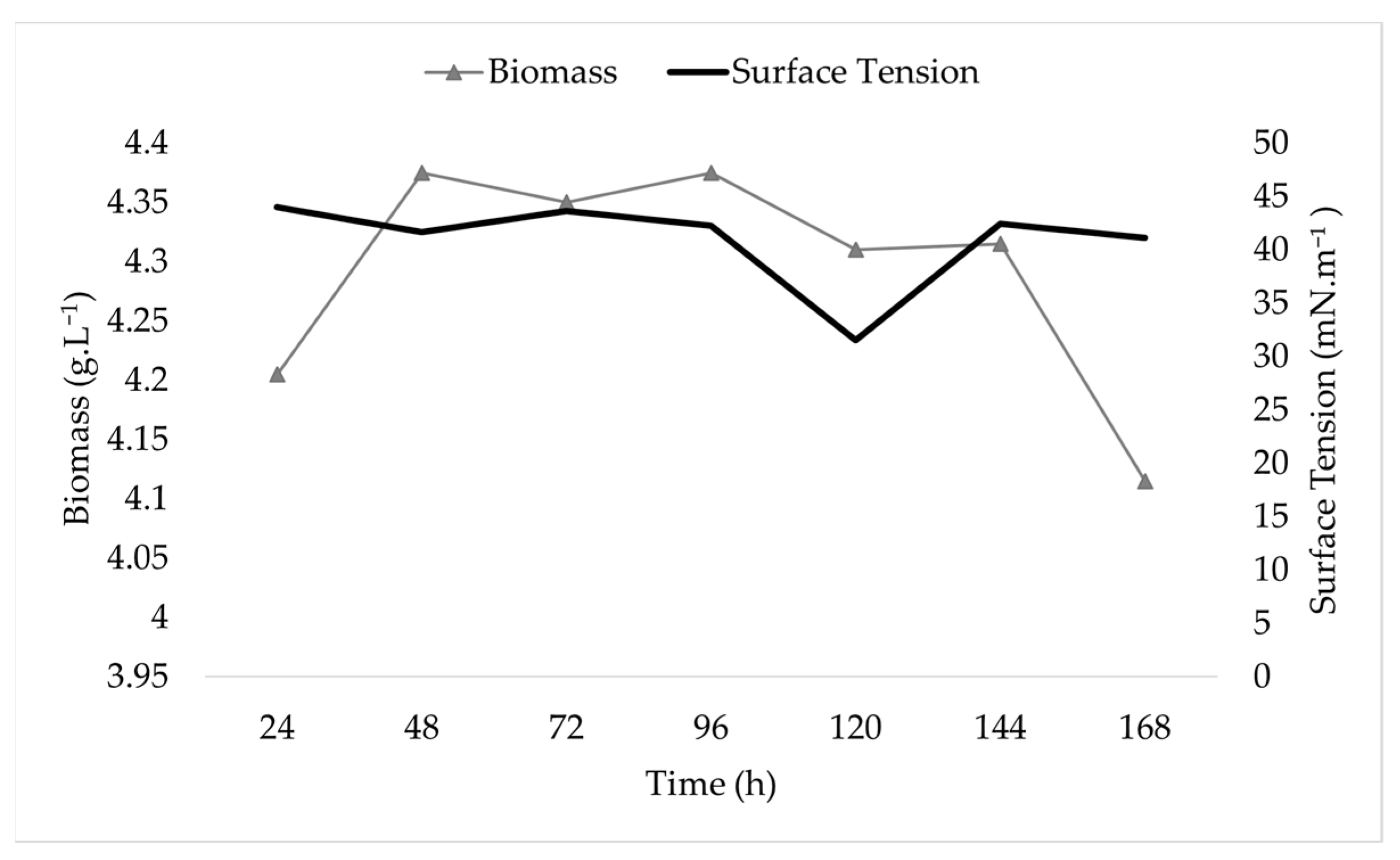
The growth curve of C. utilis cultivated in mineral medium supplemented with licuri oil is shown in Figure 1. Biomass concentration increased progressively during the 168 h fermentation, accompanied by moderate pH fluctuations. The surface tension of the culture medium decreased sharply from 71.01 to 31.55 mN·m−1 after 120 h, reaching a stable value thereafter.
This reduction in surface tension reflects the active synthesis and secretion of surface-active molecules by C. utilis during the exponential phase of growth. The profile suggests that the strain efficiently utilized licuri oil as a carbon source, producing compounds capable of lowering surface tension below 35 mN·m−1, the benchmark value for efficient biosurfactants.

3.2. Evaluation of Culture Medium Parameters by Factorial Design

A 24 full factorial design, including three replicates at the central point, was employed to evaluate the effects of licuri oil (X1), glucose (X2), ammonium nitrate (X3), and yeast extract (X4) on three responses: surface tension (Y1), emulsification index with motor oil (Y2), and emulsification index with canola oil (Y3). The experimental matrix and responses are presented in Table 2.
The surface tension values ranged from 33.7 to 47.8 mN m−1. The lowest values—indicating higher biosurfactant production—were obtained in assays 4, 6, and 8.
Among them, assay 8 showed the most favorable overall performance, combining strong surface tension reduction (34.56 mN·m−1) with the highest emulsification indices for both oils (90.00% for motor oil and 75.00% for canola oil).
The ANOVA results for Y1 are summarized in Table 3 and indicate that the regression was globally significant (p = 0.00164), confirming that at least one independent variable had a real influence on the response. The lack-of-fit test was not significant (p = 0.59024), suggesting that the model form was adequate. The coefficient of determination (R2 = 55.12%) revealed that the model explained slightly more than half of the total variability in the data.
After reparameterization, only the significant effects were retained, as represented in Equation (2):
Y1 = 41.63 − 2.37X1 + 2.73X1X4.
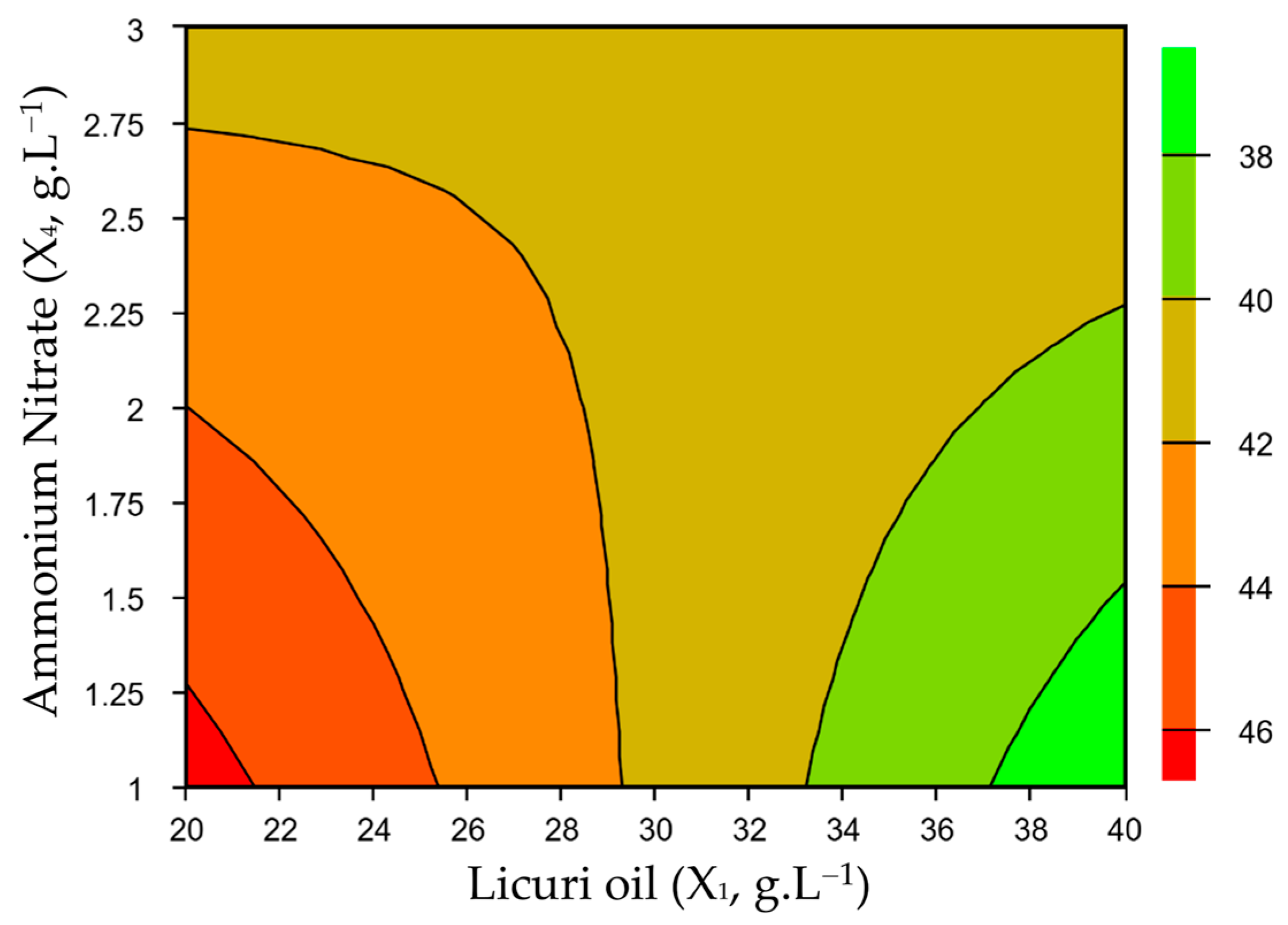
This model highlights licuri oil (X1) as the main factor influencing surface tension, along with its positive interaction with ammonium nitrate (X1X4). The analysis of the response surface (Figure 2) shows that the maximum ST reduction (green region, approximately 38 mN·m−1) is achieved in the area combining the highest level of licuri oil (X1: 36 to 40 g·L−1) and the lowest level of ammonium nitrate (X4: 1 to 1.75 g·L−1). This pattern is a strong indication that biosurfactant synthesis by C. utilis is favored under high carbon-to-nitrogen (C/N) ratio conditions, a known strategy for inducing secondary metabolite production in yeasts.
However, for the emulsification index responses (Y2 and Y3—motor oil and canola oil), the generated models were not found to be statistically significant or predictive. For the Y2 response, the ANOVA p-value for regression was 0.69, indicating no statistically valid relationship between the four variables and the emulsifying activity. Although some individual runs showed high E24 results, a robust model could not be established using the linear factorial approach. Therefore, the discussion regarding emulsifying activity focuses on the raw performance data and the subsequent stability studies.

3.3. Emulsification Stability Under Environmental Stress and Critical Micelle Concentration

The biosurfactant exhibited remarkable stability under diverse environmental conditions (Table 4), maintaining emulsification indices above 50% even after exposure to variations in temperature (30–70 °C), NaCl concentration (1–10%), and pH (3–7). Emulsions prepared with canola oil remained particularly stable, with E24 values consistently exceeding 70% under all tested conditions. In contrast, motor oil emulsions displayed a slight decrease in stability at higher salinity levels, yet their E24 values remained above 60% at neutral pH, confirming the compound’s overall structural resilience and versatility.
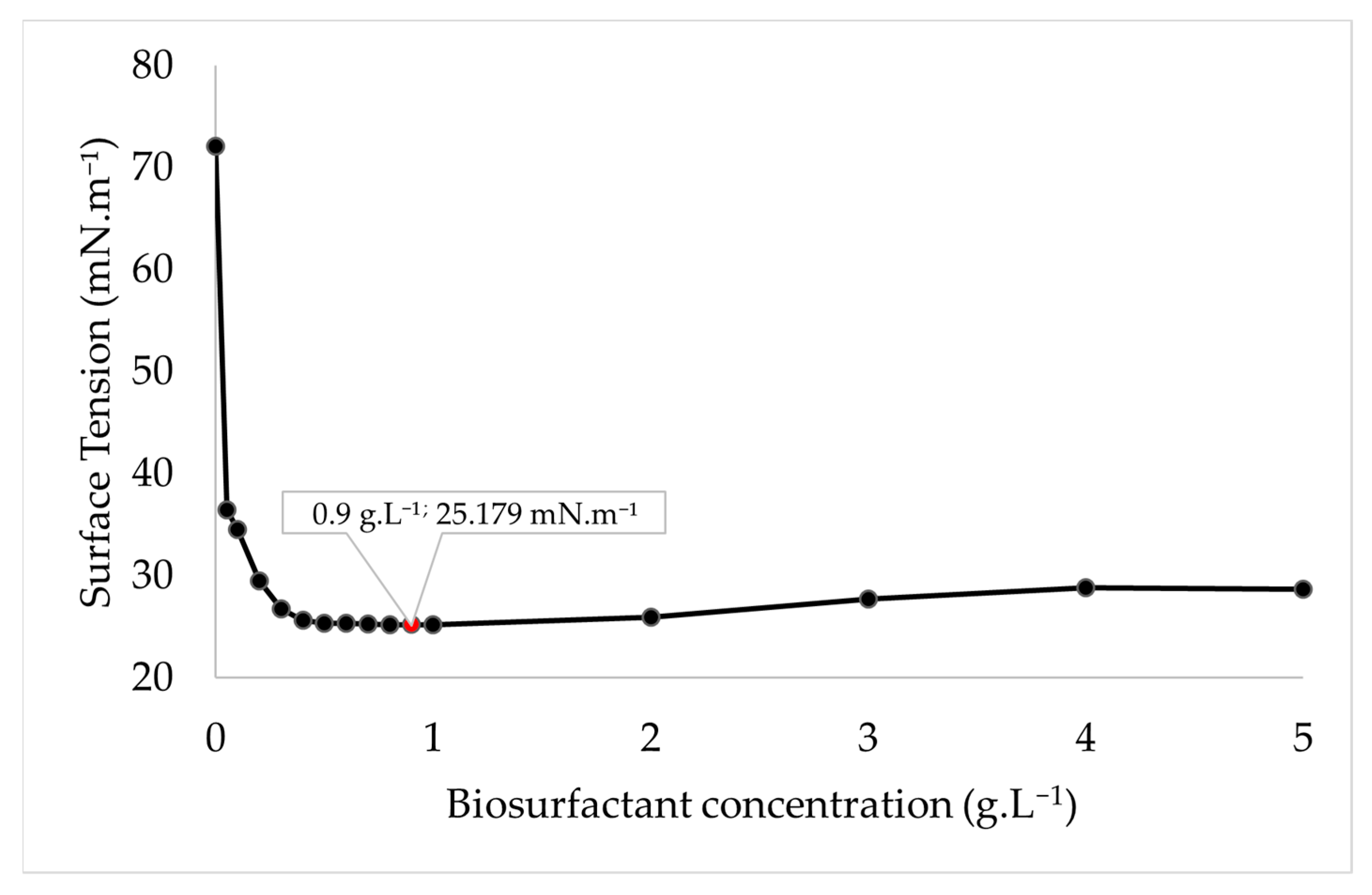
The relationship between biosurfactant concentration and surface tension is shown in Figure 3. The minimum surface tension (25.17 ± 0.03 mN·m−1) was reached at a concentration of 0.9 g L−1, corresponding to the critical micelle concentration (CMC).

3.4. Novel Application in Dressings

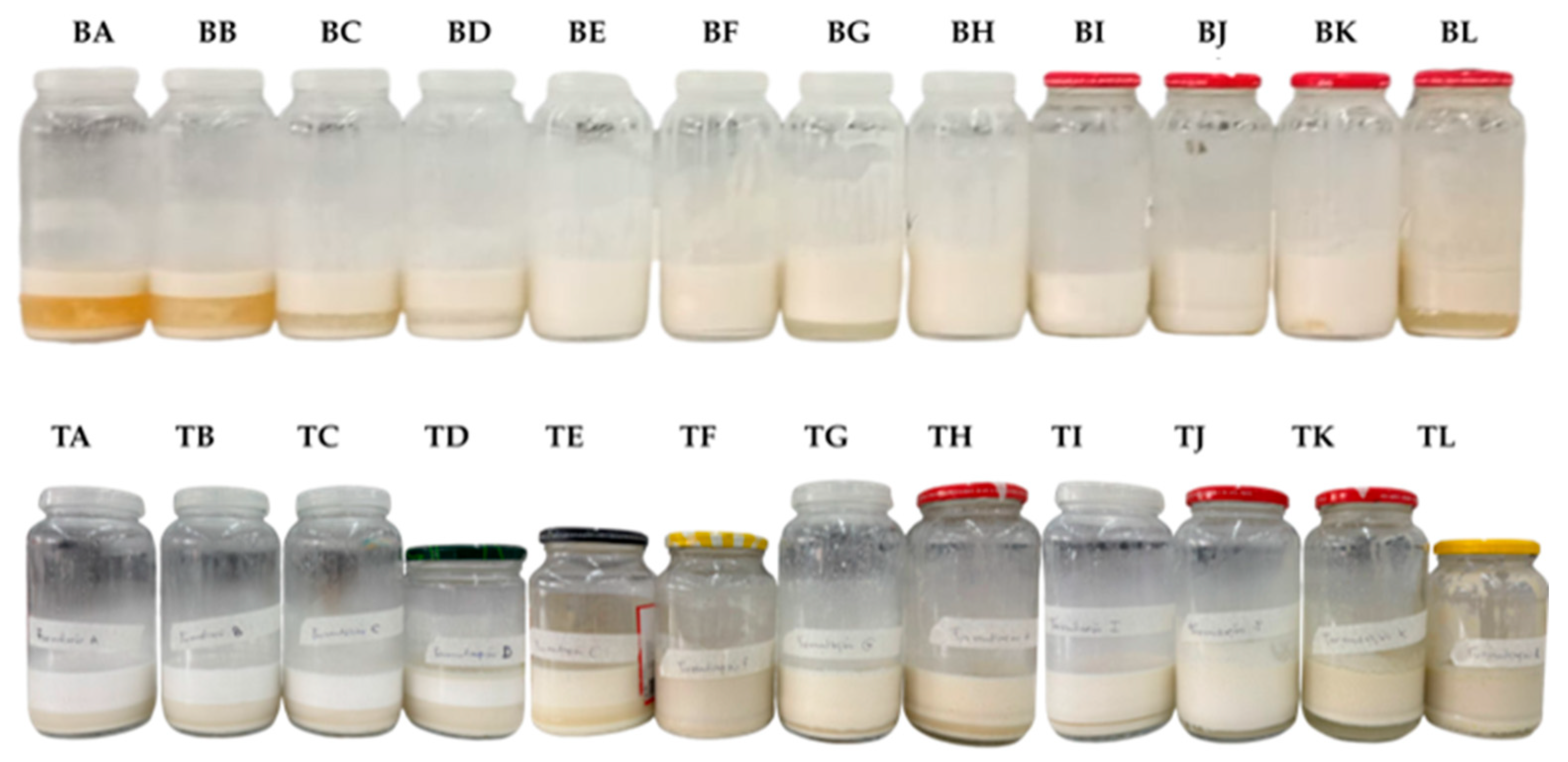
Visual observations of the formulations containing the biosurfactant (codes BA–BL) after 60 days, and the formulations containing Tween 80 (codes TA–TL) after 10 days, are presented in Figure 4.
After 60 days of storage, formulations BE (0.5% BS + 3% egg yolk), BF (0.5% BS + 3% lecithin), and BH (0.5% BS + 2% egg yolk + 1% lecithin) remained completely stable, showing no phase separation. Formulations BJ, BK, and BL, which contained only egg yolk and/or lecithin, also remained stable, confirming the synergistic stabilizing effect of phospholipids and proteins. Conversely, formulations lacking emulsifiers (BA–BD) displayed clear phase separation, demonstrating that the biosurfactant and natural emulsifiers are essential for stability. Notably, formulation BG (0.5% BS + 1% egg yolk + 2% lecithin) showed instability despite having the same ingredients as BH, highlighting the importance of the proportion between egg yolk and lecithin.
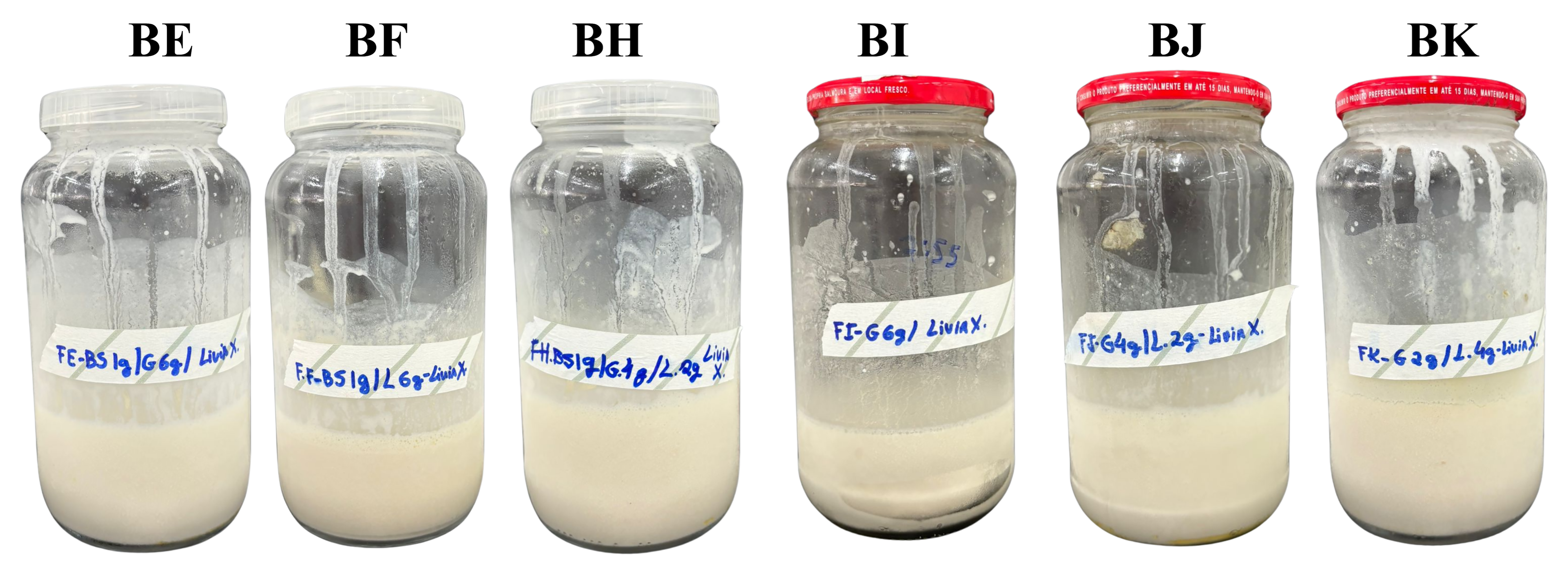
The successful formulations (BE, BF, BH, BI, BJ, and BK) were then maintained under refrigeration for an additional 180 days, totaling 240 days of storage. All these formulations successfully maintained their physical integrity and stability, demonstrating consistent performance over long periods, as can be seen in Figure 5.
The pH and viscosity of the six most stable formulations during this period are presented in Table 5. An acidic pH was observed across all samples, with Formulation BI standing out for exhibiting the lowest pH and viscosity values. For the emulsions prepared with Tween® 80, the initial pH remained within the range of 2.11 to 2.74.

3.5. Microbiological Safety

In terms of microbiological safety, no growth of pathogenic or spoilage microorganisms was detected in the emulsions after 240 days of refrigerated storage (Table 6). The analysis includes the enumeration of total aerobic mesophiles, molds, and yeasts, and specific pathogens (Salmonella sp., Staphylococcus sp., and Pseudomonas aeruginosa) across three serial dilutions, demonstrating the sanitary quality of the products.
Table 6. Microbiological assessment of the six physically stable emulsion formulations (BE–BK) after 240 days of refrigerated storage (8°).
SampleDilutionMicroorganisms Analyzed
Salmonella sp./25 gTotal Aerobic Mesophiles (CFU/g)Thermotolerant Coliforms (MPN·g−1 at 45 °C)Coagulase-Positive Staphylococci (CFU/g)Molds and Yeasts (CFU/g)Pseudomonas aeruginosa (CFU/g)
BE10−1Absence250000
10−2Absence00000
10−3Absence00000
BF10−1Absence00000
10−2Absence00000
10−3Absence00000
BH10−1Absence00000
10−2Absence00000
10−3Absence00000
BI10−1Absence00000
10−2Absence0101000
10−3Absence00000
BJ10−1Absence01000
10−2Absence00000
10−3Absence00000
BK10−1Absence00000
10−2Absence00000
10−3Absence00000
A value of 0 indicates the absence of microbial cell growth.

4. Discussion

The integration of kinetic evaluation and functional testing demonstrated that C. utilis effectively produces a potent surface-active compound using licuri oil as the main carbon source. The rapid initial surface tension (ST) reduction suggests that biosurfactant synthesis commenced early, possibly during the exponential phase. However, the minimum ST of 31.55 mN·m−1 was definitively achieved at 120 h, coinciding with the transition to the stationary phase. This delayed production pattern is characteristic of secondary metabolism [18] and aligns well with the behavior observed for the related yeast Candida mogii, which, when cultivated on the same licuri oil substrate, achieved maximum BS production during the stationary/decline phase [11].
This mechanism is strongly supported by factorial analysis, which identified the high carbon-to-nitrogen (C/N) ratio as the key factor influencing ST reduction. This limitation-driven strategy is essential to stress the cells and redirect metabolic flux toward biosurfactant synthesis [19].
The functional parameters of the product confirm its strong competitive advantage. The lowest surface tension (ST) achieved was 25.17 ± 0.03 mN·m−1 at a critical micelle concentration (CMC) of 0.9 g·L−1. This CMC is highly competitive, positioning the product among the most efficient microbial surfactants for industrial applications. The CMC value obtained is significantly more efficient than those reported for C. bombicola (2.7 g·L−1) [20] and Pichia pseudolambica (16.0 g·L−1) [21]. Moreover, the minimal ST of 31.55 mN·m−1 achieved on licuri oil is highly competitive with, and cross-validated by, the performance of C. utilis grown on waste canola frying oil (CMC of 0.6 g·L−1 with ST of approximately 35 mN·m−1 [9] and Pseudomonas sp. (ST of 32 mN·m−1 at 1.0 g·L−1) [22].
The lower surface tension observed for the isolated product (25.17 mN·m−1) compared to the crude culture broth, 31.55 mN·m−1, is attributed to the extraction process. The removal of interfering media components (such as salts and residual nutrients) facilitates tighter molecular packing at the air–water interface, enhancing the surface activity of the isolated compound [23].
This performance is further reinforced by recent studies utilizing the related yeast C. mogii on the same substrate, which achieved a highly comparable CMC of 0.8 g·L−1 and a minimum ST of 28.66 mN·m−1 [11]. This consistency reinforces the value of licuri oil as a strategic, regional feedstock. Moreover, the intrinsic safety of the strain (C. utilis holds GRAS status) and the proven innocuousness of its biosurfactant in previous toxicological and food application tests [9,10] provide a robust foundation for the safety and functional potential of the product derived from licuri oil.
The factorial screening successfully identified the variables critical for biosurfactant production, fulfilling its role as a process mapping tool. The linear model for surface tension (ST) showed a clear dependence on the licuri oil (X1) and ammonium nitrate (X4) interaction. This interaction confirms that a strategic nitrogen limitation is essential to stress the C. utilis cells and maximize the output of the secondary metabolite. Such behavior is consistent with reports that many yeast-derived biosurfactants (e.g., sophorolipids) are upregulated under low-nitrogen regimes, where excess carbon is redirected to surface-active compound biosynthesis [24,25]. Moreover, studies coupling hydrophobic carbon sources and variable nitrogen levels demonstrate that high carbon availability combined with moderate nitrogen favors product formation, while high nitrogen enhances growth at the expense of biosurfactant yield [26,27]. This finding is crucial for guiding future scale-up efforts toward a cost-effective medium design.
Conversely, the inability to establish robust predictive models for the Emulsification Index (Y2 and Y3) suggests that E24 activity is governed by complex, higher-order, or nonlinear interactions that could not be fully captured by the linear factorial approach. This outcome aligns with previous reports where emulsification responses exhibited significant variability and poor linear predictability. For instance, in a 24 factorial design applied to Yarrowia lipolytica [28], observed that while linear models adequately described surface tension reduction, the E24 response fluctuated considerably across different combinations of carbon and nitrogen sources, implying the presence of hidden nonlinear dependencies. Similarly, an RSM-based optimization study using Pseudomonas aeruginosa cultivated with rubber tree seed oil required the inclusion of quadratic and interaction terms to accurately predict E24 activity [29]. Comparable results were also reported for Brevibacillus borstelensis, in which a second-order model was necessary to describe the combined effects of nutrient components on emulsification performance [30]. Therefore, while the present factorial design effectively guided the identification of nutrient ratios for maximal surface tension reduction, the interpretation of emulsification efficiency relies primarily on the direct experimental E24 outcomes rather than on predictive modeling. Future studies employing central composite or Box–Behnken designs could therefore capture these higher-order effects, improving predictive accuracy for emulsification-related responses.
The biosurfactant demonstrated strong functional activity, with E24 values exceeding 74% for the selected oils (canola and motor oil), validating its ability to effectively stabilize biphasic systems. These values are superior to those previously reported for C. utilis on other substrates. For example, C. utilis cultivated with waste frying canola oil and ammonium nitrate reached an E24 of 73% (using canola oil) under conditions involving nearly 6% oil, glucose, and low nitrogen (0.2% NH4NO3) [31].
Essentially, the compound maintained high emulsifying activity (>50%) across adverse conditions of pH (3 to 7), temperature (30 °C to 70 °C), and salinity (1% to 10%) in comparable studies. For example, Bacillus aryabhattai ZDY2 preserved E24 above 80% between 30–90 °C and still 75% at 10% NaCl (pH 5–10) [32]. Pseudomonas mendocina exhibited >70% emulsification with motor oil across most pH levels and stable performance under high salt conditions [33]. This structural robustness is non-negotiable for industrial applications. The stability profile confirms that the biosurfactant will retain its functionality during food processing and storage, where pH changes and thermal steps are routine, positioning it as a reliable ingredient against environmental fluctuations [34].
The most significant finding lies in the unprecedented application and validation of the product in food systems. The use of licuri oil not only as the fermentation substrate but also as the base oil in the mayonnaise-type dressings aligns perfectly with the current demand for integrated biorefinery and circular economy models.
The 240-day stability observed in six formulations provides strong proof of concept for the long-term functionality of the licuri-derived biosurfactant in complex food matrices. The clear failure of formulations containing only the biosurfactant (Formulations BA–BD), contrasted with the stability of blended systems (e.g., BE, BF, and BH), indicates that the C. utilis biosurfactant functions most effectively as a co-emulsifier or secondary stabilizer, rather than as a sole structural emulsifier. This result mirrors previous food-application studies where microbial biosurfactants alone were insufficient to guarantee prolonged physical stability: Campos et al. reported that mayonnaise containing only a C. utilis bioemulsifier lost stability within nearly 30 days unless combined with hydrocolloids (e.g., guar gum, CMC) [10]. Likewise, bakery and pastry applications (cookies, muffins, cupcakes) using biosurfactants required complementary formulation strategies (hydrocolloids, proteins, humectants) to maintain desirable texture and shelf life [35,36]. These convergent findings suggest that the biosurfactant’s primary role in food formulations is to reinforce the interfacial film formed by primary emulsifiers (lecithin, egg yolk) and, together with rheology modifiers, to minimize droplet coalescence and creaming over extended storage. Therefore, the present results demonstrate the practical value of integrating the licuri-derived biosurfactant into multi-component formulations to achieve industrially relevant, long-term emulsion stability.
After evaluating important physicochemical parameters such as final pH and viscosity of the emulsions, it was observed that formulation BI presented the lowest values, being the one (among the three added emulsifying agents) that contains only egg yolk in its composition. Furthermore, it is worth noting that the concentration of biosurfactant used in this formulation is 0.5%, a divergent value compared with emulsions containing biosurfactant from Candida bombicola in association with guar gum and carboxymethylcellulose [35].
Although IN 161/2022 [37] lists only three microorganisms as quality control parameters, the food industry commonly monitors the presence of molds and yeasts in this type of product due to their high tolerance to acidic environments. These microorganisms are the main agents responsible for spoilage in acidified sauces, and this analysis is important for quality control and shelf-life determination. Pinto et al. [38] evaluated the effect of biosurfactant in emulsions formulated with different gums and did not observe microbial growth of pathogens after 180 days of storage, corroborating the present study regarding the maintenance of safe emulsions after a long storage period without the use of prior thermal treatment.

5. Conclusions

This study demonstrated that the C. utilis biosurfactant produced using licuri oil as a carbon source exhibits promising physicochemical and functional characteristics for industrial and food applications. The factorial design effectively identified licuri oil and ammonium nitrate as the main variables influencing biosurfactant synthesis, confirming that mild nitrogen limitation enhances metabolite production. When applied in salad dressing formulations, the biosurfactant successfully acted as a co-emulsifier, particularly when combined with lecithin or egg yolk. The blended systems maintained physical stability for up to 240 days, confirming the compound’s long-term compatibility and reinforcing its role as a secondary stabilizer in multiphase systems, as well as maintaining the appropriate pH and microbiological conditions for human consumption. These findings provide strong evidence of the potential of the licuri-derived biosurfactant as a sustainable alternative to synthetic surfactants for the food sector, adding functional and ecological value.
Despite the promising results, the predictive capacity of the linear factorial model for emulsification responses remained limited, indicating that biosurfactant activity may depend on complex, nonlinear interactions not captured in the present design. Future research should therefore employ response surface methodologies (RSM) or machine learning-based predictive modeling to elucidate these relationships more accurately. Additionally, scale-up studies in bioreactor systems are essential to assess process reproducibility and economic feasibility under controlled fermentation conditions.

Author Contributions

Conceptualization, L.X.d.A., P.F.F.d.S. and J.M.C.G.; methodology, L.X.d.A., P.F.F.d.S., R.R.d.S., J.L.S.S., L.A.S. and J.M.C.G.; validation, L.X.d.A. and J.M.C.G.; formal analysis, L.X.d.A., P.F.F.d.S. and J.M.C.G.; investigation, L.X.d.A. and J.M.C.G.; resources, J.L.S.S., L.A.S. and J.M.C.G.; data curation, L.X.d.A.; writing—original draft, L.X.d.A., P.F.F.d.S. and J.M.C.G.; writing—review and editing, L.X.d.A., P.F.F.d.S., R.R.d.S., L.A.S., J.L.S.S. and J.M.C.G.; visualization, J.M.C.G., J.L.S.S. and L.A.S.; supervision, J.M.C.G.; project administration, J.M.C.G.; funding acquisition, J.M.C.G. All authors have read and agreed to the published version of the manuscript.

Funding

This study was financed in part by the Fundação de Amparo a Ciência e Tecnologia do Estado de Pernambuco (FACEPE, IBPG-2153-3.06/22) and the Coordenação de Aperfeiçoamento de Pessoal de Nível Superior—Brasil (CAPES)—Finance Code 001.

Institutional Review Board Statement

Not applicable.

Informed Consent Statement

Not applicable.

Data Availability Statement

The original contributions presented in the study are included in the article. Further inquiries can be directed to the corresponding author.

Acknowledgments

The authors express their gratitude to the Bioprocess Laboratory of the Antibiotics Department at the Federal University of Pernambuco, Science and Technology Center of the Catholic University of Pernambuco (UNICAP), and Cooperativa de Produção da Região do Piemonte da Diamantina (COOPES) for providing the fixed oil of S. coronata, and to the Coordenação de Aperfeiçoamento de Pessoal de Nível Superior—Brasil CAPES for providing scholarships.

Conflicts of Interest

The authors declare no conflicts of interest.

References

  1. Patel, R.J.; Patel, A.A.; Raval, M.A.; Pandya, V.; Alexander, A. Ajazuddin Optimization and Characterization of Various Biosurfactant and Application in Food Industries. In Applications of Next Generation Biosurfactants in the Food Sector; Academic Press: Cambridge, MA, USA, 2023; pp. 17–42. [Google Scholar] [CrossRef]
  2. Nagtode, V.S.; Cardoza, C.; Yasin, H.K.A.; Mali, S.N.; Tambe, S.M.; Roy, P.; Singh, K.; Goel, A.; Amin, P.D.; Thorat, B.R.; et al. Green Surfactants (Biosurfactants): A Petroleum-Free Substitute for Sustainability—Comparison, Applications, Market, and Future Prospects. ACS Omega 2023, 8, 11674–11699. [Google Scholar] [CrossRef] [PubMed]
  3. de Souza, A.C.; Silva, M.S.; Simões, L.A.; Fernandes, N.A.T.; Schwan, R.F.; Dias, D.R. Advantages of Biosurfactants over Petroleum-Based Surfactants. In Industrial Applications of Biosurfactants and Microorganisms: Green Technology Avenues from Lab to Commercialization; Academic Press: Cambridge, MA, USA, 2023. [Google Scholar]
  4. Kugaji, M.; Ray, S.K.; Parvatikar, P.; Raghu, A.V. Biosurfactants: A Review of Different Strategies for Economical Production, Their Applications and Recent Advancements. Adv. Colloid. Interface Sci. 2025, 337, 103389. [Google Scholar] [CrossRef] [PubMed]
  5. Krishnan Venkatesan, S.; Mandava, R.R.D.; Srinivasan, V.R.; Prasad, M.; Kandasamy, R. Strategic Biosur-factant-Advocated Bioremediation Technologies for the Removal of Petroleum Derivatives and Other Hydrophobic Emerging Contaminants; Academic Press: Cambridge, MA, USA, 2023; ISBN 9780443132889. [Google Scholar]
  6. Lima, V.V.F.d.; Scariot, A.; Sevilha, A.C. Livestock and Agriculture Affect Recruitment and the Structure of a Key Palm for People and an Endangered Bird in Semi-Arid Lands. J. Arid. Environ. 2023, 217, 105036. [Google Scholar] [CrossRef]
  7. Moreira, R.C.; Leonardi, G.R.; Bicas, J.L. Lipase-Mediated Alcoholysis for in Situ Production of Ester Bioaromas in Licuri Oil for Cosmetic Applications. J. Biotechnol. 2024, 392, 25–33. [Google Scholar] [CrossRef]
  8. Leal, L.B.; Sousa, G.D.; Seixas, K.B.; de Souza, P.H.N.; de Santana, D.P. Determination of the Critical Hydrophile-Lipophile Balance of Licuri Oil from Syagrus coronata: Application for Topical Emulsions and Evaluation of Its Hydrating Function. Braz. J. Pharm. Sci. 2013, 49, 167–173. [Google Scholar] [CrossRef]
  9. Ribeiro, B.G.; de Veras, B.O.; dos Santos Aguiar, J.; Medeiros Campos Guerra, J.; Sarubbo, L.A. Biosurfactant Produced by Candida utilis UFPEDA1009 with Potential Application in Cookie Formulation. Electron. J. Biotechnol. 2020, 46, 14–21. [Google Scholar] [CrossRef]
  10. Campos, J.M.; Stamford, T.L.M.; Rufino, R.D.; Luna, J.M.; Stamford, T.C.M.; Sarubbo, L.A. Formulation of Mayonnaise with the Addition of a Bioemulsifier Isolated from Candida utilis. Toxicol. Rep. 2015, 2, 1164–1170. [Google Scholar] [CrossRef]
  11. da Silva, P.F.F.; da Silva, R.R.; Sarubbo, L.A.; Guerra, J.M.C. Production and Optimization of Biosurfactant Properties Using Candida mogii and Licuri Oil (Syagrus coronata). Foods 2024, 13, 4029. [Google Scholar] [CrossRef]
  12. Rodrigues, M.I.; Iemma, A.F. Experimental Design and Process Optimization; CRC Press: Boca Raton, FL, USA, 2014. [Google Scholar] [CrossRef]
  13. Cooper, D.G.; Goldenberg, B.G. Surface-Active Agents from Two Bacillus Species. Appl. Environ. Microbiol. 1987, 53, 224–229. [Google Scholar] [CrossRef]
  14. Krucoń, T.; Ruszkowska, Z.; Pilecka, W.; Szych, A. Drewniak Bioprospecting of the Antarctic Bacillus subtilis Strain for Potential Application in Leaching Hydrocarbons and Trace Elements from Contaminated Environments Based on Functional and Genomic Analysis. Environ. Res. 2023, 227, 115785. [Google Scholar] [CrossRef]
  15. Ribes, S.; Fuentes, A.; Barat, J.M. Physical Stability, Rheology and Microstructure of Salad Dressing Containing Essential Oils: Study of Incorporating Nanoemulsions. Br. Food J. 2021, 123, 1626–1642. [Google Scholar] [CrossRef]
  16. American Public Health Association (APHA). Compendium of Methods for the Microbiological Examination of Foods, 5th ed.; APHA Press: Washington, DC, USA, 2015. [Google Scholar]
  17. BRASIL. Ministério da Saúde. Agência Nacional de Vigilância Sanitária. Instrução Normativa-IN nº 161, de 1º de julho de 2022. Estabelece os Padrões Microbiológicos dos Alimentos. Diário Oficial [da] República Federativa do Brasil, Brasília, DF, 6 jul. 2022. Seção 1, p. 217. Available online: https://in.gov.br/en/web/dou/-/instrucao-normativa-in-n-161-de-1-de-julho-de-2022-413366880 (accessed on 10 November 2025).
  18. El-Sheshtawy, H.S.; Aiad, I.; Osman, M.E.; Abo-ELnasr, A.A.; Kobisy, A.S. Production of Biosurfactant from Bacillus licheniformis for Microbial Enhanced Oil Recovery and Inhibition the Growth of Sulfate Reducing Bacteria. Egypt. J. Pet. 2015, 24, 155–162. [Google Scholar] [CrossRef]
  19. Darwesh, O.M.; Mahmoud, M.S.; Barakat, K.M.; Abuellil, A.; Ahmad, M.E. Improving the Bioremediation Technology of Contaminated Wastewater Using Biosurfactants Produced by Novel Bacillus Isolates. Heliyon 2021, 7, e08616. [Google Scholar] [CrossRef] [PubMed]
  20. Daverey, A.; Pakshirajan, K. Sophorolipids from Candida bombicola Using Mixed Hydrophilic Substrates: Production, Purification and Characterization. Colloids Surf. B Biointerfaces 2010, 79, 246–253. [Google Scholar] [CrossRef]
  21. Macedo Silva, J.R.; Petra de Oliveira Barros, V.; Terceiro, P.S.; Nunes de Oliveira, Í.; Francisco da Silva Moura, O.; Duarte de Freitas, J.; Crispim, A.C.; Maciel Melo, V.M.; Thompson, F.L.; Maraschin, M.; et al. Brazilian Mangrove Sediments as a Source of Biosurfactant-Producing Yeast Pichia pseudolambica for Bioremediation. Chemosphere 2024, 365, 143285. [Google Scholar] [CrossRef]
  22. Chebbi, A.; Hentati, D.; Zaghden, H.; Baccar, N.; Rezgui, F.; Chalbi, M.; Sayadi, S.; Chamkha, M. Polycyclic Aromatic Hydrocarbon Degradation and Biosurfactant Production by a Newly Isolated Pseudomonas Sp. Strain from Used Motor Oil-Contaminated Soil. Int. Biodeterior. Biodegrad. 2017, 122, 128–140. [Google Scholar] [CrossRef]
  23. Wu, B.; Xiu, J.; Yu, L.; Huang, L.; Yi, L.; Ma, Y. Biosurfactant production by Bacillus subtilis SL and its potential for enhanced oil recovery in low permeability reservoirs. Sci. Rep. 2022, 12, 7785. [Google Scholar] [CrossRef]
  24. Kumar, A.; Singh, S.K.; Kant, C.; Verma, H.; Kumar, D.; Singh, P.P.; Modi, A.; Droby, S.; Kesawat, M.S.; Alavilli, H.; et al. Microbial Biosurfactant: A New Frontier for Sustainable Agriculture and Pharmaceutical Industries. Antioxidants 2021, 10, 1472. [Google Scholar] [CrossRef]
  25. Ingham, B.; Winterburn, J. Developing an Understanding of Sophorolipid Synthesis through application of a Central Composite Design Model. Microb. Biotechnol. 2022, 15, 1744–1761. [Google Scholar] [CrossRef]
  26. Banat, I.M.; Satpute, S.K.; Cameotra, S.S.; Patil, R.; Nyayanit, N.V. Cost Effective Technologies and Renewable Substrates for Biosurfactants Production. Front. Microbiol. 2014, 5, 697. [Google Scholar] [CrossRef] [PubMed]
  27. Qin, Z.; Guo, W.; Liu, J.; Zhao, G.; Liu, M.; Song, X. Reduced-Cost Production of Sophorolipids by Starmerella bombicola CGMCC1576 Grown on Cottonseed Molasses and Cottonseed Oil-Based Medium. Int. J. Mol. Sci. 2023, 24, 5759. [Google Scholar] [CrossRef] [PubMed]
  28. Zarur Coelho, M.A.; Fontes, G.C.; Fonseca Amaral, P.F.; Nele, M. Factorial Design to Optimize Biosurfactant Production by Yarrowia lipolytica. J. Biomed. Biotechnol. 2010, 2010, 821306. [Google Scholar] [CrossRef]
  29. Angba, Y.J.; Touré, A.O.; Abro, K.D.M.; Amadou Kiari, M.N.; Drogui, A.P.; Yao, K.B. Optimization of Biosurfactant Production by Pseudomonas aeruginosa Strain Pa Using Rubber Tree Seed Oil as Sole Carbon Source. Discov. Appl. Sci. 2025, 7, 1020. [Google Scholar] [CrossRef]
  30. Dong, H.; Zheng, A.; He, Y.; Wang, X.; Li, Y.; Yu, G.; Gu, Y.; Banat, I.M.; Sun, S.; She, Y.; et al. Optimization and Characterization of Biosurfactant Produced by Indigenous: Brevibacillus borstelensis Isolated from a Low Permeability Reservoir for Application in MEOR. RSC Adv. 2022, 12, 2036–2047. [Google Scholar] [CrossRef]
  31. Campos, J.M.; Stamford, T.L.M.; Sarubbo, L.A. Production of a Bioemulsifier with Potential Application in the Food Industry. Appl. Biochem. Biotechnol. 2014, 172, 3234–3252. [Google Scholar] [CrossRef] [PubMed]
  32. Yaraguppi, D.A.; Bagewadi, Z.K.; Muddapur, U.M.; Mulla, S.I. Response Surface Methodology-Based Optimization of Biosurfactant Production from Isolated Bacillus aryabhattai Strain ZDY2. J. Pet Explor. Prod. Technol. 2020, 10, 2483–2498. [Google Scholar] [CrossRef]
  33. Gulati, D.; Ahmad, M.; Bhatia, M. Evaluation of Biosurfactant Production from Pseudomonas Mendocina and Its Antibacterial Application. Biocatal. Agric. Biotechnol. 2025, 66, 103609. [Google Scholar] [CrossRef]
  34. Sharma, J.; Kapley, A.; Sundar, D.; Srivastava, P. Characterization of a Potent Biosurfactant Produced from Franconibacter Sp. IITDAS19 and Its Application in Enhanced Oil Recovery. Colloids Surf. B Biointerfaces 2022, 214, 112453. [Google Scholar] [CrossRef]
  35. Silva, I.A.; Veras, B.O.; Ribeiro, B.G.; Aguiar, J.S.; Campos Guerra, J.M.; Luna, J.M.; Sarubbo, L.A. Production of Cupcake-like Dessert Containing Microbial Biosurfactant as an Emulsifier. PeerJ 2020, 2020, e9064. [Google Scholar] [CrossRef]
  36. Lira, I.R.A.D.S.; Santos, E.M.D.S.; dos Santos, J.C.V.; da Silva, R.R.; da Silva, Y.A.; Durval, I.J.B.; Guerra, J.M.C.; Sarubbo, L.A.; de Luna, J.M. Production of Biossurfactant by Candida guilliermondii and Application in a Mayonnaise Emulsion. Chem. Eng. Trans. 2021, 87, 259–264. [Google Scholar] [CrossRef]
  37. Agência Nacional De Vigilância Sanitária. Instrução Normativa-IN nº 211, de 1º de março de 2023. Available online: https://www.in.gov.br/en/web/dou/-/instrucao-normativa-in-n-211-de-1-de-marco-de-2023-468509746 (accessed on 28 November 2025).
  38. Pinto, M.I.S.; Campos Guerra, J.M.; Meira, H.M.; Sarubbo, L.A.; de Luna, J.M. A Biosurfactant from Candida bombicola: Its Synthesis, Characterization, and its Application as a Food Emulsions. Foods 2022, 11, 561. [Google Scholar] [CrossRef] [PubMed]
Figure 1. Biosurfactant production kinetics by C. utilis in mineral medium: Temporal variation of biomass (g·L−1) and surface tension (mN·m−1) over 168 h of fermentation.
Fermentation 11 00679 g001
Figure 2. Response surface plot for surface tension (TS) showing the significant interaction between licuri oil concentration (X1) and ammonium nitrate concentration (X4) in the culture medium by C. utilis.
Fermentation 11 00679 g002
Figure 3. Critical micelle concentration (CMC) curve of the isolated biosurfactant produced by C. utilis.
Fermentation 11 00679 g003
Figure 4. Physical stability of mayonnaise-type salad dressing formulations stored at 8 °C. Biosurfactant-based formulations (codes BA to BL) after 60 days of storage; Tween® 80-based formulations (codes TA to TL) after 10 days of storage. Formulations BE, BF, BH, BI, BJ, and BK remained stable without phase segregation.
Fermentation 11 00679 g004
Figure 5. Stable mayonnaise-type dressing formulations (BE, BF, BH, BI, BJ, and BK) after the final storage period. These formulations included the biosurfactant produced by C. utilis (BE, BF, and BH) and/or natural emulsifiers (BI, BJ, and BK), demonstrating successful long-term physical integrity without phase segregation.
Fermentation 11 00679 g005
Table 1. Composition of salad dressing formulations containing different emulsifiers and concentrations.
CodeBiosurfactant (%) or Tween 80Egg Yolk (%)Lecithin (%)
BA/TA3.00.00.0
BB/TB2.00.00.0
BC/TC1.00.00.0
BD/TD0.50.00.0
BE/TE0.52.50.0
BF/TF0.50.02.5
BG/TG0.51.51.0
BH/TH0.51.01.5
BI/TI0.03.00.0
BJ/TJ0.02.01.0
BK/TK0.01.02.0
BL/TL0.00.03.0
The prefix “B” in the formulation code indicates the addition of the biosurfactant, while the prefix “T” indicates the addition of Tween 80, used as a comparative control at the respective concentrations listed in the second column.
Table 2. Experimental matrix and observed responses for the Factorial Design (4 factors with central point), showing the coded levels of the independent variables (X1 to X4) and the measured responses: surface tension (Y1 in mN·m−1), emulsification index with motor oil (Y2 in %), and emulsification index with canola oil (Y3 in %).
RunX1X2X3X4Y1 (mN·m−1)Y2 (%)Y3 (%)
1−1−1−1−142.8375.006.67
21−1−1−141.2666.6753.33
3−11−1−145.9366.675.00
411−1−132.1766.6733.33
5−1−11−148.7566.6733.33
61−11−132.5066.676.67
7−111−143.7693.3313.33
8111−134.5690.0075.00
9−1−1−1141.9350.0080.00
101−1−1141.7350.0060.00
11−11−1138.1866.6713.33
1211−1144.7366.670.00
13−1−11143.6266.670.00
141−11144.3262.506.67
15−111146.7966.6725.00
16111142.6594.4425.00
17000039.4725.0020.00
18000040.4566.6713.33
19000045.4266.674.55
X1: licuri oil concentration; X2: glucose concentration; X3: ammonium nitrate concentration; X4: yeast extract concentration. Coded Levels: (−1): low level; (0): central point; (+1): high level.
Table 3. ANOVA of the reparameterized linear model for surface tension (Y1) reduction, identifying the statistically significant factors influencing the biosurfactant production.
Source of VariationSum of SquaresDegrees of FreedomMean SquareFcalcp-Value
Regression208.92104.59.80.00164
Residual170.11610.6
Lack of Fit149.71410.71.10.59024
Pure Error20.4210.2
Total379.018
Table 4. Emulsification index (E24) stability of the biosurfactant produced by C. utilis under varying conditions of temperature, NaCl concentration, and pH against motor oil and canola oil (values are presented as mean ± SD, where SD stands for standard deviation).
ParameterConditionMotor Oil (% ± SD)Canola Oil (% ± SD)
Temperature (°C)3060.00 ± 2.1 b75.00 ± 1.8 a
5068.00 ± 2.5 a72.00 ± 2.0 a
6064.00 ± 1.9 ab70.00 ± 2.3 a
NaCl (%)166.67 ± 1.7 a70.00 ± 1.6 a
562.50 ± 2.4 b72.00 ± 1.8 a
1060.00 ± 1.5 b64.00 ± 2.2 b
pH372.00 ± 2.1 a74.07 ± 1.9 a
571.43 ± 2.0 a71.43 ± 1.7 a
770.37 ± 2.4 a73.08 ± 2.1 a
Different lowercase letters indicate statistically significant differences among conditions for each oil according to Tukey’s test (p < 0.05). Values sharing at least one letter do not differ significantly.
Table 5. Physicochemical parameters of the six stable emulsions after eight months of storage.
SamplepHViscosity (mPa·s)
BE3.78 ± 0.12 a157 ± 2 f
BF3.31 ± 0.08 b300 ± 2 e
BH2.95 ± 0.05 c349 ± 3 d
BI2.26 ± 0.03 d21 ± 2 c
BJ2.69 ± 0.10 e285 ± 2 b
BK2.33 ± 0.01 d553 ± 1 a
Values are presented as mean ± standard deviation. Different lowercase letters within the same column indicate statistically significant differences according to Tukey’s test (p < 0.05).
Disclaimer/Publisher’s Note: The statements, opinions and data contained in all publications are solely those of the individual author(s) and contributor(s) and not of MDPI and/or the editor(s). MDPI and/or the editor(s) disclaim responsibility for any injury to people or property resulting from any ideas, methods, instructions or products referred to in the content.