

High-Protein Diets: Characteristics of Bacterial Fermentation and Its Consequences on Intestinal Health

 ,
, 
Abstract
1. Introduction
2. Methods
3. Protein Metabolism in the Small Intestine
3.1. Protein Metabolism by Digestive Enzymes
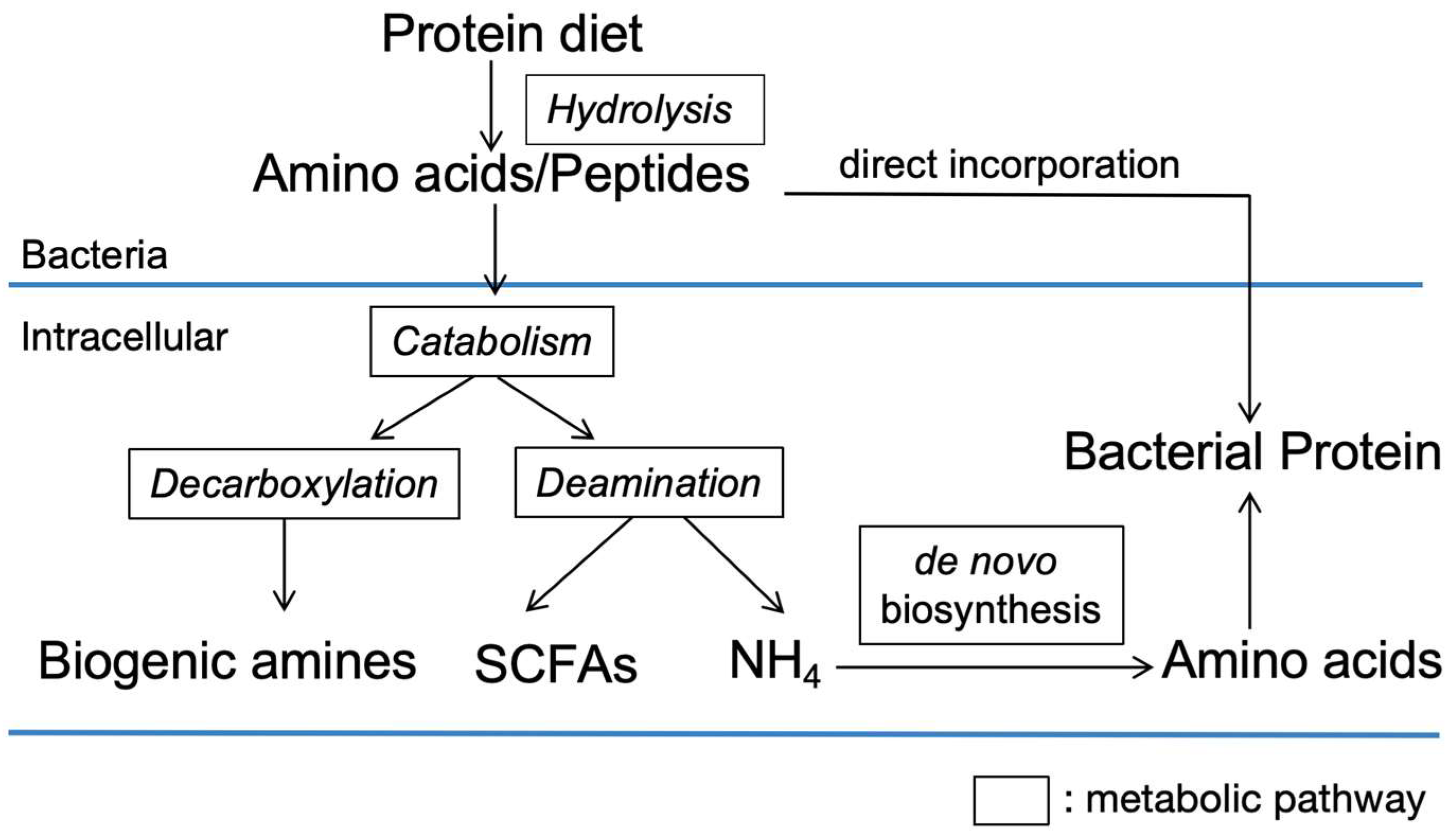
3.2. Microbial Fermentation of Amino Acids
3.2.1. Catabolic Pathways of Amino Acids by Bacteria
3.2.2. Anabolic Pathway of Amino Acids by Bacteria
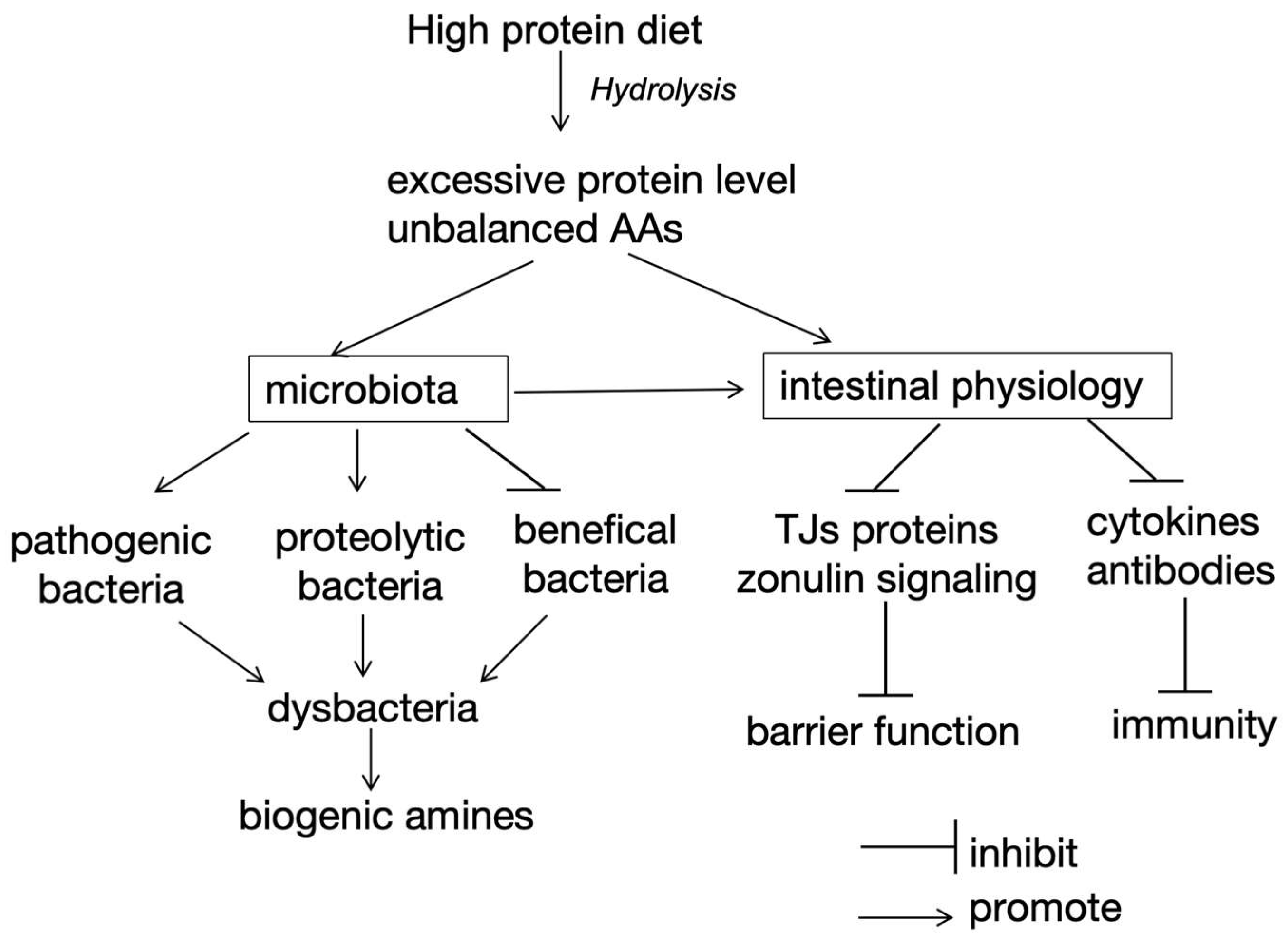
4. Effect of High Protein Levels on Gut Microbes
4.1. Dysbiosis
4.2. Bacterial Metabolism
5. Effect of High-Protein Diets on Intestinal Physiology
5.1. Barrier Function
5.2. Immunity
6. Regulatory Strategies
6.1. Dietary Regulation
6.2. Microbiome Modulation

| Condition | Specie | Recommended Intervention | Ref. |
|---|---|---|---|
| High protein diet (>17%) | Human | Add 3–5% resistant starch or soluble fiber to balance C/N ratio | [92] |
| shortage of feed protein sources | ruminant | replace with non-protein nitrogen (urea, ammonia solution), beneficial for microbial protein synthesis in ruminants | [99] |
| high fermentation crude protein (20.1%), damage the colonic barrier function | piglet | provide high level of fermentable carbohydrates (total dietary fibre 18.0%) to balance C/N ratio and improve barrier function. | [95] |
| excessive protein fermentation ↑ nitrogenous metabolites, ↓ epithelial integrity | human | An appropriate balance of nitrogen nutrition, including hydrolyzed proteins, peptides, and plant-derived proteins | [78] |
| ↓ epithelial barrier integrity | human | Supplement Probiotics (Lactobacillus and Bifidobacterium genera) | [96,100] |
7. Conclusions and Perspectives
Author Contributions
Funding
Institutional Review Board Statement
Informed Consent Statement
Data Availability Statement
Conflicts of Interest
Abbreviations
| AAs | Amino acids |
| ADG | Average daily gain |
| BAs | Biogenic amines |
| BCFAs | Branched-chain fatty acids |
| BCAAs | Branched-chain amino acids |
| C/N | Carbon-to-nitrogen |
| CRP | C-Reactive protein |
| CP | crude protein |
| IL-10 | Interleukin-10 |
| IL-6 | Interleukin-6 |
| MyD88 | Myeloid differentiation primary response 88 |
| NF-κB | Nuclear factor kappa B |
| SCFAs | Short-chain fatty acids |
| TLRs | Toll-like receptors |
| TNF-α | Tumor necrosis factor-alpha |
| ZO-1 | Zonula occludens-1 |
| ZO-2 | Zonula occludens-2 |
References
- Kay, R.N.B. Digestion of protein in the intestines of adult ruminants. Proc. Nutr. Soc. 1969, 28, 140–151. [Google Scholar] [CrossRef] [PubMed]
- Duncan, S.H.; Iyer, A.; Russell, W.R. Impact of protein on the composition and metabolism of the human gut microbiota and health. Proc. Nutr. Soc. 2021, 80, 173–185. [Google Scholar] [CrossRef]
- Caminero, A.; Guzman, M.; Libertucci, J.; Lomax, A.E. The emerging roles of bacterial proteases in intestinal diseases. Gut Microbes 2023, 15, 2181922. [Google Scholar] [CrossRef]
- Del Rio, B.; Fernandez, M.; Redruello, B.; Ladero, V.; Alvarez, M.A. New insights into the toxicological effects of dietary biogenic amines. Food Chem. 2024, 435, 137558. [Google Scholar] [CrossRef]
- Zhang, K.; Wang, N.; Lu, L.; Ma, X. Fermentation and metabolism of dietary protein by intestinal microorganisms. Curr. Protein Pept. Sci. 2020, 21, 807–811. [Google Scholar] [CrossRef]
- Wang, S.; van Geffen, M.; Venema, K.; Mommers, A.; Jonkers, D.; van Schooten, F.J.; Godschalk, R. Effect of protein fermentation products on gut health assessed in an in vitro model of human colon (TIM-2). Mol. Nutr. Food Res. 2023, 67, 2200574. [Google Scholar] [CrossRef]
- Pasiakos, S.M. Metabolic advantages of higher protein diets and benefits of dairy foods on weight management, glycemic regulation, and bone. J. Food Sci. 2015, 80, A2–A7. [Google Scholar] [CrossRef]
- Wu, S.; Bhat, Z.F.; Gounder, R.S.; Mohamed Ahmed, I.A.; Al-Juhaimi, F.Y.; Ding, Y.; Bekhit, A.E.D.A. Effect of dietary protein and processing on gut microbiota—A systematic review. Nutrients 2022, 14, 453. [Google Scholar] [CrossRef]
- Zhao, J.; Zhang, X.; Liu, H.; Brown, M.A.; Qiao, S. Dietary protein and gut microbiota composition and function. Curr. Protein Pept. Sci. 2019, 20, 145–154. [Google Scholar] [CrossRef]
- Shi, J.; Zhao, D.; Song, S.; Zhang, M.; Zamaratskaia, G.; Xu, X.; Zhou, G.; Li, C. High-meat-protein high-fat diet induced dysbiosis of gut microbiota and tryptophan metabolism in wistar rats. J. Agric. Food Chem. 2020, 68, 6333–6346. [Google Scholar] [CrossRef]
- Xie, Y.; Ding, F.; Di, W.; Lv, Y.; Xia, F.; Sheng, Y.; Yu, J.; Ding, G. Impact of a high-fat diet on intestinal stem cells and epithelial barrier function in middle-aged female mice. Mol. Med. Rep. 2020, 21, 1133–1144. [Google Scholar] [CrossRef]
- Prokopidis, K.; Cervo, M.M.; Gandham, A.; Scott, D. Impact of protein intake in older adults with sarcopenia and obesity: A gut microbiota perspective. Nutrients 2020, 12, 2285. [Google Scholar] [CrossRef]
- Di Rosa, C.; Di Francesco, L.; Spiezia, C.; Khazrai, Y.M. Effects of animal and vegetable proteins on gut microbiota in subjects with overweight or obesity. Nutrients 2023, 15, 2675. [Google Scholar] [CrossRef]
- French, W.W.; Dridi, S.; Shouse, S.A.; Wu, H.; Hawley, A.; Lee, S.-O.; Gu, X.; Baum, J.I. A high-protein diet reduces weight gain, decreases food intake, decreases liver fat deposition, and improves markers of muscle metabolism in obese Zucker rats. Nutrients 2017, 9, 587. [Google Scholar] [CrossRef]
- Liu, Y.; Azad, M.A.K.; Zhao, X.; Zhu, Q.; Kong, X. Dietary crude protein levels alter diarrhea incidence, immunity, and intestinal barrier function of Huanjiang mini-pigs during different growth stages. Front. Immunol. 2022, 13, 908753. [Google Scholar] [CrossRef]
- Kim, H.; Shin, H.; Kim, Y.Y. Effects of different levels of dietary crude protein on growth performance, blood profiles, diarrhea incidence, nutrient digestibility, and odor emission in weaning pigs. Anim. Biosci. 2023, 36, 1228. [Google Scholar] [CrossRef]
- Mackie, A.; Macierzanka, A. Colloidal aspects of protein digestion. Curr. Opin. Colloid Interface Sci. 2010, 15, 102–108. [Google Scholar] [CrossRef]
- Salelles, L.; Floury, J.; Le Feunteun, S. Pepsin activity as a function of pH and digestion time on caseins and egg white proteins under static in vitro conditions. Food Funct. 2021, 12, 12468–12478. [Google Scholar] [CrossRef]
- Moran, A.W.; Daly, K.; Al-Rammahi, M.A.; Shirazi-Beechey, S.P. Nutrient sensing of gut luminal environment. Proc. Nutr. Soc. 2021, 80, 29–36. [Google Scholar] [CrossRef]
- Lu, Y.; Wang, J.; Soladoye, O.P.; Aluko, R.E.; Fu, Y.; Zhang, Y. Preparation, receptors, bioactivity and bioavailability of γ-glutamyl peptides: A comprehensive review. Trends Food Sci. Technol. 2021, 113, 301–314. [Google Scholar] [CrossRef]
- Deglaire, A.; Moughan, P.J.; Airinei, G.; Benamouzig, R.; Tomé, D. Intact and hydrolyzed casein lead to similar ileal endogenous protein and amino acid flows in adult humans. Am. J. Clin. Nutr. 2020, 111, 90–97. [Google Scholar] [CrossRef]
- Hoskins, L.C.; Boulding, E.T. Mucin degradation in human colon ecosystems: Evidence for the existence and role of bacterial subpopulations producing glycosidases as extracellular enzymes. J. Clin. Investig. 1981, 67, 163–172. [Google Scholar] [CrossRef]
- Macfarlane, G.T.; Cummings, J.H.; Allison, C. Protein degradation by human intestinal bacteria. Microbiology 1986, 132, 1647–1656. [Google Scholar] [CrossRef]
- Mailliard, M.E.; Stevens, B.R.; Mann, G.E. Amino acid transport by small intestinal, hepatic, and pancreatic epithelia. Gastroenterology 1995, 108, 888–910. [Google Scholar] [CrossRef]
- Broer, S. Apical transporters for neutral amino acids: Physiology and pathophysiology. Physiology 2008, 23, 95–103. [Google Scholar] [CrossRef] [PubMed]
- Han, P.; Ma, X.; Yin, J. The effects of lipoic acid on soybean ?-conglycinin-induced anaphylactic reactions in a rat model. Arch. Anim. Nutr. 2010, 64, 254–264. [Google Scholar] [CrossRef] [PubMed]
- Blachier, F.; Mariotti, F.; Huneau, J.-F.; Tomé, D. Effects of amino acid-derived luminal metabolites on the colonic epithelium and physiopathological consequences. Amino Acids 2007, 33, 547–562. [Google Scholar] [CrossRef]
- Rasmussen, H.S.; Holtug, K.; Mortensen, P.B. Degradation of amino acids to short-chain fatty acids in humans: An in vitro study. Scand. J. Gastroenterol. 1988, 23, 178–182. [Google Scholar] [CrossRef]
- Ma, N.; Ma, X. Dietary amino acids and the gut-microbiome-immune axis: Physiological metabolism and therapeutic prospects. Compr. Rev. Food Sci. Food Saf. 2019, 18, 221–242. [Google Scholar] [CrossRef]
- Zong, X.; Luo, S.; Liu, S.; Deehan, E.C.; Wang, Y.; Jin, M. Nondigestible carbohydrates and gut microbiota: A dynamic duo in host defense. Anim. Nutr. 2024, 1, e7. [Google Scholar] [CrossRef]
- Nikolaki, M.D.; Kasti, A.N.; Katsas, K.; Petsis, K.; Lambrinou, S.; Patsalidou, V.; Stamatopoulou, S.; Karlatira, K.; Kapolos, J.; Papadimitriou, K. The low-FODMAP diet, IBS, and BCFAs: Exploring the positive, negative, and less desirable aspects—A literature review. Microorganisms 2023, 11, 2387. [Google Scholar] [CrossRef]
- Schaible, U.E.; Kaufmann, S.H.E. A nutritive view on the host–pathogen interplay. Trends Microbiol. 2005, 13, 373–380. [Google Scholar] [CrossRef]
- Bron, P.A.; Grangette, C.; Mercenier, A.; De Vos, W.M.; Kleerebezem, M. Identification of Lactobacillus plantarum genes that are induced in the gastrointestinal tract of mice. J. Bacteriol. 2004, 186, 5721–5729. [Google Scholar] [CrossRef]
- Sánchez-Jiménez, F.; Ruiz-Pérez, M.V.; Urdiales, J.L.; Medina, M.A. Pharmacological potential of biogenic amine–polyamine interactions beyond neurotransmission. Br. J. Pharmacol. 2013, 170, 4–16. [Google Scholar] [CrossRef] [PubMed]
- Nissim, I.; Horyn, O.; Daikhin, Y.; Chen, P.; Li, C.; Wehrli, S.L.; Nissim, I.; Yudkoff, M. The molecular and metabolic influence of long term agmatine consumption. J. Biol. Chem. 2014, 289, 9710–9729. [Google Scholar] [CrossRef] [PubMed]
- Neis, E.P.J.G.; Dejong, C.H.C.; Rensen, S.S. The role of microbial amino acid metabolism in host metabolism. Nutrients 2015, 7, 2930–2946. [Google Scholar] [CrossRef]
- Flatley, J.; Barrett, J.; Pullan, S.T.; Hughes, M.N.; Green, J.; Poole, R.K. Transcriptional responses of Escherichia coli to S-nitrosoglutathione under defined chemostat conditions reveal major changes in methionine biosynthesis. J. Biol. Chem. 2005, 280, 10065–10072. [Google Scholar] [CrossRef]
- Atasoglu, C.; Valdes, C.; Walker, N.D.; Newbold, C.J.; Wallace, R.J. De novo synthesis of amino acids by the ruminal bacteria Prevotella bryantii B14, Selenomonas ruminantium HD4, and Streptococcus bovis ES1. Appl. Environ. Microbiol. 1998, 64, 2836–2843. [Google Scholar] [CrossRef]
- Gill, S.R.; Pop, M.; DeBoy, R.T.; Eckburg, P.B.; Turnbaugh, P.J.; Samuel, B.S.; Gordon, J.I.; Relman, D.A.; Fraser-Liggett, C.M.; Nelson, K.E. Metagenomic analysis of the human distal gut microbiome. Science 2006, 312, 1355–1359. [Google Scholar] [CrossRef]
- Gottschalk, G. Regulation of Bacterial Metabolism; Springer Nature: New York, NY, USA, 1979; pp. 142–166. [Google Scholar]
- Metges, C.C.; Petzke, K.J.; Hennig, U. Gas chromatography/combustion/isotope ratio mass spectrometric comparison of N-acetyl-and N-pivaloyl amino acid esters to measure 15N isotopic abundances in physiological samples: A pilot study on amino acid synthesis in the upper gastro-intestinal tract of minipigs. J. Mass Spectrom. 1996, 31, 367–376. [Google Scholar]
- Millward, D.J.; Forrester, T.; Ah-Sing, E.; Yeboah, N.; Gibson, N.; Badaloo, A.; Boyne, M.; Reade, M.; Persaud, C.; Jackson, A. The transfer of 15N from urea to lysine in the human infant. Br. J. Nutr. 2000, 83, 505–512. [Google Scholar] [CrossRef] [PubMed]
- Lin, R.; Liu, W.; Piao, M.; Zhu, H. A review of the relationship between the gut microbiota and amino acid metabolism. Amino Acids 2017, 49, 2083–2090. [Google Scholar] [CrossRef] [PubMed]
- Zhang, H.; Wielen, N.v.d.; Hee, B.v.d.; Wang, J.; Hendriks, W.; Gilbert, M. Impact of fermentable protein, by feeding high protein diets, on microbial composition, microbial catabolic activity, gut health and beyond in pigs. Microorganisms 2020, 8, 1735. [Google Scholar] [CrossRef] [PubMed]
- Balint, D.; Brito, I.L. Human–gut bacterial protein–protein interactions: Understudied but impactful to human health. Trends Microbiol. 2024, 32, 325–332. [Google Scholar] [CrossRef]
- Liu, X.; Blouin, J.-M.; Santacruz, A.; Lan, A.; Andriamihaja, M.; Wilkanowicz, S.; Benetti, P.-H.; Tomé, D.; Sanz, Y.; Blachier, F. High-protein diet modifies colonic microbiota and luminal environment but not colonocyte metabolism in the rat model: The increased luminal bulk connection. Am. J. Physiol. Gastrointest. Liver Physiol. 2014, 307, G459–G470. [Google Scholar] [CrossRef]
- Mu, C.; Yang, Y.; Luo, Z.; Guan, L.; Zhu, W. The colonic microbiome and epithelial transcriptome are altered in rats fed a high-protein diet compared with a normal-protein diet. J. Nutr. 2016, 146, 474–483. [Google Scholar] [CrossRef]
- Durica-Mitic, S.; Göpel, Y.; Görke, B. Carbohydrate utilization in bacteria: Making the most out of sugars with the help of small regulatory RNAs. Microbiol. Spectr. 2018, 6, 229–248. [Google Scholar] [CrossRef]
- Diether, N.E.; Willing, B.P. Microbial fermentation of dietary protein: An important factor in diet–microbe–host interaction. Microorganisms 2019, 7, 19. [Google Scholar] [CrossRef]
- Zhang, T.; Li, Q.; Cheng, L.; Buch, H.; Zhang, F. Akkermansia muciniphila is a promising probiotic. Microb. Biotechnol. 2019, 12, 1109–1125. [Google Scholar] [CrossRef]
- Oliphant, K.; Allen-Vercoe, E. Macronutrient metabolism by the human gut microbiome: Major fermentation by-products and their impact on host health. Microbiome 2019, 7, 91. [Google Scholar] [CrossRef]
- Zheng, Y.; Qin, C.; Wen, M.; Zhang, L.; Wang, W. The effects of food nutrients and bioactive compounds on the gut microbiota: A comprehensive review. Foods 2024, 13, 1345. [Google Scholar] [CrossRef]
- Ruiz-Capillas, C.; Herrero, A.M. Impact of biogenic amines on food quality and safety. Foods 2019, 8, 62. [Google Scholar] [CrossRef] [PubMed]
- Richardson, A.J.; McKain, N.; Wallace, R.J. Ammonia production by human faecal bacteria, and the enumeration, isolation and characterization of bacteria capable of growth on peptides and amino acids. BMC Microbiol. 2013, 13, 6. [Google Scholar] [CrossRef] [PubMed]
- Ladero, V.; Calles-Enríquez, M.; Fernández, M.; Alvarez, M.A. Toxicological effects of dietary biogenic amines. Curr. Nutr. Food Sci. 2010, 6, 145–156. [Google Scholar] [CrossRef]
- Tofalo, R.; Perpetuini, G.; Schirone, M.; Suzzi, G. Biogenic amines: Toxicology and health effect. In Encyclopedia of Food and Health; Elsevier: Oxford, UK, 2016; pp. 424–429. [Google Scholar]
- Barbieri, F.; Montanari, C.; Gardini, F.; Tabanelli, G. Biogenic amine production by lactic acid bacteria: A review. Foods 2019, 8, 17. [Google Scholar] [CrossRef]
- Santos, M.H.S. Biogenic amines: Their importance in foods. Int. J. Food Microbiol. 1996, 29, 213–231. [Google Scholar] [CrossRef]
- Dmytriv, T.R.; Storey, K.B.; Lushchak, V.I. Intestinal barrier permeability: The influence of gut microbiota, nutrition, and exercise. Front. Physiol. 2024, 15, 1380713. [Google Scholar] [CrossRef]
- James, D.; Poveda, C.; Walton, G.E.; Elmore, J.S.; Linden, B.; Gibson, J.; Griffin, B.A.; Robertson, M.D.; Lewis, M.C. Do high-protein diets have the potential to reduce gut barrier function in a sex-dependent manner? Eur. J. Nutr. 2024, 63, 2035–2054. [Google Scholar] [CrossRef]
- Cenac, N.; Andrews, C.N.; Holzhausen, M.; Chapman, K.; Cottrell, G.; Andrade-Gordon, P.; Steinhoff, M.; Barbara, G.; Beck, P.; Bunnett, N.W. Role for protease activity in visceral pain in irritable bowel syndrome. J. Clin. Investig. 2007, 117, 636–647. [Google Scholar] [CrossRef]
- Kaminsky, L.W.; Al-Sadi, R.; Ma, T.Y. IL-1β and the intestinal epithelial tight junction barrier. Front. Immunol. 2021, 12, 767456. [Google Scholar] [CrossRef]
- Ma, N.; Tian, Y.; Wu, Y.; Ma, X. Contributions of the interaction between dietary protein and gut microbiota to intestinal health. Curr. Protein Pept. Sci. 2017, 18, 795–808. [Google Scholar] [CrossRef]
- Zhang, B.; Guo, Y. Supplemental zinc reduced intestinal permeability by enhancing occludin and zonula occludens protein-1 (ZO-1) expression in weaning piglets. Br. J. Nutr. 2009, 102, 687–693. [Google Scholar] [CrossRef]
- De Santis, S.; Cavalcanti, E.; Mastronardi, M.; Jirillo, E.; Chieppa, M. Nutritional keys for intestinal barrier modulation. Front. Immunol. 2015, 6, 612. [Google Scholar] [CrossRef] [PubMed]
- Fasano, A. Physiological, pathological, and therapeutic implications of zonulin-mediated intestinal barrier modulation: Living life on the edge of the wall. Am. J. Pathol. 2008, 173, 1243–1252. [Google Scholar] [CrossRef] [PubMed]
- Paganelli, R.; Giovannetti, A.; Pierdominici, M.; Iorio, A.D.; Cianci, R.; Murdaca, G.; Puppo, F.; Pandolfi, F. Apoptosis in the homeostasis of the immune system and in human immune mediated diseases. Curr. Pharm. Des. 2008, 14, 253–268. [Google Scholar] [CrossRef] [PubMed]
- Martínez-Augustin, O.; Tena-Garitaonaindia, M.; Ceacero-Heras, D.; Jiménez-Ortas, Á.; Enguix-Huete, J.J.; Álvarez-Mercado, A.I.; Ruiz-Henares, G.; Aranda, C.J.; Gámez-Belmonte, R.; Sánchez de Medina, F. Macronutrients as Regulators of Intestinal Epithelial Permeability: Where Do We Stand? Compr. Rev. Food Sci. Food Saf. 2025, 24, e70178. [Google Scholar] [CrossRef]
- Li, Q.; Wang, J. The effect of protein nutritional support on inflammatory bowel disease and its potential mechanisms. Nutrients 2024, 16, 2302. [Google Scholar] [CrossRef]
- Cai, J.; Chen, Z.; Wu, W.; Lin, Q.; Liang, Y. High animal protein diet and gut microbiota in human health. Crit. Rev. Food Sci. Nutr. 2022, 62, 6225–6237. [Google Scholar] [CrossRef]
- Munteanu, C.; Schwartz, B. The relationship between nutrition and the immune system. Front. Nutr. 2022, 9, 1082500. [Google Scholar] [CrossRef]
- Seo, S.-K.; Kwon, B. Immune regulation through tryptophan metabolism. Exp. Mol. Med. 2023, 55, 1371–1379. [Google Scholar] [CrossRef]
- Harnish, J.M.; Link, N.; Yamamoto, S. Drosophila as a model for infectious diseases. Int. J. Mol. Sci. 2021, 22, 2724. [Google Scholar] [CrossRef] [PubMed]
- Markova, M.; Koelman, L.; Hornemann, S.; Pivovarova, O.; Sucher, S.; Machann, J.; Rudovich, N.; Thomann, R.; Schneeweiss, R.; Rohn, S. Effects of plant and animal high protein diets on immune-inflammatory biomarkers: A 6-week intervention trial. Clin. Nutr. 2020, 39, 862–869. [Google Scholar] [CrossRef] [PubMed]
- Hudson, J.L.; Zhou, J.; Campbell, W.W. Adults who are overweight or obese and consuming an energy-restricted healthy US-style eating pattern at either the recommended or a higher protein quantity perceive a shift from “poor” to “good” sleep: A randomized controlled trial. J. Nutr. 2020, 150, 3216–3223. [Google Scholar] [CrossRef] [PubMed]
- Grosso, G.; Laudisio, D.; Frias-Toral, E.; Barrea, L.; Muscogiuri, G.; Savastano, S.; Colao, A. Anti-inflammatory nutrients and obesity-associated metabolic-inflammation: State of the art and future direction. Nutrients 2022, 14, 1137. [Google Scholar] [CrossRef]
- Kitabchi, A.E.; McDaniel, K.A.; Wan, J.Y.; Tylavsky, F.A.; Jacovino, C.A.; Sands, C.W.; Nyenwe, E.A.; Stentz, F.B. Effects of high-protein versus high-carbohydrate diets on markers of β-cell function, oxidative stress, lipid peroxidation, proinflammatory cytokines, and adipokines in obese, premenopausal women without diabetes: A randomized controlled trial. Diabetes Care 2013, 36, 1919–1925. [Google Scholar] [CrossRef]
- Boudry, G.; Jamin, A.; Chatelais, L.; Gras-Le Guen, C.; Michel, C.; Le Huërou-Luron, I. Dietary protein excess during neonatal life alters colonic microbiota and mucosal response to inflammatory mediators later in life in female pigs. J. Nutr. 2013, 143, 1225–1232. [Google Scholar] [CrossRef]
- Yin, L.; Li, J.; Wang, M.; Wang, Q.; Li, J.; Ding, N.; Yang, H.; Yin, Y. Dietary high protein-induced diarrhea and intestinal inflammation by activation of NF-κB signaling in piglets. Anim. Nutr. 2021, 7, 1070–1077. [Google Scholar] [CrossRef]
- Zhang, C.; Yu, M.; Yang, Y.; Mu, C.; Su, Y.; Zhu, W. Differential effect of early antibiotic intervention on bacterial fermentation patterns and mucosal gene expression in the colon of pigs under diets with different protein levels. Appl. Microbiol. Biotechnol. 2017, 101, 2493–2505. [Google Scholar] [CrossRef]
- Zhang, Z.; Sun, Y.; Zhong, X.; Zhu, J.; Yang, S.; Gu, Y.; Yu, X.; Lu, Y.; Lu, Z.; Sun, X. Dietary crude protein and protein solubility manipulation enhances intestinal nitrogen absorption and mitigates reactive nitrogen emissions through gut microbiota and metabolome reprogramming in sheep. Anim. Nutr. 2024, 18, 57–71. [Google Scholar] [CrossRef]
- Xia, Y.; Lu, L.; Wang, L.; Qiu, Y.; Liu, X.; Ge, W. Multi-omics analyses reveal altered gut microbial thiamine production in obesity. Front. Microbiol. 2025, 16, 1516393. [Google Scholar] [CrossRef]
- Li, Z.; Ding, L.; Zhu, W.; Hang, S. Effects of the increased protein level in small intestine on the colonic microbiota, inflammation and barrier function in growing pigs. BMC Microbiol. 2022, 22, 172. [Google Scholar] [CrossRef]
- Zhou, Y.; Cao, W.; Zhang, Y.; Roding, S.P.; Muntifering, R.B.; Pacheco, W.J.; Moisa, S.J.; Wang, X. Metagenomic analysis revealed significant changes in the beef cattle rectum microbiome under fescue toxicosis. Biology 2025, 14, 1197. [Google Scholar] [CrossRef]
- Minj, J.; Chandra, P.; Paul, C.; Sharma, R.K. Bio-functional properties of probiotic Lactobacillus: Current applications and research perspectives. Crit. Rev. Food Sci. Nutr. 2021, 61, 2207–2224. [Google Scholar] [CrossRef]
- Li, C.; Ge, Z.; Dai, L.; Chen, Y. Integrated Application of Biofloc Technology in Aquaculture: A Review. Water 2025, 17, 2107. [Google Scholar] [CrossRef]
- Zhang, Y.; Zhu, X.; Yu, X.; Novák, P.; Gui, Q.; Yin, K. Enhancing intestinal barrier efficiency: A novel metabolic diseases therapy. Front. Nutr. 2023, 10, 1120168. [Google Scholar] [CrossRef]
- Li, R.; Hou, G.; Jiang, X.; Song, Z.; Fan, Z.; Hou, D.-X.; He, X. Different dietary protein sources in low protein diets regulate colonic microbiota and barrier function in a piglet model. Food Funct. 2019, 10, 6417–6428. [Google Scholar] [CrossRef]
- Arumugam, M.; Raes, J.; Pelletier, E.; Le Paslier, D.; Yamada, T.; Mende, D.R.; Fernandes, G.R.; Tap, J.; Bruls, T.; Batto, J.-M. Enterotypes of the human gut microbiome. Nature 2011, 473, 174–180. [Google Scholar] [CrossRef] [PubMed]
- Wu, G.D.; Chen, J.; Hoffmann, C.; Bittinger, K.; Chen, Y.-Y.; Keilbaugh, S.A.; Bewtra, M.; Knights, D.; Walters, W.A.; Knight, R. Linking long-term dietary patterns with gut microbial enterotypes. Science 2011, 334, 105–108. [Google Scholar] [CrossRef] [PubMed]
- Zhu, Y.; Zhu, J.; Zhao, L.; Zhang, M.; Guo, H.; Ren, F. Effect of oral administration of Lactobacillus paracasei L9 on mouse systemic immunity and the immune response in the intestine. Arch. Biol. Sci. 2016, 68, 311–318. [Google Scholar] [CrossRef]
- Phromraksa, P.; Nagano, H.; Kanamaru, Y.; Izumi, H.; Yamada, C.; Khamboonruang, C. Characterization of Bacillus subtilis isolated from Asian fermented foods. Food Sci. Technol. Res. 2009, 15, 659–666. [Google Scholar] [CrossRef]
- Zhang, C.; Zhang, M.; Wang, S.; Han, R.; Cao, Y.; Hua, W.; Mao, Y.; Zhang, X.; Pang, X.; Wei, C. Interactions between gut microbiota, host genetics and diet relevant to development of metabolic syndromes in mice. ISME J. 2010, 4, 232–241. [Google Scholar] [CrossRef] [PubMed]
- Walsh, S.K.; Lucey, A.; Walter, J.; Zannini, E.; Arendt, E.K. Resistant starch—An accessible fiber ingredient acceptable to the Western palate. Compr. Rev. Food Sci. Food Saf. 2022, 21, 2930–2955. [Google Scholar] [CrossRef] [PubMed]
- Molfetta, M.; Morais, E.G.; Barreira, L.; Bruno, G.L.; Porcelli, F.; Dugat-Bony, E.; Bonnarme, P.; Minervini, F. Protein sources alternative to meat: State of the art and involvement of fermentation. Foods 2022, 11, 2065. [Google Scholar] [CrossRef]
- Mârza, S.M.; Munteanu, C.; Papuc, I.; Radu, L.; Purdoiu, R.C. The Role of Probiotics in Enhancing Animal Health: Mechanisms, Benefits, and Applications in Livestock and Companion Animals. Animals 2025, 15, 2986. [Google Scholar] [CrossRef] [PubMed]
- Richter, J.F.; Pieper, R.; Zakrzewski, S.S.; Günzel, D.; Schulzke, J.D.; Van Kessel, A.G. Diets high in fermentable protein and fibre alter tight junction protein composition with minor effects on barrier function in piglet colon. Br. J. Nutr. 2014, 111, 1040–1049. [Google Scholar] [CrossRef]
- Methiwala, H.N.; Vaidya, B.; Addanki, V.K.; Bishnoi, M.; Sharma, S.S.; Kondepudi, K.K. Gut microbiota in mental health and depression: Role of pre/pro/synbiotics in their modulation. Food Funct. 2021, 12, 4284–4314. [Google Scholar] [CrossRef]
- Jin, D.; Zhao, S.; Zheng, N.; Beckers, Y.; Wang, J. Urea metabolism and regulation by rumen bacterial urease in ruminants–a review. Ann. Anim. Sci. 2018, 18, 303–318. [Google Scholar] [CrossRef]
- Sanders, M.E.; Merenstein, D.J.; Reid, G.; Gibson, G.R.; Rastall, R.A. Probiotics and prebiotics in intestinal health and disease: From biology to the clinic. Nat. Rev. Gastroenterol. Hepatol. 2019, 16, 605–616. [Google Scholar] [CrossRef]


Disclaimer/Publisher’s Note: The statements, opinions and data contained in all publications are solely those of the individual author(s) and contributor(s) and not of MDPI and/or the editor(s). MDPI and/or the editor(s) disclaim responsibility for any injury to people or property resulting from any ideas, methods, instructions or products referred to in the content. |
© 2025 by the authors. Licensee MDPI, Basel, Switzerland. This article is an open access article distributed under the terms and conditions of the Creative Commons Attribution (CC BY) license (https://creativecommons.org/licenses/by/4.0/).
Share and Cite
Omer, F.; Song, X.; Qiao, E.; Sun, X.; Zhang, H.; Wang, M.; Jing, Y. High-Protein Diets: Characteristics of Bacterial Fermentation and Its Consequences on Intestinal Health. Fermentation 2025, 11, 678. https://doi.org/10.3390/fermentation11120678
Omer F, Song X, Qiao E, Sun X, Zhang H, Wang M, Jing Y. High-Protein Diets: Characteristics of Bacterial Fermentation and Its Consequences on Intestinal Health. Fermentation. 2025; 11(12):678. https://doi.org/10.3390/fermentation11120678
Chicago/Turabian StyleOmer, Fatima, Xin Song, Enting Qiao, Xuezhao Sun, Hao Zhang, Mengzhi Wang, and Yujia Jing. 2025. "High-Protein Diets: Characteristics of Bacterial Fermentation and Its Consequences on Intestinal Health" Fermentation 11, no. 12: 678. https://doi.org/10.3390/fermentation11120678
APA StyleOmer, F., Song, X., Qiao, E., Sun, X., Zhang, H., Wang, M., & Jing, Y. (2025). High-Protein Diets: Characteristics of Bacterial Fermentation and Its Consequences on Intestinal Health. Fermentation, 11(12), 678. https://doi.org/10.3390/fermentation11120678